










Ajay Kumar (talk | contribs) Created a new article Tags: self-published-blog nowiki added |
No edit summary |
||
| Line 1: | Line 1: | ||
{{Short description|Ethnic group native to Portugal}} | {{Short description|Ethnic group native to Portugal}} | ||
{{For|a specific analysis of the population of Portugal|Demographics of Portugal}} | {{For|a specific analysis of the population of Portugal|Demographics of Portugal}} | ||
{{ | {{very long|date=May 2023|words=16,000}} | ||
}} | |||
{{Use dmy dates|date=April 2020}} | {{Use dmy dates|date=April 2020}} | ||
{{Infobox ethnic group | {{Infobox ethnic group | ||
| group = Portuguese people | | group = Portuguese people | ||
| native_name = {{ | | native_name = {{langx|pt|Portugueses}} | ||
| image = Map of the Portuguese Diaspora in the World.svg | | image = Map of the Portuguese Diaspora in the World.svg | ||
| population = {{ | | population = '''{{flag|Portugal}}''': {{Nts|9205938}}<ref>{{cite web|url=https://www.ine.pt/xportal/xmain?xpid=INE&xpgid=ine_destaques&DESTAQUESdest_boui=707078398&DESTAQUESmodo=2|title=População residente aumenta, mas envelhecimento continua a agravar-se - 2024 |publisher=[[Instituto Nacional de Estatística (Portugal)|INE]]|date=18 June 2025 |access-date=18 June 2025}}</ref><ref name="AIMA24">{{Cite report|title=Relatório de Migrações e Asilo 2024|trans-title=Report on Migrations and Asylum 2024|language=pt-PT|author=AIMA I.P. - DPEE – Direção de Planeamento, Estudos e Estatística|isbn=978-989-35625-8-1|date=October 2025|access-date=March 28, 2026|url=https://aima.gov.pt/media/pages/documents/fec4d6a712-1760603125/relatorio-migracoes-e-asilo-2024.pdf|page=2|edition=Digital}}</ref> | ||
| | | popplace = | ||
| region1 = {{flagcountry|Brazil}} | | region1 = {{flagcountry|Brazil}} | ||
| pop1 = {{circa}} 5,000,000 {{small|(includes Portuguese nationals and their descendants down to the third generation; excludes more distant ancestry)}}<ref name="Dn.pt" /> | | pop1 = {{circa}} 5,000,000 {{small|(includes Portuguese nationals and their descendants down to the third generation; excludes more distant ancestry)}}<ref name="Dn.pt">{{cite web |url=https://www.dn.pt/inicio/portugal/interior.aspx?content_id=1192698 |title=Estudo descobre 31,19 milhões de portugueses pelo mundo |publisher=Dn.pt |access-date=24 August 2014 |archive-url=https://web.archive.org/web/20141028023159/http://www.dn.pt/inicio/portugal/interior.aspx?content_id=1192698 |archive-date=28 October 2014}}</ref> | ||
| region2 = {{flagcountry|France}} | | region2 = {{flagcountry|France}} | ||
| pop2 = 2, | | pop2 = 2,577,000 {{small|(Portuguese born & ancestry)}}<ref>{{cite web|url=https://www.lefigaro.fr/flash-actu/a-lisbonne-une-visite-d-elisabeth-borne-dediee-a-la-culture-et-aux-dossier-energetiques-20221029 |title=A Lisbonne, une visite d'Elisabeth Borne dédiée à la culture et aux dossiers énergétiques|website=lefigaro.fr|date=29 October 2022 |access-date=29 October 2022 |archive-date=28 November 2024 |archive-url=https://web.archive.org/web/20241128130807/https://www.lefigaro.fr/flash-actu/a-lisbonne-une-visite-d-elisabeth-borne-dediee-a-la-culture-et-aux-dossier-energetiques-20221029 |url-status=live}}</ref><ref>{{cite web|url=https://www.diplomatie.gouv.fr/fr/dossiers-pays/portugal/relations-bilaterales/|title=Relations bilatérales avec le Portugal et France|website=France Diplomatie : : Ministère de l'Europe et des Affaires étrangères|access-date=4 January 2023 |archive-date=15 December 2023 |archive-url=https://web.archive.org/web/20231215045148/https://www.diplomatie.gouv.fr/fr/dossiers-pays/portugal/relations-bilaterales/ |url-status=live}}</ref> | ||
| | |||
}}</ref> | |||
| region3 = {{flagcountry|United States}} | | region3 = {{flagcountry|United States}} | ||
| pop3 = 1,400,000 {{small|(Portuguese ancestry)}}<ref>{{cite web|title=Portuguese Americans are organized and well connected|date=13 April 2011 |url=https://portuguese-american-journal.com/portuguese-americans-are-organized-and-well-connected/}}</ref><ref>{{cite web|title="Nós unimos, não dividimos, nós criamos a paz, não a guerra" | | pop3 = 1,400,000 {{small|(Portuguese ancestry)}}<ref>{{cite web|title=Portuguese Americans are organized and well connected|date=13 April 2011 |url=https://portuguese-american-journal.com/portuguese-americans-are-organized-and-well-connected/}}</ref><ref>{{cite web|title="Nós unimos, não dividimos, nós criamos a paz, não a guerra" | ||
|date=11 June 2018 |url=https://www.dn.pt/portugal/10-junho-presidente-da-republica-anuncia-visita-aos-estados-unidos-em-novembro-9429623.html}}</ref><ref>{{cite web|title=TVI Internacional disponível para 1 milhão e 400 mil portugueses nos EUA | |date=11 June 2018 |url=https://www.dn.pt/portugal/10-junho-presidente-da-republica-anuncia-visita-aos-estados-unidos-em-novembro-9429623.html}}</ref><ref>{{cite web|title=TVI Internacional disponível para 1 milhão e 400 mil portugueses nos EUA | ||
|url=https://sol.sapo.pt/artigo/79654/tvi-internacional-disponivel-para-1-milhao-e-400-mil-portugueses-nos-eua}}</ref> | |work=Jornal SOL |date=15 July 2013 |url=https://sol.sapo.pt/artigo/79654/tvi-internacional-disponivel-para-1-milhao-e-400-mil-portugueses-nos-eua}}</ref> | ||
| region4 = {{flagcountry| | | region4 = {{flagcountry|Canada}} | ||
| pop4 = | | pop4 = 400,000<ref>{{Cite web|url=https://toronto.consuladoportugal.mne.gov.pt/pt/portugal-no-canada |title= Consulado Geral de Portugal em Toronto|publisher=consuladoportugal.mne.gov.pt |date=n.d.|access-date=23 October 2024}}</ref> – 471,810<ref>{{Cite web|url=https://observatorioemigracao.pt/np4/10003.html |title= Entrada de portugueses no Canadá atinge máximo em 2023|publisher=bservatorioemigracao.pt |date=n.d.|access-date=23 October 2024}}</ref> {{small|(Portuguese ancestry)}}<ref name="Statistics Canada">{{cite web|title=Ethnic or cultural origin by gender and age: Canada, provinces and territories| date=26 October 2022 |url=https://www150.statcan.gc.ca/t1/tbl1/en/tv.action?pid=9810035501#data}}</ref><ref>{{cite web|title=Os passos tímidos da língua portuguesa no Canadá | ||
|date=7 July 2017 |url=https://rr.sapo.pt/noticia/mundo/2017/07/07/os-passos-timidos-da-lingua-portuguesa-no-canada/88264/}}</ref><ref>{{cite web|title=Esquema relacionado com burla na imigração está a preocupar portugueses no Canadá | |date=7 July 2017 |url=https://rr.sapo.pt/noticia/mundo/2017/07/07/os-passos-timidos-da-lingua-portuguesa-no-canada/88264/}}</ref><ref>{{cite web|title=Esquema relacionado com burla na imigração está a preocupar portugueses no Canadá | ||
|date=10 January 2016 |url=https://sicnoticias.pt/mundo/2016-01-10-Esquema-relacionado-com-burla-na-imigracao-esta-a-preocupar-portugueses-no-Canada}}</ref><ref>{{ | |date=10 January 2016 |url=https://sicnoticias.pt/mundo/2016-01-10-Esquema-relacionado-com-burla-na-imigracao-esta-a-preocupar-portugueses-no-Canada}}</ref><ref>{{Cite web|url=https://www.theportugalnews.com/pt/noticias/2022-06-16/portugueses-no-canada-sao-embaixadores-de-portugal/67915|title="Portugueses no Canadá são embaixadores de Portugal"|website=www.theportugalnews.com}}</ref> | ||
|url=https://www. | | region5 = {{flagcountry|Venezuela}} | ||
| pop5 = 300,000{{small|(The official data Portuguese born & ancestry 2024)}}<ref>{{cite web|url=https://observador.pt/2024/12/19/candidato-da-oposicao-na-venezuela-pede-a-comunidade-portuguesa-que-participe-na-recuperacao-do-pais/ |title=Candidato da oposição na Venezuela pede à comunidade portuguesa que participe na recuperação do país |website=observador.pt|date=29 December 2024 |access-date=13 July 2025 |archive-date=13 July 2025 |archive-url=https://web.archive.org/web/20250713051703/https://observador.pt/2024/12/19/candidato-da-oposicao-na-venezuela-pede-a-comunidade-portuguesa-que-participe-na-recuperacao-do-pais/ |url-status=live}}</ref><ref>{{cite web|url=https://observador.pt/2019/04/10/governo-portugues-admite-morte-de-portugueses-por-falencia-de-sistema-de-saude-na-venezuela/ |title=Governo português admite morte de portugueses por falência de sistema de saúde na Venezuela |website=observador.pt|date=29 October 2022 |access-date=13 July 2025 |archive-date=13 July 2025 |archive-url=https://web.archive.org/web/20250713051647/https://observador.pt/2019/04/10/governo-portugues-admite-morte-de-portugueses-por-falencia-de-sistema-de-saude-na-venezuela/ |url-status=live}}</ref><ref>{{cite web|url=https://www.france24.com/es/20200219-portugal-rechaza-la-suspensión-de-tap-en-venezuela-es-inadmisible-y-hostil |title=Portugal rechaza la suspensión de TAP en Venezuela: "Es inadmisible y hostil" |website=F24|date=29 December 2024 |access-date=13 July 2025 |archive-date=13 July 2025 |archive-url=https://web.archive.org/web/20250713051927/https://www.france24.com/es/20200219-portugal-rechaza-la-suspensión-de-tap-en-venezuela-es-inadmisible-y-hostil |url-status=live}}</ref><ref>{{cite web|url=https://www.elnuevoherald.com/noticias/america-latina/venezuela-es/article156459379.html |title=En medio de la crisis, los portugueses de Venezuela inician el retorno |website=elnuevoherald.com|date=29 December 2024 |access-date=13 July 2025 |archive-date=13 July 2025 |archive-url=https://web.archive.org/web/20250713052031/https://www.elnuevoherald.com/noticias/america-latina/venezuela-es/article156459379.html |url-status=live}}</ref><ref name="news.un.org">{{cite web |url=https://news.un.org/pt/story/2019/09/1688742 |title=Ministro de Portugal discutiu crise na Venezuela "todos os dias" na Assembleia Geral|website=News.un.org|date=26 September 2019}}</ref> – 400,000{{small|(ancestry 2019)}}<ref>{{cite web|url=https://www.dw.com/es/crisis-venezolana-obliga-a-portugueses-a-volver-a-su-pa%C3%ADs-de-origen/a-47380260 |title=Crisis venezolana obliga a portugueses a volver a su país | |||
|website=DW.COM|access-date=26 November 2019 |archive-date=26 November 2024 |archive-url=https://web.archive.org/web/20241126154936/https://amp.dw.com/es/crisis-venezolana-obliga-a-portugueses-a-volver-a-su-pa%C3%ADs-de-origen/a-47380260 |url-status=live}}</ref><ref>{{cite web|url=https://www.swissinfo.ch/spa/la-crisis-de-venezuela-devuelve-a-casa-a-los-portugueses/44736546 |title=La crisis de Venezuela devuelve a casa a los portugueses |website=Swissinfo.ch|date=6 February 2019 |access-date=26 November 2024 |archive-date=26 November 2024 |archive-url=https://web.archive.org/web/20241126155727/https://www.swissinfo.ch/spa/la-crisis-de-venezuela-devuelve-a-casa-a-los-portugueses/44736546 |url-status=live}}</ref> {{small|(1,300,000 Ancestry Upper Estimate 2019)}}<ref name="news.un.org">{{cite web |url=https://news.un.org/pt/story/2019/09/1688742 |title=Ministro de Portugal discutiu crise na Venezuela "todos os dias" na Assembleia Geral|website=News.un.org|date=26 September 2019}}</ref><ref>{{cite web |url=https://www.jn.pt/mundo/maior-comunidade-portuguesa-da-america-latina-esperancada-numa-nova-venezuela-3163750.html |title=Maior comunidade portuguesa da América Latina esperançada numa nova Venezuela|website=Jn.pt|date=13 April 2013}}</ref><br /><small>(49,104 citizens in 2024)</small><ref name="observatorioemigracao.pt">{{cite web |url=http://observatorioemigracao.pt/np4/paises.html?id=235 |title=Observatório da Emigração: Portugueses na Venezuela|website=Observatorioemigracao.pt}}</ref><ref>{{cite news |url=https://www.france24.com/en/20190206-crisis-has-venezuelas-portuguese-returning-roots |title=Crisis has Venezuela's Portuguese returning to roots|publisher=France 24|date=6 February 2019}}</ref><ref>{{cite web|url=https://www.publico.pt/2019/12/08/politica/noticia/reforco-consular-paises-volta-venezuela-1896544 |title=Reforço consular em países à volta da Venezuela |website=Publico.pt |date=8 December 2019}}</ref> | |||
| region6 = {{flagcountry|Switzerland}} | |||
| pop6 = 203 696<ref>{{Cite web|url=https://observatorioemigracao.pt/np4/paises.html?id=43 |title= Observatorio Emigraçao|publisher=observatorioemigracao.pt |date=n.d.|access-date=23 October 2024}}</ref> – 265,272<ref>{{Cite web|url=https://berna.embaixadaportugal.mne.gov.pt/pt/inicio/comunidade-portuguesa/caracterizacao |title= Embaixada de Portugal na Suiça|publisher=embaixadaportugal.mne.gov.pt |date=n.d.|access-date=23 October 2024}}</ref><ref>{{cite book|last1=Rausa|first1=Fabienne|first2=Sara|last2=Reist|url=http://www.bfs.admin.ch/bfs/portal/de/index/themen/01/22/publ.Document.114724.pdf|title=Ausländerinnen und Ausländer in der Schweiz: Bericht 2008|trans-title=Foreigners in Switzerland: Report 2008|language=de|publisher=[[Federal Statistical Office (Switzerland)|Swiss Federal Statistical Office]]|location=Neuchâtel|date=2008|page=16|isbn=978-3-303-01243-7|access-date=24 August 2014|archive-url=https://web.archive.org/web/20130802014647/http://www.bfs.admin.ch/bfs/portal/de/index/themen/01/22/publ.Document.114724.pdf|archive-date=2 August 2013}}</ref><ref>{{cite journal |last=Afonso |first=Alexandre |title=Permanently Provisional. History, Facts & Figures of Portuguese Immigration in Switzerland |journal=International Migration |volume=53 |issue=4 |pages=120–134|year= 2015|doi=10.1111/j.1468-2435.2010.00636.x|s2cid=143290940}}</ref><ref name="ReferenceB">{{Cite web|url=https://observatorioemigracao.pt/np4/paises.html?id=43 | |||
|title=Observatório da Emigração-Suíça|website=Observatorioemigracao.pt|access-date=2 March 2022}}</ref> | |||
| region7 = {{flagcountry|Angola}} | | region7 = {{flagcountry|Angola}} | ||
| pop7 = | | pop7 = 200,000<ref>{{cite web|url=http://www.observatorioemigracao.secomunidades.pt/np4/3607.html |title=presença de cerca de 200 mil trabalhadores portugueses no país |website=observatorioemigracao.secomunidades.pt|access-date=22 July 2013 |archive-date=20 September 2013 |archive-url=https://web.archive.org/web/20130920100459/http://www.observatorioemigracao.secomunidades.pt/np4/3607.html }}</ref><br /><small>(114,768 citizens)</small><ref>{{cite web |url=https://observatorioemigracao.pt/np4/paises.html?id=9 |title=Observatório da Emigração: Portugueses Angola|website=Observatorioemigracao.pt}}</ref> | ||
| | | region8 = {{flagcountry|Mozambique}} | ||
| | | pop8 = 200,000 {{small|(42,008 citizens)}}<ref>{{cite web |url=http://observatorioemigracao.pt/np4/paises.html?id=158 |title=Observatório da Emigração: Portugueses em Moçambique|website=Observatorioemigracao.pt}}</ref><ref>{{cite book |chapter-url=https://link.springer.com/chapter/10.1057/9781137265005_9?noAccess=true |title=The Making of a Portuguese Community in South Africa, 1900–1994, pag. 213–238|chapter=The Making of a Portuguese Community in South Africa, 1900–1994 |series=Migration, Diasporas and Citizenship |year=2013 |pages=213–238 |publisher=Palgrave Macmillan UK |doi=10.1057/9781137265005_9 |isbn=978-1-137-26500-5 |last1=Glaser |first1=Clive }}</ref> | ||
}}</ref> | | region9 = {{flagcountry|Chile}} | ||
| pop9 = 200,000<ref>{{cite web|url={{google books|plainurl=y|id=QCCLWmy_8zcC}}|title = origenes de chile:elementos etnicos, apellidos, familas | last1=Ojeda | first1=Luis Thayer | year=1989 }}</ref> | |||
| region10 = {{flagcountry|Spain}} | |||
| pop10 = 184,774<ref>{{cite web|url=https://www.inclusion.gob.es/documents/2178369/2280852/Nota_Extranjeros_con_certificado.pdf/23bc1fab-4460-dc4e-1fe6-7b53369b8ce7?t=1676918157289|title = Estadística de extranjeros residentes en España | |||
}}</ref><ref name="observatorioemigracao.secomunidades.pt" /> | |||
| region11 = {{flagcountry|United Kingdom}} | |||
| pop11 = 170,000<ref name="ons.gov.uk">{{cite web |title=Population of the United Kingdom by country of birth and nationality, July 2020 to June 2021 |url=https://www.ons.gov.uk/file?uri=/peoplepopulationandcommunity/populationandmigration/internationalmigration/datasets/populationoftheunitedkingdombycountryofbirthandnationality/july2020tojune2021/populationbycountryofbirthandnationalityjul20tojun21.xls|website=ons.gov.uk|publisher=Office for National Statistics|access-date=5 February 2023|archive-date=3 January 2024|archive-url=https://web.archive.org/web/20240103215501/https://www.ons.gov.uk/file?uri=/peoplepopulationandcommunity/populationandmigration/internationalmigration/datasets/populationoftheunitedkingdombycountryofbirthandnationality/july2020tojune2021/populationbycountryofbirthandnationalityjul20tojun21.xls|url-status=live}}.</ref><ref>{{Cite web|url=https://observador.pt/2021/04/24/brexit-portugueses-no-reino-unido-desesperam-para-renovar-documentos/|title=Brexit: Portugueses no Reino Unido desesperam para renovar documentos|first=Agência|last=Lusa|website=Observador}}</ref> | |||
<ref name="ReferenceB"/><ref>{{Cite web|url= https://www.dn.pt/internacional/isabel-ii-portugueses-no-reino-unido-mais-preocupados-com-economia-do-que-com-realeza-15159851.html | <ref name="ReferenceB"/><ref>{{Cite web|url= https://www.dn.pt/internacional/isabel-ii-portugueses-no-reino-unido-mais-preocupados-com-economia-do-que-com-realeza-15159851.html | ||
|title=Portugueses no UK|date=13 September 2022 }}</ref><ref>{{Cite web|url=https://app.parlamento.pt/webutils/docs/doc.pdf?path=6148523063446f764c324679626d56304c334e706447567a4c31684a53556c4d5a5763765130394e4c7a5244515555765247396a6457316c626e527663306c7561574e7059585270646d46446232317063334e686279387a5a44566a5a6a55315a5330774f5463354c545134596a59744f44457a4d4331695a6d46684d3255334f5449355a6a4d756347526d&fich=3d5cf55e-0979-48b6-8130-bfaa3e7929f3.pdf&Inline=true | |title=Portugueses no UK|date=13 September 2022 }}</ref><ref>{{Cite web|url=https://app.parlamento.pt/webutils/docs/doc.pdf?path=6148523063446f764c324679626d56304c334e706447567a4c31684a53556c4d5a5763765130394e4c7a5244515555765247396a6457316c626e527663306c7561574e7059585270646d46446232317063334e686279387a5a44566a5a6a55315a5330774f5463354c545134596a59744f44457a4d4331695a6d46684d3255334f5449355a6a4d756347526d&fich=3d5cf55e-0979-48b6-8130-bfaa3e7929f3.pdf&Inline=true|title=Parlamento de Portugal sobre portugueses no UK}}</ref><ref>{{Cite web|url=https://www.newswiretoday.com/news/10592/|title=UK-Portuguese Newspaper Launched in Thetford Norfolk}}</ref> | ||
|title=Parlamento de Portugal sobre portugueses no UK}}</ref><ref>{{Cite web|url=https://www.newswiretoday.com/news/10592/|title=UK-Portuguese Newspaper Launched in Thetford Norfolk}}</ref> | | region12 = {{flagcountry|Macau}} | ||
| | | pop12 = 152,616<ref>{{cite news |url=http://observatorioemigracao.pt/np4/paises.html?id=147|title=Observatório da Emigração: Portugueses em Macau|website=Observatorioemigracao.pt}}</ref> | ||
| region13 = {{flagcountry|Luxembourg}} | |||
| pop13 = 151,028<ref>{{cite news |url=http://observatorioemigracao.pt/np4/paises.html?id=133|title=Observatório da Emigração: Portugueses no Luxemburgo|website=Observatorioemigracao.pt}}</ref> | |||
| region14 = {{flagcountry|Germany}} | |||
| | | pop14 = 115 165 – 244,217<ref>{{cite web |url=http://observatorioemigracao.pt/np4/paises.html?id=56|title=Observatório da Emigração: Portugueses na Alemanha|website=Observatorioemigracao.pt}}</ref> | ||
| region13 = {{flagcountry| | |||
| pop13 = | |||
| | |||
| | |||
| region16 = {{flagcountry|Myanmar}} | | region16 = {{flagcountry|Myanmar}} | ||
| pop16 = 100,000 {{small|(Bayingyi)}}<ref>{{ | | pop16 = 100,000 {{small|([[Bayingyi people|Bayingyi]])}}<ref>{{Cite web|url=https://www.dn.pt/edicao-do-dia/03-dez-2022/mianmar-a-terra-em-que-houve-reis-portugueses-15419070.htmll/?id=133|title=Mianmar. A terra em que houve reis portugueses|website=Diário de Notícias}}</ref><ref>{{Cite web|url=https://www.sbs.com.au/language/portuguese/pt/podcast-episode/risking-my-life-to-speak-out-claims-minority-catholic-community-leader-amid-persecution-by-myanmars-junta/7snuhkchj|title=Casas incendiadas, terror e morte em Myanmar: Luso-descendentes católicos Bayingyi no alvo dos militares|website=SBS Language}}</ref> | ||
}}</ref><ref>{{ | |||
| region17 = {{flagcountry|India}} | | region17 = {{flagcountry|India}} | ||
| pop17 = 80,654<ref>{{cite web |url=http://observatorioemigracao.pt/np4/paises.html?id=104 |title=Observatório da Emigração: Portugueses na Índia|website=Observatorioemigracao.pt}}</ref> | | pop17 = 80,654<ref>{{cite web |url=http://observatorioemigracao.pt/np4/paises.html?id=104 |title=Observatório da Emigração: Portugueses na Índia|website=Observatorioemigracao.pt}}</ref> | ||
| region18 = {{flagcountry|Belgium}} | | region18 = {{flagcountry|Belgium}} | ||
| pop18 = 80,000<ref>{{cite web |url=http://observatorioemigracao.pt/np4/paises.html?id=21 |title=Observatório da Emigração: Portugueses na Bélgica|website=Observatorioemigracao.pt}}</ref><ref>{{cite web |url=https://expresso.pt/politica/2016-02-18-Ha-portugueses-que-admitem-renunciar-a-nacionalidade-devido-a-burocracia-nos-consulados-belgas|title=Há portugueses que admitem "renunciar à nacionalidade" devido à burocracia nos consulados belgas | | pop18 = 80,000<ref>{{cite web |url=http://observatorioemigracao.pt/np4/paises.html?id=21 |title=Observatório da Emigração: Portugueses na Bélgica|website=Observatorioemigracao.pt}}</ref><ref>{{cite web |url=https://expresso.pt/politica/2016-02-18-Ha-portugueses-que-admitem-renunciar-a-nacionalidade-devido-a-burocracia-nos-consulados-belgas|title=Há portugueses que admitem "renunciar à nacionalidade" devido à burocracia nos consulados belgas | ||
|website=Expresso.pt}}</ref> | |website=Expresso.pt|date=18 February 2016 | ||
}}</ref> | |||
| region19 = {{flagcountry|Australia}} | | region19 = {{flagcountry|Australia}} | ||
| pop19 = 73,903<ref>{{cite web|url=https://www.abs.gov.au/websitedbs/censushome.nsf/home/factsheetsa?opendocument&navpos=450|title=Fact sheet – Ancestry|website=Abs.gov.au}}</ref><ref>{{cite web|url=https://www.abs.gov.au/statistics/people/people-and-communities/cultural-diversity-census/2021 | | pop19 = 73,903<ref>{{cite web|url=https://www.abs.gov.au/websitedbs/censushome.nsf/home/factsheetsa?opendocument&navpos=450|title=Fact sheet – Ancestry|website=Abs.gov.au}}</ref><ref>{{cite web|url=https://www.abs.gov.au/statistics/people/people-and-communities/cultural-diversity-census/2021 | ||
|title=Cultural diversity: Census|website=Abs.gov.au|date=12 January 2022 }}</ref> | |title=Cultural diversity: Census|website=Abs.gov.au|date=12 January 2022 }}</ref> | ||
| region20 = {{flagcountry|Argentina}} | | region20 = {{flagcountry|Argentina}} | ||
| pop20 = 42,000<ref name="sapo.pt"/><ref>{{Cite web |url=https://expresso.pt/actualidade/buenos-aires-celebra-portugal-fotogaleria=f656497 | | pop20 = 42,000<ref name="sapo.pt"/><ref>{{Cite web|url=https://expresso.pt/actualidade/buenos-aires-celebra-portugal-fotogaleria=f656497|title=Buenos Aires celebra Portugal (fotogaleria)|website=Jornal Expresso}}</ref><ref>{{Cite web|url=https://www.memoria.fahce.unlp.edu.ar/tesis/te.237/te.237.pdf|title=Los portugueses del Buenos Aires tardocolonial:Inmigración, sociedad, familia, vida cotidiana y religión}}</ref><ref>{{Cite web|url=https://bloguedominho.blogs.sapo.pt/minhotos-na-argentina-celebram-portugal-4348519|title=Minhotos Na Argentina Celebram Portugal |website=bloguedominho.blogs.sapo.pt}}</ref><ref>{{Cite web |url=https://www.noticiasaominuto.com/pais/1506495/10-de-junho-instituicoes-na-argentina-celebram-em-conjunto-pela-1-vez |title=10 de Junho: Instituições na Argentina celebram em conjunto pela 1.ª vez|work=Notícias ao Minuto |date=10 June 2020 }}</ref> | ||
| region21 = {{flagcountry|Sri Lanka}} | | region21 = {{flagcountry|Sri Lanka}} | ||
| pop21 = 40,000 {{small|(Burgher)}}<ref>{{cite web |url=https://www.gestaoeducacional.com.br/povo-burgher-quem-sao/|date=9 August 2019|title=Povo Burgher – Quem são? Como surgiram? História e Formação }}</ref> | | pop21 = 40,000 {{small|(Burgher)}}<ref>{{cite web |last1=Oliveira |first1=Umberto |url=https://www.gestaoeducacional.com.br/povo-burgher-quem-sao/|date=9 August 2019|title=Povo Burgher – Quem são? Como surgiram? História e Formação |work=Gestão Educacional }}</ref> | ||
| region22 = {{flagcountry|Malaysia}} | | region22 = {{flagcountry|Malaysia}} | ||
| pop22 = 40,000 {{small|(Kristang)}}<ref>{{cite web |url=https://www.lonelyplanet.com/malaysia-singapore-brunei/background/other-features/8f3253aa-2294-4762-8523-e9c20d3f636b/a/nar/8f3253aa-2294-4762-8523-e9c20d3f636b/1325999 |title=Malaysia, Singapore & Brunei travel|website=Lonelyplanet.com}}</ref><ref>{{citation |first=Laura |last=Jarnagin |title=Portuguese and Luso-Asian Legacies in Southeast Asia, 1511–2011: Culture and identity in the Luso-Asian world, tenacities & plasticities. Institute of Southeast Asian Studies. |page=268|year=2012}}</ref><ref>{{ | | pop22 = 40,000 {{small|(Kristang)}}<ref>{{cite web |url=https://www.lonelyplanet.com/malaysia-singapore-brunei/background/other-features/8f3253aa-2294-4762-8523-e9c20d3f636b/a/nar/8f3253aa-2294-4762-8523-e9c20d3f636b/1325999 |title=Malaysia, Singapore & Brunei travel|website=Lonelyplanet.com}}</ref><ref>{{citation |first=Laura |last=Jarnagin |title=Portuguese and Luso-Asian Legacies in Southeast Asia, 1511–2011: Culture and identity in the Luso-Asian world, tenacities & plasticities. Institute of Southeast Asian Studies. |page=268|year=2012}}</ref><ref>{{Cite web|url=https://www.fieldtrip-malaysia2019.linguistics.hku.hk/malaccan-portuguese-creole-kristang|title=The Malaccan Portuguese Creole: Papia Kristang|website=HKU Malaysia 2019}}</ref><ref name="auto4"/> | ||
| region23 = {{flagcountry|Netherlands}} | | region23 = {{flagcountry|Netherlands}} | ||
| pop23 = 35,633<ref>{{cite web |url=http://observatorioemigracao.pt/np4/paises.html?id=165|title=Observatório da Emigração: Portugueses nos Países Baixos | | pop23 = 35,633<ref>{{cite web |url=http://observatorioemigracao.pt/np4/paises.html?id=165|title=Observatório da Emigração: Portugueses nos Países Baixos | ||
| Line 79: | Line 68: | ||
| region24 = {{flagcountry|Cape Verde}} | | region24 = {{flagcountry|Cape Verde}} | ||
| pop24 = 22,318 {{small|(ancestry)}}<ref name="observatorioemigracao.secomunidades.pt" /> | | pop24 = 22,318 {{small|(ancestry)}}<ref name="observatorioemigracao.secomunidades.pt" /> | ||
| region25 = {{flagcountry|Timor | | region25 = {{flagcountry|East Timor}} | ||
| pop25 = 20,853<ref>{{cite web |url=http://observatorioemigracao.pt/np4/paises.html?id=218|title=Observatório da Emigração: Portugueses em Timor-Leste|website=Observatorioemigracao.pt}}</ref> | | pop25 = 20,853<ref>{{cite web |url=http://observatorioemigracao.pt/np4/paises.html?id=218|title=Observatório da Emigração: Portugueses em Timor-Leste|website=Observatorioemigracao.pt}}</ref> | ||
| region26 = {{flagcountry|Hong Kong}} | | region26 = {{flagcountry|Hong Kong}} | ||
| pop26 = 20,700<ref>{{ | | pop26 = 20,700<ref>{{Cite web|url=https://observador.pt/2019/11/13/portugal-apela-a-estudantes-portugueses-em-hong-kong-que-enviem-dados-pessoais-para-receberem-apoio/|title=Portugal apela a estudantes portugueses em Hong Kong que enviem dados pessoais para receberem apoio|first=Agência|last=Lusa|website=Observador}}</ref><ref>{{cite web |url=http://imigrantes.no.sapo.pt/page6Cont.html |title=Comunidades Portuguesas no Mundo |access-date=16 May 2023 |archive-date=7 October 2010 |archive-url=https://web.archive.org/web/20101007000254/http://imigrantes.no.sapo.pt/page6Cont.html |url-status=bot: unknown }}</ref> | ||
}}</ref><ref>{{cite web |url=https://web.archive.org/web/20101007000254/http:/imigrantes.no.sapo.pt/page6Cont.html | | |||
| region27 = {{flagcountry|Malawi}} | | region27 = {{flagcountry|Malawi}} | ||
| pop27 = 19,000 | | pop27 = 19,000{{citation needed|date=November 2024}} | ||
| region28 = {{flagcountry|Zimbabwe}} | | region28 = {{flagcountry|Zimbabwe}} | ||
| pop28 = 18,000 | | pop28 = 18,000{{citation needed|date=November 2024}} | ||
| region29 = {{flagcountry|Singapore}} | | region29 = {{flagcountry|Singapore}} | ||
| pop29 = 17,000<ref>{{cite web |url=https://unravellingmag.com/articles/kristang-in-singapore/ |title=Palabra-palabra di pasadu | | pop29 = 17,000<ref>{{cite web |url=https://unravellingmag.com/articles/kristang-in-singapore/ |title=Palabra-palabra di pasadu|date=23 April 2018 }}</ref><ref name="auto3"/> | ||
| region30 = {{flagcountry|Andorra}} | | region30 = {{flagcountry|Andorra}} | ||
| pop30 = 16,308<ref>{{cite news |url=http://observatorioemigracao.pt/np4/paises.html?id=1|title=Observatório da Emigração: Portugueses em Andorra|website=Observatorioemigracao.pt}}</ref><ref>{{cite news |url=https://portaldiplomatico.mne.gov.pt/relacoesbilaterais/paises-geral/ | | pop30 = 16,308<ref>{{cite news |url=http://observatorioemigracao.pt/np4/paises.html?id=1|title=Observatório da Emigração: Portugueses em Andorra|website=Observatorioemigracao.pt}}</ref><ref>{{cite news |url=https://portaldiplomatico.mne.gov.pt/relacoesbilaterais/paises-geral/Andorra | ||
|title= Relações Bilaterais Portugal-Andorra|website=Portaldiplomatico.gov.mne.pt}}</ref> | |title= Relações Bilaterais Portugal-Andorra|website=Portaldiplomatico.gov.mne.pt}}</ref> | ||
| region31 = {{flagcountry|Bermuda}} | | region31 = {{flagcountry|Bermuda}} | ||
| pop31 = 16,000 {{small| (ancestry)}}<ref>{{cite web |url=https://www.thebermudian.com/heritage/heritage-heritage/portuguese-links/ |title=The History of the Portuguese in Bermuda| date=29 April 2021}}</ref><br /><small>(1,643 Portuguese born)</small><ref name="observatorioemigracao.pt" /><ref>{{cite web|url=https://www.gov.bm/bermuda-census|website=Gov.bm|title=The Bermuda Census|date=2 March 2016}}</ref> | | pop31 = 16,000 {{small| (ancestry)}}<ref>{{cite web |url=https://www.thebermudian.com/heritage/heritage-heritage/portuguese-links/ |title=The History of the Portuguese in Bermuda| date=29 April 2021}}</ref><br /><small>(1,643 Portuguese born)</small><ref name="observatorioemigracao.pt">{{cite web |url=http://observatorioemigracao.pt/np4/paises.html?id=235 |title=Observatório da Emigração: Portugueses na Venezuela|website=Observatorioemigracao.pt}}</ref><ref>{{cite web|url=https://www.gov.bm/bermuda-census|website=Gov.bm|title=The Bermuda Census|date=2 March 2016}}</ref> | ||
<ref>{{ | <ref>{{Cite web|url=https://24.sapo.pt/atualidade/artigos/marco-tem-dinheiro-fresco-na-bermuda-mas-sente-falta-da-gastronomia-acoriana|title=Marco tem "dinheiro fresco" na Bermuda, mas sente falta da gastronomia açoriana|website=SAPO 24}}</ref><ref>{{Cite web|url=https://www.acorianooriental.pt/noticia/associacao-prepara-livro-historico-sobre-presenca-portuguesa-nas-bermudas-346793|title=Associação prepara livro histórico sobre presença portuguesa nas Bermudas - Açoriano Oriental |work=Açoriano Oriental |date=18 January 2023 }}</ref><ref>{{Cite web|url=https://www.dn.pt/lusa/escola-de-portugues-nas-bermudas-procura-acreditacao-junto-do-instituto-camoes-8928190.html/|title=Escola de português nas Bermudas procura acreditação junto do instituto Camões|website=Diário de Notícias|date=19 November 2017 }}</ref><ref>{{Cite web|url=https://observador.pt/2022/10/15/emigrantes-nas-bermudas-deixam-de-visitar-portugal-por-nao-poderem-conduzir-no-pais/|title=Emigrantes nas Bermudas deixam de visitar Portugal por não poderem conduzir no país|first=Agência|last=Lusa|website=Observador}}</ref><ref>{{cite web | ||
|title=Associação prepara livro histórico sobre presença portuguesa nas Bermudas}}</ref><ref>{{ | |url=http://diariodosacores.pt/NewsDetail/ArtMID/380/ArticleID/11547/Associa231227o-dos-Emigrantes-A231orianos-foi-224s-Bermudas-para-registar-Hist243ria-de-175-anos-de-presen231a-portuguesa | ||
}}</ref><ref>{{cite web|url=http://diariodosacores.pt/NewsDetail/ArtMID/380/ArticleID/11547/Associa231227o-dos-Emigrantes-A231orianos-foi-224s-Bermudas-para-registar-Hist243ria-de-175-anos-de-presen231a-portuguesa | |title=Associação dos Emigrantes Açorianos foi às Bermudas para registar História de 175 anos de presença portuguesa | ||
|title=Associação dos Emigrantes Açorianos foi às Bermudas para registar História de 175 anos de presença portuguesa}}</ref> | |work=Diario dos Açores | ||
|access-date=31 March 2023 | |||
|archive-date=31 March 2023 | |||
|archive-url=https://web.archive.org/web/20230331190515/http://diariodosacores.pt/NewsDetail/ArtMID/380/ArticleID/11547/Associa231227o-dos-Emigrantes-A231orianos-foi-224s-Bermudas-para-registar-Hist243ria-de-175-anos-de-presen231a-portuguesa | |||
}}</ref> | |||
| region32 = {{flagcountry|Jersey}} | | region32 = {{flagcountry|Jersey}} | ||
| pop32 = 15,000<ref>{{cite web |url=https://www.gov.je/SiteCollectionDocuments/Government%20and%20administration/R%20CensusBulletin1%2020220413%20SJ.pdf| title=2021 Jersey census}}</ref><ref>{{cite web |url= https://ccmm.madeira.gov.pt/index.php/publicacoes/noticias/2908-clubes-desportivos-dao-vida-e-visibilidade-a-comunidade-portuguesa-em-jersey| title=Clubes desportivos dão vida e visibilidade à comunidade portuguesa em Jersey}}</ref><ref>{{cite web |url= https://www.publico.pt/2005/11/28/jornal/fluxo-comecou-na-decada-de-50-51253| title=Fluxo começou na década de 50}}</ref><ref>{{cite web |url=https://guiame.com.br/gospel/mundo-cristao/nossa-moeda-e-fe-como-uma-igreja-impediu-que-um-templo-virasse-um-restaurante.html| title="Nossa moeda é a fé": Como uma igreja impediu que um templo virasse um restaurante | | pop32 = 15,000<ref>{{cite web|url=https://www.gov.je/SiteCollectionDocuments/Government%20and%20administration/R%20CensusBulletin1%2020220413%20SJ.pdf|title=2021 Jersey census|access-date=19 May 2022|archive-date=13 April 2022|archive-url=https://web.archive.org/web/20220413165711/https://www.gov.je/SiteCollectionDocuments/Government%20and%20administration/R%20CensusBulletin1%2020220413%20SJ.pdf}}</ref><ref>{{cite web |url= https://ccmm.madeira.gov.pt/index.php/publicacoes/noticias/2908-clubes-desportivos-dao-vida-e-visibilidade-a-comunidade-portuguesa-em-jersey| title=Clubes desportivos dão vida e visibilidade à comunidade portuguesa em Jersey}}</ref><ref>{{cite web |url= https://www.publico.pt/2005/11/28/jornal/fluxo-comecou-na-decada-de-50-51253| title=Fluxo começou na década de 50| date=28 November 2005}}</ref><ref>{{cite web |url=https://guiame.com.br/gospel/mundo-cristao/nossa-moeda-e-fe-como-uma-igreja-impediu-que-um-templo-virasse-um-restaurante.html| title="Nossa moeda é a fé": Como uma igreja impediu que um templo virasse um restaurante | ||
}}</ref> | }}</ref> | ||
| region33 = {{flagcountry|Guinea Bissau}} | | region33 = {{flagcountry|Guinea Bissau}} | ||
| Line 117: | Line 109: | ||
|title=Relações Bilaterais Portugal-Áustria|website=Portaldiplomatico.gov.mne.pt}}</ref><ref>{{cite web |url=http://observatorioemigracao.pt/np4/paises.html?id=13|title=Observatório da Emigração: Portugueses na Áustria|website=Observatorioemigracao.pt}}</ref> | |title=Relações Bilaterais Portugal-Áustria|website=Portaldiplomatico.gov.mne.pt}}</ref><ref>{{cite web |url=http://observatorioemigracao.pt/np4/paises.html?id=13|title=Observatório da Emigração: Portugueses na Áustria|website=Observatorioemigracao.pt}}</ref> | ||
| region39 = {{flagcountry|Democratic Republic of the Congo}} | | region39 = {{flagcountry|Democratic Republic of the Congo}} | ||
| pop39 = 6,400 | | pop39 = 6,400{{citation needed|date=November 2024}} | ||
| region40 = {{flagcountry|Zambia}} | | region40 = {{flagcountry|Zambia}} | ||
| pop40 = 5,700 | | pop40 = 5,700{{citation needed|date=November 2024}} | ||
| region41 = {{flagcountry|Jamaica}} | | region41 = {{flagcountry|Jamaica}} | ||
| pop41 = 5,700 | | pop41 = 5,700{{citation needed|date=November 2024}} | ||
| region42 = {{flagcountry|Russia}} | | region42 = {{flagcountry|Russia}} | ||
| pop42 = 4,945<ref>{{cite web |url=https://www.moscovo.embaixadaportugal.mne.pt/pt/ |title=Embaixada de Portugal na Rússia|website=Moscovo.embaixadaportugal.mne.pt}}</ref> | | pop42 = 4,945<ref>{{cite web |url=https://www.moscovo.embaixadaportugal.mne.pt/pt/ |title=Embaixada de Portugal na Rússia|website=Moscovo.embaixadaportugal.mne.pt}}</ref> | ||
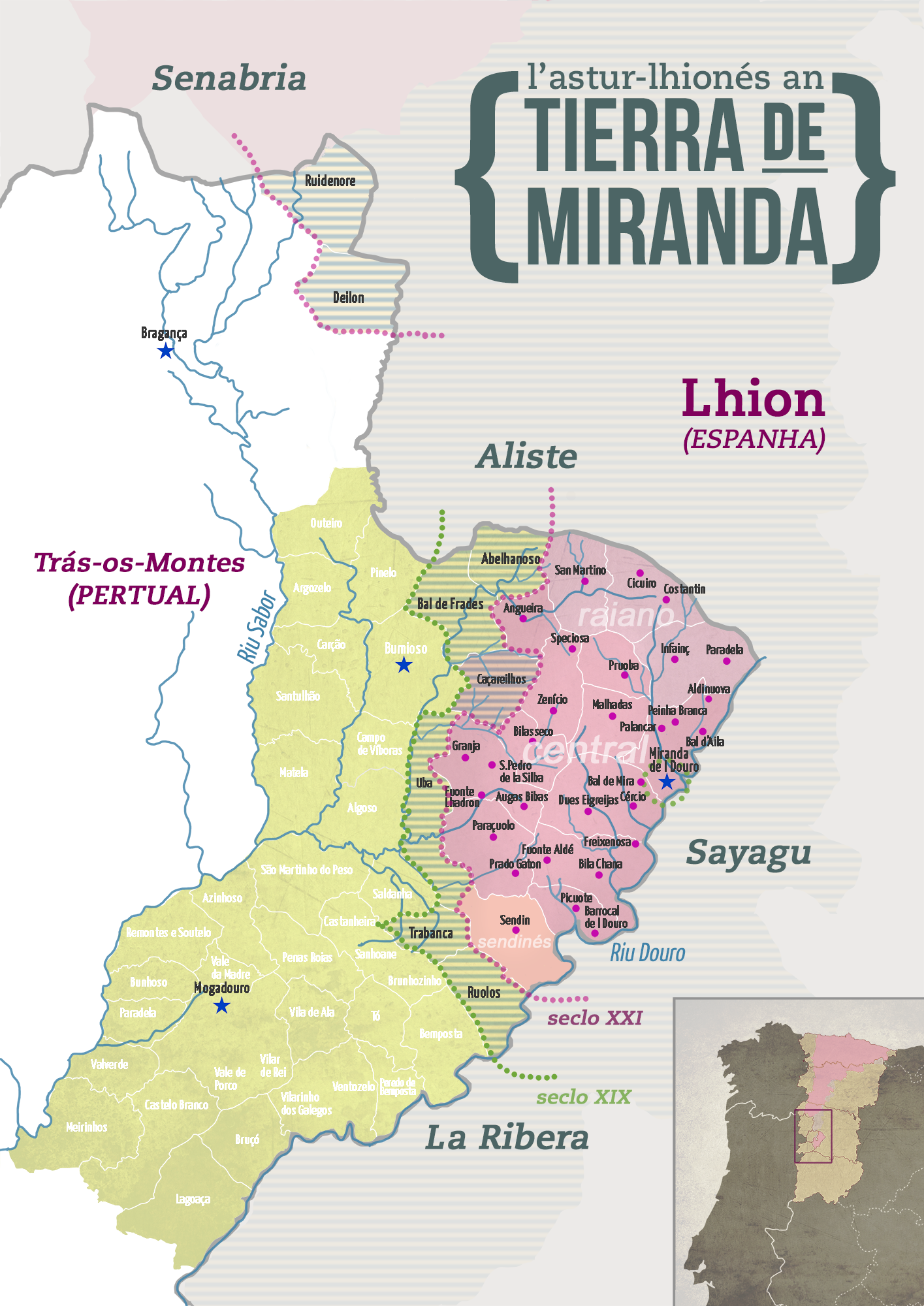
| langs = [[Portuguese | | langs = [[European Portuguese|Portuguese]], [[Mirandese]], [[Portuguese Sign Language|Portuguese Sign Language(LGP)]] | ||
| rels = Predominantly [[ | | rels = Predominantly [[Latin Catholic]]<ref>{{cite book|last=Faris|first=Robert N.|year=2014|isbn=978-1-63087-484-1|publisher=Wipf and Stock Publishers |title=Liberating Mission in Mozambique: Faith and Revolution in the Life of Eduardo Mondlane|url={{google books|plainurl=y|id=qaENBQAAQBAJ|page=114}}}}</ref><ref>{{cite book|last=Cavendish|first=Marshall|publisher=Marshall Cavendish|isbn=978-0-7614-7378-7|year=2002 |title=Peoples of Europe|page=382|url={{google books|plainurl=y|id=gwqL95lflz4C|page=382}}}}</ref> | ||
| related_groups = [[Galicians]], [[ | | related_groups = Other [[Romance languages|Romance]]-speaking peoples<br />Especially [[Galicians]], [[Extremadurans]], [[Barranquenhos]], [[Mirandese people|Mirandese]], [[Spaniards]], and other [[Geographical distribution of Portuguese speakers|Lusophones]] | ||
| footnotes = {{note|a|a}} Total number of ethnic Portuguese varies wildly based on the definition. | | footnotes = {{note|a|a}} Total number of ethnic Portuguese varies wildly based on the definition. | ||
}} | }} | ||
The '''Portuguese people''' ({{ | The '''Portuguese people''' ({{Langx|pt|Portugueses}} – masculine – or ''Portuguesas'') are a [[Romance peoples|Romance-speaking ethnic group]] and nation [[Ethnic groups in Europe|indigenous]] to [[Portugal]], a country that occupies the west side of the [[Iberian Peninsula]] in [[Southern Europe|south-west Europe]], who share [[Culture of Portugal|culture]], [[ancestry]] and [[Portuguese language|language]].<ref name="Pop">{{cite book|last=Pop|first=Ioan-Aurel|url={{google books|plainurl=y|id=xDwMAQAAMAAJ}}|title=Romanians and Hungarians from the 9th to the 14th century|date=1996|publisher=[[Romanian Cultural Foundation]]|isbn=0-88033-440-1|quote=We could say that contemporary Europe is made up of three large groups of peoples, divided on the criteria of their origin and linguistic affiliation. They are the following: the Romanic or neo-Latin peoples (Italians, Spaniards, Portuguese, French, Romanians, etc.), the Germanic peoples (Germans proper, English, Dutch, Danes, Norwegians, Swedes, Icelanders, etc.), and the Slavic peoples (Russians, Ukrainians, Belorussians, Poles, Czechs, Slovaks, Bulgarians, Serbs, Croats, Slovenians, etc.|author-link=Ioan-Aurel Pop}}</ref><ref name="Minahan">{{cite book |last=Minahan |first=James |title=One Europe, Many Nations: A Historical Dictionary of European National Groups |url={{google books|plainurl=y|id=NwvoM-ZFoAgC|page=533}} |date=2000 |publisher=[[Greenwood Publishing Group]] |page=533 |isbn=0-313-30984-1 |quote=The Portuguese are a Latin nation}}</ref><ref>{{cite book |last=Minahan |first=James |title=One Europe, Many Nations: A Historical Dictionary of European National Groups |url={{google books|plainurl=y|id=NwvoM-ZFoAgC|page=776}}|date=2000 |publisher=[[Greenwood Publishing Group]] |page=776 |isbn=978-0-313-30984-7 |quote=Romance (Latin) nations... Portuguese}}</ref> | ||
The Portuguese state began with the founding of the [[County of Portugal]] in [[868]]. Following the [[Battle of São Mamede]] (1128), Portugal gained international recognition as a [[Kingdom of Portugal|kingdom]] through the [[Treaty of Zamora]] and the [[papal bull]] [[Manifestis Probatum]]. This Portuguese state paved the way for the Portuguese people to unite as a nation.<ref name=":21">{{Cite web |last=says |first=Soraya Gomes |date=2022-09-10 |title=Os 23 povos que deram origem aos portugueses {{!}} VortexMag |url=https://www.vortexmag.net/povos-que-deram-origem-aos-portugueses/ |access-date=2023-04-20 |website=www.vortexmag.net |language=pt-PT}}</ref><ref name=":22">{{Cite web |title=Batalha de São Mamede |url=https://www.leme.pt/magazine/efemerides/0624/batalha-de-sao-mamede.html |access-date=2023-04-20 |website=www.leme.pt}}</ref><ref name=":23">{{Cite web |title=O Tratado de Zamora |url=https://ensina.rtp.pt/artigo/tratado-de-zamora/ |access-date=2023-04-20 |website=RTP Ensina |language=pt-PT}}</ref> | |||
The Portuguese [[Portuguese maritime exploration|explored]] [[Hic sunt Dracones|distant lands]] previously unknown to Europeans—in the Americas, Africa, Asia and Oceania (southwest Pacific Ocean). In 1415, with the [[conquest of Ceuta]], the Portuguese took a significant role in the [[Age of Discovery]], which culminated in a [[Portuguese Empire|colonial empire]]. It was one of the first global empires and one of the world's major economic, political and military powers in the 15th and 16th centuries, with territories that became part of numerous countries.<ref>Melvin Eugene Page, Penny M. Sonnenburg, p. 481</ref><ref>{{cite journal |last1=Valdez |first1=Ana T. |title=(PDF) The First Globalization: The Portuguese and the Age of Discovery |url=https://www.academia.edu/10885837 |journal=Academia.edu |access-date=24 April 2020}}</ref><ref name="weforum1">{{cite web |title=A brief history of globalization |url=https://www.weforum.org/agenda/2019/01/how-globalization-4-0-fits-into-the-history-of-globalization/ |access-date=24 April 2020 |work=Weforum.org}}</ref> Portugal helped to launch the spread of [[Western culture|Western civilization]] to other geographies.<ref>{{Cite book |last1=Crowley |first1=Roger |url={{google books|plainurl=y|id=NU1GAwAAQBAJ}} |title=Conquerors: How Portugal seized the Indian Ocean and forged the First Global Empire |date=15 September 2015 |publisher=Faber & Faber |isbn=978-0-571-29091-8}}</ref><ref>{{Cite book |last1=Page |first1=Martin |url={{google books|plainurl=y|id=-IIEhFx0OfwC}} |title=The First Global Village: How Portugal Changed the World |year=2002 |publisher=Casa das Letras |isbn=978-972-46-1313-0}}</ref><ref>{{cite journal |last1=Exenberger |first1=Andreas |title=(PDF) The Cradle of Globalisation Venice's and Portugal's Contribution to a World Becoming Global |url=https://www.academia.edu/8378880 |journal=Academia.edu |access-date=24 April 2020}}</ref><ref name="weforum1" /> | |||
During and after the period of the [[Portuguese Empire]], the Portuguese diaspora spread across the world.<ref>{{Cite web |title=Portuguese Communities |url=https://portaldiplomatico.mne.gov.pt/en/foreign-policy/portuguese-communities |access-date=2023-04-20 |website=Diplomatic Portal |language=en-gb}}</ref> | |||
{{Toclimit}} | |||
== Ancestry == | |||
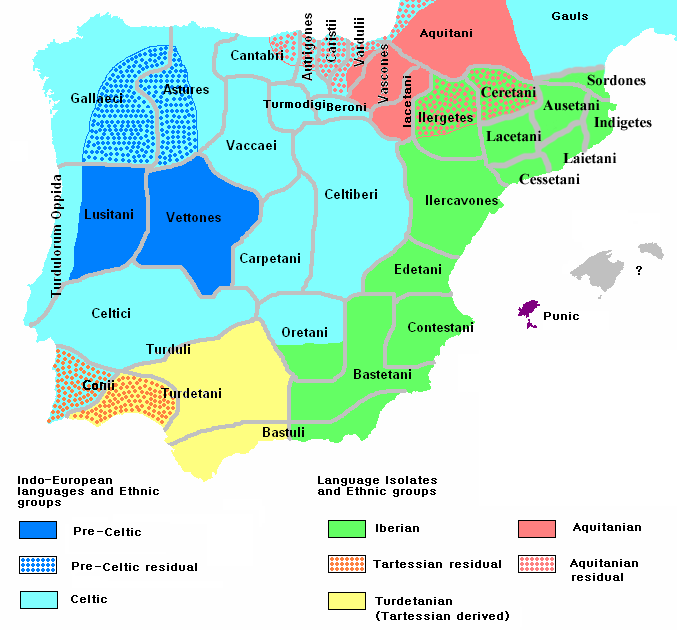
The | The Portuguese people's [[Ancestor|heritage]] largely derives from the [[Indo-European]] (''[[Lusitanians]], [[Cynetes|Conii]]''),<ref>{{cite web|url=https://ppg.revistas.uema.br/index.php/brathair/article/download/1785/1305|title=Celts and the Castro Culture in the Iberian Peninsula – issues of national identity and Proto-Celtic substratum|website=Ppg.revistas.uema.br|access-date=2 March 2022}}</ref><ref>{{cite journal|url=https://dc.uwm.edu/cgi/viewcontent.cgi?article=1028&context=ekeltoi |title=The Celts in Portugal|date=9 September 2004|first=Teresa Júdice |last=Gamito|journal=E-Keltoi Journal of Interdisciplinary Celtic Studies}}</ref><ref>"the Indo-European but clearly non-Celtic language that we today call Lusitanian.(...)": Book Reviews: Alejandro G. Sinner, Javier Velaza (eds.). ''Palaeohispanic Languages and Epigraphies'', Oxford University Press, 2019, Juan Luis García Alonso, University of Salamanca, Spain, ''Journal of Language Relationship, № 19/3-4, 2021''</ref> and [[Celts|Celtic]] peoples (''[[Gallaecians]], [[Turduli]] and [[Celtici]]'').<ref>{{cite web|url=https://www.britannica.com/place/Portugal/History |title=Portugal – History |publisher=Britannica |access-date=21 January 2020}}</ref><ref>{{cite journal|url=https://revistas.ucm.es/index.php/CMPL/article/view/53220/48889 |title=Vista de "Lancea", palabra lusitana, y la etnogénesis de los "Lancienses" |journal=Complutum |date=14 July 2016 |volume=27 |issue=1 |pages=131–168 |publisher=Revistas.ucm.es |doi=10.5209/CMPL.53220 |access-date=21 January 2020|last1=Almagro-Gorbea |first1=Martín |doi-access=free}}</ref><ref>{{Cite book |url={{google books|plainurl=y|id=kfv6HKXErqAC|page=144}}|page=144 |title = Encyclopedia of European Peoples |isbn=978-1-4381-2918-1 |last1=Waldman|first1=Carl|last2=Mason|first2=Catherine|year=2006|publisher = Infobase }}</ref> They were later [[Romanization (cultural)|Romanized]] after the [[Roman conquest of the Iberian Peninsula|Roman conquest]].<ref name="Bycroft2019">{{cite journal|last=Bycroft|first=Clare|display-authors=etal|title=Patterns of genetic differentiation and the footprints of historical migrations in the Iberian Peninsula|journal=Nature Communications|volume=10|issue=1|year=2019|article-number=551|doi=10.1038/s41467-018-08272-w|pmid=30710075|pmc=6358624|bibcode=2019NatCo..10..551B}}</ref><ref name="Olalde2019">{{cite journal|last=Olalde|first=Iñigo|display-authors=etal|title=The genomic history of the Iberian Peninsula over the past 8000 years|journal=Science|volume=363 |issue=6432|year=2019|pages=1230–1234|doi=10.1126/science.aav4040|pmid=30872528|pmc=6436108|bibcode=2019Sci...363.1230O}}</ref><ref>{{Cite web |last=Lenzi |first=Tié |date=2021-12-10 |title=Povo português: conheça as suas origens e características |url=https://www.nacionalidadeportuguesa.com.br/povo-portugues/ |access-date=2023-04-20 |website=Nacionalidade Portuguesa Assessoria |language=en}}</ref> The [[Portuguese language]]–the native language of the [[Languages of Portugal|overwhelming majority]] of Portuguese people–stems from [[Vulgar Latin]].<ref>{{Citation |last=Pöll |first=Bernhard |title=History of the Portuguese Lexicon |date=2019-04-26 |url=https://oxfordre.com/linguistics/display/10.1093/acrefore/9780199384655.001.0001/acrefore-9780199384655-e-463 |encyclopedia=Oxford Research Encyclopedia of Linguistics |access-date=2023-07-18 |language=en |doi=10.1093/acrefore/9780199384655.013.463 |isbn=978-0-19-938465-5|url-access=subscription }}</ref> | ||
A number of male Portuguese lineages descend from [[Germanic peoples|Germanic]] tribes who arrived as ruling elites after the Roman period, starting in [[409]].<ref>{{Cite web |title=As invasões bárbaras da Península Ibérica |url=https://ensina.rtp.pt/artigo/as-invasoes-barbaras-da-peninsula-iberica/ |access-date=2023-04-20 |website=RTP Ensina |language=pt-PT}}</ref> These included the [[Suebi]], [[Buri tribe|Buri]], [[Hasdingi]] [[Vandals]] and [[Visigoths]]. The pastoral [[North Caucasus]]' [[Alans]] left traces in a few central-southern areas (e.g. [[Alenquer, Portugal|Alenquer]], from "''Alen Kerke''" or "Temple of the Alans").<ref>Milhazes, José. [http://www.rtp.pt/index.php?article=264957&visual=16&rss=0 Os antepassados caucasianos dos portugueses] {{webarchive|url=https://web.archive.org/web/20160101100219/http://www.rtp.pt/index.php?article=264957&visual=16&rss=0 |date=2016-01-01}} – [[Rádio e Televisão de Portugal]] in [[Portuguese language|Portuguese]].</ref><ref>Ivo Xavier Fernándes. Topónimos e gentílicos, Volume 1, 1941, p. 144.</ref><ref>{{cite journal|url=https://www.academia.edu/13589202|title= Mitos e Concepções dos Alanos no Ocidente Ibérico|last1=Oliveira|first1=Ricardo Costa de|website=Academia.edu}}</ref><ref>{{cite journal |url=https://www.academia.edu/37321555 |title=IN TEMPORE SUEBORUM. The time of the Suevi in Gallaecia (411–585 AD). Exhibition Catalogue (English) |journal=Jorge López Quiroga-Artemio M. Martínez Tejera (Coord.): In Tempore Sueborum. The Time of the Sueves in Gallaecia (411–585 Ad). The First Medieval Kingdom of the West, Ourense |date=January 2017 |last1=Quiroga |first1=Jorge López }}</ref> | |||
The [[Umayyad conquest of Hispania|Umayyad conquest of Iberia]], between the [[Timeline of the Muslim presence in the Iberian Peninsula|early 8th century]] until the [[Siege of Faro (1249)|12th century]], also left small [[Moorish]], [[Sephardi Jews|Jewish]] and [[Saqaliba]] genetic contributions.<ref>{{cite journal|title=Portuguese crypto-Jews: the genetic heritage of a complex history|year=2015|pmc=4313780|last1=Nogueiro|first1=I.|last2=Teixeira|first2=J. C.|last3=Amorim|first3=A.|last4=Gusmão|first4=L.|last5=Alvarez|first5=L.|journal=Frontiers in Genetics|volume=6|page=12|doi=10.3389/fgene.2015.00012|pmid=25699075|doi-access=free}}</ref><ref name=":19">{{cite journal|title=The Genetic Legacy of Religious Diversity and Intolerance: Paternal Lineages of Christians, Jews, and Muslims in the Iberian Peninsula|year=2008|pmc=2668061 |last1=Adams|first1=S. M.|last2=Bosch|first2=E.|last3=Balaresque|first3=P. L.|last4=Ballereau|first4=S. J.|last5=Lee|first5=A. C.|last6=Arroyo|first6=E.|last7=López-Parra |first7=A. M.|last8=Aler|first8=M.|last9=Grifo|first9=M. S.|last10=Brion|first10=M.|last11=Carracedo|first11=A. |last12=Lavinha|first12=J.|last13=Martínez-Jarreta|first13=B.|last14=Quintana-Murci|first14=L.|last15=Picornell|first15=A.|last16=Ramon |first16=M.|last17=Skorecki|first17=K.|last18=Behar|first18=D. M.|last19=Calafell|first19=F.|last20=Jobling|first20=M. A.|journal=American Journal of Human Genetics|volume=83|issue=6 |pages=725–736|doi=10.1016/j.ajhg.2008.11.007|pmid=19061982}}</ref><ref name="Bycroft2019" /><ref name="Olalde2019" /> Other minor – as well as later – influences include small [[Viking]] [[Vikings in Iberia|settlements between the 9th and 11th centuries]], made by [[Norsemen]] who raided coastal areas mainly in the northern regions of [[Douro]] and [[Minho (river)|Minho]].<ref name="auto1">{{cite web |title=The Viking Routes / Les Routes Des Vikings |url=http://culture-routes.net/sites/default/files/Fiche%20A4-1994-Viking.pdf |archive-url=https://web.archive.org/web/20160911173220/http://www.culture-routes.net/sites/default/files/Fiche%20A4-1994-Viking.pdf |archive-date=11 September 2016 |access-date=3 April 2018}}</ref><ref name="História da Póvoa de Varzim">{{cite web |title=História da Póvoa de Varzim |url=http://terrasdeportugal.wikidot.com/historia-da-povoa-de-varzim |publisher=Memória Portuguesa |language=pt}}</ref><ref name="auto2">{{cite web |title=09 |url=https://ler.letras.up.pt/uploads/ficheiros/3886.pdf |access-date=24 April 2020}}</ref><ref name="Vikings- Warriors from the sea">{{cite web |title=Vikings- Warriors from the sea |url=https://portugal.um.dk/en/culture/culture-events/eventdisplaypage/?eventid=1bd54bcf-6989-430b-ab7d-2ddd5640d986 |archive-url=https://web.archive.org/web/20200924073048/https://portugal.um.dk/en/culture/culture-events/eventdisplaypage/?eventid=1bd54bcf-6989-430b-ab7d-2ddd5640d986 |archive-date=24 September 2020 |access-date=24 April 2020 |publisher=Portugal.um.dk}}</ref> Low-incidence, pre-Roman influence came from [[Phoenicians]] and [[Ancient Greece|Greeks]] in southern coastal areas.<ref>{{Cite web|url=https://www.infopedia.pt/apoio/artigos/$fenicios-e-gregos-na-peninsula-iberica|title=Fenícios e Gregos na Península Ibérica - Infopédia}}</ref> | |||
== Name == | == Name == | ||
The name Portugal | The name Portugal is a [[portmanteau]] that comes from the [[Latin]] word ''Portus'' (meaning port) and a second word ''Cale'', whose meaning and origin are unclear. ''Cale'' is probably a reminder of the [[Gallaeci]] (also known as Callaeci), a [[Celts|Celtic]] tribe that lived in part of [[North Region, Portugal|Northern Portugal]]. | ||
Alternatively the name may have come from the early settlement of Cale (today's [[Gaia]]), situated on the mouth of the [[Douro|Douro River]] on the Atlantic coast (''Portus Cale''). The name Cale seems to come from the [[Celts]] – perhaps from one of their specifications, ''Cailleach'' – but which, in everyday life, was synonymous with shelter, anchorage or door.<ref>{{Cite web|url=https://manuelfariasousa.pt/ficheiros/d13615381YvuHVwQhxJ.pdf|title=Porque é que Portugal se chama Portugal?}}</ref> Among other theories, some suggest that Cale may stem from the [[Greek language|Greek]] word for ''kalós'' (beautiful). Another theory for Portugal postulates a French derivation, ''Portus Gallus''<ref>{{cite web | url=https://books.google.com/books?id=MD8zAQAAMAAJ&q=portus+Gallus+etymologie+du+portugal&pg=PA441 | title=Manuel géographique et statistique de l'Espagne et du Portugal | date=25 September 2023 }}</ref> "port of the Gauls". | |||
During the [[Middle Ages]], the area around Cale became known through the [[Visigoths]] as ''Portucale''. Portucale could have evolved in the 7th and 8th centuries, to become | During the [[Middle Ages]], the area around Cale became known through the [[Visigoths]] as ''Portucale''. Portucale could have evolved in the 7th and 8th centuries, to become ''Portugale'', or Portugal, from the 9th century. The term denoted the area between the Douro and [[Minho (river)|Minho]] rivers.<ref>{{Cite web |title=De onde vem o nome Portugal? |date=24 June 2021 |url=https://www.vortexmag.net/de-onde-vem-o-nome-portugal-2/}}</ref> | ||
== Early inhabitants == | == Early inhabitants == | ||
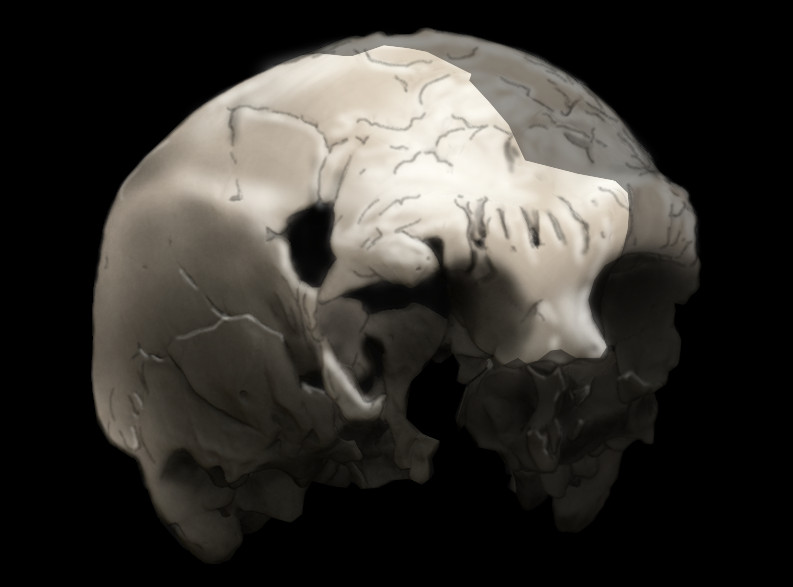
{{Main|Genetic history of the Iberian Peninsula}} {{Further|Genetic history of Europe}} | {{Main|Genetic history of the Iberian Peninsula}} {{Further|Genetic history of Europe}}[[File:Aroeira3.jpg|left|thumb|[[Aroeira 3]] skull of 400,000-year-old ''[[Homo heidelbergensis]]'' found in 2014. The oldest trace of human history in Portugal]] | ||
Portuguese origins are predominantly from [[Southern Europe|Southern]] and Western Europe. The earliest [[Human|modern humans]] inhabiting Portugal are believed to have arrived in the [[Iberian Peninsula]] 35,000 to 40,000 years ago. [[Y-chromosome]] and [[mtDNA]] data suggest that modern Portuguese trace a proportion of these lineages to the [[Paleolithic]] peoples who began settling the European continent at the end of the [[Wisconsin glaciation|last glaciation]] around 45,000 years ago. | |||
[[File:Aroeira3.jpg|left|thumb|[[Aroeira 3]] skull of 400,000 year old ''[[Homo heidelbergensis]]'' found in 2014. The oldest trace of human history in Portugal]] | |||
[[File:Y-Haplogroup R1 distribution.png|thumb|left|Distribution of [[R1a]] (purple) and '''[[R1b]]''' (red). See also [[:File:R1b.jpg|this map]] for distribution in Europe.]] | [[File:Y-Haplogroup R1 distribution.png|thumb|left|Distribution of [[R1a]] (purple) and '''[[R1b]]''' (red). See also [[:File:R1b.jpg|this map]] for distribution in Europe.]] | ||
Northern Iberia is believed to have been a major [[Ice age | Northern Iberia is believed to have been a major [[Ice age]] refuge from which Paleolithic humans later colonized Europe. Migrations from northern Iberia during the Paleolithic and [[Mesolithic]] link modern [[Iberian Peninsula|Iberians]] to much of Western Europe, particularly the [[British Isles]] and [[Atlantic Europe]].<ref>{{cite web|url=https://www.cepese.pt/portal/pt/investigacao/livro-historia-da-populacao-portuguesa |title=HISTÓRIA DA POPULAÇÃO PORTUGUESA: Das longas permanências à conquista da modernidade|author=Teresa Ferriera Rodrigues|website=Cepese.pt|access-date=2 March 2022}}</ref> | ||
Y-chromosome [[haplogroup]] [[R1b]] is the most common haplogroup in | Y-chromosome [[haplogroup]] [[R1b]] is the most common haplogroup in the Iberian peninsula and western Europe.<ref>{{cite journal |vauthors=Pericić M, Lauc LB, Klarić IM, Rootsi S, Janićijevic B, Rudan I, Terzić R, Colak I, Kvesić A, Popović D, Sijacki A, Behluli I, Dordevic D, Efremovska L, Bajec DD, Stefanović BD, Villems R, Rudan P |display-authors=6 |title=High-resolution phylogenetic analysis of southeastern Europe traces major episodes of paternal gene flow among Slavic populations |journal=Molecular Biology and Evolution |volume=22 |issue=10 |pages=1964–75 |date=October 2005 |pmid=15944443 |doi=10.1093/molbev/msi185 |doi-access=free }}</ref> One of the best-characterized of Iberian haplotypes is the [[Atlantic Modal Haplotype]] (AMH). This haplotype reaches the highest frequencies there and in the British Isles. In Portugal it reckons generally 65% in the South, ranging from 87-96% northwards.<ref>{{cite web|author=Čeština: Distribuce genu R1b napříč Evropou |url=http://commons.wikimedia.org/wiki/File:R1b-DNA-Distribution.jpg |title=File:R1b-DNA-Distribution – Wikimedia Commons |publisher=Commons.wikimedia.org |date=15 June 2012 |access-date=24 August 2014}}</ref> | ||
=== | === Neolithic === | ||
The [[Neolithic]] colonization of Europe from | {{See also|Early European Farmers}} | ||
The [[Neolithic]] [[Pre-modern human migration|colonization of Europe]] from Western Asia and the Middle East, beginning around 10,000 years ago, reached [[Iberian Peninsula|Iberia]] after reaching the rest of the continent. According to the [[demic diffusion]] model its impact was greatest in the southern and eastern regions.<ref name="pmid15044595">{{cite journal |vauthors=Dupanloup I, Bertorelle G, Chikhi L, Barbujani G |title=Estimating the impact of prehistoric admixture on the genome of Europeans |journal=Molecular Biology and Evolution |volume=21 |issue=7 |pages=1361–72 |date=July 2004 |pmid=15044595 |doi=10.1093/molbev/msh135 |s2cid=17665038 |doi-access=free }}</ref> | |||
=== | === Celts and Indo-Europeans === | ||
[[ | [[File:Cultures, 1200 BC.PNG|right|thumb|'''A simplified map of archaeological cultures of the late Bronze Age (c. 1200 BC):''' {{legend|#1E90FF|[[Terramare culture]]|size=60%|outline=#1E90FF}} {{legend|#FF0000|central [[Urnfield culture]]|size=60%|outline=#FF0000}} {{legend|#FF8C00|northern Urnfield culture|size=60%|outline=#FF8C00}} {{legend|#FF00FF|[[Lusatian culture]]|size=60%|outline=#FF00FF}} {{legend|#1E90FF|(in central Europe) [[Knovíz culture]]|size=60%|outline=#1E90FF}} {{legend|#808000|[[Danubian culture]]|size=60%|outline=#808000}} {{legend|#00FF7F|[[Atlantic Bronze Age]]|size=60%|outline=#00FF7F}} {{legend|#FFD700|[[Nordic Bronze Age]]|size=60%|outline=#FFD700}}]] | ||
In the 3rd millennium BC, during the [[Bronze Age]], the first wave of migrations by [[Indo-European languages|Indo-European language]] speakers into Iberia occurred. The expansion of [[haplogroup R1b]] in Western Europe, most common in many areas of [[Atlantic Europe]], was primarily due to massive migrations from the [[Pontic–Caspian steppe]] of Eastern Europe during the [[Bronze Age]], along with carriers of [[Indo-European languages]] like [[proto-Celtic]] and [[proto-Italic]]. Unlike older studies on uniparental markers, large amounts of [[autosomal DNA]] were analyzed in addition to paternal [[Y-DNA]]. An [[autosomal]] component was detected in modern Europeans that was not present in the Neolithic or Mesolithic, and which entered Europe with paternal lineages R1b and R1a, as well as the Indo-European languages.<ref>{{cite journal |last1=Haak |first1=Wolfgang |last2=Lazaridis |first2=Iosif |last3=Patterson |first3=Nick |last4=Rohland |first4=Nadin |last5=Mallick |first5=Swapan |last6=Llamas |first6=Bastien |last7=Brandt |first7=Guido |last8=Nordenfelt |first8=Susanne |last9=Harney |first9=Eadaoin |last10=Stewardson |first10=Kristin |last11=Fu |first11=Qiaomei |last12=Mittnik |first12=Alissa |last13=Bánffy |first13=Eszter |last14=Economou |first14=Christos |last15=Francken |first15=Michael |display-authors=5 |date=2015-03-02 |title=Massive migration from the steppe was a source for Indo-European languages in Europe |journal=Nature |publisher=Springer Science and Business Media LLC |volume=522 |issue=7555 |pages=207–211 |arxiv=1502.02783 |bibcode=2015Natur.522..207H |biorxiv=10.1101/013433 |doi=10.1038/nature14317 |issn=0028-0836 |pmc=5048219 |pmid=25731166 |s2cid=196643946 |last16=Friederich |first16=Susanne |last17=Pena |first17=Rafael Garrido |last18=Hallgren |first18=Fredrik |last19=Khartanovich |first19=Valery |last20=Khokhlov |first20=Aleksandr |last21=Kunst |first21=Michael |last22=Kuznetsov |first22=Pavel |last23=Meller |first23=Harald |last24=Mochalov |first24=Oleg |last25=Moiseyev |first25=Vayacheslav |last26=Nicklisch |first26=Nicole |last27=Pichler |first27=Sandra L. |last28=Risch |first28=Roberto |last29=Rojo Guerra |first29=Manuel A. |last30=Roth |first30=Christina |last31=Szécsényi-Nagy |first31=Anna |last32=Wahl |first32=Joachim |last33=Meyer |first33=Matthias |last34=Krause |first34=Johannes |last35=Brown |first35=Dorcas |last36=Anthony |first36=David |last37=Cooper |first37=Alan |last38=Alt |first38=Kurt Werner |last39=Reich |first39=David}}</ref><ref>{{Cite journal |last1=Allentoft |first1=Morten E. |last2=Sikora |first2=Martin |last3=Sjögren |first3=Karl-Göran |last4=Rasmussen |first4=Simon |last5=Rasmussen |first5=Morten |last6=Stenderup |first6=Jesper |last7=Damgaard |first7=Peter B. |last8=Schroeder |first8=Hannes |last9=Ahlström |first9=Torbjörn |last10=Vinner |first10=Lasse |last11=Malaspinas |first11=Anna-Sapfo |last12=Margaryan |first12=Ashot |last13=Higham |first13=Tom |last14=Chivall |first14=David |last15=Lynnerup |first15=Niels |display-authors=29 |year=2015 |title=Population genomics of Bronze Age Eurasia |url=https://depot.ceon.pl/handle/123456789/13155 |journal=Nature |volume=522 |issue=7555 |pages=167–172 |bibcode=2015Natur.522..167A |doi=10.1038/nature14507 |pmid=26062507 |s2cid=4399103 |last16=Harvig |first16=Lise |last17=Baron |first17=Justyna |last18=Casa |first18=Philippe Della |last19=Dąbrowski |first19=Paweł |last20=Duffy |first20=Paul R. |last21=Ebel |first21=Alexander V. |last22=Epimakhov |first22=Andrey |last23=Frei |first23=Karin |last24=Furmanek |first24=Mirosław |last25=Gralak |first25=Tomasz |last26=Gromov |first26=Andrey |last27=Gronkiewicz |first27=Stanisław |last28=Grupe |first28=Gisela |last29=Hajdu |first29=Tamás |last30=Jarysz |first30=Radosław}}</ref><ref>{{Cite bioRxiv |last1=Mathieson |first1=Iain |last2=Lazaridis |first2=Iosif |last3=Rohland |first3=Nadin |last4=Mallick |first4=Swapan |last5=Patterson |first5=Nick |last6=Alpaslan Roodenberg |first6=Songul |last7=Harney |first7=Eadaoin |last8=Stewardson |first8=Kristin |last9=Fernandes |first9=Daniel |last10=Novak |first10=Mario |last11=Sirak |first11=Kendra |last12=Gamba |first12=Cristina |last13=Jones |first13=Eppie R. |last14=Llamas |first14=Bastien |last15=Dryomov |first15=Stanislav |display-authors=29 |year=2015 |title=Eight thousand years of natural selection in Europe |biorxiv=10.1101/016477 |last16=Pickrell |first16=Joseph |last17=Arsuaga |first17=Juan Luis |last18=De Castro |first18=Jose Maria Bermudez |last19=Carbonell |first19=Eudald |last20=Gerritsen |first20=Fokke |last21=Khokhlov |first21=Aleksandr |last22=Kuznetsov |first22=Pavel |last23=Lozano |first23=Marina |last24=Meller |first24=Harald |last25=Mochalov |first25=Oleg |last26=Moiseyev |first26=Vayacheslav |last27=Rojo Guerra |first27=Manuel A. |last28=Roodenberg |first28=Jacob |last29=Verges |first29=Josep Maria |last30=Krause |first30=Johannes}}</ref>[[File:Indo-European migrations.jpg|thumb|left|Indo-European migrations|224x224px]] | |||
The first immigrations of Indo-European | The first immigrations of Indo-European language speakers were followed by waves of [[Celt]]s. The Celts arrived in Portugal about 3,000 years ago.<ref>{{Cite web |title=OS CELTAS |url=https://abemdanacao.blogs.sapo.pt/os-celtas-1422373 |access-date=2023-04-20 |website=abemdanacao.blogs.sapo.pt}}</ref> Migration was particularly intense from the 7th to the 5th centuries BC.<ref name=EBO>{{cite book|last=Cunliffe|first=Barry|title=Europe Between the Oceans: Themes and Variations, 9000 BC-AD 1000|year=2008|publisher=Yale University Press|location=New Haven|isbn=978-0-300-17086-3|pages=254–258|edition=First printed in paperback 2011.}}</ref><ref>{{cite journal|last1=Bowman|first1=Sheridan|first2=Stuart|last2=Needham|journal=The Antiquaries Journal|year=2007|volume=87|pages=53–108|url=http://www.littlethetford.org/archaeology/Bowman-and-Needham.pdf|access-date=22 September 2011|doi=10.1017/s0003581500000846|title=The Dunaverney and Little Thetford Flesh-Hooks: History, Technology and Their Position within the Later Bronze Age Atlantic Zone Feasting Complex|s2cid=161084139}}</ref> | ||
These two processes defined Iberia's | These two processes defined Iberia's cultural landscape "Continental in the northwest and Mediterranean towards the southeast", as historian [[José Mattoso]] described.<ref>[[:pt:José Mattoso|Mattoso, José]] (dir.), História de Portugal. Primeiro Volume: Antes de Portugal, Lisboa, Círculo de Leitores, 1992. (in [[Portuguese language|Portuguese]])</ref> | ||
The northwest–southeast cultural shift also shows in genetic differences: based on 2016 findings,<ref>{{cite journal |display-authors=6 |vauthors=Barral-Arca R, Pischedda S, Gómez-Carballa A, Pastoriza A, Mosquera-Miguel A, López-Soto M, Martinón-Torres F, Álvarez-Iglesias V, Salas A |date=21 July 2016 |title=Meta-Analysis of Mitochondrial DNA Variation in the Iberian Peninsula |journal=PLOS ONE |volume=11 |issue=7 | | The northwest–southeast cultural shift also shows in genetic differences: based on 2016 findings,<ref>{{cite journal |display-authors=6 |vauthors=Barral-Arca R, Pischedda S, Gómez-Carballa A, Pastoriza A, Mosquera-Miguel A, López-Soto M, Martinón-Torres F, Álvarez-Iglesias V, Salas A |date=21 July 2016 |title=Meta-Analysis of Mitochondrial DNA Variation in the Iberian Peninsula |journal=PLOS ONE |volume=11 |issue=7 |article-number=e0159735 |bibcode=2016PLoSO..1159735B |doi=10.1371/journal.pone.0159735 |pmc=4956223 |pmid=27441366 |doi-access=free}}</ref> haplogroup H, a cluster within the haplogroup R category, is more prevalent along the [[Atlantic]] façade, including the [[Cantabrian Coast]] and Portugal. Its highest frequency is in [[Galicia (Spain)|Galicia]] (northwestern corner of Iberia). The frequency of haplogroup H shows a decreasing trend from the Atlantic façade toward the Mediterranean. | ||
This finding adds strong evidence | This finding adds strong evidence that [[Galicia (Spain)|Galicia]] and [[North Region, Portugal|Northern Portugal]] was a cul-de-sac population, a kind of European edge for a major ancient central European migration. An interesting pattern of genetic continuity exists along the [[Cantabria]] coast and Portugal, a pattern observed previously when minor sub-clades of the mtDNA phylogeny were examined.<ref name="autogenerated7825">{{Cite journal |pmc=6534591|year=2019|last1=Pimenta|first1=J.|title=Spatially explicit analysis reveals complex human genetic gradients in the Iberian Peninsula|journal=Scientific Reports|volume=9|issue=1|page=7825|last2=Lopes|first2=A. M.|last3=Carracedo|first3=A. |last4=Arenas|first4=M.|last5=Amorim|first5=A.|last6=Comas|first6=D.|pmid=31127131|doi=10.1038/s41598-019-44121-6|bibcode=2019NatSR...9.7825P}}</ref> | ||
Given the | Given the Paleolithic and Neolithic origins, as well as [[Bronze Age]] and [[Iron Age]] [[Proto-Indo-Europeans|Indo-European]] migrations, the Portuguese [[ethnic origin]] was mainly a mixture of [[pre-Celtic|pre-Celts]] or para-[[Celts]], such as the [[Lusitanians]]<ref name="google1854">{{cite web |url=https://books.google.com/books?id=aAkFAAAAYAAJ&q=lusitanians+celtic+people&pg=PA583 |title=Dictionary of Greek and Roman Geography|last1=Smith|first1=William|year=1854}}</ref> of [[Lusitania]], and [[Celts|Celtic]] peoples such as [[Gallaeci]] of [[Gallaecia]], the [[Celtici]]<ref>{{Cite book |url=https://books.google.com/books?id=kfv6HKXErqAC&q=celtici+portugal&pg=PA144 |title=Encyclopedia of European Peoples |isbn=978-1-4381-2918-1 |last1=Waldman |first1=Carl |last2=Mason |first2=Catherine |year=2006|publisher=Infobase }}</ref> and the [[Cynetes]]<ref>{{Cite book |url=https://books.google.com/books?id=LFJAShEc8ykC&q=kunesioi&pg=PA475 |title=Origines Celticae (A Fragment) and Other Contributions to the History of Britain |isbn=978-0-8046-1223-4 |last1=Guest |first1=Edwin |year=1971|publisher=Ardent Media }}</ref> of [[Alentejo]] and the [[Algarve]]. | ||
== Pre-Roman populations == | == Pre-Roman populations == | ||
| Line 187: | Line 179: | ||
{{Distinguish|Lusatia}} | {{Distinguish|Lusatia}} | ||
The '''[[Lusitanians]]''' (or '''''Lusitānus''''' | The '''[[Lusitanians]]''' (or '''''Lusitānus''''' – singular – '''''Lusitani''''' – plural – in [[Latin]]) were an [[Proto-Indo-Europeans|Indo-European people]] living in the Western [[Iberian Peninsula]] long before it became the [[Ancient Rome|Roman]] [[Roman provinces|province]] of [[Lusitania]] (modern [[Portugal]], Extremadura and part of [[Salamanca]]). They spoke [[Lusitanian language|Lusitanian]], of which only a few short written fragments survive. Most Portuguese consider Lusitanians as their ancestors, although the northern regions ([[Minho Province|Minho]], [[Douro (intermunicipal community)|Douro]], [[Trás-os-Montes]]) identify more with [[Gallaecians]]. Linguists such as [[Ellis Evans]] claimed that [[Gallaecian]]-Lusitanian was one language (thus not separate languages) of the "p" [[Celtic languages|Celtic]] variant.<ref>{{cite web |title=Archived copy |url=https://ilg.usc.es/agon/wp-content/uploads/2010/09/Callaica_Nomina.pdf |archive-url=https://web.archive.org/web/20200930005923/https://ilg.usc.es/agon/wp-content/uploads/2010/09/Callaica_Nomina.pdf |archive-date=30 September 2020 |access-date=16 May 2020}}</ref><ref>{{Cite book |url=https://books.google.com/books?id=f899xH_quaMC&q=Evans+lusitanian+celt+linguist&pg=PA484 |title=Celtic Culture: A-Celti |year=2006 |isbn=978-1-85109-440-0 |last1=Koch |first1=John T. |publisher=Bloomsbury Academic }}</ref> They were a large [[tribe]] who lived between [[Douro River|Douro]] and [[Tagus]] rivers. | ||
The [[Lusitanians]] may have originated in the [[Alps]] and settled in the region in the 6th century BC. Scholars such as [[Dáithí Ó hÓgáin]] consider them to be [[Indigenous peoples|indigenous]].<ref>{{cite book |last=Ó hÓgáin |first=Dáithí |url=https://books.google.com/books?id=-yd1huHoXJwC&pg=PA73 |title=The Celts: A History |publisher=The Collins Press |year=2002 |isbn=978-0-85115-923-2 |place=Cork |page=73}}</ref> He claimed they were initially dominated by the [[Celt]]s, before gaining full independence. Romanian [[Archaeology|archaeologist]] {{ill|Scarlat Lambrino|ro|Scarlat Lambrino}}, active in Portugal for many years, proposed that they were originally a tribal [[Celts|Celtic]] group, related to the [[Lusones]].<ref>{{cite web |title=Lusitani | people |url=https://www.britannica.com/topic/Lusitani |website=Britannica.com}}</ref> | |||
The first area settled by the [[Lusitanians]] was probably the [[Douro Valley | The first area settled by the [[Lusitanians]] was probably the [[Douro Valley]] and the region of [[Beira Alta (region)|Beira Alta]]; they subsequently moved south, and expanded on both sides of the [[Tagus river]], before the [[Ancient Rome|Roman]] conquest. | ||
The Lusitanians originated from either [[Proto-Celtic]] or [[Proto-Italic]] populations who spread from Central Europe into western Europe after [[Yamnaya culture|Yamnaya]] migrations into the [[Danube|Danube Valley]], while [[Proto-Germanic]] and [[Proto-Balto-Slavic]] may have developed east of the [[Carpathian Mountains]], in present-day [[Ukraine]], moving north and spreading with the [[Corded Ware culture]] in Middle Europe (third millennium BCE). One theory claimed that a European branch of Indo-European dialects, termed "North-west Indo-European" and associated with the [[Bell Beaker culture]], may have been ancestral to Celtic, Italic, Germanic, and Balto-Slavic lanaguages.<ref name="Mallory (2013)">{{cite conference |first=James P. |last=Mallory |author-link=James P. Mallory |date=2013 |editor2=B. Cunliffe |title=The Indo-Europeanization of Atlantic Europe |url=https://www.oxbowbooks.com/oxbow/celtic-from-the-west-2.html |location=Oxford |publisher=Oxbow Books |pages=17–40 |book-title=Celtic From the West 2: Rethinking the Bronze Age and the Arrival of Indo–European in Atlantic Europe |editor1=J. T. Koch |access-date=4 January 2020 |archive-date=26 March 2019 |archive-url=https://web.archive.org/web/20190326210720/https://www.oxbowbooks.com/oxbow/celtic-from-the-west-2.html }}</ref> | |||
The Celtic root | The Lusitanians' Celtic root, is further emphasized by research by the [[Max Planck Institute]] on the origins of Indo-European languages. One study identified one common Celtic branch of peoples and languages spanning most of Atlantic Europe, including Lusitania, at around 7,000 BC. This work contradicts previous theories that excluded Lusitanian from the Celtic linguistic family.<ref>{{Cite web|url=https://www.mpg.de/20666229/0725-evan-origin-of-the-indo-european-languages-150495-x|title=New insights into the origin of the Indo-European languages|website=www.mpg.de}}</ref> | ||
In Roman times, the | In Roman times, the Roman province of [[Lusitania]] was extended north of the areas occupied by the Lusitanians to include the territories of [[Asturias]] and [[Gallaecia]], but these were soon ceded to the jurisdiction of the ''Provincia Tarraconensis'' in the north, while the south remained the ''Provincia Lusitania et Vettones''. After this, Lusitania's northern border was along the Douro river, while its eastern border passed through ''Salmantica'' and ''Caesarobriga'' to the ''Anas'' ([[Guadiana]]) river. | ||
===Other Pre-Roman groups | ===Other Pre-Roman groups=== | ||
[[File:Mapa de Portugal tribos principais.png|thumb|upright=1.2|Map showing the main pre-Roman tribes in Portugal and their main migrations. [[Turduli]] movement in red, [[Celtici]] in brown and Lusitanian in a blue colour. Most tribes neighbouring the Lusitanians were dependent on them. Names are in Latin.]] | [[File:Mapa de Portugal tribos principais.png|thumb|upright=1.2|Map showing the main pre-Roman tribes in Portugal and their main migrations. [[Turduli]] movement in red, [[Celtici]] in brown and Lusitanian in a blue colour. Most tribes neighbouring the Lusitanians were dependent on them. Names are in Latin.]] | ||
As the Lusitanians fought | As the Lusitanians fought the Romans, the name Lusitania was adopted by the [[Gallaeci]], tribes living north of the Douro, and other surrounding tribes, eventually spreading as a label to the nearby peoples fighting Roman rule in western Iberia. This led the Romans to name their original province in the area, which initially covered the entire western side of the Iberian peninsula, Lusitania. | ||
{| class="wikitable" | |||
|- | |||
|+List of the tribes living in "Portugal" prior to Roman rule: | |||
|- | |||
! Tribes!! Description | |||
|- | |||
| [[Bardili (Turduli)]] || living in the [[Península de Setúbal|Setúbal peninsula]]; | |||
|- | |||
| [[Bracari]] || living between the rivers [[Tâmega (river)|Tâmega]] and [[Cávado River|Cávado]], in the area of the modern city of [[Braga]]; | |||
|- | |||
| [[Callaici]] || living along and north of the [[Douro]]; | |||
|- | |||
| [[Celtici]] || [[Celts]] living in [[Alentejo]]; | |||
|- | |||
| [[Coelerni]] || living in the mountains between the rivers [[Tua River|Tua]] and [[Sabor River|Sabor]]; | |||
|- | |||
| [[Cynetes|Cynetes or Conii]] || living in the [[Algarve]] and the south of [[Alentejo]]; | |||
|- | |||
| [[Equaesi]] || living in the most [[List of mountains in Portugal|mountainous]] region of modern [[Portugal]]; | |||
|- | |||
| [[Grovii]] || a mysterious tribe living in the [[Minho (river)|Minho]] valley; | |||
|- | |||
| [[Interamici]] || living in [[Trás-os-Montes (region)|Trás-os-Montes]] and in the border areas with [[Galicia (Spain)|Galicia]] and [[Province of León|León]] (in modern Spain); | |||
|- | |||
| [[Leuni]] || living between the rivers [[Lima River|Lima]] and [[Minho (river)|Minho]]; | |||
|- | |||
| [[Luanqui]] || living between the rivers Tâmega and Tua; | |||
|- | |||
| [[Limici]] || living in the swamps of the river [[Limia (river)|Lima]], on the border between Portugal and Galicia; | |||
|- | |||
| [[Narbasi]] || living in the north of modern Portugal (interior) and nearby area of southern Galicia; | |||
|- | |||
| [[Nemetati]] || living north of the Douro Valley in the area of [[Mondim de Basto|Mondim]]; | |||
|- | |||
| [[Oestriminis]] ||also referred to as [[Sefes]] and supposedly linked to the {{ill|Cempsii|pt|Cempsos}}.<ref>{{cite web |last1=Chao |first1=Eduardo |year=1849 |title=Cuadros de la geografia historica de Espana desde los primeros tiempos historicos hasta el dia (Etc.) |url=https://books.google.com/books?id=DwpaAAAAcAAJ&q=cempsii+saefes&pg=PA336}}</ref> There is not a consensus regarding their exact origins and location. They are believed to have been the first known humans to inhabit the whole Atlantic margin covering Portugal and Galicia, the people from '''Finis terrae''' at the end of the Western world.<ref>{{Cite conference |last=Corbal |first=Margarita Vazquez |title=The southwestern border between Galicia and Portugal during the 12th and 13th centuries: A space for experimentation and artistic transmission |url=https://www.academia.edu/30105295 |via=Academia |book-title=The Reading Medievalist, 3, "Selected Proceedings from "On the Edge" GCMS Graduate Conference, 2015 |date=27 November 2016 }}</ref><ref>{{cite web |last=Ferreira |first=Marta Leite |title=Lisboa não é a capital de Portugal e outros 9 factos que não aprendeu nas aulas de História |url=https://observador.pt/2016/10/06/lisboa-nao-e-a-capital-de-portugal-e-outros-9-factos-que-nao-aprendeu-nas-aulas-de-historia/ |website=Observador}}</ref> | |||
|- | |||
| [[Paesuri]] || a dependent tribe of the Lusitanians, living between the rivers Douro and [[Vouga River|Vouga]]; | |||
|- | |||
| [[Quaquerni]] || living in the mountains at the mouths of rivers Cávado and Tâmega; | |||
|- | |||
| [[Seurbi]] || living between the rivers [[Cávado River|Cávado]] and Lima (or even reaching the river Minho); | |||
|- | |||
| [[Tamagani]] || from the area of [[Chaves, Portugal|Chaves]], near the river Tâmega; | |||
|- | |||
| [[Tapoli]] || another dependent tribe of the Lusitanians, living north of the river Tagus, on the border between modern Portugal and Spain; | |||
|- | |||
| [[Turdetani]] || In southern municipalities such as [[São Brás de Alportel]] | |||
|- | |||
| [[Turduli]] || in the east of [[Alentejo]] (Guadiana Valley); | |||
|- | |||
| [[Turduli Veteres]] || literally "ancient Turduli", living south of the estuary of the river Douro; | |||
|- | |||
| [[Turdulorum Oppida]] || Turduli living in the Portuguese region of [[Estremadura Province (historical)|Estremadura]] and [[Beira Litoral Province|Beira Litoral]]; | |||
|- | |||
| [[Turodi]] || living in [[Trás-os-Montes (region)|Trás-os-Montes]] and bordering areas of [[Galicia (Spain)|Galicia]]; | |||
|- | |||
| [[Vettones]] || living in the eastern border areas of Portugal, and in Spanish provinces of [[Ávila (province)|Ávila]] and [[Salamanca (province)|Salamanca]], as well as parts of [[Zamora (province)|Zamora]], [[Toledo (province)|Toledo]] and [[Cáceres (province)|Cáceres]]; | |||
|- | |||
| [[Zoelae]] || living in the mountains of {{ill|Serra da Nogueira|pt|Serra da Nogueira}}, Sanabria and Culebra, up to the mountains of [[Mogadouro]] in northern Portugal and adjacent areas of [[Galicia (Spain)|Galicia]]. | |||
|} | |||
==Romanization== | ==Romanization== | ||
{{Campaignbox Roman conquest of the Iberian Peninsula}} | {{Campaignbox Roman conquest of the Iberian Peninsula}} | ||
{{Main|Lusitanian War}} | {{Main|Lusitanian War}} | ||
[[File:Nt-Viriato Viseu.jpg|left|thumb|[[Viriathus|Viriato]] (179 – 139 BC), led a [[Guerrilla warfare|guerilla]] war against the [[Roman Empire|Romans]] for eight years. He was [[Decapitation|beheaded]] by [[Treason|traitors]] from his ranks, who killed him in his sleep for a [[Bribery|bribe]].<ref>{{Cite web | [[File:Nt-Viriato Viseu.jpg|left|thumb|[[Viriathus|Viriato]] (179 – 139 BC), led a [[Guerrilla warfare|guerilla]] war against the [[Roman Empire|Romans]] for eight years. He was [[Decapitation|beheaded]] by [[Treason|traitors]] from his ranks, who killed him in his sleep for a [[Bribery|bribe]].<ref>{{Cite web|url=https://www.infopedia.pt/apoio/artigos/$viriato|title=Viriato - Infopédia}}</ref> The statue depicted is in [[Viseu]].]] | ||
Rome conquered the peninsula during the 2nd and 1st centuries B.C. from [[Carthage]] during the [[Punic Wars]]. | |||
After 193 B.C., the Lusitanians fought Rome's expansion peninsula following the defeat and occupation of [[Carthage]] in North Africa. They fought for years, repeatedly defeating the [[Ancient Rome|Roman]] invaders. In the end they were punished by [[Praetor]] [[Servius Sulpicius Galba (consul 144 BC)|Servius Galba]] in 150 B.C. He killed 9,000 Lusitanians and later sold 20,000 more as [[Slavery|slaves]] to the Roman provinces in [[Gaul]] (modern France). | |||
Three years later (147 B.C.), [[Viriathus]] became the leader of the Lusitanians and attacked Roman rule in Lusitania and beyond. He commanded a confederation of Celtic tribes<ref>{{cite web |date=22 May 2023 |title=Portugal – History |url=https://www.britannica.com/place/Portugal |website=Encyclopedia Britannica}}</ref> and prevented Roman expansion with guerrilla warfare. In 139 B.C. Viriathus was betrayed and killed in his sleep by his companions (emissaries to the [[Ancient Rome|Romans]]), [[Audax, Ditalcus and Minurus]], [[Bribery|bribed]] by [[Marcus Popillius Laenas]]. However, when Audax, Ditalcus and Minurus returned to receive their reward, Consul [[Quintus Servilius Caepio (consul 106 BC)|Quintus Servilius Caepio]] ordered their execution, declaring, ''"''Rome does not pay traitors''"''.[[File:Ethnographic Iberia 200 BCE.PNG|right|thumb|Ethnographic and Linguistic Map of the Iberian Peninsula at about 200 BC.<ref>{{cite web |url=http://www.arkeotavira.com/Mapas/Iberia/Populi.htm |title=Ethnographic Map of Pre-Roman Iberia (circa 200 b |publisher=Arkeotavira.com |access-date=24 August 2014 |archive-date=5 April 2016 |archive-url=https://web.archive.org/web/20160405013713/http://www.arkeotavira.com/Mapas/Iberia/Populi.htm }}</ref>]] [[Viriathus]]<ref>{{Cite book |last=Silva |first=Luis |url=https://books.google.com/books?id=IY5ABAAAQBAJ&q=viriathus+lusitanian+celtic+hero+academic&pg=PT76 |title=Viriathus: and the Lusitanian Resistance to Rome 155–139 BC |date=30 July 2013 |publisher=Pen and Sword |isbn=978-1-4738-2689-2 |via=Google Books}}</ref> was the first Portuguese '[[national hero]]' .<ref>{{cite web |title=Vercingetorix | Gallic chieftain |url=https://www.britannica.com/biography/Vercingetorix |website=Encyclopedia Britannica|date=8 January 2024 }}</ref><ref>{{cite web |date=12 May 2023 |title=Boudicca | History, Facts, & Death |url=https://www.britannica.com/biography/Boudicca |website=Encyclopedia Britannica}}</ref> After Viriathus' rule, the [[celticized]] Lusitanians largely adopted [[romanized]] culture and the [[Latin]] language. | |||
Lusitanian inhabitants, following the rest of the Roman-Iberian peninsula, eventually gained the status of "[[Roman citizenship|Citizens of Rome]]". Many saints emerged from the territory. These include [[Engratia|Saint Engrácia]], [[Quiteria|Saint Quitéria]], and [[Marina of Aguas Santas|Saint Marina of Aguas Santas]]. | |||
The [[Ancient Rome|Romans]] impacted the population, both genetically and culturally; the [[Portuguese language]] derives mostly from [[Latin]], mostly a later evolution of the Roman language after the fall of the [[Western Roman Empire]].<ref name="Bycroft2019" /><ref name="Olalde2019" /> | |||
A 1949 study by the Italian-American linguist [[Mario Pei]], analyzing the degree to which Portuguese and six other Romance languages diverged from Classical Latin with respect to their accent vocalization, yielded the following measurements of divergence—with higher percentages indicating greater divergence from the stressed vowels of Classical Latin—placing Portuguese toward the innovative end of the spectrum in this respect: | |||
* [[Logudorese Sardinian]]: 8% | |||
* Italian: 12% | |||
* Spanish: 20% | |||
* Romanian: 23.5% | |||
* [[Occitan language|Occitan]]: 25% | |||
* Portuguese: 31% | |||
* French: 44% | |||
The | The study emphasized, however, that it represented only "a very elementary, incomplete and tentative demonstration" of how statistical methods could measure linguistic change, assigned "frankly arbitrary" point values to various types of change, and did not compare languages in the sample with respect to any characteristics or forms of divergence other than stressed vowels, among other caveats.<ref>{{cite journal |last=Pei |first=Mario |author-link=Mario Pei |date=1949 |title=A New Methodology for Romance Classification |journal=WORD |volume=5 |issue=2 |pages=135–146 |doi=10.1080/00437956.1949.11659494 |doi-access=free }}</ref> | ||
== | [[Roman cities in Portugal|Roman domination]] lasted from the 2nd century BC to the 5th century AD. | ||
== Middle Ages == | |||
[[File:Placa largo passeio alegre povoa varzim.jpg|thumb|183x183px|A street plate in [[Póvoa de Varzim]], with [[Siglas poveiras]] (describing names of local families), believed related to Scandinavian ''[[Bomärken]]''.<ref>"O Barco Poveiro" – Octávio Lixa Filgueiras, 1ª edição 1966</ref>]] | [[File:Placa largo passeio alegre povoa varzim.jpg|thumb|183x183px|A street plate in [[Póvoa de Varzim]], with [[Siglas poveiras]] (describing names of local families), believed related to Scandinavian ''[[Bomärken]]''.<ref>"O Barco Poveiro" – Octávio Lixa Filgueiras, 1ª edição 1966</ref>]] | ||
After the Romans, [[Germanic peoples]], namely the [[Suebi]], | After the Romans, [[Germanic peoples]], namely the [[Suebi]], the [[Buri tribe|Buri]], and the [[Visigoths]] (an estimated 2–3% of the population),<ref>{{cite web |last=Ripoll López |first=Gisela |year=1989 |title=Características generales del poblamiento y la arqueología funeraria visigoda de Hispania |url=http://e-spacio.uned.es/fez/eserv.php?pid=bibliuned:ETFSerie1-71E2565C-354B-7D1E-4C3F-27B8664C1938&dsID=PDF |archive-url=https://web.archive.org/web/20100812072505/http://e-spacio.uned.es/fez/eserv.php?pid=bibliuned:ETFSerie1-71E2565C-354B-7D1E-4C3F-27B8664C1938&dsID=PDF |archive-date=2010-08-12 |access-date=2017-11-27 |work=Espacio, Tiempo y Forma, S. I, Prehist. y Arqueol., t. 2 |pages=389–418 |format=PDF |quote=En resumen se puede considerar que el pueblo visigodo—sin diferenciar la población civil de la militar— representó de un uno a un dos por ciento sobre la totalidad de la población de Hispania.}}</ref><ref>{{cite book |url=https://books.openedition.org/cvz/2148?lang=en |title=L'Europe héritière de l'Espagne wisigothique |date=23 January 2014 |publisher=Books.openedition.org |isbn=978-84-9096-098-1 |series=Collection de la Casa de Velázquez |pages=326–339 |chapter=Les Wisigoths dans le Portugal médiéval : état actuel de la question}}</ref><ref>{{cite web|url=https://alpha.sib.uc.pt/?q=content/o-património-visigodo-da-l%C3%ADngua-portuguesa |title=O Património Visigodo Da13 ADngua Portuguesa |date=March 2022}}{{dead link|date=May 2024}}</ref><ref>{{cite journal |last1=Quiroga |first1=Jorge López |date=January 2017 |title=(PDF) IN TEMPORE SUEBORUM. The time of the Suevi in Gallaecia (411–585 AD). |url=https://www.academia.edu/37321555 |journal=Jorge López Quiroga-Artemio M. Martínez Tejera (Coord.): In Tempore Sueborum. The Time of the Sueves in Gallaecia (411–585 Ad). The First Medieval Kingdom of the West, Ourense |publisher=Academia.edu |access-date=21 January 2020}}</ref> ruled the peninsula for centuries and assimilated into the local population. Some of the [[Vandals]] ([[Silingi]] and [[Hasdingi]]) and [[Alans]]<ref>{{Cite web|url=https://www.academia.edu/13589202|title="Nós somos Alanos": Documentos, Mitos e Concepções dos Alanos no Ocidente Ibérico|last1=Oliveira|first1=Ricardo Costa de}}</ref> lingered. The [[Suebians]] were the most numerous Germanic tribes. Portugal and Galicia, (along with [[Catalonia]] which was part of the [[Frankish Kingdom]]), are the regions with the highest ratios of Germanic Y-DNA.{{citation needed|date=September 2021}} | ||
Other | Other influences include small [[Viking]] [[Vikings in Iberia|settlements between the 9th and 11th centuries]], made by [[Norsemen]] who raided coastal areas mainly in [[Douro]] and [[Minho (river)|Minho]].<ref name="auto1"/><ref name="História da Póvoa de Varzim"/><ref name="auto2"/><ref name="Vikings- Warriors from the sea"/> | ||
[[File:Linguistic_map_Southwestern_Europe-en.gif|left|thumb|The ''[[Reconquista]]'' Timetable and expulsion of the Moors.]] | |||
[[File: | The [[Moors]] occupied what is now Portugal from the 8th century until the [[Reconquista]] movement expelled them in 1249. Some 2.000 of their population, mainly [[Berbers]] and Christian Jews became [[New Christian]]s (''Cristãos novos''); some descendants of these people are still identifiable by their new [[surnames]].<ref>{{Cite book | url=https://books.google.com/books?id=58lqDwAAQBAJ&q=portuguese+sephardic+surnames&pg=PA49 |title=Book of Jewish and Crypto-Jewish Surnames|isbn=978-1-9858-5656-1|last1=Jarvis|first1=Judith K.|last2=Levin|first2=Susan L.|last3=Yates|first3=Donald N.|date=10 May 2018|publisher=Panther's Lodge Publishers }}</ref> Several genetic studies, including the most comprehensive [[Genome-wide association study|genome-wide]] studies published on historical and modern populations of the [[Iberian Peninsula]], conclude that the [[Gharb Al-Andalus|Moorish occupation]] left few to no [[Sephardic Jews|Jewish]], [[Arab]] and [[Berbers|Berber]] genetic influences throughout Iberia, with higher incidence in the south and west, and lower incidence in the northeast, and almost none in [[Basque Country (autonomous community)|Basque Country]].<ref>{{cite web|url=https://academic.oup.com/mbe/article/24/6/1300/984002 |title=Tracing Past Human Male Movements in Northern/Eastern Africa and Western Eurasia |journal=Molecular Biology and Evolution |date=June 2007 |volume=24 |issue=6 |pages=1300–1311 |publisher=Academic.oup.com |doi=10.1093/molbev/msm049 |access-date=21 January 2020 |last1=Cruciani |first1=Fulvio |last2=La Fratta |first2=Roberta |last3=Trombetta |first3=Beniamino |last4=Santolamazza |first4=Piero |last5=Sellitto |first5=Daniele |last6=Colomb |first6=Eliane Beraud |last7=Dugoujon |first7=Jean-Michel |last8=Crivellaro |first8=Federica |last9=Benincasa |first9=Tamara |last10=Pascone |first10=Roberto |last11=Moral |first11=Pedro |last12=Watson |first12=Elizabeth |last13=Melegh |first13=Bela |last14=Barbujani |first14=Guido |last15=Fuselli |first15=Silvia |last16=Vona |first16=Giuseppe |last17=Zagradisnik |first17=Boris |last18=Assum |first18=Guenter |last19=Brdicka |first19=Radim |last20=Kozlov |first20=Andrey I. |last21=Efremov |first21=Georgi D. |last22=Coppa |first22=Alfredo |last23=Novelletto |first23=Andrea |last24=Scozzari |first24=Rosaria |pmid=17351267 }}</ref><ref name="pmid19061982">{{cite journal |vauthors=Adams SM, Bosch E, Balaresque PL, Ballereau SJ, Lee AC, Arroyo E, López-Parra AM, Aler M, Grifo MS, Brion M, Carracedo A, Lavinha J, Martínez-Jarreta B, Quintana-Murci L, Picornell A, Ramon M, Skorecki K, Behar DM, Calafell F, Jobling MA |display-authors=6 |title=The genetic legacy of religious diversity and intolerance: paternal lineages of Christians, Jews, and Muslims in the Iberian Peninsula |journal=American Journal of Human Genetics |volume=83 |issue=6 |pages=725–36 |date=December 2008 |pmid=19061982 |pmc=2668061 |doi=10.1016/j.ajhg.2008.11.007}}</ref><ref name="Bycroft2019" /><ref name="Olalde2019" /> | ||
The [[Moors]] occupied what is now Portugal from the 8th century until the [[Reconquista]] movement expelled them | |||
Following the end of the Reconquista and the [[Siege of Faro (1249)|Conquest of Faro]], religious and ethnic minorities such as the so-called "new Christians" or the "''Ciganos''" ([[Roma gypsies]])<ref>Numa breve cronologia: 1526 – Alvará de João III, de 13 de Março de 1526, proibiu que os ciganos entrassem no reino, e ordenou que saíssem os que cá estavam; 1538 – Nova lei de 26 de Novembro desse ano, ordenando a sua expulsão; 1592 – Lei de 28 de Agosto agravou as penas contra os ciganos que dentro de 4 meses não saíssem de Portugal; [[Ordenações Filipinas]], proíbindo a entrada no Reino; 1606 – Alvará de 7 de Janeiro exigindo a observância das Ordenações, com a mesma pena agravada com degredo para as galés e com severas cominações para os magistrados remissos; 1614 – Nova carta régia de 3 de Dezembro impedindo a sua entrada no Reino; 1618 – Carta régia de 28 de Março em que o monarca mandava averiguar se no Reino andavam ciganos com «traje e língua diferente dos naturais»; 1654 – D. João IV mandou prender os ciganos que havia no Reino e embarcá-los para Maranhão, Cabo Verde e São Tomé; 1718 – D. João V, em 10 de Dezembro de 1718, determinou a expulsão dos ciganos. Ver Joel Serrão, ''Dicionário de História de Portugal'', ed. de 2006.</ref> | Following the end of the Reconquista and the [[Siege of Faro (1249)|Conquest of Faro]], religious and ethnic minorities such as the so-called "new Christians" or the "''Ciganos''" ([[Roma gypsies]])<ref>Numa breve cronologia: 1526 – Alvará de João III, de 13 de Março de 1526, proibiu que os ciganos entrassem no reino, e ordenou que saíssem os que cá estavam; 1538 – Nova lei de 26 de Novembro desse ano, ordenando a sua expulsão; 1592 – Lei de 28 de Agosto agravou as penas contra os ciganos que dentro de 4 meses não saíssem de Portugal; [[Ordenações Filipinas]], proíbindo a entrada no Reino; 1606 – Alvará de 7 de Janeiro exigindo a observância das Ordenações, com a mesma pena agravada com degredo para as galés e com severas cominações para os magistrados remissos; 1614 – Nova carta régia de 3 de Dezembro impedindo a sua entrada no Reino; 1618 – Carta régia de 28 de Março em que o monarca mandava averiguar se no Reino andavam ciganos com «traje e língua diferente dos naturais»; 1654 – D. João IV mandou prender os ciganos que havia no Reino e embarcá-los para Maranhão, Cabo Verde e São Tomé; 1718 – D. João V, em 10 de Dezembro de 1718, determinou a expulsão dos ciganos. Ver Joel Serrão, ''Dicionário de História de Portugal'', ed. de 2006.</ref> later suffered persecution from the state and the [[Holy Inquisition|Inquisition]]. As a consequence, many were expelled, condemned, and subjected to [[auto-da-fé]],<ref>{{cite web|url=http://www.jewishencyclopedia.com/articles/2155-auto-da-fe |title=Auto Da Fé |publisher=JewishEncyclopedia.com |access-date=21 January 2020}}</ref> or fled the country, creating a [[Jewish diaspora]] in the [[Netherlands]],<ref>{{Cite book|url=https://brill.com/view/title/12707|isbn = 978-90-474-4214-1|title = The Dutch Intersection: The Jews and the Netherlands in Modern History|date = 19 June 2008|publisher = Brill}}</ref> [[England]], [[United States|US]],<ref>{{Cite web|url=https://www.myjewishlearning.com/article/the-sephardic-diaspora-after-1492/|title=The Sephardic Diaspora After 1492|website=Myjewishlearning.com|access-date=2 March 2022}}</ref> [[Brazil]],<ref>{{cite web|url=http://www.uel.br/seer/index.php/histensino/article/download/11251/10021 |title=A HISTÓRIA DOS CRISTÃOS-NOVOS NO BRASIL COLONIAL: ESCRITA E REPRESENTAÇÕES NOS LIVROS DIDÁTICOS NOS ÚLTIMOS VINTE ANOS |first=Helena |last=Ragusa}}</ref> [[The Balkans|Balkans]],<ref>{{cite web|url=http://www.centrodehistoria-flul.com/uploads/7/1/7/0/7170743/jews_of_portugal_and_the_spanish-portuguese_jewish_diaspora_-_program30.5.18.pdf|title=Jews of Portugal and the Spanish-Portuguese Jewish Diaspora|website=Centrodehistoria-flul.com|access-date=2 March 2022}}</ref> and beyond. | ||
== | == County of Portugal == | ||
[[File:BritesdeAlmeida.jpg|thumb|[[Azulejo]] tile image of [[Brites de Almeida]] killing [[Castilians|Castilian]] soldiers]] | [[File:BritesdeAlmeida.jpg|thumb|[[Azulejo]] tile image of [[Brites de Almeida]] killing [[Castilians|Castilian]] soldiers]] | ||
The political origin of the Portuguese state is in the founding of [[County of Portugal]] in [[868]] ({{ | The political origin of the Portuguese state is in the founding of [[County of Portugal]] in [[868]] ({{langx|pt|Condado Portucalense}}; in period documents the name used was Portugalia<ref>{{Citation |last1=Ribeiro |first1=Ângelo |title=História de Portugal I – A Formação do Território |year=2004 |trans-title=History of Portugal: The Formation of the Territory |publisher=QuidNovi |language=pt |isbn=989-554-106-6 |last2=Hermano |first2=José}}</ref>). It was the first time that a cohesive nationalism emerged there{{Citation needed|date=October 2025}}, as even during the Roman Era, the indigenous populations were from diverse ethnic and cultural backgrounds. | ||
Although the country | Although the country began as a county, after the [[Battle of São Mamede]] on 24 June 1128 Portugal was officially recognised as a kingdom via the [[Treaty of Zamora]] and the [[papal bull]] [[Manifestis Probatum]] of [[Pope Alexander III]]. The establishment of the Portuguese state in the 12th century led the Portuguese to group together as a nation.<ref name=":21" /><ref name=":22" /><ref name=":23" /> | ||
A subsequent turning point in Portuguese nationalism was the [[Battle of Aljubarrota]] in 1385, linked to | A subsequent turning point in Portuguese nationalism was the [[Battle of Aljubarrota]] in 1385, linked to [[Brites de Almeida]], thereby putting an end to Castilian ambitions to take over the [[List of Portuguese monarchs|Portuguese throne]]. | ||
== Genetic | == Genetic comparisons == | ||
The Portuguese share | The Portuguese share some DNA with the [[Basques]].<ref>{{Cite book |url=https://books.google.com/books?id=F0wIBgAAQBAJ&q=genetic+relation+portuguese+and+basques&pg=PT26 |title=Prehistoric Iberia: Genetics, Anthropology, and Linguistics|isbn=978-1-4615-4231-5|last1=Arnaiz-Villena|first1=Antonio|date=6 December 2012|publisher=Springer }}</ref> The results of the present [[Human leukocyte antigen|HLA]] study in Portuguese populations show that they have features in common with Basques and some [[Madrid]]-area [[Spaniards]]: a high frequency of the HLA-[[haplotypes]] A29-B44-DR7 (ancient Western Europeans) and A1-B8-DR3 are common characteristics. Many Portuguese and Basques do not show the Mediterranean A33-B14-DR1 [[haplotype]], confirming a lower admixture with [[Mediterranean people|Mediterraneans]].<ref name="autogenerated7825" />[[File:Geographical distribution of haplogroup frequency of hgR1b1b2.png|left|thumb|Geographical distribution of Haplogroup R1b (Y-DNA), R1b1a1a2 (R-M269)]] | ||
The Portuguese have | The Portuguese have one unique characteristic: a high frequency of HLA-A25-B18-DR15 and A26-B38-DR13, which may reflect a founder effect from ancient Portuguese, i.e., [[Oestriminis]] and [[Cynetes]].<ref>{{cite journal |vauthors=Arnaiz-Villena A, Martínez-Laso J, Gómez-Casado E, Díaz-Campos N, Santos P, Martinho A, Breda-Coimbra H |title=Relatedness among Basques, Portuguese, Spaniards, and Algerians studied by HLA allelic frequencies and haplotypes |journal=Immunogenetics |volume=47 |issue=1 |pages=37–43 |date=14 May 2014 |pmid=9382919 |doi=10.1007/s002510050324 |s2cid=11750235}}</ref> According to an early genetic study, the Portuguese are a relatively distinct population according to HLA data, as they have a high frequency of the HLA-A25-B18-DR15 and A26-B38-DR13 genes, the latter is a unique Portuguese marker. In Europe, the A25-B18-DR15 gene is found only in Portugal; it also observed in some North Americans and in [[Brazilians]] (very likely of Portuguese ancestry).<ref name="portgenes">{{cite journal |vauthors=Galbraith W, Wagner MC, Chao J, Abaza M, Ernst LA, Nederlof MA, Hartsock RJ, Taylor DL, Waggoner AS |display-authors=6 |title=Imaging cytometry by multiparameter fluorescence |journal=Cytometry |volume=12 |issue=7 |pages=579–596 |year=1997 |pmid=1782829 |doi=10.1002/cyto.990120702}}</ref> | ||
The pan-European | The pan-European haplotype [[HLA A1-B8-DR3-DQ2|A1-B8-DR3]] and the western-European haplotype A29-B44-DR7 are shared by Portuguese, Basques, and Spaniards. The latter is also common in Irish, southern English, and western French populations.<ref name="portgenes" /> | ||
Men from [[Continental Portugal|mainland Portugal]], [[Azores|the Azores]] and [[Madeira]] belonged to 78–83% of the "Western European" [[haplogroup R1b]], and Mediterranean J and [[Haplogroup E-M215 (Y-DNA)|E3b]].<ref>{{Cite journal |last1=Gonçalves |first1=Rita |last2=Freitas |first2=Ana |last3=Branco |first3=Marta |last4=Rosa |first4=Alexandra |last5=Fernandes |first5=Ana T. |last6=Zhivotovsky |first6=Lev A. |last7=Underhill |first7=Peter A. |last8=Kivisild |first8=Toomas |last9=Brehm |first9=António |date=2005-04-19 |title=Y-chromosome Lineages from Portugal, Madeira and Açores Record Elements of Sephardim and Berber Ancestry |journal=Annals of Human Genetics |volume=69 |issue=4 |pages=443–454 |doi=10.1111/j.1529-8817.2005.00161.x |pmid=15996172 |hdl=10400.13/3018 |s2cid=3229760 |issn=0003-4800|hdl-access=free }}</ref> | |||
The comparative table shows statistics by haplogroups of Portuguese men with men of [[List of sovereign states and dependent territories in Europe|European countries]], and communities. | The comparative table shows statistics by haplogroups of Portuguese men with men of [[List of sovereign states and dependent territories in Europe|European countries]], and communities. | ||
| Line 309: | Line 344: | ||
|0 | |0 | ||
|- | |- | ||
| | |France | ||
|8.5 | |8.5 | ||
|3 | |3 | ||
| Line 323: | Line 358: | ||
|0 | |0 | ||
|- | |- | ||
| | |United Kingdom | ||
|8 | |8 | ||
|1 | |1 | ||
| Line 337: | Line 372: | ||
|0 | |0 | ||
|- | |- | ||
| | |Germany | ||
|16 | |16 | ||
|1.5 | |1.5 | ||
| Line 351: | Line 386: | ||
|1 | |1 | ||
|- | |- | ||
| | |Ireland | ||
|6 | |6 | ||
|1 | |1 | ||
| Line 365: | Line 400: | ||
|0 | |0 | ||
|- | |- | ||
| | |Italy | ||
|4.5 | |4.5 | ||
|3 | |3 | ||
| Line 379: | Line 414: | ||
|0 | |0 | ||
|- | |- | ||
| | |Spain | ||
|1.5 | |1.5 | ||
|4.5 | |4.5 | ||
| Line 435: | Line 470: | ||
|2 | |2 | ||
|} | |} | ||
Culturally and linguistically, the Portuguese are close to | Culturally and linguistically, the Portuguese are close to [[Galicians]].<ref>{{Cite web |title=Porque querem os galegos ver televisão portuguesa? – Diversidades – Ciberdúvidas da Língua Portuguesa |url=https://ciberduvidas.iscte-iul.pt/outros/diversidades/porque-querem-os-galegos-ver-televisao-portuguesa/4005 |access-date=2023-04-20 |website=ciberduvidas.iscte-iul.pt}}</ref><ref>{{Cite web |last=Terra |first=A. Nosa |date=2019-08-31 |title="Decepciona ver galegos difundindo mitos portugueses negadores do galego" |url=https://anosaterra.com/decepciona-ver-galegos-difundindo-mitos-portugueses-negadores-do-galego/ |access-date=2023-04-20 |website=A Nosa Terra |language=gl-ES}}</ref><ref>{{Cite web |date=2020-07-18 |title=O "galego" é o "português da Galiza" |url=https://www.nosdiario.gal/opinion/jose-martinho-montero-santalha/galego-portugues-da-galiza/20200717132413101619.html |access-date=2023-04-20 |website=Nós Diario |language=gl}}</ref><ref>{{Cite web |date=2020-08-30 |title=Portugal 1929: "Os galegos são nossos irmãos" |url=https://www.nosdiario.gal/opinion/manuel-mera/portugal-1929-galegos-sao-nossos-irmaos/20200828204604103934.html |access-date=2023-04-20 |website=Nós Diario |language=gl}}</ref> The similarities among the two groups are pronounced. [[Galician language|Galician]] and Portuguese may be the same language (''see also: [[Reintegrationism]]'').<ref>{{Cite web |date=2020-01-06 |title=O Galego e o Português São a Mesma Língua? |url=https://www.languagetrainersbrasil.com.br/blog/o-galego-e-o-portugues-sao-a-mesma-lingua/ |access-date=2023-05-22 |website=Artigos com informações, dicas e curiosidades sobre línguas |language=pt-BR}}</ref><ref>{{Cite web|url=https://www.tsf.pt/programa/a-rede-social/o-galego-e-o-portugues-sao-a-mesma-lingua-11407203.html/|title=O Galego e o Português são a mesma língua?|website=TSF Rádio Notícias}}</ref> | ||
== Demography == | == Demography == | ||
===Demographics | ===Demographics=== | ||
{{Main|Demographics of Portugal}} | {{Main|Demographics of Portugal}} | ||
{{see also|List of Portuguese municipalities by population}} | {{see also|List of Portuguese municipalities by population}} | ||
[[File:Lisbon set of images.jpg|left|thumb|306x306px|[[Lisbon]], with 545,143 inhabitants in the city proper, is the capital and the [[List of cities in Portugal|largest city in Portugal]].]] | [[File:Lisbon set of images.jpg|left|thumb|306x306px|[[Lisbon]], with 545,143 inhabitants in the city proper, is the capital and the [[List of cities in Portugal|largest city in Portugal]].]] | ||
Around 9.15 million (87%) Portuguese-born people live in the country,<ref>{{Cite web |title=Population on 1 January by age group, sex and country of birth |url=https://ec.europa.eu/eurostat/databrowser/view/MIGR_POP3CTB__custom_6218523/default/table?lang=en}}</ref> out of a total population of 10.467 million.<ref>{{Cite web |title=Statistics Portugal – Web Portal |url=https://www.ine.pt/xportal/xmain?xpgid=ine_main&xpid=INE |access-date=2023-07-05 |website=www.ine.pt}}</ref> | |||
About 782,000 foreigners live legally in the country (7%), thus approximately 9.685 million people living in Portugal hold Portuguese citizenship or legal residency.<ref name=":9">{{Cite web |date=23 June 2023 |title=Quase 800 mil estrangeiros vivem em Portugal e 30% são brasileiros |url=https://www.dn.pt/sociedade/quase-800-mil-estrangeiros-vivem-em-portugal-e-30-sao-brasileiros-16577792.html |website= |language= |archive-date=5 July 2023 |archive-url=https://web.archive.org/web/20230705130422/https://www.dn.pt/sociedade/quase-800-mil-estrangeiros-vivem-em-portugal-e-30-sao-brasileiros-16577792.html }}</ref> | |||
The [[median age]] stood at 46.8 years (versus 44.4 in the EU as a whole) as of 2023.<ref>{{Cite web |date=2023-02-22 |title=Idade média: 46,8 anos. População portuguesa é a que mais está a envelhecer na UE |url=https://www.tsf.pt/portugal/sociedade/idade-media-468-anos-populacao-portuguesa-e-a-que-mais-esta-a-envelhecer-na-ue-15882746.html |access-date=2023-05-16 |website=TSF Rádio Notícias |language=pt-PT}}</ref> [[Old age|People aged 65 or more]] accounted for 23%.<ref name="pordata.pt">{{Cite web |title=População residente segundo os Censos: total e por grandes grupos etários |url=https://www.pordata.pt/portugal/populacao+residente+segundo+os+censos+total+e+por+grandes+grupos+etarios-512-2541 |access-date=2023-05-16 |website=www.pordata.pt}}</ref> The [[total fertility rate]] is 1.35 against the EU average of 1.53.<ref name="pordata.pt"/> [[Life expectancy|Life expectancy at birth]] is 83.<ref>{{Cite web|title=life expectancy PRT|access-date=2023-08-12|url=https://www.macrotrends.net/countries/PRT/portugal/life-expectancy}}</ref> Due to the high percentage of senior citizens, the [[Mortality rate|crude mortality rate]] (12%)<ref>{{Cite web |title=Taxa bruta de mortalidade |url=https://www.pordata.pt/Municipios/Taxa+bruta+de+mortalidade-367 |access-date=2023-05-16 |website=www.pordata.pt}}</ref> is well in excess of the [[Birth rate|crude birth rate]] (8%).<ref>{{Cite web |title=Taxa bruta de natalidade |url=https://www.pordata.pt/Portugal/Taxa+bruta+de+natalidade-527 |access-date=2023-05-16 |website=www.pordata.pt}}</ref> | |||
Portugal boasts one of the world's lowest [[Infant mortality|infant mortality rates]] (3%), down from 9% in 1961.<ref>{{Cite web |title=Taxa bruta de mortalidade e taxa de mortalidade infantil |url=https://www.pordata.pt/portugal/taxa+bruta+de+mortalidade+e+taxa+de+mortalidade+infantil-528 |access-date=2023-05-16 |website=www.pordata.pt}}</ref> The average age of women at first childbirth was at 30 years, in contrast to the EU average of 28.<ref>{{Cite web |title=Women in the EU are having their first child later |url=https://ec.europa.eu/eurostat/web/products-eurostat-news/-/ddn-20210224-1 |access-date=2023-05-16 |website=ec.europa.eu |language=en-GB}}</ref> | |||
About | About 67% live in urban settings, concentrated along the coast and in the [[Lisbon metropolitan area]], which hosts 2,883,645, or 28%.<ref>{{Cite web |title=Portugal – urbanization 2011–2021 |url=https://www.statista.com/statistics/455915/urbanization-in-portugal/ |access-date=2023-05-16 |website=Statista |language=en}}</ref><ref>{{Cite web |title=Statistics Portugal – Web Portal |url=https://www.ine.pt/xportal/xmain?xpid=INE&xpgid=ine_indicadores&indOcorrCod=0008273 |access-date=2023-05-16 |website=www.ine.pt}}</ref> | ||
About | About 65% of the national population, or 6,760,989 people, live in the 56 municipalities with more than 50,000 inhabitants, about 18% of all [[List of municipalities of Portugal|national municipalities]]. The country hosts 122 municipalities, about 40% of all national municipalities, with a population of 10,000 inhabitants or less, totaling 678,855 inhabitants, about 7% of the national population. | ||
===Native minority languages | ===Native minority languages=== | ||
{{Main|Languages of Portugal}} | {{Main|Languages of Portugal}} | ||
[[File:Asturllionés en Tierra de Miranda.png|thumb|Areas in [[North Region, Portugal|Northern Portugal]] where Mirandese is spoken]] | [[File:Asturllionés en Tierra de Miranda.png|thumb|Areas in [[North Region, Portugal|Northern Portugal]] where Mirandese is spoken]] | ||
The main language spoken as first language | The main language spoken as first language is [[Portuguese language|Portuguese]].<ref>{{Cite web |last=Union |first=Publications Office of the European |date=2013-06-20 |title=Europeans and their languages: special Eurobarometer. 386, June 2012. |url=http://op.europa.eu/en/publication-detail/-/publication/f551bd64-8615-4781-9be1-c592217dad83 |access-date=2023-05-11 |website=op.europa.eu |language=en}}</ref> Other autochthonous languages include: | ||
* ''Caló'' (''see also [[Caló language]]''), the language of the [[Romani people in Portugal|Portuguese-Romani community]]. Some 52,000 Romani people live in Portugal.<ref>{{Cite web |last=Portugal |first=Rádio e Televisão de |title=Mais de 95% da etnia cigana em Portugal vive abaixo do limiar da pobreza |url=https://www.rtp.pt/noticias/pais/mais-de-95-da-etnia-cigana-em-portugal-vive-abaixo-do-limiar-da-pobreza_a1442067 |access-date=2023-05-11 |website=Mais de 95% da etnia cigana em Portugal vive abaixo do limiar da pobreza |date=25 October 2022 |language=pt}}</ref> | |||
* ''Caló'' (''see also [[Caló language]]''), the language of the [[Romani people in Portugal|Portuguese-Romani community]]. | * ''Mirandês'' (''see also [[Mirandese language]]'') is an officially recognised language.<ref>{{Cite web |last=Portuguesa |first=Observatório da Língua |date=2021-07-31 |title=A língua mirandesa é língua oficial em Portugal desde 1999. |url=https://observalinguaportuguesa.org/80760-2/ |access-date=2023-05-11 |website=Observatório da Língua Portuguesa |language=pt-PT}}</ref> It enjoys special protection in the areas of [[Miranda do Douro]], [[Vimioso]], and [[Mogadouro]]. About 15,000 people speak the language (0.14%).<ref>{{Cite web |date=2015-05-31 |title=Língua Mirandesa |url=https://ctmad.pt/lingua-mirandesa/ |access-date=2023-05-11 |website=Casa de Trás-os-Montes e Alto Douro de Lisboa |language=pt-PT}}</ref><ref>{{Cite web |last=SAPO |title=Têm menos de 20 anos e sentem-se mais livres por falar mirandês |url=https://24.sapo.pt/atualidade/artigos/tem-20-anos-e-sentem-se-mais-livres-por-falar-mirandes |access-date=2023-05-11 |website=SAPO 24 |language=pt}}</ref><ref>{{Citation |title=Assim se fala o mirandês |url=https://tvi.iol.pt/noticias/videos/assim-se-fala-o-mirandes/607827a20cf277cf82c19a2e |access-date=2023-05-11 |language=pt}}</ref><ref>{{Cite web |date=2015-05-31 |title=Língua Mirandesa |url=https://ctmad.pt/lingua-mirandesa/ |access-date=2023-04-20 |website=Casa de Trás-os-Montes e Alto Douro de Lisboa |language=pt-PT}}</ref> The language is part of the [[Asturleonese language|Asturian-Leonese linguistic]] group which includes the [[Asturian Language|Asturian]] and [[Leonese language|Leonese]] minority languages of Northwestern Spain.<ref>{{cite web |date=9 August 2014 |title=Unesco.org |url=http://www.unesco.org |access-date=24 August 2014 |publisher=Unesco.org}}</ref><ref>{{cite web |title=Asturiano/Leonés |url=http://www.azkuefundazioa.eus/es/casa-del-euskera/lenguas-minorizadas-listado/asturianoleones |access-date=2 August 2017 |website=Azkuefundazioa.eus |archive-date=15 July 2017 |archive-url=https://web.archive.org/web/20170715030824/http://www.azkuefundazioa.eus/es/casa-del-euskera/lenguas-minorizadas-listado/asturianoleones }}</ref><ref>{{cite web |date=20 March 2010 |title=Un enclave lingüístico astur-leonés sobrevive en la "raia" portuguesa |url=http://www.lavozdegalicia.es/noticia/cultura/2010/03/20/enclave-linguistico-astur-leones-sobrevive-raia-portuguesa/0003_8367479.htm |access-date=2 August 2017 |website=Lavozdegalicia.es}}</ref> All of its speakers are bilingual and speak [[Portuguese language|Portuguese]]: [[code-switching]] is common. | ||
* ''Mirandês'' (''see also [[Mirandese language]]'') | * ''Barranquenhu (see also [[Barranquenho]])'' is spoken in the town of [[Barrancos]] (in the border between [[Extremadura]] and [[Andalusia]], in Spain). Some 3,000 speak the language (0.03%).<ref>{{Cite web |last=Rodrigues |first=Elisabete |date=2020-02-07 |title=O Barranquenho quer ser a 3ª língua oficial de Portugal |url=https://alentejo.sulinformacao.pt/2020/02/o-barranquenho-quer-ser-a-3a-lingua-oficial-de-portugal/ |access-date=2023-05-11 |website=Sul Informação |language=pt-PT}}</ref> It is a Portuquese dialect influenced by [[Extremaduran language|Extremaduran]] and, later, southern Spanish. | ||
* [[Minderico]] – a [[sociolect]] or [[argot]] spoken in [[Minde, Alcanena|Minde]], which is practically [[Endangered language|extinct]] (150 remaining speakers).<ref>{{Cite web |title=A luta de Vera Ferreira para salvar o minderico |url=https://omirante.pt/entrevista/2021-01-06-A-luta-de-Vera-Ferreira-para-salvar-o-minderico |access-date=2023-05-11 |website=O MIRANTE {{!}} A luta de Vera Ferreira para salvar o minderico. |language=pt-PT}}</ref><ref>{{Cite web |last=Vicente |first=Manuel Fernandes |title=Minderico renasce com apoio da Volkswagen a línguas ameaçadas |url=https://www.publico.pt/2009/08/17/local/noticia/minderico-renasce-com-apoio-da-volkswagen-a-linguas-ameacadas-1396430 |access-date=2023-05-11 |website=PÚBLICO |date=17 August 2009 |language=pt}}</ref> | |||
* [[Minderico]] – a [[sociolect]] or [[argot]] spoken in [[Minde, Alcanena|Minde]], practically [[Endangered language|extinct]] | * [[Portuguese Sign Language]], the official language for the deaf community. About 30,000 deaf people (0.29%) use the language.<ref>{{Cite web |title=Língua Gestual Portuguesa (LGP) |url=https://apsurdos.org.pt/?page_id=3725 |access-date=2023-05-11 |website=Associação Portuguesa de Surdos |language=pt-PT}}</ref> The first teacher of [[deaf-mute]]s in France was [[History of the Jews in Portugal|Portuguese-Jew]] [[Jacob Rodrigues Pereira]]. | ||
* [[Portuguese Sign Language]], the official language for the deaf community | |||
=== Ethnic minorities | === Ethnic minorities === | ||
{{Main|Immigration to Portugal}} | {{Main|Immigration to Portugal}} | ||
{{see also|Religion in Portugal|Racism in Portugal|Romani people in Portugal}} | {{see also|Religion in Portugal|Racism in Portugal|Romani people in Portugal}} | ||
[[File:Bandeiras Imigrantes Seixal.jpg|thumb|249x249px|Flags of the countries of origin of the main immigrant communities in the municipality of [[Seixal]]|left]] | [[File:Bandeiras Imigrantes Seixal.jpg|thumb|249x249px|Flags of the countries of origin of the main immigrant communities in the municipality of [[Seixal]]|left]] | ||
People from | People from Portugal's former [[Portuguese Empire|colonies]], particularly Brazil, [[Portuguese language in Africa|Portuguese Africa]] (especially [[Retornados|Afro-Portuguese]]), [[Macau]], [[Portuguese India]] and [[East Timor|Timor-Leste]], have been migrating to Portugal since the 1900s. | ||
Many [[Slavic people|Slavs]], especially [[Ukrainians]] (now one of the biggest [[ethnic minority|ethnic minorities]])<ref>{{cite web |url=http://www.sef.pt/portal/v10/PT/aspx/estatisticas/index.aspx?id_linha=4224&menu_position=4142 |title=Portal SEF |publisher=Sef.pt |access-date=24 August 2014 |archive-date=20 July 2008 |archive-url=https://web.archive.org/web/20080720182852/http://www.sef.pt/portal/v10/PT/aspx/estatisticas/index.aspx?id_linha=4224&menu_position=4142 }}</ref><ref>{{Cite web |last=Kitsoft |title=Embaixada da Ucrânia na República Portuguesa – Informação sobre a comunidade ucraniana em Portugal |url=https://portugal.mfa.gov.ua/pt/partnership/240-ukrajinci-u-portugaliji/informaciya-pro-ukrayinsku-gromadu-v-portugaliyi |access-date=2023-04-20 |website=portugal.mfa.gov.ua |language=pt}}</ref> and [[Russians]], as well as [[Moldovan diaspora|Moldovans]], [[Romanian diaspora|Romanians]], [[Bulgarians]] and [[Georgians]], have been migrating to Portugal since the late 20th century. A wave of Ukrainians arrived in Portugal after the [[Russian invasion of Ukraine]], approximately 60,000, making them the second largest migrant community after Brazilians.<ref>{{Cite web |last=Lusa |first=Agência |title=Portugal concedeu mais de 59.000 proteções temporárias desde o início da guerra na Ucrânia |url=https://observador.pt/2023/04/03/portugal-concedeu-mais-de-59-000-protecoes-temporarias-desde-o-inicio-da-guerra-na-ucrania/ |access-date=2023-04-20 |website=Observador |language=pt-PT}}</ref><ref>cite web=https://inforpress.cv/ucrania-comunidade-ucraniana-passa-a-ser-segunda-maior-residente-em-portugal/ {{Webarchive|url=https://web.archive.org/web/20230627192302/https://inforpress.cv/ucrania-comunidade-ucraniana-passa-a-ser-segunda-maior-residente-em-portugal/ |date=27 June 2023 }}</ref> | |||
A | A Chinese minority of [[Macanese people|Macau]] [[Cantonese people|Cantonese]] origin as well as of [[mainland China|Chinese mainlanders]] are present. | ||
Other relevant [[Asian people|Asian communities]] include [[Indians in Portugal|Indians]], [[Nepalis in Portugal|Nepalis]], [[Bangladesh–Portugal relations|Bangladeshis]] and [[Pakistani Diaspora|Pakistanis]] while, dealing with [[Latin Americans]], [[Venezuelans]] – numbering about 27,700 – are present.<ref>{{Cite web |title=Refugiados y migrantes de Venezuela {{!}} R4V |url=https://www.r4v.info/es/refugiadosymigrantes |access-date=2023-05-16 |website=www.r4v.info}}</ref> | |||
A small minority of [[Romani people#Portugal|Romani]] live–about 52,000.<ref>{{cite web |title=CIGANOS, UM PASSADO, UM PRESENTE E QUE FUTURO? |url=https://setentaequatro.pt/ensaio/ciganos-um-passado-um-presente-e-que-futuro |archive-url=https://web.archive.org/web/20211105105516/https://www.setentaequatro.pt/ensaio/ciganos-um-passado-um-presente-e-que-futuro |url-status=usurped |archive-date=5 November 2021 |access-date=24 August 2014 |publisher=Errc.org}}</ref><ref>{{Cite web |title=Mais de 95% da etnia cigana em Portugal vive abaixo do limiar da pobreza |date=25 October 2022 |url=https://www.rtp.pt/noticias/pais/mais-de-95-da-etnia-cigana-em-portugal-vive-abaixo-do-limiar-da-pobreza_a1442067}}</ref> | |||
Portugal is home to other EU and [[European Economic Area|EEA]]/[[European Free Trade Association|EFTA]] nationals (French, Germans, Dutch, Swedes, Spaniards). The UK and France represented the largest senior resident communities as of 2019. They are part of a larger expatriate community including [[Germans]], [[Dutch people|Dutch]], [[Belgians]] and [[Swedes]].<ref>{{Cite book |last1=Reis Oliveira |first1=Catarina |url=https://books.google.com/books?id=OPmiDwAAQBAJ&q=reformados+residentes+UE+em+portugal+estat%C3%ADsticas&pg=PA18 |title=Estatísticas do Bolso da Imigração |last2=Gomes |first2=Natália |date=July 2019 |publisher=Observatório das Migrações, ACM, I.P. |isbn=978-989-685-101-9}}</ref> | |||
Portugal is | |||
Officially registered foreigners | Officially registered foreigners amount to 7% of the population.<ref name=":9" /><ref>{{cite web |title=Imigração para Portugal já cresceu 18% em 2019 (e ainda vai aumentar) |url=https://expresso.pt/sociedade/2019-11-12-Imigracao-para-Portugal-ja-cresceu-18-em-2019--e-ainda-vai-aumentar- |website=Jornal Expresso|date=12 November 2019 }}</ref> Descendants of immigrants are excluded (Portugal, like many European countries, does not collect data on ethnicity) and those who, regardless of [[Portuguese nationality law|place of birth or citizenship at birth]], were Portuguese citizens. | ||
Some 100,000 [[Muslims]]<ref>{{cite web |title=A Comunidade Islâmica de Lisboa faz 50 anos. E "o Islão está na alma de Portugal" |url=https://24.sapo.pt/atualidade/artigos/a-comunidade-islamica-de-lisboa-faz-50-anos-e-o-islao-esta-na-alma-de-portugal |archive-url=https://web.archive.org/web/20140926180641/http://imigrantes.no.sapo.pt/page2AfricanMuls.html |archive-date=26 September 2014 |access-date=24 August 2014 |publisher=Imigrantes.no.sapo.pt}}</ref><ref>{{Cite web |title="A comunidade muçulmana em Portugal dá-nos uma grande tranquilidade na prevenção do terrorismo" |date=20 September 2022 |url=https://www.dn.pt/sociedade/a-comunidade-muculmana-em-portugal-da-nos-uma-grande-tranquilidade-na-prevencao-do-terrorismo-15178283.html}}</ref> and 5,000–6,000 [[History of the Jews in Portugal|Jews]] (mostly [[Sephardi]] such as the [[Belmonte Jews]], and [[Ashkenazi Jews|Ashkenazi]]).<ref>{{Cite news |title=Por que judeus estão voltando a Portugal séculos após antepassados serem expulsos e massacrados |newspaper=BBC News Brasil |url=https://www.bbc.com/portuguese/geral-48440404}}</ref><ref>{{Cite web |title=How many Jews live in Portugal? {{!}} JPR |url=https://www.jpr.org.uk/countries/how-many-jews-in-portugal |access-date=2023-04-20 |website=www.jpr.org.uk |date=5 January 2022 |language=en}}</ref><ref>{{Cite news |title=Exodus? The Jewish Community in This European City Is Thriving |language=en |work=Haaretz |url=https://www.haaretz.com/world-news/europe/2021-04-04/ty-article-magazine/.highlight/exodus-the-jewish-community-in-this-european-city-is-thriving/0000017f-deda-df9c-a17f-feda1a5d0000 |access-date=2023-04-20}}</ref><ref>{{Cite web |title=New dawn: Portugal Jewish community springs to life |url=https://www.israelhayom.com/2021/04/27/new-dawn-portugal-jewish-community-springs-to-life/}}</ref><gallery widths="140" heights="230" caption="Flag maps{{efn|Only people legally registered as living in Portugal and not holding Portuguese nationality (thus excluding naturalised citizens and descendants of immigrants) are taken into account.}} for each [[Districts of Portugal|Portuguese district]] as of January 2022<ref>{{Cite web |title=SEFSTAT – Portal de Estatística |url=https://sefstat.sef.pt/forms/distritos.aspx |access-date=2023-05-25 |website=sefstat.sef.pt}}</ref>"> | |||
File:1st foreign nationality PT 2022.png| | File:1st foreign nationality PT 2022.png|Largest immigrant population by district. Brazilians plus [[Venezuelans]] in [[Madeira]], [[British people|Britons]] in [[Algarve]] and Indians in [[Beja District|Beja]] | ||
File:2nd nationality PT 2022.svg| | File:2nd nationality PT 2022.svg|Second largest. [[Cape Verdeans]] in [[Lisbon metropolitan area|Lisbon Area]], Italians in [[Porto]] with [[British people|Britons]] and [[Romanians]] in the interior. | ||
File:3rd nationality PT 2022.svg| | File:3rd nationality PT 2022.svg|Third largest. [[Americans|US-citizens]] in the [[Azores]], Chinese in the north, [[Portuguese language in Africa|Africans]] in [[Lisbon metropolitan area]]. | ||
File:4th foreign nationality PT 2022.svg| | File:4th foreign nationality PT 2022.svg|Fourth largest. [[Angolans in Portugal|Angolans]] and Eastern Europeans (such as [[Ukrainians]] in [[Santarém District|Santarém]]) present nationwide | ||
File:5th foreign nationality PT 2022.svg| | File:5th foreign nationality PT 2022.svg|Fifth largest. Chinese near the [[Portugal–Spain border|Spanish border]] and [[Ethnic groups in Europe|Europeans]] along the coast. | ||
</gallery> | </gallery> | ||
== | == Surnames == | ||
{{Main|Portuguese name|Portuguese orthography}} | {{Main|Portuguese name|Portuguese orthography}} | ||
A Portuguese surname is typically composed of a variable number of [[family names]] (rarely one, often two or three or more). The first additional names are usually the mother's surname(s) and the father's family surname(s). For practicality, usually only the final surname ([[Portuguese name#The particle 'de'|excluding prepositions]]) is used in greetings. | |||
A Portuguese surname is typically composed of a variable number of [[family names]] (rarely one, often two or three | |||
Portugal | Portugal's adaptable naming system complies with the country's legal framework. The law mandates that a child must be given at least one personal name and one surname from a parent. The limit is two personal names and four surnames.<ref name="irn nome">{{cite web |author1=((Registo Civil, Instituto dos Registos e Notariado, Ministério da Justiça)) |title=Composição do nome |trans-title=Composition of the name |url=https://irn.justica.gov.pt/Servicos/Cidadao/Nascimento/Composicao-do-nome |access-date=3 August 2022 |website=IRN.Justica.gov.pt |language=pt-PT |quote=«O nome completo deve compor-se, no máximo, de seis vocábulos gramaticais, simples ou compostos, dos quais só dois podem corresponder ao nome próprio e quatro a apelidos.»}}</ref> | ||
In pre-Roman times, | In pre-Roman times, inhabitants had either a single name or a name followed by a patronym, which reflected their ethnicity or their tribe/region. These names could be [[Celts|Celtic]], [[Lusitanians|Lusitanian]], [[Iberians|Iberian]], or [[Conii]]. However, the [[Roman naming conventions|Roman onomastic]] system began to slowly gain popularity after the first century AD. This system involved adopting a Roman name (''tria nomina''), which consisted of a ''praenomen'' (given name), ''nomen'' (gentile), and ''[[cognomen]]''. Today, most Portuguese surnames have a Germanic patronymic (such as [[Henriques (surname)|Henriques]], [[Pires]], [[Rodrigues (surname)|Rodrigues]], [[Lopes]], [[Nunes]], [[Mendes]], [[Fernandes]] etc. where the ending -es means "son of"), locative ([[Gouveia, Portugal|Gouveia]], [[Guimarães]], [[Lima River|Lima]], [[Maia, Portugal|Maia]], [[Mascarenhas (surname)|Mascarenhas]], [[Serpa]], [[Montes (surname)|Montes]], [[Fonseca (surname)|Fonseca]], [[Barroso (surname)|Barroso]]), religious origin ([[Cruz]], [[Reis (surname)|Reis]], [[De Jesus]], [[Moysés]], [[Nascimento (surname)|Nascimento]]), occupational ([[Carpinteiro (surname)|Carpinteiro]] (carpenter), [[Malheiro (surname)|Malheiro]] (wool-maker, thresher), [[Jardineiro (surname)|Jardineiro]] (gardener), or derived from physical appearance ([[Branco (surname)|Branco]] (white), [[Trigueiro (surname)|Trigueiro]] (brown, tanned), [[Louraço (surname)|Louraço]] (blond). Toponymic, locative, and religion-derived surnames are often preceded by the preposition 'of' in its varying forms: (''De, de''), (''Do, do''- masculine), (''Da, da''- feminine) or 'of the' (''dos, Dos, das, Das'' – plural) such as ''De Carvalho'', ''Da Silva'', ''de Gouveia'', ''Da Costa'', ''da Maia'', ''do Nascimento'', ''dos Santos'', ''das Mercês''. If the preposition is followed by a vowel, sometimes apostrophes are used in surnames (or stage names) such as D'Oliveira, d'Abranches, d'Eça. In some previous Asian colonies (India, Malaysia, East Timor) alternative spellings are used such as 'D'Souza, Desouza, De Cunha, Ferrao, Dessais, Balsemao, Conceicao, Gurjao, Mathias, Thomaz. | ||
(''De, de''), (''Do, do''- masculine), (''Da, da''- feminine) or 'of the' (''dos, Dos, das, Das'' | |||
The majority of Portuguese have multiple surnames. | |||
{| class="wikitable sortable" | {| class="wikitable sortable" | ||
|+Most Common Surnames<ref>{{cite web |title=FAQs e Dicas – SPIE |url=http://www.bbg.pt/sites_off/SPIE_01/faqs4.htm |archive-url=https://web.archive.org/web/20131014174225/http://www.bbg.pt/sites_off/SPIE_01/faqs4.htm |archive-date=2013-10-14 |access-date=2013-09-13}}<!-- auto-translated by Module:CS1 translator --> (a fonte utilizada enuncia "100 apelidos", mas a listagem traz apenas 96).</ref><ref>{{cite web |title=Os 100 Apelidos mais frequentes da População Portuguesa |url=http://anossavida.pt/sites/anossavida.pt/files/100_apelidos.pdf |archive-url=https://web.archive.org/web/20130228151813/http://anossavida.pt/sites/anossavida.pt/files/100_apelidos.pdf |archive-date=2013-02-28 |access-date=2013-09-13}}<!-- auto-translated by Module:CS1 translator --></ref><ref>{{cite web |title=Apellidos clasificaciones |url=https://www.mapadesobrenomes.com/classificacao_dos_sobrenomes.php |access-date=2023-02-24 |website=Mapa De Sobrenomes |language=pt-PT}}<!-- auto-translated by Module:CS1 translator --></ref> | |||
!Rank | !Rank | ||
!Surname | !Surname | ||
! | !Percentage | ||
! | !Individuals | ||
(000) | |||
|- | |- | ||
|1 | |1 | ||
|[[Silva]] | |[[Silva]] | ||
|9 | |9.44% | ||
|999 | |999 | ||
|- | |- | ||
|2 | |2 | ||
|[[Santos (surname)|Santos]] | |[[Santos (surname)|Santos]] | ||
|5 | |5.96% | ||
|628 | |628 | ||
|- | |- | ||
|3 | |3 | ||
|[[Ferreira (surname)|Ferreira]] | |[[Ferreira (surname)|Ferreira]] | ||
|5 | |5.25% | ||
|553 | |553 | ||
|- | |- | ||
|4 | |4 | ||
|[[Pereira (surname)|Pereira]] | |[[Pereira (surname)|Pereira]] | ||
|4 | |4.88% | ||
|514 | |514 | ||
|- | |- | ||
|5 | |5 | ||
|[[Oliveira (surname)|Oliveira]] | |[[Oliveira (surname)|Oliveira]] | ||
|3 | |3.71% | ||
|391 | |391 | ||
|- | |- | ||
|6 | |6 | ||
|[[Costa (surname)|Costa]] | |[[Costa (surname)|Costa]] | ||
|3 | |3.68% | ||
|387 | |387 | ||
|- | |- | ||
|7 | |7 | ||
|[[Rodrigues (surname)|Rodrigues]] | |[[Rodrigues (surname)|Rodrigues]] | ||
|3 | |3.57% | ||
|376 | |376 | ||
|- | |- | ||
|8 | |8 | ||
|[[Martins (surname)|Martins]] | |[[Martins (surname)|Martins]] | ||
|3 | |3.23% | ||
|340 | |340 | ||
|- | |- | ||
|9 | |9 | ||
|[[De Jesus|Jesus]] | |[[De Jesus|Jesus]] | ||
|2 | |2.99% | ||
|315 | |315 | ||
|- | |- | ||
|10 | |10 | ||
|[[Sousa (surname)|Sousa]] | |[[Sousa (surname)|Sousa]] | ||
|2 | |2.95% | ||
|311 | |311 | ||
|- | |- | ||
|11 | |11 | ||
|[[Fernandes]] | |[[Fernandes]] | ||
|2 | |2.82% | ||
|297 | |297 | ||
|- | |- | ||
|12 | |12 | ||
|[[Gonçalves]] | |[[Gonçalves]] | ||
|2 | |2.76% | ||
|291 | |291 | ||
|- | |- | ||
|13 | |13 | ||
|[[Gomes]] | |[[Gomes]] | ||
|2 | |2.57% | ||
|271 | |271 | ||
|- | |- | ||
|14 | |14 | ||
|[[Lopes]] | |[[Lopes]] | ||
|2 | |2.52% | ||
|265 | |265 | ||
|- | |- | ||
|15 | |15 | ||
|[[Marques (surname)|Marques]] | |[[Marques (surname)|Marques]] | ||
|2 | |2.51% | ||
|265 | |265 | ||
|- | |- | ||
|16 | |16 | ||
|[[Alves]] | |[[Alves]] | ||
|2 | |2.37% | ||
|250 | |250 | ||
|- | |- | ||
|17 | |17 | ||
|[[Almeida (surname)|Almeida]] | |[[Almeida (surname)|Almeida]] | ||
|2 | |2.27% | ||
|239 | |239 | ||
|- | |- | ||
|18 | |18 | ||
|[[Ribeiro]] | |[[Ribeiro]] | ||
|2 | |2.27% | ||
|239 | |239 | ||
|- | |- | ||
|19 | |19 | ||
|[[Pinto]] | |[[Pinto]] | ||
|2 | |2.09% | ||
|220 | |220 | ||
|- | |- | ||
|20 | |20 | ||
|[[Carvalho]] | |[[Carvalho]] | ||
|1 | |1.97% | ||
|208 | |208 | ||
|- | |- | ||
|21 | |21 | ||
|[[Teixeira]] | |[[Teixeira]] | ||
|1 | |1.69% | ||
|178 | |178 | ||
|- | |- | ||
|22 | |22 | ||
|[[Moreira (name)|Moreira]] | |[[Moreira (name)|Moreira]] | ||
|1 | |1.54% | ||
|162 | |162 | ||
|- | |- | ||
|23 | |23 | ||
|[[Correia]] | |[[Correia]] | ||
|1 | |1.53% | ||
|161 | |161 | ||
|- | |- | ||
|24 | |24 | ||
|[[Mendes (name)|Mendes]] | |[[Mendes (name)|Mendes]] | ||
|1 | |1.39% | ||
|146 | |146 | ||
|- | |- | ||
|25 | |25 | ||
|[[Nunes]] | |[[Nunes]] | ||
|1 | |1.32% | ||
|139 | |139 | ||
|} | |} | ||
Note: Percentages total > 100 because of individuals with multiple surnames. | |||
== | == Diaspora == | ||
{{main|Geographical distribution of Portuguese speakers}} | |||
{{multiple image | {{multiple image | ||
| direction = vertical | | direction = vertical | ||
| width = | | width = | ||
| footer = | | footer = | ||
| image1 = V d Serpenti 3 - proprietà di s Antonio dei Portoghesi P1140807.jpg | | image1 = V d Serpenti 3 - proprietà di s Antonio dei Portoghesi P1140807.jpg | ||
| caption1 = | | caption1 = | ||
| image2 = Santa Cruz Bangkok 2.jpg | | image2 = Santa Cruz Bangkok 2.jpg | ||
| caption2 = Portuguese [[Portuguese heraldry| | | caption2 = Portuguese [[Portuguese heraldry|coat of arms]] and sign – commending the property and hospital to [[Anthony of Padua|Anthony of Lisbon]] – outside the Church of [[Sant'Antonio dei Portoghesi]], Rome; the Portuguese presence in Europe outside of Portugal, has had many reasons such as economic, cultural and religious (up). [[Santa Cruz Church, Bangkok|Santa Cruz Church]], Thon Buri District, [[Bangkok]], Constructed by Portuguese monks in the 18th Century (down) | ||
}} | }}Portugal was traditionally a land of emigration: according to estimates, more than one hundred million people could have recognizable Portuguese ancestors, with Portuguese diasporas found in diverse regions in all [[continent]]s. However, poor sources for statistics dating hundreds of years ago complicate any estimates.<ref>{{Cite web |title=descendentes ou membros da comunidade |url=https://www.consuladoportugalportoalegre.com/membros-da-comunidade-ou-com-servios-re |access-date=2023-05-15 |website=vcportugalpoa |language=pt}}</ref><ref>{{Cite web |last1=Guides |first1=Pilot |title=The Portuguese Diaspora – PILOT GUIDES |work=PILOT GUIDES |date=25 January 2022 |url=https://www.pilotguides.com/study-guides/the-portuguese-diaspora/ |access-date=2023-05-15 |language=en-GB}}</ref><ref>{{Cite web |title=Portugal ǀ Portuguese ǀ Iberian |url=https://dnaconsultants.com/portugal-portuguese-iberian/ |access-date=2023-05-15 |website=DNA Consultants |language=en}}</ref> | ||
Explorations in the 15th and 16th centuries and [[Portuguese Empire|colonial expansion]] encouraged worldwide emigration to South Asia, the Americas, Macau, [[East-Timor]], [[Malaysia]], [[Indonesia]], [[Myanmar]]<ref>{{cite web |title=The Bayingyi People of Burma |url=https://www.joaoroqueliteraryjournal.com/nonfiction-1/2018/2/6/the-baying-people-of-burma |website=Joaoroqueliteraryjournal.com|date=6 February 2018 }}</ref> and Africa, particularly to former colonies (''see [[Luso-Africans]]''). Portuguese emigration contributed to the settlement of the [[List of islands of Portugal|Atlantic islands]], Brazil (where the majority of the population is of Portuguese descent), Goa [[Goan Catholics|Catholic Goans]], [[Portuguese Burghers]] in Sri Lanka, in Malacca the [[Kristang people|Kristang]] and in Macau the [[Macanese people|Macaense]]. The [[Portuguese Empire]], which lasted nearly 600 years, ended when [[Macau]] [[Transfer of sovereignty over Macau|returned]] to [[China]] in 1999. During the period, millions left Portugal. Inter-ethnic marriage and cultural influences, produced [[Portuguese-based creole languages|dialects based on Portuguese]] in the former colonies (e.g. [[Forro Creole|Forro]]) and in other countries (e.g. [[Papiamento|Papiamentu]]). | |||
In addition, a considerable segment of the diaspora is due to recent mass emigration, mainly for economic reasons. Between 1886 and 1966 Portugal had more emigrants than any Western European country save Ireland.<ref>{{cite web |title=Portugal – Emigration |url=http://countrystudies.us/portugal/48.htm |access-date=24 August 2014 |publisher=Countrystudies.us}}</ref> Nearly two million left to live mainly in Brazil, but also significant numbers settled in the US, Canada, and the [[Caribbean]].<ref>{{cite news|first=Jorge |last=Malheiros |url=http://www.migrationinformation.org/Profiles/display.cfm?ID=77 |title=Portugal Seeks Balance of Emigration, Immigration |newspaper=Migrationpolicy.org|publisher=Migrationinformation.org |date=1 December 2002|access-date=24 August 2014}}</ref> About 1.2 million Brazilian citizens are native Portuguese.<ref name="memorialdoimigrante.sp.gov.br">{{cite web| url=http://www.memorialdoimigrante.sp.gov.br/historico/e4.htm|title=Estatísticas gerais: imigrantes e descendentes|trans-title=General statistics: immigrants and descendants| language=es| publisher=State Government of São Paulo|access-date=6 February 2016|archive-url=https://web.archive.org/web/20060425123106/http://www.memorialdoimigrante.sp.gov.br/historico/e4.htm| archive-date=25 April 2006}}</ref><ref>Direcção Geral dos Assuntos Consulares e Comunidades Portuguesas do Ministério dos Negócios Estrangeiros (1999), Dados Estatísticos sobre as Comunidades Portuguesas, IC/CP – DGACCP/DAX/DID – Maio 1999.</ref> | |||
By 1989 some 4,000,000 Portuguese citizens were living abroad, mainly in France, Germany, Brazil, South Africa, Canada, [[Venezuela]], and the US.<ref>{{cite web|url=http://www.nationsencyclopedia.com/Europe/Portugal-MIGRATION.html|title=Migration – Portugal – average, annual|website=Nationsencyclopedia.com|access-date=2 August 2017}}</ref> Estimates from 2021 are that as much as 5 million Portuguese citizens (not descendants or citizens registered within the Portuguese consular authorities) may be living abroad.<ref>{{Cite web |title=Observatório da Emigração |url=http://observatorioemigracao.pt/np4/paises.html |access-date=2023-04-01 |website=observatorioemigracao.pt |language=pt}}</ref> | |||
Within Europe, many Portuguese live in [[Geographical distribution of French speakers|Francophone]] countries like France, [[Luxembourg]] and Switzerland, spurred in part by the [[Mutual intelligibility|linguistic proximity]] of [[Portuguese language|Portuguese]] and French. In fact, according to data from the General Directorate of Consular Affairs and Portuguese Communities of the Portuguese Ministry of Foreign Affairs, the countries with the largest Portuguese communities are, in ascending order, France, the UK and Switzerland.<ref>{{Cite web |title=Observatório da Emigração |url=https://observatorioemigracao.pt/np4/home |access-date=2023-06-08 |website=observatorioemigracao.pt}}</ref> | |||
=== Sephardi Jews === | |||
{{see also|Sephardic Jews|Spanish and Portuguese Jews|Sephardic Bnei Anusim}} | {{see also|Sephardic Jews|Spanish and Portuguese Jews|Sephardic Bnei Anusim}} | ||
[[File:A Expulsão dos Judeus (Roque Gameiro, Quadros da História de Portugal, 1917).png|thumb|"''The Banishment of the Jews''", by [[Alfredo Roque Gameiro]], in ''Quadros da História de Portugal'' ("Pictures of the History of Portugal", 1917)]] | [[File:A Expulsão dos Judeus (Roque Gameiro, Quadros da História de Portugal, 1917).png|thumb|"''The Banishment of the Jews''", by [[Alfredo Roque Gameiro]], in ''Quadros da História de Portugal'' ("Pictures of the History of Portugal", 1917)]] | ||
Descendants of Portuguese [[Sephardi Jews]] established many communities around the world, including in significant numbers in Israel, the [[Netherlands]], the United States, France, [[Venezuela]], Brazil and [[Turkey]]. | |||
====Expulsion==== | |||
The | The Portuguese Jewish diaspora was mainly a result of the [[Persecution of Jews and Muslims by Manuel I of Portugal|expulsion decree]]<ref>{{Cite web |title=How Spain and Portugal Expelled Their Jews |url=https://www.myjewishlearning.com/article/jewish-expulsion-from-portugal/ |access-date=2023-03-17 |website=My Jewish Learning |language=en-US}}</ref> issued in 1496 by the [[List of Portuguese monarchs|Portuguese monarchy]], which targeted Portuguese-Jews. This decree forced many Jews to either [[Religious conversion|convert]] to Christianity (leading to the emergence of ''[[New Christian|Cristão-novos]]'' and of ''[[Crypto-Judaism]]'' practices) or to leave, leading Portuguese Jews to settle throughout Europe and Brazil. In Brazil<ref>{{cite web |title=Cristãos-Novos no Brasil Colônia |trans-title=New-Christians in colonial Brazil |url=http://www.ibge.gov.br/ibgeteen/povoamento/judeus/cristaos_novos.html |archive-url=https://web.archive.org/web/20010306082855/http://www.ibge.gov.br/ibgeteen/povoamento/judeus/cristaos_novos.html |archive-date=6 March 2001 |access-date=7 July 2007 |publisher=[[Brazilian Institute of Geography and Statistics|IBGE]] |language=pt}}</ref> many of the early colonists were originally Sephardi Jews who, following their conversion, were known as [[New Christians]] ''(see [[Anusim]])''.<ref>{{Cite web |title=Cristãos-novos |url=https://mundoeducacao.uol.com.br/historiageral/cristaos-novos.htm |access-date=2023-03-17 |website=Mundo Educação |language=pt-br}}</ref><ref>{{Cite web |title=Crypto Jews: What is the history of secret Jews? – explainer |url=https://www.jpost.com/diaspora/article-715350 |access-date=2023-03-17 |website=The Jerusalem Post |date=23 August 2022 |language=en-US}}</ref> | ||
==== Emigration ==== | |||
[[File:Expulsao judeus Olival (Porto).JPG|left|thumb|264x264px|In memoriam of the expulsion of the Jews from [[Porto]].]]Up to 10,000 Portuguese-Jews might have migrated to France from 1497; this phenomenon remained noticeable until the 1600s, when the [[Netherlands]] became a favorite choice.<ref>{{Cite journal |last=Ayoun |first=Richard |date=2002 |title=L'établissement des crypto-juifs portugais à Nantes au XVIe siècle |url=https://www.persee.fr/doc/acths_0000-0001_2002_act_124_11_5987 |journal=Actes des congrès nationaux des sociétés historiques et scientifiques |volume=124 |issue=11 |pages=303–320}}</ref><ref name=":02">{{Cite web|url=https://www.cepese.pt/portal/pt/investigacao/livro-historia-da-populacao-portuguesa|title=HISTÓRIA DA POPULAÇÃO PORTUGUESA: Das longas permanências à conquista da modernidade}}</ref> | |||
[[ | The Netherlands and England became top destinations for these emigrants because those places had no [[Inquisition]]. Adding to the economical and cultural aspects of their host countries,<ref>{{Cite journal |last=Stolk |first=Marijn |date=2018-12-31 |title=Exploring Immigrant Identities: The Link between Portuguese Ceramics and Sephardic Immigrants in 17th Century Amsterdam: Marijn Stolk |url=https://archaeopresspublishing.com/ojs/index.php/EXNOVO/article/view/383 |journal=Ex Novo: Journal of Archaeology |language=en |volume=3 |pages=101–120 |doi=10.32028/exnovo.v3i0.383 |s2cid=166900120 |issn=2531-8810|doi-access=free }}</ref> Portuguese-Jews established institutions that continue, such as the [[Portuguese Synagogue (Amsterdam)|Esnoga]], in [[Amsterdam]], [[Congregation Shearith Israel]] (America's oldest Jewish congregation), [[Bevis Marks Synagogue]] (the UK's oldest synagogue) – the [[Spanish and Portuguese Synagogue of Montreal]] – (Canada's oldest synagogue) – , [[Mount Sinai Hospital, New York|Mount Sinai]] Hospital, [[City Lights Bookstore|City Lights Booksellers]], and [[Nathan Lopes Cardozo|David Cardozo Academy]] in [[Jerusalem]]. | ||
Smaller communities thrived in the [[Balkans]],<ref>{{Cite journal |last=Tomashevich |first=George Vid |date=1982 |title=BALKAN JEWS AND THEIR NEIGHBORS BEFORE, DURING AND SINCE THE HOLOCAUST: A Study in Ethno-Religious (and Ideological) Relations |journal=Humboldt Journal of Social Relations |volume=10 |issue=1 |pages=339–363 |jstor=23261871 |issn=0160-4341}}</ref> Italy,<ref>{{Cite web |title=Italy |url=https://sephardicgenealogy.com/regions/europe/sephardic-jews-in-italy/ |access-date=2023-04-12 |website=Sephardic Genealogy |language=en-US}}</ref> the [[Ottoman Empire]]<ref>{{Cite web |title=Sephardi Jews in the Ottoman Empire – Portuguese Citizenship – |url=https://lawoffice.org.il/en/sephardi-jews-in-the-ottoman-empire/ |access-date=2023-04-12 |language=en-US}}</ref><ref>{{Cite web |title=The Sephardic Exodus to the Ottoman Empire |url=https://www.myjewishlearning.com/article/the-ottoman-empire/ |access-date=2023-04-12 |website=My Jewish Learning |language=en-US}}</ref> and Germany, especially in [[Hamburg]] (''see [[Elijah Aboab Cardoso]] [[Joan d'Acosta]] and [[Samuel Aboab|Samuel ben Abraham Aboab]]'').<ref>{{Cite web |title=O português dos judeus na Europa no começo do séc. XX – Ciberdúvidas da Língua Portuguesa |url=https://ciberduvidas.iscte-iul.pt/consultorio/perguntas/o-portugues-dos-judeus-na-europa-no-comeco-do-seculo-xx/37332 |access-date=2023-04-12 |website=ciberduvidas.iscte-iul.pt}}</ref> | |||
Portuguese-Jews were responsible for the appearance of [[Papiamento|Papiamentu]]<ref>{{Cite web |title=Papiamentu {{!}} language {{!}} Britannica |url=https://www.britannica.com/topic/Papiamentu |access-date=2023-04-12 |website=www.britannica.com |language=en}}</ref> (a 300,000 strong<ref>{{Cite web |title=the world |url=https://www.ethnologue.com/ |access-date=2023-04-12 |website=Ethnologue (Free All) |language=en}}</ref> [[Portuguese-based creole languages|Portuguese-based creole]] now the official language in [[Aruba]], [[Curaçao]] and [[Bonaire]]) and of [[Sranan Tongo]], a Portuguese-influenced, English-based creole by spoken by more than 500,000 in [[Suriname]].<ref>{{Cite web|url=https://www.tabletmag.com/sections/news/articles/regaining-jerusalem|title=Natalie Zemon Davis on Jewish Slaveowners Celebrating Passover in 17th-Century Suriname - Tablet Magazine|date=21 April 2016 }}</ref><ref>{{Cite web |title=The History of Sranan, A Language of Suriname |url=https://linguistics.byu.edu/classes/Ling450ch/reports/Sranan1.html |access-date=2023-04-12 |website=linguistics.byu.edu}}</ref> | |||
==== Shoah ==== | |||
[[ | During the [[The Holocaust|Shoah]], nearly 4,000 Jews of Portuguese descent residing in the Netherlands lost their lives, making up the largest group of casualties with a Portuguese background.<ref>{{Cite web |last=Abrunhosa |first=Maria Eugénia |date=2020-12-01 |title="Portugueses no Holocausto": o "descarinho" que acabou em Auschwitz |url=https://setemargens.com/portugueses-no-holocausto-o-descarinho-que-acabou-em-auschwitz/ |access-date=2023-04-12 |website=Sete Margens |language=pt-PT}}</ref><ref>{{Cite web |title=Portugueses no holocausto – A Esfera dos Livros |url=https://esferadoslivros.pt/livros/sem-categoria/portugueses-no-holocausto/ |access-date=2023-04-12 |language=pt-PT}}</ref> Among famous Portuguese-Jewish victims of the Shoah is painter [[Baruch Lopes Leão de Laguna]]. Although officially [[Neutral powers during World War II|neutral]], the Portuguese regime at that time, [[Estado Novo (Portugal)|Estado Novo]], aligned with [[Nazism|Germany's ideology]] and failed to protect its citizens and other Jewish people living overseas.<ref>{{Cite web |title=Salazar negou auxílio a judeus na Grécia e na Holanda |url=https://www.dn.pt/cartaz/salazar-negou-auxilio-a-judeus-na-grecia-e-na-holanda-2854275.html |access-date=2023-04-12 |website=www.dn.pt |date=29 October 2012 |language=pt-PT}}</ref><ref>{{Cite web |title=Salazar foi cúmplice "involuntário" do Holocausto |url=https://www.dn.pt/cartaz/salazar-foi-cumplice-involuntario-do-holocausto-2854139.html |access-date=2023-04-12 |website=www.dn.pt |date=29 October 2012 |language=pt-PT}}</ref><ref>{{Cite web |title=Salazar evitou o auxílio a judeus portugueses na Grécia e na Holanda |url=https://tvi.iol.pt/noticias/sociedade/iol-push/salazar-evitou-o-auxilio-a-judeus-portugueses-na-grecia-e-na-holanda |access-date=2023-04-12 |website=TVI Notícias |language=pt}}</ref> Despite the lack of support by the Portuguese authorities, Jews of both Portuguese<ref>{{Cite web |date=2023-02-07 |title=Artes – Prémio distingue pesquisa sobre judeus de origem portuguesa em França salvos do Holocausto |url=https://www.rfi.fr/pt/programas/em-directo-da-redac%C3%A7%C3%A3o/20230207-pr%C3%A9mio-distingue-pesquisa-sobre-judeus-de-origem-portuguesa-em-fran%C3%A7a-salvos-do-holocausto |access-date=2023-04-12 |website=RFI |language=pt}}</ref> and other descent were saved thanks to individuals such as [[Carlos Sampaio Garrido]], Joaquim Carreira, José Brito Mendes and [[Aristides de Sousa Mendes]],<ref>{{Cite web |title=Yad Vashem: Aristides De Sousa Mendes |url=https://www.yadvashem.org/righteous/stories/mendes.html}}</ref> who alone helped 34,000 Jews | ||
==== Twenty-first century ==== | |||
Over 500 years after the expulsion decree, in 2015 the [[Assembly of the Republic (Portugal)|Portuguese parliament]] officially acknowledged that the expulsion of its citizens of Jewish descent was wrong. The government then passed a [[Portuguese nationality law|Law of Return]]<ref>{{Cite web |title=Portuguese Law of Return |url=https://lawoffice.org.il/en/portuguese-law-of-return/ |access-date=2023-04-12 |language=en-US}}</ref> that aimed to address the wrongs of the [[Portuguese Inquisition]]. The law grants citizenship to any descendants of those persecuted Jews able to confirm their Sephardic Jewish ancestry and a "connection" to Portugal.<ref>{{Cite web |title=Portuguese Law: Sephardic descendants eligible to obtain Portuguese Citizenship – Sponsored Content {{!}} The Times of Israel |url=https://www.timesofisrael.com/spotlight/portuguese-law-sephardic-descendants-eligible-to-obtain-portuguese-citizenship/ |access-date=2023-04-12 |website=The Times of Israel |date=28 April 2021 |language=en-US}}</ref><ref>{{Cite web |title=Getting The Portuguese Citizenship For The Sephardic Jews |url=https://www.abitbol-associes.com/en/getting-the-portuguese-citizenship-for-the-sephardic-jews/ |access-date=2023-04-12 |website=Abitbol Associes |language=en-US}}</ref><ref>{{Cite web |last=Renascença |title=Renascença – A par com o mundo. |url=https://rr.sapo.pt/informacao_detalhe.aspx?fid=1&did=104840 |access-date=2023-04-12 |website=Rádio Renascença |language=pt-pt}}</ref> | |||
Thereafter, more than 140,000 people of Sephardic descent, from 60 countries (mostly Israel and [[Turkey]]) applied for [[Portuguese passport|Portuguese citizenship]].<ref>{{Cite web |last=Machado |first=Alexandra |title=Mais de 30 mil descendentes de sefarditas receberam cidadania portuguesa desde 2015 |url=https://observador.pt/2022/01/02/mais-de-30-mil-descendentes-de-sefarditas-receberam-cidadania-portuguesa-desde-2015/ |access-date=2023-04-12 |website=Observador |language=pt-PT}}</ref><ref>{{Cite web |last=Lusa |first=Agência |title=Descendentes sefarditas a viver no estrangeiro foram quem mais obteve a cidadania portuguesa |url=https://observador.pt/2022/12/18/descendentes-sefarditas-a-viver-no-estrangeiro-foram-quem-mais-obteve-a-cidadania-portuguesa/ |access-date=2023-04-12 |website=Observador |language=pt-PT}}</ref><ref>{{Cite web |date=2022-02-16 |title=Sefarditas de mais de 60 países pediram nacionalidade portuguesa |url=https://www.tsf.pt/portugal/sociedade/sefarditas-de-mais-de-60-paises-pediram-nacionalidade-portuguesa-14593300.html |access-date=2023-04-12 |website=TSF Rádio Notícias |language=pt-PT}}</ref><ref>{{Cite web |last=Pomerantz |first=Leandro Da Mota Damasceno, Ian |title=O que aconteceu à "reparação histórica mais progressista" da Europa? |url=https://www.publico.pt/2023/03/14/opiniao/opiniao/aconteceu-reparacao-historica-progressista-europa-2042401 |access-date=2023-04-12 |website=PÚBLICO |date=14 March 2023 |language=pt}}</ref> Thereafter, foreigners with no legitimate links were granted Portuguese and thus EU citizenship, including [[Russian oligarchs|Russian oligarch]] [[Roman Abramovich]]. Such abuse prompted the judiciary to review the law.<ref>{{Cite news |last1=Jones |first1=Sam |last2=Silva |first2=Beatriz Ramalho da |date=2022-03-16 |title=Portugal to change law under which Roman Abramovich gained citizenship |language=en-GB |work=The Guardian |url=https://www.theguardian.com/world/2022/mar/16/portugal-nationality-by-descent-law-roman-abramovich-citizenship |access-date=2023-04-12 |issn=0261-3077}}</ref><ref>{{Cite news |date=2023-02-27 |title=Les secrets de la ruée sur les passeports portugais |language=fr |work=Le Monde.fr |url=https://www.lemonde.fr/international/article/2023/02/27/les-secrets-de-la-ruee-sur-les-passeports-portugais_6163428_3210.html |access-date=2023-04-12}}</ref><ref>{{Cite web |date=2022-05-06 |title=Descendentes de judeus sefarditas correm por nacionalidade em Portugal antes de nova regra |url=https://www1.folha.uol.com.br/mundo/2022/05/descendentes-de-judeus-sefarditas-correm-por-nacionalidade-em-portugal-antes-de-nova-regra.shtml |access-date=2023-04-12 |website=Folha de S.Paulo |language=pt-BR}}</ref><ref>{{Cite web |last=Santos |first=Eurico |title=Comunicado do Conselho de Ministros de 6 de abril de 2023 |url=https://www.homepagejuridica.pt/noticias/11948-comunicado-do-conselho-de-ministros-de-6-de-abril-de-2023 |access-date=2023-04-12 |website=www.homepagejuridica.pt |date=6 April 2023 |language=pt-pt}}</ref> | |||
Notable people of Portuguese-Jewish descent include: | |||
* [[Amatus Lusitanus]] (1511–1568): Jewish physician said to have discovered the [[valve]]s in the [[azygos vein]]. | * [[Amatus Lusitanus]] (1511–1568): Jewish physician said to have discovered the [[valve]]s in the [[azygos vein]]. | ||
* [[Gracia Mendes Nasi]] (1510–1569): | * [[Gracia Mendes Nasi]] (1510–1569): Philanthropist and one of the wealthiest Jewish women of Renaissance Europe | ||
* [[Leonora Duarte]] ( | * [[Leonora Duarte]] (1610–1678): a [[Flemish people|Flemish]] composer and musician | ||
* [[Baruch Spinoza]] ( | * [[Baruch Spinoza]] (1632–1677): Dutch philosopher of Portuguese-Jewish origin | ||
* [[Catherine da Costa]] (1679–1756): English miniaturist | * [[Catherine da Costa]] (1679–1756): English miniaturist | ||
* [[David Ricardo]] ( | * [[David Ricardo]] (1772–1823): a British [[Political economy|political economist]] | ||
* [[Rehuel Lobatto]] ( | * [[Rehuel Lobatto]] (1797–1866): Dutch mathematician whose notable contributions include [[Gaussian quadrature|Gauss-Lobatto quadrature method]] and the [[Orthogonal polynomials|Lobatto polynomials]] | ||
* [[Isaac da Costa|Isaäc da Costa]] ( | * [[Isaac da Costa|Isaäc da Costa]] (1798–1860): a [[Sephardi|Jewish]] poet. | ||
* [[Pereire brothers | * [[Pereire brothers]] (19th century): major figures in the development of France's finance and infrastructure | ||
* [[Samuel Sarphati]] ( | * [[Samuel Sarphati]] (1813–1866): Dutch physician and [[Amsterdam]] [[Urban planning|city planner]] | ||
* [[Solomon Nunes Carvalho]] ( | * [[Solomon Nunes Carvalho]] (1815–1897): American painter, photographer, author and [[Invention|inventor]] | ||
* [[Grace Aguilar]] ( | * [[Grace Aguilar]] (1816–1847): English novelist, poet and writer on Jewish history and religion | ||
* [[Camille Pissarro]] ( | * [[Camille Pissarro]] (1830–1903): a Danish-French [[Impressionist]] and [[Neo-Impressionist]] painter considered the "dean of the Impressionist painters"<ref>{{Cite web |title=Camille Pissarro |url=https://www.myjewishlearning.com/article/camille-pissarro/ |access-date=2023-04-12 |website=My Jewish Learning |language=en-US}}</ref> | ||
* [[Francis Lewis Cardozo]] ( | * [[Francis Lewis Cardozo]] (1836–1903): American clergyman, politician, and educator. When elected in South Carolina as Secretary of State in 1868, he was the first [[African Americans|African American]] to hold a statewide office in the United States | ||
* [[Maud Nathan]] ( | * [[Maud Nathan]] (1862–1946): American social worker, labor activist and women's [[suffragist]] | ||
* [[Federigo Enriques]] ( | * [[Federigo Enriques]] (1871–1946): Italian mathematician, now known principally as the first to give a [[classification of algebraic surfaces]] in [[birational geometry]], and other contributions in [[algebraic geometry]] | ||
* [[Frieda Belinfante]] ( | * [[Frieda Belinfante]] (1904–1995): Dutch cellist, philharmonic conductor, a prominent lesbian, and a member of the [[Dutch resistance]] during [[World War II]] | ||
* [[William Pereira|William Leonard Pereira]] ( | * [[William Pereira|William Leonard Pereira]] (1909–1985): American architect | ||
* [[Abraham Pais]] ( | * [[Abraham Pais]] (1918–2000): Dutch-American physicist and [[science historian]] | ||
* [[Louisa Benson Craig]] ( | * [[Louisa Benson Craig]] (1941–2010): Burmese-born two-time beauty pageant winner and [[Karen people|Karen]] rebel leader of [[History of the Jews in Portugal|Portuguese-Jewish descent]]<ref>{{Cite web |title=Louisa Benson Craig Dies Aged 69 |url=https://www2.irrawaddy.com/article.php?art_id=17739#:~:text=She%20was%2069.,%E2%80%93%E2%80%93in%201956%20and%201958. |access-date=2023-04-12 |website=www2.irrawaddy.com}}</ref><ref>{{Cite web |last=Arom |first=Eitan |date=2018-01-03 |title=Charmaine Craig Ponders Her Mixed Jewish and Karen Heritage in 'Miss Burma' |url=https://jewishjournal.com/culture/arts/229285/charmaine-craig-ponders-mixed-jewish-karen-heritage-miss-burma/ |access-date=2023-04-12 |website=Jewish Journal |language=en-US}}</ref> | ||
* [[Alberto Portugheis]] (1941): Argentine | * [[Alberto Portugheis]] (1941): Argentine pianist | ||
* [[Henrique Cymerman]] (1959): Israeli | * [[Henrique Cymerman]] (1959): Israeli journalist | ||
* [[Shon Weissman]] (1996): Israeli [[Football player|footballer]] | * [[Shon Weissman]] (1996): Israeli [[Football player|footballer]] | ||
=== | === Americas outside of Brazil === | ||
==== United States ==== | |||
{{see also|Portuguese Americans|Portuguese-American neighborhoods}} | {{see also|Portuguese Americans|Portuguese-American neighborhoods}} | ||
[[File:Bodo de Leite Parade in East Providence, Rhode Island.jpg|thumb|''Bodo de Leite'' parade in [[East Providence, Rhode Island]]]] | [[File:Bodo de Leite Parade in East Providence, Rhode Island.jpg|thumb|''Bodo de Leite'' parade in [[East Providence, Rhode Island]]]] | ||
The | The US established bilateral relations with Portugal when Portugal became the first [[neutral country]] to acknowledge the United States.<ref>[[U.S. Department of State]], "A GUIDE TO THE UNITED STATES' HISTORY OF RECOGNITION, DIPLOMATIC, AND CONSULAR RELATIONS, BY COUNTRY, SINCE 1776: PORTUGAL", [https://history.state.gov/countries/portugal]</ref> | ||
Despite Portugal never | Despite Portugal never attempting to colonize any territory that became part of the US, navigators such as [[João Fernandes Lavrador]], [[Miguel Corte-Real]] and [[João Rodrigues Cabrilho]] are among its earliest documented European explorers. [[Dighton Rock]], in [[Southeastern Massachusetts]], is a marker of early Portuguese presence.<ref>{{Cite web |last=Couto |first=António |date=2023-04-02 |title=História e Memória: A Pedra de Dighton (1511) |url=https://philangra.blogspot.com/2018/12/a-pedra-de-dighton-1511.html |access-date=2023-05-14 |website=História e Memória}}</ref><ref>{{Cite web |title=Monumentos |url=http://www.monumentos.gov.pt/Site/APP_PagesUser/SIPA.aspx?id=31651 |access-date=2023-05-14 |website=www.monumentos.gov.pt}}</ref> | ||
[[Mathias de Sousa]], who was potentially a Sephardic Jew of mixed African background, is believed to be the first documented Portuguese resident of [[Colonial history of the United States|colonial United States]].<ref>{{cite web |first=Robert L. |last=Santos |year=1995 |title=Azorean Immigration Into the United States |url=http://www.library.csustan.edu/bsantos/immigr.html | [[Mathias de Sousa]], who was potentially a Sephardic Jew of mixed African background, is believed to be the first documented Portuguese resident of [[Colonial history of the United States|colonial United States]].<ref>{{cite web |first=Robert L. |last=Santos |year=1995 |title=Azorean Immigration Into the United States |url=http://www.library.csustan.edu/bsantos/immigr.html |archive-url=https://web.archive.org/web/20120206025424/http://www.library.csustan.edu/bsantos/immigr.html |archive-date=6 February 2012 |access-date=4 May 2015}}</ref> Another Portuguese Jew, [[Isaac Touro]], is commemorated in the name of the US' oldest synagogue, the [[Touro Synagogue]]. | ||
Portuguese started to settle in significant numbers only in the 19th century, with major migration waves occurring in the first half of the 20th century, especially from the [[Azores]].<ref>{{Cite web |date=2011-04-13 |title={{!}} Portuguese Americans are organized and well connectedPortuguese American Journal |url=https://portuguese-american-journal.com/portuguese-americans-are-organized-and-well-connected/ |access-date=2023-05-14 |website=Portuguese American Journal |language=en}}</ref><ref>{{Cite web |title=The Portuguese in the United States |url=https://www.loc.gov/rr/hispanic/portam/ |access-date=2023-05-14 |website=www.loc.gov}}</ref> Of the 1,4 million Portuguese Americans found in the US (0.4% of its [[Demographics of the United States|population]]) the majority are originally from the Azores. The arrival of Azorean emigrants was easier because of geographic proximity and was encouraged by the Azorean Refugee Act of 1958, sponsored by then-Senator [[John F. Kennedy]] and [[John Pastore]] to help the population affected by the 1957–58, the [[Capelinhos]] volcano eruption.<ref name="LOCpage6">{{cite web |title=Chronology, 1958–Present |url=https://www.loc.gov/rr/hispanic/portam/chron6.html |access-date=22 June 2020 |website=Portuguese Immigrants in the United States |publisher=[[Library of Congress]] Hispanic Division}}</ref><ref>{{Cite web |title=Text of H.Res. 1438 (110th): Commemorating the 50th anniversary of the Azorean Refugee Act of 1958 and celebrating ... (Passed the House version) – GovTrack.us |url=https://www.govtrack.us/congress/bills/110/hres1438/text |access-date=2018-02-14 |website=GovTrack.us |language=en}}</ref><ref>{{Cite web |date=2022-09-22 |title=Azorean-Americans: The Azorean Refugee Act |url=https://www.portugal.com/history-and-culture/azorean-americans-the-azorean-refugee-act/ |access-date=2023-05-14 |website=Portugal.com |language=en-US}}</ref> Moreover, the 1965 [[Immigration and Nationality Act of 1965|Immigration Act]] stated that if someone had legal or American relatives in the US who would serve as a sponsor, they could obtain the status of [[Alien (law)|legal aliens]]. This act dramatically increased Portuguese immigration in the 1970s and 1980s.<ref name=":03">Ponta-Garça, Nelson, director. ''Portuguese in New England''. 2016.</ref> | |||
Major Portuguese communities | Major Portuguese communities arose in [[New Jersey]] (particularly in [[History of Lusophone Americans in Newark, New Jersey|Newark]]), the [[New England]] states, California and along the Gulf Coast (Louisiana). [[Springfield, Illinois]] once hosted the largest Portuguese community in the [[Midwestern United States|Midwest]].<ref name="Springfield Railroads Improvement Project">{{cite web|last1=Martin|first1=Andrea|title=Carpenter Street Underpass|url=http://springfieldrailroad.com/newsite/pdfs/SRIP_CarpenterStreet_FAQ_FINAL8-25-15.pdf|website=Springfield Railroads Improvement Project|publisher=US Department of Transportation Federal Railroad Administration and the Illinois Historic Preservation Agency|access-date=23 May 2018}}</ref> In the Pacific, Hawaii (''see [[Portuguese immigration to Hawaii]]'') sports a sizable Portuguese population, encouraged by the availability of labor contracts 150 years ago.<ref name=":12">{{Cite journal |last=Baganha |first=Maria Ioannis Benis |year=1991 |title=The Social Mobility of Portuguese Immigrants in the United States at the Turn of the Nineteenth Century |journal=The International Migration Review |volume=25 |issue=2 |pages=277–302 |doi=10.1177/019791839102500202 |jstor=2546289 |s2cid=147321899 }}</ref> Elements of [[Cuisine of Hawaii|Hawaiian cuisine]], such as [[Malassada|malasadas]], originate from Portuguese immigrants to Hawaii.<ref>{{Cite web |last=Recipes |first=Ono Hawaiian |date=2023-05-06 |title=The Best Malasadas Recipe in Hawaii |url=https://onohawaiianrecipes.com/recipes/malasadas/ |access-date=2024-11-27 |website=Ono Hawaiian Recipes |language=en-US}}</ref> | ||
The | |||
==== Canada ==== | |||
{{see also|Portuguese Canadians}}{{multiple image | {{see also|Portuguese Canadians}}{{multiple image | ||
| direction = vertical | | direction = vertical | ||
| width = | | width = | ||
| footer = | | footer = | ||
| image1 = AlvaresFagundesMonumentHalifaxNovaScotia.jpg | | image1 = AlvaresFagundesMonumentHalifaxNovaScotia.jpg | ||
| caption1 we = | | caption1 we = | ||
| image2 = Portugueses.jpg | | image2 = Portugueses.jpg | ||
| caption2 = Explorer [[João Álvares Fagundes]] commemorative monument surrounded by [[Portuguese pavement]], in [[Halifax, Nova Scotia|Halifax]] (up) and [[Azulejo]]s, sign and frame about Portuguese immigration inside a [[Toronto subway and RT|subway station]] in | | caption2 = Explorer [[João Álvares Fagundes]] commemorative monument surrounded by [[Portuguese pavement]], in [[Halifax, Nova Scotia|Halifax]] (up) and [[Azulejo]]s, sign and frame about Portuguese immigration inside a [[Toronto subway and RT|subway station]] in Toronto (down), both in Canada | ||
}} | }} | ||
Canada, particularly [[Ontario]], Quebec and [[British Columbia]], developed a significant Portuguese community since the 1940s. The availability of more [[Economy of Canada|job opportunities in Canada]] attracted Portuguese migrants, leading to Portuguese culture to flourish. Many Portuguese residents took the initiative to purchase homes and establish businesses. | |||
According to the [[Canada 2016 Census|2016 Census]], | According to the [[Canada 2016 Census|2016 Census]], 482,610, or 1.4% of Canadians claimed Portuguese ancestry.<ref name="stats">{{cite web |title=Ethnic Origin, Single and Multiple Ethnic Origin Responses and Sex for the Population of Canada, Provinces, Territories, Census Metropolitan Areas and Census Agglomerations, 2006 Census – 20% Sample Data |url=http://www12.statcan.gc.ca/census-recensement/2006/dp-pd/tbt/Rp-eng.cfm?TABID=1&LANG=E&APATH=3&DETAIL=0&DIM=2&FL=A&FREE=0&GC=59&GK=1&GRP=1&PID=92333&PRID=0&PTYPE=88971,97154&S=0&SHOWALL=0&SUB=801&Temporal=2006&THEME=80&VID=14493&VNAMEE=&VNAMEF= |access-date=2010-11-10}}</ref> | ||
Two major neighbourhoods where | Two major neighbourhoods where Portuguese are notable include the Little Portugals in [[Little Portugal, Toronto|Toronto]] and [[Little Portugal, Montreal|Montréal]]. Montréal's Little Portugal, known as "''Petit Portugal''" in French, hosts Portuguese shops, restaurants, and cafes, and is also home to "''Parc du Portugal''" (Portugal's park), featuring vibrant murals and elements inspired by [[Portuguese art|Portuguese design]].<ref>{{Cite web |last=Lusa |first=Agência |title=Principal rua do 'Little Portugal' em Toronto muda de nome e reescreve a história |url=https://observador.pt/2021/11/28/principal-rua-do-little-portugal-em-toronto-muda-de-nome-e-reescreve-a-historia/ |access-date=2023-05-17 |website=Observador |language=pt-PT}}</ref><ref>{{Cite web |last=Resident |first=Portugal |date=2022-10-18 |title=A little piece of Portugal in Canada |url=https://www.portugalresident.com/a-little-piece-of-portugal-in-canada/ |access-date=2023-05-17 |website=Portugal Resident |language=en-GB}}</ref> | ||
The [[Portuguese language]] is spoken by over 330,000 Canadians, making up around 1% of the population.<ref>{{Cite web |last=Janarra |first=Rui |date=2022-08-18 |title=Línguas no Canadá: 118.730 cidadãos falam português em casa, segundo Statcan |url=https://www.correiodamanhacanada.com/linguas-no-canada-118-730-cidadaos-falam-portugues-em-casa-segundo-statcan/ |access-date=2023-03-30 |website=Correio da Manhã Canadá |language=pt-PT}}</ref> | |||
Significant testimonies of the Portuguese presence in Canada include the name of one of the [[Provinces and territories of Canada|10 provinces of Canada]]: [[Newfoundland and Labrador]]. [[Henry VII of England|King Henry VII]] coined the name "New found land" for the territory explored by [[Sebastian Cabot (explorer)|Sebastian]] and [[John Cabot]]. In [[Portuguese language|Portuguese]], the land is known as ''Terra Nova'', which translates to "new land," and is also referred to as ''Terre-Neuve'' in French, the name for the province's island region. The name Terra Nova is commonly used on the island, including in the name of [[Terra Nova National Park]]. The influence of early Portuguese exploration is also evident in the name of Labrador, which is derived from the surname of [[History of Portugal (1415–1578)#Chronology of the Portuguese discoveries|Portuguese navigator]] [[João Fernandes Lavrador]].<ref>{{Cite report |title=Canada and its provinces - the origins of their names - as noted in The Macmillan Book of Canadian Place Names |last=Hamilton |first=W B |date=1981 |publisher=Natural Resources Canada/CMSS/Information Management|page=105|doi=10.4095/298053 |doi-access=free }}</ref> Other remnants of early Portuguese exploration include toponyms such as [[Baccalieu Island|Baccalieu]] (from ''bacalhau'', [[Portuguese language|Portuguese]] for [[cod]]fish) and [[Portugal Cove–St. Philip's|Portugal Cove]]. Portuguese cartographer [[Diogo Ribeiro]] is responsible for one of the earliest maps depicting the territory of modern-day Canada.<ref>{{Cite web |title=Portuguese Exploration along the Northeast Coast of North America |url=https://www.loc.gov/rr/hispanic/portam/coast.html |access-date=2023-05-17 |website=www.loc.gov}}</ref> | |||
==== Caribbean ==== | |||
The first Portuguese who settled in the [[Caribbean]] were merchants or Portuguese-Jews fleeing the [[Portuguese Inquisition]].<ref>{{Cite web |title=Jamaica National Heritage Trust – The People Who Came |url=http://www.jnht.com/disndat_people.php |access-date=2023-05-14 |website=www.jnht.com}}</ref> Migrants from the 1830s came as indentured labourers, especially from [[Madeira]]. The 19th century migration coincided with the [[Abolitionism|abolition of slavery]] in the [[British West Indies|British colonies]]. As a result, the Portuguese, along with [[Indo-Caribbeans|Indians]] and [[Chinese Caribbeans|Chinese]], arrived to replace the [[Slavery|slave labor]]. The Portuguese took a prominent part in shaping the [[Demographics of the Caribbean|population of the West Indies]]. Their descendants form an active minority in many countries. | |||
As part of a larger system of low-wage labour, about 2,500 Portuguese left for [[Antigua and Barbuda]]<ref>{{Cite web|url=https://www.researchgate.net/publication/281277075|title=Madeiran Portuguese Migration to Guyana, St. Vincent, Antigua and Trinidad: A Comparative Overview}}</ref> (where, more than 1,000 people still speak the [[Portuguese language|language]]),<ref>{{Cite web |date=2019-09-16 |title=What Languages Are Spoken in Antigua and Barbuda? |url=https://www.worldatlas.com/articles/what-languages-are-spoken-in-antigua-and-barbuda.html |access-date=2023-05-13 |website=WorldAtlas |language=en-US}}</ref> [[Portuguese Guyanese|30,000 to Guyana]] (4.3% of the population in 1891)<ref>{{cite web |date=7 May 2000 |title=Portuguese emigration from Madeira to British Guiana |url=http://www.guyana.org/special/portuguese.html |access-date=24 August 2014 |publisher=Guyana.org}}</ref> and [[Portuguese Trinidadian and Tobagonian|another 2,000 settled]] in [[Trinidad and Tobago]]<ref name="researchgate.net">{{Cite web|url=https://www.researchgate.net/publication/305557491|title=2. Português Língua de Herança: Um estudo da tentativa da manutenção de uma língua praticamente extinta, em Trinidad e Tobago}}</ref><ref>{{cite web |last=Pidduck |first=Angela |date=14 June 1999 |title=Small TT / Portuguese Community Continues to Celebrate Heritage |url=http://www.nalis.gov.tt/Communities/communities_Portuguese.html |archive-url=https://web.archive.org/web/20020225025938/http://www.nalis.gov.tt/Communities/communities_Portuguese.html |archive-date=25 February 2002 |access-date=7 September 2008 |publisher=nalis.gov.tt}}</ref><ref>{{Cite web |last=Rampersad |first=Joan |date=2019-12-07 |title=Portuguese celebrate 185 years in TT – Trinidad and Tobago Newsday |url=https://newsday.co.tt/2019/12/07/portuguese-celebrate-185-years-in-tt/,%20https://newsday.co.tt/2019/12/07/portuguese-celebrate-185-years-in-tt/ |access-date=2023-05-13 |website=newsday.co.tt |language=en-US}}</ref> between the mid-1800s and the mid-1900s.<ref name=":8">{{Cite web |title=The Portuguese presence |url=https://guyanachronicle.com/2019/05/05/the-portuguese-presence/ |access-date=2023-05-14 |website=Guyana Chronicle |date=5 May 2019 |language=en-US}}</ref><ref>{{Cite journal |last=Kempadoo |first=Kamala |date=2017-09-21 |title='Bound Coolies' and Other Indentured Workers in the Caribbean: Implications for debates about human trafficking and modern slavery |url=https://antitraffickingreview.org/index.php/atrjournal/article/view/263 |journal=Anti-Trafficking Review |language=en |issue=9 |pages=48–63 |doi=10.14197/atr.20121794 |issn=2287-0113|doi-access=free }}</ref><ref>{{Cite web |title=The Arrival of the Portuguese in British Guiana |url=https://guyanachronicle.com/2012/05/05/the-arrival-of-the-portuguese-in-british-guiana/ |access-date=2023-05-14 |website=Guyana Chronicle |date=2 January 2018 |language=en-US}}</ref> Portuguese culture survives in the enterprises established by community members. In 2016 [[Eugene F. Correia International Airport|the second international airport]] of [[List of airports in Guyana|the country]] was renamed after a [[Portuguese Guyanese]] individual.<ref name=":8" /><ref>{{Cite web |title=Ogle Airport Renamed Eugene F. Correia International |url=https://www.nevispages.com/ogle-airport-renamed-eugene-f-correia-international/ |access-date=2023-05-14 |website=NevisPages.com |date=11 May 2016 |language=en-CA}}</ref> | |||
Portuguese [[Fisherman|fishermen]], farmers and [[Indentured servitude|indentured labourers]] inhabited other [[Caribbean]] countries, especially [[Jamaica]] (about 5,700 people, primarily of Portuguese-Jewish descent),<ref>{{Cite book |last=Mirvis |first=Stanley |title=The Jews of Eighteenth-Century Jamaica: A Testamentary History of a Diaspora in Transition |date=2020 |publisher=Yale University Press |doi=10.2307/j.ctv10sm932 |jstor=j.ctv10sm932 |isbn=978-0-300-23881-5|s2cid=219044870 }}</ref><ref>{{Cite web |last=Community |date=2020-10-13 |title=Jews in Jamaica |url=https://jewishmuseum.org.uk/2020/10/13/jews-in-jamaica/ |access-date=2023-05-14 |website=The Jewish Museum London |language=en-US}}</ref><ref>{{Cite web |title=PORTUGALITY in Jamaica |url=https://portugality.yolasite.com/jamaica-en.php |access-date=2023-05-14 |website=portugality.yolasite.com}}</ref> [[St. Vincent and the Grenadines]] (0.7% of the population),<ref>{{Cite web|url=http://finance.gov.vc/finance/images/PDF/censusreport2012.pdf|title=Saint Vincent and the Grenadines 2012 Census}}</ref><ref>{{cite web |date=31 July 2001 |title=The Portuguese of the West Indies |url=http://freepages.genealogy.rootsweb.ancestry.com/~portwestind/diaspora/waves_of_migration.htm |access-date=24 August 2014 |publisher=Freepages.genealogy.rootsweb.ancestry.com}}</ref> and [[Portuguese Surinamese|Suriname]], whose first capital, [[Torarica]] (literally "''rich [[Torah]]"'' in [[Portuguese language|Portuguese]]), was established by [[Spanish and Portuguese Jews|Portuguese-Jewish]] settlers. Minor communities exist in [[Grenada]],<ref>{{Cite web |title=Grenada – Population and Housing Census 2001 |url=https://catalog.ihsn.org/catalog/4322/related-materials |access-date=2023-05-14 |website=catalog.ihsn.org}}</ref> [[Saint Lucia]],<ref>{{Cite web |title=UNECLAC-CELADE::Redatam Webserver {{!}} Statistical Process and Dissemination Tool |url=https://redatam.org/binlca/RpWebEngine.exe/Portal?BASE=PHC2010C&lang=ENG |access-date=2023-05-14 |website=redatam.org}}</ref> [[Saint Kitts and Nevis]]<ref>{{Cite web |date=2018-02-05 |title=Saint Kitts and Nevis |url=http://www.caricomstats.org/Files/Publications/NCR%20Reports/Kitts.pdf |access-date=2023-05-14 |archive-url=https://web.archive.org/web/20180205005511/http://www.caricomstats.org/Files/Publications/NCR%20Reports/Kitts.pdf |archive-date=5 February 2018 }}</ref> and the [[Cayman Islands]]<ref>{{Cite web|url=https://www.eso.ky/UserFiles/page_docums/files/uploads/docum436.pdf|title=Cayman Islands 2010 census}}</ref> | |||
Portuguese [[ | About 4,000 Portuguese people live in the Caribbean territories of Overseas France, especially in [[Saint Barthélemy]] (where they constitute about a third of the population), [[Guadeloupe]] and [[Martinique]].<ref name=":7" /><ref>{{Cite web |title=Observatório da Emigração |url=http://observatorioemigracao.pt/np4/paises.html?id=86 |access-date=2023-05-14 |website=observatorioemigracao.pt |language=pt}}</ref><ref>{{Cite web |title=Quatro portugueses retirados de ilha em Cuba devido ao furacão |url=https://www.jn.pt/mundo/quatro-portugueses-retirados-de-ilha-em-cubadevido-ao-furacao-8753686.html |access-date=2023-05-14 |website=www.jn.pt |date=7 September 2017 |language=pt-PT}}</ref> | ||
Portuguese heritage lives on in [[Aruba]], [[Bonaire]] and [[Curaçao]]. In the three territories, the official language, [[Papiamento|Papiamentu]], includes numerous Portuguese elements. | |||
The North Atlantic archipelago of [[Bermuda]] (10%<ref>{{cite web |title=Bermuda |url=http://www.solarnavigator.net/geography/bermuda.htm |access-date=24 August 2014 |publisher=Solarnavigator.net}}</ref> to 25%<ref name=":6" /> of the population) experienced sustained immigration especially from the [[Azores]], as well as from Madeira and the [[Cape Verde|Cape Verde Islands]] since the 1840s.<ref>{{Cite news |last=Zacharias |first=Adam |date=2015-11-27 |title=Portuguese community 'still not accepted' |url=https://www.royalgazette.com/other/news/article/20151127/portuguese-community-still-not-accepted/ |access-date=2024-11-13 |website=www.royalgazette.com |language=en-US|publisher=The Royal Gazette}}</ref> | |||
Portuguese communities are also present in countries such as [[Cuba]], [[Dominican Republic]], and [[Puerto Rico]].<ref>{{Cite web |title=History |url=https://porturicans.weebly.com/history.html |access-date=2023-05-23 |website=Portu Ricans – Portuguese Puerto Ricans |language=en}}</ref> Notable members of the community include activist [[Ada Bello]], businessman [[Alexis Victoria Yeb]], former [[First Lady of Nicaragua|Nicaraguan First Lady]] [[Lila T. Abaunza|Lila Teresita Abaunza]] and [[Felipa Colón de Toledo, 2nd Duchess of Veragua|Felipa Colón de Toledo]]. | |||
==== Latin America (excluding Brazil) ==== | |||
Portuguese | [[Portuguese Mexicans|Mexico]] had flows of Portuguese immigration from the colonial period through the early 20th century, most importantly in northeastern cities<ref>{{Cite web |title=Archived copy |url=http://www.ejournal.unam.mx/ehn/ehn32/EHNO3201.pdf |archive-url=https://web.archive.org/web/20150204000759/http://www.ejournal.unam.mx/ehn/ehn32/EHNO3201.pdf |archive-date=4 February 2015 |access-date=3 December 2021}}</ref> such as [[Saltillo]], [[Monterrey]], [[Durango City|Durango]] and [[Torreón|Torreon]]. [[Santiago Tequixquiac]], due to its lime and stone mining deposits, was a place of settlement for Portuguese [[Crypto-Judaism|Crypto-Jews]] during the colonial period. They were brought there together with the [[Tlaxcaltec|Tlaxcalans]] and [[Spaniards|peninsular Spaniards]] to appease the [[Otomi|Otomi indigenous]] people in that town. Many Lusitanian cultural traits were preserved through the 19th century, such as [[forcado]]s, [[Portuguese cuisine|gastronomy]], some Sephardic customs and its inhabitants' surnames. [[Bullfighting]] is a Portuguese tradition that continues in Mexico.<ref>{{Cite web |last=Rodrigues |first=Andreia |date=2021-06-09 |title=Os portugueses no México, destinos traçados com armas e com gosto de tequila |url=https://eltrapezio.eu/es/portugues/os-portugueses-no-mexico-destinos-tracados-com-armas-e-com-gosto-de-tequila_21610.html |access-date=2023-05-16 |website=El Trapezio |language=es-ES}}</ref> A notable Portuguese-Mexican Jew was [[Francisca Nuñez de Carabajal]], executed by burning at the stake by the [[Mexican Inquisition|Inquisition]] for [[Judaizers|judaizing]] in 1596. | ||
Venezuela hosts the largest community of Portuguese immigrants in [[Latin America]] after [[Brazil]]. Portuguese nationals began arriving in the country during the early and mid-20th century as economic migrants, particularly from [[Madeira]]. Distinct from this immigrant group, the population of Portuguese descent (lusodescendants) is estimated at approximately 1.2 million individuals.<ref>{{cite web|access-date=2026-02-25 |date=2026-01-03 |language=pt |last=Lusa |title=Portugueses na Venezuela continuam a ser vistos como uma das comunidades mais integradas no país |url=https://www.publico.pt/2026/01/03/mundo/noticia/portugueses-venezuela-continuam-vistos-comunidades-integradas-pais-2159990 |website=Público}}<!-- auto-translated from Spanish by Module:CS1 translator --></ref> | |||
[[Colombia]] did not | [[Colombia]] did not welcome mass Portuguese immigration. Although Portuguese may have explored the area, they did not establish communities there. Colombia became a Spanish colony, as defined by the [[Treaty of Tordesillas]]. The Portuguese embassy in Bogota estimated that around 800 Portuguese nationals live there. The number with Portuguese ancestry is not known, but they left little mark on the culture, except for some surnames.<ref>{{cite web|access-date=2023-05-03|language=es|title=Colombia – Inmigración 2020 {{!}} Datosmacro.com|url=https://datosmacro.expansion.com/demografia/migracion/inmigracion/colombia|website=datosmacro.expansion.com}}<!-- auto-translated by Module:CS1 translator --></ref><ref name="Colômbia atrai cidadãos portugueses">{{cite web|access-date=2023-05-03|language=pt|last=SAPO|title=Colômbia atrai portugueses interessados em negócios e é uma opção à Venezuela|url=https://24.sapo.pt/noticias/internacional/artigo/colombia-atrai-portugueses-interessados-em-negocios-e-e-uma-opcao-a-venezuela_21033581.html|website=SAPO 24}}<!-- auto-translated by Module:CS1 translator --></ref> | ||
In [[Peru]], | In [[Peru]], a modest migration began at the time of the [[Viceroyalty of Peru]]. Sailors who traveled along the Peruvian coast, and later entered the country from the Atlantic via the [[Amazon River]] settled there. Records of [[Portuguese Brazilians|Luso-Brazilians]] survive in the cities surrounding the [[Brazil–Peru border|Brazil-Peru border]]. Portuguese citizens in Peru number about 2,000,<ref>{{Cite web |title=Observatório da Emigração |url=https://observatorioemigracao.pt/np4/paises.html?id=173 |access-date=2023-05-16 |website=observatorioemigracao.pt |language=pt}}</ref> Peruvians with Portuguese ancestry could approach 1 million, including direct and indirect descendants, or about 3% of the total.<ref>{{Cite web|url=http://www.espejodelperu.com.pe/Poblacion-del-Peru/Inmigracion-Portuguesa-al-Peru.htm|title=Inmigración portuguesa al Perú|website=www.espejodelperu.com.pe}}</ref> A famous Peruvian of Portuguese descent is popular TV presenter {{ill|Janet Barboza|es|Janet Barboza}}. | ||
[[File:PortugueseMuseum-Colonia4.jpg|left|thumb|188x188px|[[Azulejo]] depicting the foundation of [[Colonia del Sacramento]], now a [[World Heritage Site|Unesco World Heritage Site]], Portuguese Museum]] | [[File:PortugueseMuseum-Colonia4.jpg|left|thumb|188x188px|[[Azulejo]] depicting the foundation of [[Colonia del Sacramento]], now a [[World Heritage Site|Unesco World Heritage Site]], Portuguese Museum]] | ||
The [[Southern Cone|Cono Sur]] region had Portuguese immigration | The [[Southern Cone|Cono Sur]] region had Portuguese immigration beginning in the early 20th century. The [[Portuguese Argentine|Portuguese]] and [[Cape Verdean Argentine|Cape Verdean]] community in [[Argentina]], [[Portuguese Uruguayan|Uruguay]] and Chile numbers around 255,000 people combined<ref name=":10" /><ref name=":11" /><ref name=":13" /> (0.37% of the region's population). | ||
Portuguese Uruguayans are mainly of [[Azores|Azorean]] descent.<ref>{{Cite web |title=Portugueses no Uruguai. São Carlos de Maldonado. 1764 |url=https://www.esteditora.com.br/PortuguesesnoUruguaiSaoCarlosdeMaldonado1764 |access-date=2023-03-29 |website=www.esteditora.com.br}}</ref> Portuguese presence in the country dates to colonial times, in particular to the establishment of [[Colonia del Sacramento]] by the Portuguese in 1680,<ref>{{Cite web|url=https://www.multirio.rj.gov.br/historia/modulo01/fund_sacramento.html|title=A Fundação da Colônia do Sacramento|website=www.multirio.rj.gov.br}}</ref> which eventually turned into a regional [[smuggling]] center. Other Portuguese entered Uruguay from [[Portuguese Brazilians|Brazil]]. During the second half of the 19th century and part of the 20th, several additional Portuguese immigrants arrived; the last wave came during 1930–1965.<ref>{{Cite web|url=http://www.fhuce.edu.uy/jornadas/IIJornadasInvestigacion/PONENCIAS/BLANCO.PDF|archive-url=https://web.archive.org/web/20131029221147/http://www.fhuce.edu.uy/jornadas/IIJornadasInvestigacion/PONENCIAS/BLANCO.PDF|title=Our last Lusitanians|archive-date=29 October 2013}}</ref><ref>{{Cite web |title=Portugueses no Uruguai |date=4 January 2024 |url=https://ciencia.iscte-iul.pt/publications/portugueses-no-uruguai-redes-retratos-e-relatos/18250 |last1=Carreiras |first1=Helena }}</ref> As of 2021, 3,069<ref>{{Cite web|url=https://observatorioemigracao.pt/np4/paises.html?id=231|title=Observatório da Emigração|website=observatorioemigracao.pt}}</ref> Portuguese citizens had registered as residing in Uruguay. Many luso-descendants also reside there, but numbers are lacking.<ref>{{Cite web |title=Perguntas frequentes |url=https://montreal.consuladoportugal.mne.gov.pt/pt/assuntos-consulares/perguntas-frequentes |access-date=2023-03-29 |website=Consulado Geral de Portugal em Montreal |language=pt-pt}}</ref><ref name=":10" /> | |||
[[File:Portugueseobera.JPG|thumb|Portuguese community in [[Oberá]], [[Misiones Province|Misiones]], [[Argentina]]]] | [[File:Portugueseobera.JPG|thumb|Portuguese community in [[Oberá]], [[Misiones Province|Misiones]], [[Argentina]]]] | ||
[[Argentina–Portugal relations|Argentina-Portugal relations]] date back to the early | [[Argentina–Portugal relations|Argentina-Portugal relations]] date back to the early explorers, as the [[Río de la Plata]] (literally, silver river) was first explored by the Portuguese in the 1510s. In [[Argentina]], Portuguese immigration remained limited due to a preference for Brazil. However, the Portuguese constituted the second-largest immigrant group after the Spanish before [[Argentine Declaration of Independence|1816]] and continued to arrive throughout the 19th century. While a significant number settled in the interior, the primary destination was [[Buenos Aires]]. Many men from [[Lisbon]], [[Porto]], and coastal regions of Portugal, predominantly in maritime professions, were already present. During the 1970s, they began to organize ethnically, and community life developed.<ref name="monographyar">{{Cite web |last=Rouco |first=Maria Gonzalez |date=2004-11-16 |title=Inmigración a la Argentina. Portugueses |url=https://www.monografias.com/trabajos16/portugueses-en-argentina/portugueses-en-argentina |access-date=2024-11-13 |website=Monografias.com |language=es-ES}}</ref><ref name="Olova">Olavarria Portuguese society participated in "Buenos Aires celebrates Portugal" {{cite web |title=Infoeme.com – Diario on line de Olavarria |url=http://www.infoeme.com/noticia.asp?id=41701 |archive-url=https://archive.today/20120903173358/http://www.infoeme.com/noticia.asp?id=41701 |archive-date=2012-09-03 |access-date=2012-06-02}}</ref> A popular member of the Portuguese community in Argentina was best-selling author [[Silvina Bullrich]]. | ||
=== Africa === | === Africa === | ||
{{see also|Portuguese Africans}}[[File:2019-05-06 Empfang Jorge Carlos Fonseca-1190.jpg|thumb|upright=0.8|[[Cape Verde|Cape Verdian]] President [[Jorge Carlos Fonseca]]]]In the early twentieth century the Portuguese government encouraged | {{see also|Portuguese Africans}}[[File:2019-05-06 Empfang Jorge Carlos Fonseca-1190.jpg|thumb|upright=0.8|Former [[Cape Verde|Cape Verdian]] President [[Jorge Carlos Fonseca]]]]In the early twentieth century the Portuguese government encouraged migration to [[Overseas Province of Angola|Angola]] and [[Overseas Province of Mozambique|Mozambique]], and by the 1970s, up to 1 million Portuguese settlers were living in Portugal's overseas African provinces.<ref>{{Cite web |title=Portugal - Emigration |url=https://countrystudies.us/portugal/48.htm |access-date=2024-11-13 |website=countrystudies.us|publisher=GPO for the Library of Congress|year=1993}}</ref> Minor communities settled in [[Portuguese Guineans|Guinea-Bissau]], [[Demographics of Equatorial Guinea|Equatorial Guinea]], [[Demographics of Cape Verde|Cape Verde]] and [[Demographics of São Tomé and Príncipe|São Tomé and Príncipe]], Portuguese influences continue there: Portuguese enjoys the status of [[official language]]. | ||
Following the [[Carnation Revolution]], as the country's African possessions gained independence in 1975, an estimated 800,000 Portuguese emigrated from the former colonies.<ref>{{Cite web |title=O Retorno |url=https://arquivos.rtp.pt/conteudos/o-retorno/ |access-date=2023-05-16 |language=pt-PT}}</ref><ref>[https://africasacountry.com/2020/12/the-strange-case-of-portugals-returnees Africa As A Country: The Strange Case of Portugal's Returnees]</ref> Returnees to Portugal are often referred as ''[[Retornados]]'' (literally, those who came back). | |||
Some Portuguese moved to South Africa, [[Botswana]], and [[Algeria]].<ref>{{cite web |url=https://www.portaldascomunidades.mne.pt/pt/conselhos-aos-viajantes/a/122-dz |title=Argélia|website=Portaldascomunidades.mne.pt}}</ref><ref>{{cite web |url=https://www.internations.org/botswana-expats/portuguese/pt |title=Portugueses em Botsuana – Expats portugueses em Botsuana|website=Internations.org}}</ref><ref>{{cite web|url=http://www.time.com/time/magazine/article/0,9171,913229-1,00.html |archive-url=https://web.archive.org/web/20090113204408/http://www.time.com/time/magazine/article/0,9171,913229-1,00.html |title=Dismantling the Portuguese Empire |publisher=[[Time (magazine)|Time]] |archive-date=13 January 2009}}</ref><ref>{{cite web|url=https://www.tsf.pt/internacional/africa/portugueses-sao-mais-parecidos-com-os-argelinos-do-que-costumamos-pensar--4444227.html|title=Portugueses são mais parecidos com os argelinos do que costumamos pensar|date=10 March 2015|website=TSF Rádio Notícias}}</ref><ref>{{cite web|url=https://www.dinheirovivo.pt/empresas/argelia-quer-formacao-profissional-portuguesa/|title=Argélia quer formação profissional portuguesa|date=29 November 2018|website=Dinheirovivo.pt|access-date=6 December 2019|archive-date=6 April 2019|archive-url=https://web.archive.org/web/20190406010851/https://www.dinheirovivo.pt/empresas/argelia-quer-formacao-profissional-portuguesa/}}</ref> In particular, South Africa hosts the largest Portuguese community in the continent, numbering about 700,000 (more than Lisbon). | |||
Portuguese descendants make up a significant minority in the former colonies where, they make up the bulk of ''[[Mulatto|Mestiços]]'' (Mixed African-European people).<ref>{{Cite web |title=Mia Couto ao Expresso: "Somos todos biologicamente mestiços. Os vírus moram dentro de nós" |url=https://expresso.pt/sociedade/coronavirus/2020-05-31-Mia-Couto-ao-Expresso-Somos-todos-biologicamente-mesticos.-Os-virus-moram-dentro-de-nos |access-date=2023-05-16 |website=Jornal Expresso |date=31 May 2020 |language=pt-PT}}</ref><ref>{{Cite web |title=Angola: "Houve independência mas não descolonização das mentes" |url=https://acervo.publico.pt/mundo/noticia/houve-independencia-mas-nao-descolonizacao-das-mentes-1712736 |access-date=2023-05-16 |website=PÚBLICO |date=11 January 2015 |language=pt}}</ref><ref>{{Cite journal |last=Filho |first=João Lopes |date=2011-12-09 |title=Mestiçagem, emigração e mudança em Cabo Verde |url=https://www.revistas.usp.br/africa/article/view/96111 |journal=Revista África |language=pt |issue=29–30 |pages=129–140 |doi=10.11606/issn.2526-303X.v0i29-30p129-140 |s2cid=249832231 |issn=2526-303X|doi-access=free }}</ref><ref>{{Cite web |title=Quando todo mundo virou mestiço |url=https://ilhas.li/aIFt |access-date=2023-05-16 |website=Expresso das Ilhas |language=pt}}</ref> | |||
=== Europe outside of Portugal === | |||
Portuguese | ==== France, Belgium, Luxembourg, Monaco, Andorra and Switzerland ==== | ||
{{see also|Portuguese in Belgium|Portuguese in France|Portuguese in Luxembourg}} | |||
[[File:Portuguese Fook Dancing in Kockelscheuer, Luxembourg.jpg|thumb|Portuguese folk dancing in [[Kockelscheuer]].|200x200px]] | |||
[[File:Plaque Avenue des Portugais, Paris 16.jpg|thumb|[[Commemorative plaque]] on the Portuguese.avenue (''Avenue des Portugais'') in Paris|200x200px]] | |||
[[File:Monument des Portugais de Champigny-sur-Marne 2.jpg|thumb|[[Champigny-sur-Marne]] Portuguese monument (''Monument des Portugais)''|200x200px]] | |||
[[File:Geração à rasca - Portuguese in Belgium.jpg|thumb|Portuguese in front of their embassy in [[Brussels]], [[Belgium]]|300x300px]] | |||
[[File:Eglise du Sacré Coeur de Gentilly (92) vue de la cité universitaire.jpg|thumb|Portuguese catholic church in [[Gentilly, Val-de-Marne|Gentilly]], seen from the [[Cité Internationale Universitaire de Paris]]|200x200px]] | |||
[[File:Portuguese WWI Memorial (1324658430).jpg|thumb|[[Portuguese Military Cemetery, Richebourg|Portuguese Military Cemetery]] in [[Richebourg, Pas-de-Calais|Richebourg]], France|267x267px]] | |||
[[File:Portuguese Consulate in Geneva.JPG|thumb|[[Foreign relations of Portugal|Portuguese]] consulate in Geneva|200x200px]] | |||
Due to the linguistic similarity between [[Portuguese language|Portuguese]] and [[French language|French]] and the many [[Education in Portugal|schools in Portugal]] that promote [[Français langue étrangère|French as foreign language]], many Portuguese nationals started migrating to [[Portuguese in France|France]], [[Belgium]], [[Luxembourg]], [[Monaco]] and the [[Swiss French|French-speaking part]] of [[Switzerland]] in the 1960s, for economic reasons, and to avoid conscription to fight in Portuguese colonies. Interestingly, migration to [[Andorra]] - where, although [[Catalan language|Catalan]] is the official language, French is widely spoken - made the Portuguese the third largest ethnic group in the state, after [[Demographics of Andorra|Andorrans]] and [[Spaniards]].<ref>{{Cite web|url=https://www.estadistica.ad/portal/apps/sites/#/estadistica-ca/pages/estadistiques-i-dades-detall?Idioma=ca&N2=605&N3=630&DV=1251|title=Andorra statistics}}</ref><ref>{{Cite web |title=en AndorraInfo.com |url=https://www.andorrainfo.com/andorra/idioma.html |access-date=2024-02-26 |website=AndorraInfo |language=es-es}}</ref><ref>{{Cite web|url=https://www.cultura.ad/la-llengua-a-andorra|title=La llengua a Andorra}}</ref><ref>{{Cite web|url=https://www.cultura.ad/images/stories/Llengua/Documents/CU_22_web-Indicador_dusos_ling%C3%BC%C3%ADstics_compressed.pdf|title=Andorra languages - 2}}</ref> | |||
Around 15% of Portuguese people are fluent in French.<ref>{{Cite web |title=Eurobarometer |url=https://europa.eu/eurobarometer/surveys/detail/1049 |access-date=2023-06-08 |website=europa.eu}}</ref><ref>{{Cite web |last= |date= 15 December 2017|title=Portugueses falam cada vez mais (e melhor) línguas estrangeiras |url=https://www.dn.pt/portugal/portugal-e-pais-da-ue-com-maior-aumento-de-adultos-a-falar-linguas-estrangeiras-8987820.html |access-date=2023-06-08 |website=www.dn.pt |language=pt-PT}}</ref> French has been dwindling, often replaced by English. In 2005 French fluency stood at 24%.<ref>{{Cite web |last= |date= 20 October 2022|title="Tive colegas de escola cujos pais eram portugueses. Mas nunca os vi como uma comunidade. Eram amigos" |url=https://www.dn.pt/internacional/tive-colegas-de-escola-cujos-pais-eram-portugueses-mas-nunca-os-vi-como-uma-comunidade-eram-amigos--15273308.html |access-date=2023-06-08 |website=www.dn.pt |language=pt-PT}}</ref> Nevertheless, 70% of middle school students study French.<ref>{{Cite web |last=Lusa |first=PÚBLICO |date=2019-09-25 |title=Português é uma das línguas estrangeiras ensinadas em França, Espanha e Roménia |url=https://www.publico.pt/2019/09/25/sociedade/noticia/linguas-uniao-europeia-1887866 |access-date=2024-02-26 |website=PÚBLICO |language=pt}}</ref> French media are widely available in Portugal (newspapers, magazines, [[Radio broadcasting|radio stations]] and [[Lists of television channels|TV channels]]) and many [[Library|libraries]] offer a French-language section. | |||
Portuguese migration to the more affluent French speaking countries in Europe continues, although at a lower rate. | |||
More than 2,260,000 Portuguese citizens live in these countries. In addition, France alone hosts 450,000 Luso-descendants''.''{{Citation needed|date=November 2024}} | |||
Records of Portuguese living in France date to the early centuries of the Portuguese kingdom, notably merchants, [[Spanish and Portuguese Jews|Portuguese-Jews]] and [[Portuguese nobility|Portuguese nobles]]: [[Louis XIV]] was of Portuguese descent through his grandfather [[Philip III of Spain|Philip II]]. Despite a centuries-long presence, Portuguese nationals only started to move to France in large numbers following World War 2.<ref name=":110">{{Cite web |title=L'immigration portugaise en France au 20ème siècle {{!}} Musée de l'histoire de l'immigration |url=https://www.histoire-immigration.fr/caracteristiques-migratoires-selon-les-pays-d-origine/l-immigration-portugaise-en-france-au-20eme-siecle |access-date=2023-03-17 |website=www.histoire-immigration.fr |language=fr}}</ref><ref>{{Cite web |title=História da Emigração em França destaca envio de trabalhadores e xenofobia |url=https://www.dn.pt/lusa/historia-da-emigracao-em-franca-destaca-envio-de-trabalhadores-e-xenofobia-9294878.html |access-date=2023-03-17 |website=www.dn.pt |date=30 April 2018 |language=pt-PT}}</ref> | |||
{{ | |||
From the 1960s, [[History of Brazil|Brazil's economic stagnation]], French efforts to attract Portuguese workers, and [[António de Oliveira Salazar]]'s [[Estado Novo (Portugal)|dictatorship]] and the [[Portuguese Colonial War|colonial wars]] were factors that contributed to 1,000,000 people migrating to France from 1960 to 1974.<ref>{{cite web |title=france 2 actualités & société |url=http://info.france2.fr/dossiers/europe/25778206-fr.php?page=1 |access-date=28 August 2017 |website=info.france2.fr }}{{Dead link|date=September 2023 |bot=InternetArchiveBot |fix-attempted=yes }}</ref><ref name="auto">{{Cite web|url=https://www.diplomatie.gouv.fr/fr/dossiers-pays/portugal/presentation-du-portugal/|title=Présentation du Portugal|first=Ministère de l'Europe et des Affaires|last=étrangères|website=France Diplomatie : : Ministère de l'Europe et des Affaires étrangères}}</ref><ref name="Archived copy">{{cite web |url=http://www.observatorioemigracao.secomunidades.pt/np4/2454.html |title=Observatório da Emigração |access-date=2014-08-24 |archive-url=https://web.archive.org/web/20160303190314/http://www.observatorioemigracao.secomunidades.pt/np4/2454.html |archive-date=2016-03-03 }}</ref><ref>{{Cite web |last=Infopédia |title=Emigração massiva dos anos 60 – Infopédia |url=https://www.infopedia.pt/apoio/artigos/$emigracao-massiva-dos-anos-60 |access-date=2023-03-17 |website=infopedia.pt – Porto Editora |language=pt}}</ref><ref name=":25">{{Cite web|url=https://portaldascomunidades.mne.gov.pt/images/GADG/Destaques/DLFE-264.pdf|title=RELATÓRIO DA EMIGRAÇÃO}}</ref> After 1974, Portuguese nationals started moving to Luxembourg and Monaco (1980s), Switzerland (1990s) and – Belgium and Andorra (2000s). This is also due to France's tightened immigration control.<ref>{{Cite web|url=https://www.cairn.info/load_pdf.php?ID_ARTICLE=VING_084_0107&download=1|title=Francais et immigres a l'epreuve de la crise (1973-1995)}}</ref><ref>{{Cite journal |last=Zancarini-Fournel |first=Michelle |date=2000 |title=La construction d'un "problème national": l'immigration. 1973, un tournant ? |url=https://www.persee.fr/doc/camed_0395-9317_2000_num_61_1_1297 |journal=Cahiers de la Méditerranée |volume=61 |issue=1 |pages=147–157 |doi=10.3406/camed.2000.1297}}</ref><ref>{{Cite web |title=1973-1974, du pétrole et des idées: épisode • 3/4 du podcast Après la crise, demain est-il un autre jour ? |url=https://www.radiofrance.fr/franceculture/podcasts/lsd-la-serie-documentaire/1973-1974-du-petrole-et-des-idees-1084221 |access-date=2024-02-26 |website=France Culture |date=18 November 2020 |language=fr}}</ref> | |||
[[Portuguese in Luxembourg|Portuguese]] constitute 23.4% of [[Luxembourg]]'s population, second to native [[Luxembourgers]]; the Luxembourgers of Portuguese blood speak [[luxembourgish language|Letzeburgesch]] (a German dialect) and [[Standard German]], aside from French. Andorra is inhabited by 16,300 Portuguese nationals (19.4% of the population)<ref>{{Cite web |title=Observatório da Emigração |url=https://observatorioemigracao.pt/np4/paises.html?id=1 |access-date=2024-02-26 |website=observatorioemigracao.pt |language=pt}}</ref><ref name=":26" />'','' [[Monaco]] hosts around 1,000 (3.3% of the Population),<ref name=":24" /> while [[Belgium]] is home to around 80,000 (0.7% of the population).<ref name=":3" /> | |||
In Switzerland, Portuguese settled mainly in [[Romandy]]. Official figures suggest that [[Portuguese language|Portuguese]] is spoken by 5% of the population at home and 10.1% in [[Romandy|French speaking Switzerland]], thus making Portuguese second only to French.<ref>{{Cite web |last=statistique |first=Office fédéral de la |date=2021-01-25 |title=Pratiques linguistiques en Suisse – Premiers résultats de l'Enquête sur la langue, la religion et la culture 2019 {{!}} Publication |url=https://www.bfs.admin.ch/asset/fr/15324910 |access-date=2023-06-09 |website=Office fédéral de la statistique |language=fr}}</ref> | |||
Portuguese | Notable Portuguese Swiss include snooker player [[Alexander Ursenbacher]], models [[Pedro Mendes (model)|Pedro Mendes]] and [[Nomi Fernandes]], actress [[Yaël Boon]] and Olympic medalist [[Stéphane Lambiel]]. | ||
Notable Portuguese Belgians include – nobles such as [[Elisabeth of Bavaria, Queen of the Belgians|Queen Elizabeth]] or [[Leopold III of Belgium|King Leopold III]], fashion designer [[Veronique Branquinho]], footballer [[Yannick Carrasco]], actress [[Rose Bertram]], sprinter [[Jonathan Sacoor]], and actress [[Helena Noguerra]]. | |||
Portuguese migration towards these countries has steadily declined over the years, although from 2003 to 2022 around 615,000 Portuguese nationals migrated there, especially following the [[2008 financial crisis]]. As of 2021 around 40% had returned to Portugal, as the economic outlook improved.<ref>{{Cite web |last=INE |title=Indicador |url=https://tabulador.ine.pt/indicador/?id=0011689 |access-date=2024-02-26 |website=tabulador.ine.pt}}</ref> | |||
{| class="wikitable sortable" | {| class="wikitable sortable" | ||
|+ | |+Portuguese immigrants to Belgium, France, Luxembourg, and Switzerland | ||
(2022 data for Belgium missing)<ref>{{Cite web |date=2024-01-29 |title=Cerca de 60 mil portugueses emigraram em 2022, Suíça volta a ser principal destino |url=https://expresso.pt/sociedade/2024-01-29-Cerca-de-60-mil-portugueses-emigraram-em-2022-Suica-volta-a-ser-principal-destino-4e932d91 |access-date=2024-02-26 |website=Expresso |language=pt}}</ref> | |||
! | ! | ||
! scope="row" style="text-align:center;" | | ! scope="row" style="text-align:center;" | 2003–2006 | ||
! scope="row" style="text-align:center;" | | ! scope="row" style="text-align:center;" | 2007–2010 | ||
! scope="row" style="text-align:center;" | | ! scope="row" style="text-align:center;" | 2011–2014 | ||
! scope="row" style="text-align:center;" | | ! scope="row" style="text-align:center;" | 2015–2018 | ||
! scope="row" style="text-align:center;" | | ! scope="row" style="text-align:center;" | 2019–2022 | ||
! scope="row" style="text-align:center;" | Total | ! scope="row" style="text-align:center;" | Total | ||
|- | |- | ||
| Line 848: | Line 865: | ||
| style="text-align:center;" | 69,172 | | style="text-align:center;" | 69,172 | ||
| style="text-align:center;" | 40,438 | | style="text-align:center;" | 40,438 | ||
| style="text-align:center;" | | | style="text-align:center;" | 33,608 | ||
| style="text-align:center;" | | | style="text-align:center;" | 252,893 | ||
|- | |- | ||
|'''France''' | |'''France''' | ||
| Line 856: | Line 873: | ||
| style="text-align:center;" | 68,216 | | style="text-align:center;" | 68,216 | ||
| style="text-align:center;" | 40,345 | | style="text-align:center;" | 40,345 | ||
| style="text-align:center;" | | | style="text-align:center;" | 28,967 | ||
| style="text-align:center;" | | | style="text-align:center;" | 211,196 | ||
|- | |- | ||
|'''Luxembourg''' | |'''Luxembourg''' | ||
| Line 864: | Line 881: | ||
| style="text-align:center;" | 18,592 | | style="text-align:center;" | 18,592 | ||
| style="text-align:center;" | 16,723 | | style="text-align:center;" | 16,723 | ||
| style="text-align:center;" | | | style="text-align:center;" | 14,556 | ||
| style="text-align:center;" | | | style="text-align:center;" | 81,432 | ||
|- | |- | ||
|'''Belgium''' | |'''Belgium''' | ||
| Line 874: | Line 891: | ||
| style="text-align:center;" |9,029 | | style="text-align:center;" |9,029 | ||
| style="text-align:center;" |53,777 | | style="text-align:center;" |53,777 | ||
|- | |||
|'''Andorra''' | |||
| style="text-align:center;" |7,167 | |||
| style="text-align:center;" |3,204 | |||
| style="text-align:center;" |1,067 | |||
| style="text-align:center;" |1,122 | |||
| style="text-align:center;" |884 | |||
| style="text-align:center;" |13,444 | |||
|- | |- | ||
|'''Total''' | |'''Total''' | ||
| | | style="text-align:center;" |120,123 | ||
| | | style="text-align:center;" |123,910 | ||
| | | style="text-align:center;" |171,740 | ||
| | | style="text-align:center;" |109,925 | ||
| | | style="text-align:center;" |87,044 | ||
| | | style="text-align:center;" |612,742 | ||
|} | |} | ||
==== Germany ==== | |||
{{see also|Portuguese in Germany}} | |||
After WWII hundreds of thousands of Portuguese settled as [[Foreign worker|guest workers]] in Western European countries. On 17 March 1964, the recruitment agreement between the [[West Germany|Federal Republic of Germany]] and Portugal was signed under the Erhard I cabinet. Armando Rodrigues de Sá was officially welcomed in 1964 as the millionth "guest worker" in Germany and was given a certificate and a two-seater Zündapp Sport Combinette – Mokick.<ref>{{Cite web |title=Angekommen – Armando Rodrigues de Sa |url=https://iberer.angekommen.com/05/05rodri.html |access-date=2023-05-16 |website=iberer.angekommen.com}}</ref> The number of Portuguese citizens living in Germany was estimated at 245,000 as of 2021.<ref>{{Cite web |title=Observatório da Emigração |url=https://observatorioemigracao.pt/np4/paises.html?id=56 |access-date=2023-05-16 |website=observatorioemigracao.pt |language=pt}}</ref> The largest Portuguese community is located in [[Hamburg]] numbering about 25,000. A ''Portugiesenviertel'' (Portuguese quarter) in Hamburg sits near the [[Port of Hamburg]] and between the subway stations of [[Landungsbrücken station|Landungsbrücken]] and [[Baumwall station|Baumwall]]. | |||
==== United Kingdom ==== | |||
In the [[Portuguese in the United Kingdom|United Kingdom, people of Portuguese origin]] were estimated at 400,000 in 2021.<ref>{{Cite journal |last1=Almeida |first1=José Carlos Pina |last2=Corkill |first2=David |date=2010 |title=Portuguese Migrant Workers in the UK: A Case Study of Thetford, Norfolk |journal=Portuguese Studies |volume=26 |issue=1 |pages=27–40 |doi=10.1353/port.2010.0019 |issn=0267-5315 |jstor=41105329|s2cid=245842608 }}</ref><ref>{{Cite web |title=Observatório da Emigração |url=http://observatorioemigracao.pt/np4/paises.html?id=76 |access-date=2023-05-14 |website=observatorioemigracao.pt |language=pt}}</ref> Other sources claim as many as 500,000 Portuguese there,<ref name="newswiretoday.com">{{Cite web |title=UK-Portuguese Newspaper Launched in Thetford Norfolk |url=https://www.newswiretoday.com/news/10592/}}</ref> considerably higher than the estimated 170,000 Portuguese-born people residing in the country in 2021<ref>{{Cite web|url=https://www.ons.gov.uk/peoplepopulationandcommunity/populationandmigration/internationalmigration/datasets/populationoftheunitedkingdombycountryofbirthandnationality|title=Population by country of birth and nationality (Discontinued after June 2021) - Office for National Statistics|website=www.ons.gov.uk}}</ref> (excluding British-born people of Portuguese descent). | |||
In areas such as [[Thetford]] and the crown dependencies of [[Jersey]] and [[Guernsey]], | In areas such as [[Thetford]] and the crown dependencies of [[Jersey]] and [[Guernsey]], Portuguese form the largest ethnic minority groups at 30%. | ||
[[London]] is home to the largest group of Portuguese in the UK, with the majority settling in the Western boroughs of [[Royal Borough of Kensington and Chelsea|Kensington and Chelsea]], [[Lambeth]] and [[City of Westminster|Westminster]].<ref name="autogenerated1">{{cite web|title=Observatório da Emigração|url=http://observatorioemigracao.pt/np4/paises.html?id=76|access-date=17 January 2009|publisher=NewswireToday}}</ref> | |||
=== | ===Brazil=== | ||
{{see also|Portuguese Brazilians}} | {{see also|Portuguese Brazilians}} | ||
{| class="wikitable" style="margin-left:auto; margin-right:auto;" | {| class="wikitable" style="margin-left:auto; margin-right:auto;" | ||
| Line 923: | Line 945: | ||
| 1961–1967 | | 1961–1967 | ||
| 1981–1991 | | 1981–1991 | ||
| | | 1991–2023 | ||
|- style="text-align:center;" | |- style="text-align:center;" | ||
| Portuguese | | Portuguese | ||
| Line 941: | Line 963: | ||
|} | |} | ||
==== Colonial period ==== | |||
[[File:Passaporte português de 1927.jpg|thumb|Passport of an immigrant from the [[Braga District]] to Brazil]] | [[File:Passaporte português de 1927.jpg|thumb|Passport of an immigrant from the [[Braga District]] to Brazil]] | ||
Portuguese are the [[Demographics of Brazil|largest European immigrant group in Brazil]]. In [[Colonial Brazil|colonial times]], over 700,000 Portuguese settled there, mostly during the 18th century gold rush.<ref>{{cite web |title=Brasil: 500 anos de povoamento |trans-title=Brazil: 500 years of settlement |url=http://www.ibge.gov.br/ibgeteen/povoamento/ |archive-url=https://web.archive.org/web/20090923103736/http://www.ibge.gov.br/ibgeteen/povoamento/ |archive-date=23 September 2009 |access-date=29 December 2011 |publisher=IBGE |language=pt}}</ref> Brazil received more European settlers during its colonial era than any other country in the Americas. Between 1500 and 1760, about 700,000 Europeans immigrated to Brazil, compared to 530,000 to the US.<ref name="Pinto Venâncio">{{cite web |last=Pinto Venâncio |first=Renato |date=2000 |title=Presença portuguesa: de colonizadores a imigrantes |trans-title=Portuguese presence: from settlers to immigrants |url=http://www.ibge.gov.br/ibgeteen/povoamento/portugueses.html |archive-url=https://web.archive.org/web/20021124205218/http://www1.ibge.gov.br/brasil500/portugueses.html |archive-date=24 November 2002 |publisher=IBGE |language=pt}}</ref><ref>[[History of Immigration to the United States#Population in 1790]]</ref> They were the only significant migrants to the country during the colonial era, despite [[France Antarctique|French]] and [[Dutch Brazil|Dutch invasions]]. The Portuguese migration was predominantly men. The [[Jesuits]] asked the Portuguese King to send any kind of Portuguese women to Brazil, even the socially undesirable (e.g. prostitutes or women with mental maladies), if necessary.<ref name="ensinarhistoria">{{cite web |date=27 February 2015 |title=Desmundo de Alain Fresnot, o Brasil no século XVI |url=http://www.ensinarhistoriajoelza.com.br/desmundo-o-brasil-do-sec-xvi/ |archive-url=https://web.archive.org/web/20171008132701/http://www.ensinarhistoriajoelza.com.br/desmundo-o-brasil-do-sec-xvi/ |archive-date=8 October 2017 |access-date=22 April 2016 |publisher=ensinarhistoria}}</ref><ref>{{cite web |title=Desmundo by Ana Miranda (1996) |url=http://www.companhiadasletras.com.br/detalhe.php?codigo=10637 |access-date=22 April 2016 |publisher=companhiadasletras.com.br}}</ref> The Crown responded by sending groups of orphans to marry nobles and peasants alike.<ref name="ensinarhistoria" /><ref>{{cite web |title=Desmundo by Ana Miranda |url=http://www.companhiadasletras.com.br/detalhe.php?codigo=10637 |access-date=22 April 2016 |publisher=companhiadasletras.com.br}}</ref> | |||
Brazil received more European settlers during its colonial era than any other country in the Americas. Between 1500 and 1760, about 700,000 Europeans immigrated to Brazil, compared to 530,000 | |||
They included many ''[[Órfãs do Rei]]'' (orphans of the king) of what was considered "good birth". They were noble and non-noble maidens, often daughters of soldiers killed in battle or noblemen who died overseas and whose upbringing was paid by the Crown. [[Bahia]]'s port in the East received one of the first groups of orphans in 1551.{{sfnp|Sarkissian|2000|p=22}} Portuguese men also competed successfully for local women with [[Afro-Brazilians|slaves]] and [[Indigenous peoples of the Americas|indigenous peoples]].<ref name="Ribeiro">Ribeiro, Darcy. O Povo Brasileiro, Companhia de Bolso, fourth reprint, 2008 (2008)</ref> Their better [[quality of life]] and lower [[mortality rate]] were important advantages. Then, even though the 700,000 Portuguese colonial migration was smaller than 3.2 million indigenous inhabitants and the 4.8million Africans, their descendants numbered as many as the "non-white" population in the early 19th century.<ref>{{Cite web|url=https://mundoeducacao.uol.com.br/geografia/a-populacao-indigena-no-brasil.htm|title=Povos indígenas no Brasil: características|website=Mundo Educação}}</ref><ref>{{Cite news |title=Navios portugueses e brasileiros fizeram mais de 9 mil viagens com africanos escravizados |language=pt-BR |work=BBC News Brasil |url=https://www.bbc.com/portuguese/brasil-45092235 |access-date=2023-05-14}}</ref><ref name="Ribeiro" /> After [[Independence of Brazil|independence from Portugal]] in 1822, around 1.7 million additional Portuguese immigrants settled there.<ref name="Ribeiro" /> | |||
Portuguese immigration | ==== Post-independence ==== | ||
Portuguese immigration in the 19th and 20th centuries was marked by its concentration in [[São Paulo (state)|São Paulo]] and [[Rio de Janeiro (state)|Rio de Janeiro]]. The immigrants opted mostly for [[urban center]]s. Portuguese women began to migrate independently, although even at the turn of the 20th century, 319 men came for each 100 women.<ref>{{cite web |title=A Integração social e económica dos emigrantes portugueses no Brasil |url=http://www.abep.nepo.unicamp.br/docs/rev_inf/vol6_n2_1989/vol6_n2_1989_2artigo_17_37.pdf |archive-url=https://web.archive.org/web/20161230163157/http://www.abep.nepo.unicamp.br/docs/rev_inf/vol6_n2_1989/vol6_n2_1989_2artigo_17_37.pdf |archive-date=30 December 2016 |access-date=25 August 2014}}</ref> The Portuguese were different from [[German Brazilians|Germans]]<ref>{{cite web|url=http://ich.unito.com.br/materia/resource/download/41917 |title=None|date=December 2017 <!--|bot=InternetArchiveBot|fix-attempted=yes-->}}{{dead link|date=May 2024}}</ref> or [[Italian Brazilians|Italians]]<ref>{{cite book |url={{Google books |plainurl=yes |id=ncc7WLAXlmQC |page=99}} |title=Do outro lado do Atlântico: um século de imigração italiana no Brasil |access-date=25 August 2014}}</ref> who brought many more women with them. Despite the small female proportion, Portuguese men typically chose Portuguese women, while female immigrants rarely married indigenous men. Portuguese [[endogamy]] was higher than any other European immigrant community, behind only the [[Japanese Brazilians|Japanese]].<ref>{{cite web |title=A integração social e económica dos imigrantes portugueses no Brasil nos finais do século xix e no século xx |url=http://analisesocial.ics.ul.pt/documentos/1223290545Z8cUY2rh7Lu99TE5.pdf |access-date=25 August 2014 |website=Analisesocial.ics.ul.pt}}</ref> | |||
Many Portuguese-Brazilians identified as Brazilian, perhaps encouraged by the dominance of Portuguese culture there. | |||
In 1872, | In 1872, 3.7 million [[White people|Whites]] lived in Brazil (the vast majority of Portuguese ancestry), along with 4.1 million [[mixed-race]] people (mostly of Portuguese-[[Afro-Brazilians|African]]-[[Indigenous peoples in Brazil|Amerindian]] ancestry) and 1.9 million [[Black people|Blacks]]. Thus 80% of Brazilians had at least partial Portuguese ancestry in the 1870s.<ref>{{cite web |last=Reis |first=João José |date=2000 |title=Evolução da população brasileira segundo a cor |trans-title=Evolution of the Brazilian population according to colour |url=http://www.ibge.gov.br/ibgeteen/povoamento/tabelas/populacao_cor.htm |archive-url=https://web.archive.org/web/20010305200619/http://www.ibge.gov.br/ibgeteen/povoamento/tabelas/populacao_cor.htm |archive-date=5 March 2001 |access-date=21 November 2006 |publisher=[[Brazilian Institute of Geography and Statistics|IBGE]] |language=pt |location=Rio de Janeiro}}</ref> | ||
In the late 19th and early 20th centuries, a new large wave of immigrants | In the late 19th and early 20th centuries, a new large wave of Portuguese immigrants arrived, including over 1.5 million Portuguese from 1881 to 1991. In 1906, for example, 133,393 Portuguese-born people lived in [[Rio de Janeiro]], comprising 16% of the city's population. Rio remains the largest "Portuguese city" outside of Portugal, with 1% Portuguese natives.<ref name="Pinto Venâncio" /><ref>{{cite web|url=http://observatorio.ultimosegundo.ig.com.br/artigos/da020420033.htm |last=Carvalho |first=R. |title=Pelos mesmos direitos do imigrante|year=2003|archive-url=https://web.archive.org/web/20080312112155/http://observatorio.ultimosegundo.ig.com.br/artigos/da020420033.htm |archive-date=12 March 2008}}</ref><ref>{{Cite web |title=Observatório da Imprensa |url=https://www.observatoriodaimprensa.com.br/ |access-date=2024-11-13 |website=Observatório da Imprensa |language=pt-br}}</ref> Because of the independence of Portuguese overseas provinces after the [[Carnation Revolution]] in 1974, a new wave of Portuguese settlers arrived in Brazil until the late 1970s as refugees from Portugal and the newly independent countries of Angola and Mozambique.<ref>[https://imigrantes.no.sapo.pt/page6portugal.html Portuguese Immigration (History)] {{webarchive|url=https://web.archive.org/web/20120516050553/http://imigrantes.no.sapo.pt/page6portugal.html |title=Memórias da Emigração Portuguesa|date=16 May 2012 }}</ref>{{Failed verification|date=April 2010}}.<ref name="tirapeli"/><ref>[http://www.economist.com/world/mideast-africa/displayStory.cfm?story_id=12079340 Flight from Angola], ''The Economist'', August 16, 1975</ref> | ||
Genetic studies | ==== Genetic evidence ==== | ||
Genetic studies confirm the strong Portuguese genetic influence. At least half of the Brazilian population's male inheritance (based on [[Y Chromosome|Y chromosomes]]) comes from Portugal. [[Afro-Brazilians|Black Brazilians]] have an average of 48% non-African genes, mostly with Portuguese ancestors. By contrast, 33% Amerindian and 28% African contribution to the total female inheritance ([[Mitochondrial DNA|mtDNA]]) of white Brazilians was found.<ref name="ReferenceA">{{cite journal |vauthors=Parra FC, Amado RC, Lambertucci JR, Rocha J, Antunes CM, Pena SD |date=January 2003 |title=Color and genomic ancestry in Brazilians |journal=Proceedings of the National Academy of Sciences of the United States of America |volume=100 |issue=1 |pages=177–82 |bibcode=2003PNAS..100..177P |doi=10.1073/pnas.0126614100 |pmc=140919 |pmid=12509516 |doi-access=free}}</ref><ref name="PLoS ONE">{{cite journal |display-authors=6 |vauthors=Pena SD, Di Pietro G, Fuchshuber-Moraes M, Genro JP, Hutz MH, Gomes Kehdy F, Kohlrausch F, Magno LA, Montenegro RC, Moraes MO, de Moraes ME, de Moraes MR, Ojopi EB, Perini JA, Racciopi C, Ribeiro-Dos-Santos AK, Rios-Santos F, Romano-Silva MA, Sortica VA, Suarez-Kurtz G |date=February 2011 |title=The genomic ancestry of individuals from different geographical regions of Brazil is more uniform than expected |journal=PLOS ONE |volume=6 |issue=2 |article-number=e17063 |bibcode=2011PLoSO...617063P |doi=10.1371/journal.pone.0017063 |pmc=3040205 |pmid=21359226 |doi-access=free}}</ref> | |||
An [[Autosome|autosomal]] study from 2013, with nearly 1300 samples from | An [[Autosome|autosomal]] study from 2013, with nearly 1300 samples from across Brazil, found a predominant degree of Portuguese ancestry. European ancestry was the most prevalent in all urban populations (with values from 51% to 74%, increasing northern to southern Brazil). Northern populations included a significant proportion of indigenous ancestry, twice the African contribution. In the northeast, centerwest and southeast, African ancestry exceeded them. All urban populations were highly admixed, and most of the variation was observed between individuals within each population.<ref>{{cite journal |display-authors=6 |vauthors=Saloum de Neves Manta F, Pereira R, Vianna R, Rodolfo Beuttenmüller de Araújo A, Leite Góes Gitaí D, Aparecida da Silva D, de Vargas Wolfgramm E, da Mota Pontes I, Ivan Aguiar J, Ozório Moraes M, Fagundes de Carvalho E, Gusmão L |year=2013 |title=Revisiting the genetic ancestry of Brazilians using autosomal AIM-Indels |journal=PLOS ONE |volume=8 |issue=9 |article-number=e75145 |bibcode=2013PLoSO...875145S |doi=10.1371/journal.pone.0075145 |pmc=3779230 |pmid=24073242 |doi-access=free}}</ref> | ||
A large community-based multicenter autosomal study | A large, community-based multicenter autosomal study considered representative samples from three urban communities [[Salvador, Bahia|Salvador]], [[Bambuí]], and [[Pelotas]], estimated European, mostly Iberian, ancestry to be 42.4%, 83.8% and 85.3%, respectively.<ref>{{cite journal |display-authors=6 |vauthors=Lima-Costa MF, Rodrigues LC, Barreto ML, Gouveia M, Horta BL, Mambrini J, Kehdy FS, Pereira A, Rodrigues-Soares F, Victora CG, Tarazona-Santos E |date=April 2015 |title=Genomic ancestry and ethnoracial self-classification based on 5,871 community-dwelling Brazilians (The Epigen Initiative) |journal=Scientific Reports |volume=5 |issue=1 |article-number=9812 |bibcode=2015NatSR...5.9812. |doi=10.1038/srep09812 |pmc=5386196 |pmid=25913126}}</ref> | ||
An estimated 5 million Brazilians (2.3% of the total) were eligible for Portuguese citizenship.<ref name="noticiaslusofonas.com">{{cite web |author=NOVAimagem.co.pt / Portugal em LInha |date=17 February 2006 |title=Cinco milhões de netos de emigrantes podem tornar-se portugueses |url=http://www.noticiaslusofonas.com/view.php?load=arcview&article=13313&catogory=Brasil |access-date=25 August 2014 |publisher=Noticiaslusofonas.com}}</ref> | |||
=== Oceania === | === Oceania === | ||
{{see also|Portuguese Australians|Portuguese New Zealanders}} | {{see also|Portuguese Australians|Portuguese New Zealanders}} | ||
==== Australia ==== | |||
[[File:PetershamTH.JPG|left|thumb|241x241px|[[Petersham, New South Wales|Petersham]] ([[Sydney]]) is a neighbourhood known for its extensive | [[File:PetershamTH.JPG|left|thumb|241x241px|[[Petersham, New South Wales|Petersham]] ([[Sydney]]) is a neighbourhood known for its extensive Portuguese commercial offerings]] | ||
In Australia, although their numbers are | In Australia, although their numbers are smaller than the [[Greek Australians|Greek]] and [[Italian Australians|Italian]] communities, Portuguese are an active community. They were among the early European settlers, and [[Theory of the Portuguese discovery of Australia|might have discovered Australia]]. Portuguese immigration to Australia experienced a boom after the [[Carnation Revolution]] and [[Indonesian invasion of East Timor|the Indonesian Invasion of Timor-Leste]]. Portuguese spread across the country and even have a designated [[Petersham, New South Wales|Portuguese neighborhood]]. The 74,000 people of Portuguese descent constitute about 0.28% of the [[Demographics of Australia|population]]. [[Portuguese cuisine]] is popular, exemplified by restaurants such as [[Nando's]], [[Oporto (restaurant)|Oporto]], and Ogalo. ''[[Pastel de nata]]'' is widely consumed. Many Portuguese are from [[Madeira]].<ref>{{Cite web |date=2022-01-12 |title=Cultural diversity: Census, 2021 {{!}} Australian Bureau of Statistics |url=https://www.abs.gov.au/statistics/people/people-and-communities/cultural-diversity-census/latest-release |access-date=2023-05-17 |website=www.abs.gov.au |language=en}}</ref><ref>{{Cite AV media |url=https://www.youtube.com/watch?v=MyTNnJakzTA |title=Portuguese Festival at Petersham |date=2009-03-16 |last= |publisher=Cumberland Courier |access-date=2024-11-11 |via=YouTube}}</ref><ref>"[http://www.secomunidades.pt/c/portal/layout?p_l_id=PUB.1.493 List of numerous Portuguese Social Clubs and institutions based in Australia (Portuguese)] {{Webarchive|url=https://web.archive.org/web/20090624195624/http://www.secomunidades.pt/c/portal/layout?p_l_id=PUB.1.493 |date=24 June 2009 }}"</ref><ref>{{Cite web |date=2010-10-14 |title=Portugal country brief - Department of Foreign Affairs and Trade |url=http://www.dfat.gov.au/geo/portugal/portugal_brief.html |access-date=2023-05-17 |archive-url=https://web.archive.org/web/20101014163142/http://www.dfat.gov.au/geo/portugal/portugal_brief.html |archive-date=14 October 2010 }}</ref> Notable Portuguese Australians include [[Naomi Sequeira]], [[Kate DeAraugo]], [[Junie Morosi]], [[Lyndsey Rodrigues]], [[Sophie Masson]] and [[Irina Dunn]]. | ||
The community in | ==== New Zealand ==== | ||
The community in New Zealand is much smaller and the 1,500 Portuguese people living there (although the numbers could be significantly higher) constitute about 0.03% of the [[Demographics of New Zealand|population]]. On 22 April 2010, the [[Department of Internal Affairs|Office of Ethnic Affairs]] officially recognized [[Portuguese New Zealanders]] as a distinct community, marked by tying the 70th ribbon to Parliament's mooring stone in the [[Parliament House, Wellington|Parliament House Galleria]]. The Portuguese community organizes annual gatherings and celebrations, such as [[Portugal Day]], and maintains a friendship association. Portuguese individuals were among the early settlers in New Zealand, although immigration declined gradually until the 1960s. After the [[Carnation Revolution]], the community started to increase again.<ref name=":18" /><ref>{{Cite web|url=https://www.scoop.co.nz/stories/PA1004/S00257/nz-portuguese-add-cultural-strand-to-parliament.htm|title=NZ-Portuguese add cultural strand to Parliament | Scoop News|website=www.scoop.co.nz}}</ref> | |||
==== New Caledonia ==== | |||
About 900 Portuguese live in the [[Overseas France|French collectivity]] of [[New Caledonia]] (0.38% of the [[Demographics of New Caledonia|population]]).{{citation needed|date=November 2024}} | |||
=== Asia === | === Asia === | ||
{{see also|Luso-Asians}} | {{see also|Luso-Asians}} | ||
Portuguese influences are found throughout Asia, especially in | Portuguese influences are found throughout Asia, especially in [[Macanese people|Macau]], [[East Timor|Timor-Leste]] and [[Luso-Indian|India]]'','' all territories where the Portuguese maintained [[Portuguese Empire|colonies]].<ref>{{cite web |date=10 April 2014 |title=Nova Deli por quem lá vive: Jorge Roza de Oliveira |url=https://www.almadeviajante.com/viver-em-nova-deli-jorge-roza-de-oliveira/ |website=Almadeviajante.com}}</ref><ref>{{cite web |last=Reis |first=Bárbara |title=Portugal quer redescobrir a Índia. Outra vez |url=https://www.publico.pt/2017/01/07/politica/noticia/portugal-quer-redescobrir-a-india-outra-vez-1757392 |website=Publico.pt|date=7 January 2017 }}</ref> | ||
==== Southeast Asia ==== | |||
[[File:Khanom Farang Kudi Chin, 2020-10-10 (1).jpg|left|thumb|237x237px|[[Khanom farang kudi chin]], [[Thai food|Thai]]-style | [[File:Khanom Farang Kudi Chin, 2020-10-10 (1).jpg|left|thumb|237x237px|[[Khanom farang kudi chin]], [[Thai food|Thai]]-style cake influenced by [[Portuguese cuisine|Portuguese desserts]]]] | ||
[[File:A Famosa Malacca 16th Century Portugese fortress with cannon view.jpg|thumb|[[A Famosa]], as well as the Historical centre of [[Malacca City|Malacca]], is a remnant of the Portuguese presence now part of the [[World Heritage Site|Unesco World Heritage Sites]].]]Luso-Asian communities have had a | [[File:A Famosa Malacca 16th Century Portugese fortress with cannon view.jpg|thumb|[[A Famosa]], as well as the Historical centre of [[Malacca City|Malacca]], is a remnant of the Portuguese presence now part of the [[World Heritage Site|Unesco World Heritage Sites]].]]Luso-Asian communities have had a presence in Southeast Asia since the 15th century. As a result of inter-ethnic marriage, Portuguese-based dialects have emerged in [[Kristang people|Malaysia]] and [[Eurasian Singaporeans|Singapore]]. Notable Kristangs include [[Kimberley Leggett]], {{ill|Jojo Sturys|ms|Jojo Sturys}}, [[Joan Margaret Marbeck]], {{ill|Elaine Daly|ms|Elaine Daly}}, {{ill|Nor Aliah Lee|ms|Nor Aliah Lee}}, [[Melissa Tan]], [[Andrea Fonseka]], {{ill|Anna Jobling|ms|Anna Jobling}} and {{ill|Cheryl Samad|ms|Cheryl Samad}}. People of Portuguese descent from Singapore include [[Pilar Arlando]], [[Mary Klass]] and [[Vernetta Lopez]]. | ||
Other communities are found in | Other communities are found in [[Portuguese Indonesians|Indonesia]], with significant populations living in Lamno (the so-called "''mata biru''" or blue-eyed people), [[Aceh]], [[Maluku Islands|Maluku]] Islands and [[Kampung Tugu]].<ref>{{Cite web |title=Keturunan Portugis Bermata Biru dan Rambut Pirang Masih Ditemukan di Lamno Raya |url=https://aceh.tribunnews.com/2023/04/21/keturunan-portugis-bermata-biru-dan-rambut-pirang-masih-ditemukan-di-lamno-raya |access-date=2023-05-17 |website=Serambinews.com |language=id-ID}}</ref><ref>{{Cite web |title=Mengagumi Kecantikan Muslim Mata Biru Keturunan Portugis yang Hidup di Lamno |url=http://www.statusaceh.net/2016/09/mengagumi-kecantikan-muslim-mata-biru.html |access-date=2023-05-17 |website=StatusAceh}}</ref><ref>{{Cite web |last=Anjani |first=Anatasia |title=Seperti Orang Eropa, Ini 3 Suku di Indonesia yang Bermata Biru |url=https://www.detik.com/edu/detikpedia/d-5876564/seperti-orang-eropa-ini-3-suku-di-indonesia-yang-bermata-biru |access-date=2023-05-17 |website=detikedu |publisher=[[Detik.com|detikcom]] |language=id-ID |location=[[Jakarta]]}}</ref><ref>{{Citation |title=Kampung Tugu, Jejak Portugis di Utara Jakarta | date=6 March 2023 |url=https://www.youtube.com/watch?v=fk7Xx91-ymA |access-date=2023-05-17 |language=id}}</ref><ref>{{Cite web |last=Aditya |first=Nicholas Ryan |date=2019-11-03 |editor-last=Agmasari |editor-first=Silvita |title=Menelusuri Kampung Tugu, Jejak Portugis di Utara Jakarta Halaman all |url=https://travel.kompas.com/read/2019/11/03/210000827/menelusuri-kampung-tugu-jejak-portugis-di-utara-jakarta |access-date=2023-05-17 |website=KOMPAS.com |publisher=Kompas Cyber Media |language=id |location=[[Jakarta]]}}</ref><ref>{{Cite web |title=Lusodescendentes em Java |date=29 June 2019 |url=https://www.dn.pt/lusa/descendentes-de-portugueses-na-indonesia-animam-malaca-ao-som-do-malhao-malhao-11060158.html}}</ref> Portuguese vestiges include dozens of [[List of loanwords in Indonesian|loanwords]] as well as the introduction of Latin Catholicism (3.12% of the population, but still the major religion in [[East Nusa Tenggara|NTT]]) and [[Kroncong|''Keroncong'']], similar to ''[[Cavaquinho|Portuguese cavaquinho]].''<ref>{{Cite web |date=2020-09-03 |title=PUSAT DATA KEMENTERIAN AGAMA RI |url=https://data.kemenag.go.id/agamadashboard/statistik/umat |access-date=2023-05-17 |archive-url=https://web.archive.org/web/20200903221250/https://data.kemenag.go.id/agamadashboard/statistik/umat |archive-date=3 September 2020 }}</ref><ref>{{Citation |title=Similarities Between Indonesian and Portuguese | date=29 June 2019 |url=https://www.youtube.com/watch?v=V7a0HMpSP3M |access-date=2023-05-17 |language=en}}</ref><ref>{{Cite web |date=2020-06-23 |title=INDONESIAN LOANWORDS FROM PORTUGUESE |url=https://www.learnindonesian.education/single-post/indonesian-loanwords-from-portuguese |access-date=2023-05-17 |website=Learn Indonesian |language=en}}</ref><ref>{{Cite web |title=The borrowed words of Bahasa Indonesia: Exploring the roots of a deeply dynamic language |url=https://www.sbs.com.au/language/indonesian/en/article/the-borrowed-words-of-bahasa-indonesia-exploring-the-roots-of-a-deeply-dynamic-language/ebr3w6kds |access-date=2023-05-17 |website=SBS Language |date=17 September 2019 |language=en}}</ref> Many Portuguese Indonesians even intermarried with [[Indo people]], who are Eurasians of partial Dutch descent. In recent years many Indonesians of Portuguese descent have been active in the entertainment industry such as [[Puteri Indonesia]] [[Elfin Pertiwi Rappa]] or actress {{ill|Millane Fernandez|id|Millane Fernandez}}. In the [[Philippines]], actress [[Sophie Albert]] is another Portuguese-South Asian. | ||
Communities of Portuguese descent are found in [[Bayingyi people|Myanmar]]<ref name=":0">{{cite web |last=Thu |first=Mratt Kyaw |date=6 December 2017 |title=The 400-year history of Portuguese Catholics in Sagaing |url=https://frontiermyanmar.net/en/the-400-year-history-of-portuguese-catholics-in-sagaing |access-date=8 May 2019 |website=Frontier Myanmar |language=en}}</ref><ref name=":1" /> and [[Kudi Chin|Thailand]].<ref name=":2">{{cite web |last=Combustões |date=19 July 2009 |title=Portuguese descendants in Thailand |url=http://500anosportugaltailandia.blogspot.com/2009_07_01_archive.html |access-date=8 May 2019 |website=500anosportugaltailansda.blogspot.com}}</ref><ref>{{cite web |title=Bangkok enclave celebrates its Portuguese past |url=https://asia.nikkei.com/Life-Arts/Life/Bangkok-enclave-celebrates-its-Portuguese-past |website=Asia.nikkei.com}}</ref> In Thailand, during the reign of [[Narai|King Narai the Great]] the Portuguese community in Ayutthaya is thought to have peaked at 6,000 people.<ref name=":17" /> Notable Thai of Portuguese descent include [[Francis Chit]], [[Maria Guyomar de Pinha]], {{ill|Kung Nang Pattamasuta|th|กุ้งนาง ปัทมสูต}}, [[Krystal Vee]], and {{ill|Neon Issara|th|นิออน อิสรา}}. | |||
==== Indian Subcontinent ==== | |||
[[File:Galle Fort.jpg|left|thumb|202x202px|Aerial view of [[Galle Fort]], built by the Portuguese in 1588 and now a [[World Heritage Site|Unesco World Heritage Site]]]] | [[File:Galle Fort.jpg|left|thumb|202x202px|Aerial view of [[Galle Fort]], built by the Portuguese in 1588 and now a [[World Heritage Site|Unesco World Heritage Site]]]] | ||
[[File:SL Negombo asv2020-01 img06 Dutch Fort.jpg|left|thumb|203x203px|[[Negombo fort | [[File:SL Negombo asv2020-01 img06 Dutch Fort.jpg|left|thumb|203x203px|[[Negombo fort]], that was built by the [[Portuguese Ceylon|Portuguese]] to defend Colombo as a part of a [[Forts in Sri Lanka|defensive system all over the island]].]] | ||
[[Portuguese Burghers|Sri Lanka]] is home to around 40,000 Portuguese Burghers. A notable example is [[Rosemary Rogers]]. In addition, as a consequence of the [[Portuguese Ceylon|Portuguese invasion of Sri Lanka]], during the 16th and 17th centuries, many [[Portuguese language]] surnames were adopted among the [[Sinhalese people|Sinhalese]]. As a result, [[Perera]] and [[Fernando]] eventually became the most common surnames.<ref>{{Cite web |last=Low |first=Spencer |date=2023-03-26 |title=How Portuguese influence in Sri Lanka outlasted that of the Dutch |url=https://www.portuguese.asia/post/how-portuguese-influence-in-sri-lanka-outlasted-that-of-the-dutch |access-date=2023-05-16 |website=Portuguese in Asia |language=en}}</ref><ref>{{Cite web |title=THE RISE AND FALL OF THE PORTUGUESE LANGUAGE IN SRI LANKA |url=http://www.icm.gov.mo/rc/viewer/20015/967 |access-date=2023-05-16 |website=www.icm.gov.mo}}</ref><ref>{{Cite journal |last=Jayasuriya |first=Shihan de Silva |date=2000 |title=The Portuguese Cultural Imprint on Sri Lanka |url=https://www.persee.fr/doc/luso_1257-0273_2000_num_7_1_1374 |journal=Lusotopie |volume=7 |issue=1 |pages=253–259}}</ref> [[Sri Lanka Kaffirs|Afro Sri-Lankans]] also retain a Portuguese identity.<ref>{{Cite journal |last=Jayasuriya |first=Shihan de Silva |date=2005-11-30 |title=The Portuguese Identity of the Afro-Sri Lankans |journal=Lusotopie. Recherches politiques internationales sur les espaces issus de l'histoire et de la colonisation portugaises |volume=12 |language=en |issue=XII(1–2) |pages=21–32 |doi=10.1163/176830805774719755 |issn=1257-0273|doi-access=free }}</ref> Major Portuguese contributions to Sri Lanka include 1,000 [[List of Sinhala words of Portuguese origin|loanwords]] in Sinhala,<ref>{{Cite journal |last=HETTIARATCHI |first=D. E. |date=1965 |title=Influence of Portuguese on the Sinhalese Language |journal=The Journal of the Ceylon Branch of the Royal Asiatic Society of Great Britain & Ireland |volume=9 |issue=2 |pages=229–238 |jstor=45377565 |issn=0304-2235}}</ref> [[Baila music]] (from the [[Portuguese language|Portuguese]] ''bailar'', meaning ''to dance''), culinary innovations such as ''[[Love cake|"Bolo di amor"]]'' (literally Love cake) or [[Bolo fiado|"''Bolo Folhado"'']] (literally Puff Pastry)<ref>{{Cite web |last=Digest |first=Ceylon |date=2020-02-22 |title=The Portuguese Burghers of Sri Lanka |url=https://www.ceylondigest.com/the-portuguese-burghers-of-sri-lanka/ |access-date=2023-05-17 |website=Ceylon Digest |language=en-US}}</ref> as well as [[Catholic Church in Sri Lanka|Latin Catholicism]] (approximately 6.1% of the population identifies as Catholic) and the endangered [[Sri Lankan Portuguese creole]].<ref>{{Cite web |last=Travel |first=Diamond Tours and |title=5 Marcos da Herança Portuguesa no Sri Lanka que permanecem até hoje |url=http://www.diamondtoursandtravel.com/blog/?5-marcos-da-heranca-portuguesa-no-sri-lanka-que-permanecem-ate-hoje |access-date=2023-05-16 |website=www.diamondtoursandtravel.com |language=pt-BR}}</ref><ref>{{Cite web |last=DIA |first=BOM |date=2023-05-08 |title=Salvar o crioulo português do Sri Lanka é urgente |url=https://bomdia.eu/salvar-o-crioulo-portugues-do-sri-lanka-e-urgente/ |access-date=2023-05-16 |website=BOM DIA |language=pt}}</ref> | |||
In [[Portuguese in Pakistan|Pakistan]] a small Portuguese community numbers about 64 people,<ref>{{Cite web |title=Observatório da Emigração |url=https://observatorioemigracao.pt/np4/paises.html?id=177 |access-date=2023-05-16 |website=observatorioemigracao.pt |language=pt}}</ref> even though other estimates point to 400 in [[Karachi]].<ref name=":14">{{Cite web |date=2022-04-16 |title=Celebrating Karachi's Goan connection {{!}} The Express Tribune |url=https://tribune.com.pk/story/2352894/celebrating-karachis-goan-connection |access-date=2023-05-16 |website=tribune.com.pk |language=en}}</ref> Notable Portuguese Pakistani include [[Dilshad Vadsaria]] and [[Bernadette Louise Dean]]. Before [[partition of India|partition]], it is estimated that the [[Goans|Goan]] community in Karachi numbered up to 15,000. The majority returned to [[Goa]], to other Portuguese territories, or to the UK.<ref name="Dawn">{{cite news |date=16 September 2012 |title=Flashback: From Goa with love |work=Dawn |url=http://www.dawn.com/news/749685/flashback-from-goa-with-love |access-date=10 August 2015}}</ref> The Portuguese community contributed to the [[Music of Pakistan|musical scene]] of pre-partition Karachi.<ref name="ET2">{{cite news |last=Correa |first=Noel |date=12 June 2011 |title=Pakistan's Portuguese wonder: Magic fingers |url=http://tribune.com.pk/story/185598/pakistans-portuguese-wonder-magic-fingers/ |access-date=10 August 2015 |work=The Express Tribune}}</ref> As of today, about 6,000 Goans remain in Pakistan, mainly in that city.<ref name=":14" /> | |||
Portuguese heritage continues in [[Bangladesh]]: they were the first [[Ethnic groups in Europe|Europeans]].<ref>{{Cite web |last=Alam |first=Dhrubo |date=2018-01-22 |title=The Portuguese in Dhaka |url=https://www.thedailystar.net/in-focus/the-portuguese-dhaka-1523059 |access-date=2023-05-16 |website=The Daily Star |language=en}}</ref> The Portuguese introduced Catholicism, now professed by [[Catholic Church in Bangladesh|about 375,000 Bangladeshis]].<ref>{{Cite web |title=Viaggio Apostolico di Sua Santità Francesco in Myanmar e Bangladesh (26 novembre-2 dicembre 2017) – Statistiche |url=https://press.vatican.va/content/salastampa/it/bollettino/pubblico/2017/11/17/0798/01726.html |access-date=2023-05-16 |website=press.vatican.va}}</ref> This heritage added more than 1,500 [[Bengali language|words to Bengali]].<ref>{{Cite web |last=Renascença |date=2017-11-30 |title=Rozario, Costa e Gomes esperam Papa no Bangladesh – Renascença |url=https://rr.sapo.pt/noticia/religiao/2017/11/30/rozario-costa-e-gomes-esperam-papa-no-bangladesh/99657/ |access-date=2023-05-16 |website=Rádio Renascença |language=pt-pt}}</ref> In [[Portuguese settlement in Chittagong|colonial times]], the population may have reached 40,000 people<ref>{{Cite web |title=Bangladesh. O que é "Joy Bangla"? |url=https://www.dn.pt/edicao-do-dia/24-ago-2022/bangladesh-o-que-e-joy-bangla-15110958.html |access-date=2023-05-16 |website=www.dn.pt |date=24 August 2022 |language=pt-PT}}</ref><ref>{{Cite web |date=2017-05-04 |title=Bangladesh |url=https://www.instituto-camoes.pt/activity/o-que-fazemos/cultura-portuguesa/cultura-e-desenvolvimento/autores-estrangeiros/bangladesh |access-date=2023-05-16 |website=Camões, I.P. |language=pt-pt}}</ref> before most resettled elsewhere. Those who remained integrated in [[Bangladeshis|Bangladeshi]] society. Notable examples of Portuguese influence in Bangladesh are their surnames, as well as Bangladesh's oldest church, the [[Holy Rosary Church, Dhaka|Holy Rosary Church in Dhaka]].<ref>{{Cite web |last=Renascença |date=2018-01-31 |title=Bangladesh. A história de fé de um povo que usa com orgulho o apelido português – Renascença |url=https://rr.sapo.pt/noticia/religiao/2018/01/31/bangladesh-a-historia-de-fe-de-um-povo-que-usa-com-orgulho-o-apelido-portugues/104438/ |access-date=2023-05-16 |website=Rádio Renascença |language=pt-pt}}</ref> As of now, the Portuguese community in Bangladesh consists of a few expatriates<ref>{{Cite web |title=Um treinador português no Bangladesh: "Ganhe ou não, preciso de um desafio novo" |url=https://www.ojogo.pt/internacional/portugueses/noticias/um-treinador-portugues-no-bangladesh-ganhe-ou-nao-preciso-de-um-desafio-novo-14272748.html |access-date=2023-05-16 |website=www.ojogo.pt |date=30 October 2021 |language=pt-PT}}</ref> and some descendants of the early settlers. | |||
==== East Asia ==== | |||
[[File:Ruinas de Sao Paulo.jpg|thumb|The [[Historic Centre of Macau|Historic Centre of Macao]], epitome of the Sino-Portuguese culture, is a [[World Heritage Site|Unesco World Heritage Site]]]] | [[File:Ruinas de Sao Paulo.jpg|thumb|The [[Historic Centre of Macau|Historic Centre of Macao]], epitome of the Sino-Portuguese culture, is a [[World Heritage Site|Unesco World Heritage Site]]]] | ||
A small but growing Portuguese community | A small but growing Portuguese community – consisting mainly of recent expats and numbering about 3,500 people – is found in Japan,<ref>{{cite web |title=Embaixada de Portugal em Tóquio | Portal dedicado à divulgação das atividades da Embaixada de Portugal em Tóquio. Disponível informação relativa a relações bilaterais entre Portugal e Japão, Agência para o Investimento e Comércio Externo de Portugal, Secção Consular e Secção Cultural, bem como todos os contactos úteis, localização e horários de funcionamento |url=http://embaixadadeportugal.jp/pt/ |archive-url=https://web.archive.org/web/20190529224234/http://embaixadadeportugal.jp/pt/ |archive-date=29 May 2019 |access-date=2 June 2019 |website=Embaixadadeportugal.jp}}</ref><ref name=":15">{{Cite web |title=在留外国人統計(旧登録外国人統計) 在留外国人統計 月次 2020年12月 {{!}} ファイル {{!}} 統計データを探す |url=https://www.e-stat.go.jp/stat-search/files?page=1&layout=datalist&toukei=00250012&tstat=000001018034&cycle=1&year=20200&month=24101212&tclass1=000001060399&tclass2val=0 |access-date=2023-05-16 |website=政府統計の総合窓口 |language=ja}}</ref> [[South Korea]],<ref>{{Cite web |title=Observatório da Emigração |url=https://observatorioemigracao.pt/np4/paises.html?id=121 |access-date=2023-05-16 |website=observatorioemigracao.pt |language=pt}}</ref> China<ref>{{Cite web |title=Observatório da Emigração |url=https://observatorioemigracao.pt/np4/paises.html?id=48 |access-date=2023-05-17 |website=observatorioemigracao.pt |language=pt}}</ref><ref>{{Cite thesis |title=Portugueses na China: um exame da situação atual |url=http://repositorium.sdum.uminho.pt/ |date=2017 |degree=masterThesis |first=Cui |last=Yuanyuan}}</ref> and [[Taiwan]], whose name in European texts until the 20th century – ''Formosa'', meaning "beautiful (island)" – is Portuguese.<ref>{{Cite web|url=https://www.immigration.gov.tw/5475/5478/141478/141380/340268/cp_news|title=2023.2Foreign Residents by Nationality|first=內政部移民署|last=A01050000A|website=內政部移民署 A01050000A}}</ref> | ||
The most important Portuguese community in Eastern Asia is in Macau, which was a Portuguese colony until 1999. It harbors more than 150,000 Portuguese citizens, accounting for 22.34% of the total, the largest concentration of Portuguese nationals in Asia as well as one of the most important in the world.<ref>{{Cite web |title=Observatório da Emigração |url=https://observatorioemigracao.pt/np4/paises.html?id=147 |access-date=2023-05-16 |website=observatorioemigracao.pt |language=pt}}</ref> Notables include {{ill|Germano Guilherme|zh|古卓文}}. | |||
A 20,700 people-strong community continues in Hong Kong, mainly of [[Macanese people|Macanese]] descent.<ref name=":16">{{Cite web |title=Comunidades Portuguesas no Mundo |url=http://imigrantes.no.sapo.pt/page6Cont.html |access-date=16 May 2023 |archive-date=7 October 2010 |archive-url=https://web.archive.org/web/20101007000254/http://imigrantes.no.sapo.pt/page6Cont.html |url-status=bot: unknown }}</ref> Notable people include [[Joe Junior]], [[Michelle Reis]], [[Rowan Varty]], [[Rita Carpio]] and [[Ray Cordeiro]]. | |||
== | === Diaspora populations === | ||
{| class="wikitable sortable" | {| class="wikitable sortable" | ||
|- | |- | ||
! style=width:40% | Country || Population || % of country || Criterion | ! style=width:40% | Country || Population || % of country || Criterion | ||
|- | |- | ||
| colspan="4" | | | colspan="4" |'''''Portuguese in North America''''' | ||
|- | |- | ||
| | | [[Portuguese American]] || style="text-align:right;"| 1,400,000 || style="text-align:right;" | 0.42% || | ||
<ref>{{cite web |url=http://factfinder.census.gov/servlet/ADPTable?_bm=y&-geo_id=01000US&-parsed=true&-ds_name=ACS_2008_1YR_G00_&-_lang=en&-_caller=geoselect&-format= |title=2008 Community Survey |website=Factfinder.census.gov |access-date=18 September 2012 |archive-url=https://archive.today/20200211182630/http://factfinder.census.gov/servlet/ADPTable?_bm=y&-geo_id=01000US&-parsed=true&-ds_name=ACS_2008_1YR_G00_&-_lang=en&-_caller=geoselect&-format= |archive-date=11 February 2020 | <ref>{{cite web |url=http://factfinder.census.gov/servlet/ADPTable?_bm=y&-geo_id=01000US&-parsed=true&-ds_name=ACS_2008_1YR_G00_&-_lang=en&-_caller=geoselect&-format= |title=2008 Community Survey |website=Factfinder.census.gov |access-date=18 September 2012 |archive-url=https://archive.today/20200211182630/http://factfinder.census.gov/servlet/ADPTable?_bm=y&-geo_id=01000US&-parsed=true&-ds_name=ACS_2008_1YR_G00_&-_lang=en&-_caller=geoselect&-format= |archive-date=11 February 2020 }}</ref><ref>{{Cite web |title="Nós unimos, não dividimos, nós criamos a paz, não a guerra" |url=https://www.dn.pt/portugal/10-junho-presidente-da-republica-anuncia-visita-aos-estados-unidos-em-novembro-9429623.html |access-date=2023-03-31 |website=www.dn.pt |date=11 June 2018 |language=pt-PT}}</ref><ref>{{Cite web |title=TVI Internacional disponível para 1 milhão e 400 mil portugueses nos EUA |url=https://sol.sapo.pt/artigo/79654/tvi-internacional-disponivel-para-1-milhao-e-400-mil-portugueses-nos-eua |access-date=2023-03-31 |website=Jornal SOL |date=15 July 2013 |language=pt}}</ref> | ||
|- | |- | ||
| | | [[Portuguese Canadian]] || style="text-align:right;"| 550,000 || style="text-align:right;" | 1.38% ||<ref name="Portuguese Canadians">{{cite web |url=http://www12.statcan.gc.ca/nhs-enm/2011/dp-pd/dt-td/Rp-eng.cfm?TABID=2&LANG=E&APATH=3&DETAIL=0&DIM=0&FL=A&FREE=0&GC=0&GID=1118296&GK=0&GRP=0&PID=105396&PRID=0&PTYPE=105277&S=0&SHOWALL=0&SUB=0&Temporal=2013&THEME=95&VID=0&VNAMEE=&VNAMEF=&D1=0&D2=0&D3=0&D4=0&D5=0&D6=0 |author=Statistics Canada |title=2011 National Household Survey: Data tables |access-date=14 February 2014|author-link=Statistics Canada |date=8 May 2013}}</ref><ref>{{Cite web |last=Renascença |date=2017-07-07 |title=Os passos tímidos da língua portuguesa no Canadá – Renascença |url=https://rr.sapo.pt/noticia/mundo/2017/07/07/os-passos-timidos-da-lingua-portuguesa-no-canada/88264/ |access-date=2023-03-31 |website=Rádio Renascença |language=pt-pt}}</ref><ref>{{Cite web |title=Esquema relacionado com burla na imigração está a preocupar portugueses no Canadá |url=https://sicnoticias.pt/mundo/2016-01-10-Esquema-relacionado-com-burla-na-imigracao-esta-a-preocupar-portugueses-no-Canada |access-date=2023-03-31 |website=SIC Notícias |date=10 January 2016 |language=pt}}</ref><ref>{{Cite web |title="Portugueses no Canadá são embaixadores de Portugal" |url=https://www.theportugalnews.com/pt/noticias/2022-06-16/portugueses-no-canada-sao-embaixadores-de-portugal/67915 |access-date=2023-03-31 |website=www.theportugalnews.com |language=pt}}</ref> | ||
|- | |- | ||
| | |[[Demographics of Bermuda|Portuguese in Bermuda]]|| style="text-align:right;"| 16,000 || style="text-align:right;" | 25% ||<ref>{{Cite web |title=Escola de português nas Bermudas procura acreditação junto do instituto Camões |url=https://www.dn.pt/lusa/escola-de-portugues-nas-bermudas-procura-acreditacao-junto-do-instituto-camoes-8928190.html |access-date=2023-03-31 |website=www.dn.pt |date=19 November 2017 |language=pt-PT}}</ref><ref>{{Cite web |title=Associação dos Emigrantes Açorianos foi às Bermudas para registar História de 175 anos de presença portuguesa |url=http://diariodosacores.pt/NewsDetail/ArtMID/380/ArticleID/11547/Associa231227o-dos-Emigrantes-A231orianos-foi-224s-Bermudas-para-registar-Hist243ria-de-175-anos-de-presen231a-portuguesa |access-date=2023-03-31 |website=Diario dos Açores |language=pt-PT |archive-date=31 March 2023 |archive-url=https://web.archive.org/web/20230331190515/http://diariodosacores.pt/NewsDetail/ArtMID/380/ArticleID/11547/Associa231227o-dos-Emigrantes-A231orianos-foi-224s-Bermudas-para-registar-Hist243ria-de-175-anos-de-presen231a-portuguesa }}</ref><ref>{{Cite web |date=2016-08-12 |title=Governo dos Açores considera urgente reconhecimento em Portugal das cartas de condução emitidas nas Bermudas |url=https://radiolumena.com/governo-dos-acores-considera-urgente-reconhecimento-em-portugal-das-cartas-de-conducao-emitidas-nas-bermudas/ |access-date=2023-03-31 |website=Rádio Lumena |language=pt-PT}}</ref><ref name=":6">{{Cite web |last=Lusa |first=Agência |title=Emigrantes nas Bermudas deixam de visitar Portugal por não poderem conduzir no país |url=https://observador.pt/2022/10/15/emigrantes-nas-bermudas-deixam-de-visitar-portugal-por-nao-poderem-conduzir-no-pais/ |access-date=2023-03-31 |website=Observador |language=pt-PT}}</ref><ref>{{Cite web |last=SAPO |title=Marco tem "dinheiro fresco" na Bermuda, mas sente falta da gastronomia açoriana |url=https://24.sapo.pt/atualidade/artigos/marco-tem-dinheiro-fresco-na-bermuda-mas-sente-falta-da-gastronomia-acoriana |access-date=2023-03-31 |website=SAPO 24 |language=pt}}</ref><ref>{{Cite web |title=Azoreans in Bermuda – AEA |url=https://aeazores.org/en/cp_noticias/acorianos-na-bermuda/ |access-date=2023-03-31 |language=en-US}}</ref><ref>{{Cite web |last=aportugueseaffair |date=2017-05-30 |title=Portuguese Heritage in Bermuda • A Portuguese Affair |url=https://www.aportugueseaffair.com/portuguese-bermuda/ |access-date=2023-03-31 |website=A Portuguese Affair |language=en-US}}</ref> | ||
|- | |- | ||
| | |[[White Jamaicans|Portuguese in Jamaica]]|| style="text-align:right;"| 5,700 || style="text-align:right;" | 0.21% ||{{citation needed|date=November 2024}} | ||
|- | |- | ||
| | |[[Portuguese in France|Portuguese in Saint Barthélemy]]|| style="text-align:right;"| 3,400 || style="text-align:right;" | 33% ||<ref name=":7">{{Cite web |title=Quase metade dos habitantes de uma ilha paradisíaca são portugueses |date=9 February 2013 |url=https://www.jn.pt/local/noticias/braga/braga/quase-metade-dos-habitantes-de-uma-ilha-paradisiaca-sao-portugueses-3044006.html}}</ref> | ||
|- | |- | ||
| | |[[Demographics of Panama|Portuguese in Panama]]|| style="text-align:right;"| 3,038 || style="text-align:right;" | 0.07% ||<ref>{{Cite web |title=Observatório da Emigração |url=http://observatorioemigracao.pt/np4/paises.html?id=172 |access-date=2023-03-31 |website=observatorioemigracao.pt |language=pt}}</ref> | ||
|- | |- | ||
| | |[[Demographics of Curaçao|Portuguese in Curaçao]]|| style="text-align:right;"| 3,000 || style="text-align:right;" | 1.95% ||<ref name=":4">{{Cite web |title=Historial da Emigração da R.A.M. |url=https://ccmm.madeira.gov.pt/index.php/emigracao/historial-da-emigracao |access-date=2023-04-01 |website=ccmm.madeira.gov.pt}}</ref> | ||
|- | |- | ||
| | |[[Portuguese Mexicans|Portuguese in Mexico]]|| style="text-align:right;"| 2,500 || style="text-align:right;" | 0.002% ||<ref>{{Cite web |title=PR/México: Marcelo salienta crescimento das relações económicas e da comunidade portuguesa |url=https://www.dn.pt/lusa/prmexico-marcelo-salienta-crescimento-das-relacoes-economicas-e-da-comunidade-portuguesa-8636522.html |access-date=2023-04-01 |website=www.dn.pt |date=14 July 2017 |language=pt-PT}}</ref> | ||
|- | |- | ||
| | |[[Demographics of Aruba|Portuguese Aruba]]|| style="text-align:right;"| 2,000 || style="text-align:right;" | 1.8% ||<ref name=":4" /> | ||
|- | |- | ||
| | |[[Portuguese Trinidadian and Tobagonian|Portuguese in Trinidad and Tobago]]|| style="text-align:right;"| 837 || style="text-align:right;" | 0.06% ||<ref>{{Cite web|url=https://cso.gov.tt/stat_publications/2011-population-and-housing-census-demographic-report/|title=2011 Population and Housing Census Demographic Report - Central Statistical Office}}</ref> | ||
|- | |- | ||
| | |[[Demographics of Saint Vincent and the Grenadines|Portuguese in Saint Vincent and the Grenadines]]|| style="text-align:right;"| 753 || style="text-align:right;" | 0.68% ||<ref>{{Cite web|url=http://finance.gov.vc/finance/images/PDF/censusreport2012.pdf|title=Saint Vincent and the Grenadines census}}</ref> | ||
|- | |- | ||
| | |[[Portuguese in France|Portuguese in Guadeloupe]]|| style="text-align:right;"| 426 || style="text-align:right;" | 0.11% ||<ref>{{Cite web |title=Observatório da Emigração |url=http://observatorioemigracao.pt/np4/paises.html?id=86 |access-date=2023-04-01 |website=observatorioemigracao.pt |language=pt}}</ref> | ||
|- | |- | ||
| | |[[Demographics of the Dominican Republic|Portuguese in the Dominican Republic]]|| style="text-align:right;"| 263 || style="text-align:right;" | 0.003% ||<ref>{{Cite web |title=Observatório da Emigração |url=http://observatorioemigracao.pt/np4/paises.html?id=60 |access-date=2023-04-01 |website=observatorioemigracao.pt |language=pt}}</ref> | ||
|- | |- | ||
| | |[[Portuguese in the United Kingdom|Portuguese in the Cayman Islands]]|| style="text-align:right;"| 130 || style="text-align:right;" | 0.18% ||<ref>{{Cite web|url=https://www.eso.ky/UserFiles/page_docums/files/uploads/docum436.pdf|title=Cayman Islands 2010 Census}}</ref> | ||
|- | |- | ||
| | |[[Demographics of Antigua and Barbuda|Portuguese in Antigua and Barbuda]]|| style="text-align:right;"| 126 || style="text-align:right;" | 0.13% ||<ref>{{Cite web |title=Antigua and Barbuda 2011 Census |url=https://statistics.gov.ag/wp-content/uploads/2017/11/2011-Antigua-and-Barbuda-Population-and-Housing-Census-A-Demographic-Profile.pdf}}</ref> | ||
|- | |- | ||
| colspan="4" | | | colspan="4" |'''''Portuguese in South America''''' | ||
|- | |- | ||
| | | [[Portuguese Brazilian]] || style="text-align:right;" | 180,000,000 || style="text-align:right;" | 90% (2.5% children and grandchildren, eligible for Portuguese citizenship) || | ||
<ref>{{cite web|author=NOVAimagem.co.pt / Portugal em LInha |url=http://www.noticiaslusofonas.com/view.php?%20load=arcview&article=13313&catogory=Brasil |title=Notícias do Brasil | Noticias do Brasil, Portugal e países de língua portuguesa e comunidades portuguesas |publisher=Noticiaslusofonas.com |date=17 February 2006|access-date=25 August 2014}}</ref> Portuguese | <ref>{{cite web|author=NOVAimagem.co.pt / Portugal em LInha |url=http://www.noticiaslusofonas.com/view.php?%20load=arcview&article=13313&catogory=Brasil |title=Notícias do Brasil | Noticias do Brasil, Portugal e países de língua portuguesa e comunidades portuguesas |publisher=Noticiaslusofonas.com |date=17 February 2006|access-date=25 August 2014}}</ref> Brazilians with Portuguese ancestry, of which an estimated 5,400,000 children and grandchildren of Portuguese nationals (eligible for Portuguese citizenship) | ||
|- | |- | ||
| | | [[Portuguese Venezuelan]] || style="text-align:right;" | 1,300,000 || style="text-align:right;" | 4.59%|| | ||
<ref name="jn.pt" /><ref>{{Cite web | <ref name="jn.pt">{{cite web |title=Maior comunidade portuguesa da América Latina esperançada numa nova Venezuela |url=https://www.jn.pt/mundo/maior-comunidade-portuguesa-da-america-latina-esperancada-numa-nova-venezuela-3163750.html |access-date=2022-01-09 |website=Jn.pt |date=13 April 2013 |language=pt-PT}}</ref><ref>{{Cite web|url=https://www.elnacional.com/papel-literario/froilan-ramos-rodriguez-un-estudio-sobre-la-inmigracion-portuguesa-a-venezuela/|title=Froilán Ramos Rodríguez: Un estudio sobre la inmigración portuguesa a Venezuela|first=El|last=Nacional|date=7 September 2019}}</ref> | ||
|- | |- | ||
| | |[[:es:Inmigración portuguesa en el Perú|Portuguese Peruvian]]|| style="text-align:right;"| 1,150,000 || style="text-align:right;" | 3.44% ||<ref>{{Cite web|url=http://www.espejodelperu.com.pe/Poblacion-del-Peru/Inmigracion-Portuguesa-al-Peru.htm#.YoEtfuhBxPY|title=Inmigración portuguesa al Perú|website=www.espejodelperu.com.pe}}</ref> | ||
|- | |- | ||
| | |[[Immigration to Chile|Portuguese Chilean]]|| style="text-align:right;"| 200,000 || style="text-align:right;" | 1% ||<ref name=":13">{{Cite web |title=origenes de chile:elementos etnicos, apellidos, familas |url=https://books.google.com/books?id=QCCLWmy_8zcC| last1=Ojeda | first1=Luis Thayer | year=1989 }}</ref> | ||
|- | |- | ||
| | | [[Portuguese Argentine]] || style="text-align:right;" | 42,000 || style="text-align:right;" | 0.09% ||<ref name="sapo.pt">{{cite web|url=https://expresso.sapo.pt/actualidade/buenos-aires-celebra-portugal-fotogaleria=f656497|title=Expresso|website=Jornal Expresso|access-date=28 April 2016|archive-date=10 December 2018|archive-url=https://web.archive.org/web/20181210113451/https://expresso.sapo.pt/actualidade/buenos-aires-celebra-portugal-fotogaleria=f656497}}</ref><ref>{{Cite web |title=Buenos Aires celebra Portugal (fotogaleria) |url=https://expresso.pt/actualidade/buenos-aires-celebra-portugal-fotogaleria=f656497 |access-date=2023-03-31 |website=Jornal Expresso |language=pt-PT}}</ref><ref>{{Cite web |date=2020-06-10 |title=10 de Junho: Instituições na Argentina celebram em conjunto pela 1.ª vez |url=https://www.noticiasaominuto.com/pais/1506495/10-de-junho-instituicoes-na-argentina-celebram-em-conjunto-pela-1-vez |access-date=2023-03-31 |website=Notícias ao Minuto |language=pt}}</ref><ref>{{Cite web |title=Quando os portugueses na Argentina falam de Portugal é à sua aldeia que se referem |url=http://observatorioemigracao.pt/np4/4690.html |access-date=2023-03-31 |website=observatorioemigracao.pt |language=pt}}</ref><ref name=":11">{{Cite web |title=MINHOTOS NA ARGENTINA CELEBRAM PORTUGAL |url=https://bloguedominho.blogs.sapo.pt/minhotos-na-argentina-celebram-portugal-4348519 |access-date=2023-03-31 |website=bloguedominho.blogs.sapo.pt}}</ref> | ||
|- | |- | ||
| | |[[Portuguese Uruguayans|Portuguese Uruguayan]]|| style="text-align:right;"| 13,000 || style="text-align:right;" | 0.37% ||<ref name=":10">{{Cite web|url=https://www.yumpu.com/pt/document/read/12471971/a-emigracao-invisivel-dos-portugueses-na-regiao-platina|title=A emigração 'invisível' dos portugueses na região platina|website=yumpu.com}}</ref> | ||
|- | |- | ||
| | |[[Portuguese Guyanese]]|| style="text-align:right;"| 2,000 || style="text-align:right;" | 0.27% ||<ref>{{Cite web |title=Portuguese: Small in numbers but big in business |date=5 May 2021 |url=https://issuu.com/guyanachroniclee-paper/docs/indian_ariival_day_supplement_05_05_2021}}</ref><ref name="researchgate.net"/> | ||
|- | |- | ||
| | |[[Immigration to Colombia|Portuguese in Colombia]]|| style="text-align:right;"| 800 || style="text-align:right;" | 0.002% ||<ref>{{Cite web |last=SAPO |title=Colômbia atrai portugueses interessados em negócios e é uma opção à Venezuela |url=https://24.sapo.pt/noticias/internacional/artigo/colombia-atrai-portugueses-interessados-em-negocios-e-e-uma-opcao-a-venezuela_21033581.html |access-date=2023-04-01 |website=SAPO 24 |language=pt}}</ref><ref>{{Cite web |title=Embaixada de Portugal na Colômbia |url=https://bogota.embaixadaportugal.mne.gov.pt/pt/ |access-date=2023-04-01 |website=Embaixada de Portugal na Colômbia |date=14 March 2023 |language=pt-pt}}</ref> | ||
|- | |- | ||
| colspan="4" | | | colspan="4" |'''''Portuguese in Europe''''' | ||
|- | |- | ||
| | | [[Portuguese French]] || style="text-align:right;"| 1,720,000–2,000,000 || style="text-align:right;" | 2.53%–2.94% ||<ref name=OECD>{{cite web|format=XLS|url=http://www.oecd.org/dataoecd/18/23/34792376.xls|title=Country-of-birth database|publisher=[[Organisation for Economic Co-operation and Development]]|access-date=30 July 2009|archive-url=https://web.archive.org/web/20050511105416/http://www.oecd.org/dataoecd/18/23/34792376.xls|archive-date=11 May 2005}}</ref><ref name=":5">{{Cite web |date=2022-10-29 |title=A Lisbonne, une visite d'Elisabeth Borne dédiée à la culture et aux dossiers énergétiques |url=https://www.lefigaro.fr/flash-actu/a-lisbonne-une-visite-d-elisabeth-borne-dediee-a-la-culture-et-aux-dossier-energetiques-20221029 |access-date=2023-04-01 |website=LEFIGARO |language=fr}}</ref> | ||
|- | |- | ||
| | | [[Portuguese in Switzerland]] || style="text-align:right;"| 460,173 || style="text-align:right;" | 5.24%|| | ||
<ref name="S">{{cite web|title=Observatório da Emigração|url=http://observatorioemigracao.pt/np4/paises.html?id=43|website=Sem.admin.ch}}</ref> | <ref name="S">{{cite web|title=Observatório da Emigração|url=http://observatorioemigracao.pt/np4/paises.html?id=43|website=Sem.admin.ch}}</ref> | ||
|- | |- | ||
| | | [[Portuguese British]]|| style="text-align:right;" | 400,000–500,000 || style="text-align:right;" | 0.60–0.75% || | ||
<ref name="autogenerated1" /><ref>{{Cite web |last=Lusa |first=Agência |title=Brexit: Portugueses no Reino Unido desesperam para renovar documentos |url=https://observador.pt/2021/04/24/brexit-portugueses-no-reino-unido-desesperam-para-renovar-documentos/ |access-date=2023-04-01 |website=Observador |language=pt-PT}}</ref><ref>{{Cite web | <ref name="autogenerated1" /><ref>{{Cite web |last=Lusa |first=Agência |title=Brexit: Portugueses no Reino Unido desesperam para renovar documentos |url=https://observador.pt/2021/04/24/brexit-portugueses-no-reino-unido-desesperam-para-renovar-documentos/ |access-date=2023-04-01 |website=Observador |language=pt-PT}}</ref><ref>{{Cite web|url=https://app.parlamento.pt/webutils/docs/doc.pdf?path=6148523063446f764c324679626d56304c334e706447567a4c31684a53556c4d5a5763765130394e4c7a5244515555765247396a6457316c626e527663306c7561574e7059585270646d46446232317063334e686279387a5a44566a5a6a55315a5330774f5463354c545134596a59744f44457a4d4331695a6d46684d3255334f5449355a6a4d756347526d&fich=3d5cf55e-0979-48b6-8130-bfaa3e7929f3.pdf&Inline=true|title=Portugueses no Reino Unido}}</ref><ref>{{Cite web |title=Isabel II: Portugueses no Reino Unido mais preocupados com economia do que com realeza |url=https://www.dn.pt/internacional/isabel-ii-portugueses-no-reino-unido-mais-preocupados-com-economia-do-que-com-realeza-15159851.html |access-date=2023-04-01 |website=www.dn.pt |date=13 September 2022 |language=pt-PT}}</ref><ref name="newswiretoday.com"/> | ||
|- | |- | ||
| | |[[Portuguese in Germany]]|| style="text-align:right;" | 244,217 || style="text-align:right;" |0.29% ||<ref>{{cite web|title=Observatório da Emigração|url=http://observatorioemigracao.pt/np4/paises.html?id=56|language=pt}}</ref> | ||
|- | |- | ||
| | |[[Immigration to Spain|Portuguese in Spain]]|| style="text-align:right;"| 184,774 || style="text-align:right;" | 0.39% ||<ref>{{Cite web |title=Estadística de extranjeros residentes en España |url=https://www.inclusion.gob.es/documents/2178369/2280852/Nota_Extranjeros_con_certificado.pdf/23bc1fab-4460-dc4e-1fe6-7b53369b8ce7?t=1676918157289}}</ref> | ||
|- | |- | ||
| | | [[Portuguese Luxembourger]]|| style="text-align:right;" | 151,028 || style="text-align:right;" | 23.4% || | ||
<ref name="2001 census subdivision">{{cite web|title=Observatório da Emigração|url=http://observatorioemigracao.pt/np4/paises.html?id=133|access-date=1 July 2007|publisher=[[Statec]]|language=fr}}</ref> | <ref name="2001 census subdivision">{{cite web|title=Observatório da Emigração|url=http://observatorioemigracao.pt/np4/paises.html?id=133|access-date=1 July 2007|publisher=[[Statec]]|language=fr}}</ref> | ||
|- | |- | ||
| | |[[Immigration to Belgium|Portuguese in Belgium]]|| style="text-align:right;"| 80,000 || style="text-align:right;" | 0.68% ||<ref name=":3">{{Cite web |title=Há portugueses que admitem "renunciar à nacionalidade" devido à burocracia nos consulados belgas |url=https://expresso.pt/politica/2016-02-18-Ha-portugueses-que-admitem-renunciar-a-nacionalidade-devido-a-burocracia-nos-consulados-belgas |access-date=2023-04-01 |website=Jornal Expresso |date=18 February 2016 |language=pt-PT}}</ref><ref>{{Cite web |title=Observatório da Emigração |url=https://observatorioemigracao.pt/np4/paises.html?id=21 |access-date=2023-06-08 |website=observatorioemigracao.pt |language=pt}}</ref> | ||
|- | |- | ||
| | | [[Portuguese in the Netherlands]]|| style="text-align:right;" | 35,779 || style="text-align:right;" | 0.20% || | ||
<ref name="CBS Statline">{{Cite web|url=http://observatorioemigracao.pt/np4/paises.html?id=165|title=Observatório da Emigração|website=Observatorioemigracao.pt|access-date=2 March 2022}}</ref> | <ref name="CBS Statline">{{Cite web|url=http://observatorioemigracao.pt/np4/paises.html?id=165|title=Observatório da Emigração|website=Observatorioemigracao.pt|access-date=2 March 2022}}</ref> | ||
|- | |- | ||
| | |[[Demographics of Andorra|Portuguese in Andorra]]|| style="text-align:right;"| 16,308 || style="text-align:right;" | 20.12% ||<ref name=":26">{{Cite web |title=Andorra |url=https://portaldiplomatico.mne.gov.pt/relacoesbilaterais/paises-geral/andorra |access-date=2023-04-01 |website=Portal Diplomático |language=pt-pt}}</ref><ref>{{Cite web |title=Observatório da Emigração |url=https://observatorioemigracao.pt/np4/paises.html?id=1 |access-date=2023-06-08 |website=observatorioemigracao.pt |language=pt}}</ref> | ||
|- | |- | ||
| | |[[Portuguese in the United Kingdom|Portuguese in Jersey]]|| style="text-align:right;"| 15,000 || style="text-align:right;" | 9.03% ||<ref>{{Cite web |title=Portuguese in Jersey |url=https://www.gov.je/SiteCollectionDocuments/Government%20and%20administration/R%20CensusBulletin1%2020220413%20SJ.pdf |access-date=19 May 2022 |archive-date=13 April 2022 |archive-url=https://web.archive.org/web/20220413165711/https://www.gov.je/SiteCollectionDocuments/Government%20and%20administration/R%20CensusBulletin1%2020220413%20SJ.pdf }}</ref><ref>{{Cite web |last=Moura |first=Sara |title=Clubes desportivos dão vida e visibilidade à comunidade portuguesa em Jersey |url=https://ccmm.madeira.gov.pt/index.php/publicacoes/noticias/2908-clubes-desportivos-dao-vida-e-visibilidade-a-comunidade-portuguesa-em-jersey |access-date=2023-04-01 |website=ccmm.madeira.gov.pt |language=pt-pt}}</ref><ref>{{Cite web |title="Nossa moeda é a fé": Como uma igreja impediu que um templo virasse um restaurante |url=https://guiame.com.br/gospel/mundo-cristao/nossa-moeda-e-fe-como-uma-igreja-impediu-que-um-templo-virasse-um-restaurante.html |access-date=2023-04-01 |website=Notícias Gospel}}</ref><ref>{{Cite web |title=Fluxo começou na década de 50 |url=https://www.publico.pt/2005/11/28/jornal/fluxo-comecou-na-decada-de-50-51253 |access-date=2023-04-01 |website=PÚBLICO |date=28 November 2005 |language=pt}}</ref> | ||
|- | |- | ||
| | |[[Immigration to Ireland|Portuguese in Ireland]]|| style="text-align:right;"| 10,516 || style="text-align:right;" | 0.19% ||<ref>{{Cite web |title=Observatório da Emigração |url=http://observatorioemigracao.pt/np4/paises.html?id=101 |access-date=2023-04-01 |website=observatorioemigracao.pt |language=pt}}</ref> | ||
|- | |- | ||
| | |[[Immigration to Norway|Portuguese in Norway]]|| style="text-align:right;"| 9,000 || style="text-align:right;" | 0.16% ||<ref>{{Cite web |last=Pisco |first=Paulo |date=2020-03-13 |title=Os portugueses na Noruega |url=https://bomdia.eu/os-portugueses-na-noruega/ |access-date=2023-04-01 |website=BOM DIA |language=pt}}</ref> | ||
|- | |- | ||
| | |[[Immigration to Italy|Portuguese in Italy]]|| style="text-align:right;"| 8,288 || style="text-align:right;" | 0.01% ||<ref>{{Cite web |title=Itália |url=https://portaldiplomatico.mne.gov.pt/relacoesbilaterais/paises-geral/italia |access-date=2023-04-01 |website=Portal Diplomático |language=pt-pt}}</ref> | ||
|- | |- | ||
| | |[[Immigration to Austria|Portuguese in Austria]]|| style="text-align:right;"| 7,245 || style="text-align:right;" | 0.08% ||<ref>{{Cite web |title=Áustria |url=https://portaldiplomatico.mne.gov.pt/relacoesbilaterais/paises-geral/austria |access-date=2023-04-01 |website=Portal Diplomático |language=pt-pt}}</ref> | ||
|- | |- | ||
| | |[[Immigration to Sweden|Portuguese in Sweden]]|| style="text-align:right;"| 4,953 || style="text-align:right;" | 0.05% ||<ref>{{Cite web |title=Observatório da Emigração |url=http://observatorioemigracao.pt/np4/paises.html?id=196 |access-date=2023-04-01 |website=observatorioemigracao.pt |language=pt}}</ref> | ||
|- | |- | ||
| | |[[Immigration to Denmark|Portuguese in Denmark]]|| style="text-align:right;"| 4,476 || style="text-align:right;" | 0.08% ||<ref>{{Cite web |title=Dinamarca |url=https://portaldiplomatico.mne.gov.pt/relacoesbilaterais/paises-geral/dinamarca |access-date=2023-04-01 |website=Portal Diplomático |language=pt-pt}}</ref> | ||
|- | |- | ||
| | |[[Demographics of Gibraltar|Portuguese in Gibraltar]]|| style="text-align:right;"| 3,450 || style="text-align:right;" | 10% ||<ref>{{Cite book |last=Archer |first=Edward G. |url=https://books.google.com/books?id=2ip0C6odET4C |title=Gibraltar, Identity and Empire |date=2006 |publisher=Psychology Press |isbn=978-0-415-34796-9 |language=en}}</ref> | ||
|- | |- | ||
| | |[[Demographics of Poland|Portuguese in Poland]]|| style="text-align:right;"| 3,000 || style="text-align:right;" | 0.01% ||<ref>{{Cite web |date=2022-03-14 |title=Convidado - Rede de portugueses na Polónia já conseguiu enviar 30 ucranianos para Portugal |url=https://www.rfi.fr/pt/programas/convidado/20220314-rede-de-portugueses-na-pol%C3%B3nia-j%C3%A1-conseguiu-enviar-carca-de-30-ucranianos-para-portugal |access-date=2023-04-01 |website=RFI |language=pt}}</ref> | ||
|- | |- | ||
| | |[[Demographics of Romania|Portuguese in Romania]]|| style="text-align:right;"| 2,652 || style="text-align:right;" | 0.01% ||<ref>{{Cite web |title=Observatório da Emigração |url=http://observatorioemigracao.pt/np4/paises.html?id=188 |access-date=2023-04-01 |website=observatorioemigracao.pt |language=pt}}</ref> | ||
|- | |- | ||
| | |[[Portuguese in the Czech Republic]]|| style="text-align:right;" | 2,202 || style="text-align:right;" | 0.02% ||<ref>{{Cite web |title=Observatório da Emigração |url=http://observatorioemigracao.pt/np4/paises.html?id=55 |access-date=2023-04-01 |website=observatorioemigracao.pt |language=pt}}</ref> | ||
|- | |- | ||
| | |[[Portuguese in the United Kingdom|Portuguese in Guernsey]]|| style="text-align:right;"| 2,000 || style="text-align:right;" | 3.13% ||<ref>{{Cite web|url=https://www.bbc.co.uk/voices/multilingual/portuguese.shtml|title=BBC - Voices - Multilingual Nation|website=www.bbc.co.uk}}</ref> | ||
|- | |- | ||
| | |[[Portuguese in Finland]]|| style="text-align:right;" | 1,521 || style="text-align:right;" | 0.02% ||<ref>{{Cite web |title=Observatório da Emigração |url=http://observatorioemigracao.pt/np4/paises.html?id=69 |access-date=2023-04-01 |website=observatorioemigracao.pt |language=pt}}</ref> | ||
|- | |- | ||
| | |[[Portuguese in Iceland]]|| style="text-align:right;" | 1,406 || style="text-align:right;" | 0.38% ||<ref>{{Cite web |title=Observatório da Emigração |url=https://observatorioemigracao.pt/np4/paises.html?id=108 |access-date=2023-06-08 |website=observatorioemigracao.pt |language=pt}}</ref> | ||
|- | |- | ||
| | |[[Demographics of Monaco|Portuguese in Monaco]]|| style="text-align:right;"| 1,008 || style="text-align:right;" | 2.57% ||<ref name=":24">{{Cite web|url=https://lugaresnofimdomundo.webnode.pt/news/monaco/|title=Mónaco :: Lugares no Fim do Mundo|website=lugaresnofimdomundo.webnode.pt}}</ref> | ||
|- | |- | ||
| | |[[Demographics of Liechtenstein|Portuguese in Liechtenstein]]|| style="text-align:right;"| 969 || style="text-align:right;" | 2.44% ||<ref>{{Cite web|url=https://observatorioemigracao.pt/np4/paises.html?id=128|title=Observatório da Emigração|website=observatorioemigracao.pt}}</ref><ref>{{Cite web |title=Liechtenstein |url=https://portaldiplomatico.mne.gov.pt/relacoesbilaterais/paises-geral/liechtenstein |access-date=2023-04-01 |website=Portal Diplomático |language=pt-pt}}</ref> | ||
|- | |- | ||
| | |[[Immigration to Greece|Portuguese in Greece]]|| style="text-align:right;"| 962 || style="text-align:right;" | 0.01% ||<ref>{{Cite web |title=Observatório da Emigração |url=http://observatorioemigracao.pt/np4/paises.html?id=88 |access-date=2023-04-01 |website=observatorioemigracao.pt |language=pt}}</ref> | ||
|- | |- | ||
| | |[[Demographics of Bulgaria|Portuguese in Bulgaria]]|| style="text-align:right;"| 818 || style="text-align:right;" | 0.01% ||<ref>{{Cite web |title=Observatório da Emigração |url=http://observatorioemigracao.pt/np4/paises.html?id=23 |access-date=2023-04-01 |website=observatorioemigracao.pt |language=pt}}</ref> | ||
|- | |- | ||
| | |[[Immigration to Hungary|Portuguese in Hungary]]|| style="text-align:right;" | 689 || style="text-align:right;" | 0.01% ||<ref>{{Cite web |title=Observatório da Emigração |url=http://observatorioemigracao.pt/np4/paises.html?id=99 |access-date=2023-04-01 |website=observatorioemigracao.pt |language=pt}}</ref> | ||
|- | |- | ||
| | |[[Demographics of Moldova|Portuguese in Moldova]]|| style="text-align:right;"| 670 || style="text-align:right;" | 0.03% ||<ref>{{Cite web |title=Observatório da Emigração |url=http://observatorioemigracao.pt/np4/paises.html?id=138 |access-date=2023-04-01 |website=observatorioemigracao.pt |language=pt}}</ref> | ||
|- | |- | ||
| | |[[Demographics of Ukraine|Portuguese in Ukraine]]|| style="text-align:right;"| 502 || style="text-align:right;" | 0.001% ||<ref>{{Cite web |title=Observatório da Emigração |url=http://observatorioemigracao.pt/np4/paises.html?id=227 |access-date=2023-04-01 |website=observatorioemigracao.pt |language=pt}}</ref> | ||
|- | |- | ||
| colspan="4" | | | colspan="4" |'''''Portuguese in Asia''' (see [[Luso-Asians|Luso-Asian]])'' | ||
|- | |- | ||
| | | [[Luso-Indian]] || style="text-align:right;" | 200,000–1,000,000 || style="text-align:right;" | 0.01–0.07% || | ||
|- | |- | ||
| | | [[Macanese people|Portuguese in Macau]] || style="text-align:right;" | 152,616 || style="text-align:right;" | 22.34% || | ||
<ref>{{cite book |url={{Google books |plainurl=yes |id=oXC8AAAAQBAJ |page=49}} |title=Macao Country Study Guide Volume 1 Strategic Information and Developments|access-date=25 August 2014}}</ref><ref>{{Cite web |title=Observatório da Emigração |url=http://observatorioemigracao.pt/np4/paises.html?id=147 |access-date=2023-04-01 |website=observatorioemigracao.pt |language=pt}}</ref> | <ref>{{cite book |url={{Google books |plainurl=yes |id=oXC8AAAAQBAJ |page=49}} |title=Macao Country Study Guide Volume 1 Strategic Information and Developments|access-date=25 August 2014}}</ref><ref>{{Cite web |title=Observatório da Emigração |url=http://observatorioemigracao.pt/np4/paises.html?id=147 |access-date=2023-04-01 |website=observatorioemigracao.pt |language=pt}}</ref> | ||
|- | |- | ||
| | |[[Bayingyi people|Portuguese in Myanmar]]|| style="text-align:right;" | 100,000 || style="text-align:right;" | 0.18% | ||
|<ref name=":0" /><ref name=":2" /><ref name=":1">{{cite web|url=https://www.joaoroqueliteraryjournal.com/nonfiction-1/2018/2/6/the-baying-people-of-burma|title=The Bayingyi People of Burma|website=Joao-Roque Literary Journal est. 2017|date=6 February 2018 |language=en-US|access-date=11 May 2019}}</ref><ref>{{Cite web |title=National Geographic Portugal |url=https://nationalgeographic.pt/ |access-date=2023-03-31 |website=nationalgeographic.pt}}</ref><ref>{{Cite web |title=Mianmar. A terra em que houve reis portugueses |url=https://www.dn.pt/edicao-do-dia/03-dez-2022/mianmar-a-terra-em-que-houve-reis-portugueses-15419070.html |access-date=2023-03-31 |website=www.dn.pt |date=3 December 2022 |language=pt-PT}}</ref><ref>{{Cite web |last=Castro |first=Joaquim Magalhães de |title=A ilha dos portugueses |url=https://www.publico.pt/2011/03/12/jornal/a-ilha-dos-portugueses-21499900 |access-date=2023-03-31 |website=PÚBLICO |date=12 March 2011 |language=pt}}</ref><ref>{{Cite web |title=Casas incendiadas, terror e morte em Myanmar: Luso-descendentes católicos Bayingyi no alvo dos militares |url=https://www.sbs.com.au/language/portuguese/pt/podcast-episode/risking-my-life-to-speak-out-claims-minority-catholic-community-leader-amid-persecution-by-myanmars-junta/7snuhkchj |access-date=2023-03-31 |website=SBS Language |language=pt}}</ref> | |<ref name=":0" /><ref name=":2" /><ref name=":1">{{cite web|url=https://www.joaoroqueliteraryjournal.com/nonfiction-1/2018/2/6/the-baying-people-of-burma|title=The Bayingyi People of Burma|website=Joao-Roque Literary Journal est. 2017|date=6 February 2018 |language=en-US|access-date=11 May 2019}}</ref><ref>{{Cite web |title=National Geographic Portugal |url=https://nationalgeographic.pt/ |access-date=2023-03-31 |website=nationalgeographic.pt}}</ref><ref>{{Cite web |title=Mianmar. A terra em que houve reis portugueses |url=https://www.dn.pt/edicao-do-dia/03-dez-2022/mianmar-a-terra-em-que-houve-reis-portugueses-15419070.html |access-date=2023-03-31 |website=www.dn.pt |date=3 December 2022 |language=pt-PT}}</ref><ref>{{Cite web |last=Castro |first=Joaquim Magalhães de |title=A ilha dos portugueses |url=https://www.publico.pt/2011/03/12/jornal/a-ilha-dos-portugueses-21499900 |access-date=2023-03-31 |website=PÚBLICO |date=12 March 2011 |language=pt}}</ref><ref>{{Cite web |title=Casas incendiadas, terror e morte em Myanmar: Luso-descendentes católicos Bayingyi no alvo dos militares |url=https://www.sbs.com.au/language/portuguese/pt/podcast-episode/risking-my-life-to-speak-out-claims-minority-catholic-community-leader-amid-persecution-by-myanmars-junta/7snuhkchj |access-date=2023-03-31 |website=SBS Language |language=pt}}</ref> | ||
|- | |- | ||
| | | [[Portuguese Burghers|Portuguese in Sri Lanka]] || style="text-align:right;"| 5,000–40,000 || style="text-align:right;" | 0.02–0.18% || | ||
<ref>{{in lang|pt}}Sidney Arnold Pakeman, "Ceylon", Praeger, 1964</ref> | <ref>{{in lang|pt}}Sidney Arnold Pakeman, "Ceylon", Praeger, 1964</ref> | ||
|- | |- | ||
| | | [[Kristang people|Portuguese in Malaysia]] || style="text-align:right;" | 40,000 || style="text-align:right;" | 0.12%|| | ||
<ref>{{in lang|pt}}</ref><ref>{{Cite web |title=The Malaccan Portuguese Creole: Papia Kristang |url=https://www.fieldtrip-malaysia2019.linguistics.hku.hk/malaccan-portuguese-creole-kristang |access-date=2023-03-31 |website=HKU Malaysia 2019 |language=en}}</ref><ref>{{Cite web | <ref>{{in lang|pt}}</ref><ref>{{Cite web |title=The Malaccan Portuguese Creole: Papia Kristang |url=https://www.fieldtrip-malaysia2019.linguistics.hku.hk/malaccan-portuguese-creole-kristang |access-date=2023-03-31 |website=HKU Malaysia 2019 |language=en}}</ref><ref name="auto4">{{Cite web|url=http://agal-gz.org/faq/lib/exe/fetch.php?media=contributos-pgl:uma_historia_da_lingua.pdf|title=Uma história da língua}}</ref> | ||
|- | |- | ||
| | |[[Demographics of East Timor|Portuguese in East Timor]]|| style="text-align:right;"| 20,853 || style="text-align:right;" | 1.58% ||<ref>{{Cite web |title=Observatório da Emigração |url=http://observatorioemigracao.pt/np4/paises.html?id=218 |access-date=2023-04-01 |website=observatorioemigracao.pt |language=pt}}</ref> | ||
|- | |- | ||
| | |[[Demographics of Hong Kong|Portuguese in Hong Kong]]|| style="text-align:right;"| 20,700 || style="text-align:right;" | 0.27% ||<ref>{{Cite web |title=Hong Kong – "Club Lusitano é a casa de todos os portugueses" |year=2021 |url=http://baiadalusofonia.blogspot.com/2021/06/hong-kong-club-lusitano-e-casa-de-todos.html}}</ref><ref>{{Cite web |title=CASA DE MACAU – July 2002 NEWSLETTER |url=https://www.casademacau.org/Newsletters/2002/1102news.htm |access-date=2023-04-01 |website=www.casademacau.org}}</ref><ref>{{Cite web |last=Lusa |first=Agência |title=Portugal apela a estudantes portugueses em Hong Kong que enviem dados pessoais para receberem apoio |url=https://observador.pt/2019/11/13/portugal-apela-a-estudantes-portugueses-em-hong-kong-que-enviem-dados-pessoais-para-receberem-apoio/ |access-date=2023-04-01 |website=Observador |language=pt-PT}}</ref><ref name=":16" /> | ||
|- | |- | ||
| | |[[Eurasian Singaporeans|Portuguese in Singapore]]|| style="text-align:right;"| 17,000 || style="text-align:right;" | 0.31% ||<ref>{{Cite web |title=Kristang, lost language of the Eurasians {{!}} Unravel Magazine |url=https://unravellingmag.com/articles/kristang-in-singapore/ |access-date=2023-04-01 |website=Unravel |date=23 April 2018 |language=en-US}}</ref><ref name="auto3">{{Cite web|url=https://scholarspace.manoa.hawaii.edu/server/api/core/bitstreams/31b5e84b-6219-420b-8325-ea45a5e2ba11/content|title=Kodrah Kristang: The initiative to revitalize the Kristang language in Singapore}}</ref> | ||
|- | |- | ||
| | |[[Demographics of Saudi Arabia|Portuguese in Saudi Arabia]]|| style="text-align:right;"| 7,971 || style="text-align:right;" | 0.02% ||<ref>{{Cite web |title=Observatório da Emigração |url=http://observatorioemigracao.pt/np4/paises.html?id=192 |access-date=2023-04-01 |website=observatorioemigracao.pt |language=pt}}</ref> | ||
|- | |- | ||
| | |[[History of the Jews in Turkey|Portuguese in Turkey]]|| style="text-align:right;"| 4,364 || style="text-align:right;" | 0.01% ||<ref>{{Cite web |title=Observatório da Emigração |url=http://observatorioemigracao.pt/np4/paises.html?id=222 |access-date=2023-04-01 |website=observatorioemigracao.pt |language=pt}}</ref> | ||
|- | |- | ||
| | |[[Demographics of the United Arab Emirates|Portuguese in the UAE]]|| style="text-align:right;"| 4,000 || style="text-align:right;" | 0.04% ||<ref>{{Cite web |title=Observatório da Emigração |url=http://observatorioemigracao.pt/np4/paises.html?id=2 |access-date=2023-04-01 |website=observatorioemigracao.pt |language=pt}}</ref> | ||
|- | |- | ||
| | |[[Demographics of Israel|Portuguese in Israel]]|| style="text-align:right;"| 3,575 || style="text-align:right;" | 0.04% ||<ref>{{Cite web |title=Observatório da Emigração |url=http://observatorioemigracao.pt/np4/paises.html?id=102 |access-date=2023-04-01 |website=observatorioemigracao.pt |language=pt}}</ref> | ||
|- | |- | ||
| | |{{ill|Portuguese in Thailand|th|ไทยเชอสายโปรตเกส}}|| style="text-align:right;" |1,600–3,500|| style="text-align:right;" | ~0.01%||<ref name=":2" /><ref>{{Cite web |title=เกาะติดสถานการณ์ข่าว ข่าวด่วน ข่าววันนี้ ข่าวล่าสุด เนชั่นทีวี {{!}} เนชั่นออนไลน์ |url=https://www.nationtv.tv/ |access-date=2023-03-31 |website=เนชั่นทีวี |language=th-TH}}</ref><ref name=":17">{{Cite web|url=http://sure.su.ac.th/xmlui/bitstream/id/a14af077-4109-4adb-bbf5-b372b8cc676c/fulltext.pdf?attempt=2|title=ความสัมพันธ์ไทย-โปรตุเกส}}</ref><ref>{{Cite web|url=http://thesis.swu.ac.th/swuthesis/His/Janjaem_S.pdf|title=Janjaem}}</ref><ref>{{Cite web |title="มิตรคาม" ย่านวัดเขมรและวัดญวนสามเสนชุมชนริมแม่น้ำเจ้าพระยาที่ต้องถูกไล่รื้อ |url=https://lek-prapai.org/home/view.php?id=5248| archive-url=https://web.archive.org/web/20210715074350/https://lek-prapai.org/home/view.php?id=5248 | archive-date=15 July 2021 }}</ref><ref>{{Cite web |title=Luso-Asians and Macanese in Siam – Far East Currents |url=https://macstudies.net/luso-asians-and-macanese-in-siam/ |access-date=2023-03-31 |language=en-US}}</ref><ref>{{Citation |title=Spirit of Asia: มะละกา และกุฏีจีน สายเลือดลูกผสมโปรตุเกส (15 เม.ย. 61) | date=15 April 2018 |url=https://www.youtube.com/watch?v=b1ooplhf9r0 |access-date=2023-03-31 |language=en}}</ref><ref>{{Cite web |title=Observatório da Emigração |url=http://observatorioemigracao.pt/np4/paises.html?id=215 |access-date=2023-03-31 |website=observatorioemigracao.pt |language=pt}}</ref> | ||
|- | |- | ||
| | |[[Demographics of Lebanon|Portuguese in Lebanon]]|| style="text-align:right;"| 3,400 || style="text-align:right;" | 0.06% ||{{citation needed|date=November 2024}} | ||
|- | |- | ||
| | |[[Demographics of Qatar|Portuguese in Qatar]]|| style="text-align:right;"| 2,293 || style="text-align:right;" | 0.08% ||<ref>{{Cite web |title=Observatório da Emigração |url=http://observatorioemigracao.pt/np4/paises.html?id=186 |access-date=2023-04-01 |website=observatorioemigracao.pt |language=pt}}</ref> | ||
|- | |- | ||
| | |[[Demographics of China|Portuguese in China]]|| style="text-align:right;"| 2,022 || style="text-align:right;" | 0.0001% ||<ref>{{Cite web |title=Observatório da Emigração |url=http://observatorioemigracao.pt/np4/paises.html?id=48 |access-date=2023-04-01 |website=observatorioemigracao.pt |language=pt}}</ref> | ||
|- | |- | ||
| | |[[Immigration to Japan|Portuguese in Japan]]|| style="text-align:right;" | 746 || style="text-align:right;" | 0.0004% ||<ref>{{Cite web |title=Observatório da Emigração |url=http://observatorioemigracao.pt/np4/paises.html?id=113 |access-date=2023-04-01 |website=observatorioemigracao.pt |language=pt}}</ref><ref name=":15" /> | ||
|- | |- | ||
| | |[[Immigration to the Philippines|Portuguese in the Philippines]]|| style="text-align:right;"| 623 || style="text-align:right;" | 0.001% ||<ref>{{Cite web |title=Observatório da Emigração |url=http://observatorioemigracao.pt/np4/paises.html?id=176 |access-date=2023-04-01 |website=observatorioemigracao.pt |language=pt}}</ref> | ||
|- | |- | ||
| colspan="4" | | | colspan="4" |'''''Portuguese in Oceania''''' | ||
|- | |- | ||
| | | [[Portuguese Australian]] || style="text-align:right;"| 73,903 || style="text-align:right;" | 0.28% || | ||
<ref name="Portugueses na Austrália">{{cite web|title=Ancestry – ABS|url=https://www.abs.gov.au/websitedbs/censushome.nsf/home/factsheetsa?opendocument&navpos=450|website=Abs.gov.au | <ref name="Portugueses na Austrália">{{cite web|title=Ancestry – ABS|url=https://www.abs.gov.au/websitedbs/censushome.nsf/home/factsheetsa?opendocument&navpos=450|website=Abs.gov.au}}</ref><ref>{{Cite web |title=Portuguese Culture – Population Statistics |url=http://culturalatlas.sbs.com.au/portuguese-culture/portuguese-culture-population-statistics |access-date=2023-04-01 |website=Cultural Atlas |language=en}}</ref><ref>{{Cite web |date=2022-01-12 |title=Cultural diversity: Census, 2021 {{!}} Australian Bureau of Statistics |url=https://www.abs.gov.au/statistics/people/people-and-communities/cultural-diversity-census/latest-release |access-date=2023-04-01 |website=www.abs.gov.au |language=en}}</ref> | ||
|- | |- | ||
| | | [[Portuguese New Zealander]] || style="text-align:right;"| 1,500 || style="text-align:right;" | 0.03% || | ||
<ref name=":18">{{Cite web |last=Brazão |first=Isabel |title=Portugueses na Austrália e Nova Zelândia mais próximos de Portugal |url=https://ccmm.madeira.gov.pt/index.php/publicacoes/noticias/1617-portugueses-na-australia-e-nova-zelandia-mais-proximos-de-portugal-governo |access-date=2023-03-31 |website=ccmm.madeira.gov.pt |language=pt-pt}}</ref><ref>{{Cite web |title="Autoridades australianas querem conhecer-nos mais e investir aqui" |url=https://www.dn.pt/portugal/autoridades-australianas-querem-conhecer-nos-mais-e-investir-aqui-9188177.html |access-date=2023-03-31 |website=www.dn.pt |language=pt-PT}}</ref> | <ref name=":18">{{Cite web |last=Brazão |first=Isabel |title=Portugueses na Austrália e Nova Zelândia mais próximos de Portugal |url=https://ccmm.madeira.gov.pt/index.php/publicacoes/noticias/1617-portugueses-na-australia-e-nova-zelandia-mais-proximos-de-portugal-governo |access-date=2023-03-31 |website=ccmm.madeira.gov.pt |language=pt-pt}}</ref><ref>{{Cite web |title="Autoridades australianas querem conhecer-nos mais e investir aqui" |url=https://www.dn.pt/portugal/autoridades-australianas-querem-conhecer-nos-mais-e-investir-aqui-9188177.html |access-date=2023-03-31 |website=www.dn.pt |date=15 March 2018 |language=pt-PT}}</ref> | ||
|- | |- | ||
| | |[[Portuguese in France|Portuguese in New Caledonia]]|| style="text-align:right;"| 900 || style="text-align:right;" | 0.33% ||{{citation needed|date=November 2024}} | ||
|- | |- | ||
| colspan="4" | | | colspan="4" |'''''Portuguese in Africa''' (see [[Portuguese Africans|Luso-African]])'' | ||
|- | |- | ||
| | | [[Portuguese South African]]|| style="text-align:right;" | 700,000 || style="text-align:right;" | 1.16% || | ||
<ref name="observatorioemigracao.secomunidades.pt" /> | <ref name="observatorioemigracao.secomunidades.pt" /> | ||
|- | |- | ||
| | | [[Portuguese Angolan]] || style="text-align:right;"| 500,000 || style="text-align:right;"| 1.51% || | ||
<ref name="Observatório da Emigração">{{cite web|title=José Eduardo dos Santos diz que trabalhadores portugueses são bem-vindos em Angola|url=http://www.observatorioemigracao.secomunidades.pt/np4/3607.html|publisher=Observatório da Emigração|access-date=22 July 2013|quote=...presença de cerca de 200 mil trabalhadores portugueses no país...}}</ref> | <ref name="Observatório da Emigração">{{cite web|title=José Eduardo dos Santos diz que trabalhadores portugueses são bem-vindos em Angola|url=http://www.observatorioemigracao.secomunidades.pt/np4/3607.html|publisher=Observatório da Emigração|access-date=22 July 2013|quote=...presença de cerca de 200 mil trabalhadores portugueses no país...|archive-date=20 September 2013|archive-url=https://web.archive.org/web/20130920100459/http://www.observatorioemigracao.secomunidades.pt/np4/3607.html}}</ref> | ||
|- | |- | ||
| | | [[Portuguese Mozambicans]]|| style="text-align:right;" | 200,000 || style="text-align:right;" | 0.62% || | ||
<ref name="observatorioemigracao.secomunidades.pt">{{cite book|chapter=The Making of a Portuguese Community in South Africa, 1900–1994|doi=10.1057/9781137265005_9|chapter-url=https://link.springer.com/chapter/10.1057/9781137265005_9?noAccess=true|title=Imperial Migrations|year=2013|last1=Glaser|first1=Clive|pages=213–238|isbn=978-1-349-34604-2}}</ref> | <ref name="observatorioemigracao.secomunidades.pt">{{cite book|chapter=The Making of a Portuguese Community in South Africa, 1900–1994|doi=10.1057/9781137265005_9|chapter-url=https://link.springer.com/chapter/10.1057/9781137265005_9?noAccess=true|title=Imperial Migrations|year=2013|last1=Glaser|first1=Clive|pages=213–238|isbn=978-1-349-34604-2}}</ref> | ||
|- | |- | ||
| | |[[Demographics of Cape Verde|Portuguese in Cape Verde]]|| style="text-align:right;"| 22,318 || style="text-align:right;" | 3.96% ||<ref>{{Citation |last=Glaser |first=Clive |chapter=The Making of a Portuguese Community in South Africa, 1900–1994 |date=2013 |title=Imperial Migrations: Colonial Communities and Diaspora in the Portuguese World |pages=213–238 |editor-last=Morier-Genoud |editor-first=Eric |place=London |publisher=Palgrave Macmillan UK |language=en |doi=10.1057/9781137265005_9 |isbn=978-1-137-26500-5 |editor2-last=Cahen |editor2-first=Michel}}</ref> | ||
|- | |- | ||
| | |[[Demographics of Malawi|Portuguese in Malawi]]|| style="text-align:right;"| 19,000 || style="text-align:right;" | 0.09% ||{{citation needed|date=November 2024}} | ||
|- | |- | ||
| | |[[White Zimbabweans|Portuguese in Zimbabwe]]|| style="text-align:right;"| 18,000 || style="text-align:right;" | 0.12% ||<ref>{{Cite web |date=2017-11-16 |title=Portugueses no Zimbabué estão bem, diz ministro |url=https://bomdia.eu/portugueses-no-zimbabue-estao-bem-diz-ministro/ |access-date=2023-03-31 |website=BOM DIA |language=pt}}</ref> | ||
|- | |- | ||
| | |[[Portuguese Guineans|Portuguese in Guinea Bissau]]|| style="text-align:right;"| 10,400 || style="text-align:right;" | 0.63% ||<ref>{{Cite web |title=Observatório da Emigração |url=http://observatorioemigracao.pt/np4/paises.html?id=92 |access-date=2023-03-31 |website=observatorioemigracao.pt |language=pt}}</ref> | ||
|- | |- | ||
| | |[[White people in the Democratic Republic of the Congo|Portuguese in the DRC]]|| style="text-align:right;"| 6,400 || style="text-align:right;" | 0.01% ||<ref>{{Cite web |title=Portugueses no Congo |date=30 December 2018 |url=https://www.publico.pt/2018/12/30/mundo/noticia/portugueses-republica-democratica-congo-estao-bem-prudentes-1856298}}</ref> | ||
|- | |- | ||
| | |[[White people in Zambia|Portuguese Zambians]]|| style="text-align:right;"| 5,700 || style="text-align:right;" | 0.03% ||<ref>{{Cite web|url=https://joshuaproject.net/pray/cards/ROG3/ZA/PeopNameInCountry/Population|title=People of Zambia}}</ref> | ||
|- | |- | ||
| | |[[White Namibians|Portuguese Namibians]]|| style="text-align:right;"| 4,783 || style="text-align:right;" | 0.19% ||<ref>{{Cite web |title=Observatório da Emigração |url=http://observatorioemigracao.pt/np4/paises.html?id=159 |access-date=2023-03-31 |website=observatorioemigracao.pt |language=pt}}</ref> | ||
|- | |- | ||
| | |[[Demographics of São Tomé and Príncipe|Portuguese in São Tomé and Príncipe]]|| style="text-align:right;"| 4,765 || style="text-align:right;" | 2.22% ||<ref>{{Cite web |title=Observatório da Emigração |url=http://observatorioemigracao.pt/np4/paises.html?id=207 |access-date=2023-04-01 |website=observatorioemigracao.pt |language=pt}}</ref> | ||
|- | |- | ||
| | |[[White Aethiopians|Portuguese Ethiopians]]|| style="text-align:right;"| 3,000 || style="text-align:right;" | 0.003% ||<ref>{{Cite web|url=https://uthiopia.com/the-oranges-of-prester-john/#:~:text=The+Oranges+of+Prester+John+recounts+the+bittersweet+tale+of,the+Birtukan+in+today's+Ethiopia?|title=THE ORANGES OF PRESTER JOHN - |ዩ| UTHIOPIA: Ethiopia in Utopia}}</ref><ref>{{Cite web |title=Presença portuguesa na Etiópia sem registo de quaisquer mulheres |url=https://www.dn.pt/arquivo/2008/presenca-portuguesa-na-etiopia-sem-registo-de-quaisquer-mulheres-1137441.html |access-date=2023-03-31 |website=www.dn.pt |date=13 December 2008 |language=pt-PT}}</ref> | ||
|- | |- | ||
| | |[[Demographics of Senegal|Portuguese in Senegal]]|| style="text-align:right;"| 2,800 || style="text-align:right;" | 0.02% ||{{citation needed|date=November 2024}} | ||
|- | |- | ||
| | |[[European Moroccans|Portuguese in Morocco]]|| style="text-align:right;"| 2,445 || style="text-align:right;" | 0.01% ||<ref>{{Cite web |title=Observatório da Emigração |url=http://observatorioemigracao.pt/np4/paises.html?id=136 |access-date=2023-03-31 |website=observatorioemigracao.pt |language=pt}}</ref> | ||
|- | |- | ||
| | |[[Demographics of the Republic of the Congo|Portuguese in Congo]]|| style="text-align:right;"| 1,431 || style="text-align:right;" | 0.02% ||<ref>{{Cite web |title=Observatório da Emigração |url=http://observatorioemigracao.pt/np4/paises.html?id=42 |access-date=2023-03-31 |website=observatorioemigracao.pt |language=pt}}</ref> | ||
|- | |- | ||
| | |[[Demographics of Eswatini|Portuguese in Eswatini]]|| style="text-align:right;"| 1,300 || style="text-align:right;" | 0.11% ||<ref>{{Cite web|url=https://observatorioemigracao.pt/np4/paises.html?id=210|title=Observatório da Emigração|website=observatorioemigracao.pt}}</ref><ref>{{Cite web |title=Empresário português desaparecido desde domingo na Suazilândia |url=https://www.dn.pt/sociedade/empresario-portugues-desaparecido-desde-domingo-na-suazilandia-6236506.html |access-date=2023-03-31 |website=www.dn.pt |date=21 April 2017 |language=pt-PT}}</ref> | ||
|- | |- | ||
| | |[[Demographics of Tanzania|Portuguese in Tanzania]]|| style="text-align:right;"| 1,185 || style="text-align:right;" | 0.002% ||{{citation needed|date=November 2024}} | ||
|- | |- | ||
| | |[[White people in Kenya|Portuguese in Kenya]]|| style="text-align:right;"| 906 || style="text-align:right;" | 0.002% ||<ref>{{Cite web |title=Ao sétimo país vive com 13 horas de luz todos os dias |url=https://expresso.pt/sociedade/2017-12-23-Ao-setimo-pais-vive-com-13-horas-de-luz-todos-os-dias |access-date=2023-03-31 |website=Jornal Expresso |date=23 December 2017 |language=pt-PT}}</ref> | ||
|- | |- | ||
| | |[[Demographics of Algeria|Portuguese in Algeria]]|| style="text-align:right;"| 515 || style="text-align:right;" | 0.001% ||<ref>{{Cite web |title=Observatório da Emigração |url=http://observatorioemigracao.pt/np4/paises.html?id=61 |access-date=2023-04-01 |website=observatorioemigracao.pt |language=pt}}</ref> | ||
|- | |- | ||
| | |'''Total in diaspora''' | ||
| style="text-align:right;" | ~70,000,000 || || | | style="text-align:right;" | ~70,000,000 || || | ||
|- | |- | ||
| | | [[Demographics of Portugal|Portugal]]|| style="text-align:right;" | 10,467,366|| style="text-align:right;" | || [[Instituto Nacional de Estatística (Portugal)|Statistics Portugal]] (2022)<ref>{{Cite web |title=Statistics Portugal – Web Portal |url=https://www.ine.pt/xportal/xmain?xpid=INE&xpgid=ine_indicadores&indOcorrCod=0008273 |access-date=2023-04-20 |website=www.ine.pt}}</ref><ref>{{Cite web |title=Imigração sustenta subida da população em Portugal |url=https://www.cmjornal.pt/sociedade/detalhe/imigracao-sustenta-subida-da-populacao-em-portugal |access-date=2023-04-20 |website=www.cmjornal.pt |date=April 2023 |language=pt-PT}}</ref> Figure is only a population estimate of all residents of Portugal, and includes people of non-Portuguese ethnic origin | ||
|} | |} | ||
== Literature == | == Literature == | ||
{{see also|Portuguese literature}} | {{see also|Portuguese literature}} | ||
[[File:Luís de Camões por François Gérard.png | [[File:Luís de Camões por François Gérard.png|thumb|[[Luís de Camões]], one of the greatest poets of the [[Middle Ages|European]] literary tradition. His [[Epic poetry|epic poem]] [[Os Lusíadas|''Os'' ''Lusíadas'']] ranks among the finest works of [[world literature]]]] | ||
[[Portuguese literature]] has a long and varied history, with roots in the [[Middle Ages]] | [[Portuguese literature]] has a long and varied history, with roots in the [[Middle Ages]]. In the 16th century, Portugal's literature entered its "[[Golden Age]]", during which time poets such as [[Luís de Camões]] and [[Francisco de Sá de Miranda]] were renowned.<ref>{{Cite web |title=Literatura portuguesa: origem, divisão, autores |url=https://www.portugues.com.br/literatura/literatura-portuguesa.html |access-date=2023-05-23 |website=Português |language=pt-br}}</ref> Portuguese is often referred as to the ''"língua de Camões"'' (Camões's language), highlighting this author's importance in forging the national identity.<ref>{{Cite web |title=A língua de Camões – Ciberdúvidas da Língua Portuguesa |url=https://ciberduvidas.iscte-iul.pt/aberturas/a-lingua-de-camoes/1459 |access-date=2023-05-23 |website=ciberduvidas.iscte-iul.pt}}</ref> | ||
Portuguese authors from the Age of Discovery include [[Públia Hortênsia de Castro]], [[Gomes Eanes de Zurara]], [[Joana Vaz]], [[Fernão Mendes Pinto]] (author of ''[[Peregrinação]]),'' [[Joana da Gama]]'','' [[Fernão Lopes]] and [[Violante do Céu]].<ref>{{Cite web |title=Escritores e Literatura Portuguesa |url=https://arquivos.rtp.pt/colecoes/escritores-e-literatura-portuguesa/ |access-date=2023-05-23 |language=pt-PT}}</ref> | |||
19th authors included [[Almeida Garrett]], who is credited with founding modern Portuguese literature. His writings reflect the political and social revolutions then taking place in Portugal, and his writing style is recognized as original.<ref>{{Cite web |title=Almeida Garrett: biografia, obras e estilo literários – Sua Pesquisa |url=https://www.suapesquisa.com/biografias/almeida_garrett.htm |access-date=2023-05-23 |website=www.suapesquisa.com}}</ref> | |||
Authors such as [[Fernando Pessoa]] and [[Guerra Junqueiro]] gained international acclaim for their writings in the 20th century. Literary production mushroomed.<ref>{{Cite web |title=Literatura Portuguesa. Origens da Literatura Portuguesa |url=https://mundoeducacao.uol.com.br/literatura/literatura-portuguesa.htm |access-date=2023-05-23 |website=Mundo Educação |language=pt-br}}</ref><ref>{{Cite web |title=As 20 obras mais importantes da literatura portuguesa |url=https://www.mundodek.com/2016/10/as-20-obras-mais-importantes-da.html |access-date=2023-05-23}}</ref> | |||
Modern authors such as [[Nobel Prize in Literature|Nobel Laureate]] [[José Saramago]] and [[António Lobo Antunes]]. These authors write about identity, culture, and society. | |||
Other notable Portuguese authors include [[Ana Vicente]], [[Richard Zimler]], [[Ana Plácido]], [[Mário Cesariny de Vasconcelos|Mário Cesariny]], [[Ana Hatherly]], [[Cesário Verde]], [[Isabel Stilwell]], [[Miguel Torga]], [[Ana de Castro Osório]], [[Alves Redol]], [[Maria Archer]], [[Antero de Quental]], [[Isabel Alçada]], [[Wenceslau de Moraes]], [[Vimala Devi]], [[Alexandre Herculano]], [[Dulce Maria Cardoso]], [[Maria Gabriela Llansol]], [[Abel Botelho]], [[Fernanda Botelho (writer)|Fernanda Botelho]], [[Isabel da Nóbrega]], {{ill|Rita Vilela|pt|Rita Vilela}}, [[Maria Gabriela Llansol]] and [[Natália Correia]], {{ill|Matilde Campilho|pt|Matilde Campilho}}, and [[Ana Daniel]]. | |||
[[Susan Lowndes Marques]], writer and journalist, was a leading figure in the Portuguese-British community in [[Lisbon]], and promoted [[Portugal]] in the UK. | |||
==Law and Justice== | ==Law and Justice== | ||
{{see also|Ministry of Justice (Portugal)|Judiciary of Portugal|Portuguese Inquisition}} | {{see also|Ministry of Justice (Portugal)|Judiciary of Portugal|Portuguese Inquisition}} | ||
Portugal created a [[List of national legal systems|legal system]] for its colonies, with traces visible in [[international law]]. | |||
Portugal has contributed to human rights law. The [[European Convention on Human Rights]], which was established in 1950 with the purpose of defending human rights and basic freedoms, was championed by Portugal. | |||
Portuguese active in the field of Law and Justice include [[Paula Teixeira da Cruz]] (previous Minister of Justice), [[Boaventura de Sousa Santos]] [[Military Order of Saint James of the Sword|GOSE]] (one of the most prominent Portuguese living left-wing intellectuals. ), [[Susana Amador]], [[Henrique O'Neill, 1st Viscount of Santa Mónica|Henrique O'Neill]], [[Marta Santos Pais|Maria Santos Pais]] (served as Special Representative of the United Nations Secretary-General on Violence against Children), [[Januário Lourenço]] (invented the [[Electronic Power of Attorney]] and the [[Electronic Divorce]].), [[Isabel Oneto]], [[Guilherme d'Oliveira Martins]], [[Heloísa Apolónia]] and [[António Vitorino]] (former [[List of European Commission portfolios#Justice, Freedom and Security|European Commissioner for Justice and Home Affairs]]). | |||
== Science and | == Science and technology == | ||
{{see also|Science and technology in Portugal|List of Portuguese inventions and discoveries|Category:Portuguese scientists}} | {{see also|Science and technology in Portugal|List of Portuguese inventions and discoveries|Category:Portuguese scientists}} | ||
[[Research and development|Research and development (R&D)]] is conducted mainly by [[State university system|state universities]] and autonomous state research institutes. However, non-state research institutes and some private projects also operate.<ref>{{Cite web |title=Expenditure in research and development activities (R&D) as a % of GDP: by sector of performance |url=https://www.pordata.pt/en/Portugal/Expenditure+in+research+and+development+activities+(R+D)+as+a+percentage+of+GDP+by+sector+of+performance-1133 |access-date=2023-05-23 |website=www.pordata.pt}}</ref><ref>{{Cite web |title=Portugal registers 7th largest increase in R&D investment since 2015 |url=https://www.ani.pt/en/news/ani-news/portugal-registers-7th-largest-increase-in-rd-investment-since-2015/ |access-date=2023-05-23 |website=ANI |language=en-GB}}</ref> | |||
During the Age of Discovery technical requirements for [[navigation]] were a topic of great importance. Portuguese contributions to the scientific world included the [[Caravel]] – a light and fast ship designed for coastal navigation and the [[Portolan chart|Portolan]] – a maritime map used from the early Middle Ages. The Portuguese also introduced the [[Compass rose]] on maps<ref>{{Cite web |title=The Sixth International Geographical Congress, London, 1895. An uncommon original article from The British Association for The Advancement of Science report, 1895 |url=https://books.google.com/books?id=glw5AQAAIAAJ&pg=PA693 | last1=Mill | first1=Hugh Robert | year=1896 }}</ref> and for guidance and navigation devices such as the [[cross-staff]], [[Nonius (device)|nonius]], the [[Astrolabe|nautical astrolabe]], and the Black Maple Sword.{{Clarify|reason=Black Maple Sword?|date=November 2024}}<ref>{{Cite web |title=introduçao |url=https://paginas.fe.up.pt/~ee97242/Web%20msin/subequipamentos/balestilha.htm |access-date=2023-05-23 |website=paginas.fe.up.pt}}</ref> | |||
[[João Faras]] named the [[Southern Cross]] while [[Francisco de Pina]], in Asia invented the modern [[Vietnamese alphabet]] (''Quốc ngữ)''.<ref>{{Cite web |last=ONLINE |first=TUOI TRE |date=2019-12-27 |title=Chữ quốc ngữ những người đầu tiên khai sáng |url=https://tuoitre.vn/news-20191206213804476.htm |access-date=2023-05-23 |website=TUOI TRE ONLINE |language=vi}}</ref> Botanist [[João de Loureiro]] also worked in Vietnam. | |||
One of the oldest learned societies of Portugal, the [[Lisbon Academy of Sciences]], was founded in 1779. During this time the [[Passarola]] was conceived. Natural philosopher [[Jean Hyacinthe de Magellan]] was active. [[Bento de Moura Portugal]] improved [[Thomas Savery]]'s steam engine. | |||
In 1792 Portugues founded the oldest engineering school of Latin America ([[Real Academia de Artilharia, Fortificação e Desenho]]), as well as the oldest medical college of Asia ([[Escola Médico-Cirúrgica de Goa]]) in 1842. | |||
[[ | |||
During the late 19th century [[Bartolomeu de Gusmão]] introduced the Pyreliophore and [[Herrmann wall telephone|Maximiliano Augusto Herrmann]] developed the [[Herrmann Wall Phone|Herrmann wall telephone]]. [[Spectrography]] pioneer [[Francisco Miranda da Costa Lobo]] and [[telectroscope]] pioneer [[Adriano de Paiva]] were active. | |||
In 1949, neurologist [[António Egas Moniz]], an early developer of [[cerebral angiography]], was awarded the [[Nobel Prize in Physiology or Medicine|Nobel Prize in Medicine]]. | |||
Other | Other contributions include the drug [[Zebinix]], the [[All-on-4|All-on-4 method]] (dentistry), the [[Multibanco]], the [[Coloradd]] and the [[prepaid mobile phone]]. | ||
[[Instituto Gulbenkian de Ciência]] (IGC), an international centre for biomedical research, was founded in 1961 and ranked as one of the Top Ten places for [[post-doc]]s, by [[The Scientist (magazine)|''The Scientist'']]. [[Champalimaud Foundation]] focuses on [[neuroscience]] and [[oncology]]. [[International Iberian Nanotechnology Laboratory]] operates in [[Braga]]. | |||
In 2001 Portugal ranked 28th among countries for contributions to the top 1% of the world's highly cited publications. Portugal ranked 32nd in the 2022 [[Global Innovation Index]].<ref>{{Cite book |url=https://www.wipo.int/global_innovation_index/en/2022/index.html |title=Global Innovation Index 2022, 15th Edition |publisher=[[World Intellectual Property Organization]] |year=2022 |isbn=978-92-805-3432-0 |language=en |doi=10.34667/tind.46596 |access-date=2022-11-16 |last1=Dutta |first1=Soumitra |last2=Lanvin |first2=Bruno |last3=Wunsch-Vincent |first3=Sacha |last4=León |first4=Lorena Rivera |last5=World Intellectual Property Organization }}</ref><ref>See the analysis of King, D.A., The scientific Impact of Nations – What difference countries for their research spending, [[Nature (journal)|Nature]], vol. 430, 15 July 2004</ref> | |||
Portugal has full membership and citizens working in pan-European scientific organizations such as [[European Space Agency]] (ESA), [[European Laboratory for Particle Physics]] (CERN), [[ITER]], and the [[European Southern Observatory]] (ESO). From 2005–2007, Portugal was the EU member state with the highest growth rate in [[research and development]] (R&D) investment as a percentage of GDP at 46%, totaling 1.2% of GDP. This ranked 15th among the 27 EU member states in 2007.<ref name="research and PhDs">{{in lang|pt}} [http://ultimahora.publico.clix.pt/noticia.aspx?id=1352953&idCanal=13 Portugal é o país da UE onde despesa em investigação e desenvolvimento mais cresceu], [[Público (Portugal)|Público]] (13 December 2008)</ref> | |||
Notable Portuguese people who made important contributions to science and technology: | |||
* [[Agronomy]] ([[Alexandre Rodrigues Ferreira]]) | * [[Agronomy]] ([[Alexandre Rodrigues Ferreira]]) | ||
* [[Anthropology]] ([[Miguel Vale de Almeida]], [[Jill Rosemary Dias]], [[Leopoldina Ferreira Paulo]], [[Teresa Joaquim]]) | * [[Anthropology]] ([[Miguel Vale de Almeida]], [[Jill Rosemary Dias]], [[Leopoldina Ferreira Paulo]], [[Teresa Joaquim]]) | ||
| Line 1,296: | Line 1,314: | ||
* [[Chemistry]] ([[Roberto Duarte Silva]], [[Branca Edmée Marques]]) | * [[Chemistry]] ([[Roberto Duarte Silva]], [[Branca Edmée Marques]]) | ||
* [[Computer science]] ([[Diogo Vasconcelos]], [[Fernando Boavida]], [[Pedro Pedrosa Mendes]], [[Isabel Cruz]]) | * [[Computer science]] ([[Diogo Vasconcelos]], [[Fernando Boavida]], [[Pedro Pedrosa Mendes]], [[Isabel Cruz]]) | ||
* | * Economics ([[Francisco Luís Gomes]], [[Moisés Bensabat Amzalak]], [[Rita Almeida]], [[Lúcio Mauro Vinhas de Souza]]) | ||
* [[Ethnology]] ([[António dos Santos Graça]]), | * [[Ethnology]] ([[António dos Santos Graça]]), | ||
* [[Fluid dynamics]] ([[Silvana Cardoso]]) | * [[Fluid dynamics]] ([[Silvana Cardoso]]) | ||
* | * Geography ([[Orlando Ribeiro (geographer)|Orlando Ribeiro]]) | ||
* | * Geology ([[Paul Choffat|Léon Paul Choffat]], [[Venceslau de Lima]], [[Carlos Ribeiro]]) | ||
* [[Immunology]] ([[Benedita Barata da Rocha]]) | * [[Immunology]] ([[Benedita Barata da Rocha]]) | ||
* [[Malariology]] ([[Maria Manuel Mota]]) | * [[Malariology]] ([[Maria Manuel Mota]]) | ||
| Line 1,311: | Line 1,329: | ||
* [[Paleontology]] ([[Miguel Telles Antunes]]) | * [[Paleontology]] ([[Miguel Telles Antunes]]) | ||
* [[Pathology]] ([[Fátima Carneiro]]) | * [[Pathology]] ([[Fátima Carneiro]]) | ||
* [[Pharmaceutical Science | * [[Pharmaceutical Science]] ([[Luís Prista]]) | ||
* [[Planning|Planning theory]] ([[Elisabete A. Silva]]) | * [[Planning|Planning theory]] ([[Elisabete A. Silva]]) | ||
* [[Primatology]] ([[Claudia Sousa]]) | * [[Primatology]] ([[Claudia Sousa]]) | ||
* [[Protein Crystallography | * [[Protein Crystallography]] ([[Maria Arménia Carrondo]]) | ||
* | * Psychology ([[Armindo Freitas-Magalhães]], [[Ana Cristina Silva]]) | ||
* | * Physics ([[José Mendes (physicist)|José Mendes]], [[Luís Amaral]]) | ||
* [[Oncobiology]] ([[Raquel Seruca]]) | * [[Oncobiology]] ([[Raquel Seruca]]) | ||
* [[Romance philology]] ([[Carolina Michaëlis de Vasconcelos|Karoline Michaelis]]) | * [[Romance philology]] ([[Carolina Michaëlis de Vasconcelos|Karoline Michaelis]]) | ||
| Line 1,324: | Line 1,342: | ||
Other notable Portuguese scientists include: | Other notable Portuguese scientists include: | ||
* [[Corino Andrade]] – initially described [[Familial amyloid polyneuropathy|familial amyloidotic polyneuropathy]] | |||
* [[Odette Ferreira]] – identified [[Subtypes of HIV|HIV-2]] | |||
* [[Froilano de Mello]] – 20th century medical researcher and biologist | |||
* [[Graça Freitas]] [[Order of Merit (Portugal)|GCM]] – [[Directorate-General of Health|Director-General of Health]] during the Covid pandemic | |||
* [[Diogo de Carvalho e Sampayo]] – amateur scientist who authored two important works on chromatics.{{Clarify|reason=Music? Color?|date=November 2024}} | |||
Portuguese [[archaeology]] was inaugurated by [[André de Resende]] in the 16th century. Portuguese contributors include [[Estácio da Veiga]], [[José Leite de Vasconcelos]], [[Irisalva Moita]], [[Luís Raposo]], [[Samuel Schwarz (historian)|Samuel Schwarz]], {{ill|Miriam Halpern Pereira|pt|Miriam Halpern Pereira}}, {{ill|Raquel Varela|pt|Raquel Varela}}<nowiki/>and [[João de Barros]]. | |||
[[Manuel Valadares]] pioneered the use of X-rays for art restoration. [[Paleoethnobotany|Paleoethnobotanist]] [[António Rodrigo Pinto da Silva]] contributed to the study of Portuguese history. | |||
== | == Governance == | ||
{{see also|Politics of Portugal}} | {{see also|Politics of Portugal}} | ||
[[Politics of Portugal|Portuguese politics]] is defined within the framework of a [[Parliamentary republic|parliamentary]], representative [[Multi-party system|multy-party]] democratic republic, where the [[Prime Minister of Portugal|Prime Minister]] is the [[head of government]]. | |||
[[Politics of Portugal|Portuguese politics]] is defined within the framework of a [[Parliamentary republic|parliamentary]], representative [[Multi-party system|multy-party]] | |||
The [[President of Portugal| | The [[President of Portugal|President]] is the head of the country and has significant political power. He is elected for a 5-year term by [[Direct election|direct vote]], and he is the commander-in-chief of the [[Portuguese Armed Forces|armed forces]]. His powers include the election of the Prime Minister and the [[Council of Ministers (Portugal)|Council of Ministers]], in accordance with [[Elections in Portugal|general elections results]]. The [[Council of State (Portugal)|Council of State]] is a presidential oversight body, composed of six senior civilian officers, any former president elected since 1976, five members elected by the [[Assembly of the Republic (Portugal)|Assembly]], and five directly appointed by the President. | ||
Executive power is assigned to the Council of Ministers. Both the [[Government of Portugal|Government]] and the [[Assembly of the Republic (Portugal)|Portuguese Parliament]] (''Assembleia da República'') are equipped with [[Right of initiative (legislative)|legislative rights]]. The Assembly is elected by [[universal suffrage]] via [[proportional representation]]. [[Deputy (legislator)|Deputies]] serve a four-year term. Given extreme unrest or of inability to form a government, the President can dissolve the Assembly and call for new elections. | |||
Since 1976, the [[Socialist Party (Portugal)|Socialist Party]] (PS) and [[Social Democratic Party (Portugal)|Social Democratic Party]] (PSD) have dominated the political landscape. | Since 1976, the [[Socialist Party (Portugal)|Socialist Party]] (PS) and [[Social Democratic Party (Portugal)|Social Democratic Party]] (PSD) have dominated the political landscape. | ||
The judiciary | The judiciary is independent of the executive and legislative branches and the [[Supreme Court of Justice (Portugal)|national Supreme Court]] is the court of last appeal. Military, administrative and fiscal courts are independent systemsce. A nine-member Constitutional Court verifies the [[constitutionality]] of legislation. | ||
== Education == | |||
{{See also|Education in Portugal}} | |||
Education has been gradually modernized and expanded since the 1970s. According to the [[Programme for International Student Assessment|Program for International Student Assessment]] (PISA) in 2015, 15-year-old students were significantly above the [[OECD]] average for reading skills, mathematics and science.<ref>{{cite magazine |title=Testes PISA: Portugal supera média da OCDE |url=https://visao.sapo.pt/actualidade/sociedade/2016-12-06-Testes-PISA-Portugal-supera-media-da-OCDE |magazine=[[Visão]] |language=pt}}</ref><ref>{{cite web |title=E agora no PISA: alunos portugueses melhoram a ciências, leitura e matemática |url=https://expresso.sapo.pt/sociedade/2016-12-06-E-agora-no-PISA-alunos-portugueses-melhoram-a-ciencias-leitura-e-matematica |archive-url=https://web.archive.org/web/20181213064034/https://expresso.sapo.pt/sociedade/2016-12-06-E-agora-no-PISA-alunos-portugueses-melhoram-a-ciencias-leitura-e-matematica |archive-date=13 December 2018 |access-date=23 May 2023 |work=[[Expresso (newspaper)|Expresso]] |language=pt}}</ref> Portugal has recognized [[List of universities and colleges in Portugal|universities]] and business schools that have contributed international leaders<ref name="portugaldailyview">{{cite web |title=Management: The Portuguese who sit at the top of the world |url=http://www.portugaldailyview.com/whats-new/management-the-portuguese-who-sit-at-the-top-of-the-world |archive-url=https://web.archive.org/web/20171214182642/http://www.portugaldailyview.com/whats-new/management-the-portuguese-who-sit-at-the-top-of-the-world |archive-date=14 December 2017 |access-date=14 December 2017 |website=Portugal Daily View}}</ref> and which attract an increasing number of foreign students. Portugal is among the top senders and receivers country within the [[Erasmus Programme|Erasmus+ programme]],<ref>{{Cite web |date=2023-03-07 |title=Erasmus decoded: Where do Europe's students go when they study abroad? |url=https://www.euronews.com/2023/03/07/erasmus-decoded-where-do-europes-students-go-when-they-study-abroad |access-date=2023-05-23 |website=euronews |language=en}}</ref> with more student entering than leaving.<ref>{{Cite book |last=Directorate-General for Education |first=Youth |url=https://data.europa.eu/doi/10.2766/63555 |title=Erasmus+ annual report 2021: statistical annex |date=2022 |publisher=Publications Office of the European Union |isbn=978-92-76-58692-0 |location=LU |doi=10.2766/63555}}</ref> | |||
== Economy == | == Economy == | ||
{{see also|Economy of Portugal}} | {{see also|Economy of Portugal}} | ||
Portugal's economy ranked 34th on the World Economic Forum's Global Competitiveness Report in 2019.<ref>{{Cite web |title=Global Competitiveness Report 2020 |url=https://www.weforum.org/reports/the-global-competitiveness-report-2020/ |access-date=2023-05-23 |website=World Economic Forum |language=en}}</ref> | |||
Portugal's economy | |||
The | The majority of its trade is with the EU, the source and destination of more than 70% of the 2020 total.<ref>{{Cite web |last=ECO |date=2021-03-25 |title=Portugal é dos países mais dependentes das trocas comerciais intra-UE |url=https://eco.sapo.pt/2021/03/25/portugal-e-dos-paises-mais-dependentes-das-trocas-comerciais-intra-ue/ |access-date=2023-05-23 |website=ECO |language=pt-PT}}</ref> International trade amounted to approximately 153.3 billion Euros in 2022. Spain is by far its largest trading partner, accounting for 11.61% of exports and 32.07% of imports.<ref>{{Cite web |title=Exportações de serviços: total e por principais países parceiros comerciais |url=https://www.pordata.pt/portugal/exportacoes+de+servicos+total+e+por+principais+paises+parceiros+comerciais-2349 |access-date=2023-05-23 |website=www.pordata.pt}}</ref><ref>{{Cite web |title=Importações de bens: total e por principais países parceiros comerciais |url=https://www.pordata.pt/portugal/importacoes+de+bens+total+e+por+principais+paises+parceiros+comerciais-2345 |access-date=2023-05-23 |website=www.pordata.pt}}</ref> Other important trading partners include [[North American Free Trade Agreement|NAFTA]] (6.3% of exports and 2% of imports), [[Portuguese language in Africa|PALOP]] (5.7% of exports and 2.5% of imports), [[Maghreb]] (3.7% of exports and 1.3% of import and [[Mercosur|Mercosul]] (1.4% of exports and 2.5% of imports). | ||
The Portuguese currency is the [[euro]] (€). The country has been part of the [[Eurozone]] since its founding. | |||
The country's national bank is [[Banco de Portugal]], and it is part of the [[European System of Central Banks]]. Most stock trading takes place on [[Euronext Lisbon]], owned by [[NYSE Euronext]].<ref>{{Cite web |last=Bray |first=Chad |date=2014-05-27 |title=IntercontinentalExchange Set to Spin Off Euronext |url=https://dealbook.nytimes.com/2014/05/27/intercontinentalexchange-announces-plans-to-float-euronext/ |access-date=2023-05-23 |website=DealBook |language=en}}</ref> Important Portuguese banks include [[Banco Espírito Santo]] (now [[Novo Banco]]), [[Caixa Geral de Depósitos]] and [[Millennium BCP]]. | |||
[[ | Portugal's largest companies include [[The Navigator Company]] (paper); [[Sonae Indústria]] (world's largest producer of wood panels); [[Corticeira Amorim]] (world's largest [[Cork (material)|cork]] producer); [[Conservas Ramirez]] (canned food); [[Cimpor]] (top 10 cement); [[EDP Renováveis]] (#3 producer of [[Wind power|wind energy]]); [[Jerónimo Martins]] (supermarket chain); [[Grupo José de Mello|José de Mello Group]] ([[Conglomerate (company)|conglomerate]]), [[TAP Air Portugal]]; and [[Brisa - Autoestradas de Portugal]].<ref name="insideportugaltravel">{{cite web |title=Conservas A Ramirez, Portugal's oldest brand, opens nutrition center, Inside Portugal Travel, 2009 |url=http://www.insideportugaltravel.com/news-a-ideas/6151-conservas-a-ramirez-portugal%E2%80%99s-oldest-brand-opens-nutrition-center.html |archive-url=https://web.archive.org/web/20160304063954/http://www.insideportugaltravel.com/news-a-ideas/6151-conservas-a-ramirez-portugal%E2%80%99s-oldest-brand-opens-nutrition-center.html |archive-date=4 March 2016 |access-date=14 December 2017 |url-status=usurped |website=insideportugaltravel.com}}</ref> Other companies include [[Sumol + Compal]] (drinks); [[Renova (company)|Renova]] ([[Tissue paper|tissue]]); [[Vista Alegre (company)|Vista Alegre]] ([[ceramic]]s); [[Nelo|Nelo (MAR Kayaks Ltda)]] (boats); [[GestiFute]] (public relations); [[Pestana Group]] (tourism and leisure) and [[Salvador Caetano]]. Media companies include [[Impresa]], [[Sociedade Independente de Comunicação|Sociedade Independente de Comunicação (SIC), the first Portuguese private television network]], [[NOS (Portuguese company)|NOS]] and [[MEO (telecommunication company)|MEO]]. | ||
Portuguese businesswomen include [[Catarina Fagundes]], CEO of Wind Birds, [[Catarina Portas]], owner of A Vida Portuguesa, [[Fernanda Pires da Silva]], President of Grupo Grão-Pará, a conglomerate focusing on construction, real estate, tourism, hotel management, and marble, [[Julia Carvalho]], Corporate Manager at [[IBM]], [[Maria da Conceição Zagalo]], awarded by [[Amnesty International]], as one of 25 women worldwide, "for her special dedication to social causes", [[Carla Castro]] and [[Eugénia Cândida da Fonseca da Silva Mendes, 1st Baroness of Silva|Eugénia Cândida da Fonseca da Silva Mendes]]. | |||
Portuguese businessmen include [[Raul Pires Ferreira Chaves]], inventor of a precursor to modular construction systems; [[Paulo Maló]], founder of Malo Clinic; [[Zeinal Bava|Zeinal Abedin Mohamed Bava]]; [[António Miguel Ferreira]]; [[Paulo Morgado]], Executive Vice-president of [[Capgemini|Capgemini Group]]; [[Henrique de Sommer]]; [[Fernando Van Zeller Guedes]], co-founder of [[Sogrape]] and the inspiration behind [[Mateus (wine)|Mateus]]; [[Narciso Ferreira]]; [[Henrique de Mendonça]], helping the Portuguese colony of [[São Tomé and Príncipe]] become a leading [[Cocoa bean|cocoa]] producers; [[Diogo Mónica]], co-founder of [[Anchorage Digital]]. Expat Portuguese businessmen include [[Pedro José Lobo]]; [[Joe Berardo]], entrepreneur; [[Arnaldo de Oliveira Sales]]; [[José Filipe Torres]], branding expert; [[António Augusto Carvalho Monteiro]], [[Quinta da Regaleira]]. | |||
Fishing is a prominent occupation, notably for [[sardine]]s. Both men and women work as [[Fisherman|fishermen]]. | |||
== Cuisine == | == Cuisine == | ||
{{see also|List of Portuguese dishes|List of Portuguese food and drink products with protected status|Portuguese cuisine}} | {{see also|List of Portuguese dishes|List of Portuguese food and drink products with protected status|Portuguese cuisine}}{{More citations needed section|date=November 2024}}[[File:Bacalhau (Porto).jpg|left|thumb|[[Bacalhau]] codfish is one of the epitomes of Portuguese cuisine]] | ||
[[File:Bacalhau (Porto).jpg|left|thumb|[[Bacalhau]] codfish is one of the epitomes of Portuguese cuisine]] | The oldest cookbook on Portuguese cooking is from the 16th century, ''Livro de Cozinha da Infanta D. Maria de Portugal''<ref>{{Cite book |last1=autores |first1=Vários |url=https://books.google.com/books?id=6jT-DwAAQBAJ |title=Manual de Cozinha da Infanta D. Maria |last2=Carvalho |first2=Bruno |date=2020 |publisher=Amass. Cook. |isbn=978-1-393-89909-9 |language=pt-PT}}</ref> (Crown-Princess Maria's [[cookbook]]). It describes recipes made of beef, fish, fowl, and other traditional ingredients. Even in the [[High Middle Ages]], agriculture had already a regional character. Small [[peasant]] allotments and large [[Latifundium|latifundia]] were cultivated. The latter are particularly characteristic of southern regions, which were annexed as a result of the Reconquista and distributed among [[Feudalism|feudal lords]], whereas further north, agricultural lots were typically smaller. | ||
The oldest cookbook on Portuguese cooking | |||
In modern times, fruit and grapes began to play an important role. Portugal is a world leader in [[Fortified wine|fortified red]] and [[Dry wines|dry white wines]]. [[Port wine]] and [[Madeira wine]] come from there. Portuguese farmers grow pears, apples, [[plum]]s, [[Cherry|cherries]], [[olive]]s, [[Citrus|citrus fruits]] and grain crops such as wheat, [[rye]], [[Maize|corn]], [[oat]]s, and vegetables such as [[legume]]s. | |||
[[File:Peixinhos da horta.jpg|left|thumb|[[Peixinhos da horta]], a typical dish from Lisbon from which Japanese [[tempura]] derives]] | [[File:Peixinhos da horta.jpg|left|thumb|[[Peixinhos da horta]], a typical dish from Lisbon from which Japanese [[tempura]] derives]] | ||
[[File:Buñuelos de bacalao.jpg|left|thumb|[[Bolinhos de bacalhau|Pastéis de bacalhau]], a typical ''petisco'' found everywhere in Portugal]] | [[File:Buñuelos de bacalao.jpg|left|thumb|[[Bolinhos de bacalhau|Pastéis de bacalhau]], a typical ''petisco'' found everywhere in Portugal]] | ||
[[File:Samosachutney.jpg|left|thumb|[[Samosa|Chamuças]] (samosas) are an example of dish of foreign origin today widely popular in Portugal. They were first brought to the country during the [[Age of Discovery]] in the 15th century.]] | |||
[[File:Samosachutney.jpg|left|thumb|[[Samosa|Chamuças]] are an example of dish of foreign origin today widely popular in Portugal. They were first brought to the country during the [[Age of Discovery]] in the 15th century.]] | Portuguese cuisine relies on meats (pork, cattle, chicken and [[Game (hunting)|game]] among others). | ||
Portuguese cuisine | |||
High seafood (fish, [[crustacean]]s including [[lobster]], crab, [[shrimp]], [[prawn]]s, and octopus) consumption is supported by rich fisheries along Portugal's [[Geography of Portugal|1,800 km of coastline]] (1,115 miles). This is balanced by vegetables, legumes, and sweets (notably, cakes). The diet is rich in carbohydrates that often includes fresh breads like ''[[broa]]'', rice, and potatoes.<ref>{{Cite web |last=S.A |first=Priberam Informática |title=Dicionário Priberam Online de Português Contemporâneo |url=https://dicionario.priberam.org/ |access-date=2023-06-08 |website=Dicionário Priberam |language=pt-br}}</ref><ref>{{Cite web |last=Ferrín |first=Xosé Luis Méndez |date=2014-04-21 |title=Broa |url=https://www.farodevigo.es/opinion/2014/04/21/broa-17230314.html |access-date=2023-06-08 |website=Faro de Vigo |language=es}}</ref><ref>{{Cite web |title=Pão e Produtos de Panificação |url=https://tradicional.dgadr.gov.pt/pt/cat/pao-e-produtos-de-panificacao?start=12 |access-date=2023-06-08 |website=Produtos Tradicionais Portugueses |language=pt}}</ref> The Portuguese lead the Europeans in rice consumption per capita, 16.1 kg per year.<ref>{{Cite web |last=Landgeist |date=2022-06-25 |title=Rice consumption in Europe |url=https://landgeist.com/2022/06/25/rice-consumption-in-europe/ |access-date=2023-06-08 |website=Landgeist |language=en-GB}}</ref> Rice specialities include, ''Arroz de Tamboril'' ([[Lophius|Monkfish]] rice), ''Arroz de Pato'' (duck rice) and ''Arroz de Cabidela'' ([[Chicken|rooster]] rice) enjoy high popularity.<ref>{{Cite web |last= |date= 9 September 2020|title=Portugal e o arroz. 14 pratos a não perder (e onde os comer) |url=https://www.dn.pt/dn-ocio/portugal-e-o-arroz-14-pratos-a-nao-perder-e-onde-os-comer-12707164.html |access-date=2023-06-08 |website=www.dn.pt |language=pt-PT}}</ref> Portuguese are among the largest European potato consumers, consuming 62 kg potatoes per capita per year,.<ref>{{Cite web |last=Landgeist |date=2021-12-21 |title=Potato Consumption in Europe |url=https://landgeist.com/2021/12/21/potato-consumption-in-europe/ |access-date=2023-06-08 |website=Landgeist |language=en-GB}}</ref> Portugal has one of the largest livestock EU populations.<ref>{{Cite web |title=Livestock population in numbers |url=https://ec.europa.eu/eurostat/web/products-eurostat-news/-/ddn-20220517-2 |access-date=2023-06-08 |website=ec.europa.eu |language=en-GB}}</ref> | |||
[[António-Maria De Oliveira Bello]], also known as Olleboma, wrote "''Culinária Portuguesa''" (Portuguese Cuisine) in 1936.<ref>{{Cite web | [[António-Maria De Oliveira Bello]], also known as Olleboma, wrote "''Culinária Portuguesa''" (Portuguese Cuisine) in 1936.<ref>{{Cite web|url=https://www.wook.pt/autor/antonio-maria-de-oliveira-bello/21113|title=António Maria de Oliveira Bello - WOOK}}</ref> Portuguese cuisine draws from both [[Atlantic diet]] traditions and [[Mediterranean cuisine|Mediterranean sources]] – Portugal is among the countries recognised by [[UNESCO]] for its [[Mediterranean diet]] – and from all over the world, especially from the onetime Portuguese Empire. | ||
Portugal | Portugal's role in the [[spice trade]] influenced its cuisine, particularly in the broad variety of spices used. These spices include [[Peri-peri|''piri piri'']] (tiny, spicy [[chili pepper]]s), white and black pepper, [[saffron]], [[paprika]], [[clove]], allspice, [[cumin]], and [[nutmeg]].<ref>{{Cite web |title=Nando's restaurant numbers 2022 |url=https://www.statista.com/statistics/953079/nando-s-restaurant-numbers/ |access-date=2023-06-08 |website=Statista |language=en}}</ref> | ||
Many dishes contain [[cinnamon]], [[vanilla]], lemon, orange, [[anise]], [[clove]], and [[allspice]]. Portuguese merchants introduced oranges in Middle Eastern countries. Today the [[Turkish language|Turkish]] ("Portakal"), [[Persian language|Farsi]] (نارنجی or "portaqal") and [[Arabic]] (البرتقالي or "lburtuqaliiu") words for orange all reflect a Portuguese origin. This term extended to the Ottoman Empire and beyond, today appearing in languages such as [[Romanian language|Romanian]] (portocale), [[Albanian language|Albanian]] (portokalli), [[Greek language|Greek]] (πορτοκάλι-portokáli) and [[Georgian language|Georgian]] (ფორთოხალი-portokhali). | |||
One popular dish is ''[[Feijoada]]''. ''Feijão'' is Portuguese for [[bean]]. With ''feijoada'' ''salada de tomate'' and ''vinagrete'' or ''molho vinagrete'' are sometimes served. The Portuguese have 365 ways of cooking [[cod]] (''bacalhau''). Other emblematic Portuguese traditional dishes are ''[[Cozido à portuguesa]]'' (Portuguese stew) and ''[[Caldo verde]]'' (green soup). The most globally appreciated pastry is ''[[pastel de nata]]'', sometimes known as ''Natas'' or ''Portuguese custard tarts''. | |||
Portugal has 19 named [[wine regions]] ''[[Denominação de Origem Controlada]]'' | Portugal has 19 named [[wine regions]] ''[[Denominação de Origem Controlada]]'': [[Alenquer DOC|Alenquer]], [[Arruda DOC|Arruda]], [[Bairrada DOC|Bairrada]], [[Beira Interior DOC|Beira Interior]], [[Bucelas DOC|Bucelas]], [[Carcavelos DOC|Carcavelos]], [[Colares DOC|Colares]], [[Dão DOC|Dão]], [[Douro DOC|Douro]], [[Encostas d'Aire DOC|Encostas d'Aire]], [[Lagoa DOC|Lagoa]], Lagos, [[Óbidos DOC|Óbidos]], [[Palmela DOC|Palmela]], [[Portimão DOC|Portimão]], [[Setúbal DOC|Setúbal]], [[Tavira DOC|Tavira]], [[Távora-Varosa DOC|Távora-Varosa]], and [[Torres Vedras DOC|Torres Vedras]]. The most famous Portuguese wine is[[Port wine|''Vinho do Porto'']] (port), which is grown only in the ''região demarcada do Douro''. Several unique types of Port wine are made, namely ''Porto Branco'', ''Porto Ruby,'' and ''Porto Tawny''. Also famous is the slightly sparkling ''[[Vinho Verde]]''<ref>{{cite web|url=https://www.vinhoverde.pt |title=Vinho Verde |access-date=2024-02-10}}</ref> (green wine), from the Minho region. | ||
Notable Portuguese chefs include {{ill|Filipa Vacondeus|pt|Filipa Vacondeus}}, [[Louise Bourrat]]<ref>{{Cite web |date=2023-04-20 |title=Louise Bourrat, uma Top Chef |url=https://www.timeout.pt/lisboa/pt/restaurantes/louise-bourrat-uma-top-chef |access-date=2023-06-08 |website=Time Out Lisboa |language=pt-PT}}</ref> and {{ill|Marlene Vieira|pt|Marlene Vieira}}. | |||
== Architecture == | == Architecture == | ||
{{see also|Portuguese architecture|Manueline|Pombaline style}} | {{see also|Portuguese architecture|Manueline|Pombaline style}} | ||
[[File:Capela das Almas (Porto) 17.jpg|left|thumb|[[Azulejo]]s are a distinctive feature of [[Portuguese architecture | [[File:Capela das Almas (Porto) 17.jpg|left|thumb|[[Azulejo]]s are a distinctive feature of [[Portuguese architecture]] as it is the case with {{ill|Capela das Almas|pt|Capela de Santa Catarina (Santo Ildefonso)}}, in [[Porto]]]] | ||
Portuguese architecture encompasses | Portuguese architecture encompasses work in Portugal and its former colonies, reflecting these diverse cultures. [[Roman people|Romans]] and [[Moors]] each left marks. Epitomes of the Portuguese architectural style are [[Romanesque architecture|Romanesque]], [[Gothic architecture|Gothic]] and, above all, [[Manueline|Manueline style]]. [[Baroque]] and [[Rococo]] were influential. After the [[1755 Lisbon earthquake]] the [[Pombaline style]] (now candidate to become a listed [[UNESCO]] heritage site) took over and is still visible, especially in [[Estremadura Province (historical)|Estremadura]] (the region of the capital city, [[Lisbon]]). Other influences include Romanesque evolving into [[Modern architecture|contemporary styles]]. The [[Fundação Calouste Gulbenkian]], built in the 1960s is one of defining examples of 20th-century Portuguese architecture.[[File:Treppenaufgang Bom Jesus do Monte.jpg|left|thumb|282x282px|[[Sanctuary of Bom Jesus do Monte|Santuário do Bom Jesus do Monte]], in [[Braga]], with its famous [[Baroque architecture|Baroque]] [[stairway]]]] | ||
Epitomes of the Portuguese architectural style are [[Romanesque architecture|Romanesque]], [[Gothic architecture|Gothic]] and, above all, [[Manueline|Manueline style]]. | |||
[[File:Treppenaufgang Bom Jesus do Monte.jpg|left|thumb|282x282px|[[Sanctuary of Bom Jesus do Monte|Santuário do Bom Jesus do Monte]], in [[Braga]], with its famous [[Baroque architecture|Baroque]] [[stairway]]]] | |||
[[File:Palacio da Queluz (21095271746).jpg|thumb|191x191px|[[Fountain]] in the [[Palace of Queluz|Palácio Nacional de Queluz]], [[Queluz, Portugal|Queluz]]]] | [[File:Palacio da Queluz (21095271746).jpg|thumb|191x191px|[[Fountain]] in the [[Palace of Queluz|Palácio Nacional de Queluz]], [[Queluz, Portugal|Queluz]]]] | ||
[[File:Almourol 034.jpg|thumb|194x194px|Portugal is famous for its [[Castle|Medieval]] and [[Knights Templar|Templar castles]]. A fine example is the [[Castle of Almourol]], in [[Vila Nova da Barquinha Municipality|Vila Nova da Barquinha]].]] | [[File:Almourol 034.jpg|thumb|194x194px|Portugal is famous for its [[Castle|Medieval]] and [[Knights Templar|Templar castles]]. A fine example is the [[Castle of Almourol]], in [[Vila Nova da Barquinha Municipality|Vila Nova da Barquinha]].]] | ||
19th century architects include [[Maria José Marques da Silva]], [[Helena Roseta]], [[Miguel Ventura Terra]] and [[José Marques da Silva]]. Modern architects include [[Pritzker Architecture Prize|Pritzker Architecture Prize winners]] [[Eduardo Souto de Moura]] and [[Álvaro Siza Vieira|Siza Vieira]]. Others include [[Raul Lino]], [[Fernando Távora]] and [[Álvaro Siza Vieira]]. [[Tomás Taveira]] is noted particularly for stadium design. Other Portuguese architects include [[Diogo de Arruda]] ([[chapter house]] window at the [[Convent of Christ (Tomar)|Convent of Christ]], in [[Tomar]]), [[Pedro Nunes Tinoco]] and [[Filippo Terzi]] ([[Monastery of São Vicente de Fora]]), [[André Soares (architect)|André Soares]] ([[Falperra Church]]), [[José António Caldas]] ([[Darkroom|dark room]] pioneer in Brazil), [[Carlos Amarante]] ([[Bom Jesus do Monte]]), [[João Luís Carrilho da Graça]], [[José da Costa e Silva]] (established [[Neoclassical architecture]] in Portugal and Brazil), [[José Luís Monteiro|José Luis Monteiro]], [[João Abel Manta]], [[Huguet]] and [[Mateus Fernandes (architect)|Mateus Fernandes]] ([[Monastery of Batalha]]) | |||
Portuguese architects who made contributions abroad include [[Alfredo Azancot]] in Chile, [[Emanuele Rodriguez Dos Santos]] in Italy, and [[Jo Palma]] in Canada. | |||
== Music == | == Music == | ||
{{see also|Music of Portugal|Music history of Portugal|Fado}} | {{see also|Music of Portugal|Music history of Portugal|Fado}} | ||
[[File: | [[File:Fado1 - Fadistas a los Jeronimos.JPG|thumb|Portuguese [[Fado|fadistas]] performing in the [[Jerónimos Monastery|Mosteiro dos Jerónimos]], Lisbon]] | ||
From [[Italian folk music|folk music]] to [[European classical music|classical]], music has always played an important role in [[Culture of Portugal|Portuguese culture]] | From [[Italian folk music|folk music]] to [[European classical music|classical]], music has always played an important role in [[Culture of Portugal|Portuguese culture]]. From traditional songs from the [[North Region, Portugal|north]] of the country to the rhythms of Portuguese-influenced [[samba]], from ''[[fado]]'' to [[Pop rock|Portuguese pop-rock]], Portuguese music has delighted listeners all over the world. | ||
Portuguese music dates back to the [[Middle Ages]], when [[troubadour]]s, poets and musicians sang [[love song]]s throughout the [[Portugal|country]]. | |||
The 16th century brought musical influences such as the stringed instrument, the [[Kroncong|Krencong]], which traveled from Portugal to Indonesia and made a lasting contribution to Indonesian culture. Another instrument of Portuguese origin that gained acclaim in Hawaiian music is the [[ukulele]], which originated on [[Madeira Island]]. | |||
Fado is | ''Fado'' is the leading modern genre. Originating in [[Lisbon]] in the 19th century, it symbolizes Portuguese culture. ''Fado'' songs often express love, ''[[saudade]]'' (longing) and difficulties in life. The great ambassador of Portuguese fado, [[Amália Rodrigues]], had carried the music across the world during the 1950s and 1960s. Musicians such as [[Mariza]], [[Ana Moura]] and [[Cristina Branco]], [[Katia Guerreiro]] modernized and invigorated this musical art alive. The genre is one of two Portuguese music traditions in the [[UNESCO Intangible Cultural Heritage Lists]], along with ''[[Cante Alentejano]]''. | ||
Besides fado, the country | Besides ''fado'', the country produced other popular music, including Portuguese Pop Rock, developed in the 1980s and 1990s by artists such as [[Xutos & Pontapés]], [[Rui Veloso]], and the [[Madredeus]]. The latter are noted for their innovative use of the traditional [[Portuguese guitar]]. | ||
[[File:Carmen Miranda 1941.JPG|left|thumb|[[Carmen Miranda]] [[Order of Prince Henry|GCIH]], [[Ordem do Mérito Cultural|OMC]] who reached stardom in Brazil as the foremost interpreter of [[samba]]]] | [[File:Carmen Miranda 1941.JPG|left|thumb|[[Carmen Miranda]] [[Order of Prince Henry|GCIH]], [[Ordem do Mérito Cultural|OMC]] who reached stardom in Brazil as the foremost interpreter of [[samba]]]] | ||
Other popular | Other popular imported genres include dance, [[House music|house]], ''[[kizomba]]'', pop, [[reggae]], [[ska]] and [[Zouk (musical movement)|''zouk'']]. [[World music]] stars include [[Waldemar Bastos]]. A notable Portuguese ''[[kizomba]]'' author is [[Soraia Ramos]]. | ||
[[Boss AC|Ângelo César do Rosário Firmino]] and [[IAMDDB|Diana De Brito]] are important [[rap]] artists. Hip hop arrived in the early 1990s. The first artist to sign a major record deal was [[General D]]. Other important artists from the [[Hip hop tuga]] genre include [[Sam the Kid]] and Regula. | |||
In jazz, notable Portuguese performers include [[Carmen Souza]], [[Marta Dias]], [[Vânia Fernandes]], [[Maria João (singer)|Maria João]] and [[Luísa Sobral]]. while in the ''[[kuduro]]'' musical genre in Portugal [[Valete|Keidje Torres Lima]] is notable. Other authors are [[Lura (singer)|Lura]], [[Georgina Ribas]], [[Filipa Azevedo]], [[Nenny]], [[Ana Free]], {{ill|Ana Bela Alves|pt|Ana Bela Alves}} and [[Bárbara Bandeira]]. | |||
In jazz, notable Portuguese performers include [[Carmen Souza]], [[Marta Dias]], [[Vânia Fernandes]], [[Maria João (singer)|Maria João]] and [[Luísa Sobral]]. while in the [[kuduro]] musical genre in Portugal [[Valete|Keidje Torres Lima]] is notable. Other authors | |||
== Cinema == | == Cinema == | ||
{{see also|Cinema of Portugal|List of Portuguese films}} | {{see also|Cinema of Portugal|List of Portuguese films}} | ||
[[Cinema of Portugal|Portuguese cinema]] appeared at the end of the 19th century, via [[silent film]]s. In the 1920s that cinema became an important cultural and artistic element. The first Portuguese film, shot in Porto, was directed by {{ill|Aurélio da Paz dos Reis|pt|Aurélio da Paz dos Reis}} in 1896. In homage to the Departure of the Workers from the Lumière Factory (''[[Workers Leaving the Lumière Factory|La Sortie de l'usine Lumière à Lyon]]'') by [[Auguste and Louis Lumière]] shot in 1895, he filmed the Departure of the Workers from the Confiança Factory (''Saída do Pessoal Operário da Fábrica Confiança'').<ref name=":20">{{Cite web |title=Um olhar sobre o cinema mudo em Portugal |url=https://artsandculture.google.com/story/um-olhar-sobre-o-cinema-mudo-em-portugal/XAVh29Yu-S6GIw |access-date=2023-05-23 |website=Google Arts & Culture |language=pt-PT}}</ref> | |||
[[Cinema of Portugal|Portuguese cinema]] | |||
The first Portuguese film, shot in Porto, was directed by {{ill|Aurélio da Paz dos Reis|pt|Aurélio da Paz dos Reis}} in 1896. In homage to the Departure of the Workers from the Lumière Factory (''[[Workers Leaving the Lumière Factory|La Sortie de l'usine Lumière à Lyon]]'') by [[Auguste and Louis Lumière]] shot in 1895, he filmed the Departure of the Workers from the Confiança Factory (''Saída do Pessoal Operário da Fábrica Confiança'').<ref name=":20">{{Cite web |title=Um olhar sobre o cinema mudo em Portugal |url=https://artsandculture.google.com/story/um-olhar-sobre-o-cinema-mudo-em-portugal/XAVh29Yu-S6GIw |access-date=2023-05-23 |website=Google Arts & Culture |language=pt-PT}}</ref> | |||
[[José Leitão de Barros]] pioneered the Portuguese film industry, producing and directing silent films starting in the 1910s.<ref name=":20" /> One of the first notable female actresses was [[Cremilda de Oliveira]]. [[Manoel de Oliveira]] extended de la Velle's legacy. His film "''[[Aniki-Bóbó]]'' (1942), is notable for its innovation and vision of adolescence. Manoel de Oliveira made more than 30 films, including [[I'm Going Home (film)|''I'm Going home'']] (2001), produced at age 93. | |||
In the 1950s, attention pivoted to technically advanced [[Hollywood, Los Angeles|Hollywood]] films. In the 1960s, attention returned home. In the 1960s innovative cinema flourished, notably with director [[Fernando Lopes (filmmaker)|Fernando Lopes]]. He made films that touched on themes of politics and religion, generating debate and controversy at the time. His film ''[[Belarmino]]'' (1964), won the [[Golden Lion]] at that year's [[Venice Film Festival|Venice exhibition]]. | |||
In | Fernando Lopes led a new generation of directors in the 70s and 80s. This period saw films like ''Mudar de Vida'' (1966) by [[Paulo Rocha (film director)|Paulo Rocha]]. In the 70s the [[The School of Reis|School of Reis]] – a concept related to the teachings of Portuguese director [[António Reis]] and [[Margarida Cordeiro]] – emerged. Notable proponents are [[João Pedro Rodrigues]] and [[Pedro Costa]].<ref>{{Cite web |date=2012-06-20 |title={{!}} Cinema: Anthology of Film Archives featuring "The School of Reis" – NYCPortuguese American Journal |url=https://portuguese-american-journal.com/cinema-anthology-of-film-archives-featuring-the-school-of-reis-nyc/ |access-date=2023-05-23 |website=Portuguese American Journal |language=en}}</ref> | ||
Portuguese | Despite national success, Portuguese films were largely ignored by international festivals until the emergence of directors such as [[Marco Martins]]. | ||
In 1989, the first of a new wave of filmmakers, Pedro Costa, presented ''[[O Sangue]]''. This film, along with its follow-up efforts in the 90s, ''[[Ossos]]'' and [[Down to Earth (1995 film)|''Casa de Lava'']], shaped a distinctive style. | |||
Portuguese directors have influenced the international film industry. Manoel de Oliveira was the first Portuguese director to compete for the [[Palme d'Or]] at Cannes in 1985. Since then, other Portuguese filmmakers have competed at major international festivals. | |||
The ''[[telenovela]]'' is a popular genre, brought from [[Brazilian telenovela|Brazil]], and the country is a major producer and consumer.<ref>{{Cite web |last=Factos |first=Espalha- |date=2020-11-21 |title=15 séries e novelas que marcaram a televisão portuguesa |url=https://espalhafactos.com/2020/11/21/15-series-e-novela-que-marcaram-a-televisao-portuguesa/ |access-date=2023-05-23 |website=Espalha-Factos |language=pt-PT}}</ref><ref>{{Cite web |title=Os sinais do 'efeito- -telenovela' |work=DN |date=26 April 2006 |url=https://www.dn.pt/arquivo/2006/os-sinais-do-efeito---telenovela-639561.html}}</ref> Many Portuguese telenovelas have reached international audiences, such as ''[[A Única Mulher]]'', ''[[Floribella]]'', ''[[Morangos com Açúcar]]'', ''[[Laços de Sangue]]'' and ''[[Conta-me como foi]]''. Telenovela stars include [[Liliana Santos]], [[Lúcia Moniz]], [[Diogo Morgado]], [[Vera Kolodzig]], [[Sílvia Alberto]], [[Diogo Amaral]], [[Rita Pereira (actress)|Rita Pereira]], [[Joana Ribeiro]], [[Ricardo Pereira (actor)|Ricardo Pereira]], [[Mariana Monteiro]], and [[Luciana Abreu]]. | |||
Portuguese authors have participated in international productions; among them [[Daniela Melchior]], [[Nuno Lopes]], [[Cris Huerta]], [[Helena D'Algy]] and [[Rafael Morais]]. | |||
[[Nuno Sá Pessoa]] and [[Diana Andringa]] are known for documentaries, [[Nuno Markl]], [[Rita Camarneiro]], [[Ricardo Araújo Pereira]], [[Filomena Cautela]] and [[Eduardo Serra]] are TV hosts (''[[Harry Potter and the Deathly Hallows – Part 1]]'' and ''[[Harry Potter and the Deathly Hallows – Part 2]])''. | |||
== Influencers == | |||
{| class="wikitable sortable mw-collapsible mw-collapsed" | {| class="wikitable sortable mw-collapsible mw-collapsed" | ||
|+Top 10 Influencers*<ref>{{Cite web|url=https://starngage.com/app/global/influencer/ranking/portugal|title=Top Instagram Influencers and Instagram Users in Portugal in 2024 | StarNgage}}</ref><ref>{{Cite web |title=Influencer Marketing Platform {{!}} Brinfer |url=https://brinfer.com/en/resources/public-reports/portugal-top-1000-U2Y0N1c3TW43RVF0Ny9wOXJjaTgxdz09 |access-date=2023-06-06 |website=brinfer.com |language=English}}</ref><ref>{{Cite web |title=1000 Melhores Influenciadores do Instagram em Portugal {{!}} Ranking de Instagram do HypeAuditor |url=https://hypeauditor.com/pt/top-instagram-all-portugal/ |access-date=2023-06-06 |website=HypeAuditor.com |language=pt}}</ref> | |||
! scope="col" | Rank | ! scope="col" | Rank | ||
! scope="col" | Username | ! scope="col" | Username | ||
| Line 1,482: | Line 1,473: | ||
! scope="row" style="text-align:center;" | 1 | ! scope="row" style="text-align:center;" | 1 | ||
| {{Plain link|https://www.instagram.com/cristiano|@cristiano}} | | {{Plain link|https://www.instagram.com/cristiano|@cristiano}} | ||
| [[Cristiano Ronaldo]] | | style="text-align:center;" | [[Cristiano Ronaldo]] | ||
| | | style="text-align:center;" |622,000,000 | ||
| Footballer | | style="text-align:center;" | Footballer | ||
| Most followed person on [[Instagram]] | | Most followed person on [[Instagram]] | ||
|- | |- | ||
! scope="row" style="text-align:center;" | 2 | ! scope="row" style="text-align:center;" | 2 | ||
| {{Plain link|https://www.instagram.com/virginia|@virginia}} | | {{Plain link|https://www.instagram.com/virginia|@virginia}} | ||
| | | style="text-align:center;" | [[Virginia Fonseca]] | ||
| | | style="text-align:center;" |46,000,000 | ||
| [[Influencer]], [[ | | style="text-align:center;" | [[Influencer]], [[YouTuber]], businesswoman | ||
| American-born Brazilian who also holds Portuguese nationality. This makes her the most followed Portuguese woman on Instagram.<ref>{{Cite web |date=2022-08-21 |title=Virginia Fonseca e Zé Felipe são tietados por fãs em Portugal; vídeo |url=https://gq.globo.com/Celebridades/noticia/2021/09/virginia-fonseca-e-ze-felipe-sao-tietados-por-fas-em-portugal-video.html |access-date=2023-06-06 |website=GQ |language=pt-br}}</ref> | | American-born Brazilian who also holds Portuguese nationality. This makes her the most followed Portuguese woman on Instagram.<ref>{{Cite web |date=2022-08-21 |title=Virginia Fonseca e Zé Felipe são tietados por fãs em Portugal; vídeo |url=https://gq.globo.com/Celebridades/noticia/2021/09/virginia-fonseca-e-ze-felipe-sao-tietados-por-fas-em-portugal-video.html |access-date=2023-06-06 |website=GQ |language=pt-br}}</ref> | ||
|- | |- | ||
! scope="row" style="text-align:center;" | 3 | ! scope="row" style="text-align:center;" | 3 | ||
| {{Plain link|https://www.instagram.com/gioewbank|@gioewbank}} | | {{Plain link|https://www.instagram.com/gioewbank|@gioewbank}} | ||
| [[Giovanna Ewbank]] | | style="text-align:center;" | [[Giovanna Ewbank]] | ||
|29, | | style="text-align:center;" |29,300,000 | ||
| Actress, | | style="text-align:center;" | Actress, model, Television presenter | ||
| Brazilian-born Luso-Brazilian citizen<ref name="purepeople.com.br">{{Cite web |title=FOTOS | | Brazilian-born Luso-Brazilian citizen<ref name="purepeople.com.br">{{Cite web |title=FOTOS – Giovanna Ewbank tem cidadania portuguesa, assim como Bruno Gagliasso e os 3 filhos do casal |url=https://www.purepeople.com.br/midia/giovanna-ewbank-tem-cidadania-portuguesa_m3611760 |access-date=2023-06-06 |website=www.purepeople.com.br |language=br}}</ref> | ||
|- | |- | ||
! scope="row" style="text-align:center;" | 4 | ! scope="row" style="text-align:center;" | 4 | ||
| {{Plain link|https://www.instagram.com/phil.coutinho|@phil.coutinho}} | | {{Plain link|https://www.instagram.com/phil.coutinho|@phil.coutinho}} | ||
| [[Philippe Coutinho]] | | style="text-align:center;" | [[Philippe Coutinho]] | ||
|24, | | style="text-align:center;" |24,400,000 | ||
| Footballer | | style="text-align:center;" | Footballer | ||
| Most followed Brazilian-born Luso-Brazilian man on Instagram<ref>{{Cite web |date=2018-08-10 |title=Coutinho consegue cidadania portuguesa e libera espaço para extracomunitário no Barcelona |url=https://www.espn.com.br/futebol/artigo/_/id/4628925/coutinho-consegue-cidadania-portuguesa-e-libera-espaco-para-extracomunitario-no-barcelona |access-date=2023-06-06 |website=ESPN.com |language=pt}}</ref> | | Most followed Brazilian-born Luso-Brazilian man on Instagram<ref>{{Cite web |date=2018-08-10 |title=Coutinho consegue cidadania portuguesa e libera espaço para extracomunitário no Barcelona |url=https://www.espn.com.br/futebol/artigo/_/id/4628925/coutinho-consegue-cidadania-portuguesa-e-libera-espaco-para-extracomunitario-no-barcelona |access-date=2023-06-06 |website=ESPN.com |language=pt}}</ref> | ||
|- | |- | ||
! scope="row" style="text-align:center;" | 5 | ! scope="row" style="text-align:center;" | 5 | ||
| {{Plain link|https://www.instagram.com/brunogagliasso|@brunogagliasso}} | | {{Plain link|https://www.instagram.com/brunogagliasso|@brunogagliasso}} | ||
| [[Bruno Gagliasso]] | | style="text-align:center;" | [[Bruno Gagliasso]] | ||
|22, | | style="text-align:center;" |22,300,000 | ||
| Actor | | style="text-align:center;" | Actor | ||
| Luso-Brazilian citizen<ref name="purepeople.com.br"/> | | Luso-Brazilian citizen<ref name="purepeople.com.br" /> | ||
|- | |- | ||
! scope="row" style="text-align:center;" | 6 | ! scope="row" style="text-align:center;" | 6 | ||
| {{Plain link|https://www.instagram.com/official_pepe|@official_pepe}} | |||
| [[Pepe (footballer, born 1983)|Pepe]] | |||
| style="text-align:center;" |17,600,000 | |||
| style="text-align:center;" | Footballer | |||
| style="text-align:center;" | Brazilian-born | |||
|- | |||
! scope="row" style="text-align:center;" | 7 | |||
| {{Plain link|https://www.instagram.com/felipeneto|@felipeneto}} | | {{Plain link|https://www.instagram.com/felipeneto|@felipeneto}} | ||
| [[Felipe Neto]] | | style="text-align:center;" | [[Felipe Neto]] | ||
|17, | | style="text-align:center;" |17,300,000 | ||
| YouTuber | | style="text-align:center;" | YouTuber | ||
| Luso-Brazilian citizen<ref>{{Cite web |last= |date= 29 November 2022|title=Brasileiro Felipe Neto criticado por festejar golo de Portugal: "Torcendo por colonizador" |url=https://www.ojogo.pt/internacional/selecao/noticias/felipe-neto-criticado-por-festejar-golo-de-portugal-torcendo-por-colonizador-15399651.html |access-date=2023-06-06 |website=www.ojogo.pt |language=pt-PT}}</ref> | | Luso-Brazilian citizen<ref>{{Cite web |last= |date= 29 November 2022|title=Brasileiro Felipe Neto criticado por festejar golo de Portugal: "Torcendo por colonizador" |url=https://www.ojogo.pt/internacional/selecao/noticias/felipe-neto-criticado-por-festejar-golo-de-portugal-torcendo-por-colonizador-15399651.html |access-date=2023-06-06 |website=www.ojogo.pt |language=pt-PT}}</ref> | ||
|- | |- | ||
! scope="row" style="text-align:center;" | 8 | ! scope="row" style="text-align:center;" | 8 | ||
| {{Plain link|https://www.instagram.com/ileana_official|@ileana_official}} | | {{Plain link|https://www.instagram.com/ileana_official|@ileana_official}} | ||
| [[Ileana D'Cruz]] | | style="text-align:center;" | [[Ileana D'Cruz]] | ||
|16, | | style="text-align:center;" |16,400,000 | ||
| Actress | | style="text-align:center;" | Actress | ||
| Indian-born | | Indian-born | ||
|- | |- | ||
! | !9 | ||
| {{Plain link|https://www.instagram.com/ | |{{Plain link|https://www.instagram.com/joaofelix79|@joaofelix79}} | ||
| [[ | | style="text-align:center;" |[[João Félix]] | ||
| | | style="text-align:center;" |11,800,000 | ||
| | | style="text-align:center;" |Footballer | ||
| | |||
| | |||
|- | |- | ||
! | ! scope="row" style="text-align:center;" |10 | ||
| | |{{Plain link|https://www.instagram.com/brunofernandes8|@brunofernandes8}} | ||
| style="text-align:center;" |[[Bruno Fernandes]] | |||
| style="text-align:center;" |8,800,000 | |||
| style="text-align:center;" |Footballer | |||
|- | |- | ||
! scope="row" style="text-align:center;" | 11 | ! scope="row" style="text-align:center;" | 11 | ||
| {{Plain link|https://www.instagram.com/ | | {{Plain link|https://www.instagram.com/oficialkellykey|@oficialkellykey}} | ||
| [[ | | style="text-align:center;" | [[Kelly Key]] | ||
|8, | | style="text-align:center;" |8,700,000 | ||
| | | style="text-align:center;" | Singer | ||
| | |Luso-Brazilian citizen<ref>{{Cite web |title=Flamengo no Brasil, Kelly Key revela seus times em Portugal e Angola |url=https://www.uol.com.br/splash/noticias/2021/12/15/flamengo-no-brasil-kelly-key-revela-seus-times-em-portugal-e-angola.htm |access-date=2023-06-06 |website=www.uol.com.br |language=pt-br}}</ref> | ||
|- | |- | ||
! scope="row" style="text-align:center;" | 12 | ! scope="row" style="text-align:center;" | 12 | ||
| {{Plain link|https://www.instagram.com/ | | {{Plain link|https://www.instagram.com/sarasampaio|@sarasampaio}} | ||
| [[ | | style="text-align:center;" | [[Sara Sampaio]] | ||
|8, | | style="text-align:center;" |8,600,000 | ||
| | | style="text-align:center;" | Model | ||
| | | Most followed Portuguese-born Portuguese model on Instagram | ||
|- | |- | ||
! scope="row" style="text-align:center;" | 13 | ! scope="row" style="text-align:center;" | 13 | ||
| {{Plain link|https://www.instagram.com/jpcancelo|@jpcancelo}} | |||
| style="text-align:center;" | [[João Cancelo]] | |||
| style="text-align:center;" |6,800,000 | |||
| style="text-align:center;" | Footballer | |||
| | |||
| | |||
|- | |||
! scope="row" style="text-align:center;" | 14 | |||
| {{Plain link|https://www.instagram.com/pedroscooby|@pedroscooby}} | | {{Plain link|https://www.instagram.com/pedroscooby|@pedroscooby}} | ||
| {{ill|Pedro Scooby|pt|Pedro Scooby}} | | style="text-align:center;" | {{ill|Pedro Scooby|pt|Pedro Scooby}} | ||
| | | style="text-align:center;" |5,800,000 | ||
| Surfer | | style="text-align:center;" | Surfer | ||
| Luso-Brazilian<ref>{{Cite web |date=2022-09-23 |title=Pedro Scooby revela que conseguiu cidadania portuguesa para ficar perto dos filhos |url=https://vogue.globo.com/celebridade/noticia/2020/07/sou-cidadao-portugues-e-tenho-minha-casa-em-portugal-diz-pedro-ao-falar-sobre-vida-com-filhos.html |access-date=2023-06-06 |website=Vogue |language=pt-br}}</ref> | | Luso-Brazilian<ref>{{Cite web |date=2022-09-23 |title=Pedro Scooby revela que conseguiu cidadania portuguesa para ficar perto dos filhos |url=https://vogue.globo.com/celebridade/noticia/2020/07/sou-cidadao-portugues-e-tenho-minha-casa-em-portugal-diz-pedro-ao-falar-sobre-vida-com-filhos.html |access-date=2023-06-06 |website=Vogue |language=pt-br}}</ref> | ||
|- | |- | ||
! scope="row" style="text-align:center;" | | ! scope="row" style="text-align:center;" | 15 | ||
| {{Plain link|https://www.instagram.com/luccasneto|@luccasneto}} | | {{Plain link|https://www.instagram.com/luccasneto|@luccasneto}} | ||
| [[Luccas Neto]] | | style="text-align:center;" | [[Luccas Neto]] | ||
|5, | | style="text-align:center;" |5,800,000 | ||
| Actor, | | style="text-align:center;" | Actor, comedian | ||
| Luso-Brazilian<ref>{{Cite web |date=2021-12-22 |title=Após polêmica sobre ensinar 'brasileiro' às crianças portuguesas, conteúdo de Luccas Neto será dublado com sotaque lusitano |url=https://oglobo.globo.com/cultura/revista-da-tv/apos-polemica-sobre-ensinar-brasileiro-as-criancas-portuguesas-conteudo-de-luccas-neto-sera-dublado-com-sotaque-lusitano-25317807 |access-date=2023-06-06 |website=O Globo |language=pt-BR}}</ref> | | Luso-Brazilian<ref>{{Cite web |date=2021-12-22 |title=Após polêmica sobre ensinar 'brasileiro' às crianças portuguesas, conteúdo de Luccas Neto será dublado com sotaque lusitano |url=https://oglobo.globo.com/cultura/revista-da-tv/apos-polemica-sobre-ensinar-brasileiro-as-criancas-portuguesas-conteudo-de-luccas-neto-sera-dublado-com-sotaque-lusitano-25317807 |access-date=2023-06-06 |website=O Globo |language=pt-BR}}</ref> | ||
|- | |- | ||
! scope="row" style="text-align:center;" | 16 | ! scope="row" style="text-align:center;" | 16 | ||
| {{Plain link|https://www.instagram.com/ | | {{Plain link|https://www.instagram.com/iamrafaeleao93|@iamrafaeleao93}} | ||
| [[ | | style="text-align:center;" | [[Rafael Leão]] | ||
| | | style="text-align:center;" |5,600,000 | ||
| Footballer | | style="text-align:center;" | Footballer | ||
| Being of [[Angolans in Portugal|Portuguese-Angolan]] descent, he is the most followed [[Afro-Portuguese people|Luso-African]] on Instagram | |||
| | | | ||
|- | |- | ||
! scope="row" style="text-align:center;" | 17 | ! scope="row" style="text-align:center;" | 17 | ||
| {{Plain link|https://www.instagram.com/ | | {{Plain link|https://www.instagram.com/ederson93|@ederson93}} | ||
| [[ | | style="text-align:center;" | [[Ederson Moraes]] | ||
| | | style="text-align:center;" |5,200,000 | ||
| Footballer | | style="text-align:center;" | Footballer | ||
| | | Luso-Brazilian<ref>{{Cite web |title=Convocado por Tite, Ederson virou destaque em Portugal após dispensa no SP |url=https://www.uol.com.br/esporte/futebol/ultimas-noticias/2017/03/04/convocado-por-tite-ederson-virou-destaque-em-portugal-apos-dispensa-no-sp.htm |access-date=2023-06-06 |website=www.uol.com.br |language=pt-br}}</ref> | ||
| | | | ||
|- | |- | ||
! scope="row" style="text-align:center;" | 18 | ! scope="row" style="text-align:center;" | 18 | ||
| {{Plain link|https://www.instagram.com/luis__figo|@luis__figo}} | | {{Plain link|https://www.instagram.com/luis__figo|@luis__figo}} | ||
| [[Luís Figo]] | | style="text-align:center;" | [[Luís Figo]] | ||
|4, | | style="text-align:center;" |4,900,000 | ||
| Footballer | | style="text-align:center;" | Footballer | ||
| | |||
| | | | ||
|- | |- | ||
! scope="row" style="text-align:center;" | 19 | ! scope="row" style="text-align:center;" | 19 | ||
| {{Plain link|https://www.instagram.com/ | | {{Plain link|https://www.instagram.com/renatosanches18|@renatosanches18}} | ||
| [[ | | style="text-align:center;" | [[Renato Sanches]] | ||
|4, | | style="text-align:center;" |4,800,000 | ||
| | | style="text-align:center;" | Footballer | ||
| Of [[São Tomé and Príncipe]] and [[Cape Verdean diaspora|Cape Verdean descent]] | |||
|- | |- | ||
! scope="row" style="text-align:center;" | 20 | ! scope="row" style="text-align:center;" | 20 | ||
| {{Plain link|https://www.instagram.com/bernardocarvalhosilva|@bernardocarvalhosilva}} | | {{Plain link|https://www.instagram.com/bernardocarvalhosilva|@bernardocarvalhosilva}} | ||
| [[Bernardo Silva]] | | style="text-align:center;" | [[Bernardo Silva]] | ||
|4, | | style="text-align:center;" |4,700,000 | ||
| Footballer | | style="text-align:center;" | Footballer | ||
| | | | ||
|- | |- | ||
! scope="row" style="text-align:center;" | 21 | ! scope="row" style="text-align:center;" | 21 | ||
| {{Plain link|https://www.instagram.com/doloresaveiroofficial|@doloresaveiroofficial}} | | {{Plain link|https://www.instagram.com/doloresaveiroofficial|@doloresaveiroofficial}} | ||
| Dolores Aveiro | | style="text-align:center;" | Dolores Aveiro | ||
| | | style="text-align:center;" |4,300,000 | ||
| [[Cristiano Ronaldo]]'s mother | | style="text-align:center;" | [[Cristiano Ronaldo]]'s mother | ||
| | | | ||
|- | |- | ||
! scope="row" style="text-align:center;" | 22 | ! scope="row" style="text-align:center;" | 22 | ||
| {{Plain link|https://www.instagram.com/josemourinho|@josemourinho}} | | {{Plain link|https://www.instagram.com/josemourinho|@josemourinho}} | ||
| [[José Mourinho]] | | style="text-align:center;" | [[José Mourinho]] | ||
| | | style="text-align:center;" |4,100,000 | ||
| Football manager | | style="text-align:center;" | Football manager | ||
| | | | ||
|- | |- | ||
! scope="row" style="text-align:center;" | 23 | ! scope="row" style="text-align:center;" | 23 | ||
| {{Plain link|https://www.instagram.com/ricardoquaresmaoficial|@ricardoquaresmaoficial}} | | {{Plain link|https://www.instagram.com/ricardoquaresmaoficial|@ricardoquaresmaoficial}} | ||
| [[Ricardo Quaresma]] | | style="text-align:center;" | [[Ricardo Quaresma]] | ||
| | | style="text-align:center;" |4,100,000 | ||
| Footballer | | style="text-align:center;" | Footballer | ||
| Most followed [[Romani people in Portugal|Portuguese of Romani descent]] | | Most followed [[Romani people in Portugal|Portuguese of Romani descent]] | ||
|- | |- | ||
! scope="row" style="text-align:center;" | 24 | ! scope="row" style="text-align:center;" | 24 | ||
| {{Plain link|https://www.instagram.com/rubendias|@rubendias}} | | {{Plain link|https://www.instagram.com/rubendias|@rubendias}} | ||
| [[Rúben Dias]] | | style="text-align:center;" | [[Rúben Dias]] | ||
|3, | | style="text-align:center;" |3,600,000 | ||
| Footballer | | style="text-align:center;" | Footballer | ||
| | | | ||
|- | |- | ||
! scope="row" style="text-align:center;" | 25 | ! scope="row" style="text-align:center;" | 25 | ||
| {{Plain link|https://www.instagram.com/ | | {{Plain link|https://www.instagram.com/diogodalot|@diogodalot}} | ||
| [[ | | style="text-align:center;" | [[Diogo Dalot]] | ||
|3, | | style="text-align:center;" |3,100,000 | ||
| | | style="text-align:center;" | Footballer | ||
| | | Most followed Portuguese of French descent on Instagram | ||
|- | |- | ||
! scope="row" style="text-align:center;" | 26 | ! scope="row" style="text-align:center;" | 26 | ||
| {{Plain link|https://www.instagram.com/nelsonsemedo50|@nelsonsemedo50}} | | {{Plain link|https://www.instagram.com/nelsonsemedo50|@nelsonsemedo50}} | ||
| [[Nélson Semedo]] | | style="text-align:center;" | [[Nélson Semedo]] | ||
|3,000,000 | | style="text-align:center;" |3,000,000 | ||
| Footballer | | style="text-align:center;" | Footballer | ||
| Of [[Cape Verdeans in Portugal|Cape Verdean descent]] | | Of [[Cape Verdeans in Portugal|Cape Verdean descent]] | ||
|- | |- | ||
! scope="row" style="text-align:center;" | 27 | ! scope="row" style="text-align:center;" | 27 | ||
| {{Plain link|https://www.instagram.com/ | | {{Plain link|https://www.instagram.com/jorgejesus|@jorgejesus}} | ||
| [[ | | style="text-align:center;" | [[Jorge Jesus]] | ||
| | | style="text-align:center;" |3,000,000 | ||
| | | style="text-align:center;" | Football manager | ||
| | | | ||
|- | |- | ||
! scope="row" style="text-align:center;" | 28 | ! scope="row" style="text-align:center;" | 28 | ||
| {{Plain link|https://www.instagram.com/luisnani|@luisnani}} | | {{Plain link|https://www.instagram.com/luisnani|@luisnani}} | ||
| [[Nani (footballer)|Nani]] | | style="text-align:center;" | [[Nani (footballer)|Nani]] | ||
|2, | | style="text-align:center;" |2,500,000 | ||
| Footballer | | style="text-align:center;" | Footballer | ||
| Of Cape Verdean descent | | Of Cape Verdean descent | ||
|- | |- | ||
! scope="row" style="text-align:center;" | 29 | ! scope="row" style="text-align:center;" | 29 | ||
| {{Plain link|https://www.instagram.com/ferodriguesoficial|@ferodriguesoficial}} | | {{Plain link|https://www.instagram.com/ferodriguesoficial|@ferodriguesoficial}} | ||
| [[Fernanda Rodrigues]] | | style="text-align:center;" | [[Fernanda Rodrigues]] | ||
|2, | | style="text-align:center;" |2,300,000 | ||
| Actress, Television presenter | | style="text-align:center;" | Actress, Television presenter | ||
| Luso-Brazilian<ref>{{Cite web |date=2021-06-14 |title=Além dos Gagliasso, quem são os famosos que trocaran Brasil por Portugal; Ricardo Pereira e mulher recepcionam |url=https://extra.globo.com/famosos/alem-dos-gagliasso-quem-sao-os-famosos-que-trocaran-brasil-por-portugal-ricardo-pereira-mulher-recepcionam-25059714.html |access-date=2023-06-06 |website=Extra Online |language=pt-BR}}</ref> | | Luso-Brazilian<ref>{{Cite web |date=2021-06-14 |title=Além dos Gagliasso, quem são os famosos que trocaran Brasil por Portugal; Ricardo Pereira e mulher recepcionam |url=https://extra.globo.com/famosos/alem-dos-gagliasso-quem-sao-os-famosos-que-trocaran-brasil-por-portugal-ricardo-pereira-mulher-recepcionam-25059714.html |access-date=2023-06-06 |website=Extra Online |language=pt-BR}}</ref> | ||
|- | |- | ||
! scope="row" style="text-align:center;" | 30 | ! scope="row" style="text-align:center;" | 30 | ||
| {{Plain link|https://www.instagram.com/ | | {{Plain link|https://www.instagram.com/diogoj_18|@diogoj_18}} | ||
| [[ | | style="text-align:center;" | [[Diogo Jota]] | ||
|2, | | style="text-align:center;" |2,300,000 | ||
| Footballer | | style="text-align:center;" | Footballer | ||
| | | | ||
|- | |- | ||
! scope="row" style="text-align:center;" | 31 | ! scope="row" style="text-align:center;" | 31 | ||
| {{Plain link|https://www.instagram.com/ | | {{Plain link|https://www.instagram.com/fabio_coentrao|@fabio_coentrao}} | ||
| [[ | | style="text-align:center;" | [[Fábio Coentrão]] | ||
|2,000,000 | | style="text-align:center;" |2,000,000 | ||
| Footballer | | style="text-align:center;" | Footballer | ||
| | | | ||
|- | |- | ||
! scope="row" style="text-align:center;" | 32 | ! scope="row" style="text-align:center;" | 32 | ||
| {{Plain link|https://www.instagram.com/aftgomes21|@aftgomes21}} | | {{Plain link|https://www.instagram.com/aftgomes21|@aftgomes21}} | ||
| [[André Gomes]] | | style="text-align:center;" | [[André Gomes]] | ||
|1, | | style="text-align:center;" |1,800,000 | ||
| Footballer | | style="text-align:center;" | Footballer | ||
| | | | ||
|- | |- | ||
! scope="row" style="text-align:center;" | 33 | ! scope="row" style="text-align:center;" | 33 | ||
| {{Plain link|https://www.instagram.com/magui_corceiro|@magui_corceiro}} | | {{Plain link|https://www.instagram.com/magui_corceiro|@magui_corceiro}} | ||
| [[Margarida Corceiro]] | | style="text-align:center;" | [[Margarida Corceiro]] | ||
|1, | | style="text-align:center;" |1,800,000 | ||
| Actress | | style="text-align:center;" | Actress | ||
| Most followed Portuguese born in the 21st century | | Most followed Portuguese born in the 21st century | ||
|- | |- | ||
! scope="row" style="text-align:center;" | 34 | ! scope="row" style="text-align:center;" | 34 | ||
| {{Plain link|https://www.instagram.com/ | | {{Plain link|https://www.instagram.com/andresilva9|@andresilva9}} | ||
| [[ | | style="text-align:center;" | [[André Silva (footballer, born 1995)|André Silva]] | ||
|1,500,000 | | style="text-align:center;" |1,500,000 | ||
| | | style="text-align:center;" | Footballer | ||
| | | | ||
|- | |- | ||
! scope="row" style="text-align:center;" | 35 | ! scope="row" style="text-align:center;" | 35 | ||
| {{Plain link|https://www.instagram.com/ | | {{Plain link|https://www.instagram.com/dailycristina|@dailycristina}} | ||
| [[ | | style="text-align:center;" | [[Cristina Ferreira]] | ||
|1, | | style="text-align:center;" |1,600,000 | ||
| | | style="text-align:center;" | Television presenter | ||
| | | | ||
|- | |- | ||
! scope="row" style="text-align:center;" | 36 | ! scope="row" style="text-align:center;" | 36 | ||
| {{Plain link|https://www.instagram.com/ | | {{Plain link|https://www.instagram.com/hyndia|@hyndia}} | ||
| [[ | | style="text-align:center;" | [[Rita Pereira (actress)|Rita Pereira]] | ||
|1,500,000 | | style="text-align:center;" |1,500,000 | ||
| | | style="text-align:center;" | Actress | ||
| | | | ||
|- | |- | ||
! scope="row" style="text-align:center;" | 37 | ! scope="row" style="text-align:center;" | 37 | ||
| {{Plain link|https://www.instagram.com/pedrocarvalho_oficial|@pedrocarvalho_oficial}} | | {{Plain link|https://www.instagram.com/pedrocarvalho_oficial|@pedrocarvalho_oficial}} | ||
| [[Pedro Carvalho (actor)|Pedro Carvalho]] | | style="text-align:center;" | [[Pedro Carvalho (actor)|Pedro Carvalho]] | ||
|1, | | style="text-align:center;" |1,500,000 | ||
| Actor | | style="text-align:center;" | Actor | ||
| Most followed Portuguese male actor | | Most followed Portuguese male actor | ||
|- | |- | ||
! scope="row" style="text-align:center;" | 38 | ! scope="row" style="text-align:center;" | 38 | ||
| {{Plain link|https://www.instagram.com/katiaaveirooficial|@katiaaveirooficial}} | |||
| style="text-align:center;" | [[Kátia Aveiro]] | |||
| style="text-align:center;" |1,400,000 | |||
| style="text-align:center;" | Pop singer | |||
| | |||
|- | |||
! scope="row" style="text-align:center;" | 39 | |||
| {{Plain link|https://www.instagram.com/explorerssaurus_|@explorerssaurus_}} | | {{Plain link|https://www.instagram.com/explorerssaurus_|@explorerssaurus_}} | ||
| Raquel e Miguel | | style="text-align:center;" | Raquel e Miguel | ||
|1,300,000 | | style="text-align:center;" |1,300,000 | ||
| Travellers | | style="text-align:center;" | Travellers | ||
| Most followed Portuguese couple on Instagram | | Most followed Portuguese couple on Instagram | ||
|- | |- | ||
! scope="row" style="text-align:center;" | 40 | ! scope="row" style="text-align:center;" | 40 | ||
| {{Plain link|https://www.instagram.com/danielamelchior|@danielamelchior}} | | {{Plain link|https://www.instagram.com/danielamelchior|@danielamelchior}} | ||
| [[Daniela Melchior]] | | style="text-align:center;" | [[Daniela Melchior]] | ||
|1,300,000 | | style="text-align:center;" |1,300,000 | ||
| Actress | | style="text-align:center;" | Actress | ||
| | | | ||
|- | |- | ||
! scope="row" style="text-align:center;" | 41 | ! scope="row" style="text-align:center;" | 41 | ||
| {{Plain link|https://www.instagram.com/ricardinho10oficial|@ricardinho10oficial}} | |||
| style="text-align:center;" | [[Ricardinho (futsal player, born 1985)|Ricardinho]] | |||
| style="text-align:center;" |1,300,000 | |||
| style="text-align:center;" | Futsal player | |||
| Most followed Portuguese [[Portuguese Futsal First Division|futsal]] player | |||
|- | |||
! scope="row" style="text-align:center;" | 42 | |||
| {{Plain link|https://www.instagram.com/h.herrera16|@h.herrera16}} | | {{Plain link|https://www.instagram.com/h.herrera16|@h.herrera16}} | ||
| [[Héctor Herrera]] | | style="text-align:center;" | [[Héctor Herrera]] | ||
|1,200,000 | | style="text-align:center;" |1,200,000 | ||
| Footballer | | style="text-align:center;" | Footballer | ||
| Most followed Portuguese citizen of [[Mexicans|Mexican descent]] on Instagram | | Most followed Portuguese citizen of [[Mexicans|Mexican descent]] on Instagram | ||
|- | |- | ||
! scope="row" style="text-align:center;" | | !43 | ||
| {{Plain link|https://www.instagram.com/ | |{{Plain link|https://www.instagram.com/sergioliveira27|@sergioliveira27}} | ||
| [[ | | style="text-align:center;" |[[Sérgio Oliveira]] | ||
|1,200,000 | | style="text-align:center;" |1,200,000 | ||
| | | style="text-align:center;" |Footballer | ||
| Most followed | | | ||
|- | |||
! scope="row" style="text-align:center;" | 44 | |||
| {{Plain link|https://www.instagram.com/iamdanilopereira|@iamdanilopereira}} | |||
| style="text-align:center;" | [[Danilo Pereira]] | |||
| style="text-align:center;" |1,200,000 | |||
| style="text-align:center;" | Footballer | |||
| Most followed [[Guinea-Bissau]] born Portuguese on Instagram | |||
|- | |- | ||
! scope="row" style="text-align:center;" | | ! scope="row" style="text-align:center;" | 45 | ||
| {{Plain link|https://www.instagram.com/claudiavieiraoficial|@claudiavieiraoficial}} | | {{Plain link|https://www.instagram.com/claudiavieiraoficial|@claudiavieiraoficial}} | ||
| [[Cláudia Vieira]] | | style="text-align:center;" | [[Cláudia Vieira]] | ||
|1,200,000 | | style="text-align:center;" |1,200,000 | ||
| Actress, Television presenter | | style="text-align:center;" | Actress, Television presenter | ||
| | | | ||
|- | |- | ||
! scope="row" style="text-align:center;" | | ! scope="row" style="text-align:center;" | 46 | ||
| {{Plain link|https://www.instagram.com/pedrobarrosopb|@pedrobarrosopb}} | | {{Plain link|https://www.instagram.com/pedrobarrosopb|@pedrobarrosopb}} | ||
| {{ill|Pedro Barroso|pt|Pedro Barroso (ator)}} | | style="text-align:center;" | {{ill|Pedro Barroso|pt|Pedro Barroso (ator)}} | ||
|1,100,000 | | style="text-align:center;" |1,100,000 | ||
| Actor | | style="text-align:center;" | Actor | ||
| | | | ||
|- | |- | ||
! scope="row" style="text-align:center;" | | ! scope="row" style="text-align:center;" | 47 | ||
| {{Plain link|https://www.instagram.com/nunomendes_5/|@nunomendes}} | | {{Plain link|https://www.instagram.com/nunomendes_5/|@nunomendes}} | ||
| [[Nuno Mendes (footballer, born 2002)|Nuno Mendes]] | | style="text-align:center;" | [[Nuno Mendes (footballer, born 2002)|Nuno Mendes]] | ||
|1,100,000 | | style="text-align:center;" |1,100,000 | ||
| Footballer | | style="text-align:center;" | Footballer | ||
| Of Angolan descent | | Of Angolan descent | ||
|- | |- | ||
! scope="row" style="text-align:center;" | 48 | ! scope="row" style="text-align:center;" | 48 | ||
| {{Plain link|https://www.instagram.com/ | | {{Plain link|https://www.instagram.com/rubendsneves|@rubendsneves}} | ||
| | | style="text-align:center;" | [[Rúben Neves]] | ||
|1,100,000 | | style="text-align:center;" |1,100,000 | ||
| | | style="text-align:center;" | Footballer | ||
| | |||
|- | |- | ||
! scope="row" style="text-align:center;" | 49 | ! scope="row" style="text-align:center;" | 49 | ||
| {{Plain link|https://www.instagram.com/gonolivier|@gonolivier}} | | {{Plain link|https://www.instagram.com/gonolivier|@gonolivier}} | ||
| Gonçalo Olivier | | style="text-align:center;" | [[Gonçalo Olivier]] | ||
|1, | | style="text-align:center;" |1,100,000 | ||
| Influencer | | style="text-align:center;" | Influencer | ||
| One of the most followed Portuguese influencers<ref>{{Cite web |title=GONOLIVIER |url=https://itsgonolivier.com/ |access-date=2023-06-06 |website=itsgonolivier.com}}</ref><ref>{{Cite web |last=Hughes |first=Tobi |date=2021-06-17 |title=Digital content creator promotes Madeira |url=https://www.madeiraislandnews.com/2021/06/digital-content-creator-promotes-madeira.html |access-date=2023-06-06 |website=Madeira Island News Blog |language=en-GB}}</ref> | | One of the most followed Portuguese influencers<ref>{{Cite web |title=GONOLIVIER |url=https://itsgonolivier.com/ |access-date=2023-06-06 |website=itsgonolivier.com}}</ref><ref>{{Cite web |last=Hughes |first=Tobi |date=2021-06-17 |title=Digital content creator promotes Madeira |url=https://www.madeiraislandnews.com/2021/06/digital-content-creator-promotes-madeira.html |access-date=2023-06-06 |website=Madeira Island News Blog |language=en-GB}}</ref> | ||
|- | |- | ||
! scope="row" style="text-align:center;" | | ! scope="row" style="text-align:center;" | 50 | ||
| {{Plain link|https://www.instagram.com/ | | {{Plain link|https://www.instagram.com/danielaruah|@danielaruah}} | ||
| | | [[Daniela Ruah]] | ||
|1, | |1,100,000 | ||
| Actress | | Actress | ||
| | | Most followed American-Bissau born Portuguese on Instagram | ||
|- | |- | ||
! colspan="7" style="text-align:center; font-size:8pt;" | Instagram {{As of|2024|2|26|df=US}} | |||
! colspan="7" style="text-align:center; font-size:8pt;" | {{As of| | |||
|} | |} | ||
== See also == | == See also == | ||
| Line 2,610: | Line 1,843: | ||
* [[Portuguese language]] | * [[Portuguese language]] | ||
* [[:Category:Portuguese people]] | * [[:Category:Portuguese people]] | ||
'''Diaspora Politics''' | |||
*[[Europe (Assembly of the Republic constituency)]] | |||
*[[Outside Europe (Assembly of the Republic constituency)]] | |||
== Notes == | == Notes == | ||
| Line 2,632: | Line 1,868: | ||
[[Category:Ethnic groups in Portugal| ]] | [[Category:Ethnic groups in Portugal| ]] | ||
[[Category:Demographics of Portugal]] | [[Category:Demographics of Portugal]] | ||
[[Category:Romance peoples]] | |||
Latest revision as of 02:04, 29 March 2026
 | This article may be too long to read and navigate comfortably. (May 2023) |
Script error: The function "langx" does not exist. | |
|---|---|
 | |
| Total population | |
 Portugal: 9,205,938[1][2] Portugal: 9,205,938[1][2] | |
| Regions with significant populations | |
 Brazil Brazil | c. 5,000,000 (includes Portuguese nationals and their descendants down to the third generation; excludes more distant ancestry)[3] |
 France France | 2,577,000 (Portuguese born & ancestry)[4][5] |
 United States United States | 1,400,000 (Portuguese ancestry)[6][7][8] |
 Canada Canada | 400,000[9] – 471,810[10] (Portuguese ancestry)[11][12][13][14] |
 Venezuela Venezuela | 300,000(The official data Portuguese born & ancestry 2024)[15][16][17][18][19] – 400,000(ancestry 2019)[20][21] (1,300,000 Ancestry Upper Estimate 2019)[19][22] (49,104 citizens in 2024)[23][24][25] |
 Switzerland Switzerland | 203 696[26] – 265,272[27][28][29][30] |
 Angola Angola | 200,000[31] (114,768 citizens)[32] |
 Mozambique Mozambique | 200,000 (42,008 citizens)[33][34] |
 Chile Chile | 200,000[35] |
 Spain Spain | 184,774[36][37] |
 United Kingdom United Kingdom | 170,000[38][39] [30][40][41][42] |
 Macau Macau | 152,616[43] |
 Luxembourg Luxembourg | 151,028[44] |
 Germany Germany | 115 165 – 244,217[45] |
 Myanmar Myanmar | 100,000 (Bayingyi)[46][47] |
 India India | 80,654[48] |
 Belgium Belgium | 80,000[49][50] |
 Australia Australia | 73,903[51][52] |
 Argentina Argentina | 42,000[53][54][55][56][57] |
 Sri Lanka Sri Lanka | 40,000 (Burgher)[58] |
 Malaysia Malaysia | 40,000 (Kristang)[59][60][61][62] |
 Netherlands Netherlands | 35,633[63] |
| File:Flag of Cape Verde.svg Cape Verde | 22,318 (ancestry)[37] |
 East Timor East Timor | 20,853[64] |
 Hong Kong Hong Kong | 20,700[65][66] |
 Malawi Malawi | 19,000[citation needed] |
 Zimbabwe Zimbabwe | 18,000[citation needed] |
 Singapore Singapore | 17,000[67][68] |
 Andorra Andorra | 16,308[69][70] |
 Bermuda Bermuda | 16,000 (ancestry)[71] (1,643 Portuguese born)[23][72] [73][74][75][76][77] |
 Jersey Jersey | 15,000[78][79][80][81] |
| Template:Country data Guinea Bissau | 10,400[82] |
 Ireland Ireland | 9,542[83] |
 Norway Norway | 9,000 [84] |
 Italy Italy | 8,288[85][86] |
 Saudi Arabia Saudi Arabia | 7,971[87] |
 Austria Austria | 7,245[88][89] |
 DR Congo DR Congo | 6,400[citation needed] |
 Zambia Zambia | 5,700[citation needed] |
| Languages | |
| Portuguese, Mirandese, Portuguese Sign Language(LGP) | |
| Religion | |
| Predominantly Latin Catholic[90][91] | |
| Related ethnic groups | |
| Other Romance-speaking peoples Especially Galicians, Extremadurans, Barranquenhos, Mirandese, Spaniards, and other Lusophones | |
^a Total number of ethnic Portuguese varies wildly based on the definition. | |
The Portuguese people (Script error: The function "langx" does not exist. – masculine – or Portuguesas) are a Romance-speaking ethnic group and nation indigenous to Portugal, a country that occupies the west side of the Iberian Peninsula in south-west Europe, who share culture, ancestry and language.[93][94][95]
The Portuguese state began with the founding of the County of Portugal in 868. Following the Battle of São Mamede (1128), Portugal gained international recognition as a kingdom through the Treaty of Zamora and the papal bull Manifestis Probatum. This Portuguese state paved the way for the Portuguese people to unite as a nation.[96][97][98]
The Portuguese explored distant lands previously unknown to Europeans—in the Americas, Africa, Asia and Oceania (southwest Pacific Ocean). In 1415, with the conquest of Ceuta, the Portuguese took a significant role in the Age of Discovery, which culminated in a colonial empire. It was one of the first global empires and one of the world's major economic, political and military powers in the 15th and 16th centuries, with territories that became part of numerous countries.[99][100][101] Portugal helped to launch the spread of Western civilization to other geographies.[102][103][104][101]
During and after the period of the Portuguese Empire, the Portuguese diaspora spread across the world.[105]
Ancestry[edit | edit source]
The Portuguese people's heritage largely derives from the Indo-European (Lusitanians, Conii),[106][107][108] and Celtic peoples (Gallaecians, Turduli and Celtici).[109][110][111] They were later Romanized after the Roman conquest.[112][113][114] The Portuguese language–the native language of the overwhelming majority of Portuguese people–stems from Vulgar Latin.[115]
A number of male Portuguese lineages descend from Germanic tribes who arrived as ruling elites after the Roman period, starting in 409.[116] These included the Suebi, Buri, Hasdingi Vandals and Visigoths. The pastoral North Caucasus' Alans left traces in a few central-southern areas (e.g. Alenquer, from "Alen Kerke" or "Temple of the Alans").[117][118][119][120]
The Umayyad conquest of Iberia, between the early 8th century until the 12th century, also left small Moorish, Jewish and Saqaliba genetic contributions.[121][122][112][113] Other minor – as well as later – influences include small Viking settlements between the 9th and 11th centuries, made by Norsemen who raided coastal areas mainly in the northern regions of Douro and Minho.[123][124][125][126] Low-incidence, pre-Roman influence came from Phoenicians and Greeks in southern coastal areas.[127]
Name[edit | edit source]
The name Portugal is a portmanteau that comes from the Latin word Portus (meaning port) and a second word Cale, whose meaning and origin are unclear. Cale is probably a reminder of the Gallaeci (also known as Callaeci), a Celtic tribe that lived in part of Northern Portugal.
Alternatively the name may have come from the early settlement of Cale (today's Gaia), situated on the mouth of the Douro River on the Atlantic coast (Portus Cale). The name Cale seems to come from the Celts – perhaps from one of their specifications, Cailleach – but which, in everyday life, was synonymous with shelter, anchorage or door.[128] Among other theories, some suggest that Cale may stem from the Greek word for kalós (beautiful). Another theory for Portugal postulates a French derivation, Portus Gallus[129] "port of the Gauls".
During the Middle Ages, the area around Cale became known through the Visigoths as Portucale. Portucale could have evolved in the 7th and 8th centuries, to become Portugale, or Portugal, from the 9th century. The term denoted the area between the Douro and Minho rivers.[130]
Early inhabitants[edit | edit source]

Portuguese origins are predominantly from Southern and Western Europe. The earliest modern humans inhabiting Portugal are believed to have arrived in the Iberian Peninsula 35,000 to 40,000 years ago. Y-chromosome and mtDNA data suggest that modern Portuguese trace a proportion of these lineages to the Paleolithic peoples who began settling the European continent at the end of the last glaciation around 45,000 years ago.

Northern Iberia is believed to have been a major Ice age refuge from which Paleolithic humans later colonized Europe. Migrations from northern Iberia during the Paleolithic and Mesolithic link modern Iberians to much of Western Europe, particularly the British Isles and Atlantic Europe.[131]
Y-chromosome haplogroup R1b is the most common haplogroup in the Iberian peninsula and western Europe.[132] One of the best-characterized of Iberian haplotypes is the Atlantic Modal Haplotype (AMH). This haplotype reaches the highest frequencies there and in the British Isles. In Portugal it reckons generally 65% in the South, ranging from 87-96% northwards.[133]
Neolithic[edit | edit source]
The Neolithic colonization of Europe from Western Asia and the Middle East, beginning around 10,000 years ago, reached Iberia after reaching the rest of the continent. According to the demic diffusion model its impact was greatest in the southern and eastern regions.[134]
Celts and Indo-Europeans[edit | edit source]

In the 3rd millennium BC, during the Bronze Age, the first wave of migrations by Indo-European language speakers into Iberia occurred. The expansion of haplogroup R1b in Western Europe, most common in many areas of Atlantic Europe, was primarily due to massive migrations from the Pontic–Caspian steppe of Eastern Europe during the Bronze Age, along with carriers of Indo-European languages like proto-Celtic and proto-Italic. Unlike older studies on uniparental markers, large amounts of autosomal DNA were analyzed in addition to paternal Y-DNA. An autosomal component was detected in modern Europeans that was not present in the Neolithic or Mesolithic, and which entered Europe with paternal lineages R1b and R1a, as well as the Indo-European languages.[135][136][137]

The first immigrations of Indo-European language speakers were followed by waves of Celts. The Celts arrived in Portugal about 3,000 years ago.[138] Migration was particularly intense from the 7th to the 5th centuries BC.[139][140]
These two processes defined Iberia's cultural landscape "Continental in the northwest and Mediterranean towards the southeast", as historian José Mattoso described.[141]
The northwest–southeast cultural shift also shows in genetic differences: based on 2016 findings,[142] haplogroup H, a cluster within the haplogroup R category, is more prevalent along the Atlantic façade, including the Cantabrian Coast and Portugal. Its highest frequency is in Galicia (northwestern corner of Iberia). The frequency of haplogroup H shows a decreasing trend from the Atlantic façade toward the Mediterranean.
This finding adds strong evidence that Galicia and Northern Portugal was a cul-de-sac population, a kind of European edge for a major ancient central European migration. An interesting pattern of genetic continuity exists along the Cantabria coast and Portugal, a pattern observed previously when minor sub-clades of the mtDNA phylogeny were examined.[143]
Given the Paleolithic and Neolithic origins, as well as Bronze Age and Iron Age Indo-European migrations, the Portuguese ethnic origin was mainly a mixture of pre-Celts or para-Celts, such as the Lusitanians[144] of Lusitania, and Celtic peoples such as Gallaeci of Gallaecia, the Celtici[145] and the Cynetes[146] of Alentejo and the Algarve.
Pre-Roman populations[edit | edit source]
Lusitanians[edit | edit source]
The Lusitanians (or Lusitānus – singular – Lusitani – plural – in Latin) were an Indo-European people living in the Western Iberian Peninsula long before it became the Roman province of Lusitania (modern Portugal, Extremadura and part of Salamanca). They spoke Lusitanian, of which only a few short written fragments survive. Most Portuguese consider Lusitanians as their ancestors, although the northern regions (Minho, Douro, Trás-os-Montes) identify more with Gallaecians. Linguists such as Ellis Evans claimed that Gallaecian-Lusitanian was one language (thus not separate languages) of the "p" Celtic variant.[147][148] They were a large tribe who lived between Douro and Tagus rivers.
The Lusitanians may have originated in the Alps and settled in the region in the 6th century BC. Scholars such as Dáithí Ó hÓgáin consider them to be indigenous.[149] He claimed they were initially dominated by the Celts, before gaining full independence. Romanian archaeologist Scarlat Lambrino, active in Portugal for many years, proposed that they were originally a tribal Celtic group, related to the Lusones.[150]
The first area settled by the Lusitanians was probably the Douro Valley and the region of Beira Alta; they subsequently moved south, and expanded on both sides of the Tagus river, before the Roman conquest.
The Lusitanians originated from either Proto-Celtic or Proto-Italic populations who spread from Central Europe into western Europe after Yamnaya migrations into the Danube Valley, while Proto-Germanic and Proto-Balto-Slavic may have developed east of the Carpathian Mountains, in present-day Ukraine, moving north and spreading with the Corded Ware culture in Middle Europe (third millennium BCE). One theory claimed that a European branch of Indo-European dialects, termed "North-west Indo-European" and associated with the Bell Beaker culture, may have been ancestral to Celtic, Italic, Germanic, and Balto-Slavic lanaguages.[151]
The Lusitanians' Celtic root, is further emphasized by research by the Max Planck Institute on the origins of Indo-European languages. One study identified one common Celtic branch of peoples and languages spanning most of Atlantic Europe, including Lusitania, at around 7,000 BC. This work contradicts previous theories that excluded Lusitanian from the Celtic linguistic family.[152]
In Roman times, the Roman province of Lusitania was extended north of the areas occupied by the Lusitanians to include the territories of Asturias and Gallaecia, but these were soon ceded to the jurisdiction of the Provincia Tarraconensis in the north, while the south remained the Provincia Lusitania et Vettones. After this, Lusitania's northern border was along the Douro river, while its eastern border passed through Salmantica and Caesarobriga to the Anas (Guadiana) river.
Other Pre-Roman groups[edit | edit source]

As the Lusitanians fought the Romans, the name Lusitania was adopted by the Gallaeci, tribes living north of the Douro, and other surrounding tribes, eventually spreading as a label to the nearby peoples fighting Roman rule in western Iberia. This led the Romans to name their original province in the area, which initially covered the entire western side of the Iberian peninsula, Lusitania.
| Tribes | Description |
|---|---|
| Bardili (Turduli) | living in the Setúbal peninsula; |
| Bracari | living between the rivers Tâmega and Cávado, in the area of the modern city of Braga; |
| Callaici | living along and north of the Douro; |
| Celtici | Celts living in Alentejo; |
| Coelerni | living in the mountains between the rivers Tua and Sabor; |
| Cynetes or Conii | living in the Algarve and the south of Alentejo; |
| Equaesi | living in the most mountainous region of modern Portugal; |
| Grovii | a mysterious tribe living in the Minho valley; |
| Interamici | living in Trás-os-Montes and in the border areas with Galicia and León (in modern Spain); |
| Leuni | living between the rivers Lima and Minho; |
| Luanqui | living between the rivers Tâmega and Tua; |
| Limici | living in the swamps of the river Lima, on the border between Portugal and Galicia; |
| Narbasi | living in the north of modern Portugal (interior) and nearby area of southern Galicia; |
| Nemetati | living north of the Douro Valley in the area of Mondim; |
| Oestriminis | also referred to as Sefes and supposedly linked to the Cempsii.[153] There is not a consensus regarding their exact origins and location. They are believed to have been the first known humans to inhabit the whole Atlantic margin covering Portugal and Galicia, the people from Finis terrae at the end of the Western world.[154][155] |
| Paesuri | a dependent tribe of the Lusitanians, living between the rivers Douro and Vouga; |
| Quaquerni | living in the mountains at the mouths of rivers Cávado and Tâmega; |
| Seurbi | living between the rivers Cávado and Lima (or even reaching the river Minho); |
| Tamagani | from the area of Chaves, near the river Tâmega; |
| Tapoli | another dependent tribe of the Lusitanians, living north of the river Tagus, on the border between modern Portugal and Spain; |
| Turdetani | In southern municipalities such as São Brás de Alportel |
| Turduli | in the east of Alentejo (Guadiana Valley); |
| Turduli Veteres | literally "ancient Turduli", living south of the estuary of the river Douro; |
| Turdulorum Oppida | Turduli living in the Portuguese region of Estremadura and Beira Litoral; |
| Turodi | living in Trás-os-Montes and bordering areas of Galicia; |
| Vettones | living in the eastern border areas of Portugal, and in Spanish provinces of Ávila and Salamanca, as well as parts of Zamora, Toledo and Cáceres; |
| Zoelae | living in the mountains of Serra da Nogueira, Sanabria and Culebra, up to the mountains of Mogadouro in northern Portugal and adjacent areas of Galicia. |
Romanization[edit | edit source]
Template:Campaignbox Roman conquest of the Iberian Peninsula

Rome conquered the peninsula during the 2nd and 1st centuries B.C. from Carthage during the Punic Wars.
After 193 B.C., the Lusitanians fought Rome's expansion peninsula following the defeat and occupation of Carthage in North Africa. They fought for years, repeatedly defeating the Roman invaders. In the end they were punished by Praetor Servius Galba in 150 B.C. He killed 9,000 Lusitanians and later sold 20,000 more as slaves to the Roman provinces in Gaul (modern France).
Three years later (147 B.C.), Viriathus became the leader of the Lusitanians and attacked Roman rule in Lusitania and beyond. He commanded a confederation of Celtic tribes[157] and prevented Roman expansion with guerrilla warfare. In 139 B.C. Viriathus was betrayed and killed in his sleep by his companions (emissaries to the Romans), Audax, Ditalcus and Minurus, bribed by Marcus Popillius Laenas. However, when Audax, Ditalcus and Minurus returned to receive their reward, Consul Quintus Servilius Caepio ordered their execution, declaring, "Rome does not pay traitors".

Viriathus[159] was the first Portuguese 'national hero' .[160][161] After Viriathus' rule, the celticized Lusitanians largely adopted romanized culture and the Latin language.
Lusitanian inhabitants, following the rest of the Roman-Iberian peninsula, eventually gained the status of "Citizens of Rome". Many saints emerged from the territory. These include Saint Engrácia, Saint Quitéria, and Saint Marina of Aguas Santas.
The Romans impacted the population, both genetically and culturally; the Portuguese language derives mostly from Latin, mostly a later evolution of the Roman language after the fall of the Western Roman Empire.[112][113]
A 1949 study by the Italian-American linguist Mario Pei, analyzing the degree to which Portuguese and six other Romance languages diverged from Classical Latin with respect to their accent vocalization, yielded the following measurements of divergence—with higher percentages indicating greater divergence from the stressed vowels of Classical Latin—placing Portuguese toward the innovative end of the spectrum in this respect:
- Logudorese Sardinian: 8%
- Italian: 12%
- Spanish: 20%
- Romanian: 23.5%
- Occitan: 25%
- Portuguese: 31%
- French: 44%
The study emphasized, however, that it represented only "a very elementary, incomplete and tentative demonstration" of how statistical methods could measure linguistic change, assigned "frankly arbitrary" point values to various types of change, and did not compare languages in the sample with respect to any characteristics or forms of divergence other than stressed vowels, among other caveats.[162]
Roman domination lasted from the 2nd century BC to the 5th century AD.
Middle Ages[edit | edit source]

After the Romans, Germanic peoples, namely the Suebi, the Buri, and the Visigoths (an estimated 2–3% of the population),[164][165][166][167] ruled the peninsula for centuries and assimilated into the local population. Some of the Vandals (Silingi and Hasdingi) and Alans[168] lingered. The Suebians were the most numerous Germanic tribes. Portugal and Galicia, (along with Catalonia which was part of the Frankish Kingdom), are the regions with the highest ratios of Germanic Y-DNA.[citation needed]
Other influences include small Viking settlements between the 9th and 11th centuries, made by Norsemen who raided coastal areas mainly in Douro and Minho.[123][124][125][126]

The Moors occupied what is now Portugal from the 8th century until the Reconquista movement expelled them in 1249. Some 2.000 of their population, mainly Berbers and Christian Jews became New Christians (Cristãos novos); some descendants of these people are still identifiable by their new surnames.[169] Several genetic studies, including the most comprehensive genome-wide studies published on historical and modern populations of the Iberian Peninsula, conclude that the Moorish occupation left few to no Jewish, Arab and Berber genetic influences throughout Iberia, with higher incidence in the south and west, and lower incidence in the northeast, and almost none in Basque Country.[170][171][112][113]
Following the end of the Reconquista and the Conquest of Faro, religious and ethnic minorities such as the so-called "new Christians" or the "Ciganos" (Roma gypsies)[172] later suffered persecution from the state and the Inquisition. As a consequence, many were expelled, condemned, and subjected to auto-da-fé,[173] or fled the country, creating a Jewish diaspora in the Netherlands,[174] England, US,[175] Brazil,[176] Balkans,[177] and beyond.
County of Portugal[edit | edit source]

The political origin of the Portuguese state is in the founding of County of Portugal in 868 (Script error: The function "langx" does not exist.; in period documents the name used was Portugalia[178]). It was the first time that a cohesive nationalism emerged there[citation needed], as even during the Roman Era, the indigenous populations were from diverse ethnic and cultural backgrounds.
Although the country began as a county, after the Battle of São Mamede on 24 June 1128 Portugal was officially recognised as a kingdom via the Treaty of Zamora and the papal bull Manifestis Probatum of Pope Alexander III. The establishment of the Portuguese state in the 12th century led the Portuguese to group together as a nation.[96][97][98]
A subsequent turning point in Portuguese nationalism was the Battle of Aljubarrota in 1385, linked to Brites de Almeida, thereby putting an end to Castilian ambitions to take over the Portuguese throne.
Genetic comparisons[edit | edit source]
The Portuguese share some DNA with the Basques.[179] The results of the present HLA study in Portuguese populations show that they have features in common with Basques and some Madrid-area Spaniards: a high frequency of the HLA-haplotypes A29-B44-DR7 (ancient Western Europeans) and A1-B8-DR3 are common characteristics. Many Portuguese and Basques do not show the Mediterranean A33-B14-DR1 haplotype, confirming a lower admixture with Mediterraneans.[143]
The Portuguese have one unique characteristic: a high frequency of HLA-A25-B18-DR15 and A26-B38-DR13, which may reflect a founder effect from ancient Portuguese, i.e., Oestriminis and Cynetes.[180] According to an early genetic study, the Portuguese are a relatively distinct population according to HLA data, as they have a high frequency of the HLA-A25-B18-DR15 and A26-B38-DR13 genes, the latter is a unique Portuguese marker. In Europe, the A25-B18-DR15 gene is found only in Portugal; it also observed in some North Americans and in Brazilians (very likely of Portuguese ancestry).[181]
The pan-European haplotype A1-B8-DR3 and the western-European haplotype A29-B44-DR7 are shared by Portuguese, Basques, and Spaniards. The latter is also common in Irish, southern English, and western French populations.[181]
Men from mainland Portugal, the Azores and Madeira belonged to 78–83% of the "Western European" haplogroup R1b, and Mediterranean J and E3b.[182]
The comparative table shows statistics by haplogroups of Portuguese men with men of European countries, and communities.
| Country/Haplogroup | I1 | I2*/I2a | I2b | R1a | R1b | G | J2 | J*/J1 | E1b1b | T | Q | N |
|---|---|---|---|---|---|---|---|---|---|---|---|---|
| Portugal | 2 | 1.5 | 3 | 1.5 | 56 | 6.5 | 9.5 | 3 | 14 | 2.5 | 0.5 | 0 |
| France | 8.5 | 3 | 3.5 | 3 | 58.5 | 5.5 | 6 | 1.5 | 7.5 | 1 | 0.5 | 0 |
| United Kingdom | 8 | 1 | 4.5 | 0.5 | 80 | 2 | 2.5 | 0.5 | 0.5 | 0 | 0 | 0 |
| Germany | 16 | 1.5 | 4.5 | 16 | 44.5 | 5 | 4.5 | 0 | 5.5 | 1 | 0.5 | 1 |
| Ireland | 6 | 1 | 5 | 2.5 | 81 | 1 | 1 | 0 | 2 | 0 | 0 | 0 |
| Italy | 4.5 | 3 | 2.5 | 4 | 39 | 9 | 15.5 | 3 | 13.5 | 2.5 | 0 | 0 |
| Spain | 1.5 | 4.5 | 1 | 2 | 69 | 3 | 8 | 1.5 | 7 | 2.5 | 0 | 0 |
| Ukraine | 4.5 | 20.5 | 0.5 | 44 | 8 | 3 | 4.5 | 0.5 | 6.5 | 1 | 0.5 | 5.5 |
| Ashkenazi Jews | 4 | 10 | 9 | 9.5 | 19 | 19 | 20.5 | 2 | 0.5 | 5 | 0 | 1.5 |
| Sephardi Jews | 1 | 5 | 13 | 15 | 25 | 22 | 9 | 6 | 0 | 2 | 0 | 2 |
Culturally and linguistically, the Portuguese are close to Galicians.[183][184][185][186] The similarities among the two groups are pronounced. Galician and Portuguese may be the same language (see also: Reintegrationism).[187][188]
Demography[edit | edit source]
Demographics[edit | edit source]

Around 9.15 million (87%) Portuguese-born people live in the country,[189] out of a total population of 10.467 million.[190]
About 782,000 foreigners live legally in the country (7%), thus approximately 9.685 million people living in Portugal hold Portuguese citizenship or legal residency.[191]
The median age stood at 46.8 years (versus 44.4 in the EU as a whole) as of 2023.[192] People aged 65 or more accounted for 23%.[193] The total fertility rate is 1.35 against the EU average of 1.53.[193] Life expectancy at birth is 83.[194] Due to the high percentage of senior citizens, the crude mortality rate (12%)[195] is well in excess of the crude birth rate (8%).[196]
Portugal boasts one of the world's lowest infant mortality rates (3%), down from 9% in 1961.[197] The average age of women at first childbirth was at 30 years, in contrast to the EU average of 28.[198]
About 67% live in urban settings, concentrated along the coast and in the Lisbon metropolitan area, which hosts 2,883,645, or 28%.[199][200]
About 65% of the national population, or 6,760,989 people, live in the 56 municipalities with more than 50,000 inhabitants, about 18% of all national municipalities. The country hosts 122 municipalities, about 40% of all national municipalities, with a population of 10,000 inhabitants or less, totaling 678,855 inhabitants, about 7% of the national population.
Native minority languages[edit | edit source]

The main language spoken as first language is Portuguese.[201] Other autochthonous languages include:
- Caló (see also Caló language), the language of the Portuguese-Romani community. Some 52,000 Romani people live in Portugal.[202]
- Mirandês (see also Mirandese language) is an officially recognised language.[203] It enjoys special protection in the areas of Miranda do Douro, Vimioso, and Mogadouro. About 15,000 people speak the language (0.14%).[204][205][206][207] The language is part of the Asturian-Leonese linguistic group which includes the Asturian and Leonese minority languages of Northwestern Spain.[208][209][210] All of its speakers are bilingual and speak Portuguese: code-switching is common.
- Barranquenhu (see also Barranquenho) is spoken in the town of Barrancos (in the border between Extremadura and Andalusia, in Spain). Some 3,000 speak the language (0.03%).[211] It is a Portuquese dialect influenced by Extremaduran and, later, southern Spanish.
- Minderico – a sociolect or argot spoken in Minde, which is practically extinct (150 remaining speakers).[212][213]
- Portuguese Sign Language, the official language for the deaf community. About 30,000 deaf people (0.29%) use the language.[214] The first teacher of deaf-mutes in France was Portuguese-Jew Jacob Rodrigues Pereira.
Ethnic minorities[edit | edit source]

People from Portugal's former colonies, particularly Brazil, Portuguese Africa (especially Afro-Portuguese), Macau, Portuguese India and Timor-Leste, have been migrating to Portugal since the 1900s.
Many Slavs, especially Ukrainians (now one of the biggest ethnic minorities)[215][216] and Russians, as well as Moldovans, Romanians, Bulgarians and Georgians, have been migrating to Portugal since the late 20th century. A wave of Ukrainians arrived in Portugal after the Russian invasion of Ukraine, approximately 60,000, making them the second largest migrant community after Brazilians.[217][218]
A Chinese minority of Macau Cantonese origin as well as of Chinese mainlanders are present.
Other relevant Asian communities include Indians, Nepalis, Bangladeshis and Pakistanis while, dealing with Latin Americans, Venezuelans – numbering about 27,700 – are present.[219]
A small minority of Romani live–about 52,000.[220][221]
Portugal is home to other EU and EEA/EFTA nationals (French, Germans, Dutch, Swedes, Spaniards). The UK and France represented the largest senior resident communities as of 2019. They are part of a larger expatriate community including Germans, Dutch, Belgians and Swedes.[222]
Officially registered foreigners amount to 7% of the population.[191][223] Descendants of immigrants are excluded (Portugal, like many European countries, does not collect data on ethnicity) and those who, regardless of place of birth or citizenship at birth, were Portuguese citizens.
Some 100,000 Muslims[224][225] and 5,000–6,000 Jews (mostly Sephardi such as the Belmonte Jews, and Ashkenazi).[226][227][228][229]
- Flag maps[lower-alpha 1] for each Portuguese district as of January 2022[230]
-
 Largest immigrant population by district. Brazilians plus Venezuelans in Madeira, Britons in Algarve and Indians in Beja
 -
 Second largest. Cape Verdeans in Lisbon Area, Italians in Porto with Britons and Romanians in the interior.
 -
 Third largest. US-citizens in the Azores, Chinese in the north, Africans in Lisbon metropolitan area.
 -

-
 Fifth largest. Chinese near the Spanish border and Europeans along the coast.


Surnames[edit | edit source]
A Portuguese surname is typically composed of a variable number of family names (rarely one, often two or three or more). The first additional names are usually the mother's surname(s) and the father's family surname(s). For practicality, usually only the final surname (excluding prepositions) is used in greetings.
Portugal's adaptable naming system complies with the country's legal framework. The law mandates that a child must be given at least one personal name and one surname from a parent. The limit is two personal names and four surnames.[231]
In pre-Roman times, inhabitants had either a single name or a name followed by a patronym, which reflected their ethnicity or their tribe/region. These names could be Celtic, Lusitanian, Iberian, or Conii. However, the Roman onomastic system began to slowly gain popularity after the first century AD. This system involved adopting a Roman name (tria nomina), which consisted of a praenomen (given name), nomen (gentile), and cognomen. Today, most Portuguese surnames have a Germanic patronymic (such as Henriques, Pires, Rodrigues, Lopes, Nunes, Mendes, Fernandes etc. where the ending -es means "son of"), locative (Gouveia, Guimarães, Lima, Maia, Mascarenhas, Serpa, Montes, Fonseca, Barroso), religious origin (Cruz, Reis, De Jesus, Moysés, Nascimento), occupational (Carpinteiro (carpenter), Malheiro (wool-maker, thresher), Jardineiro (gardener), or derived from physical appearance (Branco (white), Trigueiro (brown, tanned), Louraço (blond). Toponymic, locative, and religion-derived surnames are often preceded by the preposition 'of' in its varying forms: (De, de), (Do, do- masculine), (Da, da- feminine) or 'of the' (dos, Dos, das, Das – plural) such as De Carvalho, Da Silva, de Gouveia, Da Costa, da Maia, do Nascimento, dos Santos, das Mercês. If the preposition is followed by a vowel, sometimes apostrophes are used in surnames (or stage names) such as D'Oliveira, d'Abranches, d'Eça. In some previous Asian colonies (India, Malaysia, East Timor) alternative spellings are used such as 'D'Souza, Desouza, De Cunha, Ferrao, Dessais, Balsemao, Conceicao, Gurjao, Mathias, Thomaz.
The majority of Portuguese have multiple surnames.
| Rank | Surname | Percentage | Individuals
(000) |
|---|---|---|---|
| 1 | Silva | 9.44% | 999 |
| 2 | Santos | 5.96% | 628 |
| 3 | Ferreira | 5.25% | 553 |
| 4 | Pereira | 4.88% | 514 |
| 5 | Oliveira | 3.71% | 391 |
| 6 | Costa | 3.68% | 387 |
| 7 | Rodrigues | 3.57% | 376 |
| 8 | Martins | 3.23% | 340 |
| 9 | Jesus | 2.99% | 315 |
| 10 | Sousa | 2.95% | 311 |
| 11 | Fernandes | 2.82% | 297 |
| 12 | Gonçalves | 2.76% | 291 |
| 13 | Gomes | 2.57% | 271 |
| 14 | Lopes | 2.52% | 265 |
| 15 | Marques | 2.51% | 265 |
| 16 | Alves | 2.37% | 250 |
| 17 | Almeida | 2.27% | 239 |
| 18 | Ribeiro | 2.27% | 239 |
| 19 | Pinto | 2.09% | 220 |
| 20 | Carvalho | 1.97% | 208 |
| 21 | Teixeira | 1.69% | 178 |
| 22 | Moreira | 1.54% | 162 |
| 23 | Correia | 1.53% | 161 |
| 24 | Mendes | 1.39% | 146 |
| 25 | Nunes | 1.32% | 139 |
Note: Percentages total > 100 because of individuals with multiple surnames.
Diaspora[edit | edit source]


Portugal was traditionally a land of emigration: according to estimates, more than one hundred million people could have recognizable Portuguese ancestors, with Portuguese diasporas found in diverse regions in all continents. However, poor sources for statistics dating hundreds of years ago complicate any estimates.[235][236][237]
Explorations in the 15th and 16th centuries and colonial expansion encouraged worldwide emigration to South Asia, the Americas, Macau, East-Timor, Malaysia, Indonesia, Myanmar[238] and Africa, particularly to former colonies (see Luso-Africans). Portuguese emigration contributed to the settlement of the Atlantic islands, Brazil (where the majority of the population is of Portuguese descent), Goa Catholic Goans, Portuguese Burghers in Sri Lanka, in Malacca the Kristang and in Macau the Macaense. The Portuguese Empire, which lasted nearly 600 years, ended when Macau returned to China in 1999. During the period, millions left Portugal. Inter-ethnic marriage and cultural influences, produced dialects based on Portuguese in the former colonies (e.g. Forro) and in other countries (e.g. Papiamentu).
In addition, a considerable segment of the diaspora is due to recent mass emigration, mainly for economic reasons. Between 1886 and 1966 Portugal had more emigrants than any Western European country save Ireland.[239] Nearly two million left to live mainly in Brazil, but also significant numbers settled in the US, Canada, and the Caribbean.[240] About 1.2 million Brazilian citizens are native Portuguese.[241][242]
By 1989 some 4,000,000 Portuguese citizens were living abroad, mainly in France, Germany, Brazil, South Africa, Canada, Venezuela, and the US.[243] Estimates from 2021 are that as much as 5 million Portuguese citizens (not descendants or citizens registered within the Portuguese consular authorities) may be living abroad.[244]
Within Europe, many Portuguese live in Francophone countries like France, Luxembourg and Switzerland, spurred in part by the linguistic proximity of Portuguese and French. In fact, according to data from the General Directorate of Consular Affairs and Portuguese Communities of the Portuguese Ministry of Foreign Affairs, the countries with the largest Portuguese communities are, in ascending order, France, the UK and Switzerland.[245]
Sephardi Jews[edit | edit source]
.png)
Descendants of Portuguese Sephardi Jews established many communities around the world, including in significant numbers in Israel, the Netherlands, the United States, France, Venezuela, Brazil and Turkey.
Expulsion[edit | edit source]
The Portuguese Jewish diaspora was mainly a result of the expulsion decree[246] issued in 1496 by the Portuguese monarchy, which targeted Portuguese-Jews. This decree forced many Jews to either convert to Christianity (leading to the emergence of Cristão-novos and of Crypto-Judaism practices) or to leave, leading Portuguese Jews to settle throughout Europe and Brazil. In Brazil[247] many of the early colonists were originally Sephardi Jews who, following their conversion, were known as New Christians (see Anusim).[248][249]
Emigration[edit | edit source]
.JPG)
Up to 10,000 Portuguese-Jews might have migrated to France from 1497; this phenomenon remained noticeable until the 1600s, when the Netherlands became a favorite choice.[250][251]
The Netherlands and England became top destinations for these emigrants because those places had no Inquisition. Adding to the economical and cultural aspects of their host countries,[252] Portuguese-Jews established institutions that continue, such as the Esnoga, in Amsterdam, Congregation Shearith Israel (America's oldest Jewish congregation), Bevis Marks Synagogue (the UK's oldest synagogue) – the Spanish and Portuguese Synagogue of Montreal – (Canada's oldest synagogue) – , Mount Sinai Hospital, City Lights Booksellers, and David Cardozo Academy in Jerusalem.
Smaller communities thrived in the Balkans,[253] Italy,[254] the Ottoman Empire[255][256] and Germany, especially in Hamburg (see Elijah Aboab Cardoso Joan d'Acosta and Samuel ben Abraham Aboab).[257]
Portuguese-Jews were responsible for the appearance of Papiamentu[258] (a 300,000 strong[259] Portuguese-based creole now the official language in Aruba, Curaçao and Bonaire) and of Sranan Tongo, a Portuguese-influenced, English-based creole by spoken by more than 500,000 in Suriname.[260][261]
Shoah[edit | edit source]
During the Shoah, nearly 4,000 Jews of Portuguese descent residing in the Netherlands lost their lives, making up the largest group of casualties with a Portuguese background.[262][263] Among famous Portuguese-Jewish victims of the Shoah is painter Baruch Lopes Leão de Laguna. Although officially neutral, the Portuguese regime at that time, Estado Novo, aligned with Germany's ideology and failed to protect its citizens and other Jewish people living overseas.[264][265][266] Despite the lack of support by the Portuguese authorities, Jews of both Portuguese[267] and other descent were saved thanks to individuals such as Carlos Sampaio Garrido, Joaquim Carreira, José Brito Mendes and Aristides de Sousa Mendes,[268] who alone helped 34,000 Jews
Twenty-first century[edit | edit source]
Over 500 years after the expulsion decree, in 2015 the Portuguese parliament officially acknowledged that the expulsion of its citizens of Jewish descent was wrong. The government then passed a Law of Return[269] that aimed to address the wrongs of the Portuguese Inquisition. The law grants citizenship to any descendants of those persecuted Jews able to confirm their Sephardic Jewish ancestry and a "connection" to Portugal.[270][271][272]
Thereafter, more than 140,000 people of Sephardic descent, from 60 countries (mostly Israel and Turkey) applied for Portuguese citizenship.[273][274][275][276] Thereafter, foreigners with no legitimate links were granted Portuguese and thus EU citizenship, including Russian oligarch Roman Abramovich. Such abuse prompted the judiciary to review the law.[277][278][279][280]
Notable people of Portuguese-Jewish descent include:
- Amatus Lusitanus (1511–1568): Jewish physician said to have discovered the valves in the azygos vein.
- Gracia Mendes Nasi (1510–1569): Philanthropist and one of the wealthiest Jewish women of Renaissance Europe
- Leonora Duarte (1610–1678): a Flemish composer and musician
- Baruch Spinoza (1632–1677): Dutch philosopher of Portuguese-Jewish origin
- Catherine da Costa (1679–1756): English miniaturist
- David Ricardo (1772–1823): a British political economist
- Rehuel Lobatto (1797–1866): Dutch mathematician whose notable contributions include Gauss-Lobatto quadrature method and the Lobatto polynomials
- Isaäc da Costa (1798–1860): a Jewish poet.
- Pereire brothers (19th century): major figures in the development of France's finance and infrastructure
- Samuel Sarphati (1813–1866): Dutch physician and Amsterdam city planner
- Solomon Nunes Carvalho (1815–1897): American painter, photographer, author and inventor
- Grace Aguilar (1816–1847): English novelist, poet and writer on Jewish history and religion
- Camille Pissarro (1830–1903): a Danish-French Impressionist and Neo-Impressionist painter considered the "dean of the Impressionist painters"[281]
- Francis Lewis Cardozo (1836–1903): American clergyman, politician, and educator. When elected in South Carolina as Secretary of State in 1868, he was the first African American to hold a statewide office in the United States
- Maud Nathan (1862–1946): American social worker, labor activist and women's suffragist
- Federigo Enriques (1871–1946): Italian mathematician, now known principally as the first to give a classification of algebraic surfaces in birational geometry, and other contributions in algebraic geometry
- Frieda Belinfante (1904–1995): Dutch cellist, philharmonic conductor, a prominent lesbian, and a member of the Dutch resistance during World War II
- William Leonard Pereira (1909–1985): American architect
- Abraham Pais (1918–2000): Dutch-American physicist and science historian
- Louisa Benson Craig (1941–2010): Burmese-born two-time beauty pageant winner and Karen rebel leader of Portuguese-Jewish descent[282][283]
- Alberto Portugheis (1941): Argentine pianist
- Henrique Cymerman (1959): Israeli journalist
- Shon Weissman (1996): Israeli footballer
Americas outside of Brazil[edit | edit source]
United States[edit | edit source]

The US established bilateral relations with Portugal when Portugal became the first neutral country to acknowledge the United States.[284]
Despite Portugal never attempting to colonize any territory that became part of the US, navigators such as João Fernandes Lavrador, Miguel Corte-Real and João Rodrigues Cabrilho are among its earliest documented European explorers. Dighton Rock, in Southeastern Massachusetts, is a marker of early Portuguese presence.[285][286]
Mathias de Sousa, who was potentially a Sephardic Jew of mixed African background, is believed to be the first documented Portuguese resident of colonial United States.[287] Another Portuguese Jew, Isaac Touro, is commemorated in the name of the US' oldest synagogue, the Touro Synagogue.
Portuguese started to settle in significant numbers only in the 19th century, with major migration waves occurring in the first half of the 20th century, especially from the Azores.[288][289] Of the 1,4 million Portuguese Americans found in the US (0.4% of its population) the majority are originally from the Azores. The arrival of Azorean emigrants was easier because of geographic proximity and was encouraged by the Azorean Refugee Act of 1958, sponsored by then-Senator John F. Kennedy and John Pastore to help the population affected by the 1957–58, the Capelinhos volcano eruption.[290][291][292] Moreover, the 1965 Immigration Act stated that if someone had legal or American relatives in the US who would serve as a sponsor, they could obtain the status of legal aliens. This act dramatically increased Portuguese immigration in the 1970s and 1980s.[293]
Major Portuguese communities arose in New Jersey (particularly in Newark), the New England states, California and along the Gulf Coast (Louisiana). Springfield, Illinois once hosted the largest Portuguese community in the Midwest.[294] In the Pacific, Hawaii (see Portuguese immigration to Hawaii) sports a sizable Portuguese population, encouraged by the availability of labor contracts 150 years ago.[295] Elements of Hawaiian cuisine, such as malasadas, originate from Portuguese immigrants to Hawaii.[296]
Canada[edit | edit source]


Canada, particularly Ontario, Quebec and British Columbia, developed a significant Portuguese community since the 1940s. The availability of more job opportunities in Canada attracted Portuguese migrants, leading to Portuguese culture to flourish. Many Portuguese residents took the initiative to purchase homes and establish businesses.
According to the 2016 Census, 482,610, or 1.4% of Canadians claimed Portuguese ancestry.[297]
Two major neighbourhoods where Portuguese are notable include the Little Portugals in Toronto and Montréal. Montréal's Little Portugal, known as "Petit Portugal" in French, hosts Portuguese shops, restaurants, and cafes, and is also home to "Parc du Portugal" (Portugal's park), featuring vibrant murals and elements inspired by Portuguese design.[298][299]
The Portuguese language is spoken by over 330,000 Canadians, making up around 1% of the population.[300]
Significant testimonies of the Portuguese presence in Canada include the name of one of the 10 provinces of Canada: Newfoundland and Labrador. King Henry VII coined the name "New found land" for the territory explored by Sebastian and John Cabot. In Portuguese, the land is known as Terra Nova, which translates to "new land," and is also referred to as Terre-Neuve in French, the name for the province's island region. The name Terra Nova is commonly used on the island, including in the name of Terra Nova National Park. The influence of early Portuguese exploration is also evident in the name of Labrador, which is derived from the surname of Portuguese navigator João Fernandes Lavrador.[301] Other remnants of early Portuguese exploration include toponyms such as Baccalieu (from bacalhau, Portuguese for codfish) and Portugal Cove. Portuguese cartographer Diogo Ribeiro is responsible for one of the earliest maps depicting the territory of modern-day Canada.[302]
Caribbean[edit | edit source]
The first Portuguese who settled in the Caribbean were merchants or Portuguese-Jews fleeing the Portuguese Inquisition.[303] Migrants from the 1830s came as indentured labourers, especially from Madeira. The 19th century migration coincided with the abolition of slavery in the British colonies. As a result, the Portuguese, along with Indians and Chinese, arrived to replace the slave labor. The Portuguese took a prominent part in shaping the population of the West Indies. Their descendants form an active minority in many countries.
As part of a larger system of low-wage labour, about 2,500 Portuguese left for Antigua and Barbuda[304] (where, more than 1,000 people still speak the language),[305] 30,000 to Guyana (4.3% of the population in 1891)[306] and another 2,000 settled in Trinidad and Tobago[307][308][309] between the mid-1800s and the mid-1900s.[310][311][312] Portuguese culture survives in the enterprises established by community members. In 2016 the second international airport of the country was renamed after a Portuguese Guyanese individual.[310][313]
Portuguese fishermen, farmers and indentured labourers inhabited other Caribbean countries, especially Jamaica (about 5,700 people, primarily of Portuguese-Jewish descent),[314][315][316] St. Vincent and the Grenadines (0.7% of the population),[317][318] and Suriname, whose first capital, Torarica (literally "rich Torah" in Portuguese), was established by Portuguese-Jewish settlers. Minor communities exist in Grenada,[319] Saint Lucia,[320] Saint Kitts and Nevis[321] and the Cayman Islands[322]
About 4,000 Portuguese people live in the Caribbean territories of Overseas France, especially in Saint Barthélemy (where they constitute about a third of the population), Guadeloupe and Martinique.[323][324][325]
Portuguese heritage lives on in Aruba, Bonaire and Curaçao. In the three territories, the official language, Papiamentu, includes numerous Portuguese elements.
The North Atlantic archipelago of Bermuda (10%[326] to 25%[327] of the population) experienced sustained immigration especially from the Azores, as well as from Madeira and the Cape Verde Islands since the 1840s.[328]
Portuguese communities are also present in countries such as Cuba, Dominican Republic, and Puerto Rico.[329] Notable members of the community include activist Ada Bello, businessman Alexis Victoria Yeb, former Nicaraguan First Lady Lila Teresita Abaunza and Felipa Colón de Toledo.
Latin America (excluding Brazil)[edit | edit source]
Mexico had flows of Portuguese immigration from the colonial period through the early 20th century, most importantly in northeastern cities[330] such as Saltillo, Monterrey, Durango and Torreon. Santiago Tequixquiac, due to its lime and stone mining deposits, was a place of settlement for Portuguese Crypto-Jews during the colonial period. They were brought there together with the Tlaxcalans and peninsular Spaniards to appease the Otomi indigenous people in that town. Many Lusitanian cultural traits were preserved through the 19th century, such as forcados, gastronomy, some Sephardic customs and its inhabitants' surnames. Bullfighting is a Portuguese tradition that continues in Mexico.[331] A notable Portuguese-Mexican Jew was Francisca Nuñez de Carabajal, executed by burning at the stake by the Inquisition for judaizing in 1596.
Venezuela hosts the largest community of Portuguese immigrants in Latin America after Brazil. Portuguese nationals began arriving in the country during the early and mid-20th century as economic migrants, particularly from Madeira. Distinct from this immigrant group, the population of Portuguese descent (lusodescendants) is estimated at approximately 1.2 million individuals.[332]
Colombia did not welcome mass Portuguese immigration. Although Portuguese may have explored the area, they did not establish communities there. Colombia became a Spanish colony, as defined by the Treaty of Tordesillas. The Portuguese embassy in Bogota estimated that around 800 Portuguese nationals live there. The number with Portuguese ancestry is not known, but they left little mark on the culture, except for some surnames.[333][334]
In Peru, a modest migration began at the time of the Viceroyalty of Peru. Sailors who traveled along the Peruvian coast, and later entered the country from the Atlantic via the Amazon River settled there. Records of Luso-Brazilians survive in the cities surrounding the Brazil-Peru border. Portuguese citizens in Peru number about 2,000,[335] Peruvians with Portuguese ancestry could approach 1 million, including direct and indirect descendants, or about 3% of the total.[336] A famous Peruvian of Portuguese descent is popular TV presenter Janet Barboza.

The Cono Sur region had Portuguese immigration beginning in the early 20th century. The Portuguese and Cape Verdean community in Argentina, Uruguay and Chile numbers around 255,000 people combined[337][338][339] (0.37% of the region's population).
Portuguese Uruguayans are mainly of Azorean descent.[340] Portuguese presence in the country dates to colonial times, in particular to the establishment of Colonia del Sacramento by the Portuguese in 1680,[341] which eventually turned into a regional smuggling center. Other Portuguese entered Uruguay from Brazil. During the second half of the 19th century and part of the 20th, several additional Portuguese immigrants arrived; the last wave came during 1930–1965.[342][343] As of 2021, 3,069[344] Portuguese citizens had registered as residing in Uruguay. Many luso-descendants also reside there, but numbers are lacking.[345][337]

Argentina-Portugal relations date back to the early explorers, as the Río de la Plata (literally, silver river) was first explored by the Portuguese in the 1510s. In Argentina, Portuguese immigration remained limited due to a preference for Brazil. However, the Portuguese constituted the second-largest immigrant group after the Spanish before 1816 and continued to arrive throughout the 19th century. While a significant number settled in the interior, the primary destination was Buenos Aires. Many men from Lisbon, Porto, and coastal regions of Portugal, predominantly in maritime professions, were already present. During the 1970s, they began to organize ethnically, and community life developed.[346][347] A popular member of the Portuguese community in Argentina was best-selling author Silvina Bullrich.
Africa[edit | edit source]

In the early twentieth century the Portuguese government encouraged migration to Angola and Mozambique, and by the 1970s, up to 1 million Portuguese settlers were living in Portugal's overseas African provinces.[348] Minor communities settled in Guinea-Bissau, Equatorial Guinea, Cape Verde and São Tomé and Príncipe, Portuguese influences continue there: Portuguese enjoys the status of official language.
Following the Carnation Revolution, as the country's African possessions gained independence in 1975, an estimated 800,000 Portuguese emigrated from the former colonies.[349][350] Returnees to Portugal are often referred as Retornados (literally, those who came back).
Some Portuguese moved to South Africa, Botswana, and Algeria.[351][352][353][354][355] In particular, South Africa hosts the largest Portuguese community in the continent, numbering about 700,000 (more than Lisbon).
Portuguese descendants make up a significant minority in the former colonies where, they make up the bulk of Mestiços (Mixed African-European people).[356][357][358][359]
Europe outside of Portugal[edit | edit source]
France, Belgium, Luxembourg, Monaco, Andorra and Switzerland[edit | edit source]


_vue_de_la_cit%C3%A9_universitaire.jpg)
.jpg)

Due to the linguistic similarity between Portuguese and French and the many schools in Portugal that promote French as foreign language, many Portuguese nationals started migrating to France, Belgium, Luxembourg, Monaco and the French-speaking part of Switzerland in the 1960s, for economic reasons, and to avoid conscription to fight in Portuguese colonies. Interestingly, migration to Andorra - where, although Catalan is the official language, French is widely spoken - made the Portuguese the third largest ethnic group in the state, after Andorrans and Spaniards.[360][361][362][363]
Around 15% of Portuguese people are fluent in French.[364][365] French has been dwindling, often replaced by English. In 2005 French fluency stood at 24%.[366] Nevertheless, 70% of middle school students study French.[367] French media are widely available in Portugal (newspapers, magazines, radio stations and TV channels) and many libraries offer a French-language section.
Portuguese migration to the more affluent French speaking countries in Europe continues, although at a lower rate.
More than 2,260,000 Portuguese citizens live in these countries. In addition, France alone hosts 450,000 Luso-descendants.[citation needed]
Records of Portuguese living in France date to the early centuries of the Portuguese kingdom, notably merchants, Portuguese-Jews and Portuguese nobles: Louis XIV was of Portuguese descent through his grandfather Philip II. Despite a centuries-long presence, Portuguese nationals only started to move to France in large numbers following World War 2.[368][369]
From the 1960s, Brazil's economic stagnation, French efforts to attract Portuguese workers, and António de Oliveira Salazar's dictatorship and the colonial wars were factors that contributed to 1,000,000 people migrating to France from 1960 to 1974.[370][371][372][373][374] After 1974, Portuguese nationals started moving to Luxembourg and Monaco (1980s), Switzerland (1990s) and – Belgium and Andorra (2000s). This is also due to France's tightened immigration control.[375][376][377]
Portuguese constitute 23.4% of Luxembourg's population, second to native Luxembourgers; the Luxembourgers of Portuguese blood speak Letzeburgesch (a German dialect) and Standard German, aside from French. Andorra is inhabited by 16,300 Portuguese nationals (19.4% of the population)[378][379], Monaco hosts around 1,000 (3.3% of the Population),[380] while Belgium is home to around 80,000 (0.7% of the population).[381]
In Switzerland, Portuguese settled mainly in Romandy. Official figures suggest that Portuguese is spoken by 5% of the population at home and 10.1% in French speaking Switzerland, thus making Portuguese second only to French.[382]
Notable Portuguese Swiss include snooker player Alexander Ursenbacher, models Pedro Mendes and Nomi Fernandes, actress Yaël Boon and Olympic medalist Stéphane Lambiel.
Notable Portuguese Belgians include – nobles such as Queen Elizabeth or King Leopold III, fashion designer Veronique Branquinho, footballer Yannick Carrasco, actress Rose Bertram, sprinter Jonathan Sacoor, and actress Helena Noguerra.
Portuguese migration towards these countries has steadily declined over the years, although from 2003 to 2022 around 615,000 Portuguese nationals migrated there, especially following the 2008 financial crisis. As of 2021 around 40% had returned to Portugal, as the economic outlook improved.[383]
| 2003–2006 | 2007–2010 | 2011–2014 | 2015–2018 | 2019–2022 | Total | |
|---|---|---|---|---|---|---|
| Switzerland | 50,346 | 59,329 | 69,172 | 40,438 | 33,608 | 252,893 |
| France | 39,960 | 33,708 | 68,216 | 40,345 | 28,967 | 211,196 |
| Luxembourg | 14,956 | 16,605 | 18,592 | 16,723 | 14,556 | 81,432 |
| Belgium | 7,694 | 11,064 | 14,693 | 11,297 | 9,029 | 53,777 |
| Andorra | 7,167 | 3,204 | 1,067 | 1,122 | 884 | 13,444 |
| Total | 120,123 | 123,910 | 171,740 | 109,925 | 87,044 | 612,742 |
Germany[edit | edit source]
After WWII hundreds of thousands of Portuguese settled as guest workers in Western European countries. On 17 March 1964, the recruitment agreement between the Federal Republic of Germany and Portugal was signed under the Erhard I cabinet. Armando Rodrigues de Sá was officially welcomed in 1964 as the millionth "guest worker" in Germany and was given a certificate and a two-seater Zündapp Sport Combinette – Mokick.[385] The number of Portuguese citizens living in Germany was estimated at 245,000 as of 2021.[386] The largest Portuguese community is located in Hamburg numbering about 25,000. A Portugiesenviertel (Portuguese quarter) in Hamburg sits near the Port of Hamburg and between the subway stations of Landungsbrücken and Baumwall.
United Kingdom[edit | edit source]
In the United Kingdom, people of Portuguese origin were estimated at 400,000 in 2021.[387][388] Other sources claim as many as 500,000 Portuguese there,[389] considerably higher than the estimated 170,000 Portuguese-born people residing in the country in 2021[390] (excluding British-born people of Portuguese descent).
In areas such as Thetford and the crown dependencies of Jersey and Guernsey, Portuguese form the largest ethnic minority groups at 30%.
London is home to the largest group of Portuguese in the UK, with the majority settling in the Western boroughs of Kensington and Chelsea, Lambeth and Westminster.[391]
Brazil[edit | edit source]
| Source: Brazilian Institute for Geography and Statistics (IBGE) | |||||||||||||
| Decade | |||||||||||||
|---|---|---|---|---|---|---|---|---|---|---|---|---|---|
| Nationality | 1500–1700 | 1701–1760 | 1808–1817 | 1827–1829 | 1837–1841 | 1856–1857 | 1881–1900 | 1901–1930 | 1931–1950 | 1951–1960 | 1961–1967 | 1981–1991 | 1991–2023 |
| Portuguese | 100,000 | 600,000 | 24,000 | 2,004 | 629 | 16,108 | 316,204 | 754,147 | 148,699 | 235,635 | 54,767 | 4,605 | 400,000 |
Colonial period[edit | edit source]

Portuguese are the largest European immigrant group in Brazil. In colonial times, over 700,000 Portuguese settled there, mostly during the 18th century gold rush.[392] Brazil received more European settlers during its colonial era than any other country in the Americas. Between 1500 and 1760, about 700,000 Europeans immigrated to Brazil, compared to 530,000 to the US.[393][394] They were the only significant migrants to the country during the colonial era, despite French and Dutch invasions. The Portuguese migration was predominantly men. The Jesuits asked the Portuguese King to send any kind of Portuguese women to Brazil, even the socially undesirable (e.g. prostitutes or women with mental maladies), if necessary.[395][396] The Crown responded by sending groups of orphans to marry nobles and peasants alike.[395][397]
They included many Órfãs do Rei (orphans of the king) of what was considered "good birth". They were noble and non-noble maidens, often daughters of soldiers killed in battle or noblemen who died overseas and whose upbringing was paid by the Crown. Bahia's port in the East received one of the first groups of orphans in 1551.[398] Portuguese men also competed successfully for local women with slaves and indigenous peoples.[399] Their better quality of life and lower mortality rate were important advantages. Then, even though the 700,000 Portuguese colonial migration was smaller than 3.2 million indigenous inhabitants and the 4.8million Africans, their descendants numbered as many as the "non-white" population in the early 19th century.[400][401][399] After independence from Portugal in 1822, around 1.7 million additional Portuguese immigrants settled there.[399]
Post-independence[edit | edit source]
Portuguese immigration in the 19th and 20th centuries was marked by its concentration in São Paulo and Rio de Janeiro. The immigrants opted mostly for urban centers. Portuguese women began to migrate independently, although even at the turn of the 20th century, 319 men came for each 100 women.[402] The Portuguese were different from Germans[403] or Italians[404] who brought many more women with them. Despite the small female proportion, Portuguese men typically chose Portuguese women, while female immigrants rarely married indigenous men. Portuguese endogamy was higher than any other European immigrant community, behind only the Japanese.[405]
Many Portuguese-Brazilians identified as Brazilian, perhaps encouraged by the dominance of Portuguese culture there.
In 1872, 3.7 million Whites lived in Brazil (the vast majority of Portuguese ancestry), along with 4.1 million mixed-race people (mostly of Portuguese-African-Amerindian ancestry) and 1.9 million Blacks. Thus 80% of Brazilians had at least partial Portuguese ancestry in the 1870s.[406]
In the late 19th and early 20th centuries, a new large wave of Portuguese immigrants arrived, including over 1.5 million Portuguese from 1881 to 1991. In 1906, for example, 133,393 Portuguese-born people lived in Rio de Janeiro, comprising 16% of the city's population. Rio remains the largest "Portuguese city" outside of Portugal, with 1% Portuguese natives.[393][407][408] Because of the independence of Portuguese overseas provinces after the Carnation Revolution in 1974, a new wave of Portuguese settlers arrived in Brazil until the late 1970s as refugees from Portugal and the newly independent countries of Angola and Mozambique.[409][failed verification].[410][411]
Genetic evidence[edit | edit source]
Genetic studies confirm the strong Portuguese genetic influence. At least half of the Brazilian population's male inheritance (based on Y chromosomes) comes from Portugal. Black Brazilians have an average of 48% non-African genes, mostly with Portuguese ancestors. By contrast, 33% Amerindian and 28% African contribution to the total female inheritance (mtDNA) of white Brazilians was found.[412][413]
An autosomal study from 2013, with nearly 1300 samples from across Brazil, found a predominant degree of Portuguese ancestry. European ancestry was the most prevalent in all urban populations (with values from 51% to 74%, increasing northern to southern Brazil). Northern populations included a significant proportion of indigenous ancestry, twice the African contribution. In the northeast, centerwest and southeast, African ancestry exceeded them. All urban populations were highly admixed, and most of the variation was observed between individuals within each population.[414]
A large, community-based multicenter autosomal study considered representative samples from three urban communities Salvador, Bambuí, and Pelotas, estimated European, mostly Iberian, ancestry to be 42.4%, 83.8% and 85.3%, respectively.[415]
An estimated 5 million Brazilians (2.3% of the total) were eligible for Portuguese citizenship.[416]
Oceania[edit | edit source]
Australia[edit | edit source]

In Australia, although their numbers are smaller than the Greek and Italian communities, Portuguese are an active community. They were among the early European settlers, and might have discovered Australia. Portuguese immigration to Australia experienced a boom after the Carnation Revolution and the Indonesian Invasion of Timor-Leste. Portuguese spread across the country and even have a designated Portuguese neighborhood. The 74,000 people of Portuguese descent constitute about 0.28% of the population. Portuguese cuisine is popular, exemplified by restaurants such as Nando's, Oporto, and Ogalo. Pastel de nata is widely consumed. Many Portuguese are from Madeira.[417][418][419][420] Notable Portuguese Australians include Naomi Sequeira, Kate DeAraugo, Junie Morosi, Lyndsey Rodrigues, Sophie Masson and Irina Dunn.
New Zealand[edit | edit source]
The community in New Zealand is much smaller and the 1,500 Portuguese people living there (although the numbers could be significantly higher) constitute about 0.03% of the population. On 22 April 2010, the Office of Ethnic Affairs officially recognized Portuguese New Zealanders as a distinct community, marked by tying the 70th ribbon to Parliament's mooring stone in the Parliament House Galleria. The Portuguese community organizes annual gatherings and celebrations, such as Portugal Day, and maintains a friendship association. Portuguese individuals were among the early settlers in New Zealand, although immigration declined gradually until the 1960s. After the Carnation Revolution, the community started to increase again.[421][422]
New Caledonia[edit | edit source]
About 900 Portuguese live in the French collectivity of New Caledonia (0.38% of the population).[citation needed]
Asia[edit | edit source]
Portuguese influences are found throughout Asia, especially in Macau, Timor-Leste and India, all territories where the Portuguese maintained colonies.[423][424]
Southeast Asia[edit | edit source]
.jpg)

Luso-Asian communities have had a presence in Southeast Asia since the 15th century. As a result of inter-ethnic marriage, Portuguese-based dialects have emerged in Malaysia and Singapore. Notable Kristangs include Kimberley Leggett, Jojo Sturys, Joan Margaret Marbeck, Elaine Daly, Nor Aliah Lee, Melissa Tan, Andrea Fonseka, Anna Jobling and Cheryl Samad. People of Portuguese descent from Singapore include Pilar Arlando, Mary Klass and Vernetta Lopez.
Other communities are found in Indonesia, with significant populations living in Lamno (the so-called "mata biru" or blue-eyed people), Aceh, Maluku Islands and Kampung Tugu.[425][426][427][428][429][430] Portuguese vestiges include dozens of loanwords as well as the introduction of Latin Catholicism (3.12% of the population, but still the major religion in NTT) and Keroncong, similar to Portuguese cavaquinho.[431][432][433][434] Many Portuguese Indonesians even intermarried with Indo people, who are Eurasians of partial Dutch descent. In recent years many Indonesians of Portuguese descent have been active in the entertainment industry such as Puteri Indonesia Elfin Pertiwi Rappa or actress Millane Fernandez. In the Philippines, actress Sophie Albert is another Portuguese-South Asian.
Communities of Portuguese descent are found in Myanmar[435][436] and Thailand.[437][438] In Thailand, during the reign of King Narai the Great the Portuguese community in Ayutthaya is thought to have peaked at 6,000 people.[439] Notable Thai of Portuguese descent include Francis Chit, Maria Guyomar de Pinha, Kung Nang Pattamasuta, Krystal Vee, and Neon Issara.
Indian Subcontinent[edit | edit source]


Sri Lanka is home to around 40,000 Portuguese Burghers. A notable example is Rosemary Rogers. In addition, as a consequence of the Portuguese invasion of Sri Lanka, during the 16th and 17th centuries, many Portuguese language surnames were adopted among the Sinhalese. As a result, Perera and Fernando eventually became the most common surnames.[440][441][442] Afro Sri-Lankans also retain a Portuguese identity.[443] Major Portuguese contributions to Sri Lanka include 1,000 loanwords in Sinhala,[444] Baila music (from the Portuguese bailar, meaning to dance), culinary innovations such as "Bolo di amor" (literally Love cake) or "Bolo Folhado" (literally Puff Pastry)[445] as well as Latin Catholicism (approximately 6.1% of the population identifies as Catholic) and the endangered Sri Lankan Portuguese creole.[446][447]
In Pakistan a small Portuguese community numbers about 64 people,[448] even though other estimates point to 400 in Karachi.[449] Notable Portuguese Pakistani include Dilshad Vadsaria and Bernadette Louise Dean. Before partition, it is estimated that the Goan community in Karachi numbered up to 15,000. The majority returned to Goa, to other Portuguese territories, or to the UK.[450] The Portuguese community contributed to the musical scene of pre-partition Karachi.[451] As of today, about 6,000 Goans remain in Pakistan, mainly in that city.[449]
Portuguese heritage continues in Bangladesh: they were the first Europeans.[452] The Portuguese introduced Catholicism, now professed by about 375,000 Bangladeshis.[453] This heritage added more than 1,500 words to Bengali.[454] In colonial times, the population may have reached 40,000 people[455][456] before most resettled elsewhere. Those who remained integrated in Bangladeshi society. Notable examples of Portuguese influence in Bangladesh are their surnames, as well as Bangladesh's oldest church, the Holy Rosary Church in Dhaka.[457] As of now, the Portuguese community in Bangladesh consists of a few expatriates[458] and some descendants of the early settlers.
East Asia[edit | edit source]

A small but growing Portuguese community – consisting mainly of recent expats and numbering about 3,500 people – is found in Japan,[459][460] South Korea,[461] China[462][463] and Taiwan, whose name in European texts until the 20th century – Formosa, meaning "beautiful (island)" – is Portuguese.[464]
The most important Portuguese community in Eastern Asia is in Macau, which was a Portuguese colony until 1999. It harbors more than 150,000 Portuguese citizens, accounting for 22.34% of the total, the largest concentration of Portuguese nationals in Asia as well as one of the most important in the world.[465] Notables include Germano Guilherme.
A 20,700 people-strong community continues in Hong Kong, mainly of Macanese descent.[466] Notable people include Joe Junior, Michelle Reis, Rowan Varty, Rita Carpio and Ray Cordeiro.
Diaspora populations[edit | edit source]
Literature[edit | edit source]

Portuguese literature has a long and varied history, with roots in the Middle Ages. In the 16th century, Portugal's literature entered its "Golden Age", during which time poets such as Luís de Camões and Francisco de Sá de Miranda were renowned.[585] Portuguese is often referred as to the "língua de Camões" (Camões's language), highlighting this author's importance in forging the national identity.[586]
Portuguese authors from the Age of Discovery include Públia Hortênsia de Castro, Gomes Eanes de Zurara, Joana Vaz, Fernão Mendes Pinto (author of Peregrinação), Joana da Gama, Fernão Lopes and Violante do Céu.[587]
19th authors included Almeida Garrett, who is credited with founding modern Portuguese literature. His writings reflect the political and social revolutions then taking place in Portugal, and his writing style is recognized as original.[588]
Authors such as Fernando Pessoa and Guerra Junqueiro gained international acclaim for their writings in the 20th century. Literary production mushroomed.[589][590]
Modern authors such as Nobel Laureate José Saramago and António Lobo Antunes. These authors write about identity, culture, and society.
Other notable Portuguese authors include Ana Vicente, Richard Zimler, Ana Plácido, Mário Cesariny, Ana Hatherly, Cesário Verde, Isabel Stilwell, Miguel Torga, Ana de Castro Osório, Alves Redol, Maria Archer, Antero de Quental, Isabel Alçada, Wenceslau de Moraes, Vimala Devi, Alexandre Herculano, Dulce Maria Cardoso, Maria Gabriela Llansol, Abel Botelho, Fernanda Botelho, Isabel da Nóbrega, Rita Vilela, Maria Gabriela Llansol and Natália Correia, Matilde Campilho, and Ana Daniel.
Susan Lowndes Marques, writer and journalist, was a leading figure in the Portuguese-British community in Lisbon, and promoted Portugal in the UK.
Law and Justice[edit | edit source]
Portugal created a legal system for its colonies, with traces visible in international law.
Portugal has contributed to human rights law. The European Convention on Human Rights, which was established in 1950 with the purpose of defending human rights and basic freedoms, was championed by Portugal.
Portuguese active in the field of Law and Justice include Paula Teixeira da Cruz (previous Minister of Justice), Boaventura de Sousa Santos GOSE (one of the most prominent Portuguese living left-wing intellectuals. ), Susana Amador, Henrique O'Neill, Maria Santos Pais (served as Special Representative of the United Nations Secretary-General on Violence against Children), Januário Lourenço (invented the Electronic Power of Attorney and the Electronic Divorce.), Isabel Oneto, Guilherme d'Oliveira Martins, Heloísa Apolónia and António Vitorino (former European Commissioner for Justice and Home Affairs).
Science and technology[edit | edit source]
Research and development (R&D) is conducted mainly by state universities and autonomous state research institutes. However, non-state research institutes and some private projects also operate.[591][592]
During the Age of Discovery technical requirements for navigation were a topic of great importance. Portuguese contributions to the scientific world included the Caravel – a light and fast ship designed for coastal navigation and the Portolan – a maritime map used from the early Middle Ages. The Portuguese also introduced the Compass rose on maps[593] and for guidance and navigation devices such as the cross-staff, nonius, the nautical astrolabe, and the Black Maple Sword.[clarification needed][594]
João Faras named the Southern Cross while Francisco de Pina, in Asia invented the modern Vietnamese alphabet (Quốc ngữ).[595] Botanist João de Loureiro also worked in Vietnam.
One of the oldest learned societies of Portugal, the Lisbon Academy of Sciences, was founded in 1779. During this time the Passarola was conceived. Natural philosopher Jean Hyacinthe de Magellan was active. Bento de Moura Portugal improved Thomas Savery's steam engine.
In 1792 Portugues founded the oldest engineering school of Latin America (Real Academia de Artilharia, Fortificação e Desenho), as well as the oldest medical college of Asia (Escola Médico-Cirúrgica de Goa) in 1842.
During the late 19th century Bartolomeu de Gusmão introduced the Pyreliophore and Maximiliano Augusto Herrmann developed the Herrmann wall telephone. Spectrography pioneer Francisco Miranda da Costa Lobo and telectroscope pioneer Adriano de Paiva were active.
In 1949, neurologist António Egas Moniz, an early developer of cerebral angiography, was awarded the Nobel Prize in Medicine.
Other contributions include the drug Zebinix, the All-on-4 method (dentistry), the Multibanco, the Coloradd and the prepaid mobile phone.
Instituto Gulbenkian de Ciência (IGC), an international centre for biomedical research, was founded in 1961 and ranked as one of the Top Ten places for post-docs, by The Scientist. Champalimaud Foundation focuses on neuroscience and oncology. International Iberian Nanotechnology Laboratory operates in Braga.
In 2001 Portugal ranked 28th among countries for contributions to the top 1% of the world's highly cited publications. Portugal ranked 32nd in the 2022 Global Innovation Index.[596][597]
Portugal has full membership and citizens working in pan-European scientific organizations such as European Space Agency (ESA), European Laboratory for Particle Physics (CERN), ITER, and the European Southern Observatory (ESO). From 2005–2007, Portugal was the EU member state with the highest growth rate in research and development (R&D) investment as a percentage of GDP at 46%, totaling 1.2% of GDP. This ranked 15th among the 27 EU member states in 2007.[598]
Notable Portuguese people who made important contributions to science and technology:
- Agronomy (Alexandre Rodrigues Ferreira)
- Anthropology (Miguel Vale de Almeida, Jill Rosemary Dias, Leopoldina Ferreira Paulo, Teresa Joaquim)
- Astronomy (Paulo Freire)
- Astrophysics (David Sobral)
- Biochemistry (Sónia Rocha, Mónica Bettencourt-Dias, Helena Santos)
- Biology (Rolanda Matos)
- Botany (António Xavier Pereira Coutinho, Rosette Batarda Fernandes, Seomara da Costa Primo)
- Chemical engineering (Alírio Rodrigues, Isabel Gago, Armando J. L. Pombeiro)
- Chemistry (Roberto Duarte Silva, Branca Edmée Marques)
- Computer science (Diogo Vasconcelos, Fernando Boavida, Pedro Pedrosa Mendes, Isabel Cruz)
- Economics (Francisco Luís Gomes, Moisés Bensabat Amzalak, Rita Almeida, Lúcio Mauro Vinhas de Souza)
- Ethnology (António dos Santos Graça),
- Fluid dynamics (Silvana Cardoso)
- Geography (Orlando Ribeiro)
- Geology (Léon Paul Choffat, Venceslau de Lima, Carlos Ribeiro)
- Immunology (Benedita Barata da Rocha)
- Malariology (Maria Manuel Mota)
- Marine biology (Alexandra Cunha)
- Medical analysis (Mortó Sitarama Dessai)
- Metereology (Ilda Aurora Pinheiro de Moura Machado)
- Mycology (Mathilde Bensaude)
- Neuroscience (Megan Carey, Paula Isabel da Silva Moreira, Susana Lima, Ana Domingos, Hanna Damasio)
- Nuclear physics (Lidia Salgueiro)
- Paleontology (Miguel Telles Antunes)
- Pathology (Fátima Carneiro)
- Pharmaceutical Science (Luís Prista)
- Planning theory (Elisabete A. Silva)
- Primatology (Claudia Sousa)
- Protein Crystallography (Maria Arménia Carrondo)
- Psychology (Armindo Freitas-Magalhães, Ana Cristina Silva)
- Physics (José Mendes, Luís Amaral)
- Oncobiology (Raquel Seruca)
- Romance philology (Karoline Michaelis)
- Somnology (Teresa Paiva)
- Systems theory (Tessaleno Devezas)
- Theoretical physics (Pedro Vieira, João Penedones)
Other notable Portuguese scientists include:
- Corino Andrade – initially described familial amyloidotic polyneuropathy
- Odette Ferreira – identified HIV-2
- Froilano de Mello – 20th century medical researcher and biologist
- Graça Freitas GCM – Director-General of Health during the Covid pandemic
- Diogo de Carvalho e Sampayo – amateur scientist who authored two important works on chromatics.[clarification needed]
Portuguese archaeology was inaugurated by André de Resende in the 16th century. Portuguese contributors include Estácio da Veiga, José Leite de Vasconcelos, Irisalva Moita, Luís Raposo, Samuel Schwarz, Miriam Halpern Pereira, Raquel Varelaand João de Barros.
Manuel Valadares pioneered the use of X-rays for art restoration. Paleoethnobotanist António Rodrigo Pinto da Silva contributed to the study of Portuguese history.
Governance[edit | edit source]
Portuguese politics is defined within the framework of a parliamentary, representative multy-party democratic republic, where the Prime Minister is the head of government.
The President is the head of the country and has significant political power. He is elected for a 5-year term by direct vote, and he is the commander-in-chief of the armed forces. His powers include the election of the Prime Minister and the Council of Ministers, in accordance with general elections results. The Council of State is a presidential oversight body, composed of six senior civilian officers, any former president elected since 1976, five members elected by the Assembly, and five directly appointed by the President.
Executive power is assigned to the Council of Ministers. Both the Government and the Portuguese Parliament (Assembleia da República) are equipped with legislative rights. The Assembly is elected by universal suffrage via proportional representation. Deputies serve a four-year term. Given extreme unrest or of inability to form a government, the President can dissolve the Assembly and call for new elections.
Since 1976, the Socialist Party (PS) and Social Democratic Party (PSD) have dominated the political landscape.
The judiciary is independent of the executive and legislative branches and the national Supreme Court is the court of last appeal. Military, administrative and fiscal courts are independent systemsce. A nine-member Constitutional Court verifies the constitutionality of legislation.
Education[edit | edit source]
Education has been gradually modernized and expanded since the 1970s. According to the Program for International Student Assessment (PISA) in 2015, 15-year-old students were significantly above the OECD average for reading skills, mathematics and science.[599][600] Portugal has recognized universities and business schools that have contributed international leaders[601] and which attract an increasing number of foreign students. Portugal is among the top senders and receivers country within the Erasmus+ programme,[602] with more student entering than leaving.[603]
Economy[edit | edit source]
Portugal's economy ranked 34th on the World Economic Forum's Global Competitiveness Report in 2019.[604]
The majority of its trade is with the EU, the source and destination of more than 70% of the 2020 total.[605] International trade amounted to approximately 153.3 billion Euros in 2022. Spain is by far its largest trading partner, accounting for 11.61% of exports and 32.07% of imports.[606][607] Other important trading partners include NAFTA (6.3% of exports and 2% of imports), PALOP (5.7% of exports and 2.5% of imports), Maghreb (3.7% of exports and 1.3% of import and Mercosul (1.4% of exports and 2.5% of imports).
The Portuguese currency is the euro (€). The country has been part of the Eurozone since its founding.
The country's national bank is Banco de Portugal, and it is part of the European System of Central Banks. Most stock trading takes place on Euronext Lisbon, owned by NYSE Euronext.[608] Important Portuguese banks include Banco Espírito Santo (now Novo Banco), Caixa Geral de Depósitos and Millennium BCP.
Portugal's largest companies include The Navigator Company (paper); Sonae Indústria (world's largest producer of wood panels); Corticeira Amorim (world's largest cork producer); Conservas Ramirez (canned food); Cimpor (top 10 cement); EDP Renováveis (#3 producer of wind energy); Jerónimo Martins (supermarket chain); José de Mello Group (conglomerate), TAP Air Portugal; and Brisa - Autoestradas de Portugal.[609] Other companies include Sumol + Compal (drinks); Renova (tissue); Vista Alegre (ceramics); Nelo (MAR Kayaks Ltda) (boats); GestiFute (public relations); Pestana Group (tourism and leisure) and Salvador Caetano. Media companies include Impresa, Sociedade Independente de Comunicação (SIC), the first Portuguese private television network, NOS and MEO.
Portuguese businesswomen include Catarina Fagundes, CEO of Wind Birds, Catarina Portas, owner of A Vida Portuguesa, Fernanda Pires da Silva, President of Grupo Grão-Pará, a conglomerate focusing on construction, real estate, tourism, hotel management, and marble, Julia Carvalho, Corporate Manager at IBM, Maria da Conceição Zagalo, awarded by Amnesty International, as one of 25 women worldwide, "for her special dedication to social causes", Carla Castro and Eugénia Cândida da Fonseca da Silva Mendes.
Portuguese businessmen include Raul Pires Ferreira Chaves, inventor of a precursor to modular construction systems; Paulo Maló, founder of Malo Clinic; Zeinal Abedin Mohamed Bava; António Miguel Ferreira; Paulo Morgado, Executive Vice-president of Capgemini Group; Henrique de Sommer; Fernando Van Zeller Guedes, co-founder of Sogrape and the inspiration behind Mateus; Narciso Ferreira; Henrique de Mendonça, helping the Portuguese colony of São Tomé and Príncipe become a leading cocoa producers; Diogo Mónica, co-founder of Anchorage Digital. Expat Portuguese businessmen include Pedro José Lobo; Joe Berardo, entrepreneur; Arnaldo de Oliveira Sales; José Filipe Torres, branding expert; António Augusto Carvalho Monteiro, Quinta da Regaleira.
Fishing is a prominent occupation, notably for sardines. Both men and women work as fishermen.
Cuisine[edit | edit source]
 | This section needs additional citations for verification. (November 2024) |
.jpg)
The oldest cookbook on Portuguese cooking is from the 16th century, Livro de Cozinha da Infanta D. Maria de Portugal[610] (Crown-Princess Maria's cookbook). It describes recipes made of beef, fish, fowl, and other traditional ingredients. Even in the High Middle Ages, agriculture had already a regional character. Small peasant allotments and large latifundia were cultivated. The latter are particularly characteristic of southern regions, which were annexed as a result of the Reconquista and distributed among feudal lords, whereas further north, agricultural lots were typically smaller.
In modern times, fruit and grapes began to play an important role. Portugal is a world leader in fortified red and dry white wines. Port wine and Madeira wine come from there. Portuguese farmers grow pears, apples, plums, cherries, olives, citrus fruits and grain crops such as wheat, rye, corn, oats, and vegetables such as legumes.


Portuguese cuisine relies on meats (pork, cattle, chicken and game among others).
High seafood (fish, crustaceans including lobster, crab, shrimp, prawns, and octopus) consumption is supported by rich fisheries along Portugal's 1,800 km of coastline (1,115 miles). This is balanced by vegetables, legumes, and sweets (notably, cakes). The diet is rich in carbohydrates that often includes fresh breads like broa, rice, and potatoes.[611][612][613] The Portuguese lead the Europeans in rice consumption per capita, 16.1 kg per year.[614] Rice specialities include, Arroz de Tamboril (Monkfish rice), Arroz de Pato (duck rice) and Arroz de Cabidela (rooster rice) enjoy high popularity.[615] Portuguese are among the largest European potato consumers, consuming 62 kg potatoes per capita per year,.[616] Portugal has one of the largest livestock EU populations.[617]
António-Maria De Oliveira Bello, also known as Olleboma, wrote "Culinária Portuguesa" (Portuguese Cuisine) in 1936.[618] Portuguese cuisine draws from both Atlantic diet traditions and Mediterranean sources – Portugal is among the countries recognised by UNESCO for its Mediterranean diet – and from all over the world, especially from the onetime Portuguese Empire.
Portugal's role in the spice trade influenced its cuisine, particularly in the broad variety of spices used. These spices include piri piri (tiny, spicy chili peppers), white and black pepper, saffron, paprika, clove, allspice, cumin, and nutmeg.[619]
Many dishes contain cinnamon, vanilla, lemon, orange, anise, clove, and allspice. Portuguese merchants introduced oranges in Middle Eastern countries. Today the Turkish ("Portakal"), Farsi (نارنجی or "portaqal") and Arabic (البرتقالي or "lburtuqaliiu") words for orange all reflect a Portuguese origin. This term extended to the Ottoman Empire and beyond, today appearing in languages such as Romanian (portocale), Albanian (portokalli), Greek (πορτοκάλι-portokáli) and Georgian (ფორთოხალი-portokhali).
One popular dish is Feijoada. Feijão is Portuguese for bean. With feijoada salada de tomate and vinagrete or molho vinagrete are sometimes served. The Portuguese have 365 ways of cooking cod (bacalhau). Other emblematic Portuguese traditional dishes are Cozido à portuguesa (Portuguese stew) and Caldo verde (green soup). The most globally appreciated pastry is pastel de nata, sometimes known as Natas or Portuguese custard tarts.
Portugal has 19 named wine regions Denominação de Origem Controlada: Alenquer, Arruda, Bairrada, Beira Interior, Bucelas, Carcavelos, Colares, Dão, Douro, Encostas d'Aire, Lagoa, Lagos, Óbidos, Palmela, Portimão, Setúbal, Tavira, Távora-Varosa, and Torres Vedras. The most famous Portuguese wine isVinho do Porto (port), which is grown only in the região demarcada do Douro. Several unique types of Port wine are made, namely Porto Branco, Porto Ruby, and Porto Tawny. Also famous is the slightly sparkling Vinho Verde[620] (green wine), from the Minho region.
Notable Portuguese chefs include Filipa Vacondeus, Louise Bourrat[621] and Marlene Vieira.
Architecture[edit | edit source]
_17.jpg)
Portuguese architecture encompasses work in Portugal and its former colonies, reflecting these diverse cultures. Romans and Moors each left marks. Epitomes of the Portuguese architectural style are Romanesque, Gothic and, above all, Manueline style. Baroque and Rococo were influential. After the 1755 Lisbon earthquake the Pombaline style (now candidate to become a listed UNESCO heritage site) took over and is still visible, especially in Estremadura (the region of the capital city, Lisbon). Other influences include Romanesque evolving into contemporary styles. The Fundação Calouste Gulbenkian, built in the 1960s is one of defining examples of 20th-century Portuguese architecture.

.jpg)

19th century architects include Maria José Marques da Silva, Helena Roseta, Miguel Ventura Terra and José Marques da Silva. Modern architects include Pritzker Architecture Prize winners Eduardo Souto de Moura and Siza Vieira. Others include Raul Lino, Fernando Távora and Álvaro Siza Vieira. Tomás Taveira is noted particularly for stadium design. Other Portuguese architects include Diogo de Arruda (chapter house window at the Convent of Christ, in Tomar), Pedro Nunes Tinoco and Filippo Terzi (Monastery of São Vicente de Fora), André Soares (Falperra Church), José António Caldas (dark room pioneer in Brazil), Carlos Amarante (Bom Jesus do Monte), João Luís Carrilho da Graça, José da Costa e Silva (established Neoclassical architecture in Portugal and Brazil), José Luis Monteiro, João Abel Manta, Huguet and Mateus Fernandes (Monastery of Batalha)
Portuguese architects who made contributions abroad include Alfredo Azancot in Chile, Emanuele Rodriguez Dos Santos in Italy, and Jo Palma in Canada.
Music[edit | edit source]

From folk music to classical, music has always played an important role in Portuguese culture. From traditional songs from the north of the country to the rhythms of Portuguese-influenced samba, from fado to Portuguese pop-rock, Portuguese music has delighted listeners all over the world.
Portuguese music dates back to the Middle Ages, when troubadours, poets and musicians sang love songs throughout the country.
The 16th century brought musical influences such as the stringed instrument, the Krencong, which traveled from Portugal to Indonesia and made a lasting contribution to Indonesian culture. Another instrument of Portuguese origin that gained acclaim in Hawaiian music is the ukulele, which originated on Madeira Island.
Fado is the leading modern genre. Originating in Lisbon in the 19th century, it symbolizes Portuguese culture. Fado songs often express love, saudade (longing) and difficulties in life. The great ambassador of Portuguese fado, Amália Rodrigues, had carried the music across the world during the 1950s and 1960s. Musicians such as Mariza, Ana Moura and Cristina Branco, Katia Guerreiro modernized and invigorated this musical art alive. The genre is one of two Portuguese music traditions in the UNESCO Intangible Cultural Heritage Lists, along with Cante Alentejano.
Besides fado, the country produced other popular music, including Portuguese Pop Rock, developed in the 1980s and 1990s by artists such as Xutos & Pontapés, Rui Veloso, and the Madredeus. The latter are noted for their innovative use of the traditional Portuguese guitar.

Other popular imported genres include dance, house, kizomba, pop, reggae, ska and zouk. World music stars include Waldemar Bastos. A notable Portuguese kizomba author is Soraia Ramos.
Ângelo César do Rosário Firmino and Diana De Brito are important rap artists. Hip hop arrived in the early 1990s. The first artist to sign a major record deal was General D. Other important artists from the Hip hop tuga genre include Sam the Kid and Regula.
In jazz, notable Portuguese performers include Carmen Souza, Marta Dias, Vânia Fernandes, Maria João and Luísa Sobral. while in the kuduro musical genre in Portugal Keidje Torres Lima is notable. Other authors are Lura, Georgina Ribas, Filipa Azevedo, Nenny, Ana Free, Ana Bela Alves and Bárbara Bandeira.
Cinema[edit | edit source]
Portuguese cinema appeared at the end of the 19th century, via silent films. In the 1920s that cinema became an important cultural and artistic element. The first Portuguese film, shot in Porto, was directed by Aurélio da Paz dos Reis in 1896. In homage to the Departure of the Workers from the Lumière Factory (La Sortie de l'usine Lumière à Lyon) by Auguste and Louis Lumière shot in 1895, he filmed the Departure of the Workers from the Confiança Factory (Saída do Pessoal Operário da Fábrica Confiança).[622]
José Leitão de Barros pioneered the Portuguese film industry, producing and directing silent films starting in the 1910s.[622] One of the first notable female actresses was Cremilda de Oliveira. Manoel de Oliveira extended de la Velle's legacy. His film "Aniki-Bóbó (1942), is notable for its innovation and vision of adolescence. Manoel de Oliveira made more than 30 films, including I'm Going home (2001), produced at age 93.
In the 1950s, attention pivoted to technically advanced Hollywood films. In the 1960s, attention returned home. In the 1960s innovative cinema flourished, notably with director Fernando Lopes. He made films that touched on themes of politics and religion, generating debate and controversy at the time. His film Belarmino (1964), won the Golden Lion at that year's Venice exhibition.
Fernando Lopes led a new generation of directors in the 70s and 80s. This period saw films like Mudar de Vida (1966) by Paulo Rocha. In the 70s the School of Reis – a concept related to the teachings of Portuguese director António Reis and Margarida Cordeiro – emerged. Notable proponents are João Pedro Rodrigues and Pedro Costa.[623]
Despite national success, Portuguese films were largely ignored by international festivals until the emergence of directors such as Marco Martins.
In 1989, the first of a new wave of filmmakers, Pedro Costa, presented O Sangue. This film, along with its follow-up efforts in the 90s, Ossos and Casa de Lava, shaped a distinctive style.
Portuguese directors have influenced the international film industry. Manoel de Oliveira was the first Portuguese director to compete for the Palme d'Or at Cannes in 1985. Since then, other Portuguese filmmakers have competed at major international festivals.
The telenovela is a popular genre, brought from Brazil, and the country is a major producer and consumer.[624][625] Many Portuguese telenovelas have reached international audiences, such as A Única Mulher, Floribella, Morangos com Açúcar, Laços de Sangue and Conta-me como foi. Telenovela stars include Liliana Santos, Lúcia Moniz, Diogo Morgado, Vera Kolodzig, Sílvia Alberto, Diogo Amaral, Rita Pereira, Joana Ribeiro, Ricardo Pereira, Mariana Monteiro, and Luciana Abreu.
Portuguese authors have participated in international productions; among them Daniela Melchior, Nuno Lopes, Cris Huerta, Helena D'Algy and Rafael Morais.
Nuno Sá Pessoa and Diana Andringa are known for documentaries, Nuno Markl, Rita Camarneiro, Ricardo Araújo Pereira, Filomena Cautela and Eduardo Serra are TV hosts (Harry Potter and the Deathly Hallows – Part 1 and Harry Potter and the Deathly Hallows – Part 2).
Influencers[edit | edit source]
| Rank | Username | Owner | Followers |
Profession/Activity | Notes | |
|---|---|---|---|---|---|---|
| 1 | @cristiano | Cristiano Ronaldo | 622,000,000 | Footballer | Most followed person on Instagram | |
| 2 | @virginia | Virginia Fonseca | 46,000,000 | Influencer, YouTuber, businesswoman | American-born Brazilian who also holds Portuguese nationality. This makes her the most followed Portuguese woman on Instagram.[629] | |
| 3 | @gioewbank | Giovanna Ewbank | 29,300,000 | Actress, model, Television presenter | Brazilian-born Luso-Brazilian citizen[630] | |
| 4 | @phil.coutinho | Philippe Coutinho | 24,400,000 | Footballer | Most followed Brazilian-born Luso-Brazilian man on Instagram[631] | |
| 5 | @brunogagliasso | Bruno Gagliasso | 22,300,000 | Actor | Luso-Brazilian citizen[630] | |
| 6 | @official_pepe | Pepe | 17,600,000 | Footballer | Brazilian-born | |
| 7 | @felipeneto | Felipe Neto | 17,300,000 | YouTuber | Luso-Brazilian citizen[632] | |
| 8 | @ileana_official | Ileana D'Cruz | 16,400,000 | Actress | Indian-born | |
| 9 | @joaofelix79 | João Félix | 11,800,000 | Footballer | ||
| 10 | @brunofernandes8 | Bruno Fernandes | 8,800,000 | Footballer | ||
| 11 | @oficialkellykey | Kelly Key | 8,700,000 | Singer | Luso-Brazilian citizen[633] | |
| 12 | @sarasampaio | Sara Sampaio | 8,600,000 | Model | Most followed Portuguese-born Portuguese model on Instagram | |
| 13 | @jpcancelo | João Cancelo | 6,800,000 | Footballer | ||
| 14 | @pedroscooby | Pedro Scooby | 5,800,000 | Surfer | Luso-Brazilian[634] | |
| 15 | @luccasneto | Luccas Neto | 5,800,000 | Actor, comedian | Luso-Brazilian[635] | |
| 16 | @iamrafaeleao93 | Rafael Leão | 5,600,000 | Footballer | Being of Portuguese-Angolan descent, he is the most followed Luso-African on Instagram | |
| 17 | @ederson93 | Ederson Moraes | 5,200,000 | Footballer | Luso-Brazilian[636] | |
| 18 | @luis__figo | Luís Figo | 4,900,000 | Footballer | ||
| 19 | @renatosanches18 | Renato Sanches | 4,800,000 | Footballer | Of São Tomé and Príncipe and Cape Verdean descent | |
| 20 | @bernardocarvalhosilva | Bernardo Silva | 4,700,000 | Footballer | ||
| 21 | @doloresaveiroofficial | Dolores Aveiro | 4,300,000 | Cristiano Ronaldo's mother | ||
| 22 | @josemourinho | José Mourinho | 4,100,000 | Football manager | ||
| 23 | @ricardoquaresmaoficial | Ricardo Quaresma | 4,100,000 | Footballer | Most followed Portuguese of Romani descent | |
| 24 | @rubendias | Rúben Dias | 3,600,000 | Footballer | ||
| 25 | @diogodalot | Diogo Dalot | 3,100,000 | Footballer | Most followed Portuguese of French descent on Instagram | |
| 26 | @nelsonsemedo50 | Nélson Semedo | 3,000,000 | Footballer | Of Cape Verdean descent | |
| 27 | @jorgejesus | Jorge Jesus | 3,000,000 | Football manager | ||
| 28 | @luisnani | Nani | 2,500,000 | Footballer | Of Cape Verdean descent | |
| 29 | @ferodriguesoficial | Fernanda Rodrigues | 2,300,000 | Actress, Television presenter | Luso-Brazilian[637] | |
| 30 | @diogoj_18 | Diogo Jota | 2,300,000 | Footballer | ||
| 31 | @fabio_coentrao | Fábio Coentrão | 2,000,000 | Footballer | ||
| 32 | @aftgomes21 | André Gomes | 1,800,000 | Footballer | ||
| 33 | @magui_corceiro | Margarida Corceiro | 1,800,000 | Actress | Most followed Portuguese born in the 21st century | |
| 34 | @andresilva9 | André Silva | 1,500,000 | Footballer | ||
| 35 | @dailycristina | Cristina Ferreira | 1,600,000 | Television presenter | ||
| 36 | @hyndia | Rita Pereira | 1,500,000 | Actress | ||
| 37 | @pedrocarvalho_oficial | Pedro Carvalho | 1,500,000 | Actor | Most followed Portuguese male actor | |
| 38 | @katiaaveirooficial | Kátia Aveiro | 1,400,000 | Pop singer | ||
| 39 | @explorerssaurus_ | Raquel e Miguel | 1,300,000 | Travellers | Most followed Portuguese couple on Instagram | |
| 40 | @danielamelchior | Daniela Melchior | 1,300,000 | Actress | ||
| 41 | @ricardinho10oficial | Ricardinho | 1,300,000 | Futsal player | Most followed Portuguese futsal player | |
| 42 | @h.herrera16 | Héctor Herrera | 1,200,000 | Footballer | Most followed Portuguese citizen of Mexican descent on Instagram | |
| 43 | @sergioliveira27 | Sérgio Oliveira | 1,200,000 | Footballer | ||
| 44 | @iamdanilopereira | Danilo Pereira | 1,200,000 | Footballer | Most followed Guinea-Bissau born Portuguese on Instagram | |
| 45 | @claudiavieiraoficial | Cláudia Vieira | 1,200,000 | Actress, Television presenter | ||
| 46 | @pedrobarrosopb | Pedro Barroso | 1,100,000 | Actor | ||
| 47 | @nunomendes | Nuno Mendes | 1,100,000 | Footballer | Of Angolan descent | |
| 48 | @rubendsneves | Rúben Neves | 1,100,000 | Footballer | ||
| 49 | @gonolivier | Gonçalo Olivier | 1,100,000 | Influencer | One of the most followed Portuguese influencers[638][639] | |
| 50 | @danielaruah | Daniela Ruah | 1,100,000 | Actress | Most followed American-Bissau born Portuguese on Instagram | |
| Instagram As of February 26, 2024[update] | ||||||
See also[edit | edit source]
- Ethnic groups in Europe
- Galicians
- Luso-Asians
- Luso-Africans
- Iberian Jews
- Portuguese American
- Portuguese Canadians
- List of Portuguese people
- Portuguese cuisine
- Portuguese culture
- Lusitanics
- Lusophone
- Portuguese language
- Category:Portuguese people
Diaspora Politics
- Europe (Assembly of the Republic constituency)
- Outside Europe (Assembly of the Republic constituency)
Notes[edit | edit source]
- ↑ Only people legally registered as living in Portugal and not holding Portuguese nationality (thus excluding naturalised citizens and descendants of immigrants) are taken into account.
References[edit | edit source]
- ↑ "População residente aumenta, mas envelhecimento continua a agravar-se - 2024". INE. 18 June 2025. Retrieved 18 June 2025.
- ↑ AIMA I.P. - DPEE – Direção de Planeamento, Estudos e Estatística (October 2025). Relatório de Migrações e Asilo 2024 [Report on Migrations and Asylum 2024] (PDF) (Report) (in português) (Digital ed.). p. 2. ISBN 978-989-35625-8-1. Retrieved 28 March 2026.
- ↑ "Estudo descobre 31,19 milhões de portugueses pelo mundo". Dn.pt. Archived from the original on 28 October 2014. Retrieved 24 August 2014.
- ↑ "A Lisbonne, une visite d'Elisabeth Borne dédiée à la culture et aux dossiers énergétiques". lefigaro.fr. 29 October 2022. Archived from the original on 28 November 2024. Retrieved 29 October 2022.
- ↑ "Relations bilatérales avec le Portugal et France". France Diplomatie : : Ministère de l'Europe et des Affaires étrangères. Archived from the original on 15 December 2023. Retrieved 4 January 2023.
- ↑ "Portuguese Americans are organized and well connected". 13 April 2011.
- ↑ ""Nós unimos, não dividimos, nós criamos a paz, não a guerra"". 11 June 2018.
- ↑ "TVI Internacional disponível para 1 milhão e 400 mil portugueses nos EUA". Jornal SOL. 15 July 2013.
- ↑ "Consulado Geral de Portugal em Toronto". consuladoportugal.mne.gov.pt. n.d. Retrieved 23 October 2024.
- ↑ "Entrada de portugueses no Canadá atinge máximo em 2023". bservatorioemigracao.pt. n.d. Retrieved 23 October 2024.
- ↑ "Ethnic or cultural origin by gender and age: Canada, provinces and territories". 26 October 2022.
- ↑ "Os passos tímidos da língua portuguesa no Canadá". 7 July 2017.
- ↑ "Esquema relacionado com burla na imigração está a preocupar portugueses no Canadá". 10 January 2016.
- ↑ ""Portugueses no Canadá são embaixadores de Portugal"". www.theportugalnews.com.
- ↑ "Candidato da oposição na Venezuela pede à comunidade portuguesa que participe na recuperação do país". observador.pt. 29 December 2024. Archived from the original on 13 July 2025. Retrieved 13 July 2025.
- ↑ "Governo português admite morte de portugueses por falência de sistema de saúde na Venezuela". observador.pt. 29 October 2022. Archived from the original on 13 July 2025. Retrieved 13 July 2025.
- ↑ "Portugal rechaza la suspensión de TAP en Venezuela: "Es inadmisible y hostil"". F24. 29 December 2024. Archived from the original on 13 July 2025. Retrieved 13 July 2025.
- ↑ "En medio de la crisis, los portugueses de Venezuela inician el retorno". elnuevoherald.com. 29 December 2024. Archived from the original on 13 July 2025. Retrieved 13 July 2025.
- ↑ 19.0 19.1 "Ministro de Portugal discutiu crise na Venezuela "todos os dias" na Assembleia Geral". News.un.org. 26 September 2019.
- ↑ "Crisis venezolana obliga a portugueses a volver a su país". DW.COM. Archived from the original on 26 November 2024. Retrieved 26 November 2019.
- ↑ "La crisis de Venezuela devuelve a casa a los portugueses". Swissinfo.ch. 6 February 2019. Archived from the original on 26 November 2024. Retrieved 26 November 2024.
- ↑ "Maior comunidade portuguesa da América Latina esperançada numa nova Venezuela". Jn.pt. 13 April 2013.
- ↑ 23.0 23.1 "Observatório da Emigração: Portugueses na Venezuela". Observatorioemigracao.pt.
- ↑ "Crisis has Venezuela's Portuguese returning to roots". France 24. 6 February 2019.
- ↑ "Reforço consular em países à volta da Venezuela". Publico.pt. 8 December 2019.
- ↑ "Observatorio Emigraçao". observatorioemigracao.pt. n.d. Retrieved 23 October 2024.
- ↑ "Embaixada de Portugal na Suiça". embaixadaportugal.mne.gov.pt. n.d. Retrieved 23 October 2024.
- ↑ Rausa, Fabienne; Reist, Sara (2008). Ausländerinnen und Ausländer in der Schweiz: Bericht 2008 [Foreigners in Switzerland: Report 2008] (PDF) (in Deutsch). Neuchâtel: Swiss Federal Statistical Office. p. 16. ISBN 978-3-303-01243-7. Archived from the original (PDF) on 2 August 2013. Retrieved 24 August 2014.
- ↑ Afonso, Alexandre (2015). "Permanently Provisional. History, Facts & Figures of Portuguese Immigration in Switzerland". International Migration. 53 (4): 120–134. doi:10.1111/j.1468-2435.2010.00636.x. S2CID 143290940.
- ↑ 30.0 30.1 "Observatório da Emigração-Suíça". Observatorioemigracao.pt. Retrieved 2 March 2022.
- ↑ "presença de cerca de 200 mil trabalhadores portugueses no país". observatorioemigracao.secomunidades.pt. Archived from the original on 20 September 2013. Retrieved 22 July 2013.
- ↑ "Observatório da Emigração: Portugueses Angola". Observatorioemigracao.pt.
- ↑ "Observatório da Emigração: Portugueses em Moçambique". Observatorioemigracao.pt.
- ↑ Glaser, Clive (2013). "The Making of a Portuguese Community in South Africa, 1900–1994". The Making of a Portuguese Community in South Africa, 1900–1994, pag. 213–238. Migration, Diasporas and Citizenship. Palgrave Macmillan UK. pp. 213–238. doi:10.1057/9781137265005_9. ISBN 978-1-137-26500-5.
- ↑ Ojeda, Luis Thayer (1989). "origenes de chile:elementos etnicos, apellidos, familas".
- ↑ "Estadística de extranjeros residentes en España".
- ↑ 37.0 37.1 37.2 37.3 Glaser, Clive (2013). "The Making of a Portuguese Community in South Africa, 1900–1994". Imperial Migrations. pp. 213–238. doi:10.1057/9781137265005_9. ISBN 978-1-349-34604-2.
- ↑ "Population of the United Kingdom by country of birth and nationality, July 2020 to June 2021". ons.gov.uk. Office for National Statistics. Archived from the original on 3 January 2024. Retrieved 5 February 2023..
- ↑ Lusa, Agência. "Brexit: Portugueses no Reino Unido desesperam para renovar documentos". Observador.
- ↑ "Portugueses no UK". 13 September 2022.
- ↑ "Parlamento de Portugal sobre portugueses no UK" (PDF).
- ↑ "UK-Portuguese Newspaper Launched in Thetford Norfolk".
- ↑ "Observatório da Emigração: Portugueses em Macau". Observatorioemigracao.pt.
- ↑ "Observatório da Emigração: Portugueses no Luxemburgo". Observatorioemigracao.pt.
- ↑ "Observatório da Emigração: Portugueses na Alemanha". Observatorioemigracao.pt.
- ↑ "Mianmar. A terra em que houve reis portugueses". Diário de Notícias.
- ↑ "Casas incendiadas, terror e morte em Myanmar: Luso-descendentes católicos Bayingyi no alvo dos militares". SBS Language.
- ↑ "Observatório da Emigração: Portugueses na Índia". Observatorioemigracao.pt.
- ↑ "Observatório da Emigração: Portugueses na Bélgica". Observatorioemigracao.pt.
- ↑ "Há portugueses que admitem "renunciar à nacionalidade" devido à burocracia nos consulados belgas". Expresso.pt. 18 February 2016.
- ↑ "Fact sheet – Ancestry". Abs.gov.au.
- ↑ "Cultural diversity: Census". Abs.gov.au. 12 January 2022.
- ↑ 53.0 53.1 "Expresso". Jornal Expresso. Archived from the original on 10 December 2018. Retrieved 28 April 2016.
- ↑ "Buenos Aires celebra Portugal (fotogaleria)". Jornal Expresso.
- ↑ "Los portugueses del Buenos Aires tardocolonial:Inmigración, sociedad, familia, vida cotidiana y religión" (PDF).
- ↑ "Minhotos Na Argentina Celebram Portugal". bloguedominho.blogs.sapo.pt.
- ↑ "10 de Junho: Instituições na Argentina celebram em conjunto pela 1.ª vez". Notícias ao Minuto. 10 June 2020.
- ↑ Oliveira, Umberto (9 August 2019). "Povo Burgher – Quem são? Como surgiram? História e Formação". Gestão Educacional.
- ↑ "Malaysia, Singapore & Brunei travel". Lonelyplanet.com.
- ↑ Jarnagin, Laura (2012), Portuguese and Luso-Asian Legacies in Southeast Asia, 1511–2011: Culture and identity in the Luso-Asian world, tenacities & plasticities. Institute of Southeast Asian Studies., p. 268
- ↑ "The Malaccan Portuguese Creole: Papia Kristang". HKU Malaysia 2019.
- ↑ 62.0 62.1 "Uma história da língua" (PDF).
- ↑ "Observatório da Emigração: Portugueses nos Países Baixos". Observatorioemigracao.pt.
- ↑ "Observatório da Emigração: Portugueses em Timor-Leste". Observatorioemigracao.pt.
- ↑ Lusa, Agência. "Portugal apela a estudantes portugueses em Hong Kong que enviem dados pessoais para receberem apoio". Observador.
- ↑ "Comunidades Portuguesas no Mundo". Archived from the original on 7 October 2010. Retrieved 16 May 2023.
{{cite web}}: CS1 maint: bot: original URL status unknown (link) - ↑ "Palabra-palabra di pasadu". 23 April 2018.
- ↑ 68.0 68.1 "Kodrah Kristang: The initiative to revitalize the Kristang language in Singapore".
- ↑ "Observatório da Emigração: Portugueses em Andorra". Observatorioemigracao.pt.
- ↑ "Relações Bilaterais Portugal-Andorra". Portaldiplomatico.gov.mne.pt.
- ↑ "The History of the Portuguese in Bermuda". 29 April 2021.
- ↑ "The Bermuda Census". Gov.bm. 2 March 2016.
- ↑ "Marco tem "dinheiro fresco" na Bermuda, mas sente falta da gastronomia açoriana". SAPO 24.
- ↑ "Associação prepara livro histórico sobre presença portuguesa nas Bermudas - Açoriano Oriental". Açoriano Oriental. 18 January 2023.
- ↑ "Escola de português nas Bermudas procura acreditação junto do instituto Camões". Diário de Notícias. 19 November 2017.
- ↑ Lusa, Agência. "Emigrantes nas Bermudas deixam de visitar Portugal por não poderem conduzir no país". Observador.
- ↑ "Associação dos Emigrantes Açorianos foi às Bermudas para registar História de 175 anos de presença portuguesa". Diario dos Açores. Archived from the original on 31 March 2023. Retrieved 31 March 2023.
- ↑ "2021 Jersey census" (PDF). Archived from the original (PDF) on 13 April 2022. Retrieved 19 May 2022.
- ↑ "Clubes desportivos dão vida e visibilidade à comunidade portuguesa em Jersey".
- ↑ "Fluxo começou na década de 50". 28 November 2005.
- ↑ ""Nossa moeda é a fé": Como uma igreja impediu que um templo virasse um restaurante".
- ↑ "Observatório da Emigração: Portugueses na Guiné Bissau". Observatorioemigracao.pt.
- ↑ "Observatório da Emigração: Portugueses na Irlanda". Observatorioemigracao.pt.
- ↑ "Os portugueses na Noruega". 13 March 2020.
- ↑ "Relações Bilaterais Portugal-Itália". Portaldiplomatico.gov.mne.pt.
- ↑ "Observatório da Emigração: Portugueses em Itália". Observatorioemigracao.pt.
- ↑ "Observatório da Emigração: Portugueses na Arábia Saudita". Observatorioemigracao.pt.
- ↑ "Relações Bilaterais Portugal-Áustria". Portaldiplomatico.gov.mne.pt.
- ↑ "Observatório da Emigração: Portugueses na Áustria". Observatorioemigracao.pt.
- ↑ Faris, Robert N. (2014). Liberating Mission in Mozambique: Faith and Revolution in the Life of Eduardo Mondlane. Wipf and Stock Publishers. ISBN 978-1-63087-484-1.
- ↑ Cavendish, Marshall (2002). Peoples of Europe. Marshall Cavendish. p. 382. ISBN 978-0-7614-7378-7.
- ↑ "Embaixada de Portugal na Rússia". Moscovo.embaixadaportugal.mne.pt.
- ↑ Pop, Ioan-Aurel (1996). Romanians and Hungarians from the 9th to the 14th century. Romanian Cultural Foundation. ISBN 0-88033-440-1.
We could say that contemporary Europe is made up of three large groups of peoples, divided on the criteria of their origin and linguistic affiliation. They are the following: the Romanic or neo-Latin peoples (Italians, Spaniards, Portuguese, French, Romanians, etc.), the Germanic peoples (Germans proper, English, Dutch, Danes, Norwegians, Swedes, Icelanders, etc.), and the Slavic peoples (Russians, Ukrainians, Belorussians, Poles, Czechs, Slovaks, Bulgarians, Serbs, Croats, Slovenians, etc.
- ↑ Minahan, James (2000). One Europe, Many Nations: A Historical Dictionary of European National Groups. Greenwood Publishing Group. p. 533. ISBN 0-313-30984-1.
The Portuguese are a Latin nation
- ↑ Minahan, James (2000). One Europe, Many Nations: A Historical Dictionary of European National Groups. Greenwood Publishing Group. p. 776. ISBN 978-0-313-30984-7.
Romance (Latin) nations... Portuguese
- ↑ 96.0 96.1 says, Soraya Gomes (10 September 2022). "Os 23 povos que deram origem aos portugueses | VortexMag". www.vortexmag.net (in português). Retrieved 20 April 2023.
- ↑ 97.0 97.1 "Batalha de São Mamede". www.leme.pt. Retrieved 20 April 2023.
- ↑ 98.0 98.1 "O Tratado de Zamora". RTP Ensina (in português). Retrieved 20 April 2023.
- ↑ Melvin Eugene Page, Penny M. Sonnenburg, p. 481
- ↑ Valdez, Ana T. "(PDF) The First Globalization: The Portuguese and the Age of Discovery". Academia.edu. Retrieved 24 April 2020.
- ↑ 101.0 101.1 "A brief history of globalization". Weforum.org. Retrieved 24 April 2020.
- ↑ Crowley, Roger (15 September 2015). Conquerors: How Portugal seized the Indian Ocean and forged the First Global Empire. Faber & Faber. ISBN 978-0-571-29091-8.
- ↑ Page, Martin (2002). The First Global Village: How Portugal Changed the World. Casa das Letras. ISBN 978-972-46-1313-0.
- ↑ Exenberger, Andreas. "(PDF) The Cradle of Globalisation Venice's and Portugal's Contribution to a World Becoming Global". Academia.edu. Retrieved 24 April 2020.
- ↑ "Portuguese Communities". Diplomatic Portal. Retrieved 20 April 2023.
- ↑ "Celts and the Castro Culture in the Iberian Peninsula – issues of national identity and Proto-Celtic substratum". Ppg.revistas.uema.br. Retrieved 2 March 2022.
- ↑ Gamito, Teresa Júdice (9 September 2004). "The Celts in Portugal". E-Keltoi Journal of Interdisciplinary Celtic Studies.
- ↑ "the Indo-European but clearly non-Celtic language that we today call Lusitanian.(...)": Book Reviews: Alejandro G. Sinner, Javier Velaza (eds.). Palaeohispanic Languages and Epigraphies, Oxford University Press, 2019, Juan Luis García Alonso, University of Salamanca, Spain, Journal of Language Relationship, № 19/3-4, 2021
- ↑ "Portugal – History". Britannica. Retrieved 21 January 2020.
- ↑ Almagro-Gorbea, Martín (14 July 2016). "Vista de "Lancea", palabra lusitana, y la etnogénesis de los "Lancienses"". Complutum. 27 (1). Revistas.ucm.es: 131–168. doi:10.5209/CMPL.53220. Retrieved 21 January 2020.
- ↑ Waldman, Carl; Mason, Catherine (2006). Encyclopedia of European Peoples. Infobase. p. 144. ISBN 978-1-4381-2918-1.
- ↑ 112.0 112.1 112.2 112.3 Bycroft, Clare; et al. (2019). "Patterns of genetic differentiation and the footprints of historical migrations in the Iberian Peninsula". Nature Communications. 10 (1) 551. Bibcode:2019NatCo..10..551B. doi:10.1038/s41467-018-08272-w. PMC 6358624. PMID 30710075.
- ↑ 113.0 113.1 113.2 113.3 Olalde, Iñigo; et al. (2019). "The genomic history of the Iberian Peninsula over the past 8000 years". Science. 363 (6432): 1230–1234. Bibcode:2019Sci...363.1230O. doi:10.1126/science.aav4040. PMC 6436108. PMID 30872528.
- ↑ Lenzi, Tié (10 December 2021). "Povo português: conheça as suas origens e características". Nacionalidade Portuguesa Assessoria. Retrieved 20 April 2023.
- ↑ Pöll, Bernhard (26 April 2019), "History of the Portuguese Lexicon", Oxford Research Encyclopedia of Linguistics, doi:10.1093/acrefore/9780199384655.013.463, ISBN 978-0-19-938465-5, retrieved 18 July 2023
- ↑ "As invasões bárbaras da Península Ibérica". RTP Ensina (in português). Retrieved 20 April 2023.
- ↑ Milhazes, José. Os antepassados caucasianos dos portugueses Archived 2016-01-01 at the Wayback Machine – Rádio e Televisão de Portugal in Portuguese.
- ↑ Ivo Xavier Fernándes. Topónimos e gentílicos, Volume 1, 1941, p. 144.
- ↑ Oliveira, Ricardo Costa de. "Mitos e Concepções dos Alanos no Ocidente Ibérico". Academia.edu.
- ↑ Quiroga, Jorge López (January 2017). "IN TEMPORE SUEBORUM. The time of the Suevi in Gallaecia (411–585 AD). Exhibition Catalogue (English)". Jorge López Quiroga-Artemio M. Martínez Tejera (Coord.): In Tempore Sueborum. The Time of the Sueves in Gallaecia (411–585 Ad). The First Medieval Kingdom of the West, Ourense.
- ↑ Nogueiro, I.; Teixeira, J. C.; Amorim, A.; Gusmão, L.; Alvarez, L. (2015). "Portuguese crypto-Jews: the genetic heritage of a complex history". Frontiers in Genetics. 6: 12. doi:10.3389/fgene.2015.00012. PMC 4313780. PMID 25699075.
- ↑ Adams, S. M.; Bosch, E.; Balaresque, P. L.; Ballereau, S. J.; Lee, A. C.; Arroyo, E.; López-Parra, A. M.; Aler, M.; Grifo, M. S.; Brion, M.; Carracedo, A.; Lavinha, J.; Martínez-Jarreta, B.; Quintana-Murci, L.; Picornell, A.; Ramon, M.; Skorecki, K.; Behar, D. M.; Calafell, F.; Jobling, M. A. (2008). "The Genetic Legacy of Religious Diversity and Intolerance: Paternal Lineages of Christians, Jews, and Muslims in the Iberian Peninsula". American Journal of Human Genetics. 83 (6): 725–736. doi:10.1016/j.ajhg.2008.11.007. PMC 2668061. PMID 19061982.
- ↑ 123.0 123.1 "The Viking Routes / Les Routes Des Vikings" (PDF). Archived from the original (PDF) on 11 September 2016. Retrieved 3 April 2018.
- ↑ 124.0 124.1 "História da Póvoa de Varzim" (in português). Memória Portuguesa.
- ↑ 125.0 125.1 "09" (PDF). Retrieved 24 April 2020.
- ↑ 126.0 126.1 "Vikings- Warriors from the sea". Portugal.um.dk. Archived from the original on 24 September 2020. Retrieved 24 April 2020.
- ↑ "Fenícios e Gregos na Península Ibérica - Infopédia".
- ↑ "Porque é que Portugal se chama Portugal?" (PDF).
- ↑ "Manuel géographique et statistique de l'Espagne et du Portugal". 25 September 2023.
- ↑ "De onde vem o nome Portugal?". 24 June 2021.
- ↑ Teresa Ferriera Rodrigues. "HISTÓRIA DA POPULAÇÃO PORTUGUESA: Das longas permanências à conquista da modernidade". Cepese.pt. Retrieved 2 March 2022.
- ↑ Pericić M, Lauc LB, Klarić IM, Rootsi S, Janićijevic B, Rudan I, et al. (October 2005). "High-resolution phylogenetic analysis of southeastern Europe traces major episodes of paternal gene flow among Slavic populations". Molecular Biology and Evolution. 22 (10): 1964–75. doi:10.1093/molbev/msi185. PMID 15944443.
- ↑ Čeština: Distribuce genu R1b napříč Evropou (15 June 2012). "File:R1b-DNA-Distribution – Wikimedia Commons". Commons.wikimedia.org. Retrieved 24 August 2014.
{{cite web}}: CS1 maint: numeric names: authors list (link) - ↑ Dupanloup I, Bertorelle G, Chikhi L, Barbujani G (July 2004). "Estimating the impact of prehistoric admixture on the genome of Europeans". Molecular Biology and Evolution. 21 (7): 1361–72. doi:10.1093/molbev/msh135. PMID 15044595. S2CID 17665038.
- ↑ Haak, Wolfgang; Lazaridis, Iosif; Patterson, Nick; Rohland, Nadin; Mallick, Swapan; et al. (2 March 2015). "Massive migration from the steppe was a source for Indo-European languages in Europe". Nature. 522 (7555). Springer Science and Business Media LLC: 207–211. arXiv:1502.02783. Bibcode:2015Natur.522..207H. bioRxiv 10.1101/013433. doi:10.1038/nature14317. ISSN 0028-0836. PMC 5048219. PMID 25731166. S2CID 196643946.
- ↑ Allentoft, Morten E.; Sikora, Martin; Sjögren, Karl-Göran; Rasmussen, Simon; Rasmussen, Morten; Stenderup, Jesper; Damgaard, Peter B.; Schroeder, Hannes; Ahlström, Torbjörn; Vinner, Lasse; Malaspinas, Anna-Sapfo; Margaryan, Ashot; Higham, Tom; Chivall, David; Lynnerup, Niels; Harvig, Lise; Baron, Justyna; Casa, Philippe Della; Dąbrowski, Paweł; Duffy, Paul R.; Ebel, Alexander V.; Epimakhov, Andrey; Frei, Karin; Furmanek, Mirosław; Gralak, Tomasz; Gromov, Andrey; Gronkiewicz, Stanisław; Grupe, Gisela; Hajdu, Tamás; et al. (2015). "Population genomics of Bronze Age Eurasia". Nature. 522 (7555): 167–172. Bibcode:2015Natur.522..167A. doi:10.1038/nature14507. PMID 26062507. S2CID 4399103.
- ↑ Template:Cite bioRxiv
- ↑ "OS CELTAS". abemdanacao.blogs.sapo.pt. Retrieved 20 April 2023.
- ↑ Cunliffe, Barry (2008). Europe Between the Oceans: Themes and Variations, 9000 BC-AD 1000 (First printed in paperback 2011. ed.). New Haven: Yale University Press. pp. 254–258. ISBN 978-0-300-17086-3.
- ↑ Bowman, Sheridan; Needham, Stuart (2007). "The Dunaverney and Little Thetford Flesh-Hooks: History, Technology and Their Position within the Later Bronze Age Atlantic Zone Feasting Complex" (PDF). The Antiquaries Journal. 87: 53–108. doi:10.1017/s0003581500000846. S2CID 161084139. Retrieved 22 September 2011.
- ↑ Mattoso, José (dir.), História de Portugal. Primeiro Volume: Antes de Portugal, Lisboa, Círculo de Leitores, 1992. (in Portuguese)
- ↑ Barral-Arca R, Pischedda S, Gómez-Carballa A, Pastoriza A, Mosquera-Miguel A, López-Soto M, et al. (21 July 2016). "Meta-Analysis of Mitochondrial DNA Variation in the Iberian Peninsula". PLOS ONE. 11 (7) e0159735. Bibcode:2016PLoSO..1159735B. doi:10.1371/journal.pone.0159735. PMC 4956223. PMID 27441366.
- ↑ 143.0 143.1 Pimenta, J.; Lopes, A. M.; Carracedo, A.; Arenas, M.; Amorim, A.; Comas, D. (2019). "Spatially explicit analysis reveals complex human genetic gradients in the Iberian Peninsula". Scientific Reports. 9 (1): 7825. Bibcode:2019NatSR...9.7825P. doi:10.1038/s41598-019-44121-6. PMC 6534591. PMID 31127131.
- ↑ Smith, William (1854). "Dictionary of Greek and Roman Geography".
- ↑ Waldman, Carl; Mason, Catherine (2006). Encyclopedia of European Peoples. Infobase. ISBN 978-1-4381-2918-1.
- ↑ Guest, Edwin (1971). Origines Celticae (A Fragment) and Other Contributions to the History of Britain. Ardent Media. ISBN 978-0-8046-1223-4.
- ↑ "Archived copy" (PDF). Archived from the original (PDF) on 30 September 2020. Retrieved 16 May 2020.
{{cite web}}: CS1 maint: archived copy as title (link) - ↑ Koch, John T. (2006). Celtic Culture: A-Celti. Bloomsbury Academic. ISBN 978-1-85109-440-0.
- ↑ Ó hÓgáin, Dáithí (2002). The Celts: A History. Cork: The Collins Press. p. 73. ISBN 978-0-85115-923-2.
- ↑ "Lusitani | people". Britannica.com.
- ↑ Mallory, James P. (2013). "The Indo-Europeanization of Atlantic Europe". In J. T. Koch; B. Cunliffe (eds.). Celtic From the West 2: Rethinking the Bronze Age and the Arrival of Indo–European in Atlantic Europe. Oxford: Oxbow Books. pp. 17–40. Archived from the original on 26 March 2019. Retrieved 4 January 2020.
- ↑ "New insights into the origin of the Indo-European languages". www.mpg.de.
- ↑ Chao, Eduardo (1849). "Cuadros de la geografia historica de Espana desde los primeros tiempos historicos hasta el dia (Etc.)".
- ↑ Corbal, Margarita Vazquez (27 November 2016). "The southwestern border between Galicia and Portugal during the 12th and 13th centuries: A space for experimentation and artistic transmission". The Reading Medievalist, 3, "Selected Proceedings from "On the Edge" GCMS Graduate Conference, 2015 – via Academia.
- ↑ Ferreira, Marta Leite. "Lisboa não é a capital de Portugal e outros 9 factos que não aprendeu nas aulas de História". Observador.
- ↑ "Viriato - Infopédia".
- ↑ "Portugal – History". Encyclopedia Britannica. 22 May 2023.
- ↑ "Ethnographic Map of Pre-Roman Iberia (circa 200 b". Arkeotavira.com. Archived from the original on 5 April 2016. Retrieved 24 August 2014.
- ↑ Silva, Luis (30 July 2013). Viriathus: and the Lusitanian Resistance to Rome 155–139 BC. Pen and Sword. ISBN 978-1-4738-2689-2 – via Google Books.
- ↑ "Vercingetorix | Gallic chieftain". Encyclopedia Britannica. 8 January 2024.
- ↑ "Boudicca | History, Facts, & Death". Encyclopedia Britannica. 12 May 2023.
- ↑ Pei, Mario (1949). "A New Methodology for Romance Classification". WORD. 5 (2): 135–146. doi:10.1080/00437956.1949.11659494.
- ↑ "O Barco Poveiro" – Octávio Lixa Filgueiras, 1ª edição 1966
- ↑ Ripoll López, Gisela (1989). "Características generales del poblamiento y la arqueología funeraria visigoda de Hispania". Espacio, Tiempo y Forma, S. I, Prehist. y Arqueol., t. 2. pp. 389–418. Archived from the original (PDF) on 12 August 2010. Retrieved 27 November 2017.
En resumen se puede considerar que el pueblo visigodo—sin diferenciar la población civil de la militar— representó de un uno a un dos por ciento sobre la totalidad de la población de Hispania.
- ↑ "Les Wisigoths dans le Portugal médiéval : état actuel de la question". L'Europe héritière de l'Espagne wisigothique. Collection de la Casa de Velázquez. Books.openedition.org. 23 January 2014. pp. 326–339. ISBN 978-84-9096-098-1.
- ↑ "O Património Visigodo Da13 ADngua Portuguesa". March 2022.[dead link]
- ↑ Quiroga, Jorge López (January 2017). "(PDF) IN TEMPORE SUEBORUM. The time of the Suevi in Gallaecia (411–585 AD)". Jorge López Quiroga-Artemio M. Martínez Tejera (Coord.): In Tempore Sueborum. The Time of the Sueves in Gallaecia (411–585 Ad). The First Medieval Kingdom of the West, Ourense. Academia.edu. Retrieved 21 January 2020.
- ↑ Oliveira, Ricardo Costa de. ""Nós somos Alanos": Documentos, Mitos e Concepções dos Alanos no Ocidente Ibérico".
- ↑ Jarvis, Judith K.; Levin, Susan L.; Yates, Donald N. (10 May 2018). Book of Jewish and Crypto-Jewish Surnames. Panther's Lodge Publishers. ISBN 978-1-9858-5656-1.
- ↑ Cruciani, Fulvio; La Fratta, Roberta; Trombetta, Beniamino; Santolamazza, Piero; Sellitto, Daniele; Colomb, Eliane Beraud; Dugoujon, Jean-Michel; Crivellaro, Federica; Benincasa, Tamara; Pascone, Roberto; Moral, Pedro; Watson, Elizabeth; Melegh, Bela; Barbujani, Guido; Fuselli, Silvia; Vona, Giuseppe; Zagradisnik, Boris; Assum, Guenter; Brdicka, Radim; Kozlov, Andrey I.; Efremov, Georgi D.; Coppa, Alfredo; Novelletto, Andrea; Scozzari, Rosaria (June 2007). "Tracing Past Human Male Movements in Northern/Eastern Africa and Western Eurasia". Molecular Biology and Evolution. Academic.oup.com. pp. 1300–1311. doi:10.1093/molbev/msm049. PMID 17351267. Retrieved 21 January 2020.
- ↑ Adams SM, Bosch E, Balaresque PL, Ballereau SJ, Lee AC, Arroyo E, et al. (December 2008). "The genetic legacy of religious diversity and intolerance: paternal lineages of Christians, Jews, and Muslims in the Iberian Peninsula". American Journal of Human Genetics. 83 (6): 725–36. doi:10.1016/j.ajhg.2008.11.007. PMC 2668061. PMID 19061982.
- ↑ Numa breve cronologia: 1526 – Alvará de João III, de 13 de Março de 1526, proibiu que os ciganos entrassem no reino, e ordenou que saíssem os que cá estavam; 1538 – Nova lei de 26 de Novembro desse ano, ordenando a sua expulsão; 1592 – Lei de 28 de Agosto agravou as penas contra os ciganos que dentro de 4 meses não saíssem de Portugal; Ordenações Filipinas, proíbindo a entrada no Reino; 1606 – Alvará de 7 de Janeiro exigindo a observância das Ordenações, com a mesma pena agravada com degredo para as galés e com severas cominações para os magistrados remissos; 1614 – Nova carta régia de 3 de Dezembro impedindo a sua entrada no Reino; 1618 – Carta régia de 28 de Março em que o monarca mandava averiguar se no Reino andavam ciganos com «traje e língua diferente dos naturais»; 1654 – D. João IV mandou prender os ciganos que havia no Reino e embarcá-los para Maranhão, Cabo Verde e São Tomé; 1718 – D. João V, em 10 de Dezembro de 1718, determinou a expulsão dos ciganos. Ver Joel Serrão, Dicionário de História de Portugal, ed. de 2006.
- ↑ "Auto Da Fé". JewishEncyclopedia.com. Retrieved 21 January 2020.
- ↑ The Dutch Intersection: The Jews and the Netherlands in Modern History. Brill. 19 June 2008. ISBN 978-90-474-4214-1.
- ↑ "The Sephardic Diaspora After 1492". Myjewishlearning.com. Retrieved 2 March 2022.
- ↑ Ragusa, Helena. "A HISTÓRIA DOS CRISTÃOS-NOVOS NO BRASIL COLONIAL: ESCRITA E REPRESENTAÇÕES NOS LIVROS DIDÁTICOS NOS ÚLTIMOS VINTE ANOS".
- ↑ "Jews of Portugal and the Spanish-Portuguese Jewish Diaspora" (PDF). Centrodehistoria-flul.com. Retrieved 2 March 2022.
- ↑ Ribeiro, Ângelo; Hermano, José (2004), História de Portugal I – A Formação do Território [History of Portugal: The Formation of the Territory] (in português), QuidNovi, ISBN 989-554-106-6
- ↑ Arnaiz-Villena, Antonio (6 December 2012). Prehistoric Iberia: Genetics, Anthropology, and Linguistics. Springer. ISBN 978-1-4615-4231-5.
- ↑ Arnaiz-Villena A, Martínez-Laso J, Gómez-Casado E, Díaz-Campos N, Santos P, Martinho A, Breda-Coimbra H (14 May 2014). "Relatedness among Basques, Portuguese, Spaniards, and Algerians studied by HLA allelic frequencies and haplotypes". Immunogenetics. 47 (1): 37–43. doi:10.1007/s002510050324. PMID 9382919. S2CID 11750235.
- ↑ 181.0 181.1 Galbraith W, Wagner MC, Chao J, Abaza M, Ernst LA, Nederlof MA, et al. (1997). "Imaging cytometry by multiparameter fluorescence". Cytometry. 12 (7): 579–596. doi:10.1002/cyto.990120702. PMID 1782829.
- ↑ Gonçalves, Rita; Freitas, Ana; Branco, Marta; Rosa, Alexandra; Fernandes, Ana T.; Zhivotovsky, Lev A.; Underhill, Peter A.; Kivisild, Toomas; Brehm, António (19 April 2005). "Y-chromosome Lineages from Portugal, Madeira and Açores Record Elements of Sephardim and Berber Ancestry". Annals of Human Genetics. 69 (4): 443–454. doi:10.1111/j.1529-8817.2005.00161.x. hdl:10400.13/3018. ISSN 0003-4800. PMID 15996172. S2CID 3229760.
- ↑ "Porque querem os galegos ver televisão portuguesa? – Diversidades – Ciberdúvidas da Língua Portuguesa". ciberduvidas.iscte-iul.pt. Retrieved 20 April 2023.
- ↑ Terra, A. Nosa (31 August 2019). ""Decepciona ver galegos difundindo mitos portugueses negadores do galego"". A Nosa Terra (in galego). Retrieved 20 April 2023.
- ↑ "O "galego" é o "português da Galiza"". Nós Diario (in galego). 18 July 2020. Retrieved 20 April 2023.
- ↑ "Portugal 1929: "Os galegos são nossos irmãos"". Nós Diario (in galego). 30 August 2020. Retrieved 20 April 2023.
- ↑ "O Galego e o Português São a Mesma Língua?". Artigos com informações, dicas e curiosidades sobre línguas (in português do Brasil). 6 January 2020. Retrieved 22 May 2023.
- ↑ "O Galego e o Português são a mesma língua?". TSF Rádio Notícias.
- ↑ "Population on 1 January by age group, sex and country of birth".
- ↑ "Statistics Portugal – Web Portal". www.ine.pt. Retrieved 5 July 2023.
- ↑ 191.0 191.1 "Quase 800 mil estrangeiros vivem em Portugal e 30% são brasileiros". 23 June 2023. Archived from the original on 5 July 2023.
- ↑ "Idade média: 46,8 anos. População portuguesa é a que mais está a envelhecer na UE". TSF Rádio Notícias (in português). 22 February 2023. Retrieved 16 May 2023.
- ↑ 193.0 193.1 "População residente segundo os Censos: total e por grandes grupos etários". www.pordata.pt. Retrieved 16 May 2023.
- ↑ "life expectancy PRT". Retrieved 12 August 2023.
- ↑ "Taxa bruta de mortalidade". www.pordata.pt. Retrieved 16 May 2023.
- ↑ "Taxa bruta de natalidade". www.pordata.pt. Retrieved 16 May 2023.
- ↑ "Taxa bruta de mortalidade e taxa de mortalidade infantil". www.pordata.pt. Retrieved 16 May 2023.
- ↑ "Women in the EU are having their first child later". ec.europa.eu. Retrieved 16 May 2023.
- ↑ "Portugal – urbanization 2011–2021". Statista. Retrieved 16 May 2023.
- ↑ "Statistics Portugal – Web Portal". www.ine.pt. Retrieved 16 May 2023.
- ↑ Union, Publications Office of the European (20 June 2013). "Europeans and their languages: special Eurobarometer. 386, June 2012". op.europa.eu. Retrieved 11 May 2023.
- ↑ Portugal, Rádio e Televisão de (25 October 2022). "Mais de 95% da etnia cigana em Portugal vive abaixo do limiar da pobreza". Mais de 95% da etnia cigana em Portugal vive abaixo do limiar da pobreza (in português). Retrieved 11 May 2023.
- ↑ Portuguesa, Observatório da Língua (31 July 2021). "A língua mirandesa é língua oficial em Portugal desde 1999". Observatório da Língua Portuguesa (in português). Retrieved 11 May 2023.
- ↑ "Língua Mirandesa". Casa de Trás-os-Montes e Alto Douro de Lisboa (in português). 31 May 2015. Retrieved 11 May 2023.
- ↑ SAPO. "Têm menos de 20 anos e sentem-se mais livres por falar mirandês". SAPO 24 (in português). Retrieved 11 May 2023.
- ↑ Assim se fala o mirandês (in português), retrieved 11 May 2023
- ↑ "Língua Mirandesa". Casa de Trás-os-Montes e Alto Douro de Lisboa (in português). 31 May 2015. Retrieved 20 April 2023.
- ↑ "Unesco.org". Unesco.org. 9 August 2014. Retrieved 24 August 2014.
- ↑ "Asturiano/Leonés". Azkuefundazioa.eus. Archived from the original on 15 July 2017. Retrieved 2 August 2017.
- ↑ "Un enclave lingüístico astur-leonés sobrevive en la "raia" portuguesa". Lavozdegalicia.es. 20 March 2010. Retrieved 2 August 2017.
- ↑ Rodrigues, Elisabete (7 February 2020). "O Barranquenho quer ser a 3ª língua oficial de Portugal". Sul Informação (in português). Retrieved 11 May 2023.
- ↑ "A luta de Vera Ferreira para salvar o minderico". O MIRANTE | A luta de Vera Ferreira para salvar o minderico. (in português). Retrieved 11 May 2023.
- ↑ Vicente, Manuel Fernandes (17 August 2009). "Minderico renasce com apoio da Volkswagen a línguas ameaçadas". PÚBLICO (in português). Retrieved 11 May 2023.
- ↑ "Língua Gestual Portuguesa (LGP)". Associação Portuguesa de Surdos (in português). Retrieved 11 May 2023.
- ↑ "Portal SEF". Sef.pt. Archived from the original on 20 July 2008. Retrieved 24 August 2014.
- ↑ Kitsoft. "Embaixada da Ucrânia na República Portuguesa – Informação sobre a comunidade ucraniana em Portugal". portugal.mfa.gov.ua (in português). Retrieved 20 April 2023.
- ↑ Lusa, Agência. "Portugal concedeu mais de 59.000 proteções temporárias desde o início da guerra na Ucrânia". Observador (in português). Retrieved 20 April 2023.
- ↑ cite web=https://inforpress.cv/ucrania-comunidade-ucraniana-passa-a-ser-segunda-maior-residente-em-portugal/ Archived 27 June 2023 at the Wayback Machine
- ↑ "Refugiados y migrantes de Venezuela | R4V". www.r4v.info. Retrieved 16 May 2023.
- ↑ "CIGANOS, UM PASSADO, UM PRESENTE E QUE FUTURO?". Errc.org. Archived from the original on 5 November 2021. Retrieved 24 August 2014.
- ↑ "Mais de 95% da etnia cigana em Portugal vive abaixo do limiar da pobreza". 25 October 2022.
- ↑ Reis Oliveira, Catarina; Gomes, Natália (July 2019). Estatísticas do Bolso da Imigração. Observatório das Migrações, ACM, I.P. ISBN 978-989-685-101-9.
- ↑ "Imigração para Portugal já cresceu 18% em 2019 (e ainda vai aumentar)". Jornal Expresso. 12 November 2019.
- ↑ "A Comunidade Islâmica de Lisboa faz 50 anos. E "o Islão está na alma de Portugal"". Imigrantes.no.sapo.pt. Archived from the original on 26 September 2014. Retrieved 24 August 2014.
- ↑ ""A comunidade muçulmana em Portugal dá-nos uma grande tranquilidade na prevenção do terrorismo"". 20 September 2022.
- ↑ "Por que judeus estão voltando a Portugal séculos após antepassados serem expulsos e massacrados". BBC News Brasil.
- ↑ "How many Jews live in Portugal? | JPR". www.jpr.org.uk. 5 January 2022. Retrieved 20 April 2023.
- ↑ "Exodus? The Jewish Community in This European City Is Thriving". Haaretz. Retrieved 20 April 2023.
- ↑ "New dawn: Portugal Jewish community springs to life".
- ↑ "SEFSTAT – Portal de Estatística". sefstat.sef.pt. Retrieved 25 May 2023.
- ↑ Registo Civil, Instituto dos Registos e Notariado, Ministério da Justiça. "Composição do nome" [Composition of the name]. IRN.Justica.gov.pt (in português). Retrieved 3 August 2022.
«O nome completo deve compor-se, no máximo, de seis vocábulos gramaticais, simples ou compostos, dos quais só dois podem corresponder ao nome próprio e quatro a apelidos.»
- ↑ "FAQs e Dicas – SPIE". Archived from the original on 14 October 2013. Retrieved 13 September 2013. (a fonte utilizada enuncia "100 apelidos", mas a listagem traz apenas 96).
- ↑ "Os 100 Apelidos mais frequentes da População Portuguesa" (PDF). Archived from the original (PDF) on 28 February 2013. Retrieved 13 September 2013.
- ↑ "Apellidos clasificaciones". Mapa De Sobrenomes (in português). Retrieved 24 February 2023.
- ↑ "descendentes ou membros da comunidade". vcportugalpoa (in português). Retrieved 15 May 2023.
- ↑ Guides, Pilot (25 January 2022). "The Portuguese Diaspora – PILOT GUIDES". PILOT GUIDES. Retrieved 15 May 2023.
- ↑ "Portugal ǀ Portuguese ǀ Iberian". DNA Consultants. Retrieved 15 May 2023.
- ↑ "The Bayingyi People of Burma". Joaoroqueliteraryjournal.com. 6 February 2018.
- ↑ "Portugal – Emigration". Countrystudies.us. Retrieved 24 August 2014.
- ↑ Malheiros, Jorge (1 December 2002). "Portugal Seeks Balance of Emigration, Immigration". Migrationpolicy.org. Migrationinformation.org. Retrieved 24 August 2014.
- ↑ "Estatísticas gerais: imigrantes e descendentes" [General statistics: immigrants and descendants] (in español). State Government of São Paulo. Archived from the original on 25 April 2006. Retrieved 6 February 2016.
- ↑ Direcção Geral dos Assuntos Consulares e Comunidades Portuguesas do Ministério dos Negócios Estrangeiros (1999), Dados Estatísticos sobre as Comunidades Portuguesas, IC/CP – DGACCP/DAX/DID – Maio 1999.
- ↑ "Migration – Portugal – average, annual". Nationsencyclopedia.com. Retrieved 2 August 2017.
- ↑ "Observatório da Emigração". observatorioemigracao.pt (in português). Retrieved 1 April 2023.
- ↑ "Observatório da Emigração". observatorioemigracao.pt. Retrieved 8 June 2023.
- ↑ "How Spain and Portugal Expelled Their Jews". My Jewish Learning. Retrieved 17 March 2023.
- ↑ "Cristãos-Novos no Brasil Colônia" [New-Christians in colonial Brazil] (in português). IBGE. Archived from the original on 6 March 2001. Retrieved 7 July 2007.
- ↑ "Cristãos-novos". Mundo Educação (in português do Brasil). Retrieved 17 March 2023.
- ↑ "Crypto Jews: What is the history of secret Jews? – explainer". The Jerusalem Post. 23 August 2022. Retrieved 17 March 2023.
- ↑ Ayoun, Richard (2002). "L'établissement des crypto-juifs portugais à Nantes au XVIe siècle". Actes des congrès nationaux des sociétés historiques et scientifiques. 124 (11): 303–320.
- ↑ "HISTÓRIA DA POPULAÇÃO PORTUGUESA: Das longas permanências à conquista da modernidade".
- ↑ Stolk, Marijn (31 December 2018). "Exploring Immigrant Identities: The Link between Portuguese Ceramics and Sephardic Immigrants in 17th Century Amsterdam: Marijn Stolk". Ex Novo: Journal of Archaeology. 3: 101–120. doi:10.32028/exnovo.v3i0.383. ISSN 2531-8810. S2CID 166900120.
- ↑ Tomashevich, George Vid (1982). "BALKAN JEWS AND THEIR NEIGHBORS BEFORE, DURING AND SINCE THE HOLOCAUST: A Study in Ethno-Religious (and Ideological) Relations". Humboldt Journal of Social Relations. 10 (1): 339–363. ISSN 0160-4341. JSTOR 23261871.
- ↑ "Italy". Sephardic Genealogy. Retrieved 12 April 2023.
- ↑ "Sephardi Jews in the Ottoman Empire – Portuguese Citizenship –". Retrieved 12 April 2023.
- ↑ "The Sephardic Exodus to the Ottoman Empire". My Jewish Learning. Retrieved 12 April 2023.
- ↑ "O português dos judeus na Europa no começo do séc. XX – Ciberdúvidas da Língua Portuguesa". ciberduvidas.iscte-iul.pt. Retrieved 12 April 2023.
- ↑ "Papiamentu | language | Britannica". www.britannica.com. Retrieved 12 April 2023.
- ↑ "the world". Ethnologue (Free All). Retrieved 12 April 2023.
- ↑ "Natalie Zemon Davis on Jewish Slaveowners Celebrating Passover in 17th-Century Suriname - Tablet Magazine". 21 April 2016.
- ↑ "The History of Sranan, A Language of Suriname". linguistics.byu.edu. Retrieved 12 April 2023.
- ↑ Abrunhosa, Maria Eugénia (1 December 2020). ""Portugueses no Holocausto": o "descarinho" que acabou em Auschwitz". Sete Margens (in português). Retrieved 12 April 2023.
- ↑ "Portugueses no holocausto – A Esfera dos Livros" (in português). Retrieved 12 April 2023.
- ↑ "Salazar negou auxílio a judeus na Grécia e na Holanda". www.dn.pt (in português). 29 October 2012. Retrieved 12 April 2023.
- ↑ "Salazar foi cúmplice "involuntário" do Holocausto". www.dn.pt (in português). 29 October 2012. Retrieved 12 April 2023.
- ↑ "Salazar evitou o auxílio a judeus portugueses na Grécia e na Holanda". TVI Notícias (in português). Retrieved 12 April 2023.
- ↑ "Artes – Prémio distingue pesquisa sobre judeus de origem portuguesa em França salvos do Holocausto". RFI (in português). 7 February 2023. Retrieved 12 April 2023.
- ↑ "Yad Vashem: Aristides De Sousa Mendes".
- ↑ "Portuguese Law of Return". Retrieved 12 April 2023.
- ↑ "Portuguese Law: Sephardic descendants eligible to obtain Portuguese Citizenship – Sponsored Content | The Times of Israel". The Times of Israel. 28 April 2021. Retrieved 12 April 2023.
- ↑ "Getting The Portuguese Citizenship For The Sephardic Jews". Abitbol Associes. Retrieved 12 April 2023.
- ↑ Renascença. "Renascença – A par com o mundo". Rádio Renascença (in português). Retrieved 12 April 2023.
- ↑ Machado, Alexandra. "Mais de 30 mil descendentes de sefarditas receberam cidadania portuguesa desde 2015". Observador (in português). Retrieved 12 April 2023.
- ↑ Lusa, Agência. "Descendentes sefarditas a viver no estrangeiro foram quem mais obteve a cidadania portuguesa". Observador (in português). Retrieved 12 April 2023.
- ↑ "Sefarditas de mais de 60 países pediram nacionalidade portuguesa". TSF Rádio Notícias (in português). 16 February 2022. Retrieved 12 April 2023.
- ↑ Pomerantz, Leandro Da Mota Damasceno, Ian (14 March 2023). "O que aconteceu à "reparação histórica mais progressista" da Europa?". PÚBLICO (in português). Retrieved 12 April 2023.
{{cite web}}: CS1 maint: multiple names: authors list (link) - ↑ Jones, Sam; Silva, Beatriz Ramalho da (16 March 2022). "Portugal to change law under which Roman Abramovich gained citizenship". The Guardian. ISSN 0261-3077. Retrieved 12 April 2023.
- ↑ "Les secrets de la ruée sur les passeports portugais". Le Monde.fr (in français). 27 February 2023. Retrieved 12 April 2023.
- ↑ "Descendentes de judeus sefarditas correm por nacionalidade em Portugal antes de nova regra". Folha de S.Paulo (in português do Brasil). 6 May 2022. Retrieved 12 April 2023.
- ↑ Santos, Eurico (6 April 2023). "Comunicado do Conselho de Ministros de 6 de abril de 2023". www.homepagejuridica.pt (in português). Retrieved 12 April 2023.
- ↑ "Camille Pissarro". My Jewish Learning. Retrieved 12 April 2023.
- ↑ "Louisa Benson Craig Dies Aged 69". www2.irrawaddy.com. Retrieved 12 April 2023.
- ↑ Arom, Eitan (3 January 2018). "Charmaine Craig Ponders Her Mixed Jewish and Karen Heritage in 'Miss Burma'". Jewish Journal. Retrieved 12 April 2023.
- ↑ U.S. Department of State, "A GUIDE TO THE UNITED STATES' HISTORY OF RECOGNITION, DIPLOMATIC, AND CONSULAR RELATIONS, BY COUNTRY, SINCE 1776: PORTUGAL", [1]
- ↑ Couto, António (2 April 2023). "História e Memória: A Pedra de Dighton (1511)". História e Memória. Retrieved 14 May 2023.
- ↑ "Monumentos". www.monumentos.gov.pt. Retrieved 14 May 2023.
- ↑ Santos, Robert L. (1995). "Azorean Immigration Into the United States". Archived from the original on 6 February 2012. Retrieved 4 May 2015.
- ↑ "| Portuguese Americans are organized and well connectedPortuguese American Journal". Portuguese American Journal. 13 April 2011. Retrieved 14 May 2023.
- ↑ "The Portuguese in the United States". www.loc.gov. Retrieved 14 May 2023.
- ↑ "Chronology, 1958–Present". Portuguese Immigrants in the United States. Library of Congress Hispanic Division. Retrieved 22 June 2020.
- ↑ "Text of H.Res. 1438 (110th): Commemorating the 50th anniversary of the Azorean Refugee Act of 1958 and celebrating ... (Passed the House version) – GovTrack.us". GovTrack.us. Retrieved 14 February 2018.
- ↑ "Azorean-Americans: The Azorean Refugee Act". Portugal.com. 22 September 2022. Retrieved 14 May 2023.
- ↑ Ponta-Garça, Nelson, director. Portuguese in New England. 2016.
- ↑ Martin, Andrea. "Carpenter Street Underpass" (PDF). Springfield Railroads Improvement Project. US Department of Transportation Federal Railroad Administration and the Illinois Historic Preservation Agency. Retrieved 23 May 2018.
- ↑ Baganha, Maria Ioannis Benis (1991). "The Social Mobility of Portuguese Immigrants in the United States at the Turn of the Nineteenth Century". The International Migration Review. 25 (2): 277–302. doi:10.1177/019791839102500202. JSTOR 2546289. S2CID 147321899.
- ↑ Recipes, Ono Hawaiian (6 May 2023). "The Best Malasadas Recipe in Hawaii". Ono Hawaiian Recipes. Retrieved 27 November 2024.
- ↑ "Ethnic Origin, Single and Multiple Ethnic Origin Responses and Sex for the Population of Canada, Provinces, Territories, Census Metropolitan Areas and Census Agglomerations, 2006 Census – 20% Sample Data". Retrieved 10 November 2010.
- ↑ Lusa, Agência. "Principal rua do 'Little Portugal' em Toronto muda de nome e reescreve a história". Observador (in português). Retrieved 17 May 2023.
- ↑ Resident, Portugal (18 October 2022). "A little piece of Portugal in Canada". Portugal Resident. Retrieved 17 May 2023.
- ↑ Janarra, Rui (18 August 2022). "Línguas no Canadá: 118.730 cidadãos falam português em casa, segundo Statcan". Correio da Manhã Canadá (in português). Retrieved 30 March 2023.
- ↑ Hamilton, W B (1981). Canada and its provinces - the origins of their names - as noted in The Macmillan Book of Canadian Place Names (Report). Natural Resources Canada/CMSS/Information Management. p. 105. doi:10.4095/298053.
- ↑ "Portuguese Exploration along the Northeast Coast of North America". www.loc.gov. Retrieved 17 May 2023.
- ↑ "Jamaica National Heritage Trust – The People Who Came". www.jnht.com. Retrieved 14 May 2023.
- ↑ "Madeiran Portuguese Migration to Guyana, St. Vincent, Antigua and Trinidad: A Comparative Overview".
- ↑ "What Languages Are Spoken in Antigua and Barbuda?". WorldAtlas. 16 September 2019. Retrieved 13 May 2023.
- ↑ "Portuguese emigration from Madeira to British Guiana". Guyana.org. 7 May 2000. Retrieved 24 August 2014.
- ↑ 307.0 307.1 "2. Português Língua de Herança: Um estudo da tentativa da manutenção de uma língua praticamente extinta, em Trinidad e Tobago".
- ↑ Pidduck, Angela (14 June 1999). "Small TT / Portuguese Community Continues to Celebrate Heritage". nalis.gov.tt. Archived from the original on 25 February 2002. Retrieved 7 September 2008.
- ↑ Rampersad, Joan (7 December 2019). "Portuguese celebrate 185 years in TT – Trinidad and Tobago Newsday". newsday.co.tt. Retrieved 13 May 2023.
- ↑ 310.0 310.1 "The Portuguese presence". Guyana Chronicle. 5 May 2019. Retrieved 14 May 2023.
- ↑ Kempadoo, Kamala (21 September 2017). "'Bound Coolies' and Other Indentured Workers in the Caribbean: Implications for debates about human trafficking and modern slavery". Anti-Trafficking Review (9): 48–63. doi:10.14197/atr.20121794. ISSN 2287-0113.
- ↑ "The Arrival of the Portuguese in British Guiana". Guyana Chronicle. 2 January 2018. Retrieved 14 May 2023.
- ↑ "Ogle Airport Renamed Eugene F. Correia International". NevisPages.com. 11 May 2016. Retrieved 14 May 2023.
- ↑ Mirvis, Stanley (2020). The Jews of Eighteenth-Century Jamaica: A Testamentary History of a Diaspora in Transition. Yale University Press. doi:10.2307/j.ctv10sm932. ISBN 978-0-300-23881-5. JSTOR j.ctv10sm932. S2CID 219044870.
- ↑ Community (13 October 2020). "Jews in Jamaica". The Jewish Museum London. Retrieved 14 May 2023.
- ↑ "PORTUGALITY in Jamaica". portugality.yolasite.com. Retrieved 14 May 2023.
- ↑ "Saint Vincent and the Grenadines 2012 Census" (PDF).
- ↑ "The Portuguese of the West Indies". Freepages.genealogy.rootsweb.ancestry.com. 31 July 2001. Retrieved 24 August 2014.
- ↑ "Grenada – Population and Housing Census 2001". catalog.ihsn.org. Retrieved 14 May 2023.
- ↑ "UNECLAC-CELADE::Redatam Webserver | Statistical Process and Dissemination Tool". redatam.org. Retrieved 14 May 2023.
- ↑ "Saint Kitts and Nevis" (PDF). 5 February 2018. Archived from the original (PDF) on 5 February 2018. Retrieved 14 May 2023.
- ↑ "Cayman Islands 2010 census" (PDF).
- ↑ 323.0 323.1 "Quase metade dos habitantes de uma ilha paradisíaca são portugueses". 9 February 2013.
- ↑ "Observatório da Emigração". observatorioemigracao.pt (in português). Retrieved 14 May 2023.
- ↑ "Quatro portugueses retirados de ilha em Cuba devido ao furacão". www.jn.pt (in português). 7 September 2017. Retrieved 14 May 2023.
- ↑ "Bermuda". Solarnavigator.net. Retrieved 24 August 2014.
- ↑ 327.0 327.1 Lusa, Agência. "Emigrantes nas Bermudas deixam de visitar Portugal por não poderem conduzir no país". Observador (in português). Retrieved 31 March 2023.
- ↑ Zacharias, Adam (27 November 2015). "Portuguese community 'still not accepted'". www.royalgazette.com. The Royal Gazette. Retrieved 13 November 2024.
- ↑ "History". Portu Ricans – Portuguese Puerto Ricans. Retrieved 23 May 2023.
- ↑ "Archived copy" (PDF). Archived from the original (PDF) on 4 February 2015. Retrieved 3 December 2021.
{{cite web}}: CS1 maint: archived copy as title (link) - ↑ Rodrigues, Andreia (9 June 2021). "Os portugueses no México, destinos traçados com armas e com gosto de tequila". El Trapezio (in español). Retrieved 16 May 2023.
- ↑ Lusa (3 January 2026). "Portugueses na Venezuela continuam a ser vistos como uma das comunidades mais integradas no país". Público (in português). Retrieved 25 February 2026.
- ↑ "Colombia – Inmigración 2020 | Datosmacro.com". datosmacro.expansion.com (in español). Retrieved 3 May 2023.
- ↑ SAPO. "Colômbia atrai portugueses interessados em negócios e é uma opção à Venezuela". SAPO 24 (in português). Retrieved 3 May 2023.
- ↑ "Observatório da Emigração". observatorioemigracao.pt (in português). Retrieved 16 May 2023.
- ↑ "Inmigración portuguesa al Perú". www.espejodelperu.com.pe.
- ↑ 337.0 337.1 337.2 "A emigração 'invisível' dos portugueses na região platina". yumpu.com.
- ↑ 338.0 338.1 "MINHOTOS NA ARGENTINA CELEBRAM PORTUGAL". bloguedominho.blogs.sapo.pt. Retrieved 31 March 2023.
- ↑ 339.0 339.1 Ojeda, Luis Thayer (1989). "origenes de chile:elementos etnicos, apellidos, familas".
- ↑ "Portugueses no Uruguai. São Carlos de Maldonado. 1764". www.esteditora.com.br. Retrieved 29 March 2023.
- ↑ "A Fundação da Colônia do Sacramento". www.multirio.rj.gov.br.
- ↑ "Our last Lusitanians" (PDF). Archived from the original (PDF) on 29 October 2013.
- ↑ Carreiras, Helena (4 January 2024). "Portugueses no Uruguai".
- ↑ "Observatório da Emigração". observatorioemigracao.pt.
- ↑ "Perguntas frequentes". Consulado Geral de Portugal em Montreal (in português). Retrieved 29 March 2023.
- ↑ Rouco, Maria Gonzalez (16 November 2004). "Inmigración a la Argentina. Portugueses". Monografias.com (in español). Retrieved 13 November 2024.
- ↑ Olavarria Portuguese society participated in "Buenos Aires celebrates Portugal" "Infoeme.com – Diario on line de Olavarria". Retrieved 2 June 2012.
{{cite web}}: CS1 maint: deprecated archival service (link) - ↑ "Portugal - Emigration". countrystudies.us. GPO for the Library of Congress. 1993. Retrieved 13 November 2024.
- ↑ "O Retorno" (in português). Retrieved 16 May 2023.
- ↑ Africa As A Country: The Strange Case of Portugal's Returnees
- ↑ "Argélia". Portaldascomunidades.mne.pt.
- ↑ "Portugueses em Botsuana – Expats portugueses em Botsuana". Internations.org.
- ↑ "Dismantling the Portuguese Empire". Time. Archived from the original on 13 January 2009.
- ↑ "Portugueses são mais parecidos com os argelinos do que costumamos pensar". TSF Rádio Notícias. 10 March 2015.
- ↑ "Argélia quer formação profissional portuguesa". Dinheirovivo.pt. 29 November 2018. Archived from the original on 6 April 2019. Retrieved 6 December 2019.
- ↑ "Mia Couto ao Expresso: "Somos todos biologicamente mestiços. Os vírus moram dentro de nós"". Jornal Expresso (in português). 31 May 2020. Retrieved 16 May 2023.
- ↑ "Angola: "Houve independência mas não descolonização das mentes"". PÚBLICO (in português). 11 January 2015. Retrieved 16 May 2023.
- ↑ Filho, João Lopes (9 December 2011). "Mestiçagem, emigração e mudança em Cabo Verde". Revista África (in português) (29–30): 129–140. doi:10.11606/issn.2526-303X.v0i29-30p129-140. ISSN 2526-303X. S2CID 249832231.
- ↑ "Quando todo mundo virou mestiço". Expresso das Ilhas (in português). Retrieved 16 May 2023.
- ↑ "Andorra statistics".
- ↑ "en AndorraInfo.com". AndorraInfo (in español). Retrieved 26 February 2024.
- ↑ "La llengua a Andorra".
- ↑ "Andorra languages - 2" (PDF).
- ↑ "Eurobarometer". europa.eu. Retrieved 8 June 2023.
- ↑ "Portugueses falam cada vez mais (e melhor) línguas estrangeiras". www.dn.pt (in português). 15 December 2017. Retrieved 8 June 2023.
- ↑ ""Tive colegas de escola cujos pais eram portugueses. Mas nunca os vi como uma comunidade. Eram amigos"". www.dn.pt (in português). 20 October 2022. Retrieved 8 June 2023.
- ↑ Lusa, PÚBLICO (25 September 2019). "Português é uma das línguas estrangeiras ensinadas em França, Espanha e Roménia". PÚBLICO (in português). Retrieved 26 February 2024.
- ↑ "L'immigration portugaise en France au 20ème siècle | Musée de l'histoire de l'immigration". www.histoire-immigration.fr (in français). Retrieved 17 March 2023.
- ↑ "História da Emigração em França destaca envio de trabalhadores e xenofobia". www.dn.pt (in português). 30 April 2018. Retrieved 17 March 2023.
- ↑ "france 2 actualités & société". info.france2.fr. Retrieved 28 August 2017.[permanent dead link]
- ↑ étrangères, Ministère de l'Europe et des Affaires. "Présentation du Portugal". France Diplomatie : : Ministère de l'Europe et des Affaires étrangères.
- ↑ "Observatório da Emigração". Archived from the original on 3 March 2016. Retrieved 24 August 2014.
- ↑ Infopédia. "Emigração massiva dos anos 60 – Infopédia". infopedia.pt – Porto Editora (in português). Retrieved 17 March 2023.
- ↑ "RELATÓRIO DA EMIGRAÇÃO" (PDF).
- ↑ "Francais et immigres a l'epreuve de la crise (1973-1995)".
- ↑ Zancarini-Fournel, Michelle (2000). "La construction d'un "problème national": l'immigration. 1973, un tournant ?". Cahiers de la Méditerranée. 61 (1): 147–157. doi:10.3406/camed.2000.1297.
- ↑ "1973-1974, du pétrole et des idées: épisode • 3/4 du podcast Après la crise, demain est-il un autre jour ?". France Culture (in français). 18 November 2020. Retrieved 26 February 2024.
- ↑ "Observatório da Emigração". observatorioemigracao.pt (in português). Retrieved 26 February 2024.
- ↑ 379.0 379.1 "Andorra". Portal Diplomático (in português). Retrieved 1 April 2023.
- ↑ 380.0 380.1 "Mónaco :: Lugares no Fim do Mundo". lugaresnofimdomundo.webnode.pt.
- ↑ 381.0 381.1 "Há portugueses que admitem "renunciar à nacionalidade" devido à burocracia nos consulados belgas". Jornal Expresso (in português). 18 February 2016. Retrieved 1 April 2023.
- ↑ statistique, Office fédéral de la (25 January 2021). "Pratiques linguistiques en Suisse – Premiers résultats de l'Enquête sur la langue, la religion et la culture 2019 | Publication". Office fédéral de la statistique (in français). Retrieved 9 June 2023.
- ↑ INE. "Indicador". tabulador.ine.pt. Retrieved 26 February 2024.
- ↑ "Cerca de 60 mil portugueses emigraram em 2022, Suíça volta a ser principal destino". Expresso (in português). 29 January 2024. Retrieved 26 February 2024.
- ↑ "Angekommen – Armando Rodrigues de Sa". iberer.angekommen.com. Retrieved 16 May 2023.
- ↑ "Observatório da Emigração". observatorioemigracao.pt (in português). Retrieved 16 May 2023.
- ↑ Almeida, José Carlos Pina; Corkill, David (2010). "Portuguese Migrant Workers in the UK: A Case Study of Thetford, Norfolk". Portuguese Studies. 26 (1): 27–40. doi:10.1353/port.2010.0019. ISSN 0267-5315. JSTOR 41105329. S2CID 245842608.
- ↑ "Observatório da Emigração". observatorioemigracao.pt (in português). Retrieved 14 May 2023.
- ↑ 389.0 389.1 "UK-Portuguese Newspaper Launched in Thetford Norfolk".
- ↑ "Population by country of birth and nationality (Discontinued after June 2021) - Office for National Statistics". www.ons.gov.uk.
- ↑ 391.0 391.1 "Observatório da Emigração". NewswireToday. Retrieved 17 January 2009.
- ↑ "Brasil: 500 anos de povoamento" [Brazil: 500 years of settlement] (in português). IBGE. Archived from the original on 23 September 2009. Retrieved 29 December 2011.
- ↑ 393.0 393.1 Pinto Venâncio, Renato (2000). "Presença portuguesa: de colonizadores a imigrantes" [Portuguese presence: from settlers to immigrants] (in português). IBGE. Archived from the original on 24 November 2002.
- ↑ History of Immigration to the United States#Population in 1790
- ↑ 395.0 395.1 "Desmundo de Alain Fresnot, o Brasil no século XVI". ensinarhistoria. 27 February 2015. Archived from the original on 8 October 2017. Retrieved 22 April 2016.
- ↑ "Desmundo by Ana Miranda (1996)". companhiadasletras.com.br. Retrieved 22 April 2016.
- ↑ "Desmundo by Ana Miranda". companhiadasletras.com.br. Retrieved 22 April 2016.
- ↑ Sarkissian (2000), p. 22.
- ↑ 399.0 399.1 399.2 Ribeiro, Darcy. O Povo Brasileiro, Companhia de Bolso, fourth reprint, 2008 (2008)
- ↑ "Povos indígenas no Brasil: características". Mundo Educação.
- ↑ "Navios portugueses e brasileiros fizeram mais de 9 mil viagens com africanos escravizados". BBC News Brasil (in português do Brasil). Retrieved 14 May 2023.
- ↑ "A Integração social e económica dos emigrantes portugueses no Brasil" (PDF). Archived from the original (PDF) on 30 December 2016. Retrieved 25 August 2014.
- ↑ "None". December 2017.[dead link]
- ↑ Do outro lado do Atlântico: um século de imigração italiana no Brasil. Retrieved 25 August 2014.
- ↑ "A integração social e económica dos imigrantes portugueses no Brasil nos finais do século xix e no século xx" (PDF). Analisesocial.ics.ul.pt. Retrieved 25 August 2014.
- ↑ Reis, João José (2000). "Evolução da população brasileira segundo a cor" [Evolution of the Brazilian population according to colour] (in português). Rio de Janeiro: IBGE. Archived from the original on 5 March 2001. Retrieved 21 November 2006.
- ↑ Carvalho, R. (2003). "Pelos mesmos direitos do imigrante". Archived from the original on 12 March 2008.
- ↑ "Observatório da Imprensa". Observatório da Imprensa (in português do Brasil). Retrieved 13 November 2024.
- ↑ Portuguese Immigration (History) Memórias da Emigração Portuguesa at the Wayback Machine (archived 16 May 2012)
- ↑ Cite error: Invalid
<ref>tag; no text was provided for refs namedtirapeli - ↑ Flight from Angola, The Economist, August 16, 1975
- ↑ Parra FC, Amado RC, Lambertucci JR, Rocha J, Antunes CM, Pena SD (January 2003). "Color and genomic ancestry in Brazilians". Proceedings of the National Academy of Sciences of the United States of America. 100 (1): 177–82. Bibcode:2003PNAS..100..177P. doi:10.1073/pnas.0126614100. PMC 140919. PMID 12509516.
- ↑ Pena SD, Di Pietro G, Fuchshuber-Moraes M, Genro JP, Hutz MH, Gomes Kehdy F, et al. (February 2011). "The genomic ancestry of individuals from different geographical regions of Brazil is more uniform than expected". PLOS ONE. 6 (2) e17063. Bibcode:2011PLoSO...617063P. doi:10.1371/journal.pone.0017063. PMC 3040205. PMID 21359226.
- ↑ Saloum de Neves Manta F, Pereira R, Vianna R, Rodolfo Beuttenmüller de Araújo A, Leite Góes Gitaí D, Aparecida da Silva D, et al. (2013). "Revisiting the genetic ancestry of Brazilians using autosomal AIM-Indels". PLOS ONE. 8 (9) e75145. Bibcode:2013PLoSO...875145S. doi:10.1371/journal.pone.0075145. PMC 3779230. PMID 24073242.
- ↑ Lima-Costa MF, Rodrigues LC, Barreto ML, Gouveia M, Horta BL, Mambrini J, et al. (April 2015). "Genomic ancestry and ethnoracial self-classification based on 5,871 community-dwelling Brazilians (The Epigen Initiative)". Scientific Reports. 5 (1) 9812. Bibcode:2015NatSR...5.9812.. doi:10.1038/srep09812. PMC 5386196. PMID 25913126.
- ↑ NOVAimagem.co.pt / Portugal em LInha (17 February 2006). "Cinco milhões de netos de emigrantes podem tornar-se portugueses". Noticiaslusofonas.com. Retrieved 25 August 2014.
- ↑ "Cultural diversity: Census, 2021 | Australian Bureau of Statistics". www.abs.gov.au. 12 January 2022. Retrieved 17 May 2023.
- ↑ Portuguese Festival at Petersham. Cumberland Courier. 16 March 2009. Retrieved 11 November 2024 – via YouTube.
- ↑ "List of numerous Portuguese Social Clubs and institutions based in Australia (Portuguese) Archived 24 June 2009 at the Wayback Machine"
- ↑ "Portugal country brief - Department of Foreign Affairs and Trade". 14 October 2010. Archived from the original on 14 October 2010. Retrieved 17 May 2023.
- ↑ 421.0 421.1 Brazão, Isabel. "Portugueses na Austrália e Nova Zelândia mais próximos de Portugal". ccmm.madeira.gov.pt (in português). Retrieved 31 March 2023.
- ↑ "NZ-Portuguese add cultural strand to Parliament | Scoop News". www.scoop.co.nz.
- ↑ "Nova Deli por quem lá vive: Jorge Roza de Oliveira". Almadeviajante.com. 10 April 2014.
- ↑ Reis, Bárbara (7 January 2017). "Portugal quer redescobrir a Índia. Outra vez". Publico.pt.
- ↑ "Keturunan Portugis Bermata Biru dan Rambut Pirang Masih Ditemukan di Lamno Raya". Serambinews.com (in Bahasa Indonesia). Retrieved 17 May 2023.
- ↑ "Mengagumi Kecantikan Muslim Mata Biru Keturunan Portugis yang Hidup di Lamno". StatusAceh. Retrieved 17 May 2023.
- ↑ Anjani, Anatasia. "Seperti Orang Eropa, Ini 3 Suku di Indonesia yang Bermata Biru". detikedu (in Bahasa Indonesia). Jakarta: detikcom. Retrieved 17 May 2023.
- ↑ Kampung Tugu, Jejak Portugis di Utara Jakarta (in Bahasa Indonesia), 6 March 2023, retrieved 17 May 2023
- ↑ Aditya, Nicholas Ryan (3 November 2019). Agmasari, Silvita (ed.). "Menelusuri Kampung Tugu, Jejak Portugis di Utara Jakarta Halaman all". KOMPAS.com (in Bahasa Indonesia). Jakarta: Kompas Cyber Media. Retrieved 17 May 2023.
- ↑ "Lusodescendentes em Java". 29 June 2019.
- ↑ "PUSAT DATA KEMENTERIAN AGAMA RI". 3 September 2020. Archived from the original on 3 September 2020. Retrieved 17 May 2023.
- ↑ Similarities Between Indonesian and Portuguese, 29 June 2019, retrieved 17 May 2023
- ↑ "INDONESIAN LOANWORDS FROM PORTUGUESE". Learn Indonesian. 23 June 2020. Retrieved 17 May 2023.
- ↑ "The borrowed words of Bahasa Indonesia: Exploring the roots of a deeply dynamic language". SBS Language. 17 September 2019. Retrieved 17 May 2023.
- ↑ 435.0 435.1 Thu, Mratt Kyaw (6 December 2017). "The 400-year history of Portuguese Catholics in Sagaing". Frontier Myanmar. Retrieved 8 May 2019.
- ↑ 436.0 436.1 "The Bayingyi People of Burma". Joao-Roque Literary Journal est. 2017. 6 February 2018. Retrieved 11 May 2019.
- ↑ 437.0 437.1 437.2 Combustões (19 July 2009). "Portuguese descendants in Thailand". 500anosportugaltailansda.blogspot.com. Retrieved 8 May 2019.
- ↑ "Bangkok enclave celebrates its Portuguese past". Asia.nikkei.com.
- ↑ 439.0 439.1 "ความสัมพันธ์ไทย-โปรตุเกส" (PDF).
- ↑ Low, Spencer (26 March 2023). "How Portuguese influence in Sri Lanka outlasted that of the Dutch". Portuguese in Asia. Retrieved 16 May 2023.
- ↑ "THE RISE AND FALL OF THE PORTUGUESE LANGUAGE IN SRI LANKA". www.icm.gov.mo. Retrieved 16 May 2023.
- ↑ Jayasuriya, Shihan de Silva (2000). "The Portuguese Cultural Imprint on Sri Lanka". Lusotopie. 7 (1): 253–259.
- ↑ Jayasuriya, Shihan de Silva (30 November 2005). "The Portuguese Identity of the Afro-Sri Lankans". Lusotopie. Recherches politiques internationales sur les espaces issus de l'histoire et de la colonisation portugaises. 12 (XII(1–2)): 21–32. doi:10.1163/176830805774719755. ISSN 1257-0273.
- ↑ HETTIARATCHI, D. E. (1965). "Influence of Portuguese on the Sinhalese Language". The Journal of the Ceylon Branch of the Royal Asiatic Society of Great Britain & Ireland. 9 (2): 229–238. ISSN 0304-2235. JSTOR 45377565.
- ↑ Digest, Ceylon (22 February 2020). "The Portuguese Burghers of Sri Lanka". Ceylon Digest. Retrieved 17 May 2023.
- ↑ Travel, Diamond Tours and. "5 Marcos da Herança Portuguesa no Sri Lanka que permanecem até hoje". www.diamondtoursandtravel.com (in português do Brasil). Retrieved 16 May 2023.
- ↑ DIA, BOM (8 May 2023). "Salvar o crioulo português do Sri Lanka é urgente". BOM DIA (in português). Retrieved 16 May 2023.
- ↑ "Observatório da Emigração". observatorioemigracao.pt (in português). Retrieved 16 May 2023.
- ↑ 449.0 449.1 "Celebrating Karachi's Goan connection | The Express Tribune". tribune.com.pk. 16 April 2022. Retrieved 16 May 2023.
- ↑ "Flashback: From Goa with love". Dawn. 16 September 2012. Retrieved 10 August 2015.
- ↑ Correa, Noel (12 June 2011). "Pakistan's Portuguese wonder: Magic fingers". The Express Tribune. Retrieved 10 August 2015.
- ↑ Alam, Dhrubo (22 January 2018). "The Portuguese in Dhaka". The Daily Star. Retrieved 16 May 2023.
- ↑ "Viaggio Apostolico di Sua Santità Francesco in Myanmar e Bangladesh (26 novembre-2 dicembre 2017) – Statistiche". press.vatican.va. Retrieved 16 May 2023.
- ↑ Renascença (30 November 2017). "Rozario, Costa e Gomes esperam Papa no Bangladesh – Renascença". Rádio Renascença (in português). Retrieved 16 May 2023.
- ↑ "Bangladesh. O que é "Joy Bangla"?". www.dn.pt (in português). 24 August 2022. Retrieved 16 May 2023.
- ↑ "Bangladesh". Camões, I.P. (in português). 4 May 2017. Retrieved 16 May 2023.
- ↑ Renascença (31 January 2018). "Bangladesh. A história de fé de um povo que usa com orgulho o apelido português – Renascença". Rádio Renascença (in português). Retrieved 16 May 2023.
- ↑ "Um treinador português no Bangladesh: "Ganhe ou não, preciso de um desafio novo"". www.ojogo.pt (in português). 30 October 2021. Retrieved 16 May 2023.
- ↑ "Embaixada de Portugal em Tóquio | Portal dedicado à divulgação das atividades da Embaixada de Portugal em Tóquio. Disponível informação relativa a relações bilaterais entre Portugal e Japão, Agência para o Investimento e Comércio Externo de Portugal, Secção Consular e Secção Cultural, bem como todos os contactos úteis, localização e horários de funcionamento". Embaixadadeportugal.jp. Archived from the original on 29 May 2019. Retrieved 2 June 2019.
- ↑ 460.0 460.1 "在留外国人統計(旧登録外国人統計) 在留外国人統計 月次 2020年12月 | ファイル | 統計データを探す". 政府統計の総合窓口 (in 日本語). Retrieved 16 May 2023.
- ↑ "Observatório da Emigração". observatorioemigracao.pt (in português). Retrieved 16 May 2023.
- ↑ "Observatório da Emigração". observatorioemigracao.pt (in português). Retrieved 17 May 2023.
- ↑ Yuanyuan, Cui (2017). Portugueses na China: um exame da situação atual (masterThesis thesis).
- ↑ A01050000A, 內政部移民署. "2023.2Foreign Residents by Nationality". 內政部移民署 A01050000A.
{{cite web}}: CS1 maint: numeric names: authors list (link) - ↑ "Observatório da Emigração". observatorioemigracao.pt (in português). Retrieved 16 May 2023.
- ↑ 466.0 466.1 "Comunidades Portuguesas no Mundo". Archived from the original on 7 October 2010. Retrieved 16 May 2023.
{{cite web}}: CS1 maint: bot: original URL status unknown (link) - ↑ "2008 Community Survey". Factfinder.census.gov. Retrieved 18 September 2012.
{{cite web}}: CS1 maint: deprecated archival service (link) - ↑ ""Nós unimos, não dividimos, nós criamos a paz, não a guerra"". www.dn.pt (in português). 11 June 2018. Retrieved 31 March 2023.
- ↑ "TVI Internacional disponível para 1 milhão e 400 mil portugueses nos EUA". Jornal SOL (in português). 15 July 2013. Retrieved 31 March 2023.
- ↑ Statistics Canada (8 May 2013). "2011 National Household Survey: Data tables". Retrieved 14 February 2014.
- ↑ Renascença (7 July 2017). "Os passos tímidos da língua portuguesa no Canadá – Renascença". Rádio Renascença (in português). Retrieved 31 March 2023.
- ↑ "Esquema relacionado com burla na imigração está a preocupar portugueses no Canadá". SIC Notícias (in português). 10 January 2016. Retrieved 31 March 2023.
- ↑ ""Portugueses no Canadá são embaixadores de Portugal"". www.theportugalnews.com (in português). Retrieved 31 March 2023.
- ↑ "Escola de português nas Bermudas procura acreditação junto do instituto Camões". www.dn.pt (in português). 19 November 2017. Retrieved 31 March 2023.
- ↑ "Associação dos Emigrantes Açorianos foi às Bermudas para registar História de 175 anos de presença portuguesa". Diario dos Açores (in português). Archived from the original on 31 March 2023. Retrieved 31 March 2023.
- ↑ "Governo dos Açores considera urgente reconhecimento em Portugal das cartas de condução emitidas nas Bermudas". Rádio Lumena (in português). 12 August 2016. Retrieved 31 March 2023.
- ↑ SAPO. "Marco tem "dinheiro fresco" na Bermuda, mas sente falta da gastronomia açoriana". SAPO 24 (in português). Retrieved 31 March 2023.
- ↑ "Azoreans in Bermuda – AEA". Retrieved 31 March 2023.
- ↑ aportugueseaffair (30 May 2017). "Portuguese Heritage in Bermuda • A Portuguese Affair". A Portuguese Affair. Retrieved 31 March 2023.
- ↑ "Observatório da Emigração". observatorioemigracao.pt (in português). Retrieved 31 March 2023.
- ↑ 481.0 481.1 "Historial da Emigração da R.A.M." ccmm.madeira.gov.pt. Retrieved 1 April 2023.
- ↑ "PR/México: Marcelo salienta crescimento das relações económicas e da comunidade portuguesa". www.dn.pt (in português). 14 July 2017. Retrieved 1 April 2023.
- ↑ "2011 Population and Housing Census Demographic Report - Central Statistical Office".
- ↑ "Saint Vincent and the Grenadines census" (PDF).
- ↑ "Observatório da Emigração". observatorioemigracao.pt (in português). Retrieved 1 April 2023.
- ↑ "Observatório da Emigração". observatorioemigracao.pt (in português). Retrieved 1 April 2023.
- ↑ "Cayman Islands 2010 Census" (PDF).
- ↑ "Antigua and Barbuda 2011 Census" (PDF).
- ↑ NOVAimagem.co.pt / Portugal em LInha (17 February 2006). "Notícias do Brasil | Noticias do Brasil, Portugal e países de língua portuguesa e comunidades portuguesas". Noticiaslusofonas.com. Retrieved 25 August 2014.
- ↑ "Maior comunidade portuguesa da América Latina esperançada numa nova Venezuela". Jn.pt (in português). 13 April 2013. Retrieved 9 January 2022.
- ↑ Nacional, El (7 September 2019). "Froilán Ramos Rodríguez: Un estudio sobre la inmigración portuguesa a Venezuela".
- ↑ "Inmigración portuguesa al Perú". www.espejodelperu.com.pe.
- ↑ "Buenos Aires celebra Portugal (fotogaleria)". Jornal Expresso (in português). Retrieved 31 March 2023.
- ↑ "10 de Junho: Instituições na Argentina celebram em conjunto pela 1.ª vez". Notícias ao Minuto (in português). 10 June 2020. Retrieved 31 March 2023.
- ↑ "Quando os portugueses na Argentina falam de Portugal é à sua aldeia que se referem". observatorioemigracao.pt (in português). Retrieved 31 March 2023.
- ↑ "Portuguese: Small in numbers but big in business". 5 May 2021.
- ↑ SAPO. "Colômbia atrai portugueses interessados em negócios e é uma opção à Venezuela". SAPO 24 (in português). Retrieved 1 April 2023.
- ↑ "Embaixada de Portugal na Colômbia". Embaixada de Portugal na Colômbia (in português). 14 March 2023. Retrieved 1 April 2023.
- ↑ "Country-of-birth database". Organisation for Economic Co-operation and Development. Archived from the original (XLS) on 11 May 2005. Retrieved 30 July 2009.
- ↑ "A Lisbonne, une visite d'Elisabeth Borne dédiée à la culture et aux dossiers énergétiques". LEFIGARO (in français). 29 October 2022. Retrieved 1 April 2023.
- ↑ "Observatório da Emigração". Sem.admin.ch.
- ↑ Lusa, Agência. "Brexit: Portugueses no Reino Unido desesperam para renovar documentos". Observador (in português). Retrieved 1 April 2023.
- ↑ "Portugueses no Reino Unido" (PDF).
- ↑ "Isabel II: Portugueses no Reino Unido mais preocupados com economia do que com realeza". www.dn.pt (in português). 13 September 2022. Retrieved 1 April 2023.
- ↑ "Observatório da Emigração" (in português).
- ↑ "Estadística de extranjeros residentes en España".
- ↑ "Observatório da Emigração" (in français). Statec. Retrieved 1 July 2007.
- ↑ "Observatório da Emigração". observatorioemigracao.pt (in português). Retrieved 8 June 2023.
- ↑ "Observatório da Emigração". Observatorioemigracao.pt. Retrieved 2 March 2022.
- ↑ "Observatório da Emigração". observatorioemigracao.pt (in português). Retrieved 8 June 2023.
- ↑ "Portuguese in Jersey" (PDF). Archived from the original (PDF) on 13 April 2022. Retrieved 19 May 2022.
- ↑ Moura, Sara. "Clubes desportivos dão vida e visibilidade à comunidade portuguesa em Jersey". ccmm.madeira.gov.pt (in português). Retrieved 1 April 2023.
- ↑ ""Nossa moeda é a fé": Como uma igreja impediu que um templo virasse um restaurante". Notícias Gospel. Retrieved 1 April 2023.
- ↑ "Fluxo começou na década de 50". PÚBLICO (in português). 28 November 2005. Retrieved 1 April 2023.
- ↑ "Observatório da Emigração". observatorioemigracao.pt (in português). Retrieved 1 April 2023.
- ↑ Pisco, Paulo (13 March 2020). "Os portugueses na Noruega". BOM DIA (in português). Retrieved 1 April 2023.
- ↑ "Itália". Portal Diplomático (in português). Retrieved 1 April 2023.
- ↑ "Áustria". Portal Diplomático (in português). Retrieved 1 April 2023.
- ↑ "Observatório da Emigração". observatorioemigracao.pt (in português). Retrieved 1 April 2023.
- ↑ "Dinamarca". Portal Diplomático (in português). Retrieved 1 April 2023.
- ↑ Archer, Edward G. (2006). Gibraltar, Identity and Empire. Psychology Press. ISBN 978-0-415-34796-9.
- ↑ "Convidado - Rede de portugueses na Polónia já conseguiu enviar 30 ucranianos para Portugal". RFI (in português). 14 March 2022. Retrieved 1 April 2023.
- ↑ "Observatório da Emigração". observatorioemigracao.pt (in português). Retrieved 1 April 2023.
- ↑ "Observatório da Emigração". observatorioemigracao.pt (in português). Retrieved 1 April 2023.
- ↑ "BBC - Voices - Multilingual Nation". www.bbc.co.uk.
- ↑ "Observatório da Emigração". observatorioemigracao.pt (in português). Retrieved 1 April 2023.
- ↑ "Observatório da Emigração". observatorioemigracao.pt (in português). Retrieved 8 June 2023.
- ↑ "Observatório da Emigração". observatorioemigracao.pt.
- ↑ "Liechtenstein". Portal Diplomático (in português). Retrieved 1 April 2023.
- ↑ "Observatório da Emigração". observatorioemigracao.pt (in português). Retrieved 1 April 2023.
- ↑ "Observatório da Emigração". observatorioemigracao.pt (in português). Retrieved 1 April 2023.
- ↑ "Observatório da Emigração". observatorioemigracao.pt (in português). Retrieved 1 April 2023.
- ↑ "Observatório da Emigração". observatorioemigracao.pt (in português). Retrieved 1 April 2023.
- ↑ "Observatório da Emigração". observatorioemigracao.pt (in português). Retrieved 1 April 2023.
- ↑ Macao Country Study Guide Volume 1 Strategic Information and Developments. Retrieved 25 August 2014.
- ↑ "Observatório da Emigração". observatorioemigracao.pt (in português). Retrieved 1 April 2023.
- ↑ "National Geographic Portugal". nationalgeographic.pt. Retrieved 31 March 2023.
- ↑ "Mianmar. A terra em que houve reis portugueses". www.dn.pt (in português). 3 December 2022. Retrieved 31 March 2023.
- ↑ Castro, Joaquim Magalhães de (12 March 2011). "A ilha dos portugueses". PÚBLICO (in português). Retrieved 31 March 2023.
- ↑ "Casas incendiadas, terror e morte em Myanmar: Luso-descendentes católicos Bayingyi no alvo dos militares". SBS Language (in português). Retrieved 31 March 2023.
- ↑ (in Portuguese)Sidney Arnold Pakeman, "Ceylon", Praeger, 1964
- ↑ (in Portuguese)
- ↑ "The Malaccan Portuguese Creole: Papia Kristang". HKU Malaysia 2019. Retrieved 31 March 2023.
- ↑ "Observatório da Emigração". observatorioemigracao.pt (in português). Retrieved 1 April 2023.
- ↑ "Hong Kong – "Club Lusitano é a casa de todos os portugueses"". 2021.
- ↑ "CASA DE MACAU – July 2002 NEWSLETTER". www.casademacau.org. Retrieved 1 April 2023.
- ↑ Lusa, Agência. "Portugal apela a estudantes portugueses em Hong Kong que enviem dados pessoais para receberem apoio". Observador (in português). Retrieved 1 April 2023.
- ↑ "Kristang, lost language of the Eurasians | Unravel Magazine". Unravel. 23 April 2018. Retrieved 1 April 2023.
- ↑ "Observatório da Emigração". observatorioemigracao.pt (in português). Retrieved 1 April 2023.
- ↑ "Observatório da Emigração". observatorioemigracao.pt (in português). Retrieved 1 April 2023.
- ↑ "Observatório da Emigração". observatorioemigracao.pt (in português). Retrieved 1 April 2023.
- ↑ "Observatório da Emigração". observatorioemigracao.pt (in português). Retrieved 1 April 2023.
- ↑ "เกาะติดสถานการณ์ข่าว ข่าวด่วน ข่าววันนี้ ข่าวล่าสุด เนชั่นทีวี | เนชั่นออนไลน์". เนชั่นทีวี (in ไทย). Retrieved 31 March 2023.
- ↑ "Janjaem" (PDF).
- ↑ ""มิตรคาม" ย่านวัดเขมรและวัดญวนสามเสนชุมชนริมแม่น้ำเจ้าพระยาที่ต้องถูกไล่รื้อ". Archived from the original on 15 July 2021.
- ↑ "Luso-Asians and Macanese in Siam – Far East Currents". Retrieved 31 March 2023.
- ↑ Spirit of Asia: มะละกา และกุฏีจีน สายเลือดลูกผสมโปรตุเกส (15 เม.ย. 61), 15 April 2018, retrieved 31 March 2023
- ↑ "Observatório da Emigração". observatorioemigracao.pt (in português). Retrieved 31 March 2023.
- ↑ "Observatório da Emigração". observatorioemigracao.pt (in português). Retrieved 1 April 2023.
- ↑ "Observatório da Emigração". observatorioemigracao.pt (in português). Retrieved 1 April 2023.
- ↑ "Observatório da Emigração". observatorioemigracao.pt (in português). Retrieved 1 April 2023.
- ↑ "Observatório da Emigração". observatorioemigracao.pt (in português). Retrieved 1 April 2023.
- ↑ "Ancestry – ABS". Abs.gov.au.
- ↑ "Portuguese Culture – Population Statistics". Cultural Atlas. Retrieved 1 April 2023.
- ↑ "Cultural diversity: Census, 2021 | Australian Bureau of Statistics". www.abs.gov.au. 12 January 2022. Retrieved 1 April 2023.
- ↑ ""Autoridades australianas querem conhecer-nos mais e investir aqui"". www.dn.pt (in português). 15 March 2018. Retrieved 31 March 2023.
- ↑ "José Eduardo dos Santos diz que trabalhadores portugueses são bem-vindos em Angola". Observatório da Emigração. Archived from the original on 20 September 2013. Retrieved 22 July 2013.
...presença de cerca de 200 mil trabalhadores portugueses no país...
- ↑ Glaser, Clive (2013), "The Making of a Portuguese Community in South Africa, 1900–1994", in Morier-Genoud, Eric; Cahen, Michel (eds.), Imperial Migrations: Colonial Communities and Diaspora in the Portuguese World, London: Palgrave Macmillan UK, pp. 213–238, doi:10.1057/9781137265005_9, ISBN 978-1-137-26500-5
- ↑ "Portugueses no Zimbabué estão bem, diz ministro". BOM DIA (in português). 16 November 2017. Retrieved 31 March 2023.
- ↑ "Observatório da Emigração". observatorioemigracao.pt (in português). Retrieved 31 March 2023.
- ↑ "Portugueses no Congo". 30 December 2018.
- ↑ "People of Zambia".
- ↑ "Observatório da Emigração". observatorioemigracao.pt (in português). Retrieved 31 March 2023.
- ↑ "Observatório da Emigração". observatorioemigracao.pt (in português). Retrieved 1 April 2023.
- ↑ "THE ORANGES OF PRESTER JOHN - |ዩ| UTHIOPIA: Ethiopia in Utopia".
- ↑ "Presença portuguesa na Etiópia sem registo de quaisquer mulheres". www.dn.pt (in português). 13 December 2008. Retrieved 31 March 2023.
- ↑ "Observatório da Emigração". observatorioemigracao.pt (in português). Retrieved 31 March 2023.
- ↑ "Observatório da Emigração". observatorioemigracao.pt (in português). Retrieved 31 March 2023.
- ↑ "Observatório da Emigração". observatorioemigracao.pt.
- ↑ "Empresário português desaparecido desde domingo na Suazilândia". www.dn.pt (in português). 21 April 2017. Retrieved 31 March 2023.
- ↑ "Ao sétimo país vive com 13 horas de luz todos os dias". Jornal Expresso (in português). 23 December 2017. Retrieved 31 March 2023.
- ↑ "Observatório da Emigração". observatorioemigracao.pt (in português). Retrieved 1 April 2023.
- ↑ "Statistics Portugal – Web Portal". www.ine.pt. Retrieved 20 April 2023.
- ↑ "Imigração sustenta subida da população em Portugal". www.cmjornal.pt (in português). April 2023. Retrieved 20 April 2023.
- ↑ "Literatura portuguesa: origem, divisão, autores". Português (in português do Brasil). Retrieved 23 May 2023.
- ↑ "A língua de Camões – Ciberdúvidas da Língua Portuguesa". ciberduvidas.iscte-iul.pt. Retrieved 23 May 2023.
- ↑ "Escritores e Literatura Portuguesa" (in português). Retrieved 23 May 2023.
- ↑ "Almeida Garrett: biografia, obras e estilo literários – Sua Pesquisa". www.suapesquisa.com. Retrieved 23 May 2023.
- ↑ "Literatura Portuguesa. Origens da Literatura Portuguesa". Mundo Educação (in português do Brasil). Retrieved 23 May 2023.
- ↑ "As 20 obras mais importantes da literatura portuguesa". Retrieved 23 May 2023.
- ↑ "Expenditure in research and development activities (R&D) as a % of GDP: by sector of performance". www.pordata.pt. Retrieved 23 May 2023.
- ↑ "Portugal registers 7th largest increase in R&D investment since 2015". ANI. Retrieved 23 May 2023.
- ↑ Mill, Hugh Robert (1896). "The Sixth International Geographical Congress, London, 1895. An uncommon original article from The British Association for The Advancement of Science report, 1895".
- ↑ "introduçao". paginas.fe.up.pt. Retrieved 23 May 2023.
- ↑ ONLINE, TUOI TRE (27 December 2019). "Chữ quốc ngữ những người đầu tiên khai sáng". TUOI TRE ONLINE (in Tiếng Việt). Retrieved 23 May 2023.
- ↑ Dutta, Soumitra; Lanvin, Bruno; Wunsch-Vincent, Sacha; León, Lorena Rivera; World Intellectual Property Organization (2022). Global Innovation Index 2022, 15th Edition. World Intellectual Property Organization. doi:10.34667/tind.46596. ISBN 978-92-805-3432-0. Retrieved 16 November 2022.
- ↑ See the analysis of King, D.A., The scientific Impact of Nations – What difference countries for their research spending, Nature, vol. 430, 15 July 2004
- ↑ (in Portuguese) Portugal é o país da UE onde despesa em investigação e desenvolvimento mais cresceu, Público (13 December 2008)
- ↑ "Testes PISA: Portugal supera média da OCDE". Visão (in português).
- ↑ "E agora no PISA: alunos portugueses melhoram a ciências, leitura e matemática". Expresso (in português). Archived from the original on 13 December 2018. Retrieved 23 May 2023.
- ↑ "Management: The Portuguese who sit at the top of the world". Portugal Daily View. Archived from the original on 14 December 2017. Retrieved 14 December 2017.
- ↑ "Erasmus decoded: Where do Europe's students go when they study abroad?". euronews. 7 March 2023. Retrieved 23 May 2023.
- ↑ Directorate-General for Education, Youth (2022). Erasmus+ annual report 2021: statistical annex. LU: Publications Office of the European Union. doi:10.2766/63555. ISBN 978-92-76-58692-0.
- ↑ "Global Competitiveness Report 2020". World Economic Forum. Retrieved 23 May 2023.
- ↑ ECO (25 March 2021). "Portugal é dos países mais dependentes das trocas comerciais intra-UE". ECO (in português). Retrieved 23 May 2023.
- ↑ "Exportações de serviços: total e por principais países parceiros comerciais". www.pordata.pt. Retrieved 23 May 2023.
- ↑ "Importações de bens: total e por principais países parceiros comerciais". www.pordata.pt. Retrieved 23 May 2023.
- ↑ Bray, Chad (27 May 2014). "IntercontinentalExchange Set to Spin Off Euronext". DealBook. Retrieved 23 May 2023.
- ↑ "Conservas A Ramirez, Portugal's oldest brand, opens nutrition center, Inside Portugal Travel, 2009". insideportugaltravel.com. Archived from the original on 4 March 2016. Retrieved 14 December 2017.
- ↑ autores, Vários; Carvalho, Bruno (2020). Manual de Cozinha da Infanta D. Maria (in português). Amass. Cook. ISBN 978-1-393-89909-9.
- ↑ S.A, Priberam Informática. "Dicionário Priberam Online de Português Contemporâneo". Dicionário Priberam (in português do Brasil). Retrieved 8 June 2023.
- ↑ Ferrín, Xosé Luis Méndez (21 April 2014). "Broa". Faro de Vigo (in español). Retrieved 8 June 2023.
- ↑ "Pão e Produtos de Panificação". Produtos Tradicionais Portugueses (in português). Retrieved 8 June 2023.
- ↑ Landgeist (25 June 2022). "Rice consumption in Europe". Landgeist. Retrieved 8 June 2023.
- ↑ "Portugal e o arroz. 14 pratos a não perder (e onde os comer)". www.dn.pt (in português). 9 September 2020. Retrieved 8 June 2023.
- ↑ Landgeist (21 December 2021). "Potato Consumption in Europe". Landgeist. Retrieved 8 June 2023.
- ↑ "Livestock population in numbers". ec.europa.eu. Retrieved 8 June 2023.
- ↑ "António Maria de Oliveira Bello - WOOK".
- ↑ "Nando's restaurant numbers 2022". Statista. Retrieved 8 June 2023.
- ↑ "Vinho Verde". Retrieved 10 February 2024.
- ↑ "Louise Bourrat, uma Top Chef". Time Out Lisboa (in português). 20 April 2023. Retrieved 8 June 2023.
- ↑ 622.0 622.1 "Um olhar sobre o cinema mudo em Portugal". Google Arts & Culture (in português). Retrieved 23 May 2023.
- ↑ "| Cinema: Anthology of Film Archives featuring "The School of Reis" – NYCPortuguese American Journal". Portuguese American Journal. 20 June 2012. Retrieved 23 May 2023.
- ↑ Factos, Espalha- (21 November 2020). "15 séries e novelas que marcaram a televisão portuguesa". Espalha-Factos (in português). Retrieved 23 May 2023.
- ↑ "Os sinais do 'efeito- -telenovela'". DN. 26 April 2006.
- ↑ "Top Instagram Influencers and Instagram Users in Portugal in 2024 | StarNgage".
- ↑ "Influencer Marketing Platform | Brinfer". brinfer.com. Retrieved 6 June 2023.
- ↑ "1000 Melhores Influenciadores do Instagram em Portugal | Ranking de Instagram do HypeAuditor". HypeAuditor.com (in português). Retrieved 6 June 2023.
- ↑ "Virginia Fonseca e Zé Felipe são tietados por fãs em Portugal; vídeo". GQ (in português do Brasil). 21 August 2022. Retrieved 6 June 2023.
- ↑ 630.0 630.1 "FOTOS – Giovanna Ewbank tem cidadania portuguesa, assim como Bruno Gagliasso e os 3 filhos do casal". www.purepeople.com.br (in brezhoneg). Retrieved 6 June 2023.
- ↑ "Coutinho consegue cidadania portuguesa e libera espaço para extracomunitário no Barcelona". ESPN.com (in português). 10 August 2018. Retrieved 6 June 2023.
- ↑ "Brasileiro Felipe Neto criticado por festejar golo de Portugal: "Torcendo por colonizador"". www.ojogo.pt (in português). 29 November 2022. Retrieved 6 June 2023.
- ↑ "Flamengo no Brasil, Kelly Key revela seus times em Portugal e Angola". www.uol.com.br (in português do Brasil). Retrieved 6 June 2023.
- ↑ "Pedro Scooby revela que conseguiu cidadania portuguesa para ficar perto dos filhos". Vogue (in português do Brasil). 23 September 2022. Retrieved 6 June 2023.
- ↑ "Após polêmica sobre ensinar 'brasileiro' às crianças portuguesas, conteúdo de Luccas Neto será dublado com sotaque lusitano". O Globo (in português do Brasil). 22 December 2021. Retrieved 6 June 2023.
- ↑ "Convocado por Tite, Ederson virou destaque em Portugal após dispensa no SP". www.uol.com.br (in português do Brasil). Retrieved 6 June 2023.
- ↑ "Além dos Gagliasso, quem são os famosos que trocaran Brasil por Portugal; Ricardo Pereira e mulher recepcionam". Extra Online (in português do Brasil). 14 June 2021. Retrieved 6 June 2023.
- ↑ "GONOLIVIER". itsgonolivier.com. Retrieved 6 June 2023.
- ↑ Hughes, Tobi (17 June 2021). "Digital content creator promotes Madeira". Madeira Island News Blog. Retrieved 6 June 2023.

External links[edit | edit source]
- Ethnographic Map of Pre-Roman Iberia (circa 200 BC)
 Wikimedia Atlas of Portugal
- Portugal (Emigration) from CIA Country Studies Series
Template:Portuguese diaspora Template:European diasporas Template:Portugal topics