







m Removed empty portal template using script |
added section also and cleaned formatting |
||
| Line 1: | Line 1: | ||
{{Short description|Primary antagonist in the Hindu epic Ramayana}} | {{Short description|Primary antagonist in the Hindu epic Ramayana}} | ||
{{Use Indian English|date=July 2013}} | {{Use Indian English|date=July 2013}} | ||
{{Use dmy dates|date=November 2020}} | {{Use dmy dates|date=November 2020}} | ||
{{Redirect-several|Ravan}} | |||
{{Infobox deity | {{Infobox deity | ||
| type = | | type = Hindu | ||
| image = Ravana | | image = Ravana.jpg | ||
| alt = | | alt = | ||
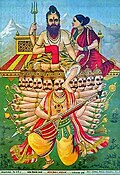
| caption = | | caption = Illustration depicting Ravana, circa 1920 | ||
| successor = [[Vibhishana]] (King of Lanka) | | successor = [[Vibhishana]] (King of Lanka) | ||
| predecessor = [[Kubera]] (King of Lanka) | | predecessor = [[Kubera]] (King of Lanka) | ||
| siblings = [[Kumbhakarna]] | | siblings = {{bulleted list|[[Kumbhakarna]] (younger brother)|[[Vibhishana]] (younger brother)|[[Shurpanakha]] (younger sister)}} | ||
| father = [[Vishrava]] | | father = [[Vishrava]] | ||
| mother = [[ | | mother = [[Kaikasi]] | ||
| spouse = {{ | | spouse = {{bulleted list||[[Mandodari]] (chief-queen)|[[Dhanyamalini]] and a thousand junior wives<ref name = "thousand_wives" />}} | ||
| children = [[ | | children = {{hlist|[[Meghanada]]|[[Atikaya]]|[[Akshayakumara]]|[[Narantaka-Devantaka|Narantaka]]| [[Narantaka-Devantaka|Devantaka]]||[[Trishira]]|[[Prahasta]] (sons)}} | ||
| abode = [[Lanka]] | | abode = [[Lanka]] | ||
| mount = [[Pushpaka | | mount = [[Pushpaka Vimana]] | ||
| affiliation = | | affiliation = [[Shaivism]], [[Lanka]], [[Rakshasa]] | ||
| texts = [[Ramayana]] and [[Ramayana versions|its versions]] | | texts = [[Ramayana]] and [[Ramayana versions|its versions]] | ||
| Devanagari = रावण | | Devanagari = रावण | ||
| Sanskrit_transliteration = Rāvaṇa | | Sanskrit_transliteration = Rāvaṇa | ||
| Tamil = ராவணன் | <!-- Infobox does not support the following parameter:| Tamil = ராவணன் -->}} | ||
}} | |||
{{Hinduism}} | {{Hinduism}} | ||
'''Ravana''' ({{ | '''Ravana''' ({{langx|sa|रावण|Rāvaṇa|roaring}}) is the principal antagonist of the ancient [[Mahakavya|Hindu epic]] ''[[Ramayana]]'' and its several [[Ramayana versions|other versions]]. He is traditionally depicted as a ten-headed [[rakshasa]] (demon) king of [[Lanka]] (present-day [[Sri Lanka]]).<ref>{{cite book |author=Wheeler, James Talboys |url=https://books.google.com/books?id=xzAQAAAAYAAJ&pg=PA281 |title=The History of India from the Earliest Ages |publisher=N. Trubner & Co. |year=1869 |volume=II The Rámáyana and the Vedic period |page=281}}</ref><ref name="Brown">{{cite book |author=Brown, Nathan Robert |url=https://books.google.com/books?id=1lR_UXIkBfgC&q=ravana+rakshasa&pg=PT43 |title=The Mythology of Supernatural: The signs and symbols behind the popular TV show |date=2 August 2011 |publisher=Berkley Boulevard books, Newwork |isbn=9781101517529 |access-date=12 May 2020}}</ref><ref name="Henry_p.3">Justin W. Henry, ''Ravana's Kingdom: The Ramayana and Sri Lankan History from Below'', Oxford University Press, p.3</ref> In the ''Ramayana'', Ravana is described as the eldest son of sage [[Vishrava]] and [[Kaikesi|Kaikasi]]. He abducted [[Rama]]'s wife, [[Sita]], and took her to his kingdom of [[Lanka]], where he held her in the [[Ashok Vatika|Ashoka Vatika]].<ref>{{cite web |title=Sunderkand explanation |website=sunderkandsatsangsamuh.org |url=http://www.sunderkandsatsangsamuh.org/Sunderkand_Explanation.pdf |access-date=12 May 2020 |archive-date=18 July 2021 |archive-url=https://web.archive.org/web/20210718071828/http://www.sunderkandsatsangsamuh.org/Sunderkand_Explanation.pdf |url-status=dead }}</ref> Rama, with the support of [[vanara]] King [[Sugriva]] and his army of vanaras, launched a rescue operation for Sita against Ravana in Lanka. Ravana was subsequently slain, and Rama rescued his beloved wife Sita.<ref>{{cite web |author=Das, Subhamoy |title=The Ramayana |quote=Summary by Stephen Knapp |website=Learn Religions |url=https://www.learnreligions.com/the-ramayana-summary-by-stephen-knapp-4092441 |access-date=12 May 2020}}</ref><ref>{{cite encyclopedia |title=Ravana |encyclopedia=[[Encyclopædia Britannica]] |url=https://www.britannica.com/topic/Ravana |access-date=12 May 2020}}</ref> | ||
Ravana | Ravana was well-versed in the six [[shastra]]s and the four [[Vedas]], including the [[Shiva Tandava Stotra]].<ref>{{Cite book |last1=Vālmīki |url=https://books.google.com/books?id=aWFEAQAAQBAJ&q=ramayan+ramesh+menon |title=The Ramayana: A Modern Retelling of the Great Indian Epic |last2=Menon |first2=Ramesh |date=2004-05-26 |publisher=Macmillan |isbn=978-0-86547-695-0 |language=en}}</ref> Ravana is also considered to be the most revered devotee of [[Shiva]]. Images of Ravana are often seen associated with Shiva at temples. He also appears in the Buddhist [[Mahayana]] text [[Laṅkāvatāra Sūtra]], in Buddhist [[Jataka tales|Jatakas]], as well as in [[Rama in Jainism|Jain Ramayanas]]. In [[Hindu scriptures|Vaishnava scriptures]], he is depicted as one of [[Vishnu]]'s cursed doorkeepers.<ref name=Pankaj-2019-07-31-Stsmn/> | ||
== Etymology == | == Etymology == | ||
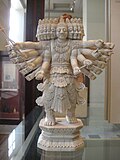
[[File: | [[File:Ravana British Museum.jpg|left|thumb|Statue of Ravana, South India, 18th century CE, [[British Museum]]]] | ||
The word Rāvaṇa ([[Sanskrit language|Sanskrit]]: रावण) means " | The word Rāvaṇa ([[Sanskrit language|Sanskrit]]: रावण) means "Roaring" (active), the opposite of [[Vaiśravaṇa]] which means to "hear distinctly" (passive).<ref name="Aiyangar Narayan 1909 p.413">Aiyangar Narayan (1909) "Essays On Indo-Aryan Mythology-Vol.", p.413</ref><ref name="sanskrit-lexicon.uni-koeln.de">{{Cite web |url=https://www.sanskrit-lexicon.uni-koeln.de/cgi-bin/monier/serveimg.pl?file=/scans/MWScan/MWScanjpg/mw1026-vaivarNika.jpg |title=Cologne Scan |website=sanskrit-lexicon.uni-koeln.de}}</ref> Both Ravana and Vaiśravaṇa, who is commonly known as [[Kubera]], are considered to be [[patronymic]]s derived from "sons of [[Vishrava]]".<ref name="Aiyangar Narayan 1909 p.413"/><ref name="sanskrit-lexicon.uni-koeln.de"/><ref>{{Cite book |title=The Rāmāyaṇa of Vālmīki: An Epic of Ancient India. Ayodhyākāṇḍa |date=25 April 2007 |publisher=Motilal Banarsidass Publishers |isbn=9788120831636 |page=30 |url=https://books.google.com/books?id=YJGRP-otpdIC&pg=PA530 |via=Google Books}}</ref><ref>{{cite book |last=Hopkins |first=Edward Washburn |author-link=Edward Washburn Hopkins |year=1915 |title=Epic Mythology |place=Strassburg, DE |publisher=K.J. Trübner |page = 142 |url=https://archive.org/stream/epicmythology00hopkuoft#page/n147/mode/2up/search/Kubera}}</ref> | ||
Dashānana was a title later taken on by Ravana, and it means "the one with ten (dasha) Heads (anana)". Further, roravana is Sanskrit for "loud roaring." In Abhinava Gupta's Krama Shaiva scripture, yāsām rāvanam is used as an expression to mean people who are truly aware of the materialism of their environment.{{Citation needed|date=February 2022}} | |||
Ravana | Ravana is also known by several other names including Dasis Ravana, Dasis Sakvithi Maha Ravana, Dashaanan, Ravula, Lankapati, Lankeshwara, Ravanasura and Ravanaeshwara.<ref>{{cite web|title=10 Names of Ravana |work=LifeStalker |date=6 October 2014 |url=http://www.lifestalker.com/2014/10/the-10-names-of-ravana.html |access-date=18 May 2021}}</ref> | ||
== Iconography == | == Iconography == | ||
Ravana is depicted and described as having ten heads, although he is sometimes shown with only nine heads since he cut one off to convince Shiva.<ref>{{ | Ravana is depicted and described as having ten heads, although he is sometimes shown with only nine heads since he cut one off to convince Shiva.<ref>{{cite web |date=26 October 2015 |title=When Ravana tore his head and a hand to apologize to Lord Shiva |url=https://www.mensxp.com/special-features/today/28124-when-ravana-tore-his-head-and-a-hand-to-apologize-to-lord-shiva.html |access-date=5 May 2022|work=Mensxp}}</ref> He is described as a devout follower of Shiva, a great scholar, a capable ruler, and a maestro of the [[Veena]]. Ravana is also depicted as the author of the ''Ravana Samhita'', a book on [[Hindu astrology]], and the ''Arka Prakasham'', a book on [[Siddha medicine]] and treatment. Ravana possessed a thorough knowledge of [[Siddha]] and [[political science]]. In some later versions, he is said to have possessed the nectar of immortality, which was stored inside his belly thanks to a celestial boon from [[Brahma]]. In the War with Lord Rama, Ravana was killed by a powerful Brahma's weapon shot by Rama which was gifted to Rama by Sage Agstya.<ref>{{cite book |title=Ramayana |author=[[Valmiki]]}} {{cite book |title=[[Ramcharitmanas]] |author=[[Tulsidas]] |editor1=Vibhishana, Lanka Kanda |editor2=Samvaad, Rama }}</ref>{{page needed|date=July 2020}} | ||
== | == Biography == | ||
=== Birth === | === Birth === | ||
[[File:Ravi Varma-Ravana Sita Jathayu.jpg|thumb| | [[File:Ravi Varma-Ravana Sita Jathayu.jpg|thumb|Painting depicting Ravana cutting off [[Jatayu]]'s wing while abducting [[Sita]], by [[Raja Ravi Varma]]]] | ||
Ravana was born to the sage [[Vishrava]] and the [[ | |||
Ravana was born to the [[Brahmin]] sage [[Vishrava]] and the [[Daitya]] princess [[Kaikesi|Kaikasi]] in [[Treta Yuga]].<ref>{{Cite book|url=https://books.google.com/books?id=0VoXEQAAQBAJ&dq=vishrava+brahmin&pg=PT19 | title=The Brahmin | isbn=978-93-5776-137-6 | last1=Etteth | first1=Ravi Shankar | date=4 March 2024 | publisher=Westland }}</ref><ref>{{cite book |last1=Shastri |first1=Jagdish Lal |last2=Kunst |first2=Arnold |title=Ancient Indian Tradition & Mythology: Brahma Purāṇa |date=1986 |publisher=Motilal Banarsidass |isbn=978-81-208-0271-1 |page=164 |url=https://www.google.co.in/books/edition/Ancient_Indian_Tradition_Mythology_Brahm/MeJjAAAAMAAJ?hl=en&gbpv=1&bsq=Daitya+Kaikesi&dq=Daitya+Kaikesi&printsec=frontcover |language=en}}</ref> Villagers from [[Bisrakh]] in [[Uttar Pradesh]] claim that Bisrakh was named after Vishrava, and that Ravana was born there.<ref>{{cite web|author=Dutta, Prabhash K. |date=10 October 2016 |title=Did you know? Ravana was born in Greater Noida West |work=[[India Today]] |url=https://www.indiatoday.in/india/story/ravana-greater-noida-demon-king-delhi-ncr-bishrakh-dussehra-345906-2016-10-10 |access-date=2 July 2020 |lang=en}}</ref> | |||
Ravana's paternal grandfather, the sage [[Pulastya]],<ref>{{Cite journal|last=Rajarajan|first=R.K.K.|year=2018|title=Woven Threads of the Rāmāyaṇa The Early Āḻvārs on Brahmā and Rāvaṇa|url=https://www.academia.edu/37599459|journal=Romanian Journal of Indian Studies|volume=2|pages=9–45}}</ref> was one of the ten [[Prajapati]]s, or mind-born sons of [[Brahma]], and one of the [[Saptarishi]] ( | Ravana's paternal grandfather, the sage [[Pulastya]],<ref>{{Cite journal|last=Rajarajan|first=R.K.K.|year=2018|title=Woven Threads of the Rāmāyaṇa The Early Āḻvārs on Brahmā and Rāvaṇa|url=https://www.academia.edu/37599459|journal=Romanian Journal of Indian Studies|volume=2|pages=9–45}}</ref> was one of the ten [[Prajapati]]s, or mind-born sons of [[Brahma]], and one of the [[Saptarishi]] (seven great sages) in the first [[Manvantara]] (age of [[Manu (Hinduism)|Manu]]). His maternal grandfather was [[Sumali]] (or Sumalaya), the king of the Rakshasas and the son of Sukesha. Sumali had ten sons and four daughters. Sumali wished for Kaikasi to marry the most powerful being in the mortal world, so as to produce an exceptional heir. He rejected the kings of the world, as they were less powerful than him. Kaikasi searched among the sages and finally chose Vishrava, the father of Kubera. Ravana and his siblings were born to the couple and they completed their education from their father, with Ravana being a great scholar of the Vedas.{{citation needed|date=February 2022}} | ||
=== Boon from Brahma === | === Boon from Brahma === | ||
Ravana and his two brothers, [[Kumbhakarna]] and [[Vibhishana]], performed penance on Mount Gokarna for | Ravana and his two brothers, [[Kumbhakarna]] and [[Vibhishana]], performed penance on Mount Gokarna for 10,000 years and won boons from Brahma. Ravana was blessed with a boon that would make him invincible to all the creations of Brahma, except for humans.<ref>{{cite web |last=Manglik |first=Reshu |date=29 September 2017 |title=Happy Dussehra 2017: 11 important facts to know about Ravana, primary antagonist of epic Ramayana |work=India TV |url=https://www.indiatvnews.com/lifestyle/books-culture-dussehra-2017-king-ravana-important-facts-from-ramayana-403950 |access-date=14 July 2020}}</ref> He also received weapons, a chariot, as well as the ability to shapeshift from Brahma.{{Citation needed|date=February 2022}} According to the ''Ramayana'', demigods approached Brahma since Ravana was causing harm on Earth. Lord Vishnu appeared and gave blessings that Rama would incarnate as a human and kill Ravana since his invincibility boon did not include humans.<ref>{{Cite book |last=Rosen |first=Steven |title=Essential Hinduism |date=2006 |publisher=Praeger |isbn=0-275-99006-0 |location=Westport, Conn. |pages=68–69 |oclc=70775665}}</ref> | ||
=== Devotee of Shiva === | === Devotee of Shiva === | ||
{{See also|Ravananugraha}} | {{See also|Ravananugraha}} | ||
[[File:RavanKailashAndolan.jpg|left|thumb | [[File:RavanKailashAndolan.jpg|left|thumb|Ravananugraha theme]] | ||
One of the most popular images of Shiva is called "Ravananugraha", which was popular in the [[Gupta era]]. It depicts Ravana beneath [[Mount Kailash]] playing a veena made out of his head and hands, and strings made out of his tendons, while Shiva and Parvati sit on top of the mountain.<ref name="kala">Kala pp. 38–42</ref>{{full citation needed|date=July 2022|reason=no such ref "Kala"}} According to scriptures, Ravana once tried to lift Mount Kailash, but Shiva pushed the mountain into place and trapped Ravana beneath it. For a thousand years, the imprisoned Ravana sang [[Shiva Tandava Stotra]], a hymn in praise of Shiva, who finally blessed him and granted him an invincible sword and a powerful [[linga]] (Shiva's iconic symbol, Atmalinga) to worship.<ref>{{cite web |author=Rathore, Vinod | |||
One of the most popular images of Shiva is called "Ravananugraha", which was popular in the [[Gupta era]]. It depicts Ravana beneath [[Mount Kailash]] playing a veena made out of his head and hands, and strings made out of his tendons, while Shiva and Parvati sit on top of the mountain.<ref name="kala">Kala pp. 38–42</ref>{{full citation needed|date=July 2022|reason=no such ref "Kala"}} According to scriptures, Ravana once tried to lift Mount Kailash, but Shiva pushed the mountain into place and trapped Ravana beneath it. For a thousand years, the imprisoned Ravana sang [[Shiva Tandava Stotra]], a hymn in praise of Shiva, who finally blessed him and granted him an invincible sword and a powerful [[linga]] (Shiva's iconic symbol, Atmalinga) to worship. But this incident has little to no evidence in Valmiki Ramayana.<ref name="kala"/><ref>{{cite web |author=Rathore, Vinod |title=Know the unique story of Ravana's devotion to Shiva |website=News Track |url=https://english.newstracklive.com/news/ravan-shiv-bhakti-ravan-and-shiv-katha-hindi-me-sc91-nu612-ta272-1103191-1.html |access-date=14 July 2020 |language=en}}</ref> | |||
{{clear left}} | {{clear left}} | ||
=== Family === | === Family === | ||
[[File:COLLECTIE TROPENMUSEUM Reliëf op de aan Brahma gewijde tempel op de Candi Lara Jonggrang oftewel het Prambanan tempelcomplex TMnr 10016175.jpg|thumb | [[File:COLLECTIE TROPENMUSEUM Reliëf op de aan Brahma gewijde tempel op de Candi Lara Jonggrang oftewel het Prambanan tempelcomplex TMnr 10016175.jpg|thumb|Queen [[Mandodari]] and the women of Lanka mourning the death of Ravana. Bas-relief of 9th century from [[Prambanan]] Temple, Java, Indonesia]] | ||
Ravana's parents were the sage [[Vishrava]] (son of [[Pulastya]]) and [[List of characters in Ramayana#Kaikashi|Kaikesi]] (daughter of [[Sumali]] and [[Ketumati (Ramayana)|Ketumati]]). Ravana had seventeen maternal uncles and three maternal aunts. [[List of characters in Ramayana#Dhumraksha|Dhumraksha]], [[Prahastha]], [[Akampana]], [[Vajramushti]], [[Suparshwa]] and [[Virupaksha]], a few of his maternal uncles, were generals in the Lanka army. The other grandsons of Sumali, through his other daughters, namely [[List of characters in Ramayana#K|Khara]], [[Dushana]], [[Mahodara]], and [[Mahaparshwa]] were equally powerful lieutenants in Ravana’s army, and given the first two were responsible to govern the territories of Janasthana. [[Kaikesi]]'s father, [[Sumali]] and uncle, [[Malyavan]] were instrumental in making Ravana the king of Lanka by advising him to receive boons from Brahma, defeat Kubera, and establish [[rakshasa]] rule in the [[Trailokya|three worlds]].<ref name="Mittal-2006-p200">{{cite book |last=Mittal |first=J.P. |url=https://books.google.com/books?id=b7gOBW8oDFgC&pg=PA200 |title=History of Ancient India (a new version: From 7300 BC to 4250 BC |date=2006 |publisher=Atlantic Publishers & Dist |isbn=978-81-269-0615-4 |page=200 |language=en}}</ref> | |||
Ravana's granduncle was [[Malyavan]], who opposed the war with Rama and Lakshmana. He also had another granduncle named Mali who was killed by [[Vishnu]].<ref name="Mittal-2006-p200" /> | Ravana's granduncle was [[Malyavan]], who opposed the war with Rama and Lakshmana. He also had another granduncle named Mali who was killed by [[Vishnu]].<ref name="Mittal-2006-p200" /> | ||
According to ''[[Sundara Kanda]]'' of ''Valmiki Ramayana'', Ravana had over a thousand wives, with [[Mandodari]], the daughter of the celestial architect [[Mayasura|Maya]], being his chief queen.<ref name = "thousand_wives">{{Cite book |last=Kant |first=Anjani |url=https://books.google.com/books?id=Z-5nkRZXjPMC&dq=ravana+thousand+wives&pg=PA45 |title=Women and the Law |date=2008 |publisher=APH Publishing |isbn=978-81-7648-456-5 |language=en}}</ref> His sons were [[Indrajit|Meghanada]], [[Atikaya]], [[Akshayakumara]], [[Narantaka]], [[Devantaka]] and [[Trishira]]. | |||
Ravana had | |||
=== Priestly ministers === | === Priestly ministers === | ||
In some accounts, Ravana is said to have had Shukracharya, the priest of the Asuras, as his minister, and in other accounts, [[Brihaspati]], the priest of the Devas.{{citation needed|date=February 2022}} | In some accounts, Ravana is said to have had [[Shukracharya]], the priest of the Asuras, as his minister, and in other accounts, [[Brihaspati]], the priest of the Devas.{{citation needed|date=February 2022}} | ||
One account narrates how Ravana ordered Brihaspati to recite the Chandi stava (mantras of Chandi), more specifically the Devi Mahatmya, in order to stave off defeat. According to the Krttivasa text, Ravana arranged for a peaceful [[yajna]], and invited Brihaspati to start the recitation of Chandi.<ref>{{cite book |first=Shanti Lal |last=Nagar |title=Genesis and Evolution of the Rāma Kathā in Indian Art, Thought, Literature, and Culture: From the earliest period to modern times |volume=2}}</ref>{{full citation needed|date=July 2022|reason=publisher, date, page}} | One account narrates how Ravana ordered Brihaspati to recite the Chandi stava (mantras of Chandi), more specifically the Devi Mahatmya, in order to stave off defeat. According to the Krttivasa text, Ravana arranged for a peaceful [[yajna]], and invited Brihaspati to start the recitation of Chandi.<ref>{{cite book |first=Shanti Lal |last=Nagar |title=Genesis and Evolution of the Rāma Kathā in Indian Art, Thought, Literature, and Culture: From the earliest period to modern times |volume=2}}</ref>{{full citation needed|date=July 2022|reason=publisher, date, page}} | ||
[[File:Mani Madhava Chakyar as Ravana.jpg|Ravana in [[Sanskrit]] drama of [[Kerala]], India- [[Kutiyattam]]. Artist: Guru ''Nātyāchārya'' [[Māni Mādhava Chākyār]]<ref>{{cite book | author = Chākyār, Māni Mādhava | author-link = Māni Mādhava Chākyār | year = 1996 | title = Nātyakalpadrumam | title-link = Nātyakalpadrumam | place = New Delhi, IN | publisher = Sangeet Natak Akademi | page = 6}}</ref>|thumb|right]] | |||
[[File:Mani Madhava Chakyar as Ravana.jpg|Ravana in [[Sanskrit]] drama of [[Kerala]], India- [[Kutiyattam]]. Artist: Guru ''Nātyāchārya'' [[Māni Mādhava Chākyār]]<ref> | |||
{{cite book | |||
}} | |||
</ref>|thumb|right]] | |||
== Other legends == | == Other legends == | ||
| Line 86: | Line 76: | ||
In the [[Bhagavata Purana]], Ravana and his brother [[Kumbhakarna]] are said to be reincarnations of [[Jaya-Vijaya|Jaya and Vijaya]], gatekeepers at [[Vaikuntha]] (the abode of [[Vishnu]]), and were cursed to be born on Earth for their insolence.<ref name=":0">{{cite book |last=Ninan |first=M.M. |date=2008-06-23 |df=dmy-all |title=The Development of Hinduism |publisher=Madathil Mammen Ninan |isbn=978-1-4382-2820-4 |pages=241 |language=en |url=https://books.google.com/books?id=-8RTZcjg9awC&dq=Ravana+Kumbhakarna+cursed+born+on+earth&pg=PA241}}</ref> | In the [[Bhagavata Purana]], Ravana and his brother [[Kumbhakarna]] are said to be reincarnations of [[Jaya-Vijaya|Jaya and Vijaya]], gatekeepers at [[Vaikuntha]] (the abode of [[Vishnu]]), and were cursed to be born on Earth for their insolence.<ref name=":0">{{cite book |last=Ninan |first=M.M. |date=2008-06-23 |df=dmy-all |title=The Development of Hinduism |publisher=Madathil Mammen Ninan |isbn=978-1-4382-2820-4 |pages=241 |language=en |url=https://books.google.com/books?id=-8RTZcjg9awC&dq=Ravana+Kumbhakarna+cursed+born+on+earth&pg=PA241}}</ref> | ||
These gatekeepers refused entry to the [[Catursana|Sanatha Kumara]] monks who, because of their powers and austerity, appeared as young children. For their insolence, the monks cursed them to be expelled from [[Vaikuntha]] and to be born on Earth.<ref name=":0" /><ref name= | These gatekeepers refused entry to the [[Catursana|Sanatha Kumara]] monks who, because of their powers and austerity, appeared as young children. For their insolence, the monks cursed them to be expelled from [[Vaikuntha]] and to be born on Earth.<ref name="Pankaj-2019-07-31-Stsmn" /><ref name=":0" /> | ||
Vishnu agreed that they should be punished and gave them two options. First, that they could be born seven times as normal mortals and devotees of Vishnu, or be born three times as strong and powerful beings, but as enemies of Vishnu. Eager to be back with the Lord, they chose the latter option. The curse of the first birth was fulfilled by [[Hiranyakashipu]] and his brother [[Hiranyaksha]] in [[Satya Yuga]], when they were both vanquished by earlier avatars of Vishnu (Hiranyaksha by [[Varaha]], and Hiranyakashipu by [[Narasimha]]). Ravana and his brother Kumbhakarna were born to fulfill the curse in their second birth as enemies of Vishnu in [[Treta Yuga]]. The curse of the third birth was fulfilled by [[Dantavakra]] and [[Shishupala]] in the [[Dvapara Yuga]], when they both were slain by [[Krishna]], the eighth avatar.<ref name=Pankaj-2019-07-31-Stsmn>{{cite news |author=Pankaj, Bhavana |date=31 July 2019 |title=Where Ravana is Vishnu's true Bhakta |newspaper=The Statesman |url=https://www.thestatesman.com/religion/ravana-vishnus-true-bhakta-1502783704.html |access-date=1 July 2020 |language=en}}</ref> | |||
=== Other conflicts === | |||
Ravana had fought with the demons named [[Nivatakavacha]] along with his army for an entire year but was unable to kill them due to Brahma's boon. The war was stopped by Brahma and Ravana formed an alliance with them, he learnt several magical tricks or maya from those demons.<ref name="valmikiramayan.net">{{Cite web | title=Valmiki Ramayana | url=https://www.valmikiramayan.net/ | access-date=2025-08-05 | website=www.valmikiramayan.net}}</ref> | |||
Ravana had defeated the vanara warriors namely Hanuman, Sugriva, Neela and even Rama's brother Lakshmana twice during his war with Rama.<ref name="valmikiramayan.net"/> As per the original six books of Valmiki Ramayana, only lord Rama the incarnation of Vishnu defeated Ravana and killed him after several days of single duel. | |||
He killed Anaranya, the king of [[Ayodhya]], although he cursed Ravana to be slain by Rama. | He killed Anaranya, the king of [[Ayodhya (Ramayana)|Ayodhya]], although he cursed Ravana to be slain by Rama. | ||
Ravana had wrestled his brother [[Kubera]] for the [[Vimana|Pushpaka Vimana]]. | Ravana had wrestled his brother [[Kubera]] and vanquished him for the [[Vimana|Pushpaka Vimana]]. | ||
=== Immolation of Vedavati=== | |||
Ravana found [[Vedavati]] sitting in meditation as a ''[[Tapas (Indian religions)|tapasvini]]'' and was captivated by her beauty. He proposed his hand in marriage to her, and was rejected. Ravana, firmly rejected at every turn, grabbed her hair and tried assaulting her.<ref>{{Cite book |url=https://books.google.com/books?id=uXCYDwAAQBAJ&dq=ravana+rape+Vedavati&pg=PA907 |title=The Rāmāyaṇa of Vālmīki: An Epic of Ancient India, Volume VI: Yuddhakāṇḍa |date=2017-01-24 |publisher=Princeton University Press |isbn=978-0-691-17398-6 |pages=907 |language=en}}</ref> The furious [[Vedavati]] cursed Ravana that she would be born once more, and would be the cause of his death.<ref>{{Cite book |last=Gupta |first=Stuti |url=https://books.google.com/books?id=B3oEEAAAQBAJ&dq=Vedavati+ravana&pg=PA42 |title=Magical Mythology |date=2020-11-10 |publisher=Sristhi Publishers & Distributors |isbn=978-81-947908-6-0 |language=en}}</ref> She subsequently leapt into the ritual [[Homa (ritual)|havan]] that was present in her vicinity, immolating herself.<ref>{{Cite book |last=Gupta |first=Stuti |url=https://books.google.com/books?id=B3oEEAAAQBAJ&dq=Vedavati+havan&pg=PA42 |title=Magical Mythology |date=2020-11-10 |publisher=Sristhi Publishers & Distributors |isbn=978-81-947908-6-0 |language=en}}</ref> | |||
=== Rape of Rambha === | |||
Ravana is regarded to have once caught sight of the [[apsara]] [[Rambha (apsara)|Rambha]] and was filled with lust. Even as the apsara resisted his advances by asserting that she was his daughter-in-law, he raped her. When she reported this to her husband, [[Nalakuvara]], he cursed Ravana to be unable to cause violence to any woman who did not consent to being with him, his head splitting into a number of pieces if he did so. This incident is stated to explain why Ravana could not force the abducted Sita to submit to his desire.<ref>{{Cite book |last=Doniger |first=Wendy |url=https://books.google.com/books?id=iM_QAgAAQBAJ&dq=Ravana+rape+Rambha&pg=PA535 |title=On Hinduism |date=March 2014 |publisher=OUP USA |isbn=978-0-19-936007-9 |pages=535 |language=en}}</ref><ref>{{Cite book |last=Vālmīki |url=https://books.google.com/books?id=h1g6fWIu-kAC&pg=PA393 |title=The Rāmāyaṇa of Vālmīki: An Epic of Ancient India. Araṇyakāṇḍa |date=2007 |publisher=Motilal Banarsidass Publishers |isbn=978-81-208-3164-3 |pages=393 |language=en}}</ref> | |||
== Worship and temples == | == Worship and temples == | ||
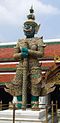
[[File:Phu Yak.jpg|thumb | [[File:Phu Yak.jpg|thumb|Thotsakan (Ravana)'s sculpture as a guardian of [[Wat Phra Kaew]], [[Thailand]]]] | ||
=== Worship === | === Worship === | ||
Ravana is worshipped as one of Shiva's most revered followers,<ref name="spectrum"/> and he is even worshipped in some Shiva temples.<ref name = "spectrum">{{cite news |url=http://www.tribuneindia.com/2007/20071021/spectrum/society1.htm |title=Ravana has his temples, too |newspaper=The Sunday Tribune |department=Spectrum |date=21 October 2007}}</ref><ref>{{cite book |author=Vachaspati, S. |title=Ravana Brahma |year=2005 |publisher=Rudrakavi Sahitya Peetham, Gandhi Nagar |place=Tenali, India |language=English}}</ref><ref>{{cite book |author=Dave, Kamalesh Kumar |year=2008 |title=Dashanan |publisher=Akshaya Jyotish Anusandan Kendra |place=[[Jodhpur]], India |language=Hindi}}</ref> | Ravana is worshipped as one of Shiva's most revered followers,<ref name="spectrum"/> and he is even worshipped in some Shiva temples.<ref name = "spectrum">{{cite news |url=http://www.tribuneindia.com/2007/20071021/spectrum/society1.htm |title=Ravana has his temples, too |newspaper=The Sunday Tribune |department=Spectrum |date=21 October 2007}}</ref><ref>{{cite book |author=Vachaspati, S. |title=Ravana Brahma |year=2005 |publisher=Rudrakavi Sahitya Peetham, Gandhi Nagar |place=Tenali, India |language=English}}</ref><ref>{{cite book |author=Dave, Kamalesh Kumar |year=2008 |title=Dashanan |publisher=Akshaya Jyotish Anusandan Kendra |place=[[Jodhpur]], India |language=Hindi}}</ref> | ||
King Shiv Shankar built a Ravana temple in [[Kanpur]], [[Uttar Pradesh]]. The Ravana temple is open once a year, on the day of [[Vijayadashami|Dashera]], to perform puja for the welfare of Ravana.<ref>{{cite news |first=Faiz |last=Siddiqui |date=10 October 2016 |title=A temple where demon king has his day |newspaper=[[The Times of India]] |url=https://timesofindia.indiatimes.com/city/kanpur/A-temple-where-demon-king-has-his-day/articleshow/54772663.cms |access-date=14 September 2018}}</ref> | |||
King Shiv Shankar built a Ravana temple in [[Kanpur]], [[Uttar Pradesh]]. The Ravana temple is open once a year, on the day of [[ | |||
Ravana is also | Ravana is also worshipped by Hindus of [[Bisrakh]], who claim their town to be his birthplace.<ref>{{cite news |title=Only the elderly come to mourn Ravana in 'birthplace' Bisrakh |date=4 October 2014 |newspaper=[[The Indian Express]] |url=http://indianexpress.com/article/cities/delhi/only-the-elderly-come-to-mourn-ravana-in-birthplace-bisrakh/ |access-date=14 June 2016}}</ref> | ||
The Sachora Brahmins of Gujarat claim to be descendants of Ravana, and sometimes have "Ravan" as their surnames.<ref>{{cite book |title=People of India |volume=4: A–G |publisher=Oxford University Press |page=3061}}</ref> | The Sachora Brahmins of Gujarat claim to be descendants of Ravana, and sometimes have "Ravan" as their surnames.<ref>{{cite book |title=People of India |volume=4: A–G |publisher=Oxford University Press |page=3061}}</ref> | ||
Saraswat Brahmins from Mathura claim Ravana as a saraswat Brahmin as per his lineage.<ref>{{cite news |title=Mathura lawyer seeks ban on burning of Ravana effigies |date=26 September 2017 |newspaper=[[The Indian Express]] |url=https://indianexpress.com/article/india/mathura-lawyer-seeks-ban-on-burning-of-ravana-effigies-4862479/}}</ref><ref>{{cite magazine |author=Qureshi, Siraj |date=12 October 2016 |title=A Dussehra without burning Ravana: This Brahmin community in Agra wants an end to practice |magazine=[[India Today]] | Saraswat Brahmins from Mathura claim Ravana as a saraswat Brahmin as per his lineage.<ref>{{cite news |title=Mathura lawyer seeks ban on burning of Ravana effigies |date=26 September 2017 |newspaper=[[The Indian Express]] |url=https://indianexpress.com/article/india/mathura-lawyer-seeks-ban-on-burning-of-ravana-effigies-4862479/}}</ref><ref>{{cite magazine |author=Qureshi, Siraj |date=12 October 2016 |title=A Dussehra without burning Ravana: This Brahmin community in Agra wants an end to practice |magazine=[[India Today]] |url=https://www.indiatoday.in/india/story/raavan-vijay-dashmi-agra-saraswat-caste-brahmins-346178-2016-10-12}}</ref> | ||
The [[Gondi people]] of central India claim to be descendants of Ravana, and | The [[Gondi people]] of central India claim to be descendants of Ravana, and have temples for him, his wife Mandodari, and their son Meghnad. They also state that Ravana was an ancient Gond king, the tenth ''dharmaguru'' of their tribe, and the eighteenth lingo (divine teacher). Annually on [[Dussehra]], the Gondis from the village of [[Paraswadi]] carry an image of Ravana riding on an elephant in a procession.<ref>{{cite news |author=Rashid, Omar |date=24 October 2015 |title=Celebrating Ravan |newspaper=[[The Hindu]] |url=https://www.thehindu.com/features/magazine/omar-rashid-on-ravan-worship/article7799972.ece}}</ref> | ||
=== Temples === | === Temples === | ||
| Line 130: | Line 121: | ||
* Mandore Ravan Temple, Jodhpur<ref name="Native Planet">{{cite web |title=Unique Ravana temples in India |date=27 April 2018 |website=Native Planet |department=Travel guide |url=https://www.nativeplanet.com/travel-guide/unique-ravana-temples-in-india-001812.html}}</ref> | * Mandore Ravan Temple, Jodhpur<ref name="Native Planet">{{cite web |title=Unique Ravana temples in India |date=27 April 2018 |website=Native Planet |department=Travel guide |url=https://www.nativeplanet.com/travel-guide/unique-ravana-temples-in-india-001812.html}}</ref> | ||
* Baijanath Temple, Kangra District, Himachal Pradesh<ref name="Native Planet"/> | * Baijanath Temple, Kangra District, Himachal Pradesh<ref name="Native Planet"/> | ||
* Ravaleshwara temple- Malavalli, mandya district of Karnataka | |||
== Influence on culture and art == | == Influence on culture and art == | ||
[[File:Hanuman and Ravana in Tholu Bommalata, the shadow puppet tradition of Andhra Pradesh, India.JPG|thumb | [[File:Hanuman and Ravana in Tholu Bommalata, the shadow puppet tradition of Andhra Pradesh, India.JPG|thumb|Ravana with [[Hanuman]] in ''[[tholu bommalata]]'', a [[shadow puppet]] tradition of [[Andhra Pradesh]], India]] | ||
=== Ravana-Dahan (burning effigy of Ravana) === | === Ravana-Dahan (burning effigy of Ravana) === | ||
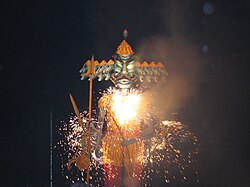
[[File:Ravana_fizzles.jpg|thumb|An effigy of Ravana with burning sparklers on [[Dusshera]]. ''Dashehra Diwali Mela'' in Manchester, England, 2006]] | [[File:Ravana_fizzles.jpg|thumb|An effigy of Ravana with burning sparklers on [[Dusshera]]. ''Dashehra Diwali Mela'' in Manchester, England, 2006]] | ||
Effigies of Ravana are burned on [[Vijayadashami]] in many places throughout India to symbolize Rama's triumph over evil.<ref>{{cite news |title=Dussehra 2018: What is the significance Of Ravana Dahan? |website=NDTV.com |department=Dehli news |url=https://www.ndtv.com/delhi-news/ravana-dahan-2018-what-is-the-significance-of-ravana-dahan-1934573 |access-date=1 July 2020}}</ref> | Effigies of Ravana are burned on [[Vijayadashami]] in many places throughout India to symbolize Rama's triumph over evil.<ref>{{cite news |title=Dussehra 2018: What is the significance Of Ravana Dahan? |website=NDTV.com |department=Dehli news |url=https://www.ndtv.com/delhi-news/ravana-dahan-2018-what-is-the-significance-of-ravana-dahan-1934573 |access-date=1 July 2020}}</ref> | ||
| Line 143: | Line 135: | ||
== In other religions == | == In other religions == | ||
[[File:130 Ramakien Murals (9150183848).jpg|thumb|Mural painting depicting Thotsakan (Ravana) at [[Wat Phra Kaew]], [[Thailand]].]] | |||
In the Rin-spuns-pa Tibetan Ramayana, it is prophesied that Ravana will return as the Buddha incarnation of Vishnu in Kali Yuga. | |||
The Arunachal Pradesh Tai Khamti Ramayana (Phra Chow Lamang) shows Rama as a Bodhisattva who was reborn so Ravana could torture him. | The Arunachal Pradesh Tai Khamti Ramayana (Phra Chow Lamang) shows Rama as a Bodhisattva who was reborn so Ravana could torture him. | ||
In the Laotian Buddhist text [[Phra Lak Phra Lam]], Rama is a Bodhisattva and the embodiment of virtues, while Ravana is a Brahmin ("''mahabrahma''") son of Virulaha who is highly materialistic.{{Citation needed|date=February 2022}} | In the Laotian Buddhist text [[Phra Lak Phra Lam]], Rama is a Bodhisattva and the embodiment of virtues, while Ravana is a Brahmin ("''mahabrahma''") son of Virulaha who is highly materialistic.{{Citation needed|date=February 2022}} | ||
In the Cambodian Buddhist text [[Reamker|Preah Ream]], Buddha is an incarnation of Rama and Ravana is a rakshasa.{{Citation needed|date=February 2022}} | In the Cambodian Buddhist text [[Reamker|Preah Ream]], Buddha is an incarnation of Rama and Ravana is a rakshasa.{{Citation needed|date=February 2022}} | ||
In the Thai Buddhist text [[Ramakien]], Ravana is a rakshasa<ref>{{Cite book|title=Prachi Darshan|last=Vyas|first=Lallan Prasad|pages=98}}</ref> known as "Thotsakan" (ทศกัณฐ์, from Sanskrit दशकण्ठ, Daśakaṇṭha, "ten necks"), and is depicted with green skin.{{Citation needed|date=February 2022}} | In the Thai Buddhist text [[Ramakien]], Ravana is a rakshasa<ref>{{Cite book|title=Prachi Darshan|last=Vyas|first=Lallan Prasad|pages=98}}</ref> known as "Thotsakan" (ทศกัณฐ์, from Sanskrit दशकण्ठ, Daśakaṇṭha, "ten necks"), and is depicted with green skin.{{Citation needed|date=February 2022}} | ||
In the [[Karandavyuha Sutra]], [[Yama]] asks if the visitor in hell (Avalokitesvara), whom he hasn't seen yet, is a god or a demon, and whether he is Vishnu, [[Maheśvara (Buddhism)|Mahesvara]], or the rakshasa Ravana. | In the [[Karandavyuha Sutra]], [[Yama]] asks if the visitor in hell (Avalokitesvara), whom he hasn't seen yet, is a god or a demon, and whether he is Vishnu, [[Maheśvara (Buddhism)|Mahesvara]], or the rakshasa Ravana. | ||
=== Jainism === | === Jainism === | ||
{{Further|Salakapurusa}} | {{Further|Salakapurusa}} | ||
[[File:Jain Universal History Diorama in Jain Museum of Madhuban 44.jpg|thumb|A diorama in Jain Museum of Madhuban depicting Ravana]] | |||
[[Jain]] accounts vary from the traditional Hindu accounts of the Ramayana. The incidents are placed at the time of the 20th [[Tirthankara]], [[Munisuvrata]]. In Jainism, both Rama and Ravana were devout Jains.<ref>{{cite book |last=Sharma |first=S.R. |year=1940 |title=Jainism and Karnataka Culture |publisher=Karnatak Historical Research Society |location=Dharwar, IN |page=76 }}</ref> Ravana was a [[Vidyadhara]] king who had magical powers,<ref>{{cite book |last=Dalal |first=Roshen |year=2010 |title=Hinduism: An alphabetical guide |publisher=[[Penguin Books]] India |page=338 |isbn=9780143414216 |url=https://books.google.com/books?id=DH0vmD8ghdMC}}</ref> and Lakshmana, not Rama, was the one who ultimately killed Ravana.<ref>{{cite book |last=Ramanujan |first=A.K. |year=1991 |editor=Paula Richman |title=Many Rāmāyaṇas: The diversity of a narrative tradition in south Asia |page=35 |publisher=University of California Press |isbn=978-0-520-07589-4 |chapter=Three hundred Rāmāyaṇas: Five examples and Three thoughts on Translation |chapter-url=https://books.google.com/books?id=XkifYfljHP4C}}</ref> | [[Jain]] accounts vary from the traditional Hindu accounts of the Ramayana. The incidents are placed at the time of the 20th [[Tirthankara]], [[Munisuvrata]]. In Jainism, both Rama and Ravana were devout Jains.<ref>{{cite book |last=Sharma |first=S.R. |year=1940 |title=Jainism and Karnataka Culture |publisher=Karnatak Historical Research Society |location=Dharwar, IN |page=76 }}</ref> Ravana was a [[Vidyadhara]] king who had magical powers,<ref>{{cite book |last=Dalal |first=Roshen |year=2010 |title=Hinduism: An alphabetical guide |publisher=[[Penguin Books]] India |page=338 |isbn=9780143414216 |url=https://books.google.com/books?id=DH0vmD8ghdMC}}</ref> and Lakshmana, not Rama, was the one who ultimately killed Ravana.<ref>{{cite book |last=Ramanujan |first=A.K. |year=1991 |editor=Paula Richman |title=Many Rāmāyaṇas: The diversity of a narrative tradition in south Asia |page=35 |publisher=University of California Press |isbn=978-0-520-07589-4 |chapter=Three hundred Rāmāyaṇas: Five examples and Three thoughts on Translation |chapter-url=https://books.google.com/books?id=XkifYfljHP4C}}</ref> | ||
=== Dravidian movement === | === Dravidian movement === | ||
[[Pulavar Kuzhanthai]]'s Ravana Kaaviyam is a [[panegyric]] on Ravana that is made up of 3,100 poetic stanzas in which Ravana is the hero. The book was released in 1946, and was subsequently banned by India's [[Indian National Congress|Congress]] led government. The ban was later lifted in 1971.<ref>{{cite magazine |author=Pandian, M.S.S. |date=2 November 1998 |title=Ravana as antidote |magazine=Outlook India |url=https://www.outlookindia.com/magazine/story/ravana-as-antidote/206446 |access-date=20 June 2019 |archive-url=https://web.archive.org/web/20180116135407/https://www.outlookindia.com/magazine/story/ravana-as-antidote/206446 |archive-date=2018}}</ref><ref>{{cite magazine |author=Nalankilli, Thanjai |date=April 2006 |title=Censorship of Dravidian voices in Tamil Nadu (India) in 1948, 1949 |magazine=Tamil Tribune |url=http://www.tamiltribune.com/06/0401.html |url-status=dead <!-- presumed --> |archive-url=https://web.archive.org/web/20180108182839/http://www.tamiltribune.com/06/0401.html |archive-date=8 January 2018}}</ref><ref>{{cite web |last=Sivapriyan |first=E.T.B. |title=Ram Temple: Tamilians praise Ravana on ''Twitter'' |newspaper=[[Deccan Herald]] |date=5 August 2020 |url=https://www.deccanherald.com/national/ram-temple-tamilians-praise-ravana-on-twitter-869883.html |access-date=21 November 2021}}</ref> | [[Pulavar Kuzhanthai]]'s Ravana Kaaviyam is a [[panegyric]] on Ravana that is made up of 3,100 poetic stanzas in which Ravana is the hero. The book was released in 1946, and was subsequently banned by India's [[Indian National Congress|Congress]] led government. The ban was later lifted in 1971.<ref>{{cite magazine |author=Pandian, M.S.S. |date=2 November 1998 |title=Ravana as antidote |magazine=Outlook India |url=https://www.outlookindia.com/magazine/story/ravana-as-antidote/206446 |access-date=20 June 2019 |archive-url=https://web.archive.org/web/20180116135407/https://www.outlookindia.com/magazine/story/ravana-as-antidote/206446 |archive-date=2018-01-16}}</ref><ref>{{cite magazine |author=Nalankilli, Thanjai |date=April 2006 |title=Censorship of Dravidian voices in Tamil Nadu (India) in 1948, 1949 |magazine=Tamil Tribune |url=http://www.tamiltribune.com/06/0401.html |url-status=dead <!-- presumed --> |archive-url=https://web.archive.org/web/20180108182839/http://www.tamiltribune.com/06/0401.html |archive-date=8 January 2018}}</ref><ref>{{cite web |last=Sivapriyan |first=E.T.B. |title=Ram Temple: Tamilians praise Ravana on ''Twitter'' |newspaper=[[Deccan Herald]] |date=5 August 2020 |url=https://www.deccanherald.com/national/ram-temple-tamilians-praise-ravana-on-twitter-869883.html |access-date=21 November 2021}}</ref> | ||
==In popular culture== | ==In popular culture== | ||
Sri Lanka named its first satellite [[Raavana 1]] after Ravana.<ref>{{cite web |last=Yamunan |first=Sruthisagar |date=6 July 2019 |title=Why Sri Lanka named its first-ever satellite after Ravana |website=Scroll.in |url=https://scroll.in/article/929015/why-sri-lanka-named-its-first-ever-satellite-after-ravana |access-date=2 July 2020 |language=en-US}}</ref> | Sri Lanka named its first satellite [[Raavana 1]] after Ravana.<ref>{{cite web |last=Yamunan |first=Sruthisagar |date=6 July 2019 |title=Why Sri Lanka named its first-ever satellite after Ravana |website=Scroll.in |url=https://scroll.in/article/929015/why-sri-lanka-named-its-first-ever-satellite-after-ravana |access-date=2 July 2020 |language=en-US}}</ref> | ||
Ravana appears as the primary antagonist in [[Ramayana#In modern popular culture|films and television series based on the ''Ramayana'']]. Movies like ''Bhakta Ravana'' (1938) and its [[Telugu language|Telugu]] ([[Bhookailas (1940 film)|1940]] and [[Bhookailas (1958 film)|1958]]) and [[Kannada]] ([[Bhookailasa (film)|1958]]) adaptations as well as television series ''[[Raavan (TV series)|Raavan]]'' (2006-2008)<ref>{{Cite web|url=http://www.indiantelevision.com/headlines/y2k6/nov/nov192.htm|title=Zee TV enters new genre with 'Ravan' on Saturdays at 9|work=Indiantelevision.com|date=16 November 2006}}</ref> are focused on the tale on Ravana. The [[Tamil language|Tamil]] film ''[[Raavanan (2010 film)|Raavanan]]'' (2010) and its [[Hindi]] counterpart ''[[Raavan (2010 film)|Raavan]]'' (2010) narrate the epic from Ravana's perspective in a modern setting. | |||
Author [[Anand Neelakantan]] published the novel ''[[Asura: Tale of the Vanquished]]'' in 2012, in which the character Ravana is depicted as a human-like figure. | |||
|'' | |||
| | |||
| | |||
| | |||
| | |||
| | |||
|[[ | |||
| | |||
Author [[Amish Tripathi]]'s 2019 novel ''[[Raavan: Enemy of Aryavarta]]'' chronicles the life of Ravana until the time he kidnaps [[Sita]].<ref>{{cite news|url=https://www.business-standard.com/article/pti-stories/amish-tripathi-s-raavan-enemy-of-aryavarta-hits-stands-119070200545_1.html|title=Amish Tripathi's 'Raavan: Enemy of Aryavarta' hits stands|work=Business Standard|date=2 July 2019|accessdate=4 July 2019}}</ref><ref>{{cite news|url=https://timesofindia.indiatimes.com/life-style/books/features/amish-tripathis-raavan-enemy-of-aryavarta-to-release-in-july/articleshow/69230605.cms|title=Amish Tripathi's 'Raavan- Enemy of Aryavarta' to release in July|work=The Times of India|date=8 May 2019|accessdate=4 July 2019}}</ref> It is the third book in Tripathi's Ram Chandra Series.<ref>{{cite news|url=https://www.hindustantimes.com/books/excerpt-raavan-enemy-of-aryavarta-by-amish/story-xCkBcVXzW7hEniZaQvETxH.html|title=Excerpt: Raavan; Enemy of Aryavarta by Amish|work=Hindustan Times|date=29 June 2019|accessdate=4 July 2019}}</ref> | |||
Hardeep Singh portrayed him in the 2024 Hindi film ''[[Singham Again]]''. | |||
== See also == | == See also == | ||
* | * {{anl|Asura}} | ||
* | * {{anl|Bull Demon King}} | ||
* | * {{anl|Daitya}} | ||
* | * {{anl|Danava (Hinduism)}} | ||
* | * {{anl|Keibu Keioiba}} | ||
* | * {{anl|Rakshasa}} | ||
==References== | ==References== | ||
| Line 340: | Line 187: | ||
== External links == | == External links == | ||
{{Commons category|Rāvaṇa}} | |||
{{Wikiquote}} | |||
* {{cite web |title=Rawana the Historical King of Heladiwa |website=Ramayana Research |url=http://www.ramayanaresearch.com/rawana.html |url-status=usurped |archive-url=https://web.archive.org/web/20130708195310/http://www.ramayanaresearch.com/rawana.html |archive-date=2013-07-08}} | |||
* {{cite web |title=Rawana the Historical King of Heladiwa |website=Ramayana Research |url=http://www.ramayanaresearch.com/rawana.html |archive-url=https://web.archive.org/web/20130708195310/http://www.ramayanaresearch.com/rawana.html |archive-date=2013-07-08}} | |||
{{S-start}} | {{S-start}} | ||
| Line 355: | Line 202: | ||
{{S-end}} | {{S-end}} | ||
{{Ramayana}} | {{Ramayana}} | ||
{{Portal bar|Hinduism|India|Religion|Sri Lanka|}} | |||
{{Authority control}} | {{Authority control}} | ||
| Line 361: | Line 208: | ||
[[Category:Characters in the Ramayana]] | [[Category:Characters in the Ramayana]] | ||
[[Category:Danavas]] | [[Category:Danavas]] | ||
[[Category:Evil | [[Category:Demons in Hinduism]] | ||
[[Category: | [[Category:Evil gods]] | ||
[[Category:Hindu gods]] | |||
[[Category:Legendary monarchs]] | |||
[[Category:Rakshasa in the Ramayana]] | [[Category:Rakshasa in the Ramayana]] | ||
[[Category:Salakapurusa]] | [[Category:Salakapurusa]] | ||
[[Category:Legendary creatures with supernumerary body parts]] | |||
[[Category:Sinhalese Buddhist deities]] | |||
Latest revision as of 19:42, 20 March 2026
| Ravana | |
|---|---|
 Illustration depicting Ravana, circa 1920 | |
| Devanagari | रावण |
| Sanskrit transliteration | Rāvaṇa |
| Affiliation | Shaivism, Lanka, Rakshasa |
| Predecessor | Kubera (King of Lanka) |
| Successor | Vibhishana (King of Lanka) |
| Abode | Lanka |
| Mount | Pushpaka Vimana |
| Texts | Ramayana and its versions |
| Personal information | |
| Parents | |
| Siblings |
|
| Spouse |
|
| Children | |
| Part of a series on |
| Hinduism |
|---|
 |


Ravana (Sanskrit: रावण, romanized: Rāvaṇa, lit. 'roaring') is the principal antagonist of the ancient Hindu epic Ramayana and its several other versions. He is traditionally depicted as a ten-headed rakshasa (demon) king of Lanka (present-day Sri Lanka).[2][3][4] In the Ramayana, Ravana is described as the eldest son of sage Vishrava and Kaikasi. He abducted Rama's wife, Sita, and took her to his kingdom of Lanka, where he held her in the Ashoka Vatika.[5] Rama, with the support of vanara King Sugriva and his army of vanaras, launched a rescue operation for Sita against Ravana in Lanka. Ravana was subsequently slain, and Rama rescued his beloved wife Sita.[6][7]
Ravana was well-versed in the six shastras and the four Vedas, including the Shiva Tandava Stotra.[8] Ravana is also considered to be the most revered devotee of Shiva. Images of Ravana are often seen associated with Shiva at temples. He also appears in the Buddhist Mahayana text Laṅkāvatāra Sūtra, in Buddhist Jatakas, as well as in Jain Ramayanas. In Vaishnava scriptures, he is depicted as one of Vishnu's cursed doorkeepers.[9]
Etymology[edit | edit source]

The word Rāvaṇa (Sanskrit: रावण) means "Roaring" (active), the opposite of Vaiśravaṇa which means to "hear distinctly" (passive).[10][11] Both Ravana and Vaiśravaṇa, who is commonly known as Kubera, are considered to be patronymics derived from "sons of Vishrava".[10][11][12][13]
Dashānana was a title later taken on by Ravana, and it means "the one with ten (dasha) Heads (anana)". Further, roravana is Sanskrit for "loud roaring." In Abhinava Gupta's Krama Shaiva scripture, yāsām rāvanam is used as an expression to mean people who are truly aware of the materialism of their environment.[citation needed]
Ravana is also known by several other names including Dasis Ravana, Dasis Sakvithi Maha Ravana, Dashaanan, Ravula, Lankapati, Lankeshwara, Ravanasura and Ravanaeshwara.[14]
Iconography[edit | edit source]
Ravana is depicted and described as having ten heads, although he is sometimes shown with only nine heads since he cut one off to convince Shiva.[15] He is described as a devout follower of Shiva, a great scholar, a capable ruler, and a maestro of the Veena. Ravana is also depicted as the author of the Ravana Samhita, a book on Hindu astrology, and the Arka Prakasham, a book on Siddha medicine and treatment. Ravana possessed a thorough knowledge of Siddha and political science. In some later versions, he is said to have possessed the nectar of immortality, which was stored inside his belly thanks to a celestial boon from Brahma. In the War with Lord Rama, Ravana was killed by a powerful Brahma's weapon shot by Rama which was gifted to Rama by Sage Agstya.[16][page needed]
Biography[edit | edit source]
Birth[edit | edit source]

Ravana was born to the Brahmin sage Vishrava and the Daitya princess Kaikasi in Treta Yuga.[17][18] Villagers from Bisrakh in Uttar Pradesh claim that Bisrakh was named after Vishrava, and that Ravana was born there.[19]
Ravana's paternal grandfather, the sage Pulastya,[20] was one of the ten Prajapatis, or mind-born sons of Brahma, and one of the Saptarishi (seven great sages) in the first Manvantara (age of Manu). His maternal grandfather was Sumali (or Sumalaya), the king of the Rakshasas and the son of Sukesha. Sumali had ten sons and four daughters. Sumali wished for Kaikasi to marry the most powerful being in the mortal world, so as to produce an exceptional heir. He rejected the kings of the world, as they were less powerful than him. Kaikasi searched among the sages and finally chose Vishrava, the father of Kubera. Ravana and his siblings were born to the couple and they completed their education from their father, with Ravana being a great scholar of the Vedas.[citation needed]
Boon from Brahma[edit | edit source]
Ravana and his two brothers, Kumbhakarna and Vibhishana, performed penance on Mount Gokarna for 10,000 years and won boons from Brahma. Ravana was blessed with a boon that would make him invincible to all the creations of Brahma, except for humans.[21] He also received weapons, a chariot, as well as the ability to shapeshift from Brahma.[citation needed] According to the Ramayana, demigods approached Brahma since Ravana was causing harm on Earth. Lord Vishnu appeared and gave blessings that Rama would incarnate as a human and kill Ravana since his invincibility boon did not include humans.[22]
Devotee of Shiva[edit | edit source]

One of the most popular images of Shiva is called "Ravananugraha", which was popular in the Gupta era. It depicts Ravana beneath Mount Kailash playing a veena made out of his head and hands, and strings made out of his tendons, while Shiva and Parvati sit on top of the mountain.[23][full citation needed] According to scriptures, Ravana once tried to lift Mount Kailash, but Shiva pushed the mountain into place and trapped Ravana beneath it. For a thousand years, the imprisoned Ravana sang Shiva Tandava Stotra, a hymn in praise of Shiva, who finally blessed him and granted him an invincible sword and a powerful linga (Shiva's iconic symbol, Atmalinga) to worship. But this incident has little to no evidence in Valmiki Ramayana.[23][24]
Family[edit | edit source]

Ravana's parents were the sage Vishrava (son of Pulastya) and Kaikesi (daughter of Sumali and Ketumati). Ravana had seventeen maternal uncles and three maternal aunts. Dhumraksha, Prahastha, Akampana, Vajramushti, Suparshwa and Virupaksha, a few of his maternal uncles, were generals in the Lanka army. The other grandsons of Sumali, through his other daughters, namely Khara, Dushana, Mahodara, and Mahaparshwa were equally powerful lieutenants in Ravana’s army, and given the first two were responsible to govern the territories of Janasthana. Kaikesi's father, Sumali and uncle, Malyavan were instrumental in making Ravana the king of Lanka by advising him to receive boons from Brahma, defeat Kubera, and establish rakshasa rule in the three worlds.[25]
Ravana's granduncle was Malyavan, who opposed the war with Rama and Lakshmana. He also had another granduncle named Mali who was killed by Vishnu.[25]
According to Sundara Kanda of Valmiki Ramayana, Ravana had over a thousand wives, with Mandodari, the daughter of the celestial architect Maya, being his chief queen.[1] His sons were Meghanada, Atikaya, Akshayakumara, Narantaka, Devantaka and Trishira.
Priestly ministers[edit | edit source]
In some accounts, Ravana is said to have had Shukracharya, the priest of the Asuras, as his minister, and in other accounts, Brihaspati, the priest of the Devas.[citation needed]
One account narrates how Ravana ordered Brihaspati to recite the Chandi stava (mantras of Chandi), more specifically the Devi Mahatmya, in order to stave off defeat. According to the Krttivasa text, Ravana arranged for a peaceful yajna, and invited Brihaspati to start the recitation of Chandi.[26][full citation needed]

Other legends[edit | edit source]
Vishnu's cursed doorkeeper[edit | edit source]
In the Bhagavata Purana, Ravana and his brother Kumbhakarna are said to be reincarnations of Jaya and Vijaya, gatekeepers at Vaikuntha (the abode of Vishnu), and were cursed to be born on Earth for their insolence.[28]
These gatekeepers refused entry to the Sanatha Kumara monks who, because of their powers and austerity, appeared as young children. For their insolence, the monks cursed them to be expelled from Vaikuntha and to be born on Earth.[9][28]
Vishnu agreed that they should be punished and gave them two options. First, that they could be born seven times as normal mortals and devotees of Vishnu, or be born three times as strong and powerful beings, but as enemies of Vishnu. Eager to be back with the Lord, they chose the latter option. The curse of the first birth was fulfilled by Hiranyakashipu and his brother Hiranyaksha in Satya Yuga, when they were both vanquished by earlier avatars of Vishnu (Hiranyaksha by Varaha, and Hiranyakashipu by Narasimha). Ravana and his brother Kumbhakarna were born to fulfill the curse in their second birth as enemies of Vishnu in Treta Yuga. The curse of the third birth was fulfilled by Dantavakra and Shishupala in the Dvapara Yuga, when they both were slain by Krishna, the eighth avatar.[9]
Other conflicts[edit | edit source]
Ravana had fought with the demons named Nivatakavacha along with his army for an entire year but was unable to kill them due to Brahma's boon. The war was stopped by Brahma and Ravana formed an alliance with them, he learnt several magical tricks or maya from those demons.[29]
Ravana had defeated the vanara warriors namely Hanuman, Sugriva, Neela and even Rama's brother Lakshmana twice during his war with Rama.[29] As per the original six books of Valmiki Ramayana, only lord Rama the incarnation of Vishnu defeated Ravana and killed him after several days of single duel.
He killed Anaranya, the king of Ayodhya, although he cursed Ravana to be slain by Rama.
Ravana had wrestled his brother Kubera and vanquished him for the Pushpaka Vimana.
Immolation of Vedavati[edit | edit source]
Ravana found Vedavati sitting in meditation as a tapasvini and was captivated by her beauty. He proposed his hand in marriage to her, and was rejected. Ravana, firmly rejected at every turn, grabbed her hair and tried assaulting her.[30] The furious Vedavati cursed Ravana that she would be born once more, and would be the cause of his death.[31] She subsequently leapt into the ritual havan that was present in her vicinity, immolating herself.[32]
Rape of Rambha[edit | edit source]
Ravana is regarded to have once caught sight of the apsara Rambha and was filled with lust. Even as the apsara resisted his advances by asserting that she was his daughter-in-law, he raped her. When she reported this to her husband, Nalakuvara, he cursed Ravana to be unable to cause violence to any woman who did not consent to being with him, his head splitting into a number of pieces if he did so. This incident is stated to explain why Ravana could not force the abducted Sita to submit to his desire.[33][34]
Worship and temples[edit | edit source]

Worship[edit | edit source]
Ravana is worshipped as one of Shiva's most revered followers,[35] and he is even worshipped in some Shiva temples.[35][36][37]
King Shiv Shankar built a Ravana temple in Kanpur, Uttar Pradesh. The Ravana temple is open once a year, on the day of Dashera, to perform puja for the welfare of Ravana.[38]
Ravana is also worshipped by Hindus of Bisrakh, who claim their town to be his birthplace.[39]
The Sachora Brahmins of Gujarat claim to be descendants of Ravana, and sometimes have "Ravan" as their surnames.[40]
Saraswat Brahmins from Mathura claim Ravana as a saraswat Brahmin as per his lineage.[41][42]
The Gondi people of central India claim to be descendants of Ravana, and have temples for him, his wife Mandodari, and their son Meghnad. They also state that Ravana was an ancient Gond king, the tenth dharmaguru of their tribe, and the eighteenth lingo (divine teacher). Annually on Dussehra, the Gondis from the village of Paraswadi carry an image of Ravana riding on an elephant in a procession.[43]
Temples[edit | edit source]
The following temples in India are for Ravana as a Shiva Bhakta.
- Dashanan Temple, Kanpur, Uttar Pradesh[44]
- Ravana Temple, Bisrakh, Greater Noida, Uttar Pradesh[44]
- Kakinada Ravana Temple, Andhra Pradesh[44]
- Ravangram Ravana Temple, Vidisha, Madhya Pradesh[44]
- Mandsaur, Madhya Pradesh[44]
- Mandore Ravan Temple, Jodhpur[45]
- Baijanath Temple, Kangra District, Himachal Pradesh[45]
- Ravaleshwara temple- Malavalli, mandya district of Karnataka
Influence on culture and art[edit | edit source]

Ravana-Dahan (burning effigy of Ravana)[edit | edit source]

Effigies of Ravana are burned on Vijayadashami in many places throughout India to symbolize Rama's triumph over evil.[46]
Ravanahatha[edit | edit source]
According to mythology, the ravanahatha, an ancient bowed string instrument, was created by Ravana and is still used as a Rajasthani folk instrument.[47]
In other religions[edit | edit source]
.jpg)
In the Rin-spuns-pa Tibetan Ramayana, it is prophesied that Ravana will return as the Buddha incarnation of Vishnu in Kali Yuga.
The Arunachal Pradesh Tai Khamti Ramayana (Phra Chow Lamang) shows Rama as a Bodhisattva who was reborn so Ravana could torture him.
In the Laotian Buddhist text Phra Lak Phra Lam, Rama is a Bodhisattva and the embodiment of virtues, while Ravana is a Brahmin ("mahabrahma") son of Virulaha who is highly materialistic.[citation needed]
In the Cambodian Buddhist text Preah Ream, Buddha is an incarnation of Rama and Ravana is a rakshasa.[citation needed]
In the Thai Buddhist text Ramakien, Ravana is a rakshasa[48] known as "Thotsakan" (ทศกัณฐ์, from Sanskrit दशकण्ठ, Daśakaṇṭha, "ten necks"), and is depicted with green skin.[citation needed]
In the Karandavyuha Sutra, Yama asks if the visitor in hell (Avalokitesvara), whom he hasn't seen yet, is a god or a demon, and whether he is Vishnu, Mahesvara, or the rakshasa Ravana.
Jainism[edit | edit source]

Jain accounts vary from the traditional Hindu accounts of the Ramayana. The incidents are placed at the time of the 20th Tirthankara, Munisuvrata. In Jainism, both Rama and Ravana were devout Jains.[49] Ravana was a Vidyadhara king who had magical powers,[50] and Lakshmana, not Rama, was the one who ultimately killed Ravana.[51]
Dravidian movement[edit | edit source]
Pulavar Kuzhanthai's Ravana Kaaviyam is a panegyric on Ravana that is made up of 3,100 poetic stanzas in which Ravana is the hero. The book was released in 1946, and was subsequently banned by India's Congress led government. The ban was later lifted in 1971.[52][53][54]
In popular culture[edit | edit source]
Sri Lanka named its first satellite Raavana 1 after Ravana.[55]
Ravana appears as the primary antagonist in films and television series based on the Ramayana. Movies like Bhakta Ravana (1938) and its Telugu (1940 and 1958) and Kannada (1958) adaptations as well as television series Raavan (2006-2008)[56] are focused on the tale on Ravana. The Tamil film Raavanan (2010) and its Hindi counterpart Raavan (2010) narrate the epic from Ravana's perspective in a modern setting.
Author Anand Neelakantan published the novel Asura: Tale of the Vanquished in 2012, in which the character Ravana is depicted as a human-like figure.
Author Amish Tripathi's 2019 novel Raavan: Enemy of Aryavarta chronicles the life of Ravana until the time he kidnaps Sita.[57][58] It is the third book in Tripathi's Ram Chandra Series.[59]
Hardeep Singh portrayed him in the 2024 Hindi film Singham Again.
See also[edit | edit source]
- Asura – Mythical beings, demi-gods, in Indian religions
- Bull Demon King
- Daitya – Race in Hindu mythology
- Danava (Hinduism) – Race in Hindu mythology
- Keibu Keioiba – Half man, half tiger of Meitei folklore
- Rakshasa – Mythical beings, demons in Indian religions
References[edit | edit source]
- ↑ 1.0 1.1 Kant, Anjani (2008). Women and the Law. APH Publishing. ISBN 978-81-7648-456-5.
- ↑ Wheeler, James Talboys (1869). The History of India from the Earliest Ages. Vol. II The Rámáyana and the Vedic period. N. Trubner & Co. p. 281.
- ↑ Brown, Nathan Robert (2 August 2011). The Mythology of Supernatural: The signs and symbols behind the popular TV show. Berkley Boulevard books, Newwork. ISBN 9781101517529. Retrieved 12 May 2020.
- ↑ Justin W. Henry, Ravana's Kingdom: The Ramayana and Sri Lankan History from Below, Oxford University Press, p.3
- ↑ "Sunderkand explanation" (PDF). sunderkandsatsangsamuh.org. Archived from the original (PDF) on 18 July 2021. Retrieved 12 May 2020.
- ↑ Das, Subhamoy. "The Ramayana". Learn Religions. Retrieved 12 May 2020.
Summary by Stephen Knapp
- ↑ "Ravana". Encyclopædia Britannica. Retrieved 12 May 2020.
- ↑ Vālmīki; Menon, Ramesh (26 May 2004). The Ramayana: A Modern Retelling of the Great Indian Epic. Macmillan. ISBN 978-0-86547-695-0.
- ↑ 9.0 9.1 9.2 Pankaj, Bhavana (31 July 2019). "Where Ravana is Vishnu's true Bhakta". The Statesman. Retrieved 1 July 2020.
- ↑ 10.0 10.1 Aiyangar Narayan (1909) "Essays On Indo-Aryan Mythology-Vol.", p.413
- ↑ 11.0 11.1 "Cologne Scan". sanskrit-lexicon.uni-koeln.de.
- ↑ The Rāmāyaṇa of Vālmīki: An Epic of Ancient India. Ayodhyākāṇḍa. Motilal Banarsidass Publishers. 25 April 2007. p. 30. ISBN 9788120831636 – via Google Books.
- ↑ Hopkins, Edward Washburn (1915). Epic Mythology. Strassburg, DE: K.J. Trübner. p. 142.
- ↑ "10 Names of Ravana". LifeStalker. 6 October 2014. Retrieved 18 May 2021.
- ↑ "When Ravana tore his head and a hand to apologize to Lord Shiva". Mensxp. 26 October 2015. Retrieved 5 May 2022.
- ↑ Valmiki. Ramayana. Tulsidas. Vibhishana, Lanka Kanda; Samvaad, Rama (eds.). Ramcharitmanas.
- ↑ Etteth, Ravi Shankar (4 March 2024). The Brahmin. Westland. ISBN 978-93-5776-137-6.
- ↑ Shastri, Jagdish Lal; Kunst, Arnold (1986). Ancient Indian Tradition & Mythology: Brahma Purāṇa. Motilal Banarsidass. p. 164. ISBN 978-81-208-0271-1.
- ↑ Dutta, Prabhash K. (10 October 2016). "Did you know? Ravana was born in Greater Noida West". India Today. Retrieved 2 July 2020.
- ↑ Rajarajan, R.K.K. (2018). "Woven Threads of the Rāmāyaṇa The Early Āḻvārs on Brahmā and Rāvaṇa". Romanian Journal of Indian Studies. 2: 9–45.
- ↑ Manglik, Reshu (29 September 2017). "Happy Dussehra 2017: 11 important facts to know about Ravana, primary antagonist of epic Ramayana". India TV. Retrieved 14 July 2020.
- ↑ Rosen, Steven (2006). Essential Hinduism. Westport, Conn.: Praeger. pp. 68–69. ISBN 0-275-99006-0. OCLC 70775665.
- ↑ 23.0 23.1 Kala pp. 38–42
- ↑ Rathore, Vinod. "Know the unique story of Ravana's devotion to Shiva". News Track. Retrieved 14 July 2020.
- ↑ 25.0 25.1 Mittal, J.P. (2006). History of Ancient India (a new version: From 7300 BC to 4250 BC. Atlantic Publishers & Dist. p. 200. ISBN 978-81-269-0615-4.
- ↑ Nagar, Shanti Lal. Genesis and Evolution of the Rāma Kathā in Indian Art, Thought, Literature, and Culture: From the earliest period to modern times. Vol. 2.
- ↑ Chākyār, Māni Mādhava (1996). Nātyakalpadrumam. New Delhi, IN: Sangeet Natak Akademi. p. 6.
- ↑ 28.0 28.1 Ninan, M.M. (23 June 2008). The Development of Hinduism. Madathil Mammen Ninan. p. 241. ISBN 978-1-4382-2820-4.
- ↑ 29.0 29.1 "Valmiki Ramayana". www.valmikiramayan.net. Retrieved 5 August 2025.
- ↑ The Rāmāyaṇa of Vālmīki: An Epic of Ancient India, Volume VI: Yuddhakāṇḍa. Princeton University Press. 24 January 2017. p. 907. ISBN 978-0-691-17398-6.
- ↑ Gupta, Stuti (10 November 2020). Magical Mythology. Sristhi Publishers & Distributors. ISBN 978-81-947908-6-0.
- ↑ Gupta, Stuti (10 November 2020). Magical Mythology. Sristhi Publishers & Distributors. ISBN 978-81-947908-6-0.
- ↑ Doniger, Wendy (March 2014). On Hinduism. OUP USA. p. 535. ISBN 978-0-19-936007-9.
- ↑ Vālmīki (2007). The Rāmāyaṇa of Vālmīki: An Epic of Ancient India. Araṇyakāṇḍa. Motilal Banarsidass Publishers. p. 393. ISBN 978-81-208-3164-3.
- ↑ 35.0 35.1 "Ravana has his temples, too". Spectrum. The Sunday Tribune. 21 October 2007.
- ↑ Vachaspati, S. (2005). Ravana Brahma. Tenali, India: Rudrakavi Sahitya Peetham, Gandhi Nagar.
- ↑ Dave, Kamalesh Kumar (2008). Dashanan (in Hindi). Jodhpur, India: Akshaya Jyotish Anusandan Kendra.
{{cite book}}: CS1 maint: unrecognized language (link) - ↑ Siddiqui, Faiz (10 October 2016). "A temple where demon king has his day". The Times of India. Retrieved 14 September 2018.
- ↑ "Only the elderly come to mourn Ravana in 'birthplace' Bisrakh". The Indian Express. 4 October 2014. Retrieved 14 June 2016.
- ↑ People of India. Vol. 4: A–G. Oxford University Press. p. 3061.
- ↑ "Mathura lawyer seeks ban on burning of Ravana effigies". The Indian Express. 26 September 2017.
- ↑ Qureshi, Siraj (12 October 2016). "A Dussehra without burning Ravana: This Brahmin community in Agra wants an end to practice". India Today.
- ↑ Rashid, Omar (24 October 2015). "Celebrating Ravan". The Hindu.
- ↑ 44.0 44.1 44.2 44.3 44.4 "Five temples of Ravana in India where demon king is worshipped". India TV. 11 October 2016.
- ↑ 45.0 45.1 "Unique Ravana temples in India". Travel guide. Native Planet. 27 April 2018.
- ↑ "Dussehra 2018: What is the significance Of Ravana Dahan?". Dehli news. NDTV.com. Retrieved 1 July 2020.
- ↑ "Sri Lankan revives Ravana's musical instrument". The Island. Sri Lanka. 9 March 2008.
- ↑ Vyas, Lallan Prasad. Prachi Darshan. p. 98.
- ↑ Sharma, S.R. (1940). Jainism and Karnataka Culture. Dharwar, IN: Karnatak Historical Research Society. p. 76.
- ↑ Dalal, Roshen (2010). Hinduism: An alphabetical guide. Penguin Books India. p. 338. ISBN 9780143414216.
- ↑ Ramanujan, A.K. (1991). "Three hundred Rāmāyaṇas: Five examples and Three thoughts on Translation". In Paula Richman (ed.). Many Rāmāyaṇas: The diversity of a narrative tradition in south Asia. University of California Press. p. 35. ISBN 978-0-520-07589-4.
- ↑ Pandian, M.S.S. (2 November 1998). "Ravana as antidote". Outlook India. Archived from the original on 16 January 2018. Retrieved 20 June 2019.
- ↑ Nalankilli, Thanjai (April 2006). "Censorship of Dravidian voices in Tamil Nadu (India) in 1948, 1949". Tamil Tribune. Archived from the original on 8 January 2018.
- ↑ Sivapriyan, E.T.B. (5 August 2020). "Ram Temple: Tamilians praise Ravana on Twitter". Deccan Herald. Retrieved 21 November 2021.
- ↑ Yamunan, Sruthisagar (6 July 2019). "Why Sri Lanka named its first-ever satellite after Ravana". Scroll.in. Retrieved 2 July 2020.
- ↑ "Zee TV enters new genre with 'Ravan' on Saturdays at 9". Indiantelevision.com. 16 November 2006.
- ↑ "Amish Tripathi's 'Raavan: Enemy of Aryavarta' hits stands". Business Standard. 2 July 2019. Retrieved 4 July 2019.
- ↑ "Amish Tripathi's 'Raavan- Enemy of Aryavarta' to release in July". The Times of India. 8 May 2019. Retrieved 4 July 2019.
- ↑ "Excerpt: Raavan; Enemy of Aryavarta by Amish". Hindustan Times. 29 June 2019. Retrieved 4 July 2019.
Bibliography[edit | edit source]
- Doniger, Wendy (1993). Purana Perennis: Reciprocity and transformation in Hindu and Jaina texts. SUNY Press. ISBN 9780791413814 – via Google Books.
- Udayakumar, S.P. (2005). Presenting the Past: Anxious history and ancient future in Hindutva India. Greenwood Publishing Group.
External links[edit | edit source]
- "Rawana the Historical King of Heladiwa". Ramayana Research. Archived from the original on 8 July 2013.
| Preceded by Kubera |
Emperor of Lanka | Succeeded by Vibhisana |
.jpg)


