


m Removed empty portal template using script |
m General improvements and edits |
||
| Line 1: | Line 1: | ||
{{Short description|Major deity and | {{Short description|Major deity in Indian religions symbolizing power, time, and death}} | ||
{{about|the | {{about|the form of [[Mahadevi]]|the Supreme goddess of time and death |Mahakali|the auspicious form of the goddess|Bhadrakali|the malevolent entity in Hinduism|Kali (demon)|other uses|Kali (disambiguation)}} | ||
{{pp-move}} | |||
{{protection padlock|small=yes}} | |||
{{Use Indian English|date=March 2015}} | |||
{{Use dmy dates|date=March 2015}} | {{Use dmy dates|date=March 2015}} | ||
{{Infobox deity | {{Infobox deity<!--Wikipedia:WikiProject Hindu mythology--> | ||
| type = Hindu | | type = Hindu | ||
| name = Kali | | name = Kali | ||
| deity_of = | | deity_of = Goddess of Time, Death and Destruction | ||
Goddess of | | abode = [[Shmashana Adhipati|Cremation ground]]s, [[Battlefield]]s (varies by interpretation), [[Manidvipa|Maṇidvīpa]] | ||
| abode = [[Cremation ground]]s ( | | consort = [[Shiva]]<ref>{{cite book|author=Wendy Doniger|title=Merriam-Webster's Encyclopedia of World Religions |url=https://archive.org/details/isbn_9780877790440|url-access=registration|year=1999|publisher=Merriam-Webster|isbn=978-0-87779-044-0|page=629}}</ref> | ||
| consort = [[Shiva]] | | mantra = *''oṁ jayantī maṅgalā kālī<br />bhadrakālī kapālinī<br />durgā śivā kṣamā dhātrī<br />svāhā svadhā namo'stute'' | ||
| mantra = * | *''oṁ kālī kālī mahākālī<br />kālike parameśvari<br />sarvānandakare devī nārāyaṇi namo'stute'' | ||
* | *''oṁ krīṃ kālīkāyai namaḥ'' | ||
| weapon = [[Scimitar]], [[Trishula]] ([[Trident]]) | | weapon = [[Scimitar]], [[Trishula]] ([[Trident]]) | ||
| image = Kali.jpg | | image = Kali by Raja Ravi Varma.jpg | ||
| festivals = [[Kali Puja]] | | festivals = {{hlist|[[Kali Puja]]|[[Navaratri|Seventh day of Navaratri]]|[[Kali Chaudas]]}} | ||
| | | caption = ''Kali'' by [[Raja Ravi Varma]] | ||
| affiliation = [[ | | affiliation = {{hlist|[[Shakti]]|[[Mahadevi]]|[[Durga]]|[[Parvati]]|[[Mahakali]]|[[Mahavidyas]]}} | ||
| gender = Female | | gender = Female | ||
| member_of = The Ten [[Mahavidyas]] | | member_of = The Ten [[Mahavidyas]] | ||
| day = Tuesday and Friday | |||
| texts = [[Devi-Bhagavata Purana]], [[Devi Mahatmya]], [[Kalika Purana]], [[Shakta Upanishads]], [[Tantra]]s | |||
| mount = [[Jackal]] | |||
}} | }} | ||
{{Hinduism}} | {{Hinduism}} | ||
{{Saktism}} | {{Saktism}} | ||
'''Kali''' ({{IPAc-en|ˈ|k|ɑː|l|iː}}; {{ | '''Kali''' ({{IPAc-en|ˈ|k|ɑː|l|iː}}; {{langx|sa|काली}}, {{IAST3|Kālī}}), also called '''Kalika''', is a major [[Devi|goddess]] in [[Hinduism]], primarily associated with time, death, and destruction. Kali is also connected with transcendental knowledge and is the first of the ten [[Mahavidyas]], a group of goddesses who provide liberating knowledge.<ref name="Paul"/><ref>{{cite news |url=https://timesofindia.indiatimes.com/religion/rituals-puja/the-significance-of-dus-mahavidya/articleshow/68206997.cms |title=The Significance of Dus Mahavidya |work=[[The Times of India]] |access-date=4 April 2019}}</ref> Of the numerous [[List of Hindu deities#Tridevi|Hindu goddesses]], Kali is held as the most famous.<ref name="Lynn"/> She is the preeminent deity in the [[Tantra#Hindu tantra|Hindu tantric]] and the [[Shaktism#Kalikula: family of Kali|Kalikula]] worship traditions, and is a central figure in the goddess-centric sects of Hinduism as well as in [[Shaivism]].<ref name="EY"/><ref>{{Cite web |title=Dakshin Kali Khadgamala Stotra: A Hymn to the Fierce and Compassionate Goddess from Rudrayamal Tantra - Aghori Stories |url=https://aghoristories.com/tantra/dakshina-kali-khadgamala-stotra-a-hymn-to-the-fierce-and-compassionate-goddess-from-rudrayamal-tantra/?amp=1 |access-date=2024-05-06 |website=aghoristories.com |date=February 2024}}</ref> Kali is chiefly worshipped as the Divine Mother, Mother of the Universe, and [[Shakti|Divine feminine energy]].<ref name="Hawley">{{Cite book |last1=Hawley |first1=John Stratton |title=Sri Ramakrishna: The Spiritual Glow |last2=Wulff |first2=Donna Marie |publisher=Motilal Banarsidass |year=1982 |pages=152}}</ref><ref name="Harding">{{cite book |last1=Harding |first1=Elizabeth U. |title=Kali: The Black Goddess of Dakshineswar |url=https://books.google.com/books?id=4woiJbQTsBQC |year=1993 |publisher=Nicolas Hays |isbn=978-8120814509}}</ref><ref name="McDaniel">{{cite book |last1=McDaniel |first1=June |title=Offering Flowers, Feeding Skulls: Popular Goddess Worship in West Bengal |year=2004 |publisher=Oxford University Press}}</ref> | ||
Kali | The origins of Kali can be traced to the pre-Vedic and [[Vedic period|Vedic]] era goddess worship [[Sampradaya|traditions]] in the [[Indian subcontinent]].<ref name="EY">{{cite web |url=https://www.britannica.com/topic/Kali |title=Kali |date=31 July 2024 |work=[[Encyclopædia Britannica]]|access-date= }}</ref> Etymologically, the term ''Kali'' refers to one who governs time or is black. The first major appearance of Kali in the [[Sanskrit]] literature was in the sixth-century CE text ''[[Devi Mahatmya]]''.<ref name="EY"/> Kali appears in many stories, with the most popular one being when she manifests as personification of goddess [[Durga]]'s rage to defeat the demon [[Raktabija]]. The terrifying iconography of Kali makes her a unique figure among the [[List of goddesses|goddesses]] and symbolises her embracement and embodiment of the grim worldly realities of blood, death and destruction.<ref name="Paul"/> | ||
Kali is stated to protect and bestow liberation (''[[moksha]]'') to devotees who approach her with an attitude of a child towards mother. Devotional songs and poems that extol the motherly nature of Kali are popular in [[Bengal]], where she is most widely worshipped as the Divine Mother. [[Shaktism|Shakta]] and [[Tantra|Tantric]] traditions additionally worship Kali as the ultimate reality or ''[[Brahman]]''.<ref name="McDaniel" /> In modern times, Kali has emerged as a symbol of significance for women.<ref name="Paul"/> | |||
| | |||
==Etymology== | ==Etymology== | ||
The term ''Kali'' is derived from ''Kala'', which is mentioned quite differently in [[Sanskrit]].<ref name="Jones">{{cite encyclopedia |last1=Jones |first1=Constance |last2=Ryan |first2=James D. |title=Encyclopedia of Hinduism |series=Encyclopedia of World Religions |location=New York |publisher=Infobase Publishing |year=2007 |isbn=9780816054589 |url=https://archive.org/details/wg992 |pages=220–221}}</ref> The homonym ''{{IAST|[[Kāla (time)|kālá]]}}'' (time) is distinct from ''kāla'' (black), but these became associated through [[popular etymology]].<ref name="Coburn111-112"/> | |||
Kali is then understood as "she who is the ruler of time", or "she who is black".<ref name="Jones"/> Kālī is the goddess of time or death and the consort of Shiva.<ref name="McDermott2001">{{cite book |last1=McDermott |first1=Rachel Fell |url=https://books.google.com/books?id=FeMX2g8lqkAC&pg=PA175 |title=Singing to the Goddess: Poems to Kali and Uma from Bengal |publisher=[[Oxford University Press]] |year=2001 |isbn=978-0198030706}}</ref> She is called Kali Mata ("the dark mother") and also ''kālī'', which can be read here either as a [[proper name]] or as a description: "the dark (or black) one".<ref name="Coburn111-112">{{cite book |last1=Coburn |first1=Thomas |title=Devī-Māhātmya – Crystallization of the Goddess Tradition |publisher=Motilal Banarsidass, Delhi |year=1984 |isbn=978-81-208-0557-6}}</ref> | |||
==History== | |||
Although the word ''{{IAST|Kālī}}'' appears as early as the [[Atharva Veda]], the first use of it as a proper name is in the ''Kathaka Grhya Sutra'' (19.7).<ref name="Urban">{{cite book |last=Urban |first=Hugh B. |author-link=Hugh Urban |chapter=India's Darkest Heart: Kali in the Colonial Imagination |year=2003 |editor-last=McDermott |editor-first=Rachel Fell |editor-last2=Kripal |editor-first2=Jeffrey J. |title=Encountering Kali: In the Margins, at the Center, in the West |publisher=University of California Press |page=171 |isbn=978-0-520-92817-6}}</ref> Kali originated as a tantric and non-Vedic goddess. Her roots are most probably connected to the Pre-Aryan period.<ref>{{Cite book |last1=Mohanty |first1=Seema |url=https://books.google.com/books?id=3KyfCUvoAtoC |title=The Book of Kali |last2=Seema |date=July 2009 |publisher=Penguin Books India |isbn=978-0-14-306764-1 |language=en}}</ref> According to Indologist [[Wendy Doniger]], Kali's origins can be traced to the deities of the Pre-Vedic village, tribal, and mountain cultures of South Asia who were gradually appropriated and transformed by the Sanskritic traditions.<ref name="EY" /> | |||
==== | |||
==== | |||
==Legends== | ==Legends== | ||
Her most well-known appearance is on the battlefield in the sixth century ''[[Devi Mahatmyam]]''. The deity of the first chapter of Devi Mahatmyam is Mahakali, who appears from the body of sleeping [[Vishnu]] as goddess Yoga Nidra to wake him up in order to protect [[Bramha|Brahma]] and the | Her most well-known appearance is on the battlefield in the sixth century text ''[[Devi Mahatmyam]]''. The deity of the first chapter of ''Devi Mahatmyam'' is Mahakali, who appears from the body of sleeping [[Vishnu]] as goddess Yoga Nidra to wake him up in order to protect [[Bramha|Brahma]] and the world from two [[asuras]] (demons), [[Madhu-Kaitabha]]. When Vishnu woke up he started a war against the two asuras. After a long battle with Vishnu, the two demons were undefeated and Mahakali took the form of Mahamaya to enchant the two asuras. When Madhu and Kaitabha were enchanted by Mahakali, Vishnu killed them.<ref name="Kinsley1997">{{cite book |last1=Kinsley |first1=David |title=Tantric Visions of the Divine Feminine: The Ten Mahavidyas |location=Berkeley |publisher=University of California Press |year=1997 |pages=70–76}}</ref> | ||
In later chapters, the story of two asuras who were destroyed by Kali can be found. [[Chanda and Munda]] attack the goddess [[ | In later chapters, the story of two asuras who were destroyed by Kali can be found. [[Chanda and Munda]] attack the goddess [[Kaushiki]]. Kaushiki responds with such anger that it causes her face to turn dark, resulting in Kali appearing out of her forehead. Kali's appearance is dark blue, gaunt with sunken eyes, wearing a tiger skin [[sari]] and a [[Mundamala|garland of human heads]]. She immediately defeats the two asuras. Later in the same battle, the asura [[Raktabija]] is undefeated because of his ability to reproduce himself from every drop of his blood that reaches the ground. Countless Raktabija clones appear on the battlefield. Kali eventually defeats him by sucking his blood before it can reach the ground, and eating the numerous clones. Kinsley writes that Kali represents "Durga's personified wrath, her embodied fury".<ref name="Kinsley1997" /> | ||
Other origin stories involve Parvati and Shiva. Parvati is typically portrayed as a benign and friendly goddess. The ''[[Linga Purana]]'' describes Shiva asking Parvati to defeat the asura [[Daruka]], who received a boon that would only allow a female to kill him. Parvati merges with Shiva's body, reappearing as Kali to defeat Daruka and his armies. Her bloodlust gets out of control, only calming when Shiva intervenes. The ''[[Vamana Purana]]'' has a different version of Kali's relationship with Parvati. When Shiva addresses Parvati as Kali, "the dark blue one", she is greatly offended. Parvati performs austerities to lose her dark complexion and becomes Gauri, the golden one. Her dark sheath becomes ''[[Kaushiki | Other origin stories involve Parvati and Shiva. Parvati is typically portrayed as a benign and friendly goddess. The ''[[Linga Purana]]'' describes Shiva asking Parvati to defeat the asura [[Daruka]], who received a boon that would only allow a female to kill him. Parvati merges with Shiva's body, reappearing as Kali to defeat Daruka and his armies. Her bloodlust gets out of control, only calming when Shiva intervenes. The ''[[Vamana Purana]]'' has a different version of Kali's relationship with Parvati. When Shiva addresses Parvati as Kali, "the dark blue one", she is greatly offended. Parvati performs austerities to lose her dark complexion and becomes Gauri, the golden one. Her dark sheath becomes ''[[Kaushiki]]'', who while enraged, creates Kali.<ref name="Kinsley1997" /> | ||
In the [[Devi Bhagavata Purana]], Kali turns black out of rage, while battling the demons [[Shumbha and Nishumbha]].<ref name="Jones"/>{{rp|221}} | |||
===Slayer of Raktabīja=== | ===Slayer of Raktabīja=== | ||
[[ | In Kāli's most famous legend, [[Durga]] and her assistants, the [[Matrikas]], wound the demon [[Raktabīja]], in various ways and with a variety of weapons in an attempt to destroy him. They soon find that they have worsened the situation for with every drop of blood that drips from Raktabīja, he reproduces a duplicate of himself. The battlefield becomes increasingly filled with his duplicates.<ref name="Kinsley1997" /> Durga summons Kāli to combat the demons. This episode is described in the ''[[Devi Mahatmya]]m,'' Kali is depicted as being fierce, clad in a tiger's skin and armed with a sword and noose. She has deep, red eyes with tongue lolling out as she catches drops of Raktabīja's blood before they fall to the ground and create duplicates.<ref name="Wangu2003" /> | ||
Kali consumes Raktabīja and his duplicates, and dances on the corpses of the slain.<ref name="Kinsley1997" /> In the ''Devi Mahatmya'' version of this story, Kali is also described as a ''Matrika'' and as a ''[[Shakti]]'' or power of [[Durga|Devi]]. She is given the epithet ''{{IAST|Cāṃuṇḍā}}'' (''[[Chamunda]]''), that is, the slayer of the demons [[Chanda and Munda]].<ref name ="Wangu2003">{{cite book |last1=Wangu |first1=Madhu Bazaz |title=Images of Indian Goddesses |year=2003 |publisher=Abhinav Publications |isbn=978-81-7017-416-5}}</ref>{{rp|72}} ''Chamunda'' is very often identified with Kali and is very much like her in appearance and habit.<ref name="Kinsley1997" />{{rp|241 Footnotes}} | |||
Kali consumes Raktabīja and his duplicates, and dances on the corpses of the slain. | |||
|last1=Wangu | |||
|first1=Madhu Bazaz | |||
|title=Images of Indian Goddesses | |||
|year=2003 | |||
|publisher=Abhinav Publications | |||
|isbn=978-81-7017-416-5}} | |||
==Iconography and forms== | ==Iconography and forms== | ||
The goddess | The goddess Kali is regarded as the most famous female deity of all the numerous [[List of Hindu deities#Tridevi|Hindu goddesses]].<ref name="Lynn">{{cite encyclopedia |last=Foulston |first=Lynn |editor-last1=Cush |editor-first1=Denise |editor-last2=Robinson |editor-first2=Catherine |editor-last3=York |editor-first3=Michael |chapter=ŚAKTI |page=730 |title=Encyclopedia of Hinduism |publisher=Routledge |year=2008 |doi=10.4324/9780203862032 |isbn=978-0-7007-1267-0 |url=https://www.taylorfrancis.com/books/mono/10.4324/9780203862032/encyclopedia-hinduism-denise-cush-catherine-robinson-michael-york |url-access=subscription}}</ref> The uncommon appearance of Kali is explained as a cause of her popularity.<ref name="Paul"/>{{rp|398}} Kali is iconographically depicted as a "terrifying emaciated woman," with black skin, long tangled hair, red eyes and a long lolling tongue. She is naked barring a grim set of ornamentation: "a necklace of skulls or freshly decapitated heads, a skirt of severed arms and jewellery made from the corpses of infants." The "wildness" is a defining aspect of her character.<ref name="Paul"/>{{rp|399}} The terrifying iconography of Kali is considered symbolic of her role as a protector and a bestower of freedom to devotees, of whom she shall take care if they come to her in the "attitude of a child."<ref name="Paul"/>{{rp|399}} Devotional songs and poems that glorify the motherly nature of Kali are popular in [[Bengal]], where she is most extensively worshipped.<ref name="Paul"/>{{rp|399}} | ||
|last1= | |||
|first1= | |||
|title= | |||
|url=https:// | |||
|url-access= | |||
| | |||
| | |||
}} | |||
In the | In the [[Devi Mahatmya]], where Kali first appeared as a personification of the rage of goddess [[Durga]], an aspect of Kali's character was her thirst for blood and fondness to stay at places of death and destruction.<ref name="Paul"/>{{rp|399}} In original depictions, Kali was often pictured in a cremation ground or battlefield standing on the corpse of [[Shiva]], which symbolized her manifestation as [[Shakti]].<ref name=":3" /> Kali represents the goddess embracing and encompassing the grim worldly realities of "blood, death and destruction".<ref name="Paul">{{cite encyclopedia |last=Reid-Bowen |first=Paul |editor-last1=Cush |editor-first1=Denise |editor-last2=Robinson |editor-first2=Catherine |editor-last3=York |editor-first3=Michael |chapter=KĀLĪ AND CAṆḌĪ |pages=398–399 |title=Encyclopedia of Hinduism |publisher=Routledge |year=2008 |doi=10.4324/9780203862032 |isbn=978-0-7007-1267-0 |url=https://www.taylorfrancis.com/books/mono/10.4324/9780203862032/encyclopedia-hinduism-denise-cush-catherine-robinson-michael-york |url-access=subscription}}</ref> | ||
|last1= | |||
|first1= | |||
|title= | |||
|year= | |||
| | |||
|isbn=978- | |||
The ''Kalika Purana'' describes Kali as possessing a soothing dark complexion, as perfectly beautiful, riding a lion, four-armed, holding a sword and blue lotus | The ''Kalika [[Puranas|Purana]]'' describes Kali as "possessing a soothing dark complexion, as perfectly beautiful, riding a lion, four-armed, holding a sword and blue lotus, her hair unrestrained, body firm and youthful".<ref name="White2000">{{cite book |last1=Gupta |first1=Sanjukta |editor-last1=White |editor-first1=David Gordon |editor-link=David Gordon White |chapter=The Worship of Kali According to the Todala Tantra |title=Tantra in Practice |year=2000 |publisher=Princeton Press |page=466 |isbn=0-691-05778-8 |ref=refWhite2000}}</ref> The goddess has two depictions: the popular [[Chaturbhuja|four-armed]] form and the ten-armed Mahakali avatar. In both, she is described as being black in colour, though she is often seen as blue in popular Indian art. Her eyes are described as red with intoxication and rage. Her hair is disheveled, small fangs sometimes protrude out of her mouth, and her tongue is lolling. Sometimes she dons a skirt made of demon arms and a [[Mundamala|garland of demon heads]]. Other times, she is seen wearing a tiger skin. She is also accompanied by [[Serpent (symbolism)|serpents]] and a [[jackal]] while standing on the calm and prostrate Shiva, usually right foot forward to symbolize the more popular ''[[dakṣiṇācāra]]'' ("right-hand path"), as opposed to the more infamous and transgressive [[vamachara]] ("left-hand path").<ref name="Rawson">{{cite book |last1=Rawson |first1=Philip |title=The Art of Tantra |url=https://archive.org/details/tantra00phil |url-access=registration |year=1973 |publisher=Thames & Hudson}}</ref> Her mount, or ''[[vahana]]'', is the lion.<ref>{{Cite book |last=Williams |first=George Mason |title=Handbook of Hindu mythology |date=2003 |publisher=ABC-CLIO |isbn=978-1-57607-106-9 |series=Handbooks of world mythology |location=Santa Barbara (Calif.) |pages=173}}</ref> | ||
|last1=White | |||
|first1=David Gordon | |||
|title=Tantra in Practice | |||
|year=2000 | |||
|publisher=Princeton Press | |||
|ref=refWhite2000}} | |||
|last1= | |||
|first1= | |||
|title= | |||
|year= | |||
|publisher= | |||
}} | |||
===Popular form=== | ===Popular form=== | ||
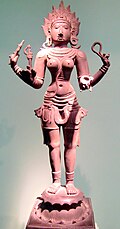
[[File:Goddess Kali.jpg|thumb | [[File:Goddess Kali.jpg|thumb|A Tamil depiction of Kali, 12th century, [[National Museum of India]]|420x420px]]Kali is depicted with four arms, which symbolize the circle of creation and dissolution.<ref name=":3" /> Her left hands are depicted holding a severed head and a sword.<ref name=":3">{{Cite book |last1=Foulston |first1=Lynn |title=Hindu goddesses: beliefs and practices |last2=Abbott |first2=Stuart |date=2009 |publisher=Sussex Academic |isbn=978-1-902210-43-8 |edition= |location=Brighton |pages=34–38}}</ref> The sword signifies divine knowledge and the human head signifies human ego which must be slain by divine knowledge in order to attain [[moksha]]. The right hands are usually depicted in the [[mudra#Abhaya Mudrā|abhaya]] (fearlessness) and [[mudra#Varada Mudrā|varada]] (blessing) [[mudra]]s, which means her initiated devotees (or anyone worshipping her with a true heart) will be saved as she will guide them here and in the hereafter.<ref name="White2000" />{{rp|477}} | ||
She wears a [[Mundamala|garland of | She wears a [[Mundamala|garland of demon heads]], variously enumerated at [[108 (number)|108]] (an auspicious number in Hinduism and the number of countable beads on a [[japa]] [[japa mala|mala]] or rosary for repetition of [[mantras]]) or 51, which represents Varnamala or the Garland of letters of the Sanskrit alphabet, [[Devanagari]]. Hindus believe [[Sanskrit]] is a language of [[dynamism (metaphysics)|dynamism]], and each of these letters represents a form of energy, or a form of Kali. Therefore, she is generally seen as the mother of language, and all [[mantra]]s.<ref name="White2000" />{{rp|475}} | ||
She is often depicted naked which symbolizes her being beyond the covering of [[Maya (Hinduism)|Maya]] since she is pure (''nirguna'') being-consciousness-bliss and far above Prakriti. She is shown as very dark as she is Brahman in its supreme unmanifest state. She has no permanent qualities—she will continue to exist even when the universe ends. It is therefore believed that the concepts of color, light, good, and bad do not apply to her. | She is often depicted naked which symbolizes her being beyond the covering of [[Maya (Hinduism)|Maya]] since she is pure (''nirguna'') being-consciousness-bliss and far above Prakriti. She is shown as very dark as she is Brahman in its supreme unmanifest state. She has no permanent qualities—she will continue to exist even when the universe ends. It is therefore believed that the concepts of color, light, good, and bad do not apply to her.<ref name="White2000" />{{rp|463–488}} | ||
===Mahakali=== | ===Mahakali=== | ||
{{Main|Mahakali}} | {{Main|Mahakali}} | ||
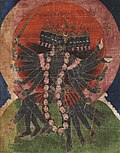
[[File:Goddess Mahakali - National Museum, Delhi.jpg|thumb|upright|[[Mahakali]], goddess of time and death, depicted with a black complexion with ten heads, arms and legs.]] | |||
Mahakali ([[Sanskrit]]: Mahākālī, [[Devanagari]]: महाकाली, [[Bengali language|Bengali]]: মহাকালী, [[Gujarati language|Gujarati]]: મહાકાળી), literally translated as "Great Kali", is sometimes considered as a greater form of Kali, identified with the Ultimate reality of [[Brahman]]. It can also be used as an honorific of the Goddess Kali,.<ref name="McDaniel"/>{{rp|257}} Mahakali symbolizes absolute night and the power of time. She is depicted with five or ten heads, each with three eyes and holding different weapons. Mahakali is known as the origin of all things, her consort is [[Mahakala]].<ref name="McDaniel" />{{rp|257}} | |||
The | The [[Skanda Purana]] mentions that Kali took the form of Mahakali at the instruction of Shiva who wanted her to destroy the world during the time of universal [[Pralaya|destruction]].<ref name="McDaniel" />{{rp|242}} | ||
In the ten-armed form of Mahakali, she is depicted as shining like a blue stone. She has ten faces, ten feet, and three eyes for each head. She has ornaments decked on all her limbs. There is no association with Shiva.<ref>{{cite book |last1=Sankaranarayanan |first1=Sri |title=Glory of the Divine Mother: Devi Mahatmyam |publisher=Nesma Books India |year=2001 |isbn=978-8187936008 |page=127}}</ref> | |||
===Dakshinakali=== | ===Dakshinakali=== | ||
Dakshinakali is the most popular form of Kali in Bengal.<ref>{{cite book |last1=Harper |first1=Katherine Anne |last2=Brown |first2=Robert L. |title=The Roots of Tantra |year=2012 |publisher=SUNY Press |isbn=978-0-7914-8890-4 |page=53}}</ref> She is the benevolent mother, who protects her devotees and children from mishaps and misfortunes. There are various versions for the origin of the name ''Dakshinakali''. ''[[Dakshina]]'' refers to the gift given to a priest before performing a ritual or to one's guru. Such gifts are traditionally given with the right hand. Dakshinakali's two right hands are usually depicted in gestures of blessing and giving of boons. One version of the origin of her name comes from the story of [[Yama]], lord of death, who lives in the south (''dakshina''). When Yama heard Kali's name, he fled in terror, and so those who worship Kali are said to be able to overcome death itself.<ref name="Kinsley1998pp86-90">{{cite book |last1=Kinsley |first1=David R. |title=Hindu Goddesses: Visions of the Divine Feminine in the Hindu Religious Tradition |url=https://books.google.com/books?id=hgTOZEyrVtIC |year=1988 |publisher=[[University of California Press]] |isbn=978-8120803947 |pages=86–90}}</ref><ref name="Dold2003" />{{rp|53–55}} | |||
Dakshinakali is the most popular form of Kali in Bengal. | |||
|last1=Harper | |||
|first1=Katherine Anne | |||
|last2=Brown | |||
|first2=Robert L. | |||
|title=The Roots of Tantra | |||
|year=2012 | |||
|publisher=SUNY Press | |||
|isbn=978-0-7914-8890-4|page=53}} | |||
|last1=Kinsley | |||
|first1=David R. | |||
|title=Hindu Goddesses: Visions of the Divine Feminine in the Hindu Religious Tradition | |||
|url=https://books.google.com/books?id=hgTOZEyrVtIC | |||
|year=1988 | |||
|publisher=[[University of California Press]] | |||
|isbn=978-8120803947 |pages=86–90}} | |||
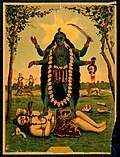
Dakshinakali is typically shown with her right foot on [[Shiva]]'s chest—while depictions showing Kali with her left foot on Shiva's chest depict the even more fearsome Vamakali. Vamakali is usually worshipped by non-householders. | Dakshinakali is typically shown with her right foot on [[Shiva]]'s chest—while depictions showing Kali with her left foot on Shiva's chest depict the even more fearsome Vamakali. Vamakali is usually worshipped by non-householders.<ref name="Pravrajika Vedantaprana 2015 p.16">Pravrajika Vedantaprana, Saptahik Bartaman, Volume 28, Issue 23, Bartaman Private Ltd., 6, JBS Haldane Avenue, 700 105 (ed. 10 October 2015) p.16</ref> | ||
The pose shows the conclusion of an episode in which Kali was rampaging out of control after destroying many demons. | The pose shows the conclusion of an episode in which Kali was rampaging out of control after destroying many demons. Vishnu confronted Kali in an attempt to cool her down. She was unable to see beyond the limitless power of her rage and Vishnu had to move out of her way. Seeing this the devas became more fearful, afraid that in her rampage, Kali would not stop until she destroyed the entire universe. Shiva saw only one solution to prevent Kali's endless destruction. Shiva lay down on the battlefield so that Goddess Mahakali would have to step on him. When she saw her consort under her foot, Kali realized that she had gone too far. Filled with grief for the damage she had done, her blood-red tongue hung from her mouth, calming her down. In some interpretations of the story, Shiva was attempting to receive Kali's grace by receiving her foot on his chest.<ref>{{Cite book |last=Kinsley |first=David R. |editor1-last=McDermott |editor1-first=Rachel Fell |editor2-last=Kripal |editor2-first=Jeffrey J. |chapter=Kali |title=Encountering Kali: in the margins, at the center, in the West |year=2003 |publisher=University of California Press |page=36 |isbn=978-0-520-92817-6}}</ref> | ||
[[ | Rachel Fell McDermott finds that in the [[Mahabhagavata Purana]], Shiva is portrayed as "the devotee who falls at [Kali's] feet in devotion, in the surrender of his ego, or in hopes of gaining ''moksha'' by her touch." In fact, Shiva is said to have become so enchanted by Kali that he performed austerities to win her, and having received the treasure of her feet, held them against his heart in reverence.<ref name="Dold2003">{{cite book |last1=Dold |first1=Patricia |editor-last1=McDermott |editor-first1=Rachel Fell |editor2-last=Kripal |editor2-first=Jeffrey J. |chapter=Kali the Terrific and Her Tests |title=Encountering Kali: In the Margins, at the Center, in the West |url=https://books.google.com/books?id=bMUJyU_C-LkC |year=2003 |publisher=University of California Press |page=54 |isbn=978-0-520-92817-6}}</ref> | ||
The popularity of the worship of the Dakshinakali form of Goddess Kali is often attributed to [[Krishnananda Agamavagisha]]. He was a noted 17th-century Bengali Tantra thinker and author of ''Tantrasara''. Devi Kali reportedly appeared to him in a dream and told him to popularize her in a particular form that would appear to him the following day. The next morning he observed a young woman making cow dung patties. While placing a patty on a wall, she stood in the ''alidha'' pose, with her right foot forward. When she saw Krishnananda watching her, she was embarrassed and put her tongue between her teeth, Agamavagisha realized that this was the divine form of maa kali he was looking for.<ref name="Dold2003" />{{rp|54}}<ref name="Sircar1998">{{cite book |last1=Sircar |first1=Dineschandra |author-link=Dineschandra Sircar |title=The Śākta Pīṭhas |year=1998 |publisher=Motilal Banarsidass Publ |isbn=978-81-208-0879-9 |page=74}}</ref> Krishnananda Agamavagisha was also the guru of the Kali devotee and poet [[Ramprasad Sen]].<ref name="Harding" />{{rp|217}} | |||
|last1=Sircar | |||
|first1=Dineschandra | |||
|title= The Śākta Pīṭhas | |||
|year=1998 | |||
|publisher=Motilal Banarsidass Publ | |||
|isbn=978-81-208-0879-9| | |||
===Samhara Kali=== | ===Samhara Kali=== | ||
Samhara Kali, also called Vama Kali, is the embodiment of the power of destruction. The chief goddess of Tantric texts, Samhara Kali is the most dangerous and powerful form of Kali. Samhara Kali takes form when Kali steps out with her left foot holding her sword in her right hand. She is the Kali of death, destruction and is | Samhara Kali, also called Vama Kali, is the embodiment of the power of destruction. The chief goddess of Tantric texts, Samhara Kali is the most dangerous and powerful form of Kali. Samhara Kali takes form when Kali steps out with her left foot holding her sword in her right hand. She is the Kali of death, destruction and is worshipped by tantrics. As Samhara Kali she gives death and liberation. According to the Mahakala Samhita, Samhara Kali is two armed and black in complexion. She stands on a corpse and holds a freshly cut head and a plate to collect the dripping blood. She is worshipped by warriors, tantrics – the followers of [[Tantra]].<ref name="Harding" /> | ||
===Other forms=== | ===Other forms=== | ||
Other forms of Kali popularly worshipped in Bengal include Raksha Kali (form of Kali worshipped for protection against epidemics and drought), Bhadra Kali and Guhya Kali. Kali is said to have 8, 12, or 21 different forms according to different traditions. The popular forms are Adya | Other forms of Kali popularly worshipped in Bengal include Raksha Kali (form of Kali worshipped for protection against epidemics and drought), Bhadra Kali and Guhya Kali. Kali is said to have 8, 12, or 21 different forms according to different traditions. The popular forms are Adya Kali, Chintamani Kali, Sparshamani Kali, Santati Kali, Siddhi Kali, Dakshina Kali, Bhadra Kali, Adharvana Bhadra Kali, Smashana Kali, Rakta Kali, Kamakala Kali, Guhya Kali, Hamsa Kali, Shyama Kali, and Kalasankarshini Kali. In [[Gujarat]], [[Khodiyar]] is a regional form of [[Mahakali]].<ref name="Pravrajika Vedantaprana 2015 p.16"/> | ||
==Symbolism== | ==Symbolism== | ||
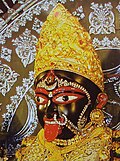
[[File:Maa Bhavatarini's face @ Dakshineshwar Kali Temple.JPG|thumb|upright|In [[Bengal]] and [[Odisha]], Kali's extended tongue is widely seen as expressing embarrassment over the realization that her foot is on her husband's chest.<ref name="Dold2003" />{{rp|53–55}}<ref name="Kali's Tongue" /><ref name="Dutta2011" /><ref name="McDaniel"/>{{rp|237}} Above: idol of Kali at the [[Dakshineshwar Kali Temple]].]] | |||
Interpretations of the symbolic meanings of Kali's appearance vary depending on Tantric or devotional approach, and on whether one views her image in a symbolic, allegorical or mystical fashion.<ref name="Kinsley1998pp86-90" /> There are many varied depictions of the different forms of Kali. The most common form shows her with four arms and hands, showing aspects of both creation and destruction. The two right hands are often held out in blessing, one in a mudra saying "fear not" ([[abhayamudra]]), the other conferring boons. Her left hands hold a severed head and blood-covered sword. The sword severs the bondage of ignorance and ego ([[Tamas (philosophy)|tamas]]), represented by the severed head. One interpretation of Kali's tongue is that the red tongue symbolizes the [[rajasic]] nature being conquered by the white (symbolizing [[sattvic]]) nature of the teeth. Her blackness represents that she is ''[[nirguna]]'', beyond all qualities of nature, and transcendent.<ref name="Kinsley1998pp86-90" /><ref name="Dold2003" />{{rp|53–55}} Kali's lolling tongue is interpreted as her being angry, enraged; while many in India interpret it as "biting the tongue" in shame.<ref name="Jones"/>{{rp|222}} | |||
There are many varied depictions of the different forms of Kali. The most common form shows her with four arms and hands, showing aspects of both creation and destruction. The two right hands are often held out in blessing, one in a mudra saying "fear not" ([[abhayamudra]]), the other conferring boons. Her left hands hold a severed head and blood-covered sword. The sword severs the bondage of ignorance and ego, represented by the severed head. One interpretation of Kali's tongue is that the red tongue symbolizes the [[rajasic]] nature being conquered by the white (symbolizing [[sattvic]]) nature of the teeth. Her blackness represents that she is ''[[nirguna]]'', beyond all qualities of nature, and transcendent. | |||
The most widespread interpretation of Kali's extended tongue involve her embarrassment over the sudden realization that she has stepped on her husband's chest. Kali's sudden "modesty and shame" over that act is the prevalent interpretation among [[Hinduism in Odisha|Odia Hindus]]. | The most widespread interpretation of Kali's extended tongue involve her embarrassment over the sudden realization that she has stepped on her husband's chest. Kali's sudden "modesty and shame" over that act is the prevalent interpretation among [[Hinduism in Odisha|Odia Hindus]].<ref name="Dold2003" />{{rp|53–55}} The biting of the tongue conveys the emotion of ''lajja'' or modesty, an expression that is widely accepted as the emotion being expressed by Kali.<ref name="Kali's Tongue">{{cite book |last1=Menon |first1=Usha |last2=Shweder |first2=Richard A. |title=Emotion and Culture: Empirical Studies of Mutual Influence |chapter=Kali's Tongue: Cultural Psychology and the Power of Shame in Orissa, India |editor-last=Kitayama |editor-first=Shinobu |editor2-last=Markus |editor2-first=Hazel Rose |location=Washington, D.C. |publisher=American Psychological Association |date=1994 |pages=241–284}}</ref><ref name="McDaniel"/>{{rp|237}} In Bengal also, Kali's protruding tongue is "widely accepted... as a sign of speechless embarrassment: a gesture very common among Bengalis."<ref name="Dutta2011">{{cite book |author=Krishna Dutta |title=Calcutta: A Cultural and Literary History (Cities of the Imagination) |url=https://books.google.com/books?id=SZq_BAAAQBAJ&pg=PT18 |year=2011 |publisher=Andrews UK Ltd |isbn=978-1-904955-87-0 |page=18}}</ref><ref name="Harding" />{{rp|xxiii}} | ||
The twin earrings of Kali are small embryos. This is because Kali likes devotees who have childlike qualities in them. | The twin earrings of Kali are small embryos. This is because Kali likes devotees who have childlike qualities in them.<ref name="Pravrajika Vedantaprana 2015 p.16"/> The forehead of Kali is seen to be as luminous as the full moon and eternally giving out ambrosia.<ref name="Pravrajika Vedantaprana 2015 p.16"/> | ||
Kali is often shown standing with her right foot on Shiva's chest. This represents an episode where Kali was out of control on the battlefield, such that she was about to destroy the entire universe. | Kali is often shown standing with her right foot on Shiva's chest. This represents an episode where Kali was out of control on the battlefield, such that she was about to destroy the entire universe. Shiva pacified her by laying down under her foot to pacify and calm her. Shiva is sometimes shown with a blissful smile on his face.<ref name="Dold2003" />{{rp|53–55}} She is typically shown with a garland of severed heads, often numbering fifty. This can symbolize the letters of the Sanskrit alphabet and therefore as the primordial sound of [[Aum]] from which all creation proceeds. The severed arms which make up her skirt represent her devotee's karma that she has taken on.<ref name="Kinsley1998pp86-90" /> | ||
There are several interpretations of the symbolism behind the commonly represented image of Kali standing on Shiva's supine form. A common interpretation is that Shiva symbolizes ''[[purusha]]'', the universal unchanging aspect of reality, or pure consciousness. Kali represents ''[[Prakriti]]'', nature or matter, sometimes seen as having a feminine quality of creation of life. The merging of these two qualities represent ultimate reality.<ref name="Kinsley1997" />{{rp|88}} | |||
| | |||
A tantric interpretation sees Shiva as consciousness and Kali as power or energy. Consciousness and energy are dependent upon each other, since Shiva depends on Shakti, or energy, in order to fulfill his role in creation, preservation, and destruction. In this view, without Shakti, Shiva is a corpse—unable to act.<ref name="Dold2003"/>{{rp|53}} | |||
A tantric interpretation sees Shiva as consciousness and Kali as power or energy. Consciousness and energy are dependent upon each other, since Shiva depends on Shakti, or energy, in order to fulfill his role in creation, preservation, and destruction. In this view, without Shakti, Shiva is a corpse—unable to act. | |||
==Worship== | ==Worship== | ||
===Mantras=== | ===Mantras=== | ||
Kali | Kali is closely associated with transcendent knowledge and is regarded as the first of the ten [[Mahavidya]]s, an amalgamation of goddesses who provide liberating knowledge.<ref name="Paul"/>{{rp|399}} Kali is primarily worshipped in the [[Shaktism#Kalikula: family of Kali|Kalikula]] worship tradition. The closest way of direct worship is to the forms of [[Mahakali]] or [[Bhadrakali]] (Bhadra in Sanskrit means 'gentle'). One mantra for Kali worship is:<ref name="Chawdri">{{cite book |last=Chawdhri |first=L.R. |title=Secrets of Yantra, Mantra and Tantra |year=1992 |publisher=Sterling Publishers Pvt. Ltd.}}</ref> | ||
|last=Chawdhri | |||
|first=L.R. | |||
|title=Secrets of Yantra, Mantra and Tantra | |||
|year=1992 | |||
|publisher=Sterling Publishers Pvt. Ltd. | |||
}} | |||
{{verse translation|lang=sa|italicsoff=y | {{verse translation|lang=sa|italicsoff=y | ||
|सर्वमङ्गलमाङ्गल्ये शिवे सर्वार्थसाधिके । शरण्ये त्र्यम्बके गौरि नारायणि नमोऽस्तु ते ॥ | |सर्वमङ्गलमाङ्गल्ये शिवे सर्वार्थसाधिके । शरण्ये त्र्यम्बके गौरि नारायणि नमोऽस्तु ते ॥ | ||
ॐ जयंती मंगला काली भद्रकाली कपालिनी । दुर्गा क्षमा शिवा धात्री स्वाहा स्वधा नमोऽस्तुते ॥ | ॐ जयंती मंगला काली भद्रकाली कपालिनी । दुर्गा क्षमा शिवा धात्री स्वाहा स्वधा नमोऽस्तुते ॥ | ||
| | |Sarvamangal-māngalyē śivē sarvārthasādhikē. Śaraṇyē tryambakē Gauri nārāyaṇi namō'stu tē. | ||
Oṃ jayantī mangala kālī bhadrakālī kapālinī . Durgā kṣamā śivā dhātrī svāhā svadhā namō'stutē. | Oṃ jayantī mangala kālī bhadrakālī kapālinī . Durgā kṣamā śivā dhātrī svāhā svadhā namō'stutē. | ||
ॐ काली काली महाकाली कालिके परमेश्वरी । सर्वानन्दकरी देवी नारायणि नमोऽस्तुते ।। | |||
}} | |||
===Tantra=== | ===Tantra=== | ||
[[File:Kali Yantra.jpg|thumb|Kali [[Yantra]]]] | [[File:Kali Yantra.jpg|thumb|Kali [[Yantra]]]] | ||
In Tantrism the cause of reality is the mutual interaction between male and female or Shiva and Shakti. As a result, goddesses play an important role in the study and practice of [[Tantra]] Yoga and are essential in understanding the nature of reality.<ref name="Kinsley1997" /> Kali is often mentioned in Tantric iconography, texts and rituals even though [[Parvati]] received [[Shiva]]'s wisdom in the form of Tantras.<ref name="Kinsley1997" /> Kali is revered as the highest reality or greatest of all deities in many Tantric texts. The ''Niruttara-tantra'' and the ''Picchila-tantra'' state that among all mantras Kali's mantras are the greatest. The ''Kdmadd-tantra'' mentions that Kali is ''sacciddnanda'' or imperishable bliss and Brahman. In other texts like the''Yogini-tantra'', ''Kamakhya-tantra'' and the ''Niruttara-tantra'' Kali is referred to as an essential form of [[Mahadevi]].<ref name="Kinsley1997" />{{rp|122–124}} | |||
In | In Tantric practice, Kali's figure represents death itself. The ''Karpuradi-stotra,'' dated to approximately 10th century CE'','' describes the ''Pancatattva'' ritual which is performed on cremation grounds (''Samahana-sadhan''). It states that a ''[[sadhaka]]'' that meditates on the terrible aspects of Kali's form and confronts her can attain salvation.<ref name="Kinsley1997" />{{rp|122–124}} | ||
The ''Karpuradi-stotra'' also describes Kali's gentler form that is young, with a smiling face and with two right hands to dispel fear and offer boons. She is also described as the supreme being of the universe. In this benign form, Kali becomes the goddess who grants salvation when fear is overcome and goes from being a symbol of death to being a symbol of triumph over death.<ref name="Kinsley1997" />{{rp|124–125}} | |||
===In Bengali tradition=== | |||
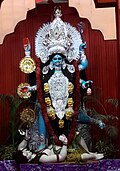
[[File:Daksina_Kali_clay_statue_of_Bengal.jpg|thumb|upright|Statue of Kali trampling on Shiva, worshipped in [[Bengal]]]] | |||
[[File:Kali; standing triumphantly over Shiva. Chromolitho Wellcome V0045066.jpg|thumb|upright|Kali standing triumphantly over Shiva, painting]] | |||
Kali is a central figure in late medieval [[Bengal]] devotional literature, with such notable devotee poets as [[Kamalakanta Bhattacharya (West Bengal)|Kamalakanta Bhattacharya]] (1769–1821) and [[Ramprasad Sen]] (1718–1775). With the exception of being associated with [[Parvati]] as [[Shiva]]'s consort, Kāli is rarely pictured in Hindu legends and iconography as a motherly figure until Bengali devotions beginning in the early eighteenth century. Even in Bengāli tradition her appearance and habits change little, if at all.<ref name="Kinsley1997" />{{rp|126}} | |||
}} | |||
The Tantric approach to Kāli is to display courage by confronting her on cremation grounds in the dead of night, despite her terrible appearance. In contrast, the Bengali devotee adopts the attitude of a child, coming to love her unreservedly. In both cases, the goal of the devotee is to become reconciled with death and to learn acceptance of the way that things are. These themes are addressed in Rāmprasād's work.<ref name="Kinsley1997" />{{rp|125–126}} Rāmprasād comments in many of his other songs that Kāli is indifferent to his wellbeing, causes him to suffer, brings his worldly desires to nothing and his worldly goods to ruin. He also states that she does not behave like a mother should and that she ignores his pleas.<ref name="Kinsley1997" />{{rp|128}} | |||
To be a child of Kāli, Rāmprasād asserts, is to be denied of earthly delights and pleasures. Kāli is said to refrain from giving that which is expected. To the devotee, it is perhaps her very refusal to do so that enables her devotees to reflect on dimensions of themselves and of reality that go beyond the material world.<ref name="Kinsley1997" />{{rp|128}} | |||
A significant portion of Bengali devotional music features Kāli as its central theme and is known as [[Shyama Sangeet]].<ref>{{Cite book |last1=Multani |first1=Angelie |url=https://books.google.com/books?id=qsDGEAAAQBAJ&dq=shyama+sangeet+in+bengali+tradition&pg=PT50 |title=From Canon to Covid: Transforming English Literary Studies in India. Essays in Honour of GJV Prasad |last2=Pal |first2=Swati |last3=Saha |first3=Nandini |last4=Shakil |first4=Albeena |last5=Ghosh |first5=Arjun |date=2023-08-31 |publisher=Taylor & Francis |isbn=978-1-000-89220-8 |language=en}}</ref> | |||
[[ | |||
Kāli is especially venerated in the festival of [[Kali Puja]] in eastern India – celebrated when the new moon day of [[Ashwin]] month coincides with the festival of [[Diwali]]. The practice of animal sacrifice is still practiced during Kali Puja in Bengal, Orissa, and Assam, though it is rare outside of those areas. The [[Hindu temple]]s where this takes place involves the ritual slaying of goats, chickens and sometimes male water buffalos. Throughout India, the practice is becoming less common.<ref name="Fuller Christopher John 2004 83">{{cite book|last=J. Fuller|first= C.|title=The Camphor Flame: Popular Hinduism and Society in India [Paperback] |edition=Revised|year=2004|publisher=[[Princeton University Press]]|isbn=978-0-691-12048-5 |page=83|quote=Animal sacrifice is still practiced widely and is an important ritual in popular Hinduism|id= {{ASIN|069112048X|country=uk}}}}</ref> The rituals in eastern India temples where animals are killed are generally led by [[Brahmin]] priests.<ref name="Fuller Christopher John 2004 83"/>{{rp|84, 101–104}} A number of [[Tantra|Tantric]] [[Puranas]] specify the ritual for how the animal should be killed. A Brahmin priest will recite a mantra in the ear of the animal to be sacrificed, in order to free the animal from the cycle of life and death. Groups such as People for Animals continue to protest animal sacrifice based on court rulings forbidding the practice in some locations.<ref>{{cite book |last1=McDermottb|first1=Rachel Fell |title=Revelry, rivalry, and longing for the goddesses of Bengal: the fortunes of Hindu festivals |date=2011 |publisher=[[Columbia University Press]] |location=New York; Chichester |isbn=978-0-231-12918-3 |page=205 |url=https://books.google.com/books?id=ggBeH_lmUu8C&pg=PR10 |access-date=17 December 2014}}</ref> | |||
===In Tantric Buddhism=== | |||
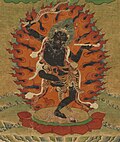
[[File:Troma Nagmo closeup.jpg|thumb|upright|Tröma Nagm, in Tibetan Buddhism, shares some attributes of Kali]] | |||
Tantric Kali cults such as the Kaula and Krama had a strong influence on [[Tantric Buddhism]], as can be seen in fierce-looking [[yogini]]s and [[dakini]]s such as [[Vajrayogini]] and Krodikali.<ref>{{Cite book |last=English |first=Elizabeth |title=Vajrayoginī: her visualizations, rituals & forms: a study of the cult of Vajrayoginī in India |publisher=Wisdom Publications |year=2002 |isbn=0-86171-329-X |edition=1st Wisdom |location=Boston |pages=38–40 |oclc=50234984}}</ref> | |||
{{ | In Tibet, Krodikali (alt. Krodhakali, Kālikā, Krodheśvarī, Krishna Krodhini) is known as ''Tröma Nagmo'' ({{langx|xct|ཁྲོ་མ་ནག་མོ་}}, [[Wylie transliteration|Wylie]]: {{lang|bo-Latn|khro ma nag mo}}, English: "The Black Wrathful Lady").<ref>[http://www.himalayanart.org/pages/vajrayogini/index.html The Forms of Vajrayoginī] {{Webarchive|url=https://web.archive.org/web/20080821222811/http://www.himalayanart.org/pages/vajrayogini/index.html |date=21 August 2008 }} Himalayan Art Resources</ref><ref>{{cite web|url=http://www.himalayanart.org/image.cfm/490.html|title=Vajrayogini (Buddhist Deity) – Krodha Kali (Wrathful Black Varahi) |work=HimalayanArt}}</ref> She features as a key deity in the practice tradition of [[Chöd]] founded by [[Machig Labdron]] and is seen as a fierce form of [[Vajrayogini]].<ref>{{Cite book |last=Simmer-Brown |first=Judith |author-link=Judith Simmer-Brown |title=Dakini's warm breath: the feminine principle in Tibetan Buddhism |year=2002 |isbn=1-57062-920-X |edition=1st paperback |location=Boulder |publisher=Shambhala |pages=146 |oclc=54964040}}</ref> Other similar fierce deities include the dark blue Ugra Tara and the lion-faced [[Simhamukha]].<ref>{{Cite book |last=Shaw |first=Miranda Eberle |title=Buddhist goddesses of India |publisher=Princeton University Press |year=2006 |isbn=0-691-12758-1 |location=Princeton |pages=340, 426|oclc=62342823}}</ref> | ||
===In Sinhala Buddhism=== | |||
In Sinhala Buddhism, Kali's origin is explained through her arriving at Munneśvaram from South India, eating humans, and attempting to eat Pattini, who instead tames her.<ref name=":2">{{Cite journal |last=Bastin |first=Rohan |date=September 1996 |title=The Regenerative Power of Kali Worship in Contemporary Sinhala Buddhism |url=https://www.jstor.org/stable/23171698 |journal=Social Analysis: The International Journal of Anthropology |issue=40 |pages=59–94 |jstor=23171698}}</ref> | |||
She is regarded as having seven forms; Bhadrakāli, Mahābhadrakāli, Pēnakāli, Vandurukāli (Hanumāpatrakāli), Rīrikāli, Sohonkāli, and Ginikāli. These forms are subordinate to Kāliammā (the mother of Kāli). Red flowers, silver coins, blood, and oil lamps with mustard oil are offered to her, and as Pattini's servant, she accepts offerings on her behalf.<ref name=":1">{{Cite journal |last=Hewamanage |first=Wimal |date=January 2018 |title=The History of the Kāli Cult and its Implications in Modern Sri Lankan Buddhist Culture |journal=Alternative Spirituality and Religion Review |volume=9 |issue=2 |pages=246–256 |doi=10.5840/asrr2018111353}}</ref> | |||
Her worship in Sri Lanka dates back to at least the 9th century CE, and [[Dharmasena Thera]] created the [[Sadharma Ratnavaliya]] in the 13th century based on an older 5th century work, which actively recontextualizes Kali in a Buddhist context,<ref>{{Cite web |title=Sri Kali and Sri Lanka |url=http://www.srilankaguardian.org/2011/12/sri-kali-and-sri-lanka.html}}</ref> exploring the nature of violence and vengeance and how they trap people in cycles until justification, guilt, and good and evil become irrelevant.<ref>{{Cite book |last=Thera |first=Dharmasena |title=The Jewels of the Doctrine |year=1991 |publisher=SUNY Press |isbn=0-7914-0489-7 |language=English |translator-last=Obeyesekere |translator-first=Ranjini}}</ref> Kali has been seen as both a demon (though a tamed one, thanks to Pattini<ref name=":2" />) and a goddess in Sri Lanka.<ref name=":1" /> She and mythical Sinhala Buddhist kings both use demonic fury as a necessary condition of conquest.<ref name=":2" /> | |||
Yantras are used in relation to her, sourced from the [[Pali Canon]], later Buddhist [[paritta]] chants, and from non-Buddhist yantras and mantras. The Sādhakayantra is popular, and its corresponding mantra includes Arabic words and Islamic concepts.<ref name=":1" /> | |||
===Worship in the Western world=== | ===Worship in the Western world=== | ||
====Theorized early worship==== | ====Theorized early worship==== | ||
A form of Kali worship may have already transmitted to the west | A form of Kali worship may have already been transmitted to the west in medieval times by the wandering [[Romani people|Romani]]. A few authors have drawn parallels between Kali worship and the ceremonies of the annual pilgrimage in honor of [[Saint Sarah]], also known as ''Sara-la-Kali'' ("Sara the Black", {{langx|rom|Sara e Kali}}), held at [[Saintes-Maries-de-la-Mer]], a place of [[pilgrimage]] for Roma in the [[Camargue]], in southern France.<ref>{{Cite book |last=McDowell |first=Bart |title=Gypsies: Wanderers of the World |pages=38–57}}</ref><ref>{{Cite book |last=Fonseca |first=Isabel |title=Bury me standing: the Gypsies and their journey |others=Mazal Holocaust Collection, David Lindroth Inc. |year=1995 |isbn=0-679-40678-6 |edition=1st |location=New York |publisher=Alfred A. Knopf |pages=106–107 |oclc=32387216}}</ref> [[Ronald Lee]] (2001) notes that the similarities in the ceremonies performed at the shrine if Sainte Sara (called Sara e Kali in Romani) indicate that Kali/Durga worship have been incorporated to a Christian figure.<ref name="McDermott1998p281-305" /> | ||
====In modern times==== | |||
An academic study of modern-day western Kali enthusiasts noted that, "as shown in the histories of all cross-cultural religious transplants, Kali devotionalism in the West must take on its own indigenous forms if it is to adapt to its new environment."<ref name="McDermott1998p281-305">{{cite book |last=McDermott |first=Rachel Fell |chapter=The Western Kali |editor-last=Hawley |editor-first=John Stratton |title=Devi: Goddesses of India |publisher=Motilal Banarsidass |date=1998 |pages=281–305}}</ref> Rachel Fell McDermott, Professor of Asian and Middle Eastern Cultures at [[Columbia University]] and author of several books on Kali, has noted the evolving views in the West regarding Kali and her worship. In 1998 McDermott wrote that feminists and New Age spiritualists are drawn to Kali because they perceive her to be a symbol of repressed female power, sexuality, and healing but that this is a misinterpretation which stems from a lack of knowledge about Hindu religious tradition.<ref name="McDermott1998p281-305" /> By 2003, she amended this view stating that cross-cultural borrowing should be done thoughtfully and is natural due to religious globalization. She further stated that Kali enthusiasts since the early 1990s had sought to take on a more informed approach by incorporating more Indian perspective of her character than feminist and New Age interpretations.<ref name="McDermott1998p281-305" /> | |||
The emergence of Kali in the modern times as an image of significance for many women, both Hindu and non-Hindu, has been noteworthy.<ref name="Paul"/>{{rp|399}} Since the late twentieth century, various [[feminist movement]]s in the West have associated Kali with [[women's empowerment]].<ref name="EY" /> [[New age]] religious and spiritual movements have found in the iconographic representations and mythological stories of Kali an inspiration for [[theological]] and [[Sexual revolution|sexual liberation]].<ref name="EY" /> | |||
====In Réunion==== | |||
In [[Réunion]], an island territory of France in the Indian Ocean, veneration for Saint [[Expeditus]] ({{Langx|fr|Saint Expédit}}) is very popular. The [[Malbars]] have Tamil ancestry but are, at least nominally, Catholics. | |||
The saint is identified with Kali.<ref name="Suryanarayan">{{cite journal |last1=Suryanarayan |first1=V. |title=Tamils In Re-Union: Losing Cultural Identity – Analysis |journal=Eurasia Review |date=12 October 2018 |url=https://www.eurasiareview.com/12102018-tamils-in-re-union-losing-cultural-identity-analysis/ |access-date=3 March 2021 |language=en |quote=Saint Expedit, worshipped locally, is identified with Goddess Kali.}}</ref> | |||
==Comparative scholarship== | |||
Scholar [[Marvin H. Pope]] in 1965 argues that the [[Hinduism|Hindu]] goddess Kali, who is first attested in the 7th century CE, shares some characteristics with some ancient Near Eastern goddesses, such as wearing a necklace of heads and a belt of severed hands like [[Anat]], and drinking blood like the Egyptian goddess [[Sekhmet]] and that therefore that her character might have been influenced by them.{{sfn|Pope|Röllig|1965|page=239}} | |||
==== | === Levantine Anat === | ||
The Bronze Age epic cycles of the [[Levant]]ine city of [[Ugarit]] include a myth according to which the warrior goddess [[Anat]] started attacking warriors, with the text of the myth describing the goddess as gloating and her heart filling with joy and her liver with laughter while attaching the heads of warriors to her back and girding hands to her waist{{sfn|Pope|1977|pages=606–607}} until she is pacified by a message of peace sent by her brother and consort, the god [[Baal|Baʿlu]].{{sfn|Pope|1977|page=601}} | |||
The Hindu goddess Kali similarly wore a necklace of severed heads and a girdle of severed hands, and was pacified by her consort, Śiva, throwing himself under her feet. The sickle sword wielded by Kali might also have been connected to similar sickle swords used in [[Early Dynastic Period (Mesopotamia)|early dynastic]] [[Mesopotamia]].{{sfn|Pope|1977|pages=608}} | |||
== | === Egyptian Sekhmet === | ||
[[ | According to an [[Ancient Egypt]]ian myth, called {{transliteration|en|The Deliverance of Mankind from Destruction}}, the ancient Egyptian supreme god, the Sun-god [[Ra]], suspected that mankind was plotting against him, and so he sent the goddess [[Hathor]], who was the incarnation of his violent feminine aspect, the [[Eye of Ra]], to destroy his enemies.{{sfn|Pope|1977|pages=607–608}} | ||
Furthermore, Hathor appeared as the lion-goddess [[Sekhmet]] and carried out Ra's orders until she became so captured by her blood-lust that she would not stop despite Ra himself becoming distressed and wishing an end to the killing. Therefore, Ra concocted a ruse whereby a plain was flooded with beer which had been dyed red, which Sekhmet mistook for blood and drank until she became too inebriated to continue killing, thus saving humanity from destruction.{{sfn|Pope|1977|pages=607–608}} | |||
Similarly, while killing demons, Kālī became ecstatic with the joy of battle and slaughter and refused to stop, so that the [[Deva (Hinduism)|Devas]] feared she would destroy the world, and she was stopped through ruse when her consort Śiva threw himself under her feet.{{sfn|Pope|1977|pages=608}} | |||
A [[Thuggee]] | ==In popular culture== | ||
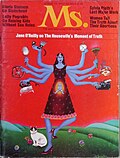
[[File:Ms. magazine Cover - Spring 1972.jpg|thumb|''[[Ms. (magazine)|Ms.]]'' magazine cover, 1972]] | |||
A 1939 American [[adventure film]]'', [[Gunga Din (film)|Gunga Din]]'', features a resurgent sect of [[Thuggee]]s as worshippers of Kali who are at war with the British Raj.<ref>{{Cite book |doi=10.4324/9780203720707 |title=South Asian Transnationalisms |date=2014-02-25 |publisher=Routledge |isbn=978-1-135-71832-9 |editor-last=Sinha |editor-first=Babli |pages=88–89}}</ref> In the [[Beatles]]' 1965 film ''[[Help! (film)|Help!]]'', [[Ringo Starr]] is pursued by Kali worshippers intending to sacrifice him.<ref name="Magic Circles">{{cite book |last1=McKinney |first1=Devin |title=Magic Circles: The Beatles in Dream and History |date=2003 |publisher=Harvard University Press |isbn=978-0-674-01202-8 |page=78 |url=https://books.google.com/books?id=NODXwtg3SIkC&dq=%22Help!%22+Beatles+Kali&pg=PA78 |language=en}}</ref><ref name="Vampires' Most Wanted">{{cite book |last1=Enright |first1=Laura |title=Vampires' Most Wanted: The Top 10 Book of Bloodthirsty Biters, Stake-wielding Slayers, and Other Undead Oddities |date=30 June 2011 |publisher=[[Potomac Books]], Inc. |isbn=978-1-59797-752-4 |page=12 |url=https://books.google.com/books?id=kbM7fOH5SI0C&dq=%22Help!%22+Beatles+Kali&pg=PT12 |language=en}}</ref> In ''[[Indiana Jones and the Temple of Doom]]'' (1984), an action-adventure film which takes place in 1935, a Thuggee cult of Kali worshippers are villains.<ref>{{cite book |last1=Ganguly |first1=Swagato |url=https://books.google.com/books?id=r_0wDwAAQBAJ&q=%22Indiana+Jones+and+the+Temple+of+Doom%22+kali&pg=PT12 |title=Idolatry and the Colonial Idea of India: Visions of Horror, Allegories of Enlightenment |date=2017 |publisher=Taylor & Francis |isbn=978-1351584678 |language=en |access-date=6 January 2019}}</ref> An Indian television series, ''[[Mahakali — Anth Hi Aarambh Hai]]'' (2017), has [[Parvati]] (Mahakali), Shiva's consort, assuming varied forms to destroy evil and protect the innocent.<ref>{{Cite web |last=Nathan |first=Leona |date=2017-07-23 |title=Mahakali – Anth Hi Aarambh Hai: Pooja Sharma Says, Playing Mahakali Is A Lifetime Experience |url=https://www.india.com/entertainment/mahakali-anth-hi-aarambh-hai-pooja-sharma-says-playing-mahakali-is-a-lifetime-experience-2342973/ |access-date=2020-09-27 |website=India News, Breaking News, Entertainment News {{!}} India.com |language=en}}</ref> | |||
''[[ | A modern version of Kali was featured on the cover of the first issue of feminist magazine ''[[Ms. (magazine)|Ms.]]'', published in 1972, with Kali's arms symbolizing the many tasks of the contemporary American woman.<ref>{{cite book |last1=Lemak |first1=Jennifer A. |last2=Hopkins-Benton |first2=Ashley |title=Votes for Women: Celebrating New York's Suffrage Centennial |date=2017 |publisher=[[SUNY Press]] |isbn=978-1-4384-6732-0 |pages=204 |url=https://books.google.com/books?id=tuo_DwAAQBAJ&pg=PA204 |access-date=2 July 2020 |language=en}}</ref><ref>{{cite web |last1=Donald |first1=Brooke |title=The feminist struggle continues, Gloria Steinem says, encouraging a Stanford audience toward 'one new subversive thing' |url=https://news.stanford.edu/news/2012/january/gloria-steinem-talk-012712.html |website=[[Stanford University]] |access-date=2 July 2020 |language=en |date=27 January 2012}}</ref> The [[tongue and lips logo]] of the band [[The Rolling Stones]], created in 1971, was inspired by the stuck-out tongue of Kali.<ref>{{cite news |last=Coscarelli |first=Joe |date=7 June 2015 |title=Art of the Rolling Stones: Behind That Zipper and That Tongue |url=https://www.nytimes.com/2015/06/08/arts/music/art-of-the-rolling-stones-behind-that-zipper-and-that-tongue.html |url-status=live |archive-url=https://web.archive.org/web/20150611105409/http://www.nytimes.com/2015/06/08/arts/music/art-of-the-rolling-stones-behind-that-zipper-and-that-tongue.html |archive-date=11 June 2015 |access-date=9 June 2015 |work=[[The New York Times]]}}</ref><ref>{{cite book |last1=Fornatale |first1=Peter |url=https://archive.org/details/50licksmythsstor00forn |title=50 Licks: Myths and Stories from Half a Century of the Rolling Stones |date=2013 |publisher=Bloomsbury Publishing |isbn=978-1408833834 |pages=[https://archive.org/details/50licksmythsstor00forn/page/126 126] |language=en |url-access=registration}}</ref> | ||
==References== | ==References== | ||
{{Reflist}} | {{Reflist|30em}} | ||
==Further reading== | ==Further reading== | ||
{{Refbegin| | {{Refbegin|30em}} | ||
* {{cite book |last1=Bowker |first1=John |title=Oxford Concise Dictionary of World Religions |year=2000 |publisher=Oxford Press |ref=refBowker2000}} | * {{cite book |last1=Bowker |first1=John |title=Oxford Concise Dictionary of World Religions |year=2000 |publisher=Oxford Press |ref=refBowker2000}} | ||
* {{cite book |last1=Bunce |first1=Frederick W. |title=A Dictionary of Buddhist and Hindu Iconography (Illustrated) |year=1997 |publisher=D.K. Print World |ref=refBunce1997}} | * {{cite book |last1=Bunce |first1=Frederick W. |title=A Dictionary of Buddhist and Hindu Iconography (Illustrated) |year=1997 |publisher=D.K. Print World |ref=refBunce1997}} | ||
* {{cite book |last1=Craven |first1=Roy C. |title=Indian Art (revised) |year=1997 |publisher=Thames & Hudson |ref=refCraven1997 | * {{cite book |last1=Craven |first1=Roy C. |title=Indian Art (revised) |year=1997 |publisher=Thames & Hudson |ref=refCraven1997}} | ||
* {{cite book |last1=Harshananda |first1=Swami |title=Hindu Gods & Goddesses |year=1981 |publisher=Ramakrishna Math |ref=refHarshananda1981}} | |||
* {{cite book |last1=Harshananda |first1=Swami |title=Hindu Gods & Goddesses |year=1981 |publisher=Ramakrishna Math |ref=refHarshananda1981}} | |||
* {{cite book |last1=Mishra |first1=T. N. |title=Impact of Tantra on Religion and Art |year=1997 |publisher=D.K. Print World |ref=refMishra1997}} | * {{cite book |last1=Mishra |first1=T. N. |title=Impact of Tantra on Religion and Art |year=1997 |publisher=D.K. Print World |ref=refMishra1997}} | ||
* {{cite book |last1=Santideva |first1=Sadhu |title=Ascetic Mysticism |year=2000 |publisher=Cosmo Publications |ref=refSantideva2000}} | * {{cite book |last1=Santideva |first1=Sadhu |title=Ascetic Mysticism |year=2000 |publisher=Cosmo Publications |ref=refSantideva2000}} | ||
* Loriliai Biernacki, ''Renowned Goddess of Desire: Women, Sex, and Speech in Tantra'' Oxford Scholarship Online: September 2007, {{doi| 10.1093/acprof:oso/9780195327823.001.0001}}, {{ISBN|978-0195327823}} | * Loriliai Biernacki, ''Renowned Goddess of Desire: Women, Sex, and Speech in Tantra'' Oxford Scholarship Online: September 2007, {{doi| 10.1093/acprof:oso/9780195327823.001.0001}}, {{ISBN|978-0195327823}} | ||
* {{cite book |editor-last=Haussig |editor-first=Hans Wilhelm |editor-link=:de:Hans Wilhelm Haussig |last1=Pope |first1=Marvin H. |author-link1= |last2=Röllig |first2=Wolfgang |author-link2=:de:Wolfgang Röllig |date=1965 |title=Götter und Mythen im Vorderen Orient |trans-title=Gods and Myths in the Middle East |chapter=Syrien: Die Mythologie der Ugariter und Phönizier |trans-chapter=Syria: The Mythology of the Ugarites and Phoenicians |language=de |url= |location=[[Stuttgart]], | * {{cite book |editor-last=Haussig |editor-first=Hans Wilhelm |editor-link=:de:Hans Wilhelm Haussig |last1=Pope |first1=Marvin H. |author-link1=Marvin H. Pope |last2=Röllig |first2=Wolfgang |author-link2=:de:Wolfgang Röllig |date=1965 |title=Götter und Mythen im Vorderen Orient |trans-title=Gods and Myths in the Middle East |chapter=Syrien: Die Mythologie der Ugariter und Phönizier |trans-chapter=Syria: The Mythology of the Ugarites and Phoenicians |language=de |url= |location=[[Stuttgart]], Germany |publisher=[[:de:Ernst Klett Verlag|Ernst Klett Verlag]] |pages=217–312 |isbn=}} | ||
* {{cite book |last=Pope |first=Marvin H. |author-link= |date=1977 |title=Song of Songs |series=[[Anchor Bible Series|The Anchor Bible]] |volume=7C |url= |location= | * {{cite book |last=Pope |first=Marvin H. |author-link=Marvin H. Pope |date=1977 |title=Song of Songs |series=[[Anchor Bible Series|The Anchor Bible]] |volume=7C |url= |location=New York City, United States |publisher=[[Doubleday (publisher)|Doubleday]] |isbn=978-0-385-00569-2}} | ||
* Shanmukha Anantha Natha and Shri Ma Kristina Baird, ''Divine Initiation'' Shri Kali Publications (2001) {{ISBN|0-9582324-0-7}} – Has a chapter on Mahadevi with a commentary on the ''Devi Mahatmyam'' from the Markandeya Purana. | * Shanmukha Anantha Natha and Shri Ma Kristina Baird, ''Divine Initiation'' Shri Kali Publications (2001) {{ISBN|0-9582324-0-7}} – Has a chapter on Mahadevi with a commentary on the ''Devi Mahatmyam'' from the Markandeya Purana. | ||
* Ajit Mookerjee, ''Kali: The Feminine Force'' {{ISBN|0-89281-212-5}} | * Ajit Mookerjee, ''Kali: The Feminine Force'' {{ISBN|0-89281-212-5}} | ||
| Line 387: | Line 231: | ||
==External links== | ==External links== | ||
* [https://www.britannica.com/topic/Kali Kali] at the ''[[Encyclopædia Britannica]]'' | * [https://www.britannica.com/topic/Kali Kali] at the ''[[Encyclopædia Britannica]]'' | ||
<!--======================== {{No more links}} ============================ | |||
| PLEASE BE CAUTIOUS IN ADDING MORE LINKS TO THIS ARTICLE. Wikipedia | | | PLEASE BE CAUTIOUS IN ADDING MORE LINKS TO THIS ARTICLE. Wikipedia | | ||
| is not a collection of links nor should it be used for advertising. | | | is not a collection of links nor should it be used for advertising. | | ||
| | | | | | ||
| Excessive or inappropriate links WILL BE DELETED. | | | Excessive or inappropriate links WILL BE DELETED. | | ||
| See [[Wikipedia:External links]] & [[Wikipedia:Spam]] for details. | | | See [[Wikipedia:External links]] & [[Wikipedia:Spam]] for details. | | ||
| | | | | | ||
| If there are already plentiful links, please propose additions or | | | If there are already plentiful links, please propose additions or | | ||
| Line 398: | Line 243: | ||
| to the relevant category at the Open Directory Project (dmoz.org) | | | to the relevant category at the Open Directory Project (dmoz.org) | | ||
| and link back to that category using the {{dmoz}} template. | | | and link back to that category using the {{dmoz}} template. | | ||
======================= {{No more links}} =============================-- | ======================= {{No more links}} =============================--> | ||
{{Subject bar|Hinduism|India|Religion|auto=y|d=y|s=Kali the Mother}} | |||
{{ | |||
{{Shaktism}} | {{Shaktism}} | ||
{{Hindu Deities and Texts}} | {{Hindu Deities and Texts}} | ||
{{Authority control}} | {{Authority control}} | ||
{{Good article}} | {{Good article}} | ||
[[Category:Kali| ]] | |||
[[Category:Death goddesses]] | [[Category:Death goddesses]] | ||
[[Category:Destroyer goddesses]] | [[Category:Destroyer goddesses]] | ||
[[Category:Creator goddesses]] | [[Category:Creator goddesses]] | ||
[[Category:Forms of Parvati]] | [[Category:Forms of Parvati]] | ||
[[Category:Hindu goddesses]] | [[Category:Hindu goddesses]] | ||
| Line 416: | Line 259: | ||
[[Category:Mahavidyas]] | [[Category:Mahavidyas]] | ||
[[Category:Mother goddesses]] | [[Category:Mother goddesses]] | ||
[[Category:Supernatural beings identified with Christian saints]] | |||
[[Category:Time and fate goddesses]] | [[Category:Time and fate goddesses]] | ||
[[Category:War goddesses]] | [[Category:War goddesses]] | ||
[[Category: | [[Category:Buddhist goddesses]] | ||
[[Category:Sinhalese Buddhist deities]] | |||
Revision as of 06:18, 18 February 2026
{{Infobox deity<!--Wikipedia:WikiProject Hindu mythology--> | type = Hindu | name = Kali | deity_of = Goddess of Time, Death and Destruction | abode = Cremation grounds, Battlefields (varies by interpretation), Maṇidvīpa | consort = Shiva<ref>Wendy Doniger (1999). Merriam-Webster's Encyclopedia of World Religions. Merriam-Webster. p. 629. ISBN 978-0-87779-044-0.</ref> | mantra = *oṁ jayantī maṅgalā kālī<br />bhadrakālī kapālinī<br />durgā śivā kṣamā dhātrī<br />svāhā svadhā namo'stute
- oṁ kālī kālī mahākālī<br />kālike parameśvari<br />sarvānandakare devī nārāyaṇi namo'stute
- oṁ krīṃ kālīkāyai namaḥ
| weapon = Scimitar, Trishula (Trident) | image = Kali by Raja Ravi Varma.jpg
| festivals =
| caption = Kali by Raja Ravi Varma
| affiliation =
| gender = Female | member_of = The Ten Mahavidyas | day = Tuesday and Friday | texts = Devi-Bhagavata Purana, Devi Mahatmya, Kalika Purana, Shakta Upanishads, Tantras | mount = Jackal }}
| Part of a series on |
| Hinduism |
|---|
 |


Kali (/ˈkɑːliː/; Sanskrit: काली, IAST: Kālī), also called Kalika, is a major goddess in Hinduism, primarily associated with time, death, and destruction. Kali is also connected with transcendental knowledge and is the first of the ten Mahavidyas, a group of goddesses who provide liberating knowledge.<ref name="Paul"/><ref>"The Significance of Dus Mahavidya". The Times of India. Retrieved 4 April 2019.</ref> Of the numerous Hindu goddesses, Kali is held as the most famous.<ref name="Lynn"/> She is the preeminent deity in the Hindu tantric and the Kalikula worship traditions, and is a central figure in the goddess-centric sects of Hinduism as well as in Shaivism.<ref name="EY"/><ref>"Dakshin Kali Khadgamala Stotra: A Hymn to the Fierce and Compassionate Goddess from Rudrayamal Tantra - Aghori Stories". aghoristories.com. February 2024. Retrieved 6 May 2024.</ref> Kali is chiefly worshipped as the Divine Mother, Mother of the Universe, and Divine feminine energy.<ref name="Hawley">Hawley, John Stratton; Wulff, Donna Marie (1982). Sri Ramakrishna: The Spiritual Glow. Motilal Banarsidass. p. 152.</ref><ref name="Harding">Harding, Elizabeth U. (1993). Kali: The Black Goddess of Dakshineswar. Nicolas Hays. ISBN 978-8120814509.</ref><ref name="McDaniel">McDaniel, June (2004). Offering Flowers, Feeding Skulls: Popular Goddess Worship in West Bengal. Oxford University Press.</ref>
The origins of Kali can be traced to the pre-Vedic and Vedic era goddess worship traditions in the Indian subcontinent.<ref name="EY">"Kali". Encyclopædia Britannica. 31 July 2024.</ref> Etymologically, the term Kali refers to one who governs time or is black. The first major appearance of Kali in the Sanskrit literature was in the sixth-century CE text Devi Mahatmya.<ref name="EY"/> Kali appears in many stories, with the most popular one being when she manifests as personification of goddess Durga's rage to defeat the demon Raktabija. The terrifying iconography of Kali makes her a unique figure among the goddesses and symbolises her embracement and embodiment of the grim worldly realities of blood, death and destruction.<ref name="Paul"/>
Kali is stated to protect and bestow liberation (moksha) to devotees who approach her with an attitude of a child towards mother. Devotional songs and poems that extol the motherly nature of Kali are popular in Bengal, where she is most widely worshipped as the Divine Mother. Shakta and Tantric traditions additionally worship Kali as the ultimate reality or Brahman.<ref name="McDaniel" /> In modern times, Kali has emerged as a symbol of significance for women.<ref name="Paul"/>
Etymology
The term Kali is derived from Kala, which is mentioned quite differently in Sanskrit.<ref name="Jones">Jones, Constance; Ryan, James D. (2007). Encyclopedia of Hinduism. Encyclopedia of World Religions. New York: Infobase Publishing. pp. 220–221. ISBN 9780816054589.</ref> The homonym kālá (time) is distinct from kāla (black), but these became associated through popular etymology.<ref name="Coburn111-112"/> Kali is then understood as "she who is the ruler of time", or "she who is black".<ref name="Jones"/> Kālī is the goddess of time or death and the consort of Shiva.<ref name="McDermott2001">McDermott, Rachel Fell (2001). Singing to the Goddess: Poems to Kali and Uma from Bengal. Oxford University Press. ISBN 978-0198030706.</ref> She is called Kali Mata ("the dark mother") and also kālī, which can be read here either as a proper name or as a description: "the dark (or black) one".<ref name="Coburn111-112">Coburn, Thomas (1984). Devī-Māhātmya – Crystallization of the Goddess Tradition. Motilal Banarsidass, Delhi. ISBN 978-81-208-0557-6.</ref>
History
Although the word Kālī appears as early as the Atharva Veda, the first use of it as a proper name is in the Kathaka Grhya Sutra (19.7).<ref name="Urban">Urban, Hugh B. (2003). "India's Darkest Heart: Kali in the Colonial Imagination". In McDermott, Rachel Fell; Kripal, Jeffrey J. (eds.). Encountering Kali: In the Margins, at the Center, in the West. University of California Press. p. 171. ISBN 978-0-520-92817-6.</ref> Kali originated as a tantric and non-Vedic goddess. Her roots are most probably connected to the Pre-Aryan period.<ref>Mohanty, Seema; Seema (July 2009). The Book of Kali. Penguin Books India. ISBN 978-0-14-306764-1.</ref> According to Indologist Wendy Doniger, Kali's origins can be traced to the deities of the Pre-Vedic village, tribal, and mountain cultures of South Asia who were gradually appropriated and transformed by the Sanskritic traditions.<ref name="EY" />
Legends
Her most well-known appearance is on the battlefield in the sixth century text Devi Mahatmyam. The deity of the first chapter of Devi Mahatmyam is Mahakali, who appears from the body of sleeping Vishnu as goddess Yoga Nidra to wake him up in order to protect Brahma and the world from two asuras (demons), Madhu-Kaitabha. When Vishnu woke up he started a war against the two asuras. After a long battle with Vishnu, the two demons were undefeated and Mahakali took the form of Mahamaya to enchant the two asuras. When Madhu and Kaitabha were enchanted by Mahakali, Vishnu killed them.<ref name="Kinsley1997">Kinsley, David (1997). Tantric Visions of the Divine Feminine: The Ten Mahavidyas. Berkeley: University of California Press. pp. 70–76.</ref>
In later chapters, the story of two asuras who were destroyed by Kali can be found. Chanda and Munda attack the goddess Kaushiki. Kaushiki responds with such anger that it causes her face to turn dark, resulting in Kali appearing out of her forehead. Kali's appearance is dark blue, gaunt with sunken eyes, wearing a tiger skin sari and a garland of human heads. She immediately defeats the two asuras. Later in the same battle, the asura Raktabija is undefeated because of his ability to reproduce himself from every drop of his blood that reaches the ground. Countless Raktabija clones appear on the battlefield. Kali eventually defeats him by sucking his blood before it can reach the ground, and eating the numerous clones. Kinsley writes that Kali represents "Durga's personified wrath, her embodied fury".<ref name="Kinsley1997" />
Other origin stories involve Parvati and Shiva. Parvati is typically portrayed as a benign and friendly goddess. The Linga Purana describes Shiva asking Parvati to defeat the asura Daruka, who received a boon that would only allow a female to kill him. Parvati merges with Shiva's body, reappearing as Kali to defeat Daruka and his armies. Her bloodlust gets out of control, only calming when Shiva intervenes. The Vamana Purana has a different version of Kali's relationship with Parvati. When Shiva addresses Parvati as Kali, "the dark blue one", she is greatly offended. Parvati performs austerities to lose her dark complexion and becomes Gauri, the golden one. Her dark sheath becomes Kaushiki, who while enraged, creates Kali.<ref name="Kinsley1997" />
In the Devi Bhagavata Purana, Kali turns black out of rage, while battling the demons Shumbha and Nishumbha.<ref name="Jones"/>:221
Slayer of Raktabīja
In Kāli's most famous legend, Durga and her assistants, the Matrikas, wound the demon Raktabīja, in various ways and with a variety of weapons in an attempt to destroy him. They soon find that they have worsened the situation for with every drop of blood that drips from Raktabīja, he reproduces a duplicate of himself. The battlefield becomes increasingly filled with his duplicates.<ref name="Kinsley1997" /> Durga summons Kāli to combat the demons. This episode is described in the Devi Mahatmyam, Kali is depicted as being fierce, clad in a tiger's skin and armed with a sword and noose. She has deep, red eyes with tongue lolling out as she catches drops of Raktabīja's blood before they fall to the ground and create duplicates.<ref name="Wangu2003" />
Kali consumes Raktabīja and his duplicates, and dances on the corpses of the slain.<ref name="Kinsley1997" /> In the Devi Mahatmya version of this story, Kali is also described as a Matrika and as a Shakti or power of Devi. She is given the epithet Cāṃuṇḍā (Chamunda), that is, the slayer of the demons Chanda and Munda.<ref name ="Wangu2003">Wangu, Madhu Bazaz (2003). Images of Indian Goddesses. Abhinav Publications. ISBN 978-81-7017-416-5.</ref>:72 Chamunda is very often identified with Kali and is very much like her in appearance and habit.<ref name="Kinsley1997" />:241 Footnotes
Iconography and forms
The goddess Kali is regarded as the most famous female deity of all the numerous Hindu goddesses.<ref name="Lynn">Foulston, Lynn (2008). "ŚAKTI". In Cush, Denise; Robinson, Catherine; York, Michael (eds.). Encyclopedia of Hinduism. Routledge. p. 730. doi:10.4324/9780203862032. ISBN 978-0-7007-1267-0.</ref> The uncommon appearance of Kali is explained as a cause of her popularity.<ref name="Paul"/>:398 Kali is iconographically depicted as a "terrifying emaciated woman," with black skin, long tangled hair, red eyes and a long lolling tongue. She is naked barring a grim set of ornamentation: "a necklace of skulls or freshly decapitated heads, a skirt of severed arms and jewellery made from the corpses of infants." The "wildness" is a defining aspect of her character.<ref name="Paul"/>:399 The terrifying iconography of Kali is considered symbolic of her role as a protector and a bestower of freedom to devotees, of whom she shall take care if they come to her in the "attitude of a child."<ref name="Paul"/>:399 Devotional songs and poems that glorify the motherly nature of Kali are popular in Bengal, where she is most extensively worshipped.<ref name="Paul"/>:399
In the Devi Mahatmya, where Kali first appeared as a personification of the rage of goddess Durga, an aspect of Kali's character was her thirst for blood and fondness to stay at places of death and destruction.<ref name="Paul"/>:399 In original depictions, Kali was often pictured in a cremation ground or battlefield standing on the corpse of Shiva, which symbolized her manifestation as Shakti.<ref name=":3" /> Kali represents the goddess embracing and encompassing the grim worldly realities of "blood, death and destruction".<ref name="Paul">Reid-Bowen, Paul (2008). "KĀLĪ AND CAṆḌĪ". In Cush, Denise; Robinson, Catherine; York, Michael (eds.). Encyclopedia of Hinduism. Routledge. pp. 398–399. doi:10.4324/9780203862032. ISBN 978-0-7007-1267-0.</ref>
The Kalika Purana describes Kali as "possessing a soothing dark complexion, as perfectly beautiful, riding a lion, four-armed, holding a sword and blue lotus, her hair unrestrained, body firm and youthful".<ref name="White2000">Gupta, Sanjukta (2000). "The Worship of Kali According to the Todala Tantra". In White, David Gordon (ed.). Tantra in Practice. Princeton Press. p. 466. ISBN 0-691-05778-8.</ref> The goddess has two depictions: the popular four-armed form and the ten-armed Mahakali avatar. In both, she is described as being black in colour, though she is often seen as blue in popular Indian art. Her eyes are described as red with intoxication and rage. Her hair is disheveled, small fangs sometimes protrude out of her mouth, and her tongue is lolling. Sometimes she dons a skirt made of demon arms and a garland of demon heads. Other times, she is seen wearing a tiger skin. She is also accompanied by serpents and a jackal while standing on the calm and prostrate Shiva, usually right foot forward to symbolize the more popular dakṣiṇācāra ("right-hand path"), as opposed to the more infamous and transgressive vamachara ("left-hand path").<ref name="Rawson">Rawson, Philip (1973). The Art of Tantra. Thames & Hudson.</ref> Her mount, or vahana, is the lion.<ref>Williams, George Mason (2003). Handbook of Hindu mythology. Handbooks of world mythology. Santa Barbara (Calif.): ABC-CLIO. p. 173. ISBN 978-1-57607-106-9.</ref>
Popular form

Kali is depicted with four arms, which symbolize the circle of creation and dissolution.<ref name=":3" /> Her left hands are depicted holding a severed head and a sword.<ref name=":3">Foulston, Lynn; Abbott, Stuart (2009). Hindu goddesses: beliefs and practices. Brighton: Sussex Academic. pp. 34–38. ISBN 978-1-902210-43-8.</ref> The sword signifies divine knowledge and the human head signifies human ego which must be slain by divine knowledge in order to attain moksha. The right hands are usually depicted in the abhaya (fearlessness) and varada (blessing) mudras, which means her initiated devotees (or anyone worshipping her with a true heart) will be saved as she will guide them here and in the hereafter.<ref name="White2000" />:477
She wears a garland of demon heads, variously enumerated at 108 (an auspicious number in Hinduism and the number of countable beads on a japa mala or rosary for repetition of mantras) or 51, which represents Varnamala or the Garland of letters of the Sanskrit alphabet, Devanagari. Hindus believe Sanskrit is a language of dynamism, and each of these letters represents a form of energy, or a form of Kali. Therefore, she is generally seen as the mother of language, and all mantras.<ref name="White2000" />:475
She is often depicted naked which symbolizes her being beyond the covering of Maya since she is pure (nirguna) being-consciousness-bliss and far above Prakriti. She is shown as very dark as she is Brahman in its supreme unmanifest state. She has no permanent qualities—she will continue to exist even when the universe ends. It is therefore believed that the concepts of color, light, good, and bad do not apply to her.<ref name="White2000" />:463–488
Mahakali

Mahakali (Sanskrit: Mahākālī, Devanagari: महाकाली, Bengali: মহাকালী, Gujarati: મહાકાળી), literally translated as "Great Kali", is sometimes considered as a greater form of Kali, identified with the Ultimate reality of Brahman. It can also be used as an honorific of the Goddess Kali,.<ref name="McDaniel"/>:257 Mahakali symbolizes absolute night and the power of time. She is depicted with five or ten heads, each with three eyes and holding different weapons. Mahakali is known as the origin of all things, her consort is Mahakala.<ref name="McDaniel" />:257
The Skanda Purana mentions that Kali took the form of Mahakali at the instruction of Shiva who wanted her to destroy the world during the time of universal destruction.<ref name="McDaniel" />:242
In the ten-armed form of Mahakali, she is depicted as shining like a blue stone. She has ten faces, ten feet, and three eyes for each head. She has ornaments decked on all her limbs. There is no association with Shiva.<ref>Sankaranarayanan, Sri (2001). Glory of the Divine Mother: Devi Mahatmyam. Nesma Books India. p. 127. ISBN 978-8187936008.</ref>
Dakshinakali
Dakshinakali is the most popular form of Kali in Bengal.<ref>Harper, Katherine Anne; Brown, Robert L. (2012). The Roots of Tantra. SUNY Press. p. 53. ISBN 978-0-7914-8890-4.</ref> She is the benevolent mother, who protects her devotees and children from mishaps and misfortunes. There are various versions for the origin of the name Dakshinakali. Dakshina refers to the gift given to a priest before performing a ritual or to one's guru. Such gifts are traditionally given with the right hand. Dakshinakali's two right hands are usually depicted in gestures of blessing and giving of boons. One version of the origin of her name comes from the story of Yama, lord of death, who lives in the south (dakshina). When Yama heard Kali's name, he fled in terror, and so those who worship Kali are said to be able to overcome death itself.<ref name="Kinsley1998pp86-90">Kinsley, David R. (1988). Hindu Goddesses: Visions of the Divine Feminine in the Hindu Religious Tradition. University of California Press. pp. 86–90. ISBN 978-8120803947.</ref><ref name="Dold2003" />:53–55
Dakshinakali is typically shown with her right foot on Shiva's chest—while depictions showing Kali with her left foot on Shiva's chest depict the even more fearsome Vamakali. Vamakali is usually worshipped by non-householders.<ref name="Pravrajika Vedantaprana 2015 p.16">Pravrajika Vedantaprana, Saptahik Bartaman, Volume 28, Issue 23, Bartaman Private Ltd., 6, JBS Haldane Avenue, 700 105 (ed. 10 October 2015) p.16</ref>
The pose shows the conclusion of an episode in which Kali was rampaging out of control after destroying many demons. Vishnu confronted Kali in an attempt to cool her down. She was unable to see beyond the limitless power of her rage and Vishnu had to move out of her way. Seeing this the devas became more fearful, afraid that in her rampage, Kali would not stop until she destroyed the entire universe. Shiva saw only one solution to prevent Kali's endless destruction. Shiva lay down on the battlefield so that Goddess Mahakali would have to step on him. When she saw her consort under her foot, Kali realized that she had gone too far. Filled with grief for the damage she had done, her blood-red tongue hung from her mouth, calming her down. In some interpretations of the story, Shiva was attempting to receive Kali's grace by receiving her foot on his chest.<ref>Kinsley, David R. (2003). "Kali". In McDermott, Rachel Fell; Kripal, Jeffrey J. (eds.). Encountering Kali: in the margins, at the center, in the West. University of California Press. p. 36. ISBN 978-0-520-92817-6.</ref>
Rachel Fell McDermott finds that in the Mahabhagavata Purana, Shiva is portrayed as "the devotee who falls at [Kali's] feet in devotion, in the surrender of his ego, or in hopes of gaining moksha by her touch." In fact, Shiva is said to have become so enchanted by Kali that he performed austerities to win her, and having received the treasure of her feet, held them against his heart in reverence.<ref name="Dold2003">Dold, Patricia (2003). "Kali the Terrific and Her Tests". In McDermott, Rachel Fell; Kripal, Jeffrey J. (eds.). Encountering Kali: In the Margins, at the Center, in the West. University of California Press. p. 54. ISBN 978-0-520-92817-6.</ref>
The popularity of the worship of the Dakshinakali form of Goddess Kali is often attributed to Krishnananda Agamavagisha. He was a noted 17th-century Bengali Tantra thinker and author of Tantrasara. Devi Kali reportedly appeared to him in a dream and told him to popularize her in a particular form that would appear to him the following day. The next morning he observed a young woman making cow dung patties. While placing a patty on a wall, she stood in the alidha pose, with her right foot forward. When she saw Krishnananda watching her, she was embarrassed and put her tongue between her teeth, Agamavagisha realized that this was the divine form of maa kali he was looking for.<ref name="Dold2003" />:54<ref name="Sircar1998">Sircar, Dineschandra (1998). The Śākta Pīṭhas. Motilal Banarsidass Publ. p. 74. ISBN 978-81-208-0879-9.</ref> Krishnananda Agamavagisha was also the guru of the Kali devotee and poet Ramprasad Sen.<ref name="Harding" />:217
Samhara Kali
Samhara Kali, also called Vama Kali, is the embodiment of the power of destruction. The chief goddess of Tantric texts, Samhara Kali is the most dangerous and powerful form of Kali. Samhara Kali takes form when Kali steps out with her left foot holding her sword in her right hand. She is the Kali of death, destruction and is worshipped by tantrics. As Samhara Kali she gives death and liberation. According to the Mahakala Samhita, Samhara Kali is two armed and black in complexion. She stands on a corpse and holds a freshly cut head and a plate to collect the dripping blood. She is worshipped by warriors, tantrics – the followers of Tantra.<ref name="Harding" />
Other forms
Other forms of Kali popularly worshipped in Bengal include Raksha Kali (form of Kali worshipped for protection against epidemics and drought), Bhadra Kali and Guhya Kali. Kali is said to have 8, 12, or 21 different forms according to different traditions. The popular forms are Adya Kali, Chintamani Kali, Sparshamani Kali, Santati Kali, Siddhi Kali, Dakshina Kali, Bhadra Kali, Adharvana Bhadra Kali, Smashana Kali, Rakta Kali, Kamakala Kali, Guhya Kali, Hamsa Kali, Shyama Kali, and Kalasankarshini Kali. In Gujarat, Khodiyar is a regional form of Mahakali.<ref name="Pravrajika Vedantaprana 2015 p.16"/>
Symbolism

Interpretations of the symbolic meanings of Kali's appearance vary depending on Tantric or devotional approach, and on whether one views her image in a symbolic, allegorical or mystical fashion.<ref name="Kinsley1998pp86-90" /> There are many varied depictions of the different forms of Kali. The most common form shows her with four arms and hands, showing aspects of both creation and destruction. The two right hands are often held out in blessing, one in a mudra saying "fear not" (abhayamudra), the other conferring boons. Her left hands hold a severed head and blood-covered sword. The sword severs the bondage of ignorance and ego (tamas), represented by the severed head. One interpretation of Kali's tongue is that the red tongue symbolizes the rajasic nature being conquered by the white (symbolizing sattvic) nature of the teeth. Her blackness represents that she is nirguna, beyond all qualities of nature, and transcendent.<ref name="Kinsley1998pp86-90" /><ref name="Dold2003" />:53–55 Kali's lolling tongue is interpreted as her being angry, enraged; while many in India interpret it as "biting the tongue" in shame.<ref name="Jones"/>:222
The most widespread interpretation of Kali's extended tongue involve her embarrassment over the sudden realization that she has stepped on her husband's chest. Kali's sudden "modesty and shame" over that act is the prevalent interpretation among Odia Hindus.<ref name="Dold2003" />:53–55 The biting of the tongue conveys the emotion of lajja or modesty, an expression that is widely accepted as the emotion being expressed by Kali.<ref name="Kali's Tongue">Menon, Usha; Shweder, Richard A. (1994). "Kali's Tongue: Cultural Psychology and the Power of Shame in Orissa, India". In Kitayama, Shinobu; Markus, Hazel Rose (eds.). Emotion and Culture: Empirical Studies of Mutual Influence. Washington, D.C.: American Psychological Association. pp. 241–284.</ref><ref name="McDaniel"/>:237 In Bengal also, Kali's protruding tongue is "widely accepted... as a sign of speechless embarrassment: a gesture very common among Bengalis."<ref name="Dutta2011">Krishna Dutta (2011). Calcutta: A Cultural and Literary History (Cities of the Imagination). Andrews UK Ltd. p. 18. ISBN 978-1-904955-87-0.</ref><ref name="Harding" />:xxiii
The twin earrings of Kali are small embryos. This is because Kali likes devotees who have childlike qualities in them.<ref name="Pravrajika Vedantaprana 2015 p.16"/> The forehead of Kali is seen to be as luminous as the full moon and eternally giving out ambrosia.<ref name="Pravrajika Vedantaprana 2015 p.16"/>
Kali is often shown standing with her right foot on Shiva's chest. This represents an episode where Kali was out of control on the battlefield, such that she was about to destroy the entire universe. Shiva pacified her by laying down under her foot to pacify and calm her. Shiva is sometimes shown with a blissful smile on his face.<ref name="Dold2003" />:53–55 She is typically shown with a garland of severed heads, often numbering fifty. This can symbolize the letters of the Sanskrit alphabet and therefore as the primordial sound of Aum from which all creation proceeds. The severed arms which make up her skirt represent her devotee's karma that she has taken on.<ref name="Kinsley1998pp86-90" />
There are several interpretations of the symbolism behind the commonly represented image of Kali standing on Shiva's supine form. A common interpretation is that Shiva symbolizes purusha, the universal unchanging aspect of reality, or pure consciousness. Kali represents Prakriti, nature or matter, sometimes seen as having a feminine quality of creation of life. The merging of these two qualities represent ultimate reality.<ref name="Kinsley1997" />:88
A tantric interpretation sees Shiva as consciousness and Kali as power or energy. Consciousness and energy are dependent upon each other, since Shiva depends on Shakti, or energy, in order to fulfill his role in creation, preservation, and destruction. In this view, without Shakti, Shiva is a corpse—unable to act.<ref name="Dold2003"/>:53
Worship
Mantras
Kali is closely associated with transcendent knowledge and is regarded as the first of the ten Mahavidyas, an amalgamation of goddesses who provide liberating knowledge.<ref name="Paul"/>:399 Kali is primarily worshipped in the Kalikula worship tradition. The closest way of direct worship is to the forms of Mahakali or Bhadrakali (Bhadra in Sanskrit means 'gentle'). One mantra for Kali worship is:<ref name="Chawdri">Chawdhri, L.R. (1992). Secrets of Yantra, Mantra and Tantra. Sterling Publishers Pvt. Ltd.</ref>
सर्वमङ्गलमाङ्गल्ये शिवे सर्वार्थसाधिके । शरण्ये त्र्यम्बके गौरि नारायणि नमोऽस्तु ते ॥ |
Sarvamangal-māngalyē śivē sarvārthasādhikē. Śaraṇyē tryambakē Gauri nārāyaṇi namō'stu tē. |
Tantra

In Tantrism the cause of reality is the mutual interaction between male and female or Shiva and Shakti. As a result, goddesses play an important role in the study and practice of Tantra Yoga and are essential in understanding the nature of reality.<ref name="Kinsley1997" /> Kali is often mentioned in Tantric iconography, texts and rituals even though Parvati received Shiva's wisdom in the form of Tantras.<ref name="Kinsley1997" /> Kali is revered as the highest reality or greatest of all deities in many Tantric texts. The Niruttara-tantra and the Picchila-tantra state that among all mantras Kali's mantras are the greatest. The Kdmadd-tantra mentions that Kali is sacciddnanda or imperishable bliss and Brahman. In other texts like theYogini-tantra, Kamakhya-tantra and the Niruttara-tantra Kali is referred to as an essential form of Mahadevi.<ref name="Kinsley1997" />:122–124
In Tantric practice, Kali's figure represents death itself. The Karpuradi-stotra, dated to approximately 10th century CE, describes the Pancatattva ritual which is performed on cremation grounds (Samahana-sadhan). It states that a sadhaka that meditates on the terrible aspects of Kali's form and confronts her can attain salvation.<ref name="Kinsley1997" />:122–124
The Karpuradi-stotra also describes Kali's gentler form that is young, with a smiling face and with two right hands to dispel fear and offer boons. She is also described as the supreme being of the universe. In this benign form, Kali becomes the goddess who grants salvation when fear is overcome and goes from being a symbol of death to being a symbol of triumph over death.<ref name="Kinsley1997" />:124–125
In Bengali tradition


Kali is a central figure in late medieval Bengal devotional literature, with such notable devotee poets as Kamalakanta Bhattacharya (1769–1821) and Ramprasad Sen (1718–1775). With the exception of being associated with Parvati as Shiva's consort, Kāli is rarely pictured in Hindu legends and iconography as a motherly figure until Bengali devotions beginning in the early eighteenth century. Even in Bengāli tradition her appearance and habits change little, if at all.<ref name="Kinsley1997" />:126
The Tantric approach to Kāli is to display courage by confronting her on cremation grounds in the dead of night, despite her terrible appearance. In contrast, the Bengali devotee adopts the attitude of a child, coming to love her unreservedly. In both cases, the goal of the devotee is to become reconciled with death and to learn acceptance of the way that things are. These themes are addressed in Rāmprasād's work.<ref name="Kinsley1997" />:125–126 Rāmprasād comments in many of his other songs that Kāli is indifferent to his wellbeing, causes him to suffer, brings his worldly desires to nothing and his worldly goods to ruin. He also states that she does not behave like a mother should and that she ignores his pleas.<ref name="Kinsley1997" />:128
To be a child of Kāli, Rāmprasād asserts, is to be denied of earthly delights and pleasures. Kāli is said to refrain from giving that which is expected. To the devotee, it is perhaps her very refusal to do so that enables her devotees to reflect on dimensions of themselves and of reality that go beyond the material world.<ref name="Kinsley1997" />:128
A significant portion of Bengali devotional music features Kāli as its central theme and is known as Shyama Sangeet.<ref>Multani, Angelie; Pal, Swati; Saha, Nandini; Shakil, Albeena; Ghosh, Arjun (31 August 2023). From Canon to Covid: Transforming English Literary Studies in India. Essays in Honour of GJV Prasad. Taylor & Francis. ISBN 978-1-000-89220-8.</ref>
Kāli is especially venerated in the festival of Kali Puja in eastern India – celebrated when the new moon day of Ashwin month coincides with the festival of Diwali. The practice of animal sacrifice is still practiced during Kali Puja in Bengal, Orissa, and Assam, though it is rare outside of those areas. The Hindu temples where this takes place involves the ritual slaying of goats, chickens and sometimes male water buffalos. Throughout India, the practice is becoming less common.<ref name="Fuller Christopher John 2004 83">J. Fuller, C. (2004). The Camphor Flame: Popular Hinduism and Society in India [Paperback] (Revised ed.). Princeton University Press. p. 83. ISBN 978-0-691-12048-5. ASIN 069112048X. Animal sacrifice is still practiced widely and is an important ritual in popular Hinduism
</ref> The rituals in eastern India temples where animals are killed are generally led by Brahmin priests.<ref name="Fuller Christopher John 2004 83"/>:84, 101–104 A number of Tantric Puranas specify the ritual for how the animal should be killed. A Brahmin priest will recite a mantra in the ear of the animal to be sacrificed, in order to free the animal from the cycle of life and death. Groups such as People for Animals continue to protest animal sacrifice based on court rulings forbidding the practice in some locations.<ref>McDermottb, Rachel Fell (2011). Revelry, rivalry, and longing for the goddesses of Bengal: the fortunes of Hindu festivals. New York; Chichester: Columbia University Press. p. 205. ISBN 978-0-231-12918-3. Retrieved 17 December 2014.</ref>
In Tantric Buddhism

Tantric Kali cults such as the Kaula and Krama had a strong influence on Tantric Buddhism, as can be seen in fierce-looking yoginis and dakinis such as Vajrayogini and Krodikali.<ref>English, Elizabeth (2002). Vajrayoginī: her visualizations, rituals & forms: a study of the cult of Vajrayoginī in India (1st Wisdom ed.). Boston: Wisdom Publications. pp. 38–40. ISBN 0-86171-329-X. OCLC 50234984.</ref>
In Tibet, Krodikali (alt. Krodhakali, Kālikā, Krodheśvarī, Krishna Krodhini) is known as Tröma Nagmo (Classical Tibetan: ཁྲོ་མ་ནག་མོ་, Wylie: khro ma nag mo, English: "The Black Wrathful Lady").<ref>The Forms of Vajrayoginī Archived 21 August 2008 at the Wayback Machine Himalayan Art Resources</ref><ref>"Vajrayogini (Buddhist Deity) – Krodha Kali (Wrathful Black Varahi)". HimalayanArt.</ref> She features as a key deity in the practice tradition of Chöd founded by Machig Labdron and is seen as a fierce form of Vajrayogini.<ref>Simmer-Brown, Judith (2002). Dakini's warm breath: the feminine principle in Tibetan Buddhism (1st paperback ed.). Boulder: Shambhala. p. 146. ISBN 1-57062-920-X. OCLC 54964040.</ref> Other similar fierce deities include the dark blue Ugra Tara and the lion-faced Simhamukha.<ref>Shaw, Miranda Eberle (2006). Buddhist goddesses of India. Princeton: Princeton University Press. pp. 340, 426. ISBN 0-691-12758-1. OCLC 62342823.</ref>
In Sinhala Buddhism
In Sinhala Buddhism, Kali's origin is explained through her arriving at Munneśvaram from South India, eating humans, and attempting to eat Pattini, who instead tames her.<ref name=":2">Bastin, Rohan (September 1996). "The Regenerative Power of Kali Worship in Contemporary Sinhala Buddhism". Social Analysis: The International Journal of Anthropology (40): 59–94. JSTOR 23171698.</ref>
She is regarded as having seven forms; Bhadrakāli, Mahābhadrakāli, Pēnakāli, Vandurukāli (Hanumāpatrakāli), Rīrikāli, Sohonkāli, and Ginikāli. These forms are subordinate to Kāliammā (the mother of Kāli). Red flowers, silver coins, blood, and oil lamps with mustard oil are offered to her, and as Pattini's servant, she accepts offerings on her behalf.<ref name=":1">Hewamanage, Wimal (January 2018). "The History of the Kāli Cult and its Implications in Modern Sri Lankan Buddhist Culture". Alternative Spirituality and Religion Review. 9 (2): 246–256. doi:10.5840/asrr2018111353.</ref>
Her worship in Sri Lanka dates back to at least the 9th century CE, and Dharmasena Thera created the Sadharma Ratnavaliya in the 13th century based on an older 5th century work, which actively recontextualizes Kali in a Buddhist context,<ref>"Sri Kali and Sri Lanka".</ref> exploring the nature of violence and vengeance and how they trap people in cycles until justification, guilt, and good and evil become irrelevant.<ref>Thera, Dharmasena (1991). The Jewels of the Doctrine. Translated by Obeyesekere, Ranjini. SUNY Press. ISBN 0-7914-0489-7.</ref> Kali has been seen as both a demon (though a tamed one, thanks to Pattini<ref name=":2" />) and a goddess in Sri Lanka.<ref name=":1" /> She and mythical Sinhala Buddhist kings both use demonic fury as a necessary condition of conquest.<ref name=":2" />
Yantras are used in relation to her, sourced from the Pali Canon, later Buddhist paritta chants, and from non-Buddhist yantras and mantras. The Sādhakayantra is popular, and its corresponding mantra includes Arabic words and Islamic concepts.<ref name=":1" />
Worship in the Western world
Theorized early worship
A form of Kali worship may have already been transmitted to the west in medieval times by the wandering Romani. A few authors have drawn parallels between Kali worship and the ceremonies of the annual pilgrimage in honor of Saint Sarah, also known as Sara-la-Kali ("Sara the Black", Romani: Sara e Kali), held at Saintes-Maries-de-la-Mer, a place of pilgrimage for Roma in the Camargue, in southern France.<ref>McDowell, Bart. Gypsies: Wanderers of the World. pp. 38–57.</ref><ref>Fonseca, Isabel (1995). Bury me standing: the Gypsies and their journey. Mazal Holocaust Collection, David Lindroth Inc. (1st ed.). New York: Alfred A. Knopf. pp. 106–107. ISBN 0-679-40678-6. OCLC 32387216.</ref> Ronald Lee (2001) notes that the similarities in the ceremonies performed at the shrine if Sainte Sara (called Sara e Kali in Romani) indicate that Kali/Durga worship have been incorporated to a Christian figure.<ref name="McDermott1998p281-305" />
In modern times
An academic study of modern-day western Kali enthusiasts noted that, "as shown in the histories of all cross-cultural religious transplants, Kali devotionalism in the West must take on its own indigenous forms if it is to adapt to its new environment."<ref name="McDermott1998p281-305">McDermott, Rachel Fell (1998). "The Western Kali". In Hawley, John Stratton (ed.). Devi: Goddesses of India. Motilal Banarsidass. pp. 281–305.</ref> Rachel Fell McDermott, Professor of Asian and Middle Eastern Cultures at Columbia University and author of several books on Kali, has noted the evolving views in the West regarding Kali and her worship. In 1998 McDermott wrote that feminists and New Age spiritualists are drawn to Kali because they perceive her to be a symbol of repressed female power, sexuality, and healing but that this is a misinterpretation which stems from a lack of knowledge about Hindu religious tradition.<ref name="McDermott1998p281-305" /> By 2003, she amended this view stating that cross-cultural borrowing should be done thoughtfully and is natural due to religious globalization. She further stated that Kali enthusiasts since the early 1990s had sought to take on a more informed approach by incorporating more Indian perspective of her character than feminist and New Age interpretations.<ref name="McDermott1998p281-305" />
The emergence of Kali in the modern times as an image of significance for many women, both Hindu and non-Hindu, has been noteworthy.<ref name="Paul"/>:399 Since the late twentieth century, various feminist movements in the West have associated Kali with women's empowerment.<ref name="EY" /> New age religious and spiritual movements have found in the iconographic representations and mythological stories of Kali an inspiration for theological and sexual liberation.<ref name="EY" />
In Réunion
In Réunion, an island territory of France in the Indian Ocean, veneration for Saint Expeditus (French: Saint Expédit) is very popular. The Malbars have Tamil ancestry but are, at least nominally, Catholics.
The saint is identified with Kali.<ref name="Suryanarayan">Suryanarayan, V. (12 October 2018). "Tamils In Re-Union: Losing Cultural Identity – Analysis". Eurasia Review. Retrieved 3 March 2021. Saint Expedit, worshipped locally, is identified with Goddess Kali.
</ref>
Comparative scholarship
Scholar Marvin H. Pope in 1965 argues that the Hindu goddess Kali, who is first attested in the 7th century CE, shares some characteristics with some ancient Near Eastern goddesses, such as wearing a necklace of heads and a belt of severed hands like Anat, and drinking blood like the Egyptian goddess Sekhmet and that therefore that her character might have been influenced by them.[1]
Levantine Anat
The Bronze Age epic cycles of the Levantine city of Ugarit include a myth according to which the warrior goddess Anat started attacking warriors, with the text of the myth describing the goddess as gloating and her heart filling with joy and her liver with laughter while attaching the heads of warriors to her back and girding hands to her waist[2] until she is pacified by a message of peace sent by her brother and consort, the god Baʿlu.[3]
The Hindu goddess Kali similarly wore a necklace of severed heads and a girdle of severed hands, and was pacified by her consort, Śiva, throwing himself under her feet. The sickle sword wielded by Kali might also have been connected to similar sickle swords used in early dynastic Mesopotamia.[4]
Egyptian Sekhmet
According to an Ancient Egyptian myth, called The Deliverance of Mankind from Destruction, the ancient Egyptian supreme god, the Sun-god Ra, suspected that mankind was plotting against him, and so he sent the goddess Hathor, who was the incarnation of his violent feminine aspect, the Eye of Ra, to destroy his enemies.[5]
Furthermore, Hathor appeared as the lion-goddess Sekhmet and carried out Ra's orders until she became so captured by her blood-lust that she would not stop despite Ra himself becoming distressed and wishing an end to the killing. Therefore, Ra concocted a ruse whereby a plain was flooded with beer which had been dyed red, which Sekhmet mistook for blood and drank until she became too inebriated to continue killing, thus saving humanity from destruction.[5]
Similarly, while killing demons, Kālī became ecstatic with the joy of battle and slaughter and refused to stop, so that the Devas feared she would destroy the world, and she was stopped through ruse when her consort Śiva threw himself under her feet.[4]
In popular culture

A 1939 American adventure film, Gunga Din, features a resurgent sect of Thuggees as worshippers of Kali who are at war with the British Raj.<ref>Sinha, Babli, ed. (25 February 2014). South Asian Transnationalisms. Routledge. pp. 88–89. doi:10.4324/9780203720707. ISBN 978-1-135-71832-9.</ref> In the Beatles' 1965 film Help!, Ringo Starr is pursued by Kali worshippers intending to sacrifice him.<ref name="Magic Circles">McKinney, Devin (2003). Magic Circles: The Beatles in Dream and History. Harvard University Press. p. 78. ISBN 978-0-674-01202-8.</ref><ref name="Vampires' Most Wanted">Enright, Laura (30 June 2011). Vampires' Most Wanted: The Top 10 Book of Bloodthirsty Biters, Stake-wielding Slayers, and Other Undead Oddities. Potomac Books, Inc. p. 12. ISBN 978-1-59797-752-4.</ref> In Indiana Jones and the Temple of Doom (1984), an action-adventure film which takes place in 1935, a Thuggee cult of Kali worshippers are villains.<ref>Ganguly, Swagato (2017). Idolatry and the Colonial Idea of India: Visions of Horror, Allegories of Enlightenment. Taylor & Francis. ISBN 978-1351584678. Retrieved 6 January 2019.</ref> An Indian television series, Mahakali — Anth Hi Aarambh Hai (2017), has Parvati (Mahakali), Shiva's consort, assuming varied forms to destroy evil and protect the innocent.<ref>Nathan, Leona (23 July 2017). "Mahakali – Anth Hi Aarambh Hai: Pooja Sharma Says, Playing Mahakali Is A Lifetime Experience". India News, Breaking News, Entertainment News | India.com. Retrieved 27 September 2020.</ref>
A modern version of Kali was featured on the cover of the first issue of feminist magazine Ms., published in 1972, with Kali's arms symbolizing the many tasks of the contemporary American woman.<ref>Lemak, Jennifer A.; Hopkins-Benton, Ashley (2017). Votes for Women: Celebrating New York's Suffrage Centennial. SUNY Press. p. 204. ISBN 978-1-4384-6732-0. Retrieved 2 July 2020.</ref><ref>Donald, Brooke (27 January 2012). "The feminist struggle continues, Gloria Steinem says, encouraging a Stanford audience toward 'one new subversive thing'". Stanford University. Retrieved 2 July 2020.</ref> The tongue and lips logo of the band The Rolling Stones, created in 1971, was inspired by the stuck-out tongue of Kali.<ref>Coscarelli, Joe (7 June 2015). "Art of the Rolling Stones: Behind That Zipper and That Tongue". The New York Times. Archived from the original on 11 June 2015. Retrieved 9 June 2015.</ref><ref>Fornatale, Peter (2013). 50 Licks: Myths and Stories from Half a Century of the Rolling Stones. Bloomsbury Publishing. pp. 126. ISBN 978-1408833834.</ref>
References
Further reading
- Bowker, John (2000). Oxford Concise Dictionary of World Religions. Oxford Press.
- Bunce, Frederick W. (1997). A Dictionary of Buddhist and Hindu Iconography (Illustrated). D.K. Print World.
- Craven, Roy C. (1997). Indian Art (revised). Thames & Hudson.
- Harshananda, Swami (1981). Hindu Gods & Goddesses. Ramakrishna Math.
- Mishra, T. N. (1997). Impact of Tantra on Religion and Art. D.K. Print World.
- Santideva, Sadhu (2000). Ascetic Mysticism. Cosmo Publications.
- Loriliai Biernacki, Renowned Goddess of Desire: Women, Sex, and Speech in Tantra Oxford Scholarship Online: September 2007, doi: 10.1093/acprof:oso/9780195327823.001.0001, ISBN 978-0195327823
- Pope, Marvin H.; Röllig, Wolfgang [in Deutsch] (1965). "Syrien: Die Mythologie der Ugariter und Phönizier" [Syria: The Mythology of the Ugarites and Phoenicians]. In Haussig, Hans Wilhelm [in Deutsch] (ed.). Götter und Mythen im Vorderen Orient [Gods and Myths in the Middle East] (in Deutsch). Stuttgart, Germany: Ernst Klett Verlag. pp. 217–312.
- Pope, Marvin H. (1977). Song of Songs. The Anchor Bible. Vol. 7C. New York City, United States: Doubleday. ISBN 978-0-385-00569-2.
- Shanmukha Anantha Natha and Shri Ma Kristina Baird, Divine Initiation Shri Kali Publications (2001) ISBN 0-9582324-0-7 – Has a chapter on Mahadevi with a commentary on the Devi Mahatmyam from the Markandeya Purana.
- Ajit Mookerjee, Kali: The Feminine Force ISBN 0-89281-212-5
- Swami Satyananda Saraswati, Kali Puja ISBN 1-887472-64-9
- Ramprasad Sen, Grace and Mercy in Her Wild Hair: Selected Poems to the Mother Goddess ISBN 0-934252-94-7
- Sir John Woodroffe (a.k.a. Arthur Avalon) Hymns to the Goddess and Hymn to Kali ISBN 81-85988-16-1
- Robert E. Svoboda, Aghora, at the left hand of God ISBN 0-914732-21-8
- Dimitri Kitsikis, L'Orocc, dans l'âge de Kali ISBN 2-89040-359-9
- Lex Hixon, Mother of the Universe: Visions of the Goddess and Tantric Hymns of Enlightenment ISBN 0-8356-0702-X
- Neela Bhattacharya Saxena, In the Beginning is Desire: Tracing Kali's Footprints in Indian Literature ISBN 81-87981-61-X
- The Goddess Kali of Kolkata (ISBN 81-7476-514-X) by Shoma A. Chatterji
- Dictionary of Hindu Lore and Legend (ISBN 0-500-51088-1) by Anna Dallapiccola
- In Praise of The Goddess: The Devimahatmyam and Its Meaning (ISBN 0-89254-080-X) by Devadatta Kali
- Seeking Mahadevi: Constructing the Identities of the Hindu Great Goddess (ISBN 0-791-45008-2) Edited by Tracy Pintchman
- The Rise of the Goddess in the Hindu Tradition (ISBN 0-7914-2112-0) by Tracy Pintchman
- Narasimhananda, Swami, Prabuddha Bharata, January 2016, The Phalaharini Kali.
External links
- Kali at the Encyclopædia Britannica
<!--======================== Template:No more links ============================
   | PLEASE BE CAUTIOUS IN ADDING MORE LINKS TO THIS ARTICLE. Wikipedia  |
   | is not a collection of links nor should it be used for advertising. |
   |                                                                     |
   |           Excessive or inappropriate links WILL BE DELETED.         |
   | See Wikipedia:External links & Wikipedia:Spam for details.  |
   |                                                                     |
   | If there are already plentiful links, please propose additions or   |
   | replacements on this article's discussion page, or submit your link |
   | to the relevant category at the Open Directory Project (dmoz.org)   |
   | and link back to that category using the Kali at Curlie template.         |
   ======================= Template:No more links =============================-->
Lua error in Module:Sister_project_links at line 463: attempt to index field 'wikibase' (a nil value).

Hindu deities and texts | ||
|---|---|---|
| Gods |  | |
| Goddesses | ||
| Other deities | ||
| Texts | ||
- Pages using the JsonConfig extension
- Articles containing Romani-language text
- Articles containing French-language text
- Good articles
- Kali
- Death goddesses
- Destroyer goddesses
- Creator goddesses
- Forms of Parvati
- Hindu goddesses
- Justice goddesses
- Mahavidyas
- Mother goddesses
- Supernatural beings identified with Christian saints
- Time and fate goddesses
- War goddesses
- Buddhist goddesses
- Sinhalese Buddhist deities