




Kamal Guha (talk | contribs) Category changed |
No edit summary |
||
| Line 1: | Line 1: | ||
{{ | {{short description|Ethnic group of India, Bangladesh and Nepal}} | ||
{{ | {{About|the Mundari speaking ethnic group|a list of all ethnic groups using Munda languages|Munda peoples}} | ||
{{Distinguish|text=the [[Mundari people]] of [[South Sudan]]}} | |||
{{Use Indian English|date=May 2025}} | |||
{{Use dmy dates|date=May 2025}} | |||
{{Infobox ethnic group | {{Infobox ethnic group | ||
| group = Munda people | | group = Munda people | ||
| native_name = | | native_name = Hoṛoko, Hoṛo | ||
| native_name_lang = unr | |||
| image = Old Munda Men, Dinajpur, 2010 by Biplob Rahman.jpg | | image = Old Munda Men, Dinajpur, 2010 by Biplob Rahman.jpg | ||
| | | image_caption = Munda men, [[Dinajpur District, Bangladesh]] | ||
| | | image_alt = | ||
| | | image_upright = | ||
| pop1 = | | total = {{circa|2.29 million}} | ||
| ref1 = <ref name="census">{{Cite web|url=http://www.censusindia.gov.in/2011census/PCA/ST.html|title=A-11 Individual Scheduled Tribe Primary Census Abstract Data and its Appendix|publisher=Office of the Registrar General & Census Commissioner, India| | | total_year = | ||
| total_source = | |||
| total_ref = | |||
| genealogy = | |||
| regions = {{hlist|India| Bangladesh |Nepal}} | |||
| region1 = India | |||
| pop1 = 2,228,661 (2011) | |||
| ref1 = <ref name="census">{{Cite web |url=http://www.censusindia.gov.in/2011census/PCA/ST.html |title=A-11 Individual Scheduled Tribe Primary Census Abstract Data and its Appendix |website=censusindia.gov.in |publisher=Office of the Registrar General & Census Commissioner, India |access-date=18 November 2017 |archive-url=https://web.archive.org/web/20220107124005/https://www.censusindia.gov.in/2011census/PCA/ST.html |archive-date=7 January 2022}}</ref> | |||
| region2 = [[Jharkhand]] | | region2 = [[Jharkhand]] | ||
| pop2 = | | pop2 = {{space|5}} 1,229,221 | ||
| region3 = [[Odisha]] | | region3 = [[Odisha]] | ||
| pop3 = | | pop3 = {{space|5}} 584,346 | ||
| region4 = [[West Bengal]] | | region4 = [[West Bengal]] | ||
| pop4 = | | pop4 = {{space|5}} 366,386 | ||
| region5 = [[ | | region5 = [[Assam]] | ||
| pop5 = | | pop5 = {{space|5}} 149,851 (1921) | ||
| region6 = [[ | | ref5 = <ref>{{cite web|title=Estimated Population by Castes, 5. Assam – Census 1951 |year=1954 |url=https://censusindia.gov.in/nada/index.php/catalog/30196/download/33377/44094_1951_POP.pdf |publisher=Office of the Registrar General, India |page=9}}</ref> | ||
| pop6 = | | region6 = [[Chhattisgarh]] | ||
| region7 = [[ | | pop6 = {{space|5}} 15,095 | ||
| pop7 = | | region7 = [[Tripura]] | ||
| region8 ={{ | | pop7 = {{space|5}} 14,544 | ||
| | | region8 = [[Bihar]] | ||
| | | pop8 = {{space|5}} 14,028 | ||
| | | region9 = [[Madhya Pradesh]] | ||
[[Kurmali language|Panchpargania]]{{*}}[[Sadri language|Sadri]]{{*}}[[Odia language|Odia]]{{*}}[[Bengali language|Bengali]] | | pop9 = {{space|5}} 5,041 | ||
| | | region10 = Bangladesh | ||
| | | pop10 = 60,191 (2021) | ||
| | | ref10 = <ref>{{Cite web |url=http://bbs.portal.gov.bd/sites/default/files/files/bbs.portal.gov.bd/page/b343a8b4_956b_45ca_872f_4cf9b2f1a6e0/2022-07-28-14-31-b21f81d1c15171f1770c661020381666.pdf |title=Table 1.4 Ethnic Population by Group and Sex |year=2021 |publisher=Bangladesh Bureau of Statistics |page=33 |language=bn |access-date=15 August 2022 |archive-date=13 August 2022 |archive-url=https://web.archive.org/web/20220813235827/https://bbs.portal.gov.bd/sites/default/files/files/bbs.portal.gov.bd/page/b343a8b4_956b_45ca_872f_4cf9b2f1a6e0/2022-07-28-14-31-b21f81d1c15171f1770c661020381666.pdf |url-status=live}}</ref> | ||
| region11 = Nepal | |||
| pop11 = 2,350 (2011) | |||
| languages = [[Mundari language|Mundari]]<ref name="Osada">{{cite book |last1=Osada |first1=Toshiki |editor1-last=Anderson |editor1-first=Gregory |title=The Munda languages |date=19 March 2008 |publisher=Routledge |location=New York |isbn=978-0-415-32890-6 |chapter=3. Mundari |quote=...the designation Munda is used for the language family. Mundari, on the other hand, refers to an individual language, namely the language of Munda people.}}</ref>{{hlist | | |||
[[Kurmali language|Panchpargania]]{{*}}[[Sadri language|Sadri]]{{*}}[[Odia language|Odia]]{{*}}[[Bengali language|Bengali]]{{*}}[[Hindi]]}} | |||
| religions = {{hlist |[[Hinduism]] • [[Sarnaism]] • [[Christianity]] • [[Islam]]}}<ref name="Cen2011">{{cite web |title=ST-14 Scheduled Tribe Population By Religious Community |url=http://www.censusindia.gov.in/2011census/SCST-Series/ST14.html |website=Census of India |publisher=Ministry of Home Affairs, India |access-date=15 October 2017 |archive-date=15 October 2017 |archive-url=https://web.archive.org/web/20171015214556/http://www.censusindia.gov.in/2011census/SCST-Series/ST14.html |url-status=live}}</ref><ref name="Srivas">{{cite journal |last1=Srivastava |first1=Malini |s2cid=73737689 |title=The Sacred Complex of Munda Tribe |journal=Anthropologist |year=2007 |volume=9 |issue=4 |pages=327–330 |doi=10.1080/09720073.2007.11891020 |url=http://krepublishers.com/02-Journals/T-Anth/Anth-09-0-000-000-2007-Web/Anth-09-4-000-07-Abst-PDF/Anth-09-4-327-07-417-Srivastava-M/Anth-09-4-327-07-417-Srivastava-M-Tt.pdf |access-date=22 October 2017 |archive-date=17 May 2017 |archive-url=https://web.archive.org/web/20170517132805/http://krepublishers.com/02-Journals/T-Anth/Anth-09-0-000-000-2007-Web/Anth-09-4-000-07-Abst-PDF/Anth-09-4-327-07-417-Srivastava-M/Anth-09-4-327-07-417-Srivastava-M-Tt.pdf |url-status=live}}</ref>{{rp|327}}<ref>{{Cite news |title=Tribals who convert to other religions will continue to get quota benefits: Jual Oram {{!}} India News |url=https://timesofindia.indiatimes.com/india/tribals-who-convert-to-other-religions-will-continue-to-get-quota-benefits-jual-oram/articleshow/65379249.cms |access-date=10 July 2021 |work=The Times of India |language=en |archive-date=12 July 2021 |archive-url=https://web.archive.org/web/20210712091834/https://timesofindia.indiatimes.com/india/tribals-who-convert-to-other-religions-will-continue-to-get-quota-benefits-jual-oram/articleshow/65379249.cms |url-status=live}}</ref> | |||
| related_groups = [[Munda peoples]] {{hlist | [[Bhumij people|Bhumijs]]|[[Ho people|Ho]]|[[Kharia people|Kharias]]|[[Juang people|Juangs]]|[[Santhal people|Santhals]]}} | |||
| footnotes = | |||
}} | }} | ||
{{Infobox ethnonym|root={{lang|unr-nagm|𞓧𞓟𞓨𞓜𞓕}} Munda|person={{lang|unr-nagm|𞓞𞓐𞓣𞓐}} (Hoṛo)|people={{lang|unr-nagm|𞓞𞓐𞓣𞓐𞓢𞓐}} (Hoṛoko)|language=[[Mundari language|Mundari]]|country={{hlist|{{Flag|India}}| {{Flag|Bangladesh}} |{{Flag|Nepal}}}}}} | |||
==Etymology== | The '''Munda people''' are an [[Austroasiatic languages|Austroasiatic]]-speaking [[ethnic group]] of the [[Indian subcontinent]]. They speak [[Mundari language|Mundari]] as their native language, which belongs to the [[Munda languages|Munda subgroup]] of [[Austroasiatic languages]]. The Munda are found mainly concentrated in the south and East [[Chhotanagpur Plateau]] region of [[Jharkhand]],<ref>{{cite book |last1=Gupta |first1=Satya Prakash |title=Tribes of Chotanagpur Plateau: An Ethno-nutritional & Pharmacological Cross-section |year=1974 |publisher=Government of Bihar, Welfare Department |page=12 |url=https://books.google.com/books?id=0gAEAAAAMAAJ&q=munda+people+are+concentrated+in+chotanagpur+plateau |language=en |access-date=19 March 2023}}</ref> [[Odisha]] and [[West Bengal]].<ref name="census"/><ref>{{Cite web |date=December 2012 |title=Adivasi Volume 52, Number 1&2 |url=http://www.stscodisha.gov.in/pdf/June-Dec-2012-Vol-1-2.pdf |url-status=live |archive-date=8 November 2016 |website=Web Archive |archive-url=https://web.archive.org/web/20161108183956/http://www.stscodisha.gov.in/pdf/June-Dec-2012-Vol-1-2.pdf}}</ref> The Munda also reside in adjacent areas of [[Madhya Pradesh]] as well as in portions of [[Bangladesh]], [[Nepal]], and the Indian state of [[Tripura]].<ref name="census"/><ref name="BD">{{cite web |title=Mundari Language |url=https://www.ethnologue.com/language/unr |website=Ethnologue |publisher=SIL International |access-date=20 October 2017 |url-access=subscription |archive-date=20 April 2021 |archive-url=https://web.archive.org/web/20210420113123/https://www.ethnologue.com/language/unr |url-status=live}}</ref> They are one of India's largest [[Scheduled Castes and Scheduled Tribes|scheduled tribes]].{{Citation needed|date=September 2025}} Munda people in [[Tripura]] are also known as '''Mura'''.<ref>{{Cite web |url=http://tribesindia.com/index.php?option=com_content&view=article&id=792&Itemid=104&lang=en |title=Homepage |access-date=14 December 2017 |archive-date=14 December 2017 |archive-url=https://web.archive.org/web/20171214182942/http://tribesindia.com/index.php?option=com_content&view=article&id=792&Itemid=104&lang=en |url-status=live}}</ref> In the [[Kolhan division|Kolhan region]] of [[Jharkhand]] the Munda people are often called '''Tamadia''' by other communities.<ref>{{Cite web |year=1993 |title=Munda Tribe |url=https://www.trijharkhand.in/en/publications |publisher=Dr. Ramdayal Munda Tribal Welfare Research Institute |place=Jharkhand, India |language=hindi |edition=4th 2020}}</ref> | ||
Robert Parkin notes that the term "Munda" did not belong to the [[Austroasiatic languages|Austroasiatic]] lexis and is of Sanskrit origin.<ref>{{cite web |website=[[University of Oxford]] |title=Second Reply to Pfeffer |first=Robert |last=Parkin |year=1993 |page=161 |url=https://www.anthro.ox.ac.uk/sites/default/files/anthro/documents/media/jaso24_2_1993_158_163.pdf |access-date=18 December 2020 |quote=The term 'Munda' is of Sanskritic origin and therefore not original in any sense to Austroasiatic speakers, although it has come to be used by one tribe as an alternative to their own term 'Horo' (Le. Roy's group; cf. Pfeffer above, p. 154; also Parkin 1990: 17, 23).}}</ref> According to R. R. Prasad, the name " | |||
==Overview== | |||
=== Etymology === | |||
Munda means [[Village head|headman]] of a village in the Munda-Manki system to govern villages in South-east [[Chota Nagpur Plateau|Chotanagpur]]. They [[Endonym and exonym|call themselves]] ''horoko'' or ''ho ko'', which means "men".<ref>{{Cite web |url=https://mundariversity.com/history-munda-tribe-language-mundari/ |title=History of Munda Tribe Language : Mundari |date=29 May 2018 |publisher=mundariuniversity |access-date=20 October 2022 |archive-date=20 October 2022 |archive-url=https://web.archive.org/web/20221020013818/https://mundariversity.com/history-munda-tribe-language-mundari/ |url-status=live}}</ref> | |||
Robert Parkin notes that the term "Munda" did not belong to the [[Austroasiatic languages|Austroasiatic]] lexis and is of Sanskrit origin.<ref>{{cite web |website=[[University of Oxford]] |title=Second Reply to Pfeffer |first=Robert |last=Parkin |year=1993 |page=161 |url=https://www.anthro.ox.ac.uk/sites/default/files/anthro/documents/media/jaso24_2_1993_158_163.pdf |access-date=18 December 2020 |quote=The term 'Munda' is of Sanskritic origin and therefore not original in any sense to Austroasiatic speakers, although it has come to be used by one tribe as an alternative to their own term 'Horo' (Le. Roy's group; cf. Pfeffer above, p. 154; also Parkin 1990: 17, 23). |archive-date=16 September 2020 |archive-url=https://web.archive.org/web/20200916201633/https://www.anthro.ox.ac.uk/sites/default/files/anthro/documents/media/jaso24_2_1993_158_163.pdf |url-status=live}}</ref> According to R. R. Prasad, the name "Munde" is a [[Ho language|Ho]] word that means "headman". It is an honorific name given by Hindus, and hence became a tribal name.<ref>{{Cite book |last1=Prasad |first1=R. R. |year=1996 |title=Encyclopaedic Profile of Indian Tribes |url=https://books.google.com/books?id=TmDRNTYw49EC&pg=PA186 |volume=1 |page=186 |publisher=Discovery Publishing House |isbn=978-81-7141-298-3 |access-date=16 August 2019}}</ref> According to Standing (1976), it was under British rule that the term Munda started to be used for the tribal group.<ref>{{cite web |url=https://core.ac.uk/download/pdf/46519807.pdf |title=An Anthropological Study of Rural Jharkhand, India |author=Alpa Shah |page=88 |year=2003 |access-date=8 November 2022 |archive-date=8 November 2022 |archive-url=https://web.archive.org/web/20221108161436/https://core.ac.uk/download/pdf/46519807.pdf |url-status=live}}</ref> | |||
=== Geographic distribution === | |||
[[File:Munda people distribution.svg|thumb|Distribution of Munda people]] | |||
The Munda primarily inhabit the eastern states of [[Jharkhand]], [[West Bengal]], and [[Odisha]], specifically in the [[Khunti district|Khunti]], [[Ranchi district|Ranchi]], [[Simdega district|Simdega]], [[West Singhbhum district|Paschim Singhbhum]], [[Gumla district|Gumla]], [[East Singhbhum district|Purbi Singhbhum]], and [[Ramgarh district|Ramghar districts]] of Jharkhand; the [[Sundergarh district|Sundargarh]] and [[Sambalpur district]]s of Odisha; and the [[Jalpaiguri district|Jalpaiguri]], [[Paschim Medinipur district|Paschim Medinipur]], and [[North 24 Parganas district|North 24 Parganas]] districts of West Bengal. They are also sporadically distributed in the neighbouring states of [[Chhattisgarh]] and [[Bihar]]. Additionally, they live in the northeastern states of [[Assam]], [[Tripura]], and [[Mizoram]], largely in the tea valleys of Assam, where they migrated to work as [[Tea-garden community|tea garden workers]] during colonial India. Apart from India, they also reside in neighbouring countries such as [[Bangladesh]] and [[Nepal]]. | |||
==History== | ==History== | ||
According to linguist [[Paul Sidwell]], Munda languages arrived on the coast of [[Odisha]] from | {{See also|Munda peoples#History}} | ||
According to linguist [[Paul Sidwell]], Munda languages arrived on the coast of [[Odisha]] from Southeast Asia approximately 4,000 to 3,500 years ago ({{circa|2000|1500}} BCE).<ref>Sidwell, Paul. 2018. [https://www.academia.edu/36689736/Austroasiatic_Studies_state_of_the_art_in_2018 Austroasiatic Studies: state of the art in 2018] {{Webarchive|url=https://web.archive.org/web/20190503013417/https://www.academia.edu/36689736/Austroasiatic_Studies_state_of_the_art_in_2018 |date=3 May 2019 }}. Presentation at the Graduate Institute of Linguistics, National Tsing Hua University, Taiwan, 22 May 2018.</ref><ref>{{cite journal |last1=Rau |first1=Felix |last2=Sidwell |first2=Paul |title=The Munda Maritime Hypothesis |date=12 September 2019 |url=https://core.ac.uk/download/pdf/228160282.pdf |journal=Journal of the Southeast Asian Linguistics Society |volume=12 |issue=2 |issn=1836-6821 |hdl=10524/52454 |s2cid=204901974|pages=35–57 }}</ref> The Munda people are genetically closely related to [[Mah Meri people|Mah Meri]] and [[Temuan people]] of [[Malaysia]].<ref>{{Cite news |url=https://www.downtoearth.org.in/lifestyle/scientists-solve-genetic-puzzle-surrounding-mundas-63548 |title=Scientists solve genetic puzzle surrounding Mundas |publisher=down-to-earth.org |date=12 March 2019 |access-date=1 October 2022 |archive-date=25 September 2022 |archive-url=https://web.archive.org/web/20220925014616/https://www.downtoearth.org.in/news/lifestyle/amp/scientists-solve-genetic-puzzle-surrounding-mundas-63548 |url-status=live}}</ref> | |||
According to historian [[Ram Sharan Sharma|R. S. Sharma]], tribals who spoke the Munda language occupied the eastern region of ancient India. Many Munda terms occur in [[Vedic texts]] that were written between 1500 BCE and 500 BCE. Their presence in texts compiled in the upper [[Gangetic basin]] late in that period suggests that Munda speakers were there at the time.<ref>{{Cite book |last=Sharma |first=R. S. |author-link=Ram Sharan Sharma |year=2005 |title=India's Ancient Past |publisher=Oxford University Press |pages=2, 118–119 |isbn=978-0-19-566714-1}}</ref> According to Barbara A. West, the Mundas claim origin in [[Uttar Pradesh]], and a steady flow eastward in history as other groups moved into their original homeland; she suggests that they inhabited a "much larger territory" in ancient India.<ref>{{cite book |last1=West |first1=Barbara A. |title=Encyclopedia of the Peoples of Asia and Oceania |date=2010 |publisher=Infobase Publishing |isbn=9781438119137 |page=564 |url=https://books.google.com/books?id=pCiNqFj3MQsC&q=munda+people+came+from+south+east+asia&pg=PA564 |access-date=20 September 2019 |language=en |archive-date=14 April 2023 |archive-url=https://web.archive.org/web/20230414174240/https://books.google.com/books?id=pCiNqFj3MQsC&q=munda+people+came+from+south+east+asia&pg=PA564 |url-status=live}}</ref> Recent studies suggest that Munda languages spread as far as Eastern [[Uttar Pradesh]] but not beyond that, and impacted [[Eastern Indo-Aryan languages]], as some groups such as [[Musahar]] have Munda genetic lineage. The claim of a Munda presence in the Upper Gangetic plain has no linguistic or genetic basis.<ref>{{cite web |url=https://www.researchgate.net/publication/355078227 |title=The spread of Munda in prehistoric South Asia -the view from areal typology To appear in: Volume in Celebration of the Bicentenary of Deccan College Post-Graduate and Research Institute (Deemed University) |author=John Peterson |date=October 2021 |access-date=1 September 2022}}</ref> | |||
[[File:Group Photo of Mundas - Chota Nagpur 1903.jpg|thumb|1903 Group photo of Mundas in Chota Nagpur.]] | |||
In the late 1800s, during the [[British Raj]], the Mundas were forced to pay rents and work as bonded labourers. Munda freedom fighter [[Birsa Munda]] began the | In the late 1800s, during the [[British Raj]], the Mundas were forced to pay rents and work as [[Debt bondage in India|bonded labourers]] to the [[zamindar]]s. During the [[Kol uprising]] in 1823–1833, some Manki Munda revolted due to their disposition and attacked Thikedars, other Mankis, plundered and destroyed villages. This insurgency was suppressed by Thomas Wilkinson.<ref>{{cite book |url=https://books.google.com/books?id=kUueDwAAQBAJ&pg=PT215 |title=Mughal Administration and the Zamindars of Bihar |isbn=9781000651522 |last1=Ansari |first1=Tahir Hussain |year=2019 |publisher=Routledge }}</ref> During the 19th century, Munda freedom fighter [[Birsa Munda]] began the protest marches calling for non-payment of rents and remission of forest dues. He led guerrilla warfare to uproot the [[British Raj]] and establish Munda Raj. He was caught by [[East India Company|Company]] forces, along with his supporters, and died in jail. He is still revered in [[Jharkhand]].<ref>{{Cite news |url=http://indianexpress.com/article/india/jharkhand-amit-shah-launches-scheme-for-villages-of-freedom-fighters-khunti-4848635/ |title=Jharkhand: Amit Shah launches scheme for villages of freedom fighters |last=Pandey |first=Prashant |date=18 September 2017 |work=The Indian Express |access-date=21 October 2017 |language=en-US |archive-date=14 November 2019 |archive-url=https://web.archive.org/web/20191114151130/https://indianexpress.com/article/india/jharkhand-amit-shah-launches-scheme-for-villages-of-freedom-fighters-khunti-4848635/ |url-status=live}}</ref><ref>{{Cite news |title=History of Munda Tribes |url=https://www.prabhatkhabar.com/topic/history-of-munda-tribes |access-date=22 January 2025 |work=Prabhat Khabar}}</ref> | ||
[[File:Birsa-Munda-Biography.jpg|thumb|Illustration of Munda rebellion in 1800s]] | |||
Nomadic hunters in the [[India tribal belt]], they became farmers and some were employed in basketwork. With the listing of the Munda people as [[Scheduled Tribes]], many are employed in various governmental organisations (particularly [[Indian Railways]]).<ref>{{cite web |title=List of Schedule Castes |publisher=Ministry of Social Justice and Empowerment, Government of India |year=2011 |url=http://socialjustice.nic.in/aboutdivision1.php |url-status=dead |archive-url=https://web.archive.org/web/20140923060507/http://socialjustice.nic.in/aboutdivision1.php |archive-date=23 September 2014}}</ref> | |||
Nomadic hunters in the [[India tribal belt]], they became farmers | |||
[[ | ==Social structure == | ||
===Kinship patterns=== | |||
Munda are divided into a number of exogamous clans. Clans among Mundas are known as ''Killi'', which is similar to [[Sanskrit]] word ''Kula''. Munda are [[patrilineal]], and clan name descends father to son. According to tradition, people of the same clan are descendants of the same forefather. Clans among Mundas are of [[totem]]ic origin. Some clans are:<ref>{{Cite book |last=Roy |first=Sarat Chandra |title=The Mundas and their Country |publisher=Asia Publishing House |year=1912}}</ref> | |||
{{div col|colwidth=15em|rules=yes}} | |||
* ''Baa'' (a fish) | |||
* ''Baba'' (rice) | |||
* ''Bodra'' | |||
* ''Balamchu'' (fish net) | |||
* ''Barla'' | |||
* ''Bhengra'' (horse) | |||
* ''Bukru'' (a bird) | |||
* ''Bulung'' (salt) | |||
* ''Dang, Dungdung'' (a fish) | |||
* ''Gudia, Hans'' (swan) | |||
* ''Hemrom/Hembram'' (a tree) | |||
* ''Herenz'' (a specific Bird) | |||
* ''Horo'' (turtle) | |||
* ''Hundar'' (hyena) | |||
* ''Jojo'' (tamarind) | |||
* ''Kauwa'' (crow) | |||
* ''Kerketta'' (a bird) | |||
* ''Kula'' (tiger) | |||
* ''Nil'' (bull) | |||
* ''Mus'' (mouse) | |||
* ''Nag'' (cobra) | |||
* ''Oreya'' (bammboo basket) | |||
* ''Pandu'' (cobra) | |||
* ''Purty'' | |||
* ''Runda'' (wild cat) | |||
* ''Sandil'' (Full moon)<ref>{{Cite book |url=https://books.google.com/books?id=bfAMAQAAMAAJ|title=Communities, segments, synonym, surnames and titles V.8, xiii,1948p.-(People of India National Series) |isbn=978-0-19-563357-3 |access-date=1 August 2024 |last1=Singh |first1=K. S. |date=1996 |publisher=Anthropological Survey of India }}</ref> | |||
* ''Sanga'' (a type of root) | |||
* ''Surin/Soren/Soreng'' (a bird) | |||
* ''Tiru'' (a bird) | |||
* ''Tuti'' (a type of grain)<ref>{{Cite web |url=http://hi.vikaspedia.in/social-welfare/92d93e930924-915940-91c92891c93e92493f92f93e901/90692693f93593e938940-93890293894d91594392493f-914930-92a93092e94d92a93093e/90692693f93593e938940-91794b92494d930 |title=आदिवासी गोत्र |website=vikaspedia |access-date=18 September 2019 |archive-date=18 December 2019 |archive-url=https://web.archive.org/web/20191218142057/http://hi.vikaspedia.in/social-welfare/92d93e930924-915940-91c92891c93e92493f92f93e901/90692693f93593e938940-93890293894d91594392493f-914930-92a93092e94d92a93093e/90692693f93593e938940-91794b92494d930 |url-status=live}}</ref> | |||
* ''Topno'' (red ants) | |||
* ''Kongari'' (white crow) | |||
{{div col end}} | |||
===Administrative system=== | |||
Munda-Manki governing system was prevalent in [[Kolhan division|Kolhan]] region of Jharkhand. | |||
Munda govern their villages by Munda-Manki system. Head of village is called ''Munda'', informant of village is called ''Dakuwa'', village priest is called ''Pahaan'', assistant of ''Pahaan'' is called ''Pujhar'', head of 15 to 20 villages is called Manki, assistant of Manki is called ''[[Tehsildar|Tahshildar]]'', which collected taxes. The priest "Deori" is also prevalent among [[Ho people|Hos]], [[Bhumij people|Bhumij]], [[Bhuyan]], [[Sounti]], [[Khonds]] tribe of [[Odisha]] and [[Chutia people]] of Assam.<ref name = "Prasad">Prasad, Hem Chandra. ''Bihar''. 1983/2003, pp. 36, 67, 159, 162, 184. National Book Trust, New Delhi. {{ISBN|81-237-0151-9}}</ref>{{refn|group=lower-alpha|"All these [[Bodo–Kachari people|Bodo]] tribes had their own respective priests called [[Deoris]]".<ref>{{cite book |last=Dutta |first=Sristidhar |year=1985 |title=The Mataks and their Kingdom |publisher=Chugh Publications |place=Allahabad |page=50 |oclc=13959339}}</ref>}} In Chotanagpur division, Munda have adopted Pahan as their village priest.<ref name="academia.edu">{{Cite journal |url=https://www.academia.edu/42298290 |title=Pages from the Old Records: A Note on 'The "Kols" of Chota-Nagpore' by E.T. Dalton |author=Sanjay Nath |website=academia.edu |page=19 |year=2015 |access-date=25 October 2022 |archive-date=25 October 2022 |archive-url=https://web.archive.org/web/20221025154052/https://www.academia.edu/42298290 |url-status=live}}</ref> | |||
== Culture and tradition == | |||
===Festival=== | |||
Involved in agriculture, the Munda people celebrate the seasonal festivals of [[Mage Parab]], [[Phagu]], [[Karam festival|Karam]], [[Baha parab]], [[Sarhul]] and [[Sohrai]]. Some seasonal festivals have coincided with religious festivals, but their original meaning remains. Their [[deity]] is [[Singbonga]].<ref name="auto">{{cite web |url=http://www.ecoindia.com/tribes/munda.html |title=Mundas, Munda Tribe in Jharkhand India, Occupation of Mundas |website=ecoindia.com |access-date=26 March 2016 |archive-date=16 November 2019 |archive-url=https://web.archive.org/web/20191116025801/http://www.ecoindia.com/tribes/munda.html |url-status=live}}</ref> | |||
===Music=== | |||
They have many [[folk song]]s, dances, [[Narrative|tales]] and traditional [[musical instruments]]. Both sexes participate in dances at social events and festivals. The [[naqareh]] is a principal musical instrument.<ref>{{Cite web |date=30 January 2025 |title=The Munda Tribe of Jharkhand: Glimpse into Rich Heritage |url=https://sudershanchakra.com/the-munda-tribe-of-jharkhand/ |access-date=4 April 2025 |language=en-US}}</ref> Munda refer to their dance and song as ''durang'' and ''susun'' respectively. Some folk dances of the Munda are ''Jadur'', ''Karam Susun'' and ''Mage Susun''.<ref>{{Cite book |last1=Prasad |first1=R. R. |year=1996 |title=Encyclopaedic Profile of Indian Tribes |url=https://books.google.com/books?id=TmDRNTYw49EC&pg=PA186 |volume=1 |pages=188–191 |publisher=Discovery Publishing House |isbn=978-81-7141-298-3 |access-date=16 August 2019}}</ref> Mundari music is similar to the music of [[Sadan peoples|Sadan]]. Mundari Mage song (winter) rhythm is similar to the [[Nagpuri culture#Folk music and dance|Nagpuri]] Fagua song (winter, spring) rhythm.<ref>{{Cite book |url=https://books.google.com/books?id=GbbQyA557B0C&pg=PA215 |title=Ethnomusicology and Modern Music History |publisher=University of Illinois Press |year=1993 |isbn=978-0252063435 |editor=Blum |editor-first=Stephen |page=215 |editor-last2=Bohlman |editor-first2=Phillip Vilas |editor-last3=Neuman |editor-first3=Daniel M. |access-date=30 January 2023}}</ref> | |||
[[File:Adiwasi dance.jpg|thumb|Mundari dance]] | [[File:Adiwasi dance.jpg|thumb|Mundari dance]] | ||
===Rituals=== | |||
The Munda people have elaborate rituals to celebrate birth, death, engagement and marriage. | |||
Munda practice clan exogamy and tribal endogamy. Monogamy is the norm. Bride price is prevalent. Marriage ceremony starts with Sagai and ends with Bidai. Munda enjoy this occasion with feast, drinks and dance.<ref>{{Cite book |url=https://books.google.com/books?id=za396I85CPEC&pg=PA116 |title=Marriages in Indian Society |publisher=Discovery Publishing House |author=Prakash Chandra Mehta |year=2005 |isbn=9788171419210 |page=116 |access-date=24 October 2022}}</ref> According to [[Sarat Chandra Roy]], Sindurdaan ceremony and turmeric use in marriage clearly reflect Hindu elements borrowed into Munda tradition.<ref>{{Cite book |url=https://archive.org/stream/in.ernet.dli.2015.125201/2015.125201.The-Mundas-And-Their-Country_djvu.txt |title=The Mundas and their country |author=Sarat Chandra Roy |year=1912 |publisher=Asia Publishing House |access-date=22 October 2022}}</ref> | |||
Munda people of Jharkhand also follow the age old tradition of [[Patthalgari]], i.e., stone erection, in which the tribal community residing in the village buries a large inverted U-shaped dressed headstone on the head side of a grave or at the entrance to the village, in which is inscribed the family tree of the dead persons.<ref>{{cite thesis |last=Poyil |first=Manjula |year=2006 |title=Death funeral and the ancestors Cult of the dead and the Malabar tribes |type=PhD |chapter=Death Customs In The Tribal Context: Concluding Observations |chapter-url=http://shodhganga.inflibnet.ac.in/bitstream/10603/20515/11/11_chapter%205.pdf |publisher=University of Calicut |hdl=10603/20515 |url=http://hdl.handle.net/10603/20515 |access-date=21 February 2022}}</ref> There are some other types of patthalgari also: | |||
* ''Horadiri'' - It is the stone in which family tree is written. | |||
* ''Chalpadiri'' or ''Saasandiri'' - It is the stone in remarking boundary of any village and its limits. | |||
* ''Magodiri'' - This is the headstone of a social criminal who committed polygamy or unsocial marriage. | |||
* ''Ziddiri'' - This is the stone placed over burial of placenta and dried navel part of a newborn.<ref>{{Cite web |url=https://www.antiquity.ac.uk/projgall/mendaly352 |title=Menhirs and cultural diffusion: megalithic practices in Central-eastern India | Antiquity Journal |website=antiquity.ac.uk |access-date=22 December 2019 |archive-date=18 December 2019 |archive-url=https://web.archive.org/web/20191218142113/https://www.antiquity.ac.uk/projgall/mendaly352 |url-status=live}}</ref><ref>{{Cite news |url=https://scroll.in/article/878468/the-constitution-set-in-stone-adivasis-in-jharkhand-are-using-an-old-tradition-as-a-novel-protest |title=The Constitution set in stone: Adivasis in Jharkhand are using an old tradition as a novel protest |work=Scroll.in |access-date=31 July 2018 |archive-date=31 July 2018 |archive-url=https://web.archive.org/web/20180731125000/https://scroll.in/article/878468/the-constitution-set-in-stone-adivasis-in-jharkhand-are-using-an-old-tradition-as-a-novel-protest |url-status=live}}</ref> | |||
[[File:Munda House at " State Tribal Fair- 2020 " , Bhubaneswar, India.jpg|thumb|Munda House at "State Tribal Fair- 2020", Bhubaneswar]] | |||
[[File:Munda Lady.jpg|thumb|Munda Lady]] | |||
==Literature and studies== | |||
[[File:Encyclopedia mundarica (John-Baptist Hoffmann).JPG|thumb|alt=Eight books on a shelf|upright=1.2|Part of [[John-Baptist Hoffmann]]'s 15-volume ''Encyclopaedia Mundarica'']] | |||
[[Jesuit]] priest John-Baptist Hoffmann (1857–1928) studied the language, customs, religion and life of the Munda people, publishing the first [[Mundari language]] grammar in 1903. With the help of Menas Orea, Hoffmann published the 15-volume ''Encyclopaedia Mundarica''. The first edition was published posthumously in 1937, and a third edition was published in 1976. ''The Mundas and Their Country'', by S. C. Roy, was published in 1912. ''Adidharam'' (Hindi:आदि धर्म) by Ram Dayal Munda and Ratan Singh Manki, in Mundari with a [[Hindi]] translation, describes Munda rituals and customs.<ref>{{cite web |url=http://tribalstuffs.blogspot.in/2011/11/mundari-language-of-munda-tribe.html |title=Mundari: The Language of Munda Tribe |access-date=6 February 2015 |archive-date=1 May 2018 |archive-url=https://web.archive.org/web/20180501192451/http://tribalstuffs.blogspot.in/2011/11/mundari-language-of-munda-tribe.html |url-status=dead}}</ref> | |||
== | {| class="wikitable sortable collapsible plainrowheaders" border="1" style="text-align:left" | ||
=== | ! scope="col" | Title | ||
! scope="col" | Author(s) | |||
! scope="col" | Year / Edition | |||
! scope="col" | Focus / What It Covers | |||
! scope="col" | Significance | |||
|- | |||
| Encyclopaedia Mundarica | |||
| John Baptist Hoffmann & Arthur Van Emelen | |||
| Volumes published between ~1924-1950 | |||
| A multi-volume reference work describing the language, culture, customs, material culture of the Mundas. | |||
| One of the most comprehensive traditional sources in English on Munda culture. | |||
|- | |||
| The Mundas and Their Country | |||
| S. C. Roy | |||
| 1912 (original) | |||
| Ethnographic / geographical study of the Munda people and their lands. | |||
| Important early work documenting Munda social and economic life during British colonial period. | |||
|- | |||
| Musical Culture of the Munda Tribe | |||
| Sem Topno | |||
| (year not always indicated) | |||
| Study of music and dance among the Munda, with song texts (in original + English translation), relation to life-cycle, cosmology etc. | |||
| Fills a gap in literature by focusing on artistic expressions; useful for culture & anthropology. | |||
|- | |||
| Cultural Study of Oraon and Munda Tribes | |||
| Niranjan Mahawar | |||
| 2019 (Hardcover ed.) | |||
| Comparative cultural study of the two tribes: lifestyle, performing arts, cultural change etc. | |||
| Useful for understanding similarities/differences with neighbouring tribes; more recent scholarship. | |||
|- | |||
| The Religious History of Munda and Oraon Tribes | |||
| Diwakar Minz | |||
| 2017 | |||
| Traces beliefs, customs, origin, and changes over time among Munda & Oraon tribes. | |||
| Helps understand religious dimension historically and its evolution. | |||
|- | |||
| The Legend of Birsa Munda | |||
| (by Tuhin A. Sinha) | |||
| English edition (2021) | |||
| Narrative / biographical work about Birsa Munda, his life, struggle, resistance. | |||
| Widely accessible work; useful for popular understanding and for those less familiar with academic texts. | |||
|- | |||
| The Life and Times of Jaipal Singh Munda | |||
| Santosh Kiro | |||
| 2018 | |||
| Biography of Jaipal Singh Munda, notable leader, role in tribal politics, sporting and other contributions. | |||
| Adds dimension of modern political history, leadership, and identity. | |||
|- | |||
|} | |||
== | ==Social issues == | ||
[[ | ===Economic condition=== | ||
In a 2016 research paper on subsistence strategies of Mundas in a village of [[Sunderbans]] in West Bengal, it was found that many people migrate out of their residences because of poor economic conditions and landlessness. This rural to urban migration has followed a greater trend within India. Men and women engage in forest product collection, cultivation, small business and agricultural as well as non-agricultural jobs. A person or a family may be engaged in multiple occupations, often undertaking risky visits to the forests and rivers. It was also found that younger generation preferred to engage as migrant workers outside the village and often outside the district and the state.<ref>{{cite journal |last1=Bandyopadhyay |first1=Ayan |title=Subsistence strategies of the Mundas in a village of Sundarban, West Bengal |date=November 2016 |url=https://www.researchgate.net/publication/318359839 |journal=Journal of the Indian Anthropological Society |volume=51 |issue=3 |pages=128–144 |access-date=30 March 2020}}</ref> | |||
==Notable | ==Notable people== | ||
<!---♦♦♦ Only add a person to this list if they already have their own article on the English Wikipedia ♦♦♦---> | |||
<!---♦♦♦ Only add a person to this list if they already have their own article on the English Wikipedia ♦♦♦---> | <!---♦♦♦ Please keep the list in alphabetical order by LAST NAME ♦♦♦---> | ||
<!---♦♦♦ Please keep the list in alphabetical order by LAST NAME ♦♦♦---> | * [[Dayamani Barla]] (active 2004–2013), journalist<ref>{{Cite web |title=Dayamani Barla: Indigenous Journalist and Activist from India |url=https://www.indybay.org/newsitems/2007/11/24/18463235.php |access-date=4 April 2025 |website=Indybay |language=en}}</ref> | ||
* [[Dayamani Barla]] (active 2004–2013), journalist | * [[Puna Bhengra]], politician<ref>{{Cite news |last=Das |first=Madhuparna |date=17 April 2021 |title=How tea gardens in North Bengal, key to poll fortunes of BJP & TMC, have kept both guessing |url=https://theprint.in/politics/how-tea-gardens-in-north-bengal-key-to-poll-fortunes-of-bjp-tmc-have-kept-both-guessing/641016/ |access-date=4 April 2025 |work=ThePrint |language=en-US}}</ref> | ||
* [[Amrit Lugun]] (born 1962), | * [[Niral Enem Horo]], politician<ref>{{Cite news |last=Kumar |first=Raj |date=6 January 2017 |title=New names for city roads |url=https://www.telegraphindia.com/jharkhand/new-names-for-city-roads/cid/1335902 |work=The Telegraph |location=Kolkata |language=en}}</ref> | ||
* [[Anuj Lugun]] (born 1986), poet who received the 2011 Bharat Bhushan Agarwal Award<ref>{{cite | * [[Amrit Lugun]] (born 1962), ambassador to [[Greece]],<ref>{{cite web |title=Amrit Lugun has been appointed as the next Ambassador of India to Greece |url=https://www.mea.gov.in/press-releases.htm?dtl/31896/Amrit+Lugun+has+been+appointed+as+the+next+Ambassador+of+India+to+Greece |date=3 October 2019 |website=mea.gov.in |access-date=11 March 2022 |archive-date=14 April 2023 |archive-url=https://web.archive.org/web/20230414185759/https://www.mea.gov.in/press-releases.htm?dtl/31896/Amrit+Lugun+has+been+appointed+as+the+next+Ambassador+of+India+to+Greece |url-status=live}}</ref> [[South Asian Association for Regional Cooperation]] director<ref>{{cite web |url=http://saarc-sdmc.nic.in/saarc_secretariat.asp |title=SAARC Secretariat |access-date=23 January 2015 |url-status=dead |archive-url=https://web.archive.org/web/20150403005743/http://saarc-sdmc.nic.in/saarc_secretariat.asp |website=saarc-sdmc.nic.in |archive-date=3 April 2015}}</ref> | ||
* [[Arjun Munda]] (born 1968), politician | * [[Anuj Lugun]] (born 1986), poet who received the 2011 Bharat Bhushan Agarwal Award<ref>{{cite news |last=Ganguly |first=M. |date=11 August 2011 |url=https://in.news.yahoo.com/hindi-stalwarts-praise-tribal-poet-000000197.html |title=Hindi stalwarts praise tribal poet |publisher=Yahoo! News |access-date=26 March 2016 |archive-url=https://web.archive.org/web/20141112214729/https://in.news.yahoo.com/hindi-stalwarts-praise-tribal-poet-000000197.html |archive-date=12 November 2014 |url-status=dead}}</ref> | ||
* [[Birsa Munda]] ( | * [[Munmun Lugun]], football player<ref>{{Cite news |date=18 September 2020 |title=Mohammedan Sporting sign defender Munmun Timothy Lugun |url=https://timesofindia.indiatimes.com/sports/football/i-league/mohammedan-sporting-sign-defender-munmun-timothy-lugun/articleshow/78182108.cms |access-date=4 April 2025 |work=The Times of India |issn=0971-8257}}</ref> | ||
* [[Jaipal Singh Munda]] ( | * [[Arjun Munda]] (born 1968), politician<ref>{{Cite news |date=31 May 2019 |title=Former Jharkhand CM Arjun Munda gets tribal affairs ministry |url=https://www.hindustantimes.com/india-news/former-jharkhand-cm-arjun-munda-gets-tribal-affairs-ministry/story-HJQOPdm2riSuRrSYi7CZJM.html |archive-url=https://web.archive.org/web/20220627123653/https://www.hindustantimes.com/india-news/former-jharkhand-cm-arjun-munda-gets-tribal-affairs-ministry/story-HJQOPdm2riSuRrSYi7CZJM.html |archive-date=27 June 2022 |access-date=4 April 2025 |work=Hindustan Times |language=en-us}}</ref> | ||
* [[Kariya Munda]] (born 1936), politician | * [[Birsa Munda]] (1875–1900), freedom fighter, religious leader<ref>{{Cite web |title=Birsa Munda |url=https://www.indianpost.com/viewstamp.php/Alpha/B/BIRSA%20MUNDA |access-date=4 April 2025 |website=indianpost.com}}</ref> | ||
* [[Nilkanth Singh Munda]] (born 1968), politician | * [[Jaipal Singh Munda]] (1903–1970), politician, hockey player<ref>{{Cite news |last=Suren |first=Aswin |date=2 January 2025 |title=Jaipal Singh Munda — the Hockey captain who fought for the cause of Adivasis vigorously |url=https://www.thehindu.com/news/national/jharkhand/jaipal-singh-munda-the-hockey-captain-who-fought-for-the-cause-of-adivasis/article69053196.ece |access-date=4 April 2025 |work=The Hindu |language=en-IN |issn=0971-751X}}</ref> | ||
* [[Ram Dayal Munda]] ( | * [[Joseph Munda]], politician<ref name=":0">{{Cite web |last=iMeUsWe |title=MUNDA Surname in India {{!}} iMeUsWe Surnames Origin |url=https://www.imeuswe.in/surname/MUNDA |access-date=4 April 2025 |website=imeuswe.in}}</ref> | ||
* [[Sukra Munda]] (active 2016 to 2020), politician | * [[Kariya Munda]] (born 1936), politician<ref name=":0" /><ref>{{Cite news |title=Tribal activists expect Droupadi Murmu to be assertive as President |url=https://www.telegraphindia.com/jharkhand/tribal-activists-expect-droupadi-murmu-to-be-assertive-as-president/cid/1871370 |archive-url=https://web.archive.org/web/20241203023120/https://www.telegraphindia.com/jharkhand/tribal-activists-expect-droupadi-murmu-to-be-assertive-as-president/cid/1871370 |archive-date=3 December 2024 |access-date=4 April 2025 |language=en}}</ref> | ||
* [[Tulasi Munda]] (born 1947), social activist | * [[Laxman Munda]], politician<ref name=":0" /><ref>{{Cite web |title=MLA Laxman Munda Profile {{!}} BONAI Constituency |url=https://naveenpatnaik.com/MLA-Laxman-Munda-of-BONAI-constituency-1237.html |access-date=4 April 2025 |website=naveenpatnaik.com}}</ref> | ||
* [[Rohidas Singh Nag]] ( | * [[Nilkanth Singh Munda]] (born 1968), politician<ref name=":0" /><ref>{{Cite web |last=Sourav |date=21 October 2024 |title=Neelkanth Singh Munda: Biography, Wiki, Career, Net Worth, Caste, Contact, etc. |url=https://chunavsathi.com/neelkanth-singh-munda/ |access-date=4 April 2025 |language=en-US}}</ref> | ||
<!---♦♦♦ Only add a person to this list if they already have their own article on the English Wikipedia ♦♦♦---> | * [[Ram Dayal Munda]] (1939–2011), scholar in languages & folklore<ref name=":0" /><ref>{{Cite news |last=Gupta |first=Smita |title=A life dedicated to preserving tribal culture |url=http://www.thehindu.com/news/national/article2506981.ece |url-status=dead |archive-url=https://web.archive.org/web/20111005123739/http://www.thehindu.com/news/national/article2506981.ece |archive-date=5 October 2011 |work=The Hindu |language=en}}</ref> | ||
* [[Sukra Munda]] (active 2016 to 2020), politician<ref name=":0" /> | |||
* [[Tulasi Munda]] (born 1947), social activist<ref name=":0" /><ref>{{Cite web |last=S |first=Lekshmi Priya |date=15 May 2017 |title=12 Facts About Tulasi Apa, the Odisha Woman Who Taught 20,000+ Children in 50 Years |url=https://thebetterindia.com/100710/tulasi-apa-eradication-of-illiteracy/ |access-date=4 April 2025 |website=The Better India |language=en-US}}</ref> | |||
* [[Rohidas Singh Nag]] (1934–2012), creator of "Mundari Bani" script<ref>{{Cite web |title=Mundari Bani alphabet |url=https://www.omniglot.com/writing/mundaribani.htm |access-date=4 April 2025 |website=omniglot.com}}</ref> | |||
* [[Masira Surin]], hockey player<ref>{{Cite news |date=9 September 2002 |title=Three hockey players from Jharkhand bring pride back to their people, save their school |url=https://www.indiatoday.in/magazine/sport/story/20020909-three-hockey-players-from-jharkhand-bring-pride-back-to-their-people-save-their-school-796378-2002-09-08 |access-date=4 April 2025 |work=India Today |language=en}}</ref> | |||
* [[Rajeev Topno]] (born 1974), private secretary to the prime minister of India, senior advisor to the executive director at World Bank<ref>{{Cite web |date=22 May 2018 |title=Surnames in Munda Tribe |url=https://mundariversity.com/munda-tribe-surnames/ |access-date=4 April 2025 |website=Online Platform to Learn Mundari Language |language=en-US}}</ref> | |||
<!---♦♦♦ Only add a person to this list if they already have their own article on the English Wikipedia ♦♦♦---> | |||
<!---♦♦♦ Please keep the list in alphabetical order by LAST NAME ♦♦♦---> | <!---♦♦♦ Please keep the list in alphabetical order by LAST NAME ♦♦♦---> | ||
| Line 130: | Line 232: | ||
==References== | ==References== | ||
=== Footnotes === | |||
{{notelist}} | |||
=== Sources === | |||
{{reflist}} | {{reflist}} | ||
===Bibliography=== | |||
* {{Cite book |last=Ray |first=Sarat Chandra |author-link1=Sarat Chandra Roy |date=1912 |title=The Mundas and Their Country |url=https://books.google.com/books?id=hMpGAAAAIAAJ |publisher=Kuntaline Press |publication-place=Calcutta |language=en |oclc=504764442}} | |||
==Further reading== | ==Further reading== | ||
| Line 139: | Line 248: | ||
==External links== | ==External links== | ||
{{commons category}} | {{commons category}} | ||
* [http://koenraadelst.bharatvani.org/articles/chr/sarna.html Sarna – A case study in religion] On the religion of the Munda tribals | * [http://koenraadelst.bharatvani.org/articles/chr/sarna.html Sarna – A case study in religion] {{Webarchive|url=https://web.archive.org/web/20080131234541/http://koenraadelst.bharatvani.org/articles/chr/sarna.html |date=31 January 2008 }} On the religion of the Munda tribals | ||
* [http://www.sinlung.com/ Sinlung] – Indian tribes | * [http://www.sinlung.com/ Sinlung] – Indian tribes | ||
* {{Cite EB1911|wstitle=Mundās|volume=18|short=x}} This article is a discussion of the related family of languages. | * {{Cite EB1911 |wstitle=Mundās |volume=18 |short=x}} This article is a discussion of the related family of languages. | ||
* [http://projekt.ht.lu.se/rwaai RWAAI | RWAAI, Lunds universitet] RWAAI (Repository and Workspace for Austroasiatic Intangible Heritage) | * [http://projekt.ht.lu.se/rwaai RWAAI | RWAAI, Lunds universitet] RWAAI (Repository and Workspace for Austroasiatic Intangible Heritage) | ||
* [[hdl:10050/00-0000-0000-0003-A6AA-C@view|http://hdl.handle.net/10050/00-0000-0000-0003-A6AA-C@view]] Mundari language in RWAAI Digital Archive | * [[hdl:10050/00-0000-0000-0003-A6AA-C@view|http://hdl.handle.net/10050/00-0000-0000-0003-A6AA-C@view]] Mundari language in RWAAI Digital Archive | ||
| Line 158: | Line 267: | ||
[[Category:Munda people| ]] | [[Category:Munda people| ]] | ||
[[Category:Ethnic groups in Bangladesh]] | [[Category:Ethnic groups in Bangladesh]] | ||
[[Category:Ethnic groups in | [[Category:Ethnic groups in India]] | ||
[[Category:Ethnic groups in South Asia]] | [[Category:Ethnic groups in South Asia]] | ||
[[Category:Ethnoreligious groups in Asia]] | [[Category:Ethnoreligious groups in Asia]] | ||
| Line 170: | Line 279: | ||
[[Category:Tribes of Jharkhand]] | [[Category:Tribes of Jharkhand]] | ||
[[Category:Tribes of West Bengal]] | [[Category:Tribes of West Bengal]] | ||
[[Category:Ethnic groups in Nepal]] | |||
Latest revision as of 03:35, 22 April 2026
Hoṛoko, Hoṛo | |
|---|---|
 Munda men, Dinajpur District, Bangladesh | |
| Total population | |
| c. 2.29 million | |
| Regions with significant populations | |
| |
| India | 2,228,661 (2011)[1] |
| Jharkhand | 1,229,221 |
| Odisha | 584,346 |
| West Bengal | 366,386 |
| Assam | 149,851 (1921)[2] |
| Chhattisgarh | 15,095 |
| Tripura | 14,544 |
| Bihar | 14,028 |
| Madhya Pradesh | 5,041 |
| Bangladesh | 60,191 (2021)[3] |
| Nepal | 2,350 (2011) |
| Languages | |
Mundari[4]
| |
| Religion | |
| |
| Related ethnic groups | |
| Munda peoples | |
| 𞓧𞓟𞓨𞓜𞓕 Munda | |
|---|---|
| Person | 𞓞𞓐𞓣𞓐 (Hoṛo) |
| People | 𞓞𞓐𞓣𞓐𞓢𞓐 (Hoṛoko) |
| Language | Mundari |
| Country | |


The Munda people are an Austroasiatic-speaking ethnic group of the Indian subcontinent. They speak Mundari as their native language, which belongs to the Munda subgroup of Austroasiatic languages. The Munda are found mainly concentrated in the south and East Chhotanagpur Plateau region of Jharkhand,[8] Odisha and West Bengal.[1][9] The Munda also reside in adjacent areas of Madhya Pradesh as well as in portions of Bangladesh, Nepal, and the Indian state of Tripura.[1][10] They are one of India's largest scheduled tribes.[citation needed] Munda people in Tripura are also known as Mura.[11] In the Kolhan region of Jharkhand the Munda people are often called Tamadia by other communities.[12]
Overview[edit | edit source]
Etymology[edit | edit source]
Munda means headman of a village in the Munda-Manki system to govern villages in South-east Chotanagpur. They call themselves horoko or ho ko, which means "men".[13]
Robert Parkin notes that the term "Munda" did not belong to the Austroasiatic lexis and is of Sanskrit origin.[14] According to R. R. Prasad, the name "Munde" is a Ho word that means "headman". It is an honorific name given by Hindus, and hence became a tribal name.[15] According to Standing (1976), it was under British rule that the term Munda started to be used for the tribal group.[16]
Geographic distribution[edit | edit source]

The Munda primarily inhabit the eastern states of Jharkhand, West Bengal, and Odisha, specifically in the Khunti, Ranchi, Simdega, Paschim Singhbhum, Gumla, Purbi Singhbhum, and Ramghar districts of Jharkhand; the Sundargarh and Sambalpur districts of Odisha; and the Jalpaiguri, Paschim Medinipur, and North 24 Parganas districts of West Bengal. They are also sporadically distributed in the neighbouring states of Chhattisgarh and Bihar. Additionally, they live in the northeastern states of Assam, Tripura, and Mizoram, largely in the tea valleys of Assam, where they migrated to work as tea garden workers during colonial India. Apart from India, they also reside in neighbouring countries such as Bangladesh and Nepal.
History[edit | edit source]
According to linguist Paul Sidwell, Munda languages arrived on the coast of Odisha from Southeast Asia approximately 4,000 to 3,500 years ago (c. 2000 – c. 1500 BCE).[17][18] The Munda people are genetically closely related to Mah Meri and Temuan people of Malaysia.[19]
According to historian R. S. Sharma, tribals who spoke the Munda language occupied the eastern region of ancient India. Many Munda terms occur in Vedic texts that were written between 1500 BCE and 500 BCE. Their presence in texts compiled in the upper Gangetic basin late in that period suggests that Munda speakers were there at the time.[20] According to Barbara A. West, the Mundas claim origin in Uttar Pradesh, and a steady flow eastward in history as other groups moved into their original homeland; she suggests that they inhabited a "much larger territory" in ancient India.[21] Recent studies suggest that Munda languages spread as far as Eastern Uttar Pradesh but not beyond that, and impacted Eastern Indo-Aryan languages, as some groups such as Musahar have Munda genetic lineage. The claim of a Munda presence in the Upper Gangetic plain has no linguistic or genetic basis.[22]

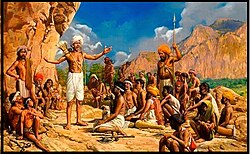
In the late 1800s, during the British Raj, the Mundas were forced to pay rents and work as bonded labourers to the zamindars. During the Kol uprising in 1823–1833, some Manki Munda revolted due to their disposition and attacked Thikedars, other Mankis, plundered and destroyed villages. This insurgency was suppressed by Thomas Wilkinson.[23] During the 19th century, Munda freedom fighter Birsa Munda began the protest marches calling for non-payment of rents and remission of forest dues. He led guerrilla warfare to uproot the British Raj and establish Munda Raj. He was caught by Company forces, along with his supporters, and died in jail. He is still revered in Jharkhand.[24][25]

Nomadic hunters in the India tribal belt, they became farmers and some were employed in basketwork. With the listing of the Munda people as Scheduled Tribes, many are employed in various governmental organisations (particularly Indian Railways).[26]
Social structure[edit | edit source]
Kinship patterns[edit | edit source]
Munda are divided into a number of exogamous clans. Clans among Mundas are known as Killi, which is similar to Sanskrit word Kula. Munda are patrilineal, and clan name descends father to son. According to tradition, people of the same clan are descendants of the same forefather. Clans among Mundas are of totemic origin. Some clans are:[27]
- Baa (a fish)
- Baba (rice)
- Bodra
- Balamchu (fish net)
- Barla
- Bhengra (horse)
- Bukru (a bird)
- Bulung (salt)
- Dang, Dungdung (a fish)
- Gudia, Hans (swan)
- Hemrom/Hembram (a tree)
- Herenz (a specific Bird)
- Horo (turtle)
- Hundar (hyena)
- Jojo (tamarind)
- Kauwa (crow)
- Kerketta (a bird)
- Kula (tiger)
- Nil (bull)
- Mus (mouse)
- Nag (cobra)
- Oreya (bammboo basket)
- Pandu (cobra)
- Purty
- Runda (wild cat)
- Sandil (Full moon)[28]
- Sanga (a type of root)
- Surin/Soren/Soreng (a bird)
- Tiru (a bird)
- Tuti (a type of grain)[29]
- Topno (red ants)
- Kongari (white crow)
Administrative system[edit | edit source]
Munda-Manki governing system was prevalent in Kolhan region of Jharkhand. Munda govern their villages by Munda-Manki system. Head of village is called Munda, informant of village is called Dakuwa, village priest is called Pahaan, assistant of Pahaan is called Pujhar, head of 15 to 20 villages is called Manki, assistant of Manki is called Tahshildar, which collected taxes. The priest "Deori" is also prevalent among Hos, Bhumij, Bhuyan, Sounti, Khonds tribe of Odisha and Chutia people of Assam.[30][lower-alpha 1] In Chotanagpur division, Munda have adopted Pahan as their village priest.[32]
Culture and tradition[edit | edit source]
Festival[edit | edit source]
Involved in agriculture, the Munda people celebrate the seasonal festivals of Mage Parab, Phagu, Karam, Baha parab, Sarhul and Sohrai. Some seasonal festivals have coincided with religious festivals, but their original meaning remains. Their deity is Singbonga.[33]
Music[edit | edit source]
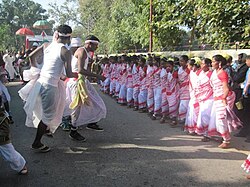
They have many folk songs, dances, tales and traditional musical instruments. Both sexes participate in dances at social events and festivals. The naqareh is a principal musical instrument.[34] Munda refer to their dance and song as durang and susun respectively. Some folk dances of the Munda are Jadur, Karam Susun and Mage Susun.[35] Mundari music is similar to the music of Sadan. Mundari Mage song (winter) rhythm is similar to the Nagpuri Fagua song (winter, spring) rhythm.[36]

Rituals[edit | edit source]
The Munda people have elaborate rituals to celebrate birth, death, engagement and marriage.
Munda practice clan exogamy and tribal endogamy. Monogamy is the norm. Bride price is prevalent. Marriage ceremony starts with Sagai and ends with Bidai. Munda enjoy this occasion with feast, drinks and dance.[37] According to Sarat Chandra Roy, Sindurdaan ceremony and turmeric use in marriage clearly reflect Hindu elements borrowed into Munda tradition.[38]
Munda people of Jharkhand also follow the age old tradition of Patthalgari, i.e., stone erection, in which the tribal community residing in the village buries a large inverted U-shaped dressed headstone on the head side of a grave or at the entrance to the village, in which is inscribed the family tree of the dead persons.[39] There are some other types of patthalgari also:
- Horadiri - It is the stone in which family tree is written.
- Chalpadiri or Saasandiri - It is the stone in remarking boundary of any village and its limits.
- Magodiri - This is the headstone of a social criminal who committed polygamy or unsocial marriage.
- Ziddiri - This is the stone placed over burial of placenta and dried navel part of a newborn.[40][41]


Literature and studies[edit | edit source]
.JPG)
Jesuit priest John-Baptist Hoffmann (1857–1928) studied the language, customs, religion and life of the Munda people, publishing the first Mundari language grammar in 1903. With the help of Menas Orea, Hoffmann published the 15-volume Encyclopaedia Mundarica. The first edition was published posthumously in 1937, and a third edition was published in 1976. The Mundas and Their Country, by S. C. Roy, was published in 1912. Adidharam (Hindi:आदि धर्म) by Ram Dayal Munda and Ratan Singh Manki, in Mundari with a Hindi translation, describes Munda rituals and customs.[42]
| Title | Author(s) | Year / Edition | Focus / What It Covers | Significance |
|---|---|---|---|---|
| Encyclopaedia Mundarica | John Baptist Hoffmann & Arthur Van Emelen | Volumes published between ~1924-1950 | A multi-volume reference work describing the language, culture, customs, material culture of the Mundas. | One of the most comprehensive traditional sources in English on Munda culture. |
| The Mundas and Their Country | S. C. Roy | 1912 (original) | Ethnographic / geographical study of the Munda people and their lands. | Important early work documenting Munda social and economic life during British colonial period. |
| Musical Culture of the Munda Tribe | Sem Topno | (year not always indicated) | Study of music and dance among the Munda, with song texts (in original + English translation), relation to life-cycle, cosmology etc. | Fills a gap in literature by focusing on artistic expressions; useful for culture & anthropology. |
| Cultural Study of Oraon and Munda Tribes | Niranjan Mahawar | 2019 (Hardcover ed.) | Comparative cultural study of the two tribes: lifestyle, performing arts, cultural change etc. | Useful for understanding similarities/differences with neighbouring tribes; more recent scholarship. |
| The Religious History of Munda and Oraon Tribes | Diwakar Minz | 2017 | Traces beliefs, customs, origin, and changes over time among Munda & Oraon tribes. | Helps understand religious dimension historically and its evolution. |
| The Legend of Birsa Munda | (by Tuhin A. Sinha) | English edition (2021) | Narrative / biographical work about Birsa Munda, his life, struggle, resistance. | Widely accessible work; useful for popular understanding and for those less familiar with academic texts. |
| The Life and Times of Jaipal Singh Munda | Santosh Kiro | 2018 | Biography of Jaipal Singh Munda, notable leader, role in tribal politics, sporting and other contributions. | Adds dimension of modern political history, leadership, and identity. |
Social issues[edit | edit source]
Economic condition[edit | edit source]
In a 2016 research paper on subsistence strategies of Mundas in a village of Sunderbans in West Bengal, it was found that many people migrate out of their residences because of poor economic conditions and landlessness. This rural to urban migration has followed a greater trend within India. Men and women engage in forest product collection, cultivation, small business and agricultural as well as non-agricultural jobs. A person or a family may be engaged in multiple occupations, often undertaking risky visits to the forests and rivers. It was also found that younger generation preferred to engage as migrant workers outside the village and often outside the district and the state.[43]
Notable people[edit | edit source]
- Dayamani Barla (active 2004–2013), journalist[44]
- Puna Bhengra, politician[45]
- Niral Enem Horo, politician[46]
- Amrit Lugun (born 1962), ambassador to Greece,[47] South Asian Association for Regional Cooperation director[48]
- Anuj Lugun (born 1986), poet who received the 2011 Bharat Bhushan Agarwal Award[49]
- Munmun Lugun, football player[50]
- Arjun Munda (born 1968), politician[51]
- Birsa Munda (1875–1900), freedom fighter, religious leader[52]
- Jaipal Singh Munda (1903–1970), politician, hockey player[53]
- Joseph Munda, politician[54]
- Kariya Munda (born 1936), politician[54][55]
- Laxman Munda, politician[54][56]
- Nilkanth Singh Munda (born 1968), politician[54][57]
- Ram Dayal Munda (1939–2011), scholar in languages & folklore[54][58]
- Sukra Munda (active 2016 to 2020), politician[54]
- Tulasi Munda (born 1947), social activist[54][59]
- Rohidas Singh Nag (1934–2012), creator of "Mundari Bani" script[60]
- Masira Surin, hockey player[61]
- Rajeev Topno (born 1974), private secretary to the prime minister of India, senior advisor to the executive director at World Bank[62]
See also[edit | edit source]
References[edit | edit source]
Footnotes[edit | edit source]
Sources[edit | edit source]
- ↑ 1.0 1.1 1.2 "A-11 Individual Scheduled Tribe Primary Census Abstract Data and its Appendix". censusindia.gov.in. Office of the Registrar General & Census Commissioner, India. Archived from the original on 7 January 2022. Retrieved 18 November 2017.
- ↑ "Estimated Population by Castes, 5. Assam – Census 1951" (PDF). Office of the Registrar General, India. 1954. p. 9.
- ↑ "Table 1.4 Ethnic Population by Group and Sex" (PDF) (in Bengali). Bangladesh Bureau of Statistics. 2021. p. 33. Archived (PDF) from the original on 13 August 2022. Retrieved 15 August 2022.
- ↑ Osada, Toshiki (19 March 2008). "3. Mundari". In Anderson, Gregory (ed.). The Munda languages. New York: Routledge. ISBN 978-0-415-32890-6.
...the designation Munda is used for the language family. Mundari, on the other hand, refers to an individual language, namely the language of Munda people.
- ↑ "ST-14 Scheduled Tribe Population By Religious Community". Census of India. Ministry of Home Affairs, India. Archived from the original on 15 October 2017. Retrieved 15 October 2017.
- ↑ Srivastava, Malini (2007). "The Sacred Complex of Munda Tribe" (PDF). Anthropologist. 9 (4): 327–330. doi:10.1080/09720073.2007.11891020. S2CID 73737689. Archived (PDF) from the original on 17 May 2017. Retrieved 22 October 2017.
- ↑ "Tribals who convert to other religions will continue to get quota benefits: Jual Oram | India News". The Times of India. Archived from the original on 12 July 2021. Retrieved 10 July 2021.
- ↑ Gupta, Satya Prakash (1974). Tribes of Chotanagpur Plateau: An Ethno-nutritional & Pharmacological Cross-section. Government of Bihar, Welfare Department. p. 12. Retrieved 19 March 2023.
- ↑ "Adivasi Volume 52, Number 1&2" (PDF). Web Archive. December 2012. Archived (PDF) from the original on 8 November 2016.
- ↑ "Mundari Language". Ethnologue. SIL International. Archived from the original on 20 April 2021. Retrieved 20 October 2017.
- ↑ "Homepage". Archived from the original on 14 December 2017. Retrieved 14 December 2017.
- ↑ "Munda Tribe" (in hindi) (4th 2020 ed.). Jharkhand, India: Dr. Ramdayal Munda Tribal Welfare Research Institute. 1993.
{{cite web}}: CS1 maint: unrecognized language (link) - ↑ "History of Munda Tribe Language : Mundari". mundariuniversity. 29 May 2018. Archived from the original on 20 October 2022. Retrieved 20 October 2022.
- ↑ Parkin, Robert (1993). "Second Reply to Pfeffer" (PDF). University of Oxford. p. 161. Archived (PDF) from the original on 16 September 2020. Retrieved 18 December 2020.
The term 'Munda' is of Sanskritic origin and therefore not original in any sense to Austroasiatic speakers, although it has come to be used by one tribe as an alternative to their own term 'Horo' (Le. Roy's group; cf. Pfeffer above, p. 154; also Parkin 1990: 17, 23).
- ↑ Prasad, R. R. (1996). Encyclopaedic Profile of Indian Tribes. Vol. 1. Discovery Publishing House. p. 186. ISBN 978-81-7141-298-3. Retrieved 16 August 2019.
- ↑ Alpa Shah (2003). "An Anthropological Study of Rural Jharkhand, India" (PDF). p. 88. Archived (PDF) from the original on 8 November 2022. Retrieved 8 November 2022.
- ↑ Sidwell, Paul. 2018. Austroasiatic Studies: state of the art in 2018 Archived 3 May 2019 at the Wayback Machine. Presentation at the Graduate Institute of Linguistics, National Tsing Hua University, Taiwan, 22 May 2018.
- ↑ Rau, Felix; Sidwell, Paul (12 September 2019). "The Munda Maritime Hypothesis" (PDF). Journal of the Southeast Asian Linguistics Society. 12 (2): 35–57. hdl:10524/52454. ISSN 1836-6821. S2CID 204901974.
- ↑ "Scientists solve genetic puzzle surrounding Mundas". down-to-earth.org. 12 March 2019. Archived from the original on 25 September 2022. Retrieved 1 October 2022.
- ↑ Sharma, R. S. (2005). India's Ancient Past. Oxford University Press. pp. 2, 118–119. ISBN 978-0-19-566714-1.
- ↑ West, Barbara A. (2010). Encyclopedia of the Peoples of Asia and Oceania. Infobase Publishing. p. 564. ISBN 9781438119137. Archived from the original on 14 April 2023. Retrieved 20 September 2019.
- ↑ John Peterson (October 2021). "The spread of Munda in prehistoric South Asia -the view from areal typology To appear in: Volume in Celebration of the Bicentenary of Deccan College Post-Graduate and Research Institute (Deemed University)". Retrieved 1 September 2022.
- ↑ Ansari, Tahir Hussain (2019). Mughal Administration and the Zamindars of Bihar. Routledge. ISBN 9781000651522.
- ↑ Pandey, Prashant (18 September 2017). "Jharkhand: Amit Shah launches scheme for villages of freedom fighters". The Indian Express. Archived from the original on 14 November 2019. Retrieved 21 October 2017.
- ↑ "History of Munda Tribes". Prabhat Khabar. Retrieved 22 January 2025.
- ↑ "List of Schedule Castes". Ministry of Social Justice and Empowerment, Government of India. 2011. Archived from the original on 23 September 2014.
- ↑ Roy, Sarat Chandra (1912). The Mundas and their Country. Asia Publishing House.
- ↑ Singh, K. S. (1996). Communities, segments, synonym, surnames and titles V.8, xiii,1948p.-(People of India National Series). Anthropological Survey of India. ISBN 978-0-19-563357-3. Retrieved 1 August 2024.
- ↑ "आदिवासी गोत्र". vikaspedia. Archived from the original on 18 December 2019. Retrieved 18 September 2019.
- ↑ Prasad, Hem Chandra. Bihar. 1983/2003, pp. 36, 67, 159, 162, 184. National Book Trust, New Delhi. ISBN 81-237-0151-9
- ↑ Dutta, Sristidhar (1985). The Mataks and their Kingdom. Allahabad: Chugh Publications. p. 50. OCLC 13959339.
- ↑ Sanjay Nath (2015). "Pages from the Old Records: A Note on 'The "Kols" of Chota-Nagpore' by E.T. Dalton". academia.edu: 19. Archived from the original on 25 October 2022. Retrieved 25 October 2022.
- ↑ "Mundas, Munda Tribe in Jharkhand India, Occupation of Mundas". ecoindia.com. Archived from the original on 16 November 2019. Retrieved 26 March 2016.
- ↑ "The Munda Tribe of Jharkhand: Glimpse into Rich Heritage". 30 January 2025. Retrieved 4 April 2025.
- ↑ Prasad, R. R. (1996). Encyclopaedic Profile of Indian Tribes. Vol. 1. Discovery Publishing House. pp. 188–191. ISBN 978-81-7141-298-3. Retrieved 16 August 2019.
- ↑ Blum, Stephen; Bohlman, Phillip Vilas; Neuman, Daniel M., eds. (1993). Ethnomusicology and Modern Music History. University of Illinois Press. p. 215. ISBN 978-0252063435. Retrieved 30 January 2023.
- ↑ Prakash Chandra Mehta (2005). Marriages in Indian Society. Discovery Publishing House. p. 116. ISBN 9788171419210. Retrieved 24 October 2022.
- ↑ Sarat Chandra Roy (1912). The Mundas and their country. Asia Publishing House. Retrieved 22 October 2022.
- ↑ Poyil, Manjula (2006). "Death Customs In The Tribal Context: Concluding Observations" (PDF). Death funeral and the ancestors Cult of the dead and the Malabar tribes (PhD). University of Calicut. hdl:10603/20515. Retrieved 21 February 2022.
- ↑ "Menhirs and cultural diffusion: megalithic practices in Central-eastern India | Antiquity Journal". antiquity.ac.uk. Archived from the original on 18 December 2019. Retrieved 22 December 2019.
- ↑ "The Constitution set in stone: Adivasis in Jharkhand are using an old tradition as a novel protest". Scroll.in. Archived from the original on 31 July 2018. Retrieved 31 July 2018.
- ↑ "Mundari: The Language of Munda Tribe". Archived from the original on 1 May 2018. Retrieved 6 February 2015.
- ↑ Bandyopadhyay, Ayan (November 2016). "Subsistence strategies of the Mundas in a village of Sundarban, West Bengal". Journal of the Indian Anthropological Society. 51 (3): 128–144. Retrieved 30 March 2020.
- ↑ "Dayamani Barla: Indigenous Journalist and Activist from India". Indybay. Retrieved 4 April 2025.
- ↑ Das, Madhuparna (17 April 2021). "How tea gardens in North Bengal, key to poll fortunes of BJP & TMC, have kept both guessing". ThePrint. Retrieved 4 April 2025.
- ↑ Kumar, Raj (6 January 2017). "New names for city roads". The Telegraph. Kolkata.
- ↑ "Amrit Lugun has been appointed as the next Ambassador of India to Greece". mea.gov.in. 3 October 2019. Archived from the original on 14 April 2023. Retrieved 11 March 2022.
- ↑ "SAARC Secretariat". saarc-sdmc.nic.in. Archived from the original on 3 April 2015. Retrieved 23 January 2015.
- ↑ Ganguly, M. (11 August 2011). "Hindi stalwarts praise tribal poet". Yahoo! News. Archived from the original on 12 November 2014. Retrieved 26 March 2016.
- ↑ "Mohammedan Sporting sign defender Munmun Timothy Lugun". The Times of India. 18 September 2020. ISSN 0971-8257. Retrieved 4 April 2025.
- ↑ "Former Jharkhand CM Arjun Munda gets tribal affairs ministry". Hindustan Times. 31 May 2019. Archived from the original on 27 June 2022. Retrieved 4 April 2025.
- ↑ "Birsa Munda". indianpost.com. Retrieved 4 April 2025.
- ↑ Suren, Aswin (2 January 2025). "Jaipal Singh Munda — the Hockey captain who fought for the cause of Adivasis vigorously". The Hindu. ISSN 0971-751X. Retrieved 4 April 2025.
- ↑ 54.0 54.1 54.2 54.3 54.4 54.5 54.6 iMeUsWe. "MUNDA Surname in India | iMeUsWe Surnames Origin". imeuswe.in. Retrieved 4 April 2025.
- ↑ "Tribal activists expect Droupadi Murmu to be assertive as President". Archived from the original on 3 December 2024. Retrieved 4 April 2025.
- ↑ "MLA Laxman Munda Profile | BONAI Constituency". naveenpatnaik.com. Retrieved 4 April 2025.
- ↑ Sourav (21 October 2024). "Neelkanth Singh Munda: Biography, Wiki, Career, Net Worth, Caste, Contact, etc". Retrieved 4 April 2025.
- ↑ Gupta, Smita. "A life dedicated to preserving tribal culture". The Hindu. Archived from the original on 5 October 2011.
- ↑ S, Lekshmi Priya (15 May 2017). "12 Facts About Tulasi Apa, the Odisha Woman Who Taught 20,000+ Children in 50 Years". The Better India. Retrieved 4 April 2025.
- ↑ "Mundari Bani alphabet". omniglot.com. Retrieved 4 April 2025.
- ↑ "Three hockey players from Jharkhand bring pride back to their people, save their school". India Today. 9 September 2002. Retrieved 4 April 2025.
- ↑ "Surnames in Munda Tribe". Online Platform to Learn Mundari Language. 22 May 2018. Retrieved 4 April 2025.
Bibliography[edit | edit source]
- Ray, Sarat Chandra (1912). The Mundas and Their Country. Calcutta: Kuntaline Press. OCLC 504764442.
Further reading[edit | edit source]
- Parkin, R. (1992). The Munda of central India: an account of their social organisation. Delhi: Oxford University Press. ISBN 0-19-563029-7
- Omkar, P.(2018). "Santhal tribes present in India" like Jharkhand, Odisha, and West Bengal... Belavadi.
- Omkar, patil.(2018). "Kola tribes"...
External links[edit | edit source]
- Sarna – A case study in religion Archived 31 January 2008 at the Wayback Machine On the religion of the Munda tribals
- Sinlung – Indian tribes
- . Encyclopædia Britannica. Vol. 18 (11th ed.). 1911. This article is a discussion of the related family of languages.
- RWAAI | RWAAI, Lunds universitet RWAAI (Repository and Workspace for Austroasiatic Intangible Heritage)
- http://hdl.handle.net/10050/00-0000-0000-0003-A6AA-C@view Mundari language in RWAAI Digital Archive
Template:Ethnic groups in Bangladesh Template:Ethnic groups in Nepal

- Pages using the JsonConfig extension
- Munda people
- Ethnic groups in Bangladesh
- Ethnic groups in India
- Ethnic groups in South Asia
- Ethnoreligious groups in Asia
- Scheduled Tribes of India
- Scheduled Tribes of Odisha
- Social groups of Bihar
- Social groups of Jharkhand
- Social groups of Odisha
- Social groups of West Bengal
- Sociology of religion
- Tribes of Jharkhand
- Tribes of West Bengal
- Ethnic groups in Nepal