



No edit summary Tags: Manual revert Mobile edit Mobile web edit |
No edit summary |
||
| Line 3: | Line 3: | ||
{{Use Indian English|date=January 2016}} | {{Use Indian English|date=January 2016}} | ||
{{Infobox character | {{Infobox character | ||
| | | name = Yudhishthira | ||
| image = Yudhisthira and His Dog, Ascending.jpg | |||
| image | | caption = Yudhishthira entering heaven alive with his dog, painting by [[Nandalal Bose]], c. 1913 | ||
| caption | | weapon = [[Bow and arrow]], [[Javelin]] | ||
| weapon | | spouse = * [[Draupadi]] | ||
| spouse | *[[Devika (Mahabharat)|Devika]]<ref>{{Cite web|url=http://www.sacred-texts.com/hin/m01/m01096.htm|archive-url = https://web.archive.org/web/20100116130453/http://www.sacred-texts.com/hin/m01/m01096.htm|archive-date = 16 January 2010|title = The Mahabharata, Book 1: Adi Parva: Sambhava Parva: Section XCV}}</ref> | ||
| family = [[Yama (Hinduism)|Dharma]] (father)<br/>[[Pandu]] (adoptive father)<br/>[[Kunti]] (mother)<br/>[[Madri]] (step-mother)<br/>{{hlist|[[Karna]]|[[Bhima]]|[[Arjuna]]|[[Nakula]]|[[Sahadeva]]}} (brothers) | |||
| family | | children = {{bulleted list|[[Upapandavas#Prativindhya|Prativindhya]] by Draupadi|[[Characters in the Mahabharata#Yaudheya|Yaudheya]] by Devika}} | ||
| children | | relatives = {{bulleted list | ||
| relatives | |[[Kauravas]] (paternal cousins) | ||
|[[Krishna]] (maternal cousin) | |||
|[[Dhritarashtra]] and [[Vidura]] (paternal uncles) | |||
}} | |||
| position = {{ubl|[[Chakravartin|Chakravarti Samrat]]|Dharmaraja}} | |||
| religion = | |||
}} | }} | ||
{{Hinduism}} | |||
'''Yudhishthira''' ({{langx|sa|युधिष्ठिर|Yudhiṣṭhira|one who is steady in battle}}), also known as '''Dharmaputra''' ({{Literal translation|Son of [[Dharma]]}}) and '''Dharmaraja''' ({{Literal translation|King of [[Dharma]]}}), was the eldest among the five [[Pandava]]s, and is also one of the central characters of the ancient [[Hinduism|Hindu]] epic ''[[Mahabharata]]''. He was the king of [[Indraprastha]] and later the King of the [[Kuru kingdom]] in the epic.<ref>{{Cite web|url=https://sacred-texts.com/hin/maha/index.htm|title = The Mahabharata}}</ref> | |||
Yudhishthira was the son of [[Kunti]], the first wife of King [[Pandu]], fathered by the personification of [[Dharma]], due to a curse preventing Pandu from having children. Yudhishthira held a strong belief in ''[[dharma]]'' (morals and virtues) and was chosen as the crown prince of Kuru. However, after the [[Lakshagriha]] incident, he was presumed dead and his cousin [[Duryodhana]] was appointed as the new heir. The kingdom was split in half due to a succession dispute between Yudhishthira and Duryodhana. Yudhishthira received the barren half, which he later transformed into the magnificent city of [[Indraprastha]].<ref>{{Cite web|url=https://sacred-texts.com/hin/m02/m02001.htm|title = The Mahabharata, Book 2: Sabha Parva: Section I}}</ref> | |||
After | Yudhishthira and his brothers, the [[Pandava|Pandavas]] ({{Literal translation|Descendants of [[Pandu]]}}), had a [[Polyandry in India|polyandrous marriage]] with [[Draupadi]], the princess of [[Panchala]], who became the empress of Indraprastha. After Yudhishthira performed the [[Rajasuya|Rajasuya Yagna]], he was invited to play [[Pachisi|a game of dice]] by his jealous cousin, Duryodhana and his uncle, [[Shakuni]]. Shakuni, a master at the game, represented Duryodhana against Yudhishthira and manipulated him into gambling his kingdom, wealth, the freedom of his brothers, Draupadi, and even himself. After the game, the Pandavas and Draupadi were sent into exile for thirteen years, with the last year requiring them to live incognito. During his exile, Yudhisthira was tested by his divine father [[Yama]]. During the last year of the exile, known as [[Agyaata Vaasa]], Yudhishthira disguised himself as a [[Brahmin]] named Kanka and served as the [[Virata|King of Matsya Kingdom]].<ref name="sacred-texts.com">{{Cite web|url=https://sacred-texts.com/hin/m04/m04001.htm|title = The Mahabharata, Book 4: Virata Parva: Section I}}</ref> | ||
Yudhishthira was the leader of the successful [[Pandava]] | Yudhishthira was the leader of the successful [[Pandava]] faction in the [[Kurukshetra War]] and defeated many venerable warriors such as [[Shalya]]. He then ruled the Kuru Kingdom for 36 years before announcing his retirement. At the end of the epic, he was the only one among his brothers to [[Entering heaven alive|ascend to heaven]] while retaining his mortal body.<ref name="ReferenceA">{{Cite web|url=https://sacred-texts.com/hin/m17/m17003.htm|title = The Mahabharata, Book 17: Mahaprasthanika Parva: Section III}}</ref> | ||
==Etymology== | ==Etymology and historicity== | ||
[[File:Yudhishthir Birla mandir 6 dec 2009 (29).JPG|thumb|Statue of Yudhishthira]] | [[File:Yudhishthir Birla mandir 6 dec 2009 (29).JPG|thumb|Statue of Yudhishthira|267x267px]] | ||
The word '' | The word ''Yudhiṣṭhira'' is an ''aluk'' compound (meaning it preserves the case ending of its first part). It means "one who is steady in battle". It is composed of the words, ''yudhi'' (masculine locative singular) meaning "in battle"—from ''yudh'' (युध्) meaning 'battle, fighting'—and ''sthira'' (स्थिर) meaning 'steady' or 'stable'.<ref>{{Cite web|last=www.wisdomlib.org|date=2010-12-26|title=Yudhishthira, Yudhiṣṭhira, Yudhisthira: 15 definitions|url=https://www.wisdomlib.org/definition/yudhishthira|access-date=2020-09-08|website=www.wisdomlib.org|archive-date=21 October 2020|archive-url=https://web.archive.org/web/20201021220517/https://www.wisdomlib.org/definition/yudhishthira|url-status=live}}</ref> His other names are: | ||
* Bharata | * Bharata-vanshī (भरतवंशी) – descendant of [[Bharata (Mahabharata)|Bharata]]{{Sfn|Agarwala|1979|p=167}} | ||
* | * Ajātashatru (अजातशत्रु) – one who is born without enemies{{Sfn|Abbott|Godbole|1988|p=402}} | ||
* Dharmanandana ( | * Dharmanandana (धर्मनन्दन) or Dharmaputra (धर्मपुत्र) – The son of Dharma (Righteousness) or Yama Dharma Raja | ||
* | * Dharmarāja (धर्मराज) or Dharmarāya or Dharmaja – Lord of Dharma. | ||
* | * Pānduputra (पांडुपुत्र) – Son of [[Pandu]]. | ||
* | * Pāndavāgrajah (पाण्डवाग्रजः) – Eldest of Pandavas. | ||
* | * Jyeshthakaunteya (ज्येष्ठकौन्तेय) – Eldest son of Kunti. | ||
* | * Sārvabhauma (सार्वभौम) / Samrāt Chakravarti (सम्राट् चक्रवर्ती) – Emperor of the complete planet Earth. | ||
* Kanka | * Kanka (कङ्क) – another name for Yudhisthira given by Draupadi for the 13th year in exile. | ||
== | According to Buddhist sources, by the late and post-Vedic periods, Kuru had become a minor state ruled by a chieftain called Koravya and belonging to the {{Transliteration|pi|Yuddhiṭṭhila}} ({{Transliteration|sa|Yudhiṣṭhira}}) [[gotra|{{Transliteration|pi|gotta}}]].<ref>{{cite book |last=Singh |first=Upinder |author-link=Upinder Singh |date= |title=A History of Ancient and Early Medieval India: From the Stone Age to the 12th Century |url= |location= |publisher=[[Longman|Pearson Education India]] |page=264 |isbn=}}</ref>{{sfn|Raychaudhuri|1953|p=41}} | ||
{{ | ==Birth and early life== | ||
[[ | According to the ''[[Mahabharata]]'', Yudhishthira was born under extraordinary circumstances, fathered by the god [[Yama|Dharma]] (the god of righteousness) through the practice of ''[[niyoga]]'' (levirate), as detailed in the narrative of the ''[[Adi Parva]]''.<ref>{{Cite web |title=The Mahabharata, Book 1: Adi Parva: Section CXIX |url=https://sacred-texts.com/hin/m01/m01120.htm}}</ref> [[Pandu]], the king of [[Kuru kingdom|Kuru]], was married to [[Kunti]] and [[Madri]]. His life changed abruptly after a hunting accident led to a curse: intimacy with his wives would mean instant death. Choosing celibacy and asceticism, Pandu abdicated his throne, abandoned hunting, and pursued ''moksha'' (liberation), while his elder blind brother [[Dhritarashtra]] took over the reins of the kingdom. Pandu's devoted wives joined him in this mountain retreat, despite his initial reluctance. Though initially unconcerned with heirs, Pandu later fixated on his childlessness. When he sought to ascend to heaven with his wives, sages halted them, citing his lack of children became a profound personal failure.<ref name=":0">{{Cite book |last=Mani |first=Vettam |url=https://books.google.com/books?id=mvXsDwAAQBAJ&pg=PA1 |title=Puranic Encyclopedia: A Comprehensive Work with Special Reference to the Epic and Puranic Literature |date=1975 |publisher=Motilal Banarsidass |isbn=978-81-208-0597-2 |pages=227–229 (entry ''Dharmaputra'') |language=en}}</ref><ref name=":1">{{Cite book |last1=Brodbeck |first1=Simon |url=https://books.google.com/books?id=56fr2p5f7l0C&q=gender+and+narrative+in+the+mahabharata |title=Gender and Narrative in the Mahabharata |last2=Black |first2=Brian |date=2007-08-09 |publisher=Routledge |isbn=978-1-134-11995-0 |language=en}}</ref> | ||
Kunti, Pandu's first wife, had received a boon from the sage [[Durvasa]]s in the form of powerful mantras, which allowed her to summon any god to grant her a son. As [[Gandhari (Mahabharata)|Gandhari]], Dhritarashtra’s wife, neared the birth of her own children, Pandu grew anxious and requested Kunti to apply her boon and suggested to call Dharma to get a truthful, knowledgeable and justice knowing son who can rule Hastinapur (capital of Kuru). Meditating on Dharma, she recited one of the mantras, and a son was born to her through this divine intervention. The child arrived at midday on the eighth day of the month of [[Jyeshtha (month)|Jyeshtha]], on the fifth lunar day ([[Panchami]]), during the auspicious Abhijit hour. At his birth, a celestial voice declared, "This boy will grow to be a highly righteous and courageous king, the finest among the virtuous. He will be known as Yudhishthira." Following this divine proclamation, the child was named Yudhishthira.<ref name=":0" /><ref name=":2">{{Cite book |last1=Buitenen |first1=Johannes Adrianus Bernardus |url=https://books.google.com/books?id=i8oe5fY5_3UC&q=the+book+of+beginnings+mahabharata |title=The Mahābhārata |last2=Fitzgerald |first2=James L. |date=1973 |publisher=University of Chicago Press |isbn=978-0-226-84663-7 |language=en}}</ref><ref name=":1" /> | |||
Following Yudhishthira’s birth, Pandu’s desire for more sons grew. He urged Kunti to invoke her boon again, leading to [[Bhima]]’s birth from [[Vayu]] and [[Arjuna]]’s from [[Indra]]. With her three invocations used, Kunti shared the boon with Madri, who called upon the [[Ashvins|Ashwini Kumaras]] and bore [[Nakula]] and [[Sahadeva]]. Thus, the five Pandavas were born, fulfilling Pandu’s wish for a strong lineage.<ref>{{Cite web|url=https://sacred-texts.com/hin/m01/m01123.htm|title = The Mahabharata, Book 1: Adi Parva: Section CXXII}}</ref> After Pandu had five sons through divine means, he took his family to the Shatashringa forest, under the care of the resident sages.<ref name=":0" /> | |||
Yudhishthira's | === Boyhood === | ||
Yudhishthira's boyhood is mainly detailed in the Southern recension of the ''Mahabharata'', according to which Kashyapa, a priest associated with Vasudeva, conducted Yudhishthira’s ''[[upanayana]]'' (sacred thread ceremony), while Rajarshi Shuka trained him in spear warfare during this time. Tragedy struck when Pandu, attested in all recensions, unable to resist the curse that doomed him, died in the forest, and Madri, his second wife, chose to end her life. According to Southern recension, before doing so, Madri summoned Yudhishthira, clasped her hands, and entrusted him with the responsibility of his younger brothers, saying, "Son, you are now the father to your brothers."<ref name=":0" /> | |||
=== Youth === | |||
Following the deaths of Pandu and Madri, the forest sages escorted Kunti and the children to Hastinapura, where they handed them over to the Kuru grandsire, [[Bhishma]], recounting the events that had transpired. Yudhishthira and his brothers grew up in Hastinapura with their cousins, including Duryodhana, who clashed with Bhima. During a Ganga River outing planned by Duryodhana, he ambushed Bhima, binding and throwing him into the water. When Yudhishthira noticed Bhima missing, he alerted Kunti; Bhima soon returned, recounting his ordeal in Nagaloka and his escape. Yudhishthira wisely advised his brothers to keep the incident secret.<ref name=":0" /> | |||
In Hastinapura, the Pandavas trained under [[Kripa]] and later [[Drona]], their preceptor, with Yudhishthira excelling in chariot warfare.<ref>{{Cite web |title=The Mahabharata, Book 1: Adi Parva: Section CXXXIV |url=https://sacred-texts.com/hin/m01/m01135.htm}}</ref> As ''[[gurudakshina]]'' (a traditional offering to the teacher), Yudhishthira initially volunteered to capture King [[Drupada]] and present him bound before Drona. However, Arjuna intervened and took on the task himself.<ref name=":0" /><ref name=":2" /> | |||
Yudhishthira | Dhritarashtra named Yudhishthira heir-apparent after his warfare training, impressed by his righteousness and skill. His popularity among the citizens eclipsed Pandu’s, enraging Duryodhana, who feared the Pandavas’ rise. With Dhritarashtra’s hesitant approval, Duryodhana plotted their demise, sending them to Varanavata in a flammable [[Lakshagriha|lac palace]] built by [[Purochana]]. Despite Dhritarashtra’s doubts, the plan proceeded. Yudhishthira, warned by his uncle [[Vidura]]’s coded message, deterred followers but prepared an escape. Spotting the palace’s weakness, he and Bhima planned a tunnel with Vidura’s sapper. After a year, Bhima torched the house during a feast, leaving a [[Nishadas|Nishada]] family inside as decoys. The Pandavas fled via the tunnel, while Dhritarashtra, believing them dead, ordered their funeral rites in Hastinapura.<ref name=":0" /><ref name=":2" /> | ||
The | |||
After the lac palace in Varanavata burned to ashes, the ''Mahabharata'' recounts that the Pandavas were presumed dead, and decided to go on hiding to avoid further such incidents. Vidura secretly informed Bhishma of their survival. While in hiding in the forests, Yudhishthira permitted Bhima to marry [[Hidimbi|Hidimba]], a [[Rakshasa|rakshasi]] they encountered . Later, when Arjuna defeated the [[gandharva]] Chitraratha in combat, Yudhishthira counseled Arjuna to release him. Following this Yudhishthira appointed [[Dhaumya]] as his family priest. They then resided at a village called Ekachakra.<ref name=":0" /><ref name=":2" /> | |||
== Marriages == | |||
In the ''Mahabharata'', Yudhishthira is recorded as having two wives. His most well-known union is with [[Draupadi]], the princess of [[Pañcāla|Panchala]], whom he shares with his four brothers, that binds the Pandavas together in a unique marital arrangement. Additionally, Yudhishthira is married to [[Devika (Mahabharat)|Devika]], who is only mentioned once in the entire epic.<ref name=":1" /> | |||
During their exile, as recounted in the ''Adi Parva'', the Pandavas grew restless in Ekachakra. Kunti suggested they move to Panchala. On their journey, they met the sage [[Vyasa]], who narrated how the Panchala princess, Draupadi, born from a fire ritual and not a womb, was fated to have five husbands due to a past-life boon from [[Shiva]]. Disguised as brahmins, they then joined a caravan and lodged with a potter, begging for food. King [[Drupada]] had organized a ''[[svayamvara]]'' for Draupadi, setting a challenge: string a formidable bow and hit a target. Many barons, including [[Duryodhana]], failed, but [[Arjuna]], rising from the brahmins, succeeded, winning Draupadi’s garland. Yudhishthira and the twins left early, though all five brothers loved her. Returning to [[Kunti]], they playfully called Draupadi their "alms," prompting her unintended command to share her. Horrified but resolute, Kunti stood firm. Yudhishthira offered Draupadi to Arjuna, but Arjuna deferred to the eldest. Mindful of Vyasa’s tale and their shared affection, Yudhishthira agreed to Kunti’s proposal. With Vyasa's persuasion, the Pandavas wed Draupadi, after gaining permission from Drupada, who was hesitant to allow.<ref name=":0" /><ref name=":1" /> | |||
Yudhishthira’s other wife, Devika, is mentioned briefly in the ''Mahabharata'' (''Adi Parva'', Chapter 90, Verse 83). She was the daughter of king Govasana of the [[Sivi Kingdom]].{{Sfn|Bandyopadhyay|2016}} In a conventional ''svayamvara'', Devika chose Yudhishthira as her husband, and they had a son named Yaudheya. Unlike the widely narrated and polyandrous marriage to Draupadi, this union is a more traditional and individual arrangement, with scant details provided in the epic.<ref name=":1" />{{Refn|According to Puranas, Yaudheya was also the name of the son of Prativindhya.[1] The Bhagavata Purana, as well as Vishnu Purana, mention Pauravi as one of the wives of Yudhishthira. A son named Devaka was born to this couple.[2]|group=note}} | |||
==Ruling the Indraprastha== | ==Ruling the Indraprastha== | ||
Following Draupadi’s ''[[svayamvara]]'', the ''Mahabharata'' recounts that news of the Pandavas’ survival reached [[Hastinapur]]a, sparking surprise and joy (''Adi Parva''). [[Duryodhana]] pressed for schemes to undermine Yudhishthira’s alliance with [[Drupada]], while his ally [[Karna]] advocated immediate war. [[Bhishma]], however, asserted Yudhishthira’s equal right to the kingdom, proposing a partition, a stance [[Drona]] supported, urging reconciliation. [[Vidura]] emphasized Yudhishthira’s invincibility and Drupada’s support, swaying [[Dhritarashtra]] to summon him back. Vidura fetched Yudhishthira and his brothers, mother and wife, from Panchala, where he was courteously received, and upon returning to Hastinapura, the populace celebrated. Dhritarashtra granted Yudhishthira the [[Khandavaprastha]]—half the kingdom—which he accepted. There, with Vyasa officiating, Yudhishthira established [[Indraprastha]], a thriving capital.<ref name=":2" /><ref name=":0" /> | |||
===Rajasuya | Crowned king of Indraprastha, Yudhishthira began his reign. The divine sage [[Narada]] visited and, addressing the shared marriage to Draupadi, advised that she spend one year with each brother in turn, a rule Yudhishthira implemented to ensure harmony. Later, Draupadi bore him a son, [[Prativindhya]], among her five sons with the Pandavas.<ref name=":2" /><ref name=":0" /> | ||
[[File:King Yudhisthira Performs the Rajasuya Sacrifice.png|thumb| | |||
Arjuna and Krishna burned the [[Khandava Forest]] to expand Indraprastha, sparing the [[Asura]] architect [[Mayasura|Maya]]. At Krishna’s suggestion, Maya constructed a magnificent ''[[mayasabha]]'' (assembly hall) for the Pandavas, which he presented to Yudhishthira, narrated in the ''[[Sabha Parva]]''. When Krishna departed for [[Dvārakā|Dvaraka]], Yudhishthira drove his chariot, replacing Krishna’s charioteer Daruka.<ref name=":0" /> | |||
===Rajasuya=== | |||
[[File:King Yudhisthira Performs the Rajasuya Sacrifice.png|thumb|200x200px|King Yudhishthira performs the rajasuya sacrifice]] | |||
When Narada visited once again, he conveyed Pandu’s post-mortem wish for Yudhishthira to perform the ''[[Rajasuya]]'', an ancient Vedic ritual of royal consecration, entirely narrated in the ''[[Sabha Parva]]''. Initially a means to legitimize his kingship, the ''Rajasuya'' soon reflected Yudhishthira’s ambition to become ''[[samraj]]''—an “all-king” or universal sovereign—to whom all princes would submit. Encouraged by his brothers, ministers, and Krishna, Yudhishthira considered the proposal. Krishna suggested eliminating [[Jarasandha]], the [[Magadha]] king obstructing Yudhishthira’s supremacy. Yudhishthira dispatched his brothers on a ''[[Digvijaya (conquest)|Digvijaya]]'' (conquest): Arjuna to the north, Bhima to the east, Nakula to the west, and Sahadeva to the south, subduing rival kings and securing tribute. These victories established Yudhishthira’s dominance, prompting him to order the ''Rajasuya''.<ref name=":1" /><ref name=":3">{{Cite book |url=https://books.google.com/books?id=1qZUvwEACAAJ |title=The Mahabharata, Volume 2: Book 2: The Book of Assembly; Book 3: The Book of the Forest |date=1975 |publisher=University of Chicago Press |isbn=978-0-226-84649-1 |language=en}}</ref> | |||
[[ | [[Vyasa]] arrived to oversee the sacrifice, assembling priests and sanctifying the opulent sacrificial site, built to reflect Yudhishthira’s sovereignty. Yudhishthira instructed Sahadeva to summon kings and Brahmins, dispatching messengers across the realms subdued in the ''Digvijaya''. Nakula invited their Hastinapura kinsmen, the Kauravas, who accepted and attended. Yudhishthira was inaugurated as the sacrificer, and arriving guests—kings, princes, and Brahmins—were housed and feasted lavishly in Indraprastha’s quarters. The assembled kings offered great gifts. Yudhishthira, unsure of the primary honor (''agra-puja''), accepted [[Bhishma]]’s proposal of Krishna, sparking dissent from [[Shishupala]] of [[Chedi kingdom|Chedi]]. Shishupala’s challenge escalated into a confrontation, ending with Krishna beheading him. Yudhishthira was consecrated ''samraj'', achieving temporal supremacy. However, the hall’s magnificence stirred envy in [[Duryodhana]].<ref name=":1" /><ref name=":3" /> | ||
==The game of dice== | ==The game of dice== | ||
Yudhishthira | [[File:89-LepakshiShakuni.jpg|thumb|A relief at Lepakshi Temple depicting the dice-match between Shakuni (left) and Yudhishthira (right). The other Pandavas stand beside Yudhishthira]] | ||
Following the ''Rajasuya'' sacrifice, Yudhishthira’s reign faced a pivotal challenge with the game of dice in Hastinapura, narrated in the ''[[Sabha Parva]]''. [[Dhritarashtra]], at Duryodhana’s urging, invited Yudhishthira to Hastinapura for a dice match against [[Duryodhana]]. Despite [[Vidura]]’s warnings and his own misgivings, Yudhishthira accepted, citing ''[[kshatriya dharma]]'' (duty to accept challenges), ''kula dharma'' (obedience to elders), and the inevitability of fate (''daiva'' and ''Dhatr''). Learning that [[Shakuni]], a skilled dice player, would roll for Duryodhana, he proceeded nonetheless, entering the contest with unease. In the ''sabha'', Yudhishthira wagered incrementally, losing his wealth, lands, brothers, and himself to Shakuni’s expertise. At Shakuni’s suggestion, he then staked [[Draupadi]], losing her as well. Draupadi protested, arguing that Yudhishthira, having lost himself, lacked authority to wager her—a claim debated amidst insults from [[Karna]], Duryodhana, and [[Dushasana|Duhshasana]]. Bhima angered, wished to burn Yudhishthira's hands. Alarmed by her ordeal and ominous signs, Dhritarashtra intervened, granting her boons and annulling the match, restoring the Pandavas’ losses.<ref>{{Cite book |last1=Chakrabarti |first1=Arindam |url=https://books.google.com/books?id=HuffCgAAQBAJ&q=mahabharata+now+narration+aesthetics+ethics |title=Mahabharata Now: Narration, Aesthetics, Ethics |last2=Bandyopadhyay |first2=Sibaji |date=2017-09-19 |publisher=Routledge |isbn=978-1-317-34213-7 |language=en}}</ref><ref name=":1" /> | |||
Duryodhana, fueled by envy of Indraprastha’s splendor, persuaded Dhritarashtra to recall Yudhishthira for a second, decisive game. The stake was set: thirteen years of exile, including one in hiding, with Draupadi included. Yudhishthira lost again to Shakuni, and this time, Draupadi accepted the outcome without protest . The Pandavas, stripped of their kingdom, departed for exile, marking the downfall of Yudhishthira’s ''samraj'' status.<ref name=":1" /> | |||
Yudhishthira’s decision to play puzzled observers. He later explained to Vidura that duty compelled him, yet he admitted to [[Bhima]] a desire to claim Duryodhana’s half of the kingdom, driven by overconfidence (''Sabha Parva'', 3.35.1–5). When Shakuni’s skill became evident, anger spurred him to continue rather than withdraw. Some scholars link the dice game to Vedic ''Rajasuya'' traditions, though the ''Mahabharata'' does not explicitly connect them. Yudhishthira's staking of Draupadi, after losing himself, drew Shakuni’s rebuke—“Self-loss is wicked when a stake remains”—highlighting a lapse in responsibility.<ref name=":1" /> | |||
== Exile == | == Exile == | ||
===Obtaining the Akshaya Patra=== | |||
{{main|Akshaya Patra}} | |||
Some time after going to the forests, Yudhishthira became troubled upon realising that he was unable to feed the Brahmanas who followed him to the forests. On the advice of his priest, Sage Dhaumya, Yudhishthira stood in river and appeased [[Surya]], the Sun god, by reciting his 108 names. The god gifted a copper plate, the [[Akshaya Patra]], to Yudhishthira, saying that any food cooked in that vessel would be inexhaustible, until Draupadi finished her daily meal. He also blessed Yudhishthira that the latter would regain his kingdom fourteen years later.<ref>{{Cite web|url=https://sacred-texts.com/hin/m03/m03003.htm|title = The Mahabharata, Book 3: Vana Parva: Section III}}</ref> | |||
===Tale of Nala and Damayanti=== | |||
Sage Vyasa imparts the Pratismriti to Yudhishthira and tells him to pass it down to Arjuna. On Vyasa's advice, Yudhishthira permits Arjuna to perform penance in the Himalayas and obtain celestial weapons from the gods. During Arjuna's absence, Sage Brihadashva consoles Yudhishthira by narrating the story of [[Nala]] and [[Damayanti]]. Brihadashva advises Yudhishthira not give in to misery despite the wretched conditions he lives in. At the end of the story, Yudhishthira received a mantra from the sage, which makes him a master of gambling.<ref>{{Cite web|url=https://sacred-texts.com/hin/m03/m03079.htm|title = The Mahabharata, Book 3: Vana Parva: Section LXXIX}}</ref> | |||
===Yudhishthira and Nahusha=== | |||
{{main|Nahusha}} | |||
One day, while Bhima was roaming the forests, he was captured by a giant serpent, who suppressed the Pandava's might with his gaze. Meanwhile, a worried Yudhishthira searched for Bhima and found him at the mercy of the snake. To Yudhishthira's shock, the snake introduces itself to be the ancient King [[Nahusha]], the father of [[Yayati]], and the legendary ancestor of the Pandavas. | |||
Nahusha posed questions on spirituality to Yudhishthira and was satisfied with his answers. In turn, he also clarified Yudhishthira's doubts on some spiritual topics. Nahusha then narrated his story to Yudhishthira, on how he used to rule [[Svarga]] in the days of yore, how he became intoxicated with hubris, and how he turned into a snake due to the curse of the sages, [[Bhrigu]] and [[Agastya]]. Nahusha used his own story to warn Yudhishthira about the consequences of being arrogant. | |||
Agastya and Bhrigu had prophesized that Yudhishthira would rescue Nahusha from his curse. After conversing with Yudhishthira, Nahusha regained his original form and returned to Svarga.<ref>{{Cite web|url=https://sacred-texts.com/hin/m03/m03180.htm|title = The Mahabharata, Book 3: Vana Parva: Section CLXXX}}</ref> | |||
===Yudhishthira and Markandeya=== | |||
{{main|Markandeya}} | |||
The ever-youthful sage, [[Markandeya]], once visited Yudhishthira. He narrated many stories to Yudhishthira, including the characteristics of the Yugas, the story of King [[Shibi (king)|Shibi]], and the story of [[Savitri and Satyavan]]. He also narrated the story of [[Rama]] to Yudhishthira, and discoursed on spiritual philosophy.<ref>{{Cite web|url=https://sacred-texts.com/hin/m03/m03230.htm|title = The Mahabharata, Book 3: Vana Parva: Section CCXXX}}</ref> | |||
===Yaksha Prashna=== | ===Yaksha Prashna=== | ||
{{main|Yaksha Prashna}} | {{main|Yaksha Prashna}} | ||
[[File:Yudhisthira answer to yaksha.jpg|thumb|200px|Yudhisthira answering the questions of Yaksha]] | [[File:Yudhisthira answer to yaksha.jpg|thumb|200px|Yudhisthira answering the questions of Yaksha]] | ||
During their exile, the | During their exile, the four other Pandavas happened upon a lake, which was haunted by a [[Yaksha]]. The Yaksha challenged the brothers to answer his moral questions before drinking the water; the four Pandavas laughed and drank the water anyway. As a result, they choked on the water and died. Yudhishthira went in last, answered many questions put forth to him by the Yaksha. After the Yaksha was satisfied with the answers, he offered Yudhishthira the choice to bring back one of his brother, and Yudhishthira chose Nakula. When the Yaksha questioned him on his reasoning, Yudhishthira replied that he is still alive as Kunti's lineage, but there are no one alive as [[Madri]]'s lineage, so he chose Nakula. The Yaksha was impressed again, and revived all of the Pandavas siblings. | ||
The Yaksha asked for any other wish as he was impressed and told him he could ask for wealth, strength, power, anything he wished. Yudhishthira said he already got the strength, wealth and power when all his four brothers were revived and said he could not ask for any other wish. Yudhishthira replied, "It is enough that I have beheld thee with my senses, eternal God of gods as thou art! O father, whatever boon thou wilt confer on me I shall surely accept gladly! May I, O lord, always conquer covetousness and folly and anger, and may my mind be ever devoted to charity, truth, and ascetic austerities!"<ref>{{Cite web|url=https://sacred-texts.com/hin/m03/m03312.htm|title = The Mahabharata, Book 3: Vana Parva: Section CCCXII}}</ref> | |||
This story is often cited as an example of Yudhishthira's upright principles.{{Sfn|Sehgal|1999}} The Yaksha later identified himself as Yudhishthira's father, Dharma, and pointed them to the kingdom of [[Matsya Kingdom|Matsya]] to spend their last year of exile in anoymity. | |||
=== Ajñātavāsa === | |||
Along with his brothers, Yudhishthira spent his last year of exile in the kingdom of Matsya. He disguised himself as a [[Brahmin]] named Kanka (among themselves Pandavas codenamed him Jaya) and advised the game of dice to the king.<ref name="sacred-texts.com"/> | |||
Following the death of [[Kichaka]] by Bhima, Matsya was invaded by King [[Susharma]] of [[Trigarta]], in retaliation to the raidings his kingdom had suffered by Kichaka, and in cooperation with Duryodhana of Hastinapur. When Susharma's army closed the kingdom, Kanka volunteered to follow King Virata to face the invader, and took along his three brothers, Vallabha ([[Bhima]]), Granthika ([[Nakula]]), and Tantripala ([[Sahadeva]]), with him and while disguised. On the battlefield, the brothers proved valiance, defending King Virata before finally defeating King Susharma. | |||
While Yudhishthira and King Virata were away battling Susharma, the city was marched upon by the host from Hastinapur. Prince Uttar and Brihannala ([[Arjuna]]), who were left in defense of the city, rallied to defend the kingdom, where Arjuna revealed his identity and fended off the invasion. When King Virata returned from his battle, the identities of all Pandavas were revealed, and Yudhishthira congratulated the marriage between Princess [[Uttarā (Mahabharata)|Uttarā]] and [[Abhimanyu]], as Arjuna has suggested. | |||
==Kurukshetra war== | ==Kurukshetra war== | ||
[[File:Krishna talking with Yudhishthira and his brothers.jpg|thumb|Krishna talking with Yudhishthira and his brothers, on preparation for war]] | |||
When the period of exile was completed, [[Duryodhana]] refused to return Yudhishthira's kingdom. Yudhishthira made numerous diplomatic efforts to retrieve his kingdom peacefully but in vain. Left with no other option, Yudhishthira wages war.<ref>{{Cite web|url=https://sacred-texts.com/hin/m05/m05151.htm|title = The Mahabharata, Book 5: Udyoga Parva: Section CLI}}</ref> | |||
The flag of Yudhishthira's chariot bore the image of a golden moon with planets around it. Two large and beautiful kettle-drums, called Nanda and Upananda, were tied to it.{{Sfn|Kapoor|2002|p=4462}} Before the war started, Yudhishthira stepped down from his chariot to take blessings from his grandsire [[Bhishma]], teachers [[Drona]] and [[Kripa]] and uncle [[Shalya]], who all were in his opposite side in the war showing his respect towards his elders. He also asked the willing Kauravas to join his side. On his request one of [[Dhritarashtra]] sons, [[Yuyutsu]] joined the war on the side of Pandavas.<ref>{{Cite web|url=https://sacred-texts.com/hin/m06/m06043.htm|title = The Mahabharata, Book 6: Bhishma Parva: Section XLIII}}</ref> | |||
Yudhishthira was described to be an excellent javelin-fighter and to have surpassed everyone as a car-warrior. Yudhishthira defeated many warriors in the war, like Duryodhana. Yudhishthira’s javelin originally belonged to [[Ishana]] which he would use to kill Shalya during the war.<ref name="ReferenceB">{{Cite web|url=https://sacred-texts.com/hin/m09/m09017.htm|title = The Mahabharata, Book 9: Shalya Parva: Section XVII}}</ref> Yudhishthira also wielded a bow called Mahendra. | |||
On the 14th day of the war, while [[Arjuna]] was busy searching for [[Jayadratha]], Drona attempted to capture Yudhishthira but Arjuna would foil Drona's plans. Yudhishthira and Drona engaged in a fierce duel where Yudhishthira was ultimately defeated by Drona.<ref>{{Cite web|url=https://sacred-texts.com/hin/m07/m07102.htm|title = The Mahabharata, Book 7: Drona Parva: Section CV}}</ref> Yudhishthira would later assist his nephew [[Ghatotkacha]] in slaying the asura Alambusha.<ref>{{Cite web|url=https://sacred-texts.com/hin/m07/m07105.htm|title = The Mahabharata, Book 7: Drona Parva: Section CVIII}}</ref> | |||
Yudhishthira would later defeat Duryodhana twice and the latter had to be rescued by Drona.<ref>{{Cite web|url=https://sacred-texts.com/hin/m07/m07149.htm|title = The Mahabharata, Book 7: Drona Parva: Section CLII}}</ref> Drona and Yudhishthira would engage in an archery duel which would end up as a stalemate.<ref>{{Cite web|url=https://sacred-texts.com/hin/m07/m07153.htm|title = The Mahabharata, Book 7: Drona Parva: Section CLVI}}</ref> Yudhishthira would later be defeated by [[Kritavarma]].<ref>{{Cite web|url=https://sacred-texts.com/hin/m07/m07158.htm|title = The Mahabharata, Book 7: Drona Parva: Section CLXI}}</ref> | |||
Yudhishthira was | On the 15th day, Yudhishthira was approached by [[Drona]], in the latter' inquiry on the death of his son [[Ashwatthama]] whom he heard to have died at Bhima's hand. Torn between his duty to cripple Drona and upholding his morals, Yudhishthira opted to half truth where he confirmed the death of Ashwatthama the elephant, but omitted the contextual part that it was an elephant and not his son. This was effective in the former purpose of crippling Drona, but also caused his own chariot to finally fall down to the ground, instead of slightly levitating as it had been before this incident. Yudhishthira was one of 5 individuals who witnessed Drona's spirit leaving his body.<ref>{{Cite web|url=https://sacred-texts.com/hin/m07/m07189.htm|title = The Mahabharata, Book 7: Drona Parva: Section CXCIII}}</ref> | ||
[[File: | On the 17th day, he injured Duryodhana badly and was about to kill him but decided to spare him on Bhima's advice who reminded him of his vow to kill Duryodhana.<ref>{{Cite web|url=https://sacred-texts.com/hin/m08/m08029.htm|title = The Mahabharata, Book 8: Karna Parva: Section XXIX}}</ref> Yudhishthira would be defeated by both [[Karna]] and [[Ashwatthama]]. | ||
[[File:Mace fighting between Duryodhan & bheema.jpg|thumb|Bhima duels with Duryodhana.]] | |||
Worried for Yudhishthira's safety, [[Arjuna]] retreats from the battlefield to search for him, only to find him taking refuge in camp. Furious at Arjuna for not killing Karna yet, Yudhishthira insults him by suggesting Arjuna should hand over the Gandiva to another warrior if he does not think he is able to slay Karna.<ref>{{Cite web|url=https://sacred-texts.com/hin/m08/m08068.htm|title = The Mahabharata, Book 8: Karna Parva: Section LXVIII}}</ref> Arjuna, enraged from Yudhishthira's insult, attempted to kill him with his sword but was stopped from doing so due to Krishna's intervention. Filled with regret, Arjuna [[attempted suicide]] but was dissuaded from doing so by [[Krishna]]. The brothers would reconcile their differences and embrace each other.<ref>{{Cite web|url=https://sacred-texts.com/hin/m08/m08071.htm|title = The Mahabharata, Book 8: Karna Parva: Section LXXI}}</ref> | |||
On the last day of the war, Yudhishthira was highly energetic for the day, and engaged in a fierce duel against the Kauravas' final supreme commander, [[Shalya]]. With Bhima's assistance, Yudhishthira managed to slay his uncle.<ref name="ReferenceB"/> | |||
With the battlefield cleared of the Kauravas but no sight of Duryodhana, Yudhishthira received a report that his nemesis went into hiding in a nearby swamp. The Pandavas brothers and Krishna thus went to the swamp, and taunted Duryodhana off his refuge. Yudhishthira proposed a final challenge to Duryodhana, to a battle against any of the Pandavas under any weapon of Duryodhana's desire. Yudhishthira also promised Duryodhana that should he win, he would reign as the next King of Hastinapura.<ref>{{Cite web|url=https://sacred-texts.com/hin/m09/m09032.htm|title = The Mahabharata, Book 9: Shalya Parva: Section XXXII}}</ref> | |||
With Duryodhana choosing Bhima, the other Pandavas brothers, Krishna and Balarama witnessed the mace duel between the mace fighters. When Bhima finally defeated Duryodhana and started insulting his nemesis, Yudhishthira became sufficiently displeased with his brother's disrespect and ordered Bhima off the battleground. Ultimately, Yudhishthira heard out Duryodhana's final conversation and lamentation, before leaving the fallen Kauravas' overlord on his deathbed.<ref>{{Cite web|url=https://sacred-texts.com/hin/m09/m09061.htm|title = The Mahabharata, Book 9: Shalya Parva: Section LXI}}</ref> | |||
On | On advice of Krishna, Yudhishthira and the Pandavas brothers did not return to their camps. They were thus absent from the nighttime assault carried by the Kauravas survivors, led by [[Aswatthama]]. The Panadavas showed up later to witness the massacre's aftermath, and the deaths of their sons by Drauparti. Stricken by grief, Draupadi asked her husbands to bring justice to Aswatthama. The Panadavas thus chased Drona's son to the Rishi's encampment, where he took refuge. Yudhishthira then witnessed Aswatthama's last stand and downfall, and afterwards, return to Draupadi with proof of Aswatthama's defeat. | ||
===Yudhishthira's curse=== | |||
Aftermath of the Kurukshetra War [[Kunti]] reveals to Yudhishthira and all the Pandavas that [[Karna]] was her eldest son, born before marriage, through [[Lord Surya]], by invoking the boon gifted by [[Durvasa]], thus making Karna his elder brother. Yudhishthira overwhelmed with grief and regret for Karna, cursed all women with not being able to hide any secrets - "Thus addressed by his mother, King Yudhishthira, with tearful eyes and heart agitated by grief, said these words, 'In consequence of thyself having concealed thy counsels, this great affliction has overtaken me!' Possessed of great energy, the righteous king, then, in sorrow, cursed all the women of the world, saying, 'Henceforth no woman shall succeed in keeping a secret'."<ref>{{Cite web|url=https://sacred-texts.com/hin/m12/m12a006.htm|title = The Mahabharata, Book 12: Santi Parva: Section VI}}</ref> | |||
==Reign after the war== | |||
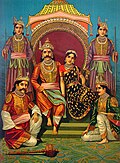
[[File: Draupadi and Pandavas.jpg|thumb|Yudhishthira (centre) and Draupadi seated on a throne, while the other Pandavas surround them, a print by Ravi Varma Press, {{circa|1910}}]] | |||
After getting victory in the war, Yudhishthira was crowned as the Emperor of [[Hastinapura]] and reigned for 36 years. | |||
Fifty days after the war, Yudhishthira and the royal families visited [[Bhishma]], who had been lying on the bed of arrows since his defeat. Bhishma bestowed the new king with ''Anushasana'', teaching the new king in series of dharma and royal conducts, before the elder guardian surrendered his life by his own will. Yudhishthira then cremated the former protector of Hastinapur in a great ceremony. | |||
In the | Later, he performed the [[Ashwamedha|Ashvamedha]] on [[Krishna]] and [[Vyasa]]'s insistence. In this sacrifice, a horse was released to wander for a year, and Yudhishthira's brother Arjuna led the Pandava army, following the horse. The kings of all the countries where the horse wandered were asked to submit to Yudhishthira's rule or face war. All paid tribute, once again establishing Yudhishthira as the undisputed Emperor of Bharatavarsha.<ref>{{Cite web|title=The Mahabharata, Book 14: Aswamedha Parva Index|url=https://www.sacred-texts.com/hin/m14/index.htm|access-date=2020-06-09|website=www.sacred-texts.com|archive-date=8 July 2020|archive-url=https://web.archive.org/web/20200708220631/https://www.sacred-texts.com/hin/m14/index.htm|url-status=live}}</ref> | ||
=== | |||
After | During his reign, Yudhisthira duly consulted with and reported to [[Dhritarashtra]] on governances. After 15 years, the former king, his consort [[Gandhari (Mahabharata)|Gandhari]], Queen Mother [[Kunti]], and Prime Minister [[Vidura]] decided to retire to the forest, where they pass away years later. These events greatly saddened Yudhishthira and the Pandavas brothers. | ||
== | ==Retirement and ascent to heaven== | ||
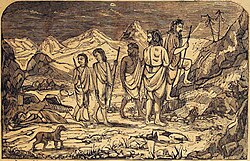
[[File:Death of Draupadi - Illustrations from the Barddhaman edition of Mahabharata.jpg|thumb|Draupadi dies as the Pandavas journey to heaven.]] | |||
Upon the onset of the ''[[Kali Yuga]]'' and the departure of [[Krishna]], Yudhishthira and his brothers retired, leaving the throne to their only descendant to survive the war of Kurukshetra, Arjuna's grandson, [[Parikshit]]. Giving up all their belongings and ties, the Pandavas, accompanied by a dog, made their final journey of pilgrimage to the [[Himalayas]]. During their pilgrimage, each one starting with [[Draupadi]], fell down dead upon the mountains. Yudhishthira cites Draupadi's partiality for Arjuna, Sahadeva's pride in his wisdom, Nakula's vanity in his beauty, Arjuna's boastfulness of his archery, and Bhima's negligence of the needs of others while eating as the reasons for their fall. Finally, it was Yudhishthira who was able to reach the top, with the dog accompanying him.<ref>{{Cite web|url=https://sacred-texts.com/hin/m17/m17002.htm|title = The Mahabharata, Book 17: Mahaprasthanika Parva: Section II}}</ref> | |||
[[File:Dark and difficult was the Road.jpg|thumb|[[Indra]] lifts the illusion and reveals the truth to Yudhishthira. ]] | |||
On reaching the top, [[Indra]] congratulates him and promises Yudhishthira immortality and godhood upon his ascent to Heaven. However, Indra asks him to abandon the dog before entering Heaven. But Yudhishthira refused to do so, citing the dog's unflinching devotion as a reason. Indra retorts that he has abandoned his brothers and wife to reach the top of the Himalayas, but Yudhishthira said he could not prevent their deaths, but to abandon a poor creature was a great sin. It turns out that the dog was his father [[Yama]] in disguise. Yama congratulates his son and commends him on his unwavering principles. Yudhishthira proceeds to Heaven upon a celestial vehicle with [[Narada]] as his guide, who informs him that he is the first mortal to enter Heaven in a physical form.<ref name="ReferenceA"/> | |||
Upon his arrival, Yudhishthira finds Duryodhana and his Kaurava cousins in heaven but not his brothers and Draupadi. Furious, Yudhishthira demands that Narada take him to where he might find his family. Narada brings Yudhishthira to Hell where he encounters [[Karna]], his brothers, Draupadi, Dhrishtadyumna, and the Upapandavas. Yudhishthira, enraged, decides that he would rather live in Hell with his family than in Heaven with his cousins.<ref>{{Cite web|url=https://sacred-texts.com/hin/m18/m18002.htm|title = The Mahabharata, Book 18: Svargarohanika Parva: Section II}}</ref> Indra then appears and lifts the illusion, informing Yudhishthira of his deception. Indra reveals that Yudhishthira has been shown a glimpse of Hell due to deceiving [[Drona]] with his white lie. Yama congratulates his son on passing his third and final test, the first being the Yaksha Prashna, and the second being his refusal to abandon the dog. Yudhishthira would then bathe in the Heavenly Ganga, casting off his mortal form and was reunited with his family in [[Svarga]].<ref>{{Cite web|url=https://sacred-texts.com/hin/m18/m18003.htm|title = The Mahabharata, Book 18: Svargarohanika Parva: Section III}}</ref> | |||
Yudhishthira | ==Assessment== | ||
Yudhishthira was master in javelin-fighting and chariot racing, alongside being a skilled archer. Yudhishthira was a polyglot, knowing unusual languages. After being exiled by Duryodhana, Yudhishthira became adept at controlling the dice after learning a mantra from Sage Brihadashwa. He was a hero known for his honesty, justice, sagacity, tolerance, good behavior and discernment.<ref>{{Cite web|url=http://sacred-texts.com/hin/m01/m01142.htm|title=Mahabharata Text|access-date=3 August 2016|archive-date=18 June 2018|archive-url=https://web.archive.org/web/20180618171502/http://www.sacred-texts.com/hin/m01/m01142.htm|url-status=live}}</ref> | |||
Yudhishthira could burn down anyone into ashes when he sees someone with his wrath and anger. That's why he used to be calm and composed most of the time. He closed his eyes and came out of the gambling hall even when he lost everything. Otherwise the entire Kuru court and all the one who were present would be burnt into ashes. | |||
[[Dhritarashtra]] said to Sanjaya "The son of [[Kunti]] and [[Pandu]], Yudhishthira, is virtuous and brave and eschews deeds that bring on shame. Endued with great energy, he hath been wronged by Duryodhana. If he were not high-minded, they would in wrath burn the Dhritarashtras. I do not so much dread Arjuna or [[Bhima]] or Krishna or the twin brothers as I dread the wrath of the king, O [[Sūta|Suta]], when his wrath is excited. His austerities are great; he is devoted to ''[[Brahmacharya]]'' practices. His heart's wishes will certainly be fulfilled. When I think of his wrath, O [[Sanjaya]], and consider how just it is, I am filled with alarm."<ref>{{Cite web|url=http://www.sacred-texts.com/hin/m05/m05022.htm|title=Mahabharata Section XXII|access-date=22 January 2018|archive-date=26 October 2017|archive-url=https://web.archive.org/web/20171026103613/http://www.sacred-texts.com/hin/m05/m05022.htm|url-status=live}}</ref> | |||
== Notes == | |||
<references group="note" /> | |||
==References== | ==References== | ||
{{Reflist}} | |||
{{ | === Bibliography === | ||
{{Refbegin|30em}} | |||
* {{cite book|last1=Abbott|first1=Justin Edwards|last2=Godbole|first2=Narhar R.|title=Stories of Indian Saints|year=1988|publisher=[[Motilal Banarsidass]]|isbn=9788120804692|edition=4th|url=https://books.google.com/books?id=ISBN9788120804692}} | |||
* {{cite book|last=Agarwal|first=Satya P.|title=Selections from the Mahābhārata: Re-affirming Gītā's Call for the Good of All|year=2002|publisher=[[Motilal Banarsidass]]|location=Delhi|isbn=9788120818743|edition=1|series=Hinduism and Its Sources Series}} | |||
* {{Cite book |editor-last1=Agarwala|editor-first=G C|url=https://books.google.com/books?id=WgnfbxkFsFoC |title=Age of Bharata War |date=1979 |publisher=Motilal Banarsidass|language=en}} | |||
* {{cite book|last=Bandyopadhyay|first=Indrajit|url=https://books.google.com/books?id=LbRLCAAAQBAJ&q=Yudhishthira+marriage+with+Draupadi&pg=PT51|title=Peter Brook's Woman in Mahabharata|date=2016-10-30|publisher=[[Lulu Press, Inc.]]|isbn=978-1-105-32108-5|language=en}}{{Dead link|date=January 2024 |bot=InternetArchiveBot |fix-attempted=yes }} | |||
* {{cite book|editor-last=Fitzgerald|editor-first=James L.|editor-link=James L. Fitzgerald|translator-last1=Fitzgerald|translator-first1=James L.|translator-last2=van Buitenen|translator-first2=Johannes Adrianus Bernardus|translator-link2=J. A. B. van Buitenen|title=The Mahābhārata|year=2004|orig-date=1973|publisher=[[University of Chicago Press]]|location=Chicago|isbn=9780226252506|volume=7}} | |||
* {{cite book|last=Hudson|first=Emily T.|url=https://books.google.com/books?id=isYVDAAAQBAJ&pg=PA97|title=Disorienting Dharma: Ethics and the Aesthetics of Suffering in the Mahābhārata|year=2013|isbn=978-0199860760|publisher=[[Oxford University Press]]|oclc=852228437|access-date=17 September 2020|archive-date=16 August 2023|archive-url=https://web.archive.org/web/20230816071848/https://books.google.com/books?id=isYVDAAAQBAJ&pg=PA97|url-status=live}} | |||
* {{cite book |editor-last=Kapoor |editor-first=Subodh |title=The Indian encyclopaedia : biographical, historical, religious, administrative, ethnological, commercial and scientific|year=2002|publisher=Cosmo Publications |location=New Delhi |isbn=9788177552713 |edition=1st}} | |||
* {{cite book|last=Kishore|first=B. R.|title=Hinduism|year=2001|publisher=Diamond Books|location=New Delhi|isbn=9788171820733|url=https://books.google.com/books?id=ISBN9788171820733|oclc=314385773}} | |||
* {{cite book|last=Lochtefeld|first=James G.|title=The illustrated encyclopedia of Hinduism|url=https://archive.org/details/illustratedencyc0000loch/|url-access=registration|year=2002|publisher=[[Rosen Publishing]]|location=New York|isbn=9780823931798|edition=1st}} | |||
* {{cite book|last=Mittal|first=J.P.|title=History of Ancient India (A New Version)|year=2006|publisher=Atlantic|volume=2: From 4250 BC to 637 AD|location=New Delhi|isbn=9788126906161|oclc=135269936|url=https://books.google.com/books?id=rrh4tY3v2A4C|access-date=22 March 2023|archive-date=4 April 2023|archive-url=https://web.archive.org/web/20230404091809/https://books.google.com/books?id=rrh4tY3v2A4C|url-status=live}} | |||
* {{Cite book |last=Raychaudhuri |first=Hemchandra |url=https://books.google.com/books?id=fN89AAAAMAAJ |title=Political History of Ancient India: From the Accession of Parikshit to the Extinction of the Gupta Dynasty |date=1953 |publisher=University of Calcutta |language=en}} | |||
* {{cite book|last=Sehgal|first=Sunil|title=Encyclopaedia of Hinduism|year=1999|publisher=Sarup & Sons|location=New Delhi|isbn=9788176250641|edition=1st|url=https://books.google.com/books?id=ISBN9788176250641|volume=4|oclc=47906736}} | |||
* {{cite journal |last1=Sutton |first1=Nick |date=1997 |title=Aśoka and Yudhisthira: A Historical Setting for the Ideological Tensions of the Mahābhārata? |url=https://doi.org/10.1006/reli.1997.0092 |journal=Religion |volume=27 |issue=4 |pages=333–341 |doi=10.1006/reli.1997.0092 |access-date= |archive-date=16 August 2023 |archive-url=https://web.archive.org/web/20230816072344/https://www.tandfonline.com/doi/abs/10.1006/reli.1997.0092 |url-status=live |url-access=subscription }} | |||
* {{cite book|author1=Valmiki|author-link1=Valmiki|author2=Vyasa|author-link2=Vyasa|translator-last1=Griffith|translator-first1=Ralph Thomas Hotchkin Griffith|translator-link1=Ralph T. H. Griffith|translator-last2=Ganguli|translator-first2=Kisari Mohan|translator-link2=Kisari Mohan Ganguli|translator-last3=Cowell|translator-first3=Edward Byles|translator-link3=Edward Byles Cowell|translator-last4=Johnston|translator-first4=Edward Hamilton|translator-link4=Edward Johnston (orientalist)|translator-last5=Ryder|translator-first5=Arthur William|translator-link5=Arthur W. Ryder|translator-last6=Bhandare|translator-first6=M. S.|translator-last7=Dutt|translator-first7=Romesh Chunder|translator-link7=Romesh Chunder Dutt|url=https://books.google.com/books?id=qj9bDwAAQBAJ&q=Dhritrashtra+khandavaprastha&pg=PT2606|title=Delphi Collected Sanskrit Epics (Illustrated)|volume=78 of Delphi Poets Series|date=19 May 2018|publisher=Delphi Classics|isbn=978-1-78656-128-2|language=en|access-date=5 December 2020|archive-date=16 August 2023|archive-url=https://web.archive.org/web/20230816072343/https://books.google.com/books?id=qj9bDwAAQBAJ&q=Dhritrashtra+khandavaprastha&pg=PT2606|url-status=live}} | |||
* {{cite book|last=Vyas|first=Ramnarayan|url=https://books.google.com/books?id=fmYAdJHqd3cC&q=crowning+of+Yudhishthira&pg=PA29|title=Nature of Indian Culture|year=1992|publisher=Concept Publishing Company|location=New Delhi|isbn=978-81-7022-388-7|language=en|oclc=28062149|access-date=5 December 2020|archive-date=16 August 2023|archive-url=https://web.archive.org/web/20230816072344/https://books.google.com/books?id=fmYAdJHqd3cC&q=crowning+of+Yudhishthira&pg=PA29|url-status=live}} | |||
* {{cite book|last=Walker|first=Benjamin|author-link=Benjamin Walker (author)|url=https://books.google.com/books?id=6zj3DwAAQBAJ&q=Pandava+conquest+Rajasuya&pg=PA564|title=Hindu World: An Encyclopedic Survey of Hinduism|date=9 April 2019|publisher=[[Routledge]]|isbn=978-0-429-62465-0|language=en|oclc=1124550466|volume=I A-L|access-date=5 December 2020|archive-date=16 August 2023|archive-url=https://web.archive.org/web/20230816072345/https://books.google.com/books?id=6zj3DwAAQBAJ&q=Pandava+conquest+Rajasuya&pg=PA564|url-status=live}} | |||
{{refend}} | |||
==External links== | ==External links== | ||
*{{Commons category-inline}} | |||
* [http://www.mahabharataonline.com/ Persons and stories from ''Mahabharata''] | * [http://www.mahabharataonline.com/ Persons and stories from ''Mahabharata''] | ||
{{Mahabharata}} | {{Mahabharata}} | ||
{{HinduMythology}} | {{HinduMythology}} | ||
{{authority control}} | {{authority control}} | ||
[[Category:Characters in the Mahabharata]] | [[Category:Characters in the Mahabharata]] | ||
[[Category:Entering heaven alive]] | [[Category:Entering heaven alive]] | ||
[[Category:Princes in Hindu mythology]] | |||
[[Category:Mythological kings of Kuru]] | |||
[[Category:Pandavas]] | |||
[[Category:Demigods]] | |||
[[Category:Heroes in Hindu mythology]] | |||
[[Category:People of the Kurukshetra War]] | |||
[[Category:People related to Krishna]] | |||
[[Category:Yama]] | |||
Latest revision as of 02:11, 18 March 2026
| Yudhishthira | |
|---|---|
 Yudhishthira entering heaven alive with his dog, painting by Nandalal Bose, c. 1913 | |
| In-universe information | |
| Position |
|
| Weapon | Bow and arrow, Javelin |
| Family | Dharma (father) Pandu (adoptive father) Kunti (mother) Madri (step-mother) (brothers) |
| Spouse | |
| Children |
|
| Relatives |
|
| Part of a series on |
| Hinduism |
|---|
 |


Yudhishthira (Sanskrit: युधिष्ठिर, romanized: Yudhiṣṭhira, lit. 'one who is steady in battle'), also known as Dharmaputra (lit. 'Son of Dharma') and Dharmaraja (lit. 'King of Dharma'), was the eldest among the five Pandavas, and is also one of the central characters of the ancient Hindu epic Mahabharata. He was the king of Indraprastha and later the King of the Kuru kingdom in the epic.[2]
Yudhishthira was the son of Kunti, the first wife of King Pandu, fathered by the personification of Dharma, due to a curse preventing Pandu from having children. Yudhishthira held a strong belief in dharma (morals and virtues) and was chosen as the crown prince of Kuru. However, after the Lakshagriha incident, he was presumed dead and his cousin Duryodhana was appointed as the new heir. The kingdom was split in half due to a succession dispute between Yudhishthira and Duryodhana. Yudhishthira received the barren half, which he later transformed into the magnificent city of Indraprastha.[3]
Yudhishthira and his brothers, the Pandavas (lit. 'Descendants of Pandu'), had a polyandrous marriage with Draupadi, the princess of Panchala, who became the empress of Indraprastha. After Yudhishthira performed the Rajasuya Yagna, he was invited to play a game of dice by his jealous cousin, Duryodhana and his uncle, Shakuni. Shakuni, a master at the game, represented Duryodhana against Yudhishthira and manipulated him into gambling his kingdom, wealth, the freedom of his brothers, Draupadi, and even himself. After the game, the Pandavas and Draupadi were sent into exile for thirteen years, with the last year requiring them to live incognito. During his exile, Yudhisthira was tested by his divine father Yama. During the last year of the exile, known as Agyaata Vaasa, Yudhishthira disguised himself as a Brahmin named Kanka and served as the King of Matsya Kingdom.[4]
Yudhishthira was the leader of the successful Pandava faction in the Kurukshetra War and defeated many venerable warriors such as Shalya. He then ruled the Kuru Kingdom for 36 years before announcing his retirement. At the end of the epic, he was the only one among his brothers to ascend to heaven while retaining his mortal body.[5]
Etymology and historicity[edit | edit source]
.JPG)
The word Yudhiṣṭhira is an aluk compound (meaning it preserves the case ending of its first part). It means "one who is steady in battle". It is composed of the words, yudhi (masculine locative singular) meaning "in battle"—from yudh (युध्) meaning 'battle, fighting'—and sthira (स्थिर) meaning 'steady' or 'stable'.[6] His other names are:
- Bharata-vanshī (भरतवंशी) – descendant of Bharata[7]
- Ajātashatru (अजातशत्रु) – one who is born without enemies[8]
- Dharmanandana (धर्मनन्दन) or Dharmaputra (धर्मपुत्र) – The son of Dharma (Righteousness) or Yama Dharma Raja
- Dharmarāja (धर्मराज) or Dharmarāya or Dharmaja – Lord of Dharma.
- Pānduputra (पांडुपुत्र) – Son of Pandu.
- Pāndavāgrajah (पाण्डवाग्रजः) – Eldest of Pandavas.
- Jyeshthakaunteya (ज्येष्ठकौन्तेय) – Eldest son of Kunti.
- Sārvabhauma (सार्वभौम) / Samrāt Chakravarti (सम्राट् चक्रवर्ती) – Emperor of the complete planet Earth.
- Kanka (कङ्क) – another name for Yudhisthira given by Draupadi for the 13th year in exile.
According to Buddhist sources, by the late and post-Vedic periods, Kuru had become a minor state ruled by a chieftain called Koravya and belonging to the Yuddhiṭṭhila (Yudhiṣṭhira) gotta.[9][10]
Birth and early life[edit | edit source]
According to the Mahabharata, Yudhishthira was born under extraordinary circumstances, fathered by the god Dharma (the god of righteousness) through the practice of niyoga (levirate), as detailed in the narrative of the Adi Parva.[11] Pandu, the king of Kuru, was married to Kunti and Madri. His life changed abruptly after a hunting accident led to a curse: intimacy with his wives would mean instant death. Choosing celibacy and asceticism, Pandu abdicated his throne, abandoned hunting, and pursued moksha (liberation), while his elder blind brother Dhritarashtra took over the reins of the kingdom. Pandu's devoted wives joined him in this mountain retreat, despite his initial reluctance. Though initially unconcerned with heirs, Pandu later fixated on his childlessness. When he sought to ascend to heaven with his wives, sages halted them, citing his lack of children became a profound personal failure.[12][13]
Kunti, Pandu's first wife, had received a boon from the sage Durvasas in the form of powerful mantras, which allowed her to summon any god to grant her a son. As Gandhari, Dhritarashtra’s wife, neared the birth of her own children, Pandu grew anxious and requested Kunti to apply her boon and suggested to call Dharma to get a truthful, knowledgeable and justice knowing son who can rule Hastinapur (capital of Kuru). Meditating on Dharma, she recited one of the mantras, and a son was born to her through this divine intervention. The child arrived at midday on the eighth day of the month of Jyeshtha, on the fifth lunar day (Panchami), during the auspicious Abhijit hour. At his birth, a celestial voice declared, "This boy will grow to be a highly righteous and courageous king, the finest among the virtuous. He will be known as Yudhishthira." Following this divine proclamation, the child was named Yudhishthira.[12][14][13]
Following Yudhishthira’s birth, Pandu’s desire for more sons grew. He urged Kunti to invoke her boon again, leading to Bhima’s birth from Vayu and Arjuna’s from Indra. With her three invocations used, Kunti shared the boon with Madri, who called upon the Ashwini Kumaras and bore Nakula and Sahadeva. Thus, the five Pandavas were born, fulfilling Pandu’s wish for a strong lineage.[15] After Pandu had five sons through divine means, he took his family to the Shatashringa forest, under the care of the resident sages.[12]
Boyhood[edit | edit source]
Yudhishthira's boyhood is mainly detailed in the Southern recension of the Mahabharata, according to which Kashyapa, a priest associated with Vasudeva, conducted Yudhishthira’s upanayana (sacred thread ceremony), while Rajarshi Shuka trained him in spear warfare during this time. Tragedy struck when Pandu, attested in all recensions, unable to resist the curse that doomed him, died in the forest, and Madri, his second wife, chose to end her life. According to Southern recension, before doing so, Madri summoned Yudhishthira, clasped her hands, and entrusted him with the responsibility of his younger brothers, saying, "Son, you are now the father to your brothers."[12]
Youth[edit | edit source]
Following the deaths of Pandu and Madri, the forest sages escorted Kunti and the children to Hastinapura, where they handed them over to the Kuru grandsire, Bhishma, recounting the events that had transpired. Yudhishthira and his brothers grew up in Hastinapura with their cousins, including Duryodhana, who clashed with Bhima. During a Ganga River outing planned by Duryodhana, he ambushed Bhima, binding and throwing him into the water. When Yudhishthira noticed Bhima missing, he alerted Kunti; Bhima soon returned, recounting his ordeal in Nagaloka and his escape. Yudhishthira wisely advised his brothers to keep the incident secret.[12]
In Hastinapura, the Pandavas trained under Kripa and later Drona, their preceptor, with Yudhishthira excelling in chariot warfare.[16] As gurudakshina (a traditional offering to the teacher), Yudhishthira initially volunteered to capture King Drupada and present him bound before Drona. However, Arjuna intervened and took on the task himself.[12][14]
Dhritarashtra named Yudhishthira heir-apparent after his warfare training, impressed by his righteousness and skill. His popularity among the citizens eclipsed Pandu’s, enraging Duryodhana, who feared the Pandavas’ rise. With Dhritarashtra’s hesitant approval, Duryodhana plotted their demise, sending them to Varanavata in a flammable lac palace built by Purochana. Despite Dhritarashtra’s doubts, the plan proceeded. Yudhishthira, warned by his uncle Vidura’s coded message, deterred followers but prepared an escape. Spotting the palace’s weakness, he and Bhima planned a tunnel with Vidura’s sapper. After a year, Bhima torched the house during a feast, leaving a Nishada family inside as decoys. The Pandavas fled via the tunnel, while Dhritarashtra, believing them dead, ordered their funeral rites in Hastinapura.[12][14]
After the lac palace in Varanavata burned to ashes, the Mahabharata recounts that the Pandavas were presumed dead, and decided to go on hiding to avoid further such incidents. Vidura secretly informed Bhishma of their survival. While in hiding in the forests, Yudhishthira permitted Bhima to marry Hidimba, a rakshasi they encountered . Later, when Arjuna defeated the gandharva Chitraratha in combat, Yudhishthira counseled Arjuna to release him. Following this Yudhishthira appointed Dhaumya as his family priest. They then resided at a village called Ekachakra.[12][14]
Marriages[edit | edit source]
In the Mahabharata, Yudhishthira is recorded as having two wives. His most well-known union is with Draupadi, the princess of Panchala, whom he shares with his four brothers, that binds the Pandavas together in a unique marital arrangement. Additionally, Yudhishthira is married to Devika, who is only mentioned once in the entire epic.[13]
During their exile, as recounted in the Adi Parva, the Pandavas grew restless in Ekachakra. Kunti suggested they move to Panchala. On their journey, they met the sage Vyasa, who narrated how the Panchala princess, Draupadi, born from a fire ritual and not a womb, was fated to have five husbands due to a past-life boon from Shiva. Disguised as brahmins, they then joined a caravan and lodged with a potter, begging for food. King Drupada had organized a svayamvara for Draupadi, setting a challenge: string a formidable bow and hit a target. Many barons, including Duryodhana, failed, but Arjuna, rising from the brahmins, succeeded, winning Draupadi’s garland. Yudhishthira and the twins left early, though all five brothers loved her. Returning to Kunti, they playfully called Draupadi their "alms," prompting her unintended command to share her. Horrified but resolute, Kunti stood firm. Yudhishthira offered Draupadi to Arjuna, but Arjuna deferred to the eldest. Mindful of Vyasa’s tale and their shared affection, Yudhishthira agreed to Kunti’s proposal. With Vyasa's persuasion, the Pandavas wed Draupadi, after gaining permission from Drupada, who was hesitant to allow.[12][13]
Yudhishthira’s other wife, Devika, is mentioned briefly in the Mahabharata (Adi Parva, Chapter 90, Verse 83). She was the daughter of king Govasana of the Sivi Kingdom.[17] In a conventional svayamvara, Devika chose Yudhishthira as her husband, and they had a son named Yaudheya. Unlike the widely narrated and polyandrous marriage to Draupadi, this union is a more traditional and individual arrangement, with scant details provided in the epic.[13][note 1]
Ruling the Indraprastha[edit | edit source]
Following Draupadi’s svayamvara, the Mahabharata recounts that news of the Pandavas’ survival reached Hastinapura, sparking surprise and joy (Adi Parva). Duryodhana pressed for schemes to undermine Yudhishthira’s alliance with Drupada, while his ally Karna advocated immediate war. Bhishma, however, asserted Yudhishthira’s equal right to the kingdom, proposing a partition, a stance Drona supported, urging reconciliation. Vidura emphasized Yudhishthira’s invincibility and Drupada’s support, swaying Dhritarashtra to summon him back. Vidura fetched Yudhishthira and his brothers, mother and wife, from Panchala, where he was courteously received, and upon returning to Hastinapura, the populace celebrated. Dhritarashtra granted Yudhishthira the Khandavaprastha—half the kingdom—which he accepted. There, with Vyasa officiating, Yudhishthira established Indraprastha, a thriving capital.[14][12]
Crowned king of Indraprastha, Yudhishthira began his reign. The divine sage Narada visited and, addressing the shared marriage to Draupadi, advised that she spend one year with each brother in turn, a rule Yudhishthira implemented to ensure harmony. Later, Draupadi bore him a son, Prativindhya, among her five sons with the Pandavas.[14][12]
Arjuna and Krishna burned the Khandava Forest to expand Indraprastha, sparing the Asura architect Maya. At Krishna’s suggestion, Maya constructed a magnificent mayasabha (assembly hall) for the Pandavas, which he presented to Yudhishthira, narrated in the Sabha Parva. When Krishna departed for Dvaraka, Yudhishthira drove his chariot, replacing Krishna’s charioteer Daruka.[12]
Rajasuya[edit | edit source]

When Narada visited once again, he conveyed Pandu’s post-mortem wish for Yudhishthira to perform the Rajasuya, an ancient Vedic ritual of royal consecration, entirely narrated in the Sabha Parva. Initially a means to legitimize his kingship, the Rajasuya soon reflected Yudhishthira’s ambition to become samraj—an “all-king” or universal sovereign—to whom all princes would submit. Encouraged by his brothers, ministers, and Krishna, Yudhishthira considered the proposal. Krishna suggested eliminating Jarasandha, the Magadha king obstructing Yudhishthira’s supremacy. Yudhishthira dispatched his brothers on a Digvijaya (conquest): Arjuna to the north, Bhima to the east, Nakula to the west, and Sahadeva to the south, subduing rival kings and securing tribute. These victories established Yudhishthira’s dominance, prompting him to order the Rajasuya.[13][18]
Vyasa arrived to oversee the sacrifice, assembling priests and sanctifying the opulent sacrificial site, built to reflect Yudhishthira’s sovereignty. Yudhishthira instructed Sahadeva to summon kings and Brahmins, dispatching messengers across the realms subdued in the Digvijaya. Nakula invited their Hastinapura kinsmen, the Kauravas, who accepted and attended. Yudhishthira was inaugurated as the sacrificer, and arriving guests—kings, princes, and Brahmins—were housed and feasted lavishly in Indraprastha’s quarters. The assembled kings offered great gifts. Yudhishthira, unsure of the primary honor (agra-puja), accepted Bhishma’s proposal of Krishna, sparking dissent from Shishupala of Chedi. Shishupala’s challenge escalated into a confrontation, ending with Krishna beheading him. Yudhishthira was consecrated samraj, achieving temporal supremacy. However, the hall’s magnificence stirred envy in Duryodhana.[13][18]
The game of dice[edit | edit source]

Following the Rajasuya sacrifice, Yudhishthira’s reign faced a pivotal challenge with the game of dice in Hastinapura, narrated in the Sabha Parva. Dhritarashtra, at Duryodhana’s urging, invited Yudhishthira to Hastinapura for a dice match against Duryodhana. Despite Vidura’s warnings and his own misgivings, Yudhishthira accepted, citing kshatriya dharma (duty to accept challenges), kula dharma (obedience to elders), and the inevitability of fate (daiva and Dhatr). Learning that Shakuni, a skilled dice player, would roll for Duryodhana, he proceeded nonetheless, entering the contest with unease. In the sabha, Yudhishthira wagered incrementally, losing his wealth, lands, brothers, and himself to Shakuni’s expertise. At Shakuni’s suggestion, he then staked Draupadi, losing her as well. Draupadi protested, arguing that Yudhishthira, having lost himself, lacked authority to wager her—a claim debated amidst insults from Karna, Duryodhana, and Duhshasana. Bhima angered, wished to burn Yudhishthira's hands. Alarmed by her ordeal and ominous signs, Dhritarashtra intervened, granting her boons and annulling the match, restoring the Pandavas’ losses.[19][13]
Duryodhana, fueled by envy of Indraprastha’s splendor, persuaded Dhritarashtra to recall Yudhishthira for a second, decisive game. The stake was set: thirteen years of exile, including one in hiding, with Draupadi included. Yudhishthira lost again to Shakuni, and this time, Draupadi accepted the outcome without protest . The Pandavas, stripped of their kingdom, departed for exile, marking the downfall of Yudhishthira’s samraj status.[13]
Yudhishthira’s decision to play puzzled observers. He later explained to Vidura that duty compelled him, yet he admitted to Bhima a desire to claim Duryodhana’s half of the kingdom, driven by overconfidence (Sabha Parva, 3.35.1–5). When Shakuni’s skill became evident, anger spurred him to continue rather than withdraw. Some scholars link the dice game to Vedic Rajasuya traditions, though the Mahabharata does not explicitly connect them. Yudhishthira's staking of Draupadi, after losing himself, drew Shakuni’s rebuke—“Self-loss is wicked when a stake remains”—highlighting a lapse in responsibility.[13]
Exile[edit | edit source]
Obtaining the Akshaya Patra[edit | edit source]
Some time after going to the forests, Yudhishthira became troubled upon realising that he was unable to feed the Brahmanas who followed him to the forests. On the advice of his priest, Sage Dhaumya, Yudhishthira stood in river and appeased Surya, the Sun god, by reciting his 108 names. The god gifted a copper plate, the Akshaya Patra, to Yudhishthira, saying that any food cooked in that vessel would be inexhaustible, until Draupadi finished her daily meal. He also blessed Yudhishthira that the latter would regain his kingdom fourteen years later.[20]
Tale of Nala and Damayanti[edit | edit source]
Sage Vyasa imparts the Pratismriti to Yudhishthira and tells him to pass it down to Arjuna. On Vyasa's advice, Yudhishthira permits Arjuna to perform penance in the Himalayas and obtain celestial weapons from the gods. During Arjuna's absence, Sage Brihadashva consoles Yudhishthira by narrating the story of Nala and Damayanti. Brihadashva advises Yudhishthira not give in to misery despite the wretched conditions he lives in. At the end of the story, Yudhishthira received a mantra from the sage, which makes him a master of gambling.[21]
Yudhishthira and Nahusha[edit | edit source]
One day, while Bhima was roaming the forests, he was captured by a giant serpent, who suppressed the Pandava's might with his gaze. Meanwhile, a worried Yudhishthira searched for Bhima and found him at the mercy of the snake. To Yudhishthira's shock, the snake introduces itself to be the ancient King Nahusha, the father of Yayati, and the legendary ancestor of the Pandavas.
Nahusha posed questions on spirituality to Yudhishthira and was satisfied with his answers. In turn, he also clarified Yudhishthira's doubts on some spiritual topics. Nahusha then narrated his story to Yudhishthira, on how he used to rule Svarga in the days of yore, how he became intoxicated with hubris, and how he turned into a snake due to the curse of the sages, Bhrigu and Agastya. Nahusha used his own story to warn Yudhishthira about the consequences of being arrogant.
Agastya and Bhrigu had prophesized that Yudhishthira would rescue Nahusha from his curse. After conversing with Yudhishthira, Nahusha regained his original form and returned to Svarga.[22]
Yudhishthira and Markandeya[edit | edit source]
The ever-youthful sage, Markandeya, once visited Yudhishthira. He narrated many stories to Yudhishthira, including the characteristics of the Yugas, the story of King Shibi, and the story of Savitri and Satyavan. He also narrated the story of Rama to Yudhishthira, and discoursed on spiritual philosophy.[23]
Yaksha Prashna[edit | edit source]

During their exile, the four other Pandavas happened upon a lake, which was haunted by a Yaksha. The Yaksha challenged the brothers to answer his moral questions before drinking the water; the four Pandavas laughed and drank the water anyway. As a result, they choked on the water and died. Yudhishthira went in last, answered many questions put forth to him by the Yaksha. After the Yaksha was satisfied with the answers, he offered Yudhishthira the choice to bring back one of his brother, and Yudhishthira chose Nakula. When the Yaksha questioned him on his reasoning, Yudhishthira replied that he is still alive as Kunti's lineage, but there are no one alive as Madri's lineage, so he chose Nakula. The Yaksha was impressed again, and revived all of the Pandavas siblings.
The Yaksha asked for any other wish as he was impressed and told him he could ask for wealth, strength, power, anything he wished. Yudhishthira said he already got the strength, wealth and power when all his four brothers were revived and said he could not ask for any other wish. Yudhishthira replied, "It is enough that I have beheld thee with my senses, eternal God of gods as thou art! O father, whatever boon thou wilt confer on me I shall surely accept gladly! May I, O lord, always conquer covetousness and folly and anger, and may my mind be ever devoted to charity, truth, and ascetic austerities!"[24]
This story is often cited as an example of Yudhishthira's upright principles.[25] The Yaksha later identified himself as Yudhishthira's father, Dharma, and pointed them to the kingdom of Matsya to spend their last year of exile in anoymity.
Ajñātavāsa[edit | edit source]
Along with his brothers, Yudhishthira spent his last year of exile in the kingdom of Matsya. He disguised himself as a Brahmin named Kanka (among themselves Pandavas codenamed him Jaya) and advised the game of dice to the king.[4]
Following the death of Kichaka by Bhima, Matsya was invaded by King Susharma of Trigarta, in retaliation to the raidings his kingdom had suffered by Kichaka, and in cooperation with Duryodhana of Hastinapur. When Susharma's army closed the kingdom, Kanka volunteered to follow King Virata to face the invader, and took along his three brothers, Vallabha (Bhima), Granthika (Nakula), and Tantripala (Sahadeva), with him and while disguised. On the battlefield, the brothers proved valiance, defending King Virata before finally defeating King Susharma.
While Yudhishthira and King Virata were away battling Susharma, the city was marched upon by the host from Hastinapur. Prince Uttar and Brihannala (Arjuna), who were left in defense of the city, rallied to defend the kingdom, where Arjuna revealed his identity and fended off the invasion. When King Virata returned from his battle, the identities of all Pandavas were revealed, and Yudhishthira congratulated the marriage between Princess Uttarā and Abhimanyu, as Arjuna has suggested.
Kurukshetra war[edit | edit source]

When the period of exile was completed, Duryodhana refused to return Yudhishthira's kingdom. Yudhishthira made numerous diplomatic efforts to retrieve his kingdom peacefully but in vain. Left with no other option, Yudhishthira wages war.[26]
The flag of Yudhishthira's chariot bore the image of a golden moon with planets around it. Two large and beautiful kettle-drums, called Nanda and Upananda, were tied to it.[27] Before the war started, Yudhishthira stepped down from his chariot to take blessings from his grandsire Bhishma, teachers Drona and Kripa and uncle Shalya, who all were in his opposite side in the war showing his respect towards his elders. He also asked the willing Kauravas to join his side. On his request one of Dhritarashtra sons, Yuyutsu joined the war on the side of Pandavas.[28]
Yudhishthira was described to be an excellent javelin-fighter and to have surpassed everyone as a car-warrior. Yudhishthira defeated many warriors in the war, like Duryodhana. Yudhishthira’s javelin originally belonged to Ishana which he would use to kill Shalya during the war.[29] Yudhishthira also wielded a bow called Mahendra.
On the 14th day of the war, while Arjuna was busy searching for Jayadratha, Drona attempted to capture Yudhishthira but Arjuna would foil Drona's plans. Yudhishthira and Drona engaged in a fierce duel where Yudhishthira was ultimately defeated by Drona.[30] Yudhishthira would later assist his nephew Ghatotkacha in slaying the asura Alambusha.[31]
Yudhishthira would later defeat Duryodhana twice and the latter had to be rescued by Drona.[32] Drona and Yudhishthira would engage in an archery duel which would end up as a stalemate.[33] Yudhishthira would later be defeated by Kritavarma.[34]
On the 15th day, Yudhishthira was approached by Drona, in the latter' inquiry on the death of his son Ashwatthama whom he heard to have died at Bhima's hand. Torn between his duty to cripple Drona and upholding his morals, Yudhishthira opted to half truth where he confirmed the death of Ashwatthama the elephant, but omitted the contextual part that it was an elephant and not his son. This was effective in the former purpose of crippling Drona, but also caused his own chariot to finally fall down to the ground, instead of slightly levitating as it had been before this incident. Yudhishthira was one of 5 individuals who witnessed Drona's spirit leaving his body.[35]
On the 17th day, he injured Duryodhana badly and was about to kill him but decided to spare him on Bhima's advice who reminded him of his vow to kill Duryodhana.[36] Yudhishthira would be defeated by both Karna and Ashwatthama.

Worried for Yudhishthira's safety, Arjuna retreats from the battlefield to search for him, only to find him taking refuge in camp. Furious at Arjuna for not killing Karna yet, Yudhishthira insults him by suggesting Arjuna should hand over the Gandiva to another warrior if he does not think he is able to slay Karna.[37] Arjuna, enraged from Yudhishthira's insult, attempted to kill him with his sword but was stopped from doing so due to Krishna's intervention. Filled with regret, Arjuna attempted suicide but was dissuaded from doing so by Krishna. The brothers would reconcile their differences and embrace each other.[38]
On the last day of the war, Yudhishthira was highly energetic for the day, and engaged in a fierce duel against the Kauravas' final supreme commander, Shalya. With Bhima's assistance, Yudhishthira managed to slay his uncle.[29]
With the battlefield cleared of the Kauravas but no sight of Duryodhana, Yudhishthira received a report that his nemesis went into hiding in a nearby swamp. The Pandavas brothers and Krishna thus went to the swamp, and taunted Duryodhana off his refuge. Yudhishthira proposed a final challenge to Duryodhana, to a battle against any of the Pandavas under any weapon of Duryodhana's desire. Yudhishthira also promised Duryodhana that should he win, he would reign as the next King of Hastinapura.[39]
With Duryodhana choosing Bhima, the other Pandavas brothers, Krishna and Balarama witnessed the mace duel between the mace fighters. When Bhima finally defeated Duryodhana and started insulting his nemesis, Yudhishthira became sufficiently displeased with his brother's disrespect and ordered Bhima off the battleground. Ultimately, Yudhishthira heard out Duryodhana's final conversation and lamentation, before leaving the fallen Kauravas' overlord on his deathbed.[40]
On advice of Krishna, Yudhishthira and the Pandavas brothers did not return to their camps. They were thus absent from the nighttime assault carried by the Kauravas survivors, led by Aswatthama. The Panadavas showed up later to witness the massacre's aftermath, and the deaths of their sons by Drauparti. Stricken by grief, Draupadi asked her husbands to bring justice to Aswatthama. The Panadavas thus chased Drona's son to the Rishi's encampment, where he took refuge. Yudhishthira then witnessed Aswatthama's last stand and downfall, and afterwards, return to Draupadi with proof of Aswatthama's defeat.
Yudhishthira's curse[edit | edit source]
Aftermath of the Kurukshetra War Kunti reveals to Yudhishthira and all the Pandavas that Karna was her eldest son, born before marriage, through Lord Surya, by invoking the boon gifted by Durvasa, thus making Karna his elder brother. Yudhishthira overwhelmed with grief and regret for Karna, cursed all women with not being able to hide any secrets - "Thus addressed by his mother, King Yudhishthira, with tearful eyes and heart agitated by grief, said these words, 'In consequence of thyself having concealed thy counsels, this great affliction has overtaken me!' Possessed of great energy, the righteous king, then, in sorrow, cursed all the women of the world, saying, 'Henceforth no woman shall succeed in keeping a secret'."[41]
Reign after the war[edit | edit source]

After getting victory in the war, Yudhishthira was crowned as the Emperor of Hastinapura and reigned for 36 years.
Fifty days after the war, Yudhishthira and the royal families visited Bhishma, who had been lying on the bed of arrows since his defeat. Bhishma bestowed the new king with Anushasana, teaching the new king in series of dharma and royal conducts, before the elder guardian surrendered his life by his own will. Yudhishthira then cremated the former protector of Hastinapur in a great ceremony.
Later, he performed the Ashvamedha on Krishna and Vyasa's insistence. In this sacrifice, a horse was released to wander for a year, and Yudhishthira's brother Arjuna led the Pandava army, following the horse. The kings of all the countries where the horse wandered were asked to submit to Yudhishthira's rule or face war. All paid tribute, once again establishing Yudhishthira as the undisputed Emperor of Bharatavarsha.[42]
During his reign, Yudhisthira duly consulted with and reported to Dhritarashtra on governances. After 15 years, the former king, his consort Gandhari, Queen Mother Kunti, and Prime Minister Vidura decided to retire to the forest, where they pass away years later. These events greatly saddened Yudhishthira and the Pandavas brothers.
Retirement and ascent to heaven[edit | edit source]

Upon the onset of the Kali Yuga and the departure of Krishna, Yudhishthira and his brothers retired, leaving the throne to their only descendant to survive the war of Kurukshetra, Arjuna's grandson, Parikshit. Giving up all their belongings and ties, the Pandavas, accompanied by a dog, made their final journey of pilgrimage to the Himalayas. During their pilgrimage, each one starting with Draupadi, fell down dead upon the mountains. Yudhishthira cites Draupadi's partiality for Arjuna, Sahadeva's pride in his wisdom, Nakula's vanity in his beauty, Arjuna's boastfulness of his archery, and Bhima's negligence of the needs of others while eating as the reasons for their fall. Finally, it was Yudhishthira who was able to reach the top, with the dog accompanying him.[43]

On reaching the top, Indra congratulates him and promises Yudhishthira immortality and godhood upon his ascent to Heaven. However, Indra asks him to abandon the dog before entering Heaven. But Yudhishthira refused to do so, citing the dog's unflinching devotion as a reason. Indra retorts that he has abandoned his brothers and wife to reach the top of the Himalayas, but Yudhishthira said he could not prevent their deaths, but to abandon a poor creature was a great sin. It turns out that the dog was his father Yama in disguise. Yama congratulates his son and commends him on his unwavering principles. Yudhishthira proceeds to Heaven upon a celestial vehicle with Narada as his guide, who informs him that he is the first mortal to enter Heaven in a physical form.[5]
Upon his arrival, Yudhishthira finds Duryodhana and his Kaurava cousins in heaven but not his brothers and Draupadi. Furious, Yudhishthira demands that Narada take him to where he might find his family. Narada brings Yudhishthira to Hell where he encounters Karna, his brothers, Draupadi, Dhrishtadyumna, and the Upapandavas. Yudhishthira, enraged, decides that he would rather live in Hell with his family than in Heaven with his cousins.[44] Indra then appears and lifts the illusion, informing Yudhishthira of his deception. Indra reveals that Yudhishthira has been shown a glimpse of Hell due to deceiving Drona with his white lie. Yama congratulates his son on passing his third and final test, the first being the Yaksha Prashna, and the second being his refusal to abandon the dog. Yudhishthira would then bathe in the Heavenly Ganga, casting off his mortal form and was reunited with his family in Svarga.[45]
Assessment[edit | edit source]
Yudhishthira was master in javelin-fighting and chariot racing, alongside being a skilled archer. Yudhishthira was a polyglot, knowing unusual languages. After being exiled by Duryodhana, Yudhishthira became adept at controlling the dice after learning a mantra from Sage Brihadashwa. He was a hero known for his honesty, justice, sagacity, tolerance, good behavior and discernment.[46]
Yudhishthira could burn down anyone into ashes when he sees someone with his wrath and anger. That's why he used to be calm and composed most of the time. He closed his eyes and came out of the gambling hall even when he lost everything. Otherwise the entire Kuru court and all the one who were present would be burnt into ashes.
Dhritarashtra said to Sanjaya "The son of Kunti and Pandu, Yudhishthira, is virtuous and brave and eschews deeds that bring on shame. Endued with great energy, he hath been wronged by Duryodhana. If he were not high-minded, they would in wrath burn the Dhritarashtras. I do not so much dread Arjuna or Bhima or Krishna or the twin brothers as I dread the wrath of the king, O Suta, when his wrath is excited. His austerities are great; he is devoted to Brahmacharya practices. His heart's wishes will certainly be fulfilled. When I think of his wrath, O Sanjaya, and consider how just it is, I am filled with alarm."[47]
Notes[edit | edit source]
- ↑ According to Puranas, Yaudheya was also the name of the son of Prativindhya.[1] The Bhagavata Purana, as well as Vishnu Purana, mention Pauravi as one of the wives of Yudhishthira. A son named Devaka was born to this couple.[2]
References[edit | edit source]
- ↑ "The Mahabharata, Book 1: Adi Parva: Sambhava Parva: Section XCV". Archived from the original on 16 January 2010.
- ↑ "The Mahabharata".
- ↑ "The Mahabharata, Book 2: Sabha Parva: Section I".
- ↑ 4.0 4.1 "The Mahabharata, Book 4: Virata Parva: Section I".
- ↑ 5.0 5.1 "The Mahabharata, Book 17: Mahaprasthanika Parva: Section III".
- ↑ www.wisdomlib.org (26 December 2010). "Yudhishthira, Yudhiṣṭhira, Yudhisthira: 15 definitions". www.wisdomlib.org. Archived from the original on 21 October 2020. Retrieved 8 September 2020.
- ↑ Agarwala 1979, p. 167.
- ↑ Abbott & Godbole 1988, p. 402.
- ↑ Singh, Upinder. A History of Ancient and Early Medieval India: From the Stone Age to the 12th Century. Pearson Education India. p. 264.
- ↑ Raychaudhuri 1953, p. 41.
- ↑ "The Mahabharata, Book 1: Adi Parva: Section CXIX".
- ↑ 12.00 12.01 12.02 12.03 12.04 12.05 12.06 12.07 12.08 12.09 12.10 12.11 Mani, Vettam (1975). Puranic Encyclopedia: A Comprehensive Work with Special Reference to the Epic and Puranic Literature. Motilal Banarsidass. pp. 227–229 (entry Dharmaputra). ISBN 978-81-208-0597-2.
- ↑ 13.00 13.01 13.02 13.03 13.04 13.05 13.06 13.07 13.08 13.09 Brodbeck, Simon; Black, Brian (9 August 2007). Gender and Narrative in the Mahabharata. Routledge. ISBN 978-1-134-11995-0.
- ↑ 14.0 14.1 14.2 14.3 14.4 14.5 Buitenen, Johannes Adrianus Bernardus; Fitzgerald, James L. (1973). The Mahābhārata. University of Chicago Press. ISBN 978-0-226-84663-7.
- ↑ "The Mahabharata, Book 1: Adi Parva: Section CXXII".
- ↑ "The Mahabharata, Book 1: Adi Parva: Section CXXXIV".
- ↑ Bandyopadhyay 2016.
- ↑ 18.0 18.1 The Mahabharata, Volume 2: Book 2: The Book of Assembly; Book 3: The Book of the Forest. University of Chicago Press. 1975. ISBN 978-0-226-84649-1.
- ↑ Chakrabarti, Arindam; Bandyopadhyay, Sibaji (19 September 2017). Mahabharata Now: Narration, Aesthetics, Ethics. Routledge. ISBN 978-1-317-34213-7.
- ↑ "The Mahabharata, Book 3: Vana Parva: Section III".
- ↑ "The Mahabharata, Book 3: Vana Parva: Section LXXIX".
- ↑ "The Mahabharata, Book 3: Vana Parva: Section CLXXX".
- ↑ "The Mahabharata, Book 3: Vana Parva: Section CCXXX".
- ↑ "The Mahabharata, Book 3: Vana Parva: Section CCCXII".
- ↑ Sehgal 1999.
- ↑ "The Mahabharata, Book 5: Udyoga Parva: Section CLI".
- ↑ Kapoor 2002, p. 4462.
- ↑ "The Mahabharata, Book 6: Bhishma Parva: Section XLIII".
- ↑ 29.0 29.1 "The Mahabharata, Book 9: Shalya Parva: Section XVII".
- ↑ "The Mahabharata, Book 7: Drona Parva: Section CV".
- ↑ "The Mahabharata, Book 7: Drona Parva: Section CVIII".
- ↑ "The Mahabharata, Book 7: Drona Parva: Section CLII".
- ↑ "The Mahabharata, Book 7: Drona Parva: Section CLVI".
- ↑ "The Mahabharata, Book 7: Drona Parva: Section CLXI".
- ↑ "The Mahabharata, Book 7: Drona Parva: Section CXCIII".
- ↑ "The Mahabharata, Book 8: Karna Parva: Section XXIX".
- ↑ "The Mahabharata, Book 8: Karna Parva: Section LXVIII".
- ↑ "The Mahabharata, Book 8: Karna Parva: Section LXXI".
- ↑ "The Mahabharata, Book 9: Shalya Parva: Section XXXII".
- ↑ "The Mahabharata, Book 9: Shalya Parva: Section LXI".
- ↑ "The Mahabharata, Book 12: Santi Parva: Section VI".
- ↑ "The Mahabharata, Book 14: Aswamedha Parva Index". www.sacred-texts.com. Archived from the original on 8 July 2020. Retrieved 9 June 2020.
- ↑ "The Mahabharata, Book 17: Mahaprasthanika Parva: Section II".
- ↑ "The Mahabharata, Book 18: Svargarohanika Parva: Section II".
- ↑ "The Mahabharata, Book 18: Svargarohanika Parva: Section III".
- ↑ "Mahabharata Text". Archived from the original on 18 June 2018. Retrieved 3 August 2016.
- ↑ "Mahabharata Section XXII". Archived from the original on 26 October 2017. Retrieved 22 January 2018.
Bibliography[edit | edit source]
- Abbott, Justin Edwards; Godbole, Narhar R. (1988). Stories of Indian Saints (4th ed.). Motilal Banarsidass. ISBN 9788120804692.
- Agarwal, Satya P. (2002). Selections from the Mahābhārata: Re-affirming Gītā's Call for the Good of All. Hinduism and Its Sources Series (1 ed.). Delhi: Motilal Banarsidass. ISBN 9788120818743.
- Agarwala, G C, ed. (1979). Age of Bharata War. Motilal Banarsidass.
- Bandyopadhyay, Indrajit (30 October 2016). Peter Brook's Woman in Mahabharata. Lulu Press, Inc. ISBN 978-1-105-32108-5.[permanent dead link]
- Fitzgerald, James L., ed. (2004) [1973]. The Mahābhārata. Vol. 7. Translated by Fitzgerald, James L.; van Buitenen, Johannes Adrianus Bernardus. Chicago: University of Chicago Press. ISBN 9780226252506.
- Hudson, Emily T. (2013). Disorienting Dharma: Ethics and the Aesthetics of Suffering in the Mahābhārata. Oxford University Press. ISBN 978-0199860760. OCLC 852228437. Archived from the original on 16 August 2023. Retrieved 17 September 2020.
- Kapoor, Subodh, ed. (2002). The Indian encyclopaedia : biographical, historical, religious, administrative, ethnological, commercial and scientific (1st ed.). New Delhi: Cosmo Publications. ISBN 9788177552713.
- Kishore, B. R. (2001). Hinduism. New Delhi: Diamond Books. ISBN 9788171820733. OCLC 314385773.
- Lochtefeld, James G. (2002). The illustrated encyclopedia of Hinduism (1st ed.). New York: Rosen Publishing. ISBN 9780823931798.
- Mittal, J.P. (2006). History of Ancient India (A New Version). Vol. 2: From 4250 BC to 637 AD. New Delhi: Atlantic. ISBN 9788126906161. OCLC 135269936. Archived from the original on 4 April 2023. Retrieved 22 March 2023.
- Raychaudhuri, Hemchandra (1953). Political History of Ancient India: From the Accession of Parikshit to the Extinction of the Gupta Dynasty. University of Calcutta.
- Sehgal, Sunil (1999). Encyclopaedia of Hinduism. Vol. 4 (1st ed.). New Delhi: Sarup & Sons. ISBN 9788176250641. OCLC 47906736.
- Sutton, Nick (1997). "Aśoka and Yudhisthira: A Historical Setting for the Ideological Tensions of the Mahābhārata?". Religion. 27 (4): 333–341. doi:10.1006/reli.1997.0092. Archived from the original on 16 August 2023.
- Valmiki; Vyasa (19 May 2018). Delphi Collected Sanskrit Epics (Illustrated). Vol. 78 of Delphi Poets Series. Translated by Griffith, Ralph Thomas Hotchkin Griffith; Ganguli, Kisari Mohan; Cowell, Edward Byles; Johnston, Edward Hamilton; Ryder, Arthur William; Bhandare, M. S.; Dutt, Romesh Chunder. Delphi Classics. ISBN 978-1-78656-128-2. Archived from the original on 16 August 2023. Retrieved 5 December 2020.
- Vyas, Ramnarayan (1992). Nature of Indian Culture. New Delhi: Concept Publishing Company. ISBN 978-81-7022-388-7. OCLC 28062149. Archived from the original on 16 August 2023. Retrieved 5 December 2020.
- Walker, Benjamin (9 April 2019). Hindu World: An Encyclopedic Survey of Hinduism. Vol. I A-L. Routledge. ISBN 978-0-429-62465-0. OCLC 1124550466. Archived from the original on 16 August 2023. Retrieved 5 December 2020.
External links[edit | edit source]


Hindu deities and texts | ||
|---|---|---|
| Gods |  | |
| Goddesses | ||
| Other deities | ||
| Texts | ||