



CleanupBot (talk | contribs) m →External links: clean up |
Delphia92Y (talk | contribs) No edit summary |
||
| Line 1: | Line 1: | ||
{{short description|Personification of the river | {{short description|Personification of the river Ganges as a deity in Hinduism}} | ||
{{redirect|Ganga Devi|the Indian painter|Ganga Devi (painter)|the Indian politician|Ganga Devi (politician)}} | {{redirect|Ganga Devi|the Indian painter|Ganga Devi (painter)|the Indian politician|Ganga Devi (politician)|Queen of Bhaktapur|Ganga Rani}} | ||
{{Use dmy dates|date=July 2020}} | {{Infobox deity | ||
| type = Hindu | |||
| image = 17th to 18th-century goddess Ganga sculpture, Musée Rodin, Paris.jpg | |||
| caption = 17th-18th-century sculpture of goddess Ganga | |||
| name = Ganga | |||
| affiliation = {{hlist|[[Devi]]|[[River deities in Hinduism|River goddess]]|[[Yogini]]|[[Banai (goddess)|Banai]]}} | |||
| mantra = Oṁ Śrī Gaṅgāyai Namaḥ | |||
| siblings = [[Parvati]], [[Mainaka]] (in some texts) | |||
| consort = * [[Shantanu]] (married temporarily) | |||
* [[Shiva]] (in some Puranas)<ref>{{Cite book |last1=Hawley |first1=John Stratton |url=https://books.google.com/books?id=j3R1z0sE340C&dq=ga%E1%B9%85g%C4%81+wife+of+%C5%9Biva&pg=PA177 |title=The Divine Consort: Rādhā and the Goddesses of India |last2=Wulff |first2=Donna Marie |date=1984 |publisher=Motilal Banarsidass Publishing House |isbn=978-0-89581-441-8 |language=en}}</ref><ref> | |||
{{Cite book |last=Wangu |first=Madhu Bazaz |url=https://books.google.com/books?id=k8y-vKtqCmIC&dq=ga%E1%B9%85g%C4%81+wife+of+%C5%9Biva&pg=PA90 |title=Images of Indian Goddesses: Myths, Meanings, and Models |date=2003 |publisher=Abhinav Publications |isbn=978-81-7017-416-5 |language=en}} | |||
</ref><ref>{{Cite book |last=Sivaramamurti |first=C. |url=https://books.google.com/books?id=vu9PAAAAMAAJ&q=ga%E1%B9%85g%C4%81+wife+of+%C5%9Biva |title=Gaṅgā |date=1976 |publisher=Orient Longman |isbn=978-0-86125-084-4 |language=en}}</ref> | |||
| children = [[Bhishma]] and 7 other sons of Shantanu | |||
| symbol = [[Ganges River]] | |||
| festivals = {{bulleted list|[[Ganga Dussehra]]|Ganga Jayanti|[[Navaratri]]|[[Loy Krathong]]|[[Triyampawai ceremony]]}} | |||
| weapon = [[Kalasha]] | |||
| mount = [[Makara (Hindu mythology)|Makara]] | |||
| other_names = {{hlist|[[Bhagirathi]]|Shivapriya|Jahnavi|Nikita|Mandakini|}} | |||
| deity_of = Personification of the [[Ganges River]] <br /> Goddess of Forgiveness and Purification | |||
| parents = [[Himavan]] and Maināvati (in some texts) | |||
}}{{Use dmy dates|date=July 2020}} | |||
{{Use Indian English|date=January 2016}} | {{Use Indian English|date=January 2016}} | ||
'''Ganga''' ({{ | '''Ganga''' ({{langx|sa|गङ्गा}}, {{IAST3|Gaṅgā}}) is the personification of the river [[Ganges]], who is worshipped by [[Hindu]]s as the goddess of purification and forgiveness. Known by many names, Ganga is often depicted as a fair, beautiful woman, riding a divine crocodile-like creature called the [[makara]]. | ||
Some of the earliest mentions of Ganga are found in the [[Rigveda]], where she is mentioned as the holiest of the rivers. Her stories mainly appear in post-Vedic texts such as the ''[[Ramayana]]'', ''[[Mahabharata]],'' and the ''[[Puranas]]''. | |||
The ''[[Ramayana]]'' describes her to be the firstborn of [[Himavat]], the personification of the [[Himalayas]], and the sister of the mother goddess [[Parvati]]. However, other texts mention her origin from the preserver deity, [[Vishnu]]. Legends focus on her descent to earth, which occurred because of a royal-sage [[Bhagiratha]], aided by the god [[Shiva]]. | |||
In the epic ''Mahabharata'', Ganga is the mother of the warrior [[Bhishma]] in a union with the [[Kuru Kingdom|Kuru]] king [[Shantanu]]. | |||
In Hinduism, Ganga is seen as a mother to humanity. Pilgrims immerse the [[Antyesti|ashes of their kin]] in the river | In Hinduism, Ganga is seen as a mother to humanity. Pilgrims immerse the [[Antyesti|ashes of their kin]] in the river Ganga, which is considered by them to bring the souls (purified spirits) closer to [[moksha]], the liberation from the cycle of life and death. Festivals like [[Ganga Dussehra]] and Ganga Jayanti are celebrated in her honour at several sacred places, which lie along the banks of the Ganges, including [[Gangotri]], [[Haridwar]], [[Prayagraj]], [[Varanasi]] and [[Kalighat Kali Temple|Kali Ghat]] in [[Kolkata]]. Alongside [[Gautama Buddha]], Ganga is worshipped during the [[Loy Krathong]] festival in [[Thailand]]. | ||
==Vedic scriptures== | ==Vedic scriptures== | ||
Ganga is mentioned in the ''[[Rigveda]]'', the earliest and theoretically the holiest of the Hindu scriptures. Ganga is mentioned in the | Ganga is mentioned in the ''[[Rigveda]]'', the earliest and theoretically the holiest of the Hindu scriptures. Ganga is mentioned in the [[Nadistuti sukta|Nadistuti]] (Rigveda 10.75), which lists the rivers from east to west. In RV 6.45.31, the word ''Ganga'' is also mentioned, but it is not clear if the reference is to the river. RVRV 3.58.6 says that "your ancient home, your auspicious friendship, O Heroes, your wealth is on the banks of the Jahanvi". This verse could refer to the Ganga. In RV 1.116.18–19, the Jahanvi and the [[Ganges river dolphin]] occur in two adjacent verses.<ref>{{Cite book|last=Talageri|first=Shrikant G.|url=https://books.google.com/books?id=dpkoAAAAYAAJ&q=Ganges|title=The Rigveda: A Historical Analysis|date=2000|publisher=Aditya Prakashan|isbn=978-81-7742-010-4|language=en}}</ref> | ||
==Iconography== | ==Iconography== | ||
[[File: | [[File:Images_from_National_Museum,_New_Delhi,_India_18_(cropped).jpg|thumb|Ganga stone statue, 8th century AD, Ellora. Currently at National Museum, New Delhi, India.]] | ||
Ganga is described as the melodious, the fortunate, the cow that gives much milk, the eternally pure, the delightful, the body that is full of fish, affords delight to the eye and leaps over mountains in sport, the bedding that bestows water and happiness, and the friend or benefactor of all that lives.<ref>{{Cite book|last=Kumari|first=M. Krishna|url=https://books.google.com/books?id=U95LswEACAAJ&q=iconography+of+Ganga|title=Iconography of Gaṅgā and Yamunā|date=2018|publisher=B.R. Publishing Corporation|isbn=978-93-86223-70-8|language=en}}</ref> | Ganga is described as the melodious, the fortunate, the cow that gives much milk, the eternally pure, the delightful, the body that is full of fish, affords delight to the eye and leaps over mountains in sport, the bedding that bestows water and happiness, and the friend or benefactor of all that lives.<ref>{{Cite book|last=Kumari|first=M. Krishna|url=https://books.google.com/books?id=U95LswEACAAJ&q=iconography+of+Ganga|title=Iconography of Gaṅgā and Yamunā|date=2018|publisher=B.R. Publishing Corporation|isbn=978-93-86223-70-8|language=en}}</ref> | ||
Since | Since the Vedic period, the Ganges river has been considered the holiest of all rivers by [[Hindus]]. Ganga is also personified as a goddess and worshipped as Goddess Ganga. She holds an important place in the [[Hindu deities|Hindu pantheon]]. Ganga is represented as a fair-complexioned woman, wearing a white crown and sitting on a crocodile. She holds a water lily in her right hand and a flute in her left. When shown with four hands she carries a water-pot, a lily, and a rosary, and has one hand in a protective mode. The ''[[Rig Veda|Rigveda]]'' mentions Ganga but more of her is said in the [[Puranas]]. | ||
Ganga is depicted four-armed and mounted on a crocodile or enthroned surrounded by crocodiles. In one of the iconography in Maha Virat-rupa, she holds a jar of [[amrita]], rosary, [[Lotus flower|lotus | Ganga is depicted [[Chaturbhuja|four-armed]] and mounted on a crocodile or enthroned surrounded by crocodiles. In one of the iconography in Maha Virat-rupa, she holds a jar of [[amrita]], rosary, [[Lotus flower|lotus]] and varada mudra. She may be depicted in other ways holding only a [[kalasha]] (or 2 replacing lotus) and lotus, while other 2 hands in [[varada]] and [[Abhayamudra|abhaya mudra]]. | ||
Another depiction popular especially in [[Bengal]] shows her holding [[shankha]], [[chakra]] ([[discus]]), [[lotus flower|lotus]] and | Another depiction popular especially in [[Bengal]] shows her holding [[shankha]], [[chakra]] ([[discus]]), [[lotus flower|lotus]] and abhaya mudra, with the [[kalasha]] releasing her holy water. | ||
In [[Brahma Vaivarta Purana]], Ganga is often depicted with her divine mount, the [[makara]] – an animal with the head of a crocodile and tail of a dolphin. | |||
In [[Brahma Vaivarta Purana]], Ganga is often depicted with her divine | |||
==Legend== | |||
== | |||
===Birth=== | ===Birth=== | ||
Varying myths of Ganga's birth is found in Hindu scriptures. According to the'' [[Bhagavata Purana]]'', [[Vishnu]], in his incarnation as [[Vamana]], extended his left foot to the end of the universe, and pierced a hole in its covering with the nail of his big toe. Through the hole, the pure water of the [[Causal Ocean|causal ocean]] entered this universe as the Ganges river. Having washed the lotus feet of the lord, which are covered with reddish saffron, the water of the Ganga acquired a very beautiful pink colour. Because the Ganges directly touches the lotus feet of [[Vishnu]] ([[Narayana]]) before descending within this universe, it is known as ''Bhagavat-Padi'' or ''Vishnupadi,'' which means e''manating from the feet of Bhagavan (God)''. It finally settles in [[Brahmaloka]] or [[Brahmapura]], the abode of the Brahma, before descending to the planet earth at the request of [[Bhagiratha]], and held safely by [[Shiva]] on his head, to prevent the destruction of [[Bhumi Devi]] (the earth goddess). Then, Ganga was released from Shiva's hair to meet the needs of the country.<ref>{{cite web|url = https://www.wisdomlib.org/hinduism/compilation/puranic-encyclopaedia/d/doc241588.html|title = Story of Gaṅgā|date = 28 January 2019|access-date = 7 November 2020|archive-date = 12 November 2020|archive-url = https://web.archive.org/web/20201112220139/https://www.wisdomlib.org/hinduism/compilation/puranic-encyclopaedia/d/doc241588.html|url-status = live}}</ref> | |||
[[ | The ''[[Ramayana]]'' narrates a different version of the myth. Ganga is described as the eldest child of [[Himavat]], son of Brahma and the king of the [[Himalayas]], and his wife Queen Menavati, the daughter of [[Mount Meru|Meru]]. Her younger sister is [[Parvati]], who latter marries Shiva. When Ganga attained youth, the [[Deva (Hinduism)|devas]] took her to [[Svarga]], where she took a form of a river and flowed.<ref>{{Cite book|last1=V?lm?ki|url=https://books.google.com/books?id=mkSzznK3VuEC&q=himavan+and+ganga&pg=PA20|title=The Concise R_m_ya_a of V_lm_ki|last2=Venkatesananda|first2=Swami|date=1988-01-01|publisher=SUNY Press|isbn=978-0-88706-862-1|language=en}}</ref><ref>{{Cite book|last=Sivkishen|url=https://books.google.com/books?id=kmVZBgAAQBAJ&q=himavan+and+ganga&pg=PT465|title=Kingdom of Shiva|date=2015-01-23|publisher=Diamond Pocket Books Pvt Ltd|isbn=978-81-288-3028-0|language=en}}</ref> | ||
=== | === Transformation into a river === | ||
[[ | A legend in the [[Devi-Bhagavata Purana|Devi Bhagavata Purana]] describes Ganga as originally being one of the three wives of Vishnu, together with [[Lakshmi]] and [[Saraswati]].<ref>{{Cite book|last=Dalal|first=Roshen|url=https://books.google.com/books?id=zrk0AwAAQBAJ&q=Ganga+shiva|title=Hinduism: An Alphabetical Guide|date=2014-04-18|publisher=Penguin UK|isbn=978-81-8475-277-9|language=en}}</ref> In the midst of a conversation, Saraswati observed Ganga playfully glancing at Vishnu. Frustrated, Saraswati launched a furious tirade against Ganga, accusing her of stealing Vishnu's love away from her. When Ganga appealed to her husband to help her, he chose to remain neutral, not wishing to participate in a quarrel between his three wives, whom he loved equally. When Lakshmi attempted to soothe Saraswati's anger by reasoning with her, the jealous goddess grew angry with her as well, accusing her of disloyalty towards her. She cursed Lakshmi to be born as the [[Tulasi in Hinduism|Tulasi]] plant upon the earth. Ganga, now enraged that Lakshmi had been cursed because she had defended her, cursed Saraswati that she would be incarnated as a river on earth. Saraswati issued the same curse against Ganga, informing her that sinful men would cleanse themselves of their sins with her water. To prevent further conflict among the goddesses, Vishnu declares Lakshmi as his only wife and sends Saraswati to Brahma and Ganga to Shiva.<ref>{{Cite web |last=www.wisdomlib.org |date=2013-05-15 |title=On the coming in this world of Lakṣmī, Gaṅgā and Sarasvatī [Chapter 6] |url=https://www.wisdomlib.org/hinduism/book/devi-bhagavata-purana/d/doc57319.html |access-date=2022-10-21 |website=www.wisdomlib.org |language=en |archive-date=21 October 2022 |archive-url=https://web.archive.org/web/20221021081331/https://www.wisdomlib.org/hinduism/book/devi-bhagavata-purana/d/doc57319.html |url-status=live }}</ref><ref>{{Cite book |last=Williams |first=George M. |url=https://books.google.com/books?id=N7LOZfwCDpEC&dq=three+wives+vishnu&pg=PA137 |title=Handbook of Hindu Mythology |date=2008-03-27 |publisher=OUP USA |isbn=978-0-19-533261-2 |pages=137 |language=en}}</ref><ref>{{Cite book |last=Sharma |first=Bulbul |url=https://books.google.com/books?id=on_ZhlB5taUC&dq=bhagavata+purana+lakshmi+ganga+saraswati&pg=PA67 |title=The Book of Devi |date=June 2010 |publisher=Penguin Books India |isbn=978-0-14-306766-5 |pages=67–71 |language=en}}</ref> | ||
===Descent upon the earth=== | |||
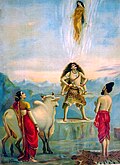
[[File:Ravi Varma-Descent of Ganga.jpg|thumb|upright|''Descent of Ganga'', painting by [[Raja Ravi Varma]] {{Circa|1910}}]] | |||
The ''[[Mahabharata]]'' narrates that there was once a war between the devas and the [[asura]]s. The leader of the asuras, [[Vritra]], was killed by [[Indra]], and so his followers hid in the sea, causing the devas to be unable to find them. The devas requested Sage [[Agastya]] to help. He used his divine powers and swallowed the ocean to reveal where the asuras were hiding. The devas defeated the remaining asuras, and asked Sage Agastya to restore the water. However, the sage was unable to release the water, despite trying several times. This caused drought conditions upon the earth, but [[Vishnu]] assured that the ocean would be filled by the flow of Ganga on the planet.<ref name=":2">{{Cite book |last=Warrier |first=Shrikala |url=https://books.google.com/books?id=qNhiCAAAQBAJ&q=Ganga |title=Kamandalu: The Seven Sacred Rivers of Hinduism |date=December 2014 |publisher=MAYUR University |isbn=978-0-9535679-7-3 |pages=42–45 |language=en}}</ref> | |||
The | The story about Ganga's descent on earth through the efforts of [[Bhagiratha]], a descendant of [[King Sagara]], is narrated in the Ramayana, Mahabharata, and various Puranas.<ref name=":0">{{Cite book |last=Eck |first=Diana L. |url= |title=India : a sacred geography |publisher=Harmony Books |year=2012 |isbn= |edition= |location=New York |pages=216–221 |oclc=}}</ref> Wanting to show his sovereignty, King Sagara performed a ritual known as [[ashvamedha]], where a horse was left to wander for one year. However, Indra stole the horse to prevent the ritual from being successful. Learning that the horse had disappeared, King Sagara sent his sixty thousand sons to look for it.<ref name=":0" /> They eventually found the horse at the [[ashram]]a of Sage [[Kapila]], in the netherworld. Thinking that Sage Kapila had stolen the horse, the sons interrupted him while he was in a deep meditation. This infuriated Kapila, and with his ascetic's gaze, he burned all the sixty thousand sons to ashes.<ref name=":1">{{Cite book |last=Sen |first=Sudipta |url= |title=Ganges : the many pasts of an Indian River |publisher=Yale University Press |year=2019 |isbn= |location=New Haven |oclc=}}</ref> | ||
King Sagara sent his grandson, [[Amshuman]], to ask the sage Kapila what could be done to bring deliverance to their souls. Sage Kapila advised that only the water of the Ganges, which flowed from Svarga, could liberate them.<ref name=":1" /> Bhagiratha, Amshuman's grandson, undertook severe ascetic practices, and won the favour of Brahma and Shiva. Brahma allowed Ganga to descend on earth, while Shiva broke Ganga's fall in the coils of his hair, so that her force would not shatter the earth.<ref name=":1" /> When Ganga descended, Bhagiratha led her to the sea. From there, the river reached the [[Patala|netherworld]], and liberated the sixty thousand sons of King Sagara.<ref name=":2" /> | |||
Because of Bhagiratha's efforts, the river is also known as [[Bhagirathi River|Bhagirathi]]. She is also known as Tripathaga because she flows in the three worlds, heaven, earth, and the netherworld.<ref name=":0" /> Another epithet that Ganga is known by is Jahnavi, because she flooded the ashram of Sage [[Jahnu]] while being led by Bhagiratha. Her waters extinguished the ritual fire there, which angered the sage Jahnu, so he drank up all of Ganga's waters. Sage Jahnu later released the water out of his left ear after Bhagiratha explained his mission for Ganga's descent. Due to this incident, Ganga is known as ''Jahnavi,'' which means daughter of Sage Jahnu.<ref name=":2" /> | |||
Another | |||
===Marriage and children=== | ===Marriage and children=== | ||
In the ''[[Mahabharata]]'', | In the ''[[Mahabharata]]'', Ganga is the wife of [[Shantanu]] as well as the mother of the eight [[Vasu]]s, including [[Bhishma]].<ref name="eck1998-p149"/><ref name=":3" /> Ganga and Shantanu were cursed by [[Brahma]] to be born on earth. Shantanu met Ganga on the banks of the Ganges and asked her to marry him. She accepted the proposal on the condition that Shantanu would not question any of her actions.<ref name=":3">{{Citation |last=Vemsani |first=Lavanya |title=Introduction: Feminine Journeys of the Mahabharata |url= |work= |page=198 |publication-date=2021 |place=Cham |publisher=Springer International Publishing |isbn= |access-date=}}</ref> Shantanu agreed and they married. They lived together peacefully and had eight sons who were the incarnation of the eight Vasus. | ||
They too had been cursed and had asked Ganga to end their life when they were born to her on earth. Due to their request, Ganga began drowning each son upon birth while Shantanu watched without questioning. However, when she was about to drown their eighth son, Bhishma, Shantanu stopped her.<ref name=":3" /> Ganga later leaves with Bhishma but gives him back to Shantanu when he is ten years old.<ref name=":3" /> | |||
{{multiple image | {{multiple image | ||
| align = centre | |||
| direction = horizontal | |||
| total_width = 800 | |||
| header = | |||
| image1 = Santanu and Ganga.JPG | |||
| alt1 = | |||
| caption1 = Shantanu meets Ganga and asks for her hand in marriage. | |||
| image2 = Raja Ravi Varma, Ganga and Shantanu (1890).jpg | |||
| alt2 = | |||
| caption2 = Shantanu trying to stop Ganga from drowning their eighth child | |||
| image3 = The_scene_from_the_Mahabharata_of_the_presentation_by_Ganga_of_her_son_Devavrata_(the_future_Bhisma)_to_his_father,_Santanu..jpg | |||
| alt3 = | |||
| caption3 = Ganga presenting her son Devavrata (the future Bhishma) to his father, Shantanu | |||
| image4 = | |||
| alt4 = | |||
| caption4 = Krishna and Vyasa console Ganga grieving over her son Bhishma's death. | |||
}} | }} | ||
== Significance == | == Significance == | ||
The Ganga is also | The Ganga is also called the ''Ganga Mata'' (Mother), and is revered in Hindu worship and culture, venerated for her forgiveness of sins and capacity to cleanse mankind.<ref name="eck1982-p218">Quoted in {{Harvnb|Eck|1982|p=218}}</ref> Unlike various other goddesses, she has no destructive or fearsome aspect, destructive though she might be as a river in nature.<ref name="eck1982-p218"/> She is also a mother to other gods.<ref name="eck1998-p149">{{Harvnb|Eck|1998|p=149}}</ref> | ||
==Festivals== | ==Festivals== | ||
[[File:Ganga Dashara, at Haridwar.jpg|thumb|Pilgrims at Haridwar on the occasion of [[Ganga Dussehra]] | [[File:Ganga Dashara, at Haridwar.jpg|thumb|Pilgrims at Haridwar on the occasion of [[Ganga Dussehra]]]] | ||
===Ganga Jayanti=== | ===Ganga Jayanti=== | ||
On this day Ganga | On this day, Ganga is regarded to have been reborn. According to legend, the goddess is regarded to have accidentally destroyed the hut of Sage [[Jahnu]] during her descent upon the earth. In retort, the sage drank the entirety of the river's water. At the request of [[Bhagiratha]] and Ganga herself, he released the river from his ear, and she earned the epithet Jahnavi.<ref>{{Cite book |last=Dowson |first=John |url=https://books.google.com/books?id=ejh82j8G_CYC&dq=jahnu+jahnavi&pg=PA129 |title=A Classical Dictionary of Hindu Mythology, and Religion, Geography, History, and Literature |date=2004 |publisher=Asian Educational Services |isbn=978-81-206-1786-5 |pages=129 |language=en}}</ref> Ganga Jayanti falls on the [[Saptami|seventh day]] of the month of [[Vaisakha|Vaishakha]]'s [[Paksha|first fortnight]]. | ||
=== | ===Navaratri=== | ||
Ganga | Ganga is worshipped during [[Navaratri]] as all the forms of [[Mahadevi|Adishakti]] during the duration of the festivities. | ||
=== | ===Loy Krathong=== | ||
Thais use the Krathong to thank the Goddess of Water | Thais use the Krathong to thank the Goddess of Water known as Phra Mae Khongkha and who represents the [[Devi|Hindu goddess]] Ganga.<ref>{{Cite news |date=2024-11-16 |title=Loy Krathong 2024: Celebrations across Thailand to honour river Goddess |url=https://timesofindia.indiatimes.com/world/south-asia/loy-krathong-2024-celebrations-across-thailand-to-honour-river-goddess/photostory/115365434.cms?picid=115365450 |access-date=2025-10-26 |work=The Times of India |issn=}}</ref> | ||
===Triyampawai ceremony=== | |||
The worship dedicated to Ganga is of great importance in the [[Triyampawai ceremony]]. An image of her in the form of a Nang kradan (นางกระดาน) along with a [[Phra Mae Thorani]], Surya and Chandra are invited at the beginning of the festival for three days which is considered to symbolise the beginning of the Triyampawai festival.<ref>https://www.finearts.go.th/fad12/view/42238-%E0%B8%AD%E0%B8%87%E0%B8%84%E0%B9%8C%E0%B8%84%E0%B8%A7%E0%B8%B2%E0%B8%A1%E0%B8%A3%E0%B8%B9%E0%B9%89%E0%B8%97%E0%B8%B2%E0%B8%87%E0%B8%A7%E0%B8%B4%E0%B8%8A%E0%B8%B2%E0%B8%81%E0%B8%B2%E0%B8%A3%E0%B9%80%E0%B8%A3%E0%B8%B7%E0%B9%88%E0%B8%AD%E0%B8%87----%E0%B8%95%E0%B8%A3%E0%B8%B5%E0%B8%A2%E0%B8%B1%E0%B8%A1%E0%B8%9B%E0%B8%A7%E0%B8%B2%E0%B8%A2---%E0%B8%95%E0%B8%A3%E0%B8%B5%E0%B8%9B%E0%B8%A7%E0%B8%B2%E0%B8%A2---%E0%B8%9E%E0%B8%B4%E0%B8%98%E0%B8%B5%E0%B8%9E%E0%B8%A3%E0%B8%B2%E0%B8%AB%E0%B8%A1%E0%B8%93%E0%B9%8C%E0%B8%97%E0%B8%B5%E0%B9%88%E0%B8%9B%E0%B8%A3%E0%B8%B2%E0%B8%81%E0%B8%8F%E0%B9%83%E0%B8%99%E0%B9%80%E0%B8%A1%E0%B8%B7%E0%B8%AD%E0%B8%87%E0%B8%99%E0%B8%84%E0%B8%A3%E0%B8%A8%E0%B8%A3%E0%B8%B5%E0%B8%98%E0%B8%A3%E0%B8%A3%E0%B8%A1%E0%B8%A3%E0%B8%B2%E0%B8%8A%E0%B9%83%E0%B8%99%E0%B8%AA%E0%B8%A1%E0%B8%B1%E0%B8%A2%E0%B8%AD%E0%B8%A2%E0%B8%B8%E0%B8%98%E0%B8%A2%E0%B8%B2 {{Bare URL inline|date=August 2025}}</ref><ref>{{cite web | last1=Madla | first1=Rochana | title=แห่นางดาน : ประเพณีปีใหม่ของพราหมณ์เพื่อบูชาเทพบริวารทั้ง 4 ด้วยไม้กระดาน 3 แผ่น - คลังสารสนเทศวลัยลักษณ์ | work=คลังสารสนเทศวลัยลักษณ์ | date=14 April 2024 | url=https://library.wu.ac.th/NST_localinfo/haenangdan/ }}</ref><ref>{{cite web | title=Untitled | url=https://www.tungsong.com/NakhonSri/Tradition_NakhonSri/%E0%B9%81%E0%B8%AB%E0%B9%88%E0%B8%99%E0%B8%B2%E0%B8%87%E0%B8%81%E0%B8%A3%E0%B8%B0%E0%B8%94%E0%B8%B2%E0%B8%99/Index_02%E0%B8%99%E0%B8%B2%E0%B8%87%E0%B8%81%E0%B8%A3%E0%B8%B0%E0%B8%94%E0%B8%B2%E0%B8%99.htm }}</ref><ref>{{cite web | title=Thailand Festival | url=https://www.thailandfestival.org/events/21fc7d55-6734-4a2e-8f78-3717d199dfd2 }}</ref><ref>{{cite web | title=แห่นางดาน-โล้ชิงช้า เมืองคอน ต้อนรับการมาเยือนของเทพแห่งพราหมณ์ | date=12 April 2006 | url=https://mgronline.com/live/detail/9490000048726 }}</ref> | |||
== Beyond the Indian subcontinent and Hinduism == | == Beyond the Indian subcontinent and Hinduism == | ||
{{Infobox | {{Infobox | ||
| title = Beyond the Indian subcontinent and Hinduism | | title = Beyond the Indian subcontinent and Hinduism | ||
| image = | | image = {{image array|perrow=2|width=125|height=115 | ||
{{image array|perrow=2|width=125|height=115 | | image1 = A_Devi_sculpture_in_Sri_Lanka_Goddess_Ganga.jpg| caption1 = Goddess Ganga, [[Kelaniya Raja Maha Vihara]] | ||
| image1 = A_Devi_sculpture_in_Sri_Lanka_Goddess_Ganga.jpg| caption1 = Goddess Ganga, [[Kelaniya Raja Maha Vihara]] | | image2 = Tara_at_Mul_Chowk_02.jpg| caption2 = Goddess Ganga, [[Patan Durbar Square]] | ||
| image2 = Tara_at_Mul_Chowk_02.jpg| caption2 = Goddess Ganga, [[Patan Durbar Square]] | | image3 = Angkor-Thommanon-08-2007-gje.jpg | caption3 = [[Shiva]] breaks Ganga's fall in the coils of his hair, lintel in [[Thommanon]]. | ||
| image3 = Angkor-Thommanon-08-2007-gje.jpg | caption3 = | | image4 = Lakshmi Statue Holy Lake Temple Mauritius.jpg | caption4 = [[Murti|Statue]] of Goddess Ganga at [[Ganga Talao]] in [[Mauritius]] | ||
| image4 = | |||
}} | }} | ||
}} | }} | ||
Ganga is respected in [[Nepal]] as a guardian water goddess, worshipped together with another river goddess [[ | Ganga is respected in [[Nepal]] as a guardian water goddess, worshipped together with another river goddess [[Yamuna in Hinduism|Yamuna]]. Her sculptures are found in [[Patan Durbar Square]]<ref>{{cite web|url=https://www.dreamstime.com/stock-photo-statue-river-goddess-ganga-royal-palace-patan-kath-ancient-famous-standing-makara-mul-chowk-kathmandu-valley-image89398650|title=Statue of the River Goddess Ganga in Royal Palace in Patan, Kathmandu Valley, Nepal Stock Photo - Image of Nepalese, Asian: 89398650|access-date=21 June 2020|archive-date=22 June 2020|archive-url=https://web.archive.org/web/20200622235058/https://www.dreamstime.com/stock-photo-statue-river-goddess-ganga-royal-palace-patan-kath-ancient-famous-standing-makara-mul-chowk-kathmandu-valley-image89398650|url-status=live}}</ref><ref>{{cite web|url=https://www.alamy.com/stock-photo/nepal-patan-ganga-statue.html|title=Nepal Patan Ganga Statue High Resolution Stock Photography and Images - Alamy|access-date=21 June 2020|archive-date=20 January 2021|archive-url=https://web.archive.org/web/20210120174411/https://www.alamy.com/stock-photo/nepal-patan-ganga-statue.html|url-status=live}}</ref> and [[Gokarneshwar|Gokarneshwar Mahadev temple]] is a municipality in [[Kathmandu District]] in the [[Bagmati Province]].<ref>{{cite web |url=http://www.mountainsoftravelphotos.com/Nepal%20-%20Kathmandu/Gokarna%20Mahadev%20Temple/slides/53%20Kathmandu%20Gokarna%20Mahadev%20Temple%20Ganga%20Statue.html |title=53 Kathmandu Gokarna Mahadev Temple Ganga Statue |publisher=Mountainsoftravelphotos.com |date=2010-10-10 |accessdate=2022-08-12 |archive-date=31 August 2013 |archive-url=https://web.archive.org/web/20130831141812/http://mountainsoftravelphotos.com/Nepal%20-%20Kathmandu/Gokarna%20Mahadev%20Temple/slides/53%20Kathmandu%20Gokarna%20Mahadev%20Temple%20Ganga%20Statue.html |url-status=live }}</ref> | ||
In [[Sri Lanka]], Ganga with other Hindu deities assumes a Buddhist persona. Her sculpture is seen in [[Kelaniya Raja Maha Vihara]].<ref>{{ | In [[Sri Lanka]], Ganga with other Hindu deities assumes a Buddhist persona. Her sculpture is seen in [[Kelaniya Raja Maha Vihara]].<ref>{{cite web|url=https://www.photodharma.net/Sri-Lanka/Kelaniya/Kelaniya.htm|title=Kelaniya Raja Maha Vihara|access-date=21 June 2020|archive-date=21 June 2020|archive-url=https://web.archive.org/web/20200621171842/https://www.photodharma.net/Sri-Lanka/Kelaniya/Kelaniya.htm|url-status=live}}</ref><ref>{{cite web|url=http://www.mahavidya.ca/2008/06/22/ganga-goddess-and-sacred-river/the-goddess-ganga-bas-relief-depicting-the-goddess-ganga-atop-her-crocodile-makara-mount-at-kelaniya-temple-sri-lanka/|title=The Goddess Ganga (Bas-relief depicting the goddess Ganga atop her crocodile (Makara) mount at Kelaniya Temple, Sri Lanka) | Mahavidya|access-date=21 June 2020|archive-date=22 June 2020|archive-url=https://web.archive.org/web/20200622151937/http://www.mahavidya.ca/2008/06/22/ganga-goddess-and-sacred-river/the-goddess-ganga-bas-relief-depicting-the-goddess-ganga-atop-her-crocodile-makara-mount-at-kelaniya-temple-sri-lanka/|url-status=live}}</ref> | ||
In [[Balinese Hinduism]], she is | In [[Balinese Hinduism]], she is worshipped together with the [[Dewi Danu|goddess Danu]]. Her waters are considered holy in [[Bali]]. Her maternal association with Bhishma is known in Bali. Religious sites associated with her in Bali are [[Tirta Gangga]], [[:id:Pura Taman Mumbul|Pura Taman Mumbul Sangeh]], and [[:id: Kongco Pura Taman Gandasari|Kongco Pura Taman Gandasari]].<ref>{{cite web|url=https://bali.tribunnews.com/2018/03/09/taman-mumbul-dengan-panglukatan-pancoran-solas-di-sangeh-simbol-dewata-nawasanga|title=Taman Mumbul dengan Panglukatan Pancoran Solas di Sangeh, Simbol Dewata Nawasanga|access-date=21 June 2020|archive-date=22 June 2020|archive-url=https://web.archive.org/web/20200622232844/https://bali.tribunnews.com/2018/03/09/taman-mumbul-dengan-panglukatan-pancoran-solas-di-sangeh-simbol-dewata-nawasanga|url-status=live}}</ref> | ||
[[Ganga Talao]] in Mauritius is considered by the [[Hinduism in Mauritius|Mauritian Hindus]] equivalent to Ganga. In 1972, the then [[Prime Minister of Mauritius]], [[Seewoosagur Ramgoolam|Sir Seewoosagur Ramgoolam]] brought Holy water from the Ganga's source | [[Ganga Talao]] in Mauritius is considered by the [[Hinduism in Mauritius|Mauritian Hindus]] equivalent to Ganga. In 1972, the then [[Prime Minister of Mauritius]], [[Seewoosagur Ramgoolam|Sir Seewoosagur Ramgoolam]] brought Holy water from the Ganga's source – [[Gomukh]] in India and mixed it with the water of the [[Ganga Talao|Grand Bassin]] and renamed it as Ganga Talao.{{Citation needed|date=December 2022}} | ||
Ganga is invoked with Hindu deities Shiva, [[Bhūmi|Bhumi]], [[Surya]] and [[Chandra]] in [[Thailand]]'s royal [[Triyampawai ceremony]]. She is worshipped together with goddess [[Phra Mae Thorani]] within [[Buddhism in Thailand|Thai | Ganga is invoked with Hindu deities Shiva, [[Bhūmi|Bhumi]], [[Surya]] and [[Chandra]] in [[Thailand]]'s royal [[Triyampawai ceremony]]. She is worshipped together with goddess [[Phra Mae Thorani]] within [[Buddhism in Thailand|Thai Budhhism]] and goddess [[Phosop]] in [[Tai folk religion]]. The four sacred pools of [[Suphan Buri Province]] have waters from the Ganga and the Yamuna rivers and are used for rituals.<ref>{{cite web|url=http://www.srichinda.com/index.php?lite=article&qid=181442|title=พระราชพิธีตรียัมปวาย-ตรีปวาย|access-date=21 June 2020|archive-date=22 June 2020|archive-url=https://web.archive.org/web/20200622211048/http://www.srichinda.com/index.php?lite=article&qid=181442|url-status=live}}</ref><ref>{{cite web|url=http://pioneer.netserv.chula.ac.th/~cvipada/land_06.html|title=อุทยานศาสนาพระโพธิสัตว์กวนอิม|access-date=21 June 2020|archive-date=23 January 2020|archive-url=https://web.archive.org/web/20200123024359/http://pioneer.netserv.chula.ac.th/~cvipada/land_06.html|url-status=live}}</ref><ref>{{cite web|url = https://www.silpa-mag.com/on-view/tour-tod-nong-tong-tiew/article_28733|title = "พันปีไม่เคยแห้ง" น้ำศักดิ์สิทธิ์ ของพญานาค จากสระทั้งสี่ ที่เมืองสุพรรณบุรี|date = 4 March 2019|access-date = 21 June 2020|archive-date = 25 June 2020|archive-url = https://web.archive.org/web/20200625133736/https://www.silpa-mag.com/on-view/tour-tod-nong-tong-tiew/article_28733|url-status = live}}</ref> | ||
Ganga has been revered in [[Cambodia]] since the [[Khmer empire]]. In Shiva's iconographical form ''Uma-Gangapatisvarar'', Shiva is depicted with Ganga and his wife Uma ([[Parvati]]). Ganga's images are located in [[Bakong]], [[Lintel]] in [[Thommanon]] and exhibit in [[International Council of Museums]].<ref>{{ | Ganga has been revered in [[Cambodia]] since the [[Khmer empire]]. In Shiva's iconographical form ''Uma-Gangapatisvarar'' ({{langx|km|ព្រះឧមាគង្គាបតិស្វរ}}), Shiva is depicted with Ganga and his wife Uma ([[Parvati]]). Ganga's images are located in [[Bakong]], [[Lintel]] in [[Thommanon]] and exhibit in [[International Council of Museums]].<ref>{{cite web|url=http://users.clas.ufl.edu/vasu/cambodia/hariharalaya/shiva.jpg|title=Vasudha Narayanan | Department of Religion|access-date=21 June 2020|archive-date=22 June 2020|archive-url=https://web.archive.org/web/20200622151935/http://users.clas.ufl.edu/vasu/cambodia/hariharalaya/shiva.jpg|url-status=live}}</ref><ref>{{cite web|url=https://icom.museum/en/object/shiva-with-uma-and-ganga-sandstone-101-x-53-x-13-cm/|title=Shiva with Uma and Ganga, sandstone, 101 x 53 x 13 cm|access-date=21 June 2020|archive-date=21 June 2020|archive-url=https://web.archive.org/web/20200621180206/https://icom.museum/en/object/shiva-with-uma-and-ganga-sandstone-101-x-53-x-13-cm/|url-status=live}}</ref> | ||
==See also== | ==See also== | ||
| Line 141: | Line 138: | ||
*[[Shantanu]] | *[[Shantanu]] | ||
*[[Shiva]] | *[[Shiva]] | ||
*[[Yami]]/[[Yamuna]] | *[[Yami]]/[[Yamuna]] | ||
*[[Narmada#Significance in Hinduism|Narmada]] | *[[Narmada#Significance in Hinduism|Narmada]] | ||
==References== | ==References== | ||
| Line 160: | Line 155: | ||
<!-- | <!-- | ||
*********************** ({{No More Links}}) *************************** | *********************** ({{No More Links}}) *************************** | ||
* Please be cautious in adding more links to this article. | * Please be cautious in adding more links to this article. Bharatpedia * | ||
* is not a collection of links nor should it be used for advertising. * | * is not a collection of links nor should it be used for advertising. * | ||
* * | * * | ||
* Excessive or inappropriate links Will-Be-Deleted. * | * Excessive or inappropriate links Will-Be-Deleted. * | ||
* See [[ | * See [[Bharatpedia:External links]] & [[Bharatpedia:Spam]] for details. * | ||
* * | * * | ||
* If there are already plentiful links, please propose additions or * | * If there are already plentiful links, please propose additions or * | ||
| Line 172: | Line 167: | ||
********************** ({{No More Links}}) **************************** | ********************** ({{No More Links}}) **************************** | ||
--> | --> | ||
*[https://vimeo.com/ondemand/gangama ''Ganga Ma: A Pilgrimage to the Source''] a documentary that follows the Ganges from the mouth to its source in the Himalayas. | |||
*[https://vimeo.com/ondemand/gangama Ganga Ma: A Pilgrimage to the Source] a documentary that follows the Ganges from the mouth to its source in the Himalayas. | |||
{{Hindu Culture and Epics}} | {{Hindu Culture and Epics}} | ||
{{Hindudharma}} | {{Hindudharma}} | ||
| Line 189: | Line 184: | ||
[[Category:Water and Hinduism]] | [[Category:Water and Hinduism]] | ||
[[Category:Personifications of rivers]] | [[Category:Personifications of rivers]] | ||
[[Category:Buddhist goddesses]] | |||
[[Category:Sinhalese Buddhist deities]] | |||
[[Category:Thai goddesses]] | |||
Latest revision as of 02:34, 18 March 2026
| Ganga | |
|---|---|
Personification of the Ganges River Goddess of Forgiveness and Purification | |
 17th-18th-century sculpture of goddess Ganga | |
| Other names |
|
| Affiliation | |
| Mantra | Oṁ Śrī Gaṅgāyai Namaḥ |
| Weapon | Kalasha |
| Symbol | Ganges River |
| Mount | Makara |
| Festivals | |
| Personal information | |
| Parents | Himavan and Maināvati (in some texts) |
| Siblings | Parvati, Mainaka (in some texts) |
| Consort | |
| Children | Bhishma and 7 other sons of Shantanu |
Ganga (Sanskrit: गङ्गा, IAST: Gaṅgā) is the personification of the river Ganges, who is worshipped by Hindus as the goddess of purification and forgiveness. Known by many names, Ganga is often depicted as a fair, beautiful woman, riding a divine crocodile-like creature called the makara.
Some of the earliest mentions of Ganga are found in the Rigveda, where she is mentioned as the holiest of the rivers. Her stories mainly appear in post-Vedic texts such as the Ramayana, Mahabharata, and the Puranas.
The Ramayana describes her to be the firstborn of Himavat, the personification of the Himalayas, and the sister of the mother goddess Parvati. However, other texts mention her origin from the preserver deity, Vishnu. Legends focus on her descent to earth, which occurred because of a royal-sage Bhagiratha, aided by the god Shiva.
In the epic Mahabharata, Ganga is the mother of the warrior Bhishma in a union with the Kuru king Shantanu.
In Hinduism, Ganga is seen as a mother to humanity. Pilgrims immerse the ashes of their kin in the river Ganga, which is considered by them to bring the souls (purified spirits) closer to moksha, the liberation from the cycle of life and death. Festivals like Ganga Dussehra and Ganga Jayanti are celebrated in her honour at several sacred places, which lie along the banks of the Ganges, including Gangotri, Haridwar, Prayagraj, Varanasi and Kali Ghat in Kolkata. Alongside Gautama Buddha, Ganga is worshipped during the Loy Krathong festival in Thailand.
Vedic scriptures[edit | edit source]
Ganga is mentioned in the Rigveda, the earliest and theoretically the holiest of the Hindu scriptures. Ganga is mentioned in the Nadistuti (Rigveda 10.75), which lists the rivers from east to west. In RV 6.45.31, the word Ganga is also mentioned, but it is not clear if the reference is to the river. RVRV 3.58.6 says that "your ancient home, your auspicious friendship, O Heroes, your wealth is on the banks of the Jahanvi". This verse could refer to the Ganga. In RV 1.116.18–19, the Jahanvi and the Ganges river dolphin occur in two adjacent verses.[4]
Iconography[edit | edit source]
.jpg)
Ganga is described as the melodious, the fortunate, the cow that gives much milk, the eternally pure, the delightful, the body that is full of fish, affords delight to the eye and leaps over mountains in sport, the bedding that bestows water and happiness, and the friend or benefactor of all that lives.[5]
Since the Vedic period, the Ganges river has been considered the holiest of all rivers by Hindus. Ganga is also personified as a goddess and worshipped as Goddess Ganga. She holds an important place in the Hindu pantheon. Ganga is represented as a fair-complexioned woman, wearing a white crown and sitting on a crocodile. She holds a water lily in her right hand and a flute in her left. When shown with four hands she carries a water-pot, a lily, and a rosary, and has one hand in a protective mode. The Rigveda mentions Ganga but more of her is said in the Puranas.
Ganga is depicted four-armed and mounted on a crocodile or enthroned surrounded by crocodiles. In one of the iconography in Maha Virat-rupa, she holds a jar of amrita, rosary, lotus and varada mudra. She may be depicted in other ways holding only a kalasha (or 2 replacing lotus) and lotus, while other 2 hands in varada and abhaya mudra.
Another depiction popular especially in Bengal shows her holding shankha, chakra (discus), lotus and abhaya mudra, with the kalasha releasing her holy water.
In Brahma Vaivarta Purana, Ganga is often depicted with her divine mount, the makara – an animal with the head of a crocodile and tail of a dolphin.
Legend[edit | edit source]
Birth[edit | edit source]
Varying myths of Ganga's birth is found in Hindu scriptures. According to the Bhagavata Purana, Vishnu, in his incarnation as Vamana, extended his left foot to the end of the universe, and pierced a hole in its covering with the nail of his big toe. Through the hole, the pure water of the causal ocean entered this universe as the Ganges river. Having washed the lotus feet of the lord, which are covered with reddish saffron, the water of the Ganga acquired a very beautiful pink colour. Because the Ganges directly touches the lotus feet of Vishnu (Narayana) before descending within this universe, it is known as Bhagavat-Padi or Vishnupadi, which means emanating from the feet of Bhagavan (God). It finally settles in Brahmaloka or Brahmapura, the abode of the Brahma, before descending to the planet earth at the request of Bhagiratha, and held safely by Shiva on his head, to prevent the destruction of Bhumi Devi (the earth goddess). Then, Ganga was released from Shiva's hair to meet the needs of the country.[6]
The Ramayana narrates a different version of the myth. Ganga is described as the eldest child of Himavat, son of Brahma and the king of the Himalayas, and his wife Queen Menavati, the daughter of Meru. Her younger sister is Parvati, who latter marries Shiva. When Ganga attained youth, the devas took her to Svarga, where she took a form of a river and flowed.[7][8]
Transformation into a river[edit | edit source]
A legend in the Devi Bhagavata Purana describes Ganga as originally being one of the three wives of Vishnu, together with Lakshmi and Saraswati.[9] In the midst of a conversation, Saraswati observed Ganga playfully glancing at Vishnu. Frustrated, Saraswati launched a furious tirade against Ganga, accusing her of stealing Vishnu's love away from her. When Ganga appealed to her husband to help her, he chose to remain neutral, not wishing to participate in a quarrel between his three wives, whom he loved equally. When Lakshmi attempted to soothe Saraswati's anger by reasoning with her, the jealous goddess grew angry with her as well, accusing her of disloyalty towards her. She cursed Lakshmi to be born as the Tulasi plant upon the earth. Ganga, now enraged that Lakshmi had been cursed because she had defended her, cursed Saraswati that she would be incarnated as a river on earth. Saraswati issued the same curse against Ganga, informing her that sinful men would cleanse themselves of their sins with her water. To prevent further conflict among the goddesses, Vishnu declares Lakshmi as his only wife and sends Saraswati to Brahma and Ganga to Shiva.[10][11][12]
Descent upon the earth[edit | edit source]

The Mahabharata narrates that there was once a war between the devas and the asuras. The leader of the asuras, Vritra, was killed by Indra, and so his followers hid in the sea, causing the devas to be unable to find them. The devas requested Sage Agastya to help. He used his divine powers and swallowed the ocean to reveal where the asuras were hiding. The devas defeated the remaining asuras, and asked Sage Agastya to restore the water. However, the sage was unable to release the water, despite trying several times. This caused drought conditions upon the earth, but Vishnu assured that the ocean would be filled by the flow of Ganga on the planet.[13]
The story about Ganga's descent on earth through the efforts of Bhagiratha, a descendant of King Sagara, is narrated in the Ramayana, Mahabharata, and various Puranas.[14] Wanting to show his sovereignty, King Sagara performed a ritual known as ashvamedha, where a horse was left to wander for one year. However, Indra stole the horse to prevent the ritual from being successful. Learning that the horse had disappeared, King Sagara sent his sixty thousand sons to look for it.[14] They eventually found the horse at the ashrama of Sage Kapila, in the netherworld. Thinking that Sage Kapila had stolen the horse, the sons interrupted him while he was in a deep meditation. This infuriated Kapila, and with his ascetic's gaze, he burned all the sixty thousand sons to ashes.[15]
King Sagara sent his grandson, Amshuman, to ask the sage Kapila what could be done to bring deliverance to their souls. Sage Kapila advised that only the water of the Ganges, which flowed from Svarga, could liberate them.[15] Bhagiratha, Amshuman's grandson, undertook severe ascetic practices, and won the favour of Brahma and Shiva. Brahma allowed Ganga to descend on earth, while Shiva broke Ganga's fall in the coils of his hair, so that her force would not shatter the earth.[15] When Ganga descended, Bhagiratha led her to the sea. From there, the river reached the netherworld, and liberated the sixty thousand sons of King Sagara.[13]
Because of Bhagiratha's efforts, the river is also known as Bhagirathi. She is also known as Tripathaga because she flows in the three worlds, heaven, earth, and the netherworld.[14] Another epithet that Ganga is known by is Jahnavi, because she flooded the ashram of Sage Jahnu while being led by Bhagiratha. Her waters extinguished the ritual fire there, which angered the sage Jahnu, so he drank up all of Ganga's waters. Sage Jahnu later released the water out of his left ear after Bhagiratha explained his mission for Ganga's descent. Due to this incident, Ganga is known as Jahnavi, which means daughter of Sage Jahnu.[13]
Marriage and children[edit | edit source]
In the Mahabharata, Ganga is the wife of Shantanu as well as the mother of the eight Vasus, including Bhishma.[16][17] Ganga and Shantanu were cursed by Brahma to be born on earth. Shantanu met Ganga on the banks of the Ganges and asked her to marry him. She accepted the proposal on the condition that Shantanu would not question any of her actions.[17] Shantanu agreed and they married. They lived together peacefully and had eight sons who were the incarnation of the eight Vasus. They too had been cursed and had asked Ganga to end their life when they were born to her on earth. Due to their request, Ganga began drowning each son upon birth while Shantanu watched without questioning. However, when she was about to drown their eighth son, Bhishma, Shantanu stopped her.[17] Ganga later leaves with Bhishma but gives him back to Shantanu when he is ten years old.[17]

.jpg)
_to_his_father,_Santanu..jpg)
Significance[edit | edit source]
The Ganga is also called the Ganga Mata (Mother), and is revered in Hindu worship and culture, venerated for her forgiveness of sins and capacity to cleanse mankind.[18] Unlike various other goddesses, she has no destructive or fearsome aspect, destructive though she might be as a river in nature.[18] She is also a mother to other gods.[16]
Festivals[edit | edit source]

Ganga Jayanti[edit | edit source]
On this day, Ganga is regarded to have been reborn. According to legend, the goddess is regarded to have accidentally destroyed the hut of Sage Jahnu during her descent upon the earth. In retort, the sage drank the entirety of the river's water. At the request of Bhagiratha and Ganga herself, he released the river from his ear, and she earned the epithet Jahnavi.[19] Ganga Jayanti falls on the seventh day of the month of Vaishakha's first fortnight.
[edit | edit source]
Ganga is worshipped during Navaratri as all the forms of Adishakti during the duration of the festivities.
Loy Krathong[edit | edit source]
Thais use the Krathong to thank the Goddess of Water known as Phra Mae Khongkha and who represents the Hindu goddess Ganga.[20]
Triyampawai ceremony[edit | edit source]
The worship dedicated to Ganga is of great importance in the Triyampawai ceremony. An image of her in the form of a Nang kradan (นางกระดาน) along with a Phra Mae Thorani, Surya and Chandra are invited at the beginning of the festival for three days which is considered to symbolise the beginning of the Triyampawai festival.[21][22][23][24][25]
Beyond the Indian subcontinent and Hinduism[edit | edit source]
| |||||


Ganga is respected in Nepal as a guardian water goddess, worshipped together with another river goddess Yamuna. Her sculptures are found in Patan Durbar Square[26][27] and Gokarneshwar Mahadev temple is a municipality in Kathmandu District in the Bagmati Province.[28]
In Sri Lanka, Ganga with other Hindu deities assumes a Buddhist persona. Her sculpture is seen in Kelaniya Raja Maha Vihara.[29][30]
In Balinese Hinduism, she is worshipped together with the goddess Danu. Her waters are considered holy in Bali. Her maternal association with Bhishma is known in Bali. Religious sites associated with her in Bali are Tirta Gangga, Pura Taman Mumbul Sangeh, and Kongco Pura Taman Gandasari.[31]
Ganga Talao in Mauritius is considered by the Mauritian Hindus equivalent to Ganga. In 1972, the then Prime Minister of Mauritius, Sir Seewoosagur Ramgoolam brought Holy water from the Ganga's source – Gomukh in India and mixed it with the water of the Grand Bassin and renamed it as Ganga Talao.[citation needed]
Ganga is invoked with Hindu deities Shiva, Bhumi, Surya and Chandra in Thailand's royal Triyampawai ceremony. She is worshipped together with goddess Phra Mae Thorani within Thai Budhhism and goddess Phosop in Tai folk religion. The four sacred pools of Suphan Buri Province have waters from the Ganga and the Yamuna rivers and are used for rituals.[32][33][34]
Ganga has been revered in Cambodia since the Khmer empire. In Shiva's iconographical form Uma-Gangapatisvarar (Khmer: ព្រះឧមាគង្គាបតិស្វរ), Shiva is depicted with Ganga and his wife Uma (Parvati). Ganga's images are located in Bakong, Lintel in Thommanon and exhibit in International Council of Museums.[35][36]
See also[edit | edit source]
References[edit | edit source]
- ↑ Hawley, John Stratton; Wulff, Donna Marie (1984). The Divine Consort: Rādhā and the Goddesses of India. Motilal Banarsidass Publishing House. ISBN 978-0-89581-441-8.
- ↑ Wangu, Madhu Bazaz (2003). Images of Indian Goddesses: Myths, Meanings, and Models. Abhinav Publications. ISBN 978-81-7017-416-5.
- ↑ Sivaramamurti, C. (1976). Gaṅgā. Orient Longman. ISBN 978-0-86125-084-4.
- ↑ Talageri, Shrikant G. (2000). The Rigveda: A Historical Analysis. Aditya Prakashan. ISBN 978-81-7742-010-4.
- ↑ Kumari, M. Krishna (2018). Iconography of Gaṅgā and Yamunā. B.R. Publishing Corporation. ISBN 978-93-86223-70-8.
- ↑ "Story of Gaṅgā". 28 January 2019. Archived from the original on 12 November 2020. Retrieved 7 November 2020.
- ↑ V?lm?ki; Venkatesananda, Swami (1 January 1988). The Concise R_m_ya_a of V_lm_ki. SUNY Press. ISBN 978-0-88706-862-1.
- ↑ Sivkishen (23 January 2015). Kingdom of Shiva. Diamond Pocket Books Pvt Ltd. ISBN 978-81-288-3028-0.
- ↑ Dalal, Roshen (18 April 2014). Hinduism: An Alphabetical Guide. Penguin UK. ISBN 978-81-8475-277-9.
- ↑ www.wisdomlib.org (15 May 2013). "On the coming in this world of Lakṣmī, Gaṅgā and Sarasvatī [Chapter 6]". www.wisdomlib.org. Archived from the original on 21 October 2022. Retrieved 21 October 2022.
- ↑ Williams, George M. (27 March 2008). Handbook of Hindu Mythology. OUP USA. p. 137. ISBN 978-0-19-533261-2.
- ↑ Sharma, Bulbul (June 2010). The Book of Devi. Penguin Books India. pp. 67–71. ISBN 978-0-14-306766-5.
- ↑ 13.0 13.1 13.2 Warrier, Shrikala (December 2014). Kamandalu: The Seven Sacred Rivers of Hinduism. MAYUR University. pp. 42–45. ISBN 978-0-9535679-7-3.
- ↑ 14.0 14.1 14.2 Eck, Diana L. (2012). India : a sacred geography. New York: Harmony Books. pp. 216–221.
- ↑ 15.0 15.1 15.2 Sen, Sudipta (2019). Ganges : the many pasts of an Indian River. New Haven: Yale University Press.
- ↑ 16.0 16.1 Eck 1998, p. 149
- ↑ 17.0 17.1 17.2 17.3 Vemsani, Lavanya (2021), Introduction: Feminine Journeys of the Mahabharata, Cham: Springer International Publishing, p. 198
- ↑ 18.0 18.1 Quoted in Eck 1982, p. 218
- ↑ Dowson, John (2004). A Classical Dictionary of Hindu Mythology, and Religion, Geography, History, and Literature. Asian Educational Services. p. 129. ISBN 978-81-206-1786-5.
- ↑ "Loy Krathong 2024: Celebrations across Thailand to honour river Goddess". The Times of India. 16 November 2024. Retrieved 26 October 2025.
- ↑ https://www.finearts.go.th/fad12/view/42238-%E0%B8%AD%E0%B8%87%E0%B8%84%E0%B9%8C%E0%B8%84%E0%B8%A7%E0%B8%B2%E0%B8%A1%E0%B8%A3%E0%B8%B9%E0%B9%89%E0%B8%97%E0%B8%B2%E0%B8%87%E0%B8%A7%E0%B8%B4%E0%B8%8A%E0%B8%B2%E0%B8%81%E0%B8%B2%E0%B8%A3%E0%B9%80%E0%B8%A3%E0%B8%B7%E0%B9%88%E0%B8%AD%E0%B8%87----%E0%B8%95%E0%B8%A3%E0%B8%B5%E0%B8%A2%E0%B8%B1%E0%B8%A1%E0%B8%9B%E0%B8%A7%E0%B8%B2%E0%B8%A2---%E0%B8%95%E0%B8%A3%E0%B8%B5%E0%B8%9B%E0%B8%A7%E0%B8%B2%E0%B8%A2---%E0%B8%9E%E0%B8%B4%E0%B8%98%E0%B8%B5%E0%B8%9E%E0%B8%A3%E0%B8%B2%E0%B8%AB%E0%B8%A1%E0%B8%93%E0%B9%8C%E0%B8%97%E0%B8%B5%E0%B9%88%E0%B8%9B%E0%B8%A3%E0%B8%B2%E0%B8%81%E0%B8%8F%E0%B9%83%E0%B8%99%E0%B9%80%E0%B8%A1%E0%B8%B7%E0%B8%AD%E0%B8%87%E0%B8%99%E0%B8%84%E0%B8%A3%E0%B8%A8%E0%B8%A3%E0%B8%B5%E0%B8%98%E0%B8%A3%E0%B8%A3%E0%B8%A1%E0%B8%A3%E0%B8%B2%E0%B8%8A%E0%B9%83%E0%B8%99%E0%B8%AA%E0%B8%A1%E0%B8%B1%E0%B8%A2%E0%B8%AD%E0%B8%A2%E0%B8%B8%E0%B8%98%E0%B8%A2%E0%B8%B2 [bare URL]
- ↑ Madla, Rochana (14 April 2024). "แห่นางดาน : ประเพณีปีใหม่ของพราหมณ์เพื่อบูชาเทพบริวารทั้ง 4 ด้วยไม้กระดาน 3 แผ่น - คลังสารสนเทศวลัยลักษณ์". คลังสารสนเทศวลัยลักษณ์.
- ↑ "Untitled".
- ↑ "Thailand Festival".
- ↑ "แห่นางดาน-โล้ชิงช้า เมืองคอน ต้อนรับการมาเยือนของเทพแห่งพราหมณ์". 12 April 2006.
- ↑ "Statue of the River Goddess Ganga in Royal Palace in Patan, Kathmandu Valley, Nepal Stock Photo - Image of Nepalese, Asian: 89398650". Archived from the original on 22 June 2020. Retrieved 21 June 2020.
- ↑ "Nepal Patan Ganga Statue High Resolution Stock Photography and Images - Alamy". Archived from the original on 20 January 2021. Retrieved 21 June 2020.
- ↑ "53 Kathmandu Gokarna Mahadev Temple Ganga Statue". Mountainsoftravelphotos.com. 10 October 2010. Archived from the original on 31 August 2013. Retrieved 12 August 2022.
- ↑ "Kelaniya Raja Maha Vihara". Archived from the original on 21 June 2020. Retrieved 21 June 2020.
- ↑ "The Goddess Ganga (Bas-relief depicting the goddess Ganga atop her crocodile (Makara) mount at Kelaniya Temple, Sri Lanka) | Mahavidya". Archived from the original on 22 June 2020. Retrieved 21 June 2020.
- ↑ "Taman Mumbul dengan Panglukatan Pancoran Solas di Sangeh, Simbol Dewata Nawasanga". Archived from the original on 22 June 2020. Retrieved 21 June 2020.
- ↑ "พระราชพิธีตรียัมปวาย-ตรีปวาย". Archived from the original on 22 June 2020. Retrieved 21 June 2020.
- ↑ "อุทยานศาสนาพระโพธิสัตว์กวนอิม". Archived from the original on 23 January 2020. Retrieved 21 June 2020.
- ↑ ""พันปีไม่เคยแห้ง" น้ำศักดิ์สิทธิ์ ของพญานาค จากสระทั้งสี่ ที่เมืองสุพรรณบุรี". 4 March 2019. Archived from the original on 25 June 2020. Retrieved 21 June 2020.
- ↑ "Vasudha Narayanan | Department of Religion". Archived from the original on 22 June 2020. Retrieved 21 June 2020.
- ↑ "Shiva with Uma and Ganga, sandstone, 101 x 53 x 13 cm". Archived from the original on 21 June 2020. Retrieved 21 June 2020.
Sources[edit | edit source]
- Eck, Diana L. (1982), Banaras, city of light, Columbia University, ISBN 978-0231114479
- Eck, Diana (1998), "Gangā: The Goddess Ganges in Hindu Sacred Geography", in Hawley, John Stratton; Wulff, Donna Marie (eds.), Devī: Goddesses of India, University of California / Motilal Banarasidass, pp. 137–53, ISBN 8120814916
- Vijay Singh: The River Goddess (Moonlight Publishing, London, 1994)
External links[edit | edit source]
- Ganga Ma: A Pilgrimage to the Source a documentary that follows the Ganges from the mouth to its source in the Himalayas.
Hindu deities and texts | ||
|---|---|---|
| Gods |  | |
| Goddesses | ||
| Other deities | ||
| Texts | ||
| Philosophy |
|  | |||||||||||||||
|---|---|---|---|---|---|---|---|---|---|---|---|---|---|---|---|---|---|
| Texts |
| ||||||||||||||||
| Deities |
| ||||||||||||||||
| Practices |
| ||||||||||||||||
| Related | |||||||||||||||||


.jpg)

