





robot: Update article (please report if you notice any mistake or error in this edit) |
3muhammed4 (talk | contribs) small improve lead per sources and added references for accuracy |
||
| Line 1: | Line 1: | ||
{{ | {{Short description|Princely state of India}} | ||
{{For|the district in Himachal Pradesh|Sirmaur district}} | |||
{{More citations needed|date=June 2025}} | |||
{{Use dmy dates|date=April 2017}} | {{Use dmy dates|date=April 2017}} | ||
{{Use Indian English|date=April 2017}} | {{Use Indian English|date=April 2017}} | ||
{{Infobox former subdivision | {{Infobox former subdivision | ||
| conventional_long_name = Sirmaur State<br /><small>Sirmoor State<br />Nahan State</small> | |||
|conventional_long_name = Sirmaur State<br><small>Sirmoor State<br>Nahan State</small> | | common_name = Sirmur | ||
|common_name = Sirmur | | nation = [[British India]] | ||
|nation = [[British India]] | | subdivision = [[Princely State]] | ||
|subdivision = [[Princely State]] | | capital = Nahan | ||
|capital | | era = | ||
|era = | | year_start = 1095 | ||
|year_start = 1095 | | date_start = | ||
|date_start = | | event_start = | ||
|event_start= | | year_end = 1948 | ||
|year_end = 1948 | | date_end = | ||
|date_end = | | event_end = [[Independence of India]] | ||
|event_end= [[Independence of India]] | | event1 = | ||
|event1 = | | date_event1 = | ||
|date_event1 = | | p1 = | ||
|p1 = | | s1 = India | ||
|s1 = India | | flag_p1 = | ||
|flag_p1 = | | flag_s1 = Flag of India.svg | ||
|flag_s1 = Flag of India.svg | | image_flag = | ||
|image_flag = | | image_coat = Sirmur State CoA.png | ||
|image_coat =Sirmur State CoA.png | | image_map = Urdu map of Sirmur State.jpg | ||
|image_map = | | image_map_caption = Urdu map of Sirmur State | ||
|image_map_caption = Sirmur State | | stat_area1 = 4039 | ||
|stat_area1 =4039 | | stat_year1 = [[1901 Census of India]] | ||
|stat_year1 = [[1901 Census of India]] | | stat_pop1 = 135,626 | ||
|stat_pop1 = 135,626 | | footnotes = {{cite book | ||
|footnotes = {{cite book | |||
| title = Gazetteer of the Sirmur State | | title = Gazetteer of the Sirmur State | ||
| publisher = Indus Publishing | | publisher = Indus Publishing | ||
| Line 36: | Line 37: | ||
| isbn = 978-81-7387-056-9 | | isbn = 978-81-7387-056-9 | ||
| oclc = 41357468}} | | oclc = 41357468}} | ||
|today | | today = [[Himachal Pradesh]], [[India]] | ||
| image_map2 = Punjab-Districts 1911.png | |||
| image_map2_caption = Sirmur State in a 1911 map of Punjab | |||
}} | }} | ||
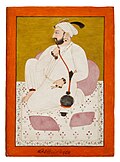
[[File:Indian - Portrait of Kirat Prakash of Sirmur - Walters W898.jpg|thumb|250 px|Portrait of Maharaja Kirat Prakash of Sirmur. Late 18th century.]] | [[File:Indian - Portrait of Kirat Prakash of Sirmur - Walters W898.jpg|thumb|250 px|Portrait of Maharaja Kirat Prakash of Sirmur. Late 18th century.]] | ||
[[File:The Fort of Nahan, c.1850.jpg|right|thumb|250 px|The Fort of Nahan, the capital of princely-state of [[Sirmur]]]] | [[File:The Fort of Nahan, c.1850.jpg|right|thumb|250 px|The Fort of Nahan, the capital of princely-state of [[Sirmur]]]] | ||
[[File:NahanStamp1800s.jpg|right|thumb|Stamp of Sirmour in 1800s]] | [[File:NahanStamp1800s.jpg|right|thumb|Stamp of Sirmour in 1800s]] | ||
'''Sirmur''' (also spelled as '''Sirmor''', '''Sirmaur''', '''Sirmour''', or '''Sirmoor''') was a [[princely state of India]], located in the region that is now the [[Sirmaur district]] of [[Himachal Pradesh]]. The state was also known as '''Nahan''', after its main city, [[Nahan]]. The state ranked predominant amongst the [[Punjab Hill States]]. It had an area of 4,039 km<sup>2</sup> and a revenue of 300,000 rupees in 1891.{{Citation needed|date=August 2019}} | |||
'''Sirmur''' (also spelled as '''Sirmor''', '''Sirmaur''', '''Sirmour''', or '''Sirmoor''') was | |||
==History== | ==History== | ||
=== Origin === | |||
According to Mian Goverdhan Singh in ''Wooden Temples of Himachal Pradesh'', the principality of Sirmaur was founded in the 7th to 8th century by Maharaja of [[Parmar (Rajput clan)|Parmar]] [[Rajput|Rajputs]], and Rathore noble.<ref name=":0">{{Cite book |last=Singh |first=Mian Goverdhan |title=Wooden Temples of Himachal Pradesh |publisher=Indus Publishing |year=1999 |isbn=9788173870941 |pages=48–49}}</ref> | |||
=== Nahan State === | |||
[[Nahan]], the predecessor state of Sirmur, was founded by Soba Rawal in 1095 AD who assumed the name Raja Subans Prakash.{{Citation needed|date=October 2024}} | |||
Near the end of the 12th century in the year 1195, a flood of the [[Giri River]] destroyed the old capital of Sirmaur-Tal, which killed Raja Ugar Chand.<ref name=":0" /> A ruler of [[Jaisalmer]], Raja Salivahana, thought this was an opportune time to attack the state as it was in a state of disarray due to the natural disaster and death of its ruler, so he sent his son Sobha to conquer the state.<ref name=":0" /> The attack was successful and a new dynasty headed by [[Bhati]] Rajputs was established.<ref name=":0" /> Sirmur was invaded by invader [[Jasrat|Jasrath]]'s army, who also invaded fragments of Punjab and Jammu.<ref>{{Cite book |first=Ayyappa |last=Panikkar|author-link= Ayyappa Panikkar |url=https://books.google.com/books?id=KYLpvaKJIMEC&pg=PA73 |title=Medieval Indian Literature: Surveys and selections |date=1997 |publisher=Sahitya Akademi |isbn=978-81-260-0365-5 |language=en|page=72}}</ref> | |||
=== Sirmur State === | |||
Budh Parkãsh, the next ruler, recovered [[Pinjaur]] for [[Aurangzeb]]’s foster-brother. Raja Mit | Eventually in 1621 Karm Parkash founded [[Nahan]], the modern capital.<ref name=":1">{{Cite book |last=Sen Negi |first=Thakur |url=https://archive.org/details/dli.csl.3089 |title=Himachal Pradesh District Gazetteers: Sirmur |date= |publisher=Government of Himachal Pradesh |year=1969 |page= |pages=52–54}}</ref> | ||
Budh Parkãsh, the next ruler, recovered [[Pinjore|Pinjaur]] for [[Aurangzeb]]’s foster-brother.{{Citation needed|date=October 2024}} Raja Mit Parkãsh gave an asylum to the Sikh Guru, [[Gobind Singh]], permitting him to fortify [[Paonta]] in the Kiarda Dun; and it was at Bhangani in the Dun that the Guru defeated the Rajäs of Kahlur and Garhwäl in 1688.<ref name=":1" /> But in 1710 Kirat Parkãsh, after defeating the Räja of [[Garhwal Kingdom|Garhwal]], captured Naraingarh, Morni, Pinjaur, and other territories from the Sikhs, and concluded an alliance with [[Amar Singh of Patiala|Amar Singh]], [[Maharaja of Patiala|Raja of Patiala]], whom he aided in suppressing his rebellious Wazir; and he also fought in alliance with the Raja of Kahlür when [[Ghulam Kadir|Ghuläm Kãdir Khan]], Rohilla, invaded that State.<ref name=":12">{{Cite book |last=Sen Negi |first=Thakur |url=https://archive.org/details/dli.csl.3089 |title=Himachal Pradesh District Gazetteers: Sirmur |date= |publisher=Government of Himachal Pradesh |year=1969 |page= |pages=55–57}}</ref> | |||
[[File:Painting of a panoramic view of pilgrims visiting holy sites at the Shivalik Hills near Sirmaur, Jodhpur, 1824.jpg|thumb|Painting of a panoramic view of pilgrims visiting holy sites at the Shivalik Hills near Sirmaur, Jodhpur, 1824]] | |||
==Rulers== | ==Rulers== | ||
The rulers of Sirmur bore the title "[[Maharaja]]" from 1911 onward | The rulers of Sirmur bore the title "[[Maharaja]]" from 1911 onward {{citation needed|date=November 2024}} | ||
{| class="wikitable sortable" | {| class="wikitable sortable" | ||
|- | |- | ||
! Name | ! Name | ||
!Portrait | |||
! Ruled from | ! Ruled from | ||
! Ruled | ! Ruled until | ||
!Citation | |||
|- | |||
| Subhansh Prakash | |||
| | |||
| 1095 | |||
| 1099 | |||
| | |||
|- | |||
| Mahe Prakash | |||
| | |||
| 1099 | |||
| 1117 | |||
| | |||
|- | |||
| Udit Prakash | |||
| | |||
| 1117 | |||
|1127 | |||
| | |||
|- | |||
| Kaul Prakash | |||
| | |||
| 1127 | |||
| 1153 | |||
| | |||
|- | |||
| Sumer Prakash | |||
| | |||
| 1153 | |||
| 1188 | |||
| | |||
|- | |||
| Suraj Prakash | |||
| | |||
| 1188 | |||
| 1254 | |||
| | |||
|- | |||
| Bhagat Prakash I | |||
| | |||
| 1254 | |||
| 1336 | |||
| | |||
|- | |||
| Jagat Prakash | |||
| | |||
| 1336 | |||
| 1388 | |||
| | |||
|- | |||
| Bir Prakash | |||
| | |||
| 1388 | |||
| 1398 | |||
| | |||
|- | |||
| Naket Prakash | |||
| | |||
| 1398 | |||
| 1398 | |||
| | |||
|- | |||
| Ratna Prakash | |||
| | |||
| 1398 | |||
| 1413 | |||
| | |||
|- | |||
| Garv Prakash | |||
| | |||
| 1413 | |||
| 1432 | |||
| | |||
|- | |||
| Brahm Prakash | |||
| | |||
| 1432 | |||
| 1446 | |||
| | |||
|- | |||
| Hams Prakash | |||
| | |||
| 1446 | |||
| 1471 | |||
| | |||
|- | |||
| Bhagat Prakash II | |||
| | |||
| 1471 | |||
| 1538 | |||
| | |||
|- | |||
| Dharam Prakash | |||
| | |||
| 1538 | |||
| 1570 | |||
| | |||
|- | |||
| Deep Prakash | |||
| | |||
| 1570 | |||
| 1585 | |||
| | |||
|- | |||
| Budh Prakash | |||
| | |||
| 1605 | |||
| 1615 | |||
| | |||
|- | |||
| Bhagat Prakash III | |||
| | |||
| 1615 | |||
| 1620 | |||
| | |||
|- | |- | ||
| Karam Prakash | | Karam Prakash I | ||
| 1616 | |[[File:Raja Karam Pragash of Sirmur (1616-30) with his son and two nobles (6124585105).jpg|150x150px]] | ||
| 1621 | |||
| 1630 | | 1630 | ||
| | |||
|- | |- | ||
| Mandhata Prakash | | Mandhata Prakash | ||
|[[File:Painting of Raja Mandhata Prakash of Sirmur State, Punjab Hills, possibly Bilaspur, ca.1720.jpg|203x203px]] | |||
| 1630 | | 1630 | ||
| 1654 | | 1654 | ||
| | |||
|- | |- | ||
| Sobhag Prakash | | Sobhag Prakash | ||
| | |||
| 1654 | | 1654 | ||
| 1664 | | 1664 | ||
| | |||
|- | |- | ||
| Budh Prakash | | Budh Prakash | ||
| | |||
| 1664 | | 1664 | ||
| 1684 | | 1684 | ||
|<ref name=":0" /><ref name=":13">{{Cite book |last=Archer |first=William George |title=Indian Paintings from the Punjab Hills |publisher=Sotheby Parke Bernet |year=1973 |isbn=9780856670022 |series=Indian Paintings from the Punjab Hills: A Survey and History of Pahari Miniature Painting |volume=1 |pages=414}}</ref> | |||
|- | |- | ||
| [[Mat Prakash]] | | [[Mat Prakash]] | ||
| | |||
| 1684 | | 1684 | ||
| 1704 | | 1704 | ||
|<ref name=":0" /><ref name=":13"/> | |||
|- | |- | ||
| Hari Prakash | | Hari Prakash | ||
| | |||
| 1704 | | 1704 | ||
| 1712 | | 1712 | ||
|<ref name=":13"/> | |||
|- | |- | ||
| Bijay Prakash | | Bijay Prakash | ||
| | |||
| 1712 | | 1712 | ||
| 1736 | | 1736 | ||
| | |||
|- | |- | ||
| Pratap Prakash | | Pratap Prakash | ||
| | |||
| 1736 | | 1736 | ||
| 1754 | | 1754 | ||
| | |||
|- | |- | ||
| Kirat Prakash ( | | Kirat Prakash | ||
|[[File:Painting of Raja Kirat Prakash of Sirmur State, Guler, ca.1765–70 (detail).jpg|156x156px]] | |||
| 1754 | | 1754 | ||
| 1770 | | 1770 | ||
| | |||
|- | |- | ||
| Jagat Prakash | | Jagat Prakash | ||
|[[File:Painting of Raja Jagat Prakash of Sirmur State worshipping Rama and Sita, ca.1790.jpg|206x206px]] | |||
| 1770 | | 1770 | ||
| 1789 | | 1789 | ||
| | |||
|- | |- | ||
| Dharam Prakash | | Dharam Prakash | ||
| | |||
| 1789 | | 1789 | ||
| 1793 | | 1793 | ||
| | |||
|- | |- | ||
| Karam Prakash II (died 1820) | | Karam Prakash II (died 1820) | ||
| | |||
| 1793 | | 1793 | ||
| 1803 | | 1803 | ||
| | |||
|- | |- | ||
| Ratan Prakash (installed by [[Gurkha]]s, hanged by the [[British India|British]] in 1804) | | Ratan Prakash (installed by [[Gurkha]]s, hanged by the [[British India|British]] in 1804) | ||
| | |||
| 1803 | | 1803 | ||
| 1804 | | 1804 | ||
| | |||
|- | |- | ||
| Karma Prakash II (died 1820) | | Karma Prakash II (died 1820) | ||
| | |||
| 1804 | | 1804 | ||
| 1815 | | 1815 | ||
| | |||
|- | |- | ||
| Fateh Prakash ( | | Fateh Prakash | ||
|[[File:Detail of Raja Fateh Prakash of Sirmur, from a painting of Lord Auckland receiving the Raja of Nahan in Durbar, by Emily Eden, watercolour, 1844 (cropped).jpg|150x150px]] | |||
| 1815 | | 1815 | ||
| 1850 | | 1850 | ||
| | |||
|- | |- | ||
| Raghbir Prakash | | Raghbir Prakash | ||
| | |||
| 1850 | | 1850 | ||
| 1856 | | 1856 | ||
| | |||
|- | |- | ||
| Shamsher Prakash | | Shamsher Prakash | ||
|[[File:Painting of Raja Shamsher Prakash of Simur State with the Rani of Simur and his son Surendra Prakash, Simur, ca.1869.jpg|150x150px]] | |||
| 1856 | | 1856 | ||
| 1898 | | 1898 | ||
| | |||
|- | |- | ||
| [[Surendra Bikram Prakash]] ( | | [[Surendra Bikram Prakash]] | ||
|[[File:Portrait of Raja Surendra Bikram Prakash of Sirmur State, published in 'The Panjab, North-West Frontier Province and Kashmir' (1916).jpg|166x166px]] | |||
| 1898 | | 1898 | ||
| 1911 | | 1911 | ||
| | |||
|- | |- | ||
| [[Amar Prakash]] | | [[Amar Prakash]] | ||
| | |||
| 1911 | | 1911 | ||
| 1933 | | 1933 | ||
| | |||
|- | |- | ||
| [[Rajendra Prakash]] | | [[Rajendra Prakash]] | ||
| | |||
| 1933 | | 1933 | ||
| | | 1947 | ||
| | |||
|- | |- | ||
|Lakshraj Prakash | |[[Lakshraj Prakash]] | ||
| | |||
|2013 | |2013 | ||
| | | | ||
|<ref>{{Cite web |last=Archives |first=Royal |date=2025-07-26 |title=Sirmur (Princely State) |url=https://oroyalarchives.com/sirmur/ |access-date=2025-07-26 |website=Royal Archives |language=en-US}}</ref><ref>{{Cite web |date=2013-05-15 |title=9-year-old Jaipur prince becomes Maharaja of Sirmaur |url=https://www.indiatoday.in/mail-today/story/9-year-old-jaipur-prince-becomes-maharaja-of-sirmaur-163173-2013-05-14 |access-date=2025-07-26 |website=India Today |language=en}}</ref> | |||
|} | |||
== Demographics == | |||
{| class="wikitable sortable" | |||
|+ Religious groups in Sirmur State ([[British Punjab province]] era) | |||
! rowspan="2" |[[Religion in India|Religious]]<br>group | |||
! colspan="2" |1901<ref name="Census1901">{{cite web|url=https://www.jstor.org/stable/saoa.crl.25363739 |jstor=saoa.crl.25363739 |access-date=30 March 2024 |title=Census of India 1901. [Vol. 17A]. Imperial tables, I–VIII, X–XV, XVII and XVIII for the Punjab, with the native states under the political control of the Punjab Government, and for the North-west Frontier Province. |year=1901 |pages=34}}</ref> | |||
! colspan="2" |1911<ref name="Census1911">{{cite web|url=https://www.jstor.org/stable/saoa.crl.25393788 |jstor=saoa.crl.25393788 |access-date=30 March 2024 |title=Census of India 1911. Vol. 14, Punjab. Pt. 2, Tables. |year=1911 |pages=27}}</ref><ref name="Census1911B">{{cite web|url=https://archive.org/details/in.ernet.dli.2015.62718 |access-date=30 March 2024 |title=Census Of India 1911 Punjab Vol XIV Part II |year=1911 |pages=27 |author=Kaul, Harikishan}}</ref> | |||
! colspan="2" |1921<ref name="Census1921">{{cite web|url=https://www.jstor.org/stable/saoa.crl.25430165 |jstor=saoa.crl.25430165 |access-date=30 March 2024 |title=Census of India 1921. Vol. 15, Punjab and Delhi. Pt. 2, Tables. |year=1921 |pages=29}}</ref> | |||
! colspan="2" |1931<ref name="Census1931">{{cite web|url=https://www.jstor.org/stable/saoa.crl.25793242 |jstor=saoa.crl.25793242 |access-date=30 March 2024 |title=Census of India 1931. Vol. 17, Punjab. Pt. 2, Tables. |year=1931 |pages=277}}</ref> | |||
! colspan="2" |1941<ref name="Census1941">{{cite web|url=https://www.jstor.org/stable/saoa.crl.28215541 |jstor=saoa.crl.28215541 |access-date=30 March 2024 |title=Census of India, 1941. Vol. 6, Punjab |year=1941 |pages=42}}</ref> | |||
|- | |||
![[Population|{{abbr|Pop.|Population}}]] | |||
!{{Abbr|%|percentage}} | |||
!{{abbr|Pop.|Population}} | |||
!{{Abbr|%|percentage}} | |||
!{{abbr|Pop.|Population}} | |||
!{{Abbr|%|percentage}} | |||
!{{abbr|Pop.|Population}} | |||
!{{Abbr|%|percentage}} | |||
!{{abbr|Pop.|Population}} | |||
!{{Abbr|%|percentage}} | |||
|- | |||
! [[Hinduism]] [[File:Om.svg|15px]]{{efn|name=ad-dharmi|1931-1941: Including [[Ad-Dharmi]]s}} | |||
| 128,478 | |||
| {{Percentage | 128478 | 135687 | 2 }} | |||
| 130,276 | |||
| {{Percentage | 130276 | 138520 | 2 }} | |||
| 132,431 | |||
| {{Percentage | 132431 | 140448 | 2 }} | |||
| 139,031 | |||
| {{Percentage | 139031 | 148568 | 2 }} | |||
| 146,199 | |||
| {{Percentage | 146199 | 156026 | 2 }} | |||
|- | |||
! [[Islam]] [[File:Star and Crescent.svg|15px]] | |||
| 6,414 | |||
| {{Percentage | 6414 | 135687 | 2 }} | |||
| 6,016 | |||
| {{Percentage | 6016 | 138520 | 2 }} | |||
| 6,449 | |||
| {{Percentage | 6449 | 140448 | 2 }} | |||
| 7,020 | |||
| {{Percentage | 7020 | 148568 | 2 }} | |||
| 7,374 | |||
| {{Percentage | 7374 | 156026 | 2 }} | |||
|- | |||
! [[Sikhism]] [[File:Khanda.svg|15px]] | |||
| 688 | |||
| {{Percentage | 688 | 135687 | 2 }} | |||
| 2,142 | |||
| {{Percentage | 2142 | 138520 | 2 }} | |||
| 1,449 | |||
| {{Percentage | 1449 | 140448 | 2 }} | |||
| 2,413 | |||
| {{Percentage | 2413 | 148568 | 2 }} | |||
| 2,334 | |||
| {{Percentage | 2334 | 156026 | 2 }} | |||
|- | |||
! [[Jainism]] [[File:Jain_Prateek_Chihna.svg|15px]] | |||
| 61 | |||
| {{Percentage | 61 | 135687 | 2 }} | |||
| 49 | |||
| {{Percentage | 49 | 138520 | 2 }} | |||
| 65 | |||
| {{Percentage | 65 | 140448 | 2 }} | |||
| 52 | |||
| {{Percentage | 52 | 148568 | 2 }} | |||
| 81 | |||
| {{Percentage | 81 | 156026 | 2 }} | |||
|- | |||
! [[Christianity]] [[File:Christian cross.svg|15px]] | |||
| 46 | |||
| {{Percentage | 46 | 135687 | 2 }} | |||
| 37 | |||
| {{Percentage | 37 | 138520 | 2 }} | |||
| 44 | |||
| {{Percentage | 44 | 140448 | 2 }} | |||
| 52 | |||
| {{Percentage | 52 | 148568 | 2 }} | |||
| 38 | |||
| {{Percentage | 38 | 156026 | 2 }} | |||
|- | |||
! [[Buddhism]] [[File:Dharma_Wheel_(2).svg|15px]] | |||
| 0 | |||
| {{Percentage | 0 | 135687 | 2 }} | |||
| 0 | |||
| {{Percentage | 0 | 138520 | 2 }} | |||
| 10 | |||
| {{Percentage | 10 | 140448 | 2 }} | |||
| 0 | |||
| {{Percentage | 0 | 148568 | 2 }} | |||
| 0 | |||
| {{Percentage | 0 | 156026 | 2 }} | |||
|- | |||
! [[Zoroastrianism]] [[File:Faravahar.svg|15px]] | |||
| 0 | |||
| {{Percentage | 0 | 135687 | 2 }} | |||
| 0 | |||
| {{Percentage | 0 | 138520 | 2 }} | |||
| 0 | |||
| {{Percentage | 0 | 140448 | 2 }} | |||
| 0 | |||
| {{Percentage | 0 | 148568 | 2 }} | |||
| 0 | |||
| {{Percentage | 0 | 156026 | 2 }} | |||
|- | |||
! [[Judaism]] [[File:Star_of_David.svg|15px]] | |||
| 0 | |||
| {{Percentage | 0 | 135687 | 2 }} | |||
| 0 | |||
| {{Percentage | 0 | 138520 | 2 }} | |||
| 0 | |||
| {{Percentage | 0 | 140448 | 2 }} | |||
| 0 | |||
| {{Percentage | 0 | 148568 | 2 }} | |||
| 0 | |||
| {{Percentage | 0 | 156026 | 2 }} | |||
|- | |||
! Others | |||
| 0 | |||
| {{Percentage | 0 | 135687 | 2 }} | |||
| 0 | |||
| {{Percentage | 0 | 138520 | 2 }} | |||
| 0 | |||
| {{Percentage | 0 | 140448 | 2 }} | |||
| 0 | |||
| {{Percentage | 0 | 148568 | 2 }} | |||
| 0 | |||
| {{Percentage | 0 | 156026 | 2 }} | |||
|- | |||
! Total population | |||
! 135,687 | |||
! {{Percentage | 135687 | 135687 | 2 }} | |||
! 138,520 | |||
! {{Percentage | 138520 | 138520 | 2 }} | |||
! 140,448 | |||
! {{Percentage | 140448 | 140448 | 2 }} | |||
! 148,568 | |||
! {{Percentage | 148568 | 148568 | 2 }} | |||
! 156,026 | |||
! {{Percentage | 156026 | 156026 | 2 }} | |||
|- class="sortbottom" | |||
| colspan="11" | {{small|Note: [[British Punjab province]] era district borders are not an exact match in the present-day due to various bifurcations to district borders — which since created new districts — throughout the historic [[Punjab Province (British India)|Punjab Province region]] during the post-independence era that have taken into account population increases.}} | |||
|} | |||
== Artwork == | |||
[[File:Fresco depicting a Devi Mahatmya scene from Indic mythology from a Shiva temple located in Nahan, painted during the reign of Sirmur State (3).png|thumb|Fresco depicting a [[Devi Mahatmya]] scene from [[Hindu mythology|Indic mythology]] from a Shiva temple located in Nahan, painted during the reign of Sirmur State]] | |||
Not many paintings depicting the historical rajas of Sirmur State have survived due to the Gurkha occupation of the state between 1803 and 1814, which led to the loss and destruction of much artwork, including any portraits of earlier rulers produced in Sirmur itself.<ref>{{Cite web |last=Plumbly |first=Sara |date=2020 |title=RAJA JAGAT PRAKASH OF SIRMUR (R.1770-89) WORSHIPPING RAMA AND SITA |url=https://www.christies.com/en/lot/lot-6282154 |access-date=23 October 2024 |website=Christie's |quote=Very few portraits of Sirmur rulers remain as the Gurkha occupation of the state in 1803-14 is thought to have destroyed any earlier paintings.}}</ref><ref>{{Cite book |last=Galloway |first=Francesca |url=https://francescagalloway.com/usr/documents/exhibitions/list_of_works_url/27/seitz-online.pdf |title=Pahari Paintings From the Eva and Konrad Seitz Collection |publisher=www.francescagalloway.com |pages=48}}</ref> | |||
== Notes == | |||
{{notelist}} | |||
==References== | |||
{{Reflist}} | |||
== Further reading == | |||
* {{Cite book |last=Singh |first=Kanwar Ranjhor |title=Tarikh-i-Riyasat Sirmaur |year=1912 |language=fa |trans-title=History of Sirmaur State}} | |||
{{Princely states of India}} | |||
{{Princely states of the Punjab and Simla Hills}} | |||
{{Authority control}} | |||
[[Category:Sirmaur district]] | [[Category:Sirmaur district]] | ||
[[Category: | [[Category:Rajput history]] | ||
[[Category:11th-century establishments in India]] | [[Category:11th-century establishments in India]] | ||
[[Category:1095 establishments in Asia]] | [[Category:1095 establishments in Asia]] | ||
[[Category:1948 disestablishments in India]] | [[Category:1948 disestablishments in India]] | ||
[[Category:Princely states of Himachal Pradesh]] | [[Category:Princely states of Himachal Pradesh]] | ||
[[Category:Sirmur State]] | |||
Latest revision as of 08:14, 17 March 2026
 | This article needs more citations. (June 2025) |
| Sirmaur State Sirmoor State Nahan State | |||||||
|---|---|---|---|---|---|---|---|
| Princely State of British India | |||||||
| 1095–1948 | |||||||
 Coat of arms
| |||||||
 Urdu map of Sirmur State | |||||||
 Sirmur State in a 1911 map of Punjab | |||||||
| Capital | Nahan | ||||||
| Area | |||||||
| 4,039 km2 (1,559 sq mi) | |||||||
| Population | |||||||
| 135,626 | |||||||
| History | |||||||
| History | |||||||
• Established | 1095 | ||||||
| 1948 | |||||||
| |||||||
| Today part of | Himachal Pradesh, India | ||||||
| Gazetteer of the Sirmur State. New Delhi: Indus Publishing. 1996. ISBN 978-81-7387-056-9. OCLC 41357468. | |||||||


Sirmur (also spelled as Sirmor, Sirmaur, Sirmour, or Sirmoor) was a princely state of India, located in the region that is now the Sirmaur district of Himachal Pradesh. The state was also known as Nahan, after its main city, Nahan. The state ranked predominant amongst the Punjab Hill States. It had an area of 4,039 km2 and a revenue of 300,000 rupees in 1891.[citation needed]
History[edit | edit source]
Origin[edit | edit source]
According to Mian Goverdhan Singh in Wooden Temples of Himachal Pradesh, the principality of Sirmaur was founded in the 7th to 8th century by Maharaja of Parmar Rajputs, and Rathore noble.[1]
Nahan State[edit | edit source]
Nahan, the predecessor state of Sirmur, was founded by Soba Rawal in 1095 AD who assumed the name Raja Subans Prakash.[citation needed]
Near the end of the 12th century in the year 1195, a flood of the Giri River destroyed the old capital of Sirmaur-Tal, which killed Raja Ugar Chand.[1] A ruler of Jaisalmer, Raja Salivahana, thought this was an opportune time to attack the state as it was in a state of disarray due to the natural disaster and death of its ruler, so he sent his son Sobha to conquer the state.[1] The attack was successful and a new dynasty headed by Bhati Rajputs was established.[1] Sirmur was invaded by invader Jasrath's army, who also invaded fragments of Punjab and Jammu.[2]
Sirmur State[edit | edit source]
Eventually in 1621 Karm Parkash founded Nahan, the modern capital.[3] Budh Parkãsh, the next ruler, recovered Pinjaur for Aurangzeb’s foster-brother.[citation needed] Raja Mit Parkãsh gave an asylum to the Sikh Guru, Gobind Singh, permitting him to fortify Paonta in the Kiarda Dun; and it was at Bhangani in the Dun that the Guru defeated the Rajäs of Kahlur and Garhwäl in 1688.[3] But in 1710 Kirat Parkãsh, after defeating the Räja of Garhwal, captured Naraingarh, Morni, Pinjaur, and other territories from the Sikhs, and concluded an alliance with Amar Singh, Raja of Patiala, whom he aided in suppressing his rebellious Wazir; and he also fought in alliance with the Raja of Kahlür when Ghuläm Kãdir Khan, Rohilla, invaded that State.[4]

Rulers[edit | edit source]
The rulers of Sirmur bore the title "Maharaja" from 1911 onward [citation needed]
| Name | Portrait | Ruled from | Ruled until | Citation |
|---|---|---|---|---|
| Subhansh Prakash | 1095 | 1099 | ||
| Mahe Prakash | 1099 | 1117 | ||
| Udit Prakash | 1117 | 1127 | ||
| Kaul Prakash | 1127 | 1153 | ||
| Sumer Prakash | 1153 | 1188 | ||
| Suraj Prakash | 1188 | 1254 | ||
| Bhagat Prakash I | 1254 | 1336 | ||
| Jagat Prakash | 1336 | 1388 | ||
| Bir Prakash | 1388 | 1398 | ||
| Naket Prakash | 1398 | 1398 | ||
| Ratna Prakash | 1398 | 1413 | ||
| Garv Prakash | 1413 | 1432 | ||
| Brahm Prakash | 1432 | 1446 | ||
| Hams Prakash | 1446 | 1471 | ||
| Bhagat Prakash II | 1471 | 1538 | ||
| Dharam Prakash | 1538 | 1570 | ||
| Deep Prakash | 1570 | 1585 | ||
| Budh Prakash | 1605 | 1615 | ||
| Bhagat Prakash III | 1615 | 1620 | ||
| Karam Prakash I | _with_his_son_and_two_nobles_(6124585105).jpg)
|
1621 | 1630 | |
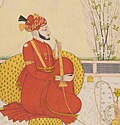
| Mandhata Prakash | 
|
1630 | 1654 | |
| Sobhag Prakash | 1654 | 1664 | ||
| Budh Prakash | 1664 | 1684 | [1][5] | |
| Mat Prakash | 1684 | 1704 | [1][5] | |
| Hari Prakash | 1704 | 1712 | [5] | |
| Bijay Prakash | 1712 | 1736 | ||
| Pratap Prakash | 1736 | 1754 | ||
| Kirat Prakash | .jpg)
|
1754 | 1770 | |
| Jagat Prakash | 
|
1770 | 1789 | |
| Dharam Prakash | 1789 | 1793 | ||
| Karam Prakash II (died 1820) | 1793 | 1803 | ||
| Ratan Prakash (installed by Gurkhas, hanged by the British in 1804) | 1803 | 1804 | ||
| Karma Prakash II (died 1820) | 1804 | 1815 | ||
| Fateh Prakash | .jpg)
|
1815 | 1850 | |
| Raghbir Prakash | 1850 | 1856 | ||
| Shamsher Prakash | 
|
1856 | 1898 | |
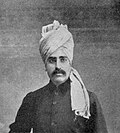
| Surendra Bikram Prakash | .jpg)
|
1898 | 1911 | |
| Amar Prakash | 1911 | 1933 | ||
| Rajendra Prakash | 1933 | 1947 | ||
| Lakshraj Prakash | 2013 | [6][7] |
Demographics[edit | edit source]
| Religious group |
1901[8] | 1911[9][10] | 1921[11] | 1931[12] | 1941[13] | |||||
|---|---|---|---|---|---|---|---|---|---|---|
| Pop. | % | Pop. | % | Pop. | % | Pop. | % | Pop. | % | |
Hinduism  [lower-alpha 1] [lower-alpha 1]
|
128,478 | 94.69% | 130,276 | 94.05% | 132,431 | 94.29% | 139,031 | 93.58% | 146,199 | 93.7% |
Islam 
|
6,414 | 4.73% | 6,016 | 4.34% | 6,449 | 4.59% | 7,020 | 4.73% | 7,374 | 4.73% |
Sikhism 
|
688 | 0.51% | 2,142 | 1.55% | 1,449 | 1.03% | 2,413 | 1.62% | 2,334 | 1.5% |
Jainism 
|
61 | 0.04% | 49 | 0.04% | 65 | 0.05% | 52 | 0.04% | 81 | 0.05% |
Christianity 
|
46 | 0.03% | 37 | 0.03% | 44 | 0.03% | 52 | 0.04% | 38 | 0.02% |
Buddhism .svg)
|
0 | 0% | 0 | 0% | 10 | 0.01% | 0 | 0% | 0 | 0% |
Zoroastrianism 
|
0 | 0% | 0 | 0% | 0 | 0% | 0 | 0% | 0 | 0% |
Judaism 
|
0 | 0% | 0 | 0% | 0 | 0% | 0 | 0% | 0 | 0% |
| Others | 0 | 0% | 0 | 0% | 0 | 0% | 0 | 0% | 0 | 0% |
| Total population | 135,687 | 100% | 138,520 | 100% | 140,448 | 100% | 148,568 | 100% | 156,026 | 100% |
|
Note: British Punjab province era district borders are not an exact match in the present-day due to various bifurcations to district borders — which since created new districts — throughout the historic Punjab Province region during the post-independence era that have taken into account population increases. | ||||||||||
Artwork[edit | edit source]
.png)
Not many paintings depicting the historical rajas of Sirmur State have survived due to the Gurkha occupation of the state between 1803 and 1814, which led to the loss and destruction of much artwork, including any portraits of earlier rulers produced in Sirmur itself.[14][15]
Notes[edit | edit source]
- ↑ 1931-1941: Including Ad-Dharmis
References[edit | edit source]
- ↑ 1.0 1.1 1.2 1.3 1.4 1.5 Singh, Mian Goverdhan (1999). Wooden Temples of Himachal Pradesh. Indus Publishing. pp. 48–49. ISBN 9788173870941.
- ↑ Panikkar, Ayyappa (1997). Medieval Indian Literature: Surveys and selections. Sahitya Akademi. p. 72. ISBN 978-81-260-0365-5.
- ↑ 3.0 3.1 Sen Negi, Thakur (1969). Himachal Pradesh District Gazetteers: Sirmur. Government of Himachal Pradesh. pp. 52–54.
- ↑ Sen Negi, Thakur (1969). Himachal Pradesh District Gazetteers: Sirmur. Government of Himachal Pradesh. pp. 55–57.
- ↑ 5.0 5.1 5.2 Archer, William George (1973). Indian Paintings from the Punjab Hills. Indian Paintings from the Punjab Hills: A Survey and History of Pahari Miniature Painting. Vol. 1. Sotheby Parke Bernet. p. 414. ISBN 9780856670022.
- ↑ Archives, Royal (26 July 2025). "Sirmur (Princely State)". Royal Archives. Retrieved 26 July 2025.
- ↑ "9-year-old Jaipur prince becomes Maharaja of Sirmaur". India Today. 15 May 2013. Retrieved 26 July 2025.
- ↑ "Census of India 1901. [Vol. 17A]. Imperial tables, I–VIII, X–XV, XVII and XVIII for the Punjab, with the native states under the political control of the Punjab Government, and for the North-west Frontier Province". 1901. p. 34. JSTOR saoa.crl.25363739. Retrieved 30 March 2024.
- ↑ "Census of India 1911. Vol. 14, Punjab. Pt. 2, Tables". 1911. p. 27. JSTOR saoa.crl.25393788. Retrieved 30 March 2024.
- ↑ Kaul, Harikishan (1911). "Census Of India 1911 Punjab Vol XIV Part II". p. 27. Retrieved 30 March 2024.
- ↑ "Census of India 1921. Vol. 15, Punjab and Delhi. Pt. 2, Tables". 1921. p. 29. JSTOR saoa.crl.25430165. Retrieved 30 March 2024.
- ↑ "Census of India 1931. Vol. 17, Punjab. Pt. 2, Tables". 1931. p. 277. JSTOR saoa.crl.25793242. Retrieved 30 March 2024.
- ↑ "Census of India, 1941. Vol. 6, Punjab". 1941. p. 42. JSTOR saoa.crl.28215541. Retrieved 30 March 2024.
- ↑ Plumbly, Sara (2020). "RAJA JAGAT PRAKASH OF SIRMUR (R.1770-89) WORSHIPPING RAMA AND SITA". Christie's. Retrieved 23 October 2024.
Very few portraits of Sirmur rulers remain as the Gurkha occupation of the state in 1803-14 is thought to have destroyed any earlier paintings.
- ↑ Galloway, Francesca. Pahari Paintings From the Eva and Konrad Seitz Collection (PDF). www.francescagalloway.com. p. 48.
Further reading[edit | edit source]
- Singh, Kanwar Ranjhor (1912). Tarikh-i-Riyasat Sirmaur [History of Sirmaur State] (in فارسی).
- Pages using the JsonConfig extension
- Articles needing additional references from June 2025
- Former country articles requiring maintenance
- Sirmaur district
- Rajput history
- 11th-century establishments in India
- 1095 establishments in Asia
- 1948 disestablishments in India
- Princely states of Himachal Pradesh
- Sirmur State