

m robot: Update article (please report if you notice any mistake or error in this edit) |
added references per standard format to improve readability |
||
| Line 1: | Line 1: | ||
{{Short description|Launches made by the Geosynchronous Satellite Launch Vehicle Mk I and Mk II}} | {{Short description|Launches made by the Geosynchronous Satellite Launch Vehicle Mk I and Mk II}} | ||
{{Use Indian English|date=March 2021}} | {{Use Indian English|date=March 2021}} | ||
{{Use dmy dates|date=March 2021}} | {{Use dmy dates|date=March 2021}} | ||
[[File:GSLV- | [[File:GSLV-F14, INSAT-3DS - Lift off from SLP 01.jpg|thumb|Liftoff of [[Geosynchronous Satellite Launch Vehicle|GSLV Mk. II]] F14 from [[Satish Dhawan Space Centre#Second Launch Pad|SDSC SLP]], carrying [[INSAT-3DS]].]] | ||
This is a list of launches conducted by | This is a list of launches conducted by [[ISRO]] using [[Geosynchronous Satellite Launch Vehicle]] (GSLV) rockets. This list does not include [[LVM3]] (formerly known as GSLV Mk III) launches, which can be found [[List of LVM3 launches|here]]. | ||
== Notable missions == | == Notable missions == | ||
=== GSLV MK. I flight D1 === | === GSLV MK. I flight D1 === | ||
{{main|GSLV | {{main|GSLV}} | ||
This was the first developmental flight of the [[GSLV]] | This was the first developmental flight of the [[GSLV]] Mk.I featuring Russian cryogenic engine [[KVD-1]]. It was used to place an experimental satellite [[GSAT-1]] into the orbit. However, due to sub-optimal performance and lack of fuel the vehicle did not achieve the intended orbit and the satellite had to maneuver itself using onboard fuel to correct the shortfall. ISRO claims the launch to be successful.<ref name="kyle-failures">{{cite web |last=Kyle |first=Ed |date=28 December 2010 |title=Page 2 of 2: Comprehensive Orbital Launch Failure List |url=http://www.spacelaunchreport.com/slvfail.txt |url-status=usurped |archive-url=https://archive.today/20120913053550/http://www.spacelaunchreport.com/slvfail.txt |archive-date=13 September 2012 |access-date=14 August 2013 |work=India (SLV/ASLV/PSLV/GSLV) Flight History by Variant/Year (1979–2010)}}</ref><ref>{{cite web|url=http://www.isro.gov.in/update/24-apr-2001/press-brief-gslv-d1-gsat-1|title=Press Brief on GSLV-D1/GSAT-1|date=24 April 2001|publisher=ISRO}}</ref> In a 2014 interview, ISRO Chairman [[K. Radhakrishnan]] attributed the failure to incorrect mixture ratio used in the cryogenic upper stage.<ref>{{cite news |last1=Ramachandran|first1=R.|title=GSLV Mk III, the next milestone|url=http://www.frontline.in/cover-story/gslv-mkiii-the-next-milestone/article5596588.ece|publisher=Frontline|date=22 January 2014}}</ref><ref name="kyle-failures"/><ref>{{cite web|url=http://www.business-standard.com/article/current-affairs/isro-clears-launch-of-gslv-d5-113123000189_1.html|title=ISRO clears launch of GSLV-D5|publisher=Business Standard|date=31 December 2013|access-date=20 January 2014}}</ref> | ||
=== GSLV MK. II flight D5 === | === GSLV MK. II flight D5 === | ||
{{main|GSLV-D5}} | {{main|GSLV-D5}} | ||
This was the second test flight with indigenous cryogenic stage [[CE-7.5]] and the first successful launch with the [[CE-7.5]]. The flight lifted and successfully placed the {{convert|1982|kg|lb}} [[GSAT-14]] into the orbit. This flight became the harbinger of successful launch with the indigenous cryogenic stage.<ref>{{cite news | url=http://timesofindia.indiatimes.com/india/Isro-successfully-launches-indigenous-cryogenic-engine-powered-GSLV-D5/articleshow/28437867.cms | title=Isro successfully launches indigenous cryogenic engine-powered GSLV-D5 | access-date=5 January 2014 | work=The Times Of India}}</ref><ref name=GSLV-D5-Success>{{cite web| title=GSLV-D5-Success| url=http://www.isro.gov.in/gslv-d5/d5-updates.aspx| publisher=ISRO| access-date=5 January 2014| url-status=dead| archive-url=https://web.archive.org/web/20140104204430/http://isro.gov.in/gslv-d5/d5-updates.aspx| archive-date=4 January 2014}}</ref><ref name="GSLV-D5 Launch Success">{{cite news| title=GSLV-D5 Launch Success| url=http://www.thehindu.com/sci-tech/science/gslvd5-with-indigenous-cryogenic-engine-launched-successfully/article5541607.ece?homepage=true| | This was the second test flight with indigenous cryogenic stage [[CE-7.5]] and the first successful launch with the [[CE-7.5]]. The flight lifted and successfully placed the {{convert|1982|kg|lb}} [[GSAT-14]] into the orbit. This flight became the harbinger of successful launch with the indigenous cryogenic stage.<ref>{{cite news | url=http://timesofindia.indiatimes.com/india/Isro-successfully-launches-indigenous-cryogenic-engine-powered-GSLV-D5/articleshow/28437867.cms | title=Isro successfully launches indigenous cryogenic engine-powered GSLV-D5 | access-date=5 January 2014 | work=The Times Of India}}</ref><ref name=GSLV-D5-Success>{{cite web| title=GSLV-D5-Success| url=http://www.isro.gov.in/gslv-d5/d5-updates.aspx| publisher=ISRO| access-date=5 January 2014| url-status=dead| archive-url=https://web.archive.org/web/20140104204430/http://isro.gov.in/gslv-d5/d5-updates.aspx| archive-date=4 January 2014}}</ref><ref name="GSLV-D5 Launch Success">{{cite news| title=GSLV-D5 Launch Success| url=http://www.thehindu.com/sci-tech/science/gslvd5-with-indigenous-cryogenic-engine-launched-successfully/article5541607.ece?homepage=true| work=The Hindu| access-date=5 January 2014| location=Chennai, India| first=T.S.| last=Subramanian| date=5 January 2014| url-status=dead| archive-url=https://web.archive.org/web/20140106031909/http://www.thehindu.com/sci-tech/science/gslvd5-with-indigenous-cryogenic-engine-launched-successfully/article5541607.ece?homepage=true| archive-date=6 January 2014}}</ref> | ||
=== GSLV MK. II flight F09 === | === GSLV MK. II flight F09 === | ||
{{main| | {{main|South Asia Satellite}} | ||
This was the fourth consecutive successful flight of GSLV Mk. II with indigenous cryogenic engine. The flight placed the regional satellite [[South Asia Satellite]] was previously named as [[South Asian Association for Regional Cooperation]] (SAARC) Satellite.<ref>{{cite news|title=Made in India South Asia Satellite to be launched on 5 May 2017 |url=https://www.livemint.com/Science/hbsHovfU7ngFqoPec9KQML/Indias-priceless-gift-Isros-South-Asia-Satellite-to-be.html|agency=PTI|date=30 April 2017}}</ref><ref name="pib-5may2017">{{cite web |url=http://pib.nic.in/newsite/PrintRelease.aspx?relid=161601|title=Official Press Release: GSLV Successfully Launches South Asia Satellite|date=5 May 2017|publisher=Press Information Bureau}}</ref><ref>{{cite news|last1=Sinha|first1=Amitabh|title=South Asian diplomacy lifts off on 2230-kg ISRO satellite GSAT-9|url=http://indianexpress.com/article/india/isro-gsat-9-satellite-launch-propels-modi-govts-satellite-diplomacy-in-the-neighbourhood-4642042/|newspaper=The Indian Express|date=6 May 2017}}</ref><ref>{{cite web|last1=Clark|first1=Stephen|title=India launches satellite linking its South Asian neighbors |url=https://spaceflightnow.com/2017/05/06/india-launches-satellite-linking-its-south-asian-neighbors/|publisher=Spaceflight Now|date=6 May 2017}}</ref> The satellite was a gift from India to its neighbors to | This was the fourth consecutive successful flight of GSLV Mk. II with indigenous cryogenic engine. The flight placed the regional satellite [[South Asia Satellite]] was previously named as [[South Asian Association for Regional Cooperation]] (SAARC) Satellite.<ref>{{cite news|title=Made in India South Asia Satellite to be launched on 5 May 2017 |url=https://www.livemint.com/Science/hbsHovfU7ngFqoPec9KQML/Indias-priceless-gift-Isros-South-Asia-Satellite-to-be.html|agency=PTI|date=30 April 2017}}</ref><ref name="pib-5may2017">{{cite web |url=http://pib.nic.in/newsite/PrintRelease.aspx?relid=161601|title=Official Press Release: GSLV Successfully Launches South Asia Satellite|date=5 May 2017|publisher=Press Information Bureau}}</ref><ref>{{cite news|last1=Sinha|first1=Amitabh|title=South Asian diplomacy lifts off on 2230-kg ISRO satellite GSAT-9|url=http://indianexpress.com/article/india/isro-gsat-9-satellite-launch-propels-modi-govts-satellite-diplomacy-in-the-neighbourhood-4642042/|newspaper=The Indian Express|date=6 May 2017}}</ref><ref name="Spaceflight Now">{{cite web|last1=Clark|first1=Stephen|title=India launches satellite linking its South Asian neighbors |url=https://spaceflightnow.com/2017/05/06/india-launches-satellite-linking-its-south-asian-neighbors/|publisher=Spaceflight Now|date=6 May 2017}}</ref> The satellite was a gift from India to its neighbors to bolster [[Prime Minister of India|Prime Minister]] [[Narendra Modi]]'s [[South Asian foreign policy of the Narendra Modi government|neighborhood first policy]].<ref name="The Space Review">{{cite news |url=http://www.thespacereview.com/article/2579/1|title=India's SAARC satellite proposal: a boost to a multilateral space agenda|publisher=The Space Review|date=18 August 2014|access-date=22 April 2015}}</ref> [[Afghanistan]], [[Bangladesh]], [[Bhutan]], [[Maldives]], [[Nepal]] and [[Sri Lanka]] are the users of the multi-dimensional facilities provided by the satellite. | ||
== | == Statistics == | ||
{{ | {{columns-start}} | ||
{{ | {{column}} | ||
=== | ===Rocket configurations=== | ||
{{ #invoke:Chart | bar chart | {{ #invoke:Chart | bar chart | ||
| height = 300 | | height = 300 | ||
| width = 500 | |||
| stack = 1 | | stack = 1 | ||
| group 1 = 1:0:1:1:0:1:1:0:0:1 | | group 1 = 1:0:1:1:0:1:1:0:0:1:0:0:0:0:0:0:0:0:0:0:0:0:0:0:0:0 | ||
| colors = | | group 2 = 0:0:0:0:0:0:0:0:0:1:0:0:0:1:1:1:1:2:0:0:1:0:1:1:2:0 | ||
| group names = GSLV | | colors = #9966CC : #77B5FE | ||
| x legends = 2001 :::: 2005 ::::: 2010 | | group names = GSLV MK. I : GSLV MK. II | ||
| x legends = 2001 :::: 2005 ::::: 2010 ::::: 2015 ::::: 2020 ::::: 2025 : | |||
| y tick marks = 2 | |||
}} | }} | ||
=== | {{column}} | ||
{{ #invoke:Chart | bar chart | |||
=== Launch sites === | |||
{{#invoke:Chart | bar chart | |||
| height = 300 | | height = 300 | ||
| width = 500 | |||
| stack = 1 | | stack = 1 | ||
| group 1 = 1:0:0:0:1:1:1:1:2:0:0:1 | | group 1 = 1:0:1:1:0:0:0:0:0:0:0:0:0:0:0:0:0:0:0:0:0:0:0:0:0:0<!-- SDSC 1LP --> | ||
| colors = | | group 2 = 0:0:0:0:0:1:1:0:0:2:0:0:0:1:1:1:1:2:0:0:1:0:1:1:2:0<!-- SDSC 2LP --> | ||
| group names = | | colors = Wheat : #FFA07A | ||
| x legends = 2010 ::::: 2015 ::::: 2020: | | group names = [[Satish Dhawan Space Centre First Launch Pad|First LP]] : [[Satish Dhawan Space Centre Second Launch Pad|Second LP]] | ||
| x legends = 2001 :::: 2005 ::::: 2010 ::::: 2015 ::::: 2020 ::::: 2025 : | |||
| y tick marks = 2 | |||
}} | }} | ||
{{ | {{columns-end}} | ||
<!-- added :0 data for all groups and final':' to x legends, to extend x axis so x label 2025 is not clipped --> | |||
<!-- mission outcome chart below is scaled down, and is not clipped ! --> | |||
{{columns-start}} | |||
{{column}} | |||
=== Mission outcome | === Mission outcome === | ||
{{ #invoke:Chart | bar chart | {{ #invoke:Chart | bar chart | ||
| height = 300 | | height = 300 | ||
| width = 500 | |||
| stack = 1 | | stack = 1 | ||
| group 1 = 0:0:1:1:0:0:0:0:0:0 | | group 1 = 0:0:1:1:0:0:0:0:0:0:0:0:1:1:1:1:2:0:0:0:0:1:1:2:0 | ||
| group 2 = 1:0:0:0:0:0:1:0:0:0 | | group 2 = 1:0:0:0:0:0:1:0:0:0:0:0:0:0:0:0:0:0:0:0:0:0:0:0:0 | ||
| group 3 = 0:0:0:0:0:1:0:0:0:1 | | group 3 = 0:0:0:0:0:1:0:0:0:2:0:0:0:0:0:0:0:0:0:1:0:0:0:0:0 | ||
| group 4 = 0:0:0:0:0:0:0:0:0:0 | | group 4 = 0:0:0:0:0:0:0:0:0:0:0:0:0:0:0:0:0:0:0:0:0:0:0:0:3 | ||
| colors = ForestGreen : | | colors = ForestGreen : Orange : FireBrick: LightBlue | ||
| group names = Success : Partial failure : Failure : Planned | | group names = Success : Partial failure : Failure : Planned | ||
| x legends = 2001 :::: 2005 ::::: 2010 | | x legends = 2001 :::: 2005 ::::: 2010 :::: 2015 ::::: 2020 ::::: 2025: | ||
| y tick marks = 3 | |||
}} | }} | ||
{{column}} | |||
{{ | {{columns-end}} | ||
}} | |||
{{ | |||
== Launch history == | == Launch history == | ||
<onlyinclude>{{as of| | <onlyinclude>{{as of|2025|07|30}}, rockets from the GSLV family have made 18 launches, resulting in 12 successes, four failures, and two partial failures.<ref>{{cite news|url=https://www.isro.gov.in/launchers/list-of-gslv-launches|title=List of GSLV launches|website=isro.org|publisher=ISRO|access-date=14 December 2020|archive-date=13 August 2021|archive-url=https://web.archive.org/web/20210813014242/https://www.isro.gov.in/launchers/list-of-gslv-launches|url-status=dead}}</ref> All launches have occurred from the Satish Dhawan Space Centre, known before 2002 as the Sriharikota Range (SHAR).</onlyinclude> | ||
{| class="wikitable plainrowheaders" style="width: 100%;" | {| class="wikitable plainrowheaders" style="width: 100%;" | ||
|- | |- | ||
| colspan=9 style="background:white;" | | | colspan=9 style="background:white;" | | ||
=== | === 2001–2009 === | ||
|- | |- | ||
! scope="col" | Flight No. | ! scope="col" | Flight No. | ||
| Line 108: | Line 98: | ||
|- | |- | ||
! scope="row" rowspan = 2 style="text-align:center;| D1 | ! scope="row" rowspan = 2 style="text-align:center;"| D1 | ||
| 18 April 2001<br/>10:13 | | 18 April 2001<br/>10:13 | ||
| Mk I | | Mk I | ||
| Line 121: | Line 111: | ||
|- | |- | ||
! scope="row" rowspan = 2 style="text-align:center;| D2 | ! scope="row" rowspan = 2 style="text-align:center;"| D2 | ||
| 8 May 2003<br/>11:28 | | 8 May 2003<br/>11:28 | ||
| Mk I | | Mk I | ||
| Line 131: | Line 121: | ||
| {{Success}} | | {{Success}} | ||
|- | |- | ||
| colspan="8"| Developmental flight.<ref>{{cite web|archive-url=https://web.archive.org/web/20090314174842/http://isro.org/gslvd2/gslvd2.htm|archive-date=March | | colspan="8"| Developmental flight.<ref>{{cite web|archive-url=https://web.archive.org/web/20090314174842/http://isro.org/gslvd2/gslvd2.htm|archive-date=14 March 2009|title=GSLV-D2 Mission|publisher=ISRO | ||
|url=http://isro.org/gslvd2/gslvd2.htm}}</ref> | |url=http://isro.org/gslvd2/gslvd2.htm}}</ref> | ||
|- | |- | ||
! scope="row" rowspan = 2 style="text-align:center;| F01 | ! scope="row" rowspan = 2 style="text-align:center;"| F01 | ||
| 20 September 2004<br/>10:31 | | 20 September 2004<br/>10:31 | ||
| Mk I | | Mk I | ||
| Line 145: | Line 135: | ||
| {{Success}} | | {{Success}} | ||
|- | |- | ||
| colspan="8"| First operational flight.<ref>{{cite web|archive-url=https://web.archive.org/web/20090318132656/http://isro.org/Edusat/Page4.htm|archive-date=March | | colspan="8"| First operational flight.<ref>{{cite web|archive-url=https://web.archive.org/web/20090318132656/http://isro.org/Edusat/Page4.htm|archive-date=18 March 2009|title=EDUSAT mission |publisher=ISRO |url=http://isro.org/Edusat/Page4.htm}}</ref> | ||
|- | |- | ||
! scope="row" rowspan = 2 style="text-align:center;| F02 | ! scope="row" rowspan = 2 style="text-align:center;"| F02 | ||
| 10 July 2006<br/>12:08 | | 10 July 2006<br/>12:08 | ||
| Mk I | | Mk I | ||
| Line 158: | Line 148: | ||
| {{Failure}} | | {{Failure}} | ||
|- | |- | ||
| colspan="8"| One of the L40 strap-on engines failed at lift-off. Both rocket and satellite had to be destroyed over the Bay of Bengal after the rocket's trajectory veered outside permitted limits.<ref>{{Cite web|title=GSLV-F02 Failure Analysis Committee Report|url=http://www.spaceref.com/news/viewpr.html?pid=20769|access-date=2021-08-20|website=www.spaceref.com}}</ref> | | colspan="8"| One of the L40 strap-on engines failed at lift-off. Both rocket and satellite had to be destroyed over the Bay of Bengal after the rocket's trajectory veered outside permitted limits.<ref>{{Cite web|title=GSLV-F02 Failure Analysis Committee Report|url=http://www.spaceref.com/news/viewpr.html?pid=20769|archive-url=https://archive.today/20120524115033/http://www.spaceref.com/news/viewpr.html?pid=20769|url-status=dead|archive-date=24 May 2012|access-date=2021-08-20|website=www.spaceref.com}}</ref> | ||
|- | |- | ||
! scope="row" rowspan = 2 style="text-align:center;| F04 | ! scope="row" rowspan = 2 style="text-align:center;"| F04 | ||
| 2 September 2007<br/>12:51 | | 2 September 2007<br/>12:51 | ||
| Mk I | | Mk I | ||
| Line 171: | Line 161: | ||
| {{Partial failure}}<!--ISRO claim this as a success, however they have a HUGE conflict of interest. Use third-party sources.--> | | {{Partial failure}}<!--ISRO claim this as a success, however they have a HUGE conflict of interest. Use third-party sources.--> | ||
|- | |- | ||
| colspan="8"| High roll rate build-up due control system malfunction on one L40 strapon resulted in premature shutdown of other strap-on stages.<ref name=":0">{{Cite book|title=From Fishing Hamlet to Red Planet: India's Space Journey|isbn=9789351776895}}</ref> Due to an error in the guidance subsystem achieved orbit had lower apogee and inclination higher than expected.<ref name="SFN-GSLV04">{{cite web|url=http://www.spaceflightnow.com/news/n0709/02insat4cr |title=India's large satellite launcher returns to flight|last=Clark|first=Stephen|publisher=Spaceflight Now|date=2 September 2007}}</ref> Orbit corrected through satellite, eventually the INSAT-4CR was placed in its slot.<ref>{{cite news|url=http://timesofindia.indiatimes.com/INSAT-4CR_successfully_placed_in_orbit/articleshow/2331752.cms|title=INSAT-4CR successfully placed in orbit|newspaper=Times of India | | colspan="8"| High roll rate build-up due control system malfunction on one L40 strapon resulted in premature shutdown of other strap-on stages.<ref name=":0">{{Cite book|title=From Fishing Hamlet to Red Planet: India's Space Journey|date=15 December 2015 |publisher=HarperCollins Publishers India |isbn=9789351776895}}</ref> Due to an error in the guidance subsystem achieved orbit had lower apogee and inclination higher than expected.<ref name="SFN-GSLV04">{{cite web|url=http://www.spaceflightnow.com/news/n0709/02insat4cr |title=India's large satellite launcher returns to flight|last=Clark|first=Stephen|publisher=Spaceflight Now|date=2 September 2007}}</ref> Orbit corrected through satellite, eventually the INSAT-4CR was placed in its slot.<ref>{{cite news|url=http://timesofindia.indiatimes.com/INSAT-4CR_successfully_placed_in_orbit/articleshow/2331752.cms|title=INSAT-4CR successfully placed in orbit|newspaper=Times of India | ||
|date=2 September 2007}}</ref><ref>{{cite web|title=GSLV-F04 Launch Successful – Places INSAT-4CR in orbit|publisher=ISRO|archive-url=https://web.archive.org/web/20090301180426/http://www.isro.org/pressrelease/Sep02_2007.htm|archive-date=March | |date=2 September 2007}}</ref><ref>{{cite web|title=GSLV-F04 Launch Successful – Places INSAT-4CR in orbit|publisher=ISRO|archive-url=https://web.archive.org/web/20090301180426/http://www.isro.org/pressrelease/Sep02_2007.htm|archive-date=1 March 2009|url=http://www.isro.gov.in/update/02-sep-2007/gslv-f04-launch-successful-places-insat-4cr-orbit}}</ref><ref name="isro_4crlost">{{cite web|title=ISRO refutes INSAT-4CR "disappearance" story|newspaper=Hindustan Times|url=http://www.hindustantimes.com/india-news/isro-refutes-insat-vanishing-story/article1-263347.aspx|url-status=dead|archive-url=https://web.archive.org/web/20131112232031/http://www.hindustantimes.com/india-news/isro-refutes-insat-vanishing-story/article1-263347.aspx|archive-date=2013-11-12}}</ref> Satellite completed its planned design life while it was fully operational. ISRO claims this GSLV flight to be successful.<ref>{{cite web|url=http://www.thehindu.com/todays-paper/article1904902.ece|title=First manoeuvre to raise satellite's orbit|newspaper=The Hindu|access-date=19 November 2015|location=Sriharikota}}</ref> | ||
|- | |- | ||
| colspan=9 style="background:white;" | | | colspan=9 style="background:white;" | | ||
=== | === 2010–2017 === | ||
|- | |- | ||
! scope="col" | Flight No. | ! scope="col" | Flight No. | ||
| Line 188: | Line 178: | ||
! scope="col" | Launch<br/>outcome | ! scope="col" | Launch<br/>outcome | ||
|- | |- | ||
! scope="row" rowspan = 2 style="text-align:center;| D3 | ! scope="row" rowspan = 2 style="text-align:center;"| D3 | ||
| 15 April 2010<br/>10:57 | | 15 April 2010<br/>10:57 | ||
| Mk II | | Mk II | ||
| Line 198: | Line 188: | ||
| {{Failure}} | | {{Failure}} | ||
|- | |- | ||
| colspan="8"| First flight test of the ISRO designed and built Cryogenic Upper Stage (CUS). Failed to reach orbit due to malfunction of the Fuel Booster Turbo Pump (FBTP) of the cryogenic upper stage.<ref name=gslvD3-failurePressRelease>{{cite web|url=http://www.isro.gov.in/update/09-jul-2010/gslv-d3-failure-analysis-report|title=GSLV-D3 Failure Analysis Report|publisher=ISRO}}</ref> | | colspan="8"| First flight test of the ISRO designed and built Cryogenic Upper Stage (CUS). Failed to reach orbit due to malfunction of the Fuel Booster Turbo Pump (FBTP) of the cryogenic upper stage.<ref name=gslvD3-failurePressRelease>{{cite web|url=http://www.isro.gov.in/update/09-jul-2010/gslv-d3-failure-analysis-report|title=GSLV-D3 Failure Analysis Report|publisher=ISRO|access-date=14 December 2020|archive-date=23 August 2016|archive-url=https://web.archive.org/web/20160823151911/http://www.isro.gov.in/update/09-jul-2010/gslv-d3-failure-analysis-report|url-status=dead}}</ref> | ||
|- | |- | ||
! scope="row" rowspan = 2 style="text-align:center;| F06 | ! scope="row" rowspan = 2 style="text-align:center;"| F06 | ||
| 25 December 2010<br/>10:34 | | 25 December 2010<br/>10:34 | ||
| Mk I | | Mk I | ||
| Line 215: | Line 205: | ||
|- | |- | ||
! scope="row" rowspan = 2 style="text-align:center;| D5 | ! scope="row" rowspan = 2 style="text-align:center;"| D5 | ||
| 5 January 2014<br/>10:48 | | 5 January 2014<br/>10:48 | ||
| Mk II | | Mk II | ||
| Line 225: | Line 215: | ||
| {{Success}} | | {{Success}} | ||
|- | |- | ||
| colspan="8"| The flight was scheduled for 19 August 2013, but one hour and 14 minutes before the lift off, a leakage was reported and the launch was halted.<ref>{{cite web |url=http://www.ndtv.com/article/india/gslv-d5-rocket-launch-delayed-countdown-clock-stopped-due-to-leak-407665|title=GSLV-D5 rocket launch delayed, countdown clock stopped due to leak in second stage |publisher=NDTV|access-date=November | | colspan="8"| The flight was scheduled for 19 August 2013, but one hour and 14 minutes before the lift off, a leakage was reported and the launch was halted.<ref>{{cite web |url=http://www.ndtv.com/article/india/gslv-d5-rocket-launch-delayed-countdown-clock-stopped-due-to-leak-407665|title=GSLV-D5 rocket launch delayed, countdown clock stopped due to leak in second stage |publisher=NDTV|access-date=27 November 2013}}</ref> Second flight of GSLV with indigenous cryogenic upper stage (CUS) developed by ISRO's Liquid Propulsion Systems Centre (LPSC) was launched successfully on 5 January 2014.<ref>{{cite news|url=http://www.thehindu.com/news/national/another-shot-at-gslv-with-indigenous-cryogenic-engine/article5298156.ece|title=Another shot at GSLV with indigenous cryogenic engine |newspaper=The Hindu|access-date=27 November 2013|location=Chennai, India|first=M. Dinesh|last=Varma|date=31 October 2013}}</ref><ref>{{cite web|url=http://www.hindustantimes.com/india-news/preparations-in-full-swing-for-dec-15-gslv-mission/article1-1147438.aspx|archive-url=https://web.archive.org/web/20131106013414/http://www.hindustantimes.com/india-news/preparations-in-full-swing-for-dec-15-gslv-mission/article1-1147438.aspx|url-status=dead|archive-date=6 November 2013|title=Preparations in full swing for December 15 GSLV mission|newspaper=Hindustan Times|access-date=27 November 2013}}</ref> It was a launch with precision of {{cvt|40|m}}. All the three stages performed successfully.<ref>{{cite web|url=https://twitter.com/ISROOFFICIAL/status/419786787297300480/photo/1|title=GSAT-14 Separated|publisher=Twitter |date=5 January 2014 |access-date=5 January 2014}}</ref><ref>{{cite web|url=https://twitter.com/ISROOFFICIAL/statuses/419784120307159042|title=Performance of Cryogenic stage of GSLV D5 normal. Ignition sustained.|publisher=Twitter|date=5 January 2014|access-date=5 January 2014}}</ref> This was the first successful flight of the cryogenic stage which was developed indigenously in India. | ||
|- | |- | ||
! scope="row" rowspan = 2 style="text-align:center;| D6 | ! scope="row" rowspan = 2 style="text-align:center;"| D6 | ||
| 27 August 2015<br/>11:22 | | 27 August 2015<br/>11:22 | ||
| Mk II | | Mk II | ||
| Line 238: | Line 228: | ||
| {{Success}} | | {{Success}} | ||
|- | |- | ||
| colspan="8"| GSLV Mk II D6 with an Indigenous Cryogenic Engine (ICE) successfully ferried GSAT-6 payload into [[Geostationary Transfer Orbit]] (GTO) with injection parameters of 170 km x 35945 km, 19.96° inclination. The cuboid-shaped GSAT-6 satellite includes a technology demonstrator [[S band|S-Band]] unfurlable antenna with a diameter of six metre which will provide S-band communication services during its expected mission life of nine years.<ref>{{cite news|title=ISRO's GSLV D-6 puts GSAT-6 satellite in orbit|url=http://www.thehindu.com/news/national/geostationary-satellite-launch-vehicle-gslvd6-successfully-launched/article7587039.ece|newspaper=The Hindu|date=27 August 2015}}</ref><ref>{{cite web|url=http://space.skyrocket.de/doc_sdat/gsat-6.htm|title=GSAT 6|access-date=1 July 2014}}</ref><ref>{{cite | | colspan="8"| GSLV Mk II D6 with an Indigenous Cryogenic Engine (ICE) successfully ferried GSAT-6 payload into [[Geostationary Transfer Orbit]] (GTO) with injection parameters of 170 km x 35945 km, 19.96° inclination. The cuboid-shaped GSAT-6 satellite includes a technology demonstrator [[S band|S-Band]] unfurlable antenna with a diameter of six metre which will provide S-band communication services during its expected mission life of nine years.<ref>{{cite news|title=ISRO's GSLV D-6 puts GSAT-6 satellite in orbit|url=http://www.thehindu.com/news/national/geostationary-satellite-launch-vehicle-gslvd6-successfully-launched/article7587039.ece|newspaper=The Hindu|date=27 August 2015}}</ref><ref>{{cite web|url=http://space.skyrocket.de/doc_sdat/gsat-6.htm|title=GSAT 6|access-date=1 July 2014}}</ref><ref>{{cite news | ||
|url=http://www.thehindu.com/news/national/gsat6-slated-for-march-launch/article6545929.ece|title=GSAT-6 slated for March launch|access-date=27 August 2015}}</ref> | |url=http://www.thehindu.com/news/national/gsat6-slated-for-march-launch/article6545929.ece|title=GSAT-6 slated for March launch|newspaper=The Hindu |date=29 October 2014 |access-date=27 August 2015}}</ref> | ||
|- | |- | ||
! scope="row" rowspan = 2 style="text-align:center;| F05 | ! scope="row" rowspan = 2 style="text-align:center;"| F05 | ||
| 8 September 2016<br/>11:20 | | 8 September 2016<br/>11:20 | ||
| MK II | | MK II | ||
| Line 252: | Line 242: | ||
| {{Success}} | | {{Success}} | ||
|- | |- | ||
| colspan="8"| First operational flight of GSLV Mk II. The injection parameters were met with extreme precision. Perigee was within 300m (within 0.18%) of the expected value whereas apogee was within 0.2% (80 km). The difference between expected and actual inclination degree was 0. | | colspan="8"| First operational flight of GSLV Mk II. The injection parameters were met with extreme precision. Perigee was within 300m (within 0.18%) of the expected value whereas apogee was within 0.2% (80 km). The difference between expected and actual inclination degree was 0. | ||
INSAT-3DR is an advanced atmospheric weather satellite. as well as the second heaviest satellite placed in orbit by an indigenous cryogenic engine propelled GSLV <ref>{{cite | INSAT-3DR is an advanced atmospheric weather satellite. as well as the second heaviest satellite placed in orbit by an indigenous cryogenic engine propelled GSLV<ref>{{cite news |url=http://timesofindia.indiatimes.com/india/Isros-desi-cryo-enginepowered-GSLV-F05-places-INSAT-3DR-weather-satellite-in-orbit/articleshow/54181283.cms|title=ISRO's desi cryo engine–powered GSLV-F05 places INSAT-3DR weather satellite in orbit|newspaper=Times of India|date=8 September 2016 |access-date=2016-09-08}}</ref><ref>{{cite web|url=https://spaceflightnow.com/2016/09/08/gslv-counting-down-to-launch-advanced-indian-weather-satellite/|title=GSLV puts advanced Indian weather satellite in orbit|publisher=Spaceflight Now|last=Clark|first=Stephen|access-date=2016-09-08}}</ref><ref>{{cite news|url=http://www.thehindu.com/sci-tech/science/live-updates-isros-gslvf05-launch/article9085403.ece|title=GSLV-F05 lobs advanced weather satellite INSAT-3DR into orbit|newspaper=The Hindu|date=8 September 2016 |access-date=2016-09-08}}</ref> | ||
|- | |- | ||
! scope="row" rowspan = 2 style="text-align:center;|F09 | ! scope="row" rowspan = 2 style="text-align:center;"|F09 | ||
| 5 May 2017<br>11:27 | | 5 May 2017<br>11:27 | ||
| Mk II | | Mk II | ||
| Line 266: | Line 256: | ||
| {{Success}} | | {{Success}} | ||
|- | |- | ||
| colspan="8"| [[South Asia Satellite]] was previously named as [[South Asian Association for Regional Cooperation]] (SAARC) Satellite.<ref>{{cite news|title=Made in India South Asia Satellite to be launched on 5 May 2017|url=https://www.livemint.com/Science/hbsHovfU7ngFqoPec9KQML/Indias-priceless-gift-Isros-South-Asia-Satellite-to-be.html|agency=PTI|date=30 April 2017}}</ref><ref>{{cite news|last1=Sinha |first1=Amitabh|title=South Asian diplomacy lifts off on 2230-kg ISRO satellite GSAT-9|url=http://indianexpress.com/article/india/isro-gsat-9-satellite-launch-propels-modi-govts-satellite-diplomacy-in-the-neighbourhood-4642042/|newspaper=The Indian Express|date=6 May 2017}}</ref><ref | | colspan="8"| [[South Asia Satellite]] was previously named as [[South Asian Association for Regional Cooperation]] (SAARC) Satellite.<ref>{{cite news|title=Made in India South Asia Satellite to be launched on 5 May 2017|url=https://www.livemint.com/Science/hbsHovfU7ngFqoPec9KQML/Indias-priceless-gift-Isros-South-Asia-Satellite-to-be.html|agency=PTI|date=30 April 2017}}</ref><ref>{{cite news|last1=Sinha |first1=Amitabh|title=South Asian diplomacy lifts off on 2230-kg ISRO satellite GSAT-9|url=http://indianexpress.com/article/india/isro-gsat-9-satellite-launch-propels-modi-govts-satellite-diplomacy-in-the-neighbourhood-4642042/|newspaper=The Indian Express|date=6 May 2017}}</ref><ref name="Spaceflight Now"/> | ||
|- | |- | ||
| colspan=9 style="background:white;" | | | colspan=9 style="background:white;" | | ||
| Line 282: | Line 272: | ||
! scope="col" | Launch<br/>Outcome | ! scope="col" | Launch<br/>Outcome | ||
|- | |- | ||
! scope="row" rowspan = 2 style="text-align:center;| F08 | ! scope="row" rowspan = 2 style="text-align:center;"| F08 | ||
| 29 March 2018<br>11:26 | | 29 March 2018<br>11:26 | ||
| Mk II | | Mk II | ||
| Line 292: | Line 282: | ||
| {{Success}} | | {{Success}} | ||
|- | |- | ||
| colspan="8"| Used an enhanced version of the Vikas engine called High Thrust Vikas Engine (HTVE) which had a thrust of {{cvt|848|kN}} in GS2 stage. Electro-hydraulic Actuation used for gimballing in GS2 stage was replaced by more reliable Electro-Mechanical Actuation.<ref>{{cite web|url=https://www.isro.gov.in/gslv-f08-gsat-6a-mission/gslv-f08-gsat6a-brochure|title=GSLV F08-GSAT-6A Brochure|website=isro.gov.in |publisher=Indian Space Research Organisation|access-date=29 March 2018}}</ref><ref>{{cite | | colspan="8"| Used an enhanced version of the Vikas engine called High Thrust Vikas Engine (HTVE) which had a thrust of {{cvt|848|kN}} in GS2 stage. Electro-hydraulic Actuation used for gimballing in GS2 stage was replaced by more reliable Electro-Mechanical Actuation.<ref>{{cite web|url=https://www.isro.gov.in/gslv-f08-gsat-6a-mission/gslv-f08-gsat6a-brochure|title=GSLV F08-GSAT-6A Brochure|website=isro.gov.in|publisher=Indian Space Research Organisation|access-date=29 March 2018|archive-date=10 July 2021|archive-url=https://web.archive.org/web/20210710162623/https://www.isro.gov.in/gslv-f08-gsat-6a-mission/gslv-f08-gsat6a-brochure|url-status=dead}}</ref><ref>{{cite news|url=https://economictimes.indiatimes.com/news/science/isro-says-contact-with-gsat-6a-lost-second-setback-in-seven-months/articleshow/63565348.cms|title=ISRO Loses communication with GSAT-6A|newspaper=The Economic Times|date=April 2018 |access-date=1 April 2018}}</ref><ref>{{cite web|url=https://www.isro.gov.in/update/01-apr-2018/status-update-of-gsat-6a|title=Status Update of GSAT-6A|website=isro.gov.in|access-date=2018-04-01|archive-date=1 April 2018|archive-url=https://web.archive.org/web/20180401065043/https://www.isro.gov.in/update/01-apr-2018/status-update-of-gsat-6a|url-status=dead}}</ref><ref>{{Cite news |url=https://timesofindia.indiatimes.com/india/isro-loses-contact-with-communication-satellite-gsat-6a/articleshow/63565033.cms|title=ISRO confirms losing contact with communication satellite GSAT-6A |newspaper=The Times of India|access-date=2018-04-01}}</ref><ref name="pib-29mar18">{{cite web|title=GSLV Successfully Launches GSAT-6A Satellite|url=http://pib.nic.in/PressReleseDetail.aspx?PRID=1527070 |publisher=Press Information Bureau|date=29 March 2018}}</ref><ref>{{cite news|url=http://www.prajasakti.com/Article/BreakingNews/2014966|title=29న జిఎస్ఎల్వీ- ఎఫ్08 ప్రయోగం|publisher=Prajasakti News|access-date=2018-03-02}}</ref><ref>{{cite web|url=https://www.isro.gov.in/gslv-f08-gsat-6a-mission|archive-url=https://web.archive.org/web/20171118185141/https://www.isro.gov.in/gslv-f08-gsat-6a-mission|url-status=dead|archive-date=2017-11-18|title=GSLV-F08/GSAT-6A Mission|publisher=ISRO|date=2017-11-18|access-date=2018-04-02}}</ref> | ||
|- | |- | ||
! scope="row" rowspan = 2 style="text-align:center;| F11 | ! scope="row" rowspan = 2 style="text-align:center;"| F11 | ||
| 19 December 2018<br/>10:40 | | 19 December 2018<br/>10:40 | ||
| Mk II | | Mk II | ||
| Line 304: | Line 294: | ||
| {{Success}} | | {{Success}} | ||
|- | |- | ||
| colspan="8"| Used an enhanced version of the Vikas engine called High Thrust Vikas Engine (HTVE) along with uprated cryogenic engine C15.<ref>{{cite news|url=http://www.spacetechasia.com/indias-19-upcoming-missions-and-isros-small-satellite-launch-vehicle-sslv/|title=India's 19 upcoming missions, and ISRO's Small Satellite Launch Vehicle (SSLV)|date=2018-08-28|publisher=SpaceTech Asia|access-date=2018-08-29}}</ref><ref>{{cite news |url=https://timesofindia.indiatimes.com/city/kochi/isro-lines-up-3-rocket-launches-in-two-months/articleshow/66538316.cms|title=Isro lines up 3 rocket launches in two months|newspaper=The Times of India |access-date=2018-11-07}}</ref><ref>{{cite web|url=http://www.andhrabhoomi.net/content/state-andhra-pradesh-440|title=19న నింగిలోకి | | colspan="8"| Used an enhanced version of the Vikas engine called High Thrust Vikas Engine (HTVE) along with uprated cryogenic engine C15.<ref>{{cite news|url=http://www.spacetechasia.com/indias-19-upcoming-missions-and-isros-small-satellite-launch-vehicle-sslv/|title=India's 19 upcoming missions, and ISRO's Small Satellite Launch Vehicle (SSLV)|date=2018-08-28|publisher=SpaceTech Asia|access-date=2018-08-29}}</ref><ref>{{cite news |url=https://timesofindia.indiatimes.com/city/kochi/isro-lines-up-3-rocket-launches-in-two-months/articleshow/66538316.cms|title=Isro lines up 3 rocket launches in two months|newspaper=The Times of India |access-date=2018-11-07}}</ref><ref>{{cite web|url=http://www.andhrabhoomi.net/content/state-andhra-pradesh-440|title=19న నింగిలోకి జీఎస్ఎల్వీ-ఎఫ్ 11 రాకెట్ {{!}} Daily Newspaper in Telugu {{!}} Telugu News Headlines {{!}} Andhrabhoomi|website=andhrabhoomi.netn|access-date=2018-12-03}}</ref><ref>{{cite news|url=https://timesofindia.indiatimes.com/india/isros-gslv-f11/gsat-7a-mission-successful-satellite-meant-for-military-applications-placed-in-orbit/articleshow/67161406.cms|title=ISRO's GSLV-F11/Gsat-7A mission successful, satellite meant for military applications placed in orbit|newspaper=The Times of India|date=19 December 2018 |access-date=2018-12-19}}</ref> | ||
|- | |- | ||
| colspan=9 style="background:white;" | | | colspan=9 style="background:white;" | | ||
=== 2021 === | === 2021 === | ||
|- | |- | ||
| Line 319: | Line 310: | ||
! scope="col" | Launch<br/>Outcome | ! scope="col" | Launch<br/>Outcome | ||
|- | |- | ||
! scope="row" rowspan = 2 style="text-align:center;| F10 | ! scope="row" rowspan = 2 style="text-align:center;"| F10 | ||
|12 August 2021<br>00:13<ref>{{cite web|date=10 July 2021|title=ISRO plans to launch geo imaging satellite on August 12|url=https://www.thehindu.com/sci-tech/science/isro-plans-to-launch-geo-imaging-satellite-on-august-12/article35249440.ece|access-date=10 July 2021|work=[[The Hindu]]}}</ref><ref>{{cite web|title=SDSC-SHAR - Upcoming Missions|url=https://www.shar.gov.in/sdscshar/index.jsp|access-date=23 March 2021|work=[[Satish Dhawan Space Centre]]}}</ref> | |12 August 2021<br>00:13<ref>{{cite web|date=10 July 2021|title=ISRO plans to launch geo imaging satellite on August 12|url=https://www.thehindu.com/sci-tech/science/isro-plans-to-launch-geo-imaging-satellite-on-august-12/article35249440.ece|access-date=10 July 2021|work=[[The Hindu]]}}</ref><ref>{{cite web|title=SDSC-SHAR - Upcoming Missions|url=https://www.shar.gov.in/sdscshar/index.jsp|access-date=23 March 2021|work=[[Satish Dhawan Space Centre]]}}</ref> | ||
| Mk II | | Mk II | ||
| Line 329: | Line 320: | ||
| {{Failure}} | | {{Failure}} | ||
|- | |- | ||
| colspan="8"|Carried EOS-03, a geostationary multi-spectral imaging satellite. The third stage failed to ignite, leading to the loss of the mission. The cause of failure was found to be a 50 millibar drop in pressure in the Liquid Hydrogen tank of the Cryogenic Upper Stage (CUS) <ref>{{Cite tweet|number=1425631254913843202|user=isro|title=GSLV-F10 launch took place today at 0543 Hrs IST as scheduled. Performance of first and second stages was normal. However, Cryogenic Upper Stage ignition did not happen due to technical anomaly. The mission couldn't be accomplished as intended.|author=[[Indian Space Research Organization]]}}</ref><ref>{{Cite web|date=2021-08-11|title=India's GSLV fails on long-delayed EOS-03 mission|url=https://www.nasaspaceflight.com/2021/08/eos-03-launch/|access-date=2021-08-12|website=NASASpaceFlight.com|language=en-US}}</ref><ref>{{Cite news|date=2021-08-12|title=GSLV failure to have an impact on India's human space mission|work=Business Standard India|url=https://www.business-standard.com/article/current-affairs/gslv-failure-to-have-an-impact-on-india-s-human-space-mission-121081200178_1.html|access-date=2021-08-12}}</ref><ref>{{cite web|title=GSLV-F10 / GISAT-1|url=https://www.isro.gov.in/launcher/gslv-f10-gisat-1|access-date=25 February 2020|work=[[ISRO]]}}</ref><ref name="gslv2020">{{cite web|title=Planned Launches of GSLV|url=https://www.vssc.gov.in/VSSC/images/GSLV/LaunchesPlanned.pdf|access-date=22 December 2019|publisher=VSSC}}</ref><ref name="ar-2021">{{cite web|date= | | colspan="8"|Carried EOS-03, a geostationary multi-spectral imaging satellite. The third stage failed to ignite, leading to the loss of the mission. The cause of failure was found to be a 50 millibar drop in pressure in the Liquid Hydrogen tank of the Cryogenic Upper Stage (CUS)<ref>{{Cite tweet|number=1425631254913843202|user=isro|title=GSLV-F10 launch took place today at 0543 Hrs IST as scheduled. Performance of first and second stages was normal. However, Cryogenic Upper Stage ignition did not happen due to technical anomaly. The mission couldn't be accomplished as intended.|author=[[Indian Space Research Organization]]}}</ref><ref>{{Cite web|date=2021-08-11|title=India's GSLV fails on long-delayed EOS-03 mission|url=https://www.nasaspaceflight.com/2021/08/eos-03-launch/|access-date=2021-08-12|website=NASASpaceFlight.com|language=en-US}}</ref><ref>{{Cite news|date=2021-08-12|title=GSLV failure to have an impact on India's human space mission|work=Business Standard India|url=https://www.business-standard.com/article/current-affairs/gslv-failure-to-have-an-impact-on-india-s-human-space-mission-121081200178_1.html|access-date=2021-08-12}}</ref><ref>{{cite web|title=GSLV-F10 / GISAT-1|url=https://www.isro.gov.in/launcher/gslv-f10-gisat-1|access-date=25 February 2020|work=[[ISRO]]|archive-date=28 April 2021|archive-url=https://web.archive.org/web/20210428080046/https://www.isro.gov.in/launcher/gslv-f10-gisat-1|url-status=dead}}</ref><ref name="gslv2020">{{cite web|title=Planned Launches of GSLV|url=https://www.vssc.gov.in/VSSC/images/GSLV/LaunchesPlanned.pdf|access-date=22 December 2019|publisher=VSSC}}</ref><ref name="ar-2021">{{cite web |date=23 March 2023 |title=Annual Report 2022-2023 |url=https://www.isro.gov.in/media_isro/pdf/AnnualReport/Annual_Report_2022_23_Eng.pdf |archive-url=https://web.archive.org/web/20230325172013/https://www.isro.gov.in/media_isro/pdf/AnnualReport/Annual_Report_2022_23_Eng.pdf |archive-date=25 March 2023 |access-date=23 March 2023 |work=[[ISRO]]}}</ref><ref>{{Cite web|title=SDSC-SHAR Website|url=https://www.shar.gov.in/sdscshar/index.jsp|access-date=2021-07-16|website=www.shar.gov.in}}</ref><ref>{{Cite web|title=2021 GSLV mission failed due to loss of pressure in fuel tank:Isro|url=https://www.hindustantimes.com/india-news/2021-gslv-mission-failed-due-to-loss-of-pressure-in-fuel-tank-isro-101637346913901.html|access-date=2021-11-20|website=www.hindustantimes.com|date=20 November 2021 }}</ref><ref>{{Cite web |title=GSLV-F10/EOS-03 Mission Failure: Failure Analysis Committee submits conclusions & recommendations - ISRO |url=https://www.isro.gov.in/update/25-mar-2022/gslv-f10-eos-03-mission-failure-failure-analysis-committee-submits-conclusions |access-date=2022-03-25 |website=www.isro.gov.in}}</ref> | ||
| | |- | ||
| colspan=9 style="background:white;" | | |||
== | === 2023 === | ||
|- | |- | ||
! scope="col" | Flight No. | |||
! scope="col" | Date / time ([[Coordinated Universal Time|UTC]]) | ! scope="col" | Date / time ([[Coordinated Universal Time|UTC]]) | ||
! scope="col" | Rocket,<br/>Configuration | ! scope="col" | Rocket,<br/>Configuration | ||
! scope="col" | Launch site | ! scope="col" | Launch site | ||
! scope="col" | Payload | ! scope="col" | Payload | ||
! scope="col" | Payload mass | |||
! scope="col" | Orbit | ! scope="col" | Orbit | ||
! scope="col" | User | ! scope="col" | User | ||
! scope="col" | Launch<br/>Outcome | |||
|- | |- | ||
! rowspan="2" |[[GSLV F12|F12]] | |||
|29 May 2023<br/>10:42<ref>{{Cite news |date=2023-05-29 |title=ISRO's GSLV-F12 successfully places navigation satellite NVS-01 into intended orbit |language=en-IN |work=The Hindu |url=https://www.thehindu.com/sci-tech/science/isro-launches-gslv-mission-to-deploy-the-nvs-01-navigation-satellite/article66906942.ece |access-date=2023-06-01 |issn=0971-751X}}</ref><ref>{{Cite web |date=2023-05-30 |title=India's navigation system gets a boost after ISRO successfully launches NVS-01 satellite |url=https://www.hindustantimes.com/india-news/indias-isro-successfully-launches-nvs-01-navigation-satellite-plans-for-chandrayaan-3-and-aditya-l1-missions-101685386977377.html |access-date=2023-06-01 |website=Hindustan Times |language=en}}</ref> | |||
|Mk II | |||
|[[Satish Dhawan Space Centre|Second]] | |||
|{{flagicon|IND}} [[NVS-01]] | |||
|2232 kg | |||
|GTO | |||
|ISRO | |||
|{{Success}} | |||
|- | |||
| colspan="8" |NVS-01 is the first in the second generation navigational satellites. It carried navigational payload operating in L1,L5 and s bands. For the first time, an indigenous atomic clock was flown in NVS-01.<ref>{{Cite news |date=2023-05-29 |title=Isro's GSLV-F12 successfully places navigation satellite NVS-01 |work=The Times of India |url=https://timesofindia.indiatimes.com/india/isros-gslv-f12-successfully-places-navigation-satellite-nvs-01/articleshow/100583132.cms |access-date=2023-05-29 |issn=0971-8257}}</ref><ref>{{Cite web |title=GSLV-F12/NVS-01 Mission |url=https://www.isro.gov.in/GSLV_F12_Landingpage.html |access-date=2023-05-29 |website=www.isro.gov.in}}</ref> | |||
|- | |- | ||
| colspan= | | colspan=9 style="background:white;" | | ||
=== 2024 === | |||
|- | |||
! scope="col" | Flight No. | |||
! scope="col" | Date / time ([[Coordinated Universal Time|UTC]]) | |||
! scope="col" | Rocket,<br/>Configuration | |||
! scope="col" | Launch site | |||
! scope="col" | Payload | |||
! scope="col" | Payload mass | |||
! scope="col" | Orbit | |||
! scope="col" | User | |||
! scope="col" | Launch<br/>Outcome | |||
|- | |||
! rowspan="2" |[[GSLV F14|F14]] | |||
|17 February 2024 <br/>12:05 | |||
|Mk II | |||
|[[Satish Dhawan Space Centre|Second]] | |||
|{{flagicon|IND}} [[INSAT-3DS]] | |||
|2275 kg | |||
|GTO | |||
|[[ISRO]] | |||
|{{Success}} | |||
|- | |||
| colspan="8" |Follow on mission to [[INSAT-3DR]]. In this mission, a new white coloured C15 stage was introduced which has more environmental-friendly manufacturing processes, better insulation properties and the use of lightweight materials.<ref>{{Cite web |title=GSLV-F14/INSAT-3DS Gallery |url=https://www.isro.gov.in/GSLV_F14_INSAT_3DS_gallery.html |access-date=2024-02-08 |website=www.isro.gov.in}}</ref> | |||
|- | |- | ||
| colspan=9 style="background:white;" | | |||
| rowspan=2 | | === 2025 === | ||
| Mk II | |- | ||
| [[Satish Dhawan Space Centre|Second | ! scope="col" | Flight No. | ||
| {{flagicon|IND}} [[ | ! scope="col" | Date / time ([[Coordinated Universal Time|UTC]]) | ||
| GTO | ! scope="col" | Rocket,<br/>Configuration | ||
| [[ | ! scope="col" | Launch site | ||
! scope="col" | Payload | |||
! scope="col" | Payload mass | |||
! scope="col" | Orbit | |||
! scope="col" | User | |||
! scope="col" | Launch<br/>Outcome | |||
|- | |||
! rowspan="2" |[[GSLV F15|F15]] | |||
|29 January 2025 <br/>00:53<ref>{{Cite news |title=Isro gears up for multiple launches; Spadex to demonstrate space docking on December 20 |url=https://timesofindia.indiatimes.com/city/bengaluru/isro-gears-up-for-multiple-launches-spadex-to-demonstrate-space-docking-on-december-20/articleshow/115623777.cms |access-date=2024-11-25 |work=The Times of India |issn=0971-8257}}</ref><ref>{{Cite news |date=2024-01-01|title=2024 to be a year of Gaganyaan readiness: ISRO Chairman |work=New India Express|url=https://www.newindianexpress.com/nation/2024/jan/01/2024-to-be-a-year-of-gaganyaan-readiness-isro-chairman-2646795.html}}</ref> | |||
|Mk II | |||
|[[Satish Dhawan Space Centre|Second]] | |||
|{{flagicon|IND}} [[NVS-02]] (IRNSS-1K) | |||
|2250 kg | |||
|GTO | |||
|[[ISRO]] | |||
|{{Success}} | |||
|- | |||
| colspan="8" |Second generation NAVIC satellite. Also known IRNSS-1K. | |||
|- | |- | ||
| | ! rowspan="2" |[[GSLV-F16|F16]] | ||
| 30 July 2025<br>12:10<ref name="roses25-a33">{{cite web |url=https://science.nasa.gov/researchers/solicitations/roses-2024/amendment-33-a-27-nisar-research-and-applications-science-team-deferred-to-roses-25/ |title=Amendment 33: A.27 NISAR Research and Applications Science Team Deferred to ROSES-25 |work=[[Science Mission Directorate]] |date=18 July 2024 |access-date=30 July 2024}}</ref> | |||
|Mk II | |||
|[[Satish Dhawan Space Centre|Second]] | |||
| {{flagicon|USA}} {{flagicon|IND}} [[NISAR (satellite)|NISAR]] | |||
|2393 kg | |||
|SSO | |||
|[[NASA]] / [[Indian Space Research Organisation|ISRO]] | |||
|{{Success}} | |||
|- | |- | ||
| colspan="8" | A [[NASA]] - [[ISRO]] joint mission to co-develop and launch a dual-frequency [[synthetic aperture radar]] on an [[Earth observation satellite]]. | |||
|} | |||
== Future launches == | |||
{| class="wikitable plainrowheaders" style="width: 100%;" | |||
|- | |- | ||
| | ! scope="col" | Date / time ([[Coordinated Universal Time|UTC]]) | ||
! scope="col" | Rocket,<br/>Configuration | |||
! scope="col" | Launch site | |||
! scope="col" | Payload | |||
! scope="col" | Orbit | |||
! scope="col" | User | |||
|- | |- | ||
| rowspan=2 | | | rowspan=2 | By Q1 2026<ref name=":2">{{Cite web |date=2025-11-04 |title=ISRO reveals new schedule, 7 launches planned in next 5 months |url=https://www.news9live.com/science/isro-reveals-new-schedule-7-launches-planned-in-next-5-months-2901874 |access-date=2025-11-22 |website=News9live |language=en-US}}</ref> | ||
| Mk II | | Mk II | ||
| [[Satish Dhawan Space Centre|Second | | [[Satish Dhawan Space Centre|Second]] | ||
| | | {{flagicon|IND}} [[NVS-03]] | ||
| | | GTO | ||
| [[ | | [[ISRO]] | ||
|- | |- | ||
| colspan=5 | | colspan="5" | Flight F17, Second generation NAVIC satellite. Also known IRNSS-1L | ||
|- | |- | ||
| rowspan=2 | | | rowspan=2 |By Q1 2026<ref name=":2" /> | ||
| Mk II | | Mk II | ||
| Second | |||
| {{flagicon|IND}} [[ | | {{flagicon|IND}} [[EOS-05]] ([[GEO Imaging Satellite|GISAT-1A]]) | ||
| | | TBD | ||
| ISRO | | ISRO | ||
|- | |- | ||
| colspan=5 | Follow mission to [[ | | colspan=5 | Flight F18, Follow mission to [[GEO Imaging Satellite|GISAT-1]] 2268 kg<ref name="hindu_isro">{{cite web |last=D.S. |first=Madhumathi |url=https://www.thehindu.com/news/national/starting-may-isro-to-launch-a-string-of-defence-satellites/article26714439.ece |title=Starting May, ISRO to launch a string of "defence" satellites |newspaper=[[The Hindu]] |date=2 April 2019 |access-date=2 April 2019}}</ref><ref name="ar-2021"/><ref name="gunter-gisat1">{{cite web |last=Krebs |first=Gunter |url=https://space.skyrocket.de/doc_sdat/gisat-1.htm |title=GISAT 1, 2 (EOS 03, 05) |publisher=Gunter's Space Page |date=10 April 2021 |access-date=29 April 2021}}</ref> | ||
|- | |- | ||
| rowspan=2 | | | rowspan=2 | 2026<ref>{{Cite web |date=2023-07-30 |title=ISRO 'going to have exciting missions' in 2023, says Chairman Somanath |url=https://www.livemint.com/science/isro-going-to-have-exciting-missions-in-2023-including-gslv-launch-chairman-somanath-chandrayaan-space-projects-here-11690700558256.html |access-date=2023-07-30 |website=www.livemint.com |language=en}}</ref><ref>{{cite news |title=Gaganyaan: More than 2 uncrewed missions on cards |url=https://timesofindia.indiatimes.com/india/gaganyaan-more-than-2-uncrewed-missions-on-cards/articleshow/84738013.cms |access-date=25 July 2021}}</ref><ref name="toi-20210312">{{cite web |last=Kumar |first=Chethan |url=https://timesofindia.indiatimes.com/india/isro-aims-for-7-more-launches-from-india-in-2021/articleshow/81455856.cms |title=Isro aims for 7 more launches from India in 2021 |work=[[The Times of India]] |date=12 March 2021 |access-date=29 April 2021}}</ref><ref name=":1">{{Cite web |date=6 April 2022 |first=Chethan |last=Kumar |title=2 Gaganyaan abort tests in August, December; relay satellites next year |url=https://timesofindia.indiatimes.com/india/2-gaganyaan-abort-tests-in-august-december-relay-satellites-next-year/articleshow/90688885.cms |access-date=2022-06-25 |website=The Times of India |language=en}}</ref> | ||
| Mk II | | Mk II | ||
| Second | |||
| {{flagicon|IND}} [[ | | {{flagicon|IND}} [[Indian Data Relay Satellite System|IDRSS-1]] (CMS-04) | ||
| GTO | | GTO | ||
| ISRO | | ISRO | ||
|- | |- | ||
| colspan=5 | | | colspan=5 |<ref name="idrss">{{cite web |last=D.S. |first=Madhumathi |url=https://www.thehindu.com/news/national/new-satellites-will-help-gaganyaan-crew/article30496759.ece|title=New data relay satellites to keep Gaganyaan crew in touch with Earth |work=[[The Hindu]] |date=6 January 2020 |access-date=6 January 2020}}</ref><ref name="ar-2021"/> | ||
|- | |- | ||
| rowspan=2 | | | rowspan=2 | 2026<ref>{{Cite news |date=2024-01-01|title=2024 to be a year of Gaganyaan readiness: ISRO Chairman |work=New India Express|url=https://www.newindianexpress.com/nation/2024/jan/01/2024-to-be-a-year-of-gaganyaan-readiness-isro-chairman-2646795.html}}</ref> | ||
| Mk II | | Mk II | ||
| Second | |||
| {{flagicon|IND}} [[ | | {{flagicon|IND}} [[NVS-04]] | ||
| GTO | | GTO | ||
| | | ISRO | ||
|- | |- | ||
| colspan=5 | | | colspan="5" | Second generation NAVIC satellite. Also known IRNSS-1M | ||
|- | |- | ||
| rowspan=2 | | | rowspan=2 | 2026<ref>{{Cite news |date=2024-01-01|title=2024 to be a year of Gaganyaan readiness: ISRO Chairman |work=New India Express|url=https://www.newindianexpress.com/nation/2024/jan/01/2024-to-be-a-year-of-gaganyaan-readiness-isro-chairman-2646795.html}}</ref> | ||
| Mk II | | Mk II | ||
| Second | |||
| {{flagicon|IND}} [[ | | {{flagicon|IND}} [[NVS-05]] | ||
| GTO | | GTO | ||
| | | ISRO | ||
|- | |- | ||
| colspan=5 | | | colspan="5" | Second generation NAVIC satellite. Also known IRNSS-1N | ||
|- | |- | ||
| rowspan=2 | | | rowspan=2 | 2026-27<ref name="toi-20210312" /><ref name=":1" /> | ||
| Mk II | | Mk II | ||
| Second | |||
| {{flagicon|IND}} [[ | | {{flagicon|IND}} [[Indian Data Relay Satellite System|IDRSS-2]] | ||
| GTO | | GTO | ||
| ISRO | | ISRO | ||
|- | |- | ||
| colspan=5 | <ref name=" | | colspan=5 |<ref name="idrss" /> | ||
|- | |- | ||
| rowspan=2 | | | rowspan=2 |TBA<ref>{{Cite web |date=4 March 2021 |title=Annual Report, Department of Space 2020-2021 |url=https://www.isro.gov.in/sites/default/files/anual_report_2020-2021_english.pdf |archive-url=https://web.archive.org/web/20210304095412/https://www.isro.gov.in/sites/default/files/anual_report_2020-2021_english.pdf |archive-date=4 March 2021 |quote=GEV for Orbital Re-entry Experiment (ORE): Launch with 1:8 scale RLV, targeted in first quarter of 2022.}}</ref> | ||
| | | GEV | ||
| Second | |||
| {{flagicon|IND}} [[ | | {{flagicon|IND}} [[RLV-TD|RLV-ORV]] | ||
| | | [[Low Earth Orbit|LEO]] | ||
| | | ISRO | ||
|- | |- | ||
| colspan=5 | | | colspan=5 | Orbital Reentry Experiment (OREX) of [[RLV-TD]] will use the existing GSLV launch vehicle with [[Polar Satellite Launch Vehicle#Fourth stage|PS-4]] stage instead of its [[Geosynchronous Satellite Launch Vehicle#Third stage|CUS]] [[upper stage]]s (due to decreased performance unlike a regular GSLV launch) and [[RLV-TD|Orbital Re-entry vehicle (ORV)]] in place of its [[ogive]] [[payload fairing]].<ref>{{Cite web |title=Reusable Launch Vehicle |url=https://www.vssc.gov.in/Reusable_launch_Vehicle.html |access-date=2023-04-02 |website=www.vssc.gov.in}}</ref><ref>{{Cite web |title=75 Major Activities of ISRO |url=https://www.isro.gov.in/sites/default/files/article-files/azadi-ka-amrit-mahotsav/75-major-events-of-isro-coffee-table-book/coffee_table_book_-_05-02-22_-_fv.pdf |archive-url=https://web.archive.org/web/20220218074246/https://www.isro.gov.in/sites/default/files/article-files/azadi-ka-amrit-mahotsav/75-major-events-of-isro-coffee-table-book/coffee_table_book_-_05-02-22_-_fv.pdf |archive-date=18 February 2022}}</ref> | ||
|} | |} | ||
| Line 447: | Line 499: | ||
|width=160 | height=170 | |width=160 | height=170 | ||
|align=center | |align=center | ||
|File:GSLV Mk.II D6 lifting off with GSAT-6.jpg | |||
|[[GSAT-6]] launch | |||
|File:GSLV-F01 Blasting off from the Sathish Dawan Space Centre, Sriharikota, to place EDUSAT- India's first full-fledged educational sattellite- in orbit on September 20, 2004.jpg | |||
|EDUSAT launch | |||
|File:Fully integrated GSLV-F05 coming out of the Vehicle Assembly Building.jpg | |||
|Fully integrated GSLV-F05 coming out of the Vehicle Assembly Building. | |||
|File:GSLV F05 INSAT 3DR.jpg | |||
|[[INSAT-3DR]] launch | |||
|File:GSLV-F05 take off.jpg | |File:GSLV-F05 take off.jpg | ||
|GSLV F05 take off | |GSLV F05 take off | ||
|File:Fully Integrated GSLV-F08 inside the Vehicle Assembly Building.jpg | |||
|Top view of a fully Integrated GSLV-F08 inside the Vehicle Assembly Building. | |||
|File:GSLV-F08 Liftoff 5.jpg | |||
|GSLV F08 lift off. | |||
|File:GSLV F11 GSAT-7A campaign- Vehicle at Second Launch Pad 01.jpg | |File:GSLV F11 GSAT-7A campaign- Vehicle at Second Launch Pad 01.jpg | ||
|GSLV F11 vehicle at Second Launch Pad. | |GSLV F11 vehicle at Second Launch Pad. | ||
|File: | |File:Launch of GSLV F11 GSAT-7A from Second Launch Pad of SDSC SHAR 05.jpg | ||
| | |[[GSAT-7A]] launch | ||
|File:Launch of GSLV F11 GSAT-7A from Second Launch Pad of SDSC SHAR 01.jpg | |File:Launch of GSLV F11 GSAT-7A from Second Launch Pad of SDSC SHAR 01.jpg | ||
|Launch of GSLV F11 from Second Launch Pad. | |Launch of GSLV F11 from Second Launch Pad. | ||
|File: | |File:GSLV-F10, EOS-3 - Lift off from Second Launch Pad, SDSC-SHAR 002.jpg | ||
| | |[[GISAT|EOS-03]] launch | ||
|File:GSLV- | |File:GSLV-F12, NVS-01 - Lift-off 02.webp | ||
|GSLV | |[[NVS-01]] launch | ||
|File:GSLV-F14, INSAT-3DS - Lift off from SLP 01.jpg | |||
|[[INSAT-3DS]] launch | |||
|File:GSLV-F15, NVS-02 — Pre launch images of integration campaign 45.webp | |||
|[[NVS-02]] at SLP before launch | |||
|File:GSLVF16 at SLP.webp | |||
|[[NISAR]] at SLP before launch | |||
|File:GSLV F16 during Liftoff carrying NISAR.webp | |||
|NISAR during Liftoff | |||
}} | }} | ||
== See also == | == See also == | ||
*[[List of PSLV launches]] | |||
*[[List of LVM3 launches]] | |||
* [[List of PSLV launches]] | *[[List of SSLV launches]] | ||
* [[ | |||
* [[ | |||
== References == | == References == | ||
{{Reflist}} | {{Reflist}} | ||
{{Indian Department of Space}} | |||
{{Space exploration lists and timelines}} | |||
[[Category:Geosynchronous Satellite Launch Vehicle| ]] | [[Category:Geosynchronous Satellite Launch Vehicle| ]] | ||
| Line 478: | Line 550: | ||
[[Category:Vehicles introduced in 2001]] | [[Category:Vehicles introduced in 2001]] | ||
[[Category:Expendable space launch systems]] | [[Category:Expendable space launch systems]] | ||
[[Category:Space programme of India]] | |||
Latest revision as of 16:34, 25 December 2025

This is a list of launches conducted by ISRO using Geosynchronous Satellite Launch Vehicle (GSLV) rockets. This list does not include LVM3 (formerly known as GSLV Mk III) launches, which can be found here.
Notable missions[edit | edit source]
GSLV MK. I flight D1[edit | edit source]
This was the first developmental flight of the GSLV Mk.I featuring Russian cryogenic engine KVD-1. It was used to place an experimental satellite GSAT-1 into the orbit. However, due to sub-optimal performance and lack of fuel the vehicle did not achieve the intended orbit and the satellite had to maneuver itself using onboard fuel to correct the shortfall. ISRO claims the launch to be successful.[1][2] In a 2014 interview, ISRO Chairman K. Radhakrishnan attributed the failure to incorrect mixture ratio used in the cryogenic upper stage.[3][1][4]
GSLV MK. II flight D5[edit | edit source]
This was the second test flight with indigenous cryogenic stage CE-7.5 and the first successful launch with the CE-7.5. The flight lifted and successfully placed the 1,982 kilograms (4,370 lb) GSAT-14 into the orbit. This flight became the harbinger of successful launch with the indigenous cryogenic stage.[5][6][7]
GSLV MK. II flight F09[edit | edit source]
This was the fourth consecutive successful flight of GSLV Mk. II with indigenous cryogenic engine. The flight placed the regional satellite South Asia Satellite was previously named as South Asian Association for Regional Cooperation (SAARC) Satellite.[8][9][10][11] The satellite was a gift from India to its neighbors to bolster Prime Minister Narendra Modi's neighborhood first policy.[12] Afghanistan, Bangladesh, Bhutan, Maldives, Nepal and Sri Lanka are the users of the multi-dimensional facilities provided by the satellite.
Statistics[edit | edit source]
Page Template:Column/styles.css has no content.
Rocket configurations[edit | edit source]
- GSLV MK. I
- GSLV MK. II
Launch sites[edit | edit source]
Page Template:Column/styles.css has no content.
Mission outcome[edit | edit source]
- Success
- Partial failure
- Failure
- Planned
Launch history[edit | edit source]
As of 30 July 2025[update], rockets from the GSLV family have made 18 launches, resulting in 12 successes, four failures, and two partial failures.[13] All launches have occurred from the Satish Dhawan Space Centre, known before 2002 as the Sriharikota Range (SHAR).
2001–2009[edit | edit source] | ||||||||
| Flight No. | Date / time (UTC) | Rocket, Configuration |
Launch site | Payload | Payload mass | Orbit | User | Launch outcome |
|---|---|---|---|---|---|---|---|---|
| D1 | 18 April 2001 10:13 |
Mk I | First |  GSAT-1 GSAT-1
|
1540 kg | GTO | INSAT | Partial failure |
| Developmental flight, payload placed into lower than planned orbit, and did not have sufficient fuel to reach a usable orbit.[1] | ||||||||
| D2 | 8 May 2003 11:28 |
Mk I | First | GSAT-2
|
1825 kg | GTO | INSAT | Success |
| Developmental flight.[14] | ||||||||
| F01 | 20 September 2004 10:31 |
Mk I | First | GSAT-3
|
1950 kg | GTO | INSAT | Success |
| First operational flight.[15] | ||||||||
| F02 | 10 July 2006 12:08 |
Mk I | Second | INSAT-4C
|
2168 kg | GTO | INSAT | Failure |
| One of the L40 strap-on engines failed at lift-off. Both rocket and satellite had to be destroyed over the Bay of Bengal after the rocket's trajectory veered outside permitted limits.[16] | ||||||||
| F04 | 2 September 2007 12:51 |
Mk I | Second | INSAT-4CR
|
2160 kg | GTO | INSAT | Partial failure |
| High roll rate build-up due control system malfunction on one L40 strapon resulted in premature shutdown of other strap-on stages.[17] Due to an error in the guidance subsystem achieved orbit had lower apogee and inclination higher than expected.[18] Orbit corrected through satellite, eventually the INSAT-4CR was placed in its slot.[19][20][21] Satellite completed its planned design life while it was fully operational. ISRO claims this GSLV flight to be successful.[22] | ||||||||
2010–2017[edit | edit source] | ||||||||
| Flight No. | Date / time (UTC) | Rocket, Configuration |
Launch site | Payload | Payload mass | Orbit | User | Launch outcome |
| D3 | 15 April 2010 10:57 |
Mk II | Second | GSAT-4
|
2220 kg | GTO | INSAT | Failure |
| First flight test of the ISRO designed and built Cryogenic Upper Stage (CUS). Failed to reach orbit due to malfunction of the Fuel Booster Turbo Pump (FBTP) of the cryogenic upper stage.[23] | ||||||||
| F06 | 25 December 2010 10:34 |
Mk I | Second | GSAT-5P
|
2310 kg | GTO | INSAT | Failure |
| First flight of GSLV Mk.I (c). Aft shroud of upper stage engine bay disintegrated due to aerodynamic loads, snapping the electrical continuity to L40 strapons.[24][17] Vehicle was destroyed by range safety officer after loss of control over liquid-fueled boosters.[25] | ||||||||
| D5 | 5 January 2014 10:48 |
Mk II | Second | GSAT-14
|
1980 kg | GTO | INSAT | Success |
| The flight was scheduled for 19 August 2013, but one hour and 14 minutes before the lift off, a leakage was reported and the launch was halted.[26] Second flight of GSLV with indigenous cryogenic upper stage (CUS) developed by ISRO's Liquid Propulsion Systems Centre (LPSC) was launched successfully on 5 January 2014.[27][28] It was a launch with precision of 40 m (130 ft). All the three stages performed successfully.[29][30] This was the first successful flight of the cryogenic stage which was developed indigenously in India. | ||||||||
| D6 | 27 August 2015 11:22 |
Mk II | Second | GSAT-6
|
2117 kg | GTO | INSAT | Success |
| GSLV Mk II D6 with an Indigenous Cryogenic Engine (ICE) successfully ferried GSAT-6 payload into Geostationary Transfer Orbit (GTO) with injection parameters of 170 km x 35945 km, 19.96° inclination. The cuboid-shaped GSAT-6 satellite includes a technology demonstrator S-Band unfurlable antenna with a diameter of six metre which will provide S-band communication services during its expected mission life of nine years.[31][32][33] | ||||||||
| F05 | 8 September 2016 11:20 |
MK II | Second | INSAT-3DR
|
2211 kg | GTO | INSAT | Success |
| First operational flight of GSLV Mk II. The injection parameters were met with extreme precision. Perigee was within 300m (within 0.18%) of the expected value whereas apogee was within 0.2% (80 km). The difference between expected and actual inclination degree was 0.
INSAT-3DR is an advanced atmospheric weather satellite. as well as the second heaviest satellite placed in orbit by an indigenous cryogenic engine propelled GSLV[34][35][36] | ||||||||
| F09 | 5 May 2017 11:27 |
Mk II | Second | GSAT-9 / South Asia Satellite
|
2230 kg | GTO | INSAT | Success |
| South Asia Satellite was previously named as South Asian Association for Regional Cooperation (SAARC) Satellite.[37][38][11] | ||||||||
2018[edit | edit source] | ||||||||
| Flight No. | Date / time (UTC) | Rocket, Configuration |
Launch site | Payload | Payload mass | Orbit | User | Launch Outcome |
| F08 | 29 March 2018 11:26 |
Mk II | Second | GSAT-6A
|
2140 kg | GTO | INSAT | Success |
| Used an enhanced version of the Vikas engine called High Thrust Vikas Engine (HTVE) which had a thrust of 848 kN (191,000 lbf) in GS2 stage. Electro-hydraulic Actuation used for gimballing in GS2 stage was replaced by more reliable Electro-Mechanical Actuation.[39][40][41][42][43][44][45] | ||||||||
| F11 | 19 December 2018 10:40 |
Mk II | Second | GSAT-7A
|
2250 kg | GTO | INSAT | Success |
| Used an enhanced version of the Vikas engine called High Thrust Vikas Engine (HTVE) along with uprated cryogenic engine C15.[46][47][48][49] | ||||||||
2021[edit | edit source] | ||||||||
| Flight No. | Date / time (UTC) | Rocket, Configuration |
Launch site | Payload | Payload mass | Orbit | User | Launch Outcome |
| F10 | 12 August 2021 00:13[50][51] |
Mk II | Second | GISAT-1 / EOS-03
|
2268 kg | GTO | ISRO | Failure |
| Carried EOS-03, a geostationary multi-spectral imaging satellite. The third stage failed to ignite, leading to the loss of the mission. The cause of failure was found to be a 50 millibar drop in pressure in the Liquid Hydrogen tank of the Cryogenic Upper Stage (CUS)[52][53][54][55][56][57][58][59][60] | ||||||||
2023[edit | edit source] | ||||||||
| Flight No. | Date / time (UTC) | Rocket, Configuration |
Launch site | Payload | Payload mass | Orbit | User | Launch Outcome |
| F12 | 29 May 2023 10:42[61][62] |
Mk II | Second | NVS-01
|
2232 kg | GTO | ISRO | Success |
| NVS-01 is the first in the second generation navigational satellites. It carried navigational payload operating in L1,L5 and s bands. For the first time, an indigenous atomic clock was flown in NVS-01.[63][64] | ||||||||
2024[edit | edit source] | ||||||||
| Flight No. | Date / time (UTC) | Rocket, Configuration |
Launch site | Payload | Payload mass | Orbit | User | Launch Outcome |
| F14 | 17 February 2024 12:05 |
Mk II | Second | INSAT-3DS
|
2275 kg | GTO | ISRO | Success |
| Follow on mission to INSAT-3DR. In this mission, a new white coloured C15 stage was introduced which has more environmental-friendly manufacturing processes, better insulation properties and the use of lightweight materials.[65] | ||||||||
2025[edit | edit source] | ||||||||
| Flight No. | Date / time (UTC) | Rocket, Configuration |
Launch site | Payload | Payload mass | Orbit | User | Launch Outcome |
| F15 | 29 January 2025 00:53[66][67] |
Mk II | Second | NVS-02 (IRNSS-1K)
|
2250 kg | GTO | ISRO | Success |
| Second generation NAVIC satellite. Also known IRNSS-1K. | ||||||||
| F16 | 30 July 2025 12:10[68] |
Mk II | Second |  NISAR NISAR
|
2393 kg | SSO | NASA / ISRO | Success |
| A NASA - ISRO joint mission to co-develop and launch a dual-frequency synthetic aperture radar on an Earth observation satellite. | ||||||||
Future launches[edit | edit source]
| Date / time (UTC) | Rocket, Configuration |
Launch site | Payload | Orbit | User |
|---|---|---|---|---|---|
| By Q1 2026[69] | Mk II | Second | NVS-03
|
GTO | ISRO |
| Flight F17, Second generation NAVIC satellite. Also known IRNSS-1L | |||||
| By Q1 2026[69] | Mk II | Second | EOS-05 (GISAT-1A)
|
TBD | ISRO |
| Flight F18, Follow mission to GISAT-1 2268 kg[70][57][71] | |||||
| 2026[72][73][74][75] | Mk II | Second | IDRSS-1 (CMS-04)
|
GTO | ISRO |
| [76][57] | |||||
| 2026[77] | Mk II | Second | NVS-04
|
GTO | ISRO |
| Second generation NAVIC satellite. Also known IRNSS-1M | |||||
| 2026[78] | Mk II | Second | NVS-05
|
GTO | ISRO |
| Second generation NAVIC satellite. Also known IRNSS-1N | |||||
| 2026-27[74][75] | Mk II | Second | IDRSS-2
|
GTO | ISRO |
| [76] | |||||
| TBA[79] | GEV | Second | RLV-ORV
|
LEO | ISRO |
| Orbital Reentry Experiment (OREX) of RLV-TD will use the existing GSLV launch vehicle with PS-4 stage instead of its CUS upper stages (due to decreased performance unlike a regular GSLV launch) and Orbital Re-entry vehicle (ORV) in place of its ogive payload fairing.[80][81] | |||||
Gallery[edit | edit source]
-
 GSAT-6 launch
 -
 EDUSAT launch
 -
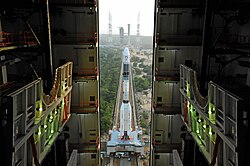 Fully integrated GSLV-F05 coming out of the Vehicle Assembly Building.
 -
 INSAT-3DR launch
 -
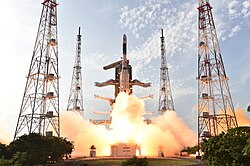 GSLV F05 take off
 -
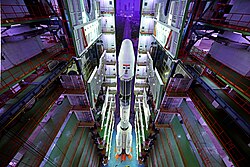 Top view of a fully Integrated GSLV-F08 inside the Vehicle Assembly Building.
 -
 GSLV F08 lift off.
 -
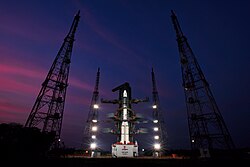 GSLV F11 vehicle at Second Launch Pad.
 -
 GSAT-7A launch
 -
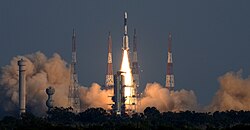 Launch of GSLV F11 from Second Launch Pad.
 -
 EOS-03 launch
 -
 NVS-01 launch
 -
 INSAT-3DS launch
 -
 NVS-02 at SLP before launch
 -
NISAR at SLP before launch
-
 NISAR during Liftoff


See also[edit | edit source]
References[edit | edit source]
- ↑ 1.0 1.1 1.2 Kyle, Ed (28 December 2010). "Page 2 of 2: Comprehensive Orbital Launch Failure List". India (SLV/ASLV/PSLV/GSLV) Flight History by Variant/Year (1979–2010). Retrieved 14 August 2013.
{{cite web}}: CS1 maint: deprecated archival service (link) - ↑ "Press Brief on GSLV-D1/GSAT-1". ISRO. 24 April 2001.
- ↑ Ramachandran, R. (22 January 2014). "GSLV Mk III, the next milestone". Frontline.
- ↑ "ISRO clears launch of GSLV-D5". Business Standard. 31 December 2013. Retrieved 20 January 2014.
- ↑ "Isro successfully launches indigenous cryogenic engine-powered GSLV-D5". The Times Of India. Retrieved 5 January 2014.
- ↑ "GSLV-D5-Success". ISRO. Archived from the original on 4 January 2014. Retrieved 5 January 2014.
- ↑ Subramanian, T.S. (5 January 2014). "GSLV-D5 Launch Success". The Hindu. Chennai, India. Archived from the original on 6 January 2014. Retrieved 5 January 2014.
- ↑ "Made in India South Asia Satellite to be launched on 5 May 2017". PTI. 30 April 2017.
- ↑ "Official Press Release: GSLV Successfully Launches South Asia Satellite". Press Information Bureau. 5 May 2017.
- ↑ Sinha, Amitabh (6 May 2017). "South Asian diplomacy lifts off on 2230-kg ISRO satellite GSAT-9". The Indian Express.
- ↑ 11.0 11.1 Clark, Stephen (6 May 2017). "India launches satellite linking its South Asian neighbors". Spaceflight Now.
- ↑ "India's SAARC satellite proposal: a boost to a multilateral space agenda". The Space Review. 18 August 2014. Retrieved 22 April 2015.
- ↑ "List of GSLV launches". isro.org. ISRO. Archived from the original on 13 August 2021. Retrieved 14 December 2020.
- ↑ "GSLV-D2 Mission". ISRO. Archived from the original on 14 March 2009.
- ↑ "EDUSAT mission". ISRO. Archived from the original on 18 March 2009.
- ↑ "GSLV-F02 Failure Analysis Committee Report". www.spaceref.com. Retrieved 20 August 2021.
{{cite web}}: CS1 maint: deprecated archival service (link) - ↑ 17.0 17.1 From Fishing Hamlet to Red Planet: India's Space Journey. HarperCollins Publishers India. 15 December 2015. ISBN 9789351776895.
- ↑ Clark, Stephen (2 September 2007). "India's large satellite launcher returns to flight". Spaceflight Now.
- ↑ "INSAT-4CR successfully placed in orbit". Times of India. 2 September 2007.
- ↑ "GSLV-F04 Launch Successful – Places INSAT-4CR in orbit". ISRO. Archived from the original on 1 March 2009.
- ↑ "ISRO refutes INSAT-4CR "disappearance" story". Hindustan Times. Archived from the original on 12 November 2013.
- ↑ "First manoeuvre to raise satellite's orbit". The Hindu. Sriharikota. Retrieved 19 November 2015.
- ↑ "GSLV-D3 Failure Analysis Report". ISRO. Archived from the original on 23 August 2016. Retrieved 14 December 2020.
- ↑ "GSLV-F06 Failure-Preliminary findings and Further steps - ISRO". www.isro.gov.in. Retrieved 20 August 2021.
- ↑ "Rocket failed after 45 seconds, says ISRO". Hindustan Times. 25 December 2010. Archived from the original on 26 December 2010. Retrieved 25 December 2010.
- ↑ "GSLV-D5 rocket launch delayed, countdown clock stopped due to leak in second stage". NDTV. Retrieved 27 November 2013.
- ↑ Varma, M. Dinesh (31 October 2013). "Another shot at GSLV with indigenous cryogenic engine". The Hindu. Chennai, India. Retrieved 27 November 2013.
- ↑ "Preparations in full swing for December 15 GSLV mission". Hindustan Times. Archived from the original on 6 November 2013. Retrieved 27 November 2013.
- ↑ "GSAT-14 Separated". Twitter. 5 January 2014. Retrieved 5 January 2014.
- ↑ "Performance of Cryogenic stage of GSLV D5 normal. Ignition sustained". Twitter. 5 January 2014. Retrieved 5 January 2014.
- ↑ "ISRO's GSLV D-6 puts GSAT-6 satellite in orbit". The Hindu. 27 August 2015.
- ↑ "GSAT 6". Retrieved 1 July 2014.
- ↑ "GSAT-6 slated for March launch". The Hindu. 29 October 2014. Retrieved 27 August 2015.
- ↑ "ISRO's desi cryo engine–powered GSLV-F05 places INSAT-3DR weather satellite in orbit". Times of India. 8 September 2016. Retrieved 8 September 2016.
- ↑ Clark, Stephen. "GSLV puts advanced Indian weather satellite in orbit". Spaceflight Now. Retrieved 8 September 2016.
- ↑ "GSLV-F05 lobs advanced weather satellite INSAT-3DR into orbit". The Hindu. 8 September 2016. Retrieved 8 September 2016.
- ↑ "Made in India South Asia Satellite to be launched on 5 May 2017". PTI. 30 April 2017.
- ↑ Sinha, Amitabh (6 May 2017). "South Asian diplomacy lifts off on 2230-kg ISRO satellite GSAT-9". The Indian Express.
- ↑ "GSLV F08-GSAT-6A Brochure". isro.gov.in. Indian Space Research Organisation. Archived from the original on 10 July 2021. Retrieved 29 March 2018.
- ↑ "ISRO Loses communication with GSAT-6A". The Economic Times. April 2018. Retrieved 1 April 2018.
- ↑ "Status Update of GSAT-6A". isro.gov.in. Archived from the original on 1 April 2018. Retrieved 1 April 2018.
- ↑ "ISRO confirms losing contact with communication satellite GSAT-6A". The Times of India. Retrieved 1 April 2018.
- ↑ "GSLV Successfully Launches GSAT-6A Satellite". Press Information Bureau. 29 March 2018.
- ↑ "29న జిఎస్ఎల్వీ- ఎఫ్08 ప్రయోగం". Prajasakti News. Retrieved 2 March 2018.
- ↑ "GSLV-F08/GSAT-6A Mission". ISRO. 18 November 2017. Archived from the original on 18 November 2017. Retrieved 2 April 2018.
- ↑ "India's 19 upcoming missions, and ISRO's Small Satellite Launch Vehicle (SSLV)". SpaceTech Asia. 28 August 2018. Retrieved 29 August 2018.
- ↑ "Isro lines up 3 rocket launches in two months". The Times of India. Retrieved 7 November 2018.
- ↑ "19న నింగిలోకి జీఎస్ఎల్వీ-ఎఫ్ 11 రాకెట్ | Daily Newspaper in Telugu | Telugu News Headlines | Andhrabhoomi". andhrabhoomi.netn. Retrieved 3 December 2018.
- ↑ "ISRO's GSLV-F11/Gsat-7A mission successful, satellite meant for military applications placed in orbit". The Times of India. 19 December 2018. Retrieved 19 December 2018.
- ↑ "ISRO plans to launch geo imaging satellite on August 12". The Hindu. 10 July 2021. Retrieved 10 July 2021.
- ↑ "SDSC-SHAR - Upcoming Missions". Satish Dhawan Space Centre. Retrieved 23 March 2021.
- ↑ Indian Space Research Organization [@isro] (12 August 2021). "GSLV-F10 launch took place today at 0543 Hrs IST as scheduled. Performance of first and second stages was normal. However, Cryogenic Upper Stage ignition did not happen due to technical anomaly. The mission couldn't be accomplished as intended" (Tweet) – via Twitter.
- ↑ "India's GSLV fails on long-delayed EOS-03 mission". NASASpaceFlight.com. 11 August 2021. Retrieved 12 August 2021.
- ↑ "GSLV failure to have an impact on India's human space mission". Business Standard India. 12 August 2021. Retrieved 12 August 2021.
- ↑ "GSLV-F10 / GISAT-1". ISRO. Archived from the original on 28 April 2021. Retrieved 25 February 2020.
- ↑ "Planned Launches of GSLV" (PDF). VSSC. Retrieved 22 December 2019.
- ↑ 57.0 57.1 57.2 "Annual Report 2022-2023" (PDF). ISRO. 23 March 2023. Archived from the original (PDF) on 25 March 2023. Retrieved 23 March 2023.
- ↑ "SDSC-SHAR Website". www.shar.gov.in. Retrieved 16 July 2021.
- ↑ "2021 GSLV mission failed due to loss of pressure in fuel tank:Isro". www.hindustantimes.com. 20 November 2021. Retrieved 20 November 2021.
- ↑ "GSLV-F10/EOS-03 Mission Failure: Failure Analysis Committee submits conclusions & recommendations - ISRO". www.isro.gov.in. Retrieved 25 March 2022.
- ↑ "ISRO's GSLV-F12 successfully places navigation satellite NVS-01 into intended orbit". The Hindu. 29 May 2023. ISSN 0971-751X. Retrieved 1 June 2023.
- ↑ "India's navigation system gets a boost after ISRO successfully launches NVS-01 satellite". Hindustan Times. 30 May 2023. Retrieved 1 June 2023.
- ↑ "Isro's GSLV-F12 successfully places navigation satellite NVS-01". The Times of India. 29 May 2023. ISSN 0971-8257. Retrieved 29 May 2023.
- ↑ "GSLV-F12/NVS-01 Mission". www.isro.gov.in. Retrieved 29 May 2023.
- ↑ "GSLV-F14/INSAT-3DS Gallery". www.isro.gov.in. Retrieved 8 February 2024.
- ↑ "Isro gears up for multiple launches; Spadex to demonstrate space docking on December 20". The Times of India. ISSN 0971-8257. Retrieved 25 November 2024.
- ↑ "2024 to be a year of Gaganyaan readiness: ISRO Chairman". New India Express. 1 January 2024.
- ↑ "Amendment 33: A.27 NISAR Research and Applications Science Team Deferred to ROSES-25". Science Mission Directorate. 18 July 2024. Retrieved 30 July 2024.
- ↑ 69.0 69.1 "ISRO reveals new schedule, 7 launches planned in next 5 months". News9live. 4 November 2025. Retrieved 22 November 2025.
- ↑ D.S., Madhumathi (2 April 2019). "Starting May, ISRO to launch a string of "defence" satellites". The Hindu. Retrieved 2 April 2019.
- ↑ Krebs, Gunter (10 April 2021). "GISAT 1, 2 (EOS 03, 05)". Gunter's Space Page. Retrieved 29 April 2021.
- ↑ "ISRO 'going to have exciting missions' in 2023, says Chairman Somanath". www.livemint.com. 30 July 2023. Retrieved 30 July 2023.
- ↑ "Gaganyaan: More than 2 uncrewed missions on cards". Retrieved 25 July 2021.
- ↑ 74.0 74.1 Kumar, Chethan (12 March 2021). "Isro aims for 7 more launches from India in 2021". The Times of India. Retrieved 29 April 2021.
- ↑ 75.0 75.1 Kumar, Chethan (6 April 2022). "2 Gaganyaan abort tests in August, December; relay satellites next year". The Times of India. Retrieved 25 June 2022.
- ↑ 76.0 76.1 D.S., Madhumathi (6 January 2020). "New data relay satellites to keep Gaganyaan crew in touch with Earth". The Hindu. Retrieved 6 January 2020.
- ↑ "2024 to be a year of Gaganyaan readiness: ISRO Chairman". New India Express. 1 January 2024.
- ↑ "2024 to be a year of Gaganyaan readiness: ISRO Chairman". New India Express. 1 January 2024.
- ↑ "Annual Report, Department of Space 2020-2021" (PDF). 4 March 2021. Archived from the original (PDF) on 4 March 2021.
GEV for Orbital Re-entry Experiment (ORE): Launch with 1:8 scale RLV, targeted in first quarter of 2022.
- ↑ "Reusable Launch Vehicle". www.vssc.gov.in. Retrieved 2 April 2023.
- ↑ "75 Major Activities of ISRO" (PDF). Archived from the original (PDF) on 18 February 2022.

