





CleanupBot (talk | contribs) m →By Train: clean up |
WikiDwarfBOT (talk | contribs) Cleanup: Source modification. Information added. |
||
| Line 1: | Line 1: | ||
{{About|the city in Uttar Pradesh, India | {{About|the city in Uttar Pradesh, India|other locations}} | ||
{{Use British English|date=March 2013}} | {{Use British English|date=March 2013}} | ||
{{Use dmy dates|date= | {{Use dmy dates|date=March 2022}} | ||
<!-- See [[Wikipedia:WikiProject Indian cities]] for details -->{{Infobox settlement | <!-- See [[Wikipedia:WikiProject Indian cities]] for details -->{{Infobox settlement | ||
| name | | name = Faizabad | ||
| native_name_lang = | |||
| native_name_lang | | settlement_type = City | ||
| image_skyline = {{photomontage | |||
| settlement_type | |||
| image_skyline | |||
| photo1a = TilakHall.jpg | | photo1a = TilakHall.jpg | ||
| photo2a = Gulabbari.JPG | | photo2a = Gulabbari.JPG | ||
| photo3a = Maqbara with palm trees.JPG | | photo3a = Maqbara with palm trees.JPG | ||
}} | }} | ||
| image_alt | | image_alt = | ||
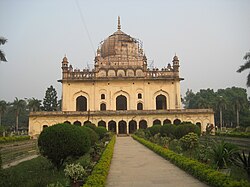
| image_caption | | image_caption = Tilak Hall, [[Gulab Bari]], [[Bahu Begum ka Maqbara]] | ||
| nickname | | nickname = | ||
| pushpin_map | | pushpin_map = India Uttar Pradesh#India3 | ||
| pushpin_label_position | | pushpin_label_position = right | ||
| pushpin_map_alt | | pushpin_map_alt = | ||
| pushpin_map_caption | | pushpin_map_caption = Location in Uttar Pradesh, India | ||
| coordinates | | coordinates = {{coord|26.773|N|82.146|E|display=inline,title}} | ||
| subdivision_type | | subdivision_type = Country | ||
| subdivision_name | | subdivision_name = {{flag|India}} | ||
| subdivision_type1 | | subdivision_type1 = [[States and territories of India|State]] | ||
| subdivision_type2 | | subdivision_name1 = [[Uttar Pradesh]] | ||
| | | subdivision_type2 = [[List of divisions in India|Division]] | ||
| | | subdivision_name2 = [[Ayodhya division|Ayodhya]] | ||
| established_title | | subdivision_type3 = [[List of districts of India|District]] | ||
| established_date | | subdivision_name3 = [[Ayodhya district|Ayodhya]] | ||
| founder | | established_title = <!-- Established --> | ||
| named_for | | established_date = | ||
| government_type | | founder = | ||
| governing_body | | named_for = | ||
| unit_pref | | government_type = [[Municipal corporation]] | ||
| area_footnotes | | governing_body = [[Ayodhya Municipal Corporation]] | ||
| area_total_km2 | | leader_title = Mayor | ||
| area_rank | | leader_name = Rishikesh Upadhyay, ([[Bharatiya Janata Party|BJP]])<ref>{{cite news |last1=Pandey |first1=Alok |last2=Nair |first2=Arun |title=BJP's Rishikesh Upadhayay Elected First Mayor Of Ayodhya |url=https://www.ndtv.com/india-news/bjps-rishikesh-upadhayay-elected-first-mayor-of-ayodhya-1782532 |access-date=1 March 2022 |work=NDTV |date=1 December 2017}}</ref> | ||
| elevation_footnotes | | unit_pref = Metric | ||
| elevation_m | | area_footnotes = | ||
| population_total | | area_total_km2 = 16.02 | ||
| population_as_of | | area_rank = | ||
| population_footnotes | | elevation_footnotes = | ||
| population_density_km2 | | elevation_m = 97 | ||
| population_rank | | population_total = 165,228 | ||
| population_demonym | | population_as_of = 2011 | ||
| demographics_type1 | | population_footnotes = <ref name=2011census-PCA-A4/> | ||
| demographics1_title1 | | population_density_km2 = auto | ||
| timezone1 | | population_rank = | ||
| utc_offset1 | | population_demonym = | ||
| postal_code_type | | demographics_type1 = [[Language]] | ||
| postal_code | | demographics1_title1 = Official | ||
| area_code | | timezone1 = [[Indian Standard Time|IST]] | ||
| area_code_type | | utc_offset1 = +5:30 | ||
| registration_plate | | postal_code_type = [[Postal Index Number|PIN]] | ||
| blank1_name_sec1 | | postal_code = 224001 | ||
| blank1_info_sec1 | | area_code = [[Telephone numbers in India|+91-5278]] | ||
| website = {{URL|ayodhya.nic.in/}} | | area_code_type = Telephone code | ||
| footnotes = | | registration_plate = UP-42 | ||
| demographics1_info1 | | blank1_name_sec1 = [[Human sex ratio|Sex ratio]] | ||
| demographics1_title2 | | blank1_info_sec1 = 998/1000 [[male|♂]]/[[female|♀]] | ||
| demographics1_info2 | | website = {{URL|ayodhya.nic.in/}} | ||
| footnotes = | |||
| demographics1_info1 = [[Hindi]]<ref name="nclm.nic.in">{{cite web|url=http://nclm.nic.in/shared/linkimages/NCLM50thReport.pdf |title=50th Report of the Commissioner for Linguistic Minorities in India |access-date=4 November 2016 |url-status=dead |archive-url=https://web.archive.org/web/20160708012438/http://nclm.nic.in/shared/linkimages/NCLM50thReport.pdf |archive-date=8 July 2016 }}</ref> | |||
| demographics1_title2 = Additional official | |||
| demographics1_info2 = [[Urdu]]<ref name="nclm.nic.in"/> | |||
| demographics1_title3 = Regional | |||
| demographics1_info3 = [[Awadhi language|Awadhi]] | |||
}} | }} | ||
'''Faizabad''' is a city in | '''Faizabad''' (Hindustani pronunciation: [[Help:IPA/Hindi and Urdu|[fɛːzaːbaːd]]]) is a city located in [[Ayodhya district]] in the Indian state of [[Uttar Pradesh]]. It is situated on southern the bank of the [[Ghaghara|River Saryu]] about 130 km east of state capital [[Lucknow]]. Faizabad was the first capital of the [[Nawabs of Awadh]] and has monuments built by the Nawabs, like the [[Bahu Begum ka Maqbara|Tomb of Bahu Begum]], [[Gulab Bari]]. It was also the headquarters of Faizabad district (now [[Ayodhya district]]) and Faizabad division (now [[Ayodhya division]]) before November 2018.<ref>{{cite web |title=UP cabinet approves renaming of Faizabad as Ayodhya |url=https://timesofindia.indiatimes.com/city/lucknow/up-cabinet-approves-renaming-of-faizabad-as-ayodhya-allahabad-as-prayagraj/articleshow/66605791.cms |publisher=[[India Today]] |author=PTI |date=6 November 2018 |access-date=24 April 2019}}</ref><ref>{{Cite web|url=https://ayodhya.nic.in/about-district/|title=About District {{!}} District Ayodhya - Government of Uttar Pradesh|website=District Ayodhya - Government of Uttar Pradesh}}</ref> Faizabad is a twin city of [[Ayodhya]] and it is administered by [[Ayodhya Municipal Corporation]]. | ||
==History== | ==History== | ||
{{Main|Awadh|Nawab of Awadh}} | {{Main|Awadh|Nawab of Awadh}} | ||
{{See also|Oudh State}} | {{See also|Oudh State}} | ||
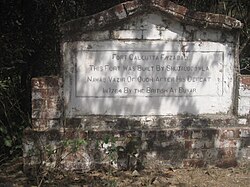
[[File:Fort Calcutta.JPG|thumb|left|Fort Calcutta]] | [[File:Fort Calcutta.JPG|thumb|left|Fort Calcutta]] | ||
[[File: | [[File:Palace complex with harem gardens, India.png|thumb|Miniature. "A Palace Complex with Harem Gardens" India, Faizabad or Lucknow; c. 1765]] | ||
{{multiple image | {{multiple image | ||
| Line 83: | Line 88: | ||
}} | }} | ||
According to ''[[The Imperial Gazetteer of India]]'', "[w]hen [[:Saadat Ali Khan I|Saadat Khan]] was appointed governor of [[Oudh State|Oudh]] he built a hunting lodge 4 miles west of [[Ayodhya]] [in 1730<ref name=faizabad.nic.in/>], then the head-quarters of the province. Gardens were laid out and shops sprang up in the neighbourhood, and during the time of his successor [[Safdar Jang]] the name Faizabad was first applied. [[Shuja-ud-Daula|Shuja-ud-daula]], the third Nawab, lived chiefly at [[:Lucknow]] during the early part of his reign; but after his defeat at [[Battle of Buxar|Buxar in 1764]] he made Faizabad his residence, and during the remainder of his life added largely to its defences and also laid a large town. Shuja-ud-daula died early in 1775, and before the close of the year [[:Asaf-ud-Daula|Asaf-ud-daula]] moved permanently to Lucknow. The importance of Faizabad declined, but it remained the home of Asaf-ud-daula's grandmother and mother, the Nawab Begam and Bahu Begam, whose treatment was the subject of charges against [[Warren Hastings]]. After the death of Bahu Begam in 1816 Faizabad decayed still farther".<ref>{{cite book |url=https://dsal.uchicago.edu/reference/gazetteer/pager.html?volume=12&objectid=DS405.1.I34_V12_001.gif |section-url=https://dsal.uchicago.edu/reference/gazetteer/pager.html?volume=12&objectid=DS405.1.I34_V12_123.gif|title=Imperial Gazetteer of India |volume=12 |section=Fyzabad |page=117 |date=1908}}</ref> Oudh State was annexed by the British in 1856. Local self-government for Ayodhya and Faizabad was introduced in 1865. The two cities were administered jointly as a municipality.<ref name="Imperial Gazetteer of India, v. 12, p. 118.">{{cite book |url=https://dsal.uchicago.edu/reference/gazetteer/pager.html?volume=12&objectid=DS405.1.I34_V12_001.gif |section-url=https://dsal.uchicago.edu/reference/gazetteer/pager.html?volume=12&objectid=DS405.1.I34_V12_124.gif|title=Imperial Gazetteer of India |volume=12 |section=Fyzabad |page=118|date=1908}}</ref> | |||
=== Establishment of Princely state of | === Establishment of Princely state of Awadh === | ||
Gulab Bari stands in a garden surrounded by a wall, approachable through two large gateways. These buildings are particularly interesting for their assimilative architectural styles. Shuja-ud-daula's wife was the well known Bahu Begum, who married the Nawab in 1743 and continued to reside in Faizabad, her residence being the Moti-Mahal. Close by at Jawaharbagh lies her Maqbara, where she was buried after her death in 1816. It is considered to be one of the finest buildings of its kind in Avadh, which was built at the cost of three lakh rupees by her chief advisor Darab Ali Khan. A fine view of the city is obtainable from top of the begum's tomb. Bahu Begum was a woman of great distinction and rank, bearing dignity. Most of the Muslim buildings of Faizabad are attributed to her. From the date of Bahu Begum's death in 1815 until the annexation of Avadh, the city of Faizabad gradually fell into decay. The glory of Faizabad finally eclipsed with the shifting of capital from Faizabad to Lucknow by Nawab [[Asaf-ud-daula]].<ref name=faizabad.nic.in>{{cite web|url=http://faizabad.nic.in/history.htm|title=Welcome to Faizabad History|publisher=official website of Faizabad district|access-date=29 June 2012|archive-url=https://web.archive.org/web/20111228201603/http://faizabad.nic.in/history.htm|archive-date=28 December 2011|url-status=dead}}</ref> | |||
{{Clear}} | |||
Faizabad | Faizabad was also a centre of one of many battles of the Mutiny of 1857. A detailed history of Faizabad can be read in 'Tareekh-e-Farahbaksh', written by Munshi Mohd. Faiz Baksh, (after whom Faizabad is named) a courtier in the Shuja-ud-Daula's court. This book has been translated into English by Hamid Afaq Qureshi as 'Memoirs of Faizabad'. Faizabad also finds a prominent and detailed mention in ''[[Guzashta Lucknow]]'' written by [[Abdul Halim Sharar]]. The fourth nawab of Awadh, Nawab [[Asaf-ud-Daula]], shifted the Capital of Avadh to Lucknow in 1775 after his terms with his mother became sour.<ref>{{cite web|url=http://www.myuttarpradesh.co.in/faizabad.html|title=History of Faizabad|publisher=myuttarpradesh.co.in/|access-date=29 June 2012|url-status=dead|archive-url=https://web.archive.org/web/20120701141026/http://www.myuttarpradesh.co.in/faizabad.html|archive-date=1 July 2012}}</ref> | ||
=== Hanging of Ashfaqulla Khan === | |||
[[File:Mir Hasan,‘Id ki tahniyat.jpg|thumb|Small Street with Shops in Faizabad]] | |||
[[File:Lucknow, Mir Hasan,‘Id ki tahniyat.png|Difficult Roads Leading to Faizabad from‘Id ki tahniyat, 1822|thumb|left]] | |||
[[Ashfaqulla Khan]] was hanged in Faizabad jail on 19 December 1927 for his role in the [[Kakori conspiracy|Kakori Train robbery]] on 9 August 1925.<ref name=pib.nic.in>{{cite web |url=http://pib.nic.in/feature/feyr2000/fdec2000/f151220001.html|archive-url=https://web.archive.org/web/20021105203929/http://pib.nic.in/feature/feyr2000/fdec2000/f151220001.html |archive-date=5 November 2002 |title=Ashfaqulla Khan: The Immortal Revolutionary |first1=N.P. |last1=Shankaranarayana Rao |work=Press Information Bureau, Government of India |access-date=27 August 2019}}</ref><ref name=TOI-02Aug04>{{cite news |work=The Times of India (newspaper)|title=Daredevilry of sons of the soil |first=Aparna |last=Singh |date=2 August 2004 |url=http://timesofindia.indiatimes.com/articleshow/799244.cms |access-date=7 January 2018}}</ref> | |||
==Demographics== | |||
{{Pie chart | |||
|label1=[[Hinduism]]|value1=69.89|color1=orange | |||
|label2=[[Islam]]|value2=28.32|color2=Green | |||
|label3=[[Sikhism]]|value3=0.83|color3=yellow | |||
|label4=[[Christianity]]|value4=0.23|color4=blue | |||
|label5=[[Jainism]]|value5=0.06|color5=Maroon | |||
|label6=[[Buddhism]]|value6=0.04|color6=red | |||
|label7=Others|value7=0.01|color7=Grey | |||
|label8=Not Stated|value8=0.62|color8=Black|caption=Religions in Faizabad municipal council (2011)<ref name="2011 Census">{{citation |title=Religion PCA (India & States/UTs/District/Sub-Distt/Town Level) – Uttar Pradesh |url=https://censusindia.gov.in/2011census/Religion_pca/RL-0900.xlsx |work=[[2011 Census of India]], Office of the Registrar General & Census Commissioner, India}}</ref>}} | |||
Faizabad | The [[2011 Census of India]] has separate data for Faizabad municipal council (N.P.P.) and Faizabad Cantonment, which were counted as separate towns:<ref name=2011_MDDS/> | ||
*Faizabad municipal council (N.P.P.), which had a population of 165,228 in 28,150 households.<ref name=2011_MDDS>{{citation |url=https://censusindia.gov.in/pca/pcadata/DDW_PCA0946_2011_MDDS%20with%20UI.xlsx |title=Primary Census Abstract Data Tables – Uttar Pradesh – Faizabad district |work=[[2011 Census of India]], Office of the Registrar General & Census Commissioner, India}}</ref><ref name=2011census-PCA-A4/> | |||
*Faizabad Cantonment, which had a population of 12,391 in 2,014 households.<ref name=2011_MDDS/><ref name=2011census-PCA-A4/> | |||
The following data are for Faizabad municipal council in the 2011 census. | |||
*There were 85,620 males and 79,608 females.<ref name=2011_MDDS/><ref name=2011census-PCA-A4/> The [[sex ratio]] was 929.8 females per 1,000 males.<ref name=2011_MDDS/> | |||
*There were 17,781 children of six and under:<ref name=2011_MDDS/> 9,310 boys and 8,471 girls, giving a sex ratio of 909.9 girls per 1,000 boys.<ref name=2011_MDDS/> | |||
*There were 123,895 literates (84% of the population over six), of which 66,519 were male and 57,376 were female (78% and 72% of the male and female population over six).<ref name=2011_MDDS/> | |||
The following data are for Faizabad Cantonment in the 2011 census. | |||
*There were 7,744 males and 4,647 females.<ref name=2011_MDDS/><ref name=2011census-PCA-A4/> The [[sex ratio]] was 600.1 females per 1,000 males.<ref name=2011_MDDS/> | |||
*There were 1,368 children of six and under:<ref name=2011_MDDS/> 716 boys and 652 girls, giving a sex ratio of 910.6 girls per 1,000 boys.<ref name=2011_MDDS/> | |||
*There were 9,783 literates (89% of the population over six), of which 6,595 were male and 3,188 were female (85% and 69% of the male and female population over six).<ref name=2011_MDDS/> | |||
{{Historical populations | |||
|title = Historical population of Faizabad (excluding the cantonment) | |||
{{ | |align = | ||
| | |footnote = | ||
| align | |source = <ref name=2011census-PCA-A4>{{citation |url=http://censusindia.gov.in/2011census/PCA/A4.html |title=A -4 Towns And Urban Agglomerations Classified By Population Size Class In 2011 With Variation Since 1901 |work=[[2011 Census of India]], Office of the Registrar General & Census Commissioner, India}}</ref> | ||
| | |graph-pos = | ||
| | |graph-width = | ||
| | |graph-height = | ||
| | |percol = | ||
| | |cols = | ||
|perrow = | |||
|rows = | |||
| 1901 | 71,179 | |||
| 1911 | 54,655 | |||
| 1921 | 56,620 | |||
| 1931 | 59,992 | |||
| 1941 | 55,215 | |||
| 1951 | 76,582 | |||
| 1961 | 83,717 | |||
| 1971 | 102,835 | |||
| 1981 | 101,873 | |||
| 1991 | 124,437 | |||
| 2001 | 144,705 | |||
| 2011 | 165,228 | |||
}} | }} | ||
{{Historical populations | |||
|title = Historical population of Faizabad Cantonment | |||
|align = | |||
== | |footnote = | ||
|source = <ref name=2011census-PCA-A4/> | |||
| | |graph-pos = | ||
| | |graph-width = | ||
| | |graph-height = | ||
| | |percol = | ||
| | |cols = | ||
| | |perrow = | ||
|rows = | |||
| 1931| 5,726 | |||
| 1941| 2,417 | |||
| 1951| 5,916 | |||
| | | 1961| 4,579 | ||
| 1971| 6,971 | |||
| 1981| 10,794 | |||
| 1991| 11,843 | |||
| 2001| 14,040 | |||
| 2011| 12,391 | |||
}} | }} | ||
{{See also|List of cities in Uttar Pradesh}} | {{See also|List of cities in Uttar Pradesh}} | ||
| Line 136: | Line 177: | ||
===Climate=== | ===Climate=== | ||
Summer (March to July) temperatures can range from 35 to 45 | Typical of the central plains of India, Faizabad has a monsoon-influenced [[humid subtropical climate]] ([[Köppen climate classification|Köppen]] ''Cwa''). Summer (March to July) temperatures can range from {{convert|35|to|45|C|F}}, whilst winter (November to February) temperatures can range from {{convert|6|to|25|C|F|1}}. More than 85 percent of the annual rainfall of {{convert|1100|mm|in|0|disp=or}} falls during the southwest monsoon from June to September. | ||
{{Weather box | {{Weather box | ||
| | | width = auto | ||
| location = Faizabad (1971–2000, extremes 1959–2003) | | location = Faizabad (1971–2000, extremes 1959–2003) | ||
| metric first = Yes | | metric first = Yes | ||
| Line 262: | Line 302: | ||
==Transport== | ==Transport== | ||
===By Road=== | ===By Road=== | ||
Faizabad is situated on National Highway | Faizabad is situated on National Highway 27 and has connectivity with [[Kanpur]] (213 km), [[Lucknow]] (127 km), [[Varanasi]] (202 km), [[Prayagraj]] (161 km) and [[Gorakhpur]] (165 km). The state government's Road Transport Service runs regular and frequent buses to and from these cities. | ||
[[National Highway 27 (India)|NH27]] connects [[Lucknow]] to [[Barauni]] via Faizabad and [[Gorakhpur]] whilst [[National Highway 330 (India)|NH330]] connects Faizabad to [[ | [[National Highway 27 (India)|NH27]] connects [[Lucknow]] to [[Barauni]] via Faizabad and [[Gorakhpur]] whilst [[National Highway 330 (India)|NH330]] connects Faizabad to [[Prayagraj]] via [[Sultanpur, Uttar Pradesh|Sultanpur]]. [[Nawab Yusuf Road]] connects Faizabad to [[Varanasi]] via [[Jaunpur, Uttar Pradesh|Jaunpur]], [[National Highway 330A (India)|NH330A]] connects Faizabad to [[Raebareli]] via [[Kumarganj, Ayodhya]] and [[Jagdispur|Jagdishpur]] and [[NH 330]] connects Faizabad to Bharich via [[Gonda district|Gonda]], NH 330C is connected by [[Azamgarh]] to Faizabad via [[Ambedkar Nagar]] and [[Balrampur]] is connected by Faizabad via [[National Highway (India)|NH334]] and [[Utraula]] and [[Mankapur]] connects Faizabad by SH14. | ||
===By Train=== | ===By Train=== | ||
| Line 270: | Line 310: | ||
| align = right | | align = right | ||
| width1 = {{#expr: (150 * 1600 / 1200) round 0}} | | width1 = {{#expr: (150 * 1600 / 1200) round 0}} | ||
| caption1 = [[ | | caption1 = [[Ayodhya Cantt railway station|Ayodhya Cantt]] in Faizabad | ||
| image2 = Ayodhya Jn.jpg | | image2 = Ayodhya Jn.jpg | ||
| width2 = {{#expr: (150 * 1024 / 768) round 0}} | | width2 = {{#expr: (150 * 1024 / 768) round 0}} | ||
| caption2 = [[Ayodhya Junction]] in | | caption2 = [[Ayodhya Junction railway station]] in Ayodhya. | ||
}} | }} | ||
[[Ayodhya Cantt railway station]]: | |||
The [[Indian Railways]] network connects Faizabad directly with [[Kanpur]] (4 hours) [[Lucknow]] (3 hours | The [[Indian Railways]] network connects Faizabad directly with [[Kanpur]] (4 hours) [[Lucknow]] (3 hours), [[Varanasi]] (4 hours.) and [[Prayagraj]] (5 hours). | ||
[[File:Ayodhya Cantt railway station, Faizabad, Ayodhya district.jpg|thumb|Faizabad railway station, Faizabad, Ayodhya district. In October 2021, the chief minister of Uttar Pradesh, Yogi Adityanath, decided to rename the station "Ayodhya Cantt railway station".<ref>{{cite news |url=https://www.telegraphindia.com/india/uttar-pradesh-government-to-rename-faizabad-railway-station-as-ayodhya-cantt/cid/1835645 |title=UP govt to rename Faizabad railway station as Ayodhya Cantt |work=[[The Telegraph (India)]] |date=23 October 2021}}</ref> Indian Railways approved the change on 2 November 2021.<ref name="newindianexpress-02Nov21">{{cite news |url=https://www.newindianexpress.com/nation/2021/nov/02/faizabad-junction-railway-station-renamed-as-ayodhya-cantt-railways-2378895.html |title=Faizabad Junction railway station renamed as Ayodhya Cantt: Railways |work=[[The New Indian Express]] |date=2 November 2021}}</ref>]] | |||
[[ | [[Ayodhya Cantt Superfast Express]] is a train which runs weekly connecting [[Ayodhya Cantt railway station]] to [[Lokmanya Tilak Terminus]], Mumbai. Its one of the two trains which runs between Faizabad to Mumbai the other one is [[Saket Express]] which runs twice a week. It is numbered as 22103/22104. [[Rameswaram - Faizabad Shraddha Sethu Express]] is a weekly Superfast Express connecting [[Rameswaram]] in [[Tamil Nadu]] and Faizabad in [[Uttar Pradesh]]. It takes nearly 3 days to reach the destination and one of the longest running train in India. A few mail express trains also connect Faizabad to [[Kolkata]], New Delhi and [[Mumbai]]. In addition, the Faizabad-Delhi express runs daily from Faizabad to Delhi and Delhi to Faizabad, whilst a new railway line will be proposed from [[Lalganj, Uttar Pradesh|Lalganj]] to Faizabad via [[Raebareli]] Akberganj station. | ||
Faizabad Delhi express runs daily from Faizabad to Delhi and Delhi to Faizabad | |||
[[Ayodhya Junction railway station]]: | |||
[[Ayodhya Junction]] is the second major railway station | [[Ayodhya Junction]] is the second major railway station in [[Ayodhya]] city. | ||
[[Acharya Narendra Dev Nagar railway station]]: | |||
This station is another gateway to the city via rail and it lies in the heart of the city. | |||
===By Air=== | ===By Air=== | ||
Currently, the nearest airports are [[Lucknow International Airport]] (128 km), [[Prayagraj Airport]] (144 km) and [[Varanasi International Airport]] (200 km). | |||
[[Ayodhya International Airport]] is currently under construction. | |||
==Places of interest== | ==Places of interest== | ||
===Tourism=== | ===Tourism=== | ||
[[Image:Gulab Bari.jpg|thumb|right|200px|Gulab Bari is the tomb of the third [[Nawab]] of [[Awadh]] Nawab [[Shuja-ud-Daula]] in Faizabad]] | [[Image:Gulab Bari.jpg|thumb|right|200px|Gulab Bari is the tomb of the third [[Nawab]] of [[Awadh]], Nawab [[Shuja-ud-Daula]] in Faizabad]] | ||
'''[[Gulab Bari]]''': Literally meaning 'Garden of Roses', the tomb of [[Nawab]] [[Shuja-ud-Daula]] (third Nawab of [[Awadh]]), this place has a | '''[[Gulab Bari]]''': Literally meaning 'Garden of Roses', the tomb of [[Nawab]] [[Shuja-ud-Daula]] (third Nawab of [[Awadh]]), this place has a collection of [[rose]]s of various varieties set by the sides of water fountains. Gulab Bari also houses a maqbara (Mausoleum) of [[Nawab Shuja-ud-Daula]] in the campus. | ||
[[Image:Bahu Begum ka Maqbara.jpg|thumb|right|200px|Bahu Begum ka Maqbara (Bahu Begum's Mausoluem) in Faizabad]] | [[Image:Bahu Begum ka Maqbara.jpg|thumb|right|200px|Bahu Begum ka Maqbara (Bahu Begum's Mausoluem) in Faizabad]] | ||
'''[[Bahu Begum ka Maqbara]]''': (The Mausoleum of the Queen Bride) the memorial built for queen of [[Nawab Shujah-ud-Daulah]], Unmatuzzohra Bano Begum. Its one of the tallest buildings in Faizabad and is an example of non-mughal Muslim architecture | '''[[Bahu Begum ka Maqbara]]''': (The Mausoleum of the Queen Bride) the memorial built for queen of [[Nawab Shujah-ud-Daulah]], Unmatuzzohra Bano Begum. Its one of the tallest buildings in Faizabad and is an example of non-mughal Muslim architecture.{{citation needed|date=June 2018}} | ||
'''Military Temple''': (The Dogra Regimental Centre/ Corps of Military Police CMP Temple) Located in cantonment area. | '''Military Temple''': (The Dogra Regimental Centre/ Corps of Military Police CMP Temple) Located in cantonment area. | ||
'''Guptar Ghat''': the Ghat (Jetty) where Lord Rama is believed to have taken 'jal samadhi' (leaving the earth for 'Baikuntha', the divine abode of Lord Vishnu, by drowning himself). It has | '''Guptar Ghat''': the Ghat (Jetty) where Lord Rama is believed to have taken 'jal samadhi' (leaving the earth for 'Baikuntha', the divine abode of Lord Vishnu, by drowning himself). It has view of the [[Saryu River]] and its green banks and has several ancient temples. | ||
'''Company Gardens''' : Adjoining Guptar Ghat, on the banks of River Saryu, is Company Gardens, a botanical garden built during British Rule. it has a well maintained, sprawling garden set amidst lush greenery | '''Company Gardens''' : Adjoining Guptar Ghat, on the banks of River Saryu, is Company Gardens, a botanical garden built during British Rule. it has a well maintained, sprawling garden set amidst lush greenery. It also has an orchard spread over acres. Plants and Trees can also be bought here. The remains of the fort built by Nawab Shuja-ud-Daula after the battle of Buxar is also within walking distance. | ||
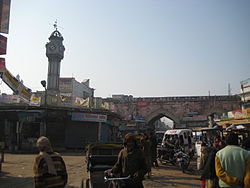
'''Ghanta Ghar''': The heart of Faizabad city, houses a clock tower (Ghanta means 'clock' in Hindi and Ghar is the Hindi word for 'house') in the middle of the city center. All distances within the city are measured from this location. The place is also known as Chowk, which houses the main vegetable and spice market in the town. | '''Ghanta Ghar''': The heart of Faizabad city, houses a clock tower (Ghanta means 'clock' in Hindi and Ghar is the Hindi word for 'house') in the middle of the city center. All distances within the city are measured from this location. The place is also known as Chowk, which houses the main vegetable and spice market in the town. | ||
'''Shringi Rishi Ashram''': 35 km from Faizabad in [[Goshainganj]] is ashram of Sage (Rishi in Sanskrit/Hindi) Shringi. Shringi Rishi performed 'Putrakameshti Yajya' for King Dashrath of Ayodhya, after that Lord Rama and his three brothers were born. There is an ashram of Shringi Rishi situated at Sherwaghat near [[Mehbubganj]] 11 km from [[Goshainganj]] on the banks of | '''Shringi Rishi Ashram''': 35 km from Faizabad in [[Goshainganj]] is ashram of Sage (Rishi in Sanskrit/Hindi) Shringi. Shringi Rishi performed 'Putrakameshti Yajya' for King Dashrath of Ayodhya, after that Lord Rama and his three brothers were born. There is an ashram of Shringi Rishi situated at Sherwaghat near [[Mehbubganj]] 11 km from [[Goshainganj]] on the banks of Saryu river at Sherwa Ghat. A temple of Shringi Rishi, is also located at Sherwaghat, and a fair is held every year in May in his honour. A cave is also located in Ayodhya district near [[Mehbubganj]] Near [[Goshainganj]] where he is supposed to have stayed. | ||
'''Maharshi Balmiki Ashram Babuapur''' : | '''Maharshi Balmiki Ashram Babuapur''' : Named after the saint Maharishi Balmilki who wrote Ramayan in Sanskrit language in the time of Lord Rama. It is located 28 km from Faizabad city in Babuapur village directly connected with Dilasiganj. | ||
===Shopping places=== | ===Shopping places=== | ||
| Line 322: | Line 358: | ||
'''Faizabad Chowk:''' Next to Ghanta Ghar, is the central market of Faizabad town. One can find vegetables, fruits and spices, jewellery shops, clothing and other retail. | '''Faizabad Chowk:''' Next to Ghanta Ghar, is the central market of Faizabad town. One can find vegetables, fruits and spices, jewellery shops, clothing and other retail. | ||
''' | '''Rikabganj:''' About a kilometer away from Chowk (towards Lucknow) lies the Rikabganj market which has a multitude of pharmacies. The market also has some seed shops which cater to the farmers of the adjoining regions. | ||
'''Bajaja:''' (now known as Subhas Nagar)A place adjacent to Chowk towards Sultanpur Road holds a market for Clothes and garments. In Urdu Bajaja means cloth market. This area also holds major banks | '''Bajaja:''' (now known as Subhas Nagar)A place adjacent to Chowk towards Sultanpur Road holds a market for Clothes and garments. In Urdu Bajaja means cloth market. This area also holds major banks such as Union Bank of India, SBI and Allahabad Bank. | ||
'''Fatehganj:''' This is a market mainly for wholesale grocery and other house hold items. This area is on the same road on which Bajaja falls. Hotel Krishna Palace is adjacent to the fountain near | '''Fatehganj:''' This is a market mainly for wholesale grocery and other house hold items. This area is on the same road on which Bajaja falls. Hotel Krishna Palace is adjacent to the fountain near Ayodhya jail. This is the place which is near to Bus Station as well as Railway Station. | ||
==Education== | ==Education== | ||
| Line 332: | Line 368: | ||
===Universities=== | ===Universities=== | ||
<!---♦♦♦ Only add a university to this list if it already has its own article on the English Wikipedia ♦♦♦---> | |||
* [[Dr. Ram Manohar Lohia Avadh University]] | * [[Dr. Ram Manohar Lohia Avadh University]] | ||
* [[Narendra | * [[Acharya Narendra Deva University of Agriculture and Technology]] | ||
==Sports== | ==Sports== | ||
[[ | [[Dr. Bhimrao Ambedkar International Sports Stadium]] Loc: {{Coord|26|43|47|N|82|08|17|E|display=inline}} is an international standard [[sports complex]] being built on [[NH 330]] (Faizabad to [[Sultanpur, Uttar Pradesh|Sultanpur]] Road) in Ayodhya district. The new sports complex would have astro turf, synthetic track, olympic size swimming pool, cricket field, hostels and other required facilities. It is the part of multi crore Rs. project for sports complex by state government. The Lokayukta office has received a complaint from one Bhanu Pratap Singh of Ayodhya who has accused the minister of corruption in the construction of Ayodhya International stadium. According to the complainant, the sports minister had a nexus with former sports director Hari Om and former project manager R.D. Prasad and had deliberately delayed the construction of the {{Indian Rupee}} 86 crore Dr. Bhimrao Ambedkar stadium, paving the way for an escalation of costs to {{Indian Rupee}} 1.50 billion.<ref>{{cite web|url=http://www.asianage.com/india/sports-minister-faces-lokayukta-probe-292 |title=Sports minister faces lokayukta probe in U.P. |date=31 October 2011 |location=Lucknow |work=Asian Age |url-status=dead |archive-url=https://web.archive.org/web/20120406122340/http://www.asianage.com/india/sports-minister-faces-lokayukta-probe-292 |archive-date=6 April 2012 }}</ref><ref>{{cite web|url=http://www.dailypioneer.com/state-editions/lucknow/16674-ayodhya-prasad-pal-comes-under-lokayukta-scanner-for-corruption-charges.html|title=Ayodhya Prasad Pal comes under Lokayukta scanner for corruption charges|date= 30 October 2011 }}</ref> | ||
==Notable people== | ==Notable people== | ||
{{multiple image | {{multiple image | ||
| footer = Olympian and [[Arjuna Award]] winner [[Boxer]] [[Akhil Kumar]] and | | footer = Olympian and [[Arjuna Award]] winner [[Boxer (boxing)|boxer]] [[Akhil Kumar]] and pop singer [[Barry Hay]] were born in Faizabad. | ||
| align = right | | align = right | ||
| image1 = | | image1 = | ||
| Line 372: | Line 402: | ||
* [[Tariq Umar Khan]], production designer, art director and film director in [[Bollywood]] | * [[Tariq Umar Khan]], production designer, art director and film director in [[Bollywood]] | ||
* [[Akhil Kumar]], Indian boxer and [[Olympic Games|Olympian]] | * [[Akhil Kumar]], Indian boxer and [[Olympic Games|Olympian]] | ||
* [[Kunwar Narayan]], Hindi poet | |||
* [[Francis Quinton]], an English cricketer, was born Faizabad. | * [[Francis Quinton]], an English cricketer, was born Faizabad. | ||
* [[Mirza Muhammad Rafi Sauda]], born in Faizabad. | * [[Mirza Muhammad Rafi Sauda]], born in Faizabad. | ||
* [[Ahmadullah Shah]] (1787–1858), Indian freedom fighter | |||
* [[Anushka Sharma]], Bollywood actress | * [[Anushka Sharma]], Bollywood actress | ||
* [[Lallu Singh]], politician, won the 2014 and 2019 elections for the [[Faizabad (Lok Sabha constituency)]] | * [[Lallu Singh]], politician, won the 2014 and 2019 elections for the [[Faizabad (Lok Sabha constituency)]] | ||
| Line 412: | Line 444: | ||
==External links== | ==External links== | ||
{{ | |||
{{EB1911 poster|Fyzabad}} | |||
*[https://ayodhya.nic.in/ Official district web site] | *[https://ayodhya.nic.in/ Official district web site] | ||
| Line 423: | Line 456: | ||
[[Category:Faizabad| ]] | [[Category:Faizabad| ]] | ||
[[Category: | [[Category:Ayodhya division]] | ||
[[Category:Cities and towns in | [[Category:Cities and towns in Ayodhya district]] | ||
[[Category:Former capital cities in India]] | [[Category:Former capital cities in India]] | ||
[[Category:Awadh]] | [[Category:Awadh]] | ||
[[Category:Cities in Uttar Pradesh]] | [[Category:Cities in Uttar Pradesh]] | ||
Latest revision as of 06:05, 22 July 2023
Faizabad | |
|---|---|
City | |
   Tilak Hall, Gulab Bari, Bahu Begum ka Maqbara | |
  Faizabad Location in Uttar Pradesh, India  Faizabad Faizabad (India) | |
| Coordinates: 26°46′23″N 82°08′46″E / 26.773°N 82.146°E | |
| Country |  India India |
| State | Uttar Pradesh |
| Division | Ayodhya |
| District | Ayodhya |
| Government | |
| • Type | Municipal corporation |
| • Body | Ayodhya Municipal Corporation |
| • Mayor | Rishikesh Upadhyay, (BJP)[1] |
| Area | |
| • Total | 16.02 km2 (6.19 sq mi) |
| Elevation | 97 m (318 ft) |
| Population (2011)[2] | |
| • Total | 165,228 |
| • Density | 10,000/km2 (27,000/sq mi) |
| Language | |
| • Official | Hindi[3] |
| • Additional official | Urdu[3] |
| • Regional | Awadhi |
| Time zone | UTC+5:30 (IST) |
| PIN | 224001 |
| Telephone code | +91-5278 |
| Vehicle registration | UP-42 |
| Sex ratio | 998/1000 ♂/♀ |
| Website | ayodhya |
Faizabad (Hindustani pronunciation: [fɛːzaːbaːd]) is a city located in Ayodhya district in the Indian state of Uttar Pradesh. It is situated on southern the bank of the River Saryu about 130 km east of state capital Lucknow. Faizabad was the first capital of the Nawabs of Awadh and has monuments built by the Nawabs, like the Tomb of Bahu Begum, Gulab Bari. It was also the headquarters of Faizabad district (now Ayodhya district) and Faizabad division (now Ayodhya division) before November 2018.[4][5] Faizabad is a twin city of Ayodhya and it is administered by Ayodhya Municipal Corporation.
History[edit | edit source]


According to The Imperial Gazetteer of India, "[w]hen Saadat Khan was appointed governor of Oudh he built a hunting lodge 4 miles west of Ayodhya [in 1730[6]], then the head-quarters of the province. Gardens were laid out and shops sprang up in the neighbourhood, and during the time of his successor Safdar Jang the name Faizabad was first applied. Shuja-ud-daula, the third Nawab, lived chiefly at Lucknow during the early part of his reign; but after his defeat at Buxar in 1764 he made Faizabad his residence, and during the remainder of his life added largely to its defences and also laid a large town. Shuja-ud-daula died early in 1775, and before the close of the year Asaf-ud-daula moved permanently to Lucknow. The importance of Faizabad declined, but it remained the home of Asaf-ud-daula's grandmother and mother, the Nawab Begam and Bahu Begam, whose treatment was the subject of charges against Warren Hastings. After the death of Bahu Begam in 1816 Faizabad decayed still farther".[7] Oudh State was annexed by the British in 1856. Local self-government for Ayodhya and Faizabad was introduced in 1865. The two cities were administered jointly as a municipality.[8]
Establishment of Princely state of Awadh[edit | edit source]
Gulab Bari stands in a garden surrounded by a wall, approachable through two large gateways. These buildings are particularly interesting for their assimilative architectural styles. Shuja-ud-daula's wife was the well known Bahu Begum, who married the Nawab in 1743 and continued to reside in Faizabad, her residence being the Moti-Mahal. Close by at Jawaharbagh lies her Maqbara, where she was buried after her death in 1816. It is considered to be one of the finest buildings of its kind in Avadh, which was built at the cost of three lakh rupees by her chief advisor Darab Ali Khan. A fine view of the city is obtainable from top of the begum's tomb. Bahu Begum was a woman of great distinction and rank, bearing dignity. Most of the Muslim buildings of Faizabad are attributed to her. From the date of Bahu Begum's death in 1815 until the annexation of Avadh, the city of Faizabad gradually fell into decay. The glory of Faizabad finally eclipsed with the shifting of capital from Faizabad to Lucknow by Nawab Asaf-ud-daula.[6]
Faizabad was also a centre of one of many battles of the Mutiny of 1857. A detailed history of Faizabad can be read in 'Tareekh-e-Farahbaksh', written by Munshi Mohd. Faiz Baksh, (after whom Faizabad is named) a courtier in the Shuja-ud-Daula's court. This book has been translated into English by Hamid Afaq Qureshi as 'Memoirs of Faizabad'. Faizabad also finds a prominent and detailed mention in Guzashta Lucknow written by Abdul Halim Sharar. The fourth nawab of Awadh, Nawab Asaf-ud-Daula, shifted the Capital of Avadh to Lucknow in 1775 after his terms with his mother became sour.[9]
Hanging of Ashfaqulla Khan[edit | edit source]


Ashfaqulla Khan was hanged in Faizabad jail on 19 December 1927 for his role in the Kakori Train robbery on 9 August 1925.[10][11]
Demographics[edit | edit source]
The 2011 Census of India has separate data for Faizabad municipal council (N.P.P.) and Faizabad Cantonment, which were counted as separate towns:[13]
- Faizabad municipal council (N.P.P.), which had a population of 165,228 in 28,150 households.[13][2]
- Faizabad Cantonment, which had a population of 12,391 in 2,014 households.[13][2]
The following data are for Faizabad municipal council in the 2011 census.
- There were 85,620 males and 79,608 females.[13][2] The sex ratio was 929.8 females per 1,000 males.[13]
- There were 17,781 children of six and under:[13] 9,310 boys and 8,471 girls, giving a sex ratio of 909.9 girls per 1,000 boys.[13]
- There were 123,895 literates (84% of the population over six), of which 66,519 were male and 57,376 were female (78% and 72% of the male and female population over six).[13]
The following data are for Faizabad Cantonment in the 2011 census.
- There were 7,744 males and 4,647 females.[13][2] The sex ratio was 600.1 females per 1,000 males.[13]
- There were 1,368 children of six and under:[13] 716 boys and 652 girls, giving a sex ratio of 910.6 girls per 1,000 boys.[13]
- There were 9,783 literates (89% of the population over six), of which 6,595 were male and 3,188 were female (85% and 69% of the male and female population over six).[13]
| Year | Pop. | ±% |
|---|---|---|
| 1901 | 71,179 | — |
| 1911 | 54,655 | −23.2% |
| 1921 | 56,620 | +3.6% |
| 1931 | 59,992 | +6.0% |
| 1941 | 55,215 | −8.0% |
| 1951 | 76,582 | +38.7% |
| 1961 | 83,717 | +9.3% |
| 1971 | 102,835 | +22.8% |
| 1981 | 101,873 | −0.9% |
| 1991 | 124,437 | +22.1% |
| 2001 | 144,705 | +16.3% |
| 2011 | 165,228 | +14.2% |
| Source: [2] | ||
| Year | Pop. | ±% |
|---|---|---|
| 1931 | 5,726 | — |
| 1941 | 2,417 | −57.8% |
| 1951 | 5,916 | +144.8% |
| 1961 | 4,579 | −22.6% |
| 1971 | 6,971 | +52.2% |
| 1981 | 10,794 | +54.8% |
| 1991 | 11,843 | +9.7% |
| 2001 | 14,040 | +18.6% |
| 2011 | 12,391 | −11.7% |
| Source: [2] | ||
Geography[edit | edit source]
Climate[edit | edit source]
Typical of the central plains of India, Faizabad has a monsoon-influenced humid subtropical climate (Köppen Cwa). Summer (March to July) temperatures can range from 35 to 45 °C (95 to 113 °F), whilst winter (November to February) temperatures can range from 6 to 25 °C (42.8 to 77.0 °F). More than 85 percent of the annual rainfall of 1,100 millimetres or 43 inches falls during the southwest monsoon from June to September.
| Climate data for Faizabad (1971–2000, extremes 1959–2003) | |||||||||||||
|---|---|---|---|---|---|---|---|---|---|---|---|---|---|
| Month | Jan | Feb | Mar | Apr | May | Jun | Jul | Aug | Sep | Oct | Nov | Dec | Year |
| Record high °C (°F) | 28.5 (83.3) |
35.8 (96.4) |
41.7 (107.1) |
45.5 (113.9) |
46.0 (114.8) |
47.4 (117.3) |
41.6 (106.9) |
39.2 (102.6) |
37.8 (100.0) |
37.7 (99.9) |
35.8 (96.4) |
31.0 (87.8) |
47.4 (117.3) |
| Average high °C (°F) | 22.6 (72.7) |
26.3 (79.3) |
32.0 (89.6) |
37.7 (99.9) |
39.4 (102.9) |
37.6 (99.7) |
33.6 (92.5) |
32.8 (91.0) |
32.8 (91.0) |
32.8 (91.0) |
29.6 (85.3) |
25.1 (77.2) |
31.9 (89.4) |
| Average low °C (°F) | 7.4 (45.3) |
10.1 (50.2) |
14.3 (57.7) |
19.7 (67.5) |
23.7 (74.7) |
25.4 (77.7) |
25.0 (77.0) |
24.6 (76.3) |
23.3 (73.9) |
19.1 (66.4) |
12.6 (54.7) |
8.0 (46.4) |
17.7 (63.9) |
| Record low °C (°F) | 0.8 (33.4) |
1.8 (35.2) |
7.6 (45.7) |
11.4 (52.5) |
17.7 (63.9) |
16.4 (61.5) |
18.0 (64.4) |
18.2 (64.8) |
15.2 (59.4) |
7.4 (45.3) |
3.0 (37.4) |
1.0 (33.8) |
0.8 (33.4) |
| Average rainfall mm (inches) | 17.5 (0.69) |
14.4 (0.57) |
6.6 (0.26) |
8.3 (0.33) |
17.9 (0.70) |
141.0 (5.55) |
297.3 (11.70) |
324.9 (12.79) |
209.5 (8.25) |
51.4 (2.02) |
4.3 (0.17) |
9.5 (0.37) |
1,102.5 (43.41) |
| Average rainy days | 1.4 | 1.5 | 0.8 | 0.7 | 1.4 | 5.5 | 12.3 | 12.4 | 8.1 | 2.2 | 0.2 | 0.7 | 47.3 |
| Average relative humidity (%) (at 17:30 IST) | 64 | 59 | 45 | 39 | 42 | 56 | 75 | 79 | 77 | 73 | 69 | 67 | 62 |
| Source: India Meteorological Department[14][15] | |||||||||||||
Transport[edit | edit source]
By Road[edit | edit source]
Faizabad is situated on National Highway 27 and has connectivity with Kanpur (213 km), Lucknow (127 km), Varanasi (202 km), Prayagraj (161 km) and Gorakhpur (165 km). The state government's Road Transport Service runs regular and frequent buses to and from these cities. NH27 connects Lucknow to Barauni via Faizabad and Gorakhpur whilst NH330 connects Faizabad to Prayagraj via Sultanpur. Nawab Yusuf Road connects Faizabad to Varanasi via Jaunpur, NH330A connects Faizabad to Raebareli via Kumarganj, Ayodhya and Jagdishpur and NH 330 connects Faizabad to Bharich via Gonda, NH 330C is connected by Azamgarh to Faizabad via Ambedkar Nagar and Balrampur is connected by Faizabad via NH334 and Utraula and Mankapur connects Faizabad by SH14.
By Train[edit | edit source]

Ayodhya Cantt railway station: The Indian Railways network connects Faizabad directly with Kanpur (4 hours) Lucknow (3 hours), Varanasi (4 hours.) and Prayagraj (5 hours).

Ayodhya Cantt Superfast Express is a train which runs weekly connecting Ayodhya Cantt railway station to Lokmanya Tilak Terminus, Mumbai. Its one of the two trains which runs between Faizabad to Mumbai the other one is Saket Express which runs twice a week. It is numbered as 22103/22104. Rameswaram - Faizabad Shraddha Sethu Express is a weekly Superfast Express connecting Rameswaram in Tamil Nadu and Faizabad in Uttar Pradesh. It takes nearly 3 days to reach the destination and one of the longest running train in India. A few mail express trains also connect Faizabad to Kolkata, New Delhi and Mumbai. In addition, the Faizabad-Delhi express runs daily from Faizabad to Delhi and Delhi to Faizabad, whilst a new railway line will be proposed from Lalganj to Faizabad via Raebareli Akberganj station.
Ayodhya Junction railway station: Ayodhya Junction is the second major railway station in Ayodhya city.
Acharya Narendra Dev Nagar railway station: This station is another gateway to the city via rail and it lies in the heart of the city.
By Air[edit | edit source]
Currently, the nearest airports are Lucknow International Airport (128 km), Prayagraj Airport (144 km) and Varanasi International Airport (200 km).
Ayodhya International Airport is currently under construction.
Places of interest[edit | edit source]
Tourism[edit | edit source]

Gulab Bari: Literally meaning 'Garden of Roses', the tomb of Nawab Shuja-ud-Daula (third Nawab of Awadh), this place has a collection of roses of various varieties set by the sides of water fountains. Gulab Bari also houses a maqbara (Mausoleum) of Nawab Shuja-ud-Daula in the campus.

Bahu Begum ka Maqbara: (The Mausoleum of the Queen Bride) the memorial built for queen of Nawab Shujah-ud-Daulah, Unmatuzzohra Bano Begum. Its one of the tallest buildings in Faizabad and is an example of non-mughal Muslim architecture.[citation needed]
Military Temple: (The Dogra Regimental Centre/ Corps of Military Police CMP Temple) Located in cantonment area.
Guptar Ghat: the Ghat (Jetty) where Lord Rama is believed to have taken 'jal samadhi' (leaving the earth for 'Baikuntha', the divine abode of Lord Vishnu, by drowning himself). It has view of the Saryu River and its green banks and has several ancient temples.
Company Gardens : Adjoining Guptar Ghat, on the banks of River Saryu, is Company Gardens, a botanical garden built during British Rule. it has a well maintained, sprawling garden set amidst lush greenery. It also has an orchard spread over acres. Plants and Trees can also be bought here. The remains of the fort built by Nawab Shuja-ud-Daula after the battle of Buxar is also within walking distance.
Ghanta Ghar: The heart of Faizabad city, houses a clock tower (Ghanta means 'clock' in Hindi and Ghar is the Hindi word for 'house') in the middle of the city center. All distances within the city are measured from this location. The place is also known as Chowk, which houses the main vegetable and spice market in the town.
Shringi Rishi Ashram: 35 km from Faizabad in Goshainganj is ashram of Sage (Rishi in Sanskrit/Hindi) Shringi. Shringi Rishi performed 'Putrakameshti Yajya' for King Dashrath of Ayodhya, after that Lord Rama and his three brothers were born. There is an ashram of Shringi Rishi situated at Sherwaghat near Mehbubganj 11 km from Goshainganj on the banks of Saryu river at Sherwa Ghat. A temple of Shringi Rishi, is also located at Sherwaghat, and a fair is held every year in May in his honour. A cave is also located in Ayodhya district near Mehbubganj Near Goshainganj where he is supposed to have stayed.
Maharshi Balmiki Ashram Babuapur : Named after the saint Maharishi Balmilki who wrote Ramayan in Sanskrit language in the time of Lord Rama. It is located 28 km from Faizabad city in Babuapur village directly connected with Dilasiganj.
Shopping places[edit | edit source]

Faizabad Chowk: Next to Ghanta Ghar, is the central market of Faizabad town. One can find vegetables, fruits and spices, jewellery shops, clothing and other retail.
Rikabganj: About a kilometer away from Chowk (towards Lucknow) lies the Rikabganj market which has a multitude of pharmacies. The market also has some seed shops which cater to the farmers of the adjoining regions.
Bajaja: (now known as Subhas Nagar)A place adjacent to Chowk towards Sultanpur Road holds a market for Clothes and garments. In Urdu Bajaja means cloth market. This area also holds major banks such as Union Bank of India, SBI and Allahabad Bank.
Fatehganj: This is a market mainly for wholesale grocery and other house hold items. This area is on the same road on which Bajaja falls. Hotel Krishna Palace is adjacent to the fountain near Ayodhya jail. This is the place which is near to Bus Station as well as Railway Station.
Education[edit | edit source]

Universities[edit | edit source]
- Dr. Ram Manohar Lohia Avadh University
- Acharya Narendra Deva University of Agriculture and Technology
Sports[edit | edit source]
Dr. Bhimrao Ambedkar International Sports Stadium Loc: 26°43′47″N 82°08′17″E / 26.72972°N 82.13806°E is an international standard sports complex being built on NH 330 (Faizabad to Sultanpur Road) in Ayodhya district. The new sports complex would have astro turf, synthetic track, olympic size swimming pool, cricket field, hostels and other required facilities. It is the part of multi crore Rs. project for sports complex by state government. The Lokayukta office has received a complaint from one Bhanu Pratap Singh of Ayodhya who has accused the minister of corruption in the construction of Ayodhya International stadium. According to the complainant, the sports minister had a nexus with former sports director Hari Om and former project manager R.D. Prasad and had deliberately delayed the construction of the ₹ 86 crore Dr. Bhimrao Ambedkar stadium, paving the way for an escalation of costs to ₹ 1.50 billion.[18][19]
Notable people[edit | edit source]

- Begum Akhtar or Akhtari Bai Faizabadi, singer
- Mir Anees, Urdu poet
- Pooja Batra, actress
- Brij Narayan Chakbast, nineteenth-century Urdu poet who is credited with the first translation of the Ramayana into Urdu
- Abhishek Chaubey, Bollywood film director
- Kathleen Crofton, an English dancer, was born is Faizabad
- Narendra Deva, political theorist
- Barry Hay, pop singer born in Faizabad
- Indu Jain, owner of Bennett, Coleman & Co. Ltd, Times of India Group, Forbes India's top 20 richest person
- Vinay Katiyar, politician
- Tariq Umar Khan, production designer, art director and film director in Bollywood
- Akhil Kumar, Indian boxer and Olympian
- Kunwar Narayan, Hindi poet
- Francis Quinton, an English cricketer, was born Faizabad.
- Mirza Muhammad Rafi Sauda, born in Faizabad.
- Ahmadullah Shah (1787–1858), Indian freedom fighter
- Anushka Sharma, Bollywood actress
- Lallu Singh, politician, won the 2014 and 2019 elections for the Faizabad (Lok Sabha constituency)
- Ravindranath Tewari, former minister
- Nivedita Tiwari, actress
- Brij Bhushan Mani Tripathi, Indian Politician
- Mitrasen Yadav, politician
Gallery[edit | edit source]


Surrounding districts[edit | edit source]
Places adjacent to Faizabad | |
|---|---|


See also[edit | edit source]
References[edit | edit source]
- ↑ Pandey, Alok; Nair, Arun (1 December 2017). "BJP's Rishikesh Upadhayay Elected First Mayor Of Ayodhya". NDTV. Retrieved 1 March 2022.
- ↑ 2.0 2.1 2.2 2.3 2.4 2.5 2.6 "A -4 Towns And Urban Agglomerations Classified By Population Size Class In 2011 With Variation Since 1901", 2011 Census of India, Office of the Registrar General & Census Commissioner, India
- ↑ 3.0 3.1 "50th Report of the Commissioner for Linguistic Minorities in India" (PDF). Archived from the original (PDF) on 8 July 2016. Retrieved 4 November 2016.
- ↑ PTI (6 November 2018). "UP cabinet approves renaming of Faizabad as Ayodhya". India Today. Retrieved 24 April 2019.
- ↑ "About District | District Ayodhya - Government of Uttar Pradesh". District Ayodhya - Government of Uttar Pradesh.
- ↑ 6.0 6.1 "Welcome to Faizabad History". official website of Faizabad district. Archived from the original on 28 December 2011. Retrieved 29 June 2012.
- ↑ "Fyzabad". Imperial Gazetteer of India. Vol. 12. 1908. p. 117.
- ↑ "Fyzabad". Imperial Gazetteer of India. Vol. 12. 1908. p. 118.
- ↑ "History of Faizabad". myuttarpradesh.co.in/. Archived from the original on 1 July 2012. Retrieved 29 June 2012.
- ↑ Shankaranarayana Rao, N.P. "Ashfaqulla Khan: The Immortal Revolutionary". Press Information Bureau, Government of India. Archived from the original on 5 November 2002. Retrieved 27 August 2019.
- ↑ Singh, Aparna (2 August 2004). "Daredevilry of sons of the soil". The Times of India (newspaper). Retrieved 7 January 2018.
- ↑ "Religion PCA (India & States/UTs/District/Sub-Distt/Town Level) – Uttar Pradesh", 2011 Census of India, Office of the Registrar General & Census Commissioner, India
- ↑ 13.00 13.01 13.02 13.03 13.04 13.05 13.06 13.07 13.08 13.09 13.10 13.11 13.12 "Primary Census Abstract Data Tables – Uttar Pradesh – Faizabad district", 2011 Census of India, Office of the Registrar General & Census Commissioner, India
- ↑ "Station: Faizabad Climatological Table 1971–2000" (PDF). Climatological Normals 1971–2000. India Meteorological Department. October 2011. pp. 265–266. Archived from the original (PDF) on 15 February 2020. Retrieved 6 May 2020.
- ↑ "Extremes of Temperature & Rainfall for Indian Stations (Up to 2012)" (PDF). India Meteorological Department. December 2016. p. M214. Archived from the original (PDF) on 5 February 2020. Retrieved 6 May 2020.
- ↑ "UP govt to rename Faizabad railway station as Ayodhya Cantt". The Telegraph (India). 23 October 2021.
- ↑ "Faizabad Junction railway station renamed as Ayodhya Cantt: Railways". The New Indian Express. 2 November 2021.
- ↑ "Sports minister faces lokayukta probe in U.P." Asian Age. Lucknow. 31 October 2011. Archived from the original on 6 April 2012.
- ↑ "Ayodhya Prasad Pal comes under Lokayukta scanner for corruption charges". 30 October 2011.
External links[edit | edit source]


