



WikiDwarfBOT (talk | contribs) Cleanup: Information added. |
No edit summary Tags: Mobile edit Mobile web edit |
||
| (3 intermediate revisions by 3 users not shown) | |||
| Line 1: | Line 1: | ||
{{pp-extended|small=yes}} | |||
{{Multiple issues| | |||
{{Original research|date=November 2019}} | |||
{{POV|date=August 2024}} | |||
}} | |||
{{Short description|Part of Anglo-Maratha Wars between 1775 and 1818}} | {{Short description|Part of Anglo-Maratha Wars between 1775 and 1818}} | ||
{{Use dmy dates|date=June 2023}} | {{Use dmy dates|date=June 2023}} | ||
{{EngvarB|date=June 2023}} | {{EngvarB|date=June 2023}} | ||
| Line 6: | Line 10: | ||
| conflict = First Anglo-Maratha War | | conflict = First Anglo-Maratha War | ||
| image = File:Maratha British Treaty.JPG | | image = File:Maratha British Treaty.JPG | ||
| caption = A mural depicting | | caption = A mural depicting a British officer surrendering to Mahadaji Scindia following the Maratha victory at the Battle of Wadagaon | ||
| | | date = {{start and end dates|1775|03|15|1782|05|17|df=yes}} {{nwr|({{Age in years, months, weeks and days|month1=03|day1=15|year1=1775|month2=05|day2=17|year2=1782}})}} | ||
| partof = the [[Anglo-Maratha Wars (disambiguation)|Anglo-Maratha Wars]] | | partof = the [[Anglo-Maratha Wars (disambiguation)|Anglo-Maratha Wars]] | ||
| place = {{hlist|[[Central India]]|[[Western India]]}} | | place = {{hlist|[[Central India]]|[[Western India]]}} | ||
| result = Maratha victory<ref | | result = Descessive Maratha victory and forces brithishers to beg to sign treaty of salbai<ref name="Kantak1993" /><ref>{{citation|url=https://books.google.com/books?id=cYoHOqC7Yx4C&pg=PA290|others=quote: "First Anglo-Maratha War...The war ends with Descessive Maratha victory forcing brithishers to sign treaty of salbai."|title=Columbia Chronologies of Asian History and Culture|author=John Bowman|page=290|publisher=Columbia University Press|isbn=9780231500043|date=2000-09-05}}</ref> | ||
* [[Treaty of Salbai]] | *[[Status quo ante bellum]] | ||
| | * [[Treaty of Salbai]] | ||
| combatant1 = {{Tree list}}{{flagdeco|Kingdom of Great Britain }} [[Kingdom of Great Britain|Great Britain]]<br> | |||
| commander1 = {{ubl|[[File:Flag of Great Britain.svg|23px]] [[Warren Hastings]]<ref name="Kantak1993">{{cite book|last=Kantak|first=M. R. |title=The First Anglo-Maratha War, 1774-1783: A Military Study of Major Battles|url=https://books.google.com/books?id=cdXnVOKKkssC&pg=PA220|year=1993|publisher=Popular Prakashan|isbn=978-81-7154-696-1|page=220}}</ref>|[[File:Flag of the British East India Company (1707).svg|23px]] Colonel Keating|[[File:Flag of the British East India Company (1707).svg|23px]] Thomas Wyndham Goddard<ref name="Kantak1993" />|[[File:Flag of the Maratha Empire.svg|23px]] [[Raghunathrao]]<ref name="Naravane2006" />}} | **[[File:Flag of the British East India Company (1707).svg|23px]] [[East India Company]] {{Tree list end}} | ||
| commander2 ={{ubl|[[File:Flag of the Maratha Empire.svg|23px]] [[Sawai Madhavrao|Madhavrao II]]<ref name="Kantak1993" />|[[File:Flag of the Maratha Empire.svg|23px]] [[ | | combatant2 = {{Tree list}}[[File:Flag of the Maratha Empire.svg|23px]] [[Maratha Empire]] | ||
| strength1 = 93,000 troops total<ref name="West2009" /><ref name="Kantak1993" /> | **[[File:Indore Flag.svg|23px]] [[Indore State]] | ||
23 ships<ref name="Kantak1993" /> | **[[File:Flag of Gwalior (State).svg|23px]] [[Gwalior State]] {{Tree list end}} | ||
| strength2 = Around 146,000 troops total<ref name="West2009" /><ref name="Kantak1993" /> | | commander1 = {{ubl|[[File:Flag of Great Britain.svg|23px]] [[Warren Hastings]]<ref name="Kantak1993">{{cite book|last=Kantak|first=M. R. |title=The First Anglo-Maratha War, 1774-1783: A Military Study of Major Battles|url=https://books.google.com/books?id=cdXnVOKKkssC&pg=PA220|year=1993|publisher=Popular Prakashan|isbn=978-81-7154-696-1|page=220}}</ref>|[[File:Flag of the British East India Company (1707).svg|23px]] Colonel Keating|[[File:Flag of the British East India Company (1707).svg|23px]] Thomas Wyndham Goddard<ref name="Kantak1993" />|[[File:Flag of the Maratha Empire.svg|23px]] [[Raghunathrao]]<ref name="Naravane2006" />}} | ||
14 ships<ref name="Kantak1993" /> | | commander2 = {{ubl|[[File:Flag of the Maratha Empire.svg|23px]] [[Sawai Madhavrao|Madhavrao II]]<ref name="Kantak1993" />|[[File:Flag of the Maratha Empire.svg|23px]] [[Nana Fadnavis]]|[[File:Flag of the Maratha Empire.svg|23px]] [[Hari Pant]]||[[File:Flag of Gwalior (State).svg|23px]] [[Mahadji Shinde]]<ref name="Kantak1993" />|[[File:Indore Flag.svg|23px]] [[Tukoji Rao Holkar|Tukoji Holkar]]<ref name="Kantak1993" /><ref name="History of the Mahrattas">{{Cite web | url=https://books.google.com/books?id=Al8OAAAAQAAJ&q=Holkar | title=History of the Mahrattas| last1=Duff| first1=James Grant| year=1878}}</ref>}} | ||
| strength1 = 93,000 troops total<ref name="West2009">{{cite book|last=West|first=Barbara A. |title=Encyclopedia of the Peoples of Asia and Oceania|url={{google books|plainurl=yes|id=AMYZAQAAIAAJ|keywords= First Anglo-Maratha War}}|volume=M to Z|year=2009|publisher=Facts On File|isbn=978-0-8160-7109-8|page=509|quote=This period also coincided with the First Anglo-Maratha War, which was settled only in 1782 with a Maratha victory over the British and their local allies.}}</ref><ref name="Kantak1993" /><br>23 ships<ref name="Kantak1993" /> | |||
| strength2 = Around 146,000 troops total<ref name="West2009" /><ref name="Kantak1993" /><br>14 ships<ref name="Kantak1993" /> | |||
| casualties1 = | |||
| casualties2 = | |||
}} | }} | ||
{{Campaignbox Anglo-Maratha Wars}} | {{Campaignbox Anglo-Maratha Wars}} | ||
{{Wars of Great Britain}} | {{Wars of Great Britain}} | ||
The '''First Anglo-Maratha War''' (1775–1782) was the first | The '''First Anglo-Maratha War''' (1775–1782) was the first conflict fought between the [[British East India Company]] and [[Maratha Empire]] in India. The war, fought in between [[Surat]] and [[Poona]], began with the 1775 [[Treaty of Surat]] after the East India Company agreed to support the recently-deposed [[Raghunathrao|Raghunathrao's]] claim as [[peshwa]] of the Maratha Empire. Several years of intermittent and largely inconclusive campaigning followed, in which the East India Company failed to decisively defeat the highly mobile Marathas. The war ended in 1782 following the [[Treaty of Salbai]].<ref name="Kantak1993" /> As per the treaty, both sides returned each other's captured territory, and the British withdrew their support for Raghunathrao. The British and Marathas would not fight against each other again until the [[Second Anglo-Maratha War]] 20 years later. | ||
==Background== | ==Background== | ||
After the death of [[Madhavrao Peshwa]] in 1772, his brother [[Narayanrao Peshwa|Narayanrao]] became [[peshwa]] (prime minister) of the Maratha Empire. | After the death of [[Madhavrao Peshwa]] in 1772, his brother [[Narayanrao Peshwa|Narayanrao]] became [[peshwa]] (prime minister) of the Maratha Empire. Narayanrao's palace guards murdered him in August 1773, and his uncle [[Raghunathrao]] (Raghoba) became the Peshwa. However, Narayanrao's wife, [[Gangabai]], gave birth to a posthumous son, who was the legal heir to the throne. The newborn infant was named [['Sawai' Madhavrao]] (Sawai means "One and a Quarter"). Twelve Maratha chiefs, known as the Baarbhai <ref>Known as the Baarbhai or Barbhai Council {{Cite book|last=Kulkarni |first=Sumitra |year=1995|url=https://books.google.com/books?id=SYOSHaZnBy8C&pg=PA74|title=The Satara Raj, 1818-1848: A Study in History, Administration, and Culture |location=New Delhi |publisher=Mittal Publications |page= 74 |isbn=978-81-7099-581-4 }}</ref> and led by [[Nana Phadnavis]], directed an effort to install the infant as the new Peshwa and to rule in his name as [[regent]]s. | ||
[[Raghunathrao]], unwilling to give up his position of power, sought help from the [[Kingdom of Great Britain|British]] at [[Bombay]] and signed the [[Treaty of Surat]] on 6 March 1775. According to the treaty, Raghunathrao ceded the territories of [[Salsette]] and [[Vasai|Bassein]] (Vasai) to the British, along with part of the revenues from [[Surat]] and [[Bharuch]] districts. In return, the British promised to provide Raghunathrao with 2,500 soldiers. | [[Raghunathrao]], unwilling to give up his position of power, sought help from the [[Kingdom of Great Britain|British]] at [[Bombay]] and signed the [[Treaty of Surat]] on 6 March 1775. According to the treaty, Raghunathrao ceded the territories of [[Salsette]] and [[Vasai|Bassein]] (Vasai) to the British, along with part of the revenues from [[Surat]] and [[Bharuch]] districts. In return, the British promised to provide Raghunathrao with 2,500 soldiers. | ||
The [[British Calcutta Council]] condemned the Treaty of Surat, sending Colonel Upton to [[Pune]] to annul it and make a new treaty with the regency. The [[Treaty of Purandar (1776)|Treaty of Purandhar]] (1 March 1776) annulled that of Surat, Raghunathrao was pensioned and his cause abandoned, but the revenues of Salsette and | At the same time, the Marathas tried to form a military alliance with the French. Two Frenchmen, Saint-Lubin and M. Montigny acted as intermediaries between France and the Poona Regency. Although the alliance proposals went nowhere, British suspicions of a global anti-British front increased in the midst of the concurrent [[American War of Independence]].<ref>{{Citation |last=KADAM |first=towards Cordial Relations UMESH ASHOK |title=The Maratha Court and the Embassies of Saint-Lubin and M. Montigny: A Truce towards Cordial Relations |date=2016 |url=https://www.taylorfrancis.com/chapters/edit/10.4324/9781315276809-18/maratha-court-embassies-saint-lubin-montigny-truce-towards-cordial-relations-towards-cordial-relations-umesh-ashok-kadam |work=The Indian Ocean in the Making of Early Modern India |access-date=2023-08-30 |publisher=Routledge |doi=10.4324/9781315276809-18 |doi-broken-date=12 July 2025 |isbn=978-1-315-27680-9}}</ref> | ||
The [[British Calcutta Council]] condemned the Treaty of Surat, sending Colonel Upton to [[Pune]] to annul it and make a new treaty with the regency. The [[Treaty of Purandar (1776)|Treaty of Purandhar]] (1 March 1776) annulled that of Surat, Raghunathrao was pensioned and his cause abandoned, but the revenues of Salsette and Bharuch districts were retained by the British. The Bombay government rejected this new treaty and gave refuge to Raghunathrao. In 1777, Nana Phadnavis violated his treaty with the Calcutta Council by granting the French a port on the West coast. The British retaliated by sending a force towards Pune. | |||
==Initial stage and Treaty of Purandar ( | ==Initial stage and Treaty of Purandar (1774–1775)== | ||
British troops under the command of Colonel Keating, left [[Surat]] on 15 March 1775, for Pune. But they were checked by Haripant Phadke at Adas and were totally defeated on 18 May 1775.<ref name="Rathod1994" /> Casualties for Keating's force, accompanied by [[Raghunathrao]], included 96 killed. The Marathas casualties in the Battle of Adas (Gujarat) included 150 killed.<ref name="Naravane2006">{{cite book|first=M. S. |last=Naravane|title=Battles of the Honourable East India Company: Making of the Raj|url=https://books.google.com/books?id=bxsa3jtHoCEC&pg=PA53|year=2006|publisher=APH Publishing|isbn=978-81-313-0034-3}}</ref>{{rp|53–56}} | British troops under the command of Colonel Keating, left [[Surat]] on 15 March 1775, for Pune. But they were checked by Haripant Phadke at Adas and were totally defeated on 18 May 1775.<ref name="Rathod1994" /> Casualties for Keating's force, accompanied by [[Raghunathrao]], included 96 killed. The Marathas casualties in the Battle of Adas (Gujarat) included 150 killed.<ref name="Naravane2006">{{cite book|first=M. S. |last=Naravane|title=Battles of the Honourable East India Company: Making of the Raj|url=https://books.google.com/books?id=bxsa3jtHoCEC&pg=PA53|year=2006|publisher=APH Publishing|isbn=978-81-313-0034-3}}</ref>{{rp|53–56}} | ||
[[Warren Hastings]] estimated that direct actions against Pune would be detrimental. Therefore, the [[Supreme Council of Bengal]] condemned the [[Treaty of Surat]], sending Colonel Upton to [[Pune]] to annul it and make a new treaty with the regency. An agreement between Upton and the ministers of Pune called [[Treaty of Purandar (1776)|Treaty of Purandar]] was signed on 1 March 1776. | [[Warren Hastings]] estimated that direct actions against Pune would be detrimental. Therefore, the [[Supreme Council of Bengal]] condemned the [[Treaty of Surat]], sending Colonel Upton to [[Pune]] to annul it and make a new treaty with the regency. An agreement between Upton and the ministers of Pune called [[Treaty of Purandar (1776)|Treaty of Purandar]] was signed on 1 March 1776. | ||
| Line 45: | Line 54: | ||
==Battle of Wadgaon== | ==Battle of Wadgaon== | ||
{{Main | {{Main|Battle of Wadgaon}} | ||
[[File:Route of the Bombay detachment across the Mahratta country from Culpee to Surat in 1778.jpg|thumb|Route of the Bombay detachment across the Mahratta country from Culpee to Surat c. 1778.]] | |||
Following a treaty between France and the [[Poona]] Government in 1776, the [[Bombay Presidency|Bombay]] Government decided to invade and reinstate Raghoba. They sent a force under Col. Egerton reached [[Khopoli]] and made its way through the [[Western Ghats]] at [[Bhor Ghat]] and onwards toward Karla, which was reached on 4 January 1779 while under Maratha attacks. Finally the British were forced to retreat back to Wadgaon, but were soon surrounded. The British surrendered<ref>{{cite news |last= Athale|first= Colonel Anil A|date=12 January 2018|title=How a Maratha general defeated the British|url=https://www.rediff.com/news/column/how-a-maratha-general-defeated-the-british/20180112.htm|newspaper=Rediff News}}</ref> and were forced to sign the [[Treaty of Wadgaon]] on 16 January 1779, a victory for the Marathas.<ref name="Naravane2006" />{{rp|56–58}} | Following a treaty between France and the [[Poona]] Government in 1776, the [[Bombay Presidency|Bombay]] Government decided to invade and reinstate Raghoba. They sent a force under Col. Egerton reached [[Khopoli]] and made its way through the [[Western Ghats]] at [[Bhor Ghat]] and onwards toward Karla, which was reached on 4 January 1779 while under Maratha attacks. Finally the British were forced to retreat back to Wadgaon, but were soon surrounded. The British surrendered<ref>{{cite news |last= Athale|first= Colonel Anil A|date=12 January 2018|title=How a Maratha general defeated the British|url=https://www.rediff.com/news/column/how-a-maratha-general-defeated-the-british/20180112.htm|newspaper=Rediff News}}</ref> and were forced to sign the [[Treaty of Wadgaon]] on 16 January 1779, a victory for the Marathas.<ref name="Naravane2006" />{{rp|56–58}} | ||
Reinforcements from northern India, commanded by Colonel (later General) Thomas Wyndham Goddard, arrived too late to save the Bombay force. The British [[Governor-General]] in [[Bengal]], [[Warren Hastings]], rejected the treaty on the grounds that the Bombay officials had no legal power to sign it, and ordered Goddard to secure British interests in the area. | Reinforcements from northern India, commanded by Colonel (later General) Thomas Wyndham Goddard, arrived too late to save the Bombay force. The British [[Governor-General]] in [[Bengal]], [[Warren Hastings]], rejected the treaty on the grounds that the Bombay officials had no legal power to sign it, and ordered Goddard to secure British interests in the area. | ||
Goddard with 6,000 troops stormed [[Bhadra Fort]] and captured [[Ahmedabad]] on 15 February 1779. There was a garrison of 6,000 Arab and Sindhi infantry and 2,000 horses. Losses in the fight totalled 108, including two British.<ref name="toib">{{cite news | url= | Goddard with 6,000 troops stormed [[Bhadra Fort]] and captured [[Ahmedabad]] on 15 February 1779. There was a garrison of 6,000 Arab and Sindhi infantry and 2,000 horses. Losses in the fight totalled 108, including two British.<ref name="toib">{{cite news | url=https://timesofindia.indiatimes.com/city/ahmedabad/Bhadra-Fort-to-turn-into-heritage-hangout/articleshow/4646568.cms | archive-url=https://archive.today/20130216064235/http://articles.timesofindia.indiatimes.com/2009-06-12/ahmedabad/28165182_1_bhadra-fort-walled-city-cultural-centre | url-status=live | archive-date=16 February 2013 | title=Bhadra Fort to turn into heritage hangout! | work=[[The Times of India]] | date=12 June 2009 | agency=TNN | access-date=17 January 2013 | location=Ahmedabad}}</ref><ref name="Duff-446" /><ref name="hb">{{cite book | title=A comprehensive history of India, civil, military and social | publisher=Blackie | last=Beveridge |first=Henry | url=https://archive.org/details/acomprehensiveh02bevegoog/page/n498| year=1862 | pages=456–466}}</ref> Goddard also captured [[Vasai|Bassein]] on 11 December 1780. Another [[Bengal]] detachment led by Captain Popham and assisted by the Rana of Gohad, captured [[Gwalior]] on 4 August 1780, before Mahadji Scindia could make preparations. Skirmishes took place between Mahadji Scindia and General Goddard in Gujarat, but indecisively. Hastings sent yet another force to harass [[Mahadji Shinde]], commanded by Major Camac.{{efn|Camac (not to be confused with Carnac) received his promotion to Lieutenant-Colonel while on this mission}} | ||
== Central India and the Deccan == | ==Central India and the Deccan== | ||
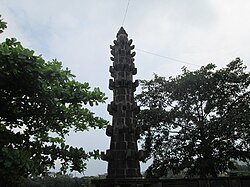
[[File:Vijay Stambh Vadgaon.JPG|thumb|right| A ''Vijay Stambh'' (Victory Pillar) erected to commemorate Maratha victory over British. The pillar is located at [[Vadgaon Maval|Vadgaon/Wadgaon Maval]], close to the city of [[Pune]], India]] | |||
[[File:Scindia Memorial Vadgaon.JPG|thumb|right|An information plaque describing the Maratha victory over British. The plaque is located at [[Vadgaon Maval|Vadgaon/Wadgaon Maval]], close to the city of [[Pune]], India]] | |||
After capturing [[Vasai|Bassein]], Goddard marched towards [[Pune]]. But he was routed in the Battle of Bhor Ghat in April 1781 by Parshurambha, [[Hari Pant|Haripant Phadke]] and [[Tukoji Rao Holkar|Tukoji Holkar]].<ref name="Kantak1993" /><ref name="History of the Mahrattas">{{Cite web | url=https://books.google.com/books?id=Al8OAAAAQAAJ&q=Holkar | title=History of the Mahrattas| last1=Duff| first1=James Grant| year=1878}}</ref> | |||
After capturing [[Vasai|Bassein]], Goddard marched towards [[Pune]]. But he was routed in the Battle of Bhor Ghat in April 1781 by Parshurambha, [[Hari Pant|Haripant Phadke]] and [[Tukoji Rao Holkar|Tukoji Holkar]].<ref name="Kantak1993" /><ref name="History of the Mahrattas">{{Cite web | url=https://books.google.com/books?id=Al8OAAAAQAAJ&q=Holkar | title=History of the Mahrattas| last1=Duff| first1=James Grant| year=1878}}</ref> | |||
In central India, [[Mahadji]] stationed himself at Malwa to challenge Camac. Initially, [[Mahadji]] had an upper hand and British forces under Camac, being harassed and reduced, had to retreat to Hadur.<ref name="Rathod1994">{{cite book|last=Rathod|first=N. G. |title=The Great Maratha Mahadaji Scindia|url=https://books.google.com/books?id=uPq640stHJ0C|year=1994|publisher=Sarup & Sons|location=New Delhi|isbn=978-81-85431-52-9}}</ref>{{rp|20}} | In central India, [[Mahadji]] stationed himself at Malwa to challenge Camac. Initially, [[Mahadji]] had an upper hand and British forces under Camac, being harassed and reduced, had to retreat to Hadur.<ref name="Rathod1994">{{cite book|last=Rathod|first=N. G. |title=The Great Maratha Mahadaji Scindia|url=https://books.google.com/books?id=uPq640stHJ0C|year=1994|publisher=Sarup & Sons|location=New Delhi|isbn=978-81-85431-52-9}}</ref>{{rp|20}} | ||
In February 1781 the British beat Shinde to the town of Sipri,<ref name="Duff-446">{{Cite book|last=Duff|first= James Grant |date=1826 |title= A History of the Mahrattas |location=London |publisher=Longman |url=https://archive.org/details/ahistorymahratt01duffgoog |page=[https://archive.org/details/ahistorymahratt01duffgoog/page/n489 446]}}</ref> but every move they made after that was shadowed by his much larger army, and their supplies were cut off, until they made a desperate night raid in late March, capturing not only supplies, but even guns and [[war elephant|elephants]].<ref name="Mill1826">{{cite book|last=Mill|first= James|chapter-url=http://oll.libertyfund.org/titles/mill-the-history-of-british-india-vol-4 |title=The History of British India|volume=4| chapter=Chapter 6|location=London|publisher= Baldwin |date=1826}}</ref> Thereafter, the military threat from Shinde's forces to the British was much reduced. | In February 1781, the British beat Shinde to the town of Sipri,<ref name="Duff-446">{{Cite book|last=Duff|first= James Grant |date=1826 |title= A History of the Mahrattas |location=London |publisher=Longman |url=https://archive.org/details/ahistorymahratt01duffgoog |page=[https://archive.org/details/ahistorymahratt01duffgoog/page/n489 446]}}</ref> but every move they made after that was shadowed by his much larger army, and their supplies were cut off, until they made a desperate night raid in late March, capturing not only supplies, but even guns and [[war elephant|elephants]].<ref name="Mill1826">{{cite book|last=Mill|first= James|chapter-url=http://oll.libertyfund.org/titles/mill-the-history-of-british-india-vol-4 |title=The History of British India|volume=4| chapter=Chapter 6|location=London|publisher= Baldwin |date=1826}}</ref> Thereafter, the military threat from Shinde's forces to the British was much reduced. | ||
The contest was equally balanced now. Where Mahadji scored a significant victory over Camac at [[Battle of Sironj|Sironj]],<ref name="Naravane2006" />{{rp|62}} the British avenged the loss through the [[Battle of Durdah]]<ref name="Jaques2007">{{cite book|last=Jaques|first=Tony|title=Dictionary of Battles and Sieges|url=https://books.google.com/books?id=3amnMPTPP5MC&pg=PA320|volume=A-E|year=2007|publisher=Greenwood Publishing Group|isbn=978-0-313-33537-2|page=320}}</ref> on 24 March 1781. | The contest was equally balanced now. Where Mahadji scored a significant victory over Camac at [[Battle of Sironj|Sironj]],<ref name="Naravane2006" />{{rp|62}} the British avenged the loss through the [[Battle of Durdah]]<ref name="Jaques2007">{{cite book|last=Jaques|first=Tony|title=Dictionary of Battles and Sieges|url=https://books.google.com/books?id=3amnMPTPP5MC&pg=PA320|volume=A-E|year=2007|publisher=Greenwood Publishing Group|isbn=978-0-313-33537-2|page=320}}</ref> on 24 March 1781. | ||
Colonel Murre arrived with fresh forces in April 1781 to assist Popham and Camac. After his defeat at Sipri, [[Mahadaji Shinde|Mahadji Shinde]] | Colonel Murre arrived with fresh forces in April 1781 to assist Popham and Camac. After his defeat at Sipri, [[Mahadaji Shinde|Mahadji Shinde]] - eager to broker an alliance with the British and avoid further conflict - proposed a new treaty, in spite of objections from within his camp.<ref name=":0">{{Cite book |last=Dalrymple |first=William |title=The Anarchy |publisher=Bloomsbury Publishing |year=2019 |isbn=978-1-4088-6437-1 |location=London |language=English}}</ref> | ||
==Treaty of Salbai== | ==Treaty of Salbai== | ||
{{Main|Treaty of Salbai}} | |||
The war ended on 17 May 1782 with the signing of the [[Treaty of Salbai]] between Warren Hastings and Mahadji Shinde, and was later ratified by Hastings in June 1782, and by Nana Phadnavis in February 1783. | |||
In exchange for the Maratha Empire recognising Raghunathrao's cession of [[Salsette]] and [[Bassein Fort]] to the East India Company, the British withdrew their support for him and recognised Madhavrao II as Peshwa of the Maratha Empire. The British also recognised Maratha claims west of the Jumna River, and agreed to return the territories it occupied over the course of the war. However, in return, the Marathas agreed to return the territories it had captured from the British, while also recognising British suzereinty over the [[Muhammad Ali Khan Wallajah|Nawab of Arcot]]. The Marathas also promised to continue upholding the prior trading privileges enjoyed by the British, whilst agreeing not to support any European power. This was at a time when the British were keen to prevent France - already providing support to Mysore - from gaining further influence in the region during the ongoing [[Anglo-French War (1778–1783)|Anglo-French War]]. | |||
The treaty ended the First Anglo-Maratha War, restored the status quo, and established a relative peace between the two parties for 20 years until the outbreak of the [[Second Anglo-Maratha War]].<ref name="Naravane2006" />{{rp|63}} | |||
==Aftermath== | |||
The war ultimately highlighted the strengths and weaknesses of the largely European style of warfare used by the East India Company, and the ''[[ganimi kava]]'' style of warfare used by the Marathas. Despite being on the offensive throughout the war, the British lacked mobile cavalry capable of pursuing the highly mobile Maratha armies. Conversely, although the Maratha armies consistently harried the British while avoiding [[pitched battles]], these alone were not enough to achieve a decisive victory. The Marathas' extensive use of scorched earth tactics against the British also exacted a considerable toll on the local population. | |||
Nevertheless, in the immediate term, the Marathas had successfully frustrated British machinations in western India by thwarting the restoration of Raghunathrao in exchange for minor territorial concessions, while compelling the British to recognise its own claims west of the Jumna River. | |||
However, the most significant consequence of the First Anglo-Maratha War was the resulting isolation of the [[Kingdom of Mysore]], which itself was fighting the East India Company in the [[Second Anglo-Mysore War]]; with the war against the Marathas concluded, the East India Company was able to concentrate its efforts against the kingdom. Although the 1784 [[Treaty of Mangalore]] between the British and Mysore similarly held Company ambitions at bay and forced it to remain neutral in the [[Maratha–Mysore wars|Maratha–Mysore war]], Mysore would be soundly defeated by an Anglo-Maratha alliance 8 years later in the [[Third Anglo-Mysore War]]. | |||
By the time of the [[Second Anglo-Maratha War]], the defeat of Mysore, the consolidation of its own strength, and the increasing division within the Maratha Empire, placed the East India Company in a much stronger position than it enjoyed in the 1770s.<ref name=":0">{{Cite book |last=Dalrymple |first=William |title=The Anarchy |publisher=Bloomsbury Publishing |year=2019 |isbn=978-1-4088-6437-1 |location=London |language=English}}</ref> | |||
==In popular culture== | ==In popular culture== | ||
The 2013 Hollywood film titled ''[[The Lovers (2013 film)|The Lovers]]'' is based on the backdrop of this war.<ref name="TimeOfIndia">{{Cite web | title = Atul and Milind's The Lovers to be premiered at Cannes | work = The Times of India | date = 10 May 2014 | access-date = 2018-08-13 | url = https://timesofindia.indiatimes.com/entertainment/marathi/movies/news/Atul-Kulkarni-Milind-Gunaji-Roland-Joffe-Singularity-The-Lovers-Bipasha-Basu-Abhay-Deol-Ajay-Zankar-Aishwarya-Rai-Vivek-Oberoi/articleshow/34926960.cms }}</ref> | The 2013 Hollywood film titled ''[[The Lovers (2013 film)|The Lovers]]'' is based on the backdrop of this war.<ref name="TimeOfIndia">{{Cite web | title = Atul and Milind's The Lovers to be premiered at Cannes | work = The Times of India | date = 10 May 2014 | access-date = 2018-08-13 | url = https://timesofindia.indiatimes.com/entertainment/marathi/movies/news/Atul-Kulkarni-Milind-Gunaji-Roland-Joffe-Singularity-The-Lovers-Bipasha-Basu-Abhay-Deol-Ajay-Zankar-Aishwarya-Rai-Vivek-Oberoi/articleshow/34926960.cms }}</ref> | ||
==See also== | ==See also== | ||
{{Commons category|First Anglo-Maratha War}} | |||
* [[Second Anglo-Maratha War]] | * [[Second Anglo-Maratha War]] | ||
* [[Third Anglo-Maratha War]] | * [[Third Anglo-Maratha War]] | ||
| Line 83: | Line 105: | ||
==Notes== | ==Notes== | ||
{{ | {{Notelist}} | ||
{{ | |||
==References== | |||
{{Reflist}} | |||
==Further reading== | ==Further reading== | ||
* Beck, Sanderson. ''India & Southeast Asia to 1800'' (2006) [http://www.san.beck.org/2-10-Marathas1707-1800.html "Marathas and the English Company 1701–1818" online]. Retrieved 1 October 2004. | * Beck, Sanderson. ''India & Southeast Asia to 1800'' (2006) [http://www.san.beck.org/2-10-Marathas1707-1800.html "Marathas and the English Company 1701–1818" online] {{Webarchive|url=https://web.archive.org/web/20181225084030/http://www.san.beck.org/2-10-Marathas1707-1800.html%20 |date=25 December 2018 }}. Retrieved 1 October 2004. | ||
* Gordon, Stewart. ''Marathas, marauders, and state formation in eighteenth-century India'' (Oxford University Press, 1994). | * Gordon, Stewart. ''Marathas, marauders, and state formation in eighteenth-century India'' (Oxford University Press, 1994). | ||
* Gordon, Stewart. "The Marathas," in '' New Cambridge History of India,'' II.4, (Cambridge U Press, 1993). | * Gordon, Stewart. "The Marathas," in '' New Cambridge History of India,'' II.4, (Cambridge U Press, 1993). | ||
| Line 95: | Line 119: | ||
* Athale, Anil. [http://www.rediff.com/news/2003/feb/14spec.htm Anil Athale on Joffe's Invaders]. Retrieved 21 July 2011. | * Athale, Anil. [http://www.rediff.com/news/2003/feb/14spec.htm Anil Athale on Joffe's Invaders]. Retrieved 21 July 2011. | ||
* Hameed, Shahul. [https://web.archive.org/web/20041105041122/http://sify.com/itihaas/fullstory.php?id=13258693 The First Anglo-Maratha War (1775–1782)]. Retrieved 1 October 2004. | * Hameed, Shahul. [https://web.archive.org/web/20041105041122/http://sify.com/itihaas/fullstory.php?id=13258693 The First Anglo-Maratha War (1775–1782)]. Retrieved 1 October 2004. | ||
* [http://www.gatewayforindia.com/history/maratha.htm Indian History – British Period]. Retrieved 1 October 2004. | * {{usurped|1=[https://archive.today/20121216064527/http://www.gatewayforindia.com/history/maratha.htm Indian History – British Period]}}. Retrieved 1 October 2004. | ||
* Paranjpe, Amit et al. | * Paranjpe, Amit et al. {{usurped|1=[https://web.archive.org/web/20040927075428/http://www.mumbainet.com/cityinfo/histmaha.htm#Peshwa History of Maharashtra]}}. Retrieved 1 October 2004. | ||
* https://sites.google.com/vvdatalink.com/vv-datalink/knowledge/history/indian-history/mordern-history/anglo-maratha-wars | * [https://sites.google.com/vvdatalink.com/vv-datalink/knowledge/history/indian-history/mordern-history/anglo-maratha-wars Anglo Maratha Wars] {{Webarchive|url=https://web.archive.org/web/20220125033212/https://sites.google.com/vvdatalink.com/vv-datalink/knowledge/history/indian-history/mordern-history/anglo-maratha-wars |date=25 January 2022 }} | ||
{{MarathaEmpire}} | |||
{{British colonial campaigns}} | {{British colonial campaigns}} | ||
{{ | {{Indian Independence Movement}} | ||
{{Authority control}} | {{Authority control}} | ||
[[Category:Wars involving the British East India Company|Ang]] | [[Category:Wars involving the British East India Company|Ang]] | ||
[[Category:Wars involving the Maratha Empire|Anglo-Maratha War 1]] | [[Category:Wars involving the Maratha Empire|Anglo-Maratha War 1]] | ||
[[Category:Wars involving British India|Anglo-Maratha War 1]] | [[Category:Wars involving British India|Anglo-Maratha War 1]] | ||
[[Category:Wars involving Great Britain|Anglo-Maratha War 1]] | [[Category:Wars involving the Kingdom of Great Britain|Anglo-Maratha War 1]] | ||
[[Category:1775 in India]] | [[Category:1775 in India]] | ||
[[Category:1775 in the British Empire]] | [[Category:1775 in the British Empire]] | ||
Latest revision as of 13:03, 22 July 2026
 | This article has multiple issues. Please help improve it or discuss these issues on the talk page. (Learn how and when to remove these template messages)
|

| First Anglo-Maratha War | |||||||
|---|---|---|---|---|---|---|---|
| Part of the Anglo-Maratha Wars | |||||||
 A mural depicting a British officer surrendering to Mahadaji Scindia following the Maratha victory at the Battle of Wadagaon | |||||||
| |||||||
| Belligerents | |||||||
| Commanders and leaders | |||||||
| |||||||
| Strength | |||||||
|
93,000 troops total[5][1] 23 ships[1] |
Around 146,000 troops total[5][1] 14 ships[1] | ||||||
.svg)


.svg)

Template:Wars of Great Britain
The First Anglo-Maratha War (1775–1782) was the first conflict fought between the British East India Company and Maratha Empire in India. The war, fought in between Surat and Poona, began with the 1775 Treaty of Surat after the East India Company agreed to support the recently-deposed Raghunathrao's claim as peshwa of the Maratha Empire. Several years of intermittent and largely inconclusive campaigning followed, in which the East India Company failed to decisively defeat the highly mobile Marathas. The war ended in 1782 following the Treaty of Salbai.[1] As per the treaty, both sides returned each other's captured territory, and the British withdrew their support for Raghunathrao. The British and Marathas would not fight against each other again until the Second Anglo-Maratha War 20 years later.
Background[edit | edit source]
After the death of Madhavrao Peshwa in 1772, his brother Narayanrao became peshwa (prime minister) of the Maratha Empire. Narayanrao's palace guards murdered him in August 1773, and his uncle Raghunathrao (Raghoba) became the Peshwa. However, Narayanrao's wife, Gangabai, gave birth to a posthumous son, who was the legal heir to the throne. The newborn infant was named 'Sawai' Madhavrao (Sawai means "One and a Quarter"). Twelve Maratha chiefs, known as the Baarbhai [6] and led by Nana Phadnavis, directed an effort to install the infant as the new Peshwa and to rule in his name as regents.
Raghunathrao, unwilling to give up his position of power, sought help from the British at Bombay and signed the Treaty of Surat on 6 March 1775. According to the treaty, Raghunathrao ceded the territories of Salsette and Bassein (Vasai) to the British, along with part of the revenues from Surat and Bharuch districts. In return, the British promised to provide Raghunathrao with 2,500 soldiers.
At the same time, the Marathas tried to form a military alliance with the French. Two Frenchmen, Saint-Lubin and M. Montigny acted as intermediaries between France and the Poona Regency. Although the alliance proposals went nowhere, British suspicions of a global anti-British front increased in the midst of the concurrent American War of Independence.[7]
The British Calcutta Council condemned the Treaty of Surat, sending Colonel Upton to Pune to annul it and make a new treaty with the regency. The Treaty of Purandhar (1 March 1776) annulled that of Surat, Raghunathrao was pensioned and his cause abandoned, but the revenues of Salsette and Bharuch districts were retained by the British. The Bombay government rejected this new treaty and gave refuge to Raghunathrao. In 1777, Nana Phadnavis violated his treaty with the Calcutta Council by granting the French a port on the West coast. The British retaliated by sending a force towards Pune.
Initial stage and Treaty of Purandar (1774–1775)[edit | edit source]
British troops under the command of Colonel Keating, left Surat on 15 March 1775, for Pune. But they were checked by Haripant Phadke at Adas and were totally defeated on 18 May 1775.[8] Casualties for Keating's force, accompanied by Raghunathrao, included 96 killed. The Marathas casualties in the Battle of Adas (Gujarat) included 150 killed.[3]:53–56
Warren Hastings estimated that direct actions against Pune would be detrimental. Therefore, the Supreme Council of Bengal condemned the Treaty of Surat, sending Colonel Upton to Pune to annul it and make a new treaty with the regency. An agreement between Upton and the ministers of Pune called Treaty of Purandar was signed on 1 March 1776.
The Treaty of Purandar (or Treaty of Purandhar) was a doctrine signed on 1 March 1776 by the peshwa of the Maratha Empire and the British East India Company's Supreme Council of Bengal in Calcutta.[9] Based on the terms of the accord, the British were able to secure Salsette.[10] Treaty was signed between the then Governor General Warren Hasting who sent Colonel Upton and Nana Fadnavis of Peshwa in which British accepted Sawai Madhav Rao as a new Peshwa and Maratha accepted not to recognise existence of French in India.
The Treaty of Purandhar (1 March 1776) annulled that of Surat, Raghunath Rao was pensioned and his cause abandoned, but the revenues of Salsette and Broach districts were retained by the British.
Battle of Wadgaon[edit | edit source]

Following a treaty between France and the Poona Government in 1776, the Bombay Government decided to invade and reinstate Raghoba. They sent a force under Col. Egerton reached Khopoli and made its way through the Western Ghats at Bhor Ghat and onwards toward Karla, which was reached on 4 January 1779 while under Maratha attacks. Finally the British were forced to retreat back to Wadgaon, but were soon surrounded. The British surrendered[11] and were forced to sign the Treaty of Wadgaon on 16 January 1779, a victory for the Marathas.[3]:56–58
Reinforcements from northern India, commanded by Colonel (later General) Thomas Wyndham Goddard, arrived too late to save the Bombay force. The British Governor-General in Bengal, Warren Hastings, rejected the treaty on the grounds that the Bombay officials had no legal power to sign it, and ordered Goddard to secure British interests in the area.
Goddard with 6,000 troops stormed Bhadra Fort and captured Ahmedabad on 15 February 1779. There was a garrison of 6,000 Arab and Sindhi infantry and 2,000 horses. Losses in the fight totalled 108, including two British.[12][13][14] Goddard also captured Bassein on 11 December 1780. Another Bengal detachment led by Captain Popham and assisted by the Rana of Gohad, captured Gwalior on 4 August 1780, before Mahadji Scindia could make preparations. Skirmishes took place between Mahadji Scindia and General Goddard in Gujarat, but indecisively. Hastings sent yet another force to harass Mahadji Shinde, commanded by Major Camac.[lower-alpha 1]
Central India and the Deccan[edit | edit source]


After capturing Bassein, Goddard marched towards Pune. But he was routed in the Battle of Bhor Ghat in April 1781 by Parshurambha, Haripant Phadke and Tukoji Holkar.[1][4]
In central India, Mahadji stationed himself at Malwa to challenge Camac. Initially, Mahadji had an upper hand and British forces under Camac, being harassed and reduced, had to retreat to Hadur.[8]:20
In February 1781, the British beat Shinde to the town of Sipri,[13] but every move they made after that was shadowed by his much larger army, and their supplies were cut off, until they made a desperate night raid in late March, capturing not only supplies, but even guns and elephants.[15] Thereafter, the military threat from Shinde's forces to the British was much reduced.
The contest was equally balanced now. Where Mahadji scored a significant victory over Camac at Sironj,[3]:62 the British avenged the loss through the Battle of Durdah[16] on 24 March 1781.
Colonel Murre arrived with fresh forces in April 1781 to assist Popham and Camac. After his defeat at Sipri, Mahadji Shinde - eager to broker an alliance with the British and avoid further conflict - proposed a new treaty, in spite of objections from within his camp.[17]
Treaty of Salbai[edit | edit source]
The war ended on 17 May 1782 with the signing of the Treaty of Salbai between Warren Hastings and Mahadji Shinde, and was later ratified by Hastings in June 1782, and by Nana Phadnavis in February 1783.
In exchange for the Maratha Empire recognising Raghunathrao's cession of Salsette and Bassein Fort to the East India Company, the British withdrew their support for him and recognised Madhavrao II as Peshwa of the Maratha Empire. The British also recognised Maratha claims west of the Jumna River, and agreed to return the territories it occupied over the course of the war. However, in return, the Marathas agreed to return the territories it had captured from the British, while also recognising British suzereinty over the Nawab of Arcot. The Marathas also promised to continue upholding the prior trading privileges enjoyed by the British, whilst agreeing not to support any European power. This was at a time when the British were keen to prevent France - already providing support to Mysore - from gaining further influence in the region during the ongoing Anglo-French War.
The treaty ended the First Anglo-Maratha War, restored the status quo, and established a relative peace between the two parties for 20 years until the outbreak of the Second Anglo-Maratha War.[3]:63
Aftermath[edit | edit source]
The war ultimately highlighted the strengths and weaknesses of the largely European style of warfare used by the East India Company, and the ganimi kava style of warfare used by the Marathas. Despite being on the offensive throughout the war, the British lacked mobile cavalry capable of pursuing the highly mobile Maratha armies. Conversely, although the Maratha armies consistently harried the British while avoiding pitched battles, these alone were not enough to achieve a decisive victory. The Marathas' extensive use of scorched earth tactics against the British also exacted a considerable toll on the local population.
Nevertheless, in the immediate term, the Marathas had successfully frustrated British machinations in western India by thwarting the restoration of Raghunathrao in exchange for minor territorial concessions, while compelling the British to recognise its own claims west of the Jumna River.
However, the most significant consequence of the First Anglo-Maratha War was the resulting isolation of the Kingdom of Mysore, which itself was fighting the East India Company in the Second Anglo-Mysore War; with the war against the Marathas concluded, the East India Company was able to concentrate its efforts against the kingdom. Although the 1784 Treaty of Mangalore between the British and Mysore similarly held Company ambitions at bay and forced it to remain neutral in the Maratha–Mysore war, Mysore would be soundly defeated by an Anglo-Maratha alliance 8 years later in the Third Anglo-Mysore War.
By the time of the Second Anglo-Maratha War, the defeat of Mysore, the consolidation of its own strength, and the increasing division within the Maratha Empire, placed the East India Company in a much stronger position than it enjoyed in the 1770s.[17]
In popular culture[edit | edit source]
The 2013 Hollywood film titled The Lovers is based on the backdrop of this war.[18]
See also[edit | edit source]
- Second Anglo-Maratha War
- Third Anglo-Maratha War
- List of Maratha dynasties and states
- James Hartley (Indian officer)
Notes[edit | edit source]
- ↑ Camac (not to be confused with Carnac) received his promotion to Lieutenant-Colonel while on this mission
References[edit | edit source]
- ↑ 1.00 1.01 1.02 1.03 1.04 1.05 1.06 1.07 1.08 1.09 1.10 1.11 Kantak, M. R. (1993). The First Anglo-Maratha War, 1774-1783: A Military Study of Major Battles. Popular Prakashan. p. 220. ISBN 978-81-7154-696-1.
- ↑ John Bowman (5 September 2000), Columbia Chronologies of Asian History and Culture, quote: "First Anglo-Maratha War...The war ends with Descessive Maratha victory forcing brithishers to sign treaty of salbai.", Columbia University Press, p. 290, ISBN 9780231500043
- ↑ 3.0 3.1 3.2 3.3 3.4 Naravane, M. S. (2006). Battles of the Honourable East India Company: Making of the Raj. APH Publishing. ISBN 978-81-313-0034-3.
- ↑ 4.0 4.1 Duff, James Grant (1878). "History of the Mahrattas".
- ↑ 5.0 5.1 West, Barbara A. (2009). Encyclopedia of the Peoples of Asia and Oceania. Vol. M to Z. Facts On File. p. 509. ISBN 978-0-8160-7109-8.
This period also coincided with the First Anglo-Maratha War, which was settled only in 1782 with a Maratha victory over the British and their local allies.
- ↑ Known as the Baarbhai or Barbhai Council Kulkarni, Sumitra (1995). The Satara Raj, 1818-1848: A Study in History, Administration, and Culture. New Delhi: Mittal Publications. p. 74. ISBN 978-81-7099-581-4.
- ↑ KADAM, towards Cordial Relations UMESH ASHOK (2016), "The Maratha Court and the Embassies of Saint-Lubin and M. Montigny: A Truce towards Cordial Relations", The Indian Ocean in the Making of Early Modern India, Routledge, doi:10.4324/9781315276809-18 ( (inactive $1) 12 July 2025), ISBN 978-1-315-27680-9, retrieved 30 August 2023
{{citation}}: CS1 maint: DOI inactive as of July 2025 (link) CS1 maint: work parameter with ISBN (link) - ↑ 8.0 8.1 Rathod, N. G. (1994). The Great Maratha Mahadaji Scindia. New Delhi: Sarup & Sons. ISBN 978-81-85431-52-9.
- ↑ Encyclopædia Britannica - Treaty of Purandhar After the death of the peshwa Narayan Rao in 1773, his uncle Raghunath Rao tried to secure the succession.Raghunath's claim in the Treaty of Surat (7 March 1775) in return for Salsette Island and Bassein (Vasai). But the supreme government disallowed this treaty and sent its own agent to renegotiate. The resulting Treaty of Purandhar annulled that of Surat. Raghunath was pensioned and his cause abandoned, but Salsette and the Broach revenues were retained by the British. The tangle was increased by the support of the London authorities for Bombay, which in 1778–79 again supported Raghunath. Peace was finally restored in 1782.
- ↑ Sugden, p. 96. It appeared that the Mahrattas had no plans to recover Bassein and Salsette by force, and that they were about to conclude an armistice with the East India Company. Indeed, the supreme council of the company had sent a plenipotentiary to the Mahratta capital, Poona, and it was expected that Salsette would be yielded without violence. This is, in fact, what happened. By playing one faction among the Mahrattas against the other, the company secured Salsette in 1776 by the treaty of Purandhar.
- ↑ Athale, Colonel Anil A (12 January 2018). "How a Maratha general defeated the British". Rediff News.
- ↑ "Bhadra Fort to turn into heritage hangout!". The Times of India. Ahmedabad. TNN. 12 June 2009. Retrieved 17 January 2013.
{{cite news}}: CS1 maint: deprecated archival service (link) - ↑ 13.0 13.1 Duff, James Grant (1826). A History of the Mahrattas. London: Longman. p. 446.
- ↑ Beveridge, Henry (1862). A comprehensive history of India, civil, military and social. Blackie. pp. 456–466.
- ↑ Mill, James (1826). "Chapter 6". The History of British India. Vol. 4. London: Baldwin.
- ↑ Jaques, Tony (2007). Dictionary of Battles and Sieges. Vol. A–E. Greenwood Publishing Group. p. 320. ISBN 978-0-313-33537-2.
- ↑ 17.0 17.1 Dalrymple, William (2019). The Anarchy. London: Bloomsbury Publishing. ISBN 978-1-4088-6437-1.
- ↑ "Atul and Milind's The Lovers to be premiered at Cannes". The Times of India. 10 May 2014. Retrieved 13 August 2018.
Further reading[edit | edit source]
- Beck, Sanderson. India & Southeast Asia to 1800 (2006) "Marathas and the English Company 1701–1818" online Archived 25 December 2018 at the Wayback Machine. Retrieved 1 October 2004.
- Gordon, Stewart. Marathas, marauders, and state formation in eighteenth-century India (Oxford University Press, 1994).
- Gordon, Stewart. "The Marathas," in New Cambridge History of India, II.4, (Cambridge U Press, 1993).
- Seshan, Radhika. "The Maratha State: Some Preliminary Considerations." Indian Historical Review 41.1 (2014): 35–46. online
External links[edit | edit source]
- Athale, Anil. Anil Athale on Joffe's Invaders. Retrieved 21 July 2011.
- Hameed, Shahul. The First Anglo-Maratha War (1775–1782). Retrieved 1 October 2004.
- Indian History – British Period[usurped]. Retrieved 1 October 2004.
- Paranjpe, Amit et al. History of Maharashtra[usurped]. Retrieved 1 October 2004.
- Anglo Maratha Wars Archived 25 January 2022 at the Wayback Machine

.svg)
- Wars involving the British East India Company
- Wars involving the Maratha Empire
- Wars involving British India
- Wars involving the Kingdom of Great Britain
- 1775 in India
- 1775 in the British Empire
- 1776 in India
- 1777 in India
- 1778 in India
- 1779 in India
- 1780 in India
- 1781 in India
- 1782 in India
- 1782 in the British Empire
- Conflicts in 1775
- Conflicts in 1776
- Conflicts in 1777
- Conflicts in 1778
- Conflicts in 1779
- Conflicts in 1780
- Conflicts in 1781
- Conflicts in 1782
- Military history of British India