






No edit summary |
TeenaDease50 (talk | contribs) add structure per standard format and added references based on references |
||
| (3 intermediate revisions by 3 users not shown) | |||
| Line 3: | Line 3: | ||
{{Use dmy dates|date=June 2019}} | {{Use dmy dates|date=June 2019}} | ||
{{Infobox spaceflight | {{Infobox spaceflight | ||
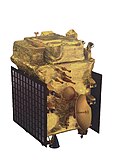
| image = Aditya L1.png | | image = Aditya L1.png | ||
| image_caption = Aditya-L1 | | image_caption = Aditya-L1 spacecraft | ||
| image_size = | | image_size = 280px | ||
| mission_type = [[Solar observation]] | | mission_type = [[Solar observation]] | ||
| operator = [[ | | operator = [[ISRO]] | ||
| COSPAR_ID = | | COSPAR_ID = | ||
| SATCAT = | | SATCAT = | ||
| website = {{URL|https://www.isro.gov.in/Aditya_L1.html}} | | website = {{URL|https://www.isro.gov.in/Aditya_L1.html}} | ||
| mission_duration = 5.2 years (planned)<ref name="CurrSci_113_04">{{Cite journal |last1=Somasundaram |first1=Seetha |last2=Megala |first2=S. |date=25 August 2017 |title=Aditya-L1 mission |url=http://www.currentscience.ac.in/Volumes/113/04/0610.pdf |url-status=dead |journal=Current Science |volume=113 |issue=4 |page=610 |bibcode=2017CSci..113..610S |doi=10.18520/cs/v113/i04/610-612 |archive-url=https://web.archive.org/web/20170825061326/http://www.currentscience.ac.in/Volumes/113/04/0610.pdf |archive-date=25 August 2017 |access-date=25 | | mission_duration = 5.2 years (planned)<ref name="CurrSci_113_04">{{Cite journal |last1=Somasundaram |first1=Seetha |last2=Megala |first2=S. |date=25 August 2017 |title=Aditya-L1 mission |url=http://www.currentscience.ac.in/Volumes/113/04/0610.pdf |url-status=dead |journal=Current Science |volume=113 |issue=4 |page=610 |bibcode=2017CSci..113..610S |doi=10.18520/cs/v113/i04/610-612 |archive-url=https://web.archive.org/web/20170825061326/http://www.currentscience.ac.in/Volumes/113/04/0610.pdf |archive-date=25 August 2017 |access-date=2023-10-25}}</ref> <br/>{{time interval|2 September 2023|show=ymd}} (elapsed) | ||
| spacecraft = | | spacecraft = PSLV-XL/C-57 | ||
| spacecraft_type = | | spacecraft_type = [[PSLV]] | ||
| spacecraft_bus = [[I-1K]] {{ | | spacecraft_bus = [[I-1K]]<ref name="SFI_20160903">{{Cite web |url=https://www.spaceflightinsider.com/organizations/isro/indias-first-solar-mission-to-be-launched-in-2019-20/ |title=India's first solar mission to be launched in 2019–20 |date=4 February 2016 |publisher=Space Flight Insider |first=Tomas |last=Nowakowski |access-date=3 September 2023 |archive-date=3 September 2023 |archive-url=https://web.archive.org/web/20230903160054/https://www.spaceflightinsider.com/organizations/isro/indias-first-solar-mission-to-be-launched-in-2019-20/ |url-status=live }}</ref> | ||
| manufacturer = [[ | | manufacturer = [[ISRO]]{{\}}[[Inter-University Centre for Astronomy and Astrophysics|IUCAA]]{{\}}[[Indian Institute of Astrophysics|IIA]] | ||
| payload_mass = {{cvt|1,500|kg}}<ref name="CurrSci_113_04" /> | |||
| payload_mass = {{cvt| | |||
| dimensions = | | dimensions = | ||
| power = <!-- [[watt]]s --> | | power = <!-- [[watt]]s --> | ||
| launch_date = {{start | | launch_date = {{start date text|2 September 2023}}, 11:50 IST (06:20 UTC)<ref name="it-20230824">{{Cite web |date=28 August 2023 |title=Moon mission done, ISRO aims for the Sun with Aditya-L1 launch on September 2 |url=https://indianexpress.com/article/technology/science/isros-solar-mission-aditya-l1-to-be-launched-on-september-2-says-space-agency-8913266/ |access-date=28 August 2023 |website=[[The Indian Express]] |archive-date=28 August 2023 |archive-url=https://web.archive.org/web/20230828120712/https://indianexpress.com/article/technology/science/isros-solar-mission-aditya-l1-to-be-launched-on-september-2-says-space-agency-8913266/ |url-status=live }}</ref><ref name="launch">{{Cite web |url=https://www.bbc.com/news/world-asia-india-66643805 |title=Aditya-L1: India launches its first mission to Sun |date=2 September 2023 |access-date=2 September 2023 |first=Geeta |last=Pandey |website=[[BBC News]] |archive-date=2 September 2023 |archive-url=https://web.archive.org/web/20230902182110/https://www.bbc.com/news/world-asia-india-66643805 |url-status=live }}</ref> | ||
| launch_rocket = [[Polar Satellite Launch Vehicle|PSLV-XL]] | | launch_rocket = [[Polar Satellite Launch Vehicle#PSLV-XL|PSLV-XL]] [[PSLV-C57|C57]] | ||
| launch_site = [[Satish Dhawan Space Centre]] | | launch_site = [[Satish Dhawan Space Centre]] | ||
| launch_contractor = [[ | | launch_contractor = [[ISRO]] | ||
| orbit_reference = [[Lagrange point#L1|Sun–Earth L<sub>1</sub>]] | | orbit_reference = [[Lagrange point#L1|Sun–Earth L<sub>1</sub> orbit]] | ||
| orbit_regime = [[Halo orbit]] | | orbit_regime = [[Halo orbit]] | ||
| orbit_periapsis = | | orbit_periapsis = | ||
| orbit_apoapsis = | | orbit_apoapsis = | ||
| orbit_inclination = | | orbit_inclination = | ||
| orbit_epoch = 6 January 2024<ref>{{cite news|last=Gupta|first=Shobhit|title=Aditya L1 LIVE: ISRO's first Sun mission successfully injected into final orbit|url=https://www.hindustantimes.com/india-news/aditya-l1-live-updates-indias-first-solar-mission-isro-lagrangean-point-1-insertion-tl1i-s-somanath-101704506376141.html|work=Hindustan Times|date=6 January 2024|access-date=6 January 2024|language=en}}</ref> | |||
| orbit_period = 177.86 days<ref name="COPUOS_62">{{Cite web |last=Sreekumar |first=P. |date=19 June 2019 |title=Indian Space Science & Exploration : Global Perspective |url=http://www.unoosa.org/documents/pdf/copuos/2019/copuos2019tech32E.pdf |access-date=30 June 2019 |publisher=UNOOSA |page=8 |archive-date=30 June 2019 |archive-url=https://web.archive.org/web/20190630051004/http://www.unoosa.org/documents/pdf/copuos/2019/copuos2019tech32E.pdf |url-status=live }}</ref> | | orbit_period = 177.86 days<ref name="COPUOS_62">{{Cite web |last=Sreekumar |first=P. |date=19 June 2019 |title=Indian Space Science & Exploration : Global Perspective |url=http://www.unoosa.org/documents/pdf/copuos/2019/copuos2019tech32E.pdf |access-date=30 June 2019 |publisher=UNOOSA |page=8 |archive-date=30 June 2019 |archive-url=https://web.archive.org/web/20190630051004/http://www.unoosa.org/documents/pdf/copuos/2019/copuos2019tech32E.pdf |url-status=live }}</ref> | ||
| apsis = gee | | apsis = gee | ||
<!-- Re-add when fixed. | |||
| instruments_list = {{Infobox spaceflight/Instruments | | instruments_list = {{Infobox spaceflight/Instruments | ||
| acronym1 = VELC | name1 = Visible Emission Line [[Coronagraph]] | | acronym1 = VELC | name1 = Visible Emission Line [[Coronagraph]] | ||
| Line 40: | Line 41: | ||
| acronym6 = HEL1OS | name6 = High Energy L1 Orbiting X-ray Spectrometer | | acronym6 = HEL1OS | name6 = High Energy L1 Orbiting X-ray Spectrometer | ||
| acronym7 = Magnetometer | name7 = Magnetometer | | acronym7 = Magnetometer | name7 = Magnetometer | ||
}} -->| insignia = [[File:Aditya-L1 logo.png|120px]] [[File:Aditya L1 logo.png|200px]] | |||
| insignia_size = 198px | |||
| insignia_caption = Mission Patch and Mission Insignia | |||
}} | }} | ||
'''Aditya-L1''' | '''Aditya-L1''' <!--Please do not add any non-Latin Script as per "WP:INDICSCRIPT"--> ([[Sanskrit]]: {{transliteration|sa|[[Surya|Āditya]]}} {{IPA|sa|aːd̪it̪jɐ|ipa}} 'Sun', L1 '[[Lagrange point#L1 point|Lagrange Point 1]]'){{efn|from [[Sanskrit]] {{transliteration|sa|Āditya}}, a synonym for the Hindu [[solar deity]], [[Surya]].}} is a [[coronagraph]]y spacecraft for studying the [[Sun#Atmosphere|solar atmosphere]], designed and developed by [[ISRO]] and various other Indian Space Research Institutes.<ref name="CurrSci_113_04" /> It is orbiting at about 1.5 million km from Earth in a [[halo orbit]] around the [[Lagrange point#Lagrange points|Lagrange point 1]] (L1) between the [[Earth]] and the [[Sun]], where it will study the solar atmosphere, [[Solar storm|solar magnetic storms]], and their impact on the environment around the Earth.<ref name=":3">{{Cite news |last=C.S |first=Hemanth |date=2026-01-06 |title=ISRO invites proposals from Indian scientists to analyse data from Aditya-L1 mission |url=https://www.thehindu.com/sci-tech/science/isro-invites-proposals-from-indian-scientists-to-analyse-data-from-aditya-l1-mission/article70476849.ece |access-date=2026-01-09 |work=The Hindu |language=en-IN |issn=0971-751X}}</ref> | ||
It is the first Indian mission dedicated to | It is the first [[List of ISRO missions|Indian mission]] dedicated to observe the Sun. [[Nigar Shaji]] is the project's director.<ref name=":2">{{Cite web |date=2 September 2023 |title=Meet The Project Director Of Ambitious Mission Aditya-L1 {{!}} Nigar Shaji from Tamil Nadu |url=https://www.timesnownews.com/videos/times-now/india/meet-the-project-director-of-ambitious-mission-aditya-l1-nigar-shaji-from-tamil-nadu-video-103302519 |access-date=2 September 2023 |website=TimesNow |language=en |archive-date=2 September 2023 |archive-url=https://web.archive.org/web/20230902155210/https://www.timesnownews.com/videos/times-now/india/meet-the-project-director-of-ambitious-mission-aditya-l1-nigar-shaji-from-tamil-nadu-video-103302519 |url-status=live }}</ref><ref name=":4">{{Cite web |title=Aditya-L1 Mission: Announcement of Opportunity (AO) soliciting proposals for the first AO cycle observations |url=https://www.isro.gov.in/AdityaL1_first_AO_cycle.html |access-date=2026-01-09 |website=www.isro.gov.in}}</ref><ref name="nie_20230902_projectdirector">{{Cite web |title=Meet Nigar Shaji from TN's Tenkasi, Aditya-L1 mission project director |url=https://www.newindianexpress.com/states/tamil-nadu/2023/sep/02/meet-nigar-shaji-from-tns-tenkasi-aditya-l1-mission-project-director-2610872.html |access-date=2 September 2023 |website=The New Indian Express |date=2 September 2023 |archive-url=https://web.archive.org/web/20230902155211/https://www.newindianexpress.com/states/tamil-nadu/2023/sep/02/meet-nigar-shaji-from-tns-tenkasi-aditya-l1-mission-project-director-2610872.html |archive-date=2 September 2023 |url-status=live }}</ref><ref name="ndtv_20230902_projectdirector">{{Cite web |title=Meet Nigar Shaji, The Project Director Of India's First Sun Mission: 5 Points |url=https://www.ndtv.com/india-news/5-points-about-nigar-shaji-project-director-of-india-s-maiden-solar-mission-4352495 |access-date=2 September 2023 |website=NDTV.com |archive-url=https://web.archive.org/web/20230902180138/https://www.ndtv.com/india-news/5-points-about-nigar-shaji-project-director-of-india-s-maiden-solar-mission-4352495 |archive-date=2 September 2023 |url-status=live }}</ref> Aditya-L1 was launched aboard the [[Polar Satellite Launch Vehicle|PSLV]] C57 at 11:50 [[India Standard Time|IST]] on 2 September 2023.<ref name="twitter_20230901_isro_launchannounce">{{Cite tweet |author=ISRO |author-link=ISRO |user=isro |number=1697506899242217921 |title=PSLV-C57/Aditya-L1 Mission: The 23-hour 40-minute countdown leading to the launch at 11:50 Hrs. IST on September 2, 2023, has commended today at 12:10 Hrs. The launch can be watched LIVE on ISRO Website https://isro.gov.in Facebook https://facebook.com/ISRO YouTube https://youtube.com/watch?v=_IcgGYZTXQw… DD National TV channel from 11:20 Hrs. IST |date=1 September 2023}}</ref><ref name="it-20230824"/><ref name="launch" /> It successfully achieved its intended orbit nearly an hour later, and separated from its [[Polar Satellite Launch Vehicle#Fourth stage (PS4)|fourth stage]] at 12:57 IST.<ref name="it_20230902_liveblog">{{Cite web |date=2 September 2023 |title=Aditya L1 Mission: Aditya L1 Launch LIVE Updates: Aditya L1 spacecraft successfully separated from PSLV rocket, now en route to Sun-Earth L1 point. ISRO says mission accomplished |url=https://economictimes.indiatimes.com/news/newsblogs/aditya-l1-live-news-updates-isro-first-solar-mission-launch-02-september-2023/liveblog/103297403.cms |url-status=live |archive-url=https://web.archive.org/web/20230903115715/https://economictimes.indiatimes.com/news/newsblogs/aditya-l1-live-news-updates-isro-first-solar-mission-launch-02-september-2023/liveblog/103297403.cms |archive-date=3 September 2023 |access-date=2 September 2023 |website=The Economic Times |language=en}}</ref> It was inserted at the L1 point on 6 January 2024, at 4:17 pm IST.<ref>{{cite news|title=Aditya-L1 Mission Live Updates: Isro successfully injects Aditya-L1, designed to study Sun, in halo orbit|url=https://timesofindia.indiatimes.com/india/isro-aditya-l1-mission-live-updates-l1-enter-final-orbit-today-sun-mission-all-you-need-to-know-details-isro-news/liveblog/106591455.cms|work=The Times of India|date=6 January 2024|access-date=6 January 2024|language=en}}</ref> | ||
== Mission objectives == | == Mission objectives == | ||
The | The main objectives of Aditya-L1 are: | ||
* | |||
* | * To observe the dynamics of the Sun's [[chromosphere]] and [[Stellar corona|corona]]: | ||
** To study [[Chromosphere|chromospheric]] and [[coronal heating]], the physics of [[Solar spicule|partially ionised]] [[Plasma (physics)|plasma]], of [[coronal mass ejection]]s (CMEs) and their origins, of the coronal [[Stellar magnetic field|magnetic field]] and [[heat transfer]] mechanisms, and [[Solar flare|flare]] exchanges. | |||
* To observe the physical particle environment around its position. | |||
* To determine the sequence of processes in multiple layers below the corona that lead to [[solar eruption]]s. | |||
* | * To study [[space weather]], and the origin, composition and dynamics of [[solar wind]].<ref>{{Cite web |title=ADITYA-L1 |url=https://www.isro.gov.in/Aditya_L1.html |access-date=29 August 2023 |website=www.isro.gov.in |archive-date=3 August 2023 |archive-url=https://web.archive.org/web/20230803035925/https://www.isro.gov.in/Aditya_L1.html |url-status=live }}</ref> | ||
* | |||
* | |||
[[File:Aditya L1.jpg|thumb|Aditya-L1 in stowed configuration]] | [[File:Aditya L1.jpg|thumb|Aditya-L1 in stowed configuration]] | ||
Aditya was conceptualised in January 2008 by the Advisory Committee for Space | [[File:Aditya-L1 spacecraft diagram.jpg|thumb|Aditya-L1 in deployed configuration]] | ||
The mission was conceptualised in January 2008 by the Advisory Committee for Space Sciences (ADCOS).<ref>{{Cite web |title=SAC Industry Portal |url=https://www.sac.gov.in/SAC_Industry_Portal/programme_hsp.html |access-date=2023-09-03 |website=www.sac.gov.in |publisher=Space Applications Center, Government of India |archive-date=3 August 2022 |archive-url=https://web.archive.org/web/20220803051439/https://www.sac.gov.in/SAC_Industry_Portal/programme_hsp.html |url-status=live }}</ref><ref>{{Cite web |date=2023-08-14 |editor-last=Teotia |editor-first=Riya |title=ISRO shares first images of Aditya-L1 satellite ahead of India's first-ever mission to study the Sun |url=https://www.wionews.com/india-news/isro-share-first-images-of-aditya-l1-satellite-ahead-of-indias-first-ever-mission-to-study-the-sun-625203 |access-date=2023-09-03 |website=WION |language=en-us |archive-date=3 September 2023 |archive-url=https://web.archive.org/web/20230903162358/https://www.wionews.com/india-news/isro-share-first-images-of-aditya-l1-satellite-ahead-of-indias-first-ever-mission-to-study-the-sun-625203 |url-status=live }}</ref> It was initially envisaged as a small, {{cvt|400|kg}} satellite in a [[Low Earth orbit|Low Earth Orbit]] (800 km) with a [[coronagraph]] to study the [[solar corona]]. An experimental budget of {{INR|3 [[crore]]}} was allocated for the financial year 2016–2017.<ref name="2016-17_budget">{{Cite press release |title=Notes on Demands for Grants, 2016–2017 |publisher=Department of Space |url=http://indiabudget.nic.in/ub2016-17/eb/sbe84.pdf |access-date=9 September 2016 |url-status=dead |archive-url=https://web.archive.org/web/20160917064145/http://indiabudget.nic.in/ub2016-17/eb/sbe84.pdf |archive-date=17 September 2016}}</ref><ref>{{Cite news |title=Aditya gets ready to gaze at the sun |work=The Hindu |url=http://www.thehindu.com/todays-paper/tp-national/aditya-gets-ready-to-gaze-at-the-sun/article8212387.ece |access-date=25 August 2017 |archive-date=26 August 2017 |archive-url=https://web.archive.org/web/20170826033106/http://www.thehindu.com/todays-paper/tp-national/aditya-gets-ready-to-gaze-at-the-sun/article8212387.ece |url-status=live }}</ref><ref>{{Cite news |last=Gandhi |first=Divya |date=13 January 2008 |title=ISRO planning to launch satellite to study the sun |work=The Hindu |url=http://www.thehindu.com/todays-paper/ISRO-planning-to-launch-satellite-to-study-the-sun/article15143000.ece |access-date=26 August 2017 |archive-date=15 September 2018 |archive-url=https://web.archive.org/web/20180915091339/https://www.thehindu.com/todays-paper/ISRO-planning-to-launch-satellite-to-study-the-sun/article15143000.ece |url-status=live }}</ref> The scope of the mission has since been expanded and it became a comprehensive solar and space environment [[Solar observatory|observatory]] to be placed at [[Lagrange point#L1 point|Lagrange point 1]] (L1),<ref>{{Cite news |last=Desikan |first=Shubashree |date=15 November 2015 |title=The sun shines on India's Aditya |work=The Hindu |url=http://www.thehindu.com/opinion/the-sun-shines-on-indias-aditya/article7878625.ece |access-date=12 August 2018 |archive-date=13 March 2018 |archive-url=https://web.archive.org/web/20180313004843/http://www.thehindu.com/opinion/the-sun-shines-on-indias-aditya/article7878625.ece |url-status=live }}</ref> hence the mission was renamed as ''Aditya-L1.'' {{As of|2019|7|df=}}, the mission has an allocated cost of {{INR|378 [[crore]]s}}, excluding launch costs.<ref name="launch" /> | |||
The [[European Space Operations Centre]] (ESOC), operated by the [[European Space Agency]] (ESA) is supporting the mission.<ref>{{Cite web |date=11 January 2024 |title=ISRO delegation visits ESA mission control |url=https://www.esa.int/Enabling_Support/Operations/ISRO_delegation_visits_ESA_mission_control |access-date=14 January 2024 |website=European Space Agency}}</ref> | |||
On 11 January 2024, ISRO successfully deployed a 6-meter [[magnetometer]] boom aboard the Aditya-L1 in the [[Halo orbit]] at the Lagrange Point L1. After the liftoff, the boom had been stowed for 132 days. The in-orbit deployment period that was measured was roughly 9 seconds, which is well within the 8–12 second prediction range. The magnetometer boom will measure the low-intensity interplanetary magnetic field in space using two high-accuracy [[fluxgate magnetometer]] sensors that are carried aboard. In order to reduce the impact of the spacecraft's [[magnetic field]] on measurements, the sensors are placed 3 and 6 meters away from the craft. Using a dual sensor system also helps to cancel out the spacecraft's magnetic influence and facilitates accurate estimation. The [[carbon-fiber-reinforced polymers]] (CFRP) was used in the construction of the boom segments. Through the use of spring-driven [[hinge]] mechanisms, the five pieces are joined to enable folding in close proximity to the craft throughout the journey and opening up upon reaching the desired orbit. The hinges lock into place as the mechanism fans out. In the stowed position, two hold-downs firmly secure the boom in place. Information obtained via the [[telemetry]] switches validates the release of the hold-down, the initial motion, and the locking of every hinge.<ref>{{Cite news |last=Kumar |first=Chethan |date=2024-01-25 |title=Isro deploys key sensors on Aditya-L1 |url=https://timesofindia.indiatimes.com/india/isro-deploys-key-sensors-on-aditya-l1/articleshow/107151400.cms |access-date=2024-01-27 |work=The Times of India |issn=0971-8257}}</ref><ref>{{Cite web |date=2024-01-26 |title=ISRO confirms magnetometer on Aditya L1 deployed |url=https://indianexpress.com/article/technology/science/isro-confirms-magnetometer-on-aditya-l1-deployed-9128208/ |access-date=2024-01-27 |website=The Indian Express |language=en}}</ref> | |||
== Overview == | == Overview == | ||
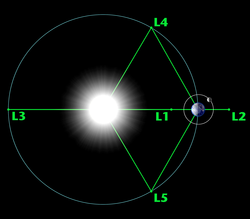
[[File:Lagrange-better.png|thumb|upright=1.0|right|[[Lagrange point]]s in the Sun–Earth system (not to scale) – a small object at any one of the five points will hold its relative position.]] | [[File:Lagrange-better.png|thumb|upright=1.0|right|[[Lagrange point]]s in the Sun–Earth system (not to scale) – a small object at any one of the five points will hold its relative position.]] | ||
The | The mission took 126 Earth days after launch to reach the [[halo orbit]] around the L1 point, which is about {{cvt|1500000|km}} from Earth.<ref>{{Cite web |date=14 February 2020 |title=Department Of Space, Annual Report 2019–2020 |url=https://www.isro.gov.in/sites/default/files/flipping_book/annual_report_2019-20_english/files/assets/common/downloads/Annual%20Report%202019-20%20(English).pdf |url-status=live |archive-url=https://web.archive.org/web/20211007125322/https://www.isro.gov.in/sites/default/files/flipping_book/annual_report_2019-20_english/files/assets/common/downloads/Annual%20Report%202019-20%20(English).pdf |archive-date=7 October 2021 |access-date=25 October 2021}}</ref> The spacecraft is planned to remain in the halo orbit for its mission duration while being maintained at a [[Orbital station-keeping|stationkeeping]] Δv of 0.2–4 m/s per year.<ref>{{Cite thesis |last=Muralidharan |first=Vivek |url=https://docs.lib.purdue.edu/open_access_theses/1310/ |title=Orbit Maintenance Strategies for Sun-Earth/Moon Libration Point Missions: Parameter Selection for Target Point and Cauchy-Green Tensor Approaches |type=MS Thesis |publisher=Purdue University |year=2017 |pages=183–194 |access-date=31 August 2023 |archive-date=31 August 2023 |archive-url=https://web.archive.org/web/20230831130516/https://docs.lib.purdue.edu/open_access_theses/1310/ |url-status=live }}</ref> The {{cvt|1500|kg}} satellite carries seven science payloads with various objectives, including instruments to measure [[Coronal heating problem|coronal heating]], [[solar wind]] acceleration, coronal magnetometry, origin and monitoring of [[Ultraviolet|near-UV]] [[Solar irradiance|solar radiation]] (which drives Earth's upper atmospheric dynamics and global climate), coupling of the solar photosphere to the chromosphere and corona,<ref>{{Cite journal |last1=Wedemeyer-Böhm |first1=S. |last2=Lagg |first2=A. |last3=Nordlund |first3=Å |date=2009-09-15 |title=Coupling from the photosphere to the chromosphere and the corona |journal=Space Science Reviews |volume=144 |issue=1–4 |pages=317–350 |doi=10.1007/s11214-008-9447-8 |arxiv=0809.0987 |issn=0038-6308 |doi-access=free |bibcode=2009SSRv..144..317W }}</ref> and [[in-situ]] characterisations of the space environment around Earth by measuring energetic particle fluxes and magnetic fields of the solar wind, and [[Solar storm|solar magnetic storms]].<ref name="CurrSci_113_04" /> | ||
Aditya-L1 will | Aditya-L1 will provide observations of the Sun's [[photosphere]], [[chromosphere]] and [[solar corona|corona]]. Its scientific payloads must be placed outside the interference from the [[Earth's magnetic field]], and hence, could not have been useful in the low Earth orbit, as proposed in the original mission concept back in 2008.<ref>{{Cite web |title=Aditya-L1 First Indian mission to study the Sun |url=https://www.isro.gov.in/aditya-l1-first-indian-mission-to-study-sun |url-status=dead |archive-url=https://web.archive.org/web/20191210161048/https://www.isro.gov.in/aditya-l1-first-indian-mission-to-study-sun |archive-date=10 December 2019 |access-date=19 June 2019 |website=isro.gov.in}}</ref> | ||
One of the major unsolved | One of the major unsolved problems in the field of [[solar physics]] is coronal heating. The upper atmosphere of the Sun has a temperature of {{cvt|2000000|K|C F}}, whereas the lower atmosphere is just {{cvt|6000|K|C F}}.<ref>{{Cite web |title=Temperatures Across Our Solar System - NASA Science |url=https://science.nasa.gov/solar-system/temperatures-across-our-solar-system/ |access-date=2023-11-30 |website=science.nasa.gov |date=16 November 2023 |language=en}}</ref> In addition, it is not understood exactly how the Sun's radiation affects the dynamics of the Earth's atmosphere on a shorter as well as a longer time scale. The mission will obtain near-simultaneous images of the different layers of the Sun's atmosphere, which will reveal the ways in which energy is channeled and transferred from one layer to another. Thus, the mission will enable a comprehensive understanding of the dynamical processes of the Sun and address some of the outstanding problems in solar physics and [[heliophysics]]. | ||
== Payloads == | == Payloads == | ||
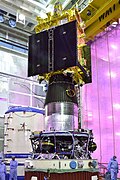
The instruments of Aditya-L1 are tuned to observe the solar atmosphere mainly the chromosphere and corona. In-situ instruments will observe the local environment at | [[File:Aditya-L1 spacecraft.jpg|thumb|The [[Aditya (spacecraft)|Aditya spacecraft]] before integration with the [[Polar Satellite Launch Vehicle|PSLV]] rocket]] | ||
The instruments of Aditya-L1 are tuned to observe the solar atmosphere, mainly the chromosphere and corona. In-situ instruments will observe the local environment at the L1 point. There are seven payloads on board, with four for [[remote sensing]] of the Sun and three for in-situ observation. The payloads have been developed by different laboratories in the country with close collaborations of various ISRO centres.<ref name="ISRO ADITYA-L1">{{Cite web |title=ISRO ADITYA-L1 |url=https://www.isro.gov.in/Aditya_L1.html |access-date=15 July 2023 |archive-date=3 August 2023 |archive-url=https://web.archive.org/web/20230803035925/https://www.isro.gov.in/Aditya_L1.html |url-status=live }}</ref> | |||
{| class="wikitable" | {| class="wikitable" | ||
! | !Type | ||
!Sl.No | !Sl.No | ||
!Payload | !Payload | ||
!Capability | !Capability | ||
!Laboratories | |||
|- | |- | ||
| rowspan="4" |Remote Sensing | | rowspan="4" |Remote Sensing Payloads | ||
|1 | |1 | ||
|Visible Emission Line [[Coronagraph]] | |Visible Emission Line [[Coronagraph]] (VELC) | ||
|[[Stellar corona|Corona]] Imaging and [[spectroscopy]] | |||
|[[Stellar corona|Corona]] | |[[Indian Institute of Astrophysics]], [[Bangalore]] | ||
|- | |- | ||
|2 | |2 | ||
|Solar Ultraviolet Imaging Telescope (SUIT) | |Solar Ultraviolet Imaging Telescope (SUIT) | ||
|[[Photosphere]] and [[ | |[[Photosphere]] and [[chromosphere]] imaging-narrow and broadband | ||
|[[Inter-University Centre for Astronomy and Astrophysics|Inter University Centre for Astronomy & Astrophysics]], [[Pune]] | |||
|- | |- | ||
|3 | |3 | ||
|Solar Low Energy X-ray [[Spectrometer]] (SoLEXS) | |Solar Low Energy X-ray [[Spectrometer]] (SoLEXS) | ||
|Soft X-ray [[spectrometer]]: Sun-as-a-star observation | |Soft X-ray [[spectrometer]]: Sun-as-a-star observation | ||
| rowspan="2" |[[U R Rao Satellite Centre]], [[Bangalore]] | |||
|- | |- | ||
|4 | |4 | ||
|High Energy L1 Orbiting X-ray [[Spectrometer]](HEL1OS) | |High Energy L1 Orbiting X-ray [[Spectrometer]] (HEL1OS) | ||
|Hard X-ray [[spectrometer]]: Sun-as-a-star observation | |Hard X-ray [[spectrometer]]: Sun-as-a-star observation | ||
|- | |- | ||
| rowspan="3" |In-situ | | rowspan="3" |In-situ Payloads | ||
|5 | |5 | ||
|Aditya Solar wind Particle Experiment(ASPEX) | |Aditya Solar wind Particle Experiment (ASPEX) | ||
|[[Solar wind]] | |[[Solar wind]] and Particle analyzer: [[Protons]] and Heavier ions with directions | ||
|[[Physical Research Laboratory]], [[Ahmedabad]] | |||
|- | |- | ||
|6 | |6 | ||
|[[Plasma (physics)|Plasma]] Analyser Package For Aditya (PAPA) | |[[Plasma (physics)|Plasma]] Analyser Package For Aditya (PAPA) | ||
|[[Solar wind]] | |[[Solar wind]] and Particle Analyzer: [[Electrons]] and Heavier Ions with directions | ||
|Space Physics Laboratory, [[Vikram Sarabhai Space Centre]], [[Thiruvananthapuram]] | |||
|- | |- | ||
|7 | |7 | ||
|Advanced Tri-axial [[High Resolution]] Digital [[Magnetometer]]s | |Advanced Tri-axial [[High Resolution]] Digital [[Magnetometer]]s | ||
|[[In-situ]] | |[[In-situ]] magnetic field (Bx, By and Bz). | ||
|[[Laboratory for Electro-Optics Systems|Laboratory for Electro Optics Systems]], [[Bangalore]] | |||
|} | |} | ||
=== | === Visible Emission Line Coronagraph (VELC) === | ||
The | The Visible Emission Line Coronagraph (VELC) is a key instrument on the [[Aditya (spacecraft)|Aditya spacecraft]]. The VELC is an internally [[Occultation|occulted]] reflective coronagraph designed to fulfil specific observation needs. The instrument allows for high spatial resolution imaging 1.25-2.5 [[Arc-seconds|arcseconds]] of the Sun's corona, simultaneous observations in three modes (Imaging, Spectroscopy and [[Spectropolarimetry|Spectro-polarimetry]]), and even utilizes artificial intelligence to aid in the detection of coronal mass ejections (CMEs). The instrument was developed by [[Indian Institute of Astrophysics]], [[Bangalore]].<ref name=":1">{{Cite web |title=ADITYA-L1 |url=https://www.isro.gov.in/Aditya_L1_Payload.html |access-date=2023-10-25 |website=www.isro.gov.in |archive-date=1 January 2024 |archive-url=https://web.archive.org/web/20240101121455/https://www.isro.gov.in/Aditya_L1_Payload.html |url-status=dead }}</ref> | ||
=== Solar Ultraviolet Imaging Telescope (SUIT) === | |||
The SUIT is an ultraviolet imaging telescope designed to study the solar spectral radiation in the [[ultraviolet]] range, using narrowband and broadband spectral filters in the range of 200-400 nm with the hope of developing a better understanding between solar activity and the atmospheric dynamics of Earth. The SUIT utilises 11 different filters. The filters have been selected carefully to ensure coverage of the lower (photosphere) and middle (chromosphere) atmosphere of the Sun, the first approach of its kind in such observations.<ref>{{Cite web |title=Solar Ultraviolet Imaging Telescope (SUIT) onboard Aditya-L1 Mission Observed Powerful Solar Flare and a First-of-Its-Kind Observation of Rare Plasma Ejection in Ultra-violet Light |url=https://www.isro.gov.in/SUIT_onboard_Aditya-L1_Mission.html?utm_ |access-date=2025-11-02 |website=www.isro.gov.in |language=en}}</ref> The SUIT provides near-simultaneous coverage of the solar atmosphere, from lower photosphere to the upper chromosphere. The instrument was developed by [[Inter-University Centre for Astronomy and Astrophysics|Inter University Centre for Astronomy & Astrophysics]], [[Pune]], in collaboration with ISRO.<ref name=":1" /> | |||
=== Solar Low Energy X-ray Spectrometer (SoLEXS) === | |||
The SoLEXS is an X-ray spectrometer designed to continuously measure the solar [[soft X-ray]] flux (2 keV-22 keV)<ref>{{cite journal |last1=Sankarasubramanian |title=Solar Low Energy X-ray Spectrometer (SoLEXS) on Board Aditya-L1 Mission |journal=Solar Physics |date=25 June 2025 |volume=300 |issue=7 |article-number=87 |doi=10.1007/s11207-025-02494-0 |bibcode=2025SoPh..300...87S |url=https://doi.org/10.1007/s11207-025-02494-0|url-access=subscription }}</ref> from the Sun-Earth Lagrangian point L1. These measurements can be used to better understand the properties of the Sun's corona, in particular, why the temperature of the corona is so high. The SoLEXS will observe solar flares, and in conjunction with data provided by the VELC, will help study the complex thermal properties of the Sun's outer layers. The instrument was developed by [[U R Rao Satellite Centre]], [[Bangalore]].<ref name=":1" /> | |||
=== High Energy L-1 Orbiting X-ray Spectrometer (HEL1OS) === | |||
Developed by the Space Astronomy Group, URSC, the HEL1OS (pronounced ''helios)'' is an x-ray spectrometer designed to study solar flares in the x-ray spectrum, in particular, energy bands of 10-150 Kev ([[Kiloelectronvolt|kilo-electron volts]]). Using a twin-pair of [[Cadmium telluride|Cadmium Telluride]] (CdTe) and [[Cadmium zinc telluride|Cadmium Zinc Telluride]] (CZT) detectors, the instrument aims to study the acceleration and movement of electrons in the Sun's corona, as well as to study the [[Cutoff (physics)|cut-off]] energy between thermal and non-thermal solar emissions.<ref name=":1" /> | |||
=== Aditya Solar Wind Particle Experiment (ASPEX) === | |||
The ASPEX is an instrument composed of low and [[high energy particle]] spectrometers, designed to conduct measurements of the Sun's solar wind particles. Solar Wind Ion Spectrometer (SWIS), the low energy spectrometer, contains two analysers, each designed to study particles entering the device in different planes. Supra Thermal Energetic Particle Spectrometer (STEPS), the high energy spectrometer, also consists of two parts, STEPS 1 and STEPS 2, both designed to separate protons and [[alpha particle]]s and measure the integrated [[flux]]. The instrument was developed by the [[Physical Research Laboratory]], [[Ahmedabad]].<ref name=":1" /> | |||
=== Plasma Analyser Package for Aditya (PAPA) === | |||
The PAPA is an instrument on board the Aditya-L1 designed to study the temperature, distribution and velocity of the solar winds. The instrument contains two sensors; the Solar Wind Electron Energy Probe (SWEEP) and the Solar Wind lon Composition Analyser (SWICAR). The detectors are used in conjunction to analyse the energy levels of electrons and ions within the solar wind. The instrument was developed by the Space Physics Laboratory of the [[Vikram Sarabhai Space Centre]], [[Thiruvananthapuram]].<ref name=":1" /> | |||
=== Digital Magnetometers === | |||
On board the Aditya-L1 spacecraft are a pair of magnetic sensors on a deployable boom, one positioned in the middle and the other at the tip. The purpose of these sensors is to gather information about the magnitude and direction of the Interplanetary Magnetic Fields (IMF), as well as to study other events such as Coronal Mass Ejections (CME). Data from the magnetic sensors will be used to supplement that of the PAPA and ASPEX sensors.<ref name=":1" /> | |||
== Mission profile == | |||
[[File:Flight Sequence.pdf|thumb|Flight Sequence of PSLV-C57]] | |||
=== Launch === | |||
[[File:PSLV-C57, Aditya-L1 - Launch Vehicle being transferred from Vehicle Assembly Building (VAB) to Second Launch Pad (SLP) 05.webp|PSLV-C57 on launch pad housing Aditya-L1|thumb|left]] | |||
On 2 September 2023, at 11:50 [[Indian Standard Time|IST]], the [[Polar Satellite Launch Vehicle]] (PSLV-C57) accomplished a successful launch of the ''Aditya-L1'' from the [[Second Launch Pad]] of the [[Satish Dhawan Space Centre]] (SDSC) located in [[Sriharikota]]. | |||
''Aditya-L1'', following a flight duration of 63 minutes and 20 seconds, achieved a successful [[Orbit injection|injection]] into an [[elliptical orbit]] around the Earth at 12:54 [[Indian Standard Time|IST]].<ref>{{Cite web |title=PSLV-C57 / ADITYA-L1 Mission - Press Release |url=https://www.isro.gov.in/PSLVC57_AdityaL1_PressRelease.html |access-date=2023-09-03 |website=www.isro.gov.in |archive-date=3 September 2023 |archive-url=https://web.archive.org/web/20230903112819/https://www.isro.gov.in/PSLVC57_AdityaL1_PressRelease.html |url-status=live }}</ref> | |||
''Aditya-L1'' underwent a series of four Earth-bound [[Orbital maneuver|orbital maneuvres]] prior to its injection to a transfer orbit towards the [[Lagrange point]] (L1). It reached its designated orbit at the L1 point 126 days after its launch on 6 January 2024 at 4:17 IST.<ref name="isro_20230902_adityal1">{{Cite web |title=PSLV-C57/ADITYA-L1 Mission |url=https://www.isro.gov.in/PSLVC57_AdityaL1_PressRelease.html |url-status=live |archive-url=https://web.archive.org/web/20230903112819/https://www.isro.gov.in/PSLVC57_AdityaL1_PressRelease.html |archive-date=3 September 2023 |access-date=2 September 2023 |website=www.isro.gov.in}}</ref><ref>{{cite news|title=Aditya L1 Mission LIVE Updates: India creates yet another landmark, country's first solar observatory Aditya-L1 reaches its destination, says PM Modi|url=https://www.moneycontrol.com/news/india/latest-daily-news-live-india-world-delhi-coldwave-covid-cases-in-india-breaking-news-and-updates-liveblog-12007491.html|work=Moneycontrol|date=6 January 2024|access-date=6 January 2024|language=en}}</ref> | |||
=== Orbit raising burns === | |||
[[File:Aditya L1 's Trajectory.pdf|thumb|Trajectory of PSLV-C57/Aditya L1 Mission]] | |||
; First orbit raising burn | |||
On 3 September 2023, the ''Aditya-L1'' performed its first Earth-bound maneuvre, raising its orbit to a {{Cvt|245|km}} into {{Cvt|22,459|km}} orbit.<ref>{{cite tweet|title=Aditya L1|user=isro|number=1698224462821544411|date=3 September 2023|access-date=3 September 2023}}</ref> | |||
; Second orbit raising burn | |||
On 5 September 2023, ''Aditya-L1'' performed its second Earth-bound maneuvre, raising its orbit to a {{Cvt|282|km}} into {{Cvt|40,225|km}} orbit. | |||
; Third orbit raising burn | |||
On 10 September 2023, ''Aditya-L1'' performed its third Earth-bound maneuvre, raising its orbit to a {{Cvt|296|km}} into {{Cvt|71,767|km}} orbit. | |||
; Fourth orbit raising burn | |||
On 15 September 2023, ''Aditya-L1'' performed its fourth Earth-bound maneuvre, raising its original orbit to a {{Cvt|256|km}} into {{Cvt|121,973|km}} orbit. This was the last of such maneuvers, being directly followed by the Trans-Lagrangian 1 Injection, which took place on 19 September. | |||
; Trans-Lagrangian 1 Injection | |||
On 19 September 2023, ''Aditya-L1'' performed its last maneuvre around Earth to escape its orbit and headed towards the Lagrange 1 point, taking at least four months to further reach its destination, 1.5 million kilometers away.<ref name=":0">{{Cite web |title=ADITYA-L1 Mission Details |url=https://www.isro.gov.in/Aditya_L1-MissionDetails.html |access-date=2023-10-25 |website=www.isro.gov.in}}</ref> | |||
On 30 September 2023, ''Aditya-L1'' had escaped the Earth's sphere of influence and was on the way to the Lagrange point 1.<ref name=":0" /> During this journey a week before Orbital Insertion, the SUIT instrument captured an X-class solare flare and a CME on December 31, 2023.<ref>{{Cite web |title=MSN |url=https://www.msn.com/en-in/news/techandscience/isro-s-aditya-l1-captures-solar-eruption-that-could-circle-earth-in-30-seconds/ar-AA1EKiVO?ocid=msedgntp&pc=U531&cvid=b4e5dd3bf9934e2aff0471a165d7df87&ei=13 |access-date=2025-05-14 |website=www.msn.com}}</ref> This was the first observations of a solar flare using [[Near UV|near-UV]] light.<ref>{{Cite web |title=Solar Ultraviolet Imaging Telescope (SUIT) onboard Aditya-L1 Mission Observed Powerful Solar Flare and a First-of-Its-Kind Observation of Rare Plasma Ejection in Ultra-violet Light |url=https://www.isro.gov.in/SUIT_onboard_Aditya-L1_Mission.html |access-date=2025-05-25 |website=www.isro.gov.in |language=en}}</ref> | |||
;Trajectory correction maneuver | |||
On 6 October 2023, ''Aditya-L1'' performed a Trajectory Correction maneuvre (TCM1). It was needed to correct the trajectory evaluated after tracking the Trans-Lagrangian Point 1 Insertion (TL1I) maneuvre performed on 19 September 2023.<ref>{{Cite web |title=ADITYA-L1 |url=https://www.isro.gov.in/Aditya_L1.html |access-date=2023-09-30 |website=www.isro.gov.in}}</ref> | |||
;Halo orbit insertion | |||
On 6 January 2024, ''Aditya-L1'' was successfully injected on the [[Halo orbit]] of Lagrange point 1 (HOI), at 4:17 pm IST.<ref name="TET">{{cite news|title=Aditya-L1, ISRO's first solar spacecraft enters Sun's final orbit|url=https://economictimes.indiatimes.com/news/science/aditya-l1-isros-first-solar-spacecraft-enters-suns-final-orbit/articleshow/106596085.cms|work=The Economic Times|date=6 January 2024|access-date=6 January 2024|language=en}}</ref> | |||
{| class="wikitable" | {| class="wikitable" | ||
|+ | |+Mission stages and maneuvres | ||
! | !Stage and Sequence | ||
! | !Date/Time | ||
!Time (IST) | |||
![[Periapsis]] | |||
![[Apoapsis]] | |||
![[Duration|Duration]] | |||
!Burn Time | |||
!{{Refh}} | |||
|- | |||
! colspan="8" |Launch | |||
|- | |||
|Earth Orbit Insertion | |||
|2 September 2023 | |||
|12:54 p.m | |||
|{{Cvt|235|km}} | |||
|{{Cvt|19500|km}} | |||
|22 hours, 46 minutes | |||
| | |||
|<ref>{{Cite tweet|number=1697874341604835828|user=isro|title=The launch of Aditya-L1 by PSLV-C57 is accomplished successfully. The vehicle has placed the satellite precisely into its intended orbit. India's first solar observatory has begun its journey to the destination of Sun-Earth L1 point.|date=2023-09-02|author=ISRO|df=dmy}}</ref> | |||
|- | |||
! colspan="8" |Earth Bound maneuvres | |||
|- | |||
|Earth Bound maneuvre 1 | |||
|3 September 2023 | |||
|11:40 a.m. | |||
|{{Cvt|245|km}} | |||
|{{Cvt|22,459|km}} | |||
|39 hours, 20 minutes | |||
| | |||
|<ref name="ebn2">{{Cite tweet|number=1698224462821544411|user=isro|title=The satellite is healthy and operating nominally. The first Earth-bound maneuvre (EBN#1) is performed successfully from ISTRAC, Bengaluru. The new orbit attained is 245km x 22459 km. The next maneuvre (EBN#2) is scheduled for September 5, 2023, around 03:00 Hrs. IST|date=2023-09-03|author=ISRO|df=dmy}}</ref> | |||
|- | |||
|Earth Bound maneuvre 2 | |||
|5 September 2023 | |||
|3:00 a.m | |||
|{{Cvt|282|km}} | |||
|{{Cvt|40225|km}} | |||
|4 days, 23 hours and 30 minutes | |||
| | |||
|<ref name="ebn3">{{Cite tweet |user=isro |number=1698810887614992515 |title=Aditya-L1 Mission: The second Earth-bound maneuvre (EBN#2) is performed successfully from ISTRAC, Bengaluru. ISTRAC/ISRO's ground stations at Mauritius, Bengaluru and Port Blair tracked the satellite during this operation. The new orbit attained is 282 km x 40225 km. The next maneuvre (EBN#3) is scheduled for September 10, 2023, around 02:30 Hrs. IST |df=dmy |author=ISRO |author-link=ISRO}}</ref> | |||
|- | |||
|Earth Bound maneuvre 3 | |||
|10 September 2023 | |||
|2:30 am | |||
|{{Cvt|296|km}} | |||
|{{Cvt|71,767|km}} | |||
|4 days, 23 hours and 45 minutes | |||
| | |||
|<ref name="ebn4">{{Cite tweet |user=isro|number=1700616257169400254|title=Aditya-L1 Mission:The third Earth-bound maneuvre (EBN#3) is performed successfully from ISTRAC, Bengaluru.ISRO's ground stations at Mauritius, Bengaluru, SDSC-SHAR and Port Blair tracked the satellite during this operation.The new orbit attained is 296 km x 71767 km. The next maneuvre (EBN#4) is scheduled for September 15, 2023, around 02:00 Hrs. IST |df=dmy |author=ISRO |author-link=ISRO}}</ref> | |||
|- | |- | ||
| | |Earth Bound maneuvre 4 | ||
| | |15 September 2023 | ||
|2:15 am | |||
| | |{{Cvt|256|km}} | ||
|{{Cvt|121,973|km}} | |||
|3 days, 23 hours and 45 minutes | |||
| | |||
|<ref name="ebn5">{{Cite tweet |user=isro|number=1702426982602907974|title=Aditya-L1 Mission: The fourth Earth-bound maneuvre (EBN#4) is performed successfully. ISRO's ground stations at Mauritius, Bengaluru, SDSC-SHAR and Port Blair tracked the satellite during this operation, while a transportable terminal currently stationed in the Fiji islands for Aditya-L1 will support post-burn operations. The new orbit attained is 256 km x 121973 km. The next maneuvre Trans-Lagragean Point 1 Insertion (TL1I) a send-off from the Earth is scheduled for September 19, 2023, around 02:00 Hrs.IST |df=dmy |author=ISRO |author-link=ISRO}}</ref> | |||
|- | |- | ||
|2 | |Trans-Lagrangian Point 1 Injection | ||
| | |19 September 2023 | ||
| | |2:00 am | ||
| | |||
| | |||
| | |||
| | |||
|<ref>{{Cite tweet |user=isro|number=1703876571080143044|title=Aditya-L1 Mission: Off to Sun-Earth L1 point! The Trans-Lagrangean Point 1 Insertion (TL1I) maneuvre is performed successfully. The spacecraft is now on a trajectory that will take it to the Sun-Earth L1 point. It will be injected into an orbit around L1 through a maneuver after about 110 days. This is the fifth consecutive time ISRO has successfully transferred an object on a trajectory toward another celestial body or location in space |df=dmy |author=ISRO |author-link=ISRO}}</ref> | |||
|- | |- | ||
| | ! colspan="8" |Trajectory correction maneuvres | ||
|- | |- | ||
| | |Trajectory Correction maneuvre (TCM) | ||
| | |6 October 2023 | ||
| | | | ||
| | |||
| | |||
| | |||
|16s | |||
|<ref>{{Cite web |title=ADITYA-L1 |url=https://www.isro.gov.in/Aditya_L1.html |access-date=2023-10-08 |website=www.isro.gov.in}}</ref> | |||
|- | |- | ||
| | ! colspan="8" |Halo orbit injection | ||
|- | |- | ||
|6 | |Halo orbit insertion (HOI) | ||
| | |6 January 2024 | ||
| | |4:17 pm | ||
| | |||
| | |||
|approx. 177.86 earth days | |||
| | |||
|<ref>{{cite news|title=Halo-Orbit Insertion of Aditya-L1 Successfully Accomplished|url=https://www.isro.gov.in/halo-orbit-insertion-adtya-l1.html|website=[[ISRO]]|date=6 January 2024|access-date=6 January 2024|language=en}}</ref> | |||
|} | |} | ||
== | {{multiple image | ||
The Aditya-L1 | | align = center | ||
| direction = horizontal | |||
| width = 300px | |||
| header = Animation of Aditya-L1 | |||
| image1 = Animation of Aditya-L1 around Earth.gif | |||
| caption1 = Around the Earth | |||
| image2 = Animation of Aditya-L1 around Sun - Frame rotating with Earth.gif | |||
| caption2 = Around the L1 point - Frame rotating with Earth | |||
| footer = {{legend2|Magenta| Aditya-L1}}{{·}}{{legend2| RoyalBlue| Earth}}{{·}}{{legend2|Cyan| L1 point}} | |||
}} | |||
=== Orbit === | |||
Aditya-L1 completed its first [[halo orbit]] around L1 point on July 2, 2024. It takes it approximately 178 days to complete each orbit. It underwent two station-keeping maneuvers on February 22 and June 7, and later one on July 2.<ref>{{Cite web |title=Aditya-L1 Mission: Completion of First Halo Orbit |url=https://www.isro.gov.in/Aditya_L1_Mission_Completion_of_First_Halo_Orbit.html |access-date=2024-07-02 |website=www.isro.gov.in}}</ref> | |||
== Science phase == | |||
Following commissioning and checkout, Adiya L1 began Science observations about three months into the mission. The PAPA instrument on the spacecraft was operationalised on December 12, 2023, and made its first observation on February 10 and 11 2024 using the PAPA instrument to observe the Sun from its vantage point–a distance of about 1 million miles (1.5 million kilometers).<ref>{{Cite web |author1=Sharmila Kuthunur |date=2025-03-04 |title=India's Aditya-L1 solar probe watches powerful flare erupt from the sun |url=https://www.space.com/the-universe/sun/indias-aditya-l1-solar-probe-watches-powerful-flare-erupt-from-the-sun |access-date=2025-03-04 |website=Space.com |language=en}}</ref><ref>{{Cite web |title=PAPA payload aboard Aditya-L1 detects solar wind impact of Coronal Mass Ejections |url=https://www.isro.gov.in/PAPA_payload_Aditya-L1_detects_solar_wind.html |access-date=2024-12-10 |website=www.isro.gov.in}}</ref> Post-launch calibration of SUIT has now characterised its filters in detail. In-orbit testing of the transmission, spatial variation, and out-of-band performance confirmed that most filters meet design expectations, with only a few showing slightly higher out-of-band transmission than predicted (still below 1%).<ref>Title = Science Filter Characterization of SUIT | |||
Author = Mathew, S. K. and others | |||
Eprint = 2412.11636 | |||
archiveprefix= arXiv | |||
Date = 2024-12-17</ref> Additionally, on 31 December 2023, SUIT observed a plasma blob ejection from the Sun moving at speeds up to 1500 km/s, the highest recorded by the mission thus far.<ref name=":2" /> | |||
In conjunction with the [[Udaipur Solar Observatory]] and research stations at [[Thumba]], ISRO mobilised all its observation platforms and systems to record the signatures of a Massive Solar Flare in May 2024. Aditya-L1, [[Chandrayaan-2]]'s orbiter and [[XPoSat]] have made observations and observed signatures have been analysed. Aditya-L1 used ASPEX, SOLEX, HEL1OS and its [[magnetometer]] instruments to record data.<ref>{{Cite web |title=ISRO Captures the Signatures of the Recent Solar Eruptive Events from Earth, Sun-Earth L1 Point, and the Moon |url=https://www.isro.gov.in/ISRO_CapturesSignaturesRecentSolarEruptive_Events.html |access-date=2024-12-10 |website=www.isro.gov.in}}</ref> This storm, called "[[May 2024 solar storms|Gannon's Storm]]" was the strongest solar storm recorded since the beginning of the 21st Century. Using the Magneometers on Aditya L1 and other [[NASA]] spacecraft discovered that two distinct CMEs collided in space such that the magnetic field lines inside one of them snapped and rejoined in new ways, a process called [[magnetic reconnection]]. This sudden reversal of the magnetic field made the storm's impact much stronger than expected.<ref>{{Cite web |title=India's Aditya-L1 Joins Global Effort in Landmark Solar Storm Study |url=https://www.isro.gov.in/Aditya_L1_Landmark_solar_storm_study.html |access-date=2025-12-09 |website=www.isro.gov.in |language=en}}</ref><ref>{{Cite web |last=Madanapalle |first=Aditya |date=2025-12-09 |title=Aditya L1 reveals complexities of plasma bursts during May 2024 solar storm |url=https://www.news9live.com/science/aditya-l1-reveals-complexities-of-plasma-bursts-during-may-2024-solar-storm-2910403 |access-date=2025-12-09 |website=News9live |language=en-US}}</ref> Using observations of particles and fields measurements from Aditya-L1, and combining it with other ground based measurements as well as the [[GOES-18]] spacecraft, unusual dawn-side magnetic disturbances observed during this storm were most likely caused by a rare type of space current normally confined to auroral regions of the Sun.<ref>{{Cite web |title=MSN |url=https://www.msn.com/en-in/news/india/earth-behaved-strangely-during-two-massive-solar-events-aditya-l1-reveals-why/ar-AA1WNeGK?ocid=msedgntp&pc=U531&cvid=6999e6d8809644dba8b2924c401cc5f6&ei=101 |access-date=2026-02-21 |website=www.msn.com}}</ref> During very strong storms, when the Earth’s magnetosphere becomes highly compressed, such rare auroral current systems ingress into lower solar latitudes, extending much farther towards the mean solar equator.<ref>{{Cite web |title=Aditya-L1 measurementshelp to explain unusual dawn-time geomagnetic disturbances during strong solar storms |url=https://www.isro.gov.in/Aditya_L1_measurementshelp.html |access-date=2026-02-19 |website=www.isro.gov.in |language=en}}</ref><ref>{{Cite journal |last=Rai |first=Deeksha |last2=Tulasi Ram |first2=S. |last3=Nilam |first3=B. |last4=Oliveira |first4=D. M. |last5=Remya |first5=B. |last6=Raghav |first6=Anil |last7=Chakrabarty |first7=D. |last8=Kumar |first8=Abhishek |last9=Parashar |first9=Shivam |last10=Yadav |first10=Vipin K. |last11=Dimri |first11=A. P. |date=2026-02-16 |title=Dawn‐Side Anomaly in Sudden Geomagnetic Field Responses to Solar Wind Pressure Discontinuities During the 10 May and 10 October 2024 Geomagnetic Storms |url=https://agupubs.onlinelibrary.wiley.com/doi/10.1029/2025GL119914 |journal=Geophysical Research Letters |language=en |volume=53 |issue=3 |doi=10.1029/2025GL119914 |issn=0094-8276|doi-access=free }}</ref> | |||
Ground based observations from the [[Gauribidanur Radio Observatory|Gauribidanur radio telescope]] and [[Indian Institute of Astrophysics|IIA]] astronomers using VELC detected multiple CME-driven shock waves forming at a distance of approximately 130,000 kilometers above the Sun’s surface and traveling at nearly 1,700 kilometers per second on May 27 2024.This is the closest distance from the Sun at which such a shock and its associated radio burst have been unambiguously detected.<ref>{{Cite web |last=Tripathi |first=Sibu |date=2026-02-25 |title=Indian team makes big solar discovery that could save Earth's satellites, GPS |url=https://www.indiatoday.in/science/story/indian-team-make-big-solar-discovery-that-could-hit-earths-satellites-gps-aditya-l1-2874169-2026-02-25 |access-date=2026-02-26 |website=India Today |language=en}}</ref> | |||
On July 16, 2024, the VELC instrument was used to measure another large Coronal Mass ejection from the Sun. It also studied an accompanying solar flare and the motion of solar particles within the Sun.<ref>{{Cite web |title=Unlocking the Mysteries of the Sun: Aditya-L1's Observations of a Coronal Mass Ejection |url=https://www.isro.gov.in/Aditya_L1_Observations_Coronal_Mass_Ejection.html |access-date=2024-12-10 |website=www.isro.gov.in |language=en}}</ref> | |||
<gallery mode="packed"> | |||
File:Global Magnetic field changes during 2024 solar storms.webp|Global Solar wind impact map from 2024 Aditya L1 data | |||
File:Aditya l1 2024 solar wind measurment data.webp|Global Solar wind impact map from 2024 Aditya L1 data | |||
</gallery> | |||
Marking its first year of science observation, ISRO released the maiden set of the scientific data from the Aditya L1 to the global scientific community on January 6, 2025, at the ISRO Headquarters in Bengaluru.<ref>{{Cite web |title=ISRO Organises National Meet on Aditya L1 Data Release and Payload Performance Appraisal |url=https://www.isro.gov.in/ISRO_Nationalmeet_AdityaL1.html |access-date=2025-01-07 |website=www.isro.gov.in}}</ref> ISRO presented the second set on February 14, 2025.<ref>{{Cite web |title=Release of the Second Set of Aditya-L1 Science Data |url=https://www.isro.gov.in/Second_Set_of_Aditya_L1_Science_Data.html |access-date=2025-02-28 |website=www.isro.gov.in}}</ref> On February 22, 2024, Aditya L1 captured the first-ever image of a ''X6.3-class'' [[Solar flare|solar flare ‘kernel’]] occurring in the [[photosphere]] and the [[chromosphere]]. The image was taken alongside operations of SUIT, SoLEXS and HEL1OS instruments in the [[Near ultraviolet|Near-Ultraviolet band.]]<ref>{{Cite web |title=Historic First: India's Solar Ultra-violet Imaging Telescope (SUIT) onboard Aditya-L1 Captures Unprecedented Solar Flare Details |url=https://www.isro.gov.in/SUIT_Aditya-L1_Captures_SolarFlare.html |access-date=2025-02-28 |website=www.isro.gov.in}}</ref> Further studies of a continuation event in October 2024 decoded the impact of Solar winds with the [[Earth's magnetic field|Earth's Magnectic field]] and the result of these interactions that affected [[Geostationary satellites]] in earth orbit. The study also noted that currents over high latitude regions intensified, potentially heating the Earth’s upper atmosphere and causing enhanced [[atmospheric escape]].<ref>{{Cite web |title=ISRO's Aditya-L1 decodes the Impact of a Powerful Solar Storm on Earth's Invisible Magnetic Shield |url=https://www.isro.gov.in/AdityaL1_decodes_Impact_Powerful_Solar_Storm.html |access-date=2026-01-11 |website=www.isro.gov.in |language=en}}</ref><ref>{{Cite web |title=MSN |url=https://www.msn.com/en-in/news/techandscience/india-s-aditya-l1-reveals-how-monster-solar-storm-shook-earth-s-magnetic-shield/ar-AA1TWqcq?ocid=msedgntp&pc=U531&cvid=696331fded474579b55019632b293c39&ei=132 |access-date=2026-01-11 |website=www.msn.com}}</ref><ref>{{Cite web |title=MSN |url=https://www.msn.com/en-in/news/techandscience/how-do-solar-storms-impact-earth-s-magnetic-field-isro-s-aditya-l1-decodes/ar-AA1TWDca?ocid=msedgntp&pc=U531&cvid=f558b6f61c61447b86265af935ca974c&ei=91 |access-date=2026-01-11 |website=www.msn.com}}</ref> Scientists from IIA also reported observations of a flareless coronal mass ejection from reading taken by VELC in March 2025.<ref>{{Cite news |last=C.S |first=Hemanth |date=2025-03-14 |title=Aditya-L1 mission: scientists observe a flareless coronal mass ejection |url=https://www.thehindu.com/sci-tech/science/aditya-l1-mission-iia-scientists-report-observations-of-a-flareless-coronal-mass-ejection-from-the-solar-atmosphere/article69330587.ece/ |access-date=2025-03-15 |work=The Hindu |language=en-IN |issn=0971-751X}}</ref>Observations from the onboard MAG payload show that during solar transient events in 2024, the [[interplanetary magnetic field]] magnitude increased above typical quiet-solar levels, and the spectral slope of turbulence approached a Kolmogorov -5/3 kind of behaviour. To verify changes in spectral behaviour, the data was compared with that from a day when quiet solar winds were present, resulting in a strong contrast. The quiet periods exhibit anisotropic turbulence, whereas the behaviour from the event exhibited quasi-isotropic behaviour, with spectral slopes closely following the Kolmogorov spectrum across all three IMF components.<ref>Title = Observations of the fluctuations in Interplanetary Magnetic Field around L1 point during the solar transient events of 2024 with MAG payload onboard Aditya-L1 spacecraft. | |||
Authors = Vipin K. Yadav, R.K. Choudhary and M. Midhun Goutham | |||
archiveprefix = arXiv | |||
eprint = 2509.03182 | |||
class = astro-ph.IM | |||
</ref> | |||
In 2025, using the data from the VELC instrument, researchers from IIA and NASA created the very first spectroscopic observations of a CME in the visible wavelength range. They also estimated the electron density, energy, mass, temperature and speed of a CME very close to the Sun.<ref>{{Cite news |last=C.S |first=Hemanth |date=2025-11-09 |title=Aditya-L1 gets a close look at eruptions from the sun |url=https://www.thehindu.com/sci-tech/science/aditya-l1-iia-nasa-collaborate-to-record-spectroscopic-observations-of-a-cme-in-visible-wavelength-range-for-very-first-time/article70258711.ece |access-date=2025-11-10 |work=The Hindu |language=en-IN |issn=0971-751X}}</ref><ref>[https://www.moneycontrol.com/science/aditya-l1-mission-tracks-coronal-mass-ejection-in-india-nasa-collaboration-article-13662018.html Aditya-L1 mission tracks coronal mass ejection in India-NASA collaboration]</ref> | |||
On the second anniversary (January 6, 2026) of Aditya-L1's launch, ISRO made an Announcement of Opportunity to solicit proposals for scientific research data from its first AO cycle observations.<ref name=":3" /><ref name=":4" /> ISRO and [[ESA]] conducted a workshop at [[IIST]] in [[Thiruvananthapuram|Thiruvanthapuram]] between 19-23 January 2026 presenting data from Aditya-L1, [[PROBA-3|Proba-3]] and [[Solar Orbiter]] presenting complementary vantage data points from each mission.<ref>{{Cite web |title=ISRO and ESA jointly organise ISRO-ESA Heliophysics Workshop on Aditya-L1, Solar Orbiter and Proba-3 |url=https://www.isro.gov.in/ISRO_ESA_Heliophysics_Workshop.html |access-date=2026-01-21 |website=www.isro.gov.in}}</ref><ref>{{Cite web |title=ISRO-ESA Heliophysics Workshop on Aditya-L1, Solar Orbiter and Proba-3 {{!}} Indian Institute of Space Science and Technology |url=https://www.iist.ac.in/events/isro-esa-heliophysics-workshop-aditya-l1-solar-orbiter-and-proba-3 |access-date=2026-02-07 |website=www.iist.ac.in}}</ref> The [[2026 Union budget of India|2026 Indian budget]] also proposed to rebuild the [[National Large Solar Telescope|''National Large'' ''Solar Telescope'']] at a cost of about {{INRConvert|1000|c|year=2026}} by 2030 for it to serve as a complement to solar data from Aditya-L1.<ref>{{Cite web |title=Angry sun puts India at risk, ISRO warns of strong radio blackout |first=Pallava |last=Bagla |url=https://www.msn.com/en-in/news/techandscience/angry-sun-puts-india-at-risk-isro-warns-of-strong-radio-blackout/ar-AA1VDD4u?ocid=msedgntp&pc=U531&cvid=69849799bbad4c1c86f36ecc60d98bd9&ei=65 |access-date=2026-02-05 |website=www.msn.com}}</ref><ref>{{Cite web |title=Government of India Budget 2026-2027, Speech of Nirmala Sitharaman Minister of Finance |url=https://www.indiabudget.gov.in/doc/Budget_Speech.pdf |date=February 1, 2026 |archive-url=http://web.archive.org/web/20260201080555/https://www.indiabudget.gov.in/doc/Budget_Speech.pdf |archive-date=2026-02-01 |access-date=2026-02-05 |website=www.indiabudget.gov.in}}</ref> | |||
== Gallery == | |||
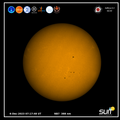
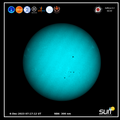
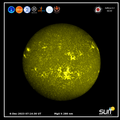
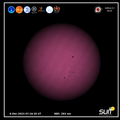
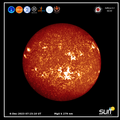
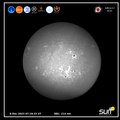
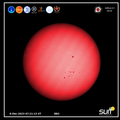
Some images of the sun taken from SUIT (Solar Ultraviolet Imaging Telescope) instrument of Aditya-L1 in different wavelengths. | |||
[[File:Aditya L1 sun image1.png|150px]] [[File:Aditya L1 sun image2.png|150px]] [[File:Aditya L1 sun image3.png|150px]] [[File:Aditya L1 sun image4.png|150px]] [[File:Aditya L1 sun image5.png|150px]] [[File:Aditya L1 sun image6.png|150px]] [[File:Aditya L1 sun image7.png|150px]] [[File:Aditya L1 sun image8.png|150px]] [[File:Aditya L1 sun image9.png|150px]] [[File:Aditya L1 sun image10.png|150px]] [[File:Aditya L1 sun image11.png|150px]] [[File:Aditya L1 sun image12.png|150px]] | |||
==Team== | |||
* [[Nigar Shaji]] - Project director | |||
* [[Sankarasubramanian. K|Sankarasubramanian K]] - Principal scientist of the mission<ref>{{Cite web |title=Educational qualification of scientists behind ISRO's solar mission, Aditya L-1 |url=https://www.dnaindia.com/education/report-educational-qualification-of-scientists-behind-aditya-l-1-mission-chandrayaan-3-s-somanath-iit-iisc-bengaluru-3058363 |access-date=2023-09-04 |website=DNA India |language=en |archive-date=4 September 2023 |archive-url=https://web.archive.org/web/20230904053429/https://www.dnaindia.com/education/report-educational-qualification-of-scientists-behind-aditya-l-1-mission-chandrayaan-3-s-somanath-iit-iisc-bengaluru-3058363 |url-status=live }}</ref> | |||
== See also == | == See also == | ||
{{Portal|Spaceflight}} | {{Portal|Spaceflight}} | ||
* {{annotated link|Lagrange point}} | |||
* [[Sun#Solar space missions|Solar space missions]] | * [[Sun#Solar space missions|Solar space missions]] | ||
* | ** {{annotated link|Advanced Composition Explorer}} | ||
* | ** {{annotated link|Solar Dynamics Observatory}} | ||
** {{annotated link|Solar and Heliospheric Observatory}} | |||
** {{annotated link|Solar Orbiter}} | |||
** {{annotated link|Parker Solar Probe}} | |||
* {{annotated link|ISRO}} | |||
== References == | == References == | ||
{{notelist}} | |||
{{Reflist|30em}} | {{Reflist|30em}} | ||
== External links == | == External links == | ||
{{commons}} | |||
* [https://www.isro.gov.in/Aditya_L1.html ISRO page for Aditya-L1] | * [https://www.isro.gov.in/Aditya_L1.html ISRO page for Aditya-L1] | ||
{{Sun spacecraft|state=collapsed}} | {{Sun spacecraft|state=collapsed}} | ||
{{Space observatories}} | |||
{{Indian space programme}} | {{Indian space programme}} | ||
{{Indian spacecraft}} | {{Indian spacecraft}} | ||
{{ | {{Orbital launches in 2023}} | ||
[[Category:Satellites of India]] | [[Category:Satellites of India]] | ||
[[Category: | [[Category:Spacecraft launched by India in 2023]] | ||
[[Category:Missions to the Sun]] | [[Category:Missions to the Sun]] | ||
[[Category:September 2023 in India]] | |||
[[Category:Space probes launched in 2023]] | |||
Latest revision as of 10:58, 29 March 2026
 Aditya-L1 spacecraft | |
| Mission type | Solar observation |
|---|---|
| Operator | ISRO |
| COSPAR ID | {{#property:P247}} |
| Website | www |
| Mission duration | 5.2 years (planned)[1] 3 years, 1 month and 19 days (elapsed) |
| Spacecraft properties | |
| Spacecraft | PSLV-XL/C-57 |
| Spacecraft type | PSLV |
| Bus | I-1K[2] |
| Manufacturer | ISRO / IUCAA / IIA |
| Payload mass | 1,500 kg (3,300 lb)[1] |
| Start of mission | |
| Launch date | 2 September 2023, 11:50 IST (06:20 UTC)[3][4] |
| Rocket | PSLV-XL C57 |
| Launch site | Satish Dhawan Space Centre |
| Contractor | ISRO |
| Orbital parameters | |
| Reference system | Sun–Earth L1 orbit |
| Regime | Halo orbit |
| Period | 177.86 days[5] |
| Epoch | 6 January 2024[6] |
  Mission Patch and Mission Insignia | |
Aditya-L1 (Sanskrit: Āditya IPA: [aːd̪it̪jɐ] 'Sun', L1 'Lagrange Point 1')[lower-alpha 1] is a coronagraphy spacecraft for studying the solar atmosphere, designed and developed by ISRO and various other Indian Space Research Institutes.[1] It is orbiting at about 1.5 million km from Earth in a halo orbit around the Lagrange point 1 (L1) between the Earth and the Sun, where it will study the solar atmosphere, solar magnetic storms, and their impact on the environment around the Earth.[7]
It is the first Indian mission dedicated to observe the Sun. Nigar Shaji is the project's director.[8][9][10][11] Aditya-L1 was launched aboard the PSLV C57 at 11:50 IST on 2 September 2023.[12][3][4] It successfully achieved its intended orbit nearly an hour later, and separated from its fourth stage at 12:57 IST.[13] It was inserted at the L1 point on 6 January 2024, at 4:17 pm IST.[14]
Mission objectives[edit | edit source]
The main objectives of Aditya-L1 are:
- To observe the dynamics of the Sun's chromosphere and corona:
- To study chromospheric and coronal heating, the physics of partially ionised plasma, of coronal mass ejections (CMEs) and their origins, of the coronal magnetic field and heat transfer mechanisms, and flare exchanges.
- To observe the physical particle environment around its position.
- To determine the sequence of processes in multiple layers below the corona that lead to solar eruptions.
- To study space weather, and the origin, composition and dynamics of solar wind.[15]


The mission was conceptualised in January 2008 by the Advisory Committee for Space Sciences (ADCOS).[16][17] It was initially envisaged as a small, 400 kg (880 lb) satellite in a Low Earth Orbit (800 km) with a coronagraph to study the solar corona. An experimental budget of ₹3 crore was allocated for the financial year 2016–2017.[18][19][20] The scope of the mission has since been expanded and it became a comprehensive solar and space environment observatory to be placed at Lagrange point 1 (L1),[21] hence the mission was renamed as Aditya-L1. As of July 2019[update], the mission has an allocated cost of ₹378 crores, excluding launch costs.[4]
The European Space Operations Centre (ESOC), operated by the European Space Agency (ESA) is supporting the mission.[22]
On 11 January 2024, ISRO successfully deployed a 6-meter magnetometer boom aboard the Aditya-L1 in the Halo orbit at the Lagrange Point L1. After the liftoff, the boom had been stowed for 132 days. The in-orbit deployment period that was measured was roughly 9 seconds, which is well within the 8–12 second prediction range. The magnetometer boom will measure the low-intensity interplanetary magnetic field in space using two high-accuracy fluxgate magnetometer sensors that are carried aboard. In order to reduce the impact of the spacecraft's magnetic field on measurements, the sensors are placed 3 and 6 meters away from the craft. Using a dual sensor system also helps to cancel out the spacecraft's magnetic influence and facilitates accurate estimation. The carbon-fiber-reinforced polymers (CFRP) was used in the construction of the boom segments. Through the use of spring-driven hinge mechanisms, the five pieces are joined to enable folding in close proximity to the craft throughout the journey and opening up upon reaching the desired orbit. The hinges lock into place as the mechanism fans out. In the stowed position, two hold-downs firmly secure the boom in place. Information obtained via the telemetry switches validates the release of the hold-down, the initial motion, and the locking of every hinge.[23][24]
Overview[edit | edit source]

The mission took 126 Earth days after launch to reach the halo orbit around the L1 point, which is about 1,500,000 km (930,000 mi) from Earth.[25] The spacecraft is planned to remain in the halo orbit for its mission duration while being maintained at a stationkeeping Δv of 0.2–4 m/s per year.[26] The 1,500 kg (3,300 lb) satellite carries seven science payloads with various objectives, including instruments to measure coronal heating, solar wind acceleration, coronal magnetometry, origin and monitoring of near-UV solar radiation (which drives Earth's upper atmospheric dynamics and global climate), coupling of the solar photosphere to the chromosphere and corona,[27] and in-situ characterisations of the space environment around Earth by measuring energetic particle fluxes and magnetic fields of the solar wind, and solar magnetic storms.[1]
Aditya-L1 will provide observations of the Sun's photosphere, chromosphere and corona. Its scientific payloads must be placed outside the interference from the Earth's magnetic field, and hence, could not have been useful in the low Earth orbit, as proposed in the original mission concept back in 2008.[28]
One of the major unsolved problems in the field of solar physics is coronal heating. The upper atmosphere of the Sun has a temperature of 2,000,000 K (2,000,000 °C; 3,600,000 °F), whereas the lower atmosphere is just 6,000 K (5,730 °C; 10,340 °F).[29] In addition, it is not understood exactly how the Sun's radiation affects the dynamics of the Earth's atmosphere on a shorter as well as a longer time scale. The mission will obtain near-simultaneous images of the different layers of the Sun's atmosphere, which will reveal the ways in which energy is channeled and transferred from one layer to another. Thus, the mission will enable a comprehensive understanding of the dynamical processes of the Sun and address some of the outstanding problems in solar physics and heliophysics.
Payloads[edit | edit source]

The instruments of Aditya-L1 are tuned to observe the solar atmosphere, mainly the chromosphere and corona. In-situ instruments will observe the local environment at the L1 point. There are seven payloads on board, with four for remote sensing of the Sun and three for in-situ observation. The payloads have been developed by different laboratories in the country with close collaborations of various ISRO centres.[30]
| Type | Sl.No | Payload | Capability | Laboratories |
|---|---|---|---|---|
| Remote Sensing Payloads | 1 | Visible Emission Line Coronagraph (VELC) | Corona Imaging and spectroscopy | Indian Institute of Astrophysics, Bangalore |
| 2 | Solar Ultraviolet Imaging Telescope (SUIT) | Photosphere and chromosphere imaging-narrow and broadband | Inter University Centre for Astronomy & Astrophysics, Pune | |
| 3 | Solar Low Energy X-ray Spectrometer (SoLEXS) | Soft X-ray spectrometer: Sun-as-a-star observation | U R Rao Satellite Centre, Bangalore | |
| 4 | High Energy L1 Orbiting X-ray Spectrometer (HEL1OS) | Hard X-ray spectrometer: Sun-as-a-star observation | ||
| In-situ Payloads | 5 | Aditya Solar wind Particle Experiment (ASPEX) | Solar wind and Particle analyzer: Protons and Heavier ions with directions | Physical Research Laboratory, Ahmedabad |
| 6 | Plasma Analyser Package For Aditya (PAPA) | Solar wind and Particle Analyzer: Electrons and Heavier Ions with directions | Space Physics Laboratory, Vikram Sarabhai Space Centre, Thiruvananthapuram | |
| 7 | Advanced Tri-axial High Resolution Digital Magnetometers | In-situ magnetic field (Bx, By and Bz). | Laboratory for Electro Optics Systems, Bangalore |
Visible Emission Line Coronagraph (VELC)[edit | edit source]
The Visible Emission Line Coronagraph (VELC) is a key instrument on the Aditya spacecraft. The VELC is an internally occulted reflective coronagraph designed to fulfil specific observation needs. The instrument allows for high spatial resolution imaging 1.25-2.5 arcseconds of the Sun's corona, simultaneous observations in three modes (Imaging, Spectroscopy and Spectro-polarimetry), and even utilizes artificial intelligence to aid in the detection of coronal mass ejections (CMEs). The instrument was developed by Indian Institute of Astrophysics, Bangalore.[31]
Solar Ultraviolet Imaging Telescope (SUIT)[edit | edit source]
The SUIT is an ultraviolet imaging telescope designed to study the solar spectral radiation in the ultraviolet range, using narrowband and broadband spectral filters in the range of 200-400 nm with the hope of developing a better understanding between solar activity and the atmospheric dynamics of Earth. The SUIT utilises 11 different filters. The filters have been selected carefully to ensure coverage of the lower (photosphere) and middle (chromosphere) atmosphere of the Sun, the first approach of its kind in such observations.[32] The SUIT provides near-simultaneous coverage of the solar atmosphere, from lower photosphere to the upper chromosphere. The instrument was developed by Inter University Centre for Astronomy & Astrophysics, Pune, in collaboration with ISRO.[31]
Solar Low Energy X-ray Spectrometer (SoLEXS)[edit | edit source]
The SoLEXS is an X-ray spectrometer designed to continuously measure the solar soft X-ray flux (2 keV-22 keV)[33] from the Sun-Earth Lagrangian point L1. These measurements can be used to better understand the properties of the Sun's corona, in particular, why the temperature of the corona is so high. The SoLEXS will observe solar flares, and in conjunction with data provided by the VELC, will help study the complex thermal properties of the Sun's outer layers. The instrument was developed by U R Rao Satellite Centre, Bangalore.[31]
High Energy L-1 Orbiting X-ray Spectrometer (HEL1OS)[edit | edit source]
Developed by the Space Astronomy Group, URSC, the HEL1OS (pronounced helios) is an x-ray spectrometer designed to study solar flares in the x-ray spectrum, in particular, energy bands of 10-150 Kev (kilo-electron volts). Using a twin-pair of Cadmium Telluride (CdTe) and Cadmium Zinc Telluride (CZT) detectors, the instrument aims to study the acceleration and movement of electrons in the Sun's corona, as well as to study the cut-off energy between thermal and non-thermal solar emissions.[31]
Aditya Solar Wind Particle Experiment (ASPEX)[edit | edit source]
The ASPEX is an instrument composed of low and high energy particle spectrometers, designed to conduct measurements of the Sun's solar wind particles. Solar Wind Ion Spectrometer (SWIS), the low energy spectrometer, contains two analysers, each designed to study particles entering the device in different planes. Supra Thermal Energetic Particle Spectrometer (STEPS), the high energy spectrometer, also consists of two parts, STEPS 1 and STEPS 2, both designed to separate protons and alpha particles and measure the integrated flux. The instrument was developed by the Physical Research Laboratory, Ahmedabad.[31]
Plasma Analyser Package for Aditya (PAPA)[edit | edit source]
The PAPA is an instrument on board the Aditya-L1 designed to study the temperature, distribution and velocity of the solar winds. The instrument contains two sensors; the Solar Wind Electron Energy Probe (SWEEP) and the Solar Wind lon Composition Analyser (SWICAR). The detectors are used in conjunction to analyse the energy levels of electrons and ions within the solar wind. The instrument was developed by the Space Physics Laboratory of the Vikram Sarabhai Space Centre, Thiruvananthapuram.[31]
Digital Magnetometers[edit | edit source]
On board the Aditya-L1 spacecraft are a pair of magnetic sensors on a deployable boom, one positioned in the middle and the other at the tip. The purpose of these sensors is to gather information about the magnitude and direction of the Interplanetary Magnetic Fields (IMF), as well as to study other events such as Coronal Mass Ejections (CME). Data from the magnetic sensors will be used to supplement that of the PAPA and ASPEX sensors.[31]
Mission profile[edit | edit source]
Launch[edit | edit source]
On 2 September 2023, at 11:50 IST, the Polar Satellite Launch Vehicle (PSLV-C57) accomplished a successful launch of the Aditya-L1 from the Second Launch Pad of the Satish Dhawan Space Centre (SDSC) located in Sriharikota.
Aditya-L1, following a flight duration of 63 minutes and 20 seconds, achieved a successful injection into an elliptical orbit around the Earth at 12:54 IST.[34]
Aditya-L1 underwent a series of four Earth-bound orbital maneuvres prior to its injection to a transfer orbit towards the Lagrange point (L1). It reached its designated orbit at the L1 point 126 days after its launch on 6 January 2024 at 4:17 IST.[35][36]
Orbit raising burns[edit | edit source]
- First orbit raising burn
On 3 September 2023, the Aditya-L1 performed its first Earth-bound maneuvre, raising its orbit to a 245 km (152 mi) into 22,459 km (13,955 mi) orbit.[37]
- Second orbit raising burn
On 5 September 2023, Aditya-L1 performed its second Earth-bound maneuvre, raising its orbit to a 282 km (175 mi) into 40,225 km (24,995 mi) orbit.
- Third orbit raising burn
On 10 September 2023, Aditya-L1 performed its third Earth-bound maneuvre, raising its orbit to a 296 km (184 mi) into 71,767 km (44,594 mi) orbit.
- Fourth orbit raising burn
On 15 September 2023, Aditya-L1 performed its fourth Earth-bound maneuvre, raising its original orbit to a 256 km (159 mi) into 121,973 km (75,791 mi) orbit. This was the last of such maneuvers, being directly followed by the Trans-Lagrangian 1 Injection, which took place on 19 September.
- Trans-Lagrangian 1 Injection
On 19 September 2023, Aditya-L1 performed its last maneuvre around Earth to escape its orbit and headed towards the Lagrange 1 point, taking at least four months to further reach its destination, 1.5 million kilometers away.[38]
On 30 September 2023, Aditya-L1 had escaped the Earth's sphere of influence and was on the way to the Lagrange point 1.[38] During this journey a week before Orbital Insertion, the SUIT instrument captured an X-class solare flare and a CME on December 31, 2023.[39] This was the first observations of a solar flare using near-UV light.[40]
- Trajectory correction maneuver
On 6 October 2023, Aditya-L1 performed a Trajectory Correction maneuvre (TCM1). It was needed to correct the trajectory evaluated after tracking the Trans-Lagrangian Point 1 Insertion (TL1I) maneuvre performed on 19 September 2023.[41]
- Halo orbit insertion
On 6 January 2024, Aditya-L1 was successfully injected on the Halo orbit of Lagrange point 1 (HOI), at 4:17 pm IST.[42]
| Stage and Sequence | Date/Time | Time (IST) | Periapsis | Apoapsis | Duration | Burn Time | Ref. |
|---|---|---|---|---|---|---|---|
| Launch | |||||||
| Earth Orbit Insertion | 2 September 2023 | 12:54 p.m | 235 km (146 mi) | 19,500 km (12,100 mi) | 22 hours, 46 minutes | [43] | |
| Earth Bound maneuvres | |||||||
| Earth Bound maneuvre 1 | 3 September 2023 | 11:40 a.m. | 245 km (152 mi) | 22,459 km (13,955 mi) | 39 hours, 20 minutes | [44] | |
| Earth Bound maneuvre 2 | 5 September 2023 | 3:00 a.m | 282 km (175 mi) | 40,225 km (24,995 mi) | 4 days, 23 hours and 30 minutes | [45] | |
| Earth Bound maneuvre 3 | 10 September 2023 | 2:30 am | 296 km (184 mi) | 71,767 km (44,594 mi) | 4 days, 23 hours and 45 minutes | [46] | |
| Earth Bound maneuvre 4 | 15 September 2023 | 2:15 am | 256 km (159 mi) | 121,973 km (75,791 mi) | 3 days, 23 hours and 45 minutes | [47] | |
| Trans-Lagrangian Point 1 Injection | 19 September 2023 | 2:00 am | [48] | ||||
| Trajectory correction maneuvres | |||||||
| Trajectory Correction maneuvre (TCM) | 6 October 2023 | 16s | [49] | ||||
| Halo orbit injection | |||||||
| Halo orbit insertion (HOI) | 6 January 2024 | 4:17 pm | approx. 177.86 earth days | [50] | |||


Orbit[edit | edit source]
Aditya-L1 completed its first halo orbit around L1 point on July 2, 2024. It takes it approximately 178 days to complete each orbit. It underwent two station-keeping maneuvers on February 22 and June 7, and later one on July 2.[51]
Science phase[edit | edit source]
Following commissioning and checkout, Adiya L1 began Science observations about three months into the mission. The PAPA instrument on the spacecraft was operationalised on December 12, 2023, and made its first observation on February 10 and 11 2024 using the PAPA instrument to observe the Sun from its vantage point–a distance of about 1 million miles (1.5 million kilometers).[52][53] Post-launch calibration of SUIT has now characterised its filters in detail. In-orbit testing of the transmission, spatial variation, and out-of-band performance confirmed that most filters meet design expectations, with only a few showing slightly higher out-of-band transmission than predicted (still below 1%).[54] Additionally, on 31 December 2023, SUIT observed a plasma blob ejection from the Sun moving at speeds up to 1500 km/s, the highest recorded by the mission thus far.[8]
In conjunction with the Udaipur Solar Observatory and research stations at Thumba, ISRO mobilised all its observation platforms and systems to record the signatures of a Massive Solar Flare in May 2024. Aditya-L1, Chandrayaan-2's orbiter and XPoSat have made observations and observed signatures have been analysed. Aditya-L1 used ASPEX, SOLEX, HEL1OS and its magnetometer instruments to record data.[55] This storm, called "Gannon's Storm" was the strongest solar storm recorded since the beginning of the 21st Century. Using the Magneometers on Aditya L1 and other NASA spacecraft discovered that two distinct CMEs collided in space such that the magnetic field lines inside one of them snapped and rejoined in new ways, a process called magnetic reconnection. This sudden reversal of the magnetic field made the storm's impact much stronger than expected.[56][57] Using observations of particles and fields measurements from Aditya-L1, and combining it with other ground based measurements as well as the GOES-18 spacecraft, unusual dawn-side magnetic disturbances observed during this storm were most likely caused by a rare type of space current normally confined to auroral regions of the Sun.[58] During very strong storms, when the Earth’s magnetosphere becomes highly compressed, such rare auroral current systems ingress into lower solar latitudes, extending much farther towards the mean solar equator.[59][60]
Ground based observations from the Gauribidanur radio telescope and IIA astronomers using VELC detected multiple CME-driven shock waves forming at a distance of approximately 130,000 kilometers above the Sun’s surface and traveling at nearly 1,700 kilometers per second on May 27 2024.This is the closest distance from the Sun at which such a shock and its associated radio burst have been unambiguously detected.[61]
On July 16, 2024, the VELC instrument was used to measure another large Coronal Mass ejection from the Sun. It also studied an accompanying solar flare and the motion of solar particles within the Sun.[62]
-
 Global Solar wind impact map from 2024 Aditya L1 data
 -
 Global Solar wind impact map from 2024 Aditya L1 data


Marking its first year of science observation, ISRO released the maiden set of the scientific data from the Aditya L1 to the global scientific community on January 6, 2025, at the ISRO Headquarters in Bengaluru.[63] ISRO presented the second set on February 14, 2025.[64] On February 22, 2024, Aditya L1 captured the first-ever image of a X6.3-class solar flare ‘kernel’ occurring in the photosphere and the chromosphere. The image was taken alongside operations of SUIT, SoLEXS and HEL1OS instruments in the Near-Ultraviolet band.[65] Further studies of a continuation event in October 2024 decoded the impact of Solar winds with the Earth's Magnectic field and the result of these interactions that affected Geostationary satellites in earth orbit. The study also noted that currents over high latitude regions intensified, potentially heating the Earth’s upper atmosphere and causing enhanced atmospheric escape.[66][67][68] Scientists from IIA also reported observations of a flareless coronal mass ejection from reading taken by VELC in March 2025.[69]Observations from the onboard MAG payload show that during solar transient events in 2024, the interplanetary magnetic field magnitude increased above typical quiet-solar levels, and the spectral slope of turbulence approached a Kolmogorov -5/3 kind of behaviour. To verify changes in spectral behaviour, the data was compared with that from a day when quiet solar winds were present, resulting in a strong contrast. The quiet periods exhibit anisotropic turbulence, whereas the behaviour from the event exhibited quasi-isotropic behaviour, with spectral slopes closely following the Kolmogorov spectrum across all three IMF components.[70]
In 2025, using the data from the VELC instrument, researchers from IIA and NASA created the very first spectroscopic observations of a CME in the visible wavelength range. They also estimated the electron density, energy, mass, temperature and speed of a CME very close to the Sun.[71][72]
On the second anniversary (January 6, 2026) of Aditya-L1's launch, ISRO made an Announcement of Opportunity to solicit proposals for scientific research data from its first AO cycle observations.[7][9] ISRO and ESA conducted a workshop at IIST in Thiruvanthapuram between 19-23 January 2026 presenting data from Aditya-L1, Proba-3 and Solar Orbiter presenting complementary vantage data points from each mission.[73][74] The 2026 Indian budget also proposed to rebuild the National Large Solar Telescope at a cost of about ₹1,000 crore (US$140 million) by 2030 for it to serve as a complement to solar data from Aditya-L1.[75][76]
Gallery[edit | edit source]
Some images of the sun taken from SUIT (Solar Ultraviolet Imaging Telescope) instrument of Aditya-L1 in different wavelengths.


Team[edit | edit source]
- Nigar Shaji - Project director
- Sankarasubramanian K - Principal scientist of the mission[77]
See also[edit | edit source]
- Lagrange point – Equilibrium points near two orbiting bodies
- Solar space missions
- Advanced Composition Explorer
- Solar Dynamics Observatory
- Solar and Heliospheric Observatory
- Solar Orbiter – European space-based solar observatory
- Parker Solar Probe
- ISRO – Indian national space and aeronautics agency
References[edit | edit source]
- ↑ from Sanskrit Āditya, a synonym for the Hindu solar deity, Surya.
- ↑ 1.0 1.1 1.2 1.3 Somasundaram, Seetha; Megala, S. (25 August 2017). "Aditya-L1 mission" (PDF). Current Science. 113 (4): 610. Bibcode:2017CSci..113..610S. doi:10.18520/cs/v113/i04/610-612. Archived from the original (PDF) on 25 August 2017. Retrieved 25 October 2023.
- ↑ Nowakowski, Tomas (4 February 2016). "India's first solar mission to be launched in 2019–20". Space Flight Insider. Archived from the original on 3 September 2023. Retrieved 3 September 2023.
- ↑ 3.0 3.1 "Moon mission done, ISRO aims for the Sun with Aditya-L1 launch on September 2". The Indian Express. 28 August 2023. Archived from the original on 28 August 2023. Retrieved 28 August 2023.
- ↑ 4.0 4.1 4.2 Pandey, Geeta (2 September 2023). "Aditya-L1: India launches its first mission to Sun". BBC News. Archived from the original on 2 September 2023. Retrieved 2 September 2023.
- ↑ Sreekumar, P. (19 June 2019). "Indian Space Science & Exploration : Global Perspective" (PDF). UNOOSA. p. 8. Archived (PDF) from the original on 30 June 2019. Retrieved 30 June 2019.
- ↑ Gupta, Shobhit (6 January 2024). "Aditya L1 LIVE: ISRO's first Sun mission successfully injected into final orbit". Hindustan Times. Retrieved 6 January 2024.
- ↑ 7.0 7.1 C.S, Hemanth (6 January 2026). "ISRO invites proposals from Indian scientists to analyse data from Aditya-L1 mission". The Hindu. ISSN 0971-751X. Retrieved 9 January 2026.
- ↑ 8.0 8.1 "Meet The Project Director Of Ambitious Mission Aditya-L1 | Nigar Shaji from Tamil Nadu". TimesNow. 2 September 2023. Archived from the original on 2 September 2023. Retrieved 2 September 2023.
- ↑ 9.0 9.1 "Aditya-L1 Mission: Announcement of Opportunity (AO) soliciting proposals for the first AO cycle observations". www.isro.gov.in. Retrieved 9 January 2026.
- ↑ "Meet Nigar Shaji from TN's Tenkasi, Aditya-L1 mission project director". The New Indian Express. 2 September 2023. Archived from the original on 2 September 2023. Retrieved 2 September 2023.
- ↑ "Meet Nigar Shaji, The Project Director Of India's First Sun Mission: 5 Points". NDTV.com. Archived from the original on 2 September 2023. Retrieved 2 September 2023.
- ↑ ISRO [@isro] (1 September 2023). "PSLV-C57/Aditya-L1 Mission: The 23-hour 40-minute countdown leading to the launch at 11:50 Hrs. IST on September 2, 2023, has commended today at 12:10 Hrs. The launch can be watched LIVE on ISRO Website isro.gov.in Facebook facebook.com/ISRO YouTube youtube.com/watch?v=_IcgGYZTXQw… DD National TV channel from 11:20 Hrs. IST" (Tweet) – via Twitter.
- ↑ "Aditya L1 Mission: Aditya L1 Launch LIVE Updates: Aditya L1 spacecraft successfully separated from PSLV rocket, now en route to Sun-Earth L1 point. ISRO says mission accomplished". The Economic Times. 2 September 2023. Archived from the original on 3 September 2023. Retrieved 2 September 2023.
- ↑ "Aditya-L1 Mission Live Updates: Isro successfully injects Aditya-L1, designed to study Sun, in halo orbit". The Times of India. 6 January 2024. Retrieved 6 January 2024.
- ↑ "ADITYA-L1". www.isro.gov.in. Archived from the original on 3 August 2023. Retrieved 29 August 2023.
- ↑ "SAC Industry Portal". www.sac.gov.in. Space Applications Center, Government of India. Archived from the original on 3 August 2022. Retrieved 3 September 2023.
- ↑ Teotia, Riya, ed. (14 August 2023). "ISRO shares first images of Aditya-L1 satellite ahead of India's first-ever mission to study the Sun". WION. Archived from the original on 3 September 2023. Retrieved 3 September 2023.
- ↑ "Notes on Demands for Grants, 2016–2017" (PDF) (Press release). Department of Space. Archived from the original (PDF) on 17 September 2016. Retrieved 9 September 2016.
- ↑ "Aditya gets ready to gaze at the sun". The Hindu. Archived from the original on 26 August 2017. Retrieved 25 August 2017.
- ↑ Gandhi, Divya (13 January 2008). "ISRO planning to launch satellite to study the sun". The Hindu. Archived from the original on 15 September 2018. Retrieved 26 August 2017.
- ↑ Desikan, Shubashree (15 November 2015). "The sun shines on India's Aditya". The Hindu. Archived from the original on 13 March 2018. Retrieved 12 August 2018.
- ↑ "ISRO delegation visits ESA mission control". European Space Agency. 11 January 2024. Retrieved 14 January 2024.
- ↑ Kumar, Chethan (25 January 2024). "Isro deploys key sensors on Aditya-L1". The Times of India. ISSN 0971-8257. Retrieved 27 January 2024.
- ↑ "ISRO confirms magnetometer on Aditya L1 deployed". The Indian Express. 26 January 2024. Retrieved 27 January 2024.
- ↑ "Department Of Space, Annual Report 2019–2020" (PDF). 14 February 2020. Archived (PDF) from the original on 7 October 2021. Retrieved 25 October 2021.
- ↑ Muralidharan, Vivek (2017). Orbit Maintenance Strategies for Sun-Earth/Moon Libration Point Missions: Parameter Selection for Target Point and Cauchy-Green Tensor Approaches (MS Thesis). Purdue University. pp. 183–194. Archived from the original on 31 August 2023. Retrieved 31 August 2023.
- ↑ Wedemeyer-Böhm, S.; Lagg, A.; Nordlund, Å (15 September 2009). "Coupling from the photosphere to the chromosphere and the corona". Space Science Reviews. 144 (1–4): 317–350. arXiv:0809.0987. Bibcode:2009SSRv..144..317W. doi:10.1007/s11214-008-9447-8. ISSN 0038-6308.
- ↑ "Aditya-L1 First Indian mission to study the Sun". isro.gov.in. Archived from the original on 10 December 2019. Retrieved 19 June 2019.
- ↑ "Temperatures Across Our Solar System - NASA Science". science.nasa.gov. 16 November 2023. Retrieved 30 November 2023.
- ↑ "ISRO ADITYA-L1". Archived from the original on 3 August 2023. Retrieved 15 July 2023.
- ↑ 31.0 31.1 31.2 31.3 31.4 31.5 31.6 "ADITYA-L1". www.isro.gov.in. Archived from the original on 1 January 2024. Retrieved 25 October 2023.
- ↑ "Solar Ultraviolet Imaging Telescope (SUIT) onboard Aditya-L1 Mission Observed Powerful Solar Flare and a First-of-Its-Kind Observation of Rare Plasma Ejection in Ultra-violet Light". www.isro.gov.in. Retrieved 2 November 2025.
- ↑ Sankarasubramanian (25 June 2025). "Solar Low Energy X-ray Spectrometer (SoLEXS) on Board Aditya-L1 Mission". Solar Physics. 300 (7) 87. Bibcode:2025SoPh..300...87S. doi:10.1007/s11207-025-02494-0.
- ↑ "PSLV-C57 / ADITYA-L1 Mission - Press Release". www.isro.gov.in. Archived from the original on 3 September 2023. Retrieved 3 September 2023.
- ↑ "PSLV-C57/ADITYA-L1 Mission". www.isro.gov.in. Archived from the original on 3 September 2023. Retrieved 2 September 2023.
- ↑ "Aditya L1 Mission LIVE Updates: India creates yet another landmark, country's first solar observatory Aditya-L1 reaches its destination, says PM Modi". Moneycontrol. 6 January 2024. Retrieved 6 January 2024.
- ↑ @isro (3 September 2023). "Aditya L1" (Tweet). Retrieved 3 September 2023 – via Twitter.
- ↑ 38.0 38.1 "ADITYA-L1 Mission Details". www.isro.gov.in. Retrieved 25 October 2023.
- ↑ "MSN". www.msn.com. Retrieved 14 May 2025.
- ↑ "Solar Ultraviolet Imaging Telescope (SUIT) onboard Aditya-L1 Mission Observed Powerful Solar Flare and a First-of-Its-Kind Observation of Rare Plasma Ejection in Ultra-violet Light". www.isro.gov.in. Retrieved 25 May 2025.
- ↑ "ADITYA-L1". www.isro.gov.in. Retrieved 30 September 2023.
- ↑ "Aditya-L1, ISRO's first solar spacecraft enters Sun's final orbit". The Economic Times. 6 January 2024. Retrieved 6 January 2024.
- ↑ ISRO [@isro] (2 September 2023). "The launch of Aditya-L1 by PSLV-C57 is accomplished successfully. The vehicle has placed the satellite precisely into its intended orbit. India's first solar observatory has begun its journey to the destination of Sun-Earth L1 point" (Tweet) – via Twitter.
- ↑ ISRO [@isro] (3 September 2023). "The satellite is healthy and operating nominally. The first Earth-bound maneuvre (EBN#1) is performed successfully from ISTRAC, Bengaluru. The new orbit attained is 245km x 22459 km. The next maneuvre (EBN#2) is scheduled for September 5, 2023, around 03:00 Hrs. IST" (Tweet) – via Twitter.
- ↑ ISRO [@isro] (5 September 2023). "Aditya-L1 Mission: The second Earth-bound maneuvre (EBN#2) is performed successfully from ISTRAC, Bengaluru. ISTRAC/ISRO's ground stations at Mauritius, Bengaluru and Port Blair tracked the satellite during this operation. The new orbit attained is 282 km x 40225 km. The next maneuvre (EBN#3) is scheduled for September 10, 2023, around 02:30 Hrs. IST" (Tweet) – via Twitter.
- ↑ ISRO [@isro] (10 September 2023). "Aditya-L1 Mission:The third Earth-bound maneuvre (EBN#3) is performed successfully from ISTRAC, Bengaluru.ISRO's ground stations at Mauritius, Bengaluru, SDSC-SHAR and Port Blair tracked the satellite during this operation.The new orbit attained is 296 km x 71767 km. The next maneuvre (EBN#4) is scheduled for September 15, 2023, around 02:00 Hrs. IST" (Tweet) – via Twitter.
- ↑ ISRO [@isro] (15 September 2023). "Aditya-L1 Mission: The fourth Earth-bound maneuvre (EBN#4) is performed successfully. ISRO's ground stations at Mauritius, Bengaluru, SDSC-SHAR and Port Blair tracked the satellite during this operation, while a transportable terminal currently stationed in the Fiji islands for Aditya-L1 will support post-burn operations. The new orbit attained is 256 km x 121973 km. The next maneuvre Trans-Lagragean Point 1 Insertion (TL1I) a send-off from the Earth is scheduled for September 19, 2023, around 02:00 Hrs.IST" (Tweet) – via Twitter.
- ↑ ISRO [@isro] (19 September 2023). "Aditya-L1 Mission: Off to Sun-Earth L1 point! The Trans-Lagrangean Point 1 Insertion (TL1I) maneuvre is performed successfully. The spacecraft is now on a trajectory that will take it to the Sun-Earth L1 point. It will be injected into an orbit around L1 through a maneuver after about 110 days. This is the fifth consecutive time ISRO has successfully transferred an object on a trajectory toward another celestial body or location in space" (Tweet) – via Twitter.
- ↑ "ADITYA-L1". www.isro.gov.in. Retrieved 8 October 2023.
- ↑ "Halo-Orbit Insertion of Aditya-L1 Successfully Accomplished". ISRO. 6 January 2024. Retrieved 6 January 2024.
- ↑ "Aditya-L1 Mission: Completion of First Halo Orbit". www.isro.gov.in. Retrieved 2 July 2024.
- ↑ Sharmila Kuthunur (4 March 2025). "India's Aditya-L1 solar probe watches powerful flare erupt from the sun". Space.com. Retrieved 4 March 2025.
- ↑ "PAPA payload aboard Aditya-L1 detects solar wind impact of Coronal Mass Ejections". www.isro.gov.in. Retrieved 10 December 2024.
- ↑ Title = Science Filter Characterization of SUIT Author = Mathew, S. K. and others Eprint = 2412.11636 archiveprefix= arXiv Date = 2024-12-17
- ↑ "ISRO Captures the Signatures of the Recent Solar Eruptive Events from Earth, Sun-Earth L1 Point, and the Moon". www.isro.gov.in. Retrieved 10 December 2024.
- ↑ "India's Aditya-L1 Joins Global Effort in Landmark Solar Storm Study". www.isro.gov.in. Retrieved 9 December 2025.
- ↑ Madanapalle, Aditya (9 December 2025). "Aditya L1 reveals complexities of plasma bursts during May 2024 solar storm". News9live. Retrieved 9 December 2025.
- ↑ "MSN". www.msn.com. Retrieved 21 February 2026.
- ↑ "Aditya-L1 measurementshelp to explain unusual dawn-time geomagnetic disturbances during strong solar storms". www.isro.gov.in. Retrieved 19 February 2026.
- ↑ Rai, Deeksha; Tulasi Ram, S.; Nilam, B.; Oliveira, D. M.; Remya, B.; Raghav, Anil; Chakrabarty, D.; Kumar, Abhishek; Parashar, Shivam; Yadav, Vipin K.; Dimri, A. P. (16 February 2026). "Dawn‐Side Anomaly in Sudden Geomagnetic Field Responses to Solar Wind Pressure Discontinuities During the 10 May and 10 October 2024 Geomagnetic Storms". Geophysical Research Letters. 53 (3). doi:10.1029/2025GL119914. ISSN 0094-8276.
- ↑ Tripathi, Sibu (25 February 2026). "Indian team makes big solar discovery that could save Earth's satellites, GPS". India Today. Retrieved 26 February 2026.
- ↑ "Unlocking the Mysteries of the Sun: Aditya-L1's Observations of a Coronal Mass Ejection". www.isro.gov.in. Retrieved 10 December 2024.
- ↑ "ISRO Organises National Meet on Aditya L1 Data Release and Payload Performance Appraisal". www.isro.gov.in. Retrieved 7 January 2025.
- ↑ "Release of the Second Set of Aditya-L1 Science Data". www.isro.gov.in. Retrieved 28 February 2025.
- ↑ "Historic First: India's Solar Ultra-violet Imaging Telescope (SUIT) onboard Aditya-L1 Captures Unprecedented Solar Flare Details". www.isro.gov.in. Retrieved 28 February 2025.
- ↑ "ISRO's Aditya-L1 decodes the Impact of a Powerful Solar Storm on Earth's Invisible Magnetic Shield". www.isro.gov.in. Retrieved 11 January 2026.
- ↑ "MSN". www.msn.com. Retrieved 11 January 2026.
- ↑ "MSN". www.msn.com. Retrieved 11 January 2026.
- ↑ C.S, Hemanth (14 March 2025). "Aditya-L1 mission: scientists observe a flareless coronal mass ejection". The Hindu. ISSN 0971-751X. Retrieved 15 March 2025.
- ↑ Title = Observations of the fluctuations in Interplanetary Magnetic Field around L1 point during the solar transient events of 2024 with MAG payload onboard Aditya-L1 spacecraft. Authors = Vipin K. Yadav, R.K. Choudhary and M. Midhun Goutham archiveprefix = arXiv eprint = 2509.03182 class = astro-ph.IM
- ↑ C.S, Hemanth (9 November 2025). "Aditya-L1 gets a close look at eruptions from the sun". The Hindu. ISSN 0971-751X. Retrieved 10 November 2025.
- ↑ Aditya-L1 mission tracks coronal mass ejection in India-NASA collaboration
- ↑ "ISRO and ESA jointly organise ISRO-ESA Heliophysics Workshop on Aditya-L1, Solar Orbiter and Proba-3". www.isro.gov.in. Retrieved 21 January 2026.
- ↑ "ISRO-ESA Heliophysics Workshop on Aditya-L1, Solar Orbiter and Proba-3 | Indian Institute of Space Science and Technology". www.iist.ac.in. Retrieved 7 February 2026.
- ↑ Bagla, Pallava. "Angry sun puts India at risk, ISRO warns of strong radio blackout". www.msn.com. Retrieved 5 February 2026.
- ↑ "Government of India Budget 2026-2027, Speech of Nirmala Sitharaman Minister of Finance" (PDF). www.indiabudget.gov.in. 1 February 2026. Archived from the original (PDF) on 1 February 2026. Retrieved 5 February 2026.
- ↑ "Educational qualification of scientists behind ISRO's solar mission, Aditya L-1". DNA India. Archived from the original on 4 September 2023. Retrieved 4 September 2023.
External links[edit | edit source]
| Current | (since 1997) (since 2022) (since 2021) (since 2015) (since 2006) (since 2013) (since 2018) (since 1995) (since 2010) (since 2020) (since 2006) (since 1994) |   |
|---|---|---|
| Past |
| |
| Planned | (2023) (2024) (2024) (2024) (2025) (2025) (2025) (2020s) | |
| Proposed | ||
| Cancelled | ||
| Lost | ||
| Sun-Earth | ||


_to_Second_Launch_Pad_(SLP)_05.webp)
| Satellites |
|  | ||||||||||
|---|---|---|---|---|---|---|---|---|---|---|---|---|
| Space probes |
| |||||||||||
| Human spaceflight | ||||||||||||
| ||||||||||||