


Early career (1936–42) |
Tudu Hommie (talk | contribs) Article updated with improved flow |
||
| (38 intermediate revisions by 7 users not shown) | |||
| Line 1: | Line 1: | ||
{{short description|Indian actor (1911–2001)}} | |||
{{About|the Indian actor}} | |||
{{Use Indian English|date=July 2015}} | |||
{{Use dmy dates|date=November 2020}} | |||
{{Infobox person | {{Infobox person | ||
| name | | pre-nominals = | ||
| image | | name = Ashok Kumar | ||
| caption | | image = Ashok Kumar Saab.jpg | ||
| birth_date | | imagesize = | ||
| birth_place | | caption = | ||
| death_date | | native_name = | ||
| death_place | | native_name_lang = | ||
| occupation | | birth_name = Kumudlal Ganguly | ||
| spouse | | birth_date = {{Birth date|1911|10|13|df=y}} | ||
| | | birth_place = [[Bhagalpur]], [[Bengal Presidency]], [[British Raj|British India]]<br />{{small|(present-day [[Bhagalpur]], [[Bihar]], India)}} | ||
| | | death_date = {{Death date and age|2001|12|10|1911|10|13|df=y}} | ||
| | | death_place = [[Mumbai]], [[Maharashtra]], India | ||
| other_names = ''Dadamoni'' | |||
| occupation = Actor, producer, [[painter]], singer | |||
| years_active = 1934–1997 | |||
| works = [[Ashok Kumar filmography|Filmography]] | |||
| spouse = {{married|Shobha Devi|1935}} | |||
| children = 4, including [[Preeti Ganguly]] | |||
| alma_mater = [[Presidency College, Calcutta]] | |||
| relatives = See [[Ganguly family]]<br />See [[Mukherjee-Samarth family]] | |||
| awards = * [[List of awards and nominations received by Ashok Kumar|Full list]] | |||
*[[Dadasaheb Phalke Award]] (1988) | |||
| honours = {{bulleted list|[[Padma Shri]] (1962)|[[Padma Bhushan]] (1999)}} | |||
| signature = Ashok_Kumar_signature.jpg | |||
}} | }} | ||
'''Ashok Kumar''' ({{ | '''Ashok Kumar''' (born '''Kumudlal Ganguly'''; 13 October 1911 – 10 December 2001) was an Indian actor who worked in [[Hindi cinema]]. He is regarded as one of the greatest and most successful actors in the history of [[Indian cinema]].<ref>{{Cite magazine |title=Iconic heroes of Bollywood |magazine=[[India Today]] |url=https://www.indiatoday.in/cinema/100-years-of-indian-cinema/photo/iconic-heroes-of-bollywood-367542-2012-05-01/5 |url-status=live |access-date=24 August 2020 |archive-url=https://web.archive.org/web/20201128234730/https://www.indiatoday.in/cinema/100-years-of-indian-cinema/photo/iconic-heroes-of-bollywood-367542-2012-05-01/5 |archive-date=28 November 2020}}</ref><ref>{{cite web | title=Remembering Dadamoni: 10 facts about Ashok Kumar you did not know | date=13 October 2016 | url=https://www.indiatoday.in/education-today/gk-current-affairs/story/ashok-kumar-839051-2016-10-13 }}</ref> He is considered to be the first superstar of Indian cinema as well as the first lead actor to play an anti-hero.<ref>{{cite web|url=https://indianexpress.com/article/entertainment/bollywood/when-ashok-kumar-wedding-was-called-off-because-he-became-actor-8204427/|title=When Ashok Kumar's wedding was called off because he became an actor: 'It was considered disreputable those days'|date=13 October 2022}}</ref><ref>{{cite web|url=https://www.thehindu.com/entertainment/movies/movie-buffs-and-time-machines/article61526391.ece|title=Movie buffs and time machines|website=[[The Hindu]] |date=5 October 2018}}</ref> He also became the first star to reinvent himself, enjoying a long and hugely successful career as a character actor. He was a member of the cinematic [[Ganguly family]].<ref>{{Cite web |last=Handa |first=Ekta |date=2018-12-10 |title=Remembering 'Dadamoni' Ashok Kumar: A perfectionist actor, homoeopath & 'wacky' gentleman |url=https://theprint.in/features/remembering-dadamoni-ashok-kumar-a-perfectionist-actor-homoeopath-wacky-gentleman/160924/ |access-date=2022-10-03 |website=ThePrint |language=en-US}}</ref> He was honoured in 1988 with the [[Dadasaheb Phalke Award]], the highest national award for cinema artists,<ref name="Ashok Kumar: Lesser Known Facts">{{Cite news |title=Ashok Kumar: Lesser Known Facts |url=https://timesofindia.indiatimes.com/entertainment/hindi/bollywood/photo-features/ashok-kumar-lesser-known-facts/photostory/44795000.cms |access-date=2022-10-03 |website=The Times of India}}</ref> by the [[Government of India]]. He received the [[Padma Shri]] in 1962 and [[Padma Bhushan]] in 1999 for his contributions to Indian cinema.<ref name="Ashok Kumar: Lesser Known Facts"/> | ||
== Background and personal life == | |||
[[File:Indian film actor Ashok Kumar (2).jpg|thumb|257x257px|Ashok Kumar portrait]] | |||
Ashok Kumar was born Kumudlal Ganguly into a [[Bengalis|Bengali]] [[Bengali Brahmin|Brahmin]] family in [[Bhagalpur]], [[Bengal Presidency]], [[British Raj|British India]] (present-day [[Bihar]], India).<ref>{{cite news|url=http://timesofindia.indiatimes.com/entertainment/hindi/bollywood/Ashok-Kumar-Lesser-Known-Facts/photostory/44794987.cms|title=Ashok Kumar: Lesser Known Facts – The Times of India|website=The Times of India|access-date=27 March 2018|archive-date=28 March 2018|archive-url=https://web.archive.org/web/20180328172117/https://timesofindia.indiatimes.com/entertainment/hindi/bollywood/Ashok-Kumar-Lesser-Known-Facts/photostory/44794987.cms|url-status=live}}</ref> His father, Kunjlal Ganguly, was a lawyer while his mother, Gouri Devi, was a housewife. Kumudlal was the eldest of four children. His only sister, Sati Devi, a few years younger than him, was married at a very young age to [[Sashadhar Mukherjee]] and became the matriarch of [[Mukherjee-Samarth family|a large "film family"]]. Next was his brother, [[Anoop Kumar|Kalyan]], 16 years younger (b.1927), who later took the screen name [[Anoop Kumar]]. Youngest of all was [[Kishore Kumar|Abhas]] (b.1929), whose screen name was [[Kishore Kumar]], who became a phenomenally successful playback singer in Hindi films. Although the eldest by several years, Kumudlal outlived all his siblings. Notably, he stopped celebrating his birthday after his youngest brother, Kishore, died on the same day in 1987. | |||
Ashok Kumar was born Kumudlal Ganguly | |||
While still a teenager | While still a teenager and well before he had even given thought to a career in films, the young Kumudlal was married to Shobha (a first cousin of actress [[Chhaya Devi]]), a girl of his own [[Bengali Brahmin]] community and similar family background, in a match arranged by their parents in the usual Indian way.<ref>{{cite web|title=Home alone: Ashok Kumar |url=http://downloads.movies.indiatimes.com/site/feb2001/tunen2.html |archive-url=https://web.archive.org/web/20080205232633/http://downloads.movies.indiatimes.com/site/feb2001/tunen2.html |archive-date=5 February 2008 }}</ref> Their lifelong marriage was a harmonious and conventional one, and despite his film career, the couple retained a very middle-class outlook and value system, bringing up their children with traditional values in a remarkably simple home. They were the parents of one son, Aroop Ganguly, and three daughters named Bharati Patel, Rupa Verma and [[Preeti Ganguly]]. Aroop Kumar Ganguly worked in only one film, appearing as a hero in ''Bezubaan'' (1962), which flopped at the box office. He then made a career in the corporate world. The eldest daughter, Bharati Patel, is the mother of the actress [[Anuradha Patel]]. His second eldest daughter, Rupa Ganguly, is a former actress and widow of actor-comedian [[Deven Verma]].<ref>{{Cite web |title=दिग्गज अभिनेता अशोक कुमार की बेटी अभिनेत्री भारती जाफरी का निधन |url=https://zeenews.india.com/hindi/zeesalaam/entertainment/bollywood-actor-ashok-kumar-daughter-actress-bharti-jaffery-dies-htzs/1361467 |access-date=2023-05-23 |website=Zee News |language=hi}}</ref> The youngest daughter, [[Preeti Ganguly]] acted as a comedienne in several Hindi films during the 1970s and 1980s and died unmarried in 2012.<ref>{{cite news |title = Veteran actor Ashok Kumar passes away |url = http://articles.economictimes.indiatimes.com/2001-12-10/news/27470778_1_ashok-kumar-film-industry-actor |publisher = [[The Economic Times|Economic Times]] |date = 10 December 2001 |access-date = 30 March 2012 |archive-date = 31 December 2013 |archive-url = https://web.archive.org/web/20131231222421/http://articles.economictimes.indiatimes.com/2001-12-10/news/27470778_1_ashok-kumar-film-industry-actor }}</ref> | ||
Kumudlal's daughter Bharati married twice. Her first marriage was to | Kumudlal's daughter Bharati married twice. Her first marriage was to Dr. Veerendra Patel, a Gujarati doctor. Through this marriage, she had two sons, Rahul and Rohit, and one daughter, the actress [[Anuradha Patel]], who is married to the actor [[Kanwaljit Singh (actor)|Kanwaljit Singh]]. Later, and much against the wishes of all her relatives, Bharati married Hameed Jaffrey, a Muslim, the brother of the actor [[Saeed Jaffrey]].<ref>{{cite web|url=http://bollywood.bhaskar.com/news-aff/ENT-BOL-meet-first-ever-girlfriend-of-salman-khan-5244922-PHO.html|title=ये रही हैं सलमान खान की पहली गर्लफ्रेंड, होते-होते रह गई दोनों की शादी!|date=10 February 2016|website=bhaskar.com|access-date=27 March 2018|archive-date=18 September 2016|archive-url=https://web.archive.org/web/20160918194905/http://bollywood.bhaskar.com/news-aff/ENT-BOL-meet-first-ever-girlfriend-of-salman-khan-5244922-PHO.html|url-status=dead}}</ref> By this second marriage, Bharati had one son, Saahil, and also acquired step-daughters, Geneviève and Shaheen, who were Hameed's daughters by his first wife Valerie Salway, a woman of Scottish, Irish, Portuguese and Spanish heritage.<ref>{{cite web|url=http://www.vervemagazine.in/people/kiara-alia-advani-bollywood-actress?platform=hootsuite|title=Gene Junction: Kiara Alia Advani|date=2 February 2016|website=[[Verve (Indian magazine)]]|access-date=27 March 2018|archive-date=26 June 2019|archive-url=https://web.archive.org/web/20190626181135/http://www.vervemagazine.in/people/kiara-alia-advani-bollywood-actress?platform=hootsuite|url-status=live}}</ref> Geneviève married a [[Sindhi people|Sindhi]] businessman named Jagdeep Advani. Their daughter is actress [[Kiara Advani]].<ref>{{Cite web|title=Kiara Advani's about her relation with Ashok Kumar {{!}} THE FREE PRESS JOURNAL|url=https://www.freepressjournal.in/entertainment/i-wasnt-even-aware-that-i-was-related-to-ashok-kumar-reveals-kiara-advani|access-date=2021-07-30}}</ref> Thus, Ashok Kumar has no blood relationship with Kiara Advani but he is related to her in her family tree. In all, Kumar had eight biological grandchildren - Bharati's four children Rahul, Rohit, Anuradha and Saahil, and Aroop's four children Rishi, Mihir, Tushar and Somdatta (from his marriage to Nirmala Ganguly), in addition to his step-granddaughters Geneviève and Shaheen. | ||
Ganguly was educated at [[Presidency College, Kolkata|Presidency College of the University of Calcutta]], Kolkata, where he studied to become a lawyer. However, his heart was not in his law studies. Ganguly was more interested in cinema, in which he dreamt of working as a technician. | |||
==Career | == Career == | ||
=== | === Debut and breakthrough (1936–1942) === | ||
[[File: | Kumar reluctantly made his debut in the year 1936 with [[Franz Osten]]'s ''[[Jeevan Naiya]]'' alongside [[Devika Rani]].{{Sfn|Manṭo|2003|pp=244–245}} | ||
[[File:Devika Rani et Ashok Kumar dans Nirmala (1938).jpg|left|thumb|With Devika Rani in ''[[Nirmala (1938 film)|Nirmala]]'' (1938)]] | |||
His breakthrough came the same year with another Franz Osten's film ''[[Achhut Kannya]]'' which was a reformist piece featuring a [[Brahmin]] boy falling in love with a girl from the so-called [[Dalit (outcaste)|untouchables]] in Indian [[society]].<ref>[https://indiancine.ma/BXG/info Annotation of the film on indiancine.ma]</ref> | |||
After the huge box office success of ''Achhut Kanya'', he delivered a hat-trick of silver jubilee hits with ''Kangan'' (1939), ''[[Bandhan (1940 film)|Bandhan]]'' (1940) and ''[[Jhoola (1941 film)|Jhoola]]'' (1941), all opposite [[Leela Chitnis]].<ref>{{cite web|url=https://boxofficeindia.com/report-details.php?articleid=6042|title=All Time Longest Runners In Kolkata: Sholay 2nd - HAHK 4th}}</ref> | |||
== | === Superstardom (1943–1959) === | ||
{{ | [[File:Mumtaz Shanti et Ashok Kumar dans Kismet (1943).jpg|thumb|Ashok Kumar in the 1943 film ''[[Kismet (1943 film)|Kismet]]'']] | ||
In 1943, Ashok Kumar played the lead role in [[Gyan Mukherjee]]'s [[Drama (genre)|drama]] film ''[[Kismet (1943 film)|Kismet]]'' opposite [[Mumtaz Shanti]].<ref>{{cite web|url=https://www.rottentomatoes.com/m/kismet_1943|title=Kismet (1943)|website=[[Rotten Tomatoes]] }}</ref> It became the first film to present the main lead as an [[Antihero|anti-hero]] as well as an unmarried girl getting pregnant.<ref>{{cite web|url=https://www.timesnownews.com/entertainment-news/bollywood/ashok-kumar-played-khal-nayak-in-1943-film-kismat-first-in-bollywood-article-104391070|title=Ashok Kumar Played 'Khal Nayak' In 1943 Film Kismet, First In Bollywood|date=13 October 2023}}</ref> Despite having themes considered way ahead of times, ''Kismet'' became the first [[India]]n film to do a nett business of {{INRConvert|10|m}} and emerged an ''All Time Blockbuster'' at the box office.<ref>{{cite web|url=https://www.mensxp.com/entertainment/bollywood/108517-all-about-first-blockbuster-indian-cinema-kismet-ashok-kumar.html|title=Everything To Know About Indian Cinema's First Blockbuster, 'Kismet' Starring Ashok Kumar|date=28 May 2002}}</ref> It ran in [[Kolkata]]'s [[Roxy Cinema (Kolkata)|Roxy Cinema]] for 184 weeks, a record which remains unbroken till date.<ref name="boxofficeindia.com">{{cite web|url=https://boxofficeindia.com/report-details.php?articleid=6042|title=All Time Longest Runners In Kolkata: Sholay 2nd - HAHK 4th}}</ref> ''Kismet'' also got the tag of being the first true blue mega blockbuster in the history of [[Indian cinema]].<ref name="nfaipune">[http://nfaipune.nic.in/kismet.htm Kismet (1943 film)] {{Webarchive|url=https://web.archive.org/web/20081003044855/http://nfaipune.nic.in/kismet.htm |date=3 October 2008 }} ''[[National Film Archive of India]]''; accessed 15 October 2017.</ref> Its music, especially the patriotic song "[[Aaj Himalay Ki Choti Se]]" written by [[Kavi Pradeep]] was highly successful and played big role in making ''Kismet'' a box office sensation.<ref>{{Cite book |last=Britannica |first=Encyclopedia |url=https://books.google.com/books?id=8y8vN9A14nkC&pg=PA282 |title=Encyclopaedia of Hindi Cinema |date=2003 |publisher=Popular Prakashan |isbn=978-81-7991-066-5 |page=282 |language=en}}</ref> The mass hysteria created by ''Kismet'' made Kumar the first big superstar of Indian cinema.<ref name="Top Actors">{{cite web |title=Top Actors |url=http://www.boxofficeindia.com/cpages.php?pageName=top_actors |archive-url=https://web.archive.org/web/20080219165002/http://www.boxofficeindia.com/cpages.php?pageName=top_actors |archive-date=19 February 2008 |access-date=24 April 2020 |work=Box Office India}}</ref><ref>{{Cite web |title=एक तरफ 'वर्ल्ड वॉर 2' चल रहा था और दूसरी तरफ फिल्म 'किस्मत'ने इतिहास रचा, अशोक कुमार बन गए पहले सुपरस्टार |url=https://navbharattimes.indiatimes.com/entertainment/news-from-bollywood/bollywood-first-blockbuster-film-kismat-which-made-ashok-kumar-the-first-superstar-of-the-industry-filmy-friday/articleshow/100363275.cms#:~:text=%E0%A4%85%E0%A4%97%E0%A4%B2%E0%A4%BE%20%E0%A4%B2%E0%A5%87%E0%A4%96%20*%20'Aryan%20Khan%20%E0%A4%95%E0%A5%87%20%E0%A4%B2%E0%A4%BF%E0%A4%8F,%E0%A4%B6%E0%A5%87%E0%A4%9F%E0%A5%8D%E0%A4%9F%E0%A5%80%20%E0%A4%B8%E0%A4%82%E0%A4%97%20%E0%A4%95%E0%A5%88%E0%A4%B8%E0%A5%87%20%E0%A4%B9%E0%A5%8B%20%E0%A4%97%E0%A4%8F%20%E0%A4%B9%E0%A5%88%E0%A4%82%20%E0%A4%B9%E0%A4%BE%E0%A4%B2%E0%A4%BE%E0%A4%A4 |access-date=2024-09-26 |website=Navbharat Times |language=hi}}</ref> Such was his popularity at the time that, in the words of Manṭo, "Ashok's popularity grew each passing day. He seldom ventured out, but wherever he was spotted, he was mobbed. Traffic would come to a stop and often the police would have to use lathis to disperse his fans".{{sfn|Manṭo|2010}} The huge box office success of ''Kismet'' was followed by films, such as Gyan Mukherjee's ''[[Chal Chal Re Naujawan]]'' (1944), [[Mehboob Khan]]'s ''[[Humayun (film)|Humayun]]'' (1945) and [[Kishore Sahu]]'s ''[[Sajan (1947 film)|Sajan]]'' (1947), all three of which received critical acclaim and emerged box office hits.<ref>{{cite book |title=Eena Meena Deeka: The Story of Hindi Film Comedy |publisher=Rupa & Company |page=161}}</ref> | |||
In 1949, Kumar produced and starred in [[Kamal Amrohi]]'s ''[[Mahal (1949 film)|Mahal]]'', which had [[Madhubala]] as the female lead. Recalled as [[Hindi cinema]]'s first [[Horror fiction|horror film]], ''Mahal'' went on to become a blockbuster at the box office and [[List of Hindi films of 1949|third highest-grossing film of the year]], behind ''[[Barsaat (1949 film)|Barsaat]]'' and ''[[Andaz (1949 film)|Andaz]]''.<ref>{{cite web|url=https://www.pinkvilla.com/entertainment/box-office/with-pathaan-and-jawan-shah-rukh-khan-becomes-only-actor-after-raj-kapoor-to-deliver-2-atgs-in-a-single-year-1247199|title=With Pathaan and Jawan, Shah Rukh Khan becomes only actor after Raj Kapoor to deliver 2 ATGs in a single year|date=29 September 2023}}</ref> The film made Madhubala an overnight sensation and launched the career of [[Lata Mangeshkar]] who sang [[Aayega Aanewala]], which remains popular till date.<ref>{{cite web |work=Box Office India |title=Top Actress |url=http://boxofficeindia.com/cpages.php?pageName=top_actress |archive-url=https://web.archive.org/web/20121227120846/http://www.boxofficeindia.com/cpages.php?pageName=top_actress |archive-date=27 December 2012 |access-date=25 September 2016}}</ref><ref>{{cite book |last=Prabhu |first=Gayathri |title=Shadow Craft: Visual Aesthetics of Black and White Hindi Cinema |publisher=Bloomsbury Academic |year=2020 |isbn=978-93-90176-26-7 }}</ref> ''Mahal'' also became the source of inspiration for several films like ''[[Madhumati]]'' (1958), ''[[Mehbooba (1976 film)|Mehbooba]]'' (1976), ''[[Karz (1980 film)|Karz]]'' (1980) and ''[[Om Shanti Om]]'' (2007).<ref>{{citation|last=Mishra|first=Vijay|title=Bollywood cinema: temples of desire|publisher=[[Routledge]]|year=2002|isbn=0-415-93014-6|pages=49–57}}</ref><ref>{{citation|last=Doniger|first=Wendy|title=The woman who pretended to be who she was: myths of self-imitation|chapter=Chapter 6: Reincarnation|pages=112–136 [135]|publisher=[[Oxford University Press]]|year=2005|isbn=0-19-516016-9}}</ref> The early-1950s saw the rise of younger crop of stars like [[Dilip Kumar]], [[Dev Anand]] and [[Raj Kapoor]], but Kumar remained rock-steady and continued to deliver huge hits throughout the decade.<ref name="Top Actors"/> In 1950, Kumar delivered another blockbuster and highest-earning film of the year with [[Ramesh Saigal]]'s ''[[Samadhi (1950 film)|Samadhi]]'' opposite [[Nalini Jaywant]].<ref>{{cite web|author=Box Office India|title=Top Earners 1950|url=http://www.boxofficeindia.com/showProd.php?itemCat=155&catName=MTk1MA|publisher=boxofficeindia.com|access-date=9 July 2008}}</ref> That same year, he reunited with Jaywant and Gyan Mukherjee for ''[[Sangram (1950 film)|Sangram]]''.<ref>{{cite web|url=https://www.rottentomatoes.com/m/sangram|title=Sangram (1950)|website=[[Rotten Tomatoes]] }}</ref> After ''Kismet'', Kumar again donned the hat of anti-hero for ''Sangram'', in turn adding another huge hit in his kitty.<ref>{{cite news|url=https://www.thehindu.com/features/cinema/Sangram-1950/article12719064.ece|title=Sangram (1950)|website=[[The Hindu]] |date=30 December 2010 }}</ref> In 1951, he starred in [[B. R. Chopra]]'s [[Crime (genre)|crime drama]] film ''[[Afsana (1951 film)|Afsana]]'' and [[Nitin Bose]]'s [[romantic musical]] ''[[Deedar (1951 film)|Deedar]]''.<ref>{{cite book |title=Wanted Cultured Ladies Only!: Female Stardom and Cinema in India, 1930s-1950s |last=Majumdar |first=Neepa |page=138 |year=2009 |publisher=[[University of Illinois Press]] |isbn=978-0-252-07628-2 }}</ref><ref>{{cite book|author=Bhaichand Patel|title=Bollywood's Top 20: Superstars of Indian Cinema|url=https://books.google.com/books?id=RQL4dkVAnPIC&pg=PA84|year=2012|publisher=Penguin Books India|isbn=978-0-670-08572-9|page=84}}</ref> ''Afsana'' in which Kumar played a double role was the first hit of Chopra as a filmmaker and made him a notable name in the industry while ''Deedar'' co-starring [[Nargis]] and Dilip Kumar also proved to be a major commercial success.<ref>{{cite news|title=Noted filmmaker B R Chopra passes away |url=http://www.hindu.com/thehindu/holnus/009200811051642.htm |work=The Hindu newspaper |date=5 November 2008 |access-date=28 November 2022 |archive-url=https://web.archive.org/web/20110629033642/http://www.hindu.com/thehindu/holnus/009200811051642.htm |archive-date=29 June 2011 }}</ref><ref>{{cite web | title = Cinema: Do Badan (1966)| url = http://www.hindu.com/mp/2010/10/15/stories/2010101551031100.htm | archive-url = https://web.archive.org/web/20140313211101/http://www.hindu.com/mp/2010/10/15/stories/2010101551031100.htm | archive-date = 13 March 2014 | date=15 October 2010| work = [[The Hindu]]|access-date = 2014-03-13 }}</ref> | |||
Kumar's only notable release of 1952 was M. L. Anand's [[Romance film|romantic drama]] ''[[Bewafa (1952 film)|Bewafa]]'' which also had Nargis and Raj Kapoor in the lead.<ref>{{cite web|url=https://www.jiocinema.com/movies/bewafa/3490774|title=Bewafa (1952)}}</ref> In 1953, he produced and starred in [[Bimal Roy]]'s romantic drama ''[[Parineeta (1953 film)|Parineeta]]'' alongside [[Meena Kumari]].<ref>{{cite web|url=https://www.hindustantimes.com/photos/entertainment/on-meena-kumari-s-birth-anniversary-here-are-her-5-must-watch-films-101659343058782.html|title=On Meena Kumari's birth anniversary, here are her 5 must watch films|date=1 August 2022}}</ref> Based upon the 1914 Bengali novel of the [[Parineeta (novel)|same name]] by [[Sarat Chandra Chattopadhyay]], it proved to be a critical and commercial success.<ref>{{cite web|url=https://www.koimoi.com/box-office/highest-grossers/from-anarkali-to-rahi-top-bollywood-box-office-grossers-of-1953/|title=From Anarkali To Rahi – Top Bollywood Box Office Grossers Of 1953}}</ref> Post-''Parineeta'', Kumar had three unsuccessful ventures in ''[[Baadbaan]]'' (1954), ''[[Sardar (1955 film)|Sardar]]'' (1955) and ''[[Bandish (1955 film)|Bandish]]'' (1955), but this changed with a superhit in B. R. Chopra's [[Family|family drama]] film ''[[Ek Hi Raasta (1956 film)|Ek Hi Raasta]]'' (1956), acting alongside Meena Kumari and [[Sunil Dutt]].<ref>{{cite book | title=Yash Chopra: Fifty Years in Indian Cinema | publisher=Lotus Collection | author=Dwyer, Rachel | year=2002 | page=42 | isbn=81-7436-234-7}}</ref> He also had successes in [[M. V. Raman]]'s ''[[Bhai-Bhai (1956 Hindi film)|Bhai-Bhai]]'' and [[Shakti Samanta]]'s ''[[Inspector (1956 film)|Inspector]]'', the same year and [[Devendra Goel]]'s ''[[Ek Saal]]'', the next year.<ref name="Great Gambler"/><ref>{{Cite book|last=Patel|first=Bhaichand|url=https://books.google.com/books?id=6yQYcxZ8wmsC&q=ek+saal&pg=PT110|title=Bollywood's Top 20: Superstars of Indian Cinema|date=2016-01-15|publisher=Penguin UK|isbn=978-81-8475-598-5|language=en}}</ref> | |||
In 1958, Kumar added one more superhit in his kitty with [[Satyen Bose]]'s [[musical comedy]] ''[[Chalti Ka Naam Gaadi]]'', which also had his brothers [[Anoop Kumar]] and [[Kishore Kumar]] in the lead.<ref name=":1">{{Cite web|last=Deb|first=Sandipan|date=2020-10-12|title=The best Hindi movie ever and the inimitable Kishore Kumar|url=https://www.livemint.com/opinion/columns/the-best-hindi-movie-ever-and-the-inimitable-kishore-kumar-11602460560015.html|access-date=2021-04-17|website=mint|language=en}}</ref> The film gained cult status in later years and got remade twice in Hindi and once in [[Marathi language|Marathi]].<ref>{{Cite news |url=http://archive.indianexpress.com/news/the-remake-saga/1073397/ |title=The Remake Saga |last=Swamy |first=Rohan |date=13 February 2013 |work=[[The Indian Express]] |access-date=2019-05-05}}</ref> Its soundtrack composed by [[S. D. Burman]] was highly successful with a number of hit songs, including "Babu Samjho Ishaare", "Ek Ladki Bheegi Bhaagi Si", "Hum The Woh Thi Aur Sama Rangeen" and "Haal Kaisa Hai Janaab Ka".<ref>{{Cite news |url=http://archive.indianexpress.com/news/the-remake-saga/1073397/ |title=The Remake Saga |last=Swamy |first=Rohan |date=13 February 2013 |work=[[The Indian Express]] |access-date=2019-05-05}}</ref><ref>{{Cite web|date=2016-12-01|title=Bollywood throwback movie review: Chalti Ka Naam Gaadi (1958)|url=https://www.americanbazaaronline.com/2016/12/01/bollywood-throwback-movie-review-chalti-ka-naam-gaadi-1958419964/|access-date=2021-04-18|website=The American Bazaar|language=en-US}}</ref><ref>"The Top 25 Rain Songs In Bollywood – Rediff.com" https://m.rediff.com/movies/slide-show/slide-show-1-top-25-rain-songs-of-bollywood/20120614.htm</ref> His other major release of the year was Shakti Samanta's [[Crime film|crime thriller]] ''[[Howrah Bridge (1958 film)|Howrah Bridge]]'' which had Madhubala opposite him.<ref>{{Cite book|last=U|first=Saiam Z.|url=https://books.google.com/books?id=JSVCCwAAQBAJ&q=Madhubala+shakti+ashok+nargis+nimmi&pg=PT146|title=Houseful The Golden Years of Hindi Cinema|date=2012|publisher=Om Books International|isbn=978-93-80070-25-4|language=en}}</ref> The film opened to positive response from critics and proved to be a hit.<ref>{{Cite web|title=Remembering Madhubala's best roles|url=https://www.filmfare.com/features/remembering-madhubalas-best-roles-32527.html|access-date=2021-09-11|website=[[Filmfare]]|language=en}}</ref> Its dance numbers - "[[Mera Naam Chin Chin Chu]]" sung by [[Geeta Dutt]] which brought fame to [[Helen (actress)|Helen]] and "Aaiye Meharban" sung by [[Asha Bhosle]] were hugely popular among the masses.<ref>{{cite web|url=https://www.thehindu.com/features/metroplus/events/mera-naam-chin-chin-chu/article8441496.ece|title=For a shake n shimmy|website=[[The Hindu]] |date=6 April 2016}}</ref> Kumar's last notable film in his prime came with [[Yash Chopra]]'s maiden directional venture ''[[Dhool Ka Phool]]'' (1959), co-starring [[Mala Sinha]], [[Rajendra Kumar]] and [[Nanda (actress)|Nanda]].<ref>{{cite web|url=https://www.rottentomatoes.com/m/dhool-ka-phool|title=Dhool Ka Phool (1959)|website=[[Rotten Tomatoes]] }}</ref> It opened to critical acclaim and emerged a blockbuster at the box office.<ref>{{cite web|url=http://www.boxofficeindia.com/npages.php?page=shownews&articleid=5005&nCat=|title=Legendary Director Yash Chopra Passes Away|date=22 October 2012|archive-url=https://web.archive.org/web/20131121054713/http://www.boxofficeindia.com/npages.php?page=shownews&articleid=5005&nCat= |archive-date=21 November 2013 }}</ref> | |||
=== Continued success, acclaim and expansion to television (1960–1984) === | |||
With the beginning of the 1960s, Kumar was open to all kind of roles, whether as main lead, second lead, or in a character role.<ref name=bo25y/> This prevented him from being type-cast and he continued to receive acclaim for his work.<ref>{{cite web|url=https://www.outlookindia.com/art-entertainment/ashok-kumar-jewel-to-his-family-and-jewel-thief-of-hindi-cinema-news-229874|title=Ashok Kumar: 'Jewel' To His Family And 'Jewel Thief' Of Hindi Cinema|date=14 October 2022}}</ref> | |||
It started with B. R. Chopra's [[Legal drama|courtroom drama]] ''[[Kanoon]]'' (1960) which also had Rajendra Kumar and Nanda in the lead.<ref>{{cite web|url=https://www.rottentomatoes.com/m/kanoon_1960|title=Kanoon (1960)|website=[[Rotten Tomatoes]]}}</ref> Despite not having any songs and other gimmicks required in a commercial Hindi film, ''Kanoon'' emerged a hit and went on to win [[National Film Award for Best Feature Film in Hindi|National Film Award for Best Feature Film (Hindi)]].<ref name="JK"/><ref>{{cite web|url=https://filminformation.com/featured/flashback-17-july-2024-from-our-issue-dated-17th-july-1999/|title=JAANEWALE KI YAAD AATI HAI - RAJENDRA KUMAR BIDS ADIEU|date=17 July 2024}}</ref><ref name="8thaward">{{cite web|url=http://iffi.nic.in/Dff2011/Frm8thNFAAward.aspx|title=8th National Film Awards|publisher=[[International Film Festival of India]]|access-date=7 September 2011|archive-url=https://web.archive.org/web/20131012062918/http://iffi.nic.in/Dff2011/Frm8thNFAAward.aspx|archive-date=12 October 2013}}</ref> After playing a brief role in Yash Chopra's critically acclaimed [[Partition of India|partition]] drama ''[[Dharmputra]]'' (1961), the following year, he did lead roles in [[A. Bhimsingh]]'s ''[[Rakhi (1962 film)|Rakhi]]'' and [[Phani Majumdar]]'s ''[[Aarti (1962 film)|Aarti]]''.<ref>{{Cite web|url=https://www.thehindu.com/features/friday-review/Blast-from-the-past-RAKTHA-SAMBANDHAM-1962/article16076658.ece|title=Blast from the past: RAKTHA SAMBANDHAM (1962)|date=20 October 2016|access-date=18 November 2021|website=Thehindu.com}}</ref><ref name="TheHindu">{{Cite news |last=Vijayakumar |first=B. |date=12 April 2015 |title=Manaswini – 1968 |work=[[The Hindu]] |url=https://www.thehindu.com/features/metroplus/old-is-gold-manaswini-1968/article7095564.ece |url-status=live |access-date=12 November 2019 |archive-url=https://web.archive.org/web/20200509074827/https://www.thehindu.com/features/metroplus/old-is-gold-manaswini-1968/article7095564.ece |archive-date=9 May 2020}}</ref> Both ''Rakhi'' and ''Aarti'' received critical acclaim and proved to be box office hits.<ref>{{Cite web |url=http://www.boxofficeindia.co.in/worth-their-weight-in-gold/ |title=Worth Their Weight in Gold! - Box Office India: India's premier film trade magazine |access-date=24 October 2015 |archive-url=https://web.archive.org/web/20170915183938/http://boxofficeindia.co.in/worth-their-weight-in-gold |archive-date=15 September 2017 }}</ref> Kumar received his first [[Filmfare Award for Best Actor]] for his portrayal of a doting brother in ''Rakhi''.<ref>{{Cite web |title=Filmfare Nominees and {{sic|nolink=1|Winner}} |url=https://archive.org/download/FilmfareAwards/FilmfareAwards.pdf |access-date=6 May 2023 |publisher=[[The Times Group]] |via=[[Internet Archive]]}}</ref> 1963 proved to be a hugely successful year for Kumar with many successes.<ref>{{cite web|url=https://m.rediff.com/movies/2002/apr/29dinesh.htm|title=Ashok Kumar - The Jewel In Bollywood's Crown}}</ref> He first collaborated with B. R. Chopra for the [[Romance film|romantic thriller]] ''[[Gumrah (1963 film)|Gumrah]]'' co-starring Sunil Dutt, [[Mala Sinha]], [[Shashikala]] and [[Nirupa Roy]].<ref>{{cite web|url=https://www.rottentomatoes.com/m/gumrah1963|title=Gumrah (1963)|website=[[Rotten Tomatoes]] }}</ref> ''Gumrah'' did very well at the box office and proved to be a superhit.<ref>{{cite web|url=https://www.boxofficeindia.com/report-details.php?articleid=7690|title=Gumraah Dull - John Wick 4 Proving To Be A HIT}}</ref> For his performance in the film, Kumar won his first [[BFJA Award for Best Actor (Hindi)]].<ref>{{cite web|url=http://www.bfjaawards.com/legacy/pastwin/196427.htm |title=27th Annual BFJA Awards |publisher=Bfjaawards.com |access-date=12 July 2010 |archive-url=https://web.archive.org/web/20100108082149/http://www.bfjaawards.com/legacy/pastwin/196427.htm |archive-date=8 January 2010 }}</ref> The film won [[National Film Award for Best Feature Film|National Film Award for Third Best Feature Film in Hindi]].<ref name="11thaward">{{cite web|url=http://iffi.nic.in/Dff2011/Frm11thNFAAward.aspx|title=11th National Film Awards|publisher=[[International Film Festival of India]]|access-date=13 September 2011|archive-url=https://archive.today/20170502124428/http://iffi.nic.in/Dff2011/Frm11thNFAAward.aspx|archive-date=2 May 2017}}</ref> This was followed by Bimal Roy's critically and commercially successful drama film ''[[Bandini (1963 film)|Bandini]]''.<ref>{{cite book |last1=Chatterjee |first1=Saibal |author-link1=Saibal Chatterjee |last2=Nihalani |first2=Govind |author-link2=Govind Nihalani |author3=Gulzar |author-link3=Gulzar |date=2003 |title=Encyclopaedia of Hindi cinema |url=https://books.google.com/books?id=8y8vN9A14nkC&q=Bandini+ |publisher=[[Popular Prakashan]] |page=599 |isbn=978-81-7991-066-5}}</ref> ''Bandini'' was the last feature film directed by Roy and won him his final [[Filmfare Award for Best Director]] along with [[National Film Award for Best Feature Film in Hindi|National Film Award for Best Feature Film (Hindi)]] as well as [[Filmfare Award for Best Film]].<ref name="11thaward" /> Before the end of year, he reunited with Rajendra Kumar in [[H. S. Rawail]]'s [[muslim social]] ''[[Mere Mehboob]]'', co-starring [[Sadhana Shivdasani|Sadhana]] and [[Nimmi]].<ref>{{cite web|url=https://www.rottentomatoes.com/m/mere-mehboob|title=Mere Mehboob (1963)|website=[[Rotten Tomatoes]]}}</ref> The film topped box office chart in 1963 and emerged an ''All Time Blockbuster''.<ref name="JK">{{cite web|url=https://m.rediff.com/movies/2002/jul/09dinesh.htm|title=Bollywood's Jubilee Kumar}}</ref> Its music composed by [[Naushad]] dominated the year-end annual list of [[Binaca Geetmala]] and was the second best-selling [[Hindi]] film album of the 1960s.<ref>{{cite web|url=https://www.hindigeetmala.net/geetmala/binaca_geetmala_1963.php|title=Binaca Geetmala (1963)}}</ref><ref>{{Cite web|title=Music Hits 1960–1969|url=http://www.boxofficeindia.com/showProd.php?itemCat=281&catName=MTk2MC0xOTY5|archive-url=https://web.archive.org/web/20080215081535/http://www.boxofficeindia.com/showProd.php?itemCat=281&catName=MTk2MC0xOTY5&PHPSESSID=108b9056cd4ca14236f9c6119d34dcce|archive-date=15 February 2008|access-date=2 September 2013|website=Box Office India}}</ref> | |||
In 1964, Kumar delivered two moderately successful films with A. Bhimsingh's ''[[Pooja Ke Phool]]'' and [[Inder Raj Anand]]'s ''[[Phoolon Ki Sej]]'' which had [[Dharmendra]] and [[Manoj Kumar]] in the lead respectively, but his other releases, such as ''[[Chitralekha (1964 film)|Chitralekha]]'' and ''[[Benazir (1964 film)|Benazir]]'' flopped at the box office.<ref>{{cite news | url=http://www.boxofficeindia.com/showProd.php?itemCat=170&catName=MTk2NA== |title=Box Office 1964 |publisher=Boxofficeindia.com |access-date=2012-03-08 |archive-url=https://web.archive.org/web/20100212160433/http://www.boxofficeindia.com/showProd.php?itemCat=170&catName=MTk2NA== |archive-date=12 February 2010 |df=dmy-all }}</ref> In 1965, he had a hit in ''[[Bheegi Raat]]'' and a semi-hit in ''[[Oonche Log (1965 film)|Oonche Log]]''.<ref>{{cite web |url=http://boxofficeindia.com/showProd.php?itemCat=171&catName=MTk2NQ== |title=Box Office 1965 |publisher=[[Box Office India]] |archive-url=https://web.archive.org/web/20120922021801/http://boxofficeindia.com/showProd.php?itemCat=171&catName=MTk2NQ== |archive-date=22 September 2012 |df=dmy-all }}</ref> The hit streak continued in 1966 with [[Asit Sen (director)|Asit Sen]]'s ''[[Mamta (1966 film)|Mamta]]'' which again had Dharmendra in the lead along with [[Suchitra Sen]] who played a double role.<ref>{{cite book|author=Peter Cowie|title=World Filmography: 1967|url=https://books.google.com/books?id=Jp7ayTLX1D8C&pg=PA270|access-date=23 February 2015|year=1977|publisher=Fairleigh Dickinson Univ Press|isbn=978-0-498-01565-6|page=270}}</ref> It was a successful venture domestically, but an ''All Time Blockbuster'' in overseas markets.<ref>{{cite web|url=https://www.boxofficeindia.com/report-details.php?articleid=3720|title=You Asked It - Why Are China Collections Not Added To Worldwide Collections|date=1 March 2018}}</ref> The same year, Kumar also appeared in [[Brij Sadanah]]'s ''Afsana'' which was a box office failure, but won him [[Filmfare Award for Best Supporting Actor]].<ref>{{cite web|url=http://filmfareawards.indiatimes.com/articleshow/articleshow/366575.cms|title=The Filmfare Awards Nominations – 1966|publisher=[[The Times Group]]|archive-url=https://web.archive.org/web/20040323040505/http://filmfareawards.indiatimes.com/articleshow/articleshow/366575.cms|archive-date=23 March 2004}}</ref> 1967 was a notable year for him as he starred in two of the biggest hits of the year - [[Vijay Anand (filmmaker)|Vijay Anand]]'s [[Spy fiction|spy heist thriller]] ''[[Jewel Thief (1967 film)|Jewel Thief]]'' and A. Bhimsingh's light hearted drama film ''[[Mehrban]]''.<ref>{{cite news|url=http://www.tribuneindia.com/2004/20040307/spectrum/main5.htm |title=Goldie: Guide for new filmmakers |newspaper=[[The Tribune (Chandigarh)|The Tribune]] |date=7 March 2004 |author=Devinder Bir Kaur |access-date=19 April 2012}}</ref>{{sfn|Elley|1977|pp=270–271}} Both the films proved to be critical and commercial successes with Kumar getting applauded for his performances in them and receiving a nomination in the [[Filmfare Award for Best Supporting Actor]] category for the latter.<ref>{{Cite web|url=https://indianexpress.com/article/entertainment/bollywood/chetan-anand-jewel-thief-overshadowed-by-guide-dev-anand-vyjayanthimala-7735256/|title=Dev Anand-Vyjanthimala's Jewel Thief remains one of Hindi cinema's tautest thrillers, even 55 years after it was made|date=23 January 2022}}</ref><ref>{{cite web|url=https://www.koimoi.com/box-office/highest-grossers/from-dilip-kumars-ram-aur-shyam-to-manoj-kumars-patthar-ke-sanam-top-box-office-grossers-of-1967/|title=From Dilip Kumar's Ram Aur Shyam To Manoj Kumar's Patthar Ke Sanam – Top Box Office Grossers Of 1967|date=7 May 1967}}</ref> | |||
In 1968, he played the lead role in [[Hrishikesh Mukherjee]]'s social drama ''[[Aashirwad (film)|Aashirwad]]''.<ref>{{cite web|url=https://www.rottentomatoes.com/m/aashirwad|title=Aashirwad (1968)|website=[[Rotten Tomatoes]] }}</ref> Although the film did not do well at the box office, it was a huge critical success, winning [[National Film Award for Best Feature Film in Hindi|National Film Award for Best Feature Film (Hindi)]].<ref name="rediff">{{Cite web | title =Hrishikesh Mukherjee's best films: Aashirwad (1969)| url = http://specials.rediff.com/movies/2006/aug/28slide4.htm | publisher =Rediff.com Movies | date =28 August 2006 | access-date = 30 July 2013 }}</ref> Kumar's portrayal of a loving father was very well received and won him all the major accolades that year, such as [[National Film Award for Best Actor]], [[Filmfare Award for Best Actor]] and [[BFJA Award for Best Actor (Hindi)]].<ref name="16thaward">{{cite web|url=http://dff.nic.in/images/Documents/99_16thNfacatalogue.pdf|title=16th National Film Awards|publisher=Directorate of Film Festivals|access-date=2 September 2020|archive-date=9 November 2018|archive-url=https://web.archive.org/web/20181109153304/https://dff.nic.in/images/Documents/99_16thNfacatalogue.pdf|url-status=live}}</ref><ref>{{cite news|url=https://timesofindia.indiatimes.com/entertainment/movie-awards/filmfare-awards-winners/bollywood/1970/101|title=Filmfare Winners (1970)|newspaper=The Times of India }}</ref><ref>{{cite web|url=http://www.bfjaawards.com/legacy/pastwin/197033.htm |title=33th Annual BFJA Awards |publisher=Bfjaawards.com |access-date=12 July 2010 |archive-url=https://web.archive.org/web/20100108033915/http://www.bfjaawards.com/legacy/pastwin/197033.htm |archive-date=8 January 2010 }}</ref> One of its song "Rail Gaadi Chhuk Chhuk Chhuk Chhuk" sung by Kumar himself is considered the first [[rap]] song of Indian cinema.<ref>{{cite web|url=https://timesofindia.indiatimes.com/videos/entertainment/hindi/did-you-know-ashok-kumar-crooned-the-first-rap-song-of-bollywood-deets-inside/videoshow/94859920.cms|title=Did you know Ashok Kumar crooned the first rap song of Bollywood|website=[[The Times of India]] |date=14 October 2022}}</ref> Kumar ended the decade on a high. He co-starred alongside [[Sanjay Khan]] and Sadhana in [[R. K. Nayyar]]'s [[Mystery film|mystery thriller]] ''[[Intaqam]]'' which went on to become a superhit at the box office.<ref>{{cite web|url=https://www.koimoi.com/box-office/highest-grossers/from-rajesh-khannas-aradhana-to-jeetendras-jigri-dost-top-bollywood-box-office-grossers-of-1969/|title=From Rajesh Khanna's Aradhana To Jeetendra's Jigri Dost – Top Bollywood Box Office Grossers Of 1969|date=5 May 1969}}</ref> He then did a guest appearance in Samanta's [[Romance film|romantic blockbuster]] ''[[Aradhana (1969 film)|Aradhana]]'' which made [[Rajesh Khanna]] a superstar. Kumar also reunited with Hrishikesh Mukherjee for drama film ''[[Satyakam]]'' which like their previous collaboration ''Aashirwad'' met with immense acclaim and won [[National Film Award for Best Feature Film in Hindi|National Film Award for Best Feature Film (Hindi)]].<ref>{{Cite web|url=https://www.rediff.com/movies/2003/mar/15dinesh.htm|title=Satyakam: Dharmendra's career best role|website=www.rediff.com}}</ref><ref>{{cite web|url=http://iffi.nic.in/Dff2011/Frm17thNFAAward.aspx?PdfName=17NFA.pdf |title=Directorate of Film Festival |publisher=Iffi.nic.in |access-date=2012-07-23}}</ref> | |||
The 1970s saw the domination of whole new generation of stars, including Rajesh Khanna, Dharmendra, [[Amitabh Bachchan]], Manoj Kumar, [[Shashi Kapoor]], [[Vinod Khanna]], [[Jeetendra]] and [[Rishi Kapoor]].<ref>{{cite web|url=https://indianexpress.com/article/entertainment/bollywood/1970s-bollywood-amitabh-bachchan-rishi-kapoor-dharmendra-shabana-azmi-vinod-khanna-shatrughan-sinha-salim-javed-4955704/|title=Hindi classics that defined the 1970s|date=27 May 2020}}</ref> Kumar worked with all of them in various successful and acclaimed films.<ref>{{cite news|url=https://www.thehindu.com/features/metroplus/Romancing-the-camera-for-decades/article15783728.ece|title=Romancing the camera for decades|newspaper=The Hindu |date=15 October 2010}}</ref> In 1970, he played important roles in two directional ventures of Asit Sen, ''[[Sharafat]]'' co-starring Dharmendra, [[Hema Malini]] and ''[[Safar (1970 film)|Safar]]'' which also had Rajesh Khanna, [[Sharmila Tagore]], [[Feroz Khan (actor)|Feroz Khan]] in the lead.<ref>{{cite book |title=Bollywood's Top 20: Superstars of Indian Cinema|editor=Bhaichand Patel |publisher=Penguin Books India |year=2012|isbn=978-0-670-08572-9 |page=165 }}</ref><ref>{{Cite web |title=আনন্দবাজার পত্রিকা - নিবন্ধ |url=https://archives.anandabazar.com/archive/1140111/11smaran.html |access-date=2023-01-12 |website=archives.anandabazar.com}}</ref> Both the films emerged superhits and received big thumbs from reviewers, especially ''Safar'' which won Sen his first [[Filmfare Award for Best Director]].<ref>[http://deep750.googlepages.com/FilmfareAwards.pdf Filmfare Nominees and Winners]</ref> He also collaborated with Manoj Kumar for his second directional, the patriotic drama ''[[Purab Aur Paschim]]'', which proved to be a blockbuster in India as well as overseas.<ref>{{citation|url=https://boxofficeindia.com/report-details.php?articleid=2882|title=Vinod Khanna Passes Away|publisher=[[Box Office India]]|date=27 April 2017}}</ref><ref>{{cite news |title=United Kingdom Evolution - £100k To £4 Million Of Pathaan |url=https://www.boxofficeindia.com/report-details.php?articleid=7602 |access-date=2 March 2023 |work=[[Box Office India]]}}</ref> The following year, he appeared in acclaimed ventures, such ''[[Naya Zamana]]'', ''[[Guddi (1971 film)|Guddi]]'' and ''[[Adhikar (1971 film)|Adhikar]]''.<ref>{{Cite news|last=Lokapally|first=Vijay|date=25 July 2013|title=Naya Zamana (1971)|work=[[The Hindu]]|url=https://www.thehindu.com/features/friday-review/naya-zamana-1971/article4952795.ece|access-date=28 January 2021}}</ref><ref>{{Cite web|url=https://www.rediff.com/movies/2002/may/02dinesh.htm|title=rediff.com, Movies: Classics Revisited: Guddi|website=www.rediff.com|access-date=4 March 2023|archive-date=30 October 2020|archive-url=https://web.archive.org/web/20201030233905/https://www.rediff.com/movies/2002/may/02dinesh.htm|url-status=live}}</ref> In 1972, he starred in Kamal Amrohi's magnum opus ''[[Pakeezah]]'' which had Meena Kumari as the eponymous lead, alongside [[Raaj Kumar]].<ref>{{cite web|url=https://www.rottentomatoes.com/m/the_pure_one_1971|title=Pakeezah|website=[[Rotten Tomatoes]] }}</ref> Despite getting mixed reviews and being a slow starter, it went on to become a massive blockbuster and also the final film appearance of Kumari who died few weeks after its release.<ref>{{cite web|url=https://boxofficeindia.com/report-details.php?articleid=3957|title=You Asked It - Can Race 3 Do 300 Crore Plus?|date=24 May 2018}}</ref> Kumar then played the role of a doting grandfather in Samanta's ''[[Anuraag (1972 film)|Anuraag]]'' and a crook in Sadanah's ''[[Victoria No. 203 (1972 film)|Victoria No. 203]]''.<ref>{{Cite web|url=http://www.glamsham.com/movies/news/15/jan/news-how-rajesh-khanna-encouraged-shakti-samanta-to-make-anuraag.asp|title=OTT | TV | Bollywood | Hollywood - News, Reviews, Gossips|date=7 August 2021}}</ref><ref>{{Cite news |date=October 18, 2015 |author=Roshmila Bhattacharya|title=Infocus: Dadamoni, Pran and fun times |url=https://bangaloremirror.indiatimes.com/entertainment/bollywood/Infocus-Dadamoni-Pran-and-fun-times/articleshow/49443859.cms |access-date=2025-03-02 |newspaper=Bangalore Mirror |language=en}}</ref> Both the films emerged superhits with Kumar again getting nominated in the [[Filmfare Award for Best Supporting Actor]] category for ''Anuraag''.<ref name="boxofficeindia.com"/> That same year, he reunited with Rajesh Khanna for ''[[Maalik (1972 film)|Maalik]]'' and ''[[Dil Daulat Duniya]]'', but contrary to expectations, both the films flopped commercially.<ref name="thehindu">{{cite news|url=http://www.thehindu.com/features/cinema/cinema-reviews/dil-daulat-duniya-1972-movie-review/article6360033.ece|publisher=thehindu.com|title=Dil Daulat Duniya (1972) – The Hindu|newspaper=The Hindu |date=28 August 2014 |access-date=12 November 2016}}</ref> | |||
Kumar played small roles in both of his major releases of 1973 and 1974 which were - ''[[Dhund (1973 film)|Dhund]]'' and ''[[Prem Nagar (1974 film)|Prem Nagar]]'', respectively.<ref>{{Cite web|url=https://m.cinemaexpress.com/stories/trends/2017/nov/22/aboard-the-mystery-train-3207.amp|title = Aboard the mystery train | Cinemaexpress|date=22 November 2017| website=[[Cinema Express]]|archive-url=https://web.archive.org/web/20201024081137/https://m.cinemaexpress.com/stories/trends/2017/nov/22/aboard-the-mystery-train-3207.amp |archive-date=24 October 2020|quote=This BR Chopra directorial was based on the Christie play, The Unexpected Guest, and featured Sanjay Khan, Zeenat Aman, Danny Denzongpa, and Ashok Kumar, among others. The story is about a car-wrecked stranger knocking on the door of a damsel-in-distress who has just shot her husband. On hearing her sad tale of woe, the stranger decides to help her escape punishment.}}</ref><ref>{{Cite web|url=https://www.thehindu.com/features/friday-review/blast-from-the-past-column-prem-nagar/article6861419.ece|title=Prem Nagar (1974)|first=A. p s|last=Malhotra|date=5 February 2015|access-date=18 November 2021|website=Thehindu.com}}</ref> In 1975, he had a superhit in ''[[Chori Mera Kaam]]'' co-starring Shashi Kapoor and [[Zeenat Aman]].<ref>{{cite web | title = Chori Mera Kaam (1975) |work= The Hindu| url = http://www.thehindu.com/features/friday-review/chori-mera-kaam-1975/article6683094.ece |date=11 December 2014| access-date = 2014-12-12 | first = Vijay| last = Lokapally }}</ref> He also appeared alongside Amitabh Bachchan and [[Jaya Bachchan]] in ''[[Mili (1975 film)|Mili]]''.<ref>{{cite web|url=https://www.rottentomatoes.com/m/mili|title=Mili (1975)|website=[[Rotten Tomatoes]] }}</ref> It did average business, but won massive acclaim and is now considered a film ahead of its times.<ref>{{cite web|url=https://m.rediff.com/movies/slide-show/slide-show-1-classics-revisited-the-spirit-of-mili-lives-on/20130328.htm|title=Classics revisited: The spirit of Mili lives on|date=28 March 2013}}</ref> The following year, Kumar saw four profitable ventures in ''[[Ek Se Badhkar Ek (1976 film)|Ek Se Badhkar Ek]]'', ''[[Barood (1976 film)|Barood]]'', ''[[Chhoti Si Baat]]'' and ''[[Suntan (1976 film)|Suntan]]''.<ref>{{cite web|url=https://www.mid-day.com/entertainment/bollywood-news/photo/chashme-buddoor-khatta-meetha-katha-revisiting-bollywoods-middle-class-era-5051/5|title=Gol Maal, Chashme Buddoor, Choti Si Baat: Revisiting Bollywood's middle class era}}</ref> He received his fifth and final nomination in the [[Filmfare Award for Best Supporting Actor]] category for his heartfelt portrayal of a retired colonel in ''Chhoti Si Baat''.<ref>{{cite web|title=Best Screenplay Award |url=http://recipeguide.indiatimes.com/awards2001/ex_screenplay.htm |publisher=Filmfare Award Official Listings, [[Indiatimes]] |access-date=28 April 2014 |archive-url=https://web.archive.org/web/20140429080308/http://recipeguide.indiatimes.com/awards2001/ex_screenplay.htm |archive-date=29 April 2014 |df=dmy }}</ref> His other successful films of the decade, include ''[[Dream Girl (1977 film)|Dream Girl]]'' (1977), ''[[Anand Ashram]]'' (1977), ''[[Safed Jhooth]]'' (1977), ''[[Chala Murari Hero Banne]]'' (1977), ''[[Dil Aur Deewaar]]'' (1978), ''[[Parikshit Sahni|Anpadh]]'' (1978) and ''[[Khatta Meetha (1978 film)|Khatta Meetha]]'' (1978).<ref>{{cite web|url=http://in.rediff.com/movies/2003/oct/16sd1.htm |title=A dream called Hema Malini |publisher=In.rediff.com|date=1948-10-16 |access-date=2009-09-24}}</ref><ref name="Great Gambler"/><ref>{{cite web|url=https://www.bobbytalkscinema.com/bobbytalk/adminpanel/imagetemp/Trade-Guide-1978-Classification.jpg|title=Trade Guide Classification 1978}}</ref> | |||
Kumar began the next decade with supporting role in four hit films, including ''[[Khubsoorat]]'', ''[[Jyoti Bane Jwala]]'', ''[[Sau Din Saas Ke]]'' and ''[[Judaai (1980 film)|Judaai]]''.<ref>{{cite web|url=https://www.bobbytalkscinema.com/bobbytalk/adminpanel/imagetemp/Trade-Guide-1980-Classification.jpg|title=Trade Guide Classification (1980)}}</ref> In 1981, he had two more box office successes with [[Shibu Mitra]]'s ''[[Maan Gaye Ustaad]]'' and Pramod Chakravarty's ''[[Jyoti (1981 film)|Jyoti]]''.<ref>{{cite web|url=https://www.bobbytalkscinema.com/bobbytalk/adminpanel/imagetemp/TG-1981-Class-P1-Comp.jpg|title=Trade Guide Classification (1981)}}</ref> He then played the lead role in Basu Chatterjee's [[Comedy (genre)|comedy drama]] ''[[Shaukeen]]'' (1982), which was a commercial as well as critical success and is now considered a cult classic.<ref>{{Cite web|date=2019-12-11|title=Samaresh Basu Birth Anniversary: Here Are 5 Films Based on His Novels|url=https://www.news18.com/news/lifestyle/samaresh-basu-birth-anniversary-here-are-5-films-based-on-his-novels-2419565.html|access-date=2021-12-26|website=News18}}</ref> In 1983, he appeared in another of Basu Chatterjee's acclaimed venture ''[[Pasand Apni Apni]]'' and Sunil Dutt's drama film ''[[Dard Ka Rishta]]'', which proved to be a box office hit.<ref>{{cite web | title = Classics should be taken on, but correctly: Basu Chatterjee | url = http://timesofindia.indiatimes.com/entertainment/hindi/bollywood/news-interviews/Classics-should-be-taken-on-but-correctly-Basu-Chatterjee/articleshow/19253612.cms |date=28 March 2013| access-date = 28 April 2014 | work = The Times of India}}</ref><ref>{{cite web|url=https://www.bobbytalkscinema.com/bobbytalk/adminpanel/imagetemp/Film-Inf-1983-Classification.jpg|title=Film Informatiom Classification 1983}}</ref> The following year, Kumar made his television debut with the soap opera ''[[Hum Log (TV series)|Hum Log]]'', which was telecasted on [[Doordarshan]] and presented the story of an [[Indian people|Indian]] middle-class family from the 1980s and their daily struggles.<ref>{{cite web |url=http://www.indianexpress.com/news/an-episode-in-history/485943/ |title=An episode in history |date=7 July 2009 |publisher=[[Indian Express]] |access-date=8 July 2009 |archive-date=15 July 2009 |archive-url=https://web.archive.org/web/20090715005740/http://www.indianexpress.com/news/an-episode-in-history/485943 |url-status=live }}</ref><ref name="auto"/> Every episode ended with the Kumar in a sharp suit and dark glasses explaining the theme of the day and prodding viewers to think about what they had just watched.<ref>{{cite web|url=https://scroll.in/reel/808304/the-dd-files-hum-log-versus-buniyaad|title=The DD Files: 'Hum Log' versus 'Buniyaad'|date=18 May 2016}}</ref> During its 1 and a half-year run, he received over 400,000 letters from young viewers, asking him to convince their parents in marriage of their choice. The show proved to be a huge success with each episode having a regular viewing audience of more than 50 million.<ref>{{cite web |title=How soap operas changed the world |work=BBC News |url=https://www.bbc.com/news/magazine-17820571 |author=Stephanie Hegarty |date=27 April 2012 |access-date=26 January 2016 |archive-date=31 January 2016 |archive-url=https://web.archive.org/web/20160131094916/http://www.bbc.com/news/magazine-17820571 |url-status=live }}</ref> | |||
=== Further works and retirement (1985–1997) === | |||
In 1985, Kumar played a notable supporting role in B. R. Chopra's drama film ''[[Tawaif (film)|Tawaif]]''.<ref>{{cite web|title=Tawaif (1985 film)|url=https://www.rottentomatoes.com/m/tawaif|website=Rotten Tomatoes website|access-date=2023-12-04}}</ref><ref>{{cite web|url=https://www.rottentomatoes.com/m/durgaa|title=Durgaa (1985)|website=[[Rotten Tomatoes]] }}</ref> The film opened to positive response from reviewers and emerged a major commercial success.<ref>{{cite web|url=https://www.bobbytalkscinema.com/bobbytalk/adminpanel/imagetemp/Trade-Guide-1985-Classification.jpg|title=Trade Guide Classification (1985)}}</ref> In 1986, he played the title role in B. R. Chopra's acclaimed and successful television show ''[[Doordarshan|Bahadur Shah Zafar]]''.<ref name="auto"/><ref>{{cite web|url=https://www.ndtv.com/entertainment/when-juhi-chawla-kept-forgetting-her-lines-on-the-sets-of-br-chopras-bahadur-shah-zafar-2546115|title=When Juhi Chawla "Kept Forgetting Her Lines" On The Sets Of BR Chopra's Bahadur Shah Zafar|date=19 September 2021}}</ref> The following year, he appeared in [[Shekhar Kapoor]]'s [[Superhero film|superhero]] film ''[[Mr. India (1987 film)|Mr. India]]'', which was a major critical and commercial success, followed by two more hits films, ''[[Watan Ke Rakhwale]]'' and ''[[Sridevi|Jawab Hum Denge]]''.<ref>{{cite web|url=https://www.mensxp.com/ampstories/buzz-on-web/entertainment/153537-dharmendra-unbeatable-record-7-biggest-grossers-out-of-top-10-1987-films.html|title=Dharmendra's Unbeatable Record In 1987 With 7 Out of Top 10 Grossers|date=31 January 2024 }}</ref><ref>{{Cite news |last=Sharma |first=Devesh |date=13 August 2020 |title=Birthday Special: Best Sridevi Movies |work=Filmfare |url=https://www.filmfare.com/features/birthday-special-best-sridevi-movies-42819.html |url-status=live |access-date=4 April 2021 |archive-url=https://web.archive.org/web/20200929191246/https://www.filmfare.com/features/birthday-special-best-sridevi-movies-42819.html |archive-date=29 September 2020}}</ref> Towards the end of decade, Kumar's workload slowed due to declining health. His major releases in 1988 and 1989 - ''[[Inteqam]]'' and ''[[Clerk (1989 film)|Clerk]]'', respectively, were critical and commercial failures.<ref>{{cite web|url=https://www.bobbytalkscinema.com/bobbytalk/adminpanel/imagetemp/FI-1988-Classifications.jpg|title=Film Information Classification (1988)}}</ref><ref>{{cite web|url=https://boxofficeindia.com/report-details.php?articleid=4133|title=Real Winner With Dhadak|date=25 July 2018}}</ref> | |||
In the early-1990s, he appeared in films, such as ''[[Majboor (1990 film)|Majboor]]'' (1990), ''[[Begunaah]]'' (1991), ''[[Humlaa]]'' (1992) and ''[[Aasoo Bane Angaarey]]'' (1993), but they did not succeed at the box office. During this period, success came with the TV shows ''[[Anoop Kumar|Bheem-Bhavani]]'' (1990) and ''[[Tehkikaat]]'' (1994).<ref name="auto">{{Cite web|url=http://photogallery.indiatimes.com/celebs/goldenframes/Ashok-Kumars-pictures/morphshow/80345028.cms|title=#GoldenFrames: Pictorial Biography of Ashok Kumar, the first icon of Indian cinema!Photos - GoldenFrames-Celebs-The Times of India Photogallery|website=photogallery.indiatimes.com|quote=The actor occasionally appeared on television, famously known for anchoring the first Indian soap opera Hum Log (1984-1985). Dadamoni appeared as the title character in Bahadur Shah Zafar (1986) and played the role of a detective along with his brother Anoop Kumar in Bheem-Bhawani (1990-1991).}}</ref> Kumar received [[Filmfare Lifetime Achievement Award|Lifetime Achievement Award]] at the [[41st Filmfare Awards]], which was held in the year 1996.<ref>{{cite news |url=http://www.filmfare.com/site/jan97/update.htm |title=The day we were |date=January 1997 |work=[[Filmfare]] |publisher=The Times Group |access-date=23 November 2020 |archive-url=https://web.archive.org/web/19970204103953/http://www.filmfare.com/site/jan97/update.htm |archive-date=4 February 1997 }}</ref> The same year, he reunited with Dev Anand and Dharmendra for ''[[Return of Jewel Thief]]'', which was highly anticipated before release, but ended up as a loss making venture.<ref>{{cite web|url=https://www.boxofficeindia.com/movie.php?movieid=2744|title=RETURN of JEWEL THIEF - Movie}}</ref> Kumar quit acting after making an appearance in [[Ashim Samanta]]'s romantic drama ''[[Ankhon Mein Tum Ho]]'' (1997) starring [[Sharad Kapoor]], [[Suman Ranganathan]] and [[Rohit Roy]].<ref>{{Cite web|url=https://indianexpress.com/article/news-archive/trailer-ankhon-mein-tum-ho/|title=Trailer — Ankhon Mein Tum Ho|date=26 December 1997|access-date=12 December 2023|archive-date=6 October 2023|archive-url=https://web.archive.org/web/20231006033648/https://indianexpress.com/article/news-archive/trailer-ankhon-mein-tum-ho/|url-status=live}}</ref> The film opened to negative reviews from critics and was a box office flop.<ref name="Great Gambler"/><ref>{{cite web|url=https://www.boxofficeindia.com/movie.php?movieid=2619|title=ANKHON MEIN TUM HO - Movie}}</ref> | |||
== Death == | |||
Ashok Kumar died at the age of 90 in Mumbai on 10 December 2001 of heart failure at his residence in [[Chembur]]. The then [[Prime Minister of India|Prime Minister]] [[Atal Bihari Vajpayee]] described him as "an inspiration... for many generations of aspiring actors.<ref name=bo25y>{{cite news|url=http://news.bbc.co.uk/2/hi/entertainment/1701925.stm|title=BBC News – FILM – Bollywood star Ashok Kumar dies|work=bbc.co.uk|access-date=1 August 2011|archive-date=22 February 2014|archive-url=https://web.archive.org/web/20140222031504/http://news.bbc.co.uk/2/hi/entertainment/1701925.stm|url-status=live}}</ref> | |||
== Artistry and legacy == | |||
[[File:Ashok Kumar 2013 stamp of India.jpg|thumb|Stamp issued in memory of Ashok Kumar]] | |||
Kumar was a pioneering actor who introduced natural acting to Hindi cinema and the distinctive style and mannerisms that he adopted in his later career still remain extremely popular among mimicry artists.<ref>{{cite web|url=https://www.firstpost.com/entertainment/ashok-kumar-111th-birth-anniversary-must-watch-films-of-bollywoods-first-superstar-11435871.html|title=Ashok Kumar 111th birth anniversary: Must-watch films of Bollywood's first superstar|date=13 October 2022 }}</ref> | |||
Kumar had an eye for talent and helped several up-and-coming artists get a break. He groomed [[Hrishikesh Mukherjee]] during the director's association with [[Bombay Talkies]].<ref>[http://www.ultraindia.com/movies/awards/hrishikesh.htm Hrishikesh Mukherjee Biography] {{webarchive|url=https://web.archive.org/web/20071015095045/http://ultraindia.com/movies/awards/hrishikesh.htm |date=15 October 2007 }} on winning, the 31st Dada Saheb Phalke Award.</ref> The filmmaker went on to helm movies, such as ''[[Anari (1959 film)|Anari]]'' (1959), ''[[Asli-Naqli]]'' (1962), ''[[Anupama (1966 film)|Anupama]]'' (1966), ''[[Aashirwad (film)|Aashirwad]]'' (1968), ''[[Satyakam]]'' (1969), ''[[Anand (1971 film)|Anand]]'' (1971), ''[[Chupke Chupke (film)|Chupke Chupke]]'' (1975) and ''[[Khubsoorat]]'' (1980).<ref>{{cite book|author1=Gulzar |author2=Nihalani, Govind |author3=Chatterjee, Saibal |title=Encyclopaedia of Hindi Cinema|year=2003|publisher=Encyclopædia Britannica (India) Pvt Ltd.|isbn=81-7991-066-0|page=592}}</ref><ref>{{Cite web |title=rediff.com, Movies: The common man lure of Hrishikesh Mukherjee's films |url=https://www.rediff.com/entertai/2002/dec/17dinesh.htm |access-date=2025-03-02 |website=www.rediff.com}}</ref><ref>{{Cite web |title=rediff.com: Hrishikesh Mukherjee's best films |url=http://specials.rediff.com/movies/2006/aug/28slide1.htm |archive-url=https://web.archive.org/web/20230530140945/http://specials.rediff.com/movies/2006/aug/28slide1.htm |archive-date=2023-05-30 |access-date=2025-03-02 |website=specials.rediff.com}}</ref> He produced ''[[Neel Kamal (1947 film)|Neel Kamal]]'' (1947), ''[[Ziddi (1948 film)|Ziddi]]'' (1948) and ''[[Mahal (1949 film)|Mahal]]'' (1949) which launched the careers of [[Raj Kapoor]], [[Dev Anand]] and [[Madhubala]] respectively.<ref>{{cite web|url=https://indianexpress.com/article/entertainment/bollywood/eventful-1947-breakthrough-year-for-dilip-kumar-raj-kapoor-indian-cinema-8538245/|title=The eventful 1947 was a breakthrough year for Dilip Kumar, Raj Kapoor and Indian cinema |date=7 April 2023 }}</ref><ref>{{cite web|url=http://www.realbollywood.com/2011/08/lata-dev-anand-recall-kishore-birth-anniversary.html |title=Lata, Dev Anand recall Kishore Kumar on his birth anniversary |publisher=Realbollywood.com website|date=2011-08-04 |access-date=2024-03-27 |archive-url=https://web.archive.org/web/20130923112313/http://www.realbollywood.com/2011/08/lata-dev-anand-recall-kishore-birth-anniversary.html |archive-date=23 September 2013}}</ref>{{sfn|Akbar|1997|p=61}} He also collaborated with [[Shakti Samanta]] for ''[[Inspector (1956 film)|Inspector]]'' (1956) and ''[[Howrah Bridge (film)|Howrah Bridge]]'' (1958), which proved to be game-changers for the then struggling filmmaker.<ref>{{cite web|url=https://www.deccanherald.com/entertainment/remembering-ashok-kumar-on-his-birth-anniversary-a-pillar-of-indian-cinema-1040189.html|title=Remembering Ashok Kumar on his birth anniversary: A pillar of Indian cinema|date=13 October 2021}}</ref><ref name="Great Gambler">{{Cite web |url=http://www.screenindia.com/old/fullstory.php?content_id=9854 |title=Great Gambler<!-- Bot generated title --> |access-date=1 May 2008 |archive-url=https://web.archive.org/web/20090215152817/http://www.screenindia.com/old/fullstory.php?content_id=9854 |archive-date=15 February 2009 }}</ref> ''[[Filmfare]]'' included his performance in ''Aashirwad'' in its list of "80 Iconic Performances".<ref name="NargisFilmfare">{{cite journal |url=https://tanqeed.com/filmfare-top-80-iconic-performances-old-article-2010/ |title=80 Iconic Performances |journal=Filmfare Via Tanqeed.com |date=4 June 2010 |access-date=27 November 2018}}</ref> | |||
He inspired many of his younger contemporaries, including [[Dilip Kumar]], [[Dev Anand]], [[Raj Kapoor]] to succeeding generations of artists, such as [[Shammi Kapoor]], [[Manoj Kumar]] and [[Raaj Kumar]] among others.<ref>{{cite web|url=https://www.thebetterindia.com/161884/ashok-kumar-madhubala-bollywood-cinema-news/|title=Dev Anand to Madhubala: How Ashok Kumar Gave India Some of Its Biggest Stars!|date=11 October 2018}}</ref><ref>{{cite web|url=https://www.indiatoday.in/movies/bollywood/story/throwback-thursday-when-raj-kapoor-scolded-shammi-at-the-airport-for-an-ad-with-ashok-kumar-1632864-2020-01-02|title=Throwback Thursday: When Raj Kapoor scolded Shammi at the airport for an ad with Ashok Kumar|date=2 January 2020}}</ref> | |||
One of the highest paid actors of the 1940s and 1950s, Kumar appeared in ''[[Box Office India]]''{{'}}s "Top Actors" list eight times, (1940–1945, 1949–1950).<ref name="Top Actors"/> In 2022, he was placed in ''[[Outlook India]]''{{'}}s "75 Best Bollywood Actors" list.<ref>{{Cite web |title=75 Bollywood Actors Who Conquered Hearts Of The Millions |work=Outlook India |date=12 August 2022 |access-date=16 August 2022 |url=https://www.outlookindia.com/art-entertainment/75-actors-who-conquered-hearts-of-the-millions-since-1947-news-215861/amp |archive-date=16 August 2022 |archive-url=https://web.archive.org/web/20220816142138/https://www.outlookindia.com/art-entertainment/75-actors-who-conquered-hearts-of-the-millions-since-1947-news-215861/amp |url-status=live }}</ref> | |||
== Awards and recognition == | |||
{{Main|List of awards and nominations received by Ashok Kumar}} | |||
== Filmography == | |||
{{Main|Ashok Kumar filmography}} | |||
== References == | |||
{{reflist}} | |||
== Bibliography == | |||
* {{Cite book |last=Akbar |first=Khatija |title=Madhubala: Her Life, Her Films |title-link=Madhubala: Her Life, Her Films |date=1997 |publisher=[[Hay House]] |isbn=978-93-80480-81-7}} | |||
* {{Cite book |last=Elley |first=Derek |url=https://books.google.com/books?id=Jp7ayTLX1D8C&q=mehrban&pg=PA270 |title=World Filmography: 1967 |publisher=[[Fairleigh Dickinson University Press]] |year=1977 |isbn=978-0-498-01565-6 |author-link=Derek Elley}} | |||
* {{cite book |last = Ghosh |first = Nabendu |author-link = Nabendu Ghosh |title = Ashok Kumar: His Life and Times |url = https://books.google.com/books?id=dB1lAAAAMAAJ |year = 1995 |publisher = Indus |isbn = 978-81-7223-218-4 }} | |||
* {{cite book |last = Valicha |first = Kishore |title = Dadamoni: the authorized biography of Ashok Kumar |url = https://books.google.com/books?id=Xx5lAAAAMAAJ |year = 1996 |publisher = Viking |isbn = 978-0-670-87271-8 }} | |||
* {{cite book |last = Burra |first = Rani |title = Ashok Kumar, Green to Evergreen |url = https://books.google.com/books?id=Th1lAAAAMAAJ |year = 1990 |publisher = Directorate of Film Festivals, Ministry of Information and Broadcasting, Govt. of India }} | |||
*{{cite book|last=Manṭo|first=Saʻādat Ḥasan|title=Black Margins: Stories|url=https://books.google.com/books?id=Dip_nMXIsiUC|year=2003|publisher=Katha|isbn=978-81-87649-40-3}} | |||
* {{cite book |last=Manṭo |first=Saʻādat Ḥasan |date=2010 |title=Stars from Another Sky: The Bombay Film World of the 1940s |publisher=Penguin |isbn=978-0-14-343011-7 }} | |||
* {{cite book |last = Patel |first = Bhaichand |title = Bollywood's Top 20: Superstars of Indian Cinema |url = https://books.google.com/books?id=RQL4dkVAnPIC&pg=PA36 |year = 2012 |publisher = Penguin Books India |isbn = 978-0-670-08572-9 |pages = 28–39 }} | |||
== External links == | |||
{{commons category}} | |||
{{Subject bar | |||
|commons = yes | |||
|d = yes | |||
|q = yes | |||
|portal1 = Biography | |||
|portal2 = Bollywood | |||
|portal3 = India | |||
}} | |||
*{{IMDb name|id=0006369|name=Ashok Kumar}} | *{{IMDb name|id=0006369|name=Ashok Kumar}} | ||
{{Navboxes | |||
| title = Awards for Ashok Kumar | |||
| list = | |||
{{Dadasaheb Phalke Award}} | |||
{{PadmaBhushanAwardRecipients 1990–99}} | |||
{{NationalFilmAwardBestActor}} | |||
{{FilmfareBestActorAward}} | |||
{{FilmfareBestSupportingActorAward}} | |||
{{FilmfareLifetimeAchievementAward}} | |||
{{Padma Shri Award Recipients in Art}} | |||
}} | |||
{{Authority control}} | |||
{{DEFAULTSORT:Kumar, Ashok}} | {{DEFAULTSORT:Kumar, Ashok}} | ||
[[Category:1911 births]] | [[Category:1911 births]] | ||
[[Category:2001 deaths]] | [[Category:2001 deaths]] | ||
[[Category: | [[Category:20th-century Indian male actors]] | ||
[[Category: | [[Category:21st-century Indian male actors]] | ||
[[Category:Bengali male actors]] | |||
[[Category:Best Actor National Film Award winners]] | |||
[[Category:Dadasaheb Phalke Award recipients]] | |||
[[Category:Indian male film actors]] | |||
[[Category:Male actors from Mumbai]] | |||
[[Category:Male actors in Bengali cinema]] | |||
[[Category:Male actors in Hindi cinema]] | |||
[[Category:Male actors in Marathi cinema]] | |||
[[Category:People from Bhagalpur]] | |||
[[Category:People from Khandwa]] | |||
[[Category:Presidency University, Kolkata alumni]] | |||
[[Category:Recipients of the Sangeet Natak Akademi Award]] | |||
[[Category:Recipients of the Padma Bhushan in arts]] | |||
[[Category:Recipients of the Padma Shri in arts]] | |||
[[Category:University of Calcutta alumni]] | |||
[[Category:Filmfare Awards winners]] | |||
[[Category:Filmfare Lifetime Achievement Award winners]] | |||
Latest revision as of 08:20, 21 March 2026
Ashok Kumar | |
|---|---|
 | |
| Born | Kumudlal Ganguly 13 October 1911 |
| Died | 10 December 2001 (aged 90) Mumbai, Maharashtra, India |
| Other names | Dadamoni |
| Alma mater | Presidency College, Calcutta |
| Occupation | Actor, producer, painter, singer |
| Years active | 1934–1997 |
Works | Filmography |
| Spouse(s) | Shobha Devi ( m. 1935) |
| Children | 4, including Preeti Ganguly |
| Relatives | See Ganguly family See Mukherjee-Samarth family |
| Awards |
|
| Honours |
|
| Signature | |
 | |
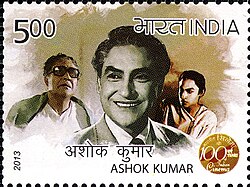
Ashok Kumar (born Kumudlal Ganguly; 13 October 1911 – 10 December 2001) was an Indian actor who worked in Hindi cinema. He is regarded as one of the greatest and most successful actors in the history of Indian cinema.[1][2] He is considered to be the first superstar of Indian cinema as well as the first lead actor to play an anti-hero.[3][4] He also became the first star to reinvent himself, enjoying a long and hugely successful career as a character actor. He was a member of the cinematic Ganguly family.[5] He was honoured in 1988 with the Dadasaheb Phalke Award, the highest national award for cinema artists,[6] by the Government of India. He received the Padma Shri in 1962 and Padma Bhushan in 1999 for his contributions to Indian cinema.[6]
Background and personal life[edit | edit source]
.jpg)
Ashok Kumar was born Kumudlal Ganguly into a Bengali Brahmin family in Bhagalpur, Bengal Presidency, British India (present-day Bihar, India).[7] His father, Kunjlal Ganguly, was a lawyer while his mother, Gouri Devi, was a housewife. Kumudlal was the eldest of four children. His only sister, Sati Devi, a few years younger than him, was married at a very young age to Sashadhar Mukherjee and became the matriarch of a large "film family". Next was his brother, Kalyan, 16 years younger (b.1927), who later took the screen name Anoop Kumar. Youngest of all was Abhas (b.1929), whose screen name was Kishore Kumar, who became a phenomenally successful playback singer in Hindi films. Although the eldest by several years, Kumudlal outlived all his siblings. Notably, he stopped celebrating his birthday after his youngest brother, Kishore, died on the same day in 1987.
While still a teenager and well before he had even given thought to a career in films, the young Kumudlal was married to Shobha (a first cousin of actress Chhaya Devi), a girl of his own Bengali Brahmin community and similar family background, in a match arranged by their parents in the usual Indian way.[8] Their lifelong marriage was a harmonious and conventional one, and despite his film career, the couple retained a very middle-class outlook and value system, bringing up their children with traditional values in a remarkably simple home. They were the parents of one son, Aroop Ganguly, and three daughters named Bharati Patel, Rupa Verma and Preeti Ganguly. Aroop Kumar Ganguly worked in only one film, appearing as a hero in Bezubaan (1962), which flopped at the box office. He then made a career in the corporate world. The eldest daughter, Bharati Patel, is the mother of the actress Anuradha Patel. His second eldest daughter, Rupa Ganguly, is a former actress and widow of actor-comedian Deven Verma.[9] The youngest daughter, Preeti Ganguly acted as a comedienne in several Hindi films during the 1970s and 1980s and died unmarried in 2012.[10]
Kumudlal's daughter Bharati married twice. Her first marriage was to Dr. Veerendra Patel, a Gujarati doctor. Through this marriage, she had two sons, Rahul and Rohit, and one daughter, the actress Anuradha Patel, who is married to the actor Kanwaljit Singh. Later, and much against the wishes of all her relatives, Bharati married Hameed Jaffrey, a Muslim, the brother of the actor Saeed Jaffrey.[11] By this second marriage, Bharati had one son, Saahil, and also acquired step-daughters, Geneviève and Shaheen, who were Hameed's daughters by his first wife Valerie Salway, a woman of Scottish, Irish, Portuguese and Spanish heritage.[12] Geneviève married a Sindhi businessman named Jagdeep Advani. Their daughter is actress Kiara Advani.[13] Thus, Ashok Kumar has no blood relationship with Kiara Advani but he is related to her in her family tree. In all, Kumar had eight biological grandchildren - Bharati's four children Rahul, Rohit, Anuradha and Saahil, and Aroop's four children Rishi, Mihir, Tushar and Somdatta (from his marriage to Nirmala Ganguly), in addition to his step-granddaughters Geneviève and Shaheen.
Ganguly was educated at Presidency College of the University of Calcutta, Kolkata, where he studied to become a lawyer. However, his heart was not in his law studies. Ganguly was more interested in cinema, in which he dreamt of working as a technician.
Career[edit | edit source]
Debut and breakthrough (1936–1942)[edit | edit source]
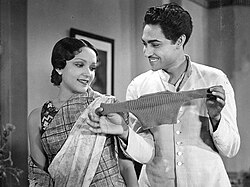
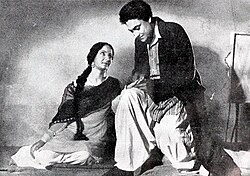
Kumar reluctantly made his debut in the year 1936 with Franz Osten's Jeevan Naiya alongside Devika Rani.[14]
.jpg)
His breakthrough came the same year with another Franz Osten's film Achhut Kannya which was a reformist piece featuring a Brahmin boy falling in love with a girl from the so-called untouchables in Indian society.[15] After the huge box office success of Achhut Kanya, he delivered a hat-trick of silver jubilee hits with Kangan (1939), Bandhan (1940) and Jhoola (1941), all opposite Leela Chitnis.[16]
Superstardom (1943–1959)[edit | edit source]
.jpg)
In 1943, Ashok Kumar played the lead role in Gyan Mukherjee's drama film Kismet opposite Mumtaz Shanti.[17] It became the first film to present the main lead as an anti-hero as well as an unmarried girl getting pregnant.[18] Despite having themes considered way ahead of times, Kismet became the first Indian film to do a nett business of ₹10 million (US$140,000) and emerged an All Time Blockbuster at the box office.[19] It ran in Kolkata's Roxy Cinema for 184 weeks, a record which remains unbroken till date.[20] Kismet also got the tag of being the first true blue mega blockbuster in the history of Indian cinema.[21] Its music, especially the patriotic song "Aaj Himalay Ki Choti Se" written by Kavi Pradeep was highly successful and played big role in making Kismet a box office sensation.[22] The mass hysteria created by Kismet made Kumar the first big superstar of Indian cinema.[23][24] Such was his popularity at the time that, in the words of Manṭo, "Ashok's popularity grew each passing day. He seldom ventured out, but wherever he was spotted, he was mobbed. Traffic would come to a stop and often the police would have to use lathis to disperse his fans".[25] The huge box office success of Kismet was followed by films, such as Gyan Mukherjee's Chal Chal Re Naujawan (1944), Mehboob Khan's Humayun (1945) and Kishore Sahu's Sajan (1947), all three of which received critical acclaim and emerged box office hits.[26]
In 1949, Kumar produced and starred in Kamal Amrohi's Mahal, which had Madhubala as the female lead. Recalled as Hindi cinema's first horror film, Mahal went on to become a blockbuster at the box office and third highest-grossing film of the year, behind Barsaat and Andaz.[27] The film made Madhubala an overnight sensation and launched the career of Lata Mangeshkar who sang Aayega Aanewala, which remains popular till date.[28][29] Mahal also became the source of inspiration for several films like Madhumati (1958), Mehbooba (1976), Karz (1980) and Om Shanti Om (2007).[30][31] The early-1950s saw the rise of younger crop of stars like Dilip Kumar, Dev Anand and Raj Kapoor, but Kumar remained rock-steady and continued to deliver huge hits throughout the decade.[23] In 1950, Kumar delivered another blockbuster and highest-earning film of the year with Ramesh Saigal's Samadhi opposite Nalini Jaywant.[32] That same year, he reunited with Jaywant and Gyan Mukherjee for Sangram.[33] After Kismet, Kumar again donned the hat of anti-hero for Sangram, in turn adding another huge hit in his kitty.[34] In 1951, he starred in B. R. Chopra's crime drama film Afsana and Nitin Bose's romantic musical Deedar.[35][36] Afsana in which Kumar played a double role was the first hit of Chopra as a filmmaker and made him a notable name in the industry while Deedar co-starring Nargis and Dilip Kumar also proved to be a major commercial success.[37][38]
Kumar's only notable release of 1952 was M. L. Anand's romantic drama Bewafa which also had Nargis and Raj Kapoor in the lead.[39] In 1953, he produced and starred in Bimal Roy's romantic drama Parineeta alongside Meena Kumari.[40] Based upon the 1914 Bengali novel of the same name by Sarat Chandra Chattopadhyay, it proved to be a critical and commercial success.[41] Post-Parineeta, Kumar had three unsuccessful ventures in Baadbaan (1954), Sardar (1955) and Bandish (1955), but this changed with a superhit in B. R. Chopra's family drama film Ek Hi Raasta (1956), acting alongside Meena Kumari and Sunil Dutt.[42] He also had successes in M. V. Raman's Bhai-Bhai and Shakti Samanta's Inspector, the same year and Devendra Goel's Ek Saal, the next year.[43][44]
In 1958, Kumar added one more superhit in his kitty with Satyen Bose's musical comedy Chalti Ka Naam Gaadi, which also had his brothers Anoop Kumar and Kishore Kumar in the lead.[45] The film gained cult status in later years and got remade twice in Hindi and once in Marathi.[46] Its soundtrack composed by S. D. Burman was highly successful with a number of hit songs, including "Babu Samjho Ishaare", "Ek Ladki Bheegi Bhaagi Si", "Hum The Woh Thi Aur Sama Rangeen" and "Haal Kaisa Hai Janaab Ka".[47][48][49] His other major release of the year was Shakti Samanta's crime thriller Howrah Bridge which had Madhubala opposite him.[50] The film opened to positive response from critics and proved to be a hit.[51] Its dance numbers - "Mera Naam Chin Chin Chu" sung by Geeta Dutt which brought fame to Helen and "Aaiye Meharban" sung by Asha Bhosle were hugely popular among the masses.[52] Kumar's last notable film in his prime came with Yash Chopra's maiden directional venture Dhool Ka Phool (1959), co-starring Mala Sinha, Rajendra Kumar and Nanda.[53] It opened to critical acclaim and emerged a blockbuster at the box office.[54]
Continued success, acclaim and expansion to television (1960–1984)[edit | edit source]
With the beginning of the 1960s, Kumar was open to all kind of roles, whether as main lead, second lead, or in a character role.[55] This prevented him from being type-cast and he continued to receive acclaim for his work.[56]
It started with B. R. Chopra's courtroom drama Kanoon (1960) which also had Rajendra Kumar and Nanda in the lead.[57] Despite not having any songs and other gimmicks required in a commercial Hindi film, Kanoon emerged a hit and went on to win National Film Award for Best Feature Film (Hindi).[58][59][60] After playing a brief role in Yash Chopra's critically acclaimed partition drama Dharmputra (1961), the following year, he did lead roles in A. Bhimsingh's Rakhi and Phani Majumdar's Aarti.[61][62] Both Rakhi and Aarti received critical acclaim and proved to be box office hits.[63] Kumar received his first Filmfare Award for Best Actor for his portrayal of a doting brother in Rakhi.[64] 1963 proved to be a hugely successful year for Kumar with many successes.[65] He first collaborated with B. R. Chopra for the romantic thriller Gumrah co-starring Sunil Dutt, Mala Sinha, Shashikala and Nirupa Roy.[66] Gumrah did very well at the box office and proved to be a superhit.[67] For his performance in the film, Kumar won his first BFJA Award for Best Actor (Hindi).[68] The film won National Film Award for Third Best Feature Film in Hindi.[69] This was followed by Bimal Roy's critically and commercially successful drama film Bandini.[70] Bandini was the last feature film directed by Roy and won him his final Filmfare Award for Best Director along with National Film Award for Best Feature Film (Hindi) as well as Filmfare Award for Best Film.[69] Before the end of year, he reunited with Rajendra Kumar in H. S. Rawail's muslim social Mere Mehboob, co-starring Sadhana and Nimmi.[71] The film topped box office chart in 1963 and emerged an All Time Blockbuster.[58] Its music composed by Naushad dominated the year-end annual list of Binaca Geetmala and was the second best-selling Hindi film album of the 1960s.[72][73]
In 1964, Kumar delivered two moderately successful films with A. Bhimsingh's Pooja Ke Phool and Inder Raj Anand's Phoolon Ki Sej which had Dharmendra and Manoj Kumar in the lead respectively, but his other releases, such as Chitralekha and Benazir flopped at the box office.[74] In 1965, he had a hit in Bheegi Raat and a semi-hit in Oonche Log.[75] The hit streak continued in 1966 with Asit Sen's Mamta which again had Dharmendra in the lead along with Suchitra Sen who played a double role.[76] It was a successful venture domestically, but an All Time Blockbuster in overseas markets.[77] The same year, Kumar also appeared in Brij Sadanah's Afsana which was a box office failure, but won him Filmfare Award for Best Supporting Actor.[78] 1967 was a notable year for him as he starred in two of the biggest hits of the year - Vijay Anand's spy heist thriller Jewel Thief and A. Bhimsingh's light hearted drama film Mehrban.[79][80] Both the films proved to be critical and commercial successes with Kumar getting applauded for his performances in them and receiving a nomination in the Filmfare Award for Best Supporting Actor category for the latter.[81][82]
In 1968, he played the lead role in Hrishikesh Mukherjee's social drama Aashirwad.[83] Although the film did not do well at the box office, it was a huge critical success, winning National Film Award for Best Feature Film (Hindi).[84] Kumar's portrayal of a loving father was very well received and won him all the major accolades that year, such as National Film Award for Best Actor, Filmfare Award for Best Actor and BFJA Award for Best Actor (Hindi).[85][86][87] One of its song "Rail Gaadi Chhuk Chhuk Chhuk Chhuk" sung by Kumar himself is considered the first rap song of Indian cinema.[88] Kumar ended the decade on a high. He co-starred alongside Sanjay Khan and Sadhana in R. K. Nayyar's mystery thriller Intaqam which went on to become a superhit at the box office.[89] He then did a guest appearance in Samanta's romantic blockbuster Aradhana which made Rajesh Khanna a superstar. Kumar also reunited with Hrishikesh Mukherjee for drama film Satyakam which like their previous collaboration Aashirwad met with immense acclaim and won National Film Award for Best Feature Film (Hindi).[90][91]
The 1970s saw the domination of whole new generation of stars, including Rajesh Khanna, Dharmendra, Amitabh Bachchan, Manoj Kumar, Shashi Kapoor, Vinod Khanna, Jeetendra and Rishi Kapoor.[92] Kumar worked with all of them in various successful and acclaimed films.[93] In 1970, he played important roles in two directional ventures of Asit Sen, Sharafat co-starring Dharmendra, Hema Malini and Safar which also had Rajesh Khanna, Sharmila Tagore, Feroz Khan in the lead.[94][95] Both the films emerged superhits and received big thumbs from reviewers, especially Safar which won Sen his first Filmfare Award for Best Director.[96] He also collaborated with Manoj Kumar for his second directional, the patriotic drama Purab Aur Paschim, which proved to be a blockbuster in India as well as overseas.[97][98] The following year, he appeared in acclaimed ventures, such Naya Zamana, Guddi and Adhikar.[99][100] In 1972, he starred in Kamal Amrohi's magnum opus Pakeezah which had Meena Kumari as the eponymous lead, alongside Raaj Kumar.[101] Despite getting mixed reviews and being a slow starter, it went on to become a massive blockbuster and also the final film appearance of Kumari who died few weeks after its release.[102] Kumar then played the role of a doting grandfather in Samanta's Anuraag and a crook in Sadanah's Victoria No. 203.[103][104] Both the films emerged superhits with Kumar again getting nominated in the Filmfare Award for Best Supporting Actor category for Anuraag.[20] That same year, he reunited with Rajesh Khanna for Maalik and Dil Daulat Duniya, but contrary to expectations, both the films flopped commercially.[105]
Kumar played small roles in both of his major releases of 1973 and 1974 which were - Dhund and Prem Nagar, respectively.[106][107] In 1975, he had a superhit in Chori Mera Kaam co-starring Shashi Kapoor and Zeenat Aman.[108] He also appeared alongside Amitabh Bachchan and Jaya Bachchan in Mili.[109] It did average business, but won massive acclaim and is now considered a film ahead of its times.[110] The following year, Kumar saw four profitable ventures in Ek Se Badhkar Ek, Barood, Chhoti Si Baat and Suntan.[111] He received his fifth and final nomination in the Filmfare Award for Best Supporting Actor category for his heartfelt portrayal of a retired colonel in Chhoti Si Baat.[112] His other successful films of the decade, include Dream Girl (1977), Anand Ashram (1977), Safed Jhooth (1977), Chala Murari Hero Banne (1977), Dil Aur Deewaar (1978), Anpadh (1978) and Khatta Meetha (1978).[113][43][114]
Kumar began the next decade with supporting role in four hit films, including Khubsoorat, Jyoti Bane Jwala, Sau Din Saas Ke and Judaai.[115] In 1981, he had two more box office successes with Shibu Mitra's Maan Gaye Ustaad and Pramod Chakravarty's Jyoti.[116] He then played the lead role in Basu Chatterjee's comedy drama Shaukeen (1982), which was a commercial as well as critical success and is now considered a cult classic.[117] In 1983, he appeared in another of Basu Chatterjee's acclaimed venture Pasand Apni Apni and Sunil Dutt's drama film Dard Ka Rishta, which proved to be a box office hit.[118][119] The following year, Kumar made his television debut with the soap opera Hum Log, which was telecasted on Doordarshan and presented the story of an Indian middle-class family from the 1980s and their daily struggles.[120][121] Every episode ended with the Kumar in a sharp suit and dark glasses explaining the theme of the day and prodding viewers to think about what they had just watched.[122] During its 1 and a half-year run, he received over 400,000 letters from young viewers, asking him to convince their parents in marriage of their choice. The show proved to be a huge success with each episode having a regular viewing audience of more than 50 million.[123]
Further works and retirement (1985–1997)[edit | edit source]
In 1985, Kumar played a notable supporting role in B. R. Chopra's drama film Tawaif.[124][125] The film opened to positive response from reviewers and emerged a major commercial success.[126] In 1986, he played the title role in B. R. Chopra's acclaimed and successful television show Bahadur Shah Zafar.[121][127] The following year, he appeared in Shekhar Kapoor's superhero film Mr. India, which was a major critical and commercial success, followed by two more hits films, Watan Ke Rakhwale and Jawab Hum Denge.[128][129] Towards the end of decade, Kumar's workload slowed due to declining health. His major releases in 1988 and 1989 - Inteqam and Clerk, respectively, were critical and commercial failures.[130][131]
In the early-1990s, he appeared in films, such as Majboor (1990), Begunaah (1991), Humlaa (1992) and Aasoo Bane Angaarey (1993), but they did not succeed at the box office. During this period, success came with the TV shows Bheem-Bhavani (1990) and Tehkikaat (1994).[121] Kumar received Lifetime Achievement Award at the 41st Filmfare Awards, which was held in the year 1996.[132] The same year, he reunited with Dev Anand and Dharmendra for Return of Jewel Thief, which was highly anticipated before release, but ended up as a loss making venture.[133] Kumar quit acting after making an appearance in Ashim Samanta's romantic drama Ankhon Mein Tum Ho (1997) starring Sharad Kapoor, Suman Ranganathan and Rohit Roy.[134] The film opened to negative reviews from critics and was a box office flop.[43][135]
Death[edit | edit source]
Ashok Kumar died at the age of 90 in Mumbai on 10 December 2001 of heart failure at his residence in Chembur. The then Prime Minister Atal Bihari Vajpayee described him as "an inspiration... for many generations of aspiring actors.[55]
Artistry and legacy[edit | edit source]

Kumar was a pioneering actor who introduced natural acting to Hindi cinema and the distinctive style and mannerisms that he adopted in his later career still remain extremely popular among mimicry artists.[136]
Kumar had an eye for talent and helped several up-and-coming artists get a break. He groomed Hrishikesh Mukherjee during the director's association with Bombay Talkies.[137] The filmmaker went on to helm movies, such as Anari (1959), Asli-Naqli (1962), Anupama (1966), Aashirwad (1968), Satyakam (1969), Anand (1971), Chupke Chupke (1975) and Khubsoorat (1980).[138][139][140] He produced Neel Kamal (1947), Ziddi (1948) and Mahal (1949) which launched the careers of Raj Kapoor, Dev Anand and Madhubala respectively.[141][142][143] He also collaborated with Shakti Samanta for Inspector (1956) and Howrah Bridge (1958), which proved to be game-changers for the then struggling filmmaker.[144][43] Filmfare included his performance in Aashirwad in its list of "80 Iconic Performances".[145]
He inspired many of his younger contemporaries, including Dilip Kumar, Dev Anand, Raj Kapoor to succeeding generations of artists, such as Shammi Kapoor, Manoj Kumar and Raaj Kumar among others.[146][147]
One of the highest paid actors of the 1940s and 1950s, Kumar appeared in Box Office India's "Top Actors" list eight times, (1940–1945, 1949–1950).[23] In 2022, he was placed in Outlook India's "75 Best Bollywood Actors" list.[148]
Awards and recognition[edit | edit source]
Filmography[edit | edit source]
References[edit | edit source]
- ↑ "Iconic heroes of Bollywood". India Today. Archived from the original on 28 November 2020. Retrieved 24 August 2020.
- ↑ "Remembering Dadamoni: 10 facts about Ashok Kumar you did not know". 13 October 2016.
- ↑ "When Ashok Kumar's wedding was called off because he became an actor: 'It was considered disreputable those days'". 13 October 2022.
- ↑ "Movie buffs and time machines". The Hindu. 5 October 2018.
- ↑ Handa, Ekta (10 December 2018). "Remembering 'Dadamoni' Ashok Kumar: A perfectionist actor, homoeopath & 'wacky' gentleman". ThePrint. Retrieved 3 October 2022.
- ↑ 6.0 6.1 "Ashok Kumar: Lesser Known Facts". The Times of India. Retrieved 3 October 2022.
- ↑ "Ashok Kumar: Lesser Known Facts – The Times of India". The Times of India. Archived from the original on 28 March 2018. Retrieved 27 March 2018.
- ↑ "Home alone: Ashok Kumar". Archived from the original on 5 February 2008.
- ↑ "दिग्गज अभिनेता अशोक कुमार की बेटी अभिनेत्री भारती जाफरी का निधन". Zee News (in हिन्दी). Retrieved 23 May 2023.
- ↑ "Veteran actor Ashok Kumar passes away". Economic Times. 10 December 2001. Archived from the original on 31 December 2013. Retrieved 30 March 2012.
- ↑ "ये रही हैं सलमान खान की पहली गर्लफ्रेंड, होते-होते रह गई दोनों की शादी!". bhaskar.com. 10 February 2016. Archived from the original on 18 September 2016. Retrieved 27 March 2018.
- ↑ "Gene Junction: Kiara Alia Advani". Verve (Indian magazine). 2 February 2016. Archived from the original on 26 June 2019. Retrieved 27 March 2018.
- ↑ "Kiara Advani's about her relation with Ashok Kumar | THE FREE PRESS JOURNAL". Retrieved 30 July 2021.
- ↑ Manṭo 2003, pp. 244–245.
- ↑ Annotation of the film on indiancine.ma
- ↑ "All Time Longest Runners In Kolkata: Sholay 2nd - HAHK 4th".
- ↑ "Kismet (1943)". Rotten Tomatoes.
- ↑ "Ashok Kumar Played 'Khal Nayak' In 1943 Film Kismet, First In Bollywood". 13 October 2023.
- ↑ "Everything To Know About Indian Cinema's First Blockbuster, 'Kismet' Starring Ashok Kumar". 28 May 2002.
- ↑ 20.0 20.1 "All Time Longest Runners In Kolkata: Sholay 2nd - HAHK 4th".
- ↑ Kismet (1943 film) Archived 3 October 2008 at the Wayback Machine National Film Archive of India; accessed 15 October 2017.
- ↑ Britannica, Encyclopedia (2003). Encyclopaedia of Hindi Cinema. Popular Prakashan. p. 282. ISBN 978-81-7991-066-5.
- ↑ 23.0 23.1 23.2 "Top Actors". Box Office India. Archived from the original on 19 February 2008. Retrieved 24 April 2020.
- ↑ "एक तरफ 'वर्ल्ड वॉर 2' चल रहा था और दूसरी तरफ फिल्म 'किस्मत'ने इतिहास रचा, अशोक कुमार बन गए पहले सुपरस्टार". Navbharat Times (in हिन्दी). Retrieved 26 September 2024.
- ↑ Manṭo 2010.
- ↑ Eena Meena Deeka: The Story of Hindi Film Comedy. Rupa & Company. p. 161.
- ↑ "With Pathaan and Jawan, Shah Rukh Khan becomes only actor after Raj Kapoor to deliver 2 ATGs in a single year". 29 September 2023.
- ↑ "Top Actress". Box Office India. Archived from the original on 27 December 2012. Retrieved 25 September 2016.
- ↑ Prabhu, Gayathri (2020). Shadow Craft: Visual Aesthetics of Black and White Hindi Cinema. Bloomsbury Academic. ISBN 978-93-90176-26-7.
- ↑ Mishra, Vijay (2002), Bollywood cinema: temples of desire, Routledge, pp. 49–57, ISBN 0-415-93014-6
- ↑ Doniger, Wendy (2005), "Chapter 6: Reincarnation", The woman who pretended to be who she was: myths of self-imitation, Oxford University Press, pp. 112–136 [135], ISBN 0-19-516016-9
- ↑ Box Office India. "Top Earners 1950". boxofficeindia.com. Retrieved 9 July 2008.
- ↑ "Sangram (1950)". Rotten Tomatoes.
- ↑ "Sangram (1950)". The Hindu. 30 December 2010.
- ↑ Majumdar, Neepa (2009). Wanted Cultured Ladies Only!: Female Stardom and Cinema in India, 1930s-1950s. University of Illinois Press. p. 138. ISBN 978-0-252-07628-2.
- ↑ Bhaichand Patel (2012). Bollywood's Top 20: Superstars of Indian Cinema. Penguin Books India. p. 84. ISBN 978-0-670-08572-9.
- ↑ "Noted filmmaker B R Chopra passes away". The Hindu newspaper. 5 November 2008. Archived from the original on 29 June 2011. Retrieved 28 November 2022.
- ↑ "Cinema: Do Badan (1966)". The Hindu. 15 October 2010. Archived from the original on 13 March 2014. Retrieved 13 March 2014.
- ↑ "Bewafa (1952)".
- ↑ "On Meena Kumari's birth anniversary, here are her 5 must watch films". 1 August 2022.
- ↑ "From Anarkali To Rahi – Top Bollywood Box Office Grossers Of 1953".
- ↑ Dwyer, Rachel (2002). Yash Chopra: Fifty Years in Indian Cinema. Lotus Collection. p. 42. ISBN 81-7436-234-7.
- ↑ 43.0 43.1 43.2 43.3 "Great Gambler". Archived from the original on 15 February 2009. Retrieved 1 May 2008.
- ↑ Patel, Bhaichand (15 January 2016). Bollywood's Top 20: Superstars of Indian Cinema. Penguin UK. ISBN 978-81-8475-598-5.
- ↑ Deb, Sandipan (12 October 2020). "The best Hindi movie ever and the inimitable Kishore Kumar". mint. Retrieved 17 April 2021.
- ↑ Swamy, Rohan (13 February 2013). "The Remake Saga". The Indian Express. Retrieved 5 May 2019.
- ↑ Swamy, Rohan (13 February 2013). "The Remake Saga". The Indian Express. Retrieved 5 May 2019.
- ↑ "Bollywood throwback movie review: Chalti Ka Naam Gaadi (1958)". The American Bazaar. 1 December 2016. Retrieved 18 April 2021.
- ↑ "The Top 25 Rain Songs In Bollywood – Rediff.com" https://m.rediff.com/movies/slide-show/slide-show-1-top-25-rain-songs-of-bollywood/20120614.htm
- ↑ U, Saiam Z. (2012). Houseful The Golden Years of Hindi Cinema. Om Books International. ISBN 978-93-80070-25-4.
- ↑ "Remembering Madhubala's best roles". Filmfare. Retrieved 11 September 2021.
- ↑ "For a shake n shimmy". The Hindu. 6 April 2016.
- ↑ "Dhool Ka Phool (1959)". Rotten Tomatoes.
- ↑ "Legendary Director Yash Chopra Passes Away". 22 October 2012. Archived from the original on 21 November 2013.
- ↑ 55.0 55.1 "BBC News – FILM – Bollywood star Ashok Kumar dies". bbc.co.uk. Archived from the original on 22 February 2014. Retrieved 1 August 2011.
- ↑ "Ashok Kumar: 'Jewel' To His Family And 'Jewel Thief' Of Hindi Cinema". 14 October 2022.
- ↑ "Kanoon (1960)". Rotten Tomatoes.
- ↑ 58.0 58.1 "Bollywood's Jubilee Kumar".
- ↑ "JAANEWALE KI YAAD AATI HAI - RAJENDRA KUMAR BIDS ADIEU". 17 July 2024.
- ↑ "8th National Film Awards". International Film Festival of India. Archived from the original on 12 October 2013. Retrieved 7 September 2011.
- ↑ "Blast from the past: RAKTHA SAMBANDHAM (1962)". Thehindu.com. 20 October 2016. Retrieved 18 November 2021.
- ↑ Vijayakumar, B. (12 April 2015). "Manaswini – 1968". The Hindu. Archived from the original on 9 May 2020. Retrieved 12 November 2019.
- ↑ "Worth Their Weight in Gold! - Box Office India: India's premier film trade magazine". Archived from the original on 15 September 2017. Retrieved 24 October 2015.
- ↑ "Filmfare Nominees and Winner [sic]" (PDF). The Times Group. Retrieved 6 May 2023 – via Internet Archive.
- ↑ "Ashok Kumar - The Jewel In Bollywood's Crown".
- ↑ "Gumrah (1963)". Rotten Tomatoes.
- ↑ "Gumraah Dull - John Wick 4 Proving To Be A HIT".
- ↑ "27th Annual BFJA Awards". Bfjaawards.com. Archived from the original on 8 January 2010. Retrieved 12 July 2010.
- ↑ 69.0 69.1 "11th National Film Awards". International Film Festival of India. Retrieved 13 September 2011.
{{cite web}}: CS1 maint: deprecated archival service (link) - ↑ Chatterjee, Saibal; Nihalani, Govind; Gulzar (2003). Encyclopaedia of Hindi cinema. Popular Prakashan. p. 599. ISBN 978-81-7991-066-5.
- ↑ "Mere Mehboob (1963)". Rotten Tomatoes.
- ↑ "Binaca Geetmala (1963)".
- ↑ "Music Hits 1960–1969". Box Office India. Archived from the original on 15 February 2008. Retrieved 2 September 2013.
- ↑ "Box Office 1964". Boxofficeindia.com. Archived from the original on 12 February 2010. Retrieved 8 March 2012.
- ↑ "Box Office 1965". Box Office India. Archived from the original on 22 September 2012.
- ↑ Peter Cowie (1977). World Filmography: 1967. Fairleigh Dickinson Univ Press. p. 270. ISBN 978-0-498-01565-6. Retrieved 23 February 2015.
- ↑ "You Asked It - Why Are China Collections Not Added To Worldwide Collections". 1 March 2018.
- ↑ "The Filmfare Awards Nominations – 1966". The Times Group. Archived from the original on 23 March 2004.
- ↑ Devinder Bir Kaur (7 March 2004). "Goldie: Guide for new filmmakers". The Tribune. Retrieved 19 April 2012.
- ↑ Elley 1977, pp. 270–271.
- ↑ "Dev Anand-Vyjanthimala's Jewel Thief remains one of Hindi cinema's tautest thrillers, even 55 years after it was made". 23 January 2022.
- ↑ "From Dilip Kumar's Ram Aur Shyam To Manoj Kumar's Patthar Ke Sanam – Top Box Office Grossers Of 1967". 7 May 1967.
- ↑ "Aashirwad (1968)". Rotten Tomatoes.
- ↑ "Hrishikesh Mukherjee's best films: Aashirwad (1969)". Rediff.com Movies. 28 August 2006. Retrieved 30 July 2013.
- ↑ "16th National Film Awards" (PDF). Directorate of Film Festivals. Archived (PDF) from the original on 9 November 2018. Retrieved 2 September 2020.
- ↑ "Filmfare Winners (1970)". The Times of India.
- ↑ "33th Annual BFJA Awards". Bfjaawards.com. Archived from the original on 8 January 2010. Retrieved 12 July 2010.
- ↑ "Did you know Ashok Kumar crooned the first rap song of Bollywood". The Times of India. 14 October 2022.
- ↑ "From Rajesh Khanna's Aradhana To Jeetendra's Jigri Dost – Top Bollywood Box Office Grossers Of 1969". 5 May 1969.
- ↑ "Satyakam: Dharmendra's career best role". www.rediff.com.
- ↑ "Directorate of Film Festival" (PDF). Iffi.nic.in. Retrieved 23 July 2012.
- ↑ "Hindi classics that defined the 1970s". 27 May 2020.
- ↑ "Romancing the camera for decades". The Hindu. 15 October 2010.
- ↑ Bhaichand Patel, ed. (2012). Bollywood's Top 20: Superstars of Indian Cinema. Penguin Books India. p. 165. ISBN 978-0-670-08572-9.
- ↑ "আনন্দবাজার পত্রিকা - নিবন্ধ". archives.anandabazar.com. Retrieved 12 January 2023.
- ↑ Filmfare Nominees and Winners
- ↑ Vinod Khanna Passes Away, Box Office India, 27 April 2017
- ↑ "United Kingdom Evolution - £100k To £4 Million Of Pathaan". Box Office India. Retrieved 2 March 2023.
- ↑ Lokapally, Vijay (25 July 2013). "Naya Zamana (1971)". The Hindu. Retrieved 28 January 2021.
- ↑ "rediff.com, Movies: Classics Revisited: Guddi". www.rediff.com. Archived from the original on 30 October 2020. Retrieved 4 March 2023.
- ↑ "Pakeezah". Rotten Tomatoes.
- ↑ "You Asked It - Can Race 3 Do 300 Crore Plus?". 24 May 2018.
- ↑ "OTT | TV | Bollywood | Hollywood - News, Reviews, Gossips". 7 August 2021.
- ↑ Roshmila Bhattacharya (18 October 2015). "Infocus: Dadamoni, Pran and fun times". Bangalore Mirror. Retrieved 2 March 2025.
- ↑ "Dil Daulat Duniya (1972) – The Hindu". The Hindu. thehindu.com. 28 August 2014. Retrieved 12 November 2016.
- ↑ "Aboard the mystery train | Cinemaexpress". Cinema Express. 22 November 2017. Archived from the original on 24 October 2020.
This BR Chopra directorial was based on the Christie play, The Unexpected Guest, and featured Sanjay Khan, Zeenat Aman, Danny Denzongpa, and Ashok Kumar, among others. The story is about a car-wrecked stranger knocking on the door of a damsel-in-distress who has just shot her husband. On hearing her sad tale of woe, the stranger decides to help her escape punishment.
- ↑ Malhotra, A. p s (5 February 2015). "Prem Nagar (1974)". Thehindu.com. Retrieved 18 November 2021.
- ↑ Lokapally, Vijay (11 December 2014). "Chori Mera Kaam (1975)". The Hindu. Retrieved 12 December 2014.
- ↑ "Mili (1975)". Rotten Tomatoes.
- ↑ "Classics revisited: The spirit of Mili lives on". 28 March 2013.
- ↑ "Gol Maal, Chashme Buddoor, Choti Si Baat: Revisiting Bollywood's middle class era".
- ↑ "Best Screenplay Award". Filmfare Award Official Listings, Indiatimes. Archived from the original on 29 April 2014. Retrieved 28 April 2014.
- ↑ "A dream called Hema Malini". In.rediff.com. 16 October 1948. Retrieved 24 September 2009.
- ↑ "Trade Guide Classification 1978".
- ↑ "Trade Guide Classification (1980)".
- ↑ "Trade Guide Classification (1981)".
- ↑ "Samaresh Basu Birth Anniversary: Here Are 5 Films Based on His Novels". News18. 11 December 2019. Retrieved 26 December 2021.
- ↑ "Classics should be taken on, but correctly: Basu Chatterjee". The Times of India. 28 March 2013. Retrieved 28 April 2014.
- ↑ "Film Informatiom Classification 1983".
- ↑ "An episode in history". Indian Express. 7 July 2009. Archived from the original on 15 July 2009. Retrieved 8 July 2009.
- ↑ 121.0 121.1 121.2 "#GoldenFrames: Pictorial Biography of Ashok Kumar, the first icon of Indian cinema!Photos - GoldenFrames-Celebs-The Times of India Photogallery". photogallery.indiatimes.com.
The actor occasionally appeared on television, famously known for anchoring the first Indian soap opera Hum Log (1984-1985). Dadamoni appeared as the title character in Bahadur Shah Zafar (1986) and played the role of a detective along with his brother Anoop Kumar in Bheem-Bhawani (1990-1991).
- ↑ "The DD Files: 'Hum Log' versus 'Buniyaad'". 18 May 2016.
- ↑ Stephanie Hegarty (27 April 2012). "How soap operas changed the world". BBC News. Archived from the original on 31 January 2016. Retrieved 26 January 2016.
- ↑ "Tawaif (1985 film)". Rotten Tomatoes website. Retrieved 4 December 2023.
- ↑ "Durgaa (1985)". Rotten Tomatoes.
- ↑ "Trade Guide Classification (1985)".
- ↑ "When Juhi Chawla "Kept Forgetting Her Lines" On The Sets Of BR Chopra's Bahadur Shah Zafar". 19 September 2021.
- ↑ "Dharmendra's Unbeatable Record In 1987 With 7 Out of Top 10 Grossers". 31 January 2024.
- ↑ Sharma, Devesh (13 August 2020). "Birthday Special: Best Sridevi Movies". Filmfare. Archived from the original on 29 September 2020. Retrieved 4 April 2021.
- ↑ "Film Information Classification (1988)".
- ↑ "Real Winner With Dhadak". 25 July 2018.
- ↑ "The day we were". Filmfare. The Times Group. January 1997. Archived from the original on 4 February 1997. Retrieved 23 November 2020.
- ↑ "RETURN of JEWEL THIEF - Movie".
- ↑ "Trailer — Ankhon Mein Tum Ho". 26 December 1997. Archived from the original on 6 October 2023. Retrieved 12 December 2023.
- ↑ "ANKHON MEIN TUM HO - Movie".
- ↑ "Ashok Kumar 111th birth anniversary: Must-watch films of Bollywood's first superstar". 13 October 2022.
- ↑ Hrishikesh Mukherjee Biography Archived 15 October 2007 at the Wayback Machine on winning, the 31st Dada Saheb Phalke Award.
- ↑ Gulzar; Nihalani, Govind; Chatterjee, Saibal (2003). Encyclopaedia of Hindi Cinema. Encyclopædia Britannica (India) Pvt Ltd. p. 592. ISBN 81-7991-066-0.
- ↑ "rediff.com, Movies: The common man lure of Hrishikesh Mukherjee's films". www.rediff.com. Retrieved 2 March 2025.
- ↑ "rediff.com: Hrishikesh Mukherjee's best films". specials.rediff.com. Archived from the original on 30 May 2023. Retrieved 2 March 2025.
- ↑ "The eventful 1947 was a breakthrough year for Dilip Kumar, Raj Kapoor and Indian cinema". 7 April 2023.
- ↑ "Lata, Dev Anand recall Kishore Kumar on his birth anniversary". Realbollywood.com website. 4 August 2011. Archived from the original on 23 September 2013. Retrieved 27 March 2024.
- ↑ Akbar 1997, p. 61.
- ↑ "Remembering Ashok Kumar on his birth anniversary: A pillar of Indian cinema". 13 October 2021.
- ↑ "80 Iconic Performances". Filmfare Via Tanqeed.com. 4 June 2010. Retrieved 27 November 2018.
- ↑ "Dev Anand to Madhubala: How Ashok Kumar Gave India Some of Its Biggest Stars!". 11 October 2018.
- ↑ "Throwback Thursday: When Raj Kapoor scolded Shammi at the airport for an ad with Ashok Kumar". 2 January 2020.
- ↑ "75 Bollywood Actors Who Conquered Hearts Of The Millions". Outlook India. 12 August 2022. Archived from the original on 16 August 2022. Retrieved 16 August 2022.


Bibliography[edit | edit source]
- Akbar, Khatija (1997). Madhubala: Her Life, Her Films. Hay House. ISBN 978-93-80480-81-7.
- Elley, Derek (1977). World Filmography: 1967. Fairleigh Dickinson University Press. ISBN 978-0-498-01565-6.
- Ghosh, Nabendu (1995). Ashok Kumar: His Life and Times. Indus. ISBN 978-81-7223-218-4.
- Valicha, Kishore (1996). Dadamoni: the authorized biography of Ashok Kumar. Viking. ISBN 978-0-670-87271-8.
- Burra, Rani (1990). Ashok Kumar, Green to Evergreen. Directorate of Film Festivals, Ministry of Information and Broadcasting, Govt. of India.
- Manṭo, Saʻādat Ḥasan (2003). Black Margins: Stories. Katha. ISBN 978-81-87649-40-3.
- Manṭo, Saʻādat Ḥasan (2010). Stars from Another Sky: The Bombay Film World of the 1940s. Penguin. ISBN 978-0-14-343011-7.
- Patel, Bhaichand (2012). Bollywood's Top 20: Superstars of Indian Cinema. Penguin Books India. pp. 28–39. ISBN 978-0-670-08572-9.
External links[edit | edit source]
Lua error in Module:Sister_project_links at line 463: attempt to index field 'wikibase' (a nil value).
- Ashok Kumar on IMDb
- Pages using the JsonConfig extension
- 1911 births
- 2001 deaths
- 20th-century Indian male actors
- 21st-century Indian male actors
- Bengali male actors
- Best Actor National Film Award winners
- Dadasaheb Phalke Award recipients
- Indian male film actors
- Male actors from Mumbai
- Male actors in Bengali cinema
- Male actors in Hindi cinema
- Male actors in Marathi cinema
- People from Bhagalpur
- People from Khandwa
- Presidency University, Kolkata alumni
- Recipients of the Padma Bhushan in arts
- Recipients of the Padma Shri in arts
- University of Calcutta alumni
- Filmfare Awards winners
- Filmfare Lifetime Achievement Award winners