




No edit summary |
WikiDwarfBOT (talk | contribs) Cleanup: Information added. |
||
| Line 1: | Line 1: | ||
{{ | {{Short description|President of India from 1977 to 1982}} | ||
{{Use Indian English|date=February 2023}} | |||
{{good article}} | {{good article}} | ||
{{Use dmy dates|date=April 2022}} | |||
{{Use dmy dates|date= | |||
{{Infobox officeholder | {{Infobox officeholder | ||
| name = Neelam Sanjiva Reddy | | name = Neelam Sanjiva Reddy | ||
| image = | | image = Neelam Sanjiva Reddy.jpg | ||
| caption = | | caption = Reddy in January 1977 | ||
| image_size = | | image_size = | ||
| order = 6th | | order = 6th | ||
| office = President of India | | office = President of India | ||
| primeminister = [[Morarji Desai]] | | primeminister = {{ubl|[[Morarji Desai]]|[[Charan Singh]]|[[Indira Gandhi]]}} | ||
| vicepresident = B. D. Jatti | | vicepresident = {{ubl|[[B. D. Jatti]]|[[Mohammad Hidayatullah]]}} | ||
| term_start = 25 July 1977 | | term_start = 25 July 1977 | ||
| term_end = 25 July 1982 | | term_end = 25 July 1982 | ||
| predecessor = [[B. D. Jatti]] | | predecessor = [[Fakhruddin Ali Ahmed]]{{efn|[[B. D. Jatti]] acting president for 6 months.}} | ||
| successor = [[Zail Singh]] | | successor = [[Zail Singh]] | ||
| order2 = 4th | | order2 = 4th | ||
| Line 21: | Line 21: | ||
| term_end2 = 19 July 1969 | | term_end2 = 19 July 1969 | ||
| deputy2 = [[R.K. Khadilkar]] | | deputy2 = [[R.K. Khadilkar]] | ||
| predecessor2 = [[ | | predecessor2 = [[Hukam Singh (Punjab politician)|Hukam Singh]] | ||
| successor2 = [[Gurdial Singh Dhillon]] | | successor2 = [[Gurdial Singh Dhillon]] | ||
| term_start3 = 26 March 1977 | | term_start3 = 26 March 1977 | ||
| Line 32: | Line 32: | ||
| term_start4 = 9 June 1964 | | term_start4 = 9 June 1964 | ||
| term_end4 = 11 January 1966 | | term_end4 = 11 January 1966 | ||
| | | office5 = 1st [[United Andhra Pradesh#List of Chief ministers of United Andhra Pradesh|Chief Minister of United Andhra Pradesh]] | ||
| | | governor5 = {{ubl|[[Bhim Sen Sachar]]|[[Satyawant Mallannah Shrinagesh]]}} | ||
| governor5 = [[Bhim Sen Sachar]] | |||
| term_start5 = 12 March 1962 | | term_start5 = 12 March 1962 | ||
| term_end5 = 20 February 1964 | | term_end5 = 20 February 1964 | ||
| predecessor5 = [[Damodaram Sanjivayya]] | | predecessor5 = [[Damodaram Sanjivayya]] | ||
| successor5 = [[Kasu Brahmananda Reddy]] | | successor5 = [[Kasu Brahmananda Reddy]] | ||
| governor6 = [[Chandulal Madhavlal Trivedi]] | | governor6 = {{ubl|[[Chandulal Madhavlal Trivedi]]|[[Bhim Sen Sachar]]}} | ||
| term_start6 = 1 November 1956 | | term_start6 = 1 November 1956 | ||
| term_end6 = 11 January 1960 | | term_end6 = 11 January 1960 | ||
| predecessor6 = ''Office Established'' | | predecessor6 = ''Office Established'' | ||
| successor6 = [[Damodaram Sanjivayya]] | | successor6 = [[Damodaram Sanjivayya]] | ||
| office7 = [[List of presidents of the Indian National Congress|President of Indian National Congress]] | | office7 = [[List of presidents of the Indian National Congress|President of the Indian National Congress]] | ||
| term_start7 = 1960 | | term_start7 = 1960 | ||
| term_end7 = 1963 | | term_end7 = 1963 | ||
| Line 50: | Line 49: | ||
| successor7 = [[K. Kamaraj]] | | successor7 = [[K. Kamaraj]] | ||
| birth_date = {{birth date|1913|5|19|df=y}} | | birth_date = {{birth date|1913|5|19|df=y}} | ||
| birth_place = [[Anantapur district|Illur]], [[Madras Presidency]], [[British Raj|British India]] | | birth_place = [[Anantapur district|Illur]], [[Madras Presidency]], [[British Raj|British India]] (present-day [[Andhra Pradesh]], [[India]]) | ||
| death_date = {{death date and age|1996|6|1|1913|5|13|df=y}} | | death_date = {{death date and age|1996|6|1|1913|5|13|df=y}} | ||
| death_place = [[Bangalore]], [[Karnataka]], [[India]] | | death_place = [[Bangalore]], [[Karnataka]], [[India]] (present-day [[Bengaluru]]) | ||
| spouse = Neelam Nagaratnamma | | spouse = {{marriage|[[Neelam Nagaratnamma Reddy|Neelam Nagaratnamma]]|1935}} | ||
| party = [[Janata Party]] | | relatives = [[T. Nagi Reddy]] (brother-in-law) | ||
| otherparty = [[Indian National Congress]] | | party = [[Janata Party]] (from 1977) | ||
| otherparty = [[Indian National Congress]] (before 1977) | |||
| alma_mater = [[University of Madras]] | | alma_mater = [[University of Madras]] | ||
| nationality = [[India]]n | | nationality = [[India]]n | ||
}} | }} | ||
'''Neelam Sanjiva Reddy''' {{audio|Nsr.ogg|pronunciation}} | |||
'''Neelam Sanjiva Reddy''' ({{audio|Nsr.ogg|pronunciation}}; 19 May 1913 – 1 June 1996) was an Indian politician who served as the sixth [[president of India]], serving from 1977 to 1982. Beginning a long political career with the [[Indian National Congress Party]] in the [[Indian independence movement|independence movement]], he went on to hold several key offices in [[independent India]] — as Deputy Chief minister of [[Andhra state]] and the first [[Andhra Pradesh (1956–2014)#List of Chief ministers of United Andhra Pradesh|Chief Minister of United Andhra Pradesh]], a two-time [[Speaker of the Lok Sabha]] and a Union Minister— before becoming the Indian president.<ref>{{cite web|title=Speech by the President of India, Shri Pranab Mukherjee at the concluding function of the centenary celebrations of the former President of India, Dr.Neelam Sanjeeva Reddy|url=http://pib.nic.in/newsite/PrintRelease.aspx?relid=102099|publisher=Press Information Bureau, Government of India|access-date=4 May 2014|url-status=live|archive-url=https://web.archive.org/web/20140504105343/http://pib.nic.in/newsite/PrintRelease.aspx?relid=102099|archive-date=4 May 2014}}</ref> | |||
Born in present-day [[Anantapur district]], [[Andhra Pradesh]], Reddy completed his schooling at [[Adyar, Chennai|Adayar]] and joined the Government Arts College at Anantapur. He quit to become an [[Indian independence movement|Indian independence activist]] and was jailed for participating in the [[Quit India Movement]]. He was elected to the [[Madras Legislative Assembly]] in 1946 as a [[Indian National Congress|Congress party representative]]. Reddy became the deputy chief minister of [[Andhra State]] in 1953 and the first [[Chief Minister of Andhra Pradesh]] in 1956. He was a union cabinet minister under Prime Ministers [[Lal Bahadur Shastri]] and [[Indira Gandhi]] from 1964 to 1967 and [[Lok Sabha|Lok Sabha Speaker]] from 1967 to 1969. He later retired from active politics but returned in 1975, responding to [[Jayaprakash Narayan]]'s call for "[[Total Revolution]]" against the Indira Gandhi Government. | Born in present-day [[Anantapur district]], [[Andhra Pradesh]], Reddy completed his schooling at [[Adyar, Chennai|Adayar]] and joined the Government Arts College at Anantapur. He quit to become an [[Indian independence movement|Indian independence activist]] and was jailed for participating in the [[Quit India Movement]]. He was elected to the [[Madras Legislative Assembly]] in 1946 as a [[Indian National Congress|Congress party representative]]. Reddy became the deputy chief minister of [[Andhra State]] in 1953 and the first [[Chief Minister of Andhra Pradesh]] in 1956. He was a union cabinet minister under Prime Ministers [[Lal Bahadur Shastri]] and [[Indira Gandhi]] from 1964 to 1967 and [[Lok Sabha|Lok Sabha Speaker]] from 1967 to 1969. He later retired from active politics but returned in 1975, responding to [[Jayaprakash Narayan]]'s call for "[[Total Revolution]]" against the Indira Gandhi Government. | ||
| Line 66: | Line 67: | ||
== Education and family == | == Education and family == | ||
Reddy was born into a [[Telugu language|Telugu]]-speaking Hindu family in Illur village, [[Madras Presidency]] (present-day [[Anantapur district]], [[Andhra Pradesh]]) on 19 May 1913.<ref name="Shankar2007">{{cite book|author=Kalyani Shankar|title=India & the United States: Politics of the Sixties|url=https://books.google.com/books?id=I5eOFg_rgh8C&pg=PA150|date=1 January 2007|publisher=Macmillan India|isbn=978-0-230-63375-9|pages=150–}}</ref><ref name="Former Speakers – N Sanjiva Reddy">{{cite web|title=Former Speakers – N Sanjiva Reddy|url=http://speakerloksabha.nic.in/former/Nsanjivareddy.asp|publisher=The Office of the Speaker, Lok Sabha|access-date=20 May 2013|url-status=live|archive-url=https://web.archive.org/web/20120508154435/http://speakerloksabha.nic.in/former/Nsanjivareddy.asp|archive-date=8 May 2012 | Reddy was born into a [[Telugu language|Telugu]]-speaking Hindu family in Illur village, [[Madras Presidency]] (present-day [[Anantapur district]], [[Andhra Pradesh]]) on 19 May 1913.<ref name="Shankar2007">{{cite book|author=Kalyani Shankar|title=India & the United States: Politics of the Sixties|url=https://books.google.com/books?id=I5eOFg_rgh8C&pg=PA150|date=1 January 2007|publisher=Macmillan India|isbn=978-0-230-63375-9|pages=150–}}</ref><ref name="Former Speakers – N Sanjiva Reddy">{{cite web|title=Former Speakers – N Sanjiva Reddy|url=http://speakerloksabha.nic.in/former/Nsanjivareddy.asp|publisher=The Office of the Speaker, Lok Sabha|access-date=20 May 2013|url-status=live|archive-url=https://web.archive.org/web/20120508154435/http://speakerloksabha.nic.in/former/Nsanjivareddy.asp|archive-date=8 May 2012}}</ref><ref>{{cite news|title=Illur gets set for Neelam Sanjeeva Reddy fete|url=http://archives.deccanchronicle.com/130601/news-politics/article/illur-gets-set-neelam-sanjeeva-reddy-fete|access-date=4 May 2014|newspaper=Deccan Chronicle|date=1 June 2013|url-status=dead|archive-url=https://web.archive.org/web/20140504104523/http://archives.deccanchronicle.com/130601/news-politics/article/illur-gets-set-neelam-sanjeeva-reddy-fete|archive-date=4 May 2014}}</ref> He studied at the [[Theosophical Society Adyar|Theosophical High School]] at [[Adyar, Chennai|Adayar]] in [[Madras]] and later enrolled at the Government Arts College at Anantapur, an affiliate of the [[University of Madras]], as an [[undergraduate]].<ref>{{cite news|title=Take a bow to the 'grand old lady'|url=http://www.thehindu.com/todays-paper/tp-national/tp-andhrapradesh/take-a-bow-to-the-grand-old-lady/article1157564.ece|access-date=19 November 2012|newspaper=The Hindu|date=5 February 2011|url-status=live|archive-url=https://web.archive.org/web/20141129055603/http://www.thehindu.com/todays-paper/tp-national/tp-andhrapradesh/take-a-bow-to-the-grand-old-lady/article1157564.ece|archive-date=29 November 2014}}</ref> In 1958, [[Sri Venkateswara University]], [[Tirupati (city)|Tirupati]] bestowed the degree of [[Doctor of Laws|Honorary Doctor of Laws]] on him because of his role in its founding.<ref>{{cite news|title=SVU for Sanjeeva Reddy's statue in Parliament|url=http://www.thehindu.com/todays-paper/tp-national/tp-andhrapradesh/svu-for-sanjeeva-reddys-statue-in-parliament/article4731704.ece|access-date=19 November 2014|work=The Hindu|date=20 May 2013|url-status=live|archive-url=https://web.archive.org/web/20141129055606/http://www.thehindu.com/todays-paper/tp-national/tp-andhrapradesh/svu-for-sanjeeva-reddys-statue-in-parliament/article4731704.ece|archive-date=29 November 2014}}</ref><ref>{{cite web|title=About SVU Alumni Association|url=http://www.svuniversityalumni.in/aboutus.html|publisher=Sri Venkateswara University Alumni Association|access-date=19 November 2014|url-status=dead|archive-url=https://web.archive.org/web/20141129065619/http://www.svuniversityalumni.in/aboutus.html|archive-date=29 November 2014}}</ref> | ||
Reddy was married to Neelam Nagaratnamma. The couple had one son and three daughters.<ref>{{cite news|title=Neelam Sanjeeva Reddy's wife passes away|url=http://www.thehindu.com/news/states/andhra-pradesh/article79202.ece|archive-url=https://archive.today/20130204071427/http://www.thehindu.com/news/states/andhra-pradesh/article79202.ece|url-status=dead|archive-date=4 February 2013|access-date=11 December 2012|newspaper=The Hindu|date=12 January 2010}}</ref> | Reddy was married to [[Neelam Nagaratnamma Reddy|Neelam Nagaratnamma]], the sister of politician [[T. Nagi Reddy]]. The couple had one son and three daughters.<ref>{{cite news|title=Neelam Sanjeeva Reddy's wife passes away|url=http://www.thehindu.com/news/states/andhra-pradesh/article79202.ece|archive-url=https://archive.today/20130204071427/http://www.thehindu.com/news/states/andhra-pradesh/article79202.ece|url-status=dead|archive-date=4 February 2013|access-date=11 December 2012|newspaper=The Hindu|date=12 January 2010}}</ref> | ||
== Role in the Indian independence movement == | == Role in the Indian independence movement == | ||
Reddy joined the [[Indian struggle for independence]] from the [[British Raj]] following [[Mahatma Gandhi]]'s visit to Anantapur in July 1929 and dropped out of college in 1931. He was closely associated with the Youth League and participated in a student [[satyagraha]]. In 1938, Reddy was elected Secretary of the [[Andhra Pradesh Congress Committee|Andhra Pradesh Provincial Congress Committee]], an office he held for ten years. During the [[Quit India Movement]], he was imprisoned and was mostly in jail between 1940 and 1945. Released in March 1942, he was arrested again in August and sent to the [[Amraoti]] jail where he served time with activists [[T. Prakasam|T Prakasam]], [[S. Satyamurti]], [[K Kamaraj]] and [[V V Giri]] till 1945.<ref name="Scharada2009">{{cite book|author=Dubey, Scharada|title=First among equals President of India|url=https://books.google.com/books?id=ToBFJZiRsxMC&pg=PA61|year=2009|publisher=Westland|isbn=978-81-89975-53-1|pages=61–}}</ref><ref name="Chander2003">{{cite book|author=Prakash Chander|title=India: Past and Present|url=https://books.google.com/books?id=4_Rl5c_v1-kC&pg=PA283|date=1 January 2003|publisher=APH Publishing|isbn=978-81-7648-455-8|pages=283–|url-status=live|archive-url=https://web.archive.org/web/20170826025829/https://books.google.com/books?id=4_Rl5c_v1-kC&pg=PA283|archive-date=26 August 2017 | Reddy joined the [[Indian struggle for independence]] from the [[British Raj]] following [[Mahatma Gandhi]]'s visit to Anantapur in July 1929 and dropped out of college in 1931. He was closely associated with the Youth League and participated in a student [[satyagraha]]. In 1938, Reddy was elected Secretary of the [[Andhra Pradesh Congress Committee|Andhra Pradesh Provincial Congress Committee]], an office he held for ten years. During the [[Quit India Movement]], he was imprisoned and was mostly in jail between 1940 and 1945. Released in March 1942, he was arrested again in August and sent to the [[Amraoti]] jail where he served time with activists [[T. Prakasam|T Prakasam]], [[S. Satyamurti]], [[K Kamaraj]] and [[V V Giri]] till 1945.<ref name="Scharada2009">{{cite book|author=Dubey, Scharada|title=First among equals President of India|url=https://books.google.com/books?id=ToBFJZiRsxMC&pg=PA61|year=2009|publisher=Westland|isbn=978-81-89975-53-1|pages=61–}}{{Dead link|date=July 2023 |bot=InternetArchiveBot |fix-attempted=yes }}</ref><ref name="Chander2003">{{cite book|author=Prakash Chander|title=India: Past and Present|url=https://books.google.com/books?id=4_Rl5c_v1-kC&pg=PA283|date=1 January 2003|publisher=APH Publishing|isbn=978-81-7648-455-8|pages=283–|url-status=live|archive-url=https://web.archive.org/web/20170826025829/https://books.google.com/books?id=4_Rl5c_v1-kC&pg=PA283|archive-date=26 August 2017}}</ref> | ||
==Political career== | ==Political career== | ||
[[1946 Madras legislative assembly election|Elected to the Madras Legislative Assembly]] in 1946 as a Congress representative, Reddy became secretary of the Congress' legislature party.<ref name="Past Presidents | [[1946 Madras legislative assembly election|Elected to the Madras Legislative Assembly]] in 1946 as a Congress representative, Reddy became secretary of the Congress' legislature party.<ref name="Past Presidents – N. Sanjiva Reddy">{{cite web|title=Past Presidents – N. Sanjiva Reddy|url=http://111.118.178.233/~aiccnew/index.php/past_presidents/address/48#.VF-5UjSUfMA|publisher=Indian National Congress|access-date=9 November 2014|url-status=dead|archive-url=https://web.archive.org/web/20141129014019/http://111.118.178.233/~aiccnew/index.php/past_presidents/address/48#.VF-5UjSUfMA|archive-date=29 November 2014}}</ref> He was also a Member of the [[Indian Constituent Assembly]] from Madras.<ref>{{cite web|title=LIST OF MEMBERS OF THE CONSTITUENT ASSEMBLY (AS IN NOVEMBER, 1949)|url=http://parliamentofindia.nic.in/ls/debates/members.htm#MADRAS|publisher=Parliament of India|access-date=22 November 2014|url-status=live|archive-url=https://web.archive.org/web/20120609085204/http://parliamentofindia.nic.in/ls/debates/members.htm#MADRAS|archive-date=9 June 2012}}</ref><ref>{{cite news|title=Contribution of K. Subba Rao, Sanjeeva Reddy recalled|url=http://www.thehindu.com/todays-paper/tp-national/tp-andhrapradesh/contribution-of-k-subba-rao-sanjeeva-reddy-recalled/article1128590.ece?textsize=large&test=1|access-date=11 December 2012|newspaper=The Hindu|date=27 January 2011|url-status=live|archive-url=https://web.archive.org/web/20160109024424/http://www.thehindu.com/todays-paper/tp-national/tp-andhrapradesh/contribution-of-k-subba-rao-sanjeeva-reddy-recalled/article1128590.ece?textsize=large&test=1|archive-date=9 January 2016}}</ref> From April 1949 to April 1951, he was the Minister for Prohibition, Housing and Forests of the [[Madras State]].<ref name="speakerloksabha">{{cite web|title=Former Speakers – N Sanjiva Reddy|url=http://speakerloksabha.nic.in/former/Nsanjivareddy.asp|access-date=11 December 2012|url-status=live|archive-url=https://web.archive.org/web/20120508154435/http://speakerloksabha.nic.in/former/Nsanjivareddy.asp|archive-date=8 May 2012}}</ref> Reddy lost the 1951 election to the [[Madras Legislative Assembly]] to the [[Communist Party of India|Communist]] leader [[T. Nagi Reddy|Tarimela Nagi Reddy]], his brother-in-law.<ref>{{cite news|title=Tarimela Nagi Reddy remembered|url=http://www.thehindu.com/todays-paper/tp-national/tp-andhrapradesh/tarimela-nagi-reddy-remembered/article5020662.ece|access-date=22 November 2014|work=The Hindu|date=14 August 2013|url-status=live|archive-url=https://web.archive.org/web/20141129183353/http://www.thehindu.com/todays-paper/tp-national/tp-andhrapradesh/tarimela-nagi-reddy-remembered/article5020662.ece|archive-date=29 November 2014}}</ref> | ||
=== Deputy Chief Minister of Andhra State === | |||
In 1951, in a closely contested election, he was elected President of the [[Andhra Pradesh Congress Committee]] defeating [[N G Ranga]].<ref>{{cite news|title=The saga of Third Front|url=http://www.thehindu.com/todays-paper/tp-features/tp-metroplus/the-saga-of-third-front/article3198228.ece|access-date=22 November 2014|work=The Hindu|date=19 August 2006|url-status=live|archive-url=https://web.archive.org/web/20141129183400/http://www.thehindu.com/todays-paper/tp-features/tp-metroplus/the-saga-of-third-front/article3198228.ece|archive-date=29 November 2014}}</ref><ref name="REDDY, DR. NEELAM SANJIVA">{{cite web|title=REDDY, DR. NEELAM SANJIVA|url=http://rajyasabha.nic.in/rsnew/pre_member/1952_2003/r.pdf|publisher=Rajya Sabha, Parliament of India|access-date=21 November 2014|url-status=live|archive-url=https://web.archive.org/web/20131031073313/http://rajyasabha.nic.in/rsnew/pre_member/1952_2003/r.pdf|archive-date=31 October 2013}}</ref> When the [[Andhra State]] was formed in 1953, T. Prakasam became its Chief Minister and Reddy became the [[Deputy Chief Minister|deputy]].<ref>{{cite news|title=… just as it hosted the first Assembly session in 1954|url=http://www.thehindu.com/todays-paper/tp-national/tp-andhrapradesh/just-as-it-hosted-the-first-assembly-session-in-1954/article6099916.ece|access-date=22 November 2014|work=The Hindu|date=10 June 2014|url-status=live|archive-url=https://web.archive.org/web/20141129183403/http://www.thehindu.com/todays-paper/tp-national/tp-andhrapradesh/just-as-it-hosted-the-first-assembly-session-in-1954/article6099916.ece|archive-date=29 November 2014}}</ref> | |||
=== Chief Minister of Andhra Pradesh (1956–60, 1962–64) === | === Chief Minister of Andhra Pradesh (1956–60, 1962–64) === | ||
After the formation of the state of [[Andhra Pradesh (1956–2014)|Andhra Pradesh]] by incorporating [[Telangana]] with the Andhra State, Reddy became its first Chief Minister from 1 November 1956 to 11 January 1960.<ref>{{cite news|title=First linguistic State gets split|url=http://www.thehindu.com/todays-paper/tp-national/tp-andhrapradesh/first-linguistic-state-gets-split/article6073411.ece|access-date=22 November 2014|work=The Hindu|date=2 June 2014|url-status=live|archive-url=https://web.archive.org/web/20141129181757/http://www.thehindu.com/todays-paper/tp-national/tp-andhrapradesh/first-linguistic-state-gets-split/article6073411.ece|archive-date=29 November 2014}}</ref><ref>{{cite news|title=Seemandhra leaders set to dominate Andhra Pradesh now|url=http://www.deccanchronicle.com/140416/nation-politics/article/seemandhra-leaders-set-dominate-andhra-pradesh-now|access-date=22 November 2014|work=Deccan Chronicle|date=16 April 2014|url-status=live|archive-url=https://web.archive.org/web/20141129062602/http://www.deccanchronicle.com/140416/nation-politics/article/seemandhra-leaders-set-dominate-andhra-pradesh-now|archive-date=29 November 2014}}</ref> He was Chief Minister for a second time from 12 March 1962 to 20 February 1964, thus holding that office for over five years.<ref>{{cite news|title=Kiran beats PV, Rosaiah, Anjaiah in tenure|url=http://www.thehindu.com/news/states/andhra-pradesh/kiran-beats-pv-rosaiah-anjaiah-in-tenure/article4132949.ece|access-date=11 December 2012|newspaper=The Hindu|date=25 November 2012|url-status=dead|archive-url=https://web.archive.org/web/20121130014025/http://www.thehindu.com/news/states/andhra-pradesh/kiran-beats-pv-rosaiah-anjaiah-in-tenure/article4132949.ece|archive-date=30 November 2012}}</ref> Reddy was [[Member of the Legislative Assembly|MLA]] from [[Sri Kalahasti]] and [[Dhone (Assembly constituency)|Dhone]] respectively during his stints as Chief Minister.<ref>{{cite news|title=Chittoor district erupts with joy|url=http://www.thehindu.com/todays-paper/tp-national/tp-andhrapradesh/chittoor-district-erupts-with-joy/article914099.ece|access-date=19 November 2014|newspaper=The Hindu|date=26 November 2010|url-status=live|archive-url=https://web.archive.org/web/20141129055610/http://www.thehindu.com/todays-paper/tp-national/tp-andhrapradesh/chittoor-district-erupts-with-joy/article914099.ece|archive-date=29 November 2014}}</ref><ref>{{cite web|title=Kotla Jaya Surya Prakash Reddy|url=http://jayasuryaprakashreddy.indianmp.co.in/Constituency.html|access-date=20 May 2013|url-status=dead|archive-url=https://web.archive.org/web/20130704111240/http://jayasuryaprakashreddy.indianmp.co.in/Constituency.html|archive-date=4 July 2013}}</ref><ref>{{cite book|title=STATISTICAL REPORT ON GENERAL ELECTION, 1962 TO THE LEGISLATIVE ASSEMBLY OF ANDHRA PRADESH|year=1962|publisher=Election Commission of India|page=200|url=http://eci.nic.in/eci_main/statisticalreports/SE_1962/StatRep_AP_1962.pdf|url-status=live|archive-url=https://web.archive.org/web/20160305015237/http://eci.nic.in/eci_main/statisticalreports/SE_1962/StatRep_AP_1962.pdf|archive-date=5 March 2016}}</ref> The [[Nagarjuna Sagar Dam|Nagarjuna Sagar]] and [[Srisailam Dam|Srisailam]] multipurpose river valley projects were initiated during his tenure.<ref>{{cite news|title=Association of Sanjeeva Reddy with city recalled|url=http://www.thehindu.com/todays-paper/tp-national/tp-andhrapradesh/association-of-sanjeeva-reddy-with-city-recalled/article4732134.ece|access-date=20 May 2013|newspaper=The Hindu|date=20 May 2013|url-status=live|archive-url=https://web.archive.org/web/20140831055430/http://www.thehindu.com/todays-paper/tp-national/tp-andhrapradesh/association-of-sanjeeva-reddy-with-city-recalled/article4732134.ece|archive-date=31 August 2014}}</ref> The [[Government of Andhra Pradesh]] later renamed the Srisailam project to Neelam Sanjiva Reddy Sagar in his honour.<ref>{{cite news|title=Project's new appellation confined to files|url=http://www.hindu.com/2005/08/23/stories/2005082318200500.htm|access-date=29 May 2013|date=23 August 2005|url-status=dead|archive-url=https://web.archive.org/web/20131021134725/http://www.hindu.com/2005/08/23/stories/2005082318200500.htm|archive-date=21 October 2013|newspaper=[[The Hindu]]}}</ref> | |||
The Congress governments under Reddy placed emphasis on [[rural development]], agriculture and allied sectors.<ref name="Sen2013">{{cite book|author=Kunal Sen|title=State-Business Relations and Economic Development in Africa and India|url=https://books.google.com/books?id=fGKoowxn9nQC&pg=PA200|date=7 May 2013|publisher=Routledge|isbn=978-1-135-12907-1|pages=200–}}</ref> The shift towards industrialisation remained limited and was largely driven by the [[Central government of India|central government's]] investments in large [[public sector enterprise]]s in the state.<ref>{{cite book|last=Alivelu|first=G|title=State Business Relations and Performance of Manufacturing Sector in Andhra Pradesh – A Case Study|year=2009|url=http://www.ippg.org.uk/papers/dp31a.pdf|url-status=live|archive-url=https://web.archive.org/web/20131020230234/http://www.ippg.org.uk/papers/dp31a.pdf|archive-date=20 October 2013 | The Congress governments under Reddy placed emphasis on [[rural development]], agriculture and allied sectors.<ref name="Sen2013">{{cite book|author=Kunal Sen|title=State-Business Relations and Economic Development in Africa and India|url=https://books.google.com/books?id=fGKoowxn9nQC&pg=PA200|date=7 May 2013|publisher=Routledge|isbn=978-1-135-12907-1|pages=200–}}</ref> The shift towards industrialisation remained limited and was largely driven by the [[Central government of India|central government's]] investments in large [[public sector enterprise]]s in the state.<ref>{{cite book|last=Alivelu|first=G|title=State Business Relations and Performance of Manufacturing Sector in Andhra Pradesh – A Case Study|year=2009|url=http://www.ippg.org.uk/papers/dp31a.pdf|url-status=live|archive-url=https://web.archive.org/web/20131020230234/http://www.ippg.org.uk/papers/dp31a.pdf|archive-date=20 October 2013}}</ref> Reddy's first term as Chief Minister ended in 1960 after he resigned on being elected [[President of the Indian National Congress]]. In 1964, he resigned voluntarily following unfavourable observations made against the [[Government of Andhra Pradesh]] by the [[Supreme Court of India|Supreme Court]] in the Bus Routes Nationalisation case.{{efn|In ''C. S. Rowjee And Others vs [[Andhra Pradesh State Road Transport Corporation]]'' (APSRTC), the petitioners accused the APSRTC of having acted [[Mala fides|mala fide]] under the orders of the Chief Minister, Sanjiva Reddy, in ordering the nationalisation of bus routes in the [[Kurnool district]] of Andhra Pradesh. In its verdict, the Supreme Court observed "that [it was] to give effect to the wishes of the Chief Minister expressed [...] that the impugned schemes were formulated by the Corporation and therefore, it would be vitiated by malafides notwithstanding the interposition of the semi-autonomous corporation."<ref name="Supreme Court of India">{{cite web|title=C. S. Rowjee And Others vs Andhra Pradesh State Road Transport Corporation, 1964 AIR 962, 1964 SCR (6) 330|url=http://indiankanoon.org/doc/1863863/|website=Indiankanoon|publisher=Supreme Court of India|access-date=26 November 2014|url-status=live|archive-url=https://web.archive.org/web/20141015013130/http://indiankanoon.org/doc/1863863/|archive-date=15 October 2014}}</ref> The Supreme Court also observed that the allegations [of "bias and personal ill-will against the appellants"] were neither denied by the Chief Minister nor were [[affidavit]]s stating the Government's position filed in the [[High Court of Andhra Pradesh|High Court]]. Further the Supreme Court observed that the counter-affidavits, while denying that the APSRTC was acting at the behest of the Chief Minister, failed to explain the choice of Kurnool district for nationalisation of the routes.<ref name="Supreme Court of India"/> In effect this was a condemnation of Reddy's role.}}<ref name="Former Speakers – N Sanjiva Reddy"/><ref>{{cite news|title=Sanjiva Reddi to resign|url=http://www.thehindu.com/todays-paper/tp-miscellaneous/this-day-that-age-dated-january-30-1964/article5632833.ece|access-date=12 March 2014|newspaper=The Hindu|date=30 January 1964|url-status=live|archive-url=https://web.archive.org/web/20140312212826/http://www.thehindu.com/todays-paper/tp-miscellaneous/this-day-that-age-dated-january-30-1964/article5632833.ece|archive-date=12 March 2014}}</ref> | ||
=== Congress President (1960–62) and Union Minister (1964–67) === | === Congress President (1960–62) and Union Minister (1964–67) === | ||
Reddy served thrice as President of the Indian National Congress at its [[Bangalore]], [[Bhavnagar]] and [[Patna]] sessions during 1960 to 1962.<ref name="Past Presidents | Reddy served thrice as President of the Indian National Congress at its [[Bangalore]], [[Bhavnagar]] and [[Patna]] sessions during 1960 to 1962.<ref name="Past Presidents – N. Sanjiva Reddy"/> At the Congress session at Goa in 1962, Reddy's speech stating India's determination to end the [[India-China War|Chinese occupation of Indian territory]] and the irrevocable nature of the [[liberation of Goa]] was enthusiastically received by attendees.<ref>{{cite news|title=Indians want Chinese out|url=https://news.google.com/newspapers?id=6SxAAAAAIBAJ&pg=3508,831529&dq=neelam+sanjiva+reddy&hl=en|access-date=27 June 2013|newspaper=Youngstown Vindicator|date=4 January 1962}}</ref><ref>{{cite news|title=Invaders warned by India|url=https://news.google.com/newspapers?id=1I4jAAAAIBAJ&pg=2881,480855&dq=neelam+sanjiva+reddy&hl=en|access-date=27 June 2013|newspaper=The Gazette|location=Montreal|date=5 January 1962}}</ref> He was thrice member of the Rajya Sabha.<ref name="REDDY, DR. NEELAM SANJIVA"/> From June 1964, Reddy was [[Ministry of Steel (India)|Union Minister of Steel and Mines]] in the [[Lal Bahadur Shastri]] government. He also served as [[Ministry of Surface Transport (India)|Union Minister of Transport]], [[Ministry of Civil Aviation (India)|Civil Aviation]], [[Ministry of Shipping (India)|Shipping]] and [[Ministry of Tourism (India)|Tourism]] from January 1966 to March 1967 in Indira Gandhi's Cabinet.<ref name="speakerloksabha" /><ref>{{cite book|last=Chander|first=Prakash|title=India: Past and Present|date=2003|publisher=A P H Publishing|location=New Delhi|page=285|url=https://books.google.com/books?id=4_Rl5c_v1-kC&q=illur+anantapur&pg=PA283|isbn=9788176484558}}</ref> | ||
=== Speaker of the Lok Sabha (1967–69) === | === Speaker of the Lok Sabha (1967–69) === | ||
In the general elections of 1967, Reddy was elected to the Lok Sabha from [[Hindupur (Lok Sabha constituency)|Hindupur]] in Andhra Pradesh.<ref>{{cite book|title=Statistical Report on General Elections 1967 to the Fourth Lok Sabha|date=1968|publisher=Election Commission of India|page=109|url=http://eci.nic.in/eci_main/StatisticalReports/LS_1967/Vol_I_LS_67.pdf|access-date=20 November 2014|url-status=live|archive-url=https://web.archive.org/web/20140718185108/http://eci.nic.in/eci_main/StatisticalReports/LS_1967/Vol_I_LS_67.pdf|archive-date=18 July 2014 | In the general elections of 1967, Reddy was elected to the Lok Sabha from [[Hindupur (Lok Sabha constituency)|Hindupur]] in Andhra Pradesh.<ref>{{cite book|title=Statistical Report on General Elections 1967 to the Fourth Lok Sabha|date=1968|publisher=Election Commission of India|page=109|url=http://eci.nic.in/eci_main/StatisticalReports/LS_1967/Vol_I_LS_67.pdf|access-date=20 November 2014|url-status=live|archive-url=https://web.archive.org/web/20140718185108/http://eci.nic.in/eci_main/StatisticalReports/LS_1967/Vol_I_LS_67.pdf|archive-date=18 July 2014}}</ref> On 17 March 1967, Reddy was elected Speaker of the Fourth Lok Sabha becoming only the third person to be elected Speaker of the house during their inaugural term.<ref>{{cite web|title=Frequently Asked Questions on Lok Sabha (As on 21.12.2009)|url=http://164.100.47.132/LssNew/Others/FAQ.htm|publisher=Lok Sabha Secretariat|access-date=5 June 2013|url-status=dead|archive-url=https://web.archive.org/web/20130622045038/http://164.100.47.132/LssNew/Others/FAQ.htm|archive-date=22 June 2013}}</ref> To emphasize the independence of the Speaker's office, Reddy resigned from the Congress Party.<ref name="Rahman2007">{{cite book|author=Taiabur Rahman|title=Parliamentary Control and Government Accountability in South Asia: A Comparative Analysis of Bangladesh, India and Sri Lanka|url=https://books.google.com/books?id=Fbx8AgAAQBAJ&pg=PA139|date=12 September 2007|publisher=Routledge|isbn=978-1-134-13647-6|pages=139–}}</ref><ref>{{cite news|title=Meira vows to be neutral, but mum on quitting Cong|url=http://archive.indianexpress.com/news/meira-vows-to-be-neutral-but-mum-on-quitting-cong/470593/|access-date=27 November 2014|work=The Indian Express|date=3 June 2009|url-status=live|archive-url=https://web.archive.org/web/20160109024424/http://archive.indianexpress.com/news/meira-vows-to-be-neutral-but-mum-on-quitting-cong/470593/|archive-date=9 January 2016}}</ref> His term as Speaker was marked by several firsts including the admission of a [[No confidence motion|No-Confidence Motion]] on the same day as the President's address to a joint session of Parliament,<ref name="speakerloksabha" /> the handing down of a sentence of imprisonment for [[Contempt of the house]]<ref>{{cite news|title=Sanjeeva Reddy was a role model, says President Pranab Mukherjee|url=http://indiatoday.intoday.in/story/sanjeeva-reddy-was-a-role-model-says-president/1/332532.html|access-date=4 May 2014|newspaper=India Today|date=23 December 2013|url-status=live|archive-url=https://web.archive.org/web/20140504104030/http://indiatoday.intoday.in/story/sanjeeva-reddy-was-a-role-model-says-president/1/332532.html|archive-date=4 May 2014}}</ref> and the setting up of the Committee on the Welfare of the Scheduled Castes and Scheduled Tribes.<ref name="speakerloksabha" /> During his term as Speaker a defamation suit filed against him by an MP resulted in the Supreme Court's ruling that parliamentarians had complete freedom of speech in the House and that the courts had no say in such matters.{{efn|In ''Tej Kiran Jain And Others vs N. Sanjiva Reddy'', the Supreme Court ruled that what MPs say in Parliament "is only subject to the discipline of the rules of Parliament, the good sense of the members and the control of proceedings by the Speaker. The courts have no say in the matter and should really have none."<ref>{{cite web|title=Tej Kiran Jain And Others vs N. Sanjiva Reddy And Others, 1970 AIR 1573, 1971 SCR (1) 612|url=http://indiankanoon.org/doc/367125/|publisher=Supreme Court of India|access-date=27 November 2014|url-status=live|archive-url=https://web.archive.org/web/20141205104033/http://indiankanoon.org/doc/367125/|archive-date=5 December 2014}}</ref> The case dealt with certain references made against the [[Shankaracharya of Puri]] during a Calling Attention Motion introduced in the House.}}<ref>{{cite news|title=Courts always recognised Parliament's supremacy|url=http://www.thehindu.com/2005/03/21/stories/2005032105851100.htm|access-date=27 November 2014|date=21 March 2005|url-status=dead|archive-url=https://web.archive.org/web/20141205180030/http://www.thehindu.com/2005/03/21/stories/2005032105851100.htm|archive-date=5 December 2014|work=[[The Hindu]]}}</ref><ref>{{cite book|title=PG Diploma in Media Laws – Chapter III Media and Other Estates|publisher=NALSAR|location=Hyderabad|page=109|url=http://www.nalsarpro.org/ML/Modules/Module%202/Chapter%203.pdf|access-date=22 November 2014|url-status=live|archive-url=https://web.archive.org/web/20141129042322/http://www.nalsarpro.org/ML/Modules/Module%202/Chapter%203.pdf|archive-date=29 November 2014}}</ref> Reddy described his role as being the 'watchman of the Parliament'.<ref>{{cite news|title=Don't try to outsmart each other, Chandre Gowda tells Chief Minister, Speaker|url=http://www.thehindu.com/todays-paper/tp-national/tp-karnataka/article3544791.ece?textsize=small&test=2|access-date=11 December 2012|newspaper=The Hindu|date=19 June 2012|url-status=live|archive-url=https://web.archive.org/web/20160109024424/http://www.thehindu.com/todays-paper/tp-national/tp-karnataka/article3544791.ece?textsize=small&test=2|archive-date=9 January 2016}}</ref> He however had several hostile encounters with Prime Minister Indira Gandhi in the House that proved costly when he became, two years later, the Congress Party's nominee to succeed Zakir Hussain as president.<ref>{{cite book|last=Jai|first=Janak Raj|title=Commissions and Omissions by Indian Presidents and Their Conflicts with the Prime Ministers under the Constitution Volume 2|year=2001|publisher=Regency Publications|location=New Delhi|page=8|url=https://books.google.com/books?id=u2nCN4nSWjEC|isbn=9788187498483}}</ref> | ||
=== Presidential election of 1969 === | === Presidential election of 1969 === | ||
In 1969, following President [[Zakir | In 1969, following President [[Zakir Husain]]'s death, the Congress party nominated Reddy, a member of its Syndicate faction, as candidate for president although Prime Minister Indira Gandhi opposed him.<ref>{{cite news|last1=Malhotra|first1=Inder|title=A populist move, a party chasm|url=http://indianexpress.com/article/opinion/columns/a-populist-move-a-party-chasm/99/|access-date=26 November 2014|work=The Indian Express|date=23 December 2013|url-status=live|archive-url=https://web.archive.org/web/20141129223801/http://indianexpress.com/article/opinion/columns/a-populist-move-a-party-chasm/99/|archive-date=29 November 2014}}</ref> She was forced to accept Reddy as the Congress party's official candidate and feared his election would allow the Syndicate to expel her from office.<ref>{{cite journal|title=The untold story of Indira Gandhi- Extract from ndira Gandhi: A Biography by Pupul Jayakar|journal=India Today|date=15 December 1992|url=http://indiatoday.intoday.in/story/exclusive-pre-publication-extracts-of-the-book---indira-gandhi-a-biography-by-pupul-jayakar/1/307858.html|access-date=26 November 2014|url-status=live|archive-url=https://web.archive.org/web/20160109024424/http://indiatoday.intoday.in/story/exclusive-pre-publication-extracts-of-the-book---indira-gandhi-a-biography-by-pupul-jayakar/1/307858.html|archive-date=9 January 2016}}</ref> She asked Congress legislators to "vote according to their conscience" rather than blindly toe the Party line, in effect giving a call to support the independent candidate V V Giri.<ref name="Guha2011">{{cite book|author=Ramachandra Guha|title=India After Gandhi: The History of the World's Largest Democracy|url=https://books.google.com/books?id=8FKepYC6wzwC&pg=PA438|date=10 February 2011|publisher=Pan Macmillan|isbn=978-0-330-54020-9|pages=438–|url-status=live|archive-url=https://web.archive.org/web/20171026061646/https://books.google.com/books?id=8FKepYC6wzwC&pg=PA438|archive-date=26 October 2017}}</ref> In a closely fought election held on 16 August 1969, V V Giri emerged victorious, winning 48.01 per cent of the first preference votes and subsequently getting a majority on counting the second preference votes. In the final tally, Giri had {{formatnum:420077}} votes against the quota of {{formatnum:418169}} votes required to be elected president and Reddy had {{formatnum:405427}} votes.<ref>{{cite news|title=Sanjiva Reddy only President elected unopposed|url=http://www.thehindu.com/news/national/article3529044.ece|access-date=11 December 2012|newspaper=The Hindu|date=15 June 2012|url-status=live|archive-url=https://web.archive.org/web/20120725071738/http://www.thehindu.com/news/national/article3529044.ece|archive-date=25 July 2012}}</ref><ref name="Pylee2009">{{cite book|author=M V Pylee|title=An Introduction to the Constitution of India, 5E|url=https://books.google.com/books?id=zps_kbj-9nsC&pg=PA158|date=1 November 2009|publisher=Vikas Publishing House Pvt Ltd|isbn=978-81-259-1832-5|pages=158–}}</ref> The election led to much discord within the Congress Party and culminated in the historic split of 1969 and the subsequent rise of Indira Gandhi in Indian politics.<ref>{{cite book|last=Jai|first=Janak Raj|title=Commissions and Omissions by Indian Presidents and Their Conflicts with the Prime Ministers under the Constitution Volume 2|year=2001|publisher=Regency Publications|location=New Delhi|pages=3, 4|url=https://books.google.com/books?id=u2nCN4nSWjEC|isbn=9788187498483}}</ref><ref>{{cite news|title=It was one cracker of an election in '69|url=http://www.deccanherald.com/content/260929/F|access-date=5 May 2013|newspaper=Deccan Herald|date=1 July 2012|url-status=live|archive-url=https://web.archive.org/web/20141129052928/http://www.deccanherald.com/content/260929/F|archive-date=29 November 2014}}</ref> | ||
Subsequently, Reddy, who had resigned as Speaker of the Lok Sabha to contest the election, retired from active politics and moved back to Anantapur where he took to farming.<ref>{{cite book|last=Jai|first=Janak Raj|title=Commissions and Omissions by Indian Presidents and Their Conflicts with the Prime Ministers under the Constitution Volume 2|year=2001|publisher=Regency Publications|location=New Delhi|page=9|url=https://books.google.com/books?id=u2nCN4nSWjEC|isbn=9788187498483}}</ref> | Subsequently, Reddy, who had resigned as Speaker of the Lok Sabha to contest the election, retired from active politics and moved back to Anantapur where he took to farming.<ref>{{cite book|last=Jai|first=Janak Raj|title=Commissions and Omissions by Indian Presidents and Their Conflicts with the Prime Ministers under the Constitution Volume 2|year=2001|publisher=Regency Publications|location=New Delhi|page=9|url=https://books.google.com/books?id=u2nCN4nSWjEC|isbn=9788187498483}}</ref> | ||
=== Return to active politics (1975–82) === | === Return to active politics (1975–82) === | ||
In response to [[Jayaprakash Narayan]]'s call for a [[Bihar movement|Total Revolution]], Reddy emerged from his political exile in 1975. In January 1977, he was made a member of the Committee of the [[Janata Party]] and in March, he fought the [[General elections in India|General Election]] from the [[Nandyal (Lok Sabha constituency)]] in Andhra Pradesh as a Janata Party candidate. He was the only non-Congress candidate to be elected from Andhra Pradesh.<ref>{{cite book|last=Jai|first=Janak Raj|title=Presidents of India: 1950–2003|year=2003|publisher=Regency Publications|location=New Delhi|page=137|url=https://books.google.com/books?id=r2C2InxI0xAC&q=neelam+sanjeeva+reddy&pg=PA126|isbn=9788187498650}}</ref><ref name="books.google">{{cite book|last=Jai|first=Janak Raj|title=Sonia's Foreign Origin: A Non-issue|year=2004|publisher=Regency Publications|location=New Delhi|page=41|url=https://books.google.com/books?id=OcQ5rT4N1BgC&q=speaker+neelam+sanjeeva+reddy&pg=PA41|isbn=9788189233037}}</ref> The Congress Party led by Prime Minister Indira Gandhi was defeated, ending 30 years of Congress rule in India and a five party coalition with Morarji Desai as its leader came to power.<ref name="Torild2014">{{cite book|author=Skard, Torild|title=Women of power: Half a century of female presidents and prime ministers worldwide|url=https://books.google.com/books?id=jmw5BAAAQBAJ&pg=PA24|date=30 July 2014|publisher=Policy Press|isbn=978-1-4473-1578-0|pages=24–}}</ref> Reddy was unanimously elected | In response to [[Jayaprakash Narayan]]'s call for a [[Bihar movement|Total Revolution]], Reddy emerged from his political exile in 1975. In January 1977, he was made a member of the Committee of the [[Janata Party]] and in March, he fought the [[General elections in India|General Election]] from the [[Nandyal (Lok Sabha constituency)]] in Andhra Pradesh as a Janata Party candidate. He was the only non-Congress candidate to be elected from Andhra Pradesh.<ref>{{cite book|last=Jai|first=Janak Raj|title=Presidents of India: 1950–2003|year=2003|publisher=Regency Publications|location=New Delhi|page=137|url=https://books.google.com/books?id=r2C2InxI0xAC&q=neelam+sanjeeva+reddy&pg=PA126|isbn=9788187498650}}</ref><ref name="books.google">{{cite book|last=Jai|first=Janak Raj|title=Sonia's Foreign Origin: A Non-issue|year=2004|publisher=Regency Publications|location=New Delhi|page=41|url=https://books.google.com/books?id=OcQ5rT4N1BgC&q=speaker+neelam+sanjeeva+reddy&pg=PA41|isbn=9788189233037}}</ref> The Congress Party led by Prime Minister Indira Gandhi was defeated, ending 30 years of Congress rule in India and a five party coalition with Morarji Desai as its leader came to power.<ref name="Torild2014">{{cite book|author=Skard, Torild|title=Women of power: Half a century of female presidents and prime ministers worldwide|url=https://books.google.com/books?id=jmw5BAAAQBAJ&pg=PA24|date=30 July 2014|publisher=Policy Press|isbn=978-1-4473-1578-0|pages=24–}}</ref> Reddy was unanimously elected Speaker of the Sixth Lok Sabha on 26 March 1977. However he resigned a few months later to contest in the presidential elections of July 1977.<ref name="speakerloksabha" /> Reddy's second term as Speaker lasted three months and 17 days and remains till date the shortest tenure for anyone to have held that post.<ref>{{cite book|title=Limca Book of Records|year=2001|publisher=Bisleri Beverages Limited|url=https://books.google.com/books?id=Y-JtAAAAMAAJ&q=speaker+neelam+sanjeeva+reddy}}</ref><ref>{{cite web|last=Malhotra|first=G C|title=ELECTION OF SPEAKER IN UK AND INDIA|url=http://parliamentofindia.nic.in/jpi/December2000/CHAP-2.htm|publisher=Parliament of India|access-date=1 August 2013|url-status=dead|archive-url=https://web.archive.org/web/20160304070053/http://parliamentofindia.nic.in/jpi/December2000/CHAP-2.htm|archive-date=4 March 2016}}</ref> | ||
=== Presidential election of 1977 === | === Presidential election of 1977 === | ||
The presidential election of 1977 was necessitated by the death in office of the incumbent [[Fakhruddin Ali Ahmed]]. Although Prime Minister [[Morarji Desai]] wanted to nominate danseuse [[Rukmini Devi Arundale]] for the post, she turned down the offer.<ref>{{cite news|title=When Bharatnatyam exponent Rukmini Devi could have been President of India|url=http://timesofindia.indiatimes.com/city/chennai/When-Bharatnatyam-exponent-Rukmini-Devi-could-have-been-President-of-India/articleshow/21697040.cms|access-date=16 April 2014|newspaper=The Times of India|date=8 August 2013|url-status=live|archive-url=https://web.archive.org/web/20130808111548/http://timesofindia.indiatimes.com/city/chennai/When-Bharatnatyam-exponent-Rukmini-Devi-could-have-been-President-of-India/articleshow/21697040.cms|archive-date=8 August 2013 | The presidential election of 1977 was necessitated by the death in office of the incumbent [[Fakhruddin Ali Ahmed]]. Although Prime Minister [[Morarji Desai]] wanted to nominate danseuse [[Rukmini Devi Arundale]] for the post, she turned down the offer.<ref>{{cite news|title=When Bharatnatyam exponent Rukmini Devi could have been President of India|url=http://timesofindia.indiatimes.com/city/chennai/When-Bharatnatyam-exponent-Rukmini-Devi-could-have-been-President-of-India/articleshow/21697040.cms|access-date=16 April 2014|newspaper=The Times of India|date=8 August 2013|url-status=live|archive-url=https://web.archive.org/web/20130808111548/http://timesofindia.indiatimes.com/city/chennai/When-Bharatnatyam-exponent-Rukmini-Devi-could-have-been-President-of-India/articleshow/21697040.cms|archive-date=8 August 2013}}</ref> Reddy was elected unopposed, the only President to be elected thus, after being unanimously supported by all political parties including the opposition Congress party. At 64, he was the youngest person to be elected President of India until [[Droupadi Murmu]] was [[2022 Indian presidential election|elected President in 2022]].<ref>{{cite news |title=India's only tribal President, Droupadi Murmu boasts of many firsts |url=https://www.firstpost.com/politics/indias-only-tribal-president-droupadi-murmu-boasts-of-many-firsts-10939741.html |access-date=26 July 2022 |work=Firstpost |date=21 July 2022 |language=en}}</ref> He was also the only serious presidential candidate to have contested twice – in 1969 against [[V V Giri]] and in 1977.<ref>{{cite news|title=Sanjiva Reddy created many records|url=http://www.thehindu.com/news/national/article3551790.ece|access-date=11 December 2012|newspaper=The Hindu|date=21 June 2012|url-status=live|archive-url=https://web.archive.org/web/20120709091029/http://www.thehindu.com/news/national/article3551790.ece|archive-date=9 July 2012}}</ref><ref name="mainstreamweekly">{{cite journal|last=Srivastava|first=Vivek Kumar|title=History and Politics of Indian Presidents|journal=Mainstream|date=21 July 2012|volume=L|issue=31|url=http://www.mainstreamweekly.net/article3592.html|url-status=live|archive-url=https://web.archive.org/web/20130621220738/http://www.mainstreamweekly.net/article3592.html|archive-date=21 June 2013}}</ref> 37 candidates had filed their nominations for the presidency of whom 36 were rejected by the returning officer. Following these disqualifications, Reddy remained the only validly nominated candidate in the fray which made elections unnecessary. Reddy thus became the first person to be elected President of India without a contest and remains the only President to have been elected unopposed.<ref>{{cite book|title=PRESIDENTIAL ELECTION FROM 1952 TO 1997|publisher=Election Commission of India|page=28|url=http://eci.nic.in/eci_main/miscellaneous_statistics/PresdElec/BriefNotes.pdf|url-status=live|archive-url=https://web.archive.org/web/20140416183310/http://eci.nic.in/eci_main/miscellaneous_statistics/PresdElec/BriefNotes.pdf|archive-date=16 April 2014}}</ref><ref>{{cite news|title=Sanjiva Reddy only President elected unopposed|url=http://www.thehindu.com/news/national/article3529044.ece?homepage=true|access-date=26 November 2014|work=The Hindu|date=15 June 2012|url-status=live|archive-url=https://web.archive.org/web/20151015201558/http://www.thehindu.com/news/national/article3529044.ece?homepage=true|archive-date=15 October 2015}}</ref> | ||
==President of India== | ==President of India== | ||
[[File: | [[File:President N.S. Reddy doing an aerial survey of flood affected areas of Tamil Nadu.jpg|thumb|right|260px|President Reddy doing an [[aerial survey]] of flood affected areas of [[Tamil Nadu]] in 1977.]] | ||
Neelam Sanjiva Reddy was elected on 21 July 1977<ref name="books.google" /> and was sworn in as the [[List of Presidents of India| | Neelam Sanjiva Reddy was elected on 21 July 1977<ref name="books.google" /> and was sworn in as the [[List of Presidents of India|sixth President of India]] on 25 July 1977. Reddy worked with three governments, with [[Prime Minister of India|Prime Ministers]] Morarji Desai, [[Charan Singh]] and Indira Gandhi.<ref>{{cite book|last=Jai|first=Janak Raj|title=Presidents of India: 1950–2003|year=2003|publisher=Regency Publications|location=New Delhi|page=141|url=https://books.google.com/books?id=r2C2InxI0xAC&q=neelam+sanjeeva+reddy&pg=PA126|isbn=9788187498650}}</ref> Reddy announced, on the eve of India's thirtieth anniversary of Independence, that he would be moving out of the [[Rashtrapati Bhawan]] to a smaller accommodation and that he would be taking a 70 percent pay cut in solidarity with India's impoverished masses.<ref>{{cite news|title=India's President Shuns Mansion, Returns Pay|url=https://news.google.com/newspapers?id=WsxRAAAAIBAJ&pg=7047,1469586&dq=neelam+sanjiva+reddy&hl=en|access-date=27 June 2013|newspaper=Pittsburgh Post Gazette|date=13 August 1977}}</ref><ref>{{cite news|title=India leader to cut his salary|url=https://news.google.com/newspapers?id=fWxQAAAAIBAJ&pg=3096,4421516&dq=neelam+sanjiva+reddy&hl=en|access-date=27 June 2013|newspaper=The St. Petersburg Times|date=15 August 1977}}</ref> | ||
=== Morarji Desai government (1977–79) === | === Morarji Desai government (1977–79) === | ||
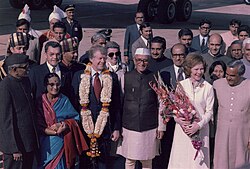
[[File:Officials of India welcome Jimmy Carter and Rosalynn Carter during an arrival ceremony in New Delhi, India - NARA - 177371.jpg|thumb|right|260px|[[President of the United States|President]] [[Jimmy Carter]] visited India during January 1–3, 1978. Seen in this picture of his reception at the [[Indira Gandhi International Airport|airport in Delhi]] are (from left to right) President Neelam Sanjiva Reddy, his wife, Jimmy Carter, Prime Minister Morarji Desai, the [[List of ambassadors of India to the United States|Indian Ambassador to the United States]] [[Nanabhoy Palkhivala]], [[First Lady of the United States]] [[Rosalynn Carter]] and the [[Minister of External Affairs (India)|External Affairs Minister]] [[Atal Bihari Vajpayee]].<ref>{{cite web |title=92. Telegram From the Embassy in India to the Department of State - Foreign Relations of the United States, 1977–1980, Volume XIX, South Asia |url=https://history.state.gov/historicaldocuments/frus1977-80v19/d92 |website=history.state.gov |publisher=Office of the Historian, Department of State |access-date=23 May 2023}}</ref>]] | |||
Relations between Reddy and Desai soon soured over the latter's promotion of his son, Kanti Desai, in politics and over Desai's communication with Chief Ministers Vengala Rao and Channa Reddy on the issue of land ceilings in Andhra Pradesh.<ref>{{cite journal|last=Srivastava|first=Vivek Kumar|title=History and Politics of Indian Presidents|journal=Mainstream|date=July 2012|volume=L|issue=31|url=http://www.mainstreamweekly.net/article3592.html|access-date=5 June 2013|url-status=live|archive-url=https://web.archive.org/web/20130621220738/http://www.mainstreamweekly.net/article3592.html|archive-date=21 June 2013 | Relations between Reddy and Desai soon soured over the latter's promotion of his son, Kanti Desai, in politics and over Desai's communication with Chief Ministers Vengala Rao and Channa Reddy on the issue of land ceilings in Andhra Pradesh.<ref>{{cite journal|last=Srivastava|first=Vivek Kumar|title=History and Politics of Indian Presidents|journal=Mainstream|date=July 2012|volume=L|issue=31|url=http://www.mainstreamweekly.net/article3592.html|access-date=5 June 2013|url-status=live|archive-url=https://web.archive.org/web/20130621220738/http://www.mainstreamweekly.net/article3592.html|archive-date=21 June 2013}}</ref> Following mass defections from the Janata Party and from the cabinet, Morarji Desai's 30-month-old government ended in July 1979 after he handed in his resignation to Reddy before a no-confidence motion could be tabled against his government in Parliament.<ref>{{cite news|title=Desai's resignation leaves India's government in crisis|url=https://news.google.com/newspapers?id=APpBAAAAIBAJ&pg=4450,2155969&dq=neelam+sanjiva+reddy+the+sun&hl=en|access-date=27 June 2013|newspaper=The Telegraph-Herald|date=15 July 1979}}</ref> Reddy's actions following Desai's resignation have been much debated. His decision to accept Desai's resignation before an alternative government created a ministerial vacuum in the executive according to [[H. M. Seervai]].<ref name="India Today">{{cite news|title=Giani Zail Singh: The making of a President|url=http://indiatoday.intoday.in/story/giani-zail-singh-poised-to-become-the-seventh-president-of-india/1/391893.html|access-date=28 November 2014|work=India Today|date=18 October 2013|url-status=live|archive-url=https://web.archive.org/web/20141207094640/http://indiatoday.intoday.in/story/giani-zail-singh-poised-to-become-the-seventh-president-of-india/1/391893.html|archive-date=7 December 2014}}</ref> The faction of the Janata Party supporting Desai continued to have the support of 205 MPs as opposed to Charan Singh's 80 MPs.<ref name="India Today"/> Reddy used [[Discretionary power|presidential discretion]] in choosing Charan Singh as the next Prime Minister over a contending claim from [[Jagjivan Ram]], the leader of the Janata Party.<ref>{{cite news|title=Past Presidents: Waning power|url=http://indiatoday.intoday.in/story/office-of-the-president-a-glamorous-edifice-but-with-a-timorous-reserve-of-real-power/1/391902.html|access-date=28 November 2014|work=India Today|date=18 October 2013|url-status=live|archive-url=https://web.archive.org/web/20141207094644/http://indiatoday.intoday.in/story/office-of-the-president-a-glamorous-edifice-but-with-a-timorous-reserve-of-real-power/1/391902.html|archive-date=7 December 2014}}</ref><ref>{{cite web|last1=Singh|first1=Mahendra Prasad|title=The Union Executive|url=http://socialsciences.in/article/union-executive|website=SocialSciences.in|access-date=28 November 2014|url-status=live|archive-url=https://web.archive.org/web/20141205180437/http://socialsciences.in/article/union-executive|archive-date=5 December 2014}}</ref> | ||
=== Charan Singh government (1979) === | === Charan Singh government (1979) === | ||
Following Desai's resignation and the fall of the [[Janata government]] headed by him, Reddy appointed Charan Singh as Prime Minister. This was on the condition that he should prove his majority on the floor of the House before the end of August.<ref>{{cite news|title=Singh faces early test|url=https://news.google.com/newspapers?id=YO4yAAAAIBAJ&pg=2305,3044776&dq=neelam+sanjiva+reddy&hl=en|access-date=27 June 2013|newspaper=Ottawa Citizen|date=27 July 1979}}</ref> Singh was sworn in on 28 July 1979 but never faced Parliament to prove his majority when Reddy convened it on 20 August. Reddy had appointed him Prime Minister since he had produced a letter claiming to have a parliamentary majority with the support of the opposition Congress Party led by his rival, the former Prime Minister Indira Gandhi.<ref>{{cite news|last1=Malhotra|first1=Inder|title=Constricting coalitions|url=http://archive.asianage.com/content/constricting-coalitions|access-date=25 November 2014|publisher=The Asian Age|date=2 February 2010|url-status=live|archive-url=https://web.archive.org/web/20160109024424/http://archive.asianage.com/content/constricting-coalitions|archive-date=9 January 2016 | Following Desai's resignation and the fall of the [[Janata government]] headed by him, Reddy appointed Charan Singh as Prime Minister. This was on the condition that he should prove his majority on the floor of the House before the end of August.<ref>{{cite news|title=Singh faces early test|url=https://news.google.com/newspapers?id=YO4yAAAAIBAJ&pg=2305,3044776&dq=neelam+sanjiva+reddy&hl=en|access-date=27 June 2013|newspaper=Ottawa Citizen|date=27 July 1979}}</ref> Singh was sworn in on 28 July 1979 but never faced Parliament to prove his majority when Reddy convened it on 20 August. Reddy had appointed him Prime Minister since he had produced a letter claiming to have a parliamentary majority with the support of the opposition Congress Party led by his rival, the former Prime Minister Indira Gandhi.<ref>{{cite news|last1=Malhotra|first1=Inder|title=Constricting coalitions|url=http://archive.asianage.com/content/constricting-coalitions|access-date=25 November 2014|publisher=The Asian Age|date=2 February 2010|url-status=live|archive-url=https://web.archive.org/web/20160109024424/http://archive.asianage.com/content/constricting-coalitions|archive-date=9 January 2016}}</ref><ref name="The disintegration of Janata">{{cite news|last1=Malhotra|first1=Inder|title=The disintegration of Janata|url=http://indianexpress.com/article/opinion/columns/the-disintegration-of-janata/99/|access-date=25 November 2014|work=The Indian Express|date=15 September 2014|url-status=live|archive-url=https://web.archive.org/web/20141129215035/http://indianexpress.com/article/opinion/columns/the-disintegration-of-janata/99/|archive-date=29 November 2014}}</ref> In return for her support, Gandhi demanded that a law establishing special courts to try her and her son [[Sanjay Gandhi]] be repealed – a proposition that was unacceptable to Charan Singh.<ref name="The disintegration of Janata"/> Gandhi therefore withdrew her support, forcing Singh to resign.<ref>{{cite news|title=India plunged into crisis as Charan Singh resigns|url=https://news.google.com/newspapers?nid=2507&dat=19790821&id=GctAAAAAIBAJ&pg=3658,4158767|access-date=25 November 2014|work=The Glasgow Herald|date=21 August 1979}}</ref> His government lasted 24 days and he never faced Parliament.<ref name="LS dissolved for fourth time">{{cite news|title=LS dissolved for fourth time|url=http://www.rediff.com/news/dec/04ls.htm|access-date=25 November 2014|work=Rediff.com|date=4 December 1997|url-status=live|archive-url=https://web.archive.org/web/20150924160542/http://www.rediff.com/news/dec/04ls.htm|archive-date=24 September 2015}}</ref><ref>{{cite news|title=8 trust votes since '79, only 3 PMs survived|url=http://timesofindia.indiatimes.com/india/8-trust-votes-since-79-only-3-PMs-survived/articleshow/3261535.cms|access-date=25 November 2014|work=The Times of India|date=22 July 2008|url-status=live|archive-url=https://web.archive.org/web/20160109024424/http://timesofindia.indiatimes.com/india/8-trust-votes-since-79-only-3-PMs-survived/articleshow/3261535.cms|archive-date=9 January 2016}}</ref> The convention of appointing a Prime Minister in a hung House but with conditions on time to prove majority was later adopted by President [[R Venkataraman]].<ref name="mainstreamweekly" /><ref>{{cite journal|last1=Noorani|first1=A. G.|title=Appointing a PM|journal=Frontline|date=20 June – 3 July 2009|volume=26|issue=13|url=http://www.frontline.in/static/html/fl2613/stories/20090703261307300.htm|access-date=4 July 2014|url-status=live|archive-url=https://web.archive.org/web/20160109024424/http://www.frontline.in/static/html/fl2613/stories/20090703261307300.htm|archive-date=9 January 2016}}</ref> | ||
Following Charan Singh's resignation, Reddy summoned [[Chandra Shekhar Singh|Chandrashekhar]] and Jagjivan Ram to Rashtrapati Bhavan to look into the possibility of forming an alternate government. Reddy, convinced that they would not be able to form one, accepted Singh's advice and dissolved Lok Sabha, calling for [[Mid term elections|a mid term election]].{{efn|Reddy's choice was between accepting the outgoing Prime Minister Charan Singh's advice of dissolving the Lok Sabha or giving Jagjivan Ram, leader of the Janata Party, the largest single bloc there, a chance of forming the government.<ref>{{cite news|title=Giani Zail Singh: The making of a President|url=http://indiatoday.intoday.in/story/giani-zail-singh-poised-to-become-the-seventh-president-of-india/1/391893.html|access-date=28 November 2014| | Following Charan Singh's resignation, Reddy summoned [[Chandra Shekhar Singh|Chandrashekhar]] and Jagjivan Ram to Rashtrapati Bhavan to look into the possibility of forming an alternate government. Reddy, convinced that they would not be able to form one, accepted Singh's advice and dissolved Lok Sabha, calling for [[Mid term elections|a mid term election]].{{efn|Reddy's choice was between accepting the outgoing Prime Minister Charan Singh's advice of dissolving the Lok Sabha or giving Jagjivan Ram, leader of the Janata Party, the largest single bloc there, a chance of forming the government.<ref>{{cite news|title=Giani Zail Singh: The making of a President|url=http://indiatoday.intoday.in/story/giani-zail-singh-poised-to-become-the-seventh-president-of-india/1/391893.html|access-date=28 November 2014|work=India Today|date=15 July 1982|url-status=live|archive-url=https://web.archive.org/web/20141207094640/http://indiatoday.intoday.in/story/giani-zail-singh-poised-to-become-the-seventh-president-of-india/1/391893.html|archive-date=7 December 2014}}</ref><ref>{{cite news|title=Another Indian Government Collapse|url=https://news.google.com/newspapers?nid=2519&dat=19790821&id=FwReAAAAIBAJ&pg=2530,3307463|access-date=30 November 2014|publisher=Observer – Reporter|date=21 August 1979}}</ref> Reddy was advised on the possibility of [[Horse trading (political)|horse trading]] and accepted Singh's advice.<ref>{{cite web|title='The price of an MP is increasing day by day. For God's sake, take a decision immediately'|url=http://www.rediff.com/news/apr/12cong7c.htm|work=Rediff.com|access-date=28 November 2014|url-status=live|archive-url=https://web.archive.org/web/20150924160408/http://www.rediff.com/news/apr/12cong7c.htm|archive-date=24 September 2015}}</ref> Jagjivan Ram's claim to having a majority were overlooked<ref>{{cite news|title=India's midsummer madness |url=http://archive.spectator.co.uk/article/25th-august-1979/7/indias-midsummer-madness |access-date=28 November 2014 |work=The Spectator |date=25 August 1979 |url-status=dead |archive-url=https://web.archive.org/web/20141224213122/http://archive.spectator.co.uk/article/25th-august-1979/7/indias-midsummer-madness |archive-date=24 December 2014 }}</ref> and elections called prompting accusations of racial prejudice and political one upmanship against Reddy.<ref>{{cite news|title=Jagjivan Ram, Champion of India's Untouchables, Dies at 78|url=https://www.nytimes.com/1986/07/07/obituaries/jagjivan-ram-champion-of-india-s-untouchables-dies-at-78.html|access-date=28 November 2014|work=The New York Times|date=7 July 1986|url-status=live|archive-url=https://web.archive.org/web/20141207225157/http://www.nytimes.com/1986/07/07/obituaries/jagjivan-ram-champion-of-india-s-untouchables-dies-at-78.html|archive-date=7 December 2014}}</ref><ref name="Gandhi2000">{{cite book|author=Rajmohan Gandhi|title=Revenge and Reconciliation: Understanding South Asian History|url=https://books.google.com/books?id=xAASBQAAQBAJ&pg=PT463|date=14 October 2000|publisher=Penguin Books Limited|isbn=978-81-8475-318-9|pages=463–}}</ref>}}<ref name="LS dissolved for fourth time"/><ref>{{cite web|title=One cannot avoid Machiavellianism altogether. Otherwise, it is not politics|url=http://www.rediff.com/news/apr/12cong7d.htm|work=Rediff.com|access-date=29 May 2013|url-status=live|archive-url=https://web.archive.org/web/20150924160409/http://www.rediff.com/news/apr/12cong7d.htm|archive-date=24 September 2015}}</ref><ref>{{cite web|title=Will the President call a mid-term poll?|url=http://m.rediff.com/news/apr/09cong2.htm|work=Rediff.com|access-date=29 May 2013|url-status=live|archive-url=https://web.archive.org/web/20141109205803/http://m.rediff.com/news/apr/09cong2.htm|archive-date=9 November 2014}}</ref> Singh was asked to continue as the [[caretaker prime minister]] till a new government was sworn in after the election. Reddy's decision was met with angry denunciations and protests by members of the Janata Party who even threatened to have him impeached.<ref>{{cite news|title=Reddy calls for new elections in India|url=https://news.google.com/newspapers?id=1_RHAAAAIBAJ&pg=1778,3771341&dq=neelam+sanjiva+reddy&hl=en|access-date=27 June 2013|newspaper=The Morning Record and Journal|date=23 August 1979}}</ref><ref>{{cite news|title=Meeting the coalition challenge head on|url=http://www.telegraphindia.com/1051110/asp/nation/story_5458864.asp|access-date=9 November 2014|agency=15 November 2005|work=The Telegraph|url-status=dead|archive-url=https://web.archive.org/web/20141109221304/http://www.telegraphindia.com/1051110/asp/nation/story_5458864.asp|archive-date=9 November 2014}}</ref> Although heading a caretaker government, Singh proposed as many as seven [[Ordinance (India)|ordinances]] on a broad range of matters from effecting changes in company law, providing state funding of elections and reservation of jobs for the [[backward classes]].<ref name="al">{{cite book|author=Abbas|title=Indian Government and Politics|year=1900|url=https://books.google.com/books?id=hko7BAAAQBAJ&pg=PA254|isbn=978-81-317-5374-3|pages=254–|display-authors=etal}}</ref><ref name="Dam2013">{{cite book|author=Shubhankar Dam|title=Presidential Legislation in India|url=https://books.google.com/books?id=bNsaAgAAQBAJ&pg=PA216|date=16 December 2013|publisher=Cambridge University Press|isbn=978-1-107-03971-1|pages=216–}}</ref> Reddy however refused to [[promulgate]] the ordinances arguing that such momentous changes could not be made by a caretaker government.<ref>{{cite news|title=CONSTITUTIONAL CONVENTIONS – Powers of caretaker govt|url=http://www.tribuneindia.com/1999/99may03/edit.htm|access-date=28 November 2014|work=The Tribune|date=3 May 1999|url-status=live|archive-url=https://web.archive.org/web/20160109024424/http://www.tribuneindia.com/1999/99may03/edit.htm|archive-date=9 January 2016}}</ref> | ||
=== Indira Gandhi's return to power (1980–82) === | === Indira Gandhi's return to power (1980–82) === | ||
[[File:Mani Ram Bagri with Jakhar, Hidayatullah, Indira Gandhi and Sanjiva Reddy.png|thumb|right|260px|Seen here (from left to right) are [[Speaker of the Lok Sabha]] [[Balram Jakhar]], [[Vice President of India|Vice President]] [[Mohammad Hidayatullah]], [[Mani Ram Bagri]], Prime Minister Indira Gandhi and President Neelam Sanjiva Reddy.]] | |||
In the elections of 1980, Indira Gandhi's party the [[Indian National Congress (I)]] returned to power by winning 351 seats in the Lok Sabha. Neither the Janata Party nor Charan Singh's Lok Dal won the 54 seats needed for recognition as the official opposition in Parliament.<ref>{{cite news|title=1980: Gandhi returned by landslide vote|url=http://news.bbc.co.uk/onthisday/hi/dates/stories/january/7/newsid_2506000/2506387.stm|access-date=27 June 2013|publisher=BBC|date=7 January 1980|url-status=live|archive-url=https://web.archive.org/web/20121023133601/http://news.bbc.co.uk/onthisday/hi/dates/stories/january/7/newsid_2506000/2506387.stm|archive-date=23 October 2012 | In the elections of 1980, Indira Gandhi's party the [[Indian National Congress (I)]] returned to power by winning 351 seats in the Lok Sabha. Neither the Janata Party nor Charan Singh's Lok Dal won the 54 seats needed for recognition as the official opposition in Parliament.<ref>{{cite news|title=1980: Gandhi returned by landslide vote|url=http://news.bbc.co.uk/onthisday/hi/dates/stories/january/7/newsid_2506000/2506387.stm|access-date=27 June 2013|publisher=BBC|date=7 January 1980|url-status=live|archive-url=https://web.archive.org/web/20121023133601/http://news.bbc.co.uk/onthisday/hi/dates/stories/january/7/newsid_2506000/2506387.stm|archive-date=23 October 2012}}</ref> Indira was sworn in as Prime Minister by Reddy for what would become her last term in office in January 1980.<ref>{{cite news|title=Indira Gandhi takes oath facing social, economic chaos in India|url=https://news.google.com/newspapers?id=j9gvAAAAIBAJ&pg=6354,1777104&dq=neelam+sanjiva+reddy+indira&hl=en|access-date=27 June 2013|newspaper=Rome News-Tribune|date=14 January 1980}}</ref><ref>{{cite news|title=Prime Minister {{sic|Gha|ndi|hide=y}} sworn in|url=https://news.google.com/newspapers?id=DgEtAAAAIBAJ&pg=2504,3267746&dq=neelam+sanjiva+reddy+indira&hl=en|access-date=27 June 2013|newspaper=The Palm Beach Post|date=15 January 1980}}</ref> Between 1980 and 1982 President Reddy led seven [[state visit]]s abroad, visiting the USSR, Bulgaria, Kenya, Zambia, the UK, Ireland, Indonesia, Nepal, Sri Lanka and Yugoslavia.<ref>{{cite web|title=DETAILS OF MEDIA PERSONS ACCOMPANYING THE PRESIDENT IN HIS/HER VISITS ABROAD SINCE 1947 TO 2012|url=http://rashtrapatisachivalaya.gov.in/media_abroad.pdf|publisher=The President's Secretariat|access-date=5 June 2013|url-status=dead|archive-url=https://web.archive.org/web/20130817094728/http://rashtrapatisachivalaya.gov.in/media_abroad.pdf|archive-date=17 August 2013}}</ref><ref>{{cite book|title=Annual Report 1982-83|publisher=Ministry of External Affairs, Government of India|url=http://mealib.nic.in/?2511?000|access-date=1 June 2014|url-status=live|archive-url=https://web.archive.org/web/20140602195025/http://mealib.nic.in/?2511%3F000|archive-date=2 June 2014}}</ref> At home, as president, he signed an [[Ordinance (India)|ordinance]] that gave the new government wide powers to imprison people for up to a year without trial under [[preventive detention]]<ref>{{cite news|title=India Begins 'Preventive Detention'|url=https://news.google.com/newspapers?id=L2dQAAAAIBAJ&pg=5495,1970220&dq=neelam+sanjiva+reddy+indira&hl=en|access-date=27 June 2013|newspaper=The Evening Independent|date=23 September 1980}}</ref><ref>{{cite news|title=Preventive detention law imposed in India|url=https://news.google.com/newspapers?nid=1298&dat=19800923&id=BOFLAAAAIBAJ&pg=5512,3620960|access-date=1 June 2014|agency=Associated Press|work=The Free Lance Star|date=23 September 1980}}</ref> and ordered the imposition of [[President's rule]] in nine opposition-ruled states on the advice of the government.<ref>{{cite news|title=Gandhi tightening grip over 9 states|url=https://news.google.com/newspapers?id=46NdAAAAIBAJ&pg=1043,1971724&dq=neelam+sanjiva+reddy+presidents+rule&hl=en|access-date=27 June 2013|newspaper=Observer-Reporter|date=18 February 1980}}</ref> | ||
[[File:State Visits by Neelam Sanjiva Reddy.png|thumb|right|260px|President Neelam Sanjiva Reddy led seven [[state visit]]s between 1980 and 1982. He visited [[USSR]], Bulgaria, Kenya, Zambia, UK, Ireland, Indonesia, Nepal, Sri Lanka, Ireland and [[Yugoslavia]].]] | |||
== Later life and death == | == Later life and death == | ||
Reddy was succeeded as president by [[Giani Zail Singh]], who was sworn in on 25 July 1982.<ref>{{cite news|title=President sworn in|url=https://news.google.com/newspapers?id=rDdVAAAAIBAJ&pg=1267,4716948&dq=neelam+sanjiva+reddy&hl=en|access-date=27 June 2013|newspaper=The Age|date=26 July 1982}}</ref><ref>{{cite news|title=Foreign Digest: New Delhi|url=https://news.google.com/newspapers?id=PAE-AAAAIBAJ&pg=1944,4223294&dq=neelam+sanjiva+reddy&hl=en|access-date=27 June 2013|newspaper=The Glasgow Herald|date=26 July 1982}}</ref> In his farewell address to the nation, Reddy criticised the failure of successive governments in improving the lives of the Indian masses and called for the emergence of a strong political opposition to prevent governmental misrule.<ref>{{cite news|title=Farewell Speech|url=https://news.google.com/newspapers?nid=1876&dat=19820725&id=B4QsAAAAIBAJ&pg=6929,5050590|access-date=27 June 2013|newspaper=Herald Journal|date=25 July 1982}}</ref><ref>{{cite news|title=Indian president favours opposition|url=https://news.google.com/newspapers?nid=1891&dat=19820725&id=96cfAAAAIBAJ&pg=971,3584037|access-date=27 June 2013|newspaper=Gadsden Times|date=25 July 1982}}</ref> Following his presidential term, the then [[Chief Minister of Karnataka]] [[Ramakrishna Hegde]] invited Reddy to settle down in Bangalore but he chose to retire to his farm in Anantapur.<ref>{{cite news|title=Bonanzas go bust|url=http://www.deccanherald.com/content/152204/bonanzas-go-bust.html|access-date=5 May 2013|newspaper=Deccan Herald|url-status=live|archive-url=https://web.archive.org/web/20130222131807/http://www.deccanherald.com/content/152204/bonanzas-go-bust.html|archive-date=22 February 2013 | [[File:President R. Venkataraman with Former President Shri Neelam Sanjiva Reddy at Rashtrapati Bhavan.jpg|thumb|260px|right|President [[Ramaswamy Venkataraman|R. Venkataraman]] with Neelam Sanjiva Reddy at the Rashtrapati Bhavan.]] | ||
Reddy was succeeded as president by [[Giani Zail Singh]], who was sworn in on 25 July 1982.<ref>{{cite news|title=President sworn in|url=https://news.google.com/newspapers?id=rDdVAAAAIBAJ&pg=1267,4716948&dq=neelam+sanjiva+reddy&hl=en|access-date=27 June 2013|newspaper=The Age|date=26 July 1982}}</ref><ref>{{cite news|title=Foreign Digest: New Delhi|url=https://news.google.com/newspapers?id=PAE-AAAAIBAJ&pg=1944,4223294&dq=neelam+sanjiva+reddy&hl=en|access-date=27 June 2013|newspaper=The Glasgow Herald|date=26 July 1982}}</ref> In his farewell address to the nation, Reddy criticised the failure of successive governments in improving the lives of the Indian masses and called for the emergence of a strong political opposition to prevent governmental misrule.<ref>{{cite news|title=Farewell Speech|url=https://news.google.com/newspapers?nid=1876&dat=19820725&id=B4QsAAAAIBAJ&pg=6929,5050590|access-date=27 June 2013|newspaper=Herald Journal|date=25 July 1982}}</ref><ref>{{cite news|title=Indian president favours opposition|url=https://news.google.com/newspapers?nid=1891&dat=19820725&id=96cfAAAAIBAJ&pg=971,3584037|access-date=27 June 2013|newspaper=Gadsden Times|date=25 July 1982}}</ref> Following his presidential term, the then [[Chief Minister of Karnataka]] [[Ramakrishna Hegde]] invited Reddy to settle down in Bangalore but he chose to retire to his farm in Anantapur.<ref>{{cite news|title=Bonanzas go bust|url=http://www.deccanherald.com/content/152204/bonanzas-go-bust.html|access-date=5 May 2013|newspaper=Deccan Herald|url-status=live|archive-url=https://web.archive.org/web/20130222131807/http://www.deccanherald.com/content/152204/bonanzas-go-bust.html|archive-date=22 February 2013}}</ref><ref>{{cite news|title=Neelam Sanjiva Reddy: Ready to retire|url=http://indiatoday.intoday.in/story/neelam-sanjiva-reddy-ready-to-retire/1/391883.html|access-date=28 November 2014|work=India Today|date=15 July 1982|url-status=live|archive-url=https://web.archive.org/web/20141207100157/http://indiatoday.intoday.in/story/neelam-sanjiva-reddy-ready-to-retire/1/391883.html|archive-date=7 December 2014}}</ref> He died of pneumonia in [[Bangalore]] in 1996 at the age of 83.<ref>{{cite news|title=Neelam Sanjeeva Reddy, Former President of India, 83|url=https://www.nytimes.com/1996/06/03/world/neelam-sanjeeva-reddy-former-president-of-india-83.html|access-date=11 December 2012|newspaper=The New York Times|date=3 June 1996|url-status=live|archive-url=https://web.archive.org/web/20130515112028/http://www.nytimes.com/1996/06/03/world/neelam-sanjeeva-reddy-former-president-of-india-83.html|archive-date=15 May 2013}}</ref> His ''[[samadhi]]'' is at Kalpally Burial Ground, Bangalore.<ref>{{cite news |title=Lone memory lingers at former president's memorial |url=https://bangaloremirror.indiatimes.com/bangalore/others/lone-memory-lingers-at-former-presidents-memorial/articleshow/69450536.cms |access-date=28 July 2022 |work=Bangalore Mirror |date=23 May 2019 |language=en}}</ref><ref>{{cite news |title=Former president Sanjeeva Reddy's tomb lies in squalor |url=https://www.dnaindia.com/bangalore/report-former-president-sanjeeva-reddy-s-tomb-lies-in-squalor-1842362 |access-date=28 July 2022 |work=DNA India |date=21 November 2013 |language=en}}</ref> Parliament mourned Reddy's death on 11 June 1996 and members cutting across party lines paid him tribute and recalled his contributions to the nation and the House.<ref>{{cite web|title=Parliament Proceedings – June 11, 1996|url=http://parliamentofindia.nic.in/lsdeb/ls11/ses1/0210069602.htm|publisher=Parliament of India|access-date=19 May 2013|url-status=dead|archive-url=https://web.archive.org/web/20120910114641/http://parliamentofindia.nic.in/lsdeb/ls11/ses1/0210069602.htm|archive-date=10 September 2012}}</ref> | |||
Reddy authored a book, ''Without Fear or Favour: Reminiscences and Reflections of a President'', published in 1989.<ref>{{cite | Reddy authored a book, ''Without Fear or Favour: Reminiscences and Reflections of a President'', published in 1989.<ref>{{cite book|title=Without Fear or Favour : Reminiscences and Reflections of a President|year=1989 |publisher=Allied Publishers |isbn=9788170232728 |url=http://catalog.hathitrust.org/Record/002219697|url-status=live|archive-url=https://web.archive.org/web/20131224160132/http://catalog.hathitrust.org/Record/002219697|archive-date=24 December 2013}}</ref> | ||
== Commemoration == | == Commemoration == | ||
Sanjiva Reddy's birth centenary was celebrated in 2013 by the [[Government of Andhra Pradesh]] with the concluding ceremony in [[Anantapur]] being addressed by President [[Pranab Mukherjee]] and with the Chief Ministers of [[Andhra Pradesh]] and [[Chief Minister of Karnataka|Karnataka]] in attendance.<ref>{{cite news|title=Illur gets set for Neelam Sanjeeva Reddy fete|url=http://archives.deccanchronicle.com/130601/news-politics/article/illur-gets-set-neelam-sanjeeva-reddy-fete|access-date=5 December 2014| | Sanjiva Reddy's birth centenary was celebrated in 2013 by the [[Government of Andhra Pradesh]] with the concluding ceremony in [[Anantapur]] being addressed by President [[Pranab Mukherjee]] and with the Chief Ministers of [[Andhra Pradesh]] and [[Chief Minister of Karnataka|Karnataka]] in attendance.<ref>{{cite news|title=Illur gets set for Neelam Sanjeeva Reddy fete|url=http://archives.deccanchronicle.com/130601/news-politics/article/illur-gets-set-neelam-sanjeeva-reddy-fete|access-date=5 December 2014|work=Deccan Chronicle|date=1 June 2013|url-status=dead|archive-url=https://web.archive.org/web/20141129022102/http://archives.deccanchronicle.com/130601/news-politics/article/illur-gets-set-neelam-sanjeeva-reddy-fete|archive-date=29 November 2014}}</ref><ref>{{cite news|title=Pranab Mukherjee to take part in Neelam centenary, no visit to Sri Satya Saibaba Maha Samadhi|url=http://www.deccanchronicle.com/131219/news-current-affairs/article/pranab-mukherjee-take-part-neelam-centenary-no-visit-sri-satya|access-date=5 December 2014|work=Deccan Chronicle|date=19 December 2013|url-status=live|archive-url=https://web.archive.org/web/20141207055622/http://www.deccanchronicle.com/131219/news-current-affairs/article/pranab-mukherjee-take-part-neelam-centenary-no-visit-sri-satya|archive-date=7 December 2014}}</ref><ref>{{cite news|title=President for Neelam fete|url=http://www.deccanchronicle.com/131214/news-politics/article/president-neelam-fete|access-date=5 December 2014|work=Deccan Chronicle|date=14 December 2013|url-status=live|archive-url=https://web.archive.org/web/20141207055355/http://www.deccanchronicle.com/131214/news-politics/article/president-neelam-fete|archive-date=7 December 2014}}</ref> The [[India Post|Postal Department of India]] released a [[commemorative stamp]] and [[First day cover|special cover]] in honour of Reddy on the occasion of his birth centenary.<ref name="deccanchronicle">{{cite news|title=CM to seek Neelam, PV statues|url=http://www.deccanchronicle.com/130520/news-politics/article/cm-seek-neelam-pv-statues|access-date=20 May 2013|newspaper=Deccan Chronicle|date=20 May 2013|url-status=live|archive-url=https://web.archive.org/web/20180321145834/https://www.deccanchronicle.com/130520/news-politics/article/cm-seek-neelam-pv-statues|archive-date=21 March 2018}}</ref> In [[Hyderabad]], there is the Neelam Sanjeeva Reddy College of Education. As part of the centenary celebrations of his birth, the [[Government of Andhra Pradesh]] has announced that it will rename the [[Andhra Pradesh]] State Revenue Academy, Reddy's alma mater the Government Arts College and the [[Government Medical College, Anantapur]] after the former president.<ref name="deccanchronicle" /><ref>{{cite news|title=AP govt wants former Prez, Narasimha Rao's statues in Parliament|url=http://economictimes.indiatimes.com/news/politics-and-nation/ap-govt-wants-former-prez-narasimha-raos-statues-in-parliament/articleshow/20135464.cms|access-date=20 May 2013|newspaper=The Economic Times|date=19 May 2013}}</ref> In the 1960s, when he was Union Minister for Mines, a statue of him had been unveiled at [[Vijayawada]] by [[K. Kamaraj]], the then [[President of the Indian National Congress|president of the Congress Party]], prompting Reddy to ask for its removal as he deemed the practice of erecting statues of people holding public office undesirable.<ref>{{cite news|title=Sanjiva Reddy wants his statue removed|url=http://www.asianage.com/books/sanjiva-reddy-wants-his-statue-removed-882|access-date=5 December 2014|publisher=The Asian Age|date=12 November 2014|url-status=live|archive-url=https://web.archive.org/web/20141206023020/http://www.asianage.com/books/sanjiva-reddy-wants-his-statue-removed-882|archive-date=6 December 2014}}</ref> A statue of Sanjiva Reddy, unveiled in 2005, stands at the [[Telangana Secretariat|Andhra Pradesh Secretariat (now Telangana Secretariat)]] in Hyderabad.<ref>{{cite news|title=Manmohan unveils Neelam's statue|url=http://www.thehindu.com/2005/08/22/stories/2005082204340500.htm|access-date=5 December 2014|date=22 August 2005|url-status=dead|archive-url=https://web.archive.org/web/20160109024424/http://www.thehindu.com/2005/08/22/stories/2005082204340500.htm|archive-date=9 January 2016|work=[[The Hindu]]}}</ref> | ||
== In popular culture == | == In popular culture == | ||
''Neelam Sanjiva Reddy | ''Neelam Sanjiva Reddy – President of India'' is a 1982 [[Short film|short]] [[documentary film]] directed by Prem Vaidya & C. L. Kaul and produced by the [[Films Division of India]], covering his term of presidency.<ref>{{Cite web|title=NEELAM SANJIVA REDDY – PRESIDENT OF INDIA {{!}} Films Division|url=https://filmsdivision.org/shop/neelam-sanjiva-reddy-president-of-india|access-date=2021-06-11|website=filmsdivision.org}}</ref> | ||
The character Mahendranath, Chief Minister of the fictional state of Afrozabad in former Prime Minister [[P. V. Narasimha Rao|P V Narasimha Rao's]] novel, ''[[The Insider (Rao novel)|The Insider]]'', is based on Reddy, portraying his career in Andhra Pradesh and his political rivalry with [[Kasu Brahmananda Reddy]].<ref>{{cite news|date=26 June 1998|title=POWER GAMES|newspaper=Asia Week- CNN|url=http://edition.cnn.com/ASIANOW/asiaweek/98/0626/feat_1_books.html|url-status=live|access-date=20 May 2013|archive-url=https://web.archive.org/web/20131224151902/http://edition.cnn.com/ASIANOW/asiaweek/98/0626/feat_1_books.html|archive-date=24 December 2013 | The character Mahendranath, Chief Minister of the fictional state of Afrozabad in former Prime Minister [[P. V. Narasimha Rao|P V Narasimha Rao's]] novel, ''[[The Insider (Rao novel)|The Insider]]'', is based on Reddy, portraying his career in Andhra Pradesh and his political rivalry with [[Kasu Brahmananda Reddy]].<ref>{{cite news|date=26 June 1998|title=POWER GAMES|newspaper=Asia Week- CNN|url=http://edition.cnn.com/ASIANOW/asiaweek/98/0626/feat_1_books.html|url-status=live|access-date=20 May 2013|archive-url=https://web.archive.org/web/20131224151902/http://edition.cnn.com/ASIANOW/asiaweek/98/0626/feat_1_books.html|archive-date=24 December 2013}}</ref><ref>{{cite journal|date=April–May 1998|title=The tale of an outsider|url=http://www.frontline.in/navigation/?type=static&page=flonnet&rdurl=fl1509/15091220.htm|url-status=live|journal=Frontline|volume=15|issue=9|archive-url=https://web.archive.org/web/20130522091852/http://www.frontline.in/navigation/?type=static&page=flonnet&rdurl=fl1509%2F15091220.htm|archive-date=22 May 2013|access-date=27 June 2013}}</ref> | ||
== Explanatory notes == | == Explanatory notes == | ||
| Line 136: | Line 142: | ||
==External links== | ==External links== | ||
* [http://presidentofindia.nic.in/writereaddata/Portal/audio-visual-section/2%20Broadcast%20to%20the%20Nation%20-%20Republic%20Day,Delhi.mp3 President Neelam Sanjiva Reddy's broadcast to India on Republic Day, 1979 (Audio)] | * [http://presidentofindia.nic.in/writereaddata/Portal/audio-visual-section/2%20Broadcast%20to%20the%20Nation%20-%20Republic%20Day,Delhi.mp3 President Neelam Sanjiva Reddy's broadcast to India on Republic Day, 1979 (Audio)] | ||
* [http://speakerloksabha.nic.in/former/Nsanjivareddy.asp Neelam Sanjiva Reddy | * [http://speakerloksabha.nic.in/former/Nsanjivareddy.asp Neelam Sanjiva Reddy – The Office of Speaker Lok Sabha] | ||
{{Navboxes | {{Navboxes | ||
| Line 147: | Line 153: | ||
{{s-off}} | {{s-off}} | ||
{{s-bef|before=[[Burgula Ramakrishna Rao]]|as=Chief Minister of [[Hyderabad State|Hyderabad]]}} | {{s-bef|before=[[Burgula Ramakrishna Rao]]|as=Chief Minister of [[Hyderabad State|Hyderabad]]}} | ||
{{s-ttl|rows=2|title=[[List of | {{s-ttl|rows=2|title=[[List of chief ministers of Andhra Pradesh|Chief Minister of Andhra Pradesh]]|years=1956–1960}} | ||
{{s-aft|rows=2|after=[[Damodaram Sanjivayya]]}} | {{s-aft|rows=2|after=[[Damodaram Sanjivayya]]}} | ||
{{s-break}} | {{s-break}} | ||
| Line 153: | Line 159: | ||
{{s-break}} | {{s-break}} | ||
{{s-bef|before=[[Damodaram Sanjivayya]]}} | {{s-bef|before=[[Damodaram Sanjivayya]]}} | ||
{{s-ttl|title=[[List of | {{s-ttl|title=[[List of chief ministers of Andhra Pradesh|Chief Minister of Andhra Pradesh]]|years=1962–1964}} | ||
{{s-aft|after=[[Kasu Brahmananda Reddy]]}} | {{s-aft|after=[[Kasu Brahmananda Reddy]]}} | ||
{{s-break}} | |||
{{s-bef|before=[[Basappa Danappa Jatti]]|as=Acting President}} | |||
{{s-ttl|title=[[President of India]]|years=1977–1982}} | |||
{{s-aft|after=[[Zail Singh]]}} | |||
{{s-par|in-lwr}} | |||
{{s-break}} | {{s-break}} | ||
{{s-bef|before=[[Sardar Hukam Singh]]}} | {{s-bef|before=[[Sardar Hukam Singh]]}} | ||
{{s-ttl|title=[[Speaker of the Lok Sabha]]|years= | {{s-ttl|title=[[Speaker of the Lok Sabha]]|years=1967–1969}} | ||
{{s-aft|after=[[Gurdial Singh Dhillon]]}} | {{s-aft|after=[[Gurdial Singh Dhillon]]}} | ||
{{s-break}} | {{s-break}} | ||
| Line 164: | Line 175: | ||
{{s-aft|after={{nowrap|[[K. S. Hegde|Kawdoor Sadananda Hegde]]}}}} | {{s-aft|after={{nowrap|[[K. S. Hegde|Kawdoor Sadananda Hegde]]}}}} | ||
{{s-break}} | {{s-break}} | ||
{{s-bef|before=[[ | {{s-ppo}} | ||
{{s-ttl|title=[[President of | {{s-bef|before=[[Indira Gandhi]]}} | ||
{{s-aft|after=[[ | {{s-ttl|title=[[List of presidents of the Indian National Congress|President of the Indian National Congress]]|years=1960–1963}} | ||
{{s-aft|after=[[K. Kamaraj]]}} | |||
{{s-end}} | {{s-end}} | ||
}} | }} | ||
| Line 184: | Line 196: | ||
[[Category:1913 births]] | [[Category:1913 births]] | ||
[[Category:1996 deaths]] | [[Category:1996 deaths]] | ||
[[Category: | [[Category:India MPs 1967–1970]] | ||
[[Category: | [[Category:India MPs 1977–1979]] | ||
[[Category:Chief Ministers of Andhra Pradesh]] | [[Category:Chief Ministers of Andhra Pradesh]] | ||
[[Category:People from Anantapur district]] | [[Category:People from Anantapur district]] | ||
| Line 202: | Line 214: | ||
[[Category:Bharatiya Lok Dal politicians]] | [[Category:Bharatiya Lok Dal politicians]] | ||
[[Category:Members of the Cabinet of India]] | [[Category:Members of the Cabinet of India]] | ||
[[Category: | [[Category:Deaths from pneumonia in India]] | ||
[[Category:Andhra Pradesh MLAs 1957–1962]] | |||
[[Category:Andhra Pradesh MLAs 1962–1967]] | |||
[[Category:Andhra movement]] | |||
Latest revision as of 13:25, 22 July 2023
Neelam Sanjiva Reddy | |
|---|---|
 Reddy in January 1977 | |
| 6th President of India | |
| In office 25 July 1977 – 25 July 1982 | |
| Prime Minister | |
| Vice President | |
| Preceded by | Fakhruddin Ali Ahmed[lower-alpha 1] |
| Succeeded by | Zail Singh |
| 4th Speaker of the Lok Sabha | |
| In office 17 March 1967 – 19 July 1969 | |
| Deputy | R.K. Khadilkar |
| Preceded by | Hukam Singh |
| Succeeded by | Gurdial Singh Dhillon |
| In office 26 March 1977 – 13 July 1977 | |
| Deputy | Godey Murahari |
| Preceded by | Bali Ram Bhagat |
| Succeeded by | K. S. Hegde |
| Minister of Steel and Mines | |
| In office 9 June 1964 – 11 January 1966 | |
| Prime Minister | Lal Bahadur Shastri |
| 1st Chief Minister of United Andhra Pradesh | |
| In office 12 March 1962 – 20 February 1964 | |
| Governor | |
| Preceded by | Damodaram Sanjivayya |
| Succeeded by | Kasu Brahmananda Reddy |
| In office 1 November 1956 – 11 January 1960 | |
| Governor | |
| Preceded by | Office Established |
| Succeeded by | Damodaram Sanjivayya |
| President of the Indian National Congress | |
| In office 1960–1963 | |
| Preceded by | Indira Gandhi |
| Succeeded by | K. Kamaraj |
| Personal details | |
| Born | 19 May 1913 Illur, Madras Presidency, British India (present-day Andhra Pradesh, India) |
| Died | 1 June 1996 (aged 83) Bangalore, Karnataka, India (present-day Bengaluru) |
| Nationality | Indian |
| Political party | Janata Party (from 1977) |
| Other political affiliations | Indian National Congress (before 1977) |
| Spouse(s) | ( m. 1935) |
| Relatives | T. Nagi Reddy (brother-in-law) |
| Alma mater | University of Madras |
Neelam Sanjiva Reddy ( pronunciation (help·info); 19 May 1913 – 1 June 1996) was an Indian politician who served as the sixth president of India, serving from 1977 to 1982. Beginning a long political career with the Indian National Congress Party in the independence movement, he went on to hold several key offices in independent India — as Deputy Chief minister of Andhra state and the first Chief Minister of United Andhra Pradesh, a two-time Speaker of the Lok Sabha and a Union Minister— before becoming the Indian president.[1]
Born in present-day Anantapur district, Andhra Pradesh, Reddy completed his schooling at Adayar and joined the Government Arts College at Anantapur. He quit to become an Indian independence activist and was jailed for participating in the Quit India Movement. He was elected to the Madras Legislative Assembly in 1946 as a Congress party representative. Reddy became the deputy chief minister of Andhra State in 1953 and the first Chief Minister of Andhra Pradesh in 1956. He was a union cabinet minister under Prime Ministers Lal Bahadur Shastri and Indira Gandhi from 1964 to 1967 and Lok Sabha Speaker from 1967 to 1969. He later retired from active politics but returned in 1975, responding to Jayaprakash Narayan's call for "Total Revolution" against the Indira Gandhi Government.
Elected to Parliament in 1977 as a candidate of the Janata Party, Reddy was unanimously elected Speaker of the Sixth Lok Sabha and three months later was elected unopposed as President of India. As president, Reddy worked with Prime Ministers Morarji Desai, Charan Singh and Indira Gandhi. Reddy was succeeded by Giani Zail Singh in 1982 and he retired to his farm in Anantapur. He died in 1996 and his samadhi is at Kalpally Burial Ground, Bangalore. In 2013, the Government of Andhra Pradesh commemorated Reddy's birth centenary.
Education and family[edit | edit source]
Reddy was born into a Telugu-speaking Hindu family in Illur village, Madras Presidency (present-day Anantapur district, Andhra Pradesh) on 19 May 1913.[2][3][4] He studied at the Theosophical High School at Adayar in Madras and later enrolled at the Government Arts College at Anantapur, an affiliate of the University of Madras, as an undergraduate.[5] In 1958, Sri Venkateswara University, Tirupati bestowed the degree of Honorary Doctor of Laws on him because of his role in its founding.[6][7]
Reddy was married to Neelam Nagaratnamma, the sister of politician T. Nagi Reddy. The couple had one son and three daughters.[8]
Role in the Indian independence movement[edit | edit source]
Reddy joined the Indian struggle for independence from the British Raj following Mahatma Gandhi's visit to Anantapur in July 1929 and dropped out of college in 1931. He was closely associated with the Youth League and participated in a student satyagraha. In 1938, Reddy was elected Secretary of the Andhra Pradesh Provincial Congress Committee, an office he held for ten years. During the Quit India Movement, he was imprisoned and was mostly in jail between 1940 and 1945. Released in March 1942, he was arrested again in August and sent to the Amraoti jail where he served time with activists T Prakasam, S. Satyamurti, K Kamaraj and V V Giri till 1945.[9][10]
Political career[edit | edit source]
Elected to the Madras Legislative Assembly in 1946 as a Congress representative, Reddy became secretary of the Congress' legislature party.[11] He was also a Member of the Indian Constituent Assembly from Madras.[12][13] From April 1949 to April 1951, he was the Minister for Prohibition, Housing and Forests of the Madras State.[14] Reddy lost the 1951 election to the Madras Legislative Assembly to the Communist leader Tarimela Nagi Reddy, his brother-in-law.[15]
Deputy Chief Minister of Andhra State[edit | edit source]
In 1951, in a closely contested election, he was elected President of the Andhra Pradesh Congress Committee defeating N G Ranga.[16][17] When the Andhra State was formed in 1953, T. Prakasam became its Chief Minister and Reddy became the deputy.[18]
Chief Minister of Andhra Pradesh (1956–60, 1962–64)[edit | edit source]
After the formation of the state of Andhra Pradesh by incorporating Telangana with the Andhra State, Reddy became its first Chief Minister from 1 November 1956 to 11 January 1960.[19][20] He was Chief Minister for a second time from 12 March 1962 to 20 February 1964, thus holding that office for over five years.[21] Reddy was MLA from Sri Kalahasti and Dhone respectively during his stints as Chief Minister.[22][23][24] The Nagarjuna Sagar and Srisailam multipurpose river valley projects were initiated during his tenure.[25] The Government of Andhra Pradesh later renamed the Srisailam project to Neelam Sanjiva Reddy Sagar in his honour.[26]
The Congress governments under Reddy placed emphasis on rural development, agriculture and allied sectors.[27] The shift towards industrialisation remained limited and was largely driven by the central government's investments in large public sector enterprises in the state.[28] Reddy's first term as Chief Minister ended in 1960 after he resigned on being elected President of the Indian National Congress. In 1964, he resigned voluntarily following unfavourable observations made against the Government of Andhra Pradesh by the Supreme Court in the Bus Routes Nationalisation case.[lower-alpha 2][3][30]
Congress President (1960–62) and Union Minister (1964–67)[edit | edit source]
Reddy served thrice as President of the Indian National Congress at its Bangalore, Bhavnagar and Patna sessions during 1960 to 1962.[11] At the Congress session at Goa in 1962, Reddy's speech stating India's determination to end the Chinese occupation of Indian territory and the irrevocable nature of the liberation of Goa was enthusiastically received by attendees.[31][32] He was thrice member of the Rajya Sabha.[17] From June 1964, Reddy was Union Minister of Steel and Mines in the Lal Bahadur Shastri government. He also served as Union Minister of Transport, Civil Aviation, Shipping and Tourism from January 1966 to March 1967 in Indira Gandhi's Cabinet.[14][33]
Speaker of the Lok Sabha (1967–69)[edit | edit source]
In the general elections of 1967, Reddy was elected to the Lok Sabha from Hindupur in Andhra Pradesh.[34] On 17 March 1967, Reddy was elected Speaker of the Fourth Lok Sabha becoming only the third person to be elected Speaker of the house during their inaugural term.[35] To emphasize the independence of the Speaker's office, Reddy resigned from the Congress Party.[36][37] His term as Speaker was marked by several firsts including the admission of a No-Confidence Motion on the same day as the President's address to a joint session of Parliament,[14] the handing down of a sentence of imprisonment for Contempt of the house[38] and the setting up of the Committee on the Welfare of the Scheduled Castes and Scheduled Tribes.[14] During his term as Speaker a defamation suit filed against him by an MP resulted in the Supreme Court's ruling that parliamentarians had complete freedom of speech in the House and that the courts had no say in such matters.[lower-alpha 3][40][41] Reddy described his role as being the 'watchman of the Parliament'.[42] He however had several hostile encounters with Prime Minister Indira Gandhi in the House that proved costly when he became, two years later, the Congress Party's nominee to succeed Zakir Hussain as president.[43]
Presidential election of 1969[edit | edit source]
In 1969, following President Zakir Husain's death, the Congress party nominated Reddy, a member of its Syndicate faction, as candidate for president although Prime Minister Indira Gandhi opposed him.[44] She was forced to accept Reddy as the Congress party's official candidate and feared his election would allow the Syndicate to expel her from office.[45] She asked Congress legislators to "vote according to their conscience" rather than blindly toe the Party line, in effect giving a call to support the independent candidate V V Giri.[46] In a closely fought election held on 16 August 1969, V V Giri emerged victorious, winning 48.01 per cent of the first preference votes and subsequently getting a majority on counting the second preference votes. In the final tally, Giri had 420,077 votes against the quota of 418,169 votes required to be elected president and Reddy had 405,427 votes.[47][48] The election led to much discord within the Congress Party and culminated in the historic split of 1969 and the subsequent rise of Indira Gandhi in Indian politics.[49][50]
Subsequently, Reddy, who had resigned as Speaker of the Lok Sabha to contest the election, retired from active politics and moved back to Anantapur where he took to farming.[51]
Return to active politics (1975–82)[edit | edit source]
In response to Jayaprakash Narayan's call for a Total Revolution, Reddy emerged from his political exile in 1975. In January 1977, he was made a member of the Committee of the Janata Party and in March, he fought the General Election from the Nandyal (Lok Sabha constituency) in Andhra Pradesh as a Janata Party candidate. He was the only non-Congress candidate to be elected from Andhra Pradesh.[52][53] The Congress Party led by Prime Minister Indira Gandhi was defeated, ending 30 years of Congress rule in India and a five party coalition with Morarji Desai as its leader came to power.[54] Reddy was unanimously elected Speaker of the Sixth Lok Sabha on 26 March 1977. However he resigned a few months later to contest in the presidential elections of July 1977.[14] Reddy's second term as Speaker lasted three months and 17 days and remains till date the shortest tenure for anyone to have held that post.[55][56]
Presidential election of 1977[edit | edit source]
The presidential election of 1977 was necessitated by the death in office of the incumbent Fakhruddin Ali Ahmed. Although Prime Minister Morarji Desai wanted to nominate danseuse Rukmini Devi Arundale for the post, she turned down the offer.[57] Reddy was elected unopposed, the only President to be elected thus, after being unanimously supported by all political parties including the opposition Congress party. At 64, he was the youngest person to be elected President of India until Droupadi Murmu was elected President in 2022.[58] He was also the only serious presidential candidate to have contested twice – in 1969 against V V Giri and in 1977.[59][60] 37 candidates had filed their nominations for the presidency of whom 36 were rejected by the returning officer. Following these disqualifications, Reddy remained the only validly nominated candidate in the fray which made elections unnecessary. Reddy thus became the first person to be elected President of India without a contest and remains the only President to have been elected unopposed.[61][62]
President of India[edit | edit source]

Neelam Sanjiva Reddy was elected on 21 July 1977[53] and was sworn in as the sixth President of India on 25 July 1977. Reddy worked with three governments, with Prime Ministers Morarji Desai, Charan Singh and Indira Gandhi.[63] Reddy announced, on the eve of India's thirtieth anniversary of Independence, that he would be moving out of the Rashtrapati Bhawan to a smaller accommodation and that he would be taking a 70 percent pay cut in solidarity with India's impoverished masses.[64][65]
Morarji Desai government (1977–79)[edit | edit source]

Relations between Reddy and Desai soon soured over the latter's promotion of his son, Kanti Desai, in politics and over Desai's communication with Chief Ministers Vengala Rao and Channa Reddy on the issue of land ceilings in Andhra Pradesh.[67] Following mass defections from the Janata Party and from the cabinet, Morarji Desai's 30-month-old government ended in July 1979 after he handed in his resignation to Reddy before a no-confidence motion could be tabled against his government in Parliament.[68] Reddy's actions following Desai's resignation have been much debated. His decision to accept Desai's resignation before an alternative government created a ministerial vacuum in the executive according to H. M. Seervai.[69] The faction of the Janata Party supporting Desai continued to have the support of 205 MPs as opposed to Charan Singh's 80 MPs.[69] Reddy used presidential discretion in choosing Charan Singh as the next Prime Minister over a contending claim from Jagjivan Ram, the leader of the Janata Party.[70][71]
Charan Singh government (1979)[edit | edit source]
Following Desai's resignation and the fall of the Janata government headed by him, Reddy appointed Charan Singh as Prime Minister. This was on the condition that he should prove his majority on the floor of the House before the end of August.[72] Singh was sworn in on 28 July 1979 but never faced Parliament to prove his majority when Reddy convened it on 20 August. Reddy had appointed him Prime Minister since he had produced a letter claiming to have a parliamentary majority with the support of the opposition Congress Party led by his rival, the former Prime Minister Indira Gandhi.[73][74] In return for her support, Gandhi demanded that a law establishing special courts to try her and her son Sanjay Gandhi be repealed – a proposition that was unacceptable to Charan Singh.[74] Gandhi therefore withdrew her support, forcing Singh to resign.[75] His government lasted 24 days and he never faced Parliament.[76][77] The convention of appointing a Prime Minister in a hung House but with conditions on time to prove majority was later adopted by President R Venkataraman.[60][78]
Following Charan Singh's resignation, Reddy summoned Chandrashekhar and Jagjivan Ram to Rashtrapati Bhavan to look into the possibility of forming an alternate government. Reddy, convinced that they would not be able to form one, accepted Singh's advice and dissolved Lok Sabha, calling for a mid term election.[lower-alpha 4][76][85][86] Singh was asked to continue as the caretaker prime minister till a new government was sworn in after the election. Reddy's decision was met with angry denunciations and protests by members of the Janata Party who even threatened to have him impeached.[87][88] Although heading a caretaker government, Singh proposed as many as seven ordinances on a broad range of matters from effecting changes in company law, providing state funding of elections and reservation of jobs for the backward classes.[89][90] Reddy however refused to promulgate the ordinances arguing that such momentous changes could not be made by a caretaker government.[91]
Indira Gandhi's return to power (1980–82)[edit | edit source]

In the elections of 1980, Indira Gandhi's party the Indian National Congress (I) returned to power by winning 351 seats in the Lok Sabha. Neither the Janata Party nor Charan Singh's Lok Dal won the 54 seats needed for recognition as the official opposition in Parliament.[92] Indira was sworn in as Prime Minister by Reddy for what would become her last term in office in January 1980.[93][94] Between 1980 and 1982 President Reddy led seven state visits abroad, visiting the USSR, Bulgaria, Kenya, Zambia, the UK, Ireland, Indonesia, Nepal, Sri Lanka and Yugoslavia.[95][96] At home, as president, he signed an ordinance that gave the new government wide powers to imprison people for up to a year without trial under preventive detention[97][98] and ordered the imposition of President's rule in nine opposition-ruled states on the advice of the government.[99]

Later life and death[edit | edit source]

Reddy was succeeded as president by Giani Zail Singh, who was sworn in on 25 July 1982.[100][101] In his farewell address to the nation, Reddy criticised the failure of successive governments in improving the lives of the Indian masses and called for the emergence of a strong political opposition to prevent governmental misrule.[102][103] Following his presidential term, the then Chief Minister of Karnataka Ramakrishna Hegde invited Reddy to settle down in Bangalore but he chose to retire to his farm in Anantapur.[104][105] He died of pneumonia in Bangalore in 1996 at the age of 83.[106] His samadhi is at Kalpally Burial Ground, Bangalore.[107][108] Parliament mourned Reddy's death on 11 June 1996 and members cutting across party lines paid him tribute and recalled his contributions to the nation and the House.[109]
Reddy authored a book, Without Fear or Favour: Reminiscences and Reflections of a President, published in 1989.[110]
Commemoration[edit | edit source]
Sanjiva Reddy's birth centenary was celebrated in 2013 by the Government of Andhra Pradesh with the concluding ceremony in Anantapur being addressed by President Pranab Mukherjee and with the Chief Ministers of Andhra Pradesh and Karnataka in attendance.[111][112][113] The Postal Department of India released a commemorative stamp and special cover in honour of Reddy on the occasion of his birth centenary.[114] In Hyderabad, there is the Neelam Sanjeeva Reddy College of Education. As part of the centenary celebrations of his birth, the Government of Andhra Pradesh has announced that it will rename the Andhra Pradesh State Revenue Academy, Reddy's alma mater the Government Arts College and the Government Medical College, Anantapur after the former president.[114][115] In the 1960s, when he was Union Minister for Mines, a statue of him had been unveiled at Vijayawada by K. Kamaraj, the then president of the Congress Party, prompting Reddy to ask for its removal as he deemed the practice of erecting statues of people holding public office undesirable.[116] A statue of Sanjiva Reddy, unveiled in 2005, stands at the Andhra Pradesh Secretariat (now Telangana Secretariat) in Hyderabad.[117]
In popular culture[edit | edit source]
Neelam Sanjiva Reddy – President of India is a 1982 short documentary film directed by Prem Vaidya & C. L. Kaul and produced by the Films Division of India, covering his term of presidency.[118]
The character Mahendranath, Chief Minister of the fictional state of Afrozabad in former Prime Minister P V Narasimha Rao's novel, The Insider, is based on Reddy, portraying his career in Andhra Pradesh and his political rivalry with Kasu Brahmananda Reddy.[119][120]
Explanatory notes[edit | edit source]
- ↑ B. D. Jatti acting president for 6 months.
- ↑ In C. S. Rowjee And Others vs Andhra Pradesh State Road Transport Corporation (APSRTC), the petitioners accused the APSRTC of having acted mala fide under the orders of the Chief Minister, Sanjiva Reddy, in ordering the nationalisation of bus routes in the Kurnool district of Andhra Pradesh. In its verdict, the Supreme Court observed "that [it was] to give effect to the wishes of the Chief Minister expressed [...] that the impugned schemes were formulated by the Corporation and therefore, it would be vitiated by malafides notwithstanding the interposition of the semi-autonomous corporation."[29] The Supreme Court also observed that the allegations [of "bias and personal ill-will against the appellants"] were neither denied by the Chief Minister nor were affidavits stating the Government's position filed in the High Court. Further the Supreme Court observed that the counter-affidavits, while denying that the APSRTC was acting at the behest of the Chief Minister, failed to explain the choice of Kurnool district for nationalisation of the routes.[29] In effect this was a condemnation of Reddy's role.
- ↑ In Tej Kiran Jain And Others vs N. Sanjiva Reddy, the Supreme Court ruled that what MPs say in Parliament "is only subject to the discipline of the rules of Parliament, the good sense of the members and the control of proceedings by the Speaker. The courts have no say in the matter and should really have none."[39] The case dealt with certain references made against the Shankaracharya of Puri during a Calling Attention Motion introduced in the House.
- ↑ Reddy's choice was between accepting the outgoing Prime Minister Charan Singh's advice of dissolving the Lok Sabha or giving Jagjivan Ram, leader of the Janata Party, the largest single bloc there, a chance of forming the government.[79][80] Reddy was advised on the possibility of horse trading and accepted Singh's advice.[81] Jagjivan Ram's claim to having a majority were overlooked[82] and elections called prompting accusations of racial prejudice and political one upmanship against Reddy.[83][84]
References[edit | edit source]
- ↑ "Speech by the President of India, Shri Pranab Mukherjee at the concluding function of the centenary celebrations of the former President of India, Dr.Neelam Sanjeeva Reddy". Press Information Bureau, Government of India. Archived from the original on 4 May 2014. Retrieved 4 May 2014.
- ↑ Kalyani Shankar (1 January 2007). India & the United States: Politics of the Sixties. Macmillan India. pp. 150–. ISBN 978-0-230-63375-9.
- ↑ 3.0 3.1 "Former Speakers – N Sanjiva Reddy". The Office of the Speaker, Lok Sabha. Archived from the original on 8 May 2012. Retrieved 20 May 2013.
- ↑ "Illur gets set for Neelam Sanjeeva Reddy fete". Deccan Chronicle. 1 June 2013. Archived from the original on 4 May 2014. Retrieved 4 May 2014.
- ↑ "Take a bow to the 'grand old lady'". The Hindu. 5 February 2011. Archived from the original on 29 November 2014. Retrieved 19 November 2012.
- ↑ "SVU for Sanjeeva Reddy's statue in Parliament". The Hindu. 20 May 2013. Archived from the original on 29 November 2014. Retrieved 19 November 2014.
- ↑ "About SVU Alumni Association". Sri Venkateswara University Alumni Association. Archived from the original on 29 November 2014. Retrieved 19 November 2014.
- ↑ "Neelam Sanjeeva Reddy's wife passes away". The Hindu. 12 January 2010. Retrieved 11 December 2012.
{{cite news}}: CS1 maint: deprecated archival service (link) - ↑ Dubey, Scharada (2009). First among equals President of India. Westland. pp. 61–. ISBN 978-81-89975-53-1.[permanent dead link]
- ↑ Prakash Chander (1 January 2003). India: Past and Present. APH Publishing. pp. 283–. ISBN 978-81-7648-455-8. Archived from the original on 26 August 2017.
- ↑ 11.0 11.1 "Past Presidents – N. Sanjiva Reddy". Indian National Congress. Archived from the original on 29 November 2014. Retrieved 9 November 2014.
- ↑ "LIST OF MEMBERS OF THE CONSTITUENT ASSEMBLY (AS IN NOVEMBER, 1949)". Parliament of India. Archived from the original on 9 June 2012. Retrieved 22 November 2014.
- ↑ "Contribution of K. Subba Rao, Sanjeeva Reddy recalled". The Hindu. 27 January 2011. Archived from the original on 9 January 2016. Retrieved 11 December 2012.
- ↑ 14.0 14.1 14.2 14.3 14.4 "Former Speakers – N Sanjiva Reddy". Archived from the original on 8 May 2012. Retrieved 11 December 2012.
- ↑ "Tarimela Nagi Reddy remembered". The Hindu. 14 August 2013. Archived from the original on 29 November 2014. Retrieved 22 November 2014.
- ↑ "The saga of Third Front". The Hindu. 19 August 2006. Archived from the original on 29 November 2014. Retrieved 22 November 2014.
- ↑ 17.0 17.1 "REDDY, DR. NEELAM SANJIVA" (PDF). Rajya Sabha, Parliament of India. Archived (PDF) from the original on 31 October 2013. Retrieved 21 November 2014.
- ↑ "… just as it hosted the first Assembly session in 1954". The Hindu. 10 June 2014. Archived from the original on 29 November 2014. Retrieved 22 November 2014.
- ↑ "First linguistic State gets split". The Hindu. 2 June 2014. Archived from the original on 29 November 2014. Retrieved 22 November 2014.
- ↑ "Seemandhra leaders set to dominate Andhra Pradesh now". Deccan Chronicle. 16 April 2014. Archived from the original on 29 November 2014. Retrieved 22 November 2014.
- ↑ "Kiran beats PV, Rosaiah, Anjaiah in tenure". The Hindu. 25 November 2012. Archived from the original on 30 November 2012. Retrieved 11 December 2012.
- ↑ "Chittoor district erupts with joy". The Hindu. 26 November 2010. Archived from the original on 29 November 2014. Retrieved 19 November 2014.
- ↑ "Kotla Jaya Surya Prakash Reddy". Archived from the original on 4 July 2013. Retrieved 20 May 2013.
- ↑ STATISTICAL REPORT ON GENERAL ELECTION, 1962 TO THE LEGISLATIVE ASSEMBLY OF ANDHRA PRADESH (PDF). Election Commission of India. 1962. p. 200. Archived (PDF) from the original on 5 March 2016.
- ↑ "Association of Sanjeeva Reddy with city recalled". The Hindu. 20 May 2013. Archived from the original on 31 August 2014. Retrieved 20 May 2013.
- ↑ "Project's new appellation confined to files". The Hindu. 23 August 2005. Archived from the original on 21 October 2013. Retrieved 29 May 2013.
- ↑ Kunal Sen (7 May 2013). State-Business Relations and Economic Development in Africa and India. Routledge. pp. 200–. ISBN 978-1-135-12907-1.
- ↑ Alivelu, G (2009). State Business Relations and Performance of Manufacturing Sector in Andhra Pradesh – A Case Study (PDF). Archived (PDF) from the original on 20 October 2013.
- ↑ 29.0 29.1 "C. S. Rowjee And Others vs Andhra Pradesh State Road Transport Corporation, 1964 AIR 962, 1964 SCR (6) 330". Indiankanoon. Supreme Court of India. Archived from the original on 15 October 2014. Retrieved 26 November 2014.
- ↑ "Sanjiva Reddi to resign". The Hindu. 30 January 1964. Archived from the original on 12 March 2014. Retrieved 12 March 2014.
- ↑ "Indians want Chinese out". Youngstown Vindicator. 4 January 1962. Retrieved 27 June 2013.
- ↑ "Invaders warned by India". The Gazette. Montreal. 5 January 1962. Retrieved 27 June 2013.
- ↑ Chander, Prakash (2003). India: Past and Present. New Delhi: A P H Publishing. p. 285. ISBN 9788176484558.
- ↑ Statistical Report on General Elections 1967 to the Fourth Lok Sabha (PDF). Election Commission of India. 1968. p. 109. Archived (PDF) from the original on 18 July 2014. Retrieved 20 November 2014.
- ↑ "Frequently Asked Questions on Lok Sabha (As on 21.12.2009)". Lok Sabha Secretariat. Archived from the original on 22 June 2013. Retrieved 5 June 2013.
- ↑ Taiabur Rahman (12 September 2007). Parliamentary Control and Government Accountability in South Asia: A Comparative Analysis of Bangladesh, India and Sri Lanka. Routledge. pp. 139–. ISBN 978-1-134-13647-6.
- ↑ "Meira vows to be neutral, but mum on quitting Cong". The Indian Express. 3 June 2009. Archived from the original on 9 January 2016. Retrieved 27 November 2014.
- ↑ "Sanjeeva Reddy was a role model, says President Pranab Mukherjee". India Today. 23 December 2013. Archived from the original on 4 May 2014. Retrieved 4 May 2014.
- ↑ "Tej Kiran Jain And Others vs N. Sanjiva Reddy And Others, 1970 AIR 1573, 1971 SCR (1) 612". Supreme Court of India. Archived from the original on 5 December 2014. Retrieved 27 November 2014.
- ↑ "Courts always recognised Parliament's supremacy". The Hindu. 21 March 2005. Archived from the original on 5 December 2014. Retrieved 27 November 2014.
- ↑ PG Diploma in Media Laws – Chapter III Media and Other Estates (PDF). Hyderabad: NALSAR. p. 109. Archived (PDF) from the original on 29 November 2014. Retrieved 22 November 2014.
- ↑ "Don't try to outsmart each other, Chandre Gowda tells Chief Minister, Speaker". The Hindu. 19 June 2012. Archived from the original on 9 January 2016. Retrieved 11 December 2012.
- ↑ Jai, Janak Raj (2001). Commissions and Omissions by Indian Presidents and Their Conflicts with the Prime Ministers under the Constitution Volume 2. New Delhi: Regency Publications. p. 8. ISBN 9788187498483.
- ↑ Malhotra, Inder (23 December 2013). "A populist move, a party chasm". The Indian Express. Archived from the original on 29 November 2014. Retrieved 26 November 2014.
- ↑ "The untold story of Indira Gandhi- Extract from ndira Gandhi: A Biography by Pupul Jayakar". India Today. 15 December 1992. Archived from the original on 9 January 2016. Retrieved 26 November 2014.
- ↑ Ramachandra Guha (10 February 2011). India After Gandhi: The History of the World's Largest Democracy. Pan Macmillan. pp. 438–. ISBN 978-0-330-54020-9. Archived from the original on 26 October 2017.
- ↑ "Sanjiva Reddy only President elected unopposed". The Hindu. 15 June 2012. Archived from the original on 25 July 2012. Retrieved 11 December 2012.
- ↑ M V Pylee (1 November 2009). An Introduction to the Constitution of India, 5E. Vikas Publishing House Pvt Ltd. pp. 158–. ISBN 978-81-259-1832-5.
- ↑ Jai, Janak Raj (2001). Commissions and Omissions by Indian Presidents and Their Conflicts with the Prime Ministers under the Constitution Volume 2. New Delhi: Regency Publications. pp. 3, 4. ISBN 9788187498483.
- ↑ "It was one cracker of an election in '69". Deccan Herald. 1 July 2012. Archived from the original on 29 November 2014. Retrieved 5 May 2013.
- ↑ Jai, Janak Raj (2001). Commissions and Omissions by Indian Presidents and Their Conflicts with the Prime Ministers under the Constitution Volume 2. New Delhi: Regency Publications. p. 9. ISBN 9788187498483.
- ↑ Jai, Janak Raj (2003). Presidents of India: 1950–2003. New Delhi: Regency Publications. p. 137. ISBN 9788187498650.
- ↑ 53.0 53.1 Jai, Janak Raj (2004). Sonia's Foreign Origin: A Non-issue. New Delhi: Regency Publications. p. 41. ISBN 9788189233037.
- ↑ Skard, Torild (30 July 2014). Women of power: Half a century of female presidents and prime ministers worldwide. Policy Press. pp. 24–. ISBN 978-1-4473-1578-0.
- ↑ Limca Book of Records. Bisleri Beverages Limited. 2001.
- ↑ Malhotra, G C. "ELECTION OF SPEAKER IN UK AND INDIA". Parliament of India. Archived from the original on 4 March 2016. Retrieved 1 August 2013.
- ↑ "When Bharatnatyam exponent Rukmini Devi could have been President of India". The Times of India. 8 August 2013. Archived from the original on 8 August 2013. Retrieved 16 April 2014.
- ↑ "India's only tribal President, Droupadi Murmu boasts of many firsts". Firstpost. 21 July 2022. Retrieved 26 July 2022.
- ↑ "Sanjiva Reddy created many records". The Hindu. 21 June 2012. Archived from the original on 9 July 2012. Retrieved 11 December 2012.
- ↑ 60.0 60.1 Srivastava, Vivek Kumar (21 July 2012). "History and Politics of Indian Presidents". Mainstream. L (31). Archived from the original on 21 June 2013.
- ↑ PRESIDENTIAL ELECTION FROM 1952 TO 1997 (PDF). Election Commission of India. p. 28. Archived (PDF) from the original on 16 April 2014.
- ↑ "Sanjiva Reddy only President elected unopposed". The Hindu. 15 June 2012. Archived from the original on 15 October 2015. Retrieved 26 November 2014.
- ↑ Jai, Janak Raj (2003). Presidents of India: 1950–2003. New Delhi: Regency Publications. p. 141. ISBN 9788187498650.
- ↑ "India's President Shuns Mansion, Returns Pay". Pittsburgh Post Gazette. 13 August 1977. Retrieved 27 June 2013.
- ↑ "India leader to cut his salary". The St. Petersburg Times. 15 August 1977. Retrieved 27 June 2013.
- ↑ "92. Telegram From the Embassy in India to the Department of State - Foreign Relations of the United States, 1977–1980, Volume XIX, South Asia". history.state.gov. Office of the Historian, Department of State. Retrieved 23 May 2023.
- ↑ Srivastava, Vivek Kumar (July 2012). "History and Politics of Indian Presidents". Mainstream. L (31). Archived from the original on 21 June 2013. Retrieved 5 June 2013.
- ↑ "Desai's resignation leaves India's government in crisis". The Telegraph-Herald. 15 July 1979. Retrieved 27 June 2013.
- ↑ 69.0 69.1 "Giani Zail Singh: The making of a President". India Today. 18 October 2013. Archived from the original on 7 December 2014. Retrieved 28 November 2014.
- ↑ "Past Presidents: Waning power". India Today. 18 October 2013. Archived from the original on 7 December 2014. Retrieved 28 November 2014.
- ↑ Singh, Mahendra Prasad. "The Union Executive". SocialSciences.in. Archived from the original on 5 December 2014. Retrieved 28 November 2014.
- ↑ "Singh faces early test". Ottawa Citizen. 27 July 1979. Retrieved 27 June 2013.
- ↑ Malhotra, Inder (2 February 2010). "Constricting coalitions". The Asian Age. Archived from the original on 9 January 2016. Retrieved 25 November 2014.
- ↑ 74.0 74.1 Malhotra, Inder (15 September 2014). "The disintegration of Janata". The Indian Express. Archived from the original on 29 November 2014. Retrieved 25 November 2014.
- ↑ "India plunged into crisis as Charan Singh resigns". The Glasgow Herald. 21 August 1979. Retrieved 25 November 2014.
- ↑ 76.0 76.1 "LS dissolved for fourth time". Rediff.com. 4 December 1997. Archived from the original on 24 September 2015. Retrieved 25 November 2014.
- ↑ "8 trust votes since '79, only 3 PMs survived". The Times of India. 22 July 2008. Archived from the original on 9 January 2016. Retrieved 25 November 2014.
- ↑ Noorani, A. G. (20 June – 3 July 2009). "Appointing a PM". Frontline. 26 (13). Archived from the original on 9 January 2016. Retrieved 4 July 2014.
- ↑ "Giani Zail Singh: The making of a President". India Today. 15 July 1982. Archived from the original on 7 December 2014. Retrieved 28 November 2014.
- ↑ "Another Indian Government Collapse". Observer – Reporter. 21 August 1979. Retrieved 30 November 2014.
- ↑ "'The price of an MP is increasing day by day. For God's sake, take a decision immediately'". Rediff.com. Archived from the original on 24 September 2015. Retrieved 28 November 2014.
- ↑ "India's midsummer madness". The Spectator. 25 August 1979. Archived from the original on 24 December 2014. Retrieved 28 November 2014.
- ↑ "Jagjivan Ram, Champion of India's Untouchables, Dies at 78". The New York Times. 7 July 1986. Archived from the original on 7 December 2014. Retrieved 28 November 2014.
- ↑ Rajmohan Gandhi (14 October 2000). Revenge and Reconciliation: Understanding South Asian History. Penguin Books Limited. pp. 463–. ISBN 978-81-8475-318-9.
- ↑ "One cannot avoid Machiavellianism altogether. Otherwise, it is not politics". Rediff.com. Archived from the original on 24 September 2015. Retrieved 29 May 2013.
- ↑ "Will the President call a mid-term poll?". Rediff.com. Archived from the original on 9 November 2014. Retrieved 29 May 2013.
- ↑ "Reddy calls for new elections in India". The Morning Record and Journal. 23 August 1979. Retrieved 27 June 2013.
- ↑ "Meeting the coalition challenge head on". The Telegraph. 15 November 2005. Archived from the original on 9 November 2014. Retrieved 9 November 2014.
- ↑ Abbas; et al. (1900). Indian Government and Politics. pp. 254–. ISBN 978-81-317-5374-3.
- ↑ Shubhankar Dam (16 December 2013). Presidential Legislation in India. Cambridge University Press. pp. 216–. ISBN 978-1-107-03971-1.
- ↑ "CONSTITUTIONAL CONVENTIONS – Powers of caretaker govt". The Tribune. 3 May 1999. Archived from the original on 9 January 2016. Retrieved 28 November 2014.
- ↑ "1980: Gandhi returned by landslide vote". BBC. 7 January 1980. Archived from the original on 23 October 2012. Retrieved 27 June 2013.
- ↑ "Indira Gandhi takes oath facing social, economic chaos in India". Rome News-Tribune. 14 January 1980. Retrieved 27 June 2013.
- ↑ "Prime Minister Ghandi sworn in". The Palm Beach Post. 15 January 1980. Retrieved 27 June 2013.
- ↑ "DETAILS OF MEDIA PERSONS ACCOMPANYING THE PRESIDENT IN HIS/HER VISITS ABROAD SINCE 1947 TO 2012" (PDF). The President's Secretariat. Archived from the original (PDF) on 17 August 2013. Retrieved 5 June 2013.
- ↑ Annual Report 1982-83. Ministry of External Affairs, Government of India. Archived from the original on 2 June 2014. Retrieved 1 June 2014.
- ↑ "India Begins 'Preventive Detention'". The Evening Independent. 23 September 1980. Retrieved 27 June 2013.
- ↑ "Preventive detention law imposed in India". The Free Lance Star. Associated Press. 23 September 1980. Retrieved 1 June 2014.
- ↑ "Gandhi tightening grip over 9 states". Observer-Reporter. 18 February 1980. Retrieved 27 June 2013.
- ↑ "President sworn in". The Age. 26 July 1982. Retrieved 27 June 2013.
- ↑ "Foreign Digest: New Delhi". The Glasgow Herald. 26 July 1982. Retrieved 27 June 2013.
- ↑ "Farewell Speech". Herald Journal. 25 July 1982. Retrieved 27 June 2013.
- ↑ "Indian president favours opposition". Gadsden Times. 25 July 1982. Retrieved 27 June 2013.
- ↑ "Bonanzas go bust". Deccan Herald. Archived from the original on 22 February 2013. Retrieved 5 May 2013.
- ↑ "Neelam Sanjiva Reddy: Ready to retire". India Today. 15 July 1982. Archived from the original on 7 December 2014. Retrieved 28 November 2014.
- ↑ "Neelam Sanjeeva Reddy, Former President of India, 83". The New York Times. 3 June 1996. Archived from the original on 15 May 2013. Retrieved 11 December 2012.
- ↑ "Lone memory lingers at former president's memorial". Bangalore Mirror. 23 May 2019. Retrieved 28 July 2022.
- ↑ "Former president Sanjeeva Reddy's tomb lies in squalor". DNA India. 21 November 2013. Retrieved 28 July 2022.
- ↑ "Parliament Proceedings – June 11, 1996". Parliament of India. Archived from the original on 10 September 2012. Retrieved 19 May 2013.
- ↑ Without Fear or Favour : Reminiscences and Reflections of a President. Allied Publishers. 1989. ISBN 9788170232728. Archived from the original on 24 December 2013.
- ↑ "Illur gets set for Neelam Sanjeeva Reddy fete". Deccan Chronicle. 1 June 2013. Archived from the original on 29 November 2014. Retrieved 5 December 2014.
- ↑ "Pranab Mukherjee to take part in Neelam centenary, no visit to Sri Satya Saibaba Maha Samadhi". Deccan Chronicle. 19 December 2013. Archived from the original on 7 December 2014. Retrieved 5 December 2014.
- ↑ "President for Neelam fete". Deccan Chronicle. 14 December 2013. Archived from the original on 7 December 2014. Retrieved 5 December 2014.
- ↑ 114.0 114.1 "CM to seek Neelam, PV statues". Deccan Chronicle. 20 May 2013. Archived from the original on 21 March 2018. Retrieved 20 May 2013.
- ↑ "AP govt wants former Prez, Narasimha Rao's statues in Parliament". The Economic Times. 19 May 2013. Retrieved 20 May 2013.
- ↑ "Sanjiva Reddy wants his statue removed". The Asian Age. 12 November 2014. Archived from the original on 6 December 2014. Retrieved 5 December 2014.
- ↑ "Manmohan unveils Neelam's statue". The Hindu. 22 August 2005. Archived from the original on 9 January 2016. Retrieved 5 December 2014.
- ↑ "NEELAM SANJIVA REDDY – PRESIDENT OF INDIA | Films Division". filmsdivision.org. Retrieved 11 June 2021.
- ↑ "POWER GAMES". Asia Week- CNN. 26 June 1998. Archived from the original on 24 December 2013. Retrieved 20 May 2013.
- ↑ "The tale of an outsider". Frontline. 15 (9). April–May 1998. Archived from the original on 22 May 2013. Retrieved 27 June 2013.
External links[edit | edit source]
- President Neelam Sanjiva Reddy's broadcast to India on Republic Day, 1979 (Audio)
- Neelam Sanjiva Reddy – The Office of Speaker Lok Sabha


- Pages using the JsonConfig extension
- Good articles
- 1913 births
- 1996 deaths
- India MPs 1967–1970
- India MPs 1977–1979
- Chief Ministers of Andhra Pradesh
- People from Anantapur district
- Presidents of India
- Presidents of the Indian National Congress
- Speakers of the Lok Sabha
- Lok Sabha members from Andhra Pradesh
- People from Rayalaseema
- Secretaries-General of the Non-Aligned Movement
- Indian Hindus
- Indian National Congress (Organisation) politicians
- Steel Ministers of India
- University of Madras alumni
- Chief ministers from Indian National Congress
- Indian National Congress politicians
- Bharatiya Lok Dal politicians
- Members of the Cabinet of India
- Deaths from pneumonia in India
- Andhra Pradesh MLAs 1957–1962
- Andhra Pradesh MLAs 1962–1967
- Andhra movement