

→Trisanku: Corrected Spelling mistake. |
WikiDwarfBOT (talk | contribs) Cleanup: Source modification. |
||
| Line 3: | Line 3: | ||
{{Use dmy dates|date=December 2015}} | {{Use dmy dates|date=December 2015}} | ||
{{Use Indian English|date= December 2015}} | {{Use Indian English|date= December 2015}} | ||
{{Infobox Hindu leader | {{Infobox Hindu leader | ||
| religion = [[Hinduism]] | | religion = [[Hinduism]] | ||
| Line 8: | Line 9: | ||
| caption = Vishvamitra by [[Raja Ravi Varma]] | | caption = Vishvamitra by [[Raja Ravi Varma]] | ||
| other_names = | | other_names = | ||
| children = Many children including [[Madhuchhanda]], Ashtaka, [[Shunahshepa]], [[Sushruta]] and [[Shakuntala]] | | children = Many children including [[Madhuchhanda]], Ashtaka, [[Shunahshepa]], [[Sushruta]], and [[Shakuntala]] | ||
| name = Vishvamitra | | name = Vishvamitra | ||
| parents = [[ | | parents = [[Gādhi]] (father) | ||
| affiliation = | | affiliation = | ||
| birth_name | | birth_name = Kaushika<ref>{{cite book | url=https://books.google.com/books?id=QERxpOnmg0sC&dq=vishwamitra+kaushika&pg=PT75 | isbn=9788184752472 | title=Kadambari: Bana | date=12 March 2010 | publisher=Penguin UK | access-date=20 March 2023 | archive-date=12 May 2023 | archive-url=https://web.archive.org/web/20230512224439/https://books.google.com/books?id=QERxpOnmg0sC&dq=vishwamitra+kaushika&pg=PT75 | url-status=live }}</ref> | ||
| title = [[Brahmarishi]], [[Rajarshi]], [[Saptarshi]] | | title = [[Brahmarishi]], [[Rajarshi]], [[Saptarshi]] | ||
| notable works = | | notable works = | ||
| Line 18: | Line 19: | ||
}} | }} | ||
'''Vishvamitra''' ({{lang-sa|विश्वामित्र}}, {{IAST3|Viśvā-mitra}}) is one of the most venerated [[rishi]]s or [[sages]] of [[ancient India]]. He is one of the seven [[Brahmarshi]]. According to Hindu tradition, he is stated to have written most of the [[Mandala 3]] of the [[Rigveda]], including the [[Gayatri Mantra]] (3.62.10). The [[Puranas]] mention that only 24 rishis since antiquity have understood the whole meaning of —and thus wielded the whole power of — the Gayatri Mantra. Vishvamitra is supposed to have been the first, and [[Yajnavalkya]] the last. | |||
Before renouncing his kingdom and royal status, Brahmarishi Vishvamitra was a king, and thus he retained the title of [[Rajarshi]], or 'royal sage'. | |||
==Textual background== | ==Textual background== | ||
[[File:Coin of Dharaghosha king of the Audumbaras.jpg|thumb|300px|Coin of Dharaghosha, king of the [[Audumbaras]], in the [[Indo-Greek]] style, with depiction of Vishvamitra, circa 100 BCE.<ref name="Rapson"/><br>'''Obv:''' Standing figure, probably of Vishvamitra, [[Kharoshthi]] legend, around: ''Mahadevasa Dharaghoshasa/Odumbarisa'' "Great Lord King Dharaghosha/Prince of Audumabara", across: ''Viçvamitra'' "Vishvamitra".<br>'''Rev:''' Trident battle-axe, tree with railing, [[Brahmi]] legend identical in content to the obverse.<ref name="Rapson">Ancient India, from the earliest times to the first century, A.D by Rapson, E. J. p.154 [https://archive.org/details/ancientindiafrom00raps]</ref>]] | [[File:Coin of Dharaghosha king of the Audumbaras.jpg|thumb|300px|Coin of Dharaghosha, king of the [[Audumbaras]], in the [[Indo-Greek]] style, with depiction of Vishvamitra, circa 100 BCE.<ref name="Rapson"/><br>'''Obv:''' Standing figure, probably of Vishvamitra, [[Kharoshthi]] legend, around: ''Mahadevasa Dharaghoshasa/Odumbarisa'' "Great Lord King Dharaghosha/Prince of Audumabara", across: ''Viçvamitra'' "Vishvamitra".<br>'''Rev:''' Trident battle-axe, tree with railing, [[Brahmi]] legend identical in content to the obverse.<ref name="Rapson">Ancient India, from the earliest times to the first century, A.D by Rapson, E. J. p.154 [https://archive.org/details/ancientindiafrom00raps]</ref>]] | ||
Historically, Viśvāmitra Gāthina was a Rigvedic [[rishi]] who was the chief author of Mandala 3 of the Rigveda.<ref name="jamisonangiras">{{cite book|last1=Jamison|first1=Stephanie|url=|title=The Rigveda: 3-Volume Set|publisher=Oxford University Press|year=2014|isbn=978-0-19-972078-1|pages=464|last2=Brereton|first2 = Joel}}</ref> He was the [[purohita]] of the [[Bharatas (tribe)|Bharata]] tribal king Sudās, until he was replaced by [[Vasiṣṭha]].{{Sfn|Jamison|Brereton|2014|p=465}} He aided the Bharatas in crossing the | Historically, Viśvāmitra Gāthina was a Rigvedic [[rishi]] who was the chief author of Mandala 3 of the Rigveda.<ref name="jamisonangiras">{{cite book|last1=Jamison|first1=Stephanie|url=|title=The Rigveda: 3-Volume Set|publisher=Oxford University Press|year=2014|isbn=978-0-19-972078-1|pages=464|last2=Brereton|first2 = Joel}}</ref> Viśvāmitra was taught by [[Jamadagni|Jamadagni Bhārgava]].{{Sfn|Witzel|1995|p=316}} He was the [[purohita]] of the [[Bharatas (tribe)|Bharata]] tribal king Sudās, until he was replaced by [[Vasiṣṭha]].{{Sfn|Jamison|Brereton|2014|p=465}} He aided the Bharatas in crossing the Vipāśa and [[Sutudri|Śutudrī]] rivers (modern [[Beas River|Beas]] and [[Sutlej]]).<ref name=":0">{{Cite book|last=Witzel|first=Michael|title=The Indo-Aryans of Ancient South Asia: Language, Material Culture and Ethnicity|publisher=De Gruyter|year=1995|editor-last=Erdosy|editor-first=George|pages=248–249, 251|chapter=Ṛgvedic history: poets, chieftains and polities}}</ref> In later Hindu texts, Viśvāmitra and Vasiṣṭha have a long-standing feud, and scholars have stated they historically had a feud regarding the position of the Bharata purohita. However, this view has been criticized due to lack of internal evidence and the projection of later views onto the Rigveda.<ref name=":0" />{{Sfn|Jamison|Brereton|2014|p=1015-1016}} In post-Rigvedic literature Viśvāmitra becomes a mythical sage.<ref>{{Cite book|last1=Macdonell|first1=Arthur Anthony|title=Vedic Index of Names and Subjects|last2=Keith|first2=Arthur Berriedale|publisher=John Murray|year=1912|pages=311}}</ref> | ||
Most of the stories related to Vishvamitra's life is narrated in the [[Valmiki Ramayana]].<ref>{{cite web|url=http://www.valmikiramayan.net |title=Valmiki Ramayana |publisher=Valmikiramayan.net |access-date=2013-03-26}}</ref> Vishvamitra was a king in ancient India, also called | Most of the stories related to Vishvamitra's life is narrated in the [[Valmiki Ramayana]].<ref>{{cite web |url=http://www.valmikiramayan.net/ |title=Valmiki Ramayana |publisher=Valmikiramayan.net |access-date=2013-03-26 |archive-date=13 January 2007 |archive-url=https://web.archive.org/web/20070113034155/http://www.valmikiramayan.net/ |url-status=live }}</ref> Vishvamitra was a king in ancient India, also called Kaushika (descendant of Kusha) and belonged to [[Amavasu Dynasty]]. Vishvamitra was originally the King of Kanyakubja (modern day [[Kannauj]]). He was a valiant warrior and the great-grandson of a great king named [[Kusha]]. ''Valmiki Ramayana'', prose 51 of Bala Kanda, starts with the story of Vishvamitra: | ||
{{ | {{Blockquote|There was a king named Kusha (not to be confused with [[Kusha (Ramayana)|Kusha]], son of [[Rama]]), a mindson (manasputra) of [[Brahma]] and Kusha's son was the powerful and verily righteous Kushanabha. One who is highly renowned by the name [[Gaadhi]] was the son of Kushanabha and Gaadhi's son is this great-saint of great resplendence, Vishvamitra. Vishvamitra ruled the earth and this great-resplendent king ruled the kingdom for many thousands of years.<ref>{{cite book|title=A Classical Dictionary of Hindu Mythology and Religion, Geography, History, and Literature|url=https://books.google.com/books?id=PwsYAAAAYAAJ|publisher=Trübner & Company|year=1870|page=341}}</ref>|author=|title=|source=}} | ||
His story also appears in various Puranas; however, with variations from ''Ramayana''. [[Vishnu Purana]] and [[Harivamsha]] chapter 27 (dynasty of Amaavasu) of ''Mahabharata'' narrates the birth of Vishvamitra. According to [[Vishnu Purana]],<ref>{{cite web|url=http://www.mythfolklore.net/india/encyclopedia/viswamitra.htm |title=Viśwamitra |publisher=Mythfolklore.net |date=2007-10-16 |access-date=2013-03-26}}</ref> [[Kushanaabha|Kushanabha]] married a damsel of Purukutsa dynasty (later called as | His story also appears in various Puranas; however, with variations from ''Ramayana''. [[Vishnu Purana]] and [[Harivamsha]] chapter 27 (dynasty of Amaavasu) of ''Mahabharata'' narrates the birth of Vishvamitra. According to [[Vishnu Purana]],<ref>{{cite web |url=http://www.mythfolklore.net/india/encyclopedia/viswamitra.htm |title=Viśwamitra |publisher=Mythfolklore.net |date=2007-10-16 |access-date=2013-03-26 |archive-date=27 November 2006 |archive-url=https://web.archive.org/web/20061127053840/http://mythfolklore.net/india/encyclopedia/viswamitra.htm |url-status=live }}</ref> [[Kushanaabha|Kushanabha]] married a damsel of Purukutsa dynasty (later called as Shatamarshana lineage - descendants of the [[Ikshvaku]] king Trasadasyu) and had a son by name Gaadhi, who had a daughter named Satyavati (not to be confused with the [[Satyavati]] of ''Mahabharata''). | ||
==Life and legends== | ==Life and legends== | ||
| Line 34: | Line 37: | ||
Satyavati was married to an old man known as Richika who was foremost among the race of [[Bhrigu]]. Ruchika desired a son having the qualities of a Brahmin and so he gave Satyavati a sacrificial offering ([[charu]]) which he had prepared to achieve this objective. He also gave Satyavati's mother another charu to make her conceive a son with the character of a [[Kshatriya]] at her request. But Satyavati's mother privately asked Satyavati to exchange her charu with her. This resulted in Satyavati's mother giving birth to Vishvamitra, and Satyavati gave birth to [[Jamadagni]], father of [[Parashurama]], a person with qualities of a warrior.<ref>{{Cite book|title=Parashurama|date=April 1971|publisher=Amar Chitra Katha Private Limited|isbn=8184823444}}</ref> | Satyavati was married to an old man known as Richika who was foremost among the race of [[Bhrigu]]. Ruchika desired a son having the qualities of a Brahmin and so he gave Satyavati a sacrificial offering ([[charu]]) which he had prepared to achieve this objective. He also gave Satyavati's mother another charu to make her conceive a son with the character of a [[Kshatriya]] at her request. But Satyavati's mother privately asked Satyavati to exchange her charu with her. This resulted in Satyavati's mother giving birth to Vishvamitra, and Satyavati gave birth to [[Jamadagni]], father of [[Parashurama]], a person with qualities of a warrior.<ref>{{Cite book|title=Parashurama|date=April 1971|publisher=Amar Chitra Katha Private Limited|isbn=8184823444}}</ref> | ||
===Conflicts with | ===Conflicts with Vasishtha=== | ||
[[ | {{MOS|section|[[MOS:SLASH]]|date=February 2022}} | ||
Maharshi [[Vasistha]] possessed a divine-cow that was able to give everything that one wished for. Once king Kaushika ( | Maharshi [[Vasistha]] possessed a divine-cow [[Kamadhenu]] that was able to give everything that one wished for. Once king Kaushika (Vishvamitra) saw the cow and wished to possess her. He asked Vasistha to hand her over but Vasistha refused to do so saying she actually belongs to Devas and not him. King Kaushika became angry due to his arrogance and attacked Vasistha with all his forces. However, he was defeated by the power of Vasistha's penance and surabhi/Kamadhenu's created soldiers and was somehow rescued by Vamadeva. He asked Vamadeva how Vasistha could defeat him all alone. Vamadeva told him this happened due to Vasistha's position as "Brahmarishi" due to his tapasya (penance). Kaushika then wanted to gain "Brahmarishi" like Vasistha. Doing penance guided by Vamadeva, King Kaushika eventually became Vishvamitra. | ||
{{Hinduism small}} | {{Hinduism small}} | ||
In one encounter, | In one encounter, Vishvamitra cursed the king [[Harishchandra]] to become a pauper. Vasishta accompanied him by becoming a bird himself to help him. There were several such instances of violent encounter between the sages and at times, [[Brahma]], god of creation, had to intervene.<ref name="Wilkins">{{cite book|title=Hindu Mythology|last=Wilkins|first=W.J.|pages=380–2|publisher=D.K. Printworld (P) Limited|location=New Delhi|isbn=81-246-0234-4|year=2003}}</ref> | ||
====Alternative version==== | ====Alternative version==== | ||
Vasishta destroys Vishvamitra's entire army by the simple use of his great mystic and spiritual powers, breathing the [[Om]] syllable. Vishvamitra then undertakes a [[tapasya]] for several years to please [[Shiva]], who bestows upon him the knowledge of celestial weaponry. He proudly goes to Vasiștha's ashram again and uses all kinds of powerful weapons to destroy Vasishta and his hermitage. He succeeded in the killings of Vasistha's thousand sons but not Vasistha himself. | |||
An enraged | An enraged Vasistha brings out his ''brahmadanda'', a wooden stick imbued with the power of [[Brahma]]. It consumes Vishvamitra's most powerful weapon, the [[brahmastra]]. Vasistha then attempts to attack Vishvamitra, but his anger is allayed by [[deva (Hinduism)|Devas]]. Vishvamitra is left humiliated while Vasistha restores his hermitage.<ref>{{cite book|title=Life And Values|url=https://books.google.com/books?id=1hOHZiLoaP0C|publisher=Sai Towers Publishing|author=Paramahamsa Prajnanananda|page=113|isbn=9788178990491|access-date=16 August 2019|archive-date=25 April 2023|archive-url=https://web.archive.org/web/20230425093752/https://books.google.com/books?id=1hOHZiLoaP0C|url-status=live}}</ref><ref>{{cite book|url=https://books.google.com/books?id=CCw2DAAAQBAJ&q=vashishta+and+vishwamitra+story&pg=PT88|title=A Prince in Exile: The Journey Begins|publisher=Jaico Publishing House|author=Torchlight Publishing|date=23 May 2016|isbn=9788184958614|access-date=29 October 2020|archive-date=25 April 2023|archive-url=https://web.archive.org/web/20230425093753/https://books.google.com/books?id=CCw2DAAAQBAJ&q=vashishta+and+vishwamitra+story&pg=PT88|url-status=live}}</ref> | ||
===Seduction by Menaka=== | ===Seduction by Menaka=== | ||
[[File:Menaka_Vishwamitra_by_RRV.jpg|alt=|thumb| | [[File:Menaka_Vishwamitra_by_RRV.jpg|alt=|thumb|Vishvamitra is seduced by Menaka.]] | ||
[[Menaka]] was born during the churning of the ocean by the | [[Menaka]] was born during the [[Samudra Manthana|churning of the ocean]] by the devas and asuras and was one of the most beautiful [[apsara]]s (celestial nymph) in the world with quick intelligence and innate talent. However, Menaka desired a family. Due to his penance and the power he achieved through it, Vishvamitra frightened the gods and even tried to create another heaven. Indra, frightened by Vishvamitra's powers, sent Menaka from heaven to earth to lure him and break his meditation. Menaka successfully incited Vishvamitra's lust and passion. She succeeded in breaking the meditation of Vishvamitra. However, she fell in genuine love with him and a girl was born to them who later grew in Sage Kanva's ashram and came to be called [[Shakuntala]]. Later, Shakuntala falls in love with King Dushyanta and gives birth to a child called [[Bharata (Mahabharata)|Bharata]].<ref>{{Cite news|last=Sattar|first=Arshia|date=2017-06-22|title=The ultimate male fantasy|language=en-IN|work=The Hindu|url=https://www.thehindu.com/society/history-and-culture/analysing-the-episode-of-apsara-menaka-and-sage-vishwamitra/article19125560.ece|access-date=2020-09-05|issn=0971-751X|archive-date=19 October 2020|archive-url=https://web.archive.org/web/20201019065632/https://www.thehindu.com/society/history-and-culture/analysing-the-episode-of-apsara-menaka-and-sage-vishwamitra/article19125560.ece|url-status=live}}</ref> | ||
[[Kanva]] describes this tale in the [[Mahabharata]]:<ref>{{Cite web |last=www.wisdomlib.org |date=2010-10-09 |title=Section LXXII [Mahabharata, English] |url=https://www.wisdomlib.org/hinduism/book/the-mahabharata-mohan/d/doc4035.html |access-date=2022-07-13 |website=www.wisdomlib.org |language=en |archive-date=13 July 2022 |archive-url=https://web.archive.org/web/20220713062807/https://www.wisdomlib.org/hinduism/book/the-mahabharata-mohan/d/doc4035.html |url-status=live }}</ref> | |||
{{Blockquote|text=And the timid and beautiful Menaka then entered the retreat and saw there Visvamitra who had burnt, by his penances, all his sins, and was engaged still in ascetic penances. And saluting the Rishi, she then began to sport before him. And just at that time Marut robbed her of her garments that were white as the Moon. | |||
And she thereupon ran, as if in great bashfulness, to catch hold of her attire, and as if she was exceedingly annoyed with Marut. And she did all this before the very eyes of Visvamitra who was endued with energy like that of fire. And Visvamitra saw her in that attitude. | |||
And beholding her divested of her robes, he saw that she was of faultless feature. And that best of Munis saw that she was exceedingly handsome, with no marks of age on her person. | |||
And beholding her beauty and accomplishments that bull amongst Rishis was possessed with lust and made a sign that he desired her companionship. And he invited her accordingly, and she also of faultless features expressed her acceptance of the invitation. And they then passed a long time there in each other’s company. | |||
And sporting with each other, just as they pleased, for a long time as if it were only a single day, the Rishi begat on Menaka a daughter named Sakuntala. And Menaka (as her conception advanced) went to the banks of the river Malini coursing along a valley of the charming mountains of Himavat. And there she gave birth to that daughter. And she left the new-born infant on the bank of that river and went away.|author=[[Vyasa]]|title=[[Mahabharata]]|source=Section 72}} | |||
However, later, Vishvamitra merely cursed Menaka to be separated from him forever, for he loved her as well and knew that she had lost all devious intentions towards him long ago. | |||
After succumbing to Menakā's flirtations, and after having a daughter with her, Vishvamitra then travels south to the [[Godavari River|Godāvarī]] to resume his austerities, settling down at a spot next where Śiva stood as Kālañjara.<ref>{{Cite book|last=Sathaye|first=Adheesh A.|url=https://books.google.com/books?id=9FlMCAAAQBAJ|title=Crossing the Lines of Caste: Visvamitra and the Construction of Brahmin Power in Hindu Mythology|date=2015-05-26|publisher=Oxford University Press|isbn=978-0-19-027312-5|language=en|access-date=26 November 2021|archive-date=12 May 2023|archive-url=https://web.archive.org/web/20230512190624/https://books.google.com/books?id=9FlMCAAAQBAJ|url-status=live}}</ref> | |||
Vishvamitra was also tested by the Apsara [[Rambha (apsara)|Rambha]]. She, however, was also cursed by Vishvamitra.<ref>{{Cite web|title=apsara rambha {{!}} अप्सरा रम्भा को क्यों एक हजार वर्ष तक बने रहना पड़ा शिला, जानिए रहस्य|url=https://hindi.webdunia.com/religious-stories/apsara-rambha-story-in-hindi-118121200066_1.html|access-date=2020-09-01|website=hindi.webdunia.com|archive-date=27 July 2019|archive-url=https://web.archive.org/web/20190727043443/http://hindi.webdunia.com/religious-stories/apsara-rambha-story-in-hindi-118121200066_1.html|url-status=live}}</ref> | |||
===Rise to Brahmarishi=== | ===Rise to Brahmarishi=== | ||
After cursing Rambha, | After cursing Rambha, Vishvamitra goes to the highest mountain of [[Himalayas]] to perform an even more severe tapasya for over 1000 years. He ceases to eat and reduces his breathing to a bare minimum. | ||
He is tested again by Indra, who comes as a poor [[Brahmin]] begging for food just as Kaushika is ready to break a fast of many years by eating some rice. Kaushika instantly gives his food away to Indra and resumes his meditation. Kaushika also finally masters his passions, refusing to be provoked by any of Indra's testing and seductive interferences. | He is tested again by Indra, who comes as a poor [[Brahmin]] begging for food just as Kaushika is ready to break a fast of many years by eating some rice. Kaushika instantly gives his food away to Indra and resumes his meditation. Kaushika also finally masters his passions, refusing to be provoked by any of Indra's testing and seductive interferences. | ||
At the penultimate culmination of a multi-thousand-year journey, Kaushika's yogic power is at a peak. At this point, Brahma, as the head of [[deva (Hinduism)|Devas]] led by Indra, names Kaushika a [[Brahmarishi]] and names him ''Vishvamitra'' or ''Friend of All'' for his unlimited compassion. He then goes to meet Vashishta. It was customary that, if a sage was greeted by an equal or superior person, the sage would also greet the person. If the sage was greeted by an inferior person, the sage would simply bless them. Initially, when | At the penultimate culmination of a multi-thousand-year journey, Kaushika's yogic power is at a peak. At this point, Brahma, as the head of [[deva (Hinduism)|Devas]] led by Indra, names Kaushika a [[Brahmarishi]] and names him ''Vishvamitra'' or ''Friend of All'' for his unlimited compassion. He then goes to meet Vashishta. It was customary that, if a sage was greeted by an equal or superior person, the sage would also greet the person. If the sage was greeted by an inferior person, the sage would simply bless them. Initially, when Vishvamitra greeted Vashishta with the pride of being a new Brahmarishi in heart, Vashishta simply blessed him. Suddenly all pride and desire left Vishvamitra's heart and he became a clean and clear Brahmarishi. When Vishvamitra turned back to leave, Vashishta realised a change of heart and proceeded to greet Vishvamitra. Vishvamitra is also embraced by [[Vashista]] and their enmity is instantly ended.<ref>{{Cite web|title=Vishwamitra - The King Who Became a Great Sage - Indian Mythology|url=http://www.apamnapat.com/entities/Vishwamitra.html|access-date=2020-09-05|website=www.apamnapat.com|archive-date=26 July 2020|archive-url=https://web.archive.org/web/20200726094502/http://www.apamnapat.com/entities/Vishwamitra.html|url-status=live}}</ref> | ||
===Trisanku=== | ===Trisanku=== | ||
Another story Vishvamitra is known for is his creation of his own version of '' | Another story Vishvamitra is known for is his creation of his own version of ''[[Svarga]]'' or heaven, called ''Trisanku Svarga''. | ||
When a proud King [[Trishanku|Trisanku]] asked his [[Guru]] [[Vashista]] to send him to heaven in his own body, guru responded that the body cannot ascend to heaven. King Trisanku then asked Vashista's hundred sons to send him to heaven. The sons, believing that Trisanku should not come to them after their father had refused, took outrage and cursed Trisanku to be a Chandala. Trisanku was transformed into a person with body smeared of ash, clothed in black and wearing iron jewelry. Unrecognizable to his subjects, he was driven out of the kingdom. | When a proud King [[Trishanku|Trisanku]] asked his [[Guru]] [[Vashista]] to send him to heaven in his own body, guru responded that the body cannot ascend to heaven. King Trisanku then asked Vashista's hundred sons to send him to heaven. The sons, believing that Trisanku should not come to them after their father had refused, took outrage and cursed Trisanku to be a Chandala. Trisanku was transformed into a person with body smeared of ash, clothed in black and wearing iron jewelry. Unrecognizable to his subjects, he was driven out of the kingdom. | ||
| Line 76: | Line 93: | ||
===Harishchandra/Ambarisha's sacrifice=== | ===Harishchandra/Ambarisha's sacrifice=== | ||
While undertaking a penance, Kaushika helps a boy named [[Shunashepa]] who has been sold by his parents to be sacrificed at [[Harishchandra]]/[[Ambarisha]]'s [[yagna]] to please [[Varuna]]. The king's son | While undertaking a penance, Kaushika helps a boy named [[Shunashepa]] who has been sold by his parents to be sacrificed at [[Harishchandra]]/[[Ambarisha]]'s [[yagna]] to please [[Varuna]]. The king's son Rohit does not want to be the one sacrificed, as was originally promised to Varuna, so young [[Shunahshepa|Sunashepa]] is taken. A devastated and terrified [[Shunahshepa|Sunashepa]] falls at the feet of Kaushika, who is deep in meditation and begs for his help.<ref name="p1">Pargiter, F.E. (1972) [1922]. ''Ancient Indian Historical Tradition'', Delhi: Motilal Banarsidass, p.92.</ref> | ||
Kaushika teaches secret mantras to Sunashepa. The boy sings these mantras at the ceremony, is blessed by [[ | Kaushika teaches secret mantras to Sunashepa. The boy sings these mantras at the ceremony, is blessed by [[Mitra]] and [[Varuna]] and Ambarisha's ceremony is completed. | ||
In another version of the story, Sunahshepa is lost son of Vishvamitra. When Vishvamitra was Prince of Bharats (Kaushik) - and his name was Vishwarath then, he was abducted by the enemy king Shambar. There, Shambar's daughter, Ugra, falls in love with Vishvarath. Ugra convinces Prince Vishvarath to marry her. Looking at the good character of Vishvarath, Shambar also agrees for the marriage. Soon after the marriage, the Bharatas win the battle against Shambar. When they found their Prince Vishvarath alive, they feel happy but they could not accept Ugra as their future queen as she is an Asura. To convert Ugra into an Sura, Vishvarath creates Gayatri Mantra, but people still refuse to accept her. Soon she gives birth to a son, but to save the son from the angry people, the greatest female sage [[Lopamudra]] sends the child to a hidden place. To Lopamudra and Vishvarath's sadness, people kill Ugra. But the son is saved, without the knowledge of Vishvarath. This child grows young and he comes to sacrifice himself in the ceremony of Ambarisha (or King Harishchandra).<ref>Munshi, K. M. (1933). Munshi Granthavali : 7. Ahmedabad: Gurjar Prakashan (for Bharatiya Vidhya Bhavan).</ref> | In another version of the story, Sunahshepa is lost son of Vishvamitra. When Vishvamitra was Prince of Bharats (Kaushik) - and his name was Vishwarath then, he was abducted by the enemy king Shambar. There, Shambar's daughter, Ugra, falls in love with Vishvarath. Ugra convinces Prince Vishvarath to marry her. Looking at the good character of Vishvarath, Shambar also agrees for the marriage. Soon after the marriage, the Bharatas win the battle against Shambar. When they found their Prince Vishvarath alive, they feel happy but they could not accept Ugra as their future queen as she is an Asura. To convert Ugra into an Sura, Vishvarath creates Gayatri Mantra, but people still refuse to accept her. Soon she gives birth to a son, but to save the son from the angry people, the greatest female sage [[Lopamudra]] sends the child to a hidden place. To Lopamudra and Vishvarath's sadness, people kill Ugra. But the son is saved, without the knowledge of Vishvarath. This child grows young and he comes to sacrifice himself in the ceremony of Ambarisha (or King Harishchandra).<ref>Munshi, K. M. (1933). Munshi Granthavali : 7. Ahmedabad: Gurjar Prakashan (for Bharatiya Vidhya Bhavan).</ref> | ||
===Teacher of Rama=== | ===Teacher of Rama=== | ||
[[File:Ravi Varma-Rama-breaking-bow.jpg|thumb|Vishvamitra looks at Rama breaks the bow, winning the hand of Sita in marriage. Painting by [[Raja Ravi Varma]].]] | [[File:Ravi Varma-Rama-breaking-bow.jpg|thumb|Vishvamitra looks at Rama as he breaks the bow, winning the hand of Sita in marriage. Painting by [[Raja Ravi Varma]].]] | ||
[[File:Ram and Lakshman perform guru-seva by pressing Vishvamitra's feet and legs (bazaar art, mid-1900's).jpg|thumb|left|Rama and Lakshmana perform guru-seva by pressing Vishvamitra's feet and legs (bazaar art, mid-1900's)]] | |||
In the [[Hindu epic]] ''[[Ramayana]]'', Vishvamitra is the preceptor of [[Rama]] and his brother [[Lakshmana]]. Rama is prince of [[Ayodhya]], and believed to be the seventh [[Avatar]] of god [[Vishnu]] . | In the [[Hindu epic]] ''[[Ramayana]]'', Vishvamitra is the preceptor of [[Rama]] and his brother [[Lakshmana]]. Rama is prince of [[Ayodhya]], and believed to be the seventh [[Avatar]] of god [[Vishnu]] . | ||
Vishvamitra gives them the knowledge of the ''Devastras'' or celestial weaponry [bala and ati bala], trains them in advanced religion and guides them to kill powerful demons like [[Tataka|Tadaka]], [[Maricha]] and [[Subahu]]. He also leads them to the [[Swayamvara]] ceremony for princess [[Sita]], who becomes wife of Rama.<ref>{{Cite web|title=Rama and Lakshmana Slay the mighty tataka|url=https://www.newindianexpress.com/lifestyle/spirituality/2018/apr/28/rama-and-lakshmana-slay-the-mighty-tataka-1806617.html|access-date=2020-09-05|website=The New Indian Express}}</ref> | Vishvamitra gives them the knowledge of the ''Devastras'' or celestial weaponry [bala and ati bala], trains them in advanced religion and guides them to kill powerful demons like [[Tataka|Tadaka]], [[Maricha]] and [[Subahu]]. He also leads them to the [[Swayamvara]] ceremony for princess [[Sita]], who becomes wife of Rama.<ref>{{Cite web|title=Rama and Lakshmana Slay the mighty tataka|url=https://www.newindianexpress.com/lifestyle/spirituality/2018/apr/28/rama-and-lakshmana-slay-the-mighty-tataka-1806617.html|access-date=2020-09-05|website=The New Indian Express|archive-date=5 August 2020|archive-url=https://web.archive.org/web/20200805023717/https://www.newindianexpress.com/lifestyle/spirituality/2018/apr/28/rama-and-lakshmana-slay-the-mighty-tataka-1806617.html|url-status=live}}</ref> | ||
==Works== | ==Works== | ||
Vishvamitra is said to have | Vishvamitra is said to have written the [[Gayatri Mantra]]. It is a verse from a sukta of Rigveda (Mandala 3.62.10). Gāyatrī is the name of the [[Vedic meter]] in which the verse is composed. | ||
Gayatri mantra is repeated and cited very widely in Vedic literature{{sfn|Bloomfield|1906|p=392b}} and praised in several well-known classical Hindu texts such as [[Manusmriti]] ("there is nothing greater than the ''Savitri (Gayatri) Mantra''.", Manu II, 83),{{sfn|Dutt|2006|p=51}} [[Harivamsa]]{{sfn|Vedas|2003|p=15–16}} and [[Bhagavad Gita]].{{sfn|Rahman|2005|p=300}}{{sfn|Radhakrishnan|1994|p=266}} The mantra is an important part of the [[upanayana]] ceremony for young males in [[Hinduism]] and has long been recited by [[dvija]] men as part of their daily rituals. Modern [[Hindu reform movements]] spread the practice of the mantra to include women and all castes and its recitation is now widespread.{{sfn|Rinehart|2004|p=127}}{{sfn|Lipner|1994|p=53}} | Gayatri mantra is repeated and cited very widely in Vedic literature{{sfn|Bloomfield|1906|p=392b}} and praised in several well-known classical Hindu texts such as [[Manusmriti]] ("there is nothing greater than the ''Savitri (Gayatri) Mantra''.", Manu II, 83),{{sfn|Dutt|2006|p=51}} [[Harivamsa]]{{sfn|Vedas|2003|p=15–16}} and [[Bhagavad Gita]].{{sfn|Rahman|2005|p=300}}{{sfn|Radhakrishnan|1994|p=266}} The mantra is an important part of the [[upanayana]] ceremony for young males in [[Hinduism]] and has long been recited by [[dvija]] men as part of their daily rituals. Modern [[Hindu reform movements]] spread the practice of the mantra to include women and all castes and its recitation is now widespread.{{sfn|Rinehart|2004|p=127}}{{sfn|Lipner|1994|p=53}} | ||
==Descendants== | ==Descendants== | ||
Vishvamitra had many children from different women. [[Madhuchhanda]] was also a composer of many hymns in the Rigveda.<ref>{{cite book|url=https://archive.org/details/in.ernet.dli.2015.24419|page=[https://archive.org/details/in.ernet.dli.2015.24419/page/n107 105]|quote=madhuchanda son of vishvamitra rigveda.|title=Indian Caste|first=John|last=Wilson|date=23 April 1877|publisher=Times of India Office|via=Internet Archive}}</ref> | |||
According to the ''[[Mahabharata]]'', [[Sushruta]], the father of plastic surgery, was one of his sons.<ref>{{Cite book|title = An English Translation of the Sushruta Samhita, based on Original Sanskrit Text|last = Bhishagratna|first = Kunjalal|year = 1907|location = Calcutta|pages = ii(introduction)|url = https://archive.org/stream/englishtranslati01susruoft#page/n17/mode/2up/search/Vishvamitra|ref = bhishagratna}}</ref> Ashtaka, who was born from Madhavi, was successor to his kingdom.<ref>{{cite book|title=Harivamsha|url=https://books.google.com/books?id=BRnpDAAAQBAJ&q=ashtaka+vishvamitra&pg=PT95|publisher=Penguin UK|author=Bibek Debroy|year=2016|isbn = 9789386057914}}</ref><ref>{{cite web|url=https://books.google.com/books?id=UxFuAAAAMAAJ&q=ashtaka+vishvamitra+kingdom|title=Uttar Pradesh District Gazetteers: Farrukhabad|first=Uttar Pradesh|last=(India)|date=23 April 1988|publisher=Government of Uttar Pradesh|via=Google Books}}</ref> [[Shakuntala]] was born from the damsel [[Menaka]]. She was the mother of [[Bharata (Mahabharata)|Bharata]], who became a powerful emperor as well as an ancestor of [[Kuru Kingdom|Kuru]] kings.<ref>{{cite book|title=Holy People of the World: A Cross-cultural Encyclopedia|url=https://books.google.com/books?id=H5cQH17-HnMC&q=vishvamitra+100+son%27s&pg=PA899|publisher=ABC-CLIO|year=2004|first=Phyllis G. |last=Jestice|page=899|isbn = 9781576073551}}</ref><ref>{{cite book|url=https://books.google.com/books?id=KtZRAQAAIAAJ&q=vishvamitra+son&pg=PA24|title=Textual Sources for the Study of Hinduism|first=Wendy|last=Doniger|date=23 April 1988|publisher=Manchester University Press|isbn=9780719018671|via=Google Books}}</ref> | According to the ''[[Mahabharata]]'', [[Sushruta]], the father of plastic surgery, was one of his sons.<ref>{{Cite book|title = An English Translation of the Sushruta Samhita, based on Original Sanskrit Text|last = Bhishagratna|first = Kunjalal|year = 1907|location = Calcutta|pages = ii(introduction)|url = https://archive.org/stream/englishtranslati01susruoft#page/n17/mode/2up/search/Vishvamitra|ref = bhishagratna}}</ref> Ashtaka, who was born from Madhavi, was successor to his kingdom.<ref>{{cite book|title=Harivamsha|url=https://books.google.com/books?id=BRnpDAAAQBAJ&q=ashtaka+vishvamitra&pg=PT95|publisher=Penguin UK|author=Bibek Debroy|year=2016|isbn=9789386057914|access-date=29 October 2020|archive-date=12 May 2023|archive-url=https://web.archive.org/web/20230512224521/https://books.google.com/books?id=BRnpDAAAQBAJ&q=ashtaka+vishvamitra&pg=PT95|url-status=live}}</ref><ref>{{cite web|url=https://books.google.com/books?id=UxFuAAAAMAAJ&q=ashtaka+vishvamitra+kingdom|title=Uttar Pradesh District Gazetteers: Farrukhabad|first=Uttar Pradesh|last=(India)|date=23 April 1988|publisher=Government of Uttar Pradesh|via=Google Books|access-date=16 August 2019|archive-date=12 May 2023|archive-url=https://web.archive.org/web/20230512224441/https://books.google.com/books?id=UxFuAAAAMAAJ&q=ashtaka+vishvamitra+kingdom|url-status=live}}</ref> [[Shakuntala]] was born from the damsel [[Menaka]]. She was the mother of [[Bharata (Mahabharata)|Bharata]], who became a powerful emperor as well as an ancestor of [[Kuru Kingdom|Kuru]] kings.<ref>{{cite book|title=Holy People of the World: A Cross-cultural Encyclopedia|url=https://books.google.com/books?id=H5cQH17-HnMC&q=vishvamitra+100+son%27s&pg=PA899|publisher=ABC-CLIO|year=2004|first=Phyllis G.|last=Jestice|page=899|isbn=9781576073551|access-date=29 October 2020|archive-date=7 April 2022|archive-url=https://web.archive.org/web/20220407160708/https://books.google.com/books?id=H5cQH17-HnMC&q=vishvamitra+100+son%27s&pg=PA899|url-status=live}}</ref><ref>{{cite book|url=https://books.google.com/books?id=KtZRAQAAIAAJ&q=vishvamitra+son&pg=PA24|title=Textual Sources for the Study of Hinduism|first=Wendy|last=Doniger|date=23 April 1988|publisher=Manchester University Press|isbn=9780719018671|via=Google Books|access-date=29 October 2020|archive-date=25 April 2023|archive-url=https://web.archive.org/web/20230425092145/https://books.google.com/books?id=KtZRAQAAIAAJ&q=vishvamitra+son&pg=PA24|url-status=live}}</ref> | ||
Vishvamitra is one of the eight main gotras of Brahmins. All Brahmins belonging to Kaushika or Vishvamitra gotra are believed to have descended from Sage Vishvamitra.<ref>{{cite book|title=About Me|url=https://books.google.com/books?id=ruC1OO9Ez5oC|page=33|publisher=Penguin Books India|author=Pande Bechan Sharma|year=2007|isbn=9780143101802|access-date=16 August 2019|archive-date=16 April 2023|archive-url=https://web.archive.org/web/20230416162618/https://books.google.com/books?id=ruC1OO9Ez5oC|url-status=live}}</ref><ref>{{cite book|title=A Classical Dictionary of India: Illustrative of the Mythology, Philosophy, Literature, Antiquities, Arts, Manners, Customs &c. of the Hindus|url=https://books.google.com/books?id=WyWMFPyrJmQC|publisher=Higginbotham and Company|author=John Garrett|year=1871|page=328|access-date=4 April 2014|archive-date=12 May 2023|archive-url=https://web.archive.org/web/20230512224436/https://books.google.com/books?id=WyWMFPyrJmQC|url-status=live}}</ref> The distinction can be found from the respective pravaras,<ref>{{cite book|title=The Early Brahmanical System of Gotra and Pravara: A Translation of the Gotra-Pravara-Manjari of Purusottama-Pandita |url= https://books.google.com/books?id=QZhtAAAAQBAJ |page=149 |publisher= Cambridge University Press |author=John Brought |date = 26 September 2013|access-date= 26 September 2013 |isbn= 978-1-107-62398-9}}</ref> | |||
#Vishvamitra, Aghamarshana, Kaushika | |||
#Vishvamitra, Devarata, Owdala | |||
#Vishvamitra, Ashtaka | |||
#Vishvamitra, Maadhucchandasa, Dhananjaya | |||
Kaushika is one of the pravara gotras of Vishvamitra gotra among [[Brahmins]].<ref>{{cite book|title=Hinduism: Its Contribution to Science and Civilisation|url=https://books.google.com/books?id=qlrXAAAAMAAJ|publisher=Machwe Prakashan|page=65|author=Prabhākara Mācave|year=1994|access-date=16 August 2019|archive-date=16 May 2022|archive-url=https://web.archive.org/web/20220516204207/https://books.google.com/books?id=qlrXAAAAMAAJ|url-status=live}}</ref> | |||
== In popular culture == | |||
=== Literature === | |||
The story of the king Vishwamitra turning into a [[Brahmarishi]] has been the topic of a mytho-fiction book by Dr. Vineet Aggarwal.<ref>{{Cite web|title=Vishwamitra Book by Dr. Vineet Aggarwal|url=https://www.amazon.in/Vishwamitra-Vineet-Aggarwal/dp/0143423444/ref=sr_1_2?qid=1686226604&refinements=p_27%3AVineet+Aggarwal&s=books&sr=1-2}}</ref> | |||
=== Graphic Novel === | |||
[[Amar Chitra Katha]] series number 599 titled Vishwamitra, published in 1975, also tells the story of Vishwamitra in the form of a graphic novel.<ref>{{Cite web|title=Vishwamitra Graphic Novel|url=https://www.amazon.in/Vishwamitra-Chitra-Katha-Kamala-Chandrakant/dp/8184820763}}</ref> | |||
=== In film and television === | |||
* Vishvamitra is shown in the 1985 [[Tamil language|Tamil]] movie ''[[Raja Rishi]]'' with [[Sivaji Ganesan]] playing the role of the Sage. | |||
* | * Vishvamitra's role is played by Shrikant Soni in the TV series Ramayan, 1987 and Uttar Ramayan, 1988 on Doordarshan. | ||
* Vishvamitra is shown in [[Telugu language|Telugu]] movie ''[[Brahmarshi Vishwamitra]]''. | * Vishvamitra is shown in 1991 [[Telugu language|Telugu]] movie ''[[Brahmarshi Vishwamitra|Brahmarshi Vishvamitra]]'' with [[N. T. Rama Rao]] playing the role of Sage. | ||
* The TV show [[Vishwamitra (1995 TV Series)|'' | * The TV show [[Vishwamitra (1995 TV Series)|''Vishvamitra'']] (1989) is made on the story of Brahmarishi Vishvamitra. The role of Vishvamitra is played by [[Mukesh Khanna]]. | ||
* | * Vishvamitra's role is played by Ashok Banthia in the TV series Ramayan, 2008 on Imagine TV. | ||
*The TV show ''Piya Albela'' is also based on the classic love story of Menaka and | * Vishvamitra is shown in the show ''[[Siya Ke Ram]]'' airing on [[Star Plus]], starring [[Manish Wadhwa]].<ref>{{cite web |author=Just now |url=http://timesofindia.indiatimes.com/tv/news/hindi/siya-ke-ram/updates/49816155.cms |title=Siya Ke Ram Latest Updates & Tweets - The Times of India |publisher=Timesofindia.indiatimes.com |access-date=2018-04-23 |archive-date=19 January 2016 |archive-url=https://web.archive.org/web/20160119075619/http://timesofindia.indiatimes.com/tv/news/hindi/siya-ke-ram/updates/49816155.cms |url-status=live }}</ref> | ||
* | *The TV show ''Piya Albela'' is also based on the classic love story of Menaka and Vishvamitra, depicted as a modern-day love story revolving around Naren and Pooja. | ||
*Vishvamitra also appears in [[Shani (TV series)]] | |||
==See also== | ==See also== | ||
* [[Hinduism]] | * [[Hinduism]] | ||
* [[Hindu mythology]] | * [[Hindu mythology]] | ||
| Line 130: | Line 161: | ||
[[Category:Rishis]] | [[Category:Rishis]] | ||
[[Category:Sages in the Ramayana]] | [[Category:Sages in the Ramayana]] | ||
[[Category:Saptarishi]] | |||
Latest revision as of 09:40, 22 July 2023
Vishvamitra | |
|---|---|
 Vishvamitra by Raja Ravi Varma | |
| Title | Brahmarishi, Rajarshi, Saptarshi |
| Personal | |
| Born | Kaushika[1] |
| Religion | Hinduism |
| Children | Many children including Madhuchhanda, Ashtaka, Shunahshepa, Sushruta, and Shakuntala |
| Parents | Gādhi (father) |
| Notable work(s) | Gayatri Mantra |
Vishvamitra (Sanskrit: विश्वामित्र, IAST: Viśvā-mitra) is one of the most venerated rishis or sages of ancient India. He is one of the seven Brahmarshi. According to Hindu tradition, he is stated to have written most of the Mandala 3 of the Rigveda, including the Gayatri Mantra (3.62.10). The Puranas mention that only 24 rishis since antiquity have understood the whole meaning of —and thus wielded the whole power of — the Gayatri Mantra. Vishvamitra is supposed to have been the first, and Yajnavalkya the last.
Before renouncing his kingdom and royal status, Brahmarishi Vishvamitra was a king, and thus he retained the title of Rajarshi, or 'royal sage'.
Textual background[edit | edit source]

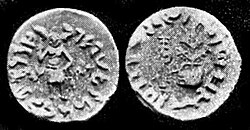
Obv: Standing figure, probably of Vishvamitra, Kharoshthi legend, around: Mahadevasa Dharaghoshasa/Odumbarisa "Great Lord King Dharaghosha/Prince of Audumabara", across: Viçvamitra "Vishvamitra".
Rev: Trident battle-axe, tree with railing, Brahmi legend identical in content to the obverse.[2]
Historically, Viśvāmitra Gāthina was a Rigvedic rishi who was the chief author of Mandala 3 of the Rigveda.[3] Viśvāmitra was taught by Jamadagni Bhārgava.[4] He was the purohita of the Bharata tribal king Sudās, until he was replaced by Vasiṣṭha.[5] He aided the Bharatas in crossing the Vipāśa and Śutudrī rivers (modern Beas and Sutlej).[6] In later Hindu texts, Viśvāmitra and Vasiṣṭha have a long-standing feud, and scholars have stated they historically had a feud regarding the position of the Bharata purohita. However, this view has been criticized due to lack of internal evidence and the projection of later views onto the Rigveda.[6][7] In post-Rigvedic literature Viśvāmitra becomes a mythical sage.[8]
Most of the stories related to Vishvamitra's life is narrated in the Valmiki Ramayana.[9] Vishvamitra was a king in ancient India, also called Kaushika (descendant of Kusha) and belonged to Amavasu Dynasty. Vishvamitra was originally the King of Kanyakubja (modern day Kannauj). He was a valiant warrior and the great-grandson of a great king named Kusha. Valmiki Ramayana, prose 51 of Bala Kanda, starts with the story of Vishvamitra:
There was a king named Kusha (not to be confused with Kusha, son of Rama), a mindson (manasputra) of Brahma and Kusha's son was the powerful and verily righteous Kushanabha. One who is highly renowned by the name Gaadhi was the son of Kushanabha and Gaadhi's son is this great-saint of great resplendence, Vishvamitra. Vishvamitra ruled the earth and this great-resplendent king ruled the kingdom for many thousands of years.[10]
His story also appears in various Puranas; however, with variations from Ramayana. Vishnu Purana and Harivamsha chapter 27 (dynasty of Amaavasu) of Mahabharata narrates the birth of Vishvamitra. According to Vishnu Purana,[11] Kushanabha married a damsel of Purukutsa dynasty (later called as Shatamarshana lineage - descendants of the Ikshvaku king Trasadasyu) and had a son by name Gaadhi, who had a daughter named Satyavati (not to be confused with the Satyavati of Mahabharata).
Life and legends[edit | edit source]
Birth[edit | edit source]
Satyavati was married to an old man known as Richika who was foremost among the race of Bhrigu. Ruchika desired a son having the qualities of a Brahmin and so he gave Satyavati a sacrificial offering (charu) which he had prepared to achieve this objective. He also gave Satyavati's mother another charu to make her conceive a son with the character of a Kshatriya at her request. But Satyavati's mother privately asked Satyavati to exchange her charu with her. This resulted in Satyavati's mother giving birth to Vishvamitra, and Satyavati gave birth to Jamadagni, father of Parashurama, a person with qualities of a warrior.[12]
Conflicts with Vasishtha[edit | edit source]
 | This section needs editing for compliance with Bharatpedia's Manual of Style. In particular, it has problems with MOS:SLASH. (February 2022) |
Maharshi Vasistha possessed a divine-cow Kamadhenu that was able to give everything that one wished for. Once king Kaushika (Vishvamitra) saw the cow and wished to possess her. He asked Vasistha to hand her over but Vasistha refused to do so saying she actually belongs to Devas and not him. King Kaushika became angry due to his arrogance and attacked Vasistha with all his forces. However, he was defeated by the power of Vasistha's penance and surabhi/Kamadhenu's created soldiers and was somehow rescued by Vamadeva. He asked Vamadeva how Vasistha could defeat him all alone. Vamadeva told him this happened due to Vasistha's position as "Brahmarishi" due to his tapasya (penance). Kaushika then wanted to gain "Brahmarishi" like Vasistha. Doing penance guided by Vamadeva, King Kaushika eventually became Vishvamitra.
| Part of a series on |
| Hinduism |
|---|
 |


In one encounter, Vishvamitra cursed the king Harishchandra to become a pauper. Vasishta accompanied him by becoming a bird himself to help him. There were several such instances of violent encounter between the sages and at times, Brahma, god of creation, had to intervene.[13]
Alternative version[edit | edit source]
Vasishta destroys Vishvamitra's entire army by the simple use of his great mystic and spiritual powers, breathing the Om syllable. Vishvamitra then undertakes a tapasya for several years to please Shiva, who bestows upon him the knowledge of celestial weaponry. He proudly goes to Vasiștha's ashram again and uses all kinds of powerful weapons to destroy Vasishta and his hermitage. He succeeded in the killings of Vasistha's thousand sons but not Vasistha himself.
An enraged Vasistha brings out his brahmadanda, a wooden stick imbued with the power of Brahma. It consumes Vishvamitra's most powerful weapon, the brahmastra. Vasistha then attempts to attack Vishvamitra, but his anger is allayed by Devas. Vishvamitra is left humiliated while Vasistha restores his hermitage.[14][15]
Seduction by Menaka[edit | edit source]

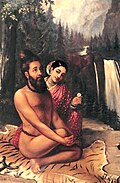
Menaka was born during the churning of the ocean by the devas and asuras and was one of the most beautiful apsaras (celestial nymph) in the world with quick intelligence and innate talent. However, Menaka desired a family. Due to his penance and the power he achieved through it, Vishvamitra frightened the gods and even tried to create another heaven. Indra, frightened by Vishvamitra's powers, sent Menaka from heaven to earth to lure him and break his meditation. Menaka successfully incited Vishvamitra's lust and passion. She succeeded in breaking the meditation of Vishvamitra. However, she fell in genuine love with him and a girl was born to them who later grew in Sage Kanva's ashram and came to be called Shakuntala. Later, Shakuntala falls in love with King Dushyanta and gives birth to a child called Bharata.[16]
Kanva describes this tale in the Mahabharata:[17]
And the timid and beautiful Menaka then entered the retreat and saw there Visvamitra who had burnt, by his penances, all his sins, and was engaged still in ascetic penances. And saluting the Rishi, she then began to sport before him. And just at that time Marut robbed her of her garments that were white as the Moon.
And she thereupon ran, as if in great bashfulness, to catch hold of her attire, and as if she was exceedingly annoyed with Marut. And she did all this before the very eyes of Visvamitra who was endued with energy like that of fire. And Visvamitra saw her in that attitude.
And beholding her divested of her robes, he saw that she was of faultless feature. And that best of Munis saw that she was exceedingly handsome, with no marks of age on her person.
And beholding her beauty and accomplishments that bull amongst Rishis was possessed with lust and made a sign that he desired her companionship. And he invited her accordingly, and she also of faultless features expressed her acceptance of the invitation. And they then passed a long time there in each other’s company.
And sporting with each other, just as they pleased, for a long time as if it were only a single day, the Rishi begat on Menaka a daughter named Sakuntala. And Menaka (as her conception advanced) went to the banks of the river Malini coursing along a valley of the charming mountains of Himavat. And there she gave birth to that daughter. And she left the new-born infant on the bank of that river and went away.
— Vyasa, Mahabharata, Section 72
However, later, Vishvamitra merely cursed Menaka to be separated from him forever, for he loved her as well and knew that she had lost all devious intentions towards him long ago.
After succumbing to Menakā's flirtations, and after having a daughter with her, Vishvamitra then travels south to the Godāvarī to resume his austerities, settling down at a spot next where Śiva stood as Kālañjara.[18]
Vishvamitra was also tested by the Apsara Rambha. She, however, was also cursed by Vishvamitra.[19]
Rise to Brahmarishi[edit | edit source]
After cursing Rambha, Vishvamitra goes to the highest mountain of Himalayas to perform an even more severe tapasya for over 1000 years. He ceases to eat and reduces his breathing to a bare minimum.
He is tested again by Indra, who comes as a poor Brahmin begging for food just as Kaushika is ready to break a fast of many years by eating some rice. Kaushika instantly gives his food away to Indra and resumes his meditation. Kaushika also finally masters his passions, refusing to be provoked by any of Indra's testing and seductive interferences.
At the penultimate culmination of a multi-thousand-year journey, Kaushika's yogic power is at a peak. At this point, Brahma, as the head of Devas led by Indra, names Kaushika a Brahmarishi and names him Vishvamitra or Friend of All for his unlimited compassion. He then goes to meet Vashishta. It was customary that, if a sage was greeted by an equal or superior person, the sage would also greet the person. If the sage was greeted by an inferior person, the sage would simply bless them. Initially, when Vishvamitra greeted Vashishta with the pride of being a new Brahmarishi in heart, Vashishta simply blessed him. Suddenly all pride and desire left Vishvamitra's heart and he became a clean and clear Brahmarishi. When Vishvamitra turned back to leave, Vashishta realised a change of heart and proceeded to greet Vishvamitra. Vishvamitra is also embraced by Vashista and their enmity is instantly ended.[20]
Trisanku[edit | edit source]
Another story Vishvamitra is known for is his creation of his own version of Svarga or heaven, called Trisanku Svarga.
When a proud King Trisanku asked his Guru Vashista to send him to heaven in his own body, guru responded that the body cannot ascend to heaven. King Trisanku then asked Vashista's hundred sons to send him to heaven. The sons, believing that Trisanku should not come to them after their father had refused, took outrage and cursed Trisanku to be a Chandala. Trisanku was transformed into a person with body smeared of ash, clothed in black and wearing iron jewelry. Unrecognizable to his subjects, he was driven out of the kingdom.
In his exile, Trisanku came across the sage Vishvamitra, who agreed to help him. Vishvamitra organized a great sacrifice and ritual propitiating the Devas, pleading that they accept Trisanku into heaven. Not one Deva responded. Angered, Vishvamitra used his yogic powers and ordered Trisanku to rise to heaven. Miraculously, Trisanku rose into the sky until he reached heaven, where he was pushed back down by Indra.
Enraged even more by this, Vishvamitra commenced the creation of another universe (including another Brahma) for Trisanku. He had only completed the Universe when Brihaspati ordered him to stop. Trisanku, however, did not fully transcend through Trisanku Svarga created for him. He remained fixed and upside-down in the sky and was transformed into a constellation, which is now known as Crux.[21]
In the process of forming a new universe, Vishvamitra used up all the tapas he had gained from his austerities. Therefore, after the Trisanku episode, Vishvamitra had to start his prayers again to attain the status of a Brahmarshi and become an equal of Vashista.
Harishchandra/Ambarisha's sacrifice[edit | edit source]
While undertaking a penance, Kaushika helps a boy named Shunashepa who has been sold by his parents to be sacrificed at Harishchandra/Ambarisha's yagna to please Varuna. The king's son Rohit does not want to be the one sacrificed, as was originally promised to Varuna, so young Sunashepa is taken. A devastated and terrified Sunashepa falls at the feet of Kaushika, who is deep in meditation and begs for his help.[22]
Kaushika teaches secret mantras to Sunashepa. The boy sings these mantras at the ceremony, is blessed by Mitra and Varuna and Ambarisha's ceremony is completed.
In another version of the story, Sunahshepa is lost son of Vishvamitra. When Vishvamitra was Prince of Bharats (Kaushik) - and his name was Vishwarath then, he was abducted by the enemy king Shambar. There, Shambar's daughter, Ugra, falls in love with Vishvarath. Ugra convinces Prince Vishvarath to marry her. Looking at the good character of Vishvarath, Shambar also agrees for the marriage. Soon after the marriage, the Bharatas win the battle against Shambar. When they found their Prince Vishvarath alive, they feel happy but they could not accept Ugra as their future queen as she is an Asura. To convert Ugra into an Sura, Vishvarath creates Gayatri Mantra, but people still refuse to accept her. Soon she gives birth to a son, but to save the son from the angry people, the greatest female sage Lopamudra sends the child to a hidden place. To Lopamudra and Vishvarath's sadness, people kill Ugra. But the son is saved, without the knowledge of Vishvarath. This child grows young and he comes to sacrifice himself in the ceremony of Ambarisha (or King Harishchandra).[23]
Teacher of Rama[edit | edit source]

.jpg)
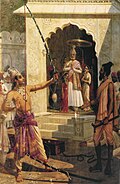
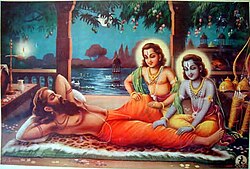
In the Hindu epic Ramayana, Vishvamitra is the preceptor of Rama and his brother Lakshmana. Rama is prince of Ayodhya, and believed to be the seventh Avatar of god Vishnu .
Vishvamitra gives them the knowledge of the Devastras or celestial weaponry [bala and ati bala], trains them in advanced religion and guides them to kill powerful demons like Tadaka, Maricha and Subahu. He also leads them to the Swayamvara ceremony for princess Sita, who becomes wife of Rama.[24]
Works[edit | edit source]
Vishvamitra is said to have written the Gayatri Mantra. It is a verse from a sukta of Rigveda (Mandala 3.62.10). Gāyatrī is the name of the Vedic meter in which the verse is composed.
Gayatri mantra is repeated and cited very widely in Vedic literature[25] and praised in several well-known classical Hindu texts such as Manusmriti ("there is nothing greater than the Savitri (Gayatri) Mantra.", Manu II, 83),[26] Harivamsa[27] and Bhagavad Gita.[28][29] The mantra is an important part of the upanayana ceremony for young males in Hinduism and has long been recited by dvija men as part of their daily rituals. Modern Hindu reform movements spread the practice of the mantra to include women and all castes and its recitation is now widespread.[30][31]
Descendants[edit | edit source]
Vishvamitra had many children from different women. Madhuchhanda was also a composer of many hymns in the Rigveda.[32] According to the Mahabharata, Sushruta, the father of plastic surgery, was one of his sons.[33] Ashtaka, who was born from Madhavi, was successor to his kingdom.[34][35] Shakuntala was born from the damsel Menaka. She was the mother of Bharata, who became a powerful emperor as well as an ancestor of Kuru kings.[36][37]
Vishvamitra is one of the eight main gotras of Brahmins. All Brahmins belonging to Kaushika or Vishvamitra gotra are believed to have descended from Sage Vishvamitra.[38][39] The distinction can be found from the respective pravaras,[40]
- Vishvamitra, Aghamarshana, Kaushika
- Vishvamitra, Devarata, Owdala
- Vishvamitra, Ashtaka
- Vishvamitra, Maadhucchandasa, Dhananjaya
Kaushika is one of the pravara gotras of Vishvamitra gotra among Brahmins.[41]
In popular culture[edit | edit source]
Literature[edit | edit source]
The story of the king Vishwamitra turning into a Brahmarishi has been the topic of a mytho-fiction book by Dr. Vineet Aggarwal.[42]
Graphic Novel[edit | edit source]
Amar Chitra Katha series number 599 titled Vishwamitra, published in 1975, also tells the story of Vishwamitra in the form of a graphic novel.[43]
In film and television[edit | edit source]
- Vishvamitra is shown in the 1985 Tamil movie Raja Rishi with Sivaji Ganesan playing the role of the Sage.
- Vishvamitra's role is played by Shrikant Soni in the TV series Ramayan, 1987 and Uttar Ramayan, 1988 on Doordarshan.
- Vishvamitra is shown in 1991 Telugu movie Brahmarshi Vishvamitra with N. T. Rama Rao playing the role of Sage.
- The TV show Vishvamitra (1989) is made on the story of Brahmarishi Vishvamitra. The role of Vishvamitra is played by Mukesh Khanna.
- Vishvamitra's role is played by Ashok Banthia in the TV series Ramayan, 2008 on Imagine TV.
- Vishvamitra is shown in the show Siya Ke Ram airing on Star Plus, starring Manish Wadhwa.[44]
- The TV show Piya Albela is also based on the classic love story of Menaka and Vishvamitra, depicted as a modern-day love story revolving around Naren and Pooja.
- Vishvamitra also appears in Shani (TV series)
See also[edit | edit source]
References[edit | edit source]
- ↑ Kadambari: Bana. Penguin UK. 12 March 2010. ISBN 9788184752472. Archived from the original on 12 May 2023. Retrieved 20 March 2023.
- ↑ 2.0 2.1 Ancient India, from the earliest times to the first century, A.D by Rapson, E. J. p.154 [1]
- ↑ Jamison, Stephanie; Brereton, Joel (2014). The Rigveda: 3-Volume Set. Oxford University Press. p. 464. ISBN 978-0-19-972078-1.
- ↑ Witzel 1995, p. 316.
- ↑ Jamison & Brereton 2014, p. 465.
- ↑ 6.0 6.1 Witzel, Michael (1995). "Ṛgvedic history: poets, chieftains and polities". In Erdosy, George (ed.). The Indo-Aryans of Ancient South Asia: Language, Material Culture and Ethnicity. De Gruyter. pp. 248–249, 251.
- ↑ Jamison & Brereton 2014, p. 1015-1016.
- ↑ Macdonell, Arthur Anthony; Keith, Arthur Berriedale (1912). Vedic Index of Names and Subjects. John Murray. p. 311.
- ↑ "Valmiki Ramayana". Valmikiramayan.net. Archived from the original on 13 January 2007. Retrieved 26 March 2013.
- ↑ A Classical Dictionary of Hindu Mythology and Religion, Geography, History, and Literature. Trübner & Company. 1870. p. 341.
- ↑ "Viśwamitra". Mythfolklore.net. 16 October 2007. Archived from the original on 27 November 2006. Retrieved 26 March 2013.
- ↑ Parashurama. Amar Chitra Katha Private Limited. April 1971. ISBN 8184823444.
- ↑ Wilkins, W.J. (2003). Hindu Mythology. New Delhi: D.K. Printworld (P) Limited. pp. 380–2. ISBN 81-246-0234-4.
- ↑ Paramahamsa Prajnanananda. Life And Values. Sai Towers Publishing. p. 113. ISBN 9788178990491. Archived from the original on 25 April 2023. Retrieved 16 August 2019.
- ↑ Torchlight Publishing (23 May 2016). A Prince in Exile: The Journey Begins. Jaico Publishing House. ISBN 9788184958614. Archived from the original on 25 April 2023. Retrieved 29 October 2020.
- ↑ Sattar, Arshia (22 June 2017). "The ultimate male fantasy". The Hindu. ISSN 0971-751X. Archived from the original on 19 October 2020. Retrieved 5 September 2020.
- ↑ www.wisdomlib.org (9 October 2010). "Section LXXII [Mahabharata, English]". www.wisdomlib.org. Archived from the original on 13 July 2022. Retrieved 13 July 2022.
- ↑ Sathaye, Adheesh A. (26 May 2015). Crossing the Lines of Caste: Visvamitra and the Construction of Brahmin Power in Hindu Mythology. Oxford University Press. ISBN 978-0-19-027312-5. Archived from the original on 12 May 2023. Retrieved 26 November 2021.
- ↑ "apsara rambha | अप्सरा रम्भा को क्यों एक हजार वर्ष तक बने रहना पड़ा शिला, जानिए रहस्य". hindi.webdunia.com. Archived from the original on 27 July 2019. Retrieved 1 September 2020.
- ↑ "Vishwamitra - The King Who Became a Great Sage - Indian Mythology". www.apamnapat.com. Archived from the original on 26 July 2020. Retrieved 5 September 2020.
- ↑ "Crux – Trishanku". 30 January 2012. Archived from the original on 30 January 2012.
- ↑ Pargiter, F.E. (1972) [1922]. Ancient Indian Historical Tradition, Delhi: Motilal Banarsidass, p.92.
- ↑ Munshi, K. M. (1933). Munshi Granthavali : 7. Ahmedabad: Gurjar Prakashan (for Bharatiya Vidhya Bhavan).
- ↑ "Rama and Lakshmana Slay the mighty tataka". The New Indian Express. Archived from the original on 5 August 2020. Retrieved 5 September 2020.
- ↑ Bloomfield 1906, p. 392b.
- ↑ Dutt 2006, p. 51.
- ↑ Vedas 2003, p. 15–16.
- ↑ Rahman 2005, p. 300.
- ↑ Radhakrishnan 1994, p. 266.
- ↑ Rinehart 2004, p. 127.
- ↑ Lipner 1994, p. 53.
- ↑ Wilson, John (23 April 1877). Indian Caste. Times of India Office. p. 105 – via Internet Archive.
madhuchanda son of vishvamitra rigveda.
- ↑ Bhishagratna, Kunjalal (1907). An English Translation of the Sushruta Samhita, based on Original Sanskrit Text. Calcutta. pp. ii(introduction).
{{cite book}}: CS1 maint: location missing publisher (link) - ↑ Bibek Debroy (2016). Harivamsha. Penguin UK. ISBN 9789386057914. Archived from the original on 12 May 2023. Retrieved 29 October 2020.
- ↑ (India), Uttar Pradesh (23 April 1988). "Uttar Pradesh District Gazetteers: Farrukhabad". Government of Uttar Pradesh. Archived from the original on 12 May 2023. Retrieved 16 August 2019 – via Google Books.
- ↑ Jestice, Phyllis G. (2004). Holy People of the World: A Cross-cultural Encyclopedia. ABC-CLIO. p. 899. ISBN 9781576073551. Archived from the original on 7 April 2022. Retrieved 29 October 2020.
- ↑ Doniger, Wendy (23 April 1988). Textual Sources for the Study of Hinduism. Manchester University Press. ISBN 9780719018671. Archived from the original on 25 April 2023. Retrieved 29 October 2020 – via Google Books.
- ↑ Pande Bechan Sharma (2007). About Me. Penguin Books India. p. 33. ISBN 9780143101802. Archived from the original on 16 April 2023. Retrieved 16 August 2019.
- ↑ John Garrett (1871). A Classical Dictionary of India: Illustrative of the Mythology, Philosophy, Literature, Antiquities, Arts, Manners, Customs &c. of the Hindus. Higginbotham and Company. p. 328. Archived from the original on 12 May 2023. Retrieved 4 April 2014.
- ↑ John Brought (26 September 2013). The Early Brahmanical System of Gotra and Pravara: A Translation of the Gotra-Pravara-Manjari of Purusottama-Pandita. Cambridge University Press. p. 149. ISBN 978-1-107-62398-9. Retrieved 26 September 2013.
- ↑ Prabhākara Mācave (1994). Hinduism: Its Contribution to Science and Civilisation. Machwe Prakashan. p. 65. Archived from the original on 16 May 2022. Retrieved 16 August 2019.
- ↑ "Vishwamitra Book by Dr. Vineet Aggarwal".
- ↑ "Vishwamitra Graphic Novel".
- ↑ Just now. "Siya Ke Ram Latest Updates & Tweets - The Times of India". Timesofindia.indiatimes.com. Archived from the original on 19 January 2016. Retrieved 23 April 2018.
.jpg)
.