




->Bridget m Reverted 1 edit by 115.99.136.114 (talk) to last revision by MPGuy2824 |
WikiDwarfBOT (talk | contribs) Cleanup: Grammar fix. Information added. |
||
| Line 1: | Line 1: | ||
{{ | {{Short description|English writer and activist (1847–1933)}} | ||
{{Inline|date=December 2022}} | |||
{{EngvarB|date=April 2014}} | {{EngvarB|date=April 2014}} | ||
{{Use dmy dates|date=November 2021}} | {{Use dmy dates|date=November 2021}} | ||
{{Infobox person | {{Infobox person | ||
| name = Annie Besant | | name = Annie Besant | ||
| image = Annie Besant | | image = Annie Besant - portrait.jpg | ||
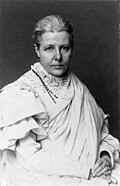
| caption = | | caption = Annie Besant as a young woman | ||
| birth_name = Annie Wood | | birth_name = Annie Wood | ||
| birth_date = {{birth date|df=yes|1847|10|1}} | | birth_date = {{birth date|df=yes|1847|10|1}} | ||
| birth_place = [[Clapham]], London, | | birth_place = [[Clapham]], London, England | ||
| death_date = {{death date and age|df=yes|1933|9|20|1847|10|1}} | | death_date = {{death date and age|df=yes|1933|9|20|1847|10|1}} | ||
| death_place = [[Adyar, Chennai|Adyar]], [[Madras]], [[Madras Presidency]], [[India]]<br />( | | death_place = [[Adyar, Chennai|Adyar]], [[Chingleput District (Madras Presidency)|Chinglepet District]], [[Madras Presidency]], [[British India]]<br />(now [[Chennai]], [[Tamil Nadu]], India) | ||
| other_names = | | other_names = | ||
| spouse = {{marriage|Frank Besant|1867|1873|reason=divorced}} | | spouse = {{marriage|Frank Besant|1867|1873|reason=divorced}} | ||
| children = Arthur, [[Mabel Besant-Scott|Mabel]] | | children = Arthur, [[Mabel Besant-Scott|Mabel]] | ||
| known_for = [[Theosophist]], [[women's rights]] activist, writer and orator | | known_for = [[Theosophist]], [[women's rights]] activist, writer and orator | ||
| party = [[Indian National Congress]] | | party = [[Indian National Congress]] <br> [[Social Democratic Federation]] | ||
| movement = [[Indian independence movement]] | | movement = [[Indian independence movement]] | ||
}} | }} | ||
{{Theosophy}} | {{Theosophy}} | ||
Besant | '''Annie Besant''' ({{nee}} '''Wood'''; 1 October 1847 – 20 September 1933) was a British [[socialist]], [[Theosophy (Blavatskian)|theosophist]], [[freemason]], [[women's rights]] and Home Rule activist, [[educationist]], and campaigner for Indian nationalism.<ref name=":1">{{Cite web |title=BBC - History - Annie Besant |url=https://www.bbc.co.uk/history/historic_figures/besant_annie.shtml |access-date=2023-01-16 |website=www.bbc.co.uk |language=en-GB}}</ref><ref>{{Cite web |title=Annie Besant, Making Britain |url=https://www.open.ac.uk/researchprojects/makingbritain/content/annie-besant |access-date=2023-01-16 |website=www.open.ac.uk}}</ref> She was an ardent supporter of both Irish and Indian [[Self-governance|self-rule]].<ref name=":1" /> | ||
Thereafter, | For fifteen years, Besant was a public proponent in [[England]] of atheism and scientific materialism. Besant's goal was to provide employment, better living conditions, and proper education for the poor.<ref>{{Cite web |title=Besant, Annie: Theosophy World |url=https://www.theosophy.world/encyclopedia/besant-annie |access-date=11 October 2021 |website=theosophy.world}}</ref> She became a prominent speaker for the [[National Secular Society]] (NSS), as well as a writer, and a close friend of [[Charles Bradlaugh]]. In 1877 they were prosecuted for publishing a book by birth control campaigner [[Charles Knowlton]]. Thereafter, she became involved with union actions, including the [[Bloody Sunday (1887)|Bloody Sunday]] demonstration and the [[London matchgirls strike of 1888]]. She was a leading speaker for both the [[Fabian Society]] and the Marxist [[Social Democratic Federation]] (SDF). She was also elected to the [[London School Board]] for [[London Borough of Tower Hamlets|Tower Hamlets]], topping the poll, even though few women were qualified to vote at that time. | ||
In 1890 Besant met [[Helena Blavatsky]], and over the next few years her interest in [[Theosophy (Blavatskian)|theosophy]] grew, whilst her interest in secular matters waned. She became a member of the [[Theosophical Society]] and a prominent lecturer on the subject. As part of her theosophy-related work, she | In 1890 Besant met [[Helena Blavatsky]], and over the next few years her interest in [[Theosophy (Blavatskian)|theosophy]] grew, whilst her interest in secular matters waned. She became a member of the [[Theosophical Society]] and a prominent lecturer on the subject. As part of her theosophy-related work, she travelled to India. In 1898 she helped establish the [[Central Hindu College|Central Hindu School]], and in 1922 she helped establish the [[Hyderabad (Sind) National Collegiate Board]] in Bombay (today's [[Mumbai]]), India. In 1902, she established the first overseas Lodge of the International Order of Co-Freemasonry, [[Le Droit Humain]]. Over the next few years, she established lodges in many parts of the [[British Empire]]. In 1907 she became president of the Theosophical Society, whose international headquarters were, by then, located in [[Adyar (Chennai)|Adyar]], [[Madras]], ([[Chennai]]). | ||
Besant also became involved in politics in India, joining the [[Indian National Congress]]. When [[World War I]] broke out in 1914, she helped launch the [[Indian Home Rule Movement|Home Rule League]] to campaign for democracy in India, and dominion status within the British Empire. This led to her election as president of the Indian National Congress, in late 1917. In the late 1920s, Besant | Besant also became involved in politics in India, joining the [[Indian National Congress]].<ref name=":1" /> When [[World War I]] broke out in 1914, she helped launch the [[Indian Home Rule Movement|Home Rule League]] to campaign for democracy in India, and dominion status within the British Empire. This led to her election as president of the Indian National Congress, in late 1917. In the late 1920s, Besant travelled to the United States with her protégé and adopted son [[Jiddu Krishnamurti]], who she claimed was the new Messiah and incarnation of Buddha. Krishnamurti rejected these claims in 1929. After the war, she continued to campaign for Indian independence and for the causes of theosophy, until her death in 1933. | ||
==Early life== | ==Early life== | ||
'''Annie Wood''' was born on 1 October 1847 in [[London]], the daughter of William Burton Persse Wood (1816–1852) and his wife Emily Roche Morris (died 1874). Her father was English, attended [[Trinity College Dublin]], and attained a medical degree; her mother was an [[Irish Catholic]]. Her paternal grandfather Robert Wright Wood was a brother of [[Sir Matthew Wood, 1st Baronet]].<ref>{{cite book |last1=Besant |first1=Arthur Digby |title=The Besant Pedigree |date=1930 |publisher=Besant & Co. |location=London |page=455 |url=https://archive.org/details/besantpedigreeby00besa/page/455/mode/1up}}</ref> | |||
'''Annie Wood''' was born on 1 October 1847 in London | |||
Annie's father died when she was five years old, leaving a son, Henry Trueman Wood, and one daughter. Her mother supported Henry's education at [[Harrow School]], by running a boarding house there. Annie was fostered by Ellen Marryat, sister of the author [[Frederick Marryat]], who ran a school at [[Charmouth]], until age 16. She returned to her mother at Harrow self-confident, aware of a sense of duty to society, and under the influence of the [[Tractarians]].<ref name="ODNB">{{cite ODNB|id=30735|first=Anne|last=Taylor|title=Besant, Annie (1847–1933)}}</ref> As a young woman, she was also able to travel in Europe.<ref>{{cite book | url=https://books.google.com/books?id=CHVMAwAAQBAJ&dq=annie+besant+anglican&pg=PA127 | isbn=9781608992621 | title=The Victorian Church, Part Two: 1860-1901 | date=April 2010 | publisher=Wipf and Stock Publishers }}</ref><ref>{{cite book | url=https://books.google.com/books?id=eE5GDwAAQBAJ&dq=annie+besant+anglican+comte&pg=PA190 | isbn=9780857281944 | title=The Anthem Companion to Auguste Comte | date=15 May 2017 | publisher=Anthem Press }}</ref> | |||
In summer 1867, Annie and her mother stayed at [[Pendleton, Lancashire|Pendleton]] near Manchester with the radical solicitor [[William Prowting Roberts]], who questioned Annie's political assumptions.<ref>{{cite book |last1=Besant |first1=Annie Wood |title=Annie Besant : an autobiography |date=1893 |publisher=London : T. Fisher Unwin |pages=71–72 |url=https://archive.org/details/anniebesantautob00besaiala/page/71/mode/1up}}</ref><ref>{{cite journal |last1=Leat |first1=Diana |title=The Rise and Rôle of the Poor Man's Lawyer |journal=British Journal of Law and Society |date=1975 |volume=2 |issue=2 |page=168 |doi=10.2307/1409644 |jstor=1409644 |url=https://www.jstor.org/stable/1409644 |issn=0306-3704}}</ref> In December of that year, at age 20, Annie married the cleric Frank Besant (1840–1917), younger brother of [[Walter Besant]], an evangelical, serious [[Anglican]].<ref name="ODNB"/> | |||
== | ==Failure of the marriage== | ||
The Rev. Frank Besant was a graduate of [[Emmanuel College, Cambridge]], ordained priest in 1866, but had no living: in 1866 he was teaching at [[Stockwell]] Grammar School as second master, and in 1867 he moved to teach at [[Cheltenham College]] as assistant master.<ref>{{acad|id=BSNT859F|name=Besant, Frank}}</ref><ref>{{cite book |title=Crockford's Clerical Directory for 1868 |date=6 June 2022 |publisher=BoD – Books on Demand |isbn=978-3-375-04550-0 |page=54 |url=https://books.google.com/books?id=m2RzEAAAQBAJ&pg=PA54 |language=en}}</ref> In 1872, he became vicar of [[Sibsey]] in Lincolnshire, a benefice in the gift of the [[Lord Chancellor]]—who was [[Lord Hatherley]], a Wood family connection, son of Sir Matthew Wood, 1st Baronet.<ref name="ODNB"/> The Besant family, with their two children, Arthur and [[Mabel Besant-Scott|Mabel]], moved to Sibsey, but the marriage was already under strain. As Annie wrote in her ''Autobiography'', "we were an ill-matched pair".<ref>{{cite book |last1=Besant |first1=Annie Wood |title=Annie Besant : an autobiography |date=1893 |publisher=T. Fisher Unwin |location=London |page=81 |url=https://archive.org/details/anniebesantautob00besaiala/page/81/mode/1up}}</ref> | |||
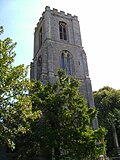
[[File:Sibsey church tower.JPG|left|thumb|upright=1.1|St. Margaret's church in [[Sibsey]], [[Lincolnshire]], where Frank Besant was vicar from 1872 to 1917]] | |||
Money was short and Frank Besant was parsimonious. Annie was sure a third child would impose too much on the family finances.<ref name="ODNB"/> She wrote short stories, books for children, and articles, the money she earned being controlled by her husband. | |||
= | Besant began to question her own faith, after her daughter Mabel was seriously ill in 1871.<ref name="ODNB"/> She consulted [[Edward Bouverie Pusey]]: by post he gave her advice along orthodox, [[Bampton Lecture]] lines, and in person he sharply reprimanded her unorthodox theological tendencies.<ref>{{cite book |last1=Besant |first1=Annie Wood |title=Annie Besant : an autobiography |date=1893 |publisher=London : T. Fisher Unwin |pages=109–112 |url=https://archive.org/details/anniebesantautob00besaiala/page/109/mode/1up}}</ref> She attended in London, with her mother, a service at [[St. George's Hall, London|St George's Hall]] given by the heterodox cleric [[Charles Voysey (theist)|Charles Voysey]], in autumn 1871, and struck up an acquaintance with the Voyseys, reading in "theistic" authors such as [[Theodore Parker]] and [[Francis Newman]] on Voysey's recommendation.<ref>{{cite book |last1=Besant |first1=Annie Wood |title=Annie Besant : an autobiography |date=1893 |publisher=T. Fisher Unwin |location=London |pages=106–107 |url=https://archive.org/details/anniebesantautob00besaiala/page/106/mode/2up}}</ref> Voysey also introduced Besant to the freethinker and publisher [[Thomas Scott (1808–1878)|Thomas Scott]]. Encouraged by Scott, Besant wrote an anonymous pamphlet ''On the Deity of Jesus of Nazareth'', by "the wife of a beneficed clergyman", which appeared in 1872.<ref name="ODNB"/> Ellen Dana Conway, wife of [[Moncure Conway]] befriended Annie at this time.<ref>{{cite book |last1=Goolrick |first1=John Tackett |title=Historic Fredericksburg; the story of an old town |date=1922 |publisher=Richmond, Va., Printed by Whittet & Shepperson |page=100 |url=https://archive.org/details/historicfrederic00goolri/page/100/mode/1up}}</ref> | ||
[[ | |||
The Besants made an effort to repair the marriage. The tension came to a head when Annie refused to attend [[Eucharist|Communion]], which Frank demanded, now fearing for his own reputation and position in the Church.<ref name="ODNB"/> In 1873 she left him and went to London. She had a temporary place to stay, with Moncure Conway.<ref name="Fabians">{{cite book |last1=MacKenzie |first1=Norman Ian |last2=MacKenzie |first2=Jeanne |title=The First Fabians |date=1979 |publisher=Quartet Books |location=London |isbn=0704332515 |page=47}}</ref> The Scotts found her a small house in Colby Road, [[Upper Norwood]].<ref>{{cite book |last1=Besant |first1=Annie Wood |title=Annie Besant : an autobiography |date=1893 |publisher=T. Fisher Unwin |location=London |page=120 |url=https://archive.org/details/anniebesantautob00besaiala/page/120/mode/1up}}</ref> | |||
The couple were legally separated and Annie took her daughter Mabel with her, the agreement of 25 October 1873 giving her custody. Annie remained Mrs. Besant for the rest of her life. At first, she was able to keep contact with both children and to have Mabel live with her; she also got a small allowance from her husband. In 1878 Frank Besant successfully argued her unfitness, after Annie's public campaigning on [[contraception]], and had custody from then of both children. Later, Annie was reconciled with her son and daughter.<ref name="ODNB"/> Her son Arthur Digby Besant (1869–1960) was President of the Institute of Actuaries, 1924–26, and wrote ''The Besant Pedigree'' (1930).<ref>{{Who's Who|surname=Besant|othernames=Besant, Arthur Digby|id=U234700}}</ref> Initially in London, Annie attempted to support her daughter, her mother (who died the following year) and herself with [[needlework]].<ref name="Fabians"/> | |||
[[File:Annie Besant plaque.JPG|thumb|left|Annie Besant's house, 39 Colby Road, Upper Norwood, now bearing a blue plaque]] | |||
==Reformer and secularist== | |||
Besant began in 1874 to write for the ''[[National Reformer]]'', the organ of the [[National Secular Society]] (NSS), run by [[Charles Bradlaugh]].<ref name="Fabians"/> She also continued to write for Thomas Scott's small press.<ref name="ODNB"/> On the account given by [[W. T. Stead]], Besant had encountered the ''National Reformer'' on sale in the shop of [[Edward Truelove]].<ref name="Stead">{{cite book |last1=Stead |first1=William Thomas |title=Mrs. Annie Besant |date=1891 |page=360 |url=https://books.google.com/books?id=uLj-iimSd8gC&pg=PA360 |language=en}}</ref> Besant had heard of Bradlaugh from Moncure Conway.<ref name="Fabians"/> She wrote to Bradlaugh and was accepted as an NSS member. She first heard him speak on 2 August 1874.<ref name="Stead"/> | |||
Through Bradlaugh, Besant met and became a supporter of [[Joseph Arch]], the farmworkers' leader.<ref>{{cite book |last1=Arch |first1=Joseph |last2=Warwick |first2=Frances Evelyn Maynard Greville |title=Joseph Arch. The story of his life |date=1898 |publisher=Hutchinson |location=London |page=124 |url=https://archive.org/details/josepharchstoryo00archuoft/page/124/mode/1up}}</ref> | |||
Her career as a platform speaker began on 25 August 1874, with topic "The Political Status of Women".<ref name="Fabians"/> The lecture was at the Co-operative Hall, Castle Street, [[Long Acre]] in west central London.<ref>{{cite wikisource|wslink=On the Political Status of Women}}</ref> It was followed by an invitation to speak in September, by Moncure Conway, at his Camden Town church, on "The True Basis of Morality", in September 1874, in his Camden Town church.<ref>{{cite web |last1=Pécastaing-Boissière |first1=Muriel |title=Annie Besant (1847-1933): Struggles and Quest |url=https://hal.sorbonne-universite.fr/hal-03895392/document|date=2017 |publisher=Theosophical Publishing House Limited |language=en |page=79}}</ref> Besant published an essay under this title, in 1882.<ref>{{cite book |last1=Cobbe |first1=Frances Power |title=Frances Power Cobbe: Essential Writings of a Nineteenth-Century Feminist Philosopher |date=2022 |publisher=Oxford University Press |isbn=978-0-19-762822-5 |page=34 |url=https://books.google.com/books?id=vyRXEAAAQBAJ&pg=PA34 |language=en}}</ref> She was a prolific writer and a powerful orator.<ref name="ReferenceA">Mark Bevir, ''The Making of British Socialism'' (Princeton University, 2011), 202.</ref> She addressed causes including [[freedom of thought]], women's rights, [[secularism]], [[birth control]], [[Fabian socialism]] and [[workers' rights]]. [[Margaret Cole]] called her "the finest woman orator and organiser of her day".<ref>{{cite book |last1=Cole |first1=Margaret |title=The Story of Fabian Socialism |date=1961 |publisher=University Press |page=8 |language=en}}</ref> | |||
Besant and Bradlaugh became household names | ===Criticism of Christianity=== | ||
{{Infobox book | |||
| nocat_wdimage = yes | |||
| name = Christianity: Its Evidences, Its Origin, Its Morality, Its History | |||
| image = | |||
| image_size = | |||
| alt = | |||
| caption = | |||
|italic title=no | |||
| author = Annie Besant | |||
| audio_read_by = | |||
| illustrator = | |||
| cover_artist = | |||
| country = | |||
| series = The freethinker's text-book | |||
| release_number = | |||
| subject = | |||
| genre = | |||
| set_in = | |||
| published = | |||
| publisher2 = | |||
| pub_date = 1876 | |||
| media_type = | |||
| awards = | |||
| isbn_note = | |||
| dewey = | |||
| congress = | |||
| preceded_by = Part I. by [[Charles Bradlaugh]]<ref>{{Cite book |last1=Bradlaugh |first1=Charles |title=The freethinker's text-book. Part I |last2=Besant |first2=Annie |last3=Watts |first3=Charles |publisher=C. Watts, National Secular Society |year=1876 |quote=Part I., section I. & II. by Charles Bradlaugh}} (Image of [https://books.google.com/books?id=ZqJbAAAAQAAJ&pg=PP1 Book cover] at Google Books)</ref> | |||
| followed_by = | |||
| notes = | |||
| exclude_cover = | |||
| website = | |||
| native_external_url=http://www.gutenberg.org/ebooks/13349 | |||
| native_external_host = [[Project Gutenberg]] | |||
| orig_lang_code = en | |||
}} | |||
Besant opined that for centuries the leaders of [[Christian philosophy|Christian thought]] spoke of women as a necessary evil and that the greatest saints of the Church were those who despised women the most, "Against the teachings of eternal torture, of the vicarious atonement, of the infallibility of the Bible, I leveled all the strength of my brain and tongue, and I exposed the history of the Christian Church with unsparing hand, its persecutions, its religious wars, its cruelties, its oppressions. (Annie Besant, An Autobiography Chapter VII)." In the section named "Its Evidences Unreliable" of her work "Christianity", Besant presents the case of why the [[Gospel]]s are not authentic: "before about A.D. 180 there is no trace of <small>FOUR</small> gospels among the Christians."<ref>1876: "Christianity", ''The freethinker's text-book'', Part II. (Issued by authority of the [[National Secular Society]])</ref> | |||
===''The Fruits of Philosophy''=== | |||
Besant and Bradlaugh set up the Freethought Publishing Company at the beginning of 1877;<ref name="ODNB"/> it followed the 1876 prosecution of [[Charles Watts (secularist)|Charles Watts]], and they carried on his work.<ref>{{cite book |last1=Brake |first1=Laurel |last2=Demoor |first2=Marysa |title=Dictionary of Nineteenth-century Journalism in Great Britain and Ireland |date=2009 |publisher=Academia Press |isbn=978-90-382-1340-8 |page=72 |url=https://books.google.com/books?id=qVrUTUelE6YC&pg=PA72 |language=en}}</ref> They became household names later that year, when they published ''[[Fruits of Philosophy]]'', a book by the American birth-control campaigner [[Charles Knowlton]]. It claimed that working-class families could never be happy until they were able to decide how many children they wanted. It also suggested ways to limit the size of their families.<ref>{{Cite book |last=Knowlton |first=Charles |url=http://www.gutenberg.org/files/38185/38185-h/38185-h.htm |title=Fruits of philosophy: a treatise on the population question |date=October 1891 |publisher=Reader's Library |editor-last=Besant |editor-first=Annie |location=San Francisco |oclc=626706770 |author-link=Charles Knowlton |orig-year=1840 |editor2-last=Bradlaugh |editor2-first=Charles |editor-link2=Charles Bradlaugh}} A publication about birth control. [https://archive.org/details/fruitsphilosoph00knogoog View original copy.]</ref> The Knowlton book was highly controversial and was vigorously opposed by the Church. Besant and Bradlaugh proclaimed in the ''National Reformer'': | |||
<blockquote>We intend to publish nothing we do not think we can morally defend. All that we publish we shall defend.<ref>{{Cite book |last=Besant |first=Annie |url=https://archive.org/details/b28977245 |title=Autobiographical sketches |date=1885 |publisher=Freethought Publishing |page=[https://archive.org/details/b28977245/page/116 116] |ol=26315876M}}</ref></blockquote> | <blockquote>We intend to publish nothing we do not think we can morally defend. All that we publish we shall defend.<ref>{{Cite book |last=Besant |first=Annie |url=https://archive.org/details/b28977245 |title=Autobiographical sketches |date=1885 |publisher=Freethought Publishing |page=[https://archive.org/details/b28977245/page/116 116] |ol=26315876M}}</ref></blockquote> | ||
The pair were arrested and put on trial for publishing the Knowlton book. They were found guilty but released pending appeal. | The pair were arrested and put on trial for publishing the Knowlton book. They were found guilty but released pending appeal. The trial became a ''[[cause célèbre]]'', and ultimately the verdict was overturned on a technical legal point.<ref>{{cite book |last1=Lazarus |first1=Joyce B. |title=Ernestine L. Rose: To Change a Nation |date=26 July 2022 |publisher=Rowman & Littlefield |isbn=978-0-7618-7343-3 |page=117 |url=https://books.google.com/books?id=PSV6EAAAQBAJ&pg=PA117 |language=en}}</ref> | ||
Besant was then instrumental in founding the [[Malthusian League]], reviving a name coined earlier by Bradlaugh. It would go on to advocate for the abolition of penalties for the promotion of contraception.<ref>{{Cite journal |last=D'arcy |first=F. |date=Nov 1977 |title=The Malthusian League and resistance to birth control propaganda in late Victorian Britain |journal=Population Studies |volume=31 |issue=3 |pages=429–448 |doi=10.1080/00324728.1977.10412759 |jstor=2173367 |pmid=11630505}}</ref> Besant and Bradlaugh supported the Malthusian League for some 12 years. They were concerned with birth control, but were not [[neo-Malthusian]]s in the sense of convinced believers in the tradition of [[Thomas Malthus]] and his demographic theories.<ref>{{cite book |last1=Ledbetter |first1=Rosanna |title=A history of the Malthusian League, 1877-1927 |date=1976 |publisher=Columbus : Ohio State University |isbn=978-0-8142-0257-9 |pages=18–19 |url=https://archive.org/details/historyofmalthus0000ledb/page/18/mode/2up}}</ref> Besant did advocate [[population control]] as an antidote to the [[struggle for survival]].<ref>{{cite book |last1=Ledbetter |first1=Rosanna |title=A history of the Malthusian League, 1877-1927 |date=1976 |publisher=Columbus : Ohio State University |isbn=978-0-8142-0257-9 |pages=44–45 |url=https://archive.org/details/historyofmalthus0000ledb/page/44/mode/2up}}</ref> She became the secretary of the League, with [[Charles Robert Drysdale]] as President.<ref>{{cite book |last1=Dolan |first1=Brian |title=Malthus, Medicine & Morality: Malthusianism After 1798 |date=2000 |publisher=Rodopi |isbn=978-90-420-0851-9 |page=146 |url=https://books.google.com/books?id=2znzI0_nzXcC&pg=PA146 |language=en}}</ref> In time the League veered towards [[eugenics]], and it was from the outset an [[individualist]] organisation, also for many members supportive of a [[social conservatism]] that was not Besant's view.<ref>{{cite web |last1=Pécastaing-Boissière |first1=Muriel |title=Annie Besant (1847-1933): Struggles and Quest |url=https://hal.sorbonne-universite.fr/hal-03895392/document|date=2017 |publisher=Theosophical Publishing House Limited |language=en |pages=106, 167, 156}}</ref> Her pamphlet ''The Law of Population'' (1878) sold well.<ref name="ODNB"/> | |||
The | ===Radical causes=== | ||
Besant was a leading member of the National Secular Society alongside Charles Bradlaugh.<ref>MacKillop, I. D. (1986) ''[https://books.google.com/books?id=mqgsFS_MN9UC The British Ethical Societies]'', Cambridge University Press. Accessed 13 May 2014.</ref> She attacked the status of the [[Church of England]] as [[established church]]. The NSS argued for a secular state and an end to the special status of Christianity and allowed her to act as one of its public speakers. On 6 March 1881 she spoke at the opening of [[Leicester Secular Society]]'s new [[Leicester Secular Hall|Secular Hall]] in Humberstone Gate, Leicester. The other speakers were [[George Jacob Holyoake]], [[Harriet Law]] and Bradlaugh.<ref>{{Cite web|url=http://leicestersecularsociety.org.uk/history_gimson.htm#(1)|title=Random Recollections of Leicester Secular Society|website=leicestersecularsociety.org.uk}}</ref> | |||
Bradlaugh was elected to Parliament in 1881. Because of his atheism, he asked to be allowed to [[affirmation (law)|affirm]], rather than swear the oath of loyalty. It took more than six years before the matter was completely resolved, in Bradlaugh's favour, after a series of by-elections and court appearances. He was an individualist and opposed to [[socialism]] in any form. While he defended free speech, he was very cautious about encouraging working-class militancy.<ref>Theresa Notare, ''A Revolution in Christian Morals: Lambeth 1930-Resolution #15. History and Reception'' (ProQuest, 2008), 188.</ref><ref>{{Cite web|url=https://tribunemag.co.uk/2019/10/the-socialist-roots-of-birth-control|title=The Socialist Roots of Birth Control|website=tribunemag.co.uk}}</ref> | |||
[[Edward Aveling]], a rising star in the National Secular Society, tutored Besant during 1879, and she went on to a degree course at London University.<ref name="ODNB"/><ref>{{cite book |last1=MacKenzie |first1=Norman Ian |last2=MacKenzie |first2=Jeanne |title=The First Fabians |date=1979 |publisher=Quartet Books |location=London |isbn=0704332515 |page=48}}</ref> Then, 1879 to 1882, she was a student of physical sciences at [[Birkbeck, University of London|Birkbeck Literary and Scientific Institution]]. Embarrassed by her activist reputation, the Institution omitted her name from the published list of graduands, and mailed her certificates to her.<ref name="BBK">{{cite web |last1=Pécastaing-Boissière |first1=Muriel |title=Annie Besant (1847-1933): Struggles and Quest |url=https://hal.sorbonne-universite.fr/hal-03895392/document|date=2017 |publisher=Theosophical Publishing House Limited |language=en |pages=112–113}}</ref> When Aveling in a speech in 1884 announced he had become a socialist after five years close study, Besant argued that his politics over that whole period had been aligned with Bradlaugh's and her own.<ref>{{cite book |last1=Kapp |first1=Yvonne |title=Eleanor Marx: A Biography |date=10 July 2018 |publisher=Verso Books |isbn=978-1-78663-594-5 |page=288 |url=https://books.google.com/books?id=1W_nDwAAQBAJ&pg=PT288 |language=en}}</ref> Aveling and [[Eleanor Marx]] joined the [[Social Democratic Federation]], followers of [[Marxism]], and then the [[Socialist League (UK, 1885)|Socialist League]], a small Marxist splinter group which formed around the artist [[William Morris]]. In 1883 Besant started her own periodical, ''Our Corner''.<ref>{{cite web |last1=Pécastaing-Boissière |first1=Muriel |title=Annie Besant (1847-1933): Struggles and Quest |url=https://hal.sorbonne-universite.fr/hal-03895392/document|date=2017 |publisher=Theosophical Publishing House Limited |language=en |page=166}}</ref> It was a literary and in time a socialist monthly, and published [[George Bernard Shaw]]'s novel ''The Irrational Knot'' in serial form.<ref>{{cite book |last1=Brake |first1=Laurel |last2=Demoor |first2=Marysa |title=Dictionary of Nineteenth-century Journalism in Great Britain and Ireland |date=2009 |publisher=Academia Press |isbn=978-90-382-1340-8 |page=72 |url=https://books.google.com/books?id=qVrUTUelE6YC&pg=PA72 |language=en}}</ref> | |||
Meanwhile, Besant built close contacts with the [[Devolution#Irish home rule|Irish Home Rulers]] and supported them in her newspaper columns during what are considered crucial years, when the Irish nationalists were forming an alliance with Liberals and Radicals. Besant met the leaders of the Irish home rule movement. In particular, she got to know [[Michael Davitt]], who wanted to mobilise the Irish peasantry through a Land War, a direct struggle against the landowners. She spoke and wrote in favour of Davitt and his Land League many times over the coming decades. | Meanwhile, Besant built close contacts with the [[Devolution#Irish home rule|Irish Home Rulers]] and supported them in her newspaper columns during what are considered crucial years, when the Irish nationalists were forming an alliance with Liberals and Radicals. Besant met the leaders of the Irish home rule movement. In particular, she got to know [[Michael Davitt]], who wanted to mobilise the Irish peasantry through a Land War, a direct struggle against the landowners. She spoke and wrote in favour of Davitt and his Land League many times over the coming decades. | ||
===Personal life=== | |||
Bradlaugh's family circumstances changed in May 1877 with the death of his wife Susannah, an alcoholic who had left him for [[James Thomson (poet, born 1834)|James Thomson]]. His two children, Alice then aged 21, and [[Hypatia Bradlaugh Bonner|Hypatia]] then 19, returned to live with him from his in-laws. He had been able to take a house in [[St John's Wood]] in February of that year, at 20 Circus Road, near Besant. They continued what had become a close friendship.<ref>{{cite ODNB|id=3183 |title=Bradlaugh, Charles |last1=Royle |first1=Edward}}</ref> | |||
==Fabian Society 1885–1890== | |||
Besant made an abrupt public change in her political views, at the 1885 New Year's Day meeting of the London Dialectical Society, founded by [[Joseph Hiam Levy]] to promote individualist views.<ref name="Fabians54">{{cite book |last1=MacKenzie |first1=Norman Ian |last2=MacKenzie |first2=Jeanne |title=The First Fabians |date=1979 |publisher=Quartet Books |location=London |isbn=0704332515 |page=54}}</ref><ref>{{cite book |last1=Shaw |first1=Bernard |last2=Tyson |first2=Brian |title=Bernard Shaw's Book Reviews: 1884-1950 |date=1991 |publisher=Penn State Press |isbn=978-0-271-01548-4 |page=111 |url=https://books.google.com/books?id=Ui6sNgX5vfQC&pg=PA111 |language=en}}</ref> It followed a noted public debate at [[St. James's Hall]] on 17 April 1884, on ''Will Socialism Benefit the English People?'', in which Bradlaugh had put individualist views, against the Marxist line of [[Henry Hyndman]].<ref>{{cite book |last1=Royle |first1=Edward |title=Radicals, Secularists, and Republicans: Popular Freethought in Britain, 1866-1915 |date=1980 |publisher=Manchester University Press |isbn=978-0-7190-0783-5 |page=348 |url=https://books.google.com/books?id=xMhRAQAAIAAJ&pg=PA348 |language=en}}</ref> On that occasion Besant still supported Bradlaugh. While Bradlaugh may have had the better of the debate, followers then began to migrate into left-wing politics.<ref name="Fabians54"/><ref>{{cite book |last1=Briggs |first1=Julia |title=A Woman of Passion: The Life of E. Nesbit |date=7 November 2000 |publisher=New Amsterdam Books |isbn=978-1-4616-3622-9 |page=81 |url=https://books.google.com/books?id=zRS_AAAAQBAJ&pg=PA81 |language=en}}</ref> George Bernard Shaw was the speaker on 1 January 1885, talking on socialism, but, instead of the expected criticism from Besant, he saw her opposing his opponent. Shaw then sponsored Besant to join the [[Fabian Society]].<ref name="Fabians54"/> | |||
The Fabians were defining political goals, rejecting [[anarchism]] in 1886, and forming the Fabian Parliamentary League, with both Besant and Shaw on its Council which promoted political candidacy.<ref>{{cite book |last1=Bevir |first1=Mark |title=The Making of British Socialism |date=13 December 2016 |publisher=Princeton University Press |isbn=978-0-691-17372-6 |pages=202–203 |url=https://books.google.com/books?id=e3CYDwAAQBAJ&pg=PA202 |language=en}}</ref> Unemployment was a central issue of the time, and in 1887 some of the London unemployed started to hold protests in [[Trafalgar Square]]. Besant agreed to appear as a speaker at a meeting on 13 November. The police tried to stop the assembly, fighting broke out, and troops were called. Many were hurt, one man died, and hundreds were arrested; Besant offered herself for arrest, an offer disregarded by the police.<ref>Sally Peters, ''Bernard Shaw: The Ascent of the Superman'' (Yale University, 1996), 94.</ref> The events became known as [[Bloody Sunday (1887)|Bloody Sunday]]. Besant threw herself into organising legal aid for the jailed workers and support for their families.<ref>Kumar, Raj, ''Annie Besant's Rise to Power in Indian Politics, 1914–1917'' (Concept Publishing, 1981), 36.</ref> In its aftermath the Law and Liberty League, defending [[freedom of expression]], was formed by Besant and others, and Besant became editor of ''The Link'', its journal.<ref name="ODNB"/> | |||
Besant's involvement in the [[London matchgirls strike of 1888]] came after a Fabian Society talk that year on [[female labour]] by [[Clementina Black]]. Besant wrote in ''The Link'' about conditions at the [[Bryant & May]] match factory. She was drawn further into this battle of the "New Unionism" by a young socialist, [[Herbert Burrows]], who had made contact with workers at the factory, in [[Bow, London|Bow]]. They were mainly young women, were very poorly paid, and subject to occupational disease, such as [[Phossy jaw]] caused by the chemicals used in match manufacture.<ref>{{cite book |last1=Holmes |first1=Rachel |title=Sylvia Pankhurst: Natural Born Rebel |date=15 December 2020 |publisher=Bloomsbury USA |isbn=978-1-4088-8041-8 |page=55 |url=https://books.google.com/books?id=q3oTEAAAQBAJ&pg=PA55 |language=en}}</ref><ref>[http://www.mernick.org.uk/thhol/thelink.html "White slavery in London"] The Link, Issue no. 21 (via Tower Hamlets' Local History Library and Archives)</ref> Louise Raw in ''Striking a Light'' (2011) has, however, contested the historiography of the strike, stating that "A proper examination of the primary evidence about the strike makes it impossible to continue to believe that Annie Besant led it."<ref>{{cite book |last1=Raw |first1=Louise |title=Striking a Light: The Bryant and May Matchwomen and their Place in History |date=10 March 2011 |publisher=Bloomsbury Publishing |isbn=978-1-4411-2104-2 |page=26 |url=https://books.google.com/books?id=tBoSBwAAQBAJ&pg=PT19 |language=en}}</ref> | |||
William Morris played some part in converting Besant to Marxism, but it was to the Social Democratic Federation of Hyndman, not his Socialist League, that she turned in 1888. She remained a member for a number of years and became one of its leading speakers. She was still a member of the Fabian Society, the two movements being compatible at the time. Besant was elected to the [[London School Board]] in 1888.<ref>[[Edward R. Pease]], ''The History of the Fabian Society'' (E. P. Dutton, 1916, rpt Aware Journalism, 2014), 179.</ref> Women at that time were not able to take part in parliamentary politics but had been brought into the London local electorate in 1881. Besant drove about with a red ribbon in her hair, speaking at meetings. "No more hungry children", her manifesto proclaimed. She combined her socialist principles with feminism: | |||
<blockquote>"I ask the electors to vote for me, and the non-electors to work for me because women are wanted on the Board and there are too few women candidates." </blockquote> | |||
From the early 1880s Besant had also been an important feminist leader in London, with [[Alice Vickery]], Ellen Dana Moncure and [[Millicent Fawcett]]. This group, at the [[South Place Ethical Society]], had a national standing.<ref>{{cite book |last1=Brown |first1=Callum G. |last2=Nash |first2=David |last3=Lynch |first3=Charlie |title=The Humanist Movement in Modern Britain: A History of Ethicists, Rationalists and Humanists |date=12 January 2023 |publisher=Bloomsbury Academic |isbn=978-1-350-13661-8 |pages=72–73 |url=https://books.google.com/books?id=liGnEAAAQBAJ&pg=PA72 |language=en}}</ref> She frequented the home of [[Richard Pankhurst|Richard]] and [[Emmeline Pankhurst]] on [[Russell Square]], and Emmeline had participated in the matchgirl organisation.<ref>{{cite book |last1=Holmes |first1=Rachel |title=Sylvia Pankhurst: Natural Born Rebel |date=15 December 2020 |publisher=Bloomsbury USA |isbn=978-1-4088-8041-8 |page=62 |url=https://books.google.com/books?id=q3oTEAAAQBAJ&pg=PA62 |language=en}}</ref><ref>{{cite book |last1=Purvis |first1=June |title=Emmeline Pankhurst: A Biography |date=2 September 2003 |publisher=Routledge |isbn=978-1-134-34191-7 |page=26 |url=https://books.google.com/books?id=Wtx_AgAAQBAJ&pg=PA26 |language=en}}</ref> Besant came out on top of the poll in [[Tower Hamlets (UK Parliament constituency)|Tower Hamlets]], with over 15,000 votes. She wrote in the ''National Reformer'': | |||
<blockquote>"Ten years ago, under a cruel law, Christian bigotry robbed me of my little child. Now the care of the 763,680 children of London is placed partly in my hands."<ref>Jyoti Chandra, ''Annie Besant: from theosophy to nationalism'' (K.K. Publications, 2001), 17.</ref></blockquote> | |||
Financial constraints meant that Besant closed down both ''Our Corner'' and ''The Link'' at the end of 1888.<ref>{{cite web |last1=Pécastaing-Boissière |first1=Muriel |title=Annie Besant (1847-1933): Struggles and Quest |url=https://hal.sorbonne-universite.fr/hal-03895392/document|date=2017 |publisher=Theosophical Publishing House Limited |language=en |pages=188}}</ref> | |||
Besant was further involved in the [[London dock strike of 1889]]. The dockers, [[casual work]]ers who were employed by the day, were led by [[Ben Tillett]] in a struggle for the "Dockers' Tanner". Besant helped Tillett draw up the union's rules and played an important part in the meetings and agitation which built up the organisation. She spoke for the dockers at public meetings and on street corners. Like the match-girls, the dockers won public support for their struggle, and the strike was won.<ref>Margaret Cole, ''The Story of Fabian Socialism'' (Stanford University, 1961), 34.</ref> | |||
==Theosophy== | |||
[[File:Portrait of Annie Besant (1847 – 1933), c. 1910.jpg|thumb|upright|Studio portrait of Annie Besant, c. 1910, by Falk Studio]] | |||
In 1889, Besant was asked to write a review for the ''Pall Mall Gazette''<ref>Lutyens, ''Krishnamurti: The Years of Awakening'', Avon/Discus. 1983. p 13</ref> on ''[[The Secret Doctrine]]'', a book by [[H. P. Blavatsky]]. After reading it, she sought an interview with its author, meeting Blavatsky in Paris. In this way, she was converted to Theosophy. She allowed her membership of the Fabian Society to lapse (1890) and broke her links with the Marxists.<ref>{{cite book |last1=MacKenzie |first1=Norman Ian |last2=MacKenzie |first2=Jeanne |title=The First Fabians |date=1979 |publisher=Quartet Books |location=London |isbn=0704332515 |page=145}}</ref> | |||
In her ''Autobiography'', Besant follows her chapter on "Socialism" with "Through Storm to Peace", the peace of Theosophy. In 1888, she described herself as "marching toward the Theosophy" that would be the "glory" of her life. Besant had found the economic side of life lacking a spiritual dimension, so she searched for a belief based on "Love". She found this in Theosophy, so she joined the Theosophical Society, a move that distanced her from Bradlaugh and other former activist co-workers.<ref>Annie Besant, ''Annie Besant: an Autobiography'' (Unwin 1908), 330, 338, 340, 344, 357.</ref> When Blavatsky died in 1891, Besant was left as one of the leading figures in theosophy and in 1893 she represented it at the [[World's Columbian Exposition|Chicago World Fair]].<ref>Emmett A. Greenwalt, ''The Point Loma Community in California, 1897–1942: A Theosophical Experiment'' (University of California, 1955), 10.</ref> | |||
In 1893, soon after becoming a member of the Theosophical Society, she went to India for the first time.<ref>Kumari Jayawardena, ''The White Woman's Other Burden'' (Routledge, 1995, 62.)</ref> After a [[Theosophical Society#Schisms|dispute]] the American section split away into an independent organisation. The original society, then led by [[Henry Steel Olcott]] and Besant, is today based in [[Chennai]], India, and is known as the [[Theosophical Society Adyar]]. Following the split, Besant devoted much of her energy not only to the society but also to India's freedom and progress. [[Besant Nagar]], a neighbourhood near the Theosophical Society in Chennai, is named in her honour.<ref>{{Cite web |last=Ramakrishnan |first=Venkatesh |date=19 May 2019 |title=Annie Besant: Firebrand Marxist to 'Devi Vasanthe' of Theosophists |url=https://www.dtnext.in/News/City/2019/05/19072935/1118897/Annie-Besant-Firebrand-Marxist-to-Devi-Vasanthe-of-.vpf |archive-url=https://web.archive.org/web/20201031073801/https://www.dtnext.in/News/City/2019/05/19072935/1118897/Annie-Besant-Firebrand-Marxist-to-Devi-Vasanthe-of-.vpf |url-status=dead |archive-date=31 October 2020 |access-date=28 October 2020 |website=dtNext.in |language=en}}</ref> | |||
In 1893, she was a representative of The Theosophical Society at the World Parliament of Religions in Chicago. The World Parliament is famous in India because Indian monk [[Swami Vivekananda]] addressed the same event. | |||
In 1895, together with the founder-president of the Theosophical Society, [[Henry Steel Olcott]], as well as [[Marie Musaeus Higgins]] and [[Peter De Abrew]], she was instrumental in developing the Buddhist school, [[Musaeus College]], in Colombo on the island of Sri Lanka. | |||
[[File:Annie Besant, LoC.jpg|thumb|Annie Besant, c.1897]] | |||
[[File:Steiner mit Annie Besant.jpg|thumb|upright|[[Rudolf Steiner]] and Annie Besant in [[Munich]] 1907.]] | |||
[[File:Steiner mit Annie Besant.jpg|thumb|[[Rudolf Steiner]] and Annie Besant in [[Munich]] 1907.]] | |||
===Co-freemasonry=== | ===Co-freemasonry=== | ||
Besant saw freemasonry, in particular [[Co-Freemasonry]], as an extension of her interest in the rights of women and the greater brotherhood of man and saw co-freemasonry as a "movement which practised true brotherhood, in which women and men worked side by side for the perfecting of humanity. She immediately wanted to be admitted to this organisation", known now as the [[Le Droit Humain|International Order of Freemasonry for Men and Women, "Le Droit Humain"]]. | Besant saw freemasonry, in particular [[Co-Freemasonry]], as an extension of her interest in the rights of women and the greater brotherhood of man and saw co-freemasonry as a "movement which practised true brotherhood, in which women and men worked side by side for the perfecting of humanity. She immediately wanted to be admitted to this organisation", known now as the [[Le Droit Humain|International Order of Freemasonry for Men and Women, "Le Droit Humain"]]. | ||
| Line 112: | Line 151: | ||
===President of Theosophical Society=== | ===President of Theosophical Society=== | ||
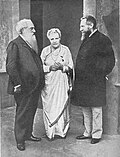
[[File:Olcott Besant Leadbeater.jpg|thumb|Annie Besant with [[Henry Olcott]] (left) and [[Charles Webster Leadbeater|Charles Leadbeater]] (right) in [[Adyar (Chennai)|Adyar]], Madras in December 1905]] | [[File:Olcott Besant Leadbeater.jpg|thumb|upright|Annie Besant with [[Henry Olcott]] (left) and [[Charles Webster Leadbeater|Charles Leadbeater]] (right) in [[Adyar (Chennai)|Adyar]], Madras in December 1905]] | ||
Besant met fellow theosophist [[Charles Webster Leadbeater]] in London in April 1894. They became close co-workers in the theosophical movement and would remain so for the rest of their lives. Leadbeater claimed [[clairvoyance]] and reputedly helped Besant become clairvoyant herself in the following year. In a letter dated 25 August 1895 to Francisca Arundale, Leadbeater narrates how Besant became clairvoyant. Together they clairvoyantly investigated the universe, matter, thought-forms, and the history of mankind, and co-authored a book called ''[[Occult Chemistry]]''. | Besant met fellow theosophist [[Charles Webster Leadbeater]] in London in April 1894. They became close co-workers in the theosophical movement and would remain so for the rest of their lives. Leadbeater claimed [[clairvoyance]] and reputedly helped Besant become clairvoyant herself in the following year. In a letter dated 25 August 1895 to Francisca Arundale, Leadbeater narrates how Besant became clairvoyant. Together they clairvoyantly investigated the universe, matter, thought-forms, and the history of mankind, and co-authored a book called ''[[Occult Chemistry]]''. | ||
| Line 123: | Line 162: | ||
Blavatsky had stated in 1889 that the main purpose of establishing the society was to prepare humanity for the future reception of a "torch-bearer of Truth", an emissary of a hidden [[Spiritual Hierarchy]] that, according to theosophists, guides the evolution of mankind.<ref>[[Helena Blavatsky|Blavatsky, H. P.]] (1889). ''[[The Key to Theosophy]]''. London: The Theosophical Publishing Company. pp. 306–307.</ref> This was repeated by Besant as early as 1896; Besant came to believe in the imminent appearance of the "emissary", who was identified by theosophists as the so-called ''[[World Teacher]]''.<ref>Lutyens, p. 12.</ref><ref>Wessinger, Catherine Lowman (1988). ''Annie Besant and Progressive Messianism, 1847–1933''. [[Lewiston, New York]]: [[Edwin Mellen Press]]. {{ISBN|978-0-88946-523-7}}.</ref> | Blavatsky had stated in 1889 that the main purpose of establishing the society was to prepare humanity for the future reception of a "torch-bearer of Truth", an emissary of a hidden [[Spiritual Hierarchy]] that, according to theosophists, guides the evolution of mankind.<ref>[[Helena Blavatsky|Blavatsky, H. P.]] (1889). ''[[The Key to Theosophy]]''. London: The Theosophical Publishing Company. pp. 306–307.</ref> This was repeated by Besant as early as 1896; Besant came to believe in the imminent appearance of the "emissary", who was identified by theosophists as the so-called ''[[World Teacher]]''.<ref>Lutyens, p. 12.</ref><ref>Wessinger, Catherine Lowman (1988). ''Annie Besant and Progressive Messianism, 1847–1933''. [[Lewiston, New York]]: [[Edwin Mellen Press]]. {{ISBN|978-0-88946-523-7}}.</ref> | ||
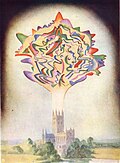
[[File:Music of Gounod - Annie Besant Thought Form - Project Gutenberg eText 16269.jpg| | [[File:Music of Gounod - Annie Besant Thought Form - Project Gutenberg eText 16269.jpg|thumb|upright|[[Thoughtform|Thought-form]] of the music of [[Charles Gounod]], according to Besant and C. W. Leadbeater in ''Thought-Forms '' (1905)]] | ||
==="World Teacher" project=== | ==="World Teacher" project=== | ||
In 1909, soon after Besant's assumption of the presidency, Leadbeater "discovered" fourteen-year-old [[Jiddu Krishnamurti]] (1895–1986), a South Indian boy who had been living, with his father and brother, on the grounds of the headquarters of the Theosophical Society at [[Adyar (Chennai)|Adyar]], and declared him the probable "vehicle" for the expected "[[Maitreya (Theosophy)|World Teacher]]".<ref>[[Mary Lutyens|Lutyens, Mary]] (1975). ''[[Krishnamurti: The Years of Awakening]]''. New York: [[Farrar Straus and Giroux]]. Hardcover. pp. 20–21. {{ISBN|0-374-18222-1}}.</ref> The "discovery" and its objective received widespread publicity and attracted a worldwide following, mainly among theosophists. It also started years of upheaval and contributed to splits in the Theosophical Society and doctrinal schisms in theosophy. Following the discovery, Jiddu Krishnamurti and his younger brother Nityananda ("Nitya") were placed under the care of theosophists and Krishnamurti was extensively groomed for his future mission as the new vehicle for the "World Teacher". Besant soon became the boys' [[legal guardianship|legal guardian]] with the consent of their father, who was very poor and could not take care of them. However, his father later changed his mind and began a legal battle to regain guardianship, against the will of the boys.<ref>Lutyens ch. 7.</ref> Early in their relationship, Krishnamurti and Besant had developed a very close bond and he considered her a surrogate mother – a role she happily accepted. (His biological mother had died when he was ten years old.)<ref>Lutyens p. 5. Also in p. 31, Krishnamurti's letter to Besant dated 24 December 1909, and in p. 62, letter dated 5 January 1913.</ref> | In 1909, soon after Besant's assumption of the presidency, Leadbeater "discovered" fourteen-year-old [[Jiddu Krishnamurti]] (1895–1986), a South Indian boy who had been living, with his father and brother, on the grounds of the headquarters of the Theosophical Society at [[Adyar (Chennai)|Adyar]], and declared him the probable "vehicle" for the expected "[[Maitreya (Theosophy)|World Teacher]]".<ref>[[Mary Lutyens|Lutyens, Mary]] (1975). ''[[Krishnamurti: The Years of Awakening]]''. New York: [[Farrar Straus and Giroux]]. Hardcover. pp. 20–21. {{ISBN|0-374-18222-1}}.</ref> The "discovery" and its objective received widespread publicity and attracted a worldwide following, mainly among theosophists. It also started years of upheaval and contributed to splits in the Theosophical Society and doctrinal schisms in theosophy. Following the discovery, Jiddu Krishnamurti and his younger brother Nityananda ("Nitya") were placed under the care of theosophists and Krishnamurti was extensively groomed for his future mission as the new vehicle for the "World Teacher". Besant soon became the boys' [[legal guardianship|legal guardian]] with the consent of their father, who was very poor and could not take care of them. However, his father later changed his mind and began a legal battle to regain guardianship, against the will of the boys.<ref>Lutyens ch. 7.</ref> Early in their relationship, Krishnamurti and Besant had developed a very close bond and he considered her a surrogate mother – a role she happily accepted. (His biological mother had died when he was ten years old.)<ref>Lutyens p. 5. Also in p. 31, Krishnamurti's letter to Besant dated 24 December 1909, and in p. 62, letter dated 5 January 1913.</ref> | ||
In 1929, twenty years after his "discovery", Krishnamurti, who had grown disenchanted with the ''World Teacher Project'', repudiated the role that many theosophists expected him to fulfil. He dissolved the [[Order of the Star in the East]], an organisation founded to assist the World Teacher in his mission, and eventually left the [[Theosophical Society]] and theosophy at large.<ref>Lutyens pp. 276–278, 285.</ref> He spent the rest of his life travelling the world as an unaffiliated speaker, becoming in the process widely known as an original, independent thinker on philosophical, psychological, and spiritual subjects. His love for Besant never waned, as also was the case with Besant's feelings towards him;<ref>[[Mary Lutyens|Lutyens, Mary]] (2003). ''The Life and Death of Krishnamurti''. [[Bramdean]]: [http://www.kfoundation.org.uk/acatalog/ Krishnamurti Foundation Trust] {{Webarchive|url=https://web.archive.org/web/20170525214520/http://www.kfoundation.org.uk/acatalog/ |date=25 May 2017 }}. p. 81. {{ISBN|0-900506-22-9}}.</ref> concerned for his wellbeing after he declared his independence, she had purchased {{convert|6|acre|ha}} of land near the Theosophical Society estate which later became the headquarters of the | In 1929, twenty years after his "discovery", Krishnamurti, who had grown disenchanted with the ''World Teacher Project'', repudiated the role that many theosophists expected him to fulfil. He dissolved the [[Order of the Star in the East]], an organisation founded to assist the World Teacher in his mission, and eventually left the [[Theosophical Society]] and theosophy at large.<ref>Lutyens pp. 276–278, 285.</ref> He spent the rest of his life travelling the world as an unaffiliated speaker, becoming in the process widely known as an original, independent thinker on philosophical, psychological, and spiritual subjects. His love for Besant never waned, as also was the case with Besant's feelings towards him;<ref>[[Mary Lutyens|Lutyens, Mary]] (2003). ''The Life and Death of Krishnamurti''. [[Bramdean]]: [http://www.kfoundation.org.uk/acatalog/ Krishnamurti Foundation Trust] {{Webarchive|url=https://web.archive.org/web/20170525214520/http://www.kfoundation.org.uk/acatalog/ |date=25 May 2017 }}. p. 81. {{ISBN|0-900506-22-9}}.</ref> concerned for his wellbeing after he declared his independence, she had purchased {{convert|6|acre|ha}} of land near the Theosophical Society estate which later became the headquarters of the Krishnamurti Foundation India. | ||
==Home Rule movement== | ==Home Rule movement== | ||
As early as 1902 Besant had written that "India is not ruled for the prospering of the people, but rather for the profit of her conquerors, and her sons are being treated as a conquered race." She encouraged Indian national consciousness, attacked [[Caste system in India|caste]] and child marriage, and worked effectively for Indian education.<ref name="Rosemary. 2004">{{Cite book |last=Rosemary |first=Dinnage |url=https://archive.org/details/alonealoneliveso00dinn |title=Alone! alone! : lives of some outsider women |date=2004 |publisher=New York Review Books |isbn=1590170695 |location=New York |oclc=54047029}}</ref> Along with her theosophical activities, Besant continued to actively participate in political matters. She had joined the [[Indian National Congress]]. As the name suggested, this was originally a debating body, which met each year to consider resolutions on political issues. Mostly it demanded more of a say for middle-class Indians in [[British India]]n government. It had not yet developed into a permanent mass movement with a local organisation. About this time her co-worker Leadbeater moved to Sydney. | As early as 1902 Besant had written that "India is not ruled for the prospering of the people, but rather for the profit of her conquerors, and her sons are being treated as a conquered race." She encouraged Indian national consciousness, attacked [[Caste system in India|caste]] and child marriage, and worked effectively for Indian education.<ref name="Rosemary. 2004">{{Cite book |last=Rosemary |first=Dinnage |url=https://archive.org/details/alonealoneliveso00dinn |title=Alone! alone! : lives of some outsider women |date=2004 |publisher=New York Review Books |isbn=1590170695 |location=New York |oclc=54047029}}</ref> Along with her theosophical activities, Besant continued to actively participate in political matters. She had joined the [[Indian National Congress]]. As the name suggested, this was originally a debating body, which met each year to consider resolutions on political issues. Mostly it demanded more of a say for middle-class Indians in [[British India]]n government. It had not yet developed into a permanent mass movement with a local organisation. About this time her co-worker Leadbeater moved to Sydney. | ||
In 1914 [[World War I]] broke out, and Britain asked for the support of its Empire in the fight against Germany. Echoing an Irish nationalist slogan, Besant declared, "England's need is India's opportunity". As editor of the ''[[New India (newspaper)|New India]]'' newspaper, she attacked the [[British Raj|colonial government]] of India and called for clear and decisive moves towards self-rule. As with Ireland, the government refused to discuss any changes while the war lasted. | In 1914, [[World War I]] broke out, and Britain asked for the support of its Empire in the fight against [[Germany]]. Echoing an Irish nationalist slogan, Besant declared, "England's need is India's opportunity". As editor of the ''[[New India (newspaper)|New India]]'' newspaper, she attacked the [[British Raj|colonial government]] of India and called for clear and decisive moves towards self-rule. As with Ireland, the government refused to discuss any changes while the war lasted.{{cn|date=December 2022}} | ||
[[File:Annie Besant.001.jpg|thumb|upright|Annie Besant in Sydney, 1922]] | |||
[[File:Annie Besant.001.jpg|thumb|Annie Besant in Sydney, 1922]] | |||
In 1916, Besant launched the [[All India Home Rule League]] along with [[Lokmanya Tilak]], once again modelling demands for India on Irish nationalist practices. This was the first political party in India to have regime change as its main goal. Unlike the Congress itself, the League worked all year round. It built a structure of local branches, enabling it to mobilise demonstrations, public meetings, and agitations. In June 1917, Besant was arrested and interned at a [[hill station]], where she defiantly flew a red and green flag.<ref>{{Cite news |date=3 July 2017 |title=House arrest of Annie Besant remembered |language=en-IN |work=The Hindu |url=https://www.thehindu.com/news/cities/Coimbatore/house-arrest-of-annie-besant-remembered/article19201976.ece |access-date=10 July 2019 |issn=0971-751X}}</ref> The Congress and the [[All-India Muslim League|Muslim League]] together threatened to launch protests if she were not set free; Besant's arrest had created a focus for protest.<ref>{{Cite book |last=Gopal |first=Madan |url=https://archive.org/details/indiathroughages00mada |title=India through the ages |publisher=Publication Division, Ministry of Information and Broadcasting, Government of India |year=1990 |editor=K.S. Gautam |page=[https://archive.org/details/indiathroughages00mada/page/192 192]}}</ref> | In 1916, Besant launched the [[All India Home Rule League]] along with [[Lokmanya Tilak]], once again modelling demands for India on Irish nationalist practices. This was the first political party in India to have regime change as its main goal. Unlike the Congress itself, the League worked all year round. It built a structure of local branches, enabling it to mobilise demonstrations, public meetings, and agitations. In June 1917, Besant was arrested and interned at a [[hill station]], where she defiantly flew a red and green flag.<ref>{{Cite news |date=3 July 2017 |title=House arrest of Annie Besant remembered |language=en-IN |work=The Hindu |url=https://www.thehindu.com/news/cities/Coimbatore/house-arrest-of-annie-besant-remembered/article19201976.ece |access-date=10 July 2019 |issn=0971-751X}}</ref> The Congress and the [[All-India Muslim League|Muslim League]] together threatened to launch protests if she were not set free; Besant's arrest had created a focus for protest.<ref>{{Cite book |last=Gopal |first=Madan |url=https://archive.org/details/indiathroughages00mada |title=India through the ages |publisher=Publication Division, Ministry of Information and Broadcasting, Government of India |year=1990 |editor=K.S. Gautam |page=[https://archive.org/details/indiathroughages00mada/page/192 192]}}</ref> | ||
| Line 147: | Line 185: | ||
Besant tried as a person, theosophist, and president of the Theosophical Society, to accommodate Krishnamurti's views into her life, without success; she vowed to personally follow him in his new direction although she apparently had trouble understanding both his motives and his new message.<ref>Lutyens pp. 236, 278–280.</ref> The two remained friends until the end of her life. | Besant tried as a person, theosophist, and president of the Theosophical Society, to accommodate Krishnamurti's views into her life, without success; she vowed to personally follow him in his new direction although she apparently had trouble understanding both his motives and his new message.<ref>Lutyens pp. 236, 278–280.</ref> The two remained friends until the end of her life. | ||
In 1931 she became ill in India.<ref>{{Cite news |date=6 November 1931 |title=Mrs. Annie Besant, 84, Is Gravely Ill in India. Leader of Theosophists Says Work in This Life Is Done, but Promises to Return |work=[[The New York Times]] |agency=[[Associated Press]] |url=https://www.nytimes.com/1931/11/07/archives/mrs-annie-besant-84-is-gravely-ill-in-india-leader-of-theosophists.html |access-date=14 February 2014 |quote=Mrs. Annie Besant, 84-year-old Theosophist, is so ill, it was learned today, that she is unable to take nourishment.}}</ref> | In 1931, she became ill in India.<ref>{{Cite news |date=6 November 1931 |title=Mrs. Annie Besant, 84, Is Gravely Ill in India. Leader of Theosophists Says Work in This Life Is Done, but Promises to Return |work=[[The New York Times]] |agency=[[Associated Press]] |url=https://www.nytimes.com/1931/11/07/archives/mrs-annie-besant-84-is-gravely-ill-in-india-leader-of-theosophists.html |access-date=14 February 2014 |quote=Mrs. Annie Besant, 84-year-old Theosophist, is so ill, it was learned today, that she is unable to take nourishment.}}</ref> | ||
Besant died on 20 September 1933, at age 85, in Adyar, Madras Presidency, British India. Her body was cremated.<ref>{{Cite news |date=22 September 1933 |title=Annie Besant Cremated. Theosophist Leader's Body Put on Pyre on River Bank in India |work=The New York Times |url=https://www.nytimes.com/1933/09/22/archives/annie-besant-cremated-theosophist-leaders-body-put-on-pyre-on-river.html |access-date=14 February 2014}}</ref><ref name="smh1933">{{Cite news |date=22 September 1933 |title=Dr. Annie Besant |page=12 |work=[[Sydney Morning Herald]] |url=https://news.google.com/newspapers?id=LvVUAAAAIBAJ&pg=7137%2C2455951 |via=[[Google News Archive]]}}</ref> | Besant died on 20 September 1933, at age 85, in [[Adyar, Chennai|Adyar]], Madras Presidency, British India. Her body was [[Cremation|cremated]].<ref>{{Cite news |date=22 September 1933 |title=Annie Besant Cremated. Theosophist Leader's Body Put on Pyre on River Bank in India |work=The New York Times |url=https://www.nytimes.com/1933/09/22/archives/annie-besant-cremated-theosophist-leaders-body-put-on-pyre-on-river.html |access-date=14 February 2014}}</ref><ref name="smh1933">{{Cite news |date=22 September 1933 |title=Dr. Annie Besant |page=12 |work=[[Sydney Morning Herald]] |url=https://news.google.com/newspapers?id=LvVUAAAAIBAJ&pg=7137%2C2455951 |via=[[Google News Archive]]}}</ref> | ||
She was survived by her daughter, [[Mabel Besant-Scott|Mabel]]. After her death, colleagues [[Jiddu Krishnamurti]], [[Aldous Huxley]], Guido Ferrando, and [[Rosalind Rajagopal]], built the Happy Valley School in California, now renamed the [[Besant Hill School of Happy Valley]] in her honour. | She was survived by her daughter, [[Mabel Besant-Scott|Mabel]]. After her death, colleagues [[Jiddu Krishnamurti]], [[Aldous Huxley]], Guido Ferrando, and [[Rosalind Rajagopal]], built the Happy Valley School in California, now renamed the [[Besant Hill School of Happy Valley]] in her honour. | ||
==Works== | ==Works== | ||
| Line 204: | Line 200: | ||
* ''[https://archive.org/details/mypathtoatheism00besarich My Path to Atheism]'' (1878, 3rd ed 1885) | * ''[https://archive.org/details/mypathtoatheism00besarich My Path to Atheism]'' (1878, 3rd ed 1885) | ||
* ''[https://archive.org/stream/MarriageAsItWasAsItIsAndAsItShouldBe/MarriageAsItWasAsItIsAsItShouldBe_Besant_64pgs.070#page/n1/mode/2up Marriage, As It Was, As It Is, And As It Should Be: A Plea for Reform]'' (1878) | * ''[https://archive.org/stream/MarriageAsItWasAsItIsAndAsItShouldBe/MarriageAsItWasAsItIsAsItShouldBe_Besant_64pgs.070#page/n1/mode/2up Marriage, As It Was, As It Is, And As It Should Be: A Plea for Reform]'' (1878) | ||
* ''[https://books.google.com/books?id=jh8HAAAAQAAJ | * ''[https://books.google.com/books?id=jh8HAAAAQAAJ The Atheistic Platform: 12 Lectures]'' One by Besant (1884) | ||
* ''[https://archive.org/details/autobiographica00besagoog <!-- quote=editions:PvHeIZ_NZRcC. --> Autobiographical Sketches]'' (1885) | * ''[https://archive.org/details/autobiographica00besagoog <!-- quote=editions:PvHeIZ_NZRcC. --> Autobiographical Sketches]'' (1885) | ||
* ''[https://archive.org/stream/whyiamsocialist441besa#page/n0/mode/2up Why I Am a Socialist]'' (1886) | * ''[https://archive.org/stream/whyiamsocialist441besa#page/n0/mode/2up Why I Am a Socialist]'' (1886) | ||
| Line 210: | Line 206: | ||
* ''[https://archive.org/details/sevenprinciples02besagoog The Seven Principles of Man]'' (1892) | * ''[https://archive.org/details/sevenprinciples02besagoog The Seven Principles of Man]'' (1892) | ||
* ''[https://archive.org/stream/bhagavadgtorlor00unkngoog#page/n6/mode/2up Bhagavad Gita]'' (translated as ''The Lord's Song'') (1895) | * ''[https://archive.org/stream/bhagavadgtorlor00unkngoog#page/n6/mode/2up Bhagavad Gita]'' (translated as ''The Lord's Song'') (1895) | ||
* '' | * ''Karma'' (1895) | ||
* ''[https://theosophy.world/sites/default/files/ebooks/Annie%20Besant-In-The-Outer-Court.pdf In the Outer Court]''(1895) | * ''[https://theosophy.world/sites/default/files/ebooks/Annie%20Besant-In-The-Outer-Court.pdf In the Outer Court]''(1895) | ||
* ''[[The Ancient Wisdom]]'' (1897) | * ''[[The Ancient Wisdom]]'' (1897) | ||
* ''Dharma'' (1898) | * ''Dharma'' (1898) | ||
* '' | * ''Evolution of Life and Form'' (1898) | ||
* ''Avatâras'' (1900) | |||
* ''[https://archive.org/details/religiousproblem00besa The Religious Problem in India]'' (1901) | * ''[https://archive.org/details/religiousproblem00besa The Religious Problem in India]'' (1901) | ||
* ''[https://archive.org/details/thoughtpowerits00besagoog <!-- quote=Annie Besant Memory and its nature. --> Thought Power: Its Control and Culture]'' (1901) | * ''[https://archive.org/details/thoughtpowerits00besagoog <!-- quote=Annie Besant Memory and its nature. --> Thought Power: Its Control and Culture]'' (1901) | ||
* ''A [[Study in Consciousness]]: A contribution to the science of psychology.'' (1904) | |||
* ''Theosophy and the new psychology: A course of six lectures'' (1904) | |||
* ''[[Thought-Forms (book)|Thought Forms]]'' with [[C. W. Leadbeater]] (1905)<ref name=":02">{{Cite journal |last=Crow |first=John L |date=July–October 2012 |title=Thought Forms: A Bibliographic Error |url=https://d1wqtxts1xzle7.cloudfront.net/49528728/Thought-Forms-A-Bibliographic-Error-with-cover-page-v2.pdf?Expires=1664818964&Signature=LskmX-UZjrOk9l3pTJnGoITdtDJPIge8pYUWzPjsZd4oRolHkER5XIcYDS~dnrTMIlDcdBU24G6If5dwdADvT8AR9hbNV9hli8qYBfjSPXWc5YilKkiOQakt4s4g~pKs5CSdv~dG1LEv6gQTSmxAiVuZ88JRnspAdfz1TuCGJiPUkFchGSH50MaC1dtkUuscVS19lKikNgbUuSEE8pj6IH1B9ezyEBrOdFc8VljTh9ZXsOQnHgti84xxOLb~-pxiMbQMNeojuYXodIVx19bvfEirOlDzKQWTTsOD~o~wwQYUlZ4b8eQBxRgQ9XV6iWUVc0vXUw9E4v3kpbpMbmKnmQ__&Key-Pair-Id=APKAJLOHF5GGSLRBV4ZA |journal=Theosophical History: A Quarterly Journal of Research |volume=16 |issue=3–4 |pages=126–127}}</ref> | |||
* ''[https://archive.org/details/in.ernet.dli.2015.31426 <!-- quote=esoteric Christianity annie besant. --> Esoteric Christianity]'' (1905 2nd ed) | * ''[https://archive.org/details/in.ernet.dli.2015.31426 <!-- quote=esoteric Christianity annie besant. --> Esoteric Christianity]'' (1905 2nd ed) | ||
* '' | * ''Death - and After?'' (1906) | ||
* [[Occult Chemistry (book)|''Occult Chemistry'']] with [[C. W. Leadbeater]] (1908) [http://babel.hathitrust.org/cgi/pt?id=mdp.39015002136920;view=1up;seq=13 Occult chemistry;: clairvoyant observations on the chemical elements] | * [[Occult Chemistry (book)|''Occult Chemistry'']] with [[C. W. Leadbeater]] (1908) [http://babel.hathitrust.org/cgi/pt?id=mdp.39015002136920;view=1up;seq=13 Occult chemistry;: clairvoyant observations on the chemical elements] | ||
* ''An Introduction to Yoga'' (1908) [http://babel.hathitrust.org/cgi/pt?id=uc2.ark:/13960/t07w6bf24#view=1up;seq=7 An introduction to yoga; four lectures delivered at the 32nd anniversary of the Theosophical Society, held at Benares, on Dec. 27th, 28th, 29th, 30th, 1907] | * ''An Introduction to Yoga'' (1908) [http://babel.hathitrust.org/cgi/pt?id=uc2.ark:/13960/t07w6bf24#view=1up;seq=7 An introduction to yoga; four lectures delivered at the 32nd anniversary of the Theosophical Society, held at Benares, on Dec. 27th, 28th, 29th, 30th, 1907] | ||
* ''[https://archive.org/details/australianlectur00besarich Australian Lectures]'' (1908) | * ''[https://archive.org/details/australianlectur00besarich Australian Lectures]'' (1908) | ||
* ''[https://books.google.com/books?id=zRA3AQAAMAAJ | * ''[https://books.google.com/books?id=zRA3AQAAMAAJ Annie Besant: An Autobiography]'' (1908 2nd ed) | ||
* ''The Religious Problem in India'' Lectures on Islam, Jainism, Sikhism, Theosophy (1909) [https://archive.org/details/religiousproblem00besa The religious problem in India: four lectures delivered during the twenty-sixth annual convention of the Theosophical Society at Adyar, Madras, 1901] | * ''The Religious Problem in India'' Lectures on Islam, Jainism, Sikhism, Theosophy (1909) [https://archive.org/details/religiousproblem00besa The religious problem in India: four lectures delivered during the twenty-sixth annual convention of the Theosophical Society at Adyar, Madras, 1901] | ||
* ''Man and His Bodies'' (1896, rpt 1911) [http://www.anandgholap.net/Man_And_His_Bodies-AB.htm Theosophy: Man and His Bodies by Annie Besant] | * ''Man and His Bodies'' (1896, rpt 1911) [http://www.anandgholap.net/Man_And_His_Bodies-AB.htm Theosophy: Man and His Bodies by Annie Besant] | ||
| Line 228: | Line 228: | ||
* ''[[A Study in Karma]]'' (1912) | * ''[[A Study in Karma]]'' (1912) | ||
* ''Initiation: The Perfecting of Man'' (1912) [http://www.anandgholap.net/Initiation_Perfecting_Of_Man-AB.htm Theosophy: Initiation The Perfecting of Man by Annie Besant - MahatmaCWLeadbeater.org] | * ''Initiation: The Perfecting of Man'' (1912) [http://www.anandgholap.net/Initiation_Perfecting_Of_Man-AB.htm Theosophy: Initiation The Perfecting of Man by Annie Besant - MahatmaCWLeadbeater.org] | ||
* ''Giordano Bruno'' (1913) | |||
* ''Man's Life in This and Other Worlds'' (1913) [http://catalog.hathitrust.org/Record/003575728 Man's life in this and other worlds] | * ''Man's Life in This and Other Worlds'' (1913) [http://catalog.hathitrust.org/Record/003575728 Man's life in this and other worlds] | ||
* [[Man: whence, how and whither, a record of clairvoyant investigation|''Man: Whence, How and Whither'']] with [[C. W. Leadbeater]] (1913) [https://web.archive.org/web/20161105170346/http://ebook.lib.hku.hk/CADAL/B31426815/ Man, whence, how and whither: a record of clairvoyant investigation / by Annie Besant and C.W. Leadbeater.] | * [[Man: whence, how and whither, a record of clairvoyant investigation|''Man: Whence, How and Whither'']] with [[C. W. Leadbeater]] (1913) [https://web.archive.org/web/20161105170346/http://ebook.lib.hku.hk/CADAL/B31426815/ Man, whence, how and whither: a record of clairvoyant investigation / by Annie Besant and C.W. Leadbeater.] | ||
| Line 235: | Line 236: | ||
* ''Memory and Its Nature'' (1935) [http://www.anandgholap.net/AP/Memory_And_It's_Nature-AB.htm Memory and Its Nature - by Annie Besant & H.P.Blavatsky - Adyar Pamphlets No. 203 & 204] | * ''Memory and Its Nature'' (1935) [http://www.anandgholap.net/AP/Memory_And_It's_Nature-AB.htm Memory and Its Nature - by Annie Besant & H.P.Blavatsky - Adyar Pamphlets No. 203 & 204] | ||
* Various writings regarding [[Helena Blavatsky]] (1889–1910) [http://blavatskyarchives.com/compitems2.htm#Besant Blavatsky Archives contains 100s of articles on HP Blavatsky & Theosophy] | * Various writings regarding [[Helena Blavatsky]] (1889–1910) [http://blavatskyarchives.com/compitems2.htm#Besant Blavatsky Archives contains 100s of articles on HP Blavatsky & Theosophy] | ||
* Selection of Pamphlets as follows: [https://books.google.com/books?id=8ZYwAQAAMAAJ& | * Selection of Pamphlets as follows: [https://books.google.com/books?id=8ZYwAQAAMAAJ&q=gbs_navlinks_s Pamphlets] | ||
:* "Sin and Crime" (1885) | :* "Sin and Crime" (1885) | ||
:* "God's Views on Marriage" (1890) | :* "God's Views on Marriage" (1890) | ||
| Line 261: | Line 262: | ||
==Recognition in popular media== | ==Recognition in popular media== | ||
On 1 October 2015, search engine Google commemorated Annie Besant with a [[Google Doodle|Doodle]] on her 168th birth anniversary. Google commented: "A fierce advocate of Indian self-rule, Annie Besant loved the language, and over a lifetime of vigorous study cultivated tremendous abilities as a writer and orator. She published mountains of essays, wrote a textbook, curated anthologies of classic literature for young adults and eventually became editor of the New India newspaper, a periodical dedicated to the cause of Indian Autonomy".<ref name="Annie Besant">{{Cite web |date=1 October 2015 |title=Annie Besant's 168th Birthday |url=https://www.google.com/doodles/annie-besants-168th-birthday |access-date=9 April 2019 |website=Google}}</ref> | On 1 October 2015, search engine Google commemorated Annie Besant with a [[Google Doodle|Doodle]] on her 168th birth anniversary. Google commented: "A fierce advocate of Indian self-rule, Annie Besant loved the language, and over a lifetime of vigorous study cultivated tremendous abilities as a writer and orator. She published mountains of essays, wrote a textbook, curated anthologies of classic literature for young adults and eventually became editor of the New India newspaper, a periodical dedicated to the cause of Indian Autonomy".<ref name="Annie Besant">{{Cite web |date=1 October 2015 |title=Annie Besant's 168th Birthday |url=https://www.google.com/doodles/annie-besants-168th-birthday |access-date=9 April 2019 |website=Google}}</ref> | ||
In his book, ''Rebels Against the Raj'', [[Ramachandra Guha|Ramchandra Guha]] tells the story of how Besant and six other foreigners served [[India]] in its quest for independence from the [[British Raj]].<ref>{{Cite web |date=2022-01-20 |title=Ramachandra Guha: I haven't written Rebels Against the Raj to influence Indians on their political preferences-Art-and-culture News , Firstpost |url=https://www.firstpost.com/art-and-culture/ramachandra-guha-i-havent-written-rebels-against-the-raj-to-influence-indians-on-their-political-preferences-10299041.html |access-date=2022-07-12 |website=Firstpost |language=en}}</ref> | |||
==See also== | ==See also== | ||
*[[Agni Yoga]] | *[[Agni Yoga]] | ||
*[[Alice Bailey]] | *[[Alice Bailey]] | ||
* | * Annie Besant School Allahabad | ||
*[[Benjamin Creme]] | *[[Benjamin Creme]] | ||
*[[Helena Roerich]] | *[[Helena Roerich]] | ||
| Line 274: | Line 277: | ||
==References== | ==References== | ||
{{Reflist| | {{Reflist|30em}} | ||
==Further reading== | ==Further reading== | ||
| Line 291: | Line 294: | ||
==External links== | ==External links== | ||
*[http://www.varanasi.org.in/annie-besant Annie Besant] Biography at [http://www.varanasi.org.in varanasi.org.in] | *[http://www.varanasi.org.in/annie-besant Annie Besant] Biography at [http://www.varanasi.org.in varanasi.org.in] | ||
| Line 302: | Line 305: | ||
*[https://www.freemasonryformenandwomen.co.uk/ The British Federation of the International Order of Freemasonry for Men and Women, Le Droit Humain, founded by Annie Besant in 1902] | *[https://www.freemasonryformenandwomen.co.uk/ The British Federation of the International Order of Freemasonry for Men and Women, Le Droit Humain, founded by Annie Besant in 1902] | ||
*[https://ledroithumain.international/?lang=en The International Order of Freemasonry for Men and Women, Le Droit Humain] | *[https://ledroithumain.international/?lang=en The International Order of Freemasonry for Men and Women, Le Droit Humain] | ||
*[https://jobalert360.com/annie-besant-in-odia/ Annie Besant perused 2000 words in the Odia language] | |||
*[http://babel.hathitrust.org/cgi/pt?id=mdp.39076005046201;view=1up;seq=9 Thought power, its control, and culture] Cornell University Library Historical Monographs Collection. | *[http://babel.hathitrust.org/cgi/pt?id=mdp.39076005046201;view=1up;seq=9 Thought power, its control, and culture] Cornell University Library Historical Monographs Collection. | ||
*[[William Thomas Stead]], [http://www.attackingthedevil.co.uk/reviews/besant.php “Character Sketch: October of Mrs. Annie Besant” 349–367 in ''Review of Reviews'' IV:22, October 1891.] | *[[William Thomas Stead]], [http://www.attackingthedevil.co.uk/reviews/besant.php “Character Sketch: October of Mrs. Annie Besant” 349–367 in ''Review of Reviews'' IV:22, October 1891.] | ||
| Line 334: | Line 338: | ||
[[Category:Banaras Hindu University people]] | [[Category:Banaras Hindu University people]] | ||
[[Category:British birth control activists]] | [[Category:British birth control activists]] | ||
[[Category:British women's rights activists]] | |||
[[Category:British reformers]] | [[Category:British reformers]] | ||
[[Category:English activists]] | [[Category:English activists]] | ||
| Line 347: | Line 352: | ||
[[Category:English Theosophists]] | [[Category:English Theosophists]] | ||
[[Category:English women activists]] | [[Category:English women activists]] | ||
[[Category:Esoteric Christianity]] | [[Category:Esoteric Christianity]] | ||
[[Category:Feminism and spirituality]] | [[Category:Feminism and spirituality]] | ||
| Line 355: | Line 359: | ||
[[Category:Founders of Indian schools and colleges]] | [[Category:Founders of Indian schools and colleges]] | ||
[[Category:History of Chennai]] | [[Category:History of Chennai]] | ||
[[Category:Indian philanthropists]] | [[Category:19th-century Indian philanthropists]] | ||
[[Category:Indian women philanthropists]] | [[Category:Indian women philanthropists]] | ||
[[Category:Members of the Fabian Society]] | [[Category:Members of the Fabian Society]] | ||
| Line 371: | Line 375: | ||
[[Category:Women mystics]] | [[Category:Women mystics]] | ||
[[Category:Indian suffragists]] | [[Category:Indian suffragists]] | ||
[[Category: | [[Category:20th-century Indian philanthropists]] | ||
Latest revision as of 07:57, 22 July 2023
 | This article includes a list of references, related reading, or external links, but its sources remain unclear because it lacks inline citations. (December 2022) |
Annie Besant | |
|---|---|
 Annie Besant as a young woman | |
| Born | Annie Wood 1 October 1847 Clapham, London, England |
| Died | 20 September 1933 (aged 85) |
| Known for | Theosophist, women's rights activist, writer and orator |
| Political party | Indian National Congress Social Democratic Federation |
| Movement | Indian independence movement |
| Spouse(s) | Frank Besant
( m. 1867; div. 1873) |
| Children | Arthur, Mabel |
Annie Besant (née Wood; 1 October 1847 – 20 September 1933) was a British socialist, theosophist, freemason, women's rights and Home Rule activist, educationist, and campaigner for Indian nationalism.[1][2] She was an ardent supporter of both Irish and Indian self-rule.[1]
For fifteen years, Besant was a public proponent in England of atheism and scientific materialism. Besant's goal was to provide employment, better living conditions, and proper education for the poor.[3] She became a prominent speaker for the National Secular Society (NSS), as well as a writer, and a close friend of Charles Bradlaugh. In 1877 they were prosecuted for publishing a book by birth control campaigner Charles Knowlton. Thereafter, she became involved with union actions, including the Bloody Sunday demonstration and the London matchgirls strike of 1888. She was a leading speaker for both the Fabian Society and the Marxist Social Democratic Federation (SDF). She was also elected to the London School Board for Tower Hamlets, topping the poll, even though few women were qualified to vote at that time.
In 1890 Besant met Helena Blavatsky, and over the next few years her interest in theosophy grew, whilst her interest in secular matters waned. She became a member of the Theosophical Society and a prominent lecturer on the subject. As part of her theosophy-related work, she travelled to India. In 1898 she helped establish the Central Hindu School, and in 1922 she helped establish the Hyderabad (Sind) National Collegiate Board in Bombay (today's Mumbai), India. In 1902, she established the first overseas Lodge of the International Order of Co-Freemasonry, Le Droit Humain. Over the next few years, she established lodges in many parts of the British Empire. In 1907 she became president of the Theosophical Society, whose international headquarters were, by then, located in Adyar, Madras, (Chennai).
Besant also became involved in politics in India, joining the Indian National Congress.[1] When World War I broke out in 1914, she helped launch the Home Rule League to campaign for democracy in India, and dominion status within the British Empire. This led to her election as president of the Indian National Congress, in late 1917. In the late 1920s, Besant travelled to the United States with her protégé and adopted son Jiddu Krishnamurti, who she claimed was the new Messiah and incarnation of Buddha. Krishnamurti rejected these claims in 1929. After the war, she continued to campaign for Indian independence and for the causes of theosophy, until her death in 1933.
Early life[edit | edit source]
Annie Wood was born on 1 October 1847 in London, the daughter of William Burton Persse Wood (1816–1852) and his wife Emily Roche Morris (died 1874). Her father was English, attended Trinity College Dublin, and attained a medical degree; her mother was an Irish Catholic. Her paternal grandfather Robert Wright Wood was a brother of Sir Matthew Wood, 1st Baronet.[4]
Annie's father died when she was five years old, leaving a son, Henry Trueman Wood, and one daughter. Her mother supported Henry's education at Harrow School, by running a boarding house there. Annie was fostered by Ellen Marryat, sister of the author Frederick Marryat, who ran a school at Charmouth, until age 16. She returned to her mother at Harrow self-confident, aware of a sense of duty to society, and under the influence of the Tractarians.[5] As a young woman, she was also able to travel in Europe.[6][7]
In summer 1867, Annie and her mother stayed at Pendleton near Manchester with the radical solicitor William Prowting Roberts, who questioned Annie's political assumptions.[8][9] In December of that year, at age 20, Annie married the cleric Frank Besant (1840–1917), younger brother of Walter Besant, an evangelical, serious Anglican.[5]
Failure of the marriage[edit | edit source]
The Rev. Frank Besant was a graduate of Emmanuel College, Cambridge, ordained priest in 1866, but had no living: in 1866 he was teaching at Stockwell Grammar School as second master, and in 1867 he moved to teach at Cheltenham College as assistant master.[10][11] In 1872, he became vicar of Sibsey in Lincolnshire, a benefice in the gift of the Lord Chancellor—who was Lord Hatherley, a Wood family connection, son of Sir Matthew Wood, 1st Baronet.[5] The Besant family, with their two children, Arthur and Mabel, moved to Sibsey, but the marriage was already under strain. As Annie wrote in her Autobiography, "we were an ill-matched pair".[12]

Money was short and Frank Besant was parsimonious. Annie was sure a third child would impose too much on the family finances.[5] She wrote short stories, books for children, and articles, the money she earned being controlled by her husband.
Besant began to question her own faith, after her daughter Mabel was seriously ill in 1871.[5] She consulted Edward Bouverie Pusey: by post he gave her advice along orthodox, Bampton Lecture lines, and in person he sharply reprimanded her unorthodox theological tendencies.[13] She attended in London, with her mother, a service at St George's Hall given by the heterodox cleric Charles Voysey, in autumn 1871, and struck up an acquaintance with the Voyseys, reading in "theistic" authors such as Theodore Parker and Francis Newman on Voysey's recommendation.[14] Voysey also introduced Besant to the freethinker and publisher Thomas Scott. Encouraged by Scott, Besant wrote an anonymous pamphlet On the Deity of Jesus of Nazareth, by "the wife of a beneficed clergyman", which appeared in 1872.[5] Ellen Dana Conway, wife of Moncure Conway befriended Annie at this time.[15]
The Besants made an effort to repair the marriage. The tension came to a head when Annie refused to attend Communion, which Frank demanded, now fearing for his own reputation and position in the Church.[5] In 1873 she left him and went to London. She had a temporary place to stay, with Moncure Conway.[16] The Scotts found her a small house in Colby Road, Upper Norwood.[17]
The couple were legally separated and Annie took her daughter Mabel with her, the agreement of 25 October 1873 giving her custody. Annie remained Mrs. Besant for the rest of her life. At first, she was able to keep contact with both children and to have Mabel live with her; she also got a small allowance from her husband. In 1878 Frank Besant successfully argued her unfitness, after Annie's public campaigning on contraception, and had custody from then of both children. Later, Annie was reconciled with her son and daughter.[5] Her son Arthur Digby Besant (1869–1960) was President of the Institute of Actuaries, 1924–26, and wrote The Besant Pedigree (1930).[18] Initially in London, Annie attempted to support her daughter, her mother (who died the following year) and herself with needlework.[16]

Reformer and secularist[edit | edit source]
Besant began in 1874 to write for the National Reformer, the organ of the National Secular Society (NSS), run by Charles Bradlaugh.[16] She also continued to write for Thomas Scott's small press.[5] On the account given by W. T. Stead, Besant had encountered the National Reformer on sale in the shop of Edward Truelove.[19] Besant had heard of Bradlaugh from Moncure Conway.[16] She wrote to Bradlaugh and was accepted as an NSS member. She first heard him speak on 2 August 1874.[19] Through Bradlaugh, Besant met and became a supporter of Joseph Arch, the farmworkers' leader.[20]
Her career as a platform speaker began on 25 August 1874, with topic "The Political Status of Women".[16] The lecture was at the Co-operative Hall, Castle Street, Long Acre in west central London.[21] It was followed by an invitation to speak in September, by Moncure Conway, at his Camden Town church, on "The True Basis of Morality", in September 1874, in his Camden Town church.[22] Besant published an essay under this title, in 1882.[23] She was a prolific writer and a powerful orator.[24] She addressed causes including freedom of thought, women's rights, secularism, birth control, Fabian socialism and workers' rights. Margaret Cole called her "the finest woman orator and organiser of her day".[25]
Criticism of Christianity[edit | edit source]
| Author | Annie Besant |
|---|---|
| Series | The freethinker's text-book |
| Preceded by | Part I. by Charles Bradlaugh[26] |
Besant opined that for centuries the leaders of Christian thought spoke of women as a necessary evil and that the greatest saints of the Church were those who despised women the most, "Against the teachings of eternal torture, of the vicarious atonement, of the infallibility of the Bible, I leveled all the strength of my brain and tongue, and I exposed the history of the Christian Church with unsparing hand, its persecutions, its religious wars, its cruelties, its oppressions. (Annie Besant, An Autobiography Chapter VII)." In the section named "Its Evidences Unreliable" of her work "Christianity", Besant presents the case of why the Gospels are not authentic: "before about A.D. 180 there is no trace of FOUR gospels among the Christians."[27]
The Fruits of Philosophy[edit | edit source]
Besant and Bradlaugh set up the Freethought Publishing Company at the beginning of 1877;[5] it followed the 1876 prosecution of Charles Watts, and they carried on his work.[28] They became household names later that year, when they published Fruits of Philosophy, a book by the American birth-control campaigner Charles Knowlton. It claimed that working-class families could never be happy until they were able to decide how many children they wanted. It also suggested ways to limit the size of their families.[29] The Knowlton book was highly controversial and was vigorously opposed by the Church. Besant and Bradlaugh proclaimed in the National Reformer:
We intend to publish nothing we do not think we can morally defend. All that we publish we shall defend.[30]
The pair were arrested and put on trial for publishing the Knowlton book. They were found guilty but released pending appeal. The trial became a cause célèbre, and ultimately the verdict was overturned on a technical legal point.[31]
Besant was then instrumental in founding the Malthusian League, reviving a name coined earlier by Bradlaugh. It would go on to advocate for the abolition of penalties for the promotion of contraception.[32] Besant and Bradlaugh supported the Malthusian League for some 12 years. They were concerned with birth control, but were not neo-Malthusians in the sense of convinced believers in the tradition of Thomas Malthus and his demographic theories.[33] Besant did advocate population control as an antidote to the struggle for survival.[34] She became the secretary of the League, with Charles Robert Drysdale as President.[35] In time the League veered towards eugenics, and it was from the outset an individualist organisation, also for many members supportive of a social conservatism that was not Besant's view.[36] Her pamphlet The Law of Population (1878) sold well.[5]
Radical causes[edit | edit source]
Besant was a leading member of the National Secular Society alongside Charles Bradlaugh.[37] She attacked the status of the Church of England as established church. The NSS argued for a secular state and an end to the special status of Christianity and allowed her to act as one of its public speakers. On 6 March 1881 she spoke at the opening of Leicester Secular Society's new Secular Hall in Humberstone Gate, Leicester. The other speakers were George Jacob Holyoake, Harriet Law and Bradlaugh.[38]
Bradlaugh was elected to Parliament in 1881. Because of his atheism, he asked to be allowed to affirm, rather than swear the oath of loyalty. It took more than six years before the matter was completely resolved, in Bradlaugh's favour, after a series of by-elections and court appearances. He was an individualist and opposed to socialism in any form. While he defended free speech, he was very cautious about encouraging working-class militancy.[39][40]
Edward Aveling, a rising star in the National Secular Society, tutored Besant during 1879, and she went on to a degree course at London University.[5][41] Then, 1879 to 1882, she was a student of physical sciences at Birkbeck Literary and Scientific Institution. Embarrassed by her activist reputation, the Institution omitted her name from the published list of graduands, and mailed her certificates to her.[42] When Aveling in a speech in 1884 announced he had become a socialist after five years close study, Besant argued that his politics over that whole period had been aligned with Bradlaugh's and her own.[43] Aveling and Eleanor Marx joined the Social Democratic Federation, followers of Marxism, and then the Socialist League, a small Marxist splinter group which formed around the artist William Morris. In 1883 Besant started her own periodical, Our Corner.[44] It was a literary and in time a socialist monthly, and published George Bernard Shaw's novel The Irrational Knot in serial form.[45]
Meanwhile, Besant built close contacts with the Irish Home Rulers and supported them in her newspaper columns during what are considered crucial years, when the Irish nationalists were forming an alliance with Liberals and Radicals. Besant met the leaders of the Irish home rule movement. In particular, she got to know Michael Davitt, who wanted to mobilise the Irish peasantry through a Land War, a direct struggle against the landowners. She spoke and wrote in favour of Davitt and his Land League many times over the coming decades.
Personal life[edit | edit source]
Bradlaugh's family circumstances changed in May 1877 with the death of his wife Susannah, an alcoholic who had left him for James Thomson. His two children, Alice then aged 21, and Hypatia then 19, returned to live with him from his in-laws. He had been able to take a house in St John's Wood in February of that year, at 20 Circus Road, near Besant. They continued what had become a close friendship.[46]
Fabian Society 1885–1890[edit | edit source]
Besant made an abrupt public change in her political views, at the 1885 New Year's Day meeting of the London Dialectical Society, founded by Joseph Hiam Levy to promote individualist views.[47][48] It followed a noted public debate at St. James's Hall on 17 April 1884, on Will Socialism Benefit the English People?, in which Bradlaugh had put individualist views, against the Marxist line of Henry Hyndman.[49] On that occasion Besant still supported Bradlaugh. While Bradlaugh may have had the better of the debate, followers then began to migrate into left-wing politics.[47][50] George Bernard Shaw was the speaker on 1 January 1885, talking on socialism, but, instead of the expected criticism from Besant, he saw her opposing his opponent. Shaw then sponsored Besant to join the Fabian Society.[47]
The Fabians were defining political goals, rejecting anarchism in 1886, and forming the Fabian Parliamentary League, with both Besant and Shaw on its Council which promoted political candidacy.[51] Unemployment was a central issue of the time, and in 1887 some of the London unemployed started to hold protests in Trafalgar Square. Besant agreed to appear as a speaker at a meeting on 13 November. The police tried to stop the assembly, fighting broke out, and troops were called. Many were hurt, one man died, and hundreds were arrested; Besant offered herself for arrest, an offer disregarded by the police.[52] The events became known as Bloody Sunday. Besant threw herself into organising legal aid for the jailed workers and support for their families.[53] In its aftermath the Law and Liberty League, defending freedom of expression, was formed by Besant and others, and Besant became editor of The Link, its journal.[5]
Besant's involvement in the London matchgirls strike of 1888 came after a Fabian Society talk that year on female labour by Clementina Black. Besant wrote in The Link about conditions at the Bryant & May match factory. She was drawn further into this battle of the "New Unionism" by a young socialist, Herbert Burrows, who had made contact with workers at the factory, in Bow. They were mainly young women, were very poorly paid, and subject to occupational disease, such as Phossy jaw caused by the chemicals used in match manufacture.[54][55] Louise Raw in Striking a Light (2011) has, however, contested the historiography of the strike, stating that "A proper examination of the primary evidence about the strike makes it impossible to continue to believe that Annie Besant led it."[56]
William Morris played some part in converting Besant to Marxism, but it was to the Social Democratic Federation of Hyndman, not his Socialist League, that she turned in 1888. She remained a member for a number of years and became one of its leading speakers. She was still a member of the Fabian Society, the two movements being compatible at the time. Besant was elected to the London School Board in 1888.[57] Women at that time were not able to take part in parliamentary politics but had been brought into the London local electorate in 1881. Besant drove about with a red ribbon in her hair, speaking at meetings. "No more hungry children", her manifesto proclaimed. She combined her socialist principles with feminism:
"I ask the electors to vote for me, and the non-electors to work for me because women are wanted on the Board and there are too few women candidates."
From the early 1880s Besant had also been an important feminist leader in London, with Alice Vickery, Ellen Dana Moncure and Millicent Fawcett. This group, at the South Place Ethical Society, had a national standing.[58] She frequented the home of Richard and Emmeline Pankhurst on Russell Square, and Emmeline had participated in the matchgirl organisation.[59][60] Besant came out on top of the poll in Tower Hamlets, with over 15,000 votes. She wrote in the National Reformer:
"Ten years ago, under a cruel law, Christian bigotry robbed me of my little child. Now the care of the 763,680 children of London is placed partly in my hands."[61]
Financial constraints meant that Besant closed down both Our Corner and The Link at the end of 1888.[62]
Besant was further involved in the London dock strike of 1889. The dockers, casual workers who were employed by the day, were led by Ben Tillett in a struggle for the "Dockers' Tanner". Besant helped Tillett draw up the union's rules and played an important part in the meetings and agitation which built up the organisation. She spoke for the dockers at public meetings and on street corners. Like the match-girls, the dockers won public support for their struggle, and the strike was won.[63]
Theosophy[edit | edit source]
,_c._1910.jpg)
In 1889, Besant was asked to write a review for the Pall Mall Gazette[64] on The Secret Doctrine, a book by H. P. Blavatsky. After reading it, she sought an interview with its author, meeting Blavatsky in Paris. In this way, she was converted to Theosophy. She allowed her membership of the Fabian Society to lapse (1890) and broke her links with the Marxists.[65]
In her Autobiography, Besant follows her chapter on "Socialism" with "Through Storm to Peace", the peace of Theosophy. In 1888, she described herself as "marching toward the Theosophy" that would be the "glory" of her life. Besant had found the economic side of life lacking a spiritual dimension, so she searched for a belief based on "Love". She found this in Theosophy, so she joined the Theosophical Society, a move that distanced her from Bradlaugh and other former activist co-workers.[66] When Blavatsky died in 1891, Besant was left as one of the leading figures in theosophy and in 1893 she represented it at the Chicago World Fair.[67]
In 1893, soon after becoming a member of the Theosophical Society, she went to India for the first time.[68] After a dispute the American section split away into an independent organisation. The original society, then led by Henry Steel Olcott and Besant, is today based in Chennai, India, and is known as the Theosophical Society Adyar. Following the split, Besant devoted much of her energy not only to the society but also to India's freedom and progress. Besant Nagar, a neighbourhood near the Theosophical Society in Chennai, is named in her honour.[69]
In 1893, she was a representative of The Theosophical Society at the World Parliament of Religions in Chicago. The World Parliament is famous in India because Indian monk Swami Vivekananda addressed the same event.
In 1895, together with the founder-president of the Theosophical Society, Henry Steel Olcott, as well as Marie Musaeus Higgins and Peter De Abrew, she was instrumental in developing the Buddhist school, Musaeus College, in Colombo on the island of Sri Lanka.


Co-freemasonry[edit | edit source]
Besant saw freemasonry, in particular Co-Freemasonry, as an extension of her interest in the rights of women and the greater brotherhood of man and saw co-freemasonry as a "movement which practised true brotherhood, in which women and men worked side by side for the perfecting of humanity. She immediately wanted to be admitted to this organisation", known now as the International Order of Freemasonry for Men and Women, "Le Droit Humain".
The link was made in 1902 by the theosophist Francesca Arundale, who accompanied Besant to Paris, along with six friends. "They were all initiated, passed, and raised into the first three degrees and Annie returned to England, bearing a Charter and founded there the first Lodge of International Mixed Masonry, Le Droit Humain." Besant eventually became the Order's Most Puissant Grand Commander and was a major influence in the international growth of the Order.[70]
President of Theosophical Society[edit | edit source]

Besant met fellow theosophist Charles Webster Leadbeater in London in April 1894. They became close co-workers in the theosophical movement and would remain so for the rest of their lives. Leadbeater claimed clairvoyance and reputedly helped Besant become clairvoyant herself in the following year. In a letter dated 25 August 1895 to Francisca Arundale, Leadbeater narrates how Besant became clairvoyant. Together they clairvoyantly investigated the universe, matter, thought-forms, and the history of mankind, and co-authored a book called Occult Chemistry.
In 1906 Leadbeater became the centre of controversy when it emerged that he had advised the practice of masturbation to some boys under his care and spiritual instruction. Leadbeater stated he had encouraged the practice to keep the boys celibate, which was considered a prerequisite for advancement on the spiritual path.[71] Because of the controversy, he offered to resign from the Theosophical Society in 1906, which was accepted. The next year Besant became president of the society and in 1908, with her express support, Leadbeater was readmitted to the society. Leadbeater went on to face accusations of improper relations with boys, but none of the accusations were ever proven and Besant never deserted him.[72]
Until Besant's presidency, the society had as one of its foci Theravada Buddhism and the island of Sri Lanka, where Henry Olcott did the majority of his useful work.[73] Under Besant's leadership there was more stress on the teachings of "The Aryavarta", as she called central India, as well as on esoteric Christianity.[74]
Besant set up a new school for boys, the Central Hindu College (CHC) at Banaras which was formed on underlying theosophical principles, and which counted many prominent theosophists in its staff and faculty. Its aim was to build a new leadership for India. The students spent 90 minutes a day in prayer and studied religious texts, but they also studied modern science. It took 3 years to raise the money for the CHC, most of which came from Indian princes.[75] In April 1911, Besant met Pandit Madan Mohan Malaviya and they decided to unite their forces and work for a common Hindu University at Banaras. Besant and fellow trustees of the Central Hindu College also agreed to the Government of India's precondition that the college should become a part of the new University. The Banaras Hindu University started functioning from 1 October 1917 with the Central Hindu College as its first constituent college.
Blavatsky had stated in 1889 that the main purpose of establishing the society was to prepare humanity for the future reception of a "torch-bearer of Truth", an emissary of a hidden Spiritual Hierarchy that, according to theosophists, guides the evolution of mankind.[76] This was repeated by Besant as early as 1896; Besant came to believe in the imminent appearance of the "emissary", who was identified by theosophists as the so-called World Teacher.[77][78]

"World Teacher" project[edit | edit source]
In 1909, soon after Besant's assumption of the presidency, Leadbeater "discovered" fourteen-year-old Jiddu Krishnamurti (1895–1986), a South Indian boy who had been living, with his father and brother, on the grounds of the headquarters of the Theosophical Society at Adyar, and declared him the probable "vehicle" for the expected "World Teacher".[79] The "discovery" and its objective received widespread publicity and attracted a worldwide following, mainly among theosophists. It also started years of upheaval and contributed to splits in the Theosophical Society and doctrinal schisms in theosophy. Following the discovery, Jiddu Krishnamurti and his younger brother Nityananda ("Nitya") were placed under the care of theosophists and Krishnamurti was extensively groomed for his future mission as the new vehicle for the "World Teacher". Besant soon became the boys' legal guardian with the consent of their father, who was very poor and could not take care of them. However, his father later changed his mind and began a legal battle to regain guardianship, against the will of the boys.[80] Early in their relationship, Krishnamurti and Besant had developed a very close bond and he considered her a surrogate mother – a role she happily accepted. (His biological mother had died when he was ten years old.)[81]
In 1929, twenty years after his "discovery", Krishnamurti, who had grown disenchanted with the World Teacher Project, repudiated the role that many theosophists expected him to fulfil. He dissolved the Order of the Star in the East, an organisation founded to assist the World Teacher in his mission, and eventually left the Theosophical Society and theosophy at large.[82] He spent the rest of his life travelling the world as an unaffiliated speaker, becoming in the process widely known as an original, independent thinker on philosophical, psychological, and spiritual subjects. His love for Besant never waned, as also was the case with Besant's feelings towards him;[83] concerned for his wellbeing after he declared his independence, she had purchased 6 acres (2.4 ha) of land near the Theosophical Society estate which later became the headquarters of the Krishnamurti Foundation India.
Home Rule movement[edit | edit source]
As early as 1902 Besant had written that "India is not ruled for the prospering of the people, but rather for the profit of her conquerors, and her sons are being treated as a conquered race." She encouraged Indian national consciousness, attacked caste and child marriage, and worked effectively for Indian education.[84] Along with her theosophical activities, Besant continued to actively participate in political matters. She had joined the Indian National Congress. As the name suggested, this was originally a debating body, which met each year to consider resolutions on political issues. Mostly it demanded more of a say for middle-class Indians in British Indian government. It had not yet developed into a permanent mass movement with a local organisation. About this time her co-worker Leadbeater moved to Sydney.
In 1914, World War I broke out, and Britain asked for the support of its Empire in the fight against Germany. Echoing an Irish nationalist slogan, Besant declared, "England's need is India's opportunity". As editor of the New India newspaper, she attacked the colonial government of India and called for clear and decisive moves towards self-rule. As with Ireland, the government refused to discuss any changes while the war lasted.[citation needed]

In 1916, Besant launched the All India Home Rule League along with Lokmanya Tilak, once again modelling demands for India on Irish nationalist practices. This was the first political party in India to have regime change as its main goal. Unlike the Congress itself, the League worked all year round. It built a structure of local branches, enabling it to mobilise demonstrations, public meetings, and agitations. In June 1917, Besant was arrested and interned at a hill station, where she defiantly flew a red and green flag.[85] The Congress and the Muslim League together threatened to launch protests if she were not set free; Besant's arrest had created a focus for protest.[86]
The government was forced to give way and to make vague but significant concessions. It was announced that the ultimate aim of British rule was Indian self-government, and moves in that direction were promised. Besant was freed in September 1917, welcomed by crowds all over India,[87][88] and in December she took over as president of the Indian National Congress for a year. Both Jawaharlal Nehru and Mahatma Gandhi spoke of Besant's influence with admiration.[84]
After the war, a new leadership of the Indian National Congress emerged around Mahatma Gandhi – one of those who had written to demand Besant's release. He was a lawyer who had returned from leading Asians in a peaceful struggle against racism in South Africa. Jawaharlal Nehru, Gandhi's closest collaborator, had been educated by a theosophist tutor.
The new leadership was committed to action that was both militant and non-violent, but there were differences between them and Besant. Despite her past, she was not happy with their socialist leanings. Until the end of her life, however, she continued to campaign for India's independence, not only in India but also on speaking tours of Britain.[89] In her own version of Indian dress, she remained a striking presence on speakers' platforms. She produced a torrent of letters and articles demanding independence.
Later years and death[edit | edit source]
Besant tried as a person, theosophist, and president of the Theosophical Society, to accommodate Krishnamurti's views into her life, without success; she vowed to personally follow him in his new direction although she apparently had trouble understanding both his motives and his new message.[90] The two remained friends until the end of her life.
In 1931, she became ill in India.[91]
Besant died on 20 September 1933, at age 85, in Adyar, Madras Presidency, British India. Her body was cremated.[92][93]
She was survived by her daughter, Mabel. After her death, colleagues Jiddu Krishnamurti, Aldous Huxley, Guido Ferrando, and Rosalind Rajagopal, built the Happy Valley School in California, now renamed the Besant Hill School of Happy Valley in her honour.
Works[edit | edit source]
Besides being a prolific writer, Besant was a "practised stump orator" who gave sixty-six public lectures in one year. She also engaged in public debates.[24]
List of Works on Online Books Annie Besant (Besant, Annie, 1847-1933) | The Online Books Page
List of Work on Open Library Annie Wood Besant
- The Political Status of Women (1874)[94]
- Christianity: Its Evidences, Its Origin, Its Morality, Its History (1876)
- The Law of Population (1877)
- My Path to Atheism (1878, 3rd ed 1885)
- Marriage, As It Was, As It Is, And As It Should Be: A Plea for Reform (1878)
- The Atheistic Platform: 12 Lectures One by Besant (1884)
- Autobiographical Sketches (1885)
- Why I Am a Socialist (1886)
- Why I Became a Theosophist (1889)
- The Seven Principles of Man (1892)
- Bhagavad Gita (translated as The Lord's Song) (1895)
- Karma (1895)
- In the Outer Court(1895)
- The Ancient Wisdom (1897)
- Dharma (1898)
- Evolution of Life and Form (1898)
- Avatâras (1900)
- The Religious Problem in India (1901)
- Thought Power: Its Control and Culture (1901)
- A Study in Consciousness: A contribution to the science of psychology. (1904)
- Theosophy and the new psychology: A course of six lectures (1904)
- Thought Forms with C. W. Leadbeater (1905)[95]
- Esoteric Christianity (1905 2nd ed)
- Death - and After? (1906)
- Occult Chemistry with C. W. Leadbeater (1908) Occult chemistry;: clairvoyant observations on the chemical elements
- An Introduction to Yoga (1908) An introduction to yoga; four lectures delivered at the 32nd anniversary of the Theosophical Society, held at Benares, on Dec. 27th, 28th, 29th, 30th, 1907
- Australian Lectures (1908)
- Annie Besant: An Autobiography (1908 2nd ed)
- The Religious Problem in India Lectures on Islam, Jainism, Sikhism, Theosophy (1909) The religious problem in India: four lectures delivered during the twenty-sixth annual convention of the Theosophical Society at Adyar, Madras, 1901
- Man and His Bodies (1896, rpt 1911) Theosophy: Man and His Bodies by Annie Besant
- Elementary Lessons on Karma (1912)
- A Study in Karma (1912)
- Initiation: The Perfecting of Man (1912) Theosophy: Initiation The Perfecting of Man by Annie Besant - MahatmaCWLeadbeater.org
- Giordano Bruno (1913)
- Man's Life in This and Other Worlds (1913) Man's life in this and other worlds
- Man: Whence, How and Whither with C. W. Leadbeater (1913) Man, whence, how and whither: a record of clairvoyant investigation / by Annie Besant and C.W. Leadbeater.
- The Doctrine of the Heart (1920) Theosophy: Doctrine of the Heart by Annie Besant
- The Future of Indian Politics 1922
- The Life and Teaching of Muhammad (1932) Annie Besant The Life And Teachings Of Muhammad ( The Prophet Of Islam)
- Memory and Its Nature (1935) Memory and Its Nature - by Annie Besant & H.P.Blavatsky - Adyar Pamphlets No. 203 & 204
- Various writings regarding Helena Blavatsky (1889–1910) Blavatsky Archives contains 100s of articles on HP Blavatsky & Theosophy
- Selection of Pamphlets as follows: Pamphlets
- "Sin and Crime" (1885)
- "God's Views on Marriage" (1890)
- "A World Without God" (1885)
- "Life, Death, and Immortality" (1886)
- "Theosophy" (1925?)
- "The World and Its God" (1886)
- "Atheism and Its Bearing on Morals" (1887)
- "On Eternal Torture" (n.d.)
- "The Fruits of Christianity" (n.d.)
- "The Jesus of the Gospels and the Influence of Christianity" (n.d.)
- "The Gospel of Christianity and the Gospel of Freethought" (1883)
- "Sins of the Church: Threatenings and Slaughters" (n.d.)
- "For the Crown and Against the Nation" (1886)
- "Christian Progress" (1890)
- "Why I Do Not Believe in God" (1887)
- "The Myth of the Resurrection" (1886)
- "The Teachings of Christianity" (1887)
Indian National Movement
Recognition in popular media[edit | edit source]
On 1 October 2015, search engine Google commemorated Annie Besant with a Doodle on her 168th birth anniversary. Google commented: "A fierce advocate of Indian self-rule, Annie Besant loved the language, and over a lifetime of vigorous study cultivated tremendous abilities as a writer and orator. She published mountains of essays, wrote a textbook, curated anthologies of classic literature for young adults and eventually became editor of the New India newspaper, a periodical dedicated to the cause of Indian Autonomy".[97]
In his book, Rebels Against the Raj, Ramchandra Guha tells the story of how Besant and six other foreigners served India in its quest for independence from the British Raj.[98]
See also[edit | edit source]
- Agni Yoga
- Alice Bailey
- Annie Besant School Allahabad
- Benjamin Creme
- Helena Roerich
- History of feminism
- Order of the Star in the East
- Theosophy and Christianity
- Theosophy and visual arts
References[edit | edit source]
- ↑ 1.0 1.1 1.2 "BBC - History - Annie Besant". www.bbc.co.uk. Retrieved 16 January 2023.
- ↑ "Annie Besant, Making Britain". www.open.ac.uk. Retrieved 16 January 2023.
- ↑ "Besant, Annie: Theosophy World". theosophy.world. Retrieved 11 October 2021.
- ↑ Besant, Arthur Digby (1930). The Besant Pedigree. London: Besant & Co. p. 455.
- ↑ 5.00 5.01 5.02 5.03 5.04 5.05 5.06 5.07 5.08 5.09 5.10 5.11 5.12 Taylor, Anne. "Besant, Annie (1847–1933)". Oxford Dictionary of National Biography (online ed.). Oxford University Press. doi:10.1093/ref:odnb/30735. Template:ODNBsub
- ↑ The Victorian Church, Part Two: 1860-1901. Wipf and Stock Publishers. April 2010. ISBN 9781608992621.
- ↑ The Anthem Companion to Auguste Comte. Anthem Press. 15 May 2017. ISBN 9780857281944.
- ↑ Besant, Annie Wood (1893). Annie Besant : an autobiography. London : T. Fisher Unwin. pp. 71–72.
- ↑ Leat, Diana (1975). "The Rise and Rôle of the Poor Man's Lawyer". British Journal of Law and Society. 2 (2): 168. doi:10.2307/1409644. ISSN 0306-3704. JSTOR 1409644.
- ↑ "Besant, Frank (BSNT859F)". A Cambridge Alumni Database. University of Cambridge.
- ↑ Crockford's Clerical Directory for 1868. BoD – Books on Demand. 6 June 2022. p. 54. ISBN 978-3-375-04550-0.
- ↑ Besant, Annie Wood (1893). Annie Besant : an autobiography. London: T. Fisher Unwin. p. 81.
- ↑ Besant, Annie Wood (1893). Annie Besant : an autobiography. London : T. Fisher Unwin. pp. 109–112.
- ↑ Besant, Annie Wood (1893). Annie Besant : an autobiography. London: T. Fisher Unwin. pp. 106–107.
- ↑ Goolrick, John Tackett (1922). Historic Fredericksburg; the story of an old town. Richmond, Va., Printed by Whittet & Shepperson. p. 100.
- ↑ 16.0 16.1 16.2 16.3 16.4 MacKenzie, Norman Ian; MacKenzie, Jeanne (1979). The First Fabians. London: Quartet Books. p. 47. ISBN 0704332515.
- ↑ Besant, Annie Wood (1893). Annie Besant : an autobiography. London: T. Fisher Unwin. p. 120.
- ↑ "Besant, Besant, Arthur Digby". Who's Who. A & C Black, an imprint of Bloomsbury Publishing plc.
{{cite book}}:|website=ignored (help) (subscription or UK public library membership required) - ↑ 19.0 19.1 Stead, William Thomas (1891). Mrs. Annie Besant. p. 360.
- ↑ Arch, Joseph; Warwick, Frances Evelyn Maynard Greville (1898). Joseph Arch. The story of his life. London: Hutchinson. p. 124.
- ↑ – via Wikisource.
- ↑ Pécastaing-Boissière, Muriel (2017). "Annie Besant (1847-1933): Struggles and Quest". Theosophical Publishing House Limited. p. 79.
- ↑ Cobbe, Frances Power (2022). Frances Power Cobbe: Essential Writings of a Nineteenth-Century Feminist Philosopher. Oxford University Press. p. 34. ISBN 978-0-19-762822-5.
- ↑ 24.0 24.1 Mark Bevir, The Making of British Socialism (Princeton University, 2011), 202.
- ↑ Cole, Margaret (1961). The Story of Fabian Socialism. University Press. p. 8.
- ↑ Bradlaugh, Charles; Besant, Annie; Watts, Charles (1876). The freethinker's text-book. Part I. C. Watts, National Secular Society.
Part I., section I. & II. by Charles Bradlaugh
(Image of Book cover at Google Books) - ↑ 1876: "Christianity", The freethinker's text-book, Part II. (Issued by authority of the National Secular Society)
- ↑ Brake, Laurel; Demoor, Marysa (2009). Dictionary of Nineteenth-century Journalism in Great Britain and Ireland. Academia Press. p. 72. ISBN 978-90-382-1340-8.
- ↑ Knowlton, Charles (October 1891) [1840]. Besant, Annie; Bradlaugh, Charles (eds.). Fruits of philosophy: a treatise on the population question. San Francisco: Reader's Library. OCLC 626706770. A publication about birth control. View original copy.
- ↑ Besant, Annie (1885). Autobiographical sketches. Freethought Publishing. p. 116. OL 26315876M.
- ↑ Lazarus, Joyce B. (26 July 2022). Ernestine L. Rose: To Change a Nation. Rowman & Littlefield. p. 117. ISBN 978-0-7618-7343-3.
- ↑ D'arcy, F. (November 1977). "The Malthusian League and resistance to birth control propaganda in late Victorian Britain". Population Studies. 31 (3): 429–448. doi:10.1080/00324728.1977.10412759. JSTOR 2173367. PMID 11630505.
- ↑ Ledbetter, Rosanna (1976). A history of the Malthusian League, 1877-1927. Columbus : Ohio State University. pp. 18–19. ISBN 978-0-8142-0257-9.
{{cite book}}: CS1 maint: publisher location (link) - ↑ Ledbetter, Rosanna (1976). A history of the Malthusian League, 1877-1927. Columbus : Ohio State University. pp. 44–45. ISBN 978-0-8142-0257-9.
{{cite book}}: CS1 maint: publisher location (link) - ↑ Dolan, Brian (2000). Malthus, Medicine & Morality: Malthusianism After 1798. Rodopi. p. 146. ISBN 978-90-420-0851-9.
- ↑ Pécastaing-Boissière, Muriel (2017). "Annie Besant (1847-1933): Struggles and Quest". Theosophical Publishing House Limited. pp. 106, 167, 156.
- ↑ MacKillop, I. D. (1986) The British Ethical Societies, Cambridge University Press. Accessed 13 May 2014.
- ↑ "Random Recollections of Leicester Secular Society". leicestersecularsociety.org.uk.
- ↑ Theresa Notare, A Revolution in Christian Morals: Lambeth 1930-Resolution #15. History and Reception (ProQuest, 2008), 188.
- ↑ "The Socialist Roots of Birth Control". tribunemag.co.uk.
- ↑ MacKenzie, Norman Ian; MacKenzie, Jeanne (1979). The First Fabians. London: Quartet Books. p. 48. ISBN 0704332515.
- ↑ Pécastaing-Boissière, Muriel (2017). "Annie Besant (1847-1933): Struggles and Quest". Theosophical Publishing House Limited. pp. 112–113.
- ↑ Kapp, Yvonne (10 July 2018). Eleanor Marx: A Biography. Verso Books. p. 288. ISBN 978-1-78663-594-5.
- ↑ Pécastaing-Boissière, Muriel (2017). "Annie Besant (1847-1933): Struggles and Quest". Theosophical Publishing House Limited. p. 166.
- ↑ Brake, Laurel; Demoor, Marysa (2009). Dictionary of Nineteenth-century Journalism in Great Britain and Ireland. Academia Press. p. 72. ISBN 978-90-382-1340-8.
- ↑ Royle, Edward. "Bradlaugh, Charles". Oxford Dictionary of National Biography (online ed.). Oxford University Press. doi:10.1093/ref:odnb/3183. Template:ODNBsub
- ↑ 47.0 47.1 47.2 MacKenzie, Norman Ian; MacKenzie, Jeanne (1979). The First Fabians. London: Quartet Books. p. 54. ISBN 0704332515.
- ↑ Shaw, Bernard; Tyson, Brian (1991). Bernard Shaw's Book Reviews: 1884-1950. Penn State Press. p. 111. ISBN 978-0-271-01548-4.
- ↑ Royle, Edward (1980). Radicals, Secularists, and Republicans: Popular Freethought in Britain, 1866-1915. Manchester University Press. p. 348. ISBN 978-0-7190-0783-5.
- ↑ Briggs, Julia (7 November 2000). A Woman of Passion: The Life of E. Nesbit. New Amsterdam Books. p. 81. ISBN 978-1-4616-3622-9.
- ↑ Bevir, Mark (13 December 2016). The Making of British Socialism. Princeton University Press. pp. 202–203. ISBN 978-0-691-17372-6.
- ↑ Sally Peters, Bernard Shaw: The Ascent of the Superman (Yale University, 1996), 94.
- ↑ Kumar, Raj, Annie Besant's Rise to Power in Indian Politics, 1914–1917 (Concept Publishing, 1981), 36.
- ↑ Holmes, Rachel (15 December 2020). Sylvia Pankhurst: Natural Born Rebel. Bloomsbury USA. p. 55. ISBN 978-1-4088-8041-8.
- ↑ "White slavery in London" The Link, Issue no. 21 (via Tower Hamlets' Local History Library and Archives)
- ↑ Raw, Louise (10 March 2011). Striking a Light: The Bryant and May Matchwomen and their Place in History. Bloomsbury Publishing. p. 26. ISBN 978-1-4411-2104-2.
- ↑ Edward R. Pease, The History of the Fabian Society (E. P. Dutton, 1916, rpt Aware Journalism, 2014), 179.
- ↑ Brown, Callum G.; Nash, David; Lynch, Charlie (12 January 2023). The Humanist Movement in Modern Britain: A History of Ethicists, Rationalists and Humanists. Bloomsbury Academic. pp. 72–73. ISBN 978-1-350-13661-8.
- ↑ Holmes, Rachel (15 December 2020). Sylvia Pankhurst: Natural Born Rebel. Bloomsbury USA. p. 62. ISBN 978-1-4088-8041-8.
- ↑ Purvis, June (2 September 2003). Emmeline Pankhurst: A Biography. Routledge. p. 26. ISBN 978-1-134-34191-7.
- ↑ Jyoti Chandra, Annie Besant: from theosophy to nationalism (K.K. Publications, 2001), 17.
- ↑ Pécastaing-Boissière, Muriel (2017). "Annie Besant (1847-1933): Struggles and Quest". Theosophical Publishing House Limited. p. 188.
- ↑ Margaret Cole, The Story of Fabian Socialism (Stanford University, 1961), 34.
- ↑ Lutyens, Krishnamurti: The Years of Awakening, Avon/Discus. 1983. p 13
- ↑ MacKenzie, Norman Ian; MacKenzie, Jeanne (1979). The First Fabians. London: Quartet Books. p. 145. ISBN 0704332515.
- ↑ Annie Besant, Annie Besant: an Autobiography (Unwin 1908), 330, 338, 340, 344, 357.
- ↑ Emmett A. Greenwalt, The Point Loma Community in California, 1897–1942: A Theosophical Experiment (University of California, 1955), 10.
- ↑ Kumari Jayawardena, The White Woman's Other Burden (Routledge, 1995, 62.)
- ↑ Ramakrishnan, Venkatesh (19 May 2019). "Annie Besant: Firebrand Marxist to 'Devi Vasanthe' of Theosophists". dtNext.in. Archived from the original on 31 October 2020. Retrieved 28 October 2020.
- ↑ The International Bulletin, 20 September 1933, The International Order of Freemasonry for Men and Women, Le Droit Humain. "In a very short time, Sister Besant founded new lodges: three in London, three in the south of England, three in the North and North-West; she even organised one in Scotland. Travelling in 1904 with her sisters and brothers she met in the Netherlands, other brethren of male obedience, who, being interested, collaborated in the further expansion of Le Droit Humain. Annie continued to work with such ardour that soon new lodges were formed in Great Britain, South America, Canada, India, Ceylon, Australia, and New Zealand. The lodges in all these countries were united under the name of the British Federation."
- ↑ Charles Webster Leadbeater 1854–1934: A Biographical Study, by Gregory John Tillett, 2008 Archived 3 July 2017 at the Wayback Machine.
- ↑ Besant, Annie (2 June 1913). "Naranian v. Besant". [Letters to the Editor]. The Times (London). p. 7. ISSN 0140-0460.
- ↑ Blavatsky and Olcott had become Buddhists in Sri Lanka and promoted Buddhist revival on the subcontinent. See also: Maha Bodhi Society.
- ↑ M. K. Singh, Encyclopaedia Of Indian War Of Independence (1857–1947) (Anmol Publications, 2009) 118.
- ↑ Kumari Jayawardena, The White Woman's Other Burden (Routledge, 1995), 128.
- ↑ Blavatsky, H. P. (1889). The Key to Theosophy. London: The Theosophical Publishing Company. pp. 306–307.
- ↑ Lutyens, p. 12.
- ↑ Wessinger, Catherine Lowman (1988). Annie Besant and Progressive Messianism, 1847–1933. Lewiston, New York: Edwin Mellen Press. ISBN 978-0-88946-523-7.
- ↑ Lutyens, Mary (1975). Krishnamurti: The Years of Awakening. New York: Farrar Straus and Giroux. Hardcover. pp. 20–21. ISBN 0-374-18222-1.
- ↑ Lutyens ch. 7.
- ↑ Lutyens p. 5. Also in p. 31, Krishnamurti's letter to Besant dated 24 December 1909, and in p. 62, letter dated 5 January 1913.
- ↑ Lutyens pp. 276–278, 285.
- ↑ Lutyens, Mary (2003). The Life and Death of Krishnamurti. Bramdean: Krishnamurti Foundation Trust Archived 25 May 2017 at the Wayback Machine. p. 81. ISBN 0-900506-22-9.
- ↑ 84.0 84.1 Rosemary, Dinnage (2004). Alone! alone! : lives of some outsider women. New York: New York Review Books. ISBN 1590170695. OCLC 54047029.
- ↑ "House arrest of Annie Besant remembered". The Hindu. 3 July 2017. ISSN 0971-751X. Retrieved 10 July 2019.
- ↑ Gopal, Madan (1990). K.S. Gautam (ed.). India through the ages. Publication Division, Ministry of Information and Broadcasting, Government of India. p. 192.
- ↑ "Mrs. Besant in Madras. Magnificent ovation. Unprecedented demonstration". The Hindu. 21 September 2017. ISSN 0971-751X. Retrieved 10 July 2019.
- ↑ "Reception to President-elect of the Congress". The Hindu. 25 December 2017. ISSN 0971-751X. Retrieved 10 July 2019.
- ↑ Jennifer S. Uglow, Maggy Hendry, The Northeastern Dictionary of Women's Biography (Northeastern University, 1999).
- ↑ Lutyens pp. 236, 278–280.
- ↑ "Mrs. Annie Besant, 84, Is Gravely Ill in India. Leader of Theosophists Says Work in This Life Is Done, but Promises to Return". The New York Times. Associated Press. 6 November 1931. Retrieved 14 February 2014.
Mrs. Annie Besant, 84-year-old Theosophist, is so ill, it was learned today, that she is unable to take nourishment.
- ↑ "Annie Besant Cremated. Theosophist Leader's Body Put on Pyre on River Bank in India". The New York Times. 22 September 1933. Retrieved 14 February 2014.
- ↑ "Dr. Annie Besant". Sydney Morning Herald. 22 September 1933. p. 12 – via Google News Archive.
- ↑ The Political Status of Women (1874) was Besant's first public lecture. Carol Hanbery MacKay, Creative Negativity: Four Victorian Exemplars of the Female Quest (Stanford University, 2001), 116–117.
- ↑ Crow, John L (July–October 2012). "Thought Forms: A Bibliographic Error" (PDF). Theosophical History: A Quarterly Journal of Research. 16 (3–4): 126–127.
- ↑ 96.0 96.1 "ANNIE BESANT (1847–1933) | TS Adyar". www.ts-adyar.org. Retrieved 10 July 2019.
- ↑ "Annie Besant's 168th Birthday". Google. 1 October 2015. Retrieved 9 April 2019.
- ↑ "Ramachandra Guha: I haven't written Rebels Against the Raj to influence Indians on their political preferences-Art-and-culture News , Firstpost". Firstpost. 20 January 2022. Retrieved 12 July 2022.
Further reading[edit | edit source]
- Briggs, Julia. A Woman of Passion: The Life of E. Nesbit. New Amsterdam Books, 2000, 68, 81–82, 92–96, 135–139
- Chandrasekhar, S. A Dirty, Filthy Book: The Writing of Charles Knowlton and Annie Besant on Reproductive Physiology and Birth Control and an Account of the Bradlaugh-Besant Trial. University of California Berkeley 1981
- Grover, Verinder and Ranjana Arora (eds.) Annie Besant: Great Women of Modern India – 1: Published by Deep of Deep Publications, New Delhi, India, 1993
- Kumar, Raj Rameshwari Devi and Romila Pruthi. Annie Besant: Founder of Home Rule Movement, Pointer Publishers, 2003 ISBN 81-7132-321-9
- Kumar, Raj, Annie Besant's Rise to Power in Indian Politics, 1914–1917. Concept Publishing, 1981
- Manvell, Roger. The trial of Annie Besant and Charles Bradlaugh. Elek, London 1976
- Nethercot, Arthur H. The first five lives of Annie Besant Hart-Davis: London, 1961
- Nethercot, Arthur H. The last four lives of Annie Besant Hart-Davis: London (also University of Chicago Press 1963) ISBN 0-226-57317-6
- Taylor, Anne. Annie Besant: A Biography, Oxford University Press, 1991 (also US edition 1992) ISBN 0-19-211796-3
- Uglow, Jennifer S., Maggy Hendry, The Northeastern Dictionary of Women's Biography. Northeastern University, 1999
External links[edit | edit source]
- Annie Besant Biography at varanasi.org.in
- Annie Besant's Multifaceted Personality. A Biographical Sketch
- Annie Besant's Quest for Truth: Christianity, Secularism, and New Age Thought
- Framke, Maria: Besant, Annie, in: 1914-1918-online. International Encyclopedia of the First World War.
- Template:PM20
- The British Federation of the International Order of Freemasonry for Men and Women, Le Droit Humain, founded by Annie Besant in 1902
- The International Order of Freemasonry for Men and Women, Le Droit Humain
- Annie Besant perused 2000 words in the Odia language
- Thought power, its control, and culture Cornell University Library Historical Monographs Collection.
- William Thomas Stead, “Character Sketch: October of Mrs. Annie Besant” 349–367 in Review of Reviews IV:22, October 1891.
- Works by Annie Besant at LibriVox (public domain audiobooks)

- Works by Annie Besant at Open Library
- Works by Annie Besant at Project Gutenberg
- Works by or about Annie Besant at Internet Archive
| Party political offices | ||
|---|---|---|
| Preceded by Ambica Charan Mazumdar |
President of the Indian National Congress 1917 |
Succeeded by Madan Mohan Malaviya |

- Pages using the JsonConfig extension
- Articles lacking in-text citations from December 2022
- Open Library ID not in Bharatdata
- 1847 births
- 1933 deaths
- 19th-century English women writers
- 19th-century Indian politicians
- 19th-century Indian women politicians
- 19th-century Indian women writers
- 19th-century Indian writers
- 20th-century Indian politicians
- 20th-century Indian women politicians
- 20th-century Indian women writers
- 20th-century Indian writers
- Alumni of Birkbeck, University of London
- Banaras Hindu University people
- British birth control activists
- British women's rights activists
- British reformers
- English activists
- English emigrants to India
- English feminists
- English Freemasons
- English non-fiction writers
- English occult writers
- English people of Irish descent
- English socialists
- English spiritual writers
- English suffragists
- English Theosophists
- English women activists
- Esoteric Christianity
- Feminism and spirituality
- English feminist writers
- Former Anglicans
- Former atheists and agnostics
- Founders of Indian schools and colleges
- History of Chennai
- 19th-century Indian philanthropists
- Indian women philanthropists
- Members of the Fabian Society
- Members of the London School Board
- People from Clapham
- People from Sibsey
- Presidents of the Indian National Congress
- Scouting and Guiding in India
- Social Democratic Federation members
- English socialist feminists
- Theosophy
- Translators of the Bhagavad Gita
- Victorian women writers
- Women Indian independence activists
- Women mystics
- Indian suffragists
- 20th-century Indian philanthropists