It is the first Indian mission dedicated to observe the Sun, and is scheduled to be launched aboard a PSLV-XL launch vehicle[1] on 2 September 2023.[3]
The major science objectives of Aditya L1 mission are:
Study of Solar upper atmospheric (chromosphere and corona) dynamics.
Study of chromospheric and coronal heating, physics of the partially ionized plasma, initiation of the coronal mass ejections, and flares
Observe the in-situ particle and plasma environment providing data for the study of particle dynamics from the Sun.
Physics of solar corona and its heating mechanism.
Diagnostics of the coronal and coronal loops plasma: Temperature, velocity and density.
Development, dynamics and origin of CMEs.
Identify the sequence of processes that occur at multiple layers (chromosphere, base and extended corona) which eventually leads to solar eruptive events.
Magnetic field topology and magnetic field measurements in the solar corona .
Drivers for space weather (origin, composition and dynamics of solar wind .[7]
History
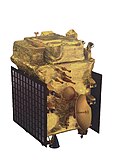
Aditya-L1 in stowed configuration
Aditya was conceptualised in January 2008 by the Advisory Committee for Space Research [dubious – discuss]. It was initially envisaged as a small 400 kg (880 lb), LEO(800 km) satellite with a coronagraph to study the solar corona. An experimental budget of 3 Crore INR was allocated for the financial year 2016–2017.[8][9][10] The scope of the mission has since been expanded and it is now planned to be a comprehensive solar and space environment observatory to be placed at the Lagrange point L1,[11] so the mission was renamed "Aditya-L1". As of July 2019[update], the mission has an allocated cost of ₹378.53 crore excluding launch costs.[12]
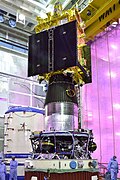
Aditya L1 in deployed configuration
Overview
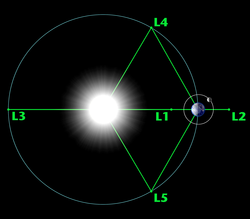
Lagrange points in the Sun–Earth system (not to scale) – a small object at any one of the five points will hold its relative position.
The Aditya-L1 mission will take around 109 Earth days after launch[13] to reach the halo orbit around the L1 point, which is about 1,500,000 km (930,000 mi) from Earth. The spacecraft will remain in the halo orbit for its planned mission duration while maintained at a stationkeeping cost of 0.2 - 4 m/s per year.[14] The 1,500 kg (3,300 lb) satellite carries seven science payloads with diverse objectives, including but not limited to, the coronal heating, solar wind acceleration, coronal magnetometry, origin and monitoring of near-UV solar radiation (which drives Earth's upper atmospheric dynamics and global climate), coupling of the solar photosphere to chromosphere and corona, in-situ characterisations of the space environment around Earth by measuring energetic particle fluxes and magnetic fields of the solar wind and solar magnetic storms that have adverse effects on space and ground-based technologies.[1]
Aditya-L1 will be able to provide observations of Sun's photosphere, chromosphere and corona. In addition, an instrument will study the solar energetic particles' flux reaching the L1 orbit, while a magnetometer payload will measure the variation in magnetic field strength at the halo orbit around L1. These payloads have to be placed outside the interference from the Earth's magnetic field and hence could not have been useful in the low Earth orbit as proposed on the original Aditya mission concept.[15]
One of the major unsolved issues in the field of solar physics is that the upper atmosphere of the Sun is 1,000,000 K (1,000,000 °C; 1,800,000 °F) hot whereas the lower atmosphere is just 6,000 K (5,730 °C; 10,340 °F). In addition, it is not understood how exactly the Sun's radiation affects the dynamics of the Earth's atmosphere on shorter as well as on longer time scale. The mission will obtain near simultaneous images of the different layers of the Sun's atmosphere, which reveal the ways in which the energy may be channeled and transferred from one layer to another. Thus the Aditya-L1 mission will enable a comprehensive understanding of the dynamical processes of the Sun and address some of the outstanding problems in solar physics and heliophysics.
Payloads
Instruments in Aditya L1Visible Emission Line Coronagraph (VELC): The coronagraph creates an artificial total solar eclipse in space by blocking the sunlight by an occultor. This telescope will have capabilities of spectral imaging of the corona in visible and infra-red wavelengths. The objectives are to study the diagnostic parameters of solar corona and dynamics and origin of coronal mass ejections (using three visible and one infra-red channels); magnetic field measurements of the solar corona down to tens of Gauss. Additional objectives are to determine why the solar atmosphere is so hot, and how the changes in the Sun can affect space weather and Earth's climate. The VELC payload weighs nearly 170 kg (370 lb).[16]
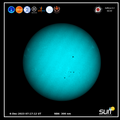
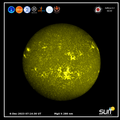
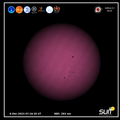
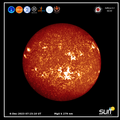
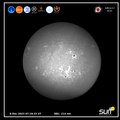
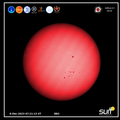
Solar Ultraviolet Imaging Telescope (SUIT): SUIT will observe the Sun between 200-400 nm wavelength range and it will provide full disk images of different layers of the solar atmosphere by making use of 11 filters. The Sun has never been observed from space in this wavelength range. The spacecraft being at the first Lagrange point, SUIT shall be observing the Sun continuously without interruption. The instrument is being developed under the leadership of A. N. Ramaprakash and Durgesh Tripathi from Inter-University Centre for Astronomy and Astrophysics (IUCAA) at Pune, in collaboration with ISRO and other institutes. The SUIT payload weighs nearly 35 kg (77 lb).[16]
Aditya Solar wind Particle Experiment (ASPEX):[17] To study the variation and properties of the solar wind as well as its distribution and spectral characteristics.
High Energy L1 Orbiting X-ray Spectrometer (HEL1OS): To observe the dynamic events in the solar corona and provide an estimate of the energy used to accelerate the solar energetic particles during the eruptive events.
The Aditya-L1 mission holds the promise of significantly advancing our understanding of the Sun's behavior and its interactions with Earth and the space environment. The planned observations and data collection from this mission could lead to several groundbreaking discoveries and insights in the field of solar and heliophysics:
Coronal Heating Mechanism[19]: One of the central puzzles in solar physics is the coronal heating problem - why the Sun's corona is much hotter than its surface. Aditya-L1's instruments, particularly the Solar Ultraviolet Imaging Telescope (SUIT) and the Visible Emission Line Coronagraph (VELC), will enable detailed studies of the corona's dynamics and composition. By closely examining the behavior of the corona, scientists hope to unravel the mechanisms responsible for heating this outer layer of the Sun.
Space Weather Prediction[20]: Understanding the Sun's behavior is crucial for predicting space weather events, which can have significant impacts on Earth's technology and infrastructure. The mission's data will provide insights into the processes that lead to solar flares, coronal mass ejections (CMEs), and solar energetic particle (SEP) events. These insights can contribute to more accurate forecasting of space weather phenomena and their potential effects on communication systems, satellites, and power grids.
Solar Wind and Magnetic Field Studies: Aditya-L1's instruments like the Aditya Solar wind Particle Experiment (ASPEX) and the Magnetometer will offer a comprehensive view of the solar wind's properties and the interplanetary magnetic field. This data will help refine models of the solar wind's behavior and its interaction with Earth's magnetosphere, shedding light on the dynamics of this critical space environment.
Understanding Earth's Climate: The Sun's activity can influence Earth's climate over long timescales. Aditya-L1's observations of near-UV solar radiation and its impact on Earth's upper atmosphere can contribute to understanding how solar variability might affect Earth's climate patterns. This could provide valuable information for climate researchers seeking to differentiate between natural and anthropogenic factors driving climate change.
Comprehensive Solar Atmosphere Imaging: The suite of instruments on Aditya-L1 will provide multi-wavelength observations of the Sun's atmosphere, from the photosphere to the corona. These simultaneous observations will allow scientists to trace the flow of energy and matter between different layers, offering insights into the complex processes that govern the Sun's behavior.
Origin and Dynamics of CMEs: Coronal mass ejections are powerful and potentially disruptive solar events. Aditya-L1's observations of the initiation and evolution of CMEs will contribute to our understanding of their origins and behavior, potentially leading to improved models for predicting their occurrence and effects.







 pronunciation) is a planned coronagraphy spacecraft to study solar atmosphere, designed and developed by the Indian Space Research Organisation (ISRO) and various other Indian research institutes.[1] It will be inserted to about 1.5 million km from earth in a halo orbit around the L1 Lagrange point between the Earth and the Sun where it will study the solar atmosphere, solar magnetic storms and its impact on environment around Earth.[6]


