



m Bot: Fixing double redirect to Indian Martian Exploration Programme Tag: Redirect target changed |
adjust layout per standard format and cleaned formatting for clarity |
||
| Line 1: | Line 1: | ||
# | {{Short description|Indian space missions aimed at Mars}} | ||
{{Use dmy dates|date=July 2023}} | |||
{{Use Indian English|date=July 2023}} | |||
{{Infobox space programme | |||
| name = Indian Mars exploration missions | |||
| image = Mars Orbitor Mission Launch.jpg | |||
| image_size = | |||
| alt = | |||
| caption = [[Polar Satellite Launch Vehicle|PSLV-XL]] C25 lifts off with [[Mars Orbiter Mission]] on 5 November 2013. | |||
| country = [[India]] | |||
| organization = [[ISRO]] | |||
| programme = y | |||
| purpose = [[Exploration of Mars]] | |||
| cost = {{INRConvert|454|c|lk=on}}<ref>{{Cite web |date=2012-08-12 |title='We are planning to send our first orbiter to Mars in 2013' |url=http://www.deccanchronicle.com/editorial/op-ed/%E2%80%98we-are-planning-send-our-first-orbiter-mars-2013%E2%80%99-548 |access-date=2023-07-22 |archive-date=12 August 2012 |archive-url=https://web.archive.org/web/20120812200201/http://www.deccanchronicle.com/editorial/op-ed/%E2%80%98we-are-planning-send-our-first-orbiter-mars-2013%E2%80%99-548 |url-status=bot: unknown }}</ref><ref>{{Cite web |date=2013-11-06 |title=Rocket science: how Isro flew to Mars cheap |url=https://www.hindustantimes.com/india/rocket-science-how-isro-flew-to-mars-cheap/story-WuxDKgSWXegskycsvxFtcO.html |access-date=2023-07-22 |website=Hindustan Times |language=en}}</ref> | |||
| status = Active | |||
| duration = 2013–present | |||
| firstflight = [[Mars Orbiter Mission]], {{start date and age|df=y|2013|11|5}} | |||
| lastflight = | |||
| launchsite = [[Satish Dhawan Space Centre]] | |||
| launcher = [[Polar Satellite Launch Vehicle#PSLV-XL|PSLV-XL]] | |||
}} | |||
The '''Indian Mars exploration missions''' are an ongoing series of outer space missions by [[ISRO]] for the [[exploration of Mars]]. The exploration is currently in the primary phase with Orbiter missions.<ref name="specifications">{{cite web |url=http://www.isro.gov.in/Spacecraft/mars-orbiter-mission-spacecraft |title=Mars Orbiter Mission Spacecraft |publisher=Indian Space Research Organisation |access-date=23 December 2014 |archive-date=25 December 2016 |archive-url=https://web.archive.org/web/20161225220451/http://www.isro.gov.in/Spacecraft/mars-orbiter-mission-spacecraft |url-status=dead}}</ref> | |||
There has been a single mission so far that deployed an orbiter around the planet which later lost its contact with the earth in 2022.<ref name="toi-20221002">{{cite web |last=Kumar |first=Chethan |url=https://timesofindia.indiatimes.com/india/designed-to-last-six-months-indias-mars-orbiter-bids-adieu-after-8-long-years/articleshow/94599977.cms |title=Designed to last six months, India's Mars Orbiter bids adieu after 8 long years |work=[[The Times of India]] |date=2 October 2022 |access-date=2 October 2022}}</ref><ref name="PTI_MOM_EOM">{{cite news |title=With drained battery & no fuel, India's Mars Orbiter craft quietly bids adieu |url=https://www.newindianexpress.com/nation/2022/oct/02/with-drained-battery-no-fuel-indias-mars-orbiter-craft-quietly-bids-adieu-2504219.html |access-date=3 October 2022}}</ref><ref name="ISRO_PR_EOL">{{Cite web |title=SCIENCE PROGRAMME OFFICE (SPO), ISRO HEADQUARTERS |url=https://www.isro.gov.in/MOM_NationalMeet_2022SEP.html |archive-url=https://web.archive.org/web/20221003123127/https://www.isro.gov.in/MOM_NationalMeet_2022SEP.html |archive-date=2022-10-03 |access-date=2022-10-03 |website=www.isro.gov.in |quote=It was also discussed that despite being designed for a life-span of six months as a technology demonstrator, the Mars Orbiter Mission has lived for about eight years in the Martian orbit with a gamut of significant scientific results on Mars as well as on the Solar corona, before losing communication with the ground station as a result of a long eclipse in April 2022. During the national meet, ISRO deliberated that the propellant must have been exhausted, and therefore, the desired attitude pointing could not be achieved for sustained power generation. It was declared that the spacecraft is non-recoverable, and attended its end-of-life. The mission will be ever-regarded as a remarkable technological and scientific feat in the history of planetary exploration.}}</ref> A second mission planned for 2030 when the [[Exploration of Mars#Launch windows|launch window]] opens.<ref>{{Cite web |date=2025-11-06 |title=ISRO To Launch Mangalyaan-2 Mission In 2030 |url=https://news.abplive.com/science/isro-to-launch-mangalyaan-2-in-2030-1810090 |access-date=2025-11-06 |website=ABP Live |language=en}}</ref><ref>{{Cite web |date=2025-11-06 |title=ISRO confirms Mangalyaan-2 Mission: India to attempt first Mars landing in 2030 |url=https://www.indiatvnews.com/science/isro-confirms-mangalyaan-2-mission-india-to-attempt-first-mars-landing-in-2030-2025-11-06-1016099 |access-date=2025-11-06 |website=India TV News |language=en}}</ref> | |||
==Mission== | |||
===Orbiter=== | |||
'''[[Mars Orbiter Mission]]''' | |||
[[File:Mars Orbiter Mission Spacecraft.jpg|thumb|Diagram of Mars Orbiter Mission-1.]] | |||
[[File:Arsia Mons - Mars Orbiter Mission (30108068296).png|thumb|Region around [[Arsia Mons]] captured by MOM-1.]] | |||
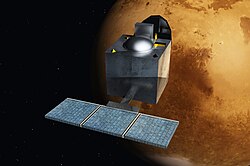
The first mission, which is also known as Mars Orbiter Mission (MOM) was launched in 2013 which carried [[Mars Orbiter Mission]] orbiter. The original mission was expected to operate for 6 months, but it lived well past its expected lifetime and lost its contact with the earth in 2022, lasting for over seven years. | |||
===Rovers and Rotocrafts=== | |||
'''[[Mars Lander Mission]]''' | |||
Mars Lander Mission is a proposed second Indian mission to Mars. Unlike the previous orbiter, it will operate in a lower orbit with [[Apsis|Periareon and Apoareon]] altitude closer to the Martian surface. It will also carry greater scientific payload that includes a [[Hyperspectral imaging|hyperspectral camera]], a very high resolution [[Panchromatic film|panchromatic]] camera and a radar to better understand the early stages of Mars, its early crust, recent basalts, and ongoing activities such as boulder falls.<ref name="roadmap22">{{Citation |author1=Neeraj Srivastava |author2=S. Vijayan |author3=Amit Basu Sarbadhikari |work=Planetary Sciences Division (PSDN), [[Physical Research Laboratory]] |title=Future Exploration of the Inner Solar System: Scope and the Focus Areas |via=ISRO Facebook Panel Discussion, Mars Orbiter Mission National Meet |date=2022-09-27}}</ref><ref name="scimag-isro-20170217">{{cite news |url=https://www.science.org/content/article/india-eyes-return-mars-and-first-run-venus |title=India eyes a return to Mars and a first run at Venus |journal=[[Science (journal)|Science]] |first=Pallava |last=Bagla |date=17 February 2017 |access-date=1 May 2017 |doi=10.1126/science.aal0781}}</ref> | |||
Furthermore, ISRO has also conceptualized a [[Mars aircraft|Mars UAV]] ''Marble'' (''Martian Boundary Layer Explorer''), that will have a suite of payloads for aerial exploration of [[Mars]]. The aerial vehicle will be designed to be capable of flying up to 100 meters in the thin Martian air to profile the [[Atmosphere of Mars|Martian atmosphere]].<ref name=":2">{{Cite news |url=https://economictimes.indiatimes.com/news/science/isro-planning-another-mars-mission-to-send-lander-with-a-helicopter-to-red-planet-report/articleshow/107828602.cms |title=ISRO planning another Mars mission to send lander with a helicopter to Red planet-Report|work=[[India Today]] |date=19 January 2024 |access-date=19 January 2024}}</ref><ref name=":3">{{Cite news |url=https://www.indiatoday.in/science/story/isro-will-send-a-uav-to-fly-on-mars-with-next-mangalyaan-mission-2504224-2024-02-19 |title=Isro will send a UAV to fly on Mars with next Mangalyaan mission|work=[[India Today]] |date=19 January 2024 |access-date=19 January 2024}}</ref> It is planned to be a part of [[Mars Orbiter Mission 2|Mangalyaan 2]] mission.<ref name=space2024>{{cite web |last1=Kuthunur |first1=Sharmila |title=India's ambitious 2nd Mars mission to include a rover, helicopter, sky crane and a supersonic parachute |url=https://www.space.com/india-mangalyaan-2-mars-mission-rover-helicopter-sky-crane |website=Space.com |access-date=2 June 2024 |language=en |date=17 May 2024}}</ref> | |||
It will conduct a high-resolution vertical profiling of critical atmospheric parameters and perform first-of-its-kind in-situ measurements in the near-surface boundary layers of Mars. The payloads will include temperature sensor, humidity sensor, pressure sensor, wind speed sensor, electric field sensor, and the trace species and dust sensor to measure vertical distribution of dust aerosols. The information was shared by Jayadev Pradeep, a scientist with the Space Physics Laboratory at the [[Vikram Sarabhai Space Centre]], during a webinar.<ref>{{Cite web |title=Isro will send a UAV to fly on Mars with next Mangalyaan mission |url=https://www.indiatoday.in/science/story/isro-will-send-a-uav-to-fly-on-mars-with-next-mangalyaan-mission-2504224-2024-02-19 |access-date=2024-02-19 |website=India Today |date=19 February 2024 |language=en}}</ref><ref>{{Cite news |title=Isro planning to send drone to Red Planet: Reports |url=https://timesofindia.indiatimes.com/home/science/next-mangalyaan-mission-isro-planning-to-send-drone-to-red-planet/articleshow/107826934.cms |access-date=2024-02-19 |work=The Times of India |issn=0971-8257}}</ref> The mission will also have a small [[Mars rover|rover]].<ref name=space2024/> | |||
{{ | ==List of Missions== | ||
{{ | ;Mission | ||
}} | {{legend inline|#9EFF9E|Successful and inactive|outline=silver}}<br /> | ||
{{legend inline|#CDEEFF|Active|outline=silver}}<br /> | |||
{{legend inline|#FFC7C8|Unsuccessful|outline=silver}} | |||
{| class="wikitable" style="text-align:center; font-size:small;" | |||
! scope="col" style="width:100px;" rowspan="2"| Mission<br /> | |||
! scope="col" style="width:80px;" rowspan="2"| Launch Date<br /> | |||
! scope="col" style="width:100px;" rowspan="2"| Launch Vehicle<br /> | |||
! scope="col" style="width:80px;" rowspan="2"| Orbital Insertion Date | |||
! scope="col" style="width:80px;" rowspan="2"| Landing Date | |||
! scope="col" style="width:80px;" rowspan="2"| Return Date | |||
! scope="col" colspan="5"| Status | |||
|- | |||
! scope="col" style="width:100px;"| Main<br />Mission | |||
! scope="col" style="width:100px;"| Extended<br />Mission | |||
! scope="col" style="width:100px;"| Expected <br/> Mission<br />Duration | |||
! scope="col" style="width:100px;"| Final Mission<br />Duration | |||
! scope="col" style="width:30%;"| Notes | |||
|- | |||
! colspan="12" style="text-align:centre;"|Phase 1: Orbiters | |||
|- | |||
! scope="row"| [[Mars Orbiter Mission]] | |||
| 5 November 2013 | |||
| [[Polar Satellite Launch Vehicle#PSLV-XL|PSLV-XL]] | |||
| 24 September 2014 | |||
| – | |||
| – | |||
| {{Success}} | |||
| {{Success}} | |||
| 6 months | |||
| 7 years, 6 months, 8 days | |||
| style="text-align: left;" | First Indian interplanetary mission. | |||
|- | |||
! scope="row"| [[Mars Lander Mission]] | |||
| NET 2030 | |||
| [[LVM3]] | |||
| TBD | |||
| – | |||
| – | |||
| TBD | |||
| TBD | |||
| 1 year | |||
| TBD | |||
| style="text-align: left;" | Proposed Indian Mars lander mission. | |||
|- | |||
|} | |||
[[File:Mars Orbiter Mission - India - ArtistsConcept.jpg|thumb|An artist's concept of MOM - 1 around Mars]] | |||
[[File:Mars Orbiter Mission.jpg|thumb|Spacecraft during encapsulation]] | |||
==Gallery== | |||
<gallery> | |||
One of the first images of the surface of Mars taken by the Mangalyaan on September 25, 2014.jpg|One of the first images of the surface of Mars taken by the MOM-1 on 25 September 2014. | |||
Mars as seen from Mangalyaan (MOM).png|Dust storm on northern hemisphere of Mars as seen from MOM-1 on 28 September 2014. | |||
Tharsis and Valles Marineris - Mars Orbiter Mission (30055660701).png|[[Tharsis]] and [[Valles Marineris]] as captured by MOM-1. | |||
Syrtis Major - Mars Orbiter Mission (29512601624).png|[[Syrtis Major Planum|Syrtis Major]] by MOM-1. | |||
File:NorthMars.jpg|North pole of Mars by MOM-1. | |||
</gallery> | |||
''[[#External links|See more on ISRO's website]]'' | |||
==See also== | |||
* [[Chandrayaan programme]] | |||
* [[Indian Human Spaceflight Programme]] | |||
* [[List of missions to Mars]] | |||
==References== | |||
{{reflist}} | |||
==External links== | |||
*[https://www.isro.gov.in/mission_Pictures_%20from_Mars_Colour_Camera.html Mars Colour Camera images from ISRO] | |||
{{Indian space programme}} | |||
{{Indian spacecraft}} | |||
{{Mars spacecraft}} | |||
{{Future spaceflights}} | |||
{{DEFAULTSORT:Indian Mars}} | |||
[[Category:2013 establishments in India]] | |||
[[Category:Indian Mars exploration programme|*]] | |||
[[Category:ISRO programmes]] | |||
[[Category:Proposed space probes]] | |||
[[Category:Exploration of Mars]] | |||
Latest revision as of 01:53, 9 May 2026
 PSLV-XL C25 lifts off with Mars Orbiter Mission on 5 November 2013. | |
| Program overview | |
|---|---|
| Country | India |
| Organization | ISRO |
| Purpose | Exploration of Mars |
| Status | Active |
| Programme history | |
| Cost | ₹454 crore (US$64 million)[1][2] |
| Duration | 2013–present |
| First flight | Mars Orbiter Mission, 5 November 2013 |
| Launch site(s) | Satish Dhawan Space Centre |
| Vehicle information | |
| Launch vehicle(s) | PSLV-XL |
The Indian Mars exploration missions are an ongoing series of outer space missions by ISRO for the exploration of Mars. The exploration is currently in the primary phase with Orbiter missions.[3]
There has been a single mission so far that deployed an orbiter around the planet which later lost its contact with the earth in 2022.[4][5][6] A second mission planned for 2030 when the launch window opens.[7][8]
Mission[edit | edit source]
Orbiter[edit | edit source]

.png)
The first mission, which is also known as Mars Orbiter Mission (MOM) was launched in 2013 which carried Mars Orbiter Mission orbiter. The original mission was expected to operate for 6 months, but it lived well past its expected lifetime and lost its contact with the earth in 2022, lasting for over seven years.
Rovers and Rotocrafts[edit | edit source]
Mars Lander Mission is a proposed second Indian mission to Mars. Unlike the previous orbiter, it will operate in a lower orbit with Periareon and Apoareon altitude closer to the Martian surface. It will also carry greater scientific payload that includes a hyperspectral camera, a very high resolution panchromatic camera and a radar to better understand the early stages of Mars, its early crust, recent basalts, and ongoing activities such as boulder falls.[9][10] Furthermore, ISRO has also conceptualized a Mars UAV Marble (Martian Boundary Layer Explorer), that will have a suite of payloads for aerial exploration of Mars. The aerial vehicle will be designed to be capable of flying up to 100 meters in the thin Martian air to profile the Martian atmosphere.[11][12] It is planned to be a part of Mangalyaan 2 mission.[13]
It will conduct a high-resolution vertical profiling of critical atmospheric parameters and perform first-of-its-kind in-situ measurements in the near-surface boundary layers of Mars. The payloads will include temperature sensor, humidity sensor, pressure sensor, wind speed sensor, electric field sensor, and the trace species and dust sensor to measure vertical distribution of dust aerosols. The information was shared by Jayadev Pradeep, a scientist with the Space Physics Laboratory at the Vikram Sarabhai Space Centre, during a webinar.[14][15] The mission will also have a small rover.[13]
List of Missions[edit | edit source]
- Mission
Successful and inactive
Active
Unsuccessful
| Mission |
Launch Date |
Launch Vehicle |
Orbital Insertion Date | Landing Date | Return Date | Status | |||||
|---|---|---|---|---|---|---|---|---|---|---|---|
| Main Mission |
Extended Mission |
Expected Mission Duration |
Final Mission Duration |
Notes | |||||||
| Phase 1: Orbiters | |||||||||||
| Mars Orbiter Mission | 5 November 2013 | PSLV-XL | 24 September 2014 | – | – | Success | Success | 6 months | 7 years, 6 months, 8 days | First Indian interplanetary mission. | |
| Mars Lander Mission | NET 2030 | LVM3 | TBD | – | – | TBD | TBD | 1 year | TBD | Proposed Indian Mars lander mission. | |


Gallery[edit | edit source]
-
 One of the first images of the surface of Mars taken by the MOM-1 on 25 September 2014.
 -
 Dust storm on northern hemisphere of Mars as seen from MOM-1 on 28 September 2014.
 -
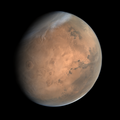 Tharsis and Valles Marineris as captured by MOM-1.
 -
 Syrtis Major by MOM-1.
 -
 North pole of Mars by MOM-1.

.png)
.png)
.png)

See also[edit | edit source]
References[edit | edit source]
- ↑ "'We are planning to send our first orbiter to Mars in 2013'". 12 August 2012. Archived from the original on 12 August 2012. Retrieved 22 July 2023.
{{cite web}}: CS1 maint: bot: original URL status unknown (link) - ↑ "Rocket science: how Isro flew to Mars cheap". Hindustan Times. 6 November 2013. Retrieved 22 July 2023.
- ↑ "Mars Orbiter Mission Spacecraft". Indian Space Research Organisation. Archived from the original on 25 December 2016. Retrieved 23 December 2014.
- ↑ Kumar, Chethan (2 October 2022). "Designed to last six months, India's Mars Orbiter bids adieu after 8 long years". The Times of India. Retrieved 2 October 2022.
- ↑ "With drained battery & no fuel, India's Mars Orbiter craft quietly bids adieu". Retrieved 3 October 2022.
- ↑ "SCIENCE PROGRAMME OFFICE (SPO), ISRO HEADQUARTERS". www.isro.gov.in. Archived from the original on 3 October 2022. Retrieved 3 October 2022.
It was also discussed that despite being designed for a life-span of six months as a technology demonstrator, the Mars Orbiter Mission has lived for about eight years in the Martian orbit with a gamut of significant scientific results on Mars as well as on the Solar corona, before losing communication with the ground station as a result of a long eclipse in April 2022. During the national meet, ISRO deliberated that the propellant must have been exhausted, and therefore, the desired attitude pointing could not be achieved for sustained power generation. It was declared that the spacecraft is non-recoverable, and attended its end-of-life. The mission will be ever-regarded as a remarkable technological and scientific feat in the history of planetary exploration.
- ↑ "ISRO To Launch Mangalyaan-2 Mission In 2030". ABP Live. 6 November 2025. Retrieved 6 November 2025.
- ↑ "ISRO confirms Mangalyaan-2 Mission: India to attempt first Mars landing in 2030". India TV News. 6 November 2025. Retrieved 6 November 2025.
- ↑ Neeraj Srivastava; S. Vijayan; Amit Basu Sarbadhikari (27 September 2022), "Future Exploration of the Inner Solar System: Scope and the Focus Areas", Planetary Sciences Division (PSDN), Physical Research Laboratory – via ISRO Facebook Panel Discussion, Mars Orbiter Mission National Meet
- ↑ Bagla, Pallava (17 February 2017). "India eyes a return to Mars and a first run at Venus". Science. doi:10.1126/science.aal0781. Retrieved 1 May 2017.
- ↑ "ISRO planning another Mars mission to send lander with a helicopter to Red planet-Report". India Today. 19 January 2024. Retrieved 19 January 2024.
- ↑ "Isro will send a UAV to fly on Mars with next Mangalyaan mission". India Today. 19 January 2024. Retrieved 19 January 2024.
- ↑ 13.0 13.1 Kuthunur, Sharmila (17 May 2024). "India's ambitious 2nd Mars mission to include a rover, helicopter, sky crane and a supersonic parachute". Space.com. Retrieved 2 June 2024.
- ↑ "Isro will send a UAV to fly on Mars with next Mangalyaan mission". India Today. 19 February 2024. Retrieved 19 February 2024.
- ↑ "Isro planning to send drone to Red Planet: Reports". The Times of India. ISSN 0971-8257. Retrieved 19 February 2024.
External links[edit | edit source]


| Satellites |
|  | ||||||||||
|---|---|---|---|---|---|---|---|---|---|---|---|---|
| Space probes |
| |||||||||||
| Human spaceflight | ||||||||||||
| ||||||||||||