










Ajay Kumar (talk | contribs) Created a new article |
slightly improved structure and added references |
||
| Line 1: | Line 1: | ||
{{Short description|Place of | {{Short description|Place of worship for Muslims}} | ||
{{Redirect-multi|2|Masjed|Musjid|the villages | {{Redirect-multi|2|Masjed|Musjid|the Iranian villages|Masjed, Iran (disambiguation)|the 19th-century British racehorse|Musjid (horse)}} | ||
{{Islam | [[File:Masjid e Nabawi Interior 2.jpg|thumb|The [[Prophet's Mosque]] in [[Medina]], one of the holiest mosques in Islam]] | ||
A '''mosque''' ({{IPAc-en|m|ɒ|s|k}} {{respell|MOSK}}) | {{Islam}} | ||
A '''mosque''' ({{IPAc-en|m|ɒ|s|k}} {{respell|MOSK}}), also called a '''masjid''' ({{IPAc-en|ˈ|m|æ|s|dʒ|ɪ|d|,_|ˈ|m|ʌ|s|-}} {{respell|MASS|jid|,_|MUSS|-}}),{{Efn|{{langx|ar|مَسْجِد}} {{IPA|ar|ˈmasdʒid| }} ({{Literal translation|place of [[Sujud|ritual prostration]]}})|group=note}} is a [[place of worship]] for [[Muslims]].<ref name="ODI">{{Cite encyclopedia|title=Mosque|editor=John L. Esposito|encyclopedia=The Oxford Dictionary of Islam|publisher=Oxford University Press|year=2014|url=http://www.oxfordislamicstudies.com/article/opr/t125/e1552|archive-url=https://web.archive.org/web/20171225191130/http://www.oxfordislamicstudies.com/article/opr/t125/e1552|archive-date=December 25, 2017}}</ref> The term usually refers to a covered building, but can be any place where [[Salah|Islamic prayers]] are performed; such as an outdoor courtyard.<ref>Longhurst, Christopher E., "Theology of a Mosque: The Sacred Inspiring Form, Function and Design in Islamic Architecture", ''Lonaard Journal''. Mar 2012, Vol. 2 Issue 8, pp. 3–13 [11]. "Since submission to God is the essence of divine worship, the place of worship is intrinsic to Islam's self-identity. This 'place' is not a building per se but what is evidenced by the etymology of the word ''mosque'' which derives from the Arabic ''masjid'' meaning 'a place of sujud (prostration).'</ref><ref>Colledge, R. (1999). "The mosque". In: ''Mastering World Religions''. Macmillan Master Series. Palgrave, London. {{doi|10.1007/978-1-349-14329-0_16}} "A mosque is a building where Muslims bow before Allah to show their submission to His will. It is not necessary to have a building to do this. Muhammad said that 'Wherever the hour of prayer overtakes you, you shall perform the prayer. That place is the mosque'. In his early days in Makkah there was no mosque, so he and his friends would pray anywhere."</ref> | |||
Originally, mosques were simple places of prayer for the [[early Muslims]], and may have been open spaces rather than elaborate buildings.{{sfn|Grabar|1969|p=34|ps=: "The main characteristic, then, of this first stage was the creation of a space which served exclusively Muslim purposes and which, in cities that were entirely Muslim, existed on two separate levels of exclusivity. The word ''masjid'' is always associated with these spaces, but it does not yet possess any formal structure nor does it have any precise function other than that of excluding non-Muslims."}} In the first stage of [[Islamic architecture]] (650–750 CE), early mosques comprised open and closed covered spaces enclosed by walls, often with [[minaret]]s, from which the [[Adhan|Islamic call to prayer]] was issued on a daily basis.{{sfn|Grabar|1969|pp=34–35|ps=: "A second stage occurred between 650 and 750. To my knowledge, twenty-seven masjids from this period are archaeologically definable{{nbs}}... All mosques had a certain relationship between open and closed covered spaces. The problems posed by this relationship pertain primarily to the history of art, except on one point, which is the apparent tendency to consider the covered parts as the bayt al-salat, i.e. place of prayer, and the rest of the building as an overflow area for prayer. All these buildings were enclosed by walls and did not have an exterior façade. Their orderly form appeared only from the inside where the balance between open and covered spaces served, among other things, to indicate the direction of qibla. Their only outward symbol was the minaret, a feature which appeared early in mosques built in old cities with predominantly non-Muslim populations and only later in primarily Muslim ones."}} It is typical of mosque buildings to have a special ornamental niche (a ''[[mihrab]]'') set into the wall in the direction of the city of [[Mecca]] (the ''[[qibla]]''), which Muslims must face during prayer,<ref name=ODI /> as well as a facility for ritual cleansing (''[[wudu]]'').<ref name=ODI /><ref name="campo">{{Cite encyclopedia |year=2009 |title=Mosque |encyclopedia=Encyclopedia of Islam |publisher=Infobase Publishing |editor=Juan Eduardo Campo |author=Nuha N. N. Khoury}}</ref> The pulpit (''[[minbar]]''), from which public sermons (''[[khutbah]]'') are delivered on the event of [[Friday prayer]], was, in earlier times, characteristic of the central city mosque, but has since become common in smaller mosques.<ref name=EIMW /><ref name=ODI /> To varying degrees, mosque buildings are designed so that there are [[Islam and gender segregation|segregated spaces for men and women]].<ref name=ODI /> This basic pattern of organization has assumed different forms depending on the region, period, and [[Islamic schools and branches|Islamic denomination]].<ref name=campo /> | |||
In addition to being places of worship in [[Islam]], mosques also serve as locations for [[Islamic funeral|funeral services]] and [[Funeral prayer (Islam)|funeral prayers]], marriages ([[Marriage in Islam|nikah]]), vigils during [[Ramadan]], business agreements, collection and distribution of [[Alms in Islam|alms]], and [[homeless shelter]]s.<ref name=ODI /><ref name=EIMW>{{Cite encyclopedia|author=Patrick D. Gaffney|title=Masjid|editor=Richard C. Martin|encyclopedia=Encyclopedia of Islam and the Muslim World|publisher=MacMillan Reference|year=2004}}</ref> To this end, mosques have historically been multi-purpose buildings functioning as [[community centre]]s, [[Mahkama|courts of law]], and [[Madrasa|religious schools]]. In modern times, they have also preserved their role as places of religious instruction and debate.<ref name=ODI /><ref name=EIMW /> Special importance is accorded to, in descending order of importance: [[Masjid al-Haram|al-Masjid al-Haram]] in the city of Mecca, where [[Hajj]] and [[Umrah]] are performed; the [[Prophet's Mosque]] in the city of [[Medina]], where [[Muhammad]] is buried; and [[al-Aqsa Mosque]] in the city of [[Jerusalem]], where Muslims believe that [[Isra' and Mi'raj|Muhammad ascended to heaven to meet God]] around 621 CE.<ref name=ODI /> | |||
During and after the [[early Muslim conquests]], mosques were established outside of [[Arabian Peninsula|Arabia]] in the hundreds; many [[synagogue]]s, [[Church (building)|churches]], and [[temple]]s were [[Conversion of non-Islamic places of worship into mosques|converted into mosques]] and thus influenced Islamic architectural styles over the centuries.<ref name=EIMW /> While most pre-modern mosques were funded by charitable endowments (''[[waqf]]''),<ref name="ODI" /> the modern-day trend of government regulation of large mosques has been countered by the rise of privately funded mosques, many of which serve as bases for different streams of [[Islamic revival]]ism and social activism.<ref name=EIMW /> | |||
==Etymology== | == Etymology == | ||
The word 'mosque' entered the [[English language]] from the [[French language|French]] | The word ''mosque'' entered the [[English language]] from the [[French language|French]] ''mosquée'', probably derived from [[Italian language|Italian]] ''moschea'' (a variant of Italian ''moscheta''), from either [[Middle Armenian language|Middle Armenian]] [[wikt:մզկիթ|մզկիթ]] (''mzkit''), [[Medieval Greek|Medieval]] {{langx|el|μασγίδιον}} (''masgídion''), or Spanish ''mezquita'', from {{langx|ar|مسجد|masjid}} ("site of prostration in prayer" and hence a place of worship), either from [[Nabataean Aramaic|Nabataean]] ''masg<sup>ĕ</sup>dhā́'' or from {{langx|ar|سَجَدَ|[[Sujud|sajada]]}} (meaning "to [[:wikt:prostrate|prostrate]]"), probably ultimately from [[Nabataean Arabic]] ''masg<sup>ĕ</sup>dhā́'' or [[Aramaic language|Aramaic]] ''s<sup>ĕ</sup>ghēdh''.<ref>For the word's origin from French and probable origin from Italian ''moscheta'', see "mosque, n.". ''OED Online''. December 2011. Oxford University Press. [http://www.oed.com/viewdictionaryentry/Entry/122562] {{Webarchive|url=https://web.archive.org/web/20140810191209/http://www.oed.com/viewdictionaryentry/Entry/122562|date=2014-08-10}}. For the derivation of ''moscheta'' from Arabic ''sajada'' see "mesquita, n.". ''OED Online''. December 2011. Oxford University Press. [http://www.oed.com/viewdictionaryentry/Entry/117089] {{Webarchive|url=https://web.archive.org/web/20140810185728/http://www.oed.com/viewdictionaryentry/Entry/117089|date=2014-08-10}}. For the probable origin of "sajada" from Aramaic, and the meanings of ''sajada'' and ''masjid'' in Arabic, see "masjid, n.". ''OED Online''. December 2011. Oxford University Press. [http://www.oed.com/viewdictionaryentry/Entry/114605]. For the inclusion of Spanish ''mesquita'', possible derivation from Nabataean ''masg<sup>ĕ</sup>dhā́'', and the Aramaic ''s<sup>ĕ</sup>ghēdh'', see Klein, E., ''A Comprehensive Etymological Dictionary of the English Language'' (Elsevier Publishing, 1966), p. 1007.</ref> | ||
==History== | == History == | ||
===Origins=== | === Origins === | ||
{{ | {{Also|List of the oldest mosques}} | ||
Islam was established in Arabia during the lifetime of [[Muhammad]] in the 7th century CE.<ref name="Watt2003">{{Cite book |last=Watt |first=William Montgomery |author-link=W. Montgomery Watt |title=Islam and the Integration of Society |url=https://books.google.com/books?id=AQUZ6BGyohQC |year=2003 |publisher=Psychology Press |isbn=978-0-415-17587-6 |page=[https://books.google.com/books?id=AQUZ6BGyohQC&pg=PA5 5] |access-date=2019-06-30 |archive-date=2023-01-16 |archive-url=https://web.archive.org/web/20230116132754/https://books.google.com/books?id=AQUZ6BGyohQC |url-status=live }}</ref> The [[List of the oldest mosques|first mosque]] in history could be either the sanctuary built around the ''[[Kaaba|Ka'bah]]'' in [[Mecca]], known today as ''[[Al-Masjid al-Haram]]'' ('The Sacred Mosque'), or the [[Quba Mosque]] in [[Medina]], the first structure built by Muhammad upon his [[Hijra (Islam)|emigration from Mecca]] in 622 [[Common Era|CE]],<ref>{{harvnb|Tajuddin|1998|p=135}}</ref> both located in the Hejaz region in present-day Saudi Arabia.<ref name="Palmer2016">{{Cite book |author=Palmer |first=Allison Lee |url=https://books.google.com/books?id=aMsvDAAAQBAJ&pg=236 |title=Historical Dictionary of Architecture |publisher=[[Rowman & Littlefield]] |year=2016 |isbn=978-1-4422-6309-3 |edition=2nd |page=236 |language=en |quote=The first mosque is considered to be either the one built around the Kaaba, or "House of God", in Mecca, now called Al-Masjid Al-Haram, or the Quba Mosque in Medina, Saudi Arabia, built when Muhammad arrived there from Mecca in 622. |access-date=2023-12-26 |archive-date=2023-12-26 |archive-url=https://web.archive.org/web/20231226065604/https://books.google.com/books?id=aMsvDAAAQBAJ&pg=236 |url-status=live }}</ref> | |||
Other scholars reference Islamic tradition<ref name="Esposito1998">{{Cite book |last=Esposito |first=John |title=Islam: The Straight Path (3rd ed.) |year=1998 |publisher=Oxford University Press |isbn=978-0-19-511234-4 |pages=9, 12}}</ref><ref name="Esposito2002b">Esposito (2002b), pp. 4–5.</ref><ref name="Peters2003">{{Cite book |last=Peters |first=F.E. |title=Islam: A Guide for Jews and Christians |year=2003 |publisher=Princeton University Press |isbn=978-0-691-11553-5 |page=[https://archive.org/details/islamguideforjew00fepe/page/9 9] |url=https://archive.org/details/islamguideforjew00fepe/page/9 }}</ref> and passages of the Quran,<ref>{{qref|2|7-286|b=y}}</ref><ref>{{qref|3|96|b=y}}</ref><ref>{{qref|22|25-37|b=y}}</ref> according to which Islam as a religion precedes Muhammad, and includes previous prophets such as Abraham.<ref name="Alli2013">{{Cite book |last=Alli |first=Irfan |title=25 Prophets of Islam |publisher=eBookIt.com |isbn=978-1-4566-1307-5 |url=https://books.google.com/books?id=5nRJK9sLjLsC |year=2013 |access-date=2019-06-30 |archive-date=2021-04-14 |archive-url=https://web.archive.org/web/20210414010428/https://books.google.com/books |url-status=live }}</ref> In Islamic tradition, [[Abraham in Islam|Abraham]] is credited with having built the ''Ka'bah'' in Mecca, and consequently its sanctuary, ''Al-Masjid al-Haram'', which is seen by Muslims as the first mosque that existed.<ref>{{harvnb|Kuban|1974|p=1}}</ref><ref name="Michigan C 1986">{{Cite book |author=Michigan Consortium for Medieval and Early Modern Studies |editor1=Goss, V.P. |editor2=Bornstein, C. V. |title=The Meeting of Two Worlds: Cultural Exchange Between East and West During the Period of the Crusades |publisher=Medieval Institute Publications, Western Michigan University |volume=21 |page=208 |isbn=978-0-918720-58-0 |url=https://books.google.com/books?id=p44kAQAAMAAJ |year=1986 |access-date=2019-06-30 |archive-date=2023-12-28 |archive-url=https://web.archive.org/web/20231228023032/https://books.google.com/books?id=p44kAQAAMAAJ |url-status=live }}</ref><ref name="Abu Sway 2011">{{Cite news |author=Mustafa Abu Sway |title=The Holy Land, Jerusalem and Al-Aqsa Mosque in the Qur'an, Sunnah and other Islamic Literary Source |publisher=[[Central Conference of American Rabbis]] |url=http://www.wcfia.harvard.edu/sites/default/files/Abusway_0.pdf |archive-url=https://web.archive.org/web/20110728001911/http://www.wcfia.harvard.edu/sites/default/files/Abusway_0.pdf |archive-date=2011-07-28 }}</ref><ref name="Dyrness2013">{{Cite book |author=Dyrness, W. A. |title=Senses of Devotion: Interfaith Aesthetics in Buddhist and Muslim Communities |publisher=[[Wipf and Stock]] Publishers |volume=7 |page=25 |isbn=978-1-62032-136-2 |url=https://books.google.com/books?id=inJNAwAAQBAJ |date=2013}}</ref> A [[hadith]] in [[Sahih al-Bukhari]] states that the sanctuary of the ''Ka'bah'' was the first mosque on Earth, with the second mosque being [[Al-Aqsa]] in [[Jerusalem]],<ref>{{Cite web|url=https://www.searchtruth.com/book_display.php?book=55&translator=1&start=0&number=585#585|title=55. Prophets – Sahih Al-Bukhari – 585|website=www.searchtruth.com|language=en|access-date=2018-06-05|archive-date=2018-06-13|archive-url=https://web.archive.org/web/20180613062602/https://www.searchtruth.com/book_display.php?book=55&translator=1&start=0&number=585#585|url-status=live}}</ref> which is also associated with Abraham.<ref name="Michigan C 1986" /> Since as early as 638 CE, the Sacred Mosque of Mecca has been expanded on several occasions to accommodate the increasing number of Muslims who either live in the area or make the annual pilgrimage known as ''[[Hajj]]'' to the city.<ref>{{harvnb|Dumper|Stanley|2007|p=241}}</ref> | |||
Either way, after the Quba Mosque, [[Muhammad in Medina|Muhammad went on to establish another mosque in Medina]], which is now known as ''[[Al-Masjid an-Nabawi]]'' ('The Prophet's Mosque'). Built on the site of his home, Muhammad participated in the construction of the mosque himself and helped pioneer the concept of the mosque as the focal point of the Islamic city.<ref name="chiu678">{{harvnb|Chiu|2010|pp=67–8}}</ref> The Prophet's Mosque is considered by some scholars of [[Islamic architecture]] to be the first mosque.<ref name="Petersen_p.195–6">{{harvnb|Petersen|1996|pp=195–196}}: "The first mosque was the house of the Prophet Muhammad in Medina. This was a simple rectangular (53 by 56 m) enclosure containing rooms for the Prophet and his wives and a shaded area on the south side of the courtyard which could be used for prayer in the direction of Mecca. This building became the model for subsequent mosques which had the same basic courtyard layout with a prayer area against the qibla wall."</ref><ref name=":24">{{harvnb|Bloom|Blair|2009|p=549|loc=''Mosque''}}: "The first mosque, a building that Muhammad erected at Medina in 622, is usually described as the Prophet's house but was probably intended from the outset as a community center as well. Initially, it was a rectangular enclosure of unbaked brick, a little over fifty meters square, but a portico of palm trunks supporting a roof of palm-frond thatch was quickly erected on the north side of the court, facing Jerusalem, the first qibla, or direction in which Muslims sent their prayers{{nbs}}... In 624 when the qibla was changed to Mecca, another such arcade was built on the south side, facing that city. Muhammad and his family lived in rooms built on to one side of the enclosure, and Muhammad was buried in one of these rooms in 632. During the 7th and early 8th centuries, Muhammad's mosque was repeatedly enlarged and rebuilt, becoming a flat-roofed hypostyle structure with a central court and a prayer-hall deeper than the three other porticos{{nbs}}... The form of the mosque of the Prophet was closely imitated in the early congregational mosques built in the Iraqi cities of Wasit, Kufa and Basra, and in the mosque built at Daybul in Sind (now Banbhore, Pakistan)."</ref> The mosque had a roof supported by columns made of palm tree trunks<ref name=":0522">{{Cite book |last=Tabbaa |first=Yasser |title=Encyclopaedia of Islam, Three |publisher=Brill |year=2007 |isbn=978-90-04-16165-8 |editor-last=Fleet |editor-first=Kate |location= |pages= |language=en |chapter=Architecture |quote=If Mecca provided the first Muslim shrine, the city of Medina, to which Muḥammad migrated in 622 C.E., may have provided the germ of the idea for the Muslim place of prayer, the masjid, in the form of the house of the Prophet himself. Descriptions of the house allow us to reconstruct it as a mud-brick rectangular enclosure consisting of an open courtyard, a three-aisled roofed space to the south, a one-bay space inside the northern wall, and eight separate rooms annexed to the eastern wall. The eight rooms housed Muḥammad's wives; the northern vestibule was a waiting area; the southern space served various residential, official, and ritual functions. The roof was supported by palm trunks and its southern wall, after 6/628, contained a three-stepped platform (minbar), from which Muḥammad spoke and adjudicated. Despite its rudimentary form and construction, Muḥammad's house would provide the basic model for the first mosques. |editor-last2=Krämer |editor-first2=Gudrun |editor-last3=Matringe |editor-first3=Denis |editor-last4=Nawas |editor-first4=John |editor-last5=Rowson |editor-first5=Everett}}</ref> and it included a large courtyard, a motif common among mosques built since then.<ref name="chiu678" /> Rebuilt and expanded over time,{{sfn|Petersen|1996|pp=182–184}} it soon became a larger [[hypostyle]] structure.<ref name=":24" /> It probably served as a model for the construction of early mosques elsewhere.<ref name="Petersen_p.195–6" /><ref name=":24" /><ref name=":0522" /> It introduced some of the features still common in today's mosques, including the niche at the front of the prayer space known as the ''[[mihrab]]'' (first added in the [[Umayyad period]]){{sfn|Petersen|1996|pp=182–184}} and the tiered pulpit called the ''[[minbar]]''.<ref>{{harvnb|Cosman|Jones|2008|p=610}}</ref><gallery widths="200" heights="200" class="center" caption="The three holiest sites in Islam"> | |||
File:After their time in Mina has passed, pilgrims head back to Mecca. - Flickr - Al Jazeera English.jpg|Aerial view of the largest mosque in the world, [[Great Mosque of Mecca|The Sacred Mosque (''Al-Masjid Al-Ḥarām'')]] of [[Mecca]] in the [[Hejaz]] region of [[Saudi Arabia]], with the [[Kaaba]] in the center | |||
File:Al-Masjid An-Nabawi (Bird's Eye View).jpg|Islam's [[Holiest sites in Islam|second holiest site]] [[Al-Masjid an-Nabawi]] (The [[Muhammad in Islam|Prophet]]'s Mosque) in Medina | |||
File:Temple Mount (Aerial view, 2007) 05.jpg|Islam's third holiest site, [[Temple Mount|Al-Aqsa]] compound in Jerusalem, including its [[Qibli Mosque]] and [[Dome of the Rock]] | |||
</gallery> | |||
=== Diffusion and evolution === | |||
{{Duplication|date=September|dupe=Mosque#Architecture|section|othersections=y}} | |||
[[File:Syria, Damascus, The Umayyad Mosque.jpg|thumb|The [[Umayyad Mosque]] in Damascus (715 AD) followed the plan of the [[Prophet's Mosque]] in Medina, and became the earliest example of a grand mosque that served as standard for future mosques<ref name=":3">{{Cite book |last=Frontiers |first=Museum With No |url=https://books.google.com/books?id=zaEHRF7ZS7IC&dq=established+the+mosque+of+kairouan+umayyad&pg=PA46 |title=The Umayyads: The Rise of Islamic Art |date=2000 |publisher=AIRP |isbn=978-1-874044-35-2 |pages=26–46 |language=en}}</ref>]] | |||
The [[Umayyad Caliphate]] was particularly instrumental in spreading Islam and establishing mosques within the [[Levant]], as the Umayyads constructed among the most revered mosques in the region: the [[Al-Aqsa Mosque|Qibli Mosque]] and [[Dome of the Rock]] both part of [[Al-Aqsa]] in [[Jerusalem]], and the [[Umayyad Mosque]] in [[Damascus]],<ref>{{harvnb|Kuban|1985|p=27}}</ref> and also built other important mosques in the region including the Great Mosques of [[Great Mosque of Aleppo|Aleppo]] and [[Great Mosque of Hama|Hama]].{{sfn|Kuban|1974|p=16}}<ref name=":02">{{Cite book |last=O'Kane |first=Bernard |title=Creswell Photographs Re-examined: New Perspectives on Islamic Architecture |publisher=American University in Cairo Press |year=2009 |isbn=978-977-416-244-2 |pages=219–246 |language=en |chapter=The Great Mosque of Hama Redux |chapter-url=https://books.google.com/books?id=cKEB886IYPEC&pg=PA219}}</ref> They also renovated and expanded other mosques like the [[Prophet's Mosque]] in [[Medina]] (which saw the introduction of the first [[mihrab]]){{sfn|Ali|1999|p=33}} the [[Masjid al-Haram]] in Mecca,<ref name=":22">{{Cite journal |last=Grabar |first=Oleg |date=1985 |title=Upon Reading al-Azraqi |url=https://www.jstor.org/stable/1523080 |journal=Muqarnas |volume=3 |pages=64–66 |doi=10.2307/1523080 |issn=0732-2992 |jstor=1523080 |url-access=subscription}}</ref> the [[Great Mosque of Sanaa]],<ref name=":1">{{Cite book |last=Mawani |first=Rizwan |url=https://books.google.com/books?id=JS2qDwAAQBAJ&dq=al-Walid+I+umayyad+mosque+sanaa+mosque&pg=PA36 |title=Beyond the Mosque: Diverse Spaces of Muslim Worship |publisher=Bloomsbury Publishing |year=2019 |isbn=978-1-78673-662-8 |pages=36 |language=en}}</ref> and the mosques of [[Great Mosque of Kufa|Kufa]], [[Imam Ali Mosque (Basra)|Basra]] and [[Amr ibn al-As Mosque|Amr ibn Al-As]] (in [[Cairo]]).<ref name=":3" />{{sfn|Kuban|1974|p=12}} The designs of the Dome of the Rock and the Umayyad Mosque were influenced by [[Byzantine architecture]], a trend that was revived much later with the rise of the [[Ottoman Empire]].<ref>{{harvnb|Flood|2001|pp=101–103}}</ref> | |||
[[File:Great Mosque of Kairouan, courtyard.jpg|left|thumb|250x250px|The [[Great Mosque of Kairouan]] (est. in 670, main current structure dates to 836), in [[Tunisia]], with its minaret being one of the oldest standing minarets in the world ]] | |||
The [[Great Mosque of Kairouan]] in present-day [[Tunisia]] was the first mosque built in the [[Maghreb]] (northwest Africa), with its present form (dating from the ninth century) serving as a model for other Islamic places of worship in the Maghreb. It was the first in the region to incorporate a square [[minaret]], which was characteristic of later Maghrebi mosques, and includes [[nave]]s akin to a [[basilica]].<ref>{{Cite web |url=http://www.qantara-med.org/qantara4/public/show_document.php?do_id=1287&lang=en |publisher=The Qantara Project |title=Minaret of the Great Mosque of Kairouan |year=2008 |access-date=5 October 2013 |archive-url=https://web.archive.org/web/20130511205253/http://www.qantara-med.org/qantara4/public/show_document.php?do_id=1287&lang=en |archive-date=11 May 2013 }}</ref><ref name="elleh114">{{harvnb|Elleh|2002|pp=114–115}}</ref> Those features can also be found in [[Al-Andalus|Andalusi]] mosques, including the [[Great Mosque of Cordoba]], as they tended to reflect the architecture of the [[Moors]] instead of their [[Visigoths|Visigoth]] predecessors.<ref name="elleh114" /> Still, some elements of [[Visigothic architecture]], like [[horseshoe arch]]es, were infused into the mosque architecture of Spain and the Maghreb.<ref>{{harvnb|Ruggles|2002|p=38}}</ref> | |||
Muslim empires were instrumental in the evolution and spread of mosques. Although mosques were first established in India during the seventh century, they were not commonplace across [[Indian subcontinent|the subcontinent]] until the arrival of the [[Mughal Empire|Mughals]] in the 16th and 17th centuries. Reflecting their [[Timurid dynasty|Timurid]] origins, [[Mughal architecture|Mughal-style]] mosques included [[onion dome]]s, [[ogee|pointed arches]], and elaborate circular minarets, features common in the [[Persian architecture|Persian]] and [[Architecture of Central Asia|Central Asian styles]].<ref>{{harvnb|Bloom|Blair|2009|p=182}}</ref> The [[Jama Masjid, Delhi|Jama Masjid]] in [[Delhi]] and the [[Badshahi Mosque]] in [[Lahore]], built in a similar manner in the mid-17th century,<ref>{{harvnb|Bloom|Blair|2009|p=187}}</ref> remain two of the largest mosques on the Indian subcontinent.<ref>{{harvnb|Asher|1992|p=202}}</ref> | |||
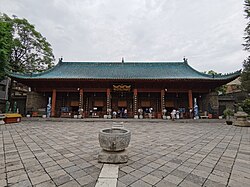
[[File:西安清真大寺大殿.jpg|left|thumb|250x250px|[[Great Mosque of Xi'an]] in China established in 742]] | |||
One of first grand mosques in [[East Asia]] was established in the eighth century in [[Xi'an]] (at the time it was called [[Chang'an]] and it was the world's largest city).<ref>{{Cite book |last=Cybriwsky |first=Roman Adrian |url=https://books.google.com/books?id=3kzEEAAAQBAJ&dq=chang'an+largest+city+in+the+world+xi'an+mosque&pg=PA350 |title=Capital Cities around the World: An Encyclopedia of Geography, History, and Culture |date=2013-05-23 |publisher=Bloomsbury Publishing USA |isbn=978-1-61069-248-9 |pages=350 |language=en}}</ref> The [[Great Mosque of Xi'an]], whose current building dates from the 18th century, does not replicate the features often associated with mosques elsewhere.<ref name="cow30">{{harvnb|Cowen|1985|pp=30–35}}</ref> Minarets were initially prohibited by the state.<ref name="ahm109">{{harvnb|Ahmed|2002|p=109}}</ref> Following traditional [[Chinese architecture]], the Great Mosque of Xi'an, like many other mosques in eastern China, resembles a [[pagoda]], with a green roof instead of the yellow roof common on imperial structures in China. Mosques in western China were more likely to incorporate elements, like domes and minarets, traditionally seen in mosques elsewhere.<ref name="cow30" /> | |||
[[File:Ampel Mosque in 2008.jpg|thumb|[[Ampel Mosque]] is the old mosque in [[Surabaya]], Indonesia (built in 1421)]] | |||
A similar integration of foreign and local influences could be seen on the [[Indonesia]]n islands of [[Sumatra]] and [[Java]], where mosques, including the [[Ampel Mosque]], were first established in the 15th century.<ref name="blobla439">{{harvnb|Bloom|Blair|2009|p=439}}</ref> Early Javanese mosques took design cues from [[Hindu temple architecture|Hindu]], [[Buddhist architecture|Buddhist]], and Chinese architectural influences, with tall timber, multi-level roofs similar to the pagodas of [[Balinese temple|Balinese Hindu temples]]; the ubiquitous Islamic dome did not appear in Indonesia until the 19th century.<ref name="ahm109" /><ref>{{harvnb|Bloom|Blair|2009|p=281}}</ref> In turn, the Javanese style influenced the styles of mosques in Indonesia's [[Austronesia]]n neighbors: [[Malaysia]], [[Brunei]], and the Philippines.<ref name="blobla439" /> | |||
[[File:Old Towns of Djenné-107952.jpg|thumb|[[Great Mosque of Djenné]] built around the 13th century ]] | |||
Another indigenous style to West Africa is the [[Sudano-Sahelian architecture|Sudano-Sahelian]] with its use of [[mudbrick]]s and [[adobe]] plaster, examples of this style include the [[Great Mosque of Djenné]] in [[Mali]], the largest mud-brick building in [[sub-Saharan Africa]],<ref name=":242322">{{harvnb|Bloom|Blair|2009|loc=''Mali, Republic of''}}</ref> and the [[Agadez Grand Mosque]], in Niger. | |||
The Ottomans developed [[Ottoman architecture|an architectural style]] characterized by large central domes (sometimes surrounded by multiple smaller domes), pencil-shaped minarets, and open façades.<ref>{{harvnb|Essa|Ali|2010|pp=231–232}}</ref> Mosques from the Ottoman period are still scattered across [[Eastern Europe]], but the most rapid growth in the number of mosques in Europe has occurred within the past century as more Muslims have migrated to the continent. Many major European cities are home to mosques, like the [[Grand Mosque of Paris]], that incorporate domes, minarets, and other features often found with mosques in Muslim-majority countries.<ref name="blobla193">{{harvnb|Bloom|Blair|2009|p=193}}</ref> The first mosque in North America was founded by [[Albanian American]]s in 1915, but the continent's oldest surviving mosque, the [[Mother Mosque of America]], was built in 1934.<ref>{{harvnb|Nimer|2002|pp=39–40}}</ref> As in Europe, the number of American mosques has rapidly increased in recent decades as Muslim immigrants, particularly from [[South Asia]], have come in the United States. Greater than forty percent of mosques in the United States were constructed after 2000.<ref>{{Cite news |last=Grossman |first=Cathy Lynn |url=http://usatoday30.usatoday.com/news/religion/story/2012-02-29/islamic-worship-growth-us/53298792/1 |newspaper=USA Today |title=Number of U.S. mosques up 74% since 2000 |date=29 February 2012 |access-date=6 October 2013 |archive-date=17 September 2018 |archive-url=https://web.archive.org/web/20180917220154/http://usatoday30.usatoday.com/news/religion/story/2012-02-29/islamic-worship-growth-us/53298792/1 }}</ref> | |||
== Religious functions == | |||
{{Also|Congregational mosque}} | |||
=== Prayers === | |||
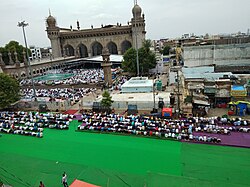
[[File:ATN News.jpg|thumb|[[Eid al-Fitr|Eid ul-Fitr]] at the mosque in [[Hyderabad]], India]] | |||
There are two holidays (''[[Muslim holidays|Eids]]'') in the [[Islamic calendar]]: ''[[Eid al-Fitr|ʿĪd al-Fiṭr]]'' and ''[[Eid al-Adha|ʿĪd al-Aḍḥā]]'', during which there are special prayers held at mosques in the morning. These [[Salat al Eid|Eid prayers]] are supposed to be offered in large groups, and so, in the absence of an outdoor ''[[Eidgah]]'', a large mosque will normally host them for their congregants as well as the congregants of smaller local mosques. Some mosques will even rent [[convention center]]s or other large public buildings to hold the large number of Muslims who attend. Mosques, especially those in countries where Muslims are the majority, will also host Eid prayers outside in courtyards, [[town square]]s or on the outskirts of town in an ''Eidgah''.<ref>{{Cite web |url=http://www.usc.edu/dept/MSA/fundamentals/pillars/prayer/Eid-Prayers_1.html |access-date=April 8, 2006 |title='Id Prayers (Salatul 'Idain) |publisher=University of Southern California |website=Compendium of Muslim Texts |archive-url=https://web.archive.org/web/20051223214532/http://www.usc.edu/dept/MSA/fundamentals/pillars/prayer/Eid-Prayers_1.html |archive-date=December 23, 2005 }}</ref><ref>{{Cite web|url=http://www.central-mosque.com/fiqh/eidgah.htm|title=Performance of Eid Salah in Eidgah (Open Field)|website=www.central-mosque.com|access-date=2012-02-01|archive-date=2016-03-15|archive-url=https://web.archive.org/web/20160315102007/http://www.central-mosque.com/fiqh/eidgah.htm|url-status=live}}</ref> | |||
=== Ramadan === | |||
[[File:Taipei Grand Mosque - Fast Break.JPG|thumb|left|[[Iftar]] at [[Taipei Grand Mosque]], Taiwan during [[Ramadan]]]] | |||
Islam's holiest month, ''[[Ramadan|Ramaḍān]]'', is observed through many events. As Muslims must [[sawm|fast]] during the day during Ramadan, mosques will host ''[[Iftar|Ifṭār]]'' dinners after sunset and the fourth required prayer of the day, that is ''[[Maghrib (prayer)|Maghrib]]''. Food is provided, at least in part, by members of the community, thereby creating daily [[potluck]] dinners. Because of the community contribution necessary to serve ''iftar'' dinners, mosques with smaller congregations may not be able to host the ''iftar'' dinners daily. Some mosques will also hold ''[[Suhoor|Suḥūr]]'' meals before [[dawn]] to congregants attending the first required prayer of the day, ''[[Fajr]]''. As with iftar dinners, congregants usually provide the food for suhoor, although able mosques may provide food instead. Mosques will often invite poorer members of the Muslim community to share in beginning and breaking the fasts, as providing [[Alms|charity]] during Ramadan is regarded in Islam as especially honorable.<ref>{{Cite web|url=http://www.usc.edu/dept/MSA/fundamentals/pillars/fasting/tajuddin/fast_51.html |access-date=April 17, 2006 |title=Charity |publisher=University of Southern California |website=Compendium of Muslim Texts |archive-url=https://web.archive.org/web/20060205112728/http://www.usc.edu/dept/MSA/fundamentals/pillars/fasting/tajuddin/fast_51.html |archive-date=February 5, 2006 }}</ref> | |||
Following the last obligatory daily prayer (''[[Isha'|ʿIshāʾ]]'') special, optional ''[[Tarawih|Tarāwīḥ]]'' prayers are offered in larger mosques. During each night of prayers, which can last for up to two hours each night, usually one member of the community who has memorized the entire Quran (a [[Hafiz (Quran)|Hafiz]]) will recite a segment of the book.<ref name="teach-islam">{{Cite book |title=Teach Yourself Islam |last=Maqsood |first=Ruqaiyyah Waris |isbn=978-0-07-141963-5 |year=2003 |edition=2nd |publisher=McGraw-Hill |pages=57–58, 72–75, 112–120 |location=Chicago}}</ref> Sometimes, several such people (not necessarily of the local community) take turns to do this. During the last ten days of Ramadan, larger mosques will host all-night programs to observe ''[[Laylat al-Qadr]]'', the night Muslims believe that Muhammad first received Quranic revelations.<ref name="teach-islam" /> On that night, between [[sunset]] and [[sunrise]], mosques employ speakers to educate congregants in attendance about Islam. Mosques or the community usually provide meals periodically throughout the night | |||
< | During the last ten days of [[Ramadan (calendar month)|Ramadan]], larger mosques within the Muslim community will host ''[[Iʿtikāf]]'', a practice in which at least one Muslim man from the community must participate. Muslims performing itikaf are required to stay within the mosque for ten consecutive days, often in worship or learning about Islam. As a result, the rest of the Muslim community is responsible for providing the participants with food, drinks, and whatever else they need during their stay.<ref name="teach-islam" /> | ||
File: | |||
=== Charity === | |||
File: | The third of the [[Five Pillars of Islam]] states that Muslims are required to give approximately one-fortieth of their wealth to charity as ''[[Zakat]]''.<ref>{{Cite book |last=Clarke |first=Matthew |title=Development and Religion: Theology and Practice |url=https://books.google.com/books?id=DIvHQc0-rwgC&pg=PA156 |access-date=21 February 2013 |year=2011 |publisher=Edward Elgar Publishing |isbn=978-0-85793-073-6 |page=156}}</ref> Since mosques form the center of Muslim communities, they are where Muslims go to both give ''zakat'' and, if necessary, collect it. Before the holiday of ''Eid ul-Fitr'', mosques also collect a special ''zakat'' that is supposed to assist in helping poor Muslims attend the prayers and celebrations associated with the holiday. | ||
File: | |||
File: | == Architecture == | ||
File: | {{Further|Islamic architecture}} | ||
File: | === Styles === | ||
[[File:مسجد أحمد ابن طولون1.jpg|left|thumb|The [[Ibn Tulun Mosque]] in Cairo (built in 879) is an example of a [[hypostyle]] or "Arab-plan" mosque with a large courtyard (''[[sahn]]'') surrounded by arcades ([[Riwaq (arcade)|''riwaq''s]]).]] | |||
''Arab-plan'' or [[hypostyle]] mosques are the earliest type of mosques, pioneered under the Umayyad Dynasty. These mosques have square or rectangular plans with an enclosed courtyard (''[[sahn]]'') and covered prayer hall. Historically, in the warm Middle Eastern and [[Mediterranean climate]]s, the courtyard served to accommodate the large number of worshippers during Friday prayers. Most early hypostyle mosques had flat roofs on prayer halls, which required the use of numerous [[column]]s and [[Support (structure)|supports]].<ref name="Masdjid1">{{Cite encyclopedia |title=Masdjid. I. In the central Islamic lands |encyclopedia=[[Encyclopaedia of Islam]] Online |publisher=Brill Academic Publishers |last=Hillenbrand |first=R |editor=P.J. Bearman |issn=1573-3912 |editor2=Th. Bianquis |editor3=[[Clifford Edmund Bosworth|C.E. Bosworth]] |editor4=E. van Donzel |editor5=[[Wolfhart Heinrichs|W.P. Heinrichs]]}}</ref> Frequently, hypostyle mosques have outer [[Arcade (architecture)|arcades]] ([[Riwaq (arcade)|''riwaq'']]) so that visitors can enjoy the shade. Arab-plan mosques were constructed mostly under the Umayyad and Abbasid dynasties. The simplicity of the Arab plan limited the opportunities for further development, the mosques consequently losing popularity.<ref name="Masdjid1" /> One of the most notable hypostyle mosques is the [[Mosque–Cathedral of Córdoba|Great Mosque of Cordoba]] in Spain, the building being supported by over 850 columns,<ref name="mit-handout" /> other notable examples include the Umayyad Mosques of [[Umayyad Mosque|Damascus]] and [[Great Mosque of Aleppo|Aleppo]], [[Al-Aqsa Mosque|Qibli Mosque]] (part of Al-Aqsa) in Jerusalem and the Great Mosques of [[Samarra]] ([[Great Mosque of Samarra|Al-Malwiya Mosque]] and [[Abu Dulaf Mosque]]),{{sfn|Bloom|Blair|2009|p=550}} in addition to the [[Great Mosque of Kairouan]], [[Al-Zaytuna Mosque]] in Tunis and [[University of al-Qarawiyyin|Al-Qarawiyyin Mosque]] in Fez.<ref>{{Cite book |last=Fenwick |first=Corisande |url=https://www.google.com.sa/books/edition/Early_Islamic_North_Africa/aXnVDwAAQBAJ?hl=en&gbpv=1&dq=hypostyle+kairouan+and+qarawiyyin&pg=PA137&printsec=frontcover |title=Early Islamic North Africa: A New Perspective |date=2020-05-14 |publisher=Bloomsbury Publishing |isbn=978-1-350-07520-7 |pages=137 |language=en}}</ref> Those Arab-plan or hypostyle mosques are based on the early [[Prophet's Mosque|Prophet's mosque]] in Medina.<ref>{{Cite book |last=Meri |first=Josef |url=https://books.google.com/books?id=P-pGDwAAQBAJ&dq=hypostyle+mosques+based+on+prophet's+mosque&pg=PT227 |title=Routledge Revivals: Medieval Islamic Civilization (2006): An Encyclopedia - Volume II |date=2018-01-12 |publisher=Routledge |isbn=978-1-351-66813-2 |language=en}}</ref> | |||
[[File:20180301124354 IMG 4179And6more Interior 3.jpg|thumb|Main courtyard of the [[Jameh Mosque of Isfahan]], with a [[four-iwan layout]] typical of mosques in Iran and Central Asia]] | |||
The first departure within mosque design started in Persia (Iran). The [[Persian people|Persians]] had inherited a rich [[Iranian architecture|architectural legacy]] from the earlier Persian dynasties, and they began incorporating elements from earlier [[Parthian Empire|Parthian]] and [[Sassanid Empire|Sassanid]] designs into their mosques, influenced by buildings such as the [[Palace of Ardashir]] and the [[Sarvestan Palace]].<ref name="autogenerated1">{{Cite web |url=http://www.ne.jp/asahi/arc/ind/2_meisaku/55_shah/sha_eng.htm |title=The Royal Mosque (Masjed-e-Emam) in Isfahan, Iran |publisher=Ne.jp |access-date=2011-11-03 |archive-date=2023-04-18 |archive-url=https://web.archive.org/web/20230418171726/http://www.ne.jp/asahi/arc/ind/2_meisaku/55_shah/sha_eng.htm |url-status=live }}</ref> Thus, [[Islamic architecture]] witnessed the introduction of such structures as domes and large, arched entrances, referred to as ''[[iwan]]s''. During [[Seljuq dynasty|Seljuq rule]], as [[Sufism|Islamic mysticism]] was on the rise, the [[Shah Mosque (Isfahan)#Design – the four-iwan style|four-iwan]] arrangement took form. The four-iwan format, finalized by the Seljuqs, and later inherited by the [[Safavid dynasty|Safavids]], firmly established the courtyard façade of such mosques, with the towering gateways at every side, as more important than the actual buildings themselves.<ref name="autogenerated1" /> They typically took the form of a square-shaped central courtyard with large entrances at each side, giving the impression of gateways to the spiritual world.<ref>{{Cite book |last=Blake |first=Stephen P. |title=Half the world: the social architecture of Safavid Isfahan, 1590–1722|url=https://books.google.com/books?id=AVAqAQAAMAAJ|access-date=21 February 2013|year=1999|publisher=Mazda Pub.|isbn=978-1-56859-087-5|pages=143–144}}</ref> The Persians also introduced [[Persian gardens]] into mosque designs. Soon, a distinctly [[Iranian architecture|Persian style]] of mosques started appearing that would significantly influence the designs of later [[Timurid dynasty|Timurid]], and also [[Mughal architecture|Mughal]], mosque designs. A prominent example of the four-Iwan layout mosque outside of Central Asia is the [[Mosque-Madrasa of Sultan Hasan|Mosque of Sultan Hasan]] in Cairo, an anomalous in Mamluk architecture.<ref>{{Cite book |last=O'Kane |first=Bernard |url=https://books.google.com/books?id=eNafEQAAQBAJ&dq=mosque+of+sultan+Hasan+iwan&pg=PT526 |title=Studies in Arab Architecture |date=2021-08-20 |publisher=Edinburgh University Press |isbn=978-1-4744-7491-7 |language=en}}</ref> | |||
[[File:Jama Masjid - In the Noon.jpg|thumb|The [[Jama Masjid, Delhi|Jama Masjid]] in Delhi is an example of a three-dome mosque found in India, Pakistan and Bangladesh ]] | |||
The three-dome layout is a prominent plan in South Asia, it was developed as a result of the fusion between Islamic architecture and local South Asian traditions during the [[Mughal Empire|Mughal era]], which created a three-dome mosque style with an extensive walled courtyard.<ref>{{Cite book|title=Sacred Buildings: A Design Manual|url=https://www.google.com.sa/books/edition/Sacred_Buildings/1RTVAAAAQBAJ?hl=en&gbpv=1&dq=three+domed+mosque%C2%A0&pg=PA48&printsec=frontcover|publisher=Walter de Gruyter|date=2008-05-16|isbn=978-3-7643-8276-6|language=en|first=Rudolf|last=Stegers|pages=48}}</ref> the most notable examples of that are influenced by this plan are the [[Jama Masjid, Delhi|Jama Masjid]] and [[Moti Masjid (Red Fort)|Moti Masjid]] in India, the [[Badshahi Mosque]], [[Dai Anga Mosque]], and [[Sunehri Mosque, Lahore|Sunehri Mosque]] in Pakistan, and the [[One Row Mosque]], [[Sat Gambuj Mosque]], and [[Nayabad Mosque]] in Bangladesh. | |||
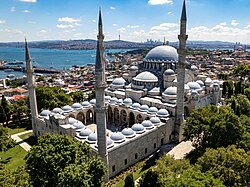
[[File:SüleymaniyeMosqueIstanbul (cropped).jpg|left|thumb|240x240px|[[Süleymaniye Mosque]] in Istanbul, with a central dome layout typical of mosques in Turkey and the Balkans]] | |||
The Ottomans introduced central dome mosques in the 15th century. These mosques have a large dome centered over the prayer hall. In addition to having a large central dome, a common feature is smaller domes that exist off-center over the prayer hall or throughout the rest of the mosque, where prayer is not performed.<ref name="mit-vocab">{{Cite web |url=http://ocw.mit.edu/OcwWeb/Architecture/4-614Religious-Architecture-and-Islamic-CulturesFall2002/LectureNotes/detail/vocab-islam.htm#islam6 |access-date=April 9, 2006 |title=Vocabulary of Islamic Architecture |publisher=Massachusetts Institute of Technology |archive-url=https://web.archive.org/web/20060918221451/http://ocw.mit.edu/OcwWeb/Architecture/4-614Religious-Architecture-and-Islamic-CulturesFall2002/LectureNotes/detail/vocab-islam.htm#islam6 |archive-date=September 18, 2006}}</ref> This style was heavily influenced by Byzantine architecture with its use of large central domes.<ref name="Masdjid1" /> One of the most notable imperial Ottoman mosques is the [[Süleymaniye Mosque]] in Istanbul, the mosque has foundations that goes 12 m into the ground, and it is covered by a large central dome that measures 26 meters in diameter, that is contained within 2 [[Semi-dome|semi-domes]], and small domes on either side that measure between 5 and 10 m in diameter. On the other hand, the latter bigger dome of the [[Selimiye Mosque, Edirne|Selmiye Mosque]] in Edrine, which measures 31.1 m in diameter, is held by giant [[Squinch|squinches]] instead of the semi-domes. Both mosques are considered to be the best works of [[Mimar Sinan]].<ref>{{Cite book |last=Petersen |first=Andrew |url=https://books.google.com/books?id=eIaEAgAAQBAJ&dq=ottoman+mosque+architecture&pg=PA219 |title=Dictionary of Islamic Architecture |date=2002-03-11 |publisher=Routledge |isbn=978-1-134-61366-3 |pages=222 |language=en}}</ref> | |||
<gallery widths="200" heights="200" class="center" caption="Examples of other historical mosque architectural styles"> | |||
File:Cairo, moschea di al-aqmar, 00.JPG|[[Aqmar Mosque]], Cairo, Egypt (built in 1125-6) | |||
File:Bibi-Khanym Mosque interior, Samarkand (мечеть Биби-Ханум, Северный зал мечети).jpg|[[Bibi-Khanym Mosque]], Samarkand, Uzbekistan (completed in 1404) | |||
File:The Mussaffar Mosque in Taiz.jpg|[[Mudhaffar Mosque]], Taiz, Yemen (13th century) | |||
File:Divrigi Darussifa.JPG|[[Divriği Great Mosque and Hospital|Divriği Great Mosque]], [[Divriği]], Turkey (built in 1228–9) | |||
File:Mausoleum of Shah e Hamadan 01.JPG|The [[Khanqah-e-Moula]], a 14th-century mosque in [[Srinagar]], [[Jammu and Kashmir (union territory)|Jammu and Kashmir]], India | |||
File:Larabanga Mosque Ghana.jpg|[[Larabanga Mosque]], Ghana founded in 1421 | |||
File:Guangdong Huaisheng Mosque 2024.jpg|[[Huaisheng Mosque]] in [[Guangzhou]], China, dating back to 627 AD | |||
File:Kazan Marjani Mosque 08-2016 img2.jpg|[[Märcani Mosque|Marjani Mosque]], oldest active mosque in [[Tatarstan]], Russia (completed in 1770) | |||
File:มัสยิดตะโละมาเนาะ (มัสยิด 300 ปี).jpg|[[Talo Mano Mosque]], in Narathiwat, Thailand built in 1634 | |||
File:Mishkal mosque calicut.jpg|[[Mishkal Mosque]], [[Kozhikode|Calicut]], [[Kerala]], India, dating back to the 14th century | |||
File:Masjid Kampung Laut, Nilampuri, Kelantan, Malaysia.jpg|[[Kampung Laut Mosque]], one of the oldest mosques in Malaysia, showcasing the local architecture. | |||
File:Tuzla, hornicka mesita (drevena, 18. stol).jpg|Huseina Čauša džamija (a.k.a. Džindijska), 17th-century traditional wooden mosque in [[Tuzla]], Bosnia and Herzegovina | |||
</gallery> | </gallery> | ||
=== | ==== Decoration ==== | ||
{{Further|Islamic ornament}}[[File:Nasr_ol_Molk_mosque_vault_ceiling.jpg|thumb|''[[Muqarnas]]'' vault in the [[Nasir al-Mulk Mosque]] in [[Shiraz]], Iran]] | |||
[[File: | |||
Islam forbids [[figurative art]], on the grounds that the artist must not imitate God's creation. Mosques are, therefore, decorated with [[Abstract art|abstract patterns]] and beautiful inscriptions. Decoration is often concentrated around doorways and the ''[[Mihrab|miḥrāb]]''. Tiles are used widely in mosques. They lend themselves to pattern-making, can be made with beautiful subtle colors, and can create a cool atmosphere, an advantage in the hot Arab countries. Quotations from the [[Quran]] often adorn mosque interiors. These texts are meant to inspire people by their beauty, while also reminding them of the words of Allah.<ref>{{Cite book|last=Encyclopedia|first=Illustrated Family|title=Mosques|publisher=[[DK (publisher)|DK]]|year=2005|isbn=0-14-306302-2|edition=|location=London|page=572}}</ref> | |||
=== Prayer hall === | |||
The prayer hall, also known as the ''muṣallá'' ({{langx|ar|مُصَلَّى}}), rarely has furniture; chairs and pews are generally absent from the prayer hall so as to allow as many worshipers as possible to line the room.<ref name="unitulsa">{{Cite web|url=http://www.utulsa.edu/iss/Mosque/MosqueFAQ.html |access-date=April 9, 2006 |publisher=The University of Tulsa |title=Mosque FAQ |archive-url=https://web.archive.org/web/20070330202640/http://www.utulsa.edu/iss/Mosque/MosqueFAQ.html |archive-date=March 30, 2007 }}</ref> Some mosques have [[Islamic calligraphy]] and Quranic verses on the walls to create a more religious atmosphere for worshippers.<ref name="teach-islam" /> | |||
Often, a limited part of the prayer hall is sanctified formally as a ''masjid'' in the ''[[Sharia|sharīʿah]]'' sense (although the term ''masjid'' is also used for the larger mosque complex as well). Once designated, there are onerous limitations on the use of this formally designated ''masjid'', and it may not be used for any purpose other than worship; restrictions that do not necessarily apply to the rest of the prayer area, and to the rest of the mosque complex (although such uses may be restricted by the conditions of the ''[[waqf]]'' that owns the mosque).<ref name="qaSunniPathFiqhMasjid">{{Cite web|url=http://qa.sunnipath.com/issue_view.asp?HD=1&ID=4347&CATE=4 |title=Fiqh of Masjid & Musalla |publisher=Qa.sunnipath.com |date=2005-07-03 |access-date=2011-11-03|archive-url=https://web.archive.org/web/20111019002051/http://qa.sunnipath.com/issue_view.asp?HD=1&ID=4347&CATE=4|archive-date=2011-10-19}}</ref> | |||
In many mosques, especially the early congregational mosques, the prayer hall is built in the [[hypostyle]] form (the roof held up by a multitude of columns).<ref>{{Cite book |last=Kleiner |first=Fred S. |title=Gardner's Art Through the Ages: The Western Perspective |url=https://books.google.com/books?id=IJrN8rDirxkC&pg=PA265 |access-date=21 February 2013 |year=2010 |publisher=Cengage Learning |isbn=978-0-495-57355-5 |page=265}}</ref> One of the finest examples of the hypostyle-plan mosques is the [[Great Mosque of Kairouan]] in [[Tunisia]].<ref>{{Cite book |last=Kleiner |first=Fred S. |title=Gardner's Art Through the Ages: The Western Perspective |url=https://books.google.com/books?id=IJrN8rDirxkC&pg=PA267 |access-date=21 February 2013|year=2010 |publisher=Cengage Learning |isbn=978-0-495-57355-5 |page=267}}</ref> | |||
Usually opposite the entrance to the prayer hall is the ''[[qibla]]'' wall (the direction of [[Mecca]], and thus the direction towards which [[Muslims]] should face for prayer), the visually emphasized area inside the prayer hall. The ''qibla'' wall should, in a properly oriented mosque, be set perpendicular to a line leading to [[Mecca]], where the [[Kaaba]] is located.<ref>{{Cite book|title=Writing Signs: Fatimid Public Text |date=December 16, 1998 |last=Bierman |first=Irene A. |publisher=University of California Press |page=150 |isbn=978-0-520-20802-5}}</ref> Congregants pray in rows parallel to the qiblah wall and thus arrange themselves so they face Mecca. In the ''qibla'' wall, usually at its center, is the ''[[Mihrab|miḥrāb]]'', a niche or depression indicating the direction of Mecca. Usually the ''mihrab'' is not occupied by furniture either. A raised ''[[minbar]]'' (pulpit) is located to the right side of the ''mihrab'' for a ''[[Khatib|khaṭīb]]'' (preacher), or some other speaker, to offer a ''[[Khutbah|khuṭbah]]'' (sermon) during the ritual Friday prayers. | |||
The ''mihrab'' serves as the location where the [[imam]] or [[mullah]] leads the five daily prayers on a regular basis.<ref>{{Cite web |url=http://www.ioc.u-tokyo.ac.jp/~islamarc/WebPage1/htm_eng/index/keyword1_e.htm |access-date=April 9, 2006 |title=Terms 1: Mosque |publisher=University of Tokyo Institute of Oriental Culture |archive-date=February 12, 2012 |archive-url=https://web.archive.org/web/20120212174310/http://www.ioc.u-tokyo.ac.jp/~islamarc/WebPage1/htm_eng/index/keyword1_e.htm |url-status=live }}</ref> Left to the ''mihrab'', in the front left corner of the mosque, sometimes there is a ''kursu'' (Turkish: {{lang|tr|[[:wikt:tr:kürsü#Türkçe|kürsü]]}}, Bosnian: ''{{lang|bs|ćurs/ћурс}}''), a small elevated plateau (rarely with a chair or other type of seat) used for less formal preaching and speeches.<gallery widths="200" heights="200" class="center"> | |||
File:Great Mosque of Kairouan, prayer hall.jpg|[[Hypostyle]] prayer hall in the [[Great Mosque of Kairouan]], Tunisia, from the [[Aghlabid architecture|Aghlabid period]] | |||
File:Shah Mosque, Isfahan 05.jpg|The [[Iranian architecture|Persian style]] prayer hall of the [[Shah Mosque (Isfahan)|Shah Mosque]] in [[Isfahan]], Iran | |||
File:Nuruosmaniye Mosque 1175.jpg|[[Ottoman Baroque architecture]] prayer hall of the [[Nuruosmaniye Mosque]] in [[Istanbul]], Turkey | |||
File:Jumma mazjid, Zinad Baksh, Bunder, Mangalore-2.jpg|Central prayer hall with [[Dravidian architecture|Dravidian style]] of the [[Masjid Zeenath Baksh]], in [[Dakshina Kannada]], India from the [[Kingdom of Mysore]] period | |||
File:Grande Mosquee de Paris salle de priere 20250824 163142.jpg|[[Moorish Revival]] prayer hall of the [[Grand Mosque of Paris]] in France | |||
File:Songjiang Mosque - Prayer Hall.jpg|alt=Chinese Islamic-style prayer hall of the Songjiang Mosque in Shanghai, China (established in 1368)|[[Chinese Islamic architecture|Chinese Islamic-style]] prayer hall of the [[Songjiang Mosque]] in [[Shanghai]], China (established in 1368) | |||
</gallery> | |||
==== Mihrab and minbar ==== | |||
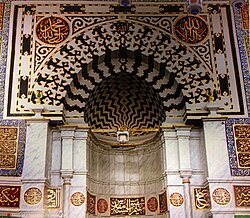
[[File:Mihrab Medina.JPG|thumb|Mihrab in [[Al-Masjid an-Nabawi]], [[Medina]], Saudi Arabia]] | |||
A ''[[mihrab|miḥrāb]]'', also spelled as ''mehrab'' is a semicircular [[Niche (architecture)|niche]] in the wall of a mosque that faces the ''[[qibla]]h'' (i.e. the "front" of the mosque); the imam stands in this niche and leads prayer. Given that the imam typically stands alone in the frontmost row, this niche's practical effect is to save unused space.{{sfn|Kuban|1974|p=4}} The ''[[minbar]]'' is a [[pulpit]] from which the Friday sermon is delivered. While the ''minbar'' of Muhammad was a simple chair, later it became larger and attracted artistic attention. Some remained made of wood, albeit exquisitely carved, while others were made of marble and featured [[frieze]]s.{{sfn|Kuban|1974|pp=5-6}} | |||
=== Minarets === | |||
{{Main|Minaret}} | |||
[[File:001124-MalwiyaMosque-Samerra-IMG 7824-2.jpg|left|thumb|The spiral "Malwiya" minaret of the [[Abbasid architecture|Abbasid]] [[Great Mosque of Samarra]], in Iraq (built in 850) was the largest mosque at the time]] | |||
A common feature in mosques is the minaret, the tall, slender tower that usually is situated at one of the corners of the mosque structure. The top of the minaret is always the highest point in mosques that have one, and often the highest point in the immediate area. | |||
[[File:ASC Leiden - van Achterberg Collection - 5 - 022 - Deux minarets de boue de la Grande Mosquée - Bobo-Dioulasso, Burkina Faso, 19-26 août 2001.tif|thumb|Two minarets made of clay with twenty layers of horizontal protruding wooden sticks from the [[Grand Mosque of Bobo-Dioulasso|Great Mosque of Bobo-Dioulasso]] in Burkina Faso]] | |||
The origin of the minaret and its initial functions are not clearly known and have long been a topic of scholarly discussion.{{Sfn|Hillenbrand|1994|pp=129–137}}{{sfn|Bloom|2013|p=|loc=Chapter 1: The History of Scholarship and the Nature of the Problem}} The earliest mosques lacked minarets, and the call to prayer was often performed from smaller structures or elevated platforms.{{sfn|Bloom|2013|pp=29-46}}<ref name="Creswell 12">{{cite journal |last1=Creswell |first1=K. A. C. |author-link1=K. A. C. Creswell |date=March 1926 |title=The Evolution of the Minaret, with Special Reference to Egypt-I |journal=[[The Burlington Magazine for Connoisseurs]] |volume=48 |issue=276 |pages=134–140 |jstor=862832}}</ref>{{Sfn|Hillenbrand|1994|pp=136–137}} The early Muslim community of Medina gave the call to prayer from the doorway or the roof of the house of [[Muhammad]], which doubled as a place for prayer.{{sfn|Bloom|2013|pp=23–30, 46}} The first confirmed minarets in the form of towers date from the early 9th century under Abbasid rule and they did not become a standard feature of mosques until the 11th century.{{sfn|Bloom|2013|pp=xvii, 64, 72}}{{Sfn|Petersen|1996|pp=187–188}} These first minaret towers were placed in the middle of the wall opposite the qibla wall.{{sfn|Bloom|2013|pp=73–82}} Among them, the minaret of the Great Mosque of Kairouan in Tunisia, dating from 836, is well-preserved and is one of the oldest surviving minarets in the world today.<ref name=":2432">{{harvnb|Bloom|Blair|2009|loc=''Minaret''}}</ref>{{Sfn|Petersen|1996|pp=187-188}}{{sfn|Bloom|2013|pp=73-75}} | |||
Before the five required daily prayers, a ''[[Mu'adhin|Mu'adhdhin]]'' ({{langx|ar|مُـؤَذِّن|links=no}}) calls the worshippers to prayer from the minaret. In many countries like Singapore where Muslims are not the majority, mosques are prohibited from loudly broadcasting the ''[[Adhan|Adhān]]'' ({{langx|ar|أَذَان|links=no}}, Call to Prayer), although it is supposed to be said loudly to the surrounding community. The ''adhan'' is required before every prayer. Nearly every mosque assigns a ''muezzin'' for each prayer to say the ''adhan'' as it is a recommended practice or ''[[Sunnah]]'' ({{langx|ar|سُـنَّـة}}) of the Islamic prophet Muhammad. At mosques that do not have minarets, the ''adhan'' is called instead from inside the mosque or somewhere else on the ground.<ref name="teach-islam" /> The ''[[Iqama|Iqâmah]]'' ({{langx|ar|إِقَـامَـة|links=no}}), which is similar to the ''adhan'' and proclaimed right before the commencement of prayers, is usually not proclaimed from the minaret even if a mosque has one. | |||
=== Courtyard === | |||
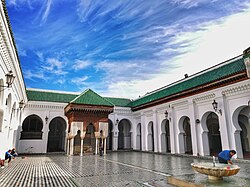
[[File:University karawiyine.jpg|thumb|The courtyard (''[[sahn]]'') of the [[Qarawiyyin Mosque]], in [[Fez, Morocco|Fez]], Morocco (established in 859), including the central fountain and one of the [[Saadi dynasty|Saadian]]-era pavilions]] | |||
The courtyard (''[[Sahn]]'') is a common feature of many congressional mosques, it usually includes a fountain or a small water pool for ablution (''[[Wudu]]'').<ref>{{Cite book |last=Alkazi |first=Feisal |url=https://books.google.com/books?id=5nlsBQAAQBAJ&dq=courtyard+or+sahn&pg=PT86 |title=Srinagar: An Architectural Legacy |date=2014-05-01 |publisher=Roli Books Private Limited |isbn=978-93-5194-051-7 |language=en}}</ref> | |||
=== Domes === | |||
[[File:1. ষাট গম্বুজ মসজিদ.jpg|thumb|[[Sixty Dome Mosque]] in Bagerhat''',''' Bangladesh (built in 1459)]] | |||
Domes have been a prominent feature in mosque architecture for centuries, evolving both in form and function. Traditionally placed above the main prayer hall, they symbolize the connection between the earthly and divine, often representing the vaults of heaven and sky.<ref>{{Cite book |title=Symmetries of Nature: A Handbook for Philosophy of Nature and Science |last=Mainzer |first=Klaus |date=1996 |isbn=978-3-11-012990-8 |page=124 |chapter=Art and Architecture |quote=the dome arching over the believers like the spherical dome of the sky |publisher=Walter de Gruyter |location=Berlin}}</ref> Initially, domes were small structures above the mihrab, but over time, they expanded to cover the entire roof of the prayer hall. The shape of the dome evolved from simple hemispherical forms to more complex designs, with the Mughals in India popularizing the onion-shaped dome, which became a hallmark of South Asian and Arabic mosque architecture.<ref>{{harvnb|Asher|1992|p=256}}</ref> The design and function of domes have been influenced by various cultures, including Persian, Byzantine, and Central Asian traditions, each contributing to the techniques and aesthetics used in their construction. Today, domes continue to serve both structural and spiritual purposes, with modern innovations further enhancing their functionality and sustainability. | |||
'''Structural and functional roles''' | |||
Domes not only serve as architectural focal points but also enhance mosque acoustics, amplifying the sound of the prayer and the sermon. Structurally, they allow vast interior spaces with minimal internal supports and they make the mosque appear bigger on the inside. Their placement above the prayer hall symbolizes the connection between the earthly and the divine, reinforcing the mosque's spiritual purpose.<ref>{{Cite journal |title=Dome |url=https://referenceworks.brill.com/display/entries/EI3O/COM-26080.xml |access-date=2024-10-22 |website=referenceworks |doi=10.1163/1573-3912_ei3_COM_26080 |language=en|url-access=subscription }}</ref> | |||
'''Origin of mosque domes''' | |||
The origin of domes in mosque architecture can be traced back to the early Islamic period, particularly under the Umayyad Caliphate (661–750 AD). The Umayyads, played a key role in incorporating domes into mosque architecture, drawing heavily from pre-Islamic Byzantine and Sassanian traditions. One of the earliest and most significant examples is the Dome of the Rock in Jerusalem, constructed in 691 AD by the Umayyad Caliph Abd al-Malik. This structure was not a mosque but a shrine, yet it set a precedent for the use of domes in Islamic architecture, symbolizing the vault of heaven and the connection between the divine and earthly realms.<ref>{{Cite journal |last=Grabar |first=Oleg |date=December 1963 |title="The Islamic Dome, Some Considerations" |journal=Journal of the Society of Architectural Historians |volume=22 |issue=4 |pages=191–198 |doi=10.2307/988190 |jstor=988190 }}</ref> | |||
Initially, domes in mosques were modest in size and positioned above the mihrab, emphasizing their symbolic function as markers of spiritual focus.{{citation needed|date=January 2025}} As the Islamic empire expanded, architects incorporated techniques from different regions. | |||
'''Persian and Byzantine influences''' | |||
Whilst squinches and pendentives were not first used in mosques, they were later incorporated in dome design and were essential in transitioning from square rooms to circular domes.<ref name=":2">{{Cite web |last=Blessing |first=Patricia |date=15 March 2022 |title=Squinch and Pendentive |url=https://sites.lsa.umich.edu/khamseen/terms/2022/squinch-and-pendentive/ |website=Khamseen: Islamic Art History Online}}</ref> Squinches, which originated in Persian and Roman architecture, fill the corners of a square space to support a dome, while pendentives, a Byzantine innovation, allowed smooth transitions from a square base to a circular dome.<ref name=":2" /> These techniques are exemplified by the Dome of Soltaniyeh. | |||
'''Domes in South Asian mosque architecture''' | |||
Domes became a defining feature of South Asian mosque architecture during the Delhi Sultanate and reached their peak under the Mughal Empire. Influenced by Persian and Central Asian traditions, the Mughals introduced the iconic onion-shaped domes, seen in landmarks like the Jama Masjid in Delhi and the Badshahi Mosque in Lahore.{{citation needed|date=January 2025}} These domes were not only visually striking but also represented remarkable engineering, using techniques such as iron dowels for strength and timber centering for precision. The Mughal architectural style still influences mosque design today.{{citation needed|date=January 2025}} | |||
'''Modern innovations''' | |||
One prime example of modern innovation is the Masjid Raja Haji Fi Sabilillah in Malaysia, which features a Low-E (low emissivity) glass dome. The use of Low-E glass allows for significant energy efficiency by reducing heat gain while still allowing natural light to illuminate the interior space.<ref>{{Cite journal |last=Lasindu |first=Gamage |date=10 December 2023 |title="The Evolution of the Islamic Architectural Dome Feature" |url=https://www.majournal.my/index.php/maj/article/view/184/96 |journal=Malaysia Architectural Journal |volume=5 |issue=3 |pages=38–41}}</ref> This technique helps to maintain a comfortable temperature inside the mosque, minimizing reliance on air conditioning, and promoting sustainability. Another example is [[Zebun Nessa Mosque]] in Bangladesh with its iconic pink color, built with concrete in order to soften the harsh industrial surroundings.<gallery widths="200" heights="200" class="center" caption="Mosques with modernist designs"> | |||
File:Faisal mosque2.jpg|The modern [[Faisal Mosque]] in [[Islamabad]], Pakistan | |||
File:Grand Istiqlal Mosque.jpg|Exterior of [[Istiqlal Mosque, Jakarta|Istiqlal Mosque]] in [[Jakarta]], Indonesia | |||
File:KAFD Grand Mosque.jpg|[[King Abdullah Financial District|KAFD]] grand mosque, in [[Riyadh]], Saudi Arabia | |||
</gallery> | |||
=== Ablution facilities === | |||
[[File:Ablution area inside Eastern wall of Badshahi mosque.JPG|thumb|The ''[[wudu]]'' ("ablution") area, where Muslims wash their hands, forearm, face and feet before they pray. Example from the [[Badshahi Mosque, Lahore]], Pakistan.]] | |||
As [[Ritual purification#Islam|ritual purification]] precedes all prayers, mosques often have [[Wudu|ablution]] fountains or other facilities for washing in their entryways or courtyards. Worshippers at much smaller mosques often have to use restrooms to perform their ablutions. In traditional mosques, this function is often elaborated into a freestanding building in the center of a courtyard.<ref name="mit-handout">{{Cite web |url=http://web.mit.edu/4.614/www/handout02.html |access-date=April 9, 2006 |publisher=Massachusetts Institute of Technology |title=Religious Architecture and Islamic Cultures |archive-date=July 20, 2012 |archive-url=https://web.archive.org/web/20120720215715/http://web.mit.edu/4.614/www/handout02.html |url-status=live }}</ref> This desire for cleanliness extends to the prayer halls where shoes are disallowed to be worn anywhere other than the cloakroom. Thus, foyers with shelves to put shoes and racks to hold coats are commonplace among mosques.<ref name="unitulsa" /> | |||
=== Contemporary features === | |||
Modern mosques have a variety of amenities available to their congregants. As mosques are supposed to appeal to the community, they may also have additional facilities, from [[clinic|health clinics]] and [[health club|clubs]] (gyms) to [[library|libraries]] to [[gym]]nasiums, to serve the community.<ref>{{Cite web |title=Student Life – Masjid DarusSalam |url=https://masjidds.org/tanwir-intensive/student-of-islam/ |access-date=2024-11-14 |website=masjidds.org}}</ref> | |||
=== Symbols === | |||
Certain symbols are represented in a mosque's architecture to allude to different aspects of the Islamic religion. One of these feature symbols is the spiral. The "cosmic spiral" found in designs and on minarets is a references to heaven as it has "no beginning and no end".<ref name="Erzen 2011 126–129">{{citation |last=Erzen |first=Jale Nejdet |title=Reading Mosques: Meaning and Architecture in Islam |journal=[[The Journal of Aesthetics and Art Criticism]] |volume=69 |issue=1 |year=2011 |pages=126–129 |jstor=42635843 |doi=10.1111/j.1540-6245.2010.01453.x |doi-access=free |hdl=11511/36200 |hdl-access=free }}</ref> Mosques also often have floral patterns or images of fruit and vegetables. These are allusions to the paradise after death.<ref name="Erzen 2011 126–129" /> | |||
=== Inter-religious conversion === | |||
{{Also|Conversion of non-Muslim places of worship into mosques|List of former mosques in Spain|List of former mosques in Portugal}} | |||
[[File:Turkey-3019 - Hagia Sophia (2216460729).jpg|thumb|The [[Hagia Sophia]] in [[Istanbul]], Turkey, built in 360, was converted into a mosque after the Ottoman conquest of Constantinople in 1453.]] | |||
[[File:Mezquita de Córdoba (28890229187).jpg|thumb|The [[Mosque–Cathedral of Córdoba]] in Spain, built in 785, was converted into a cathedral in 1236.]] | |||
According to early [[List of Muslim historians|Muslim historians]], towns that surrendered without resistance and made treaties with the Muslims were allowed to retain their churches and the towns captured by Muslims had many of their churches converted to mosques.<ref>{{Cite book |last=Houtsma |first=M. Th. |url=https://books.google.com/books?id=Va6oSxzojzoC&pg=PA321 |title=E.J. Brill's First Encyclopedia of Islam, 1913–1936 |publisher=Brill |year=1993 |isbn=978-90-04-09791-9 |page=320 |access-date=21 February 2013}}</ref> One of the earliest examples of these kinds of conversions was in [[Damascus]], Syria, where in 705 [[Umayyad Caliphate|Umayyad]] [[caliph]] [[Al-Walid I]] bought the church of [[John the Baptist|St. John]] from the [[Christians]] (which used to be a Roman temple and an Aramean temple prior to that),{{Sfn|Burns|2005|pp=38–40}}{{Sfn|George|2001|p=44}}{{sfn|Burns|2007|p=65}} and had it demolished and rebuilt as a mosque in exchange for building a number of new churches for the Christians in Damascus. Overall, [[Abd al-Malik ibn Marwan]] (Al-Waleed's father) is said to have transformed 10 churches in Damascus into mosques.<ref>Houtsma p. 21</ref> | |||
The process of turning churches into mosques were especially intensive in the villages where most of the inhabitants [[Religious conversion|converted]] to Islam.{{citation needed|date=October 2020}} The [[Abbasid Caliphate|Abbasid]] caliph [[al-Ma'mun]] turned many churches into mosques.{{citation needed|date=November 2025}} Several of the early mosques in the Ottoman Empire were originally churches or cathedrals from the [[Byzantine Empire]], with the [[Hagia Sophia]] (one of those converted cathedrals) informing the architecture of mosques from after the [[Fall of Constantinople|Ottoman conquest of Constantinople]].<ref>{{harvnb|Essa|Ali|2010|pp=230–231}}</ref> In some instances mosques have been established on the places of [[Judaism|Jewish]] or Christian sanctuaries associated with [[Bible|Biblical]] personalities who were also recognized by Islam.<ref name="Masdjid1" /> | |||
Mosques have also been converted for use by other religions, notably in southern Spain, following the conquest of the Moors in 1492.<ref>{{Cite book |last=Wagner |first=William |url=https://archive.org/details/howislamplanstoc0000wagn/page/99 |title=How Islam Plans to Change the World |publisher=Kregel Publications |year=2004 |isbn=978-0-8254-3965-0 |page=[https://archive.org/details/howislamplanstoc0000wagn/page/99 99] |quote=When the Moors were driven out of Spain in 1492, most of the mosques were converted into churches}}</ref> The most prominent of them is the [[Cathedral–Mosque of Córdoba|Great Mosque of Cordoba]], itself constructed on the site of a church demolished during the period of Muslim rule. Outside of the [[Iberian Peninsula]], such instances also occurred in southeastern Europe once regions were no longer under Muslim rule, like the [[Seven Saints Church, Sofia|Seven Saints Church]], in Sofia, Bulgaria. | |||
== Rules and etiquette == | |||
=== Prayer leading === | |||
Appointment of a prayer leader is considered desirable, but not always obligatory.<ref name="mawardi112">{{Cite book |last=Abu al-Hasankok Ibn Muhammad Ibn Habib |first=Al-Mawardi |author-link=Al-Mawardi |title=The Ordinances of Government (''Al-Ahkam al-Sultaniyya w'al-Wilayat al-Diniyya'') |publisher=Garnet Publishing |location=Lebanon |year=2000 |isbn=978-1-85964-140-8 |page=184}}</ref> The permanent prayer leader ([[imam]]) must be a free honest individual and is authoritative in religious matters.<ref name="mawardi112" /> In mosques constructed and maintained by the government, the prayer leader is appointed by the ruler;<ref name="mawardi112" /> in private mosques, appointment is made by members of the congregation through [[majority rule|majority voting]]. According to the [[Hanafi]] [[Madh'hab|school]] of Islamic jurisprudence, the individual who built the mosque has a stronger claim to the title of imam, but this view is not shared by the other schools.<ref name="mawardi112" /> | |||
[[ | Leadership at prayer falls into three categories, depending on the type of prayer: five daily prayers, Friday prayer, or optional prayers.<ref name="mawardi112" /> According to the Hanafi and [[Maliki]] school of Islamic jurisprudence, appointment of a prayer leader for Friday service is mandatory because otherwise the prayer is invalid. The [[Shafi'i]] and [[Hanbali]] schools argue that the appointment is not necessary and the prayer is valid as long as it is performed in a congregation. A slave may lead a Friday prayer, but Muslim authorities disagree over whether the job can be done by a minor.<ref name="mawardi112" /> An imam appointed to lead Friday prayers may also lead at the five daily prayers; [[List of Islamic studies scholars|Muslim scholars]] agree to the leader appointed for five daily services may lead the Friday service as well.<ref name="mawardi112" /> | ||
All Muslim authorities hold the consensus opinion that only men may lead prayer for men.<ref name="mawardi112" /> Nevertheless, women prayer leaders are allowed to lead prayer in front of all-female congregations.<ref>{{Cite book |url=https://books.google.com/books?id=Z9WF1fRGOsQC&q=false&pg=PA63 |title=Karin van Nieuwkerk, 'Women Embracing Islam'|page=63 |publisher=University of Texas Press |isbn=978-0-292-77376-9 |year=2006}}</ref> | |||
=== Cleanliness === | |||
[[File:Zoetermeer Meerzicht Moskee Qibla (04).JPG|thumb|Storage for shoes]] | |||
{{Also|Ritual purity in Islam}} | |||
All mosques have rules regarding cleanliness, as it is an essential part of the worshippers' experience. Muslims before prayer are required to cleanse themselves in an ablution process known as ''wudu''. Shoes must not be worn inside the carpeted prayer hall. Some mosques will also extend that rule to include other parts of the facility even if those other locations are not devoted to prayer. Congregants and visitors to mosques are supposed to be clean themselves. It is also undesirable to come to the mosque after eating something that smells, such as garlic.<ref>{{Cite web |url=http://www.sunnipath.com/Resources/PrintMedia/Hadith/H0002P0016.aspx |publisher=SunniPath |website=SunniPath Library |access-date=July 12, 2006 |title=Chapter 16. The Description of the Prayer |archive-url=https://web.archive.org/web/20061128133738/http://www.sunnipath.com/Resources/PrintMedia/Hadith/H0002P0016.aspx |archive-date=November 28, 2006 }}</ref> | |||
=== Dress === | |||
Islam requires that its adherents wear [[Islam and clothing|clothes]] that portray [[modesty]]. Men are supposed to come to the mosque wearing loose and clean clothes that do not reveal the shape of the body. Likewise, it is recommended that women at a mosque wear loose clothing that covers to the wrists and ankles, and cover their heads with a ''[[Hijab|hijāb]]'' ({{langx|ar|حِجاب}}), or other covering. Many Muslims, regardless of their ethnic background, wear Middle Eastern clothing associated with Arabic Islam to special occasions and prayers at mosques.<ref name="teach-islam" /> | |||
=== | === Concentration === | ||
As mosques are places of worship, those within the mosque are required to remain respectful to those in prayer. Loud talking within the mosque, as well as discussion of topics deemed disrespectful, is forbidden in areas where people are praying. In addition, it is disrespectful to walk in front of or otherwise disturb Muslims in prayer.<ref>{{Cite journal |author=Connecting Cultures, Inc. |title=Building Cultural Competency: Understanding Islam, Muslims, and Arab Culture |journal=MAEC |publisher=Connecting Cultures, Inc. |url=http://www.maec.org/2004conferencepapers/ismail.doc |archive-url=https://web.archive.org/web/20060724145207/http://www.maec.org/2004conferencepapers/ismail.doc |archive-date=July 24, 2006 |page=15 |format=Doc |access-date=July 12, 2006 }}</ref> The walls within the mosque have few items, except for possibly Islamic calligraphy, so Muslims in prayer are not distracted.<ref>{{Cite book|url=https://books.google.com/books?id=ondWbP0sB-MC&q=false&pg=PA47|title=Seven Doors to Islam: Spirituality and the Religious Life of Muslims|last=Renard|first=John|year=1996|publisher=University of California Press|isbn=978-0-520-91747-7|language=en}}</ref> Muslims are also discouraged from wearing clothing with distracting [[image]]s and [[symbol]]s so as not to divert the attention of those standing behind them during prayer. In many mosques, even the carpeted prayer area has no designs, its plainness helping worshippers to focus. | |||
=== Gender separation === | |||
{{Also|Gender segregation and Islam|Women's mosques|Islamic Bill of Rights for Women in the Mosque}} | |||
[[File:Queen Arya Tomb, Jibla (14159927604).jpg|thumb|Women in the historical [[Queen Arwa Mosque]] in [[Jibla, Yemen|Jibla]], Yemen]] | |||
There is nothing written in the Qur'an about the issue of space in mosques and gender separation. Traditional rules have segregated women and men. By traditional rules, women are most often told to occupy the rows behind the men. In part, this was a practical matter as the traditional posture for prayer{{snd}}kneeling on the floor, head to the ground{{snd}}made mixed-gender prayer uncomfortably revealing for many women and distracting for some men. Traditionalists try to argue that Muhammad preferred women to pray at home rather than at a mosque, and they cite a ''[[hadith|ḥadīth]]'' in which Muhammad supposedly said: "The best mosques for women are the inner parts of their houses," although women were active participants in the mosque started by Muhammad. Muhammad told Muslims not to forbid women from entering mosques. They are allowed to go in.<ref>{{cite web |url=https://muftiwp.gov.my/ms/artikel/al-kafi-li-al-fatawi/2835-al-kafi-936-tempat-solat-yang-terbaik-bagi-seorang-wanita-2 |title=Al-Kafi #936: Tempat Solat Yang Terbaik Bagi Seorang Wanita |trans-title=Al-Kafi #936: The Best Prayer Place For A Woman |language=ms |author=Mohammad Izzhar Faizzy Osman |work=Mufti of Federal Territory's Office |access-date=1 July 2024}}</ref> The second Sunni caliph '[[Umar]] at one time prohibited women from attending mosques especially at night because he feared they might be sexually harassed or assaulted by men, so he required them to pray at home.<ref>{{Cite web|url=http://www.usc.edu/dept/MSA/humanrelations/womeninislam/womeninsociety.html#mosque |access-date=April 15, 2006 |title=Women in Society |publisher=University of Southern California |website=Compendium of Muslim Texts |last=Doi |first=Abdur Rahman I. |archive-url=https://web.archive.org/web/20060409200739/http://usc.edu/dept/MSA/humanrelations/womeninislam/womeninsociety.html |archive-date=April 9, 2006 }}</ref> Sometimes a special part of the mosque was railed off for women; for example, the governor of Mecca in 870 had ropes tied between the columns to make a separate place for women.<ref name="Masdjid1" /> | |||
Many mosques today will put the women behind a barrier or partition or in another room. Mosques in [[South Asia|South]] and [[Southeast Asia]] put men and women in separate rooms, as the divisions were built into them centuries ago. In nearly two-thirds of American mosques, women pray behind partitions or in separate areas, not in the main prayer hall; some mosques do not admit women at all due to the lack of space and the fact that some prayers, such as the Friday Jumuʻah, are mandatory for men but optional for women.<ref>{{cite news |url=https://www.malaysiadateline.com/wanita-dari-maghribi-terkejut-kaum-hawa-di-malaysia-tak-solat-jumaat-masjid-pula-dipenuhi-kaum-adam-sahaja/ |title=Wanita dari Maghribi terkejut kaum Hawa di Malaysia tak solat Jumaat, masjid pula dipenuhi kaum Adam sahaja |trans-title=A woman from Morocco is surprised that women in Malaysia doesn't perform Friday prayer, instead the mosque is only filled with men |quote=Beberapa individu menerangkan bahawa ruangan solat wanita akan dibuka kepada golongan lelaki sewaktu solat Jumaat. Ini kerana mereka akan terpaksa bersembahyang di luar masjid atau atas jalan tar dengan ruangan solat yang tidak mencukupi. |trans-quote=Some individuals explained that women's prayer space will be opened to men during Friday prayer. This is because they would have to pray outside the mosque or on top of the paved road due to inadequate prayer space. |language=ms |author=Kim Syazie |work=Malaysia Dateline |date=20 March 2024 |access-date=1 July 2024}}</ref> Although there are sections exclusively for women and children, the Grand Mosque in Mecca is desegregated.<ref>{{Cite news |url=http://www.columbiajournalist.org/rw1_dinges/2005/article.asp?subj=national&course=rw1_dinges&id=624 |archive-url=https://web.archive.org/web/20060527161519/http://www.columbiajournalist.org/rw1_dinges/2005/article.asp?subj=national&course=rw1_dinges&id=624 |archive-date=May 27, 2006 |access-date=April 9, 2006 |date=January 26, 2006 |title=Muslim Women Seek More Equitable Role in Mosques |last=Rezk |first=Rawya |publisher=The Columbia Journalist }}</ref> In a number of mosques the women section is located above the main prayer hall, elevated in the background as stairs-separated gallery or plateau (surface-shortened to the back relative to the bottom main part). It usually has a perforated fence at the front, through which the [[imam]] or [[mullah]] and the other male worshippers in the main hall can be partially seen. | |||
=== Non-Muslim inclusion === | |||
[[File:Bush Islamic Center Washington.jpg|thumb|left|President [[George W. Bush]] inside the [[Islamic Center of Washington|Islamic Center]] of [[Washington D.C.]], US]] | |||
Under most interpretations of ''sharia'', non-Muslims are permitted to enter mosques provided that they respect the place and the people inside it.{{additional citation needed|date=June 2017}} A dissenting opinion and minority view is presented by followers of the [[Maliki]] school of Islamic jurisprudence, who argue that non-Muslims may not be allowed into mosques under any circumstances.<ref name="mawardi112" /> | |||
== | The Quran addresses the subject of non-Muslims, and particularly [[polytheism|polytheists]], in mosques in two verses in its ninth chapter, [[At-Tawba|Sura At-Tawba]]. The seventeenth verse of the chapter prohibits those who ''join gods with Allah'' (polytheists) from maintaining mosques: | ||
{{ | {{Blockquote|text=It is not for the polytheists to maintain the mosques of Allah while they openly profess disbelief. Their deeds are void, and they will be in the Fire forever.|{{qref|9|17|c=y}}}} | ||
The twenty-eighth verse of the same chapter is more specific as it only considers polytheists in the [[Masjid al-Haram]] in Mecca: | |||
{{Blockquote|text=O believers! Indeed, the polytheists are "spiritually" impure, so they should not approach the Sacred Mosque after this year. If you fear poverty, Allah will enrich you out of His bounty, if He wills. Surely, Allah is All-Knowing, All-Wise.|{{qref|9|28|c=y}}}} | |||
According to [[Ahmad ibn Hanbal]], these verses were followed to the letter at the times of Muhammad, when [[Jews]] and Christians, considered [[monotheism|monotheists]], were still allowed to ''Al-Masjid Al-Haram''. The Umayyad caliph [[Umar II]] later forbade non-Muslims from entering mosques, and his ruling remains in practice in present-day Saudi Arabia.<ref name="Masdjid1" /> Today, the decision on whether non-Muslims should be allowed to enter mosques varies. With few exceptions, mosques in the Arabian Peninsula as well as Morocco do not allow entry to non-Muslims. For example, the Hassan{{nbs}}II Mosque in Casablanca is one of only two mosques in Morocco currently open to non-Muslims.<ref>{{Cite web |url=http://edition.cnn.com/2003/TRAVEL/DESTINATIONS/02/25/morocco.travel.ap/index.html |title=Morocco travel |work=CNN|access-date=September 22, 2006 |archive-url=https://web.archive.org/web/20071012004112/http://edition.cnn.com/2003/TRAVEL/DESTINATIONS/02/25/morocco.travel.ap/index.html |archive-date=October 12, 2007 }}</ref> | |||
There are many other mosques in the West and Islamic world which non-Muslims are welcome to enter. Most mosques in the United States, for example, report receiving non-Muslim visitors every month. Many mosques throughout the United States welcome non-Muslims as a sign of openness to the rest of the community as well as to encourage conversions to Islam.<ref>{{Cite journal |last=Takim |first=Liyakatali |date=July 2004 |title=From Conversion to Conversation: Interfaith Dialogue in Post 9–11 America |journal=The Muslim World |volume=94 |pages=343–355 |url=http://www.macdonald.hartsem.edu/articles/mw943f.pdf |access-date=June 16, 2006 |doi=10.1111/j.1478-1913.2004.00058.x |issue=3 |archive-url=https://web.archive.org/web/20060618192654/http://macdonald.hartsem.edu/articles/mw943f.pdf |archive-date=June 18, 2006 }} [http://www.ltakim.com/ Liyakatali Takim] {{Webarchive|url=https://web.archive.org/web/20120218012727/http://www.ltakim.com/ |date=2012-02-18 }} is a professor at [[McMaster University]]</ref><ref>{{Cite news |url=https://news.bbc.co.uk/2/hi/uk_news/4511780.stm |publisher=BBC |access-date=June 16, 2006 |title=Laptop link-up: A day at the mosque |date=December 5, 2005 |archive-date=April 18, 2023 |archive-url=https://web.archive.org/web/20230418171725/http://news.bbc.co.uk/2/hi/uk_news/4511780.stm |url-status=live }}</ref> | |||
In modern-day Saudi Arabia, the Grand Mosque and all of Mecca are open only to Muslims. Likewise, Al-Masjid Al-Nabawi and the city of [[Medina]] that surrounds it are also off-limits to those who do not practice Islam.<ref>{{Cite book |title=Dictionary of Beliefs & Religions |last=Goring |first=Rosemary |publisher=Wordsworth Editions |year=1997 |isbn=978-1-85326-354-5 |url=https://archive.org/details/wordsworthdictio0000unse }}</ref> For mosques in other areas, it has most commonly been taken that non-Muslims may only enter mosques if granted permission to do so by Muslims, and if they have a legitimate reason. All entrants regardless of [[List of religions and spiritual traditions|religious affiliation]] are expected to respect the rules and [[decorum]] for mosques.<ref name="teach-islam" /> | |||
In modern Turkey, non-Muslim tourists are allowed to enter any mosque, but there are some strict rules. Visiting a mosque is allowed only between prayers; visitors are required to wear long trousers and not to wear shoes, women must cover their heads; visitors are not allowed to interrupt praying Muslims, especially by taking photos of them; no loud talk is allowed; and no references to other religions are allowed (no crosses on necklaces, no cross gestures, etc.) Similar rules apply to mosques in Malaysia, where larger mosques that are also tourist attractions (such as the [[National Mosque of Malaysia|Masjid Negara]]) provide robes and headscarves for visitors who are deemed inappropriately attired.<ref>{{Cite book |last1=Turner |first1=Peter |title=Malaysia, Singapore & Brunei |year=1996 |publisher=Lonely Planet |location=Hawthorn, Vic. |isbn=978-0-86442-393-1 |edition=6th|first2=Chris |last2=Taylor |first3=Hugh |last3=Finlay}}</ref> | |||
In certain times and places, non-Muslims were expected to behave a certain way in the vicinity of a mosque: in some Moroccan cities, Jews were required to remove their shoes when passing by a mosque;<ref>{{Cite book |first=Norman |last=Stillman |title=The Jews of Arab Lands: A History and Source Book |publisher=Jewish Publication Society of America |location=Philadelphia |year=1979 |isbn=978-0-8276-0116-1 |page=[https://archive.org/details/jewsofarablands00stil/page/83 83] |url=https://archive.org/details/jewsofarablands00stil/page/83 }}</ref> in 18th-century Egypt, Jews and Christians had to dismount before several mosques in veneration of their sanctity.<ref>{{Cite book |author=Bat Ye'or |author-link=Bat Ye'or |title=Islam and Dhimmitude. Where Civilizations Collide |publisher=Fairleigh Dickinson University Press/Associated University Presses |location=Madison/Teaneck, NJ |year=2002 |isbn=978-0-8386-3943-6 |page=98}}</ref>{{better source needed|date=December 2022}} | |||
The association of the mosque with education remained one of its main characteristics throughout history,<ref>{{Cite web |last=Nizamoglu |first=Cem |date=2001-08-12 |title=Education in Islam – The Role of the Mosque |url=https://muslimheritage.com/education-in-islam-the-role-of-the-mosque/ |access-date=2023-08-03 |website=Muslim Heritage |archive-date=2022-11-06 |archive-url=https://web.archive.org/web/20221106001009/https://muslimheritage.com/education-in-islam-the-role-of-the-mosque/ |url-status=live }}</ref> and the school became an indispensable appendage to the mosque. From the earliest days of Islam, the mosque was the center of the Muslim community, a place for prayer, meditation, religious instruction, political discussion, and a school. Anywhere Islam took hold, mosques were established, and basic religious and educational instruction began.<ref>Qureshi, M. 1990. ''The Role of the Mosque in Islam''. New Delhi: International Islamic Publishers.</ref> | |||
[[File: | == Role in contemporary society == | ||
[[File:Aerial view of East London Mosque complex - Feb 2014.jpg|thumb|The [[East London Mosque]] was one of the first in Britain to be allowed to use [[Loudspeakers in mosques|loudspeakers]] to broadcast the [[adhan]]<ref>{{Cite book|last1=Eade|first1=John|editor1-last=Metcalf|editor1-first=Barbara Daly|title=Making Muslim Space in North America and Europe|date=1996|publisher=University of California Press|location=Berkeley|isbn=978-0-520-20404-1|chapter-url=http://publishing.cdlib.org/ucpressebooks/view?docId=ft2s2004p0&chunk.id=s1.12.69&toc.id=ch12&brand=ucpress|access-date=19 April 2015|chapter=Nationalism, Community, and the Islamization of Space in London|quote=As one of the few mosques in Britain permitted to broadcast calls to prayer (azan), the mosque soon found itself at the center of a public debate about "noise pollution" when local non-Muslim residents began to protest.|url-access=registration|url=https://archive.org/details/makingmuslimspac0000unse}}</ref>]] | |||
=== | === Political mobilization === | ||
{{Also|Political aspects of Islam}} | |||
The late 20th century saw an increase in the number of mosques used for political purposes. While some governments in the Muslim world have attempted to limit the content of Friday sermons to strictly religious topics, there are also independent preachers who deliver ''khutbas'' that address social and political issues, often in emotionally charged terms. Common themes include social inequalities, necessity of [[jihad]] in the face of injustice, and the universal struggle between good and evil.<ref name="ODI" /> In Islamic countries like Bangladesh, Pakistan, Iran, and Saudi Arabia, political subjects are preached by imams at Friday congregations on a regular basis.<ref>{{Cite magazine |url=http://www.spiegel.de/international/spiegel/0,1518,411903,00.html |title=What Muslims Hear at Friday Prayers |access-date=October 31, 2010 |magazine=Der Spiegel |date=April 19, 2006 |archive-date=May 16, 2012 |archive-url=https://web.archive.org/web/20120516160649/http://www.spiegel.de/international/spiegel/0,1518,411903,00.html |url-status=live }}</ref> Mosques often serve as meeting points for political opposition in times of crisis.<ref name="ODI" /> | |||
=== | Countries with a minority Muslim population are more likely than Muslim-majority countries of the [[Greater Middle East]] to use mosques as a way to promote civic participation.<ref name="tc">{{Cite web |url=http://www.tc.edu/muslim-nyc/research/projects/role%20of%20muslims.html |publisher=Teachers' College – Columbia University |title=The Role of Mosques in the Civic and Political Incorporation of Muslim American |last=Jamal |first=Amany |access-date=April 22, 2006 |archive-url=https://web.archive.org/web/20070928143701/http://www.tc.edu/muslim-nyc/research/projects/role%20of%20muslims.html |archive-date=September 28, 2007 }}</ref> Studies of US Muslims have consistently shown a positive correlation between mosque attendance and political involvement. Some of the research connects civic engagement specifically with mosque attendance for social and religious activities other than prayer.<ref name="westfall">{{Cite web|url=https://pomeps.org/2018/12/18/mosques-and-political-engagement-in-europe-and-north-america/|year=2018|title=Mosques and political engagement in Europe and North America|author=Aubrey Westfall|website=Project on Middle East Political Science}}{{dead link|date=February 2022 |bot=InternetArchiveBot |fix-attempted=yes }}</ref> American mosques host [[voter registration]] and civic participation drives that promote involving Muslims, who are often first- or second-generation immigrants, in the political process. As a result of these efforts as well as attempts at mosques to keep Muslims informed about the issues facing the [[Ummah|Muslim community]], regular mosque attendants are more likely to participate in [[protest]]s, sign [[petition]]s, and otherwise be involved in politics.<ref name="tc" /> Research on Muslim civic engagement in other Western countries "is less conclusive but seems to indicate similar trends".<ref name="westfall" /> | ||
The frequency by which Muslims attend mosque services vary greatly around the world. In some countries, weekly attendance at religious services is common among Muslims while in others, attendance is rare. A study of American Muslims did not find differences in mosque attendance by gender or age.<ref name=":0">{{Cite news|url=https://www.ispu.org/american-muslim-poll-2017/| | === Frequency of attendance === | ||
The frequency by which Muslims attend mosque services vary greatly around the world. In some countries, weekly attendance at religious services is common among Muslims while in others, attendance is rare. A study of American Muslims did not find differences in mosque attendance by gender or age.<ref name=":0">{{Cite news |date=2017-03-21 |title=American Muslim Poll 2017 {{!}} ISPU |url=https://www.ispu.org/american-muslim-poll-2017/ |url-status=live |archive-url=https://web.archive.org/web/20181121165732/https://www.ispu.org/american-muslim-poll-2017/ |archive-date=2018-11-21 |access-date=2018-06-28 |work=Institute for Social Policy and Understanding |language=en-US}}</ref> | |||
{{Bar box | {{Bar box | ||
| title=Percentage of Muslims who attend mosque at least once a week, 2009–2012<ref>{{Cite web|url=https://www.pewresearch.org/religion/2012/08/09/the-worlds-muslims-unity-and-diversity-2-religious-commitment/|title=Chapter 2: Religious Commitment|date=August 9, 2012}}</ref> | | title=Percentage of Muslims who attend mosque at least once a week, 2009–2012<ref>{{Cite web|url=https://www.pewresearch.org/religion/2012/08/09/the-worlds-muslims-unity-and-diversity-2-religious-commitment/|title=Chapter 2: Religious Commitment|date=August 9, 2012|access-date=August 5, 2022|archive-date=August 5, 2022|archive-url=https://web.archive.org/web/20220805191834/https://www.pewresearch.org/religion/2012/08/09/the-worlds-muslims-unity-and-diversity-2-religious-commitment/|url-status=live}}</ref> | ||
| titlebar=#ddd | | titlebar=#ddd | ||
| left1=Countries | | left1=Countries | ||
| Line 117: | Line 266: | ||
{{Bar percent|{{Flagicon|Pakistan}} [[Pakistan]]|limegreen|59}} | {{Bar percent|{{Flagicon|Pakistan}} [[Pakistan]]|limegreen|59}} | ||
{{Bar percent|{{Flagicon|Malaysia}} [[Malaysia]]|limegreen|57}} | {{Bar percent|{{Flagicon|Malaysia}} [[Malaysia]]|limegreen|57}} | ||
{{Bar percent|{{Flagicon|United Kingdom}} [[United Kingdom]]{{refn|group=note|name=United Kingdom|Survey was conducted in 2016, not 2009–2012.}}<ref> | {{Bar percent|{{Flagicon|United Kingdom}} [[United Kingdom]]{{refn|group=note|name=United Kingdom|Survey was conducted in 2016, not 2009–2012.}}<ref>{{cite web |url=https://www.icmunlimited.com/wp-content/uploads/2016/12/Policy-Exchange-ICM-Muslims-Survey-web.pdf |archive-url=https://web.archive.org/web/20170206104600/https://www.icmunlimited.com/wp-content/uploads/2016/12/Policy-Exchange-ICM-Muslims-Survey-web.pdf |url-status=live |title='What Muslims Want': A survey of British Muslims by ICM on behalf of Policy Exchange |archive-date=2017-02-06}}</ref>|limegreen|56}} | ||
{{Bar percent|{{Flagicon|Palestine}} [[ | {{Bar percent|{{Flagicon|Palestine}} [[Palestine]]|limegreen|55}} | ||
{{Bar percent|{{Flagicon|Iraq}} [[Iraq]]|limegreen|54}} | {{Bar percent|{{Flagicon|Iraq}} [[Iraq]]|limegreen|54}} | ||
{{Bar percent|{{Flagicon|Spain}} [[Spain]]<ref>{{Cite web|url=http://www.interior.gob.es/documents/642317/1201485/Valores%2C%20actitudes+y+opiniones+de+los+inmigrantes+de+religi%C3%B3n+musulmana+%28NIPO+126-11-022-1%29.pdf/0bf98a9b-bd97-490f-8e53-0e6885a34e0a|title=Valores, Actitudes y Opiniones de los Inmigrantes de Religión Musulmana|access-date=2017-02-02|archive-date=2020-10-03|archive-url=https://web.archive.org/web/20201003080926/http://www.interior.gob.es/documents/642317/1201485/Valores,%20actitudes+y+opiniones+de+los+inmigrantes+de+religi%C3%B3n+musulmana+(NIPO+126-11-022-1).pdf/0bf98a9b-bd97-490f-8e53-0e6885a34e0a | {{Bar percent|{{Flagicon|Spain}} [[Spain]]<ref>{{Cite web|url=http://www.interior.gob.es/documents/642317/1201485/Valores%2C%20actitudes+y+opiniones+de+los+inmigrantes+de+religi%C3%B3n+musulmana+%28NIPO+126-11-022-1%29.pdf/0bf98a9b-bd97-490f-8e53-0e6885a34e0a|title=Valores, Actitudes y Opiniones de los Inmigrantes de Religión Musulmana|access-date=2017-02-02|archive-date=2020-10-03|archive-url=https://web.archive.org/web/20201003080926/http://www.interior.gob.es/documents/642317/1201485/Valores,%20actitudes+y+opiniones+de+los+inmigrantes+de+religi%C3%B3n+musulmana+(NIPO+126-11-022-1).pdf/0bf98a9b-bd97-490f-8e53-0e6885a34e0a}}</ref>|limegreen|54}} | ||
{{Bar percent|{{Flagicon|Bangladesh}} [[Bangladesh]]|limegreen|53}} | {{Bar percent|{{Flagicon|Bangladesh}} [[Bangladesh]]|limegreen|53}} | ||
{{Bar percent|{{Flagicon|Thailand}} [[Thailand]]{{refn|group=note|name=Thailand|Survey was only conducted in the southern five provinces.}}|limegreen|52}} | {{Bar percent|{{Flagicon|Thailand}} [[Thailand]]{{refn|group=note|name=Thailand|Survey was only conducted in the southern five provinces.}}|limegreen|52}} | ||
{{Bar percent|{{Flagicon|Yemen}} [[Yemen]]{{refn|group=note|name=Yemen|Survey was conducted in 2013, not 2009–2012. Sample was taken from entire population of Yemen, which is approximately 99% Muslim.}}<ref name=World>{{Cite web|url=https://www.worldvaluessurvey.org/WVSDocumentationWV6.jsp|title=WVS Database|website=www.worldvaluessurvey.org}}</ref>|limegreen|51}} | {{Bar percent|{{Flagicon|Yemen}} [[Yemen]]{{refn|group=note|name=Yemen|Survey was conducted in 2013, not 2009–2012. Sample was taken from entire population of Yemen, which is approximately 99% Muslim.}}<ref name=World>{{Cite web|url=https://www.worldvaluessurvey.org/WVSDocumentationWV6.jsp|title=WVS Database|website=www.worldvaluessurvey.org|access-date=2022-08-05|archive-date=2021-03-31|archive-url=https://web.archive.org/web/20210331011026/https://www.worldvaluessurvey.org/WVSDocumentationWV6.jsp|url-status=live}}</ref>|limegreen|51}} | ||
{{Bar percent|{{Flagicon|Israel}} [[Israel]]{{refn|group=note|name=Israel|Survey was conducted in 2015, not 2009–2012.}}<ref>{{Cite web|url=https://www.pewresearch.org/religion/2016/03/08/israels-religiously-divided-society/|title=Israel's Religiously Divided Society|date=March 8, 2016}}</ref>|limegreen|49}} | {{Bar percent|{{Flagicon|Israel}} [[Israel]]{{refn|group=note|name=Israel|Survey was conducted in 2015, not 2009–2012.}}<ref>{{Cite web|url=https://www.pewresearch.org/religion/2016/03/08/israels-religiously-divided-society/|title=Israel's Religiously Divided Society|date=March 8, 2016|access-date=August 5, 2022|archive-date=July 14, 2023|archive-url=https://web.archive.org/web/20230714160916/https://www.pewresearch.org/religion/2016/03/08/israels-religiously-divided-society/|url-status=live}}</ref>|limegreen|49}} | ||
{{Bar percent|{{Flagicon|Italy}} [[Italy]]<ref name=Sonage/>|limegreen|49}} | {{Bar percent|{{Flagicon|Italy}} [[Italy]]<ref name=Sonage />|limegreen|49}} | ||
{{Bar percent|{{Flagicon|Canada}} [[Canada]]{{refn|group=note|name=Canada|Survey was conducted in 2016, not 2009–2012.}}<ref>{{Cite web|url=http://www.environicsinstitute.org/uploads/institute-projects/survey%20of%20muslims%20in%20canada%202016%20-%20final%20report.pdf|title=Survey of Muslims in Canada 2016}}</ref>|limegreen|48}} | {{Bar percent|{{Flagicon|Canada}} [[Canada]]{{refn|group=note|name=Canada|Survey was conducted in 2016, not 2009–2012.}}<ref>{{Cite web|url=http://www.environicsinstitute.org/uploads/institute-projects/survey%20of%20muslims%20in%20canada%202016%20-%20final%20report.pdf|archive-url=https://web.archive.org/web/20160501155148/http://www.environicsinstitute.org/uploads/institute-projects/survey%20of%20muslims%20in%20canada%202016%20-%20final%20report.pdf|title=Survey of Muslims in Canada 2016|archive-date=2016-05-01}}</ref>|limegreen|48}} | ||
{{Bar percent|{{Flagicon|Algeria}} [[Algeria]]{{refn|group=note|name=Algeria|Survey was conducted in 2008, not 2009–2012.}}<ref name="regime">{{Cite web |url=http://www.psc.isr.umich.edu/pubs/pdf/rr08-641.pdf |title=Religious Regimes and Prospects for Liberal Politics: Futures of Iran, Iraq, and Saudi Arabia |access-date=2017-02-04 |archive-url=https://web.archive.org/web/20130513202651/http://www.psc.isr.umich.edu/pubs/pdf/rr08-641.pdf |archive-date=2013-05-13 | {{Bar percent|{{Flagicon|Algeria}} [[Algeria]]{{refn|group=note|name=Algeria|Survey was conducted in 2008, not 2009–2012.}}<ref name="regime">{{Cite web |url=http://www.psc.isr.umich.edu/pubs/pdf/rr08-641.pdf |title=Religious Regimes and Prospects for Liberal Politics: Futures of Iran, Iraq, and Saudi Arabia |access-date=2017-02-04 |archive-url=https://web.archive.org/web/20130513202651/http://www.psc.isr.umich.edu/pubs/pdf/rr08-641.pdf |archive-date=2013-05-13 }}</ref>|limegreen|47}} | ||
{{Bar percent|{{Flagicon|Tunisia}} [[Tunisia]]|limegreen|47}} | {{Bar percent|{{Flagicon|Tunisia}} [[Tunisia]]|limegreen|47}} | ||
{{Bar percent|{{Flagicon|United States of America}} [[United States | {{Bar percent|{{Flagicon|United States of America}} [[United States]] of America<ref>{{Cite web|url=https://www.pewresearch.org/politics/2011/08/30/section-2-religious-beliefs-and-practices/|title=Section 2: Religious Beliefs and Practices|date=August 30, 2011|access-date=August 5, 2022|archive-date=September 1, 2022|archive-url=https://web.archive.org/web/20220901050905/https://www.pewresearch.org/politics/2011/08/30/section-2-religious-beliefs-and-practices/|url-status=live}}</ref>|limegreen|47}} | ||
{{Bar percent|{{Flagicon|Turkey}} [[Turkey]]|limegreen|44}} | {{Bar percent|{{Flagicon|Turkey}} [[Turkey]]|limegreen|44}} | ||
{{Bar percent|{{Flagicon|Australia}} [[Australia]]{{refn|group=note|name=Australia|Survey was conducted in 2015, not 2009–2012.}}<ref> | {{Bar percent|{{Flagicon|Australia}} [[Australia]]{{refn|group=note|name=Australia|Survey was conducted in 2015, not 2009–2012.}}<ref>{{cite web |url=https://www.westernsydney.edu.au/__data/assets/pdf_file/0008/988793/12441_text_challenging_racism_WEB.pdf |archive-url=https://web.archive.org/web/20160329043851/https://www.westernsydney.edu.au/__data/assets/pdf_file/0008/988793/12441_text_challenging_racism_WEB.pdf |url-status=live |title=The resilience and ordinariness of Australian Muslims: Attitudes and experiences of Muslims Report |archive-date=2016-03-29}}</ref>|limegreen|40}} | ||
{{Bar percent|{{Flagicon|Morocco}} [[Morocco]]|limegreen|40}} | {{Bar percent|{{Flagicon|Morocco}} [[Morocco]]|limegreen|40}} | ||
{{Bar percent|{{Flagicon|Germany}} [[Germany]]{{refn|group=note|name=Germany|Survey was conducted in 2008, not 2009–2012.}}<ref> | {{Bar percent|{{Flagicon|Germany}} [[Germany]]{{refn|group=note|name=Germany|Survey was conducted in 2008, not 2009–2012.}}<ref>{{cite web |url=http://www.npdata.be/Data/Godsdienst/Duitsland/fb6-muslimisches-leben-englisch.pdf |archive-url=https://web.archive.org/web/20140611060146/http://www.npdata.be/Data/Godsdienst/Duitsland/fb6-muslimisches-leben-englisch.pdf |url-status=live |title=Muslim Life in Germany: A study conducted on behalf of the German Conference on Islam |archive-date=2014-06-11}}</ref>|limegreen|35}} | ||
{{Bar percent|{{Flagicon|Lebanon}} [[Lebanon]]|limegreen|35}} | {{Bar percent|{{Flagicon|Lebanon}} [[Lebanon]]|limegreen|35}} | ||
{{Bar percent|{{Flagicon|Libya}} [[Libya]]{{refn|group=note|name=Libya|Survey was conducted in 2013, not 2009–2012. Sample was taken from entire population of Libya, which is approximately 97% Muslim.}}<ref name=World/>|limegreen|35}} | {{Bar percent|{{Flagicon|Libya}} [[Libya]]{{refn|group=note|name=Libya|Survey was conducted in 2013, not 2009–2012. Sample was taken from entire population of Libya, which is approximately 97% Muslim.}}<ref name=World />|limegreen|35}} | ||
{{Bar percent|{{Flagicon|Bosnia and Herzegovina}} [[Bosnia and Herzegovina]]|limegreen|30}} | {{Bar percent|{{Flagicon|Bosnia and Herzegovina}} [[Bosnia and Herzegovina]]|limegreen|30}} | ||
{{Bar percent|{{Flagicon|France}} [[France]]{{refn|group=note|name=France|Survey was conducted in 2016, not 2009–2012.}}<ref>{{Cite web |url=http://www.institutmontaigne.org/res/files/publications/a-french-islam-is-possible-report.pdf |title=A French Islam is possible |access-date=2017-03-29 |archive-date=2017-09-15 |archive-url=https://web.archive.org/web/20170915201551/http://www.institutmontaigne.org/res/files/publications/a-french-islam-is-possible-report.pdf | {{Bar percent|{{Flagicon|France}} [[France]]{{refn|group=note|name=France|Survey was conducted in 2016, not 2009–2012.}}<ref>{{Cite web |url=http://www.institutmontaigne.org/res/files/publications/a-french-islam-is-possible-report.pdf |title=A French Islam is possible |access-date=2017-03-29 |archive-date=2017-09-15 |archive-url=https://web.archive.org/web/20170915201551/http://www.institutmontaigne.org/res/files/publications/a-french-islam-is-possible-report.pdf }}</ref>|limegreen|30}} | ||
{{Bar percent|{{Flagicon|Tajikistan}} [[Tajikistan]]|limegreen|30}} | {{Bar percent|{{Flagicon|Tajikistan}} [[Tajikistan]]|limegreen|30}} | ||
{{Bar percent|{{Flagicon|Belgium|state}} [[Belgium]]<ref name=Sonage>{{Cite web|url=http://www.yabiladi.com/img/content/docs/sondage_bva_ccme_07-2010.pdf|title=Sondage auprès des jeunes Marocains résidant en Europe}}</ref>|limegreen|28}} | {{Bar percent|{{Flagicon|Belgium|state}} [[Belgium]]<ref name=Sonage>{{Cite web|url=http://www.yabiladi.com/img/content/docs/sondage_bva_ccme_07-2010.pdf|archive-url=https://web.archive.org/web/20120130195612/http://www.yabiladi.com/img/content/docs/sondage_bva_ccme_07-2010.pdf|url-status=live|title=Sondage auprès des jeunes Marocains résidant en Europe|archive-date=2012-01-30}}</ref>|limegreen|28}} | ||
{{Bar percent|{{Flagicon|Iran}} [[Iran]]{{refn|group=note|name=Iran|Survey was conducted in 2008, not 2009–2012.}}<ref name="regime"/>|limegreen|27}} | {{Bar percent|{{Flagicon|Iran}} [[Iran]]{{refn|group=note|name=Iran|Survey was conducted in 2008, not 2009–2012.}}<ref name="regime" />|limegreen|27}} | ||
{{Bar percent|{{Flagicon|Saudi Arabia}} [[Saudi Arabia]]{{refn|group=note|name=Saudi Arabia|Survey was conducted in 2008, not 2009–2012.}}<ref name=regime/>|limegreen|27}} | {{Bar percent|{{Flagicon|Saudi Arabia}} [[Saudi Arabia]]{{refn|group=note|name=Saudi Arabia|Survey was conducted in 2008, not 2009–2012.}}<ref name=regime />|limegreen|27}} | ||
{{Bar percent|{{Flagicon|Denmark}} [[Denmark]]<ref>{{Cite book|url=https://books.google.com/books?id=srQ0F6mAiVoC|title=Islamic Education in Europe|last=Aslan|first=Ednan|publisher=Böhlau Verlag Wien|page=82|isbn= | {{Bar percent|{{Flagicon|Denmark}} [[Denmark]]<ref>{{Cite book|url=https://books.google.com/books?id=srQ0F6mAiVoC|title=Islamic Education in Europe|last=Aslan|first=Ednan|publisher=Böhlau Verlag Wien|page=82|isbn=978-3-205-78310-7|year=2009}}</ref>|limegreen|25}} | ||
{{Bar percent|{{Flagicon|Netherlands}} [[Netherlands]]<ref>{{Cite web|url=https://www.cbs.nl/nl-nl/publicatie/2009/31/religie-aan-het-begin-van-de-21ste-eeuw|title=Religie aan het begin van de 21ste eeuw|first=Centraal Bureau voor de|last=Statistiek|website=Centraal Bureau voor de Statistiek|date=29 July 2009 }}</ref>|limegreen|24}} | {{Bar percent|{{Flagicon|Netherlands}} [[Netherlands]]<ref>{{Cite web|url=https://www.cbs.nl/nl-nl/publicatie/2009/31/religie-aan-het-begin-van-de-21ste-eeuw|title=Religie aan het begin van de 21ste eeuw|first=Centraal Bureau voor de|last=Statistiek|website=Centraal Bureau voor de Statistiek|date=29 July 2009|access-date=2 February 2017|archive-date=2 February 2017|archive-url=https://web.archive.org/web/20170202234607/https://www.cbs.nl/nl-nl/publicatie/2009/31/religie-aan-het-begin-van-de-21ste-eeuw|url-status=live}}</ref>|limegreen|24}} | ||
{{Bar percent|{{Flagicon|Kyrgyzstan}} [[Kyrgyzstan]]|limegreen|23}} | {{Bar percent|{{Flagicon|Kyrgyzstan}} [[Kyrgyzstan]]|limegreen|23}} | ||
{{Bar percent|{{Flagicon|Kosovo}} [[Kosovo]] |limegreen|22}} | {{Bar percent|{{Flagicon|Kosovo}} [[Kosovo]] |limegreen|22}} | ||
{{Bar percent|{{Flagicon|Bulgaria}} [[Bulgaria]]{{refn|group=note|name=Bulgaria|Survey was conducted in 2017, not 2009–2012.}}<ref name=ReligiousTopline>{{Cite web|title=Religious Belief and National Belonging in Central and Eastern Europe: Final Topline|url=http://assets.pewresearch.org/wp-content/uploads/sites/11/2017/05/09154356/Central-and-Eastern-Europe-Topline_FINAL-FOR-PUBLICATION.pdf|website=[[Pew Research Center]]|access-date=22 October 2017|page=118|date=10 May 2017}}</ref>|limegreen|21}} | {{Bar percent|{{Flagicon|Bulgaria}} [[Bulgaria]]{{refn|group=note|name=Bulgaria|Survey was conducted in 2017, not 2009–2012.}}<ref name=ReligiousTopline>{{Cite web|title=Religious Belief and National Belonging in Central and Eastern Europe: Final Topline|url=http://assets.pewresearch.org/wp-content/uploads/sites/11/2017/05/09154356/Central-and-Eastern-Europe-Topline_FINAL-FOR-PUBLICATION.pdf|url-status=live|archive-url=https://web.archive.org/web/20170524170634/https://assets.pewresearch.org/wp-content/uploads/sites/11/2017/05/09154356/Central-and-Eastern-Europe-Topline_FINAL-FOR-PUBLICATION.pdf|archive-date=24 May 2017|website=[[Pew Research Center]]|access-date=22 October 2017|page=118|date=10 May 2017}}</ref>|limegreen|21}} | ||
{{Bar percent|{{Flagicon|Russia}} [[Russia | {{Bar percent|{{Flagicon|Russia}} [[Russia]]n Federation|limegreen|19}} | ||
{{Bar percent|{{Flagicon|Georgia}} [[Georgia (country)|Georgia]]{{refn|group=note|name=Georgia|Survey was conducted in 2017, not 2009–2012.}}<ref name=ReligiousTopline/>|limegreen|14}} | {{Bar percent|{{Flagicon|Georgia}} [[Georgia (country)|Georgia]]{{refn|group=note|name=Georgia|Survey was conducted in 2017, not 2009–2012.}}<ref name=ReligiousTopline />|limegreen|14}} | ||
{{Bar percent|{{Flagicon|Kazakhstan}} [[Kazakhstan]]|limegreen|10}} | {{Bar percent|{{Flagicon|Kazakhstan}} [[Kazakhstan]]|limegreen|10}} | ||
{{Bar percent|{{Flagicon|Uzbekistan}} [[Uzbekistan]]|limegreen|9}} | {{Bar percent|{{Flagicon|Uzbekistan}} [[Uzbekistan]]|limegreen|9}} | ||
| Line 155: | Line 304: | ||
}} | }} | ||
== | === Political controversy === | ||
=== | [[File:Wikipedia-mosquee-kruszyniany.jpg|thumb|Historic wooden [[Kruszyniany Mosque]], used by the [[Lipka Tatars|Polish Tatar]] community, and targeted by an Islamophobic attack in 2014]] | ||
{{ | In the western world, and in the United States in particular, anti-Muslim sentiment and targeted domestic policy has created challenges for mosques and those looking to build them. There has been government and police surveillance of mosques in the US<ref>{{Cite news |title=Factsheet: The NYPD Muslim Surveillance Program |url=https://www.aclu.org/other/factsheet-nypd-muslim-surveillance-program |url-status=live |archive-url=https://web.archive.org/web/20190507194636/https://www.aclu.org/other/factsheet-nypd-muslim-surveillance-program |archive-date=2019-05-07 |access-date=2018-06-28 |work=American Civil Liberties Union |language=en}}</ref> and local attempts to ban mosques and block constructions,<ref>{{Cite news |last=Goodstein |first=Laurie |date=7 August 2010 |title=Battles Around Nation Over Proposed Mosques |url=https://www.nytimes.com/2010/08/08/us/08mosque.html |url-status=live |archive-url=https://web.archive.org/web/20100811190538/http://www.nytimes.com//2010//08//08//us//08mosque.html |archive-date=2010-08-11 |access-date=2018-06-28 |work=The New York Times |language=en}}</ref> despite data showing that in fact, most Americans oppose banning the building of mosques (79%) and the surveillance of U.S. mosques (63%) as shown in a 2018 study done by the Institute for Social Policy and Understanding.<ref>{{Cite news |date=2018-04-30 |title=American Muslim Poll 2018: Full Report {{!}} ISPU |url=https://www.ispu.org/american-muslim-poll-2018-full-report/ |url-status=live |archive-url=https://web.archive.org/web/20190405095344/https://www.ispu.org/american-muslim-poll-2018-full-report/ |archive-date=2019-04-05 |access-date=2018-06-28 |work=Institute for Social Policy and Understanding |language=en-US}}</ref>{{Clarify|reason=The sentence does not make sense|date=April 2022}} | ||
[[ | Since 2017, [[Government of China|Chinese authorities]] have destroyed or damaged two-thirds of the [[List of mosques in China|mosques]] in China's [[Xinjiang]] province.<ref>{{cite news |date=25 September 2020 |title=Thousands of Xinjiang mosques destroyed or damaged, report finds |url=https://www.theguardian.com/world/2020/sep/25/thousands-of-xinjiang-mosques-destroyed-damaged-china-report-finds |url-status=live |archive-url=https://web.archive.org/web/20200926053710/https://www.theguardian.com/world/2020/sep/25/thousands-of-xinjiang-mosques-destroyed-damaged-china-report-finds |archive-date=26 September 2020 |access-date=26 September 2020 |work=The Guardian}}</ref> [[Ningxia]] officials were notified on 3 August 2018 that the [[Proposed demolition of Weizhou Grand Mosque|Weizhou Grand Mosque]] would be forcibly demolished because it had not received the proper permits before construction.<ref name="A1">{{Cite news |date=10 August 2018 |title=China mosque demolition sparks standoff in Ningxia |url=https://www.bbc.com/news/world-asia-china-45140551 |url-status=live |archive-url=https://web.archive.org/web/20190708173858/https://www.bbc.com/news/world-asia-china-45140551 |archive-date=8 July 2019 |access-date=8 April 2019 |publisher=bbc.com |agency=BBC News}}</ref><ref name="A2">{{Cite news |last1=Osborne |first1=Samuel |date=10 August 2018 |title=Thousands of Muslims protest China's plans to demolish mosque in rare demonstration against government |url=https://www.independent.co.uk/news/world/asia/china-mosque-demolition-muslim-protests-government-weizhou-grand-mosque-ningxia-hui-a8485871.html |url-status=live |archive-url=https://web.archive.org/web/20190408174247/https://www.independent.co.uk/news/world/asia/china-mosque-demolition-muslim-protests-government-weizhou-grand-mosque-ningxia-hui-a8485871.html |archive-date=8 April 2019 |access-date=8 April 2019 |newspaper=The Independent |agency=Independent}}</ref><ref name="A3">{{Cite news |last1=Harris |first1=Rachel |date=7 April 2019 |title=Bulldozing mosques: the latest tactic in China's war against Uighur culture |url=https://www.theguardian.com/commentisfree/2019/apr/07/bulldozing-mosques-china-war-uighur-culture-xinjiang |url-status=live |archive-url=https://web.archive.org/web/20191214132032/https://www.theguardian.com/commentisfree/2019/apr/07/bulldozing-mosques-china-war-uighur-culture-xinjiang |archive-date=14 December 2019 |access-date=8 April 2019 |work=The Guardian}}</ref> Officials in the town said that the mosque had not been given proper building permits, because it is built in a [[Middle Eastern]] style and includes numerous [[domes]] and [[minarets]].<ref name="A1" /><ref name="A2" /> The residents of Weizhou alarmed each other through [[social media]] and finally stopped the mosque destruction by public demonstrations.<ref name="A2" /> | ||
=== Role in violent conflicts === | |||
{{Also|Islamophobia|Israeli–Palestinian conflict}} | |||
[[File:Cast Lead Mosque.jpg|thumb|Mosque in [[Gaza Strip|Gaza]], destroyed during the [[Gaza War (2008–09)|Gaza War]] in 2009]] | |||
As they are considered important to the Muslim community, mosques, like other places of worship, can be at the heart of social conflicts. The [[Babri Mosque]] in India was the subject of such a conflict up until the early 1990s when it was demolished. Before a mutual solution could be devised, the mosque was destroyed on December 6, 1992, as the mosque was built by [[Babur]] allegedly on the site of a previous [[Hindu temple]] marking the birthplace of [[Rama]].<ref>{{Cite news |title=Flashpoint Ayodhya |url=http://www.archaeology.org/0407/abstracts/ayodhya.html |date=July–August 2004 |publisher=Archaeology |last=Romey |first=Kristen M. |access-date=2006-04-23 |archive-date=2012-11-22 |archive-url=https://web.archive.org/web/20121122220518/http://www.archaeology.org/0407/abstracts/ayodhya.html |url-status=live }}</ref> The controversy surrounded the mosque was directly linked to [[Bombay riots|rioting in Bombay]] (present-day [[Mumbai]]) as well as [[1993 Bombay bombings|bombings in 1993]] that killed 257 people.<ref>{{Cite book |last=Rollins |first=John |title=International Terrorism and Transnational Crime: Security Threats, U. S. Policy, and Considerations for Congress |url=https://books.google.com/books?id=HApgi3eCLxoC&pg=PA15 |access-date=21 February 2013 |date=2010 |publisher=Diane Publishing |isbn=978-1-4379-2756-6 |page=15}}</ref> | |||
[[ | Bombings in February 2006 and [[2007 al-Askari Mosque bombing|June 2007]] seriously damaged Iraq's [[al-Askari Mosque]] and exacerbated existing tensions. Other mosque bombings in Iraq, both before and after the February 2006 bombing, have been part of the conflict between the country's groups of Muslims. In June 2005, a [[suicide bombing]] killed at least 19 people at an Afghan [[Shia Islam|Shia]] mosque near Jade Maivand.<ref>{{Cite news |url=https://www.washingtonpost.com/wp-dyn/content/article/2005/06/01/AR2005060100263.html |date=June 2, 2006 |access-date=April 23, 2006 |title=Suicide Bomber Kills 20 in Afghan Mosque |newspaper=The Washington Post |page=A16 |last=Aizenman |first=N.C. |archive-date=October 7, 2008 |archive-url=https://web.archive.org/web/20081007001755/http://www.washingtonpost.com/wp-dyn/content/article/2005/06/01/AR2005060100263.html |url-status=live }}</ref> In April 2006, [[2006 Jama Masjid explosions|two explosions]] occurred at India's Jama Masjid.<ref>{{Cite book |last=Darpan |first=Pratiyogita |title=Pratiyogita Darpan |url=https://books.google.com/books?id=trBMVnMmk6oC&pg=PT175 |access-date=21 February 2013 |date=February 2009 |publisher=Pratiyogita Darpan |page=1509}}</ref> Following the al-Askari Mosque bombing in Iraq, imams and other Islamic leaders used mosques and [[Jumu'ah|Friday prayers]] as vehicles to call for calm and peace in the midst of widespread violence.<ref>{{Cite news |url=https://news.bbc.co.uk/2/hi/middle_east/4747886.stm |date=February 24, 2006 |access-date=April 23, 2006 |title=Friday prayer plea for Iraq calm |publisher=BBC |archive-date=March 26, 2023 |archive-url=https://web.archive.org/web/20230326031150/http://news.bbc.co.uk/1/hi/world/middle_east/4747886.stm |url-status=live }}</ref> | ||
A study 2005 indicated that while support for suicide bombings is not correlated with personal devotion to Islam among Palestinian Muslims, it is correlated with mosque attendance because "participating in communal religious rituals of any kind likely encourages support for self-sacrificing behaviors that are done for the collective good."<ref>{{Cite web |title=Study: Islam devotion not linked to terror |url=http://www.umich.edu/~urecord/0405/Jun13_05/03.shtml |publisher=The University Record Online |last=Swanbrow |first=Diane |date=June 23, 2005 |access-date=February 24, 2007 |archive-date=December 30, 2006 |archive-url=https://web.archive.org/web/20061230212711/http://www.umich.edu/~urecord/0405/Jun13_05/03.shtml }}</ref> | |||
[[ | Following the [[September 11 attacks]], several American mosques were targeted in attacks ranging from simple [[vandalism]] to [[arson]].<ref>{{Cite web |url=http://www.indypressny.org/article.php3?ArticleID=3113 |title=IPA NY Voices That Must Be Heard |publisher=Indypressny.org |access-date=November 3, 2008 |archive-url=http://arquivo.pt/wayback/20160524004722/http://www.indypressny.org/article.php3?ArticleID=3113 |archive-date=May 24, 2016 }}</ref> Furthermore, the [[Jewish Defense League]] was suspected of plotting to bomb the King Fahd Mosque in [[Culver City, California]].<ref>{{Cite news |url=https://www.foxnews.com/story/jdl-chairman-follower-accused-of-plotting-to-bomb-mosque-congressman |title=JDL Chairman, Follower Accused of Plotting to Bomb Mosque, Congressman |publisher=Associated Press via Fox News |date=December 13, 2001 |access-date=April 23, 2006 |archive-date=May 20, 2013 |archive-url=https://web.archive.org/web/20130520195513/http://www.foxnews.com/story/0,2933,40693,00.html |url-status=live }}</ref> Similar attacks occurred throughout the United Kingdom following the [[7 July 2005 London bombings]]. Outside the Western world, in June 2001, the [[Hassan Bek Mosque]] was the target of vandalism and attacks by hundreds of Israelis after a suicide bomber killed 19 people in a night club in Tel Aviv.<ref>{{Cite news |url=https://news.bbc.co.uk/2/hi/middle_east/1366719.stm |title=Arafat orders immediate ceasefire |date=June 3, 2001 |access-date=April 23, 2006 |publisher=BBC |archive-date=March 26, 2023 |archive-url=https://web.archive.org/web/20230326031252/http://news.bbc.co.uk/1/hi/world/middle_east/1366719.stm |url-status=live }}</ref><ref>{{Cite news |last=Harris |first=John |title=Paranoia, poverty and wild rumours – a journey through BNP country |url=https://www.theguardian.com/politics/2006/apr/22/localgovernment.thefarright |date=April 22, 2006 |newspaper=The Guardian |access-date=May 28, 2006 |location=London |archive-date=December 19, 2007 |archive-url=https://web.archive.org/web/20071219112224/http://politics.guardian.co.uk/farright/story/0,,1758974,00.html |url-status=live }}</ref><ref>{{Cite news |url=https://www.nbcnews.com/id/wbna12927212 |title=Italians fear mosque plans |last=Carlile |first=Jennifer |date=May 25, 2006 |access-date=May 28, 2006 |work=NBC News |archive-date=February 27, 2014 |archive-url=https://web.archive.org/web/20140227084707/http://www.nbcnews.com/id/12927212/ |url-status=live }}</ref> Although mosquegoing is highly encouraged for men, it is permitted to stay at home when one feels at risk from Islamophobic persecution.<ref>{{Cite book|last1=Rahman|first1=Fazlur|title=Major Themes of the Qur'an|edition=2nd|date=2009|page=147}}</ref> | ||
=== Saudi influence === | |||
Although the Saudi involvement in Sunni mosques around the world can be traced back to the 1960s, it was not until later in the 20th century that the government of Saudi Arabia became a large influence in foreign Sunni mosques.<ref name="money-trails">{{Cite news |url=https://www.washingtonpost.com/ac2/wp-dyn/A13266-2004Aug18 |archive-url=https://web.archive.org/web/20180714144918/https://www.washingtonpost.com/ac2/wp-dyn/A13266-2004Aug18/ |archive-date=July 14, 2018 |title=U.S. Eyes Money Trails of Saudi-Backed Charities |date=August 19, 2004 |access-date=February 24, 2007 |last=Ottoway |first=David B. |page=A1 |newspaper=The Washington Post}}</ref> Beginning in the 1980s, the Saudi Arabian government began to finance the construction of Sunni mosques in countries around the world. An estimated US$45 billion has been spent by the Saudi Arabian government financing mosques and Sunni Islamic schools in foreign countries. ''[[Ain al-Yaqeen]]'', a Saudi newspaper, reported in 2002 that Saudi funds may have contributed to building as many as 1,500 mosques and 2,000 other Islamic centers.<ref>{{Cite magazine|url=https://www.usnews.com/usnews/news/articles/031215/15terror.htm |title=The Saudi Connection |date=December 15, 2003 |access-date=April 17, 2006 |last=Kaplan |first=David E. |magazine=U.S. News & World Report |archive-url=https://web.archive.org/web/20060616161452/http://www.usnews.com/usnews/news/articles/031215/15terror.htm |archive-date=June 16, 2006 }}</ref> | |||
Saudi citizens have also contributed significantly to mosques in the [[Muslim world|Islamic world]], especially in countries where they see Muslims as poor and oppressed. Following the fall of the Soviet Union, in 1992, mosques in war-torn Afghanistan saw many contributions from Saudi citizens.<ref name="money-trails" /> The King Fahd Mosque in Culver City, California and the Islamic Cultural Center of Italy in [[Rome]] represent two of Saudi Arabia's largest investments in foreign mosques as former Saudi king [[Fahd of Saudi Arabia|Fahd bin Abdul Aziz al-Saud]] contributed US$8 million<ref name="money-trails" /> and US$50{{nbs}}million<ref>{{Cite web |url=http://www.kingfahdbinabdulaziz.com/main/m4506.htm |archive-url=https://web.archive.org/web/20020108064304/http://www.kingfahdbinabdulaziz.com/main/m4506.htm |archive-date=January 8, 2002 |access-date=April 17, 2006 |publisher=King Fahd bin Abdul Aziz |title=Islamic Center in Rome, Italy }}</ref> to the two mosques, respectively. | |||
== See also == | |||
==See also== | |||
* [[Dambana]] | * [[Dambana]] | ||
* [[Holiest sites in Islam]] | * [[Holiest sites in Islam]] | ||
| Line 317: | Line 332: | ||
* [[Lists of mosques]] | * [[Lists of mosques]] | ||
==Notes== | == Notes == | ||
{{ | {{Reflist|group=note}} | ||
==References== | == References == | ||
=== Citations === | === Citations === | ||
| Line 327: | Line 342: | ||
=== Sources === | === Sources === | ||
{{Refbegin|27em}} | {{Refbegin|27em}} | ||
*{{Cite book | last=Ahmed | first=Akbar S. | year=2002 | title=Discovering Islam: Making Sense of Muslim History and Society | publisher=Psychology Press | location=Abingdon, Eng. | isbn= | * {{Cite book |last=Ahmed |first=Akbar S. |year=2002 |title=Discovering Islam: Making Sense of Muslim History and Society |publisher=Psychology Press |location=Abingdon, Eng. |isbn=978-0-415-28525-4}} | ||
*{{Cite book |title=Architecture of Mughal India |last=Asher |first=Catherine B. |date= | * {{Cite book |title=Architecture of Mughal India |last=Asher |first=Catherine B. |date=1992 |publisher=Cambridge University Press |isbn=978-0-521-26728-1 |series=The New Cambridge History of India |chapter=Aurangzeb and the Islamization of the Mughal style}} | ||
*{{Cite book | editor-last=Bearman | editor-first=P.J. | editor2-last=Bianquis | editor2-first=Th. | editor3-last=Bosworth | editor3-first=C.E. | editor4-last=van Donzel | editor4-first=E. | editor5-last=Heinrichs | editor5-first = W.P. | title=Encyclopaedia of Islam Online | publisher=Brill Academic Publishers | issn=1573-3912 }} | * {{Cite book |editor-last=Bearman |editor-first=P.J. |editor2-last=Bianquis |editor2-first=Th. |editor3-last=Bosworth |editor3-first=C.E. |editor4-last=van Donzel |editor4-first=E. |editor5-last=Heinrichs |editor5-first=W.P. |title=Encyclopaedia of Islam Online |publisher=Brill Academic Publishers |issn=1573-3912}} | ||
*{{Cite book | editor-last=Bellows | editor-first=Keith | year=2008 | title=Sacred Places of a Lifetime: 500 of the World's Most Peaceful and Powerful Destinations | publisher=National Geographic Books | location=Washington, D.C. | isbn= | * {{Cite book |editor-last=Bellows |editor-first=Keith |year=2008 |title=Sacred Places of a Lifetime: 500 of the World's Most Peaceful and Powerful Destinations |publisher=National Geographic Books |location=Washington, D.C. |isbn=978-1-4262-0336-7}} | ||
*{{Cite book | editor-last=Bloom | editor-first=Jonathan M. | editor2-last=Blair | editor2-first=Sheila | year=2009 | | * {{Cite book |editor-last=Bloom |editor-first=Jonathan M. |editor2-last=Blair |editor2-first=Sheila |year=2009 |url=https://books.google.com/books?id=un4WcfEASZwC |title=The Grove Encyclopedia of Islamic Art and Architecture |publisher=Oxford University Press |location=Oxford, Eng. |isbn=978-0-19-530991-1 }} | ||
* {{Cite book|last=Bloom|first=Jonathan M.|title=The minaret|publisher=Edinburgh University Press|year=2013|isbn=978- | * {{Cite book |last=Bloom |first=Jonathan M. |title=The minaret |publisher=Edinburgh University Press |year=2013 |isbn=978-0-7486-3725-6 |location=Edinburgh |oclc=856037134}} | ||
*{{Cite book | last=Budge | first=E. A. Wallis | author-link = E. A. Wallis Budge | year=2001 | title=Budge's Egypt: A Classic 19th-Century Travel Guide | publisher=Courier Dover Publications | location=Toronto | isbn= | * {{Cite book |last=Budge |first=E. A. Wallis |author-link=E. A. Wallis Budge |year=2001 |title=Budge's Egypt: A Classic 19th-Century Travel Guide |publisher=Courier Dover Publications |location=Toronto |isbn=978-0-486-14953-0}} | ||
*{{ | * {{Citation |title=Damascus: A History |date=2005 |first1=Ross |last1=Burns |publisher=Routledge |url=https://books.google.com/books?id=SVR2cjWptCAC |isbn=0-415-27105-3 |location=London}}. | ||
*{{ | *{{cite book |last=Burns |first=Ross |title=Damascus: a History |publisher=Routledge |year=2007 |isbn=978-0-415-27105-9 |location=London |edition=2nd |oclc=648281269 |orig-year=2005 }} | ||
*{{Cite | * {{Cite book |last=Chiu |first=Y. C. |title=An Introduction to the History of Project Management: From the Earliest Times to A.D. 1900, Part 1900 |publisher=Eburon Uitgeverij B.V. |location=Delft, the Netherlands |isbn=978-90-5972-437-2 |year=2010}} | ||
*{{Cite | * {{Cite book |last1=Cosman |first1=Madeleine Pelner |last2=Jones |first2=Linda Gale |title=Handbook to Life in the Medieval World |publisher=Infobase Publishing |year=2008 |location=New York |isbn=978-1-4381-0907-7}} | ||
* {{Cite journal |last=Cowen |first=Jill S. |date=July–August 1985 |title=Muslims in China |journal=Saudi Aramco World |url=http://www.saudiaramcoworld.com/issue/198504/muslims.in.china-the.mosques.htm |volume=36 |number=4 |access-date=2006-04-17 |archive-url=https://web.archive.org/web/20060322154300/http://www.saudiaramcoworld.com/issue/198504/muslims.in.china-the.mosques.htm |archive-date=2006-03-22 }} | |||
*{{Cite book | | * {{Cite book |editor-last=Dumper |editor-first=Michael |editor2-last=Stanley |editor2-first=Bruce E. |title=Cities of the Middle East and North Africa: A Historical Encyclopedia |publisher=ABC-CLIO |location=Santa Barbara, Calif. |year=2007 |isbn=978-1-57607-919-5}} | ||
*{{Cite book | last= | * {{Cite book |last=Elleh |first=Nnamdi |year=2002 |title=Architecture and Power in Africa |publisher=Greenwood Publishing Group |location=Westport, Ct. |isbn=978-0-275-97679-8}} | ||
* {{Cite book |last1=Essa |first1=Ahmed |last2=Ali |first2=Othman |year=2010 |title=Title Studies in Islamic Civilization: The Muslim Contribution to the Renaissance |publisher=The International Institute of Islamic Thought |location=Herndon, Va. |isbn=978-1-56564-350-5}} | |||
*{{Cite book | last1= | * {{Cite book |last=Flood |first=Finbarr Barry |year=2001 |title=The Great Mosque of Damascus: Studies on the Makings of an Ummayyad Visual Culture |series=Islamic History and Civilization |publisher=BRILL |location=Leiden, the Netherlands |isbn=978-90-04-11638-2}} | ||
*{{Cite book | | * {{Cite book |last1=Goldschmidt |first1=Arthur Jr. |last2=Davidson |first2=Lawrence |year=2005 |title=A Concise History of the Middle East |publisher=Westview Press |edition=8th |isbn=978-0-8133-4275-7 |url-access=registration |url=https://archive.org/details/concisehistoryof0008gold }} | ||
* {{Cite book |title=Islamic Architecture: Form, Function, and Meaning |last=Hillenbrand |first=Robert |date=1994 |publisher=Columbia University Press |isbn=978-0-231-10132-5 |edition=Casebound |location=New York |oclc=30319450 |url-access=registration |url=https://books.google.com/books?id=mdWfAAAAMAAJ |access-date=2023-02-22 |archive-date=2023-03-26 |archive-url=https://web.archive.org/web/20230326164807/https://books.google.com/books?id=mdWfAAAAMAAJ |url-status=live }} | |||
* {{Cite book |last=Kuban |first=Doğan |year=1974 |title=The Mosque and Its Early Development |series=Iconography of Religions: Islam |publisher=E.J. Brill |location=Leiden, the Netherlands |isbn=978-90-04-03813-4}} | |||
* {{Cite book |last=Kuban |first=Doğan |year=1985 |title=Muslim Religious Architecture: Development of Religious Architecture in Later Periods |series=Iconography of Religions: Islam |publisher=E.J. Brill |location=Leiden, the Netherlands |isbn=978-90-04-07084-4}} | |||
* {{cite book |editor-last=Lapidus |editor-first=Ira M. |editor-link=Ira M. Lapidus |title=Middle Eastern Cities |publisher=University of California Press |chapter-url=https://books.google.com/books?id=3EHupkVYFs8C&pg=PA26 |chapter=The Architecture of the Middle Eastern City from Past to Present: The Case of the Mosque |last=Grabar |first=Oleg |author-link=Oleg Grabar |pages=26–46 |doi=10.1525/9780520323803-005 |date=1969 |isbn=978-0-520-32380-3}} | |||
*{{Cite book | last= | * {{Cite book |last=Netton |first=Ian Richard |year=1996 |title=Seek Knowledge: Thought and Travel in the House of Islam |edition=annotated |publisher=Psychology Press |location=Abingdon, Eng. |isbn=978-0-7007-0340-1}} | ||
* {{Cite book |editor-last=Nielsen |editor-first=Jørgen Schøler |editor2-last=Akgönül |editor2-first=Samim |editor3-last=Alibašić |editor3-first=Ahmet |editor4-last=Goddard |editor4-first=Hugh |editor5-last=Maréchal |editor5-first=Brigitte |year=2011 |title=Yearbook of Muslims in Europe |volume=3 |publisher=Brill |location=Leiden, the Netherlands |isbn=978-90-04-20516-1}} | |||
*{{Cite book | last=Ruggles | first=D. Fairchild |author-link=D. Fairchild Ruggles | year=2002 | title=Gardens, Landscape, and Vision in the Palaces of Islamic Spain | publisher=Penn State Press | location=University Park | * {{Cite book |last=Nimer |first=Mohamed |year=2002 |title=The North American Muslim Resource Guide: Muslim Community Life in the United States and Canada |publisher=Taylor & Francis |location=New York |isbn=978-0-415-93728-3}} | ||
*{{Cite book | last=Tajuddin | first=Mohamed | title=The Mosque as a Community Development Centre: Programme and Architectural Design Guidelines for Contemporary Muslim Societies | publisher=Penerbit UTM | location=Kuala Lumpur | year=1998 | isbn= | * {{cite book |last=Petersen |first=Andrew |title=Dictionary of Islamic Architecture |url=https://books.google.com/books?id=hcebK67IRhkC&pg=PA1 |date=1996 |publisher=Routledge |isbn=978-0-203-20387-3 }} | ||
* {{Cite book |last=Ruggles |first=D. Fairchild |author-link=D. Fairchild Ruggles |year=2002 |title=Gardens, Landscape, and Vision in the Palaces of Islamic Spain |publisher=Penn State Press |location=University Park |isbn=978-0-271-04272-5}} | |||
* {{Cite book |last=Tajuddin |first=Mohamed |title=The Mosque as a Community Development Centre: Programme and Architectural Design Guidelines for Contemporary Muslim Societies |publisher=Penerbit UTM |location=Kuala Lumpur |year=1998 |isbn=978-983-52-0131-8}} | |||
{{Refend}} | {{Refend}} | ||
==Further reading== | == Further reading == | ||
{{Refbegin}} | {{Refbegin}} | ||
*{{Cite journal |author1=Yahya Abdullahi |author2=Mohamed Rashid Bin Embi |title=Evolution of Islamic geometric patterns |journal=Frontiers of Architectural Research |volume=2 |issue=2 |pages=243–251 | year=2013 |doi=10.1016/j.foar.2013.03.002 |doi-access=free }} | * {{Cite journal |author1=Yahya Abdullahi |author2=Mohamed Rashid Bin Embi |title=Evolution of Islamic geometric patterns |journal=Frontiers of Architectural Research |volume=2 |issue=2 |pages=243–251 |year=2013 |doi=10.1016/j.foar.2013.03.002 |doi-access=free}} | ||
*{{Cite book | last=Arberry | first=A. J. | author-link=A. J. Arberry | title=The Koran Interpreted: A Translation | publisher=Touchstone | edition=1st | year=1996 | isbn=978-0-684-82507-6 | url=https://archive.org/details/koraninterpreted00ajar }} | * {{Cite book |last=Arberry |first=A. J. |author-link=A. J. Arberry |title=The Koran Interpreted: A Translation |publisher=Touchstone |edition=1st |year=1996 |isbn=978-0-684-82507-6 |url=https://archive.org/details/koraninterpreted00ajar}} | ||
* Campanini, Massimo, Mosque, in ''Muhammad in History, Thought, and Culture: An Encyclopedia of the Prophet of God'' (2 vols.), Edited by C. Fitzpatrick and A. Walker, Santa Barbara, ABC-CLIO, 2014. {{ISBN| | * Campanini, Massimo, Mosque, in ''Muhammad in History, Thought, and Culture: An Encyclopedia of the Prophet of God'' (2 vols.), Edited by C. Fitzpatrick and A. Walker, Santa Barbara, ABC-CLIO, 2014. {{ISBN|1-61069-177-6}} | ||
* {{Cite book |last=Hawting |first=Gerald R. |author-link=Gerald R. Hawting |title=The First Dynasty of Islam: The Umayyard Caliphate AD 661–750 |publisher=Routledge |year=2000 |isbn=978-0-415-24072-7}} | |||
*{{Cite book | last=Hawting | first=Gerald R. | author-link=Gerald R. Hawting | title=The First Dynasty of Islam: The Umayyard Caliphate AD 661–750 | publisher=Routledge | year=2000 | isbn=978-0-415-24072-7}} | * {{Cite book |last=Kahera |first=Akel |title=Deconstructing the American Mosque: Space, Gender and Aesthetics |year=2008 |publisher=University of Texas Press |location=Austin |isbn=978-0-292-74344-1}} | ||
*{{Cite book |last=Kahera |first=Akel |title=Deconstructing the American Mosque: Space, Gender and Aesthetics |year=2008 |publisher=University of Texas Press |location=Austin | * {{Cite book |last=Khan |first=Muhammad Muhsin |author-link=Muhammad Muhsin Khan |author2=Al-Hilali Khan |author3=Muhammad Taqi-ud-Din |title=Noble Quran |year=1999 |publisher=Dar-us-Salam Publications |edition=1st |isbn=978-9960-740-79-9}} | ||
*{{Cite book | last=Khan | first=Muhammad Muhsin | author-link=Muhammad Muhsin Khan |author2=Al-Hilali Khan|author3= Muhammad Taqi-ud-Din | title=Noble Quran | year=1999 | publisher=Dar-us-Salam Publications | edition=1st | isbn=978-9960-740-79-9}} | * {{Cite book |editor-last=Kramer |editor-first=Martin |editor-link=Martin Kramer |title=The Jewish Discovery of Islam: Studies in Honor of Bernard Lewis |publisher=Syracuse University |year=1999 |isbn=978-965-224-040-8}} | ||
*{{Cite book |editor-last=Kramer |editor-first=Martin |editor-link=Martin Kramer | title=The Jewish Discovery of Islam: Studies in Honor of Bernard Lewis | publisher=Syracuse University | year=1999 | isbn=978-965-224-040-8}} | * {{Cite book |last=Lewis |first=Bernard |author-link=Bernard Lewis |title=Islam in History: Ideas, People, and Events in the Middle East |publisher=Open Court |year=1993 |isbn=978-0-8126-9217-4 |url=https://archive.org/details/islaminhistoryid00lewi}} | ||
*{{Cite book | last=Lewis | first=Bernard | author-link=Bernard Lewis | title=Islam in History: Ideas, People, and Events in the Middle East | publisher=Open Court | year=1993 | isbn=978-0-8126-9217-4 | url=https://archive.org/details/islaminhistoryid00lewi }} | * {{Cite book |last=Lewis |first=Bernard |title=Islam and the West |publisher=Oxford University Press |year=1994 |isbn=978-0-19-509061-1 |url=https://archive.org/details/islamwest00lewi_0}} | ||
*{{Cite book | last=Lewis | first=Bernard | title=Islam and the West | publisher=Oxford University Press | year=1994 | isbn=978-0-19-509061-1 | url=https://archive.org/details/islamwest00lewi_0 }} | * {{Cite book |last=Lewis |first=Bernard |title=Cultures in Conflict: Christians, Muslims, and Jews in the Age of Discovery |publisher=Oxford University Press |year=1996 |isbn=978-0-19-510283-3 |url-access=registration |url=https://archive.org/details/culturesinconfli0000lewi}} | ||
*{{Cite book | last=Lewis | first=Bernard | title=Cultures in Conflict: Christians, Muslims, and Jews in the Age of Discovery | publisher=Oxford University Press | year=1996 | isbn=978-0-19-510283-3 | url-access=registration | url=https://archive.org/details/culturesinconfli0000lewi }} | * {{Cite book |last=Mubarkpuri |first=Saifur-Rahman |title=The Sealed Nectar: Biography of the Prophet |publisher=Dar-us-Salam Publications |year=2002 |isbn=978-1-59144-071-0 |title-link=The Sealed Nectar}} | ||
*{{Cite book | last=Mubarkpuri | first=Saifur-Rahman | title=The Sealed Nectar: Biography of the Prophet | publisher=Dar-us-Salam Publications | year=2002 | isbn=978-1-59144-071-0| title-link=The Sealed Nectar }} | * {{Cite book |last=Najeebabadi |first=Akbar Shah |title=History of Islam |publisher=Dar-us-Salam Publications |year=2001 |isbn=978-1-59144-034-5}} | ||
*{{Cite book | last=Najeebabadi | first=Akbar Shah | title=History of Islam | publisher=Dar-us-Salam Publications | year=2001 | isbn=978-1-59144-034-5}} | * {{Cite book |last=Nigosian |first=S. A. |title=Islam: Its History, Teaching, and Practices |url=https://archive.org/details/islamitshistoryt0000nigo |url-access=registration |publisher=Indiana University Press |year=2004 |edition=New |isbn=978-0-253-21627-4}} | ||
*{{Cite book | last=Nigosian | first=S. A. | title=Islam: Its History, Teaching, and Practices | url=https://archive.org/details/islamitshistoryt0000nigo | url-access=registration | publisher=Indiana University Press | year=2004 | edition=New | isbn=978-0-253-21627-4}} | * {{Cite book |last=Rahman |first=Fazlur |author-link=Fazlur Rahman Malik |title=Islam |publisher=University of Chicago Press |year=1979 |edition=2nd |isbn=978-0-226-70281-0}} | ||
*{{Cite book | last=Rahman | first=Fazlur | author-link=Fazlur Rahman Malik | title=Islam | publisher=University of Chicago Press | year=1979 | edition=2nd | isbn=978-0-226-70281-0}} | * {{Cite book |last=Walker |first=Benjamin |author-link=Benjamin Walker (author) |title=Foundations of Islam: The Making of a World Faith |publisher=Peter Owen Publishers |year=1998 |isbn=978-0-7206-1038-3}} | ||
*{{Cite book | last=Walker | first=Benjamin | author-link=Benjamin Walker (author) | title=Foundations of Islam: The Making of a World Faith | publisher=Peter Owen Publishers | year=1998 | isbn=978-0-7206-1038-3}} | * {{Cite book |last=Stachowski |first=Marek |title=Slawische Bezeichnungen für Moschee unter besonderer Berücksichtigung des Polnischen, Schlesischen, Tschechischen und Slowakischen |editor=Janyšková I. |editor2=Karlíková H. |editor3=Boček V. |year=2017 |pages=361–369 |url=https://jagiellonian.academia.edu/MarekStachowski/Papers |access-date=2018-06-19 |archive-date=2021-03-02 |archive-url=https://web.archive.org/web/20210302034503/https://jagiellonian.academia.edu/MarekStachowski/Papers |url-status=live |postscript=:}} Etymological research into Czech (=Studia Etymologica Brunensia 22), Brno. | ||
*{{Cite book | last=Stachowski | first=Marek | title=Slawische Bezeichnungen für Moschee unter besonderer Berücksichtigung des Polnischen, Schlesischen, Tschechischen und Slowakischen |editor=Janyšková I. |editor2=Karlíková H. |editor3=Boček V. | | |||
{{Refend}} | {{Refend}} | ||
==External links== | == External links == | ||
{{Sister project links |wikt=mosque |commons=Mosques |commonscat=yes |n= |q= |s=Category:Mosques |b= |v=}} | {{Sister project links |wikt=mosque |commons=Mosques |commonscat=yes |n= |q= |s=Category:Mosques |b= |v=}} | ||
* [http://dome.mit.edu/handle/1721.3/45936/browse?value=Mosques&type=subject Images of mosques from throughout the world], from the Aga Khan Documentation Center at [[MIT]] | * [http://dome.mit.edu/handle/1721.3/45936/browse?value=Mosques&type=subject Images of mosques from throughout the world] {{Webarchive|url=https://web.archive.org/web/20171018060612/http://dome.mit.edu/handle/1721.3/45936/browse?value=Mosques&type=subject |date=2017-10-18 }}, from the Aga Khan Documentation Center at [[MIT]] | ||
* [https://www.devostock.com/index.php?search=mosque Devostock Public domain images], Images of mosques from around the world | * [https://www.devostock.com/index.php?search=mosque Devostock Public domain images] {{Webarchive|url=https://web.archive.org/web/20201003140601/https://www.devostock.com/index.php?search=mosque |date=2020-10-03 }}, Images of mosques from around the world | ||
{{Characters and names in the Quran}} | {{Characters and names in the Quran}} | ||
{{Islam topics |state=collapsed}} | {{Islam topics |state=collapsed}} | ||
Latest revision as of 10:45, 7 May 2026

| Part of a series on |
| Islam |
|---|
 |
|
|
A mosque (/mɒsk/ MOSK), also called a masjid (/ˈmæsdʒɪd, ˈmʌs-/ MASS-jid, MUSS-),[note 1] is a place of worship for Muslims.[1] The term usually refers to a covered building, but can be any place where Islamic prayers are performed; such as an outdoor courtyard.[2][3]
Originally, mosques were simple places of prayer for the early Muslims, and may have been open spaces rather than elaborate buildings.[4] In the first stage of Islamic architecture (650–750 CE), early mosques comprised open and closed covered spaces enclosed by walls, often with minarets, from which the Islamic call to prayer was issued on a daily basis.[5] It is typical of mosque buildings to have a special ornamental niche (a mihrab) set into the wall in the direction of the city of Mecca (the qibla), which Muslims must face during prayer,[1] as well as a facility for ritual cleansing (wudu).[1][6] The pulpit (minbar), from which public sermons (khutbah) are delivered on the event of Friday prayer, was, in earlier times, characteristic of the central city mosque, but has since become common in smaller mosques.[7][1] To varying degrees, mosque buildings are designed so that there are segregated spaces for men and women.[1] This basic pattern of organization has assumed different forms depending on the region, period, and Islamic denomination.[6]
In addition to being places of worship in Islam, mosques also serve as locations for funeral services and funeral prayers, marriages (nikah), vigils during Ramadan, business agreements, collection and distribution of alms, and homeless shelters.[1][7] To this end, mosques have historically been multi-purpose buildings functioning as community centres, courts of law, and religious schools. In modern times, they have also preserved their role as places of religious instruction and debate.[1][7] Special importance is accorded to, in descending order of importance: al-Masjid al-Haram in the city of Mecca, where Hajj and Umrah are performed; the Prophet's Mosque in the city of Medina, where Muhammad is buried; and al-Aqsa Mosque in the city of Jerusalem, where Muslims believe that Muhammad ascended to heaven to meet God around 621 CE.[1]
During and after the early Muslim conquests, mosques were established outside of Arabia in the hundreds; many synagogues, churches, and temples were converted into mosques and thus influenced Islamic architectural styles over the centuries.[7] While most pre-modern mosques were funded by charitable endowments (waqf),[1] the modern-day trend of government regulation of large mosques has been countered by the rise of privately funded mosques, many of which serve as bases for different streams of Islamic revivalism and social activism.[7]
Etymology[edit | edit source]
The word mosque entered the English language from the French mosquée, probably derived from Italian moschea (a variant of Italian moscheta), from either Middle Armenian մզկիթ (mzkit), Medieval Greek: μασγίδιον (masgídion), or Spanish mezquita, from Arabic: مسجد, romanized: masjid ("site of prostration in prayer" and hence a place of worship), either from Nabataean masgĕdhā́ or from Arabic: سَجَدَ, romanized: sajada (meaning "to prostrate"), probably ultimately from Nabataean Arabic masgĕdhā́ or Aramaic sĕghēdh.[8]
History[edit | edit source]
Origins[edit | edit source]
Islam was established in Arabia during the lifetime of Muhammad in the 7th century CE.[9] The first mosque in history could be either the sanctuary built around the Ka'bah in Mecca, known today as Al-Masjid al-Haram ('The Sacred Mosque'), or the Quba Mosque in Medina, the first structure built by Muhammad upon his emigration from Mecca in 622 CE,[10] both located in the Hejaz region in present-day Saudi Arabia.[11]
Other scholars reference Islamic tradition[12][13][14] and passages of the Quran,[15][16][17] according to which Islam as a religion precedes Muhammad, and includes previous prophets such as Abraham.[18] In Islamic tradition, Abraham is credited with having built the Ka'bah in Mecca, and consequently its sanctuary, Al-Masjid al-Haram, which is seen by Muslims as the first mosque that existed.[19][20][21][22] A hadith in Sahih al-Bukhari states that the sanctuary of the Ka'bah was the first mosque on Earth, with the second mosque being Al-Aqsa in Jerusalem,[23] which is also associated with Abraham.[20] Since as early as 638 CE, the Sacred Mosque of Mecca has been expanded on several occasions to accommodate the increasing number of Muslims who either live in the area or make the annual pilgrimage known as Hajj to the city.[24]
Either way, after the Quba Mosque, Muhammad went on to establish another mosque in Medina, which is now known as Al-Masjid an-Nabawi ('The Prophet's Mosque'). Built on the site of his home, Muhammad participated in the construction of the mosque himself and helped pioneer the concept of the mosque as the focal point of the Islamic city.[25] The Prophet's Mosque is considered by some scholars of Islamic architecture to be the first mosque.[26][27] The mosque had a roof supported by columns made of palm tree trunks[28] and it included a large courtyard, a motif common among mosques built since then.[25] Rebuilt and expanded over time,[29] it soon became a larger hypostyle structure.[27] It probably served as a model for the construction of early mosques elsewhere.[26][27][28] It introduced some of the features still common in today's mosques, including the niche at the front of the prayer space known as the mihrab (first added in the Umayyad period)[29] and the tiered pulpit called the minbar.[30]
- The three holiest sites in Islam
-
 Aerial view of the largest mosque in the world, The Sacred Mosque (Al-Masjid Al-Ḥarām) of Mecca in the Hejaz region of Saudi Arabia, with the Kaaba in the center
 -

-
 Islam's third holiest site, Al-Aqsa compound in Jerusalem, including its Qibli Mosque and Dome of the Rock

.jpg)
_05.jpg)
Diffusion and evolution[edit | edit source]

The Umayyad Caliphate was particularly instrumental in spreading Islam and establishing mosques within the Levant, as the Umayyads constructed among the most revered mosques in the region: the Qibli Mosque and Dome of the Rock both part of Al-Aqsa in Jerusalem, and the Umayyad Mosque in Damascus,[32] and also built other important mosques in the region including the Great Mosques of Aleppo and Hama.[33][34] They also renovated and expanded other mosques like the Prophet's Mosque in Medina (which saw the introduction of the first mihrab)[35] the Masjid al-Haram in Mecca,[36] the Great Mosque of Sanaa,[37] and the mosques of Kufa, Basra and Amr ibn Al-As (in Cairo).[31][38] The designs of the Dome of the Rock and the Umayyad Mosque were influenced by Byzantine architecture, a trend that was revived much later with the rise of the Ottoman Empire.[39]

The Great Mosque of Kairouan in present-day Tunisia was the first mosque built in the Maghreb (northwest Africa), with its present form (dating from the ninth century) serving as a model for other Islamic places of worship in the Maghreb. It was the first in the region to incorporate a square minaret, which was characteristic of later Maghrebi mosques, and includes naves akin to a basilica.[40][41] Those features can also be found in Andalusi mosques, including the Great Mosque of Cordoba, as they tended to reflect the architecture of the Moors instead of their Visigoth predecessors.[41] Still, some elements of Visigothic architecture, like horseshoe arches, were infused into the mosque architecture of Spain and the Maghreb.[42]
Muslim empires were instrumental in the evolution and spread of mosques. Although mosques were first established in India during the seventh century, they were not commonplace across the subcontinent until the arrival of the Mughals in the 16th and 17th centuries. Reflecting their Timurid origins, Mughal-style mosques included onion domes, pointed arches, and elaborate circular minarets, features common in the Persian and Central Asian styles.[43] The Jama Masjid in Delhi and the Badshahi Mosque in Lahore, built in a similar manner in the mid-17th century,[44] remain two of the largest mosques on the Indian subcontinent.[45]

One of first grand mosques in East Asia was established in the eighth century in Xi'an (at the time it was called Chang'an and it was the world's largest city).[46] The Great Mosque of Xi'an, whose current building dates from the 18th century, does not replicate the features often associated with mosques elsewhere.[47] Minarets were initially prohibited by the state.[48] Following traditional Chinese architecture, the Great Mosque of Xi'an, like many other mosques in eastern China, resembles a pagoda, with a green roof instead of the yellow roof common on imperial structures in China. Mosques in western China were more likely to incorporate elements, like domes and minarets, traditionally seen in mosques elsewhere.[47]

A similar integration of foreign and local influences could be seen on the Indonesian islands of Sumatra and Java, where mosques, including the Ampel Mosque, were first established in the 15th century.[49] Early Javanese mosques took design cues from Hindu, Buddhist, and Chinese architectural influences, with tall timber, multi-level roofs similar to the pagodas of Balinese Hindu temples; the ubiquitous Islamic dome did not appear in Indonesia until the 19th century.[48][50] In turn, the Javanese style influenced the styles of mosques in Indonesia's Austronesian neighbors: Malaysia, Brunei, and the Philippines.[49]

Another indigenous style to West Africa is the Sudano-Sahelian with its use of mudbricks and adobe plaster, examples of this style include the Great Mosque of Djenné in Mali, the largest mud-brick building in sub-Saharan Africa,[51] and the Agadez Grand Mosque, in Niger.
The Ottomans developed an architectural style characterized by large central domes (sometimes surrounded by multiple smaller domes), pencil-shaped minarets, and open façades.[52] Mosques from the Ottoman period are still scattered across Eastern Europe, but the most rapid growth in the number of mosques in Europe has occurred within the past century as more Muslims have migrated to the continent. Many major European cities are home to mosques, like the Grand Mosque of Paris, that incorporate domes, minarets, and other features often found with mosques in Muslim-majority countries.[53] The first mosque in North America was founded by Albanian Americans in 1915, but the continent's oldest surviving mosque, the Mother Mosque of America, was built in 1934.[54] As in Europe, the number of American mosques has rapidly increased in recent decades as Muslim immigrants, particularly from South Asia, have come in the United States. Greater than forty percent of mosques in the United States were constructed after 2000.[55]
Religious functions[edit | edit source]
Prayers[edit | edit source]

There are two holidays (Eids) in the Islamic calendar: ʿĪd al-Fiṭr and ʿĪd al-Aḍḥā, during which there are special prayers held at mosques in the morning. These Eid prayers are supposed to be offered in large groups, and so, in the absence of an outdoor Eidgah, a large mosque will normally host them for their congregants as well as the congregants of smaller local mosques. Some mosques will even rent convention centers or other large public buildings to hold the large number of Muslims who attend. Mosques, especially those in countries where Muslims are the majority, will also host Eid prayers outside in courtyards, town squares or on the outskirts of town in an Eidgah.[56][57]
Ramadan[edit | edit source]

Islam's holiest month, Ramaḍān, is observed through many events. As Muslims must fast during the day during Ramadan, mosques will host Ifṭār dinners after sunset and the fourth required prayer of the day, that is Maghrib. Food is provided, at least in part, by members of the community, thereby creating daily potluck dinners. Because of the community contribution necessary to serve iftar dinners, mosques with smaller congregations may not be able to host the iftar dinners daily. Some mosques will also hold Suḥūr meals before dawn to congregants attending the first required prayer of the day, Fajr. As with iftar dinners, congregants usually provide the food for suhoor, although able mosques may provide food instead. Mosques will often invite poorer members of the Muslim community to share in beginning and breaking the fasts, as providing charity during Ramadan is regarded in Islam as especially honorable.[58]
Following the last obligatory daily prayer (ʿIshāʾ) special, optional Tarāwīḥ prayers are offered in larger mosques. During each night of prayers, which can last for up to two hours each night, usually one member of the community who has memorized the entire Quran (a Hafiz) will recite a segment of the book.[59] Sometimes, several such people (not necessarily of the local community) take turns to do this. During the last ten days of Ramadan, larger mosques will host all-night programs to observe Laylat al-Qadr, the night Muslims believe that Muhammad first received Quranic revelations.[59] On that night, between sunset and sunrise, mosques employ speakers to educate congregants in attendance about Islam. Mosques or the community usually provide meals periodically throughout the night
During the last ten days of Ramadan, larger mosques within the Muslim community will host Iʿtikāf, a practice in which at least one Muslim man from the community must participate. Muslims performing itikaf are required to stay within the mosque for ten consecutive days, often in worship or learning about Islam. As a result, the rest of the Muslim community is responsible for providing the participants with food, drinks, and whatever else they need during their stay.[59]
Charity[edit | edit source]
The third of the Five Pillars of Islam states that Muslims are required to give approximately one-fortieth of their wealth to charity as Zakat.[60] Since mosques form the center of Muslim communities, they are where Muslims go to both give zakat and, if necessary, collect it. Before the holiday of Eid ul-Fitr, mosques also collect a special zakat that is supposed to assist in helping poor Muslims attend the prayers and celebrations associated with the holiday.
Architecture[edit | edit source]
Styles[edit | edit source]

Arab-plan or hypostyle mosques are the earliest type of mosques, pioneered under the Umayyad Dynasty. These mosques have square or rectangular plans with an enclosed courtyard (sahn) and covered prayer hall. Historically, in the warm Middle Eastern and Mediterranean climates, the courtyard served to accommodate the large number of worshippers during Friday prayers. Most early hypostyle mosques had flat roofs on prayer halls, which required the use of numerous columns and supports.[61] Frequently, hypostyle mosques have outer arcades (riwaq) so that visitors can enjoy the shade. Arab-plan mosques were constructed mostly under the Umayyad and Abbasid dynasties. The simplicity of the Arab plan limited the opportunities for further development, the mosques consequently losing popularity.[61] One of the most notable hypostyle mosques is the Great Mosque of Cordoba in Spain, the building being supported by over 850 columns,[62] other notable examples include the Umayyad Mosques of Damascus and Aleppo, Qibli Mosque (part of Al-Aqsa) in Jerusalem and the Great Mosques of Samarra (Al-Malwiya Mosque and Abu Dulaf Mosque),[63] in addition to the Great Mosque of Kairouan, Al-Zaytuna Mosque in Tunis and Al-Qarawiyyin Mosque in Fez.[64] Those Arab-plan or hypostyle mosques are based on the early Prophet's mosque in Medina.[65]

The first departure within mosque design started in Persia (Iran). The Persians had inherited a rich architectural legacy from the earlier Persian dynasties, and they began incorporating elements from earlier Parthian and Sassanid designs into their mosques, influenced by buildings such as the Palace of Ardashir and the Sarvestan Palace.[66] Thus, Islamic architecture witnessed the introduction of such structures as domes and large, arched entrances, referred to as iwans. During Seljuq rule, as Islamic mysticism was on the rise, the four-iwan arrangement took form. The four-iwan format, finalized by the Seljuqs, and later inherited by the Safavids, firmly established the courtyard façade of such mosques, with the towering gateways at every side, as more important than the actual buildings themselves.[66] They typically took the form of a square-shaped central courtyard with large entrances at each side, giving the impression of gateways to the spiritual world.[67] The Persians also introduced Persian gardens into mosque designs. Soon, a distinctly Persian style of mosques started appearing that would significantly influence the designs of later Timurid, and also Mughal, mosque designs. A prominent example of the four-Iwan layout mosque outside of Central Asia is the Mosque of Sultan Hasan in Cairo, an anomalous in Mamluk architecture.[68]

The three-dome layout is a prominent plan in South Asia, it was developed as a result of the fusion between Islamic architecture and local South Asian traditions during the Mughal era, which created a three-dome mosque style with an extensive walled courtyard.[69] the most notable examples of that are influenced by this plan are the Jama Masjid and Moti Masjid in India, the Badshahi Mosque, Dai Anga Mosque, and Sunehri Mosque in Pakistan, and the One Row Mosque, Sat Gambuj Mosque, and Nayabad Mosque in Bangladesh.
.jpg)
The Ottomans introduced central dome mosques in the 15th century. These mosques have a large dome centered over the prayer hall. In addition to having a large central dome, a common feature is smaller domes that exist off-center over the prayer hall or throughout the rest of the mosque, where prayer is not performed.[70] This style was heavily influenced by Byzantine architecture with its use of large central domes.[61] One of the most notable imperial Ottoman mosques is the Süleymaniye Mosque in Istanbul, the mosque has foundations that goes 12 m into the ground, and it is covered by a large central dome that measures 26 meters in diameter, that is contained within 2 semi-domes, and small domes on either side that measure between 5 and 10 m in diameter. On the other hand, the latter bigger dome of the Selmiye Mosque in Edrine, which measures 31.1 m in diameter, is held by giant squinches instead of the semi-domes. Both mosques are considered to be the best works of Mimar Sinan.[71]
- Examples of other historical mosque architectural styles
-
 Aqmar Mosque, Cairo, Egypt (built in 1125-6)
 -
 Bibi-Khanym Mosque, Samarkand, Uzbekistan (completed in 1404)
 -
 Mudhaffar Mosque, Taiz, Yemen (13th century)
 -
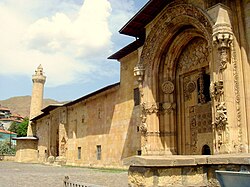 Divriği Great Mosque, Divriği, Turkey (built in 1228–9)
 -

-
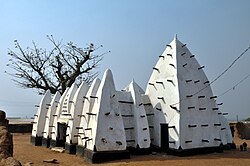 Larabanga Mosque, Ghana founded in 1421
 -
 Huaisheng Mosque in Guangzhou, China, dating back to 627 AD
 -
 Marjani Mosque, oldest active mosque in Tatarstan, Russia (completed in 1770)
 -
 Talo Mano Mosque, in Narathiwat, Thailand built in 1634
 -
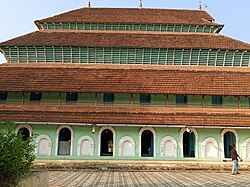
-
 Kampung Laut Mosque, one of the oldest mosques in Malaysia, showcasing the local architecture.
 -
 Huseina Čauša džamija (a.k.a. Džindijska), 17th-century traditional wooden mosque in Tuzla, Bosnia and Herzegovina

.jpg)


.jpg)


.jpg)
Decoration[edit | edit source]

Islam forbids figurative art, on the grounds that the artist must not imitate God's creation. Mosques are, therefore, decorated with abstract patterns and beautiful inscriptions. Decoration is often concentrated around doorways and the miḥrāb. Tiles are used widely in mosques. They lend themselves to pattern-making, can be made with beautiful subtle colors, and can create a cool atmosphere, an advantage in the hot Arab countries. Quotations from the Quran often adorn mosque interiors. These texts are meant to inspire people by their beauty, while also reminding them of the words of Allah.[72]
Prayer hall[edit | edit source]
The prayer hall, also known as the muṣallá (Arabic: مُصَلَّى), rarely has furniture; chairs and pews are generally absent from the prayer hall so as to allow as many worshipers as possible to line the room.[73] Some mosques have Islamic calligraphy and Quranic verses on the walls to create a more religious atmosphere for worshippers.[59]
Often, a limited part of the prayer hall is sanctified formally as a masjid in the sharīʿah sense (although the term masjid is also used for the larger mosque complex as well). Once designated, there are onerous limitations on the use of this formally designated masjid, and it may not be used for any purpose other than worship; restrictions that do not necessarily apply to the rest of the prayer area, and to the rest of the mosque complex (although such uses may be restricted by the conditions of the waqf that owns the mosque).[74]
In many mosques, especially the early congregational mosques, the prayer hall is built in the hypostyle form (the roof held up by a multitude of columns).[75] One of the finest examples of the hypostyle-plan mosques is the Great Mosque of Kairouan in Tunisia.[76]
Usually opposite the entrance to the prayer hall is the qibla wall (the direction of Mecca, and thus the direction towards which Muslims should face for prayer), the visually emphasized area inside the prayer hall. The qibla wall should, in a properly oriented mosque, be set perpendicular to a line leading to Mecca, where the Kaaba is located.[77] Congregants pray in rows parallel to the qiblah wall and thus arrange themselves so they face Mecca. In the qibla wall, usually at its center, is the miḥrāb, a niche or depression indicating the direction of Mecca. Usually the mihrab is not occupied by furniture either. A raised minbar (pulpit) is located to the right side of the mihrab for a khaṭīb (preacher), or some other speaker, to offer a khuṭbah (sermon) during the ritual Friday prayers.
The mihrab serves as the location where the imam or mullah leads the five daily prayers on a regular basis.[78] Left to the mihrab, in the front left corner of the mosque, sometimes there is a kursu (Turkish: kürsü, Bosnian: ćurs/ћурс), a small elevated plateau (rarely with a chair or other type of seat) used for less formal preaching and speeches.
-

-

-
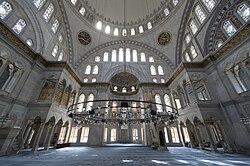
-
 Central prayer hall with Dravidian style of the Masjid Zeenath Baksh, in Dakshina Kannada, India from the Kingdom of Mysore period
 -
 Moorish Revival prayer hall of the Grand Mosque of Paris in France
 -


Mihrab and minbar[edit | edit source]

A miḥrāb, also spelled as mehrab is a semicircular niche in the wall of a mosque that faces the qiblah (i.e. the "front" of the mosque); the imam stands in this niche and leads prayer. Given that the imam typically stands alone in the frontmost row, this niche's practical effect is to save unused space.[79] The minbar is a pulpit from which the Friday sermon is delivered. While the minbar of Muhammad was a simple chair, later it became larger and attracted artistic attention. Some remained made of wood, albeit exquisitely carved, while others were made of marble and featured friezes.[80]
Minarets[edit | edit source]

A common feature in mosques is the minaret, the tall, slender tower that usually is situated at one of the corners of the mosque structure. The top of the minaret is always the highest point in mosques that have one, and often the highest point in the immediate area.
The origin of the minaret and its initial functions are not clearly known and have long been a topic of scholarly discussion.[81][82] The earliest mosques lacked minarets, and the call to prayer was often performed from smaller structures or elevated platforms.[83][84][85] The early Muslim community of Medina gave the call to prayer from the doorway or the roof of the house of Muhammad, which doubled as a place for prayer.[86] The first confirmed minarets in the form of towers date from the early 9th century under Abbasid rule and they did not become a standard feature of mosques until the 11th century.[87][88] These first minaret towers were placed in the middle of the wall opposite the qibla wall.[89] Among them, the minaret of the Great Mosque of Kairouan in Tunisia, dating from 836, is well-preserved and is one of the oldest surviving minarets in the world today.[90][91][92]
Before the five required daily prayers, a Mu'adhdhin (Arabic: مُـؤَذِّن) calls the worshippers to prayer from the minaret. In many countries like Singapore where Muslims are not the majority, mosques are prohibited from loudly broadcasting the Adhān (Arabic: أَذَان, Call to Prayer), although it is supposed to be said loudly to the surrounding community. The adhan is required before every prayer. Nearly every mosque assigns a muezzin for each prayer to say the adhan as it is a recommended practice or Sunnah (Arabic: سُـنَّـة) of the Islamic prophet Muhammad. At mosques that do not have minarets, the adhan is called instead from inside the mosque or somewhere else on the ground.[59] The Iqâmah (Arabic: إِقَـامَـة), which is similar to the adhan and proclaimed right before the commencement of prayers, is usually not proclaimed from the minaret even if a mosque has one.
Courtyard[edit | edit source]

The courtyard (Sahn) is a common feature of many congressional mosques, it usually includes a fountain or a small water pool for ablution (Wudu).[93]
Domes[edit | edit source]

Domes have been a prominent feature in mosque architecture for centuries, evolving both in form and function. Traditionally placed above the main prayer hall, they symbolize the connection between the earthly and divine, often representing the vaults of heaven and sky.[94] Initially, domes were small structures above the mihrab, but over time, they expanded to cover the entire roof of the prayer hall. The shape of the dome evolved from simple hemispherical forms to more complex designs, with the Mughals in India popularizing the onion-shaped dome, which became a hallmark of South Asian and Arabic mosque architecture.[95] The design and function of domes have been influenced by various cultures, including Persian, Byzantine, and Central Asian traditions, each contributing to the techniques and aesthetics used in their construction. Today, domes continue to serve both structural and spiritual purposes, with modern innovations further enhancing their functionality and sustainability.
Structural and functional roles
Domes not only serve as architectural focal points but also enhance mosque acoustics, amplifying the sound of the prayer and the sermon. Structurally, they allow vast interior spaces with minimal internal supports and they make the mosque appear bigger on the inside. Their placement above the prayer hall symbolizes the connection between the earthly and the divine, reinforcing the mosque's spiritual purpose.[96]
Origin of mosque domes
The origin of domes in mosque architecture can be traced back to the early Islamic period, particularly under the Umayyad Caliphate (661–750 AD). The Umayyads, played a key role in incorporating domes into mosque architecture, drawing heavily from pre-Islamic Byzantine and Sassanian traditions. One of the earliest and most significant examples is the Dome of the Rock in Jerusalem, constructed in 691 AD by the Umayyad Caliph Abd al-Malik. This structure was not a mosque but a shrine, yet it set a precedent for the use of domes in Islamic architecture, symbolizing the vault of heaven and the connection between the divine and earthly realms.[97]
Initially, domes in mosques were modest in size and positioned above the mihrab, emphasizing their symbolic function as markers of spiritual focus.[citation needed] As the Islamic empire expanded, architects incorporated techniques from different regions.
Persian and Byzantine influences
Whilst squinches and pendentives were not first used in mosques, they were later incorporated in dome design and were essential in transitioning from square rooms to circular domes.[98] Squinches, which originated in Persian and Roman architecture, fill the corners of a square space to support a dome, while pendentives, a Byzantine innovation, allowed smooth transitions from a square base to a circular dome.[98] These techniques are exemplified by the Dome of Soltaniyeh.
Domes in South Asian mosque architecture
Domes became a defining feature of South Asian mosque architecture during the Delhi Sultanate and reached their peak under the Mughal Empire. Influenced by Persian and Central Asian traditions, the Mughals introduced the iconic onion-shaped domes, seen in landmarks like the Jama Masjid in Delhi and the Badshahi Mosque in Lahore.[citation needed] These domes were not only visually striking but also represented remarkable engineering, using techniques such as iron dowels for strength and timber centering for precision. The Mughal architectural style still influences mosque design today.[citation needed]
Modern innovations
One prime example of modern innovation is the Masjid Raja Haji Fi Sabilillah in Malaysia, which features a Low-E (low emissivity) glass dome. The use of Low-E glass allows for significant energy efficiency by reducing heat gain while still allowing natural light to illuminate the interior space.[99] This technique helps to maintain a comfortable temperature inside the mosque, minimizing reliance on air conditioning, and promoting sustainability. Another example is Zebun Nessa Mosque in Bangladesh with its iconic pink color, built with concrete in order to soften the harsh industrial surroundings.
- Mosques with modernist designs
-
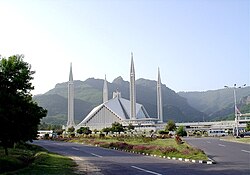 The modern Faisal Mosque in Islamabad, Pakistan
 -
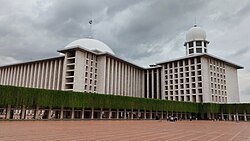 Exterior of Istiqlal Mosque in Jakarta, Indonesia


Ablution facilities[edit | edit source]

As ritual purification precedes all prayers, mosques often have ablution fountains or other facilities for washing in their entryways or courtyards. Worshippers at much smaller mosques often have to use restrooms to perform their ablutions. In traditional mosques, this function is often elaborated into a freestanding building in the center of a courtyard.[62] This desire for cleanliness extends to the prayer halls where shoes are disallowed to be worn anywhere other than the cloakroom. Thus, foyers with shelves to put shoes and racks to hold coats are commonplace among mosques.[73]
Contemporary features[edit | edit source]
Modern mosques have a variety of amenities available to their congregants. As mosques are supposed to appeal to the community, they may also have additional facilities, from health clinics and clubs (gyms) to libraries to gymnasiums, to serve the community.[100]
Symbols[edit | edit source]
Certain symbols are represented in a mosque's architecture to allude to different aspects of the Islamic religion. One of these feature symbols is the spiral. The "cosmic spiral" found in designs and on minarets is a references to heaven as it has "no beginning and no end".[101] Mosques also often have floral patterns or images of fruit and vegetables. These are allusions to the paradise after death.[101]
Inter-religious conversion[edit | edit source]
.jpg)
.jpg)
According to early Muslim historians, towns that surrendered without resistance and made treaties with the Muslims were allowed to retain their churches and the towns captured by Muslims had many of their churches converted to mosques.[102] One of the earliest examples of these kinds of conversions was in Damascus, Syria, where in 705 Umayyad caliph Al-Walid I bought the church of St. John from the Christians (which used to be a Roman temple and an Aramean temple prior to that),[103][104][105] and had it demolished and rebuilt as a mosque in exchange for building a number of new churches for the Christians in Damascus. Overall, Abd al-Malik ibn Marwan (Al-Waleed's father) is said to have transformed 10 churches in Damascus into mosques.[106]
The process of turning churches into mosques were especially intensive in the villages where most of the inhabitants converted to Islam.[citation needed] The Abbasid caliph al-Ma'mun turned many churches into mosques.[citation needed] Several of the early mosques in the Ottoman Empire were originally churches or cathedrals from the Byzantine Empire, with the Hagia Sophia (one of those converted cathedrals) informing the architecture of mosques from after the Ottoman conquest of Constantinople.[107] In some instances mosques have been established on the places of Jewish or Christian sanctuaries associated with Biblical personalities who were also recognized by Islam.[61]
Mosques have also been converted for use by other religions, notably in southern Spain, following the conquest of the Moors in 1492.[108] The most prominent of them is the Great Mosque of Cordoba, itself constructed on the site of a church demolished during the period of Muslim rule. Outside of the Iberian Peninsula, such instances also occurred in southeastern Europe once regions were no longer under Muslim rule, like the Seven Saints Church, in Sofia, Bulgaria.
Rules and etiquette[edit | edit source]
Prayer leading[edit | edit source]
Appointment of a prayer leader is considered desirable, but not always obligatory.[109] The permanent prayer leader (imam) must be a free honest individual and is authoritative in religious matters.[109] In mosques constructed and maintained by the government, the prayer leader is appointed by the ruler;[109] in private mosques, appointment is made by members of the congregation through majority voting. According to the Hanafi school of Islamic jurisprudence, the individual who built the mosque has a stronger claim to the title of imam, but this view is not shared by the other schools.[109]
Leadership at prayer falls into three categories, depending on the type of prayer: five daily prayers, Friday prayer, or optional prayers.[109] According to the Hanafi and Maliki school of Islamic jurisprudence, appointment of a prayer leader for Friday service is mandatory because otherwise the prayer is invalid. The Shafi'i and Hanbali schools argue that the appointment is not necessary and the prayer is valid as long as it is performed in a congregation. A slave may lead a Friday prayer, but Muslim authorities disagree over whether the job can be done by a minor.[109] An imam appointed to lead Friday prayers may also lead at the five daily prayers; Muslim scholars agree to the leader appointed for five daily services may lead the Friday service as well.[109]
All Muslim authorities hold the consensus opinion that only men may lead prayer for men.[109] Nevertheless, women prayer leaders are allowed to lead prayer in front of all-female congregations.[110]
Cleanliness[edit | edit source]
.JPG)
All mosques have rules regarding cleanliness, as it is an essential part of the worshippers' experience. Muslims before prayer are required to cleanse themselves in an ablution process known as wudu. Shoes must not be worn inside the carpeted prayer hall. Some mosques will also extend that rule to include other parts of the facility even if those other locations are not devoted to prayer. Congregants and visitors to mosques are supposed to be clean themselves. It is also undesirable to come to the mosque after eating something that smells, such as garlic.[111]
Dress[edit | edit source]
Islam requires that its adherents wear clothes that portray modesty. Men are supposed to come to the mosque wearing loose and clean clothes that do not reveal the shape of the body. Likewise, it is recommended that women at a mosque wear loose clothing that covers to the wrists and ankles, and cover their heads with a hijāb (Arabic: حِجاب), or other covering. Many Muslims, regardless of their ethnic background, wear Middle Eastern clothing associated with Arabic Islam to special occasions and prayers at mosques.[59]
Concentration[edit | edit source]
As mosques are places of worship, those within the mosque are required to remain respectful to those in prayer. Loud talking within the mosque, as well as discussion of topics deemed disrespectful, is forbidden in areas where people are praying. In addition, it is disrespectful to walk in front of or otherwise disturb Muslims in prayer.[112] The walls within the mosque have few items, except for possibly Islamic calligraphy, so Muslims in prayer are not distracted.[113] Muslims are also discouraged from wearing clothing with distracting images and symbols so as not to divert the attention of those standing behind them during prayer. In many mosques, even the carpeted prayer area has no designs, its plainness helping worshippers to focus.
Gender separation[edit | edit source]
.jpg)
There is nothing written in the Qur'an about the issue of space in mosques and gender separation. Traditional rules have segregated women and men. By traditional rules, women are most often told to occupy the rows behind the men. In part, this was a practical matter as the traditional posture for prayer – kneeling on the floor, head to the ground – made mixed-gender prayer uncomfortably revealing for many women and distracting for some men. Traditionalists try to argue that Muhammad preferred women to pray at home rather than at a mosque, and they cite a ḥadīth in which Muhammad supposedly said: "The best mosques for women are the inner parts of their houses," although women were active participants in the mosque started by Muhammad. Muhammad told Muslims not to forbid women from entering mosques. They are allowed to go in.[114] The second Sunni caliph 'Umar at one time prohibited women from attending mosques especially at night because he feared they might be sexually harassed or assaulted by men, so he required them to pray at home.[115] Sometimes a special part of the mosque was railed off for women; for example, the governor of Mecca in 870 had ropes tied between the columns to make a separate place for women.[61]
Many mosques today will put the women behind a barrier or partition or in another room. Mosques in South and Southeast Asia put men and women in separate rooms, as the divisions were built into them centuries ago. In nearly two-thirds of American mosques, women pray behind partitions or in separate areas, not in the main prayer hall; some mosques do not admit women at all due to the lack of space and the fact that some prayers, such as the Friday Jumuʻah, are mandatory for men but optional for women.[116] Although there are sections exclusively for women and children, the Grand Mosque in Mecca is desegregated.[117] In a number of mosques the women section is located above the main prayer hall, elevated in the background as stairs-separated gallery or plateau (surface-shortened to the back relative to the bottom main part). It usually has a perforated fence at the front, through which the imam or mullah and the other male worshippers in the main hall can be partially seen.
Non-Muslim inclusion[edit | edit source]

Under most interpretations of sharia, non-Muslims are permitted to enter mosques provided that they respect the place and the people inside it.[additional citation(s) needed] A dissenting opinion and minority view is presented by followers of the Maliki school of Islamic jurisprudence, who argue that non-Muslims may not be allowed into mosques under any circumstances.[109]
The Quran addresses the subject of non-Muslims, and particularly polytheists, in mosques in two verses in its ninth chapter, Sura At-Tawba. The seventeenth verse of the chapter prohibits those who join gods with Allah (polytheists) from maintaining mosques:
It is not for the polytheists to maintain the mosques of Allah while they openly profess disbelief. Their deeds are void, and they will be in the Fire forever.
The twenty-eighth verse of the same chapter is more specific as it only considers polytheists in the Masjid al-Haram in Mecca:
O believers! Indeed, the polytheists are "spiritually" impure, so they should not approach the Sacred Mosque after this year. If you fear poverty, Allah will enrich you out of His bounty, if He wills. Surely, Allah is All-Knowing, All-Wise.
According to Ahmad ibn Hanbal, these verses were followed to the letter at the times of Muhammad, when Jews and Christians, considered monotheists, were still allowed to Al-Masjid Al-Haram. The Umayyad caliph Umar II later forbade non-Muslims from entering mosques, and his ruling remains in practice in present-day Saudi Arabia.[61] Today, the decision on whether non-Muslims should be allowed to enter mosques varies. With few exceptions, mosques in the Arabian Peninsula as well as Morocco do not allow entry to non-Muslims. For example, the HassanTemplate:NbsII Mosque in Casablanca is one of only two mosques in Morocco currently open to non-Muslims.[118]
There are many other mosques in the West and Islamic world which non-Muslims are welcome to enter. Most mosques in the United States, for example, report receiving non-Muslim visitors every month. Many mosques throughout the United States welcome non-Muslims as a sign of openness to the rest of the community as well as to encourage conversions to Islam.[119][120]
In modern-day Saudi Arabia, the Grand Mosque and all of Mecca are open only to Muslims. Likewise, Al-Masjid Al-Nabawi and the city of Medina that surrounds it are also off-limits to those who do not practice Islam.[121] For mosques in other areas, it has most commonly been taken that non-Muslims may only enter mosques if granted permission to do so by Muslims, and if they have a legitimate reason. All entrants regardless of religious affiliation are expected to respect the rules and decorum for mosques.[59]
In modern Turkey, non-Muslim tourists are allowed to enter any mosque, but there are some strict rules. Visiting a mosque is allowed only between prayers; visitors are required to wear long trousers and not to wear shoes, women must cover their heads; visitors are not allowed to interrupt praying Muslims, especially by taking photos of them; no loud talk is allowed; and no references to other religions are allowed (no crosses on necklaces, no cross gestures, etc.) Similar rules apply to mosques in Malaysia, where larger mosques that are also tourist attractions (such as the Masjid Negara) provide robes and headscarves for visitors who are deemed inappropriately attired.[122]
In certain times and places, non-Muslims were expected to behave a certain way in the vicinity of a mosque: in some Moroccan cities, Jews were required to remove their shoes when passing by a mosque;[123] in 18th-century Egypt, Jews and Christians had to dismount before several mosques in veneration of their sanctity.[124][better source needed]
The association of the mosque with education remained one of its main characteristics throughout history,[125] and the school became an indispensable appendage to the mosque. From the earliest days of Islam, the mosque was the center of the Muslim community, a place for prayer, meditation, religious instruction, political discussion, and a school. Anywhere Islam took hold, mosques were established, and basic religious and educational instruction began.[126]
Role in contemporary society[edit | edit source]

Political mobilization[edit | edit source]
The late 20th century saw an increase in the number of mosques used for political purposes. While some governments in the Muslim world have attempted to limit the content of Friday sermons to strictly religious topics, there are also independent preachers who deliver khutbas that address social and political issues, often in emotionally charged terms. Common themes include social inequalities, necessity of jihad in the face of injustice, and the universal struggle between good and evil.[1] In Islamic countries like Bangladesh, Pakistan, Iran, and Saudi Arabia, political subjects are preached by imams at Friday congregations on a regular basis.[128] Mosques often serve as meeting points for political opposition in times of crisis.[1]
Countries with a minority Muslim population are more likely than Muslim-majority countries of the Greater Middle East to use mosques as a way to promote civic participation.[129] Studies of US Muslims have consistently shown a positive correlation between mosque attendance and political involvement. Some of the research connects civic engagement specifically with mosque attendance for social and religious activities other than prayer.[130] American mosques host voter registration and civic participation drives that promote involving Muslims, who are often first- or second-generation immigrants, in the political process. As a result of these efforts as well as attempts at mosques to keep Muslims informed about the issues facing the Muslim community, regular mosque attendants are more likely to participate in protests, sign petitions, and otherwise be involved in politics.[129] Research on Muslim civic engagement in other Western countries "is less conclusive but seems to indicate similar trends".[130]
Frequency of attendance[edit | edit source]
The frequency by which Muslims attend mosque services vary greatly around the world. In some countries, weekly attendance at religious services is common among Muslims while in others, attendance is rare. A study of American Muslims did not find differences in mosque attendance by gender or age.[131]


Political controversy[edit | edit source]

In the western world, and in the United States in particular, anti-Muslim sentiment and targeted domestic policy has created challenges for mosques and those looking to build them. There has been government and police surveillance of mosques in the US[147] and local attempts to ban mosques and block constructions,[148] despite data showing that in fact, most Americans oppose banning the building of mosques (79%) and the surveillance of U.S. mosques (63%) as shown in a 2018 study done by the Institute for Social Policy and Understanding.[149][clarification needed]
Since 2017, Chinese authorities have destroyed or damaged two-thirds of the mosques in China's Xinjiang province.[150] Ningxia officials were notified on 3 August 2018 that the Weizhou Grand Mosque would be forcibly demolished because it had not received the proper permits before construction.[151][152][153] Officials in the town said that the mosque had not been given proper building permits, because it is built in a Middle Eastern style and includes numerous domes and minarets.[151][152] The residents of Weizhou alarmed each other through social media and finally stopped the mosque destruction by public demonstrations.[152]
Role in violent conflicts[edit | edit source]

As they are considered important to the Muslim community, mosques, like other places of worship, can be at the heart of social conflicts. The Babri Mosque in India was the subject of such a conflict up until the early 1990s when it was demolished. Before a mutual solution could be devised, the mosque was destroyed on December 6, 1992, as the mosque was built by Babur allegedly on the site of a previous Hindu temple marking the birthplace of Rama.[154] The controversy surrounded the mosque was directly linked to rioting in Bombay (present-day Mumbai) as well as bombings in 1993 that killed 257 people.[155]
Bombings in February 2006 and June 2007 seriously damaged Iraq's al-Askari Mosque and exacerbated existing tensions. Other mosque bombings in Iraq, both before and after the February 2006 bombing, have been part of the conflict between the country's groups of Muslims. In June 2005, a suicide bombing killed at least 19 people at an Afghan Shia mosque near Jade Maivand.[156] In April 2006, two explosions occurred at India's Jama Masjid.[157] Following the al-Askari Mosque bombing in Iraq, imams and other Islamic leaders used mosques and Friday prayers as vehicles to call for calm and peace in the midst of widespread violence.[158]
A study 2005 indicated that while support for suicide bombings is not correlated with personal devotion to Islam among Palestinian Muslims, it is correlated with mosque attendance because "participating in communal religious rituals of any kind likely encourages support for self-sacrificing behaviors that are done for the collective good."[159]
Following the September 11 attacks, several American mosques were targeted in attacks ranging from simple vandalism to arson.[160] Furthermore, the Jewish Defense League was suspected of plotting to bomb the King Fahd Mosque in Culver City, California.[161] Similar attacks occurred throughout the United Kingdom following the 7 July 2005 London bombings. Outside the Western world, in June 2001, the Hassan Bek Mosque was the target of vandalism and attacks by hundreds of Israelis after a suicide bomber killed 19 people in a night club in Tel Aviv.[162][163][164] Although mosquegoing is highly encouraged for men, it is permitted to stay at home when one feels at risk from Islamophobic persecution.[165]
Saudi influence[edit | edit source]
Although the Saudi involvement in Sunni mosques around the world can be traced back to the 1960s, it was not until later in the 20th century that the government of Saudi Arabia became a large influence in foreign Sunni mosques.[166] Beginning in the 1980s, the Saudi Arabian government began to finance the construction of Sunni mosques in countries around the world. An estimated US$45 billion has been spent by the Saudi Arabian government financing mosques and Sunni Islamic schools in foreign countries. Ain al-Yaqeen, a Saudi newspaper, reported in 2002 that Saudi funds may have contributed to building as many as 1,500 mosques and 2,000 other Islamic centers.[167]
Saudi citizens have also contributed significantly to mosques in the Islamic world, especially in countries where they see Muslims as poor and oppressed. Following the fall of the Soviet Union, in 1992, mosques in war-torn Afghanistan saw many contributions from Saudi citizens.[166] The King Fahd Mosque in Culver City, California and the Islamic Cultural Center of Italy in Rome represent two of Saudi Arabia's largest investments in foreign mosques as former Saudi king Fahd bin Abdul Aziz al-Saud contributed US$8 million[166] and US$50Template:Nbsmillion[168] to the two mosques, respectively.
See also[edit | edit source]
Notes[edit | edit source]
- ↑ Arabic: مَسْجِد [ˈmasdʒid] (lit. 'place of ritual prostration')
- ↑ Survey was conducted in 2016, not 2009–2012.
- ↑ Survey was only conducted in the southern five provinces.
- ↑ Survey was conducted in 2013, not 2009–2012. Sample was taken from entire population of Yemen, which is approximately 99% Muslim.
- ↑ Survey was conducted in 2015, not 2009–2012.
- ↑ Survey was conducted in 2016, not 2009–2012.
- ↑ Survey was conducted in 2008, not 2009–2012.
- ↑ Survey was conducted in 2015, not 2009–2012.
- ↑ Survey was conducted in 2008, not 2009–2012.
- ↑ Survey was conducted in 2013, not 2009–2012. Sample was taken from entire population of Libya, which is approximately 97% Muslim.
- ↑ Survey was conducted in 2016, not 2009–2012.
- ↑ Survey was conducted in 2008, not 2009–2012.
- ↑ Survey was conducted in 2008, not 2009–2012.
- ↑ Survey was conducted in 2017, not 2009–2012.
- ↑ Survey was conducted in 2017, not 2009–2012.
References[edit | edit source]
Citations[edit | edit source]
- ↑ 1.00 1.01 1.02 1.03 1.04 1.05 1.06 1.07 1.08 1.09 1.10 John L. Esposito, ed. (2014). "Mosque". The Oxford Dictionary of Islam. Oxford University Press. Archived from the original on December 25, 2017.
- ↑ Longhurst, Christopher E., "Theology of a Mosque: The Sacred Inspiring Form, Function and Design in Islamic Architecture", Lonaard Journal. Mar 2012, Vol. 2 Issue 8, pp. 3–13 [11]. "Since submission to God is the essence of divine worship, the place of worship is intrinsic to Islam's self-identity. This 'place' is not a building per se but what is evidenced by the etymology of the word mosque which derives from the Arabic masjid meaning 'a place of sujud (prostration).'
- ↑ Colledge, R. (1999). "The mosque". In: Mastering World Religions. Macmillan Master Series. Palgrave, London. doi:10.1007/978-1-349-14329-0_16 "A mosque is a building where Muslims bow before Allah to show their submission to His will. It is not necessary to have a building to do this. Muhammad said that 'Wherever the hour of prayer overtakes you, you shall perform the prayer. That place is the mosque'. In his early days in Makkah there was no mosque, so he and his friends would pray anywhere."
- ↑ Grabar 1969, p. 34: "The main characteristic, then, of this first stage was the creation of a space which served exclusively Muslim purposes and which, in cities that were entirely Muslim, existed on two separate levels of exclusivity. The word masjid is always associated with these spaces, but it does not yet possess any formal structure nor does it have any precise function other than that of excluding non-Muslims."
- ↑ Grabar 1969, pp. 34–35: "A second stage occurred between 650 and 750. To my knowledge, twenty-seven masjids from this period are archaeologically definableTemplate:Nbs... All mosques had a certain relationship between open and closed covered spaces. The problems posed by this relationship pertain primarily to the history of art, except on one point, which is the apparent tendency to consider the covered parts as the bayt al-salat, i.e. place of prayer, and the rest of the building as an overflow area for prayer. All these buildings were enclosed by walls and did not have an exterior façade. Their orderly form appeared only from the inside where the balance between open and covered spaces served, among other things, to indicate the direction of qibla. Their only outward symbol was the minaret, a feature which appeared early in mosques built in old cities with predominantly non-Muslim populations and only later in primarily Muslim ones."
- ↑ 6.0 6.1 Nuha N. N. Khoury (2009). "Mosque". In Juan Eduardo Campo (ed.). Encyclopedia of Islam. Infobase Publishing.
- ↑ 7.0 7.1 7.2 7.3 7.4 Patrick D. Gaffney (2004). "Masjid". In Richard C. Martin (ed.). Encyclopedia of Islam and the Muslim World. MacMillan Reference.
- ↑ For the word's origin from French and probable origin from Italian moscheta, see "mosque, n.". OED Online. December 2011. Oxford University Press. [1] Archived 2014-08-10 at the Wayback Machine. For the derivation of moscheta from Arabic sajada see "mesquita, n.". OED Online. December 2011. Oxford University Press. [2] Archived 2014-08-10 at the Wayback Machine. For the probable origin of "sajada" from Aramaic, and the meanings of sajada and masjid in Arabic, see "masjid, n.". OED Online. December 2011. Oxford University Press. [3]. For the inclusion of Spanish mesquita, possible derivation from Nabataean masgĕdhā́, and the Aramaic sĕghēdh, see Klein, E., A Comprehensive Etymological Dictionary of the English Language (Elsevier Publishing, 1966), p. 1007.
- ↑ Watt, William Montgomery (2003). Islam and the Integration of Society. Psychology Press. p. 5. ISBN 978-0-415-17587-6. Archived from the original on 2023-01-16. Retrieved 2019-06-30.
- ↑ Tajuddin 1998, p. 135
- ↑ Palmer, Allison Lee (2016). Historical Dictionary of Architecture (2nd ed.). Rowman & Littlefield. p. 236. ISBN 978-1-4422-6309-3. Archived from the original on 2023-12-26. Retrieved 2023-12-26.
The first mosque is considered to be either the one built around the Kaaba, or "House of God", in Mecca, now called Al-Masjid Al-Haram, or the Quba Mosque in Medina, Saudi Arabia, built when Muhammad arrived there from Mecca in 622.
- ↑ Esposito, John (1998). Islam: The Straight Path (3rd ed.). Oxford University Press. pp. 9, 12. ISBN 978-0-19-511234-4.
- ↑ Esposito (2002b), pp. 4–5.
- ↑ Peters, F.E. (2003). Islam: A Guide for Jews and Christians. Princeton University Press. p. 9. ISBN 978-0-691-11553-5.
- ↑ Template:Qref
- ↑ Template:Qref
- ↑ Template:Qref
- ↑ Alli, Irfan (2013). 25 Prophets of Islam. eBookIt.com. ISBN 978-1-4566-1307-5. Archived from the original on 2021-04-14. Retrieved 2019-06-30.
- ↑ Kuban 1974, p. 1
- ↑ 20.0 20.1 Michigan Consortium for Medieval and Early Modern Studies (1986). Goss, V.P.; Bornstein, C. V. (eds.). The Meeting of Two Worlds: Cultural Exchange Between East and West During the Period of the Crusades. Vol. 21. Medieval Institute Publications, Western Michigan University. p. 208. ISBN 978-0-918720-58-0. Archived from the original on 2023-12-28. Retrieved 2019-06-30.
- ↑ Mustafa Abu Sway. "The Holy Land, Jerusalem and Al-Aqsa Mosque in the Qur'an, Sunnah and other Islamic Literary Source" (PDF). Central Conference of American Rabbis. Archived from the original (PDF) on 2011-07-28.
- ↑ Dyrness, W. A. (2013). Senses of Devotion: Interfaith Aesthetics in Buddhist and Muslim Communities. Vol. 7. Wipf and Stock Publishers. p. 25. ISBN 978-1-62032-136-2.
- ↑ "55. Prophets – Sahih Al-Bukhari – 585". www.searchtruth.com. Archived from the original on 2018-06-13. Retrieved 2018-06-05.
- ↑ Dumper & Stanley 2007, p. 241
- ↑ 25.0 25.1 Chiu 2010, pp. 67–8
- ↑ 26.0 26.1 Petersen 1996, pp. 195–196: "The first mosque was the house of the Prophet Muhammad in Medina. This was a simple rectangular (53 by 56 m) enclosure containing rooms for the Prophet and his wives and a shaded area on the south side of the courtyard which could be used for prayer in the direction of Mecca. This building became the model for subsequent mosques which had the same basic courtyard layout with a prayer area against the qibla wall."
- ↑ 27.0 27.1 27.2 Bloom & Blair 2009, p. 549, Mosque: "The first mosque, a building that Muhammad erected at Medina in 622, is usually described as the Prophet's house but was probably intended from the outset as a community center as well. Initially, it was a rectangular enclosure of unbaked brick, a little over fifty meters square, but a portico of palm trunks supporting a roof of palm-frond thatch was quickly erected on the north side of the court, facing Jerusalem, the first qibla, or direction in which Muslims sent their prayersTemplate:Nbs... In 624 when the qibla was changed to Mecca, another such arcade was built on the south side, facing that city. Muhammad and his family lived in rooms built on to one side of the enclosure, and Muhammad was buried in one of these rooms in 632. During the 7th and early 8th centuries, Muhammad's mosque was repeatedly enlarged and rebuilt, becoming a flat-roofed hypostyle structure with a central court and a prayer-hall deeper than the three other porticosTemplate:Nbs... The form of the mosque of the Prophet was closely imitated in the early congregational mosques built in the Iraqi cities of Wasit, Kufa and Basra, and in the mosque built at Daybul in Sind (now Banbhore, Pakistan)."
- ↑ 28.0 28.1 Tabbaa, Yasser (2007). "Architecture". In Fleet, Kate; Krämer, Gudrun; Matringe, Denis; Nawas, John; Rowson, Everett (eds.). Encyclopaedia of Islam, Three. Brill. ISBN 978-90-04-16165-8.
If Mecca provided the first Muslim shrine, the city of Medina, to which Muḥammad migrated in 622 C.E., may have provided the germ of the idea for the Muslim place of prayer, the masjid, in the form of the house of the Prophet himself. Descriptions of the house allow us to reconstruct it as a mud-brick rectangular enclosure consisting of an open courtyard, a three-aisled roofed space to the south, a one-bay space inside the northern wall, and eight separate rooms annexed to the eastern wall. The eight rooms housed Muḥammad's wives; the northern vestibule was a waiting area; the southern space served various residential, official, and ritual functions. The roof was supported by palm trunks and its southern wall, after 6/628, contained a three-stepped platform (minbar), from which Muḥammad spoke and adjudicated. Despite its rudimentary form and construction, Muḥammad's house would provide the basic model for the first mosques.
- ↑ 29.0 29.1 Petersen 1996, pp. 182–184.
- ↑ Cosman & Jones 2008, p. 610
- ↑ 31.0 31.1 Frontiers, Museum With No (2000). The Umayyads: The Rise of Islamic Art. AIRP. pp. 26–46. ISBN 978-1-874044-35-2.
- ↑ Kuban 1985, p. 27
- ↑ Kuban 1974, p. 16.
- ↑ O'Kane, Bernard (2009). "The Great Mosque of Hama Redux". Creswell Photographs Re-examined: New Perspectives on Islamic Architecture. American University in Cairo Press. pp. 219–246. ISBN 978-977-416-244-2.
- ↑ Ali 1999, p. 33.
- ↑ Grabar, Oleg (1985). "Upon Reading al-Azraqi". Muqarnas. 3: 64–66. doi:10.2307/1523080. ISSN 0732-2992. JSTOR 1523080.
- ↑ Mawani, Rizwan (2019). Beyond the Mosque: Diverse Spaces of Muslim Worship. Bloomsbury Publishing. p. 36. ISBN 978-1-78673-662-8.
- ↑ Kuban 1974, p. 12.
- ↑ Flood 2001, pp. 101–103
- ↑ "Minaret of the Great Mosque of Kairouan". The Qantara Project. 2008. Archived from the original on 11 May 2013. Retrieved 5 October 2013.
- ↑ 41.0 41.1 Elleh 2002, pp. 114–115
- ↑ Ruggles 2002, p. 38
- ↑ Bloom & Blair 2009, p. 182
- ↑ Bloom & Blair 2009, p. 187
- ↑ Asher 1992, p. 202
- ↑ Cybriwsky, Roman Adrian (2013-05-23). Capital Cities around the World: An Encyclopedia of Geography, History, and Culture. Bloomsbury Publishing USA. p. 350. ISBN 978-1-61069-248-9.
- ↑ 47.0 47.1 Cowen 1985, pp. 30–35
- ↑ 48.0 48.1 Ahmed 2002, p. 109
- ↑ 49.0 49.1 Bloom & Blair 2009, p. 439
- ↑ Bloom & Blair 2009, p. 281
- ↑ Bloom & Blair 2009, Mali, Republic of
- ↑ Essa & Ali 2010, pp. 231–232
- ↑ Bloom & Blair 2009, p. 193
- ↑ Nimer 2002, pp. 39–40
- ↑ Grossman, Cathy Lynn (29 February 2012). "Number of U.S. mosques up 74% since 2000". USA Today. Archived from the original on 17 September 2018. Retrieved 6 October 2013.
- ↑ "'Id Prayers (Salatul 'Idain)". Compendium of Muslim Texts. University of Southern California. Archived from the original on December 23, 2005. Retrieved April 8, 2006.
- ↑ "Performance of Eid Salah in Eidgah (Open Field)". www.central-mosque.com. Archived from the original on 2016-03-15. Retrieved 2012-02-01.
- ↑ "Charity". Compendium of Muslim Texts. University of Southern California. Archived from the original on February 5, 2006. Retrieved April 17, 2006.
- ↑ 59.0 59.1 59.2 59.3 59.4 59.5 59.6 Maqsood, Ruqaiyyah Waris (2003). Teach Yourself Islam (2nd ed.). Chicago: McGraw-Hill. pp. 57–58, 72–75, 112–120. ISBN 978-0-07-141963-5.
- ↑ Clarke, Matthew (2011). Development and Religion: Theology and Practice. Edward Elgar Publishing. p. 156. ISBN 978-0-85793-073-6. Retrieved 21 February 2013.
- ↑ 61.0 61.1 61.2 61.3 61.4 61.5 Hillenbrand, R. "Masdjid. I. In the central Islamic lands". In P.J. Bearman; Th. Bianquis; C.E. Bosworth; E. van Donzel; W.P. Heinrichs (eds.). Encyclopaedia of Islam Online. Brill Academic Publishers. ISSN 1573-3912.
- ↑ 62.0 62.1 "Religious Architecture and Islamic Cultures". Massachusetts Institute of Technology. Archived from the original on July 20, 2012. Retrieved April 9, 2006.
- ↑ Bloom & Blair 2009, p. 550.
- ↑ Fenwick, Corisande (2020-05-14). Early Islamic North Africa: A New Perspective. Bloomsbury Publishing. p. 137. ISBN 978-1-350-07520-7.
- ↑ Meri, Josef (2018-01-12). Routledge Revivals: Medieval Islamic Civilization (2006): An Encyclopedia - Volume II. Routledge. ISBN 978-1-351-66813-2.
- ↑ 66.0 66.1 "The Royal Mosque (Masjed-e-Emam) in Isfahan, Iran". Ne.jp. Archived from the original on 2023-04-18. Retrieved 2011-11-03.
- ↑ Blake, Stephen P. (1999). Half the world: the social architecture of Safavid Isfahan, 1590–1722. Mazda Pub. pp. 143–144. ISBN 978-1-56859-087-5. Retrieved 21 February 2013.
- ↑ O'Kane, Bernard (2021-08-20). Studies in Arab Architecture. Edinburgh University Press. ISBN 978-1-4744-7491-7.
- ↑ Stegers, Rudolf (2008-05-16). Sacred Buildings: A Design Manual. Walter de Gruyter. p. 48. ISBN 978-3-7643-8276-6.
- ↑ "Vocabulary of Islamic Architecture". Massachusetts Institute of Technology. Archived from the original on September 18, 2006. Retrieved April 9, 2006.
- ↑ Petersen, Andrew (2002-03-11). Dictionary of Islamic Architecture. Routledge. p. 222. ISBN 978-1-134-61366-3.
- ↑ Encyclopedia, Illustrated Family (2005). Mosques. London: DK. p. 572. ISBN 0-14-306302-2.
- ↑ 73.0 73.1 "Mosque FAQ". The University of Tulsa. Archived from the original on March 30, 2007. Retrieved April 9, 2006.
- ↑ "Fiqh of Masjid & Musalla". Qa.sunnipath.com. 2005-07-03. Archived from the original on 2011-10-19. Retrieved 2011-11-03.
- ↑ Kleiner, Fred S. (2010). Gardner's Art Through the Ages: The Western Perspective. Cengage Learning. p. 265. ISBN 978-0-495-57355-5. Retrieved 21 February 2013.
- ↑ Kleiner, Fred S. (2010). Gardner's Art Through the Ages: The Western Perspective. Cengage Learning. p. 267. ISBN 978-0-495-57355-5. Retrieved 21 February 2013.
- ↑ Bierman, Irene A. (December 16, 1998). Writing Signs: Fatimid Public Text. University of California Press. p. 150. ISBN 978-0-520-20802-5.
- ↑ "Terms 1: Mosque". University of Tokyo Institute of Oriental Culture. Archived from the original on February 12, 2012. Retrieved April 9, 2006.
- ↑ Kuban 1974, p. 4.
- ↑ Kuban 1974, pp. 5-6.
- ↑ Hillenbrand 1994, pp. 129–137.
- ↑ Bloom 2013, Chapter 1: The History of Scholarship and the Nature of the Problem.
- ↑ Bloom 2013, pp. 29-46.
- ↑ Creswell, K. A. C. (March 1926). "The Evolution of the Minaret, with Special Reference to Egypt-I". The Burlington Magazine for Connoisseurs. 48 (276): 134–140. JSTOR 862832.
- ↑ Hillenbrand 1994, pp. 136–137.
- ↑ Bloom 2013, pp. 23–30, 46.
- ↑ Bloom 2013, pp. xvii, 64, 72.
- ↑ Petersen 1996, pp. 187–188.
- ↑ Bloom 2013, pp. 73–82.
- ↑ Bloom & Blair 2009, Minaret
- ↑ Petersen 1996, pp. 187-188.
- ↑ Bloom 2013, pp. 73-75.
- ↑ Alkazi, Feisal (2014-05-01). Srinagar: An Architectural Legacy. Roli Books Private Limited. ISBN 978-93-5194-051-7.
- ↑ Mainzer, Klaus (1996). "Art and Architecture". Symmetries of Nature: A Handbook for Philosophy of Nature and Science. Berlin: Walter de Gruyter. p. 124. ISBN 978-3-11-012990-8.
the dome arching over the believers like the spherical dome of the sky
- ↑ Asher 1992, p. 256
- ↑ "Dome". referenceworks. doi:10.1163/1573-3912_ei3_COM_26080. Retrieved 2024-10-22.
- ↑ Grabar, Oleg (December 1963). ""The Islamic Dome, Some Considerations"". Journal of the Society of Architectural Historians. 22 (4): 191–198. doi:10.2307/988190. JSTOR 988190.
- ↑ 98.0 98.1 Blessing, Patricia (15 March 2022). "Squinch and Pendentive". Khamseen: Islamic Art History Online.
- ↑ Lasindu, Gamage (10 December 2023). ""The Evolution of the Islamic Architectural Dome Feature"". Malaysia Architectural Journal. 5 (3): 38–41.
- ↑ "Student Life – Masjid DarusSalam". masjidds.org. Retrieved 2024-11-14.
- ↑ 101.0 101.1 Erzen, Jale Nejdet (2011), "Reading Mosques: Meaning and Architecture in Islam", The Journal of Aesthetics and Art Criticism, 69 (1): 126–129, doi:10.1111/j.1540-6245.2010.01453.x, hdl:11511/36200, JSTOR 42635843
- ↑ Houtsma, M. Th. (1993). E.J. Brill's First Encyclopedia of Islam, 1913–1936. Brill. p. 320. ISBN 978-90-04-09791-9. Retrieved 21 February 2013.
- ↑ Burns 2005, pp. 38–40.
- ↑ George 2001, p. 44.
- ↑ Burns 2007, p. 65.
- ↑ Houtsma p. 21
- ↑ Essa & Ali 2010, pp. 230–231
- ↑ Wagner, William (2004). How Islam Plans to Change the World. Kregel Publications. p. 99. ISBN 978-0-8254-3965-0.
When the Moors were driven out of Spain in 1492, most of the mosques were converted into churches
- ↑ 109.0 109.1 109.2 109.3 109.4 109.5 109.6 109.7 109.8 Abu al-Hasankok Ibn Muhammad Ibn Habib, Al-Mawardi (2000). The Ordinances of Government (Al-Ahkam al-Sultaniyya w'al-Wilayat al-Diniyya). Lebanon: Garnet Publishing. p. 184. ISBN 978-1-85964-140-8.
- ↑ Karin van Nieuwkerk, 'Women Embracing Islam'. University of Texas Press. 2006. p. 63. ISBN 978-0-292-77376-9.
- ↑ "Chapter 16. The Description of the Prayer". SunniPath Library. SunniPath. Archived from the original on November 28, 2006. Retrieved July 12, 2006.
- ↑ Connecting Cultures, Inc. "Building Cultural Competency: Understanding Islam, Muslims, and Arab Culture". MAEC. Connecting Cultures, Inc.: 15. Archived from the original (Doc) on July 24, 2006. Retrieved July 12, 2006.
- ↑ Renard, John (1996). Seven Doors to Islam: Spirituality and the Religious Life of Muslims. University of California Press. ISBN 978-0-520-91747-7.
- ↑ Mohammad Izzhar Faizzy Osman. "Al-Kafi #936: Tempat Solat Yang Terbaik Bagi Seorang Wanita" [Al-Kafi #936: The Best Prayer Place For A Woman]. Mufti of Federal Territory's Office (in Bahasa Melayu). Retrieved 1 July 2024.
- ↑ Doi, Abdur Rahman I. "Women in Society". Compendium of Muslim Texts. University of Southern California. Archived from the original on April 9, 2006. Retrieved April 15, 2006.
- ↑ Kim Syazie (20 March 2024). "Wanita dari Maghribi terkejut kaum Hawa di Malaysia tak solat Jumaat, masjid pula dipenuhi kaum Adam sahaja" [A woman from Morocco is surprised that women in Malaysia doesn't perform Friday prayer, instead the mosque is only filled with men]. Malaysia Dateline (in Bahasa Melayu). Retrieved 1 July 2024.
Beberapa individu menerangkan bahawa ruangan solat wanita akan dibuka kepada golongan lelaki sewaktu solat Jumaat. Ini kerana mereka akan terpaksa bersembahyang di luar masjid atau atas jalan tar dengan ruangan solat yang tidak mencukupi.
[Some individuals explained that women's prayer space will be opened to men during Friday prayer. This is because they would have to pray outside the mosque or on top of the paved road due to inadequate prayer space.] - ↑ Rezk, Rawya (January 26, 2006). "Muslim Women Seek More Equitable Role in Mosques". The Columbia Journalist. Archived from the original on May 27, 2006. Retrieved April 9, 2006.
- ↑ "Morocco travel". CNN. Archived from the original on October 12, 2007. Retrieved September 22, 2006.
- ↑ Takim, Liyakatali (July 2004). "From Conversion to Conversation: Interfaith Dialogue in Post 9–11 America" (PDF). The Muslim World. 94 (3): 343–355. doi:10.1111/j.1478-1913.2004.00058.x. Archived from the original (PDF) on June 18, 2006. Retrieved June 16, 2006. Liyakatali Takim Archived 2012-02-18 at the Wayback Machine is a professor at McMaster University
- ↑ "Laptop link-up: A day at the mosque". BBC. December 5, 2005. Archived from the original on April 18, 2023. Retrieved June 16, 2006.
- ↑ Goring, Rosemary (1997). Dictionary of Beliefs & Religions. Wordsworth Editions. ISBN 978-1-85326-354-5.
- ↑ Turner, Peter; Taylor, Chris; Finlay, Hugh (1996). Malaysia, Singapore & Brunei (6th ed.). Hawthorn, Vic.: Lonely Planet. ISBN 978-0-86442-393-1.
- ↑ Stillman, Norman (1979). The Jews of Arab Lands: A History and Source Book. Philadelphia: Jewish Publication Society of America. p. 83. ISBN 978-0-8276-0116-1.
- ↑ Bat Ye'or (2002). Islam and Dhimmitude. Where Civilizations Collide. Madison/Teaneck, NJ: Fairleigh Dickinson University Press/Associated University Presses. p. 98. ISBN 978-0-8386-3943-6.
- ↑ Nizamoglu, Cem (2001-08-12). "Education in Islam – The Role of the Mosque". Muslim Heritage. Archived from the original on 2022-11-06. Retrieved 2023-08-03.
- ↑ Qureshi, M. 1990. The Role of the Mosque in Islam. New Delhi: International Islamic Publishers.
- ↑ Eade, John (1996). "Nationalism, Community, and the Islamization of Space in London". In Metcalf, Barbara Daly (ed.). Making Muslim Space in North America and Europe. Berkeley: University of California Press. ISBN 978-0-520-20404-1. Retrieved 19 April 2015.
As one of the few mosques in Britain permitted to broadcast calls to prayer (azan), the mosque soon found itself at the center of a public debate about "noise pollution" when local non-Muslim residents began to protest.
- ↑ "What Muslims Hear at Friday Prayers". Der Spiegel. April 19, 2006. Archived from the original on May 16, 2012. Retrieved October 31, 2010.
- ↑ 129.0 129.1 Jamal, Amany. "The Role of Mosques in the Civic and Political Incorporation of Muslim American". Teachers' College – Columbia University. Archived from the original on September 28, 2007. Retrieved April 22, 2006.
- ↑ 130.0 130.1 Aubrey Westfall (2018). "Mosques and political engagement in Europe and North America". Project on Middle East Political Science.[permanent dead link]
- ↑ "American Muslim Poll 2017 | ISPU". Institute for Social Policy and Understanding. 2017-03-21. Archived from the original on 2018-11-21. Retrieved 2018-06-28.
- ↑ "Chapter 2: Religious Commitment". August 9, 2012. Archived from the original on August 5, 2022. Retrieved August 5, 2022.
- ↑ "'What Muslims Want': A survey of British Muslims by ICM on behalf of Policy Exchange" (PDF). Archived (PDF) from the original on 2017-02-06.
- ↑ "Valores, Actitudes y Opiniones de los Inmigrantes de Religión Musulmana". Archived from the original on 2020-10-03. Retrieved 2017-02-02.
- ↑ 135.0 135.1 "WVS Database". www.worldvaluessurvey.org. Archived from the original on 2021-03-31. Retrieved 2022-08-05.
- ↑ "Israel's Religiously Divided Society". March 8, 2016. Archived from the original on July 14, 2023. Retrieved August 5, 2022.
- ↑ 137.0 137.1 "Sondage auprès des jeunes Marocains résidant en Europe" (PDF). Archived (PDF) from the original on 2012-01-30.
- ↑ "Survey of Muslims in Canada 2016" (PDF). Archived from the original (PDF) on 2016-05-01.
- ↑ 139.0 139.1 139.2 "Religious Regimes and Prospects for Liberal Politics: Futures of Iran, Iraq, and Saudi Arabia" (PDF). Archived from the original (PDF) on 2013-05-13. Retrieved 2017-02-04.
- ↑ "Section 2: Religious Beliefs and Practices". August 30, 2011. Archived from the original on September 1, 2022. Retrieved August 5, 2022.
- ↑ "The resilience and ordinariness of Australian Muslims: Attitudes and experiences of Muslims Report" (PDF). Archived (PDF) from the original on 2016-03-29.
- ↑ "Muslim Life in Germany: A study conducted on behalf of the German Conference on Islam" (PDF). Archived (PDF) from the original on 2014-06-11.
- ↑ "A French Islam is possible" (PDF). Archived from the original (PDF) on 2017-09-15. Retrieved 2017-03-29.
- ↑ Aslan, Ednan (2009). Islamic Education in Europe. Böhlau Verlag Wien. p. 82. ISBN 978-3-205-78310-7.
- ↑ Statistiek, Centraal Bureau voor de (29 July 2009). "Religie aan het begin van de 21ste eeuw". Centraal Bureau voor de Statistiek. Archived from the original on 2 February 2017. Retrieved 2 February 2017.
- ↑ 146.0 146.1 "Religious Belief and National Belonging in Central and Eastern Europe: Final Topline" (PDF). Pew Research Center. 10 May 2017. p. 118. Archived (PDF) from the original on 24 May 2017. Retrieved 22 October 2017.
- ↑ "Factsheet: The NYPD Muslim Surveillance Program". American Civil Liberties Union. Archived from the original on 2019-05-07. Retrieved 2018-06-28.
- ↑ Goodstein, Laurie (7 August 2010). "Battles Around Nation Over Proposed Mosques". The New York Times. Archived from the original on 2010-08-11. Retrieved 2018-06-28.
- ↑ "American Muslim Poll 2018: Full Report | ISPU". Institute for Social Policy and Understanding. 2018-04-30. Archived from the original on 2019-04-05. Retrieved 2018-06-28.
- ↑ "Thousands of Xinjiang mosques destroyed or damaged, report finds". The Guardian. 25 September 2020. Archived from the original on 26 September 2020. Retrieved 26 September 2020.
- ↑ 151.0 151.1 "China mosque demolition sparks standoff in Ningxia". bbc.com. BBC News. 10 August 2018. Archived from the original on 8 July 2019. Retrieved 8 April 2019.
- ↑ 152.0 152.1 152.2 Osborne, Samuel (10 August 2018). "Thousands of Muslims protest China's plans to demolish mosque in rare demonstration against government". The Independent. Independent. Archived from the original on 8 April 2019. Retrieved 8 April 2019.
- ↑ Harris, Rachel (7 April 2019). "Bulldozing mosques: the latest tactic in China's war against Uighur culture". The Guardian. Archived from the original on 14 December 2019. Retrieved 8 April 2019.
- ↑ Romey, Kristen M. (July–August 2004). "Flashpoint Ayodhya". Archaeology. Archived from the original on 2012-11-22. Retrieved 2006-04-23.
- ↑ Rollins, John (2010). International Terrorism and Transnational Crime: Security Threats, U. S. Policy, and Considerations for Congress. Diane Publishing. p. 15. ISBN 978-1-4379-2756-6. Retrieved 21 February 2013.
- ↑ Aizenman, N.C. (June 2, 2006). "Suicide Bomber Kills 20 in Afghan Mosque". The Washington Post. p. A16. Archived from the original on October 7, 2008. Retrieved April 23, 2006.
- ↑ Darpan, Pratiyogita (February 2009). Pratiyogita Darpan. Pratiyogita Darpan. p. 1509. Retrieved 21 February 2013.
- ↑ "Friday prayer plea for Iraq calm". BBC. February 24, 2006. Archived from the original on March 26, 2023. Retrieved April 23, 2006.
- ↑ Swanbrow, Diane (June 23, 2005). "Study: Islam devotion not linked to terror". The University Record Online. Archived from the original on December 30, 2006. Retrieved February 24, 2007.
- ↑ "IPA NY Voices That Must Be Heard". Indypressny.org. Archived from the original on May 24, 2016. Retrieved November 3, 2008.
- ↑ "JDL Chairman, Follower Accused of Plotting to Bomb Mosque, Congressman". Associated Press via Fox News. December 13, 2001. Archived from the original on May 20, 2013. Retrieved April 23, 2006.
- ↑ "Arafat orders immediate ceasefire". BBC. June 3, 2001. Archived from the original on March 26, 2023. Retrieved April 23, 2006.
- ↑ Harris, John (April 22, 2006). "Paranoia, poverty and wild rumours – a journey through BNP country". The Guardian. London. Archived from the original on December 19, 2007. Retrieved May 28, 2006.
- ↑ Carlile, Jennifer (May 25, 2006). "Italians fear mosque plans". NBC News. Archived from the original on February 27, 2014. Retrieved May 28, 2006.
- ↑ Rahman, Fazlur (2009). Major Themes of the Qur'an (2nd ed.). p. 147.
- ↑ 166.0 166.1 166.2 Ottoway, David B. (August 19, 2004). "U.S. Eyes Money Trails of Saudi-Backed Charities". The Washington Post. p. A1. Archived from the original on July 14, 2018. Retrieved February 24, 2007.
- ↑ Kaplan, David E. (December 15, 2003). "The Saudi Connection". U.S. News & World Report. Archived from the original on June 16, 2006. Retrieved April 17, 2006.
- ↑ "Islamic Center in Rome, Italy". King Fahd bin Abdul Aziz. Archived from the original on January 8, 2002. Retrieved April 17, 2006.
Sources[edit | edit source]
- Ahmed, Akbar S. (2002). Discovering Islam: Making Sense of Muslim History and Society. Abingdon, Eng.: Psychology Press. ISBN 978-0-415-28525-4.
- Asher, Catherine B. (1992). "Aurangzeb and the Islamization of the Mughal style". Architecture of Mughal India. The New Cambridge History of India. Cambridge University Press. ISBN 978-0-521-26728-1.
- Bearman, P.J.; Bianquis, Th.; Bosworth, C.E.; van Donzel, E.; Heinrichs, W.P. (eds.). Encyclopaedia of Islam Online. Brill Academic Publishers. ISSN 1573-3912.
- Bellows, Keith, ed. (2008). Sacred Places of a Lifetime: 500 of the World's Most Peaceful and Powerful Destinations. Washington, D.C.: National Geographic Books. ISBN 978-1-4262-0336-7.
- Bloom, Jonathan M.; Blair, Sheila, eds. (2009). The Grove Encyclopedia of Islamic Art and Architecture. Oxford, Eng.: Oxford University Press. ISBN 978-0-19-530991-1.
- Bloom, Jonathan M. (2013). The minaret. Edinburgh: Edinburgh University Press. ISBN 978-0-7486-3725-6. OCLC 856037134.
- Budge, E. A. Wallis (2001). Budge's Egypt: A Classic 19th-Century Travel Guide. Toronto: Courier Dover Publications. ISBN 978-0-486-14953-0.
- Burns, Ross (2005), Damascus: A History, London: Routledge, ISBN 0-415-27105-3.
- Burns, Ross (2007) [2005]. Damascus: a History (2nd ed.). London: Routledge. ISBN 978-0-415-27105-9. OCLC 648281269.
- Chiu, Y. C. (2010). An Introduction to the History of Project Management: From the Earliest Times to A.D. 1900, Part 1900. Delft, the Netherlands: Eburon Uitgeverij B.V. ISBN 978-90-5972-437-2.
- Cosman, Madeleine Pelner; Jones, Linda Gale (2008). Handbook to Life in the Medieval World. New York: Infobase Publishing. ISBN 978-1-4381-0907-7.
- Cowen, Jill S. (July–August 1985). "Muslims in China". Saudi Aramco World. 36 (4). Archived from the original on 2006-03-22. Retrieved 2006-04-17.
- Dumper, Michael; Stanley, Bruce E., eds. (2007). Cities of the Middle East and North Africa: A Historical Encyclopedia. Santa Barbara, Calif.: ABC-CLIO. ISBN 978-1-57607-919-5.
- Elleh, Nnamdi (2002). Architecture and Power in Africa. Westport, Ct.: Greenwood Publishing Group. ISBN 978-0-275-97679-8.
- Essa, Ahmed; Ali, Othman (2010). Title Studies in Islamic Civilization: The Muslim Contribution to the Renaissance. Herndon, Va.: The International Institute of Islamic Thought. ISBN 978-1-56564-350-5.
- Flood, Finbarr Barry (2001). The Great Mosque of Damascus: Studies on the Makings of an Ummayyad Visual Culture. Islamic History and Civilization. Leiden, the Netherlands: BRILL. ISBN 978-90-04-11638-2.
- Goldschmidt, Arthur Jr.; Davidson, Lawrence (2005). A Concise History of the Middle East (8th ed.). Westview Press. ISBN 978-0-8133-4275-7.
- Hillenbrand, Robert (1994). Islamic Architecture: Form, Function, and Meaning (Casebound ed.). New York: Columbia University Press. ISBN 978-0-231-10132-5. OCLC 30319450. Archived from the original on 2023-03-26. Retrieved 2023-02-22.
- Kuban, Doğan (1974). The Mosque and Its Early Development. Iconography of Religions: Islam. Leiden, the Netherlands: E.J. Brill. ISBN 978-90-04-03813-4.
- Kuban, Doğan (1985). Muslim Religious Architecture: Development of Religious Architecture in Later Periods. Iconography of Religions: Islam. Leiden, the Netherlands: E.J. Brill. ISBN 978-90-04-07084-4.
- Grabar, Oleg (1969). "The Architecture of the Middle Eastern City from Past to Present: The Case of the Mosque". In Lapidus, Ira M. (ed.). Middle Eastern Cities. University of California Press. pp. 26–46. doi:10.1525/9780520323803-005. ISBN 978-0-520-32380-3.
- Netton, Ian Richard (1996). Seek Knowledge: Thought and Travel in the House of Islam (annotated ed.). Abingdon, Eng.: Psychology Press. ISBN 978-0-7007-0340-1.
- Nielsen, Jørgen Schøler; Akgönül, Samim; Alibašić, Ahmet; Goddard, Hugh; Maréchal, Brigitte, eds. (2011). Yearbook of Muslims in Europe. Vol. 3. Leiden, the Netherlands: Brill. ISBN 978-90-04-20516-1.
- Nimer, Mohamed (2002). The North American Muslim Resource Guide: Muslim Community Life in the United States and Canada. New York: Taylor & Francis. ISBN 978-0-415-93728-3.
- Petersen, Andrew (1996). Dictionary of Islamic Architecture. Routledge. ISBN 978-0-203-20387-3.
- Ruggles, D. Fairchild (2002). Gardens, Landscape, and Vision in the Palaces of Islamic Spain. University Park: Penn State Press. ISBN 978-0-271-04272-5.
- Tajuddin, Mohamed (1998). The Mosque as a Community Development Centre: Programme and Architectural Design Guidelines for Contemporary Muslim Societies. Kuala Lumpur: Penerbit UTM. ISBN 978-983-52-0131-8.
Further reading[edit | edit source]
- Yahya Abdullahi; Mohamed Rashid Bin Embi (2013). "Evolution of Islamic geometric patterns". Frontiers of Architectural Research. 2 (2): 243–251. doi:10.1016/j.foar.2013.03.002.
- Arberry, A. J. (1996). The Koran Interpreted: A Translation (1st ed.). Touchstone. ISBN 978-0-684-82507-6.
- Campanini, Massimo, Mosque, in Muhammad in History, Thought, and Culture: An Encyclopedia of the Prophet of God (2 vols.), Edited by C. Fitzpatrick and A. Walker, Santa Barbara, ABC-CLIO, 2014. ISBN 1-61069-177-6
- Hawting, Gerald R. (2000). The First Dynasty of Islam: The Umayyard Caliphate AD 661–750. Routledge. ISBN 978-0-415-24072-7.
- Kahera, Akel (2008). Deconstructing the American Mosque: Space, Gender and Aesthetics. Austin: University of Texas Press. ISBN 978-0-292-74344-1.
- Khan, Muhammad Muhsin; Al-Hilali Khan; Muhammad Taqi-ud-Din (1999). Noble Quran (1st ed.). Dar-us-Salam Publications. ISBN 978-9960-740-79-9.
- Kramer, Martin, ed. (1999). The Jewish Discovery of Islam: Studies in Honor of Bernard Lewis. Syracuse University. ISBN 978-965-224-040-8.
- Lewis, Bernard (1993). Islam in History: Ideas, People, and Events in the Middle East. Open Court. ISBN 978-0-8126-9217-4.
- Lewis, Bernard (1994). Islam and the West. Oxford University Press. ISBN 978-0-19-509061-1.
- Lewis, Bernard (1996). Cultures in Conflict: Christians, Muslims, and Jews in the Age of Discovery. Oxford University Press. ISBN 978-0-19-510283-3.
- Mubarkpuri, Saifur-Rahman (2002). The Sealed Nectar: Biography of the Prophet. Dar-us-Salam Publications. ISBN 978-1-59144-071-0.
- Najeebabadi, Akbar Shah (2001). History of Islam. Dar-us-Salam Publications. ISBN 978-1-59144-034-5.
- Nigosian, S. A. (2004). Islam: Its History, Teaching, and Practices (New ed.). Indiana University Press. ISBN 978-0-253-21627-4.
- Rahman, Fazlur (1979). Islam (2nd ed.). University of Chicago Press. ISBN 978-0-226-70281-0.
- Walker, Benjamin (1998). Foundations of Islam: The Making of a World Faith. Peter Owen Publishers. ISBN 978-0-7206-1038-3.
- Stachowski, Marek (2017). Janyšková I.; Karlíková H.; Boček V. (eds.). Slawische Bezeichnungen für Moschee unter besonderer Berücksichtigung des Polnischen, Schlesischen, Tschechischen und Slowakischen. pp. 361–369. Archived from the original on 2021-03-02. Retrieved 2018-06-19: Etymological research into Czech (=Studia Etymologica Brunensia 22), Brno.
External links[edit | edit source]
- Images of mosques from throughout the world Archived 2017-10-18 at the Wayback Machine, from the Aga Khan Documentation Center at MIT
- Devostock Public domain images Archived 2020-10-03 at the Wayback Machine, Images of mosques from around the world
Template:Characters and names in the Quran
Islam topics | |||||||||||||
|---|---|---|---|---|---|---|---|---|---|---|---|---|---|
| |||||||||||||
| |||||||||||||
| |||||||||||||
| |||||||||||||


