


m robot: Update article (please report if you notice any mistake or error in this edit) |
further updated structure for accuracy and updated info |
||
| Line 1: | Line 1: | ||
{{Short description|North Indian | {{Short description|North Indian Iron Age culture}} | ||
{{Use dmy dates|date=July 2025}} | |||
{{Infobox archaeological culture | {{Infobox archaeological culture | ||
|name = Painted Grey Ware culture | |name = Painted Grey Ware culture | ||
|map = | |map = Painted Grey Ware Culture (1200-600 BCE).png | ||
|mapcaption = Map of some Painted Grey Ware (PGW) sites | |mapcaption = Map of some Painted Grey Ware (PGW) sites | ||
|mapalt = | |mapalt = | ||
|altnames = | |altnames = | ||
|horizon = | |horizon = | ||
|region = [[North India]] | |region = [[North India]] <br/> [[Pakistan|Eastern Pakistan]] | ||
|period = [[Iron Age]] | |period = [[Iron Age]] | ||
|dates = | |dates = {{circa|1200}}–600 BCE | ||
|typesite = | |typesite = | ||
|majorsites = [[Hastinapur]]<br>[[ Mathura]]<br>[[Ahichchhatra]]<br>[[Panipat]]<br>[[Jognakhera]]<br>[[Rupnagar]]<br>[[Bhagwanpura, Haryana|Bhagwanpura]]<br>[[Kosambi]] | |majorsites = [[Hastinapur]]<br/>[[ Mathura]]<br/>[[Ahichchhatra]]<br/>[[Panipat]]<br/>[[Jognakhera]]<br/>[[Rupnagar]]<br/>[[Bhagwanpura, Haryana|Bhagwanpura]]<br/>[[Kosambi]] | ||
|extra = Extensive Iron metallurgy<br>Fortified settlement | |extra = Extensive Iron metallurgy<br/>Fortified settlement | ||
|precededby = [[Cemetery H culture]]<br>[[Black and red ware]]<br>[[Ochre Coloured Pottery culture]] | |precededby = [[Cemetery H culture]]<br/>[[Black and red ware]]<br/>[[Ochre Coloured Pottery culture]] | ||
|followedby = [[Mahajanapadas]] | |followedby = [[Mahajanapadas]] | ||
}} | }} | ||
{{HistoryOfSouthAsia}} | {{HistoryOfSouthAsia}} | ||
The '''Painted Grey Ware culture''' ('''PGW''') is an [[Iron Age in India|Iron Age | The '''Painted Grey Ware culture''' ('''PGW''') is an [[Iron Age in India|Iron Age]] [[Indo-Aryan people|Indo-Aryan]] [[Archaeological culture|culture]] of the western [[Gangetic plain]] and the [[Ghaggar-Hakra River|Ghaggar-Hakra valley]] in the [[Indian subcontinent]], conventionally dated {{circa}}1200 to 600–500 BCE,<ref name="Adams1997">{{cite book|author=Douglas Q. Adams|title=Encyclopedia of Indo-European Culture|url=https://books.google.com/books?id=tzU3RIV2BWIC&pg=PA310|date=January 1997|publisher=Taylor & Francis|isbn=978-1-884964-98-5|pages=310–}}</ref><ref name="Jain1972">{{cite book|author=Kailash Chand Jain|title=Malwa Through the Ages, from the Earliest Times to 1305 A.D|url=https://books.google.com/books?id=ZR-J6-WOH4QC&pg=PA96|year=1972|publisher=Motilal Banarsidass|isbn=978-81-208-0824-9|pages=96–}}</ref> or from 1300 to 500–300 BCE.<ref>Possehl, G. L., (2002). ''The Indus civilization: A contemporary perspective'', AltaMira Press, Walnut Creek, CA; Oxford, p. 29.</ref><ref>Bates, J., (2020). [https://reader.elsevier.com/reader/sd/pii/S2352226719301126?token=4D05D7A0BC868D344C06DA8D4B577C5CB6C8896A914F25DD93F2488EC17DD2E0DD91AD5E98633A63E7695C011A82D2A9 "Kitchen gardens, wild forage and tree fruits: A hypothesis on the role of the Zaid season in the indus civilisation (c.3200-1300 BCE)"], in Archaeological Research in Asia 21 (2020), Table 1, p.2.</ref><ref>Uesugi, Akinori, (2018). [https://www.academia.edu/37419677/An_Overview_on_the_Iron_Age_in_South_Asia "An Overview on the Iron Age in South Asia"], in (ed.) Akinori Uesugi, Iron Age in South Asia, Kansai University, Fig. 6, pp. 9–12.</ref> It is a successor of the [[Cemetery H culture]] and [[Black and red ware culture]] (BRW) within this region, and contemporary with the continuation of the BRW culture in the eastern [[Indo-Gangetic Plain|Gangetic plain]] and [[Central India]].<ref>Southworth, Franklin, (2005). [https://books.google.com/books?id=hTwuFUW5aEgC ''Linguistic Archaeology of South Asia''], Routledge, p. 177.</ref> | ||
[[File:Painted Grey Ware sites map 1.svg|alt=|thumb|Cemetery H, Late Harappan, OCP, Copper Hoard and Painted Grey ware sites]] | |||
Characterized by a style of fine, grey pottery painted with geometric patterns in black,<ref>{{Cite book | url=https://books.google.com/books?id=WGUz01yBumEC&pg=PA357 |title = History of Humanity: From the seventh century B.C. To the seventh century A.D|isbn = 9789231028120|last1 = De Laet|first1 = Sigfried J.|last2 = Herrmann|first2 = Joachim|date = January 1996 | publisher=UNESCO }}</ref> the PGW culture is associated with village and town settlements, domesticated horses, ivory-working, and the advent of iron metallurgy.<ref>{{Cite book | url=https://books.google.com/books?id=tzU3RIV2BWIC&pg=PA414 |title = Encyclopedia of Indo-European Culture|isbn = 9781884964985|last1 = Mallory|first1 = J. P.|last2 = Adams|first2 = Douglas Q.|year = 1997 | publisher=Taylor & Francis }}</ref> {{as of|2018}}, 1,576 PGW sites have been discovered.<ref>Uesugi, Akinori (2018). [https://d1wqtxts1xzle7.cloudfront.net/58084048/Uesugi_2018j-with-cover-page-v2.pdf?Expires=1657832057&Signature=C2h1rRPP9NzH9C1nvN24yd~T-Qo96g0o3f50zyXudNmDU0RSrgqsoX6D0mSx6PyRDJzNyUxcqE5PqjiomCnIVyt5lpCsEpPGG1zCmc2mFcXBbqZxxeY-UQyGI8-bj30IM~GqhF2kzbxvrigaPiws~myDYGEeZILRUBWgVzngBp-33ps9lHv7UjDb3vKuaNaVKIAU08LstpNGU0bwsKAiWQYDRW48kZAIdIcNyCjhfPb4tu8Obs2E9adGqg76uCnaACBNhaKXg8uiEJWPYNM8lafg8ax94GPPH9x85TWCG9hYHwVj~CjONEmqgihVR6VHbjAdGTOvlqQwKrHvzW3bfg__&Key-Pair-Id=APKAJLOHF5GGSLRBV4ZA "A Study on the Painted Grey Ware"], in Heritage: Journal of Multidisciplinary Studies in Archaeology 6 (2018), p. 2.</ref> Although most PGW sites were small farming villages, "several dozen" PGW sites emerged as relatively large settlements that can be characterized as towns; the largest of these were fortified by ditches or moats and embankments made of piled earth with wooden palisades, albeit smaller and simpler than the elaborate fortifications which emerged in large cities after 600 BCE.<ref>James Heitzman, [https://books.google.com/books?id=RdcnAgh_StUC ''The City in South Asia''] (Routledge, 2008), pp. 12–13.</ref> | |||
The PGW Culture probably corresponds to the middle and late [[Vedic period]], i.e., the [[Kuru Kingdom|Kuru]]-[[Panchala]] kingdom, the first large state in the Indian subcontinent after the decline of the [[Indus Valley Civilisation]].<ref>Geoffrey Samuel, (2010) ''The Origins of Yoga and Tantra: Indic Religions to the Thirteenth Century'', Cambridge University Press, pp. 45–51.</ref><ref>[[Michael Witzel]] (1989), ''Tracing the Vedic dialects'' in ''Dialectes dans les litteratures Indo-Aryennes'' ed. [[Colette Caillat|Caillat]], Paris, 97–265.</ref> The later vedic literature provides a mass of information on the life and culture of the times. It is succeeded by [[Northern Black Polished Ware]] from c.700–500 BCE, associated with the rise of the great [[Mahajanapada]] states and of the [[Magadha (Mahajanapada)|Magadha]] Empire. | |||
The PGW | == Dating == | ||
The Painted Grey Ware culture (PGW) is conventionally dated {{circa}}1200 to 500 BCE.<ref name="Adams1997"/><ref name="Jain1972"/> | |||
Akinori Uesugi regards PGW as having three periods within North Indian Iron Age which are: | |||
;Period I ({{Circa|1300}}–1000 BCE) | |||
When it makes its appearance in the Ghaggar valley and the upper Ganga region. | |||
Akinori Uesugi regards PGW as having three periods within | ;Period II ({{Circa|1000}}–600 BCE) | ||
When it spreads into the western part of the Ganga valley. | |||
;Period III ({{circa|600}}–300 BCE) | |||
With interactions to the east.<ref>Uesugi, Akinori, (2018).[https://www.academia.edu/37419677/An_Overview_on_the_Iron_Age_in_South_Asia "An Overview on the Iron Age in South Asia", in (ed.) Akinori Uesugi, Iron Age in South Asia, Kansai University], Fig. 6, pp. 9-12.</ref> | |||
==Overview== | ==Overview== | ||
| Line 35: | Line 39: | ||
[[File:PGW fragments BM.jpg|left|thumb|Fragments of Painted Grey Ware, about 1000 BC, from [[Hastinapur]] and [[Radhakund]], [[Uttar Pradesh]], and [[Panipat]] and [[Tilpat]], [[Haryana]]. [[British Museum]].]] | [[File:PGW fragments BM.jpg|left|thumb|Fragments of Painted Grey Ware, about 1000 BC, from [[Hastinapur]] and [[Radhakund]], [[Uttar Pradesh]], and [[Panipat]] and [[Tilpat]], [[Haryana]]. [[British Museum]].]] | ||
[[File:BaraSite.jpg|thumb|Shards of Painted Grey Ware (right) and Harappan red pottery (left) from [[Rupnagar]], [[Punjab (India)|Punjab]].]] | [[File:BaraSite.jpg|thumb|Shards of Painted Grey Ware (right) and Harappan red pottery (left) from [[Rupnagar]], [[Punjab (India)|Punjab]].]] | ||
[[Image:Indo-Iranian origins.png|thumb|Archaeological cultures associated with [[Indo-Iranian migration]]s (after [[Encyclopedia of Indo-European Culture|EIEC]]). The [[Andronovo culture|Andronovo]], [[BMAC]] and [[Yaz culture]]s have often been associated with [[Indo-Iranians|Indo-Iranian]] migrations. The [[Gandhara grave culture|GGC]] (Swat), [[Cemetery H culture|Cemetery H]], [[Copper Hoard Culture|Copper Hoard]] and PGW cultures are candidates for cultures associated with [[Indo-Aryan peoples|Indo-Aryan]] [[Indo-Aryan migration|migrations]].]] | [[Image:Indo-Iranian origins.png|thumb|Archaeological cultures associated with [[Indo-Iranian migration]]s (after [[Encyclopedia of Indo-European Culture|EIEC]]). The [[Andronovo culture|Andronovo]], [[Bactria–Margiana Archaeological Complex|BMAC]] and [[Yaz culture]]s have often been associated with [[Indo-Iranians|Indo-Iranian]] migrations. The [[Gandhara grave culture|GGC]] (Swat), [[Cemetery H culture|Cemetery H]], [[Copper Hoard Culture|Copper Hoard]] and PGW cultures are candidates for cultures associated with [[Indo-Aryan peoples|Indo-Aryan]] [[Indo-Aryan migration|migrations]].]] | ||
The PGW culture cultivated rice, wheat, millet and barley, and domesticated cattle, sheep, pigs, and horses. Houses were built of [[wattle-and-daub]], mud, or bricks, ranging in size from small huts to large houses with many rooms. There is a clear settlement hierarchy, with a few central towns that stand out amongst numerous small villages. Some sites, including Jakhera in [[Uttar Pradesh]], demonstrate a “fairly evolved, proto-urban or semi-urban stage” of this culture, with evidence of social organization and trade, including ornaments of gold, copper, ivory, and semi-precious stones, storage bins for surplus grain, stone weights, paved streets, water channels and embankments.<ref>Singh, Upinder (2009), ''A History of Ancient and Medieval India: From the Stone Age to the 12th Century'', Longman, Delhi, pp. 246–248</ref> | The PGW culture cultivated rice, wheat, millet and barley, and domesticated cattle, sheep, pigs, and horses. Houses were built of [[wattle-and-daub]], mud, or bricks, ranging in size from small huts to large houses with many rooms.{{Cn|date=July 2024}} There is a clear settlement hierarchy, with a few central towns that stand out amongst numerous small villages. Some sites, including Jakhera in [[Uttar Pradesh]], demonstrate a “fairly evolved, proto-urban or semi-urban stage” of this culture, with evidence of social organization and trade, including ornaments of gold, copper, ivory, and semi-precious stones, storage bins for surplus grain, stone weights, paved streets, water channels and embankments.<ref>Singh, Upinder (2009), ''A History of Ancient and Medieval India: From the Stone Age to the 12th Century'', Longman, Delhi, pp. 246–248</ref> | ||
The plough was used for cultivation. There are also indications of growing complexity of society as population increased and the size and number of settlements multiplied. Arts and crafts of the PGW people are represented by ornaments (made from terracotta, stone, [[faience]], and glass), human and animal figurines (made from [[terracotta]]) as well as "incised terracotta discs with decorated edges and geometric motifs" which probably had "ritual meaning," perhaps representing symbols of [[Historical Vedic religion|deities]].<ref name="Kenoyer">Kenoyer, J. M., (2006), "Cultures and Societies of the Indus Tradition. In Historical Roots" in ''the Making of ‘the Aryan’'', R. Thapar (ed.), National Book Trust, New Delhi, pp. 21–49.</ref> There are a few [[stamp seal]]s with geometric designs but no inscription, contrasting with both the prior [[Indus script|Harappan seals]] and the subsequent [[Brahmi script|Brahmi]]-inscribed seals of the Northern Black Polished Ware culture.<ref name="Kenoyer" /> | The plough was used for cultivation. There are also indications of growing complexity of society as population increased and the size and number of settlements multiplied. Arts and crafts of the PGW people are represented by ornaments (made from terracotta, stone, [[faience]], and glass), human and animal figurines (made from [[terracotta]]) as well as "incised terracotta discs with decorated edges and geometric motifs" which probably had "ritual meaning," perhaps representing symbols of [[Historical Vedic religion|deities]].<ref name="Kenoyer">Kenoyer, J. M., (2006), "Cultures and Societies of the Indus Tradition. In Historical Roots" in ''the Making of ‘the Aryan’'', R. Thapar (ed.), National Book Trust, New Delhi, pp. 21–49.</ref> There are a few [[stamp seal]]s with geometric designs but no inscription, contrasting with both the prior [[Indus script|Harappan seals]] and the subsequent [[Brahmi script|Brahmi]]-inscribed seals of the Northern Black Polished Ware culture.<ref name="Kenoyer" /> | ||
| Line 45: | Line 49: | ||
At [[Bhagwanpura, Haryana|Bhagwanpura]] in the [[Kurukshetra]] district of [[Haryana]], excavations have revealed an overlap between the [[Cemetery H culture|late Harappan]] and Painted Grey Ware cultures, large houses that may have been elite residences, and fired bricks that may have been used in Vedic [[altar]]s.<ref name="Kenoyer" /> | At [[Bhagwanpura, Haryana|Bhagwanpura]] in the [[Kurukshetra]] district of [[Haryana]], excavations have revealed an overlap between the [[Cemetery H culture|late Harappan]] and Painted Grey Ware cultures, large houses that may have been elite residences, and fired bricks that may have been used in Vedic [[altar]]s.<ref name="Kenoyer" /> | ||
Fresh surveys by archaeologist Vinay Kumar Gupta suggest [[Mathura]] was the largest PGW site around 375 hectares in area.<ref name="Gupta">Gupta, Vinay Kumar, (2014).[https://www.academia.edu/7025503/Early_Settlement_of_Mathura_An_Archaeological_Perspective_An_Occasional_paper_published_by_Nehru_Memorial_Museum_and_Library_N._Delhi "Early Settlement of Mathura: An Archaeological Perspective"], An Occasional paper, in History and Society, New Series 41, [[Nehru Memorial Museum & Library|Nehru Memorial Museum and Library]], New Delhi, pp. 1-37.</ref> Among the largest sites is also the recently excavated [[Ahichatra]], with at least 40 hectares of area in PGW times along with evidence of early construction of the fortification which goes back to PGW levels.<ref>Mani, B. R., (September | Fresh surveys by archaeologist Vinay Kumar Gupta suggest [[Mathura]] was the largest PGW site around 375 hectares in area.<ref name="Gupta">Gupta, Vinay Kumar, (2014).[https://www.academia.edu/7025503/Early_Settlement_of_Mathura_An_Archaeological_Perspective_An_Occasional_paper_published_by_Nehru_Memorial_Museum_and_Library_N._Delhi "Early Settlement of Mathura: An Archaeological Perspective"], An Occasional paper, in History and Society, New Series 41, [[Nehru Memorial Museum & Library|Nehru Memorial Museum and Library]], New Delhi, pp. 1-37.</ref> Among the largest sites is also the recently excavated [[Ahichatra]], with at least 40 hectares of area in PGW times along with evidence of early construction of the fortification which goes back to PGW levels.<ref>Mani, B. R., (17 September 2013). [https://www.educationtimes.com/article/65781437/69519720/What-Lies-Beneath.html "What Lies Beneath"], in Educational Times.</ref> Towards the end of the period, many of the PGW settlements grew into the large towns and cities of the [[Northern Black Polished Ware]] period.<ref>{{cite web |url=http://a.harappa.com/sites/g/files/g65461/f/CulturesSocietiesIndusTrad.pdf |title=Archived copy |access-date=4 January 2014 |url-status=dead |archive-url=https://web.archive.org/web/20140101140624/http://a.harappa.com/sites/g/files/g65461/f/CulturesSocietiesIndusTrad.pdf |archive-date=1 January 2014 }}</ref> | ||
==Interpretations== | ==Interpretations== | ||
The [[pottery]] style of this culture is different from the pottery of the [[Iranian Plateau]] and [[Afghanistan]] (Bryant 2001). In some sites, PGW pottery and Late Harappan pottery are contemporaneous.<ref>Shaffer, Jim. 1993, Reurbanization: The eastern Punjab and beyond. In Urban Form and Meaning in South Asia: The Shaping of Cities from Prehistoric to Precolonial Times, ed. [[Howard Spodek|H. Spodek]] and D.M. Srinivasan.</ref> The archaeologist [[Jim Shaffer]] (1984:84-85) has noted that "at present, the archaeological record indicates no cultural discontinuities separating Painted Grey Ware from the indigenous protohistoric culture." However, the continuity of pottery styles may be explained by the fact that pottery was generally made by indigenous craftsmen even after the [[Indo-Aryan migration]].<ref>{{cite web |url=http://www.ejvs.laurasianacademy.com/ejvs0703/ejvs0703article.pdf |title=Archived copy |access-date=2013 | The [[pottery]] style of this culture is different from the pottery of the [[Iranian Plateau]] and [[Afghanistan]] (Bryant 2001). In some sites, PGW pottery and Late Harappan pottery are contemporaneous.<ref>Shaffer, Jim. 1993, Reurbanization: The eastern Punjab and beyond. In Urban Form and Meaning in South Asia: The Shaping of Cities from Prehistoric to Precolonial Times, ed. [[Howard Spodek|H. Spodek]] and D.M. Srinivasan.</ref> The archaeologist [[Jim Shaffer]] (1984:84-85) has noted that "at present, the archaeological record indicates no cultural discontinuities separating Painted Grey Ware from the indigenous protohistoric culture." However, the continuity of pottery styles may be explained by the fact that pottery was generally made by indigenous craftsmen even after the [[Indo-Aryan migration]].<ref>{{cite web |url=http://www.ejvs.laurasianacademy.com/ejvs0703/ejvs0703article.pdf |title=Archived copy |access-date=13 February 2013 |url-status=dead |archive-url=https://web.archive.org/web/20130523094912/http://www.ejvs.laurasianacademy.com/ejvs0703/ejvs0703article.pdf |archive-date=23 May 2013 }}</ref> According to Chakrabarti (1968) and other scholars, the origins of the subsistence patterns (e.g. rice use) and most other characteristics of the Painted Grey Ware culture are in eastern India or even [[Southeast Asia]].{{refn|group=note|See also [[Indo-Aryan migration#Archaeological evidence]].}} | ||
== Recent Archaeology == | |||
In 2015, two periods of PGW were identified, at [[Ahichchhatra|Ahichhatra]], the earliest from {{circa|1500}} to 800 BCE, and the late from 800 to 400 BCE.<ref name="currentscience.ac.in">Pokharia, Anil K., Chanchala Srivastava, Bhuvan Vikram, et al. (2015). [https://www.currentscience.ac.in/cs/Volumes/109/07/1293.pdf "On the botanical findings from excavations at Ahichchhatra: a multicultural site in Upper Ganga Plain, Uttar Pradesh"] {{Webarchive|url=https://web.archive.org/web/20160305195421/http://www.currentscience.ac.in/cs/Volumes/109/07/1293.pdf |date=5 March 2016 }}, in Current Science, Vol. 109, No. 7, 10 October 2015, p. 1301.</ref>{{refn|group=note|Petrie et al. (2019) mention 1500 to 700 BCE.<ref name="cambridge.org">Neogi, Sayantani, Charles A. I. French, Julie A. Durcan, Rabindra N. Singh, and Cameron A. Petrie, (2019). [https://www.cambridge.org/core/services/aop-cambridge-core/content/view/7EEB4F0A6653158B1160DB9B5ED61E90/S003358941900070Xa.pdf/geoarchaeological_insights_into_the_location_of_indus_settlements_on_the_plains_of_northwest_india.pdf "Geoarchaeological insights into the location of Indus settlements on the plains of northwest India"], in Quaternary Research, Volume 94, March 2020, p. 140.</ref>}} | |||
In 2014, the PGW horizon of [[Kampil]] excavations were published as 2310 ± 120 BCE and 1360 ± 90 BCE by archaeologist D.P. Tewari.<ref>Tewari, D.P., (2014). "The Ceramic Traditions from Kampil Excavations", in Puratattva No.44, pp.194-207.</ref> | |||
In 2013, further excavations at [[Alamgirpur]], near [[Delhi]], revealed contiguous occupation of the site, from Early Harappan, through Mature Harappan, Late Harappan, and into a period overlap between the later part of the Harappan phase (with a "noticeable slow decline in quality") and the earliest PGW levels; a sample of beans and grains from this transition layer (ZB 26 OxA-21882) offered a radiocarbon dating of 3659 ± 31 years BP (1647 BCE).<ref>Singh, R.N., Cameron Petrie et al., (2013). [https://www.academia.edu/8246061/Recent_Excavations_at_Alamgirpur_Meerut_District_A_Preliminary_Report "Recent Excavations at Alamgirpur, Meerut District: A Preliminary Report"], in Man and Environment 38(1), pp. 32-54.</ref> | |||
In 2013, | |||
In 2009, a team of the [[Archaeological Survey of India]] led by B.R. Mani and Vinay Kumar Gupta collected charcoal samples from the spoil of an illegally excavated, government protected mound at Gosna, a site 6 km east of [[Mathura]] across the [[Yamuna]] river, where two of the radiocarbon dates came out to be 2160 BCE and 2170 BCE, the site may have had a plain or painted grey ware association, but the evidence has been lost.<ref name="Gupta" /> | |||
In 2006, excavation at [[Anuradhapura]] in [[Sri Lanka]] has unearthed Plain Grey Ware pottery (in North India associated with Painted Grey Ware) from the 'Basal early historic' period of [[Anuradhapura]] (600-500 BCE) showing connections with North India.<ref>{{Cite journal|last=Tyagi|first=Manisha|title=Commercial Relations Between North India and Sri Lanka in Ancient Period: A Study|date=2006|url=http://www.jstor.org/stable/44147927|journal=Proceedings of the Indian History Congress|volume=67|pages=106–117|jstor=44147927|issn=2249-1937}}</ref> | |||
==See also== | ==See also== | ||
*[[Kuru | *[[Kuru kingdom]] | ||
*[[Panchala]] | *[[Panchala]] | ||
*[[Mahajanapadas]] | *[[Mahajanapadas]] | ||
| Line 65: | Line 75: | ||
==References== | ==References== | ||
{{Reflist|2}} | {{Reflist|2}} | ||
==Further reading== | |||
*{{cite book|first=Edwin|last=Bryant|author-link=Edwin Bryant (author)|title=The Quest for the Origins of Vedic Culture|publisher=Oxford University Press|year=2001|isbn=0-19-513777-9|title-link=The Quest for the Origins of Vedic Culture}} | *{{cite book|first=Edwin|last=Bryant|author-link=Edwin Bryant (author)|title=The Quest for the Origins of Vedic Culture|publisher=Oxford University Press|year=2001|isbn=0-19-513777-9|title-link=The Quest for the Origins of Vedic Culture}} | ||
*Chakrabarti, D.K. 1968. The Aryan hypothesis in Indian archaeology. Indian Studies Past and Present 4, 333–358. | *Chakrabarti, D.K. 1968. The Aryan hypothesis in Indian archaeology. Indian Studies Past and Present 4, 333–358. | ||
*[[Jim Shaffer]]. 1984. The Indo-Aryan Invasions: Cultural Myth and Archaeological Reality. In: J.R. Lukak. The People of South Asia. New York: Plenum. 1984. | *[[Jim Shaffer]]. 1984. The Indo-Aryan Invasions: Cultural Myth and Archaeological Reality. In: J.R. Lukak. The People of South Asia. New York: Plenum. 1984. | ||
*[[Kenneth A.R. Kennedy|Kennedy, Kenneth]] 1995. '' | *[[Kenneth A.R. Kennedy|Kennedy, Kenneth]] 1995. ''"Have Aryans been identified in the prehistoric skeletal record from South Asia?"'', in George Erdosy, ed.: The Indo-Aryans of Ancient South Asia, p. 49–54. | ||
==External links== | ==External links== | ||
| Line 80: | Line 92: | ||
[[Category:Prehistoric India]] | [[Category:Prehistoric India]] | ||
[[Category:Iron Age cultures of Asia]] | [[Category:Iron Age cultures of Asia]] | ||
[[Category:13th-century BC establishments in India]] | [[Category:13th-century BC establishments]] | ||
[[Category:2nd-millennium BC establishments in India]] | |||
[[Category:6th-century BC disestablishments in India]] | [[Category:6th-century BC disestablishments in India]] | ||
[[Category:Archaeological cultures in India]] | [[Category:Archaeological cultures in India]] | ||
[[Category:Indo-Aryan archaeological cultures]] | [[Category:Indo-Aryan archaeological cultures]] | ||
[[Category:Archaeological sites in Rajasthan]] | |||
Latest revision as of 18:42, 5 March 2026
.png) Map of some Painted Grey Ware (PGW) sites | |
| Geographical range | North India Eastern Pakistan |
|---|---|
| Period | Iron Age |
| Dates | c. 1200–600 BCE |
| Major sites | Hastinapur Mathura Ahichchhatra Panipat Jognakhera Rupnagar Bhagwanpura Kosambi |
| Characteristics | Extensive Iron metallurgy Fortified settlement |
| Preceded by | Cemetery H culture Black and red ware Ochre Coloured Pottery culture |
| Followed by | Mahajanapadas |
| Outline of South Asian history |
|---|
_without_national_boundaries.svg) |
The Painted Grey Ware culture (PGW) is an Iron Age Indo-Aryan culture of the western Gangetic plain and the Ghaggar-Hakra valley in the Indian subcontinent, conventionally dated c.1200 to 600–500 BCE,[1][2] or from 1300 to 500–300 BCE.[3][4][5] It is a successor of the Cemetery H culture and Black and red ware culture (BRW) within this region, and contemporary with the continuation of the BRW culture in the eastern Gangetic plain and Central India.[6]

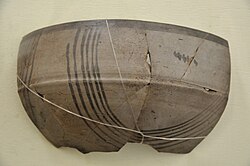
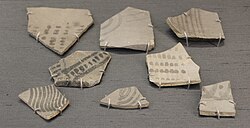
Characterized by a style of fine, grey pottery painted with geometric patterns in black,[7] the PGW culture is associated with village and town settlements, domesticated horses, ivory-working, and the advent of iron metallurgy.[8] As of 2018[update], 1,576 PGW sites have been discovered.[9] Although most PGW sites were small farming villages, "several dozen" PGW sites emerged as relatively large settlements that can be characterized as towns; the largest of these were fortified by ditches or moats and embankments made of piled earth with wooden palisades, albeit smaller and simpler than the elaborate fortifications which emerged in large cities after 600 BCE.[10]
The PGW Culture probably corresponds to the middle and late Vedic period, i.e., the Kuru-Panchala kingdom, the first large state in the Indian subcontinent after the decline of the Indus Valley Civilisation.[11][12] The later vedic literature provides a mass of information on the life and culture of the times. It is succeeded by Northern Black Polished Ware from c.700–500 BCE, associated with the rise of the great Mahajanapada states and of the Magadha Empire.
Dating[edit | edit source]
The Painted Grey Ware culture (PGW) is conventionally dated c.1200 to 500 BCE.[1][2]
Akinori Uesugi regards PGW as having three periods within North Indian Iron Age which are:
- Period I (c. 1300–1000 BCE)
When it makes its appearance in the Ghaggar valley and the upper Ganga region.
- Period II (c. 1000–600 BCE)
When it spreads into the western part of the Ganga valley.
- Period III (c. 600–300 BCE)
With interactions to the east.[13]
Overview[edit | edit source]


The PGW culture cultivated rice, wheat, millet and barley, and domesticated cattle, sheep, pigs, and horses. Houses were built of wattle-and-daub, mud, or bricks, ranging in size from small huts to large houses with many rooms.[citation needed] There is a clear settlement hierarchy, with a few central towns that stand out amongst numerous small villages. Some sites, including Jakhera in Uttar Pradesh, demonstrate a “fairly evolved, proto-urban or semi-urban stage” of this culture, with evidence of social organization and trade, including ornaments of gold, copper, ivory, and semi-precious stones, storage bins for surplus grain, stone weights, paved streets, water channels and embankments.[14]
The plough was used for cultivation. There are also indications of growing complexity of society as population increased and the size and number of settlements multiplied. Arts and crafts of the PGW people are represented by ornaments (made from terracotta, stone, faience, and glass), human and animal figurines (made from terracotta) as well as "incised terracotta discs with decorated edges and geometric motifs" which probably had "ritual meaning," perhaps representing symbols of deities.[15] There are a few stamp seals with geometric designs but no inscription, contrasting with both the prior Harappan seals and the subsequent Brahmi-inscribed seals of the Northern Black Polished Ware culture.[15]
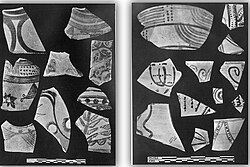
The PGW pottery shows a remarkable degree of standardization. It is dominated by bowls of two shapes, a shallow tray and a deeper bowl, often with a sharp angle between the walls and base. The range of decoration is limited - vertical, oblique or criss-cross lines, rows of dots, spiral chains and concentric circles being common.[16]
At Bhagwanpura in the Kurukshetra district of Haryana, excavations have revealed an overlap between the late Harappan and Painted Grey Ware cultures, large houses that may have been elite residences, and fired bricks that may have been used in Vedic altars.[15]
Fresh surveys by archaeologist Vinay Kumar Gupta suggest Mathura was the largest PGW site around 375 hectares in area.[17] Among the largest sites is also the recently excavated Ahichatra, with at least 40 hectares of area in PGW times along with evidence of early construction of the fortification which goes back to PGW levels.[18] Towards the end of the period, many of the PGW settlements grew into the large towns and cities of the Northern Black Polished Ware period.[19]
Interpretations[edit | edit source]
The pottery style of this culture is different from the pottery of the Iranian Plateau and Afghanistan (Bryant 2001). In some sites, PGW pottery and Late Harappan pottery are contemporaneous.[20] The archaeologist Jim Shaffer (1984:84-85) has noted that "at present, the archaeological record indicates no cultural discontinuities separating Painted Grey Ware from the indigenous protohistoric culture." However, the continuity of pottery styles may be explained by the fact that pottery was generally made by indigenous craftsmen even after the Indo-Aryan migration.[21] According to Chakrabarti (1968) and other scholars, the origins of the subsistence patterns (e.g. rice use) and most other characteristics of the Painted Grey Ware culture are in eastern India or even Southeast Asia.[note 1]
Recent Archaeology[edit | edit source]
In 2015, two periods of PGW were identified, at Ahichhatra, the earliest from c. 1500 to 800 BCE, and the late from 800 to 400 BCE.[22][note 2]
In 2014, the PGW horizon of Kampil excavations were published as 2310 ± 120 BCE and 1360 ± 90 BCE by archaeologist D.P. Tewari.[24]
In 2013, further excavations at Alamgirpur, near Delhi, revealed contiguous occupation of the site, from Early Harappan, through Mature Harappan, Late Harappan, and into a period overlap between the later part of the Harappan phase (with a "noticeable slow decline in quality") and the earliest PGW levels; a sample of beans and grains from this transition layer (ZB 26 OxA-21882) offered a radiocarbon dating of 3659 ± 31 years BP (1647 BCE).[25]
In 2009, a team of the Archaeological Survey of India led by B.R. Mani and Vinay Kumar Gupta collected charcoal samples from the spoil of an illegally excavated, government protected mound at Gosna, a site 6 km east of Mathura across the Yamuna river, where two of the radiocarbon dates came out to be 2160 BCE and 2170 BCE, the site may have had a plain or painted grey ware association, but the evidence has been lost.[17]
In 2006, excavation at Anuradhapura in Sri Lanka has unearthed Plain Grey Ware pottery (in North India associated with Painted Grey Ware) from the 'Basal early historic' period of Anuradhapura (600-500 BCE) showing connections with North India.[26]
See also[edit | edit source]
Notes[edit | edit source]
- ↑ See also Indo-Aryan migration#Archaeological evidence.
- ↑ Petrie et al. (2019) mention 1500 to 700 BCE.[23]
References[edit | edit source]
- ↑ 1.0 1.1 Douglas Q. Adams (January 1997). Encyclopedia of Indo-European Culture. Taylor & Francis. pp. 310–. ISBN 978-1-884964-98-5.
- ↑ 2.0 2.1 Kailash Chand Jain (1972). Malwa Through the Ages, from the Earliest Times to 1305 A.D. Motilal Banarsidass. pp. 96–. ISBN 978-81-208-0824-9.
- ↑ Possehl, G. L., (2002). The Indus civilization: A contemporary perspective, AltaMira Press, Walnut Creek, CA; Oxford, p. 29.
- ↑ Bates, J., (2020). "Kitchen gardens, wild forage and tree fruits: A hypothesis on the role of the Zaid season in the indus civilisation (c.3200-1300 BCE)", in Archaeological Research in Asia 21 (2020), Table 1, p.2.
- ↑ Uesugi, Akinori, (2018). "An Overview on the Iron Age in South Asia", in (ed.) Akinori Uesugi, Iron Age in South Asia, Kansai University, Fig. 6, pp. 9–12.
- ↑ Southworth, Franklin, (2005). Linguistic Archaeology of South Asia, Routledge, p. 177.
- ↑ De Laet, Sigfried J.; Herrmann, Joachim (January 1996). History of Humanity: From the seventh century B.C. To the seventh century A.D. UNESCO. ISBN 9789231028120.
- ↑ Mallory, J. P.; Adams, Douglas Q. (1997). Encyclopedia of Indo-European Culture. Taylor & Francis. ISBN 9781884964985.
- ↑ Uesugi, Akinori (2018). "A Study on the Painted Grey Ware", in Heritage: Journal of Multidisciplinary Studies in Archaeology 6 (2018), p. 2.
- ↑ James Heitzman, The City in South Asia (Routledge, 2008), pp. 12–13.
- ↑ Geoffrey Samuel, (2010) The Origins of Yoga and Tantra: Indic Religions to the Thirteenth Century, Cambridge University Press, pp. 45–51.
- ↑ Michael Witzel (1989), Tracing the Vedic dialects in Dialectes dans les litteratures Indo-Aryennes ed. Caillat, Paris, 97–265.
- ↑ Uesugi, Akinori, (2018)."An Overview on the Iron Age in South Asia", in (ed.) Akinori Uesugi, Iron Age in South Asia, Kansai University, Fig. 6, pp. 9-12.
- ↑ Singh, Upinder (2009), A History of Ancient and Medieval India: From the Stone Age to the 12th Century, Longman, Delhi, pp. 246–248
- ↑ 15.0 15.1 15.2 Kenoyer, J. M., (2006), "Cultures and Societies of the Indus Tradition. In Historical Roots" in the Making of ‘the Aryan’, R. Thapar (ed.), National Book Trust, New Delhi, pp. 21–49.
- ↑ Bridget and Raymond Allchin (1982). The Rise of Civilization in India and Pakistan. Cambridge University Press.
- ↑ 17.0 17.1 Gupta, Vinay Kumar, (2014)."Early Settlement of Mathura: An Archaeological Perspective", An Occasional paper, in History and Society, New Series 41, Nehru Memorial Museum and Library, New Delhi, pp. 1-37.
- ↑ Mani, B. R., (17 September 2013). "What Lies Beneath", in Educational Times.
- ↑ "Archived copy" (PDF). Archived from the original (PDF) on 1 January 2014. Retrieved 4 January 2014.
{{cite web}}: CS1 maint: archived copy as title (link) - ↑ Shaffer, Jim. 1993, Reurbanization: The eastern Punjab and beyond. In Urban Form and Meaning in South Asia: The Shaping of Cities from Prehistoric to Precolonial Times, ed. H. Spodek and D.M. Srinivasan.
- ↑ "Archived copy" (PDF). Archived from the original (PDF) on 23 May 2013. Retrieved 13 February 2013.
{{cite web}}: CS1 maint: archived copy as title (link) - ↑ Pokharia, Anil K., Chanchala Srivastava, Bhuvan Vikram, et al. (2015). "On the botanical findings from excavations at Ahichchhatra: a multicultural site in Upper Ganga Plain, Uttar Pradesh" Archived 5 March 2016 at the Wayback Machine, in Current Science, Vol. 109, No. 7, 10 October 2015, p. 1301.
- ↑ Neogi, Sayantani, Charles A. I. French, Julie A. Durcan, Rabindra N. Singh, and Cameron A. Petrie, (2019). "Geoarchaeological insights into the location of Indus settlements on the plains of northwest India", in Quaternary Research, Volume 94, March 2020, p. 140.
- ↑ Tewari, D.P., (2014). "The Ceramic Traditions from Kampil Excavations", in Puratattva No.44, pp.194-207.
- ↑ Singh, R.N., Cameron Petrie et al., (2013). "Recent Excavations at Alamgirpur, Meerut District: A Preliminary Report", in Man and Environment 38(1), pp. 32-54.
- ↑ Tyagi, Manisha (2006). "Commercial Relations Between North India and Sri Lanka in Ancient Period: A Study". Proceedings of the Indian History Congress. 67: 106–117. ISSN 2249-1937. JSTOR 44147927.
Further reading[edit | edit source]
- Bryant, Edwin (2001). The Quest for the Origins of Vedic Culture. Oxford University Press. ISBN 0-19-513777-9.
- Chakrabarti, D.K. 1968. The Aryan hypothesis in Indian archaeology. Indian Studies Past and Present 4, 333–358.
- Jim Shaffer. 1984. The Indo-Aryan Invasions: Cultural Myth and Archaeological Reality. In: J.R. Lukak. The People of South Asia. New York: Plenum. 1984.
- Kennedy, Kenneth 1995. "Have Aryans been identified in the prehistoric skeletal record from South Asia?", in George Erdosy, ed.: The Indo-Aryans of Ancient South Asia, p. 49–54.
External links[edit | edit source]
- Pages using the JsonConfig extension
- Iron Age cultures of South Asia
- Prehistoric Pakistan
- Prehistoric India
- Iron Age cultures of Asia
- 13th-century BC establishments
- 2nd-millennium BC establishments in India
- 6th-century BC disestablishments in India
- Archaeological cultures in India
- Indo-Aryan archaeological cultures
- Archaeological sites in Rajasthan