





m Removed empty portal template using script |
Gopalpurpp (talk | contribs) No edit summary |
||
| Line 1: | Line 1: | ||
{{ | {{Short description|1971 genocide of Bengalis in East Pakistan}} | ||
{{pp-extended|small=yes}} | |||
{{ | {{Use dmy dates|date=August 2024}} | ||
{{Use dmy dates | |||
{{Infobox civilian attack | {{Infobox civilian attack | ||
| title | | title = Bangladesh genocide | ||
| partof | | partof = the [[Bangladesh Liberation War]] | ||
| image | | image = Dead bodies of Bengali intellectuals, 14 December 1971.jpg | ||
| image_size | | image_size = 220px | ||
| alt | | alt = | ||
| caption | | caption = Corpses of [[1971 killing of Bengali intellectuals|Bengali nationalist intellectuals]] killed in [[Dhaka]] in December 1971, photographed by [[Rashid Talukdar]] | ||
| map | | map = | ||
| map_size | | map_size = | ||
| map_alt | | map_alt = | ||
| map_caption | | map_caption = | ||
| location | | native_name = {{lang|bn|একাত্তরের গণহত্যা}}<br />{{lang|bn|বাঙালি গণহত্যা}} | ||
| target | | native_name_lang = bn | ||
| coordinates | | location = [[East Pakistan]] (now [[Bangladesh]]) | ||
| motive | | target = [[Bengalis]]<ref>{{cite web |last1=Pai |first1=Nitin |title=The 1971 East Pakistan Genocide – A Realist Perspective |url=https://www.genocidebangladesh.org/wp-content/uploads/2008/03/eastpakistangenocide1971-realistperspective1.pdf |website=Bangladesh Genocide Archive |publisher=International Crimes Strategy Forum |access-date=21 September 2023 |archive-date=7 November 2022 |archive-url=https://web.archive.org/web/20221107015512/https://www.genocidebangladesh.org/wp-content/uploads/2008/03/eastpakistangenocide1971-realistperspective1.pdf |url-status=live}}</ref> | ||
| date | | coordinates = | ||
| type | | motive = [[Anti-Hindu sentiment]], [[Racism in Asia#Pakistan|anti-Bengali racism]] | ||
| fatalities | | date = 25 March 1971 – 16 December 1971<br />({{Age in months, weeks and days|month1=03|day1=26|year1=1971|month2=12|day2=16|year2=1971}}) | ||
| | | type = [[Ethnic cleansing]] through [[mass killing]] and [[genocidal rape]] | ||
| fatalities = 300,000–3,000,000 | |||
| victims = {{bulletedlist | |||
| 200,000–400,000 [[Rape during the Bangladesh Liberation War|women raped]] | |||
| 30,000,000 displaced}} | |||
| perpetrator = {{PAK}} | |||
| assailants = {{bulletedlist | |||
| [[Pakistan Army]] | |||
| [[Razakar (Pakistan)|Razakars]] | |||
| [[Al-Badr (East Pakistan)|Al-Badr]] | |||
| [[Al-Shams (East Pakistan)|Al-Shams]] | |||
| [[East Pakistan Central Peace Committee|Central Peace Committee]] | |||
| [[East Pakistan Civil Armed Force|Civil Armed Force]] | |||
| [[Jamaat-e-Islami Pakistan]] | |||
| [[Mujahid Bahini (East Pakistan)|Mujahid Bahini]] | |||
}} | |||
| accused = {{flagicon image|Flag of the President of Pakistan.svg}} [[Yahya Khan]]<br />{{flagicon image|Flag of the Chief of the Army Staff (Pakistan).svg}} [[Abdul Hamid Khan (general)|Hamid Khan]]<br />{{flagicon image|Flag of the Pakistani Army.svg}} [[Tikka Khan]]<br />{{flagicon image|Flag of the Pakistani Army.svg}} [[A. A. K. Niazi|A.A.K. Niazi]]<br />{{flagicon image|Flag of the Pakistani Army.svg}} [[Khadim Hussain Raja|Khadim Hussain]]<br />{{flagicon image|Flag of the Pakistani Army.svg}} [[Rao Farman Ali]] | |||
}} | }} | ||
{{Campaignbox Bangladesh Liberation War}}<!--Do NOT add citations to the lead, except for material likely to be challenged, per [[MOS:LEADCITE]] ([[Wikipedia:Manual of Style/Lead section#Citations)]]. Move unneeded citations to the body.-->{{History of Bangladesh}} | |||
{{Campaignbox Bangladesh Liberation War | The '''Bangladesh genocide'''{{efn|{{langx|bn|একাত্তরের গণহত্যা|Ēkātturēr Gôṇôhôtyā|71's genocide}} or {{langx|bn|বাঙালি গণহত্যা|Bāṅāli Gôṇôhôtyā|Bengali genocide|label=none}}}} was the ethnic cleansing of [[Bengalis]] residing in [[East Pakistan]] (now [[Bangladesh]]) during the [[Bangladesh Liberation War]], perpetrated by the [[Pakistan Army]] and the [[Razakars (Pakistan)|Razakars]] militia.{{sfn|Bass|2013a|p=198|ps=:"The Nixon administration had ample evidence not just of the scale of the massacres, but also of their ethnic targeting of the Hindu minority—what Blood had condemned as genocide. This was common knowledge throughout the Nixon administration."}} It began on 25 March 1971, as [[Operation Searchlight]] was launched by [[West Pakistan]] (now [[Pakistan]]) to militarily subdue the Bengali population of East Pakistan; the Bengalis comprised the demographic majority and had been calling for independence from the Pakistani state. Seeking to curtail the Bengali self-determination movement, erstwhile Pakistani president [[Yahya Khan]] approved a large-scale military deployment, and in the nine-month-long conflict that ensued, Pakistani soldiers and local pro-Pakistan militias killed between 300,000 and 3,000,000 Bengalis and [[Rape during the Bangladesh Liberation War|raped between 200,000 and 400,000 Bengali women]] in a systematic campaign of [[mass killing]] and [[Genocidal rape|genocidal sexual violence]].<ref>{{bulleted list| | ||
|{{harvnb|Dummett|2011}} | |||
The '''Bangladesh genocide''' | |{{harvnb|Boissoneault|2016}} | ||
|{{cite news |last=Bergman |first=David |title=The Politics of Bangladesh's Genocide Debate |work=[[The New York Times]] |date=5 April 2016 |url=https://www.nytimes.com/2016/04/06/opinion/the-politics-of-bangladeshs-genocide-debate.html |access-date=25 October 2024}} | |||
|{{cite book |last=Mookherjee |first=Nayanika |editor1-first=Raphaelle |editor1-last=Branche |editor2-first=Fabrice |editor2-last=Virgili |title=Rape in Wartime |chapter=Mass rape and the inscription of gendered and racial domination during the Bangladesh War of 1971 |year=2012 |publisher=[[Palgrave Macmillan]] |isbn=978-0-230-36399-1}} | |||
}}</ref> | |||
The [[ | West Pakistanis in particular were shown by the news that the operation was carried out because of the 'rebellion by the East Pakistanis' and many activities at the time were hidden from them, including rape and ethnic cleansing of East Pakistanis by the Pakistani military. Although the majority of the victims were [[Bengali Muslims]], [[Bengali Hindus|Hindus]] were especially targeted.<ref>{{Cite book |last=Jahan |first=Rounaq |editor1-last=Totten |editor1-first=Samuel |editor2-last=Parsons |editor2-first=William S. |editor3-last=Charney |editor3-first=Israel W. |chapter=Genocide in Bangladesh |title=Centuries of Genocide: Critical Essays and Eyewitness Accounts |chapter-url=https://sai.columbia.edu/sites/sai.columbia.edu/files/content/docs/1971%20Genocide%20in%20Bangladesh.pdf |year=2013 |orig-year=First published 1995 |edition=4th |publisher=Routledge |isbn=978-0-415-87192-1}}</ref> In their investigation of the genocide, the [[Geneva]]-based [[International Commission of Jurists]] concluded that Pakistan's campaign also involved the attempt to exterminate or forcibly remove a significant portion of the country's Hindu populace.<ref>{{cite web |last1=MacDermot |first1=Niall |date=June 1972 |title=The Review |url=https://www.icj.org/wp-content/uploads/2013/07/ICJ-Review-8-1972-eng.pdf |url-status=live |archive-url=https://web.archive.org/web/20220327213117/https://www.icj.org/wp-content/uploads/2013/07/ICJ-Review-8-1972-eng.pdf |archive-date=27 March 2022 |access-date=29 November 2023 |publisher=[[International Commission of Jurists]] |page=34 |quote=As far as the other three groups are concerned, namely members of the Awami League, students and Hindus, only Hindus would seem to fall within the definition of 'a national, ethnical, racial or religious group'. There is overwhelming evidence that Hindus were slaughtered and their houses and villages destroyed simply because they were Hindus. The oft repeated phrase 'Hindus are enemies of the state' as a justification for the killing does not gainsay the intent to commit genocide; rather does it confirm the intention. The Nazis regarded the Jews as enemies of the state and killed them as such. In our view there is a strong prima facie case that the crime of genocide was committed against the group comprising the Hindu population of East Bengal.}}</ref> The West Pakistani government, which had implemented discriminatory legislation in East Pakistan,<ref>{{Cite web |date=1 February 2023 |title=The Past has yet to Leave the Present: Genocide in Bangladesh |url=https://hir.harvard.edu/the-past-has-yet-to-leave-the-present-genocide-in-bangladesh/ |url-status=live |archive-url=https://web.archive.org/web/20230630102543/https://hir.harvard.edu/the-past-has-yet-to-leave-the-present-genocide-in-bangladesh/ |archive-date=30 June 2023 |access-date=16 October 2023 |website=[[Harvard International Review]] |language=en}}</ref> asserted that Hindus were behind the [[Mukti Bahini]] (Bengali resistance fighters) revolt and that resolving the local "Hindu problem" would end the conflict—Khan's government and the Pakistani elite thus regarded the crackdown as a strategic policy.{{sfn|D'Costa|2011|p=101}} Genocidal rhetoric accompanied the campaign: Pakistani men believed that the sacrifice of Hindus was needed to fix the national malaise.{{sfn|Saikia|2011|p=52}} In the countryside, Pakistan Army moved through villages and specifically asked for places where Hindus lived before burning them down.{{sfn|Bass|2013a|p=119|ps=:"Despite ongoing reports of unprovoked killing by soldiers, Blood saw the army launching a military campaign to take control of the countryside. Still, he thought, genocide was the right description for what was happening to the Hindus. So the consulate "began to focus our 'genocidal' reporting on the Hindus." The military crackdown, he cabled, "fully meets criteria of term 'genocide.'"49 Over and over, Blood tried to alarm his superiors in Washington. "'Genocide' applies fully to naked, calculated and widespread selection of Hindus for special treatment," he wrote. "From outset various members of American community have witnessed either burning down of Hindu villages, Hindu enclaves in Dacca and shooting of Hindus attempting [to] escape carnage, or have witnessed after-effects which [are] visible throughout Dacca today. Gunning down of Professor Dev of Dacca University philosophy department is one graphic example."50 He explained that the Pakistani military evidently did not "make distinctions between Indians and Pakistan Hindus, treating both as enemies." Such anti-Hindu sentiments were lingering and widespread, Blood wrote. He and his staff tenaciously kept up their reporting of anti-Hindu atrocities, telling how the Pakistan army would move into a village, ask where the Hindus lived, and then kill the Hindu men."}} Hindus were identified by checking circumcision or by demanding the recitation of Muslim prayers.{{sfn|Bass|2013a|p=120|ps=:"Desaix Myers remembers, "We were aware the Hindu markets had been attacked. The villages that we visited were Hindu. We were aware that Hindus specically were being attacked." In a letter at the time, he wrote, "The Army continues to check, lifting lungis [a kind of sarong worn by Bengalis], checking circumcision, demanding recitation of Muslim prayers. Hindus flee or are shot." He recalls that on one trip out of Dacca, "I was convinced I saw people wearing pieces of cloth identifying themselves as Hindus." Butcher says, "You heard stories of men having to pull down their lungis. If they were circumcised, they were let go. If they were not, they were killed. It was singling out the Hindus for especially bad treatment, burning Hindu villages, it was like a pogrom. It was ridding the province of these people.""}} This also resulted in the migration of around eight million East Pakistani refugees into India, 80–90% of whom were Hindus.{{sfn|Bass|2013a|p=302|ps=:"The CIA had a blunt explanation for this "incredible" migration: "many if not most of the Hindus fled for fear of their lives." Lieutenant General Tikka Khan, Yahya's military governor, evidently thought he could quickly frighten the Bengalis into submission. The Pakistan army, the CIA noted, seemed to have singled out Hindus as targets. Although the CIA refrained from crying genocide, it did insist this was an ethnic campaign, with 80 percent—or possibly even 90 percent— of the refugees being Hindus. So far, out of eight million refugees, over six million were Hindus, and many more might follow—ending perhaps only when East Pakistan had no more Hindus left.... This was confirmed by Sydney Schanberg of the New York Times, who, interviewing refugees in India, found that almost all of them were Hindus, who said that they were still specially hounded by the Pakistan army."}} | ||
Both Muslim and Hindu women were targeted for rape.{{sfn|Mookherjee|2021|p=594}} West Pakistani men wanted to cleanse a nation corrupted by the presence of Hindus and believed that the sacrifice of Hindu women was needed; Bengali women were thus viewed as Hindu or Hindu-like.{{sfn|Saikia|2011|p=52}} | |||
As a result of the conflict, | Pakistan's activities during the Bangladesh Liberation War served as a catalyst for India's military intervention in support of the Mukti Bahini, triggering the [[Indo-Pakistani War of 1971|Indo-Pakistani War that began on December 3, 1971]]. The conflict and the genocide formally ended on 16 December 1971, when the joint forces of Bangladesh and India received the [[Pakistani Instrument of Surrender]]. As a result of the conflict, approximately 10 million [[East Bengali refugees]] fled to Indian territory while up to 30 million people were internally displaced out of the 70 million total population of East Pakistan. There was also ethnic violence between the Bengali majority and the [[Biharis|Bihari]] minority during the conflict; between 1,000 and 150,000 Biharis were killed in reprisal attacks by Bengali militias and mobs, as Bihari collaboration with the West Pakistani campaign had led to further [[Persecution of Biharis in Bangladesh|anti-Bihari sentiment]]. Since Pakistan's defeat and Bangladesh's independence, the title "[[Stranded Pakistanis in Bangladesh]]" has commonly been used to refer to the Bihari community, which was denied the right to hold Bangladeshi citizenship until 2008. | ||
Allegations of a genocide in Bangladesh were rejected by most [[UN member states]] at the time and rarely appear in textbooks and academic sources on [[genocide studies]].<ref>{{cite book |last1=Moses |first1=A. Dirk |author-link=A. Dirk Moses |title=The Problems of Genocide: Permanent Security and the Language of Transgression |date=2021 |publisher=[[Cambridge University Press]] |isbn=978-1-009-02832-5 |language=en |pages=8, 395}}</ref> | |||
== Background == | == Background == | ||
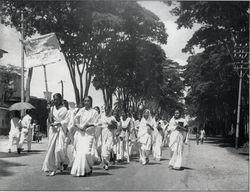
[[File:21 Feb 1953 Dhaka University female students procession.png|thumb | [[File:21 Feb 1953 Dhaka University female students procession.png|thumb|Female students of [[Dhaka|Dacca]] university marching on Language Movement Day, 21 February 1953.]] | ||
Following the [[ | === West Pakistan and East Pakistan === | ||
Following the [[Partition of India]], the new state of Pakistan represented a geographical anomaly, with two wings separated by {{convert|1000|mi|km|order=flip}} of Indian territory.{{sfn|Brecher|2008|p=169}} The wings were not only separated geographically, but also [[Culture of Bengal|culturally]]. The authorities of the West viewed the Bengali Muslims in the East as "too 'Bengali'" and their application of Islam as "inferior and impure", believing this made the Bengalis unreliable "co-religionists". The Pakistani leadership perceived elements of Hindu influence within Bengali language and culture. As a result, they made repeated efforts to mitigate or eradicate these perceived Hindu influences.<ref>{{cite book |last1=Totten |first1=Samuel |author1-link=Samuel Totten |editor1-first=Samuel |editor1-last=Totten |editor1-link=Samuel Totten |editor2-first=William S. |editor2-last=Parsons |title=Century of Genocide: Critical Essays and Eyewitness Accounts |date=2008 |publisher=[[Routledge]] |isbn=978-0-203-89043-1 |page=246 |doi=10.4324/9780203890431 |edition=3rd |url=https://doi.org/10.4324/9780203890431 |access-date=21 September 2023 |archive-date=8 August 2024 |archive-url=https://web.archive.org/web/20240808140556/https://www.taylorfrancis.com/books/mono/10.4324/9780203890431/century-genocide-samuel-totten-william-parsons |url-status=live}}</ref> Politicians in West Pakistan began a strategy to forcibly assimilate the Bengalis culturally and religiously.{{sfn|Mookherjee|2009|p=51}} The ruling class of [[West Pakistan]] held political power over and looked down on Bengali Muslims from East Pakistan due to the influence of colonialism a colorist obsession for light skin led to viewing East Pakistanis as [[Discrimination based on skin tone|darker skinned]] compared to West Pakistanis.<ref>''Visibilities and Invisibilities of Race and Racism: Toward a New Global Dialogue'' (2025) Faye V. Harrison, Yasuko I. Takezawa, Akio Tanabe</ref> | |||
The Bengali people were the demographic majority in Pakistan, making up an estimated 75 million in [[East Pakistan]], compared with 55 million in the predominantly [[Punjabi language|Punjabi]]-speaking [[West Pakistan]].{{sfn|Jones|2010|p=340}} The majority in the East were Muslim, with large minorities of Hindus, Buddhists and Christians | The Bengali people were the demographic majority in Pakistan, making up an estimated 75 million in [[East Pakistan]], compared with 55 million in the predominantly [[Punjabi language|Punjabi]]-speaking [[West Pakistan]].{{sfn|Jones|2010|p=340}} The majority in the East were Muslim, with large minorities of Hindus, Buddhists and Christians. | ||
In 1948, a few months after the creation of Pakistan, [[Governor-General of Pakistan|Governor-General]] [[ | === Discriminatory policies against Bengalis === | ||
In 1948, a few months after the creation of Pakistan, [[Governor-General of Pakistan|Governor-General]] [[Muhammad Ali Jinnah]] declared [[Urdu]] as the national language of the newly formed state,{{sfn|Thompson|2007|p=42}} although only four per cent of Pakistan's population spoke Urdu at that time.{{sfn|Shah|1997|p=51}} He mentioned that the people of [[East Bengal]] could choose what would be its provincial language, and branded those who were against the use of [[Urdu]] as the national language of Pakistan as [[Communism|communists]], [[Treason|traitors]] and enemies of the state.<ref>{{Cite web |title=txt_jinnah_dacca_1948 |url=http://www.columbia.edu/itc/mealac/pritchett/00islamlinks/txt_jinnah_dacca_1948.html |access-date=24 January 2022 |website=[[Columbia University]] |archive-date=22 October 2021 |archive-url=https://web.archive.org/web/20211022093628/http://www.columbia.edu/itc/mealac/pritchett/00islamlinks/txt_jinnah_dacca_1948.html |url-status=live}}</ref>{{sfn|Hossain|Tollefson|2006|p=245}} The refusal by successive governments to recognise [[Bengali language|Bengali]] as the second national language culminated in the [[Bengali language movement]] and strengthened support for the newly formed [[Awami League]], which was founded in the East as an alternative to the ruling [[Muslim League (Pakistan)|Muslim League]].{{sfn|Molla|2004|p=217}} A 1952 protest in [[Dhaka]], the capital of East Pakistan, was forcibly broken up, resulting in the deaths of several protesters. Bengali nationalists viewed those who had died as martyrs for their cause, and the violence led to calls for secession.{{sfn|Harder|2010|p=351}} The [[Indo-Pakistani War of 1965]] caused further grievances, as the military had assigned no extra units to the defence of the East.{{sfn|Haggett|2001|p=2716}} This was a matter of concern to the Bengalis who saw their nation undefended in case of Indian attack during the conflict of 1965,{{sfn|Hagerty|Ganguly|2005|p=31}}{{sfn|Midlarsky|2011|p=257}} and that [[Ayub Khan (President of Pakistan)|Ayub Khan]], the [[President of Pakistan]], was willing to lose the [[East Pakistan|East]] if it meant gaining [[Kashmir]].{{sfn|Riedel|2011|p=9}} | |||
The slow response to the [[1970 Bhola cyclone|Bhola cyclone]] which struck on 12 November 1970 is widely seen as a contributing factor in the December 1970 [[1970 Pakistani general election|general election]].<ref>{{cite journal|last1=Biswas|first1=Sravani|last2=Daly|first2=Patrick|title=Cyclone Not Above Politics' : East Pakistan, disaster politics, and the 1970 Bhola Cyclone|journal=[[Modern Asian Studies]]|doi=10.1017/S0026749X20000293|publisher=[[Cambridge University Press]]|volume=55|issue=4|pages=1382–1410|s2cid=224892294 }}</ref> The East Pakistan-based Awami League, headed by [[Sheikh Mujibur Rahman]], won a national majority in the first democratic election since the creation of Pakistan, sweeping East Pakistan. But, the West Pakistani establishment prevented them from forming a government.{{sfn|Roy|2010|p=102}} President [[Yahya Khan]], encouraged by [[Zulfikar Ali Bhutto]],<ref>{{Cite news|url=https://www.nytimes.com/2013/09/29/books/review/the-blood-telegram-by-gary-j-bass.html|title='The Blood Telegram,' by Gary J. Bass|last=Filkins|first=Dexter|newspaper=The New York Times|issn=0362-4331|access-date=31 March 2016|archive-date=11 June 2016|archive-url=https://web.archive.org/web/20160611054151/http://www.nytimes.com/2013/09/29/books/review/the-blood-telegram-by-gary-j-bass.html|url-status=live}}</ref> banned the Awami League and declared [[martial law]].{{sfn|Sisson|Rose|1992|p=141}} The Pakistani Army demolished [[Ramna Kali Mandir]] (temple) and killed 85 Hindus. | The slow response to the [[1970 Bhola cyclone|Bhola cyclone]] which struck on 12 November 1970 is widely seen as a contributing factor in the December 1970 [[1970 Pakistani general election|general election]].<ref>{{cite journal |last1=Biswas |first1=Sravani |last2=Daly |first2=Patrick |title=Cyclone Not Above Politics': East Pakistan, disaster politics, and the 1970 Bhola Cyclone |journal=[[Modern Asian Studies]] |doi=10.1017/S0026749X20000293 |date=July 2021 |publisher=[[Cambridge University Press]] |volume=55 |issue=4 |pages=1382–1410 |s2cid=224892294 |hdl=10356/154579 |hdl-access=free |issn=0026-749X}}</ref> The East Pakistan-based Awami League, headed by [[Sheikh Mujibur Rahman]], won a national majority in the first democratic election since the creation of Pakistan, sweeping East Pakistan. But, the West Pakistani establishment prevented them from forming a government.{{sfn|Roy|2010|p=102}} President [[Yahya Khan]], encouraged by [[Zulfikar Ali Bhutto]],<ref>{{Cite news |url=https://www.nytimes.com/2013/09/29/books/review/the-blood-telegram-by-gary-j-bass.html |title='The Blood Telegram,' by Gary J. Bass |last=Filkins |first=Dexter |date=27 September 2013 |newspaper=[[The New York Times]] |issn=0362-4331 |access-date=31 March 2016 |archive-date=11 June 2016 |archive-url=https://web.archive.org/web/20160611054151/http://www.nytimes.com/2013/09/29/books/review/the-blood-telegram-by-gary-j-bass.html |url-status=live}}</ref> banned the Awami League and declared [[martial law]].{{sfn|Sisson|Rose|1992|p=[https://books.google.com/books?id=y85KOHHVT5oC&pg=PA141 141]}} The Pakistani Army demolished [[Ramna Kali Mandir]] (temple) and killed 85 Hindus.{{sfn|Dasgupta|Togawa|Barkat|2011|p=[https://books.google.com/books?id=VdqGAwAAQBAJ&pg=PA147 147]}} On 22 February 1971, General Yahya Khan is reported to have said "Kill three million of them, and the rest will eat out of our hands."<ref name=":3">{{cite news |last=Hensher |first=Philip |date=19 February 2013 |title=The war Bangladesh can never forget |url=https://www.independent.co.uk/news/world/asia/the-war-bangladesh-can-never-forget-8501636.html |url-status=live |archive-url=https://web.archive.org/web/20201228012649/https://www.independent.co.uk/news/world/asia/war-bangladesh-can-never-forget-8501636.html |archive-date=28 December 2020 |access-date=31 March 2016 |newspaper=[[The Independent]] |location=London}}</ref><ref>{{Cite book |url=https://books.google.com/books?id=g0N8hOgFz3QC |title=Poisoning the Press: Richard Nixon, Jack Anderson, and the Rise of Washington's Scandal Culture |last=Feldstein |first=Mark |year=2010 |publisher=Macmillan |isbn=9781429978972 |page=8 |access-date=5 April 2016 |archive-date=8 August 2024 |archive-url=https://web.archive.org/web/20240808150551/https://books.google.com/books?id=g0N8hOgFz3QC |url-status=live}}</ref><ref>{{Cite book |last=Hewitt |first=William L. |year=2004 |title=Defining the Horrific: Readings on Genocide and Holocaust in the 20th Century |url=https://books.google.com/books?id=5qZIAAAAYAAJ |publisher=Pearson Education |page=287 |isbn=978-0-13-110084-8 |access-date=5 April 2016 |archive-date=17 March 2023 |archive-url=https://web.archive.org/web/20230317194232/https://books.google.com/books?id=5qZIAAAAYAAJ |url-status=live}}</ref> | ||
Some Bengalis supported a united Pakistan and opposed secession from it.<ref>{{cite book |last=Baxter |first=Craig|author-link = Craig Baxter |year=1997 |title=Bangladesh: From A Nation To A State |publisher=Westview Press |page=88 |isbn=978-0-813-33632-9 |quote=The Pakistanis had armed some groups, Bihari and Bengali, that opposed separation.}}</ref> According to Indian academic Sarmila Bose, these pro-Pakistan Bengalis constituted a significant minority, and included the Islamic parties. Moreover, many Awami League voters who hoped to achieve provincial autonomy may not have desired secession.<ref>{{Cite journal |last=Bose |first=Sarmila |title=Anatomy of Violence: Analysis of Civil War in East Pakistan in 1971 |url=http://www.politics.ox.ac.uk/materials/profile_materials/sbose-anatomy_of_violence-epw_v_40_no_41_2005.pdf |journal=Economic and Political Weekly |volume=40 |issue=41 |pages=4463–4471 |jstor=4417267 |access-date=26 March 2016 |archive-date=28 December 2020 |archive-url=https://web.archive.org/web/20201228012627/https://www.politics.ox.ac.uk/materials/profile_materials/sbose-anatomy_of_violence-epw_v_40_no_41_2005.pdf |url-status=live }}</ref> Additionally, some Bengali officers and soldiers remained loyal to the Pakistani Army and were taken as prisoners of war by India along with other West Pakistani soldiers.<ref name=":1">{{Cite journal |last=Bose |first=Sarmila |title=The question of genocide and the quest for justice in the 1971 war |url=http://www.politics.ox.ac.uk/materials/profile_materials/jgr%20vol%2013%20no%204%202011.pdf |journal=Journal of Genocide Research |volume=13 |issue=4 |page=398 |doi=10.1080/14623528.2011.625750 |s2cid=38668401 |access-date=18 March 2016 |archive-date=10 October 2017 |archive-url=https://web.archive.org/web/20171010075759/https://www.politics.ox.ac.uk/materials/profile_materials/jgr%20vol%2013%20no%204%202011.pdf |url-status=live }}</ref> Thus, according to Sarmila Bose, there were many pro-regime Bengalis who killed and persecuted the pro-liberation fighters.<ref name=":1" /> [[Sydney Schanberg]] reported the formation of armed civilian units by the Pakistani Army in June 1971. Only a minority of the recruits were Bengali, while most were Biharis and Urdu speakers. The units with local knowledge played an important role in the implementation of the Pakistani Army's genocide.<ref>{{Cite web|url=http://www.asiantribune.com/news/2009/09/21/demolition-ramna-kali-temple-march-1971-part-ii | === Bengali independence movement === | ||
Some Bengalis supported a united Pakistan and opposed secession from it.<ref>{{cite book |last=Baxter |first=Craig |author-link=Craig Baxter |year=1997 |title=Bangladesh: From A Nation To A State |publisher=[[Westview Press]] |page=88 |isbn=978-0-813-33632-9 |quote=The Pakistanis had armed some groups, Bihari and Bengali, that opposed separation.}}</ref> According to Indian academic Sarmila Bose, these pro-Pakistan Bengalis constituted a significant minority, and included the Islamic parties. Moreover, many Awami League voters who hoped to achieve provincial autonomy may not have desired secession.<ref>{{Cite journal |last=Bose |first=Sarmila |date=8 October 2005 |title=Anatomy of Violence: Analysis of Civil War in East Pakistan in 1971 |url=http://www.politics.ox.ac.uk/materials/profile_materials/sbose-anatomy_of_violence-epw_v_40_no_41_2005.pdf |journal=Economic and Political Weekly |volume=40 |issue=41 |pages=4463–4471 |jstor=4417267 |access-date=26 March 2016 |archive-date=28 December 2020 |archive-url=https://web.archive.org/web/20201228012627/https://www.politics.ox.ac.uk/materials/profile_materials/sbose-anatomy_of_violence-epw_v_40_no_41_2005.pdf |url-status=live}}</ref> Additionally, some Bengali officers and soldiers remained loyal to the Pakistani Army and were taken as prisoners of war by India along with other West Pakistani soldiers.<ref name=":1">{{Cite journal |last=Bose |first=Sarmila |date=November 2011 |title=The question of genocide and the quest for justice in the 1971 war |url=http://www.politics.ox.ac.uk/materials/profile_materials/jgr%20vol%2013%20no%204%202011.pdf |journal=[[Journal of Genocide Research]] |volume=13 |issue=4 |page=398 |doi=10.1080/14623528.2011.625750 |s2cid=38668401 |access-date=18 March 2016 |archive-date=10 October 2017 |archive-url=https://web.archive.org/web/20171010075759/https://www.politics.ox.ac.uk/materials/profile_materials/jgr%20vol%2013%20no%204%202011.pdf |url-status=live}}</ref> Thus, according to Sarmila Bose, there were many pro-regime Bengalis who killed and persecuted the pro-liberation fighters.<ref name=":1" /> [[Sydney Schanberg]] reported the formation of armed civilian units by the Pakistani Army in June 1971. Only a minority of the recruits were Bengali, while most were Biharis and Urdu speakers. The units with local knowledge played an important role in the implementation of the Pakistani Army's genocide.<ref>{{Cite web |title=The Demolition of Ramna Kali Temple in March 1971 |url=http://www.asiantribune.com/news/2009/09/21/demolition-ramna-kali-temple-march-1971-part-ii |archive-url=https://web.archive.org/web/20090923175041/http://www.asiantribune.com/news/2009/09/21/demolition-ramna-kali-temple-march-1971-part-ii |archive-date=23 September 2009 |access-date=31 March 2016 |work=[[Asian Tribune]]}}</ref> American writer Gary J. Bass believes that the breakup of Pakistan was not inevitable, identifying 25 March 1971 as the point where the idea of a united Pakistan ended for Bengalis with the start of military operations.<ref>{{Cite web |url=http://newsweekpakistan.com/gary-bass/ |title=Last Word: Gary J. Bass |website=Newsweek Pakistan |access-date=1 April 2016 |date=17 December 2013 |archive-date=28 December 2020 |archive-url=https://web.archive.org/web/20201228012659/https://www.newsweekpakistan.com/gary-bass/ |url-status=live}}</ref> According to John H. Gill, since there was widespread polarisation between pro-Pakistan Bengalis and pro-liberation Bengalis during the war, those internal battles are still playing out in the domestic politics of modern-day Bangladesh.<ref>{{Cite book |title=An Atlas of 1971 Indian-Pakistan war-the Creation of Bangladesh |last=Gill |first=John H. |publisher=NESA |year=1994 |pages=66}}</ref> | |||
==Operation Searchlight== | ==Operation Searchlight== | ||
[[Operation Searchlight]] was a planned military operation carried out by the Pakistani Army to curb elements of the separatist Bengali nationalist movement in East Pakistan in March 1971.<ref name="BoseAoV">{{cite journal |last=Bose |first=Sarmila |title=Anatomy of Violence: Analysis of Civil War in East Pakistan in 1971 |url=http://www.epw.org.in/showArticles.php?root=2005&leaf=10&filename=9223&filetype=html |journal=[[Economic and Political Weekly]] |archive-url=https://web.archive.org/web/20070301084941/http://www.epw.org.in/showArticles.php?root=2005&leaf=10&filename=9223&filetype=html |archive-date=1 March 2007}}</ref>{{sfn|Spencer|2012|p=63}}{{sfn|Ganguly|2002|p=60}} The Pakistani state justified commencing Operation Searchlight on the basis of anti-Bihari violence by Bengalis in early March.<ref name="D' Costa 2011 103">{{Cite book|title=Nationbuilding, Gender and War Crimes in South Asia | [[Operation Searchlight]] was a planned military operation carried out by the Pakistani Army to curb elements of the separatist Bengali nationalist movement in East Pakistan in March 1971.<ref name="BoseAoV">{{cite journal |last=Bose |first=Sarmila |date=8 October 2005 |title=Anatomy of Violence: Analysis of Civil War in East Pakistan in 1971 |url=http://www.epw.org.in/showArticles.php?root=2005&leaf=10&filename=9223&filetype=html |journal=[[Economic and Political Weekly]] |archive-url=https://web.archive.org/web/20070301084941/http://www.epw.org.in/showArticles.php?root=2005&leaf=10&filename=9223&filetype=html |archive-date=1 March 2007}}</ref>{{sfn|Spencer|2012|p=63}}{{sfn|Ganguly|2002|p=60}} The Pakistani state justified commencing Operation Searchlight on the basis of anti-Bihari violence by Bengalis in early March.<ref name="D' Costa 2011 103">{{Cite book |last=D' Costa |first=Bina |title=Nationbuilding, Gender and War Crimes in South Asia |publisher=[[Routledge]] |year=2011 |isbn=9780415565660 |pages=103}}</ref> Ordered by the government in West Pakistan, this was seen as the sequel to Operation Blitz which had been launched in November 1970. On 1 March 1971, East Pakistan governor Admiral [[Syed Mohammad Ahsan|Syed Mohammed Ahsan]] was replaced after disagreeing with military action in East Pakistan.<ref>{{Cite news |url=http://www.dawn.com/news/1072331/gen-agha-mohammad-yahya-khan-4 |title=Gen Agha Mohammad Yahya Khan – 4 |last=Cowasjee |first=Ardeshir |date=17 September 2000 |work=[[Dawn (newspaper)|Dawn]] |access-date=31 March 2016 |archive-date=4 March 2016 |archive-url=https://web.archive.org/web/20160304061014/http://www.dawn.com/news/1072331/gen-agha-mohammad-yahya-khan-4 |url-status=live}}</ref><ref>{{Cite web |url=http://en.banglapedia.org/index.php?title=Ahsan,_Vice_Admiral_Syed_Muhammad |title=Ahsan, Vice Admiral Syed Muhammad |website=Banglapedia |access-date=31 March 2016 |archive-date=28 December 2020 |archive-url=https://web.archive.org/web/20201228012613/http://en.banglapedia.org/index.php?title=Ahsan%2C_Vice_Admiral_Syed_Muhammad |url-status=live}}</ref> His successor [[Sahabzada Yaqub Khan|Sahibzada Yaqub Khan]] resigned after refusing to use soldiers to quell a mutiny and disagreement with military action in East Pakistan.<ref>{{Cite news |url=https://www.nytimes.com/2016/01/29/world/asia/sahabzada-yaqub-khan-dies-at-95-pakistani-diplomat-obituary.html |title=Sahabzada Yaqub Khan, Pakistani Diplomat, Dies at 95 |last=Roberts |first=Sam |date=28 January 2016 |newspaper=[[The New York Times]] |issn=0362-4331 |access-date=31 March 2016 |archive-date=11 February 2018 |archive-url=https://web.archive.org/web/20180211120817/https://www.nytimes.com/2016/01/29/world/asia/sahabzada-yaqub-khan-dies-at-95-pakistani-diplomat-obituary.html |url-status=live}}</ref><ref>{{Cite news |url=http://www.dawn.com/news/1235591 |title=Sahibzada Yaqub Khan |last=Editorial |date=27 January 2016 |work=[[Dawn (newspaper)|Dawn]] |access-date=31 March 2016 |archive-date=28 December 2020 |archive-url=https://web.archive.org/web/20201228012638/https://www.dawn.com/news/1235591 |url-status=live}}</ref> | ||
According to Indian academic<ref>{{cite web|url=https://sarmilabose.com/bio-2/|website=Sarmila Bose|title=Bio – Sarmila Bose|access-date=25 September 2016|archive-date=28 December 2020|archive-url=https://web.archive.org/web/20201228012656/https://sarmilabose.com/bio-2/|url-status=live}}</ref><ref>{{cite news|title=This account of the Bangladesh war should not be seen as unbiased|url=https://www.theguardian.com/commentisfree/2011/jun/08/bangladesh-liberation-war-sarmila-bose|newspaper=The Guardian|last1=Mookherjee|first1=Nayanika|access-date=10 August 2016|archive-date=28 December 2020|archive-url=https://web.archive.org/web/20201228012613/https://www.theguardian.com/commentisfree/2011/jun/08/bangladesh-liberation-war-sarmila-bose|url-status=live}}</ref> Sarmila Bose, the postponement of the National Assembly on 1 March led to widespread lawlessness spread by Bengali protesters during the period of 1–25 March, in which the Pakistani government lost control over much of the province. Bose asserts that during this 25-day period of lawlessness, attacks by Bengalis on non-Bengalis were common as well as attacks by Bengalis on Pakistani military personnel who, according to Bose and Anthony Mascarenhas, showed great restraint until 25 March, when Operation Searchlight began.<ref>{{Cite journal|last=Bose|first=Sarmila|title=Anatomy of Violence: Analysis of Civil War in East Pakistan in 1971|url=http://www.politics.ox.ac.uk/materials/profile_materials/sbose-anatomy_of_violence-epw_v_40_no_41_2005.pdf|journal=Economic and Political Weekly|pages=4464–4465|access-date=26 March 2016|archive-date=28 December 2020|archive-url=https://web.archive.org/web/20201228012627/https://www.politics.ox.ac.uk/materials/profile_materials/sbose-anatomy_of_violence-epw_v_40_no_41_2005.pdf|url-status=live}}</ref> Bose also described the atrocities committed by the Pakistani Army in her book.<ref>{{Cite | According to Indian academic<ref>{{cite web |url=https://sarmilabose.com/bio-2/ |website=Sarmila Bose |title=Bio – Sarmila Bose |access-date=25 September 2016 |date=8 February 2015 |archive-date=28 December 2020 |archive-url=https://web.archive.org/web/20201228012656/https://sarmilabose.com/bio-2/ |url-status=live}}</ref><ref>{{cite news |title=This account of the Bangladesh war should not be seen as unbiased |url=https://www.theguardian.com/commentisfree/2011/jun/08/bangladesh-liberation-war-sarmila-bose |newspaper=[[The Guardian]] |date=8 June 2011 |last1=Mookherjee |first1=Nayanika |access-date=10 August 2016 |archive-date=28 December 2020 |archive-url=https://web.archive.org/web/20201228012613/https://www.theguardian.com/commentisfree/2011/jun/08/bangladesh-liberation-war-sarmila-bose |url-status=live}}</ref> Sarmila Bose, the postponement of the National Assembly on 1 March led to widespread lawlessness spread by Bengali protesters during the period of 1–25 March, in which the Pakistani government lost control over much of the province. Bose asserts that during this 25-day period of lawlessness, attacks by Bengalis on non-Bengalis were common as well as attacks by Bengalis on Pakistani military personnel who, according to Bose and Anthony Mascarenhas, showed great restraint until 25 March, when Operation Searchlight began.<ref>{{Cite journal |last=Bose |first=Sarmila |date=8 October 2005 |title=Anatomy of Violence: Analysis of Civil War in East Pakistan in 1971 |url=http://www.politics.ox.ac.uk/materials/profile_materials/sbose-anatomy_of_violence-epw_v_40_no_41_2005.pdf |journal=Economic and Political Weekly |pages=4464–4465 |access-date=26 March 2016 |archive-date=28 December 2020 |archive-url=https://web.archive.org/web/20201228012627/https://www.politics.ox.ac.uk/materials/profile_materials/sbose-anatomy_of_violence-epw_v_40_no_41_2005.pdf |url-status=live}}</ref> Bose also described the atrocities committed by the Pakistani Army in her book.<ref>{{Cite news |url=http://scroll.in/article/804314/smriti-irani-misrepresented-my-work-in-her-speech-oxford-researcher-sarmila-bose |title='Smriti Irani misrepresented my work in her speech': Oxford researcher Sarmila Bose |last=Bose |first=Sarmila |work=Scroll.in |access-date=1 April 2016 |archive-date=4 April 2016 |archive-url=https://web.archive.org/web/20160404135141/http://scroll.in/article/804314/smriti-irani-misrepresented-my-work-in-her-speech-oxford-researcher-sarmila-bose |url-status=live}}</ref> According to Anthony Mascarenhas, the actions of the Pakistani Army compared to the violence by Bengalis was "altogether worse and on a grander scale."{{sfn|Dummett|2011}} | ||
On the night of 25 March 1971 the Pakistani Army launched Operation Searchlight. ''Time'' magazine dubbed General [[Tikka Khan]] the "Butcher of Bengal" for his role in Operation Searchlight.<ref name=":2">{{cite news |url=http://tribune.com.pk/story/307080/no-lessons-learnt-in-forty-years/ |title=No lessons learnt in forty years |newspaper=The Express Tribune |access-date=31 March 2016 |archive-date=24 October 2016 |archive-url=https://web.archive.org/web/20161024093415/http://tribune.com.pk/story/307080/no-lessons-learnt-in-forty-years/ |url-status=live }}</ref> Targets of the operation included [[Jagannath Hall]] which was a dormitory for non-Muslim students of Dhaka University, Rajarbagh Police Lines, and [[Pilkhana, Bangladesh|Pilkhana]], which is the headquarters of [[East Pakistan Rifles]]. About 34 students were killed in the dormitories of Dhaka University. Neighbourhoods of old Dhaka which had a majority Hindu population were also attacked. Robert Payne, an American journalist, estimated that 7,000 people had been killed and 3,000 arrested in that night.<ref>{{cite news |title=The Black Night that still haunts the nation |url=http://www.thedailystar.net/frontpage/the-black-night-still-haunts-the-nation-1199260 |newspaper=The Daily Star |access-date=30 March 2016 |archive-date=28 December 2020 |archive-url=https://web.archive.org/web/20201228012616/https://www.thedailystar.net/frontpage/the-black-night-still-haunts-the-nation-1199260 |url-status=live }}</ref> Teachers of Dhaka University were killed in the operation by the Pakistani Army.<ref>{{cite news |last=Chandan |first=Md Shahnawaz Khan |title=The Heroes of a Forgetful Nation |url=http://www.thedailystar.net/the-heroes-of-a-forgetful-nation-55177 |newspaper=The Daily Star |access-date=30 March 2016 |archive-date=10 April 2016 |archive-url=https://web.archive.org/web/20160410205814/http://www.thedailystar.net/the-heroes-of-a-forgetful-nation-55177 |url-status=live }}</ref> Sheikh Mujib was arrested by the Pakistani Army on 25 March.<ref>{{Cite book|url=https://books.google.com/books?id=UOJxCgAAQBAJ&pg=PA219|title=The Middle East and South Asia 2015–2016|last=Russell|first=Malcolm|publisher=Rowman & Littlefield|isbn=978-1-4758-1879-6|page=219|access-date=21 August 2017|archive-date= | On the night of 25 March 1971, the Pakistani Army launched Operation Searchlight. ''Time'' magazine dubbed General [[Tikka Khan]] the "Butcher of Bengal" for his role in Operation Searchlight.<ref name=":2">{{cite news |url=http://tribune.com.pk/story/307080/no-lessons-learnt-in-forty-years/ |title=No lessons learnt in forty years |newspaper=[[The Express Tribune]] |access-date=31 March 2016 |archive-date=24 October 2016 |archive-url=https://web.archive.org/web/20161024093415/http://tribune.com.pk/story/307080/no-lessons-learnt-in-forty-years/ |url-status=live}}</ref> Targets of the operation included [[Jagannath Hall]] which was a dormitory for non-Muslim students of Dhaka University, Rajarbagh Police Lines, and [[Pilkhana, Bangladesh|Pilkhana]], which is the headquarters of [[East Pakistan Rifles]]. About 34 students were killed in the dormitories of Dhaka University. Neighbourhoods of old Dhaka which had a majority Hindu population were also attacked. Robert Payne, an American journalist, estimated that 7,000 people had been killed and 3,000 arrested in that night.<ref>{{cite news |title=The Black Night that still haunts the nation |url=http://www.thedailystar.net/frontpage/the-black-night-still-haunts-the-nation-1199260 |newspaper=The Daily Star |date=25 March 2016 |access-date=30 March 2016 |archive-date=28 December 2020 |archive-url=https://web.archive.org/web/20201228012616/https://www.thedailystar.net/frontpage/the-black-night-still-haunts-the-nation-1199260 |url-status=live}}</ref> Teachers of Dhaka University were killed in the operation by the Pakistani Army.<ref>{{cite news |last=Chandan |first=Md Shahnawaz Khan |date=8 March 2015 |title=The Heroes of a Forgetful Nation |url=http://www.thedailystar.net/the-heroes-of-a-forgetful-nation-55177 |newspaper=The Daily Star |access-date=30 March 2016 |archive-date=10 April 2016 |archive-url=https://web.archive.org/web/20160410205814/http://www.thedailystar.net/the-heroes-of-a-forgetful-nation-55177 |url-status=live}}</ref> Sheikh Mujib was arrested by the Pakistani Army on 25 March.<ref>{{Cite book |url=https://books.google.com/books?id=UOJxCgAAQBAJ&pg=PA219 |title=The Middle East and South Asia 2015–2016 |last=Russell |first=Malcolm |year=2015 |publisher=[[Rowman & Littlefield]] |isbn=978-1-4758-1879-6 |page=219 |access-date=21 August 2017 |archive-date=8 August 2024 |archive-url=https://web.archive.org/web/20240808140548/https://books.google.co.id/books?id=UOJxCgAAQBAJ&pg=PA219&redir_esc=y#v=onepage&q&f=false |url-status=live}}</ref> [[Ramna Kali Mandir]] was demolished by the Pakistani Army in March 1971.{{sfn|Dasgupta|Togawa|Barkat|2011|p=[https://books.google.com/books?id=VdqGAwAAQBAJ&pg=PA147 147]}} | ||
The original plan envisioned taking control of the major cities on 26 March 1971, and then eliminating all opposition, political or military,<ref>{{cite book |last=Sālik |first=Ṣiddīq |title=Witness To Surrender |pages=63, 228–229 |location=Dhaka |publisher=University Press |year=1997 |isbn= 978-984-05-1373-4}}</ref> within one month. The prolonged Bengali resistance was not anticipated by Pakistani planners.<ref>Pakistan Defence Journal, 1977, Vol 2, p2-3</ref> The main phase of Operation Searchlight ended with the fall of the last major town in Bengali hands in mid May. The countryside still remained almost evenly contested. | The original plan envisioned taking control of the major cities on 26 March 1971, and then eliminating all opposition, political or military,<ref>{{cite book |last=Sālik |first=Ṣiddīq |title=Witness To Surrender |pages=63, 228–229 |location=Dhaka |publisher=University Press |year=1997 |isbn=978-984-05-1373-4}}</ref> within one month. The prolonged Bengali resistance was not anticipated by Pakistani planners.<ref>Pakistan Defence Journal, 1977, Vol 2, p2-3</ref> The main phase of Operation Searchlight ended with the fall of the last major town in Bengali hands in mid May. The countryside still remained almost evenly contested.{{sfn|Jones|2002|p=169}} | ||
The first report of the Bangladesh genocide was published by West Pakistani journalist [[Anthony Mascarenhas]] in ''The Sunday Times'', London on 13 June 1971 titled "Genocide". He wrote: "I saw Hindus, hunted from village to village and door to door, shot off-hand after a cursory '[[short-arm inspection]]' showed they were uncircumcised. I have heard the screams of men bludgeoned to death in the compound of the Circuit House (civil administrative headquarters) in Comilla. I have seen truckloads of other human targets and those who had the humanity to try to help them hauled off 'for disposal' under the cover of darkness and curfew."<ref>{{Cite news|url=https://www.nytimes.com/2013/12/27/opinion/anam-pakistans-overdue-apology.html|title=Pakistan's State of Denial|last=Anam|first=Tahmima|newspaper=The New York Times|issn=0362-4331|access-date=31 March 2016|archive-date=28 December 2020|archive-url=https://web.archive.org/web/20201228012615/https://www.nytimes.com/2013/12/27/opinion/anam-pakistans-overdue-apology.html|url-status=live}}</ref> This article helped turn world opinion against Pakistan and decisively encouraged the Government of India to intervene. | The first report of the Bangladesh genocide was published by West Pakistani journalist [[Anthony Mascarenhas]] in ''The Sunday Times'', London on 13 June 1971 titled "Genocide". He wrote: "I saw Hindus, hunted from village to village and door to door, shot off-hand after a cursory '[[short-arm inspection]]' showed they were uncircumcised. I have heard the screams of men bludgeoned to death in the compound of the Circuit House (civil administrative headquarters) in Comilla. I have seen truckloads of other human targets and those who had the humanity to try to help them hauled off 'for disposal' under the cover of darkness and curfew."<ref>{{Cite news |url=https://www.nytimes.com/2013/12/27/opinion/anam-pakistans-overdue-apology.html |title=Pakistan's State of Denial |last=Anam |first=Tahmima |date=26 December 2013 |newspaper=[[The New York Times]] |issn=0362-4331 |access-date=31 March 2016 |archive-date=28 December 2020 |archive-url=https://web.archive.org/web/20201228012615/https://www.nytimes.com/2013/12/27/opinion/anam-pakistans-overdue-apology.html |url-status=live}}</ref> This article helped turn world opinion against Pakistan and decisively encouraged the Government of India to intervene.{{sfn|Dummett|2011}} On 2 August 1971, ''Time'' magazine correspondent sent a dispatch that provided detailed description of the Pakistani army-led destruction in East Pakistan. It wrote that cities have whole sections damaged from shelling and aerial bombardments. The dispatch wrote: "In Dhaka, where soldiers set sections of the Old City ablaze with flamethrowers and then machine-gunned thousands as they tried to escape the cordon of fire, nearly 25 blocks have been bulldozed clear, leaving open areas set incongruously amid jam-packed slums." It quoted a senior US official as saying "It is the most incredible, calculated thing since the days of the Nazis in Poland."<ref>{{Cite magazine |url=http://world.time.com/2011/12/16/forty-years-after-its-bloody-independence-bangladesh-looks-to-its-past-to-redeem-its-future/ |title=Forty Years After Its Bloody Independence, Bangladesh Looks to Its Past to Redeem Its Future |last=Tharoor |first=Ishaan |newspaper=[[Time (magazine)|Time]] |issn=0040-781X |access-date=31 March 2016 |archive-date=28 December 2020 |archive-url=https://web.archive.org/web/20201228012700/https://world.time.com/2011/12/16/forty-years-after-its-bloody-independence-bangladesh-looks-to-its-past-to-redeem-its-future/ |url-status=live}}</ref><ref name="time2Aug1971" /> | ||
[[Archer Blood|Archer K. Blood]], American diplomat wrote in the Blood Telegram addressing [[Richard Nixon]] administration's disregard for the situation: "with support of the Pak military, non-Bengali Muslims are systematically attacking poor people's quarters and murdering Bengalis and Hindus."<ref>{{cite news |last=Mahtab |first=Moyukh |title=The burden of remembrance |url=http://www.thedailystar.net/supplements/the-burden-remembrance-188032 |newspaper=The Daily Star |access-date=31 March 2016 |archive-date=28 December 2020 |archive-url=https://web.archive.org/web/20201228012617/https://www.thedailystar.net/supplements/the-burden-remembrance-188032 |url-status=live }}</ref><ref name="usconsulate_cable_march31">U.S. Consulate (Dacca) Cable, Sitrep: [http://www.gwu.edu/~nsarchiv/NSAEBB/NSAEBB79/BEBB6.pdf Army Terror Campaign Continues in Dacca; Evidence Military Faces Some Difficulties Elsewhere] {{Webarchive|url=https://web.archive.org/web/20111221082405/http://www.gwu.edu/~nsarchiv/NSAEBB/NSAEBB79/BEBB6.pdf }}, 31 March 1971, Confidential, 3 pp</ref> | === The Blood Telegram === | ||
[[Archer Blood|Archer K. Blood]], American diplomat, wrote on 28 March 1971 in the Blood Telegram addressing [[Richard Nixon]] administration's disregard for the situation: "with support of the Pak military, non-Bengali Muslims are systematically attacking poor people's quarters and murdering Bengalis and Hindus."<ref>{{cite news |last=Mahtab |first=Moyukh |date=23 December 2015 |title=The burden of remembrance |url=http://www.thedailystar.net/supplements/the-burden-remembrance-188032 |newspaper=The Daily Star |access-date=31 March 2016 |archive-date=28 December 2020 |archive-url=https://web.archive.org/web/20201228012617/https://www.thedailystar.net/supplements/the-burden-remembrance-188032 |url-status=live}}</ref><ref name="usconsulate_cable_march31">U.S. Consulate (Dacca) Cable, Sitrep: [http://www.gwu.edu/~nsarchiv/NSAEBB/NSAEBB79/BEBB6.pdf Army Terror Campaign Continues in Dacca; Evidence Military Faces Some Difficulties Elsewhere] {{Webarchive|url=https://web.archive.org/web/20111221082405/http://www.gwu.edu/~nsarchiv/NSAEBB/NSAEBB79/BEBB6.pdf |date=21 December 2011 }}, 31 March 1971, Confidential, 3 pp</ref> | |||
== Estimated | == Estimated death toll == | ||
[[File:Human Remains and War Materiel from 1971 Genocide - Liberation War Museum - Dhaka - Bangladesh (12826731774).jpg|thumb|Human remains and war materiel from 1971 genocide in [[Liberation War Museum]]]] | [[File:Human Remains and War Materiel from 1971 Genocide - Liberation War Museum - Dhaka - Bangladesh (12826731774).jpg|thumb|Human remains and war materiel from 1971 genocide in [[Liberation War Museum]]]] | ||
On the high end, Bangladeshi authorities claim that as many as 3 million people were killed; the lowest estimate comes from the controversial [[Hamoodur Rahman Commission]], the official Pakistani government investigation, which claimed the figure was 26,000 civilian casualties. | On the high end, Bangladeshi authorities claim that as many as 3 million people were killed; the lowest estimate comes from the controversial [[Hamoodur Rahman Commission]], the official Pakistani government investigation, which claimed the figure was 26,000 civilian casualties.{{sfn|van Schendel|2009|p=173}}<ref name="deathcount-pakistani">{{cite web |url=http://www.bangla2000.com/Bangladesh/Independence-War/Report-Hamoodur-Rahman/chapter2.shtm |title=Alleged atrocities by the Pakistan Army (paragraph 33) |work=Hamoodur Rahman Commission Report |date=23 October 1974 |access-date=13 June 2014 |archive-url=https://web.archive.org/web/20141012130637/http://www.bangla2000.com/Bangladesh/Independence-War/Report-Hamoodur-Rahman/chapter2.shtm |archive-date=12 October 2014 |url-status=dead}}</ref> The figure of 3 million has become embedded in [[Bangladeshi culture]] and [[Bengali literature|literature]].<ref name=":7">{{cite news |last1=Bergman |first1=David |title=Questioning an iconic number |url=http://www.thehindu.com/opinion/lead/questioning-an-iconic-number/article5940833.ece |access-date=28 September 2016 |work=[[The Hindu]] |date=24 April 2014 |archive-date=28 December 2020 |archive-url=https://web.archive.org/web/20201228012642/https://www.thehindu.com/opinion/lead/questioning-an-iconic-number/article5940833.ece |url-status=live}}</ref> Sayyid A. Karim, Bangladesh's first [[Foreign Secretary (Bangladesh)|foreign secretary]] alleges that the source of the figure was ''[[Pravda]]'', the news-arm of the [[Communist Party of the Soviet Union]].<ref name=":7" /> Independent researchers have estimated the death toll to be around 300,000 to 500,000 people while others estimate the casualty figure to be 3 million.<ref>{{bulleted list| | ||
|{{harvnb|Alston|2015|p=40}} | |||
|{{harvnb|Dummett|2011}} | |||
|{{cite book |last=Myers |title=Exploring Social Psychology |edition=4 |url=https://books.google.com/books?id=X3fdaGkEy6MC&pg=PA269 |year=2004 |publisher=Tata McGraw-Hill Education |isbn=978-0-07-070062-8 |page=269 |access-date=17 May 2016 |archive-date=8 August 2024 |archive-url=https://web.archive.org/web/20240808141620/https://books.google.com/books?id=X3fdaGkEy6MC&pg=PA269 |url-status=live}} | |||
}}</ref><ref name="Plight and Fate of Women During and Following Genocide">{{cite book |last=Debnath |first=Angela |year=2012 |orig-year=First published 2009 |chapter=The Bangladesh Genocide: The Plight of Women |editor1-last=Totten |editor1-first=Samuel |editor1-link=Samuel Totten |title=Plight and Fate of Women During and Following Genocide |chapter-url=https://books.google.com/books?id=crJ7ai7GJH0C&pg=PA55 |publisher=Transaction Publishers |page=55 |isbn=978-1-4128-4759-9 |access-date=14 March 2018 |archive-date=28 December 2020 |archive-url=https://web.archive.org/web/20201228012658/https://books.google.com/books?id=crJ7ai7GJH0C&pg=PA55 |url-status=live |quote=estimates of the death toll vary between 1-3 million victims.}}</ref> Midway through the genocide, the [[Central Intelligence Agency|CIA]] and the [[State Department]] conservatively estimated that 200,000 people had been killed.<ref>{{harvnb|Boissoneault|2016}}: "By halfway through the nine-month genocide, the U.S Central Intelligence Agency gave a conservative estimate of 200,000 Bangladeshis murdered."</ref><ref>{{cite news |url=https://www.nytimes.com/2013/09/30/opinion/nixon-and-kissingers-forgotten-shame.html |last=Bass |first=Gary J. |title=Nixon and Kissinger's Forgotten Shame |date=29 September 2013 |access-date=18 June 2022 |work=[[The New York Times]] |quote=Midway through the bloodshed, both the C.I.A. and the State Department conservatively estimated that about 200,000 people had died (the Bangladeshi government figure is much higher, at three million). |archive-date=30 September 2013 |archive-url=https://web.archive.org/web/20130930015644/https://www.nytimes.com/2013/09/30/opinion/nixon-and-kissingers-forgotten-shame.html |url-status=live}}</ref> The estimate of 3 million has come under strict scrutiny.<ref>{{Cite book |last=Chowdhury |first=Abdul Mu'min |author-link=Abdul Momin Chowdhury |url=https://sanipanhwar.com/Behind%20The%20Myth%20Of%20Three%20Million.pdf |title=Behind the Myth of Three Million |publisher=Al-Hilal Publishers |year=1996 |pages=1–3 |language=en |archive-url=https://web.archive.org/web/20180822060106/http://sanipanhwar.com/Behind%20The%20Myth%20Of%20Three%20Million.pdf |archive-date=2018-08-22}}</ref><ref>{{Cite web |last=Khan |first=Jalal |date=4 October 2020 |title=Controversy over Bangladesh's War Dead: 3 lakh (300,000) or 30 lakh (3 million)? |url=https://cafedissensuseveryday.com/2020/10/04/controversy-over-bangladeshs-war-dead-3-lakh-300000-or-30-lakh-3-million/ |access-date=21 April 2024 |website=Cafe Dissensus Everyday |language=en |archive-date=13 March 2024 |archive-url=https://web.archive.org/web/20240313102356/https://cafedissensuseveryday.com/2020/10/04/controversy-over-bangladeshs-war-dead-3-lakh-300000-or-30-lakh-3-million/ |url-status=live}}</ref> | |||
[[File:Bones of Victims of 1971 Genocide - Liberation War Museum - Dhaka - Bangladesh (12826761704).jpg|thumb|Pile of bones of those killed in the Bangladesh Genocide]] | [[File:Bones of Victims of 1971 Genocide - Liberation War Museum - Dhaka - Bangladesh (12826761704).jpg|thumb|Pile of bones of those killed in the Bangladesh Genocide]] | ||
According to [[Sarmila Bose]]'s controversial book ''[[Dead Reckoning: Memories of the 1971 Bangladesh War]]'', the number lies somewhere between 50,000 and 100,000.<ref name="bbc16Jun2011">{{cite news |title=Controversial book accuses Bengalis of 1971 war crimes |url=https://www.bbc.com/news/world-south-asia-13417170 |work=BBC News |access-date=9 December 2013 |archive-date=28 December 2020 |archive-url=https://web.archive.org/web/20201228012618/https://www.bbc.com/news/world-south-asia-13417170 |url-status=live }}</ref><ref>{{cite news |last=Jack |first=Ian |url=https://www.theguardian.com/commentisfree/2011/may/21/ian-jack-bangladesh-war-genocide |title=It's not the arithmetic of genocide that's important. It's that we pay attention |work=The Guardian |access-date=10 December 2016 |archive-date=24 December 2018 |archive-url=https://web.archive.org/web/20181224231312/https://www.theguardian.com/commentisfree/2011/may/21/ian-jack-bangladesh-war-genocide |url-status=live }}</ref> However, her book was the subject of strong criticism by journalists; writer and visual artist [[Naeem Mohaiemen]]; Nayanika Mookherjee, an anthropologist at [[Durham University]]; and others.<ref name="bbc16Jun2011" /><ref | According to [[Sarmila Bose]]'s controversial book ''[[Dead Reckoning: Memories of the 1971 Bangladesh War]]'', the number lies somewhere between 50,000 and 100,000.<ref name="bbc16Jun2011">{{cite news |title=Controversial book accuses Bengalis of 1971 war crimes |url=https://www.bbc.com/news/world-south-asia-13417170 |work=[[BBC News]] |date=16 June 2011 |access-date=9 December 2013 |archive-date=28 December 2020 |archive-url=https://web.archive.org/web/20201228012618/https://www.bbc.com/news/world-south-asia-13417170 |url-status=live}}</ref><ref>{{cite news |last=Jack |first=Ian |url=https://www.theguardian.com/commentisfree/2011/may/21/ian-jack-bangladesh-war-genocide |title=It's not the arithmetic of genocide that's important. It's that we pay attention |work=[[The Guardian]] |date=20 May 2011 |access-date=10 December 2016 |archive-date=24 December 2018 |archive-url=https://web.archive.org/web/20181224231312/https://www.theguardian.com/commentisfree/2011/may/21/ian-jack-bangladesh-war-genocide |url-status=live}}</ref> However, her book was the subject of strong criticism by journalists; writer and visual artist [[Naeem Mohaiemen]]; Nayanika Mookherjee, an anthropologist at [[Durham University]]; and others.<ref name="bbc16Jun2011" /><ref>{{bulleted list| | ||
|{{cite news |title=Bose is more Pakistani than Jinnah the Quaid |url=http://www.sunday-guardian.com/analysis/bose-is-more-pakistani-than-jinnah-the-quaid |access-date=9 December 2013 |newspaper=The Sunday Guardian |archive-date=12 December 2013 |archive-url=https://web.archive.org/web/20131212073930/http://www.sunday-guardian.com/analysis/bose-is-more-pakistani-than-jinnah-the-quaid |url-status=live}} | |||
|{{cite news |last=Mohaiemen |first=Naeem |date=3 October 2011 |title=Flying Blind: Waiting for a Real Reckoning on 1971 |url=http://archive.thedailystar.net/newDesign/news-details.php?nid=205005 |newspaper=[[The Daily Star (Bangladesh)|The Daily Star]] |access-date=9 December 2013 |archive-date=13 December 2013 |archive-url=https://web.archive.org/web/20131213210628/http://archive.thedailystar.net/newDesign/news-details.php?nid=205005 |url-status=live}} | |||
|{{Cite news |url=https://www.theguardian.com/commentisfree/2011/jun/08/bangladesh-liberation-war-sarmila-bose |title=This account of the Bangladesh war should not be seen as unbiased |date=8 June 2011 |newspaper=[[The Guardian]] |issn=0261-3077 |access-date=31 March 2016 |archive-date=28 December 2020 |archive-url=https://web.archive.org/web/20201228012641/https://www.theguardian.com/commentisfree/2011/jun/08/bangladesh-liberation-war-sarmila-bose |url-status=live}} | |||
}}</ref> | |||
In 1976 the [[International Centre for Diarrhoeal Disease Research, Bangladesh]] undertook a comprehensive population survey in [[Matlab (Bangladesh)|Matlab, Noakhali]] where a total of 868 excess wartime deaths were recorded; this led to an estimated overall excess number of deaths in the whole of Bangladesh of nearly 500,000.<ref name=":7" /> Based on this study, the ''[[British Medical Journal]]'' in 2008, conducted a study by Ziad Obermeyer, Christopher J. L. Murray, and Emmanuela Gakidou which estimated that 125,000–505,000 civilians died as a result of the conflict;<ref name=":7" /> the authors note that this is far higher than a previous estimate of 58,000 by Uppsala University and the Peace Research Institute, Oslo.<ref>{{Cite journal |last=Obermeyer |first=Ziad |title=Fifty years of violent war deaths from Vietnam to Bosnia: analysis of data from the world health survey programme |journal=British Medical Journal |volume=336 |issue=7659 |pages=1482–1486 |display-authors=etal |doi=10.1136/bmj.a137 |pmid=18566045 |pmc=2440905}}</ref> This figure is supported by the statements of Bangladeshi author [[Ahmed Sharif]] in 1996, who added that "they kept the truth hidden for getting political advantages" | In 1976, the [[International Centre for Diarrhoeal Disease Research, Bangladesh]] undertook a comprehensive population survey in [[Matlab (Bangladesh)|Matlab, Noakhali]] where a total of 868 excess wartime deaths were recorded; this led to an estimated overall excess number of deaths in the whole of Bangladesh of nearly 500,000.<ref name=":7" /> Based on this study, the ''[[British Medical Journal]]'' in 2008, conducted a study by Ziad Obermeyer, Christopher J. L. Murray, and Emmanuela Gakidou which estimated that 125,000–505,000 civilians died as a result of the conflict;<ref name=":7" /> the authors note that this is far higher than a previous estimate of 58,000 by Uppsala University and the Peace Research Institute, Oslo.<ref>{{Cite journal |last=Obermeyer |first=Ziad |date=June 2008 |title=Fifty years of violent war deaths from Vietnam to Bosnia: analysis of data from the world health survey programme |journal=[[British Medical Journal]] |volume=336 |issue=7659 |pages=1482–1486 |display-authors=etal |doi=10.1136/bmj.a137 |pmid=18566045 |pmc=2440905}}</ref> This figure is supported by the statements of Bangladeshi author [[Ahmed Sharif]] in 1996, who added that "they kept the truth hidden for getting political advantages."<ref name=":8">{{cite web |url=http://www.bangladesh-web.com/view.php?hidRecord=44486 |archive-url=https://web.archive.org/web/20150204080757/http://www.bangladesh-web.com/view.php?hidRecord=44486 |url-status=dead |archive-date=4 February 2015 |title=An interview with prof. Ahmed sharif |date=13 May 2005 |website=News from Bangladesh |publisher=Daily News Monitoring Service |last1=Mukhopadhay |first1=Keshab |access-date=14 January 2015}}</ref> American political scientists Richard Sisson and Leo E. Rose give a low-end estimate of 300,000 dead, killed by all parties, and they deny that a genocide occurred, while American political scientist [[Rudolph Rummel|R. J. Rummel]] estimated that about 1.5 million people were killed in Bangladesh.{{sfn|Beachler |2011 |p=[https://books.google.com/books?id=XeDHAAAAQBAJ&pg=PA16 16]}} Indian journalist Nirmal Sen claims that the total number killed was about 250,000 and among them, about 100,000 were [[Bengalis]] and the rest were [[Biharis in Bangladesh|Biharis]].<ref name=":8" /> | ||
A 2018 paper by Christian Gerlach concluded that overall deaths due to the war in East Pakistan slightly exceeded half a million and could not have exceeded 1 million,<ref name="gerlach2018">{{cite journal |last1=Gerlach |first1=Christian |title=East Pakistan/Bangladesh 1971–1972: How Many Victims, Who, and Why? |journal=The Civilianization of War the Changing Civil–Military Divide, 1914–2014 |pages=116–140 |doi=10.1017/9781108643542.007|isbn=9781108643542 }}</ref> adding that the majority of | A 2018 paper by Christian Gerlach concluded that overall deaths due to the war in East Pakistan slightly exceeded half a million and could not have exceeded 1 million,<ref name="gerlach2018">{{cite journal |last1=Gerlach |first1=Christian |title=East Pakistan/Bangladesh 1971–1972: How Many Victims, Who, and Why? |journal=The Civilianization of War the Changing Civil–Military Divide, 1914–2014 |date=20 July 2018 |pages=116–140 |doi=10.1017/9781108643542.007 |isbn=9781108643542}}</ref> adding that the majority of the dead were rural dwellers who died of "hunger, want, and exhaustion" with many deaths occurring in the year following the conflict.<ref name="gerlach2018"/> Out of 200,000 members of the Awami League, the paper states that, 17,000 were killed with the leaders of the league experiencing a death ratio of 15 to 20 out of 167.<ref name="gerlach2018"/> The paper also denies based on statistical evidence that there was a coordinated attempt to exterminate the Bengali intelligentsia stating: "if one accepts the data published by the Bangladesh propaganda ministry, 4.2 per cent of all university professors were killed, along with 1.4 per cent of all college teachers, 0.6 per cent of all secondary and primary school teachers, and 0.6 per cent of all teaching personnel. On the basis of the aforementioned Ministry of Education data, 1.2 per cent of all teaching personnel were killed. This is hardly proof of an extermination campaign."<ref name="gerlach2018"/> | ||
Many of those killed were the victims of radical religious paramilitary militias formed by the West Pakistani Army, including the [[Razakars (Pakistan)|Razakars]], [[Al-Shams (Bangladesh)|Al-Shams]] and [[Al-Badr (East Pakistan)|Al-Badr]] forces.<ref name="2006-06-18">Many of the eyewitness accounts of relations that were picked up by "Al Badr" forces describe them as Bengali men. The only survivor of the Rayerbazar killings describes the captors and killers of Bengali professionals as fellow Bengalis. See 37 Dilawar Hossain, account reproduced in 'Ekattorer Ghatok-dalalera ke Kothay' (Muktijuddha Chetona Bikash Kendro, Dhaka, 1989)</ref><ref name="2005-12-14">{{cite news |first=Asadullah |last=Khan |title=The loss continues to haunt us |url=http://www.thedailystar.net/2005/12/14/d512141501115.htm |newspaper=[[The Daily Star (Bangladesh)|The Daily Star]] |type=Point-Counterpoint |access-date=5 April 2006 |archive-date=5 March 2013 |archive-url=https://web.archive.org/web/20130305011706/http://www.thedailystar.net/2005/12/14/d512141501115.htm |url-status=live }}</ref> There are many mass graves in Bangladesh,<ref>{{cite news|url=https://www.theguardian.com/world/2013/feb/13/shahbag-protest-bangladesh-quader-mollah|title=Shahbag protesters versus the Butcher of Mirpur| | Many of those killed were the victims of radical religious paramilitary militias formed by the West Pakistani Army, including the [[Razakars (Pakistan)|Razakars]], [[Al-Shams (Bangladesh)|Al-Shams]] and [[Al-Badr (East Pakistan)|Al-Badr]] forces.<ref name="2006-06-18">Many of the eyewitness accounts of relations that were picked up by "Al Badr" forces describe them as Bengali men. The only survivor of the Rayerbazar killings describes the captors and killers of Bengali professionals as fellow Bengalis. See 37 Dilawar Hossain, account reproduced in 'Ekattorer Ghatok-dalalera ke Kothay' (Muktijuddha Chetona Bikash Kendro, Dhaka, 1989)</ref><ref name="2005-12-14">{{cite news |first=Asadullah |last=Khan |date=14 December 2005 |title=The loss continues to haunt us |url=http://www.thedailystar.net/2005/12/14/d512141501115.htm |newspaper=[[The Daily Star (Bangladesh)|The Daily Star]] |type=Point-Counterpoint |access-date=5 April 2006 |archive-date=5 March 2013 |archive-url=https://web.archive.org/web/20130305011706/http://www.thedailystar.net/2005/12/14/d512141501115.htm |url-status=live}}</ref> There are many mass graves in Bangladesh,<ref>{{cite news |url=https://www.theguardian.com/world/2013/feb/13/shahbag-protest-bangladesh-quader-mollah |title=Shahbag protesters versus the Butcher of Mirpur |first=Tahmima |last=Anam |newspaper=[[The Guardian]] |access-date=15 January 2016 |date=13 February 2013 |archive-date=6 December 2013 |archive-url=https://web.archive.org/web/20131206145334/http://www.theguardian.com/world/2013/feb/13/shahbag-protest-bangladesh-quader-mollah |url-status=live}}</ref><ref>{{cite web |url=http://www.crimesofwar.org/commentary/bangladesh-a-free-and-fair-war-crimes-tribunal/ |title=Crimes of War – Bangladesh: A Free and Fair War Crimes Tribunal? |work=crimesofwar.org |access-date=15 January 2016 |archive-url=https://web.archive.org/web/20160120222424/http://www.crimesofwar.org/commentary/bangladesh-a-free-and-fair-war-crimes-tribunal/ |archive-date=20 January 2016 |url-status=dead}}</ref> and more are continually being discovered (such as one in an old well near a mosque in Dhaka, located in the [[Mirpur Thana|Mirpur region]] of the city, which was discovered in August 1999).<ref>{{cite news |author=[[Deutsche Presse Agentur|DPA]] report |url=http://www.tribuneindia.com/1999/99aug08/world.htm#7 |title=Mass grave found in Bangladesh |newspaper=The Tribune |location=India |date=8 August 1999 |access-date=5 April 2006 |archive-date=28 December 2020 |archive-url=https://web.archive.org/web/20201228012627/https://www.tribuneindia.com/1999/99aug08/world.htm#7 |url-status=live}}</ref> The first night of war on Bengalis, which is documented in telegrams from the American Consulate in Dhaka to the United States State Department, saw indiscriminate killings of students of Dhaka University and other civilians.<ref name="TheTilt">{{cite web |url=https://nsarchive2.gwu.edu/NSAEBB/NSAEBB79/ |title=The Tilt: The U.S. and the South Asian Crisis of 1971 |editor-first=Sajit |editor-last=Gandhi |work=National Security Archive Electronic Briefing Book No. 79 |date=16 December 2002 |access-date=13 June 2014 |archive-date=28 December 2020 |archive-url=https://web.archive.org/web/20201228012644/https://nsarchive2.gwu.edu/NSAEBB/NSAEBB79/ |url-status=live}}</ref> | ||
On 16 December 2002, the [[George Washington University]]'s [[National Security Archive]] published a collection of declassified documents, consisting mostly of communications between US embassy officials and [[United States Information Service|USIS]] centres in Dhaka and India, and officials in Washington, D.C.<ref name="TheTilt" /> These documents show that US officials working in diplomatic institutions within Bangladesh used the terms ''selective genocide''<ref name="SelectiveGenocide">{{cite web|title=Cable from U.S. Consulate in Dacca: Selective Genocide |url=http://www.gwu.edu/~nsarchiv/NSAEBB/NSAEBB79/BEBB1.pdf |work=National Security Archive |access-date=25 May 2009 |archive-url=https://web.archive.org/web/20090612052659/http://www.gwu.edu/~nsarchiv/NSAEBB/NSAEBB79/ |archive-date=12 June 2009 |url-status=live | On 16 December 2002, the [[George Washington University]]'s [[National Security Archive]] published a collection of declassified documents, consisting mostly of communications between US embassy officials and [[United States Information Service|USIS]] centres in Dhaka and India, and officials in Washington, D.C.<ref name="TheTilt" /> These documents show that US officials working in diplomatic institutions within Bangladesh used the terms ''selective genocide''<ref name="SelectiveGenocide">{{cite web |title=Cable from U.S. Consulate in Dacca: Selective Genocide |url=http://www.gwu.edu/~nsarchiv/NSAEBB/NSAEBB79/BEBB1.pdf |work=National Security Archive |date=27 March 1971 |access-date=25 May 2009 |archive-url=https://web.archive.org/web/20090612052659/http://www.gwu.edu/~nsarchiv/NSAEBB/NSAEBB79/ |archive-date=12 June 2009 |url-status=live}}</ref><ref>[https://2001-2009.state.gov/documents/organization/48048.pdf Telegram 959 From the US Consulate General in Dacca to the Department of State, 28 March 1971, 0540Z] {{Webarchive|url=https://web.archive.org/web/20201228012617/https://2001-2009.state.gov/documents/organization/48048.pdf |date=28 December 2020 }} ("Selective Genocide")</ref> and ''genocide'' (see [[Blood telegram]]) to describe events they had knowledge of at the time. The complete chronology of events as reported to the [[Nixon administration]] can be found on the Department of State website.<ref>{{cite web |url=https://2001-2009.state.gov/r/pa/ho/frus/nixon/e7/48213.htm |title=Office of the Historian |access-date=10 February 2015 |archive-date=28 December 2020 |archive-url=https://web.archive.org/web/20201228012643/https://2001-2009.state.gov/r/pa/ho/frus/nixon/e7/48213.htm |url-status=live}}</ref> | ||
== Islamist militias == | == Pro-Pakistan Islamist militias == | ||
The [[Bangladesh Jamaat-e-Islami|Jamaat-e-Islami]] party<ref>{{cite book |last=Baxter |first=Craig |year=1997 |title=Bangladesh: From A Nation To A State |publisher=Westview Press |page=123 |isbn=978-0-813-33632-9 }}</ref> as well as some other pro-Pakistani Islamists opposed the Bangladeshi independence struggle and collaborated with the Pakistani state and armed forces out of Islamic solidarity.<ref>{{Cite web|url=http://apcss.org/Publications/Edited%20Volumes/ReligiousRadicalism/PagesfromReligiousRadicalismandSecurityinSouthAsiach17.pdf|title=Religious Extremism and Nationalism in Bangladesh|last= | The [[Bangladesh Jamaat-e-Islami|Jamaat-e-Islami]] party<ref>{{cite book |last=Baxter |first=Craig |author-link=Craig Baxter |year=1997 |title=Bangladesh: From A Nation To A State |publisher=[[Westview Press]] |page=123 |isbn=978-0-813-33632-9}}</ref> as well as some other pro-Pakistani Islamists opposed the Bangladeshi independence struggle and collaborated with the Pakistani state and armed forces out of Islamic solidarity.<ref>Sources: | ||
* {{Cite web |url=http://apcss.org/Publications/Edited%20Volumes/ReligiousRadicalism/PagesfromReligiousRadicalismandSecurityinSouthAsiach17.pdf |title=Religious Extremism and Nationalism in Bangladesh |last=Lintner |first=Bertil |year=2004 |page=418 |access-date=19 March 2017 |archive-date=11 April 2019 |archive-url=https://web.archive.org/web/20190411211447/https://apcss.org/Publications/Edited |url-status=live}} | |||
* {{Cite book |last=Grare |first=Frederic |editor-last=Kalia |editor-first=Ravi |chapter=Pakistan's Pursuit of Democracy |title=Pakistan: From the Rhetoric of Democracy to the Rise of Militancy |chapter-url=https://books.google.com/books?id=NsrfCgAAQBAJ&pg=PA168 |year=2012 |publisher=[[Routledge]] |isbn=978-1-136-51641-2 |pages=168 |access-date=19 March 2017 |archive-date=7 February 2023 |archive-url=https://web.archive.org/web/20230207214843/https://books.google.com/books?id=NsrfCgAAQBAJ&pg=PA168 |url-status=live}} | |||
* {{harvnb|Bass|2013b}} | |||
* {{cite book |last1=Totten |first1=Samuel |author1-link=Samuel Totten |url=https://books.google.com/books?id=EDZa0zZ-XCAC&pg=PA263 |title=Centuries of Genocide: Essays and Eyewitness Accounts |last2=Parsons |first2=William S. |year=2012 |publisher=[[Routledge]] |isbn=978-1-135-24550-4 |access-date=21 August 2017 |archive-url=https://web.archive.org/web/20201228012704/https://books.google.com/books?id=EDZa0zZ-XCAC&pg=PA263 |archive-date=28 December 2020 |url-status=live}}</ref><ref name="Al Jazeera">{{cite news |url=http://english.aljazeera.net/news/asia/2010/03/2010325151839747356.html |title=Bangladesh sets up war crimes court – Central & South Asia |publisher=Al Jazeera |date=25 March 2010 |access-date=23 June 2011 |archive-url=https://web.archive.org/web/20110605014512/http://english.aljazeera.net/news/asia/2010/03/2010325151839747356.html |archive-date=5 June 2011 |url-status=live}}</ref>{{sfn|Alston|2015|p=40}} According to political scientist [[Peter Tomsen]], Pakistan's [[Inter-Services Intelligence|secret service]], in conjunction with the political party Jamaat-e-Islami, formed militias such as Al-Badr ("the moon") and the Al-Shams ("the sun") to conduct operations against the nationalist movement.{{sfn|Schmid|2011|p=600}}{{sfn|Tomsen|2011|p=240}} These militias targeted noncombatants and committed rapes as well as other crimes.{{sfn|Saikia|2011|p=3}} Local [[Wartime collaboration|collaborators]] known as [[Razakars (Pakistan)|Razakars]] also took part in the atrocities. The term has since become a [[pejorative]] akin to the western term "[[Judas Iscariot|Judas]]".{{sfn|Mookherjee|2009|p=49}} | |||
Members of the [[Muslim League ( | Members of the [[Muslim League (1947–1958)|Muslim League]], [[Nizam-e-Islam]], Jamaat-e-Islami and Jamiat Ulema Pakistan, who had lost the election, collaborated with the military and acted as an intelligence organisation for them.{{sfn|Ḥaqqānī|2005|p=77}} Jamaat-e-Islami members and some of its leaders collaborated with the Pakistani forces in rapes and targeted killings.{{sfn|Shehabuddin|2010|p=93}} The atrocities by Al-Badr and the Al-Shams garnered worldwide attention from news agencies; accounts of massacres and rapes were widely reported.{{sfn|Tomsen|2011|p=240}}{{sfn|D'Costa|2011|p=108}}<ref name="Britannica">{{cite encyclopedia |title=History (from Bangladesh) |encyclopedia=Encyclopædia Britannica |url=http://global.britannica.com/EBchecked/topic/51736/Bangladesh/277584/The-Pakistani-period-1947-71 |access-date=11 June 2013 |last=Tinker |first=Hugh Russell |archive-url=https://web.archive.org/web/20131029185936/http://global.britannica.com/EBchecked/topic/51736/Bangladesh/277584/The-Pakistani-period-1947-71 |archive-date=29 October 2013 |url-status=live}}</ref> | ||
== Killing of intellectuals == | == Killing of Bengali intellectuals == | ||
{{Main|1971 killing of Bengali intellectuals}} | {{Main|1971 killing of Bengali intellectuals}} | ||
During the war, the Pakistani Army and its local collaborators, mainly [[Bangladesh Jamaat-e-Islami|Jamaat e Islami]] carried out a systematic execution of the leading Bengali intellectuals. A number of professors from Dhaka University were killed during the first few days of the war.<ref name="Blood9782">{{cite web|url=https://history.state.gov/historicaldocuments/frus1969-76ve07/d126|title=Foreign Relations of the United States, 1969–1976, Volume E–7, Documents on South Asia, 1969–1972 – Office of the Historian|website=history.state.gov|access-date=24 September 2016|archive-date=26 May 2019|archive-url=https://web.archive.org/web/20190526180019/https://history.state.gov/historicaldocuments/frus1969-76ve07/d126|url-status=live}}</ref><ref name="roy02homage">[[Ajoy Roy]], [http://www.mukto-mona.com/Articles/ajoy/martyr_intellectual.htm "Homage to my martyr colleagues"] {{Webarchive|url=https://web.archive.org/web/20161015022357/https://mukto-mona.com/Articles/ajoy/martyr_intellectual.htm }}, 2002</ref> However, the most extreme cases of [[targeted killing]] of intellectuals took place during the last few days of the war. Professors, journalists, doctors, artists, engineers and writers were rounded up by the Pakistani Army and the Razakar militia in Dhaka, blindfolded, taken to torture cells in Mirpur, [[Mohammadpur Thana|Mohammadpur]], [[Nakhalpara]], Rajarbagh and other locations in different sections of the city to be executed en masse, most notably at Rayerbazar and Mirpur.<ref name="nyt12-19-1971">{{cite news| title = 125 Slain in Dacca Area, Believed Elite of Bengal| url = http://select.nytimes.com/gst/abstract.html?res=F50C13F83C5E127A93CBA81789D95F458785F9| work = [[The New York Times]]| location = New York, NY, USA| page = 1| date = 19 December 1971| access-date = 4 January 2008| quote = At least 125 persons, believed to be physicians, professors, writers and teachers were found murdered today in a field outside Dacca. All the victims' hands were tied behind their backs and they had been bayoneted, garroted or shot. They were among an estimated 300 Bengali intellectuals who had been seized by West Pakistani soldiers and locally recruited| archive-date = 28 March 2014| archive-url = https://web.archive.org/web/20140328143516/http://select.nytimes.com/gst/abstract.html?res=F50C13F83C5E127A93CBA81789D95F458785F9| url-status = live}}</ref><ref name="massacre-intel">{{cite journal| last = Murshid| first = Tazeen M. |year = 1997 | title = State, nation, identity: The quest for legitimacy in Bangladesh | journal = South Asia: Journal of South Asian Studies | volume = 20 | issue = 2 | pages = 1–34 | issn = 1479-0270| doi = 10.1080/00856409708723294}}</ref><ref name=BangInt>{{cite book |last=Khan |first=Muazzam Hussain |year=2012 |chapter=Killing of Intellectuals |chapter-url=http://en.banglapedia.org/index.php?title=Killing_of_Intellectuals |editor1-last=Islam |editor1-first=Sirajul |editor1-link=Sirajul Islam |editor2-last=Jamal |editor2-first=Ahmed A. |title=Banglapedia: National Encyclopedia of Bangladesh |edition=Second |publisher=[[Asiatic Society of Bangladesh]] |access-date=4 December 2015 |archive-date=26 May 2019 |archive-url=https://web.archive.org/web/20190526180022/http://en.banglapedia.org/index.php?title=Killing_of_Intellectuals |url-status=live }}</ref><ref>Shaiduzzaman (14 December 2005), [http://www.newagebd.com/2005/dec/15/murdered/murdered.html "Martyred intellectuals: martyred history"] {{webarchive|url=https://web.archive.org/web/20101201162513/http://www.newagebd.com/2005/dec/15/murdered/murdered.html }}, ''The Daily New Age'', Bangladesh</ref> Allegedly, the Pakistani Army and its paramilitary arm, the Al-Badr and Al-Shams forces created a list of doctors, teachers, poets, and scholars.<ref name="askari05star">{{cite news |last=Askari |first=Rashid |title=Our martyerd intellectuals |url=http://archive.thedailystar.net/2005/12/14/d51214020321.htm |newspaper=The Daily Star |type=Editorial |access-date=25 December 2016 |archive-date=23 July 2017 |archive-url=https://web.archive.org/web/20170723161252/http://archive.thedailystar.net/2005/12/14/d51214020321.htm |url-status=live }}</ref><ref name="hasan01onneshon">Dr. M.A. Hasan, ''Juddhaporadh, Gonohatya o bicharer anneshan'', War Crimes Fact Finding Committee and Genocide archive & Human Studies Centre, Dhaka, 2001</ref> | During the war, the Pakistani Army and its local collaborators, mainly [[Bangladesh Jamaat-e-Islami|Jamaat e Islami]] carried out a systematic execution of the leading Bengali intellectuals. A number of professors from Dhaka University were killed during the first few days of the war.<ref name="Blood9782">{{cite web |url=https://history.state.gov/historicaldocuments/frus1969-76ve07/d126 |title=Foreign Relations of the United States, 1969–1976, Volume E–7, Documents on South Asia, 1969–1972 – Office of the Historian |website=history.state.gov |access-date=24 September 2016 |archive-date=26 May 2019 |archive-url=https://web.archive.org/web/20190526180019/https://history.state.gov/historicaldocuments/frus1969-76ve07/d126 |url-status=live}}</ref><ref name="roy02homage">[[Ajoy Roy]], [http://www.mukto-mona.com/Articles/ajoy/martyr_intellectual.htm "Homage to my martyr colleagues"] {{Webarchive|url=https://web.archive.org/web/20161015022357/https://mukto-mona.com/Articles/ajoy/martyr_intellectual.htm |date=15 October 2016 }}, 2002</ref> However, the most extreme cases of [[targeted killing]] of intellectuals took place during the last few days of the war. Professors, journalists, doctors, artists, engineers and writers were rounded up by the Pakistani Army and the Razakar militia in Dhaka, blindfolded, taken to torture cells in Mirpur, [[Mohammadpur Thana|Mohammadpur]], [[Nakhalpara]], Rajarbagh and other locations in different sections of the city to be executed en masse, most notably at Rayerbazar and Mirpur.<ref name="nyt12-19-1971">{{cite news |title=125 Slain in Dacca Area, Believed Elite of Bengal |url=http://select.nytimes.com/gst/abstract.html?res=F50C13F83C5E127A93CBA81789D95F458785F9 |work=[[The New York Times]] |location=New York, NY, USA |page=1 |date=19 December 1971 |access-date=4 January 2008 |quote=At least 125 persons, believed to be physicians, professors, writers and teachers were found murdered today in a field outside Dacca. All the victims' hands were tied behind their backs and they had been bayoneted, garroted or shot. They were among an estimated 300 Bengali intellectuals who had been seized by West Pakistani soldiers and locally recruited |archive-date=28 March 2014 |archive-url=https://web.archive.org/web/20140328143516/http://select.nytimes.com/gst/abstract.html?res=F50C13F83C5E127A93CBA81789D95F458785F9 |url-status=live}}</ref><ref name="massacre-intel">{{cite journal |last=Murshid |first=Tazeen M. |year=1997 |title=State, nation, identity: The quest for legitimacy in Bangladesh |journal=South Asia: Journal of South Asian Studies |volume=20 |issue=2 |pages=1–34 |issn=1479-0270 |doi=10.1080/00856409708723294}}</ref><ref name=BangInt>{{cite book |last=Khan |first=Muazzam Hussain |year=2012 |chapter=Killing of Intellectuals |chapter-url=http://en.banglapedia.org/index.php?title=Killing_of_Intellectuals |editor1-last=Islam |editor1-first=Sirajul |editor1-link=Sirajul Islam |editor2-last=Jamal |editor2-first=Ahmed A. |title=Banglapedia: National Encyclopedia of Bangladesh |edition=Second |publisher=[[Asiatic Society of Bangladesh]] |access-date=4 December 2015 |archive-date=26 May 2019 |archive-url=https://web.archive.org/web/20190526180022/http://en.banglapedia.org/index.php?title=Killing_of_Intellectuals |url-status=live}}</ref><ref>Shaiduzzaman (14 December 2005), [http://www.newagebd.com/2005/dec/15/murdered/murdered.html "Martyred intellectuals: martyred history"] {{webarchive|url=https://web.archive.org/web/20101201162513/http://www.newagebd.com/2005/dec/15/murdered/murdered.html |date=1 December 2010 }}, ''The Daily New Age'', Bangladesh</ref> Allegedly, the Pakistani Army and its paramilitary arm, the Al-Badr and Al-Shams forces created a list of doctors, teachers, poets, and scholars.<ref name="askari05star">{{cite news |last=Askari |first=Rashid |date=14 December 2005 |title=Our martyerd intellectuals |url=http://archive.thedailystar.net/2005/12/14/d51214020321.htm |newspaper=The Daily Star |type=Editorial |access-date=25 December 2016 |archive-date=23 July 2017 |archive-url=https://web.archive.org/web/20170723161252/http://archive.thedailystar.net/2005/12/14/d51214020321.htm |url-status=live}}</ref><ref name="hasan01onneshon">Dr. M.A. Hasan, ''Juddhaporadh, Gonohatya o bicharer anneshan'', War Crimes Fact Finding Committee and Genocide archive & Human Studies Centre, Dhaka, 2001</ref> | ||
During the nine-month duration of the war the Pakistani Army, with the assistance of local collaborators, systematically executed an estimated 991 teachers, 13 journalists, 49 physicians, 42 lawyers, and 16 writers, artists and engineers.<ref name=BangInt/> Even after the official ending of the war on 16 December there were reports of killings being committed by either the armed Pakistani soldiers or by their collaborators. In one such incident, notable filmmaker [[Jahir Raihan]] was killed on 30 January 1972 in Mirpur, allegedly by armed Beharis. In memory of the people who were killed, 14 December is observed in Bangladesh as Shaheed Buddhijibi Dibosh ("Day of the Martyred Intellectuals").<ref name="2005-12-14" /><ref name=BangInt/><ref>Shahiduzzaman ''[http://www.newagebd.com/2005/dec/15/murdered/murdered.html No count of the nation's intellectual loss] {{webarchive|url=https://web.archive.org/web/20101201162513/http://www.newagebd.com/2005/dec/15/murdered/murdered.html }}'' The New Age, 15 December 2005</ref> | During the nine-month duration of the war the Pakistani Army, with the assistance of local collaborators, systematically executed an estimated 991 teachers, 13 journalists, 49 physicians, 42 lawyers, and 16 writers, artists and engineers.<ref name=BangInt/> Even after the official ending of the war on 16 December there were reports of killings being committed by either the armed Pakistani soldiers or by their collaborators. In one such incident, notable filmmaker [[Jahir Raihan]] was killed on 30 January 1972 in Mirpur, allegedly by armed Beharis. In memory of the people who were killed, 14 December is observed in Bangladesh as Shaheed Buddhijibi Dibosh ("Day of the Martyred Intellectuals").<ref name="2005-12-14" /><ref name=BangInt/><ref>Shahiduzzaman ''[http://www.newagebd.com/2005/dec/15/murdered/murdered.html No count of the nation's intellectual loss] {{webarchive|url=https://web.archive.org/web/20101201162513/http://www.newagebd.com/2005/dec/15/murdered/murdered.html |date=1 December 2010 }}'' The New Age, 15 December 2005</ref> | ||
Notable intellectuals who were killed from the time period of 25 March to 16 December 1971 in different parts of the country include Dhaka University professors Dr. [[Govinda Chandra Dev]] (philosophy), Dr. [[Munier Chowdhury]] (Bengali literature), Dr. [[Mufazzal Haider Chaudhury]] (Bengali Literature), Dr. [[Anwar Pasha]] (Bengali Literature), [[Dr Abul Khair|Dr M Abul Khair]] (history), Dr. [[Jyotirmoy Guhathakurta]] (English literature), Humayun Kabir (English literature), [[Rashidul Hasan]] (English literature), [[Ghyasuddin Ahmed]], [[Sirajul Haque Khan]], [[Faizul Mahi]], Dr [[Santosh Chandra Bhattacharyya]]<ref name=Gallows>{{cite news |title=Gallows for Mueen, Ashraf |url=http://www.thedailystar.net/beta2/news/gallows-for-mueen-ashraf/ |newspaper=[[The Daily Star (Bangladesh)|The Daily Star]] |access-date=10 December 2013 |archive-date=28 December 2020 |archive-url=https://web.archive.org/web/20201228012709/https://www.thedailystar.net/news/gallows-for-mueen-ashraf |url-status=live }}</ref> and Saidul Hassan (physics), Rajshahi University professors Dr. Hobibur Rahman (mathematics), Prof Sukhranjan Somaddar (Sanskrit), Prof Mir Abdul Quaiyum (psychology) as well as Dr. [[Mohammed Fazle Rabbee]] (cardiologist), Dr. [[AFM Alim Chowdhury]] (ophthalmologist), [[Shahidullah Kaiser]] (journalist), [[Nizamuddin Ahmed]] (journalist),<ref>{{cite web|url=http://adnan.quaium.com/blog/56|title=Story of a Martyred Intellectual of 71's war|work=Adnan's Den|access-date=10 February 2015|archive-date=9 December 2014|archive-url=https://web.archive.org/web/20141209232606/http://adnan.quaium.com/blog/56|url-status=live}}</ref> [[Selina Parvin]] (journalist), [[Altaf Mahmud]] (lyricist and musician), [[Dhirendranath Datta]] (politician), [[Jahir Raihan]] (novelist, journalist, film director) and [[Ranadaprasad Saha]] (philanthropist).<ref name="daily-sun2">{{cite news|url=http://www.daily-sun.com/details_yes_03-05-2013_ICT-issues-arrest-order-against-Mueen,-Ashrafuzzaman_485_1_2_1_0.html |title=ICT issues arrest order against Mueen, Ashrafuzzaman|work=[[Daily Sun (Bangladesh)|Daily Sun]] |access-date=3 November 2013 |url-status=dead |archive-url=https://web.archive.org/web/20131104105107/http://www.daily-sun.com/details_yes_03-05-2013_ICT-issues-arrest-order-against-Mueen%2C-Ashrafuzzaman_485_1_2_1_0.html |archive-date=4 November 2013 }}</ref><ref name="DS-Tamanna">{{cite news |last=Khan |first=Tamanna |title=It was matricide |url=http://www.thedailystar.net/beta2/news/it-was-matricide/ |newspaper=The Daily Star |access-date=7 November 2013 |archive-date=6 November 2013 |archive-url=https://web.archive.org/web/20131106200142/http://www.thedailystar.net/beta2/news/it-was-matricide/ |url-status=live }}</ref> | Notable intellectuals who were killed from the time period of 25 March to 16 December 1971 in different parts of the country include Dhaka University professors Dr. [[Govinda Chandra Dev]] (philosophy), Dr. [[Munier Chowdhury]] (Bengali literature), Dr. [[Mufazzal Haider Chaudhury]] (Bengali Literature), Dr. [[Anwar Pasha]] (Bengali Literature), [[Dr Abul Khair|Dr M Abul Khair]] (history), Dr. [[Jyotirmoy Guhathakurta]] (English literature), Humayun Kabir (English literature), [[Rashidul Hasan]] (English literature), [[Ghyasuddin Ahmed]], [[Sirajul Haque Khan]], [[Faizul Mahi]], Dr [[Santosh Chandra Bhattacharyya]]<ref name=Gallows>{{cite news |title=Gallows for Mueen, Ashraf |url=http://www.thedailystar.net/beta2/news/gallows-for-mueen-ashraf/ |newspaper=[[The Daily Star (Bangladesh)|The Daily Star]] |date=3 November 2013 |access-date=10 December 2013 |archive-date=28 December 2020 |archive-url=https://web.archive.org/web/20201228012709/https://www.thedailystar.net/news/gallows-for-mueen-ashraf |url-status=live}}</ref> and Saidul Hassan (physics), Rajshahi University professors Dr. Hobibur Rahman (mathematics), Prof Sukhranjan Somaddar (Sanskrit), Prof Mir Abdul Quaiyum (psychology) as well as Dr. [[Mohammed Fazle Rabbee]] (cardiologist), Dr. [[AFM Alim Chowdhury]] (ophthalmologist), [[Shahidullah Kaiser]] (journalist), [[Nizamuddin Ahmed]] (journalist),<ref>{{cite web |url=http://adnan.quaium.com/blog/56 |title=Story of a Martyred Intellectual of 71's war |work=Adnan's Den |access-date=10 February 2015 |date=13 December 2007 |archive-date=9 December 2014 |archive-url=https://web.archive.org/web/20141209232606/http://adnan.quaium.com/blog/56 |url-status=live}}</ref> [[Selina Parvin]] (journalist), [[Altaf Mahmud]] (lyricist and musician), [[Dhirendranath Datta]] (politician), [[Jahir Raihan]] (novelist, journalist, film director) and [[Ranadaprasad Saha]] (philanthropist).<ref name="daily-sun2">{{cite news |url=http://www.daily-sun.com/details_yes_03-05-2013_ICT-issues-arrest-order-against-Mueen,-Ashrafuzzaman_485_1_2_1_0.html |title=ICT issues arrest order against Mueen, Ashrafuzzaman |work=[[Daily Sun (Bangladesh)|Daily Sun]] |date=3 May 2013 |access-date=3 November 2013 |url-status=dead |archive-url=https://web.archive.org/web/20131104105107/http://www.daily-sun.com/details_yes_03-05-2013_ICT-issues-arrest-order-against-Mueen%2C-Ashrafuzzaman_485_1_2_1_0.html |archive-date=4 November 2013}}</ref><ref name="DS-Tamanna">{{cite news |last=Khan |first=Tamanna |date=4 November 2013 |title=It was matricide |url=http://www.thedailystar.net/beta2/news/it-was-matricide/ |newspaper=The Daily Star |access-date=7 November 2013 |archive-date=6 November 2013 |archive-url=https://web.archive.org/web/20131106200142/http://www.thedailystar.net/beta2/news/it-was-matricide/ |url-status=live}}</ref> | ||
== Violence == | == Violence == | ||
=== | === Rape of Bengali women === | ||
{{main|Rape during the Bangladesh Liberation War}} | {{main|Rape during the Bangladesh Liberation War}} | ||
The generally accepted figure for the mass rapes during the nine-month long conflict is between 200,000 and 400,000.<ref | The generally accepted figure for the mass rapes during the nine-month long conflict is between 200,000 and 400,000.<ref>{{bulleted list| | ||
|{{harvnb|Alston|2015|p=40}} | |||
|{{harvnb|D'Costa|2011|p=120}} | |||
|{{cite journal |last=Islam |first=Kajalie Shehreen |year=2012 |title=Breaking Down the ''Birangona'': Examining the (Divided) Media Discourse on the War Heroines of Bangladesh's Independence Movement |url=http://ijoc.org/index.php/ijoc/article/viewFile/874/787 |journal=[[International Journal of Communication]] |volume=6 |page=2131 |access-date=5 April 2016 |archive-date=28 December 2020 |archive-url=https://web.archive.org/web/20201228012704/https://ijoc.org/index.php/ijoc/article/viewFile/874/787 |url-status=live}} | |||
|{{harvnb|Sharlach|2000|pp=92–93}} | |||
|{{harvnb|Sajjad|2012|p=225}} | |||
|{{cite news |date=19 December 2016 |title=Birth of Bangladesh: When raped women and war babies paid the price of a new nation |url=http://indianexpress.com/article/research/birth-of-bangladesh-when-raped-women-and-war-babies-paid-the-price-of-a-new-nation-victory-day-4430420/ |work=[[The Indian Express]] |url-status=live |archive-url=https://web.archive.org/web/20190406193430/https://indianexpress.com/article/research/birth-of-bangladesh-when-raped-women-and-war-babies-paid-the-price-of-a-new-nation-victory-day-4430420/ |archive-date=6 April 2019 |access-date=17 December 2016}} | |||
|{{harvnb|Sisson|Rose|1992|p=[https://books.google.com/books?id=y85KOHHVT5oC&pg=PA306 306]}} | |||
}}</ref> Both Muslim and Hindu women were targeted for rape.{{sfn|Mookherjee|2021|p=594}} West Pakistani men wanted to cleanse a nation corrupted by the presence of Hindus and believed that the sacrifice of Hindu women was needed; Bengali women were thus viewed as Hindu or Hindu-like.{{sfn|Saikia|2011|p=52}} Imams, mullahs, and a fatwa from West Pakistan declared that Bengali women could be handled as {{translit|bn|gonimoter maal}} ("war booty" or "public property").{{sfn|Siddiqi|1998|pp=208–209}}{{sfn|D'Costa|2011|p=108}} | |||
Bangladeshi sources cite a figure of 200,000 women raped, giving birth to thousands of [[war-babies]]. The soldiers of the [[Pakistan Army]] and [[Razakar (Pakistan)|razakars]] also kept Bengali women as sex-slaves inside the Pakistani Army's camps, and many became pregnant. | Bangladeshi sources cite a figure of 200,000 women raped, giving birth to thousands of [[war-babies]]. The soldiers of the [[Pakistan Army]] and [[Razakar (Pakistan)|razakars]] also kept Bengali women as sex-slaves inside the Pakistani Army's camps, and many became pregnant.{{sfn|Alston|2015|p=40}}<ref name="time.oct25-1971">{{Cite magazine |title=East Pakistan: Even the Skies Weep |url=http://www.time.com/time/magazine/article/0,9171,877316,00.html |url-access=subscription |magazine=[[Time (magazine)|Time]] |date=25 October 1971 |access-date=26 March 2007 |archive-date=8 October 2009 |archive-url=https://web.archive.org/web/20091008112352/http://www.time.com/time/magazine/article/0,9171,877316,00.html |url-status=dead}}</ref> The perpetrators also included Mukti Bahini and the Indian Army, which targeted noncombatants and committed rapes, as well as other crimes.{{sfn|Saikia|2011|p=3}} Among other sources, [[Susan Brownmiller]] refers to an estimated 200,000 to 400,000 women raped.<ref name="susanbrownmiller">{{cite book |last=Brownmiller |first=Susan |author-link=Susan Brownmiller |year=1993 |orig-year=First published 1975 |title=Against Our Will: Men, Women, and Rape |publisher=Ballantine Books |page=81 |isbn=0-449-90820-8}}</ref> Pakistani sources claim the number is much lower, though they have not denied that rape incidents occurred.<ref>[http://www.bangla2000.com/Bangladesh/Independence-War/Report-Hamoodur-Rahman/default.shtm Hamoodur Rahman Commission] {{Webarchive|url=https://web.archive.org/web/20160816211333/http://www.bangla2000.com/bangladesh/Independence-War/Report-Hamoodur-Rahman/default.shtm |date=16 August 2016 }}, [http://www.bangla2000.com/Bangladesh/Independence-War/Report-Hamoodur-Rahman/chapter2.shtm Chapter 2] {{Webarchive|url=https://web.archive.org/web/20141012130637/http://www.bangla2000.com/Bangladesh/Independence-War/Report-Hamoodur-Rahman/chapter2.shtm |date=12 October 2014 }}, Paragraphs 32,34</ref> Brownmiller writes:<ref name="BrownmillerExtract">{{cite book |last=Brownmiller |first=Susan |author-link=Susan Brownmiller |year=1993 |orig-year=First published 1975 |title=Against Our Will: Men, Women, and Rape |publisher=Ballantine Books |pages=82–83 |isbn=0-449-90820-8}}</ref> | ||
{{blockquote|text=Khadiga, thirteen years old, was interviewed by a photojournalist in Dacca. She was walking to school with four other girls when they were kidnapped by a gang of Pakistani soldiers. All five were put in a military brothel in Mohammedpur and held captive for six months until the end of the war.}} | {{blockquote|text=Khadiga, thirteen years old, was interviewed by a photojournalist in Dacca. She was walking to school with four other girls when they were kidnapped by a gang of Pakistani soldiers. All five were put in a military brothel in Mohammedpur and held captive for six months until the end of the war.}} | ||
In a ''New York Times'' report named 'Horrors of East Pakistan Turning Hope into Despair', Malcolm W. Browne<ref name="NYTimes.oct10-1971">{{cite news |last=Browne |first=Malcolm W. |title=Horrors of East Pakistan Turning Hope into Despair |url=http://www.docstrangelove.com/uploads/1971/foreign/19711014_nyt_horrors_of_east_pakistan_turning_hope_into_despair.pdf |work=The New York Times |access-date=13 June 2014 |archive-date=28 December 2020 |archive-url=https://web.archive.org/web/20201228012656/http://www.docstrangelove.com/uploads/1971/foreign/19711014_nyt_horrors_of_east_pakistan_turning_hope_into_despair.pdf |url-status=live }}</ref> wrote: | In a ''New York Times'' report named 'Horrors of East Pakistan Turning Hope into Despair', Malcolm W. Browne<ref name="NYTimes.oct10-1971">{{cite news |last=Browne |first=Malcolm W. |title=Horrors of East Pakistan Turning Hope into Despair |url=http://www.docstrangelove.com/uploads/1971/foreign/19711014_nyt_horrors_of_east_pakistan_turning_hope_into_despair.pdf |work=[[The New York Times]] |date=14 October 1971 |access-date=13 June 2014 |archive-date=28 December 2020 |archive-url=https://web.archive.org/web/20201228012656/http://www.docstrangelove.com/uploads/1971/foreign/19711014_nyt_horrors_of_east_pakistan_turning_hope_into_despair.pdf |url-status=live}}</ref> wrote: | ||
{{blockquote|text=One tale that is widely believed and seems to come from many different sources is that 563 women picked up by the army in March and April and held in military brothels are not being released because they are pregnant beyond the point at which abortions are possible.}} | {{blockquote|text=One tale that is widely believed and seems to come from many different sources is that 563 women picked up by the army in March and April and held in military brothels are not being released because they are pregnant beyond the point at which abortions are possible.}} | ||
The licentious attitude of the soldiers, although generally supported by their superiors, alarmed the regional high command of the Pakistani Army. On 15 April 1971, in a secret memorandum to the divisional commanders, Niazi complained, | The licentious attitude of the soldiers, although generally supported by their superiors, alarmed the regional high command of the Pakistani Army. On 15 April 1971, in a secret memorandum to the divisional commanders, Niazi complained, | ||
{{blockquote|text=Since my arrival, I have heard numerous reports of troops indulging in | {{blockquote|text=Since my arrival, I have heard numerous reports of troops indulging in loot and arson, killing people at random and without reasons in areas cleared of the anti state elements; of late there have been reports of rape and even the West Pakistanis are not being spared; on 12 April two West Pakistani women were raped, and an attempt was made on two others.<ref>{{cite book |last=Mamoon |first=Muntassir |author-link=Muntassir Mamoon |translator-last=Ibrahim |translator-first=Kushal |title=The Vanquished Generals and the Liberation War of Bangladesh |publisher=Somoy Prokashon |date=June 2000 |isbn=978-984-458-210-1 |page=30}}</ref>}} | ||
Anthony Mascarenhas published a newspaper article titled 'Genocide in June 1971' in which he also wrote about violence perpetrated by Bengalis against Biharis.<ref>Anthony Mascarenhas, Sunday Times, 13 June 1971</ref><blockquote>First it was the massacre of the non-Bengalis in a savage outburst of Bengali hatred. Now it was massacre deliberately carried out by the West Pakistan army ... The West Pakistani soldiers are not the only ones who have been killing in East Bengal, of course. On the night of 25 March... the Bengali troops and paramilitary units stationed in East Pakistan mutinied and attacked non-Bengalis with atrocious savagery. Thousands of families of unfortunate Muslims, many of them refugees from Bihar who chose Pakistan at the time of the partition riots in 1947, were mercilessly wiped out. Women were raped, or had their breasts torn out with specially-fashioned knives. Children did not escape the horror; the lucky ones were killed with their parents...</blockquote> | Anthony Mascarenhas published a newspaper article titled 'Genocide in June 1971' in which he also wrote about violence perpetrated by Bengalis against Biharis.<ref>Anthony Mascarenhas, Sunday Times, 13 June 1971</ref><blockquote>First it was the massacre of the non-Bengalis in a savage outburst of Bengali hatred. Now it was massacre deliberately carried out by the West Pakistan army ... The West Pakistani soldiers are not the only ones who have been killing in East Bengal, of course. On the night of 25 March... the Bengali troops and paramilitary units stationed in East Pakistan mutinied and attacked non-Bengalis with atrocious savagery. Thousands of families of unfortunate Muslims, many of them refugees from Bihar who chose Pakistan at the time of the partition riots in 1947, were mercilessly wiped out. Women were raped, or had their breasts torn out with specially-fashioned knives. Children did not escape the horror; the lucky ones were killed with their parents...</blockquote> | ||
Pakistani Major General [[Khadim Hussain Raja]] wrote in his book that Niazi, in presence of Bengali officers would say | Pakistani Major General [[Khadim Hussain Raja]] wrote in his book that Niazi, in presence of Bengali officers would say '''Main iss haramzadi qom ki nasal badal doonga'' (I will change the race of the Bengalis)'. A witness statement to the commission read "The troops used to say that when the Commander (Lt Gen Niazi) was himself a raper (sic), how could they be stopped?"<ref name="Genocide they wrote">{{cite news |title=Genocide they wrote |url=http://www.thedailystar.net/frontpage/genocide-they-wrote-180955 |newspaper=The Daily Star |date=2 December 2015 |access-date=1 April 2016 |archive-date=6 March 2016 |archive-url=https://web.archive.org/web/20160306172005/http://www.thedailystar.net/frontpage/genocide-they-wrote-180955 |url-status=live}}</ref> | ||
Another work that has included direct experiences from the women raped is ''Ami Birangona Bolchhi'' ("I, the heroine, speak") by [[Nilima Ibrahim]]. The work includes in its name from the word ''Birangona'' (Heroine), given by Sheikh Mujibur Rahman after the war, to the raped and tortured women during the war. This was a conscious effort to alleviate any social stigma the women might face in the society.{{Citation needed}} | Another work that has included direct experiences from the women raped is ''Ami Birangona Bolchhi'' ("I, the heroine, speak") by [[Nilima Ibrahim]]. The work includes in its name from the word ''Birangona'' (Heroine), given by Sheikh Mujibur Rahman after the war, to the raped and tortured women during the war. This was a conscious effort to alleviate any [[social stigma]] the women might face in the society.{{Citation needed|date=July 2019}} | ||
There are eyewitness reports of the "rape camps" established by the Pakistani Army.<ref name=":3" /> The US based [[Women Under Siege Project]] of the [[Women's Media Center]] have reported the girls as young as 8 and women as old as 75 were detained in Pakistan military barracks, and where they were victims of mass rape which sometimes culminated in mass murder. The report was based on interview with survivors.<ref>{{Cite web|url=http://nytlive.nytimes.com/womenintheworld/2016/03/25/why-is-the-mass-sexualized-violence-of-bangladeshs-liberation-war-being-ignored/|title=Why is the mass sexualized violence of Bangladesh's Liberation War being ignored?|website=Women in the World in Association with The New York Times – WITW|access-date=31 March 2016|archive-date=29 March 2016|archive-url=https://web.archive.org/web/20160329090337/http://nytlive.nytimes.com/womenintheworld/2016/03/25/why-is-the-mass-sexualized-violence-of-bangladeshs-liberation-war-being-ignored/|url-status=live}}</ref> Australian | There are eyewitness reports of the "rape camps" established by the Pakistani Army.<ref name=":3" /> The US based [[Women Under Siege Project]] of the [[Women's Media Center]] have reported the girls as young as 8 and women as old as 75 were detained in Pakistan military barracks, and where they were victims of mass rape which sometimes culminated in mass murder. The report was based on interview with survivors.<ref>{{Cite web |url=http://nytlive.nytimes.com/womenintheworld/2016/03/25/why-is-the-mass-sexualized-violence-of-bangladeshs-liberation-war-being-ignored/ |title=Why is the mass sexualized violence of Bangladesh's Liberation War being ignored? |website=Women in the World in Association with The New York Times – WITW |access-date=31 March 2016 |date=25 March 2016 |archive-date=29 March 2016 |archive-url=https://web.archive.org/web/20160329090337/http://nytlive.nytimes.com/womenintheworld/2016/03/25/why-is-the-mass-sexualized-violence-of-bangladeshs-liberation-war-being-ignored/ |url-status=live}}</ref> Australian Doctor Geoffrey Davis was brought to Bangladesh by the United Nation and [[International Planned Parenthood Federation]] to carry out late term abortions on rape victims. He was of the opinion that the 200,000 to 400,000 rape victims were an underestimation. On the actions of Pakistan army he said "They'd keep the infantry back and put artillery ahead and they would shell the hospitals and schools. And that caused absolute chaos in the town. And then the infantry would go in and begin to segregate the women. Apart from little children, all those were (sic) sexually matured would be segregated..And then the women would be put in the compound under guard and made available to the troops ... Some of the stories they told were appalling. Being raped again and again and again. A lot of them died in those [rape] camps. There was an air of disbelief about the whole thing. Nobody could credit that it really happened! But the evidence clearly showed that it did happen."<ref>{{Cite web |last1=Hossain |first1=Anushay |url=https://www.forbes.com/sites/worldviews/2012/05/21/1971-rapes-bangladesh-cannot-hide-history/ |title=1971 Rapes: Bangladesh Cannot Hide History |website=Forbes |access-date=1 April 2016 |archive-date=24 July 2020 |archive-url=https://web.archive.org/web/20200724122219/https://www.forbes.com/sites/worldviews/2012/05/21/1971-rapes-bangladesh-cannot-hide-history/ |url-status=live}}</ref>{{Better source needed|reason=Forbes sites by contributors are blogs, not reliable sources for facts. It claims D'Costa's interview of Dr. Davis was published in "a Bangladeshi publication". Identify and cite that instead, if it's reliable.|date=June 2020}} | ||
In October 2005, [[Sarmila Bose]] published a paper suggesting that the casualties and rape allegations in the war have been greatly exaggerated for political purposes.<ref name="BoseAoV" /><ref>{{Cite news|title=New impartial evidence debunks 1971 rape allegations against groups working for Pakistan and also some members of the Pakistani Army|work=[[Daily Times (Pakistan)|Daily Times]]}}</ref> Whilst she received praise from many quarters,<ref>{{Cite news|url=https://www.theguardian.com/books/2011/jul/01/dead-reckoning-sarmila-bose-review|title=Dead Reckoning by Sarmila Bose – review|last=Woollacott|first=Martin|newspaper=The Guardian|issn=0261-3077|access-date=10 October 2016|archive-date=28 December 2020|archive-url=https://web.archive.org/web/20201228012648/https://www.theguardian.com/books/2011/jul/01/dead-reckoning-sarmila-bose-review|url-status=live}}</ref> a number of researchers have shown inaccuracies in Bose's work, including flawed methodology of statistical analysis, misrepresentation of referenced sources, and disproportionate weight to Pakistani Army testimonies.<ref>{{cite web|url=http://drishtipat.org/sarmila/sarmila.htm|archive-url=https://web.archive.org/web/20070707053235/http://drishtipat.org/sarmila/sarmila.htm|url-status=dead|archive-date=7 July 2007|title=Sarmila Bose rewrites history|last=Khatun|first=Salma|work=Drishtipat}}</ref> | In October 2005, [[Sarmila Bose]] published a paper suggesting that the casualties and rape allegations in the war have been greatly exaggerated for political purposes.<ref name="BoseAoV" /><ref>{{Cite news |title=New impartial evidence debunks 1971 rape allegations against groups working for Pakistan and also some members of the Pakistani Army |date=2 July 2005 |work=[[Daily Times (Pakistan)|Daily Times]]}}</ref> Whilst she received praise from many quarters,<ref>{{Cite news |url=https://www.theguardian.com/books/2011/jul/01/dead-reckoning-sarmila-bose-review |title=Dead Reckoning by Sarmila Bose – review |last=Woollacott |first=Martin |date=1 July 2011 |newspaper=The Guardian |issn=0261-3077 |access-date=10 October 2016 |archive-date=28 December 2020 |archive-url=https://web.archive.org/web/20201228012648/https://www.theguardian.com/books/2011/jul/01/dead-reckoning-sarmila-bose-review |url-status=live}}</ref> a number of researchers have shown inaccuracies in Bose's work, including flawed methodology of statistical analysis, misrepresentation of referenced sources, and disproportionate weight to Pakistani Army testimonies.<ref>{{cite web |url=http://drishtipat.org/sarmila/sarmila.htm |archive-url=https://web.archive.org/web/20070707053235/http://drishtipat.org/sarmila/sarmila.htm |url-status=dead |archive-date=7 July 2007 |title=Sarmila Bose rewrites history |last=Khatun |first=Salma |work=Drishtipat}}</ref> | ||
<!--A 2014 film titled ''[[Children of War (2014 film)|Children of War]]'' focused on the harrowing condition in the 'rape camps' set up by the Anti Separatists.<ref>{{cite web |url=http://www.outlookindia.com/article/Children-Of-War/290775 |title=Children of War |first=Namrata |last=Joshi |work=[[Outlook (Indian magazine)|Outlook]] |access-date=13 June 2014 |archive-date=28 December 2020 |archive-url=https://web.archive.org/web/20201228012631/https://magazine.outlookindia.com/story/children-of-war/290775 |url-status=live }}</ref> --> | <!--A 2014 film titled ''[[Children of War (2014 film)|Children of War]]'' focused on the harrowing condition in the 'rape camps' set up by the Anti Separatists.<ref>{{cite web |url=http://www.outlookindia.com/article/Children-Of-War/290775 |title=Children of War |first=Namrata |last=Joshi |work=[[Outlook (Indian magazine)|Outlook]] |date=2 June 2014 |access-date=13 June 2014 |archive-date=28 December 2020 |archive-url=https://web.archive.org/web/20201228012631/https://magazine.outlookindia.com/story/children-of-war/290775 |url-status=live}}</ref> --> | ||
Historian [[Christian Gerlach]] states that "a systematic collection of statistical data was aborted, possibly because the tentative data did not substantiate the claim that three million had died and at least 200,000 women had been raped."{{sfn|Gerlach|2010|p=262}} | |||
=== Mass murder of Hindus === | |||
An article in [[Time (magazine)|''Time'' magazine]], dated 2 August 1971, stated "The Hindus, who account for three-fourths of the refugees and a majority of the dead, have borne the brunt of the Muslim military hatred."<ref name="time2Aug1971">{{cite magazine |url=http://www.time.com/time/printout/0,8816,878408,00.html |title=Pakistan: The Ravaging of Golden Bengal |magazine=Time |date=2 August 1971 |access-date=25 October 2013 |archive-date=11 March 2007 |archive-url=https://web.archive.org/web/20070311141813/http://www.time.com/time/printout/0,8816,878408,00.html |url-status=live}}</ref> Pakistan army eastern command headquarters officials in Dhaka made clear the government's policy on East Bengal. After the elimination or exile of Hindus, their property was going to be shared among middle class Muslims.<ref name="Beachler, Donald 2007">Beachler, Donald (2007) 'The politics of genocide scholarship:the case of Bangladesh', Patterns of Prejudice, 41:5, 467 – 492</ref> According to Colonel Naim, Hindus "undermined the Muslim masses." He said Bengali culture to a great extent was Hindu culture, and "We have to sort them out to restore the land to the people."{{sfn|Gerlach|2010|pp=144–145}} In April 1971 at Comilla, Major Rathore said to Anthony Mascarenhas, regarding Hindus: "Now under the cover of fighting we have an excellent opportunity of finishing them off. [...] Of course [...], we are only killing the Hindu men. We are soldiers, not cowards like the rebels."{{sfn|Gerlach|2010|p=144}} | |||
Hindus were alleged to have corrupted the Awami League. Pakistani soldiers repeatedly boasted to US Consul Archer Blood that they came "to kill Hindus." A witness heard an officer shouting to soldiers: "Why you have killed Muslims [sic]. We ordered you to kill only Hindus."{{sfn|Gerlach|2010|pp=144–145}} US government cables noted that the minorities of Bangladesh, especially the [[Hindus]], were specific targets of the Pakistani Army.<ref name="usconsulate_cable_march31" /><ref name="Blood9782"/> US consulates reported methodical slaughter of Hindu men in cities starting in the first 24 hours of the crackdown. Army units entered villages asking where Hindus live; it was "common pattern" to kill Hindu males. Hindus were identified because they were not circumcised. There were barely any areas where no Hindu was killed.{{sfn|Gerlach|2010|p=145–146}} Sometimes the military also massacred Hindu women. There was widespread killing of Hindu males, and rapes of women. Documented incidents in which Hindus were massacred in large numbers include the [[Jathibhanga massacre]],<ref name="shakeel">{{cite news |script-title=bn:ঠাকুরগাওয়ের জাঠিভাঙ্গা গণহত্যা দিবস উদ্যাপন |title=Ṭhākuragā'ōẏēra jāṭhibhāṅgā gaṇahatyā dibasa udyāpana |trans-title=Thakurgao's Jathibhanga Genocide Day celebrations |first=Mohammad Shakeel |last=Ahammed |url=http://www.bdreport24.com/archives/19653 |language=bn |archive-url=https://archive.today/20130118000209/http://www.bdreport24.com/archives/19653 |url-status=dead |archive-date=18 January 2013 |newspaper=bdreport24.com |date=23 April 2011 |access-date=20 January 2012}}</ref><ref name="karatoa">{{cite news |script-title=bn:ঠাকুরগাঁওয়ের জাঠিভাঙ্গা গণহত্যা দিবস পালিত |title=Ṭhākuragām̐ōẏēra jāṭhibhāṅgā gaṇahatyā dibasa pālita |trans-title=Thakurgaon Jathibhanga Genocide Day celebrated |url=http://www.karatoa.com.bd/details.php?pub_no=546&menu_id=15&val=63463 |newspaper=Dainik Karatoa |language=bn |access-date=22 January 2012 |archive-date=28 September 2015 |archive-url=https://web.archive.org/web/20150928123440/http://www.karatoa.com.bd/details.php?pub_no=546&menu_id=15&val=63463 |url-status=dead}}</ref> the [[Chuknagar massacre]], and the [[Shankharipara massacre]].<ref>{{Cite book |last=Bose |first=Sarmila |author-link=Sarmila Bose |title=Dead Reckoning: Memories of the 1971 Bangladesh War |publisher=Hurst and Co. |year=2011 |isbn=978-1-84904-049-5 |location=London |pages=73, 122}}</ref> | |||
Senator [[Ted Kennedy|Edward Kennedy]] wrote in a report that was part of [[United States Senate Committee on Foreign Relations]] testimony, dated 1 November 1971, "Hardest hit have been members of the Hindu community who have been robbed of their lands and shops, systematically slaughtered, and in some places, painted with yellow patches marked "H". All of this has been officially sanctioned, ordered and implemented under martial law from [[Islamabad]]." More than 60% of the Bengali refugees who fled to India were Hindus.<ref name="usstatedept_south_asia_crisis">U.S. State Department, ''Foreign Relations of the United States, 1969–1976'', Volume XI, "South Asia Crisis, 1971", page 165</ref><ref name="kennedy">Kennedy, Senator Edward, "Crisis in South Asia – A report to the Subcommittee investigating the Problem of Refugees and Their Settlement, Submitted to U.S. Senate Judiciary Committee", 1 November 1971, U.S. Govt. Press, page 66. Sen. Kennedy wrote, "Field reports to the U.S. Government, countless eye-witness journalistic accounts, reports of International agencies such as World Bank and additional information available to the subcommittee document the reign of terror which grips East Bengal (East Pakistan). Hardest hit have been members of the Hindu community who have been robbed of their lands and shops, systematically slaughtered, and in some places, painted with yellow patches marked 'H'. All of this has been officially sanctioned, ordered and implemented under martial law from Islamabad."</ref> It has been alleged that this widespread violence against Hindus was motivated by a policy to purge East Pakistan of what was seen as Hindu and Indian influences.<ref name="sundaytimes6_13_71">{{cite news |last=Mascarenhas |first=Anthony |author-link=Anthony Mascarenhas |date=13 June 1971 |title=Genocide |newspaper=[[The Times]] |location=London |quote=The Government's policy for East Bengal was spelled out to me in the Eastern Command headquarters at Dacca. It has three elements: 1. The Bengalis have proved themselves unreliable and must be ruled by West Pakistanis; 2. The Bengalis will have to be re-educated along proper Islamic lines. The – Islamization of the masses – this is the official jargon – is intended to eliminate secessionist tendencies and provide a strong religious bond with West Pakistan; 3. When the Hindus have been eliminated by death and flight, their property will be used as a golden carrot to win over the under privileged Muslim middle-class. This will provide the base for erecting administrative and political structures in the future.}}</ref> [[Buddhist]] temples and Buddhist monks were also attacked throughout the course of the year.<ref>{{Cite web |url=http://www.southasiaanalysis.org/papers3/paper232.html |title=Bangladesh: A Bengali Abbasi Lurking Somewhere? |work=South Asia Analysis Group |date=23 April 2001 |url-status=usurped |archive-url=https://web.archive.org/web/20100613152129/http://southasiaanalysis.org/papers3/paper232.html |archive-date=13 June 2010}}</ref> Lt. Colonel Aziz Ahmed Khan reported that in May 1971 there was a written order to kill Hindus, and that General Niazi would ask troops how many Hindus they had killed.{{sfn|Jones|2002|p=[https://books.google.com/books?id=t8iYEgPYG_EC&pg=PA170 170]}} | |||
The genocide and gendercidal atrocities were also perpetrated by lower-ranking officers and ordinary soldiers. These "willing executioners" were fueled by an abiding anti-Bengali racism, especially against the Hindu minority.{{citation needed|date=January 2024}} According to R. J. Rummel, professor of [[political science]] at the [[University of Hawaii]], | |||
{{blockquote|text=Bengalis were often compared with monkeys and chickens. Said Pakistan General Niazi, "It was a low lying land of low lying people." The Hindus among the Bengalis were as Jews to the Nazis: scum and vermin that [should] best be exterminated. As to the Moslem Bengalis, they were to live only on the sufferance of the soldiers: any infraction, any suspicion cast on them, any need for reprisal, could mean their death. And the soldiers were free to kill at will. The journalist Dan Coggin quoted one Punjabi [Pakistani] captain as telling him, "We can kill anyone for anything. We are accountable to no one." This is the arrogance of Power.{{sfn|Rummel|1994|p=[https://books.google.com/books?id=kPdKDwAAQBAJ&pg=PG335 335]}}}} | |||
The [[Pulitzer Prize]]–winning journalist [[Sydney Schanberg]] covered the start of the war and wrote extensively on the suffering of the East Bengalis, including the Hindus both during and after the conflict. In a syndicated column "The Pakistani Slaughter That Nixon Ignored", he wrote about his return to liberated Bangladesh in 1972. "Other reminders were the yellow "H"s the Pakistanis had painted on the homes of Hindus, particular targets of the Muslim army" (by "Muslim army", meaning the [[Pakistan Army]], which had targeted Bengali Muslims as well).{{citation needed|date=June 2022}} Missionaries in Bangladesh reported to Schanberg that massacres occurred on a nearly daily basis. One reported the slaughter of over a thousand Hindus in the southern district of Barisal in a single day. According to another, a [[East Pakistan Central Peace Committee|Peace Committee]] in northeastern Sylhet district called residents together. Troops arrived and from the gathered crowd selected 300 Hindus and shot them dead.<ref>{{cite news |last1=Schanberg |first1=Sydney H. |title=West Pakistan Pursues Subjugation of Bengalis |url=https://www.nytimes.com/1971/07/14/archives/west-pakistan-pursues-subjugation-of-bengalis-west-pakistan-pursues.html |work=[[The New York Times]] |date=14 July 1971 |access-date=22 January 2023 |archive-date=22 January 2023 |archive-url=https://web.archive.org/web/20230122061834/https://www.nytimes.com/1971/07/14/archives/west-pakistan-pursues-subjugation-of-bengalis-west-pakistan-pursues.html |url-status=live}}</ref>{{sfn|Beachler|2007|p=478}} | |||
== Bengali attacks on Biharis == | |||
{{Main|Persecution of Biharis in Bangladesh}} | |||
In 1947, at the time of partition and the establishment of the state of Pakistan, Bihari Muslims, many of whom were fleeing the violence that took place during partition, migrated from India to the newly independent East Pakistan.<ref>{{Cite news |url=http://www.aljazeera.com/indepth/inpictures/2014/03/pictures-plight-biharis-bangla-2014325152839952229.html |title=In Pictures: Plight of Biharis in Bangladesh |last1=Das |first1=Bijoyeta |last2=Hasan |first2=Khaled |work=[[Al Jazeera English|Al Jazeera]] |access-date=1 April 2016 |archive-date=24 May 2019 |archive-url=https://web.archive.org/web/20190524210015/https://www.aljazeera.com/indepth/inpictures/2014/03/pictures-plight-biharis-bangla-2014325152839952229.html |url-status=live}}</ref><ref name="Khan 2010 p101">{{cite book |last1=Khan |first1=Borhan Uddin |url=https://books.google.com/books?id=yKCKe7J9Uq4C |title=Minority Rights in South Asia |first2=Muhammad Mahbubur |last2=Rahman |year=2010 |publisher=[[Peter Lang (publisher)|Peter Lang]] |isbn=978-3631609163 |editor1-first=Rainer |editor1-last=Hofmann |editor2-last=Ugo |editor2-first=Caruso |page=101 |access-date=5 September 2017 |archive-date=8 August 2024 |archive-url=https://web.archive.org/web/20240808142243/https://books.google.com/books?id=yKCKe7J9Uq4C |url-status=live}}</ref> These Urdu-speaking people were averse to the Bengali language movement and the subsequent nationalist movements because they maintained allegiance toward West Pakistani rulers, causing anti-Bihari sentiments among local nationalist Bengalis. After the convening of the National Assembly was postponed by Yahya Khan on 1 March 1971, the dissidents in East Pakistan began targeting the ethnic Bihari community which had supported West Pakistan.<ref>{{bulleted list| | |||
|{{harvnb|D'Costa|2011|p=103}} | |||
|{{harvnb|Fink|2010|p=[https://books.google.com/books?id=rOq4XV94wLsC&pg=PA292 292]}} | |||
|{{cite book |url=https://books.google.com/books?id=TG2kN033mDkC&pg=PA64 |title=Encyclopedia of Violence, Peace and Conflict: Po – Z, index. 3 |year=1999 |publisher=Academic Press |isbn=978-0-12-227010-9 |pages=64 |access-date=4 September 2017 |archive-date=8 August 2024 |archive-url=https://web.archive.org/web/20240808142248/https://books.google.com/books?id=TG2kN033mDkC&pg=PA64#v=onepage&q&f=false |url-status=live}} | |||
}}</ref><ref name="MAR-1" /> | |||
In early March 1971, 300 Biharis were slaughtered in rioting by Bengali mobs in Chittagong alone.{{sfn|D'Costa|2011|p=103}} The Government of Pakistan used the 'Bihari massacre' to justify its deployment of the military in East Pakistan on 25 March,{{sfn|D'Costa|2011|p=103}} when it initiated its infamous Operation Searchlight. When the war broke out in 1971, the Biharis sided with the Pakistani Army. Some of them joined Razakar and Al-Shams militia groups and participated in the persecution and genocide of their Bengali countrymen, in retaliation for atrocities committed against them by Bengalis,{{sfn|D'Costa|2011|p=103}} including the widespread looting of Bengali properties and abetting other criminal activities.<ref name="Blood9782"/> When the war finished Biharis faced severe retaliation, resulting in a counter-genocide and the displacement of over a million non-Bengalis. | In early March 1971, 300 Biharis were slaughtered in rioting by Bengali mobs in Chittagong alone.{{sfn|D'Costa|2011|p=103}} The Government of Pakistan used the 'Bihari massacre' to justify its deployment of the military in East Pakistan on 25 March,{{sfn|D'Costa|2011|p=103}} when it initiated its infamous Operation Searchlight. When the war broke out in 1971, the Biharis sided with the Pakistani Army. Some of them joined Razakar and Al-Shams militia groups and participated in the persecution and genocide of their Bengali countrymen, in retaliation for atrocities committed against them by Bengalis,{{sfn|D'Costa|2011|p=103}} including the widespread looting of Bengali properties and abetting other criminal activities.<ref name="Blood9782"/> When the war finished Biharis faced severe retaliation, resulting in a counter-genocide and the displacement of over a million non-Bengalis.{{sfn|van Schendel|2009|p=173}} | ||
According to the [[Minorities at Risk]] project, the number of Biharis killed by Bengalis was reportedly about 1,000.<ref name="MAR-1">{{cite web|url=http://www.cidcm.umd.edu/mar/chronology.asp?groupId=77103 |title=Chronology for Biharis in Bangladesh |work=The Minorities at Risk (MAR) Project |access-date=27 March 2013 |url-status=dead |archive-url=https://web.archive.org/web/20100602055513/http://www.cidcm.umd.edu/mar/chronology.asp?groupId=77103 |archive-date=2 June 2010 }}</ref> [[Rudolph Rummel]] gives an estimate of 150,000 killed. | According to the [[Minorities at Risk]] project, the number of Biharis killed by Bengalis was reportedly about 1,000.<ref name="MAR-1">{{cite web |url=http://www.cidcm.umd.edu/mar/chronology.asp?groupId=77103 |title=Chronology for Biharis in Bangladesh |work=The Minorities at Risk (MAR) Project |access-date=27 March 2013 |url-status=dead |archive-url=https://web.archive.org/web/20100602055513/http://www.cidcm.umd.edu/mar/chronology.asp?groupId=77103 |archive-date=2 June 2010}}</ref> [[Rudolph Rummel]] gives an estimate of 150,000 killed.{{sfn|Rummel|1997|p=[https://books.google.com/books?id=aYBrAgAAQBAJ&pg=PA334 334]}} International estimates vary, while some have put the deaths as several thousands; Biharis faced reprisals from the Mukti Bahini and militias,{{sfn|van Schendel|2009|p=173}}<ref name="Khan 2010 p101" /> and from 1,000<ref name="MAR-1" /> to 150,000{{sfn|Fink|2010|p=[https://books.google.com/books?id=rOq4XV94wLsC&pg=PA292 292]}}<ref>{{cite book |title=Encyclopedia of Violence, Peace and Conflict: Po – Z, index. 3 |url=https://books.google.com/books?id=TG2kN033mDkC&pg=PA64 |year=1999 |publisher=Academic Press |isbn=978-0-12-227010-9 |page=64 |access-date=4 September 2017 |archive-date=8 August 2024 |archive-url=https://web.archive.org/web/20240808142248/https://books.google.com/books?id=TG2kN033mDkC&pg=PA64#v=onepage&q&f=false |url-status=live}}</ref> were killed. | ||
Bihari representatives claim a figure of | Bihari representatives claim a figure of 500,000 Biharis killed.{{sfn|Gerlach|2010|p=[https://books.google.com/books?id=48N-XbOltMEC&pg=PA148 148]}}{{sfn|Rummel|1997|p=[https://books.google.com/books?id=aYBrAgAAQBAJ&pg=PA334 334]}} | ||
After the war the | After the war the government of Bangladesh confiscated the properties of the Bihari population.{{citation needed|date=April 2024}} There are many reports of attacks on Biharis and alleged collaborators that took place in the period following the surrender of the Pakistani Army on 16 December 1971.<ref>{{cite journal |last1=Linton |first1=Suzannah |author1-link=Suzannah Linton |title=Completing the Circle: Accountability for the Crimes of the 1971 Bangladesh War of Liberation |journal=[[Criminal Law Forum]] |date=June 2010 |volume=21 |issue=2 |page=200 |doi=10.1007/s10609-010-9119-8}}</ref> In an incident on 18 December 1971, captured on camera and attended by members of the foreign press, [[Abdul Kader Siddiqui]], together with [[Kader Bahini|Kaderia Bahini]] guerrillas under his command and named after him,<ref>{{cite news |last=Ahsan |first=Syed Badrul |author-link=Syed Badrul Ahsan |date=28 March 2012 |title=Old images from a long-ago war |newspaper=The Daily Star |url=http://www.thedailystar.net/news-detail-227960 |url-status=live |access-date=1 April 2016 |archive-url=https://web.archive.org/web/20201228012705/https://www.thedailystar.net/news-detail-227960 |archive-date=28 December 2020}}</ref> bayoneted and shot to death a group of prisoners of war who were accused of belonging to the Razakar paramilitary forces.<ref>{{cite news |last=Stanhope |first=Henry |date=20 December 1971 |title=Mukti Bahini Bayonet Prisoners After Prayers |newspaper=The Times |location=London |page=4 |quote=[Dateline: Dec 19] Four ''Razakar'' prisoners, who were bayoneted publicly after a rally yesterday ... The leader of the Mukti Bahini ... took part, casually beating the prisoners with has swagger stick before borrowing a bayonet to lunge at one of the trussed-up men. The leader, Mr Abdul Qader Siddiqui, the Mukti commander-in-chief for Dacca, Tangail, Mymensingh and Pusur, whose 'troops' are known as the ''Qaderi'' ... Mr Saddiqui's Mukti guards ... fixed bayonets and charged at the prisoners ... They stabed [sic] them through the neck, the chest, the stomach. One of the guards, dismayed at having no bayonet, shot one of the prisoners in the stomach with his sten gun. The crowd watched with interest and the photographers snapped away.}}</ref><ref>International Commission of Jurists, the Events in Pakistan: A Legal Study by the Secretariat of the International Commission of Jurists 9 (1972)</ref> | ||
==International reactions== | ==International reactions== | ||
''[[Time (magazine)|Time]]'' reported a high US official as saying of the slaughter of the East Pakistanis by their West Pakistani enemies, "It is the most incredible, calculated thing since the days of the Nazis in Poland. | ''[[Time (magazine)|Time]]'' reported a high US official as saying of the slaughter of the East Pakistanis by their West Pakistani enemies, "It is the most incredible, calculated thing since the days of the Nazis in Poland".<ref name="time2Aug1971" /><ref>{{bulleted list| | ||
|{{cite web |title=World Population Prostpects 2017 |url=http://esa.un.org/unpd/wpp/index.htm |url-status=dead |archive-url=https://web.archive.org/web/20110506065230/http://esa.un.org/unpd/wpp/index.htm |archive-date=6 May 2011 |access-date=30 October 2011 |website=Population Division of the Department of Economic and Social Affairs of the United Nations Secretariat}} | |||
|{{harvnb|Saikia|2011|p=3}} | |||
|{{harvnb|Alston|2015|p=40}} | |||
}}</ref> [[Genocide]] is the term that is used to describe the event in almost every major publication and newspaper in Bangladesh;<ref name="Dr. N.Rabbee">{{cite news |last=Rabbee |first=N. |date=16 December 2005 |title=Remembering a Martyr |url=http://archive.thedailystar.net/magazine/2005/12/03/remembrance.htm |work=Star Weekend Magazine |access-date=25 May 2009 |archive-date=27 October 2013 |archive-url=https://web.archive.org/web/20131027095320/http://archive.thedailystar.net/magazine/2005/12/03/remembrance.htm |url-status=live}}</ref><ref name="bangladeshobserver">{{cite news |title=The Jamaat Talks Back |url=http://www.bangladeshobserveronline.com/new/2005/12/30/editorial.htm |newspaper=[[The Bangladesh Observer]] |type=Editorial |date=30 December 2005 |access-date=25 May 2009 |archive-url=https://web.archive.org/web/20070123033307/http://www.bangladeshobserveronline.com/new/2005/12/30/editorial.htm |archive-date=23 January 2007 |url-status=usurped}}</ref> the term is defined as "the deliberate and systematic destruction, in whole or in part, of an ethnic, racial, religious, or national group"<ref>{{cite book |last=Funk |first=T. Marcus |title=Victims' Rights and Advocacy at the International Criminal Court |publisher=[[Oxford University Press]] |location=Oxford, England |year=2010 |isbn=978-0-19-973747-5 |url=http://www.oup.com/us/catalog/general/subject/Law/PublicInternationalLaw/InternationalCriminalandHumanita/?view=usa&ci=9780199737475 |access-date=13 May 2012 |archive-date=22 October 2012 |archive-url=https://web.archive.org/web/20121022045912/http://www.oup.com/us/catalog/general/subject/Law/PublicInternationalLaw/InternationalCriminalandHumanita/?view=usa |url-status=live}}</ref> | |||
=== International Commission of Jurists === | |||
A 1972 report by the [[International Commission of Jurists]] (ICJ) noted that both sides in the conflict accused each other of perpetrating genocide. The report observed that it may be difficult to substantiate claims that the "whole of the military action and repressive measures taken by the Pakistani Army and their auxiliary forces constituted genocide' that was intended to destroy the Bengali people in whole or in part, and that 'preventing a nation from attaining political autonomy does not constitute genocide: the intention must be to destroy in whole or in part the people as such." The difficulty of proving intent was considered to be further complicated by the fact that three specific sections of the Bengali people were targeted in killings committed by the Pakistani Army and their collaborators: members of the [[Awami League]], students, and East Pakistani citizens of the [[Hinduism|Hindu]] religion. The report observed, however, that there is a strong ''prima facie'' case that particular acts of genocide were committed, especially towards the end of the war, when Bengalis were targeted indiscriminately. Similarly, it was felt that there is a strong ''prima facie'' case that crimes of genocide were committed against the Hindu population of East Pakistan.<ref name=ICJ>International Commission of Jurists, "The Events in Pakistan: A Legal Study By The Secretariat Of The International Commission Of Jurists" 9 (1972), p. 56–57., cited in S. Linton, "Completing the Circle: Accountability for the Crimes of the 1971 Bangladesh War of Liberation," Criminal Law Forum (2010) 21:191–311, p. 243.</ref> | A 1972 report by the [[International Commission of Jurists]] (ICJ) noted that both sides in the conflict accused each other of perpetrating genocide. The report observed that it may be difficult to substantiate claims that the "whole of the military action and repressive measures taken by the Pakistani Army and their auxiliary forces constituted genocide' that was intended to destroy the Bengali people in whole or in part, and that 'preventing a nation from attaining political autonomy does not constitute genocide: the intention must be to destroy in whole or in part the people as such." The difficulty of proving intent was considered to be further complicated by the fact that three specific sections of the Bengali people were targeted in killings committed by the Pakistani Army and their collaborators: members of the [[Awami League]], students, and East Pakistani citizens of the [[Hinduism|Hindu]] religion. The report observed, however, that there is a strong ''prima facie'' case that particular acts of genocide were committed, especially towards the end of the war, when Bengalis were targeted indiscriminately. Similarly, it was felt that there is a strong ''prima facie'' case that crimes of genocide were committed against the Hindu population of East Pakistan.<ref name=ICJ>International Commission of Jurists, "The Events in Pakistan: A Legal Study By The Secretariat Of The International Commission Of Jurists" 9 (1972), p. 56–57., cited in S. Linton, "Completing the Circle: Accountability for the Crimes of the 1971 Bangladesh War of Liberation," Criminal Law Forum (2010) 21:191–311, p. 243.</ref> | ||
As regards the massacres of non-Bengalis by Bengalis during and after the Liberation War, the ICJ report argued that it is improbable that "spontaneous and frenzied mob violence against a particular section of the community from whom the mob senses danger and hostility is to be regarded as possessing the necessary element of conscious intent to constitute the crime of genocide," but that, if the ''[[dolus specialis]]'' were to be proved in particular cases, these would have constituted acts of genocide against non-Bengalis.<ref name=ICJ/> | As regards the massacres of non-Bengalis by Bengalis during and after the Liberation War, the ICJ report argued that it is improbable that "spontaneous and frenzied mob violence against a particular section of the community from whom the mob senses danger and hostility is to be regarded as possessing the necessary element of conscious intent to constitute the crime of genocide," but that, if the ''[[dolus specialis]]'' were to be proved in particular cases, these would have constituted acts of genocide against non-Bengalis.<ref name=ICJ/> | ||
After the minimum 20 countries became parties to the [[Genocide Convention]], it came into force as [[international law]] on 12 January 1951. At that time however, only two of the five [[Permanent members of the United Nations Security Council|permanent members]] of the [[UN Security Council]] were parties to the treaty, and it was not until after the last of the five permanent members ratified the treaty in 1988, and the [[Cold War]] came to an end, that the international law on the crime of genocide began to be enforced. As such, the allegation that genocide took place during the Bangladesh Liberation War of 1971 was never investigated by an international tribunal set up under the auspices of the | After the minimum 20 countries became parties to the [[Genocide Convention]], it came into force as [[international law]] on 12 January 1951. At that time however, only two of the five [[Permanent members of the United Nations Security Council|permanent members]] of the [[UN Security Council]] were parties to the treaty, and it was not until after the last of the five permanent members ratified the treaty in 1988, and the [[Cold War]] came to an end, that the international law on the crime of genocide began to be enforced. As such, the allegation that genocide took place during the Bangladesh Liberation War of 1971 was never investigated by an international tribunal set up under the auspices of the United Nations.{{Citation needed|date=July 2019}} | ||
Rudolph Rummel wrote, "In 1971, the self-appointed president of Pakistan and commander-in-chief of the army General Agha Mohammed Yahya Khan and his top generals prepared a careful and systematic military, economic, and political operation against East Pakistan (now Bangladesh). They planned to murder that country's Bengali intellectual, cultural, and political elite. They planned to indiscriminately murder hundreds of thousands of its Hindus and drive the rest into India. And they planned to destroy its economic base to insure that it would be subordinate to West Pakistan for at least a generation to come. This despicable and cutthroat plan was outright genocide."{{sfn|Rummel|1994|p=[https://books.google.com/books?id=kPdKDwAAQBAJ&pg=PG315 315]}} | |||
The genocide is also mentioned in some publications outside the subcontinent; for example, ''[[The Guinness Book of Records]]'' lists the atrocities as one of the largest five genocides in the twentieth century.<ref name="Guinness genocide">{{cite book|url=https://books.google.com/books?id=j1YnAAAACAAJ|title=Guinness World Records 2007|last=[[Guinness World Records]]|publisher=Guinness World Records Ltd.|year=2006|isbn=978-1-904994-12-1|location=London|pages=118–119|access-date=19 May 2020|archive-date= | The genocide is also mentioned in some publications outside the subcontinent; for example, ''[[The Guinness Book of Records]]'' lists the atrocities as one of the largest five genocides in the twentieth century.<ref name="Guinness genocide">{{cite book |url=https://books.google.com/books?id=j1YnAAAACAAJ |title=Guinness World Records 2007 |last=[[Guinness World Records]] |publisher=Guinness World Records Ltd. |year=2006 |isbn=978-1-904994-12-1 |location=London |pages=118–119 |access-date=19 May 2020 |archive-date=8 August 2024 |archive-url=https://web.archive.org/web/20240808142245/https://books.google.com/books?id=j1YnAAAACAAJ |url-status=live}}</ref> | ||
=== | ===U.S. complicity=== | ||
[[File:Yahya and Nixon.jpg|thumb|200px | [[File:Yahya and Nixon.jpg|thumb|200px|President of Pakistan Yahya Khan with United States President Richard Nixon, 1970.]] | ||
President [[Richard Nixon]] viewed Pakistan as a [[Cold War]] ally and refused to condemn its actions. From the White House tapes: "The President seems to be making sure that the distrusted [[U.S. Department of State|State Department]] would not, on its own, condemn [[Yahya Khan|Yahya]] for killing [[Bengal]]is." | President [[Richard Nixon]] viewed Pakistan as a [[Cold War]] ally and refused to condemn its actions. From the White House tapes: "The President seems to be making sure that the distrusted [[U.S. Department of State|State Department]] would not, on its own, condemn [[Yahya Khan|Yahya]] for killing [[Bengal]]is."{{sfn|Bass|2013b}} Nixon and China tried to suppress reports of genocide emanating from East Pakistan.<ref>{{Cite news |url=http://zeenews.india.com/news/north-east/us-china-suppressed-genocide-reports-during-bangladesh-liberation-war_1567599.html |title=US, China suppressed genocide reports during Bangladesh liberation war |work=Zee News |access-date=31 March 2016 |date=25 March 2015 |archive-date=28 December 2020 |archive-url=https://web.archive.org/web/20201228012623/https://zeenews.india.com/news/north-east/us-china-suppressed-genocide-reports-during-bangladesh-liberation-war_1567599.html |url-status=live}}</ref> Nixon also relied on Americans not paying close attention to events in Asia, comparing it to reactions over the atrocities in [[Biafra]] during the [[Nigerian Civil War]]: "Biafra stirred up a few Catholics. But you know, I think Biafra stirred people up more than Pakistan, because Pakistan they're just a bunch of brown goddamn Moslems."<ref>{{Cite magazine |url=http://www.newyorker.com/magazine/2013/09/23/unholy-alliances-3 |title=Unholy Alliances |last=Mishra |first=Pankaj |date=23 September 2013 |magazine=[[The New Yorker]] |issn=0028-792X |access-date=31 March 2016 |archive-date=19 March 2016 |archive-url=https://web.archive.org/web/20160319161402/http://www.newyorker.com/magazine/2013/09/23/unholy-alliances-3 |url-status=live}}</ref> | ||
The US government secretly encouraged the shipment of weapons from [[Iran]], [[Turkey]], and [[Jordan]] to Pakistan, and reimbursed those countries for them<ref name="cb756">Black, Conrad, "Richard Nixon: A Life in Full" ( | The US government secretly encouraged the shipment of weapons from [[Iran]], [[Turkey]], and [[Jordan]] to Pakistan, and reimbursed those countries for them<ref name="cb756">Black, Conrad, "Richard Nixon: A Life in Full" (New York City: [[PublicAffairs]], 2007), p. 756.</ref> despite Congressional objections.<ref>{{cite journal |last=Rao |first=P. V. |title=The US Congress and the 1971 Crisis in East Pakistan |journal=International Studies |volume=43 |issue=1 |date=1 January 2006 |doi=10.1177/002088170504300104 |pages=73–91 |s2cid=154328910 |quote=The US government's continued shipping of arms to Pakistan, despite suspension, angered the Congress and India.}}</ref> | ||
A collection of declassified US government documents, mostly consisting of communications between US officials in | A collection of declassified US government documents, mostly consisting of communications between US officials in Washington, D.C., and in embassies and USIS centers in [[Dhaka]] and in India, show that US officials knew about these mass killings at the time and, in fact, used the terms "genocide" and "selective genocide", for example, in the "[[Blood Telegram]]".<ref name="TheTilt" /> They also show that President Nixon, advised by [[Henry Kissinger]], decided to downplay this secret internal advice, because he wanted to protect the interests of Pakistan as he was apprehensive of India's friendship with the [[USSR]], and he was seeking a closer relationship with China, which supported Pakistan.<ref>{{cite web |url=http://www.gwu.edu/~nsarchiv/NSAEBB/NSAEBB79/BEBB21.pdf |title=Memorandam for the Record |date=11 August 1971 |access-date=25 May 2009 |archive-url=https://web.archive.org/web/20090612052659/http://www.gwu.edu/~nsarchiv/NSAEBB/NSAEBB79/ |archive-date=12 June 2009 |url-status=live}}</ref> | ||
In his book ''[[The Trial of Henry Kissinger]]'', [[Christopher Hitchens]] elaborates on what he saw as the efforts of Kissinger to subvert the aspirations of independence on the part of the Bengalis.<ref>{{Cite web|url=http://theweek.com/articles/452419/toxic-cult-americas-national-interest|title=The toxic cult of America's national interest|website= | In his book ''[[The Trial of Henry Kissinger]]'', [[Christopher Hitchens]] elaborates on what he saw as the efforts of Kissinger to subvert the aspirations of independence on the part of the Bengalis.<ref>{{Cite web |url=http://theweek.com/articles/452419/toxic-cult-americas-national-interest |title=The toxic cult of America's national interest |website=The Week |access-date=1 April 2016 |date=23 January 2014 |archive-date=28 December 2020 |archive-url=https://web.archive.org/web/20201228012652/https://theweek.com/articles/452419/toxic-cult-americas-national-interest |url-status=live}}</ref> Hitchens not only claims that the term genocide is appropriate to describe the results of the struggle, but also points to the efforts of Henry Kissinger in undermining others who condemned the then-ongoing atrocities as being a genocide. Hitchens concluded, "Kissinger was responsible for the killing of thousands of people, including [[Sheikh Mujibur Rahman]]".<ref>{{cite news |last=Nabi |first=Waheed |date=21 October 2013 |title=America's role in Mujib murder |url=http://www.thedailystar.net/news/americas-role-in-mujib-murder |newspaper=The Daily Star |access-date=1 April 2016 |archive-date=28 December 2020 |archive-url=https://web.archive.org/web/20201228012625/https://www.thedailystar.net/news/americas-role-in-mujib-murder |url-status=live}}</ref><ref>{{cite news |date=December 1, 2023 |title=The Bengali blood on Henry Kissinger's hands |url=https://www.washingtonpost.com/world/2023/12/01/bangladesh-kissinger-henry-genocide-pakistan-east-legacy/ |url-status=live |archive-url=https://web.archive.org/web/20240613120603/https://www.washingtonpost.com/world/2023/12/01/bangladesh-kissinger-henry-genocide-pakistan-east-legacy/ |archive-date=June 13, 2024 |newspaper=[[The Washington Post]]}}</ref><ref>{{cite news |url=https://www.thehindu.com/news/national/kissinger-nixon-broke-us-rule-to-help-pakistan-sent-aircraft-from-third-countries-as-they-feared-india-was-about-to-attack-west-pakistan/article67591823.ece |title=Kissinger, Nixon 'helped' Pakistan in 1971, documents from U.S. Archive reveal |work=[[The Hindu]] |date=30 November 2023 |last1=Bhattacherjee |first1=Kallol |access-date=1 December 2023 |archive-date=1 December 2023 |archive-url=https://web.archive.org/web/20231201212100/https://www.thehindu.com/news/national/kissinger-nixon-broke-us-rule-to-help-pakistan-sent-aircraft-from-third-countries-as-they-feared-india-was-about-to-attack-west-pakistan/article67591823.ece |url-status=live}}</ref> | ||
Some American politicians did speak out. | Some American politicians did speak out. Senator [[Ted Kennedy]] charged Pakistan with committing genocide, and called for a complete cut-off of American military and economic aid to Pakistan.<ref>{{bulleted list| | ||
|{{Cite news |title=Kennedy Charges Genocide in Pakistan, Urges Aid Cutoff |url=http://www.docstrangelove.com/uploads/1971/foreign/19710817_wp_kennedy_charges_genocide_in_Pakistan.pdf |newspaper=[[The Washington Post]] |date=17 August 1971 |access-date=7 March 2013 |archive-url=https://web.archive.org/web/20110822192747/http://www.docstrangelove.com/uploads/1971/foreign/19710817_wp_kennedy_charges_genocide_in_Pakistan.pdf |archive-date=22 August 2011}} [http://december71.wordpress.com/2011/12/16/newspaper-reports-1971/ Alt URL] {{Webarchive|url=https://web.archive.org/web/20201228012658/https://december71.wordpress.com/2011/12/16/newspaper-reports-1971/ |date=28 December 2020}} | |||
|{{cite journal |last=Chowdhury |first=Shahid Kader |date=January–June 2021 |title=Age, Gender and Religion of the Victims of the Bangladesh Genocide: A Case Study |url=https://jnu.ac.bd/journal/assets/pdf/11_1_399.pdf |journal=Jagannath University Journal of Arts |location=Dhaka |publisher=[[Jagannath University]] |volume=11 |access-date=18 June 2022 |quote=The intensity of genocide, i.e. persecuting 3 million within just nine months on such a small geographical area, is unprecedented in history. The intensity is comparable to the Holocaust during World War II. |number=1 |archive-date=10 August 2022 |archive-url=https://web.archive.org/web/20220810112754/https://jnu.ac.bd/journal/assets/pdf/11_1_399.pdf |url-status=live}} | |||
|{{cite journal |last=Mookherjee |first=Nayanika |year=2011 |title='Never again': aesthetics of 'genocidal' cosmopolitanism and the Bangladesh Liberation War Museum |journal=[[Journal of the Royal Anthropological Institute]] |publisher=[[Royal Anthropological Institute of Great Britain and Ireland]] |volume=17 |issue=s1 |pages=S71–S91 |doi=10.1111/j.1467-9655.2011.01690.x |jstor=23011426 |url=https://durham-repository.worktribe.com/output/1505962}} | |||
|{{cite news |date=27 March 2022 |title=Discussion in UN: Recognition of 1971 genocide sought |url=https://thefinancialexpress.com.bd/national/discussion-in-un-recognition-of-1971-genocide-sought-1648355940 |access-date=18 June 2022 |work=[[The Financial Express (Bangladesh)|The Financial Express]] |quote=Ambassador Sovaan Ke termed the 1971 genocide as the second largest genocide in the history after the holocaust. |archive-date=27 March 2022 |archive-url=https://web.archive.org/web/20220327050406/https://thefinancialexpress.com.bd/national/discussion-in-un-recognition-of-1971-genocide-sought-1648355940 |url-status=live}} | |||
}}</ref> | |||
== | ==Attempted trials for Pakistani war crimes== | ||
As early as 22 December 1971, the [[Indian Army]] was conducting investigations of senior Pakistani Army officers connected to the massacre of intellectuals in Dhaka, with the aim of collecting sufficient evidence to have them tried as war criminals. They produced a list of officers who were in positions of command at the time, or were connected to the Inter-Services Screening Committee.<ref>{{cite news |last=Dring |first=S. |title=Pakistani officers on list for war crimes trials |newspaper=The Times |location=London |page=5}}</ref> | As early as 22 December 1971, the [[Indian Army]] was conducting investigations of senior Pakistani Army officers connected to the massacre of intellectuals in Dhaka, with the aim of collecting sufficient evidence to have them tried as war criminals. They produced a list of officers who were in positions of command at the time, or were connected to the Inter-Services Screening Committee.<ref>{{cite news |last=Dring |first=S. |date=23 December 1971 |title=Pakistani officers on list for war crimes trials |newspaper=The Times |location=London |page=5}}</ref> | ||
===1972–1975=== | ===1972–1975=== | ||
On 24 December 1971, Home minister of Bangladesh [[A. H. M. Qamaruzzaman]] said, "war criminals will not survive from the hands of law. Pakistani military personnel who were involved with killing and raping have to face tribunal." In a joint statement after a meeting between Sheikh Mujib and [[Indira Gandhi]], the Indian government assured that it would give all necessary assistance for bringing war criminals into justice. In February 1972, the government of Bangladesh announced plans to put 100 senior Pakistani officers and officials on trial for crimes of genocide. The list included General [[Amir Abdullah Khan Niazi|A. K. Niazi]] and four other generals.<ref>{{cite news |title=100 face genocide charges |newspaper=The Times |location=London |page=7}}</ref> | On 24 December 1971, Home minister of Bangladesh [[A. H. M. Qamaruzzaman]] said, "war criminals will not survive from the hands of law. Pakistani military personnel who were involved with killing and raping have to face tribunal." In a joint statement after a meeting between Sheikh Mujib and [[Indira Gandhi]], the Indian government assured that it would give all necessary assistance for bringing war criminals into justice. In February 1972, the government of Bangladesh announced plans to put 100 senior Pakistani officers and officials on trial for crimes of genocide. The list included General [[Amir Abdullah Khan Niazi|A. K. Niazi]] and four other generals.<ref>{{cite news |title=100 face genocide charges |newspaper=The Times |location=London |date=23 February 1972 |page=7}}</ref> | ||
After the war, the Indian Army held 92,000 Pakistani prisoners of war,<ref>{{Cite web |url=http://www.icj-cij.org/docket/files/60/10697.pdf |title=Case Concerning Trial of Pakistani Prisoners of War (Pakistan v. India): Request for the Indication of Interim Measures of Protection |first=J. G. |last=Kharas |work=International Court of Justice |access-date=13 June 2014 |archive-url=https://web.archive.org/web/20130502182659/http://www.icj-cij.org/docket/files/60/10697.pdf |archive-date=2 May 2013 |url-status=dead | After the war, the Indian Army held 92,000 Pakistani prisoners of war,<ref>{{Cite web |url=http://www.icj-cij.org/docket/files/60/10697.pdf |title=Case Concerning Trial of Pakistani Prisoners of War (Pakistan v. India): Request for the Indication of Interim Measures of Protection |first=J. G. |last=Kharas |date=11 May 1973 |work=[[International Court of Justice]] |access-date=13 June 2014 |archive-url=https://web.archive.org/web/20130502182659/http://www.icj-cij.org/docket/files/60/10697.pdf |archive-date=2 May 2013 |url-status=dead}}</ref> 195 of whom were suspected of committing war crimes. All 195 were released in April 1974 following the tripartite [[Delhi Agreement]] between Bangladesh, Pakistan and India, and repatriated to Pakistan, in return for Pakistan's recognition of Bangladesh.<ref>{{cite journal |last=Linton |first=Suzannah |year=2010 |title=Completing the circle: accountability for the crimes of the 1971 Bangladesh war of liberation |journal=[[Criminal Law Forum]] |volume=21 |issue=2 |page=203 |doi=10.1007/s10609-010-9119-8 |ssrn=2036374 |hdl=10722/124770 |s2cid=143939929 |hdl-access=free}}</ref> Pakistan expressed interest in performing a trial against those 195 officials. Fearing for the fate of 400,000 Bengalis trapped in Pakistan, Bangladesh agreed to hand them over to Pakistani authorities.<ref name=BangInt/> | ||
The Bangladeshi Collaborators (Special Tribunals) Order of 1972 was promulgated to bring to trial those Bangladeshis who collaborated with and aided the Pakistani Armed forces during the Liberation War of 1971.<ref>President's Order No. 8 of 1972 (1972) (Bangl.); Collaborators (Special Tribunals) | The Bangladeshi Collaborators (Special Tribunals) Order of 1972 was promulgated to bring to trial those Bangladeshis who collaborated with and aided the Pakistani Armed forces during the Liberation War of 1971.<ref>President's Order No. 8 of 1972 (1972) (Bangl.); Collaborators (Special Tribunals) Order (1972) (Bangl.).</ref> There are conflicting accounts of the number of persons brought to trial under the 1972 Collaborators Order, ranging between 10,000 and 40,000.<ref name="S. Linton 2010 p. 205">S. Linton, Criminal Law Forum (2010), p. 205.</ref> At the time, the trials were considered problematic by local and external observers, because they appear to have been used for carrying out political vendettas. R. MacLennan, a British MP who was an observer at the trials stated that 'In the dock, the defendants are scarcely more pitiable than the succession of confused prosecution witnesses driven (by the 88-year-old defence counsel) to admit that they, too, served the Pakistani government but are now ready to swear blindly that their real loyalty was to the government of Bangladesh in exile.'<ref>A. Mascarenhas, 'Bangladesh: A Legacy of Blood', Hodder and Stoughton, 1986, p. 25.</ref> In May 1973, the Pakistani government detained Bengali civil servants stranded in Pakistan, as well as their family members, in response to Bangladesh's attempt to try POWs for genocide.<ref name=":4">{{Cite web |url=http://newsweekpakistan.com/how-we-shortchanged-bangladesh/ |title=How We Shortchanged Bangladesh |website=Newsweek Pakistan |access-date=31 March 2016 |date=4 August 2013 |archive-date=28 December 2020 |archive-url=https://web.archive.org/web/20201228012704/https://www.newsweekpakistan.com/how-we-shortchanged-bangladesh/ |url-status=live}}</ref> Pakistan unsuccessfully pleaded five times to the International Court of Justice to contest Bangladesh's application of the term "genocide".<ref name=":4" /> | ||
Order (1972) (Bangl.).</ref> There are conflicting accounts of the number of persons brought to trial under the 1972 Collaborators Order, ranging between 10,000 and 40,000.<ref name="S. Linton 2010 p. 205">S. Linton, Criminal Law Forum (2010), p. 205.</ref> At the time, the trials were considered problematic by local and external observers, because they appear to have been used for carrying out political vendettas. R. MacLennan, a British MP who was an observer at the trials stated that 'In the dock, the defendants are scarcely more pitiable than the succession of confused prosecution witnesses driven (by the 88-year-old defence counsel) to admit that they, too, served the Pakistani government but are now ready to swear blindly that their real loyalty was to the government of Bangladesh in exile.'<ref>A. Mascarenhas, 'Bangladesh: A Legacy of Blood', Hodder and Stoughton, 1986, p. 25.</ref> In May 1973, the Pakistani government detained Bengali civil servants stranded in Pakistan, as well as their family members, in response to Bangladesh's attempt to try POWs for genocide.<ref name=":4">{{Cite web|url=http://newsweekpakistan.com/how-we-shortchanged-bangladesh/|title=How We Shortchanged Bangladesh|website=Newsweek Pakistan|access-date=31 March 2016|archive-date=28 December 2020|archive-url=https://web.archive.org/web/20201228012704/https://www.newsweekpakistan.com/how-we-shortchanged-bangladesh/|url-status=live}}</ref> Pakistan unsuccessfully pleaded five times to the International Court of Justice to contest Bangladesh's application of the term "genocide".<ref name=":4" /> | |||
The government of Bangladesh issued a general amnesty on 30 November 1973, applying it to all persons except those who were punished or accused of rape, murder, attempted murder or arson.<ref name="S. Linton 2010 p. 205"/> The Collaborators Order of 1972 was revoked in 1975.<ref>{{cite | The government of Bangladesh issued a general amnesty on 30 November 1973, applying it to all persons except those who were punished or accused of rape, murder, attempted murder or arson.<ref name="S. Linton 2010 p. 205"/> The Collaborators Order of 1972 was revoked in 1975.<ref>{{cite news |url=https://www.thedailystar.net/news-detail-15426 |title=Existing evidence enough to try killers |date=14 December 2007 |work=[[The Daily Star (Bangladesh)|The Daily Star]] |last1=Ahsan |first1=Zayadul |last2=Liton |first2=Shakawat |access-date=18 June 2022 |quote=To resume the trial process, the jurists said, the government could enact a new law, or revive the Bangladesh Collaborators (Special Tribunals) Order, 1972, which was revoked on December 31, 1975, burying the process of trial of the killers. |archive-date=18 June 2022 |archive-url=https://web.archive.org/web/20220618140006/https://www.thedailystar.net/news-detail-15426 |url-status=live}}</ref> | ||
The International Crimes (Tribunals) Act of 1973 was promulgated to prosecute any persons, irrespective of nationality, who were accused of committing crimes against peace, crimes against humanity, war crimes, "violations of any humanitarian rules applicable in armed conflicts laid out in the Geneva Conventions of 1949" and "any other crimes under international law".<ref>S. Linton, Criminal Law Forum (2010), p. 206.</ref> Detainees held under the 1972 Collaborators Order who were not released by the general amnesty of 1973 were going to be tried under this Act. However, no trials were held, and all activities related to the Act ceased after the [[assassination of Sheikh Mujibur Rahman]] in 1975.<ref>{{Cite web|url=https://www.straight.com/news/402371/gwynne-dyer-genocide-trials-bangladesh|title=Gwynne Dyer: Genocide trials in Bangladesh|website=Georgia Straight Vancouver's News & Entertainment Weekly|access-date=1 April 2016|archive-date=14 April 2016|archive-url=https://web.archive.org/web/20160414143821/http://www.straight.com/news/402371/gwynne-dyer-genocide-trials-bangladesh|url-status=live}}</ref> | The International Crimes (Tribunals) Act of 1973 was promulgated to prosecute any persons, irrespective of nationality, who were accused of committing crimes against peace, crimes against humanity, war crimes, "violations of any humanitarian rules applicable in armed conflicts laid out in the Geneva Conventions of 1949" and "any other crimes under international law".<ref>S. Linton, Criminal Law Forum (2010), p. 206.</ref> Detainees held under the 1972 Collaborators Order who were not released by the general amnesty of 1973 were going to be tried under this Act. However, no trials were held, and all activities related to the Act ceased after the [[assassination of Sheikh Mujibur Rahman]] in 1975.<ref>{{Cite web |url=https://www.straight.com/news/402371/gwynne-dyer-genocide-trials-bangladesh |title=Gwynne Dyer: Genocide trials in Bangladesh |website=Georgia Straight Vancouver's News & Entertainment Weekly |access-date=1 April 2016 |date=18 July 2013 |archive-date=14 April 2016 |archive-url=https://web.archive.org/web/20160414143821/http://www.straight.com/news/402371/gwynne-dyer-genocide-trials-bangladesh |url-status=live}}</ref> | ||
There are no known instances of criminal investigations or trials outside Bangladesh of alleged perpetrators of war crimes during the 1971 war. Initial steps were taken by the [[Metropolitan Police]] to investigate individuals resident in the United Kingdom who were alleged to have committed war crimes according to a [[Channel 4]] documentary film aired in 1995. To date, no charges have been brought against these individuals.<ref>{{Cite web |title=Torture in Bangladesh 1971–2004: Making International Commitments a Reality and Providing Justice and Reparations to Victims |publisher=[[Redress (charitable organisation)|REDRESS]] |url=http://www.unhcr.org/refworld/docid/4bf3a6e92.html |access-date=4 February 2012 |archive-date=28 December 2020 |archive-url=https://web.archive.org/web/20201228012628/https://www.refworld.org/docid/4bf3a6e92.html |url-status=live }}</ref> | There are no known instances of criminal investigations or trials outside Bangladesh of alleged perpetrators of war crimes during the 1971 war. Initial steps were taken by the [[Metropolitan Police]] to investigate individuals resident in the United Kingdom who were alleged to have committed war crimes according to a [[Channel 4]] documentary film aired in 1995. To date, no charges have been brought against these individuals.<ref>{{Cite web |title=Torture in Bangladesh 1971–2004: Making International Commitments a Reality and Providing Justice and Reparations to Victims |publisher=[[Redress (charitable organisation)|REDRESS]] |date=August 2004 |url=http://www.unhcr.org/refworld/docid/4bf3a6e92.html |access-date=4 February 2012 |archive-date=28 December 2020 |archive-url=https://web.archive.org/web/20201228012628/https://www.refworld.org/docid/4bf3a6e92.html |url-status=live}}</ref> | ||
===1991–2006=== | ===1991–2006=== | ||
[[File:Sculpture of Refugees from 1971 Genocide - Liberation War Museum - Dhaka - Bangladesh (12826707374).jpg|thumb|Memorial of clay | [[File:Sculpture of Refugees from 1971 Genocide - Liberation War Museum - Dhaka - Bangladesh (12826707374).jpg|thumb|Memorial of clay commemorating refugees from the Bangladesh genocide.]] | ||
On 29 December 1991 [[Ghulam Azam]], who was accused of being a collaborator with Pakistan in the war of 1971, became the chairman or Ameer of the political party [[Bangladesh Jamaat-e-Islami|Jamaat-e-Islami]] of Bangladesh, which caused controversy. This incident prompted the creation of a 'National Committee for Resisting the Killers and Collaborators of 1971', in the footsteps of a proposal by writer and political activist [[Jahanara Imam]]. A mock people's court was formed, which on 26 March 1992 found Ghulam Azam guilty in a widely criticised trial, which sentenced him to death; he ultimately died in prison in 2014.<ref>{{cite | On 29 December 1991, [[Ghulam Azam]], who was accused of being a collaborator with Pakistan in the war of 1971, became the chairman or Ameer of the political party [[Bangladesh Jamaat-e-Islami|Jamaat-e-Islami]] of Bangladesh, which caused controversy. This incident prompted the creation of a 'National Committee for Resisting the Killers and Collaborators of 1971', in the footsteps of a proposal by writer and political activist [[Jahanara Imam]]. A mock people's court was formed, which on 26 March 1992 found Ghulam Azam guilty in a widely criticised trial, which sentenced him to death; he ultimately died in prison in 2014.<ref>{{cite news |url=https://www.thedailystar.net/ghulam-azam-dies-in-prison-47115 |title=Ghulam Azam dies in prison |work=[[The Daily Star (Bangladesh)|The Daily Star]] |date=24 October 2014 |access-date=18 June 2022 |last1=Adhikary |first1=Tuhin Shubhra |last2=Khan |first2=Mahbubur Rahman |archive-date=18 June 2022 |archive-url=https://web.archive.org/web/20220618140856/https://www.thedailystar.net/ghulam-azam-dies-in-prison-47115 |url-status=live}}</ref> | ||
A case was filed in the Federal Court of Australia on 20 September 2006 for alleged crimes of genocide, war crimes and crimes against humanity during 1971 by the Pakistani Armed Forces and its collaborators. Raymond Solaiman & Associates, acting for the plaintiff Mr. Solaiman, released a press statement which among other things said:<ref name="SYG_2672_2006">[http://www.rayimmigration.com.au/pressrelease.htm Raymond Faisal Solaiman v People's Republic of Bangladesh & Ors] {{webarchive|url=https://web.archive.org/web/20091214084924/http://www.rayimmigration.com.au/pressrelease.htm }} In The Federal Magistrates Court of Australia at Sydney.</ref> | A case was filed in the Federal Court of Australia on 20 September 2006 for alleged crimes of genocide, war crimes and crimes against humanity during 1971 by the Pakistani Armed Forces and its collaborators. Raymond Solaiman & Associates, acting for the plaintiff Mr. Solaiman, released a press statement which among other things said:<ref name="SYG_2672_2006">[http://www.rayimmigration.com.au/pressrelease.htm Raymond Faisal Solaiman v People's Republic of Bangladesh & Ors] {{webarchive|url=https://web.archive.org/web/20091214084924/http://www.rayimmigration.com.au/pressrelease.htm |date=14 December 2009 }} In The Federal Magistrates Court of Australia at Sydney.</ref> | ||
{{blockquote|text=We are glad to announce that a case has been filed in the Federal Magistrate's Court of Australia today under the Genocide Conventions Act 1949 and War Crimes Act. This is the first time in history that someone is attending a court proceeding in relation to the [alleged] crimes of Genocide, war crimes and crimes against humanity during 1971 by the Pakistani Armed Forces and its collaborators. The Proceeding number is SYG 2672 of 2006. On 25 October 2006, a direction hearing will take place in the Federal Magistrates Court of Australia, Sydney registry before Federal Magistrate His Honor Nicholls.}} | {{blockquote|text=We are glad to announce that a case has been filed in the Federal Magistrate's Court of Australia today under the Genocide Conventions Act 1949 and War Crimes Act. This is the first time in history that someone is attending a court proceeding in relation to the [alleged] crimes of Genocide, war crimes and crimes against humanity during 1971 by the Pakistani Armed Forces and its collaborators. The Proceeding number is SYG 2672 of 2006. On 25 October 2006, a direction hearing will take place in the Federal Magistrates Court of Australia, Sydney registry before Federal Magistrate His Honor Nicholls.}} | ||
On 21 May 2007, at the request of the applicant leave was granted to the applicant to discontinue his application filed on 20 September 2006.<ref>This judgement can be found via the [http://esearch.fedcourt.gov.au/ | On 21 May 2007, at the request of the applicant leave was granted to the applicant to discontinue his application filed on 20 September 2006.<ref>This judgement can be found via the [http://esearch.fedcourt.gov.au/ Federal Court of Australia home page] {{webarchive|url=https://web.archive.org/web/20070903215345/http://esearch.fedcourt.gov.au/ |date=3 September 2007 }} by following the links and using SYG/2672/2006 as the key for the database</ref> | ||
===2007–present=== | ===2007–present=== | ||
| Line 212: | Line 256: | ||
[[File:Shahbag Projonmo Square Uprising Demanding Death Penalty of the War Criminals of 1971 in Bangladesh 05.jpg|thumb|Demonstrators hold torches for a commemoration of the Bangladesh genocide]] | [[File:Shahbag Projonmo Square Uprising Demanding Death Penalty of the War Criminals of 1971 in Bangladesh 05.jpg|thumb|Demonstrators hold torches for a commemoration of the Bangladesh genocide]] | ||
The [[International Crimes Tribunal (Bangladesh)|International Crimes Tribunal]] (ICT) is a war crimes tribunal in Bangladesh set up in 2009 to investigate and prosecute suspects for the genocide committed in 1971 by the [[Pakistan Army]] and their local collaborators, Razakars, Al-Badr and Al-Shams during the [[Bangladesh Liberation War]].<ref name="Wierda">{{cite book |last=Wierda |first=Marieke |title=International Prosecutors |publisher=Oxford University Press |isbn=978-0199554294 |author2=Anthony Triolo |editor=[[Luc Reydams]] |editor2=Jan Wouters |editor3=Cedric Ryngaert |page=169 |year=2012}}</ref> During the [[2008 Bangladeshi general election|2008 general election]], the [[Awami League]] (AL) pledged to try war criminals.<ref name="Kibria">{{cite book| last=Kibria |first=Nazli |year=2011 |title=Muslims in Motion: Islam and National Identity in the Bangladeshi Diaspora |publisher=Rutgers University Press |page=19 |isbn=978-0813550565 |quote=The landslide victory of the Awami League in the 2008 election included a manifesto pledge to prosecute the war criminals of 1971.}}</ref> | The [[International Crimes Tribunal (Bangladesh)|International Crimes Tribunal]] (ICT) is a war crimes tribunal in Bangladesh set up in 2009 to investigate and prosecute suspects for the genocide committed in 1971 by the [[Pakistan Army]] and their local collaborators, Razakars, Al-Badr and Al-Shams during the [[Bangladesh Liberation War]].<ref name="Wierda">{{cite book |last=Wierda |first=Marieke |title=International Prosecutors |publisher=Oxford University Press |isbn=978-0199554294 |author2=Anthony Triolo |editor=[[Luc Reydams]] |editor2=Jan Wouters |editor3=Cedric Ryngaert |page=169 |year=2012}}</ref> During the [[2008 Bangladeshi general election|2008 general election]], the [[Awami League]] (AL) pledged to try war criminals.<ref name="Kibria">{{cite book |last=Kibria |first=Nazli |year=2011 |title=Muslims in Motion: Islam and National Identity in the Bangladeshi Diaspora |publisher=[[Rutgers University Press]] |page=19 |isbn=978-0813550565 |quote=The landslide victory of the Awami League in the 2008 election included a manifesto pledge to prosecute the war criminals of 1971.}}</ref> | ||
The government set up the tribunal after the Awami League won the general election in December 2008 with more than two-thirds majority in parliament. The [[War Crimes Fact Finding Committee]], tasked to investigate and find evidence, completed its report in 2008, identifying 1600 suspects.<ref name="Rahman">{{cite book |last=Rahman |first=Syedur |title=Historical dictionary of Bangladesh |year=2010 |publisher=Rowman & Littlefield |isbn=978-0-8108-6766-6 |page=289 |edition=4th |author2=Craig Baxter}}</ref><ref name="Montero">{{cite news |last=Montero |first=David |title=Bangladesh arrests are opening act of war crimes tribunal |url= | The government set up the tribunal after the Awami League won the general election in December 2008 with more than two-thirds majority in parliament. The [[War Crimes Fact Finding Committee]], tasked to investigate and find evidence, completed its report in 2008, identifying 1600 suspects.<ref name="Rahman">{{cite book |last=Rahman |first=Syedur |title=Historical dictionary of Bangladesh |year=2010 |publisher=Rowman & Littlefield |isbn=978-0-8108-6766-6 |page=289 |edition=4th |author2=Craig Baxter}}</ref><ref name="Montero">{{cite news |last=Montero |first=David |title=Bangladesh arrests are opening act of war crimes tribunal |url=https://www.csmonitor.com/World/Asia-South-Central/2010/0714/Bangladesh-arrests-are-opening-act-of-war-crimes-tribunal |newspaper=[[The Christian Science Monitor]] |date=14 July 2010 |access-date=27 March 2013 |archive-date=28 December 2020 |archive-url=https://web.archive.org/web/20201228012638/https://www.csmonitor.com/World/Asia-South-Central/2010/0714/Bangladesh-arrests-are-opening-act-of-war-crimes-tribunal |url-status=live}}</ref> Prior to the formation of the ICT, the [[United Nations Development Programme]] offered assistance in 2009 on the tribunal's formation.{{sfn|D'Costa|2011|p=144}} In 2009 the parliament amended the 1973 act that authorised such a tribunal to update it.<ref name=dwonparty>{{cite news |publisher=[[Deutsche Welle]] |date=18 February 2013 |access-date=28 February 2012 |url=http://www.dw.de/will-ban-on-islamic-party-heal-wounds/a-16607674 |title=Will ban on Islamic party heal wounds? |archive-date=28 December 2020 |archive-url=https://web.archive.org/web/20201228012717/https://www.dw.com/en/will-ban-on-islamic-party-heal-wounds/a-16607674 |url-status=live}}</ref> | ||
Throughout the years, tens of thousands of mostly young demonstrators, including women, have called for the death penalty for those convicted of war crimes. Non-violent protests supporting this position have occurred in other cities as the country closely follows the trials. The first indictments were issued in 2010.<ref>{{cite web |url=http://www.ipcs.org/comm_select.php?articleNo=4276 |title=Bangladesh: Implications of Jamaat-e-Islami's Indictment |last=Bhattacharjee |first=Rupak |website=Institute of Peace and Conflict Studies |location=New Delhi}}</ref> | Throughout the years, tens of thousands of mostly young demonstrators, including women, have called for the death penalty for those convicted of war crimes. Non-violent protests supporting this position have occurred in other cities as the country closely follows the trials. The first indictments were issued in 2010.<ref>{{cite web |url=http://www.ipcs.org/comm_select.php?articleNo=4276 |title=Bangladesh: Implications of Jamaat-e-Islami's Indictment |last=Bhattacharjee |first=Rupak |date=30 January 2014 |website=Institute of Peace and Conflict Studies |location=New Delhi |access-date=24 June 2022 |archive-date=21 May 2022 |archive-url=https://web.archive.org/web/20220521022545/http://www.ipcs.org/comm_select.php?articleNo=4276 |url-status=live}}</ref> | ||
By 2012, nine leaders of Jamaat-e-Islami, the largest Islamist party in the nation, and two of the [[Bangladesh National Party]], had been indicted as suspects in war crimes.<ref>{{Cite news|url=https://www.cbc.ca/news/world/bangladesh-islamic-party-leaders-indicted-on-war-crimes-charges-1.1228678|title=Bangladesh Islamic party leaders indicted on war crimes charges|publisher=Canadian Broadcasting Corporation|access-date=30 July 2019|agency=Associated Press|archive-date=28 December 2020|archive-url=https://web.archive.org/web/20201228012710/https://www.cbc.ca/news/world/bangladesh-islamic-party-leaders-indicted-on-war-crimes-charges-1.1228678|url-status=live}}</ref> Three leaders of Jamaat were the first tried; each were convicted of several charges of war crimes. The first person convicted was [[Abul Kalam Azad (Bachchu)|Abul Kalam Azad]], who was [[trial in absentia|tried ''in absentia'']] as he had left the country; he was sentenced to death in January 2013.<ref>{{Cite news|url=https://www.bbc.com/news/world-asia-21118998|title=Bangladesh cleric Abul Kalam Azad sentenced to die for war crimes|last=Mustafa|first=Sabir|year=2013|work=BBC News|access-date=29 December 2019|archive-date=28 December 2020|archive-url=https://web.archive.org/web/20201228012711/https://www.bbc.com/news/world-asia-21118998|url-status=live}}</ref> | By 2012, nine leaders of Jamaat-e-Islami, the largest Islamist party in the nation, and two of the [[Bangladesh National Party]], had been indicted as suspects in war crimes.<ref>{{Cite news |url=https://www.cbc.ca/news/world/bangladesh-islamic-party-leaders-indicted-on-war-crimes-charges-1.1228678 |title=Bangladesh Islamic party leaders indicted on war crimes charges |date=28 May 2012 |publisher=[[Canadian Broadcasting Corporation]] |access-date=30 July 2019 |agency=[[Associated Press]] |archive-date=28 December 2020 |archive-url=https://web.archive.org/web/20201228012710/https://www.cbc.ca/news/world/bangladesh-islamic-party-leaders-indicted-on-war-crimes-charges-1.1228678 |url-status=live}}</ref> Three leaders of Jamaat were the first tried; each were convicted of several charges of war crimes. The first person convicted was [[Abul Kalam Azad (Bachchu)|Abul Kalam Azad]], who was [[trial in absentia|tried ''in absentia'']] as he had left the country; he was sentenced to death in January 2013.<ref>{{Cite news |url=https://www.bbc.com/news/world-asia-21118998 |title=Bangladesh cleric Abul Kalam Azad sentenced to die for war crimes |last=Mustafa |first=Sabir |year=2013 |work=[[BBC News]] |access-date=29 December 2019 |archive-date=28 December 2020 |archive-url=https://web.archive.org/web/20201228012711/https://www.bbc.com/news/world-asia-21118998 |url-status=live}}</ref> | ||
[[File:Protest against War Crimes at Shahabag Square (8459696133).jpg|thumb|240px|[[2013 Shahbag protests]] demanding the death penalty for the war criminals of the 1971 war]] | [[File:Protest against War Crimes at Shahabag Square (8459696133).jpg|thumb|240px|[[2013 Shahbag protests]] demanding the death penalty for the war criminals of the 1971 war]] | ||
While human rights groups<ref name="Adams">{{cite news |last=Adams |first=Brad |title=Letter to the Bangladesh Prime Minister regarding the International Crimes (Tribunals) Act |url=https://www.hrw.org/news/2011/05/18/letter-bangladesh-prime-minister-regarding-international-crimes-tribunals-act | | While human rights groups<ref name="Adams">{{cite news |last=Adams |first=Brad |title=Letter to the Bangladesh Prime Minister regarding the International Crimes (Tribunals) Act |url=https://www.hrw.org/news/2011/05/18/letter-bangladesh-prime-minister-regarding-international-crimes-tribunals-act |publisher=[[Human Rights Watch]] |date=18 May 2011 |access-date=2 December 2016 |archive-date=2 April 2019 |archive-url=https://web.archive.org/web/20190402111542/https://www.hrw.org/news/2011/05/18/letter-bangladesh-prime-minister-regarding-international-crimes-tribunals-act |url-status=live}}</ref> and various political entities<ref name="Haq">{{cite book |last=Haq |first=M. Zahurul |title=Yearbook of International Humanitarian Law – 2010 |publisher=Springer |isbn=978-9067048101 |edition=1st |editor1-first=M. N. |editor1-last=Schmitt |editor2-first=Louise |editor2-last=Arimatsu |editor3-first=T. |editor3-last=McCormack |page=463 |year=2011}}</ref><ref name="Ullah">{{cite news |last=Ullah |first=Ansar Ahmed |date=3 February 2012 |title=Vote of trust for war trial |url=http://www.thedailystar.net/news-detail-221052 |newspaper=The Daily Star |access-date=25 December 2016 |archive-date=28 December 2020 |archive-url=https://web.archive.org/web/20201228012711/https://www.thedailystar.net/news-detail-221052 |url-status=live}}</ref> initially supported the establishment of the tribunal, they have since criticised it on issues of fairness and transparency, as well as reported harassment of lawyers and witnesses representing the accused.<ref name="Adams" /><ref name="Adams2">{{cite news |last=Adams |first=Brad |title=Bangladesh: Stop Harassment of Defense at War Tribunal |url=http://www.trust.org/alertnet/news/bangladesh-stop-harassment-of-defense-at-war-tribunal |publisher=Thomson Reuters Foundation |date=2 November 2011 |url-status=dead |archive-url=https://archive.today/20130415235147/http://www.trust.org/alertnet/news/bangladesh-stop-harassment-of-defense-at-war-tribunal |archive-date=15 April 2013}}</ref><ref name="Karim">{{cite book |last1=Karim |first1=Bianca |title=International Law and Domestic Legal Systems: Incorporation, Transformation, and Persuasion |publisher=[[Oxford University Press]] |isbn=978-0199694907 |first2=Tirza |last2=Theunissen |editor-first=Dinah |editor-last=Shelton |page=114 |year=2011}}</ref><ref name="Ghafour">{{cite news |last=Ghafour |first=Abdul |title=International community urged to stop 'summary executions' in Bangladesh |newspaper=Arab News |date=31 October 2012}}</ref> Jamaat-e-Islami supporters and their student wing, Islami Chhatra Shibir, called a general strike nationwide on 4 December 2012 in protest against the tribunals. The protest leaders demanded that the tribunal be scrapped permanently and their leaders released immediately.<ref name="Attack_star-1">{{cite news |title=Jamaat, Shibir go berserk |url=http://www.thedailystar.net/newDesign/news-details.php?nid=257274 |newspaper=[[The Daily Star (Bangladesh)|The Daily Star]] |date=13 November 2012 |access-date=26 January 2013 |archive-date=28 December 2020 |archive-url=https://web.archive.org/web/20201228012632/https://www.thedailystar.net/news-detail-257274 |url-status=live}}</ref><ref name="attack_newage-1">{{cite news |title=Jamaat-Shibir men run amok |url=http://newagebd.com/detail.php?date=2012-11-14&nid=30049 |access-date=26 January 2013 |newspaper=New Age |date=14 November 2012 |url-status=dead |archive-url=https://web.archive.org/web/20130927041249/http://newagebd.com/detail.php?date=2012-11-14&nid=30049#.UQPTkPJ5eSq |archive-date=27 September 2013}}</ref><ref name="attack_sun-1">{{cite news |title=Jamaat desperately on the offensive |url=http://www.daily-sun.com/details_yes_09-11-2012_Jamaat-desperately-on-the-offensive_314_1_1_1_7.html |access-date=26 January 2013 |newspaper=Daily Sun |url-status=dead |archive-url=https://web.archive.org/web/20130515115950/http://www.daily-sun.com/details_yes_09-11-2012_Jamaat-desperately-on-the-offensive_314_1_1_1_7.html |archive-date=15 May 2013}}</ref> | ||
One of the most high profile verdicts was of [[Abdul Quader Molla | One of the most high profile verdicts was of [[Abdul Quader Molla]]h, assistant secretary general of Jamaat, who was convicted in February 2013 and sentenced to life imprisonment, which culminated in the massive [[2013 Shahbag protests|Shahbag protests]]. The government, although initially reluctant, eventually appealed the verdict in the Supreme Court, which then sentenced Mollah to death. Abdul Quader Mollah was subsequently executed on Thursday 12 December 2013, amidst controversies on the legitimacy of the war tribunal hearings, drawing wide criticisms from countries such as the US, UK and Turkey, as well as from the UN. A period of unrest ensued. The majority of the population, however, was found to be in favour of the execution.<ref>{{cite news |title=Mollah Execution: Social sites explode, global media abuzz |url=http://www.thedailystar.net/beta2/news/debate-over-quader-mollah-execution/ |newspaper=[[The Daily Star (Bangladesh)|The Daily Star]] |date=14 December 2013 |access-date=13 June 2014 |archive-date=28 December 2020 |archive-url=https://web.archive.org/web/20201228012713/https://www.thedailystar.net/news/debate-over-quader-mollah-execution |url-status=live}}</ref> | ||
[[Delwar Hossain Sayeedi]] was convicted of war crimes due to his involvement in mass killings, rape, arson, looting and forced conversion of [[Hindus]] to Islam. He was sentenced to death by hanging;<ref>{{cite news |title=Bangladesh war crimes trial: Delwar Hossain Sayeedi to die |url=https://www.bbc.co.uk/news/world-asia-21611769 |work=BBC News}}</ref> his sentence, however, was later commuted to life imprisonment.<ref>{{cite news | | [[Delwar Hossain Sayeedi]] was convicted of war crimes due to his involvement in mass killings, rape, arson, looting and forced conversion of [[Hindus]] to Islam. He was sentenced to death by hanging;<ref>{{cite news |date=28 February 2013 |title=Bangladesh war crimes trial: Delwar Hossain Sayeedi to die |url=https://www.bbc.co.uk/news/world-asia-21611769 |work=[[BBC News]] |access-date=28 March 2021 |archive-date=16 April 2022 |archive-url=https://web.archive.org/web/20220416214938/https://www.bbc.co.uk/news/world-asia-21611769 |url-status=live}}</ref> his sentence, however, was later commuted to life imprisonment.<ref>{{cite news |first=Haroon |last=Habib |date=17 September 2014 |title=Top Jamaat leader Sayedee to be in prison until death |url=http://www.thehindu.com/news/international/south-asia/bangladesh-supreme-court-commutes-death-sentence-of-jamaat-leader-delwar-sayedee/article6418811.ece |newspaper=[[The Hindu]] |access-date=19 September 2014 |archive-date=15 September 2018 |archive-url=https://web.archive.org/web/20180915190713/https://www.thehindu.com/news/international/south-asia/bangladesh-supreme-court-commutes-death-sentence-of-jamaat-leader-delwar-sayedee/article6418811.ece |url-status=live}}</ref> | ||
[[Motiur Rahman Nizami]] was hanged on 11 May 2015 for 16 charges of genocide, rape and torture.<ref>{{cite news|url=https://thediplomat.com/2016/05/bangladesh-hangs-another-islamist-leader/#:~:text=Nizami%2C%20formerly%20the%20head%20of%20Jammat-e-Islami%2C%20the%20country%E2%80%99s,from%20President%20Abdul%20Hamid%20against%20his%20death%20sentence.|title=Bangladesh Hangs Another Islamist Leader| | [[Motiur Rahman Nizami]] was hanged on 11 May 2015 for 16 charges of genocide, rape and torture.<ref>{{cite news |url=https://thediplomat.com/2016/05/bangladesh-hangs-another-islamist-leader/#:~:text=Nizami%2C%20formerly%20the%20head%20of%20Jammat-e-Islami%2C%20the%20country%E2%80%99s,from%20President%20Abdul%20Hamid%20against%20his%20death%20sentence. |title=Bangladesh Hangs Another Islamist Leader |first=Roshni |last=Kapur |newspaper=The Diplomat |access-date=28 March 2021 |date=15 May 2012 |archive-date=29 January 2022 |archive-url=https://web.archive.org/web/20220129082100/https://thediplomat.com/2016/05/bangladesh-hangs-another-islamist-leader/#:~:text=Nizami%2C%20formerly%20the%20head%20of%20Jammat-e-Islami%2C%20the%20country%E2%80%99s,from%20President%20Abdul%20Hamid%20against%20his%20death%20sentence. |url-status=live}}</ref> | ||
[[Salahuddin Quader Chowdhury]] and [[Ali Ahsan Mohammad Mujahid]], both of whom had been convicted of genocide and rape, were hanged in Dhaka Central Jail shortly after midnight on 22 November 2015.<ref>{{cite news|url=http://www.thehindu.com/news/international/two-top-bangladesh-war-criminals-hanged/article7904194.ece|title=Two top Bangladesh war criminals hanged| | [[Salahuddin Quader Chowdhury]] and [[Ali Ahsan Mohammad Mujahid]], both of whom had been convicted of genocide and rape, were hanged in Dhaka Central Jail shortly after midnight on 22 November 2015.<ref>{{cite news |url=http://www.thehindu.com/news/international/two-top-bangladesh-war-criminals-hanged/article7904194.ece |title=Two top Bangladesh war criminals hanged |first=Haroon |last=Habib |newspaper=[[The Hindu]] |access-date=15 January 2016 |date=21 November 2015 |archive-date=28 November 2016 |archive-url=https://web.archive.org/web/20161128041343/http://www.thehindu.com/news/international/two-top-bangladesh-war-criminals-hanged/article7904194.ece |url-status=live}}</ref><ref>{{cite news |url=https://www.nytimes.com/2015/11/22/world/asia/bangladesh-hangs-2-leaders-convicted-of-war-crimes.html |title=Bangladesh Hangs 2 Leaders Convicted of War Crimes |date=22 November 2015 |work=[[The New York Times]] |access-date=15 January 2016 |archive-date=28 December 2020 |archive-url=https://web.archive.org/web/20201228012631/https://www.nytimes.com/2015/11/22/world/asia/bangladesh-hangs-2-leaders-convicted-of-war-crimes.html |url-status=live}}</ref> | ||
On 3 December 2016, business tycoon [[Mir Quasem Ali]], convicted of crimes against humanity for torturing and killing suspected Bangladeshi liberationists, was hanged at Kashimpur Prison.<ref>{{cite news |url=http://www.aljazeera.com/news/2016/09/bangladesh-executes-prominent-jamaat-leader-160903135231345.html | | On 3 December 2016, business tycoon [[Mir Quasem Ali]], convicted of crimes against humanity for torturing and killing suspected Bangladeshi liberationists, was hanged at Kashimpur Prison.<ref>{{cite news |title=Bangladesh executes last prominent Jamaat leader |url=http://www.aljazeera.com/news/2016/09/bangladesh-executes-prominent-jamaat-leader-160903135231345.html |url-status=live |archive-url=https://web.archive.org/web/20200304142819/https://www.aljazeera.com/news/2016/09/bangladesh-executes-prominent-jamaat-leader-160903135231345.html |archive-date=4 March 2020 |access-date=9 August 2021 |publisher=[[Al Jazeera]]}}</ref> | ||
In 2016, a draft of the Digital Security Act was finalized and placed for cabinet approval. The law proposed to declare any propaganda against the War of Liberation as cognizable and non-bailable.<ref>{{Cite web|url=http://futrlaw.org/the-digital-security-act-2016-draft-a-sneak-peek/|title=The Digital Security Act, 2016 (Draft) : A Sneak Peek |website=The FutureLaw Initiative |access-date=17 October 2016|archive-date=19 October 2016|archive-url=https://web.archive.org/web/20161019033240/http://futrlaw.org/the-digital-security-act-2016-draft-a-sneak-peek/|url-status=live}}</ | In 2016, a draft of the Digital Security Act was finalized and placed for cabinet approval. The law proposed to declare any propaganda against the War of Liberation as cognizable and non-bailable.<ref>{{Cite web |url=http://futrlaw.org/the-digital-security-act-2016-draft-a-sneak-peek/ |title=The Digital Security Act, 2016 (Draft) : A Sneak Peek |website=The FutureLaw Initiative |access-date=17 October 2016 |date=7 May 2016 |archive-date=19 October 2016 |archive-url=https://web.archive.org/web/20161019033240/http://futrlaw.org/the-digital-security-act-2016-draft-a-sneak-peek/ |url-status=live}}</ref>{{sfn|Beachler |2011 |p=[https://books.google.com/books?id=XeDHAAAAQBAJ&pg=PA11 11]}}<ref>{{Cite book |last1=Bloxham |first1=Donald |author1-link=Donald Bloxham |url= |title=The Oxford Handbook of Genocide Studies |last2=Moses |first2=A. Dirk |author2-link=A. Dirk Moses |year=2010 |publisher=[[Oxford University Press]] |isbn=978-0-19-157260-9 |page=468 |language=en}}</ref> | ||
==Views in Pakistan== | ==Views in Pakistan== | ||
{{Denial of Mass Killings}} | {{Denial of Mass Killings}} | ||
=== Atrocities === | |||
The [[Hamoodur Rahman Commission]] set up by the Pakistani government following the war noted various atrocities committed by the Pakistani military, including: Widespread arson and killings in the countryside; killing of intellectuals and professionals; killing of Bengali military officers and soldiers on the pretence of mutiny; killing Bengali civilian officials, businessmen and industrialists; raping numerous Bengali women as a deliberate act of revenge, retaliation and torture; deliberate killing of members of the Bengali Hindu minority; and the creation of [[mass grave]]s.<ref>{{cite web |url=http://storyofpakistan.com/the-hamood-ur-rahman-commission-report |title=The Hamood-ur-Rahman Commission Report |work=Story of Pakistan |access-date=15 January 2016 |date=June 2003 |archive-date=28 December 2020 |archive-url=https://web.archive.org/web/20201228012634/http://storyofpakistan.com/the-hamood-ur-rahman-commission-report/ |url-status=live}}</ref> The Hamoodur Rahman Commission wrote: "[I]ndiscriminate killing and looting could only serve the cause of the enemies of Pakistan. In the harshness, we lost the support of the silent majority of the people of East Pakistan.... The [[Comilla Cantonment massacre]] (on 27th/28th of March, 1971) under the orders of CO 53 Field Regiment, Lt. Gen. Yakub Malik, in which 17 Bengali Officers and 915 men were just slain by a flick of one Officer's fingers should suffice as an example".<ref name="Genocide they wrote"/> The commission's report and findings were suppressed by the Pakistani government for more than 30 years, but were leaked to the Indian and Pakistani media in 2000. However, the commission's lowly death toll of 26,000 was criticised as an attempt to whitewash the war.<ref name="bbc16Jun2011" /><ref>{{harvnb|Beachler|2007|p=}}: "Some scholars and other writers have denied that what took place in Bangladesh was a genocide."</ref>{{sfn|Payaslian}} | |||
The government of Pakistan continues to deny that the 1971 Bangladesh genocide took place under Pakistan's rule of [[Bangladesh]] ([[East Pakistan]]) during the [[Bangladesh Liberation War]] of 1971. They typically accuse Pakistani reporters (such as [[Anthony Mascarenhas]]) who reported on the genocide of being "enemy agents".<ref>"His article was – from Pakistan's point of view – a huge betrayal and he was accused of being an enemy agent. It still denies its forces were behind such atrocities as those described by Mascarenhas, and blames Indian propaganda." | Several former West Pakistani Army officers who served in Bangladesh during the 1971 war have admitted to large-scale atrocities by their forces.<ref name="Genocide they wrote" /><ref>{{cite news |last1=Ahmed |first1=Inam |last2=Liton |first2=Shakhawat |date=6 December 2015 |title=The blueprint for massacre |url=http://www.thedailystar.net/frontpage/the-blueprint-massacre-183016 |newspaper=The Daily Star |access-date=15 January 2016 |archive-date=28 December 2020 |archive-url=https://web.archive.org/web/20201228012702/https://www.thedailystar.net/frontpage/the-blueprint-massacre-183016 |url-status=live}}</ref><ref>{{cite news |last1=Ahmed |first1=Inam |last2=Liton |first2=Shakhawat |date=7 December 2015 |title=Partners in the genocide |url=http://www.thedailystar.net/frontpage/partners-the-genocide-183616 |newspaper=The Daily Star |access-date=15 January 2016 |archive-date=28 December 2020 |archive-url=https://web.archive.org/web/20201228012719/https://www.thedailystar.net/frontpage/partners-the-genocide-183616 |url-status=live}}</ref> | ||
=== Denial === | |||
The government of Pakistan continues to deny that the 1971 Bangladesh genocide took place under Pakistan's rule of [[Bangladesh]] ([[East Pakistan]]) during the [[Bangladesh Liberation War]] of 1971. They typically accuse Pakistani reporters (such as [[Anthony Mascarenhas]]) who reported on the genocide of being "enemy agents".<ref>{{harvnb|Dummett|2011}}: "His article was – from Pakistan's point of view – a huge betrayal and he was accused of being an enemy agent. It still denies its forces were behind such atrocities as those described by Mascarenhas, and blames Indian propaganda."</ref> According to Donald W. Beachler, professor of [[political science]] at [[Ithaca College]]:<ref>{{cite web |url=http://www.instituteforthestudyofgenocide.org/events/2005iagsconference/abstracts/IAGS%202005.proposal.doc |title=Genocide Denial; The Case of Bangladesh |first=Donald W. |last=Beachler |website=Institute for the Study of Genocide |access-date=28 December 2011 |url-status=dead |archive-url=https://web.archive.org/web/20120426074152/http://www.instituteforthestudyofgenocide.org/events/2005iagsconference/abstracts/IAGS%202005.proposal.doc |archive-date=26 April 2012}}</ref> | |||
{{blockquote|The government of Pakistan explicitly denied that there was genocide. By their refusal to characterise the mass-killings as genocide or to condemn and restrain the Pakistani government, the US and Chinese governments implied that they did not consider it so.}} | {{blockquote|The government of Pakistan explicitly denied that there was genocide. By their refusal to characterise the mass-killings as genocide or to condemn and restrain the Pakistani government, the US and Chinese governments implied that they did not consider it so.}} | ||
Similarly, in the wake of the [[2013 Shahbag protests]] against [[war criminals]] who were complicit in the genocide, English journalist [[Philip Hensher]] wrote:<ref>{{cite news|title= The war Bangladesh can never forget| | Similarly, in the wake of the [[2013 Shahbag protests]] against [[war criminals]] who were complicit in the genocide, English journalist [[Philip Hensher]] wrote:<ref>{{cite news |title=The war Bangladesh can never forget |first=Philip |last=Hensher |url=https://www.independent.co.uk/news/world/asia/the-war-bangladesh-can-never-forget-8501636.html# |newspaper=[[The Independent]] |date=19 February 2013 |access-date=26 February 2013 |author-link=Philip Hensher |archive-date=28 December 2020 |archive-url=https://web.archive.org/web/20201228012642/https://www.independent.co.uk/news/world/asia/war-bangladesh-can-never-forget-8501636.html |url-status=live}}</ref> | ||
{{blockquote|The genocide is still too little known about in the West. It is, moreover, the subject of shocking degrees of denial among partisan polemicists and manipulative historians.}} | {{blockquote|The genocide is still too little known about in the West. It is, moreover, the subject of shocking degrees of denial among partisan polemicists and manipulative historians.}} | ||
In the 1974 [[Delhi Agreement]], Bangladesh called on Pakistan to prosecute 195 military officers for [[war crime]]s, [[crimes against humanity]], and genocide under relevant provisions of [[international law]]. Pakistan responded that it "deeply regretted any crimes that may have been committed".<ref>{{cite web|url=http://www.genocidebangladesh.org/text-of-the-tri-patriate-agreement-of-bangladesh-pakistan-india/|title=Text of the tri-patriate agreement of Bangladesh-Pakistan-India|work=Bangladesh Genocide Archive|access-date=15 January 2016|archive-date=28 December 2020|archive-url=https://web.archive.org/web/20201228012708/http://www.genocidebangladesh.org/text-of-the-tri-patriate-agreement-of-bangladesh-pakistan-india/|url-status=live}}</ref> It failed to bring the perpetrators to account on its own soil, as requested by Bangladesh. The position taken by Pakistan was reiterated by [[Zulfikar Ali Bhutto]] in 1974, when he simply expressed "regret" for 1971, and former Pakistani President [[Pervez Musharraf]] in 2002, when he expressed regret for the "excesses" committed in 1971.<ref>{{cite news |title=Musharraf boosts Bangladesh ties |url=http://news.bbc.co.uk/2/hi/south_asia/2157891.stm |work=BBC News |access-date=15 January 2016 |archive-date=6 March 2016 |archive-url=https://web.archive.org/web/20160306053830/http://news.bbc.co.uk/2/hi/south_asia/2157891.stm |url-status=live }}</ref> | In the 1974 [[Delhi Agreement]], Bangladesh called on Pakistan to prosecute 195 military officers for [[war crime]]s, [[crimes against humanity]], and genocide under relevant provisions of [[international law]]. Pakistan responded that it "deeply regretted any crimes that may have been committed".<ref>{{cite web |url=http://www.genocidebangladesh.org/text-of-the-tri-patriate-agreement-of-bangladesh-pakistan-india/ |title=Text of the tri-patriate agreement of Bangladesh-Pakistan-India |work=Bangladesh Genocide Archive |date=2 March 2008 |access-date=15 January 2016 |archive-date=28 December 2020 |archive-url=https://web.archive.org/web/20201228012708/http://www.genocidebangladesh.org/text-of-the-tri-patriate-agreement-of-bangladesh-pakistan-india/ |url-status=live}}</ref> It failed to bring the perpetrators to account on its own soil, as requested by Bangladesh. The position taken by Pakistan was reiterated by [[Zulfikar Ali Bhutto]] in 1974, when he simply expressed "regret" for 1971, and former Pakistani President [[Pervez Musharraf]] in 2002, when he expressed regret for the "excesses" committed in 1971.<ref>{{cite news |title=Musharraf boosts Bangladesh ties |url=http://news.bbc.co.uk/2/hi/south_asia/2157891.stm |work=[[BBC News]] |date=30 July 2002 |access-date=15 January 2016 |archive-date=6 March 2016 |archive-url=https://web.archive.org/web/20160306053830/http://news.bbc.co.uk/2/hi/south_asia/2157891.stm |url-status=live}}</ref> | ||
The [[International Crimes Tribunal (Bangladesh)|International Crimes Tribunal]] set up by Bangladesh in 2009 to prosecute surviving collaborators of the pro-Pakistani militias in 1971 has been the subject of strong criticism in Pakistani political and military circles. On 30 November 2015, the government of Prime Minister [[Nawaz Sharif]] retreated from earlier positions and said that it denies any role by Pakistan in atrocities in Bangladesh.<ref name="thedailystar.net">{{cite news |last1=Karim |first1=Rezaul |last2=Adhikary |first2=Tuhin Shubhra |title=Pakistan denies committing war crimes in 1971 |url=http://www.thedailystar.net/frontpage/pak-statement-creates-outrage-180628 |newspaper=The Daily Star |access-date=15 January 2016 |archive-date=5 December 2015 |archive-url=https://web.archive.org/web/20151205151039/http://www.thedailystar.net/frontpage/pak-statement-creates-outrage-180628 |url-status=live }}</ref> A statement of the Pakistani Foreign Ministry, after summoning the Acting Bangladeshi High Commissioner, said that "Pakistan also rejected insinuation of complicity in committing crimes or war atrocities. Nothing could be further from the truth".<ref name="thedailystar.net"/><ref>{{cite | The [[International Crimes Tribunal (Bangladesh)|International Crimes Tribunal]] set up by Bangladesh in 2009 to prosecute surviving collaborators of the pro-Pakistani militias in 1971 has been the subject of strong criticism in Pakistani political and military circles. On 30 November 2015, the government of Prime Minister [[Nawaz Sharif]] retreated from earlier positions and said that it denies any role by Pakistan in atrocities in Bangladesh.<ref name="thedailystar.net">{{cite news |last1=Karim |first1=Rezaul |last2=Adhikary |first2=Tuhin Shubhra |date=1 December 2015 |title=Pakistan denies committing war crimes in 1971 |url=http://www.thedailystar.net/frontpage/pak-statement-creates-outrage-180628 |newspaper=The Daily Star |access-date=15 January 2016 |archive-date=5 December 2015 |archive-url=https://web.archive.org/web/20151205151039/http://www.thedailystar.net/frontpage/pak-statement-creates-outrage-180628 |url-status=live}}</ref> A statement of the Pakistani Foreign Ministry, after summoning the Acting Bangladeshi High Commissioner, said that "Pakistan also rejected insinuation of complicity in committing crimes or war atrocities. Nothing could be further from the truth".<ref name="thedailystar.net"/><ref>{{cite news |url=http://www.arabnews.com/world/news/843926 |title=Pakistan denies war crimes in Bangladesh |work=Arab News |date=December 2015 |access-date=15 January 2016 |archive-date=28 December 2020 |archive-url=https://web.archive.org/web/20201228012637/https://www.arabnews.com/world/news/843926 |url-status=live}}</ref> The statement marked a growing trend of [[genocide denial]] in Pakistan, which picked up pace after controversial Indian academic [[Sarmila Bose]] accused the [[Mukti Bahini]] of war crimes. Bose asserts that there is greater denial in Bangladesh of war crimes which were committed by Bengalis against Biharis.<ref name="bbc16Jun2011" /> | ||
Many in Pakistan's [[civil society]] have called for an unconditional apology to Bangladesh and an acknowledgement of the genocide, including noted journalist [[Hamid Mir]],<ref>{{cite news |last=Tusher |first=Hasan Jahid |title=Pakistan must offer unconditional apology |url=http://archive.thedailystar.net/beta2/news/pakistan-must-offer-unconditional-apology/ |newspaper=The Daily Star |access-date=15 January 2016 |archive-date=4 March 2016 |archive-url=https://web.archive.org/web/20160304093936/http://archive.thedailystar.net/beta2/news/pakistan-must-offer-unconditional-apology/ |url-status=live }}</ref> former Pakistani ambassador to the United States [[Husain Haqqani]],<ref>{{Cite | Many in Pakistan's [[civil society]] have called for an unconditional apology to Bangladesh and an acknowledgement of the genocide, including former Pakistan Air Force chief [[Asghar Khan]],<ref>{{cite web |url=http://www.globalwebpost.com/genocide1971/docs/hamoodur/articles/akhtar_apology.htm |title=[Genocide/1971] Hasan Akhtar: "Pakistan should apologize to BD for '71 tragedy" |work=globalwebpost.com |access-date=15 January 2016 |archive-url=https://web.archive.org/web/20061021023532/http://www.globalwebpost.com/genocide1971/docs/hamoodur/articles/akhtar_apology.htm |archive-date=21 October 2006 |url-status=dead}}</ref> former [[Prime Minister Imran Khan]],<ref>{{cite news |url=http://www.thenews.com.pk/TodaysPrintDetail.aspx?ID=37808&Cat=2 |title=Imran demands apology from Pakistan to Bangladesh |date=24 March 2011 |work=[[The News International]] |access-date=1 July 2013 |url-status=live |archive-url=https://web.archive.org/web/20131006205350/http://www.thenews.com.pk/TodaysPrintDetail.aspx?ID=37808&Cat=2 |archive-date=6 October 2013}}</ref> noted journalist [[Hamid Mir]],<ref>{{cite news |last=Tusher |first=Hasan Jahid |date=26 March 2013 |title=Pakistan must offer unconditional apology |url=http://archive.thedailystar.net/beta2/news/pakistan-must-offer-unconditional-apology/ |newspaper=The Daily Star |access-date=15 January 2016 |archive-date=4 March 2016 |archive-url=https://web.archive.org/web/20160304093936/http://archive.thedailystar.net/beta2/news/pakistan-must-offer-unconditional-apology/ |url-status=live}}</ref> former Pakistani ambassador to the United States [[Husain Haqqani]],<ref>{{Cite news |url=https://www.thedailystar.net/bangladesh/news/former-pakistani-diplomat-calls-official-apology-bangladesh-1971-genocide-2069089 |title=Former Pakistani diplomat calls for official apology to Bangladesh for 1971 genocide |date=30 March 2021 |access-date=24 August 2021 |work=[[The Daily Star (Bangladesh)|The Daily Star]] |archive-date=28 July 2021 |archive-url=https://web.archive.org/web/20210728094106/https://www.thedailystar.net/bangladesh/news/former-pakistani-diplomat-calls-official-apology-bangladesh-1971-genocide-2069089 |url-status=live}}</ref> human rights activist [[Asma Jahangir]],<ref name="thedailystar.net1">{{cite news |last=Tusher |first=Hasan Jahid |date=30 March 2013 |title=Genocide 1971 – Apology not made due to army factor |url=http://archive.thedailystar.net/beta2/news/apology-not-made-due-to-army-factor/ |newspaper=The Daily Star |access-date=15 January 2016 |archive-date=2 March 2016 |archive-url=https://web.archive.org/web/20160302143504/http://archive.thedailystar.net/beta2/news/apology-not-made-due-to-army-factor/ |url-status=live}}</ref> cultural activist [[Salima Hashmi]],<ref>{{cite web |url=http://new-pakistan.com/2013/04/01/pakistan-should-apologize-to-bangladesh-salima-hashmi/ |title=Pakistan should apologize to Bangladesh: Salima Hashmi |work=new-pakistan.com |date=April 2013 |access-date=15 January 2016 |archive-date=28 December 2020 |archive-url=https://web.archive.org/web/20201228012721/http://new-pakistan.com/2013/04/01/pakistan-should-apologize-to-bangladesh-salima-hashmi/ |url-status=live}}</ref> and defence analyst Muhammad Ali Ehsan.<ref>{{cite news |url=http://tribune.com.pk/story/471715/why-pakistan-should-apologise-to-bangladesh/ |title=Why Pakistan should apologise to Bangladesh |date=27 November 2012 |work=[[The Express Tribune]] |access-date=15 January 2016 |archive-date=28 December 2020 |archive-url=https://web.archive.org/web/20201228012736/https://tribune.com.pk/story/471715/why-pakistan-should-apologise-to-bangladesh |url-status=live}}</ref> Asma Jahangir has called for an independent United Nations inquiry to investigate the atrocities. Jahangir also described Pakistan's reluctance to acknowledge the genocide a result of the Pakistani Army's dominant influence on foreign policy.<ref name="thedailystar.net1"/> She spoke of the need for closure on the 1971 genocide.<ref>{{cite news |url=https://www.dhakatribune.com/bangladesh/bangladesh-others/115007/asma-jahangir-for-un-body-to-investigate-genocide |title=Asma Jahangir for UN body to investigate genocide in 1971 |work=[[Dhaka Tribune]] |access-date=15 January 2016 |archive-date=21 August 2023 |archive-url=https://web.archive.org/web/20230821234023/https://www.dhakatribune.com/bangladesh/bangladesh-others/115007/asma-jahangir-for-un-body-to-investigate-genocide |url-status=live}}</ref> Pakistani historian Yaqoob Khan Bangash described the actions of the Pakistani Army during the Bangladesh Liberation war as a "rampage".<ref name=":2" /> | ||
==Documentaries and films== | ==Documentaries and films== | ||
* [[Stop Genocide]] (1971) | * ''[[Stop Genocide]]'' (1971)—documentary film<ref>{{Cite web |url=https://www.youtube.com/watch?v=eIK_mi-SJT4 |title=Stop Genocide, Documentary film by Zahir Raihan |date=3 May 2018 |via=YouTube |access-date=8 June 2020 |archive-date=28 December 2020 |archive-url=https://web.archive.org/web/20201228012646/https://www.youtube.com/watch?v=eIK_mi-SJT4 |url-status=live}}</ref><ref>{{cite news |date=19 December 2008 |title=The making of Stop Genocide and disappearance of Zahir Raihan |url=https://www.thedailystar.net/news-detail-67680 |newspaper=[[The Daily Star (Bangladesh)|The Daily Star]] |access-date=8 June 2020 |archive-date=28 December 2020 |archive-url=https://web.archive.org/web/20201228012650/https://www.thedailystar.net/news-detail-67680 |url-status=live}}</ref> | ||
* Major Khaled's war (1971) | * ''Major Khaled's war'' (1971)—documentary film<ref>{{Cite web |url=https://www.youtube.com/watch?v=tsjTQLtIHEI |title=Khaled's war – English (Full) |date=4 November 2014 |via=YouTube |access-date=8 June 2020 |archive-date=28 December 2020 |archive-url=https://web.archive.org/web/20201228012724/https://www.youtube.com/watch?v=tsjTQLtIHEI |url-status=live}}</ref> | ||
* Nine Months to Freedom: The Story of Bangladesh (1972) | * ''Nine Months to Freedom: The Story of Bangladesh'' (1972)—documentary film<ref>{{cite news |last=Dey |first=Saurav |date=26 March 2013 |title=9 Months to Freedom |url=https://www.thedailystar.net/news/9-months-to-freedom |newspaper=[[The Daily Star (Bangladesh)|The Daily Star]] |access-date=8 June 2020 |archive-date=8 June 2020 |archive-url=https://web.archive.org/web/20200608061231/https://www.thedailystar.net/news/9-months-to-freedom |url-status=live}}</ref><ref>{{Cite web |url=https://indiancine.ma/AKDE/info |title=Nine Months To Freedom: The Story of Bangladesh |publisher=Indian Cine |access-date=8 June 2020 |archive-date=28 December 2020 |archive-url=https://web.archive.org/web/20201228012653/https://indiancine.ma/AKDE/info |url-status=live}}</ref> | ||
* [[Children of War (2014 film)|Children of War (2014) | * ''[[Children of War (2014 film)|Children of War]]'' (2014)—a film portraying the atrocities in the 1971 Bangladesh genocide | ||
* Merciless Mayhem: The Bangladesh Genocide Through Pakistani Eyes (2018) | * ''Merciless Mayhem: The Bangladesh Genocide Through Pakistani Eyes'' (2018)—TV movie<ref>{{Cite web |url=https://www.youtube.com/watch?v=voT8MPAQyh0 |title=Merciless Mayhem: The Bangladesh Genocide Through Pakistani Eyes |date=29 March 2019 |via=YouTube |access-date=8 June 2020 |archive-date=28 December 2020 |archive-url=https://web.archive.org/web/20201228012715/https://www.youtube.com/watch?v=voT8MPAQyh0 |url-status=dead}}</ref> | ||
==See also== | ==See also== | ||
* [[1971 Dhaka University massacre]] | * [[1971 Dhaka University massacre]] | ||
* [[Akhira massacre]] | * [[Akhira massacre]] | ||
* [[Bakhrabad massacre]] | * [[Bakhrabad massacre]] | ||
* [[ | * [[Bangladesh Liberation War Library and Research Centre]], a digital library, working to "preserve and publicly distribute" the historical documents regarding the Liberation War of Bangladesh and genocide | ||
* [[Bangladesh Liberation War]] | |||
* [[Burunga massacre]] | * [[Burunga massacre]] | ||
* [[Chuknagar massacre]] | * [[Chuknagar massacre]] | ||
* [[The Concert for Bangladesh]], the first major [[benefit concert]] | * [[The Concert for Bangladesh]], the first major [[benefit concert]] | ||
* [[ | * [[Genocide Remembrance Day (Bangladesh)|Genocide Remembrance Day]] | ||
* [[ | * [[Jinjira massacre]] | ||
* [[Movement demanding trial of war criminals (Bangladesh)]] | |||
== Notes == | ==Notes== | ||
{{notelist}} | {{notelist}} | ||
==References== | ==References== | ||
{{Reflist|30em}} | {{Reflist|30em}} | ||
=== Bibliography === | === Bibliography === | ||
{{refbegin| | {{refbegin|20em}} | ||
* | * {{cite book |last1=Alston |first1=Margaret |title=Women and Climate Change in Bangladesh |url=https://books.google.com/books?id=WMSgBgAAQBAJ&pg=PA40 |year=2015 |publisher=[[Routledge]] |isbn=978-1-317-68486-2 |access-date=14 March 2018 |archive-date=28 December 2020 |archive-url=https://web.archive.org/web/20201228012615/https://books.google.com/books?id=WMSgBgAAQBAJ&pg=PA40 |url-status=live}} | ||
* {{cite book |last=Bass |first=Gary J. |title=The Blood Telegram: Nixon, Kissinger, and a Forgotten Genocide |year=2013a |publisher=[[Knopf Doubleday Publishing Group]] |isbn=978-0385350471}} | |||
* {{Cite magazine |last=Bass |first=Gary |date=19 November 2013b |url=http://www.newyorker.com/news/news-desk/looking-away-from-genocide |title=Looking Away from Genocide |magazine=[[The New Yorker]] |issn=0028-792X |access-date=31 March 2016 |archive-date=14 February 2019 |archive-url=https://web.archive.org/web/20190214121105/https://www.newyorker.com/news/news-desk/looking-away-from-genocide |url-status=live}} | |||
* {{cite journal |last=Beachler |first=Donald |date=1 December 2007 |title=The politics of genocide scholarship: the case of Bangladesh |journal=[[Patterns of Prejudice]] |volume=41 |issue=5 |pages=467–492 |doi=10.1080/00313220701657286 |s2cid=220344166}} | |||
* {{cite book| | * {{cite book |last=Beachler |first=Donald W. |title=The Genocide Debate: Politicians, Academics, and Victims |year=2011 |publisher=[[Palgrave Macmillan]] |location=New York |isbn=978-0-230-11414-2 |edition=1st |url=https://books.google.com/books?id=XeDHAAAAQBAJ |access-date=21 August 2017}} | ||
* {{ | * {{cite book |last=Brecher |first=Michael |title=International political earthquakes |year=2008 |publisher=[[University of Michigan Press]] |isbn=978-0472070015}} | ||
* {{cite book |last1=Bodman |first1=Herbert L. |last2=Tohidi |first2=Nayereh Esfahlani |year=1998 |title=Women in Muslim societies: diversity within unity |publisher=Lynne Rienner Publishers |isbn=1555875785}} | |||
* {{cite magazine |last=Boissoneault |first=Lorraine |date=16 December 2016 |url=https://www.smithsonianmag.com/history/genocide-us-cant-remember-bangladesh-cant-forget-180961490/ |title=The Genocide the U.S. Can't Remember, But Bangladesh Can't Forget |magazine=[[Smithsonian (magazine)|Smithsonian Magazine]] |access-date=18 June 2022 |archive-date=17 December 2016 |archive-url=https://web.archive.org/web/20161217125201/https://www.smithsonianmag.com/history/genocide-us-cant-remember-bangladesh-cant-forget-180961490/ |url-status=live}} | |||
* {{cite book | | * {{cite book |last1=Dasgupta |first1=Abhijit |last2=Togawa |first2=Masahiko |last3=Barkat |first3=Abul |title=Minorities and the State: Changing Social and Political Landscape of Bengal |url=https://books.google.com/books?id=VdqGAwAAQBAJ |year=2011 |publisher=[[SAGE Publications]] |isbn=978-81-321-0766-8 |access-date=10 October 2016 |archive-date=8 August 2024 |archive-url=https://web.archive.org/web/20240808140607/https://books.google.com/books?id=VdqGAwAAQBAJ&pg=PA147 |url-status=live}} | ||
* {{cite book | last = | * {{cite book |last=D'Costa |first=Bina |title=Nationbuilding, Gender and War Crimes in South Asia |year=2011 |publisher=[[Routledge]] |isbn=978-0-415-56566-0}} | ||
* {{cite book | | * {{cite news |last=Dummett |first=Mark |author-link=Mark Dummett |date=16 December 2011 |title=Bangladesh war: The article that changed history |url=https://www.bbc.com/news/world-asia-16207201 |work=[[BBC News]] |access-date=31 March 2016 |archive-date=8 May 2019 |archive-url=https://web.archive.org/web/20190508091712/https://www.bbc.com/news/world-asia-16207201 |url-status=live}} | ||
* {{cite book |last=Fink |first=George |title=Stress of War, Conflict and Disaster |url=https://books.google.com/books?id=rOq4XV94wLsC |year=2010 |publisher=Academic Press |isbn=978-0-12-381382-4 |access-date=4 September 2017 |archive-date=8 August 2024 |archive-url=https://web.archive.org/web/20240808142138/https://books.google.com/books?id=rOq4XV94wLsC&pg=PA292#v=onepage&q&f=false |url-status=live}} | |||
* {{cite book | last1 = | * {{cite book |last=Ganguly |first=Sumit |title=Conflict Unending: India-Pakistan Tensions Since 1947 |year=2002 |publisher=[[Columbia University Press]] |isbn=978-0231123693 |url-access=registration |url=https://archive.org/details/conflictunending0000gang}} | ||
* {{Cite book |last=Gerlach |first=Christian |year=2010 |title=Extremely Violent Societies: Mass Violence in the Twentieth-Century World |url=https://books.google.com/books?id=48N-XbOltMEC&pg=PA144 |publisher=[[Cambridge University Press]] |isbn=978-0-521-70681-0 |access-date=7 October 2021 |archive-date=8 August 2024 |archive-url=https://web.archive.org/web/20240808142247/https://books.google.com/books?id=48N-XbOltMEC&pg=PA144#v=onepage&q&f=false |url-status=live}} | |||
* {{cite | * {{cite book |last1=Hagerty |first1=Devin T. |last2=Ganguly |first2=Šumit |title=Fearful Symmetry: India-Pakistan Crises In The Shadow Of Nuclear Weapons |year=2005 |publisher=[[University of Washington Press]] |isbn=978-0-295-98635-7}} | ||
* {{cite book |last=Haggett |first=Peter |title=Encyclopedia of World Geography: The Indian subcontinent |year=2001 |publisher=Marshall Cavendish |isbn=978-0-7614-7289-6 |edition=2nd}} | |||
* {{cite book | | * {{cite book |last=Harder |first=Hans |title=Islam in the World Today: A Handbook of Politics, Religion, Culture, and Society |year=2010 |publisher=[[Cornell University Press]] |isbn=978-0-8014-4571-2 |editor1-first=Werner |editor1-last=Ende |editor2-first=Udo |editor2-last=Steinbac |url=https://archive.org/details/islaminworldtoda00unse}} | ||
* {{cite book | last = | * {{cite book |last=Ḥaqqānī |first=Ḥusain |title=Pakistan: Between Mosque and Military |year=2005 |publisher=Carnegie |isbn=978-0-87003-214-1 |url=https://archive.org/details/pakistanbetweenm00haqq}} | ||
* {{cite book |last1=Hossain |first1=Tania |last2=Tollefson |first2=James W. |title=Language Policy, Culture, and Identity in Asian Contexts |chapter=Language Policy in Education in Bangladesh |year=2006 |publisher=[[Routledge]] |isbn=978-0-8058-5693-4 |editor1-first=Amy |editor1-last=Tsui |editor2-first=James W. |editor2-last=Tollefson}} | |||
* {{cite book |last=Islam |first=M. Rafiqul |title=National Trials of International Crimes in Bangladesh: Transitional Justice as Reflected in Judgments |url=https://books.google.com/books?id=V8KODwAAQBAJ&pg=PA175 |year=2019 |publisher=[[Brill Publishers|BRILL]] |pages=175– |isbn=978-90-04-38938-0 |access-date=4 June 2023 |archive-date=8 August 2024 |archive-url=https://web.archive.org/web/20240808142248/https://books.google.com/books?id=V8KODwAAQBAJ&pg=PA175#v=onepage&q&f=false |url-status=live}} | |||
* {{cite book |last=Jones |first=Adam |author-link=Adam Jones (Canadian scholar) |title=Genocide: A Comprehensive Introduction |year=2010 |publisher=[[Taylor & Francis]] |isbn=978-0-415-48618-7}} | |||
* {{cite book |last=Jones |first=Owen Bennett |author-link=Owen Bennett-Jones |year=2002 |title=Pakistan: Eye of the Storm |url=https://books.google.com/books?id=t8iYEgPYG_EC |publisher=[[Yale University Press]] |isbn=978-0-300-10147-8 |access-date=1 April 2016 |archive-date=8 August 2024 |archive-url=https://web.archive.org/web/20240808140612/https://books.google.com/books?id=t8iYEgPYG_EC |url-status=live}} | |||
* {{cite book |last=Midlarsky |first=Manus I. |title=Origins of Political Extremism: Mass Violence in the Twentieth Century and Beyond |year=2011 |publisher=[[Cambridge University Press]] |isbn=978-0-521-87708-4}} | |||
* {{cite book |last1=Molla |first1=Gyasuddin |editor1-last=Mitra |editor1-first=Subrata K. |editor2-last=Enskat |editor2-first=Mike |editor3-last=Spiess |editor3-first=Clement |year=2004 |chapter=The Awami League: From Charismatic Leadership to Political Party |title=Political Parties in South Asia |publisher=Praeger |isbn=978-0-275-96832-8}} | |||
* {{cite book |last=Mookherjee |first=Nayanika |title=Traitors: Suspicion, Intimacy, and the Ethics of State-Building |editor1-first=Sharika |editor1-last=Thiranagama |editor2-first=Tobias |editor2-last=Kelly |chapter=Denunciatory practices and the constitutive role of collaboration in the Bangladesh War |year=2009 |publisher=[[University of Pennsylvania Press]] |isbn=978-0-8122-4213-3}} | |||
* {{cite journal |last=Mookherjee |first=Nayanika |date=2021-11-02 |title=Historicising the Birangona : Interrogating the Politics of Commemorating the Wartime Rape of 1971 in the Context of the 50 th Anniversary of Bangladesh |journal=Strategic Analysis |volume=45 |issue=6 |pages=588–597 |doi=10.1080/09700161.2021.2009663 |issn=0970-0161 |s2cid=246760529 |doi-access=free}} | |||
* {{cite web |last=Payaslian |first=Simon |author-link=Simon Payaslian |title=20th Century Genocides |url=http://www.oxfordbibliographies.com/view/document/obo-9780199743292/obo-9780199743292-0105.xml |publisher=Oxford bibliographies |access-date=27 October 2013 |archive-date=16 May 2020 |archive-url=https://web.archive.org/web/20200516233147/https://www.oxfordbibliographies.com/view/document/obo-9780199743292/obo-9780199743292-0105.xml |url-status=live}} | |||
* {{cite book |last=Rummel |first=R. J. |author-link=Rudolph Rummel |year=1994 |title=Death by Government: Genocide and Mass Murder Since 1900 |url=https://books.google.com/books?id=kPdKDwAAQBAJ |location=New Brunswick, New Jersey |publisher=Transaction Publishers |isbn=978-1-56000-145-4 |access-date=17 March 2019 |archive-date=8 August 2024 |archive-url=https://web.archive.org/web/20240808142244/https://books.google.com/books?id=kPdKDwAAQBAJ&pg=PG315#v=onepage&q&f=false |url-status=live}} | |||
* {{Cite book |last=Rummel |first=R. J. |author-link=Rudolph Rummel |year=1997 |url=https://books.google.com/books?id=aYBrAgAAQBAJ |title=Death by Government: Genocide and Mass Murder Since 1900 |publisher=Transaction Publishers |isbn=978-1-56000-927-6 |access-date=7 March 2017 |archive-date=7 February 2023 |archive-url=https://web.archive.org/web/20230207214903/https://books.google.com/books?id=aYBrAgAAQBAJ&pg=PA334 |url-status=live}} | |||
* {{cite book |last=Saikia |first=Yasmin |author-link=Yasmin Saikia |year=2011 |title=Women, War, and the Making of Bangladesh: Remembering 1971 |publisher=[[Duke University Press]] |isbn=978-0-8223-5038-5}} | |||
* {{cite book |last=Sajjad |first=Tazreena |year=2012 |orig-year=First published 2009 |chapter=The Post-Genocidal Period and Its Impact on Women |editor-last=Totten |editor-first=Samuel |editor-link=Samuel Totten |title=Plight and Fate of Women During and Following Genocide |publisher=Transaction |pages=219–248 |isbn=978-1-4128-4759-9}} | * {{cite book |last=Sajjad |first=Tazreena |year=2012 |orig-year=First published 2009 |chapter=The Post-Genocidal Period and Its Impact on Women |editor-last=Totten |editor-first=Samuel |editor-link=Samuel Totten |title=Plight and Fate of Women During and Following Genocide |publisher=Transaction |pages=219–248 |isbn=978-1-4128-4759-9}} | ||
* {{cite book | last = Riedel | first = Bruce O. | title = Deadly Embrace: Pakistan, America, and the Future of the Global Jihad | year = 2011 | publisher = Brookings Institution | isbn = 978-0-8157-0557-4 }} | * {{cite book |last=Riedel |first=Bruce O. |title=Deadly Embrace: Pakistan, America, and the Future of the Global Jihad |year=2011 |publisher=[[Brookings Institution]] |isbn=978-0-8157-0557-4}} | ||
* {{cite book | last = Roy | first = Rituparna | title = South Asian Partition Fiction in English: From Khushwant Singh to Amitav Ghosh | year = 2010 | publisher = Amsterdam University Press | isbn = 978-90-8964-245-5 | edition = 1st }} | * {{cite book |last=Roy |first=Rituparna |title=South Asian Partition Fiction in English: From Khushwant Singh to Amitav Ghosh |year=2010 |publisher=[[Amsterdam University Press]] |isbn=978-90-8964-245-5 |edition=1st}} | ||
* {{cite book | last = | * {{cite book |last=van Schendel |first=Willem |title=A History of Bangladesh |url=https://books.google.com/books?id=7Y2bBQAAQBAJ |year=2009 |publisher=[[Cambridge University Press]] |isbn=978-1-316-26497-3 |access-date=4 December 2018 |archive-date=7 February 2023 |archive-url=https://web.archive.org/web/20230207214523/https://books.google.com/books?id=7Y2bBQAAQBAJ |url-status=live}} | ||
* {{cite book | editor-last = Schmid | editor-first = Alex | title = The Routledge Handbook of Terrorism Research | year = 2011 | publisher = Routledge | isbn = 978-0-415-41157-8 }} | * {{cite book |editor-last=Schmid |editor-first=Alex |title=The Routledge Handbook of Terrorism Research |year=2011 |publisher=[[Routledge]] |isbn=978-0-415-41157-8}} | ||
* {{cite book | last = Shah | first = Mehtab Ali | title = The Foreign Policy of Pakistan: Ethnic Impacts on Diplomacy, 1971–1994 | year = 1997 | publisher = I.B. Tauris | isbn = 978-1-86064-169-5 }} | * {{cite book |last=Shah |first=Mehtab Ali |title=The Foreign Policy of Pakistan: Ethnic Impacts on Diplomacy, 1971–1994 |year=1997 |publisher=[[I.B. Tauris]] |isbn=978-1-86064-169-5}} | ||
* {{cite journal|last=Sharlach|first=Lisa|title=Rape as Genocide: Bangladesh, the Former Yugoslavia, and Rwanda|journal=New Political Science|year=2000|volume=1|issue=22|pages=89–102|doi=10.1080/713687893|s2cid=144966485}} | * {{cite journal |last=Sharlach |first=Lisa |title=Rape as Genocide: Bangladesh, the Former Yugoslavia, and Rwanda |journal=New Political Science |year=2000 |volume=1 |issue=22 |pages=89–102 |doi=10.1080/713687893 |s2cid=144966485}} | ||
* {{cite book | last = Shehabuddin | first = Elora | editor1-last = Riaz | editor1-first = Ali | editor1-link = Ali Riaz |editor2-last = Fair |editor2-first = C. Christine | title = Political Islam and Governance in Bangladesh | chapter = Bangladeshi civil society and Islamist politics | year = 2010 | publisher = Routledge | isbn = 978-0-415-57673-4 }} | * {{cite book |last=Shehabuddin |first=Elora |editor1-last=Riaz |editor1-first=Ali |editor1-link=Ali Riaz |editor2-last=Fair |editor2-first=C. Christine |title=Political Islam and Governance in Bangladesh |chapter=Bangladeshi civil society and Islamist politics |year=2010 |publisher=[[Routledge]] |isbn=978-0-415-57673-4}} | ||
* {{cite book | last1 = Sisson | first1 = Richard | title = War and Secession: Pakistan, India, and the Creation of Bangladesh | year = 1992 | publisher = University of California Press | isbn = 978-0-520-07665-5 | | * {{cite book |last=Siddiqi |first=Dina M. |title=Women in Muslim Societies: Diversity Within Unity |year=1998 |publisher=Lynne Rienner |isbn=978-1-55587-578-7 |editor1=Herbert L. Bodman |editor2=Nayereh Esfahlani Tohidi |chapter=Taslima Nasreen and Others: The Contest over Gender in Bangladesh |url-access=registration |url=https://archive.org/details/womeninmuslimsoc0000unse}} | ||
* {{cite book|last=Spencer|first=Philip|title=Genocide Since 1945|year=2012|publisher=Routledge|isbn=978-0415606349}} | * {{cite book |last1=Sisson |first1=Richard |last2=Rose |first2=Leo E. |title=War and Secession: Pakistan, India, and the Creation of Bangladesh |year=1992 |publisher=[[University of California Press]] |isbn=978-0-520-07665-5 |url=https://books.google.com/books?id=y85KOHHVT5oC |access-date=27 February 2017 |archive-date=8 August 2024 |archive-url=https://web.archive.org/web/20240808141629/https://books.google.com/books?id=y85KOHHVT5oC&pg=PA306#v=onepage&q&f=false |url-status=live}} | ||
* {{cite book | last = | * {{cite book |last=Spencer |first=Philip |title=Genocide Since 1945 |year=2012 |publisher=[[Routledge]] |isbn=978-0415606349}} | ||
* {{cite book | last = | * {{cite book |last=Thompson |first=H. R. |title=Language and National Identity in Asia |year=2007 |publisher=[[Oxford University Press]] |isbn=978-0-19-926748-4 |editor-first=Andrew |editor-last=Simpson}} | ||
* {{cite book |last=Tomsen |first=Peter |title=The Wars of Afghanistan: Messianic Terrorism, Tribal Conflicts, and the Failures of Great Powers |year=2011 |publisher=Public Affairs |isbn=978-1-58648-763-8}} | |||
{{refend}} | {{refend}} | ||
==Further reading== | ==Further reading== | ||
* [[Abul Barkat (economist)|Abul Barkat]], An Inquiry into Causes and Consequences of Deprivation of Hindu Minorities in Bangladesh through the Vested Property Act: Framework for a Realistic Solution Publisher: PRIP Trust (2001) ASIN: B005PWD15O | |||
* Abul Barkat, Deprivation of Hindu Minority in Bangladesh: Living with Vested Property (Published English and Bengali languages 2008, 2009) | |||
* [http://www.gendercide.org/case_bangladesh.html Genocide in Bangladesh, 1971], A Gendercide Watch case study | * [http://www.gendercide.org/case_bangladesh.html Genocide in Bangladesh, 1971], A Gendercide Watch case study | ||
* [https://web.archive.org/web/20150402164154/http://indiafacts.co.in/infographic-state-hindus-bangladesh/ State of Hindus in Bangladesh] | * [https://web.archive.org/web/20150402164154/http://indiafacts.co.in/infographic-state-hindus-bangladesh/ State of Hindus in Bangladesh] | ||
| Line 324: | Line 383: | ||
* [https://web.archive.org/web/20170316113441/http://gbnews24.com/breaking-news/article/call-for-international-recognitio/ Call for international recognition and observance of genocide day] by Delwar Jahid | * [https://web.archive.org/web/20170316113441/http://gbnews24.com/breaking-news/article/call-for-international-recognitio/ Call for international recognition and observance of genocide day] by Delwar Jahid | ||
* [https://web.archive.org/web/20170323200927/http://www.bssnews.net/newsDetails.php?cat=0&id=651764&date=2017-03-23 Bangladesh to seek UN recognition of 1971 genocide] | * [https://web.archive.org/web/20170323200927/http://www.bssnews.net/newsDetails.php?cat=0&id=651764&date=2017-03-23 Bangladesh to seek UN recognition of 1971 genocide] | ||
* [http://www.newstoday.com.bd/index.php?option=details&news_id=2467591&date=2017-03-25 Genocide Day today] | * [http://www.newstoday.com.bd/index.php?option=details&news_id=2467591&date=2017-03-25 Genocide Day today] {{Webarchive|url=https://web.archive.org/web/20210224192304/http://www.newstoday.com.bd/index.php?option=details&news_id=2467591&date=2017-03-25 |date=24 February 2021 }} | ||
* [http://www.hindustantimes.com/world-news/bangladesh-wants-un-to-declare-march-25-as-genocide-day-in-remembrance-of-1971/story-sC2eS7cCnpLLhbGTC6cUSN.html Bangladesh wants UN to declare March 25 as Genocide Day in remembrance of 1971], ''[[Hindustan Times]]'', 23 March 2017 | * [http://www.hindustantimes.com/world-news/bangladesh-wants-un-to-declare-march-25-as-genocide-day-in-remembrance-of-1971/story-sC2eS7cCnpLLhbGTC6cUSN.html Bangladesh wants UN to declare March 25 as Genocide Day in remembrance of 1971], ''[[Hindustan Times]]'', 23 March 2017 | ||
* [http://www.hindustantimes.com/analysis/looking-back-at-1971-how-india-s-intervention-in-bangladesh-shaped-south-asia/story-bpHKfX4ou3TErdfazvE8yO.html How India's intervention in Bangladesh shaped south Asia], ''[[Hindustan Times]]'', 22 September 2016 | * [http://www.hindustantimes.com/analysis/looking-back-at-1971-how-india-s-intervention-in-bangladesh-shaped-south-asia/story-bpHKfX4ou3TErdfazvE8yO.html How India's intervention in Bangladesh shaped south Asia], ''[[Hindustan Times]]'', 22 September 2016 | ||
| Line 335: | Line 394: | ||
{{Religious persecution}} | {{Religious persecution}} | ||
{{Bangladesh–Pakistan relations}} | {{Bangladesh–Pakistan relations}} | ||
{{Pakistan Armed Forces}} | |||
{{Authority control}} | |||
{{DEFAULTSORT:Bangladesh Genocide, 1971}} | {{DEFAULTSORT:Bangladesh Genocide, 1971}} | ||
[[Category: | [[Category:Bangladesh genocide| ]] | ||
[[Category:1971 murders in Bangladesh|Genocide]] | [[Category:1971 murders in Bangladesh|Genocide]] | ||
[[Category:20th-century mass | [[Category:20th-century mass murders in Bangladesh]] | ||
[[Category:Bangladesh Liberation War]] | [[Category:Bangladesh Liberation War]] | ||
[[Category:Bangladesh–Pakistan relations]] | [[Category:Bangladesh–Pakistan relations]] | ||
[[Category:Genocides in Asia]] | [[Category:Genocides in Asia]] | ||
[[Category: | [[Category:1971 mass murders]] | ||
[[Category:Massacres in Bangladesh]] | [[Category:Massacres in Bangladesh]] | ||
[[Category:Pakistani war crimes]] | [[Category:Pakistani war crimes]] | ||
Latest revision as of 16:35, 25 March 2026
| Bangladesh genocide | |
|---|---|
| Part of the Bangladesh Liberation War | |
 Corpses of Bengali nationalist intellectuals killed in Dhaka in December 1971, photographed by Rashid Talukdar | |
| Native name | একাত্তরের গণহত্যা বাঙালি গণহত্যা |
| Location | East Pakistan (now Bangladesh) |
| Date | 25 March 1971 – 16 December 1971 (8 months, 2 weeks and 6 days) |
| Target | Bengalis[1] |
Attack type | Ethnic cleansing through mass killing and genocidal rape |
| Deaths | 300,000–3,000,000 |
| Victims |
|
| Perpetrator |  Pakistan Pakistan |
| Assailants | |
| Motive | Anti-Hindu sentiment, anti-Bengali racism |
| Accused |  Yahya Khan Yahya Khan Hamid Khan Hamid Khan Tikka Khan A.A.K. Niazi Khadim Hussain Rao Farman Ali Tikka Khan A.A.K. Niazi Khadim Hussain Rao Farman Ali |
Template:History of Bangladesh
The Bangladesh genocide[lower-alpha 1] was the ethnic cleansing of Bengalis residing in East Pakistan (now Bangladesh) during the Bangladesh Liberation War, perpetrated by the Pakistan Army and the Razakars militia.[2] It began on 25 March 1971, as Operation Searchlight was launched by West Pakistan (now Pakistan) to militarily subdue the Bengali population of East Pakistan; the Bengalis comprised the demographic majority and had been calling for independence from the Pakistani state. Seeking to curtail the Bengali self-determination movement, erstwhile Pakistani president Yahya Khan approved a large-scale military deployment, and in the nine-month-long conflict that ensued, Pakistani soldiers and local pro-Pakistan militias killed between 300,000 and 3,000,000 Bengalis and raped between 200,000 and 400,000 Bengali women in a systematic campaign of mass killing and genocidal sexual violence.[3]
West Pakistanis in particular were shown by the news that the operation was carried out because of the 'rebellion by the East Pakistanis' and many activities at the time were hidden from them, including rape and ethnic cleansing of East Pakistanis by the Pakistani military. Although the majority of the victims were Bengali Muslims, Hindus were especially targeted.[4] In their investigation of the genocide, the Geneva-based International Commission of Jurists concluded that Pakistan's campaign also involved the attempt to exterminate or forcibly remove a significant portion of the country's Hindu populace.[5] The West Pakistani government, which had implemented discriminatory legislation in East Pakistan,[6] asserted that Hindus were behind the Mukti Bahini (Bengali resistance fighters) revolt and that resolving the local "Hindu problem" would end the conflict—Khan's government and the Pakistani elite thus regarded the crackdown as a strategic policy.[7] Genocidal rhetoric accompanied the campaign: Pakistani men believed that the sacrifice of Hindus was needed to fix the national malaise.[8] In the countryside, Pakistan Army moved through villages and specifically asked for places where Hindus lived before burning them down.[9] Hindus were identified by checking circumcision or by demanding the recitation of Muslim prayers.[10] This also resulted in the migration of around eight million East Pakistani refugees into India, 80–90% of whom were Hindus.[11]
Both Muslim and Hindu women were targeted for rape.[12] West Pakistani men wanted to cleanse a nation corrupted by the presence of Hindus and believed that the sacrifice of Hindu women was needed; Bengali women were thus viewed as Hindu or Hindu-like.[8]
Pakistan's activities during the Bangladesh Liberation War served as a catalyst for India's military intervention in support of the Mukti Bahini, triggering the Indo-Pakistani War that began on December 3, 1971. The conflict and the genocide formally ended on 16 December 1971, when the joint forces of Bangladesh and India received the Pakistani Instrument of Surrender. As a result of the conflict, approximately 10 million East Bengali refugees fled to Indian territory while up to 30 million people were internally displaced out of the 70 million total population of East Pakistan. There was also ethnic violence between the Bengali majority and the Bihari minority during the conflict; between 1,000 and 150,000 Biharis were killed in reprisal attacks by Bengali militias and mobs, as Bihari collaboration with the West Pakistani campaign had led to further anti-Bihari sentiment. Since Pakistan's defeat and Bangladesh's independence, the title "Stranded Pakistanis in Bangladesh" has commonly been used to refer to the Bihari community, which was denied the right to hold Bangladeshi citizenship until 2008.
Allegations of a genocide in Bangladesh were rejected by most UN member states at the time and rarely appear in textbooks and academic sources on genocide studies.[13]
Background[edit | edit source]

West Pakistan and East Pakistan[edit | edit source]
Following the Partition of India, the new state of Pakistan represented a geographical anomaly, with two wings separated by 1,600 kilometres (1,000 mi) of Indian territory.[14] The wings were not only separated geographically, but also culturally. The authorities of the West viewed the Bengali Muslims in the East as "too 'Bengali'" and their application of Islam as "inferior and impure", believing this made the Bengalis unreliable "co-religionists". The Pakistani leadership perceived elements of Hindu influence within Bengali language and culture. As a result, they made repeated efforts to mitigate or eradicate these perceived Hindu influences.[15] Politicians in West Pakistan began a strategy to forcibly assimilate the Bengalis culturally and religiously.[16] The ruling class of West Pakistan held political power over and looked down on Bengali Muslims from East Pakistan due to the influence of colonialism a colorist obsession for light skin led to viewing East Pakistanis as darker skinned compared to West Pakistanis.[17]
The Bengali people were the demographic majority in Pakistan, making up an estimated 75 million in East Pakistan, compared with 55 million in the predominantly Punjabi-speaking West Pakistan.[18] The majority in the East were Muslim, with large minorities of Hindus, Buddhists and Christians.
Discriminatory policies against Bengalis[edit | edit source]
In 1948, a few months after the creation of Pakistan, Governor-General Muhammad Ali Jinnah declared Urdu as the national language of the newly formed state,[19] although only four per cent of Pakistan's population spoke Urdu at that time.[20] He mentioned that the people of East Bengal could choose what would be its provincial language, and branded those who were against the use of Urdu as the national language of Pakistan as communists, traitors and enemies of the state.[21][22] The refusal by successive governments to recognise Bengali as the second national language culminated in the Bengali language movement and strengthened support for the newly formed Awami League, which was founded in the East as an alternative to the ruling Muslim League.[23] A 1952 protest in Dhaka, the capital of East Pakistan, was forcibly broken up, resulting in the deaths of several protesters. Bengali nationalists viewed those who had died as martyrs for their cause, and the violence led to calls for secession.[24] The Indo-Pakistani War of 1965 caused further grievances, as the military had assigned no extra units to the defence of the East.[25] This was a matter of concern to the Bengalis who saw their nation undefended in case of Indian attack during the conflict of 1965,[26][27] and that Ayub Khan, the President of Pakistan, was willing to lose the East if it meant gaining Kashmir.[28]
The slow response to the Bhola cyclone which struck on 12 November 1970 is widely seen as a contributing factor in the December 1970 general election.[29] The East Pakistan-based Awami League, headed by Sheikh Mujibur Rahman, won a national majority in the first democratic election since the creation of Pakistan, sweeping East Pakistan. But, the West Pakistani establishment prevented them from forming a government.[30] President Yahya Khan, encouraged by Zulfikar Ali Bhutto,[31] banned the Awami League and declared martial law.[32] The Pakistani Army demolished Ramna Kali Mandir (temple) and killed 85 Hindus.[33] On 22 February 1971, General Yahya Khan is reported to have said "Kill three million of them, and the rest will eat out of our hands."[34][35][36]
Bengali independence movement[edit | edit source]
Some Bengalis supported a united Pakistan and opposed secession from it.[37] According to Indian academic Sarmila Bose, these pro-Pakistan Bengalis constituted a significant minority, and included the Islamic parties. Moreover, many Awami League voters who hoped to achieve provincial autonomy may not have desired secession.[38] Additionally, some Bengali officers and soldiers remained loyal to the Pakistani Army and were taken as prisoners of war by India along with other West Pakistani soldiers.[39] Thus, according to Sarmila Bose, there were many pro-regime Bengalis who killed and persecuted the pro-liberation fighters.[39] Sydney Schanberg reported the formation of armed civilian units by the Pakistani Army in June 1971. Only a minority of the recruits were Bengali, while most were Biharis and Urdu speakers. The units with local knowledge played an important role in the implementation of the Pakistani Army's genocide.[40] American writer Gary J. Bass believes that the breakup of Pakistan was not inevitable, identifying 25 March 1971 as the point where the idea of a united Pakistan ended for Bengalis with the start of military operations.[41] According to John H. Gill, since there was widespread polarisation between pro-Pakistan Bengalis and pro-liberation Bengalis during the war, those internal battles are still playing out in the domestic politics of modern-day Bangladesh.[42]
Operation Searchlight[edit | edit source]
Operation Searchlight was a planned military operation carried out by the Pakistani Army to curb elements of the separatist Bengali nationalist movement in East Pakistan in March 1971.[43][44][45] The Pakistani state justified commencing Operation Searchlight on the basis of anti-Bihari violence by Bengalis in early March.[46] Ordered by the government in West Pakistan, this was seen as the sequel to Operation Blitz which had been launched in November 1970. On 1 March 1971, East Pakistan governor Admiral Syed Mohammed Ahsan was replaced after disagreeing with military action in East Pakistan.[47][48] His successor Sahibzada Yaqub Khan resigned after refusing to use soldiers to quell a mutiny and disagreement with military action in East Pakistan.[49][50]
According to Indian academic[51][52] Sarmila Bose, the postponement of the National Assembly on 1 March led to widespread lawlessness spread by Bengali protesters during the period of 1–25 March, in which the Pakistani government lost control over much of the province. Bose asserts that during this 25-day period of lawlessness, attacks by Bengalis on non-Bengalis were common as well as attacks by Bengalis on Pakistani military personnel who, according to Bose and Anthony Mascarenhas, showed great restraint until 25 March, when Operation Searchlight began.[53] Bose also described the atrocities committed by the Pakistani Army in her book.[54] According to Anthony Mascarenhas, the actions of the Pakistani Army compared to the violence by Bengalis was "altogether worse and on a grander scale."[55]
On the night of 25 March 1971, the Pakistani Army launched Operation Searchlight. Time magazine dubbed General Tikka Khan the "Butcher of Bengal" for his role in Operation Searchlight.[56] Targets of the operation included Jagannath Hall which was a dormitory for non-Muslim students of Dhaka University, Rajarbagh Police Lines, and Pilkhana, which is the headquarters of East Pakistan Rifles. About 34 students were killed in the dormitories of Dhaka University. Neighbourhoods of old Dhaka which had a majority Hindu population were also attacked. Robert Payne, an American journalist, estimated that 7,000 people had been killed and 3,000 arrested in that night.[57] Teachers of Dhaka University were killed in the operation by the Pakistani Army.[58] Sheikh Mujib was arrested by the Pakistani Army on 25 March.[59] Ramna Kali Mandir was demolished by the Pakistani Army in March 1971.[33]
The original plan envisioned taking control of the major cities on 26 March 1971, and then eliminating all opposition, political or military,[60] within one month. The prolonged Bengali resistance was not anticipated by Pakistani planners.[61] The main phase of Operation Searchlight ended with the fall of the last major town in Bengali hands in mid May. The countryside still remained almost evenly contested.[62]
The first report of the Bangladesh genocide was published by West Pakistani journalist Anthony Mascarenhas in The Sunday Times, London on 13 June 1971 titled "Genocide". He wrote: "I saw Hindus, hunted from village to village and door to door, shot off-hand after a cursory 'short-arm inspection' showed they were uncircumcised. I have heard the screams of men bludgeoned to death in the compound of the Circuit House (civil administrative headquarters) in Comilla. I have seen truckloads of other human targets and those who had the humanity to try to help them hauled off 'for disposal' under the cover of darkness and curfew."[63] This article helped turn world opinion against Pakistan and decisively encouraged the Government of India to intervene.[55] On 2 August 1971, Time magazine correspondent sent a dispatch that provided detailed description of the Pakistani army-led destruction in East Pakistan. It wrote that cities have whole sections damaged from shelling and aerial bombardments. The dispatch wrote: "In Dhaka, where soldiers set sections of the Old City ablaze with flamethrowers and then machine-gunned thousands as they tried to escape the cordon of fire, nearly 25 blocks have been bulldozed clear, leaving open areas set incongruously amid jam-packed slums." It quoted a senior US official as saying "It is the most incredible, calculated thing since the days of the Nazis in Poland."[64][65]
The Blood Telegram[edit | edit source]
Archer K. Blood, American diplomat, wrote on 28 March 1971 in the Blood Telegram addressing Richard Nixon administration's disregard for the situation: "with support of the Pak military, non-Bengali Muslims are systematically attacking poor people's quarters and murdering Bengalis and Hindus."[66][67]
Estimated death toll[edit | edit source]
.jpg)
On the high end, Bangladeshi authorities claim that as many as 3 million people were killed; the lowest estimate comes from the controversial Hamoodur Rahman Commission, the official Pakistani government investigation, which claimed the figure was 26,000 civilian casualties.[68][69] The figure of 3 million has become embedded in Bangladeshi culture and literature.[70] Sayyid A. Karim, Bangladesh's first foreign secretary alleges that the source of the figure was Pravda, the news-arm of the Communist Party of the Soviet Union.[70] Independent researchers have estimated the death toll to be around 300,000 to 500,000 people while others estimate the casualty figure to be 3 million.[71][72] Midway through the genocide, the CIA and the State Department conservatively estimated that 200,000 people had been killed.[73][74] The estimate of 3 million has come under strict scrutiny.[75][76]
.jpg)
According to Sarmila Bose's controversial book Dead Reckoning: Memories of the 1971 Bangladesh War, the number lies somewhere between 50,000 and 100,000.[77][78] However, her book was the subject of strong criticism by journalists; writer and visual artist Naeem Mohaiemen; Nayanika Mookherjee, an anthropologist at Durham University; and others.[77][79]
In 1976, the International Centre for Diarrhoeal Disease Research, Bangladesh undertook a comprehensive population survey in Matlab, Noakhali where a total of 868 excess wartime deaths were recorded; this led to an estimated overall excess number of deaths in the whole of Bangladesh of nearly 500,000.[70] Based on this study, the British Medical Journal in 2008, conducted a study by Ziad Obermeyer, Christopher J. L. Murray, and Emmanuela Gakidou which estimated that 125,000–505,000 civilians died as a result of the conflict;[70] the authors note that this is far higher than a previous estimate of 58,000 by Uppsala University and the Peace Research Institute, Oslo.[80] This figure is supported by the statements of Bangladeshi author Ahmed Sharif in 1996, who added that "they kept the truth hidden for getting political advantages."[81] American political scientists Richard Sisson and Leo E. Rose give a low-end estimate of 300,000 dead, killed by all parties, and they deny that a genocide occurred, while American political scientist R. J. Rummel estimated that about 1.5 million people were killed in Bangladesh.[82] Indian journalist Nirmal Sen claims that the total number killed was about 250,000 and among them, about 100,000 were Bengalis and the rest were Biharis.[81]
A 2018 paper by Christian Gerlach concluded that overall deaths due to the war in East Pakistan slightly exceeded half a million and could not have exceeded 1 million,[83] adding that the majority of the dead were rural dwellers who died of "hunger, want, and exhaustion" with many deaths occurring in the year following the conflict.[83] Out of 200,000 members of the Awami League, the paper states that, 17,000 were killed with the leaders of the league experiencing a death ratio of 15 to 20 out of 167.[83] The paper also denies based on statistical evidence that there was a coordinated attempt to exterminate the Bengali intelligentsia stating: "if one accepts the data published by the Bangladesh propaganda ministry, 4.2 per cent of all university professors were killed, along with 1.4 per cent of all college teachers, 0.6 per cent of all secondary and primary school teachers, and 0.6 per cent of all teaching personnel. On the basis of the aforementioned Ministry of Education data, 1.2 per cent of all teaching personnel were killed. This is hardly proof of an extermination campaign."[83]
Many of those killed were the victims of radical religious paramilitary militias formed by the West Pakistani Army, including the Razakars, Al-Shams and Al-Badr forces.[84][85] There are many mass graves in Bangladesh,[86][87] and more are continually being discovered (such as one in an old well near a mosque in Dhaka, located in the Mirpur region of the city, which was discovered in August 1999).[88] The first night of war on Bengalis, which is documented in telegrams from the American Consulate in Dhaka to the United States State Department, saw indiscriminate killings of students of Dhaka University and other civilians.[89]
On 16 December 2002, the George Washington University's National Security Archive published a collection of declassified documents, consisting mostly of communications between US embassy officials and USIS centres in Dhaka and India, and officials in Washington, D.C.[89] These documents show that US officials working in diplomatic institutions within Bangladesh used the terms selective genocide[90][91] and genocide (see Blood telegram) to describe events they had knowledge of at the time. The complete chronology of events as reported to the Nixon administration can be found on the Department of State website.[92]
Pro-Pakistan Islamist militias[edit | edit source]
The Jamaat-e-Islami party[93] as well as some other pro-Pakistani Islamists opposed the Bangladeshi independence struggle and collaborated with the Pakistani state and armed forces out of Islamic solidarity.[94][95][96] According to political scientist Peter Tomsen, Pakistan's secret service, in conjunction with the political party Jamaat-e-Islami, formed militias such as Al-Badr ("the moon") and the Al-Shams ("the sun") to conduct operations against the nationalist movement.[97][98] These militias targeted noncombatants and committed rapes as well as other crimes.[99] Local collaborators known as Razakars also took part in the atrocities. The term has since become a pejorative akin to the western term "Judas".[100]
Members of the Muslim League, Nizam-e-Islam, Jamaat-e-Islami and Jamiat Ulema Pakistan, who had lost the election, collaborated with the military and acted as an intelligence organisation for them.[101] Jamaat-e-Islami members and some of its leaders collaborated with the Pakistani forces in rapes and targeted killings.[102] The atrocities by Al-Badr and the Al-Shams garnered worldwide attention from news agencies; accounts of massacres and rapes were widely reported.[98][103][104]
Killing of Bengali intellectuals[edit | edit source]
During the war, the Pakistani Army and its local collaborators, mainly Jamaat e Islami carried out a systematic execution of the leading Bengali intellectuals. A number of professors from Dhaka University were killed during the first few days of the war.[105][106] However, the most extreme cases of targeted killing of intellectuals took place during the last few days of the war. Professors, journalists, doctors, artists, engineers and writers were rounded up by the Pakistani Army and the Razakar militia in Dhaka, blindfolded, taken to torture cells in Mirpur, Mohammadpur, Nakhalpara, Rajarbagh and other locations in different sections of the city to be executed en masse, most notably at Rayerbazar and Mirpur.[107][108][109][110] Allegedly, the Pakistani Army and its paramilitary arm, the Al-Badr and Al-Shams forces created a list of doctors, teachers, poets, and scholars.[111][112]
During the nine-month duration of the war the Pakistani Army, with the assistance of local collaborators, systematically executed an estimated 991 teachers, 13 journalists, 49 physicians, 42 lawyers, and 16 writers, artists and engineers.[109] Even after the official ending of the war on 16 December there were reports of killings being committed by either the armed Pakistani soldiers or by their collaborators. In one such incident, notable filmmaker Jahir Raihan was killed on 30 January 1972 in Mirpur, allegedly by armed Beharis. In memory of the people who were killed, 14 December is observed in Bangladesh as Shaheed Buddhijibi Dibosh ("Day of the Martyred Intellectuals").[85][109][113]
Notable intellectuals who were killed from the time period of 25 March to 16 December 1971 in different parts of the country include Dhaka University professors Dr. Govinda Chandra Dev (philosophy), Dr. Munier Chowdhury (Bengali literature), Dr. Mufazzal Haider Chaudhury (Bengali Literature), Dr. Anwar Pasha (Bengali Literature), Dr M Abul Khair (history), Dr. Jyotirmoy Guhathakurta (English literature), Humayun Kabir (English literature), Rashidul Hasan (English literature), Ghyasuddin Ahmed, Sirajul Haque Khan, Faizul Mahi, Dr Santosh Chandra Bhattacharyya[114] and Saidul Hassan (physics), Rajshahi University professors Dr. Hobibur Rahman (mathematics), Prof Sukhranjan Somaddar (Sanskrit), Prof Mir Abdul Quaiyum (psychology) as well as Dr. Mohammed Fazle Rabbee (cardiologist), Dr. AFM Alim Chowdhury (ophthalmologist), Shahidullah Kaiser (journalist), Nizamuddin Ahmed (journalist),[115] Selina Parvin (journalist), Altaf Mahmud (lyricist and musician), Dhirendranath Datta (politician), Jahir Raihan (novelist, journalist, film director) and Ranadaprasad Saha (philanthropist).[116][117]
Violence[edit | edit source]
Rape of Bengali women[edit | edit source]
The generally accepted figure for the mass rapes during the nine-month long conflict is between 200,000 and 400,000.[118] Both Muslim and Hindu women were targeted for rape.[12] West Pakistani men wanted to cleanse a nation corrupted by the presence of Hindus and believed that the sacrifice of Hindu women was needed; Bengali women were thus viewed as Hindu or Hindu-like.[8] Imams, mullahs, and a fatwa from West Pakistan declared that Bengali women could be handled as gonimoter maal ("war booty" or "public property").[119][103]
Bangladeshi sources cite a figure of 200,000 women raped, giving birth to thousands of war-babies. The soldiers of the Pakistan Army and razakars also kept Bengali women as sex-slaves inside the Pakistani Army's camps, and many became pregnant.[96][120] The perpetrators also included Mukti Bahini and the Indian Army, which targeted noncombatants and committed rapes, as well as other crimes.[99] Among other sources, Susan Brownmiller refers to an estimated 200,000 to 400,000 women raped.[121] Pakistani sources claim the number is much lower, though they have not denied that rape incidents occurred.[122] Brownmiller writes:[123]
Khadiga, thirteen years old, was interviewed by a photojournalist in Dacca. She was walking to school with four other girls when they were kidnapped by a gang of Pakistani soldiers. All five were put in a military brothel in Mohammedpur and held captive for six months until the end of the war.
In a New York Times report named 'Horrors of East Pakistan Turning Hope into Despair', Malcolm W. Browne[124] wrote:
One tale that is widely believed and seems to come from many different sources is that 563 women picked up by the army in March and April and held in military brothels are not being released because they are pregnant beyond the point at which abortions are possible.
The licentious attitude of the soldiers, although generally supported by their superiors, alarmed the regional high command of the Pakistani Army. On 15 April 1971, in a secret memorandum to the divisional commanders, Niazi complained,
Since my arrival, I have heard numerous reports of troops indulging in loot and arson, killing people at random and without reasons in areas cleared of the anti state elements; of late there have been reports of rape and even the West Pakistanis are not being spared; on 12 April two West Pakistani women were raped, and an attempt was made on two others.[125]
Anthony Mascarenhas published a newspaper article titled 'Genocide in June 1971' in which he also wrote about violence perpetrated by Bengalis against Biharis.[126]
First it was the massacre of the non-Bengalis in a savage outburst of Bengali hatred. Now it was massacre deliberately carried out by the West Pakistan army ... The West Pakistani soldiers are not the only ones who have been killing in East Bengal, of course. On the night of 25 March... the Bengali troops and paramilitary units stationed in East Pakistan mutinied and attacked non-Bengalis with atrocious savagery. Thousands of families of unfortunate Muslims, many of them refugees from Bihar who chose Pakistan at the time of the partition riots in 1947, were mercilessly wiped out. Women were raped, or had their breasts torn out with specially-fashioned knives. Children did not escape the horror; the lucky ones were killed with their parents...
Pakistani Major General Khadim Hussain Raja wrote in his book that Niazi, in presence of Bengali officers would say 'Main iss haramzadi qom ki nasal badal doonga (I will change the race of the Bengalis)'. A witness statement to the commission read "The troops used to say that when the Commander (Lt Gen Niazi) was himself a raper (sic), how could they be stopped?"[127]
Another work that has included direct experiences from the women raped is Ami Birangona Bolchhi ("I, the heroine, speak") by Nilima Ibrahim. The work includes in its name from the word Birangona (Heroine), given by Sheikh Mujibur Rahman after the war, to the raped and tortured women during the war. This was a conscious effort to alleviate any social stigma the women might face in the society.[citation needed]
There are eyewitness reports of the "rape camps" established by the Pakistani Army.[34] The US based Women Under Siege Project of the Women's Media Center have reported the girls as young as 8 and women as old as 75 were detained in Pakistan military barracks, and where they were victims of mass rape which sometimes culminated in mass murder. The report was based on interview with survivors.[128] Australian Doctor Geoffrey Davis was brought to Bangladesh by the United Nation and International Planned Parenthood Federation to carry out late term abortions on rape victims. He was of the opinion that the 200,000 to 400,000 rape victims were an underestimation. On the actions of Pakistan army he said "They'd keep the infantry back and put artillery ahead and they would shell the hospitals and schools. And that caused absolute chaos in the town. And then the infantry would go in and begin to segregate the women. Apart from little children, all those were (sic) sexually matured would be segregated..And then the women would be put in the compound under guard and made available to the troops ... Some of the stories they told were appalling. Being raped again and again and again. A lot of them died in those [rape] camps. There was an air of disbelief about the whole thing. Nobody could credit that it really happened! But the evidence clearly showed that it did happen."[129][better source needed]
In October 2005, Sarmila Bose published a paper suggesting that the casualties and rape allegations in the war have been greatly exaggerated for political purposes.[43][130] Whilst she received praise from many quarters,[131] a number of researchers have shown inaccuracies in Bose's work, including flawed methodology of statistical analysis, misrepresentation of referenced sources, and disproportionate weight to Pakistani Army testimonies.[132]
Historian Christian Gerlach states that "a systematic collection of statistical data was aborted, possibly because the tentative data did not substantiate the claim that three million had died and at least 200,000 women had been raped."[133]
Mass murder of Hindus[edit | edit source]
An article in Time magazine, dated 2 August 1971, stated "The Hindus, who account for three-fourths of the refugees and a majority of the dead, have borne the brunt of the Muslim military hatred."[65] Pakistan army eastern command headquarters officials in Dhaka made clear the government's policy on East Bengal. After the elimination or exile of Hindus, their property was going to be shared among middle class Muslims.[134] According to Colonel Naim, Hindus "undermined the Muslim masses." He said Bengali culture to a great extent was Hindu culture, and "We have to sort them out to restore the land to the people."[135] In April 1971 at Comilla, Major Rathore said to Anthony Mascarenhas, regarding Hindus: "Now under the cover of fighting we have an excellent opportunity of finishing them off. [...] Of course [...], we are only killing the Hindu men. We are soldiers, not cowards like the rebels."[136]
Hindus were alleged to have corrupted the Awami League. Pakistani soldiers repeatedly boasted to US Consul Archer Blood that they came "to kill Hindus." A witness heard an officer shouting to soldiers: "Why you have killed Muslims [sic]. We ordered you to kill only Hindus."[135] US government cables noted that the minorities of Bangladesh, especially the Hindus, were specific targets of the Pakistani Army.[67][105] US consulates reported methodical slaughter of Hindu men in cities starting in the first 24 hours of the crackdown. Army units entered villages asking where Hindus live; it was "common pattern" to kill Hindu males. Hindus were identified because they were not circumcised. There were barely any areas where no Hindu was killed.[137] Sometimes the military also massacred Hindu women. There was widespread killing of Hindu males, and rapes of women. Documented incidents in which Hindus were massacred in large numbers include the Jathibhanga massacre,[138][139] the Chuknagar massacre, and the Shankharipara massacre.[140]
Senator Edward Kennedy wrote in a report that was part of United States Senate Committee on Foreign Relations testimony, dated 1 November 1971, "Hardest hit have been members of the Hindu community who have been robbed of their lands and shops, systematically slaughtered, and in some places, painted with yellow patches marked "H". All of this has been officially sanctioned, ordered and implemented under martial law from Islamabad." More than 60% of the Bengali refugees who fled to India were Hindus.[141][142] It has been alleged that this widespread violence against Hindus was motivated by a policy to purge East Pakistan of what was seen as Hindu and Indian influences.[143] Buddhist temples and Buddhist monks were also attacked throughout the course of the year.[144] Lt. Colonel Aziz Ahmed Khan reported that in May 1971 there was a written order to kill Hindus, and that General Niazi would ask troops how many Hindus they had killed.[145]
The genocide and gendercidal atrocities were also perpetrated by lower-ranking officers and ordinary soldiers. These "willing executioners" were fueled by an abiding anti-Bengali racism, especially against the Hindu minority.[citation needed] According to R. J. Rummel, professor of political science at the University of Hawaii,
Bengalis were often compared with monkeys and chickens. Said Pakistan General Niazi, "It was a low lying land of low lying people." The Hindus among the Bengalis were as Jews to the Nazis: scum and vermin that [should] best be exterminated. As to the Moslem Bengalis, they were to live only on the sufferance of the soldiers: any infraction, any suspicion cast on them, any need for reprisal, could mean their death. And the soldiers were free to kill at will. The journalist Dan Coggin quoted one Punjabi [Pakistani] captain as telling him, "We can kill anyone for anything. We are accountable to no one." This is the arrogance of Power.[146]
The Pulitzer Prize–winning journalist Sydney Schanberg covered the start of the war and wrote extensively on the suffering of the East Bengalis, including the Hindus both during and after the conflict. In a syndicated column "The Pakistani Slaughter That Nixon Ignored", he wrote about his return to liberated Bangladesh in 1972. "Other reminders were the yellow "H"s the Pakistanis had painted on the homes of Hindus, particular targets of the Muslim army" (by "Muslim army", meaning the Pakistan Army, which had targeted Bengali Muslims as well).[citation needed] Missionaries in Bangladesh reported to Schanberg that massacres occurred on a nearly daily basis. One reported the slaughter of over a thousand Hindus in the southern district of Barisal in a single day. According to another, a Peace Committee in northeastern Sylhet district called residents together. Troops arrived and from the gathered crowd selected 300 Hindus and shot them dead.[147][148]
Bengali attacks on Biharis[edit | edit source]
In 1947, at the time of partition and the establishment of the state of Pakistan, Bihari Muslims, many of whom were fleeing the violence that took place during partition, migrated from India to the newly independent East Pakistan.[149][150] These Urdu-speaking people were averse to the Bengali language movement and the subsequent nationalist movements because they maintained allegiance toward West Pakistani rulers, causing anti-Bihari sentiments among local nationalist Bengalis. After the convening of the National Assembly was postponed by Yahya Khan on 1 March 1971, the dissidents in East Pakistan began targeting the ethnic Bihari community which had supported West Pakistan.[151][152]
In early March 1971, 300 Biharis were slaughtered in rioting by Bengali mobs in Chittagong alone.[153] The Government of Pakistan used the 'Bihari massacre' to justify its deployment of the military in East Pakistan on 25 March,[153] when it initiated its infamous Operation Searchlight. When the war broke out in 1971, the Biharis sided with the Pakistani Army. Some of them joined Razakar and Al-Shams militia groups and participated in the persecution and genocide of their Bengali countrymen, in retaliation for atrocities committed against them by Bengalis,[153] including the widespread looting of Bengali properties and abetting other criminal activities.[105] When the war finished Biharis faced severe retaliation, resulting in a counter-genocide and the displacement of over a million non-Bengalis.[68]
According to the Minorities at Risk project, the number of Biharis killed by Bengalis was reportedly about 1,000.[152] Rudolph Rummel gives an estimate of 150,000 killed.[154] International estimates vary, while some have put the deaths as several thousands; Biharis faced reprisals from the Mukti Bahini and militias,[68][150] and from 1,000[152] to 150,000[155][156] were killed. Bihari representatives claim a figure of 500,000 Biharis killed.[157][154]
After the war the government of Bangladesh confiscated the properties of the Bihari population.[citation needed] There are many reports of attacks on Biharis and alleged collaborators that took place in the period following the surrender of the Pakistani Army on 16 December 1971.[158] In an incident on 18 December 1971, captured on camera and attended by members of the foreign press, Abdul Kader Siddiqui, together with Kaderia Bahini guerrillas under his command and named after him,[159] bayoneted and shot to death a group of prisoners of war who were accused of belonging to the Razakar paramilitary forces.[160][161]
International reactions[edit | edit source]
Time reported a high US official as saying of the slaughter of the East Pakistanis by their West Pakistani enemies, "It is the most incredible, calculated thing since the days of the Nazis in Poland".[65][162] Genocide is the term that is used to describe the event in almost every major publication and newspaper in Bangladesh;[163][164] the term is defined as "the deliberate and systematic destruction, in whole or in part, of an ethnic, racial, religious, or national group"[165]
International Commission of Jurists[edit | edit source]
A 1972 report by the International Commission of Jurists (ICJ) noted that both sides in the conflict accused each other of perpetrating genocide. The report observed that it may be difficult to substantiate claims that the "whole of the military action and repressive measures taken by the Pakistani Army and their auxiliary forces constituted genocide' that was intended to destroy the Bengali people in whole or in part, and that 'preventing a nation from attaining political autonomy does not constitute genocide: the intention must be to destroy in whole or in part the people as such." The difficulty of proving intent was considered to be further complicated by the fact that three specific sections of the Bengali people were targeted in killings committed by the Pakistani Army and their collaborators: members of the Awami League, students, and East Pakistani citizens of the Hindu religion. The report observed, however, that there is a strong prima facie case that particular acts of genocide were committed, especially towards the end of the war, when Bengalis were targeted indiscriminately. Similarly, it was felt that there is a strong prima facie case that crimes of genocide were committed against the Hindu population of East Pakistan.[166]
As regards the massacres of non-Bengalis by Bengalis during and after the Liberation War, the ICJ report argued that it is improbable that "spontaneous and frenzied mob violence against a particular section of the community from whom the mob senses danger and hostility is to be regarded as possessing the necessary element of conscious intent to constitute the crime of genocide," but that, if the dolus specialis were to be proved in particular cases, these would have constituted acts of genocide against non-Bengalis.[166]
After the minimum 20 countries became parties to the Genocide Convention, it came into force as international law on 12 January 1951. At that time however, only two of the five permanent members of the UN Security Council were parties to the treaty, and it was not until after the last of the five permanent members ratified the treaty in 1988, and the Cold War came to an end, that the international law on the crime of genocide began to be enforced. As such, the allegation that genocide took place during the Bangladesh Liberation War of 1971 was never investigated by an international tribunal set up under the auspices of the United Nations.[citation needed]
Rudolph Rummel wrote, "In 1971, the self-appointed president of Pakistan and commander-in-chief of the army General Agha Mohammed Yahya Khan and his top generals prepared a careful and systematic military, economic, and political operation against East Pakistan (now Bangladesh). They planned to murder that country's Bengali intellectual, cultural, and political elite. They planned to indiscriminately murder hundreds of thousands of its Hindus and drive the rest into India. And they planned to destroy its economic base to insure that it would be subordinate to West Pakistan for at least a generation to come. This despicable and cutthroat plan was outright genocide."[167]
The genocide is also mentioned in some publications outside the subcontinent; for example, The Guinness Book of Records lists the atrocities as one of the largest five genocides in the twentieth century.[168]
U.S. complicity[edit | edit source]

President Richard Nixon viewed Pakistan as a Cold War ally and refused to condemn its actions. From the White House tapes: "The President seems to be making sure that the distrusted State Department would not, on its own, condemn Yahya for killing Bengalis."[169] Nixon and China tried to suppress reports of genocide emanating from East Pakistan.[170] Nixon also relied on Americans not paying close attention to events in Asia, comparing it to reactions over the atrocities in Biafra during the Nigerian Civil War: "Biafra stirred up a few Catholics. But you know, I think Biafra stirred people up more than Pakistan, because Pakistan they're just a bunch of brown goddamn Moslems."[171]
The US government secretly encouraged the shipment of weapons from Iran, Turkey, and Jordan to Pakistan, and reimbursed those countries for them[172] despite Congressional objections.[173]
A collection of declassified US government documents, mostly consisting of communications between US officials in Washington, D.C., and in embassies and USIS centers in Dhaka and in India, show that US officials knew about these mass killings at the time and, in fact, used the terms "genocide" and "selective genocide", for example, in the "Blood Telegram".[89] They also show that President Nixon, advised by Henry Kissinger, decided to downplay this secret internal advice, because he wanted to protect the interests of Pakistan as he was apprehensive of India's friendship with the USSR, and he was seeking a closer relationship with China, which supported Pakistan.[174]
In his book The Trial of Henry Kissinger, Christopher Hitchens elaborates on what he saw as the efforts of Kissinger to subvert the aspirations of independence on the part of the Bengalis.[175] Hitchens not only claims that the term genocide is appropriate to describe the results of the struggle, but also points to the efforts of Henry Kissinger in undermining others who condemned the then-ongoing atrocities as being a genocide. Hitchens concluded, "Kissinger was responsible for the killing of thousands of people, including Sheikh Mujibur Rahman".[176][177][178]
Some American politicians did speak out. Senator Ted Kennedy charged Pakistan with committing genocide, and called for a complete cut-off of American military and economic aid to Pakistan.[179]
Attempted trials for Pakistani war crimes[edit | edit source]
As early as 22 December 1971, the Indian Army was conducting investigations of senior Pakistani Army officers connected to the massacre of intellectuals in Dhaka, with the aim of collecting sufficient evidence to have them tried as war criminals. They produced a list of officers who were in positions of command at the time, or were connected to the Inter-Services Screening Committee.[180]
1972–1975[edit | edit source]
On 24 December 1971, Home minister of Bangladesh A. H. M. Qamaruzzaman said, "war criminals will not survive from the hands of law. Pakistani military personnel who were involved with killing and raping have to face tribunal." In a joint statement after a meeting between Sheikh Mujib and Indira Gandhi, the Indian government assured that it would give all necessary assistance for bringing war criminals into justice. In February 1972, the government of Bangladesh announced plans to put 100 senior Pakistani officers and officials on trial for crimes of genocide. The list included General A. K. Niazi and four other generals.[181]
After the war, the Indian Army held 92,000 Pakistani prisoners of war,[182] 195 of whom were suspected of committing war crimes. All 195 were released in April 1974 following the tripartite Delhi Agreement between Bangladesh, Pakistan and India, and repatriated to Pakistan, in return for Pakistan's recognition of Bangladesh.[183] Pakistan expressed interest in performing a trial against those 195 officials. Fearing for the fate of 400,000 Bengalis trapped in Pakistan, Bangladesh agreed to hand them over to Pakistani authorities.[109]
The Bangladeshi Collaborators (Special Tribunals) Order of 1972 was promulgated to bring to trial those Bangladeshis who collaborated with and aided the Pakistani Armed forces during the Liberation War of 1971.[184] There are conflicting accounts of the number of persons brought to trial under the 1972 Collaborators Order, ranging between 10,000 and 40,000.[185] At the time, the trials were considered problematic by local and external observers, because they appear to have been used for carrying out political vendettas. R. MacLennan, a British MP who was an observer at the trials stated that 'In the dock, the defendants are scarcely more pitiable than the succession of confused prosecution witnesses driven (by the 88-year-old defence counsel) to admit that they, too, served the Pakistani government but are now ready to swear blindly that their real loyalty was to the government of Bangladesh in exile.'[186] In May 1973, the Pakistani government detained Bengali civil servants stranded in Pakistan, as well as their family members, in response to Bangladesh's attempt to try POWs for genocide.[187] Pakistan unsuccessfully pleaded five times to the International Court of Justice to contest Bangladesh's application of the term "genocide".[187]
The government of Bangladesh issued a general amnesty on 30 November 1973, applying it to all persons except those who were punished or accused of rape, murder, attempted murder or arson.[185] The Collaborators Order of 1972 was revoked in 1975.[188]
The International Crimes (Tribunals) Act of 1973 was promulgated to prosecute any persons, irrespective of nationality, who were accused of committing crimes against peace, crimes against humanity, war crimes, "violations of any humanitarian rules applicable in armed conflicts laid out in the Geneva Conventions of 1949" and "any other crimes under international law".[189] Detainees held under the 1972 Collaborators Order who were not released by the general amnesty of 1973 were going to be tried under this Act. However, no trials were held, and all activities related to the Act ceased after the assassination of Sheikh Mujibur Rahman in 1975.[190]
There are no known instances of criminal investigations or trials outside Bangladesh of alleged perpetrators of war crimes during the 1971 war. Initial steps were taken by the Metropolitan Police to investigate individuals resident in the United Kingdom who were alleged to have committed war crimes according to a Channel 4 documentary film aired in 1995. To date, no charges have been brought against these individuals.[191]
1991–2006[edit | edit source]
.jpg)
On 29 December 1991, Ghulam Azam, who was accused of being a collaborator with Pakistan in the war of 1971, became the chairman or Ameer of the political party Jamaat-e-Islami of Bangladesh, which caused controversy. This incident prompted the creation of a 'National Committee for Resisting the Killers and Collaborators of 1971', in the footsteps of a proposal by writer and political activist Jahanara Imam. A mock people's court was formed, which on 26 March 1992 found Ghulam Azam guilty in a widely criticised trial, which sentenced him to death; he ultimately died in prison in 2014.[192]
A case was filed in the Federal Court of Australia on 20 September 2006 for alleged crimes of genocide, war crimes and crimes against humanity during 1971 by the Pakistani Armed Forces and its collaborators. Raymond Solaiman & Associates, acting for the plaintiff Mr. Solaiman, released a press statement which among other things said:[193]
We are glad to announce that a case has been filed in the Federal Magistrate's Court of Australia today under the Genocide Conventions Act 1949 and War Crimes Act. This is the first time in history that someone is attending a court proceeding in relation to the [alleged] crimes of Genocide, war crimes and crimes against humanity during 1971 by the Pakistani Armed Forces and its collaborators. The Proceeding number is SYG 2672 of 2006. On 25 October 2006, a direction hearing will take place in the Federal Magistrates Court of Australia, Sydney registry before Federal Magistrate His Honor Nicholls.
On 21 May 2007, at the request of the applicant leave was granted to the applicant to discontinue his application filed on 20 September 2006.[194]
2007–present[edit | edit source]

On 30 July 2009, the Minister of Law, Justice and Parliamentary Affairs of Bangladesh stated that no Pakistanis would be tried under the International Crimes (Tribunals) Act of 1973.[195] This decision has drawn criticism from international jurists, because it effectively gives immunity to the commanders of the Pakistani Army who are generally considered to be ultimately responsible for the majority of the crimes that were committed in 1971.[195]

The International Crimes Tribunal (ICT) is a war crimes tribunal in Bangladesh set up in 2009 to investigate and prosecute suspects for the genocide committed in 1971 by the Pakistan Army and their local collaborators, Razakars, Al-Badr and Al-Shams during the Bangladesh Liberation War.[196] During the 2008 general election, the Awami League (AL) pledged to try war criminals.[197]
The government set up the tribunal after the Awami League won the general election in December 2008 with more than two-thirds majority in parliament. The War Crimes Fact Finding Committee, tasked to investigate and find evidence, completed its report in 2008, identifying 1600 suspects.[198][199] Prior to the formation of the ICT, the United Nations Development Programme offered assistance in 2009 on the tribunal's formation.[200] In 2009 the parliament amended the 1973 act that authorised such a tribunal to update it.[201]
Throughout the years, tens of thousands of mostly young demonstrators, including women, have called for the death penalty for those convicted of war crimes. Non-violent protests supporting this position have occurred in other cities as the country closely follows the trials. The first indictments were issued in 2010.[202]
By 2012, nine leaders of Jamaat-e-Islami, the largest Islamist party in the nation, and two of the Bangladesh National Party, had been indicted as suspects in war crimes.[203] Three leaders of Jamaat were the first tried; each were convicted of several charges of war crimes. The first person convicted was Abul Kalam Azad, who was tried in absentia as he had left the country; he was sentenced to death in January 2013.[204]
.jpg)
While human rights groups[205] and various political entities[206][207] initially supported the establishment of the tribunal, they have since criticised it on issues of fairness and transparency, as well as reported harassment of lawyers and witnesses representing the accused.[205][208][209][210] Jamaat-e-Islami supporters and their student wing, Islami Chhatra Shibir, called a general strike nationwide on 4 December 2012 in protest against the tribunals. The protest leaders demanded that the tribunal be scrapped permanently and their leaders released immediately.[211][212][213]
One of the most high profile verdicts was of Abdul Quader Mollah, assistant secretary general of Jamaat, who was convicted in February 2013 and sentenced to life imprisonment, which culminated in the massive Shahbag protests. The government, although initially reluctant, eventually appealed the verdict in the Supreme Court, which then sentenced Mollah to death. Abdul Quader Mollah was subsequently executed on Thursday 12 December 2013, amidst controversies on the legitimacy of the war tribunal hearings, drawing wide criticisms from countries such as the US, UK and Turkey, as well as from the UN. A period of unrest ensued. The majority of the population, however, was found to be in favour of the execution.[214]
Delwar Hossain Sayeedi was convicted of war crimes due to his involvement in mass killings, rape, arson, looting and forced conversion of Hindus to Islam. He was sentenced to death by hanging;[215] his sentence, however, was later commuted to life imprisonment.[216]
Motiur Rahman Nizami was hanged on 11 May 2015 for 16 charges of genocide, rape and torture.[217]
Salahuddin Quader Chowdhury and Ali Ahsan Mohammad Mujahid, both of whom had been convicted of genocide and rape, were hanged in Dhaka Central Jail shortly after midnight on 22 November 2015.[218][219]
On 3 December 2016, business tycoon Mir Quasem Ali, convicted of crimes against humanity for torturing and killing suspected Bangladeshi liberationists, was hanged at Kashimpur Prison.[220]
In 2016, a draft of the Digital Security Act was finalized and placed for cabinet approval. The law proposed to declare any propaganda against the War of Liberation as cognizable and non-bailable.[221][222][223]
Views in Pakistan[edit | edit source]
Template:Denial of Mass Killings
Atrocities[edit | edit source]
The Hamoodur Rahman Commission set up by the Pakistani government following the war noted various atrocities committed by the Pakistani military, including: Widespread arson and killings in the countryside; killing of intellectuals and professionals; killing of Bengali military officers and soldiers on the pretence of mutiny; killing Bengali civilian officials, businessmen and industrialists; raping numerous Bengali women as a deliberate act of revenge, retaliation and torture; deliberate killing of members of the Bengali Hindu minority; and the creation of mass graves.[224] The Hamoodur Rahman Commission wrote: "[I]ndiscriminate killing and looting could only serve the cause of the enemies of Pakistan. In the harshness, we lost the support of the silent majority of the people of East Pakistan.... The Comilla Cantonment massacre (on 27th/28th of March, 1971) under the orders of CO 53 Field Regiment, Lt. Gen. Yakub Malik, in which 17 Bengali Officers and 915 men were just slain by a flick of one Officer's fingers should suffice as an example".[127] The commission's report and findings were suppressed by the Pakistani government for more than 30 years, but were leaked to the Indian and Pakistani media in 2000. However, the commission's lowly death toll of 26,000 was criticised as an attempt to whitewash the war.[77][225][226]
Several former West Pakistani Army officers who served in Bangladesh during the 1971 war have admitted to large-scale atrocities by their forces.[127][227][228]
Denial[edit | edit source]
The government of Pakistan continues to deny that the 1971 Bangladesh genocide took place under Pakistan's rule of Bangladesh (East Pakistan) during the Bangladesh Liberation War of 1971. They typically accuse Pakistani reporters (such as Anthony Mascarenhas) who reported on the genocide of being "enemy agents".[229] According to Donald W. Beachler, professor of political science at Ithaca College:[230]
The government of Pakistan explicitly denied that there was genocide. By their refusal to characterise the mass-killings as genocide or to condemn and restrain the Pakistani government, the US and Chinese governments implied that they did not consider it so.
Similarly, in the wake of the 2013 Shahbag protests against war criminals who were complicit in the genocide, English journalist Philip Hensher wrote:[231]
The genocide is still too little known about in the West. It is, moreover, the subject of shocking degrees of denial among partisan polemicists and manipulative historians.
In the 1974 Delhi Agreement, Bangladesh called on Pakistan to prosecute 195 military officers for war crimes, crimes against humanity, and genocide under relevant provisions of international law. Pakistan responded that it "deeply regretted any crimes that may have been committed".[232] It failed to bring the perpetrators to account on its own soil, as requested by Bangladesh. The position taken by Pakistan was reiterated by Zulfikar Ali Bhutto in 1974, when he simply expressed "regret" for 1971, and former Pakistani President Pervez Musharraf in 2002, when he expressed regret for the "excesses" committed in 1971.[233]
The International Crimes Tribunal set up by Bangladesh in 2009 to prosecute surviving collaborators of the pro-Pakistani militias in 1971 has been the subject of strong criticism in Pakistani political and military circles. On 30 November 2015, the government of Prime Minister Nawaz Sharif retreated from earlier positions and said that it denies any role by Pakistan in atrocities in Bangladesh.[234] A statement of the Pakistani Foreign Ministry, after summoning the Acting Bangladeshi High Commissioner, said that "Pakistan also rejected insinuation of complicity in committing crimes or war atrocities. Nothing could be further from the truth".[234][235] The statement marked a growing trend of genocide denial in Pakistan, which picked up pace after controversial Indian academic Sarmila Bose accused the Mukti Bahini of war crimes. Bose asserts that there is greater denial in Bangladesh of war crimes which were committed by Bengalis against Biharis.[77]
Many in Pakistan's civil society have called for an unconditional apology to Bangladesh and an acknowledgement of the genocide, including former Pakistan Air Force chief Asghar Khan,[236] former Prime Minister Imran Khan,[237] noted journalist Hamid Mir,[238] former Pakistani ambassador to the United States Husain Haqqani,[239] human rights activist Asma Jahangir,[240] cultural activist Salima Hashmi,[241] and defence analyst Muhammad Ali Ehsan.[242] Asma Jahangir has called for an independent United Nations inquiry to investigate the atrocities. Jahangir also described Pakistan's reluctance to acknowledge the genocide a result of the Pakistani Army's dominant influence on foreign policy.[240] She spoke of the need for closure on the 1971 genocide.[243] Pakistani historian Yaqoob Khan Bangash described the actions of the Pakistani Army during the Bangladesh Liberation war as a "rampage".[56]
Documentaries and films[edit | edit source]
- Stop Genocide (1971)—documentary film[244][245]
- Major Khaled's war (1971)—documentary film[246]
- Nine Months to Freedom: The Story of Bangladesh (1972)—documentary film[247][248]
- Children of War (2014)—a film portraying the atrocities in the 1971 Bangladesh genocide
- Merciless Mayhem: The Bangladesh Genocide Through Pakistani Eyes (2018)—TV movie[249]
See also[edit | edit source]
- 1971 Dhaka University massacre
- Akhira massacre
- Bakhrabad massacre
- Bangladesh Liberation War Library and Research Centre, a digital library, working to "preserve and publicly distribute" the historical documents regarding the Liberation War of Bangladesh and genocide
- Bangladesh Liberation War
- Burunga massacre
- Chuknagar massacre
- The Concert for Bangladesh, the first major benefit concert
- Genocide Remembrance Day
- Jinjira massacre
- Movement demanding trial of war criminals (Bangladesh)
Notes[edit | edit source]
References[edit | edit source]
- ↑ Pai, Nitin. "The 1971 East Pakistan Genocide – A Realist Perspective" (PDF). Bangladesh Genocide Archive. International Crimes Strategy Forum. Archived (PDF) from the original on 7 November 2022. Retrieved 21 September 2023.
- ↑ Bass 2013a, p. 198:"The Nixon administration had ample evidence not just of the scale of the massacres, but also of their ethnic targeting of the Hindu minority—what Blood had condemned as genocide. This was common knowledge throughout the Nixon administration."
- ↑
- Dummett 2011
- Boissoneault 2016
- Bergman, David (5 April 2016). "The Politics of Bangladesh's Genocide Debate". The New York Times. Retrieved 25 October 2024.
- Mookherjee, Nayanika (2012). "Mass rape and the inscription of gendered and racial domination during the Bangladesh War of 1971". In Branche, Raphaelle; Virgili, Fabrice (eds.). Rape in Wartime. Palgrave Macmillan. ISBN 978-0-230-36399-1.
- ↑ Jahan, Rounaq (2013) [First published 1995]. "Genocide in Bangladesh" (PDF). In Totten, Samuel; Parsons, William S.; Charney, Israel W. (eds.). Centuries of Genocide: Critical Essays and Eyewitness Accounts (4th ed.). Routledge. ISBN 978-0-415-87192-1.
- ↑ MacDermot, Niall (June 1972). "The Review" (PDF). International Commission of Jurists. p. 34. Archived (PDF) from the original on 27 March 2022. Retrieved 29 November 2023.
As far as the other three groups are concerned, namely members of the Awami League, students and Hindus, only Hindus would seem to fall within the definition of 'a national, ethnical, racial or religious group'. There is overwhelming evidence that Hindus were slaughtered and their houses and villages destroyed simply because they were Hindus. The oft repeated phrase 'Hindus are enemies of the state' as a justification for the killing does not gainsay the intent to commit genocide; rather does it confirm the intention. The Nazis regarded the Jews as enemies of the state and killed them as such. In our view there is a strong prima facie case that the crime of genocide was committed against the group comprising the Hindu population of East Bengal.
- ↑ "The Past has yet to Leave the Present: Genocide in Bangladesh". Harvard International Review. 1 February 2023. Archived from the original on 30 June 2023. Retrieved 16 October 2023.
- ↑ D'Costa 2011, p. 101.
- ↑ 8.0 8.1 8.2 Saikia 2011, p. 52.
- ↑ Bass 2013a, p. 119:"Despite ongoing reports of unprovoked killing by soldiers, Blood saw the army launching a military campaign to take control of the countryside. Still, he thought, genocide was the right description for what was happening to the Hindus. So the consulate "began to focus our 'genocidal' reporting on the Hindus." The military crackdown, he cabled, "fully meets criteria of term 'genocide.'"49 Over and over, Blood tried to alarm his superiors in Washington. "'Genocide' applies fully to naked, calculated and widespread selection of Hindus for special treatment," he wrote. "From outset various members of American community have witnessed either burning down of Hindu villages, Hindu enclaves in Dacca and shooting of Hindus attempting [to] escape carnage, or have witnessed after-effects which [are] visible throughout Dacca today. Gunning down of Professor Dev of Dacca University philosophy department is one graphic example."50 He explained that the Pakistani military evidently did not "make distinctions between Indians and Pakistan Hindus, treating both as enemies." Such anti-Hindu sentiments were lingering and widespread, Blood wrote. He and his staff tenaciously kept up their reporting of anti-Hindu atrocities, telling how the Pakistan army would move into a village, ask where the Hindus lived, and then kill the Hindu men."
- ↑ Bass 2013a, p. 120:"Desaix Myers remembers, "We were aware the Hindu markets had been attacked. The villages that we visited were Hindu. We were aware that Hindus specically were being attacked." In a letter at the time, he wrote, "The Army continues to check, lifting lungis [a kind of sarong worn by Bengalis], checking circumcision, demanding recitation of Muslim prayers. Hindus flee or are shot." He recalls that on one trip out of Dacca, "I was convinced I saw people wearing pieces of cloth identifying themselves as Hindus." Butcher says, "You heard stories of men having to pull down their lungis. If they were circumcised, they were let go. If they were not, they were killed. It was singling out the Hindus for especially bad treatment, burning Hindu villages, it was like a pogrom. It was ridding the province of these people.""
- ↑ Bass 2013a, p. 302:"The CIA had a blunt explanation for this "incredible" migration: "many if not most of the Hindus fled for fear of their lives." Lieutenant General Tikka Khan, Yahya's military governor, evidently thought he could quickly frighten the Bengalis into submission. The Pakistan army, the CIA noted, seemed to have singled out Hindus as targets. Although the CIA refrained from crying genocide, it did insist this was an ethnic campaign, with 80 percent—or possibly even 90 percent— of the refugees being Hindus. So far, out of eight million refugees, over six million were Hindus, and many more might follow—ending perhaps only when East Pakistan had no more Hindus left.... This was confirmed by Sydney Schanberg of the New York Times, who, interviewing refugees in India, found that almost all of them were Hindus, who said that they were still specially hounded by the Pakistan army."
- ↑ 12.0 12.1 Mookherjee 2021, p. 594.
- ↑ Moses, A. Dirk (2021). The Problems of Genocide: Permanent Security and the Language of Transgression. Cambridge University Press. pp. 8, 395. ISBN 978-1-009-02832-5.
- ↑ Brecher 2008, p. 169.
- ↑ Totten, Samuel (2008). Totten, Samuel; Parsons, William S. (eds.). Century of Genocide: Critical Essays and Eyewitness Accounts (3rd ed.). Routledge. p. 246. doi:10.4324/9780203890431. ISBN 978-0-203-89043-1. Archived from the original on 8 August 2024. Retrieved 21 September 2023.
- ↑ Mookherjee 2009, p. 51.
- ↑ Visibilities and Invisibilities of Race and Racism: Toward a New Global Dialogue (2025) Faye V. Harrison, Yasuko I. Takezawa, Akio Tanabe
- ↑ Jones 2010, p. 340.
- ↑ Thompson 2007, p. 42.
- ↑ Shah 1997, p. 51.
- ↑ "txt_jinnah_dacca_1948". Columbia University. Archived from the original on 22 October 2021. Retrieved 24 January 2022.
- ↑ Hossain & Tollefson 2006, p. 245.
- ↑ Molla 2004, p. 217.
- ↑ Harder 2010, p. 351.
- ↑ Haggett 2001, p. 2716.
- ↑ Hagerty & Ganguly 2005, p. 31.
- ↑ Midlarsky 2011, p. 257.
- ↑ Riedel 2011, p. 9.
- ↑ Biswas, Sravani; Daly, Patrick (July 2021). "Cyclone Not Above Politics': East Pakistan, disaster politics, and the 1970 Bhola Cyclone". Modern Asian Studies. 55 (4). Cambridge University Press: 1382–1410. doi:10.1017/S0026749X20000293. hdl:10356/154579. ISSN 0026-749X. S2CID 224892294.
- ↑ Roy 2010, p. 102.
- ↑ Filkins, Dexter (27 September 2013). "'The Blood Telegram,' by Gary J. Bass". The New York Times. ISSN 0362-4331. Archived from the original on 11 June 2016. Retrieved 31 March 2016.
- ↑ Sisson & Rose 1992, p. 141.
- ↑ 33.0 33.1 Dasgupta, Togawa & Barkat 2011, p. 147.
- ↑ 34.0 34.1 Hensher, Philip (19 February 2013). "The war Bangladesh can never forget". The Independent. London. Archived from the original on 28 December 2020. Retrieved 31 March 2016.
- ↑ Feldstein, Mark (2010). Poisoning the Press: Richard Nixon, Jack Anderson, and the Rise of Washington's Scandal Culture. Macmillan. p. 8. ISBN 9781429978972. Archived from the original on 8 August 2024. Retrieved 5 April 2016.
- ↑ Hewitt, William L. (2004). Defining the Horrific: Readings on Genocide and Holocaust in the 20th Century. Pearson Education. p. 287. ISBN 978-0-13-110084-8. Archived from the original on 17 March 2023. Retrieved 5 April 2016.
- ↑ Baxter, Craig (1997). Bangladesh: From A Nation To A State. Westview Press. p. 88. ISBN 978-0-813-33632-9.
The Pakistanis had armed some groups, Bihari and Bengali, that opposed separation.
- ↑ Bose, Sarmila (8 October 2005). "Anatomy of Violence: Analysis of Civil War in East Pakistan in 1971" (PDF). Economic and Political Weekly. 40 (41): 4463–4471. JSTOR 4417267. Archived (PDF) from the original on 28 December 2020. Retrieved 26 March 2016.
- ↑ 39.0 39.1 Bose, Sarmila (November 2011). "The question of genocide and the quest for justice in the 1971 war" (PDF). Journal of Genocide Research. 13 (4): 398. doi:10.1080/14623528.2011.625750. S2CID 38668401. Archived (PDF) from the original on 10 October 2017. Retrieved 18 March 2016.
- ↑ "The Demolition of Ramna Kali Temple in March 1971". Asian Tribune. Archived from the original on 23 September 2009. Retrieved 31 March 2016.
- ↑ "Last Word: Gary J. Bass". Newsweek Pakistan. 17 December 2013. Archived from the original on 28 December 2020. Retrieved 1 April 2016.
- ↑ Gill, John H. (1994). An Atlas of 1971 Indian-Pakistan war-the Creation of Bangladesh. NESA. p. 66.
- ↑ 43.0 43.1 Bose, Sarmila (8 October 2005). "Anatomy of Violence: Analysis of Civil War in East Pakistan in 1971". Economic and Political Weekly. Archived from the original on 1 March 2007.
- ↑ Spencer 2012, p. 63.
- ↑ Ganguly 2002, p. 60.
- ↑ D' Costa, Bina (2011). Nationbuilding, Gender and War Crimes in South Asia. Routledge. p. 103. ISBN 9780415565660.
- ↑ Cowasjee, Ardeshir (17 September 2000). "Gen Agha Mohammad Yahya Khan – 4". Dawn. Archived from the original on 4 March 2016. Retrieved 31 March 2016.
- ↑ "Ahsan, Vice Admiral Syed Muhammad". Banglapedia. Archived from the original on 28 December 2020. Retrieved 31 March 2016.
- ↑ Roberts, Sam (28 January 2016). "Sahabzada Yaqub Khan, Pakistani Diplomat, Dies at 95". The New York Times. ISSN 0362-4331. Archived from the original on 11 February 2018. Retrieved 31 March 2016.
- ↑ Editorial (27 January 2016). "Sahibzada Yaqub Khan". Dawn. Archived from the original on 28 December 2020. Retrieved 31 March 2016.
- ↑ "Bio – Sarmila Bose". Sarmila Bose. 8 February 2015. Archived from the original on 28 December 2020. Retrieved 25 September 2016.
- ↑ Mookherjee, Nayanika (8 June 2011). "This account of the Bangladesh war should not be seen as unbiased". The Guardian. Archived from the original on 28 December 2020. Retrieved 10 August 2016.
- ↑ Bose, Sarmila (8 October 2005). "Anatomy of Violence: Analysis of Civil War in East Pakistan in 1971" (PDF). Economic and Political Weekly: 4464–4465. Archived (PDF) from the original on 28 December 2020. Retrieved 26 March 2016.
- ↑ Bose, Sarmila. "'Smriti Irani misrepresented my work in her speech': Oxford researcher Sarmila Bose". Scroll.in. Archived from the original on 4 April 2016. Retrieved 1 April 2016.
- ↑ 55.0 55.1 Dummett 2011.
- ↑ 56.0 56.1 "No lessons learnt in forty years". The Express Tribune. Archived from the original on 24 October 2016. Retrieved 31 March 2016.
- ↑ "The Black Night that still haunts the nation". The Daily Star. 25 March 2016. Archived from the original on 28 December 2020. Retrieved 30 March 2016.
- ↑ Chandan, Md Shahnawaz Khan (8 March 2015). "The Heroes of a Forgetful Nation". The Daily Star. Archived from the original on 10 April 2016. Retrieved 30 March 2016.
- ↑ Russell, Malcolm (2015). The Middle East and South Asia 2015–2016. Rowman & Littlefield. p. 219. ISBN 978-1-4758-1879-6. Archived from the original on 8 August 2024. Retrieved 21 August 2017.
- ↑ Sālik, Ṣiddīq (1997). Witness To Surrender. Dhaka: University Press. pp. 63, 228–229. ISBN 978-984-05-1373-4.
- ↑ Pakistan Defence Journal, 1977, Vol 2, p2-3
- ↑ Jones 2002, p. 169.
- ↑ Anam, Tahmima (26 December 2013). "Pakistan's State of Denial". The New York Times. ISSN 0362-4331. Archived from the original on 28 December 2020. Retrieved 31 March 2016.
- ↑ Tharoor, Ishaan. "Forty Years After Its Bloody Independence, Bangladesh Looks to Its Past to Redeem Its Future". Time. ISSN 0040-781X. Archived from the original on 28 December 2020. Retrieved 31 March 2016.
- ↑ 65.0 65.1 65.2 "Pakistan: The Ravaging of Golden Bengal". Time. 2 August 1971. Archived from the original on 11 March 2007. Retrieved 25 October 2013.
- ↑ Mahtab, Moyukh (23 December 2015). "The burden of remembrance". The Daily Star. Archived from the original on 28 December 2020. Retrieved 31 March 2016.
- ↑ 67.0 67.1 U.S. Consulate (Dacca) Cable, Sitrep: Army Terror Campaign Continues in Dacca; Evidence Military Faces Some Difficulties Elsewhere Archived 21 December 2011 at the Wayback Machine, 31 March 1971, Confidential, 3 pp
- ↑ 68.0 68.1 68.2 van Schendel 2009, p. 173.
- ↑ "Alleged atrocities by the Pakistan Army (paragraph 33)". Hamoodur Rahman Commission Report. 23 October 1974. Archived from the original on 12 October 2014. Retrieved 13 June 2014.
- ↑ 70.0 70.1 70.2 70.3 Bergman, David (24 April 2014). "Questioning an iconic number". The Hindu. Archived from the original on 28 December 2020. Retrieved 28 September 2016.
- ↑
- Alston 2015, p. 40
- Dummett 2011
- Myers (2004). Exploring Social Psychology (4 ed.). Tata McGraw-Hill Education. p. 269. ISBN 978-0-07-070062-8. Archived from the original on 8 August 2024. Retrieved 17 May 2016.
- ↑ Debnath, Angela (2012) [First published 2009]. "The Bangladesh Genocide: The Plight of Women". In Totten, Samuel (ed.). Plight and Fate of Women During and Following Genocide. Transaction Publishers. p. 55. ISBN 978-1-4128-4759-9. Archived from the original on 28 December 2020. Retrieved 14 March 2018.
estimates of the death toll vary between 1-3 million victims.
- ↑ Boissoneault 2016: "By halfway through the nine-month genocide, the U.S Central Intelligence Agency gave a conservative estimate of 200,000 Bangladeshis murdered."
- ↑ Bass, Gary J. (29 September 2013). "Nixon and Kissinger's Forgotten Shame". The New York Times. Archived from the original on 30 September 2013. Retrieved 18 June 2022.
Midway through the bloodshed, both the C.I.A. and the State Department conservatively estimated that about 200,000 people had died (the Bangladeshi government figure is much higher, at three million).
- ↑ Chowdhury, Abdul Mu'min (1996). Behind the Myth of Three Million (PDF). Al-Hilal Publishers. pp. 1–3. Archived from the original (PDF) on 22 August 2018.
- ↑ Khan, Jalal (4 October 2020). "Controversy over Bangladesh's War Dead: 3 lakh (300,000) or 30 lakh (3 million)?". Cafe Dissensus Everyday. Archived from the original on 13 March 2024. Retrieved 21 April 2024.
- ↑ 77.0 77.1 77.2 77.3 "Controversial book accuses Bengalis of 1971 war crimes". BBC News. 16 June 2011. Archived from the original on 28 December 2020. Retrieved 9 December 2013.
- ↑ Jack, Ian (20 May 2011). "It's not the arithmetic of genocide that's important. It's that we pay attention". The Guardian. Archived from the original on 24 December 2018. Retrieved 10 December 2016.
- ↑
- "Bose is more Pakistani than Jinnah the Quaid". The Sunday Guardian. Archived from the original on 12 December 2013. Retrieved 9 December 2013.
- Mohaiemen, Naeem (3 October 2011). "Flying Blind: Waiting for a Real Reckoning on 1971". The Daily Star. Archived from the original on 13 December 2013. Retrieved 9 December 2013.
- "This account of the Bangladesh war should not be seen as unbiased". The Guardian. 8 June 2011. ISSN 0261-3077. Archived from the original on 28 December 2020. Retrieved 31 March 2016.
- ↑ Obermeyer, Ziad; et al. (June 2008). "Fifty years of violent war deaths from Vietnam to Bosnia: analysis of data from the world health survey programme". British Medical Journal. 336 (7659): 1482–1486. doi:10.1136/bmj.a137. PMC 2440905. PMID 18566045.
- ↑ 81.0 81.1 Mukhopadhay, Keshab (13 May 2005). "An interview with prof. Ahmed sharif". News from Bangladesh. Daily News Monitoring Service. Archived from the original on 4 February 2015. Retrieved 14 January 2015.
- ↑ Beachler 2011, p. 16.
- ↑ 83.0 83.1 83.2 83.3 Gerlach, Christian (20 July 2018). "East Pakistan/Bangladesh 1971–1972: How Many Victims, Who, and Why?". The Civilianization of War the Changing Civil–Military Divide, 1914–2014: 116–140. doi:10.1017/9781108643542.007. ISBN 9781108643542.
- ↑ Many of the eyewitness accounts of relations that were picked up by "Al Badr" forces describe them as Bengali men. The only survivor of the Rayerbazar killings describes the captors and killers of Bengali professionals as fellow Bengalis. See 37 Dilawar Hossain, account reproduced in 'Ekattorer Ghatok-dalalera ke Kothay' (Muktijuddha Chetona Bikash Kendro, Dhaka, 1989)
- ↑ 85.0 85.1 Khan, Asadullah (14 December 2005). "The loss continues to haunt us". The Daily Star (Point-Counterpoint). Archived from the original on 5 March 2013. Retrieved 5 April 2006.
- ↑ Anam, Tahmima (13 February 2013). "Shahbag protesters versus the Butcher of Mirpur". The Guardian. Archived from the original on 6 December 2013. Retrieved 15 January 2016.
- ↑ "Crimes of War – Bangladesh: A Free and Fair War Crimes Tribunal?". crimesofwar.org. Archived from the original on 20 January 2016. Retrieved 15 January 2016.
- ↑ DPA report (8 August 1999). "Mass grave found in Bangladesh". The Tribune. India. Archived from the original on 28 December 2020. Retrieved 5 April 2006.
- ↑ 89.0 89.1 89.2 Gandhi, Sajit, ed. (16 December 2002). "The Tilt: The U.S. and the South Asian Crisis of 1971". National Security Archive Electronic Briefing Book No. 79. Archived from the original on 28 December 2020. Retrieved 13 June 2014.
- ↑ "Cable from U.S. Consulate in Dacca: Selective Genocide" (PDF). National Security Archive. 27 March 1971. Archived from the original on 12 June 2009. Retrieved 25 May 2009.
- ↑ Telegram 959 From the US Consulate General in Dacca to the Department of State, 28 March 1971, 0540Z Archived 28 December 2020 at the Wayback Machine ("Selective Genocide")
- ↑ "Office of the Historian". Archived from the original on 28 December 2020. Retrieved 10 February 2015.
- ↑ Baxter, Craig (1997). Bangladesh: From A Nation To A State. Westview Press. p. 123. ISBN 978-0-813-33632-9.
- ↑ Sources:
- Lintner, Bertil (2004). "Religious Extremism and Nationalism in Bangladesh" (PDF). p. 418. Archived from the original on 11 April 2019. Retrieved 19 March 2017.
- Grare, Frederic (2012). "Pakistan's Pursuit of Democracy". In Kalia, Ravi (ed.). Pakistan: From the Rhetoric of Democracy to the Rise of Militancy. Routledge. p. 168. ISBN 978-1-136-51641-2. Archived from the original on 7 February 2023. Retrieved 19 March 2017.
- Bass 2013b
- Totten, Samuel; Parsons, William S. (2012). Centuries of Genocide: Essays and Eyewitness Accounts. Routledge. ISBN 978-1-135-24550-4. Archived from the original on 28 December 2020. Retrieved 21 August 2017.
- ↑ "Bangladesh sets up war crimes court – Central & South Asia". Al Jazeera. 25 March 2010. Archived from the original on 5 June 2011. Retrieved 23 June 2011.
- ↑ 96.0 96.1 Alston 2015, p. 40.
- ↑ Schmid 2011, p. 600.
- ↑ 98.0 98.1 Tomsen 2011, p. 240.
- ↑ 99.0 99.1 Saikia 2011, p. 3.
- ↑ Mookherjee 2009, p. 49.
- ↑ Ḥaqqānī 2005, p. 77.
- ↑ Shehabuddin 2010, p. 93.
- ↑ 103.0 103.1 D'Costa 2011, p. 108.
- ↑ Tinker, Hugh Russell. "History (from Bangladesh)". Encyclopædia Britannica. Archived from the original on 29 October 2013. Retrieved 11 June 2013.
- ↑ 105.0 105.1 105.2 "Foreign Relations of the United States, 1969–1976, Volume E–7, Documents on South Asia, 1969–1972 – Office of the Historian". history.state.gov. Archived from the original on 26 May 2019. Retrieved 24 September 2016.
- ↑ Ajoy Roy, "Homage to my martyr colleagues" Archived 15 October 2016 at the Wayback Machine, 2002
- ↑ "125 Slain in Dacca Area, Believed Elite of Bengal". The New York Times. New York, NY, USA. 19 December 1971. p. 1. Archived from the original on 28 March 2014. Retrieved 4 January 2008.
At least 125 persons, believed to be physicians, professors, writers and teachers were found murdered today in a field outside Dacca. All the victims' hands were tied behind their backs and they had been bayoneted, garroted or shot. They were among an estimated 300 Bengali intellectuals who had been seized by West Pakistani soldiers and locally recruited
- ↑ Murshid, Tazeen M. (1997). "State, nation, identity: The quest for legitimacy in Bangladesh". South Asia: Journal of South Asian Studies. 20 (2): 1–34. doi:10.1080/00856409708723294. ISSN 1479-0270.
- ↑ 109.0 109.1 109.2 109.3 Khan, Muazzam Hussain (2012). "Killing of Intellectuals". In Islam, Sirajul; Jamal, Ahmed A. (eds.). Banglapedia: National Encyclopedia of Bangladesh (Second ed.). Asiatic Society of Bangladesh. Archived from the original on 26 May 2019. Retrieved 4 December 2015.
- ↑ Shaiduzzaman (14 December 2005), "Martyred intellectuals: martyred history" Archived 1 December 2010 at the Wayback Machine, The Daily New Age, Bangladesh
- ↑ Askari, Rashid (14 December 2005). "Our martyerd intellectuals". The Daily Star (Editorial). Archived from the original on 23 July 2017. Retrieved 25 December 2016.
- ↑ Dr. M.A. Hasan, Juddhaporadh, Gonohatya o bicharer anneshan, War Crimes Fact Finding Committee and Genocide archive & Human Studies Centre, Dhaka, 2001
- ↑ Shahiduzzaman No count of the nation's intellectual loss Archived 1 December 2010 at the Wayback Machine The New Age, 15 December 2005
- ↑ "Gallows for Mueen, Ashraf". The Daily Star. 3 November 2013. Archived from the original on 28 December 2020. Retrieved 10 December 2013.
- ↑ "Story of a Martyred Intellectual of 71's war". Adnan's Den. 13 December 2007. Archived from the original on 9 December 2014. Retrieved 10 February 2015.
- ↑ "ICT issues arrest order against Mueen, Ashrafuzzaman". Daily Sun. 3 May 2013. Archived from the original on 4 November 2013. Retrieved 3 November 2013.
- ↑ Khan, Tamanna (4 November 2013). "It was matricide". The Daily Star. Archived from the original on 6 November 2013. Retrieved 7 November 2013.
- ↑
- Alston 2015, p. 40
- D'Costa 2011, p. 120
- Islam, Kajalie Shehreen (2012). "Breaking Down the Birangona: Examining the (Divided) Media Discourse on the War Heroines of Bangladesh's Independence Movement". International Journal of Communication. 6: 2131. Archived from the original on 28 December 2020. Retrieved 5 April 2016.
- Sharlach 2000, pp. 92–93
- Sajjad 2012, p. 225
- "Birth of Bangladesh: When raped women and war babies paid the price of a new nation". The Indian Express. 19 December 2016. Archived from the original on 6 April 2019. Retrieved 17 December 2016.
- Sisson & Rose 1992, p. 306
- ↑ Siddiqi 1998, pp. 208–209.
- ↑ "East Pakistan: Even the Skies Weep". Time. 25 October 1971. Archived from the original on 8 October 2009. Retrieved 26 March 2007.
- ↑ Brownmiller, Susan (1993) [First published 1975]. Against Our Will: Men, Women, and Rape. Ballantine Books. p. 81. ISBN 0-449-90820-8.
- ↑ Hamoodur Rahman Commission Archived 16 August 2016 at the Wayback Machine, Chapter 2 Archived 12 October 2014 at the Wayback Machine, Paragraphs 32,34
- ↑ Brownmiller, Susan (1993) [First published 1975]. Against Our Will: Men, Women, and Rape. Ballantine Books. pp. 82–83. ISBN 0-449-90820-8.
- ↑ Browne, Malcolm W. (14 October 1971). "Horrors of East Pakistan Turning Hope into Despair" (PDF). The New York Times. Archived (PDF) from the original on 28 December 2020. Retrieved 13 June 2014.
- ↑ Mamoon, Muntassir (June 2000). The Vanquished Generals and the Liberation War of Bangladesh. Translated by Ibrahim, Kushal. Somoy Prokashon. p. 30. ISBN 978-984-458-210-1.
- ↑ Anthony Mascarenhas, Sunday Times, 13 June 1971
- ↑ 127.0 127.1 127.2 "Genocide they wrote". The Daily Star. 2 December 2015. Archived from the original on 6 March 2016. Retrieved 1 April 2016.
- ↑ "Why is the mass sexualized violence of Bangladesh's Liberation War being ignored?". Women in the World in Association with The New York Times – WITW. 25 March 2016. Archived from the original on 29 March 2016. Retrieved 31 March 2016.
- ↑ Hossain, Anushay. "1971 Rapes: Bangladesh Cannot Hide History". Forbes. Archived from the original on 24 July 2020. Retrieved 1 April 2016.
- ↑ "New impartial evidence debunks 1971 rape allegations against groups working for Pakistan and also some members of the Pakistani Army". Daily Times. 2 July 2005.
- ↑ Woollacott, Martin (1 July 2011). "Dead Reckoning by Sarmila Bose – review". The Guardian. ISSN 0261-3077. Archived from the original on 28 December 2020. Retrieved 10 October 2016.
- ↑ Khatun, Salma. "Sarmila Bose rewrites history". Drishtipat. Archived from the original on 7 July 2007.
- ↑ Gerlach 2010, p. 262.
- ↑ Beachler, Donald (2007) 'The politics of genocide scholarship:the case of Bangladesh', Patterns of Prejudice, 41:5, 467 – 492
- ↑ 135.0 135.1 Gerlach 2010, pp. 144–145.
- ↑ Gerlach 2010, p. 144.
- ↑ Gerlach 2010, p. 145–146.
- ↑ Ahammed, Mohammad Shakeel (23 April 2011). "Ṭhākuragā'ōẏēra jāṭhibhāṅgā gaṇahatyā dibasa udyāpana" ঠাকুরগাওয়ের জাঠিভাঙ্গা গণহত্যা দিবস উদ্যাপন [Thakurgao's Jathibhanga Genocide Day celebrations]. bdreport24.com (in Bengali). Retrieved 20 January 2012.
{{cite news}}: CS1 maint: deprecated archival service (link) - ↑ "Ṭhākuragām̐ōẏēra jāṭhibhāṅgā gaṇahatyā dibasa pālita" ঠাকুরগাঁওয়ের জাঠিভাঙ্গা গণহত্যা দিবস পালিত [Thakurgaon Jathibhanga Genocide Day celebrated]. Dainik Karatoa (in Bengali). Archived from the original on 28 September 2015. Retrieved 22 January 2012.
- ↑ Bose, Sarmila (2011). Dead Reckoning: Memories of the 1971 Bangladesh War. London: Hurst and Co. pp. 73, 122. ISBN 978-1-84904-049-5.
- ↑ U.S. State Department, Foreign Relations of the United States, 1969–1976, Volume XI, "South Asia Crisis, 1971", page 165
- ↑ Kennedy, Senator Edward, "Crisis in South Asia – A report to the Subcommittee investigating the Problem of Refugees and Their Settlement, Submitted to U.S. Senate Judiciary Committee", 1 November 1971, U.S. Govt. Press, page 66. Sen. Kennedy wrote, "Field reports to the U.S. Government, countless eye-witness journalistic accounts, reports of International agencies such as World Bank and additional information available to the subcommittee document the reign of terror which grips East Bengal (East Pakistan). Hardest hit have been members of the Hindu community who have been robbed of their lands and shops, systematically slaughtered, and in some places, painted with yellow patches marked 'H'. All of this has been officially sanctioned, ordered and implemented under martial law from Islamabad."
- ↑ Mascarenhas, Anthony (13 June 1971). "Genocide". The Times. London.
The Government's policy for East Bengal was spelled out to me in the Eastern Command headquarters at Dacca. It has three elements: 1. The Bengalis have proved themselves unreliable and must be ruled by West Pakistanis; 2. The Bengalis will have to be re-educated along proper Islamic lines. The – Islamization of the masses – this is the official jargon – is intended to eliminate secessionist tendencies and provide a strong religious bond with West Pakistan; 3. When the Hindus have been eliminated by death and flight, their property will be used as a golden carrot to win over the under privileged Muslim middle-class. This will provide the base for erecting administrative and political structures in the future.
- ↑ "Bangladesh: A Bengali Abbasi Lurking Somewhere?". South Asia Analysis Group. 23 April 2001. Archived from the original on 13 June 2010.
- ↑ Jones 2002, p. 170.
- ↑ Rummel 1994, p. 335.
- ↑ Schanberg, Sydney H. (14 July 1971). "West Pakistan Pursues Subjugation of Bengalis". The New York Times. Archived from the original on 22 January 2023. Retrieved 22 January 2023.
- ↑ Beachler 2007, p. 478.
- ↑ Das, Bijoyeta; Hasan, Khaled. "In Pictures: Plight of Biharis in Bangladesh". Al Jazeera. Archived from the original on 24 May 2019. Retrieved 1 April 2016.
- ↑ 150.0 150.1 Khan, Borhan Uddin; Rahman, Muhammad Mahbubur (2010). Hofmann, Rainer; Ugo, Caruso (eds.). Minority Rights in South Asia. Peter Lang. p. 101. ISBN 978-3631609163. Archived from the original on 8 August 2024. Retrieved 5 September 2017.
- ↑
- D'Costa 2011, p. 103
- Fink 2010, p. 292
- Encyclopedia of Violence, Peace and Conflict: Po – Z, index. 3. Academic Press. 1999. p. 64. ISBN 978-0-12-227010-9. Archived from the original on 8 August 2024. Retrieved 4 September 2017.
- ↑ 152.0 152.1 152.2 "Chronology for Biharis in Bangladesh". The Minorities at Risk (MAR) Project. Archived from the original on 2 June 2010. Retrieved 27 March 2013.
- ↑ 153.0 153.1 153.2 D'Costa 2011, p. 103.
- ↑ 154.0 154.1 Rummel 1997, p. 334.
- ↑ Fink 2010, p. 292.
- ↑ Encyclopedia of Violence, Peace and Conflict: Po – Z, index. 3. Academic Press. 1999. p. 64. ISBN 978-0-12-227010-9. Archived from the original on 8 August 2024. Retrieved 4 September 2017.
- ↑ Gerlach 2010, p. 148.
- ↑ Linton, Suzannah (June 2010). "Completing the Circle: Accountability for the Crimes of the 1971 Bangladesh War of Liberation". Criminal Law Forum. 21 (2): 200. doi:10.1007/s10609-010-9119-8.
- ↑ Ahsan, Syed Badrul (28 March 2012). "Old images from a long-ago war". The Daily Star. Archived from the original on 28 December 2020. Retrieved 1 April 2016.
- ↑ Stanhope, Henry (20 December 1971). "Mukti Bahini Bayonet Prisoners After Prayers". The Times. London. p. 4.
[Dateline: Dec 19] Four Razakar prisoners, who were bayoneted publicly after a rally yesterday ... The leader of the Mukti Bahini ... took part, casually beating the prisoners with has swagger stick before borrowing a bayonet to lunge at one of the trussed-up men. The leader, Mr Abdul Qader Siddiqui, the Mukti commander-in-chief for Dacca, Tangail, Mymensingh and Pusur, whose 'troops' are known as the Qaderi ... Mr Saddiqui's Mukti guards ... fixed bayonets and charged at the prisoners ... They stabed [sic] them through the neck, the chest, the stomach. One of the guards, dismayed at having no bayonet, shot one of the prisoners in the stomach with his sten gun. The crowd watched with interest and the photographers snapped away.
- ↑ International Commission of Jurists, the Events in Pakistan: A Legal Study by the Secretariat of the International Commission of Jurists 9 (1972)
- ↑
- "World Population Prostpects 2017". Population Division of the Department of Economic and Social Affairs of the United Nations Secretariat. Archived from the original on 6 May 2011. Retrieved 30 October 2011.
- Saikia 2011, p. 3
- Alston 2015, p. 40
- ↑ Rabbee, N. (16 December 2005). "Remembering a Martyr". Star Weekend Magazine. Archived from the original on 27 October 2013. Retrieved 25 May 2009.
- ↑ "The Jamaat Talks Back". The Bangladesh Observer (Editorial). 30 December 2005. Archived from the original on 23 January 2007. Retrieved 25 May 2009.
- ↑ Funk, T. Marcus (2010). Victims' Rights and Advocacy at the International Criminal Court. Oxford, England: Oxford University Press. ISBN 978-0-19-973747-5. Archived from the original on 22 October 2012. Retrieved 13 May 2012.
- ↑ 166.0 166.1 International Commission of Jurists, "The Events in Pakistan: A Legal Study By The Secretariat Of The International Commission Of Jurists" 9 (1972), p. 56–57., cited in S. Linton, "Completing the Circle: Accountability for the Crimes of the 1971 Bangladesh War of Liberation," Criminal Law Forum (2010) 21:191–311, p. 243.
- ↑ Rummel 1994, p. 315.
- ↑ Guinness World Records (2006). Guinness World Records 2007. London: Guinness World Records Ltd. pp. 118–119. ISBN 978-1-904994-12-1. Archived from the original on 8 August 2024. Retrieved 19 May 2020.
- ↑ Bass 2013b.
- ↑ "US, China suppressed genocide reports during Bangladesh liberation war". Zee News. 25 March 2015. Archived from the original on 28 December 2020. Retrieved 31 March 2016.
- ↑ Mishra, Pankaj (23 September 2013). "Unholy Alliances". The New Yorker. ISSN 0028-792X. Archived from the original on 19 March 2016. Retrieved 31 March 2016.
- ↑ Black, Conrad, "Richard Nixon: A Life in Full" (New York City: PublicAffairs, 2007), p. 756.
- ↑ Rao, P. V. (1 January 2006). "The US Congress and the 1971 Crisis in East Pakistan". International Studies. 43 (1): 73–91. doi:10.1177/002088170504300104. S2CID 154328910.
The US government's continued shipping of arms to Pakistan, despite suspension, angered the Congress and India.
- ↑ "Memorandam for the Record" (PDF). 11 August 1971. Archived from the original on 12 June 2009. Retrieved 25 May 2009.
- ↑ "The toxic cult of America's national interest". The Week. 23 January 2014. Archived from the original on 28 December 2020. Retrieved 1 April 2016.
- ↑ Nabi, Waheed (21 October 2013). "America's role in Mujib murder". The Daily Star. Archived from the original on 28 December 2020. Retrieved 1 April 2016.
- ↑ "The Bengali blood on Henry Kissinger's hands". The Washington Post. 1 December 2023. Archived from the original on 13 June 2024.
- ↑ Bhattacherjee, Kallol (30 November 2023). "Kissinger, Nixon 'helped' Pakistan in 1971, documents from U.S. Archive reveal". The Hindu. Archived from the original on 1 December 2023. Retrieved 1 December 2023.
- ↑
- "Kennedy Charges Genocide in Pakistan, Urges Aid Cutoff" (PDF). The Washington Post. 17 August 1971. Archived from the original (PDF) on 22 August 2011. Retrieved 7 March 2013. Alt URL Archived 28 December 2020 at the Wayback Machine
- Chowdhury, Shahid Kader (January–June 2021). "Age, Gender and Religion of the Victims of the Bangladesh Genocide: A Case Study" (PDF). Jagannath University Journal of Arts. 11 (1). Dhaka: Jagannath University. Archived (PDF) from the original on 10 August 2022. Retrieved 18 June 2022.
The intensity of genocide, i.e. persecuting 3 million within just nine months on such a small geographical area, is unprecedented in history. The intensity is comparable to the Holocaust during World War II.
- Mookherjee, Nayanika (2011). "'Never again': aesthetics of 'genocidal' cosmopolitanism and the Bangladesh Liberation War Museum". Journal of the Royal Anthropological Institute. 17 (s1). Royal Anthropological Institute of Great Britain and Ireland: S71–S91. doi:10.1111/j.1467-9655.2011.01690.x. JSTOR 23011426.
- "Discussion in UN: Recognition of 1971 genocide sought". The Financial Express. 27 March 2022. Archived from the original on 27 March 2022. Retrieved 18 June 2022.
Ambassador Sovaan Ke termed the 1971 genocide as the second largest genocide in the history after the holocaust.
- ↑ Dring, S. (23 December 1971). "Pakistani officers on list for war crimes trials". The Times. London. p. 5.
- ↑ "100 face genocide charges". The Times. London. 23 February 1972. p. 7.
- ↑ Kharas, J. G. (11 May 1973). "Case Concerning Trial of Pakistani Prisoners of War (Pakistan v. India): Request for the Indication of Interim Measures of Protection" (PDF). International Court of Justice. Archived from the original (PDF) on 2 May 2013. Retrieved 13 June 2014.
- ↑ Linton, Suzannah (2010). "Completing the circle: accountability for the crimes of the 1971 Bangladesh war of liberation". Criminal Law Forum. 21 (2): 203. doi:10.1007/s10609-010-9119-8. hdl:10722/124770. S2CID 143939929. SSRN 2036374.
- ↑ President's Order No. 8 of 1972 (1972) (Bangl.); Collaborators (Special Tribunals) Order (1972) (Bangl.).
- ↑ 185.0 185.1 S. Linton, Criminal Law Forum (2010), p. 205.
- ↑ A. Mascarenhas, 'Bangladesh: A Legacy of Blood', Hodder and Stoughton, 1986, p. 25.
- ↑ 187.0 187.1 "How We Shortchanged Bangladesh". Newsweek Pakistan. 4 August 2013. Archived from the original on 28 December 2020. Retrieved 31 March 2016.
- ↑ Ahsan, Zayadul; Liton, Shakawat (14 December 2007). "Existing evidence enough to try killers". The Daily Star. Archived from the original on 18 June 2022. Retrieved 18 June 2022.
To resume the trial process, the jurists said, the government could enact a new law, or revive the Bangladesh Collaborators (Special Tribunals) Order, 1972, which was revoked on December 31, 1975, burying the process of trial of the killers.
- ↑ S. Linton, Criminal Law Forum (2010), p. 206.
- ↑ "Gwynne Dyer: Genocide trials in Bangladesh". Georgia Straight Vancouver's News & Entertainment Weekly. 18 July 2013. Archived from the original on 14 April 2016. Retrieved 1 April 2016.
- ↑ "Torture in Bangladesh 1971–2004: Making International Commitments a Reality and Providing Justice and Reparations to Victims". REDRESS. August 2004. Archived from the original on 28 December 2020. Retrieved 4 February 2012.
- ↑ Adhikary, Tuhin Shubhra; Khan, Mahbubur Rahman (24 October 2014). "Ghulam Azam dies in prison". The Daily Star. Archived from the original on 18 June 2022. Retrieved 18 June 2022.
- ↑ Raymond Faisal Solaiman v People's Republic of Bangladesh & Ors Archived 14 December 2009 at the Wayback Machine In The Federal Magistrates Court of Australia at Sydney.
- ↑ This judgement can be found via the Federal Court of Australia home page Archived 3 September 2007 at the Wayback Machine by following the links and using SYG/2672/2006 as the key for the database
- ↑ 195.0 195.1 S. Linton, Criminal Law Forum (2010), p. 228.
- ↑ Wierda, Marieke; Anthony Triolo (2012). Luc Reydams; Jan Wouters; Cedric Ryngaert (eds.). International Prosecutors. Oxford University Press. p. 169. ISBN 978-0199554294.
- ↑ Kibria, Nazli (2011). Muslims in Motion: Islam and National Identity in the Bangladeshi Diaspora. Rutgers University Press. p. 19. ISBN 978-0813550565.
The landslide victory of the Awami League in the 2008 election included a manifesto pledge to prosecute the war criminals of 1971.
- ↑ Rahman, Syedur; Craig Baxter (2010). Historical dictionary of Bangladesh (4th ed.). Rowman & Littlefield. p. 289. ISBN 978-0-8108-6766-6.
- ↑ Montero, David (14 July 2010). "Bangladesh arrests are opening act of war crimes tribunal". The Christian Science Monitor. Archived from the original on 28 December 2020. Retrieved 27 March 2013.
- ↑ D'Costa 2011, p. 144.
- ↑ "Will ban on Islamic party heal wounds?". Deutsche Welle. 18 February 2013. Archived from the original on 28 December 2020. Retrieved 28 February 2012.
- ↑ Bhattacharjee, Rupak (30 January 2014). "Bangladesh: Implications of Jamaat-e-Islami's Indictment". Institute of Peace and Conflict Studies. New Delhi. Archived from the original on 21 May 2022. Retrieved 24 June 2022.
- ↑ "Bangladesh Islamic party leaders indicted on war crimes charges". Canadian Broadcasting Corporation. Associated Press. 28 May 2012. Archived from the original on 28 December 2020. Retrieved 30 July 2019.
- ↑ Mustafa, Sabir (2013). "Bangladesh cleric Abul Kalam Azad sentenced to die for war crimes". BBC News. Archived from the original on 28 December 2020. Retrieved 29 December 2019.
- ↑ 205.0 205.1 Adams, Brad (18 May 2011). "Letter to the Bangladesh Prime Minister regarding the International Crimes (Tribunals) Act". Human Rights Watch. Archived from the original on 2 April 2019. Retrieved 2 December 2016.
- ↑ Haq, M. Zahurul (2011). Schmitt, M. N.; Arimatsu, Louise; McCormack, T. (eds.). Yearbook of International Humanitarian Law – 2010 (1st ed.). Springer. p. 463. ISBN 978-9067048101.
- ↑ Ullah, Ansar Ahmed (3 February 2012). "Vote of trust for war trial". The Daily Star. Archived from the original on 28 December 2020. Retrieved 25 December 2016.
- ↑ Adams, Brad (2 November 2011). "Bangladesh: Stop Harassment of Defense at War Tribunal". Thomson Reuters Foundation.
{{cite news}}: CS1 maint: deprecated archival service (link) - ↑ Karim, Bianca; Theunissen, Tirza (2011). Shelton, Dinah (ed.). International Law and Domestic Legal Systems: Incorporation, Transformation, and Persuasion. Oxford University Press. p. 114. ISBN 978-0199694907.
- ↑ Ghafour, Abdul (31 October 2012). "International community urged to stop 'summary executions' in Bangladesh". Arab News.
- ↑ "Jamaat, Shibir go berserk". The Daily Star. 13 November 2012. Archived from the original on 28 December 2020. Retrieved 26 January 2013.
- ↑ "Jamaat-Shibir men run amok". New Age. 14 November 2012. Archived from the original on 27 September 2013. Retrieved 26 January 2013.
- ↑ "Jamaat desperately on the offensive". Daily Sun. Archived from the original on 15 May 2013. Retrieved 26 January 2013.
- ↑ "Mollah Execution: Social sites explode, global media abuzz". The Daily Star. 14 December 2013. Archived from the original on 28 December 2020. Retrieved 13 June 2014.
- ↑ "Bangladesh war crimes trial: Delwar Hossain Sayeedi to die". BBC News. 28 February 2013. Archived from the original on 16 April 2022. Retrieved 28 March 2021.
- ↑ Habib, Haroon (17 September 2014). "Top Jamaat leader Sayedee to be in prison until death". The Hindu. Archived from the original on 15 September 2018. Retrieved 19 September 2014.
- ↑ Kapur, Roshni (15 May 2012). "Bangladesh Hangs Another Islamist Leader". The Diplomat. Archived from the original on 29 January 2022. Retrieved 28 March 2021.
- ↑ Habib, Haroon (21 November 2015). "Two top Bangladesh war criminals hanged". The Hindu. Archived from the original on 28 November 2016. Retrieved 15 January 2016.
- ↑ "Bangladesh Hangs 2 Leaders Convicted of War Crimes". The New York Times. 22 November 2015. Archived from the original on 28 December 2020. Retrieved 15 January 2016.
- ↑ "Bangladesh executes last prominent Jamaat leader". Al Jazeera. Archived from the original on 4 March 2020. Retrieved 9 August 2021.
- ↑ "The Digital Security Act, 2016 (Draft) : A Sneak Peek". The FutureLaw Initiative. 7 May 2016. Archived from the original on 19 October 2016. Retrieved 17 October 2016.
- ↑ Beachler 2011, p. 11.
- ↑ Bloxham, Donald; Moses, A. Dirk (2010). The Oxford Handbook of Genocide Studies. Oxford University Press. p. 468. ISBN 978-0-19-157260-9.
- ↑ "The Hamood-ur-Rahman Commission Report". Story of Pakistan. June 2003. Archived from the original on 28 December 2020. Retrieved 15 January 2016.
- ↑ Beachler 2007: "Some scholars and other writers have denied that what took place in Bangladesh was a genocide."
- ↑ Payaslian.
- ↑ Ahmed, Inam; Liton, Shakhawat (6 December 2015). "The blueprint for massacre". The Daily Star. Archived from the original on 28 December 2020. Retrieved 15 January 2016.
- ↑ Ahmed, Inam; Liton, Shakhawat (7 December 2015). "Partners in the genocide". The Daily Star. Archived from the original on 28 December 2020. Retrieved 15 January 2016.
- ↑ Dummett 2011: "His article was – from Pakistan's point of view – a huge betrayal and he was accused of being an enemy agent. It still denies its forces were behind such atrocities as those described by Mascarenhas, and blames Indian propaganda."
- ↑ Beachler, Donald W. "Genocide Denial; The Case of Bangladesh". Institute for the Study of Genocide. Archived from the original on 26 April 2012. Retrieved 28 December 2011.
- ↑ Hensher, Philip (19 February 2013). "The war Bangladesh can never forget". The Independent. Archived from the original on 28 December 2020. Retrieved 26 February 2013.
- ↑ "Text of the tri-patriate agreement of Bangladesh-Pakistan-India". Bangladesh Genocide Archive. 2 March 2008. Archived from the original on 28 December 2020. Retrieved 15 January 2016.
- ↑ "Musharraf boosts Bangladesh ties". BBC News. 30 July 2002. Archived from the original on 6 March 2016. Retrieved 15 January 2016.
- ↑ 234.0 234.1 Karim, Rezaul; Adhikary, Tuhin Shubhra (1 December 2015). "Pakistan denies committing war crimes in 1971". The Daily Star. Archived from the original on 5 December 2015. Retrieved 15 January 2016.
- ↑ "Pakistan denies war crimes in Bangladesh". Arab News. December 2015. Archived from the original on 28 December 2020. Retrieved 15 January 2016.
- ↑ "[Genocide/1971] Hasan Akhtar: "Pakistan should apologize to BD for '71 tragedy"". globalwebpost.com. Archived from the original on 21 October 2006. Retrieved 15 January 2016.
- ↑ "Imran demands apology from Pakistan to Bangladesh". The News International. 24 March 2011. Archived from the original on 6 October 2013. Retrieved 1 July 2013.
- ↑ Tusher, Hasan Jahid (26 March 2013). "Pakistan must offer unconditional apology". The Daily Star. Archived from the original on 4 March 2016. Retrieved 15 January 2016.
- ↑ "Former Pakistani diplomat calls for official apology to Bangladesh for 1971 genocide". The Daily Star. 30 March 2021. Archived from the original on 28 July 2021. Retrieved 24 August 2021.
- ↑ 240.0 240.1 Tusher, Hasan Jahid (30 March 2013). "Genocide 1971 – Apology not made due to army factor". The Daily Star. Archived from the original on 2 March 2016. Retrieved 15 January 2016.
- ↑ "Pakistan should apologize to Bangladesh: Salima Hashmi". new-pakistan.com. April 2013. Archived from the original on 28 December 2020. Retrieved 15 January 2016.
- ↑ "Why Pakistan should apologise to Bangladesh". The Express Tribune. 27 November 2012. Archived from the original on 28 December 2020. Retrieved 15 January 2016.
- ↑ "Asma Jahangir for UN body to investigate genocide in 1971". Dhaka Tribune. Archived from the original on 21 August 2023. Retrieved 15 January 2016.
- ↑ "Stop Genocide, Documentary film by Zahir Raihan". 3 May 2018. Archived from the original on 28 December 2020. Retrieved 8 June 2020 – via YouTube.
- ↑ "The making of Stop Genocide and disappearance of Zahir Raihan". The Daily Star. 19 December 2008. Archived from the original on 28 December 2020. Retrieved 8 June 2020.
- ↑ "Khaled's war – English (Full)". 4 November 2014. Archived from the original on 28 December 2020. Retrieved 8 June 2020 – via YouTube.
- ↑ Dey, Saurav (26 March 2013). "9 Months to Freedom". The Daily Star. Archived from the original on 8 June 2020. Retrieved 8 June 2020.
- ↑ "Nine Months To Freedom: The Story of Bangladesh". Indian Cine. Archived from the original on 28 December 2020. Retrieved 8 June 2020.
- ↑ "Merciless Mayhem: The Bangladesh Genocide Through Pakistani Eyes". 29 March 2019. Archived from the original on 28 December 2020. Retrieved 8 June 2020 – via YouTube.
Bibliography[edit | edit source]
- Alston, Margaret (2015). Women and Climate Change in Bangladesh. Routledge. ISBN 978-1-317-68486-2. Archived from the original on 28 December 2020. Retrieved 14 March 2018.
- Bass, Gary J. (2013a). The Blood Telegram: Nixon, Kissinger, and a Forgotten Genocide. Knopf Doubleday Publishing Group. ISBN 978-0385350471.
- Bass, Gary (19 November 2013b). "Looking Away from Genocide". The New Yorker. ISSN 0028-792X. Archived from the original on 14 February 2019. Retrieved 31 March 2016.
- Beachler, Donald (1 December 2007). "The politics of genocide scholarship: the case of Bangladesh". Patterns of Prejudice. 41 (5): 467–492. doi:10.1080/00313220701657286. S2CID 220344166.
- Beachler, Donald W. (2011). The Genocide Debate: Politicians, Academics, and Victims (1st ed.). New York: Palgrave Macmillan. ISBN 978-0-230-11414-2. Retrieved 21 August 2017.
- Brecher, Michael (2008). International political earthquakes. University of Michigan Press. ISBN 978-0472070015.
- Bodman, Herbert L.; Tohidi, Nayereh Esfahlani (1998). Women in Muslim societies: diversity within unity. Lynne Rienner Publishers. ISBN 1555875785.
- Boissoneault, Lorraine (16 December 2016). "The Genocide the U.S. Can't Remember, But Bangladesh Can't Forget". Smithsonian Magazine. Archived from the original on 17 December 2016. Retrieved 18 June 2022.
- Dasgupta, Abhijit; Togawa, Masahiko; Barkat, Abul (2011). Minorities and the State: Changing Social and Political Landscape of Bengal. SAGE Publications. ISBN 978-81-321-0766-8. Archived from the original on 8 August 2024. Retrieved 10 October 2016.
- D'Costa, Bina (2011). Nationbuilding, Gender and War Crimes in South Asia. Routledge. ISBN 978-0-415-56566-0.
- Dummett, Mark (16 December 2011). "Bangladesh war: The article that changed history". BBC News. Archived from the original on 8 May 2019. Retrieved 31 March 2016.
- Fink, George (2010). Stress of War, Conflict and Disaster. Academic Press. ISBN 978-0-12-381382-4. Archived from the original on 8 August 2024. Retrieved 4 September 2017.
- Ganguly, Sumit (2002). Conflict Unending: India-Pakistan Tensions Since 1947. Columbia University Press. ISBN 978-0231123693.
- Gerlach, Christian (2010). Extremely Violent Societies: Mass Violence in the Twentieth-Century World. Cambridge University Press. ISBN 978-0-521-70681-0. Archived from the original on 8 August 2024. Retrieved 7 October 2021.
- Hagerty, Devin T.; Ganguly, Šumit (2005). Fearful Symmetry: India-Pakistan Crises In The Shadow Of Nuclear Weapons. University of Washington Press. ISBN 978-0-295-98635-7.
- Haggett, Peter (2001). Encyclopedia of World Geography: The Indian subcontinent (2nd ed.). Marshall Cavendish. ISBN 978-0-7614-7289-6.
- Harder, Hans (2010). Ende, Werner; Steinbac, Udo (eds.). Islam in the World Today: A Handbook of Politics, Religion, Culture, and Society. Cornell University Press. ISBN 978-0-8014-4571-2.
- Ḥaqqānī, Ḥusain (2005). Pakistan: Between Mosque and Military. Carnegie. ISBN 978-0-87003-214-1.
- Hossain, Tania; Tollefson, James W. (2006). "Language Policy in Education in Bangladesh". In Tsui, Amy; Tollefson, James W. (eds.). Language Policy, Culture, and Identity in Asian Contexts. Routledge. ISBN 978-0-8058-5693-4.
- Islam, M. Rafiqul (2019). National Trials of International Crimes in Bangladesh: Transitional Justice as Reflected in Judgments. BRILL. pp. 175–. ISBN 978-90-04-38938-0. Archived from the original on 8 August 2024. Retrieved 4 June 2023.
- Jones, Adam (2010). Genocide: A Comprehensive Introduction. Taylor & Francis. ISBN 978-0-415-48618-7.
- Jones, Owen Bennett (2002). Pakistan: Eye of the Storm. Yale University Press. ISBN 978-0-300-10147-8. Archived from the original on 8 August 2024. Retrieved 1 April 2016.
- Midlarsky, Manus I. (2011). Origins of Political Extremism: Mass Violence in the Twentieth Century and Beyond. Cambridge University Press. ISBN 978-0-521-87708-4.
- Molla, Gyasuddin (2004). "The Awami League: From Charismatic Leadership to Political Party". In Mitra, Subrata K.; Enskat, Mike; Spiess, Clement (eds.). Political Parties in South Asia. Praeger. ISBN 978-0-275-96832-8.
- Mookherjee, Nayanika (2009). "Denunciatory practices and the constitutive role of collaboration in the Bangladesh War". In Thiranagama, Sharika; Kelly, Tobias (eds.). Traitors: Suspicion, Intimacy, and the Ethics of State-Building. University of Pennsylvania Press. ISBN 978-0-8122-4213-3.
- Mookherjee, Nayanika (2 November 2021). "Historicising the Birangona : Interrogating the Politics of Commemorating the Wartime Rape of 1971 in the Context of the 50 th Anniversary of Bangladesh". Strategic Analysis. 45 (6): 588–597. doi:10.1080/09700161.2021.2009663. ISSN 0970-0161. S2CID 246760529.
- Payaslian, Simon. "20th Century Genocides". Oxford bibliographies. Archived from the original on 16 May 2020. Retrieved 27 October 2013.
- Rummel, R. J. (1994). Death by Government: Genocide and Mass Murder Since 1900. New Brunswick, New Jersey: Transaction Publishers. ISBN 978-1-56000-145-4. Archived from the original on 8 August 2024. Retrieved 17 March 2019.
- Rummel, R. J. (1997). Death by Government: Genocide and Mass Murder Since 1900. Transaction Publishers. ISBN 978-1-56000-927-6. Archived from the original on 7 February 2023. Retrieved 7 March 2017.
- Saikia, Yasmin (2011). Women, War, and the Making of Bangladesh: Remembering 1971. Duke University Press. ISBN 978-0-8223-5038-5.
- Sajjad, Tazreena (2012) [First published 2009]. "The Post-Genocidal Period and Its Impact on Women". In Totten, Samuel (ed.). Plight and Fate of Women During and Following Genocide. Transaction. pp. 219–248. ISBN 978-1-4128-4759-9.
- Riedel, Bruce O. (2011). Deadly Embrace: Pakistan, America, and the Future of the Global Jihad. Brookings Institution. ISBN 978-0-8157-0557-4.
- Roy, Rituparna (2010). South Asian Partition Fiction in English: From Khushwant Singh to Amitav Ghosh (1st ed.). Amsterdam University Press. ISBN 978-90-8964-245-5.
- van Schendel, Willem (2009). A History of Bangladesh. Cambridge University Press. ISBN 978-1-316-26497-3. Archived from the original on 7 February 2023. Retrieved 4 December 2018.
- Schmid, Alex, ed. (2011). The Routledge Handbook of Terrorism Research. Routledge. ISBN 978-0-415-41157-8.
- Shah, Mehtab Ali (1997). The Foreign Policy of Pakistan: Ethnic Impacts on Diplomacy, 1971–1994. I.B. Tauris. ISBN 978-1-86064-169-5.
- Sharlach, Lisa (2000). "Rape as Genocide: Bangladesh, the Former Yugoslavia, and Rwanda". New Political Science. 1 (22): 89–102. doi:10.1080/713687893. S2CID 144966485.
- Shehabuddin, Elora (2010). "Bangladeshi civil society and Islamist politics". In Riaz, Ali; Fair, C. Christine (eds.). Political Islam and Governance in Bangladesh. Routledge. ISBN 978-0-415-57673-4.
- Siddiqi, Dina M. (1998). "Taslima Nasreen and Others: The Contest over Gender in Bangladesh". In Herbert L. Bodman; Nayereh Esfahlani Tohidi (eds.). Women in Muslim Societies: Diversity Within Unity. Lynne Rienner. ISBN 978-1-55587-578-7.
- Sisson, Richard; Rose, Leo E. (1992). War and Secession: Pakistan, India, and the Creation of Bangladesh. University of California Press. ISBN 978-0-520-07665-5. Archived from the original on 8 August 2024. Retrieved 27 February 2017.
- Spencer, Philip (2012). Genocide Since 1945. Routledge. ISBN 978-0415606349.
- Thompson, H. R. (2007). Simpson, Andrew (ed.). Language and National Identity in Asia. Oxford University Press. ISBN 978-0-19-926748-4.
- Tomsen, Peter (2011). The Wars of Afghanistan: Messianic Terrorism, Tribal Conflicts, and the Failures of Great Powers. Public Affairs. ISBN 978-1-58648-763-8.
Further reading[edit | edit source]
- Abul Barkat, An Inquiry into Causes and Consequences of Deprivation of Hindu Minorities in Bangladesh through the Vested Property Act: Framework for a Realistic Solution Publisher: PRIP Trust (2001) ASIN: B005PWD15O
- Abul Barkat, Deprivation of Hindu Minority in Bangladesh: Living with Vested Property (Published English and Bengali languages 2008, 2009)
- Genocide in Bangladesh, 1971, A Gendercide Watch case study
- State of Hindus in Bangladesh
External links[edit | edit source]
- Bangladesh Genocide Archive
- Whole nation should observe National Genocide Day, New Age, 14 March 2017
- Call for international recognition and observance of genocide day by Delwar Jahid
- Bangladesh to seek UN recognition of 1971 genocide
- Genocide Day today Archived 24 February 2021 at the Wayback Machine
- Bangladesh wants UN to declare March 25 as Genocide Day in remembrance of 1971, Hindustan Times, 23 March 2017
- How India's intervention in Bangladesh shaped south Asia, Hindustan Times, 22 September 2016
- By marking Genocide Day, Bangladesh seeks to remember what Pakistan wants to forget, Scroll.in, 25 March 2017


Template:Bangladesh–Pakistan relations Template:Pakistan Armed Forces
- Pages using the JsonConfig extension
- Bangladesh genocide
- 1971 murders in Bangladesh
- 20th-century mass murders in Bangladesh
- Bangladesh Liberation War
- Bangladesh–Pakistan relations
- Genocides in Asia
- 1971 mass murders
- Massacres in Bangladesh
- Pakistani war crimes
- Rebellions in Pakistan
- War crimes in Bangladesh
- Massacres committed by Pakistan in East Pakistan
- Persecution of Hindus by Muslims
- Massacres in 1971
- Persecution of Bengali Hindus
- Massacres of Bengali Hindus in East Pakistan