

>Johnbod removed Category:Indus Valley Civilisation using HotCat in sub-cat |
brief adjust intro based on references and improved wording |
||
| Line 4: | Line 4: | ||
{{Infobox river | {{Infobox river | ||
| name = Indori River | | name = Indori River | ||
| | | native_name ={{native name|hi|इन्दोरी नदी}} | ||
| name_other = | | name_other = | ||
| etymology = | | etymology = | ||
| Line 39: | Line 38: | ||
| extra = | | extra = | ||
}} | }} | ||
The '''Indori river''' (Hindi: '''इन्दोरी नदी'''), is a rain-fed river originates from [[Aravalli Range]] from [[Sikar district]] and flows through [[Alwar district]] of [[Rajasthan]] to [[Rewari district]] of Haryana and it is the longest tributary of [[Sahibi River]] which stretches to 50 km.<ref name="Sahibi1"> | The '''Indori river''' (Hindi: '''इन्दोरी नदी'''), is a rain-fed river originates from [[Aravalli Range]] from [[Sikar district]] and flows through [[Alwar district]] of [[Rajasthan]] to [[Rewari district]] of Haryana and it is the longest tributary of [[Sahibi River]] which stretches to 50 km.<ref name="Sahibi1">{{Cite web |url=http://www.indiamapped.in/revers-in-india/haryana/sahibi-river |title=Sahibi river |access-date=14 April 2016 |archive-date=12 October 2017 |archive-url=https://web.archive.org/web/20171012201926/http://www.indiamapped.in/revers-in-india/haryana/sahibi-river |url-status=dead }}</ref><ref>[https://books.google.com/books?id=1PjJD61h8Q0C&q=sahibi+riverGoogle&pg=PA41 Books: Page 41, 42, 43, 44, 47 (b) Sahibi Nadi (River), River Pollution, By A.k.jain]</ref> In [[Delhi]], it is called the [[Najafgarh drain]] or '''Najafgarh Nallah'''. | ||
==Archaeological findings== | ==Archaeological findings== | ||
| Line 46: | Line 45: | ||
== Identification with Vedic rivers == | == Identification with Vedic rivers == | ||
{{See also|Drishadvati | {{See also|Drishadvati River}} | ||
Several modern scholars identify the old [[Ghaggar-Hakra River]] (of which Tangri river is a tributary) as the [[Sarasvati | Several modern scholars identify the old [[Ghaggar-Hakra River]] (of which Tangri river is a tributary) as the [[Sarasvati River]] and the [[Sahibi River]] with the [[Drishadvati River]] of [[Vedic period]], on the banks of which [[Indus Valley Civilisation|Indus–Sarasvati Civilisation]] developed. such scholars include Bhargava<ref>"Location of Brahmavarta and Drishadwati River is important to find earliest alignment of Saraswati River", Sudhir Bhargava, International Conference, 20–22 Nov. 2009, "Saraswati-a perspective" pages 114–117, [[Kurukshetra University]], Kurukshetra, Organised by: Saraswati Nadi Shodh Sansthan, Haryana.</ref> The [[Drishadwati]] River formed one border of the [[Vedic]] state of [[Brahmavarta]] and was mentioned in the ''[[Rigveda]]'', the ''[[Manusmriti]]'', and the ''Brahmin Granths'' texts. | ||
==Gallery == | ==Gallery == | ||
<gallery> | <gallery> | ||
IVC-major-sites-2.jpg|[[Indus Valley Civilisation| | IVC-major-sites-2.jpg|[[Indus Valley Civilisation|Indus–Sarasvati Civilisation]] major sites | ||
</gallery> | </gallery> | ||
| Line 100: | Line 99: | ||
[[Category:Indus Valley Civilisation sites]] | [[Category:Indus Valley Civilisation sites]] | ||
[[Category:Rigvedic rivers]] | [[Category:Rigvedic rivers]] | ||
Latest revision as of 17:38, 31 December 2025
| Indori River | |
|---|---|
| Native name | [इन्दोरी नदी (Hindi)] Error: {{Native name}}: missing language tag (help) (language?) |
| Location | |
| Country | India |
| Physical characteristics | |
| Source | |
| • location | Aravalli Range, From Alwar district and Sikar district of Rajasthan to Rewari district of Haryana |
| Mouth | |
• location | Rewari |
| Discharge | |
| • location | Sahibi River in Haryana |
The Indori river (Hindi: इन्दोरी नदी), is a rain-fed river originates from Aravalli Range from Sikar district and flows through Alwar district of Rajasthan to Rewari district of Haryana and it is the longest tributary of Sahibi River which stretches to 50 km.[1][2] In Delhi, it is called the Najafgarh drain or Najafgarh Nallah.
Archaeological findings[edit | edit source]

Archaeological findings on the Sahibi River have confirmed habitations on its banks before the Harappan and pre-Mahabharata periods. Both handmade and wheel-made earthenware dated from 3309–2709 BCE and 2879–2384 BCE has been found on the banks of the Sahibi River at Jodhpura. INTACH-Rewari found pottery on the Sahibi riverbed at Hansaka in the Rewari district. A red stone statue of Vamana Dev was found in the Sahibi riverbed near Bawal in 2002; the statue is now displayed at the Shri Krishna Museum, Kurukshetra.[citation needed] Other artifacts discovered in the Sahibi River include arrowheads, fishhooks, appearheads, awls, and chisels.[3]
Identification with Vedic rivers[edit | edit source]
Several modern scholars identify the old Ghaggar-Hakra River (of which Tangri river is a tributary) as the Sarasvati River and the Sahibi River with the Drishadvati River of Vedic period, on the banks of which Indus–Sarasvati Civilisation developed. such scholars include Bhargava[4] The Drishadwati River formed one border of the Vedic state of Brahmavarta and was mentioned in the Rigveda, the Manusmriti, and the Brahmin Granths texts.
Gallery[edit | edit source]
-
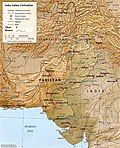 Indus–Sarasvati Civilisation major sites

See also[edit | edit source]
- Krishnavati river
- Dangri, a tributary of Sarsuti
- Tangri river, a tributary of Sarsuti, merge if Dangri and Tangri are same
- Sarsuti, a tributary of Ghaggar-Hakra River
- Kaushalya river, a tributary of Ghaggar-Hakra River
- Chautang, a tributary of Ghaggar-Hakra River
- Sutlej, a tributary of Indus
- Ganges
- Indus
- Western Yamuna Canal, branches off Yamuna
- List of rivers of Rajasthan
- List of rivers of India
- List of dams and reservoirs in India
External links[edit | edit source]
- Sarasvati-Sindhu civilization and Sarasvati River
- The Saraswati: Where lies the mystery by Saswati Paik
References[edit | edit source]
- ↑ "Sahibi river". Archived from the original on 12 October 2017. Retrieved 14 April 2016.
- ↑ Books: Page 41, 42, 43, 44, 47 (b) Sahibi Nadi (River), River Pollution, By A.k.jain
- ↑ A History of Ancient and Early Medieval India from the stone age to the 12th century, Pearson 2009, page 116
- ↑ "Location of Brahmavarta and Drishadwati River is important to find earliest alignment of Saraswati River", Sudhir Bhargava, International Conference, 20–22 Nov. 2009, "Saraswati-a perspective" pages 114–117, Kurukshetra University, Kurukshetra, Organised by: Saraswati Nadi Shodh Sansthan, Haryana.
28°29′N 76°44′E / 28.483°N 76.733°E
.png)


