


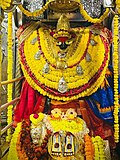
ImportMaster (talk | contribs) robot: Create/update articles in Category:Hindu gods. |
No edit summary |
||
| Line 1: | Line 1: | ||
{{short description|Hindu goddess}} | {{short description|Hindu goddess}} | ||
{{Redirect|Yogmaya|the temple|Yogmaya Temple}} | {{Redirect|Yogmaya|the temple|Yogmaya Temple}} | ||
{{Use dmy dates|date=April 2019}} | |||
{{Use Indian English|date=April 2019}} | |||
{{Infobox deity | {{Infobox deity | ||
| type = Hindu | | type = Hindu | ||
| image = | | image = File:Raja Ravi Varma, Kamsa maya (1890).jpg | ||
| caption = | | caption = 19th century painting by [[Raja Ravi Varma]] depicting Yogamaya (above) issuing a warning to Kamsa | ||
| deity_of = Goddess of Illusion<ref>{{cite book | url=https:// | | deity_of = Goddess of Illusion<ref>{{cite book | url=https://books.google.com/books?id=IVsoDwAAQBAJ&dq=yogamaya+goddess+of+illusion&pg=PT83 | isbn=9781594775376 | title=The Goddess in India: The Five Faces of the Eternal Feminine | date=September 2000 | publisher=Simon and Schuster }}</ref> | ||
| affiliation = [[ | | affiliation = {{hlist|Aspect of [[Vishnu]] or [[Durga]] (in Vaishnavism)|Aspect of [[Mahadevi]] (in Shaktism)}} | ||
| | | venerated_in = {{hlist|[[Vaishnavism]]|[[Shaktism]]}} | ||
| parents = [[Nanda (Hinduism)|Nanda]] | | birth_place = | ||
| parents = [[Nanda (Hinduism)|Nanda]] and [[Yashoda]] (parents of her earthly manifestation) | |||
| dynasty = [[Yadava|Yaduvamsha]] | | dynasty = [[Yadava|Yaduvamsha]] | ||
| name = Yogamaya | | name = Yogamaya | ||
| abode = [[ | | abode = [[Vindhya Range]] | ||
| temple = [[#Temples|Vindhyavasini Devi Temple, Vindhyachal]] | |||
| festivals = [[Vaikuntha Ekadashi]] | | festivals = [[Vaikuntha Ekadashi]] | ||
| other_names = Mahamaya | | other_names = {{hlist|Vindhyavasini|Mahamaya|Narayani| [[Ekanamsha]]}} | ||
| texts = [[Bhagavata Purana]] | | texts = [[Bhagavata Purana]] | ||
| siblings = [[Vishnu]] (ceremonial brother)<ref>{{Cite book |last=Williams |first=George M. |url=https://books.google.com/books?id=N7LOZfwCDpEC&dq=durga+sister+visnu&pg=PA122 |title=Handbook of Hindu Mythology |date=2008-03-27 |publisher=OUP USA |isbn=978-0-19-533261-2 |language=en}}</ref> | |||
| avatar_birth = [[Gokul]]am | |||
}} | }} | ||
{{ | '''Yogamaya''' ({{Langx|sa|योगमाया|lit=illusory potency}}, {{IAST3|Yogamāyā}}) is a [[Hinduism|Hindu goddess]] who serves as the personification of [[Vishnu]]'s powers of illusion.<ref>{{Cite book |last=Beck |first=Guy L. |url=https://books.google.com/books?id=K0XqbG0LKBUC&dq=yogamaya+vishnu&pg=PA170 |title=Alternative Krishnas: Regional and Vernacular Variations on a Hindu Deity |date=2012-02-01 |publisher=State University of New York Press |isbn=978-0-7914-8341-1 |pages=170 |language=en}}</ref> In [[Vaishnavism|Vaishnava]] tradition, she is accorded the epithet '''Narayani'''—"the sister of Narayana<ref>{{Cite book |last=Sinha |first=Purnendu Narayana |url=https://books.google.com/books?id=GIBBAAAAYAAJ&dq=yogamaya+narayani&pg=PA247 |title=A Study of the Bhagavata Purana: Or, Esoteric Hinduism |date=1901 |publisher=Freeman & Company, Limited |pages=247 |language=en}}</ref><ref>{{Cite book |last1=Parthasarathy |first1=V. R. |url=https://books.google.com/books?id=EyAoAQAAIAAJ&q=yogamaya+narayani |title=Devi: Goddesses in Indian Art and Literature |last2=Parthasarathy |first2=Indu |date=2009 |publisher=Bharatiya Kala Prakashan |isbn=978-81-8090-203-1 |pages=133 |language=en}}</ref>"—and is regarded as the benevolent aspect of the goddess [[Durga]].<ref name="Śb 10.4.12">{{Cite web|url=https://vedabase.io/en/library/sb/10/4/12/|website=vedabase.io/en/|language=en|access-date=24 February 2020|title=Śb 10.4.12}}</ref> | ||
{{ | |||
According to [[Hindu texts]], Yogamaya plays the role of the facilitator of the earthly birth of [[Krishna]], an avatar of Vishnu. She took the [[avatar]] of the daughter of [[Yadava]] cowherd [[Nanda (Hinduism)|Nanda]] and [[Yashoda]], after which her place is swapped with Krishna to protect the latter from the tyrant ruler [[Kamsa]]. After warning Kamsa about his impending death, Yogamaya vanished and resided in the [[Vindhya Range|Vindhya]] hills, due to which she is accorded the epithet '''Vindhyavasini'''.<ref>{{Cite book |last=Knapp |first=Stephen |url=https://books.google.com/books?id=eIqyv8A9XBAC&dq=yogamaya+yashoda&pg=PT32 |title=Hindu Gods & Goddesses |date=2012 |publisher=Jaico Publishing House |isbn=978-81-8495-366-4 |pages=32 |language=en}}</ref> | |||
Yogamaya is also an important goddess in [[Shaktism]] sect, and is worshipped as a form of [[Mahadevi]]. | |||
== Etymology == | == Etymology == | ||
Yogamaya refers to “the internal potency of [[Vishnu|Bhagavan]], that arranges and enhances all his pastimes” in the [[Bhagavad Gita]].<ref>{{Cite web |last=www.wisdomlib.org |date=2017-04-30 |title=Yogamaya, Yogamāyā, Yoga-maya: 13 definitions |url=https://www.wisdomlib.org/definition/yogamaya |access-date=2022-09-12 |website=www.wisdomlib.org |language=en}}</ref> | Yogamaya refers to “the internal potency of [[Vishnu|Bhagavan]], that arranges and enhances all his pastimes” in the [[Bhagavad Gita]].<ref>{{Cite web |last=www.wisdomlib.org |date=2017-04-30 |title=Yogamaya, Yogamāyā, Yoga-maya: 13 definitions |url=https://www.wisdomlib.org/definition/yogamaya |access-date=2022-09-12 |website=www.wisdomlib.org |language=en}}</ref> | ||
The goddess Vindhyavasini gets her name from the [[Vindhya Range]], literally meaning, "she who resides in Vindhya". | The goddess Vindhyavasini gets her name from the [[Vindhya Range]], literally meaning, "''she who resides in Vindhya''".<ref>{{Cite book |last1=Hawley |first1=John Stratton |url=https://books.google.com/books?id=CZrV3kOpMt0C |title=Devī: Goddesses of India |last2=Wulff |first2=Donna Marie |date=1998 |publisher=Motilal Banarsidass Publ. |isbn=978-81-208-1491-2 |pages=49}}</ref> | ||
==Legend== | ==Legend== | ||
At the time of the birth of | At the time of the [[birth of Krishna]] as the eighth child of [[Devaki]] and [[Vasudeva]], Yogamaya had been born at the same time at the house of [[Nanda (Hinduism)|Nanda]] and [[Yashoda]], as instructed by [[Vishnu]]. Vasudeva replaced Krishna with this daughter of Yashoda. When [[Kamsa]] tried to kill this infant, believing that she was his prophesied killer, she escaped from the grasp of Kamsa, and turned into her form of [[Durga]]. She informed the tyrant that his killer had already been born elsewhere, and subsequently vanished from the prison of [[Mathura]]. | ||
[[File:Episodes Surrounding the Birth of Krishna.jpg|thumb|280x280px|The goddess Yogamaya emerges as Kamsa kills Yashoda's daughter]] | [[File:Episodes Surrounding the Birth of Krishna.jpg|thumb|280x280px|The goddess Yogamaya emerges as Kamsa kills Yashoda's daughter]] | ||
{{blockquote|The child, Yoga-māyā-devī, the younger sister of Lord Viṣṇu, slipped upward from Kaṁsa’s hands and appeared in the sky as Devī, the goddess Durgā, with eight arms, completely equipped with weapons|source=[[Srimad Bhagavatam]], Canto 10,Chapter 4, Verse 9<ref>{{Cite web|url=https://vedabase.io/en/library/sb/10/4/9/|website=vedabase.io/en/|language=en|access-date=24 February 2020|title=Śb 10.4.9}}</ref>}} | {{blockquote|The child, Yoga-māyā-devī, the younger sister of Lord Viṣṇu, slipped upward from Kaṁsa’s hands and appeared in the sky as Devī, the goddess Durgā, with eight arms, completely equipped with weapons|source=[[Srimad Bhagavatam]], Canto 10, Chapter 4, Verse 9<ref>{{Cite web|url=https://vedabase.io/en/library/sb/10/4/9/|website=vedabase.io/en/|language=en|access-date=24 February 2020|title=Śb 10.4.9}}</ref>}} | ||
{{blockquote|O Kaṁsa, you fool, what will be the use of killing me? The Supreme Personality of Godhead, who has been your enemy from the very beginning and who will certainly kill you, has already taken His birth somewhere else. Therefore, do not unnecessarily kill other children|source=[[Srimad Bhagavatam]], Canto 10,Chapter 4, Verse 12<ref>{{Cite web|url=https://vedabase.io/en/library/sb/10/4/12/|website=vedabase.io/en/|language=en|access-date=24 February 2020|title=Śb 10.4.12}}</ref>}} | {{blockquote|O Kaṁsa, you fool, what will be the use of killing me? The Supreme Personality of Godhead, who has been your enemy from the very beginning and who will certainly kill you, has already taken His birth somewhere else. Therefore, do not unnecessarily kill other children|source=[[Srimad Bhagavatam]], Canto 10, Chapter 4, Verse 12<ref name="Śb 10.4.12">{{Cite web|url=https://vedabase.io/en/library/sb/10/4/12/|website=vedabase.io/en/|language=en|access-date=24 February 2020|title=Śb 10.4.12}}</ref>}} | ||
Thereafter, she is believed by local lore to have chosen to reside at the Vindhyachala mountains, where her temple is located at present | Thereafter, she is believed by local lore to have chosen to reside at the Vindhyachala mountains, where her temple is located at present.<ref>{{Cite book|last=Krishnan|first=S. A.|url=https://books.google.com/books?id=v2ZEDwAAQBAJ&q=is+subhadra+yogmaya&pg=PA70|title=Abhimanyu: The Warrior Prince|date=2017-05-20|publisher=SA Krishnan|language=en}}</ref> | ||
== Shaktism == | == Shaktism == | ||
| Line 42: | Line 47: | ||
== Vaishnavism == | == Vaishnavism == | ||
[[File:Narayani Dham idol.jpg|thumb|Shrine of the goddess Narayani, [[Lonavala]]]] | |||
{{Vaishnavism}} | {{Vaishnavism}} | ||
Yogamaya is regarded to be the embodiment of either the internal or the external potency of Vishnu, or his avatar of Krishna, in [[Vaishnavism]].<ref>{{Cite book |last=Knapp |first=Stephen |url=https://books.google.com/books?id=eIqyv8A9XBAC&dq=yogamaya+krishna+birth&pg=PT32 |title=Hindu Gods & Goddesses |date=2012 |publisher=Jaico Publishing House |isbn=978-81-8495-366-4 |language=en}}</ref> The goddess, also referred to as ''Vaishnavi Mahamaya'', assumes a number of manifestations like [[Durga]], Ambika, Kshemada, and [[Bhadrakali]], according to the [[Vishnu Purana]].<ref>{{Cite book |last=Varadpande |first=Manohar Laxman |url=https://books.google.com/books?id=_XrFh2S8nlEC&dq=yogamaya+power+vishnu&pg=PA15 |title=Mythology of Vishnu and His Incarnations |date=2009 |publisher=Gyan Publishing House |isbn=978-81-212-1016-4 |pages=15 |language=en}}</ref> | Yogamaya is regarded to be the embodiment of either the internal or the external potency of Vishnu, or his avatar of Krishna, in [[Vaishnavism]].<ref>{{Cite book |last=Knapp |first=Stephen |url=https://books.google.com/books?id=eIqyv8A9XBAC&dq=yogamaya+krishna+birth&pg=PT32 |title=Hindu Gods & Goddesses |date=2012 |publisher=Jaico Publishing House |isbn=978-81-8495-366-4 |language=en}}</ref> The goddess, also referred to as ''Vaishnavi Mahamaya'', assumes a number of manifestations like [[Durga]], Ambika, Kshemada, and [[Bhadrakali]], according to the [[Vishnu Purana]].<ref>{{Cite book |last=Varadpande |first=Manohar Laxman |url=https://books.google.com/books?id=_XrFh2S8nlEC&dq=yogamaya+power+vishnu&pg=PA15 |title=Mythology of Vishnu and His Incarnations |date=2009 |publisher=Gyan Publishing House |isbn=978-81-212-1016-4 |pages=15 |language=en}}</ref> | ||
| Line 48: | Line 54: | ||
{{Blockquote|text=Are you employed by our enemies for destroying us? You kill Asuras by Māyā and thus conquer them by fraudulent means. Oh dunce, I shall wipe out the sorrows of my friends by killing you, whose strength lies in yoga-māyā, but have little personal bravery.|title=[[Bhagavata Purana]]|source=Chapter 18}} | {{Blockquote|text=Are you employed by our enemies for destroying us? You kill Asuras by Māyā and thus conquer them by fraudulent means. Oh dunce, I shall wipe out the sorrows of my friends by killing you, whose strength lies in yoga-māyā, but have little personal bravery.|title=[[Bhagavata Purana]]|source=Chapter 18}} | ||
According to a 17th century literary poem called the ''Mukundavilasa'', when [[Bhumi (goddess)|Bhudevi]] and [[Brahma]] petition Vishnu to intervene in earthly affairs due to the oppression of [[Kamsa]] and [[Shishupala]], he recruits a number of deities to assist him in his Krishna avatar: [[Lakshmi]] is to be born as [[Rukmini]], Bhudevi is to manifest as [[Satyabhama]], [[Shesha]] is to incarnate as [[Balarama]], and Yogamaya is tasked to be born as the daughter of Yashoda.<ref>{{Cite book |last=Unni |first=N. P. |url=https://books.google.com/books?id=GbK-jb7i_KcC&dq=yogamaya+rukmini&pg=PA25 |title=Nilakantha Diksita |date=1995 |publisher=Sahitya Akademi |isbn=978-81-7201-803-0 |pages=25 |language=en}}</ref> | According to a 17th century literary poem called the ''Mukundavilasa'', when [[Bhumi (goddess)|Bhudevi]] and [[Brahma]] petition Vishnu to intervene in earthly affairs due to the oppression of [[Kamsa]] and [[Shishupala]], he recruits a number of deities to assist him in his Krishna avatar: [[Lakshmi]] is to be born as [[Rukmini]], Bhudevi is to manifest as [[Satyabhama]], [[Shesha]] is to incarnate as [[Balarama]], and Yogamaya is tasked to be born as the [[Rohini (Krishna's wife)|daughter]] of [[Yashoda]].<ref>{{Cite book |last=Unni |first=N. P. |url=https://books.google.com/books?id=GbK-jb7i_KcC&dq=yogamaya+rukmini&pg=PA25 |title=Nilakantha Diksita |date=1995 |publisher=Sahitya Akademi |isbn=978-81-7201-803-0 |pages=25 |language=en}}</ref> | ||
In the narratives of Krishna, the deity employs the phenomenon of ''Yogamaya'' in order to spend time with the cowherd women of [[Gokul]]am, the [[gopi]]s. During his blissful dalliance with the gopis, it is Yogamaya who creates spiritual doppelgangers of each gopi at their houses so that they can also act as chaste wives to their husbands, while also dwelling on the deity.<ref>{{Cite book |last=Schweig |first=Graham M. |url=https://books.google.com/books?id=k4ZeDwAAQBAJ&dq=yogamaya+potency&pg=PA130 |title=Dance of Divine Love: India's Classic Sacred Love Story: The Rasa Lila of Krishna |date=2018-06-26 |publisher=Princeton University Press |isbn=978-0-691-19017-4 |pages=136 |language=en}}</ref> | In the narratives of Krishna, the deity employs the phenomenon of ''Yogamaya'' in order to spend time with the cowherd women of [[Gokul]]am, the [[gopi]]s. During his blissful dalliance with the gopis, it is Yogamaya who creates spiritual doppelgangers of each gopi at their houses so that they can also act as chaste wives to their husbands, while also dwelling on the deity.<ref>{{Cite book |last=Schweig |first=Graham M. |url=https://books.google.com/books?id=k4ZeDwAAQBAJ&dq=yogamaya+potency&pg=PA130 |title=Dance of Divine Love: India's Classic Sacred Love Story: The Rasa Lila of Krishna |date=2018-06-26 |publisher=Princeton University Press |isbn=978-0-691-19017-4 |pages=136 |language=en}}</ref> | ||
| Line 54: | Line 60: | ||
In the [[Bhagavad Gita]], when [[Arjuna]] wonders why Krishna's pastimes and true form are not visible to mortals, he responds by stating that his manifestations are not visible to all men, and that he is veiled by his illusory potency.<ref>{{Cite web |last=www.wisdomlib.org |date=2020-05-08 |title=Verse 7.25 [Bhagavad-gita] |url=https://www.wisdomlib.org/hinduism/book/shrimad-bhagavad-gita/d/doc419992.html |access-date=2022-09-28 |website=www.wisdomlib.org |language=en}}</ref> | In the [[Bhagavad Gita]], when [[Arjuna]] wonders why Krishna's pastimes and true form are not visible to mortals, he responds by stating that his manifestations are not visible to all men, and that he is veiled by his illusory potency.<ref>{{Cite web |last=www.wisdomlib.org |date=2020-05-08 |title=Verse 7.25 [Bhagavad-gita] |url=https://www.wisdomlib.org/hinduism/book/shrimad-bhagavad-gita/d/doc419992.html |access-date=2022-09-28 |website=www.wisdomlib.org |language=en}}</ref> | ||
When the [[asura]] [[Jalandhara]] wages a war against [[Shiva]] to abduct [[Parvati]], Vishnu employs Yogamaya | When the [[asura]] [[Jalandhara]] wages a war against [[Shiva]] to abduct [[Parvati]], Vishnu employs Yogamaya as an illusory form to break the chastity of the asura's wife, [[Tulasi in Hinduism|Vrinda]]. This allows Shiva to prevail in his war.<ref>{{Cite book |last=Pintchman |first=Tracy |url=https://books.google.com/books?id=3KcEotmV2MAC&dq=yogamaya+goddess+lakshmi&pg=PA81 |title=Guests at God's Wedding: Celebrating Kartik among the Women of Benares |date=2005-08-25 |publisher=SUNY Press |isbn=978-0-7914-6595-0 |pages=81 |language=en}}</ref> | ||
Due to Yogamaya's service to Vishnu, the deity offers her the occasion of ''[[Vaikuntha Ekadashi|Ekadashi]]'' (the eleventh day of every month) for veneration in her honour.<ref>{{Cite book |last=Rinehart |first=Robin |url=https://books.google.com/books?id=hMPYnfS_R90C&dq=yogamaya+vishnu&pg=PA142 |title=Contemporary Hinduism: Ritual, Culture, and Practice |date=2004 |publisher=ABC-CLIO |isbn=978-1-57607-905-8 |pages=142 |language=en}}</ref> | Due to Yogamaya's service to Vishnu, the deity offers her the occasion of ''[[Vaikuntha Ekadashi|Ekadashi]]'' (the eleventh day of every month) for veneration in her honour.<ref>{{Cite book |last=Rinehart |first=Robin |url=https://books.google.com/books?id=hMPYnfS_R90C&dq=yogamaya+vishnu&pg=PA142 |title=Contemporary Hinduism: Ritual, Culture, and Practice |date=2004 |publisher=ABC-CLIO |isbn=978-1-57607-905-8 |pages=142 |language=en}}</ref> | ||
==Temples== | ==Temples== | ||
[[File: | [[File:Vindhyavasini mata.jpg|thumb|upright|Shrine of Vindhyavasini, near Mirzapur]] | ||
* [[Mirzapur]], [[Uttar Pradesh]]: Yogamaya's temple is located at [[Vindhyachal]], 8 km away from [[Mirzapur]] on the banks of river [[Ganges]], in [[Uttar Pradesh]].<ref>{{Cite web |title=Vindhyachal Dham |url=https://mirzapur.nic.in/tourist-place/vindhyachal-dham/ |access-date=3 July 2020 |website=District Mirzapur, Government of Uttar Pradesh}}</ref><ref>https://vindhyachalmandir.com/history-of-vindhyachal-temple/</ref> A huge crowd visits the temple, especially during [[Navaratri]] in the Hindu months of [[Chaitra]] and [[Ashwin|Ashvin]]. In the month of [[Jyeshtha (month)|Jyeshtha]], the Kajali competition, is held here.<ref name="b">{{cite web|url=http://vindhyachaltemple.com/|title=Vindhyachal Temple {{!}} Vindhyachal Mandir {{!}} Download {{!}} Website|website=vindhyachaltemple.com}}</ref><ref name="c">{{cite web |title=Complete Information on Vindhyachal Temple, Distance, Hotels & Tourist Attraction |url=https://vindhyachalmandir.com/complete-information-on-vindhyachal-temple/ |access-date=13 June 2023 |website=www.vindhyachalmandir.com|date=19 March 2023 }}</ref> The temple is one of the most revered [[Shakta pithas]] of India. The Vindhyavasini Devi is also known popularly by name of Kajala devi. The goddess Kali is adorned in the form of Vindhyavasini Devi.<ref name="b" /><ref name="c" /> There is a nearby temple of [[Saraswati]] named Ashtbhuja Temple, 3 km away on a hillock, and a temple of goddess [[Kali]] in cave called Kali khoh temple. The pilgrims prefer to visit these three temples, which is a part of rite called Trilokan [[Parikrama]].<ref name="b" /><ref name="c" /> | |||
Yogamaya's temple is located at [[Vindhyachal]], 8 km away from [[Mirzapur]] on the banks of river [[Ganges]], in [[Uttar Pradesh]].<ref>{{Cite web |title=Vindhyachal Dham |url=https://mirzapur.nic.in/tourist-place/vindhyachal-dham/ |access-date=3 July 2020 |website=District Mirzapur, Government of Uttar Pradesh}}</ref> | * [[Sehore district|Sehore]], [[Madhya Pradesh]]: The shrine of [[Bijasan Mata Temple, Salkanpur|Bijasan Mata Temple]] in Salkanpur is located 70 kms away from [[Bhopal]]. | ||
* [[New Delhi]]: The [[Yogmaya Temple|Yogmaya or Jogmaya temple in Mehrauli]], New Delhi is said to have been built by the [[Pandava]]s at the end of the [[Mahabharata]] war. Jain scriptures from the twelfth century state that the ancient city of [[Mehrauli]] was once called ''Yoginipura'' after the temple. | |||
There is a temple of [[Saraswati]] named Ashtbhuja Temple, 3 km away on a hillock, and a temple of goddess [[Kali]] in cave called Kali khoh temple. The pilgrims prefer to visit these three temples, which is a part of rite called Trilokan [[Parikrama]].<ref name="b" /><ref name="c" /> | * [[Ernakulam district|Ernakulam]], [[Kerala]]: Goddess Durga in her incarnation as Yoga-Nidra or Yogamaya is worshiped in the sacred forest temple of [[Iringole Kavu]], situated in the state's [[Ernakulam district|Ernakulam]] district. This temple is one of Kerala's famed ''[[kavu]]'', or [[Sacred groves of India|sacred grove]]. It is also considered to be one among the 108 Durga temples in the state consecrated by Lord [[Parashurama|Parasurama]] himself. | ||
* [[Nepal]]: There is also a temple dedicated to this goddess in [[Pokhara]] named [[Bindhyabasini Temple]].<ref>{{cite book |author1=Galen Rowell |author2=John Everingham |author3=Jim Goodman |title=Pokhara in the shadow of the Annapurnas |url=https://books.google.com/books?id=620MAQAAMAAJ |year=1997 |publisher=Book Faith India |isbn=978-974-89765-4-9 |page=29 }}</ref> | |||
The | |||
There is also a temple dedicated to this goddess in [[Pokhara]] | |||
==See also== | ==See also== | ||
*[[ | *[[Shakta pithas]] | ||
*[[Rukmini]] | *[[Rukmini]] | ||
*[[Yashoda]] | *[[Yashoda]] | ||
| Line 76: | Line 79: | ||
==References== | ==References== | ||
{{Reflist}}5.↑ [https:// | {{Reflist}}5.↑ [https://vindhyachalmandir.com/history-of-vindhyachal-temple/ Uncovering the Rich History of Vindhyachal Temple] | ||
===Bibliography=== | ===Bibliography=== | ||
Latest revision as of 00:02, 14 March 2026
| Yogamaya | |
|---|---|
Goddess of Illusion[1] | |
.jpg) 19th century painting by Raja Ravi Varma depicting Yogamaya (above) issuing a warning to Kamsa | |
| Other names |
|
| Venerated in | |
| Affiliation | |
| Abode | Vindhya Range |
| Texts | Bhagavata Purana |
| Temple | Vindhyavasini Devi Temple, Vindhyachal |
| Festivals | Vaikuntha Ekadashi |
| Personal information | |
| Avatar birth | Gokulam |
| Parents | Nanda and Yashoda (parents of her earthly manifestation) |
| Siblings | Vishnu (ceremonial brother)[2] |
| Dynasty | Yaduvamsha |
Yogamaya (Sanskrit: योगमाया, lit. 'illusory potency', IAST: Yogamāyā) is a Hindu goddess who serves as the personification of Vishnu's powers of illusion.[3] In Vaishnava tradition, she is accorded the epithet Narayani—"the sister of Narayana[4][5]"—and is regarded as the benevolent aspect of the goddess Durga.[6]
According to Hindu texts, Yogamaya plays the role of the facilitator of the earthly birth of Krishna, an avatar of Vishnu. She took the avatar of the daughter of Yadava cowherd Nanda and Yashoda, after which her place is swapped with Krishna to protect the latter from the tyrant ruler Kamsa. After warning Kamsa about his impending death, Yogamaya vanished and resided in the Vindhya hills, due to which she is accorded the epithet Vindhyavasini.[7]
Yogamaya is also an important goddess in Shaktism sect, and is worshipped as a form of Mahadevi.
Etymology[edit | edit source]
Yogamaya refers to “the internal potency of Bhagavan, that arranges and enhances all his pastimes” in the Bhagavad Gita.[8]
The goddess Vindhyavasini gets her name from the Vindhya Range, literally meaning, "she who resides in Vindhya".[9]
Legend[edit | edit source]
At the time of the birth of Krishna as the eighth child of Devaki and Vasudeva, Yogamaya had been born at the same time at the house of Nanda and Yashoda, as instructed by Vishnu. Vasudeva replaced Krishna with this daughter of Yashoda. When Kamsa tried to kill this infant, believing that she was his prophesied killer, she escaped from the grasp of Kamsa, and turned into her form of Durga. She informed the tyrant that his killer had already been born elsewhere, and subsequently vanished from the prison of Mathura.

The child, Yoga-māyā-devī, the younger sister of Lord Viṣṇu, slipped upward from Kaṁsa’s hands and appeared in the sky as Devī, the goddess Durgā, with eight arms, completely equipped with weapons
— Srimad Bhagavatam, Canto 10, Chapter 4, Verse 9[10]
O Kaṁsa, you fool, what will be the use of killing me? The Supreme Personality of Godhead, who has been your enemy from the very beginning and who will certainly kill you, has already taken His birth somewhere else. Therefore, do not unnecessarily kill other children
— Srimad Bhagavatam, Canto 10, Chapter 4, Verse 12[6]
Thereafter, she is believed by local lore to have chosen to reside at the Vindhyachala mountains, where her temple is located at present.[11]
Shaktism[edit | edit source]
Authors Constance Jones and James D. Ryan opine that Vindhyavasini is mentioned in the Devi Mahatmya, an important text that presents various incarnations or forms of the Supreme Goddess of Shaktism (Mahadevi). She is also mentioned in an early 19th-century local text called Vindhya Mahatmya. In both, she is understood to be the Ultimate Reality in its totality. She is also assimilated with Parvati, conceived of as "ultimate divinity".[12]
[edit | edit source]

| Part of a series on |
| Vaishnavism |
|---|
 |
 Hinduism portal Hinduism portal |
Yogamaya is regarded to be the embodiment of either the internal or the external potency of Vishnu, or his avatar of Krishna, in Vaishnavism.[13] The goddess, also referred to as Vaishnavi Mahamaya, assumes a number of manifestations like Durga, Ambika, Kshemada, and Bhadrakali, according to the Vishnu Purana.[14]
In the Bhagavata Purana, the asura Hiranyaksha mocks Varaha and references Vishnu's Yogamaya:[15]
Are you employed by our enemies for destroying us? You kill Asuras by Māyā and thus conquer them by fraudulent means. Oh dunce, I shall wipe out the sorrows of my friends by killing you, whose strength lies in yoga-māyā, but have little personal bravery.
— Bhagavata Purana, Chapter 18
According to a 17th century literary poem called the Mukundavilasa, when Bhudevi and Brahma petition Vishnu to intervene in earthly affairs due to the oppression of Kamsa and Shishupala, he recruits a number of deities to assist him in his Krishna avatar: Lakshmi is to be born as Rukmini, Bhudevi is to manifest as Satyabhama, Shesha is to incarnate as Balarama, and Yogamaya is tasked to be born as the daughter of Yashoda.[16]
In the narratives of Krishna, the deity employs the phenomenon of Yogamaya in order to spend time with the cowherd women of Gokulam, the gopis. During his blissful dalliance with the gopis, it is Yogamaya who creates spiritual doppelgangers of each gopi at their houses so that they can also act as chaste wives to their husbands, while also dwelling on the deity.[17]
In the Bhagavad Gita, when Arjuna wonders why Krishna's pastimes and true form are not visible to mortals, he responds by stating that his manifestations are not visible to all men, and that he is veiled by his illusory potency.[18]
When the asura Jalandhara wages a war against Shiva to abduct Parvati, Vishnu employs Yogamaya as an illusory form to break the chastity of the asura's wife, Vrinda. This allows Shiva to prevail in his war.[19]
Due to Yogamaya's service to Vishnu, the deity offers her the occasion of Ekadashi (the eleventh day of every month) for veneration in her honour.[20]
Temples[edit | edit source]

- Mirzapur, Uttar Pradesh: Yogamaya's temple is located at Vindhyachal, 8 km away from Mirzapur on the banks of river Ganges, in Uttar Pradesh.[21][22] A huge crowd visits the temple, especially during Navaratri in the Hindu months of Chaitra and Ashvin. In the month of Jyeshtha, the Kajali competition, is held here.[23][24] The temple is one of the most revered Shakta pithas of India. The Vindhyavasini Devi is also known popularly by name of Kajala devi. The goddess Kali is adorned in the form of Vindhyavasini Devi.[23][24] There is a nearby temple of Saraswati named Ashtbhuja Temple, 3 km away on a hillock, and a temple of goddess Kali in cave called Kali khoh temple. The pilgrims prefer to visit these three temples, which is a part of rite called Trilokan Parikrama.[23][24]
- Sehore, Madhya Pradesh: The shrine of Bijasan Mata Temple in Salkanpur is located 70 kms away from Bhopal.
- New Delhi: The Yogmaya or Jogmaya temple in Mehrauli, New Delhi is said to have been built by the Pandavas at the end of the Mahabharata war. Jain scriptures from the twelfth century state that the ancient city of Mehrauli was once called Yoginipura after the temple.
- Ernakulam, Kerala: Goddess Durga in her incarnation as Yoga-Nidra or Yogamaya is worshiped in the sacred forest temple of Iringole Kavu, situated in the state's Ernakulam district. This temple is one of Kerala's famed kavu, or sacred grove. It is also considered to be one among the 108 Durga temples in the state consecrated by Lord Parasurama himself.
- Nepal: There is also a temple dedicated to this goddess in Pokhara named Bindhyabasini Temple.[25]
See also[edit | edit source]
References[edit | edit source]
- ↑ The Goddess in India: The Five Faces of the Eternal Feminine. Simon and Schuster. September 2000. ISBN 9781594775376.
- ↑ Williams, George M. (27 March 2008). Handbook of Hindu Mythology. OUP USA. ISBN 978-0-19-533261-2.
- ↑ Beck, Guy L. (1 February 2012). Alternative Krishnas: Regional and Vernacular Variations on a Hindu Deity. State University of New York Press. p. 170. ISBN 978-0-7914-8341-1.
- ↑ Sinha, Purnendu Narayana (1901). A Study of the Bhagavata Purana: Or, Esoteric Hinduism. Freeman & Company, Limited. p. 247.
- ↑ Parthasarathy, V. R.; Parthasarathy, Indu (2009). Devi: Goddesses in Indian Art and Literature. Bharatiya Kala Prakashan. p. 133. ISBN 978-81-8090-203-1.
- ↑ 6.0 6.1 "Śb 10.4.12". vedabase.io/en/. Retrieved 24 February 2020.
- ↑ Knapp, Stephen (2012). Hindu Gods & Goddesses. Jaico Publishing House. p. 32. ISBN 978-81-8495-366-4.
- ↑ www.wisdomlib.org (30 April 2017). "Yogamaya, Yogamāyā, Yoga-maya: 13 definitions". www.wisdomlib.org. Retrieved 12 September 2022.
- ↑ Hawley, John Stratton; Wulff, Donna Marie (1998). Devī: Goddesses of India. Motilal Banarsidass Publ. p. 49. ISBN 978-81-208-1491-2.
- ↑ "Śb 10.4.9". vedabase.io/en/. Retrieved 24 February 2020.
- ↑ Krishnan, S. A. (20 May 2017). Abhimanyu: The Warrior Prince. SA Krishnan.
- ↑ Jones & Ryan 2006, p. 489.
- ↑ Knapp, Stephen (2012). Hindu Gods & Goddesses. Jaico Publishing House. ISBN 978-81-8495-366-4.
- ↑ Varadpande, Manohar Laxman (2009). Mythology of Vishnu and His Incarnations. Gyan Publishing House. p. 15. ISBN 978-81-212-1016-4.
- ↑ www.wisdomlib.org (24 July 2022). "Hiraṇyākṣa's Fight with Varāha [Chapter 18]". www.wisdomlib.org. Retrieved 12 September 2022.
- ↑ Unni, N. P. (1995). Nilakantha Diksita. Sahitya Akademi. p. 25. ISBN 978-81-7201-803-0.
- ↑ Schweig, Graham M. (26 June 2018). Dance of Divine Love: India's Classic Sacred Love Story: The Rasa Lila of Krishna. Princeton University Press. p. 136. ISBN 978-0-691-19017-4.
- ↑ www.wisdomlib.org (8 May 2020). "Verse 7.25 [Bhagavad-gita]". www.wisdomlib.org. Retrieved 28 September 2022.
- ↑ Pintchman, Tracy (25 August 2005). Guests at God's Wedding: Celebrating Kartik among the Women of Benares. SUNY Press. p. 81. ISBN 978-0-7914-6595-0.
- ↑ Rinehart, Robin (2004). Contemporary Hinduism: Ritual, Culture, and Practice. ABC-CLIO. p. 142. ISBN 978-1-57607-905-8.
- ↑ "Vindhyachal Dham". District Mirzapur, Government of Uttar Pradesh. Retrieved 3 July 2020.
- ↑ https://vindhyachalmandir.com/history-of-vindhyachal-temple/
- ↑ 23.0 23.1 23.2 "Vindhyachal Temple | Vindhyachal Mandir | Download | Website". vindhyachaltemple.com.
- ↑ 24.0 24.1 24.2 "Complete Information on Vindhyachal Temple, Distance, Hotels & Tourist Attraction". www.vindhyachalmandir.com. 19 March 2023. Retrieved 13 June 2023.
- ↑ Galen Rowell; John Everingham; Jim Goodman (1997). Pokhara in the shadow of the Annapurnas. Book Faith India. p. 29. ISBN 978-974-89765-4-9.
5.↑ Uncovering the Rich History of Vindhyachal Temple
Bibliography[edit | edit source]
- Jones, Constance; Ryan, James D. (2006). Encyclopedia of Hinduism. Infobase Publishing. ISBN 9780816075645.
Hindu deities and texts | ||
|---|---|---|
| Gods |  | |
| Goddesses | ||
| Other deities | ||
| Texts | ||