


Ajay Kumar (talk | contribs) Created a new article |
m brief improve details per standard format further and updated info |
||
| Line 1: | Line 1: | ||
{{Short description|Species of tree in | {{Short description|Species of tree in the sandalwood family}} | ||
{{Speciesbox | {{Speciesbox | ||
|name = White sandalwood | |||
|image = Santalum_album_-_Köhler–s_Medizinal-Pflanzen-128.jpg | |image = Santalum_album_-_Köhler–s_Medizinal-Pflanzen-128.jpg | ||
|image_caption = | |image_caption = | ||
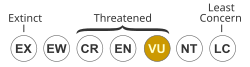
|status = VU | |status = VU | ||
|status_system = IUCN3.1 | |status_system = IUCN3.1 | ||
|status_ref = <ref name="iucn status 12 November 2021">{{cite iucn |author=Arunkumar, A.N. |author2=Dhyani, A. |author3=Joshi, G. |date=2019 |title=''Santalum album'' |volume=2019 | | |status_ref = <ref name="iucn status 12 November 2021">{{cite iucn |author=Arunkumar, A.N. |author2=Dhyani, A. |author3=Joshi, G. |date=2019 |title=''Santalum album'' |volume=2019 |article-number=e.T31852A2807668 |doi=10.2305/IUCN.UK.2019-1.RLTS.T31852A2807668.en |access-date=12 November 2021}}</ref> | ||
|genus = Santalum | |genus = Santalum | ||
|species = album | |species = album | ||
| Line 12: | Line 13: | ||
[[File:檀香 Santalum album 20210712091332 04.jpg|thumb|x292px|The light green calyx gradually turns dark red. Some calyces have four sepals and some have five.]] | [[File:檀香 Santalum album 20210712091332 04.jpg|thumb|x292px|The light green calyx gradually turns dark red. Some calyces have four sepals and some have five.]] | ||
'''''Santalum album''''' | '''''Santalum album''''' is a small tropical tree, and the traditional source of [[sandalwood oil]]. It is native to [[Indonesia]] ([[Java]] and the [[Lesser Sunda Islands]]), the [[Philippines]], and [[Western Australia]].<ref name="powo">{{cite web |title=Santalum album L. |url=https://powo.science.kew.org/taxon/urn:lsid:ipni.org:names:780592-1 |website=Plants of the World Online |publisher=Royal Botanic Gardens Kew |access-date=19 June 2024}}</ref> It is commonly known as the '''white sandalwood''' or '''Indian sandalwood.''' It was one of the plants exploited by [[Austronesians|Austronesian]] [[arboriculture]] and it was introduced by Austronesian sailors to [[Mainland Southeast Asia]], [[South Asia]] and [[East Asia]], during the ancient [[spice trade]], becoming [[Naturalisation (biology)|naturalized]] in [[South India]] by at least 1300 BCE.<ref name="Fuller2015">{{cite book |editor=Tripati, Sila |last1=Fuller |first1=Dorian Q. |last2=Boivin |first2=Nicole |last3=Castillo |first3=Cristina Cobo |last4=Hoogervorst |first4=Tom |last5=Allaby |first5=Robin G. |title=Maritime Contacts of the Past: Deciphering Connections Amongst Communities |date=2015 |publisher=Kaveri Books |location=Delhi |isbn=978-81-926244-3-3 |pages=1–23 |chapter=The archaeobiology of Indian Ocean translocations: Current outlines of cultural exchanges by proto-historic seafarers |url=https://www.researchgate.net/publication/272434953}}</ref> It was greatly valued for its fragrance, and is considered sacred in some religions like [[Hinduism]]. The high value of the species has caused [[over-exploitation]], to the point where the wild population is vulnerable to [[species extinction|extinction]]. Indian sandalwood still commands high prices for its [[essential oil]] owing to its high [[alpha-santalol]] content, but the lack of sizable trees has essentially eliminated its former use for fine [[woodworking]]. The plant is long-lived, but harvest is only viable after many years. | ||
==Description== | ==Description== | ||
[[File:Santalum album (Chandan) in Hyderabad, AP W2 IMG 0023.jpg|thumb|left|Flowers in [[Hyderabad, India]] | [[File:Santalum album (Chandan) in Hyderabad, AP W2 IMG 0023.jpg|thumb|left|Flowers in [[Hyderabad, India]] ]] | ||
''Santalum album is an'' evergreen tree that grows between {{Convert|4-9|m|ft|abbr=off}}.<ref>{{Cite journal |last1=Fatima |first1=Tanzeem |last2=Srivastava |first2=Ashutosh |last3=Somashekar |first3=P. V. |last4=Hanur |first4=Vageeshbabu S. |last5=Rao |first5=M. Srinivasa |last6=Bisht |first6=Surendra Singh |date=July 2019 |title=Assessment of morphological and genetic variability through genic microsatellite markers for essential oil in Sandalwood (Santalum album L.) |journal=3 Biotech |volume=9 |issue=7 | | ''Santalum album is an'' evergreen tree that grows between {{Convert|4-9|m|ft|abbr=off}}.<ref>{{Cite journal |last1=Fatima |first1=Tanzeem |last2=Srivastava |first2=Ashutosh |last3=Somashekar |first3=P. V. |last4=Hanur |first4=Vageeshbabu S. |last5=Rao |first5=M. Srinivasa |last6=Bisht |first6=Surendra Singh |date=July 2019 |title=Assessment of morphological and genetic variability through genic microsatellite markers for essential oil in Sandalwood (Santalum album L.) |journal=3 Biotech |volume=9 |issue=7 |page=252 |doi=10.1007/s13205-019-1758-9 |pmc=6555841 |pmid=31192077}}</ref> The tree is variable in habit, usually upright to sprawling, and may intertwine with other species. The plant [[parasitise]]s the roots of other tree species, with a [[haustorium]] adaptation on its own roots, but without major detriment to its hosts.<ref>{{Cite journal |last1=Spallek |first1=Thomas |last2=Melnyk |first2=Charles W. |last3=Wakatake |first3=Takanori |last4=Zhang |first4=Jing |last5=Sakamoto |first5=Yuki |last6=Kiba |first6=Takatoshi |last7=Yoshida |first7=Satoko |last8=Matsunaga |first8=Sachihiro |last9=Sakakibara |first9=Hitoshi |last10=Shirasu |first10=Ken |date=2017-05-16 |title=Interspecies hormonal control of host root morphology by parasitic plants |journal=Proceedings of the National Academy of Sciences of the United States of America |volume=114 |issue=20 |pages=5283–5288 |doi=10.1073/pnas.1619078114 |pmc=5441792 |pmid=28461500|bibcode=2017PNAS..114.5283S |doi-access=free }}</ref> An individual will form a non-[[Obligate parasite|obligate]] relationship with a number of other plants.{{fact|date=March 2025}} Up to 300 species (including its own) can host the tree's development—supplying [[macronutrient]]s [[phosphorus]], [[nitrogen]] and [[potassium]], and shade—especially during early phases of development. It may propagate itself through wood [[Sucker (botany)|suckering]] during its early development, establishing small stands. The reddish or brown [[Bark (botany)|bark]] can be almost black and is smooth in young trees, becoming cracked with a red reveal. The [[heartwood]] is pale green to white as the common name indicates. The [[leaves]] are thin, opposite and ovate to [[Leaf shape|lanceolate]] in shape. Glabrous surface is shiny and bright green, with a glaucous pale reverse. [[Fruit]] is produced after three years, viable seeds after five. These seeds are distributed by birds. | ||
[[File:Santalum album Fruit Krish.jpg|thumb|A ripened fruit of ''Santalum album'' from [[Panchkhal]] Valley, [[Nepal]] | [[File:Santalum album Fruit Krish.jpg|thumb|A ripened fruit of ''Santalum album'' from [[Panchkhal]] Valley, [[Nepal]]]] | ||
== Taxonomy == | == Taxonomy == | ||
=== Nomenclature === | === Nomenclature === | ||
| Line 31: | Line 28: | ||
''Santalum album'' is included in the family [[Santalaceae]], and is commonly known as white or East Indian sandalwood.<ref>[http://www.ipni.org/ipni/idPlantNameSearch.do?id=62651-3 ''Santalum''] ([[IPNI]])</ref> The name, ''Santalum ovatum'', used by [[Robert Brown (botanist, born 1773)|Robert Brown]] in ''[[Prodromus Florae Novae Hollandiae]]'' (1810) was described as a synonym of this species by [[Alex George (botanist)|Alex George]] in 1984.<ref>{{APNI|name = ''Santalum ovatum''|id=7316}} George, A.S. & Hewson, H.J. in George, A.S. (Ed) (1984), ''[[Flora of Australia]]'' 22: 61, 63, Fig. 18D, Map 71</ref> The epithet ''album'' refers to the "white" of the heartwood. | ''Santalum album'' is included in the family [[Santalaceae]], and is commonly known as white or East Indian sandalwood.<ref>[http://www.ipni.org/ipni/idPlantNameSearch.do?id=62651-3 ''Santalum''] ([[IPNI]])</ref> The name, ''Santalum ovatum'', used by [[Robert Brown (botanist, born 1773)|Robert Brown]] in ''[[Prodromus Florae Novae Hollandiae]]'' (1810) was described as a synonym of this species by [[Alex George (botanist)|Alex George]] in 1984.<ref>{{APNI|name = ''Santalum ovatum''|id=7316}} George, A.S. & Hewson, H.J. in George, A.S. (Ed) (1984), ''[[Flora of Australia]]'' 22: 61, 63, Fig. 18D, Map 71</ref> The epithet ''album'' refers to the "white" of the heartwood. | ||
The species was the first to be known as sandalwood. Other species in the genus ''[[Santalum]]'', such as the Australian ''[[Santalum spicatum|S. spicatum]]'', are also referred to as true sandalwoods, to distinguish them from trees with similar-smelling wood or oil. | The species was the first to be known as sandalwood. Other species in the genus ''[[Santalum]]'', such as the Australian ''[[Santalum spicatum|S. spicatum]]'', are also referred to as true sandalwoods, to distinguish them from trees with similar-smelling wood or oil. | ||
=== Phytochemistry === | === Phytochemistry === | ||
Sandalwood oil consists of about 80% α-[[Alpha-Santalol|santalol]] and [[Beta-Santalol|β-santolol]], predominantly the former, which are [[sesquiterpene]]s. Attempts to synthesise these date to 1947 by [[Givaudan]] in Switzerland. The resulting [[isobornyl cyclohexanol]] can be distinguished from santolol, but is much cheaper. Since then other synthetic sandalwood oils have been used in [[Laundry detergent|laundry detergents]] and textiles.{{sfn|Ellena|2022|p=14}} Three of the [[Terpene#Biosynthesis|terpene synthase]] [[gene]]s producing components employed in [[host defense]] are present in ''S. album''.<ref name="Harrasi-et-al-2021">{{cite journal | last1=Al-Harrasi | first1=Ahmed | last2=Khan | first2=Abdul Latif | last3=Rehman | first3=Najeeb Ur | last4=Csuk | first4=René | title=Biosynthetic diversity in triterpene cyclization within the ''Boswellia'' genus | journal=[[Phytochemistry (journal)|Phytochemistry]] | volume=184 | year=2021 | Sandalwood oil consists of about 80% α-[[Alpha-Santalol|santalol]] and [[Beta-Santalol|β-santolol]], predominantly the former, which are [[sesquiterpene]]s. Attempts to synthesise these date to 1947 by [[Givaudan]] in Switzerland. The resulting [[isobornyl cyclohexanol]] can be distinguished from santolol, but is much cheaper. Since then other synthetic sandalwood oils have been used in [[Laundry detergent|laundry detergents]] and textiles.{{sfn|Ellena|2022|p=14}} Three of the [[Terpene#Biosynthesis|terpene synthase]] [[gene]]s producing components employed in [[host defense]] are present in ''S. album''.<ref name="Harrasi-et-al-2021">{{cite journal | last1=Al-Harrasi | first1=Ahmed | last2=Khan | first2=Abdul Latif | last3=Rehman | first3=Najeeb Ur | last4=Csuk | first4=René | title=Biosynthetic diversity in triterpene cyclization within the ''Boswellia'' genus | journal=[[Phytochemistry (journal)|Phytochemistry]] | volume=184 | year=2021 | doi=10.1016/j.phytochem.2021.112660 | article-number=112660 | pmid=33524859| bibcode=2021PChem.184k2660A }}</ref><ref name="Zhang-et-al-2019">{{cite journal | last1=Zhang | first1=Xinhua | last2=Niu | first2=Meiyun | last3=Teixeira da Silva | first3=Jaime A. | last4=Zhang | first4=Yueya | last5=Yuan | first5=Yunfei | last6=Jia | first6=Yongxia | last7=Xiao | first7=Yangyang | last8=Li | first8=Yuan | last9=Fang | first9=Lin | last10=Zeng | first10=Songjun | last11=Ma | first11=Guohua | title=Identification and functional characterization of three new terpene synthase genes involved in chemical defense and abiotic stresses in ''Santalum album'' | journal=[[BMC Plant Biology]] | volume=19 | issue=1 | date=2019-03-28 | page=115 | doi=10.1186/s12870-019-1720-3| pmid=30922222 | pmc=6437863 | doi-access=free | bibcode=2019BMCPB..19..115Z }}</ref> | ||
==Distribution== | ==Distribution and history== | ||
Sandalwood is originally native to dry areas in [[Indonesia]] ([[Java]] and the [[Lesser Sunda Islands]]), the [[Philippines]], and [[Western Australia]], where it is found with close [[Congener (biology)|congener]]s.<ref name="powo"/><ref name="Fuller2015"/> It was introduced very early ({{circa|1500 BCE}}) into [[Dravidian peoples|Dravidian]] regions of [[South Asia]] via the [[Austronesian maritime trade network|Austronesian maritime]] [[spice trade]], along with other [[Domesticated plants and animals of Austronesia|Austronesian domesticates]] like [[areca nut]] and [[coconut]]s. It first appears in archaeological records in South Asia in the southern [[Deccan]] by 1300 BCE. It became naturalized in these regions where dry sandy soils are common.<ref name="Fuller2015"/><ref name="Zumbroich2007">{{cite journal |last1=Zumbroich |first1=Thomas J. |title=The origin and diffusion of betel chewing: a synthesis of evidence from South Asia, Southeast Asia and beyond |journal=eJournal of Indian Medicine |date=2007–2008 |volume=1 |pages=87–140 |url=https://ugp.rug.nl/eJIM/article/download/24712/22162}}</ref> | |||
Sandalwood is now cultivated in [[India]], [[Sri Lanka]], [[Indonesia]], [[Malaysia]], the [[Philippines]] and Northern [[Australia]]. | Sandalwood is now cultivated in [[India]], [[Sri Lanka]], [[Indonesia]], [[Malaysia]], the [[Philippines]] and Northern [[Australia]]. | ||
| Line 44: | Line 41: | ||
==Habitat and growth== | ==Habitat and growth== | ||
[[File:SantalumAlbumLeaf.jpg|thumb|left]] | [[File:SantalumAlbumLeaf.jpg|thumb|left]] | ||
''S. album'' occurs from coastal [[Tropical and subtropical dry broadleaf forests|dry forests]] up to {{convert|700| m}} elevation. It normally grows in sandy or well drained stony red soils, but a wide range of soil types are inhabited. This habitat has a temperature range from {{convert|0 to 38|C}} and annual rainfall between {{convert|500|mm}} and {{convert|3000|mm}}. ''S. album'' can grow up to {{convert|30 |feet|order=flip}} vertically. It should be planted in good sunlight and does not require a lot of water. The tree starts to flower after | ''S. album'' occurs from coastal [[Tropical and subtropical dry broadleaf forests|dry forests]] up to {{convert|700| m}} elevation. It normally grows in sandy or well drained stony red soils, but a wide range of soil types are inhabited. This habitat has a temperature range from {{convert|0 to 38|C}} and annual rainfall between {{convert|500|mm}} and {{convert|3000|mm}}. ''S. album'' can grow up to {{convert|30 |feet|order=flip}} vertically. It should be planted in good sunlight and does not require a lot of water. The tree starts to flower after seven years. When the tree is still young the flowers are white and with age they turn red or orange. The trunk of the tree starts to develop its fragrance after about 10 years of growth, but is not ready to harvest till after 20. The tree rarely lives more than 100 years.{{sfn|Ellena|2022|p=12}} | ||
==Conservation== | ==Conservation== | ||
''S. album'' is recognized as a "vulnerable" species by the International Union for the Conservation of Nature (IUCN).<ref>{{Cite web|url=http://sandalwoodoilspecialist.com/the-sandalwood-tree/conservation-environmental/|title= | ''S. album'' is recognized as a "vulnerable" species by the International Union for the Conservation of Nature (IUCN).<ref>{{Cite web|url=http://sandalwoodoilspecialist.com/the-sandalwood-tree/conservation-environmental/|title=Conservation & environmental |website=Sandalwood Oil specialist |language=en-US|access-date=2017-04-05 |archive-url= https://web.archive.org/web/20170405173905/http://sandalwoodoilspecialist.com/the-sandalwood-tree/conservation-environmental/ |archive-date= 2017-04-05 }}</ref> It is threatened by [[over-exploitation]] and degradation to [[habitat (ecology)|habitat]] through altered land use, fire (to which this species is extremely sensitive), [[Sandal spike phytoplasma|Spike disease]], agriculture, and land-clearing are the factors of most concern. To preserve this [[vulnerable species|vulnerable]] resource from over-exploitation, legislation protects the species, and cultivation is researched and developed.<ref>{{Cite journal |last=Rado |first=Andrew |date=July 1994 |title=5.4 Sandalwood (Santalum spp.) |url=http://www.newcrops.uq.edu.au/newslett/ncnl2-54.htm |journal=Australian New Crops Newsletter |publisher=University of Queensland |issue=2 |archive-url=https://web.archive.org/web/20130427022708/http://www.newcrops.uq.edu.au/newslett/ncnl2-54.htm |archive-date=Apr 27, 2013}}</ref><ref>[http://www.australian-aridlands-botanic-garden.org/general/plants/p_spec/sawo.htm Friends of the Australian Arid Lands Botanic Garden - "Plants: Sandalwood, ''Santalum spicatum''"<!-- Bot generated title -->].</ref><ref>{{cite web |url=http://www.fpc.wa.gov.au/pdfs/sandalwood_detail.pdf |title=Sandalwood |website=Forest Products Commission |access-date=2007-01-31 |archive-url=https://web.archive.org/web/20060920204549/http://www.fpc.wa.gov.au/pdfs/sandalwood_detail.pdf |archive-date=2006-09-20 |publisher=WA Gov}}</ref> | ||
Until 2002, individuals in India were not allowed to grow sandalwood. Due to its scarcity, sandalwood is not allowed to be cut or harvested by individuals. The State grants specific permission to officials who then can cut down the tree and sell its wood.<ref name=":0">{{Cite news|url=http://www.thehindu.com/features/homes-and-gardens/gardens/time-to-lift-restrictions-on-planting-sandalwood/article7285956.ece|title=Time to lift restrictions on planting sandalwood?|last=Vijay|first=Hema|work=The Hindu|access-date=2017-04-05|language=en}}</ref> The Indian government has placed a ban on the export of the timber.<ref name="iucn status 12 November 2021" /> | Until 2002, individuals in India were not allowed to grow sandalwood. Due to its scarcity, sandalwood is not allowed to be cut or harvested by individuals. The State grants specific permission to officials who then can cut down the tree and sell its wood.<ref name=":0">{{Cite news|url=http://www.thehindu.com/features/homes-and-gardens/gardens/time-to-lift-restrictions-on-planting-sandalwood/article7285956.ece |url-access=subscription |date=June 5, 2015 |title=Time to lift restrictions on planting sandalwood?|last=Vijay|first=Hema|work=The Hindu|access-date=2017-04-05 |language=en |url-status=live |archive-url=https://web.archive.org/web/20170405173823/http://www.thehindu.com/features/homes-and-gardens/gardens/time-to-lift-restrictions-on-planting-sandalwood/article7285956.ece |archive-date=2017-04-05 }}</ref> The Indian government has placed a ban on the export of the timber.<ref name="iucn status 12 November 2021" /> | ||
==Uses and production== | ==Uses and production== | ||
[[File:SantalumAlbumSapling.jpg|thumb|Young sapling]] | [[File:SantalumAlbumSapling.jpg|thumb|Young sapling]] | ||
''S. album'' has been the primary source of sandalwood and the [[sandalwood oil|derived oil]]. These often hold an important place | ''S. album'' has been the primary source of sandalwood and the [[sandalwood oil|derived oil]]. These often hold an important place in the societies of their naturalised distribution range. The central part of the tree, the heartwood, is the only part of the tree that is used for its fragrance. It is yellow-brown in color, hard with an oily texture and due to its durability, is a preferred material for carving. The outer part of the tree, the sapwood, is unscented. The sapwood is white or yellow in color and is used to make turnery items. The high value of sandalwood has led to attempts at cultivation, this has increased the [[Population distribution|distribution]] range of the plant. It was valued in construction, since it was considered rotproof.{{sfn|Ellena|2022|p=12}} | ||
The first extraction of its essential oil occurred in [[Mysore]], India, in 1917. For many years, the oils were extracted in the perfumeries at [[Grasse]], France. Production is now controlled by the Indian state, and demand exceeds supply.{{sfn|Ellena|2022|pp=12-14}} | |||
The [[International Organization for Standardization|ISO]] | The [[International Organization for Standardization|ISO]] standard for the accepted characteristics of this essential oil is ISO 3518:2002.<ref>[http://www.iso.org/iso/iso_catalogue/catalogue_tc/catalogue_detail.htm?csnumber=32037 ISO 3518:2002]</ref> HPTLC and GC,{{citation needed|date=January 2021}} GC-MS based methods are used for qualitative and quantitative analyses of the volatile <ref>{{cite journal | last1 = Misra | first1 = Biswapriya B. | last2 = Das | first2 = Shibendu S. | last3 = Dey | first3 = Satyahari | year = 2013| title = Volatile profiling from heartwood of East Indian sandalwood tree | journal = Journal of Pharmacy Research | volume = 7 | issue = 4| pages = 299–303 | doi = 10.1016/j.jopr.2013.04.030 | doi-access = free }}</ref> essential oil constituents. | ||
White sandalwood has a high [[alpha-santalol|santalol]] content, at about 90%, compared with the other main source of the oil, the cheaper{{sfn|Ellena|2022|p=14}} ''[[Santalum spicatum]]'' (Australian sandalwood), at around 39%, and India used to dominate production of sandalwood oil world-wide, but the industry has been in decline in the 21st century.<ref name="Yousaf 2012">{{cite web | last=Yousaf | first=Shamsheer | title=Indian sandalwood production set to lose home ground edge | website=mint | date=25 January 2012 | url=https://www.livemint.com/Home-Page/BDsfOQH2DCWR5ikaMVlaqI/Indian-sandalwood-production-set-to-lose-home-ground-edge.html | access-date=19 September 2020}}</ref> Another source is ''[[Santalum austrocaledonicum]]'' from New Caledonia. Sandalwood is used in the production of the [[perfume]] Samsara by [[Guerlain]] (1989).{{sfn|Ellena|2022|p=14}} | |||
The long maturation period and difficulty in cultivation have restricted extensive planting. Harvest of the tree involves several curing and processing stages, also adding to the commercial value. The wood and oil are in high demand and are an important trade item in three main regions: | The long maturation period and difficulty in cultivation have restricted extensive planting. Harvest of the tree involves several curing and processing stages, also adding to the commercial value. The wood and oil are in high demand and are an important trade item in three main regions: | ||
===India=== | ===India=== | ||
The use of ''S. album'' in India is noted in literature for over two thousand years. It has use as wood and oil in religious practices, and was burned in cremation. In modern times only a small fragment is added to the [[pyre]] for symbolic purposes.{{sfn|Ellena|2022|p=12}} It also features as a construction material in temples and elsewhere. The [[Government of India|Indian government]] has banned the export of the species to reduce the threat by over-harvesting. In the southern Indian states of [[Karnataka]], [[Andhra Pradesh]],<ref name=karn/> and [[Tamil Nadu]] all trees of greater than a specified girth were the property of the state until 2001/2.<ref name="Yousaf 2012"/> Cutting of trees, even on private property, was regulated by the Forest Department.<ref name=karn>[http://karnatakaforest.gov.in/English/Acts_Rules/acts/KFD_Manual_1976.pdf Karnataka Forest Department Rules] {{webarchive|url=https://web.archive.org/web/20070217051358/http://www.karnatakaforest.gov.in/English/Acts_Rules/acts/KFD_Manual_1976.pdf |date=2007-02-17 }}</ref> After that, they were allowed to be sold to private growers, but the product can only be sold to the state forest department. Annual production fell from a high of 4,000 tonnes in the early 1970s, to fewer than 300 tonnes in 2011. The decline is blamed on government policy and [[over-exploitation]], and moves have been made to encourage planters to grow the trees again.<ref name="Yousaf 2012"/> | The use of ''S. album'' in India is noted in literature for over two thousand years. It has use as wood and oil in religious practices, and was burned in cremation. In modern times only a small fragment is added to the [[pyre]] for symbolic purposes.{{sfn|Ellena|2022|p=12}} It also features as a construction material in temples and elsewhere. The [[Government of India|Indian government]] has banned the export of the species to reduce the threat by over-harvesting. In the southern Indian states of [[Karnataka]], [[Andhra Pradesh]],<ref name=karn/> and [[Tamil Nadu]] all trees of greater than a specified girth were the property of the state until 2001/2.<ref name="Yousaf 2012"/> Cutting of trees, even on private property, was regulated by the Forest Department.<ref name=karn>[http://karnatakaforest.gov.in/English/Acts_Rules/acts/KFD_Manual_1976.pdf Karnataka Forest Department Rules] {{webarchive|url=https://web.archive.org/web/20070217051358/http://www.karnatakaforest.gov.in/English/Acts_Rules/acts/KFD_Manual_1976.pdf |date=2007-02-17 }}</ref> After that, they were allowed to be sold to private growers, but the product can only be sold to the state forest department. Annual production fell from a high of 4,000 tonnes in the early 1970s, to fewer than 300 tonnes in 2011. The decline is blamed on government policy and [[over-exploitation]], and moves have been made to encourage planters to grow the trees again.<ref name="Yousaf 2012"/> | ||
===Australia=== | ===Australia=== | ||
The native species, ''[[Santalum spicatum]]'', is more common and extensively grown in [[Western Australia]], but {{as of|lc=yes|2020}} there are two commercial Indian sandalwood plantations in full operation based in [[Kununurra]], in the far north of Western Australia: Quintis (formerly Tropical Forestry Services), which in 2017 controlled around 80 per cent of the world's supply of Indian sandalwood,<ref>{{cite web | title=Tropical Forestry Services becomes Quintis as the company shifts focus|first=Clint|last= Jasper| website=ABC News (Australian Broadcasting Corporation) | date=21 March 2017 | url=https://www.abc.net.au/news/rural/rural-news/2017-03-22/tropical-forestry-services-rebrands-sandalwood-co-to-quintis/8374366 | access-date=19 September 2020}}</ref> and Santanol.<ref>{{cite web | title=About Santanol | website=Santanol | url=https://santanol.com/about-santanol/ | access-date=19 September 2020}}</ref> | The native species, ''[[Santalum spicatum]]'', is more common and extensively grown in [[Western Australia]], but {{as of|lc=yes|2020}} there are two commercial Indian sandalwood plantations in full operation based in [[Kununurra]], in the far north of Western Australia: Quintis (formerly Tropical Forestry Services), which in 2017 controlled around 80 per cent of the world's supply of Indian sandalwood,<ref>{{cite web | title=Tropical Forestry Services becomes Quintis as the company shifts focus|first=Clint|last= Jasper| website=ABC News (Australian Broadcasting Corporation) | date=21 March 2017 | url=https://www.abc.net.au/news/rural/rural-news/2017-03-22/tropical-forestry-services-rebrands-sandalwood-co-to-quintis/8374366 | access-date=19 September 2020}}</ref> and Santanol.<ref>{{cite web | title=About Santanol | website=Santanol | url=https://santanol.com/about-santanol/ | access-date=19 September 2020 | archive-date=16 January 2021 | archive-url=https://web.archive.org/web/20210116105521/https://santanol.com/about-santanol/ }}</ref> | ||
=== Comoros === | === Comoros === | ||
White sandalwood is grated against a stone, coral, or ceramic surface to make a sun-protective medicinal paste called [[msindzano]], worn on the faces of women and girls in Comoros.<ref>{{Cite report |url=https://peerj.com/preprints/96v1 |title=Biological Activities of East Indian Sandalwood Tree, Santalum album |last1=Misra |first1=Biswapriya B. |last2=Dey |first2=Satyahari |date=2013-11-12 |publisher=PeerJ PrePrints |issue=e96v1 |language=en}}</ref> | |||
===Sri Lanka=== | ===Sri Lanka=== | ||
The harvesting of sandalwood is preferred to be of trees that are advanced in age. Saleable wood can, however, be of trees as young as seven years. The entire plant is removed rather than cut to the base, as in [[coppicing|coppiced]] species. | The harvesting of sandalwood is preferred to be of trees that are advanced in age. Saleable wood can, however, be of trees as young as seven years. The entire plant is removed rather than cut to the base, as in [[coppicing|coppiced]] species. The extensive removal of ''S. album'' over the past century led to increased vulnerability to extinction.<ref name="iucn status 12 November 2021" /> | ||
{{as of |2020}}, small plantations of | {{as of |2020}}, small plantations of white sandalwood also exist in China, Indonesia, Malaysia, the Philippines and the Pacific Islands.<ref name=waspfaq>{{cite web | title=Frequently Asked Questions | website=WA Sandalwood Plantations | url=https://www.wasandalwood.com/faq | access-date=19 September 2020}}</ref> | ||
=== China === | === China === | ||
Sandalwood has been used over a | Sandalwood has been used over a long time in China for the construction of statues and temples, and was burned in [[Censer|censers]] during religious rites.{{sfn|Ellena|2022|p=12}} | ||
=== Egypt === | === Egypt === | ||
Sandalwood was used for [[embalming]] [[Mummy|mummies]], and later was burned as part of | Sandalwood was used for [[embalming]] [[Mummy|mummies]], and later was burned as part of Muslim funerals.{{sfn|Ellena|2022|p=12}} | ||
==See also== | ==See also== | ||
* [[Sandal spike phytoplasma]] | * [[Sandal spike phytoplasma]] – disease of ''S. album'' | ||
*[[Domesticated plants and animals of Austronesia]] | |||
==References== | ==References== | ||
| Line 92: | Line 91: | ||
== Bibliography == | == Bibliography == | ||
{{refbegin}} | {{refbegin}} | ||
*{{Cite book |last=Ellena |first=Jean-Claude |url=https://books.google.com/books?id=yrZNEAAAQBAJ |title=Atlas of Perfumed Botany |trans-title=Atlas de botanique parfumée|date=2022 |translator=Erik Butler| | *{{Cite book |last=Ellena |first=Jean-Claude |url=https://books.google.com/books?id=yrZNEAAAQBAJ |title=Atlas of Perfumed Botany |trans-title=Atlas de botanique parfumée|date=2022 |translator=Erik Butler|orig-date=2020 Flammarion, Paris|publisher=[[MIT Press]] |location=[[Cambridge, Massachusetts|Cambridge]]|isbn=978-0-262-04673-2 }} | ||
{{refend}} | {{refend}} | ||
== External links == | |||
*{{Commons-inline}} | *{{Commons-inline}} | ||
*{{Wikispecies-inline}} | *{{Wikispecies-inline}} | ||
| Line 108: | Line 108: | ||
[[Category:Vulnerable plants]] | [[Category:Vulnerable plants]] | ||
[[Category:Plants described in 1753]] | [[Category:Plants described in 1753]] | ||
[[Category: | [[Category:Botanical taxa named by Carl Linnaeus]] | ||
[[Category:Austronesian agriculture]] | |||
Latest revision as of 04:26, 11 March 2026
| White sandalwood | |
|---|---|

| |
Scientific classification 
| |
| : | [[Template:Taxonomy/Santalum]] |
| Species: | Template:Taxonomy/SantalumS. album
|
| Binomial name | |
| Template:Taxonomy/SantalumSantalum album | |

Santalum album is a small tropical tree, and the traditional source of sandalwood oil. It is native to Indonesia (Java and the Lesser Sunda Islands), the Philippines, and Western Australia.[2] It is commonly known as the white sandalwood or Indian sandalwood. It was one of the plants exploited by Austronesian arboriculture and it was introduced by Austronesian sailors to Mainland Southeast Asia, South Asia and East Asia, during the ancient spice trade, becoming naturalized in South India by at least 1300 BCE.[3] It was greatly valued for its fragrance, and is considered sacred in some religions like Hinduism. The high value of the species has caused over-exploitation, to the point where the wild population is vulnerable to extinction. Indian sandalwood still commands high prices for its essential oil owing to its high alpha-santalol content, but the lack of sizable trees has essentially eliminated its former use for fine woodworking. The plant is long-lived, but harvest is only viable after many years.
Description[edit | edit source]
_in_Hyderabad,_AP_W2_IMG_0023.jpg)
Santalum album is an evergreen tree that grows between 4–9 metres (13–30 feet).[4] The tree is variable in habit, usually upright to sprawling, and may intertwine with other species. The plant parasitises the roots of other tree species, with a haustorium adaptation on its own roots, but without major detriment to its hosts.[5] An individual will form a non-obligate relationship with a number of other plants.[citation needed] Up to 300 species (including its own) can host the tree's development—supplying macronutrients phosphorus, nitrogen and potassium, and shade—especially during early phases of development. It may propagate itself through wood suckering during its early development, establishing small stands. The reddish or brown bark can be almost black and is smooth in young trees, becoming cracked with a red reveal. The heartwood is pale green to white as the common name indicates. The leaves are thin, opposite and ovate to lanceolate in shape. Glabrous surface is shiny and bright green, with a glaucous pale reverse. Fruit is produced after three years, viable seeds after five. These seeds are distributed by birds.

Taxonomy[edit | edit source]
Nomenclature[edit | edit source]
The nomenclature for other "sandalwoods" and the taxonomy of the genus are derived from this species' historical and widespread use. Etymologically it is derived from Sanskrit chandanam, meaning "wood for burning incense", and related to candrah, meaning "shining, glowing".[6]
Santalum album is included in the family Santalaceae, and is commonly known as white or East Indian sandalwood.[7] The name, Santalum ovatum, used by Robert Brown in Prodromus Florae Novae Hollandiae (1810) was described as a synonym of this species by Alex George in 1984.[8] The epithet album refers to the "white" of the heartwood.
The species was the first to be known as sandalwood. Other species in the genus Santalum, such as the Australian S. spicatum, are also referred to as true sandalwoods, to distinguish them from trees with similar-smelling wood or oil.
Phytochemistry[edit | edit source]
Sandalwood oil consists of about 80% α-santalol and β-santolol, predominantly the former, which are sesquiterpenes. Attempts to synthesise these date to 1947 by Givaudan in Switzerland. The resulting isobornyl cyclohexanol can be distinguished from santolol, but is much cheaper. Since then other synthetic sandalwood oils have been used in laundry detergents and textiles.[9] Three of the terpene synthase genes producing components employed in host defense are present in S. album.[10][11]
Distribution and history[edit | edit source]
Sandalwood is originally native to dry areas in Indonesia (Java and the Lesser Sunda Islands), the Philippines, and Western Australia, where it is found with close congeners.[2][3] It was introduced very early (c. 1500 BCE) into Dravidian regions of South Asia via the Austronesian maritime spice trade, along with other Austronesian domesticates like areca nut and coconuts. It first appears in archaeological records in South Asia in the southern Deccan by 1300 BCE. It became naturalized in these regions where dry sandy soils are common.[3][12]
Sandalwood is now cultivated in India, Sri Lanka, Indonesia, Malaysia, the Philippines and Northern Australia.
Habitat and growth[edit | edit source]

S. album occurs from coastal dry forests up to 700 metres (2,300 ft) elevation. It normally grows in sandy or well drained stony red soils, but a wide range of soil types are inhabited. This habitat has a temperature range from 0 to 38 °C (32 to 100 °F) and annual rainfall between 500 millimetres (20 in) and 3,000 millimetres (120 in). S. album can grow up to 9.1 metres (30 ft) vertically. It should be planted in good sunlight and does not require a lot of water. The tree starts to flower after seven years. When the tree is still young the flowers are white and with age they turn red or orange. The trunk of the tree starts to develop its fragrance after about 10 years of growth, but is not ready to harvest till after 20. The tree rarely lives more than 100 years.[13]
Conservation[edit | edit source]
S. album is recognized as a "vulnerable" species by the International Union for the Conservation of Nature (IUCN).[14] It is threatened by over-exploitation and degradation to habitat through altered land use, fire (to which this species is extremely sensitive), Spike disease, agriculture, and land-clearing are the factors of most concern. To preserve this vulnerable resource from over-exploitation, legislation protects the species, and cultivation is researched and developed.[15][16][17]
Until 2002, individuals in India were not allowed to grow sandalwood. Due to its scarcity, sandalwood is not allowed to be cut or harvested by individuals. The State grants specific permission to officials who then can cut down the tree and sell its wood.[18] The Indian government has placed a ban on the export of the timber.[1]
Uses and production[edit | edit source]

S. album has been the primary source of sandalwood and the derived oil. These often hold an important place in the societies of their naturalised distribution range. The central part of the tree, the heartwood, is the only part of the tree that is used for its fragrance. It is yellow-brown in color, hard with an oily texture and due to its durability, is a preferred material for carving. The outer part of the tree, the sapwood, is unscented. The sapwood is white or yellow in color and is used to make turnery items. The high value of sandalwood has led to attempts at cultivation, this has increased the distribution range of the plant. It was valued in construction, since it was considered rotproof.[13]
The first extraction of its essential oil occurred in Mysore, India, in 1917. For many years, the oils were extracted in the perfumeries at Grasse, France. Production is now controlled by the Indian state, and demand exceeds supply.[19]
The ISO standard for the accepted characteristics of this essential oil is ISO 3518:2002.[20] HPTLC and GC,[citation needed] GC-MS based methods are used for qualitative and quantitative analyses of the volatile [21] essential oil constituents.
White sandalwood has a high santalol content, at about 90%, compared with the other main source of the oil, the cheaper[9] Santalum spicatum (Australian sandalwood), at around 39%, and India used to dominate production of sandalwood oil world-wide, but the industry has been in decline in the 21st century.[22] Another source is Santalum austrocaledonicum from New Caledonia. Sandalwood is used in the production of the perfume Samsara by Guerlain (1989).[9]
The long maturation period and difficulty in cultivation have restricted extensive planting. Harvest of the tree involves several curing and processing stages, also adding to the commercial value. The wood and oil are in high demand and are an important trade item in three main regions:
India[edit | edit source]
The use of S. album in India is noted in literature for over two thousand years. It has use as wood and oil in religious practices, and was burned in cremation. In modern times only a small fragment is added to the pyre for symbolic purposes.[13] It also features as a construction material in temples and elsewhere. The Indian government has banned the export of the species to reduce the threat by over-harvesting. In the southern Indian states of Karnataka, Andhra Pradesh,[23] and Tamil Nadu all trees of greater than a specified girth were the property of the state until 2001/2.[22] Cutting of trees, even on private property, was regulated by the Forest Department.[23] After that, they were allowed to be sold to private growers, but the product can only be sold to the state forest department. Annual production fell from a high of 4,000 tonnes in the early 1970s, to fewer than 300 tonnes in 2011. The decline is blamed on government policy and over-exploitation, and moves have been made to encourage planters to grow the trees again.[22]
Australia[edit | edit source]
The native species, Santalum spicatum, is more common and extensively grown in Western Australia, but as of 2020[update] there are two commercial Indian sandalwood plantations in full operation based in Kununurra, in the far north of Western Australia: Quintis (formerly Tropical Forestry Services), which in 2017 controlled around 80 per cent of the world's supply of Indian sandalwood,[24] and Santanol.[25]
Comoros[edit | edit source]
White sandalwood is grated against a stone, coral, or ceramic surface to make a sun-protective medicinal paste called msindzano, worn on the faces of women and girls in Comoros.[26]
Sri Lanka[edit | edit source]
The harvesting of sandalwood is preferred to be of trees that are advanced in age. Saleable wood can, however, be of trees as young as seven years. The entire plant is removed rather than cut to the base, as in coppiced species. The extensive removal of S. album over the past century led to increased vulnerability to extinction.[1]
As of 2020[update], small plantations of white sandalwood also exist in China, Indonesia, Malaysia, the Philippines and the Pacific Islands.[27]
China[edit | edit source]
Sandalwood has been used over a long time in China for the construction of statues and temples, and was burned in censers during religious rites.[13]
Egypt[edit | edit source]
Sandalwood was used for embalming mummies, and later was burned as part of Muslim funerals.[13]
See also[edit | edit source]
- Sandal spike phytoplasma – disease of S. album
- Domesticated plants and animals of Austronesia
References[edit | edit source]
- ↑ 1.0 1.1 1.2 Arunkumar, A.N.; Dhyani, A.; Joshi, G. (2019). "Santalum album". IUCN Red List of Threatened Species. 2019 e.T31852A2807668. doi:10.2305/IUCN.UK.2019-1.RLTS.T31852A2807668.en. Retrieved 12 November 2021.
- ↑ 2.0 2.1 "Santalum album L." Plants of the World Online. Royal Botanic Gardens Kew. Retrieved 19 June 2024.
- ↑ 3.0 3.1 3.2 Fuller, Dorian Q.; Boivin, Nicole; Castillo, Cristina Cobo; Hoogervorst, Tom; Allaby, Robin G. (2015). "The archaeobiology of Indian Ocean translocations: Current outlines of cultural exchanges by proto-historic seafarers". In Tripati, Sila (ed.). Maritime Contacts of the Past: Deciphering Connections Amongst Communities. Delhi: Kaveri Books. pp. 1–23. ISBN 978-81-926244-3-3.
- ↑ Fatima, Tanzeem; Srivastava, Ashutosh; Somashekar, P. V.; Hanur, Vageeshbabu S.; Rao, M. Srinivasa; Bisht, Surendra Singh (July 2019). "Assessment of morphological and genetic variability through genic microsatellite markers for essential oil in Sandalwood (Santalum album L.)". 3 Biotech. 9 (7): 252. doi:10.1007/s13205-019-1758-9. PMC 6555841. PMID 31192077.
- ↑ Spallek, Thomas; Melnyk, Charles W.; Wakatake, Takanori; Zhang, Jing; Sakamoto, Yuki; Kiba, Takatoshi; Yoshida, Satoko; Matsunaga, Sachihiro; Sakakibara, Hitoshi; Shirasu, Ken (2017-05-16). "Interspecies hormonal control of host root morphology by parasitic plants". Proceedings of the National Academy of Sciences of the United States of America. 114 (20): 5283–5288. Bibcode:2017PNAS..114.5283S. doi:10.1073/pnas.1619078114. PMC 5441792. PMID 28461500.
- ↑ "Sandalwood (n.)". Online Etymology Dictionary. Retrieved 19 September 2020.
- ↑ Santalum (IPNI)
- ↑ Template:APNI George, A.S. & Hewson, H.J. in George, A.S. (Ed) (1984), Flora of Australia 22: 61, 63, Fig. 18D, Map 71
- ↑ 9.0 9.1 9.2 Ellena 2022, p. 14.
- ↑ Al-Harrasi, Ahmed; Khan, Abdul Latif; Rehman, Najeeb Ur; Csuk, René (2021). "Biosynthetic diversity in triterpene cyclization within the Boswellia genus". Phytochemistry. 184 112660. Bibcode:2021PChem.184k2660A. doi:10.1016/j.phytochem.2021.112660. PMID 33524859.
- ↑ Zhang, Xinhua; Niu, Meiyun; Teixeira da Silva, Jaime A.; Zhang, Yueya; Yuan, Yunfei; Jia, Yongxia; Xiao, Yangyang; Li, Yuan; Fang, Lin; Zeng, Songjun; Ma, Guohua (2019-03-28). "Identification and functional characterization of three new terpene synthase genes involved in chemical defense and abiotic stresses in Santalum album". BMC Plant Biology. 19 (1): 115. Bibcode:2019BMCPB..19..115Z. doi:10.1186/s12870-019-1720-3. PMC 6437863. PMID 30922222.
- ↑ Zumbroich, Thomas J. (2007–2008). "The origin and diffusion of betel chewing: a synthesis of evidence from South Asia, Southeast Asia and beyond". eJournal of Indian Medicine. 1: 87–140.
- ↑ 13.0 13.1 13.2 13.3 13.4 Ellena 2022, p. 12.
- ↑ "Conservation & environmental". Sandalwood Oil specialist. Archived from the original on 2017-04-05. Retrieved 2017-04-05.
- ↑ Rado, Andrew (July 1994). "5.4 Sandalwood (Santalum spp.)". Australian New Crops Newsletter (2). University of Queensland. Archived from the original on Apr 27, 2013.
- ↑ Friends of the Australian Arid Lands Botanic Garden - "Plants: Sandalwood, Santalum spicatum".
- ↑ "Sandalwood" (PDF). Forest Products Commission. WA Gov. Archived from the original (PDF) on 2006-09-20. Retrieved 2007-01-31.
- ↑ Vijay, Hema (June 5, 2015). "Time to lift restrictions on planting sandalwood?". The Hindu. Archived from the original on 2017-04-05. Retrieved 2017-04-05.
- ↑ Ellena 2022, pp. 12-14.
- ↑ ISO 3518:2002
- ↑ Misra, Biswapriya B.; Das, Shibendu S.; Dey, Satyahari (2013). "Volatile profiling from heartwood of East Indian sandalwood tree". Journal of Pharmacy Research. 7 (4): 299–303. doi:10.1016/j.jopr.2013.04.030.
- ↑ 22.0 22.1 22.2 Yousaf, Shamsheer (25 January 2012). "Indian sandalwood production set to lose home ground edge". mint. Retrieved 19 September 2020.
- ↑ 23.0 23.1 Karnataka Forest Department Rules Archived 2007-02-17 at the Wayback Machine
- ↑ Jasper, Clint (21 March 2017). "Tropical Forestry Services becomes Quintis as the company shifts focus". ABC News (Australian Broadcasting Corporation). Retrieved 19 September 2020.
- ↑ "About Santanol". Santanol. Archived from the original on 16 January 2021. Retrieved 19 September 2020.
- ↑ Misra, Biswapriya B.; Dey, Satyahari (2013-11-12). Biological Activities of East Indian Sandalwood Tree, Santalum album (Report). PeerJ PrePrints.
- ↑ "Frequently Asked Questions". WA Sandalwood Plantations. Retrieved 19 September 2020.
Bibliography[edit | edit source]
- Ellena, Jean-Claude (2022) [2020 Flammarion, Paris]. Atlas of Perfumed Botany [Atlas de botanique parfumée]. Translated by Erik Butler. Cambridge: MIT Press. ISBN 978-0-262-04673-2.
External links[edit | edit source]
.png)