

ImportMaster (talk | contribs) No edit summary |
m small changes |
||
| Line 1: | Line 1: | ||
{{Short description|Vaishnava mantra}} | {{Short description|Vaishnava mantra}} | ||
{{for|the religious organization known as the Hare Krishna movement|International Society for Krishna Consciousness}} | |||
{{EngvarB|date=March 2017}} | {{EngvarB|date=March 2017}} | ||
{{Use dmy dates|date=March 2017}} | {{Use dmy dates|date=March 2017}} | ||
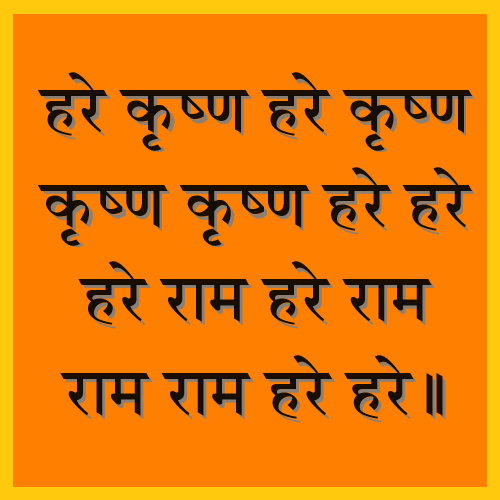
[[File:Hare Krishna.png|thumb|Hare Krishna (Maha Mantra) in the [[Devanagari]] ({{transliteration|sa|devanāgarī}}) script.]] | |||
[[File:Hare Krishna. | [[File:Mahamantra.png|thumb|Hare Krishna (Maha Mantra) in the [[Bengali language]]]] | ||
[[File:Mahamantra.png|thumb|Hare Krishna (Maha Mantra) in [[Bengali language]]]] | The '''Hare Krishna''' ([[Sanskrit|Devanagari]]: {{lang |sa | हरे कृष्ण}}) [[mantra]], also referred to reverentially as the '''{{IAST|Mahā-mantra}}''' ([[Sanskrit|Devanagari]]: {{lang |sa | महामन्त्र}}; {{lit|Great Mantra}}), is a 16-word [[Vaishnavism|Vaishnava]] Hindu mantra mentioned in the [[Kali-Saṇṭāraṇa Upaniṣad]].{{sfn|Beck|1993|p=199}} In the 15th century, it rose to importance in the [[Bhakti movement]] following the teachings of [[Chaitanya Mahaprabhu]]. This mantra is composed of three [[Sanskrit]] names – "[[Krishna]]", "Rama", and "Hare".<ref>{{Cite news| url=http://www.krishna.com/info/hare-krishna-mantra| title=Hare Krishna mantra| work=Krishna| access-date=28 July 2015| archive-date=5 August 2015| archive-url=https://web.archive.org/web/20150805150315/http://www.krishna.com/info/hare-krishna-mantra| url-status=live}}</ref><ref>{{cite news| url=http://www.iskconhk.org/index.php?option=com_content&view=article&id=37&Itemid=115&lang=en| title=Chant and be happy| work=iskcon| access-date=28 July 2015| archive-url=https://web.archive.org/web/20171020135346/http://www.iskconhk.org/index.php?option=com_content&view=article&id=37&Itemid=115&lang=en| archive-date=20 October 2017| url-status=dead}}</ref><ref name="Rosen2006">{{cite book | ||
The '''Hare Krishna''' [[mantra]], also referred to reverentially as the '''{{IAST|Mahā-mantra}}''' ( | |||
| work= Krishna }}</ref><ref>{{cite news| url=http://www.iskconhk.org/index.php?option=com_content&view=article&id=37&Itemid=115&lang=en| title=Chant and be happy| work=iskcon| access-date=28 July 2015| archive-url=https://web.archive.org/web/20171020135346/http://www.iskconhk.org/index.php?option=com_content&view=article&id=37&Itemid=115&lang=en| archive-date=20 October 2017| url-status=dead}}</ref> | |||
| author = Rosen, S. | | author = Rosen, S. | ||
| year = 2006 | | year = 2006 | ||
| Line 45: | Line 12: | ||
| isbn = 0-275-99006-0 | | isbn = 0-275-99006-0 | ||
}}P.4: It was preserved in the confidential sampradayas, or esoteric lineages, that were guardian to these truths from the beginning. p.244: | }}P.4: It was preserved in the confidential sampradayas, or esoteric lineages, that were guardian to these truths from the beginning. p.244: | ||
In a more esoteric sense, the word "Hare" is a vocative form of "Harā," which refers to Mother Harā, or Sri Radha.</ref> | In a more esoteric sense, the word "Hare" is a vocative form of "Harā," which refers to Mother Harā, or Sri Radha.</ref> | ||
| | Since the 1960s, the mantra has been widely known outside India through [[A. C. Bhaktivedanta Swami Prabhupada]] and his movement, [[International Society for Krishna Consciousness]] (commonly known as the Hare Krishnas or the Hare Krishna movement).<ref>[http://www.religion-encyclopedia.com/H/hare_krishna.htm Religion Encyclopedia – Hare Krishna (ISKCON)] {{webarchive|url=https://web.archive.org/web/20070701152023/http://www.religion-encyclopedia.com/H/hare_krishna.htm |date=1 July 2007 }}</ref> | ||
}}</ref> | |||
==Mantra== | |||
The mantra as rendered in the oldest source, the [[Kali-Saṇṭāraṇa Upaniṣad|''Kali-Santaraṇa Upaniṣad'']], is as follows:{{sfn|Beck|1993|p=199}} | |||
{{ | {{poemquote| | ||
Hare Rāma Hare Rāma | |||
Rāma Rāma Hare Hare | |||
Hare Kr̥ṣṇa Hare Kr̥ṣṇa | |||
Kr̥ṣṇa Kr̥ṣṇa Hare Hare | |||
|source=Kali-Santaraṇa Upaniṣad}} | |||
==History== | ==History== | ||
{{Hinduism small}} | {{Hinduism small}} | ||
{{Vaishnavism}} | {{Vaishnavism}} | ||
The mantra is first attested in the {{IAST|''[[Kali- | The mantra is first attested in the {{IAST|''[[Kali-Santaraṇa Upaniṣad]]''}} (Kali Santarana [[Upanishads]]), an Upanishad, which is commented on by Raghunandan Bhattacharya in his work {{transliteration|sa|Harinamarthah-ratna-dipika}}.<ref>{{cite web|title=The Prominence of Hari-Naam in Hinduism: Benefits of Chanting "Hare Krishna" Mahamantra|date=3 June 2020|website=NewsGram|url=https://www.newsgram.com/prominence-hari-naam-hinduism-benefits-hare-krishna-mahamantra/|access-date=10 February 2021|archive-date=26 February 2021|archive-url=https://web.archive.org/web/20210226094150/https://www.newsgram.com/prominence-hari-naam-hinduism-benefits-hare-krishna-mahamantra/|url-status=live}}</ref> In this [[Upanishads|Upanishad]], [[Narada]] is instructed by [[Brahma]] (in the translation of K. N. Aiyar): | ||
{{ | {{blockquote|Hearken to that which all [[Śruti|Shruti]]s (the [[Vedas]]) keep secret and hidden, through which one may cross the [[Saṃsāra]] (mundane existence) of [[Kali (demon)|Kali]]. He shakes off (the evil effects of) Kali through the mere uttering of the name of Lord [[Narayana]], who is the primeval [[Purusha]].}} | ||
Narada asks to be told this name of [[Narayana]], and Brahma replies: | Narada asks to be told this name of [[Narayana]], and Brahma replies: | ||
{{ | {{blockquote|Hare Rama Hare Rama, Rama Rama Hare Hare, Hare Krishna Hare Krishna, Krishna Krishna Hare Hare; these sixteen names are destructive of the evil effects of Kali.<ref>{{Cite web|url=https://sanskritdocuments.org/doc_upanishhat/kalisantarana_upan.html?lang=sa|title=Kalisantarana Upanishat|website=sanskritdocuments.org|access-date=2 December 2018|archive-date=2 December 2018|archive-url=https://web.archive.org/web/20181202202602/https://sanskritdocuments.org/doc_upanishhat/kalisantarana_upan.html?lang=sa|url-status=live}}</ref> No better means than this is to be seen in all the Vedas.}} | ||
Popular tradition believes that [[Chaitanya Mahaprabhu]] received this mantra at his initiation (''[[diksha]]'') in [[Gaya, India]]; however, biographies of Chaitanya state he received a ten-syllabled mantra.{{sfn|Beck|1993|p=199}} | |||
[[ | |||
==Popular culture== | ==Popular culture== | ||
{{further|Hare Krishna in popular culture}} | {{further|Hare Krishna in popular culture}} | ||
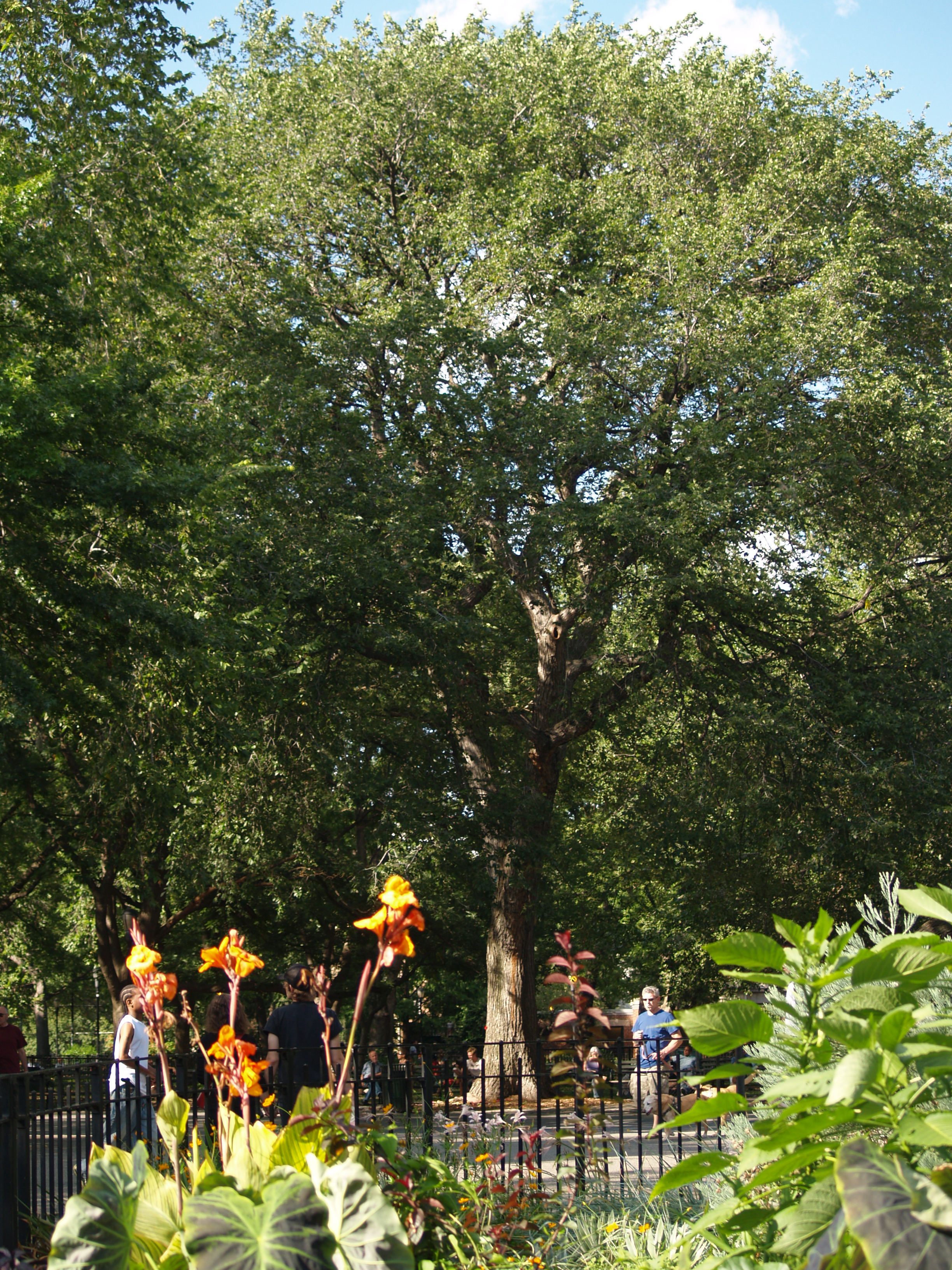
[[File:Hare Krishna Tree.jpg|thumb| | [[File:Hare Krishna Tree.jpg|thumb|upright|The Hare Krishna Tree, an [[Ulmus americana|American elm]] in [[Tompkins Square Park]], [[New York City]], under which Bhaktivedanta Swami Prabhupada began the first recorded public chanting of the Hare Krishna mantra outside India.<ref>{{Cite web|url=http://www.nycgovparks.org/sub_your_park/historical_signs/hs_historical_sign.php?id=10823|title=Hare Krishna Tree|access-date=27 March 2007|archive-date=2 June 2009|archive-url=https://web.archive.org/web/20090602190814/http://www.nycgovparks.org/sub_your_park/historical_signs/hs_historical_sign.php?id=10823|url-status=live}}</ref>]] | ||
The Hare Krishna mantra appears in a number of famous songs, notably those of [[George Harrison]]. His first solo single "[[My Sweet Lord]]" topped charts around the world in 1970–71. Harrison put a Hare Krishna sticker on the back of the headstock of [[Eric Clapton]]'s 1964 [[Gibson ES-335]]; the sticker also appears on Gibson's 2005 reproduction of the guitar. | The Hare Krishna mantra appears in a number of famous songs, notably those of [[George Harrison]]. His first solo single "[[My Sweet Lord]]" topped charts around the world in 1970–71. Harrison put a Hare Krishna sticker on the back of the headstock of [[Eric Clapton]]'s 1964 [[Gibson ES-335]]; the sticker also appears on Gibson's 2005 reproduction of the guitar. | ||
| Line 83: | Line 48: | ||
The [[Broadway theatre|Broadway]] musical [[Hair (musical)|''Hair'']] has a song, "Hare Krishna", containing the mantra, along with some additional lyrics. | The [[Broadway theatre|Broadway]] musical [[Hair (musical)|''Hair'']] has a song, "Hare Krishna", containing the mantra, along with some additional lyrics. | ||
[[The Muppet Movie|The Muppet Movie (1979)]] has a [[running gag]] in which characters respond to people being lost by suggesting Hare Krishna. The second time this occurs [[Kermit the Frog]] acknowledges that this has become a running gag and it's used throughout the rest of the film. | |||
The mantra also prominently appears in [[Jesus Loves You (band)|Jesus Loves You]]'s "[[Bow Down Mister]]" (1990) and in [[the Pretenders]]' "Boots of Chinese Plastic" from their 2008 album, ''[[Break Up the Concrete]]''.{{citation needed|date=December 2021}} Stevie Wonder used the devotees chanting Hare Krishna in his song "Pastime Paradise".{{citation needed|date=December 2021}} | |||
Less well-known recordings of the Hare Krishna mantra include versions by [[the Fugs]] on their 1968 album [[Tenderness Junction]] (featuring poet [[Allen Ginsberg]]), by [[Nina Hagen]], in multiple songs by English psychedelic rock band [[Quintessence (English band)|Quintessence]] (produced by [[John Barham]], a frequent collaborator of George Harrison), the American psychedelic rock band [[Mad River (band)|Mad River]] featured the Hare Krishna mantra on an early version of their song Wind Chimes, recorded in 1967, and by [[Hüsker Dü]] on their 1984 album ''[[Zen Arcade]]''. [[Kula Shaker]], [[Boy George]], and members of [[the Rubettes]] have recorded music tracks about Krishna Consciousness. | |||
In a 2010 experimental study involving both devotees and non-devotees, singing vowels like "ah" and "eh" was found to be more joyful than singing vowels like "oh" and "uh", possibly due to a [[Facial feedback hypothesis|facial feedback]] effect.<ref>Böttger, D. (2010) ''To say "Krishna" is to smile – emotion psychology and the neurology of mantra singing.'' In "The Varieties of Ritual Experience" (ed. Jan Weinhold & [[Geoffrey Samuel]]) in the series "Ritual Dynamics and the Science of Ritual", Volume II: "Body, performance, agency and experience". Wiesbaden, Germany: Harrassowitz. [https://www.youtube.com/watch?v=aZkgFTzlX14 Video summary] {{Webarchive|url=https://web.archive.org/web/20170202022151/https://www.youtube.com/watch?v=aZkgFTzlX14 |date=2 February 2017 }}</ref> | |||
{{ | |||
==See also== | ==See also== | ||
{{div col|colwidth=30em}} | {{div col|colwidth=30em}} | ||
*[[Om | * ''[[Hari Om]]'' | ||
*[[ | * ''[[Om Namo Bhagavate Vāsudevāya]]'' | ||
*[[ | * ''[[Om Namo Narayanaya]]'' | ||
*[[Svayam Bhagavan | * [[Svayam Bhagavan]] | ||
{{div col end}} | {{div col end}} | ||
| Line 113: | Line 68: | ||
==Sources== | ==Sources== | ||
{{Wikiquote}} | |||
* {{cite book|surname=Beck |given=Guy L. |title=Sonic Theology: Hinduism and Sacred Sound | * {{cite book|surname=Beck |given=Guy L. |title=Sonic Theology: Hinduism and Sacred Sound | ||
|url=https://books.google.com/books?id=cY1Xw1ZlIeQC |place=Columbia, SC |publisher=University of South Carolina Press |year=1993 |series=Studies in Comparative Religion |isbn=0872498557}} | |url=https://books.google.com/books?id=cY1Xw1ZlIeQC |place=Columbia, SC |publisher=University of South Carolina Press |year=1993 |series=Studies in Comparative Religion |isbn=0872498557}} | ||
| Line 120: | Line 77: | ||
|publisher = www.celextel.org | |publisher = www.celextel.org | ||
|access-date = 2008-05-06 | |access-date = 2008-05-06 | ||
| | |translator = K. Narayanasvami Aiyar | ||
|first = | |first = | ||
|url-status = dead | |url-status = dead | ||
|archive-url = https://web.archive.org/web/20080511193912/http://www.celextel.org/108upanishads/kalisantarana.html | |archive-url = https://web.archive.org/web/20080511193912/http://www.celextel.org/108upanishads/kalisantarana.html | ||
|archive-date = 11 May 2008 | |archive-date = 11 May 2008 | ||
|df = dmy-all | |df = dmy-all | ||
}} | }} | ||
<!--===========================({{NoMoreLinks}})===============================--> | <!--===========================({{NoMoreLinks}})===============================--> | ||
<!--| DO NOT ADD MORE LINKS TO THIS ARTICLE. WIKIPEDIA IS NOT A COLLECTION OF |--> | <!--| DO NOT ADD MORE LINKS TO THIS ARTICLE. WIKIPEDIA IS NOT A COLLECTION OF |--> | ||
| Line 152: | Line 95: | ||
<!--| See [[Wikipedia:External links]] and [[Wikipedia:Spam]] for details |--> | <!--| See [[Wikipedia:External links]] and [[Wikipedia:Spam]] for details |--> | ||
<!--===========================({{NoMoreLinks}})===============================--> | <!--===========================({{NoMoreLinks}})===============================--> | ||
<!--See [[Wikipedia:WikiProject_Hinduism#External_Links]] for guidelines to adding links here. | <!--See [[Wikipedia:WikiProject_Hinduism#External_Links]] for guidelines to adding links here. PLS DISCUSS IN TALK BEFORE ADDING NEW ONES--> | ||
{{Vaishnava philosophy}} | |||
[[Category:Hindu denominations]] | [[Category:Hindu denominations]] | ||
[[Category:Hindu mantras]] | [[Category:Hindu mantras]] | ||
[[Category:Kirtan]] | |||
[[Category:Krishna]] | [[Category:Krishna]] | ||
[[Category:Meditation]] | [[Category:Meditation]] | ||
[[Category:Vaishnavism]] | [[Category:Vaishnavism]] | ||
[[Category: | [[Category:Chaitanya Mahaprabhu]] | ||
Latest revision as of 04:52, 26 March 2026


The Hare Krishna (Devanagari: हरे कृष्ण) mantra, also referred to reverentially as the Mahā-mantra (Devanagari: महामन्त्र; lit. 'Great Mantra'), is a 16-word Vaishnava Hindu mantra mentioned in the Kali-Saṇṭāraṇa Upaniṣad.[1] In the 15th century, it rose to importance in the Bhakti movement following the teachings of Chaitanya Mahaprabhu. This mantra is composed of three Sanskrit names – "Krishna", "Rama", and "Hare".[2][3][4]
Since the 1960s, the mantra has been widely known outside India through A. C. Bhaktivedanta Swami Prabhupada and his movement, International Society for Krishna Consciousness (commonly known as the Hare Krishnas or the Hare Krishna movement).[5]
Mantra[edit | edit source]
The mantra as rendered in the oldest source, the Kali-Santaraṇa Upaniṣad, is as follows:[1]
Hare Rāma Hare Rāma
Rāma Rāma Hare Hare
Hare Kr̥ṣṇa Hare Kr̥ṣṇa
Kr̥ṣṇa Kr̥ṣṇa Hare Hare— Kali-Santaraṇa Upaniṣad
History[edit | edit source]
| Part of a series on |
| Hinduism |
|---|
 |

| Part of a series on |
| Vaishnavism |
|---|
 |
 Hinduism portal Hinduism portal |
The mantra is first attested in the Kali-Santaraṇa Upaniṣad (Kali Santarana Upanishads), an Upanishad, which is commented on by Raghunandan Bhattacharya in his work Harinamarthah-ratna-dipika.[6] In this Upanishad, Narada is instructed by Brahma (in the translation of K. N. Aiyar):
Hearken to that which all Shrutis (the Vedas) keep secret and hidden, through which one may cross the Saṃsāra (mundane existence) of Kali. He shakes off (the evil effects of) Kali through the mere uttering of the name of Lord Narayana, who is the primeval Purusha.
Narada asks to be told this name of Narayana, and Brahma replies:
Hare Rama Hare Rama, Rama Rama Hare Hare, Hare Krishna Hare Krishna, Krishna Krishna Hare Hare; these sixteen names are destructive of the evil effects of Kali.[7] No better means than this is to be seen in all the Vedas.
Popular tradition believes that Chaitanya Mahaprabhu received this mantra at his initiation (diksha) in Gaya, India; however, biographies of Chaitanya state he received a ten-syllabled mantra.[1]
Popular culture[edit | edit source]

The Hare Krishna mantra appears in a number of famous songs, notably those of George Harrison. His first solo single "My Sweet Lord" topped charts around the world in 1970–71. Harrison put a Hare Krishna sticker on the back of the headstock of Eric Clapton's 1964 Gibson ES-335; the sticker also appears on Gibson's 2005 reproduction of the guitar.
Produced by Harrison, Radha Krishna Temple's recording "Hare Krishna Mantra" was issued as a single on the Beatles' Apple record label in 1969. The single was a commercial success, peaking at number 12 in the UK, and led to the Temple devotees appearing on the popular British music chart television programme Top of the Pops.
The Broadway musical Hair has a song, "Hare Krishna", containing the mantra, along with some additional lyrics.
The Muppet Movie (1979) has a running gag in which characters respond to people being lost by suggesting Hare Krishna. The second time this occurs Kermit the Frog acknowledges that this has become a running gag and it's used throughout the rest of the film.
The mantra also prominently appears in Jesus Loves You's "Bow Down Mister" (1990) and in the Pretenders' "Boots of Chinese Plastic" from their 2008 album, Break Up the Concrete.[citation needed] Stevie Wonder used the devotees chanting Hare Krishna in his song "Pastime Paradise".[citation needed]
Less well-known recordings of the Hare Krishna mantra include versions by the Fugs on their 1968 album Tenderness Junction (featuring poet Allen Ginsberg), by Nina Hagen, in multiple songs by English psychedelic rock band Quintessence (produced by John Barham, a frequent collaborator of George Harrison), the American psychedelic rock band Mad River featured the Hare Krishna mantra on an early version of their song Wind Chimes, recorded in 1967, and by Hüsker Dü on their 1984 album Zen Arcade. Kula Shaker, Boy George, and members of the Rubettes have recorded music tracks about Krishna Consciousness.
In a 2010 experimental study involving both devotees and non-devotees, singing vowels like "ah" and "eh" was found to be more joyful than singing vowels like "oh" and "uh", possibly due to a facial feedback effect.[9]
See also[edit | edit source]
Footnotes[edit | edit source]
- ↑ 1.0 1.1 1.2 Beck 1993, p. 199.
- ↑ "Hare Krishna mantra". Krishna. Archived from the original on 5 August 2015. Retrieved 28 July 2015.
- ↑ "Chant and be happy". iskcon. Archived from the original on 20 October 2017. Retrieved 28 July 2015.
- ↑ Rosen, S. (2006). Essential Hinduism. Praeger Publishers. ISBN 0-275-99006-0.P.4: It was preserved in the confidential sampradayas, or esoteric lineages, that were guardian to these truths from the beginning. p.244: In a more esoteric sense, the word "Hare" is a vocative form of "Harā," which refers to Mother Harā, or Sri Radha.
- ↑ Religion Encyclopedia – Hare Krishna (ISKCON) Archived 1 July 2007 at the Wayback Machine
- ↑ "The Prominence of Hari-Naam in Hinduism: Benefits of Chanting "Hare Krishna" Mahamantra". NewsGram. 3 June 2020. Archived from the original on 26 February 2021. Retrieved 10 February 2021.
- ↑ "Kalisantarana Upanishat". sanskritdocuments.org. Archived from the original on 2 December 2018. Retrieved 2 December 2018.
- ↑ "Hare Krishna Tree". Archived from the original on 2 June 2009. Retrieved 27 March 2007.
- ↑ Böttger, D. (2010) To say "Krishna" is to smile – emotion psychology and the neurology of mantra singing. In "The Varieties of Ritual Experience" (ed. Jan Weinhold & Geoffrey Samuel) in the series "Ritual Dynamics and the Science of Ritual", Volume II: "Body, performance, agency and experience". Wiesbaden, Germany: Harrassowitz. Video summary Archived 2 February 2017 at the Wayback Machine
Sources[edit | edit source]
- Beck, Guy L. (1993). Sonic Theology: Hinduism and Sacred Sound. Studies in Comparative Religion. Columbia, SC: University of South Carolina Press. ISBN 0872498557.
- "English translation of the Kali Santarana Upanishad". Translated by K. Narayanasvami Aiyar. www.celextel.org. Archived from the original on 11 May 2008. Retrieved 6 May 2008.