



imported>ChandlerMinh mNo edit summary |
corrected layout further and cleaned formatting |
||
| Line 1: | Line 1: | ||
{{Short description|Abugida}} | |||
{{About|a writing system|other meanings of "Sharada"|Sharada (disambiguation)}} | {{About|a writing system|other meanings of "Sharada"|Sharada (disambiguation)}} | ||
{{Infobox Writing system | {{Infobox Writing system | ||
|name= | |name=Sharada script | ||
|altname={{Script|Shrd|𑆯𑆳𑆫𑆢𑆳}} | |altname=Śāradā<br/> | ||
|sample=Sharada.svg | {{Script|Shrd|𑆯𑆳𑆫𑆢𑆳}} | ||
|sample=Shukla Sharada.svg | |||
|caption=The word ''śāradā'' in Sharada script | |caption=The word ''śāradā'' in Sharada script | ||
|type=[[Abugida]] | |type=[[Abugida]] | ||
| Line 9: | Line 11: | ||
|time= 700 CE –present (almost extinct)<ref name=singh/> | |time= 700 CE –present (almost extinct)<ref name=singh/> | ||
|region=[[India]], [[Pakistan]], [[Central Asia]] | |region=[[India]], [[Pakistan]], [[Central Asia]] | ||
|fam1=[[ | |fam1=[[Egyptian hieroglyphs|Egyptian]] | ||
|fam2=[[ | |fam2=[[Proto-Sinaitic]] | ||
|fam3=[[ | |fam3=[[Phoenician alphabet|Phoenician]] | ||
|fam4=[[Aramaic alphabet|Aramaic]] | |||
|fam5=[[Brahmi script|Brahmi]] | |||
|fam6=[[Gupta script|Gupta]] | |||
|sisters=[[Siddham script|Siddham]], [[Tibetan script|Tibetan]],<ref name=daniels>{{cite book |last1=Daniels |first1=P.T. |chapter=Writing systems of major and minor languages |editor-last1=Kachru |editor-first1=Braj B. |editor-last2=Kachru |editor-first2=Yamuna |editor-last3=Sridhar |editor-first3=S. N. |title=Language in South Asia |date=27 March 2008 |publisher=Cambridge University Press |isbn=978-1-139-46550-2 |url=https://books.google.com/books?id=O2n4sFGDEMYC |language=en}}</ref><ref name="masica">{{cite book |last1=Masica |first1=Colin |title=The Indo-Aryan languages |date=1993 |page=143}}</ref> [[Kalinga script|Kalinga]], [[Bhaiksuki script|Bhaiksuki]] | |||
|children=[[Takri script|Takri]]<br />[[Laṇḍā|Landa]] | |children=[[Takri script|Takri]]<br />[[Laṇḍā|Landa]] | ||
|unicode=[https://www.unicode.org/charts/PDF/U11180.pdf U+11180–U+111DF] | | unicode = {{Plainlist| | ||
* [https://www.unicode.org/charts/PDF/U11180.pdf U+11180–U+111DF]<br />Sharada, | |||
* [https://www.unicode.org/charts/PDF/U11B60.pdf U+11B60–U+11B7F]<br />Sharada Supplement | |||
}} | |||
|iso15924=Shrd | |iso15924=Shrd | ||
|note=none | |note=none | ||
|footnotes= | |||
}} | }} | ||
{{Contains special characters | {{Contains special characters | ||
| Line 32: | Line 38: | ||
{{brahmic|state=uncollapsed}} | {{brahmic|state=uncollapsed}} | ||
The '''Śāradā''' | The '''Śāradā''' (also spelled '''Sarada''' or '''Sharada''') script is an [[abugida]] writing system of the [[Brahmic family]] of scripts. The script was widespread between the 8th and 12th centuries in the northwestern parts of Indian Subcontinent (in [[Kashmir]] and neighbouring areas), for writing [[Sanskrit]] and [[Kashmiri language|Kashmiri]].<ref name=Selin>{{cite book |last1=Selin |first1=Helaine |title=Encyclopaedia of the History of Science, Technology, and Medicine in Non-Western Cultures |date=2008 |publisher=Springer Science & Business Media |isbn=9781402045592 |page=Bakhshali Manuscript entry |url=https://books.google.com/books?id=kt9DIY1g9HYC&pg=RA1-PA1 |language=en|bibcode=2008ehst.book.....S }}</ref><ref name=singh>{{cite book |last1=Singh |first1=Upinder |title=A History of Ancient and Early Medieval India: From the Stone Age to the 12th Century |date=2008 |publisher=Pearson Education India |isbn=9788131711200 |page=43 |url=https://books.google.com/books?id=H3lUIIYxWkEC&pg=PA43 |language=en}}</ref><ref>Sir George Grierson. (1916). "[https://archive.org/details/244194891OnTheSharadaAlphabetJournalOfTheRoyalAsiaticSociety171916SirGeorgeGriersonKCIEMRAS/page/n17 On the Sharada Alphabet]". ''Journal of the Royal Asiatic Society, 17''.</ref> Although originally a signature [[Brahminical]] script created in the valley, it was more widespread throughout northwestern Indian subcontinent, and later became restricted to Kashmir, and is now rarely used, except by the [[Kashmiri Pandit]] community for religious purposes.<ref name=singh/> | ||
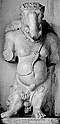
[[File:Kabul | [[File:Gardesh Ganesha dedicated by Khingila, Kabul, 7-8th century CE.jpg|thumb|150px|The ''[[Gardez Ganesha]]'', a 6th-century marble [[Ganesha]] found in [[Gardez]], [[Afghanistan]], now at Dargah Pir Rattan Nath, [[Kabul]]. The Sharada inscription says that this "great and beautiful image of {{IAST|Mahāvināyaka}}" was consecrated by the [[Hindu Shahi|Shahi]] King Khingala of Khatriya Country Modern Part of Punjab Pakistan and Afghanistan.<ref>For photograph of statue and details of inscription, see: Dhavalikar, M. K., "{{IAST|Gaņeśa}}: Myth and Reality", in: {{Harvnb|Brown|1991|pp=50,63}}.</ref>]] | ||
It is a native script of | It is a native script of Kashmir and is named after the goddess Śāradā or [[Saraswati]], the goddess of learning and the main [[Hindu deity]] of the [[Sharada Peeth]] temple.<ref name=hindu2>{{cite news|title=Pandits to visit Sharda temple|url=http://www.hindu.com/2006/05/17/stories/2006051704920900.htm |archive-url=https://web.archive.org/web/20070204050822/http://www.hindu.com/2006/05/17/stories/2006051704920900.htm |url-status=dead |archive-date=4 February 2007 |newspaper=[[The Hindu]] |date=17 May 2006 |access-date=13 August 2012}}</ref> | ||
==History== | ==History== | ||
[[File:Bakhshali_manuscript.jpg|thumb|Bakhshali manuscript]] | [[File:Bakhshali_manuscript.jpg|thumb|Bakhshali manuscript]] | ||
[[File:Om in Sharada script.png|thumb| | [[File:Om_in_Sharada_script.svg|thumb|100px|Om in Sharada script]] | ||
The [[Bakhshali manuscript]] uses an early stage of the Sharada script.<ref name=Selin/> The | [[File:Śāradāstotra.png|thumb|The first half stanza of the Śāradāstotra rendered in Śāradā script.]] | ||
Sharda script is named after the Hindu goddess Śāradā, also known as [[Saraswati]], the goddess of learning and the main [[Hindu deity]] of the [[Sharada Peeth]] temple.<ref name=hindu2 /> | |||
Although originally a script restricted to only [[Brahmins]], Sharda was later spread throughout the larger Hindu population in Northwestern Indian subcontinent, as [[Hinduism]] became the dominant religion in the region again.<ref name=hindu2 /><ref>{{cite web |url=https://eduindex.org/2020/06/12/the-indigenous-script-of-kashmir-the-sharda-script/ |url-status=live |access-date=September 24, 2023 |title=The Indigenous Script of Kashmir – The Sharda Script |archive-url=https://archive.today/20230924195939/https://eduindex.org/2020/06/12/the-indigenous-script-of-kashmir-the-sharda-script/ |archive-date=September 24, 2023 |date=June 12, 2020 |language=en-IN }}</ref><ref>{{ cite book |year=2015 |last=Fogelin |first=Lars |url=https://books.google.com/books?id=yPZzBgAAQBAJ&q=Decline+buddhism+gupta |access-date=September 24, 2023 |isbn=9780199948239 |publisher=[[Oxford University Press]] |page=149 |title=An Archaeological History of Indian Buddhism |quote=...the emergence and spread of Hinduism through Indian society helped lead to Buddhism's gradual decline in India. |language=en-UK }}</ref> | |||
The [[Bakhshali manuscript]] uses an early stage of the Sharada script.<ref name=Selin/> The Sharada script was used in Afghanistan as well as in the [[Himachal Pradesh|Himachal]] region in India. In Afghanistan, the [[Gardez Ganesha#Inscription|Kabul Ganesh]] has a 6th to 8th century Proto-Sharada{{clarify|date=April 2019|reason="Proto-Sharada" unclear}} inscription mentioning the, [[Turk Shahis]], king [[Khingala]] of [[Oddiyana]].<ref>[https://books.google.com/books?id=x2cuAQAAIAAJ&q=khingala+ganesha+sarAda From Persepolis to the Punjab: Exploring Ancient Iran, Afghanistan and Pakistan, Elizabeth Errington, Vesta Sarkhosh Curtis, British Museum Press, 2007 p. 96]</ref> At the historic temple of Mirkula Devi (also Mrikula Devi) in Lahaul, [Himachal Pradesh], the goddess Mahishamardini has a Sharada inscription of 1569 CE.<ref>[https://www.jstor.org/stable/29757141 Observations on the Architecture and on a Carved Wooden Door of the Temple of Mirkulā Devī at Udaipur, Himachal Pradesh, Francesco Noci, East and West, Vol. 44, No. 1 (March 1994), pp. 99-114]</ref> | |||
From the 10th century onwards, regional differences started to appear between the Sharada script used in Punjab, the Hill States (partly [[Himachal Pradesh]]) and [[Kashmir]]. Sharada proper was eventually restricted to very limited ceremonial use in Kashmir, as it grew increasingly unsuitable for writing the [[Kashmiri language]].<ref name=sharada/> With the last known inscription dating to 1204 C.E., the early 13th century marks a milestone in the development of Sharada.<ref name=sharada>{{cite web | url=https://unicode.org/L2/L2009/09074r-n3595-sharada.pdf| title=N3545: Proposal to Encode the Sharada Script in ISO/IEC 10646 | first1=Anshuman | last1=Pandey | publisher=Working Group Document, ISO/IEC JTC1/SC2/WG2 | date=2009-03-25}}</ref> The regional variety in Punjab continued to evolve from this stage through the 14th century; during this period it starts to appear in forms closely resembling [[Gurmukhī]] and other [[Landa scripts]]. By the 15th century, Sharada had evolved so considerably that [[epigraphist]]s denote the script at this point by a special name, ''Devāśeṣa''.<ref name=sharada/> | From the 10th century onwards, regional differences started to appear between the Sharada script used in Punjab, the Hill States (partly [[Himachal Pradesh]]) and [[Kashmir]]. Sharada proper was eventually restricted to very limited ceremonial use in Kashmir, as it grew increasingly unsuitable for writing the [[Kashmiri language]].<ref name=sharada/> With the last known inscription dating to 1204 C.E., the early 13th century marks a milestone in the development of Sharada.<ref name=sharada>{{cite web | url=https://unicode.org/L2/L2009/09074r-n3595-sharada.pdf| title=N3545: Proposal to Encode the Sharada Script in ISO/IEC 10646 | first1=Anshuman | last1=Pandey | publisher=Working Group Document, ISO/IEC JTC1/SC2/WG2 | date=2009-03-25}}</ref> The regional variety in [[Punjab]] continued to evolve from this stage through the 14th century; during this period it starts to appear in forms closely resembling [[Gurmukhī]] and other [[Landa scripts]]. By the 15th century, Sharada had evolved so considerably that [[epigraphist]]s denote the script at this point by a special name, ''Devāśeṣa''.<ref name=sharada/> | ||
==Letters== | ==Letters== | ||
===Vowels=== | ===Vowels=== | ||
{| class="wikitable" | {| class="wikitable" | ||
|- | |- | ||
! | !Letter | ||
! | !Diacritic on {{Angbr|𑆥}} | ||
!Special forms | !Special forms | ||
|- | |- | ||
|{{letter|ch1=𑆃|ch2=-|s=Shrd|ipa=[ɐ]|iso=a}} | |||
|{{ | |{{Script|Shrd|𑆥}} ''pa'' | ||
| | |||
| | |||
| | | | ||
|- | |- | ||
|{{letter|ch1=𑆄|ch2=𑆳|s=Shrd|ipa=[aː]|iso=ā}} | |||
|{{ | |||
| | |||
|{{Script|Shrd|𑆥𑆳}} ''pā'' | |{{Script|Shrd|𑆥𑆳}} ''pā'' | ||
|{{Script|Shrd|𑆕}} → {{Script|Shrd|𑆕𑆳}}; {{Script|Shrd|𑆘}} → {{Script|Shrd|𑆘𑆳}}; {{Script|Shrd|𑆛}} → {{Script|Shrd|𑆛𑆳}}; {{Script|Shrd|𑆟}} → {{Script|Shrd|𑆟𑆳}} | |{{Script|Shrd|𑆕}} → {{Script|Shrd|𑆕𑆳}}; {{Script|Shrd|𑆘}} → {{Script|Shrd|𑆘𑆳}}; {{Script|Shrd|𑆛}} → {{Script|Shrd|𑆛𑆳}}; {{Script|Shrd|𑆟}} → {{Script|Shrd|𑆟𑆳}} | ||
|- | |- | ||
|{{letter|ch1=𑆅|ch2=𑆴|s=Shrd|ipa=[ɪ]|iso=i}} | |||
|{{ | |||
| | |||
|{{Script|Shrd|𑆥𑆴}} ''pi'' | |{{Script|Shrd|𑆥𑆴}} ''pi'' | ||
| | | | ||
|- | |- | ||
|{{letter|ch1=𑆆|ch2=𑆵|s=Shrd|ipa=[iː]|iso=ī}} | |||
|{{ | |||
| | |||
|{{Script|Shrd|𑆥𑆵}} ''pī'' | |{{Script|Shrd|𑆥𑆵}} ''pī'' | ||
| | | | ||
|- | |- | ||
|{{letter|ch1=𑆇|ch2=𑆶|s=Shrd|ipa=[ʊ]|iso=u}} | |||
|{{ | |||
| | |||
|{{Script|Shrd|𑆥𑆶}} ''pu'' | |{{Script|Shrd|𑆥𑆶}} ''pu'' | ||
|{{Script|Shrd|𑆑}} → {{Script|Shrd|𑆑𑆶}}; {{Script|Shrd|𑆓}} → {{Script|Shrd|𑆓𑆶}}; {{Script|Shrd|𑆙}} → {{Script|Shrd|𑆙𑆶}}; {{Script|Shrd|𑆚}} → {{Script|Shrd|𑆚𑆶}}; {{Script|Shrd|𑆝}} → {{Script|Shrd|𑆝𑆶}}; {{Script|Shrd|𑆠}} → {{Script|Shrd|𑆠𑆶}}; {{Script|Shrd|𑆨}} → {{Script|Shrd|𑆨𑆶}}; {{Script|Shrd|𑆫}} → {{Script|Shrd|𑆫𑆶}}; {{Script|Shrd|𑆯}} → {{Script|Shrd|𑆯𑆶}} | |{{Script|Shrd|𑆑}} → {{Script|Shrd|𑆑𑆶}}; {{Script|Shrd|𑆓}} → {{Script|Shrd|𑆓𑆶}}; {{Script|Shrd|𑆙}} → {{Script|Shrd|𑆙𑆶}}; {{Script|Shrd|𑆚}} → {{Script|Shrd|𑆚𑆶}}; {{Script|Shrd|𑆝}} → {{Script|Shrd|𑆝𑆶}}; {{Script|Shrd|𑆠}} → {{Script|Shrd|𑆠𑆶}}; {{Script|Shrd|𑆨}} → {{Script|Shrd|𑆨𑆶}}; {{Script|Shrd|𑆫}} → {{Script|Shrd|𑆫𑆶}}; {{Script|Shrd|𑆯}} → {{Script|Shrd|𑆯𑆶}} | ||
|- | |- | ||
|{{letter|ch1=𑆈|ch2=𑆷|s=Shrd|ipa=[uː]|iso=ū}} | |||
|{{ | |||
| | |||
|{{Script|Shrd|𑆥𑆷}} ''pū'' | |{{Script|Shrd|𑆥𑆷}} ''pū'' | ||
|{{Script|Shrd|𑆑}} → {{Script|Shrd|𑆑𑆷}}; {{Script|Shrd|𑆓}} → {{Script|Shrd|𑆓𑆷}}; {{Script|Shrd|𑆙}} → {{Script|Shrd|𑆙𑆷}}; {{Script|Shrd|𑆚}} → {{Script|Shrd|𑆚𑆷}}; {{Script|Shrd|𑆝}} → {{Script|Shrd|𑆝𑆷}}; {{Script|Shrd|𑆠}} → {{Script|Shrd|𑆠𑆷}}; {{Script|Shrd|𑆨}} → {{Script|Shrd|𑆨𑆷}}; {{Script|Shrd|𑆫}} → {{Script|Shrd|𑆫𑆷}}; {{Script|Shrd|𑆯}} → {{Script|Shrd|𑆯𑆷}} | |{{Script|Shrd|𑆑}} → {{Script|Shrd|𑆑𑆷}}; {{Script|Shrd|𑆓}} → {{Script|Shrd|𑆓𑆷}}; {{Script|Shrd|𑆙}} → {{Script|Shrd|𑆙𑆷}}; {{Script|Shrd|𑆚}} → {{Script|Shrd|𑆚𑆷}}; {{Script|Shrd|𑆝}} → {{Script|Shrd|𑆝𑆷}}; {{Script|Shrd|𑆠}} → {{Script|Shrd|𑆠𑆷}}; {{Script|Shrd|𑆨}} → {{Script|Shrd|𑆨𑆷}}; {{Script|Shrd|𑆫}} → {{Script|Shrd|𑆫𑆷}}; {{Script|Shrd|𑆯}} → {{Script|Shrd|𑆯𑆷}} | ||
|- | |- | ||
|{{letter|ch1=𑆉|ch2=𑆸|s=Shrd|ipa=[r̩]|iso=r̥}} | |||
|{{ | |||
| | |||
|{{Script|Shrd|𑆥𑆸}} ''pr̥'' | |{{Script|Shrd|𑆥𑆸}} ''pr̥'' | ||
|{{Script|Shrd|𑆑}} → {{Script|Shrd|𑆑𑆸}} | |{{Script|Shrd|𑆑}} → {{Script|Shrd|𑆑𑆸}} | ||
|- | |- | ||
|{{letter|ch1=𑆊|ch2=𑆹|s=Shrd|ipa=[r̩ː]|iso=r̥̄}} | |||
|{{ | |||
| | |||
|{{Script|Shrd|𑆥𑆹}} ''pr̥̄'' | |{{Script|Shrd|𑆥𑆹}} ''pr̥̄'' | ||
|{{Script|Shrd|𑆑}} → {{Script|Shrd|𑆑𑆹}} | |{{Script|Shrd|𑆑}} → {{Script|Shrd|𑆑𑆹}} | ||
|- | |- | ||
|{{letter|ch1=𑆋|ch2=𑆺|s=Shrd|ipa=[l̩]|iso=l̥}} | |||
|{{ | |||
| | |||
|{{Script|Shrd|𑆥𑆺}} ''pl̥'' | |{{Script|Shrd|𑆥𑆺}} ''pl̥'' | ||
| | | | ||
|- | |- | ||
|{{letter|ch1=𑆌|ch2=𑆻|s=Shrd|ipa=[l̩ː]|iso=l̥̄}} | |||
|{{ | |||
| | |||
|{{Script|Shrd|𑆥𑆻}} ''pl̥̄'' | |{{Script|Shrd|𑆥𑆻}} ''pl̥̄'' | ||
| | | | ||
|- | |- | ||
|{{letter|ch1=𑆍|ch2=𑆼|s=Shrd|ipa=[eː]|iso=ē}} | |||
|{{ | |||
| | |||
|{{Script|Shrd|𑆥𑆼}} ''pē'' | |{{Script|Shrd|𑆥𑆼}} ''pē'' | ||
| | | | ||
|- | |- | ||
|{{letter|ch1=𑆎|ch2=𑆽|s=Shrd|ipa=[aːi̯], [ai], [ɐi], [ɛi]|iso=ai}} | |||
|{{ | |||
| | |||
|{{Script|Shrd|𑆥𑆽}} ''pai'' | |{{Script|Shrd|𑆥𑆽}} ''pai'' | ||
| | | | ||
|- | |- | ||
|{{letter|ch1=𑆏|ch2=𑆾|s=Shrd|ipa=[oː]|iso=ō}} | |||
|{{ | |||
| | |||
|{{Script|Shrd|𑆥𑆾}} ''pō'' | |{{Script|Shrd|𑆥𑆾}} ''pō'' | ||
| | | | ||
|- | |- | ||
|{{letter|ch1=𑆐|ch2=𑆿|s=Shrd|ipa=[aːu̯], [au], [ɐu], [ɔu]|iso=au}} | |||
|{{ | |||
| | |||
|{{Script|Shrd|𑆥𑆿}} ''pau'' | |{{Script|Shrd|𑆥𑆿}} ''pau'' | ||
| | | | ||
|- | |- | ||
|{{letter|ch1=𑆃𑆀|ch2=𑆀|s=Shrd|ipa=[◌̃]|iso=am̐}} | |||
|{{ | |||
| | |||
|{{Script|Shrd|𑆥𑆀}} ''pam̐'' | |{{Script|Shrd|𑆥𑆀}} ''pam̐'' | ||
| | | | ||
|- | |- | ||
|{{letter|ch1=𑆃𑆁|ch2=𑆁|s=Shrd|ipa=[n], [m]|iso=aṃ}} | |||
|{{ | |||
| | |||
|{{Script|Shrd|𑆥𑆁}} ''paṃ'' | |{{Script|Shrd|𑆥𑆁}} ''paṃ'' | ||
| | | | ||
|- | |- | ||
|{{letter|ch1=𑆃𑆂|ch2=𑆂|s=Shrd|ipa=[h]|iso=aḥ}} | |||
|{{ | |||
| | |||
|{{Script|Shrd|𑆥𑆂}} ''paḥ'' | |{{Script|Shrd|𑆥𑆂}} ''paḥ'' | ||
| | | | ||
| Line 181: | Line 136: | ||
{| class="wikitable" | {| class="wikitable" | ||
| {{letter | s = Shrd | ch = 𑆑 | iso = ka | ipa = [kɐ] }} | |||
| {{letter | s = Shrd | ch = 𑆒 | iso = kha | ipa = [kʰɐ] }} | |||
| {{letter | s = Shrd | ch = 𑆓 | iso = ga | ipa = [ɡɐ] }} | |||
| {{letter | s = Shrd | ch = 𑆔 | iso = gha | ipa = [ɡʱɐ] }} | |||
|{{ | | {{letter | s = Shrd | ch = 𑆕 | iso = ṅa | ipa = [ŋɐ] }} | ||
| | |||
|{{ | |||
| | |||
|{{ | |||
| | |||
|{{ | |||
| | |||
|{{ | |||
| | |||
|- | |- | ||
|{{ | | {{letter | s = Shrd | ch = 𑆖 | iso = ca | ipa = [tɕɐ] }} | ||
| | | {{letter | s = Shrd | ch = 𑆗 | iso = cha | ipa = [tɕʰɐ] }} | ||
|{{ | | {{letter | s = Shrd | ch = 𑆘 | iso = ja | ipa = [dʑɐ] }} | ||
| {{letter | s = Shrd | ch = 𑆙 | iso = jha | ipa = [dʑʱɐ] }} | |||
| {{letter | s = Shrd | ch = 𑆚 | iso = ña | ipa = [ɲɐ] }} | |||
|- | |- | ||
|{{ | | {{letter | s = Shrd | ch = 𑆛 | iso = ṭa | ipa = [ʈɐ] }} | ||
| | | {{letter | s = Shrd | ch = 𑆜 | iso = ṭha | ipa = [ʈʰɐ] }} | ||
|{{ | | {{letter | s = Shrd | ch = 𑆝 | iso = ḍa | ipa = [ɖɐ] }} | ||
| {{letter | s = Shrd | ch = 𑆞 | iso = ḍha | ipa = [ɖʱɐ] }} | |||
| {{letter | s = Shrd | ch = 𑆟 | iso = ṇa | ipa = [ɳɐ] }} | |||
|- | |- | ||
|{{ | | {{letter | s = Shrd | ch = 𑆠 | iso = ta | ipa = [tɐ] }} | ||
| | | {{letter | s = Shrd | ch = 𑆡 | iso = tha | ipa = [tʰɐ] }} | ||
|{{ | | {{letter | s = Shrd | ch = 𑆢 | iso = da | ipa = [dɐ] }} | ||
| {{letter | s = Shrd | ch = 𑆣 | iso = dha | ipa = [dʱɐ] }} | |||
| {{letter | s = Shrd | ch = 𑆤 | iso = na | ipa = [nɐ] }} | |||
|- | |- | ||
|{{ | | {{letter | s = Shrd | ch = 𑆥 | iso = pa | ipa = [pɐ] }} | ||
| | | {{letter | s = Shrd | ch = 𑆦 | iso = pha | ipa = [pʰɐ] }} | ||
|{{ | | {{letter | s = Shrd | ch = 𑆧 | iso = ba | ipa = [bɐ] }} | ||
| {{letter | s = Shrd | ch = 𑆨 | iso = bha | ipa = [bʱɐ] }} | |||
| {{letter | s = Shrd | ch = 𑆩 | iso = ma | ipa = [mɐ] }} | |||
|- | |- | ||
|{{ | | {{letter | s = Shrd | ch = 𑆪 | iso = ya | ipa = [jɐ] }} | ||
| | | {{letter | s = Shrd | ch = 𑆫 | iso = ra | ipa = [rɐ], [ɾɐ], [ɽɐ], [ɾ̪ɐ] }} | ||
|{{ | | {{letter | s = Shrd | ch = 𑆬 | iso = la | ipa = [lɐ] }} | ||
| {{letter | s = Shrd | ch = 𑆭 | iso = ḷa | ipa = [ɭɐ] }} | |||
| {{letter | s = Shrd | ch = 𑆮 | iso = va | ipa = [ʋɐ] }} | |||
|- | |- | ||
|{{ | | {{letter | s = Shrd | ch = 𑆯 | iso = śa | ipa = [ɕɐ] }} | ||
| {{letter | s = Shrd | ch = 𑆰 | iso = ṣa | ipa = [ʂɐ] }} | |||
| {{letter | s = Shrd | ch = 𑆱 | iso = sa | ipa = [sɐ] }} | |||
| {{letter | s = Shrd | ch = 𑆲 | iso = ha | ipa = [ɦɐ] }} | |||
| | |||
|{{ | |||
| | |||
|{{ | |||
| | |||
|{{ | |||
| | |||
|} | |} | ||
==Numerals== | ==Numerals== | ||
{| class="wikitable" | {| class="wikitable" | ||
|- | |- | ||
| {{ | | {{letter | s = Shrd | ch = 𑇐 | top = 0}} | ||
| {{letter | s = Shrd | ch = 𑇑 | top = 1}} | |||
| {{ | | {{letter | s = Shrd | ch = 𑇒 | top = 2}} | ||
| {{letter | s = Shrd | ch = 𑇓 | top = 3}} | |||
| {{ | | {{letter | s = Shrd | ch = 𑇔 | top = 4}} | ||
| {{letter | s = Shrd | ch = 𑇕 | top = 5}} | |||
| {{ | | {{letter | s = Shrd | ch = 𑇖 | top = 6}} | ||
| {{letter | s = Shrd | ch = 𑇗 | top = 7}} | |||
| {{ | | {{letter | s = Shrd | ch = 𑇘 | top = 8}} | ||
| {{letter | s = Shrd | ch = 𑇙 | top = 9}} | |||
| {{ | |||
| {{ | |||
| {{ | |||
| {{ | |||
| {{ | |||
|} | |} | ||
| Line 354: | Line 200: | ||
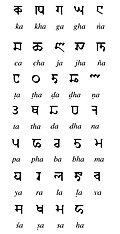
File:Sharada-Consonants.jpg|Sharada consonant signs | File:Sharada-Consonants.jpg|Sharada consonant signs | ||
File:Die Sprachenhalle 1.jpg|Sanskrit (above; devanagari script) and Kashmiri language (below; sharada script) | File:Die Sprachenhalle 1.jpg|Sanskrit (above; devanagari script) and Kashmiri language (below; sharada script) | ||
File:Sarada Script of Kashmir.jpg|Old manuscript using Sharada script | |||
File:Sharadastotrafull.png|The Sharadastotra rendered in the style of handwritten manuscripts from the 17th to 19th century | |||
File:Kashmiri miniature painting of Brahma, Vishnu, Mahesh, and other Indic deities figuratively within the Sharada script Omkar glyph.jpg|Kashmiri miniature painting of [[Brahma]], [[Vishnu]], [[Shiva|Mahesh]], and other [[Hindu deities|Indic deities]] figuratively within the Sharada script [[Om]]kar glyph | |||
File:Sanskrit manuscript 1219 Wellcome L0043910.jpg|Folio of the ''Citrabhânuçataka'' by Ratnakantha Rajanaka written in Sharada script, circa 17th century | |||
</gallery> | </gallery> | ||
== Unicode == | == Unicode == | ||
{{Main|Sharada (Unicode block)}} | {{Main|Sharada (Unicode block)|Sharada Supplement|l2=Sharada Supplement (Unicode block)}} | ||
Śāradā script was added to the [[Unicode]] Standard in January, 2012 with the release of version 6.1.<ref>{{Cite web|url=https://www.unicode.org/L2/L2009/09074r2-n3595-sharada.pdf|title=L2/09-074R2: Proposal to encode the Sharada Script in ISO/IEC 10646|date=2009-08-05|first=Anshuman|last=Pandey}}</ref> | Śāradā script was added to the [[Unicode]] Standard in January, 2012 with the release of version 6.1.<ref>{{Cite web|url=https://www.unicode.org/L2/L2009/09074r2-n3595-sharada.pdf|title=L2/09-074R2: Proposal to encode the Sharada Script in ISO/IEC 10646|date=2009-08-05|first=Anshuman|last=Pandey}}</ref> | ||
| Line 363: | Line 213: | ||
The Unicode block for Śāradā script, called Sharada, is U+11180–U+111DF: | The Unicode block for Śāradā script, called Sharada, is U+11180–U+111DF: | ||
{{Unicode chart Sharada}} | {{Unicode chart Sharada}} | ||
[[Kashmiri language|Kashmiri]]-specific vowels for contemporary use with Śāradā script were added in September 2025 with the release of version 17.0. | |||
They are in the Sharada Supplement block, which is U+11B60–U+11B7F: | |||
{{Unicode chart Sharada Supplement}} | |||
==See also== | ==See also== | ||
* [[Lipi]] – writing scripts in Buddhist, Hindu and Jaina texts | * [[Lipi (script)|Lipi]] – writing scripts in Buddhist, Hindu and Jaina texts | ||
* [[Sharada Peeth]] in Kashmir | * [[Sharada Peeth]] in Kashmir | ||
==References== | ==References== | ||
{{Reflist}} | {{Reflist}} | ||
===Works cited=== | |||
* {{Citation |last=Brown |first=Robert |year=1991 |title=Ganesh: Studies of an Asian God |location=Albany |publisher=State University of New York |isbn=978-0791406571 |url=https://books.google.com/books?id=oF-Hqih3pBAC}} | |||
==External links== | ==External links== | ||
*[https://aksharamukha.appspot.com/describe/Sharada Aksharamukha: Sharada script] | *[https://aksharamukha.appspot.com/describe/Sharada Aksharamukha: Sharada script] | ||
*Saerji. (2009). ''[http://www.fanfoyan.com/resour/pale/abhidharm.pdf Śāradā script: Akṣara List of the Manuscript of Abhidharmadīpa (ca. the 11th Century)]''. Research Institute of Sanskrit Manuscripts & Buddhist Literature, Peking University. | *Saerji. (2009). ''[http://www.fanfoyan.com/resour/pale/abhidharm.pdf Śāradā script: Akṣara List of the Manuscript of Abhidharmadīpa (ca. the 11th Century)]''. Research Institute of Sanskrit Manuscripts & Buddhist Literature, Peking University. | ||
*[http://www.expressindia.com/news/ie/daily/20010105/iin05014.html Prevalence of the Śāradā Script in Afghanistan] | *[http://www.expressindia.com/news/ie/daily/20010105/iin05014.html Prevalence of the Śāradā Script in Afghanistan] {{Webarchive|url=https://web.archive.org/web/20100920034518/http://www.expressindia.com/news/ie/daily/20010105/iin05014.html |date=2010-09-20 }} | ||
{{list of writing systems}} | {{list of writing systems}} | ||
| Line 383: | Line 241: | ||
[[Category:Sarada scripts]] | [[Category:Sarada scripts]] | ||
[[Category:History of Kashmir]] | [[Category:History of Kashmir]] | ||
[[Category:8th-century introductions]] | |||
[[Category:Writing systems introduced in the 1st millennium]] | |||
Latest revision as of 09:35, 14 March 2026
| Sharada script Śāradā 𑆯𑆳𑆫𑆢𑆳 | |
|---|---|
 The word śāradā in Sharada script | |
| Script type | |
Time period | 700 CE –present (almost extinct)[1] |
| Region | India, Pakistan, Central Asia |
| Languages | Sanskrit, Kashmiri |
| Related scripts | |
Parent systems | |
Child systems | Takri Landa |
Sister systems | Siddham, Tibetan,[2][3] Kalinga, Bhaiksuki |
| ISO 15924 | |
| ISO 15924 | Shrd, , Sharada, Śāradā |
| Unicode | |
Unicode alias | Sharada |
| |

| Brahmic scripts |
|---|
| The Brahmic script and its descendants |
The Śāradā (also spelled Sarada or Sharada) script is an abugida writing system of the Brahmic family of scripts. The script was widespread between the 8th and 12th centuries in the northwestern parts of Indian Subcontinent (in Kashmir and neighbouring areas), for writing Sanskrit and Kashmiri.[4][1][5] Although originally a signature Brahminical script created in the valley, it was more widespread throughout northwestern Indian subcontinent, and later became restricted to Kashmir, and is now rarely used, except by the Kashmiri Pandit community for religious purposes.[1]

It is a native script of Kashmir and is named after the goddess Śāradā or Saraswati, the goddess of learning and the main Hindu deity of the Sharada Peeth temple.[7]
History[edit | edit source]


Sharda script is named after the Hindu goddess Śāradā, also known as Saraswati, the goddess of learning and the main Hindu deity of the Sharada Peeth temple.[7]
Although originally a script restricted to only Brahmins, Sharda was later spread throughout the larger Hindu population in Northwestern Indian subcontinent, as Hinduism became the dominant religion in the region again.[7][8][9]
The Bakhshali manuscript uses an early stage of the Sharada script.[4] The Sharada script was used in Afghanistan as well as in the Himachal region in India. In Afghanistan, the Kabul Ganesh has a 6th to 8th century Proto-Sharada[clarification needed] inscription mentioning the, Turk Shahis, king Khingala of Oddiyana.[10] At the historic temple of Mirkula Devi (also Mrikula Devi) in Lahaul, [Himachal Pradesh], the goddess Mahishamardini has a Sharada inscription of 1569 CE.[11]
From the 10th century onwards, regional differences started to appear between the Sharada script used in Punjab, the Hill States (partly Himachal Pradesh) and Kashmir. Sharada proper was eventually restricted to very limited ceremonial use in Kashmir, as it grew increasingly unsuitable for writing the Kashmiri language.[12] With the last known inscription dating to 1204 C.E., the early 13th century marks a milestone in the development of Sharada.[12] The regional variety in Punjab continued to evolve from this stage through the 14th century; during this period it starts to appear in forms closely resembling Gurmukhī and other Landa scripts. By the 15th century, Sharada had evolved so considerably that epigraphists denote the script at this point by a special name, Devāśeṣa.[12]
Letters[edit | edit source]
Vowels[edit | edit source]
| Letter | Diacritic on ⟨𑆥⟩ | Special forms |
|---|---|---|
| Template:Letter | 𑆥 pa | |
| Template:Letter | 𑆥𑆳 pā | 𑆕 → 𑆕𑆳; 𑆘 → 𑆘𑆳; 𑆛 → 𑆛𑆳; 𑆟 → 𑆟𑆳 |
| Template:Letter | 𑆥𑆴 pi | |
| Template:Letter | 𑆥𑆵 pī | |
| Template:Letter | 𑆥𑆶 pu | 𑆑 → 𑆑𑆶; 𑆓 → 𑆓𑆶; 𑆙 → 𑆙𑆶; 𑆚 → 𑆚𑆶; 𑆝 → 𑆝𑆶; 𑆠 → 𑆠𑆶; 𑆨 → 𑆨𑆶; 𑆫 → 𑆫𑆶; 𑆯 → 𑆯𑆶 |
| Template:Letter | 𑆥𑆷 pū | 𑆑 → 𑆑𑆷; 𑆓 → 𑆓𑆷; 𑆙 → 𑆙𑆷; 𑆚 → 𑆚𑆷; 𑆝 → 𑆝𑆷; 𑆠 → 𑆠𑆷; 𑆨 → 𑆨𑆷; 𑆫 → 𑆫𑆷; 𑆯 → 𑆯𑆷 |
| Template:Letter | 𑆥𑆸 pr̥ | 𑆑 → 𑆑𑆸 |
| Template:Letter | 𑆥𑆹 pr̥̄ | 𑆑 → 𑆑𑆹 |
| Template:Letter | 𑆥𑆺 pl̥ | |
| Template:Letter | 𑆥𑆻 pl̥̄ | |
| Template:Letter | 𑆥𑆼 pē | |
| Template:Letter | 𑆥𑆽 pai | |
| Template:Letter | 𑆥𑆾 pō | |
| Template:Letter | 𑆥𑆿 pau | |
| Template:Letter | 𑆥𑆀 pam̐ | |
| Template:Letter | 𑆥𑆁 paṃ | |
| Template:Letter | 𑆥𑆂 paḥ |
Consonants[edit | edit source]
Numerals[edit | edit source]
| Template:Letter | Template:Letter | Template:Letter | Template:Letter | Template:Letter | Template:Letter | Template:Letter | Template:Letter | Template:Letter | Template:Letter |
Sharada script uses its own signs for the positional decimal numeral system.
Image gallery[edit | edit source]
-
 Sharada vowels
 -
 Sharada consonant signs
 -
 Sanskrit (above; devanagari script) and Kashmiri language (below; sharada script)
 -
 Old manuscript using Sharada script
 -
The Sharadastotra rendered in the style of handwritten manuscripts from the 17th to 19th century
-
 Kashmiri miniature painting of Brahma, Vishnu, Mahesh, and other Indic deities figuratively within the Sharada script Omkar glyph
 -
 Folio of the Citrabhânuçataka by Ratnakantha Rajanaka written in Sharada script, circa 17th century


Unicode[edit | edit source]
Śāradā script was added to the Unicode Standard in January, 2012 with the release of version 6.1.[13]
The Unicode block for Śāradā script, called Sharada, is U+11180–U+111DF: Template:Unicode chart Sharada
Kashmiri-specific vowels for contemporary use with Śāradā script were added in September 2025 with the release of version 17.0.
They are in the Sharada Supplement block, which is U+11B60–U+11B7F: Template:Unicode chart Sharada Supplement
See also[edit | edit source]
- Lipi – writing scripts in Buddhist, Hindu and Jaina texts
- Sharada Peeth in Kashmir
References[edit | edit source]
- ↑ 1.0 1.1 1.2 Singh, Upinder (2008). A History of Ancient and Early Medieval India: From the Stone Age to the 12th Century. Pearson Education India. p. 43. ISBN 9788131711200.
- ↑ Daniels, P.T. (27 March 2008). "Writing systems of major and minor languages". In Kachru, Braj B.; Kachru, Yamuna; Sridhar, S. N. (eds.). Language in South Asia. Cambridge University Press. ISBN 978-1-139-46550-2.
- ↑ Masica, Colin (1993). The Indo-Aryan languages. p. 143.
- ↑ 4.0 4.1 Selin, Helaine (2008). Encyclopaedia of the History of Science, Technology, and Medicine in Non-Western Cultures. Springer Science & Business Media. p. Bakhshali Manuscript entry. Bibcode:2008ehst.book.....S. ISBN 9781402045592.
- ↑ Sir George Grierson. (1916). "On the Sharada Alphabet". Journal of the Royal Asiatic Society, 17.
- ↑ For photograph of statue and details of inscription, see: Dhavalikar, M. K., "Gaņeśa: Myth and Reality", in: Brown 1991, pp. 50,63.
- ↑ 7.0 7.1 7.2 "Pandits to visit Sharda temple". The Hindu. 17 May 2006. Archived from the original on 4 February 2007. Retrieved 13 August 2012.
- ↑ "The Indigenous Script of Kashmir – The Sharda Script". June 12, 2020. Retrieved September 24, 2023.
{{cite web}}: CS1 maint: deprecated archival service (link) - ↑ Fogelin, Lars (2015). An Archaeological History of Indian Buddhism. Oxford University Press. p. 149. ISBN 9780199948239. Retrieved September 24, 2023.
...the emergence and spread of Hinduism through Indian society helped lead to Buddhism's gradual decline in India.
- ↑ From Persepolis to the Punjab: Exploring Ancient Iran, Afghanistan and Pakistan, Elizabeth Errington, Vesta Sarkhosh Curtis, British Museum Press, 2007 p. 96
- ↑ Observations on the Architecture and on a Carved Wooden Door of the Temple of Mirkulā Devī at Udaipur, Himachal Pradesh, Francesco Noci, East and West, Vol. 44, No. 1 (March 1994), pp. 99-114
- ↑ 12.0 12.1 12.2 Pandey, Anshuman (2009-03-25). "N3545: Proposal to Encode the Sharada Script in ISO/IEC 10646" (PDF). Working Group Document, ISO/IEC JTC1/SC2/WG2.
- ↑ Pandey, Anshuman (2009-08-05). "L2/09-074R2: Proposal to encode the Sharada Script in ISO/IEC 10646" (PDF).
Works cited[edit | edit source]
- Brown, Robert (1991), Ganesh: Studies of an Asian God, Albany: State University of New York, ISBN 978-0791406571
External links[edit | edit source]
- Aksharamukha: Sharada script
- Saerji. (2009). Śāradā script: Akṣara List of the Manuscript of Abhidharmadīpa (ca. the 11th Century). Research Institute of Sanskrit Manuscripts & Buddhist Literature, Peking University.
- Prevalence of the Śāradā Script in Afghanistan Archived 2010-09-20 at the Wayback Machine