







WikiDwarfBOT (talk | contribs) Cleanup: Grammar fix. Source modification. |
HymanGumm776 (talk | contribs) m fixed information per sources |
||
| Line 1: | Line 1: | ||
{{Short description|Ancient | {{Short description|Ancient Indo-Aryan civilisation}} | ||
{{About|| | {{About|the ancient civilisation|other uses|||||}} | ||
{{Use British English|date= | {{Use British English|date=July 2025}}{{Use dmy dates|date=July 2025}} | ||
{{Use dmy dates|date= | |||
{{Infobox Former Subdivision | {{Infobox Former Subdivision | ||
| native_name = Gandhara | | native_name = Gandhara | ||
| conventional_long_name = Gandhāra | | conventional_long_name = Gandhāra | ||
| common_name = Gandhara | | common_name = Gandhara | ||
| subdivision = Province | | subdivision = Province | ||
| nation = | | nation = | ||
| era = [[Ancient history|Antiquity]] | | era = [[Ancient history|Antiquity]] | ||
| capital = [[ | | capital = [[Pushkalavati]]<br/>[[Purushapura]]<br/>[[Kapisa|Kapisa]]<br/>[[Taxila]]<br/>[[Hund, Khyber Pakhtunkhwa|Hund]] | ||
| title_leader = | | title_leader = [[Raja]] | ||
| year_leader1 = {{circa| | | year_leader1 = {{circa|6th/5th cent. BCE}} | ||
| leader1 = [[Pushkarasarin]] | | leader1 = [[Pushkarasarin]] | ||
| year_leader2 = {{circa|330 | | year_leader2 = {{circa|330 BCE}} | ||
| leader2 = [[Taxiles]] | | leader2 = [[Taxiles]] | ||
| year_leader3 = {{circa| | | year_leader3 = {{circa|321 BCE}} | ||
| leader3 = [[ | | leader3 = [[Chandragupta Maurya]] | ||
| image_map = {{Location map+ | | image_map = {{Location map+ | ||
|Pakistan | |Pakistan | ||
|float = | |float = center | ||
|width = 320 | |width = 320 | ||
|caption = | |caption = | ||
| Line 49: | Line 47: | ||
{{location map~ |Gandhara |lat=33.6|N |long=72.1|E |label=''[[Indus]]<br/>[[Indus|river]]''|position=bottom |label_size=70|mark=File:1000x1.png|marksize=0}} | {{location map~ |Gandhara |lat=33.6|N |long=72.1|E |label=''[[Indus]]<br/>[[Indus|river]]''|position=bottom |label_size=70|mark=File:1000x1.png|marksize=0}} | ||
}} | }} | ||
| image_map2_caption = Approximate geographical region of Gandhara centered on the [[Valley of Peshawar|Peshawar Basin]], in present-day northwest [[Pakistan]] | | image_map2_caption = Approximate geographical region of Gandhara centered on the [[Valley of Peshawar|Peshawar Basin]], in present-day northwest [[Pakistan]] | ||
| life_span = | | life_span = | ||
| year_start = | | year_start = | ||
| event_start = | | event_start = | ||
| event1 = | | event1 = | ||
| date_event1 = | | date_event1 = | ||
| year_end = | | year_end = | ||
| date_end = 27 November | |||
| event_end = | | event_end = | ||
| s1 = | | s1 = | ||
| today = [[ | | today = [[Pakistan]]<br/>[[Afghanistan]] | ||
| leader4 = [[Sases]] | |||
| year_leader4 = {{circa|46 CE}} | |||
| leader5 = [[Kanishka]] | |||
| year_leader5 = {{circa|127 CE}} | |||
| leader6 = [[Mihirakula]] | |||
| year_leader6 = {{circa|514 CE}} | |||
| leader7 = [[Jayapala]] | |||
| year_leader7 = 964 – 1001 | |||
}} | }} | ||
''' | '''Gandhara''' ({{IAST3|Gandhāra}}) was an ancient [[Indo-Aryan people|Indo-Aryan]]<ref name=":4">{{Cite book |last=Bryant |first=Edwin Francis |url=https://books.google.com/books?id=3UWFPwAACAAJ |title=The Quest for the Origins of Vedic Culture: The Indo-Aryan Migration Debate |date=2002 |publisher=Oxford University Press |isbn=978-0-19-565361-8 |language=en|page=138}}</ref> civilisation in present-day northwestern [[Pakistan]] and eastern [[Afghanistan]].<ref name="auto1">{{Cite book |last1=Kulke |first1=Professor of Asian History Hermann |url=https://books.google.com/books?id=TPVq3ykHyH4C&pg=PA53 |title=A History of India |last2=Kulke |first2=Hermann |last3=Rothermund |first3=Dietmar |date=2004 |publisher=Psychology Press |isbn=978-0-415-32919-4 |language=en}}</ref><ref name="auto">{{Cite book |last=Warikoo |first=K. |url=https://books.google.com/books?id=NsdvkRtAtusC&pg=PA73 |title=Bamiyan: Challenge to World Heritage |date=2004 |publisher=Third Eye |isbn=978-81-86505-66-3 |language=en}}</ref><ref name="auto2">{{Cite book |last=Hansen |first=Mogens Herman |url=https://books.google.com/books?id=8qvY8pxVxcwC&pg=PA377 |title=A Comparative Study of Thirty City-state Cultures: An Investigation |date=2000 |publisher=Kgl. Danske Videnskabernes Selskab |isbn=978-87-7876-177-4 |language=en}}</ref> The core of the region of Gandhara was the [[Valley of Peshawar]], though the cultural influence of "Greater Gandhara" extended across the [[Indus River]] to [[Taxila]] and westwards into the [[Kabul Valley]] as far as [[Bamyan]], and northwards up to the [[Karakoram]] range, including [[Swat District|Swat]], [[Bajaur District|Bajaur]] and other valleys.{{sfn|Neelis, Early Buddhist Transmission and Trade Networks|2010|loc=|pp=232–233}}{{sfn|Eggermont, Alexander's Campaigns in Sind and Baluchistan|1975|pp=175–177}} | ||
The ''Gandhara tribe'', after which it is named, is attested in the [[Rigveda]] ( | The ''Gandhara tribe'', after which it is named, is attested in the [[Rigveda]] (<abbr>c.</abbr> 1500 – c. 1200 BCE), while the region is mentioned in the Zoroastrian [[Avesta]] as ''Vaēkərəta'', the [[Avestan geography|seventh most beautiful place]] on earth created by [[Ahura Mazda]]. Gandhara was one of the 16 ''[[Avestan geography|Great Realms]]'' of the [[second urbanisation]]. | ||
The [[Iron Age in India|Iron Age]] [[Gandhāra (kingdom)|Gandhara kingdom]] | The [[Iron Age in India|Iron Age]] [[Gandhāra (kingdom)|Gandhara kingdom]] was [[Achaemenid conquest of the Indus Valley|conquered by Cyrus I]] in the 6th century BCE who incorporated it as the satrapy of [[Gandāra]] into the [[Achaemenid Empire]], later [[Cophen campaign|being conquered]] by [[Alexander the Great]] in 327 BCE. Afterwards it became a part of the [[Maurya Empire]], followed by the [[Indo-Greek Kingdom]]. The region was a major centre for [[Greco-Buddhism]] under the Indo-Greeks and [[Gandharan Buddhism]] under later dynasties; Gandhara was also the central location for the [[Silk Road transmission of Buddhism]] to Central and East Asia.<ref>[http://www.washington.edu/uwpress/search/books/SALANC.html "UW Press: Ancient Buddhist Scrolls from Gandhara"]. Retrieved April 2018.</ref> | ||
[[Gandhari language| | [[Gandhari language|Gandhārī]], an [[Indo-Aryan languages|Indo-Aryan language]] written in [[Kharosthi script]], acted as lingua franca of the region. Famed for its unique [[Gandhara art|Gandharan style of art]] influenced by the classical Hellenistic styles, Gandhara attained its height from the 1st century to the 5th century CE under the [[Kushan Empire]], who had their capital at Peshawar (''[[Puruṣapura]]'') and ushered a period of relative peace known as ''[[Pax Kushana]]''. Gandhara "flourished at the crossroads of India, Central Asia, and the Middle East," connecting [[Silk Road|trade routes]] and absorbing cultural influences from diverse civilizations; Buddhism thrived until the 8th or 9th centuries, when [[Islam]] first began to gain sway in the region. | ||
The region | The region declined after the invasion by the [[Alchon Huns]] in 6th century, and the name Gandhara disappeared after [[Mahmud Ghaznavi]]'s conquest of [[Hindu Shahis|Hindu Shahi Kingdom]] in 1001 CE. | ||
==Etymology== | ==Etymology== | ||
Gandhara was known in [[Sanskrit]] as Gandhāraḥ ({{lang|sa|[[wikt:गन्धार|गन्धारः]]}}) and in [[Avestan]] as '{{lang|ae|Vaēkərəta}}. In [[Old Persian]], Gandhara was known as [[Gadāra]] ([[:Wikt:𐎥𐎭𐎠𐎼|𐎥𐎭𐎠𐎼]], also transliterated as Ga<sup>n</sup>dāra since the nasal "n" before consonants were omitted in Old Persian).<ref name="Old Persian">Some sounds are omitted in the writing of Old Persian and are shown with a raised letter. [https://archive.org/stream/OldPersian#page/n177/mode/2up/ Old Persian p.164][https://archive.org/stream/OldPersian#page/n23/mode/2up/ Old Persian p.13]. In particular, Old Persian nasals such as "n" were omitted in writing before consonants [https://archive.org/stream/OldPersian#page/n27/mode/2up/ Old Persian p.17][https://archive.org/stream/OldPersian#page/n35/mode/2up/ Old Persian p.25]</ref> In [[Chinese language|Chinese]], Gandhara is known as ''Jiāntuóluó'' ({{zh|t={{wt|zh|犍陀羅}}|s=犍陀罗|first=t}}, also written {{zh|t={{wt|zh|健馱邏}}|s=健驮逻|labels=no|first=t}}), with the Middle Chinese pronunciation reconstructed as ''kɨɐndala''. One state of the region named ''[[Jibin|Jìbīn]]'' ({{zh|t={{wt|zh|罽賓}}|s=罽宾|labels=no|first=t}}, also romanised as Kipin) is recorded in the [[Book of Han]]. | |||
One proposed origin of the name is from the Sanskrit word ''{{IAST|gandhaḥ}}'' ({{lang|sa|[[wikt:गन्ध|गन्धः]]}}), meaning "perfume" and "referring to the spices and aromatic herbs which they (the inhabitants) traded and with which they anointed themselves".<ref>{{cite web|title=On Yuan Chwang's travels in India, 629–645 A.D.|author=Thomas Watters|publisher=[[Royal Asiatic Society]]|year=1904|url=https://archive.org/stream/onyuanchwangstr00wattgoog#page/n220/mode/2up|page=200|quote=Taken as Gandhavat the name is explained as meaning ''hsiang-hsing'' or "scent-action" from the word gandha which means ''scent'', ''small'', ''perfume''.}} At the [[Internet Archive]].</ref><ref>{{cite book|url=https://books.google.com/books?id=PzIer-wYbnQC&pg=PA176|title=Placenames of the World|author=Adrian Room|publisher=McFarland|year=1997|quote=Kandahar. ''City, south central Afghanistan''|isbn=9780786418145}} At Google Books.</ref> The [[Gandhari people]] are a [[List of Rigvedic tribes|tribe]] mentioned in the [[Rigveda]], the [[Atharvaveda]], and later Vedic texts.<ref>{{cite book | url=https://books.google.com/books?id=t6TVLlPvuMAC&pg=PA219 | title=Vedic Index of Names and Subjects|volume=1|year=1995|page=219|first1=Arthur Anthony|last1=Macdonell|first2=Arthur Berriedale|last2=Keith|publisher=Motilal Banarsidass Publishers| isbn=9788120813328}} From [[Google Books]].</ref> This origin is also supported by the word ''Gandhara'' meaning “fragrance bringer” in the [[Pashayi languages|Pashayi language]]. A [[Persian language|Persian]] form of the name, ''Gandara'', mentioned in the [[Behistun inscription]] of Emperor [[Darius I]],<ref>{{Cite web | url=https://www.livius.org/articles/place/gandara/? |title = Gandara – Livius}}</ref><ref>{{cite book|last=Herodotus|author-link=Herodotus|title=Histories|chapter=3.102.1|year=1920|chapter-url=https://www.perseus.tufts.edu/hopper/text?doc=Perseus%3Atext%3A1999.01.0125%3Abook%3D3%3Achapter%3D102%3Asection%3D1|title-link=Histories (Herodotus)}} {{cite book|chapter=4.44.2|language=el|chapter-url=https://www.perseus.tufts.edu/hopper/text?doc=Perseus%3Atext%3A1999.01.0125%3Abook%3D4%3Achapter%3D44%3Asection%3D2|title=Histories|translator=A. D. Godley|title-link=Histories (Herodotus)}} {{cite book|title=Histories|chapter=3.102.1|chapter-url=https://www.perseus.tufts.edu/hopper/text?doc=Hdt.+3.102.1&fromdoc=Perseus%3Atext%3A1999.01.0126|title-link=Histories (Herodotus)}} {{cite book|title=Histories|chapter=4.44.2|chapter-url=https://www.perseus.tufts.edu/hopper/text?doc=Hdt.+4.44.2&fromdoc=Perseus%3Atext%3A1999.01.0125|place=Cambridge|publisher=Harvard University Press.|title-link=Histories (Herodotus)}} At the [[Perseus Project]].</ref> was translated as ''[[Paruparaesanna]]'' (''{{lang|peo|Para-upari-sena}}'', meaning "beyond the Hindu Kush") in [[Babylonian language|Babylonian]] and [[Elamite language|Elamite]] in the same inscription.<ref name="PC2004">Perfrancesco Callieri, [http://www.iranicaonline.org/articles/india-ii-historical-geography INDIA ii. Historical Geography], Encyclopaedia Iranica, 15 December 2004.</ref> In [[Ancient Greek|Greek]], Gandhara was known as [[Paropamisadae]]'''.<ref name="HIII">Herodotus [https://penelope.uchicago.edu/Thayer/E/Roman/Texts/Herodotus/3D*.html Book III, 89–95]</ref>''' | |||
== Geography == | |||
The geographical extent of Gandhara underwent much alteration throughout history, with the core being the region bounded by the Indus River, the Swat Valley, and the [[Kabul River]].<ref>{{Cite book |last=University Of Pittsburgh Press U.S.A. |url=http://archive.org/details/in.ernet.dli.2015.198056 |title=Cultural History Of Kapisa And Gandhara |date=1961 |pages=12–13 |quote=The Ramayana places Gandhara on both banks of the Indus....According to Strabo, Gandharites lay along the river Kophes, between the Khoaspes and the Indus. Ptolemy places Gandhara between Suastos (Swat) and the Indus including both banks of Koa immediately above its junction with the Indus.}}</ref> Its prominent urban centres were [[Taxila]] and [[Pushkalavati]].<ref>{{Cite book |last=University Of Pittsburg Press U.S.A. |url=http://archive.org/details/in.ernet.dli.2015.198056 |title=Cultural History Of Kapisa And Gandhara |date=1961 |page=12 |quote=The Ramayana places Gandhara on both banks of the Indus with its two royal cities Pushkalavati for the west and Takshasila for the east.}}</ref> The cultural influence of Gandhara stretched as far as [[Jhelum River]] in the east as evident by the discovery of Gandhara style Buddhist artworks there.<ref>{{Cite web |title=Decorative Motifs on Pedestals of Gandharan Sculptures: A Case Study of Peshawar Museum |url=https://ph.hu.edu.pk/public/uploads/vol-12/Paper%208.%20Fawad%20Khan%20Final%20.pdf |page=173 |quote=While according to the recent research, the cultural influence of Gandhāra even reached up to the valley of the Jhelum River in the east (Dar 2007: 54-55).}}</ref><ref>{{Cite web |title=The geography of Gandharan art |url=https://www.carc.ox.ac.uk/PublicFiles/media/The%20Geography%20of%20Gandharan%20Art.pdf |page=6 |quote=although Saifur Rahman Dar sought in 2007 to extend the geographical frame to the left bank of the Jhelum river, on account of six Buddhist images discovered at the sites of Mehlan, Patti Koti, Burarian, Cheyr and Qila Ram Kot (Dar 2007: 45-59), evidence remains insufficient to support his conclusions.}}</ref><ref>{{Cite book |last=Sastri |first=K. a Nilakanta |url=http://archive.org/details/in.ernet.dli.2015.532644 |title=Comprehensive History Of India Vol.2 (mauryas And Satavahanas) |date=1957 |page=1 |quote=Here he had to depend upon and appoint Indians as his satraps, viz., Ambhi, king of Taxila, to rule from the Indus to the Hydaspes (Jhelum).}}</ref> One [[Jataka tales|Jataka]] even includes [[Kashmir]] within Gandhara.<ref name=":4" /> | |||
[[Richard G. Salomon (professor of Asian studies)|Richard Solomon]] uses the term "Greater Gandhara" to describe the extent of cultural influence of Gandhara and its language, Gandhari.<ref>{{Cite book |last=Wannaporn Rienjang and Peter Stewart |url=http://archive.org/details/TheGeographyOfGandharanArt |title=The Geography Of Gandhāran Art: Proceedings of the Second International Workshop of the Gandhāra Connections Project, University of Oxford, 22nd-23rd March, 2018 |date=15 March 2019 |page=8 |quote=The Greater Gandhara of philologists, or at least of Salomon, extends beyond the western foothills of the Hindu Kush and the Karakorum Highway to include parts of Bactria and even parts of the region around the Tarim Basin. As Salomon specifies in The Buddhist Literature from Ancient Gandhara, ‘thus Greater Gandhara can be understood as a primarily linguistic rather than a political term, that is, as comprising the regions where Gandharl was the indigenous or adopted language’. Accordingly, it includes places such as Bamiyan where over two hundred of fragments of manuscripts in Gandharl have been discovered along with a larger group of manuscripts in Sanskrit.}}</ref> In the later historical sources, Greater Gandhara encompassed the territories of [[Jibin]] and [[Oddiyana]], extending into parts of [[Bactria]] and the [[Tarim Basin]]. Oddiyana was situated in the vicinity of the Swat Valley, while Jibin corresponded to the region of [[Kapisa (city)|Kapisa]], south of the Hindu Kush.<ref>{{Cite book |last=Wannaporn Rienjang and Peter Stewart |url=http://archive.org/details/TheGeographyOfGandharanArt |title=The Geography Of Gandhāran Art: Proceedings of the Second International Workshop of the Gandhāra Connections Project, University of Oxford, 22nd-23rd March, 2018 |date=15 March 2019 |page=7 |quote=Other scholars had alternately equated Jibin with Kapisa and more frequently with Kashmir. Kuwayama concludes that while this identification might prove correct for some sources, the Gaoseng zhuan s fourth and fifth century placement of Jibin coincides clearly with the narrower geographical definition of Gandhara.}}</ref> | |||
The Udichya region was noted by 6th century BCE scholar [[Pāṇini]] as comprising both the regions of [[Vahika]] and Gandhara.<ref>{{Cite book |last=Agrawala |first=V. S. |url=http://archive.org/details/in.gov.ignca.4695 |title=India as known to Panini |date=1953 |pages=38 |quote=Udichya and Prachya are the two broad divisions of the country mentioned by Panini, and these terms occur in connection with the linguistic forms known to the eastern and northern grammarians. The Udichya country included Gandhara and Vahika, the latter comprising Madra and Usinara.}}</ref> | |||
The | |||
==History== | ==History== | ||
=== | === Gandhāra grave culture === | ||
{{Main|Gandhara grave culture|Indo-Aryan migration|}} | {{Main|Gandhara grave culture|Indo-Aryan migration|}} | ||
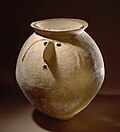
=== Vedic | [[File:Cremation Urn with Lid LACMA AC1994.234.8a-b.jpg|thumb|upright|Cremation urn, [[Gandhara grave culture]], Swat Valley, {{circa|1200 BCE}}|left]] | ||
Gandhara's first recorded culture was the Grave Culture that emerged {{circa|1200 BCE}} and lasted until 800 BCE,<ref>Olivieri, Luca M., Roberto Micheli, Massimo Vidale, and Muhammad Zahir, (2019). [https://reich.hms.harvard.edu/sites/reich.hms.harvard.edu/files/inline-files/2019_Science_NarasimhanPatterson_CentralSouthAsia_Supplement.pdf 'Late Bronze – Iron Age Swat Protohistoric Graves (Gandhara Grave Culture), Swat Valley, Pakistan (n-99)'], in Narasimhan, Vagheesh M., et al., "Supplementary Materials for the formation of human populations in South and Central Asia", Science 365 (6 September 2019), pp. 137–164.</ref> and named for their distinct funerary practices. It was found along the Middle [[Swat River]] course, even though earlier research considered it to be expanded to the Valleys of [[Dir (region)|Dir]], [[Kunar Province|Kunar]], [[Chitral]], and [[Valley of Peshawar|Peshawar]].<ref>Coningham, Robin, and Mark Manuel, (2008). "Kashmir and the Northwest Frontier", Asia, South, in ''Encyclopedia of Archaeology 2008'', Elsevier, p. 740.</ref> It has been regarded as a token of the Indo-Aryan migrations but has also been explained by local cultural continuity. Backwards projections, based on ancient DNA analyses, suggest ancestors of Swat culture people mixed with a population coming from [[Inner Asia Mountain Corridor]], which carried [[Eurasian Steppe|Steppe]] ancestry, sometime between 1900 and 1500 BCE.<ref>Narasimhan, Vagheesh M., et al. (2019). [https://reich.hms.harvard.edu/sites/reich.hms.harvard.edu/files/inline-files/2019_Science_NarasimhanPatterson_CentralSouthAsia.pdf "The formation of human populations in South and Central Asia"], in Science 365 (6 September 2019), p. 11: "...we estimate the date of admixture into the Late Bronze Age and Iron Age individuals from the Swat District of northernmost South Asia to be, on average, 26 generations before the date that they lived, corresponding to a 95% confidence interval of ~1900 to 1500 BCE..."</ref> | |||
=== Vedic Gandhāra === | |||
{{Main|Gandhāra (kingdom)|Gandhara Kingdom}} | {{Main|Gandhāra (kingdom)|Gandhara Kingdom}} | ||
[[File:Mahajanapadas (c. 500 BCE).png|thumb|upright=1.15|Kingdoms and cities of ancient Buddhism, with Gandhara located in the northwest of this region, during the time of the Buddha ({{circa|500 BCE}})]] | |||
According to [[Rigveda|Rigvedic tradition]], [[Yayati]] was the progenitor of the prominent Udichya (Gandhara and [[Vahika]] tribes) and had numerous sons, including Anu, Puru, and Druhyu. The lineage of Anu gave rise to the [[Madra]], [[Kekaya]], [[Sivi Kingdom|Sivi]] and [[Uśīnara]] kingdoms, while the Druhyu tribe has been associated with the Gandhara kingdom.<ref>{{Cite book |url=https://books.google.com/books?id=WIMlttRq_P4C&dq=Druhyu+Anu+Puru&pg=PA230 |title=Journal of the Royal Asiatic Society |date=1889 |publisher=University Press |page=212 |language=en}}</ref> | |||
The first mention of the Gandhārīs is attested once in the [[Rigveda|{{transliteration|sa|Ṛigveda}}]] as a tribe that has sheep with good wool. In the [[Atharvaveda|{{transliteration|sa|Atharvaveda}}]], the Gandhārīs are mentioned alongside the Mūjavants, the [[Anga|Āṅgeyas]] and the [[Magadha (Mahajanapada)|Māgadhīs]] in a hymn asking fever to leave the body of the sick man and instead go those aforementioned tribes. The tribes listed were the furthermost border tribes known to those in [[Madhyadesha|{{transliteration|sa|Madhyadeśa}}]], the Āṅgeyas and Māgadhīs in the east, and the Mūjavants and Gandhārīs in the north.<ref>{{Cite book |last1=Macdonell |first1=Arthur Anthony |title=Vedic Index of Names and Subjects |last2=Keith |first2=Arthur Berriedale |publisher=John Murray |year=1912 |pages=218–219}}</ref><ref>{{Cite book |last=Chattopadhyaya |first=Sudhakar |title=Reflections on the Tantras |publisher=Motilal Banarsidass Publishers |year=1978 |pages=4}}</ref> The ''Gandhara tribe'', after which it is named, is attested in the [[Rigveda]] ({{circa|1500|1200 BCE}}),<ref name="sacred-texts.com">{{cite web |title=Rigveda 1.126:7, English translation by Ralph TH Griffith |url=http://www.sacred-texts.com/hin/rigveda/rv01126.htm}}</ref><ref name="Macdonell1997">{{cite book |author=Arthur Anthony Macdonell |url=https://books.google.com/books?id=8wM-dNOa7fMC&pg=PA130 |title=A History of Sanskrit Literature |publisher=Motilal Banarsidass |year=1997 |isbn=978-81-208-0095-3 |pages=130–}}</ref> while the region is mentioned in the Zoroastrian [[Avesta]] as ''Vaēkərəta'', the [[Avestan geography|seventh most beautiful place]] on earth created by [[Ahura Mazda]]. | |||
The Gāndhārī king [[Nagnajit]] and his son Svarajit are mentioned in the [[Brahmana|{{transliteration|sa|Brāhmaṇa}}s]], according to which they received Brahmanic consecration, but their family's attitude towards ritual is mentioned negatively,{{sfn|Raychaudhuri|1953|p=59-62}} with the royal family of Gandhāra during this period following non-Brahmanical religious traditions. According to the [[Jainism|Jain]] [[Uttaradhyayana|{{transliteration|sa|Uttarādhyayana-sūtra}}]], Nagnajit, or Naggaji, was a prominent king who had adopted Jainism and was comparable to Dvimukha of [[Pancala|Pāñcāla]], Nimi of [[Videha]], Karakaṇḍu of [[Kalinga (historical region)|Kaliṅga]], and Bhīma of [[Vidarbha]]; [[Buddhism|Buddhist]] sources instead claim that he had achieved [[Pratyekabuddhayāna|{{transliteration|pi|paccekabuddhayāna}}]].{{sfn|Raychaudhuri|1953|p=146-147}}<ref name="Prakash">{{cite journal |last=Prakash |first=Buddha |date=1951 |title=Poros |url=https://www.jstor.org/stable/41784590 |journal=Annals of the Bhandarkar Oriental Research Institute |volume=32 |issue=1 |pages=198–233 |doi= |jstor=41784590 |access-date=12 June 2022}}</ref>{{Sfn|Macdonell|Keith|1912|p=218-219, 432}} | |||
Due to this important position, Buddhist texts listed the Gandhāra kingdom as one of the sixteen ''[[Mahajanapadas|{{transliteration|sa|Mahājanapada}}s]]'' ("great realms") of Iron Age South Asia. It was the home of [[Gandhari (Mahabharata)|Gandhari]], the princess of [[Gandhara Kingdom | By the later [[Vedic period]], the situation had changed, and the Gāndhārī capital of [[Taxila|Takṣaśila]] had become an important centre of knowledge where the men of {{transliteration|sa|Madhya-desa}} went to learn the three Vedas and the eighteen branches of knowledge, with the {{transliteration|sa|Kauśītaki Brāhmaṇa}} recording that [[Brahmin|{{transliteration|sa|brāhmaṇa}}s]] went north to study. According to the [[Shatapatha Brahmana|{{transliteration|sa|Śatapatha Brāhmaṇa}}]] and the {{transliteration|pi|Uddālaka Jātaka}}, the famous Vedic philosopher [[Uddālaka Āruṇi]] was among the famous students of Takṣaśila, and the {{transliteration|pi|Setaketu Jātaka}} claims that his son Śvetaketu also studied there. In the [[Chandogya Upanishad|{{transliteration|sa|Chāndogya Upaniṣad}}]], Uddālaka Āruṇi himself favourably referred to Gāndhārī education to the [[Videha|Vaideha]] king [[Janaka]].{{sfn|Raychaudhuri|1953|p=59-62}} During the 6th century BCE, Gandhāra was an important imperial power in north-west Iron Age South Asia, with the [[Kashmir Valley|valley of Kaśmīra]] being part of the kingdom.{{sfn|Raychaudhuri|1953|p=146-147}} Due to this important position, Buddhist texts listed the Gandhāra kingdom as one of the sixteen ''[[Mahajanapadas|{{transliteration|sa|Mahājanapada}}s]]'' ("great realms") of Iron Age South Asia. It was the home of [[Gandhari (Mahabharata)|Gandhari]], the princess and her brother [[Shakuni]] the king of [[Gandhara Kingdom]].<ref name="Higham2014">{{citation |last=Higham |first=Charles |title=Encyclopedia of Ancient Asian Civilizations |url=https://books.google.com/books?id=H1c1UIEVH9gC&pg=PA209 |pages=209– |year=2014 |publisher=Infobase Publishing |isbn=978-1-4381-0996-1}}</ref><ref name="Devi2007">{{cite book |author=Khoinaijam Rita Devi |url=https://books.google.com/books?id=R0UwAQAAIAAJ |title=History of ancient India: on the basis of Buddhist literature |date=1 January 2007 |publisher=Akansha Publishing House |isbn=978-81-8370-086-3}}</ref> | ||
===Achaemenid | === Pukkusāti and Achaemenid Gandhāra === | ||
{{Main|Gandāra}} | {{Main|Gandāra}} | ||
{{See also|Achaemenid invasion of the Indus Valley}} | {{See also|Achaemenid invasion of the Indus Valley}} | ||
[[File:Xerxes detail Gandharan enhanced.jpg|thumb|200x200px|[[Xerxes I]] tomb, Gandāra soldier, {{Circa|470 BCE}}]] | |||
[[File:Xerxes detail Gandharan enhanced.jpg|thumb|200x200px|[[Xerxes I]] tomb, Gandāra soldier, {{Circa|470 | |||
During the 6th or 5th century BCE, Gandhara was governed under the reign of King [[Pushkarasarin|Pukkusāti]]. There are no historical facts known for certain about Pukkusāti, and all theories about his reign are speculative relying on later [[Buddhism|Buddhist]] sources.<ref>{{Cite book |last=Chattopadhyaya |first=Sudhakar |url=https://archive.org/details/in.ernet.dli.2015.118140/page/n27/mode/2up?view=theater |title=The Achaemenids And India |date=1974 |pages=22–23}}</ref><ref name="Lamotte"/> It is debated whether he ruled before or after the [[Achaemenid conquest of the Indus Valley]], and is unknown what kind of relationship he historically had with the Persian Achaemenid rulers.<ref name="Karttunen">{{cite book | last=Karttunen | first=Klaus | title=India in Early Greek Literature | publisher=Finnish Oriental Society | date=1989 | isbn=978-951-9380-10-0 | url=https://books.google.com/books?id=1TxZAAAAMAAJ | pages=61–62}}</ref> According to [[Buddhism|Buddhist]] accounts written centuries later,<ref name="Lamotte">{{cite book | last=Lamotte | first=Etienne | title=History of Indian Buddhism: From the Origins to the Saka Era | publisher=Institut Orientaliste, Louvain-La-Neuve | date=1988 | url=https://books.google.com/books?id=sJwEAAAAYAAJ | page=101 | isbn=978-90-6831-100-6 | quote = Pukkusāti, whose history we learn from a late and partly apocryphal tradition}}</ref> he had forged diplomatic ties with [[Magadha (Mahajanapada)|Magadha]] and achieved victories over neighbouring kingdoms such as that of the realm of [[Avanti (region)|Avanti]].<ref>{{Cite book |last=Chattopadhyaya |first=Sudhakar |url=http://archive.org/details/in.ernet.dli.2015.118140 |title=The Achaemenids And India |date=1974 |page=22 |quote=According to the Buddhist account Pukkusati, king of Taksasila, sent an embassy and a letter to king Bimbisara of Magadha and he also defeated Pradyota, king of Avanti.}}</ref> [[Pushkarasarin|Pukkusāti]]'s kingdom was described as being 100 [[Yojana]]s in width, approximately 500 to 800 miles wide, with his capital at [[Taxila]] in modern day [[Punjab]] as stated in early [[Jataka tales|Jatakas.]]<ref>{{Cite web |title=Part 2 - Story of King Pukkusāti |date=11 September 2019 |url=https://www.wisdomlib.org/buddhism/book/the-great-chronicle-of-buddhas/d/doc364622.html |quote=This man of good family read the message sent by his friend King Bimbisāra and after completely renouncing his one hundred yojana-wide domain of Takkasīla, he became a monk out of reverence for Me.}}</ref> | |||
It is noted by [[R. C. Majumdar]] that Pukkusāti would have been contemporary to the [[Achamenid]] king [[Cyrus the Great]]<ref>{{Cite book |last=Chattopadhyaya |first=Sudhakar |url=http://archive.org/details/in.ernet.dli.2015.118140 |title=The Achaemenids And India |date=1974 |page=22 |quote=Bimbisara and his son Ajatasatru, he did not probably come to the throne before 540 or 530 bc, and Pukkusati also may be regarded as ruling in Gandhara about that time. He would be thus a contemporary of Cyrus who established his power and authority in 549 bc}}</ref> and according to the scholar Buddha Prakash, Pukkusāti might have acted as a bulwark against the expansion of the [[Persians|Persian]] [[Achaemenid Empire]] into Gandhara. This hypothesis posits that the army which [[Nearchus]] claimed Cyrus had lost in [[Gedrosia]] had been defeated by Pukkusāti's Gāndhārī kingdom.<ref name="Prakash" /> Therefore, following Prakash's position, the Achaemenids would have been able to conquer Gandhāra only after a period of decline after the reign of Pukkusāti, combined with the growth of Achaemenid power under the kings [[Cambyses II]] and [[Darius the Great|Darius I]].<ref name="Prakash" /> However, the presence of Gandhāra among the list of Achaemenid provinces in Darius's [[Behistun Inscription]] confirms that his empire had inherited this region from Cyrus.<ref name=":0">{{Cite book |url=http://archive.org/details/history-of-ancient-and-early-medeival-india-from-the-stone-age-to-the-12th-century-pdfdrive |title=History Of Ancient And Early Medieval India From The Stone Age To The 12th Century |page=604 |quote=The Behistun inscription of the Achaemenid emperor Darius indicates that Gandhara was conquered by the Persians in the later part of the 6th century BCE.}}</ref> Assuming that Pukkusāti lived during the 6th century BCE, is unknown whether he remained in power after the Achaemenid conquest as a Persian vassal or if he was replaced by a Persian [[satrap]], although [[Buddhism|Buddhist]] sources claim that he renounced his throne and became a monk after becoming a disciple of the [[Gautama Buddha|Buddha]].<ref>{{cite web|title=Pukkusāti|url=http://www.palikanon.com/english/pali_names/pu/pukkusati.htm|publisher=www.palikanon.com|access-date=26 July 2020}}</ref> The annexation under Cyrus was limited to the Western sphere of Gandhāra as only during the reign of [[Darius the Great]] did the region between the [[Indus River]] and the [[Jhelum River]] become annexed.<ref name="Prakash" /> | |||
However, with [[The Buddha#Dating|alternative chronologies]] which date the Buddha's lifetime (and his contemporary kings) as much as a century later, it is alternatively possible that [[Pushkarasarin|Pukkusāti]] in fact lived as much as a century after the Achaemenid conquest. Among scholars who favour the latter chronology, it remains an open question for debate, what kind of relationship Pukkusāti historically had with the Persian Achaemenid rulers. Possible theories are: he "may belong to a period when the Achaemenids had already lost their hold over Indian provinces," or he may have been holding power in eastern parts of Gandhara such as [[Taxila]] (speculatively considered by some scholars to be outside the Achaemenid dominions), or may have been serving as a vassal of the Achaemenids but with autonomy to conduct warfare and diplomacy with independent Indian states, similar to the "active and often independent role the western satraps had [[Greco-Persian Wars|in Greek politics]]". Thus it is considered that he may have been an important intermediary for [[Achaemenid_conquest_of_the_Indus_Valley#Influence_of_Achaemenid_culture_in_the_Indian_subcontinent|cultural influence between Ancient Persia and India]].<ref>{{Cite web |title=VIEWER XDOCS |url=https://docviewer.xdocs.net/view_v2.php |access-date=25 April 2025 |website=xdocs.net |pages=61–62 |language=en}}</ref> | |||
[[ | [[Megasthenes]] [[Indica (Megasthenes)|Indica]], states that the [[Achaemenid Empire|Achaemenids]] never conquered India and had only approached its borders after battling with the [[Massagetae]], it further states that the Persians summoned mercenaries specifically from the Oxydrakai tribe, who were previously known to have resisted the incursions of [[Alexander the Great]], but they never entered their armies into the region of Gandhara.<ref>{{Cite book |last=Mccrindle |first=J. W. |url=http://archive.org/details/AncientIndiaAsDescribedByMegasthenesAndArrianByMccrindleJ.W |title=Ancient India As Described By Megasthenes And Arrian by Mccrindle, J. W |page=109 |language=English |quote=The Persians indeed summoned the Hydrakai from India to serve as mercenaries, but they did not lead an army into the country and only approached its borders when Kyros marched against the Massagatai.}}</ref> [[File:Athens coin discovered in Pushkalavati.jpg|thumb|[[Athens]] coin ({{circa|500/490–485 BCE}}) discovered in [[Pushkalavati]]. This coin is the earliest known example of its type to be found so far east.<ref>O. Bopearachchi, "Premières frappes locales de l'Inde du Nord-Ouest: nouvelles données", in Trésors d'Orient: Mélanges offerts à Rika Gyselen, Fig. 1 [https://www.cngcoins.com/Coin.aspx?CoinID=199773 CNG Coins]</ref> Such coins were circulating in the area as currency, at least as far as the [[Indus]], during the reign of the [[Achaemenids]].<ref name="OB300">{{cite book |last1=Bopearachchi |first1=Osmund |title=Coin Production and Circulation in Central Asia and North-West India (Before and after Alexander's Conquest) |pages=300–301 |url=https://www.academia.edu/15798938 |language=en}}</ref><ref>{{Cite web |url=https://www.cemml.colostate.edu/cultural/09476/afgh05-106.html |title=US Department of Defense |access-date=7 October 2018 |archive-date=10 June 2020 |archive-url=https://web.archive.org/web/20200610004813/https://www.cemml.colostate.edu/cultural/09476/afgh05-106.html |url-status=dead }}</ref><ref name="JC">{{cite book |last1=Errington |first1=Elizabeth |last2=Trust |first2=Ancient India and Iran |last3=Museum |first3=Fitzwilliam |title=The Crossroads of Asia: transformation in image and symbol in the art of ancient Afghanistan and Pakistan |date=1992 |publisher=Ancient India and Iran Trust |isbn=9780951839911 |pages=57–59 |url=https://books.google.com/books?id=pfLpAAAAMAAJ |language=en}}</ref><ref name="OB308">{{cite book |last1=Bopearachchi |first1=Osmund |title=Coin Production and Circulation in Central Asia and North-West India (Before and after Alexander's Conquest) |pages=308– |url=https://www.academia.edu/15798938 |language=en}}</ref> |left]] | ||
During the reign of [[Xerxes I]], Gandharan troops were noted by [[Herodotus]] to have taken part in the [[Second Persian invasion of Greece]] and were described as clothed similar to that of the [[Bactria]]ns.<ref>{{Cite web |title=LacusCurtius • Herodotus — Book VII: Chapters 57‑137 |url=https://penelope.uchicago.edu/Thayer/E/Roman/Texts/Herodotus/7B*.html |access-date=27 January 2024 |website=penelope.uchicago.edu |quote=The Parthians, Chorasmians, Sogdians, Gandarians, and Dadicae in the army had the same equipment as the Bactrians.}}</ref> Herodotus states that during the battle they were led by the [[Achamenid]] general [[Artyphius]].<ref>{{Cite web |title=LacusCurtius • Herodotus — Book VII: Chapters 57‑137 |url=https://penelope.uchicago.edu/Thayer/E/Roman/Texts/Herodotus/7B*.html |access-date=27 January 2024 |website=penelope.uchicago.edu |quote=The Parthians and Chorasmians had for their commander Artabazus son of Pharnaces, the Sogdians Azanes son of Artaeus, the Gandarians and Dadicae Artyphius son of Artabanus.}}</ref> | |||
The | Under Persian rule, a system of centralised administration, with a bureaucratic system, was introduced into the Indus Valley for the first time. Provinces or "satrapy" were established with provincial capitals. The [[#Part of Achaemenid Empire|Gandhara]] satrapy, established 518 BCE with its capital at [[Pushkalavati]] ([[Charsadda]]).<ref>Rafi U. Samad, [https://books.google.com/books?id=pNUwBYGYgxsC&pg=PA33 ''The Grandeur of Gandhara: The Ancient Buddhist Civilization of the Swat, Peshawar, Kabul and Indus Valleys.''] Algora Publishing, 2011, p. 32 {{ISBN|0875868592}}</ref> It was also during the [[Achaemenid Empire]] rule of Gandhara that the [[Kharosthi]] script, the script of [[Gandhari prakrit]], was born through the [[Aramaic]] alphabet.<ref>{{Cite book |last=Konow |first=Sien |url=http://archive.org/details/in.ernet.dli.2015.62020 |title=Kharoshthi Inscriptions Except Those Of Asoka Vol.ii Part I (1929) |date=1929 |pages=18 |quote=Buhler had shown that the KharoshthI characters are derived from Aramaic, which Origin of was in common use for official purposes all over the Achaemenian empire during the KharoshthI period when it comprised north-western India... And Buhler is right in assuming that KharoshthI is ‘ the result of the intercourse between the offices of the Satraps and of the native authorities}}</ref> | ||
=== | === Hellenistic era Gandhāra === | ||
{{Main|Paropamisadae}} | {{Main|Paropamisadae}} | ||
{{See also|Indian campaign of Alexander the Great|Hellenistic period|Macedonian Empire}} | |||
According to [[Arrian]]'s [[Indica (Arrian)|Indica]], the area corresponding to Gandhara situated between the [[Kabul River]] and the [[Indus River]] was inhabited by two tribes noted as the [[Assakenoi]] and Astakanoi whom he describes as 'Indian' and occupying the two great cities of [[Massaga (ancient city)|Massaga]] located around the [[Swat valley]] and [[Pushkalavati]] in modern day Peshawar.<ref>{{Cite book |last=Mccrindle |first=J. W. |url=http://archive.org/details/AncientIndiaAsDescribedByMegasthenesAndArrianByMccrindleJ.W |title=Ancient India As Described By Megasthenes And Arrian by Mccrindle, J. W |pages=179–180 |language=English |quote=The regions beyond the, river Indus on the west are inhabited, up to the river Kophen, by two Indian tribes, the Astakenoi and the Assakenoi...In the dominions of the Assakanoi there is a great city called Massaka, the seat of the sovereign power which controls the whole realm. And there is an other city, Peukalaitis, which is also of great size and not far from the Indus.}}</ref> | |||
The | The sovereign of [[Taxila]], [[Omphis]], formed an alliance with Alexander, motivated by a longstanding animosity towards [[Porus]], who governed the region encompassed by the [[Chenab River|Chenab]] and [[Jhelum River]].<ref>{{Cite web |title=alexander and his successors in central asia |url=https://fr.unesco.org/silkroad/sites/default/files/knowledge-bank-article/vol_II%20silk%20road_alexander%20and%20his%20successors%20in%20central%20asia.pdf |page=72 |quote=The ruler of Taxila wanted to satisfy his own grudge against Porus}}</ref> Omphis, in a gesture of goodwill, presented [[Alexander the Great|Alexander the great]] with significant gifts, esteemed among the Indian populace, and subsequently accompanied him on the expedition crossing the [[Indus River|Indus]].<ref>{{Cite web |title=alexander and his successors in central asia |url=https://fr.unesco.org/silkroad/sites/default/files/knowledge-bank-article/vol_II%20silk%20road_alexander%20and%20his%20successors%20in%20central%20asia.pdf |page=72 |quote=Taxiles and the others came to meet him, bringing gifts reckoned of value among the Indians. They presented him with the twenty-five elephants....and when they reached the Indus, they were to make all necessary preparations for the passage of the army. Taxiles and the other chiefs marched with them.}}</ref> | ||
In 327 BCE, [[Alexander the Great]]'s military campaign progressed to Arigaum, situated in present-day [[Nawagai, Bajaur|Nawagai]], marking the initial encounter with the [[Aspasians]]. [[Arrian]] documented their implementation of a scorched earth strategy, evidenced by the city ablaze upon Alexander's arrival, with its inhabitants already fleeing.<ref>{{Cite web |title=alexander and his successors in central asia |url=https://fr.unesco.org/silkroad/sites/default/files/knowledge-bank-article/vol_II%20silk%20road_alexander%20and%20his%20successors%20in%20central%20asia.pdf |page=73 |quote=Then crossing the mountains Alexander descended to a city called Arigaeum [identified with Nawagai], and found that this had been set on fire by the inhabitants, who had afterwards fled.}}</ref> The [[Aspasians]] fiercely contested Alexander's forces, resulting in their eventual defeat. Subsequently, Alexander traversed the River Guraeus in the contemporary [[Dir (region)|Dir District]], engaging with the [[Asvakas]], as chronicled in Sanskrit literature.<ref>{{Cite web |title=alexander and his successors in central asia |url=https://fr.unesco.org/silkroad/sites/default/files/knowledge-bank-article/vol_II%20silk%20road_alexander%20and%20his%20successors%20in%20central%20asia.pdf |page=74 |quote=Alexander then crossed the River Guraeus (the Panchkora, in Dir District). Beyond the Karmani pass lies the Talash valley. The Assacenians, identified with the Asvakas of Sanskrit literature, tried to defend themselves.}}</ref> The primary stronghold among the Asvakas, [[Massaga (ancient city)|Massaga]], characterised as strongly fortified by [[Quintus Curtius Rufus]], became a focal point.<ref>{{Cite web |title=alexander and his successors in central asia |url=https://fr.unesco.org/silkroad/sites/default/files/knowledge-bank-article/vol_II%20silk%20road_alexander%20and%20his%20successors%20in%20central%20asia.pdf |pages=74–75}}</ref> Despite an initial standoff which led to Alexander being struck in the leg by an [[Asvaka]] arrow,<ref>{{Cite web |title=alexander and his successors in central asia |url=https://fr.unesco.org/silkroad/sites/default/files/knowledge-bank-article/vol_II%20silk%20road_alexander%20and%20his%20successors%20in%20central%20asia.pdf |page=Alexander while reconnoitring the fortifications, and unable to fix on a plan of attack, since nothing less than a vast mole, necessary for bringing up his engines to the walls, would suffice to fill up the chasms, was wounded from the ramparts by an arrow which chanced to hit him in the calf of the leg}}</ref> peace terms were negotiated between the Queen of Massaga and Alexander. However, when the defenders had vacated the fort, a fierce battle ensued when Alexander broke the treaty. According to [[Diodorus Siculus]], the Asvakas, including women fighting alongside their husbands, valiantly resisted Alexander's army but were ultimately defeated.<ref>{{Cite web |title=alexander and his successors in central asia |url=https://fr.unesco.org/silkroad/sites/default/files/knowledge-bank-article/vol_II%20silk%20road_alexander%20and%20his%20successors%20in%20central%20asia.pdf |page=75 |quote=When many were thus wounded and not a few killed, the women, taking the arms of the fallen, fought side by side with the men for the imminence of the danger and the great interests at stake forced them to do violence to their nature, and to take an active part in the defence.}}</ref> | |||
===Mauryan | === Mauryan Gandhāra === | ||
[[File:Upper Boulder with Inscriptions - Mansehra Rock Edicts.jpg|thumb|[[Major Rock Edicts|Major Rock Edict]] of Ashoka in [[Mansehra District|Mansehra]] | [[File:Upper Boulder with Inscriptions - Mansehra Rock Edicts.jpg|thumb|[[Major Rock Edicts|Major Rock Edict]] of Ashoka in [[Mansehra District|Mansehra]]]]During the [[Maurya Empire|Mauryan]] era, Gandhara held a pivotal position as a core territory within the empire, with [[Taxila]] serving as the provincial capital of the North West.<ref>{{Cite book |last=Tarn |first=William Woodthorpe |url=https://books.google.com/books?id=-HeJS3nE9cAC&dq=Taxila+capital+of+the+north+west+Mauryan+empire&pg=PA152 |title=The Greeks in Bactria and India |date=24 June 2010 |publisher=Cambridge University Press |isbn=978-1-108-00941-6 |page=152 |language=en |quote=The Mauryan empire proper, north of the line of the Nerbudda and the Vindhya mountains, had pivoted upon three great cities: pataliputra the capital and the seat of the emperor, Taxila the seat of the viceroy of the North West...}}</ref> [[Chanakya]], a prominent figure in the establishment of the [[Maurya Empire|Mauryan Empire]], played a key role by adopting [[Chandragupta Maurya]], the initial Mauryan emperor. Under Chanakya's tutelage, Chandragupta received a comprehensive education at Taxila, encompassing various arts of the time, including military training, for a duration spanning 7–8 years.<ref>{{Cite book |last=Sastri |first=K. a Nilakanta |url=http://archive.org/details/in.ernet.dli.2015.532644 |title=Comprehensive History Of India Vol.2 (mauryas And Satavahanas) |date=1957 |page=2 |quote=he bought the boy by paying on the spot 1000 kdrshapanas. Kautilya(Chanakya) then took the boy with him to his native city of Takshasila (Taxila), then the most renowned seat of learning in India, and had him educated there for a period of seven or eight years in the humanities and the practical arts and crafts of the time, including the military arts.}}</ref> | ||
[[ | [[Plutarch|Plutarch's]] accounts suggest that [[Alexander the Great]] encountered a young [[Chandragupta Maurya]] in the [[Punjab]] region, possibly during his time at the university.<ref>{{Cite book |last=Sastri |first=K. a Nilakanta |url=http://archive.org/details/in.ernet.dli.2015.532644 |title=Comprehensive History Of India Vol.2 (mauryas And Satavahanas) |date=1957 |page=2 |quote=This tradition is curiously confirmed by Plutarch's statement that Chandragupta as a youth had met Alexander during his campaigns in the Panjab. This was possible because Chandragupta was already living in that locality with Kautilya (Chanakya).}}</ref> Subsequent to Alexander's death, Chanakya and Chandragupta allied with [[Trigarta Kingdom|Trigarta]] king Parvataka to conquer the [[Nanda Empire]].<ref>{{Cite book |last=Sastri |first=K. a Nilakanta |url=http://archive.org/details/in.ernet.dli.2015.532644 |title=Comprehensive History Of India Vol.2 (mauryas And Satavahanas) |date=1957 |page=3 |quote=According to tradition he began by strengthening his position by an alliance with the Himalayan chief Parvataka, as stated in both the Sanskrit and Jaina texts, Mudradkshasa and Parisishtaparvan.}}</ref> This alliance resulted in the formation of a composite army, comprising Gandharans and [[Kambojas]], as documented in the [[Mudrarakshasa]].<ref>{{Cite book |last=Sastri |first=K. a Nilakanta |url=http://archive.org/details/in.ernet.dli.2015.532644 |title=Comprehensive History Of India Vol.2 (mauryas And Satavahanas) |date=1957 |page=4 |quote=The army of Malayaketu (Parvataka) comprised recruits from the following peoples : Khasa, Magadha, Gandhara, Yavana, Saka, Chedi and Huna.}}</ref> | ||
[[Bindusara]]s reign witnessed a rebellion among the locals of [[Taxila]] to which according to the [[Ashokavadana]], he dispatched [[Ashoka]] to quell the uprising. Upon entering the city, the populace conveyed that their rebellion was not against [[Ashoka]] or [[Bindusara]] but rather against oppressive ministers.<ref>{{Cite book |last=Lahiri |first=Nayanjot |url=https://books.google.com/books?id=JaVRCgAAQBAJ&q=ashoka+in+ancient+india |title=Ashoka in Ancient India |date=5 August 2015 |publisher=Harvard University Press |isbn=978-0-674-91525-1 |page=67 |language=en |quote=Ashoka arrived in Taxila at the head of an armed contingent, the swords remained in their scabbards: the citizenry, instead of offering resistance came out of their city and on its roads to welcome him, saying 'we did not want to rebel against the prince.. nor even against King Bundusara; but evil ministers came and oppressed us'}}</ref> In Ashoka's subsequent tenure as emperor, he appointed his son as the new governor of [[Taxila]].<ref>{{Cite book |last=Sastri |first=K. a Nilakanta |url=http://archive.org/details/in.ernet.dli.2015.532644 |title=Comprehensive History Of India Vol.2 (mauryas And Satavahanas) |date=1957 |page=22 |quote=In the Gupta epoch, again, some of the provinces were administered by princes of the royal blood designated kumaras. The same was the case in the time of Asoka. Three instances of such Kumara governorship are known from his edicts. Thus one kumara was stationed at Takshasila to govern the frontier province of Gandhara..}}</ref> During this time, Ashoka erected [[Edicts of Ashoka|numerous rock edicts]] in the region in the [[Kharosthi]] script and commissioned the construction of a monumental stupa in [[Pushkalavati]], Western Gandhara, the location of which remains undiscovered to date.<ref>{{Cite book |last=Cunningham |first=Alexander |url=https://books.google.com/books?id=6DegEAAAQBAJ&dq=stupa+pushkalavati&pg=PA90 |title=Archeological Survey of India: Vol. II |date=6 December 2022 |publisher=BoD – Books on Demand |isbn=978-3-368-13568-3 |pages=90 |language=en |quote=...3/4 of a mile to the north of this place there was a great stupa built by Ashoka}}</ref> | |||
According to the [[Taranatha]], following the death of [[Ashoka]], the northwestern region seceded from the [[Maurya Empire]], and Virasena emerged as its king.<ref>{{Cite web |last=Prakesh |first=Buddha |title=Studies In Indian History And Civilization |url=https://ia802902.us.archive.org/2/items/in.ernet.dli.2015.126821/2015.126821.Studies-In-Indian-History-And-Civilization_text.pdf |page=157 |quote=Subhagasena seems to be the successor of Virasena, who came to the throne after Ashoka, according to Taranatha. It appears that after the secession of the north-western half of India from the Maurya empire after the death of Ashoka, Virasena entrenched his hold over it while the other eastern and southern half of the country passed under the domination of Samprati.}}</ref> Noteworthy for his diplomatic endeavours, Virasena's successor, [[Subhagasena]], maintained relations with the [[Seleucid Empire|Seleucid Greeks]]. This engagement is corroborated by [[Polybius]], who records an instance where [[Antiochus III the Great]] descended into India to renew his ties with King Subhagasena in 206 BCE, subsequently receiving a substantial gift of 150 elephants from the monarch.<ref>{{Cite web |last=Prakesh |first=Buddha |title=Studies In Indian History And Civilization |url=https://ia802902.us.archive.org/2/items/in.ernet.dli.2015.126821/2015.126821.Studies-In-Indian-History-And-Civilization_text.pdf |page=155 |quote=Polybius states: “He (Antiochus the Great) crossed the Caucasus and descended into India, renewed his friendship with Sophogsenus the king of the Indians; received more elephants, until he had 150 altogether}}</ref><ref>{{Cite book |last1=Rapson |first1=Edward James |url=https://books.google.com/books?id=gYg8AAAAIAAJ&dq=virasena+maurya&pg=PA735 |title=The Cambridge History of India |last2=Haig |first2=Sir Wolseley |last3=Burn |first3=Sir Richard |last4=Dodwell |first4=Henry |last5=Wheeler |first5=Sir Robert Eric Mortimer |date=1968 |publisher=CUP Archive |page=512 |language=en |quote=..with whom Antiochus the Great renewed an ancestral relationship in 206 BCE}}</ref> | |||
===Indo-Greek Kingdom=== | ===Indo-Greek Kingdom=== | ||
[[File:Demetrius I of Bactria.jpg|right|thumb|The founder of the [[Indo-Greek Kingdom]] [[Demetrius I of Bactria|Demetrius I]] (205–171 | [[File:Demetrius I of Bactria.jpg|right|thumb|The founder of the [[Indo-Greek Kingdom]] [[Demetrius I of Bactria|Demetrius I]] (205–171 BCE), wearing the scalp of an elephant, symbol of his conquest of the Indus valley]]The Indo-Greek king [[Menander I]] (reigned 155–130 BCE) drove the Greco-Bactrians out of Gandhara and beyond the [[Hindu Kush]], becoming king shortly after his victory. | ||
His empire survived him in a fragmented manner until the last independent Greek king, [[Strato II]], disappeared around 10 CE. Around 125 BCE, the Greco-Bactrian king [[Heliocles]], son of Eucratides, fled from the [[Yuezhi]] invasion of Bactria and relocated to Gandhara, pushing the Indo-Greeks east of the [[Jhelum River]]. The last known Indo-Greek ruler was [[Theodamas]], from the [[Bajaur]] area of Gandhara, mentioned on a 1st-century CE signet ring, bearing the Kharoṣṭhī inscription ''"Su Theodamasa"'' (''"Su"'' was the Greek transliteration of the [[Kushan]] royal title ''"Shau"'' ("[[Shah]]" or "King")). | His empire survived him in a fragmented manner until the last independent Greek king, [[Strato II]], disappeared around 10 CE. Around 125 BCE, the Greco-Bactrian king [[Heliocles]], son of Eucratides, fled from the [[Yuezhi]] invasion of Bactria and relocated to Gandhara, pushing the Indo-Greeks east of the [[Jhelum River]]. The last known Indo-Greek ruler was [[Theodamas]], from the [[Bajaur]] area of Gandhara, mentioned on a 1st-century CE signet ring, bearing the Kharoṣṭhī inscription ''"Su Theodamasa"'' (''"Su"'' was the Greek transliteration of the [[Kushan Empire|Kushan]] royal title ''"Shau"'' ("[[Shah]]" or "King")). | ||
It is during this period that the fusion of Hellenistic and South Asian mythological, artistic and religious elements becomes most apparent, especially in the region of Gandhara. | It is during this period that the fusion of Hellenistic and South Asian mythological, artistic and religious elements becomes most apparent, especially in the region of Gandhara.{{Citation needed|date=November 2023}} | ||
Local Greek rulers still exercised a feeble and precarious power along the borderland, but the last vestige of the Greco-Indian rulers | Local Greek rulers still exercised a feeble and precarious power along the borderland, but the last vestige of the Greco-Indian rulers was finished by a people known to the old Chinese as the [[Yuezhi|Yueh-Chi]].<ref name= IG149>{{Harv|Imperial Gazetteer|p=149}}</ref> | ||
===Indo-Scythian Kingdom=== | === Apracharajas === | ||
The Apracharajas were a historical dynasty situated in the region of Gandhara, extending from the governance of [[Menander II]] within the [[Indo-Greek Kingdom]] to the era of the early [[Kushans]]. Renowned for their significant support of [[Buddhism]], this assertion is supported by swathes of discovered donations within their principal domain, between [[Taxila]] and [[Bajaur District|Bajaur]].<ref name=":12">{{Cite book |last=Neelis |first=Jason |url=https://books.google.com/books?id=GB-JV2eOr2UC&q=early+buddhist+transmission+and+trade+networks |title=Early Buddhist Transmission and Trade Networks: Mobility and Exchange Within and Beyond the Northwestern Borderlands of South Asia |date=19 November 2010 |publisher=BRILL |isbn=978-90-04-18159-5 |page=118 |language=en |quote=The domain of the Apracas was probably centred in Bajaur and extended to Swat, Gandhara, Taxila and other parts of Eastern Afghanistan}}</ref> Archaeological evidence also establishes dynastic affiliations between them and the rulers of [[Oddiyana]] in modern-day [[Swat District|Swat.]]<ref>{{Cite book |last=Neelis |first=Jason |url=https://books.google.com/books?id=GB-JV2eOr2UC&q=early+buddhist+transmission+and+trade+networks |title=Early Buddhist Transmission and Trade Networks: Mobility and Exchange Within and Beyond the Northwestern Borderlands of South Asia |date=19 November 2010 |publisher=BRILL |isbn=978-90-04-18159-5 |page=119 |language=en |quote=The apracas were also connected by marital alliance with the Odi kings in the Swat valley since a royal relative and officer named Suhasoma in a Buddhist reliquary inscription of Senavarman was married to Vasavadatta.}}</ref> | |||
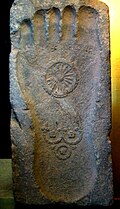
[[File:Buddha-Footprint.jpeg|thumb|227x227px|Footprint of the Buddha. 1st century BCE, Gandhara.]] | |||
The dynasty is argued to have been founded by Vijayakamitra, identified as a vassal to [[Menander II]], according to the [[Shinkot casket]]. This epigraphic source further articulates that [[Vijayamitra|King Vijayamitra]], a descendant of Vijayakamitra, approximately half a century subsequent to the initial inscription, is credited with its restoration following inflicted damage.<ref>{{Cite book |last=Kubica |first=Olga |url=https://books.google.com/books?id=8M-vEAAAQBAJ&q=greco-buddhist+relations+in+the+hellenistic+far+east |title=Greco-Buddhist Relations in the Hellenistic Far East: Sources and Contexts |date=14 April 2023 |publisher=Taylor & Francis |isbn=978-1-000-86852-4 |pages=134–135 |language=en}}</ref> He is presumed to have gained the throne in c. 2 BCE after succeeding Visnuvarma, with a reign of three decades lasting til c. 32 CE <ref>{{Cite web |title=Buddhism and Society in the Indic North and Northwest, 2nd Century BCE–3rd Century CE |url=https://core.ac.uk/download/pdf/345076701.pdf |page=207 |quote=The first was dedicated by Prahodi, the woman of the inner court of Vijayamitra, and is dated 32 Vijayamitra (30/31 CE)...This year represents in all likelihood one of Vijayamitra's last as ruler, for the throne would subsequently be given to his son Indravasu..}}</ref> before being succeeded by his son [[Indravasu]] and then further by Indravasu's grandson Indravarma II in c. 50 CE.<ref>{{Cite web |title=Buddhism and Society in the Indic North and Northwest, 2nd Century BCE–3rd Century CE |url=https://core.ac.uk/download/pdf/345076701.pdf |page=220 |quote=More likely is that Indravasu governed until c. 50 CE, whereafter he was succeeded by his grandson Indravarma II}}</ref> | |||
==== Indo-Scythian Kingdom ==== | |||
[[File:Buner reliefs Scythian bacchanalian cropped.jpg|left|thumb|One of the [[Buner reliefs]] showing Scythian soldiers dancing. [[Cleveland Museum of Art]].]] | [[File:Buner reliefs Scythian bacchanalian cropped.jpg|left|thumb|One of the [[Buner reliefs]] showing Scythian soldiers dancing. [[Cleveland Museum of Art]].]] | ||
The [[Indo-Scythians]] were descended from the [[Sakas]] (Scythians) who migrated from Central Asia into South Asia from the middle of the 2nd century BCE to the 1st century BCE. They displaced the Indo-Greeks and ruled a kingdom that stretched from Gandhara to [[Mathura, Uttar Pradesh|Mathura]]. The first Indo-Scythian king [[Maues]] established [[Saka]] hegemony by conquering | The [[Indo-Scythians]] were descended from the [[Sakas]] (Scythians) who migrated from Central Asia into South Asia from the middle of the 2nd century BCE to the 1st century BCE. They displaced the Indo-Greeks and ruled a kingdom that stretched from Gandhara to [[Mathura, Uttar Pradesh|Mathura]]. The first Indo-Scythian king [[Maues]] established [[Saka]] hegemony by conquering [[Indo-Greek]] territories.<ref>The Grandeur of Gandhara, Rafi-us Samad, Algora Publishing, 2011, p.64-67 [https://books.google.com/books?id=PMEd8Cqh-YQC&pg=PA66]</ref> | ||
Some Aprachas are documented on the [[Silver Reliquary of Indravarman|Silver Reliquary]] discovered at [[Sirkap|Sirkap, near Taxila]], designating the title "Stratega," denoting a position equivalent to [[Senapati]], such as that of [[Indravarma]] who was a general during the reign of the Apracharaja [[Vijayamitra]].<ref>{{Cite book |last=Neelis |first=Jason |url=https://books.google.com/books?id=GB-JV2eOr2UC&q=early+buddhist+transmission+and+trade+networks |title=Early Buddhist Transmission and Trade Networks: Mobility and Exchange Within and Beyond the Northwestern Borderlands of South Asia |date=19 November 2010 |publisher=BRILL |isbn=978-90-04-18159-5 |pages=118–119 |language=en |quote=Another important member of the Apraca lineage was the general (stratega) Aspavarman}}</ref> [[Indravarma]] is additionally noteworthy for receiving the above-mentioned [[Silver Reliquary of Indravarman|Silver Reliquary]] from the [[Indo-Scythians|Indo-Scythian]] monarch [[Kharahostes]], which he subsequently re-dedicated as a [[Buddhism|Buddhist]] reliquary, indicating was a gift in exchange for tribute or assistance.<ref>{{Cite book |last=Neelis |first=Jason |url=https://books.google.com/books?id=GB-JV2eOr2UC&q=early+buddhist+transmission+and+trade+networks |title=Early Buddhist Transmission and Trade Networks: Mobility and Exchange Within and Beyond the Northwestern Borderlands of South Asia |date=19 November 2010 |publisher=BRILL |isbn=978-90-04-18159-5 |page=119 |language=en |quote=A silver drinking vessel with an animal style ibex figure formerly belonging to the "Yagu king" Kharaosta that was rededicated as a Buddhist reliquary by Indravarman may indicate this object was given to the apracas as a gift in exchange for some form of tribute or assistance}}</ref> According to another reliquary inscription Indravarma is noted as the Lord of Gandhara and general during the reign of Vijayamitra.<ref>{{Cite web |title=Buddhism and Society in the Indic North and Northwest, 2nd Century BCE–3rd Century CE |url=https://core.ac.uk/download/pdf/345076701.pdf |pages=204–205 |quote=the Lord Vijayamitra Apracarāja, and Indravarma the General, Ruler of Gandhāra, are worshipped}}</ref> According to Apracha chronology, [[Indravarma]] was the son of Visnuvarma, an Aprachraja preceding [[Vijayamitra]]. | |||
[[Indravarma]]s son [[Aspavarma]] is situated between 20 and 50 CE, during which numismatic evidence overlaps him with the [[Indo-Scythians|Indo-Scythian]] ruler [[Azes II]] and [[Gondophares]] of the [[Indo-Parthians]] whilst also describing him as 'Stratega' or general of the Aprachas.<ref>{{Cite book |last=Neelis |first=Jason |url=https://books.google.com/books?id=GB-JV2eOr2UC&q=early+buddhist+transmission+and+trade+networks |title=Early Buddhist Transmission and Trade Networks: Mobility and Exchange Within and Beyond the Northwestern Borderlands of South Asia |date=19 November 2010 |publisher=BRILL |isbn=978-90-04-18159-5 |page=119 |language=en |quote=Since Aspavarman's coins overlap with late or post-humous issues of Azes II and the Indo-parthian ruler Gondophares, he probably flourished from ca. 20-50 CE.}}</ref> In accordance with a Buddhist [[Avadana]], [[Aspavarma]] and a [[Saka]] noble, Jhadamitra, engaged in discussions concerning the establishment of accommodation for monks during the rainy seasons, displaying that he was a patron of [[Buddhism]].<ref>{{Cite journal |last=Khettry |first=Sarita |date=2014 |title=Social Background of Buddhism in Gandhara(c.2 Nd Century Bce to the Middle of the 4th Century Ce) |url=https://www.jstor.org/stable/44158359 |journal=Proceedings of the Indian History Congress |volume=75 |pages=44 |issn=2249-1937 |jstor=44158359 |quote=The name of Aspavarma occurs four times in the eighth avadana of the above mentioned Buddhist manuscripts. The story in the avadana text involves some interaction between Aspavarman and Jhadamitra (a Saka noble) with regard to the provision of a place for the monks to stay during the rainy season. This shows that the Aspavarman was a patron of the Buddhist Samgha.}}</ref> A reliquary inscription dedicated to 50 CE, by a woman named Ariasrava, describes that her donation was made during the reign of [[Gondophares]] nephew, [[Abdagases I]], and [[Aspavarma]], describing the joint rule by the Aprachas and the Indo-parthians.<ref>{{Cite web |title=Buddhism and Society in the Indic North and Northwest, 2nd Century BCE–3rd Century CE |url=https://core.ac.uk/download/pdf/345076701.pdf |page=163 |quote=the Reliquary Inscription of Ariaśrava et al (No. 31), dated 98 Azes (50/51 CE), whose donor, Ariaśrava, stipulates her relic dedication was made in the reign of Gondopahres’ nephew Abdagases and the General Aśpavarma, son of Indravarma I:}}</ref> | |||
==== Indo-Parthian Kingdom ==== | |||
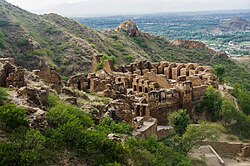
[[File:Takht-e-bahi.jpg|thumb|Ancient [[Buddhist]] [[monastery]] [[Takht-i-Bahi]] (a [[UNESCO World Heritage Site]]) constructed by the Indo-Parthians]] | |||
The [[Indo-Parthian Kingdom]] was ruled by the Gondopharid dynasty, named after its first ruler [[Gondophares]]. For most of their history, the leading Gondopharid kings held [[Taxila]] (in the present [[Punjab, Pakistan|Punjab]] province of [[Pakistan]]) as their residence, but during their last few years of existence, the capital shifted between [[Kabul]] and [[Peshawar]]. These kings have traditionally been referred to as Indo-Parthians, as their coinage was often inspired by the [[Arsacid dynasty of Parthia|Arsacid]] dynasty, but they probably belonged to wider groups of [[Iranian peoples|Iranic]] tribes who lived east of [[Parthia]] proper, and there is no evidence that all the kings who assumed the title ''Gondophares'', which means "Holder of Glory", were even related. | |||
During the dominion of the [[Indo-Parthian Kingdom|Indo-Parthians]], [[Apracharajas|Apracharaja]] [[Sases|Sasan]], as described on numismatic evidence identifying him as the nephew of [[Aspavarma]], emerged as a figure of significance.<ref>{{Cite book |last=Sastri |first=K. a Nilakanta |url=http://archive.org/details/in.ernet.dli.2015.532644 |title=Comprehensive History Of India Vol.2 (mauryas And Satavahanas) |date=1957 |page=215 |quote=The interesting additional information we get from these coins is that Sasan, a former associate of Gondophares and afterwards one of his successors in the Taxila region, was the son of Aspa's brother}}</ref> Aspavarman, a preceding Apracharaja contemporaneous with [[Gondophares]], was succeeded by [[Sases|Sasan]], after having ascended from a subordinate governance role to a recognised position as one of Gondophares's successors.<ref>{{Cite book |last=Sastri |first=K. a Nilakanta |url=http://archive.org/details/in.ernet.dli.2015.532644 |title=Comprehensive History Of India Vol.2 (mauryas And Satavahanas) |date=1957 |page=215 |quote=The coins further show that Sasan, who was at first a subordinate ruler under Gondophares, subsequently assumed independent or quasi-independent status.}}</ref> He assumed the position following [[Abdagases I]].<ref>{{Cite book |last=Srinivasan |first=Doris |url=https://books.google.com/books?id=ZuevCQAAQBAJ&dq=sases+apraca&pg=PA103 |title=On the Cusp of an Era: Art in the Pre-Kuṣāṇa World |date=30 April 2007 |publisher=BRILL |isbn=978-90-474-2049-1 |page=106 |language=en |quote=In the Indus valley Gondophares was succeeded by his nephew Abdagases and then by Sases.}}</ref> The [[Kushan Empire|Kushan]] ruler [[Vima Takto]] is known through numismatic evidence to have overstruck the coins of [[Sases|Sasan]], whilst a numismatic hoard had found coins of Sasan together with smaller coins of [[Kujula Kadphises]]<ref>{{Cite book |last=Srinivasan |first=Doris |url=https://books.google.com/books?id=ZuevCQAAQBAJ&dq=sases+apraca&pg=PA103 |title=On the Cusp of an Era: Art in the Pre-Kuṣāṇa World |date=30 April 2007 |publisher=BRILL |isbn=978-90-474-2049-1 |page=115 |language=en}}</ref> It has also been discovered that Sasan overstruck the coins of [[Nahapana]] of the [[Western Satraps]], this line of coinage dating between 40 and 78 CE.<ref>{{Cite book |last1=Rienjang |first1=Wannaporn |url=https://books.google.com/books?id=I7dTDwAAQBAJ&dq=Ubouzanes&pg=PA16 |title=Problems of Chronology in Gandhāran Art: Proceedings of the First International Workshop of the Gandhāra Connections Project, University of Oxford, 23rd-24th March, 2017 |last2=Stewart |first2=Peter |date=14 March 2018 |publisher=Archaeopress |isbn=978-1-78491-855-2 |pages=16–17 |language=en}}</ref> | |||
=== | It was noted by [[Philostratus]] and [[Apollonius of Tyana]] upon their visit with [[Phraotes]] in 46 AD, that during this time the Gandharans living between the [[Kabul River]] and [[Taxila]] had coinage of [[Orichalcum]] and Black brass, and their houses appearing as single-story structures from the outside, but upon entering, underground rooms were also present.<ref>{{Cite book |last=Srinivasan |first=Doris |url=https://books.google.com/books?id=ZuevCQAAQBAJ&dq=sases+apraca&pg=PA103 |title=On the Cusp of an Era: Art in the Pre-Kuṣāṇa World |date=30 April 2007 |publisher=BRILL |isbn=978-90-474-2049-1 |page=107 |language=en |quote=Philostratus comments that the people who live between the River Kophen and Taxila have a coinage not of gold and silver but of Orichalcum and black brass. He describes the houses as designed so that if you look at them from the outside, they appear to have only one storey, but if you go inside they have underground rooms as well.}}</ref> They describe [[Taxila]] as being the same size as [[Nineveh]], being walled like a Greek city whilst also being shaped with Narrow roads,<ref>{{Cite journal |last=De Beauvoir Priaulx |first=Osmond |date=1860 |title=The Indian Travels of Apollonius of Tyana |url=https://www.jstor.org/stable/25581224 |journal=Journal of the Royal Asiatic Society of Great Britain and Ireland |volume=17 |pages=76 |jstor=25581224 |issn=0035-869X |quote=Taxila was about the size of Ninovoh, walled like a Greek city}}</ref><ref>{{Cite journal |last=De Beauvoir Priaulx |first=Osmond |date=1860 |title=The Indian Travels of Apollonius of Tyana |url=https://www.jstor.org/stable/25581224 |journal=Journal of the Royal Asiatic Society of Great Britain and Ireland |volume=17 |page=77 |jstor=25581224 |issn=0035-869X |quote=They are taken to the palace. They found the city divided by narrow streets, well-arranged, and reminding them of Athens.}}</ref> and further describe [[Phraotes]] kingdom as containing the old territory of [[Porus]].<ref>{{Cite journal |last=De Beauvoir Priaulx |first=Osmond |date=1860 |title=The Indian Travels of Apollonius of Tyana |url=https://www.jstor.org/stable/25581224 |journal=Journal of the Royal Asiatic Society of Great Britain and Ireland |volume=17 |page=76 |jstor=25581224 |issn=0035-869X |quote=and was the residence of a sovereign who ruled over what of old was the kingdom of Porus.}}</ref> Following an exchange with the king, [[Phraotes]] is reported to have subsidised both barbarians and neighbouring states, to avert incursions into his kingdom.<ref>{{Cite journal |last=De Beauvoir Priaulx |first=Osmond |date=1860 |title=The Indian Travels of Apollonius of Tyana |url=https://www.jstor.org/stable/25581224 |journal=Journal of the Royal Asiatic Society of Great Britain and Ireland |volume=17 |page=78 |jstor=25581224 |issn=0035-869X |quote=Phraotes, in answer, said that he was moderate because his wants were few, and that as he was wealthy, he employed his wealth in doing good to his friends, and in subsidizing the barbarians, his neighbours, to prevent them from themselves ravaging, or allowing other barbarians to ravage his territories.}}</ref> [[Phraotes]] also recounts that his father, being the son of a king, had become an orphan from a young age. In accordance with Indian customs, two of his relatives assumed responsibility for his upbringing until they were killed by rebellious nobles during a ritualistic ceremony along the [[Indus River]].<ref>{{Cite journal |last=De Beauvoir Priaulx |first=Osmond |date=1860 |title=The Indian Travels of Apollonius of Tyana |url=https://www.jstor.org/stable/25581224 |journal=Journal of the Royal Asiatic Society of Great Britain and Ireland |volume=17 |page=81 |jstor=25581224 |issn=0035-869X |quote=The king then told how his father, the son of a king, had been left very young an orphan; and how during his minority two of his relatives according to Indian custom acted as regents, but with so little regard to law, that some nobles conspired against them, and slow them as they were sacrificing to the Indus, and seized upon the government}}</ref> This event led to the usurpation of the throne, compelling Phraotes' father to seek refuge with the king situated beyond the [[Hydaspes River]], in modern-day [[Punjab]], a ruler esteemed greater than Phraotes' father. Moreover, [[Phraotes]] states that his father received an education facilitated by the [[Brahmin]]s upon request to the king and married the daughter of the [[Hydaspes|Hydaspian]] king, whilst having one son who was Phraotes himself.<ref>{{Cite journal |last=De Beauvoir Priaulx |first=Osmond |date=1860 |title=The Indian Travels of Apollonius of Tyana |url=https://www.jstor.org/stable/25581224 |journal=Journal of the Royal Asiatic Society of Great Britain and Ireland |volume=17 |page=81 |jstor=25581224 |issn=0035-869X |quote=How on this his father, then sixteen years of age, fled to the king beyond the Hydaspes, a greater king than himself, who received him kindly... he requested to be sent to the Brahmans; and how the Brahmans educated him; and how in time he married the daughter of the Hydaspian king, and received with her seven villages as pin-money, and had issue one son, himself, Phraotes.}}</ref> Phraotes proceeds to narrate the opportune moment he seized to reclaim his ancestral kingdom, sparked by a rebellion of the citizens of [[Taxila]] against the usurpers. With fervent support from the populace, Phraotes led a triumphant entry into the residence of the usurpers, whilst the citizens brandished torches, swords, and bows in a display of unified resistance.<ref>{{Cite journal |last=De Beauvoir Priaulx |first=Osmond |date=1860 |title=The Indian Travels of Apollonius of Tyana |url=https://www.jstor.org/stable/25581224 |journal=Journal of the Royal Asiatic Society of Great Britain and Ireland |volume=17 |page=81 |jstor=25581224 |issn=0035-869X |quote=When I crossed the Hydraotis, I heard that, of the usurpers, one was already dead, and the other besieged in this very palace; so I hurried on, proclaiming to the villages I passed through who I was, and what were my rights : and the people received me gladly, and declaring I was the very picture of my father and grandfather, they accompanied me, many of them armed with swords and bows, and our numbers increased daily; and when we reached this city, the inhabitants, with torches lit at the altar of the Sun, and singing the praises of my father and grandfather, came out and welcomed me, and brought me hither.}}</ref> | ||
The | |||
===Kushan | ==== Tribes mentioned by Pliny ==== | ||
During this period in the 1st century CE, [[Pliny the Elder]] notes a list of tribes in the [[Vahika]] and Gandhara regions spanning from the lower Indus to the mountain tribes near the [[Hindu Kush]].{{Blockquote|text=After passing this island, the other side of the Indus is occupied, as we know by clear and undoubted proofs, by the Athoae, the Bolingae, the Gallitalutae, the Dimuri, the Megari, the Ardabae, the Mesae, and after them, the Uri and the Silae; beyond which last there are desert tracts, extending a distance of two hundred and fifty miles. After passing these nations, we come to the Organagae, the Abortae, the Bassuertae, and, after these last, deserts similar to those previously 'mentioned. We then come to the peoples of the Sorofages, the Arbae, the Marogomatrae, the Umbrittae, of whom there are twelve nations, each with two cities, and the Asini, a people who dwell in three cities, their capital being Bucephala, which was founded around the tomb of the horse belonging to king Alexander, which bore that name. Above these peoples there are some mountain tribes, which lie at the foot of Caucasus, the Soseadae and the Sondrae, and, after passing the Indus and going down its stream, the Samarabriae, the Sambraceni, the Bisambritae, the Orsi, the Anixeni, and the Taxilae, with a famous city, which lies on a low but level plain, the general name of the district being Amenda: there are four nations here, the Peucolaitae, the Arsagalitae, the Geretae, and the Assoi.|author=[[Pliny the elder]]|title=Natural history|source=}} | |||
=== Kushan Gandhāra === | |||
[[File:Gandhara Buddha (tnm).jpeg|thumb|upright|[[Greco-Buddhism|Greco-Buddhist]] [[Standing Buddha from Gandhara (Tokyo)|standing Buddha from Gandhara]] (1st–2nd century), [[Tokyo National Museum]]]] | [[File:Gandhara Buddha (tnm).jpeg|thumb|upright|[[Greco-Buddhism|Greco-Buddhist]] [[Standing Buddha from Gandhara (Tokyo)|standing Buddha from Gandhara]] (1st–2nd century), [[Tokyo National Museum]]]] | ||
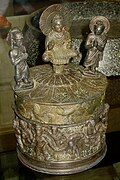
[[File:KanishkaCasket.JPG|thumb|upright|left|[[Kanishka casket|Casket of Kanishka the Great]], with Buddhist motifs]] | [[File:KanishkaCasket.JPG|thumb|upright|left|[[Kanishka casket|Casket of Kanishka the Great]], with Buddhist motifs]] | ||
The | The Kushans conquered [[Bactria]] after having been defeated by the [[Xiongnu]] and forced to retreat from the [[Central Asian steppe|Central Asian steppes.]] The [[Yuezhi]] fragmented the region of Bactria into five distinct territories, with each tribe of the Yuezhi assuming dominion over a separate kingdom.<ref>{{Cite book |last=余太山著 |url=https://books.google.com/books?id=pUvJEAAAQBAJ&dq=Ban+Chao+writings+on+kushan+empire&pg=PT290 |title=A CONCISE COMMENTARY ON MONOGRAPHS ON THE WESTERN REGIONS IN THE OFFICIAL HISTORY BOOKS OF THE WESTERN & EASTERN HAN, WEI, JIN, SOUTHERN & NORTHERN DYNASTIES |date=1 July 2021 |publisher=Beijing Book Co. Inc. |isbn=978-7-100-19365-8 |language=en |quote=Formerly, when the Yuezhi had been destroyed by the Xiongnu, they moved to Daxia and divided the country into five Xihou.}}</ref> However, a century after this division, [[Kujula Kadphises]] of the Kushan tribe emerged victorious by destroying the other four [[Yuezhi]] tribes and consolidating his reign as king.<ref>{{Cite book |last=余太山著 |url=https://books.google.com/books?id=pUvJEAAAQBAJ&dq=Ban+Chao+writings+on+kushan+empire&pg=PT290 |title=A CONCISE COMMENTARY ON MONOGRAPHS ON THE WESTERN REGIONS IN THE OFFICIAL HISTORY BOOKS OF THE WESTERN & EASTERN HAN, WEI, JIN, SOUTHERN & NORTHERN DYNASTIES |date=1 July 2021 |publisher=Beijing Book Co. Inc. |isbn=978-7-100-19365-8 |language=en |quote=More than a hundred years later, the xihou of guishuang(kushan) named Qiujiuque(Kujula) attacked and destroyed the other four xihou and established himself king.}}</ref> Kujula then invaded [[Parthia]] and annexed the upper reaches of the [[Kabul River]] before further conquering [[Jibin]].<ref>{{Cite book |last=余太山著 |url=https://books.google.com/books?id=pUvJEAAAQBAJ&dq=Ban+Chao+writings+on+kushan+empire&pg=PT290 |title=A CONCISE COMMENTARY ON MONOGRAPHS ON THE WESTERN REGIONS IN THE OFFICIAL HISTORY BOOKS OF THE WESTERN & EASTERN HAN, WEI, JIN, SOUTHERN & NORTHERN DYNASTIES |date=1 July 2021 |publisher=Beijing Book Co. Inc. |isbn=978-7-100-19365-8 |language=en |quote=This king invaded Anxi(Parthia) and took Gaofu(Kabul) and destroyed Puda and Jibin.}}</ref> In 78 CE the [[Indo-Parthian Kingdom|Indo-Parthians]] seceded Gandhara to the Kushans with [[Kujula Kadphises]] son [[Vima Takto]] succeeding the [[Apracharajas|Apracharaja]] [[Sases]] in [[Taxila]] and further conquering [[Tianzhu (India)]] before installing a general as a satrap.<ref>{{Cite book |last=余太山著 |url=https://books.google.com/books?id=pUvJEAAAQBAJ&dq=Ban+Chao+writings+on+kushan+empire&pg=PT290 |title=A CONCISE COMMENTARY ON MONOGRAPHS ON THE WESTERN REGIONS IN THE OFFICIAL HISTORY BOOKS OF THE WESTERN & EASTERN HAN, WEI, JIN, SOUTHERN & NORTHERN DYNASTIES |date=1 July 2021 |publisher=Beijing Book Co. Inc. |isbn=978-7-100-19365-8 |language=en |quote=and his son yangouzhen(Vima takto) succeeded him as king. He in his turn destroyed Tianzhu and installed a general there to control it.}}</ref><ref>{{Cite book |last=余太山著 |url=https://books.google.com/books?id=pUvJEAAAQBAJ&dq=Ban+Chao+writings+on+kushan+empire&pg=PT290 |title=A CONCISE COMMENTARY ON MONOGRAPHS ON THE WESTERN REGIONS IN THE OFFICIAL HISTORY BOOKS OF THE WESTERN & EASTERN HAN, WEI, JIN, SOUTHERN & NORTHERN DYNASTIES |date=1 July 2021 |publisher=Beijing Book Co. Inc. |isbn=978-7-100-19365-8 |language=en |quote=occupied Gandhara around 60 CE and Taxila by 78 CE}}</ref> | ||
According to the Xiyu Zhuan, the inhabitants residing in the upper reaches of the [[Kabul River]] were extremely wealthy and excelled in commerce, with their cultural practices bearing resemblance to those observed in [[Tianzhu (India)]]. However, the text also characterises them as weak and easily conquered with their political allegiance never being constant.<ref>{{Cite book |last=余太山著 |url=https://books.google.com/books?id=pUvJEAAAQBAJ&dq=Ban+Chao+writings+on+kushan+empire&pg=PT290 |title=A CONCISE COMMENTARY ON MONOGRAPHS ON THE WESTERN REGIONS IN THE OFFICIAL HISTORY BOOKS OF THE WESTERN & EASTERN HAN, WEI, JIN, SOUTHERN & NORTHERN DYNASTIES |date=1 July 2021 |publisher=Beijing Book Co. Inc. |isbn=978-7-100-19365-8 |language=en |quote=The state of Gaofu to the southwest of Da Yuezhi and is also a large state. Its way of life resembles that of Tianzhu and the people are weak and easily conquered. They excel in commerce, and internally they are very wealthy. Their political allegiance has never been constant.}}</ref> Over time, the region underwent successive annexations by [[Tianzhu (India)|Tianzhu]], [[Jibin]], and [[Parthia]] during periods of their respective strength, only to be lost when these powers experienced a decline.<ref>{{Cite book |last=余太山著 |url=https://books.google.com/books?id=pUvJEAAAQBAJ&dq=Ban+Chao+writings+on+kushan+empire&pg=PT290 |title=A CONCISE COMMENTARY ON MONOGRAPHS ON THE WESTERN REGIONS IN THE OFFICIAL HISTORY BOOKS OF THE WESTERN & EASTERN HAN, WEI, JIN, SOUTHERN & NORTHERN DYNASTIES |date=1 July 2021 |publisher=Beijing Book Co. Inc. |isbn=978-7-100-19365-8 |language=en |quote=The three states of Tianzhu Jibin and Anxi had possessed it when they were strong and have lost it when they were weak.}}</ref> The Xiyu Zhuan describes Tianzhu's customs as bearing similarities to that of the [[Yuezhi]] and the inhabitants riding on elephants in warfare.<ref>{{Cite book |last=余太山著 |url=https://books.google.com/books?id=pUvJEAAAQBAJ&dq=Ban+Chao+writings+on+kushan+empire&pg=PT290 |title=A CONCISE COMMENTARY ON MONOGRAPHS ON THE WESTERN REGIONS IN THE OFFICIAL HISTORY BOOKS OF THE WESTERN & EASTERN HAN, WEI, JIN, SOUTHERN & NORTHERN DYNASTIES |date=1 July 2021 |publisher=Beijing Book Co. Inc. |isbn=978-7-100-19365-8 |language=en |quote=its customs are the same as those of Yuezhi...the inhabitants ride on elephants in warfare}}</ref> | |||
In Gandhara, [[Mahayana Buddhism]] flourished and Buddha was represented in human form. Under the Kushans new | The Kushan period is considered the Golden Period of Gandhara. Peshawar Valley and Taxila are littered with ruins of ''stupas'' and monasteries of this period. [[Greco-Buddhist art|Gandharan art]] flourished and produced some of the best pieces of sculpture from the Indian subcontinent. Gandhara's culture peaked during the reign of the great Kushan king [[Kanishka the Great]] (127 CE – 150 CE). The cities of Taxila (Takṣaśilā) at Sirsukh and Purushapura (modern-day [[Peshawar]]) reached new heights. Purushapura along with [[Mathura]] became the capital of the great empire stretching from Central Asia to Northern [[India]] with Gandhara being in the midst of it. Emperor [[Kanishka]] was a great patron of the Buddhist faith; [[Buddhism]] spread from [[India]] to [[Central Asia]] and the Far East across Bactria and [[Sogdia]], where his empire met the [[Han dynasty|Han Empire]] of China. Buddhist art spread from Gandhara to other parts of Asia. In Gandhara, [[Mahayana Buddhism]] flourished and Buddha was represented in human form. Under the Kushans new Buddhist ''stupas'' were built and old ones were enlarged. Huge statues of the Buddha were erected in monasteries and carved into the hillsides. Kanishka also built the 400-foot [[Kanishka Stupa|Kanishka stupa]] at Peshawar. This tower was reported by Chinese monks [[Faxian]], [[Song Yun]], and [[Xuanzang]] who visited the country. The stupa was built during the Kushan era to house Buddhist relics and was among the tallest buildings in the ancient world.<ref>{{cite book |last1=Le |first1=Huu Phuoc |url=https://books.google.com/books?id=9jb364g4BvoC&pg=PA180 |title=Buddhist Architecture |date=2010 |publisher=Grafikol |isbn=9780984404308 |page=180 |language=en}}</ref><ref name="auto3">Marshall, John H. (1909): "Archaeological Exploration in India, 1908–9." (Section on: "The stūpa of Kanishka and relics of the Buddha"). ''Journal of the Royal Asiatic Society'', 1909, pp. 1056–1061.</ref><ref name="Chandra1979">{{cite book |author=Rai Govind Chandra |url=https://books.google.com/books?id=97od3sgsAjcC&pg=PA82 |title=Indo-Greek Jewellery |date=1 January 1979 |publisher=Abhinav Publications |isbn=978-81-7017-088-4 |pages=82– |access-date=13 December 2012}}</ref><gallery> | ||
File:Gandharan sculpture - head of a bodhisattva.jpg|Head of a bodhisattva, | File:Gandharan sculpture - head of a bodhisattva.jpg|Head of a bodhisattva, {{circa|4th century CE}} | ||
File:Buddha-Vajrapani-Herakles.JPG|The Buddha and [[Vajrapani]] under the guise of [[Herakles]], {{circa|2nd–3rd century CE}} | |||
File:Buddha-Vajrapani-Herakles.JPG|The Buddha and [[Vajrapani]] under the guise of [[Herakles]], | |||
</gallery> | </gallery> | ||
===Kidarites=== | ===Kidarites=== | ||
The [[Kidarites]] conquered [[Peshawar]] and parts of northwest Indian subcontinent including Gandhara probably sometime between 390 and 410 from Kushan empire,<ref>{{cite book |last1=Dani |first1=Ahmad Hasan |last2=Litvinsky |first2=B. A. |title=History of Civilizations of Central Asia: The crossroads of civilizations, A.D. 250 to 750 |date=1996 |publisher=UNESCO |isbn=9789231032110 |page=122 |url=https://books.google.com/books?id=883OZBe2sMYC&pg=PA122 |language=en}}</ref> around the end of the rule of Gupta Emperor [[Chandragupta II]] or beginning of the rule of [[Kumaragupta I]].<ref>"The entry of the Kidarites into India may firmly be placed some time round about the end of rule of | The [[Kidarites]] conquered [[Peshawar]] and parts of the northwest Indian subcontinent including Gandhara probably sometime between 390 and 410 from Kushan empire,<ref>{{cite book |last1=Dani |first1=Ahmad Hasan |last2=Litvinsky |first2=B. A. |title=History of Civilizations of Central Asia: The crossroads of civilizations, A.D. 250 to 750 |date=1996 |publisher=UNESCO |isbn=9789231032110 |page=122 |url=https://books.google.com/books?id=883OZBe2sMYC&pg=PA122 |language=en}}</ref> around the end of the rule of Gupta Emperor [[Chandragupta II]] or beginning of the rule of [[Kumaragupta I]].<ref>"The entry of the Kidarites into India may firmly be placed some time round about the end of the rule of Chandragupta II or beginning of the rule of Kumaragupta I (circa 410–420 a.d.)" in {{cite book |last1=Gupta |first1=Parmeshwari Lal |last2=Kulashreshtha |first2=Sarojini |title=Kuṣāṇa Coins and History |date=1994 |publisher=D.K. Printworld |isbn=9788124600177 |page=122 |url=https://books.google.com/books?id=q1caAAAAYAAJ |language=en}}</ref> It is probably the rise of the Hephthalites and the defeats against the Sasanians which pushed the Kidarites into northern India. Their last ruler in Gandhara was Kandik, {{circa|500 CE}}. | ||
===Alchon Huns=== | ===Alchon Huns=== | ||
Around 430 King [[Khingila]], the most notable [[Alchon Huns|Alchon]] ruler, emerged and took control of the routes across the [[Hindu Kush]] from the Kidarites.<ref>"The Alchon Huns....established themselves as overlords of northwestern India, and directly contributed to the downfall of the Guptas" in {{cite book |last1=Neelis |first1=Jason |title=Early Buddhist Transmission and Trade Networks: Mobility and Exchange Within and Beyond the Northwestern Borderlands of South Asia |date=2010 |publisher=BRILL |isbn=9789004181595 |page=162 |url=https://books.google.com/books?id=GB-JV2eOr2UC&pg=PA162 |language=en}}</ref><ref>{{citation |last=Bakker |first=Hans |title=Monuments of Hope, Gloom and Glory in the Age of the Hunnic Wars: 50 years that changed India (484–534) |publisher=Royal Netherlands Academy of Arts and Sciences |year=2017 |isbn=978-90-6984-715-3 |url=https://www.knaw.nl/en/news/publications/monuments-of-hope-gloom-and-glory |at=Section 4 |access-date=1 May 2021 |archive-date=11 January 2020 |archive-url=https://web.archive.org/web/20200111041719/https://www.knaw.nl/en/news/publications/monuments-of-hope-gloom-and-glory |url-status=dead }}</ref><ref>{{cite book |author=Atreyi Biswas |date=1971 |title=The Political History of the Hūṇas in India |url=https://books.google.com/books?id=ohwdAAAAMAAJ |publisher=Munshiram Manoharlal Publishers|isbn=9780883863015 }}</ref><ref>{{cite book |author=Upendra Thakur |date=1967 |title=The Hūṇas in India |url=https://archive.org/download/dli.ernet.429146 |publisher=Chowkhamba Prakashan |pages=52–55}}</ref> Coins of the Alchons rulers Khingila and [[Mehama]] were found at the Buddhist monastery of [[Mes Aynak]], southeast of [[Kabul]], confirming the Alchon presence in this area around | Around 430 King [[Khingila]], the most notable [[Alchon Huns|Alchon]] ruler, emerged and took control of the routes across the [[Hindu Kush]] from the Kidarites.<ref>"The Alchon Huns....established themselves as overlords of northwestern India, and directly contributed to the downfall of the Guptas" in {{cite book |last1=Neelis |first1=Jason |title=Early Buddhist Transmission and Trade Networks: Mobility and Exchange Within and Beyond the Northwestern Borderlands of South Asia |date=2010 |publisher=BRILL |isbn=9789004181595 |page=162 |url=https://books.google.com/books?id=GB-JV2eOr2UC&pg=PA162 |language=en}}</ref><ref>{{citation |last=Bakker |first=Hans |title=Monuments of Hope, Gloom and Glory in the Age of the Hunnic Wars: 50 years that changed India (484–534) |publisher=Royal Netherlands Academy of Arts and Sciences |year=2017 |isbn=978-90-6984-715-3 |url=https://www.knaw.nl/en/news/publications/monuments-of-hope-gloom-and-glory |at=Section 4 |access-date=1 May 2021 |archive-date=11 January 2020 |archive-url=https://web.archive.org/web/20200111041719/https://www.knaw.nl/en/news/publications/monuments-of-hope-gloom-and-glory |url-status=dead }}</ref><ref>{{cite book |author=Atreyi Biswas |date=1971 |title=The Political History of the Hūṇas in India |url=https://books.google.com/books?id=ohwdAAAAMAAJ |publisher=Munshiram Manoharlal Publishers|isbn=9780883863015 }}</ref><ref>{{cite book |author=Upendra Thakur |date=1967 |title=The Hūṇas in India |url=https://archive.org/download/dli.ernet.429146 |publisher=Chowkhamba Prakashan |pages=52–55}}</ref> Coins of the Alchons rulers Khingila and [[Mehama]] were found at the Buddhist monastery of [[Mes Aynak]], southeast of [[Kabul]], confirming the Alchon presence in this area around 450–500 CE.<ref>{{cite journal |last1=Alram |first1=Michael |date=2014 |title=From the Sasanians to the Huns New Numismatic Evidence from the Hindu Kush |url=https://www.jstor.org/stable/44710198 |journal=The Numismatic Chronicle |volume=174 |page=274 |jstor=44710198}}</ref> The numismatic evidence as well as the so-called "[[Hephthalite silver bowl|Hephthalite bowl]]" from Gandhara, now in the [[British Museum]], suggests a period of peaceful coexistence between the Kidarites and the Alchons, as it features two [[Kidarites|Kidarite]] noble hunters, together with two Alchon hunters and one of the Alchons inside a medallion.<ref name="MA" /> At one point, the Kidarites withdrew from Gandhara, and the Alchons took over their mints from the time of [[Khingila]].<ref name="MA" /> | ||
{{multiple image | {{multiple image | ||
| perrow = 2 | | perrow = 2 | ||
| Line 193: | Line 207: | ||
| image2 = Alchon horseman on the Hephthalite Silver Bowl.jpg | | image2 = Alchon horseman on the Hephthalite Silver Bowl.jpg | ||
| caption2 = Alchon horseman.<ref name="MA">{{cite journal |last1=ALRAM |first1=MICHAEL |title=From the Sasanians to the Huns New Numismatic Evidence from the Hindu Kush |journal=The Numismatic Chronicle |date=2014 |volume=174 |pages=274–275 |jstor=44710198 |url=https://www.jstor.org/stable/44710198 |issn=0078-2696}}</ref> | | caption2 = Alchon horseman.<ref name="MA">{{cite journal |last1=ALRAM |first1=MICHAEL |title=From the Sasanians to the Huns New Numismatic Evidence from the Hindu Kush |journal=The Numismatic Chronicle |date=2014 |volume=174 |pages=274–275 |jstor=44710198 |url=https://www.jstor.org/stable/44710198 |issn=0078-2696}}</ref> | ||
| footer = The so-called "[[Hephthalite bowl]]" from Gandhara, features two [[Kidarites|Kidarite]] hunters wearing characteristic crowns, | | footer = The so-called "[[Hephthalite bowl]]" from Gandhara, features two [[Kidarites|Kidarite]] hunters wearing characteristic crowns, as well as two Alchon hunters (one of them shown here, with [[skull deformation]]), suggesting a period of peaceful coexistence between the two entities.<ref name="MA"/> [[Swat District]], [[Pakistan]], 460–479 CE. [[British Museum]].<ref>Iaroslav Lebedynsky, "Les Nomades", p172.</ref><ref name="British Museum notice">{{Cite web|url=http://www.britishmuseum.org/research/collection_online/collection_object_details.aspx?objectId=247021&partId=1|title=British Museum notice|website=[[British Museum]]|access-date=2 April 2023}}</ref> | ||
| footer_align = center | | footer_align = center | ||
}} | }} | ||
The Alchons undertook the mass destruction of Buddhist monasteries and [[stupas]] at [[Taxila]], a high centre of learning, which never recovered from the destruction.<ref name="AG">{{cite book |last1=Ghosh |first1=Amalananda |url=https://books.google.com/books?id=0NA3AAAAIAAJ&pg=PA791 |title=Taxila |date=1965 |publisher=CUP Archive |page=791 |language=en}}</ref><ref>{{cite book |author= Upinder Singh |date=2017 |title=Political Violence in Ancient India |url=https://books.google.com/books?id=dYM4DwAAQBAJ&pg=PA241 |publisher=Harvard University Press |page=241 |isbn=9780674981287}}</ref> Virtually all of the Alchon coins found in the area of Taxila were found in the ruins of burned down monasteries, where some of the invaders died alongside local defenders during the wave of destructions.<ref name="AG" /> It is thought that the [[Kanishka stupa]], one of the most famous and tallest buildings in antiquity, was destroyed by them during their invasion of the area in the 460s CE. The [[Mankiala stupa]] was also vandalised during their invasions.<ref name="Le">{{cite book |last1=Le |first1=Huu Phuoc |url=https://books.google.com/books?id=9jb364g4BvoC&q=hephthalite+peshawar&pg=PA51 |title=Buddhist Architecture |date=2010 |publisher=Grafikol |isbn=9780984404308 |access-date=24 March 2017}}</ref> | |||
The Alchons | |||
Mihirakula in particular is remembered by [[Buddhist]] sources to have been a "terrible persecutor of their religion" in Gandhara.<ref name="Rene">{{Cite book |last=Grousset |first=Rene |title=The Empire of the Steppes |publisher=Rutgers University Press |year=1970 |isbn=0-8135-1304-9 |pages=[https://archive.org/details/empireofsteppesh00prof/page/69 69–71] |url=https://archive.org/details/empireofsteppesh00prof/page/69 }}</ref> During the reign of [[Mihirakula]], over one thousand Buddhist monasteries throughout Gandhara are said to have been destroyed.<ref name="kurt">{{cite book |last1=Behrendt |first1=Kurt A. |title=Handbuch der Orientalistik |date=2004 |publisher=BRILL |isbn=9789004135956 |location=Leiden}}</ref> In particular, the writings of Chinese monk [[Xuanzang]] from 630 CE explained that Mihirakula ordered the destruction of | Mihirakula in particular is remembered by [[Buddhist]] sources to have been a "terrible persecutor of their religion" in Gandhara.<ref name="Rene">{{Cite book |last=Grousset |first=Rene |title=The Empire of the Steppes |publisher=Rutgers University Press |year=1970 |isbn=0-8135-1304-9 |pages=[https://archive.org/details/empireofsteppesh00prof/page/69 69–71] |url=https://archive.org/details/empireofsteppesh00prof/page/69 }}</ref> During the reign of [[Mihirakula]], over one thousand Buddhist monasteries throughout Gandhara are said to have been destroyed.<ref name="kurt">{{cite book |last1=Behrendt |first1=Kurt A. |title=Handbuch der Orientalistik |date=2004 |publisher=BRILL |isbn=9789004135956 |location=Leiden}}</ref> In particular, the writings of Chinese monk [[Xuanzang]] from 630 CE explained that Mihirakula ordered the destruction of Buddhism and the expulsion of monks.<ref name="Upinder Singh 2017 241–242">{{cite book |author=Upinder Singh |url=https://books.google.com/books?id=dYM4DwAAQBAJ&pg=PA241 |title=Political Violence in Ancient India |date=2017 |publisher=Harvard University Press |isbn=9780674981287 |pages=241–242}}</ref> The Buddhist art of Gandhara, in particular [[Greco-Buddhist art]], became extinct around this period. When Xuanzang visited Gandhara in {{circa|630 CE}}, he reported that Buddhism had drastically declined in favour of [[Shaivism]] and that most of the monasteries were deserted and left in ruins.<ref name="HeirmanBumbacher2007">{{cite book |author1=Ann Heirman |url=https://books.google.com/books?id=NuOvCQAAQBAJ |title=The Spread of Buddhism |author2=Stephan Peter Bumbacher |date=11 May 2007 |publisher=BRILL |isbn=978-90-474-2006-4 |location=Leiden |page=60}}</ref> It is also noted by [[Kalhana]] that [[Brahmin]]s of Gandhara accepted from [[Mihirakula]] gifts of [[Agraharam]]s.<ref>{{Cite book |last=Thakur Upender |url=http://archive.org/details/dli.ernet.429146 |title=The Hunas In India Vol-lviii (1967) Ac 4776 |date=1967 |publisher=Chowkhamba Sanskrit Series Office |page=267 |quote=The Brahmanas of Gandhara accepted from him gift of agraharas; they no doubt, too, were similar as his own and were the meanest Brahmanas.}}</ref> [[Kalhana]] also noted in his [[Rajatarangini]] how Mihirakula oppressed local [[Brahmin]]s of South Asia and imported Gandharan Brahmins into [[Kashmir]] and India and states that he had given thousands of villages to these Brahmins in Kashmir.<ref>{{Cite web |title=Modi_History of the Huns.pdf |url=https://fid4sa-repository.ub.uni-heidelberg.de/3333/1/Modi_History%20of%20the%20Huns.pdf |page=342 |quote=It is the same Mihirkula who is referred to in the Rajatarangini, the History of Kashmir, by Kalhana, as a wicked king who was opposed to the local Brahmins and·who imported Gandhara Brahmins into Kashmir and India.}}</ref><ref>{{Cite book |last=Kalhana |first=Jogesh Chunder Dutt |url=http://archive.org/details/RajataranginiOfKalhana-English-JogeshChunderDuttVolumes12 |title=Rajatarangini of Kalhana - English - Jogesh Chunder Dutt Volumes 1 & 2 |page=21 |quote=He gave thousands of villages in Vijayeahvara to the Brahmanas of Gandhara.}}</ref> | ||
===Turk and Hindu Shahis=== | ===Turk and Hindu Shahis=== | ||
[[File:Horseman on Hindu Shahi coinage.jpg|thumb|Horseman on a coin of Spalapati, i.e. the "War-lord" of the [[Hindu Shahis]]. The headgear has been interpreted as a [[turban]].{{sfn|Rehman|1976|p=187 and Pl. V B.|loc="the horseman is shown wearing a turban-like head-gear with a small globule on the top"}}]] | [[File:Horseman on Hindu Shahi coinage.jpg|thumb|Horseman on a coin of Spalapati, i.e. the "War-lord" of the [[Hindu Shahis|Shahis]]. The headgear has been interpreted as a [[turban]].{{sfn|Rehman|1976|p=187 and Pl. V B.|loc="the horseman is shown wearing a turban-like head-gear with a small globule on the top"}}]] | ||
The [[Turk Shahis]] ruled Gandhara until | The [[Turk Shahis]] ruled Gandhara until 843 CE when they were overthrown by the [[Hindu Shahis]]. The Hindu Shahis are believed to belong to the Uḍi/Oḍi tribe, namely the people of [[Oddiyana]] in Gandhara.<ref>{{Cite journal |last=Rahman |first=Abdul |date=2002 |title=New Light on the Khingal, Turk and the Hindu Sahis |url=http://journals.uop.edu.pk/papers/AP_v15_37to42.pdf |journal=Ancient Pakistan |volume=XV |pages=37–42 |quote=The Hindu Śāhis were therefore neither Bhattis, or Janjuas, nor Brahmans. They were simply Uḍis/Oḍis. It can now be seen that the term Hindu Śāhi is a misnomer and, based as it is merely upon religious discrimination, should be discarded and forgotten. The correct name is Uḍi or Oḍi Śāhi dynasty.}}</ref><ref>{{Cite journal |last=Meister |first=Michael W. |date=2005 |title=The Problem of Platform Extensions at Kafirkot North |url=http://journals.uop.edu.pk/papers/AP_v16_41to48.pdf |journal=Ancient Pakistan |volume=XVI |pages=41–48 |quote=Rehman (2002: 41) makes a good case for calling the Hindu Śāhis by a more accurate name, "Uḍi Śāhis".}}</ref> | ||
The | The history of the Hindu Shahis begins in 843 CE with Kallar deposing the last [[Turk Shahis|Turk Shahi]] ruler, Lagaturman. Samanta succeeded him, and it was during his reign that the region of [[Kabul]] was lost to the [[Persianate]] [[Saffarid empire]].<ref name=":13">{{Cite book |url=http://archive.org/details/tltd_20240114 |title=The Last Two Dynasties of The Shāhis |date=1976 |pages=96–101}}</ref> Lalliya replaced Samanta soon after and re-conquered Kabul whilst also subduing the region of [[Zabulistan]].<ref name=":22">{{Cite book |url=http://archive.org/details/tltd_20240114 |title=The Last Two Dynasties of The Shāhis |date=1976 |page=110}}</ref><ref name=":32">{{Cite book |url=http://archive.org/details/tltd_20240114 |title=The Last Two Dynasties of The Shāhis |date=1976 |pages=110–111}}</ref> He is additionally noteworthy for coming into conflict with [[Sankaravarman|Samkaravarman]] of the [[Utpala dynasty]], resulting in his victory and the latter's death in [[Hazara region|Hazara]] and was the first Shahi noted by [[Kalhana]]. He is depicted as a great ruler with strength to the standard where kings of other regions would seek shelter in his capital of [[Udabhanda]], a change from the previous capital of [[Kabul]].<ref>{{Cite book |url=http://archive.org/details/tltd_20240114 |title=The Last Two Dynasties of The Shāhis |date=1976 |page=107}}</ref><ref name=":42">{{Cite book |url=http://archive.org/details/tltd_20240114 |title=The Last Two Dynasties of The Shāhis |date=1976 |page=113}}</ref> Bhimadeva, the next most notable ruler, is most significant for vanquishing the [[Samanid Empire]] in Ghazni and Kabul in response to their conquests,<ref name=":5">{{Cite book |url=http://archive.org/details/tltd_20240114 |title=The Last Two Dynasties of The Shāhis |date=1976 |pages=128–130}}</ref> his grand-daughter [[Didda]] was also the last ruler of the [[Lohara dynasty]]. Jayapala then gained control and was brought into conflict with the newly formed [[Ghaznavid Empire]], however, he was eventually defeated. During his rule and that of his son and successor, Anandapala, the kingdom of [[Lahore]] was conquered. The following Shahi rulers all resisted the Ghaznavids but were ultimately unsuccessful, resulting in the downfall of the empire in 1026 CE. | ||
===Rediscovery=== | ===Rediscovery=== | ||
{{Unreferenced section|date=February 2021}} | {{Unreferenced section|date=February 2021}} | ||
[[File:Shingerdar Stupa1.jpg|thumb|Many stupas, such as the Shingerdar stupa in [[Ghalegay]], are scattered throughout the region near [[Peshawar]].]] | [[File:Shingerdar Stupa1.jpg|thumb|Many stupas, such as the Shingerdar stupa in [[Ghalegay]], are scattered throughout the region near [[Peshawar]].]] | ||
By the time Gandhara had been absorbed into the empire of Mahmud of Ghazni, Buddhist buildings were already in ruins and Gandhara art had been forgotten. After Al-Biruni, the Kashmiri writer Kalhaṇa wrote his book ''Rajatarangini'' in 1151. He recorded some events that took place in Gandhara | By the time Gandhara had been absorbed into the empire of Mahmud of Ghazni, Buddhist buildings were already in ruins and Gandhara's art had been forgotten. After Al-Biruni, the Kashmiri writer Kalhaṇa wrote his book ''Rajatarangini'' in 1151. He recorded some events that took place in Gandhara and provided details about its last royal dynasty and capital [[Hund, Khyber Pakhtunkhwa|Udabhandapura]]. | ||
In the 19th century, British soldiers and administrators started taking an interest in the ancient history of the Indian Subcontinent. In the 1830s coins of the post-Ashoka period were discovered, and in the same period Chinese travelogues were translated. [[Charles Masson]], [[James Prinsep]], and [[Alexander Cunningham]] deciphered the [[Kharosthi]] script in 1838. Chinese records provided locations and site plans for Buddhist shrines. Along with the discovery of coins, these records provided clues necessary to piece together the history of Gandhara. In 1848 Cunningham found Gandhara sculptures north of Peshawar. He also identified the site of Taxila in the 1860s. From then on a large number of Buddhist statues were discovered in the Peshawar valley. | In the 19th century, British soldiers and administrators started taking an interest in the ancient history of the Indian Subcontinent. In the 1830s coins of the post-Ashoka period were discovered, and in the same period, Chinese travelogues were translated. [[Charles Masson]], [[James Prinsep]], and [[Alexander Cunningham]] deciphered the [[Kharosthi]] script in 1838. Chinese records provided locations and site plans for Buddhist shrines. Along with the discovery of coins, these records provided clues necessary to piece together the history of Gandhara. In 1848 Cunningham found Gandhara sculptures north of Peshawar. He also identified the site of Taxila in the 1860s. From then on a large number of Buddhist statues were discovered in the Peshawar valley. | ||
[[John Marshall (archaeologist)|Archaeologist John Marshall]] excavated at Taxila between 1912 and 1934. He discovered separate Greek, Parthian, and Kushan cities and a large number of ''stupas'' and monasteries. These discoveries helped to piece together much more of the chronology of the history of Gandhara and its art. | [[John Marshall (archaeologist)|Archaeologist John Marshall]] excavated at Taxila between 1912 and 1934. He discovered separate Greek, Parthian, and Kushan cities and a large number of ''stupas'' and monasteries. These discoveries helped to piece together much more of the chronology of the history of Gandhara and its art. | ||
After 1947 [[Ahmed Hassan Dani]] and the Archaeology Department at the [[University of Peshawar]] made | After 1947 [[Ahmed Hassan Dani]] and the Archaeology Department at the [[University of Peshawar]] made several discoveries in the Peshawar and Swat Valley. Excavation of many of the sites of the Gandhara Civilization is being done by researchers from Peshawar and several universities around the world. | ||
==Culture== | ==Culture== | ||
| Line 227: | Line 235: | ||
{{Main|Gandhari language}} | {{Main|Gandhari language}} | ||
Gandhara's language was a [[Prakrit]] or "[[Middle Indo-Aryan languages|Middle Indo-Aryan]]" dialect, usually called [[Gandhari language|Gāndhārī]].<ref name=":3">{{Cite web |last=Foundation |first=Encyclopaedia Iranica |title=GĀNDHĀRĪ LANGUAGE |url=https://iranicaonline.org/articles/gandhari-language |access-date=2021 | Gandhara's language was a [[Prakrit]] or "[[Middle Indo-Aryan languages|Middle Indo-Aryan]]" dialect, usually called [[Gandhari language|Gāndhārī]].<ref name=":3">{{Cite web |last=Foundation |first=Encyclopaedia Iranica |title=GĀNDHĀRĪ LANGUAGE |url=https://iranicaonline.org/articles/gandhari-language |access-date=20 July 2021 |website=iranicaonline.org |language=en-US}}</ref> Under the [[Kushan Empire]], Gāndhārī spread into adjoining regions of South and Central Asia.<ref name=":3" /> It used the [[Kharosthi]] script, which is derived from the [[Aramaic alphabet|Aramaic script]], and it died out about in the 4th century CE.<ref name=":3" /><ref>{{Cite book |last=Rhie |first=Marylin Martin |url=https://books.google.com/books?id=ogD1DwAAQBAJ&pg=PA327 |title=Early Buddhist Art of China and Central Asia, Volume 2 The Eastern Chin and Sixteen Kingdoms Period in China and Tumshuk, Kucha and Karashahr in Central Asia (2 vols) |date=15 July 2019 |publisher=BRILL |isbn=978-90-04-39186-4 |pages=327 |language=en}}</ref> | ||
Linguistic evidence links some groups of the [[Dardic languages]] with Gandhari.<ref>{{Cite book |last=Dani |first=Ahmad Hasan |url=https://books.google.com/books?id=MOltAAAAMAAJ&q=gandhari |title=History of Northern Areas of Pakistan: Upto 2000 A.D. |date=2001 |publisher=Sang-e-Meel Publications |isbn=978-969-35-1231-1 |pages=64–67 |language=en}}</ref><ref>{{Cite book |last=Saxena |first=Anju |url=https://books.google.com/books?id=vTgv1ZYGZdoC&pg=PA35 |title=Himalayan Languages: Past and Present |date=2011 | Linguistic evidence links some groups of the [[Dardic languages]] with Gandhari.<ref>{{Cite book |last=Dani |first=Ahmad Hasan |url=https://books.google.com/books?id=MOltAAAAMAAJ&q=gandhari |title=History of Northern Areas of Pakistan: Upto 2000 A.D. |date=2001 |publisher=Sang-e-Meel Publications |isbn=978-969-35-1231-1 |pages=64–67 |language=en}}</ref><ref>{{Cite book |last=Saxena |first=Anju |url=https://books.google.com/books?id=vTgv1ZYGZdoC&pg=PA35 |title=Himalayan Languages: Past and Present |date=12 May 2011 |publisher=Walter de Gruyter |isbn=978-3-11-089887-3 |pages=35 |language=en}}</ref><ref>{{Cite book |last=Liljegren |first=Henrik |url=https://books.google.com/books?id=gRK1CwAAQBAJ&pg=PA14 |title=A grammar of Palula |date=26 February 2016 |publisher=Language Science Press |isbn=978-3-946234-31-9 |pages=13–14 |language=en |quote=Palula belongs to a group of Indo-Aryan (IA) languages spoken in the Hindukush region that are often referred to as "Dardic" languages... It has been and is still disputed to what extent this primarily geographically defined grouping has any real classificatory validity... On the one hand, Strand suggests that the term should be discarded altogether, holding that there is no justification whatsoever for any such grouping (in addition to the term itself having a problematic history of use), and prefers to make a finer classification of these languages into smaller genealogical groups directly under the IA heading, a classification we shall return to shortly... Zoller identifies the Dardic languages as the modern successors of the Middle Indo-Aryan (MIA) language Gandhari (also Gandhari Prakrit), but along with Bashir, Zoller concludes that the family tree model alone will not explain all the historical developments.}}</ref> The [[Kohistani languages]], now all being displaced from their original homelands, were once more widespread in the region and most likely descend from the ancient dialects of the region of Gandhara.<ref>{{Cite book |last1=Cacopardo |first1=Alberto M. |url=https://books.google.com/books?id=ghFuAAAAMAAJ |title=Gates of Peristan: History, Religion and Society in the Hindu Kush |last2=Cacopardo |first2=Augusto S. |date=2001 |publisher=IsIAO |isbn=978-88-6323-149-6 |pages=253 |language=en |quote=...This leads us to the conclusion that the ancient dialects of the Peshawar District, the country between Tirah and Swât, must have belonged to the Tirahi-Kohistani type and that the westernmost Dardic language, Pashai, which probably had its ancient centre in Laghmân, has enjoyed a comparatively independent position since early times". …Today the Kohistâni languages descendent from the ancient dialects that developed in these valleys have all been displaced from their original homelands, as described below.}}</ref><ref name=":1">{{Cite journal|url=https://www.jstor.org/stable/608051|title=The Dialectical Position of the Niya Prakrit|date=1936|journal=Bulletin of the School of Oriental Studies, University of London|volume=8|issue=2/3|pages=419–435|issn=1356-1898|quote=... It might be going too far to say that Torwali is the direct lineal descendant of the Niya Prakrit, but there is no doubt that out of all the modern languages, it shows the closest resemblance to it. A glance at the map in the Linguistic Survey of India shows that the area at present covered by "Kohistani" is the nearest to that area around Peshawar, where, as stated above, there is most reason to believe was the original home of the Niya Prakrit. That conclusion, which was reached for other reasons, is thus confirmed by the distribution of the modern dialects.|last=Burrow|first=T.|jstor=608051}}</ref> The last to disappear was [[Tirahi language|Tirahi]], still spoken some years ago in a few villages in the vicinity of [[Jalalabad]] in eastern Afghanistan, by descendants of migrants expelled from [[Tirah]] by the [[Afridi]] [[Pashtuns]] in the 19th century.<ref name=":2">{{Cite book |last=Dani |first=Ahmad Hasan |url=https://books.google.com/books?id=MOltAAAAMAAJ |title=History of Northern Areas of Pakistan: Upto 2000 A.D. |date=2001 |publisher=Sang-e-Meel Publications |isbn=978-969-35-1231-1 |pages=56 |language=en |quote=In the Peshawar district, there does not remain any Indian dialect continuing this old Gandhari. The last to disappear was Tirahi, still spoken some years ago in Afghanistan, in the vicinity of Jalalabad, by descendants of migrants expelled from Tirah by the Afridis in the 19th century. Nowadays, it must be entirely extinct and in the NWFP are only to be found modern Iranian languages brought in by later [[Settler|immigrants]] (Baluch, Pashto) or Indian languages brought in by the paramount political power (Urdu, Panjabi) or by Hindu traders (Hindko).}}</ref> [[Georg Morgenstierne]] claimed that Tirahi is "probably the remnant of a dialect group extending from Tirah through the [[Peshawar District|Peshawar district]] into [[Swat District|Swat]] and [[Dir (region)|Dir]]".<ref>{{Cite book |last1=Jain |first1=Danesh |url=https://books.google.com/books?id=iUHfBQAAQBAJ&pg=PT991 |title=The Indo-Aryan Languages |last2=Cardona |first2=George |date=26 July 2007 |publisher=Routledge |isbn=978-1-135-79710-2 |pages=991 |language=en}}</ref> Nowadays, it must be entirely extinct and the region is now dominated by [[Iranian languages]] brought in by later [[Settler|immigrations]], such as [[Pashto]].<ref name=":2" /> Among the modern day Indo-Aryan languages still spoken today, [[Torwali language|Torwali]] shows the closest linguistic affinity possible to ''Niya'', a dialect of Gāndhārī.<ref name=":1" /><ref>{{Cite book |last=Salomon |first=Richard |url=https://books.google.com/books?id=XYrG07qQDxkC&pg=PA79 |title=Indian Epigraphy: A Guide to the Study of Inscriptions in Sanskrit, Prakrit, and the other Indo-Aryan Languages |date=10 December 1998 |publisher=Oxford University Press |isbn=978-0-19-535666-3 |pages=79 |language=en}}</ref> | ||
===Religion=== | ===Religion=== | ||
| Line 235: | Line 243: | ||
{{Further|Silk Road transmission of Buddhism|Gandharan Buddhism}} | {{Further|Silk Road transmission of Buddhism|Gandharan Buddhism}} | ||
[[File:BuddhistTriad.JPG|thumb|[[Maitreya]] [[Bodhisattva]], [[Gautama Buddha]], and [[Avalokitesvara|Avalokiteśvara]] Bodhisattva. 2nd–3rd century CE, Gandhāra]] | [[File:BuddhistTriad.JPG|thumb|[[Maitreya]] [[Bodhisattva]], [[Gautama Buddha]], and [[Avalokitesvara|Avalokiteśvara]] Bodhisattva. 2nd–3rd century CE, Gandhāra.]] | ||
[[File:Avalokitesvara Gandhara Musée Guimet 2418 1.jpg|thumb|upright|Bronze statue of [[Avalokiteśvara]] [[Bodhisattva]]. Fearlessness [[mudra|mudrā]]. 3rd century CE, Gandhāra]] | [[File:Avalokitesvara Gandhara Musée Guimet 2418 1.jpg|thumb|upright|Bronze statue of [[Avalokiteśvara]] [[Bodhisattva]]. Fearlessness [[mudra|mudrā]]. 3rd century CE, Gandhāra.]] | ||
====Mahāyāna Buddhism==== | ====Mahāyāna Buddhism==== | ||
As per Pali sources, Buddhism first reached Gandhara following the [[Third Buddhist council]] which was held in [[Pataliputra]] during the reign of [[Ashoka]] in the third-century BCE.<ref name="Princeton2014">{{cite journal |last1=Lopez |first1=Donald |title=Kashmir-Gandhāra |journal=Princeton Dictionary of Buddhism |date=2014 |url=https://www.oxfordreference.com/display/10.1093/acref/9780190681159.001.0001/acref-9780190681159-e-2137}}</ref> Various monks were dispatched to different parts of the empire and the missionary dispatched to Gandhara specifically was [[Majjhantika]] who originated from the city of [[Varanasi]] in [[India]].<ref name="Wani">{{cite book |last1=Wani |first1=Muhammad |title=The Making of Early Kashmir: Intercultural Networks and Identity Formation |date=2023 |publisher=Taylor and Francis |isbn=9781000836554 |page=82 |url=https://books.google.com/books?id=DgymEAAAQBAJ&dq=majjhantika+varanasi&pg=PT83}}</ref> | |||
Some scholars believe that the Mahāyāna ''[[Infinite Life Sutra|Longer Sukhāvatīvyūha Sūtra]]'' was compiled in the age of the Kushan Empire in the 1st and 2nd centuries CE, by | Mahāyāna [[Buddhist sutras#Pure Land Sutras|Pure Land sutras]] were brought from the Gandhāra region to China as early as 147 CE, when the [[Kushan Empire|Kushan]] monk [[Lokaksema (Buddhist monk)|Lokakṣema]] began translating some of the first Buddhist sutras into Chinese.<ref>{{Cite web|url=http://www.acmuller.net/descriptive_catalogue/files/k0024.html|title=The Korean Buddhist Canon: A Descriptive Catalogue|website=www.acmuller.net}}</ref> The earliest of these translations show evidence of having been translated from the Gāndhārī language.<ref>Mukherjee, Bratindra Nath. ''India in Early Central Asia.'' 1996. p. 15</ref> Lokakṣema translated important [[Mahayana sutras|Mahāyāna sūtras]] such as the ''[[Prajñāpāramitā|Aṣṭasāhasrikā Prajñāpāramitā Sūtra]]'', as well as rare, early Mahāyāna sūtras on topics such as [[Samādhi (Buddhism)|samādhi]], and meditation on the Buddha [[Akshobhya|Akṣobhya]]. Lokaksema's translations continue to provide insight into the early period of Mahāyāna Buddhism. This corpus of texts often includes and emphasises ascetic practices forest dwelling, and absorption in states of meditative concentration:<ref>Williams, Paul. ''Mahāyāna Buddhism: The Doctrinal Foundations.'' 2008. p. 30</ref>{{Blockquote|Paul Harrison has worked on some of the texts that are arguably the earliest versions we have of the Mahāyāna sūtras, those translated into Chinese in the last half of the second century AD by the Indo-Scythian translator Lokakṣema. Harrison points to the enthusiasm in the Lokakṣema sūtra corpus for the extra ascetic practices, for dwelling in the forest, and above all for states of meditative absorption (''samādhi''). Meditation and meditative states seem to have occupied a central place in early Mahāyāna, certainly because of their spiritual efficacy but also because they may have given access to fresh revelations and inspiration.}} | ||
Some scholars believe that the Mahāyāna ''[[Infinite Life Sutra|Longer Sukhāvatīvyūha Sūtra]]'' was compiled in the age of the Kushan Empire in the 1st and 2nd centuries CE, by order of [[Mahisasaka|Mahīśāsaka]] [[bhikkhu|bhikṣus]] which flourished in the Gandhāra region.<ref name="Nakamura, Hajime 1999. p. 205">Nakamura, Hajime. ''Indian Buddhism: A Survey With Biographical Notes.'' 1999. p. 205</ref><ref>Williams, Paul. ''Mahāyāna Buddhism: The Doctrinal Foundations.'' 2008. p. 239</ref> However, it is likely that the longer ''Sukhāvatīvyūha'' owes greatly to the [[Mahāsāṃghika]]-[[Lokottaravāda]] sect as well for its compilation, and in this sutra, there are many elements in common with the Lokottaravādin ''[[Mahavastu|Mahāvastu]]''.<ref name="Nakamura, Hajime 1999. p. 205"/> There are also images of [[Amitābha]] Buddha with the [[bodhisattva]]s [[Avalokiteśvara]] and [[Mahāsthāmaprāpta]] which were made in Gandhāra during the Kushan era.<ref>{{cite web|url=http://huntingtonarchive.osu.edu/studypages/internal/dl/SouthAsia/Buddhist/pgs/u5/DL0230m.htm|title=Gandharan Sculptural Style: The Buddha Image|access-date=7 February 2016|archive-url=https://web.archive.org/web/20141218045231/http://huntingtonarchive.osu.edu/studypages/internal/dl/SouthAsia/Buddhist/pgs/u5/DL0230m.htm|archive-date=18 December 2014|url-status=dead}}</ref> | |||
The ''Mañjuśrīmūlakalpa'' records that Kaniṣka of the Kushan Empire presided over the establishment of the Mahāyāna [[Prajnaparamita|Prajñāpāramitā]] teachings in the northwest.<ref name="Ray, Reginald 1999. p. 410">Ray, Reginald. ''Buddhist Saints in India: A Study in Buddhist Values and Orientations.'' 1999. p. 410</ref> [[Taranatha|Tāranātha]] wrote that in this region, 500 [[bodhisattva]]s attended the council at Jālandhra monastery during the time of Kaniṣka, suggesting some institutional strength for Mahāyāna in the north-west during this period.<ref name="Ray, Reginald 1999. p. 410"/> [[Edward Conze]] goes further to say that Prajñāpāramitā had great success in the north-west during the Kushan period, and may have been the "fortress and hearth" of early Mahāyāna, but not its origin, which he associates with the Mahāsāṃghika branch of Buddhism.<ref>Ray, Reginald. ''Buddhist Saints in India: A Study in Buddhist Values and Orientations.'' 1999. p. 426</ref> | The ''Mañjuśrīmūlakalpa'' records that Kaniṣka of the Kushan Empire presided over the establishment of the Mahāyāna [[Prajnaparamita|Prajñāpāramitā]] teachings in the northwest.<ref name="Ray, Reginald 1999. p. 410">Ray, Reginald. ''Buddhist Saints in India: A Study in Buddhist Values and Orientations.'' 1999. p. 410</ref> [[Taranatha|Tāranātha]] wrote that in this region, 500 [[bodhisattva]]s attended the council at Jālandhra monastery during the time of Kaniṣka, suggesting some institutional strength for Mahāyāna in the north-west during this period.<ref name="Ray, Reginald 1999. p. 410"/> [[Edward Conze]] goes further to say that Prajñāpāramitā had great success in the north-west during the Kushan period, and may have been the "fortress and hearth" of early Mahāyāna, but not its origin, which he associates with the Mahāsāṃghika branch of Buddhism.<ref>Ray, Reginald. ''Buddhist Saints in India: A Study in Buddhist Values and Orientations.'' 1999. p. 426</ref> | ||
====Other religions==== | |||
[[Zoroastrianism]] also was present in Gandhara since the Persian conquest,<ref name="Wani"/> likely continuing to the reign of Ashoka and subsequently: some scholars have speculated that its presence may have influenced the development of unique aspects of Mahayana Buddhism in Gandhara.<ref>{{cite book | last1=Boyce | first1=Mary | last2=Grenet | first2=F. | title=A History of Zoroastrianism, Zoroastrianism under Macedonian and Roman Rule | publisher=BRILL | date=2015 | isbn=978-90-04-29391-5 | url=https://books.google.com/books?id=Euh5DwAAQBAJ&pg=PA149}}</ref> | |||
Gandhara, especially Taxila, during Kushan times also played an influential role in the development of arts and culture of the [[History_of_Hinduism#Hindu_synthesis_and_Classical_Hinduism_(c._200_BCE_–_1200_CE)|Hindu synthesis]],<ref>{{cite book | last=Schmidt | first=Karl J. | title=An Atlas and Survey of South Asian History | publisher=Routledge | date=2015 | isbn=978-1-317-47681-8 | url=https://books.google.com/books?id=BqdzCQAAQBAJ&pg=PA120 | quote=In addition to being a center of religion for Buddhists, as well as Hindus, Taxila was a thriving center for art, culture, and learning.}}</ref> as the region's artistic traditions were influential to some of the early depictions of deities in [[Hindu_art#Hindu_art_under_the_Kushans_(2nd-3rd_century_CE)|Hindu art]].<ref>{{cite book | last=Srinivasan | first=Doris Meth | chapter=Hindu Deities in Gandharan art | title=Gandhara, the Buddhist Heritage of Pakistan: Legends, Monasteries, and Paradise | publisher=Kunst- und Ausstellungshalle der Bundesrepublik Deutschland ; Mainz : Verlag Philipp von Zabern | date=2008 | isbn=978-3-8053-3957-5 | url=https://books.google.com/books?id=lHBEAQAAIAAJ | page=130-143 | quote=Gandhara was not cut off from the heartland of early Hinduism in the Gangetic Valley. The two regions shared cultural and political connections and trade relations and this facilitated the adoption and exchange of religious ideas. [...] It is during the Kushan Era that flowering of religious imagery occurred. [...] Gandhara often introduced its own idiosyncratic expression upon the Buddhist and Hindu imagery it had initially come in contact with.}}</ref><ref>{{cite book | last=Blurton | first=T. Richard | title=Hindu Art | publisher=Harvard University Press | date=1993 | isbn=978-0-674-39189-5 | url=https://books.google.com/books?id=xJ-lzU_nj_MC | page=84, 176 | quote=The earliest figures of Shiva which show him in purely human form come from the area of ancient Gandhara [...] Coins from Gandhara of the first century BC show Lakshmi [...] four-armed, on a lotus.}}</ref> | |||
===Art=== | ===Art=== | ||
| Line 249: | Line 264: | ||
[[File:Lid with seated male figure, Gandhara, Pakistan.jpeg|thumb|right|Lid with seated male figure, Gandhara. (1st–2nd century)]] | [[File:Lid with seated male figure, Gandhara, Pakistan.jpeg|thumb|right|Lid with seated male figure, Gandhara. (1st–2nd century)]] | ||
Gandhāra is noted for the distinctive '''Gandhāra style''' of [[Buddhist art]], which shows influence of [[Hellenistic art|Hellenistic]] and | Gandhāra is noted for the distinctive '''Gandhāra style''' of [[Buddhist art]], which shows the influence of [[Hellenistic art|Hellenistic]] and Eastern Indo-Aryan influences from the [[Indo-Gangetic Plain|Gangetic Valley]].<ref name=ubc2011>{{cite book |last1=Behrendt |first1=Kurt |title=Gandharan Buddhism: Archaeology, Art, and Texts |date=2011 |publisher=UBC Press |isbn=978-0774841283 |page=241 |url=https://books.google.com/books?id=rtYskEpemWgC |access-date=16 August 2019}}</ref> The [[Greco-Buddhist art|Gandhāran art]] flourished and achieved its peak during the [[Kushan Empire|Kushan]] period, from the 1st to the 5th centuries, but it declined and was destroyed after the invasion of the [[Alchon Huns]] in the 5th century. | ||
Siddhārtha shown as a bejewelled prince (before [[Great Renunciation|Siddhārtha renounces palace life]]) is a common motif.<ref name="met">{{cite web|url=https://www.metmuseum.org/toah/hd/budd/hd_budd.htm |title = Buddhism and Buddhist Art}}</ref> [[Stucco]], as well as stone, were widely used by sculptors in Gandhara for the decoration of monastic and cult buildings.<ref name=met /><ref>{{Cite journal |last=Siple |first=Ella S. |date=1931 |title=Stucco Sculpture from Central Asia |url=https://www.jstor.org/stable/864875 |journal=The Burlington Magazine for Connoisseurs |volume=59 |issue=342 |pages=140–145 |jstor=864875 |issn=0951-0788}}</ref> Buddhist imagery combined with some artistic elements from the cultures of the Hellenistic world. An example is the youthful Buddha, his hair in wavy curls, similar to statutes of [[Apollo]].<ref name="met" /> Sacred artworks and architectural decorations used limestone for stucco composed by a mixture of local crushed rocks (i.e. [[schist]] and [[granite]]) which resulted compatible with the outcrops located in the mountains northwest of [[Islamabad]].<ref>{{cite journal | author = Carlo Rosa | author2 = Thomas Theye | author3 = Simona Pannuzi|url = https://doaj.org/article/4c2c60120f2343ccb1e43d8299572e53 | title = Geological overwiew of Gandharan sites and petrographical analysis on Gandharan stucco and clay artefacts | page = Abstract | language = en | format = pdf | access-date = 15 February 2020 | publisher = Firenze University Press | journal = Restauro Archeologico | oclc = 8349098991|issn = 1724-9686 |year = 2019 | volume = 27 | issue = 1 | doi = 10.13128/RA-25095 | archive-url = https://web.archive.org/web/20200215232533/https://oaj.fupress.net/index.php/ra/article/view/7349/7343 | archive-date = 15 February 2020 | url-status = live}} on [[DOAJ]]</ref> | |||
The artistic traditions of Gandhara art can be divided into following phases: | The artistic traditions of Gandhara art can be divided into the following phases: | ||
*[[Indo-Greek art]]; 2nd century | *[[Indo-Greek art]]; 2nd century BCE to 1st century CE | ||
*[[Indo-Scythian art]]; 1st century | *[[Indo-Scythian art]]; 1st century BCE to 1st century CE | ||
*[[Kushan art]]; 1st century | *[[Kushan art]]; 1st century CE to 4th century CE | ||
<gallery> | <gallery> | ||
| Line 267: | Line 282: | ||
File:Indo-GreekBanquet.JPG|Wine-drinking and music, Hadda (1st–2nd century) | File:Indo-GreekBanquet.JPG|Wine-drinking and music, Hadda (1st–2nd century) | ||
File:MayaDream.jpg|Maya's white elephant dream (2nd–3rd century) | File:MayaDream.jpg|Maya's white elephant dream (2nd–3rd century) | ||
File:SiddhartaBirth.jpg|The birth of | File:SiddhartaBirth.jpg|The birth of Siddhārtha (2nd–3rd century) | ||
File:LeavingPalace.jpg|The Great Departure from the Palace (2nd–3rd century) | File:LeavingPalace.jpg|The Great Departure from the Palace (2nd–3rd century) | ||
File:EndAscetism.JPG|The end of | File:EndAscetism.JPG|The end of asceticism (2nd–3rd century) | ||
File:Sarnath3.JPG|The Buddha preaching at the Deer Park in [[Sarnath]] (2nd–3rd century) | File:Sarnath3.JPG|The Buddha preaching at the Deer Park in [[Sarnath]] (2nd–3rd century) | ||
File:Gandhara Buddha scene.jpg|Scene of the life of the Buddha (2nd–3rd century) | File:Gandhara Buddha scene.jpg|Scene of the life of the Buddha (2nd–3rd century) | ||
| Line 277: | Line 292: | ||
File:GandharaScrolls.JPG|Hellenistic decorative scrolls from [[Hadda, Afghanistan]] | File:GandharaScrolls.JPG|Hellenistic decorative scrolls from [[Hadda, Afghanistan]] | ||
File:GandharaFrieze.JPG|Hellenistic scene, Gandhara (1st century) | File:GandharaFrieze.JPG|Hellenistic scene, Gandhara (1st century) | ||
File:StonePalette1.JPG|A stone plate (1st century) | File:StonePalette1.JPG|A stone plate (1st century) | ||
File:Laughing boy JN 16 F.25-876 (1).jpg|"Laughing boy" from Hadda | File:Laughing boy JN 16 F.25-876 (1).jpg|"Laughing boy" from Hadda | ||
File:Gandhara, bodhisattva assiso, II sec..JPG|Bodhisattva seated in [[jhana|meditation]] | File:Gandhara, bodhisattva assiso, II sec..JPG|Bodhisattva seated in [[jhana|meditation]] | ||
File:Marine deities Gandhara 1st century.jpg|Marine deities, Gandhara | File:Marine deities Gandhara 1st century.jpg|Marine deities, Gandhara | ||
File:SFAAMBuddha.jpg|The Seated Buddha, dating from 300 to 500 | File:SFAAMBuddha.jpg|The Seated Buddha, dating from 300 to 500 CE, was found near Jamal Garhi, and is now on display at the [[Asian Art Museum (San Francisco)|Asian Art Museum]] in [[San Francisco]]. | ||
File:Sharing of relics and Gandhara fortified city.jpg|Sharing of the [[Buddha]]'s relics, above a Gandhara fortified city | File:Sharing of relics and Gandhara fortified city.jpg|Sharing of the [[Buddha]]'s relics, above a Gandhara fortified city | ||
</gallery> | </gallery> | ||
==Major cities== | |||
Major cities of ancient Gandhara are as follows: | Major cities of ancient Gandhara are as follows: | ||
*[[Pushkalavati|Puṣkalavati]] ([[Charsadda]]), [[Pakistan]] | *[[Pushkalavati|Puṣkalavati]] ([[Charsadda]]), [[Pakistan]] | ||
*[[Takshashila]] ([[Taxila]]), [[Pakistan]] | *[[Takshashila]] ([[Taxila]]), [[Pakistan]] | ||
*[[Puruṣapura]] ([[Peshawer]]), [[Pakistan]] | *[[Puruṣapura]] ([[Peshawer]]), [[Pakistan]] | ||
*[[Sagala]] ([[Sialkot]]), [[Pakistan]] | *[[Sagala]] ([[Sialkot]]), [[Pakistan]] | ||
*[[Oddiyana]] ([[Swat district|Swat]]), [[Pakistan]] | *[[Oddiyana]] ([[Swat district|Swat]]), [[Pakistan]] | ||
*[[ | *[[Jibin]], [[Pakistan]] appears in the Chinese sources | ||
*[[ | * [[Chukhsa]] ([[Chhachh]]), [[Pakistan]] | ||
* [[Attock Khurd]] ([[Attock]]), [[Pakistan]] | |||
* [[Hund, Khyber Pakhtunkhwa|Hund]] ([[Swabi]]), [[Pakistan]] | |||
* [[Bajaur]], capital of ([[Apraca]]), [[Pakistan]] | |||
* [[Aornos]], somewhere in [[Hazara region|Hazara, Pakistan]] | |||
==Notable people== | ==Notable people== | ||
| Line 299: | Line 318: | ||
==In popular culture== | ==In popular culture== | ||
*''Gandhara:Buddha no Seisen'' is an action RPG released in Japan in 1987.<ref>{{Cite web |url=https://www.mobygames.com/game/51192/gandhara-buddha-no-seisen/&ved=2ahUKEwj0xcbs2Oz9AhVD-6QKHbZBCKoQFnoECBUQAQ&usg=AOvVaw10o7WfYVhm1fIa2ulvnvkp |access-date=2023 | *''Gandhara:Buddha no Seisen'' is an action RPG released in Japan in 1987.<ref>{{Cite web |url=https://www.mobygames.com/game/51192/gandhara-buddha-no-seisen/&ved=2ahUKEwj0xcbs2Oz9AhVD-6QKHbZBCKoQFnoECBUQAQ&usg=AOvVaw10o7WfYVhm1fIa2ulvnvkp |access-date=21 March 2023 |title=Gandhara:Buddha no Seisen }}{{Dead link|date=August 2024 |bot=InternetArchiveBot |fix-attempted=yes }}</ref> | ||
*''[[Gandhara (song)]]'' is a 1978 song by Japanese [[rock music|rock]] band [[Godiego]], serving as their 7th single. | *"''[[Gandhara (song)|Gandhara]]''" is a 1978 song by Japanese [[rock music|rock]] band [[Godiego]], serving as their 7th single. | ||
*''[[List of Shaman King characters#Gandhara|Gandhara]]'' is a Buddhist pacifist | *''[[List of Shaman King characters#Gandhara|Gandhara]]'' is a fictional Buddhist pacifist organisation in the Japanese [[manga]] series ''[[Shaman King]]''. | ||
==See also== | ==See also== | ||
*[[History of Pakistan]] | *[[History of Pakistan]] | ||
*[[History of Punjab]] | |||
*[[Apracharajas]] | |||
*[[History of Afghanistan]] | *[[History of Afghanistan]] | ||
==References== | ==References== | ||
| Line 325: | Line 339: | ||
* {{citation |last=Eggermont |first=Pierre Herman Leonard |title=Alexander's Campaigns in Sind and Baluchistan and the Siege of the Brahmin Town of Harmatelia |url=https://books.google.com/books?id=nG0_xoDS3hUC&pg=PA179 |year=1975 |publisher=Peeters Publishers |isbn=978-90-6186-037-2 |ref={{sfnref|Eggermont, Alexander's Campaigns in Sind and Baluchistan|1975}}}} | * {{citation |last=Eggermont |first=Pierre Herman Leonard |title=Alexander's Campaigns in Sind and Baluchistan and the Siege of the Brahmin Town of Harmatelia |url=https://books.google.com/books?id=nG0_xoDS3hUC&pg=PA179 |year=1975 |publisher=Peeters Publishers |isbn=978-90-6186-037-2 |ref={{sfnref|Eggermont, Alexander's Campaigns in Sind and Baluchistan|1975}}}} | ||
* {{cite book |last=Herodotus |year=1920 |url=https://www.perseus.tufts.edu/hopper/text?doc=Hdt.+1.1.0&fromdoc=Perseus%3Atext%3A1999.01.0125 |title=Histories |others=With an English translation by A. D. Godley |language=el, en |place=Cambridge |publisher=Harvard University Press.}} | * {{cite book |last=Herodotus |year=1920 |url=https://www.perseus.tufts.edu/hopper/text?doc=Hdt.+1.1.0&fromdoc=Perseus%3Atext%3A1999.01.0125 |title=Histories |others=With an English translation by A. D. Godley |language=el, en |place=Cambridge |publisher=Harvard University Press.}} | ||
* Hill, John E. 2003. [http://depts.washington.edu/silkroad/texts/hhshu/hou_han_shu.html "Annotated Translation of the Chapter on the Western Regions according to the ''Hou Hanshu''"]. 2nd Edition: ''Through the Jade Gate to Rome: A Study of the Silk Routes, 1st to 2nd | * Hill, John E. 2003. [http://depts.washington.edu/silkroad/texts/hhshu/hou_han_shu.html "Annotated Translation of the Chapter on the Western Regions according to the ''Hou Hanshu''"]. 2nd Edition: ''Through the Jade Gate to Rome: A Study of the Silk Routes, 1st to 2nd centuries CE''. 2015. John E. Hill. Volume I, {{ISBN|978-1500696702}}; Volume II, {{ISBN|978-1503384620}}. CreateSpace, North Charleston, S.C. | ||
* Hussain, J. '' An Illustrated History of Pakistan'', Oxford University Press, Karachi, 1983. | * Hussain, J. '' An Illustrated History of Pakistan'', Oxford University Press, Karachi, 1983. | ||
* {{cite web |url=https://dsal.uchicago.edu/reference/gazetteer/pager.html?objectid=DS405.1.I34_V19_154.gif |title=Imperial Gazetteer2 of India, Volume 19– Imperial Gazetteer of India |publisher=Digital South Asia Library |access-date=22 April 2015 |ref=CITEREFImperial_Gazetteer}} | * {{cite web |url=https://dsal.uchicago.edu/reference/gazetteer/pager.html?objectid=DS405.1.I34_V19_154.gif |title=Imperial Gazetteer2 of India, Volume 19– Imperial Gazetteer of India |publisher=Digital South Asia Library |access-date=22 April 2015 |ref=CITEREFImperial_Gazetteer}} | ||
| Line 342: | Line 356: | ||
* {{cite journal|title=Reviewed Work: A Catalogue of the Gandhāra Sculpture in the British Museum, Vol. I: Text, Vol. II: Plates by Wladimir Zwalf|publisher=Istituto Italiano per l'Africa e l'Oriente|journal=Wladimir Zwalf, Review by: Anna Filigenzi|volume = 50|issue = 1/4|pages = 584–586|jstor = 29757475|last1 = Filigenzi|first1 = Anna|year = 2000}} | * {{cite journal|title=Reviewed Work: A Catalogue of the Gandhāra Sculpture in the British Museum, Vol. I: Text, Vol. II: Plates by Wladimir Zwalf|publisher=Istituto Italiano per l'Africa e l'Oriente|journal=Wladimir Zwalf, Review by: Anna Filigenzi|volume = 50|issue = 1/4|pages = 584–586|jstor = 29757475|last1 = Filigenzi|first1 = Anna|year = 2000}} | ||
* Rienjang, Wannaporn, and Peter Stewart (eds), ''The Rediscovery and Reception of Gandharan Art'' (Archaeopress, 2022) ISBN 978-1-80327-233-7. | * Rienjang, Wannaporn, and Peter Stewart (eds), ''The Rediscovery and Reception of Gandharan Art'' (Archaeopress, 2022) ISBN 978-1-80327-233-7. | ||
* Filigenzi, Anna. [https://www.jstor.org/stable/29757475?casa_token=HfRuHCh2g-0AAAAA%3ADrmuJhMVSo9qBp3y0TmO40cvqjHMnvLBWloX01tCkwL-EXp4lQbJ7UAc2cCVdk9dx3FQqC0UXufA12yJHlgJy0C2FUI0iDZ06UWkUd_o67OY5O7dv5UESg East and West], vol. 50, no. 1/4, 2000, pp. 584–86. JSTOR, http://www.jstor.org/stable/29757475. Accessed 9 December 2024. | |||
==External links== | ==External links== | ||
{{Commons category}} | |||
*[https://www.carc.ox.ac.uk/GandharaConnections/default.htm Gandharan Connections Project (Cambridge, 2016–2021)] | |||
*[https://www.carc.ox.ac.uk/GandharaConnections/default.htm Gandharan Connections Project (Cambridge, | |||
*[https://www.livius.org/ga-gh/gandara/gandara.html Livius.org: Gandara] {{Webarchive|url=https://web.archive.org/web/20130719233855/http://www.livius.org/ga-gh/gandara/gandara.html |date=19 July 2013 }} | *[https://www.livius.org/ga-gh/gandara/gandara.html Livius.org: Gandara] {{Webarchive|url=https://web.archive.org/web/20130719233855/http://www.livius.org/ga-gh/gandara/gandara.html |date=19 July 2013 }} | ||
*[https://web.archive.org/web/20040626090537/http://www.washington.edu/research/showcase/1996a.html The Buddhist Manuscript project] | *[https://web.archive.org/web/20040626090537/http://www.washington.edu/research/showcase/1996a.html The Buddhist Manuscript project] | ||
*[https://web.archive.org/web/20040405065830/http://www.washington.edu/newsroom/news/2002archive/08-02archive/k082002a.html University of Washington's Gandharan manuscript] | *[https://web.archive.org/web/20040405065830/http://www.washington.edu/newsroom/news/2002archive/08-02archive/k082002a.html University of Washington's Gandharan manuscript] | ||
*[https://web.archive.org/web/20070222024000/http://home.comcast.net/~pankajtandon/galleries-gandhara.html Coins of Gandhara janapada] | *[https://web.archive.org/web/20070222024000/http://home.comcast.net/~pankajtandon/galleries-gandhara.html Coins of Gandhara janapada] | ||
*[http://heritage.gov.pk/html_Pages/gandhara.html Gandhara Civilization]- National Fund for Cultural Heritage (Pakistan) | *[http://heritage.gov.pk/html_Pages/gandhara.html Gandhara Civilization] {{Webarchive|url=https://web.archive.org/web/20200119143942/http://www.heritage.gov.pk/html_Pages/gandhara.html |date=19 January 2020 }}- National Fund for Cultural Heritage (Pakistan) | ||
{{Gandhara}} | {{Gandhara}} | ||
{{Achaemenid Provinces}} | {{Achaemenid Provinces}} | ||
| Line 363: | Line 378: | ||
[[Category:Gandhara| ]] | [[Category:Gandhara| ]] | ||
[[Category:Achaemenid satrapies]] | [[Category:Achaemenid satrapies]] | ||
[[Category:Ancient | [[Category:Ancient India]] | ||
[[Category:Ancient history of Pakistan]] | [[Category:Ancient history of Pakistan]] | ||
[[Category:Archaeological sites in Pakistan]] | [[Category:Archaeological sites in Pakistan]] | ||
[[Category:Buddhist sites in Pakistan]] | [[Category:Buddhist holy sites in Pakistan]] | ||
[[Category:Ancient Asia]] | [[Category:Ancient Asia]] | ||
[[Category:Historical regions of Pakistan]] | [[Category:Historical regions of Pakistan]] | ||
[[Category:Kingdoms in the Ramayana]] | [[Category:Kingdoms in the Ramayana]] | ||
[[Category: | [[Category:Places in Hindu mythology]] | ||
[[Category:Prehistoric Pakistan]] | [[Category:Prehistoric Pakistan]] | ||
[[Category:Mahajanapadas]] | |||
Latest revision as of 04:54, 29 March 2026
| Gandhāra Gandhara | |
|---|---|
  Gandhara Location of Gandhara in South Asia (Afghanistan and Pakistan) | |
| Lua error in Module:Location_map/multi at line 27: Unable to find the specified location map definition: "Module:Location map/data/Gandhara" does not exist. Approximate geographical region of Gandhara centered on the Peshawar Basin, in present-day northwest Pakistan | |
| Capital | Pushkalavati Purushapura Kapisa Taxila Hund |
| History | |
| Government | |
| Raja | |
• c. 6th/5th cent. BCE | Pushkarasarin |
• c. 330 BCE | Taxiles |
• c. 321 BCE | Chandragupta Maurya |
• c. 46 CE | Sases |
• c. 127 CE | Kanishka |
• c. 514 CE | Mihirakula |
• 964 – 1001 | Jayapala |
| Historical era | Antiquity |
| Today part of | Pakistan Afghanistan |
Gandhara (IAST: Gandhāra) was an ancient Indo-Aryan[1] civilisation in present-day northwestern Pakistan and eastern Afghanistan.[2][3][4] The core of the region of Gandhara was the Valley of Peshawar, though the cultural influence of "Greater Gandhara" extended across the Indus River to Taxila and westwards into the Kabul Valley as far as Bamyan, and northwards up to the Karakoram range, including Swat, Bajaur and other valleys.[5][6]
The Gandhara tribe, after which it is named, is attested in the Rigveda (c. 1500 – c. 1200 BCE), while the region is mentioned in the Zoroastrian Avesta as Vaēkərəta, the seventh most beautiful place on earth created by Ahura Mazda. Gandhara was one of the 16 Great Realms of the second urbanisation.
The Iron Age Gandhara kingdom was conquered by Cyrus I in the 6th century BCE who incorporated it as the satrapy of Gandāra into the Achaemenid Empire, later being conquered by Alexander the Great in 327 BCE. Afterwards it became a part of the Maurya Empire, followed by the Indo-Greek Kingdom. The region was a major centre for Greco-Buddhism under the Indo-Greeks and Gandharan Buddhism under later dynasties; Gandhara was also the central location for the Silk Road transmission of Buddhism to Central and East Asia.[7]
Gandhārī, an Indo-Aryan language written in Kharosthi script, acted as lingua franca of the region. Famed for its unique Gandharan style of art influenced by the classical Hellenistic styles, Gandhara attained its height from the 1st century to the 5th century CE under the Kushan Empire, who had their capital at Peshawar (Puruṣapura) and ushered a period of relative peace known as Pax Kushana. Gandhara "flourished at the crossroads of India, Central Asia, and the Middle East," connecting trade routes and absorbing cultural influences from diverse civilizations; Buddhism thrived until the 8th or 9th centuries, when Islam first began to gain sway in the region.
The region declined after the invasion by the Alchon Huns in 6th century, and the name Gandhara disappeared after Mahmud Ghaznavi's conquest of Hindu Shahi Kingdom in 1001 CE.
Etymology[edit | edit source]
Gandhara was known in Sanskrit as Gandhāraḥ (गन्धारः) and in Avestan as 'Vaēkərəta. In Old Persian, Gandhara was known as Gadāra (𐎥𐎭𐎠𐎼, also transliterated as Gandāra since the nasal "n" before consonants were omitted in Old Persian).[8] In Chinese, Gandhara is known as Jiāntuóluó (traditional Chinese: Template:Wt; simplified Chinese: 犍陀罗, also written Template:Wt; 健驮逻), with the Middle Chinese pronunciation reconstructed as kɨɐndala. One state of the region named Jìbīn (Template:Wt; 罽宾, also romanised as Kipin) is recorded in the Book of Han.
One proposed origin of the name is from the Sanskrit word gandhaḥ (गन्धः), meaning "perfume" and "referring to the spices and aromatic herbs which they (the inhabitants) traded and with which they anointed themselves".[9][10] The Gandhari people are a tribe mentioned in the Rigveda, the Atharvaveda, and later Vedic texts.[11] This origin is also supported by the word Gandhara meaning “fragrance bringer” in the Pashayi language. A Persian form of the name, Gandara, mentioned in the Behistun inscription of Emperor Darius I,[12][13] was translated as Paruparaesanna (Para-upari-sena, meaning "beyond the Hindu Kush") in Babylonian and Elamite in the same inscription.[14] In Greek, Gandhara was known as Paropamisadae.[15]
Geography[edit | edit source]
The geographical extent of Gandhara underwent much alteration throughout history, with the core being the region bounded by the Indus River, the Swat Valley, and the Kabul River.[16] Its prominent urban centres were Taxila and Pushkalavati.[17] The cultural influence of Gandhara stretched as far as Jhelum River in the east as evident by the discovery of Gandhara style Buddhist artworks there.[18][19][20] One Jataka even includes Kashmir within Gandhara.[1]
Richard Solomon uses the term "Greater Gandhara" to describe the extent of cultural influence of Gandhara and its language, Gandhari.[21] In the later historical sources, Greater Gandhara encompassed the territories of Jibin and Oddiyana, extending into parts of Bactria and the Tarim Basin. Oddiyana was situated in the vicinity of the Swat Valley, while Jibin corresponded to the region of Kapisa, south of the Hindu Kush.[22]
The Udichya region was noted by 6th century BCE scholar Pāṇini as comprising both the regions of Vahika and Gandhara.[23]
History[edit | edit source]
Gandhāra grave culture[edit | edit source]

Gandhara's first recorded culture was the Grave Culture that emerged c. 1200 BCE and lasted until 800 BCE,[24] and named for their distinct funerary practices. It was found along the Middle Swat River course, even though earlier research considered it to be expanded to the Valleys of Dir, Kunar, Chitral, and Peshawar.[25] It has been regarded as a token of the Indo-Aryan migrations but has also been explained by local cultural continuity. Backwards projections, based on ancient DNA analyses, suggest ancestors of Swat culture people mixed with a population coming from Inner Asia Mountain Corridor, which carried Steppe ancestry, sometime between 1900 and 1500 BCE.[26]
Vedic Gandhāra[edit | edit source]
.png)
According to Rigvedic tradition, Yayati was the progenitor of the prominent Udichya (Gandhara and Vahika tribes) and had numerous sons, including Anu, Puru, and Druhyu. The lineage of Anu gave rise to the Madra, Kekaya, Sivi and Uśīnara kingdoms, while the Druhyu tribe has been associated with the Gandhara kingdom.[27]
The first mention of the Gandhārīs is attested once in the Ṛigveda as a tribe that has sheep with good wool. In the Atharvaveda, the Gandhārīs are mentioned alongside the Mūjavants, the Āṅgeyas and the Māgadhīs in a hymn asking fever to leave the body of the sick man and instead go those aforementioned tribes. The tribes listed were the furthermost border tribes known to those in Madhyadeśa, the Āṅgeyas and Māgadhīs in the east, and the Mūjavants and Gandhārīs in the north.[28][29] The Gandhara tribe, after which it is named, is attested in the Rigveda (c. 1500 – c. 1200 BCE),[30][31] while the region is mentioned in the Zoroastrian Avesta as Vaēkərəta, the seventh most beautiful place on earth created by Ahura Mazda.
The Gāndhārī king Nagnajit and his son Svarajit are mentioned in the Brāhmaṇas, according to which they received Brahmanic consecration, but their family's attitude towards ritual is mentioned negatively,[32] with the royal family of Gandhāra during this period following non-Brahmanical religious traditions. According to the Jain Uttarādhyayana-sūtra, Nagnajit, or Naggaji, was a prominent king who had adopted Jainism and was comparable to Dvimukha of Pāñcāla, Nimi of Videha, Karakaṇḍu of Kaliṅga, and Bhīma of Vidarbha; Buddhist sources instead claim that he had achieved paccekabuddhayāna.[33][34][35]
By the later Vedic period, the situation had changed, and the Gāndhārī capital of Takṣaśila had become an important centre of knowledge where the men of Madhya-desa went to learn the three Vedas and the eighteen branches of knowledge, with the Kauśītaki Brāhmaṇa recording that brāhmaṇas went north to study. According to the Śatapatha Brāhmaṇa and the Uddālaka Jātaka, the famous Vedic philosopher Uddālaka Āruṇi was among the famous students of Takṣaśila, and the Setaketu Jātaka claims that his son Śvetaketu also studied there. In the Chāndogya Upaniṣad, Uddālaka Āruṇi himself favourably referred to Gāndhārī education to the Vaideha king Janaka.[32] During the 6th century BCE, Gandhāra was an important imperial power in north-west Iron Age South Asia, with the valley of Kaśmīra being part of the kingdom.[33] Due to this important position, Buddhist texts listed the Gandhāra kingdom as one of the sixteen Mahājanapadas ("great realms") of Iron Age South Asia. It was the home of Gandhari, the princess and her brother Shakuni the king of Gandhara Kingdom.[36][37]
Pukkusāti and Achaemenid Gandhāra[edit | edit source]

During the 6th or 5th century BCE, Gandhara was governed under the reign of King Pukkusāti. There are no historical facts known for certain about Pukkusāti, and all theories about his reign are speculative relying on later Buddhist sources.[38][39] It is debated whether he ruled before or after the Achaemenid conquest of the Indus Valley, and is unknown what kind of relationship he historically had with the Persian Achaemenid rulers.[40] According to Buddhist accounts written centuries later,[39] he had forged diplomatic ties with Magadha and achieved victories over neighbouring kingdoms such as that of the realm of Avanti.[41] Pukkusāti's kingdom was described as being 100 Yojanas in width, approximately 500 to 800 miles wide, with his capital at Taxila in modern day Punjab as stated in early Jatakas.[42]
It is noted by R. C. Majumdar that Pukkusāti would have been contemporary to the Achamenid king Cyrus the Great[43] and according to the scholar Buddha Prakash, Pukkusāti might have acted as a bulwark against the expansion of the Persian Achaemenid Empire into Gandhara. This hypothesis posits that the army which Nearchus claimed Cyrus had lost in Gedrosia had been defeated by Pukkusāti's Gāndhārī kingdom.[34] Therefore, following Prakash's position, the Achaemenids would have been able to conquer Gandhāra only after a period of decline after the reign of Pukkusāti, combined with the growth of Achaemenid power under the kings Cambyses II and Darius I.[34] However, the presence of Gandhāra among the list of Achaemenid provinces in Darius's Behistun Inscription confirms that his empire had inherited this region from Cyrus.[44] Assuming that Pukkusāti lived during the 6th century BCE, is unknown whether he remained in power after the Achaemenid conquest as a Persian vassal or if he was replaced by a Persian satrap, although Buddhist sources claim that he renounced his throne and became a monk after becoming a disciple of the Buddha.[45] The annexation under Cyrus was limited to the Western sphere of Gandhāra as only during the reign of Darius the Great did the region between the Indus River and the Jhelum River become annexed.[34]
However, with alternative chronologies which date the Buddha's lifetime (and his contemporary kings) as much as a century later, it is alternatively possible that Pukkusāti in fact lived as much as a century after the Achaemenid conquest. Among scholars who favour the latter chronology, it remains an open question for debate, what kind of relationship Pukkusāti historically had with the Persian Achaemenid rulers. Possible theories are: he "may belong to a period when the Achaemenids had already lost their hold over Indian provinces," or he may have been holding power in eastern parts of Gandhara such as Taxila (speculatively considered by some scholars to be outside the Achaemenid dominions), or may have been serving as a vassal of the Achaemenids but with autonomy to conduct warfare and diplomacy with independent Indian states, similar to the "active and often independent role the western satraps had in Greek politics". Thus it is considered that he may have been an important intermediary for cultural influence between Ancient Persia and India.[46]
Megasthenes Indica, states that the Achaemenids never conquered India and had only approached its borders after battling with the Massagetae, it further states that the Persians summoned mercenaries specifically from the Oxydrakai tribe, who were previously known to have resisted the incursions of Alexander the Great, but they never entered their armies into the region of Gandhara.[47]

During the reign of Xerxes I, Gandharan troops were noted by Herodotus to have taken part in the Second Persian invasion of Greece and were described as clothed similar to that of the Bactrians.[53] Herodotus states that during the battle they were led by the Achamenid general Artyphius.[54]
Under Persian rule, a system of centralised administration, with a bureaucratic system, was introduced into the Indus Valley for the first time. Provinces or "satrapy" were established with provincial capitals. The Gandhara satrapy, established 518 BCE with its capital at Pushkalavati (Charsadda).[55] It was also during the Achaemenid Empire rule of Gandhara that the Kharosthi script, the script of Gandhari prakrit, was born through the Aramaic alphabet.[56]
Hellenistic era Gandhāra[edit | edit source]
According to Arrian's Indica, the area corresponding to Gandhara situated between the Kabul River and the Indus River was inhabited by two tribes noted as the Assakenoi and Astakanoi whom he describes as 'Indian' and occupying the two great cities of Massaga located around the Swat valley and Pushkalavati in modern day Peshawar.[57]
The sovereign of Taxila, Omphis, formed an alliance with Alexander, motivated by a longstanding animosity towards Porus, who governed the region encompassed by the Chenab and Jhelum River.[58] Omphis, in a gesture of goodwill, presented Alexander the great with significant gifts, esteemed among the Indian populace, and subsequently accompanied him on the expedition crossing the Indus.[59]
In 327 BCE, Alexander the Great's military campaign progressed to Arigaum, situated in present-day Nawagai, marking the initial encounter with the Aspasians. Arrian documented their implementation of a scorched earth strategy, evidenced by the city ablaze upon Alexander's arrival, with its inhabitants already fleeing.[60] The Aspasians fiercely contested Alexander's forces, resulting in their eventual defeat. Subsequently, Alexander traversed the River Guraeus in the contemporary Dir District, engaging with the Asvakas, as chronicled in Sanskrit literature.[61] The primary stronghold among the Asvakas, Massaga, characterised as strongly fortified by Quintus Curtius Rufus, became a focal point.[62] Despite an initial standoff which led to Alexander being struck in the leg by an Asvaka arrow,[63] peace terms were negotiated between the Queen of Massaga and Alexander. However, when the defenders had vacated the fort, a fierce battle ensued when Alexander broke the treaty. According to Diodorus Siculus, the Asvakas, including women fighting alongside their husbands, valiantly resisted Alexander's army but were ultimately defeated.[64]
Mauryan Gandhāra[edit | edit source]

During the Mauryan era, Gandhara held a pivotal position as a core territory within the empire, with Taxila serving as the provincial capital of the North West.[65] Chanakya, a prominent figure in the establishment of the Mauryan Empire, played a key role by adopting Chandragupta Maurya, the initial Mauryan emperor. Under Chanakya's tutelage, Chandragupta received a comprehensive education at Taxila, encompassing various arts of the time, including military training, for a duration spanning 7–8 years.[66]
Plutarch's accounts suggest that Alexander the Great encountered a young Chandragupta Maurya in the Punjab region, possibly during his time at the university.[67] Subsequent to Alexander's death, Chanakya and Chandragupta allied with Trigarta king Parvataka to conquer the Nanda Empire.[68] This alliance resulted in the formation of a composite army, comprising Gandharans and Kambojas, as documented in the Mudrarakshasa.[69]
Bindusaras reign witnessed a rebellion among the locals of Taxila to which according to the Ashokavadana, he dispatched Ashoka to quell the uprising. Upon entering the city, the populace conveyed that their rebellion was not against Ashoka or Bindusara but rather against oppressive ministers.[70] In Ashoka's subsequent tenure as emperor, he appointed his son as the new governor of Taxila.[71] During this time, Ashoka erected numerous rock edicts in the region in the Kharosthi script and commissioned the construction of a monumental stupa in Pushkalavati, Western Gandhara, the location of which remains undiscovered to date.[72]
According to the Taranatha, following the death of Ashoka, the northwestern region seceded from the Maurya Empire, and Virasena emerged as its king.[73] Noteworthy for his diplomatic endeavours, Virasena's successor, Subhagasena, maintained relations with the Seleucid Greeks. This engagement is corroborated by Polybius, who records an instance where Antiochus III the Great descended into India to renew his ties with King Subhagasena in 206 BCE, subsequently receiving a substantial gift of 150 elephants from the monarch.[74][75]
Indo-Greek Kingdom[edit | edit source]

The Indo-Greek king Menander I (reigned 155–130 BCE) drove the Greco-Bactrians out of Gandhara and beyond the Hindu Kush, becoming king shortly after his victory.
His empire survived him in a fragmented manner until the last independent Greek king, Strato II, disappeared around 10 CE. Around 125 BCE, the Greco-Bactrian king Heliocles, son of Eucratides, fled from the Yuezhi invasion of Bactria and relocated to Gandhara, pushing the Indo-Greeks east of the Jhelum River. The last known Indo-Greek ruler was Theodamas, from the Bajaur area of Gandhara, mentioned on a 1st-century CE signet ring, bearing the Kharoṣṭhī inscription "Su Theodamasa" ("Su" was the Greek transliteration of the Kushan royal title "Shau" ("Shah" or "King")).
It is during this period that the fusion of Hellenistic and South Asian mythological, artistic and religious elements becomes most apparent, especially in the region of Gandhara.[citation needed]
Local Greek rulers still exercised a feeble and precarious power along the borderland, but the last vestige of the Greco-Indian rulers was finished by a people known to the old Chinese as the Yueh-Chi.[76]
Apracharajas[edit | edit source]
The Apracharajas were a historical dynasty situated in the region of Gandhara, extending from the governance of Menander II within the Indo-Greek Kingdom to the era of the early Kushans. Renowned for their significant support of Buddhism, this assertion is supported by swathes of discovered donations within their principal domain, between Taxila and Bajaur.[77] Archaeological evidence also establishes dynastic affiliations between them and the rulers of Oddiyana in modern-day Swat.[78]

The dynasty is argued to have been founded by Vijayakamitra, identified as a vassal to Menander II, according to the Shinkot casket. This epigraphic source further articulates that King Vijayamitra, a descendant of Vijayakamitra, approximately half a century subsequent to the initial inscription, is credited with its restoration following inflicted damage.[79] He is presumed to have gained the throne in c. 2 BCE after succeeding Visnuvarma, with a reign of three decades lasting til c. 32 CE [80] before being succeeded by his son Indravasu and then further by Indravasu's grandson Indravarma II in c. 50 CE.[81]
Indo-Scythian Kingdom[edit | edit source]

The Indo-Scythians were descended from the Sakas (Scythians) who migrated from Central Asia into South Asia from the middle of the 2nd century BCE to the 1st century BCE. They displaced the Indo-Greeks and ruled a kingdom that stretched from Gandhara to Mathura. The first Indo-Scythian king Maues established Saka hegemony by conquering Indo-Greek territories.[82]
Some Aprachas are documented on the Silver Reliquary discovered at Sirkap, near Taxila, designating the title "Stratega," denoting a position equivalent to Senapati, such as that of Indravarma who was a general during the reign of the Apracharaja Vijayamitra.[83] Indravarma is additionally noteworthy for receiving the above-mentioned Silver Reliquary from the Indo-Scythian monarch Kharahostes, which he subsequently re-dedicated as a Buddhist reliquary, indicating was a gift in exchange for tribute or assistance.[84] According to another reliquary inscription Indravarma is noted as the Lord of Gandhara and general during the reign of Vijayamitra.[85] According to Apracha chronology, Indravarma was the son of Visnuvarma, an Aprachraja preceding Vijayamitra.
Indravarmas son Aspavarma is situated between 20 and 50 CE, during which numismatic evidence overlaps him with the Indo-Scythian ruler Azes II and Gondophares of the Indo-Parthians whilst also describing him as 'Stratega' or general of the Aprachas.[86] In accordance with a Buddhist Avadana, Aspavarma and a Saka noble, Jhadamitra, engaged in discussions concerning the establishment of accommodation for monks during the rainy seasons, displaying that he was a patron of Buddhism.[87] A reliquary inscription dedicated to 50 CE, by a woman named Ariasrava, describes that her donation was made during the reign of Gondophares nephew, Abdagases I, and Aspavarma, describing the joint rule by the Aprachas and the Indo-parthians.[88]
Indo-Parthian Kingdom[edit | edit source]

The Indo-Parthian Kingdom was ruled by the Gondopharid dynasty, named after its first ruler Gondophares. For most of their history, the leading Gondopharid kings held Taxila (in the present Punjab province of Pakistan) as their residence, but during their last few years of existence, the capital shifted between Kabul and Peshawar. These kings have traditionally been referred to as Indo-Parthians, as their coinage was often inspired by the Arsacid dynasty, but they probably belonged to wider groups of Iranic tribes who lived east of Parthia proper, and there is no evidence that all the kings who assumed the title Gondophares, which means "Holder of Glory", were even related.
During the dominion of the Indo-Parthians, Apracharaja Sasan, as described on numismatic evidence identifying him as the nephew of Aspavarma, emerged as a figure of significance.[89] Aspavarman, a preceding Apracharaja contemporaneous with Gondophares, was succeeded by Sasan, after having ascended from a subordinate governance role to a recognised position as one of Gondophares's successors.[90] He assumed the position following Abdagases I.[91] The Kushan ruler Vima Takto is known through numismatic evidence to have overstruck the coins of Sasan, whilst a numismatic hoard had found coins of Sasan together with smaller coins of Kujula Kadphises[92] It has also been discovered that Sasan overstruck the coins of Nahapana of the Western Satraps, this line of coinage dating between 40 and 78 CE.[93]
It was noted by Philostratus and Apollonius of Tyana upon their visit with Phraotes in 46 AD, that during this time the Gandharans living between the Kabul River and Taxila had coinage of Orichalcum and Black brass, and their houses appearing as single-story structures from the outside, but upon entering, underground rooms were also present.[94] They describe Taxila as being the same size as Nineveh, being walled like a Greek city whilst also being shaped with Narrow roads,[95][96] and further describe Phraotes kingdom as containing the old territory of Porus.[97] Following an exchange with the king, Phraotes is reported to have subsidised both barbarians and neighbouring states, to avert incursions into his kingdom.[98] Phraotes also recounts that his father, being the son of a king, had become an orphan from a young age. In accordance with Indian customs, two of his relatives assumed responsibility for his upbringing until they were killed by rebellious nobles during a ritualistic ceremony along the Indus River.[99] This event led to the usurpation of the throne, compelling Phraotes' father to seek refuge with the king situated beyond the Hydaspes River, in modern-day Punjab, a ruler esteemed greater than Phraotes' father. Moreover, Phraotes states that his father received an education facilitated by the Brahmins upon request to the king and married the daughter of the Hydaspian king, whilst having one son who was Phraotes himself.[100] Phraotes proceeds to narrate the opportune moment he seized to reclaim his ancestral kingdom, sparked by a rebellion of the citizens of Taxila against the usurpers. With fervent support from the populace, Phraotes led a triumphant entry into the residence of the usurpers, whilst the citizens brandished torches, swords, and bows in a display of unified resistance.[101]
Tribes mentioned by Pliny[edit | edit source]
During this period in the 1st century CE, Pliny the Elder notes a list of tribes in the Vahika and Gandhara regions spanning from the lower Indus to the mountain tribes near the Hindu Kush.
After passing this island, the other side of the Indus is occupied, as we know by clear and undoubted proofs, by the Athoae, the Bolingae, the Gallitalutae, the Dimuri, the Megari, the Ardabae, the Mesae, and after them, the Uri and the Silae; beyond which last there are desert tracts, extending a distance of two hundred and fifty miles. After passing these nations, we come to the Organagae, the Abortae, the Bassuertae, and, after these last, deserts similar to those previously 'mentioned. We then come to the peoples of the Sorofages, the Arbae, the Marogomatrae, the Umbrittae, of whom there are twelve nations, each with two cities, and the Asini, a people who dwell in three cities, their capital being Bucephala, which was founded around the tomb of the horse belonging to king Alexander, which bore that name. Above these peoples there are some mountain tribes, which lie at the foot of Caucasus, the Soseadae and the Sondrae, and, after passing the Indus and going down its stream, the Samarabriae, the Sambraceni, the Bisambritae, the Orsi, the Anixeni, and the Taxilae, with a famous city, which lies on a low but level plain, the general name of the district being Amenda: there are four nations here, the Peucolaitae, the Arsagalitae, the Geretae, and the Assoi.
— Pliny the elder, Natural history
Kushan Gandhāra[edit | edit source]
.jpeg)

The Kushans conquered Bactria after having been defeated by the Xiongnu and forced to retreat from the Central Asian steppes. The Yuezhi fragmented the region of Bactria into five distinct territories, with each tribe of the Yuezhi assuming dominion over a separate kingdom.[102] However, a century after this division, Kujula Kadphises of the Kushan tribe emerged victorious by destroying the other four Yuezhi tribes and consolidating his reign as king.[103] Kujula then invaded Parthia and annexed the upper reaches of the Kabul River before further conquering Jibin.[104] In 78 CE the Indo-Parthians seceded Gandhara to the Kushans with Kujula Kadphises son Vima Takto succeeding the Apracharaja Sases in Taxila and further conquering Tianzhu (India) before installing a general as a satrap.[105][106]
According to the Xiyu Zhuan, the inhabitants residing in the upper reaches of the Kabul River were extremely wealthy and excelled in commerce, with their cultural practices bearing resemblance to those observed in Tianzhu (India). However, the text also characterises them as weak and easily conquered with their political allegiance never being constant.[107] Over time, the region underwent successive annexations by Tianzhu, Jibin, and Parthia during periods of their respective strength, only to be lost when these powers experienced a decline.[108] The Xiyu Zhuan describes Tianzhu's customs as bearing similarities to that of the Yuezhi and the inhabitants riding on elephants in warfare.[109]
The Kushan period is considered the Golden Period of Gandhara. Peshawar Valley and Taxila are littered with ruins of stupas and monasteries of this period. Gandharan art flourished and produced some of the best pieces of sculpture from the Indian subcontinent. Gandhara's culture peaked during the reign of the great Kushan king Kanishka the Great (127 CE – 150 CE). The cities of Taxila (Takṣaśilā) at Sirsukh and Purushapura (modern-day Peshawar) reached new heights. Purushapura along with Mathura became the capital of the great empire stretching from Central Asia to Northern India with Gandhara being in the midst of it. Emperor Kanishka was a great patron of the Buddhist faith; Buddhism spread from India to Central Asia and the Far East across Bactria and Sogdia, where his empire met the Han Empire of China. Buddhist art spread from Gandhara to other parts of Asia. In Gandhara, Mahayana Buddhism flourished and Buddha was represented in human form. Under the Kushans new Buddhist stupas were built and old ones were enlarged. Huge statues of the Buddha were erected in monasteries and carved into the hillsides. Kanishka also built the 400-foot Kanishka stupa at Peshawar. This tower was reported by Chinese monks Faxian, Song Yun, and Xuanzang who visited the country. The stupa was built during the Kushan era to house Buddhist relics and was among the tallest buildings in the ancient world.[110][111][112]
-
 Head of a bodhisattva, c. 4th century CE
 -
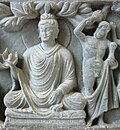


Kidarites[edit | edit source]
The Kidarites conquered Peshawar and parts of the northwest Indian subcontinent including Gandhara probably sometime between 390 and 410 from Kushan empire,[113] around the end of the rule of Gupta Emperor Chandragupta II or beginning of the rule of Kumaragupta I.[114] It is probably the rise of the Hephthalites and the defeats against the Sasanians which pushed the Kidarites into northern India. Their last ruler in Gandhara was Kandik, c. 500 CE.
Alchon Huns[edit | edit source]
Around 430 King Khingila, the most notable Alchon ruler, emerged and took control of the routes across the Hindu Kush from the Kidarites.[115][116][117][118] Coins of the Alchons rulers Khingila and Mehama were found at the Buddhist monastery of Mes Aynak, southeast of Kabul, confirming the Alchon presence in this area around 450–500 CE.[119] The numismatic evidence as well as the so-called "Hephthalite bowl" from Gandhara, now in the British Museum, suggests a period of peaceful coexistence between the Kidarites and the Alchons, as it features two Kidarite noble hunters, together with two Alchon hunters and one of the Alchons inside a medallion.[120] At one point, the Kidarites withdrew from Gandhara, and the Alchons took over their mints from the time of Khingila.[120]
.jpg)

The Alchons undertook the mass destruction of Buddhist monasteries and stupas at Taxila, a high centre of learning, which never recovered from the destruction.[123][124] Virtually all of the Alchon coins found in the area of Taxila were found in the ruins of burned down monasteries, where some of the invaders died alongside local defenders during the wave of destructions.[123] It is thought that the Kanishka stupa, one of the most famous and tallest buildings in antiquity, was destroyed by them during their invasion of the area in the 460s CE. The Mankiala stupa was also vandalised during their invasions.[125]
Mihirakula in particular is remembered by Buddhist sources to have been a "terrible persecutor of their religion" in Gandhara.[126] During the reign of Mihirakula, over one thousand Buddhist monasteries throughout Gandhara are said to have been destroyed.[127] In particular, the writings of Chinese monk Xuanzang from 630 CE explained that Mihirakula ordered the destruction of Buddhism and the expulsion of monks.[128] The Buddhist art of Gandhara, in particular Greco-Buddhist art, became extinct around this period. When Xuanzang visited Gandhara in c. 630 CE, he reported that Buddhism had drastically declined in favour of Shaivism and that most of the monasteries were deserted and left in ruins.[129] It is also noted by Kalhana that Brahmins of Gandhara accepted from Mihirakula gifts of Agraharams.[130] Kalhana also noted in his Rajatarangini how Mihirakula oppressed local Brahmins of South Asia and imported Gandharan Brahmins into Kashmir and India and states that he had given thousands of villages to these Brahmins in Kashmir.[131][132]
Turk and Hindu Shahis[edit | edit source]

The Turk Shahis ruled Gandhara until 843 CE when they were overthrown by the Hindu Shahis. The Hindu Shahis are believed to belong to the Uḍi/Oḍi tribe, namely the people of Oddiyana in Gandhara.[134][135]
The history of the Hindu Shahis begins in 843 CE with Kallar deposing the last Turk Shahi ruler, Lagaturman. Samanta succeeded him, and it was during his reign that the region of Kabul was lost to the Persianate Saffarid empire.[136] Lalliya replaced Samanta soon after and re-conquered Kabul whilst also subduing the region of Zabulistan.[137][138] He is additionally noteworthy for coming into conflict with Samkaravarman of the Utpala dynasty, resulting in his victory and the latter's death in Hazara and was the first Shahi noted by Kalhana. He is depicted as a great ruler with strength to the standard where kings of other regions would seek shelter in his capital of Udabhanda, a change from the previous capital of Kabul.[139][140] Bhimadeva, the next most notable ruler, is most significant for vanquishing the Samanid Empire in Ghazni and Kabul in response to their conquests,[141] his grand-daughter Didda was also the last ruler of the Lohara dynasty. Jayapala then gained control and was brought into conflict with the newly formed Ghaznavid Empire, however, he was eventually defeated. During his rule and that of his son and successor, Anandapala, the kingdom of Lahore was conquered. The following Shahi rulers all resisted the Ghaznavids but were ultimately unsuccessful, resulting in the downfall of the empire in 1026 CE.
Rediscovery[edit | edit source]
 |

By the time Gandhara had been absorbed into the empire of Mahmud of Ghazni, Buddhist buildings were already in ruins and Gandhara's art had been forgotten. After Al-Biruni, the Kashmiri writer Kalhaṇa wrote his book Rajatarangini in 1151. He recorded some events that took place in Gandhara and provided details about its last royal dynasty and capital Udabhandapura.
In the 19th century, British soldiers and administrators started taking an interest in the ancient history of the Indian Subcontinent. In the 1830s coins of the post-Ashoka period were discovered, and in the same period, Chinese travelogues were translated. Charles Masson, James Prinsep, and Alexander Cunningham deciphered the Kharosthi script in 1838. Chinese records provided locations and site plans for Buddhist shrines. Along with the discovery of coins, these records provided clues necessary to piece together the history of Gandhara. In 1848 Cunningham found Gandhara sculptures north of Peshawar. He also identified the site of Taxila in the 1860s. From then on a large number of Buddhist statues were discovered in the Peshawar valley.
Archaeologist John Marshall excavated at Taxila between 1912 and 1934. He discovered separate Greek, Parthian, and Kushan cities and a large number of stupas and monasteries. These discoveries helped to piece together much more of the chronology of the history of Gandhara and its art.
After 1947 Ahmed Hassan Dani and the Archaeology Department at the University of Peshawar made several discoveries in the Peshawar and Swat Valley. Excavation of many of the sites of the Gandhara Civilization is being done by researchers from Peshawar and several universities around the world.
Culture[edit | edit source]
Language[edit | edit source]
Gandhara's language was a Prakrit or "Middle Indo-Aryan" dialect, usually called Gāndhārī.[142] Under the Kushan Empire, Gāndhārī spread into adjoining regions of South and Central Asia.[142] It used the Kharosthi script, which is derived from the Aramaic script, and it died out about in the 4th century CE.[142][143]
Linguistic evidence links some groups of the Dardic languages with Gandhari.[144][145][146] The Kohistani languages, now all being displaced from their original homelands, were once more widespread in the region and most likely descend from the ancient dialects of the region of Gandhara.[147][148] The last to disappear was Tirahi, still spoken some years ago in a few villages in the vicinity of Jalalabad in eastern Afghanistan, by descendants of migrants expelled from Tirah by the Afridi Pashtuns in the 19th century.[149] Georg Morgenstierne claimed that Tirahi is "probably the remnant of a dialect group extending from Tirah through the Peshawar district into Swat and Dir".[150] Nowadays, it must be entirely extinct and the region is now dominated by Iranian languages brought in by later immigrations, such as Pashto.[149] Among the modern day Indo-Aryan languages still spoken today, Torwali shows the closest linguistic affinity possible to Niya, a dialect of Gāndhārī.[148][151]
Religion[edit | edit source]


Mahāyāna Buddhism[edit | edit source]
As per Pali sources, Buddhism first reached Gandhara following the Third Buddhist council which was held in Pataliputra during the reign of Ashoka in the third-century BCE.[152] Various monks were dispatched to different parts of the empire and the missionary dispatched to Gandhara specifically was Majjhantika who originated from the city of Varanasi in India.[153]
Mahāyāna Pure Land sutras were brought from the Gandhāra region to China as early as 147 CE, when the Kushan monk Lokakṣema began translating some of the first Buddhist sutras into Chinese.[154] The earliest of these translations show evidence of having been translated from the Gāndhārī language.[155] Lokakṣema translated important Mahāyāna sūtras such as the Aṣṭasāhasrikā Prajñāpāramitā Sūtra, as well as rare, early Mahāyāna sūtras on topics such as samādhi, and meditation on the Buddha Akṣobhya. Lokaksema's translations continue to provide insight into the early period of Mahāyāna Buddhism. This corpus of texts often includes and emphasises ascetic practices forest dwelling, and absorption in states of meditative concentration:[156]
Paul Harrison has worked on some of the texts that are arguably the earliest versions we have of the Mahāyāna sūtras, those translated into Chinese in the last half of the second century AD by the Indo-Scythian translator Lokakṣema. Harrison points to the enthusiasm in the Lokakṣema sūtra corpus for the extra ascetic practices, for dwelling in the forest, and above all for states of meditative absorption (samādhi). Meditation and meditative states seem to have occupied a central place in early Mahāyāna, certainly because of their spiritual efficacy but also because they may have given access to fresh revelations and inspiration.
Some scholars believe that the Mahāyāna Longer Sukhāvatīvyūha Sūtra was compiled in the age of the Kushan Empire in the 1st and 2nd centuries CE, by order of Mahīśāsaka bhikṣus which flourished in the Gandhāra region.[157][158] However, it is likely that the longer Sukhāvatīvyūha owes greatly to the Mahāsāṃghika-Lokottaravāda sect as well for its compilation, and in this sutra, there are many elements in common with the Lokottaravādin Mahāvastu.[157] There are also images of Amitābha Buddha with the bodhisattvas Avalokiteśvara and Mahāsthāmaprāpta which were made in Gandhāra during the Kushan era.[159]
The Mañjuśrīmūlakalpa records that Kaniṣka of the Kushan Empire presided over the establishment of the Mahāyāna Prajñāpāramitā teachings in the northwest.[160] Tāranātha wrote that in this region, 500 bodhisattvas attended the council at Jālandhra monastery during the time of Kaniṣka, suggesting some institutional strength for Mahāyāna in the north-west during this period.[160] Edward Conze goes further to say that Prajñāpāramitā had great success in the north-west during the Kushan period, and may have been the "fortress and hearth" of early Mahāyāna, but not its origin, which he associates with the Mahāsāṃghika branch of Buddhism.[161]
Other religions[edit | edit source]
Zoroastrianism also was present in Gandhara since the Persian conquest,[153] likely continuing to the reign of Ashoka and subsequently: some scholars have speculated that its presence may have influenced the development of unique aspects of Mahayana Buddhism in Gandhara.[162]
Gandhara, especially Taxila, during Kushan times also played an influential role in the development of arts and culture of the Hindu synthesis,[163] as the region's artistic traditions were influential to some of the early depictions of deities in Hindu art.[164][165]
Art[edit | edit source]

Gandhāra is noted for the distinctive Gandhāra style of Buddhist art, which shows the influence of Hellenistic and Eastern Indo-Aryan influences from the Gangetic Valley.[166] The Gandhāran art flourished and achieved its peak during the Kushan period, from the 1st to the 5th centuries, but it declined and was destroyed after the invasion of the Alchon Huns in the 5th century.
Siddhārtha shown as a bejewelled prince (before Siddhārtha renounces palace life) is a common motif.[167] Stucco, as well as stone, were widely used by sculptors in Gandhara for the decoration of monastic and cult buildings.[167][168] Buddhist imagery combined with some artistic elements from the cultures of the Hellenistic world. An example is the youthful Buddha, his hair in wavy curls, similar to statutes of Apollo.[167] Sacred artworks and architectural decorations used limestone for stucco composed by a mixture of local crushed rocks (i.e. schist and granite) which resulted compatible with the outcrops located in the mountains northwest of Islamabad.[169]
The artistic traditions of Gandhara art can be divided into the following phases:
- Indo-Greek art; 2nd century BCE to 1st century CE
- Indo-Scythian art; 1st century BCE to 1st century CE
- Kushan art; 1st century CE to 4th century CE
-
 Standing Bodhisattva (1st–2nd century)
 -
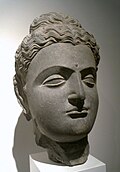 Buddha head (2nd century)
 -
 Buddha head (4th–6th century)
 -
 Buddha in acanthus capital
 -
 The Greek god Atlas, supporting a Buddhist monument, Hadda
 -
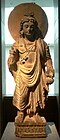 The Bodhisattva Maitreya (2nd century)
 -
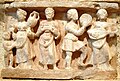 Wine-drinking and music, Hadda (1st–2nd century)
 -
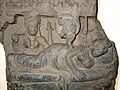 Maya's white elephant dream (2nd–3rd century)
 -
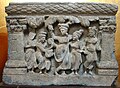 The birth of Siddhārtha (2nd–3rd century)
 -
 The Great Departure from the Palace (2nd–3rd century)
 -
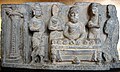 The end of asceticism (2nd–3rd century)
 -
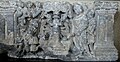 The Buddha preaching at the Deer Park in Sarnath (2nd–3rd century)
 -
 Scene of the life of the Buddha (2nd–3rd century)
 -
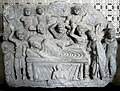 The death of the Buddha, or parinirvana (2nd–3rd century)
 -
 A sculpture from Hadda, (3rd century)
 -
 The Bodhisattva and Chandeka, Hadda (5th century)
 -
 Hellenistic decorative scrolls from Hadda, Afghanistan
 -
 Hellenistic scene, Gandhara (1st century)
 -
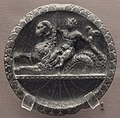 A stone plate (1st century)
 -
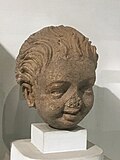 "Laughing boy" from Hadda
 -
 Bodhisattva seated in meditation
 -
 Marine deities, Gandhara
 -
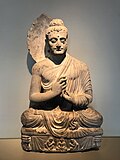 The Seated Buddha, dating from 300 to 500 CE, was found near Jamal Garhi, and is now on display at the Asian Art Museum in San Francisco.
 -
 Sharing of the Buddha's relics, above a Gandhara fortified city


.jpg)


Major cities[edit | edit source]
Major cities of ancient Gandhara are as follows:
- Puṣkalavati (Charsadda), Pakistan
- Takshashila (Taxila), Pakistan
- Puruṣapura (Peshawer), Pakistan
- Sagala (Sialkot), Pakistan
- Oddiyana (Swat), Pakistan
- Jibin, Pakistan appears in the Chinese sources
- Chukhsa (Chhachh), Pakistan
- Attock Khurd (Attock), Pakistan
- Hund (Swabi), Pakistan
- Bajaur, capital of (Apraca), Pakistan
- Aornos, somewhere in Hazara, Pakistan
Notable people[edit | edit source]
In popular culture[edit | edit source]
- Gandhara:Buddha no Seisen is an action RPG released in Japan in 1987.[170]
- "Gandhara" is a 1978 song by Japanese rock band Godiego, serving as their 7th single.
- Gandhara is a fictional Buddhist pacifist organisation in the Japanese manga series Shaman King.
See also[edit | edit source]
References[edit | edit source]
- ↑ 1.0 1.1 Bryant, Edwin Francis (2002). The Quest for the Origins of Vedic Culture: The Indo-Aryan Migration Debate. Oxford University Press. p. 138. ISBN 978-0-19-565361-8.
- ↑ Kulke, Professor of Asian History Hermann; Kulke, Hermann; Rothermund, Dietmar (2004). A History of India. Psychology Press. ISBN 978-0-415-32919-4.
- ↑ Warikoo, K. (2004). Bamiyan: Challenge to World Heritage. Third Eye. ISBN 978-81-86505-66-3.
- ↑ Hansen, Mogens Herman (2000). A Comparative Study of Thirty City-state Cultures: An Investigation. Kgl. Danske Videnskabernes Selskab. ISBN 978-87-7876-177-4.
- ↑ Neelis, Early Buddhist Transmission and Trade Networks 2010, pp. 232–233.
- ↑ Eggermont, Alexander's Campaigns in Sind and Baluchistan 1975, pp. 175–177.
- ↑ "UW Press: Ancient Buddhist Scrolls from Gandhara". Retrieved April 2018.
- ↑ Some sounds are omitted in the writing of Old Persian and are shown with a raised letter. Old Persian p.164Old Persian p.13. In particular, Old Persian nasals such as "n" were omitted in writing before consonants Old Persian p.17Old Persian p.25
- ↑ Thomas Watters (1904). "On Yuan Chwang's travels in India, 629–645 A.D." Royal Asiatic Society. p. 200.
Taken as Gandhavat the name is explained as meaning hsiang-hsing or "scent-action" from the word gandha which means scent, small, perfume.
At the Internet Archive. - ↑ Adrian Room (1997). Placenames of the World. McFarland. ISBN 9780786418145.
Kandahar. City, south central Afghanistan
At Google Books. - ↑ Macdonell, Arthur Anthony; Keith, Arthur Berriedale (1995). Vedic Index of Names and Subjects. Vol. 1. Motilal Banarsidass Publishers. p. 219. ISBN 9788120813328. From Google Books.
- ↑ "Gandara – Livius".
- ↑ Herodotus (1920). "3.102.1". Histories. "4.44.2". Histories (in Ελληνικά). Translated by A. D. Godley. "3.102.1". Histories. "4.44.2". Histories. Cambridge: Harvard University Press. At the Perseus Project.
- ↑ Perfrancesco Callieri, INDIA ii. Historical Geography, Encyclopaedia Iranica, 15 December 2004.
- ↑ Herodotus Book III, 89–95
- ↑ University Of Pittsburgh Press U.S.A. (1961). Cultural History Of Kapisa And Gandhara. pp. 12–13.
The Ramayana places Gandhara on both banks of the Indus....According to Strabo, Gandharites lay along the river Kophes, between the Khoaspes and the Indus. Ptolemy places Gandhara between Suastos (Swat) and the Indus including both banks of Koa immediately above its junction with the Indus.
- ↑ University Of Pittsburg Press U.S.A. (1961). Cultural History Of Kapisa And Gandhara. p. 12.
The Ramayana places Gandhara on both banks of the Indus with its two royal cities Pushkalavati for the west and Takshasila for the east.
- ↑ "Decorative Motifs on Pedestals of Gandharan Sculptures: A Case Study of Peshawar Museum" (PDF). p. 173.
While according to the recent research, the cultural influence of Gandhāra even reached up to the valley of the Jhelum River in the east (Dar 2007: 54-55).
- ↑ "The geography of Gandharan art" (PDF). p. 6.
although Saifur Rahman Dar sought in 2007 to extend the geographical frame to the left bank of the Jhelum river, on account of six Buddhist images discovered at the sites of Mehlan, Patti Koti, Burarian, Cheyr and Qila Ram Kot (Dar 2007: 45-59), evidence remains insufficient to support his conclusions.
- ↑ Sastri, K. a Nilakanta (1957). Comprehensive History Of India Vol.2 (mauryas And Satavahanas). p. 1.
Here he had to depend upon and appoint Indians as his satraps, viz., Ambhi, king of Taxila, to rule from the Indus to the Hydaspes (Jhelum).
- ↑ Wannaporn Rienjang and Peter Stewart (15 March 2019). The Geography Of Gandhāran Art: Proceedings of the Second International Workshop of the Gandhāra Connections Project, University of Oxford, 22nd-23rd March, 2018. p. 8.
The Greater Gandhara of philologists, or at least of Salomon, extends beyond the western foothills of the Hindu Kush and the Karakorum Highway to include parts of Bactria and even parts of the region around the Tarim Basin. As Salomon specifies in The Buddhist Literature from Ancient Gandhara, 'thus Greater Gandhara can be understood as a primarily linguistic rather than a political term, that is, as comprising the regions where Gandharl was the indigenous or adopted language'. Accordingly, it includes places such as Bamiyan where over two hundred of fragments of manuscripts in Gandharl have been discovered along with a larger group of manuscripts in Sanskrit.
- ↑ Wannaporn Rienjang and Peter Stewart (15 March 2019). The Geography Of Gandhāran Art: Proceedings of the Second International Workshop of the Gandhāra Connections Project, University of Oxford, 22nd-23rd March, 2018. p. 7.
Other scholars had alternately equated Jibin with Kapisa and more frequently with Kashmir. Kuwayama concludes that while this identification might prove correct for some sources, the Gaoseng zhuan s fourth and fifth century placement of Jibin coincides clearly with the narrower geographical definition of Gandhara.
- ↑ Agrawala, V. S. (1953). India as known to Panini. p. 38.
Udichya and Prachya are the two broad divisions of the country mentioned by Panini, and these terms occur in connection with the linguistic forms known to the eastern and northern grammarians. The Udichya country included Gandhara and Vahika, the latter comprising Madra and Usinara.
- ↑ Olivieri, Luca M., Roberto Micheli, Massimo Vidale, and Muhammad Zahir, (2019). 'Late Bronze – Iron Age Swat Protohistoric Graves (Gandhara Grave Culture), Swat Valley, Pakistan (n-99)', in Narasimhan, Vagheesh M., et al., "Supplementary Materials for the formation of human populations in South and Central Asia", Science 365 (6 September 2019), pp. 137–164.
- ↑ Coningham, Robin, and Mark Manuel, (2008). "Kashmir and the Northwest Frontier", Asia, South, in Encyclopedia of Archaeology 2008, Elsevier, p. 740.
- ↑ Narasimhan, Vagheesh M., et al. (2019). "The formation of human populations in South and Central Asia", in Science 365 (6 September 2019), p. 11: "...we estimate the date of admixture into the Late Bronze Age and Iron Age individuals from the Swat District of northernmost South Asia to be, on average, 26 generations before the date that they lived, corresponding to a 95% confidence interval of ~1900 to 1500 BCE..."
- ↑ Journal of the Royal Asiatic Society. University Press. 1889. p. 212.
- ↑ Macdonell, Arthur Anthony; Keith, Arthur Berriedale (1912). Vedic Index of Names and Subjects. John Murray. pp. 218–219.
- ↑ Chattopadhyaya, Sudhakar (1978). Reflections on the Tantras. Motilal Banarsidass Publishers. p. 4.
- ↑ "Rigveda 1.126:7, English translation by Ralph TH Griffith".
- ↑ Arthur Anthony Macdonell (1997). A History of Sanskrit Literature. Motilal Banarsidass. pp. 130–. ISBN 978-81-208-0095-3.
- ↑ 32.0 32.1 Raychaudhuri 1953, p. 59-62.
- ↑ 33.0 33.1 Raychaudhuri 1953, p. 146-147.
- ↑ 34.0 34.1 34.2 34.3 Prakash, Buddha (1951). "Poros". Annals of the Bhandarkar Oriental Research Institute. 32 (1): 198–233. JSTOR 41784590. Retrieved 12 June 2022.
- ↑ Macdonell & Keith 1912, p. 218-219, 432.
- ↑ Higham, Charles (2014), Encyclopedia of Ancient Asian Civilizations, Infobase Publishing, pp. 209–, ISBN 978-1-4381-0996-1
- ↑ Khoinaijam Rita Devi (1 January 2007). History of ancient India: on the basis of Buddhist literature. Akansha Publishing House. ISBN 978-81-8370-086-3.
- ↑ Chattopadhyaya, Sudhakar (1974). The Achaemenids And India. pp. 22–23.
- ↑ 39.0 39.1 Lamotte, Etienne (1988). History of Indian Buddhism: From the Origins to the Saka Era. Institut Orientaliste, Louvain-La-Neuve. p. 101. ISBN 978-90-6831-100-6.
Pukkusāti, whose history we learn from a late and partly apocryphal tradition
- ↑ Karttunen, Klaus (1989). India in Early Greek Literature. Finnish Oriental Society. pp. 61–62. ISBN 978-951-9380-10-0.
- ↑ Chattopadhyaya, Sudhakar (1974). The Achaemenids And India. p. 22.
According to the Buddhist account Pukkusati, king of Taksasila, sent an embassy and a letter to king Bimbisara of Magadha and he also defeated Pradyota, king of Avanti.
- ↑ "Part 2 - Story of King Pukkusāti". 11 September 2019.
This man of good family read the message sent by his friend King Bimbisāra and after completely renouncing his one hundred yojana-wide domain of Takkasīla, he became a monk out of reverence for Me.
- ↑ Chattopadhyaya, Sudhakar (1974). The Achaemenids And India. p. 22.
Bimbisara and his son Ajatasatru, he did not probably come to the throne before 540 or 530 bc, and Pukkusati also may be regarded as ruling in Gandhara about that time. He would be thus a contemporary of Cyrus who established his power and authority in 549 bc
- ↑ History Of Ancient And Early Medieval India From The Stone Age To The 12th Century. p. 604.
The Behistun inscription of the Achaemenid emperor Darius indicates that Gandhara was conquered by the Persians in the later part of the 6th century BCE.
- ↑ "Pukkusāti". www.palikanon.com. Retrieved 26 July 2020.
- ↑ "VIEWER XDOCS". xdocs.net. pp. 61–62. Retrieved 25 April 2025.
- ↑ Mccrindle, J. W. Ancient India As Described By Megasthenes And Arrian by Mccrindle, J. W. p. 109.
The Persians indeed summoned the Hydrakai from India to serve as mercenaries, but they did not lead an army into the country and only approached its borders when Kyros marched against the Massagatai.
- ↑ O. Bopearachchi, "Premières frappes locales de l'Inde du Nord-Ouest: nouvelles données", in Trésors d'Orient: Mélanges offerts à Rika Gyselen, Fig. 1 CNG Coins
- ↑ Bopearachchi, Osmund. Coin Production and Circulation in Central Asia and North-West India (Before and after Alexander's Conquest). pp. 300–301.
- ↑ "US Department of Defense". Archived from the original on 10 June 2020. Retrieved 7 October 2018.
- ↑ Errington, Elizabeth; Trust, Ancient India and Iran; Museum, Fitzwilliam (1992). The Crossroads of Asia: transformation in image and symbol in the art of ancient Afghanistan and Pakistan. Ancient India and Iran Trust. pp. 57–59. ISBN 9780951839911.
- ↑ Bopearachchi, Osmund. Coin Production and Circulation in Central Asia and North-West India (Before and after Alexander's Conquest). pp. 308–.
- ↑ "LacusCurtius • Herodotus — Book VII: Chapters 57‑137". penelope.uchicago.edu. Retrieved 27 January 2024.
The Parthians, Chorasmians, Sogdians, Gandarians, and Dadicae in the army had the same equipment as the Bactrians.
- ↑ "LacusCurtius • Herodotus — Book VII: Chapters 57‑137". penelope.uchicago.edu. Retrieved 27 January 2024.
The Parthians and Chorasmians had for their commander Artabazus son of Pharnaces, the Sogdians Azanes son of Artaeus, the Gandarians and Dadicae Artyphius son of Artabanus.
- ↑ Rafi U. Samad, The Grandeur of Gandhara: The Ancient Buddhist Civilization of the Swat, Peshawar, Kabul and Indus Valleys. Algora Publishing, 2011, p. 32 ISBN 0875868592
- ↑ Konow, Sien (1929). Kharoshthi Inscriptions Except Those Of Asoka Vol.ii Part I (1929). p. 18.
Buhler had shown that the KharoshthI characters are derived from Aramaic, which Origin of was in common use for official purposes all over the Achaemenian empire during the KharoshthI period when it comprised north-western India... And Buhler is right in assuming that KharoshthI is ' the result of the intercourse between the offices of the Satraps and of the native authorities
- ↑ Mccrindle, J. W. Ancient India As Described By Megasthenes And Arrian by Mccrindle, J. W. pp. 179–180.
The regions beyond the, river Indus on the west are inhabited, up to the river Kophen, by two Indian tribes, the Astakenoi and the Assakenoi...In the dominions of the Assakanoi there is a great city called Massaka, the seat of the sovereign power which controls the whole realm. And there is an other city, Peukalaitis, which is also of great size and not far from the Indus.
- ↑ "alexander and his successors in central asia" (PDF). p. 72.
The ruler of Taxila wanted to satisfy his own grudge against Porus
- ↑ "alexander and his successors in central asia" (PDF). p. 72.
Taxiles and the others came to meet him, bringing gifts reckoned of value among the Indians. They presented him with the twenty-five elephants....and when they reached the Indus, they were to make all necessary preparations for the passage of the army. Taxiles and the other chiefs marched with them.
- ↑ "alexander and his successors in central asia" (PDF). p. 73.
Then crossing the mountains Alexander descended to a city called Arigaeum [identified with Nawagai], and found that this had been set on fire by the inhabitants, who had afterwards fled.
- ↑ "alexander and his successors in central asia" (PDF). p. 74.
Alexander then crossed the River Guraeus (the Panchkora, in Dir District). Beyond the Karmani pass lies the Talash valley. The Assacenians, identified with the Asvakas of Sanskrit literature, tried to defend themselves.
- ↑ "alexander and his successors in central asia" (PDF). pp. 74–75.
- ↑ "alexander and his successors in central asia" (PDF). p. Alexander while reconnoitring the fortifications, and unable to fix on a plan of attack, since nothing less than a vast mole, necessary for bringing up his engines to the walls, would suffice to fill up the chasms, was wounded from the ramparts by an arrow which chanced to hit him in the calf of the leg.
- ↑ "alexander and his successors in central asia" (PDF). p. 75.
When many were thus wounded and not a few killed, the women, taking the arms of the fallen, fought side by side with the men for the imminence of the danger and the great interests at stake forced them to do violence to their nature, and to take an active part in the defence.
- ↑ Tarn, William Woodthorpe (24 June 2010). The Greeks in Bactria and India. Cambridge University Press. p. 152. ISBN 978-1-108-00941-6.
The Mauryan empire proper, north of the line of the Nerbudda and the Vindhya mountains, had pivoted upon three great cities: pataliputra the capital and the seat of the emperor, Taxila the seat of the viceroy of the North West...
- ↑ Sastri, K. a Nilakanta (1957). Comprehensive History Of India Vol.2 (mauryas And Satavahanas). p. 2.
he bought the boy by paying on the spot 1000 kdrshapanas. Kautilya(Chanakya) then took the boy with him to his native city of Takshasila (Taxila), then the most renowned seat of learning in India, and had him educated there for a period of seven or eight years in the humanities and the practical arts and crafts of the time, including the military arts.
- ↑ Sastri, K. a Nilakanta (1957). Comprehensive History Of India Vol.2 (mauryas And Satavahanas). p. 2.
This tradition is curiously confirmed by Plutarch's statement that Chandragupta as a youth had met Alexander during his campaigns in the Panjab. This was possible because Chandragupta was already living in that locality with Kautilya (Chanakya).
- ↑ Sastri, K. a Nilakanta (1957). Comprehensive History Of India Vol.2 (mauryas And Satavahanas). p. 3.
According to tradition he began by strengthening his position by an alliance with the Himalayan chief Parvataka, as stated in both the Sanskrit and Jaina texts, Mudradkshasa and Parisishtaparvan.
- ↑ Sastri, K. a Nilakanta (1957). Comprehensive History Of India Vol.2 (mauryas And Satavahanas). p. 4.
The army of Malayaketu (Parvataka) comprised recruits from the following peoples : Khasa, Magadha, Gandhara, Yavana, Saka, Chedi and Huna.
- ↑ Lahiri, Nayanjot (5 August 2015). Ashoka in Ancient India. Harvard University Press. p. 67. ISBN 978-0-674-91525-1.
Ashoka arrived in Taxila at the head of an armed contingent, the swords remained in their scabbards: the citizenry, instead of offering resistance came out of their city and on its roads to welcome him, saying 'we did not want to rebel against the prince.. nor even against King Bundusara; but evil ministers came and oppressed us'
- ↑ Sastri, K. a Nilakanta (1957). Comprehensive History Of India Vol.2 (mauryas And Satavahanas). p. 22.
In the Gupta epoch, again, some of the provinces were administered by princes of the royal blood designated kumaras. The same was the case in the time of Asoka. Three instances of such Kumara governorship are known from his edicts. Thus one kumara was stationed at Takshasila to govern the frontier province of Gandhara..
- ↑ Cunningham, Alexander (6 December 2022). Archeological Survey of India: Vol. II. BoD – Books on Demand. p. 90. ISBN 978-3-368-13568-3.
...3/4 of a mile to the north of this place there was a great stupa built by Ashoka
- ↑ Prakesh, Buddha. "Studies In Indian History And Civilization" (PDF). p. 157.
Subhagasena seems to be the successor of Virasena, who came to the throne after Ashoka, according to Taranatha. It appears that after the secession of the north-western half of India from the Maurya empire after the death of Ashoka, Virasena entrenched his hold over it while the other eastern and southern half of the country passed under the domination of Samprati.
- ↑ Prakesh, Buddha. "Studies In Indian History And Civilization" (PDF). p. 155.
Polybius states: "He (Antiochus the Great) crossed the Caucasus and descended into India, renewed his friendship with Sophogsenus the king of the Indians; received more elephants, until he had 150 altogether
- ↑ Rapson, Edward James; Haig, Sir Wolseley; Burn, Sir Richard; Dodwell, Henry; Wheeler, Sir Robert Eric Mortimer (1968). The Cambridge History of India. CUP Archive. p. 512.
..with whom Antiochus the Great renewed an ancestral relationship in 206 BCE
- ↑ (Imperial Gazetteer, p. 149)
- ↑ Neelis, Jason (19 November 2010). Early Buddhist Transmission and Trade Networks: Mobility and Exchange Within and Beyond the Northwestern Borderlands of South Asia. BRILL. p. 118. ISBN 978-90-04-18159-5.
The domain of the Apracas was probably centred in Bajaur and extended to Swat, Gandhara, Taxila and other parts of Eastern Afghanistan
- ↑ Neelis, Jason (19 November 2010). Early Buddhist Transmission and Trade Networks: Mobility and Exchange Within and Beyond the Northwestern Borderlands of South Asia. BRILL. p. 119. ISBN 978-90-04-18159-5.
The apracas were also connected by marital alliance with the Odi kings in the Swat valley since a royal relative and officer named Suhasoma in a Buddhist reliquary inscription of Senavarman was married to Vasavadatta.
- ↑ Kubica, Olga (14 April 2023). Greco-Buddhist Relations in the Hellenistic Far East: Sources and Contexts. Taylor & Francis. pp. 134–135. ISBN 978-1-000-86852-4.
- ↑ "Buddhism and Society in the Indic North and Northwest, 2nd Century BCE–3rd Century CE" (PDF). p. 207.
The first was dedicated by Prahodi, the woman of the inner court of Vijayamitra, and is dated 32 Vijayamitra (30/31 CE)...This year represents in all likelihood one of Vijayamitra's last as ruler, for the throne would subsequently be given to his son Indravasu..
- ↑ "Buddhism and Society in the Indic North and Northwest, 2nd Century BCE–3rd Century CE" (PDF). p. 220.
More likely is that Indravasu governed until c. 50 CE, whereafter he was succeeded by his grandson Indravarma II
- ↑ The Grandeur of Gandhara, Rafi-us Samad, Algora Publishing, 2011, p.64-67 [1]
- ↑ Neelis, Jason (19 November 2010). Early Buddhist Transmission and Trade Networks: Mobility and Exchange Within and Beyond the Northwestern Borderlands of South Asia. BRILL. pp. 118–119. ISBN 978-90-04-18159-5.
Another important member of the Apraca lineage was the general (stratega) Aspavarman
- ↑ Neelis, Jason (19 November 2010). Early Buddhist Transmission and Trade Networks: Mobility and Exchange Within and Beyond the Northwestern Borderlands of South Asia. BRILL. p. 119. ISBN 978-90-04-18159-5.
A silver drinking vessel with an animal style ibex figure formerly belonging to the "Yagu king" Kharaosta that was rededicated as a Buddhist reliquary by Indravarman may indicate this object was given to the apracas as a gift in exchange for some form of tribute or assistance
- ↑ "Buddhism and Society in the Indic North and Northwest, 2nd Century BCE–3rd Century CE" (PDF). pp. 204–205.
the Lord Vijayamitra Apracarāja, and Indravarma the General, Ruler of Gandhāra, are worshipped
- ↑ Neelis, Jason (19 November 2010). Early Buddhist Transmission and Trade Networks: Mobility and Exchange Within and Beyond the Northwestern Borderlands of South Asia. BRILL. p. 119. ISBN 978-90-04-18159-5.
Since Aspavarman's coins overlap with late or post-humous issues of Azes II and the Indo-parthian ruler Gondophares, he probably flourished from ca. 20-50 CE.
- ↑ Khettry, Sarita (2014). "Social Background of Buddhism in Gandhara(c.2 Nd Century Bce to the Middle of the 4th Century Ce)". Proceedings of the Indian History Congress. 75: 44. ISSN 2249-1937. JSTOR 44158359.
The name of Aspavarma occurs four times in the eighth avadana of the above mentioned Buddhist manuscripts. The story in the avadana text involves some interaction between Aspavarman and Jhadamitra (a Saka noble) with regard to the provision of a place for the monks to stay during the rainy season. This shows that the Aspavarman was a patron of the Buddhist Samgha.
- ↑ "Buddhism and Society in the Indic North and Northwest, 2nd Century BCE–3rd Century CE" (PDF). p. 163.
the Reliquary Inscription of Ariaśrava et al (No. 31), dated 98 Azes (50/51 CE), whose donor, Ariaśrava, stipulates her relic dedication was made in the reign of Gondopahres' nephew Abdagases and the General Aśpavarma, son of Indravarma I:
- ↑ Sastri, K. a Nilakanta (1957). Comprehensive History Of India Vol.2 (mauryas And Satavahanas). p. 215.
The interesting additional information we get from these coins is that Sasan, a former associate of Gondophares and afterwards one of his successors in the Taxila region, was the son of Aspa's brother
- ↑ Sastri, K. a Nilakanta (1957). Comprehensive History Of India Vol.2 (mauryas And Satavahanas). p. 215.
The coins further show that Sasan, who was at first a subordinate ruler under Gondophares, subsequently assumed independent or quasi-independent status.
- ↑ Srinivasan, Doris (30 April 2007). On the Cusp of an Era: Art in the Pre-Kuṣāṇa World. BRILL. p. 106. ISBN 978-90-474-2049-1.
In the Indus valley Gondophares was succeeded by his nephew Abdagases and then by Sases.
- ↑ Srinivasan, Doris (30 April 2007). On the Cusp of an Era: Art in the Pre-Kuṣāṇa World. BRILL. p. 115. ISBN 978-90-474-2049-1.
- ↑ Rienjang, Wannaporn; Stewart, Peter (14 March 2018). Problems of Chronology in Gandhāran Art: Proceedings of the First International Workshop of the Gandhāra Connections Project, University of Oxford, 23rd-24th March, 2017. Archaeopress. pp. 16–17. ISBN 978-1-78491-855-2.
- ↑ Srinivasan, Doris (30 April 2007). On the Cusp of an Era: Art in the Pre-Kuṣāṇa World. BRILL. p. 107. ISBN 978-90-474-2049-1.
Philostratus comments that the people who live between the River Kophen and Taxila have a coinage not of gold and silver but of Orichalcum and black brass. He describes the houses as designed so that if you look at them from the outside, they appear to have only one storey, but if you go inside they have underground rooms as well.
- ↑ De Beauvoir Priaulx, Osmond (1860). "The Indian Travels of Apollonius of Tyana". Journal of the Royal Asiatic Society of Great Britain and Ireland. 17: 76. ISSN 0035-869X. JSTOR 25581224.
Taxila was about the size of Ninovoh, walled like a Greek city
- ↑ De Beauvoir Priaulx, Osmond (1860). "The Indian Travels of Apollonius of Tyana". Journal of the Royal Asiatic Society of Great Britain and Ireland. 17: 77. ISSN 0035-869X. JSTOR 25581224.
They are taken to the palace. They found the city divided by narrow streets, well-arranged, and reminding them of Athens.
- ↑ De Beauvoir Priaulx, Osmond (1860). "The Indian Travels of Apollonius of Tyana". Journal of the Royal Asiatic Society of Great Britain and Ireland. 17: 76. ISSN 0035-869X. JSTOR 25581224.
and was the residence of a sovereign who ruled over what of old was the kingdom of Porus.
- ↑ De Beauvoir Priaulx, Osmond (1860). "The Indian Travels of Apollonius of Tyana". Journal of the Royal Asiatic Society of Great Britain and Ireland. 17: 78. ISSN 0035-869X. JSTOR 25581224.
Phraotes, in answer, said that he was moderate because his wants were few, and that as he was wealthy, he employed his wealth in doing good to his friends, and in subsidizing the barbarians, his neighbours, to prevent them from themselves ravaging, or allowing other barbarians to ravage his territories.
- ↑ De Beauvoir Priaulx, Osmond (1860). "The Indian Travels of Apollonius of Tyana". Journal of the Royal Asiatic Society of Great Britain and Ireland. 17: 81. ISSN 0035-869X. JSTOR 25581224.
The king then told how his father, the son of a king, had been left very young an orphan; and how during his minority two of his relatives according to Indian custom acted as regents, but with so little regard to law, that some nobles conspired against them, and slow them as they were sacrificing to the Indus, and seized upon the government
- ↑ De Beauvoir Priaulx, Osmond (1860). "The Indian Travels of Apollonius of Tyana". Journal of the Royal Asiatic Society of Great Britain and Ireland. 17: 81. ISSN 0035-869X. JSTOR 25581224.
How on this his father, then sixteen years of age, fled to the king beyond the Hydaspes, a greater king than himself, who received him kindly... he requested to be sent to the Brahmans; and how the Brahmans educated him; and how in time he married the daughter of the Hydaspian king, and received with her seven villages as pin-money, and had issue one son, himself, Phraotes.
- ↑ De Beauvoir Priaulx, Osmond (1860). "The Indian Travels of Apollonius of Tyana". Journal of the Royal Asiatic Society of Great Britain and Ireland. 17: 81. ISSN 0035-869X. JSTOR 25581224.
When I crossed the Hydraotis, I heard that, of the usurpers, one was already dead, and the other besieged in this very palace; so I hurried on, proclaiming to the villages I passed through who I was, and what were my rights : and the people received me gladly, and declaring I was the very picture of my father and grandfather, they accompanied me, many of them armed with swords and bows, and our numbers increased daily; and when we reached this city, the inhabitants, with torches lit at the altar of the Sun, and singing the praises of my father and grandfather, came out and welcomed me, and brought me hither.
- ↑ 余太山著 (1 July 2021). A CONCISE COMMENTARY ON MONOGRAPHS ON THE WESTERN REGIONS IN THE OFFICIAL HISTORY BOOKS OF THE WESTERN & EASTERN HAN, WEI, JIN, SOUTHERN & NORTHERN DYNASTIES. Beijing Book Co. Inc. ISBN 978-7-100-19365-8.
Formerly, when the Yuezhi had been destroyed by the Xiongnu, they moved to Daxia and divided the country into five Xihou.
- ↑ 余太山著 (1 July 2021). A CONCISE COMMENTARY ON MONOGRAPHS ON THE WESTERN REGIONS IN THE OFFICIAL HISTORY BOOKS OF THE WESTERN & EASTERN HAN, WEI, JIN, SOUTHERN & NORTHERN DYNASTIES. Beijing Book Co. Inc. ISBN 978-7-100-19365-8.
More than a hundred years later, the xihou of guishuang(kushan) named Qiujiuque(Kujula) attacked and destroyed the other four xihou and established himself king.
- ↑ 余太山著 (1 July 2021). A CONCISE COMMENTARY ON MONOGRAPHS ON THE WESTERN REGIONS IN THE OFFICIAL HISTORY BOOKS OF THE WESTERN & EASTERN HAN, WEI, JIN, SOUTHERN & NORTHERN DYNASTIES. Beijing Book Co. Inc. ISBN 978-7-100-19365-8.
This king invaded Anxi(Parthia) and took Gaofu(Kabul) and destroyed Puda and Jibin.
- ↑ 余太山著 (1 July 2021). A CONCISE COMMENTARY ON MONOGRAPHS ON THE WESTERN REGIONS IN THE OFFICIAL HISTORY BOOKS OF THE WESTERN & EASTERN HAN, WEI, JIN, SOUTHERN & NORTHERN DYNASTIES. Beijing Book Co. Inc. ISBN 978-7-100-19365-8.
and his son yangouzhen(Vima takto) succeeded him as king. He in his turn destroyed Tianzhu and installed a general there to control it.
- ↑ 余太山著 (1 July 2021). A CONCISE COMMENTARY ON MONOGRAPHS ON THE WESTERN REGIONS IN THE OFFICIAL HISTORY BOOKS OF THE WESTERN & EASTERN HAN, WEI, JIN, SOUTHERN & NORTHERN DYNASTIES. Beijing Book Co. Inc. ISBN 978-7-100-19365-8.
occupied Gandhara around 60 CE and Taxila by 78 CE
- ↑ 余太山著 (1 July 2021). A CONCISE COMMENTARY ON MONOGRAPHS ON THE WESTERN REGIONS IN THE OFFICIAL HISTORY BOOKS OF THE WESTERN & EASTERN HAN, WEI, JIN, SOUTHERN & NORTHERN DYNASTIES. Beijing Book Co. Inc. ISBN 978-7-100-19365-8.
The state of Gaofu to the southwest of Da Yuezhi and is also a large state. Its way of life resembles that of Tianzhu and the people are weak and easily conquered. They excel in commerce, and internally they are very wealthy. Their political allegiance has never been constant.
- ↑ 余太山著 (1 July 2021). A CONCISE COMMENTARY ON MONOGRAPHS ON THE WESTERN REGIONS IN THE OFFICIAL HISTORY BOOKS OF THE WESTERN & EASTERN HAN, WEI, JIN, SOUTHERN & NORTHERN DYNASTIES. Beijing Book Co. Inc. ISBN 978-7-100-19365-8.
The three states of Tianzhu Jibin and Anxi had possessed it when they were strong and have lost it when they were weak.
- ↑ 余太山著 (1 July 2021). A CONCISE COMMENTARY ON MONOGRAPHS ON THE WESTERN REGIONS IN THE OFFICIAL HISTORY BOOKS OF THE WESTERN & EASTERN HAN, WEI, JIN, SOUTHERN & NORTHERN DYNASTIES. Beijing Book Co. Inc. ISBN 978-7-100-19365-8.
its customs are the same as those of Yuezhi...the inhabitants ride on elephants in warfare
- ↑ Le, Huu Phuoc (2010). Buddhist Architecture. Grafikol. p. 180. ISBN 9780984404308.
- ↑ Marshall, John H. (1909): "Archaeological Exploration in India, 1908–9." (Section on: "The stūpa of Kanishka and relics of the Buddha"). Journal of the Royal Asiatic Society, 1909, pp. 1056–1061.
- ↑ Rai Govind Chandra (1 January 1979). Indo-Greek Jewellery. Abhinav Publications. pp. 82–. ISBN 978-81-7017-088-4. Retrieved 13 December 2012.
- ↑ Dani, Ahmad Hasan; Litvinsky, B. A. (1996). History of Civilizations of Central Asia: The crossroads of civilizations, A.D. 250 to 750. UNESCO. p. 122. ISBN 9789231032110.
- ↑ "The entry of the Kidarites into India may firmly be placed some time round about the end of the rule of Chandragupta II or beginning of the rule of Kumaragupta I (circa 410–420 a.d.)" in Gupta, Parmeshwari Lal; Kulashreshtha, Sarojini (1994). Kuṣāṇa Coins and History. D.K. Printworld. p. 122. ISBN 9788124600177.
- ↑ "The Alchon Huns....established themselves as overlords of northwestern India, and directly contributed to the downfall of the Guptas" in Neelis, Jason (2010). Early Buddhist Transmission and Trade Networks: Mobility and Exchange Within and Beyond the Northwestern Borderlands of South Asia. BRILL. p. 162. ISBN 9789004181595.
- ↑ Bakker, Hans (2017), Monuments of Hope, Gloom and Glory in the Age of the Hunnic Wars: 50 years that changed India (484–534), Royal Netherlands Academy of Arts and Sciences, Section 4, ISBN 978-90-6984-715-3, archived from the original on 11 January 2020, retrieved 1 May 2021
- ↑ Atreyi Biswas (1971). The Political History of the Hūṇas in India. Munshiram Manoharlal Publishers. ISBN 9780883863015.
- ↑ Upendra Thakur (1967). The Hūṇas in India. Chowkhamba Prakashan. pp. 52–55.
- ↑ Alram, Michael (2014). "From the Sasanians to the Huns New Numismatic Evidence from the Hindu Kush". The Numismatic Chronicle. 174: 274. JSTOR 44710198.
- ↑ 120.0 120.1 120.2 120.3 ALRAM, MICHAEL (2014). "From the Sasanians to the Huns New Numismatic Evidence from the Hindu Kush". The Numismatic Chronicle. 174: 274–275. ISSN 0078-2696. JSTOR 44710198.
- ↑ Iaroslav Lebedynsky, "Les Nomades", p172.
- ↑ "British Museum notice". British Museum. Retrieved 2 April 2023.
- ↑ 123.0 123.1 Ghosh, Amalananda (1965). Taxila. CUP Archive. p. 791.
- ↑ Upinder Singh (2017). Political Violence in Ancient India. Harvard University Press. p. 241. ISBN 9780674981287.
- ↑ Le, Huu Phuoc (2010). Buddhist Architecture. Grafikol. ISBN 9780984404308. Retrieved 24 March 2017.
- ↑ Grousset, Rene (1970). The Empire of the Steppes. Rutgers University Press. pp. 69–71. ISBN 0-8135-1304-9.
- ↑ Behrendt, Kurt A. (2004). Handbuch der Orientalistik. Leiden: BRILL. ISBN 9789004135956.
- ↑ Upinder Singh (2017). Political Violence in Ancient India. Harvard University Press. pp. 241–242. ISBN 9780674981287.
- ↑ Ann Heirman; Stephan Peter Bumbacher (11 May 2007). The Spread of Buddhism. Leiden: BRILL. p. 60. ISBN 978-90-474-2006-4.
- ↑ Thakur Upender (1967). The Hunas In India Vol-lviii (1967) Ac 4776. Chowkhamba Sanskrit Series Office. p. 267.
The Brahmanas of Gandhara accepted from him gift of agraharas; they no doubt, too, were similar as his own and were the meanest Brahmanas.
- ↑ "Modi_History of the Huns.pdf" (PDF). p. 342.
It is the same Mihirkula who is referred to in the Rajatarangini, the History of Kashmir, by Kalhana, as a wicked king who was opposed to the local Brahmins and·who imported Gandhara Brahmins into Kashmir and India.
- ↑ Kalhana, Jogesh Chunder Dutt. Rajatarangini of Kalhana - English - Jogesh Chunder Dutt Volumes 1 & 2. p. 21.
He gave thousands of villages in Vijayeahvara to the Brahmanas of Gandhara.
- ↑ Rehman 1976, p. 187 and Pl. V B., "the horseman is shown wearing a turban-like head-gear with a small globule on the top".
- ↑ Rahman, Abdul (2002). "New Light on the Khingal, Turk and the Hindu Sahis" (PDF). Ancient Pakistan. XV: 37–42.
The Hindu Śāhis were therefore neither Bhattis, or Janjuas, nor Brahmans. They were simply Uḍis/Oḍis. It can now be seen that the term Hindu Śāhi is a misnomer and, based as it is merely upon religious discrimination, should be discarded and forgotten. The correct name is Uḍi or Oḍi Śāhi dynasty.
- ↑ Meister, Michael W. (2005). "The Problem of Platform Extensions at Kafirkot North" (PDF). Ancient Pakistan. XVI: 41–48.
Rehman (2002: 41) makes a good case for calling the Hindu Śāhis by a more accurate name, "Uḍi Śāhis".
- ↑ The Last Two Dynasties of The Shāhis. 1976. pp. 96–101.
- ↑ The Last Two Dynasties of The Shāhis. 1976. p. 110.
- ↑ The Last Two Dynasties of The Shāhis. 1976. pp. 110–111.
- ↑ The Last Two Dynasties of The Shāhis. 1976. p. 107.
- ↑ The Last Two Dynasties of The Shāhis. 1976. p. 113.
- ↑ The Last Two Dynasties of The Shāhis. 1976. pp. 128–130.
- ↑ 142.0 142.1 142.2 Foundation, Encyclopaedia Iranica. "GĀNDHĀRĪ LANGUAGE". iranicaonline.org. Retrieved 20 July 2021.
- ↑ Rhie, Marylin Martin (15 July 2019). Early Buddhist Art of China and Central Asia, Volume 2 The Eastern Chin and Sixteen Kingdoms Period in China and Tumshuk, Kucha and Karashahr in Central Asia (2 vols). BRILL. p. 327. ISBN 978-90-04-39186-4.
- ↑ Dani, Ahmad Hasan (2001). History of Northern Areas of Pakistan: Upto 2000 A.D. Sang-e-Meel Publications. pp. 64–67. ISBN 978-969-35-1231-1.
- ↑ Saxena, Anju (12 May 2011). Himalayan Languages: Past and Present. Walter de Gruyter. p. 35. ISBN 978-3-11-089887-3.
- ↑ Liljegren, Henrik (26 February 2016). A grammar of Palula. Language Science Press. pp. 13–14. ISBN 978-3-946234-31-9.
Palula belongs to a group of Indo-Aryan (IA) languages spoken in the Hindukush region that are often referred to as "Dardic" languages... It has been and is still disputed to what extent this primarily geographically defined grouping has any real classificatory validity... On the one hand, Strand suggests that the term should be discarded altogether, holding that there is no justification whatsoever for any such grouping (in addition to the term itself having a problematic history of use), and prefers to make a finer classification of these languages into smaller genealogical groups directly under the IA heading, a classification we shall return to shortly... Zoller identifies the Dardic languages as the modern successors of the Middle Indo-Aryan (MIA) language Gandhari (also Gandhari Prakrit), but along with Bashir, Zoller concludes that the family tree model alone will not explain all the historical developments.
- ↑ Cacopardo, Alberto M.; Cacopardo, Augusto S. (2001). Gates of Peristan: History, Religion and Society in the Hindu Kush. IsIAO. p. 253. ISBN 978-88-6323-149-6.
...This leads us to the conclusion that the ancient dialects of the Peshawar District, the country between Tirah and Swât, must have belonged to the Tirahi-Kohistani type and that the westernmost Dardic language, Pashai, which probably had its ancient centre in Laghmân, has enjoyed a comparatively independent position since early times". …Today the Kohistâni languages descendent from the ancient dialects that developed in these valleys have all been displaced from their original homelands, as described below.
- ↑ 148.0 148.1 Burrow, T. (1936). "The Dialectical Position of the Niya Prakrit". Bulletin of the School of Oriental Studies, University of London. 8 (2/3): 419–435. ISSN 1356-1898. JSTOR 608051.
... It might be going too far to say that Torwali is the direct lineal descendant of the Niya Prakrit, but there is no doubt that out of all the modern languages, it shows the closest resemblance to it. A glance at the map in the Linguistic Survey of India shows that the area at present covered by "Kohistani" is the nearest to that area around Peshawar, where, as stated above, there is most reason to believe was the original home of the Niya Prakrit. That conclusion, which was reached for other reasons, is thus confirmed by the distribution of the modern dialects.
- ↑ 149.0 149.1 Dani, Ahmad Hasan (2001). History of Northern Areas of Pakistan: Upto 2000 A.D. Sang-e-Meel Publications. p. 56. ISBN 978-969-35-1231-1.
In the Peshawar district, there does not remain any Indian dialect continuing this old Gandhari. The last to disappear was Tirahi, still spoken some years ago in Afghanistan, in the vicinity of Jalalabad, by descendants of migrants expelled from Tirah by the Afridis in the 19th century. Nowadays, it must be entirely extinct and in the NWFP are only to be found modern Iranian languages brought in by later immigrants (Baluch, Pashto) or Indian languages brought in by the paramount political power (Urdu, Panjabi) or by Hindu traders (Hindko).
- ↑ Jain, Danesh; Cardona, George (26 July 2007). The Indo-Aryan Languages. Routledge. p. 991. ISBN 978-1-135-79710-2.
- ↑ Salomon, Richard (10 December 1998). Indian Epigraphy: A Guide to the Study of Inscriptions in Sanskrit, Prakrit, and the other Indo-Aryan Languages. Oxford University Press. p. 79. ISBN 978-0-19-535666-3.
- ↑ Lopez, Donald (2014). "Kashmir-Gandhāra". Princeton Dictionary of Buddhism.
- ↑ 153.0 153.1 Wani, Muhammad (2023). The Making of Early Kashmir: Intercultural Networks and Identity Formation. Taylor and Francis. p. 82. ISBN 9781000836554.
- ↑ "The Korean Buddhist Canon: A Descriptive Catalogue". www.acmuller.net.
- ↑ Mukherjee, Bratindra Nath. India in Early Central Asia. 1996. p. 15
- ↑ Williams, Paul. Mahāyāna Buddhism: The Doctrinal Foundations. 2008. p. 30
- ↑ 157.0 157.1 Nakamura, Hajime. Indian Buddhism: A Survey With Biographical Notes. 1999. p. 205
- ↑ Williams, Paul. Mahāyāna Buddhism: The Doctrinal Foundations. 2008. p. 239
- ↑ "Gandharan Sculptural Style: The Buddha Image". Archived from the original on 18 December 2014. Retrieved 7 February 2016.
- ↑ 160.0 160.1 Ray, Reginald. Buddhist Saints in India: A Study in Buddhist Values and Orientations. 1999. p. 410
- ↑ Ray, Reginald. Buddhist Saints in India: A Study in Buddhist Values and Orientations. 1999. p. 426
- ↑ Boyce, Mary; Grenet, F. (2015). A History of Zoroastrianism, Zoroastrianism under Macedonian and Roman Rule. BRILL. ISBN 978-90-04-29391-5.
- ↑ Schmidt, Karl J. (2015). An Atlas and Survey of South Asian History. Routledge. ISBN 978-1-317-47681-8.
In addition to being a center of religion for Buddhists, as well as Hindus, Taxila was a thriving center for art, culture, and learning.
- ↑ Srinivasan, Doris Meth (2008). "Hindu Deities in Gandharan art". Gandhara, the Buddhist Heritage of Pakistan: Legends, Monasteries, and Paradise. Kunst- und Ausstellungshalle der Bundesrepublik Deutschland ; Mainz : Verlag Philipp von Zabern. p. 130-143. ISBN 978-3-8053-3957-5.
Gandhara was not cut off from the heartland of early Hinduism in the Gangetic Valley. The two regions shared cultural and political connections and trade relations and this facilitated the adoption and exchange of religious ideas. [...] It is during the Kushan Era that flowering of religious imagery occurred. [...] Gandhara often introduced its own idiosyncratic expression upon the Buddhist and Hindu imagery it had initially come in contact with.
- ↑ Blurton, T. Richard (1993). Hindu Art. Harvard University Press. p. 84, 176. ISBN 978-0-674-39189-5.
The earliest figures of Shiva which show him in purely human form come from the area of ancient Gandhara [...] Coins from Gandhara of the first century BC show Lakshmi [...] four-armed, on a lotus.
- ↑ Behrendt, Kurt (2011). Gandharan Buddhism: Archaeology, Art, and Texts. UBC Press. p. 241. ISBN 978-0774841283. Retrieved 16 August 2019.
- ↑ 167.0 167.1 167.2 "Buddhism and Buddhist Art".
- ↑ Siple, Ella S. (1931). "Stucco Sculpture from Central Asia". The Burlington Magazine for Connoisseurs. 59 (342): 140–145. ISSN 0951-0788. JSTOR 864875.
- ↑ Carlo Rosa; Thomas Theye; Simona Pannuzi (2019). "Geological overwiew of Gandharan sites and petrographical analysis on Gandharan stucco and clay artefacts" (pdf). Restauro Archeologico. 27 (1). Firenze University Press: Abstract. doi:10.13128/RA-25095. ISSN 1724-9686. OCLC 8349098991. Archived from the original on 15 February 2020. Retrieved 15 February 2020. on DOAJ
- ↑ "Gandhara:Buddha no Seisen". Retrieved 21 March 2023.[permanent dead link]
Sources[edit | edit source]
- Beal, Samuel. 1884. Si-Yu-Ki: Buddhist Records of the Western World, by Hiuen Tsiang. 2 vols. Trans. by Samuel Beal. London. Reprint: Delhi. Oriental Books Reprint Corporation. 1969.
- Beal, Samuel. 1911. The Life of Hiuen-Tsiang by the Shaman Hwui Li, with an Introduction containing an account of the Works of I-Tsing. Trans. by Samuel Beal. London. 1911. Reprint: Munshiram Manoharlal, New Delhi. 1973.
- Bellew, H.W. Kashmir and Kashgar. London, 1875. Reprint: Sang-e-Meel Publications 1999 ISBN 969-35-0738-X
- Caroe, Sir Olaf, The Pathans, Oxford University Press, Karachi, 1958.
- Eggermont, Pierre Herman Leonard (1975), Alexander's Campaigns in Sind and Baluchistan and the Siege of the Brahmin Town of Harmatelia, Peeters Publishers, ISBN 978-90-6186-037-2
- Herodotus (1920). Histories (in Ελληνικά and English). With an English translation by A. D. Godley. Cambridge: Harvard University Press.
- Hill, John E. 2003. "Annotated Translation of the Chapter on the Western Regions according to the Hou Hanshu". 2nd Edition: Through the Jade Gate to Rome: A Study of the Silk Routes, 1st to 2nd centuries CE. 2015. John E. Hill. Volume I, ISBN 978-1500696702; Volume II, ISBN 978-1503384620. CreateSpace, North Charleston, S.C.
- Hussain, J. An Illustrated History of Pakistan, Oxford University Press, Karachi, 1983.
- "Imperial Gazetteer2 of India, Volume 19– Imperial Gazetteer of India". Digital South Asia Library. Retrieved 22 April 2015.
- Legge, James. Trans. and ed. 1886. A Record of Buddhistic Kingdoms: being an account by the Chinese monk Fâ-hsien of his travels in India and Ceylon (A.D. 399–414) in search of the Buddhist Books of Discipline. Reprint: Dover Publications, New York. 1965.
- Neelis, Jason (2010), Early Buddhist Transmission and Trade Networks: Mobility and Exchange Within and Beyond the Northwestern Borderlands of South Asia, BRILL, ISBN 978-90-04-18159-5
- Raychaudhuri, Hemchandra (1953). Political History of Ancient India: From the Accession of Parikshit to the Extinction of Gupta Dynasty. University of Calcutta.
- Rehman, Abdur (January 1976). The Last Two Dynasties of the Sahis: An analysis of their history, archaeology, coinage and palaeography (Thesis). Australian National University.
- Shaw, Isobel. Pakistan Handbook, The Guidebook Co., Hong Kong, 1989
- Watters, Thomas. 1904–5. On Yuan Chwang's Travels in India (A.D. 629–645). Reprint: Mushiram Manoharlal Publishers, New Delhi. 1973.
- Wynbrandt, James (2009). A Brief History of Pakistan. New York: Infobase Publishing.

Further reading[edit | edit source]
- Lerner, Martin (1984). The flame and the lotus: Indian and Southeast Asian art from the Kronos collections. New York: The Metropolitan Museum of Art. ISBN 0-87099-374-7.
- Rehman, Abdur (2009). "A Note on the Etymology of Gandhāra". Bulletin of the Asia Institute. 23: 143–146. JSTOR 24049432.
- Filigenzi, Anna (2000). "Reviewed Work: A Catalogue of the Gandhāra Sculpture in the British Museum, Vol. I: Text, Vol. II: Plates by Wladimir Zwalf". Wladimir Zwalf, Review by: Anna Filigenzi. 50 (1/4). Istituto Italiano per l'Africa e l'Oriente: 584–586. JSTOR 29757475.
- Rienjang, Wannaporn, and Peter Stewart (eds), The Rediscovery and Reception of Gandharan Art (Archaeopress, 2022) ISBN 978-1-80327-233-7.
- Filigenzi, Anna. East and West, vol. 50, no. 1/4, 2000, pp. 584–86. JSTOR, http://www.jstor.org/stable/29757475. Accessed 9 December 2024.
External links[edit | edit source]
- Gandharan Connections Project (Cambridge, 2016–2021)
- Livius.org: Gandara Archived 19 July 2013 at the Wayback Machine
- The Buddhist Manuscript project
- University of Washington's Gandharan manuscript
- Coins of Gandhara janapada
- Gandhara Civilization Archived 19 January 2020 at the Wayback Machine- National Fund for Cultural Heritage (Pakistan)
Template:Gandhara Template:Achaemenid Provinces
- Pages using the JsonConfig extension
- Former country articles requiring maintenance
- Articles needing additional references from February 2021
- Gandhara
- Achaemenid satrapies
- Ancient India
- Ancient history of Pakistan
- Archaeological sites in Pakistan
- Buddhist holy sites in Pakistan
- Ancient Asia
- Historical regions of Pakistan
- Kingdoms in the Ramayana
- Places in Hindu mythology
- Prehistoric Pakistan
- Mahajanapadas