

ImportMaster (talk | contribs) mNo edit summary |
further adjusted information for accuracy further to improve readability |
||
| Line 3: | Line 3: | ||
{{Speciesbox | {{Speciesbox | ||
| name = Indian cobra | | name = Indian cobra | ||
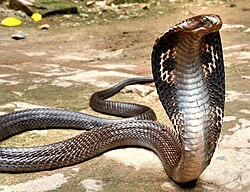
| image = Cobra | | image = Indian Cobra, crop.jpg | ||
| status = CITES_A2 | | status = LC | ||
| | | status_system = IUCN3.1 | ||
| | | status_ref = <ref>{{cite iucn|author1=de Silva, A.|author1-link=Anslem de Silva|author2=Ukuwela, K.|author2-link=species:Kanishka D.B. Ukuwela|author3=Shankar, G.|author3-link=species:P. Gowri Shankar|author4=Srinivasulu, B.|author4-link=Bhargavi Srinivasulu|author5=Das, A.|author5-link=species:Abhijit Das|author6=Vyas, R.|author6-link=species:Raju Vyas|author7=Sawant, N.S.|author7-link=species:Nitin S. Sawant|author8=Kulkarni, N.U.|author8-link=Nirmal Ulhas Kulkarni|author9=Deepak, V.|author9-link=species:Veerappan Deepak|author10=Thakur, S.|author10-link=species:Sanjay S. Thakur|author11=Mohapatra, P.|author11-link=species:Pratyush P. Mohapatra|author12=Srinivasulu, C.|author12-link=Chelmala Srinivasulu|author13=Achyuthan, N.S.|author13-link=species:Achyuthan Needamangalam Srikanthan|year=2021|title=''Naja naja''|article-number=e.T62241A3110222|doi=10.2305/IUCN.UK.2021-3.RLTS.T62241A3110222.en|access-date=16 May 2023}}</ref> | ||
| status2 = CITES_A2 | |||
| status2_system = CITES | |||
| status2_ref = <ref>{{Cite web|title=Appendices {{!}} CITES|url=https://cites.org/eng/app/appendices.php|access-date=2022-01-14|website=cites.org|archive-date=2011-06-15|archive-url=https://web.archive.org/web/20110615140252/http://www.cites.org/eng/app/appendices.shtml|url-status=live}}</ref> | |||
| genus = Naja | | genus = Naja | ||
| species = naja | | species = naja | ||
| authority = ([[Carl Linnaeus|Linnaeus]], [[10th edition of Systema Naturae|1758]])<ref name=eol>{{cite encyclopedia|title=Naja naja|url=http://eol.org/pages/1055808/details|encyclopedia=Encyclopedia of Life|access-date=28 March 2014}}</ref><ref name="itis">{{ITIS|id=700632 |taxon=''Naja naja''|access-date=23 March 2014}}</ref> | | authority = ([[Carl Linnaeus|Linnaeus]], [[10th edition of Systema Naturae|1758]])<ref name=eol>{{cite encyclopedia|title=''Naja naja''|url=http://eol.org/pages/1055808/details|encyclopedia=Encyclopedia of Life|access-date=28 March 2014|archive-date=30 March 2014|archive-url=https://web.archive.org/web/20140330012406/http://eol.org/pages/1055808/details|url-status=live}}</ref><ref name="itis">{{ITIS|id=700632 |taxon=''Naja naja''|access-date=23 March 2014}}</ref> | ||
| range_map = India Naja-naja-distribution.svg | | range_map = India Naja-naja-distribution.svg | ||
| range_map_alt = Map of South Asia showing highlighted range covering almost all of India and portions of adjoining countries | | range_map_alt = Map of South Asia showing highlighted range covering almost all of India and portions of adjoining countries | ||
| range_map_caption = Indian cobra distribution | | range_map_caption = Indian cobra distribution | ||
| synonyms = | | synonyms = {{collapsible list|bullets = true|title=<small>List</small> | ||
| ''Coluber naja'' <small>[[Carl Linnaeus|Linnaeus]], [[10th edition of Systema Naturae|1758]]</small> | |||
| ''Naja brasiliensis'' <small>[[Josephus Nicolaus Laurenti|Laurenti]], 1768</small> | |||
| ''Naja fasciata'' <small>[[Josephus Nicolaus Laurenti|Laurenti]], 1768</small> | |||
| ''Naja lutescens'' <small>[[Josephus Nicolaus Laurenti|Laurenti]], 1768</small> | |||
| ''Naja maculata'' <small>[[Josephus Nicolaus Laurenti|Laurenti]], 1768</small> | |||
| ''Naja non-naja'' <small>[[Josephus Nicolaus Laurenti|Laurenti]], 1768</small> | |||
| ''Coluber caecus'' <small>[[Johann Friedrich Gmelin|Gmelin]], 1788</small> | |||
| ''Coluber rufus'' <small>[[Johann Friedrich Gmelin|Gmelin]], 1788</small> | |||
| ''Coluber Naja'' <small>Shaw & Nodder, 1791</small> | |||
| ''Coluber Naja'' <small>Shaw & Nodder, 1794</small> | |||
| ''Naja tripudians'' <small>[[Blasius Merrem|Merrem]], 1820</small> | |||
| ''Naja nigra'' <small>[[John Edward Gray|Gray]], 1830</small> | |||
| ''Naja tripudians forma typica'' <small>[[George Albert Boulenger|Boulenger]], 1896</small> | |||
| ''Naja tripudians var. caeca'' <small>[[George Albert Boulenger|Boulenger]], 1896</small> | |||
| ''Naja naja naja'' <small>Smith, 1943</small> | |||
| ''Naja naja gangetica'' <small>[[Paules Edward Pieris Deraniyagala|Deraniyagala]], 1945</small> | |||
| ''Naja naja lutescens'' <small>[[Paules Edward Pieris Deraniyagala|Deraniyagala]], 1945</small> | |||
| ''Naja naja madrasiensis'' <small>[[Paules Edward Pieris Deraniyagala|Deraniyagala]], 1945</small> | |||
| ''Naja naja indusi'' <small>[[Paules Edward Pieris Deraniyagala|Deraniyagala]], 1960</small> | |||
| ''Naja naja bombaya'' <small>[[Paules Edward Pieris Deraniyagala|Deraniyagala]], 1961</small> | |||
| ''Naja naja karachiensis'' <small>[[Paules Edward Pieris Deraniyagala|Deraniyagala]], 1961</small> | |||
| ''Naja naja ceylonicus'' <small>Chatman & Di Mari, 1974</small> | |||
| ''Naja naja polyocellata'' <small>Mehrtens, 1987</small> | |||
| ''Naja ceylonicus Osorio'' <small>E Castro & Vernon, 1989</small> | |||
| ''Naja (Naja) naja'' — <small>Wallach, 2009</small> | |||
| synonyms_ref = <ref name="eol"/><ref name=database>{{cite web| | }} | ||
| synonyms_ref = <ref name="eol"/><ref name=database>{{cite web|last1=Uetz|first1=P.|author-link1=Peter Uetz|last2=Freed|first2=P.|author2-link=Paul Freed|last3=Aguilar|first3=R.|author3-link=Rocío Aguilar|last4=Reyes|first4=F.|last5=Kudera|first5=J.|last6=Hošek|first6=J.|author6-link=Jiří Hošek|title=''Naja naja''|url=http://reptile-database.reptarium.cz/species?genus=Naja&species=naja&search_param=%28%28search%3D%27Naja+naja%27%29%29|work=The Reptile Database|access-date=28 March 2014|archive-date=4 March 2016|archive-url=https://web.archive.org/web/20160304210753/http://reptile-database.reptarium.cz/species?genus=Naja&species=naja&search_param=%28%28search%3D%27Naja+naja%27%29%29|url-status=live}}</ref> | |||
}} | }} | ||
The '''Indian cobra''' (''Naja naja''), also known as the '''spectacled cobra''', '''Asian cobra''', or '''binocellate cobra''', is a [[species]] of [[Naja| | The '''Indian cobra''' ('''''Naja naja''' /na''dʒa nadʒa/), also known [[Common name|commonly]] as the '''spectacled cobra''', '''Asian cobra''', or '''binocellate cobra''', is a [[species]] of [[Naja|cobra]], a [[venomous snake]] in the [[Family (biology)|family]] [[Elapidae]]. The species is native to the [[Indian subcontinent]], and is a member of the "[[Big Four (Indian snakes)|big four]]" species that are responsible for the most [[snakebite]] cases in Sri Lanka and India.<ref name="Whitaker & Captain"/><ref>{{cite journal | title=Green medicine as a harmonizing tool to antivenom therapy for the clinical management of snakebite: The road ahead | journal=Indian J Med Res | year = 2012 | volume= 136| issue=1| pages= 10–12 | first=Ashis K. | last=Mukherjee | pmid=22885258 | pmc=3461710}}</ref> | ||
The Indian cobra is revered in [[Hindu mythology]] and [[Hinduism#Culture|culture]], and is often seen with [[snake charmer]]s. It is a protected species under the ''[[Wild Life (Protection) Act, 1972|Indian Wildlife Protection Act]]'' (1972). | |||
==Taxonomy== | ==Taxonomy== | ||
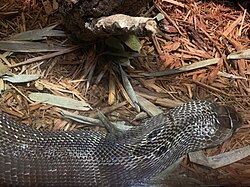
The [[Genus|generic]] name and the [[Species|specific]] epithet ''naja'' is a Latinisation of the [[Sanskrit language|Sanskrit]] word '''{{IAST| | [[File:Indian Cobra (Naja naja).jpg|thumb|Resting, at the [[Bronx Zoo]].]] | ||
The [[Genus|generic]] name and the [[Species|specific]] epithet ''naja'' is a Latinisation of the [[Sanskrit language|Sanskrit]] word '''{{IAST|nāga}}''' ({{lang|sa|[[:wikt:नाग#Sanskrit|नाग]]}}) meaning "cobra".<ref name=Naja>{{cite web|title=''Naja''|url=http://www.thefreedictionary.com/naja|work=The Free Dictionary|publisher=[[Princeton University]]|access-date=28 March 2014|archive-date=10 January 2014|archive-url=https://web.archive.org/web/20140110202116/http://www.thefreedictionary.com/naja|url-status=live}}</ref> | |||
The Indian cobra is classified under the genus ''[[Naja]]'' of the family [[Elapidae]]. The genus was first described by [[Josephus Nicolaus Laurenti]] in 1768.<ref name="itis1">{{ITIS|id=700233 |taxon=''Naja''|access-date=29 March 2014}}</ref> The species ''Naja naja'' was first described by the [[Swedes|Swedish]] physician, zoologist, and botanist [[Carl Linnaeus]] in 1758.<ref name="itis"/><ref name=Linn1758>{{cite book |last=Linnaeus |first=Carl |title=Systema | The Indian cobra is classified under the genus ''[[Naja]]'' of the family [[Elapidae]]. The genus was first described by [[Josephus Nicolaus Laurenti]] in 1768.<ref name="itis1">{{ITIS|id=700233 |taxon=''Naja''|access-date=29 March 2014}}</ref> The species ''Naja naja'' was first described by the [[Swedes|Swedish]] physician, zoologist, and botanist [[Carl Linnaeus]] in 1758.<ref name="itis"/><ref name=Linn1758>{{cite book |last=Linnaeus |first=Carl |author-link=Carl Linnaeus|title=Systema naturæ per regna tria naturæ, secundum classes, ordines, genera, species, cum characteribus, differentiis, synonymis, locis. Tomus I. Editio Decima, Reformata |publisher=Laurentius Salvius |location=Stockholm |year=1758 |url=https://www.biodiversitylibrary.org/bibliography/542 |language=la |edition=[[10th edition of Systema Naturae|10th]] |access-date=2018-01-13 |archive-date=2008-10-10 |archive-url=https://web.archive.org/web/20081010032456/https://www.biodiversitylibrary.org/bibliography/542 |url-status=live }}</ref> The genus ''Naja'' was split into several subgenera based on various factors, including morphology, diet, and habitat. ''Naja naja'' is part of the subgenus ''[[Naja]]'', along with all the other species of Asiatic cobras, including ''[[Naja kaouthia]]'', ''[[Naja siamensis]]'', ''[[Naja sputatrix]]'', and the rest. | ||
''Naja naja'' is considered to be the prototypical [[Naja|cobra]] species within the subgenus ''Naja'', and within the entire genus ''Naja''. All Asiatic species of ''Naja'' were considered conspecific with ''Naja naja'' until the 1990s, often as subspecies thereof. Many of the subspecies were later found to be artificial or composites. This causes much potential confusion when interpreting older literature.<ref name="Wuster96">{{cite journal|author=Wüster, W. |title=Taxonomic changes and toxinology: systematic revisions of the Asiatic cobras (''Naja naja'' species complex)|year=1996|journal=Toxicon|volume=34|pages=399–406|issue = 4 |doi=10.1016/0041-0101(95)00139-5 |pmid = 8735239}}</ref> | ''Naja naja'' is considered to be the prototypical [[Naja|cobra]] species within the subgenus ''Naja'', and within the entire genus ''Naja''. All Asiatic species of ''Naja'' were considered conspecific with ''Naja naja'' until the 1990s, often as subspecies thereof. Many of the subspecies were later found to be artificial or composites. This causes much potential confusion when interpreting older literature.<ref name="Wuster96">{{cite journal|author=Wüster, W.|author-link=Wolfgang Wüster|title=Taxonomic changes and toxinology: systematic revisions of the Asiatic cobras (''Naja naja'' species complex)|year=1996|journal=Toxicon|volume=34|pages=399–406|issue=4|doi=10.1016/0041-0101(95)00139-5|pmid=8735239|bibcode=1996Txcn...34..399W}}</ref> | ||
{{clade| style=font-size:90%; line-height:90% | {{clade| style=font-size:90%; line-height:90% | ||
| Line 116: | Line 123: | ||
|1=[[Naja annulifera|''Naja'' (''Uraeus'') ''annulifera'']] | |1=[[Naja annulifera|''Naja'' (''Uraeus'') ''annulifera'']] | ||
|2=[[Naja anchietae|''Naja'' (''Uraeus'') ''anchietae'']] }} }} }} }} }} }} }} | |2=[[Naja anchietae|''Naja'' (''Uraeus'') ''anchietae'']] }} }} }} }} }} }} }} | ||
==Description== | ==Description== | ||
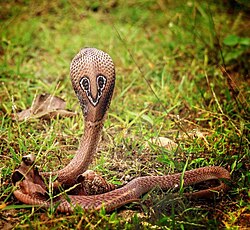
[[File:104808104 573911326897298 8431645140365739317 janakpur.jpg|left|thumb|Spectacle pattern]] | [[File:104808104 573911326897298 8431645140365739317 janakpur.jpg|left|thumb|Spectacle pattern]] | ||
The Indian cobra is a moderately sized, heavy bodied species. This cobra species can easily be identified by its relatively large | The Indian cobra is a moderately sized, heavy-bodied species. This cobra species can easily be identified by its relatively large hood, which it expands when threatened. | ||
Many specimens exhibit a hood mark. This hood mark is located at the rear of the Indian cobra's hood. When the hood mark is present, | Many specimens exhibit a hood mark. This hood mark is located at the rear ([[Dorsum (anatomy)|dorsal]] surface) of the Indian cobra's hood. When the hood mark is present, it consists of two circular [[Eyespot (mimicry)|ocelli]] patterns connected by a curved line, evoking the image of [[spectacles]].<ref name="Wüster98">{{cite journal |last1=Wüster |first1=W. |title=The Cobras of the genus ''Naja'' in India |journal=Hamadryad |date=1998 |volume=23 |issue=1 |pages=15–32 |url=http://www.venomstreet.com/images/pdf/Asian%20Cobras/The%20cobras%20of%20the%20genus%20Naja%20in%20India.pdf |access-date=15 September 2014 |archive-date=4 March 2016 |archive-url=https://web.archive.org/web/20160304214957/http://www.venomstreet.com/images/pdf/Asian%20Cobras/The%20cobras%20of%20the%20genus%20Naja%20in%20India.pdf |url-status=usurped }}</ref> | ||
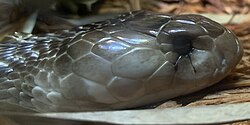
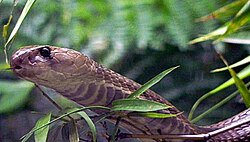
This species has a head | This species has a head that is elliptical, depressed, and very slightly distinct from the neck. The snout is short and rounded with large nostrils. The eyes are medium in size and the pupils are round.<ref name="ct"/> The majority of adult specimens range from {{convert|1|to|1.5|m|ft}} in length. Some specimens, particularly those from Sri Lanka, may grow to lengths of {{convert|2.1|to|2.2|m|ft}}, but this is relatively uncommon.<ref name="Wüster98" /> | ||
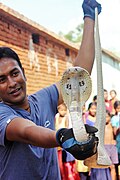
[[File:A 6.5 ft Cobra.JPG|thumb|A 6.5 ft cobra captured in a village in [[Odisha]]]] | [[File:A 6.5 ft Cobra.JPG|thumb|A rare 6.5 ft leucistic cobra captured in a village in [[Odisha]]]] | ||
[[File:Indian Cobra (Naja naja) 2 (cropped).jpg|left|thumb|Closeup when resting. [[Bronx Zoo]].]] | |||
The Indian cobra varies tremendously in colour and pattern throughout its range. The [[ventral scales]] or the underside colouration of this species can be grey, yellow, tan, brown, reddish or black. [[Dorsal scales]] of the Indian cobra may have a hood mark or colour patterns. The most common visible pattern is a posteriorly convex light band at the level of the 20th to 25th ventrals. Salt-and-pepper speckles, especially in adult specimens, are seen on the dorsal scales. | The Indian cobra varies tremendously in colour and pattern throughout its range. The [[ventral scales]] or the underside colouration of this species can be grey, yellow, tan, brown, reddish or black. [[Dorsal scales]] of the Indian cobra may have a hood mark or colour patterns. The most common visible pattern is a posteriorly convex light band at the level of the 20th to 25th ventrals. Salt-and-pepper speckles, especially in adult specimens, are seen on the dorsal scales. | ||
| Line 153: | Line 142: | ||
===Scalation=== | ===Scalation=== | ||
Dorsal scales are smooth and strongly oblique. Midbody scales are in 23 rows (21–25), with 171–197 [[ventrals]]. There are 48–75 divided [[subcaudals]] and the [[Anal scale|anal shield]] is single. There are seven [[upper labials]] (3rd the largest and in contact with nasal anteriorly, 3rd and 4th in contact with eye) and 9-10 | Dorsal scales are smooth and strongly oblique. Midbody scales are in 23 rows (21–25), with 171–197 [[ventrals]]. There are 48–75 divided [[subcaudals]] and the [[Anal scale|anal shield]] is single. There are seven [[upper labials]] (3rd the largest and in contact with the nasal anteriorly, 3rd and 4th in contact with the eye) and 9-10 [[lower labials]] (small angular cuneate scale present between 4th and 5th lower labial), as well as one [[preocular]] in contact with internasals, and three [[postoculars]]. [[Temporal scales|Temporals]] are 2 + 3.<ref name="ct"/> | ||
===Similar species=== | ===Similar species=== | ||
[[File:Common Rat Snake (Ptyas mucosa) 水律6.jpg|thumb| | [[File:Common Rat Snake (Ptyas mucosa) 水律6.jpg|thumb|Note the patterning on the body of this [[Ptyas mucosa|oriental rat snake]]. Indian cobras don't have this patterning.]] | ||
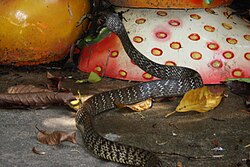
The Oriental rat snake ''[[Ptyas mucosa]]'' is often mistaken for the Indian cobra; however, this snake is much longer and can easily be distinguished by the more prominent ridged appearance of its body. Other snakes that resemble ''Naja naja'' are the banded racer ''[[Argyrogena fasciolata]]'' and the Indian smooth snake ''[[Wallophis brachyura]]''.<ref name="Whitaker & Captain"/> Also, the [[monocled cobra]] (''Naja kaouthia'') may be confused with ''Naja naja''; however, the monocled cobra has an | The Oriental rat snake ''[[Ptyas mucosa]]'' is often mistaken for the Indian cobra; however, this snake is much longer and can easily be distinguished by the more prominent ridged appearance of its body. Other snakes that resemble ''Naja naja'' are the banded racer ''[[Argyrogena fasciolata]]'' and the Indian smooth snake ''[[Wallophis brachyura]]''.<ref name="Whitaker & Captain"/> Also, the [[monocled cobra]] (''Naja kaouthia'') may be confused with ''Naja naja''; however, the monocled cobra has an O-shaped pattern on the back of the hood, while the Indian cobra has a spectacles-shaped pattern on its hood. Confusions may exist with [[Caspian cobra]] (''Naja oxiana''), as some Indian cobra specimens without a hood mark are sometimes confused with ''N. oxiana'', where these two species coexist in Pakistan and Afghanistan. Although some Caspian cobra specimens can be quite dark, they are never fully black like the Indian cobra. ''N. oxiana'' normally has several dark bands under the throat, whereas in the black phase of ''N. naja'' from Pakistan, almost the entire throat is black.<ref name="venomstreet">{{cite web|title=''Naja oxiana''|url=http://www.venomstreet.com/Naja%20oxiana.htm|work=Venom Street. Collector and Breeder of Asian Cobras|publisher=Venom Street|access-date=3 February 2012|archive-url=https://web.archive.org/web/20141021143826/http://www.venomstreet.com/Naja%20oxiana.htm|archive-date=21 October 2014|url-status=usurped}}</ref> | ||
==Distribution | ==Distribution== | ||
[[File:Natuurwonderen African chamaeleon and Indian cobra - Raymond L. Ditmars? - 1915 - EYE FLM45528 - OB 685418.ogv|thumb|Silent film showing an African | [[File:Natuurwonderen African chamaeleon and Indian cobra - Raymond L. Ditmars? - 1915 - EYE FLM45528 - OB 685418.ogv|thumb|Silent film showing an African chameleon and an Indian cobra by Raymond L. Ditmars (?) Collection [[EYE Film Institute Netherlands]].]] | ||
The Indian cobra is native to the [[Indian subcontinent]] and can be found throughout [[India]], [[Pakistan]], [[Sri Lanka]], [[Bangladesh]], and southern [[Nepal]]. In India, it may or may not occur in the [[Assam|state of Assam]], some parts of [[Kashmir]], and it does not occur | The Indian cobra is native to the [[Indian subcontinent]] and can be found throughout [[India]], [[Pakistan]], [[Sri Lanka]], [[Bangladesh]], and southern [[Nepal]]. In India, it may or may not occur in the [[Assam|state of Assam]], some parts of [[Kashmir]], and it does not occur at high altitudes of over {{convert|2000|m|ft}} and in extreme desert regions. In Pakistan, it is absent in most of [[Balochistan, Pakistan|Balochistan province]], parts of [[Khyber Pakhtunkhwa|Khyber Pakhtunkhwa Province]], desert areas elsewhere and the [[Northern Areas]]. The most westerly record comes from Duki, Balochistan in Pakistan, while the most easterly record is from the [[Tangail District]] in Bangladesh. As this species has been observed in Drosh, in the [[Chitral|Chitral Valley]], it may also occur in the Kabul River Valley in extreme eastern [[Afghanistan]].<ref name="Wüster98" /> There's been at least one report of this species occurring in [[Bhutan]].<ref name=M84>{{cite book|last1=Mahendra|first1=B.C.|author1-link=species:Beni Charan Mahendra|title=Handbook of the Snakes of India, Ceylon, Burma, Bangladesh and Pakistan|date=1984|publisher=Agra: The Academy of Zoology|page=412}}</ref> | ||
==Habitat== | |||
The Indian cobra inhabits a wide range of habitats throughout its geographical range. It can be found in dense or open forests, [[plain]]s, agricultural lands ([[Paddy field|rice paddy fields]], wheat crops), rocky terrain, wetlands, and it can even be found in heavily populated urban areas, such as villages and city outskirts, ranging from sea level to {{convert|2000|m|ft}} in altitude. This species is absent from true [[desert]] regions. The Indian cobra is often found in the vicinity of water. Preferred hiding locations are holes in embankments, tree hollows, [[Mound-building termites|termite mounds]], rock piles and small mammal dens.<ref name="ct"/><ref name=W&C04/> | |||
The Indian cobra | ==Feeding== | ||
The Indian cobra feeds on [[rodent]]s, [[lizard]]s and [[frog]]s. It bites quickly, and then waits while its venom damages the [[nervous system]] of the prey, paralyzing and often killing it. Like all snakes, ''N. naja'' swallows its prey whole. This species sometimes enters buildings in search of rodent prey.<ref name="animaldiversity.org">{{cite web | url=https://animaldiversity.org/accounts/Naja_naja/ | title=Naja naja (Indian Cobra) | website=[[Animal Diversity Web]] }}</ref> | |||
==Reproduction== | ==Reproduction== | ||
Indian | The Indian cobra is [[Oviparity|oviparous]], laying [[Egg (biology)|eggs]] in the months of April through July. The female usually lays between 10 and 30 eggs in rat holes or termite mounds, which hatch 48 to 69 days later. Each hatchling measures {{cvt|20|–|30|cm|in|0}} in total length (tail included). The hatchlings are independent from birth and have fully functional venom glands. | ||
== Venom == | ==Venom== | ||
[[File:Naja naja 107288826.jpg|thumb|Eating an [[Duttaphrynus melanostictus|Asian common toad]]]] | |||
The Indian cobra's venom mainly contains a powerful post-[[Synapse|synaptic]] [[neurotoxin]]<ref name="ct"/> and [[cardiotoxin]].<ref name="ct"/><ref name=j1/> The venom acts on the synaptic gaps of the [[nerve]]s, thereby paralyzing [[muscle]]s, and in severe bites leading to [[respiratory failure]] or [[cardiac arrest]]. The venom components include enzymes such as [[hyaluronidase]] that cause [[lysis]] and increase the spread of the venom. Envenomation symptoms may manifest between fifteen minutes and two hours following the bite.<ref name="Davidson"/><ref name=VenDoc/> | The Indian cobra's venom mainly contains a powerful post-[[Synapse|synaptic]] [[neurotoxin]]<ref name="ct"/> and [[cardiotoxin]].<ref name="ct"/><ref name=j1/> The venom acts on the synaptic gaps of the [[nerve]]s, thereby paralyzing [[muscle]]s, and in severe bites leading to [[respiratory failure]] or [[cardiac arrest]]. The venom components include enzymes such as [[hyaluronidase]] that cause [[lysis]] and increase the spread of the venom. Envenomation symptoms may manifest between fifteen minutes and two hours following the bite.<ref name="Davidson"/><ref name=VenDoc/> | ||
In [[mice]], the preferred {{LD50}} value is estimated to be 0.56 mg/kg via [[Subcutis|subcutaneous injection]] (SC).<ref name="ct"/><ref name="Broad et al">{{cite journal |last1=Broad |first1= | In [[mice]], the preferred {{LD50}} value is estimated to be 0.56 mg/kg via [[Subcutis|subcutaneous injection]] (SC).<ref name="ct"/><ref name="Broad et al">{{cite journal |last1=Broad |first1=A.J. |last2=Sutherland |first2=S.K. |last3=Coulter |first3=A.R. |title=The lethality in mice of dangerous Australian and other snake venoms |journal=Toxicon |date=1979 |volume=17 |issue=6 |pages=664–667 |doi=10.1016/0041-0101(79)90245-9 |pmid=524395 |bibcode=1979Txcn...17..661B }}</ref> However, there's a wide range of potency for this species, ranging from 0.22 mg/kg (in Pakistani ''N. naja karachiensis'')<ref name="tan et al">{{cite journal |last1=Wong |first1=K.Y. |last2=Tan |first2=C.H. |last3=Tan |first3=N.H. |title=Venom and Purified Toxins of the Spectacled Cobra (''Naja naja'') from Pakistan: Insights into Toxicity and Antivenom Neutralization |journal=The American Journal of Tropical Medicine and Hygiene| date=3 January 2019 |volume=94 |issue=6 |pages=1392–1399 |doi=10.4269/ajtmh.15-0871 |pmid=27022154|pmc=4889763 }}</ref> to 0.84 mg/kg (Indian specimens).<ref>{{cite journal |last1=Attarde |first1=S |last2=Khochare |first2=S |last3=Iyer |first3=A |last4=Dam |first4=P |last5=Martin |first5=G |last6=Sunagar |first6=K |title=Venomics of the Enigmatic Andaman Cobra (''Naja sagittifera'') and the Preclinical Failure of Indian Antivenoms in Andaman and Nicobar Islands |journal=Frontiers in Pharmacology |date=25 October 2021 |volume=12 |article-number=768210 |doi=10.3389/fphar.2021.768210 |pmid=34759827 |pmc=8573199 |doi-access=free }}</ref> ''Minton (1974)'' reported a value of 0.29 mg/kg SC for specimens from northwest India, along with an average venom yield per bite range between 170 and 250 mg (dry weight).<ref name="ct"/> In another study, the average venom yield was 169 mg and a maximum yield of 610 mg (both were dry weights of milked venom).<ref name="Broad et al"/> Though it is responsible for many bites, only a small percentage are fatal if proper medical treatment and antivenom are given.<ref name=W&C04/> Mortality rates for untreated bite victims can vary from case to case, depending upon the quantity of venom delivered by the individual involved. According to one study, it is approximately 20–30%,<ref name='WHO'/> but in another study involving victims who were given prompt medical treatment, the mortality rate was only 9%. In Bangladesh, it is responsible for most of the snake bite cases.<ref name=Brown/> | ||
[[File:Spectacled Cobra with hood lowered in a bamboo shrub.jpg|thumb|Spectacled cobra with hood lowered in a bamboo shrub]] | [[File:Spectacled Cobra with hood lowered in a bamboo shrub.jpg|thumb|Spectacled cobra with hood lowered in a bamboo shrub]] | ||
The Indian cobra is one of the [[Big Four (Indian snakes)|big four]] snakes of [[South Asia]] | The Indian cobra is one of the [[Big Four (Indian snakes)|big four]] snakes of [[South Asia]] that are responsible for the majority of human deaths by snakebite in Asia. [[Antivenom|Polyvalent serum]] is available for treating [[snakebite]]s caused by these species.<ref name='BBCSNAKEBITES'>[https://news.bbc.co.uk/earth/hi/earth_news/newsid_9401000/9401974.stm Snake-bites: a growing, global threat] . BBC News (2011-02-22). Retrieved on 2013-01-03.</ref> [[Zedoary]], a local spice with a reputation for being effective against snakebite,<ref>{{Cite journal | ||
| last1 = Martz | first1 = W. | | last1 = Martz | first1 = W. | ||
| title = Plants with a reputation against snakebite | | title = Plants with a reputation against snakebite | ||
| Line 185: | Line 178: | ||
| pmid = 1440620 | | pmid = 1440620 | ||
| doi=10.1016/0041-0101(92)90429-9 | | doi=10.1016/0041-0101(92)90429-9 | ||
| bibcode = 1992Txcn...30.1131M | |||
}}</ref> has shown promise in experiments testing its activity against cobra venom.<ref>{{Cite journal| author1 = Daduang| first2 = N.| first3 = J.| first4 = P.| first5 = A.| first6 = A.| first7 = M.| title = Screening of plants containing ''Naja naja siamensis'' cobra venom inhibitory activity using modified ELISA technique| journal = Analytical Biochemistry| volume = 341| issue = 2| pages = 316–325| year = 2005| pmid = 15907878| doi = 10.1016/j.ab.2005.03.037| last2 = Sattayasai| last3 = Sattayasai| last4 = Tophrom| last5 = Thammathaworn| last6 = Chaveerach| last7 = Konkchaiyaphum}}</ref> | }}</ref> has shown promise in experiments testing its activity against cobra venom.<ref>{{Cite journal| author1 = Daduang| first2 = N.| first3 = J.| first4 = P.| first5 = A.| first6 = A.| first7 = M.| title = Screening of plants containing ''Naja naja siamensis'' cobra venom inhibitory activity using modified ELISA technique| journal = Analytical Biochemistry| volume = 341| issue = 2| pages = 316–325| year = 2005| pmid = 15907878| doi = 10.1016/j.ab.2005.03.037| last2 = Sattayasai| last3 = Sattayasai| last4 = Tophrom| last5 = Thammathaworn| last6 = Chaveerach| last7 = Konkchaiyaphum}}</ref> | ||
The venom of young cobras has been used as a substance of abuse in India, with cases of snake charmers being paid for providing bites from their snakes. Though this practice is now seen as outdated, symptoms of such abuse include loss of consciousness, euphoria, and sedation.<ref>{{Cite journal | The venom of young cobras has been used as a substance of abuse in India, with cases of snake charmers being paid for providing bites from their snakes. Though this practice is now seen as outdated, symptoms of such abuse include loss of consciousness, euphoria, and sedation.<ref>{{Cite journal|last1=Katshu|first1=M.Z.U.H.|last2=Dubey|first2=I.|last3=Khess|first3=C.R.J.|last4=Sarkhel|first4=S.|title=Snake Bite as a Novel Form of Substance Abuse: Personality Profiles and Cultural Perspectives|doi=10.1080/08897077.2011.540482|journal=Substance Abuse|volume=32|issue=1|pages=43–46|year=2011|pmid=21302184|doi-access=free|bibcode=2011JPkR...32...43K}}</ref> | ||
| last1 = Katshu | first1 = M. Z. U. H. | |||
| last2 = Dubey | first2 = I. | |||
| last3 = Khess | first3 = C. R. J. | |||
| last4 = Sarkhel | first4 = S. | |||
| title = Snake Bite as a Novel Form of Substance Abuse: Personality Profiles and Cultural Perspectives | |||
| doi = 10.1080/08897077.2011.540482 | |||
| journal = Substance Abuse | |||
| volume = 32 | |||
| issue = 1 | |||
| pages = 43–46 | |||
| year = 2011 | |||
| pmid = 21302184 | |||
| doi-access = free | |||
}}</ref> | |||
{{As of| November 2016}}, an antivenom | {{As of| November 2016}}, an antivenom has been developed by the [[Costa Rica]]n [[Clodomiro Picado Research Institute|Clodomiro Picado Institute]], and the clinical trial phase was in Sri Lanka.<ref>Rodrigo, M. (October 9, 2016) [http://www.sundaytimes.lk/161009/news/trials-to-start-for-home-grown-anti-venom-211742.html Trials to start for home-grown anti-venom] {{Webarchive|url=https://web.archive.org/web/20161014175118/http://www.sundaytimes.lk/161009/news/trials-to-start-for-home-grown-anti-venom-211742.html |date=2016-10-14 }}. sundaytimes.lk</ref> | ||
===Envenomation and | ===Envenomation and clinical manifestation=== | ||
Indian | Indian cobra bites are very common in many parts of India, Pakistan, Sri Lanka, and throughout their range in [[South Asia]]. Hundreds of individual case reports have been published in books and journals over the past century. However, no large prospective study of patients with proven bites by ''N. naja'' has been undertaken and reported. In a survey of snakebites in India, 91.4% of cases were bitten by an unidentified snake. Of the 6.1% of identified venomous snakes responsible for bites, 40% were ''N. naja''. As with bites by ''N. kaouthia'' and ''N. oxiana'', patients may show manifestations of systemic neurotoxic envenoming or local envenoming or both, although ''N. oxiana'' bites produce noticeable symptoms of envenomation more rapidly, and prominent neurotoxicity (severe flaccid paralysis) is more common amongst patients bitten by ''N. oxiana''. A woman bitten by ''N. oxiana'' in northwestern Pakistan suffered prominent neurotoxicity and died while en route to the closest hospital nearly 50 minutes after envenomation (death occurred 45–50 minutes post envenomation).<ref name=L84>{{cite book|last=Latifi|first=Mahmoud|author-link=species:Mahmoud Latifi|title=Snakes of Iran|year=1991|location=Oxford, Ohio|publisher=Society for the Study of Amphibians and Reptiles|isbn=978-0-916984-22-9}} (''Naja naja oxiana'', Ladle Snake, p. 124).</ref> | ||
Local necrosis was described after cobra bites in India in the 1860s and up to the 1920s, but this was apparently forgotten until Reid's work in Malaysia. Severe local pain and swelling may begin almost immediately after the bite. The pain persists while swelling and tenderness extend up the bitten limb, sometimes spreading to the adjacent trunk. Darkening of the necrotic area of skin and blistering are apparent by about the third day, with a characteristic putrid smell typical of necrotic cobra bites in Africa and Asia. Early systemic symptoms include headache, nausea, vomiting, dizziness and a feeling of lassitude, drowsiness and intoxication. "Many subjects describe their drowsiness as if they had imbibed large quantities of some potent intoxicant." Neurotoxic symptoms begin with ptosis (the patient puckers their brow, contracting the frontalis muscle, attempting to raise the eyelids or tilts the head back so as to see beneath the drooping upper lids), profuse viscid saliva, inability to clear secretions, sagging of the jaw or inability to open the mouth and progression to respiratory paralysis. It is not clear from the available literature whether the proportion of patients developing neurotoxicity and necrosis is different from that in patients bitten by ''N. kaouthia''.<ref name="W95">{{cite book |last1=Warrell |first1=D.A. |author1-link=species:David A. Warrell|title=Handbook of: Clinical Toxicology of Animal Venoms and Poisons |date=22 August 1995 |publisher=CRC Press |isbn=978-0-203-71944-2 |pages=493–594 |edition=1st |url=https://www.taylorfrancis.com/chapters/edit/10.1201/9780203719442-27/clinical-toxicology-snakebite-asia-david-warrell?context=ubx&refId=952c547d-c938-479b-af7c-f605fb014509 |access-date=14 July 2021 |chapter=Clinical Toxicology of Snakebite in Asia |doi=10.1201/9780203719442-27 |archive-date=24 May 2021 |archive-url=https://web.archive.org/web/20210524062831/https://www.taylorfrancis.com/chapters/edit/10.1201/9780203719442-27/clinical-toxicology-snakebite-asia-david-warrell?context=ubx&refId=952c547d-c938-479b-af7c-f605fb014509 |url-status=live }}</ref> | |||
The outstanding feature of systemic envenoming is paralysis of the muscles due to rapid action of neurotoxin at the myoneural junction. [[Respiratory paralysis]] may occur within 3 – 4 hours in severe cases. Drowsiness is the first symptom, but it is difficult to assess because it is a subjective symptom. All of the cases developed ptosis 1.5 – 6 hours post bite. Since ptosis is easy to detect, it is a valuable clinical sign for early diagnosis of systemic envenoming due to cobra bite. Restlessness, irregular breathing, and mental confusion usually developed before respiratory paralysis, indicating that they are significant early clinical signs of impending respiratory failure. It is important for clinicians to recognize the early signs of respiratory failure. Cases which show signs of systemic envenoming require [[antivenom]]. If some hours have elapsed since the bite, the antivenom may be less successful. In general, 100 ml. of antivenom should be given in the first 30 minutes. If there is no distinct clinical improvement within 1 hour, the dose should be repeated. [[Tracheostomy]] and artificial respiration are essential in cases of respiratory failure. Necrosis is the outstanding feature of local envenoming. Most patients were bitten on the foot while working in rice fields. Authors recommended the wearing of shoes or boots while working, and that persons bitten by a snake apply a firm ligature above the bite and go to the nearest health centre or hospital.<ref name="ct"/><ref name="W95"/> | |||
==Genome== | |||
Previous cytogenetic analysis revealed the Indian cobra has a diploid [[karyotype]] of 38 chromosomes, compromising seven pairs of macro-chromosomes, 11 pairs of micro-chromosomes and one pair of sexual chromosomes.<ref>{{Cite journal|last=Singh|first=L.|date=1972|title=Evolution of karyotypes in snakes|journal=Chromosoma|volume=38|issue=2|pages=185–236|doi=10.1007/BF00326193|pmid=5066447|s2cid=21621814}}</ref> Using [[Next-Generation Sequencing|next-generation sequencing]] and emerging genomic technologies, a de novo high-quality ''N. naja'' reference genome was published in 2020.<ref name=":0">{{Cite journal|last1=Suryamohan|first1=Kushal|last2=Krishnankutty|first2=Sajesh P.|last3=Guillory|first3=Joseph|last4=Jevit|first4=Matthew|last5=Schröder|first5=Markus S.|last6=Wu|first6=Meng|last7=Kuriakose|first7=Boney|last8=Mathew|first8=Oommen K.|last9=Perumal|first9=Rajadurai C.|last10=Koludarov|first10=Ivan|last11=Goldstein|first11=Leonard D.|date=2020|title=The Indian cobra reference genome and transcriptome enables comprehensive identification of venom toxins|journal=Nature Genetics|language=en|volume=52|issue=1|pages=106–117|doi=10.1038/s41588-019-0559-8|pmid=31907489|pmc=8075977|issn=1546-1718|doi-access=free}} [[File:CC-BY icon.svg|50px]] Text was copied from this source, which is available under a [https://creativecommons.org/licenses/by/4.0/ Creative Commons Attribution 4.0 International License] {{Webarchive|url=https://web.archive.org/web/20171016050101/https://creativecommons.org/licenses/by/4.0/ |date=2017-10-16 }}.</ref> The estimated size of this haploid genome is of 1.79 Gb, which has 43.22% of repetitive content and 40.46% of [[GC-content|GC content]]. Specifically, macro-chromosomes, which represent 88% of the genome, have 39.8% of GC content, while micro-chromosomes, that represent only 12% of the genome, contain 43.5% of GC content.<ref name=":0"/> | |||
===Synteny analysis=== | |||
=== Synteny analysis === | |||
[[Synteny]] analysis between the Indian cobra and the prairie [[rattlesnake]] genome revealed large syntenic blocks within macro, micro, and sexual chromosomes. This study allowed the observation of chromosomic fusion and fission events that are consistent with the difference in chromosome number between these species. For example, chromosome 4 of the Indian cobra shares syntenic regions with chromosomes 3 and 5 of the rattlesnake genome, indicating a possible fusion event. Besides, chromosomes 5 and 6 of the Indian cobra are syntenic to rattlesnake chromosome 4, indicating a possible fusion event between these chromosomes.<ref name=":0" /> | [[Synteny]] analysis between the Indian cobra and the prairie [[rattlesnake]] genome revealed large syntenic blocks within macro, micro, and sexual chromosomes. This study allowed the observation of chromosomic fusion and fission events that are consistent with the difference in chromosome number between these species. For example, chromosome 4 of the Indian cobra shares syntenic regions with chromosomes 3 and 5 of the rattlesnake genome, indicating a possible fusion event. Besides, chromosomes 5 and 6 of the Indian cobra are syntenic to rattlesnake chromosome 4, indicating a possible fusion event between these chromosomes.<ref name=":0" /> | ||
On the other hand, by performing whole-genome synteny comparison between the Indian cobra and other reptilian and avian genomes, it was revealed the presence of large syntenic regions between macro, micro, and sexual chromosomes across species from these classes, which indicates changes in chromosome organization between reptile and avian genomes and is consistent with their evolutionary trajectories.<ref name=":0" /> | On the other hand, by performing whole-genome synteny comparison between the Indian cobra and other reptilian and avian genomes, it was revealed the presence of large syntenic regions between macro, micro, and sexual chromosomes across species from these classes, which indicates changes in chromosome organization between reptile and avian genomes and is consistent with their evolutionary trajectories.<ref name=":0" /> | ||
=== Gene organization === | ===Gene organization=== | ||
Using protein homology information and expression data from different tissues of the cobra, 23,248 [[Coding region|protein-coding genes]], 31,447 transcripts, and 31,036 proteins, which included [[Alternative splicing|alternatively spliced]] products, where predicted from this genome. 85% of these predicted proteins contained [[Start codon|start]] and [[stop codon]], and 12% contained an N-terminal secretion signal sequence, which is an important feature in terms of toxins secretion from venom glands.<ref name=":0" /> | Using protein homology information and expression data from different tissues of the cobra, 23,248 [[Coding region|protein-coding genes]], 31,447 transcripts, and 31,036 proteins, which included [[Alternative splicing|alternatively spliced]] products, where predicted from this genome. 85% of these predicted proteins contained [[Start codon|start]] and [[stop codon]], and 12% contained an N-terminal secretion signal sequence, which is an important feature in terms of toxins secretion from venom glands.<ref name=":0" /> | ||
==== Venom gland genes ==== | ====Venom gland genes==== | ||
Further studies on gene prediction and annotation of the Indian cobra genome identified 139 toxin genes from 33 protein families. These included families like [[three-finger toxin]]s (3FTxs), snake venom [[metalloproteinase]]s (SVMP), cysteine-rich secretory venom proteins and other toxins including [[natriuretic peptide]], [[C-type lectin]], snake venom serine proteinase (SVSP), [[Kunitz domain|Kunitz]] and venom complement-activating gene families, group I [[phospholipase A2]] (PLA2) and one cobra venom factor (CVF) gene. These major toxin gene families in the Indian cobra are mostly found in the snake's macro-chromosomes, which differs from ''[[Crotalus viridis|Crotalus virides]]'' [[Crotalus viridis|(rattlesnake)]] that presents them in its micro-chromosomes, and is indicative of the differences in their venom evolution. Besides, comparison of venom gland genes between the Indian cobra and ''[[Crotalus viridis|C. virides]]'', identified 15 toxin gene families that are unique to the Indian cobra, which included [[cathelicidin]]s and [[phospholipase B]]-like toxins.<ref name=":0" /> | Further studies on gene prediction and annotation of the Indian cobra genome identified 139 toxin genes from 33 protein families. These included families like [[three-finger toxin]]s (3FTxs), snake venom [[metalloproteinase]]s (SVMP), cysteine-rich secretory venom proteins and other toxins including [[natriuretic peptide]], [[C-type lectin]], snake venom serine proteinase (SVSP), [[Kunitz domain|Kunitz]] and venom complement-activating gene families, group I [[phospholipase A2]] (PLA2) and one cobra venom factor (CVF) gene. These major toxin gene families in the Indian cobra are mostly found in the snake's macro-chromosomes, which differs from ''[[Crotalus viridis|Crotalus virides]]'' [[Crotalus viridis|(rattlesnake)]] that presents them in its micro-chromosomes, and is indicative of the differences in their venom evolution. Besides, comparison of venom gland genes between the Indian cobra and ''[[Crotalus viridis|C. virides]]'', identified 15 toxin gene families that are unique to the Indian cobra, which included [[cathelicidin]]s and [[phospholipase B]]-like toxins.<ref name=":0" /> | ||
=== Venom gland transcriptome and toxin gene identification === | ===Venom gland transcriptome and toxin gene identification=== | ||
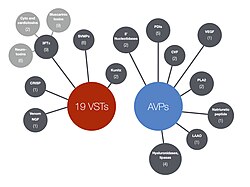
[[File:Indian cobra venom cocktail .jpg|thumb|Indian cobra venom composition classified in venom specific or accessory proteins based on genomic annotation and transcriptomic data by Suryamohan et al., 2020.]]Analysis of transcriptomic data from 14 different tissues of the Indian cobra identified 19,426 expressed genes. Out of these genes, 12,346 belonged to the venom gland transcriptome, which included 139 genes from 33 toxin gene families. Additionally, differential expression analysis revealed that 109 genes from 15 different toxin gene families were significantly up-regulated (fold change > 2) in the venom gland and this included 19 genes that were exclusively expressed in this gland.<ref name=":0" /> | [[File:Indian cobra venom cocktail .jpg|thumb|Indian cobra venom composition classified in venom specific or accessory proteins based on genomic annotation and transcriptomic data by Suryamohan et al., 2020.]]Analysis of transcriptomic data from 14 different tissues of the Indian cobra identified 19,426 expressed genes. Out of these genes, 12,346 belonged to the venom gland transcriptome, which included 139 genes from 33 toxin gene families. Additionally, differential expression analysis revealed that 109 genes from 15 different toxin gene families were significantly up-regulated (fold change > 2) in the venom gland and this included 19 genes that were exclusively expressed in this gland.<ref name=":0" /> | ||
| Line 239: | Line 215: | ||
The identification of these genes coding for core toxic effector components from the Indian cobra venom may allow the development of recombinant antivenoms based in neutralizing antibodies for VST proteins.<ref name=":0" /> | The identification of these genes coding for core toxic effector components from the Indian cobra venom may allow the development of recombinant antivenoms based in neutralizing antibodies for VST proteins.<ref name=":0" /> | ||
== | ==Relationship with humans== | ||
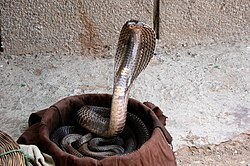
[[File:Indian cobra.jpg|thumb|Cobra in a basket, raising its head and spreading its hood]] | [[File:Indian cobra.jpg|thumb|Cobra in a basket, raising its head and spreading its hood]] | ||
[[File:Kalahandi Coat of Arms.png|thumb|160px|Indian cobras as part of the heraldry of a [[princely state]] of India; the [[Kalahandi State]] coat of arms.]] | [[File:Kalahandi Coat of Arms.png|thumb|160px|Indian cobras as part of the heraldry of a [[princely state]] of India; the [[Kalahandi State]] coat of arms.]] | ||
The Indian cobra holds a prominent place in the religious, mythological, and cultural landscape of the Indian subcontinent. | |||
===In popular culture=== | |||
The Indian cobra features prominently in literature, folklore, and cinema. It is a recurring figure in Indian fables, proverbs, and cautionary tales, often symbolizing both danger and divine power. | |||
=== Hinduism === | [[Rudyard Kipling]]'s short story "[[Rikki-Tikki-Tavi]]" features a pair of Indian cobras named Nag and Nagaina, the Hindi words for male and female snake, respectively.<ref>[[Rudyard Kipling|Kipling, Rudyard]]. [https://www.cs.cmu.edu/~mongoose/rtt.html "Rikki-Tikki-Tavi".] ''Haley Huang''. 16 January 2014.</ref> | ||
The Indian cobra is | ===Mythology=== | ||
====Hinduism==== | |||
The Indian cobra is often featured in [[Hindu mythology|Hindu religion]] and revered in several regional traditions. The Hindu god [[Shiva]] is often depicted with a cobra called [[Vasuki]], coiled around his neck, symbolizing his mastery over ''[[Maya (religion)|maya]]'', the illusory nature of the world. [[Vishnu]], in his form called the ''anantashayana'', is usually portrayed as reclining on the coiled body of [[Shesha]], a giant snake deity with multiple cobra heads. Cobras are also worshipped during the [[Hindu]] festival of ''[[Nag Panchami|Naga Panchami]]'' and ''[[Nagula Chavithi]]''. When killed by humans, it is usually cremated with milk and ghee along with a cloth by Hindus. | |||
====Buddhism==== | |||
In [[Buddhism]], cobras (''"Naga"s'') are seen as protective beings. The Naga king [[Mucilinda]] is said to have shielded [[The Buddha]] from a storm by spreading his hood over him during meditation. Nagas are regarded as guardians of water and spiritual treasures, and their imagery appears frequently in [[Buddhist art]] across South and Southeast Asia.<ref name=NagaBritannica>{{Cite web |date=2025-03-21 |title=Naga {{!}} Origins, Symbolism & Significance {{!}} Britannica |url=https://www.britannica.com/topic/naga-Hindu-mythology |access-date=2025-05-15 |website=www.britannica.com |language=en}}</ref> | |||
====Other traditions==== | |||
In [[Jainism]], the cobra is linked to [[Pārśvanātha|Parshvanatha]], the twenty-third [[Tirthankara]], who is often shown with a canopy of snake hoods as a sign of divine protection.<ref name=NagaBritannica/> | |||
=== Snake charming === | ===Snake charming=== | ||
[[Snake charming]] has traditionally featured the Indian cobra as the star attraction, with performers using the snake's dramatic hood display to captivate audiences. Although widely believed to respond to music, the cobra actually follows the movements of the charmer's instrument, as it cannot hear airborne sounds. Once common at fairs and public gatherings, snake charming has declined in recent years due to stricter wildlife protection laws and growing concern for animal welfare. Despite this, the practice has contributed to the cobra's iconic status and remains a familiar image in popular imagination.<ref>[https://web.archive.org/web/20050205034940/http://www.indialawinfo.com/bareacts/pca.html Prevention of Cruelty to Animals Act 1960]. indialawinfo.com</ref> | |||
===Heraldry=== | ===Heraldry=== | ||
Indian cobras were often a heraldic element in the official symbols of certain | Indian cobras were often a heraldic element in the official symbols of certain [[princely state]]s of India such as [[Gwalior State|Gwalior]], [[Kolhapur State|Kolhapur]], [[Pal Lahara State|Pal Lahara]], [[Gondal State|Gondal]], [[Khairagarh State|Khairagarh]] and [[Kalahandi State|Kalahandi]], among others.<ref>[http://www.hubert-herald.nl/BhaMadhyaP.htm#gwa Heraldry of Madhya Pradesh] {{Webarchive|url=https://web.archive.org/web/20151222121745/http://www.hubert-herald.nl/BhaMadhyaP.htm#gwa |date=2015-12-22 }}. hubert-herald.nl</ref> | ||
==Gallery== | ==Gallery== | ||
| Line 261: | Line 243: | ||
Image:Indian Binocellate Cobra.JPG|Binocellate cobra | Image:Indian Binocellate Cobra.JPG|Binocellate cobra | ||
Image:Cobra home.JPG|Indian cobra outside a home in [[Yelandur]], [[Karnataka]], [[South India]] | Image:Cobra home.JPG|Indian cobra outside a home in [[Yelandur]], [[Karnataka]], [[South India]] | ||
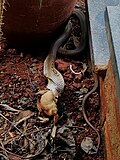
File:Common Cobra Vomiting.JPG|Cobra regurgitating | File:Common Cobra Vomiting.JPG|Cobra regurgitating | ||
</gallery> | </gallery> | ||
==Local names== | |||
The Indian cobra<ref name="Smith"/><ref name="Daniels"/> or spectacled cobra,<ref name="Whitaker & Captain"/> being common in South Asia, is referred to by a number of local names deriving from the root of ''Naga.'' | |||
For [[Indo-Aryan languages|Indo-Aryan]] and [[Dravidian languages|Dravidian]] languages: | |||
* ''Phalinger'' (फ्लिंगर) in [[Dogri language|Dogri]] | |||
* ''Phetigom'' (ফেতিগোম) in [[Assamese language|Assamese]] | |||
* ''Gokhra ''(গোখরা) in [[Bengali language|Bengali]] | |||
* ''Naag'' (नाग) in [[Hindi]] | |||
* ''Fetaar'' (फेटार) in [[Awadhi language|Awadhi]] | |||
* ''Goman'' (गोमन) in [[Nepali language|Nepali]] | |||
* Gehuan (गेहुंअन)in [[Magahi language|Magahi]] and [[Bhojpuri language|Bhojpuri]] | |||
* ''Domi'' (डोमी) in [[Chhattisgarhi]] | |||
* ''Naag'' <samp>(નાગ)</samp> in [[Gujarati language|Gujarati]] | |||
* ''Nagara Haavu'' (ನಾಗರ ಹಾವು) in [[Kannada]] | |||
* ''Moorkkan'' (മൂര്ഖന്) in [[Malayalam]] | |||
* ''Naag'' (नाग) in [[Marathi language|Marathi]] | |||
* ''Gokhara Saapa'' (ଗୋଖର ସାପ) or ''Naaga Saapa'' (ନାଗ ସାପ) in [[Odia language|Odia]] | |||
* ''Naya'' (නයා) or ''Nagaya'' (නාගයා) in [[Sinhalese language|Sinhalese]] | |||
* ''Nalla pambu'' (நல்ல பாம்பு) or ''Nagapambu'' (நாகப்பாம்பு) in [[Tamil language|Tamil]] | |||
* Nagu-paamu(నాగుపాము) in [[Telugu language|Telugu]] | |||
* Saanp ({{Nastaliq|{{nq| سانپ}}}}/sɑ̃ːp/) in [[Urdu]] | |||
==References== | ==References== | ||
{{Reflist|refs= | {{Reflist|refs= | ||
<ref name=Brown>{{cite book|last=Brown | <ref name=Brown>{{cite book|last=Brown|first=John Haynes|author-link=species:John Haynes Brown|title=Toxicology and Pharmacology of Venoms from Poisonous Snakes|year=1973|publisher=Charles C. Thomas Publishers|location=Springfield, Illinois|isbn=0-398-02808-7|page=[https://archive.org/details/toxicologypharma0000brow/page/81 81]|url=https://archive.org/details/toxicologypharma0000brow/page/81}} 184 pp.</ref> | ||
<ref name="ct">{{cite web|title= ''Naja naja''|work=University of Adelaide|url=http://toxinology.com/fusebox.cfm?fuseaction=main.snakes.display&id=SN0041}}</ref> | <ref name="ct">{{cite web|title=''Naja naja''|work=University of Adelaide|url=http://toxinology.com/fusebox.cfm?fuseaction=main.snakes.display&id=SN0041|access-date=2011-11-10|archive-date=2014-12-08|archive-url=https://web.archive.org/web/20141208220244/http://toxinology.com/fusebox.cfm?fuseaction=main.snakes.display&id=SN0041|url-status=live}}</ref> | ||
<ref name="Daniels">{{Cite book|last=Daniel|first=J.C.|year=2002|title=The Book of Indian Reptiles and Amphibians|publisher=Bombay Natural History Society and Oxford University Press|location=Oxford, England|isbn=0-19-566099-4|pages=136–140}}</ref> | <ref name="Daniels">{{Cite book|last=Daniel|first=J.C.|author-link=J. C. Daniel (naturalist)|year=2002|title=The Book of Indian Reptiles and Amphibians|publisher=Bombay Natural History Society and Oxford University Press|location=Oxford, England|isbn=0-19-566099-4|pages=136–140}}</ref> | ||
<ref name="Davidson">{{cite web|url=http://drdavidson.ucsd.edu/Portals/0/snake/Naja2.htm|title=Immediate First Aid for bites by Indian or Common Cobra (''Naja naja naja'') | <ref name="Davidson">{{cite web|url=http://drdavidson.ucsd.edu/Portals/0/snake/Naja2.htm|title=Immediate First Aid for bites by Indian or Common Cobra (''Naja naja naja'')|archive-url=https://web.archive.org/web/20120402114820/http://drdavidson.ucsd.edu/Portals/0/snake/Naja2.htm|archive-date=2012-04-02}}</ref> | ||
<ref name="Smith">{{Cite book |last=Smith |first=M.A. |year=1943 | | <ref name="Smith">{{Cite book |last=Smith |first=M.A. |author-link=Malcolm Arthur Smith |year=1943 |title=The Fauna of British India, Ceylon and Burma, Including the Whole of the Indo-Chinese Sub-region. Reptilia and Amphibia. Vol. III.—Serpentes |publisher=Secretary of State for India. (Taylor and Francis, printers) |location=London |pages=427–436}}</ref> | ||
<ref name="Whitaker & Captain">{{Cite book|last=Whitaker|first=Romulus|author2=Captain, Ashok|year=2004|title=Snakes of India: The Field Guide|publisher=Draco Books|location=Chennai, India|isbn=81-901873-0-9}}</ref> | <ref name="Whitaker & Captain">{{Cite book|last=Whitaker|first=Romulus|author-link=Romulus Whitaker|author2=Captain, Ashok|author2-link=Ashok Captain|year=2004|title=Snakes of India: The Field Guide|publisher=Draco Books|location=Chennai, India|isbn=81-901873-0-9}}</ref> | ||
<ref name=VenDoc>{{cite web|title=LD50 |url=http://www.seanthomas.net/oldsite/ld50tot.html |work=Séan Thomas & Eugene Griessel – Dec 1999;Australian Venom and Toxin database |publisher=University of Queensland |access-date=1 December 2011 | <ref name=VenDoc>{{cite web|title=LD50 |url=http://www.seanthomas.net/oldsite/ld50tot.html |work=Séan Thomas & Eugene Griessel – Dec 1999;Australian Venom and Toxin database |publisher=University of Queensland |access-date=1 December 2011 |archive-url=https://web.archive.org/web/20120201062634/http://www.seanthomas.net/oldsite/ld50tot.html |archive-date=February 1, 2012 }}</ref> | ||
<ref name=W&C04>{{cite book|last=Whitaker, Captain|first=Romulus, Ashok|title=Snakes of India, The Field Guide|year=2004|publisher=Draco Books|location=India|isbn=81-901873-0-9|page=354}}</ref> | <ref name=W&C04>{{cite book|last=Whitaker, Captain|first=Romulus, Ashok|title=Snakes of India, The Field Guide|year=2004|publisher=Draco Books|location=India|isbn=81-901873-0-9|page=354}}</ref> | ||
| Line 284: | Line 288: | ||
<ref name='WHO'>{{cite journal|author=World Health Organization|title=Zoonotic disease control: baseline epidemiological study on snake-bite treatment and management|journal=Weekly Epidemiological Record|issn=0049-8114|volume=62|issue=42|pages=319–320}}</ref> | <ref name='WHO'>{{cite journal|author=World Health Organization|title=Zoonotic disease control: baseline epidemiological study on snake-bite treatment and management|journal=Weekly Epidemiological Record|issn=0049-8114|volume=62|issue=42|pages=319–320}}</ref> | ||
<ref name=j1>{{cite journal|author1=Achyuthan, K. E. | <ref name=j1>{{cite journal|author1=Achyuthan, K.E.|author2=Ramachandran, L.K.|year=1981|title=Cardiotoxin of the Indian cobra (''Naja naja'') is a pyrophosphatase|journal=Journal of Biosciences|volume=3|issue=2|pages=149–156|url=http://www.ias.ac.in/jarch/jbiosci/3/149-156.pdf|doi=10.1007/BF02702658|s2cid=1185952|access-date=2007-09-26|archive-date=2007-10-10|archive-url=https://web.archive.org/web/20071010055231/http://www.ias.ac.in/jarch/jbiosci/3/149-156.pdf|url-status=live}}</ref> | ||
}} | }} | ||
==External links== | ==External links== | ||
{{Commons | {{Commons}} | ||
* [http://www.biodiversityofindia.org/index.php?title=Serpents_in_Indian_culture Serpents in Indian culture] An article on [http://www.biodiversityofindia.org Biodiversity of India] website. | * [http://www.biodiversityofindia.org/index.php?title=Serpents_in_Indian_culture Serpents in Indian culture] An article on [http://www.biodiversityofindia.org Biodiversity of India] website. | ||
| Line 298: | Line 302: | ||
[[Category:Reptiles of Bangladesh]] | [[Category:Reptiles of Bangladesh]] | ||
[[Category:Reptiles of Bhutan]] | [[Category:Reptiles of Bhutan]] | ||
[[Category: | [[Category:Snakes of India]] | ||
[[Category:Reptiles of Nepal]] | [[Category:Reptiles of Nepal]] | ||
[[Category:Reptiles of Pakistan]] | [[Category:Reptiles of Pakistan]] | ||
| Line 304: | Line 308: | ||
[[Category:Fauna of South Asia]] | [[Category:Fauna of South Asia]] | ||
[[Category:Reptiles described in 1758]] | [[Category:Reptiles described in 1758]] | ||
[[Category: | [[Category:Animal taxa named by Carl Linnaeus]] | ||
[[Category:Articles containing video clips]] | [[Category:Articles containing video clips]] | ||
Latest revision as of 14:12, 6 March 2026
| Indian cobra | |
|---|---|

| |
Scientific classification 
| |
| : | [[Template:Taxonomy/Naja]] |
| Species: | Template:Taxonomy/NajaN. naja
|
| Binomial name | |
| Template:Taxonomy/NajaNaja naja | |

| |
| Indian cobra distribution | |
| Synonyms[3][5] | |
|
List
| |
The Indian cobra (Naja naja /nadʒa nadʒa/), also known commonly as the spectacled cobra, Asian cobra, or binocellate cobra, is a species of cobra, a venomous snake in the family Elapidae. The species is native to the Indian subcontinent, and is a member of the "big four" species that are responsible for the most snakebite cases in Sri Lanka and India.[6][7]
The Indian cobra is revered in Hindu mythology and culture, and is often seen with snake charmers. It is a protected species under the Indian Wildlife Protection Act (1972).
Taxonomy[edit | edit source]
.jpg)
The generic name and the specific epithet naja is a Latinisation of the Sanskrit word nāga (नाग) meaning "cobra".[8]
The Indian cobra is classified under the genus Naja of the family Elapidae. The genus was first described by Josephus Nicolaus Laurenti in 1768.[9] The species Naja naja was first described by the Swedish physician, zoologist, and botanist Carl Linnaeus in 1758.[4][10] The genus Naja was split into several subgenera based on various factors, including morphology, diet, and habitat. Naja naja is part of the subgenus Naja, along with all the other species of Asiatic cobras, including Naja kaouthia, Naja siamensis, Naja sputatrix, and the rest.
Naja naja is considered to be the prototypical cobra species within the subgenus Naja, and within the entire genus Naja. All Asiatic species of Naja were considered conspecific with Naja naja until the 1990s, often as subspecies thereof. Many of the subspecies were later found to be artificial or composites. This causes much potential confusion when interpreting older literature.[11]
Description[edit | edit source]

The Indian cobra is a moderately sized, heavy-bodied species. This cobra species can easily be identified by its relatively large hood, which it expands when threatened.
Many specimens exhibit a hood mark. This hood mark is located at the rear (dorsal surface) of the Indian cobra's hood. When the hood mark is present, it consists of two circular ocelli patterns connected by a curved line, evoking the image of spectacles.[12]
This species has a head that is elliptical, depressed, and very slightly distinct from the neck. The snout is short and rounded with large nostrils. The eyes are medium in size and the pupils are round.[13] The majority of adult specimens range from 1 to 1.5 metres (3.3 to 4.9 ft) in length. Some specimens, particularly those from Sri Lanka, may grow to lengths of 2.1 to 2.2 metres (6.9 to 7.2 ft), but this is relatively uncommon.[12]

_2_(cropped).jpg)
The Indian cobra varies tremendously in colour and pattern throughout its range. The ventral scales or the underside colouration of this species can be grey, yellow, tan, brown, reddish or black. Dorsal scales of the Indian cobra may have a hood mark or colour patterns. The most common visible pattern is a posteriorly convex light band at the level of the 20th to 25th ventrals. Salt-and-pepper speckles, especially in adult specimens, are seen on the dorsal scales.
Specimens, particularly those found in Sri Lanka, may exhibit poorly defined banding on the dorsum. Ontogenetic colour change is frequently observed in specimens in the northwestern parts of their geographic range (southern Pakistan and northwestern India). In southern Pakistan, juvenile specimens may be grey in colour and may or may not have a hood mark. Adults on the other hand are typically uniformly black in colour on top (melanistic), while the underside, outside the throat region, is usually light.
Patterns on the throat and ventral scales are also variable in this species. The majority of specimens exhibit a light throat area followed by dark banding, which can be 4–7 ventral scales wide. Adult specimens also often exhibit a significant amount of mottling on the throat and on the venter, which makes patterns on this species less clear relative to patterns seen in other species of cobra. With the exception of specimens from the northwest, there is often a pair of lateral spots on the throat where the ventral and dorsal scales meet. The positioning of these spots varies, with northwestern specimens having the spots positioned more anterior, while specimens from elsewhere in their range are more posterior.

Scalation[edit | edit source]
Dorsal scales are smooth and strongly oblique. Midbody scales are in 23 rows (21–25), with 171–197 ventrals. There are 48–75 divided subcaudals and the anal shield is single. There are seven upper labials (3rd the largest and in contact with the nasal anteriorly, 3rd and 4th in contact with the eye) and 9-10 lower labials (small angular cuneate scale present between 4th and 5th lower labial), as well as one preocular in contact with internasals, and three postoculars. Temporals are 2 + 3.[13]
Similar species[edit | edit source]
_%E6%B0%B4%E5%BE%8B6.jpg)
The Oriental rat snake Ptyas mucosa is often mistaken for the Indian cobra; however, this snake is much longer and can easily be distinguished by the more prominent ridged appearance of its body. Other snakes that resemble Naja naja are the banded racer Argyrogena fasciolata and the Indian smooth snake Wallophis brachyura.[6] Also, the monocled cobra (Naja kaouthia) may be confused with Naja naja; however, the monocled cobra has an O-shaped pattern on the back of the hood, while the Indian cobra has a spectacles-shaped pattern on its hood. Confusions may exist with Caspian cobra (Naja oxiana), as some Indian cobra specimens without a hood mark are sometimes confused with N. oxiana, where these two species coexist in Pakistan and Afghanistan. Although some Caspian cobra specimens can be quite dark, they are never fully black like the Indian cobra. N. oxiana normally has several dark bands under the throat, whereas in the black phase of N. naja from Pakistan, almost the entire throat is black.[14]
Distribution[edit | edit source]
The Indian cobra is native to the Indian subcontinent and can be found throughout India, Pakistan, Sri Lanka, Bangladesh, and southern Nepal. In India, it may or may not occur in the state of Assam, some parts of Kashmir, and it does not occur at high altitudes of over 2,000 metres (6,600 ft) and in extreme desert regions. In Pakistan, it is absent in most of Balochistan province, parts of Khyber Pakhtunkhwa Province, desert areas elsewhere and the Northern Areas. The most westerly record comes from Duki, Balochistan in Pakistan, while the most easterly record is from the Tangail District in Bangladesh. As this species has been observed in Drosh, in the Chitral Valley, it may also occur in the Kabul River Valley in extreme eastern Afghanistan.[12] There's been at least one report of this species occurring in Bhutan.[15]
Habitat[edit | edit source]
The Indian cobra inhabits a wide range of habitats throughout its geographical range. It can be found in dense or open forests, plains, agricultural lands (rice paddy fields, wheat crops), rocky terrain, wetlands, and it can even be found in heavily populated urban areas, such as villages and city outskirts, ranging from sea level to 2,000 metres (6,600 ft) in altitude. This species is absent from true desert regions. The Indian cobra is often found in the vicinity of water. Preferred hiding locations are holes in embankments, tree hollows, termite mounds, rock piles and small mammal dens.[13][16]
Feeding[edit | edit source]
The Indian cobra feeds on rodents, lizards and frogs. It bites quickly, and then waits while its venom damages the nervous system of the prey, paralyzing and often killing it. Like all snakes, N. naja swallows its prey whole. This species sometimes enters buildings in search of rodent prey.[17]
Reproduction[edit | edit source]
The Indian cobra is oviparous, laying eggs in the months of April through July. The female usually lays between 10 and 30 eggs in rat holes or termite mounds, which hatch 48 to 69 days later. Each hatchling measures 20–30 cm (8–12 in) in total length (tail included). The hatchlings are independent from birth and have fully functional venom glands.
Venom[edit | edit source]

The Indian cobra's venom mainly contains a powerful post-synaptic neurotoxin[13] and cardiotoxin.[13][18] The venom acts on the synaptic gaps of the nerves, thereby paralyzing muscles, and in severe bites leading to respiratory failure or cardiac arrest. The venom components include enzymes such as hyaluronidase that cause lysis and increase the spread of the venom. Envenomation symptoms may manifest between fifteen minutes and two hours following the bite.[19][20]
In mice, the preferred Template:LD50 value is estimated to be 0.56 mg/kg via subcutaneous injection (SC).[13][21] However, there's a wide range of potency for this species, ranging from 0.22 mg/kg (in Pakistani N. naja karachiensis)[22] to 0.84 mg/kg (Indian specimens).[23] Minton (1974) reported a value of 0.29 mg/kg SC for specimens from northwest India, along with an average venom yield per bite range between 170 and 250 mg (dry weight).[13] In another study, the average venom yield was 169 mg and a maximum yield of 610 mg (both were dry weights of milked venom).[21] Though it is responsible for many bites, only a small percentage are fatal if proper medical treatment and antivenom are given.[16] Mortality rates for untreated bite victims can vary from case to case, depending upon the quantity of venom delivered by the individual involved. According to one study, it is approximately 20–30%,[24] but in another study involving victims who were given prompt medical treatment, the mortality rate was only 9%. In Bangladesh, it is responsible for most of the snake bite cases.[25]

The Indian cobra is one of the big four snakes of South Asia that are responsible for the majority of human deaths by snakebite in Asia. Polyvalent serum is available for treating snakebites caused by these species.[26] Zedoary, a local spice with a reputation for being effective against snakebite,[27] has shown promise in experiments testing its activity against cobra venom.[28]
The venom of young cobras has been used as a substance of abuse in India, with cases of snake charmers being paid for providing bites from their snakes. Though this practice is now seen as outdated, symptoms of such abuse include loss of consciousness, euphoria, and sedation.[29]
As of November 2016[update], an antivenom has been developed by the Costa Rican Clodomiro Picado Institute, and the clinical trial phase was in Sri Lanka.[30]
Envenomation and clinical manifestation[edit | edit source]
Indian cobra bites are very common in many parts of India, Pakistan, Sri Lanka, and throughout their range in South Asia. Hundreds of individual case reports have been published in books and journals over the past century. However, no large prospective study of patients with proven bites by N. naja has been undertaken and reported. In a survey of snakebites in India, 91.4% of cases were bitten by an unidentified snake. Of the 6.1% of identified venomous snakes responsible for bites, 40% were N. naja. As with bites by N. kaouthia and N. oxiana, patients may show manifestations of systemic neurotoxic envenoming or local envenoming or both, although N. oxiana bites produce noticeable symptoms of envenomation more rapidly, and prominent neurotoxicity (severe flaccid paralysis) is more common amongst patients bitten by N. oxiana. A woman bitten by N. oxiana in northwestern Pakistan suffered prominent neurotoxicity and died while en route to the closest hospital nearly 50 minutes after envenomation (death occurred 45–50 minutes post envenomation).[31]
Local necrosis was described after cobra bites in India in the 1860s and up to the 1920s, but this was apparently forgotten until Reid's work in Malaysia. Severe local pain and swelling may begin almost immediately after the bite. The pain persists while swelling and tenderness extend up the bitten limb, sometimes spreading to the adjacent trunk. Darkening of the necrotic area of skin and blistering are apparent by about the third day, with a characteristic putrid smell typical of necrotic cobra bites in Africa and Asia. Early systemic symptoms include headache, nausea, vomiting, dizziness and a feeling of lassitude, drowsiness and intoxication. "Many subjects describe their drowsiness as if they had imbibed large quantities of some potent intoxicant." Neurotoxic symptoms begin with ptosis (the patient puckers their brow, contracting the frontalis muscle, attempting to raise the eyelids or tilts the head back so as to see beneath the drooping upper lids), profuse viscid saliva, inability to clear secretions, sagging of the jaw or inability to open the mouth and progression to respiratory paralysis. It is not clear from the available literature whether the proportion of patients developing neurotoxicity and necrosis is different from that in patients bitten by N. kaouthia.[32]
The outstanding feature of systemic envenoming is paralysis of the muscles due to rapid action of neurotoxin at the myoneural junction. Respiratory paralysis may occur within 3 – 4 hours in severe cases. Drowsiness is the first symptom, but it is difficult to assess because it is a subjective symptom. All of the cases developed ptosis 1.5 – 6 hours post bite. Since ptosis is easy to detect, it is a valuable clinical sign for early diagnosis of systemic envenoming due to cobra bite. Restlessness, irregular breathing, and mental confusion usually developed before respiratory paralysis, indicating that they are significant early clinical signs of impending respiratory failure. It is important for clinicians to recognize the early signs of respiratory failure. Cases which show signs of systemic envenoming require antivenom. If some hours have elapsed since the bite, the antivenom may be less successful. In general, 100 ml. of antivenom should be given in the first 30 minutes. If there is no distinct clinical improvement within 1 hour, the dose should be repeated. Tracheostomy and artificial respiration are essential in cases of respiratory failure. Necrosis is the outstanding feature of local envenoming. Most patients were bitten on the foot while working in rice fields. Authors recommended the wearing of shoes or boots while working, and that persons bitten by a snake apply a firm ligature above the bite and go to the nearest health centre or hospital.[13][32]
Genome[edit | edit source]
Previous cytogenetic analysis revealed the Indian cobra has a diploid karyotype of 38 chromosomes, compromising seven pairs of macro-chromosomes, 11 pairs of micro-chromosomes and one pair of sexual chromosomes.[33] Using next-generation sequencing and emerging genomic technologies, a de novo high-quality N. naja reference genome was published in 2020.[34] The estimated size of this haploid genome is of 1.79 Gb, which has 43.22% of repetitive content and 40.46% of GC content. Specifically, macro-chromosomes, which represent 88% of the genome, have 39.8% of GC content, while micro-chromosomes, that represent only 12% of the genome, contain 43.5% of GC content.[34]
Synteny analysis[edit | edit source]
Synteny analysis between the Indian cobra and the prairie rattlesnake genome revealed large syntenic blocks within macro, micro, and sexual chromosomes. This study allowed the observation of chromosomic fusion and fission events that are consistent with the difference in chromosome number between these species. For example, chromosome 4 of the Indian cobra shares syntenic regions with chromosomes 3 and 5 of the rattlesnake genome, indicating a possible fusion event. Besides, chromosomes 5 and 6 of the Indian cobra are syntenic to rattlesnake chromosome 4, indicating a possible fusion event between these chromosomes.[34]
On the other hand, by performing whole-genome synteny comparison between the Indian cobra and other reptilian and avian genomes, it was revealed the presence of large syntenic regions between macro, micro, and sexual chromosomes across species from these classes, which indicates changes in chromosome organization between reptile and avian genomes and is consistent with their evolutionary trajectories.[34]
Gene organization[edit | edit source]
Using protein homology information and expression data from different tissues of the cobra, 23,248 protein-coding genes, 31,447 transcripts, and 31,036 proteins, which included alternatively spliced products, where predicted from this genome. 85% of these predicted proteins contained start and stop codon, and 12% contained an N-terminal secretion signal sequence, which is an important feature in terms of toxins secretion from venom glands.[34]
Venom gland genes[edit | edit source]
Further studies on gene prediction and annotation of the Indian cobra genome identified 139 toxin genes from 33 protein families. These included families like three-finger toxins (3FTxs), snake venom metalloproteinases (SVMP), cysteine-rich secretory venom proteins and other toxins including natriuretic peptide, C-type lectin, snake venom serine proteinase (SVSP), Kunitz and venom complement-activating gene families, group I phospholipase A2 (PLA2) and one cobra venom factor (CVF) gene. These major toxin gene families in the Indian cobra are mostly found in the snake's macro-chromosomes, which differs from Crotalus virides (rattlesnake) that presents them in its micro-chromosomes, and is indicative of the differences in their venom evolution. Besides, comparison of venom gland genes between the Indian cobra and C. virides, identified 15 toxin gene families that are unique to the Indian cobra, which included cathelicidins and phospholipase B-like toxins.[34]
Venom gland transcriptome and toxin gene identification[edit | edit source]

Analysis of transcriptomic data from 14 different tissues of the Indian cobra identified 19,426 expressed genes. Out of these genes, 12,346 belonged to the venom gland transcriptome, which included 139 genes from 33 toxin gene families. Additionally, differential expression analysis revealed that 109 genes from 15 different toxin gene families were significantly up-regulated (fold change > 2) in the venom gland and this included 19 genes that were exclusively expressed in this gland.[34]
These 19 venom specific toxins (VSTs) encode the core effector toxin proteins and include 9 three-finger toxins (out of which six are neurotoxins, one cytotoxin, one cardiotoxin and one muscarinic toxin), six snake venom metalloproteinases, one nerve growth factor, two venom Kunitz serine proteases and a cysteine-rich secretory venom protein.[34] Additionally to these VSTs, other accessory venom proteins (AVPs) were also found to be highly expressed in the venom gland such as: cobra venom factor (CVF), coagulation factors, protein disulfide isomerases, natriuretic peptides, hyaluronidases, phospholipases, L-amino acid oxidase (LAAO), vascular endothelial growth factor (VEGF) and 5' nucleotidases.[34]
This transcriptomic data together with the information provided by the high quality Indian cobra genome generated by Susyamohan et al., 2020 suggest that these VSTs together with AVPs form the core toxic effector components of this venomous snake, which induce muscular paralysis, cardiovascular dysfunction, nausea, blurred vision and hemorrhage after snake bite.[34][35]
The identification of these genes coding for core toxic effector components from the Indian cobra venom may allow the development of recombinant antivenoms based in neutralizing antibodies for VST proteins.[34]
Relationship with humans[edit | edit source]


The Indian cobra holds a prominent place in the religious, mythological, and cultural landscape of the Indian subcontinent.
In popular culture[edit | edit source]
The Indian cobra features prominently in literature, folklore, and cinema. It is a recurring figure in Indian fables, proverbs, and cautionary tales, often symbolizing both danger and divine power.
Rudyard Kipling's short story "Rikki-Tikki-Tavi" features a pair of Indian cobras named Nag and Nagaina, the Hindi words for male and female snake, respectively.[36]
Mythology[edit | edit source]
Hinduism[edit | edit source]
The Indian cobra is often featured in Hindu religion and revered in several regional traditions. The Hindu god Shiva is often depicted with a cobra called Vasuki, coiled around his neck, symbolizing his mastery over maya, the illusory nature of the world. Vishnu, in his form called the anantashayana, is usually portrayed as reclining on the coiled body of Shesha, a giant snake deity with multiple cobra heads. Cobras are also worshipped during the Hindu festival of Naga Panchami and Nagula Chavithi. When killed by humans, it is usually cremated with milk and ghee along with a cloth by Hindus.
Buddhism[edit | edit source]
In Buddhism, cobras ("Naga"s) are seen as protective beings. The Naga king Mucilinda is said to have shielded The Buddha from a storm by spreading his hood over him during meditation. Nagas are regarded as guardians of water and spiritual treasures, and their imagery appears frequently in Buddhist art across South and Southeast Asia.[37]
Other traditions[edit | edit source]
In Jainism, the cobra is linked to Parshvanatha, the twenty-third Tirthankara, who is often shown with a canopy of snake hoods as a sign of divine protection.[37]
Snake charming[edit | edit source]
Snake charming has traditionally featured the Indian cobra as the star attraction, with performers using the snake's dramatic hood display to captivate audiences. Although widely believed to respond to music, the cobra actually follows the movements of the charmer's instrument, as it cannot hear airborne sounds. Once common at fairs and public gatherings, snake charming has declined in recent years due to stricter wildlife protection laws and growing concern for animal welfare. Despite this, the practice has contributed to the cobra's iconic status and remains a familiar image in popular imagination.[38]
Heraldry[edit | edit source]
Indian cobras were often a heraldic element in the official symbols of certain princely states of India such as Gwalior, Kolhapur, Pal Lahara, Gondal, Khairagarh and Kalahandi, among others.[39]
Gallery[edit | edit source]
-
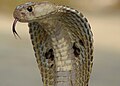 Indian cobra displaying an impressive hood
 -
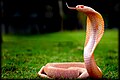 Albino spectacled cobra
 -
 Binocellate cobra
 -
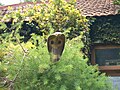
-
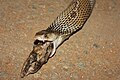 Cobra regurgitating


Local names[edit | edit source]
The Indian cobra[40][41] or spectacled cobra,[6] being common in South Asia, is referred to by a number of local names deriving from the root of Naga.
For Indo-Aryan and Dravidian languages:
- Phalinger (फ्लिंगर) in Dogri
- Phetigom (ফেতিগোম) in Assamese
- Gokhra (গোখরা) in Bengali
- Naag (नाग) in Hindi
- Fetaar (फेटार) in Awadhi
- Goman (गोमन) in Nepali
- Gehuan (गेहुंअन)in Magahi and Bhojpuri
- Domi (डोमी) in Chhattisgarhi
- Naag (નાગ) in Gujarati
- Nagara Haavu (ನಾಗರ ಹಾವು) in Kannada
- Moorkkan (മൂര്ഖന്) in Malayalam
- Naag (नाग) in Marathi
- Gokhara Saapa (ଗୋଖର ସାପ) or Naaga Saapa (ନାଗ ସାପ) in Odia
- Naya (නයා) or Nagaya (නාගයා) in Sinhalese
- Nalla pambu (நல்ல பாம்பு) or Nagapambu (நாகப்பாம்பு) in Tamil
- Nagu-paamu(నాగుపాము) in Telugu
- Saanp ( سانپ/sɑ̃ːp/) in Urdu
References[edit | edit source]
- ↑ de Silva, A.; Ukuwela, K.; Shankar, G.; Srinivasulu, B.; Das, A.; Vyas, R.; Sawant, N.S.; Kulkarni, N.U.; Deepak, V.; Thakur, S.; Mohapatra, P.; Srinivasulu, C.; Achyuthan, N.S. (2021). "Naja naja". IUCN Red List of Threatened Species. 2021 e.T62241A3110222. doi:10.2305/IUCN.UK.2021-3.RLTS.T62241A3110222.en. Retrieved 16 May 2023.
- ↑ "Appendices | CITES". cites.org. Archived from the original on 2011-06-15. Retrieved 2022-01-14.
- ↑ 3.0 3.1 "Naja naja". Encyclopedia of Life. Archived from the original on 30 March 2014. Retrieved 28 March 2014.
- ↑ 4.0 4.1 "Naja naja". Integrated Taxonomic Information System. Retrieved 23 March 2014.
- ↑ Uetz, P.; Freed, P.; Aguilar, R.; Reyes, F.; Kudera, J.; Hošek, J. "Naja naja". The Reptile Database. Archived from the original on 4 March 2016. Retrieved 28 March 2014.
- ↑ 6.0 6.1 6.2 Whitaker, Romulus; Captain, Ashok (2004). Snakes of India: The Field Guide. Chennai, India: Draco Books. ISBN 81-901873-0-9.
- ↑ Mukherjee, Ashis K. (2012). "Green medicine as a harmonizing tool to antivenom therapy for the clinical management of snakebite: The road ahead". Indian J Med Res. 136 (1): 10–12. PMC 3461710. PMID 22885258.
- ↑ "Naja". The Free Dictionary. Princeton University. Archived from the original on 10 January 2014. Retrieved 28 March 2014.
- ↑ "Naja". Integrated Taxonomic Information System. Retrieved 29 March 2014.
- ↑ Linnaeus, Carl (1758). Systema naturæ per regna tria naturæ, secundum classes, ordines, genera, species, cum characteribus, differentiis, synonymis, locis. Tomus I. Editio Decima, Reformata (in Latina) (10th ed.). Stockholm: Laurentius Salvius. Archived from the original on 2008-10-10. Retrieved 2018-01-13.
- ↑ Wüster, W. (1996). "Taxonomic changes and toxinology: systematic revisions of the Asiatic cobras (Naja naja species complex)". Toxicon. 34 (4): 399–406. Bibcode:1996Txcn...34..399W. doi:10.1016/0041-0101(95)00139-5. PMID 8735239.
- ↑ 12.0 12.1 12.2 Wüster, W. (1998). "The Cobras of the genus Naja in India" (PDF). Hamadryad. 23 (1): 15–32. Archived from the original on 4 March 2016. Retrieved 15 September 2014.
- ↑ 13.0 13.1 13.2 13.3 13.4 13.5 13.6 13.7 "Naja naja". University of Adelaide. Archived from the original on 2014-12-08. Retrieved 2011-11-10.
- ↑ "Naja oxiana". Venom Street. Collector and Breeder of Asian Cobras. Venom Street. Archived from the original on 21 October 2014. Retrieved 3 February 2012.
- ↑ Mahendra, B.C. (1984). Handbook of the Snakes of India, Ceylon, Burma, Bangladesh and Pakistan. Agra: The Academy of Zoology. p. 412.
{{cite book}}: CS1 maint: publisher location (link) - ↑ 16.0 16.1 Whitaker, Captain, Romulus, Ashok (2004). Snakes of India, The Field Guide. India: Draco Books. p. 354. ISBN 81-901873-0-9.
{{cite book}}: CS1 maint: multiple names: authors list (link) - ↑ "Naja naja (Indian Cobra)". Animal Diversity Web.
- ↑ Achyuthan, K.E.; Ramachandran, L.K. (1981). "Cardiotoxin of the Indian cobra (Naja naja) is a pyrophosphatase" (PDF). Journal of Biosciences. 3 (2): 149–156. doi:10.1007/BF02702658. S2CID 1185952. Archived (PDF) from the original on 2007-10-10. Retrieved 2007-09-26.
- ↑ "Immediate First Aid for bites by Indian or Common Cobra (Naja naja naja)". Archived from the original on 2012-04-02.
- ↑ "LD50". Séan Thomas & Eugene Griessel – Dec 1999;Australian Venom and Toxin database. University of Queensland. Archived from the original on February 1, 2012. Retrieved 1 December 2011.
- ↑ 21.0 21.1 Broad, A.J.; Sutherland, S.K.; Coulter, A.R. (1979). "The lethality in mice of dangerous Australian and other snake venoms". Toxicon. 17 (6): 664–667. Bibcode:1979Txcn...17..661B. doi:10.1016/0041-0101(79)90245-9. PMID 524395.
- ↑ Wong, K.Y.; Tan, C.H.; Tan, N.H. (3 January 2019). "Venom and Purified Toxins of the Spectacled Cobra (Naja naja) from Pakistan: Insights into Toxicity and Antivenom Neutralization". The American Journal of Tropical Medicine and Hygiene. 94 (6): 1392–1399. doi:10.4269/ajtmh.15-0871. PMC 4889763. PMID 27022154.
- ↑ Attarde, S; Khochare, S; Iyer, A; Dam, P; Martin, G; Sunagar, K (25 October 2021). "Venomics of the Enigmatic Andaman Cobra (Naja sagittifera) and the Preclinical Failure of Indian Antivenoms in Andaman and Nicobar Islands". Frontiers in Pharmacology. 12 768210. doi:10.3389/fphar.2021.768210. PMC 8573199. PMID 34759827.
- ↑ World Health Organization. "Zoonotic disease control: baseline epidemiological study on snake-bite treatment and management". Weekly Epidemiological Record. 62 (42): 319–320. ISSN 0049-8114.
- ↑ Brown, John Haynes (1973). Toxicology and Pharmacology of Venoms from Poisonous Snakes. Springfield, Illinois: Charles C. Thomas Publishers. p. 81. ISBN 0-398-02808-7. 184 pp.
- ↑ Snake-bites: a growing, global threat . BBC News (2011-02-22). Retrieved on 2013-01-03.
- ↑ Martz, W. (1992). "Plants with a reputation against snakebite". Toxicon. 30 (10): 1131–1142. Bibcode:1992Txcn...30.1131M. doi:10.1016/0041-0101(92)90429-9. PMID 1440620.
- ↑ Daduang; Sattayasai, N.; Sattayasai, J.; Tophrom, P.; Thammathaworn, A.; Chaveerach, A.; Konkchaiyaphum, M. (2005). "Screening of plants containing Naja naja siamensis cobra venom inhibitory activity using modified ELISA technique". Analytical Biochemistry. 341 (2): 316–325. doi:10.1016/j.ab.2005.03.037. PMID 15907878.
- ↑ Katshu, M.Z.U.H.; Dubey, I.; Khess, C.R.J.; Sarkhel, S. (2011). "Snake Bite as a Novel Form of Substance Abuse: Personality Profiles and Cultural Perspectives". Substance Abuse. 32 (1): 43–46. Bibcode:2011JPkR...32...43K. doi:10.1080/08897077.2011.540482. PMID 21302184.
- ↑ Rodrigo, M. (October 9, 2016) Trials to start for home-grown anti-venom Archived 2016-10-14 at the Wayback Machine. sundaytimes.lk
- ↑ Latifi, Mahmoud (1991). Snakes of Iran. Oxford, Ohio: Society for the Study of Amphibians and Reptiles. ISBN 978-0-916984-22-9. (Naja naja oxiana, Ladle Snake, p. 124).
- ↑ 32.0 32.1 Warrell, D.A. (22 August 1995). "Clinical Toxicology of Snakebite in Asia". Handbook of: Clinical Toxicology of Animal Venoms and Poisons (1st ed.). CRC Press. pp. 493–594. doi:10.1201/9780203719442-27. ISBN 978-0-203-71944-2. Archived from the original on 24 May 2021. Retrieved 14 July 2021.
- ↑ Singh, L. (1972). "Evolution of karyotypes in snakes". Chromosoma. 38 (2): 185–236. doi:10.1007/BF00326193. PMID 5066447. S2CID 21621814.
- ↑ 34.00 34.01 34.02 34.03 34.04 34.05 34.06 34.07 34.08 34.09 34.10 Suryamohan, Kushal; Krishnankutty, Sajesh P.; Guillory, Joseph; Jevit, Matthew; Schröder, Markus S.; Wu, Meng; Kuriakose, Boney; Mathew, Oommen K.; Perumal, Rajadurai C.; Koludarov, Ivan; Goldstein, Leonard D. (2020). "The Indian cobra reference genome and transcriptome enables comprehensive identification of venom toxins". Nature Genetics. 52 (1): 106–117. doi:10.1038/s41588-019-0559-8. ISSN 1546-1718. PMC 8075977. PMID 31907489. File:CC-BY icon.svg Text was copied from this source, which is available under a Creative Commons Attribution 4.0 International License Archived 2017-10-16 at the Wayback Machine.
- ↑ Gutiérrez, José María; Calvete, Juan J.; Habib, Abdulrazaq G.; Harrison, Robert A.; Williams, David J.; Warrell, David A. (2017-09-14). "Snakebite envenoming". Nature Reviews Disease Primers. 3 (1): 17063. doi:10.1038/nrdp.2017.63. ISSN 2056-676X. PMID 28905944.
- ↑ Kipling, Rudyard. "Rikki-Tikki-Tavi". Haley Huang. 16 January 2014.
- ↑ 37.0 37.1 "Naga | Origins, Symbolism & Significance | Britannica". www.britannica.com. 2025-03-21. Retrieved 2025-05-15.
- ↑ Prevention of Cruelty to Animals Act 1960. indialawinfo.com
- ↑ Heraldry of Madhya Pradesh Archived 2015-12-22 at the Wayback Machine. hubert-herald.nl
- ↑ Smith, M.A. (1943). The Fauna of British India, Ceylon and Burma, Including the Whole of the Indo-Chinese Sub-region. Reptilia and Amphibia. Vol. III.—Serpentes. London: Secretary of State for India. (Taylor and Francis, printers). pp. 427–436.
- ↑ Daniel, J.C. (2002). The Book of Indian Reptiles and Amphibians. Oxford, England: Bombay Natural History Society and Oxford University Press. pp. 136–140. ISBN 0-19-566099-4.

External links[edit | edit source]
- Serpents in Indian culture An article on Biodiversity of India website.