


Ajay Kumar (talk | contribs) Created a new article |
KraigYee56 (talk | contribs) mNo edit summary |
||
| Line 6: | Line 6: | ||
| name = Shri Krishna Temple Udupi | | name = Shri Krishna Temple Udupi | ||
| native_name = ಉಡುಪಿ ಶ್ರೀ ಕೃಷ್ಣ ದೇವಸ್ಥಾನ | | native_name = ಉಡುಪಿ ಶ್ರೀ ಕೃಷ್ಣ ದೇವಸ್ಥಾನ | ||
| image = Udupi Sri Krishna Matha Temple.jpg | |||
| alt = | | alt = | ||
| caption = | | caption = Krishna Temple, Udupi | ||
| map_type = India Karnataka | | map_type = India Karnataka | ||
| map_caption = Location in Karnataka | | map_caption = Location in Karnataka | ||
| Line 31: | Line 19: | ||
| deity = [[Krishna]] | | deity = [[Krishna]] | ||
| festivals= | | festivals= | ||
| architecture = [[ | | architecture = [[Kerala architecture]] | ||
| temple_quantity = | | temple_quantity = | ||
| monument_quantity= | | monument_quantity= | ||
| inscriptions = | | inscriptions = | ||
| year_completed = 13th | | year_completed = 13th century CE | ||
| creator = | | creator = | ||
| website = | | website = | ||
}} | }} | ||
{{DvaitaInfobox}} | {{DvaitaInfobox}} | ||
'''Udupi Shri Krishna Temple''' is a well-known historic [[Hindu]] temple dedicated to | [[File:Shri Udupi Krishna Temple's Madhwa Sarovara view.jpg|thumb|Shri Udupi Krishna Temple's Madhwa Sarovara view]] | ||
'''Udupi Shri Krishna Temple''' is a well-known historic [[Hindu]] temple dedicated to [[Krishna]] and [[Dvaita]] Matha, located in the city of [[Udupi]] in [[Karnataka]], [[India]]. The Matha area resembles a living [[Ashram|ashram]], a holy place for daily devotion and living. Surrounding the Shri Krishna Temple are several temples namely the [[Udupi Anantheshwara Temple]] which is over a thousand years old.<ref>{{cite book|title=South India|url=https://books.google.com/books?id=8KnLFpjEHpUC&q=udupi+krishna+temple&pg=PA270|publisher=Lonely Planet|year=2009|isbn = 9781741791556}}</ref> | |||
==History== | ==History== | ||
[[File:Decorated chariot, Udupi, India.jpg|thumb|Chariot in front of Sri Krishna Temple]] | [[File:Decorated chariot, Udupi, India.jpg|thumb|[[Ratha|Chariot]] in front of the Sri Krishna Temple]] | ||
The Krishna Matha was founded by the [[Vaishnavism|Vaishnavite]] saint | The Krishna Matha was founded by the [[Vaishnavism|Vaishnavite]] saint [[Madhvacharya]] in the 13th century. He was the founder of the [[Dvaita Vedanta|Dvaita]] school of Vedanta. It is believed that Madhvacharya found the [[Murti|vigraha]] of Krishna in a large ball of ''gopichandana''.<ref>{{cite book|url=https://books.google.com/books?id=fdEkDwAAQBAJ&pg=PT41|title=Karnataka's Rich Heritage – Temple Sculptures & Dancing Apsaras: An Amalgam of Hindu Mythology, Natyasastra and Silpasastra|author=Lalit Chugh|date=23 May 2017|publisher=Notion Press|page=41|isbn=9781947137363|access-date=23 May 2017}}</ref> As told by Madhvacharya in his ''Tantrasara Sangraha'', the Vigraha was placed initially in the east direction. Due to intense devotion shown by Kanakadasa, the deity is said to have turned Pashchimabhimukha (facing west). All the other Vigrahas in other Ashta Mathas face west as well. Devotees always have darshan of Krishna through the inner window, known as the Navagraha Kindi and the outer window known as the [[Kanakana kindi|Kanakana Kindi]], which is decorated by an arch named after the saint Kanakadasa. A statue has also been erected. A similar window covers the immediate front of the Vigraha and is called Navagraha Kindi. It is often mistaken to be the Kanakana Kindi.<ref>{{cite book|title=A Prehistory of Hinduism|url=https://books.google.com/books?id=0ZJdDwAAQBAJ&pg=PA120|author=Manu V. Devadevan|date = 10 October 2016|publisher=Walter de Gruyter GmbH & Co KG|page=120|isbn = 9783110517378|access-date=10 October 2016}}</ref> | ||
The temple opens at 5:30 hours IST. The unique feature of the temple is that the deity is worshipped through a silver-plated window with nine holes (Navagraha Kindi).<ref>{{cite book|title=Karnataka State: Udupi District|url=https://books.google.com/books?id=LGiex76a5-kC|author=S. Anees Siraj|publisher=Government of Karnataka, Karnataka Gazetteer Department|page=999|year=2012}}</ref> The temple also offers [[prasada]] at noon and is popularly called ''Anna Brahma'' as it feeds a vast number of devotees. | |||
==Kanakana Kindi== | |||
[[File:KANAKANA KINDI( WINDOW).JPG|alt=Kanakana Kindi in 2012|thumb|Kanakana Kindi in 2012]] | |||
Kanakana Kindi, or Kanaka’s Window, is a small viewing aperture to the western wall of main temple hall where the devotee can have a glimpse (''darshana'') of the central idol (''vigraha'') of Lord [[Krishna]]. The legends link this kindi to [[Kanaka Dasa|Kanakadasa]], a Haridasa saint in early modern India. | |||
German scholar [[Hermann Mögling|Hermann Friedrich Mogling]] documented the oral traditions about Kanakadasa in the 1860s, roughly 200 years after the events. The legends at that time were slightly different from the present day legend.<ref>{{Cite book |url=http://archive.org/details/dli.ministry.24916 |title=Zeitschrift der Deutschen Morgenländischen Gesellschaft |date=1860 |publisher=F. A. Brockhaus, Leipzig |pages=508}}</ref> | |||
Kanakadasa was born Veera Nayaka an army chieftain of the Kuruba community in the Vijayanagara Kingdom. After losing a battle, Veera Nayaka became a dasa and devoted himself to singing devotional songs praising Krishna. | |||
When Kanakadasa came to Udupi as a pilgrim, Sri [[Vadiraja Tirtha]], the chief priest of the temple, arranged a roadside hut for him behind the temple. As a non-Brahmin, Kanakadasa was not allowed to enter the temple. He spent his time in the hut playing his tambura and singing, separated from the Krishna idol by the temple wall. | |||
According to legend recorded by Mogling, Krishna's idol turned westward in response to Kanakadasa's devotion. During an earthquake one night, a crack appeared in the shrine wall, allowing Kanakadasa to see the idol. When Vadiraja learned about this, he widened the crack into a window rather than sealing it. | |||
In addition, Mogling narrates the story of precious stones after the earthquake event. A few precious stones from the idol's necklace began disappearing. Vadiraja investigated and questioned Kanakadasa, who explained that Krishna had given him the stones to ease his hunger. A local goldsmith confirmed buying the stones from Kanakadasa for four-and-a-half varahas. | |||
To demonstrate Kanakadasa's divine favour, Vadiraja entered the sanctum with closed fists and asked the temple priests what he held. None could answer. When he asked Kanakadasa, the devotee sang "Eetaneega Vasudevano," and Sri Vadiraja opened his hands to reveal a Saligrama stone. Impressed by the divine favour of Veera Nayaka, Vadiraja then formally renamed Veera Nayaka as "Kanakadasa".<ref>{{Cite news |last=Ahiraj |first=M. |date=2018-02-20 |title=Document that ‘disproves’ common belief Kanakadasa was denied temple entry |url=https://www.thehindu.com/news/national/karnataka/document-that-disproves-common-belief-that-kanakadasa-was-denied-temple-entry/article22810754.ece |access-date=2025-11-26 |work=The Hindu |language=en-IN |issn=0971-751X}}</ref> | |||
==Krishna Matha== | ==Krishna Matha== | ||
The daily [[Selfless service|sevas]] (offerings to god) and administration of the Krishna Mathas is managed by the [[Ashta Mathas of Udupi|Ashta Mathas]] (eight monasteries). Each of the Ashta Mathas performs temple management activities for two years in a cyclical order. They are collectively known as the | The daily [[Selfless service|sevas]] (offerings to god) and administration of the Krishna Mathas is managed by the [[Ashta Mathas of Udupi|Ashta Mathas]] (eight monasteries). Each of the Ashta Mathas performs temple management activities for two years in a cyclical order. They are collectively known as the 'Ashta Mathagalu' in [[Kannada]]. Each Ashta Matha has its own deity which is called ''Pattada Devaru.'' | ||
The Krishna Matha is known | The Krishna Matha is known for its religious customs, traditions and tenets of [[Dvaita]] or Tatvavada philosophy. It is also the center of Daasa Saahitya, a form of literature that originated in Udupi. | ||
These eight Mathas are: | These eight Mathas are: | ||
* [[Palimaru Matha]] | |||
* [[Palimaru Matha]] | * [[Adamaru|Admaru Matha]] | ||
* [[Adamaru|Admaru Matha]] | |||
* [[Krishnapura matha|Krishnapura Matha]] | * [[Krishnapura matha|Krishnapura Matha]] | ||
* [[Puttige Matha|Puttige]] | |||
* [[Shiroor Math|Shirur Matha]] | |||
* [[Sodhe Matha]] | |||
* [[Kaniyuru|Kaniyoor Matha]] | |||
* [[Pejawara Matha|Pejavara]] | |||
The expenses of Udupi Krishna Matha are borne by the voluntary contributions of the devotees and by the Ashta Mathas that manage the Krishna Matha. The contribution may be in cash or kind. The Krishna Matha, which owned large tracts of land, lost it all in 1975 due to the enactment of the Land Reforms Act 1975 by the Government of Karnataka. | The expenses of Udupi Krishna Matha are borne by the voluntary contributions of the devotees and by the Ashta Mathas that manage the Krishna Matha. The contribution may be in cash or kind. The Krishna Matha, which owned large tracts of land, lost it all in 1975 due to the enactment of the Land Reforms Act 1975 by the Government of Karnataka. | ||
| Line 67: | Line 72: | ||
The Pauli of Krishna Matha was renovated and the Brahmakalashotsava ceremony was held on 18 May 2017.<ref>{{cite web|url=http://www.udayavani.com/english/news/udupi-kundapur/212663/brahmakalashotva-celebrations-held-sri-krishna-mutt|title=Brahmakalashotva celebrations held at Sri Krishna Mutt|work=udayavani.com|access-date=27 May 2017}}</ref> | The Pauli of Krishna Matha was renovated and the Brahmakalashotsava ceremony was held on 18 May 2017.<ref>{{cite web|url=http://www.udayavani.com/english/news/udupi-kundapur/212663/brahmakalashotva-celebrations-held-sri-krishna-mutt|title=Brahmakalashotva celebrations held at Sri Krishna Mutt|work=udayavani.com|access-date=27 May 2017}}</ref> | ||
=== | === Swamis of the Ashta Mathas === | ||
The | The Swamis of the [[Ashta Mathas of Udupi|Ashta Mathas]] and their successors are as follows. | ||
{| class="wikitable" | {| class="wikitable" | ||
| Line 110: | Line 115: | ||
==Festivals== | ==Festivals== | ||
[[File:Udupi Sri Krishna Matha during Paryaya festival.jpg|thumb|Sri Krishna Matha during Paryaya festival January 2022]] | [[File:Udupi Sri Krishna Matha during Paryaya festival.jpg|thumb|Sri Krishna Matha during Paryaya festival January 2022]]During the [[Paryaya]] festival, held once every two years, the temple management is handed over to the next [[Ashta Mathas of Udupi|Ashta Matha]], which has been entrusted the responsibility of running the temple turn by turn. Each of the Mathas is headed by a [[swami]], who will be in charge of the temple during his Paryaya. The Paryaya is held on even years The Paryaya tradition has completed 500 years as of 2021.<ref>{{Cite news|last=|first=|date=2021-01-18|title=CM to inaugurate new free darshan pathway in Udupi temple.|language=en-IN|work=The Hindu|url=https://www.thehindu.com/news/cities/Mangalore/cm-to-inaugurate-new-free-darshan-pathway-in-udupi-temple-today/article33595827.ece|access-date=2021-01-21|issn=0971-751X}}</ref> Presently, [[Puttige Matha]] is administering the temple with Junior Pontiff Shri Sushreendra Teertha Swamiji ascending the post of Sarvajna or Paryaya Peetha. Festivals like [[Makar Sankranti|Makara Sankranthi]], [[Ratha Saptami|Ratha Sapthami]], Madhva Navami, [[Hanuman Jayanti|Hanuman Jayanthi]], Sri Krishna [[Janmashtami]], Navarathi Mahotsava, Madhva Jayanti, [[Vijayadashami|Vijaya Dashami]], [[Naraka Chaturdashi|Naraka Chathurdashi]], [[Deepavali]], and Geetha Jayanthi are celebrated by Paryaya Mutt every year.<ref>{{cite web|url=https://www.karnataka.com/udupi/sri-krishna-matha/|title=Udupi Sri Krishna Matha|work=karnataka.com|access-date=27 May 2017}}</ref> | ||
During the [[Paryaya]] festival, held once every two years, the temple management is handed over to the next [[Ashta Mathas of Udupi|Ashta Matha]], which has been entrusted the responsibility of running the temple turn by turn. Each of the Mathas is headed by a [[ | |||
==Gallery== | ==Gallery== | ||
| Line 134: | Line 136: | ||
==External links== | ==External links== | ||
{{commons category|Udupi Krishna Temple}} | {{commons category|Udupi Krishna Temple}} | ||
*[ | *{{usurped|1=[https://web.archive.org/web/20190722032437/https://www.udupipages.com/temples/sri-krishna-temple-udupi.php Sri Krishna Temple, Udupi]}} | ||
*[http://www.udupipages.com/temples/index.php Temples in Udupi] | *{{usurped|1=[https://web.archive.org/web/20181003061855/http://www.udupipages.com/temples/index.php Temples in Udupi]}} | ||
*[http://shivallibrahmins.com/photo-gallery/?album=UdupiKrishna Udupi Shri Krishna photos] | *[http://shivallibrahmins.com/photo-gallery/?album=UdupiKrishna Udupi Shri Krishna photos] | ||
*[http://www.udupirounds.com/udupi-krishna-temple.php Udupi Shri Krishna Temple and related information guide] | *[http://www.udupirounds.com/udupi-krishna-temple.php Udupi Shri Krishna Temple and related information guide] {{Webarchive|url=https://web.archive.org/web/20110522212453/http://www.udupirounds.com/udupi-krishna-temple.php |date=22 May 2011 }} | ||
{{Vishnu temples}} | {{Vishnu temples}} | ||
| Line 148: | Line 150: | ||
[[Category:Madhva mathas]] | [[Category:Madhva mathas]] | ||
[[Category:Haridasa]] | [[Category:Haridasa]] | ||
[[Category:Abhimana temples of Vishnu]] | [[Category:Abhimana temples of Vishnu]] | ||
[[Category:State Protected Monuments in Karnataka]] | |||
Latest revision as of 18:36, 4 March 2026
 | This article needs additional citations for verification. (September 2017) |
| Shri Krishna Temple Udupi | |
|---|---|
ಉಡುಪಿ ಶ್ರೀ ಕೃಷ್ಣ ದೇವಸ್ಥಾನ | |
| Religion | |
| Affiliation | Hinduism |
| Deity | Krishna |
| Location | |
| Location | Udupi |
| State | Karnataka |
| Country | India |
  Location in Karnataka | |
| Coordinates | 13°19′56″N 74°44′46″E / 13.33222°N 74.74611°E |
| Architecture | |
| Type | Kerala architecture |
| Completed | 13th century CE |
| Part of a series on |
| Dvaita |
|---|
| File:Madhvacahrya.jpg |
| Hinduism portal |

Udupi Shri Krishna Temple is a well-known historic Hindu temple dedicated to Krishna and Dvaita Matha, located in the city of Udupi in Karnataka, India. The Matha area resembles a living ashram, a holy place for daily devotion and living. Surrounding the Shri Krishna Temple are several temples namely the Udupi Anantheshwara Temple which is over a thousand years old.[1]
History[edit | edit source]

The Krishna Matha was founded by the Vaishnavite saint Madhvacharya in the 13th century. He was the founder of the Dvaita school of Vedanta. It is believed that Madhvacharya found the vigraha of Krishna in a large ball of gopichandana.[2] As told by Madhvacharya in his Tantrasara Sangraha, the Vigraha was placed initially in the east direction. Due to intense devotion shown by Kanakadasa, the deity is said to have turned Pashchimabhimukha (facing west). All the other Vigrahas in other Ashta Mathas face west as well. Devotees always have darshan of Krishna through the inner window, known as the Navagraha Kindi and the outer window known as the Kanakana Kindi, which is decorated by an arch named after the saint Kanakadasa. A statue has also been erected. A similar window covers the immediate front of the Vigraha and is called Navagraha Kindi. It is often mistaken to be the Kanakana Kindi.[3]
The temple opens at 5:30 hours IST. The unique feature of the temple is that the deity is worshipped through a silver-plated window with nine holes (Navagraha Kindi).[4] The temple also offers prasada at noon and is popularly called Anna Brahma as it feeds a vast number of devotees.
Kanakana Kindi[edit | edit source]
.JPG)
Kanakana Kindi, or Kanaka’s Window, is a small viewing aperture to the western wall of main temple hall where the devotee can have a glimpse (darshana) of the central idol (vigraha) of Lord Krishna. The legends link this kindi to Kanakadasa, a Haridasa saint in early modern India.
German scholar Hermann Friedrich Mogling documented the oral traditions about Kanakadasa in the 1860s, roughly 200 years after the events. The legends at that time were slightly different from the present day legend.[5]
Kanakadasa was born Veera Nayaka an army chieftain of the Kuruba community in the Vijayanagara Kingdom. After losing a battle, Veera Nayaka became a dasa and devoted himself to singing devotional songs praising Krishna.
When Kanakadasa came to Udupi as a pilgrim, Sri Vadiraja Tirtha, the chief priest of the temple, arranged a roadside hut for him behind the temple. As a non-Brahmin, Kanakadasa was not allowed to enter the temple. He spent his time in the hut playing his tambura and singing, separated from the Krishna idol by the temple wall.
According to legend recorded by Mogling, Krishna's idol turned westward in response to Kanakadasa's devotion. During an earthquake one night, a crack appeared in the shrine wall, allowing Kanakadasa to see the idol. When Vadiraja learned about this, he widened the crack into a window rather than sealing it.
In addition, Mogling narrates the story of precious stones after the earthquake event. A few precious stones from the idol's necklace began disappearing. Vadiraja investigated and questioned Kanakadasa, who explained that Krishna had given him the stones to ease his hunger. A local goldsmith confirmed buying the stones from Kanakadasa for four-and-a-half varahas.
To demonstrate Kanakadasa's divine favour, Vadiraja entered the sanctum with closed fists and asked the temple priests what he held. None could answer. When he asked Kanakadasa, the devotee sang "Eetaneega Vasudevano," and Sri Vadiraja opened his hands to reveal a Saligrama stone. Impressed by the divine favour of Veera Nayaka, Vadiraja then formally renamed Veera Nayaka as "Kanakadasa".[6]
Krishna Matha[edit | edit source]
The daily sevas (offerings to god) and administration of the Krishna Mathas is managed by the Ashta Mathas (eight monasteries). Each of the Ashta Mathas performs temple management activities for two years in a cyclical order. They are collectively known as the 'Ashta Mathagalu' in Kannada. Each Ashta Matha has its own deity which is called Pattada Devaru.
The Krishna Matha is known for its religious customs, traditions and tenets of Dvaita or Tatvavada philosophy. It is also the center of Daasa Saahitya, a form of literature that originated in Udupi.
These eight Mathas are:
- Palimaru Matha
- Admaru Matha
- Krishnapura Matha
- Puttige
- Shirur Matha
- Sodhe Matha
- Kaniyoor Matha
- Pejavara
The expenses of Udupi Krishna Matha are borne by the voluntary contributions of the devotees and by the Ashta Mathas that manage the Krishna Matha. The contribution may be in cash or kind. The Krishna Matha, which owned large tracts of land, lost it all in 1975 due to the enactment of the Land Reforms Act 1975 by the Government of Karnataka.
The Pauli of Krishna Matha was renovated and the Brahmakalashotsava ceremony was held on 18 May 2017.[7]
Swamis of the Ashta Mathas[edit | edit source]
The Swamis of the Ashta Mathas and their successors are as follows.
| Matha | Current Swaameejee | Successor or Junior |
|---|---|---|
| Pejavara | Shri Vishvaprasanna Teertha Swamiji | |
| Palimaru | Shri Vidyadeesha Teertha Swamiji | Shri Vidyarajeshwara Teertha Swamiji |
| Adamaru | Shri Vishvapriya Teertha Swamiji | Shri Eeshapriya Teertha Swamiji |
| Puttige | Shri Sugunendra Teertha Swamiji | Shri Sushreendra Teertha Swamiji |
| Sodhe | Shri Vishwavallabha Teertha Swamiji | |
| Kaniyooru | Shri Vidyavallabha Teertha Swamiji | |
| Shirur | Shri Vedavardhana Teertha Swamiji | |
| Krishnapura | Shri Vidyasagara Teertha Swamiji |
Festivals[edit | edit source]

During the Paryaya festival, held once every two years, the temple management is handed over to the next Ashta Matha, which has been entrusted the responsibility of running the temple turn by turn. Each of the Mathas is headed by a swami, who will be in charge of the temple during his Paryaya. The Paryaya is held on even years The Paryaya tradition has completed 500 years as of 2021.[8] Presently, Puttige Matha is administering the temple with Junior Pontiff Shri Sushreendra Teertha Swamiji ascending the post of Sarvajna or Paryaya Peetha. Festivals like Makara Sankranthi, Ratha Sapthami, Madhva Navami, Hanuman Jayanthi, Sri Krishna Janmashtami, Navarathi Mahotsava, Madhva Jayanti, Vijaya Dashami, Naraka Chathurdashi, Deepavali, and Geetha Jayanthi are celebrated by Paryaya Mutt every year.[9]
Gallery[edit | edit source]
-
Sri Krishna Matha during Paryaya festival January 2022
-

-
 Temple painted in yellow-red
 -
 Brahma ratha of Udupi Krishna
 -
 Goshala at Udupi Sri Krishna Temple
 -
 The Chariot at Udupi Sri Krishna Temple
 -
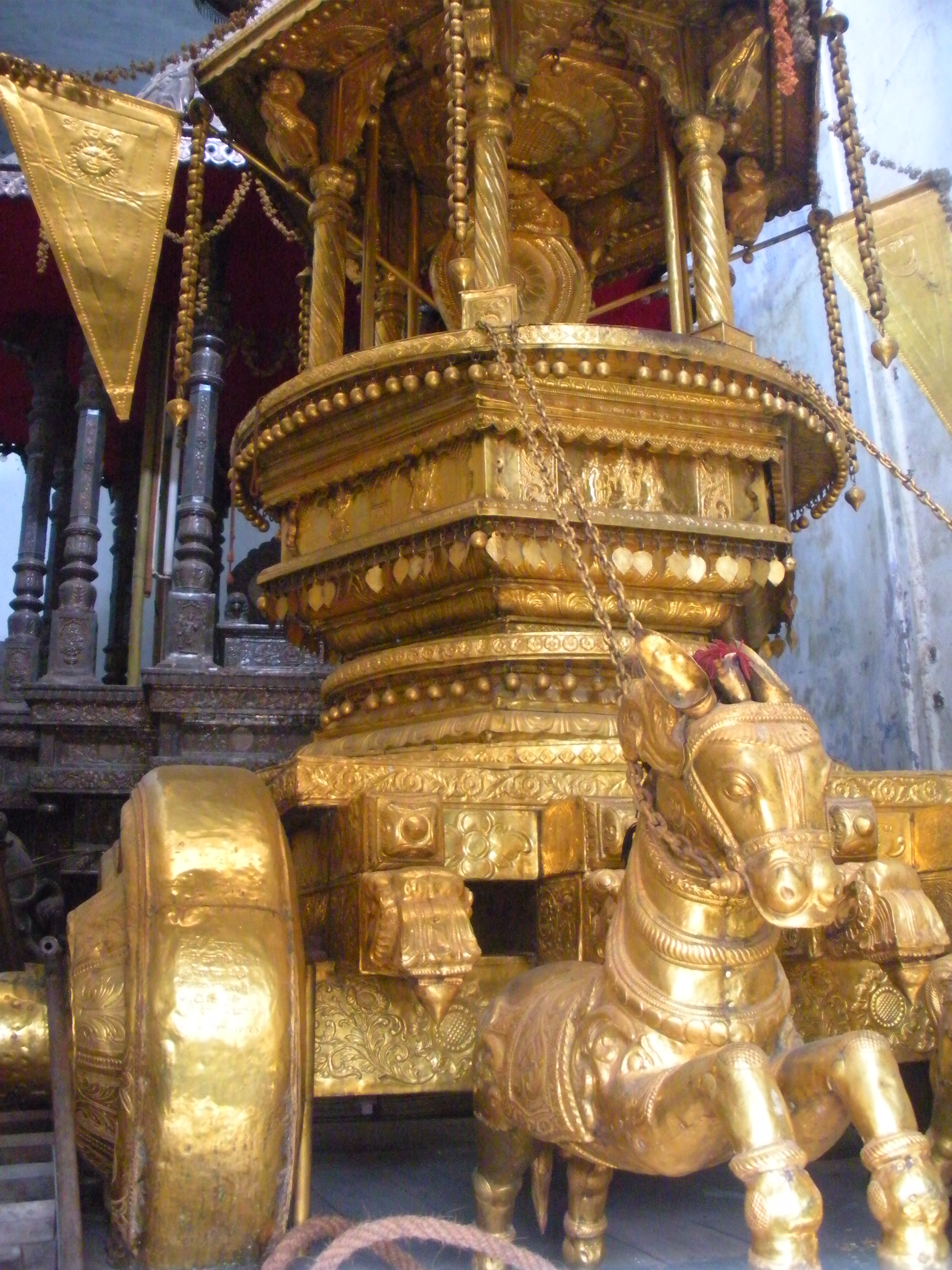 Golden Chariot of Udupi Sri Krishna Temple
 -
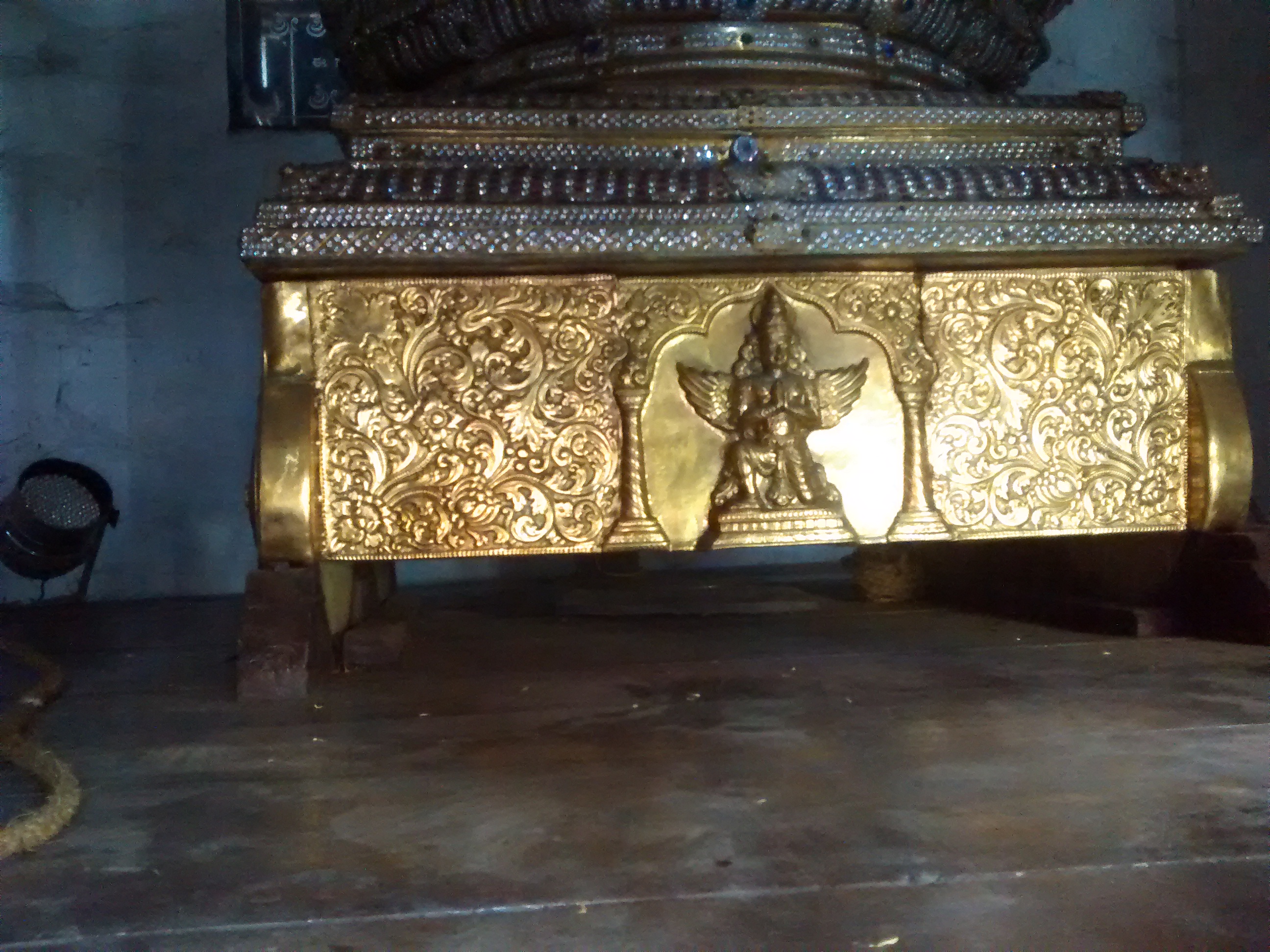 Base of Navarathna Chariot
 -
 Udupi Sri krishna Temple pond


References[edit | edit source]
- ↑ South India. Lonely Planet. 2009. ISBN 9781741791556.
- ↑ Lalit Chugh (23 May 2017). Karnataka's Rich Heritage – Temple Sculptures & Dancing Apsaras: An Amalgam of Hindu Mythology, Natyasastra and Silpasastra. Notion Press. p. 41. ISBN 9781947137363. Retrieved 23 May 2017.
- ↑ Manu V. Devadevan (10 October 2016). A Prehistory of Hinduism. Walter de Gruyter GmbH & Co KG. p. 120. ISBN 9783110517378. Retrieved 10 October 2016.
- ↑ S. Anees Siraj (2012). Karnataka State: Udupi District. Government of Karnataka, Karnataka Gazetteer Department. p. 999.
- ↑ Zeitschrift der Deutschen Morgenländischen Gesellschaft. F. A. Brockhaus, Leipzig. 1860. p. 508.
- ↑ Ahiraj, M. (20 February 2018). "Document that 'disproves' common belief Kanakadasa was denied temple entry". The Hindu. ISSN 0971-751X. Retrieved 26 November 2025.
- ↑ "Brahmakalashotva celebrations held at Sri Krishna Mutt". udayavani.com. Retrieved 27 May 2017.
- ↑ "CM to inaugurate new free darshan pathway in Udupi temple". The Hindu. 18 January 2021. ISSN 0971-751X. Retrieved 21 January 2021.
- ↑ "Udupi Sri Krishna Matha". karnataka.com. Retrieved 27 May 2017.
External links[edit | edit source]
- Sri Krishna Temple, Udupi[usurped]
- Temples in Udupi[usurped]
- Udupi Shri Krishna photos
- Udupi Shri Krishna Temple and related information guide Archived 22 May 2011 at the Wayback Machine
Template:Vishnu temples Template:Holy temples of coastal Karnataka
| Forms |  | |
|---|---|---|
| Consorts | ||
| Other relatives | ||
| Worship | ||
| Holy sites | ||
| Epigraphy | ||
| Texts | ||
| See also | ||
| Ballari (Bellary} |  | |
|---|---|---|
| Chikballapur | ||
| Gadag | ||
| Hassan | ||
| Mandya | ||
| Shivamogga (Shimoga) | ||
| Tumakuru (Tumkur) | ||
| Uttara Kannada | ||
| See also | ||
| Hindu temples in other states (templates) | ||
| Hindu temples in other states (categories) | ||