

CleanupBot (talk | contribs) m clean up, removed: {{PP|small=yes}} |
m corrected lead for consistency and improved wording based on references |
||
| Line 1: | Line 1: | ||
{{Use | {{Short description|Princely state in British India}} | ||
{{Use | |||
{{pp-extended|small=yes}} | |||
{{Use Indian English|date=January 2025}} | |||
{{Use dmy dates|date=January 2025}} | |||
{{Infobox former country | {{Infobox former country | ||
|native_name = | | native_name = | ||
|conventional_long_name = Bharatpur | | conventional_long_name = Kingdom of Bharatpur | ||
|common_name = Bharatpur | | common_name = Bharatpur | ||
|era = | | era = Early-modern India | ||
|year_start = 1722 | | year_start = 1722 | ||
|date_start = | | date_start = 18 November | ||
|event_start= | | event_start = | ||
|year_end = 1947 | | year_end = 1947 | ||
|date_end = 15 August | | date_end = 15 August | ||
| government_type = *[[ | | government_type = *Tributary of the [[Maratha Confederacy]] under the [[House of Scindia]] (1722–1825)<ref>{{cite book |last1=Sunderlal |first1=Pandit |title=How India Lost Her Freedom |date=2018 |publisher=SAGE Publishing |isbn=9789352806423 |page=500 |url=https://books.google.com/books?id=E4lIDwAAQBAJ&q=Raja+of+Bharatpur+tributaries+Sindhia}}</ref> | ||
*[[Princely state]] ( | *[[Princely state]] (1826–1947) | ||
|common_languages=[[Braj Bhasha|Braj]]<br>[[Hindi]] | | common_languages = [[Braj Bhasha|Braj]]<br>[[Hindi]] | ||
|title_leader=[[Maharaja]] | | title_leader = [[Maharaja]] | ||
|event_end= End of British | | event_end = End of British suzerainty;<br>[[Instrument of Accession|Accession]] to<br>Dominion of India | ||
|event1 = | | event1 = | ||
|date_event1 = | | date_event1 = | ||
|p1 = Mughal Empire | | p1 = Mughal Empire | ||
|s1 = Dominion of India | | s1 = Dominion of India | ||
|flag_p1 = | | flag_p1 = | ||
|flag_s1 = Flag of India.svg | | flag_s1 = Flag of India.svg | ||
| | | image_map = {{Switcher|[[File:Jaipur-Bharatpur map.jpg|frameless]]|Show Imperial Gazetteer of India|[[File:1751 map of India from "Historical Atlas of India", by Charles Joppen.jpg|upright=1.15|frameless]]|Show detailed map|default=1}} | ||
| | | image_map_caption = Bharatpur State in the [[Imperial Gazetteer of India]] | ||
| | | image_flag = File:Flag of Bharatpur.svg | ||
|image_map_caption =Bharatpur State in the [[Imperial Gazetteer of India]] | | image_flag2 = File:Flag of the Bharatpur Princely State (1880-c.1943).svg | ||
| | | flag_caption = Flag from 1722 to 1880. Flag from 1880 to 1943. | ||
| | | today = [[Rajasthan]] ([[India]]) | ||
| | | leader1 = [[Badan Singh]] | ||
|today | | leader2 = [[Brijendra Singh]] | ||
| year_leader1 = 1722–1755 (first) | |||
| year_leader2 = 1929–1947 (last) | |||
|leader1 | | capital = [[Bharatpur, Rajasthan|Bharatpur]] | ||
|leader2 | |||
|year_leader1 = | |||
|year_leader2 = 1929–1947 (last) | |||
|capital | |||
}} | }} | ||
[[ | |||
[[ | '''Bharatpur''' was a [[princely state]] under British suzerainty. It was ruled by the [[Sinsinwar]] clan of the [[Hindus|Hindu]] [[Jats]]. The state was founded by [[Badan Singh|Maharaja Badan Singh]] in 1722. [[Suraj Mal]] played an important role in the development and expansion of the state. During Suraj Mal's reign (1755–1763), the annual revenue of the state was 17,500,000 gold coins.<ref>{{Cite book |last=Sen |first=Sailendra Nath |url=https://books.google.com/books?id=bXWiACEwPR8C&q=Jats+175+lakh+rupees |title=An Advanced History of Modern India |publisher=Macmillan |year=2010 |isbn=978-0-230-32885-3 |pages=420}}</ref> | ||
[[ | |||
[[File: | Under Suraj Mal leadership, the major architecture of this state include the [[Lohagarh Fort]], [[Deeg Palace]] and the [[Keoladeo National Park]], a royal hunting reserve, is a [[World Heritage Site]].<ref name=":1">{{Cite web |date=2007-03-20 |title=The Hindu : Magazine / Travel : Summer symphony |url=http://www.hindu.com/mag/2007/03/18/stories/2007031800200800.htm |url-status=dead |archive-url=https://web.archive.org/web/20070320232002/http://www.hindu.com/mag/2007/03/18/stories/2007031800200800.htm |archive-date=20 March 2007 |access-date=2025-01-04 }}</ref><ref name=":3" /> | ||
==History== | |||
The Jat rulers of Deeg and Bharatpur emerged in the medieval period, spreading over parts of the Subah of [[Agra]], including [[Deeg]], [[Bharatpur, Rajasthan|Bharatpur]], and [[Mewat]]. During this time, the Jats were zamindars and cultivators causing trouble for the [[Mughal Empire]] alongside [[Gurjar|Gujars]] and Meos. During early time Jats were considered outcasts and jungle inhabitants. According to ''Tarikh-i-Firishta'', in 1026 AD, a band of Jats attacked [[Mahmud of Ghazni]] on his return from Gujarat but were nearly exterminated. In 1397 AD, Timur massacred a group of Jats while marching towards Delhi. In 1526 AD, Babar army was harassed by Jats during his march through Punjab.<ref name=":6">{{Cite book |last=Ahmad |first=Dr Aijaz |url=https://books.google.com/books?id=yIU3EAAAQBAJ&dq=sinsinwar+jat+rajput&pg=PA174 |title=History of Mewat |date=2021-07-09 |publisher=Alina Books |isbn=978-81-933914-2-6 |language=en}} ''“The first authentic information respecting the remote ancestors of the Jat rulers of Bhartpur is mentioned in Tarikh-i-Firishta, which states that in 1026 AD a band of Jats molested Mahmud of Ghazni on his return from Gujarat and were nearly exterminated by him. In 1397 AD, Timur, marching towards Delhi, fell in with and massacred a horde of the same race, which was even then, noted freebooters. In 1526 AD, the army of Babar was harassed by them on his march through the Punjab.”''</ref> | |||
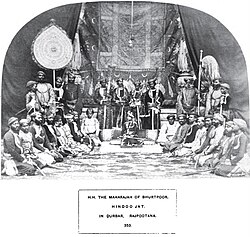
[[File:JatBhurtporeDurbar1860s.jpg|thumb|upright|Royal court of Bharatpur Kingdom during 1860s]] | |||
The Bharatpur rulers were [[Jats]] of [[Sinsinwar|Sinsinwar clan]]. According to a mythological origin, they descended from Balchand, a Yadav Rajput, through his sons Vijje and Sijje, born to a Jat concubine. They adopted the Sinsinwar gotra after being rejected as Rajputs.<ref>{{Cite book |last=McClenaghan |first=Tony |url=https://books.google.com/books?id=YQdZlHJ2WTAC&dq=yadav+rajput&pg=PA70 |title=Indian Princely Medals: A Record of the Orders, Decorations, and Medals of the Indian Princely States |date=1996 |publisher=Lancer Publishers |isbn=978-1-897829-19-6 |language=en}}</ref> Ram Pande states that this legend was created "to show superiority of Sinsinwar Jats over other Jats."<ref>{{cite book |last=Pande |first=Ram |title=Bharatpur up to 1826: A Social and Political History of the Jats |date=1970 |publisher=Rama Publishing House |pages=29 |edition=1st |url=https://books.google.com/books?id=f8-1AAAAIAAJ |oclc=610185303|quote=The legend current in the Durbars of Bharatpur and Karauli till late was that one Balchand, a Yadav Rajput, 19th from Sindpal, a common claimed ancestor of Bharatpur and Karauli families, one day went out, as was his custom, on plundering expedition. On the way he met a Jat of Dogar clan, resident of Jagar, Hindaun in the former State of Jaipur. This Jat was carrying home his wife from Hodal, Balchand made both the Jat and his wife the prisoners and carried them of to his home Sinsini. Balchand had no family by his own wife and made his Jat prisoner's lady as his concubine and by her had two sons, Viije and Sijje. From that time when these two sons of Balchand were not admitted in the Rajput clan, they became Jats. After becoming Jats they proclaimed Sinsinwar as their Gotra from their own village Sinsini. There are several difficulties in accepting the story. Firstly, Karauli never had been such a big Stage at any time that Sinsini could have been a part of it. Secondly, a child's caste is normally determined by the caste of the father not by that of the mother. If Balchand's sons were not admitted to a Rajput clan, they would have been known as Darogas. Probably the purpose of above legend was to show superiority of Sinsinwar Jats over other Jats. }}</ref> | |||
[[File:Dig Fort in Rajasthan in the 1890s.jpg|thumb|225px|View of the [[Deeg]] Fort taken in the 1890s. Deeg was the first capital of the Sinsini Jats established by [[Badan Singh]]. Later the capital was moved to Bharatpur.]] | [[File:Dig Fort in Rajasthan in the 1890s.jpg|thumb|225px|View of the [[Deeg]] Fort taken in the 1890s. Deeg was the first capital of the Sinsini Jats established by [[Badan Singh]]. Later the capital was moved to Bharatpur.]] | ||
The formation of the state of Bharatpur was a result of revolts by the [[Jat people|Jats]] living in the region around [[Delhi]], [[Agra]], and [[Mathura]] against the imperial [[Mughals]]. Gokula was a prominent Jat zamindar of Tilpat who led a rebellion against the Mughal Empire during the reign of [[Aurangzeb]]. In 1669, he spearheaded the Battle of [[Tilpat]], where Jat farmers revolted against heavy Mughal taxation. Despite initial successes, [[Gokula]] was eventually captured and executed in 1670.<ref>{{Cite web |title=History of jats state during 17th century |url=https://www.jagranjosh.com/general-knowledge/history-of-jats-state-during-17th-century-1442912815-1 |url-status=live |archive-url=https://web.archive.org/web/20240404134416/https://www.jagranjosh.com/general-knowledge/history-of-jats-state-during-17th-century-1442912815-1 |archive-date=4 April 2024 |access-date=4 April 2024 |website=Jagran Josh|date=22 September 2015 }} “''Gokla: He was the zamindar of Tilpat and one who provided leadership in 1669 AD uprising to the Jat. He was stamped down by the Mughal governor, Hasan Ali.''”</ref><ref>{{Cite web |date=2022-10-04 |title=जानें आगरा के फव्वारा चौक की रोचक कथा और कौन थे वीर गोकुला जाट जिनकी मूर्ति का हुआ अनावरण |url=https://hindi.news18.com/news/uttar-pradesh/agra-veer-gokula-jats-statue-unveiled-after-11-months-in-agra-know-glorious-history-nodaa-4681241.html |access-date=2025-01-06 |website=News18 हिंदी |language=hi |archive-date=16 October 2022 |archive-url=https://web.archive.org/web/20221016212959/https://hindi.news18.com/news/uttar-pradesh/agra-veer-gokula-jats-statue-unveiled-after-11-months-in-agra-know-glorious-history-nodaa-4681241.html |url-status=live }} “''गोकुला जाट का नाम आगरा के लिए सम्मान की बात है. दरअसल, तिलपतगढ़ी के गोकुला जाट की शौर्यगाथा 1666 से ही लोगों के जुबान पर रही है. जब दिल्ली पर औरंगजेब का शासन था. वीर गोकुला जाट ने औरंगजेब को मालगुजारी देने से इनकार कर दिया था. इससे बौखलाए औरंगजेब ने अपनी सेना युद्ध के लिए मथुरा स्थिति तिलपतगढ़ी भेजी. यह युद्ध 3 दिनों तक चला. वीर गोकुला जाट ने औरंगजेब की सेना के छक्के छुड़ा दिए. हार मानकर औरंगजेब ने 1669 में खुद वीर गोकुला जाट से युद्ध करने के लिए मथुरा पहुंचा. इस युद्ध में औरंगजेब ने वीर गोकुला जाट को बंदी बना लिया.''”</ref> | |||
The formation of the state of Bharatpur was a result of revolts by the [[Jat people|Jats]] living in the region around [[Delhi]], [[Agra]], and [[Mathura]] against the imperial [[Mughals]].<ref | |||
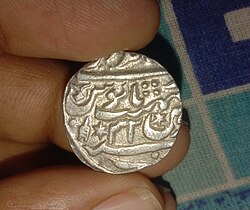
[[File:Silver Rupee of Bharatpur state, struck in Mughal emperor Akbar II, struck in Mahe Indrapur Mint.jpg|thumb|upright|Silver Rupee of Bharatpur state, struck in the name of Mughal emperor [[Akbar II]], Mahe Indrapur Mint.]] | |||
[[Rajaram of Sinsini]] succeeded [[Gokula]] and continued the struggle against [[Mughal Empire|Mughal rule]]. He is noted for organising the Jats into a more cohesive force and avenging Gokula’s death by desecrating Akbar’s tomb. Rajaram’s leadership saw several victories against Mughal forces, including the defeat of Mughal Nawab [[Bahadur Khan (Mughal general)]]. He was instrumental in consolidating Jat power in the region until his death in 1688. Now [[Aurangzeb]] approached the [[Kachhwaha|Kachhwaha Rajput]] ruler [[Bishan Singh]] to crush the uprising and appointed him as the faujdar of [[Mathura]], granting him the entire area in zamindari. Conflict between Jats and Rajputs for zamindari rights also complicated the issue, with Jats primarily being landowners, whereas the Rajputs were primarily revenue collectors.<ref name=":0">{{Cite book |last=Chandra |first=Satish |title=Medieval India |publisher=National Council for Educational Research and Training |year=1990 |location=India |pages=Chapter 18 p. 295, 296}}</ref> | |||
The Jats put up a stiff resistance but by 1691, [[Rajaram of Sinsini|Rajaram]] and his successor [[Churaman]] were compelled to submit to the Imperial Mughals. However unrest among Jats continued and later on in the beginning of the 18th century, [[Churaman]], taking advantage of the Mughal civil wars, was able to expel the Rajputs from the area and establish an independent state where Jat chiefs formed the ruling class.<ref name=":0" /> [[Rajaram of Sinsini|Rajaram]] who also exhumed and burned the remains of [[Akbar]] is known for setting up a small fort at [[Sinsini]] and it was a key foundation of this kingdom.<ref>Kunj Bihari Lal Gupta. The Evolution of the Administration of the former Bharatpur State. Vidya Bhawan Publishers, Jaipur, 1959.</ref><ref>Tony McClenaghan. Indian Princely Medals: A record of the Orders, Decorations and Medals of the Indian Princely States. Lancer Publications, Spantech & Lancer, New Delhi, 1996.</ref> | |||
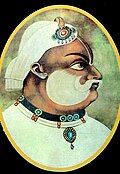
[[Suraj Mal|Maharaja Suraj Mal]] was the most prominent ruler of Bharatpur. On 12 June 1761, he captured the significant Mughal city of [[Capture of Agra|Agra]]. During his reign, he melted the two silver doors of the Taj Mahal. Agra remained under Bharatpur’s control until 1774. After Maharaja Suraj Mal’s death, his successors continued to rule over Agra Fort. [[Jawahar Singh|Maharaja Jawahar Singh]] succeeded him, followed by [[Ratan Singh of Bharatpur|Maharaja Ratan Singh]]. During the minority of Maharaja Kehri Singh, Maharaja [[Nahar Singh of Bharatpur|Nawal Singh]] acted as the regent.<ref>{{Cite book |last=Singh |first=K. Natwar |url=https://books.google.com/books?id=FZ_PwAEACAAJ |title=Maharaja Suraj Mal, 1707-1763: His Life and Times |publisher=Rupa & Company |year=2001 |isbn=978-81-7167-510-4 |language=en}}</ref><ref>{{cite book |last=Bhatia |first=O. P. Singh |url=https://books.google.com/books?id=smdXAAAAMAAJ&q=suraj+Mal+capture+agra |title=History of India, from 1707 to 1856 |publisher=Surjeet Book Depot |year=1968 |pages=536}}</ref> | |||
[[File:Maharaja Suraj Mal.jpg|thumb|upright|[[Suraj Mal]], most prominent ruler of Bharatpur Kingdom]] | |||
In 1805, war between the [[British Empire|British]] and the [[Holkars]] broke out. [[Ranjit Singh of Bharatpur|Maharaja Ranjit Singh]] agreed to help the Holkar and the two Maharajas fell back to the Bharatpur fort. The British surrounded the fort and after three months, Ranjit Singh agreed to peace and signed a treaty with the British, thus becoming a princely state.<ref>{{Cite book|title=Rise and Fall of The Maratha Empire 1750-1818|url=https://books.google.com/books?id=8AbPDwAAQBAJ&dq=ranjit+singh+of+bharatpur+help+Yashwantrao+holkar&pg=PT62|last=Nandakumar|first=Sanish|publisher=Notion Press|year=2020|isbn=978-1-647-83961-1|pages=86}}</ref> [[Maharaja Jashwant Singh|Maharaja Jaswant Singh]] of Bharatpur provided great support for the British during the [[Indian Rebellion of 1857]] and this aid was greatly acknowledged by the British. [[Jaswant Singh of Bharatpur|Jaswant Singh]] was made a [[Order of the Star of India|G.C.S.I]] and his personal gun salute was increased.<ref>{{Cite book |last=Sahai |first=Jawala |url=https://books.google.com/books?id=dMzAxgEACAAJ |title=His Highness Maharaja Jaswant Singh Bahadur, G.C.S.I. of Bharatpur |date=1914 |publisher=Jwala Sahai, retired Nazim & Honorary Magistrate |language=en}}</ref> | |||
In August 1947, Bharatpur acceded to the newly independent [[Dominion of India]]. The following year, in 1948, it became part of the [[United States of Matsya|Matsya Union]], and in 1949, it was integrated into the state of [[Rajasthan]]. Members of the Bharatpur royal family have remained active in national and regional politics. Several family members have served as members of parliament and in the state legislature.<ref>{{Cite web |date=2022-04-01 |title=Members : Lok Sabha : Singh, Shri Vishvendra |url=http://164.100.47.194/loksabha/Members/memberbioprofile.aspx?mpsno=459&lastls=14 |access-date=2025-01-06 |archive-date=1 April 2022 |archive-url=https://web.archive.org/web/20220401085317/http://164.100.47.194/loksabha/Members/memberbioprofile.aspx?mpsno=459&lastls=14 |url-status=bot: unknown }}</ref> | |||
== List of ''Maharajas'' == | |||
{{main|List of Maharajas of Bharatpur}} | |||
This section includes list of ''Maharajas'' of Bharatpur in chronological order. The current titular Maharaja of Bharatpur is [[Vishvendra Singh]] since July 1995. | |||
{| class="wikitable" | |||
|- | |||
! Portrait !! Name of Maharaja !! Reign | |||
!Notes | |||
|- | |||
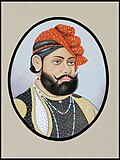
| [[File:Detail of Raja Badan Singh from a painting from an illustrated 'Sujan Charitra' series, by Ramji, Jaipur School, circa mid-to-late 18th century (cropped).jpg|90x90px]]|| [[Badan Singh]]|| 1722 - 1755 | |||
|Founder of the princely state of Bharatpur.<ref>{{Cite book |last=Division |first=Publications |url=https://books.google.com/books?id=wumhDQAAQBAJ&dq=badan+singh+bharatpur&pg=PT483 |title=THE GAZETTEER OF INDIA Volume 2 |publisher=Publications Division Ministry of Information & Broadcasting |isbn=978-81-230-2265-9 |language=en}}</ref><ref name=":5">{{Cite web |first= |title=Final Report on the Bharatpur State Settlement (1900-1901) (PDF) |url=https://ia801402.us.archive.org/6/items/in.ernet.dli.2015.35891/2015.35891.Final-Report-On-The-Bharatpur-State-Settlement.pdf |archive-url=https://archive.org/details/in.ernet.dli.2015.35891/page/n1/mode/2up |archive-date=20 January 2017 |access-date=6 January 2025 |website=[[Michael O'Dwyer]]}}</ref> | |||
|- | |||
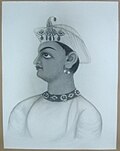
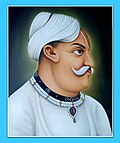
| [[File:Suraj Mal.jpg|70px]]|| [[Suraj Mal]]|| 1755 - 1763 | |||
|Son of Badan Singh. He is known for his political acumen and military prowess, he expanded his kingdom significantly and built the formidable [[Lohagarh Fort|Lohagarh]] Fort and [[Deeg Palace]]. He is often referred to as the ''Plato of the Sinsinwar Jat tribe'' or ''Jat Ullyses.''<ref>{{Cite book |last=Natwar-Singh |first=Kunwar |title=Maharaja Suraj Mal, 1707-1763: his life and times |publisher=Rupa and Co |year=2001 |isbn=978-81-7167-510-4 |edition= |location=New Delhi}}</ref><ref>{{Cite book |last=Singh |first=Brijesh |url=https://books.google.com/books?id=f864EAAAQBAJ&dq=surajmal+bharatpur&pg=PA35 |title=Comprehensive Modern Indian History: From 1707 To The Modern Times |edition=UPSC CSE |publisher=S. Chand Publishing |isbn=978-93-5501-657-7 |language=en}}</ref> | |||
|- | |||
| [[File:Jawahar Singh of Bharatpur.jpg|70px]]|| [[Jawahar Singh]]|| 1763 - 1768 | |||
|Son of Suraj Mal. He successfully repelled several attacks, including [[Ahmad Shah Durrani|Ahmad Shah Abdali's]], from Bharatpur. Additionally, he oversaw campaigns against the Marathas and Rohillas. With [[Sikhs|Sikh]] allies' assistance, he seized areas in [[Bundelkhand]] and Northern [[Malwa]] and even sacked Delhi in 1764.<ref>{{Cite book |last=Ranavat Manohar Singh Ji |url=https://archive.org/details/in.ernet.dli.2015.347515/page/n3/mode/2up |title=Bharatpur Maharaja Jawahar Singh Jat |date=1973}}</ref><ref>{{Cite book |last=Sarkar |first=Jadunath|title=Fall of the Mughal empire |date= |publisher=Orient Longman |isbn=978-81-250-3245-8 |edition= |location=New Delhi }}</ref> | |||
|- | |||
|[[File:Ratan Singh of Bharatpur.jpg|70px]] | |||
|[[Ratan Singh of Bharatpur|Ratan Singh]] | |||
|1768 - 1769 | |||
|Brother of [[Jawahar Singh]]. He ruled only for about nine months.<ref>{{Cite book |last1=Cotton |first1=James Sutherland |url=https://books.google.com/books?id=IgG2AAAAIAAJ&dq=Ratan+Singh+of+Bharatpur&pg=PA76 |title=Imperial Gazetteer of India ... |last2=Burn |first2=Sir Richard |last3=Meyer |first3=William |date=1908 |publisher=Clarendon Press |pages=76 |language=en}}</ref> | |||
|- | |||
|[[File:Portrait of Maharaja Kehri Singh of Bharatpur State (cropped).jpg|88x88px]] | |||
|Kehri Singh | |||
|1769 - 1777 | |||
|Son (minor) of [[Ratan Singh of Bharatpur|Ratan Singh]]<ref name=":5" /> | |||
|- | |||
|[[File:Maharaja Ranjit Singh of Bharatpur.jpg|70px]] | |||
|[[Ranjit Singh of Bharatpur|Ranjit Singh]] | |||
|1777 - 1805 | |||
|Son of [[Suraj Mal]]. He participated in the [[Second Anglo-Maratha War]] on the side of the [[Marathas]] and his forces proved to be a tough match for [[Lord Lake]]<ref name=":5" /><ref>{{Cite web |title=Bharatpur Fort and its resistance against British forces |url=https://cmsadmin.amritmahotsav.nic.in/district-reopsitory-detail.htm?13454#:~:text=The%20origins%20of%20the%20conflict,the%20princely%20state%20in%201805. |access-date=6 January 2025 |website=amritmahotsav.nic.in}} [[Government of India]] ''“The origins of the conflict between the British and the Bharatpur state can be traced to the [[Second Anglo-Maratha War]], when the ruler of the state, [[Ranjit Singh of Bharatpur|Ranjit Singh]], formed an alliance with the Marathas against the colonial forces. This angered the British, who ly decided to invade the princely state in 1805”''</ref> | |||
|- | |||
|[[File:Maharaja Randhir Singh.jpg|70px]] | |||
|[[Randhir Singh of Bharatpur|Randhir Singh]] | |||
|1805 - 1823 | |||
|Son of [[Ranjit Singh of Bharatpur|Ranjit Singh]]<ref name=":5" /> | |||
|- | |||
|[[File:Maharaja Baldeo Singh.jpg|70px]] | |||
|[[Baldeo Singh]] | |||
|1823 - 1825 | |||
|Brother of [[Randhir Singh of Bharatpur|Randhir Singh]]<ref name=":5" /> | |||
|- | |||
|[[File:Maharaja Balwant Singh.jpg|70px]] | |||
|[[Balwant Singh of Bharatpur|Balwant Singh]] | |||
|1825 - 1853 | |||
|Son of [[Baldeo Singh]]<ref name=":5" /> | |||
|- | |||
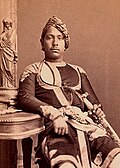
|[[File:Jaswant Singh Bharatpur.jpg|70px]] | |||
|[[Jaswant Singh of Bharatpur|Jaswant Singh]] | |||
|1853 - 1893 | |||
|Son of [[Balwant Singh of Bharatpur|Balwant Singh]]<ref name=":5" /> | |||
|- | |||
|[[File:Ram Singh of Bharatpur.jpg|70px]] | |||
|[[Ram Singh of Bharatpur|Ram Singh]] | |||
|1893 - 1900 | |||
|Son of [[Jaswant Singh of Bharatpur|Jaswant Singh]]<ref name=":5" /> | |||
|- | |||
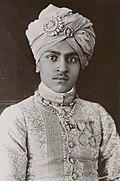
|[[File:Maharaja Kisan Singh.jpg|70px]] | |||
|[[Kishan Singh of Bharatpur|Kishan Singh]] | |||
|1900 - 1929 | |||
|Son of [[Ram Singh of Bharatpur|Ram Singh]]<ref name=":5" /> | |||
|- | |||
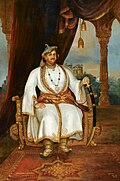
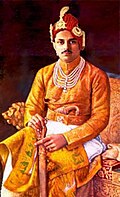
|[[File:Maharaja Brijendra Singh of Bharatpur.jpg|70px]] | |||
|[[Brijendra Singh]] | |||
|1929 - 1947 | |||
|He was the last ruler of the [[princely state]] of Bharatpur. He was a [[Member of Parliament]] ([[Lok Sabha]]) 1962–1971. He was deprived of his royal rank, titles and [[Privy Purse in India|honours]] by the [[Government of India]] on 28 December 1971.<ref>{{Cite book |title=Encyclopaedia Indica: India, Pakistan, Bangladesh |date=1996 |publisher=Anmol Publ |isbn=978-81-7041-859-7 |editor-last=Shashi |editor-first=Shyam Singh |location=New Delhi}}</ref><ref>{{Cite web |date=2019-12-01 |title=…दो घंटे में डूबने वाला था भरतपुर, तब खुद महाराजा कर्नल सवाई बृजेंद्र सिंह ने खोला था अटलबंध का मोरा {{!}} ... Bharatpur was about to drown in two hours |url=https://www.patrika.com/bharatpur-news/bharatpur-was-about-to-drown-in-two-hours-5443318 |access-date=2024-12-28 |website=Patrika News |language=hi |archive-date=4 December 2019 |archive-url=https://web.archive.org/web/20191204193013/https://www.patrika.com/bharatpur-news/bharatpur-was-about-to-drown-in-two-hours-5443318/ |url-status=live }}</ref> | |||
|} | |||
==Expansion and decline== | |||
{{Main|Battle of Delhi (1764)|Capture of Agra}} | |||
Bharatpur State, founded in 1722 by [[Badan Singh|Maharaja Badan Singh]], saw significant expansion under the leadership of [[Suraj Mal|Maharaja Suraj Mal]], who ruled from 1755 to 1763, was instrumental in consolidating and expanding the state’s territories. During his reign, the state’s revenue reached an impressive 17,500,000 gold coins per annum. [[Suraj Mal|Suraj Mal’s]] strategic alliances and military prowess enabled Bharatpur to withstand numerous invasions, including those from the [[Mughal Empire]] and the [[East India Company]].<ref>{{Cite book |last1=Majumdar |first1=Ramesh Chandra |url=https://books.google.com/books?id=dl4HxwEACAAJ |title=The History and Culture of the Indian People: The Maratha supremacy |last2=Dighe |first2=Vishvanath Govind |date=1977 |publisher=Bharatiya Vidya Bhavan |language=en}}</ref> | |||
Suraj Mal captured important territories such as [[Capture of Agra|Agra]], [[Mathura]], and parts of [[Aligarh]]. The [[capture of Agra]] in 1761, in particular, was a significant achievement, as it was a major Mughal stronghold. Suraj Mal’s forces also successfully defended Bharatpur against multiple invasions, showcasing the state’s military strength.<ref>{{Cite book |last=Sarkar |first=Sir Jadunath |url=https://books.google.com/books?id=sgfVAAAAMAAJ&q=Jats+Agra |title=Fall of the Mughal Empire: 1754-1771. (Panipat) 2d ed., rev. 1950 |date=1950 |publisher=M.C. Sarkar |language=en}}</ref><ref name=":4">{{Cite book |last=Bhanu |first=Dharma |url=https://books.google.com/books?id=CctFMm9HSH8C&dq=jat+rule+over+agra&pg=PA9 |title=The Province of Agra: Its History and Administration |date=1979 |publisher=Concept Publishing Company |language=en}}</ref> | |||
In the 1760s, the Kingdom of Bharatpur reached its zenith and covered present day capital [[Delhi]] and district of [[Bharatpur district|Bharatpur]], [[Bulandshahr district|Bulandshahr]], [[Dholpur district|Dholpur]], [[Hathras district|Hathras]], [[Jhajjar district|Jhajjar]], [[Kanpur Dehat]], [[Auraiya]], [[Hapur]], [[Firozabad]], [[Baghpat]], [[Muzaffarnagar district|Muzaffarnagar]], [[Palwal district|Palwal]], [[Rohtak district|Rohtak]], [[Sonipat]]. The areas under the control of [[Jat people|Jat]]s broadly included parts of modern eastern [[Rajasthan]], southern [[Haryana]], western [[Uttar Pradesh]] and [[Delhi]].<ref>{{cite web |last1=Lethbridge |first1=Sir Roper |date=1900 |title=The Golden Book of India. A Genealogical and Biographical Dictionary of the Ruling Princes, Chiefs, Nobles, and Other Personages, Titled or Decorated, of the Indian Empire. With an Appendix for Ceylon |url=https://books.google.com/books?id=zykYAAAAYAAJ&q=auraiya+jats+etawah&pg=PA120}}</ref><ref name="Chaudhuri">{{cite book |last1=Chaudhuri |first1=J. N. |title=The History and Culture of the Indian People. Vol. 8: The Maratha |date=1977 |publisher=[[Bharatiya Vidya Bhavan]] |editor1-last=Majumdar |editor1-first=R. C. |editor1-link=R. C. Majumdar |page=157 |chapter=Disruption of the Mughal Empire: The Jats |oclc=1067771105 |access-date=20 December 2019 |chapter-url=https://books.google.com/books?id=dl4HxwEACAAJ}}</ref> | |||
After Suraj Mal death in 1763, Bharatpur State experienced internal conflicts and succession issues, weakening its stability. The British [[East India Company]] saw an opportunity and attacked in [[Siege of Bharatpur (1805)|1805]], but Bharatpur initially resisted. However, in 1825-26, the British, led by [[Stapleton Cotton, 1st Viscount Combermere|Lord Combermere]], besieged and [[Siege of Bharatpur (1825–1826)|captured the Lohagarh Fort]]. This ended Bharatpur’s independence, and in 1826, the state had to sign a treaty, making it a British protectorate.{{citation needed|date=November 2025}} Jats ruled Agra for 13 years from 1761 to 1774. On 18 February 1774, the Mughal Commander [[Mirza Najaf Khan]] re-captured Agra.<ref name=":4" /> | |||
==Military power== | |||
The Kingdom during Jawahar Singh's time had a large army of 25,000 [[Infantry]], 15,000 [[Cavalry]] and 300 pieces of cannons with addition to the troops stationed at his forts.<ref>{{Cite book |last=Sarkar |first=Jadunath |url=https://books.google.com/books?id=O0oPIo9TXKcC |title=A History of Jaipur: C. 1503-1938 |date=1994 |publisher=Orient Blackswan |isbn=978-81-250-0333-5 |pages=253 |language=en}}</ref> | |||
== | == Architecture == | ||
{{Main|Lohagarh Fort|Deeg Palace|Keoladeo National Park}} | |||
Bharatpur State is known for its blend of [[Mughal architecture|Mughal]] and [[Rajput architecture|Rajput]] architectural styles.<ref name=":2" /> | |||
[[File:Lohagarh_Fort.jpg|thumb|225px | |||
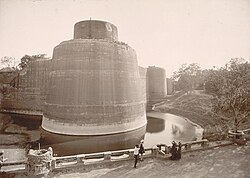
|[[Lohagarh Fort]], built by Maharaja Suraj Mal in 1732 on an artificial island and took eight years to complete.]] | |||
[[Lohagarh Fort]] is one of the architectural achievement of the state. It was built by [[Suraj Mal|Maharaja Suraj Mal]] in 1732 A.D. on an artificial island and construction of this fort took almost eight years.<ref>{{Cite web |date=2024-02-23 |title=ये है देश का एकमात्र अजेय किला, अंग्रेजों ने इसकी मजबूती के आगे टेके थे घुटने |url=https://www.patrika.com/bharatpur-news/lohagarh-fort-bharatpur-lohagarh-fort-history-special-feature-of-lohagarh-fort-8740530 |access-date=2025-01-06 |website=Patrika News |language=hi |archive-date=18 August 2024 |archive-url=https://web.archive.org/web/20240818222044/https://www.patrika.com/bharatpur-news/lohagarh-fort-bharatpur-lohagarh-fort-history-special-feature-of-lohagarh-fort-8740530 |url-status=live }}</ref> This fort is considered as one of the strongest fort due to its formidable defense because the British forces led by [[Gerard Lake, 1st Viscount Lake|Lord Lake]] were unable to capture the fort in spite of multiple attacks during the [[Siege of Bharatpur (1805)|Siege of Bharatpur]] and the fort remained free from British control for more than twenty years till 1825.<ref>{{Cite web |date=2024-10-17 |title=भरतपुर का लोहागढ़ किला, जिसके आगे अंग्रेजों ने भी टेक दिया था घुटना |url=https://hindi.news18.com/photogallery/rajasthan/bharatpur-lohagarh-fort-bharatpur-lohagarh-fort-history-special-feature-of-lohagarh-fort-8777225-page-4.html |access-date=2025-01-06 |website=News18 हिंदी |language=hi}}</ref> | |||
Between December 1825 and January 1826, British troops under [[Stapleton Cotton, 1st Viscount Combermere|Lord Combermere]] initially surrounded the state's capital until on 18 January 1826 its fortress was stormed and captured. After this [[Siege of Bharatpur (1825–1826)|siege]], it became princely state under British Raj control.<ref>{{Cite web |date=5 May 2024 |title=Siege of Bharatpur, 1825-1826 |url=https://amritmahotsav.nic.in/district-reopsitory-detail.htm?14230/ |website=amritmahotsav.nic.in |last1=Mahotsav |first1=Amrit }}</ref> | |||
[[File:Deeg Palace.jpg|thumb|225px|[[Deeg Palace]], built in 1772 as a palace for the rulers of Bharatpur State.]] | |||
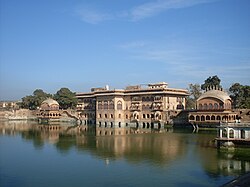
Apart from the [[Lohagarh Fort|Lohagarh]] fort, the [[Deeg Palace]] was also built by the [[Suraj Mal|Maharaja Suraj Mal]] in 1730 as a luxurious summer resort for the rulers of Bharatpur State. It is the only Hindu-style palace in north India and a perfect blend of [[Mughal architecture|Mughal]] and [[Rajput architecture|Rajput]] architecture.<ref name=":2">{{Cite web |last=Dhar |first=Aarti |title=Deeg Palace erupts in colour for Braj Holi |url=https://www.thehindu.com/news/national/other-states/deeg-palace-erupts-in-colour-for-braj-holi/article6948866.ece |access-date=4 January 2025 |website=The Hindu|date=March 2015 }} “''Celebrations at Deeg Palace, with its wonderful mix of Mughal and Rajasthani architecture.''”</ref><ref name=":1" /> | |||
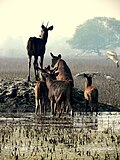
[[File:Sambhars are common sight at Keoladeo Ghana National Park Bharatpur India.jpg|thumb|225px|Sambar deer in [[Keoladeo National Park]]]] | |||
[[File: | |||
Originally a royal hunting reserve, [[Keoladeo National Park]] was developed by [[Suraj Mal|Maharaja Suraj Mal]].<ref name=":3">{{Cite book |last=TL |first=Prabhu |url=https://books.google.com/books?id=7CenDwAAQBAJ&dq=keoladeo+national+park+suraj+mal&pg=PT167 |title=Majestic Monuments of India: Ancient Indian Mega Structures |date=2019-08-04 |publisher=Nestfame Creations Pvt. Ltd. |language=en}} “''Raja '''Suraj Mal''' created '''Keoladeo National Park''', also known as Keoladeo Ghana National Park. Previously this park was established as a bird sanctuary in 1956 and in 1982''”</ref> It is now a [[World Heritage Site|UNESCO World Heritage Site]] and a bird sanctuary.<ref>{{Cite web |last=Centre |first=UNESCO World Heritage |title=Keoladeo National Park |url=https://whc.unesco.org/en/list/340/ |access-date=2025-01-06 |website=UNESCO World Heritage Centre |language=en |archive-date=3 October 2023 |archive-url=https://web.archive.org/web/20231003112429/https://whc.unesco.org/en/list/340/ |url-status=live }}</ref> | |||
==See also== | ==See also== | ||
*[[ | *[[Battle of Pichuna]] | ||
==References== | ==References== | ||
{{Reflist}} | {{Reflist}} | ||
==Notes== | ==Notes== | ||
*[http://dsal.uchicago.edu/reference/gazetteer/text.html?objectid=DS405.1.I34_V08_079.gif Imperial Gazetteer of India Vol 8, P-73 Bharatpur State] | *[http://dsal.uchicago.edu/reference/gazetteer/text.html?objectid=DS405.1.I34_V08_079.gif Imperial Gazetteer of India Vol 8, P-73 Bharatpur State] {{Webarchive|url=https://web.archive.org/web/20070605132913/http://dsal.uchicago.edu/reference/gazetteer/text.html?objectid=DS405.1.I34_V08_079.gif |date=5 June 2007 }} | ||
*[[R. C. Majumdar]], H.C. Raychaudhury, Kalikaranjan Datta: [[An Advanced History of India]], fourth edition, 1978, {{ISBN|0-333-90298-X}}, p. 535-36 | *[[R. C. Majumdar]], H.C. Raychaudhury, Kalikaranjan Datta: [[An Advanced History of India]], fourth edition, 1978, {{ISBN|0-333-90298-X}}, p. 535-36 | ||
| Line 118: | Line 189: | ||
{{DEFAULTSORT:Bharatpur State}} | {{DEFAULTSORT:Bharatpur State}} | ||
[[Category:History of Bharatpur, Rajasthan]] | [[Category:History of Bharatpur, Rajasthan]] | ||
[[Category:Princely states of Rajasthan]] | [[Category:Princely states of Rajasthan]] | ||
[[Category:Rajputana Agency]] | [[Category:States under the Rajputana Agency]] | ||
[[Category:States and territories established in the 17th century]] | [[Category:States and territories established in the 17th century]] | ||
[[Category:States and territories disestablished in 1947]] | [[Category:States and territories disestablished in 1947]] | ||
[[Category: | [[Category:1722 establishments in India]] | ||
[[Category:1947 disestablishments in British India]] | [[Category:1947 disestablishments in British India]] | ||
[[Category:1948 disestablishments in India]] | [[Category:1948 disestablishments in India]] | ||
Latest revision as of 18:44, 9 March 2026
Kingdom of Bharatpur | |||||||||
|---|---|---|---|---|---|---|---|---|---|
| 1722–1947 | |||||||||
 .svg) Flag from 1722 to 1880. Flag from 1880 to 1943. | |||||||||
  Bharatpur State in the Imperial Gazetteer of India | |||||||||
| Capital | Bharatpur | ||||||||
| Common languages | Braj Hindi | ||||||||
| Government |
| ||||||||
| Maharaja | |||||||||
• 1722–1755 (first) | Badan Singh | ||||||||
• 1929–1947 (last) | Brijendra Singh | ||||||||
| Historical era | Early-modern India | ||||||||
• Established | 18 November 1722 | ||||||||
| 15 August 1947 | |||||||||
| |||||||||
| Today part of | Rajasthan (India) | ||||||||


Bharatpur was a princely state under British suzerainty. It was ruled by the Sinsinwar clan of the Hindu Jats. The state was founded by Maharaja Badan Singh in 1722. Suraj Mal played an important role in the development and expansion of the state. During Suraj Mal's reign (1755–1763), the annual revenue of the state was 17,500,000 gold coins.[2]
Under Suraj Mal leadership, the major architecture of this state include the Lohagarh Fort, Deeg Palace and the Keoladeo National Park, a royal hunting reserve, is a World Heritage Site.[3][4]
History[edit | edit source]
The Jat rulers of Deeg and Bharatpur emerged in the medieval period, spreading over parts of the Subah of Agra, including Deeg, Bharatpur, and Mewat. During this time, the Jats were zamindars and cultivators causing trouble for the Mughal Empire alongside Gujars and Meos. During early time Jats were considered outcasts and jungle inhabitants. According to Tarikh-i-Firishta, in 1026 AD, a band of Jats attacked Mahmud of Ghazni on his return from Gujarat but were nearly exterminated. In 1397 AD, Timur massacred a group of Jats while marching towards Delhi. In 1526 AD, Babar army was harassed by Jats during his march through Punjab.[5]

The Bharatpur rulers were Jats of Sinsinwar clan. According to a mythological origin, they descended from Balchand, a Yadav Rajput, through his sons Vijje and Sijje, born to a Jat concubine. They adopted the Sinsinwar gotra after being rejected as Rajputs.[6] Ram Pande states that this legend was created "to show superiority of Sinsinwar Jats over other Jats."[7]

The formation of the state of Bharatpur was a result of revolts by the Jats living in the region around Delhi, Agra, and Mathura against the imperial Mughals. Gokula was a prominent Jat zamindar of Tilpat who led a rebellion against the Mughal Empire during the reign of Aurangzeb. In 1669, he spearheaded the Battle of Tilpat, where Jat farmers revolted against heavy Mughal taxation. Despite initial successes, Gokula was eventually captured and executed in 1670.[8][9]

Rajaram of Sinsini succeeded Gokula and continued the struggle against Mughal rule. He is noted for organising the Jats into a more cohesive force and avenging Gokula’s death by desecrating Akbar’s tomb. Rajaram’s leadership saw several victories against Mughal forces, including the defeat of Mughal Nawab Bahadur Khan (Mughal general). He was instrumental in consolidating Jat power in the region until his death in 1688. Now Aurangzeb approached the Kachhwaha Rajput ruler Bishan Singh to crush the uprising and appointed him as the faujdar of Mathura, granting him the entire area in zamindari. Conflict between Jats and Rajputs for zamindari rights also complicated the issue, with Jats primarily being landowners, whereas the Rajputs were primarily revenue collectors.[10]
The Jats put up a stiff resistance but by 1691, Rajaram and his successor Churaman were compelled to submit to the Imperial Mughals. However unrest among Jats continued and later on in the beginning of the 18th century, Churaman, taking advantage of the Mughal civil wars, was able to expel the Rajputs from the area and establish an independent state where Jat chiefs formed the ruling class.[10] Rajaram who also exhumed and burned the remains of Akbar is known for setting up a small fort at Sinsini and it was a key foundation of this kingdom.[11][12]
Maharaja Suraj Mal was the most prominent ruler of Bharatpur. On 12 June 1761, he captured the significant Mughal city of Agra. During his reign, he melted the two silver doors of the Taj Mahal. Agra remained under Bharatpur’s control until 1774. After Maharaja Suraj Mal’s death, his successors continued to rule over Agra Fort. Maharaja Jawahar Singh succeeded him, followed by Maharaja Ratan Singh. During the minority of Maharaja Kehri Singh, Maharaja Nawal Singh acted as the regent.[13][14]

In 1805, war between the British and the Holkars broke out. Maharaja Ranjit Singh agreed to help the Holkar and the two Maharajas fell back to the Bharatpur fort. The British surrounded the fort and after three months, Ranjit Singh agreed to peace and signed a treaty with the British, thus becoming a princely state.[15] Maharaja Jaswant Singh of Bharatpur provided great support for the British during the Indian Rebellion of 1857 and this aid was greatly acknowledged by the British. Jaswant Singh was made a G.C.S.I and his personal gun salute was increased.[16]
In August 1947, Bharatpur acceded to the newly independent Dominion of India. The following year, in 1948, it became part of the Matsya Union, and in 1949, it was integrated into the state of Rajasthan. Members of the Bharatpur royal family have remained active in national and regional politics. Several family members have served as members of parliament and in the state legislature.[17]
List of Maharajas[edit | edit source]
This section includes list of Maharajas of Bharatpur in chronological order. The current titular Maharaja of Bharatpur is Vishvendra Singh since July 1995.
| Portrait | Name of Maharaja | Reign | Notes |
|---|---|---|---|
.jpg) |
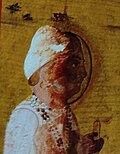
Badan Singh | 1722 - 1755 | Founder of the princely state of Bharatpur.[18][19] |
 |
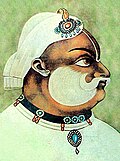
Suraj Mal | 1755 - 1763 | Son of Badan Singh. He is known for his political acumen and military prowess, he expanded his kingdom significantly and built the formidable Lohagarh Fort and Deeg Palace. He is often referred to as the Plato of the Sinsinwar Jat tribe or Jat Ullyses.[20][21] |
 |
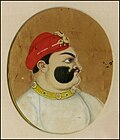
Jawahar Singh | 1763 - 1768 | Son of Suraj Mal. He successfully repelled several attacks, including Ahmad Shah Abdali's, from Bharatpur. Additionally, he oversaw campaigns against the Marathas and Rohillas. With Sikh allies' assistance, he seized areas in Bundelkhand and Northern Malwa and even sacked Delhi in 1764.[22][23] |

|
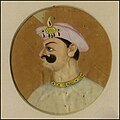
Ratan Singh | 1768 - 1769 | Brother of Jawahar Singh. He ruled only for about nine months.[24] |
.jpg)
|
Kehri Singh | 1769 - 1777 | Son (minor) of Ratan Singh[19] |

|
Ranjit Singh | 1777 - 1805 | Son of Suraj Mal. He participated in the Second Anglo-Maratha War on the side of the Marathas and his forces proved to be a tough match for Lord Lake[19][25] |

|
Randhir Singh | 1805 - 1823 | Son of Ranjit Singh[19] |

|
Baldeo Singh | 1823 - 1825 | Brother of Randhir Singh[19] |

|
Balwant Singh | 1825 - 1853 | Son of Baldeo Singh[19] |

|
Jaswant Singh | 1853 - 1893 | Son of Balwant Singh[19] |

|
Ram Singh | 1893 - 1900 | Son of Jaswant Singh[19] |

|
Kishan Singh | 1900 - 1929 | Son of Ram Singh[19] |

|
Brijendra Singh | 1929 - 1947 | He was the last ruler of the princely state of Bharatpur. He was a Member of Parliament (Lok Sabha) 1962–1971. He was deprived of his royal rank, titles and honours by the Government of India on 28 December 1971.[26][27] |
Expansion and decline[edit | edit source]
Bharatpur State, founded in 1722 by Maharaja Badan Singh, saw significant expansion under the leadership of Maharaja Suraj Mal, who ruled from 1755 to 1763, was instrumental in consolidating and expanding the state’s territories. During his reign, the state’s revenue reached an impressive 17,500,000 gold coins per annum. Suraj Mal’s strategic alliances and military prowess enabled Bharatpur to withstand numerous invasions, including those from the Mughal Empire and the East India Company.[28]
Suraj Mal captured important territories such as Agra, Mathura, and parts of Aligarh. The capture of Agra in 1761, in particular, was a significant achievement, as it was a major Mughal stronghold. Suraj Mal’s forces also successfully defended Bharatpur against multiple invasions, showcasing the state’s military strength.[29][30]
In the 1760s, the Kingdom of Bharatpur reached its zenith and covered present day capital Delhi and district of Bharatpur, Bulandshahr, Dholpur, Hathras, Jhajjar, Kanpur Dehat, Auraiya, Hapur, Firozabad, Baghpat, Muzaffarnagar, Palwal, Rohtak, Sonipat. The areas under the control of Jats broadly included parts of modern eastern Rajasthan, southern Haryana, western Uttar Pradesh and Delhi.[31][32]
After Suraj Mal death in 1763, Bharatpur State experienced internal conflicts and succession issues, weakening its stability. The British East India Company saw an opportunity and attacked in 1805, but Bharatpur initially resisted. However, in 1825-26, the British, led by Lord Combermere, besieged and captured the Lohagarh Fort. This ended Bharatpur’s independence, and in 1826, the state had to sign a treaty, making it a British protectorate.[citation needed] Jats ruled Agra for 13 years from 1761 to 1774. On 18 February 1774, the Mughal Commander Mirza Najaf Khan re-captured Agra.[30]
Military power[edit | edit source]
The Kingdom during Jawahar Singh's time had a large army of 25,000 Infantry, 15,000 Cavalry and 300 pieces of cannons with addition to the troops stationed at his forts.[33]
Architecture[edit | edit source]
Bharatpur State is known for its blend of Mughal and Rajput architectural styles.[34]

Lohagarh Fort is one of the architectural achievement of the state. It was built by Maharaja Suraj Mal in 1732 A.D. on an artificial island and construction of this fort took almost eight years.[35] This fort is considered as one of the strongest fort due to its formidable defense because the British forces led by Lord Lake were unable to capture the fort in spite of multiple attacks during the Siege of Bharatpur and the fort remained free from British control for more than twenty years till 1825.[36]
Between December 1825 and January 1826, British troops under Lord Combermere initially surrounded the state's capital until on 18 January 1826 its fortress was stormed and captured. After this siege, it became princely state under British Raj control.[37]

Apart from the Lohagarh fort, the Deeg Palace was also built by the Maharaja Suraj Mal in 1730 as a luxurious summer resort for the rulers of Bharatpur State. It is the only Hindu-style palace in north India and a perfect blend of Mughal and Rajput architecture.[34][3]

Originally a royal hunting reserve, Keoladeo National Park was developed by Maharaja Suraj Mal.[4] It is now a UNESCO World Heritage Site and a bird sanctuary.[38]
See also[edit | edit source]
References[edit | edit source]
- ↑ Sunderlal, Pandit (2018). How India Lost Her Freedom. SAGE Publishing. p. 500. ISBN 9789352806423.
- ↑ Sen, Sailendra Nath (2010). An Advanced History of Modern India. Macmillan. p. 420. ISBN 978-0-230-32885-3.
- ↑ 3.0 3.1 "The Hindu : Magazine / Travel : Summer symphony". 20 March 2007. Archived from the original on 20 March 2007. Retrieved 4 January 2025.
- ↑ 4.0 4.1 TL, Prabhu (4 August 2019). Majestic Monuments of India: Ancient Indian Mega Structures. Nestfame Creations Pvt. Ltd. “Raja Suraj Mal created Keoladeo National Park, also known as Keoladeo Ghana National Park. Previously this park was established as a bird sanctuary in 1956 and in 1982”
- ↑ Ahmad, Dr Aijaz (9 July 2021). History of Mewat. Alina Books. ISBN 978-81-933914-2-6. “The first authentic information respecting the remote ancestors of the Jat rulers of Bhartpur is mentioned in Tarikh-i-Firishta, which states that in 1026 AD a band of Jats molested Mahmud of Ghazni on his return from Gujarat and were nearly exterminated by him. In 1397 AD, Timur, marching towards Delhi, fell in with and massacred a horde of the same race, which was even then, noted freebooters. In 1526 AD, the army of Babar was harassed by them on his march through the Punjab.”
- ↑ McClenaghan, Tony (1996). Indian Princely Medals: A Record of the Orders, Decorations, and Medals of the Indian Princely States. Lancer Publishers. ISBN 978-1-897829-19-6.
- ↑ Pande, Ram (1970). Bharatpur up to 1826: A Social and Political History of the Jats (1st ed.). Rama Publishing House. p. 29. OCLC 610185303.
The legend current in the Durbars of Bharatpur and Karauli till late was that one Balchand, a Yadav Rajput, 19th from Sindpal, a common claimed ancestor of Bharatpur and Karauli families, one day went out, as was his custom, on plundering expedition. On the way he met a Jat of Dogar clan, resident of Jagar, Hindaun in the former State of Jaipur. This Jat was carrying home his wife from Hodal, Balchand made both the Jat and his wife the prisoners and carried them of to his home Sinsini. Balchand had no family by his own wife and made his Jat prisoner's lady as his concubine and by her had two sons, Viije and Sijje. From that time when these two sons of Balchand were not admitted in the Rajput clan, they became Jats. After becoming Jats they proclaimed Sinsinwar as their Gotra from their own village Sinsini. There are several difficulties in accepting the story. Firstly, Karauli never had been such a big Stage at any time that Sinsini could have been a part of it. Secondly, a child's caste is normally determined by the caste of the father not by that of the mother. If Balchand's sons were not admitted to a Rajput clan, they would have been known as Darogas. Probably the purpose of above legend was to show superiority of Sinsinwar Jats over other Jats.
- ↑ "History of jats state during 17th century". Jagran Josh. 22 September 2015. Archived from the original on 4 April 2024. Retrieved 4 April 2024. “Gokla: He was the zamindar of Tilpat and one who provided leadership in 1669 AD uprising to the Jat. He was stamped down by the Mughal governor, Hasan Ali.”
- ↑ "जानें आगरा के फव्वारा चौक की रोचक कथा और कौन थे वीर गोकुला जाट जिनकी मूर्ति का हुआ अनावरण". News18 हिंदी (in हिन्दी). 4 October 2022. Archived from the original on 16 October 2022. Retrieved 6 January 2025. “गोकुला जाट का नाम आगरा के लिए सम्मान की बात है. दरअसल, तिलपतगढ़ी के गोकुला जाट की शौर्यगाथा 1666 से ही लोगों के जुबान पर रही है. जब दिल्ली पर औरंगजेब का शासन था. वीर गोकुला जाट ने औरंगजेब को मालगुजारी देने से इनकार कर दिया था. इससे बौखलाए औरंगजेब ने अपनी सेना युद्ध के लिए मथुरा स्थिति तिलपतगढ़ी भेजी. यह युद्ध 3 दिनों तक चला. वीर गोकुला जाट ने औरंगजेब की सेना के छक्के छुड़ा दिए. हार मानकर औरंगजेब ने 1669 में खुद वीर गोकुला जाट से युद्ध करने के लिए मथुरा पहुंचा. इस युद्ध में औरंगजेब ने वीर गोकुला जाट को बंदी बना लिया.”
- ↑ 10.0 10.1 Chandra, Satish (1990). Medieval India. India: National Council for Educational Research and Training. pp. Chapter 18 p. 295, 296.
- ↑ Kunj Bihari Lal Gupta. The Evolution of the Administration of the former Bharatpur State. Vidya Bhawan Publishers, Jaipur, 1959.
- ↑ Tony McClenaghan. Indian Princely Medals: A record of the Orders, Decorations and Medals of the Indian Princely States. Lancer Publications, Spantech & Lancer, New Delhi, 1996.
- ↑ Singh, K. Natwar (2001). Maharaja Suraj Mal, 1707-1763: His Life and Times. Rupa & Company. ISBN 978-81-7167-510-4.
- ↑ Bhatia, O. P. Singh (1968). History of India, from 1707 to 1856. Surjeet Book Depot. p. 536.
- ↑ Nandakumar, Sanish (2020). Rise and Fall of The Maratha Empire 1750-1818. Notion Press. p. 86. ISBN 978-1-647-83961-1.
- ↑ Sahai, Jawala (1914). His Highness Maharaja Jaswant Singh Bahadur, G.C.S.I. of Bharatpur. Jwala Sahai, retired Nazim & Honorary Magistrate.
- ↑ "Members : Lok Sabha : Singh, Shri Vishvendra". 1 April 2022. Archived from the original on 1 April 2022. Retrieved 6 January 2025.
{{cite web}}: CS1 maint: bot: original URL status unknown (link) - ↑ Division, Publications. THE GAZETTEER OF INDIA Volume 2. Publications Division Ministry of Information & Broadcasting. ISBN 978-81-230-2265-9.
- ↑ 19.0 19.1 19.2 19.3 19.4 19.5 19.6 19.7 19.8 "Final Report on the Bharatpur State Settlement (1900-1901) (PDF)". Michael O'Dwyer. Archived from the original (PDF) on 20 January 2017. Retrieved 6 January 2025.
- ↑ Natwar-Singh, Kunwar (2001). Maharaja Suraj Mal, 1707-1763: his life and times. New Delhi: Rupa and Co. ISBN 978-81-7167-510-4.
- ↑ Singh, Brijesh. Comprehensive Modern Indian History: From 1707 To The Modern Times (UPSC CSE ed.). S. Chand Publishing. ISBN 978-93-5501-657-7.
- ↑ Ranavat Manohar Singh Ji (1973). Bharatpur Maharaja Jawahar Singh Jat.
- ↑ Sarkar, Jadunath. Fall of the Mughal empire. New Delhi: Orient Longman. ISBN 978-81-250-3245-8.
- ↑ Cotton, James Sutherland; Burn, Sir Richard; Meyer, William (1908). Imperial Gazetteer of India ... Clarendon Press. p. 76.
- ↑ "Bharatpur Fort and its resistance against British forces". amritmahotsav.nic.in. Retrieved 6 January 2025. Government of India “The origins of the conflict between the British and the Bharatpur state can be traced to the Second Anglo-Maratha War, when the ruler of the state, Ranjit Singh, formed an alliance with the Marathas against the colonial forces. This angered the British, who ly decided to invade the princely state in 1805”
- ↑ Shashi, Shyam Singh, ed. (1996). Encyclopaedia Indica: India, Pakistan, Bangladesh. New Delhi: Anmol Publ. ISBN 978-81-7041-859-7.
- ↑ "…दो घंटे में डूबने वाला था भरतपुर, तब खुद महाराजा कर्नल सवाई बृजेंद्र सिंह ने खोला था अटलबंध का मोरा | ... Bharatpur was about to drown in two hours". Patrika News (in हिन्दी). 1 December 2019. Archived from the original on 4 December 2019. Retrieved 28 December 2024.
- ↑ Majumdar, Ramesh Chandra; Dighe, Vishvanath Govind (1977). The History and Culture of the Indian People: The Maratha supremacy. Bharatiya Vidya Bhavan.
- ↑ Sarkar, Sir Jadunath (1950). Fall of the Mughal Empire: 1754-1771. (Panipat) 2d ed., rev. 1950. M.C. Sarkar.
- ↑ 30.0 30.1 Bhanu, Dharma (1979). The Province of Agra: Its History and Administration. Concept Publishing Company.
- ↑ Lethbridge, Sir Roper (1900). "The Golden Book of India. A Genealogical and Biographical Dictionary of the Ruling Princes, Chiefs, Nobles, and Other Personages, Titled or Decorated, of the Indian Empire. With an Appendix for Ceylon".
- ↑ Chaudhuri, J. N. (1977). "Disruption of the Mughal Empire: The Jats". In Majumdar, R. C. (ed.). The History and Culture of the Indian People. Vol. 8: The Maratha. Bharatiya Vidya Bhavan. p. 157. OCLC 1067771105. Retrieved 20 December 2019.
- ↑ Sarkar, Jadunath (1994). A History of Jaipur: C. 1503-1938. Orient Blackswan. p. 253. ISBN 978-81-250-0333-5.
- ↑ 34.0 34.1 Dhar, Aarti (March 2015). "Deeg Palace erupts in colour for Braj Holi". The Hindu. Retrieved 4 January 2025. “Celebrations at Deeg Palace, with its wonderful mix of Mughal and Rajasthani architecture.”
- ↑ "ये है देश का एकमात्र अजेय किला, अंग्रेजों ने इसकी मजबूती के आगे टेके थे घुटने". Patrika News (in हिन्दी). 23 February 2024. Archived from the original on 18 August 2024. Retrieved 6 January 2025.
- ↑ "भरतपुर का लोहागढ़ किला, जिसके आगे अंग्रेजों ने भी टेक दिया था घुटना". News18 हिंदी (in हिन्दी). 17 October 2024. Retrieved 6 January 2025.
- ↑ Mahotsav, Amrit (5 May 2024). "Siege of Bharatpur, 1825-1826". amritmahotsav.nic.in.
- ↑ Centre, UNESCO World Heritage. "Keoladeo National Park". UNESCO World Heritage Centre. Archived from the original on 3 October 2023. Retrieved 6 January 2025.
Notes[edit | edit source]
- Imperial Gazetteer of India Vol 8, P-73 Bharatpur State Archived 5 June 2007 at the Wayback Machine
- R. C. Majumdar, H.C. Raychaudhury, Kalikaranjan Datta: An Advanced History of India, fourth edition, 1978, ISBN 0-333-90298-X, p. 535-36


- Attribution
 This article incorporates text from a publication now in the public domain: Chisholm, Hugh, ed. (1911). "Bharatpur". Encyclopædia Britannica (11th ed.). Cambridge University Press.
External links[edit | edit source]
- Pages using the JsonConfig extension
- History of Bharatpur, Rajasthan
- Princely states of Rajasthan
- States under the Rajputana Agency
- States and territories established in the 17th century
- States and territories disestablished in 1947
- 1722 establishments in India
- 1947 disestablishments in British India
- 1948 disestablishments in India