
imported>Gotam502 No edit summary |
No edit summary |
||
| Line 1: | Line 1: | ||
{{more citations needed|date=October 2014}} | {{more citations needed|date=October 2014}} | ||
[[File:Jahaz Mahal 08909.jpg|thumb|289x289px|The Iconic Jahaz Mahal at Mandav]] | [[File:Jahaz Mahal 08909.jpg|thumb|289x289px|The Iconic Jahaz Mahal at Mandav, Dhar district, Madhya Pradesh, India]] | ||
{{Use dmy dates|date=April 2015}} | {{Use dmy dates|date=April 2015}} | ||
{{Use Indian English|date=April 2015}} | {{Use Indian English|date=April 2015}} | ||
<!-- See [[Wikipedia:WikiProject Indian cities]] for details -->{{Infobox settlement | <!-- See [[Wikipedia:WikiProject Indian cities]] for details -->{{Infobox settlement | ||
| name | | name = Mandav | ||
| native_name | | native_name = | ||
| native_name_lang | | native_name_lang = | ||
| other_name | | other_name = | ||
| nickname | | nickname = | ||
| settlement_type | | settlement_type = [[Town]] | ||
| image_skyline | | image_skyline = Mandav.jpg | ||
| image_alt | | image_alt = | ||
| image_caption | | image_caption = Reva Lake at Mandav, Dhar district (MP) | ||
| pushpin_map | | pushpin_map = India Madhya Pradesh#India3 | ||
| pushpin_label_position | | pushpin_label_position = | ||
| pushpin_map_alt | | pushpin_map_alt = | ||
| pushpin_map_caption | | pushpin_map_caption = Location in Madhya Pradesh, India | ||
| coordinates | | coordinates = {{coord|22|20|11|N|75|24|56|E|display=inline,title}} | ||
| subdivision_type | | subdivision_type = [[Country]] | ||
| subdivision_name | | subdivision_name = {{flag|India}} | ||
| subdivision_type1 | | subdivision_type1 = [[States and territories of India|State]] | ||
| subdivision_name1 | | subdivision_name1 = [[Madhya Pradesh]] | ||
| subdivision_type2 | | subdivision_type2 = [[List of districts of India|District]] | ||
| subdivision_name2 | | subdivision_name2 = [[Dhar district|Dhar]] | ||
| established_title | | established_title = <!-- Established --> | ||
| established_date | | established_date = | ||
| founder | | founder = | ||
| named_for | | named_for = | ||
| government_type | | government_type = | ||
| governing_body | | governing_body = | ||
| unit_pref | | unit_pref = Metric | ||
| area_footnotes | | area_footnotes = | ||
| area_rank | | area_rank = | ||
| area_total_km2 | | area_total_km2 = | ||
| elevation_footnotes | | elevation_footnotes = | ||
| elevation_m | | elevation_m = | ||
| population_total | | population_total = 8545 | ||
| population_as_of | | population_as_of = 2001 | ||
| population_rank | | population_rank = | ||
| population_density_km2 | | population_density_km2 = auto | ||
| population_demonym | | population_demonym = | ||
| population_footnotes | | population_footnotes = | ||
| demographics_type1 | | demographics_type1 = Languages | ||
| demographics1_title1 | | demographics1_title1 = Official | ||
| demographics1_info1 | | demographics1_info1 = [[Hindi language|Hindi]] | ||
| timezone1 | | timezone1 = [[Indian Standard Time|IST]] | ||
| utc_offset1 | | utc_offset1 = +5:30 | ||
| postal_code_type | | postal_code_type = <!-- [[Postal Index Number|PIN]] --> | ||
| postal_code | | postal_code = | ||
| registration_plate | | registration_plate = | ||
| website | | website = | ||
| footnotes | | footnotes = | ||
}} | }} | ||
'''Mandav''' is a town and a [[nagar panchayat]] in [[Dhar district]] in the [[India]]n [[States and territories of India|state]] of [[Madhya Pradesh]]. | '''Mandav''' is a [[town]] and a [[nagar panchayat]], near city of [[Dhar]] in [[Dhar district]] in the [[India]]n [[States and territories of India|state]] of [[Madhya Pradesh]]. | ||
==Demographics== | ==Demographics== | ||
| Line 72: | Line 72: | ||
This article needs to merge with [[Mandu, Madhya Pradesh#Places of interest]] | This article needs to merge with [[Mandu, Madhya Pradesh#Places of interest]] | ||
There are number of monuments in Mandav. Among the most important are: | There are number of monuments in Mandav. Among the most important are: | ||
'''Shri Mandavagadh Teerth''' | |||
Shri Mandavagadh Teerth is dedicated to Lord [[Suparshvanatha]]. It belongs to Shwetambar sect of Jainism. The temple has been attractively constructed and looks exquisite. It underwent expansion in 14th century. The idol of Lord Suparshvanath is believed to be much older. The idol is white in complexion and is 91.54 cm (3 feet) in height. It is seated in a ''padmansana'' posture. Apart from this in this same fort there is a fine temple of smaller size of Lord Shantinath. Ruins of many temples and idols can be seen here. As per a reference once there were almost 700 Jain temples here.<ref>{{Cite web |url=http://www.jainuniversity.org/jain-tirth-places/ShriMandavagadhTirtha |title=Shri Mandavagadh Tirtha |access-date=2 July 2016 |archive-url=https://web.archive.org/web/20160916111352/http://www.jainuniversity.org/jain-tirth-places/ShriMandavagadhTirtha |archive-date=16 September 2016 |url-status=dead }}</ref> | |||
'''The Delhi Darwaja and Hoshang Shah tomb''' | '''The Delhi Darwaja and Hoshang Shah tomb''' | ||
| Line 101: | Line 105: | ||
File:Rupmati Pavilion 01.jpg|Roopmati's Pavilion | File:Rupmati Pavilion 01.jpg|Roopmati's Pavilion | ||
File:Baz Bahadur's Palace 12.jpg|Baz Bahadur's Palace | File:Baz Bahadur's Palace 12.jpg|Baz Bahadur's Palace | ||
</gallery> | </gallery>There is a jamia mosque in mandu The '''Jama Masjid''', also called '''Jami Masjid''', is an historic [[Congregational mosque|Friday mosque]] in [[Mandu, Madhya Pradesh|Mandu]] in the [[Dhar district]] of the state of [[Madhya Pradesh]], India. Built in [[Mughal architecture|Mughal]] style, the mosque has been believed to have been built during the reign of [[Hoshang Shah]] and completed during the reign of [[Mahmud Khilji]] in 1454 [[Common Era|CE]]. | ||
The | The Masjid has three large domes, a courtyard, 54 smaller domes and colonnade of pillared halls. It has a prayer hall and decorated pillars in the masjid. The entire area of the mosque is 7,725 square metres (83,150 sq ft), built on an elevated platform 4.6 m (15 ft). The inscriptions on the eastern doorway to the porch indicates that the mosque was modeled on the basis of [[Umayyad Mosque|Mosque of Damascus]]. In modern times, the Group of Monuments at Mandu is maintained and administered by the Bhopal circle of the [[Archaeological Survey of India]]. | ||
==References== | ==References== | ||
{{Reflist}} | {{Reflist}} | ||
{{Commonscat}} | |||
{{Indore Division}} | {{Indore Division}} | ||
[[Category:Cities and towns in Dhar district]] | [[Category:Cities and towns in Dhar district]] | ||
[[Category:Tourist attractions in Dhar district]] | [[Category:Tourist attractions in Dhar district]] | ||
Latest revision as of 13:52, 8 January 2026
 | This article needs additional citations for verification. (October 2014) |

Mandav | |
|---|---|
 Reva Lake at Mandav, Dhar district (MP) | |
  Mandav Location in Madhya Pradesh, India  Mandav Mandav (India) | |
| Coordinates: 22°20′11″N 75°24′56″E / 22.33639°N 75.41556°E | |
| Country |  India India |
| State | Madhya Pradesh |
| District | Dhar |
| Population (2001) | |
| • Total | 8,545 |
| Languages | |
| • Official | Hindi |
| Time zone | UTC+5:30 (IST) |
Mandav is a town and a nagar panchayat, near city of Dhar in Dhar district in the Indian state of Madhya Pradesh.
Demographics[edit | edit source]
As of 2001[update] India census,[1] Mandav had a population of 8,545. Males constitute 51% of the population and females 49%. Mandav has an average literacy rate of 32%, lower than the national average of 59.5%: male literacy is 41%, and female literacy is 22%. In Mandav, 20% of the population is under 6 years of age.
Mandva is situated in the Vindhyanchal Range at 2,000 feet above sea level. There is a deep ravine that separates it from the Malwa Plateau in Central India. Mandav is 100 km from Indore, the nearest airport.
History[edit | edit source]
The history of Mandav, also known as Mandu, is known from the Paramara period in the 8th century A.D. Later it was under Mughal rule. They called it Shadiabad, which means ‘The City of Joy’. The monuments are a mix of the Hindu and Afghan style of architecture.
Mandu is a celebration in stone, of life and joy, of the love of the poet-prince Baz Bahadur for his beautiful consort, Rani Roopmati. The balladeers of Malwa still sing of the romance of these royal lovers, and high up on the crest of a hill, Roopmati's Pavilion still gazes down at Baz Bahadur's Palace, a magnificent expression of Afghan architecture.
Under Mughal rule, Mandu was a pleasure resort, its lakes and palaces the scenes of splendid and extravagant festivities.
Places of interest[edit | edit source]
This article needs to merge with Mandu, Madhya Pradesh#Places of interest There are number of monuments in Mandav. Among the most important are:
Shri Mandavagadh Teerth
Shri Mandavagadh Teerth is dedicated to Lord Suparshvanatha. It belongs to Shwetambar sect of Jainism. The temple has been attractively constructed and looks exquisite. It underwent expansion in 14th century. The idol of Lord Suparshvanath is believed to be much older. The idol is white in complexion and is 91.54 cm (3 feet) in height. It is seated in a padmansana posture. Apart from this in this same fort there is a fine temple of smaller size of Lord Shantinath. Ruins of many temples and idols can be seen here. As per a reference once there were almost 700 Jain temples here.[2]
The Delhi Darwaja and Hoshang Shah tomb
The Delhi Darwaja is one of the twelve gateways to the city and is made up of reddish stone. The Hoshang Shah's tomb is a fine example of Afghan-style architecture. It is said that four architects from Shah Jahan's court visited Mandu and took inspiration for the Taj Mahal.
-
 Hoshang Shah's Tomb
 -
 Delhi Darwaja

-1.JPG)
The Jahaz Mahal and Hindola Mahal
The Jahaz Mahal, or the ship palace, resembles a ship sailing in water. There are two lakes, Kapur Talao and the Munja Talao, at the front of and behind the monument. The beautiful reflection of the palace can be seen in the tank waters. This was built in the period of Sultan Ghias-ud-din Khilji as a pleasure resort for his large harem.
The Hindola Mahal or the Swing Palace has been built with sloping walls, which make it look like a swing. This was used as an audience hall. There is a step well called Champa Baoli near it, which was connected to underground rooms with arrangements for cold and hot water for bathing.
-
 Jahaz Mahal
 -
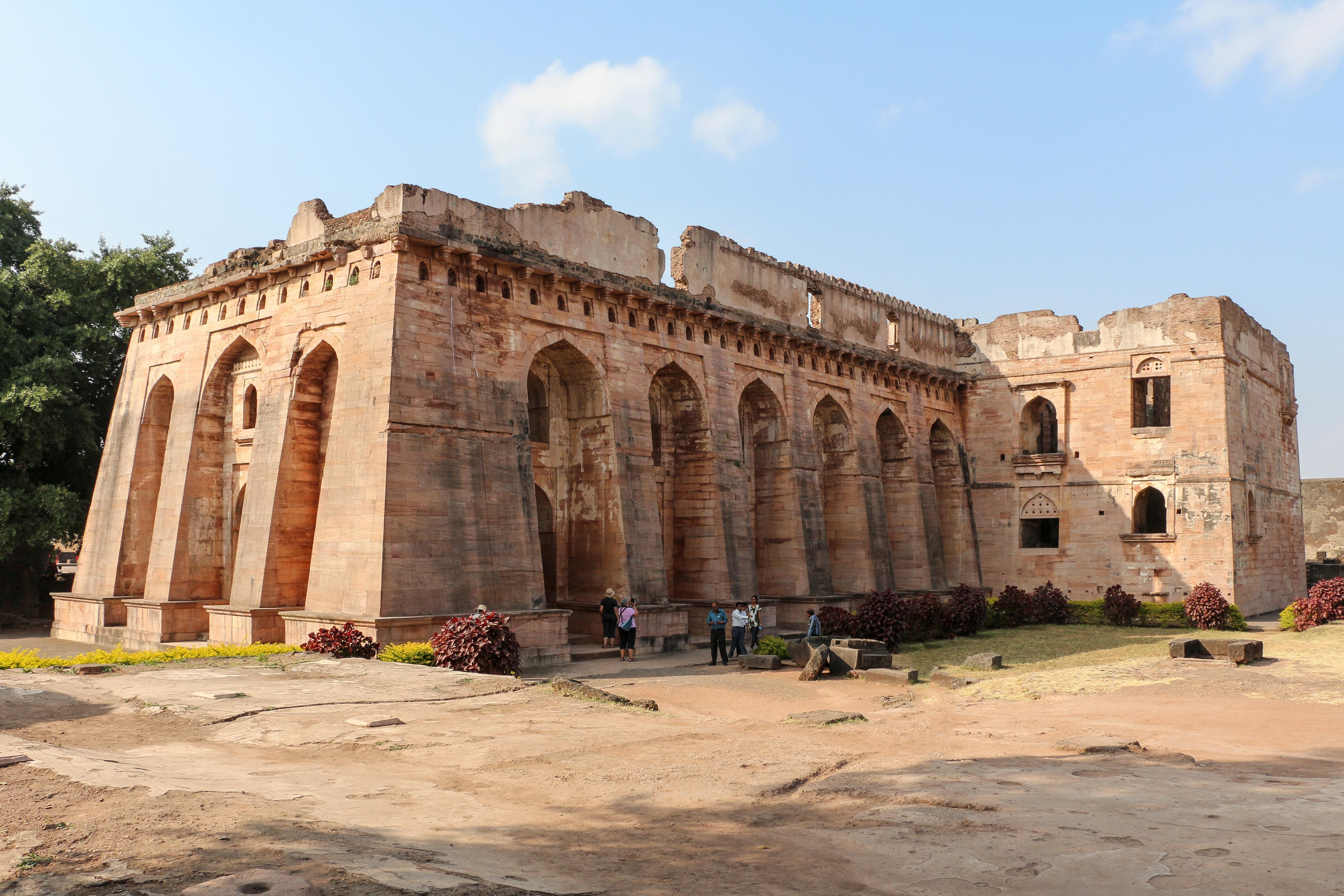 Hindola Mahal


Palaces of Roopmati and Bazbahadur
The palace of Sultan Bazbahadur and Roopmati are exquisite examples of the Islamic style of architecture. They have large courtyards. The palace of Roopmati was used as a check post in the times of an invasion. The tale of these two still resonates in the monuments of Mandu. Sultan Bazbahadur had gone to the dense woods near the Narmada River. Here he heard a sweet voice singing a divine song. When he reached the spot, he saw a beautiful maiden singing to the woods, the deer and the birds. He was mesmerized by her beauty and enchanted by her voice. When he asked her to become his wife she told him that until and unless the River Narmada starts flowing at Mandu she will not be able to marry him. This was because she used to pay homage to the river before having her food. The Sultan then went to the river and asked it to climb over the mountain and start flowing at Mandu. The river god granted his wish and told him to search for a sacred tamarisk and dig wherever it is found. There he found a spring of pure Narmada water which was a tributary. The king dug a reservoir at the place which was called the Rewa Kund. Rewa is another name of the river Narmada. He built a palace at this place and the waters of the fountain were provided to the baths of the palace. The river can be seen at a distance, as a silvery shimmering line in the Nimar plains, from the palace. Bazbahadur was later defeated in a battle and fled from the battle field. Roopmati committed suicide after consuming poison. The balladeers of Malwa still tell you their story.
-
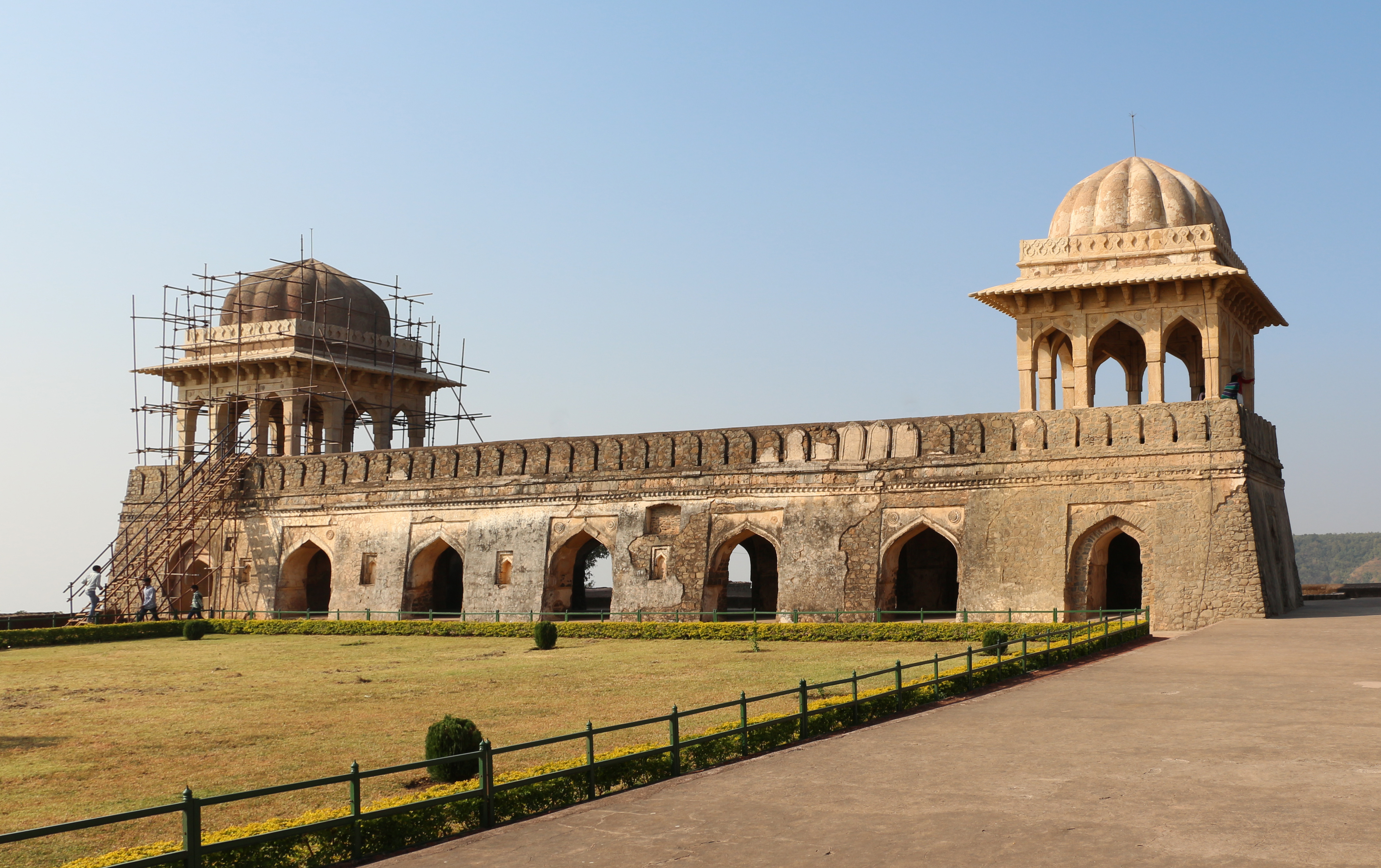 Roopmati's Pavilion
 -
 Baz Bahadur's Palace


There is a jamia mosque in mandu The Jama Masjid, also called Jami Masjid, is an historic Friday mosque in Mandu in the Dhar district of the state of Madhya Pradesh, India. Built in Mughal style, the mosque has been believed to have been built during the reign of Hoshang Shah and completed during the reign of Mahmud Khilji in 1454 CE.
The Masjid has three large domes, a courtyard, 54 smaller domes and colonnade of pillared halls. It has a prayer hall and decorated pillars in the masjid. The entire area of the mosque is 7,725 square metres (83,150 sq ft), built on an elevated platform 4.6 m (15 ft). The inscriptions on the eastern doorway to the porch indicates that the mosque was modeled on the basis of Mosque of Damascus. In modern times, the Group of Monuments at Mandu is maintained and administered by the Bhopal circle of the Archaeological Survey of India.
References[edit | edit source]
- ↑ "Census of India 2001: Data from the 2001 Census, including cities, villages and towns (Provisional)". Census Commission of India. Archived from the original on 16 June 2004. Retrieved 1 November 2008.
- ↑ "Shri Mandavagadh Tirtha". Archived from the original on 16 September 2016. Retrieved 2 July 2016.