




WikiDwarfBOT (talk | contribs) Cleanup: Information added. |
Svetlanazrc (talk | contribs) m further rework references to improve readability also and cleaned formatting |
||
| Line 1: | Line 1: | ||
{{ | {{Short description|Hindu temple at Puri, Odisha, India}} | ||
{{Redirect|Jagannath Temple}} | {{Redirect|Jagannath Temple}} | ||
{{ | {{For|the Indian filmmaker|Puri Jagannadh}} | ||
{{Use | {{Use dmy dates|date=October 2025}} | ||
{{ | {{Use Indian English|date=October 2025}} | ||
{{Infobox Hindu temple | {{Infobox Hindu temple | ||
|name = Jagannath Temple | |name = Jagannath Temple | ||
|image = Shri | |image = Shri Jagannath temple.jpg | ||
|alt = Jagannath Temple, Puri | |alt = Jagannath Temple, Puri | ||
|caption = | |caption = | ||
|map_type = India | |map_type = Odisha#India | ||
|coordinates = {{coord|19|48|17|N|85|49|6|E|type:landmark_region:IN|display=inline,title}} | |coordinates = {{coord|19|48|17|N|85|49|6|E|type:landmark_region:IN|display=inline,title}} | ||
|coordinates_footnotes = | |coordinates_footnotes = | ||
|map_caption = Location in Odisha | |map_caption = Location in Odisha | ||
|native_name = | |native_name = <!--Please do not add any Odia or any other language script here, per WP:NOINDICSCRIPT. Thanks.--> | ||
|country = India | |country = India | ||
|state = [[Odisha]] | |state = [[Odisha]] | ||
|district = [[Puri district|Puri]] | |district = [[Puri district|Puri]] | ||
|locale = [[Puri]] | |locale = [[Puri]] | ||
|elevation_m = 65 | |elevation_m = 65.47 | ||
|elevation_footnotes = | |elevation_footnotes = | ||
|deity = [[Jagannath]] | |deity = [[Jagannath]] | ||
| Line 24: | Line 24: | ||
|architecture = [[Kalinga Architecture]] | |architecture = [[Kalinga Architecture]] | ||
|temple_quantity = 31 | |temple_quantity = 31 | ||
|year_completed = 1161 CE{{ | |year_completed = 1161 CE{{sfn|Suryanarayan Das|2010|pp=49–50}} | ||
|creator = [[Indradyumna]] | |creator = [[Indradyumna]] | ||
|temple_board = Shree Jagannath Temple Managing Committee, Puri | |temple_board = Shree Jagannath Temple Managing Committee, Puri | ||
|governing_body = Shree Jagannath Temple Office, [[ | |governing_body = Shree Jagannath Temple Office, Puri | ||
| | |website = https://www.shreejagannatha.in | ||
|height_max = 214 feet 8 inches<ref name=PattnayakStatisticsRef>{{Cite book |last=Pattnayak |first=Pramod Chandra |title=Some Vital Statistics of Jagannath Temple Complex |url=https://magazines.odisha.gov.in/Orissareview/2010/July/engpdf/45-47.pdf |date=July 2010 |publisher=[[Government of Odisha]] |pages=1 |language=English}}</ref> | |||
|site_area = 10 acres<ref name=PattnayakStatisticsRef/> | |||
|length = 650 feet (east to west)<ref name=PattnayakStatisticsRef/> | |||
|width = 644 feet (north to south)<ref name=PattnayakStatisticsRef/> | |||
|materials = *Stone for the temple | |||
*Neem wood for the idols<ref>{{Cite news |last=Mohanty |first=Subashish |date=6 May 2025 |title=Wood used for Digha Jagannath Temple idols has no connection with Puri: Odisha |url=https://www.telegraphindia.com/india/wood-used-for-digha-jagannath-temple-idols-has-no-connection-with-puri-odisha-government-prnt/cid/2097698 |access-date=12 October 2025 |work=The Telegraph}}</ref> | |||
}} | }} | ||
{{Vaishnavism}} | {{Vaishnavism}} | ||
The '''Jagannath Temple''' is | The '''Jagannath Temple''' is a [[Hindu temple]] dedicated to [[Jagannath]], a form of [[Vishnu]]. It is located in [[Puri]], [[Odisha]], on the eastern coast of [[India]].<ref>{{Cite web |title=Odisha The Jagannath Temple |url=https://www.incredibleindia.gov.in/en/odisha/puri/sri-jagannath-temple |access-date=25 November 2025}}</ref> As per temple records, King [[Indradyumna]] of [[Avanti (region)|Avanti]] built the main temple.<ref>{{cite web|url=https://epaper.thestatesman.com/m5/3725372/Dainik-Statesman/28TH-JUNE-2023|title=পুরীধাম ও জগন্নাথদেবের ব্রহ্মরূপ বৃত্তান্ত|page=4|language=bn|date=28 June 2023|access-date=28 June 2023|website=dainikstatesmannews.com|publisher=[[Dainik Statesman]] (The Statesman Group)|location=Kolkata|first=Yogabrata|last=Chakraborty|trans-title=Puridham and the tale of lord Jagannath's legendary 'Bramharup'|archive-url=https://web.archive.org/web/20230628053933/https://epaper.thestatesman.com/m5/3725372/Dainik-Statesman/28TH-JUNE-2023#page/1/1|archive-date=28 June 2023|url-status=live}}</ref> The present temple complex was rebuilt from the eleventh century onwards on the site of the earlier shrines, excluding the main Jagannath temple, and was begun by [[Anantavarman Chodaganga]], the first ruler of the [[Eastern Ganga dynasty]].<ref>{{cite web |url= http://www.asianart.com/articles/patachitra/index.html#4 |title=Bernard Cesarone: Pata-chitras of Odisha |first=Bernard |last= Cesarone|work=asianart.com |year=2012 |quote=This temple was built in approximately 1135–1150 by Codaganga, a king of the Eastern Ganga dynasty |access-date=2 July 2012}}</ref> Many of the temple rituals are based on Shabari Tantras which are evolved from tribal beliefs respectively.<ref name=":0" /> The local legends link the idols with Nilamadhaba deva worshipped by tribala and the daitapatis (servitors) claim to be descendants of the tribes.<ref name=":0">{{Citation |last=Kanungo |first=Archana|url=https://magazines.odisha.gov.in/Orissareview/2013/jul/engpdf/58-67.pdf |title=Unity in Diversity: The Uniqueness of Jagannath Culture of Odisha |publisher=Government of Odisha |date=July 2013 |location=Bhubaneshwar}}</ref> The temple is one of the 108 ''[[Abhimana Kshethram]]'' of the [[Sri Vaishnavism|Sri Vaishnavite]] tradition. | ||
The | The temple is renowned for its annual [[Ratha Yatra]], chariot festival, which honors the three deities - [[Jagannath]], [[Balarama|Balabhadra]] and [[Subhadra]].<ref>{{Cite web|url=https://odishatourism.gov.in/content/tourism/en/experience/event/ratha-jatra-2025.html|title=The Divine Journey of Rath Yatra: Where Faith Moves on Wheels|access-date=27 November 2025}}</ref> During the festival, the three principal [[Murti|deities]] are pulled on large and elaborately decorated ''raths'', or [[temple car]]s. The worship is performed by the [[Bhil]] [[Sabar people|Sabar]] tribal priests, as well as priests of other communities in the temple.<ref>{{Cite book |last=Sharma |first=Dr Chandrapal |url=https://books.google.com/books?id=qzryDwAAQBAJ&dq=Magadha+Bhil&pg=PT153 |title=Ank Chakra : Indian Culture and Basic Numbers |date=21 July 2020 |publisher=Diamond Pocket Books Pvt Ltd |isbn=978-93-90287-27-7 |language=en}}</ref> Unlike the stone or metal icons found in most Hindu temples, the image of [[Jagannath]] is carved from margosa wood and is ceremoniously replaced every 12 or 19 years with an identical replica, with an elaborate month long ceremony called nabakalebar.<ref name="Nugteren 2010 159–172">{{cite journal |last=Nugteren |first=Albertina |title=Weaving Nature into Myth: Continuing Narratives Of Wood, Trees, And Forests In The Ritual Fabric Around The God Jagannath In Puri |journal=[[Journal for the Study of Religion, Nature and Culture]] |year=2010 |volume=4 |issue=2 |pages=159–172 |doi=10.1558/jsrnc.v4i2.159}}</ref> The temple is one of the [[Char Dham]] pilgrimage sites. It is also famous because many legends believe that [[Krishna]]'s heart was placed here, and it is the true Jagannath within the wooden idol. Since wood deteriorates, they have to change it every several years.<ref>{{cite news |last1=Gautam |first1=Mitali |date=7 November 2022 |title=Thus Lord Krishna's amazing heart lived on for posterity |url=https://www.thestatesman.com/lifestyle/thus-lord-krishnas-amazing-heart-lived-on-for-posterity-1503129194.html |work=The Statesman |access-date=13 December 2023}}</ref> | ||
The temple is sacred to all Hindus, and especially in those of the [[Vaishnavism|Vaishnava]] traditions. Many great Vaishnava saints, such as [[Ramanujacharya]], [[Madhvacharya]], [[Nimbarkacharya]], [[Vallabhacharya]] and [[Ramananda]] were closely associated with the temple.<ref>{{cite book|title=Introducing Orissa|url=https://books.google.com/books?id=DZgdAAAAMAAJ|page=84|author=Balaram Mohanty|publisher=Konarka Prakasani|year=1979}}</ref><ref>{{cite book|url=https://books.google.com/books?id=GsgoDwAAQBAJ&pg=PT297|title=Guru: The Universal Teacher|page=297|author=Swami B. P. Puri|publisher=Simon and Schuster|date=1 August 2017|isbn=9781683832454}}</ref> Ramanuja established the Emar | The temple is sacred and holy to all Hindus, and especially in those of the [[Vaishnavism|Vaishnava]] traditions. Many great Vaishnava saints, such as [[Chaitanya Mahaprabhu]], [[Ramanujacharya]], [[Madhvacharya]], [[Nimbarkacharya]], [[Vallabhacharya]] and [[Ramananda]] were closely associated with the temple.<ref>{{cite book|title=Introducing Orissa|url=https://books.google.com/books?id=DZgdAAAAMAAJ|page=84|author=Balaram Mohanty|publisher=Konarka Prakasani|year=1979}}</ref><ref>{{cite book|url=https://books.google.com/books?id=GsgoDwAAQBAJ&pg=PT297|title=Guru: The Universal Teacher|page=297|author=Swami B. P. Puri|publisher=Simon and Schuster|date=1 August 2017|isbn=9781683832454}}</ref> Ramanuja established the [[Emar Matha]] in the south-eastern corner of the temple, and [[Adi Shankaracharya]] established the [[Govardhan Math]], which is the seat of one of the [[Shankaracharya#Establishment of the tradition|four Shankaracharyas]]. It is also of particular significance to the followers of [[Gaudiya Vaishnavism]], whose founder, [[Chaitanya Mahaprabhu]], was attracted to the deity, Jagannath, and lived in Puri for many years.<ref>{{cite book|title=Temple Art, Icons and Culture of India and South-East Asia|url=https://books.google.com/books?id=Vb2fAAAAMAAJ|page=138|author=K. V. Raman|publisher=Sharada Publishing House|year=2006|isbn = 9788188934317|quote=Similarly, places like Srirangam associated with Ramanuja, Udupi (in Karnataka) with Madhvacharya, Pandharpur with the Maharashtra saints like Jnanesvar and Tukaram and Puri Jagannath with Chaitanya Mahaprabhu.}}</ref><ref>{{cite book|url=https://books.google.com/books?id=uQWQDwAAQBAJ&pg=PT292|title=The Spiritual Heritage of India|author=Swami Prabhavananda|publisher=Routledge|date=9 April 2019|page=292|isbn=9780429627552}}</ref> | ||
== History == | ==History== | ||
{{see also|Jagannath#Origins}} | {{see also|Jagannath#Origins}} | ||
The temple was rebuilt by the [[Eastern | The temple was rebuilt by the King of the [[Eastern Ganga dynasty]], [[Anantavarman Chodaganga]], in the 11th century CE, as described by the Kendupatna copper-plate inscription of his descendant, Narasimhadeva II and [[Rajendra Chola]] from the mother side.{{sfn|Suryanarayan Das|2010|pp=49–50}} Anantavarman was originally a [[Shaivite]], and became a [[Vaishnavite]] sometime after he conquered the [[Utkala Kingdom|Utkala]] region, in which the temple is located, in 1112 CE. A 1134–1135 CE inscription records his donation to the temple. Therefore, the temple construction must have started sometime after 1112 CE.{{sfn|Suryanarayan Das|2010|p=50}} | ||
[[File: | [[File:Indika. The country and the people of India and Ceylon (1891) (14767897094).jpg|thumb|Engraving sketch of front gate of Jagannath Temple, 1891]] | ||
According to a story in the temple chronicles, it was founded by Anangabhima | According to a story in the temple chronicles, it was founded by [[Anangabhima Deva III|Anangabhimadeva II]]. Different chronicles variously mention the year of construction as 1196, 1197, 1205, 1216, or 1226.{{sfn|Suryanarayan Das|2010|pp=50–51}} This suggests that the temple's construction was completed or that the temple was renovated during the reign of Anantavarman's son, Anangabhima.{{sfn|Suryanarayan Das|2010|p=51}} The temple complex was further developed during the reigns of the subsequent kings, including those of the Ganga dynasty and the [[Gajapati Kingdom|Gajapati dynasty]].{{sfn|Suryanarayan Das|2010|pp=51–52}} | ||
The temple annals, the [[Madala Panji]], records that the Jagannath temple has been invaded and plundered eighteen times.<ref>{{cite journal |last1=Dash |first1=Abhimanyu |date=July 2011 |title=Invasions on the Temple of Lord Jagannath, Puri |url=http://orissa.gov.in/e-magazine/Orissareview/2011/july/engpdf/82-89.pdf |url-status=dead |journal=Orissa Review |pages=82–89 |archive-url=https://web.archive.org/web/20140714125621/http://orissa.gov.in/e-magazine/Orissareview/2011/july/engpdf/82-89.pdf |archive-date=14 July 2014 |access-date=4 July 2014}}</ref> The temple is believed to have been attacked by Kalapahad, a Muslim convert general, in the 16th century.<ref name="temple attacked by islamic invaders">{{cite news |date=February 2020 |title=Chausath Yogini Temple Hirapur – A 9TH CE GEM OF ODISHA |url=https://www.inditales.com/chausath-yogini-temple-hirapur-odisha/ |publisher=Anuradha Goyal}}</ref> | |||
==Deities== | ==Deities== | ||
Jagannath, Subhadra and Balabhadra are the principal deities worshipped in the temple. The inner [[garbhagriha|sanctum]] of the temple houses images of them, carved from sacred [[neem]] wood (''daru),'' placed on the jewelled platform (''ratnabedi).'' The sanctum also contains the deities [[Sudarshana Chakra]], [[Krishna|Madanmohan]], [[Lakshmi|Sridevi]] and [[Bhudevi|Vishwadhatri]].<ref>{{cite web |url= http://www.jagannathtemplepuri.com/article/id/711/deities-in-lord-jagannath-temple |title=Deities in Lord Jagannath Temple – Jagannath Temple |work=jagannathtemplepuri.com |year=2012 |quote=along with Balabhadra, Subhadra, Sudarshan, Madhaba, Sridevi and Bhudevi on the Ratnabedi or the bejewelled platform. |access-date=26 June 2012}}</ref> The deities are adorned with different clothing and ornaments according to the season. Their worship predates the construction of the temple and may have originated in an ancient tribal shrine.<ref>{{cite web|url=http://www.kamat.com/kalranga/nindia/orissa/jaganath.htm|title=Juggernaut of Puri|access-date=20 September 2006}}</ref> The earliest known reference to Jagannath appears in the [[Oddiyana]] [[Vajrayana|Vajrayāna Tantric]] text ''Jñānasiddhi'' by [[Indrabhuti]], which begins with an invocation of the deity.<ref>{{Cite book |last=Donaldson |first= Thomas E.|url=https://books.google.com/books?id=DbxE8zOuRbUC&pg=PA11 |title=Iconography of the Buddhist sculpture of Orissa Volume 1 |publisher=[[Indira Gandhi National Centre for the Arts]] |year=2001 |location=London |page=11 |isbn=978-8170173755}}</ref>{{refn|group=note|Pranipatya Jagannatham Sarvajina Vararchitam. | |||
|url=http://www.kamat.com/kalranga/nindia/orissa/jaganath.htm | Sarva Buddha Mayam Siddhi Vyapinam Gaganopamam.<ref>{{cite web|title=JÑĀNASIDDHI|url=https://www.dsbcproject.org/canon-text/content/860/2988|year=2019|publisher=Digital Sanskrit Buddhist Canon}}</ref>}} In ''Sarala Mahabharata'', [[Sarala Das]] presents Lord Jagannath in multiple forms, emphasizing his connection to Krishna. He also described Lord Jagannath as being one with Krishna, Rama, and Buddha, reflecting a synthesis of the different faith traditions.<ref>{{Cite book |last1=Information and Public Relations Department |url=https://archive.org/details/orissa-review-2008-07 |title=Orissa Review (July 2008) |last2=Government of Odisha |date=2008 |others=Government of Odisha Information and Public Relations Department |pages=49}}</ref> | ||
|title=Juggernaut of Puri | |||
|access-date=20 September 2006 | |||
}}</ref> | |||
===Legends=== | ===Legends=== | ||
[[ | According to legends recorded in ''[[Madala Panji]]'', the construction of the first Jagannath temple was commissioned by King [[Indradyumna]], a [[Malava Kingdom|Malava]] king mentioned in the ''[[Mahabharata]]'' and the ''[[Puranas]]''.<ref>{{cite book|author=Amalananda Ghosh|title=An Encyclopaedia of Indian Archaeology|url=https://books.google.com/books?id=Wba-EZhZcfgC&pg=PA161 |publisher=BRILL Academic|isbn=90-04-09264-1 |pages=161 |date=December 1990}}</ref> | ||
Indradyumna commissioned the construction of a monument for Jagannath that was intended to be the tallest in the world. The construction was said to measure 1,000 [[cubit]]s (457.2 meters) in height. He invited [[Brahma]], the [[Creator deity#Monolatrism|cosmic creator]], to consecrate the temple and its images.<ref>{{cite web |url=http://www.jagannathpuri-info.net/storypuri.php |title=Sri Jagannath Puri Dham Information – Jagannath |work=jagannathpuri-info.net |year=2012 |quote=The King wanted Lord Brahma to consecrate the temple |access-date=26 June 2012 |archive-url=https://web.archive.org/web/20120704050957/http://www.jagannathpuri-info.net/storypuri.php |archive-date=4 July 2012 |url-status=dead }}</ref> | |||
According to traditional accounts, the origins of the Jagannath temple trace back to the end of the ''[[Dvapara Yuga]]'', when the original image of Jagannath was said to have manifested near a banyan tree by the shore in the form of the [[Sapphire|Indranila Mani]] (the Blue Jewel). It was said to be so dazzling that it could grant instant ''[[moksha]].'' The god [[Yama|Dharma]] sought to conceal it within the earth and succeeded. In the ''[[Kali Yuga]]'', Indradyumna wanted to find that mysterious image. To achieve that he performed severe [[Tapas (Indian religions)|penance]]. Vishnu then instructed him to go to the seashore at [[Puri]], where he would find a floating log from which the image could be carved.<ref name="a">{{cite book |last1=Mahanti (Retd) |first1=Col J. C. |title=The Saga of Jagannatha and Badadeula at Puri (Story of Lord Jagannatha and his Temple) |date=1 May 2014 |publisher=Vij Books India Pvt Ltd |isbn=978-93-82652-45-8 |pages=14–15 |url=https://books.google.com/books?id=QweqCQAAQBAJ |language=en}}</ref><ref>{{cite book |last1=Patra |first1=Avinash |title=Origin & Antiquity of the Cult of Lord Jagannath |date=23 June 2011 |publisher=Oxford University Press |url=https://books.google.com/books?id=RlwTCwAAQBAJ |language=en}}</ref> | |||
|url= | |||
|title=Jagannath | |||
| | |||
}}</ref> | |||
Indradyumna then discovered the log of wood. He performed a [[yajna]], from which [[Narasimha]] appeared and instructed that [[Narayana]] be manifested as a [[Caturvyūha|fourfold expansion]]: ''[[Paramatman|Paramatma]]'' as Vasudeva (Krishna),''[[Vyūha|Vyuha]]'' as Samkarshana (Balabhadra), ''[[Yogamaya]]'' as Subhadra, and ''[[Vibha]]va'' as [[Sudarshana Chakra#Etymology|Sudarshana]]. After this, [[Vishwakarma]] appeared in the form of an artisan and prepared images of Jagannath, Balabadra and Subhadra from the tree.<ref>{{cite web | |||
|url=http://www.templenet.com/Orissa/puri.html|title=Jagannath Temple at Puri|access-date=12 September 2006}}</ref> | |||
When this log, radiant with light, was seen floating in the sea, [[Narada]] told the king to make three deities out of it and place them in a pavilion. Indradyumna got Vishwakarma, the architect of gods, to build a magnificent temple to house the deities, and Vishnu himself appeared in the guise of a carpenter to make the deities, on condition that he was to be left undisturbed until he finished the work.<ref name="a"/><ref name="b">{{cite book |last1=Das |first1=Suryanarayan |title=Lord Jagannath |date=2010 |publisher=Sanbun Publishers |isbn=978-93-80213-22-4 |pages=42–44 |url=https://books.google.com/books?id=gFn8wSDfSxEC |language=en}}</ref> | |||
But just after two weeks, the queen of Indradyumna became very anxious. She took the carpenter to be dead as no sound came from the temple. Therefore, she requested the king to open the door. Thus, they went to see Vishnu at work, at which the latter abandoned his work, leaving the deities unfinished. The deity was devoid of any hands. But a divine voice told Indradyumna to install them in the temple. It has also been widely believed that in spite of the deity being without hands, it can watch over the world and be its lord. Thus, the idiom.<ref name="a"/><ref name="b"/> | |||
== | ==Entry and ''Darshan''== | ||
Non-[[Hinduism|Hindus]] (excluding [[Jainism|Jains]], [[Sikhism|Sikhs]], [[Buddhism|Buddhists]]) and foreigners are not permitted to enter the temple.<ref>{{cite magazine |url=https://magazines.odisha.gov.in/Orissareview/2014/Jun/engpdf/85-89.pdf|title=Lord Buddha in the Cult of Lord Jagannath|magazine=Odisha Review|date=June 2014|author=Abhimanyu Dash|pages=85–89}}</ref><ref>{{cite web | url=https://medium.com/@ashishsarangi/jagannatha-the-jain-connection-2cc1d447d588 | title=Jagannatha — — the Jain Connection | date=7 January 2018 }}</ref> Such a rule is believed to have existed since the temple was built, and at present, it often becomes a subject to controversy and debates that have lasted for several decades.<ref>{{cite magazine|url=https://magazines.odisha.gov.in/Orissareview/2009/June/engpdf/107-108.pdf|title=Holy Pilgrimage of Guru Nanak to Puri|first=Jagannath|last=Mohanty|date=June 2009|magazine=Orissa Review|pages=107–108}}</ref><ref>[https://www.telegraphindia.com/india/puri-temple-in-hindu-gaffe/cid/669426 Puri temple in Hindu gaffe] {{webarchive |url=https://web.archive.org/web/20160304115618/http://www.telegraphindia.com/1071108/asp/nation/story_8524891.asp |date=4 March 2016 }}, ''The Telegraph, Calcutta'' – 8 November 2007</ref><ref>{{cite web|url=http://www.iskcon.com/culture/holy_places/j_puri.html|title=Jagannatha Puri|access-date=12 September 2006|archive-url = https://web.archive.org/web/20060715031144/http://www.iskcon.com/culture/holy_places/j_puri.html <!-- Bot retrieved archive --> |archive-date = 15 July 2006}}</ref> According to [[Ganeshi Lal]], the former [[List of governors of Odisha|Governor of Odisha]], foreigners can enter the temple only if he/she can meet the [[Gajapati (title)|Gajapati]] servitors and the [[Shankaracharya]], then he/she could also be allowed to witness Jagannath. But, this theory has not wielded influence yet, and continues to be a subject of longstanding debate.<ref>{{cite news|last=Bisoyi |first=Sujit|title=Puri's Jagannath Temple: Why non-Hindus and foreigners can't enter here|url=https://indianexpress.com/article/explained/explained-culture/jagannath-temple-and-curbs-on-non-hindus-8398182/|work=The Indian Express |date=24 January 2023|access-date=13 January 2024|language=en}}</ref> The temple is open everyday from 5:00 am to 10:30 pm.<ref>{{cite web |title=Jagannath Darshan |url=http://jagannath.nic.in/old/rituals.asp |website=jagannath.nic.in. |publisher=Jagannath Temple Administration |access-date=27 June 2014 |url-status=dead |archive-date=5 March 2013 |archive-url=https://web.archive.org/web/20130305013143/http://jagannath.nic.in/old/rituals.asp }}</ref> | |||
The temple is open from 5: | |||
==Cultural integrity== | ==Cultural integrity== | ||
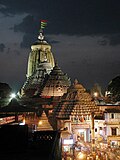
[[File:PURI JAGANATHA TEMPLE, PURI, ORISSA, INDIA, ASIA.jpg|thumb|The Jagannath Temple at night]] | |||
According to historical traditions, Jagannath is believed to have originated as a tribal deity venerated by the Bhil and Sabar communities as a form of Narayana. Another legend identifies him as [[Neela Madhava|Nilamadhava]], a blue-stone image of Narayana that was worshipped by these tribal groups. He was brought to [[Nilagiri]], the blue mountain, or Nilachala, and installed there as Jagannath, in company with [[Balabhadra]] and [[Subhadra]]. Worship of wooden images at the Jagannath temple is claimed to have a distant connection with the Vanvasi, or forest dwellers, who traditionally worship wooden poles. The Daitapatis, who are responsible for performing certain temple rituals, are claimed to be descendants of the [[List of Scheduled Tribes in Odisha|hill tribes of Odisha]] and are also believed to be closely related to Jagannath. The cultural history of ''Shrikshetra'', regarded as the [[Culture of Odisha|cultural capital of Odisha]], is traced to the traditions of Hindu tribes. The three deities came to be regarded as the symbols of ''Samyak Darshan'', ''Samyak Jnana,'' and ''Samyak Charita'', together known as [[Ratnatraya]], the triple gems of the [[Jain]] culture, whose assimilation is believed to lead to [[omniscience]] and ''[[moksha]]'' ([[salvation]]).<ref>{{Cite magazine |last=Barak |first=Pabitra Mohan |date=July 2005 |title=Jainism and Buddhism in Jagannath Culture |url=http://magazines.odisha.gov.in/Orissareview/jul2005/engpdf/jainism_budhism_in_joga-culture.pdf |magazine=magazines.odisha.gov.in |access-date=30 September 2023 |archive-date=26 March 2023 |archive-url=https://web.archive.org/web/20230326220258/http://magazines.odisha.gov.in/Orissareview/jul2005/engpdf/jainism_budhism_in_joga-culture.pdf |url-status=dead }}</ref> | |||
===Acharyas and Jagannatha Puri=== | ===Acharyas and Jagannatha Puri=== | ||
Many renowned ''[[acharya]]s'', including [[Madhvacharya]], are believed to have visited this ''[[Kshetram|kshetra]]''. [[Adi Shankara]]charya established the [[Govardhan Math]] here. [[Guru Nanak]] had visited this place with his disciples Bala and Mardana. [[Chaitanya Mahaprabhu]] the founder of [[Gaudiya Vaishnavism]] resided here for 24 years and taught that the love of God can be spread by chanting the [[Hare Krishna (mantra)|Hare Krishna mantra]]. [[Vallabha]] is traditionally believed to have visited the temple, where he performed a seven-day recitation of the ''[[Bhagavata Purana|Srimad Bhagavata]]''. His sitting place, known as his ''baithakji'', (literally "seat") remains a notable site and is regarded as evidence of his visit to [[Puri]].<ref>{{cite web |url=http://orissagov.nic.in/e-magazine/Srimandir/srimandirenglish/Epdf/Ech1.pdf |title=Shrikshetra: A Replica of Indian Culture |access-date=8 March 2010 |url-status=dead |archive-url=https://web.archive.org/web/20090410074454/http://orissagov.nic.in/e-magazine/Srimandir/srimandirenglish/Epdf/Ech1.pdf |archive-date=10 April 2009 }}</ref> | |||
Some of the | Some of the [[pandit]]s who participated in the recitation said to become jealous of the young Vallabha and sought to test him. The following day was [[Ekadashi]], a fasting observance during which devotees abstain from grains. The pandits offered Vallabha rice ''[[Prasada|prasad]]'' of Lord Jagannath, for which the temple remains renowned. Accepting it would break his vow of fasting, while refusing it would have been seen as disrespectful to Jagannath. Vallabha, with due honor and respect, accepted the prasad in his hand. He remained in the temple, spending the rest of the day and night explaining the [[shloka]]s that extolled the greatness of prasad, and consumed it the following morning after sunrise.<ref>{{Cite web|title=Shri Mad Vallabhacharya Mahaprabhuji {{!}} Shrinathji Temple, Nathdwara|url=https://www.nathdwaratemple.org/shrimahaprabhuji/shri-mad-vallabhacharya-mahaprabhuji|access-date=25 September 2021|website=www.nathdwaratemple.org}}</ref> | ||
The [[Sikh]] [[ | The [[Sikh]] [[Arti (Hinduism)|''aarti'']] "''[[Gagan mein thaal]]"'' was recited by the [[Sikh gurus#The gurus|first Sikh guru]], [[Guru Nanak]], in 1506 or 1508,<ref>{{Cite news |title=गुरु नानक देव और उनके द्वारा प्रवर्तित मार्ग |url=https://www.livehindustan.com/news/tayaarinews/tayaarinews/article1-story-67-67-199585.html |access-date=22 June 2023 |work=Hindustan |date=7 November 2011 |language=hi}}</ref><ref name="orgov">{{cite web |url=http://www.orissa.gov.in/e-magazine/orissareview/2012/Feb-March/engpdf/1-6.pdf |title=Orissa Review – Feb–March 2012 |website=orissa.gov.in |access-date=12 March 2022}}</ref><ref name="barusahib">{{Cite web|url = http://www.barusahib.org/Assets/Publications/Natures_Own_Arti.pdf|title = Home|date = 13 November 2013|access-date = 28 September 2023|archive-date = 4 March 2016|archive-url = https://web.archive.org/web/20160304023317/http://www.barusahib.org/Assets/Publications/Natures_Own_Arti.pdf|url-status = dead}}</ref><ref name="sikh-heritage">{{Cite web |title=Shree Guru Granth Sahib Ji |url=http://www.sikh-heritage.co.uk/Scriptures/Guru%20Granth/Guru%20Granth.htm |website=sikh-heritage.co.uk |access-date=22 June 2023}}</ref> during his [[udasi]] (spritiual journey) to [[east India|eastern India]],<ref name="orgov"/><ref name="barusahib"/> at the revered Jagannath Temple, Puri. Unlike traditional ''aarti,'' it is sung without the use of platters, lamps or other ritual implements. | ||
===Char Dham=== | ===Char Dham=== | ||
{{Wide image|Bird view of Jagannath Temple, Puri.jpg| | {{Char Dham}} | ||
{{Wide image|Bird view of Jagannath Temple, Puri.jpg|500px|Bird's eye view of Jagannath Temple}} | |||
The temple is one of the four [[Vaishnava]] [[Hindu]] pilgrimage sites collectively known as the ''[[Char Dham]]'', the others being [[Rameswaram]], [[Badrinath]] and [[Dwarka]].{{sfn|Mahadev Chakravarti|1986|p=140}} The origins of the Char Dham are uncertain, but the [[Advaita]] school of [[Hinduism]] propagated by [[Adi Shankaracharya]], who established Hindu monastic institutions across India, attributes the origin of Char Dham to the seer.<ref>{{cite book|last=Mittal|first=Sushil|title=The Hindu World|year=2004|publisher=Routledge|location=New York|isbn=0-203-64470-0|page=482}}</ref> The four temples are located at the [[Cardinal direction|cardinal points]] of India: [[Badrinath Temple]] in the north at [[Badrinath]], Jagannath Temple in the east at [[Puri]], [[Dwarkadheesh temple, Gujrat|Dwarakadheesh Temple]] in the west at [[Dwarka]] and [[Ramanathaswamy Temple]] in the south at [[Rameswaram]]. Although the temples are ideologically associated with different sections of Hinduism, namely [[Shaivism]] and [[Vaishnavism]], the four pilgrimage sites are regarded as integral to [[Hinduism]] as a whole.{{sfn|Norbert C. Brockman|2011|pp=94–96}} The pilgrimage to the four cardinal points of India is regarded as sacred by Hindus, who aspire to visit these temples at least once in their lifetime. Traditionally, the pilgrimage begins at Puri in the east and proceeds clockwise, following the customary practice of [[circumambulation]] in Hindu temples.{{sfn|Paul Gwynne|2017|p=296}} | |||
==Architectural description== | |||
[[File:1910 sketch of plan, Jagannath Temple, Puri Odisha.jpg|thumb|320px|Site plan of Jagannath Temple, {{circa|1910}} | |||
{{Image key | |||
|'''A'''. Main Sanctum (''Garbha-Griha, Deul'') | |||
|'''B'''. Audience Hall (''Jagamohana, Pidha Deul'') | |||
|'''C'''. Dancing Hall (''Nat-Mandap, Nata Mandir'') | |||
|'''D'''. Offering Hall (''Bhoga-Mandap, Bhog Mandir'') | |||
|'''E'''. Main Gate (''Singha Dwara'') | |||
|'''F'''. (''[[Aruna Stambha]]'') | |||
}}]] | |||
The temple complex, which contains at least 120 temples and [[shrine]]s, covers more than {{convert|400000|sqft|m2|order=flip}} and is enclosed by a high fortified wall. The wall, {{convert|20|ft|m|order=flip}} high, is known as ''Meghanada Pacheri''.<ref>{{cite web |url=http://samsepuja.in/about-puri.php |title=About Sakhigopal |work=samsepuja.in |year=2012 |quote=The outermost is called 'Meghanad Pacheri' which has a length of 650ft from east to west and breadth of 644ft from north to south direction. The height of Meghanad Pacheri is 20ft and thickness of 6ft |access-date=26 June 2012 |url-status=dead |archive-url=https://web.archive.org/web/20150224200629/http://samsepuja.in/about-puri.php |archive-date=24 February 2015 }}</ref> Another wall, called ''kurma bedha,'' surrounds the main temple.<ref>{{cite web |url=http://www.orissa.oriyaonline.com/inside_the_temple.html?page=2 |title=Lord Jagannath:Inside the temple of the lord, Jagannath Puri, Jagannath Temple, Orissa |work=orissa.oriyaonline.com |year=2012 |quote=and kurma Bedha (the inner wall) or the inner enclosure of the Jagannath temple i |access-date=26 June 2012 |archive-date=27 May 2012 |archive-url=https://web.archive.org/web/20120527144258/http://www.orissa.oriyaonline.com/inside_the_temple.html?page=2 |url-status=dead }}</ref> With its sculptural richness and the fluidity of [[Kalinga architecture]], it is regarded as one of the most magnificent temples in India.<ref name="odissi">{{cite web|url=http://www.odissi.com/orissa/jagannath.htm|title=Sri Jagannath|access-date=12 September 2006|archive-date=24 July 2008|archive-url=https://web.archive.org/web/20080724193307/http://www.odissi.com/orissa/jagannath.htm|url-status=dead}}</ref> he temple comprises four distinct sections: the ''deula''; the ''vimana'' (''garbhagriha'' or sanctum sanctorum), where the triad deities are placed on the ''ratnavedi'' (“throne of pearls”); the ''mukhashala'' (frontal porch); the ''natamandapa'', also known as the ''jagamohan'' (audience or dancing hall); and the ''bhogamandapa'' (offerings hall). In the ''Rekha Deula'' style, these elements appear in sequence, with the ''vimana'' forming the main tower and the associated halls extending westward.<ref>{{cite web |url=http://www.7wonders.org/wonders/asia/india/puri/jagannath-temple.aspx |title=Jagannath Temple, India – 7 wonders |work=7wonders.org |year=2012 |quote=The temple is divided into four chambers: Bhogmandir, Natamandir, Jagamohana and Deul |access-date=2 July 2012 |archive-date=12 June 2012 |archive-url=https://web.archive.org/web/20120612083058/http://www.7wonders.org/wonders/asia/india/puri/jagannath-temple.aspx |url-status=dead }}</ref> The main temple is curvilinear in design, and its summit is crowned by the ''Nila chakra'', an eight-spoked wheel associated with [[Vishnu]]. It is crafted from [[Ashtadhatu|a''shtadhatu'']], an [[alloy]] of eight metals, and is regarded as sacrosanct.<ref>{{cite web |url= http://www.orissatourism.org/jagannath-temple/architecture-of-temple.html |title= Architecture of Jagannath Temple, Jagannath Puri Architecture, Puri Jagannath Temple India. |work= orissatourism.org |year= 2012 |quote= wheel on top of the Jagannath Temple made of an alloy of eight metals ([[astadhatu]]). It is called the Nila Chakra (Blue Wheel) |access-date= 2 July 2012 |archive-date= 12 October 2012 |archive-url= https://web.archive.org/web/20121012013150/http://www.orissatourism.org/jagannath-temple/architecture-of-temple.html |url-status= dead }}</ref> Among the temples of Odisha, the Jagannath temple is the tallest. Its tower, constructed on a raised stone platform, rises {{convert|214|ft|m|order=flip}} above the inner sanctum where the deities reside and dominates the surrounding landscape. The [[pyramidal]] roofs of the surrounding temples and adjoining halls, or [[mandapa]]s, rise in tiers toward the tower, resembling a ridge of mountain peaks.<ref>{{cite web|url=http://www.cultureholidays.com/Temples/jagannath.htm|title=Jagannath Temple, Orrisa|access-date=20 September 2006|archive-date=17 May 2008|archive-url=https://web.archive.org/web/20080517022040/http://www.cultureholidays.com/Temples/jagannath.htm|url-status=dead}}</ref> | |||
[[ | |||
|url=http://www.odissi.com/orissa/jagannath.htm | |||
|title=Sri Jagannath | |||
|access-date=12 September 2006 | |||
|archive-date=24 July 2008 | |||
|archive-url=https://web.archive.org/web/20080724193307/http://www.odissi.com/orissa/jagannath.htm | |||
|url-status=dead | |||
}}</ref> | |||
The main temple is | |||
|url=http://www.cultureholidays.com/Temples/jagannath.htm | |||
|title=Jagannath Temple, Orrisa | |||
|access-date=20 September 2006 | |||
|archive-date=17 May 2008 | |||
|archive-url=https://web.archive.org/web/20080517022040/http://www.cultureholidays.com/Temples/jagannath.htm | |||
|url-status=dead | |||
}}</ref> | |||
===Nila Chakra=== | ===''Nila Chakra''=== | ||
The Nila [[Chakram|Chakra]] ( | The ''Nila [[Chakram|Chakra]]'' (lit. "blue discus") is mounted atop the [[shikhara]] of the Jagannath temple. By custom, a different flag is hoisted on the Nila Chakra each day. The flag hoisted on the Nila Chakra is called the ''[[Patita Pavana]]'' (lit. "Purifier of the Fallen"), and is equivalent to the image of the deities placed in the sanctum sanctorum.<ref>{{cite web|url=http://www.gopaljiu.org/excerpts/kk_13_history_pp_40-43.pdf |title= Jagannatha's British 'Guardian' |access-date=15 August 2014 |url-status=dead |archive-url=https://web.archive.org/web/20160303225323/http://gopaljiu.org/excerpts/kk_13_history_pp_40-43.pdf |archive-date=3 March 2016 }}</ref> | ||
The Nila Chakra is a disc with eight [[Navagunjara]] | The ''Nila Chakra'' is a disc with eight [[Navagunjara|''Navagunjaras'']] carved along its outer circumference, all facing the flagpost above. It is made of ''ashtadhatu'' and measures {{convert|3.5|m|ft}} in height, with a circumference of about {{convert|11|m|ft}}.<ref>{{Cite web|url=https://puriwaves.nirmalya.in/photo_news/nilachakra-is-now-repairing-by-archaeological-survey-of-india,%20https://puriwaves.nirmalya.in/photo_news/nilachakra-is-now-repairing-by-archaeological-survey-of-india|archiveurl=https://web.archive.org/web/20160312070559/http://puriwaves.nirmalya.in/photo_news/nilachakra-is-now-repairing-by-archaeological-survey-of-india|url-status=dead|title=Nilachakra is now repairing by Archaeological Survey of India — PURIWAVES|date=15 July 2010|archivedate=12 March 2016}}</ref> | ||
The | ===The ''Singhadwara''=== | ||
<gallery mode="packed" heights="180px"> | |||
File:Singhadwara.jpg|The ''Singhadwara'' in 1870, with lion sculptures and the [[Aruna Stambha]] in the foreground | |||
File:Jagannath Temple View,Puri.jpg|The ''Singhadhwara'' of the temple complex, with the main temple spire in the background | |||
File:ସିଂହଦ୍ଵାର ଗୁମୁଟ.jpg|Statue of [[Aruna (Hinduism)|Aruna]], charioteer of [[Surya]], atop the Aruna Stambha in front of the ''Singhadwara'' | |||
File:Jagannath Temple - Lions Gate (26653368174).jpg|The ''Singhadwara'' of the temple at present | |||
The '' | </gallery> | ||
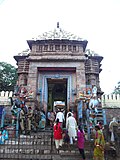
|url=http://www.odissi.com/orissa/jagannath.htm | The ''Singhadwara'' ([[Sanskrit]] for "Lion Gate") is one of the four gates of the temple, and serves as the main entrance. It is named for the large statue of crouching lion positioned on either side of the gateway. The gate faces east, opening onto the ''Bada Danda'' (the "Grand Road").<ref>{{cite web|url=http://www.fullodisha.com/about-temple/ |title=About Temple – Devotee Care Center |work=devoteecare.fullorissa.com |year=2012 |quote=Two colossal lions flank the Purba Dwara (Eastern Gate) also known as Singha Dwara. This is a mini tower and the main entrance to the temple |access-date=28 September 2012 }}{{dead link|date=June 2016|bot=medic}}{{cbignore|bot=medic}}</ref> The ''Baisi Pahacha'', a flight of twenty-two steps, leads into the temple complex. A representation of Jagannath known as ''Patita Pavana'' (Sanskrit for "savior of the downtrodden and the fallen") is painted on the right side of the entrance. In ancient times, when untouchables were not allowed inside the temple, they could pray to the Patita Pavana. The statues of the temple guards, [[Jaya-Vijaya|Jaya and Vijaya]], stand on either side of the doorway.<ref>{{cite web|url=http://www.odissi.com/orissa/jagannath.htm|title=Sri Jagannath Temple|access-date=20 September 2006|archive-date=24 July 2008|archive-url=https://web.archive.org/web/20080724193307/http://www.odissi.com/orissa/jagannath.htm|url-status=dead}}</ref> Shortly before the commencement of the [[Ratha Yatra]], the deities Jagannath, Balabhadra and Subhadra are taken out of the temple through this gate. On their return from the [[Gundicha Temple]], they must ceremonially placate [[Lakshmi|Goddess Lakshmi]], whose image is carved atop the door, for neglecting to take her with them on the Yatra. Only then does the goddess grant them permission to enter the temple. A sixteen-sided monolithic pillar, known as the [[Aruna Stambha]], stands in front of the main gate. At its top is an idol of [[Aruna (Hinduism)|Aruna]], the charioteer of the [[Solar deity|sun god]] [[Surya]]. Prior to its current location, the Aruna Stambha stood at the [[Konark Sun Temple]].<ref>{{cite web|url=http://asi.nic.in/asi_monu_whs_konark_maintemple.asp|title=Main Temple Complex – Sun Temple, Konarak – Archaeological Survey of India|work=asi.nic.in|year=2011|quote=To the front of the eastern staircase of the porch, once stood the free-standing chlorite pillar, the dhvaja-stambha, with Aruna, the charioteer of Surya as the crowning element|access-date=5 October 2012|archive-url=https://web.archive.org/web/20121108041519/http://asi.nic.in/asi_monu_whs_konark_maintemple.asp|archive-date=8 November 2012|url-status=dead}}</ref><ref>{{cite web |url=http://puriwaves.nirmalya.in/feature-article/aruna-stambha |title=Aruna Stambha | PURIWAVES |work=puriwaves.nirmalya.in |year=2012 |quote=this Pillar was a part of Sun Temple Of Konark and was located in front of Sun Temple |access-date=5 October 2012 |archive-url=https://web.archive.org/web/20130605232509/http://puriwaves.nirmalya.in/feature-article/aruna-stambha |archive-date=5 June 2013 |url-status=dead }}</ref> It was later brought from [[Konark]] by the [[Maratha Empire|Maratha guru]] Brahmachari Gosain.<ref>{{cite web|url=http://orissa.gov.in/e-magazine/Orissareview/jun2004/englishpdf/pillar.pdf |title=The Pillars of Homage to Lord Jagannatha |first=Prajna Paramita |last=Behera |work=Orissa Review |year=2004 |access-date=5 October 2012 |url-status=dead |archive-url=https://web.archive.org/web/20140222061656/http://orissa.gov.in/e-magazine/Orissareview/jun2004/englishpdf/pillar.pdf |archive-date=22 February 2014 }}</ref> | ||
|title=Sri Jagannath Temple | |||
|access-date=20 September 2006 | |||
|archive-date=24 July 2008 | |||
|archive-url=https://web.archive.org/web/20080724193307/http://www.odissi.com/orissa/jagannath.htm | |||
|url-status=dead | |||
}}</ref> | |||
===Other entrances=== | ===Other entrances=== | ||
[[File:Ashwadwara (Horse Gate) of Jagannath temple, Puri.JPG|thumb|150px|The Ashwadwara Gate]] | [[File:Ashwadwara (Horse Gate) of Jagannath temple, Puri.JPG|thumb|150px|right|The Ashwadwara Gate]] | ||
Apart from the Singhadwara, | Apart from the Singhadwara, the temple's main entrance, there are three other entrances facing north, south and west. Named for the animal sculptures that guard them, they are the ''Hathidwara (''Elephant Gate), the ''Vyaghradwara (''Tiger Gate) and the ''Ashwadwara'' (Horse Gate).<ref name="official">{{cite web |title=THE TEMPLE OF JAGANNATHA |url=http://jagannath.nic.in/pdf/THE%20TEMPLE%20OF%20JAGANNATHA.pdf |url-status=dead |archive-url=https://web.archive.org/web/20130530073442/http://jagannath.nic.in/pdf/THE%20TEMPLE%20OF%20JAGANNATHA.pdf |archive-date=30 May 2013 |access-date=25 November 2012 |work=Official site of Jagannath temple |publisher=Shree Jagannath Temple Administration, Puri }}</ref> | ||
===Minor temples=== | ===Minor temples=== | ||
[[File:Minor temples in Jagannath Puri.jpg|thumb|Cluster of minor temples in the southern part of Jagannath temple complex, including the [[Vimala Temple]] (extreme right), c. 1890]] | [[File:Minor temples in Jagannath Puri.jpg|thumb|left|180px|Cluster of minor temples in the southern part of Jagannath temple complex, including the [[Vimala Temple]] (extreme right), c. 1890]] | ||
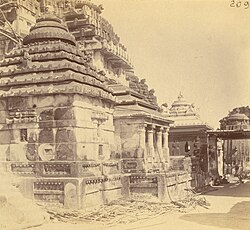
Within the temple complex, there are about thirty smaller temples and shrines where active worship is regularly conducted.<ref name="official" /> Several of these are considered significant and are generally visited before entering the main Jagannath temple.<ref name="official" /> Notable examples include the [[Ganesha]] Temple near the ''kalpavata'' [[Banyan|banyan tree]], [[Vimala Temple]], Nilamadhaba Temple, Gopalaballava Temple and Lakshmi Temple. | |||
The [[Vimala Temple]] (Bimala Temple) is regarded as one of the most important of the [[Shakta pithas]].<ref name="official" /> It is situated near [[Pancha Tirtha of Puri|Rohini Kund]] within the temple complex. The food offered to Jagannath is not considered [[Mahaprasad (Jagannath Temple)|Mahaprasad]] until it is offered to Goddess Vimala.<ref name="official" /> The [[Lakshmi]]<nowiki/>temple, dedicated to the consort of Jagannath, plays an important role in the rituals of the main temple.<ref name="official" /> | |||
There are additional shrines within the complex dedicated to [[Uchchhishta Ganapati|Kanchi Ganesha]], [[Shiva]], [[Surya]], [[Saraswati]], [[Bhuvaneshwari]], [[Narasimha]], [[Rama]], and [[Hanuman]].<ref name="official" /> | |||
===The Mandapas=== | ===The Mandapas=== | ||
[[File:Dola Mandap.jpg|thumb|150px|The Dola Mandapa in 1890 where the annual Dol Yatra is held.]] | [[File:Dola Mandap.jpg|thumb|150px|right|The ''[[Dol Purnima#Etymology and references in literature|Dola Mandapa]]'' in 1890, where the annual ''[[Dol Purnima#Etymology and references in literature|Dol Yatra]]'' is held.]] | ||
There are many [[ | There are many [[mandapa]]s, or pillared halls on raised platforms, within the temple complex that serves as venues for religious congregations. The most prominent is the [[Mukti Mandapa]], the congregation hall associated with the holy seat of selected learned Brahmins.<ref>{{cite web|url=http://jagannath.orissaculture.com/Jagannath%20Temple/Sanctuary.htm |archive-url=https://archive.today/20120711135903/http://jagannath.orissaculture.com/Jagannath%20Temple/Sanctuary.htm |url-status=dead |archive-date=11 July 2012 |title=JAGANNATH TEMPLE, SANCTUARIES, MANDAPS OF LORD JAGANNATH TEMPLE PURI |work=jagannath.orissaculture.com |year=2009 |quote=It is allowed only for Sankaracharya, Brahmins of 16 sasans and for Jhulan yatra. |access-date=26 June 2012 }}</ref> | ||
==Daily food offerings== | ==Daily food offerings== | ||
{{Main|Mahaprasad (Jagannath Temple)}} | {{Main|Mahaprasad (Jagannath Temple)}} | ||
Daily offerings are made to the deity six times a day. These include: | Daily offerings are made to the deity six times a day. These include: | ||
* The ''Gopala Vallabha Bhoga'', the morning offering regarded as the deity's breakfast. It consists of seven items: ''[[Khoa]]'', ''Lahuni'', sweetened coconut grating, coconut water, and rice grain sweetened with sugar known as ''Khai'', curd and ripe bananas. | |||
** The next offering, ''Sakala Dhupa'', is made at about 10 am. It generally includes thirteen items, including the ''[[Enduri pitha]]'' and the ''Mantha puli''. | |||
* The next offering, ''Bada Sankhudi Bhoga'', consist of ''[[Pakhala]]'' with curd and ''[[Kanji (food)|Kanji]] payas''. The offerings are made in the ''Bhog Mandapa'', located about {{convert|200|ft|m|order=flip}} from the ''Ratnabedi''. This ritual is called the ''Chatra Bhog'', and is traditionally attributed to [[Adi Shankaracharya]], who is believed to have introduced it in the eighth century to enable pilgrims to share the temple food. | |||
* ''Madhyanha dhupa'' forms the next offering at the noon. | |||
* The evening offering to the deity, ''Sandhya Dhupa'', is performed at around 8 p.m. | |||
* The final offering of the day to the deity is called ''Bada Singhara Bhoga''.<ref>{{cite web|url=http://jagannath.nic.in/old/rituals.asp |title=Rituals of LORDS |work=jagannath.nic.in |quote=This is the last bhoga of the day. |access-date=25 December 2012 |url-status=dead |archive-url=https://web.archive.org/web/20121209023113/http://jagannath.nic.in/old/rituals.asp |archive-date=9 December 2012 }}</ref> | |||
== Shopping in Swargadwar Market == | |||
Swargadwar Market in Puri is known for its vibrant collection of souvenirs and local handicrafts. Visitors can find a variety of items, including Jagannath murtis (idols), sankhs (conch shells), Pattachitra paintings, seashell crafts, and Odisha handlooms.<ref>{{cite web |title=Shopping in Puri |url=https://www.odishatourism.gov.in |publisher=Odisha Tourism |access-date=30 March 2025}}</ref> Bargaining is common in the market, allowing travellers to negotiate prices for unique mementos of their trip. | |||
==Rosaghara== | ==Rosaghara== | ||
{{Main|Rosaghara}} | {{Main|Rosaghara}} | ||
The temple's kitchen is the largest in the world.<ref name="odissi"/><ref>{{cite web|url=http://ibnlive.in.com/news/gods-own-kitchen-vies-for-no-record/27113-3.html |title=God's own kitchen vies for no record – India News – IBNLive |first=Jajati |last=Karan |work=ibnlive.in.com |year=2009 |quote=the Jagannath temple in Puri has the world's largest kitchen that can feed more than one lakh people at a time |access-date=2 July 2012 |url-status=dead |archive-url=https://web.archive.org/web/20110228095851/http://ibnlive.in.com/news/gods-own-kitchen-vies-for-no-record/27113-3.html |archive-date=28 February 2011 }}</ref><ref>{{cite web |url= http://www.harekrsna.com/sun/features/06-11/features2128.htm |title=The Sampradaya Sun – Independent Vaisnava News – Feature Stories – June 2011 |work=harekrsna.com |year=2011 |quote=Not only is it the largest temple kitchen in the world |access-date=26 June 2012}}</ref><ref>{{cite web |url=http://nilachakra.org/AmazingOrissa.htm |title=Amazing Orissa |work=nilachakra.org |year=2011 |quote=The Jagannath temple kitchen at Puri is reputed to be the largest kitchen in the world |access-date=2 July 2012 |archive-url=https://web.archive.org/web/20110326065319/http://nilachakra.org/AmazingOrissa.htm |archive-date=26 March 2011 |url-status=dead | The temple's kitchen is the second largest in the world.<ref name="odissi"/><ref>{{cite web|url=http://ibnlive.in.com/news/gods-own-kitchen-vies-for-no-record/27113-3.html |title=God's own kitchen vies for no record – India News – IBNLive |first=Jajati |last=Karan |work=ibnlive.in.com |year=2009 |quote=the Jagannath temple in Puri has the world's largest kitchen that can feed more than one lakh people at a time |access-date=2 July 2012 |url-status=dead |archive-url=https://web.archive.org/web/20110228095851/http://ibnlive.in.com/news/gods-own-kitchen-vies-for-no-record/27113-3.html |archive-date=28 February 2011 }}</ref><ref>{{cite web |url= http://www.harekrsna.com/sun/features/06-11/features2128.htm |title=The Sampradaya Sun – Independent Vaisnava News – Feature Stories – June 2011 |work=harekrsna.com |year=2011 |quote=Not only is it the largest temple kitchen in the world |access-date=26 June 2012}}</ref><ref>{{cite web |url=http://nilachakra.org/AmazingOrissa.htm |title=Amazing Orissa |work=nilachakra.org |year=2011 |quote=The Jagannath temple kitchen at Puri is reputed to be the largest kitchen in the world |access-date=2 July 2012 |archive-url=https://web.archive.org/web/20110326065319/http://nilachakra.org/AmazingOrissa.htm |archive-date=26 March 2011 |url-status=dead}}</ref> According to tradition, all ''[[Mahaprasad (Jagannath Temple)|Mahaprasad]]'' cooked in the temple kitchen is supervised by [[Lakshmi|Goddess Lakshmi]], regarded as the empress of the temple. It is believed that if the food contains any fault in it, a [[Dogs in religion#Hinduism|shadow dog]] appears near the kitchen as a sign of her displeasure. When the shadow dog is sighted, the food is promptly buried and a new batch is prepared.<ref>{{cite web |url=http://www.fullodisha.com/shree-jagannath/ |title=Kitchen of Lord Jagannath – Devotee Care Center |work=devoteecare.fullorissa.com |year=2012 |quote=If the dog is seen, all the food must be buried and prepared again |access-date=28 September 2012 |archive-date=18 March 2015 |archive-url=https://web.archive.org/web/20150318040703/http://www.fullodisha.com/shree-jagannath/ |url-status=dead }}</ref> All fifty-six varieties of food are vegetarian and cooked without onions or garlic.<ref>{{cite web |url=http://www.visitodisha.net/jagannath-temple.html |title=Jagannath Temple, Jagannath Puri, Jagannath Temple Puri, Jagannath Temple of Puri, Jagannath Temple Odisha, Jagannath Temple Orissa |work=visitodisha.net |year=2012 |quote=The Prasad is prepared in a very traditional way, without using onion, garlic, chillies |access-date=28 September 2012 |archive-date=26 September 2012 |archive-url=https://web.archive.org/web/20120926180616/http://www.visitodisha.net/jagannath-temple.html |url-status=dead }}</ref> | ||
==Festivals== | ==Festivals== | ||
{{main|List of festivals observed at Jagannatha Temple, Puri}} | {{main|List of festivals observed at Jagannatha Temple, Puri}} | ||
[[File:Puri Rath Yatra by Fergusson.jpg|thumb|230px|[[Ratha Yatra]] festival in [[Puri]], a painting by [[James Fergusson (architect)|James Fergusson]]]] | |||
Numerous festivals are held in the temple complex each year, attracting millions of people. Some of the principal festivals celebrated include Anavasara, ''Ratha Yatra, Niladri Bije, Gupta Gundicha,'' ''Nabakalebara,'' and ''Pana Sankranti'' (or [[Vishuva Sankranti]]).<ref>{{cite web |url=http://www.fullodisha.com/puri/temple_festivals.htm |title=Festivals of lord jagannath, puri festivals |work=fullorissa.com |year=2010 |quote=Pana Sankranti or Mahabishuba sankranti: |access-date=16 May 2012 |archive-date=24 May 2015 |archive-url=https://web.archive.org/web/20150524154218/http://www.fullodisha.com/puri/temple_festivals.htm |url-status=dead }}</ref> | |||
===Anavasara or Anasara=== | ===Anavasara or Anasara=== | ||
{{main|Snana Yatra}} | {{main|Snana Yatra}} | ||
Every year, the principal deities -[[Jagannath]], [[Balabhadra]], [[Subhadra]] and [[Sudarshana Chakra|Sudarshan]]- retire to a secluded chamber called ''Anavasara Ghar'' after the holy ''Snana Yatra'' on ''[[Jyeshtha (month)|Jyeshtha]] [[Purnima (day)|Purnima]]'', where they remain for the following dark fortnight, or ''[[Krishna Paksha]]''. According to tradition, the deities are believed to fall ill after undergoing the ceremonial bathing ritual, and they are tended for fifteen days by the special servitors known as ''Daitapatis''. During this period, cooked food is not offered to the deities.<ref>{{cite web |url=http://nilachakra.org/Temple/festivals.htm |title=Festivals of Lord Sri Jagannath |work=nilachakra.org |year=2010 |quote=suffer from fever on the account of elaborate bath and for that they are kept in dietary provisions (No cooked food is served) and are nursed by the Daitas |access-date=16 May 2012 |archive-url=https://web.archive.org/web/20121022015102/http://nilachakra.org/Temple/festivals.htm |archive-date=22 October 2012 |url-status=dead}}</ref> Hence, devotees are not permitted to view the deities, and instead offer worship at the nearby temple of [[Alarnatha Mandira|Alarnath]] at [[Brahmagiri, Odisha|Brahmagiri]], where a four-armed [[Vishnu]] is revered as a manifestation of Jagannath.<ref>{{cite web |year=2012 |title=Alarnatha – Articles – Jagannath Dham |url=http://www.jagannathdham.com/alarnatha/ |access-date=16 May 2012 |work=jagannathdham.com |quote=peoples believe that Lord Jagannath during this time manifests as Alarnath Dev,}}</ref> Devotees received their first glimpse of the deities on the day before [[Ratha Yatra]], an occasion known as ''Navayouvana''. | |||
=== | ===Ratha Yatra at Puri=== | ||
{{Main|Ratha Yatra (Puri)}} | {{Main|Ratha Yatra (Puri)}} | ||
[[File:Jagannath 4 - Pahandi bije.jpg|thumb|Pahandi Bije during Ratha Yatra at Puri]] | <gallery mode="packed" heights="180px"> | ||
File:Procession at the Temple of Jagannath in July, 1818.jpg|Artwork depicting the Ratha Yatra in Puri, 1818 | |||
The [[Jagannath]] triad | File:Rath Yatra, Puri, 1895 sketch.png|Drawing of Ratha Yatra, Puri, from the book, ''Account Of The Temple Of Jagannath, 1895'' | ||
File:Rath Yatra Puri 07-11027.jpg|The Ratha Yatra in Puri in modern times, showing the three ''raths'' with the temple in the background | |||
</gallery> | |||
[[File:Jagannath 4 - Pahandi bije.jpg|thumb|''Pahandi Bije'' during the Ratha Yatra at Puri]] | |||
The [[Jagannath]] triad is usually worshipped in the [[sanctum sanctorum]] of the Puri temple. However, during the month of [[Ashadha]], the monsoon month that usually falls in June or July, the deities are brought out onto the ''Bada Danda'' (Grand Road) and taken in huge chariots (''[[ratha]]'') to the [[Gundicha Temple]], about 3 km away, allowing the public to have the ''[[Darshana (Indian religions)#In Hinduism|darshana]]'', or the holy view, of the deities. This festival is known as Ratha Yatra, meaning the journey (''[[yatra]]'') of the chariots (''raths''). The ''rathas'' are large wheeled wooden structures that are newly constructed each year and are pulled by devotees using ropes. Jagannath's ''ratha'' is approximately {{convert|45|ft|m|order=flip}} high and {{convert|35|ft|m|order=flip}} wide, and requires about two months to build.{{sfn|O. M. Starza|1993|p=16}} The artists and painters of Puri decorate the chariots with painted flower petals and other motifs on the wheels, the wood-carved charioteer and horses, and the inverted lotuses on the panel behind the throne.{{sfn|Das|1982|p=40}} The massive chariots of Jagannath pulled during Ratha Yatra are the etymological origin of the English word '[[Juggernaut]]'.<ref>{{cite web|title=Juggernaut-Definition and Meaning|url=http://www.merriam-webster.com/dictionary/juggernaut|publisher=Merriam Webster Dictionary|access-date=28 November 2012}}</ref> The Ratha Yatra is also known as ''Shri Gundicha Yatra''.<ref>{{cite book |last1=Patra |first1=Avinash |title=Origin & Antiquity of the Cult of Lord Jagannath |date=23 June 2011 |publisher=Oxford University Press |page=8 |url=https://books.google.com/books?id=RlwTCwAAQBAJ&dq=%22Gundicha+yatra%22&pg=PA8}}</ref> | |||
The | The most significant ritual associated with the Ratha Yatra is the ''Chhera Pahara'' (literally, "sweeping with water"). During the festival, the [[Gajapati Empire|Gajapati king]] dresses as a sweeper and ceremonially sweeps around the deities and their chariots. The king cleanses the road before the chariots with a gold-handled broom and sprinkles sandalwood water and powder with devotion. According to custom, although the Gajapati King is regarded as the most exalted person in the [[Kalinga (historical region)|Kalinga]] kingdom, he still performs menial service to Jagannath. The ritual signifies that under the lordship of Jagannath, there is no distinction between the powerful sovereign and the most humble devotee.<ref>{{cite news|last=Karan|first=Jajati|title=Lord Jagannath yatra to begin soon|url=http://ibnlive.in.com/news/lord-jagannath-yatra-to-begin-soon/68263-3-2.html|archive-url=https://web.archive.org/web/20140714215117/http://ibnlive.in.com/news/lord-jagannath-yatra-to-begin-soon/68263-3-2.html|url-status=dead|archive-date=14 July 2014|access-date=28 November 2012|newspaper=IBN Live|date=4 July 2008}}</ref> | ||
Moreover, | Moreover, the ruling [[Eastern Ganga Dynasty|dynasty]] instituted the Ratha Yatra upon the completion of the great temple around 1150 CE. This festival was among the earliest Hindu festivals that was reported to the [[Western world]]. [[Odoric of Pordenone]], a [[Franciscans|Franciscan]] [[friar]] from what is now [[Pordenone]] in [[Italy]], visited India between 1316 and 1318, about twenty years after [[Marco Polo]] had dictated the account of [[The Travels of Marco Polo|his travels]] while imprisoned in [[Genoa]].{{sfn|O. M. Starza|1993|p=133}}{{sfn|Partha Mitter|1992|p=3}} In his 1321 account, Odoric described how the people placed the deities on chariots, and how the king, queen and the populace drew them from the "church" accompanied by song and music.{{sfn|O. M. Starza|1993|p=129}}{{sfn|Das|1982|p=48}} | ||
===Niladri Bije=== | ===''Niladri Bije''=== | ||
Celebrated on | Celebrated on ''[[Ashadha]] [[Thrayodashi|Trayodashi]]'',<ref>{{cite web |url=http://nilachakra.org/Temple/festivals.htm |title=Festivals of Lord Sri Jagannath |work=nilachakra.org |year=2010 |quote=NILADRI BIJE – Celebrated on 13th day of bright fortnight of Asadha. |access-date=3 July 2012 |archive-url=https://web.archive.org/web/20121022015102/http://nilachakra.org/Temple/festivals.htm |archive-date=22 October 2012 |url-status=dead}}</ref> ''Niladri Bije'' marks the concluding day of Ratha Yatra. On this day, the deities return to the ''Ratnabedi''.<ref>{{cite web |url= https://www.oneindia.com/2007/07/26/ocean-of-devotees-on-grand-road-to-witness-sunavesh-1185471289.html |title=Ocean of devotees on Grand road to witness Sunavesh |work=Oneindia |year=2012 |quote=entering in to the sanctum sanctorum popularly called Niladri Bije |access-date=3 July 2012}}</ref><ref>{{cite web |url= http://puriwaves.nirmalya.in/rathyatra2011/niladri-bije-lord-jagannath-returning-to-shree-mandir |title=Niladri Bije – Lord Jagannath Returning to Shree Mandir | PURIWAVES |work=puriwaves.nirmalya.in |year=2012 |quote='Niladri Bije', the return journey to Shree Mandir. It is the welcome festival of Lord Jagannath to Shree Mandir |access-date=3 July 2012}}</ref> At this point, Jagannath offers ''[[rasgulla]]'' to Goddess Lakshmi in order to reenter the temple.<ref>{{cite web |url= http://www.dailypioneer.com/state-editions/chandigarh/77507-lord-jagannath-placates-angry-mahalakshmi-reenters-temple.html |title=Lord Jagannath placates angry Mahalakshmi, reenters temple |work=The Pioneer|location=India |year=2012 |quote=Jagannath then offers Mahalakshmi rasgullas to placate her and to forgive him |access-date=3 July 2012}}</ref><ref>{{cite magazine |title=Rasagola Dibasa: Day Lord Jagannath offered Goddess Laxmi Rasgulla to please her |url=https://www.indiatoday.in/fyi/story/rasagola-dibasa-odisha-goddess-laxmi-lord-jagannath-rath-yatra-1022726-2017-07-06 |access-date=30 September 2023 |magazine=India Today |date=7 July 2017}}</ref> | ||
< | |||
</ | |||
===Gupta Gundicha=== | ===Gupta Gundicha=== | ||
It is celebrated for sixteen days from [[Dvitiya|''Krishna Dwitiya'']] of the month of [[Ashvin (month)|''Ashwin'']] to ''[[Vijayadashami]]''.<ref>{{cite news |url= http://www.telegraphindia.com/1101011/jsp/orissa/story_13041645.jsp |archive-url= https://web.archive.org/web/20120619092615/http://www.telegraphindia.com/1101011/jsp/orissa/story_13041645.jsp |url-status= dead |archive-date= 19 June 2012 |title=The Telegraph – Calcutta (Kolkata) | Gupta Gundicha attracts devotees |first= Namita |last=Panda |work=The Telegraph|quote=Beginning from Ashwina Krishna dwitiya to the last day of Dusherra, |access-date=20 December 2012 |location=Calcutta, India |date=11 October 2010}}</ref> As per tradition, [[Madhava (Vishnu)|''Madhava'']], along with ''[[Durga]]'' (known as ''Durgamadhaba'') is taken on a procession around the temple premises. The procession within the temple is observed for the first eight days. During the following next eight days, the deities are carried outside the temple on a palanquin to the nearby [[Yogamaya|''Narayani'']] Temple located in the Dola mandapa lane. After the rituals are completed, they are brought back to the temple.<ref>{{cite web |url= http://puriwaves.nirmalya.in/festivals/gupta-gundicha-in-srikhetra |title=Gupta Gundicha in Srikhetra – Start of Durga Madhab worshiping | PURIWAVES |work=puriwaves.nirmalya.in |quote=The Vimanbadu servants ( who carry the chariot) carry Sri Durga – Madhab ( Sri Jagannath & Jaya Durga ) in a chariot to the temple of Narayani at Dolamandap Sahi. |access-date=20 December 2012}}</ref> | |||
===Nabakalebara=== | ===Nabakalebara=== | ||
{{main|Nabakalevara}} | {{main|Nabakalevara}} | ||
Nabakalabera is a ritual associated with Jagannath<ref>{{cite web |title=Showing posts with label Jagannatha Nabakalebara |url=https://www.divinechariots.com/search/label/Jagannatha%20Nabakalebara?&max-results=10 |website=Divine Chariots |archive-url=https://web.archive.org/web/20190809073148/https://www.divinechariots.com/search/label/Jagannatha%20Nabakalebara?&max-results=10 |archive-date=9 August 2019}}</ref> | [[Nabakalevara|''Nabakalabera'']] is a ritual associated with Jagannath,<ref>{{cite web |title=Showing posts with label Jagannatha Nabakalebara |url=https://www.divinechariots.com/search/label/Jagannatha%20Nabakalebara?&max-results=10 |website=Divine Chariots |archive-url=https://web.archive.org/web/20190809073148/https://www.divinechariots.com/search/label/Jagannatha%20Nabakalebara?&max-results=10 |archive-date=9 August 2019}}</ref> obsereved every eight, twelve or nineteen years, when one [[lunar month]] of ''[[Ashadha]]'' is followed by another. Meaning "new body", the ritual involves installation of new images in the Jagannath Temple and the burial of the old images at the temple at ''Koili Vaikuntha''. The festival is attended by millions of people and its budget exceeds {{INRConvert|41000000}}.<ref>{{cite web |url= http://www.dailypioneer.com/state-editions/bhubaneswar/30988-puri-gearing-up-for-2015-nabakalebar.html |archive-url= https://web.archive.org/web/20140714162629/http://www.dailypioneer.com/state-editions/bhubaneswar/30988-puri-gearing-up-for-2015-nabakalebar.html |url-status= dead |archive-date= 14 July 2014 |title=Puri gearing up for 2015 Nabakalebar |work=The Pioneer|location=India |year=2011 |quote=Nabakalebar ritual of Lord Jagannath to be held in 2015, |access-date=4 January 2013}}</ref> More than three million devotees are estimated to have visited the temple during the ''Nabakalevara'' of 2015, making it one of the most widely attended festivals in the world.<ref>{{cite news|title=Plans afoot to manage Nabakalebar crowd|url=http://timesofindia.indiatimes.com/city/bhubaneswar/Plans-afoot-to-manage-Nabakalebar-crowd/articleshow/38249498.cms|access-date=13 July 2014|work=The Times of India|date=12 July 2014}}</ref> | ||
==Management== | ==Management== | ||
After independence, the | [[File:Shri Jagannath Temple,Puri.jpg|thumb|The backside of the Jagannath temple with the ''Koili Baikuntha'' garden in the foreground]] | ||
After independence, the [[Government of Odisha]], with a view to getting better administrative system, passed "The Puri Shri Jagannath Temple (Administration) Act, 1952".<ref name="Google books">{{cite book|last1=Manti|first1=J.C.|title=The Saga of Jagannatha and Badadeula at Puri|page=100|url=https://books.google.com/books?id=WKUkLzqNv64C&q=Jagannath+temple+administration%2F+act&pg=PA169|access-date=1 July 2015|isbn=9788176257473|year=2007|publisher=Sarup & Sons }}</ref> | |||
[[Dibyasingha | [[Dibyasingha Deba]], the incumbent [[Gajapati Empire|Gajapati king]] of [[Puri]], serves as the ''adhyasevak'' (chief servitor) of the temple.<ref>{{cite web |url= https://www.oneindia.com/2007/12/15/jagannath-temple-servitors-oppose-untimely-iskon-rathyatra-1197709383.html |title=Jagannath temple servitors oppose untimely ISKON Rathyatra |work=Oneindia |year=2012 |quote=Gajapati King, who is considered as the chief ''servitor'' of the temple |access-date=28 September 2012}}</ref><ref>{{cite web |url=http://www.orissa.oriyaonline.com/jagannath_sevayats.html?page=show |title=Lord Jagannath:Sevayats, complete list of servitors of Lord Jagannath, Jagannath Puri, Jagannath Temple, Orissa |work=orissa.oriyaonline.com |quote=The Gajapati (The King of Puri) is treated as the first and foremost Servitor of the Temple |access-date=28 September 2012 |archive-date=2 November 2012 |archive-url=https://web.archive.org/web/20121102183608/http://www.orissa.oriyaonline.com/jagannath_sevayats.html?page=show |url-status=dead }}</ref> He assumed the role in 1970 at the age of 17, following the death of his father, Birakishore Deb, the then King of Puri.<ref>{{cite web |url= https://timesofindia.indiatimes.com/city/bhubaneswar/I-can-walk-and-not-take-the-palanquin/articleshow/9055604.cms |archive-url= https://archive.today/20130216065140/http://articles.timesofindia.indiatimes.com/2011-06-30/bhubaneswar/29721576_1_car-festival-jagannath-temple-grand-road |url-status= live |archive-date= 16 February 2013 |title=I can walk and not take the palanquin' |year=2011|quote=I ascended the throne in July 1970 when my father Gajapati Birakishore Deb died in the midst of the car festival. I was then only 17 |work= [[The Times of India]] |access-date=13 January 2013}}</ref> | ||
==Security== | |||
The security at the temple has increased ahead of [[Ratha Yatra]], the homecoming festival of the deities of Jagannath temple. In the wake of terror alert on 27 June 2012, the security forces were increased to ensure smooth functioning of the crowded Ratha Yatra and [[Suna Besha]].<ref>{{cite news| url=http://timesofindia.indiatimes.com/india/Terror-alert-in-Puri-security-tightened/articleshow/14431660.cms | title=Terror alert in Puri, security tightened| date=27 June 2012 | work=The Times of India}}</ref> As part of the modernisation of the temple premises and surroundings, the temple's security force has been further advanced, such as 44 police platoons with 30 police officers each, and 135 CCTV cameras with advanced face-scanning technology have been installed in the premises, to cater to more pilgrims and visitors and provide them with enhanced security.<ref>{{cite news|last=Mohapatra|first=Debabrata|title=Iconic Puri Jagannath corridor equipped with advanced CCTV facial recognition cover|url=https://timesofindia.indiatimes.com/city/bhubaneswar/iconic-puri-jagannath-corridor-equipped-with-advanced-cctv-facial-recognition-cover/articleshow/106781469.cms|work=The Times of India|date=12 January 2024|access-date=15 January 2024|language=en}}</ref> To enhance aerial security and prevent unauthorized drone flights, the Directorate General of Civil Aviation (DGCA) on 25 September 2025 declared a “Red Zone,” a more stringent category than the earlier “No‑Fly Zone” classification.<ref>{{Cite web |last=Karim |first=Mohammed |date=11 October 2025 |title=DGCA declares Puri Jagannath Temple as 'Red Zone' for 3 years; anti-drone systems deployed |url=https://odishatv.in/odisha/dgca-declares-puri-jagannath-temple-as-red-zone-for-3-years-anti-drone-systems-deployed-10550975 |access-date=29 December 2025}}</ref> | |||
</ | |||
== | ==Shree Jagannath Heritage Corridor== | ||
The | {{Main|Shree Jagannath Heritage Corridor, Puri}} | ||
[[File:Gajapati Maharaja Dibyasingha Deb 2.jpg|thumb|Shri Dibyasingha Deb, the incumbent Chief Servitor of the Temple]] | |||
The ''Shree Mandir Parikrama'', also known as the Shree Jagannath Heritage Corridor (SJHC), is a 75-metre-wide corridor surrounding the Jagannath temple.<ref name=":1">{{Cite web |date=16 February 2021 |title=Puri's Jagannath Temple Gets Approval For Heritage Corridor Project |url=https://www.ndtv.com/india-news/puris-jagannath-temple-gets-approval-for-heritage-corridor-project-2371826 |access-date=30 December 2025}}</ref> It was developed to create an expansive and unobstructed pathway around the ''Meghanad Pacheri,'' allowing devotees and pilgrims to have better view, ''[[Darshana (Indian religions)#In Hinduism|darshan]],'' of the Temple, ''Nila Chakra'' and ''Meghanad Pacheri.''<ref name=":1" /> The project is conceptually similar to the Kashi Vishwanath Corridor that surrounds the [[Kashi Vishwanath Temple]] in [[Varanasi]]. The corridor provides a range of facilities and amenities to offer pilgrims and visitors a hassle-free experience while enhancing the safety and security of the temple and the devotees.<ref>{{cite web|title=About Shreemandira Parikrama|url=https://shreemandiraparikrama.org/about#heritageCorridor|website=Shree Jagannatha Temple Administration|access-date=15 January 2024|archive-date=15 January 2024|archive-url=https://web.archive.org/web/20240115152233/https://shreemandiraparikrama.org/about#heritageCorridor|url-status=dead}}</ref> Construction began after [[List of Chief Ministers of Odisha|Chief Minister]] [[Naveen Patnaik]] and [[Dibyasingha Deba]] -the incumbent King of the [[Gajapati Empire]] of Puri and the ''adhyasevak'' (chief servitor) of the Jagannath temple- laid the [[Cornerstone|foundation stone]] in November 2021.<ref>{{cite news|title=Foundation stone laid for Rs 331 cr heritage corridor project in Puri|url=https://infra.economictimes.indiatimes.com/news/urban-infrastructure/foundation-stone-laid-for-rs-331cr-heritage-corridor-project-in-puri/87904375|work=ET Infra|date=17 November 2021|access-date=15 January 2024|language=en}}</ref> The corridor was inaugurated and opened to the public by Chief Minister Naveen Patnaik and King Dibyasingha Deba on 17 January 2024.<ref>{{cite news|last=Mohanty|first=Debabrata|title=Odisha CM Naveen Patnaik inaugurates Jagannath temple corridor project|url=https://www.hindustantimes.com/cities/others/odisha-cm-naveen-patnaik-inaugurates-jagannath-temple-corridor-project-101705492113716.html|work=Hindustan Times|date=17 January 2024|access-date=18 January 2024|language=en}}</ref> | |||
{{clear}} | {{clear}} | ||
==See also== | ==See also== | ||
*[[Jagannath Temple, Digha]] | |||
* [[History of Odisha]] | |||
* [[Historic sites in Odisha|List of historic sites in Odisha]] | |||
* [[Jagannath]] | |||
* [[Indradyumna]] | |||
* [[Char Dham]] | |||
* [[Vaishnavism]] | |||
* [[Chanakya]] | |||
* [[Guru Nanak]] | |||
* [[Kalinga architecture]] | |||
* [[Gajapati Empire]] | |||
* [[Dibyasingha Deba]] | |||
* [[Archaeological Survey of India]] | |||
* [[Shree Jagannath Heritage Corridor, Puri]] | |||
* [[Konark Sun Temple]] | |||
* [[Lingaraj Temple]] | |||
* [[Kashi Vishwanath temple]] | |||
* [[Chari Kshetra]] | * [[Chari Kshetra]] | ||
==References== | ==References== | ||
{{reflist}} | {{reflist}} | ||
==Notes== | |||
{{reflist|group=note}} | |||
=== Bibliography === | === Bibliography === | ||
{{refbegin}} | {{refbegin}} | ||
* {{cite book |author=Avinash Patra |title=Origin & Antiquity of the Cult of Lord Jagannath |url=https://books.google.com/books?id=RlwTCwAAQBAJ |year=2011 |publisher=Oxford University Press }} | * {{cite book |author=Avinash Patra |title=Origin & Antiquity of the Cult of Lord Jagannath |url=https://books.google.com/books?id=RlwTCwAAQBAJ |year=2011 |publisher=Oxford University Press }} | ||
* {{cite book | | * {{cite book |first=J. P. |last=Das |title=Puri Paintings: The Chitrakara and His Work |url=https://books.google.com/books?id=RvzVAAAAMAAJ |year=1982 |publisher=Prafulla |isbn=978-81-901589-7-8 }} | ||
* {{cite book |author=Mahadev Chakravarti |title=The Concept of Rudra-Śiva Through the Ages |url=https://books.google.com/books?id=yMFwMHH4HzMC |year=1986 |publisher=Motilal Banarsidass |isbn=978-81-208-0053-3 }} | * {{cite book |author=Mahadev Chakravarti |title=The Concept of Rudra-Śiva Through the Ages |url=https://books.google.com/books?id=yMFwMHH4HzMC |year=1986 |publisher=Motilal Banarsidass |isbn=978-81-208-0053-3 }} | ||
* {{Cite book |author=Norbert C. Brockman |title= Encyclopedia of Sacred Places |year=2011 |publisher=ABC-CLIO |location=California |isbn=978-1-59884-655-3 |url=https://books.google.com/books?id=ZNZ15Oow8XcC&q=char+dham&pg=PA94 }} | * {{Cite book |author=Norbert C. Brockman |title= Encyclopedia of Sacred Places |year=2011 |publisher=ABC-CLIO |location=California |isbn=978-1-59884-655-3 |url=https://books.google.com/books?id=ZNZ15Oow8XcC&q=char+dham&pg=PA94 }} | ||
| Line 286: | Line 238: | ||
==External links== | ==External links== | ||
{{Commons category|Jagannath Temple, Puri}} | |||
{{Wikiquote}} | |||
{{Wikivoyage|Jagannath Temple}} | |||
* [https://www.wisdomlib.org/hinduism/book/the-skanda-purana/d/doc370720.html Puruṣottama-kṣetra-māhātmya, Skanda Purana] | * [https://www.wisdomlib.org/hinduism/book/the-skanda-purana/d/doc370720.html Puruṣottama-kṣetra-māhātmya, Skanda Purana] | ||
* {{Official website}} | * {{Official website}} | ||
* [https://puri.nic.in/tourist-place/shreejagannath/ | * [https://puri.nic.in/tourist-place/shreejagannath/ Sri Jagannath Temple – Jagannath Dharma] (Official website of the Puri district administration) | ||
* [https:// | * [https://www.google.com/maps/@19.8046193,85.8193112,3a,75y,275.12h,83.01t/data=!3m6!1e1!3m4!1sAF1QipOSoOv73JbJAKBMyrQ-l8hUnoOMoNpo7KZmHgJj!2e10!7i5376!8i2688 Street View around Jagannath Temple] | ||
{{Jagannath}} | {{Jagannath}} | ||
{{Vishnu temples}} | {{Vishnu temples}} | ||
{{Krishna}} | {{Krishna}} | ||
{{Hindu temples in Odisha | {{Hindu temples in Odisha}} | ||
{{Authority control}} | {{Authority control}} | ||
| Line 303: | Line 256: | ||
[[Category:Jagannath Temple Complex]] | [[Category:Jagannath Temple Complex]] | ||
[[Category:Char Dham temples]] | [[Category:Char Dham temples]] | ||
[[Category: | [[Category:Jagannath temples]] | ||
[[Category:Abhimana temples of Vishnu]] | [[Category:Abhimana temples of Vishnu]] | ||
[[Category: | [[Category:Historic sites in Odisha]] | ||
[[Category:Hindu pilgrimage sites in India]] | [[Category:Hindu pilgrimage sites in India]] | ||
[[Category:Puri]] | [[Category:Puri]] | ||
[[Category: | [[Category:Hindu temples sacked in the Muslim period in the Indian subcontinent]] | ||
Latest revision as of 05:22, 29 March 2026
| Jagannath Temple | |
|---|---|
 | |
| Religion | |
| District | Puri |
| Deity | Jagannath |
| Governing body | Shree Jagannath Temple Office, Puri |
| Location | |
| State | Odisha |
| Country | India |
| Coordinates | 19°48′17″N 85°49′6″E / 19.80472°N 85.81833°E |
| Architecture | |
| Creator | Indradyumna |
| Specifications | |
| Length | 650 feet (east to west)[2] |
| Width | 644 feet (north to south)[2] |
| Height (max) | 214 feet 8 inches[2] |
| Site area | 10 acres[2] |
| Temple | 31 |
| Materials |
|
| Elevation | 65.47 m (215 ft) |
| Part of a series on |
| Vaishnavism |
|---|
 |
 Hinduism portal Hinduism portal |
The Jagannath Temple is a Hindu temple dedicated to Jagannath, a form of Vishnu. It is located in Puri, Odisha, on the eastern coast of India.[4] As per temple records, King Indradyumna of Avanti built the main temple.[5] The present temple complex was rebuilt from the eleventh century onwards on the site of the earlier shrines, excluding the main Jagannath temple, and was begun by Anantavarman Chodaganga, the first ruler of the Eastern Ganga dynasty.[6] Many of the temple rituals are based on Shabari Tantras which are evolved from tribal beliefs respectively.[7] The local legends link the idols with Nilamadhaba deva worshipped by tribala and the daitapatis (servitors) claim to be descendants of the tribes.[7] The temple is one of the 108 Abhimana Kshethram of the Sri Vaishnavite tradition.
The temple is renowned for its annual Ratha Yatra, chariot festival, which honors the three deities - Jagannath, Balabhadra and Subhadra.[8] During the festival, the three principal deities are pulled on large and elaborately decorated raths, or temple cars. The worship is performed by the Bhil Sabar tribal priests, as well as priests of other communities in the temple.[9] Unlike the stone or metal icons found in most Hindu temples, the image of Jagannath is carved from margosa wood and is ceremoniously replaced every 12 or 19 years with an identical replica, with an elaborate month long ceremony called nabakalebar.[10] The temple is one of the Char Dham pilgrimage sites. It is also famous because many legends believe that Krishna's heart was placed here, and it is the true Jagannath within the wooden idol. Since wood deteriorates, they have to change it every several years.[11]
The temple is sacred and holy to all Hindus, and especially in those of the Vaishnava traditions. Many great Vaishnava saints, such as Chaitanya Mahaprabhu, Ramanujacharya, Madhvacharya, Nimbarkacharya, Vallabhacharya and Ramananda were closely associated with the temple.[12][13] Ramanuja established the Emar Matha in the south-eastern corner of the temple, and Adi Shankaracharya established the Govardhan Math, which is the seat of one of the four Shankaracharyas. It is also of particular significance to the followers of Gaudiya Vaishnavism, whose founder, Chaitanya Mahaprabhu, was attracted to the deity, Jagannath, and lived in Puri for many years.[14][15]
History[edit | edit source]
The temple was rebuilt by the King of the Eastern Ganga dynasty, Anantavarman Chodaganga, in the 11th century CE, as described by the Kendupatna copper-plate inscription of his descendant, Narasimhadeva II and Rajendra Chola from the mother side.[1] Anantavarman was originally a Shaivite, and became a Vaishnavite sometime after he conquered the Utkala region, in which the temple is located, in 1112 CE. A 1134–1135 CE inscription records his donation to the temple. Therefore, the temple construction must have started sometime after 1112 CE.[16]
_(14767897094).jpg)
According to a story in the temple chronicles, it was founded by Anangabhimadeva II. Different chronicles variously mention the year of construction as 1196, 1197, 1205, 1216, or 1226.[17] This suggests that the temple's construction was completed or that the temple was renovated during the reign of Anantavarman's son, Anangabhima.[18] The temple complex was further developed during the reigns of the subsequent kings, including those of the Ganga dynasty and the Gajapati dynasty.[19]
The temple annals, the Madala Panji, records that the Jagannath temple has been invaded and plundered eighteen times.[20] The temple is believed to have been attacked by Kalapahad, a Muslim convert general, in the 16th century.[21]
Deities[edit | edit source]
Jagannath, Subhadra and Balabhadra are the principal deities worshipped in the temple. The inner sanctum of the temple houses images of them, carved from sacred neem wood (daru), placed on the jewelled platform (ratnabedi). The sanctum also contains the deities Sudarshana Chakra, Madanmohan, Sridevi and Vishwadhatri.[22] The deities are adorned with different clothing and ornaments according to the season. Their worship predates the construction of the temple and may have originated in an ancient tribal shrine.[23] The earliest known reference to Jagannath appears in the Oddiyana Vajrayāna Tantric text Jñānasiddhi by Indrabhuti, which begins with an invocation of the deity.[24][note 1] In Sarala Mahabharata, Sarala Das presents Lord Jagannath in multiple forms, emphasizing his connection to Krishna. He also described Lord Jagannath as being one with Krishna, Rama, and Buddha, reflecting a synthesis of the different faith traditions.[26]
Legends[edit | edit source]
According to legends recorded in Madala Panji, the construction of the first Jagannath temple was commissioned by King Indradyumna, a Malava king mentioned in the Mahabharata and the Puranas.[27]
Indradyumna commissioned the construction of a monument for Jagannath that was intended to be the tallest in the world. The construction was said to measure 1,000 cubits (457.2 meters) in height. He invited Brahma, the cosmic creator, to consecrate the temple and its images.[28]
According to traditional accounts, the origins of the Jagannath temple trace back to the end of the Dvapara Yuga, when the original image of Jagannath was said to have manifested near a banyan tree by the shore in the form of the Indranila Mani (the Blue Jewel). It was said to be so dazzling that it could grant instant moksha. The god Dharma sought to conceal it within the earth and succeeded. In the Kali Yuga, Indradyumna wanted to find that mysterious image. To achieve that he performed severe penance. Vishnu then instructed him to go to the seashore at Puri, where he would find a floating log from which the image could be carved.[29][30]
Indradyumna then discovered the log of wood. He performed a yajna, from which Narasimha appeared and instructed that Narayana be manifested as a fourfold expansion: Paramatma as Vasudeva (Krishna),Vyuha as Samkarshana (Balabhadra), Yogamaya as Subhadra, and Vibhava as Sudarshana. After this, Vishwakarma appeared in the form of an artisan and prepared images of Jagannath, Balabadra and Subhadra from the tree.[31]
When this log, radiant with light, was seen floating in the sea, Narada told the king to make three deities out of it and place them in a pavilion. Indradyumna got Vishwakarma, the architect of gods, to build a magnificent temple to house the deities, and Vishnu himself appeared in the guise of a carpenter to make the deities, on condition that he was to be left undisturbed until he finished the work.[29][32]
But just after two weeks, the queen of Indradyumna became very anxious. She took the carpenter to be dead as no sound came from the temple. Therefore, she requested the king to open the door. Thus, they went to see Vishnu at work, at which the latter abandoned his work, leaving the deities unfinished. The deity was devoid of any hands. But a divine voice told Indradyumna to install them in the temple. It has also been widely believed that in spite of the deity being without hands, it can watch over the world and be its lord. Thus, the idiom.[29][32]
Entry and Darshan[edit | edit source]
Non-Hindus (excluding Jains, Sikhs, Buddhists) and foreigners are not permitted to enter the temple.[33][34] Such a rule is believed to have existed since the temple was built, and at present, it often becomes a subject to controversy and debates that have lasted for several decades.[35][36][37] According to Ganeshi Lal, the former Governor of Odisha, foreigners can enter the temple only if he/she can meet the Gajapati servitors and the Shankaracharya, then he/she could also be allowed to witness Jagannath. But, this theory has not wielded influence yet, and continues to be a subject of longstanding debate.[38] The temple is open everyday from 5:00 am to 10:30 pm.[39]
Cultural integrity[edit | edit source]

According to historical traditions, Jagannath is believed to have originated as a tribal deity venerated by the Bhil and Sabar communities as a form of Narayana. Another legend identifies him as Nilamadhava, a blue-stone image of Narayana that was worshipped by these tribal groups. He was brought to Nilagiri, the blue mountain, or Nilachala, and installed there as Jagannath, in company with Balabhadra and Subhadra. Worship of wooden images at the Jagannath temple is claimed to have a distant connection with the Vanvasi, or forest dwellers, who traditionally worship wooden poles. The Daitapatis, who are responsible for performing certain temple rituals, are claimed to be descendants of the hill tribes of Odisha and are also believed to be closely related to Jagannath. The cultural history of Shrikshetra, regarded as the cultural capital of Odisha, is traced to the traditions of Hindu tribes. The three deities came to be regarded as the symbols of Samyak Darshan, Samyak Jnana, and Samyak Charita, together known as Ratnatraya, the triple gems of the Jain culture, whose assimilation is believed to lead to omniscience and moksha (salvation).[40]
Acharyas and Jagannatha Puri[edit | edit source]
Many renowned acharyas, including Madhvacharya, are believed to have visited this kshetra. Adi Shankaracharya established the Govardhan Math here. Guru Nanak had visited this place with his disciples Bala and Mardana. Chaitanya Mahaprabhu the founder of Gaudiya Vaishnavism resided here for 24 years and taught that the love of God can be spread by chanting the Hare Krishna mantra. Vallabha is traditionally believed to have visited the temple, where he performed a seven-day recitation of the Srimad Bhagavata. His sitting place, known as his baithakji, (literally "seat") remains a notable site and is regarded as evidence of his visit to Puri.[41]
Some of the pandits who participated in the recitation said to become jealous of the young Vallabha and sought to test him. The following day was Ekadashi, a fasting observance during which devotees abstain from grains. The pandits offered Vallabha rice prasad of Lord Jagannath, for which the temple remains renowned. Accepting it would break his vow of fasting, while refusing it would have been seen as disrespectful to Jagannath. Vallabha, with due honor and respect, accepted the prasad in his hand. He remained in the temple, spending the rest of the day and night explaining the shlokas that extolled the greatness of prasad, and consumed it the following morning after sunrise.[42]
The Sikh aarti "Gagan mein thaal" was recited by the first Sikh guru, Guru Nanak, in 1506 or 1508,[43][44][45][46] during his udasi (spritiual journey) to eastern India,[44][45] at the revered Jagannath Temple, Puri. Unlike traditional aarti, it is sung without the use of platters, lamps or other ritual implements.
Char Dham[edit | edit source]


The temple is one of the four Vaishnava Hindu pilgrimage sites collectively known as the Char Dham, the others being Rameswaram, Badrinath and Dwarka.[47] The origins of the Char Dham are uncertain, but the Advaita school of Hinduism propagated by Adi Shankaracharya, who established Hindu monastic institutions across India, attributes the origin of Char Dham to the seer.[48] The four temples are located at the cardinal points of India: Badrinath Temple in the north at Badrinath, Jagannath Temple in the east at Puri, Dwarakadheesh Temple in the west at Dwarka and Ramanathaswamy Temple in the south at Rameswaram. Although the temples are ideologically associated with different sections of Hinduism, namely Shaivism and Vaishnavism, the four pilgrimage sites are regarded as integral to Hinduism as a whole.[49] The pilgrimage to the four cardinal points of India is regarded as sacred by Hindus, who aspire to visit these temples at least once in their lifetime. Traditionally, the pilgrimage begins at Puri in the east and proceeds clockwise, following the customary practice of circumambulation in Hindu temples.[50]
Architectural description[edit | edit source]

- A. Main Sanctum (Garbha-Griha, Deul)
- B. Audience Hall (Jagamohana, Pidha Deul)
- C. Dancing Hall (Nat-Mandap, Nata Mandir)
- D. Offering Hall (Bhoga-Mandap, Bhog Mandir)
- E. Main Gate (Singha Dwara)
- F. (Aruna Stambha)
The temple complex, which contains at least 120 temples and shrines, covers more than 37,000 square metres (400,000 sq ft) and is enclosed by a high fortified wall. The wall, 6.1 metres (20 ft) high, is known as Meghanada Pacheri.[51] Another wall, called kurma bedha, surrounds the main temple.[52] With its sculptural richness and the fluidity of Kalinga architecture, it is regarded as one of the most magnificent temples in India.[53] he temple comprises four distinct sections: the deula; the vimana (garbhagriha or sanctum sanctorum), where the triad deities are placed on the ratnavedi (“throne of pearls”); the mukhashala (frontal porch); the natamandapa, also known as the jagamohan (audience or dancing hall); and the bhogamandapa (offerings hall). In the Rekha Deula style, these elements appear in sequence, with the vimana forming the main tower and the associated halls extending westward.[54] The main temple is curvilinear in design, and its summit is crowned by the Nila chakra, an eight-spoked wheel associated with Vishnu. It is crafted from ashtadhatu, an alloy of eight metals, and is regarded as sacrosanct.[55] Among the temples of Odisha, the Jagannath temple is the tallest. Its tower, constructed on a raised stone platform, rises 65 metres (214 ft) above the inner sanctum where the deities reside and dominates the surrounding landscape. The pyramidal roofs of the surrounding temples and adjoining halls, or mandapas, rise in tiers toward the tower, resembling a ridge of mountain peaks.[56]
Nila Chakra[edit | edit source]
The Nila Chakra (lit. "blue discus") is mounted atop the shikhara of the Jagannath temple. By custom, a different flag is hoisted on the Nila Chakra each day. The flag hoisted on the Nila Chakra is called the Patita Pavana (lit. "Purifier of the Fallen"), and is equivalent to the image of the deities placed in the sanctum sanctorum.[57]
The Nila Chakra is a disc with eight Navagunjaras carved along its outer circumference, all facing the flagpost above. It is made of ashtadhatu and measures 3.5 metres (11 ft) in height, with a circumference of about 11 metres (36 ft).[58]
The Singhadwara[edit | edit source]
-
 The Singhadwara in 1870, with lion sculptures and the Aruna Stambha in the foreground
 -
 The Singhadhwara of the temple complex, with the main temple spire in the background
 -

-
 The Singhadwara of the temple at present


.jpg)
The Singhadwara (Sanskrit for "Lion Gate") is one of the four gates of the temple, and serves as the main entrance. It is named for the large statue of crouching lion positioned on either side of the gateway. The gate faces east, opening onto the Bada Danda (the "Grand Road").[59] The Baisi Pahacha, a flight of twenty-two steps, leads into the temple complex. A representation of Jagannath known as Patita Pavana (Sanskrit for "savior of the downtrodden and the fallen") is painted on the right side of the entrance. In ancient times, when untouchables were not allowed inside the temple, they could pray to the Patita Pavana. The statues of the temple guards, Jaya and Vijaya, stand on either side of the doorway.[60] Shortly before the commencement of the Ratha Yatra, the deities Jagannath, Balabhadra and Subhadra are taken out of the temple through this gate. On their return from the Gundicha Temple, they must ceremonially placate Goddess Lakshmi, whose image is carved atop the door, for neglecting to take her with them on the Yatra. Only then does the goddess grant them permission to enter the temple. A sixteen-sided monolithic pillar, known as the Aruna Stambha, stands in front of the main gate. At its top is an idol of Aruna, the charioteer of the sun god Surya. Prior to its current location, the Aruna Stambha stood at the Konark Sun Temple.[61][62] It was later brought from Konark by the Maratha guru Brahmachari Gosain.[63]
Other entrances[edit | edit source]
_of_Jagannath_temple,_Puri.JPG)
Apart from the Singhadwara, the temple's main entrance, there are three other entrances facing north, south and west. Named for the animal sculptures that guard them, they are the Hathidwara (Elephant Gate), the Vyaghradwara (Tiger Gate) and the Ashwadwara (Horse Gate).[64]
Minor temples[edit | edit source]

Within the temple complex, there are about thirty smaller temples and shrines where active worship is regularly conducted.[64] Several of these are considered significant and are generally visited before entering the main Jagannath temple.[64] Notable examples include the Ganesha Temple near the kalpavata banyan tree, Vimala Temple, Nilamadhaba Temple, Gopalaballava Temple and Lakshmi Temple.
The Vimala Temple (Bimala Temple) is regarded as one of the most important of the Shakta pithas.[64] It is situated near Rohini Kund within the temple complex. The food offered to Jagannath is not considered Mahaprasad until it is offered to Goddess Vimala.[64] The Lakshmitemple, dedicated to the consort of Jagannath, plays an important role in the rituals of the main temple.[64]
There are additional shrines within the complex dedicated to Kanchi Ganesha, Shiva, Surya, Saraswati, Bhuvaneshwari, Narasimha, Rama, and Hanuman.[64]
The Mandapas[edit | edit source]

There are many mandapas, or pillared halls on raised platforms, within the temple complex that serves as venues for religious congregations. The most prominent is the Mukti Mandapa, the congregation hall associated with the holy seat of selected learned Brahmins.[65]
Daily food offerings[edit | edit source]
Daily offerings are made to the deity six times a day. These include:
- The Gopala Vallabha Bhoga, the morning offering regarded as the deity's breakfast. It consists of seven items: Khoa, Lahuni, sweetened coconut grating, coconut water, and rice grain sweetened with sugar known as Khai, curd and ripe bananas.
- The next offering, Sakala Dhupa, is made at about 10 am. It generally includes thirteen items, including the Enduri pitha and the Mantha puli.
- The next offering, Bada Sankhudi Bhoga, consist of Pakhala with curd and Kanji payas. The offerings are made in the Bhog Mandapa, located about 61 metres (200 ft) from the Ratnabedi. This ritual is called the Chatra Bhog, and is traditionally attributed to Adi Shankaracharya, who is believed to have introduced it in the eighth century to enable pilgrims to share the temple food.
- Madhyanha dhupa forms the next offering at the noon.
- The evening offering to the deity, Sandhya Dhupa, is performed at around 8 p.m.
- The final offering of the day to the deity is called Bada Singhara Bhoga.[66]
Shopping in Swargadwar Market[edit | edit source]
Swargadwar Market in Puri is known for its vibrant collection of souvenirs and local handicrafts. Visitors can find a variety of items, including Jagannath murtis (idols), sankhs (conch shells), Pattachitra paintings, seashell crafts, and Odisha handlooms.[67] Bargaining is common in the market, allowing travellers to negotiate prices for unique mementos of their trip.
Rosaghara[edit | edit source]
The temple's kitchen is the second largest in the world.[53][68][69][70] According to tradition, all Mahaprasad cooked in the temple kitchen is supervised by Goddess Lakshmi, regarded as the empress of the temple. It is believed that if the food contains any fault in it, a shadow dog appears near the kitchen as a sign of her displeasure. When the shadow dog is sighted, the food is promptly buried and a new batch is prepared.[71] All fifty-six varieties of food are vegetarian and cooked without onions or garlic.[72]
Festivals[edit | edit source]

Numerous festivals are held in the temple complex each year, attracting millions of people. Some of the principal festivals celebrated include Anavasara, Ratha Yatra, Niladri Bije, Gupta Gundicha, Nabakalebara, and Pana Sankranti (or Vishuva Sankranti).[73]
[edit | edit source]
Every year, the principal deities -Jagannath, Balabhadra, Subhadra and Sudarshan- retire to a secluded chamber called Anavasara Ghar after the holy Snana Yatra on Jyeshtha Purnima, where they remain for the following dark fortnight, or Krishna Paksha. According to tradition, the deities are believed to fall ill after undergoing the ceremonial bathing ritual, and they are tended for fifteen days by the special servitors known as Daitapatis. During this period, cooked food is not offered to the deities.[74] Hence, devotees are not permitted to view the deities, and instead offer worship at the nearby temple of Alarnath at Brahmagiri, where a four-armed Vishnu is revered as a manifestation of Jagannath.[75] Devotees received their first glimpse of the deities on the day before Ratha Yatra, an occasion known as Navayouvana.
Ratha Yatra at Puri[edit | edit source]
-
 Artwork depicting the Ratha Yatra in Puri, 1818
 -
 Drawing of Ratha Yatra, Puri, from the book, Account Of The Temple Of Jagannath, 1895
 -
 The Ratha Yatra in Puri in modern times, showing the three raths with the temple in the background


The Jagannath triad is usually worshipped in the sanctum sanctorum of the Puri temple. However, during the month of Ashadha, the monsoon month that usually falls in June or July, the deities are brought out onto the Bada Danda (Grand Road) and taken in huge chariots (ratha) to the Gundicha Temple, about 3 km away, allowing the public to have the darshana, or the holy view, of the deities. This festival is known as Ratha Yatra, meaning the journey (yatra) of the chariots (raths). The rathas are large wheeled wooden structures that are newly constructed each year and are pulled by devotees using ropes. Jagannath's ratha is approximately 14 metres (45 ft) high and 11 metres (35 ft) wide, and requires about two months to build.[76] The artists and painters of Puri decorate the chariots with painted flower petals and other motifs on the wheels, the wood-carved charioteer and horses, and the inverted lotuses on the panel behind the throne.[77] The massive chariots of Jagannath pulled during Ratha Yatra are the etymological origin of the English word 'Juggernaut'.[78] The Ratha Yatra is also known as Shri Gundicha Yatra.[79]
The most significant ritual associated with the Ratha Yatra is the Chhera Pahara (literally, "sweeping with water"). During the festival, the Gajapati king dresses as a sweeper and ceremonially sweeps around the deities and their chariots. The king cleanses the road before the chariots with a gold-handled broom and sprinkles sandalwood water and powder with devotion. According to custom, although the Gajapati King is regarded as the most exalted person in the Kalinga kingdom, he still performs menial service to Jagannath. The ritual signifies that under the lordship of Jagannath, there is no distinction between the powerful sovereign and the most humble devotee.[80]
Moreover, the ruling dynasty instituted the Ratha Yatra upon the completion of the great temple around 1150 CE. This festival was among the earliest Hindu festivals that was reported to the Western world. Odoric of Pordenone, a Franciscan friar from what is now Pordenone in Italy, visited India between 1316 and 1318, about twenty years after Marco Polo had dictated the account of his travels while imprisoned in Genoa.[81][82] In his 1321 account, Odoric described how the people placed the deities on chariots, and how the king, queen and the populace drew them from the "church" accompanied by song and music.[83][84]
Niladri Bije[edit | edit source]
Celebrated on Ashadha Trayodashi,[85] Niladri Bije marks the concluding day of Ratha Yatra. On this day, the deities return to the Ratnabedi.[86][87] At this point, Jagannath offers rasgulla to Goddess Lakshmi in order to reenter the temple.[88][89]
Gupta Gundicha[edit | edit source]
It is celebrated for sixteen days from Krishna Dwitiya of the month of Ashwin to Vijayadashami.[90] As per tradition, Madhava, along with Durga (known as Durgamadhaba) is taken on a procession around the temple premises. The procession within the temple is observed for the first eight days. During the following next eight days, the deities are carried outside the temple on a palanquin to the nearby Narayani Temple located in the Dola mandapa lane. After the rituals are completed, they are brought back to the temple.[91]
Nabakalebara[edit | edit source]
Nabakalabera is a ritual associated with Jagannath,[92] obsereved every eight, twelve or nineteen years, when one lunar month of Ashadha is followed by another. Meaning "new body", the ritual involves installation of new images in the Jagannath Temple and the burial of the old images at the temple at Koili Vaikuntha. The festival is attended by millions of people and its budget exceeds ₹41,000,000 (US$570,000).[93] More than three million devotees are estimated to have visited the temple during the Nabakalevara of 2015, making it one of the most widely attended festivals in the world.[94]
Management[edit | edit source]

After independence, the Government of Odisha, with a view to getting better administrative system, passed "The Puri Shri Jagannath Temple (Administration) Act, 1952".[95]
Dibyasingha Deba, the incumbent Gajapati king of Puri, serves as the adhyasevak (chief servitor) of the temple.[96][97] He assumed the role in 1970 at the age of 17, following the death of his father, Birakishore Deb, the then King of Puri.[98]
Security[edit | edit source]
The security at the temple has increased ahead of Ratha Yatra, the homecoming festival of the deities of Jagannath temple. In the wake of terror alert on 27 June 2012, the security forces were increased to ensure smooth functioning of the crowded Ratha Yatra and Suna Besha.[99] As part of the modernisation of the temple premises and surroundings, the temple's security force has been further advanced, such as 44 police platoons with 30 police officers each, and 135 CCTV cameras with advanced face-scanning technology have been installed in the premises, to cater to more pilgrims and visitors and provide them with enhanced security.[100] To enhance aerial security and prevent unauthorized drone flights, the Directorate General of Civil Aviation (DGCA) on 25 September 2025 declared a “Red Zone,” a more stringent category than the earlier “No‑Fly Zone” classification.[101]
Shree Jagannath Heritage Corridor[edit | edit source]

The Shree Mandir Parikrama, also known as the Shree Jagannath Heritage Corridor (SJHC), is a 75-metre-wide corridor surrounding the Jagannath temple.[102] It was developed to create an expansive and unobstructed pathway around the Meghanad Pacheri, allowing devotees and pilgrims to have better view, darshan, of the Temple, Nila Chakra and Meghanad Pacheri.[102] The project is conceptually similar to the Kashi Vishwanath Corridor that surrounds the Kashi Vishwanath Temple in Varanasi. The corridor provides a range of facilities and amenities to offer pilgrims and visitors a hassle-free experience while enhancing the safety and security of the temple and the devotees.[103] Construction began after Chief Minister Naveen Patnaik and Dibyasingha Deba -the incumbent King of the Gajapati Empire of Puri and the adhyasevak (chief servitor) of the Jagannath temple- laid the foundation stone in November 2021.[104] The corridor was inaugurated and opened to the public by Chief Minister Naveen Patnaik and King Dibyasingha Deba on 17 January 2024.[105]
See also[edit | edit source]
- Jagannath Temple, Digha
- History of Odisha
- List of historic sites in Odisha
- Jagannath
- Indradyumna
- Char Dham
- Vaishnavism
- Chanakya
- Guru Nanak
- Kalinga architecture
- Gajapati Empire
- Dibyasingha Deba
- Archaeological Survey of India
- Shree Jagannath Heritage Corridor, Puri
- Konark Sun Temple
- Lingaraj Temple
- Kashi Vishwanath temple
- Chari Kshetra
References[edit | edit source]
- ↑ 1.0 1.1 Suryanarayan Das 2010, pp. 49–50.
- ↑ 2.0 2.1 2.2 2.3 Pattnayak, Pramod Chandra (July 2010). Some Vital Statistics of Jagannath Temple Complex (PDF). Government of Odisha. p. 1.
- ↑ Mohanty, Subashish (6 May 2025). "Wood used for Digha Jagannath Temple idols has no connection with Puri: Odisha". The Telegraph. Retrieved 12 October 2025.
- ↑ "Odisha The Jagannath Temple". Retrieved 25 November 2025.
- ↑ Chakraborty, Yogabrata (28 June 2023). "পুরীধাম ও জগন্নাথদেবের ব্রহ্মরূপ বৃত্তান্ত" [Puridham and the tale of lord Jagannath's legendary 'Bramharup']. dainikstatesmannews.com (in Bengali). Kolkata: Dainik Statesman (The Statesman Group). p. 4. Archived from the original on 28 June 2023. Retrieved 28 June 2023.
- ↑ Cesarone, Bernard (2012). "Bernard Cesarone: Pata-chitras of Odisha". asianart.com. Retrieved 2 July 2012.
This temple was built in approximately 1135–1150 by Codaganga, a king of the Eastern Ganga dynasty
- ↑ 7.0 7.1 Kanungo, Archana (July 2013), Unity in Diversity: The Uniqueness of Jagannath Culture of Odisha (PDF), Bhubaneshwar: Government of Odisha
- ↑ "The Divine Journey of Rath Yatra: Where Faith Moves on Wheels". Retrieved 27 November 2025.
- ↑ Sharma, Dr Chandrapal (21 July 2020). Ank Chakra : Indian Culture and Basic Numbers. Diamond Pocket Books Pvt Ltd. ISBN 978-93-90287-27-7.
- ↑ Nugteren, Albertina (2010). "Weaving Nature into Myth: Continuing Narratives Of Wood, Trees, And Forests In The Ritual Fabric Around The God Jagannath In Puri". Journal for the Study of Religion, Nature and Culture. 4 (2): 159–172. doi:10.1558/jsrnc.v4i2.159.
- ↑ Gautam, Mitali (7 November 2022). "Thus Lord Krishna's amazing heart lived on for posterity". The Statesman. Retrieved 13 December 2023.
- ↑ Balaram Mohanty (1979). Introducing Orissa. Konarka Prakasani. p. 84.
- ↑ Swami B. P. Puri (1 August 2017). Guru: The Universal Teacher. Simon and Schuster. p. 297. ISBN 9781683832454.
- ↑ K. V. Raman (2006). Temple Art, Icons and Culture of India and South-East Asia. Sharada Publishing House. p. 138. ISBN 9788188934317.
Similarly, places like Srirangam associated with Ramanuja, Udupi (in Karnataka) with Madhvacharya, Pandharpur with the Maharashtra saints like Jnanesvar and Tukaram and Puri Jagannath with Chaitanya Mahaprabhu.
- ↑ Swami Prabhavananda (9 April 2019). The Spiritual Heritage of India. Routledge. p. 292. ISBN 9780429627552.
- ↑ Suryanarayan Das 2010, p. 50.
- ↑ Suryanarayan Das 2010, pp. 50–51.
- ↑ Suryanarayan Das 2010, p. 51.
- ↑ Suryanarayan Das 2010, pp. 51–52.
- ↑ Dash, Abhimanyu (July 2011). "Invasions on the Temple of Lord Jagannath, Puri" (PDF). Orissa Review: 82–89. Archived from the original (PDF) on 14 July 2014. Retrieved 4 July 2014.
- ↑ "Chausath Yogini Temple Hirapur – A 9TH CE GEM OF ODISHA". Anuradha Goyal. February 2020.
- ↑ "Deities in Lord Jagannath Temple – Jagannath Temple". jagannathtemplepuri.com. 2012. Retrieved 26 June 2012.
along with Balabhadra, Subhadra, Sudarshan, Madhaba, Sridevi and Bhudevi on the Ratnabedi or the bejewelled platform.
- ↑ "Juggernaut of Puri". Retrieved 20 September 2006.
- ↑ Donaldson, Thomas E. (2001). Iconography of the Buddhist sculpture of Orissa Volume 1. London: Indira Gandhi National Centre for the Arts. p. 11. ISBN 978-8170173755.
- ↑ "JÑĀNASIDDHI". Digital Sanskrit Buddhist Canon. 2019.
- ↑ Information and Public Relations Department; Government of Odisha (2008). Orissa Review (July 2008). Government of Odisha Information and Public Relations Department. p. 49.
- ↑ Amalananda Ghosh (December 1990). An Encyclopaedia of Indian Archaeology. BRILL Academic. p. 161. ISBN 90-04-09264-1.
- ↑ "Sri Jagannath Puri Dham Information – Jagannath". jagannathpuri-info.net. 2012. Archived from the original on 4 July 2012. Retrieved 26 June 2012.
The King wanted Lord Brahma to consecrate the temple
- ↑ 29.0 29.1 29.2 Mahanti (Retd), Col J. C. (1 May 2014). The Saga of Jagannatha and Badadeula at Puri (Story of Lord Jagannatha and his Temple). Vij Books India Pvt Ltd. pp. 14–15. ISBN 978-93-82652-45-8.
- ↑ Patra, Avinash (23 June 2011). Origin & Antiquity of the Cult of Lord Jagannath. Oxford University Press.
- ↑ "Jagannath Temple at Puri". Retrieved 12 September 2006.
- ↑ 32.0 32.1 Das, Suryanarayan (2010). Lord Jagannath. Sanbun Publishers. pp. 42–44. ISBN 978-93-80213-22-4.
- ↑ Abhimanyu Dash (June 2014). "Lord Buddha in the Cult of Lord Jagannath" (PDF). Odisha Review. pp. 85–89.
- ↑ "Jagannatha — — the Jain Connection". 7 January 2018.
- ↑ Mohanty, Jagannath (June 2009). "Holy Pilgrimage of Guru Nanak to Puri" (PDF). Orissa Review. pp. 107–108.
- ↑ Puri temple in Hindu gaffe Archived 4 March 2016 at the Wayback Machine, The Telegraph, Calcutta – 8 November 2007
- ↑ "Jagannatha Puri". Archived from the original on 15 July 2006. Retrieved 12 September 2006.
- ↑ Bisoyi, Sujit (24 January 2023). "Puri's Jagannath Temple: Why non-Hindus and foreigners can't enter here". The Indian Express. Retrieved 13 January 2024.
- ↑ "Jagannath Darshan". jagannath.nic.in. Jagannath Temple Administration. Archived from the original on 5 March 2013. Retrieved 27 June 2014.
- ↑ Barak, Pabitra Mohan (July 2005). "Jainism and Buddhism in Jagannath Culture" (PDF). magazines.odisha.gov.in. Archived from the original (PDF) on 26 March 2023. Retrieved 30 September 2023.
- ↑ "Shrikshetra: A Replica of Indian Culture" (PDF). Archived from the original (PDF) on 10 April 2009. Retrieved 8 March 2010.
- ↑ "Shri Mad Vallabhacharya Mahaprabhuji | Shrinathji Temple, Nathdwara". www.nathdwaratemple.org. Retrieved 25 September 2021.
- ↑ "गुरु नानक देव और उनके द्वारा प्रवर्तित मार्ग". Hindustan (in हिन्दी). 7 November 2011. Retrieved 22 June 2023.
- ↑ 44.0 44.1 "Orissa Review – Feb–March 2012" (PDF). orissa.gov.in. Retrieved 12 March 2022.
- ↑ 45.0 45.1 "Home" (PDF). 13 November 2013. Archived from the original (PDF) on 4 March 2016. Retrieved 28 September 2023.
- ↑ "Shree Guru Granth Sahib Ji". sikh-heritage.co.uk. Retrieved 22 June 2023.
- ↑ Mahadev Chakravarti 1986, p. 140.
- ↑ Mittal, Sushil (2004). The Hindu World. New York: Routledge. p. 482. ISBN 0-203-64470-0.
- ↑ Norbert C. Brockman 2011, pp. 94–96.
- ↑ Paul Gwynne 2017, p. 296.
- ↑ "About Sakhigopal". samsepuja.in. 2012. Archived from the original on 24 February 2015. Retrieved 26 June 2012.
The outermost is called 'Meghanad Pacheri' which has a length of 650ft from east to west and breadth of 644ft from north to south direction. The height of Meghanad Pacheri is 20ft and thickness of 6ft
- ↑ "Lord Jagannath:Inside the temple of the lord, Jagannath Puri, Jagannath Temple, Orissa". orissa.oriyaonline.com. 2012. Archived from the original on 27 May 2012. Retrieved 26 June 2012.
and kurma Bedha (the inner wall) or the inner enclosure of the Jagannath temple i
- ↑ 53.0 53.1 "Sri Jagannath". Archived from the original on 24 July 2008. Retrieved 12 September 2006.
- ↑ "Jagannath Temple, India – 7 wonders". 7wonders.org. 2012. Archived from the original on 12 June 2012. Retrieved 2 July 2012.
The temple is divided into four chambers: Bhogmandir, Natamandir, Jagamohana and Deul
- ↑ "Architecture of Jagannath Temple, Jagannath Puri Architecture, Puri Jagannath Temple India". orissatourism.org. 2012. Archived from the original on 12 October 2012. Retrieved 2 July 2012.
wheel on top of the Jagannath Temple made of an alloy of eight metals (astadhatu). It is called the Nila Chakra (Blue Wheel)
- ↑ "Jagannath Temple, Orrisa". Archived from the original on 17 May 2008. Retrieved 20 September 2006.
- ↑ "Jagannatha's British 'Guardian'" (PDF). Archived from the original (PDF) on 3 March 2016. Retrieved 15 August 2014.
- ↑ "Nilachakra is now repairing by Archaeological Survey of India — PURIWAVES". 15 July 2010. Archived from the original on 12 March 2016.
- ↑ "About Temple – Devotee Care Center". devoteecare.fullorissa.com. 2012. Retrieved 28 September 2012.
Two colossal lions flank the Purba Dwara (Eastern Gate) also known as Singha Dwara. This is a mini tower and the main entrance to the temple
[dead link] - ↑ "Sri Jagannath Temple". Archived from the original on 24 July 2008. Retrieved 20 September 2006.
- ↑ "Main Temple Complex – Sun Temple, Konarak – Archaeological Survey of India". asi.nic.in. 2011. Archived from the original on 8 November 2012. Retrieved 5 October 2012.
To the front of the eastern staircase of the porch, once stood the free-standing chlorite pillar, the dhvaja-stambha, with Aruna, the charioteer of Surya as the crowning element
- ↑ "Aruna Stambha | PURIWAVES". puriwaves.nirmalya.in. 2012. Archived from the original on 5 June 2013. Retrieved 5 October 2012.
this Pillar was a part of Sun Temple Of Konark and was located in front of Sun Temple
- ↑ Behera, Prajna Paramita (2004). "The Pillars of Homage to Lord Jagannatha" (PDF). Orissa Review. Archived from the original (PDF) on 22 February 2014. Retrieved 5 October 2012.
- ↑ 64.0 64.1 64.2 64.3 64.4 64.5 64.6 "THE TEMPLE OF JAGANNATHA" (PDF). Official site of Jagannath temple. Shree Jagannath Temple Administration, Puri. Archived from the original (PDF) on 30 May 2013. Retrieved 25 November 2012.
- ↑ "JAGANNATH TEMPLE, SANCTUARIES, MANDAPS OF LORD JAGANNATH TEMPLE PURI". jagannath.orissaculture.com. 2009. Retrieved 26 June 2012.
It is allowed only for Sankaracharya, Brahmins of 16 sasans and for Jhulan yatra.
{{cite web}}: CS1 maint: deprecated archival service (link) - ↑ "Rituals of LORDS". jagannath.nic.in. Archived from the original on 9 December 2012. Retrieved 25 December 2012.
This is the last bhoga of the day.
- ↑ "Shopping in Puri". Odisha Tourism. Retrieved 30 March 2025.
- ↑ Karan, Jajati (2009). "God's own kitchen vies for no record – India News – IBNLive". ibnlive.in.com. Archived from the original on 28 February 2011. Retrieved 2 July 2012.
the Jagannath temple in Puri has the world's largest kitchen that can feed more than one lakh people at a time
- ↑ "The Sampradaya Sun – Independent Vaisnava News – Feature Stories – June 2011". harekrsna.com. 2011. Retrieved 26 June 2012.
Not only is it the largest temple kitchen in the world
- ↑ "Amazing Orissa". nilachakra.org. 2011. Archived from the original on 26 March 2011. Retrieved 2 July 2012.
The Jagannath temple kitchen at Puri is reputed to be the largest kitchen in the world
- ↑ "Kitchen of Lord Jagannath – Devotee Care Center". devoteecare.fullorissa.com. 2012. Archived from the original on 18 March 2015. Retrieved 28 September 2012.
If the dog is seen, all the food must be buried and prepared again
- ↑ "Jagannath Temple, Jagannath Puri, Jagannath Temple Puri, Jagannath Temple of Puri, Jagannath Temple Odisha, Jagannath Temple Orissa". visitodisha.net. 2012. Archived from the original on 26 September 2012. Retrieved 28 September 2012.
The Prasad is prepared in a very traditional way, without using onion, garlic, chillies
- ↑ "Festivals of lord jagannath, puri festivals". fullorissa.com. 2010. Archived from the original on 24 May 2015. Retrieved 16 May 2012.
Pana Sankranti or Mahabishuba sankranti:
- ↑ "Festivals of Lord Sri Jagannath". nilachakra.org. 2010. Archived from the original on 22 October 2012. Retrieved 16 May 2012.
suffer from fever on the account of elaborate bath and for that they are kept in dietary provisions (No cooked food is served) and are nursed by the Daitas
- ↑ "Alarnatha – Articles – Jagannath Dham". jagannathdham.com. 2012. Retrieved 16 May 2012.
peoples believe that Lord Jagannath during this time manifests as Alarnath Dev,
- ↑ O. M. Starza 1993, p. 16.
- ↑ Das 1982, p. 40.
- ↑ "Juggernaut-Definition and Meaning". Merriam Webster Dictionary. Retrieved 28 November 2012.
- ↑ Patra, Avinash (23 June 2011). Origin & Antiquity of the Cult of Lord Jagannath. Oxford University Press. p. 8.
- ↑ Karan, Jajati (4 July 2008). "Lord Jagannath yatra to begin soon". IBN Live. Archived from the original on 14 July 2014. Retrieved 28 November 2012.
- ↑ O. M. Starza 1993, p. 133.
- ↑ Partha Mitter 1992, p. 3.
- ↑ O. M. Starza 1993, p. 129.
- ↑ Das 1982, p. 48.
- ↑ "Festivals of Lord Sri Jagannath". nilachakra.org. 2010. Archived from the original on 22 October 2012. Retrieved 3 July 2012.
NILADRI BIJE – Celebrated on 13th day of bright fortnight of Asadha.
- ↑ "Ocean of devotees on Grand road to witness Sunavesh". Oneindia. 2012. Retrieved 3 July 2012.
entering in to the sanctum sanctorum popularly called Niladri Bije
- ↑ "Niladri Bije – Lord Jagannath Returning to Shree Mandir | PURIWAVES". puriwaves.nirmalya.in. 2012. Retrieved 3 July 2012.
'Niladri Bije', the return journey to Shree Mandir. It is the welcome festival of Lord Jagannath to Shree Mandir
- ↑ "Lord Jagannath placates angry Mahalakshmi, reenters temple". The Pioneer. India. 2012. Retrieved 3 July 2012.
Jagannath then offers Mahalakshmi rasgullas to placate her and to forgive him
- ↑ "Rasagola Dibasa: Day Lord Jagannath offered Goddess Laxmi Rasgulla to please her". India Today. 7 July 2017. Retrieved 30 September 2023.
- ↑ Panda, Namita (11 October 2010). "The Telegraph – Calcutta (Kolkata) | Gupta Gundicha attracts devotees". The Telegraph. Calcutta, India. Archived from the original on 19 June 2012. Retrieved 20 December 2012.
Beginning from Ashwina Krishna dwitiya to the last day of Dusherra,
- ↑ "Gupta Gundicha in Srikhetra – Start of Durga Madhab worshiping | PURIWAVES". puriwaves.nirmalya.in. Retrieved 20 December 2012.
The Vimanbadu servants ( who carry the chariot) carry Sri Durga – Madhab ( Sri Jagannath & Jaya Durga ) in a chariot to the temple of Narayani at Dolamandap Sahi.
- ↑ "Showing posts with label Jagannatha Nabakalebara". Divine Chariots. Archived from the original on 9 August 2019.
- ↑ "Puri gearing up for 2015 Nabakalebar". The Pioneer. India. 2011. Archived from the original on 14 July 2014. Retrieved 4 January 2013.
Nabakalebar ritual of Lord Jagannath to be held in 2015,
- ↑ "Plans afoot to manage Nabakalebar crowd". The Times of India. 12 July 2014. Retrieved 13 July 2014.
- ↑ Manti, J.C. (2007). The Saga of Jagannatha and Badadeula at Puri. Sarup & Sons. p. 100. ISBN 9788176257473. Retrieved 1 July 2015.
- ↑ "Jagannath temple servitors oppose untimely ISKON Rathyatra". Oneindia. 2012. Retrieved 28 September 2012.
Gajapati King, who is considered as the chief servitor of the temple
- ↑ "Lord Jagannath:Sevayats, complete list of servitors of Lord Jagannath, Jagannath Puri, Jagannath Temple, Orissa". orissa.oriyaonline.com. Archived from the original on 2 November 2012. Retrieved 28 September 2012.
The Gajapati (The King of Puri) is treated as the first and foremost Servitor of the Temple
- ↑ "I can walk and not take the palanquin'". The Times of India. 2011. Retrieved 13 January 2013.
I ascended the throne in July 1970 when my father Gajapati Birakishore Deb died in the midst of the car festival. I was then only 17
{{cite web}}: CS1 maint: deprecated archival service (link) - ↑ "Terror alert in Puri, security tightened". The Times of India. 27 June 2012.
- ↑ Mohapatra, Debabrata (12 January 2024). "Iconic Puri Jagannath corridor equipped with advanced CCTV facial recognition cover". The Times of India. Retrieved 15 January 2024.
- ↑ Karim, Mohammed (11 October 2025). "DGCA declares Puri Jagannath Temple as 'Red Zone' for 3 years; anti-drone systems deployed". Retrieved 29 December 2025.
- ↑ 102.0 102.1 "Puri's Jagannath Temple Gets Approval For Heritage Corridor Project". 16 February 2021. Retrieved 30 December 2025.
- ↑ "About Shreemandira Parikrama". Shree Jagannatha Temple Administration. Archived from the original on 15 January 2024. Retrieved 15 January 2024.
- ↑ "Foundation stone laid for Rs 331 cr heritage corridor project in Puri". ET Infra. 17 November 2021. Retrieved 15 January 2024.
- ↑ Mohanty, Debabrata (17 January 2024). "Odisha CM Naveen Patnaik inaugurates Jagannath temple corridor project". Hindustan Times. Retrieved 18 January 2024.
Notes[edit | edit source]
Bibliography[edit | edit source]
- Avinash Patra (2011). Origin & Antiquity of the Cult of Lord Jagannath. Oxford University Press.
- Das, J. P. (1982). Puri Paintings: The Chitrakara and His Work. Prafulla. ISBN 978-81-901589-7-8.
- Mahadev Chakravarti (1986). The Concept of Rudra-Śiva Through the Ages. Motilal Banarsidass. ISBN 978-81-208-0053-3.
- Norbert C. Brockman (2011). Encyclopedia of Sacred Places. California: ABC-CLIO. ISBN 978-1-59884-655-3.
- O. M. Starza (1993). The Jagannatha Temple at Puri: Its Architecture, Art, and Cult. BRILL. ISBN 90-04-09673-6.
- Partha Mitter (1992). Much Maligned Monsters: A History of European Reactions to Indian Art. University of Chicago Press. ISBN 978-0-226-53239-4.
- Paul Gwynne (2017). World Religions in Practice: A Comparative Introduction. Wiley. ISBN 978-1-118-97228-1.
- Suryanarayan Das (2010). Lord Jagannath. Sanbun. ISBN 978-93-80213-22-4.
External links[edit | edit source]
- Puruṣottama-kṣetra-māhātmya, Skanda Purana
{{URL|example.com|optional display text}}- Sri Jagannath Temple – Jagannath Dharma (Official website of the Puri district administration)
- Street View around Jagannath Temple
Jagannath worship | |||||||
|---|---|---|---|---|---|---|---|
| Deities |  | ||||||
| Temples |
| ||||||
| Festivals | |||||||
| Texts | |||||||
| Devotees | |||||||
| See also | |||||||

| Forms |  | |
|---|---|---|
| Consorts | ||
| Other relatives | ||
| Worship | ||
| Holy sites | ||
| Epigraphy | ||
| Texts | ||
| See also | ||
