

robot: import pages using Special:Import |
expanded information after review |
||
| Line 1: | Line 1: | ||
{{Short description| | {{Short description|Curry cooked and served in a wok}} | ||
{{good article}} | |||
{{Use dmy dates|date=February 2019}} | {{Use dmy dates|date=February 2019}} | ||
{{Other uses|Balti (disambiguation){{!}}Balti}} | {{Other uses|Balti (disambiguation){{!}}Balti}} | ||
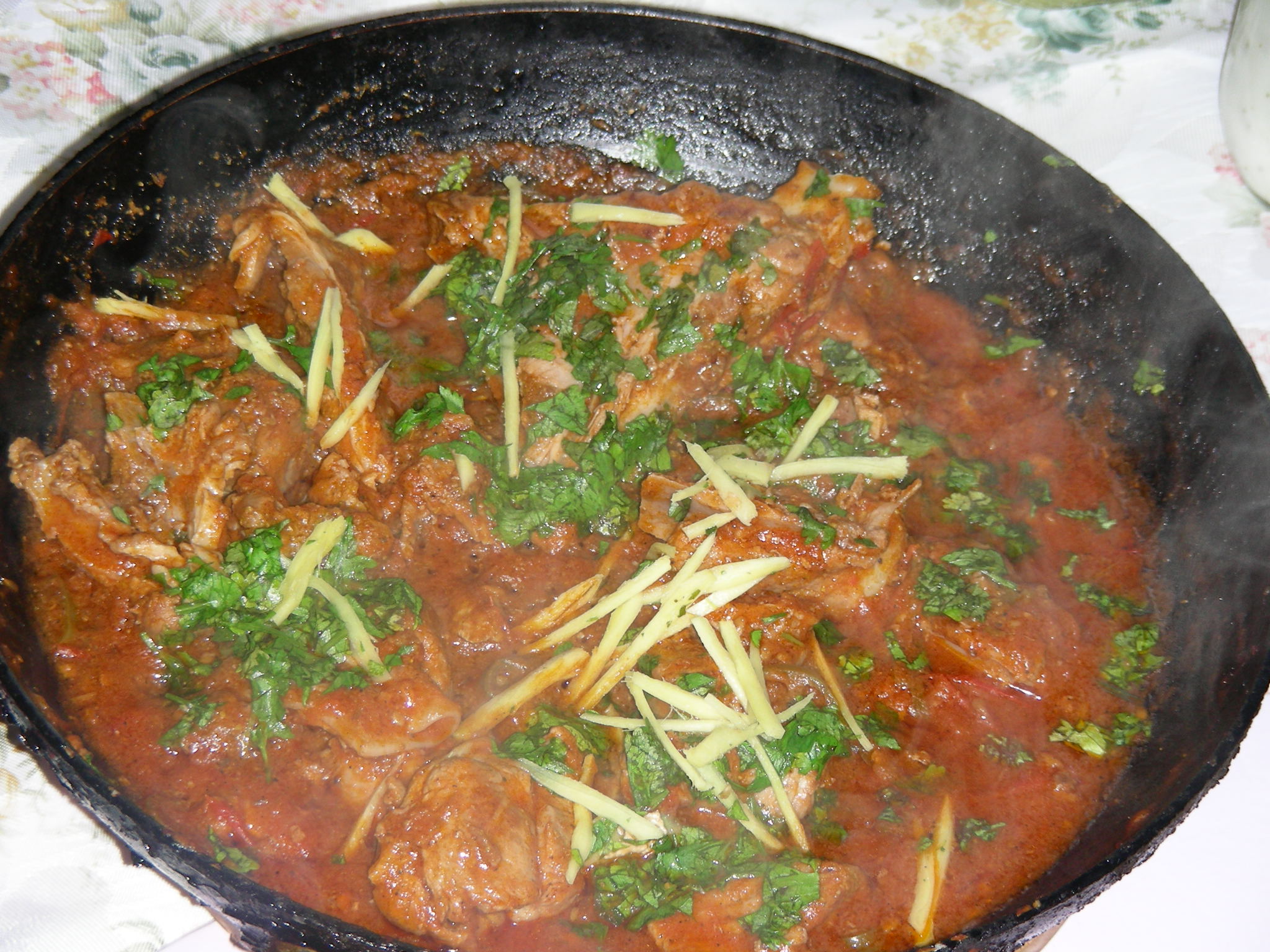
[[File:Balti gosht.jpg|thumb| | [[File:Balti gosht.jpg|thumb|''Balti gosht'' with lamb in the thin pressed-steel balti bowl, in the United Kingdom]] | ||
A '''balti''' or '''bāltī gosht''' ({{ | A '''balti''' or '''bāltī gosht''' ({{langx|ur|{{Nastaliq|بالٹی گوشت}}}}, {{langx|hi|बाल्टी गोश्त}}) is a type of [[Curry in the United Kingdom|curry within the United Kingdom]] served in a thin, pressed-steel [[wok]] called a balti bowl. Balti curries are cooked quickly using [[vegetable oil]] rather than [[ghee]], over high heat in the manner of a stir-fry, and any meat is used off the bone. Balti sauce is based on [[garlic]] and [[onion]]s, with spices including [[turmeric]] and [[garam masala]]. The dish was developed in [[Birmingham]], England in the 1970s. A region of Birmingham with many balti restaurants has become known as the '''Balti Triangle'''. An application was made to the [[European Union]] to make "Birmingham Balti" a [[traditional speciality guaranteed]] product; the application failed because the allowed variations were not precisely defined. | ||
== Origin == | |||
== | === Baltistan === | ||
[[File:Yedam and Khanum Balti, Selly Oak, Birmingham.jpg|thumb|upright|It is claimed that balti was invented in [[Birmingham]]. A balti house is shown.<ref name="Roy"/>]] | |||
The food writer [[Pat Chapman (food writer)|Pat Chapman]] believed that balti [[curry]] could be traced to the area of [[Baltistan]], in Northern [[Kashmir]], and in 1998 published a book, ''Balti Bible'', about the supposed cuisine.<ref name="Roy"/><ref>{{cite book |last=Chapman |first=Pat |author-link=Pat Chapman (food writer) |title=Pat Chapman's Balti Bible |publisher=[[Hodder & Stoughton]] |location=London |year=1998 |isbn=0-340-72858-2}}</ref> Adil's restaurant in Stoney Lane, [[Sparkbrook]], a district of Birmingham, founded in 1977, called itself "the home of Balti Cuisine", stating that its dishes followed the traditions of Northern Kashmir.<ref>{{cite web |url=http://www.adilbalti.co.uk/ |title=Welcome to Adil — The Home of Balti Cuisine |publisher=Adil's |access-date=31 December 2012 |url-status=dead |archive-url=https://web.archive.org/web/20120518161430/http://www.adilbalti.co.uk/ |archive-date=18 May 2012}}</ref><ref name=BBCBalti>{{cite web |last=Warwicker |first=Michelle |title=What makes the Birmingham Balti unique? |url=https://www.bbc.co.uk/news/uk-england-birmingham-18494918 |publisher=[[BBC]] |access-date=15 November 2015 |quote="People like (it)... sizzling and hot and with the naan bread," said Mohammed Arif, owner of Adil Balti and Tandoori Restaurant, in the Balti Triangle in Birmingham. Mr Arif claims to be first man to introduce the balti to Britain—after bringing the idea from Kashmir—when he opened his restaurant in 1977. He said that before he "recommended the balti in the UK" in the late '70s, "there was different curry" in Britain, "not like this fresh cooking one".}}</ref> However, the Canadian food writer [[Colleen Taylor Sen]] states that balti's origins are unclear, as the food eaten in Baltistan "bears no resemblance" to balti curry.<ref name="Sen2009"/> A typical [[Gilgit-Baltistan]] dish is ''rdoong balay'', a stew made of ground wheat, potatoes, <!--blue and black -->peas, and spices.<ref>{{cite news |last=Ali |first=Nisar |title=Eid Al-Fitr with a centuries-old stew |url=https://www.arabnews.com/node/2075911/%7B%7B |newspaper=[[Arab News]] |access-date=2 December 2025 |date=5 May 2022}}</ref> | |||
=== Balti cooking pot === | |||
== | Sen suggests instead that the name of the food may have originated from the fact that it is cooked in a pot named a ''baltī'', similar to a [[karahi]].<ref name="Sen2009">{{cite book |last=Sen |first=Colleen Taylor |title=Curry: A Global History |date=15 November 2009 |publisher=[[Reaktion Books]] |isbn=978-1861897046 |page=50 |quote=Its origins are unclear. Some claim it originated in Baltistan, a province high in the Pakistan Himalayas, although the food there bears no resemblance to balti cuisine. Another explanation is that the word ''balti'' means bucket in Hindi, perhaps a reference to the wok-like pot called a ''karahi'' or ''karhai''.}}</ref><ref name="Khanna2013">{{cite book |last=Khanna |first=Vikas |title=Savour Mumbai: A Culinary Journey Through India's Melting Pot |date=25 July 2013 |publisher=[[Westland Books]] |isbn=978-9382618959 |page=327 |quote=Balti Gosht (Wok Cooked Mutton): Balti cooking has taken the UK by storm. ''Balti'' in Hindi means bucket, but here it refers to a small pot or ''kadhai'' (wok) in which a dish is cooked and served.}}</ref> The word "balti" is the [[Hindi]] for "bucket", from the [[Portuguese language|Portuguese]] {{lang|pt|balde}} of the same meaning.<ref>{{cite dictionary |last=Yule |first=Henry |author-link=Henry Yule |chapter=Balty |page=54 |chapter-url=https://dsal.uchicago.edu/cgi-bin/app/hobsonjobson_query.py?qs=BALTY&searchhws=yes&matchtype=exact |title=Hobson-Jobson: A glossary of colloquial Anglo-Indian words and phrases, and of kindred terms, etymological, historical, geographical and discursive |title-link=Hobson-Jobson |location=London |publisher=[[John Murray (publishing house)|John Murray]] |year=1903 |edition=New |orig-year=1886}}</ref><ref name="Hindu">{{cite news |url=http://www.hindu.com/thehindu/mp/2003/07/17/stories/2003071700130200.htm |archive-url=https://web.archive.org/web/20041226192245/http://www.hindu.com/thehindu/mp/2003/07/17/stories/2003071700130200.htm |url-status=dead |archive-date=26 December 2004|title=Baltistan's mystery food |work=[[The Hindu]] |date=17 July 2003 |access-date=18 April 2013}}</ref> It is claimed that the thin steel balti wok was, like the curry, invented and manufactured in Birmingham in the 1970s, differing from traditional heavy [[cast iron]] cooking pots.<ref name="McComb 2009"/> | ||
[[ | |||
'' | |||
=== A piece of marketing === | |||
''Balti'' | However, some balti restaurateurs of Birmingham have claimed that they invented the dish to please their white British clientele. The British-Pakistani scholar of culture [[Ziauddin Sardar]] describes the invention as a triumph of [[marketing]], making balti houses seem more authentic than "the bog-standard confines of curry and ''[[vindaloo]]''<!--his italics-->". Sardar comments that he personally cannot tell balti from other curries.<ref name="Sardar 2012">{{cite book |last=Sardar |first=Ziauddin |chapter=Eating Balti |year=2009 |title=Balti Britain: A Provocative Journey through Asian Britain |location=London |publisher=[[Granta Books]] |isbn=978-1847080820 |pages=11–37}}</ref> The scholar of food Parama Roy, citing Sardar, adds that the success of the marketing effort "is evidenced by the publication of the ''Balti Bible'' by Pat Chapman".<ref name="Roy">{{cite book |last=Roy |first=Parama |title=Routledge Handbook of Asian Diaspora and Development Media, culture and representations |url=https://ebrary.net/173954/education/food_south_asian_diaspora |chapter=Food in the South Asian Diaspora |quote=[Ziauddin] Sardar notes with relish that the Balti food phenomenon is a superb feat of marketing, lifting the curry house 'from the bog-standard confines of curry and vindaloo' to give it a more upmarket sheen of authenticity. That such a gambit triumphed is evidenced by the publication of the Balti Bible by Pat Chapman}}</ref> The historian of food [[Lizzie Collingham]] and the ''[[Oxford English Dictionary]]'' concur that Pakistani restaurateurs invented balti in Birmingham.<ref name="Collingham 2007">{{cite book |last=Collingham |first=Lizzie |author-link=Lizzie Collingham |title=Curry: A Tale of Cooks and Conquerors |date=2007 |publisher=[[Oxford University Press]] |url=https://archive.org/details/curry00lizz |page=232}}</ref><ref name="OED 2009">{{cite web |title=Wordhunt appeal list Balderdash Wordhunt |url=http://oed.com/bbcwordhunt/list.html#balti |url-status=dead |archive-url=https://web.archive.org/web/20090709215254/http://www.oed.com/bbcwordhunt/list.html#balti |archive-date=9 July 2009 |access-date=8 June 2009 |publisher=[[Oxford English Dictionary]]}}</ref> In 2014, the Indian cook [[Madhur Jaffrey]] described the balti style of cooking as a "craze with no authentic origins which will slowly die as people's tastes turn to more complex dishes".<ref name="Roy"/> | ||
== Dish == | |||
[[File:Chicken Balti Bhuna.jpg|thumb|Balti chicken [[takeaway]] with rice and [[naan]] in [[Edinburgh]], Scotland]] | |||
A balti curry as originally cooked in Birmingham is stir-fried in very hot [[vegetable oil]] rather than [[ghee]]. The base of the curry is [[onion]] or [[tomato]], mixed with [[garlic]] and [[ginger]], and spiced with [[cumin]], [[fenugreek]], [[garam masala]], and [[turmeric]]; the meat is usually chicken or lamb.<ref name="McComb 2009">{{cite news |first=Richard |last=McComb |title=Balti making a big comeback in Birmingham |newspaper=[[Birmingham Post]] |date=20 February 2009 |access-date=16 June 2016 |url=http://www.balti-birmingham.co.uk/about-balti/bpost-on-the-balti |url-status=dead |archive-url=https://web.archive.org/web/20150930024842/http://www.balti-birmingham.co.uk/about-balti/bpost-on-the-balti|archive-date=30 September 2015}}</ref> | |||
== | Collingham writes that despite the supposed Kashmir origin, "the restaurant balti unashamedly makes a virtue out of restaurant short cuts."<ref name="Collingham 2007"/> She describes the dish as using meat which has been marinated and then pre-cooked. A separately prepared sauce is "a version of Indian restaurant curry sauce".<ref name="Collingham 2007"/> She lists both onions and tomatoes as ingredients, and describes fresh [[coriander]] as "important".<ref name="Collingham 2007"/> The mix of oil-fried spices can be varied. Finally, she states that variations are created by adding a choice of alternative ingredients such as fenugreek, [[lentil]]s, or pieces of [[pineapple]].<ref name="Collingham 2007"/> | ||
== Balti houses == | |||
*[[ | |||
{{see also|Curry in the United Kingdom}} | |||
Balti restaurants are often known in Birmingham as 'balti houses'.<ref name="McComb 2009"/> These typically offer large ''karack'' [[naan]] bread pieces, to be shared by the whole table.<ref>{{cite news |url=http://www.independent.co.uk/travel/uk/birmingham--the-latest-hot-destination-for-foodies-525778.html |archive-url=https://web.archive.org/web/20081204100757/http://www.independent.co.uk/travel/uk/birmingham--the-latest-hot-destination-for-foodies-525778.html |url-status=dead |archive-date=4 December 2008 |first=Mark |last=Rowe |date=12 February 2006 |title=Birmingham, the latest hot destination for foodies |newspaper=[[The Independent]] }}</ref> Some 50<ref name="McComb 2009"/> balti houses were originally clustered along and behind the main road between [[Sparkhill]] and [[Moseley]], to the south of Birmingham city centre. This area, comprising Ladypool Road, Stoney Lane, and Stratford Road, is sometimes called the '''Balti Triangle''', as it contains a high concentration of balti restaurants. On 28 July 2005, a [[Birmingham Tornado (UK)|tornado]] caused extensive damage to buildings in the triangle,<ref>{{cite web |url=http://www.birmingham.gov.uk/tornado |publisher=Birmingham City Council |title=Birmingham Tornado |archive-url=https://web.archive.org/web/20110514001949/http://www.birmingham.gov.uk/tornado |archive-date=14 May 2011 |url-status=dead}}</ref> forcing many restaurants to close. Most reopened by the beginning of 2006 but by 2023 only four remained.<ref>{{cite news |last=Murray |first=Jessica |date=2023-05-31 |title='The culture has changed': end of the boom for Birmingham's Balti Triangle |newspaper=[[The Guardian]] |url=https://www.theguardian.com/uk-news/2023/may/31/the-culture-has-changed-end-of-the-boom-for-birminghams-balti-triangle |access-date=4 June 2023}}</ref><ref name="Bosley 2022">{{cite magazine |last=Bosley |first=Kirsty |title=A brief history of the Birmingham balti, and where to find it |url=https://www.thegoodfoodguide.co.uk/editorial/features/a-brief-history-of-the-birmingham-balti-and-where-to-find-it- |magazine=[[The Good Food Guide]] |access-date=13 December 2025 |date=10 August 2022}}</ref> | |||
Since the late 1990s, British supermarkets have stocked a growing range of prepacked balti meals, and the balti restaurant sector has faced increasing competition both from retail and from changes in customer tastes.<ref>{{cite web|url=https://www.independent.co.uk/news/has-the-great-british-curry-house-finally-had-its-chips-1070723.html |title=Has the great British curry house finally had its chips? |website=[[The Independent]] |date=14 February 1999 |access-date=16 June 2016}}</ref><ref>{{cite web |url=http://chaisamosa.net/index.php/business-update/20090306998/indian-restaurants-urge-british-government-to-help-as-recession-bites/menu-id-386html |archive-url=https://web.archive.org/web/20100813144957/http://chaisamosa.net/index.php/business-update/20090306998/indian-restaurants-urge-british-government-to-help-as-recession-bites/menu-id-386html |url-status=dead |archive-date=13 August 2010 |title=Indian restaurants seek government help as recession bites |website=Chai Samosa |date=6 March 2009}}</ref> | |||
== Application for EU protected status == | |||
In 2012, the Birmingham Balti Association applied to the [[European Union]] to make "Birmingham Balti" a [[traditional speciality guaranteed]] (TSG) product, claiming that two features made it distinctive, namely cooking with vegetable oil, and incorporating each ingredient separately while the stir-frying.<ref>{{cite news |date=19 June 2012 |title=Birmingham Balti curry seeks EU protected status |work=[[BBC News]] |url=https://www.bbc.co.uk/news/uk-england-birmingham-18490695 |url-status=live |access-date=22 October 2013 |archive-url=https://web.archive.org/web/20140208031921/http://www.bbc.co.uk/news/uk-england-birmingham-18490695 |archive-date=8 February 2014}}</ref> The application was pursued until 2016 but failed. The reason for rejecting the application was that the dish was not cooked to a standard recipe, or as the EU stated:<ref name="Probert 2016">{{cite news |last=Probert |first=Sarah |title=EU blasted for being 'anti British' after Birmingham fails to win protection for balti |url=https://www.birminghammail.co.uk/whats-on/food-drink-news/eu-blasted-being-anti-british-11371244 |access-date=2 December 2025 |newspaper=[[Birmingham Mail|Birmingham Live]] |date=23 May 2016}}</ref> | |||
{{blockquote|Some different varieties of balti are allowed; those varieties are not definitively identified. The colour of the dish changes (either lighter brown or more reddish) depending on which ingredients are added. The additional ingredients and spices may but not have to be added. It is therefore not possible to determine what the final recipe to be followed is.<ref name="Probert 2016"/>}} | |||
== See also == | |||
* [[Chicken tikka masala]] | |||
== References == | |||
{{reflist|28em}} | {{reflist|28em}} | ||
==Further reading== | == Further reading == | ||
* ''Curry Club Balti Curry Cookbook'', [[Piatkus]], London — {{ISBN|0-7499-1214-6}} & {{ISBN|0-7499-1342-8}} (1993) | * ''Curry Club Balti Curry Cookbook'', [[Piatkus]], London — {{ISBN|0-7499-1214-6}} & {{ISBN|0-7499-1342-8}} (1993) | ||
* ''Modern Balti Curries'', | ** republished as ''Modern Balti Curries'', [[John Blake Publishing]], London (2006) | ||
* ''[[Pat Chapman]] | * ''[[Pat Chapman (food writer)|Pat Chapman]]'s Balti Bible'', [[Hodder & Stoughton]], London — {{ISBN|0-340-72858-2}} & {{ISBN|0-340-72859-0}} (1998) | ||
* ''2009 [[Cobra Beer|Cobra]] Good Curry Guide'', [[John Blake Publishing]], London — {{ISBN|1-84454-311-0}} | * ''2009 [[Cobra Beer|Cobra]] Good Curry Guide'', [[John Blake Publishing]], London — {{ISBN|1-84454-311-0}} | ||
==External links== | ==External links== | ||
{{ | {{Curry in the United Kingdom}} | ||
{{ | {{Pakistani dishes}} | ||
[[Category: | [[Category:British cuisine]] | ||
[[Category:Culture in Birmingham, West Midlands]] | [[Category:Culture in Birmingham, West Midlands]] | ||
[[Category:Curry in the United Kingdom]] | [[Category:Curry in the United Kingdom]] | ||
Latest revision as of 15:22, 16 February 2026

A balti or bāltī gosht (Script error: The function "langx" does not exist., Script error: The function "langx" does not exist.) is a type of curry within the United Kingdom served in a thin, pressed-steel wok called a balti bowl. Balti curries are cooked quickly using vegetable oil rather than ghee, over high heat in the manner of a stir-fry, and any meat is used off the bone. Balti sauce is based on garlic and onions, with spices including turmeric and garam masala. The dish was developed in Birmingham, England in the 1970s. A region of Birmingham with many balti restaurants has become known as the Balti Triangle. An application was made to the European Union to make "Birmingham Balti" a traditional speciality guaranteed product; the application failed because the allowed variations were not precisely defined.
Origin[edit | edit source]
Baltistan[edit | edit source]

The food writer Pat Chapman believed that balti curry could be traced to the area of Baltistan, in Northern Kashmir, and in 1998 published a book, Balti Bible, about the supposed cuisine.[1][2] Adil's restaurant in Stoney Lane, Sparkbrook, a district of Birmingham, founded in 1977, called itself "the home of Balti Cuisine", stating that its dishes followed the traditions of Northern Kashmir.[3][4] However, the Canadian food writer Colleen Taylor Sen states that balti's origins are unclear, as the food eaten in Baltistan "bears no resemblance" to balti curry.[5] A typical Gilgit-Baltistan dish is rdoong balay, a stew made of ground wheat, potatoes, peas, and spices.[6]
Balti cooking pot[edit | edit source]
Sen suggests instead that the name of the food may have originated from the fact that it is cooked in a pot named a baltī, similar to a karahi.[5][7] The word "balti" is the Hindi for "bucket", from the Portuguese balde of the same meaning.[8][9] It is claimed that the thin steel balti wok was, like the curry, invented and manufactured in Birmingham in the 1970s, differing from traditional heavy cast iron cooking pots.[10]
A piece of marketing[edit | edit source]
However, some balti restaurateurs of Birmingham have claimed that they invented the dish to please their white British clientele. The British-Pakistani scholar of culture Ziauddin Sardar describes the invention as a triumph of marketing, making balti houses seem more authentic than "the bog-standard confines of curry and vindaloo". Sardar comments that he personally cannot tell balti from other curries.[11] The scholar of food Parama Roy, citing Sardar, adds that the success of the marketing effort "is evidenced by the publication of the Balti Bible by Pat Chapman".[1] The historian of food Lizzie Collingham and the Oxford English Dictionary concur that Pakistani restaurateurs invented balti in Birmingham.[12][13] In 2014, the Indian cook Madhur Jaffrey described the balti style of cooking as a "craze with no authentic origins which will slowly die as people's tastes turn to more complex dishes".[1]
Dish[edit | edit source]

A balti curry as originally cooked in Birmingham is stir-fried in very hot vegetable oil rather than ghee. The base of the curry is onion or tomato, mixed with garlic and ginger, and spiced with cumin, fenugreek, garam masala, and turmeric; the meat is usually chicken or lamb.[10]
Collingham writes that despite the supposed Kashmir origin, "the restaurant balti unashamedly makes a virtue out of restaurant short cuts."[12] She describes the dish as using meat which has been marinated and then pre-cooked. A separately prepared sauce is "a version of Indian restaurant curry sauce".[12] She lists both onions and tomatoes as ingredients, and describes fresh coriander as "important".[12] The mix of oil-fried spices can be varied. Finally, she states that variations are created by adding a choice of alternative ingredients such as fenugreek, lentils, or pieces of pineapple.[12]
Balti houses[edit | edit source]
Balti restaurants are often known in Birmingham as 'balti houses'.[10] These typically offer large karack naan bread pieces, to be shared by the whole table.[14] Some 50[10] balti houses were originally clustered along and behind the main road between Sparkhill and Moseley, to the south of Birmingham city centre. This area, comprising Ladypool Road, Stoney Lane, and Stratford Road, is sometimes called the Balti Triangle, as it contains a high concentration of balti restaurants. On 28 July 2005, a tornado caused extensive damage to buildings in the triangle,[15] forcing many restaurants to close. Most reopened by the beginning of 2006 but by 2023 only four remained.[16][17]
Since the late 1990s, British supermarkets have stocked a growing range of prepacked balti meals, and the balti restaurant sector has faced increasing competition both from retail and from changes in customer tastes.[18][19]
Application for EU protected status[edit | edit source]
In 2012, the Birmingham Balti Association applied to the European Union to make "Birmingham Balti" a traditional speciality guaranteed (TSG) product, claiming that two features made it distinctive, namely cooking with vegetable oil, and incorporating each ingredient separately while the stir-frying.[20] The application was pursued until 2016 but failed. The reason for rejecting the application was that the dish was not cooked to a standard recipe, or as the EU stated:[21]
Some different varieties of balti are allowed; those varieties are not definitively identified. The colour of the dish changes (either lighter brown or more reddish) depending on which ingredients are added. The additional ingredients and spices may but not have to be added. It is therefore not possible to determine what the final recipe to be followed is.[21]
See also[edit | edit source]
References[edit | edit source]
- ↑ 1.0 1.1 1.2 1.3 Roy, Parama. "Food in the South Asian Diaspora". Routledge Handbook of Asian Diaspora and Development Media, culture and representations.
[Ziauddin] Sardar notes with relish that the Balti food phenomenon is a superb feat of marketing, lifting the curry house 'from the bog-standard confines of curry and vindaloo' to give it a more upmarket sheen of authenticity. That such a gambit triumphed is evidenced by the publication of the Balti Bible by Pat Chapman
- ↑ Chapman, Pat (1998). Pat Chapman's Balti Bible. London: Hodder & Stoughton. ISBN 0-340-72858-2.
- ↑ "Welcome to Adil — The Home of Balti Cuisine". Adil's. Archived from the original on 18 May 2012. Retrieved 31 December 2012.
- ↑ Warwicker, Michelle. "What makes the Birmingham Balti unique?". BBC. Retrieved 15 November 2015.
"People like (it)... sizzling and hot and with the naan bread," said Mohammed Arif, owner of Adil Balti and Tandoori Restaurant, in the Balti Triangle in Birmingham. Mr Arif claims to be first man to introduce the balti to Britain—after bringing the idea from Kashmir—when he opened his restaurant in 1977. He said that before he "recommended the balti in the UK" in the late '70s, "there was different curry" in Britain, "not like this fresh cooking one".
- ↑ 5.0 5.1 Sen, Colleen Taylor (15 November 2009). Curry: A Global History. Reaktion Books. p. 50. ISBN 978-1861897046.
Its origins are unclear. Some claim it originated in Baltistan, a province high in the Pakistan Himalayas, although the food there bears no resemblance to balti cuisine. Another explanation is that the word balti means bucket in Hindi, perhaps a reference to the wok-like pot called a karahi or karhai.
- ↑ Ali, Nisar (5 May 2022). "Eid Al-Fitr with a centuries-old stew". Arab News. Retrieved 2 December 2025.
- ↑ Khanna, Vikas (25 July 2013). Savour Mumbai: A Culinary Journey Through India's Melting Pot. Westland Books. p. 327. ISBN 978-9382618959.
Balti Gosht (Wok Cooked Mutton): Balti cooking has taken the UK by storm. Balti in Hindi means bucket, but here it refers to a small pot or kadhai (wok) in which a dish is cooked and served.
- ↑ Yule, Henry (1903) [1886]. "Balty". Hobson-Jobson: A glossary of colloquial Anglo-Indian words and phrases, and of kindred terms, etymological, historical, geographical and discursive (New ed.). London: John Murray. p. 54.
- ↑ "Baltistan's mystery food". The Hindu. 17 July 2003. Archived from the original on 26 December 2004. Retrieved 18 April 2013.
- ↑ 10.0 10.1 10.2 10.3 McComb, Richard (20 February 2009). "Balti making a big comeback in Birmingham". Birmingham Post. Archived from the original on 30 September 2015. Retrieved 16 June 2016.
- ↑ Sardar, Ziauddin (2009). "Eating Balti". Balti Britain: A Provocative Journey through Asian Britain. London: Granta Books. pp. 11–37. ISBN 978-1847080820.
- ↑ 12.0 12.1 12.2 12.3 12.4 Collingham, Lizzie (2007). Curry: A Tale of Cooks and Conquerors. Oxford University Press. p. 232.
- ↑ "Wordhunt appeal list Balderdash Wordhunt". Oxford English Dictionary. Archived from the original on 9 July 2009. Retrieved 8 June 2009.
- ↑ Rowe, Mark (12 February 2006). "Birmingham, the latest hot destination for foodies". The Independent. Archived from the original on 4 December 2008.
- ↑ "Birmingham Tornado". Birmingham City Council. Archived from the original on 14 May 2011.
- ↑ Murray, Jessica (31 May 2023). "'The culture has changed': end of the boom for Birmingham's Balti Triangle". The Guardian. Retrieved 4 June 2023.
- ↑ Bosley, Kirsty (10 August 2022). "A brief history of the Birmingham balti, and where to find it". The Good Food Guide. Retrieved 13 December 2025.
- ↑ "Has the great British curry house finally had its chips?". The Independent. 14 February 1999. Retrieved 16 June 2016.
- ↑ "Indian restaurants seek government help as recession bites". Chai Samosa. 6 March 2009. Archived from the original on 13 August 2010.
- ↑ "Birmingham Balti curry seeks EU protected status". BBC News. 19 June 2012. Archived from the original on 8 February 2014. Retrieved 22 October 2013.
- ↑ 21.0 21.1 Probert, Sarah (23 May 2016). "EU blasted for being 'anti British' after Birmingham fails to win protection for balti". Birmingham Live. Retrieved 2 December 2025.
Further reading[edit | edit source]
- Curry Club Balti Curry Cookbook, Piatkus, London — ISBN 0-7499-1214-6 & ISBN 0-7499-1342-8 (1993)
- republished as Modern Balti Curries, John Blake Publishing, London (2006)
- Pat Chapman's Balti Bible, Hodder & Stoughton, London — ISBN 0-340-72858-2 & ISBN 0-340-72859-0 (1998)
- 2009 Cobra Good Curry Guide, John Blake Publishing, London — ISBN 1-84454-311-0
External links[edit | edit source]
Template:Curry in the United Kingdom
Pakistani dishes by cuisine and region | |||||
|---|---|---|---|---|---|
| Balochi |  | ||||
| Gilgiti | |||||
| Muhajir |
| ||||
| Pashtun | |||||
| Punjabi |
| ||||
| Saraiki | |||||
| Sindhi | |||||
| Common dishes |
| ||||
| Pakistani diaspora | |||||