

m Removed empty portal template using script |
Dutchhoek11 (talk | contribs) improved intro to improve readability |
||
| Line 1: | Line 1: | ||
{{short description| | {{short description|Ancient Indian lower body garment}} | ||
An '''antariya''' ({{ | [[File:Raja Ravi Varma - Mahabharata - Shakuntala.jpg|thumb|Painting of [[Shakuntala]] and her friends wearing an antariya, Raja Ravi Varma.]] | ||
An '''antariya''' ({{Transliteration|sa|ISO|antarīya}}) is a lower body garment from [[ancient India]]. It is a long white or coloured strip of cotton passed through the legs, tucked at the back and covering the legs loosely, then flowing into long pleats at front of the legs.<ref name=":0">{{Cite book|last1=Nair|first1=Rukmini Bhaya|url=https://books.google.com/books?id=u6XFDwAAQBAJ&q=An+antariya+is+a+lower+garment+from+ancient+India.&pg=PT94|title=Keywords for India: A Conceptual Lexicon for the 21st Century|last2=deSouza|first2=Peter Ronald|date=2020-02-20|publisher=Bloomsbury Publishing|isbn=978-1-350-03925-4|language=en}}</ref><ref name=":1">{{Cite book|last=Mehta|first=Tarla|url=https://books.google.com/books?id=l7naMj1UxIkC&q=An+antariya+is+a+lower+garment+from+ancient+India.&pg=PA172|title=Sanskrit Play Production in Ancient India|date=1995|publisher=Motilal Banarsidass Publ.|isbn=978-81-208-1057-0|language=en}}</ref><ref name=":2">{{Cite book|last=Ayyar|first=Sulochana|url=https://books.google.com/books?id=G9eHPXL6UE0C&q=An+antariya+is+a+lower+garment+from+ancient+India.&pg=PA62|title=Costumes and Ornaments as Depicted in the Sculptures of Gwalior Museum|date=1987|publisher=Mittal Publications|isbn=978-81-7099-002-4|pages=62|language=en}}</ref><ref>{{Cite book|last1=Shastri|first1=Ajay Mitra|url=https://books.google.com/books?id=NhVWAAAAYAAJ&q=An+antariya+is+a+lower+garment+from+ancient+India.|title=Ancient Indian Heritage, Varahamihira's India: Historical geography, religion, and society|last2=Varāhamihira|date=1996|publisher=Aryan Books International|isbn=978-81-7305-081-7|pages=224|language=en}}</ref> | |||
== History == | == History == | ||
The antariya is an ancient garment mentioned in the ''[[Ramayana]]'' and the ''[[Mahabharata]]''.<ref>{{Cite book|last=McLain|first=Karline|url=https://books.google.com/books?id=V4-Su0whKa0C&q=An+antariya+is+a+lower+garment+from+ancient+India.&pg=PA72|title=India's Immortal Comic Books: Gods, Kings, and Other Heroes|date=2009|publisher=Indiana University Press|isbn=978-0-253-22052-3|pages=72|language=en}}</ref> Hindu deities can be seen wearing the [[uttariya]] and the antariya in [[sculpture in the Indian subcontinent|sculptures in the Indian subcontinent]],<ref>{{Cite book|url=https://books.google.com/books?id=XmhDAAAAYAAJ&q=An+antariya+is+a+lower+garment+from+ancient+India.|title=Ancient India|date=1950|publisher=Director General of Archaeology in India.|pages=37|language=en}}</ref> especially in [[Hindu temple]]s and other forms of [[Hindu iconography|iconography]]. | |||
As mentioned in Buddhist [[Pali]] literature during the 6th century BC, [[Sari]] | As mentioned in Buddhist [[Pali]] literature during the 6th century BC, [[Sari]] {{Transliteration|sa|ISO|śāṭikā}} ({{langx|sa|शाटिका}}) is an evolved form of the antariya, which was one of three-piece attire worn by women during the ancient period.<ref name=":0" /><ref name=":1" /><ref name=":2" /><ref>{{cite book|url=https://books.google.com/books?id=QO2BAAAAMAAJ&q=Stanapatta|page=35|title=Fashion Styles of Ancient India: A Study of Kalinga from Earliest Times to Sixteenth Century Ad|first=Ramesh |last=Prasad Mohapatra|publisher=B.R. Publishing Corporation|year=1992|isbn=9788170187233}}</ref><ref>Prachya Pratibha, 1978 "Prachya Pratibha, Volume 6", p. 121</ref><ref>Agam Kala Prakashan, 1991 "Costume, coiffure, and ornaments in the temple sculpture of northern Andhra", p. 118</ref> | ||
== Terminology == | == Terminology == | ||
The | The word antariya is of Sanskrit origin.<ref>{{Cite web|last=www.wisdomlib.org|date=2018-05-06|title=Antariya, Antarīya: 7 definitions|url=https://www.wisdomlib.org/definition/antariya|access-date=2020-12-09|website=www.wisdomlib.org}}</ref> | ||
== Use == | == Use == | ||
The antariya was usually made of fine cotton or silk. It was usually used in combination with the [[uttariya]]. | |||
== Gallery == | == Gallery == | ||
<gallery> | <gallery> | ||
File:Ajanta Paintings.jpg|Women in ''choli'' (blouse) and antariya {{circa|320 CE}}, [[Gupta Empire]] | File:Ajanta Paintings.jpg|Women in ''choli'' (blouse) and antariya {{circa|320 CE}}, [[Gupta Empire]] | ||
File:In Welcome of Buddha - ACCN 34-2542 - Government Museum - Mathura 2013-02-24 5941.JPG | File:In Welcome of Buddha - ACCN 34-2542 - Government Museum - Mathura 2013-02-24 5941.JPG|Relief depicting men in antariya and [[uttariya]], 1st century CE | ||
</gallery> | </gallery> | ||
== See also == | == See also == | ||
* [[Aprapadina]] | |||
* [[Uttariya]] | * [[Uttariya]] | ||
* [[Sari]] | * [[Sari]] | ||
*[[Choli]] | * [[Choli]] | ||
* [[Nivi (garment)]] | * [[Nivi (garment)]] | ||
| Line 35: | Line 38: | ||
{{Religion topics}} | {{Religion topics}} | ||
{{History of religions|state=collapsed}} | {{History of religions|state=collapsed}} | ||
{{Portal bar|Hinduism|India}} | |||
[[Category:History of Asian clothing]] | |||
[[Category:Indian clothing]] | [[Category:Indian clothing]] | ||
[[Category:Hindu religious clothing]] | [[Category:Hindu religious clothing]] | ||
Latest revision as of 20:03, 19 February 2026

An antariya (antarīya) is a lower body garment from ancient India. It is a long white or coloured strip of cotton passed through the legs, tucked at the back and covering the legs loosely, then flowing into long pleats at front of the legs.[1][2][3][4]
History[edit | edit source]
The antariya is an ancient garment mentioned in the Ramayana and the Mahabharata.[5] Hindu deities can be seen wearing the uttariya and the antariya in sculptures in the Indian subcontinent,[6] especially in Hindu temples and other forms of iconography.
As mentioned in Buddhist Pali literature during the 6th century BC, Sari śāṭikā (Sanskrit: शाटिका) is an evolved form of the antariya, which was one of three-piece attire worn by women during the ancient period.[1][2][3][7][8][9]
Terminology[edit | edit source]
The word antariya is of Sanskrit origin.[10]
Use[edit | edit source]
The antariya was usually made of fine cotton or silk. It was usually used in combination with the uttariya.
Gallery[edit | edit source]
-
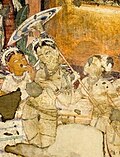 Women in choli (blouse) and antariya c. 320 CE, Gupta Empire
 -
 Relief depicting men in antariya and uttariya, 1st century CE


See also[edit | edit source]
References[edit | edit source]
- ↑ 1.0 1.1 Nair, Rukmini Bhaya; deSouza, Peter Ronald (2020-02-20). Keywords for India: A Conceptual Lexicon for the 21st Century. Bloomsbury Publishing. ISBN 978-1-350-03925-4.
- ↑ 2.0 2.1 Mehta, Tarla (1995). Sanskrit Play Production in Ancient India. Motilal Banarsidass Publ. ISBN 978-81-208-1057-0.
- ↑ 3.0 3.1 Ayyar, Sulochana (1987). Costumes and Ornaments as Depicted in the Sculptures of Gwalior Museum. Mittal Publications. p. 62. ISBN 978-81-7099-002-4.
- ↑ Shastri, Ajay Mitra; Varāhamihira (1996). Ancient Indian Heritage, Varahamihira's India: Historical geography, religion, and society. Aryan Books International. p. 224. ISBN 978-81-7305-081-7.
- ↑ McLain, Karline (2009). India's Immortal Comic Books: Gods, Kings, and Other Heroes. Indiana University Press. p. 72. ISBN 978-0-253-22052-3.
- ↑ Ancient India. Director General of Archaeology in India. 1950. p. 37.
- ↑ Prasad Mohapatra, Ramesh (1992). Fashion Styles of Ancient India: A Study of Kalinga from Earliest Times to Sixteenth Century Ad. B.R. Publishing Corporation. p. 35. ISBN 9788170187233.
- ↑ Prachya Pratibha, 1978 "Prachya Pratibha, Volume 6", p. 121
- ↑ Agam Kala Prakashan, 1991 "Costume, coiffure, and ornaments in the temple sculpture of northern Andhra", p. 118
- ↑ www.wisdomlib.org (2018-05-06). "Antariya, Antarīya: 7 definitions". www.wisdomlib.org. Retrieved 2020-12-09.


| Philosophy |
|  | |||||||||||||||
|---|---|---|---|---|---|---|---|---|---|---|---|---|---|---|---|---|---|
| Texts |
| ||||||||||||||||
| Deities |
| ||||||||||||||||
| Practices |
| ||||||||||||||||
| Related | |||||||||||||||||


