








m Removing protection template from an unprotected page |
small fixed formatting and fixed typos |
||
| Line 1: | Line 1: | ||
{{ | {{Short description|Municipality and largest city in China}} | ||
{{Other uses}} | {{Other uses}} | ||
{{pp-move}} | |||
{{good article}} | {{good article}} | ||
{{ | {{Use dmy dates|date=February 2026}} | ||
{{use | {{use British English|date=November 2025}} | ||
{{Infobox settlement | {{Infobox settlement | ||
| name = Shanghai | | name = Shanghai | ||
| native_name = | | native_name = 上海市 | ||
| native_name_lang = zh | <!-- |other_name = Huangpu (Whangpoo) -->| native_name_lang = zh | ||
| settlement_type = [[Direct-administered | | settlement_type = [[Direct-administered municipality|Municipality]] | ||
| image_skyline = {{multiple image | | image_skyline = {{multiple image | ||
| border = infobox | |border = infobox | ||
| total_width = 290 | |total_width = 290 | ||
| perrow = 1/2/2/2 | |perrow = 1/2/2/2 | ||
| caption_align = center | |caption_align = center | ||
| image1 = | |image1 = Huangpu Park 20124-Shanghai (32208802494).jpg | ||
| caption1 = | |caption1 = [[Lujiazui]] skyline from [[Suzhou Creek]] with the [[Oriental Pearl Tower]] (left) and [[Shanghai Tower]] (right) | ||
| image2 = Shanghai | |image2 = 2024-Apr Shanghai Yu Yuan Garden 豫园 - img 20.jpg | ||
| caption2 = [[Yu Garden]] | |caption2 = [[Yu Garden]] | ||
| image3 = | |image3 = 2024-Apr Shanghai East Nanjing Road morning 01.jpg | ||
| caption3 = [[ | |caption3 = [[Nanjing Road]] | ||
| image4 = 上海展览中心·上海.jpg | |image4 = 上海展览中心·上海.jpg | ||
| caption4 = [[Shanghai Exhibition Centre]] | |caption4 = [[Shanghai Exhibition Centre]] | ||
| image5 = | |image5 = Old City of Shanghai, China (December 2015) - 13.JPG | ||
| caption5 = [[ | |caption5 = [[Old City of Shanghai]] | ||
| image6 = | |image6 = The Bund, Shanghai, China (December 2015) - 08.JPG | ||
| caption6 = [[HSBC Building, the Bund|HSBC Building]] at [[The Bund]] | |caption6 = [[HSBC Building, the Bund|HSBC Building]] at [[The Bund]] | ||
| image7 = | |image7 = Jing'an Temple Shanghai 6.jpg | ||
| caption7 = [[Jing'an Temple]] | |caption7 = [[Jing'an Temple]] | ||
}} | }} | ||
| image_map = {{maplink|frame=yes|plain=yes|type=shape|stroke-width=2|stroke-color=#000000|zoom=7|frame-lat=31.22|frame-long=122.1}} | | image_map = {{maplink|frame=yes|plain=yes|type=shape|stroke-width=2|stroke-color=#000000|zoom=7|frame-lat=31.22|frame-long=122.1}} | ||
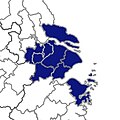
| image_map1 = Shanghai in China (+all claims hatched).svg | | image_map1 = Shanghai in China (+all claims hatched).svg | ||
| map_caption1 = Location of Shanghai Municipality in China | | map_caption1 = Location of Shanghai Municipality in China | ||
| coor_pinpoint = [[People's Square]] | | coor_pinpoint = [[People's Square (Shanghai)|People's Square]] | ||
| coordinates = {{coord|31|13| | | coordinates = {{coord|31|13|57|N|121|28|9|E|type:adm1st_region:CN-31|display=it}} | ||
| subdivision_type = Country | | subdivision_type = Country | ||
| subdivision_name = | | subdivision_name = China<!-- Per MOS:INFOBOXFLAG --> | ||
| subdivision_type2 = [[Region of China|Region]] | | subdivision_type2 = [[Region of China|Region]] | ||
| subdivision_name2 = [[East China]] | | subdivision_name2 = [[East China]] | ||
| | | seat_type = Municipal seat | ||
| | | seat = [[Huangpu District, Shanghai|Huangpu District]] | ||
| | | established_title = Establishment of<br /> - Qinglong Town | ||
| | | established_date = <br />746<ref name="kaogu" /> | ||
| established_title2 = - {{ill|Huating County (Tang)|lt=Huating County|zh|华亭县 (唐朝)}} | | established_title2 = - {{ill|Huating County (Tang)|lt=Huating County|zh|华亭县 (唐朝)}} | ||
| established_date2 = 751<ref>''New Book of Tang'', vol. 41 | | established_date2 = 751<ref>''New Book of Tang'', vol. 41: "Huating County, a greater county, established in the tenth year of Tianbao (751), which splits the Jiaxing Prefecture"</ref> | ||
| established_title3 = - [[Shanghai County]] | | established_title3 = - [[Shanghai County]] | ||
| established_date3 = 1292<ref>{{cite web |url = | | established_date3 = 1292<ref>{{cite web |url=https://www.shtong.gov.cn/difangzhi-front/book/detailNew?oneId=2&bookId=344775&parentNodeId=344806&nodeId=641941&type=-1 |publisher=Government of Shanghai |title=行政区划 (in Chinese) |access-date=4 January 2024 |archive-url=https://web.archive.org/web/20240505092811/https://www.shtong.gov.cn/difangzhi-front/book/detailNew?oneId=2&bookId=344775&parentNodeId=344806&nodeId=641940&type=-1%2A |archive-date=5 May 2024 |url-status=live }}</ref> | ||
| established_title4 = - Municipality | | established_title4 = - Municipality | ||
| established_date4 = 7 July 1927 | | established_date4 = 7 July 1927 | ||
| parts_type = Divisions<br /> - [[County-level division|County-level]]<br /> - [[Administrative divisions of the People's Republic of China#Township level|Township-<br />level]] | | parts_type = Divisions<br /> - [[County-level division|County-level]]<br /> - [[Administrative divisions of the People's Republic of China#Township level|Township-<br />level]] | ||
| parts = | | parts = {{ubl|[[List of administrative divisions of Shanghai|16 districts]]|210 towns and subdistricts}} | ||
| government_type = [[Direct-administered municipalities of China|Municipality]] | | government_type = [[Direct-administered municipalities of China|Municipality]] | ||
| | | governing_body = [[Shanghai Municipal People's Congress]] | ||
| leader_title = [[Party Secretary of Shanghai|Party Secretary]] | |||
| leader_title = [[ | |||
| leader_name = [[Chen Jining]] | | leader_name = [[Chen Jining]] | ||
| leader_title1 = [[Shanghai Municipal People's Congress|Congress]] | | leader_title1 = [[Shanghai Municipal People's Congress|Congress]] | ||
| leader_name1 = [[ | | leader_name1 = [[Huang Lixin]] | ||
| leader_title2 = [[List of mayors of Shanghai|Mayor]] | | leader_title2 = [[List of mayors of Shanghai|Mayor]] | ||
| leader_name2 = [[Gong Zheng]] | | leader_name2 = [[Gong Zheng]] | ||
| leader_title3 = | | leader_title3 = [[Shanghai Municipal Committee of the Chinese People's Political Consultative Conference|Municipal CPPCC]] Chairman | ||
| leader_name3 = [[Hu Wenrong]] | | leader_name3 = [[Hu Wenrong]] | ||
| leader_title4 = [[National People's Congress]] Representation | | leader_title4 = [[National People's Congress]] Representation | ||
| leader_name4 = 57 deputies | | leader_name4 = [[Shanghai delegation to the National People's Congress|57 deputies]] | ||
| total_type = Municipality | | total_type = Municipality | ||
| area_footnotes = <ref name="mofcom">{{cite web |title = Doing Business in China – Survey |url = http://english.mofcom.gov.cn/article/zt_business/lanmub/ |publisher = [[Ministry of Commerce of the People's Republic of China]] |access-date = 5 August 2013 |archive-url = https://web.archive.org/web/20140526181645/http://english.mofcom.gov.cn/article/zt_business/lanmub/ |archive-date = 26 May 2014 |url-status = | | area_footnotes = <ref name="mofcom">{{cite web |title=Doing Business in China – Survey |url=http://english.mofcom.gov.cn/article/zt_business/lanmub/ |publisher=[[Ministry of Commerce of the People's Republic of China]] |access-date=5 August 2013 |archive-url=https://web.archive.org/web/20140526181645/http://english.mofcom.gov.cn/article/zt_business/lanmub/ |archive-date=26 May 2014 |url-status=dead }}</ref><ref name="landarea">{{cite web |url=http://www.shanghai.gov.cn/shanghai/node23919/node24059/node24061/userobject22ai36484.html |title=地域 (in Chinese) |publisher=Government of Shanghai |access-date=4 January 2024 |archive-url=https://web.archive.org/web/20240508135319/https://www.shtong.gov.cn/difangzhi-front/book/detailNew?oneId=2&bookId=344775&parentNodeId=344806&nodeId=641940&type=-1 |archive-date=8 May 2024 |url-status=live }}</ref><ref>{{cite web |url=https://www.shtong.gov.cn/difangzhi-front/book/detailNew?oneId=2&bookId=344775&parentNodeId=344806&nodeId=641942&type=-1 |publisher=Government of Shanghai |title=水文 (in Chinese) |access-date=4 January 2024 |archive-url=https://web.archive.org/web/20240508141431/https://www.shtong.gov.cn/difangzhi-front/book/detailNew?oneId=2&bookId=344775&parentNodeId=344806&nodeId=641942&type=-1 |archive-date=8 May 2024 |url-status=live }}</ref> | ||
| area_total_km2 = 6341 | | area_total_km2 = 6341 | ||
| area_water_km2 = 653 | |||
| area_water_km2 = | |||
| area_metro_km2 = 14922.7 | | area_metro_km2 = 14922.7 | ||
| area_urban_footnotes = (2018)<ref name="demog14">{{cite book |url=http://www.demographia.com/db-worldua.pdf |title=Demographia World Urban Areas. 14th Annual Edition |last=Cox |first=W. |publisher=Demographia |year=2018 |location=St. Louis |page=22 |access-date=15 June 2018 |archive-url=https://web.archive.org/web/20180503021711/http://www.demographia.com/db-worldua.pdf |archive-date=3 May 2018 |url-status=live }}</ref> | |||
| area_urban_footnotes = (2018)<ref name="demog14">{{cite book |url = http://www.demographia.com/db-worldua.pdf |title = Demographia World Urban Areas. 14th Annual Edition |last = Cox |first = W. |publisher = Demographia |year = 2018 |location = St. Louis |page = 22 |access-date = 15 June 2018 |archive-url = https://web.archive.org/web/20180503021711/http://www.demographia.com/db-worldua.pdf |archive-date = 3 May 2018 |url-status = live }}</ref> | |||
| elevation_footnotes = <ref name="topo" /> | | elevation_footnotes = <ref name="topo" /> | ||
| elevation_m = 4 | | elevation_m = 4 | ||
| elevation_max_m = 118 | | elevation_max_m = 118 | ||
| elevation_max_point = [[Sheshan Hill]] | | elevation_max_point = [[Sheshan Hill]] | ||
| population_total = | | population_total = 24874500 | ||
| | | population_as_of = 2023 | ||
| | | population_footnotes = <ref>{{Cite web |date=21 March 2024 |title=2023年上海市国民经济和社会发展统计公报 |url=https://tjj.sh.gov.cn/tjgb/20240321/f66c5b25ce604a1f9af755941d5f454a.html |access-date=14 July 2024 |publisher=[[Shanghai Statistics Bureau]] |archive-date=30 May 2024 |archive-url=https://web.archive.org/web/20240530163249/https://tjj.sh.gov.cn/tjgb/20240321/f66c5b25ce604a1f9af755941d5f454a.html |url-status=live }}</ref> | ||
| | |||
| population_density_km2 = auto | | population_density_km2 = auto | ||
| population_density_metro_km2 = auto | | population_density_metro_km2 = auto | ||
| population_rank = [[List of cities in China by urban population|1st in China]] | | population_rank = [[List of cities in China by urban population|1st]] in China<br>[[List of Asian cities by population within city limits|1st]] in Asia | ||
| population_demonym = [[Shanghainese people|Shanghainese]] | | population_demonym = [[Shanghainese people|Shanghainese]] | ||
| demographics_type2 = [[Gross domestic product|GDP]] (nominal) {{normal|(2025)}}<ref>{{cite web |url=https://data.stats.gov.cn/english/easyquery.htm?cn=E0103 |title=National Data |publisher=[[National Bureau of Statistics of China|China NBS]] |date=March 2024 |access-date=22 June 2024 |archive-date=9 January 2020 |archive-url=https://web.archive.org/web/20200109073448/http://data.stats.gov.cn/english/easyquery.htm?cn=E0103 |url-status=live}} see also {{cite web |url=https://data.stats.gov.cn/english/easyquery.htm?cn=E0103 |title=National Data |publisher=[[National Bureau of Statistics of China|China NBS]] |date=March 2024 |access-date=22 June 2024 |archive-date=9 January 2020 |archive-url=https://web.archive.org/web/20200109073448/http://data.stats.gov.cn/english/easyquery.htm?cn=E0103 |url-status=live}} see also {{cite web |url=https://tjj.sh.gov.cn/tjgb/20240321/f66c5b25ce604a1f9af755941d5f454a.html |title=zh: 2023年上海市国民经济和社会发展统计公报 |publisher=shanghai.gov.cn |date=21 March 2024 |access-date=13 June 2024 |archive-date=30 May 2024 |archive-url=https://web.archive.org/web/20240530163249/https://tjj.sh.gov.cn/tjgb/20240321/f66c5b25ce604a1f9af755941d5f454a.html |url-status=live}} The average exchange rate of 2023 was CNY 7.0467 to 1 USD dollar {{cite press release |url=https://www.stats.gov.cn/english/PressRelease/202402/t20240228_1947918.html |title=Statistical communiqué of the People's Republic of China on the 2023 national economic and social development |publisher=China NBS |date=29 February 2024 |access-date=22 June 2024 |archive-date=5 March 2024 |archive-url=https://web.archive.org/web/20240305035331/https://www.stats.gov.cn/english/PressRelease/202402/t20240228_1947918.html |url-status=live }}</ref> | |||
| demographics2_title1 = Municipality | |||
| demographics2_info1 = [[CN¥]] 5,67 billion ([[List of Chinese provincial-level divisions by GDP|9th]]) | |||
<br />[[US$]] 814.1 billion | |||
| demographics2_title2 = Per capita | |||
| demographics2_info2 = CN¥ 228,280 ([[List of Chinese provincial-level divisions by GDP per capita|2nd]]) | |||
<br /> US$ 32,840 | |||
| postal_code_type = [[Postal code of China|Postal code]] | | postal_code_type = [[Postal code of China|Postal code]] | ||
| postal_code = '''2000'''00–'''2021'''00 | | postal_code = '''2000'''00–'''2021'''00 | ||
| area_code = [[Telephone numbers in China|21]] | | area_code = [[Telephone numbers in China|21]] | ||
| iso_code = [[ISO 3166-2:CN|CN-SH]] | | iso_code = [[ISO 3166-2:CN|CN-SH]] | ||
| etymology = {{lang|zh|上海浦}} ({{Transliteration|zh|Shànghǎi pǔ}}) {{nwr|The original name of the [[Huangpu River]]}} | |||
| etymology = {{lang|zh|上海浦}} ({{ | |||
| timezone = [[China Standard Time|CST]] | | timezone = [[China Standard Time|CST]] | ||
| utc_offset = +08:00 | | utc_offset = +08:00 | ||
| | | blank3_name_sec1 = GDP Growth | ||
| | | blank3_info_sec1 = {{increase}}5.4% [[Exports]] {{increase}}10.8% [[Services]] {{increase}}6% [[Added Value]] {{increase}}5% | ||
| blank4_name_sec1 = [[Human Development Index|HDI]] (2023) | |||
| blank4_info_sec1 = 0.901<ref | |||
name="SHDI">{{cite web |title=Human Development Indices (8.0)- China |url=https://globaldatalab.org/shdi/table/shdi/CHN/?levels=1+4&years=2022&interpolation=0&extrapolation=0 |access-date=23 September 2024 |website=Global Data Lab |archive-date=24 September 2024 |archive-url=https://web.archive.org/web/20240924022302/https://globaldatalab.org/shdi/table/shdi/CHN/?levels=1+4&years=2022&interpolation=0&extrapolation=0 |url-status=live }}</ref> ([[List of Chinese administrative divisions by HDI|2nd]]) – {{color|#003c00|very high}} | |||
| | | blank7_name = Climate | ||
| blank7_info = [[Humid subtropical climate]] (Cfa) | |||
| blank5_name = [[Licence plates of the People's Republic of China|License plate]] prefixes | | blank5_name = [[Licence plates of the People's Republic of China|License plate]] prefixes | ||
| blank5_info = {{lang|zh | | blank5_info = {{ubl|{{lang|zh|沪A, B, D, E, F, G, H, J, K, L, M, N}}|{{lang|zh|沪C}} (outer suburbs only)}} | ||
| blank6_name = Abbreviation | | blank6_name = Abbreviation | ||
| blank6_info = SH | | blank6_info = SH{{\}}{{linktext|lang=zh-Hans|沪}} ({{zhi|p=Hù}}) | ||
| blank1_name_sec2 = City flower | | blank1_name_sec2 = City flower | ||
| blank1_info_sec2 = [[Yulan magnolia]] | | blank1_info_sec2 = [[Yulan magnolia]] | ||
| blank2_name_sec2 = Languages | | blank2_name_sec2 = Languages | ||
| blank2_info_sec2 = [[Shanghainese]] | | blank2_info_sec2 = {{ubl|[[Shanghainese]]|[[Standard Mandarin]]}} | ||
| official_name = | | official_name = Shanghai Municipality | ||
| flag_link = Draft:Flag of Shanghai | | flag_link = Draft:Flag of Shanghai | ||
| image_seal = Shanghai Municipal seal.png | |||
| seal_link = | |||
| flag_size = 150px | | flag_size = 150px | ||
| website = {{ubl|{{URL|https://www.shanghai.gov.cn|shanghai.gov.cn}}|{{URL|https://english.shanghai.gov.cn|en.shanghai.gov.cn}}}} | |||
}} | }} | ||
'''Shanghai''' | '''Shanghai'''{{Efn|{{IPAc-en|ʃ|æ|ŋ|ˈ|h|aɪ}};<ref>{{Cite dictionary |url=http://www.lexico.com/definition/Shanghai |archive-url=https://web.archive.org/web/20200929230659/https://www.lexico.com/definition/shanghai |url-status=dead |archive-date=29 September 2020 |title=Shanghai |dictionary=[[Lexico]] UK English Dictionary |publisher=Oxford University Press }}</ref> {{lang-zh|c={{linktext|上海}}|p=Shànghǎi}}, <small>[[Shanghainese]]</small>: {{Transliteration|wuu|zaon<sup>6</sup> he<sup>5</sup>}} {{IPA|wuu|zɑ̃˩ hɛ˦||audio=zh-wuu-2-上海.ogg}}, <small>[[Standard Chinese]] pronunciation</small>: {{IPAc-cmn|AUD|Zh-Shanghai.ogg|sh|ang|4|.|h|ai|3}}}} is a [[direct-administered municipality]] and the [[List of cities in China by population|most populous urban area]] in [[China]]. It has a population of 29,558,908 in the urban area as of 2025. The city is located on the [[East China|Chinese]] shoreline on the southern [[estuary]] of the [[Yangtze River]], with the [[Huangpu River]] bisecting the city. Shanghai is a global center for finance, business and economics, research, science and technology, manufacturing, transportation, [[List of tourist attractions in Shanghai|tourism]], and [[Culture of Shanghai|culture]]. The [[Port of Shanghai]] is the [[world's busiest container port]].<ref>{{cite web |url=https://www.investmentmonitor.ai/features/busiest-ports-world-container/?cf-view |title=The ten busiest ports in the world by container traffic |website=Investment Monitor |publisher=GlobalData plc |first1=Richard |last1=Gardham |date=17 September 2021 |access-date=31 July 2024 |quote=Located on the Yangtze Delta, the port of Shanghai is the busiest in the world, a position it has held since 2010. }}</ref> As of 2022, the Greater Shanghai metropolitan area was estimated to produce a [[gross metropolitan product]] ([[GDP (nominal)|nominal]]) of nearly 13 trillion [[Renminbi|RMB]] ($1.9 trillion).<ref name="GDP2022" /> | ||
Originally a fishing village and market town, Shanghai grew | Originally a [[fishing village]] and market town, Shanghai grew to global prominence in the 19th century due to domestic and foreign trade and its favorable port location. The city was one of five [[treaty ports]] forced to open to trade with the [[Europeans]] after the [[First Opium War]], with the [[Shanghai International Settlement]] and [[Shanghai French Concession|French Concession]] subsequently established. The city became a primary commercial and financial hub of [[Asia]] in the 1930s. During the [[Second World War]], it was the site of the [[Battle of Shanghai]]. This was followed by the [[Chinese Civil War]] with the [[Shanghai Campaign|Communists taking over the city]] and most of the mainland. During the [[Cold War]], trade was mostly limited to other socialist countries in the [[Eastern Bloc]], causing the city's global influence to decline. | ||
The [[reform and opening up]] supported by [[Deng Xiaoping]] led to extensive redevelopment by the 1990s, particularly in the [[Pudong New Area]], spurring the return of finance and foreign investment. The city has re-emerged as a hub for international trade and finance. It is the home of the [[Shanghai Stock Exchange]], [[List of major stock exchanges|the largest stock exchange in the Asia-Pacific]] by [[market capitalization]] and the [[Shanghai Free-Trade Zone]], the first [[free-trade zone]] in mainland China. It is ranked eighth globally on the [[Global Financial Centres Index]]. Shanghai has been classified as an Alpha+ ([[Global city|global first-tier]]) city by the [[Globalization and World Cities Research Network]]. As of 2024, it is home to 13 companies of the [[Fortune Global 500#Fortune Global 500 of 2021|''Fortune'' Global 500]]—the fourth-highest number of any city.<ref name="FG" /> Shanghai is the world's second [[List of cities by scientific output|largest city by scientific outputs]] and home to several [[Double First-Class Construction|highly ranked universities]], including [[Fudan University|Fudan]], [[Shanghai Jiao Tong University|Shanghai Jiao Tong]] and [[Tongji University|Tongji]].<ref>{{Cite web |title=Results 2024{{!}} Aggregate Ranking of Top Universities (ARTU) |url=https://www.unsw.edu.au/research/artu/artu-results#country=China |access-date=24 November 2025 |website=UNSW Sites |language=en |archive-date=15 June 2025 |archive-url=https://web.archive.org/web/20250615053027/https://www.unsw.edu.au/research/artu/artu-results#country=China |url-status=live }}</ref> The [[Shanghai Metro]], first opened in 1993, is the [[List of metro systems|largest metro network]] in the world by route length. | |||
Shanghai has been described as the | Shanghai has been described as a global finance and innovation hub, and it is one of the ten biggest economic hubs in the world. Featuring several architectural styles such as [[Art Deco]] and [[shikumen]], the city contains the [[Lujiazui]] skyline, and museums and historic buildings such as the [[City God Temple of Shanghai|City God Temple]], [[Yu Garden]], the [[China Pavilion]] and buildings along [[the Bund]]. Shanghai is known for its [[Shanghai cuisine|cuisine]], [[Shanghainese|local language]], and cosmopolitan culture. It ranks sixth in the [[list of cities with the most skyscrapers]]. | ||
==Etymology== | ==Etymology== | ||
| Line 143: | Line 139: | ||
| wuu = {{Audio|zh-wuu-2-上海.ogg|Zaon<sup>22</sup> he<sup>44</sup>|help=no}} | | wuu = {{Audio|zh-wuu-2-上海.ogg|Zaon<sup>22</sup> he<sup>44</sup>|help=no}} | ||
| lmz = Zånhae | | lmz = Zånhae | ||
| j = | | j = soeng6 hoi2 | ||
| y = Seuhnghói | | y = Seuhnghói | ||
| ci = {{IPAc-yue|s|oeng|6| | | ci = {{IPAc-yue|s|oeng|6|-|h|oi|2}} | ||
| poj = Siōng-hái | | poj = Siōng-hái | ||
| buc = Siông-hāi | | buc = Siông-hāi | ||
| h = Sông-hói | | h = Sông-hói | ||
| showflag = pwuu | | showflag = pwuu | ||
}}The two [[Chinese character]]s in the city's name are {{zh|c={{linktext|上}} |labels=no}} ({{transliteration|zh|shàng}}/'' | | tp = Shànghǎi | ||
Shanghai is officially abbreviated {{zh|s={{linktext|沪}} |labels=no}}{{efn|Traditional Chinese: {{lang|zh-hant|滬}}<ref>{{Cite web|script-title=zh:教育部重編國語辭典修訂本|url=http://dict.revised.moe.edu.tw/cgi-bin/cbdic/gsweb.cgi?ccd=jhLPR1&o=e0&sec=sec1&op=v&view=1-1|access-date=29 September 2019|author=National Academy for Educational Research|work=dict.revised.moe.edu.tw|language=zh|author-link = National Academy for Educational Research}}</ref>}} ({{transliteration|zh|Hù}}/'' | | myr = ShàngHǎi | ||
}} The two [[Chinese character]]s in the city's name are {{lang-zh|c={{linktext|上}} |labels=no}} ({{transliteration|zh|shàng}}/''zaon'', "upon") and {{lang-zh|c={{linktext|海}} |labels=no}} ({{transliteration|zh|hǎi}}/''hé'', "sea"), together meaning "On the Sea". The earliest occurrence of this name is the 11th-century [[Song dynasty]], when there was a river confluence and a town with this name in the area. Others contend that the city is referenced in historical records dating back 2150 years, and that its ancient name, "Hu", suggests it was a fishing village. In 1280 it was renamed "Shanghai", which translates to "Above the Sea".<ref>{{cite book |last=Choy Chong |first=Li |year=1998 |title=Business Environment and Opportunities in China: Shanghai and its Surrounding Region |publisher=Deutscher Universitätsverlag |page=4 |isbn=978-3824404131 }}</ref> The name's interpretation was disputed, but Chinese historians concluded that during the [[Tang dynasty]], the area of modern-day Shanghai was under sea level, so the land appeared to be "on the sea".<ref name="Danielson, Eric N. 2004, pp.8-9">Danielson, Eric N., ''Shanghai and the Yangzi Delta'', 2004, pp. 8–9.</ref> | |||
Shanghai is officially abbreviated {{lang-zh|s={{linktext|沪}} |labels=no}}{{efn|Traditional Chinese: {{lang|zh-hant|滬}}<ref>{{Cite web |script-title=zh:教育部重編國語辭典修訂本 |url=http://dict.revised.moe.edu.tw/cgi-bin/cbdic/gsweb.cgi?ccd=jhLPR1&o=e0&sec=sec1&op=v&view=1-1 |access-date=29 September 2019 |author=National Academy for Educational Research |work=dict.revised.moe.edu.tw |language=zh |author-link=National Academy for Educational Research |archive-date=23 March 2020 |archive-url=https://web.archive.org/web/20200323093159/http://dict.revised.moe.edu.tw/cgi-bin/cbdic/gsweb.cgi?ccd=jhLPR1&o=e0&sec=sec1&op=v&view=1-1 |url-status=live }}</ref>}} ({{transliteration|zh|Hù}}/''wu'') in [[Chinese language|Chinese]], a contraction of {{lang-zh|s={{linktext|沪渎}} |labels=no}}{{efn|Traditional Chinese: {{lang|zh-hant|滬瀆}}<ref>{{Cite web |script-title=zh:滬瀆詞語解釋 / 滬瀆是什麽意思 |url=http://www.chinesewords.org/dict/178009-179.html |access-date=29 September 2019 |website=chinesewords.org |language=zh-Hant |archive-url=https://web.archive.org/web/20190929063643/http://www.chinesewords.org/dict/178009-179.html |archive-date=29 September 2019 |url-status=live }}</ref>}} ({{transliteration|zh|Hù Dú}}/''wu-doq'', "[[Harpoon]] Ditch"), a 4th- or {{nowrap|5th-century}} [[Jin Dynasty (265–420)|Jin]] name for the mouth of [[Suzhou Creek]] when it was the main conduit into the ocean.<ref name="Shenhu Origin">{{cite web |title=Geography |script-title= |url=https://english.shanghai.gov.cn/en-Overview/20231209/705180b43f794c1ca43f4d1ddaa049a2.html |url-status=live |archive-url=https://web.archive.org/web/20240425133729/https://english.shanghai.gov.cn/en-Overview/20231209/705180b43f794c1ca43f4d1ddaa049a2.html |archive-date=25 April 2024 |access-date=9 December 2023 |publisher=International Services Shanghai |language=English }}</ref> This character appears on motor vehicle license plates issued in the municipality.<ref>{{cite web |url=http://cgs.gzjd.gov.cn/nsyycms/u/cms/www/201310/141301475hqv.pdf |script-title=zh:中华人民共和国机动车号牌 |trans-title=License plate of motor vehicle of the People's Republic of China |date=28 September 2007 |access-date=29 September 2019 |publisher=[[Ministry of State Security of the People's Republic of China]] |language=zh-cn |page=14 |archive-url=https://web.archive.org/web/20180503024552/http://www.gzjd.gov.cn/nsyycms/u/cms/www/201310/141301475hqv.pdf |archive-date=3 May 2018 |url-status=live }}</ref> | |||
=== Alternative names === | === Alternative names === | ||
{{zh|c={{linktext|申}} |labels=no}} (''Shēn'') or {{zh|c={{linktext|申|城}} |labels=no}} (''Shēnchéng'', "Shen City") was an early name originating from [[Lord Chunshen]], a 3rd-century BC nobleman and prime minister of the [[Chu (state)|state of Chu]], whose [[fief]] included modern Shanghai.<ref name="Shenhu Origin" /> | {{lang-zh|c={{linktext|申}} |labels=no}} (''Shēn''/''sén'') or {{lang-zh|c={{linktext|申|城}} |labels=no}} (''Shēnchéng''/''sén-zen'', "Shen City") was an early name originating from [[Lord Chunshen]], a 3rd-century BC nobleman and prime minister of the [[Chu (state)|state of Chu]], whose [[fief]] included modern Shanghai.<ref name="Shenhu Origin" /> {{lang-zh|s={{linktext|华|亭}} |labels=no}}{{Efn|{{lang-zh|t=華亭}}|name=|group=}} (''Huátíng''/''gho-din'') was another early name for Shanghai. In AD 751, [[Songjiang, Shanghai|Huating County]] was established as the first [[County (China)|county-level administration]] within modern-day Shanghai by [[Zhao Juzhen]], the governor of [[Wu Commandery]].<ref>{{Cite web |script-title=zh:华亭宾馆和零的突破 |url=http://xmwb.news365.com.cn/ygb/201309/t20130905_1517067.html |work=[[Xinmin Evening News]] |date=5 September 2013 |access-date=12 January 2014 |language=zh-cn |url-status=dead |archive-url=https://web.archive.org/web/20130905221558/http://xmwb.news365.com.cn/ygb/201309/t20130905_1517067.html |archive-date=5 September 2013 }}</ref> | ||
{{zh|s={{linktext|华|亭}} |labels=no}}{{Efn|{{zh|t=華亭}}|name=|group=}} (''Huátíng'') was another early name for Shanghai. In AD 751 | |||
The city has various nicknames in | {{lang-zh|s={{linktext|魔|都}} |labels=no}} (''Módū''/''mó-tu'', "monster/fiend/magical city"),{{efn|The first Chinese character "魔" has three meanings according to The Standard Dictionary of Contemporary Chinese: (1) Devil. (2) Metaphor for something that harms people or evil forces. (3) Magical; unpredictable.}} is a contemporary nickname for Shanghai.<ref>{{Cite web |title='Modu' Shanghai but why people call it 'Modu'? |url=https://shanghaifact.weebly.com/ |website=shanghaifact.weebly.com |access-date=2 October 2019 |archive-url=https://web.archive.org/web/20191002030902/https://shanghaifact.weebly.com/ |archive-date=2 October 2019 |url-status=live }}</ref> The name was first mentioned in ''Mato'' (1924) by Japanese novelist [[Shōfu Muramatsu]].<ref>{{cite book |last=Lippet |first=Seiji |year=2002 |title=Topographies of Japanese Modernism |publisher=Columbia University Press |page=84 |isbn=0231500688 }}</ref> The city has various English nicknames including the "[[New York City|New York]] of China", in reference to its status as a cosmopolitan [[New York metropolitan area|megalopolis]] and [[financial hub]],<ref>{{cite web |url=http://www.china.org.cn/english/China/219124.htm |title=Shanghai and New York—Similar, But Different |publisher=China.org |access-date=3 April 2024 |archive-date=31 January 2024 |archive-url=https://web.archive.org/web/20240131170537/http://www.china.org.cn/english/China/219124.htm |url-status=live }}</ref> the "Pearl of the Orient", and the "Paris of the East".<ref name="paris of the east">{{cite news |last=Moraski |first=Brittney |date=20 July 2011 |access-date=29 July 2011 |url=http://www.dailypress.net/page/content.detail/id/531416/Shanghai-brings-a-touch-of-home.html?nav=5097 |title=Shanghai brings a touch of home |newspaper=Daily Press |url-status=dead |archive-url=https://web.archive.org/web/20110928204603/http://www.dailypress.net/page/content.detail/id/531416/Shanghai-brings-a-touch-of-home.html?nav=5097 |archive-date=28 September 2011 }}</ref><ref>{{cite web |url=http://www.meetingsfocus.com/ArticleDetails/tabid/162/ArticleID/10276/Default.aspx |title=Shanghai: Pearl of the Orient |publisher=Meetingsfocus.com |date=7 April 2013 |access-date=4 July 2013 |archive-url=https://web.archive.org/web/20130830214236/http://www.meetingsfocus.com/ArticleDetails/tabid/162/ArticleID/10276/Default.aspx |archive-date=30 August 2013 |url-status=dead }}</ref> | ||
==History== | ==History== | ||
{{Main|History of Shanghai}} | {{Main|History of Shanghai}} | ||
{{For timeline}} | {{For timeline}} | ||
===Antiquity=== | ===Antiquity=== | ||
The western part of modern-day Shanghai was inhabited | The western part of modern-day Shanghai was inhabited 6,000 years ago.<ref>{{cite web |url=http://museum.shqp.gov.cn/gb/content/2009-03/03/content_238558.htm |title=The Shanghainese of 6000 Years Ago – the Majiabang Culture |publisher=Shanghai Qingpu Museum |access-date=24 November 2014 |archive-url=https://web.archive.org/web/20170104183445/http://museum.shqp.gov.cn/gb/content/2009-03/03/content_238558.htm |archive-date=4 January 2017 |url-status=dead }}</ref> During the [[Spring and Autumn period]] (approximately 771 to 476 BC), it belonged to the [[Wu (state)|Kingdom of Wu]], which was conquered by the [[Yue (state)|Kingdom of Yue]], which in turn was conquered by the Kingdom of Chu.<ref name="ancient">{{cite web |title=Ancient History |url=http://shanghai.cultural-china.com/html/History-of-Shanghai/History/Brief-History/200810/16-218.html |website=cultural-china.com |access-date=26 April 2014 |url-status=dead |archive-url=https://web.archive.org/web/20130616022620/http://shanghai.cultural-china.com/html/History-of-Shanghai/History/Brief-History/200810/16-218.html |archive-date=16 June 2013 }}</ref> During the [[Warring States period]] (475 BC), Shanghai was part of the fief of [[Lord Chunshen]] of Chu, one of the [[Four Lords of the Warring States]]. Local legends claim he ordered the excavation of the [[Huangpu River]], an important river in the area. Its former or poetic name, the Chunshen River, gave Shanghai its nickname of "Shēn".<ref name="ancient" /> Fishermen living in the Shanghai area then created a fish tool called the ''hù'', which lent its name to the outlet of Suzhou Creek north of the [[Old City of Shanghai|Old City]] and became a common nickname and [[Chinese abbreviations|abbreviation]] for the city.<ref>{{cite web |script-title=zh:"申"、"沪"的由来 |url=http://www.shanghai.gov.cn/nw2/nw2314/nw3766/nw3767/nw3768/u1aw12.html |website=shanghai.gov.cn |access-date=1 October 2019 |language=zh-cn |archive-url=https://web.archive.org/web/20191001111540/http://www.shanghai.gov.cn/nw2/nw2314/nw3766/nw3767/nw3768/u1aw12.html |archive-date=1 October 2019 |url-status=live }}</ref> | ||
===Imperial era=== | ===Imperial era=== | ||
During the [[ | During the Tang and Song dynasties, Qinglong Town ({{lang|zh-Hans|青龙镇}}{{Efn|{{lang-zh|t=青龍鎮}}|name=|group=}}) in modern [[Qingpu District]] was a major trading port. Established in 746, it developed into what was historically called a "giant town of the Southeast". The port experienced thriving trade with provinces along the [[Yangtze]] and the Chinese coast, as well as foreign countries such as Japan and [[Silla]].<ref name="kaogu">{{cite web |url=http://www.kaogu.cn/zixun/zixun/shidafaxain/2017/0324/57570.html |script-title=zh:上海青浦青龙镇遗址 |trans-title=Ruins of Qinglong Town in Qingpu, Shanghai |publisher=[[Institute of Archaeology, Chinese Academy of Social Sciences]] |date=24 March 2017 |access-date=16 July 2017 |archive-url=https://web.archive.org/web/20170831221826/http://www.kaogu.cn/zixun/zixun/shidafaxain/2017/0324/57570.html |archive-date=31 August 2017 |url-status=live }}</ref> By the end of the [[Song dynasty]], the center of trading had moved downstream of the [[Wusong River]] to Shanghai.<ref>{{cite news |url=http://www.thepaper.cn/baidu.jsp?contid=1577571 |script-title=zh:青龙镇考古:上海首个贸易港,为何人称"小杭州" |publisher=Thepaper.cn |date=10 December 2016 |access-date=16 July 2017 |archive-url=https://web.archive.org/web/20170911071123/http://www.thepaper.cn/baidu.jsp?contid=1577571 |archive-date=11 September 2017 |url-status=live }}</ref> Its status was upgraded from a village to a market town in 1074; in 1172, a second sea wall was built to stabilize the ocean coastline, supplementing an earlier dike.<ref>Danielson, Eric N., Shanghai and the [[Yangzi Delta]], 2004, p.9.</ref> From the [[Yuan dynasty]] in 1292 until Shanghai officially became a [[municipality]] in 1927, central Shanghai was administered as a county under [[Songjiang, Shanghai|Songjiang Prefecture]], which had its seat in the present-day [[Songjiang District]].<ref>Danielson, Eric N., Shanghai and the Yangzi Delta, 2004, p.9, pp.11–12, p.34.</ref> | ||
[[File:Old City of Shanghai will walls and seafront.jpg|thumb|left|The [[Old City of Shanghai]] in the 17th century]] | |||
File: | Shanghai's first [[city wall]] was built in 1554 to protect the town from raids by [[Wokou|Japanese pirates]]. It was {{convert|10|m|0|sp=us|abbr=on}} high and {{convert|5|km|0|sp=us|abbr=on}} in circumference. A [[City God Temple of Shanghai|City God Temple]] was built in 1602 during the [[Wanli Emperor|Wanli]] reign. This honor was usually reserved for prefectural capitals and not normally given to a county seat like Shanghai. Scholars theorized that this reflected the town's economic importance.<ref name="Danielson, Eric N. 2004, p.10">Danielson, Eric N., Shanghai and the Yangzi Delta, 2004, p.10.</ref> | ||
</ | |||
During the [[Qing dynasty]], two central government policy changes caused Shanghai to become one of the most important seaports in the [[Yangtze Delta]] region. The first was in 1684, when the [[Kangxi Emperor]] reversed the 1525 prohibition on oceangoing vessels. In 1732, the [[Qianlong Emperor]] moved the customs office for [[Jiangsu]] province ({{linktext|lang=zh-Hans|江|海|关}};{{Efn|{{lang-zh|t=江海關}}|name=|group=}} see [[Customs House, Shanghai]]) from [[Songjiang, Shanghai|Songjiang]] to Shanghai, and gave Shanghai exclusive control over customs collections for Jiangsu's foreign trade. Shanghai became the major trade port for the lower Yangtze region by 1735, despite being at the lowest administrative level in the political hierarchy.<ref>Danielson, Eric N., Shanghai and the Yangtze Delta, 2004, pp.10–11.</ref> | |||
[[ | |||
[[File:Shanghai 1884.jpg|thumb|right|A map of Shanghai in 1884; Chinese area are in yellow, French in red/pink, British in blue, American in orange.|alt=]] | |||
In the 19th century, international attention and recognition of its economic and trade potential at the [[Yangtze]] grew.<ref>{{Cite book |last=Sergeant |first=Harriet |title=Shanghai: Collision Point of Cultures 1918-1939 |publisher=Crown Publishers |year=1990 |isbn=0-517-57025-4 |edition= |location=New York |pages=10–29 |language=en }}</ref> British forces occupied the city during the [[First Opium War]].<ref>Rait, Robert S. (1903). ''[https://archive.org/stream/cu31924088002120#page/n307/mode/2up The Life and Campaigns of Hugh, First Viscount Gough, Field-Marshal] {{Webarchive |url=https://web.archive.org/web/20160407043230/https://archive.org/stream/cu31924088002120#page/n307/mode/2up |date=7 April 2016}}''. Volume 1. p. 267–268</ref> The war ended in 1842 with the [[Treaty of Nanking]], which opened Shanghai as one of the five [[treaty ports]] for international trade.<ref>{{cite web |url=https://www.scmp.com/article/974360/opium-war-or-how-hong-kong-began |title=The Opium war (or how Hong Kong began) |work=South China Morning Post |date=24 July 2011 |access-date=2 May 2016 |archive-url=https://web.archive.org/web/20160506094130/http://www.scmp.com/article/974360/opium-war-or-how-hong-kong-began |archive-date=6 May 2016 |url-status=live }}</ref> The [[Treaty of the Bogue]], the [[Treaty of Wanghia]], and the [[Treaty of Whampoa]], signed between 1843 and 1844, forced Chinese concession to European and American desires for visitation and trade in China. Britain, France, and the [[United States]] established a presence outside the walled city of Shanghai, which remained under the direct administration of the Chinese.<ref name="SHChronicles">{{cite web |script-title=zh:上海通志 总述 |trans-title=General History of Shanghai – Overview |publisher=Office of Shanghai Chronicles |url=http://www.shtong.gov.cn/dfz_web/DFZ/Info?idnode=4560&tableName=userobject1a&id=101941 |date=1 July 2008 |access-date=2 October 2019 |language=zh |archive-url=https://web.archive.org/web/20181125124109/http://www.shtong.gov.cn/dfz_web/DFZ/Info?idnode=4560&tableName=userobject1a&id=101941 |archive-date=25 November 2018 |url-status=live }}</ref> | |||
[[ | The Chinese-held Old City of Shanghai fell to rebels from the [[Small Swords Society]] in 1853, but was regained by the Qing government in February 1855.<ref>Scarne, John. ''[https://archive.org/stream/twelveyearsinchi00scarrich Twelve years in China] {{Webarchive |url=https://web.archive.org/web/20140728114957/http://www.archive.org/stream/twelveyearsinchi00scarrich |date=28 July 2014}}.'' Edinburgh: Constable, 1860: 187–209.</ref> In 1854, the [[Shanghai Municipal Council]] was created to manage the foreign settlements. Between 1860 and 1862, the [[Taiping Rebellion|Taiping rebels]] [[Battle of Shanghai (1861)|twice attacked]] Shanghai and destroyed the city's eastern and southern suburbs, but failed to take the city.<ref name="WellWilli">Williams, S. Wells. ''[http://hdl.handle.net/2027/yale.39002013393773 The Middle Kingdom: A Survey of the Geography, Government, Literature, Social Life, Arts, and History of the Chinese Empire and its Inhabitants]'', Vol. 1, p. 107. Scribner (New York), 1904.</ref> In 1863, the British settlement south of [[Suzhou Creek]] (northern [[Huangpu District, Shanghai|Huangpu District]]) and the American settlement to the north (southern [[Hongkou District]]) joined to form the [[Shanghai International Settlement]]. The French opted out of the [[Shanghai International Settlement|Shanghai Municipal Council]] and maintained [[Shanghai French Concession|its own concession]] at the city's south and southwest.<ref>{{cite web |url=https://www.fotw.info/flags/cn-sha.html |title=Shanghai International Settlement |publisher=Flag of the World |access-date=2 October 2019 |archive-url=https://web.archive.org/web/20190514213116/https://www.fotw.info/flags/cn-sha.html |archive-date=14 May 2019 |url-status=live }}</ref> The [[First Sino-Japanese War]] concluded with the 1895 [[Treaty of Shimonoseki]], which elevated Japan as another foreign power in Shanghai. Japan built the first factories in Shanghai, which were copied by other foreign powers. This international activity gave Shanghai the nickname "the Great [[Athens]] of China".<ref>Gordon Cumming, C. F. (Constance Frederica), "The inventor of the numeral-type for China by the use of which illiterate Chinese both blind and sighted can very quickly be taught to read and write fluently", London: Downey, 1899, [https://archive.org/stream/inventorofnumera00gordiala/inventorofnumera00gordiala_djvu.txt archive.org] {{Webarchive |url=https://web.archive.org/web/20140729170142/http://www.archive.org/stream/inventorofnumera00gordiala/inventorofnumera00gordiala_djvu.txt|date=29 July 2014 }}</ref> | ||
The [[First Sino-Japanese War]] concluded with the 1895 [[Treaty of Shimonoseki]], which elevated Japan | |||
The | === Republic era === | ||
[[File:Shanghai Bund seen from the French Concession.jpg|thumb|[[The Bund]] as seen from the [[Shanghai French Concession|French Concession]] in the 1920s]] | |||
In 1912, the Old City walls were dismantled as they blocked the city's expansion.<ref>{{Cite web |last=洪智勤 |title=上海市区最后的古城墙在哪里?这些青砖堆砌的故事讲给你听 |url=https://sh.cctv.com/2021/10/25/ARTI453skr2sveNRhYx54j4u211025.shtml |access-date=7 September 2024 |website=sh.cctv.com |archive-date=7 September 2024 |archive-url=https://web.archive.org/web/20240907214638/https://sh.cctv.com/2021/10/25/ARTI453skr2sveNRhYx54j4u211025.shtml |url-status=live }}</ref> In July 1921, the [[Chinese Communist Party]] was founded in the [[Shanghai French Concession]].<ref name="SHChronicles" /> On 30 May 1925, the [[May Thirtieth Movement]] broke out when a worker in a Japanese-owned [[cotton mill]] was shot and killed by a Japanese foreman.<ref name="Ku">Ku, Hung-Ting [1979] (1979). Urban Mass Movement: The May Thirtieth Movement in Shanghai. Modern Asian Studies, Vol.13, No.2. pp.197–216</ref> Workers in the city then launched [[general strikes]] against [[imperialism]], which became nationwide protests that gave rise to [[Chinese nationalism]].<ref>{{cite book |author=Cathal J. Nolan |title=The Greenwood Encyclopedia of International Relations: S-Z |url=https://books.google.com/books?id=FMJ8KP8i3v0C&pg=PA1509 |year=2002 |publisher=Greenwood Publishing Group |isbn=978-0-313-32383-6 |page=1509 }}</ref> | |||
The city | The golden age of Shanghai began with its elevation to municipality after it was separated from [[Jiangsu]] on 7 July 1927.<ref name="SHChronicles" /><ref name="GovHistory">{{cite web |script-title=zh:第一卷 建置沿革 |publisher=Office of Shanghai Chronicles |url=http://www.shtong.gov.cn/dfz_web/DFZ/PianInfo?idnode=4562&tableName=userobject1a&id=-1 |date=2 July 2008 |access-date=2 October 2019 |language=zh-cn |archive-url=https://web.archive.org/web/20181025041944/http://www.shtong.gov.cn/dfz_web/DFZ/PianInfo?idnode=4562&tableName=userobject1a&id=-1 |archive-date=25 October 2018 |url-status=live }}</ref> This new Chinese municipality was {{convert|494.69|km2|1|sp=us|abbr=on}}, and included the districts of [[Baoshan District, Shanghai|Baoshan]], [[Yangpu District|Yangpu]], [[Zhabei]], [[Nanshi District, Shanghai|Nanshi]], and [[Pudong]].<ref name="GovHistory" /> Headed by a Chinese mayor and municipal council, the city's government implemented the [[Greater Shanghai Plan]] to create a new city center in Jiangwan town of Yangpu district, outside the boundaries of the foreign concessions.<ref>Danielson, Eric N., Shanghai and the Yangzi Delta, 2004, p. 34.</ref> The city became a commercial and financial hub of the [[Asia-Pacific]] region in the 1930s.<ref name="1930hub">{{cite web |url=http://www.hkjournal.org/PDF/2009_winter/3.pdf |title=Shanghai: Global financial center? Aspirations and reality, and implications for Hong Kong |author=Scott Tong |date=October 2009 |work=Hong Kong Journal |url-status=dead |archive-url=https://web.archive.org/web/20110624000600/http://www.hkjournal.org/PDF/2009_winter/3.pdf |archive-date=24 June 2011 |access-date=17 October 2011 }}</ref> During the ensuing decades, citizens of many countries immigrated to Shanghai; those who stayed for long periods called themselves "[[Shanghailander]]s".<ref>{{Cite AV media |url=http://www.cbc.ca/documentaries/sincities/shanghai.html |archive-url=https://web.archive.org/web/20090401164357/http://www.cbc.ca/documentaries/sincities/shanghai.html |title=Shanghai: Paradise for adventurers |date=1 April 2009 |type=Documentary |publisher=CBC - TV |archive-date=1 April 2009 }}</ref> In the 1920s and 1930s, almost 20,000 [[White Movement|White Russians]] fled the newly established [[Soviet Union]] to reside in Shanghai.<ref>{{cite web |title=Shanghai's White Russians (1937) |publisher=SHANGHAI SOJOURNS |url=http://shanghaisojourns.net/shanghais-dancing-world/2018/8/21/shanghais-white-russians-1937 |date=21 August 2018 |access-date=2 October 2019 |archive-url=https://web.archive.org/web/20190324112736/http://shanghaisojourns.net/shanghais-dancing-world/2018/8/21/shanghais-white-russians-1937 |archive-date=24 March 2019 |url-status=live }}</ref> These [[Shanghai Russians]] constituted the second-largest foreign community. By 1932, Shanghai had become the world's fifth-largest city and home to 70,000 foreigners.<ref>{{cite web |url=http://www.talesofoldchina.com/library/allaboutshanghai/t-all04.htm |title=All About Shanghai. Chapter 4 – Population |website=Tales of Old Shanghai |archive-url=https://web.archive.org/web/20100520024207/https://www.talesofoldchina.com/library/allaboutshanghai/t-all04.htm |archive-date=20 May 2010 }}</ref> In the 1930s, approximately 30,000 Jewish refugees from Europe arrived in the city.<ref>{{cite magazine |url=http://www.time.com/time/magazine/article/0,9171,1828102,00.html |title=Shanghai Sanctuary |magazine=Time |archive-url=https://web.archive.org/web/20090814051154/http://www.time.com/time/magazine/article/0,9171,1828102,00.html |archive-date=14 August 2009 |date=31 July 2008 }}</ref> | ||
</ref> During the ensuing decades, citizens of many countries | ==== Japanese invasion ==== | ||
{{Main|Battle of Shanghai}} | |||
[[File:Shanghai1937city zhabei fire.jpg|thumb|[[Zhabei District]] on fire, 1937|alt=]] | [[File:Shanghai1937city zhabei fire.jpg|thumb|[[Zhabei District]] on fire, 1937|alt=]] | ||
On [[January 28 | On [[January 28 incident|28 January 1932]], Japanese military forces invaded Shanghai. More than 10,000 shops and hundreds of factories and public buildings<ref>{{cite book |title=A Description of the Oriental Library Before and After the Destruction by Japanese on February 1, 1932 |author=Board of Directors of the Oriental Library |publisher=Mercury Press |date=1932 |page=5 |url=https://books.google.com/books?id=qf3EAAAAIAAJ |archive-url=https://web.archive.org/web/20240907214638/https://books.google.com/books?id=qf3EAAAAIAAJ |archive-date=7 September 2024 }}</ref> were destroyed, leaving Zhabei district ruined. About 18,000 civilians were either killed, injured, or declared missing.<ref name="SHChronicles" /> A ceasefire was brokered on 5 May.<ref>{{cite web |script-title=zh:图说上海一二八事变----战争罪行 |website=archives.sh.cn |url=http://www.archives.sh.cn/shjy/tssh/201303/t20130313_38117.html |access-date=3 October 2019 |language=zh |archive-url=https://web.archive.org/web/20180204225310/http://www.archives.sh.cn/shjy/tssh/201303/t20130313_38117.html |archive-date=4 February 2018 |url-status=live }}</ref> In 1937, the [[Battle of Shanghai]] resulted in the occupation of the Chinese-administered parts of Shanghai outside of the International Settlement and the French Concession. People who stayed in the occupied city experienced hunger, oppression, or death.<ref>Nicole Huang, "Introduction," in Eileen Chang, Written on Water, translated by Andrew F. Jones (New York: Columbia University Press, 2005), XI</ref> The foreign concessions were occupied by the Japanese on 8 December 1941 and remained occupied until Japan's surrender in 1945.<ref>{{cite web |url=http://news.xinhuanet.com/english/2005-06/16/content_3094613.htm |title=149 comfort women houses discovered in Shanghai |archive-url=https://web.archive.org/web/20081201080455/http://news.xinhuanet.com/english/2005-06/16/content_3094613.htm |archive-date=1 December 2008 |publisher=Xinhua News Agency |date=16 June 2005 }}</ref> | ||
Many Jewish people arrived in Shanghai during the Japanese occupation period. A vice-consul for Japan in Lithuania, [[Chiune Sugihara]], issued thousands of visas to Jewish refugees escaping the [[Holocaust]], and the Japanese government transferred many of them to Shanghai by November 1941. Other Jewish refugees traveled from Italy. The refugees from Europe were interned in the [[Shanghai Ghetto]] in Hongkou District after the Japanese [[attack on Pearl Harbor]]. After the [[surrender of Japan]], the Chinese Army liberated the Ghetto, and most of the Jews left over the next few years.<ref>{{cite web |url=https://www.theatlantic.com/china/archive/2013/11/shanghais-forgotten-jewish-past/281713/ |title=Shanghai's Forgotten Jewish Past |last=Griffiths |first=James |work=The Atlantic |date=21 December 2013 |access-date=30 June 2021 |archive-date=20 June 2021 |archive-url=https://web.archive.org/web/20210620014031/https://www.theatlantic.com/china/archive/2013/11/shanghais-forgotten-jewish-past/281713/ |url-status=live }}</ref> | |||
On 27 May 1949, the [[People's Liberation Army]] took control of Shanghai through the [[Shanghai Campaign]]. Under the new People's Republic of China (PRC), Shanghai was one of only three municipalities not merged into neighboring provinces (the others being [[Beijing]] and [[Tianjin]]).<ref>{{cite web |url=http://www.earnshaw.com/shanghai-ed-india/tales/t-monde2.htm |title=Changhai est tombé sans combat |language=fr |archive-url=https://web.archive.org/web/20110928152915/https://www.earnshaw.com/shanghai-ed-india/tales/t-monde2.htm |archive-date=28 September 2011 |work=Le Monde |date=27 May 1949}}</ref> Most foreign firms moved their offices from Shanghai to [[Hong Kong]], as part of a foreign [[divestment]] due to the PRC's victory.<ref>{{cite book |last=Thomas |first=Thompson |year=1979 |title=China's Nationalization of Foreign Firms: The Politics of Hostage Capitalism, 1949–1957 |url=https://core.ac.uk/download/pdf/56353790.pdf |publisher=University of Maryland School of Law |page=16 |isbn=0-942182-26-X |access-date=27 November 2019 |archive-url=https://web.archive.org/web/20190223100622/https://core.ac.uk/download/pdf/56353790.pdf |archive-date=23 February 2019 |url-status=dead }}</ref> | === People's Republic era === | ||
On 27 May 1949, the [[People's Liberation Army]] took control of Shanghai through the [[Shanghai Campaign]]. Under the new People's Republic of China (PRC), Shanghai was one of only three municipalities not merged into neighboring provinces (the others being [[Beijing]] and [[Tianjin]]).<ref>{{cite web |url=http://www.earnshaw.com/shanghai-ed-india/tales/t-monde2.htm |title=Changhai est tombé sans combat |language=fr |archive-url=https://web.archive.org/web/20110928152915/https://www.earnshaw.com/shanghai-ed-india/tales/t-monde2.htm |archive-date=28 September 2011 |work=Le Monde |date=27 May 1949 }}</ref> Most foreign firms moved their offices from Shanghai to [[Hong Kong]], as part of a foreign [[divestment]] due to the PRC's victory.<ref>{{cite book |last=Thomas |first=Thompson |year=1979 |title=China's Nationalization of Foreign Firms: The Politics of Hostage Capitalism, 1949–1957 |url=https://core.ac.uk/download/pdf/56353790.pdf |publisher=University of Maryland School of Law |page=16 |isbn=0-942182-26-X |access-date=27 November 2019 |archive-url=https://web.archive.org/web/20190223100622/https://core.ac.uk/download/pdf/56353790.pdf |archive-date=23 February 2019 |url-status=dead }}</ref> | |||
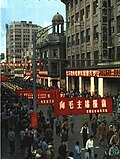
[[File:1967-12 1967年 上海市南京路.jpg|thumb|right|upright|[[Nanjing Road]], 1967, during the [[Cultural Revolution]]]] | |||
[[File:1967-12 1967年 | |||
As the industrial center of China with the most skilled industrial workers, Shanghai became a center for radical [[Left-wing politics|leftism]] during the 1950s and 1960s | After the war, Shanghai's economy was restored. From 1949 to 1952, the city's agricultural and industrial output increased by 51.5% and 94.2%, respectively.<ref name="SHChronicles" /> As the industrial center of China with the most skilled industrial workers, Shanghai became a center for radical [[Left-wing politics|leftism]] during the 1950s and 1960s.<ref>[https://books.google.com/books?id=b3MX4eQrl50C&pg=PA66 ''Shanghai: transformation and modernization under China's open policy''. By Yue-man Yeung, Sung Yun-wing, page 66] {{Webarchive |url=https://web.archive.org/web/20240907214639/https://books.google.com/books?id=b3MX4eQrl50C&pg=PA66#v=onepage&q&f=false |date=7 September 2024}}, Chinese University Press, 1996</ref> During the [[Cultural Revolution]] (1966–1976), Shanghai's society was severely damaged. The majority of the workers in the Shanghai branch of the [[People's Bank of China]] were [[Red Guards]], and they formed a group called the Anti-Economy Liaison Headquarters within the branch.<ref name="Liu-2023">{{Cite book |last=Liu |first=Zongyuan Zoe |title=Sovereign Funds: How the Communist Party of China Finances its Global Ambitions |publisher=The Belknap Press of [[Harvard University Press]] |year=2023 |isbn=9780674271913 |pages= }}</ref>{{Rp|page=38}} The Anti-Economy Liaison Headquarters dismantled economic organizations in Shanghai, investigated bank withdrawals, and disrupted regular bank service in the city.<ref name="Liu-2023" />{{Rp|page=38}} Despite the disruptions of the Cultural Revolution, Shanghai maintained economic production with a positive annual growth rate.<ref name="SHChronicles" /> | ||
In 1990, [[Deng Xiaoping]] permitted Shanghai to initiate economic reforms, which reintroduced foreign capital to the city and developed the Pudong district, resulting in the birth of [[Lujiazui]].<ref>{{cite web |url=http://www.xinhuanet.com/fortune/2018-09/17/c_1123438650.htm |script-title=zh:浦东,改革开放尽显"上海风度" |work=[[Xinhua News]] |date=17 September 2018 |access-date=29 September 2019 |language=zh-cn |archive-url=https://web.archive.org/web/20190929114521/http://www.xinhuanet.com/fortune/2018-09/17/c_1123438650.htm |archive-date=29 September 2019 |url-status=dead }}</ref> That year, the China's central government designated Shanghai as the "Dragon Head" of the [[reform and opening up]].<ref>{{Cite book |last=Hou |first=Li |title=Building for Oil: Daqing and the Formation of the Chinese Socialist State |date=2021 |publisher=[[Harvard University Asia Center]] |isbn=978-0-674-26022-1 |edition= |series=[[Harvard-Yenching Institute]] monograph series |location=Cambridge, Massachusetts |pages=xviii }}</ref> In 2022, Shanghai experienced a large outbreak of [[COVID-19]] cases and the [[2022 Shanghai COVID-19 outbreak|Chinese government locked down]] the entire city on 5 April. This resulted in widespread food shortages across the city as food-supply chains were severely disrupted. These restrictions were lifted on 1 June.<ref>{{Cite web |url=https://www.wsj.com/articles/shanghai-in-lockdown-struggles-to-feed-itself-11649353336 |title=Shanghai, in Lockdown, Struggles to Feed Itself |work=[[The Wall Street Journal]] |date=7 April 2022 |access-date=3 September 2022 |archive-date=12 November 2023 |archive-url=https://web.archive.org/web/20231112120154/https://www.wsj.com/articles/shanghai-in-lockdown-struggles-to-feed-itself-11649353336 |url-status=live }}</ref> | |||
In 1990, [[Deng Xiaoping]] permitted Shanghai to initiate economic reforms, which reintroduced foreign capital to the city and developed the Pudong district, resulting in the birth of [[Lujiazui]].<ref>{{cite web|url=http://www.xinhuanet.com/fortune/2018-09/17/c_1123438650.htm|script-title=zh:浦东,改革开放尽显"上海风度"|work=[[Xinhua News]]|date=17 September 2018|access-date=29 September 2019|language=zh-cn|archive-url=https://web.archive.org/web/20190929114521/http://www.xinhuanet.com/fortune/2018-09/17/c_1123438650.htm|archive-date=29 September 2019|url-status=dead}}</ref> That year, the China's central government designated Shanghai as the "Dragon Head" of [[ | |||
In | |||
==Geography== | ==Geography== | ||
{{Main|Geography of Shanghai}} | {{Main|Geography of Shanghai}} | ||
[[File:Sprawling Shanghai 2016-07-20.jpg|thumb|left|The urban area of Shanghai in 2016, along with [[islands of Shanghai|its major islands]]. From northwest to southeast: [[Chongming Island|Chongming]], [[Changxing Island (Shanghai)|Changxing]], [[Hengsha Island|Hengsha]], and the [[Jiuduansha]] shoals off Pudong. The Yangtze's natural [[Sediment transport|sediment discharge]] can be seen.]] | [[File:Sprawling Shanghai 2016-07-20.jpg|thumb|left|The urban area of Shanghai in 2016, along with [[islands of Shanghai|its major islands]]. From northwest to southeast: [[Chongming Island|Chongming]], [[Changxing Island (Shanghai)|Changxing]], [[Hengsha Island|Hengsha]], and the [[Jiuduansha]] shoals off Pudong. The Yangtze's natural [[Sediment transport|sediment discharge]] can be seen.]] | ||
Shanghai is located on the Yangtze [[Estuary]] of China's east coast, with the Yangtze River to the north | Shanghai is located on the Yangtze [[Estuary]] of China's east coast, with the Yangtze River to the north, [[Hangzhou Bay]] to the south, and the [[East China Sea]] to the east. The land is formed by the Yangtze's natural [[deposition (geology)|deposition]] and modern [[land reclamation]] projects. It has [[Loam|sandy soil]], and skyscrapers have to be built with deep concrete piles to avoid sinking into the soft ground.<ref name="SHChroniclesEnvir">{{cite web |script-title=zh:上海通志 第二卷 自然环境 |trans-title=General History of Shanghai – Volume 2. Natural environment |publisher=Office of Shanghai Chronicles |url=http://www.shtong.gov.cn/dfz_web/DFZ/PianInfo?idnode=4563&tableName=userobject1a&id=-1 |date=4 July 2008 |access-date=5 October 2019 |language=zh |archive-url=https://web.archive.org/web/20181025041948/http://www.shtong.gov.cn/dfz_web/DFZ/PianInfo?idnode=4563&tableName=userobject1a&id=-1 |archive-date=25 October 2018 |url-status=live }}</ref> The provincial-level [[Municipality of Shanghai]] administers the estuary and many of its [[islands of Shanghai|surrounding islands]]. It borders the provinces of [[Zhejiang]] to the south and [[Jiangsu]] to the west and north.<ref name="location"> | ||
{{cite web | {{cite web |title=Geography |url=https://english.shanghai.gov.cn/en-Overview/20231209/705180b43f794c1ca43f4d1ddaa049a2.html |url-status=live |archive-url=https://web.archive.org/web/20240425133729/https://english.shanghai.gov.cn/en-Overview/20231209/705180b43f794c1ca43f4d1ddaa049a2.html |archive-date=25 April 2024 |access-date=9 December 2023 |work=english.shanghai.gov.cn |publisher=Shanghai Municipal People's Government}} | ||
</ref> The municipality's northernmost point is on [[Chongming Island]], the second-largest [[List of islands of China|island in mainland China]] after its expansion during the 20th century.<ref>[http://zhuanti.shanghai.gov.cn/encyclopedia/en/Default2.aspx#52 "Chongming Island" in the ''Encyclopedia of Shanghai'', p. 52.] {{webarchive |url=https://web.archive.org/web/20130302131933/http://zhuanti.shanghai.gov.cn/encyclopedia/en/Default2.aspx |date=2 March 2013}} Shanghai Scientific & Technical Publishers (Shanghai), 2010. Hosted by the Municipality of Shanghai.</ref> | |||
|archive-url = https://web.archive.org/web/ | |||
| | |||
}} | |||
</ref> The municipality's northernmost point is on [[Chongming Island]], | |||
Shanghai is located on an [[alluvial plain]] | Shanghai is located on an [[alluvial plain]] and the vast majority of its {{convert|6340.5|sqkm|sqmi|abbr=off|adj=on}} land area is flat, with an average elevation of {{convert|4|m|ft|spell=in|abbr=off}}.<ref name="topo">{{cite web |title= |script-title=zh:地域 (in Chinese). |url=https://www.shtong.gov.cn/difangzhi-front/book/detailNew?oneId=2&bookId=344775&parentNodeId=344806&nodeId=641940&type=-1 |url-status=live |archive-url=https://web.archive.org/web/20240505092811/https://www.shtong.gov.cn/difangzhi-front/book/detailNew?oneId=2&bookId=344775&parentNodeId=344806&nodeId=641940&type=-1%2A |archive-date=5 May 2024 |access-date=5 May 2024 |publisher=Government of Shanghai}} | ||
</ref> Tidal flat ecosystems exist around the estuary, but they have been reclaimed for agricultural purposes.<ref>{{cite journal |last1=Murray |first1=N.J. |last2=Clemens |first2=R.S. |last3=Phinn |first3=S.R. |last4=Possingham |first4=H.P. |last5=Fuller |first5=R.A. |title=Tracking the rapid loss of tidal wetlands in the Yellow Sea |journal=Frontiers in Ecology and the Environment |date=2014 |volume=12 |issue=5 |pages=267–272 |doi=10.1890/130260 |bibcode=2014FrEE...12..267M |url=https://esajournals.onlinelibrary.wiley.com/doi/full/10.1890/130260 |access-date=4 August 2021 |archive-date=15 February 2022 |archive-url=https://web.archive.org/web/20220215055309/https://esajournals.onlinelibrary.wiley.com/doi/full/10.1890/130260 |url-status=dead |issn=1540-9295 }}</ref> The city's few hills, such as [[Sheshan Hill|She Shan]], lie to the southwest; its highest point is the peak of [[Dajinshan Island]] ({{convert|103|m|ft|disp=or}}) in Hangzhou Bay.<ref name="topo" /> Shanghai has rivers, canals, streams, and lakes, and it is known for its rich water resources as part of the [[Lake Tai]] [[drainage basin]].<ref name="waterresources"> | |||
{{cite web |url=http://www.shanghai.gov.cn/shanghai/node23919/node24059/node24061/userobject22ai36486.html |title=Water Resources |work=Basic Facts |publisher=Shanghai Municipal People's Government |access-date=19 July 2011 |archive-url=https://web.archive.org/web/20111003033713/http://www.shanghai.gov.cn/shanghai/node23919/node24059/node24061/userobject22ai36486.html |archive-date=3 October 2011 |url-status=live }}</ref> | |||
|archive-url=https://web.archive.org/web/ | |||
| | |||
}} | |||
</ref> Tidal flat ecosystems exist around the estuary, | |||
{{cite web | |||
|archive-url=https://web.archive.org/web/20111003033713/http://www.shanghai.gov.cn/shanghai/node23919/node24059/node24061/userobject22ai36486.html | |||
|url-status=live | |||
}} | |||
</ref> | |||
{{climate chart | {{climate chart | ||
| Shanghai | | Shanghai | ||
| | |1|8|72 | ||
| | |3|10|65 | ||
| | |6|14|97 | ||
| | |12|20|84 | ||
| | |17|25|91 | ||
| | |22|28|225 | ||
| | |26|33|163 | ||
| | |25|32|226 | ||
| | |21|28|132 | ||
| | |16|23|70 | ||
| | |10|17|61 | ||
| | |3|11|50 | ||
|float=right | |float=right | ||
|source=[https://www.ncei.noaa.gov/access/search/data-search/global-summary-of-the-month/ The National Centers for Environmental Information (NCEI)] | |source=[https://www.ncei.noaa.gov/access/search/data-search/global-summary-of-the-month/ The National Centers for Environmental Information (NCEI)] | ||
}} | }} | ||
Downtown Shanghai is bisected by the Huangpu River, a man-made [[tributary]] of the Yangtze created by order of Lord Chunshen during the Warring States period.<ref name=ancient /> The historic center of the city was located on the west bank of the Huangpu ([[Puxi]]), near the mouth of Suzhou Creek, connecting it with Lake Tai and the [[Grand Canal of China|Grand Canal]]. The central financial district, Lujiazui, | Downtown Shanghai is bisected by the Huangpu River, a man-made [[tributary]] of the Yangtze created by order of Lord Chunshen during the Warring States period.<ref name="ancient" /> The historic center of the city was located on the west bank of the Huangpu ([[Puxi]]), near the mouth of Suzhou Creek, connecting it with Lake Tai and the [[Grand Canal of China|Grand Canal]]. The central financial district, Lujiazui, was established on the east bank of the Huangpu (Pudong). Along Shanghai's eastern shore, the destruction of local [[wetlands]] due to the construction of [[Pudong International Airport]] has been partially offset by the protection and expansion of a nearby shoal, [[Jiuduansha]], as a nature preserve.<ref>[http://www.china.org.cn/environment/2009-12/08/content_19028666_2.htm "Fourth Island Wetland Emerging", pp. 1–2.] {{Webarchive |url=https://web.archive.org/web/20150924042546/http://www.china.org.cn/environment/2009-12/08/content_19028666_2.htm |date=24 September 2015}} ''[[Shanghai Daily]]''. 8 December 2009. Hosted at China.org.</ref> | ||
===Climate=== | ===Climate=== | ||
Shanghai has a [[humid subtropical climate]] ([[Köppen climate classification|Köppen]]: ''Cfa''), with an average annual temperature of {{convert|17.5|°C}} for downtown areas and {{convert|16.2–17.2|°C}} for suburbs.<ref name="SHChroniclesEnvir" /> The city experiences four distinct seasons. Winters are temperate to cold and damp—northwesterly winds from [[Siberia]] can cause nighttime temperatures to drop below freezing. Each year, there are an average of 4.7 days with snowfall and 1.6 days with snow cover.<ref name="SHChroniclesEnvir" /> Summers are hot and humid, and occasional downpours or [[thunderstorms]] can be expected. On average, 14.5 days exceed {{convert|35|°C}} annually. In summer and the beginning of autumn, the city is susceptible to [[typhoon]]s.<ref name="wiphatelegraph"> | |||
{{cite news |title=1.6m flee Shanghai typhoon |url=https://www.telegraph.co.uk/news/main.jhtml?xml=/news/2007/09/19/wtyphoon119.xml |work=The Daily Telegraph |location=UK |date=19 September 2008 |access-date=20 March 2008 |first=Richard |last=Spencer |archive-url=https://web.archive.org/web/20071013183032/http://www.telegraph.co.uk/news/main.jhtml?xml=%2Fnews%2F2007%2F09%2F19%2Fwtyphoon119.xml |archive-date=13 October 2007 |url-status=dead }}</ref> | |||
Shanghai | The most pleasant seasons are generally spring, although changeable and often rainy, and autumn, which is usually sunny and dry. With monthly percent possible sunshine ranging from 28% in June to 46% in August, the city receives 1,754 hours of bright sunshine annually.{{efn|All the mean values mentioned in this paragraph are data observed in Baoshan District.}} According to China's seasonal division standard, from 2001 to 2025, Shanghai enters spring on 9 March, summer on 15 May, autumn on 5 October, and winter on 4 December. The average temperature for the three weeks from 19 July to 8 August is above {{convert|30|°C|1}}. Extremes since 1951 have ranged from {{convert|−10.1|°C|1}} on 31 January 1977 (unofficial record of {{convert|−12.1|°C|1}} was set on 19 January 1893) to {{convert|40.9|°C|1}} on 21 July 2017<ref>{{Cite web |title=Hottest day ever in Shanghai as heat wave bakes China |url=https://phys.org/news/2017-07-hottest-day-shanghai-china.html |access-date=2 September 2024 |website=phys.org |language=en |archive-date=2 September 2024 |archive-url=https://web.archive.org/web/20240902055903/https://phys.org/news/2017-07-hottest-day-shanghai-china.html |url-status=live }}</ref> and 13 July 2022<ref>{{Cite web |title=Temperature in Shanghai hits record high - People's Daily Online |url=http://en.people.cn/n3/2022/0714/c90000-10122935.html |access-date=2 September 2024 |website=en.people.cn |archive-date=2 September 2024 |archive-url=https://web.archive.org/web/20240902061414/http://en.people.cn/n3/2022/0714/c90000-10122935.html |url-status=live }}</ref> at a [[weather station]] in [[Xujiahui]]. It also has {{convert|32.1|°C|1}} as the highest ever daily minimum temperature at Xujiahui on 2 August 2024.<ref>{{Cite web |title=Extreme Temperatures Around the World |url=https://www.mherrera.org/temp.htm |access-date=22 September 2024 |website=www.mherrera.org |archive-date=15 January 2022 |archive-url=https://web.archive.org/web/20220115040834/https://www.mherrera.org/temp.htm |url-status=live }}</ref> | ||
{{cite | In 2025, the average temperature of Xujiahui was 19.4°C, which was 1.9°C higher than the average from 1991 to 2020. | ||
{{Weather box | |||
| width = auto | |||
| metric first = y | |||
| single line = y | |||
| | | collapsed = Y | ||
| | | location = Shanghai ([[Xujiahui]]), elevation {{convert|5|m|ft|abbr=on}}, (1991–2020 normals, extremes 1951–present) | ||
| Jan record high C = 21.6 | |||
| Feb record high C = 27.0 | |||
| Mar record high C = 31.1 | |||
| | | Apr record high C = 33.9 | ||
| May record high C = 36.7 | |||
| Jun record high C = 38.5 | |||
| Jul record high C = 40.9 | |||
| Aug record high C = 40.8 | |||
| Sep record high C = 38.2 | |||
| Oct record high C = 36.0 | |||
| Nov record high C = 28.5 | |||
| Dec record high C = 23.4 | |||
| Jan record low C = -10.1 | |||
| Feb record low C = -7.9 | |||
| Mar record low C = -5.4 | |||
| Apr record low C = -0.5 | |||
| May record low C = 6.9 | |||
| Jun record low C = 12.3 | |||
| Jul record low C = 16.3 | |||
| Aug record low C = 18.8 | |||
| Sep record low C = 10.8 | |||
| Oct record low C = 1.7 | |||
| Nov record low C = -4.2 | |||
| Dec record low C = -8.5 | |||
| Jan high C = 8.7 | |||
| Feb high C = 10.7 | |||
| Mar high C = 14.9 | |||
| Apr high C = 20.9 | |||
| May high C = 25.8 | |||
| Jun high C = 28.6 | |||
| Jul high C = 33.2 | |||
| Aug high C = 32.6 | |||
| Sep high C = 28.7 | |||
| Oct high C = 23.5 | |||
| Nov high C = 17.8 | |||
| Dec high C = 11.3 | |||
| Jan mean C = 5.4 | |||
| Feb mean C = 7.0 | |||
| Mar mean C = 10.7 | |||
| Apr mean C = 16.1 | |||
| May mean C = 21.3 | |||
| Jun mean C = 24.7 | |||
| Jul mean C = 29.1 | |||
| Aug mean C = 28.8 | |||
| Sep mean C = 25.1 | |||
| Oct mean C = 19.9 | |||
| Nov mean C = 14.3 | |||
| Dec mean C = 7.9 | |||
| Jan low C = 2.9 | |||
| Feb low C = 4.1 | |||
| Mar low C = 7.6 | |||
| Apr low C = 12.6 | |||
| May low C = 17.9 | |||
| Jun low C = 22.0 | |||
| Jul low C = 26.2 | |||
| Aug low C = 26.2 | |||
| Sep low C = 22.5 | |||
| Oct low C = 17.1 | |||
| Nov low C = 11.4 | |||
| Dec low C = 5.3 | |||
| precipitation colour = green | |||
| Jan precipitation mm = 72.2 | |||
| Feb precipitation mm = 65.0 | |||
| Mar precipitation mm = 97.3 | |||
| Apr precipitation mm = 84.2 | |||
| May precipitation mm = 91.0 | |||
| Jun precipitation mm = 224.9 | |||
| Jul precipitation mm = 163.2 | |||
| Aug precipitation mm = 225.9 | |||
| Sep precipitation mm = 131.5 | |||
| Oct precipitation mm = 69.6 | |||
| Nov precipitation mm = 61.4 | |||
| Dec precipitation mm = 50.4 | |||
| Jan humidity = 71 | |||
| Feb humidity = 71 | |||
| Mar humidity = 70 | |||
| Apr humidity = 69 | |||
| May humidity = 70 | |||
| Jun humidity = 79 | |||
| Jul humidity = 76 | |||
| Aug humidity = 76 | |||
| Sep humidity = 74 | |||
| Oct humidity = 70 | |||
| Nov humidity = 71 | |||
| Dec humidity = 69 | |||
| unit precipitation days = 0.1 mm | |||
| Jan precipitation days = 10.6 | |||
| Feb precipitation days = 10.4 | |||
| Mar precipitation days = 12.7 | |||
| Apr precipitation days = 11.3 | |||
| May precipitation days = 11.2 | |||
| Jun precipitation days = 14.3 | |||
| Jul precipitation days = 12.2 | |||
| Aug precipitation days = 12.7 | |||
| Sep precipitation days = 10.1 | |||
| Oct precipitation days = 7.5 | |||
| Nov precipitation days = 9.2 | |||
| Dec precipitation days = 8.5 | |||
| year precipitation days = 130.7 | |||
| Jan sun = 114.3 | |||
| Feb sun = 119.9 | |||
| Mar sun = 128.5 | |||
| Apr sun = 148.5 | |||
| May sun = 169.8 | |||
| Jun sun = 130.9 | |||
| Jul sun = 190.8 | |||
| Aug sun = 185.7 | |||
| Sep sun = 167.5 | |||
| Oct sun = 161.4 | |||
| Nov sun = 131.1 | |||
| Dec sun = 127.4 | |||
| year sun = 1775.8 | |||
| Jan snow days = 2.1 | |||
| Feb snow days = 1.8 | |||
| Mar snow days = 0.5 | |||
| Apr snow days = 0.0 | |||
| May snow days = 0 | |||
| Jun snow days = 0 | |||
| Jul snow days = 0 | |||
| Aug snow days = 0 | |||
| Sep snow days = 0 | |||
| Oct snow days = 0 | |||
| Nov snow days = 0.1 | |||
| Dec snow days = 0.9 | |||
| year snow days = 5.4 | |||
| source 1 = [[China Meteorological Administration]] (sun 1981–2010)<ref name="cma graphical">{{cite web |url=http://data.cma.cn/data/weatherBk.html |script-title=zh:中国气象数据网 – WeatherBk Data |publisher=[[China Meteorological Administration]] |language=zh-hans |access-date=10 October 2023 |archive-date=18 June 2025 |archive-url=https://web.archive.org/web/20250618052416/https://data.cma.cn/data/weatherBk.html |url-status=live }}</ref><ref name="experience.arcgis.com">{{cite web |url=https://experience.arcgis.com/template/e724038fda394e9d9b7921f10fd1aa55/page/%E7%BA%AF%E8%A1%A8%E6%A0%BC%E7%BB%9F%E8%AE%A1-(%E5%AF%B9%E6%AF%948110%E5%8F%98%E5%8C%96)/?org=UQmaps |script-title=zh:中国气象数据网 |publisher=[[China Meteorological Administration]] |language=zh-hans |access-date=10 October 2023 |title=Experience Template |archive-date=4 April 2023 |archive-url=https://web.archive.org/web/20230404092524/https://experience.arcgis.com/template/e724038fda394e9d9b7921f10fd1aa55/page/%E7%BA%AF%E8%A1%A8%E6%A0%BC%E7%BB%9F%E8%AE%A1-(%E5%AF%B9%E6%AF%948110%E5%8F%98%E5%8C%96)/?org=UQmaps |url-status=live }}</ref><ref name = CMA2 >{{cite web |url=http://cdc.cma.gov.cn/dataSetLogger.do?changeFlag=dataLogger |title=中国地面国际交换站气候标准值月值数据集 |publisher=[[China Meteorological Administration]] |language=Chinese |access-date=11 June 2014 |archive-date=18 March 2013 |archive-url=https://web.archive.org/web/20130318113757/http://cdc.cma.gov.cn/dataSetLogger.do?changeFlag=dataLogger |url-status=dead }}</ref> all-time extreme temperature<ref name = Mherrera>{{cite web |url=http://www.mherrera.org/temp.htm |title=Extreme Temperatures Around the World |access-date=22 September 2024 |archive-date=22 June 2013 |archive-url=https://web.archive.org/web/20130622141215/http://www.mherrera.org/temp.htm |url-status=live }}</ref> | |||
| source = | |||
}} | |||
{{Weather box | |||
| width = auto | |||
| location = [[Minhang, Shanghai|Minhang District]], elevation {{convert|6|m|ft|abbr=on}}, (1991–2020 normals, extremes 1951–present) | |||
| single line = Y | |||
| metric first = Y | |||
| collapsed = Y | |||
| Jan record high C = 24.0 | |||
| Feb record high C = 27.2 | |||
| Mar record high C = 31.5 | |||
| Apr record high C = 33.3 | |||
| May record high C = 37.5 | |||
| Jun record high C = 37.9 | |||
| Jul record high C = 40.8 | |||
| Aug record high C = 40.9 | |||
| Sep record high C = 37.4 | |||
| Oct record high C = 35.4 | |||
| Nov record high C = 29.7 | |||
| Dec record high C = 23.9 | |||
| Jan record low C = -11.0 | |||
| Feb record low C = -8.5 | |||
| Mar record low C = -5.2 | |||
| Apr record low C = -0.6 | |||
| May record low C = 6.0 | |||
| Jun record low C = 12.4 | |||
| Jul record low C = 16.6 | |||
| Aug record low C = 18.5 | |||
| Sep record low C = 10.3 | |||
| Oct record low C = 2.3 | |||
| Nov record low C = -4.7 | |||
| Dec record low C = -8.8 | |||
| Jan high C = 8.7 | |||
| Feb high C = 10.7 | |||
| Mar high C = 14.8 | |||
| Apr high C = 20.6 | |||
| May high C = 25.5 | |||
| Jun high C = 28.3 | |||
| Jul high C = 32.8 | |||
| Aug high C = 32.3 | |||
| Sep high C = 28.5 | |||
| Oct high C = 23.6 | |||
| Nov high C = 17.9 | |||
| Dec high C = 11.5 | |||
| Jan mean C = 4.9 | |||
| Feb mean C = 6.6 | |||
| Mar mean C = 10.4 | |||
| Apr mean C = 15.8 | |||
| May mean C = 20.9 | |||
| Jun mean C = 24.4 | |||
| Jul mean C = 28.8 | |||
| Aug mean C = 28.5 | |||
| Sep mean C = 24.7 | |||
| Oct mean C = 19.5 | |||
| Nov mean C = 13.7 | |||
| Dec mean C = 7.3 | |||
| Jan low C = 1.9 | |||
| Feb low C = 3.3 | |||
| Mar low C = 6.8 | |||
| Apr low C = 11.9 | |||
| May low C = 17.2 | |||
| Jun low C = 21.5 | |||
| Jul low C = 25.8 | |||
| Aug low C = 25.7 | |||
| Sep low C = 21.6 | |||
| Oct low C = 15.9 | |||
| Nov low C = 10.1 | |||
| Dec low C = 3.9 | |||
| precipitation colour = green | |||
| Jan precipitation mm = 70.4 | |||
| Feb precipitation mm = 65.4 | |||
| Mar precipitation mm = 95.4 | |||
| Apr precipitation mm = 82.5 | |||
| May precipitation mm = 93.2 | |||
| Jun precipitation mm = 207.3 | |||
| Jul precipitation mm = 148.0 | |||
| Aug precipitation mm = 187.1 | |||
| Sep precipitation mm = 118.1 | |||
| Oct precipitation mm = 68.4 | |||
| Nov precipitation mm = 59.4 | |||
| Dec precipitation mm = 50.3 | |||
| Jan humidity = 74 | |||
| Feb humidity = 73 | |||
| Mar humidity = 72 | |||
| Apr humidity = 71 | |||
| May humidity = 73 | |||
| Jun humidity = 80 | |||
| Jul humidity = 78 | |||
| Aug humidity = 78 | |||
| Sep humidity = 76 | |||
| Oct humidity = 73 | |||
| Nov humidity = 74 | |||
| Dec humidity = 72 | |||
| unit precipitation days = 0.1 mm | |||
| Jan precipitation days = 10.9 | |||
| Feb precipitation days = 10.2 | |||
| Mar precipitation days = 12.9 | |||
| Apr precipitation days = 11.3 | |||
| May precipitation days = 11.2 | |||
| Jun precipitation days = 14.5 | |||
| Jul precipitation days = 11.7 | |||
| Aug precipitation days = 12.4 | |||
| Sep precipitation days = 9.8 | |||
| Oct precipitation days = 7.4 | |||
| Nov precipitation days = 9.1 | |||
| Dec precipitation days = 8.3 | |||
| year precipitation days = | |||
| Jan sun = 114.8 | |||
| Feb sun = 117.9 | |||
| Mar sun = 143.8 | |||
| Apr sun = 168.1 | |||
| May sun = 176.8 | |||
| Jun sun = 131.2 | |||
| Jul sun = 209.4 | |||
| Aug sun = 202.3 | |||
| Sep sun = 163.7 | |||
| Oct sun = 162.1 | |||
| Nov sun = 131.1 | |||
| Dec sun = 129.7 | |||
| year sun = | |||
| Jan percentsun = 36 | |||
| Feb percentsun = 37 | |||
| Mar percentsun = 39 | |||
| Apr percentsun = 43 | |||
| May percentsun = 41 | |||
| Jun percentsun = 31 | |||
| Jul percentsun = 49 | |||
| Aug percentsun = 50 | |||
| Sep percentsun = 45 | |||
| Oct percentsun = 46 | |||
| Nov percentsun = 42 | |||
| Dec percentsun = 41 | |||
| year percentsun = | |||
| Jan snow days = 1.8 | |||
| Feb snow days = 1.4 | |||
| Mar snow days = 0.4 | |||
| Apr snow days = 0 | |||
| May snow days = 0 | |||
| Jun snow days = 0 | |||
| Jul snow days = 0 | |||
| Aug snow days = 0 | |||
| Sep snow days = 0 | |||
| Oct snow days = 0 | |||
| Nov snow days = 0.1 | |||
| Dec snow days = 0.7 | |||
| year snow days = | |||
| source 1 = [[China Meteorological Administration]]<ref name="cma graphical" /><ref>{{cite web |url=https://experience.arcgis.com/template/e724038fda394e9d9b7921f10fd1aa55/page/%E7%BA%AF%E8%A1%A8%E6%A0%BC%E7%BB%9F%E8%AE%A1-(%E5%AF%B9%E6%AF%948110%E5%8F%98%E5%8C%96)/?org=UQmaps |script-title=zh:中国气象数据网 |publisher=[[China Meteorological Administration]] |language=zh-hans |access-date=26 August 2023 |title=Experience Template |archive-date=4 April 2023 |archive-url=https://web.archive.org/web/20230404092524/https://experience.arcgis.com/template/e724038fda394e9d9b7921f10fd1aa55/page/%E7%BA%AF%E8%A1%A8%E6%A0%BC%E7%BB%9F%E8%AE%A1-(%E5%AF%B9%E6%AF%948110%E5%8F%98%E5%8C%96)/?org=UQmaps |url-status=live }}</ref> | |||
| source = | |||
}} | |||
{{Weather box | |||
| width = auto | |||
| metric first = y | |||
| single line = y | |||
| collapsed = Y | |||
| location = [[Baoshan, Shanghai|Baoshan District]], elevation {{convert|6|m|ft|abbr=on}}, (1991–2020 normals, extremes 1951–present) | |||
| Jan record high C = 23.0 | |||
| Feb record high C = 27.0 | |||
| Mar record high C = 33.1 | |||
| Apr record high C = 34.3 | |||
| May record high C = 36.4 | |||
| Jun record high C = 37.5 | |||
| Jul record high C = 39.7 | |||
| Aug record high C = 40.0 | |||
| Sep record high C = 38.2 | |||
| Oct record high C = 36.7 | |||
| Nov record high C = 29.2 | |||
| Dec record high C = 24.4 | |||
| Jan record low C = -10.1 | |||
| Feb record low C = -7.9 | |||
| Mar record low C = -5.4 | |||
| Apr record low C = -0.5 | |||
| May record low C = 6.9 | |||
| Jun record low C = 12.3 | |||
| Jul record low C = 16.3 | |||
| Aug record low C = 18.3 | |||
| Sep record low C = 10.8 | |||
| Oct record low C = 1.7 | |||
| Nov record low C = -4.2 | |||
| Dec record low C = -8.5 | |||
| Jan high C = 8.2 | |||
| Feb high C = 10.1 | |||
| Mar high C = 14.3 | |||
| Apr high C = 20.1 | |||
| May high C = 25.1 | |||
| Jun high C = 27.8 | |||
| Jul high C = 32.4 | |||
| Aug high C = 31.9 | |||
| Sep high C = 27.9 | |||
| Oct high C = 22.9 | |||
| Nov high C = 17.5 | |||
| Dec high C = 11.0 | |||
| Jan mean C = 4.9 | |||
| Feb mean C = 6.5 | |||
| Mar mean C = 10.3 | |||
| Apr mean C = 15.7 | |||
| May mean C = 20.9 | |||
| Jun mean C = 24.4 | |||
| Jul mean C = 28.8 | |||
| Aug mean C = 28.5 | |||
| Sep mean C = 24.7 | |||
| Oct mean C = 19.7 | |||
| Nov mean C = 13.9 | |||
| Dec mean C = 7.5 | |||
| Jan low C = 2.2 | |||
| Feb low C = 3.6 | |||
| Mar low C = 6.9 | |||
| Apr low C = 12.0 | |||
| May low C = 17.5 | |||
| Jun low C = 21.7 | |||
| Jul low C = 25.9 | |||
| Aug low C = 25.9 | |||
| Sep low C = 22.2 | |||
| Oct low C = 16.7 | |||
| Nov low C = 10.7 | |||
| Dec low C = 4.4 | |||
| precipitation colour = green | |||
| Jan precipitation mm = 69.8 | |||
| Feb precipitation mm = 64.0 | |||
| Mar precipitation mm = 86.5 | |||
| Apr precipitation mm = 77.1 | |||
| May precipitation mm = 90.2 | |||
| Jun precipitation mm = 196.7 | |||
| Jul precipitation mm = 146.9 | |||
| Aug precipitation mm = 210.1 | |||
| Sep precipitation mm = 116.5 | |||
| Oct precipitation mm = 71.4 | |||
| Nov precipitation mm = 57.5 | |||
| Dec precipitation mm = 49.3 | |||
| Jan humidity = 73 | |||
| Feb humidity = 73 | |||
| Mar humidity = 72 | |||
| Apr humidity = 70 | |||
| May humidity = 71 | |||
| Jun humidity = 79 | |||
| Jul humidity = 76 | |||
| Aug humidity = 77 | |||
| Sep humidity = 75 | |||
| Oct humidity = 71 | |||
| Nov humidity = 72 | |||
| Dec humidity = 71 | |||
| unit precipitation days = 0.1 mm | |||
| Jan precipitation days = 10.0 | |||
| Feb precipitation days = 9.7 | |||
| Mar precipitation days = 12.2 | |||
| Apr precipitation days = 10.6 | |||
| May precipitation days = 10.8 | |||
| Jun precipitation days = 13.7 | |||
| Jul precipitation days = 11.9 | |||
| Aug precipitation days = 12.5 | |||
| Sep precipitation days = 9.9 | |||
| Oct precipitation days = 7.0 | |||
| Nov precipitation days = 8.6 | |||
| Dec precipitation days = 8.1 | |||
| year precipitation days = | |||
| Jan sun = 110.4 | |||
| Feb sun = 115.4 | |||
| Mar sun = 136.6 | |||
| Apr sun = 157.0 | |||
| May sun = 169.7 | |||
| Jun sun = 120.7 | |||
| Jul sun = 184.7 | |||
| Aug sun = 186.5 | |||
| Sep sun = 161.2 | |||
| Oct sun = 157.6 | |||
| Nov sun = 127.1 | |||
| Dec sun = 127.1 | |||
| year sun = | |||
| Jan percentsun = 34 | |||
| Feb percentsun = 37 | |||
| Mar percentsun = 37 | |||
| Apr percentsun = 40 | |||
| May percentsun = 40 | |||
| Jun percentsun = 28 | |||
| Jul percentsun = 43 | |||
| Aug percentsun = 46 | |||
| Sep percentsun = 44 | |||
| Oct percentsun = 45 | |||
| Nov percentsun = 40 | |||
| Dec percentsun = 41 | |||
| year percentsun = | |||
| Jan snow days = 1.9 | |||
| Feb snow days = 1.4 | |||
| Mar snow days = 0.4 | |||
| Apr snow days = 0.1 | |||
| May snow days = 0 | |||
| Jun snow days = 0 | |||
| Jul snow days = 0 | |||
| Aug snow days = 0 | |||
| Sep snow days = 0 | |||
| Oct snow days = 0 | |||
| Nov snow days = 0.1 | |||
| Dec snow days = 0.7 | |||
| year snow days = | |||
| source 1 = [[China Meteorological Administration]]<ref name="cma graphical" /><ref name="experience.arcgis.com"/> | |||
}} | }} | ||
==Cityscape== | ==Cityscape== | ||
[[The Bund]], located by the bank of the Huangpu River, is home to a row of early 20th-century architecture, ranging in style from the [[neoclassical architecture|neoclassical]] [[HSBC Building, Shanghai|HSBC Building]] to the [[Art Deco]] Sassoon House (now part of the [[Peace Hotel]]).<ref name="art deco" /> The area has been revitalized several times: the first was in 1986, with a new [[Esplanade|promenade]] by the Dutch architect Paulus Snoeren.<ref name="Potter">{{cite web |url=https://www.everettpotter.com/2018/08/strolling-shanghais-bund-part-2/ |title=Strolling Shanghai's Bund (Part 2) |work=EVERETT POTTER'S TRAVEL REPORT |date=13 August 2018 |access-date=7 October 2019 |archive-url=https://web.archive.org/web/20191007115204/https://www.everettpotter.com/2018/08/strolling-shanghais-bund-part-2/ |archive-date=7 October 2019 |url-status=live }}</ref> The second was before the [[Expo 2010|2010 Expo]], which includes restoration of the century-old [[Waibaidu Bridge]] and reconfiguration of traffic flow.<ref>{{cite web |url=http://www.cnngo.com/shanghai/none/bund-back-182534 |title=Bigger and better: The Shanghai Bund is back – CNN Travel |website=cnngo.com |access-date=9 May 2018 |url-status=dead |archive-url=https://web.archive.org/web/20121101093739/http://www.cnngo.com/shanghai/none/bund-back-182534 |archive-date=1 November 2012 }}</ref> | |||
[[The Bund]], located by the bank of the Huangpu River, is home to a row of early 20th-century architecture, ranging in style from the [[neoclassical architecture|neoclassical]] [[HSBC Building, Shanghai|HSBC Building]] to the [[Art Deco]] Sassoon House (now part of the [[Peace Hotel]]). | |||
Shanghai's construction boom during the 1920s and 1930s caused the city to have several Art Deco buildings.<ref name="art deco" /> [[László Hudec]], a [[Hungarians in Slovakia|Hungarian-Slovak]] who lived in the city between 1918 and 1947,<ref>{{cite web |url=http://www.ladislavhudec.eu/index.php?main_page=index&cPath=67 |title=The man who changed Shanghai |at=Who is L.E.Hudec |last1=Kabos |first1=Ladislav |access-date=17 May 2011 |archive-url=https://web.archive.org/web/20110504041550/http://www.ladislavhudec.eu/index.php?main_page=index&cPath=67 |archive-date=4 May 2011 |url-status=live }}</ref> designed Art Deco buildings such as the [[Park Hotel Shanghai|Park Hotel]], the [[Grand Cinema (Shanghai)|Grand Cinema]], and the [[Paramount (Shanghai)|Paramount]].<ref>{{cite web |url=http://www.archives.sh.cn/shjy/hsrw/201203/t20120313_6271.html |script-title=zh:一个外国建筑设计师的上海传奇----邬达克和他设计的经典老房子 |publisher=Shanghai Archives Bureau |last=Jin |first=Zhihao |date=12 July 2011 |access-date=7 October 2019 |language=zh-cn |archive-url=https://web.archive.org/web/20191007120214/http://www.archives.sh.cn/shjy/hsrw/201203/t20120313_6271.html |archive-date=7 October 2019 |url-status=live }}</ref> Other prominent Art Deco-style architects are [[P&T Group|Clement Palmer and Arthur Turner]], who designed the Peace Hotel, the [[Metropole Hotel (Shanghai)|Metropole Hotel]], and the [[Broadway Mansions]];<ref>{{cite web |url=https://www.fairmont.com/peace-hotel-shanghai/hotel-history/ |title=FAIRMONT PEACE HOTEL – A HISTORY |work=[[Accor]] |access-date=7 October 2019 |archive-url=https://web.archive.org/web/20191007115202/https://www.fairmont.com/peace-hotel-shanghai/hotel-history/ |archive-date=7 October 2019 |url-status=live }}</ref> and Austrian architect [[C. H. Gonda|C.H. Gonda]], who designed the [[Capitol Theater (Shanghai)|Capitol Theatre]].<ref name="Potter" /> One common architectural element is the [[shikumen]] ({{lang|zh|石库门}}, "stone storage door") residence, typically two- or three-story gray brick houses with the front yard protected by a heavy wooden door in a stylistic stone arch.<ref name="radical quaintness">{{cite magazine |last=Goldberger |first=Paul |url=http://www.newyorker.com/archive/2005/12/26/051226crsk_skyline |title=Shanghai Surprise: The radical quaintness of the Xintiandi district. |magazine=[[The New Yorker]] |date=26 December 2005 |access-date=7 October 2019 |archive-url=https://web.archive.org/web/20121102000836/http://www.newyorker.com/archive/2005/12/26/051226crsk_skyline |archive-date=2 November 2012 |url-status=live }}</ref> Each residence is connected and arranged in straight alleys, known as [[longtang]]{{efn|[[Shanghainese]] romanization: longdhang; {{IPA|wuu|lòŋdɑ̃́|pronunciation:}}<ref>{{cite book |last1=Qian |first1=Nairong |year=2007 |script-title=zh:上海话大词典 |publisher=[[Shanghai Lexicographical Publishing House]] |author-link1=Qian Nairong |isbn=9787532622481 }}</ref>}} ({{lang|zh|弄堂}}).<ref name="radical quaintness" /> Shanghai also has [[Soviet Union|Soviet]] neoclassical architecture or [[Stalinist architecture]]: most were erected between the founding of the [[People's Republic of China|People's Republic]] in 1949 and the [[Sino-Soviet Split]] in the late 1960s when Soviet personnel came to China to aid in the development of a communist state. An example of Soviet neoclassical architecture in Shanghai is the [[Shanghai Exhibition Center]].<ref name="Lonely Planet - undated - Lonely Planet review for Shanghai Exhibition Center">{{cite web |url=http://www.lonelyplanet.com/china/shanghai/sights/building/shanghai-exhibition-centre |title=Lonely Planet review for Shanghai Exhibition Centre |work=[[Lonely Planet]] |access-date=14 June 2013 |archive-url=https://web.archive.org/web/20101113175246/http://www.lonelyplanet.com/china/shanghai/sights/building/shanghai-exhibition-centre |archive-date=13 November 2010 |url-status=live }}</ref> | |||
One | |||
| last= | |||
| first= | |||
| url= | |||
| title= | |||
| magazine= | |||
| date= | |||
| access-date= | |||
| archive-url= | |||
| archive-date= | |||
| url-status= | |||
}}</ref> Each residence is connected and arranged in straight alleys, known as [[longtang]]{{efn|[[Shanghainese]] romanization: longdhang; {{IPA | |||
Shanghai has {{what|date=December 2025}} making it the fifth [[List of cities with the most skyscrapers|city in the world with the most skyscrapers]].<ref>{{cite web |url=http://skyscrapercenter.com/cities?list=buildings-150 |title=Number of 150m+ Completed Buildings – The Skyscraper Center |website=Skyscrapercenter.com |access-date=5 November 2018 |archive-url=https://web.archive.org/web/20171202102726/http://www.skyscrapercenter.com/cities?list=buildings-150 |archive-date=2 December 2017 |url-status=live }}</ref> Some of [[List of skyscrapers in Shanghai|Shanghai's skyscrapers]] include the [[Jin Mao Tower]], the [[Shanghai World Financial Center]], and the [[Shanghai Tower]], which was completed in 2015 and is currently the tallest building in China and the [[List of tallest buildings|third tallest in the world]].<ref>{{cite web |url=http://www.ibtimes.co.uk/shanghai-tower-asias-new-tallest-skyscraper-presents-future-vision-vertical-cities-1507710 |title=Shanghai Tower: Asia's new tallest skyscraper presents a future vision of 'vertical cities' |author=Alfred Joyner |work=International Business Times UK |date=24 June 2015 |access-date=26 June 2015 |archive-url=https://web.archive.org/web/20150626140923/http://www.ibtimes.co.uk/shanghai-tower-asias-new-tallest-skyscraper-presents-future-vision-vertical-cities-1507710 |archive-date=26 June 2015 |url-status=live }}</ref> The Oriental Pearl Tower, at {{convert|468|m|abbr=on}}, is located nearby at the northern tip of Lujiazui.<ref>{{skyscraperpage|25 }}</ref> Many areas in the former foreign concessions are well-preserved.<ref name="art deco">{{cite web |url=https://www.lonelyplanet.com/articles/an-art-deco-journey-through-shanghais-belle-epoque |title=An art deco journey through Shanghai's belle époque |last1=Loh |first1=Juliana |date=16 February 2016 |publisher=[[Lonely Planet]] |access-date=7 October 2019 |archive-url=https://web.archive.org/web/20191007082034/https://www.lonelyplanet.com/articles/an-art-deco-journey-through-shanghais-belle-epoque |archive-date=7 October 2019 |url-status=live }}</ref> Despite rampant redevelopment, the Old City retains traditional architecture and designs, such as the [[Yu Garden]], an elaborate [[Jiangnan]] style garden.<ref>{{cite web |url=http://www.shanghaiguide.org/Shanghai-Architectural-History-1958.html |title=Shanghai Architectural History |website=shanghaiguide.org |access-date=7 October 2019 |archive-url=https://web.archive.org/web/20181023003942/http://www.shanghaiguide.org/Shanghai-Architectural-History-1958.html |archive-date=23 October 2018 |url-status=live }}</ref> | |||
<gallery widths="155"> | <gallery widths="155"> | ||
| Line 342: | Line 679: | ||
File:Shanghaigrandtheatre.jpg|The [[Shanghai Grand Theater]] | File:Shanghaigrandtheatre.jpg|The [[Shanghai Grand Theater]] | ||
File:The Sino-Soviet Friendship Mansion.JPG|The [[Shanghai Exhibition Center]], an example of [[Stalinist architecture]] | File:The Sino-Soviet Friendship Mansion.JPG|The [[Shanghai Exhibition Center]], an example of [[Stalinist architecture]] | ||
File: | File:20045-Shanghai-Pano (cropped).jpg|View of skyscrapers in [[Lujiazui]] from [[The Bund]] | ||
</gallery> | </gallery> | ||
==Politics== | ==Politics== | ||
{{Main|Politics of Shanghai|Shanghai Municipal People's Government}} | {{Main|Politics of Shanghai|Shanghai Municipal Committee of the Chinese Communist Party|Shanghai Municipal People's Government}} | ||
===Structure=== | ===Structure=== | ||
| Line 361: | Line 696: | ||
|- | |- | ||
! Title | ! Title | ||
| style="text-align:center;" |'''[[ | | style="text-align:center;" |'''[[Party Secretary of Shanghai|CCP Committee Secretary]]''' | ||
| style="text-align:center;" |'''[[Shanghai People's Congress|SMPC]] | | style="text-align:center;" |'''[[Shanghai Municipal People's Congress|SMPC]] Chairwoman''' | ||
| style="text-align:center;" |'''[[List of mayors of Shanghai|Mayor]]''' | | style="text-align:center;" |'''[[List of mayors of Shanghai|Mayor]]''' | ||
| style="text-align:center;" |'''Shanghai [[CPPCC]] Chairman''' | | style="text-align:center;" |'''Shanghai [[CPPCC]] Chairman''' | ||
| Line 368: | Line 703: | ||
! Name | ! Name | ||
| [[Chen Jining]] | | [[Chen Jining]] | ||
| [[ | | [[Huang Lixin]] | ||
| [[Gong Zheng]] | | [[Gong Zheng]] | ||
| | | [[Hu Wenrong]] | ||
|- | |- | ||
! [[Ancestral home (Chinese)|Ancestral home]] | ! [[Ancestral home (Chinese)|Ancestral home]] | ||
| [[Lishu County|Lishu]], [[Jilin]]|| [[ | | [[Lishu County|Lishu]], [[Jilin]]|| [[Suqian]], [[Jiangsu]]|| [[Suzhou, Jiangsu]] || [[Putian]], [[Fujian]] | ||
|- | |- | ||
! Born | ! Born | ||
| {{Birth year and age|1964|02}}|| {{Birth year and age| | | {{Birth year and age|1964|02}}|| {{Birth year and age|1962|08}}|| {{Birth year and age|1960|03}} || {{Birth year and age|1964|07}} | ||
|- | |- | ||
! Assumed office | ! Assumed office | ||
| October 2022<ref>{{Cite web |date=28 October 2022 |title=CPC reshuffles Shanghai Party chief-Xinhua |url=https://english.news.cn/20221028/cd72233d5f004d17896195dd8c0a7d4d/c.html |access-date=2022 | | October 2022<ref>{{Cite web |date=28 October 2022 |title=CPC reshuffles Shanghai Party chief-Xinhua |url=https://english.news.cn/20221028/cd72233d5f004d17896195dd8c0a7d4d/c.html |access-date=28 October 2022 |website=Xinhua News Agency |archive-date=28 October 2022 |archive-url=https://web.archive.org/web/20221028025233/https://english.news.cn/20221028/cd72233d5f004d17896195dd8c0a7d4d/c.html |url-status=live }}</ref> | ||
| January | | January 2024<ref>{{cite news |title= |script-title=zh:黄莉新当选上海市人大常委会主任 |trans-title=Huang Lixin was elected chairwoman of the Shanghai Municipal People’s Congress Standing Committee |url=http://www.news.cn/politics/20240124/fd33d8cccb1c44e894d6c0525db66603/c.html%BB%E3%80%82 |access-date=26 February 2024 |work=[[Xinhua News Agency]] |language=zh-cn}}{{Dead link|date=March 2024 |bot=InternetArchiveBot |fix-attempted=yes }}</ref> | ||
| March 2020<ref>{{cite news|url=https://www.zaobao.com.sg/znews/greater-china/story20200324-1039566|script-title=zh:龚正正式出任上海代市长|publisher=[[Lianhe Zaobao]]|date=24 March 2020|access-date=24 March 2020|language=zh-cn}}</ref> | | March 2020<ref>{{cite news |url=https://www.zaobao.com.sg/znews/greater-china/story20200324-1039566 |script-title=zh:龚正正式出任上海代市长 |publisher=[[Lianhe Zaobao]] |date=24 March 2020 |access-date=24 March 2020 |language=zh-cn |archive-date=24 March 2020 |archive-url=https://web.archive.org/web/20200324072716/https://www.zaobao.com.sg/znews/greater-china/story20200324-1039566 |url-status=live }}</ref> | ||
| January | | January 2023<ref name="Dong Yunhu">{{cite news |date=14 January 2023 |title= |script-title=zh:胡文容当选上海市政协主席 |trans-title=Hu Wenrong has been elected chairman of Shanghai CPPCC |url=http://www.news.cn/politics/2023-01/14/c_1129284688.htm |access-date=26 February 2024 |language=zh-CN |agency=[[Xinhua News Agency]] |archive-date=14 January 2023 |archive-url=https://web.archive.org/web/20230114182654/http://www.news.cn/politics/2023-01/14/c_1129284688.htm |url-status=live }}</ref> | ||
|} | |} | ||
[[File:Shanghai Government Building.jpg|thumb|Shanghai Municipal Government building]] | [[File:Shanghai Government Building.jpg|thumb|Shanghai Municipal Government building]] | ||
Like all [[Politics of China|governing institutions in mainland China]], Shanghai has a parallel party-government system,<ref name="PoliticalSystem">{{cite web|url=https://fas.org/sgp/crs/row/R41007.pdf|title=Understanding China's Political System|last1=Lawrence|first1=Susan|last2=Martin|first2=Michael|date=20 March 2013|website=Federation of American Scientists|publisher=Congressional Research Service|url-status=live|archive-url=https://web.archive.org/web/20120108131300/http://www.fas.org/sgp/crs/row/R41007.pdf|archive-date=8 January 2012|access-date=28 September 2019}}</ref> in which the [[ | Like all [[Politics of China|governing institutions in mainland China]], Shanghai has a parallel party-government system,<ref name="PoliticalSystem">{{cite web |url=https://fas.org/sgp/crs/row/R41007.pdf |title=Understanding China's Political System |last1=Lawrence |first1=Susan |last2=Martin |first2=Michael |date=20 March 2013 |website=Federation of American Scientists |publisher=Congressional Research Service |url-status=live |archive-url=https://web.archive.org/web/20120108131300/http://www.fas.org/sgp/crs/row/R41007.pdf |archive-date=8 January 2012 |access-date=28 September 2019 }}</ref> in which the [[Party Secretary of Shanghai|CCP Committee Secretary]], officially termed the [[Chinese Communist Party]] Shanghai Municipal Committee Secretary, outranks the [[List of mayors of Shanghai|Mayor]].<ref>{{cite news |url=http://politics.people.com.cn/GB/30178/5316277.html |script-title=zh:党委书记权力究竟有多大? |trans-title=How much power does a Party Secretary really have? |date=23 January 2007 |script-work=zh:人民论坛 |publisher=[[People's Daily]] Press |language=zh-cn |access-date=29 April 2018 |archive-url=https://web.archive.org/web/20180702211524/http://politics.people.com.cn/GB/30178/5316277.html |archive-date=2 July 2018 |url-status=live }}</ref> The [[Shanghai Municipal Committee of the Chinese Communist Party|CCP committee]] acts as the top policy-formulation body, and typically composed of 12 members (including the secretary); it has control over the [[Shanghai Municipal People's Government]].<ref>{{cite web |title= |script-title=zh:中国共产党上海市委员会 |url=https://www.shtong.gov.cn/difangzhi-front/book/detailNew?oneId=2&bookId=344775&parentNodeId=344809&nodeId=641948&type=-1 |url-status=live |archive-url=https://web.archive.org/web/20240425132615/https://www.shtong.gov.cn/difangzhi-front/book/detailNew?oneId=2&bookId=344775&parentNodeId=344809&nodeId=641948&type=-1 |archive-date=25 April 2024 |access-date=4 January 2024 |website=shtong.gov.cn |publisher=Shanghai Municipal Government |language=zh }}</ref><ref>{{cite web |url=http://district.ce.cn/zt/rwk/sf/sh/sw/201303/15/t20130315_767698.shtml |script-title=zh:上海市委常委名单+简历 |publisher=经济日报-中国经济网 |date=4 September 2019 |access-date=14 October 2019 |language=zh |archive-url=https://web.archive.org/web/20190501050811/http://district.ce.cn/zt/rwk/sf/sh/sw/201303/15/t20130315_767698.shtml |archive-date=1 May 2019 |url-status=live }}</ref> | ||
Officials with ties to the Shanghai administration collectively form a powerful faction in the central government known as the [[Shanghai Clique]], which has often been viewed | Political power in Shanghai has been a stepping stone to higher positions in the central government. Since [[Jiang Zemin]] became the [[General Secretary of the Chinese Communist Party]] in June 1989, several former Shanghai party secretaries and deputy party secretaries were elevated to the [[Politburo Standing Committee of the Chinese Communist Party|Politburo Standing Committee]], the ''de facto'' highest decision-making body in China.<ref name="PoliticalSystem" /> Officials with ties to the Shanghai administration collectively form a powerful faction in the central government known as the [[Shanghai Clique]], which has often been viewed as competing against the rival [[Youth League Faction]] over personnel appointments and policy decisions.<ref>{{cite news |title=Factions Help Drive Modern China History |url=https://www.nytimes.com/2010/02/25/business/global/25iht-rshanpol.html |newspaper=The New York Times |date=25 February 2010 |access-date=13 September 2011 |first=Ted |last=Plafker |archive-url=https://web.archive.org/web/20111012200255/http://www.nytimes.com/2010/02/25/business/global/25iht-rshanpol.html |archive-date=12 October 2011 |url-status=live }}</ref> | ||
===Administrative divisions=== | ===Administrative divisions=== | ||
{{Main|List of administrative divisions of Shanghai|List of township-level divisions of Shanghai}} | {{Main|List of administrative divisions of Shanghai|List of township-level divisions of Shanghai}} | ||
Shanghai is one of the four [[Direct-administered municipalities of China|municipalities]] under the direct administration of the [[ | |||
|url = http://www.gov.cn/test/2009-04/17/content_1288035.htm | Shanghai is one of the four [[Direct-administered municipalities of China|municipalities]] under the direct administration of the [[State Council of the People's Republic of China|Central People's Government]],<ref>{{cite web |date=17 April 2009 |script-title=zh:中国的行政区划——省级行政单位 |trans-title=Administrative divisions in China – Provincial-level administrative divisions |url=http://www.gov.cn/test/2009-04/17/content_1288035.htm |url-status=live |archive-url=https://web.archive.org/web/20150715231343/http://www.gov.cn/test/2009-04/17/content_1288035.htm |archive-date=15 July 2015 |access-date=31 August 2019 |publisher=The Central People's Government of the People's Republic of China |language=zh-Hans }}</ref> and is divided into 16 [[District of China|districts]]. These are further divided to 108 [[Subdistrict (China)|subdistricts]], 106 [[Town (China)|towns]] and 2 [[Township (China)|townships]].<ref>{{Cite web |title=上海市行政区划情况统计表(截至2024年7月31日) |url=https://mzj.sh.gov.cn/MZ_zhuzhan34_0-2-6/20200519/MZ_zhuzhan34_43817.html |access-date=17 July 2025 |website=Shanghai Civil Affairs Bureau |archive-date=5 October 2025 |archive-url=https://web.archive.org/web/20251005233307/https://mzj.sh.gov.cn/MZ_zhuzhan34_0-2-6/20200519/MZ_zhuzhan34_43817.html |url-status=live }}</ref> | ||
| | |||
| | When the [[Shanghai Municipal People's Government]] was founded in 1949, the land area governed was {{Convert|663.5|km2|sqmi}}, largely located within the present-day [[Shanghai Outer Ring Expressway|Outer Ring Expressway]].<ref>{{Cite journal |author=Chang |first=Qing |year=2009 |title=旧改中的上海建筑及其都市历史语境 |journal=Architectural Journal |language=zh |issue=10 |pages=23–28 }}</ref> In 1958, ten [[Counties of China|counties]] were reassigned under Shanghai from [[Jiangsu]].<ref>{{Cite web |last=JFDaily |date=7 January 2011 |title=江苏10县是怎样并入上海的 |trans-title=How did 10 counties in Jiangsu become part of Shanghai? |url=http://www.chinadaily.com.cn/hqpl/zggc/2011-01-07/content_1532243_2.html |url-status=dead |archive-url=https://web.archive.org/web/20170912191417/http://www.chinadaily.com.cn/hqpl/zggc/2011-01-07/content_1532243_2.html |archive-date=12 September 2017 |access-date=17 July 2025 |website=China Daily }}</ref><ref>{{Cite journal |date=6 December 1958 |title=國務院關於行政區劃變更的決定 |url=http://www.gov.cn/gongbao/shuju/1958/gwyb195834.pdf |url-status=live |journal=State Council Gazette |issue=34 |page=717 |archive-url=https://web.archive.org/web/20201201105901/http://www.gov.cn/gongbao/shuju/1958/gwyb195834.pdf |archive-date=1 December 2020 |access-date=11 March 2019 }}</ref> District reorganizations saw several counties in the suburbs become districts between 1988 and 2015, and Chongming was the last county to be retitled as a district in 2015.<ref>{{Cite news |date=9 August 2016 |title=上海崇明撤县设区 全国4个直辖市3个已进入"无县时代" |url=http://leaders.people.com.cn/n1/2016/0809/c58278-28621914.html |url-status=live |archive-url=https://web.archive.org/web/20201121031428/http://leaders.people.com.cn/n1/2016/0809/c58278-28621914.html |archive-date=21 November 2020 |access-date=23 December 2016 |work=People's Daily }}</ref> | ||
|publisher = The Central People's Government of the People's Republic of China | |||
|language = zh-Hans | Shanghai also administers several [[enclaves]] in Jiangsu and [[Anhui]] provinces.<ref>{{Cite web |last= |date=23 May 2025 |title=他们出生在江苏,却生来就有上海户口 |url=https://www.huxiu.com/article/4381954.html |access-date=17 July 2025 |website=Huxiu |language=en |archive-date=19 August 2025 |archive-url=https://web.archive.org/web/20250819095834/https://www.huxiu.com/article/4381954.html |url-status=live }}</ref> Local residents hold Shanghai ''[[Hukou|household registration]]'' and enjoy benefits identical to Shanghai residents.<ref>{{Cite web |date=4 April 2018 |title=关于印发《上海市常住户口管理规定》的通知 |url=https://gaj.sh.gov.cn/shga/wzXxfbGj/detail?pa=110ef360e4374a41a9bee739534e6c5c54d01a372ab513b4df6374b968980fd4 |archive-url=https://web.archive.org/web/20220516082924/https://gaj.sh.gov.cn/shga/wzXxfbGj/detail?pa=110ef360e4374a41a9bee739534e6c5c54d01a372ab513b4df6374b968980fd4 |archive-date=16 May 2022 |access-date=26 February 2022 |work=Shanghai Public Security Bureau }}</ref> | ||
|date = 17 | |||
|access-date = | |||
|archive-url = https://web.archive.org/web/ | |||
|archive-date = | |||
|url-status = live | |||
}}</ref> and | |||
{| class="wikitable sortable collapsible" style="margin:1em auto 1em auto; width:90%; text-align:center;" | {| class="wikitable sortable collapsible" style="margin:1em auto 1em auto; width:90%; text-align:center;" | ||
| Line 433: | Line 760: | ||
{{Image label end}}</div> | {{Image label end}}</div> | ||
|- | |- | ||
!! scope="col" |[[Administrative division codes of the People's Republic of China|Division code]]<ref>{{cite web |url=http://www.stats.gov.cn/tjbz/cxfldm/2011/index.html |script-title=zh:国家统计局统计用区划代码 |publisher=[[National Bureau of Statistics of the People's Republic of China]] |language = zh |archive-url=https://web.archive.org/web/20130405092331/http://www.stats.gov.cn/tjbz/cxfldm/2011/index.html |archive-date=5 April 2013}}</ref> | !! scope="col" |[[Administrative division codes of the People's Republic of China|Division code]]<ref>{{cite web |url=http://www.stats.gov.cn/tjbz/cxfldm/2011/index.html |script-title=zh:国家统计局统计用区划代码 |publisher=[[National Bureau of Statistics of the People's Republic of China]] |language=zh |archive-url=https://web.archive.org/web/20130405092331/http://www.stats.gov.cn/tjbz/cxfldm/2011/index.html |archive-date=5 April 2013 }}</ref> | ||
!! scope="col" |Division | !! scope="col" |Division | ||
!! scope="col" |Area (km<sup>2</sup>)<ref name="SHSTAT2018:2.2">{{cite web|title= | !! scope="col" |Area (km<sup>2</sup>)<ref name="SHSTAT2018:2.2">{{cite web |title=Shanghai Statistical Yearbook 2023 |url=https://tjj.sh.gov.cn/tjnj/nj23.htm?d1=2023tjnj/C0202.htm |publisher=Shanghai Bureau of Statistics |access-date=21 January 2025 |archive-date=26 May 2024 |archive-url=https://web.archive.org/web/20240526151113/https://tjj.sh.gov.cn/tjnj/nj23.htm?d1=2023tjnj/C0202.htm |url-status=live }}</ref> | ||
!! scope="col" |Total population | !! scope="col" |Total population 2022<ref name="SHSTAT2018:2.2" /> | ||
!! scope="col" |Seat | !! scope="col" |Seat | ||
!! scope="col" |Postal code | !! scope="col" |Postal code | ||
|- style="font-weight: bold" | |- style="font-weight: bold" | ||
! 310000 !! Shanghai | ! 310000 !! Shanghai | ||
| | |6,340.50 ||24,758,900 ||[[Huangpu District, Shanghai|Huangpu]] ||200000 | ||
|- | |- | ||
! 310101 !! [[Huangpu District, Shanghai|Huangpu]] | ! 310101 !! [[Huangpu District, Shanghai|Huangpu]] | ||
|20.46 || | |20.46 ||507,800 ||Waitan Subdistrict ||200001 | ||
|- | |- | ||
! 310104 !! [[Xuhui District|Xuhui]] | ! 310104 !! [[Xuhui District|Xuhui]] | ||
|54.76 ||1, | |54.76 ||1,098,500 ||Xujiahui Subdistrict ||200030 | ||
|- | |- | ||
! 310105 !! [[Changning District|Changning]] | ! 310105 !! [[Changning District|Changning]] | ||
|38.30 || | |38.30 ||684,600 ||[[Jiangsu Road Subdistrict, Shanghai|Jiangsu Road Subdistrict]] ||200050 | ||
|- | |- | ||
! 310106 !! [[Jing'an District|Jing'an]] | ! 310106 !! [[Jing'an District|Jing'an]] | ||
|36.88 || | |36.88 ||940,500 ||Jiangning Road Subdistrict ||200040 | ||
|- | |- | ||
! 310107 !! [[Putuo District, Shanghai|Putuo]] | ! 310107 !! [[Putuo District, Shanghai|Putuo]] | ||
|54.83 ||1, | |54.83 ||1,242,900 ||Zhenru Town Subdistrict ||200333 | ||
|- | |- | ||
! 310109 !! [[Hongkou District|Hongkou]] | ! 310109 !! [[Hongkou District|Hongkou]] | ||
|23. | |23.48 ||681,900 ||Jiaxing Road Subdistrict ||200080 | ||
|- | |- | ||
! 310110 !! [[Yangpu District|Yangpu]] | ! 310110 !! [[Yangpu District|Yangpu]] | ||
|60.73 ||1, | |60.73 ||1,199,200 ||Pingliang Road Subdistrict ||200082 | ||
|- | |- | ||
! 310112 !! [[Minhang District|Minhang]] | ! 310112 !! [[Minhang District|Minhang]] | ||
|370.75 ||2, | |370.75 ||2,688,800 ||[[Xinzhuang, Shanghai|Xinzhuang town]] ||201100 | ||
|- | |- | ||
! 310113 !! [[Baoshan District, Shanghai|Baoshan]] | ! 310113 !! [[Baoshan District, Shanghai|Baoshan]] | ||
|270.99 ||2, | |270.99 ||2,271,900 ||Youyi Road Subdistrict ||201900 | ||
|- | |- | ||
! 310114 !! [[Jiading District|Jiading]] | ! 310114 !! [[Jiading District|Jiading]] | ||
|464.20 ||1, | |464.20 ||1,893,400 ||Xincheng Road Subdistrict ||201800 | ||
|- | |- | ||
! 310115 !! [[Pudong New Area|Pudong]] | ! 310115 !! [[Pudong New Area|Pudong]] | ||
| | |1,210.41 ||5,782,000 ||Huamu Subdistrict ||200135 | ||
|- | |- | ||
! 310116 !! [[Jinshan District|Jinshan]] | ! 310116 !! [[Jinshan District|Jinshan]] | ||
|586.05 || | |586.05 ||823,700 ||Shanyang town ||201500 | ||
|- | |- | ||
! 310117 !! [[Songjiang District|Songjiang]] | ! 310117 !! [[Songjiang District|Songjiang]] | ||
|605.64 ||1, | |605.64 ||1,954,500 ||Fangsong Subdistrict ||201600 | ||
|- | |- | ||
! 310118 !! [[Qingpu District, Shanghai|Qingpu]] | ! 310118 !! [[Qingpu District, Shanghai|Qingpu]] | ||
|670.14 ||1, | |670.14 ||1,265,600 ||Xiayang Subdistrict ||201700 | ||
|- | |- | ||
! 310120 !! [[Fengxian District|Fengxian]] | ! 310120 !! [[Fengxian District|Fengxian]] | ||
|687.39 ||1, | |687.39 ||1,126,300 ||Nanqiao town ||201400 | ||
|- | |- | ||
! 310151 !! [[Chongming District|Chongming]] | ! 310151 !! [[Chongming District|Chongming]] | ||
| | |1,185.49 ||597,400 ||Chengqiao town ||202100 | ||
|} | |} | ||
{|class="wikitable collapsible collapsed" style="margin:1em auto 1em auto; width:90%; text-align:center" | {|class="wikitable collapsible collapsed" style="margin:1em auto 1em auto; width:90%; text-align:center" | ||
| Line 586: | Line 913: | ||
|} | |} | ||
==Economy== | |||
[[File: | [[File:大上海都市圈.jpg|thumb|Greater Shanghai Metropolitan Area<ref>{{citation |title=上海大都市圈协同规划:把零散的蓝图拼成一张贯通的愿景图 |url=https://ghzyj.sh.gov.cn/gzdt/20201009/3e74e232eb4f4436a3972b63e1f8adf1.html |website=ghzyj.sh.gov.cn |access-date=18 January 2024 |archive-date=17 January 2024 |archive-url=https://web.archive.org/web/20240117181510/https://ghzyj.sh.gov.cn/gzdt/20201009/3e74e232eb4f4436a3972b63e1f8adf1.html |url-status=live }}</ref><ref>{{citation |title=重磅规划公布!一文看懂上海大都市圈十大特质,江浙各有四个城市被纳入,到底有多牛?! |url=https://zhuanlan.zhihu.com/p/569267442 |website=zhuanlan.zhihu.com |access-date=18 January 2024 |archive-date=7 September 2024 |archive-url=https://web.archive.org/web/20240907214748/https://zhuanlan.zhihu.com/p/569267442 |url-status=live }}</ref>]] | ||
{| class="wikitable sortable" | |||
! City | |||
! Area km<sup>2</sup> | |||
! [[2020 Chinese census|Population (2020)]] | |||
! GDP (CN¥)<ref name="GDP2022">The GDP figures are from the statistical bulletin on 2022 national economic and social development published by the statistical agencies of relevant cities, see {{cite web |title=2022年GDP100强城市榜:江苏13市均超4000亿,10强有变化 |url=https://yicai.com/news/101703850.html |publisher=yicai.com |access-date=18 January 2024 |archive-date=31 January 2024 |archive-url=https://web.archive.org/web/20240131014728/https://www.yicai.com/news/101703850.html |url-status=dead }}</ref> | |||
! GDP (US$) | |||
|- | |||
| Shanghai || 6,341 || 26,875,500 || CN¥ 4,465 billion || US$663.9 billion | |||
|- | |||
| [[Suzhou]] || 8,488 || 12,748,252 || CN¥ 2,396 billion || US$356.0 billion | |||
|- | |||
| [[Ningbo]] || 9,816 || 9,618,000 || CN¥ 1,570 billion || US$233.5 billion | |||
|- | |||
| [[Wuxi]] || 4,628 || 7,462,135 || CN¥ 1,485 billion || US$221.0 billion | |||
|- | |||
| [[Nantong]] || 8,544 || 7,726,635 || CN¥ 1,138 billion || US$169.2 billion | |||
|- | |||
| [[Changzhou]] || 4,385 || 5,278,121 || CN¥ 955 billion || US$142.0 billion | |||
|- | |||
| [[Jiaxing]] || 4,009 || 5,400,868 || CN¥ 551 billion || US$73.6 billion | |||
|- | |||
| [[Huzhou]] || 5,818 || 3,367,579 || CN¥ 272 billion || US$40.7 billion | |||
|- | |||
| [[Zhoushan]] || 1,378 || 1,157,817 || CN¥ 151 billion || US$20.0 billion | |||
|- | |||
|- style="background:#feb;" | |||
| '''Greater Shanghai Metropolitan Area''' || '''53,407''' || '''79,634,907''' || '''CN¥ 12.983 trillion''' || ''' US$1.927 trillion''' | |||
|- | |||
|} | |||
The city is a global center for [[finance]] and [[Science and technology in China|innovation]],<ref>{{Cite web |url=https://www.zyen.com/media/documents/GFCI_26_Report_v1.0.pdf |title=The Global Financial Centres Index 26 |date=September 2019 |website=[[Z/Yen]] |pages=17 |url-status=live |archive-url=https://web.archive.org/web/20191003083940/https://www.zyen.com/media/documents/GFCI_26_Report_v1.0.pdf |archive-date=3 October 2019 |access-date=20 October 2019 }}</ref><ref>{{cite news |url=https://technode.com/2017/03/07/shanghai-tops-next-global-innovation-hub-ranking |title=Shanghai tops next global innovation hub ranking |last=Yu |first=Sheila |date=7 March 2017 |access-date=31 August 2019 |url-status=live |archive-url=https://web.archive.org/web/20190831070105/https://technode.com/2017/03/07/shanghai-tops-next-global-innovation-hub-ranking/ |archive-date=31 August 2019 |website=TechNode }}</ref> and a national center for commerce, trade, and transportation,<ref>{{cite web |url=http://www.scio.gov.cn/ztk/dtzt/07/03/Document/485318/485318.htm |script-title=zh:上海简介 |date=4 December 2009 |access-date=4 September 2019 |publisher=国务院新闻办公室 |language=zh |archive-url=https://web.archive.org/web/20190904090216/http://www.scio.gov.cn/ztk/dtzt/07/03/Document/485318/485318.htm |archive-date=4 September 2019 |url-status=live }}</ref> with the world's busiest container port—the [[Port of Shanghai]].<ref>{{cite web |url=http://www.worldshipping.org/about-the-industry/global-trade/top-50-world-container-ports/ |title=Top 50 World Container Ports |website=World Shipping Council |url-status=live |archive-url=https://web.archive.org/web/20120704184751/http://www.worldshipping.org/about-the-industry/global-trade/top-50-world-container-ports |archive-date=4 July 2012 |access-date=15 October 2019 }}</ref> As of 2022, the Greater Shanghai metropolitan area, which includes [[Suzhou]], [[Wuxi]], [[Nantong]], [[Ningbo]], [[Jiaxing]], [[Zhoushan]], and [[Huzhou]], was estimated to produce a [[gross metropolitan product]] ([[GDP (nominal)|nominal]]) of nearly 13 trillion [[Renminbi|RMB]] ($1.9 trillion).<ref name="GDP2022" /> As of 2020, the economy of Shanghai was estimated to be $1 trillion ([[Purchasing power parity|PPP]]), ranking the most productive metro area of China and among the top ten [[List of cities by GDP|largest metropolitan economies]] in the world.<ref>{{Cite web |title=Global Wealth PPP Distribution: Who Are The Leaders Of The Global Economy? – Full Size |url=https://www.visualcapitalist.com/wp-content/uploads/2021/10/Global-Wealth-PPP-Distribution.html |access-date=22 January 2022 |website=www.visualcapitalist.com |archive-date=20 October 2021 |archive-url=https://web.archive.org/web/20211020135357/https://www.visualcapitalist.com/wp-content/uploads/2021/10/Global-Wealth-PPP-Distribution.html |url-status=live }}</ref> Shanghai's six largest industries—[[retail]], finance, [[IT]], [[real estate]], [[machine industry|machine manufacturing]], and [[automotive manufacturing]]—comprise about half the city's GDP.<ref>{{cite web |url=http://www.stats-sh.gov.cn/sjfb/201103/84307.html |script-title=zh:主要年份六大支柱产业增加值 |publisher=Shanghai Municipal Statistics Bureau |language=zh |access-date=20 April 2012 |url-status=dead |archive-url=https://web.archive.org/web/20140304223405/http://www.stats-sh.gov.cn/sjfb/201103/84307.html |archive-date=4 March 2014 }}</ref> | |||
{{As of|2025||df=US}}, Shanghai had a GDP of {{CNY|5.67 trillion|link=yes}} ($814 billion in nominal; $1.66 trillion in [[Purchasing power parity|PPP]]) that makes up 4% of China's GDP, and a [[List of Chinese provincial-level divisions by GDP per capita|GDP per capita]] of {{CNY|228,280}} ({{US$|32,840}} in nominal; {{US$|66,944}} in PPP).<ref>{{Cite web |title=Shanghai's GDP exceeds 5.6 trillion yuan in 2025 |url=http://english.scio.gov.cn/pressroom/2026-01/21/content_118292482.html |website=The State Council Information Office of China (SCIO) |access-date=2 February 2026 |language=en |last= |date=21 January 2026 }}</ref><ref>{{Cite web |title=Implied PPP conversion rate 2025 |url=https://www.imf.org/external/datamapper/PPPEX@WEO//CHN |access-date=1 February 2026 |website=World Economic Outlook (IMF) |archive-date=18 August 2025 |archive-url=https://web.archive.org/web/20250818121334/https://www.imf.org/external/datamapper/PPPEX@WEO/CHN |url-status=live }}</ref> In 2022, the average annual [[disposable income]] of Shanghai's residents was {{CNY|79,610}} ({{US$|11,836}}) per capita, while the average annual salary of people employed in urban units in Shanghai was {{CNY|212,476}} ({{US$|31,589}}),<ref name="data2022" /> making it one of the wealthiest cities in China,<ref>{{Cite web |title=Zhejiang eclipsed only by Shanghai, Beijing in per capita disposable income |url=https://subsites.chinadaily.com.cn/ezhejiang/2022-01/21/c_700519.htm |access-date=13 February 2022 |website=subsites.chinadaily.com.cn |archive-date=6 April 2023 |archive-url=https://web.archive.org/web/20230406035300/https://subsites.chinadaily.com.cn/ezhejiang/2022-01/21/c_700519.htm |url-status=live }}</ref> but also the most expensive city in [[mainland China]] to live in according to a 2023 study by the [[Economist Intelligence Unit]].<ref>{{Cite news |date=29 November 2023 |title=These are the world's most expensive cities |newspaper=[[The Economist]] |url=https://www.economist.com/graphic-detail/2023/11/29/these-are-the-worlds-most-expensive-cities |access-date=19 December 2023 |issn=0013-0613 |archive-date=2 September 2024 |archive-url=https://web.archive.org/web/20240902010115/https://www.economist.com/graphic-detail/2023/11/29/these-are-the-worlds-most-expensive-cities |url-status=live }}</ref> According to Julius Baer's Global Wealth and Lifestyle Report, Shanghai was the most expensive city in the world for living a luxurious lifestyle in 2021.<ref>{{Cite news |title=For the Rich, Living in Asia Is Costlier Than Anywhere Else |author-first1=Yoojung |author-last1=Lee |author-first2=Denise |author-last2=Wee |url=https://www.bloomberg.com/news/articles/2021-04-09/for-the-rich-living-in-asia-is-costlier-than-anywhere-else |access-date=13 February 2022 |newspaper=Bloomberg.com |date=9 April 2021 |archive-date=13 April 2022 |archive-url=https://web.archive.org/web/20220413222837/https://www.bloomberg.com/news/articles/2021-04-09/for-the-rich-living-in-asia-is-costlier-than-anywhere-else |url-status=live }}</ref> | |||
{{ | |||
In | In 2023, the city's imports and exports reached CN¥7.73 trillion (US$1.07 trillion), accounting for 18.5% of the national total.<ref>{{Cite web |title=上海国际服务门户英文网International Economic Center |url=https://english.shanghai.gov.cn/en-ThisisShanghai/20231207/b95bf84b575b48999583d3513e997985.html |archive-url=https://web.archive.org/web/20231231223210/https://english.shanghai.gov.cn/en-ThisisShanghai/20231207/b95bf84b575b48999583d3513e997985.html |url-status=live |archive-date=31 December 2023 |access-date=3 June 2024 |website=International Service Shanghai }}</ref> In 2022, Shanghai was ranked [[List of cities by number of billionaires|fifth-highest]] in the number of billionaires by Forbes.<ref>{{Cite web |last=McEvoy |first=Jemima |title=Where The Richest Live: The Cities With The Most Billionaires 2022 |url=https://www.forbes.com/sites/jemimamcevoy/2022/04/05/where-the-richest-live-the-cities-with-the-most-billionaires-2022/ |access-date=23 April 2022 |website=Forbes |language=en |archive-date=9 September 2022 |archive-url=https://web.archive.org/web/20220909022520/https://www.forbes.com/sites/jemimamcevoy/2022/04/05/where-the-richest-live-the-cities-with-the-most-billionaires-2022/ |url-status=live }}</ref> Shanghai's [[nominal GDP]] was projected to reach US$1.3 trillion in 2035 (ranking first in China), making it one of the world's top 5 major cities in terms of [[Gross regional product|GRP]] according to a study by Oxford Economics.<ref>{{Cite web |title=These will be the most important cities by 2035 |url=https://www.weforum.org/agenda/2019/10/cities-in-2035/ |access-date=3 November 2020 |website=World Economic Forum |date=31 October 2019 |language=en |archive-date=3 November 2020 |archive-url=https://web.archive.org/web/20201103162218/https://www.weforum.org/agenda/2019/10/cities-in-2035/ |url-status=live }}</ref> As of August 2024, Shanghai ranked 4th in the world and 2nd in [[Greater China]] (after Beijing) by the largest number of the [[Fortune Global 500#Fortune Global 500 of 2021|''Fortune'' Global 500]] companies.<ref name="FG">{{Cite web |title=Fortune Global 500 |url=https://fortune.com/ranking/global500/2024/ |access-date=22 August 2024 |website=Fortune |language=en |archive-date=22 August 2024 |archive-url=https://web.archive.org/web/20240822093815/https://fortune.com/ranking/global500/2024/ |url-status=live }}</ref> | ||
{| style="margin:0 auto 0 auto; border:1px solid #999; background:#fff | {| style="margin:0 auto 0 auto; border:1px solid #999; background:#fff;" border="0" | ||
|+ Economy of Shanghai since the [[ | |+ Economy of Shanghai since the [[reform and opening up]] | ||
|- | |- style="text-align: center; background: #ccc;" | ||
! | ! Year | ||
! 1978 | ! 1978 | ||
! 1980 | ! 1980 | ||
| Line 625: | Line 971: | ||
! 2016 | ! 2016 | ||
! 2017 | ! 2017 | ||
! 2018<ref name="SHECO2018">{{cite web |script-title = zh:2018年上海市国民经济和社会发展统计公报 |trans-title = Statistical Communiqué of Shanghai on the 2018 National Economic and Social Development |website = tjj.sh.gov.cn |publisher = Shanghai Municipal Statistics Bureau |date = 1 March 2019 |language = zh |access-date = 1 September 2019 |url = http://tjj.sh.gov.cn/html/sjfb/201903/1003219.html |archive-url = https://web.archive.org/web/20190502183918/http://www.stats-sh.gov.cn/html/sjfb/201903/1003219.html |archive-date = 2 May 2019 |url-status = dead }}</ref> | ! 2018<ref name="SHECO2018">{{cite web |script-title=zh:2018年上海市国民经济和社会发展统计公报 |trans-title=Statistical Communiqué of Shanghai on the 2018 National Economic and Social Development |website=tjj.sh.gov.cn |publisher=Shanghai Municipal Statistics Bureau |date=1 March 2019 |language=zh |access-date=1 September 2019 |url=http://tjj.sh.gov.cn/html/sjfb/201903/1003219.html |archive-url=https://web.archive.org/web/20190502183918/http://www.stats-sh.gov.cn/html/sjfb/201903/1003219.html |archive-date=2 May 2019 |url-status=dead }}</ref> | ||
! 2019<ref name="SHECO2019">{{Cite web |last= |date= | ! 2019<ref name="SHECO2019">{{Cite web |last= |date=21 March 2024 |title=2023年上海市国民经济和社会发展统计公报 |url=https://tjj.sh.gov.cn/tjgb/20240321/f66c5b25ce604a1f9af755941d5f454a.html |access-date=21 March 2024 |website=Shanghai Municipal Bureau of Statistics |archive-date=30 May 2024 |archive-url=https://web.archive.org/web/20240530163249/https://tjj.sh.gov.cn/tjgb/20240321/f66c5b25ce604a1f9af755941d5f454a.html |url-status=live }}</ref> | ||
|- align=right | |- align=right | ||
|{{nowrap|GDP <small>(¥T)</small><ref name="SHSTAT2018:4.1">{{cite web|url=http://tjj.sh.gov.cn/tjnj/nje18.htm?d1=2018tjnje/E0405.htm|title=4.5 PER CAPITA GROSS DOMESTIC PRODUCT (1978~2017)|access-date=29 October 2019|publisher=Shanghai Municipal Statistics Bureau | |{{nowrap|GDP <small>(¥T)</small><ref name="SHSTAT2018:4.1">{{cite web |url=http://tjj.sh.gov.cn/tjnj/nje18.htm?d1=2018tjnje/E0405.htm |archive-url=https://web.archive.org/web/20200324014915/http://tjj.sh.gov.cn/tjnj/nje18.htm?d1=2018tjnje%2FE0405.htm |url-status=dead |archive-date=24 March 2020 |title=4.5 PER CAPITA GROSS DOMESTIC PRODUCT (1978~2017) |access-date=29 October 2019 |publisher=Shanghai Municipal Statistics Bureau }}</ref>}} | ||
|0.027 | |0.027 | ||
|0.031 | |0.031 | ||
| Line 664: | Line 1,010: | ||
|157.14 | |157.14 | ||
|- align=right | |- align=right | ||
|{{nowrap|Average disposable income<br />(urban) <small>(¥K)</small><ref>{{cite web|url=http://tjj.sh.gov.cn/tjnj/nje18.htm?d1=2018tjnje%2FE1013.htm|title=10.13 DISPOSABLE INCOME AND ITS COMPOSITION OF URBAN RESIDENTS (2015~2017)|access-date=29 October 2019|publisher=Shanghai Municipal Statistics Bureau|archive-date=24 March 2020|archive-url=https://web.archive.org/web/20200324014939/http://tjj.sh.gov.cn/tjnj/nje18.htm?d1=2018tjnje%2FE1013.htm|url-status=dead}}</ref><ref name="SHSTAT2018:10.25">{{cite web|url=http://tjj.sh.gov.cn/tjnj/nje18.htm?d1=2018tjnje%2FE1025.htm|title=10.25 PER CAPITA INCOME AND CONSUMPTION EXPENDITURE OF URBAN AND RURAL HOUSEHOLDS IN MAIN YEARS|access-date=29 October 2019|publisher=Shanghai Municipal Statistics Bureau|language=zh|archive-date=24 March 2020|archive-url=https://web.archive.org/web/20200324014824/http://tjj.sh.gov.cn/tjnj/nje18.htm?d1=2018tjnje%2FE1025.htm|url-status=dead}}</ref><ref>{{cite web|url=http://tjj.sh.gov.cn/tjnj/nje18.htm?d1=2018tjnje%2FE1027.htm|title=10.27 PER CAPITA DISPOSABLE INCOME OF URBAN HOUSEHOLDS IN MAIN YEARS|access-date=29 October 2019|publisher=Shanghai Municipal Statistics Bureau|language=zh|archive-date=24 March 2020|archive-url=https://web.archive.org/web/20200324014932/http://tjj.sh.gov.cn/tjnj/nje18.htm?d1=2018tjnje%2FE1027.htm|url-status=dead}}</ref>}} | |{{nowrap|Average disposable income<br />(urban) <small>(¥K)</small><ref>{{cite web |url=http://tjj.sh.gov.cn/tjnj/nje18.htm?d1=2018tjnje%2FE1013.htm |title=10.13 DISPOSABLE INCOME AND ITS COMPOSITION OF URBAN RESIDENTS (2015~2017) |access-date=29 October 2019 |publisher=Shanghai Municipal Statistics Bureau |archive-date=24 March 2020 |archive-url=https://web.archive.org/web/20200324014939/http://tjj.sh.gov.cn/tjnj/nje18.htm?d1=2018tjnje%2FE1013.htm |url-status=dead }}</ref><ref name="SHSTAT2018:10.25">{{cite web |url=http://tjj.sh.gov.cn/tjnj/nje18.htm?d1=2018tjnje%2FE1025.htm |title=10.25 PER CAPITA INCOME AND CONSUMPTION EXPENDITURE OF URBAN AND RURAL HOUSEHOLDS IN MAIN YEARS |access-date=29 October 2019 |publisher=Shanghai Municipal Statistics Bureau |language=zh |archive-date=24 March 2020 |archive-url=https://web.archive.org/web/20200324014824/http://tjj.sh.gov.cn/tjnj/nje18.htm?d1=2018tjnje%2FE1025.htm |url-status=dead }}</ref><ref>{{cite web |url=http://tjj.sh.gov.cn/tjnj/nje18.htm?d1=2018tjnje%2FE1027.htm |title=10.27 PER CAPITA DISPOSABLE INCOME OF URBAN HOUSEHOLDS IN MAIN YEARS |access-date=29 October 2019 |publisher=Shanghai Municipal Statistics Bureau |language=zh |archive-date=24 March 2020 |archive-url=https://web.archive.org/web/20200324014932/http://tjj.sh.gov.cn/tjnj/nje18.htm?d1=2018tjnje%2FE1027.htm |url-status=dead }}</ref>}} | ||
| | | | ||
|0.64 | |0.64 | ||
| Line 682: | Line 1,028: | ||
|rowspan="2" style="text-align: center;"|69.44<br />(total) | |rowspan="2" style="text-align: center;"|69.44<br />(total) | ||
|- align=right | |- align=right | ||
|{{nowrap|Average disposable income<br />(rural) <small>(¥K)</small><ref>{{cite web|url=http://tjj.sh.gov.cn/tjnj/nje18.htm?d1=2018tjnje%2FE1014.htm|title=10.14 DISPOSABLE INCOME AND ITS COMPOSITION OF RURAL RESIDENTS (2015~2017)|access-date=29 October 2019|publisher=Shanghai Municipal Statistics Bureau|archive-date=24 March 2020|archive-url=https://web.archive.org/web/20200324014923/http://tjj.sh.gov.cn/tjnj/nje18.htm?d1=2018tjnje%2FE1014.htm|url-status=dead}}</ref><ref name="SHSTAT2018:10.25" />}} | |{{nowrap|Average disposable income<br />(rural) <small>(¥K)</small><ref>{{cite web |url=http://tjj.sh.gov.cn/tjnj/nje18.htm?d1=2018tjnje%2FE1014.htm |title=10.14 DISPOSABLE INCOME AND ITS COMPOSITION OF RURAL RESIDENTS (2015~2017) |access-date=29 October 2019 |publisher=Shanghai Municipal Statistics Bureau |archive-date=24 March 2020 |archive-url=https://web.archive.org/web/20200324014923/http://tjj.sh.gov.cn/tjnj/nje18.htm?d1=2018tjnje%2FE1014.htm |url-status=dead }}</ref><ref name="SHSTAT2018:10.25" />}} | ||
| | | | ||
|0.40 | |0.40 | ||
| Line 700: | Line 1,046: | ||
|} | |} | ||
In the last two decades, Shanghai has been one of the fastest-developing cities in the world; it has recorded double-digit GDP growth in almost every year between 1992 and 2008, before the [[2008 financial crisis]].<ref>{{cite web |url=http://www.stats-sh.gov.cn/tjnj/nje11.htm?d1=2011tjnje/E0109.htm |title=Growth rate of major national economic indicators over preceding year (1978~2010) |publisher=Stats-sh.gov.cn |access-date=11 December 2011 |url-status=dead |archive-url=https://web.archive.org/web/20120111042716/http://www.stats-sh.gov.cn/tjnj/nje11.htm?d1=2011tjnje%2FE0109.htm |archive-date=11 January 2012 }}</ref> | |||
===Finance=== | ===Finance=== | ||
[[File:Shanghai Stock Exchange 2.jpg|thumb|The [[Shanghai Stock Exchange]] is one of the largest stock exchanges in the world by market capitalization.]] | [[File:Shanghai Stock Exchange 2.jpg|thumb|The [[Shanghai Stock Exchange]] is one of the largest stock exchanges in the world by market capitalization.]] | ||
Shanghai is a global [[financial center]], ranking | Shanghai is a global [[financial center]], ranking third in Asia and eighth globally on the [[Global Financial Centres Index]].<ref>{{Cite web |title=GFCI 38 Rank |url=https://www.longfinance.net/programmes/financial-centre-futures/global-financial-centres-index/gfci-38-explore-the-data/gfci-38-rank/ |access-date=28 September 2025 |website=Long Finance |archive-date=5 October 2025 |archive-url=https://web.archive.org/web/20251005233307/https://www.longfinance.net/programmes/financial-centre-futures/global-financial-centres-index/gfci-38-explore-the-data/gfci-38-rank/ |url-status=live }}</ref> Shanghai is also a large hub of the Chinese and global technology industry and home to a large startup ecosystem. As of 2021, the city was ranked as the 2nd [[Fintech]] powerhouse in the world after New York City.<ref>{{Cite web |date=March 2021 |title=Global Financial Centres Index 29 |url=https://www.longfinance.net/media/documents/GFCI_29_Full_Report_2021.03.17_v1.2.pdf |access-date=4 October 2021 |website=Z/Yen Group |page=3 |quote=New York continues to lead the FinTech ranking, followed by Shanghai, Beijing, Shenzhen, and London |archive-date=18 July 2024 |archive-url=https://web.archive.org/web/20240718204719/https://www.longfinance.net/media/documents/GFCI_29_Full_Report_2021.03.17_v1.2.pdf |url-status=live }}</ref> | ||
{{As of|2019||df=}}, the [[Shanghai Stock Exchange]] had a [[market capitalization]] of {{US$|4.02 trillion}}, making it the largest [[stock exchange]] in China and the [[List of stock exchanges|fourth-largest stock exchange]] in the world.<ref>{{Cite web |url=https://www.valuewalk.com/2019/02/top-10-largest-stock-exchanges/ |title=Top 10 Largest Stock Exchanges In The World By Market Capitalization |last=Shukla |first=Vikas |date=19 February 2019 |website=ValueWalk |language=en-US |access-date=20 October 2019 |archive-date=15 May 2019 |archive-url=https://wayback.archive-it.org/all/20190515114023/https://www.valuewalk.com/2019/02/top-10-largest-stock-exchanges/ |url-status=dead }}</ref> In 2009, the trading volume of six key commodities—including rubber, copper, and zinc—on the [[Shanghai Futures Exchange]] all ranked first globally.<ref>{{cite web |url=http://english.cntv.cn/english/special/news/20110119/109180.shtml |title=The rise of Lujiazui Financial City in Shanghai |publisher=CCTV News – CNTV English |date=19 January 2011 |access-date=17 May 2011 |archive-url=https://web.archive.org/web/20120118232503/http://english.cntv.cn/english/special/news/20110119/109180.shtml |archive-date=18 January 2012 |url-status=dead }}</ref> By the end of 2017, Shanghai had 1,491 financial institutions, of which 251 were foreign-invested.<ref name="hktdc.com">{{cite web |url=http://china-trade-research.hktdc.com/business-news/article/Fast-Facts/SHANGHAI-MUNICIPALITY/ff/en/1/1X000000/1X06BVOR.htm |title=Shanghai: Market Profile |date=29 March 2019 |website=HKTDC Research |url-status=live |archive-url=https://web.archive.org/web/20191020060040/http://china-trade-research.hktdc.com/business-news/article/Fast-Facts/SHANGHAI-MUNICIPALITY/ff/en/1/1X000000/1X06BVOR.htm |archive-date=20 October 2019 |access-date=20 October 2019 }}</ref> | |||
===Manufacturing=== | ===Manufacturing=== | ||
[[File:F-22P PNS Zulfiquar.JPG|thumb|left|The [[F-22P]] frigate built by [[Hudong–Zhonghua Shipbuilding|Hudong-Zhonghua]] for the [[Pakistan Navy]]]] | [[File:F-22P PNS Zulfiquar.JPG|thumb|left|The [[F-22P]] frigate built by [[Hudong–Zhonghua Shipbuilding|Hudong-Zhonghua]] for the [[Pakistan Navy]]]] | ||
As one of the main industrial centers of China, Shanghai plays a key role in domestic manufacturing and [[heavy industry]]. Several industrial zones—including Shanghai Hongqiao Economic and Technological Development Zone, Jinqiao Export Economic Processing Zone, Minhang Economic and Technological Development Zone, and Shanghai Caohejing High-Tech Development Zone—are backbones of Shanghai's [[secondary sector]]. Shanghai is home to China's largest steelmaker [[Baosteel Group]], China's largest [[shipbuilding]] base [[ | As one of the main industrial centers of China, Shanghai plays a key role in domestic manufacturing and [[heavy industry]]. Several industrial zones—including Shanghai Hongqiao Economic and Technological Development Zone, Jinqiao Export Economic Processing Zone, Minhang Economic and Technological Development Zone, and Shanghai Caohejing High-Tech Development Zone—are backbones of Shanghai's [[secondary sector]]. Shanghai is home to China's largest steelmaker [[Baosteel Group]], China's largest [[shipbuilding]] base [[Hudong–Zhonghua Shipbuilding|Hudong–Zhonghua Shipbuilding Group]], and one of China's oldest shipbuilders, the [[Jiangnan Shipyard]].<ref>{{cite web |url=http://www.chinadaily.com.cn/bw/2009-11/30/content_9074353.htm |title=Shipping industry woes |work=China Daily |date=30 November 2009 |access-date=17 May 2011 |archive-url=https://web.archive.org/web/20110606062813/http://www.chinadaily.com.cn/bw/2009-11/30/content_9074353.htm |archive-date=6 June 2011 |url-status=live }}</ref><ref>{{cite web |url=http://english.peopledaily.com.cn/200104/10/eng20010410_67333.html |title=China's Largest Shipbuilding Industry Based in Shanghai |work=People's Daily |date=10 April 2001 |access-date=15 January 2014 |archive-url=https://web.archive.org/web/20140116115328/http://english.peopledaily.com.cn/200104/10/eng20010410_67333.html |archive-date=16 January 2014 |url-status=live }}</ref> In auto manufacturing, the Shanghai-based [[SAIC Motor]] is one of the three largest automotive corporations in China, and has strategic partnerships with [[Volkswagen]] and [[General Motors]].<ref>{{cite web |url=http://www.saicgroup.com/English/sqjt/gsjs/index.shtml |script-title=zh:上海汽车工业(集团)总公司|上汽集团 |publisher=Saicgroup |date=18 August 2009 |access-date=17 May 2011 |url-status=dead |archive-url=https://web.archive.org/web/20110529020940/https://www.saicgroup.com/English/sqjt/gsjs/index.shtml |archive-date=29 May 2011 }}</ref> The company ranked 84 on the Fortune Global 500 list in 2023.<ref>{{Cite web |title=SAIC Motor ranks 84th on Fortune Global 500 list |url=https://www.saicmotor.com/english/latest_news/saic_motor/58869.shtml |date=7 August 2023 |access-date=3 June 2024 |website=SAIC Motor |archive-date=3 June 2024 |archive-url=https://web.archive.org/web/20240603144409/https://www.saicmotor.com/english/latest_news/saic_motor/58869.shtml |url-status=live }}</ref> | ||
=== Tourism === | === Tourism === | ||
{{Main list|List of tourist attractions in Shanghai}} | {{Main list|List of tourist attractions in Shanghai | ||
}} | |||
In 2017, the number of domestic tourists to the city increased by 7.5% to 318 million, while the number of overseas tourists increased by 2.2% to 8.73 million.<ref name="hktdc.com" /> In 2017, Shanghai was the highest earning [[tourist city]] in the world.<ref>{{Cite web |last=Töre |first=Özgür |title=WTTC reveals the world's best performing tourism cities |url=https://ftnnews.com/other-news/35281-wttc-reveals-the-world-s-best-performing-tourism-cities |access-date=7 August 2021 |website=ftnnews.com |date=22 October 2018 |language=en-gb |archive-date=7 August 2021 |archive-url=https://web.archive.org/web/20210807052628/https://ftnnews.com/other-news/35281-wttc-reveals-the-world-s-best-performing-tourism-cities |url-status=live }}</ref> According to the [[International Congress and Convention Association]], Shanghai hosted 82 international meetings in 2018, a 34% increase from 61 in 2017.<ref>{{cite web |title=2018 ICCA Statistics Report Country & City Rankings Public Abstract |url=http://www.iccaworld.org/dcps/doc.cfm?docid=2321 |publisher=[[International Congress and Convention Association]] |page=28 |date=June 2019 |access-date=21 October 2019 |archive-date=21 October 2019 |archive-url=https://web.archive.org/web/20191021015554/https://www.iccaworld.org/dcps/doc.cfm?docid=2321 |url-status=dead }}</ref><ref>{{cite web |title=2017 ICCA Statistics Report Country & City Rankings Public Abstract |url=https://www.iccaworld.org/dcps/doc.cfm?docid=2241 |publisher=[[International Congress and Convention Association]] |page=25 |date=June 2018 |access-date=21 October 2019 |archive-date=29 March 2020 |archive-url=https://web.archive.org/web/20200329021310/https://www.iccaworld.org/dcps/doc.cfm?docid=2241 |url-status=dead }}</ref> {{As of|2023}}, it had 57 [[five star hotel|five-star hotel]]s, 52 [[four star hotel]]s, 1,942 [[travel agencies]], 144 [[Tourist Attraction Rating Categories of China|rated tourist attractions]], and 34 [[Red tourism|red tourist]] attractions.<ref name="SHECO2019" /> In 2023, Shanghai had 3.64 million tourists, a 4.8-fold growth compared to 2022. It generated CN¥177.12 billion (US$24.53 billion) in value, a 98.5% increase from the previous year. The number of foreign tourists reached 2.41 million, with a 5.2-fold increase.<ref name="SHECO2019" /> | |||
===Free-trade zone=== | ===Free-trade zone=== | ||
Shanghai | In September 2013, the city launched the [[Shanghai Free-Trade Zone]]—the first [[free-trade zone]] in mainland China. It introduced several reforms to incentivize foreign investment. ''[[The Banker]]'' reported that Shanghai attracted the highest volumes of financial sector [[foreign direct investment]] in the Asia-Pacific region in 2013.<ref>{{cite web |url=http://www.thebanker.com/Banker-Data/International-Financial-Centres/Shanghai-top-for-FDI-into-Asia-Pacific |title=Shanghai top for FDI into Asia-Pacific |publisher=The Banker |date=1 April 2014 |access-date=11 April 2014 |archive-url=https://web.archive.org/web/20140709152447/http://www.thebanker.com/Banker-Data/International-Financial-Centres/Shanghai-top-for-FDI-into-Asia-Pacific |archive-date=9 July 2014 |url-status=live }}</ref><ref>{{cite news |url=http://www.gov.cn/zhengce/2019-08/26/content_5424636.htm |script-title=zh:再添6个!18个自贸试验区构筑开放新版图 |date=26 August 2019 |access-date=26 September 2019 |work=[[Xinhua News]] |language=zh |archive-url=https://web.archive.org/web/20190827050831/http://www.gov.cn/zhengce/2019-08/26/content_5424636.htm |archive-date=27 August 2019 |url-status=live }}</ref> {{as of|October 2019}}, it is the second largest free-trade zone in mainland China in terms of land area (behind {{ill|Hainan Free Trade Zone|lt=|zh|中国(海南)自由贸易试验区}}<ref>{{cite web |url=http://www.shtong.gov.cn/node2/node70393/node70403/node83902/node83904/userobject1ai121430.html |publisher=Office of Shanghai Chronicles |script-title=zh:中国最大自贸区 奏响奋进序曲 |date=8 December 2018 |access-date=20 October 2019 |language=zh |archive-url=https://web.archive.org/web/20160305192548/http://www.shtong.gov.cn/node2/node70393/node70403/node83902/node83904/userobject1ai121430.html |archive-date=5 March 2016 |url-status=live }}</ref>) covering an area of {{convert|240.22|km2|abbr=on}} and integrating four existing bonded zones—Waigaoqiao Free Trade Zone, Waigaoqiao Free Trade Logistics Park, Yangshan Free Trade Port Area, and Pudong Airport Comprehensive Free Trade Zone.<ref>{{cite news |url=https://www.bbc.co.uk/news/business-24322313 |title=Shanghai free-trade zone launched |date=29 September 2013 |work=BBC News |access-date=30 September 2013 |archive-url=https://web.archive.org/web/20130929235642/http://www.bbc.co.uk/news/business-24322313 |archive-date=29 September 2013 |url-status=live }}</ref><ref>{{cite web |author1=State Council |script-title=zh:国务院关于同意设立中国(上海)自由贸易试验区临港新片区的批复(国函〔2019〕68号) |url=http://www.gov.cn/zhengce/content/2019-08/06/content_5419153.htm |website=gov.cn |access-date=6 August 2019 |date=27 July 2019 |language=zh |archive-url=https://web.archive.org/web/20190806104150/http://www.gov.cn/zhengce/content/2019-08/06/content_5419153.htm |archive-date=6 August 2019 |url-status=live }}</ref> Commodities entering the zone are exempt from duty and customs clearance.<ref>{{cite news |url=https://www.businessinsider.com/what-is-the-shanghai-free-trade-zone-2013-9?r=US&IR=T |title=China Is About To Open A New 'Free Trade Zone' And People Are Excited That It Could Lift The Economy |date=14 September 2013 |work=[[Business Insider]] |access-date=20 October 2019 |archive-date=28 March 2020 |archive-url=https://web.archive.org/web/20200328033143/https://www.businessinsider.com.au/what-is-the-shanghai-free-trade-zone-2013-9?r=US&IR=T |url-status=live |author-first1=Mamta |author-last1=Badkar }}</ref> | ||
==Demographics== | ==Demographics== | ||
{{main|Demographics of Shanghai}} | {{main|Demographics of Shanghai}} | ||
According to the Shanghai Municipal Statistics Bureau, about 157,900 residents in Shanghai are foreigners, including 28,900 Japanese, 21,900 Americans and 20,800 Koreans.<ref name="SHSTAT2018:2.11">{{cite web|url = http://tjj.sh.gov.cn/tjnj/nje18.htm?d1=2018tjnje%2FE0211.htm|title = 2.11 RESIDENT FOREIGNERS IN SHANGHAI IN MAIN YEARS|website = stats-sh.gov.cn|publisher = Shanghai Municipal Statistics Bureau|access-date = 1 September 2019|archive-date = 22 March 2020|archive-url = https://web.archive.org/web/20200322185612/http://tjj.sh.gov.cn/tjnj/nje18.htm?d1=2018tjnje%2FE0211.htm|url-status = dead}}</ref> The actual number of foreign citizens in the city is probably much higher.<ref | {{Historical population | ||
| source = [[Census in China]]<ref>{{cite journal |title=China County Map with 2000-201o Population Census Data |url=https://dataverse.harvard.edu/dataset.xhtml?persistentId=doi:10.7910/DVN/VKGEBX |website=dataverse.harvard.edu |date=2020 |doi=10.7910/DVN/VKGEBX |access-date=6 January 2024 |author1=China Data Lab |archive-date=6 January 2024 |archive-url=https://web.archive.org/web/20240106191117/https://dataverse.harvard.edu/dataset.xhtml?persistentId=doi:10.7910/DVN/VKGEBX |url-status=live }}</ref> | |||
|[[1953 Chinese census|1953]] |5258210 | |||
|[[1964 Chinese census|1964]] |6423017 | |||
|[[1982 Chinese census|1982]] |6320829 | |||
|[[1990 Chinese census|1990]] |8348299 | |||
|[[2000 Chinese census|2000]] |14489919 | |||
|[[2010 Chinese census|2010]] |20555098 | |||
|[[2020 Chinese census|2020]] |22209380 | |||
|align = right | |||
}} | |||
{{As of|2023||df=US}}, Shanghai had a population of 24,874,500, including 14,801,700 (59.5%) [[hukou]] holders (registered locally).<ref name="SHECO2019" /> {{As of|2022||df=US}}, 89.3% of Shanghai's population lives in urban areas, and 10.7% live in rural areas.<ref name="data2022">{{cite web |url=https://data.stats.gov.cn/english/easyquery.htm?cn=E0103 |title=National Data |publisher=[[National Bureau of Statistics of China]] |date=1 March 2022 |access-date=23 March 2022 |archive-date=9 January 2020 |archive-url=https://web.archive.org/web/20200109073448/http://data.stats.gov.cn/english/easyquery.htm?cn=E0103 |url-status=live }}</ref> Based on the population of its total administrative area, Shanghai is the second largest of the four municipalities of China, behind [[Chongqing]], but is generally considered the largest Chinese city because the urban population of Chongqing is much smaller.<ref name="chan_paper">{{cite journal |last=Chan |first=Kam Wing |title=Misconceptions and Complexities in the Study of China's Cities: Definitions, Statistics, and Implications |journal=[[Eurasian Geography and Economics]] |year=2007 |volume=48 |issue=4 |pages=383–412 |url=http://courses.washington.edu/chinageo/ChanCityDefinitionsEGE2007.pdf |access-date=13 September 2011 |archive-url=https://web.archive.org/web/20130115173048/http://courses.washington.edu/chinageo/ChanCityDefinitionsEGE2007.pdf |archive-date=15 January 2013 |doi=10.2747/1538-7216.48.4.383 |s2cid=153676671}} p. 395</ref> According to the [[OECD]], Shanghai's [[metropolitan area]] has an estimated population of 34 million.<ref name="OECD">{{cite news |url=https://www.cnbc.com/2016/09/20/biggest-megacities-in-china.html |title=A tale of megacities: China's largest metropolises |last1=Justina |first1=Crabtree |date=20 September 2016 |publisher=CNBC |access-date=8 December 2017 |url-status=live |archive-url=https://web.archive.org/web/20171209044105/https://www.cnbc.com/2016/09/20/biggest-megacities-in-china.html |archive-date=9 December 2017 }}</ref> | |||
According to the Shanghai Municipal Statistics Bureau, about 157,900 residents in Shanghai are foreigners, including 28,900 Japanese, 21,900 Americans, and 20,800 Koreans.<ref name="SHSTAT2018:2.11">{{cite web |url=http://tjj.sh.gov.cn/tjnj/nje18.htm?d1=2018tjnje%2FE0211.htm |title=2.11 RESIDENT FOREIGNERS IN SHANGHAI IN MAIN YEARS |website=stats-sh.gov.cn |publisher=Shanghai Municipal Statistics Bureau |access-date=1 September 2019 |archive-date=22 March 2020 |archive-url=https://web.archive.org/web/20200322185612/http://tjj.sh.gov.cn/tjnj/nje18.htm?d1=2018tjnje%2FE0211.htm |url-status=dead }}</ref> The actual number of foreign citizens in the city is probably much higher.<ref>{{cite web |title=Shanghai Population 2015 – World Population Review |url=http://worldpopulationreview.com/world-cities/shanghai-population/ |website=worldpopulationreview.com |access-date=23 November 2015 |archive-url=https://web.archive.org/web/20151124061733/http://worldpopulationreview.com/world-cities/shanghai-population/ |archive-date=24 November 2015 |url-status=live }}</ref> Shanghai is also a domestic immigration city—40.3% (9.8 million) of the city's residents are from other regions of China.<ref name="SHECO2019" /> | |||
Shanghai has a [[life expectancy]] of 83.18 years for the city's registered population,<ref>{{Cite news|url=http://www.xinhuanet.com/2019-02/14/c_1124113873.htm|script-title=zh:上海户籍人口人均期望寿命83.63岁,女性超86岁|work=[[Xinhua News]]|language=zh-cn|date=14 February 2019|access-date=22 August 2019|archive-url=https://web.archive.org/web/20190822020543/http://www.xinhuanet.com/2019-02/14/c_1124113873.htm|archive-date=22 August 2019|url-status=dead}}</ref> the highest life expectancy of [[List of cities in China by life expectancy|all cities in mainland China]]. This has also caused the city to [[Aging of China|experience population aging]]—in 2021, 17.4% (4.3 million) of the city's registered population was aged 65 or above.<ref name="SHECO2019" /> In 2017, the Chinese government implemented population controls for Shanghai, resulting in a population decline of 10,000 people by the end of the year.<ref>{{cite web|url=https://www.theguardian.com/cities/2018/mar/19/plan-big-city-disease-populations-fall-beijing-shanghai|title=China's radical plan to limit the populations of Beijing and Shanghai|last=Roxburgh|first=Helen|date=19 March 2018|work=The Guardian|url-status=live|archive-url=https://web.archive.org/web/20180409171520/https://www.theguardian.com/cities/2018/mar/19/plan-big-city-disease-populations-fall-beijing-shanghai|archive-date=9 April 2018|access-date=8 April 2018}}</ref> | Shanghai has a [[life expectancy]] of 83.18 years for the city's registered population,<ref>{{Cite news |url=http://www.xinhuanet.com/2019-02/14/c_1124113873.htm |script-title=zh:上海户籍人口人均期望寿命83.63岁,女性超86岁 |work=[[Xinhua News]] |language=zh-cn |date=14 February 2019 |access-date=22 August 2019 |archive-url=https://web.archive.org/web/20190822020543/http://www.xinhuanet.com/2019-02/14/c_1124113873.htm |archive-date=22 August 2019 |url-status=dead }}</ref> the highest life expectancy of [[List of cities in China by life expectancy|all cities in mainland China]]. This has also caused the city to [[Aging of China|experience population aging]]—in 2021, 17.4% (4.3 million) of the city's registered population was aged 65 or above.<ref name="SHECO2019" /> In 2017, the Chinese government implemented population controls for Shanghai, resulting in a population decline of 10,000 people by the end of the year.<ref>{{cite web |url=https://www.theguardian.com/cities/2018/mar/19/plan-big-city-disease-populations-fall-beijing-shanghai |title=China's radical plan to limit the populations of Beijing and Shanghai |last=Roxburgh |first=Helen |date=19 March 2018 |work=The Guardian |url-status=live |archive-url=https://web.archive.org/web/20180409171520/https://www.theguardian.com/cities/2018/mar/19/plan-big-city-disease-populations-fall-beijing-shanghai |archive-date=9 April 2018 |access-date=8 April 2018 }}</ref> | ||
===Religion=== | ===Religion=== | ||
{{see also|Religion in China}} | {{see also|Religion in China}} | ||
[[File:Shanghai, China (Unsplash 8T9p4FDu590).jpg|thumb|left|upright=0.7|Bird's-eye view of the golden [[pagoda]] of [[Jing'an Temple]]]] | [[File:Shanghai, China (Unsplash 8T9p4FDu590).jpg|thumb|left|upright=0.7|Bird's-eye view of the golden [[pagoda]] of [[Jing'an Temple]]]] | ||
Due to its cosmopolitan history, Shanghai has a blend of religious heritage; religious buildings and institutions are scattered around the city. According to a 2012 survey, | Due to its cosmopolitan history, Shanghai has a blend of religious heritage; religious buildings and institutions are scattered around the city. According to a 2012 survey, 13.1% of the city's population belongs to organized religions, including [[Buddhists]] with 10.4%, [[Protestants]] with 1.9%, [[Catholics]] with 0.7%, and other faiths with 0.1%. The remaining 86.9% of the population could be either [[atheist]]s or involved in [[Chinese folk religion|worship of nature deities and ancestors]] or [[Chinese salvationist religions|folk religious sects]].<ref name="CFPS2012">{{cite web |url=http://iwr.cass.cn/zjwh/201403/W020140303370398758556.pdf |trans-title=China Family Panel Studies 2012 |script-title=zh:当代中国宗教状况报告——基于CFPS(2012)调查数据 |publisher=[[Chinese Academy of Social Sciences]] |page=13 |date=3 March 2014 |access-date=7 August 2014 |archive-url=https://web.archive.org/web/20140809051625/http://iwr.cass.cn/zjwh/201403/W020140303370398758556.pdf |archive-date=9 August 2014 |url-status=dead }}</ref> | ||
{{Pie chart | {{Pie chart | ||
|thumb = | |thumb = right | ||
|caption = Religion in Shanghai (2012): | |caption = Religion in Shanghai (2012): | ||
|label1 = Chinese folk religion, or atheist | |label1 = Chinese folk religion, or atheist | ||
|value1 = | |value1 = 87.46 | ||
|color1 = #C00000 | |color1 = #C00000 | ||
|label2 = [[Buddhism]] | |label2 = [[Buddhism]] | ||
|value2 = 10. | |value2 = 10.30 | ||
|color2 = Yellow | |color2 = Yellow | ||
|label3 = [[ | |label3 = [[Christianity]] | ||
|value3 = 1. | |value3 = 1.88 | ||
|color3 = DodgerBlue | |color3 = DodgerBlue | ||
| | |label4 = [[Islam]] | ||
| | |value4 = 0.36 | ||
|color4 = Green | |||
| | |||
}} | }} | ||
Buddhism, in its [[Chinese Buddhism|Chinese varieties]], has had a presence in Shanghai since the [[Three Kingdoms]] period, during which the [[Longhua Temple]]—the largest temple in Shanghai—and the [[Jing'an Temple]] were founded.<ref name="Buddhism">{{cite web|url=http://mzzj.sh.gov.cn/mzw/zj-fojiao/|script-title=zh:上海市佛教概况|trans-title=An overview of Buddhism in Shanghai|date=29 September 2003|access-date=23 October 2019|work=Shanghai Ethnic and Religions|language=zh|archive-url=https://web.archive.org/web/20191023041825/http://mzzj.sh.gov.cn/mzw/zj-fojiao/|archive-date=23 October 2019|url-status=dead}}</ref> | Buddhism, in its [[Chinese Buddhism|Chinese varieties]], has had a presence in Shanghai since the [[Three Kingdoms]] period, during which the [[Longhua Temple]]—the largest temple in Shanghai—and the [[Jing'an Temple]] were founded.<ref name="Buddhism">{{cite web |url=http://mzzj.sh.gov.cn/mzw/zj-fojiao/ |script-title=zh:上海市佛教概况 |trans-title=An overview of Buddhism in Shanghai |date=29 September 2003 |access-date=23 October 2019 |work=Shanghai Ethnic and Religions |language=zh |archive-url=https://web.archive.org/web/20191023041825/http://mzzj.sh.gov.cn/mzw/zj-fojiao/ |archive-date=23 October 2019 |url-status=dead }}</ref> {{as of|2014}}, Buddhism in Shanghai had 114 temples, 1,182 [[Clergy#Buddhism|clergical staff]], and 453,300 registered followers.<ref name="Buddhism" /> The religion also has its own college, the {{ill|Shanghai Buddhist College|lt=|zh|上海佛学院}}, and its own press, {{ill|Shanghai Buddhological Press|lt=|zh|上海佛学书局}}.<ref>{{cite web |url=http://mzzj.sh.gov.cn/mzw/sh-zongjiao/ |archive-url=https://web.archive.org/web/20191023041826/http://mzzj.sh.gov.cn/mzw/sh-zongjiao/ |url-status=dead |archive-date=23 October 2019 |script-title=zh:上海宗教简介 |trans-title=Brief introduction to the religions in Shanghai |date=25 December 2014 |access-date=23 October 2019 |work=Shanghai Ethnic and Religions |language=zh }}</ref> | ||
[[File:Photo of St. Ignatius Cathedral, Shanghai 圣依纳爵主教座堂.jpg|thumb|170px|The [[St. Ignatius Cathedral]]]] | |||
Catholicism was brought into Shanghai in 1608 by Italian missionary [[Lazzaro Cattaneo]].<ref>{{cite web |url=http://mzzj.sh.gov.cn/mzw/zj-tianzhu/ |script-title=zh:上海天主教概况 |trans-title=An overview of Catholicism in Shanghai |date=19 September 2003 |access-date=24 October 2019 |work=Shanghai Ethnic and Religions |language=zh |archive-url=https://web.archive.org/web/20191023041853/http://mzzj.sh.gov.cn/mzw/zj-tianzhu/ |archive-date=23 October 2019 |url-status=dead }}</ref> The [[Apostolic Vicariate]] of Shanghai was erected in 1933, and was further elevated to the [[Roman Catholic Diocese of Shanghai|Diocese of Shanghai]] in 1946.<ref>{{cite web |url=http://mzzj.sh.gov.cn/mzw/zjtz-jiaoqu/ |script-title=zh:天主教上海教区 |trans-title=Roman Catholic Diocese of Shanghai |date=19 September 2003 |access-date=24 October 2019 |work=Shanghai Ethnic and Religions |language=zh |archive-url=https://web.archive.org/web/20191024001012/http://mzzj.sh.gov.cn/mzw/zjtz-jiaoqu/ |archive-date=24 October 2019 |url-status=dead }}</ref> The [[St. Ignatius Cathedral]] in Xujiahui is the largest Catholic church in the city.<ref>{{cite web |url=http://www.xuhui.gov.cn/xhbm/bmyu/20180605/014_34a48e8b-6c0a-4ee5-9146-0987d47e7486.htm |script-title=zh:徐家汇天主教堂 |trans-title=Xujiahui Catholic Church |date=6 May 2018 |access-date=24 October 2019 |publisher=[[Xuhui District]] People's Government |language=zh |archive-url=https://web.archive.org/web/20191024001015/http://www.xuhui.gov.cn/xhbm/bmyu/20180605/014_34a48e8b-6c0a-4ee5-9146-0987d47e7486.htm |archive-date=24 October 2019 |url-status=dead }}</ref> Shanghai has the highest concentration of urban [[Catholic Church in China|Catholics in China]].<ref>{{Cite journal |last=Mariani |first=Paul P. |date=2016 |title=The Four Catholic Bishops of Shanghai: "Underground" and "Patriotic" Church Competition and Sino–Vatican Relations in Reform-Era China |url=https://www.jstor.org/stable/24708489 |journal=Journal of Church and State |volume=58 |issue=1 |pages=38–56 |doi=10.1093/jcs/csu078 |issn=0021-969X |jstor=24708489 |archive-date=11 April 2024 |access-date=22 November 2024 |archive-url=https://web.archive.org/web/20240411155926/https://www.jstor.org/stable/24708489 |url-status=live }}</ref>{{Rp|page=38}} Other forms of [[Christianity in Shanghai]] include [[Eastern Orthodox]] minorities and, since 1996, registered Christian Protestant churches. The Protestant [[All Saints Church, Shanghai|All Saints Church]] in [[Huangpu, Shanghai|Huangpu]] was built in 1925 and features a [[Romanesque Revival architecture|Neo-Romanesque]] tower.<ref>{{Cite web |date=14 March 2023 |title=春日骑行——别具一格的教堂建筑赏析之旅 |url=https://www.thepaper.cn/newsDetail_forward_22288727 |website=[[The Paper (newspaper)|The Paper]] |language=zh-cn |access-date=25 September 2025 |archive-date=5 October 2025 |archive-url=https://web.archive.org/web/20251005233307/https://www.thepaper.cn/newsDetail_forward_22288727 |url-status=live }}</ref> | |||
Prominent Jewish families immigrated to Shanghai when the [[Treaty of Nanking]] opened the city to Western populations.<ref name="ShanghaiJews">{{cite web |last=Parker |first=Rupert |date=15 December 2019 |title=The Jews of Shanghai |url=https://www.thejc.com/lifestyle/travel/holidays/the-jews-of-shanghai-china-1.494295 |url-status=dead |archive-url=https://web.archive.org/web/20210506125801/https://www.thejc.com/lifestyle/travel/holidays/the-jews-of-shanghai-china-1.494295 |archive-date=6 May 2021 |access-date=30 June 2021 |work=The JC }}</ref> During [[World War II]], thousands of Jews emigrated to Shanghai to flee [[Nazi Germany]]. They lived in a designated area called the Shanghai Ghetto and formed a community centered on the Ohel Moishe Synagogue, (now the [[Shanghai Jewish Refugees Museum]]).<ref>{{cite web |url=http://www.filination.com/blog/2011/03/20/shanghai-jewish-refugees-museum-ohel-moishe-synagogue/ |title=Jewish Refugees Museum: Ohel Moishe Synagogue Shanghai |work=Visions of Travel |access-date=13 February 2013 |archive-date=10 April 2013 |archive-url=https://archive.today/20130410195934/http://www.filination.com/blog/2011/03/20/shanghai-jewish-refugees-museum-ohel-moishe-synagogue/ |url-status=live }}</ref> In 1939, [[Horace Kadoorie]], the head of the powerful philanthropic Sephardic Jewish family in Shanghai, founded the Shanghai Jewish Youth Association to support Jewish refugees through English education so they would be prepared to emigrate from Shanghai.<ref>{{cite web |url=https://collections.ushmm.org/search/catalog/pa1071705 |title=Harry Fiedler and other students wave Zionist flags during a celebration at the Kadoorie School. |publisher=United States Holocaust Memorial Museum |access-date=30 June 2021 |archive-date=28 July 2021 |archive-url=https://web.archive.org/web/20210728070458/https://collections.ushmm.org/search/catalog/pa1071705 |url-status=live }}</ref> | |||
[[Islam]] came into Shanghai during the Yuan dynasty. The city's first mosque, [[Songjiang Mosque]], was built during the Zhizheng ({{lang|zh|至正}}) era under [[Toghon Temür|Emperor Huizong]] (reigned 1333 – 1368). Shanghai's [[Muslim]] population increased in the 19th and early 20th centuries (when the city was a treaty port), during which time many mosques—including the [[Xiaotaoyuan Mosque]], the [[Huxi Mosque]], and the [[Pudong Mosque]]—were built. The Shanghai Islamic Association is located in the Xiaotaoyuan Mosque in Huangpu.<ref>{{cite web |url=http://mzzj.sh.gov.cn/mzw/zj-yisilan/ |archive-url=https://web.archive.org/web/20191023041825/http://mzzj.sh.gov.cn/mzw/zj-yisilan/ |url-status=dead |archive-date=23 October 2019 |script-title=zh:上海市伊斯兰教概 |trans-title=An overview of Islam in Shanghai |date=19 September 2003 |access-date=23 October 2019 |work=Shanghai Ethnic and Religions |language=zh }}</ref> According to the 2010 [[Census in China|census of China]], there are an estimated 85,000 Muslims in Shanghai.<ref>{{Cite web |title=Muslim in Shanghai: Muslim Population, Market, Restaurant, Mosques |url=https://www.topchinatravel.com/china-muslim/muslim-in-shanghai.htm |access-date=8 July 2024 |website=www.topchinatravel.com |archive-date=3 November 2021 |archive-url=https://web.archive.org/web/20211103010301/https://www.topchinatravel.com/china-muslim/muslim-in-shanghai.htm |url-status=live }}</ref> | |||
Shanghai has several folk religious temples, including the City God Temple at the heart of the Old City, the [[Dajing Ge Pavilion]] dedicated to the Three Kingdoms general [[Guan Yu]], the [[Confucian Temple of Shanghai]], and a major Taoist center {{ill|Shanghai White Cloud Temple|lt=|zh|海上白云观}} where the Shanghai Taoist Association locates.<ref>{{cite web |url=http://www.shtong.gov.cn/Newsite/node2/node71994/node81772/node81777/node81790/userobject1ai109134.html |script-title=zh:海上道教名观:白云观 |trans-title=Shanghai's famous taoism temple: Shanghai White Cloud Temple |date=27 October 2009 |access-date=24 October 2019 |work=Office of Shanghai Chronicles |language=zh |archive-url=https://web.archive.org/web/20180616204742/http://shtong.gov.cn/Newsite/node2/node71994/node81772/node81777/node81790/userobject1ai109134.html |archive-date=16 June 2018 |url-status=live }}</ref> | |||
Shanghai has several folk religious temples, including the City God Temple at the heart of the Old City, the [[Dajing Ge Pavilion]] dedicated to the Three Kingdoms general [[Guan Yu]], the [[Confucian Temple of Shanghai]], and a major Taoist center {{ill|Shanghai White Cloud Temple|lt=|zh|海上白云观}} where the Shanghai Taoist Association locates.<ref>{{cite web|url=http://www.shtong.gov.cn/Newsite/node2/node71994/node81772/node81777/node81790/userobject1ai109134.html|script-title=zh:海上道教名观:白云观|trans-title=Shanghai's famous taoism temple: Shanghai White Cloud Temple|date=27 October 2009|access-date=24 October 2019|work=Office of Shanghai Chronicles|language=zh|archive-url=https://web.archive.org/web/20180616204742/http://shtong.gov.cn/Newsite/node2/node71994/node81772/node81777/node81790/userobject1ai109134.html|archive-date=16 June 2018|url-status=live}}</ref> | |||
===Language=== | ===Language=== | ||
{{main|Shanghainese}} | {{main|Shanghainese}} | ||
{{bar box | {{bar box | ||
| float = right | | float = right | ||
| title = Ability to speak the following dialects/languages in Shanghai (2013)<ref>{{cite web|url= | | title = Ability to speak the following dialects/languages in Shanghai (2013)<ref>{{cite web |url=https://tjj.sh.gov.cn/tjfx/20140207/0014-266714.html |script-title=zh:上海市民语言应用能力调查. |publisher=Shanghai Municipal Bureau of Statistics |date=7 February 2014 |access-date=5 May 2024 |language=zh |archive-url=https://web.archive.org/web/20240505100756/https://tjj.sh.gov.cn/tjfx/20140207/0014-266714.html |archive-date=5 May 2024 |url-status=live }}</ref> | ||
| left1 = Languages | | left1 = Languages | ||
| right1 = % | | right1 = % | ||
| Line 817: | Line 1,140: | ||
}} | }} | ||
The [[vernacular]] language spoken in the city is Shanghainese, part of the [[Taihu Wu]] subgroup of the [[Wu Chinese]] language family. This is different from the national language, [[Standard Chinese|Mandarin]], which is mutually unintelligible with Wu Chinese.<ref>{{cite web|url=https://www.britannica.com/topic/Chinese-languages|title=Chinese languages|website=Encyclopædia Britannica|url-status=live|archive-url=https://web.archive.org/web/20180220025100/https://www.britannica.com/topic/Chinese-languages|archive-date=20 February 2018}}</ref> Modern Shanghainese derives from the indigenous Wu spoken in the former Songjiang prefecture but has been influenced by other dialects of Taihu Wu, most notably [[Suzhou dialect|Suzhounese]], and [[Ningbo dialect|Ningbonese]]<ref name="CZMShanghainese">{{cite web|url=http://wu-chinese.com/wu-chinese/SH100years.doc|script-title=zh:上海市区话语音一百多年来的演变|trans-title=Changes in the downtown Shanghainese pronunciations in the past one hundred years|page=1|last=Chen|first=Zhongmin|access-date=24 October 2019|language=zh|archive-url=https://web.archive.org/web/20110820235310/http://wu-chinese.com/wu-chinese/SH100years.doc|archive-date=20 August 2011|url-status=live}}</ref> | The [[vernacular]] language spoken in the city is Shanghainese, part of the [[Taihu Wu]] subgroup of the [[Wu Chinese]] language family. This is different from the national language, [[Standard Chinese|Mandarin]], which is mutually unintelligible with Wu Chinese.<ref>{{cite web |url=https://www.britannica.com/topic/Chinese-languages |title=Chinese languages |website=Encyclopædia Britannica |url-status=live |archive-url=https://web.archive.org/web/20180220025100/https://www.britannica.com/topic/Chinese-languages |archive-date=20 February 2018 }}</ref> Modern Shanghainese derives from the indigenous Wu spoken in the former Songjiang prefecture but has been influenced by other dialects of Taihu Wu, most notably [[Suzhou dialect|Suzhounese]], and [[Ningbo dialect|Ningbonese]].<ref name="CZMShanghainese">{{cite web |url=http://wu-chinese.com/wu-chinese/SH100years.doc |script-title=zh:上海市区话语音一百多年来的演变 |trans-title=Changes in the downtown Shanghainese pronunciations in the past one hundred years |page=1 |last=Chen |first=Zhongmin |access-date=24 October 2019 |language=zh |archive-url=https://web.archive.org/web/20110820235310/http://wu-chinese.com/wu-chinese/SH100years.doc |archive-date=20 August 2011 |url-status=live }}</ref> | ||
Before its expansion, the language spoken in Shanghai was not as prominent as those spoken around [[Jiaxing]] and later [[Suzhou]],<ref name="CZMShanghainese" /> and was known as "the local tongue" ({{lang|zh-Hans|本地閑話}}), a name which is now used in suburbs only.<ref>{{cite web |url=https://www.shobserver.com/news/detail?id=110722 |script-title=zh:“上海闲话”和“本地闲话”为何差别这么大? |work=Shanghai Observer |last=You |first=Rujie |date=16 October 2018 |access-date=25 October 2019 |archive-date=11 April 2022 |archive-url=https://web.archive.org/web/20220411210922/https://www.shobserver.com/news/detail?id=110722 |url-status=live }}</ref> In the late 19th century, downtown Shanghainese ({{lang|zh-Hans|市區閑話}} or simply {{lang|zh-Hans|上海閑話}}) appeared, undergoing rapid changes and replacing Suzhounese as the [[prestige dialect]] of the [[Yangtze River Delta]] region. At the time, most immigration into the city came from the two adjacent provinces, Jiangsu and Zhejiang, the local dialects of which had the greatest influence on Shanghainese. After 1949, Putonghua (Standard Mandarin) also had an impact on Shanghainese because it was promoted by the government.<ref name="CZMShanghainese" /> Since the 1990s, many migrants outside of the Wu-speaking region come to Shanghai for education and jobs; they often cannot speak the local language and use Putonghua (Mandarin) as a [[lingua franca]]. Because Putonghua and English were more favored, Shanghainese began to decline, and fluency among young speakers weakened. In recent years, there have been movements within the city to promote the local language and protect it from fading out.<ref>{{cite news |title=Is Shanghai's local dialect, and culture, in crisis? |author=Zat Liu |url=http://www.cnngo.com/shanghai/life/shanghaihua-crisis-680262 |newspaper=CNN GO |date=20 August 2010 |access-date=5 June 2011 |url-status=dead |archive-url=https://web.archive.org/web/20110903072555/http://www.cnngo.com/shanghai/life/shanghaihua-crisis-680262 |archive-date=3 September 2011 }}</ref><ref>{{cite news |title=Stopping the local dialect becoming derelict |author=Jia Feishang |url=http://www.shanghaidaily.com/feature/art-and-culture/Stopping-the-local-dialect-becoming-derelict/shdaily.shtml |newspaper=[[Shanghai Daily]] |date=13 May 2011 |access-date=11 February 2017 |archive-url=https://web.archive.org/web/20170212091106/http://www.shanghaidaily.com/feature/art-and-culture/Stopping-the-local-dialect-becoming-derelict/shdaily.shtml |archive-date=12 February 2017 |url-status=live }}</ref> | |||
== Education and research == | == Education and research == | ||
{{Main|Education in Shanghai}} | {{Main|Education in Shanghai|Education in China|Higher education in China}} | ||
{{Main list|List of universities and colleges in Shanghai}} | |||
{{Main list|List of universities and colleges in Shanghai | |||
}} | |||
[[File:Xuhui | [[File:20191027 Xuhui Campus of SJTU 04.jpg|thumb|left|[[Shanghai Jiao Tong University]] Library]] | ||
Shanghai is an international center of research and development and as of | Shanghai is an international center of research and development and as of 2025, it was ranked [[List of cities by scientific output|second globally]] (after [[Beijing]]) by scientific research outputs, as tracked by the [[Nature Index]].<ref name=":0">{{Cite web |date=14 November 2025 |title=Leading 200 science cities 2025{{!}} {{!}} Supplements {{!}} Nature Index |url=https://www.nature.com/nature-index/supplements/nature-index-2025-science-cities/tables/overall |access-date=15 November 2025 |website=www.nature.com }}</ref> When compared to other countries, Shanghai ranked higher than France and nearly on par with Japan, securing sixth place globally after China, the US, Germany, the United Kingdom, and Japan, according to the Nature Index for 2025. For instance, Shanghai's share of the 2024 Nature Index is 3,153.61, with a count of 6,680, while Japan's share is 3,185.39, with 5,555 counts.<ref name=":0" /><ref>{{Cite web |title=2025 Research Leaders: Leading countries/territories {{!}} Nature Index |url=https://www.nature.com/nature-index/research-leaders/2025/country/all/global |access-date=15 November 2025 |website=www.nature.com |archive-date=27 November 2025 |archive-url=https://web.archive.org/web/20251127052515/https://www.nature.com/nature-index/research-leaders/2025/country/all/global |url-status=live }}</ref> | ||
As of 2023, Shanghai had 68 universities and colleges, ranking first in [[East China]] region as a city with most higher education institutions.<ref>{{Cite web |title=全国普通高等学校名单 – 中华人民共和国教育部政府门户网站 |url=https://hudong.moe.gov.cn/qggxmd/ |access-date=28 December 2023 |website=hudong.moe.gov.cn |archive-date=21 June 2024 |archive-url=https://web.archive.org/web/20240621120742/https://hudong.moe.gov.cn/qggxmd/ |url-status=live }}</ref> The city government's education agency is the [[Shanghai Municipal Education Commission]].<ref>{{Cite web |title=上海市教育委员会 |url=https://edu.sh.gov.cn/ |access-date=19 July 2025 |website=Shanghai Municipal Education Commission |archive-date=18 July 2025 |archive-url=https://web.archive.org/web/20250718103740/https://edu.sh.gov.cn/ |url-status=live }}</ref> | |||
Shanghai has 15 universities listed in [[Double First-Class Construction|147 Double First-Class Universities]], ranking second nationwide among Chinese cities (after Beijing). According to the [[U.S. News & World Report Best Global Universities Ranking|U.S. News & World Report Best Global University Ranking]] for 2025–26, Shanghai had the third highest concentration of universities among all major cities in the world included in the ranking, totaling 22, with three in the top 125 and six in the global top 500.<ref>{{Cite news |date=17 June 2025 |title=2025-26 US News Best Global Universities in Shanghai |url=https://www.usnews.com/education/best-global-universities/search?city=shanghai |access-date=17 June 2025 |work=US News |archive-date=8 July 2025 |archive-url=https://web.archive.org/web/20250708201108/https://www.usnews.com/education/best-global-universities/search?city=shanghai |url-status=live }}</ref> In the 2025 [[Academic Ranking of World Universities]], Shanghai had two in the top 40, three in the top 150 and nine in the top 500.<ref>{{Cite web |title=ShanghaiRanking's Academic Ranking of World Universities |url=https://www.shanghairanking.com/rankings/arwu/2025 |access-date=16 August 2025 |website=www.shanghairanking.com |archive-date=15 August 2025 |archive-url=https://web.archive.org/web/20250815055209/https://www.shanghairanking.com/rankings/arwu/2025 |url-status=live }}</ref> Some of these universities were selected as "[[Project 985|985 universities]]" or "[[Project 211|211 universities]]" since the 90s by the Chinese government to build world-class universities.<ref>{{cite web |title=Shanghai 985 Project Universities list |url=https://www.cucas.cn/studyinchina/province/Shanghai_42/Shanghai_60/985_Project_3_4.html |url-status=live |archive-url=https://web.archive.org/web/20191028062423/https://www.cucas.cn/studyinchina/province/Shanghai_42/Shanghai_60/985_Project_3_4.html |archive-date=28 October 2019 |access-date=28 October 2019 |website=China's University and College Admission System }}</ref><ref>{{cite web |title=Shanghai 211 Project Universities {{!}} Study in China {{!}} CUCAS |url=https://www.cucas.cn/studyinchina/province/Shanghai_42/Shanghai_60/211_Project_3_5.html |url-status=live |archive-url=https://web.archive.org/web/20210310193701/https://www.cucas.cn/studyinchina/province/Shanghai_42/Shanghai_60/211_Project_3_5.html |archive-date=10 March 2021 |access-date=8 December 2020 |website=cucas.cn }}</ref> | |||
[[File:Fudan-guanghualou2.jpg|thumb|[[Fudan University]]]] | [[File:Fudan-guanghualou2.jpg|thumb|[[Fudan University]]]] | ||
Shanghai has two members ([[Fudan University]] and [[Shanghai Jiao Tong University]]) in the [[C9 League]], an alliance of elite Chinese universities offering comprehensive and leading education.<ref>{{cite web |date=17 February 2011 |title=Eastern stars: Universities of China's C9 League excel in select fields |url=https://www.timeshighereducation.com/news/eastern-stars-universities-of-chinas-c9-league-excel-in-select-fields/415193.article |access-date=25 February 2021 |website=Times Higher Education (THE) |language=en |archive-date=25 February 2021 |archive-url=https://web.archive.org/web/20210225152504/https://www.timeshighereducation.com/news/eastern-stars-universities-of-chinas-c9-league-excel-in-select-fields/415193.article |url-status=live }}</ref> These two universities are consistently ranked in the Asia top 10.<ref>{{Cite web |date=13 June 2023 |title=Asia University Rankings |url=https://www.timeshighereducation.com/world-university-rankings/2023/regional-ranking |access-date=23 June 2023 |website=Times Higher Education (THE) |language=en |archive-date=14 October 2023 |archive-url=https://web.archive.org/web/20231014042657/https://www.timeshighereducation.com/world-university-rankings/2023/regional-ranking |url-status=live }}</ref><ref>{{Cite web |title=QS Asia University Rankings 2023 – Overall |url=https://www.topuniversities.com/university-rankings/asia-university-rankings/2023 |access-date=23 June 2023 |website=Top Universities |language=en |archive-date=22 March 2023 |archive-url=https://web.archive.org/web/20230322173427/https://www.topuniversities.com/university-rankings/asia-university-rankings/2023 |url-status=live }}</ref> As of 2025, Fudan University and Shanghai Jiao Tong University were ranked in the global top 35 [[Research university|research comprehensive universities]] based on aggregate performance from three widely observed university rankings ([[Times Higher Education World University Rankings|THE]]+[[Academic Ranking of World Universities|ARWU]]+[[QS World University Rankings|QS]]).<ref>{{Cite web |title=ARTU 2025- Aggregate Ranking of Top Universities (ARTU) |url=https://www.unsw.edu.au/research/artu |access-date=4 February 2026 |website=UNSW Sites |language=en |archive-date=4 February 2026 |archive-url=https://web.archive.org/web/20260204090735/https://www.unsw.edu.au/research/artu |url-status=live }}</ref> | |||
The | The other two members of [[Project 985]], [[Tongji University]] and [[East China Normal University]], are also based in Shanghai and internationally; they were ranked they ranked 150–175th globally by the ''[[Times Higher Education World Reputation Rankings]]'' where .<ref>{{cite web |date=25 October 2021 |title=World Reputation Rankings |url=https://www.timeshighereducation.com/world-university-rankings/2021/reputation-ranking |access-date=29 October 2021 |website=Times Higher Education (THE) |language=en |archive-date=28 October 2021 |archive-url=https://web.archive.org/web/20211028135916/https://lax1-ib.adnxs.com/vevent?an_audit=0&referrer=https%3A%2F%2Fwww.timeshighereducation.com%2Fworld-university-rankings%2F2021%2Freputation-ranking%23%21%2Fpage%2F0%2Flength%2F25%2Fsort_by%2Frank%2Fsort_order%2Fasc%2Fcols%2Fstats&e=wqT_3QKADfBVgAYAAAMA1gAFAQip2eqLBhCbronj6pzyw1wYqPze65mVyu0aKjYJHgnVb6xV9z8Rr-sXHY-Z9D8ZAAAAgOtREkAhq8_VVuwv9T8pAAAAAAAA-D8xAAABG7joPzCJg_cJOEpAnAVIAlCKg_OWAViElpIBYABouuerAXjUzgWAAQGKAQNVU0SSAQEG8EOYAawCoAHYBKgBAbABALgBAsABBcgBAtABCdgBAOABAPABAIoClgF1ZignYScsIDIyODE5NTAsIDE2MzU0Mjk1NDUpOwEdLGknLCA2NDQ2ODQ4LEIdAARnJwEUEDI1NDc2SjsAMHMnLCAyNjc5NDMxNjYBKQAzMloAMHInLCAzMTY0NTczNTQ2HwDwi5IC2QQhWkcxSV93aWN4cW9ZRUlxRDg1WUJHQUFnaEphU0FUQUFPQUJBQUVpY0JWQ0pnX2NKV0FCZ3VBTm9BSEFBZUFDQUFRQ0lBUUNRQVFDWUFRQ2dBUUdvQVFHd0FRQzVBYjdRVE1VQUFQZ193UUctMEV6RkFBRDRQOGtCQUFBQUFBQUE4RF9aQVFBCQ50UEFfNEFHQXZva0Q5UUVBQU1BX21BSUFvQUlCdFFJBSQAdg0I8HE0QUlBNkFJQS1BSUFnQU1CbUFNQm9nTU9DSkcxaHh3UUFSZ0NMUUFBd0QtaUF3NElrYldISEJBTEdBSXRBQURBUDdvRENVeEJXREU2TlRVMU9lQUQ0aXlBQlBPbWlRZUlCSnJhbFFlUUJBR1lCQUhCQkEFfwUBCHlRUQUIBQEYTmdFQVBFRQUMBQFAQ0lCYmNybUFYLS1lRl9xUVUFFhxBQUR3UDdFRg0NARAEQkIRRwxQZ195LigAADkyKAAAWhkoISCwWHdrd253QmFpTzRBZjRCZDZqaXdHQ0JnTlZVMFNJQmdTUUJnR1lCZ0NoQmdBAWkFASBxQVlFc2dZa0MRdAxBQUFFHQwARx0MAEkdDPBDdUFZSzBnY2pDQUFTQ1FpbmgxSVF4OUxfREJJSkNOVzBXUkRIMHY4TUVna0k2Ymt1RU1mU193dy6aApkBIVdSQmtoUWk2XQIsSVNXa2dFZ0FDZ0FNHWlMT2dsTVFWZ3hPalUxTlRsQTRpeEoBpQEBDDhEOVIBCAkBBEJaCQgBAQRCaAEGCQEEQnAJCAEBBEJ4AQYJARRCNEFJa0IJDPCGQUE4RDgu2ALxBOACNuoCkAFodHRwczovL3d3dy50aW1lc2hpZ2hlcmVkdWNhdGlvbi5jb20vd29ybGQtdW5pdmVyc2l0eS1yYW5raW5ncy8yMDIxL3JlcHV0YXRpb24tcmFua2luZyMhL3BhZ2UvMC9sZW5ndGgvMjUvc29ydF9ieS9yYW5rCQ3wlW9yZGVyL2FzYy9jb2xzL3N0YXRzgAMAiAMBkAMAmAMUoAMBqgMAwAOsAsgDANgD2Ni4AeADAOgDAPgDA4AEAJIECS9vcGVucnRiMpgEAKIEDzIwNy4yNDEuMjI1LjI0NqgEILIEDAgAEAAYACAAMAA4ArgEAMAEAMgEANIEDTY2OCNMQVgxOjU1NTnaBAIIAeAEAPAEioH3DPoEEgmhHFTX40JAEQAAAKBwnV7AiAUBmAUAoAX_EQGwAaoFJDJDOTIyOEFELTA2QzEtNDdCRS05RjdCLTIzRjc4NTkzM0ZEMcAFAMkFAU8YAADwP9IFCQVbAQFw2AUB4AUB8AXbkEH6BQQIABAAkAYAmAYAuAYAwQYBIQExINAG1gHaBhYKEAkRGQFcEAAYAOAGAfIGAggAgAcBiAcAoAcBugcLAUg4GAA40h5AAcgH1M4F0gcNFXIBNAjaBwYJIzDgBwDqBwIIAPAHAPoHCfEBAQHxBQEEgghKFQA.&s=d4c207765a527a56423179720763c81ed7546d6f&type=nv&nvt=5&jm=1003&px=691&py=1825&bw=300&bh=600&sid=4266722271880150286&vd=ct~0%7Crr~0&sv=220&tv=view7-1js&ua=chrome52&pl=linux&x=v&tag_id=20824457&cid=3&cr=nv&sw=1600&sh=1000&pw=1025&ph=11392&ww=1025&wh=11392&ft=2 |url-status=live }}</ref> [[Shanghai University of Sport]] is also based in the city, which is consistently ranked the best in China among universities specialized in sports,<ref>{{Cite web |title=Ranking of Chinese Sport Science Universities |url=https://www.shanghairanking.com/rankings/bcur/202326 |access-date=18 July 2023 |website=www.shanghairanking.com |archive-date=18 July 2023 |archive-url=https://web.archive.org/web/20230718023021/https://www.shanghairanking.com/rankings/bcur/202326 |url-status=dead }}</ref> and as of 2025, SUS was ranked #1 in Asia and #23 globally according to the "Global Ranking of Sport Science Schools and Departments" released by [[Academic Ranking of World Universities|Shanghai Ranking]].<ref>{{Cite web |title=ShanghaiRanking's Global Ranking of Sport Science Schools and Departments |url=https://www.shanghairanking.com/rankings/grsssd/2025 |access-date=29 December 2025 |website=www.shanghairanking.com |archive-date=29 December 2025 |archive-url=https://web.archive.org/web/20251229075215/https://www.shanghairanking.com/rankings/grsssd/2025 |url-status=live }}</ref> | ||
The city has many {{ill|Chinese–foreign joint education institutes|zh|中外合作办学}}, such as the [[Shanghai University]]–[[University of Technology Sydney]] Business School since 1994, the [[University of Michigan]]–Shanghai Jiao Tong University Joint Institute since 2006, and [[New York University Shanghai]]—the first China–U.S. joint venture university—since 2012.<ref>{{cite web |url=http://www.chinadaily.com.cn/a/201806/13/WS5b20522ca31001b825720035.html |title=Program offers global degrees – Chinadaily.com.cn |last=He |first=Qi |date=13 June 2018 |website=China Daily |url-status=live |archive-url=https://web.archive.org/web/20191024074949/http://www.chinadaily.com.cn/a/201806/13/WS5b20522ca31001b825720035.html |archive-date=24 October 2019 |access-date=24 October 2019 }}</ref><ref>{{Cite news |url=http://www.chisa.edu.cn/rmtnews1/guandian/201810/t20181030_118361.html |script-title=zh:上海中外合作办学走过25年 已在各区遍地开花 |work=[[Xinmin Evening News]] |last1=Wang |first1=Wei |last2=Lu |first2=Zihua |date=30 October 2018 |url-status=live |archive-url=https://web.archive.org/web/20191024115730/http://www.chisa.edu.cn/rmtnews1/guandian/201810/t20181030_118361.html |archive-date=24 October 2019 |access-date=24 October 2019 |language=zh }}</ref> In 2013, the Shanghai Municipality and the [[Chinese Academy of Sciences]] founded the [[ShanghaiTech University]] in the [[Zhangjiang Hi-Tech Park]] in Pudong.<ref>Rouhi, Maureen (19 January 2015). [http://cen.acs.org/articles/93/i3/ShanghaiTech-Aims-Raise-Bar-Higher.html "ShanghaiTech Aims To Raise The Bar For Higher Education In China"] {{Webarchive |url=https://web.archive.org/web/20151119203749/http://cen.acs.org/articles/93/i3/ShanghaiTech-Aims-Raise-Bar-Higher.html |date=19 November 2015}}. ''Chemical & Engineering News''. Retrieved 19 November 2015.</ref> The city is also a seat of the [[Shanghai Academy of Social Sciences]], China's oldest [[think tank]] for the [[humanities]] and [[social sciences]].<ref>{{Cite web |date=10 September 2019 |title=上海社会科学院 |url=http://english.sass.org.cn:8001/introductionOoverview/index.jhtml |archive-url=https://web.archive.org/web/20190910071056/http://english.sass.org.cn:8001/introductionOoverview/index.jhtml |archive-date=10 September 2019 |access-date=9 September 2022 }}</ref> | |||
By the end of 2023, the city also had a total of 49 institutions for postgraduate education, 900 secondary schools, 70 vocational schools, 664 primary schools, and 31 special education schools. Five years of [[primary education]] and four years of [[Education in China#Junior secondary|junior secondary]] education are free, with a [[gross enrollment ratio]] of over 99.9%.<ref name="SHECO2019" /> In 2009 and 2012, 15-year-old students from Shanghai ranked first in every subject (math, reading, and science) in the [[Program for International Student Assessment]].<ref>{{cite news |last=Dillon |first=Sam |url=https://www.nytimes.com/2010/12/07/education/07education.html |title=In PISA Test, Top Scores From Shanghai Stun Experts |newspaper=The New York Times |date=7 December 2010 |access-date=17 May 2011 |archive-url=https://web.archive.org/web/20110512225939/http://www.nytimes.com/2010/12/07/education/07education.html |archive-date=12 May 2011 |url-status=live }}</ref><ref>{{cite news |url=https://www.bbc.co.uk/news/business-14812822 |title=How China is winning the school race |publisher=BBC |date=11 October 2011 |access-date=21 July 2018 |archive-url=https://web.archive.org/web/20181102134543/https://www.bbc.co.uk/news/business-14812822 |archive-date=2 November 2018 |url-status=live }}</ref> The consecutive three-year [[senior secondary education]] is priced and uses the [[Senior High School Entrance Examination]] (''Zhongkao'') as a selection process, with a gross enrollment ratio of 98%.<ref>{{cite web |url=http://www.shanghai.gov.cn/shanghai/download/gongkai/hff1661.pdf |script-title=zh:上海市教育改革和发展“十三五暠规划 |page=7 |date=16 August 2016 |publisher=Shanghai Municipal Government |url-status=live |archive-url=https://web.archive.org/web/20170918070130/http://www.shanghai.gov.cn/shanghai/download/gongkai/hff1661.pdf |archive-date=18 September 2017 |access-date=2019-10-26 |language=zh }}</ref> [[Shanghai High School]], [[No. 2 High School Attached to East China Normal University]], [[High School Affiliated to Fudan University]], and [[High School Affiliated to Shanghai Jiao Tong University]]—are termed "The Four Schools" ({{lang|zh|"四校"}}) of Shanghai and highlighted as having the best teaching quality in the city.<ref>{{cite web |url=http://www.shanghai.gov.cn/nw2/nw2314/nw2315/nw17239/nw17245/u21aw1304192.html |script-title=zh:新中考名额分配补充说明发布 “四校”65%招生计划数参与名额分配 |date=19 April 2018 |publisher=Shanghai Municipal Government |url-status=live |archive-url=https://web.archive.org/web/20191026022539/http://www.shanghai.gov.cn/nw2/nw2314/nw2315/nw17239/nw17245/u21aw1304192.html |archive-date=26 October 2019 |access-date=26 October 2019 |language=zh-CN }}</ref> | |||
==Transport== | ==Transport== | ||
{{Main|Transport in Shanghai}} | {{Main|Transport in Shanghai}} | ||
===Public=== | ===Public=== | ||
{{multiple image | |||
| perrow = 2 | |||
| total_width = 300 | |||
| image1 = Shanghai Metro 09A04.jpg | |||
| image2 = Sunwin SWB6109BEV69G (iEV10) S0S-0224 and SWB5129BEV77G (iEV12T) S5A-0069 at Zhongshan Rd (S-1) Xizang Rd S.jpg | |||
| image3 = A maglev train coming out, Pudong International Airport, Shanghai.jpg | |||
| image4 = 松江有轨电车 Songjiang Tram.jpg | |||
| footer = Various modes of public transport in Shanghai. From top to bottom, left to right: [[Shanghai Metro]], [[Buses in Shanghai|buses]] and [[Trolleybuses in Shanghai|trolleybuses]], [[Shanghai Maglev]] and [[Songjiang Tram]] | |||
}} | |||
Shanghai has a public transportation system comprising metros, buses, ferries, and taxis, which can be accessed using a [[Shanghai Public Transport Card]].<ref>{{cite web |url=http://www.sptcc.com/Load_yongkafanwei.html |script-title=zh:上海公共交通卡 用卡范围 |publisher=Shanghai Public Transport Card |language=zh |access-date=21 October 2019 |archive-url=https://web.archive.org/web/20190407121818/http://www.sptcc.com/Load_yongkafanwei.html |archive-date=7 April 2019 |url-status=live }}</ref> | |||
Shanghai's rapid transit system, the [[Shanghai Metro]], incorporates subway and light metro lines and extends to each core urban district as well as neighboring suburban districts. {{As of|2025}}, there are 19 metro lines (excluding the [[Shanghai maglev train]] and [[Jinshan railway]]), 508 [[List of Shanghai Metro stations|stations]], and {{convert|808|km|0|abbr=on}} of lines in operation, making it the [[List of metro systems|longest network in the world]].<ref name="SHECO2019" /> On 8 March 2019, it set the city's daily metro ridership record with 13.3 million.<ref name="ridership record">{{cite web |url=https://mp.weixin.qq.com/s/KOD05sMk2b_fe_qXZb7KpQ |script-title=zh:3月8日上海地铁客流创历史新高 |website=[[WeChat]] |publisher=Shanghai Metro |date=9 March 2019 |language=zh |access-date=9 September 2019 |archive-date=19 February 2021 |archive-url=https://web.archive.org/web/20210219060732/https://mp.weixin.qq.com/s/KOD05sMk2b_fe_qXZb7KpQ |url-status=live }}</ref> Opened in 2004, the Shanghai maglev train is the first and the fastest commercial high-speed [[maglev]] in the world, with a maximum operation speed of {{Convert|430|km/h|0|abbr=on}}.<ref>{{cite news |last1=Hunt |first1=Hugh |title=How we can make super-fast hyperloop travel a reality |url=https://www.independent.co.uk/student/student-life/technology-gaming/how-we-can-make-super-fast-hyperloop-travel-a-reality-a7529316.html |access-date=19 January 2017 |publisher=Independent |date=19 January 2017 |archive-url=https://web.archive.org/web/20170202005348/http://www.independent.co.uk/student/student-life/technology-gaming/how-we-can-make-super-fast-hyperloop-travel-a-reality-a7529316.html |archive-date=2 February 2017 |url-status=live }}</ref> | |||
Shanghai | |||
The first [[Trams in Shanghai (1908–1975)|tram line in Shanghai]] was opened in 1908. By 1925, there were 328 tramcars and 14 routes operated by Chinese, French, and British companies collaboratively,<ref>{{cite book |last=Warr |first=Anne |year=2007 |title=Shanghai Architecture |publisher=The Watermark Press |isbn=978-0-949284-76-1 }}</ref> all of which were [[nationalized]] in 1949. Since the 1960s, tram lines were either dismantled or replaced by [[trolleybus]] or [[motorbus]] lines;<ref>{{cite web |script-title=zh:第三节 公共交通 |publisher=Office of Shanghai Chronicles |url=http://www.shtong.gov.cn/Newsite/node2/node2245/node64620/node64630/node64705/node64711/userobject1ai58515.html |date=5 September 2003 |access-date=7 November 2019 |language=zh |archive-url=https://web.archive.org/web/20160627182759/http://www.shtong.gov.cn/Newsite/node2/node2245/node64620/node64630/node64705/node64711/userobject1ai58515.html |archive-date=27 June 2016 |url-status=live }}</ref> the last tram line was demolished in 1975.<ref>{{cite web |script-title=zh:第三节 轨线 |publisher=Office of Shanghai Chronicles |url=http://www.shtong.gov.cn/Newsite/node2/node2245/node4516/node55031/node55112/node55128/userobject1ai42410.html |date=30 December 2002 |access-date=7 November 2019 |language=zh |archive-url=https://web.archive.org/web/20160427214528/http://www.shtong.gov.cn/Newsite/node2/node2245/node4516/node55031/node55112/node55128/userobject1ai42410.html |archive-date=27 April 2016 |url-status=live }}</ref> Shanghai reintroduced trams in 2010 with the [[Rubber-tyred tram|rubber-tyred]] [[Zhangjiang Tram]].<ref>{{cite news |date=1 January 2010 |script-title=zh:上海首条现代化有轨电车新年正式载客运营 |url=http://www.gov.cn/jrzg/2010-01/01/content_1501507.htm |work=Central People's Government of the People's Republic of China |access-date=12 August 2019 |language=zh |archive-url=https://web.archive.org/web/20190812081051/http://www.gov.cn/jrzg/2010-01/01/content_1501507.htm |archive-date=12 August 2019 |url-status=live }}</ref> In 2018, the steel wheeled [[Songjiang Tram]] started operating in Songjiang District.<ref>{{cite magazine |last=Barrow |first=Keith |date=26 December 2018 |title=Shanghai Songjiang Tramway opens |url=https://www.railjournal.com/passenger/light-rail/shanghai-songjiang-tramway-opens/ |magazine=International Railway Journal |publisher=Simmons-Boardman Publishing Co. |access-date=11 February 2019 |archive-url=https://web.archive.org/web/20190212011917/https://www.railjournal.com/passenger/light-rail/shanghai-songjiang-tramway-opens/ |archive-date=12 February 2019 |url-status=live }}</ref> | |||
Shanghai has the world's most extensive [[Buses in Shanghai|bus network]], including the world's oldest continuously operating [[Trolleybuses in Shanghai|trolleybus system]], with 1,575 lines covering a total length of {{convert|8,997|km|0|abbr=on}} by 2019.<ref name="SHECO2019" /> The system is operated by multiple companies.<ref>{{cite web |url=http://jtw.sh.gov.cn/zsk/20181205/27281.html |script-title=zh:公交行业概况 |publisher=Shanghai Municipal Transportation Commission |date=18 July 2018 |access-date=3 November 2019 |language=zh |archive-url=https://web.archive.org/web/20191103020721/http://jtw.sh.gov.cn/zsk/20181205/27281.html |archive-date=3 November 2019 |url-status=dead }}</ref> As of 2024, 30,900 taxis were in operation in Shanghai, which carried 134 million passengers that year.<ref>{{Cite web |title=2024年上海市国民经济和社会发展统计公报_统计公报_上海市统计局 |url=https://tjj.sh.gov.cn/tjgb/20250324/a7fe18c6d5c24d66bfca89c5bb4cdcfb.html |access-date=19 July 2025 |website=tjj.sh.gov.cn |archive-date=18 June 2025 |archive-url=https://web.archive.org/web/20250618172627/https://tjj.sh.gov.cn/tjgb/20250324/a7fe18c6d5c24d66bfca89c5bb4cdcfb.html |url-status=live }}</ref> | |||
===Roads and expressways=== | ===Roads and expressways=== | ||
{{See also|Expressways of Shanghai}} | {{See also|Expressways of Shanghai}} | ||
[[File:Yan'an East Road Interchange, Shanghai, China (Unsplash).jpg|thumb | [[File:Yan'an East Road Interchange, Shanghai, China (Unsplash).jpg|thumb|[[Interchange (road)|Interchange]] between [[Yan'an Elevated Road]] and [[North–South Elevated Road (Shanghai)|North–South Elevated Road]]]] | ||
Shanghai is a major hub of [[Expressways of China|China's expressway network]]. Many national expressways | Shanghai is a major hub of [[Expressways of China|China's expressway network]]. Many national expressways pass through or end in Shanghai, including [[G2 Beijing–Shanghai Expressway|Jinghu Expressway]], [[G42 Shanghai–Chengdu Expressway|Hurong Expressway]], [[G15 Shenyang–Haikou Expressway|Shenhai Expressway]], [[G40 Shanghai–Xi'an Expressway|Hushaan Expressway]], [[G50 Shanghai–Chongqing Expressway|Huyu Expressway]], [[G60 Shanghai–Kunming Expressway|Hukun Expressway]], and [[G1503 Shanghai Ring Expressway|Shanghai Ring Expressway]].<ref name="expresswayshanghai">{{cite web |url=http://www.shanghai.gov.cn/nw2/nw2314/nw3766/nw3826/nw23313/u1aw478.html |script-title=zh:高速公路网 |website=shanghai.gov.cn |access-date=28 August 2019 |language=zh |archive-url=https://web.archive.org/web/20190828085045/http://www.shanghai.gov.cn/nw2/nw2314/nw3766/nw3826/nw23313/u1aw478.html |archive-date=28 August 2019 |url-status=live }}</ref> There are also numerous municipal expressways prefixed with the letter S.<ref name="expresswayshanghai" /> As of 2019, Shanghai has 12 bridges and 14 tunnels crossing the Huangpu River.<ref>{{cite news |url=http://sh.sina.com.cn/news/m/2017-12-07/detail-ifyppemf5760887.shtml |date=7 December 2017 |script-title=zh:上海人飞跃黄浦江历史:建14条隧道12座大桥8条轨交 |access-date=28 August 2019 |language=zh |archive-url=https://web.archive.org/web/20190828051031/http://sh.sina.com.cn/news/m/2017-12-07/detail-ifyppemf5760887.shtml |archive-date=28 August 2019 |url-status=live }}</ref><ref>{{cite news |url=https://www.jfdaily.com/news/detail?id=96784 |date=18 July 2018 |script-title=zh:黄浦江上第13座大桥开始主塔施工,除了可以"走",还有哪里与众不同? |access-date=28 August 2019 |language=zh |archive-url=https://web.archive.org/web/20180718033241/https://www.jfdaily.com/news/detail?id=96784 |archive-date=18 July 2018 |url-status=live }}</ref> | ||
Bicycle lanes are common in Shanghai, separating non-motorized traffic from car traffic on most surface streets. However, bicycles and motorcycles are banned on expressways and some main roads. Cycling has increased in popularity due to the emergence of dockless, app-based [[bicycle-sharing system]]s, such as [[Mobike]], [[Hello (Chinese company)|Hello]], and {{ill|DiDi Bike|zh|滴滴青桔}}.<ref>{{cite web |url=http://www.whatsonweibo.com/ofo-mobike-bluegogo-chinas-messy-bikeshare-market/ |title=Ofo, Mobike, BlueGogo: China's Messy Bikeshare Market |website=What's on Weibo |date=28 April 2017 |access-date=13 August 2017 |language=en-US |archive-url=https://web.archive.org/web/20170806025220/http://www.whatsonweibo.com/ofo-mobike-bluegogo-chinas-messy-bikeshare-market/ |archive-date=6 August 2017 |url-status=live }}</ref><ref>{{Cite web |title=[Hai Guide] Everything you need to know about those shared bikes |url=https://www.citynewsservice.cn/service/%5BHai-Guide%5D-Everything-you-need-to-know-about-those-shared-bikes-qyjar4kb0vmxp63w |access-date=6 October 2024 |website=www.citynewsservice.cn |language=en |archive-date=7 October 2024 |archive-url=https://web.archive.org/web/20241007103219/https://www.citynewsservice.cn/service/%5BHai-Guide%5D-Everything-you-need-to-know-about-those-shared-bikes-qyjar4kb0vmxp63w |url-status=live }}</ref> {{as of|2018|12}}, bicycle-sharing systems had an average of 1.15 million daily riders within the city.<ref>{{cite news |url=https://www.jfdaily.com/wx/detail.do?id=128912 |title=zh:共享单车最新调查 上海共享单车一年时间缩水一大半,"共享经济"是伪命题吗? |work=Shanghai Observer |date=23 January 2019 |language=zh |trans-title=The latest survey of shared bicycles |archive-url=https://web.archive.org/web/20191117003939/https://www.jfdaily.com/wx/detail.do%3Fid%3D128912 |archive-date=17 November 2019 |url-status=live }}</ref> | |||
Private car ownership in Shanghai is rapidly increasing: in 2019, there were 3.40 million private cars in the city, a 12.5% increase from 2018.<ref name="SHECO2019" /> New private cars cannot be driven without a [[license plate]], which are sold in monthly license plate auctions. Around 9,500 license plates are auctioned each month, and the average price was about {{CNY|89,600}} ({{US$|12,739}}) in 2019.<ref>{{cite news |url=https://www.jfdaily.com/news/detail?id=184394 |script-title=zh:10月沪牌拍卖结果出炉:中标率6.1%,最低成交价8.93万元 |work=Shanghai Observer |date=26 October 2019 |access-date=27 November 2019 |language=zh |archive-date=29 March 2020 |archive-url=https://web.archive.org/web/20200329025210/https://www.jfdaily.com/news/detail?id=184394 |url-status=live }}</ref> This policy was introduced to limit the growth of automobile traffic and alleviate congestion.<ref>{{cite web |url=http://www.shanghai.gov.cn/nw2/nw2314/nw32419/nw32422/nw32426/nw32487/u21aw1139737.html |script-title=zh:沪牌拍卖规定修订完善调整申请人资格条件 名下已有沪牌额度的不可再参拍 |publisher=Shanghai Municipal Government |date=19 June 2016 |access-date=27 November 2019 |language=zh |archive-date=7 August 2020 |archive-url=https://web.archive.org/web/20200807171929/http://www.shanghai.gov.cn/nw2/nw2314/nw32419/nw32422/nw32426/nw32487/u21aw1139737.html |url-status=dead }}</ref> | |||
Private car ownership in Shanghai is rapidly increasing: in 2019, there were 3.40 million private cars in the city, a 12.5% increase from 2018.<ref name="SHECO2019" /> New private cars cannot be driven without a [[license plate]], which are sold in monthly license plate auctions. Around 9,500 license plates are auctioned each month, and the average price | |||
===Railways=== | ===Railways=== | ||
[[File:Shanghai Railway Station 4.jpg|left|thumb|[[Shanghai railway station]]]] | [[File:Shanghai Railway Station 4.jpg|left|thumb|[[Shanghai railway station]]]] | ||
Shanghai has four major railway stations: [[Shanghai railway station]], [[Shanghai South railway station]], [[Shanghai | Shanghai has four major railway stations: [[Shanghai railway station]], [[Shanghai South railway station]], [[Shanghai Songjiang railway station]], and [[Shanghai Hongqiao railway station]].<ref>{{Cite web |url=https://news.qq.com/rain/a/20250201A02JIW00 |script-title=zh:上海有这么多座火车站,出行前一定要确认好乘车地点!|date=1 February 2025|}}</ref> | ||
Built in 1876, the [[Woosung Road|Woosung railway]] was the first railway in Shanghai and the first railway in operation in China<ref>{{Cite web|url=http://www.shtong.gov.cn/node2/node82288/node82292/node82361/userobject1ai111346.html|title=Songhu Railway|access-date=1 September 2019|publisher=Office of Shanghai Chronicles|archive-url=https://web.archive.org/web/20110919022647/http://www.shtong.gov.cn/node2/node82288/node82292/node82361/userobject1ai111346.html|archive-date=19 September 2011|url-status=live}}</ref> By 1909, [[Shanghai–Nanjing railway]] and [[Shanghai–Hangzhou railway]] were in service.<ref>{{Cite web|url=http://jssdfz.jiangsu.gov.cn/szbook/slsz/tlp/default.htm|script-title=zh:第一节 沪宁线|access-date=19 January 2019|script-work=zh:江苏交通志·铁路篇 |publisher=Jiangsu People's Government |language=zh|archive-url=https://web.archive.org/web/20190113232421/http://jssdfz.jiangsu.gov.cn/szbook/slsz/tlp/default.htm|archive-date=13 January 2019|url-status=live}}</ref><ref>{{Cite web|url=http://www.shtong.gov.cn/newsite/node2/node2245/node68716/node68721/node68756/node68828/userobject1ai66529.html|date=25 December 2003|script-title=zh:第一节 修建|access-date=1 September 2019|publisher=Office of Shanghai Chronicles|language=zh|archive-url=https://web.archive.org/web/20160427144741/http://www.shtong.gov.cn/Newsite/node2/node2245/node68716/node68721/node68756/node68828/userobject1ai66529.html|archive-date=27 April 2016|url-status=live}}</ref> {{As of|2019|10}}, the two railways have been integrated into two main railways in China: [[Beijing–Shanghai railway]] and [[Shanghai–Kunming railway]], respectively.<ref | Built in 1876, the [[Woosung Road|Woosung railway]] was the first railway in Shanghai and the first railway in operation in China<ref>{{Cite web |url=http://www.shtong.gov.cn/node2/node82288/node82292/node82361/userobject1ai111346.html |title=Songhu Railway |access-date=1 September 2019 |publisher=Office of Shanghai Chronicles |archive-url=https://web.archive.org/web/20110919022647/http://www.shtong.gov.cn/node2/node82288/node82292/node82361/userobject1ai111346.html |archive-date=19 September 2011 |url-status=live }}</ref> By 1909, [[Shanghai–Nanjing railway]] and [[Shanghai–Hangzhou railway]] were in service.<ref>{{Cite web |url=http://jssdfz.jiangsu.gov.cn/szbook/slsz/tlp/default.htm |script-title=zh:第一节 沪宁线 |access-date=19 January 2019 |script-work=zh:江苏交通志·铁路篇 |publisher=Jiangsu People's Government |language=zh |archive-url=https://web.archive.org/web/20190113232421/http://jssdfz.jiangsu.gov.cn/szbook/slsz/tlp/default.htm |archive-date=13 January 2019 |url-status=live }}</ref><ref>{{Cite web |url=http://www.shtong.gov.cn/newsite/node2/node2245/node68716/node68721/node68756/node68828/userobject1ai66529.html |date=25 December 2003 |script-title=zh:第一节 修建 |access-date=1 September 2019 |publisher=Office of Shanghai Chronicles |language=zh |archive-url=https://web.archive.org/web/20160427144741/http://www.shtong.gov.cn/Newsite/node2/node2245/node68716/node68721/node68756/node68828/userobject1ai66529.html |archive-date=27 April 2016 |url-status=live }}</ref> {{As of|2019|10}}, the two railways have been integrated into two main railways in China: [[Beijing–Shanghai railway]] and [[Shanghai–Kunming railway]], respectively.<ref>{{cite book |script-title=zh:《辞海》(1989年版) |page=2353 |publisher=[[Shanghai Lexicographical Publishing House]] |year=1989 |editor=辞海编辑委员会 }}</ref> | ||
Shanghai | Shanghai is a terminus for five high-speed railways (HSRs): [[Beijing–Shanghai high-speed railway|Beijing–Shanghai HSR]] (overlaps with [[Shanghai–Wuhan–Chengdu passenger railway]]), [[Shanghai–Nanjing intercity railway]], [[Shanghai–Kunming high-speed railway|Shanghai–Kunming HSR]], [[Shanghai–Nantong railway]], and [[Shanghai–Suzhou–Huzhou high-speed railway|Shanghai–Suzhou–Huzhou HSR]]. | ||
Shanghai also has four [[Shanghai Metropolitan Area Intercity Railway|commuter railways]]: [[Pudong railway]] (passenger service | Shanghai also has four [[Shanghai Metropolitan Area Intercity Railway|commuter railways]]: [[Pudong railway]] (although passenger service was suspended in 2015) and [[Jinshan railway]] operated by [[China Railway]], and [[Line 16 (Shanghai Metro)|Line 16]] and [[Line 17 (Shanghai Metro)|Line 17]] operated by Shanghai Metro.<ref name="envir20160218">{{cite news |script-title=zh:上海市轨道交通近期建设规划(2017-2025)环境影响评价公示 |script-work=zh:上海环境热线 |date=18 February 2016 |url=http://www.envir.gov.cn/docs/2016/20160218458.htm |language=zh |access-date=28 August 2019 |archive-url=https://web.archive.org/web/20160305055306/http://www.envir.gov.cn/docs/2016/20160218458.htm |archive-date=5 March 2016 |url-status=live }}</ref><ref name="envir20160418">{{cite news |script-title=zh:上海市轨道交通近期建设规划(2017-2025)环境影响评价第二次公示 |script-work=zh:上海环境热线 |date=18 April 2016 |url=http://www.envir.gov.cn/docs/2016/20160418709.htm |language=zh |access-date=28 August 2019 |archive-url=https://web.archive.org/web/20160506185941/http://www.envir.gov.cn/docs/2016/20160418709.htm |archive-date=6 May 2016 |url-status=live }}</ref> {{As of|2022|01}}, four additional lines—[[Chongming line]], [[Jiamin line]], [[Airport Link line (Shanghai)|Airport link line]] and [[Lianggang Express line]]—are under construction.<ref name="envir20160418" /><ref>{{cite news |script-title=zh:上海规土局:机场联络线和嘉闵线已明确采用市郊铁路制式 |work=[[:zh:澎湃新闻|The Paper]] |date=10 August 2016 |url=http://www.thepaper.cn/newsDetail_forward_1511321 |language=zh |access-date=28 August 2019 |archive-url=https://web.archive.org/web/20160810070018/http://www.thepaper.cn/newsDetail_forward_1511321 |archive-date=10 August 2016 |url-status=live }}</ref> | ||
===Air and sea=== | ===Air and sea=== | ||
{{See also|Port of Shanghai}} | {{See also|Port of Shanghai}} | ||
[[File:Shanghai_Pudong_International_Airport_Interior.jpg|thumb|right|Inside Shanghai Pudong International Airport Terminal 1]] | [[File:Shanghai_Pudong_International_Airport_Interior.jpg|thumb|right|Inside Shanghai Pudong International Airport Terminal 1]] | ||
Shanghai is one of the largest air transportation hubs in Asia.<ref>{{Cite web |url=https://www.asiatimes.com/2019/08/article/new-satellite-terminals-to-propel-shanghais-ascent-hold-fri-morn/ |title=New satellite terminals to propel Shanghai's ascent |last=Chan |first=KG |date=15 August 2019 |website=Asia Times Online |language=en |url-status=live |archive-url=https://web.archive.org/web/20190821174057/https://www.asiatimes.com/2019/08/article/new-satellite-terminals-to-propel-shanghais-ascent-hold-fri-morn/ |archive-date=21 August 2019 |access-date=17 November 2019 }}</ref> The city has two commercial airports: [[Shanghai Pudong International Airport]] and [[Shanghai Hongqiao International Airport]].<ref>{{cite web |url=http://www.shanghaifocus.com/guide/Shanghai/transportation-index.html |title=Transportation |publisher=Shanghai Focus |access-date=5 May 2010 |url-status=dead |archive-url=https://web.archive.org/web/20101230072918/http://www.shanghaifocus.com/guide/Shanghai/transportation-index.html |archive-date=30 December 2010 }}</ref> Pudong is the primary international airport, while Hongqiao mainly operates domestic flights with limited short-haul international flights. In 2018, Pudong International Airport served 74.0 million passengers and handled 3.8 million tons of cargo, making it the ninth-busiest airport by passenger volume and third-busiest airport by cargo volume.<ref name="aerodata">{{cite web |url=https://aci.aero/news/2019/03/13/preliminary-world-airport-traffic-rankings-released |title=Preliminary world airport traffic rankings released |date=13 March 2019 |website=[[Airports Council International]] |access-date=12 August 2019 |archive-url=https://web.archive.org/web/20190910062136/https://aci.aero/news/2019/03/13/preliminary-world-airport-traffic-rankings-released/ |archive-date=10 September 2019 |url-status=live }}</ref><ref>{{Cite book |url=https://www.panynj.gov/content/dam/airports/statistics/statistics-general-info/annual-atr/ATR2019.pdf |title=2019 Annual Airport Traffic Report |publisher=Port Authority of New York and New Jersey. |year=2020 |location=United States |access-date=17 March 2022 |archive-date=27 November 2020 |archive-url=https://web.archive.org/web/20201127110141/https://www.panynj.gov/content/dam/airports/statistics/statistics-general-info/annual-atr/ATR2019.pdf |url-status=live }}</ref> The same year, Hongqiao International Airport served 43.6 million passengers, making it the 19th-busiest airport by passenger volume.<ref name="aerodata" /> | |||
Shanghai | [[File:Yangshan-Port-Balanced.jpg|thumb|Due to [[Yangshan Port]], Shanghai has become the world's busiest container port.]] | ||
Since its opening, the [[Port of Shanghai]] has become the largest port in China.<ref>{{cite web |script-title=zh:上海:一个城市的传奇和梦想 |work=[[Sina News]] |date=12 September 2006 |url=http://news.sina.com.cn/c/2006-09-12/164610990261.shtml |access-date=11 March 2011 |language=zh |archive-url=https://web.archive.org/web/20111112053622/http://news.sina.com.cn/c/2006-09-12/164610990261.shtml |archive-date=12 November 2011 |url-status=live }}</ref> Yangshan Port was built in 2005 because the river was unsuitable for docking large [[container ships]]. The port is connected with the mainland through the {{Convert|32|km|mi|adj=on|sp=us}} long [[Donghai Bridge]]. In 2010, it became [[List of world's busiest container ports|world's busiest container port]] with an annual [[twenty-foot equivalent unit|TEU]] transportation of 42 million in 2018.<ref>{{cite news |title=Shanghai overtakes S'pore as world's busiest port |url=http://www.straitstimes.com/BreakingNews/Singapore/Story/STIStory_621944.html |newspaper=The Straits Times |date=8 January 2011 |access-date=14 September 2011 |archive-url=https://web.archive.org/web/20110815030034/http://www.straitstimes.com/BreakingNews/Singapore/Story/STIStory_621944.html |archive-date=15 August 2011 |url-status=live }}</ref><ref name="Lloyd's2019">[https://lloydslist.maritimeintelligence.informa.com/one-hundred-container-ports-2019#comment One Hundred Ports 2019] {{Webarchive |url=https://web.archive.org/web/20190826231536/https://lloydslist.maritimeintelligence.informa.com/one-hundred-container-ports-2019#comment|date=26 August 2019}} Lloyd's List,2019</ref> The Port of Shanghai also handled 259 cruises and 1.89 million passengers in 2019.<ref name="SHECO2019" /> Although the port is run by the [[Shanghai International Port Group]] under the government of Shanghai, it administratively belongs to [[Shengsi County]], Zhejiang.<ref>{{cite web |script-title=zh:2017年统计用区划代码和城乡划分代码:嵊泗县 |url=http://www.stats.gov.cn/tjsj/tjbz/tjyqhdmhcxhfdm/2017/33/09/330922.html |url-status=live |archive-url=https://web.archive.org/web/20190610191432/http://www.stats.gov.cn/tjsj/tjbz/tjyqhdmhcxhfdm/2017/33/09/330922.html |archive-date=10 June 2019 |access-date=7 October 2019 |work=[[National Bureau of Statistics of China]] |language=zh }}</ref> Shanghai is part of the [[21st Century Maritime Silk Road]] that runs from the Chinese coast to the northern Italian hub of [[Trieste]].<ref>{{Cite web |url=https://besacenter.org/perspectives-papers/china-mediterranean-silk-road/ |title=China's Maritime Silk Road Initiative |date=22 July 2018 |access-date=21 January 2021 |archive-date=29 January 2021 |archive-url=https://web.archive.org/web/20210129233212/https://besacenter.org/perspectives-papers/china-mediterranean-silk-road/ |url-status=live }}</ref><ref>Wolf D. Hartmann, Wolfgang Maennig, Run Wang: Chinas neue Seidenstraße. (2017).</ref><ref>Jean-Marc F. Blanchard "China's Maritime Silk Road Initiative and South Asia" (2019).</ref><ref>{{Cite journal |title=Maritime Shipping and Export Trade on "Maritime Silk Road" |first1=Bao |last1=Jiang |first2=Jian |last2=Li |first3=Chunxia |last3=Gong |date=1 June 2018 |journal=The Asian Journal of Shipping and Logistics |volume=34 |issue=2 |pages=83–90 |doi=10.1016/j.ajsl.2018.06.005 |s2cid=169732441 |doi-access=free }}</ref><ref>{{Cite web |url=https://www.merkur.de/politik/neue-seidenstrasse-china-beteiligte-laender-verlauf-deutschland-kritik-90466338.html |title=Neue Seidenstraße: Das Mega-Projekt aus China |website=www.merkur.de |date=12 December 2022 |access-date=7 January 2022 |archive-date=29 June 2023 |archive-url=https://web.archive.org/web/20230629064839/https://www.merkur.de/politik/neue-seidenstrasse-china-beteiligte-laender-verlauf-deutschland-kritik-90466338.html |url-status=live }}</ref> | |||
==Culture== | == Culture == | ||
{{main|Culture of Shanghai}} | {{main|Culture of Shanghai}} | ||
The culture of Shanghai was formed by a combination of the | The culture of Shanghai was formed by a combination of the [[Wuyue culture]] and the "East Meets West" [[Haipai]] culture. Wuyue culture's influence is manifested in Shanghainese language—which comprises dialectal elements from Jiaxing, Suzhou, and Ningbo—and [[Shanghai cuisine]], which was influenced by those of [[Jiangsu cuisine|Jiangsu]] and [[Zhejiang cuisine|Zhejiang]].<ref>{{cite web |url=https://archive.shine.cn/feature/art-and-culture/The-key-ingredients-of-Shanghai-culture/shdaily.shtml |title=The key ingredients of Shanghai culture |work=[[Shanghai Daily]] |date=2 June 2018 |access-date=16 February 2020 |archive-date=16 February 2020 |archive-url=https://web.archive.org/web/20200216112246/https://archive.shine.cn/feature/art-and-culture/The-key-ingredients-of-Shanghai-culture/shdaily.shtml |url-status=live }}</ref> Haipai culture emerged after Shanghai became a prosperous port in the early 20th century, with foreigners from Europe, America, Japan, and India moving into the city.<ref>{{cite web |url=https://www.topchinatravel.com/shanghai/shanghai-style-culture.htm |title=Shanghai-style Culture |publisher=Top China Travel |access-date=22 October 2019 |archive-url=https://web.archive.org/web/20191022084025/https://www.topchinatravel.com/shanghai/shanghai-style-culture.htm |archive-date=22 October 2019 |url-status=live }}</ref> The culture fuses elements of [[Western cultures]] with the local Wuyue culture, and its influence extends to the city's literature, fashion, architecture, music, and cuisine.<ref name="The Culture of Shanghai. Beijing">{{cite web |last1=Xu |first1=S.L |title=The Culture of Shanghai. Beijing |url=http://www.chinaculture.org/gb/en/2006-08/28/content_85051_2.htm |url-status=dead |archive-url=https://web.archive.org/web/20121216011720/http://www.chinaculture.org/gb/en/2006-08/28/content_85051_2.htm |archive-date=16 December 2012 }}</ref> The term Haipai was coined by Beijing writers in 1920 to criticize Shanghai scholars for admiring [[capitalism]] and Western culture.<ref name="The Culture of Shanghai. Beijing" /><ref>{{cite book |last1=Yu |first1=Jianhua (俞剑华) |script-title=zh:中国绘画史(下册) |date=1937 |publisher=[[The Commercial Press]] |location=Shanghai |page=196 }}</ref> In the early 21st century, Shanghai has been recognized as a new influence and inspiration for [[cyberpunk]] culture.<ref>Sahr Johnny, "Cybercity – Sahr Johnny's Shanghai Dream" ''[[That's_Shanghai]]'', October 2005; quoted online by [http://www.xyberia.com/] {{Webarchive |url=https://web.archive.org/web/20120114081636/http://www.xyberia.com/|date=14 January 2012 }}</ref> The city is recognized by [[UNESCO]] as a "[[Design Cities (UNESCO)|City of Design]]" since February 2010.<ref>{{Cite web |title=Shanghai |url=https://www.designcities.net/city/shanghai/ |access-date=23 July 2025 |website=Cities of Design Network |language=en-US |archive-date=7 August 2025 |archive-url=https://web.archive.org/web/20250807164522/https://www.designcities.net/city/shanghai/ |url-status=live }}</ref> | ||
=== Museums === | === Museums === | ||
{{see also|List of museums in China#Shanghai}} | {{see also|List of museums in China#Shanghai}} | ||
[[File:China Art Museum 1.jpg|left|thumb|The China Art Museum, located in [[Pudong]]]] | [[File:China Art Museum 1.jpg|left|thumb|The China Art Museum, located in [[Pudong]]]] | ||
Cultural curation in Shanghai has | Cultural curation in Shanghai has grown since 2013, with several new museums having been opened in the city.<ref>{{cite web |url=http://www.smartshanghai.com/articles/arts/3-new-museums-to-look-out-for-in-2018 |title=3 New Museums to Look Out for in 2018 |access-date=15 January 2018 |archive-url=https://web.archive.org/web/20180116004339/http://www.smartshanghai.com/articles/arts/3-new-museums-to-look-out-for-in-2018 |archive-date=16 January 2018 |url-status=live }}</ref> This is in part due to the city's 2018 development plans, which aim to make Shanghai "an excellent global city".<ref>{{cite news |date=5 January 2018 |title=Shanghai releases blueprint for becoming global cosmopolis by 2035 |newspaper=[[The Straits Times]] |url=http://www.straitstimes.com/asia/east-asia/shanghai-releases-blueprint-for-becoming-global-cosmopolis-by-2035 |url-status=live |access-date=15 January 2018 |archive-url=https://web.archive.org/web/20180115191835/http://www.straitstimes.com/asia/east-asia/shanghai-releases-blueprint-for-becoming-global-cosmopolis-by-2035 |archive-date=15 January 2018 }}</ref> The Shanghai Museum has one of the largest collections of Chinese artifacts in the world, including a large collection of [[ancient Chinese bronze]]s and [[Chinese ceramics|ceramics]].<ref>{{cite web |url=http://www.bbc.com/travel/story/20111214-free-art-in-shanghai |title=Free Art in Shanghai |work=BBC |date=18 December 2011 |access-date=6 August 2020 |archive-date=7 September 2024 |archive-url=https://web.archive.org/web/20240907214702/https://www.bbc.com/travel/article/20111214-free-art-in-shanghai |url-status=live }}</ref> The [[China Art Museum, Shanghai|China Art Museum]] is one of the largest museums in Asia and displays an animated replica of the 12th century painting [[Along the River During the Qingming Festival]].<ref>{{cite web |url=https://www.travelchinaguide.com/attraction/shanghai/art-museum.htm |title=China Art Museum |work=Travel China Guide |access-date=6 August 2020 |archive-date=10 March 2021 |archive-url=https://web.archive.org/web/20210310193907/https://www.travelchinaguide.com/attraction/shanghai/art-museum.htm |url-status=live }}</ref> The [[Shanghai Natural History Museum]] and the [[Shanghai Science and Technology Museum]] are natural history and science museums. There are numerous smaller, specialist museums housed in archeological and historical sites, such as the [[Songze culture|Songze]] Museum,<ref>{{cite web |url=https://www.sohu.com/a/242613645_205643 |script-title=zh:【文化】小编带你走进上海崧泽遗址博物馆 |work=绿色青浦 |date=22 July 2018 |access-date=6 August 2020 |language=zh |archive-date=10 March 2021 |archive-url=https://web.archive.org/web/20210310195502/https://www.sohu.com/a/242613645_205643 |url-status=live }}</ref> the [[Site of the First National Congress of the Chinese Communist Party]], the site of the former [[Provisional Government of the Republic of Korea]],<ref>{{cite web |url=http://www.xinhuanet.com//world/2015-09/04/c_1116460870.htm |script-title=zh:朴槿惠在沪为"大韩民国临时政府旧址"展馆更新启用剪彩 |work=[[Xinhua News]] |date=22 July 2018 |access-date=6 August 2020 |language=zh |archive-date=10 March 2021 |archive-url=https://web.archive.org/web/20210310194102/http://www.xinhuanet.com//world/2015-09/04/c_1116460870.htm |url-status=dead }}</ref> the Shanghai Jewish Refugees Museum, and the Shanghai Post Office Museum (located in the [[General Post Office Building, Shanghai|General Post Office Building]]).<ref>{{cite web |url=https://www.mytravels.asia/shanghai-post-office-museum/ |title=The Shanghai Post Office Museum |website=www.mytravels.asia |date=23 August 2017 |access-date=6 August 2020 |archive-date=10 March 2021 |archive-url=https://web.archive.org/web/20210310194141/https://mytravels.asia/shanghai-post-office-museum/ |url-status=live }}</ref> | ||
=== Cuisine === | === Cuisine === | ||
{{main|Shanghainese cuisine}} | {{main|Shanghainese cuisine}} | ||
[[File:Xiao Long Bao at Nanxiang Mantou Dian 1.jpg|thumb|[[Xiaolongbao]] in Shanghai]] | [[File:Xiao Long Bao at Nanxiang Mantou Dian 1.jpg|thumb|[[Xiaolongbao]] in Shanghai]] | ||
Benbang cuisine ({{zh|labels=no|s=本帮菜}})<ref name="kankanews">{{cite web|url=http://shanghai.kankanews.com/c/2014-05-04/0014691475.shtml|script-title=zh:看懂上海:上海本帮菜|script-work=zh:看看新闻 |language=zh-cn |date=4 May 2014 |access-date=31 August 2014|archive-url=https://web.archive.org/web/20140704135853/http://shanghai.kankanews.com/c/2014-05-04/0014691475.shtml|archive-date=4 July 2014|url-status=dead}}</ref> is cooking style that originated in the 1600s, with influences from surrounding provinces. It emphasizes the use of condiments while retaining the original flavors of the raw ingredients. Sugar is an important ingredient in Benbang cuisine, especially | Benbang cuisine ({{lang-zh|labels=no|s=本帮菜}})<ref name="kankanews">{{cite web |url=http://shanghai.kankanews.com/c/2014-05-04/0014691475.shtml |script-title=zh:看懂上海:上海本帮菜 |script-work=zh:看看新闻 |language=zh-cn |date=4 May 2014 |access-date=31 August 2014 |archive-url=https://web.archive.org/web/20140704135853/http://shanghai.kankanews.com/c/2014-05-04/0014691475.shtml |archive-date=4 July 2014 |url-status=dead }}</ref> is cooking style that originated in the 1600s, with influences from surrounding provinces. It emphasizes the use of condiments while retaining the original flavors of the raw ingredients. Sugar is an important ingredient in Benbang cuisine, especially in combination with soy sauce. Signature dishes of Benbang cuisine include [[Xiaolongbao]], [[Red braised pork belly]], and [[Chinese mitten crab|Shanghai hairy crab]].<ref>{{cite web |url=https://theculturetrip.com/asia/china/articles/a-brief-intro-to-shanghai-hu-cuisine |title=A Brief Intro to Shanghai "Hu" Cuisine |website=theculturetrip.com |date=21 December 2017 |access-date=28 August 2019 |archive-url=https://web.archive.org/web/20190828111530/https://theculturetrip.com/asia/china/articles/a-brief-intro-to-shanghai-hu-cuisine/ |archive-date=28 August 2019 |url-status=live }}</ref> | ||
[[Haipai cuisine]] is a Western-influenced cooking style that originated in Shanghai. It uses elements from French, British, Russian, German, and Italian cuisines and adapted them for local taste preferences and to incorporate local ingredients.<ref>{{cite book |last1=Pan |first1=Junxiang |last2=Duan |first2=Lian |script-title=zh:话说沪商 |url=https://books.google.com/books?id=Ocpibm_gSMYC |year=2007 |publisher=中华工商联合出版社 |isbn=9787801934925 |page=136 |script-chapter=zh:顺应上海人口味的海派西餐 }}</ref> Haipai cuisine dishes include Shanghai-style [[borscht]] ({{lang|zh|罗宋汤}}, "Russian soup"), crispy pork cutlets, and [[Shanghai salad]], derived from [[Olivier salad]].<ref>{{cite web |script-title=zh:上海故事“吃西菜到红房子”:海派西餐那些事 |url=https://www.thepaper.cn/newsDetail_forward_2647089 |work=[[:zh:澎湃新闻|The Paper]] |date=19 November 2018 |access-date=18 February 2020 |language=zh |archive-date=18 February 2020 |archive-url=https://web.archive.org/web/20200218061602/https://www.thepaper.cn/newsDetail_forward_2647089 |url-status=live }}</ref> Both Benbang and Haipai cuisine use various seafoods including [[freshwater fish]], [[shrimp]], and crab.<ref>{{cite web |title=Shanghai Food |url=https://www.travelchinaguide.com/cityguides/shanghai/dining/more.htm |work=Travel China Guide |access-date=6 August 2020 |language=zh |archive-date=30 June 2008 |archive-url=https://web.archive.org/web/20080630165029/https://www.travelchinaguide.com/cityguides/shanghai/dining/more.htm |url-status=live }}</ref> | |||
[[ | |||
=== Visual arts === | |||
[[File:Renxiong wan04s.jpg|thumb|upright|{{lang|zh-hans|十万图之四}} (''No. 4 of a Hundred Thousand Scenes'') by [[Ren Xiong]], a pioneer of the Shanghai School of Chinese art, {{Circa|1850}}]] | |||
The Songjiang School ({{lang|zh|淞江派}}), containing the Huating School ({{lang|zh-hans|华亭派}}) founded by [[Gu Zhengyi]],<ref>{{cite news |script-title=zh:松江画派:价格与地位不符 |author=崔庆国 |url=https://news.artron.net/20090409/n74083.html |date=9 April 2009 |access-date=5 September 2019 |script-newspaper=zh:《鉴宝》 |language=zh-Hans |archive-url=https://web.archive.org/web/20190904234817/https://news.artron.net/20090409/n74083.html |archive-date=4 September 2019 |url-status=live }}</ref> was a small painting school in Shanghai during the Ming and Qing Dynasties.<ref>{{cite web |script-title=zh:上海通志>>第三十八卷文化艺术(上)>>第六章美术、书法、摄影>>节 |publisher=Office of Shanghai Chronicles |url=http://www.shtong.gov.cn/newsite/node2/node2247/node4596/node79720/node79730/userobject1ai102937.html |access-date=20 April 2012 |language=zh |archive-url=https://web.archive.org/web/20150927072850/http://www.shtong.gov.cn/Newsite/node2/node2247/node4596/node79720/node79730/userobject1ai102937.html |archive-date=27 September 2015 |url-status=live }}</ref> It was represented by [[Dong Qichang]].<ref>{{cite web |script-title=zh:《上海地方志》>>1989年第五期>>"松江画派"源流 |publisher=Office of Shanghai Chronicles |url=http://www.shtong.gov.cn/newsite/node2/node70393/node70403/node72565/node72684/userobject1ai82593.html |access-date=20 April 2012 |language=zh}}{{dead link|date=June 2022|bot=medic}}{{cbignore|bot=medic }}</ref> The school was considered an expansion of the [[Wu School]] in Suzhou, the cultural center of the Jiangnan region at the time.<ref>{{cite web |script-title=zh:董其昌與松江畫派 |author=單國霖 |url=http://www.mam.gov.mo/MAM_WS/ShowFile.ashx?p=mam2013/pdf_theses/635645338411647.pdf |date=May 2005 |access-date=5 September 2019 |website=mam.gov.mo |language=zh |archive-date=4 September 2019 |archive-url=https://web.archive.org/web/20190904234819/http://www.mam.gov.mo/MAM_WS/ShowFile.ashx?p=mam2013/pdf_theses/635645338411647.pdf |url-status=dead }}</ref> The [[Haipai|Shanghai School]] commenced in the 19th century, focusing on the visual content of painting through the use of bright colors, using secular objects like flowers and birds as themes.<ref>{{cite web |script-title=zh:海上画派的艺术特点及对后世的影响 |url=http://www.sohu.com/a/302172277_741281 |date=18 March 2019 |access-date=5 September 2019 |website=sohu.com |language=zh |archive-url=https://web.archive.org/web/20190905042208/http://www.sohu.com/a/302172277_741281 |archive-date=5 September 2019 |url-status=live }}</ref> [[Western art]] was introduced to Shanghai in 1847 by Spanish missionary Joannes Ferrer ({{lang|zh-hans|范廷佐}}), and the city's first Western atelier was established in 1864 inside the [[Tushanwan|Tushanwan orphanage]] (土山湾孤儿院).<ref>{{cite web |script-title=zh:171年前一个西班牙人来到上海,西洋绘画由此传播开来 |url=http://www.sohu.com/a/242151956_786067 |date=17 July 2018 |access-date=5 September 2019 |website=sohu.com |language=zh |archive-url=https://web.archive.org/web/20190905042207/http://www.sohu.com/a/242151956_786067 |archive-date=5 September 2019 |url-status=live }}</ref> During the Republic of China, artists including [[Zhang Daqian]], [[Liu Haisu]], [[Xu Beihong]], [[Feng Zikai]], and [[Yan Wenliang]] settled in Shanghai, allowing it to become the art center of China. Art forms such as [[photography]], [[wood carving]], [[sculpture]], [[comics]] ([[Manhua]]), and [[Lianhuanhua]]—thrived. [[Sanmao (comics)|Sanmao]] was created to dramatize the chaos created by the Second Sino-Japanese War.<ref>{{cite web |script-title=zh:"三毛"最早诞生于1935年7月28日《晨报》副刊 |work=[[Jiefang Daily]] |date=29 July 2010 |url=http://news.163.com/10/0729/10/6COKP6R8000146BD.html |access-date=20 April 2012 |language=zh |archive-url=https://web.archive.org/web/20170823161639/http://news.163.com/10/0729/10/6COKP6R8000146BD.html |archive-date=23 August 2017 |url-status=dead }}</ref> The most comprehensive art and cultural facility in Shanghai is the China Art Museum, with {{Convert|64000|m2|sqft}} of exhibition space.<ref>{{Cite web |title=New museums add colour to Shanghai art landscape |url=https://www.france24.com/en/20121001-china-shanghai-new-museums-open-rival-art-cities-modern-contemporary-culture |date=1 October 2012 |access-date=16 September 2025 |website=France 24 |archive-date=10 April 2019 |archive-url=https://web.archive.org/web/20190410064836/https://www.france24.com/en/20121001-china-shanghai-new-museums-open-rival-art-cities-modern-contemporary-culture |url-status=live }}</ref><ref>{{Cite web |title=赋能国际文化大都市建设,中华艺术宫十载打造"人民美术馆" |url=https://www.pudong.gov.cn/rmt_pdxw/20241017/792399.html |date=17 October 2024 |website=Shanghai Pudong Media Center }}</ref> | |||
[[ | Since 2001, Shanghai has held [[Shanghai Fashion Week]] each April and October. The main venue is in [[Fuxing Park]], and the opening and closing ceremonies are held in the Shanghai Fashion Center. The April session is also part of the one-month [[Shanghai International Fashion Culture Festival]].<ref>{{cite web |script-title=zh:历届回顾 COLLECTION |url=http://www.shanghaifashionweek.com/?page_id=68293 |access-date=30 August 2019 |archive-date=13 February 2020 |archive-url=https://web.archive.org/web/20200213140139/http://www.shanghaifashionweek.com/?page_id=68293 |url-status=live }}</ref> | ||
===Performance arts=== | |||
[[File:Mei Lanfang performing at Tianchan Theatre.jpg|thumb|right|[[Mei Lanfang]] performing the [[Peking opera]] "Resisting the Jin Army" at [[Tianchan Theatre]]]] | |||
Traditional [[Chinese opera]] became a popular source of public entertainment in the late 19th century. In the early 20th century, [[monologue]] and [[burlesque]] in Shanghainese appeared, absorbing elements from traditional dramas. In the 1920s, [[Suzhou Pingtan|Pingtan]] performance art expanded from Suzhou to Shanghai;<ref>{{cite web |script-title=zh:历史上的今天 3月2日 |script-work=zh:中国网 |url=http://www.china.com.cn/aboutchina/data/lssdjt/2009-02/25/content_17334020.htm |access-date=20 April 2012 |archive-url=https://web.archive.org/web/20120422114201/http://www.china.com.cn/aboutchina/data/lssdjt/2009-02/25/content_17334020.htm |archive-date=22 April 2012 |url-status=live }}</ref> commercial radio stations expanded its popularity in the 1930s, with 103 programs every day. A Shanghai-style Beijing Opera was formed in the 1930s, led by [[Zhou Xinfang]] and {{interlanguage link|Gai Jiaotian|lt=|zh|盖叫天}}.<ref>{{cite web |script-title=zh:梅兰芳的几次出国演出(附图) |publisher=上海档案信息网 |date=27 February 2008 |url=http://www.archives.sh.cn/docs/200802/d_158621.html |access-date=20 April 2012 |url-status=dead |archive-url=https://web.archive.org/web/20111109120331/http://www.archives.sh.cn/docs/200802/d_158621.html |archive-date=9 November 2011 }}</ref> A small troupe from Shengxian (now [[Shengzhou]]) promoted [[Yue opera]] on the Shanghainese stage.<ref>{{cite web |script-title=zh:怀想当年"越剧十姐妹"绍兴将共演《山河恋》 |work=[[Sohu]] Entertainment |date=1 February 2007 |url=http://yule.sohu.com/20070201/n247975025.shtml |access-date=20 April 2012 |archive-url=https://web.archive.org/web/20140305025651/http://yule.sohu.com/20070201/n247975025.shtml |archive-date=5 March 2014 |url-status=live }}</ref> [[Shanghai opera]] was formed when local folksongs were fused with modern operas.<ref>{{Cite book |title=Huju: Traditional Opera in modern Shanghai |last=Stock |first=Jonathan |publisher=Oxford; New York: Published for the British Academy by Oxford University Press |year=2003 |isbn=0197262732 }}</ref> | |||
[[Drama]] appeared in [[Mission school|missionary schools]] in Shanghai in the late 19th century, mainly performed in English. ''Scandals in Officialdom'' ({{lang-zh|labels=no|s=官场丑史}}), staged in 1899, was one of the earliest-recorded plays.<ref>{{cite web |script-title=zh:剧变沧桑:第1集 舞台西洋风 |script-website=zh:文明网 |date=21 February 2009 |url=http://www.godpp.gov.cn/wmzh/2008-02/21/content_12509540_2.htm |access-date=20 April 2012 |url-status=dead |archive-url=https://web.archive.org/web/20170211044131/http://www.godpp.gov.cn/wmzh/2008-02/21/content_12509540_2.htm |archive-date=11 February 2017 }}</ref> In 1907, ''[[Uncle Tom's Cabin; or, Life Among the Lowly]]'' ({{lang-zh|labels=no|s=黑奴吁天录}}) was performed at the {{interlanguage link|Lyceum Theatre, Shanghai|lt=Lyceum Theatre|zh|兰心大戏院}}.<ref>{{cite web |script-title=zh:话剧百年 "兰心"之韵 |script-work=zh:城市经济导报 |date=11 March 2001 |url=http://www.ceeh.com.cn/html/news/2007/07/02/200707020235280_0.html |access-date=17 October 2011 |language=zh |url-status=dead |archive-url=https://web.archive.org/web/20160304134944/http://www.ceeh.com.cn/html/news/2007/07/02/200707020235280_0.html |archive-date=4 March 2016 }}</ref> | |||
Shanghai is the birthplace of [[Cinema of China|Chinese cinema]];<ref>{{cite web |url=http://www.timeoutshanghai.com/venue/Around_Town-Museums-_Books__Films-Cinemas/12827/Shanghai-Film-Museum.html |title=Shanghai Film Museum |work=timeoutshanghai.com |url-status=dead |archive-url=https://web.archive.org/web/20160602191309/https://www.timeoutshanghai.com/venue/Around_Town-Museums-_Books__Films-Cinemas/12827/Shanghai-Film-Museum.html |archive-date=2 June 2016 }}</ref> China's first short film, ''[[The Difficult Couple]]'' (1913), and the country's first fictional feature film, ''[[An Orphan Rescues His Grandfather]]'' ({{lang|zh-Hans|孤儿救祖记}}, 1923)<ref>{{cite web |date=4 April 2020 |script-title=zh:中國電影史|孤兒救祖記 |url=https://vitomag.com/history/fw7zt9 |script-work=zh:繪琳美育 |access-date=19 April 2020 |language=zh |archive-date=16 May 2020 |archive-url=https://web.archive.org/web/20200516170423/https://vitomag.com/history/fw7zt9.html |url-status=dead }}</ref> were both produced in the city. Shanghai's film industry grew during the early 1930s, generating stars such as [[Hu Die]], [[Ruan Lingyu]], [[Zhou Xuan]], [[Jin Yan]], and [[Zhao Dan]]. The exile of Shanghainese filmmakers and actors during the Second Sino-Japanese War and the [[Communist revolution]] contributed to the development of the [[Hong Kong film industry]].<ref name="SHHKFilm">{{cite web |script-title=zh:上海电影对香港电影的影响 |trans-title=The influence of Shanghai film on Hong Kong film |script-work=zh:香港电影论文 |url=https://www.baywatch.cn/a/lunwenziliao/wentilunwen/xianggangdianyinglunwen/2013/0831/25193.html |date=31 August 2013 |access-date=3 October 2019 |language=zh |archive-url=https://web.archive.org/web/20191003035140/https://www.baywatch.cn/a/lunwenziliao/wentilunwen/xianggangdianyinglunwen/2013/0831/25193.html |archive-date=3 October 2019 |url-status=live }}</ref> [[Shanghai Television Festival]], founded in 1986, is the earliest international TV festival founded in China. The [[Shanghai International Film Festival]] was founded in 1993 and is one of the nine major international film festivals in the A category.<ref>{{Cite web |title=Top 10 Festivals in Shanghai |url=https://www.travelchinaguide.com/cityguides/shanghai/when-to-go.htm |access-date=29 November 2021 |website=www.travelchinaguide.com |archive-date=3 October 2023 |archive-url=https://web.archive.org/web/20231003141028/https://www.travelchinaguide.com/cityguides/shanghai/when-to-go.htm |url-status=live }}</ref> | |||
==Sports== | ==Sports== | ||
[[File:Shanghai F1 Circui 01.jpg|thumb|F1 Chinese Grand Prix in Shanghai]] | [[File:Shanghai F1 Circui 01.jpg|thumb|F1 Chinese Grand Prix in Shanghai]] | ||
Shanghai | [[File:Tsonga Potro 2008 Tennis Masters.jpg|thumb|Shanghai Masters in [[Qizhong Forest Sports City Arena]]]] | ||
|title=Baseball America 2007 Almanac: A Comprehensive Review of the 2006 Season | Shanghai has several [[Association football|football]] teams, including two in the [[Chinese Super League]]: [[Shanghai Shenhua F.C.|Shanghai Shenhua]]<ref name="绿地宣布接手申花 朱骏时代宣告终结">{{cite web |url=http://sports.163.com/14/0131/15/9JU8EDUS00051C89.html |title=绿地宣布接手申花 朱骏时代宣告终结 |publisher=sports.163.com |date=1 February 2014 |access-date=2 February 2014 |archive-url=https://web.archive.org/web/20140202220527/http://sports.163.com/14/0131/15/9JU8EDUS00051C89.html |archive-date=2 February 2014 |url-status=live |language=zh }}</ref> and [[Shanghai Port F.C.|Shanghai Port]].<ref>{{cite web |url=http://sports.sina.com.cn/china/j/2018-11-07/doc-ihmutuea7981747.shtml |script-title=zh:新王登基!上港终夺中超冠军 再也不是"千年老二" |archive-url=https://web.archive.org/web/20181111071905/http://sports.sina.com.cn/china/j/2018-11-07/doc-ihmutuea7981747.shtml |archive-date=11 November 2018 |work=Sina Sports |date=7 November 2018 |access-date=12 November 2018 |language=zh |url-status=live }}</ref> Shanghai's top-tier [[basketball]] team, the [[Shanghai Sharks]] of the [[Chinese Basketball Association]], developed [[Yao Ming]] before he entered the [[National Basketball Association|NBA]].<ref>{{cite web |url=http://www.shanghaisharks.cn/ |script-title=zh:上海哔哩哔哩篮球俱乐部官方网站 |publisher=Shanghai Sharks |access-date=31 July 2020 |archive-date=4 May 2015 |archive-url=https://web.archive.org/web/20150504202947/http://www.shanghaisharks.cn/ |url-status=dead }}</ref><ref name="yao ming">{{Cite news |last=Passa |first=Dennis |url=https://news.yahoo.com/chinese-great-yao-ming-retires-basketball-060633532.html |title=Chinese great Yao Ming retires from basketball |agency=Associated Press |publisher=Yahoo! Sports |archive-url=https://web.archive.org/web/20111130114954/http://news.yahoo.com/chinese-great-yao-ming-retires-basketball-060633532.html |archive-date=30 November 2011 |url-status=dead }}</ref> Shanghai's baseball team, the [[Shanghai Golden Eagles]], plays in the [[China Baseball League]].<ref>{{cite book |title=Baseball America 2007 Almanac: A Comprehensive Review of the 2006 Season |year=2007 |author=Will Lingo |isbn=978-1932391138 |url=https://books.google.com/books?id=ik7CkgZIitEC&pg=PA361 |page=361 |publisher=Simon and Schuster }}</ref> Professional athletes from Shanghai include [[110 metres hurdles]] runner [[Liu Xiang (hurdler)|Liu Xiang]],<ref>{{cite news |date=11 July 2006 |title=Liu sets new world hurdles record |url=http://news.bbc.co.uk/sport2/hi/athletics/5156040.stm |access-date=12 October 2019 |work=[[BBC News]] |department=[[BBC Sport]] |archive-date=17 September 2016 |archive-url=https://web.archive.org/web/20160917021332/http://news.bbc.co.uk/sport2/hi/athletics/5156040.stm |url-status=live }}</ref> [[table tennis]] player [[Wang Liqin]],<ref>{{cite web |date=December 2013 |title=Wang Liqin others also retire from the nat |url=http://tabletennista.com/2013/12/wang-liqin-others-also-retire-from-the-nat/ |url-status=dead |archive-url=https://web.archive.org/web/20171114145120/http://tabletennista.com/2013/12/wang-liqin-others-also-retire-from-the-nat/ |archive-date=14 November 2017 |access-date=21 July 2020 |publisher=Table Tennis Master }}</ref> and [[badminton]] player [[Wang Yihan]].<ref>{{cite news |date=26 September 2008 |script-title=zh:南方都市报:王仪涵是下一站天后? |url=http://www.chinanews.com.cn/ty/jdpl/news/2008/09-26/1395184.shtml |access-date=19 March 2009 |publisher=China News |language=zh |archive-date=5 December 2009 |archive-url=https://web.archive.org/web/20091205004214/http://www.chinanews.com.cn/ty/jdpl/news/2008/09-26/1395184.shtml |url-status=live }}</ref> | ||
|year=2007 | |||
|author= Will Lingo | |||
|isbn=978-1932391138 | |||
|url=https://books.google.com/books?id=ik7CkgZIitEC&pg=PA361 | |||
|page=361}}</ref> | |||
[[ | |||
[[ | The [[Shanghai Cricket Club]] dates back to 1858, when the first recorded cricket match was played between a team of [[Royal Navy|British Naval]] officers and a Shanghai 11. The [[Shanghai cricket team]] played various international matches between 1866 and 1948 as China's de facto [[China national cricket team]]. After going dormant in 1949 after the founding of the PRC, the club was re-established in 1994 by expatriates living in the city and has since grown to over 300 members.<ref>{{cite web |title=About the Shanghai Cricket Club |url=http://shanghaicricket.com/about-us/ |url-status=live |archive-url=https://web.archive.org/web/20190411205407/http://shanghaicricket.com/about-us/ |archive-date=11 April 2019 |access-date=23 May 2019 |publisher=Shanghai Cricket Club }}</ref> | ||
Shanghai hosts several international sports events. Since 2004, it has hosted the [[Chinese Grand Prix]], a round of the [[Formula One|Formula One World Championship]], at the [[Shanghai International Circuit]].<ref>{{cite web |url=http://www.china.org.cn/english/2002/Oct/46457.htm |title=Grand Prix Shanghai Set to Go |publisher=China.org.cn |date=22 October 2002 |access-date=4 October 2010 |archive-url=https://web.archive.org/web/20110513234108/http://www.china.org.cn/english/2002/Oct/46457.htm |archive-date=13 May 2011 |url-status=live }}</ref> The city also hosts the [[Shanghai Masters (tennis)|Shanghai Masters]] tennis tournament, which is part of [[ATP World Tour Masters 1000]], as well as golf tournaments including the [[BMW Masters]] and [[WGC-HSBC Champions]].<ref>{{cite web |url=http://www.chinadaily.com.cn/cndy/2012-04/25/content_15132467.htm |title=European Tour, CGA unveil BMW Masters |date=25 April 2012 |work=China Daily |access-date=26 April 2012 |archive-url=https://web.archive.org/web/20120426061851/http://www.chinadaily.com.cn/cndy/2012-04/25/content_15132467.htm |archive-date=26 April 2012 |url-status=live }}</ref> In 2023, Shanghai hosted 118 sports events, with 190,000 participants and 1.29 million spectators, driving a consumption of CN¥3.713 billion (US$510.83 million).<ref>{{Cite web |title=《2023年上海市体育赛事影响力评估报告》发布-新华网 |url=http://sh.news.cn/20240302/df9a5552b08d41b9aaafdd5184e2a216/c.html |access-date=10 July 2024 |website=sh.news.cn |archive-date=10 July 2024 |archive-url=https://web.archive.org/web/20240710150058/http://sh.news.cn/20240302/df9a5552b08d41b9aaafdd5184e2a216/c.html |url-status=live }}</ref> | |||
==Environment== | ==Environment== | ||
=== Parks and resorts === | === Parks and resorts === | ||
Shanghai has an extensive public park system; by | [[File:Shanghai_disneyland_castle.jpg|thumb|right|Enchanted Storybook Castle of [[Shanghai Disneyland]]]] | ||
Shanghai has an extensive public park system; by 2022, the city had 670 parks, of which 281 had free admission, and the per capita park area was {{convert|9|m2|sqft|abbr=on}}.<ref name="Shanghai Overview 2019">{{cite web |year=2023 |title= |script-title=zh:上海市绿化和市容管理局关于报送《上海市 生态空间建设和市容环境优化“十四五” 规划》中期评估报告的函 |trans-title=Letter from Shanghai Landscaping & City Appearance Administrative Bureau on the Mid-term Evaluation Report of the “14th Five-Year Plan for Ecological Space Construction and Amenity Optimization in Shanghai” |url=https://www.shanghai.gov.cn/cmsres/d1/d1597f1c33b24a3d82e4198e5afb3a1c/ce4274ae0477e9ab050eaeac12ec9fed.pdf |access-date=11 October 2023 |publisher=Shanghai Landscaping & City Appearance Administrative Bureau |page=1 |language=zh |archive-date=15 May 2024 |archive-url=https://web.archive.org/web/20240515102101/https://www.shanghai.gov.cn/cmsres/d1/d1597f1c33b24a3d82e4198e5afb3a1c/ce4274ae0477e9ab050eaeac12ec9fed.pdf |url-status=live }}</ref> The largest park in Shanghai is [[Century Park (Shanghai)|Century Park]] in Pudong.<ref>{{Cite web |last=Chen |first=Yue |title="公园城市"在魔都:绿意与街区融合,大自然24小时可及 |trans-title="Park City" in Shanghai: Greenery and streetscapes integrate and nature becomes accessible 24/7 |url=https://www.thepaper.cn/newsDetail_forward_27076690 |archive-url=https://web.archive.org/web/20240502171626/https://www.thepaper.cn/newsDetail_forward_27076690 |archive-date=2 May 2024 |access-date=25 August 2025 |website=[[The Paper (newspaper)|The Paper]] |url-status=live }}</ref> | |||
The | |||
[[ | |||
[[ | The [[People's Square (Shanghai)|People's Square]] park, located in the heart of downtown Shanghai, is known for its proximity to other major landmarks in the city. [[Fuxing Park]], located in the former French Concession, features formal French-style gardens and is surrounded by high-end bars and cafes.<ref>{{cite web |url=https://www.shine.cn/feature/taste/2009176255/ |title=Stroll into history along a street full of delights |date=17 September 2020 |first=Jing |last=Zhu |access-date=15 November 2020 |work=[[Shanghai Daily]] |archive-date=20 November 2020 |archive-url=https://web.archive.org/web/20201120130421/https://www.shine.cn/feature/taste/2009176255/ |url-status=live }}</ref> [[Lu Xun Park]] in Hongkou is named after writer [[Lu Xun]], whose tomb is located within the park.<ref>{{Cite news |date=12 September 2020 |title=公园云导赏⑪ {{!}} 百年的历史故事见证——鲁迅公园 |url=https://www.thepaper.cn/newsDetail_forward_9149025 |work=[[The Paper (newspaper)|The Paper]] |archive-date=5 October 2025 |access-date=1 September 2025 |archive-url=https://web.archive.org/web/20251005233307/https://www.thepaper.cn/newsDetail_forward_9149025 |url-status=live }}</ref> [[Zhongshan Park (Shanghai)|Zhongshan Park]], in western central Shanghai, contains a monument of [[Frédéric Chopin|Chopin]], the tallest statue dedicated to the composer in the world.<ref>{{Cite news |url=https://www.nytimes.com/2010/07/06/arts/06iht-chopin.html |title=A Polish 'Nationalist' Whose Music Also Resonates Across China |last=Melvin |first=Sheila |date=5 July 2010 |work=The New York Times |access-date=27 December 2019 |language=en-US |issn=0362-4331 |archive-date=27 December 2019 |archive-url=https://web.archive.org/web/20191227192220/https://www.nytimes.com/2010/07/06/arts/06iht-chopin.html |url-status=live }}</ref> The park features [[Cherry blossom|sakura]] and [[peony]] gardens and a 150-year-old [[platanus]].<ref>{{Cite web |url=http://www.shcn.gov.cn/art/2019/8/20/art_7008_429598.html |script-title=zh:中山公园 |trans-title=Zhongshan Park |date=20 August 2019 |website=Shanghai Changning Government |language=zh |access-date=1 February 2020 |archive-date=1 February 2020 |archive-url=https://web.archive.org/web/20200201015300/http://www.shcn.gov.cn/art/2019/8/20/art_7008_429598.html |url-status=dead }}</ref> | ||
[[Shanghai Botanical Garden]] is located {{convert|12|km|0|abbr=on}} southwest of the city center and established in 1978. In 2011, the largest botanical garden in Shanghai—[[Shanghai Chen Shan Botanical Garden]]—opened in Songjiang District.<ref>{{cite news |date=24 January 2011 |script-title=zh:2011-01-23:亚洲最大温室建成九千种植物齐聚 辰山植物园全面开放 |url=http://www.shtong.gov.cn/newsite/node2/node70344/userobject1ai114559.html |url-status=live |archive-url=https://web.archive.org/web/20160306040518/http://www.shtong.gov.cn/newsite/node2/node70344/userobject1ai114559.html |archive-date=6 March 2016 |access-date=28 August 2019 |agency=Office of Shanghai Chronicles }}</ref> The [[Shanghai Disney Resort]] opened in 2016,<ref>{{cite news |title=Disneyland Shanghai to open 2016 |url=https://www.independent.co.uk/travel/news-and-advice/disneyland-shanghai-to-open-2016-2265050.html |access-date=16 December 2011 |newspaper=The Independent |date=8 April 2011 |archive-url=https://web.archive.org/web/20141119155711/http://www.independent.co.uk/travel/news-and-advice/disneyland-shanghai-to-open-2016-2265050.html |archive-date=19 November 2014 |url-status=live }}</ref> featuring a castle that is the biggest among Disney's resorts.<ref>{{cite news |url=https://www.nytimes.com/2011/04/08/business/media/08disney.html?_r=1&partner=rss&emc=rss |work=The New York Times |first1=David |last1=Barboza |first2=Brooks |last2=Barnes |title=Disney to Open Park in Shanghai |date=7 April 2011 |access-date=20 February 2017 |archive-url=https://web.archive.org/web/20170701090014/http://www.nytimes.com/2011/04/08/business/media/08disney.html?_r=1&partner=rss&emc=rss |archive-date=1 July 2017 |url-status=live }}</ref> | |||
{{cite | |||
|url = http:// | |||
| | |||
|archive-url = https://web.archive.org/web/ | |||
|archive-date = | |||
| | |||
| | |||
}} | |||
</ref> | |||
===Air pollution=== | ===Air pollution=== | ||
| Line 978: | Line 1,276: | ||
[[File:Shanghai haze in Huangpu Distract 20131206.jpg|thumb|left|[[Huangpu District, Shanghai|Huangpu District]] during the 2013 Eastern China smog]] | [[File:Shanghai haze in Huangpu Distract 20131206.jpg|thumb|left|[[Huangpu District, Shanghai|Huangpu District]] during the 2013 Eastern China smog]] | ||
[[Air pollution]] in Shanghai is not as severe as in many other Chinese cities, but is still considered substantial by world standards.<ref>{{cite web |url=https://www.bloomberg.com/news/2013-12-26/shanghai-issues-air-pollution-warning-as-pm2-5-surges-overnight.html |title=Shanghai Warns Children to Stay Indoors on Haze, PM2.5 Surge |date=25 December 2013 |work=Bloomberg News |access-date=25 December 2013 |archive-url=https://web.archive.org/web/20131226233031/http://www.bloomberg.com/news/2013-12-26/shanghai-issues-air-pollution-warning-as-pm2-5-surges-overnight.html |archive-date=26 December 2013 |url-status=live}}</ref> During the | [[Air pollution]] in Shanghai is not as severe as in many other Chinese cities, but is still considered substantial by world standards.<ref>{{cite web |url=https://www.bloomberg.com/news/2013-12-26/shanghai-issues-air-pollution-warning-as-pm2-5-surges-overnight.html |title=Shanghai Warns Children to Stay Indoors on Haze, PM2.5 Surge |date=25 December 2013 |work=Bloomberg News |access-date=25 December 2013 |archive-url=https://web.archive.org/web/20131226233031/http://www.bloomberg.com/news/2013-12-26/shanghai-issues-air-pollution-warning-as-pm2-5-surges-overnight.html |archive-date=26 December 2013 |url-status=live }}</ref> During the [[2013 Eastern China smog]], air pollution rates reached between 23 and 31 times the international standard.<ref>{{cite web |url=https://www.reuters.com/article/us-china-pollution-idUSBRE9B508X20131206 |title=Flights delayed as air pollution hits record in Shanghai |website=[[Reuters]] |agency=Reuters Editorial |date=6 December 2013 |access-date=2 July 2017 |archive-url=https://web.archive.org/web/20151016034759/http://www.reuters.com/article/2013/12/06/us-china-pollution-idUSBRE9B508X20131206 |archive-date=16 October 2015 |url-status=live }}</ref><ref name="Liu Chen-yao">{{cite web |url=http://www.chinanews.com/tp/hd2011/2013/12-04/272975.shtml |script-title=zh:中国出现入冬以来最大范围雾霾 局地严重污染 |trans-title=Smog levels in China reach record levels since the end of 2013; surrounding areas severely polluted |publisher=China news agency |author=Liu Chenyao |language=zh-hans |access-date=3 March 2014 |archive-url=https://web.archive.org/web/20131212001427/http://www.chinanews.com/tp/hd2011/2013/12-04/272975.shtml |archive-date=12 December 2013 |url-status=live }}</ref> On 6 December 2013, levels of PM<sub>2.5</sub> [[Particulates|particulate matter]] in Shanghai rose above 600 micrograms per cubic meter and in the surrounding area, above 700 micrograms per cubic meter.<ref name="Liu Chen-yao" /> Levels of PM<sub>2.5</sub> in Putuo District reached 726 micrograms per cubic meter.<ref>{{cite news |url=http://www.farmer.com.cn/xwpd/dfny/201312/t20131206_920714.htm |script-title=zh:上海今日PM<sub>2.5</sub>均值超600 高楼在雾霾中若隐若现 |newspaper=[[People's Daily]] |access-date=18 April 2014 |archive-url=https://web.archive.org/web/20131212111750/http://www.farmer.com.cn/xwpd/dfny/201312/t20131206_920714.htm |archive-date=12 December 2013 |url-status=dead }}</ref><ref>{{cite web |url=http://www.kankanews.com/a/2013-12-06/0013905638.shtml |script-title=zh:新闻晨报:释疑——重度污染为何不发霾红色预警 |script-work=zh:上视新闻频道-上海早晨栏目 |access-date=18 April 2014 |archive-url=https://web.archive.org/web/20131210232250/http://www.kankanews.com/a/2013-12-06/0013905638.shtml |archive-date=10 December 2013 |url-status=dead }}</ref> The following month, [[Yang Xiong (politician)|Yang Xiong]], the [[List of mayors of Shanghai|mayor of Shanghai]], announced three measures to manage the air pollution in Shanghai: implementing the 2013 air-cleaning program, establishing a linkage mechanism with the three surrounding provinces, and improving the city's early-warning systems.<ref name="yangxiongannouncement">{{cite web |url=http://stock.cnstock.com/stock/smk_gszbs/201401/2893760.htm |script-title=zh:上海将采取三大措施治理空气污染 |trans-title=Three main measures will be taken against Shanghai's air pollution |website=cnstock.com |language=zh-hans |date=24 January 2014 |access-date=18 December 2018 |archive-url=https://web.archive.org/web/20180817112414/http://stock.cnstock.com/stock/smk_gszbs/201401/2893760.htm |archive-date=17 August 2018 |url-status=live }}</ref> That year, China's cabinet announced that a {{CNY|10 billion}} ({{US$|1.7 billion}}) fund will be set up to help companies meet the new environmental standards.<ref>[[Jane Qiu|Qiu, Jane]]. ''Fight against smog ramps up'' ([http://www.nature.com/news/fight-against-smog-ramps-up-1.14730 Nature] {{Webarchive |url=https://web.archive.org/web/20140508205301/http://www.nature.com/news/fight-against-smog-ramps-up-1.14730 |date=8 May 2014}}, 18 February 2014).</ref> From 2013 to 2018, more than 3,000 treatment facilities for industrial waste gases were installed, and the city's annual [[smoke]], [[nitrogen oxide]], and [[sulfur dioxide]] emissions decreased by 65%, 54%, and 95%, respectively.<ref>{{cite web |url=http://sthj.sh.gov.cn/shhj2133/shhj2135/2014/11/87966.htm |script-title=zh:2013年大气环境保护情况统计数据 |trans-title=Atmospheric environmental protection data 2013 |publisher=Shanghai Municipal Bureau of Ecology and Environment |language=zh |date=15 October 2014 |access-date=2 February 2020 |archive-date=2 February 2020 |archive-url=https://web.archive.org/web/20200202065049/http://sthj.sh.gov.cn/shhj2133/shhj2135/2014/11/87966.htm |url-status=dead }}</ref><ref>{{cite web |url=http://sthj.sh.gov.cn/shhj2133/shhj2135/2019/11/113338.htm |script-title=zh:2018年上海市大气环境保护情况统计数据 |trans-title=Atmospheric environmental protection data of Shanghai 2018 |publisher=Shanghai Municipal Bureau of Ecology and Environment |language=zh |date=21 November 2019 |access-date=2 February 2020 |archive-date=2 February 2020 |archive-url=https://web.archive.org/web/20200202065028/http://sthj.sh.gov.cn/shhj2133/shhj2135/2019/11/113338.htm |url-status=dead }}</ref> | ||
In 2023, the Air Quality Index (AQI) of Shanghai reached a rate of 87.7%, a 0.6% increase compared to the previous year. The annual average concentration of inhalable particulate matter (PM10) was 48 microgrammes per cubic meter, while the annual average concentration of fine particulate matter was 28 microgrammes per cubic meter.<ref>{{Cite web |title=2023年上海市国民经济和社会发展统计公报_统计公报_上海市统计局 |url=https://tjj.sh.gov.cn/tjgb/20240321/f66c5b25ce604a1f9af755941d5f454a.html |access-date=17 May 2024 |website=Shanghai Municipal Bureau of Statistics }}</ref> | |||
===Environmental protection=== | ===Environmental protection=== | ||
[[File:A residual waste truck and a household food waste truck on Zhonghua Road, Shanghai.jpg|thumb|right|A residual waste truck and a kitchen waste truck | [[File:A residual waste truck and a household food waste truck on Zhonghua Road, Shanghai.jpg|thumb|right|A residual waste truck and a kitchen waste truck in [[Huangpu, Shanghai|Huangpu]]]] | ||
A 16-year rehabilitation of Suzhou Creek, which runs through the city, was finished in 2012, clearing the creek of barges and factories and removing 1.3 million cubic meters of sludge.<ref>{{cite web |url=https://www.theguardian.com/travel/2016/nov/26/shanghai-suzhou-creek-clean-up-redevelopment |title=Shanghai's Suzhou Creek cleans up its act |first=Taras |last=Grescoe |work=The Guardian |date=26 November 2016 |access-date=15 November 2020 }}</ref><ref>{{cite news |url=http://www.chinawater.com.cn/newscenter/df/sh/201203/t20120328_217472.html |script-title=zh:沉睡百年的苏州河黑臭底泥首次大规模疏浚完工 |trans-title=The first large-scale dredging of the Suzhou River's black, odorous sediment, which has been dormant for a hundred years, has been completed |first=Tianjun |last=Ouyang |work=China Water |date=28 March 2012 |access-date=15 November 2020 |language=zh }}</ref> The government has moved almost all the factories within the city center to either the outskirts or other provinces.<ref name="airpollution"> | |||
{{cite web | {{cite web |title=Environmental Protection in China's Wealthiest City |url=http://www.usembassy-china.org.cn/sandt/Shanghai4web.htm |archive-url=https://web.archive.org/web/20071030165307/http://www.usembassy-china.org.cn/sandt/Shanghai4web.htm |archive-date=30 October 2007 |publisher=The American Embassy in China |date=July 2001 |access-date=11 May 2008 }}</ref> Shanghai once promoted the usage of [[liquefied petroleum gas]] vehicles, such as scooters and taxis, in the early 2000s; due to safety risks and lack of refuelling stations, these vehicles met limited success in the city.<ref>{{Cite web |last1=Shi |first1=Yanjun |last2=Li |first2=Keda |date=23 August 2011 |title=上海LPG助动车:断气还是求生? |trans-title=Shanghai's LPG mopeds: Running out of gas or surviving? |url=http://auto.ce.cn/xwzx/201108/23/t20110823_21025596.shtml |access-date=25 August 2025 |website=China Economic Net |language=zh-cn }}</ref> | ||
|title=Environmental Protection in China's Wealthiest City | |||
|url=http://www.usembassy-china.org.cn/sandt/Shanghai4web.htm | |||
|archive-url=https://web.archive.org/web/20071030165307/http://www.usembassy-china.org.cn/sandt/Shanghai4web.htm | |||
|archive-date=30 October 2007 | |||
|publisher=The American Embassy in China | |||
|date=July 2001 | |||
|access-date=11 May 2008}}</ref> | |||
On 1 July 2019, Shanghai adopted a new garbage-classification system that sorts | On 1 July 2019, Shanghai adopted a new garbage-classification system that sorts waste into categories such as residual, kitchen, recyclable, and hazardous.<ref name="garbageclassification">{{cite web |title=Shanghai Businesses to Comply with New Waste Management Norms from July 1 |url=https://www.china-briefing.com/news/shanghai-waste-management-china-july-1/ |archive-date=30 June 2019 |publisher=China-briefing |date=25 June 2019 |access-date=2 February 2020 |archive-url=https://web.archive.org/web/20190630050942/https://www.china-briefing.com/news/shanghai-waste-management-china-july-1/ |url-status=live }}</ref> The wastes are collected by separate vehicles and sent to [[incineration]] plants, [[landfill]]s, [[recycling]] centers, and hazardous-waste-disposal facilities, respectively.<ref>{{cite news |script-title=zh:垃圾分类新风|上海分类后的垃圾到底去哪儿了? |url=https://www.thepaper.cn/newsDetail_forward_2432317 |work=[[:zh:澎湃新闻|The Paper]] |date=12 September 2018 |access-date=2 February 2020 |language=zh-cn }}</ref> | ||
|title=Shanghai Businesses to Comply with New Waste Management Norms from July 1 | |||
|url=https://www.china-briefing.com/news/shanghai-waste-management-china-july-1/ | |||
|archive-date=30 June 2019 | |||
|publisher=China-briefing | |||
|date=25 June 2019 | |||
|access-date=2 February 2020 | |||
|archive-url=https://web.archive.org/web/20190630050942/https://www.china-briefing.com/news/shanghai-waste-management-china-july-1/ | |||
|url-status=live | |||
}}</ref> The wastes are collected by separate vehicles and sent to [[incineration]] plants, [[ | |||
==Media== | ==Media== | ||
{{ill|Media in Shanghai|zh|上海传媒业}} covers newspapers, | {{ill|Media in Shanghai|zh|上海传媒业}} covers newspapers, publishers, broadcast, television, and the Internet, with some media having influence over the country. Concerning foreign publications in Shanghai, Hartmut Walravens of the [[International Federation of Library Associations and Institutions|IFLA]] Newspapers Section said that when the Japanese controlled Shanghai in the 1940s "it was very difficult to publish good papers – one either had to concentrate on emigration problems, or cooperate like the ''[[Shanghai Jewish Chronicle|Chronicle]]''."<ref>{{cite book |last=Walravens |first=Hartmut |title=Newspapers in International Librarianship: Papers presented by the Newspapers at IFLA General Conferences |chapter-url=https://books.google.com/books?id=0F6U82kZXjsC&pg=PA95 |year=2003 |publisher=Walter de Gruyter |isbn=978-3-11-096279-6 |page=95 |chapter=German Influence on the Press in China }}</ref> | ||
{{as of|2020|3}}, newspapers publishing in Shanghai include: | {{as of|2020|3}}, newspapers publishing in Shanghai include: | ||
| Line 1,025: | Line 1,307: | ||
* ''[[Der Ostasiatische Lloyd]]'' | * ''[[Der Ostasiatische Lloyd]]'' | ||
* ''[[Deutsche Shanghai Zeitung]]'' | * ''[[Deutsche Shanghai Zeitung]]'' | ||
* ''[[Gelbe Post]]''<ref>{{cite web|url=https://archive.org/details/gelbepost|title=Gelbe Post : ostasiatische Halbmonatsschrift. (Shanghai, China : 1939–1940.)|work=Internet Archive|access-date=7 March 2020}}</ref> | * ''[[Gelbe Post]]''<ref>{{cite web |url=https://archive.org/details/gelbepost |title=Gelbe Post : ostasiatische Halbmonatsschrift. (Shanghai, China : 1939–1940.) |work=Internet Archive |access-date=7 March 2020 }}</ref> | ||
* ''[[North China Daily News]]'' | * ''[[North China Daily News]]'' | ||
* ''[[Shanghai Evening Post & Mercury]]'' | * ''[[Shanghai Evening Post & Mercury]]'' | ||
* ''[[The Shanghai Gazette]]''<ref>{{cite web|url=https://www.loc.gov/item/sn89049318/|title=The Shanghai gazette|work=Library of Congress|access-date=7 March 2020}}</ref> | * ''[[The Shanghai Gazette]]''<ref>{{cite web |url=https://www.loc.gov/item/sn89049318/ |title=The Shanghai gazette |work=Library of Congress |access-date=7 March 2020 }}</ref> | ||
* ''[[Shanghai Jewish Chronicle]]'' | * ''[[Shanghai Jewish Chronicle]]'' | ||
* ''[[Shanghai Herald]]'' | * ''[[Shanghai Herald]]'' | ||
* ''[[The Shanghai Mercury]]''<ref>{{cite web|url=https://www.loc.gov/item/sn89049387/|title=The Shanghai Mercury|work=Library of Congress|access-date=7 March 2020}}</ref> | * ''[[The Shanghai Mercury]]''<ref>{{cite web |url=https://www.loc.gov/item/sn89049387/ |title=The Shanghai Mercury |work=Library of Congress |access-date=7 March 2020 }}</ref> | ||
* ''[[The Shanghai Post (German-language newspaper)|The Shanghai Post]]''<ref>{{cite book|title=Newspapers in International Librarianship|first1=Hartmut|last1=Walravens|first2=Edmund|last2=King|publisher=[[International Federation of Library Associations and Institutions|IFLA]] Publications|year=2003|isbn=3-598-21837-0|page=94}}</ref> | * ''[[The Shanghai Post (German-language newspaper)|The Shanghai Post]]''<ref>{{cite book |title=Newspapers in International Librarianship |first1=Hartmut |last1=Walravens |first2=Edmund |last2=King |publisher=[[International Federation of Library Associations and Institutions|IFLA]] Publications |year=2003 |isbn=3-598-21837-0 |page=94 }}</ref> | ||
* ''{{ill|Shanghai Times|zh|上海泰晤士报}}'' | * ''{{ill|Shanghai Times|zh|上海泰晤士报}}'' | ||
* ''[[Shen Bao]]'' | * ''[[Shen Bao]]'' | ||
| Line 1,041: | Line 1,323: | ||
==International relations== | ==International relations== | ||
The city is the seat of the [[New Development Bank]], a [[multilateral development bank]] established by the [[BRICS]] [[Sovereign state|states]]. | The city is the seat of the [[New Development Bank]], a [[multilateral development bank]] established by the [[BRICS]] [[Sovereign state|states]]. | ||
=== Twin towns – sister cities === | === Twin towns – sister cities === | ||
{{See also|List of twin towns and sister cities in China}} | {{See also|List of twin towns and sister cities in China}} | ||
Shanghai is [[Sister city|twinned]] with:<ref>{{cite web|title=市级友好城市|url=http://wsb.sh.gov.cn/node550/index.html|website=sh.gov.cn|publisher=Shanghai|language=zh|access-date=2022 | Shanghai is [[Sister city|twinned]] with 68 cities from the following 57 countries:<ref>{{cite web |title=市级友好城市 |url=http://wsb.sh.gov.cn/node550/index.html |website=sh.gov.cn |publisher=Shanghai |language=zh |access-date=29 June 2022 |archive-date=19 September 2020 |archive-url=https://web.archive.org/web/20200919163609/http://wsb.sh.gov.cn/node550/index.html |url-status=dead }}</ref> | ||
{{columns-list|colwidth=20em| | {{columns-list|colwidth=20em| | ||
*{{flagicon| | |||
*{{flagicon| | * {{flagicon|YEM}} [[Aden]], Yemen (1995) | ||
*{{flagicon| | * {{flagicon|EGY}} [[Alexandria]], Egypt (1992) | ||
*{{flagicon| | * {{flagicon|BEL}} [[Antwerp]], Belgium (1984) | ||
*{{flagicon| | * {{flagicon|FRA}} [[Auvergne-Rhône-Alpes]], France (2008) | ||
*{{flagicon| | * {{flagicon|THA}} [[Bangkok]], Thailand (2016) | ||
*{{flagicon| | * {{flagicon|ESP}} [[Barcelona]], Spain (2001) | ||
*{{flagicon| | * {{flagicon|SUI}} [[Basel-Stadt]], Switzerland (2007) | ||
*{{flagicon| | * {{flagicon|SRB}} [[Belgrade]], Serbia (2018) | ||
*{{flagicon| | * {{flagicon|SVK}} [[Bratislava Region]], Slovakia (2003) | ||
*{{flagicon| | * {{flagicon|HUN}} [[Budapest]], Hungary (2013) | ||
*{{flagicon| | * {{flagicon|ROK}} [[Busan]], South Korea (1993) | ||
*{{flagicon| | * {{flagicon|MAR}} [[Casablanca]], Morocco (1986) | ||
*{{flagicon| | * {{flagicon|DNK}} [[Central Denmark Region]], Denmark (2003) | ||
*{{flagicon|USA}} [[Chicago]], United States (1985) | * {{flagicon|THA}} [[Chiang Mai]], Thailand (2000) | ||
*{{flagicon| | * {{flagicon|USA}} [[Chicago]], United States (1985) | ||
*{{flagicon| | * {{flagicon|LKA}} [[Colombo]], Sri Lanka (2003) | ||
*{{flagicon| | * {{flagicon|ROM}} [[Constanța]], Romania (2002) | ||
*{{flagicon| | * {{flagicon|IRL}} [[Cork (city)|Cork]], Ireland (2005) | ||
*{{flagicon| | * {{flagicon|UAE}} [[Dubai]], United Arab Emirates (2000) | ||
*{{flagicon| | * {{flagicon|NZL}} [[Dunedin]], New Zealand (1994) | ||
*{{flagicon| | * {{flagicon|IDN}} [[East Java]], Indonesia (2006) | ||
*{{flagicon| | * {{flagicon|FIN}} [[Espoo]], Finland (1998) | ||
*{{flagicon|ISR}} [[Haifa]], Israel (1993) | * {{flagicon|ECU}} [[Guayaquil]], Ecuador (2001) | ||
*{{flagicon| | * {{flagicon|ISR}} [[Haifa]], Israel (1993) | ||
*{{flagicon|VNM}} [[Ho Chi Minh City]], Vietnam (1994) | * {{flagicon|DEU}} [[Hamburg]], Germany (1986) | ||
*{{flagicon| | * {{flagicon|PRK}} [[Hamhung]], North Korea (1982) | ||
*{{flagicon| | * {{flagicon|VNM}} [[Ho Chi Minh City]], Vietnam (1994) | ||
*{{flagicon| | * {{flagicon|USA}} [[Houston]], United States (2015) | ||
*{{flagicon| | * {{flagicon|TUR}} [[Istanbul]], Turkey (1989) | ||
*{{flagicon| | * {{flagicon|IDN}} [[Jakarta]], Indonesia (2020) | ||
*{{flagicon| | * {{flagicon|MEX}} [[Jalisco]], Mexico (1998) | ||
*{{flagicon| | * {{flagicon|PAK}} [[Karachi]], Pakistan (1984) | ||
*{{flagicon| | * {{flagicon|ZAF}} [[KwaZulu-Natal]], South Africa (2001) | ||
*{{flagicon| | * {{flagicon|PER}} [[Lima]], Peru (2018) | ||
*{{flagicon| | * {{flagicon|GBR}} [[Liverpool]], United Kingdom (1999) | ||
*{{flagicon| | * {{flagicon|GBR}} [[London]], United Kingdom (2009) | ||
*{{flagicon| | * {{flagicon|MOZ}} [[Maputo]], Mozambique (1999) | ||
*{{flagicon| | * {{flagicon|FRA}} [[Marseille]], France (1987) | ||
*{{flagicon| | * {{flagicon|AUS}} [[Melbourne]], Australia | ||
*{{flagicon| | * {{flagicon|PHL}} [[Metro Manila]], Philippines (1983) | ||
*{{flagicon| | * {{flagicon|ITA}} [[Milan]], Italy (1979) | ||
*{{flagicon| | * {{flagicon|BLR}} [[Minsk]], Belarus (2019) | ||
*{{flagicon| | * {{flagicon|CAN}} [[Montreal]], Canada (2011) | ||
*{{flagicon| | * {{flagicon|IND}} [[Mumbai]], India (2014) | ||
*{{flagicon| | * {{flagicon|JPN}} [[Osaka]], Japan (1974) | ||
*{{flagicon| | * {{flagicon|JPN}} [[Osaka Prefecture]], Japan (1980) | ||
*{{flagicon| | * {{flagicon|NOR}} [[Oslo]], Norway (2001) | ||
*{{flagicon| | * {{flagicon|KHM}} [[Phnom Penh]], Cambodia (2008) | ||
*{{flagicon| | * {{flagicon|GRC}} [[Piraeus]], Greece (1985) | ||
*{{flagicon| | * {{flagicon|POL}} [[Pomeranian Voivodeship]], Poland (1985) | ||
*{{flagicon| | * {{flagicon|VUT}} [[Port Vila]], Vanuatu (1994) | ||
*{{flagicon| | * {{flagicon|PRT}} [[Porto]], Portugal (1995) | ||
*{{flagicon| | * {{flagicon|AUS}} [[Queensland]], Australia (1989) | ||
*{{flagicon| | * {{flagicon|ARG}} [[Rosario]], Argentina (1997) | ||
*{{flagicon|AUT}} [[Salzburg]], Austria (2009) | * {{flagicon|NLD}} [[Rotterdam]], Netherlands (1979) | ||
*{{flagicon| | * {{flagicon|RUS}} [[Saint Petersburg]], Russia (1988) | ||
*{{flagicon| | * {{flagicon|AUT}} [[Salzburg]], Austria (2009) | ||
*{{flagicon| | * {{flagicon|USA}} [[San Francisco]], United States (1979) | ||
*{{flagicon| | * {{flagicon|CUB}} [[Santiago de Cuba]], Cuba (1996) | ||
*{{flagicon| | * {{flagicon|BRA}} [[São Paulo]], Brazil (1988) | ||
* {{flagicon|BUL}} [[Sofia]], Bulgaria (2016) | |||
* {{flagicon|IRN}} [[Tabriz]], Iran (2019)<ref>{{cite web |title=Tabriz and Shanghai agree to be sister cities |url=https://en.tabriz.ir/News/281/Tabriz-and-Shanghai-agree-to-be-sister-cities-.html |website=tabriz.ir |publisher=Tabriz |date=6 May 2019 |access-date=19 December 2021 |archive-date=28 January 2021 |archive-url=https://web.archive.org/web/20210128020427/https://en.tabriz.ir/News/281/Tabriz-and-Shanghai-agree-to-be-sister-cities-.html |url-status=dead }}</ref> | |||
* {{flagicon|UZB}} [[Tashkent]], Uzbekistan (1994) | |||
* {{flagicon|CAN}} [[Toronto]], Canada (1985) | |||
* {{flagicon|CHL}} [[Valparaíso]], Chile (2001) | |||
*{{flagicon| | * {{flagicon|NAM}} [[Windhoek]], Namibia (1995) | ||
* {{flagicon|JPN}} [[Yokohama]], Japan (1973) | |||
* {{flagicon|CRO}} [[Zagreb]], Croatia (1980) | |||
}} | }} | ||
=== Consulates and consulates general === | === Consulates and consulates general === | ||
{{See also|List of diplomatic missions in China}}As of September 2020, Shanghai hosts 71 consulates general and 5 consulates, excluding Hong Kong and Macao trade | {{See also|List of diplomatic missions in China}}As of September 2020, Shanghai hosts 71 consulates general and 5 consulates, excluding Hong Kong and Macao trade offices.<ref>{{Cite web |title=Consulates in Shanghai, China |url=https://www.embassypages.com/city/shanghai |access-date=13 October 2020 |website=www.embassypages.com |language=en }}</ref> | ||
[[File:Russian Consulate General in Shanghai.jpg|thumb|right|The [[Consulate General of Russia, Shanghai|Russian Consulate General in Shanghai]], located on the banks of the [[Suzhou River]]]] | [[File:Russian Consulate General in Shanghai.jpg|thumb|right|The [[Consulate General of Russia, Shanghai|Russian Consulate General in Shanghai]], located on the banks of the [[Suzhou River]]]] | ||
{| | {| | ||
| Line 1,222: | Line 1,506: | ||
== Further reading == | == Further reading == | ||
* {{cite book |author=Danielson, Eric N. |title=Discover Shanghai |location=Singapore |publisher=Marshall Cavendish |year=2010}} | * {{cite book |author=Danielson, Eric N. |title=Discover Shanghai |location=Singapore |publisher=Marshall Cavendish |year=2010 }} | ||
* {{cite book |author=Danielson, Eric N. |title=Shanghai and the Yangzi Delta |location=Singapore |publisher=Marshall Cavendish/Times Editions |year=2004 |isbn=978-981-232-597-6 |url-access=registration |url=https://archive.org/details/shanghaiyangzide0001unse }} | * {{cite book |author=Danielson, Eric N. |title=Shanghai and the Yangzi Delta |location=Singapore |publisher=Marshall Cavendish/Times Editions |year=2004 |isbn=978-981-232-597-6 |url-access=registration |url=https://archive.org/details/shanghaiyangzide0001unse }} | ||
* {{cite book |author=Elvin, Mark |chapter=Market Towns and Waterways: The County of Shang-hai from 1480 to 1910 |title=The City in Late Imperial China |editor1-first=G. William |editor1-last=Skinner |location=Stanford, Cal. |publisher=[[Stanford University Press]] |year=1977 |isbn=978-0-8047-0892-0 |oclc=2883862 |pages=441–474 |chapter-url = https://books.google.com/books?id=cZuaAAAAIAAJ&pg=PA441 |url = https://books.google.com/books?id=cZuaAAAAIAAJ}} | * {{cite book |author=Elvin, Mark |chapter=Market Towns and Waterways: The County of Shang-hai from 1480 to 1910 |title=The City in Late Imperial China |editor1-first=G. William |editor1-last=Skinner |location=Stanford, Cal. |publisher=[[Stanford University Press]] |year=1977 |isbn=978-0-8047-0892-0 |oclc=2883862 |pages=441–474 |chapter-url=https://books.google.com/books?id=cZuaAAAAIAAJ&pg=PA441 |url=https://books.google.com/books?id=cZuaAAAAIAAJ }} | ||
* {{cite book |author1=Erh, Deke |author2=Johnston, Tess |title=Shanghai Art Deco |location=Hong Kong |publisher=Old China Hand Press |year=2007}} | * {{cite book |author1=Erh, Deke |author2=Johnston, Tess |title=Shanghai Art Deco |location=Hong Kong |publisher=Old China Hand Press |year=2007 }} | ||
* Haarmann, Anke. ''Shanghai (Urban Public) Space'' (Berlin: Jovis, 2009). 192 pp. [https://web.archive.org/web/20150904020630/https://www.h-net.org/reviews/showrev.php?id=39796 online review] | * Haarmann, Anke. ''Shanghai (Urban Public) Space'' (Berlin: Jovis, 2009). 192 pp. [https://web.archive.org/web/20150904020630/https://www.h-net.org/reviews/showrev.php?id=39796 online review] | ||
* {{cite book |author=Horesh, Niv |title=Shanghai's Bund and Beyond |location=New Haven |publisher=[[Yale University Press]] |year=2009}} | * {{cite book |author=Horesh, Niv |title=Shanghai's Bund and Beyond |location=New Haven |publisher=[[Yale University Press]] |year=2009 }} | ||
* {{cite book |author=Johnson, Linda Cooke |title=Shanghai: From Market Town to Treaty Port |location=Stanford |publisher=Stanford University Press |year=1995}} | * {{cite book |author=Johnson, Linda Cooke |title=Shanghai: From Market Town to Treaty Port |location=Stanford |publisher=Stanford University Press |year=1995 }} | ||
* {{cite book |author=Johnson, Linda Cooke |title=Cities of Jiangnan in Late Imperial China |location=Albany, NY |publisher=State University of New York (SUNY) |year=1993 |isbn=978-0-7914-1424-8}} | * {{cite book |author=Johnson, Linda Cooke |title=Cities of Jiangnan in Late Imperial China |location=Albany, NY |publisher=State University of New York (SUNY) |year=1993 |isbn=978-0-7914-1424-8 }} | ||
* {{cite book |author=Scheen, Lena |title = Shanghai Literary Imaginings: A City in Transformation |location=Amsterdam |publisher=Amsterdam University Press |year=2015 |isbn=978-90-8964-587-6}} | * {{cite book |author=Scheen, Lena |title=Shanghai Literary Imaginings: A City in Transformation |location=Amsterdam |publisher=Amsterdam University Press |year=2015 |isbn=978-90-8964-587-6 }} | ||
* Scheen, Lena (2022). "History of Shanghai." ''Oxford Research Encyclopedia of Asian History'' 18 [https://doi.org/10.1093/acrefore/9780190277727.013.689 online] | |||
* Yan Jin. "Shanghai Studies: An evolving academic field" ''History Compass'' (October 2018) e12496 Historiography of recent scholarship. [https://web.archive.org/web/20190606020020/https://onlinelibrary.wiley.com/doi/10.1111/hic3.12496 online] | * Yan Jin. "Shanghai Studies: An evolving academic field" ''History Compass'' (October 2018) e12496 Historiography of recent scholarship. [https://web.archive.org/web/20190606020020/https://onlinelibrary.wiley.com/doi/10.1111/hic3.12496 online] | ||
| Line 1,244: | Line 1,529: | ||
}} | }} | ||
* {{Commons category-inline|Shanghai}} | * {{Commons category-inline|Shanghai}} | ||
* [http://www.shanghai.gov.cn Official website] ({{Webarchive|url=https://web.archive.org/web/20080625064719/http://www.shanghai.gov.cn/ |date=25 June 2008 }}) | * [http://www.shanghai.gov.cn Official website] ({{Webarchive |url=https://web.archive.org/web/20080625064719/http://www.shanghai.gov.cn/ |date=25 June 2008 }}) | ||
* [http://www.ICShanghai.com ''ShanghaiEye''] – English news website of SMG | * [http://www.ICShanghai.com ''ShanghaiEye''] – English news website of SMG | ||
* [http://wikimapia.org/#lang=en&lat=31.224252&lon=121.472397&z=11&m=b WikiSatellite view of Shanghai] at [[WikiMapia]] | * [http://wikimapia.org/#lang=en&lat=31.224252&lon=121.472397&z=11&m=b WikiSatellite view of Shanghai] at [[WikiMapia]] | ||
* {{OSM relation|913067|Shanghai}} | * {{OSM relation|913067|Shanghai}} | ||
{{Navboxes | {{Navboxes top | ||
|title = Articles related to Shanghai | |title = Articles related to Shanghai | ||
}} | |||
{{Shanghai |state = expanded}} | {{Shanghai |state = expanded}} | ||
{{Geographic location | {{Geographic location | ||
| Line 1,273: | Line 1,557: | ||
{{World's most populated urban areas}} | {{World's most populated urban areas}} | ||
{{Megacities}} | {{Megacities}} | ||
}} | {{Navboxes bottom}} | ||
{{Authority control}} | {{Authority control}} | ||
| Line 1,283: | Line 1,567: | ||
[[Category:Jiangnan]] | [[Category:Jiangnan]] | ||
[[Category:Metropolitan areas of China]] | [[Category:Metropolitan areas of China]] | ||
[[Category: | [[Category:Direct-administered municipalities of China]] | ||
[[Category:National Famous Historical and Cultural City]] | |||
[[Category:Populated coastal places in China]] | [[Category:Populated coastal places in China]] | ||
[[Category:Populated places established in the 10th century]] | [[Category:Populated places established in the 10th century]] | ||
[[Category:Port cities and towns in China]] | [[Category:Port cities and towns in China]] | ||
[[Category:Province-level divisions of China]] | [[Category:Province-level divisions of China]] | ||
[[Category: | [[Category:States and territories established in 1927]] | ||
[[Category:Yangtze River Delta]] | [[Category:Yangtze River Delta]] | ||
[[Category:Tech hubs]] | |||
Latest revision as of 01:26, 28 March 2026
Shanghai
上海市 | |
|---|---|
| Shanghai Municipality | |
 Seal | |
| Etymology: 上海浦 (Shànghǎi pǔ) Template:Nwr | |
.svg) Location of Shanghai Municipality in China | |
| Coordinates (People's Square): 31°13′57″N 121°28′9″E / 31.23250°N 121.46917°E | |
| Country | China |
| Region | East China |
| Establishment of - Qinglong Town | 746[1] |
| - Huating County | 751[2] |
| - Shanghai County | 1292[3] |
| - Municipality | 7 July 1927 |
| Municipal seat | Huangpu District |
| Divisions - County-level - Township- level |
|
| Government | |
| • Type | Municipality |
| • Body | Shanghai Municipal People's Congress |
| • Party Secretary | Chen Jining |
| • Congress | Huang Lixin |
| • Mayor | Gong Zheng |
| • Municipal CPPCC Chairman | Hu Wenrong |
| • National People's Congress Representation | 57 deputies |
| Area | |
| • Municipality | 6,341 km2 (2,448 sq mi) |
| • Water | 653 km2 (252 sq mi) |
| • Metro | 14,922.7 km2 (5,761.7 sq mi) |
| Elevation | 4 m (13 ft) |
| Highest elevation | 118 m (387 ft) |
| Population (2023)[8] | |
| • Municipality | 24,874,500 |
| • Rank | 1st in China 1st in Asia |
| • Density | 3,900/km2 (10,000/sq mi) |
| Demonym | Shanghainese |
| GDP (nominal) (2025)[9] | |
| • Municipality | CN¥ 5,67 billion (9th)
US$ 814.1 billion |
| • Per capita | CN¥ 228,280 (2nd)
US$ 32,840 |
| Time zone | UTC+08:00 (CST) |
| Postal code | 200000–202100 |
| Area code | 21 |
| ISO 3166 code | CN-SH |
| GDP Growth |  5.4% Exports 10.8% Services 6% Added Value 5% 5.4% Exports 10.8% Services 6% Added Value 5% |
| HDI (2023) | 0.901[10] (2nd) – very high |
| License plate prefixes |
|
| Abbreviation | SH / 沪 (Template:Zhi) |
| Climate | Humid subtropical climate (Cfa) |
| City flower | Yulan magnolia |
| Languages | |
| Website | |
.jpg)


_-_13.JPG)
_-_08.JPG)

Shanghai[lower-alpha 1] is a direct-administered municipality and the most populous urban area in China. It has a population of 29,558,908 in the urban area as of 2025. The city is located on the Chinese shoreline on the southern estuary of the Yangtze River, with the Huangpu River bisecting the city. Shanghai is a global center for finance, business and economics, research, science and technology, manufacturing, transportation, tourism, and culture. The Port of Shanghai is the world's busiest container port.[13] As of 2022, the Greater Shanghai metropolitan area was estimated to produce a gross metropolitan product (nominal) of nearly 13 trillion RMB ($1.9 trillion).[14]
Originally a fishing village and market town, Shanghai grew to global prominence in the 19th century due to domestic and foreign trade and its favorable port location. The city was one of five treaty ports forced to open to trade with the Europeans after the First Opium War, with the Shanghai International Settlement and French Concession subsequently established. The city became a primary commercial and financial hub of Asia in the 1930s. During the Second World War, it was the site of the Battle of Shanghai. This was followed by the Chinese Civil War with the Communists taking over the city and most of the mainland. During the Cold War, trade was mostly limited to other socialist countries in the Eastern Bloc, causing the city's global influence to decline.
The reform and opening up supported by Deng Xiaoping led to extensive redevelopment by the 1990s, particularly in the Pudong New Area, spurring the return of finance and foreign investment. The city has re-emerged as a hub for international trade and finance. It is the home of the Shanghai Stock Exchange, the largest stock exchange in the Asia-Pacific by market capitalization and the Shanghai Free-Trade Zone, the first free-trade zone in mainland China. It is ranked eighth globally on the Global Financial Centres Index. Shanghai has been classified as an Alpha+ (global first-tier) city by the Globalization and World Cities Research Network. As of 2024, it is home to 13 companies of the Fortune Global 500—the fourth-highest number of any city.[15] Shanghai is the world's second largest city by scientific outputs and home to several highly ranked universities, including Fudan, Shanghai Jiao Tong and Tongji.[16] The Shanghai Metro, first opened in 1993, is the largest metro network in the world by route length.
Shanghai has been described as a global finance and innovation hub, and it is one of the ten biggest economic hubs in the world. Featuring several architectural styles such as Art Deco and shikumen, the city contains the Lujiazui skyline, and museums and historic buildings such as the City God Temple, Yu Garden, the China Pavilion and buildings along the Bund. Shanghai is known for its cuisine, local language, and cosmopolitan culture. It ranks sixth in the list of cities with the most skyscrapers.
Etymology[edit | edit source]
| Shanghai |
|---|
The two Chinese characters in the city's name are 上 (shàng/zaon, "upon") and 海 (hǎi/hé, "sea"), together meaning "On the Sea". The earliest occurrence of this name is the 11th-century Song dynasty, when there was a river confluence and a town with this name in the area. Others contend that the city is referenced in historical records dating back 2150 years, and that its ancient name, "Hu", suggests it was a fishing village. In 1280 it was renamed "Shanghai", which translates to "Above the Sea".[17] The name's interpretation was disputed, but Chinese historians concluded that during the Tang dynasty, the area of modern-day Shanghai was under sea level, so the land appeared to be "on the sea".[18]
Shanghai is officially abbreviated 沪[lower-alpha 2] (Hù/wu) in Chinese, a contraction of 沪渎[lower-alpha 3] (Hù Dú/wu-doq, "Harpoon Ditch"), a 4th- or 5th-century Jin name for the mouth of Suzhou Creek when it was the main conduit into the ocean.[21] This character appears on motor vehicle license plates issued in the municipality.[22]
Alternative names[edit | edit source]
申 (Shēn/sén) or 申城 (Shēnchéng/sén-zen, "Shen City") was an early name originating from Lord Chunshen, a 3rd-century BC nobleman and prime minister of the state of Chu, whose fief included modern Shanghai.[21] 华亭[lower-alpha 4] (Huátíng/gho-din) was another early name for Shanghai. In AD 751, Huating County was established as the first county-level administration within modern-day Shanghai by Zhao Juzhen, the governor of Wu Commandery.[23]
魔都 (Módū/mó-tu, "monster/fiend/magical city"),[lower-alpha 5] is a contemporary nickname for Shanghai.[24] The name was first mentioned in Mato (1924) by Japanese novelist Shōfu Muramatsu.[25] The city has various English nicknames including the "New York of China", in reference to its status as a cosmopolitan megalopolis and financial hub,[26] the "Pearl of the Orient", and the "Paris of the East".[27][28]
History[edit | edit source]
Antiquity[edit | edit source]
The western part of modern-day Shanghai was inhabited 6,000 years ago.[29] During the Spring and Autumn period (approximately 771 to 476 BC), it belonged to the Kingdom of Wu, which was conquered by the Kingdom of Yue, which in turn was conquered by the Kingdom of Chu.[30] During the Warring States period (475 BC), Shanghai was part of the fief of Lord Chunshen of Chu, one of the Four Lords of the Warring States. Local legends claim he ordered the excavation of the Huangpu River, an important river in the area. Its former or poetic name, the Chunshen River, gave Shanghai its nickname of "Shēn".[30] Fishermen living in the Shanghai area then created a fish tool called the hù, which lent its name to the outlet of Suzhou Creek north of the Old City and became a common nickname and abbreviation for the city.[31]
Imperial era[edit | edit source]
During the Tang and Song dynasties, Qinglong Town (青龙镇[lower-alpha 6]) in modern Qingpu District was a major trading port. Established in 746, it developed into what was historically called a "giant town of the Southeast". The port experienced thriving trade with provinces along the Yangtze and the Chinese coast, as well as foreign countries such as Japan and Silla.[1] By the end of the Song dynasty, the center of trading had moved downstream of the Wusong River to Shanghai.[32] Its status was upgraded from a village to a market town in 1074; in 1172, a second sea wall was built to stabilize the ocean coastline, supplementing an earlier dike.[33] From the Yuan dynasty in 1292 until Shanghai officially became a municipality in 1927, central Shanghai was administered as a county under Songjiang Prefecture, which had its seat in the present-day Songjiang District.[34]

Shanghai's first city wall was built in 1554 to protect the town from raids by Japanese pirates. It was 10 m (33 ft) high and 5 km (3 mi) in circumference. A City God Temple was built in 1602 during the Wanli reign. This honor was usually reserved for prefectural capitals and not normally given to a county seat like Shanghai. Scholars theorized that this reflected the town's economic importance.[35]
During the Qing dynasty, two central government policy changes caused Shanghai to become one of the most important seaports in the Yangtze Delta region. The first was in 1684, when the Kangxi Emperor reversed the 1525 prohibition on oceangoing vessels. In 1732, the Qianlong Emperor moved the customs office for Jiangsu province (江海关;[lower-alpha 7] see Customs House, Shanghai) from Songjiang to Shanghai, and gave Shanghai exclusive control over customs collections for Jiangsu's foreign trade. Shanghai became the major trade port for the lower Yangtze region by 1735, despite being at the lowest administrative level in the political hierarchy.[36]

In the 19th century, international attention and recognition of its economic and trade potential at the Yangtze grew.[37] British forces occupied the city during the First Opium War.[38] The war ended in 1842 with the Treaty of Nanking, which opened Shanghai as one of the five treaty ports for international trade.[39] The Treaty of the Bogue, the Treaty of Wanghia, and the Treaty of Whampoa, signed between 1843 and 1844, forced Chinese concession to European and American desires for visitation and trade in China. Britain, France, and the United States established a presence outside the walled city of Shanghai, which remained under the direct administration of the Chinese.[40]
The Chinese-held Old City of Shanghai fell to rebels from the Small Swords Society in 1853, but was regained by the Qing government in February 1855.[41] In 1854, the Shanghai Municipal Council was created to manage the foreign settlements. Between 1860 and 1862, the Taiping rebels twice attacked Shanghai and destroyed the city's eastern and southern suburbs, but failed to take the city.[42] In 1863, the British settlement south of Suzhou Creek (northern Huangpu District) and the American settlement to the north (southern Hongkou District) joined to form the Shanghai International Settlement. The French opted out of the Shanghai Municipal Council and maintained its own concession at the city's south and southwest.[43] The First Sino-Japanese War concluded with the 1895 Treaty of Shimonoseki, which elevated Japan as another foreign power in Shanghai. Japan built the first factories in Shanghai, which were copied by other foreign powers. This international activity gave Shanghai the nickname "the Great Athens of China".[44]
Republic era[edit | edit source]

In 1912, the Old City walls were dismantled as they blocked the city's expansion.[45] In July 1921, the Chinese Communist Party was founded in the Shanghai French Concession.[40] On 30 May 1925, the May Thirtieth Movement broke out when a worker in a Japanese-owned cotton mill was shot and killed by a Japanese foreman.[46] Workers in the city then launched general strikes against imperialism, which became nationwide protests that gave rise to Chinese nationalism.[47]
The golden age of Shanghai began with its elevation to municipality after it was separated from Jiangsu on 7 July 1927.[40][48] This new Chinese municipality was 494.69 km2 (191.0 sq mi), and included the districts of Baoshan, Yangpu, Zhabei, Nanshi, and Pudong.[48] Headed by a Chinese mayor and municipal council, the city's government implemented the Greater Shanghai Plan to create a new city center in Jiangwan town of Yangpu district, outside the boundaries of the foreign concessions.[49] The city became a commercial and financial hub of the Asia-Pacific region in the 1930s.[50] During the ensuing decades, citizens of many countries immigrated to Shanghai; those who stayed for long periods called themselves "Shanghailanders".[51] In the 1920s and 1930s, almost 20,000 White Russians fled the newly established Soviet Union to reside in Shanghai.[52] These Shanghai Russians constituted the second-largest foreign community. By 1932, Shanghai had become the world's fifth-largest city and home to 70,000 foreigners.[53] In the 1930s, approximately 30,000 Jewish refugees from Europe arrived in the city.[54]
Japanese invasion[edit | edit source]

On 28 January 1932, Japanese military forces invaded Shanghai. More than 10,000 shops and hundreds of factories and public buildings[55] were destroyed, leaving Zhabei district ruined. About 18,000 civilians were either killed, injured, or declared missing.[40] A ceasefire was brokered on 5 May.[56] In 1937, the Battle of Shanghai resulted in the occupation of the Chinese-administered parts of Shanghai outside of the International Settlement and the French Concession. People who stayed in the occupied city experienced hunger, oppression, or death.[57] The foreign concessions were occupied by the Japanese on 8 December 1941 and remained occupied until Japan's surrender in 1945.[58]
Many Jewish people arrived in Shanghai during the Japanese occupation period. A vice-consul for Japan in Lithuania, Chiune Sugihara, issued thousands of visas to Jewish refugees escaping the Holocaust, and the Japanese government transferred many of them to Shanghai by November 1941. Other Jewish refugees traveled from Italy. The refugees from Europe were interned in the Shanghai Ghetto in Hongkou District after the Japanese attack on Pearl Harbor. After the surrender of Japan, the Chinese Army liberated the Ghetto, and most of the Jews left over the next few years.[59]
People's Republic era[edit | edit source]
On 27 May 1949, the People's Liberation Army took control of Shanghai through the Shanghai Campaign. Under the new People's Republic of China (PRC), Shanghai was one of only three municipalities not merged into neighboring provinces (the others being Beijing and Tianjin).[60] Most foreign firms moved their offices from Shanghai to Hong Kong, as part of a foreign divestment due to the PRC's victory.[61]

After the war, Shanghai's economy was restored. From 1949 to 1952, the city's agricultural and industrial output increased by 51.5% and 94.2%, respectively.[40] As the industrial center of China with the most skilled industrial workers, Shanghai became a center for radical leftism during the 1950s and 1960s.[62] During the Cultural Revolution (1966–1976), Shanghai's society was severely damaged. The majority of the workers in the Shanghai branch of the People's Bank of China were Red Guards, and they formed a group called the Anti-Economy Liaison Headquarters within the branch.[63](p38) The Anti-Economy Liaison Headquarters dismantled economic organizations in Shanghai, investigated bank withdrawals, and disrupted regular bank service in the city.[63](p38) Despite the disruptions of the Cultural Revolution, Shanghai maintained economic production with a positive annual growth rate.[40]
In 1990, Deng Xiaoping permitted Shanghai to initiate economic reforms, which reintroduced foreign capital to the city and developed the Pudong district, resulting in the birth of Lujiazui.[64] That year, the China's central government designated Shanghai as the "Dragon Head" of the reform and opening up.[65] In 2022, Shanghai experienced a large outbreak of COVID-19 cases and the Chinese government locked down the entire city on 5 April. This resulted in widespread food shortages across the city as food-supply chains were severely disrupted. These restrictions were lifted on 1 June.[66]
Geography[edit | edit source]

Shanghai is located on the Yangtze Estuary of China's east coast, with the Yangtze River to the north, Hangzhou Bay to the south, and the East China Sea to the east. The land is formed by the Yangtze's natural deposition and modern land reclamation projects. It has sandy soil, and skyscrapers have to be built with deep concrete piles to avoid sinking into the soft ground.[67] The provincial-level Municipality of Shanghai administers the estuary and many of its surrounding islands. It borders the provinces of Zhejiang to the south and Jiangsu to the west and north.[68] The municipality's northernmost point is on Chongming Island, the second-largest island in mainland China after its expansion during the 20th century.[69]
Shanghai is located on an alluvial plain and the vast majority of its 6,340.5-square-kilometre (2,448.1-square-mile) land area is flat, with an average elevation of 4 metres (13 feet)*.[7] Tidal flat ecosystems exist around the estuary, but they have been reclaimed for agricultural purposes.[70] The city's few hills, such as She Shan, lie to the southwest; its highest point is the peak of Dajinshan Island (103 metres or 338 feet) in Hangzhou Bay.[7] Shanghai has rivers, canals, streams, and lakes, and it is known for its rich water resources as part of the Lake Tai drainage basin.[71]
| Shanghai | ||||||||||||||||||||||||||||||||||||||||||||||||||||||||||||
|---|---|---|---|---|---|---|---|---|---|---|---|---|---|---|---|---|---|---|---|---|---|---|---|---|---|---|---|---|---|---|---|---|---|---|---|---|---|---|---|---|---|---|---|---|---|---|---|---|---|---|---|---|---|---|---|---|---|---|---|---|
| Climate chart (explanation) | ||||||||||||||||||||||||||||||||||||||||||||||||||||||||||||
| ||||||||||||||||||||||||||||||||||||||||||||||||||||||||||||
| ||||||||||||||||||||||||||||||||||||||||||||||||||||||||||||
Downtown Shanghai is bisected by the Huangpu River, a man-made tributary of the Yangtze created by order of Lord Chunshen during the Warring States period.[30] The historic center of the city was located on the west bank of the Huangpu (Puxi), near the mouth of Suzhou Creek, connecting it with Lake Tai and the Grand Canal. The central financial district, Lujiazui, was established on the east bank of the Huangpu (Pudong). Along Shanghai's eastern shore, the destruction of local wetlands due to the construction of Pudong International Airport has been partially offset by the protection and expansion of a nearby shoal, Jiuduansha, as a nature preserve.[72]
Climate[edit | edit source]
Shanghai has a humid subtropical climate (Köppen: Cfa), with an average annual temperature of 17.5 °C (63.5 °F) for downtown areas and 16.2–17.2 °C (61.2–63.0 °F) for suburbs.[67] The city experiences four distinct seasons. Winters are temperate to cold and damp—northwesterly winds from Siberia can cause nighttime temperatures to drop below freezing. Each year, there are an average of 4.7 days with snowfall and 1.6 days with snow cover.[67] Summers are hot and humid, and occasional downpours or thunderstorms can be expected. On average, 14.5 days exceed 35 °C (95 °F) annually. In summer and the beginning of autumn, the city is susceptible to typhoons.[73]
The most pleasant seasons are generally spring, although changeable and often rainy, and autumn, which is usually sunny and dry. With monthly percent possible sunshine ranging from 28% in June to 46% in August, the city receives 1,754 hours of bright sunshine annually.[lower-alpha 8] According to China's seasonal division standard, from 2001 to 2025, Shanghai enters spring on 9 March, summer on 15 May, autumn on 5 October, and winter on 4 December. The average temperature for the three weeks from 19 July to 8 August is above 30 °C (86.0 °F). Extremes since 1951 have ranged from −10.1 °C (13.8 °F) on 31 January 1977 (unofficial record of −12.1 °C (10.2 °F) was set on 19 January 1893) to 40.9 °C (105.6 °F) on 21 July 2017[74] and 13 July 2022[75] at a weather station in Xujiahui. It also has 32.1 °C (89.8 °F) as the highest ever daily minimum temperature at Xujiahui on 2 August 2024.[76] In 2025, the average temperature of Xujiahui was 19.4°C, which was 1.9°C higher than the average from 1991 to 2020.
| Climate data for Shanghai (Xujiahui), elevation 5 m (16 ft), (1991–2020 normals, extremes 1951–present) | |||||||||||||
|---|---|---|---|---|---|---|---|---|---|---|---|---|---|
| Month | Jan | Feb | Mar | Apr | May | Jun | Jul | Aug | Sep | Oct | Nov | Dec | Year |
| Record high °C (°F) | 21.6 (70.9) |
27.0 (80.6) |
31.1 (88.0) |
33.9 (93.0) |
36.7 (98.1) |
38.5 (101.3) |
40.9 (105.6) |
40.8 (105.4) |
38.2 (100.8) |
36.0 (96.8) |
28.5 (83.3) |
23.4 (74.1) |
40.9 (105.6) |
| Average high °C (°F) | 8.7 (47.7) |
10.7 (51.3) |
14.9 (58.8) |
20.9 (69.6) |
25.8 (78.4) |
28.6 (83.5) |
33.2 (91.8) |
32.6 (90.7) |
28.7 (83.7) |
23.5 (74.3) |
17.8 (64.0) |
11.3 (52.3) |
21.4 (70.5) |
| Daily mean °C (°F) | 5.4 (41.7) |
7.0 (44.6) |
10.7 (51.3) |
16.1 (61.0) |
21.3 (70.3) |
24.7 (76.5) |
29.1 (84.4) |
28.8 (83.8) |
25.1 (77.2) |
19.9 (67.8) |
14.3 (57.7) |
7.9 (46.2) |
17.5 (63.5) |
| Average low °C (°F) | 2.9 (37.2) |
4.1 (39.4) |
7.6 (45.7) |
12.6 (54.7) |
17.9 (64.2) |
22.0 (71.6) |
26.2 (79.2) |
26.2 (79.2) |
22.5 (72.5) |
17.1 (62.8) |
11.4 (52.5) |
5.3 (41.5) |
14.7 (58.4) |
| Record low °C (°F) | −10.1 (13.8) |
−7.9 (17.8) |
−5.4 (22.3) |
−0.5 (31.1) |
6.9 (44.4) |
12.3 (54.1) |
16.3 (61.3) |
18.8 (65.8) |
10.8 (51.4) |
1.7 (35.1) |
−4.2 (24.4) |
−8.5 (16.7) |
−10.1 (13.8) |
| Average precipitation mm (inches) | 72.2 (2.84) |
65.0 (2.56) |
97.3 (3.83) |
84.2 (3.31) |
91.0 (3.58) |
224.9 (8.85) |
163.2 (6.43) |
225.9 (8.89) |
131.5 (5.18) |
69.6 (2.74) |
61.4 (2.42) |
50.4 (1.98) |
1,336.6 (52.61) |
| Average precipitation days (≥ 0.1 mm) | 10.6 | 10.4 | 12.7 | 11.3 | 11.2 | 14.3 | 12.2 | 12.7 | 10.1 | 7.5 | 9.2 | 8.5 | 130.7 |
| Average snowy days | 2.1 | 1.8 | 0.5 | 0.0 | 0 | 0 | 0 | 0 | 0 | 0 | 0.1 | 0.9 | 5.4 |
| Average relative humidity (%) | 71 | 71 | 70 | 69 | 70 | 79 | 76 | 76 | 74 | 70 | 71 | 69 | 72 |
| Mean monthly sunshine hours | 114.3 | 119.9 | 128.5 | 148.5 | 169.8 | 130.9 | 190.8 | 185.7 | 167.5 | 161.4 | 131.1 | 127.4 | 1,775.8 |
| Source: China Meteorological Administration (sun 1981–2010)[77][78][79] all-time extreme temperature[80] | |||||||||||||
| Climate data for Minhang District, elevation 6 m (20 ft), (1991–2020 normals, extremes 1951–present) | |||||||||||||
|---|---|---|---|---|---|---|---|---|---|---|---|---|---|
| Month | Jan | Feb | Mar | Apr | May | Jun | Jul | Aug | Sep | Oct | Nov | Dec | Year |
| Record high °C (°F) | 24.0 (75.2) |
27.2 (81.0) |
31.5 (88.7) |
33.3 (91.9) |
37.5 (99.5) |
37.9 (100.2) |
40.8 (105.4) |
40.9 (105.6) |
37.4 (99.3) |
35.4 (95.7) |
29.7 (85.5) |
23.9 (75.0) |
40.9 (105.6) |
| Average high °C (°F) | 8.7 (47.7) |
10.7 (51.3) |
14.8 (58.6) |
20.6 (69.1) |
25.5 (77.9) |
28.3 (82.9) |
32.8 (91.0) |
32.3 (90.1) |
28.5 (83.3) |
23.6 (74.5) |
17.9 (64.2) |
11.5 (52.7) |
21.3 (70.3) |
| Daily mean °C (°F) | 4.9 (40.8) |
6.6 (43.9) |
10.4 (50.7) |
15.8 (60.4) |
20.9 (69.6) |
24.4 (75.9) |
28.8 (83.8) |
28.5 (83.3) |
24.7 (76.5) |
19.5 (67.1) |
13.7 (56.7) |
7.3 (45.1) |
17.1 (62.8) |
| Average low °C (°F) | 1.9 (35.4) |
3.3 (37.9) |
6.8 (44.2) |
11.9 (53.4) |
17.2 (63.0) |
21.5 (70.7) |
25.8 (78.4) |
25.7 (78.3) |
21.6 (70.9) |
15.9 (60.6) |
10.1 (50.2) |
3.9 (39.0) |
13.8 (56.8) |
| Record low °C (°F) | −11.0 (12.2) |
−8.5 (16.7) |
−5.2 (22.6) |
−0.6 (30.9) |
6.0 (42.8) |
12.4 (54.3) |
16.6 (61.9) |
18.5 (65.3) |
10.3 (50.5) |
2.3 (36.1) |
−4.7 (23.5) |
−8.8 (16.2) |
−11.0 (12.2) |
| Average precipitation mm (inches) | 70.4 (2.77) |
65.4 (2.57) |
95.4 (3.76) |
82.5 (3.25) |
93.2 (3.67) |
207.3 (8.16) |
148.0 (5.83) |
187.1 (7.37) |
118.1 (4.65) |
68.4 (2.69) |
59.4 (2.34) |
50.3 (1.98) |
1,245.5 (49.04) |
| Average precipitation days (≥ 0.1 mm) | 10.9 | 10.2 | 12.9 | 11.3 | 11.2 | 14.5 | 11.7 | 12.4 | 9.8 | 7.4 | 9.1 | 8.3 | 129.7 |
| Average snowy days | 1.8 | 1.4 | 0.4 | 0 | 0 | 0 | 0 | 0 | 0 | 0 | 0.1 | 0.7 | 4.4 |
| Average relative humidity (%) | 74 | 73 | 72 | 71 | 73 | 80 | 78 | 78 | 76 | 73 | 74 | 72 | 75 |
| Mean monthly sunshine hours | 114.8 | 117.9 | 143.8 | 168.1 | 176.8 | 131.2 | 209.4 | 202.3 | 163.7 | 162.1 | 131.1 | 129.7 | 1,850.9 |
| Percent possible sunshine | 36 | 37 | 39 | 43 | 41 | 31 | 49 | 50 | 45 | 46 | 42 | 41 | 42 |
| Source: China Meteorological Administration[77][81] | |||||||||||||
| Climate data for Baoshan District, elevation 6 m (20 ft), (1991–2020 normals, extremes 1951–present) | |||||||||||||
|---|---|---|---|---|---|---|---|---|---|---|---|---|---|
| Month | Jan | Feb | Mar | Apr | May | Jun | Jul | Aug | Sep | Oct | Nov | Dec | Year |
| Record high °C (°F) | 23.0 (73.4) |
27.0 (80.6) |
33.1 (91.6) |
34.3 (93.7) |
36.4 (97.5) |
37.5 (99.5) |
39.7 (103.5) |
40.0 (104.0) |
38.2 (100.8) |
36.7 (98.1) |
29.2 (84.6) |
24.4 (75.9) |
40.0 (104.0) |
| Average high °C (°F) | 8.2 (46.8) |
10.1 (50.2) |
14.3 (57.7) |
20.1 (68.2) |
25.1 (77.2) |
27.8 (82.0) |
32.4 (90.3) |
31.9 (89.4) |
27.9 (82.2) |
22.9 (73.2) |
17.5 (63.5) |
11.0 (51.8) |
20.8 (69.4) |
| Daily mean °C (°F) | 4.9 (40.8) |
6.5 (43.7) |
10.3 (50.5) |
15.7 (60.3) |
20.9 (69.6) |
24.4 (75.9) |
28.8 (83.8) |
28.5 (83.3) |
24.7 (76.5) |
19.7 (67.5) |
13.9 (57.0) |
7.5 (45.5) |
17.2 (62.9) |
| Average low °C (°F) | 2.2 (36.0) |
3.6 (38.5) |
6.9 (44.4) |
12.0 (53.6) |
17.5 (63.5) |
21.7 (71.1) |
25.9 (78.6) |
25.9 (78.6) |
22.2 (72.0) |
16.7 (62.1) |
10.7 (51.3) |
4.4 (39.9) |
14.1 (57.5) |
| Record low °C (°F) | −10.1 (13.8) |
−7.9 (17.8) |
−5.4 (22.3) |
−0.5 (31.1) |
6.9 (44.4) |
12.3 (54.1) |
16.3 (61.3) |
18.3 (64.9) |
10.8 (51.4) |
1.7 (35.1) |
−4.2 (24.4) |
−8.5 (16.7) |
−10.1 (13.8) |
| Average precipitation mm (inches) | 69.8 (2.75) |
64.0 (2.52) |
86.5 (3.41) |
77.1 (3.04) |
90.2 (3.55) |
196.7 (7.74) |
146.9 (5.78) |
210.1 (8.27) |
116.5 (4.59) |
71.4 (2.81) |
57.5 (2.26) |
49.3 (1.94) |
1,236 (48.66) |
| Average precipitation days (≥ 0.1 mm) | 10.0 | 9.7 | 12.2 | 10.6 | 10.8 | 13.7 | 11.9 | 12.5 | 9.9 | 7.0 | 8.6 | 8.1 | 125 |
| Average snowy days | 1.9 | 1.4 | 0.4 | 0.1 | 0 | 0 | 0 | 0 | 0 | 0 | 0.1 | 0.7 | 4.6 |
| Average relative humidity (%) | 73 | 73 | 72 | 70 | 71 | 79 | 76 | 77 | 75 | 71 | 72 | 71 | 73 |
| Mean monthly sunshine hours | 110.4 | 115.4 | 136.6 | 157.0 | 169.7 | 120.7 | 184.7 | 186.5 | 161.2 | 157.6 | 127.1 | 127.1 | 1,754 |
| Percent possible sunshine | 34 | 37 | 37 | 40 | 40 | 28 | 43 | 46 | 44 | 45 | 40 | 41 | 40 |
| Source: China Meteorological Administration[77][78] | |||||||||||||
Cityscape[edit | edit source]
The Bund, located by the bank of the Huangpu River, is home to a row of early 20th-century architecture, ranging in style from the neoclassical HSBC Building to the Art Deco Sassoon House (now part of the Peace Hotel).[82] The area has been revitalized several times: the first was in 1986, with a new promenade by the Dutch architect Paulus Snoeren.[83] The second was before the 2010 Expo, which includes restoration of the century-old Waibaidu Bridge and reconfiguration of traffic flow.[84]
Shanghai's construction boom during the 1920s and 1930s caused the city to have several Art Deco buildings.[82] László Hudec, a Hungarian-Slovak who lived in the city between 1918 and 1947,[85] designed Art Deco buildings such as the Park Hotel, the Grand Cinema, and the Paramount.[86] Other prominent Art Deco-style architects are Clement Palmer and Arthur Turner, who designed the Peace Hotel, the Metropole Hotel, and the Broadway Mansions;[87] and Austrian architect C.H. Gonda, who designed the Capitol Theatre.[83] One common architectural element is the shikumen (石库门, "stone storage door") residence, typically two- or three-story gray brick houses with the front yard protected by a heavy wooden door in a stylistic stone arch.[88] Each residence is connected and arranged in straight alleys, known as longtang[lower-alpha 9] (弄堂).[88] Shanghai also has Soviet neoclassical architecture or Stalinist architecture: most were erected between the founding of the People's Republic in 1949 and the Sino-Soviet Split in the late 1960s when Soviet personnel came to China to aid in the development of a communist state. An example of Soviet neoclassical architecture in Shanghai is the Shanghai Exhibition Center.[90]
Shanghai has [clarification needed] making it the fifth city in the world with the most skyscrapers.[91] Some of Shanghai's skyscrapers include the Jin Mao Tower, the Shanghai World Financial Center, and the Shanghai Tower, which was completed in 2015 and is currently the tallest building in China and the third tallest in the world.[92] The Oriental Pearl Tower, at 468 m (1,535 ft), is located nearby at the northern tip of Lujiazui.[93] Many areas in the former foreign concessions are well-preserved.[82] Despite rampant redevelopment, the Old City retains traditional architecture and designs, such as the Yu Garden, an elaborate Jiangnan style garden.[94]
-
 The Shanghai Museum
 -

-
 The Shanghai Exhibition Center, an example of Stalinist architecture
 -

.jpg)


.jpg)
Politics[edit | edit source]
Structure[edit | edit source]

|
.svg)
|
|
_logo.svg)
| |
|---|---|---|---|---|
| Title | CCP Committee Secretary | SMPC Chairwoman | Mayor | Shanghai CPPCC Chairman |
| Name | Chen Jining | Huang Lixin | Gong Zheng | Hu Wenrong |
| Ancestral home | Lishu, Jilin | Suqian, Jiangsu | Suzhou, Jiangsu | Putian, Fujian |
| Born | February 1964 (age 62) | August 1962 (age 64) | March 1960 (age 66) | July 1964 (age 62) |
| Assumed office | October 2022[95] | January 2024[96] | March 2020[97] | January 2023[98] |

Like all governing institutions in mainland China, Shanghai has a parallel party-government system,[99] in which the CCP Committee Secretary, officially termed the Chinese Communist Party Shanghai Municipal Committee Secretary, outranks the Mayor.[100] The CCP committee acts as the top policy-formulation body, and typically composed of 12 members (including the secretary); it has control over the Shanghai Municipal People's Government.[101][102]
Political power in Shanghai has been a stepping stone to higher positions in the central government. Since Jiang Zemin became the General Secretary of the Chinese Communist Party in June 1989, several former Shanghai party secretaries and deputy party secretaries were elevated to the Politburo Standing Committee, the de facto highest decision-making body in China.[99] Officials with ties to the Shanghai administration collectively form a powerful faction in the central government known as the Shanghai Clique, which has often been viewed as competing against the rival Youth League Faction over personnel appointments and policy decisions.[103]
Administrative divisions[edit | edit source]
Shanghai is one of the four municipalities under the direct administration of the Central People's Government,[104] and is divided into 16 districts. These are further divided to 108 subdistricts, 106 towns and 2 townships.[105]
When the Shanghai Municipal People's Government was founded in 1949, the land area governed was 663.5 square kilometres (256.2 sq mi), largely located within the present-day Outer Ring Expressway.[106] In 1958, ten counties were reassigned under Shanghai from Jiangsu.[107][108] District reorganizations saw several counties in the suburbs become districts between 1988 and 2015, and Chongming was the last county to be retitled as a district in 2015.[109]
Shanghai also administers several enclaves in Jiangsu and Anhui provinces.[110] Local residents hold Shanghai household registration and enjoy benefits identical to Shanghai residents.[111]
| Administrative divisions of Shanghai | |||||||
|---|---|---|---|---|---|---|---|
| Division code[112] | Division | Area (km2)[113] | Total population 2022[113] | Seat | Postal code | ||
| 310000 | Shanghai | 6,340.50 | 24,758,900 | Huangpu | 200000 | ||
| 310101 | Huangpu | 20.46 | 507,800 | Waitan Subdistrict | 200001 | ||
| 310104 | Xuhui | 54.76 | 1,098,500 | Xujiahui Subdistrict | 200030 | ||
| 310105 | Changning | 38.30 | 684,600 | Jiangsu Road Subdistrict | 200050 | ||
| 310106 | Jing'an | 36.88 | 940,500 | Jiangning Road Subdistrict | 200040 | ||
| 310107 | Putuo | 54.83 | 1,242,900 | Zhenru Town Subdistrict | 200333 | ||
| 310109 | Hongkou | 23.48 | 681,900 | Jiaxing Road Subdistrict | 200080 | ||
| 310110 | Yangpu | 60.73 | 1,199,200 | Pingliang Road Subdistrict | 200082 | ||
| 310112 | Minhang | 370.75 | 2,688,800 | Xinzhuang town | 201100 | ||
| 310113 | Baoshan | 270.99 | 2,271,900 | Youyi Road Subdistrict | 201900 | ||
| 310114 | Jiading | 464.20 | 1,893,400 | Xincheng Road Subdistrict | 201800 | ||
| 310115 | Pudong | 1,210.41 | 5,782,000 | Huamu Subdistrict | 200135 | ||
| 310116 | Jinshan | 586.05 | 823,700 | Shanyang town | 201500 | ||
| 310117 | Songjiang | 605.64 | 1,954,500 | Fangsong Subdistrict | 201600 | ||
| 310118 | Qingpu | 670.14 | 1,265,600 | Xiayang Subdistrict | 201700 | ||
| 310120 | Fengxian | 687.39 | 1,126,300 | Nanqiao town | 201400 | ||
| 310151 | Chongming | 1,185.49 | 597,400 | Chengqiao town | 202100 | ||

| Divisions in Chinese and varieties of romanizations | ||||
|---|---|---|---|---|
| English | Chinese | Pinyin | Shanghainese Romanization | |
| Shanghai Municipality | 上海市 | Shànghǎi Shì | zaon he zy | |
| Huangpu District | 黄浦区 | Huángpǔ Qū | waon phu chiu | |
| Xuhui District | 徐汇区 | Xúhuì Qū | zi we chiu | |
| Changning District | 长宁区 | Chángníng Qū | zan nyin chiu | |
| Jing'an District | 静安区 | Jìng'ān Qū | zin oe chiu | |
| Putuo District | 普陀区 | Pǔtuó Qū | phu du chiu | |
| Hongkou District | 虹口区 | Hóngkǒu Qū | ghon kheu chiu | |
| Yangpu District | 杨浦区 | Yángpǔ Qū | yan phu chiu | |
| Minhang District | 闵行区 | Mǐnháng Qū | min ghaon chiu | |
| Baoshan District | 宝山区 | Bǎoshān Qū | pau sae chiu | |
| Jiading District | 嘉定区 | Jiādìng Qū | ka din chiu | |
| Pudong New Area | 浦东新区 | Pǔdōng Xīnqū | phu ton sin chiu | |
| Jinshan District | 金山区 | Jīnshān Qū | cin se chiu | |
| Songjiang District | 松江区 | Sōngjiāng Qū | son kaon chiu | |
| Qingpu District | 青浦区 | Qīngpǔ Qū | tsin phu chiu | |
| Fengxian District | 奉贤区 | Fèngxián Qū | von yi chiu | |
| Chongming District | 崇明区 | Chóngmíng Qū | dzon min chiu | |
Economy[edit | edit source]

| City | Area km2 | Population (2020) | GDP (CN¥)[14] | GDP (US$) |
|---|---|---|---|---|
| Shanghai | 6,341 | 26,875,500 | CN¥ 4,465 billion | US$663.9 billion |
| Suzhou | 8,488 | 12,748,252 | CN¥ 2,396 billion | US$356.0 billion |
| Ningbo | 9,816 | 9,618,000 | CN¥ 1,570 billion | US$233.5 billion |
| Wuxi | 4,628 | 7,462,135 | CN¥ 1,485 billion | US$221.0 billion |
| Nantong | 8,544 | 7,726,635 | CN¥ 1,138 billion | US$169.2 billion |
| Changzhou | 4,385 | 5,278,121 | CN¥ 955 billion | US$142.0 billion |
| Jiaxing | 4,009 | 5,400,868 | CN¥ 551 billion | US$73.6 billion |
| Huzhou | 5,818 | 3,367,579 | CN¥ 272 billion | US$40.7 billion |
| Zhoushan | 1,378 | 1,157,817 | CN¥ 151 billion | US$20.0 billion |
| Greater Shanghai Metropolitan Area | 53,407 | 79,634,907 | CN¥ 12.983 trillion | US$1.927 trillion |
The city is a global center for finance and innovation,[116][117] and a national center for commerce, trade, and transportation,[118] with the world's busiest container port—the Port of Shanghai.[119] As of 2022, the Greater Shanghai metropolitan area, which includes Suzhou, Wuxi, Nantong, Ningbo, Jiaxing, Zhoushan, and Huzhou, was estimated to produce a gross metropolitan product (nominal) of nearly 13 trillion RMB ($1.9 trillion).[14] As of 2020, the economy of Shanghai was estimated to be $1 trillion (PPP), ranking the most productive metro area of China and among the top ten largest metropolitan economies in the world.[120] Shanghai's six largest industries—retail, finance, IT, real estate, machine manufacturing, and automotive manufacturing—comprise about half the city's GDP.[121]
As of 2025[update], Shanghai had a GDP of Template:CNY ($814 billion in nominal; $1.66 trillion in PPP) that makes up 4% of China's GDP, and a GDP per capita of Template:CNY (US$32,840 in nominal; US$66,944 in PPP).[122][123] In 2022, the average annual disposable income of Shanghai's residents was Template:CNY (US$11,836) per capita, while the average annual salary of people employed in urban units in Shanghai was Template:CNY (US$31,589),[124] making it one of the wealthiest cities in China,[125] but also the most expensive city in mainland China to live in according to a 2023 study by the Economist Intelligence Unit.[126] According to Julius Baer's Global Wealth and Lifestyle Report, Shanghai was the most expensive city in the world for living a luxurious lifestyle in 2021.[127]
In 2023, the city's imports and exports reached CN¥7.73 trillion (US$1.07 trillion), accounting for 18.5% of the national total.[128] In 2022, Shanghai was ranked fifth-highest in the number of billionaires by Forbes.[129] Shanghai's nominal GDP was projected to reach US$1.3 trillion in 2035 (ranking first in China), making it one of the world's top 5 major cities in terms of GRP according to a study by Oxford Economics.[130] As of August 2024, Shanghai ranked 4th in the world and 2nd in Greater China (after Beijing) by the largest number of the Fortune Global 500 companies.[15]
| Year | 1978 | 1980 | 1983 | 1986 | 1990 | 1993 | 1996 | 2000 | 2003 | 2006 | 2010 | 2013 | 2016 | 2017 | 2018[131] | 2019[132] |
|---|---|---|---|---|---|---|---|---|---|---|---|---|---|---|---|---|
| GDP (¥T)[133] | 0.027 | 0.031 | 0.035 | 0.049 | 0.078 | 0.152 | 0.298 | 0.481 | 0.676 | 1.072 | 1.744 | 2.226 | 2.818 | 3.063 | 3.268 | 3.816 |
| GDP per capita (¥K)[133] | 2.85 | 2.73 | 2.95 | 3.96 | 5.91 | 11.06 | 20.81 | 30.31 | 38.88 | 55.62 | 77.28 | 92.85 | 116.58 | 126.63 | 134.83 | 157.14 |
| Average disposable income (urban) (¥K)[134][135][136] |
0.64 | 2.18 | 4.28 | 8.16 | 11.72 | 14.87 | 20.67 | 31.84 | 43.85 | 57.69 | 62.60 | 64.18 (total) |
69.44 (total) | |||
| Average disposable income (rural) (¥K)[137][135] |
0.40 | 1.67 | 4.85 | 5.57 | 6.66 | 9.21 | 13.75 | 19.21 | 25.52 | 27.82 |
In the last two decades, Shanghai has been one of the fastest-developing cities in the world; it has recorded double-digit GDP growth in almost every year between 1992 and 2008, before the 2008 financial crisis.[138]
Finance[edit | edit source]

Shanghai is a global financial center, ranking third in Asia and eighth globally on the Global Financial Centres Index.[139] Shanghai is also a large hub of the Chinese and global technology industry and home to a large startup ecosystem. As of 2021, the city was ranked as the 2nd Fintech powerhouse in the world after New York City.[140]
As of 2019[update], the Shanghai Stock Exchange had a market capitalization of US$4.02 trillion, making it the largest stock exchange in China and the fourth-largest stock exchange in the world.[141] In 2009, the trading volume of six key commodities—including rubber, copper, and zinc—on the Shanghai Futures Exchange all ranked first globally.[142] By the end of 2017, Shanghai had 1,491 financial institutions, of which 251 were foreign-invested.[143]
Manufacturing[edit | edit source]

As one of the main industrial centers of China, Shanghai plays a key role in domestic manufacturing and heavy industry. Several industrial zones—including Shanghai Hongqiao Economic and Technological Development Zone, Jinqiao Export Economic Processing Zone, Minhang Economic and Technological Development Zone, and Shanghai Caohejing High-Tech Development Zone—are backbones of Shanghai's secondary sector. Shanghai is home to China's largest steelmaker Baosteel Group, China's largest shipbuilding base Hudong–Zhonghua Shipbuilding Group, and one of China's oldest shipbuilders, the Jiangnan Shipyard.[144][145] In auto manufacturing, the Shanghai-based SAIC Motor is one of the three largest automotive corporations in China, and has strategic partnerships with Volkswagen and General Motors.[146] The company ranked 84 on the Fortune Global 500 list in 2023.[147]
Tourism[edit | edit source]
In 2017, the number of domestic tourists to the city increased by 7.5% to 318 million, while the number of overseas tourists increased by 2.2% to 8.73 million.[143] In 2017, Shanghai was the highest earning tourist city in the world.[148] According to the International Congress and Convention Association, Shanghai hosted 82 international meetings in 2018, a 34% increase from 61 in 2017.[149][150] As of 2023[update], it had 57 five-star hotels, 52 four star hotels, 1,942 travel agencies, 144 rated tourist attractions, and 34 red tourist attractions.[132] In 2023, Shanghai had 3.64 million tourists, a 4.8-fold growth compared to 2022. It generated CN¥177.12 billion (US$24.53 billion) in value, a 98.5% increase from the previous year. The number of foreign tourists reached 2.41 million, with a 5.2-fold increase.[132]
Free-trade zone[edit | edit source]
In September 2013, the city launched the Shanghai Free-Trade Zone—the first free-trade zone in mainland China. It introduced several reforms to incentivize foreign investment. The Banker reported that Shanghai attracted the highest volumes of financial sector foreign direct investment in the Asia-Pacific region in 2013.[151][152] As of October 2019[update], it is the second largest free-trade zone in mainland China in terms of land area (behind Hainan Free Trade Zone[153]) covering an area of 240.22 km2 (92.75 sq mi) and integrating four existing bonded zones—Waigaoqiao Free Trade Zone, Waigaoqiao Free Trade Logistics Park, Yangshan Free Trade Port Area, and Pudong Airport Comprehensive Free Trade Zone.[154][155] Commodities entering the zone are exempt from duty and customs clearance.[156]
Demographics[edit | edit source]
| Year | Pop. | ±% |
|---|---|---|
| 1953 | 5,258,210 | — |
| 1964 | 6,423,017 | +22.2% |
| 1982 | 6,320,829 | −1.6% |
| 1990 | 8,348,299 | +32.1% |
| 2000 | 14,489,919 | +73.6% |
| 2010 | 20,555,098 | +41.9% |
| 2020 | 22,209,380 | +8.0% |
| Source: Census in China[157] | ||
As of 2023[update], Shanghai had a population of 24,874,500, including 14,801,700 (59.5%) hukou holders (registered locally).[132] As of 2022[update], 89.3% of Shanghai's population lives in urban areas, and 10.7% live in rural areas.[124] Based on the population of its total administrative area, Shanghai is the second largest of the four municipalities of China, behind Chongqing, but is generally considered the largest Chinese city because the urban population of Chongqing is much smaller.[158] According to the OECD, Shanghai's metropolitan area has an estimated population of 34 million.[159]
According to the Shanghai Municipal Statistics Bureau, about 157,900 residents in Shanghai are foreigners, including 28,900 Japanese, 21,900 Americans, and 20,800 Koreans.[160] The actual number of foreign citizens in the city is probably much higher.[161] Shanghai is also a domestic immigration city—40.3% (9.8 million) of the city's residents are from other regions of China.[132]
Shanghai has a life expectancy of 83.18 years for the city's registered population,[162] the highest life expectancy of all cities in mainland China. This has also caused the city to experience population aging—in 2021, 17.4% (4.3 million) of the city's registered population was aged 65 or above.[132] In 2017, the Chinese government implemented population controls for Shanghai, resulting in a population decline of 10,000 people by the end of the year.[163]
Religion[edit | edit source]
.jpg)
Due to its cosmopolitan history, Shanghai has a blend of religious heritage; religious buildings and institutions are scattered around the city. According to a 2012 survey, 13.1% of the city's population belongs to organized religions, including Buddhists with 10.4%, Protestants with 1.9%, Catholics with 0.7%, and other faiths with 0.1%. The remaining 86.9% of the population could be either atheists or involved in worship of nature deities and ancestors or folk religious sects.[164]
- Chinese folk religion, or atheist (87.5%)
- Buddhism (10.3%)
- Christianity (1.88%)
- Islam (0.36%)
Buddhism, in its Chinese varieties, has had a presence in Shanghai since the Three Kingdoms period, during which the Longhua Temple—the largest temple in Shanghai—and the Jing'an Temple were founded.[165] As of 2014[update], Buddhism in Shanghai had 114 temples, 1,182 clergical staff, and 453,300 registered followers.[165] The religion also has its own college, the Shanghai Buddhist College, and its own press, Shanghai Buddhological Press.[166]

Catholicism was brought into Shanghai in 1608 by Italian missionary Lazzaro Cattaneo.[167] The Apostolic Vicariate of Shanghai was erected in 1933, and was further elevated to the Diocese of Shanghai in 1946.[168] The St. Ignatius Cathedral in Xujiahui is the largest Catholic church in the city.[169] Shanghai has the highest concentration of urban Catholics in China.[170](p38) Other forms of Christianity in Shanghai include Eastern Orthodox minorities and, since 1996, registered Christian Protestant churches. The Protestant All Saints Church in Huangpu was built in 1925 and features a Neo-Romanesque tower.[171]
Prominent Jewish families immigrated to Shanghai when the Treaty of Nanking opened the city to Western populations.[172] During World War II, thousands of Jews emigrated to Shanghai to flee Nazi Germany. They lived in a designated area called the Shanghai Ghetto and formed a community centered on the Ohel Moishe Synagogue, (now the Shanghai Jewish Refugees Museum).[173] In 1939, Horace Kadoorie, the head of the powerful philanthropic Sephardic Jewish family in Shanghai, founded the Shanghai Jewish Youth Association to support Jewish refugees through English education so they would be prepared to emigrate from Shanghai.[174]
Islam came into Shanghai during the Yuan dynasty. The city's first mosque, Songjiang Mosque, was built during the Zhizheng (至正) era under Emperor Huizong (reigned 1333 – 1368). Shanghai's Muslim population increased in the 19th and early 20th centuries (when the city was a treaty port), during which time many mosques—including the Xiaotaoyuan Mosque, the Huxi Mosque, and the Pudong Mosque—were built. The Shanghai Islamic Association is located in the Xiaotaoyuan Mosque in Huangpu.[175] According to the 2010 census of China, there are an estimated 85,000 Muslims in Shanghai.[176]
Shanghai has several folk religious temples, including the City God Temple at the heart of the Old City, the Dajing Ge Pavilion dedicated to the Three Kingdoms general Guan Yu, the Confucian Temple of Shanghai, and a major Taoist center Shanghai White Cloud Temple where the Shanghai Taoist Association locates.[177]
Language[edit | edit source]
The vernacular language spoken in the city is Shanghainese, part of the Taihu Wu subgroup of the Wu Chinese language family. This is different from the national language, Mandarin, which is mutually unintelligible with Wu Chinese.[179] Modern Shanghainese derives from the indigenous Wu spoken in the former Songjiang prefecture but has been influenced by other dialects of Taihu Wu, most notably Suzhounese, and Ningbonese.[180]
Before its expansion, the language spoken in Shanghai was not as prominent as those spoken around Jiaxing and later Suzhou,[180] and was known as "the local tongue" (本地閑話), a name which is now used in suburbs only.[181] In the late 19th century, downtown Shanghainese (市區閑話 or simply 上海閑話) appeared, undergoing rapid changes and replacing Suzhounese as the prestige dialect of the Yangtze River Delta region. At the time, most immigration into the city came from the two adjacent provinces, Jiangsu and Zhejiang, the local dialects of which had the greatest influence on Shanghainese. After 1949, Putonghua (Standard Mandarin) also had an impact on Shanghainese because it was promoted by the government.[180] Since the 1990s, many migrants outside of the Wu-speaking region come to Shanghai for education and jobs; they often cannot speak the local language and use Putonghua (Mandarin) as a lingua franca. Because Putonghua and English were more favored, Shanghainese began to decline, and fluency among young speakers weakened. In recent years, there have been movements within the city to promote the local language and protect it from fading out.[182][183]
Education and research[edit | edit source]

Shanghai is an international center of research and development and as of 2025, it was ranked second globally (after Beijing) by scientific research outputs, as tracked by the Nature Index.[184] When compared to other countries, Shanghai ranked higher than France and nearly on par with Japan, securing sixth place globally after China, the US, Germany, the United Kingdom, and Japan, according to the Nature Index for 2025. For instance, Shanghai's share of the 2024 Nature Index is 3,153.61, with a count of 6,680, while Japan's share is 3,185.39, with 5,555 counts.[184][185]
As of 2023, Shanghai had 68 universities and colleges, ranking first in East China region as a city with most higher education institutions.[186] The city government's education agency is the Shanghai Municipal Education Commission.[187]
Shanghai has 15 universities listed in 147 Double First-Class Universities, ranking second nationwide among Chinese cities (after Beijing). According to the U.S. News & World Report Best Global University Ranking for 2025–26, Shanghai had the third highest concentration of universities among all major cities in the world included in the ranking, totaling 22, with three in the top 125 and six in the global top 500.[188] In the 2025 Academic Ranking of World Universities, Shanghai had two in the top 40, three in the top 150 and nine in the top 500.[189] Some of these universities were selected as "985 universities" or "211 universities" since the 90s by the Chinese government to build world-class universities.[190][191]

Shanghai has two members (Fudan University and Shanghai Jiao Tong University) in the C9 League, an alliance of elite Chinese universities offering comprehensive and leading education.[192] These two universities are consistently ranked in the Asia top 10.[193][194] As of 2025, Fudan University and Shanghai Jiao Tong University were ranked in the global top 35 research comprehensive universities based on aggregate performance from three widely observed university rankings (THE+ARWU+QS).[195]
The other two members of Project 985, Tongji University and East China Normal University, are also based in Shanghai and internationally; they were ranked they ranked 150–175th globally by the Times Higher Education World Reputation Rankings where .[196] Shanghai University of Sport is also based in the city, which is consistently ranked the best in China among universities specialized in sports,[197] and as of 2025, SUS was ranked #1 in Asia and #23 globally according to the "Global Ranking of Sport Science Schools and Departments" released by Shanghai Ranking.[198]
The city has many Chinese–foreign joint education institutes, such as the Shanghai University–University of Technology Sydney Business School since 1994, the University of Michigan–Shanghai Jiao Tong University Joint Institute since 2006, and New York University Shanghai—the first China–U.S. joint venture university—since 2012.[199][200] In 2013, the Shanghai Municipality and the Chinese Academy of Sciences founded the ShanghaiTech University in the Zhangjiang Hi-Tech Park in Pudong.[201] The city is also a seat of the Shanghai Academy of Social Sciences, China's oldest think tank for the humanities and social sciences.[202]
By the end of 2023, the city also had a total of 49 institutions for postgraduate education, 900 secondary schools, 70 vocational schools, 664 primary schools, and 31 special education schools. Five years of primary education and four years of junior secondary education are free, with a gross enrollment ratio of over 99.9%.[132] In 2009 and 2012, 15-year-old students from Shanghai ranked first in every subject (math, reading, and science) in the Program for International Student Assessment.[203][204] The consecutive three-year senior secondary education is priced and uses the Senior High School Entrance Examination (Zhongkao) as a selection process, with a gross enrollment ratio of 98%.[205] Shanghai High School, No. 2 High School Attached to East China Normal University, High School Affiliated to Fudan University, and High School Affiliated to Shanghai Jiao Tong University—are termed "The Four Schools" ("四校") of Shanghai and highlighted as having the best teaching quality in the city.[206]
Transport[edit | edit source]
Public[edit | edit source]

_S0S-0224_and_SWB5129BEV77G_(iEV12T)_S5A-0069_at_Zhongshan_Rd_(S-1)_Xizang_Rd_S.jpg)


Shanghai has a public transportation system comprising metros, buses, ferries, and taxis, which can be accessed using a Shanghai Public Transport Card.[207]
Shanghai's rapid transit system, the Shanghai Metro, incorporates subway and light metro lines and extends to each core urban district as well as neighboring suburban districts. As of 2025[update], there are 19 metro lines (excluding the Shanghai maglev train and Jinshan railway), 508 stations, and 808 km (502 mi) of lines in operation, making it the longest network in the world.[132] On 8 March 2019, it set the city's daily metro ridership record with 13.3 million.[208] Opened in 2004, the Shanghai maglev train is the first and the fastest commercial high-speed maglev in the world, with a maximum operation speed of 430 km/h (267 mph).[209]
The first tram line in Shanghai was opened in 1908. By 1925, there were 328 tramcars and 14 routes operated by Chinese, French, and British companies collaboratively,[210] all of which were nationalized in 1949. Since the 1960s, tram lines were either dismantled or replaced by trolleybus or motorbus lines;[211] the last tram line was demolished in 1975.[212] Shanghai reintroduced trams in 2010 with the rubber-tyred Zhangjiang Tram.[213] In 2018, the steel wheeled Songjiang Tram started operating in Songjiang District.[214]
Shanghai has the world's most extensive bus network, including the world's oldest continuously operating trolleybus system, with 1,575 lines covering a total length of 8,997 km (5,590 mi) by 2019.[132] The system is operated by multiple companies.[215] As of 2024, 30,900 taxis were in operation in Shanghai, which carried 134 million passengers that year.[216]
Roads and expressways[edit | edit source]
.jpg)
Shanghai is a major hub of China's expressway network. Many national expressways pass through or end in Shanghai, including Jinghu Expressway, Hurong Expressway, Shenhai Expressway, Hushaan Expressway, Huyu Expressway, Hukun Expressway, and Shanghai Ring Expressway.[217] There are also numerous municipal expressways prefixed with the letter S.[217] As of 2019, Shanghai has 12 bridges and 14 tunnels crossing the Huangpu River.[218][219]
Bicycle lanes are common in Shanghai, separating non-motorized traffic from car traffic on most surface streets. However, bicycles and motorcycles are banned on expressways and some main roads. Cycling has increased in popularity due to the emergence of dockless, app-based bicycle-sharing systems, such as Mobike, Hello, and DiDi Bike.[220][221] As of December 2018[update], bicycle-sharing systems had an average of 1.15 million daily riders within the city.[222]
Private car ownership in Shanghai is rapidly increasing: in 2019, there were 3.40 million private cars in the city, a 12.5% increase from 2018.[132] New private cars cannot be driven without a license plate, which are sold in monthly license plate auctions. Around 9,500 license plates are auctioned each month, and the average price was about Template:CNY (US$12,739) in 2019.[223] This policy was introduced to limit the growth of automobile traffic and alleviate congestion.[224]
Railways[edit | edit source]

Shanghai has four major railway stations: Shanghai railway station, Shanghai South railway station, Shanghai Songjiang railway station, and Shanghai Hongqiao railway station.[225]
Built in 1876, the Woosung railway was the first railway in Shanghai and the first railway in operation in China[226] By 1909, Shanghai–Nanjing railway and Shanghai–Hangzhou railway were in service.[227][228] As of October 2019[update], the two railways have been integrated into two main railways in China: Beijing–Shanghai railway and Shanghai–Kunming railway, respectively.[229]
Shanghai is a terminus for five high-speed railways (HSRs): Beijing–Shanghai HSR (overlaps with Shanghai–Wuhan–Chengdu passenger railway), Shanghai–Nanjing intercity railway, Shanghai–Kunming HSR, Shanghai–Nantong railway, and Shanghai–Suzhou–Huzhou HSR.
Shanghai also has four commuter railways: Pudong railway (although passenger service was suspended in 2015) and Jinshan railway operated by China Railway, and Line 16 and Line 17 operated by Shanghai Metro.[230][231] As of January 2022[update], four additional lines—Chongming line, Jiamin line, Airport link line and Lianggang Express line—are under construction.[231][232]
Air and sea[edit | edit source]

Shanghai is one of the largest air transportation hubs in Asia.[233] The city has two commercial airports: Shanghai Pudong International Airport and Shanghai Hongqiao International Airport.[234] Pudong is the primary international airport, while Hongqiao mainly operates domestic flights with limited short-haul international flights. In 2018, Pudong International Airport served 74.0 million passengers and handled 3.8 million tons of cargo, making it the ninth-busiest airport by passenger volume and third-busiest airport by cargo volume.[235][236] The same year, Hongqiao International Airport served 43.6 million passengers, making it the 19th-busiest airport by passenger volume.[235]

Since its opening, the Port of Shanghai has become the largest port in China.[237] Yangshan Port was built in 2005 because the river was unsuitable for docking large container ships. The port is connected with the mainland through the 32-kilometer (20 mi) long Donghai Bridge. In 2010, it became world's busiest container port with an annual TEU transportation of 42 million in 2018.[238][239] The Port of Shanghai also handled 259 cruises and 1.89 million passengers in 2019.[132] Although the port is run by the Shanghai International Port Group under the government of Shanghai, it administratively belongs to Shengsi County, Zhejiang.[240] Shanghai is part of the 21st Century Maritime Silk Road that runs from the Chinese coast to the northern Italian hub of Trieste.[241][242][243][244][245]
Culture[edit | edit source]
The culture of Shanghai was formed by a combination of the Wuyue culture and the "East Meets West" Haipai culture. Wuyue culture's influence is manifested in Shanghainese language—which comprises dialectal elements from Jiaxing, Suzhou, and Ningbo—and Shanghai cuisine, which was influenced by those of Jiangsu and Zhejiang.[246] Haipai culture emerged after Shanghai became a prosperous port in the early 20th century, with foreigners from Europe, America, Japan, and India moving into the city.[247] The culture fuses elements of Western cultures with the local Wuyue culture, and its influence extends to the city's literature, fashion, architecture, music, and cuisine.[248] The term Haipai was coined by Beijing writers in 1920 to criticize Shanghai scholars for admiring capitalism and Western culture.[248][249] In the early 21st century, Shanghai has been recognized as a new influence and inspiration for cyberpunk culture.[250] The city is recognized by UNESCO as a "City of Design" since February 2010.[251]
Museums[edit | edit source]

Cultural curation in Shanghai has grown since 2013, with several new museums having been opened in the city.[252] This is in part due to the city's 2018 development plans, which aim to make Shanghai "an excellent global city".[253] The Shanghai Museum has one of the largest collections of Chinese artifacts in the world, including a large collection of ancient Chinese bronzes and ceramics.[254] The China Art Museum is one of the largest museums in Asia and displays an animated replica of the 12th century painting Along the River During the Qingming Festival.[255] The Shanghai Natural History Museum and the Shanghai Science and Technology Museum are natural history and science museums. There are numerous smaller, specialist museums housed in archeological and historical sites, such as the Songze Museum,[256] the Site of the First National Congress of the Chinese Communist Party, the site of the former Provisional Government of the Republic of Korea,[257] the Shanghai Jewish Refugees Museum, and the Shanghai Post Office Museum (located in the General Post Office Building).[258]
Cuisine[edit | edit source]

Benbang cuisine (本帮菜)[259] is cooking style that originated in the 1600s, with influences from surrounding provinces. It emphasizes the use of condiments while retaining the original flavors of the raw ingredients. Sugar is an important ingredient in Benbang cuisine, especially in combination with soy sauce. Signature dishes of Benbang cuisine include Xiaolongbao, Red braised pork belly, and Shanghai hairy crab.[260]
Haipai cuisine is a Western-influenced cooking style that originated in Shanghai. It uses elements from French, British, Russian, German, and Italian cuisines and adapted them for local taste preferences and to incorporate local ingredients.[261] Haipai cuisine dishes include Shanghai-style borscht (罗宋汤, "Russian soup"), crispy pork cutlets, and Shanghai salad, derived from Olivier salad.[262] Both Benbang and Haipai cuisine use various seafoods including freshwater fish, shrimp, and crab.[263]
Visual arts[edit | edit source]

The Songjiang School (淞江派), containing the Huating School (华亭派) founded by Gu Zhengyi,[264] was a small painting school in Shanghai during the Ming and Qing Dynasties.[265] It was represented by Dong Qichang.[266] The school was considered an expansion of the Wu School in Suzhou, the cultural center of the Jiangnan region at the time.[267] The Shanghai School commenced in the 19th century, focusing on the visual content of painting through the use of bright colors, using secular objects like flowers and birds as themes.[268] Western art was introduced to Shanghai in 1847 by Spanish missionary Joannes Ferrer (范廷佐), and the city's first Western atelier was established in 1864 inside the Tushanwan orphanage (土山湾孤儿院).[269] During the Republic of China, artists including Zhang Daqian, Liu Haisu, Xu Beihong, Feng Zikai, and Yan Wenliang settled in Shanghai, allowing it to become the art center of China. Art forms such as photography, wood carving, sculpture, comics (Manhua), and Lianhuanhua—thrived. Sanmao was created to dramatize the chaos created by the Second Sino-Japanese War.[270] The most comprehensive art and cultural facility in Shanghai is the China Art Museum, with 64,000 square metres (690,000 sq ft) of exhibition space.[271][272]
Since 2001, Shanghai has held Shanghai Fashion Week each April and October. The main venue is in Fuxing Park, and the opening and closing ceremonies are held in the Shanghai Fashion Center. The April session is also part of the one-month Shanghai International Fashion Culture Festival.[273]
Performance arts[edit | edit source]

Traditional Chinese opera became a popular source of public entertainment in the late 19th century. In the early 20th century, monologue and burlesque in Shanghainese appeared, absorbing elements from traditional dramas. In the 1920s, Pingtan performance art expanded from Suzhou to Shanghai;[274] commercial radio stations expanded its popularity in the 1930s, with 103 programs every day. A Shanghai-style Beijing Opera was formed in the 1930s, led by Zhou Xinfang and Gai Jiaotian.[275] A small troupe from Shengxian (now Shengzhou) promoted Yue opera on the Shanghainese stage.[276] Shanghai opera was formed when local folksongs were fused with modern operas.[277]
Drama appeared in missionary schools in Shanghai in the late 19th century, mainly performed in English. Scandals in Officialdom (官场丑史), staged in 1899, was one of the earliest-recorded plays.[278] In 1907, Uncle Tom's Cabin; or, Life Among the Lowly (黑奴吁天录) was performed at the Lyceum Theatre.[279]
Shanghai is the birthplace of Chinese cinema;[280] China's first short film, The Difficult Couple (1913), and the country's first fictional feature film, An Orphan Rescues His Grandfather (孤儿救祖记, 1923)[281] were both produced in the city. Shanghai's film industry grew during the early 1930s, generating stars such as Hu Die, Ruan Lingyu, Zhou Xuan, Jin Yan, and Zhao Dan. The exile of Shanghainese filmmakers and actors during the Second Sino-Japanese War and the Communist revolution contributed to the development of the Hong Kong film industry.[282] Shanghai Television Festival, founded in 1986, is the earliest international TV festival founded in China. The Shanghai International Film Festival was founded in 1993 and is one of the nine major international film festivals in the A category.[283]
Sports[edit | edit source]


Shanghai has several football teams, including two in the Chinese Super League: Shanghai Shenhua[284] and Shanghai Port.[285] Shanghai's top-tier basketball team, the Shanghai Sharks of the Chinese Basketball Association, developed Yao Ming before he entered the NBA.[286][287] Shanghai's baseball team, the Shanghai Golden Eagles, plays in the China Baseball League.[288] Professional athletes from Shanghai include 110 metres hurdles runner Liu Xiang,[289] table tennis player Wang Liqin,[290] and badminton player Wang Yihan.[291]
The Shanghai Cricket Club dates back to 1858, when the first recorded cricket match was played between a team of British Naval officers and a Shanghai 11. The Shanghai cricket team played various international matches between 1866 and 1948 as China's de facto China national cricket team. After going dormant in 1949 after the founding of the PRC, the club was re-established in 1994 by expatriates living in the city and has since grown to over 300 members.[292]
Shanghai hosts several international sports events. Since 2004, it has hosted the Chinese Grand Prix, a round of the Formula One World Championship, at the Shanghai International Circuit.[293] The city also hosts the Shanghai Masters tennis tournament, which is part of ATP World Tour Masters 1000, as well as golf tournaments including the BMW Masters and WGC-HSBC Champions.[294] In 2023, Shanghai hosted 118 sports events, with 190,000 participants and 1.29 million spectators, driving a consumption of CN¥3.713 billion (US$510.83 million).[295]
Environment[edit | edit source]
Parks and resorts[edit | edit source]

Shanghai has an extensive public park system; by 2022, the city had 670 parks, of which 281 had free admission, and the per capita park area was 9 m2 (97 sq ft).[296] The largest park in Shanghai is Century Park in Pudong.[297]
The People's Square park, located in the heart of downtown Shanghai, is known for its proximity to other major landmarks in the city. Fuxing Park, located in the former French Concession, features formal French-style gardens and is surrounded by high-end bars and cafes.[298] Lu Xun Park in Hongkou is named after writer Lu Xun, whose tomb is located within the park.[299] Zhongshan Park, in western central Shanghai, contains a monument of Chopin, the tallest statue dedicated to the composer in the world.[300] The park features sakura and peony gardens and a 150-year-old platanus.[301]
Shanghai Botanical Garden is located 12 km (7 mi) southwest of the city center and established in 1978. In 2011, the largest botanical garden in Shanghai—Shanghai Chen Shan Botanical Garden—opened in Songjiang District.[302] The Shanghai Disney Resort opened in 2016,[303] featuring a castle that is the biggest among Disney's resorts.[304]
Air pollution[edit | edit source]

Air pollution in Shanghai is not as severe as in many other Chinese cities, but is still considered substantial by world standards.[305] During the 2013 Eastern China smog, air pollution rates reached between 23 and 31 times the international standard.[306][307] On 6 December 2013, levels of PM2.5 particulate matter in Shanghai rose above 600 micrograms per cubic meter and in the surrounding area, above 700 micrograms per cubic meter.[307] Levels of PM2.5 in Putuo District reached 726 micrograms per cubic meter.[308][309] The following month, Yang Xiong, the mayor of Shanghai, announced three measures to manage the air pollution in Shanghai: implementing the 2013 air-cleaning program, establishing a linkage mechanism with the three surrounding provinces, and improving the city's early-warning systems.[310] That year, China's cabinet announced that a Template:CNY (US$1.7 billion) fund will be set up to help companies meet the new environmental standards.[311] From 2013 to 2018, more than 3,000 treatment facilities for industrial waste gases were installed, and the city's annual smoke, nitrogen oxide, and sulfur dioxide emissions decreased by 65%, 54%, and 95%, respectively.[312][313]
In 2023, the Air Quality Index (AQI) of Shanghai reached a rate of 87.7%, a 0.6% increase compared to the previous year. The annual average concentration of inhalable particulate matter (PM10) was 48 microgrammes per cubic meter, while the annual average concentration of fine particulate matter was 28 microgrammes per cubic meter.[314]
Environmental protection[edit | edit source]

A 16-year rehabilitation of Suzhou Creek, which runs through the city, was finished in 2012, clearing the creek of barges and factories and removing 1.3 million cubic meters of sludge.[315][316] The government has moved almost all the factories within the city center to either the outskirts or other provinces.[317] Shanghai once promoted the usage of liquefied petroleum gas vehicles, such as scooters and taxis, in the early 2000s; due to safety risks and lack of refuelling stations, these vehicles met limited success in the city.[318]
On 1 July 2019, Shanghai adopted a new garbage-classification system that sorts waste into categories such as residual, kitchen, recyclable, and hazardous.[319] The wastes are collected by separate vehicles and sent to incineration plants, landfills, recycling centers, and hazardous-waste-disposal facilities, respectively.[320]
Media[edit | edit source]
Media in Shanghai covers newspapers, publishers, broadcast, television, and the Internet, with some media having influence over the country. Concerning foreign publications in Shanghai, Hartmut Walravens of the IFLA Newspapers Section said that when the Japanese controlled Shanghai in the 1940s "it was very difficult to publish good papers – one either had to concentrate on emigration problems, or cooperate like the Chronicle."[321]
As of March 2020[update], newspapers publishing in Shanghai include:
Newspapers formerly published in Shanghai include:
The city's main broadcaster is Shanghai Media Group.
International relations[edit | edit source]
The city is the seat of the New Development Bank, a multilateral development bank established by the BRICS states.
Twin towns – sister cities[edit | edit source]
Shanghai is twinned with 68 cities from the following 57 countries:[326]
 Aden, Yemen (1995)
 Alexandria, Egypt (1992)
 Antwerp, Belgium (1984)
 Auvergne-Rhône-Alpes, France (2008)
 Bangkok, Thailand (2016)
 Barcelona, Spain (2001)
 Basel-Stadt, Switzerland (2007)
 Belgrade, Serbia (2018)
 Bratislava Region, Slovakia (2003)
 Budapest, Hungary (2013)
- Template:Country data ROKScript error: The function "pwarning" does not exist. Busan, South Korea (1993)
 Casablanca, Morocco (1986)
 Central Denmark Region, Denmark (2003)
- Chiang Mai, Thailand (2000)
 Chicago, United States (1985)
 Colombo, Sri Lanka (2003)
 Constanța, Romania (2002)
 Cork, Ireland (2005)
 Dubai, United Arab Emirates (2000)
 Dunedin, New Zealand (1994)
 East Java, Indonesia (2006)
 Espoo, Finland (1998)
 Guayaquil, Ecuador (2001)
 Haifa, Israel (1993)
 Hamburg, Germany (1986)
 Hamhung, North Korea (1982)
 Ho Chi Minh City, Vietnam (1994)
- Houston, United States (2015)
 Istanbul, Turkey (1989)
- Jakarta, Indonesia (2020)
 Jalisco, Mexico (1998)
 Karachi, Pakistan (1984)
 KwaZulu-Natal, South Africa (2001)
 Lima, Peru (2018)
 Liverpool, United Kingdom (1999)
- London, United Kingdom (2009)
- Template:Country data MOZScript error: The function "pwarning" does not exist. Maputo, Mozambique (1999)
- Marseille, France (1987)
 Melbourne, Australia
 Metro Manila, Philippines (1983)
 Milan, Italy (1979)
 Minsk, Belarus (2019)
 Montreal, Canada (2011)
 Mumbai, India (2014)
 Osaka, Japan (1974)
- Osaka Prefecture, Japan (1980)
 Oslo, Norway (2001)
- Template:Country data KHMScript error: The function "pwarning" does not exist. Phnom Penh, Cambodia (2008)
 Piraeus, Greece (1985)
 Pomeranian Voivodeship, Poland (1985)
- Template:Country data VUTScript error: The function "pwarning" does not exist. Port Vila, Vanuatu (1994)
 Porto, Portugal (1995)
- Queensland, Australia (1989)
 Rosario, Argentina (1997)
 Rotterdam, Netherlands (1979)
 Saint Petersburg, Russia (1988)
 Salzburg, Austria (2009)
- San Francisco, United States (1979)
 Santiago de Cuba, Cuba (1996)
 São Paulo, Brazil (1988)
 Sofia, Bulgaria (2016)
 Tabriz, Iran (2019)[327]
 Tashkent, Uzbekistan (1994)
- Toronto, Canada (1985)
 Valparaíso, Chile (2001)
 Windhoek, Namibia (1995)
- Yokohama, Japan (1973)
 Zagreb, Croatia (1980)
Consulates and consulates general[edit | edit source]
As of September 2020, Shanghai hosts 71 consulates general and 5 consulates, excluding Hong Kong and Macao trade offices.[328]

|


See also[edit | edit source]
- List of economic and technological development zones in Shanghai
- List of administrative divisions of Shanghai
- List of fiction set in Shanghai
- List of films set in Shanghai
- List of people from Shanghai
- Shanghai Detention Center
- Shanghai International Football Tournament
- Shanghai Scientific and Technical Publishers
- Shuping Scholarship
- Urban planning in Shanghai
Notes[edit | edit source]
- ↑ /ʃæŋˈhaɪ/;[12] Chinese: 上海; pinyin: Shànghǎi, Shanghainese: zaon6 he5 [zɑ̃˩ hɛ˦]
 [[:Media:zh-wuu-2-上海.ogg|]] (help·info), Standard Chinese pronunciation: [ʂâŋ.xài] (listen)
- ↑ Traditional Chinese: 滬[19]
- ↑ Traditional Chinese: 滬瀆[20]
- ↑ Chinese: 華亭
- ↑ The first Chinese character "魔" has three meanings according to The Standard Dictionary of Contemporary Chinese: (1) Devil. (2) Metaphor for something that harms people or evil forces. (3) Magical; unpredictable.
- ↑ Chinese: 青龍鎮
- ↑ Chinese: 江海關
- ↑ All the mean values mentioned in this paragraph are data observed in Baoshan District.
- ↑ Shanghainese romanization: longdhang; Wu Chinese pronunciation: [lòŋdɑ̃́][89]
References[edit | edit source]
- ↑ 1.0 1.1 上海青浦青龙镇遗址 [Ruins of Qinglong Town in Qingpu, Shanghai]. Institute of Archaeology, Chinese Academy of Social Sciences. 24 March 2017. Archived from the original on 31 August 2017. Retrieved 16 July 2017.
- ↑ New Book of Tang, vol. 41: "Huating County, a greater county, established in the tenth year of Tianbao (751), which splits the Jiaxing Prefecture"
- ↑ "行政区划 (in Chinese)". Government of Shanghai. Archived from the original on 5 May 2024. Retrieved 4 January 2024.
- ↑ "Doing Business in China – Survey". Ministry of Commerce of the People's Republic of China. Archived from the original on 26 May 2014. Retrieved 5 August 2013.
- ↑ "地域 (in Chinese)". Government of Shanghai. Archived from the original on 8 May 2024. Retrieved 4 January 2024.
- ↑ "水文 (in Chinese)". Government of Shanghai. Archived from the original on 8 May 2024. Retrieved 4 January 2024.
- ↑ 7.0 7.1 7.2 地域 (in Chinese).. Government of Shanghai. Archived from the original on 5 May 2024. Retrieved 5 May 2024.
- ↑ "2023年上海市国民经济和社会发展统计公报". Shanghai Statistics Bureau. 21 March 2024. Archived from the original on 30 May 2024. Retrieved 14 July 2024.
- ↑ "National Data". China NBS. March 2024. Archived from the original on 9 January 2020. Retrieved 22 June 2024. see also "National Data". China NBS. March 2024. Archived from the original on 9 January 2020. Retrieved 22 June 2024. see also "zh: 2023年上海市国民经济和社会发展统计公报". shanghai.gov.cn. 21 March 2024. Archived from the original on 30 May 2024. Retrieved 13 June 2024. The average exchange rate of 2023 was CNY 7.0467 to 1 USD dollar "Statistical communiqué of the People's Republic of China on the 2023 national economic and social development" (Press release). China NBS. 29 February 2024. Archived from the original on 5 March 2024. Retrieved 22 June 2024.
- ↑ "Human Development Indices (8.0)- China". Global Data Lab. Archived from the original on 24 September 2024. Retrieved 23 September 2024.
- ↑ Cox, W. (2018). Demographia World Urban Areas. 14th Annual Edition (PDF). St. Louis: Demographia. p. 22. Archived (PDF) from the original on 3 May 2018. Retrieved 15 June 2018.
- ↑ "Shanghai". Lexico UK English Dictionary. Oxford University Press. Archived from the original on 29 September 2020.
- ↑ Gardham, Richard (17 September 2021). "The ten busiest ports in the world by container traffic". Investment Monitor. GlobalData plc. Retrieved 31 July 2024.
Located on the Yangtze Delta, the port of Shanghai is the busiest in the world, a position it has held since 2010.
- ↑ 14.0 14.1 14.2 The GDP figures are from the statistical bulletin on 2022 national economic and social development published by the statistical agencies of relevant cities, see "2022年GDP100强城市榜:江苏13市均超4000亿,10强有变化". yicai.com. Archived from the original on 31 January 2024. Retrieved 18 January 2024.
- ↑ 15.0 15.1 "Fortune Global 500". Fortune. Archived from the original on 22 August 2024. Retrieved 22 August 2024.
- ↑ "Results 2024| Aggregate Ranking of Top Universities (ARTU)". UNSW Sites. Archived from the original on 15 June 2025. Retrieved 24 November 2025.
- ↑ Choy Chong, Li (1998). Business Environment and Opportunities in China: Shanghai and its Surrounding Region. Deutscher Universitätsverlag. p. 4. ISBN 978-3824404131.
- ↑ Danielson, Eric N., Shanghai and the Yangzi Delta, 2004, pp. 8–9.
- ↑ National Academy for Educational Research. 教育部重編國語辭典修訂本. dict.revised.moe.edu.tw (in 中文). Archived from the original on 23 March 2020. Retrieved 29 September 2019.
- ↑ 滬瀆詞語解釋 / 滬瀆是什麽意思. chinesewords.org (in 中文(繁體)). Archived from the original on 29 September 2019. Retrieved 29 September 2019.
- ↑ 21.0 21.1 "Geography". International Services Shanghai. Archived from the original on 25 April 2024. Retrieved 9 December 2023.
- ↑ 中华人民共和国机动车号牌 [License plate of motor vehicle of the People's Republic of China] (PDF) (in 中文(中国大陆)). Ministry of State Security of the People's Republic of China. 28 September 2007. p. 14. Archived (PDF) from the original on 3 May 2018. Retrieved 29 September 2019.
- ↑ 华亭宾馆和零的突破. Xinmin Evening News (in 中文(中国大陆)). 5 September 2013. Archived from the original on 5 September 2013. Retrieved 12 January 2014.
- ↑ "'Modu' Shanghai but why people call it 'Modu'?". shanghaifact.weebly.com. Archived from the original on 2 October 2019. Retrieved 2 October 2019.
- ↑ Lippet, Seiji (2002). Topographies of Japanese Modernism. Columbia University Press. p. 84. ISBN 0231500688.
- ↑ "Shanghai and New York—Similar, But Different". China.org. Archived from the original on 31 January 2024. Retrieved 3 April 2024.
- ↑ Moraski, Brittney (20 July 2011). "Shanghai brings a touch of home". Daily Press. Archived from the original on 28 September 2011. Retrieved 29 July 2011.
- ↑ "Shanghai: Pearl of the Orient". Meetingsfocus.com. 7 April 2013. Archived from the original on 30 August 2013. Retrieved 4 July 2013.
- ↑ "The Shanghainese of 6000 Years Ago – the Majiabang Culture". Shanghai Qingpu Museum. Archived from the original on 4 January 2017. Retrieved 24 November 2014.
- ↑ 30.0 30.1 30.2 "Ancient History". cultural-china.com. Archived from the original on 16 June 2013. Retrieved 26 April 2014.
- ↑ "申"、"沪"的由来. shanghai.gov.cn (in 中文(中国大陆)). Archived from the original on 1 October 2019. Retrieved 1 October 2019.
- ↑ 青龙镇考古:上海首个贸易港,为何人称"小杭州". Thepaper.cn. 10 December 2016. Archived from the original on 11 September 2017. Retrieved 16 July 2017.
- ↑ Danielson, Eric N., Shanghai and the Yangzi Delta, 2004, p.9.
- ↑ Danielson, Eric N., Shanghai and the Yangzi Delta, 2004, p.9, pp.11–12, p.34.
- ↑ Danielson, Eric N., Shanghai and the Yangzi Delta, 2004, p.10.
- ↑ Danielson, Eric N., Shanghai and the Yangtze Delta, 2004, pp.10–11.
- ↑ Sergeant, Harriet (1990). Shanghai: Collision Point of Cultures 1918-1939. New York: Crown Publishers. pp. 10–29. ISBN 0-517-57025-4.
- ↑ Rait, Robert S. (1903). The Life and Campaigns of Hugh, First Viscount Gough, Field-Marshal Archived 7 April 2016 at the Wayback Machine. Volume 1. p. 267–268
- ↑ "The Opium war (or how Hong Kong began)". South China Morning Post. 24 July 2011. Archived from the original on 6 May 2016. Retrieved 2 May 2016.
- ↑ 40.0 40.1 40.2 40.3 40.4 40.5 上海通志 总述 [General History of Shanghai – Overview] (in 中文). Office of Shanghai Chronicles. 1 July 2008. Archived from the original on 25 November 2018. Retrieved 2 October 2019.
- ↑ Scarne, John. Twelve years in China Archived 28 July 2014 at the Wayback Machine. Edinburgh: Constable, 1860: 187–209.
- ↑ Williams, S. Wells. The Middle Kingdom: A Survey of the Geography, Government, Literature, Social Life, Arts, and History of the Chinese Empire and its Inhabitants, Vol. 1, p. 107. Scribner (New York), 1904.
- ↑ "Shanghai International Settlement". Flag of the World. Archived from the original on 14 May 2019. Retrieved 2 October 2019.
- ↑ Gordon Cumming, C. F. (Constance Frederica), "The inventor of the numeral-type for China by the use of which illiterate Chinese both blind and sighted can very quickly be taught to read and write fluently", London: Downey, 1899, archive.org Archived 29 July 2014 at the Wayback Machine
- ↑ 洪智勤. "上海市区最后的古城墙在哪里?这些青砖堆砌的故事讲给你听". sh.cctv.com. Archived from the original on 7 September 2024. Retrieved 7 September 2024.
- ↑ Ku, Hung-Ting [1979] (1979). Urban Mass Movement: The May Thirtieth Movement in Shanghai. Modern Asian Studies, Vol.13, No.2. pp.197–216
- ↑ Cathal J. Nolan (2002). The Greenwood Encyclopedia of International Relations: S-Z. Greenwood Publishing Group. p. 1509. ISBN 978-0-313-32383-6.
- ↑ 48.0 48.1 第一卷 建置沿革 (in 中文(中国大陆)). Office of Shanghai Chronicles. 2 July 2008. Archived from the original on 25 October 2018. Retrieved 2 October 2019.
- ↑ Danielson, Eric N., Shanghai and the Yangzi Delta, 2004, p. 34.
- ↑ Scott Tong (October 2009). "Shanghai: Global financial center? Aspirations and reality, and implications for Hong Kong" (PDF). Hong Kong Journal. Archived from the original (PDF) on 24 June 2011. Retrieved 17 October 2011.
- ↑ Shanghai: Paradise for adventurers (Documentary). CBC - TV. 1 April 2009. Archived from the original on 1 April 2009.
- ↑ "Shanghai's White Russians (1937)". SHANGHAI SOJOURNS. 21 August 2018. Archived from the original on 24 March 2019. Retrieved 2 October 2019.
- ↑ "All About Shanghai. Chapter 4 – Population". Tales of Old Shanghai. Archived from the original on 20 May 2010.
- ↑ "Shanghai Sanctuary". Time. 31 July 2008. Archived from the original on 14 August 2009.
- ↑ Board of Directors of the Oriental Library (1932). A Description of the Oriental Library Before and After the Destruction by Japanese on February 1, 1932. Mercury Press. p. 5. Archived from the original on 7 September 2024.
- ↑ 图说上海一二八事变----战争罪行. archives.sh.cn (in 中文). Archived from the original on 4 February 2018. Retrieved 3 October 2019.
- ↑ Nicole Huang, "Introduction," in Eileen Chang, Written on Water, translated by Andrew F. Jones (New York: Columbia University Press, 2005), XI
- ↑ "149 comfort women houses discovered in Shanghai". Xinhua News Agency. 16 June 2005. Archived from the original on 1 December 2008.
- ↑ Griffiths, James (21 December 2013). "Shanghai's Forgotten Jewish Past". The Atlantic. Archived from the original on 20 June 2021. Retrieved 30 June 2021.
- ↑ "Changhai est tombé sans combat". Le Monde (in français). 27 May 1949. Archived from the original on 28 September 2011.
- ↑ Thomas, Thompson (1979). China's Nationalization of Foreign Firms: The Politics of Hostage Capitalism, 1949–1957 (PDF). University of Maryland School of Law. p. 16. ISBN 0-942182-26-X. Archived from the original (PDF) on 23 February 2019. Retrieved 27 November 2019.
- ↑ Shanghai: transformation and modernization under China's open policy. By Yue-man Yeung, Sung Yun-wing, page 66 Archived 7 September 2024 at the Wayback Machine, Chinese University Press, 1996
- ↑ 63.0 63.1 Liu, Zongyuan Zoe (2023). Sovereign Funds: How the Communist Party of China Finances its Global Ambitions. The Belknap Press of Harvard University Press. ISBN 9780674271913.
- ↑ 浦东,改革开放尽显"上海风度". Xinhua News (in 中文(中国大陆)). 17 September 2018. Archived from the original on 29 September 2019. Retrieved 29 September 2019.
- ↑ Hou, Li (2021). Building for Oil: Daqing and the Formation of the Chinese Socialist State. Harvard-Yenching Institute monograph series. Cambridge, Massachusetts: Harvard University Asia Center. pp. xviii. ISBN 978-0-674-26022-1.
- ↑ "Shanghai, in Lockdown, Struggles to Feed Itself". The Wall Street Journal. 7 April 2022. Archived from the original on 12 November 2023. Retrieved 3 September 2022.
- ↑ 67.0 67.1 67.2 上海通志 第二卷 自然环境 [General History of Shanghai – Volume 2. Natural environment] (in 中文). Office of Shanghai Chronicles. 4 July 2008. Archived from the original on 25 October 2018. Retrieved 5 October 2019.
- ↑ "Geography". english.shanghai.gov.cn. Shanghai Municipal People's Government. Archived from the original on 25 April 2024. Retrieved 9 December 2023.
- ↑ "Chongming Island" in the Encyclopedia of Shanghai, p. 52. Archived 2 March 2013 at the Wayback Machine Shanghai Scientific & Technical Publishers (Shanghai), 2010. Hosted by the Municipality of Shanghai.
- ↑ Murray, N.J.; Clemens, R.S.; Phinn, S.R.; Possingham, H.P.; Fuller, R.A. (2014). "Tracking the rapid loss of tidal wetlands in the Yellow Sea". Frontiers in Ecology and the Environment. 12 (5): 267–272. Bibcode:2014FrEE...12..267M. doi:10.1890/130260. ISSN 1540-9295. Archived from the original on 15 February 2022. Retrieved 4 August 2021.
- ↑ "Water Resources". Basic Facts. Shanghai Municipal People's Government. Archived from the original on 3 October 2011. Retrieved 19 July 2011.
- ↑ "Fourth Island Wetland Emerging", pp. 1–2. Archived 24 September 2015 at the Wayback Machine Shanghai Daily. 8 December 2009. Hosted at China.org.
- ↑ Spencer, Richard (19 September 2008). "1.6m flee Shanghai typhoon". The Daily Telegraph. UK. Archived from the original on 13 October 2007. Retrieved 20 March 2008.
- ↑ "Hottest day ever in Shanghai as heat wave bakes China". phys.org. Archived from the original on 2 September 2024. Retrieved 2 September 2024.
- ↑ "Temperature in Shanghai hits record high - People's Daily Online". en.people.cn. Archived from the original on 2 September 2024. Retrieved 2 September 2024.
- ↑ "Extreme Temperatures Around the World". www.mherrera.org. Archived from the original on 15 January 2022. Retrieved 22 September 2024.
- ↑ 77.0 77.1 77.2 中国气象数据网 – WeatherBk Data (in 中文(简体)). China Meteorological Administration. Archived from the original on 18 June 2025. Retrieved 10 October 2023.
- ↑ 78.0 78.1 "Experience Template" 中国气象数据网 (in 中文(简体)). China Meteorological Administration. Archived from the original on 4 April 2023. Retrieved 10 October 2023.
- ↑ "中国地面国际交换站气候标准值月值数据集" (in Chinese). China Meteorological Administration. Archived from the original on 18 March 2013. Retrieved 11 June 2014.
{{cite web}}: CS1 maint: unrecognized language (link) - ↑ "Extreme Temperatures Around the World". Archived from the original on 22 June 2013. Retrieved 22 September 2024.
- ↑ "Experience Template" 中国气象数据网 (in 中文(简体)). China Meteorological Administration. Archived from the original on 4 April 2023. Retrieved 26 August 2023.
- ↑ 82.0 82.1 82.2 Loh, Juliana (16 February 2016). "An art deco journey through Shanghai's belle époque". Lonely Planet. Archived from the original on 7 October 2019. Retrieved 7 October 2019.
- ↑ 83.0 83.1 "Strolling Shanghai's Bund (Part 2)". EVERETT POTTER'S TRAVEL REPORT. 13 August 2018. Archived from the original on 7 October 2019. Retrieved 7 October 2019.
- ↑ "Bigger and better: The Shanghai Bund is back – CNN Travel". cnngo.com. Archived from the original on 1 November 2012. Retrieved 9 May 2018.
- ↑ Kabos, Ladislav. "The man who changed Shanghai". Who is L.E.Hudec. Archived from the original on 4 May 2011. Retrieved 17 May 2011.
- ↑ Jin, Zhihao (12 July 2011). 一个外国建筑设计师的上海传奇----邬达克和他设计的经典老房子 (in 中文(中国大陆)). Shanghai Archives Bureau. Archived from the original on 7 October 2019. Retrieved 7 October 2019.
- ↑ "FAIRMONT PEACE HOTEL – A HISTORY". Accor. Archived from the original on 7 October 2019. Retrieved 7 October 2019.
- ↑ 88.0 88.1 Goldberger, Paul (26 December 2005). "Shanghai Surprise: The radical quaintness of the Xintiandi district". The New Yorker. Archived from the original on 2 November 2012. Retrieved 7 October 2019.
- ↑ Qian, Nairong (2007). 上海话大词典. Shanghai Lexicographical Publishing House. ISBN 9787532622481.
- ↑ "Lonely Planet review for Shanghai Exhibition Centre". Lonely Planet. Archived from the original on 13 November 2010. Retrieved 14 June 2013.
- ↑ "Number of 150m+ Completed Buildings – The Skyscraper Center". Skyscrapercenter.com. Archived from the original on 2 December 2017. Retrieved 5 November 2018.
- ↑ Alfred Joyner (24 June 2015). "Shanghai Tower: Asia's new tallest skyscraper presents a future vision of 'vertical cities'". International Business Times UK. Archived from the original on 26 June 2015. Retrieved 26 June 2015.
- ↑ Template:Skyscraperpage
- ↑ "Shanghai Architectural History". shanghaiguide.org. Archived from the original on 23 October 2018. Retrieved 7 October 2019.
- ↑ "CPC reshuffles Shanghai Party chief-Xinhua". Xinhua News Agency. 28 October 2022. Archived from the original on 28 October 2022. Retrieved 28 October 2022.
- ↑ 黄莉新当选上海市人大常委会主任 [Huang Lixin was elected chairwoman of the Shanghai Municipal People’s Congress Standing Committee]. Xinhua News Agency (in 中文(中国大陆)). Retrieved 26 February 2024.[permanent dead link]
- ↑ 龚正正式出任上海代市长 (in 中文(中国大陆)). Lianhe Zaobao. 24 March 2020. Archived from the original on 24 March 2020. Retrieved 24 March 2020.
- ↑ 胡文容当选上海市政协主席 [Hu Wenrong has been elected chairman of Shanghai CPPCC] (in 中文(中国大陆)). Xinhua News Agency. 14 January 2023. Archived from the original on 14 January 2023. Retrieved 26 February 2024.
- ↑ 99.0 99.1 Lawrence, Susan; Martin, Michael (20 March 2013). "Understanding China's Political System" (PDF). Federation of American Scientists. Congressional Research Service. Archived (PDF) from the original on 8 January 2012. Retrieved 28 September 2019.
- ↑ 党委书记权力究竟有多大? [How much power does a Party Secretary really have?]. 人民论坛 (in 中文(中国大陆)). People's Daily Press. 23 January 2007. Archived from the original on 2 July 2018. Retrieved 29 April 2018.
- ↑ 中国共产党上海市委员会. shtong.gov.cn (in 中文). Shanghai Municipal Government. Archived from the original on 25 April 2024. Retrieved 4 January 2024.
- ↑ 上海市委常委名单+简历 (in 中文). 经济日报-中国经济网. 4 September 2019. Archived from the original on 1 May 2019. Retrieved 14 October 2019.
- ↑ Plafker, Ted (25 February 2010). "Factions Help Drive Modern China History". The New York Times. Archived from the original on 12 October 2011. Retrieved 13 September 2011.
- ↑ 中国的行政区划——省级行政单位 [Administrative divisions in China – Provincial-level administrative divisions] (in 中文(简体)). The Central People's Government of the People's Republic of China. 17 April 2009. Archived from the original on 15 July 2015. Retrieved 31 August 2019.
- ↑ "上海市行政区划情况统计表(截至2024年7月31日)". Shanghai Civil Affairs Bureau. Archived from the original on 5 October 2025. Retrieved 17 July 2025.
- ↑ Chang, Qing (2009). "旧改中的上海建筑及其都市历史语境". Architectural Journal (in 中文) (10): 23–28.
- ↑ JFDaily (7 January 2011). "江苏10县是怎样并入上海的" [How did 10 counties in Jiangsu become part of Shanghai?]. China Daily. Archived from the original on 12 September 2017. Retrieved 17 July 2025.
- ↑ "國務院關於行政區劃變更的決定" (PDF). State Council Gazette (34): 717. 6 December 1958. Archived (PDF) from the original on 1 December 2020. Retrieved 11 March 2019.
- ↑ "上海崇明撤县设区 全国4个直辖市3个已进入"无县时代"". People's Daily. 9 August 2016. Archived from the original on 21 November 2020. Retrieved 23 December 2016.
- ↑ "他们出生在江苏,却生来就有上海户口". Huxiu. 23 May 2025. Archived from the original on 19 August 2025. Retrieved 17 July 2025.
- ↑ "关于印发《上海市常住户口管理规定》的通知". Shanghai Public Security Bureau. 4 April 2018. Archived from the original on 16 May 2022. Retrieved 26 February 2022.
- ↑ 国家统计局统计用区划代码 (in 中文). National Bureau of Statistics of the People's Republic of China. Archived from the original on 5 April 2013.
- ↑ 113.0 113.1 "Shanghai Statistical Yearbook 2023". Shanghai Bureau of Statistics. Archived from the original on 26 May 2024. Retrieved 21 January 2025.
- ↑ "上海大都市圈协同规划:把零散的蓝图拼成一张贯通的愿景图", ghzyj.sh.gov.cn, archived from the original on 17 January 2024, retrieved 18 January 2024
- ↑ "重磅规划公布!一文看懂上海大都市圈十大特质,江浙各有四个城市被纳入,到底有多牛?!", zhuanlan.zhihu.com, archived from the original on 7 September 2024, retrieved 18 January 2024
- ↑ "The Global Financial Centres Index 26" (PDF). Z/Yen. September 2019. p. 17. Archived (PDF) from the original on 3 October 2019. Retrieved 20 October 2019.
- ↑ Yu, Sheila (7 March 2017). "Shanghai tops next global innovation hub ranking". TechNode. Archived from the original on 31 August 2019. Retrieved 31 August 2019.
- ↑ 上海简介 (in 中文). 国务院新闻办公室. 4 December 2009. Archived from the original on 4 September 2019. Retrieved 4 September 2019.
- ↑ "Top 50 World Container Ports". World Shipping Council. Archived from the original on 4 July 2012. Retrieved 15 October 2019.
- ↑ "Global Wealth PPP Distribution: Who Are The Leaders Of The Global Economy? – Full Size". www.visualcapitalist.com. Archived from the original on 20 October 2021. Retrieved 22 January 2022.
- ↑ 主要年份六大支柱产业增加值 (in 中文). Shanghai Municipal Statistics Bureau. Archived from the original on 4 March 2014. Retrieved 20 April 2012.
- ↑ "Shanghai's GDP exceeds 5.6 trillion yuan in 2025". The State Council Information Office of China (SCIO). 21 January 2026. Retrieved 2 February 2026.
- ↑ "Implied PPP conversion rate 2025". World Economic Outlook (IMF). Archived from the original on 18 August 2025. Retrieved 1 February 2026.
- ↑ 124.0 124.1 "National Data". National Bureau of Statistics of China. 1 March 2022. Archived from the original on 9 January 2020. Retrieved 23 March 2022.
- ↑ "Zhejiang eclipsed only by Shanghai, Beijing in per capita disposable income". subsites.chinadaily.com.cn. Archived from the original on 6 April 2023. Retrieved 13 February 2022.
- ↑ "These are the world's most expensive cities". The Economist. 29 November 2023. ISSN 0013-0613. Archived from the original on 2 September 2024. Retrieved 19 December 2023.
- ↑ Lee, Yoojung; Wee, Denise (9 April 2021). "For the Rich, Living in Asia Is Costlier Than Anywhere Else". Bloomberg.com. Archived from the original on 13 April 2022. Retrieved 13 February 2022.
- ↑ "上海国际服务门户英文网International Economic Center". International Service Shanghai. Archived from the original on 31 December 2023. Retrieved 3 June 2024.
- ↑ McEvoy, Jemima. "Where The Richest Live: The Cities With The Most Billionaires 2022". Forbes. Archived from the original on 9 September 2022. Retrieved 23 April 2022.
- ↑ "These will be the most important cities by 2035". World Economic Forum. 31 October 2019. Archived from the original on 3 November 2020. Retrieved 3 November 2020.
- ↑ 2018年上海市国民经济和社会发展统计公报 [Statistical Communiqué of Shanghai on the 2018 National Economic and Social Development]. tjj.sh.gov.cn (in 中文). Shanghai Municipal Statistics Bureau. 1 March 2019. Archived from the original on 2 May 2019. Retrieved 1 September 2019.
- ↑ 132.00 132.01 132.02 132.03 132.04 132.05 132.06 132.07 132.08 132.09 132.10 "2023年上海市国民经济和社会发展统计公报". Shanghai Municipal Bureau of Statistics. 21 March 2024. Archived from the original on 30 May 2024. Retrieved 21 March 2024.
- ↑ 133.0 133.1 "4.5 PER CAPITA GROSS DOMESTIC PRODUCT (1978~2017)". Shanghai Municipal Statistics Bureau. Archived from the original on 24 March 2020. Retrieved 29 October 2019.
- ↑ "10.13 DISPOSABLE INCOME AND ITS COMPOSITION OF URBAN RESIDENTS (2015~2017)". Shanghai Municipal Statistics Bureau. Archived from the original on 24 March 2020. Retrieved 29 October 2019.
- ↑ 135.0 135.1 "10.25 PER CAPITA INCOME AND CONSUMPTION EXPENDITURE OF URBAN AND RURAL HOUSEHOLDS IN MAIN YEARS" (in 中文). Shanghai Municipal Statistics Bureau. Archived from the original on 24 March 2020. Retrieved 29 October 2019.
- ↑ "10.27 PER CAPITA DISPOSABLE INCOME OF URBAN HOUSEHOLDS IN MAIN YEARS" (in 中文). Shanghai Municipal Statistics Bureau. Archived from the original on 24 March 2020. Retrieved 29 October 2019.
- ↑ "10.14 DISPOSABLE INCOME AND ITS COMPOSITION OF RURAL RESIDENTS (2015~2017)". Shanghai Municipal Statistics Bureau. Archived from the original on 24 March 2020. Retrieved 29 October 2019.
- ↑ "Growth rate of major national economic indicators over preceding year (1978~2010)". Stats-sh.gov.cn. Archived from the original on 11 January 2012. Retrieved 11 December 2011.
- ↑ "GFCI 38 Rank". Long Finance. Archived from the original on 5 October 2025. Retrieved 28 September 2025.
- ↑ "Global Financial Centres Index 29" (PDF). Z/Yen Group. March 2021. p. 3. Archived (PDF) from the original on 18 July 2024. Retrieved 4 October 2021.
New York continues to lead the FinTech ranking, followed by Shanghai, Beijing, Shenzhen, and London
- ↑ Shukla, Vikas (19 February 2019). "Top 10 Largest Stock Exchanges In The World By Market Capitalization". ValueWalk. Archived from the original on 15 May 2019. Retrieved 20 October 2019.
- ↑ "The rise of Lujiazui Financial City in Shanghai". CCTV News – CNTV English. 19 January 2011. Archived from the original on 18 January 2012. Retrieved 17 May 2011.
- ↑ 143.0 143.1 "Shanghai: Market Profile". HKTDC Research. 29 March 2019. Archived from the original on 20 October 2019. Retrieved 20 October 2019.
- ↑ "Shipping industry woes". China Daily. 30 November 2009. Archived from the original on 6 June 2011. Retrieved 17 May 2011.
- ↑ "China's Largest Shipbuilding Industry Based in Shanghai". People's Daily. 10 April 2001. Archived from the original on 16 January 2014. Retrieved 15 January 2014.
- ↑ 上海汽车工业(集团)总公司|上汽集团. Saicgroup. 18 August 2009. Archived from the original on 29 May 2011. Retrieved 17 May 2011.
- ↑ "SAIC Motor ranks 84th on Fortune Global 500 list". SAIC Motor. 7 August 2023. Archived from the original on 3 June 2024. Retrieved 3 June 2024.
- ↑ Töre, Özgür (22 October 2018). "WTTC reveals the world's best performing tourism cities". ftnnews.com. Archived from the original on 7 August 2021. Retrieved 7 August 2021.
- ↑ "2018 ICCA Statistics Report Country & City Rankings Public Abstract". International Congress and Convention Association. June 2019. p. 28. Archived from the original on 21 October 2019. Retrieved 21 October 2019.
- ↑ "2017 ICCA Statistics Report Country & City Rankings Public Abstract". International Congress and Convention Association. June 2018. p. 25. Archived from the original on 29 March 2020. Retrieved 21 October 2019.
- ↑ "Shanghai top for FDI into Asia-Pacific". The Banker. 1 April 2014. Archived from the original on 9 July 2014. Retrieved 11 April 2014.
- ↑ 再添6个!18个自贸试验区构筑开放新版图. Xinhua News (in 中文). 26 August 2019. Archived from the original on 27 August 2019. Retrieved 26 September 2019.
- ↑ 中国最大自贸区 奏响奋进序曲 (in 中文). Office of Shanghai Chronicles. 8 December 2018. Archived from the original on 5 March 2016. Retrieved 20 October 2019.
- ↑ "Shanghai free-trade zone launched". BBC News. 29 September 2013. Archived from the original on 29 September 2013. Retrieved 30 September 2013.
- ↑ State Council (27 July 2019). 国务院关于同意设立中国(上海)自由贸易试验区临港新片区的批复(国函〔2019〕68号). gov.cn (in 中文). Archived from the original on 6 August 2019. Retrieved 6 August 2019.
- ↑ Badkar, Mamta (14 September 2013). "China Is About To Open A New 'Free Trade Zone' And People Are Excited That It Could Lift The Economy". Business Insider. Archived from the original on 28 March 2020. Retrieved 20 October 2019.
- ↑ China Data Lab (2020). "China County Map with 2000-201o Population Census Data". dataverse.harvard.edu. doi:10.7910/DVN/VKGEBX. Archived from the original on 6 January 2024. Retrieved 6 January 2024.
- ↑ Chan, Kam Wing (2007). "Misconceptions and Complexities in the Study of China's Cities: Definitions, Statistics, and Implications" (PDF). Eurasian Geography and Economics. 48 (4): 383–412. doi:10.2747/1538-7216.48.4.383. S2CID 153676671. Archived from the original (PDF) on 15 January 2013. Retrieved 13 September 2011. p. 395
- ↑ Justina, Crabtree (20 September 2016). "A tale of megacities: China's largest metropolises". CNBC. Archived from the original on 9 December 2017. Retrieved 8 December 2017.
- ↑ "2.11 RESIDENT FOREIGNERS IN SHANGHAI IN MAIN YEARS". stats-sh.gov.cn. Shanghai Municipal Statistics Bureau. Archived from the original on 22 March 2020. Retrieved 1 September 2019.
- ↑ "Shanghai Population 2015 – World Population Review". worldpopulationreview.com. Archived from the original on 24 November 2015. Retrieved 23 November 2015.
- ↑ 上海户籍人口人均期望寿命83.63岁,女性超86岁. Xinhua News (in 中文(中国大陆)). 14 February 2019. Archived from the original on 22 August 2019. Retrieved 22 August 2019.
- ↑ Roxburgh, Helen (19 March 2018). "China's radical plan to limit the populations of Beijing and Shanghai". The Guardian. Archived from the original on 9 April 2018. Retrieved 8 April 2018.
- ↑ 当代中国宗教状况报告——基于CFPS(2012)调查数据 [China Family Panel Studies 2012] (PDF). Chinese Academy of Social Sciences. 3 March 2014. p. 13. Archived from the original (PDF) on 9 August 2014. Retrieved 7 August 2014.
- ↑ 165.0 165.1 上海市佛教概况 [An overview of Buddhism in Shanghai]. Shanghai Ethnic and Religions (in 中文). 29 September 2003. Archived from the original on 23 October 2019. Retrieved 23 October 2019.
- ↑ 上海宗教简介 [Brief introduction to the religions in Shanghai]. Shanghai Ethnic and Religions (in 中文). 25 December 2014. Archived from the original on 23 October 2019. Retrieved 23 October 2019.
- ↑ 上海天主教概况 [An overview of Catholicism in Shanghai]. Shanghai Ethnic and Religions (in 中文). 19 September 2003. Archived from the original on 23 October 2019. Retrieved 24 October 2019.
- ↑ 天主教上海教区 [Roman Catholic Diocese of Shanghai]. Shanghai Ethnic and Religions (in 中文). 19 September 2003. Archived from the original on 24 October 2019. Retrieved 24 October 2019.
- ↑ 徐家汇天主教堂 [Xujiahui Catholic Church] (in 中文). Xuhui District People's Government. 6 May 2018. Archived from the original on 24 October 2019. Retrieved 24 October 2019.
- ↑ Mariani, Paul P. (2016). "The Four Catholic Bishops of Shanghai: "Underground" and "Patriotic" Church Competition and Sino–Vatican Relations in Reform-Era China". Journal of Church and State. 58 (1): 38–56. doi:10.1093/jcs/csu078. ISSN 0021-969X. JSTOR 24708489. Archived from the original on 11 April 2024. Retrieved 22 November 2024.
- ↑ "春日骑行——别具一格的教堂建筑赏析之旅". The Paper (in 中文(中国大陆)). 14 March 2023. Archived from the original on 5 October 2025. Retrieved 25 September 2025.
- ↑ Parker, Rupert (15 December 2019). "The Jews of Shanghai". The JC. Archived from the original on 6 May 2021. Retrieved 30 June 2021.
- ↑ "Jewish Refugees Museum: Ohel Moishe Synagogue Shanghai". Visions of Travel. Retrieved 13 February 2013.
{{cite web}}: CS1 maint: deprecated archival service (link) - ↑ "Harry Fiedler and other students wave Zionist flags during a celebration at the Kadoorie School". United States Holocaust Memorial Museum. Archived from the original on 28 July 2021. Retrieved 30 June 2021.
- ↑ 上海市伊斯兰教概 [An overview of Islam in Shanghai]. Shanghai Ethnic and Religions (in 中文). 19 September 2003. Archived from the original on 23 October 2019. Retrieved 23 October 2019.
- ↑ "Muslim in Shanghai: Muslim Population, Market, Restaurant, Mosques". www.topchinatravel.com. Archived from the original on 3 November 2021. Retrieved 8 July 2024.
- ↑ 海上道教名观:白云观 [Shanghai's famous taoism temple: Shanghai White Cloud Temple]. Office of Shanghai Chronicles (in 中文). 27 October 2009. Archived from the original on 16 June 2018. Retrieved 24 October 2019.
- ↑ 上海市民语言应用能力调查. (in 中文). Shanghai Municipal Bureau of Statistics. 7 February 2014. Archived from the original on 5 May 2024. Retrieved 5 May 2024.
- ↑ "Chinese languages". Encyclopædia Britannica. Archived from the original on 20 February 2018.
- ↑ 180.0 180.1 180.2 Chen, Zhongmin. 上海市区话语音一百多年来的演变 [Changes in the downtown Shanghainese pronunciations in the past one hundred years] (in 中文). p. 1. Archived from the original on 20 August 2011. Retrieved 24 October 2019.
- ↑ You, Rujie (16 October 2018). “上海闲话”和“本地闲话”为何差别这么大?. Shanghai Observer. Archived from the original on 11 April 2022. Retrieved 25 October 2019.
- ↑ Zat Liu (20 August 2010). "Is Shanghai's local dialect, and culture, in crisis?". CNN GO. Archived from the original on 3 September 2011. Retrieved 5 June 2011.
- ↑ Jia Feishang (13 May 2011). "Stopping the local dialect becoming derelict". Shanghai Daily. Archived from the original on 12 February 2017. Retrieved 11 February 2017.
- ↑ 184.0 184.1 "Leading 200 science cities 2025| | Supplements | Nature Index". www.nature.com. 14 November 2025. Retrieved 15 November 2025.
- ↑ "2025 Research Leaders: Leading countries/territories | Nature Index". www.nature.com. Archived from the original on 27 November 2025. Retrieved 15 November 2025.
- ↑ "全国普通高等学校名单 – 中华人民共和国教育部政府门户网站". hudong.moe.gov.cn. Archived from the original on 21 June 2024. Retrieved 28 December 2023.
- ↑ "上海市教育委员会". Shanghai Municipal Education Commission. Archived from the original on 18 July 2025. Retrieved 19 July 2025.
- ↑ "2025-26 US News Best Global Universities in Shanghai". US News. 17 June 2025. Archived from the original on 8 July 2025. Retrieved 17 June 2025.
- ↑ "ShanghaiRanking's Academic Ranking of World Universities". www.shanghairanking.com. Archived from the original on 15 August 2025. Retrieved 16 August 2025.
- ↑ "Shanghai 985 Project Universities list". China's University and College Admission System. Archived from the original on 28 October 2019. Retrieved 28 October 2019.
- ↑ "Shanghai 211 Project Universities | Study in China | CUCAS". cucas.cn. Archived from the original on 10 March 2021. Retrieved 8 December 2020.
- ↑ "Eastern stars: Universities of China's C9 League excel in select fields". Times Higher Education (THE). 17 February 2011. Archived from the original on 25 February 2021. Retrieved 25 February 2021.
- ↑ "Asia University Rankings". Times Higher Education (THE). 13 June 2023. Archived from the original on 14 October 2023. Retrieved 23 June 2023.
- ↑ "QS Asia University Rankings 2023 – Overall". Top Universities. Archived from the original on 22 March 2023. Retrieved 23 June 2023.
- ↑ "ARTU 2025- Aggregate Ranking of Top Universities (ARTU)". UNSW Sites. Archived from the original on 4 February 2026. Retrieved 4 February 2026.
- ↑ "World Reputation Rankings". Times Higher Education (THE). 25 October 2021. Archived from the original on 28 October 2021. Retrieved 29 October 2021.
- ↑ "Ranking of Chinese Sport Science Universities". www.shanghairanking.com. Archived from the original on 18 July 2023. Retrieved 18 July 2023.
- ↑ "ShanghaiRanking's Global Ranking of Sport Science Schools and Departments". www.shanghairanking.com. Archived from the original on 29 December 2025. Retrieved 29 December 2025.
- ↑ He, Qi (13 June 2018). "Program offers global degrees – Chinadaily.com.cn". China Daily. Archived from the original on 24 October 2019. Retrieved 24 October 2019.
- ↑ Wang, Wei; Lu, Zihua (30 October 2018). 上海中外合作办学走过25年 已在各区遍地开花. Xinmin Evening News (in 中文). Archived from the original on 24 October 2019. Retrieved 24 October 2019.
- ↑ Rouhi, Maureen (19 January 2015). "ShanghaiTech Aims To Raise The Bar For Higher Education In China" Archived 19 November 2015 at the Wayback Machine. Chemical & Engineering News. Retrieved 19 November 2015.
- ↑ "上海社会科学院". 10 September 2019. Archived from the original on 10 September 2019. Retrieved 9 September 2022.
- ↑ Dillon, Sam (7 December 2010). "In PISA Test, Top Scores From Shanghai Stun Experts". The New York Times. Archived from the original on 12 May 2011. Retrieved 17 May 2011.
- ↑ "How China is winning the school race". BBC. 11 October 2011. Archived from the original on 2 November 2018. Retrieved 21 July 2018.
- ↑ 上海市教育改革和发展“十三五暠规划 (PDF) (in 中文). Shanghai Municipal Government. 16 August 2016. p. 7. Archived (PDF) from the original on 18 September 2017. Retrieved 26 October 2019.
- ↑ 新中考名额分配补充说明发布 “四校”65%招生计划数参与名额分配 (in 中文(中国大陆)). Shanghai Municipal Government. 19 April 2018. Archived from the original on 26 October 2019. Retrieved 26 October 2019.
- ↑ 上海公共交通卡 用卡范围 (in 中文). Shanghai Public Transport Card. Archived from the original on 7 April 2019. Retrieved 21 October 2019.
- ↑ 3月8日上海地铁客流创历史新高. WeChat (in 中文). Shanghai Metro. 9 March 2019. Archived from the original on 19 February 2021. Retrieved 9 September 2019.
- ↑ Hunt, Hugh (19 January 2017). "How we can make super-fast hyperloop travel a reality". Independent. Archived from the original on 2 February 2017. Retrieved 19 January 2017.
- ↑ Warr, Anne (2007). Shanghai Architecture. The Watermark Press. ISBN 978-0-949284-76-1.
- ↑ 第三节 公共交通 (in 中文). Office of Shanghai Chronicles. 5 September 2003. Archived from the original on 27 June 2016. Retrieved 7 November 2019.
- ↑ 第三节 轨线 (in 中文). Office of Shanghai Chronicles. 30 December 2002. Archived from the original on 27 April 2016. Retrieved 7 November 2019.
- ↑ 上海首条现代化有轨电车新年正式载客运营. Central People's Government of the People's Republic of China (in 中文). 1 January 2010. Archived from the original on 12 August 2019. Retrieved 12 August 2019.
- ↑ Barrow, Keith (26 December 2018). "Shanghai Songjiang Tramway opens". International Railway Journal. Simmons-Boardman Publishing Co. Archived from the original on 12 February 2019. Retrieved 11 February 2019.
- ↑ 公交行业概况 (in 中文). Shanghai Municipal Transportation Commission. 18 July 2018. Archived from the original on 3 November 2019. Retrieved 3 November 2019.
- ↑ "2024年上海市国民经济和社会发展统计公报_统计公报_上海市统计局". tjj.sh.gov.cn. Archived from the original on 18 June 2025. Retrieved 19 July 2025.
- ↑ 217.0 217.1 高速公路网. shanghai.gov.cn (in 中文). Archived from the original on 28 August 2019. Retrieved 28 August 2019.
- ↑ 上海人飞跃黄浦江历史:建14条隧道12座大桥8条轨交 (in 中文). 7 December 2017. Archived from the original on 28 August 2019. Retrieved 28 August 2019.
- ↑ 黄浦江上第13座大桥开始主塔施工,除了可以"走",还有哪里与众不同? (in 中文). 18 July 2018. Archived from the original on 18 July 2018. Retrieved 28 August 2019.
- ↑ "Ofo, Mobike, BlueGogo: China's Messy Bikeshare Market". What's on Weibo. 28 April 2017. Archived from the original on 6 August 2017. Retrieved 13 August 2017.
- ↑ "[Hai Guide] Everything you need to know about those shared bikes". www.citynewsservice.cn. Archived from the original on 7 October 2024. Retrieved 6 October 2024.
- ↑ "zh:共享单车最新调查 上海共享单车一年时间缩水一大半,"共享经济"是伪命题吗?" [The latest survey of shared bicycles]. Shanghai Observer (in 中文). 23 January 2019. Archived from the original on 17 November 2019.
- ↑ 10月沪牌拍卖结果出炉:中标率6.1%,最低成交价8.93万元. Shanghai Observer (in 中文). 26 October 2019. Archived from the original on 29 March 2020. Retrieved 27 November 2019.
- ↑ 沪牌拍卖规定修订完善调整申请人资格条件 名下已有沪牌额度的不可再参拍 (in 中文). Shanghai Municipal Government. 19 June 2016. Archived from the original on 7 August 2020. Retrieved 27 November 2019.
- ↑ 上海有这么多座火车站,出行前一定要确认好乘车地点!. 1 February 2025.
{{cite web}}: Cite has empty unknown parameter:|1=(help) - ↑ "Songhu Railway". Office of Shanghai Chronicles. Archived from the original on 19 September 2011. Retrieved 1 September 2019.
- ↑ 第一节 沪宁线. 江苏交通志·铁路篇 (in 中文). Jiangsu People's Government. Archived from the original on 13 January 2019. Retrieved 19 January 2019.
- ↑ 第一节 修建 (in 中文). Office of Shanghai Chronicles. 25 December 2003. Archived from the original on 27 April 2016. Retrieved 1 September 2019.
- ↑ 辞海编辑委员会, ed. (1989). 《辞海》(1989年版). Shanghai Lexicographical Publishing House. p. 2353.
- ↑ 上海市轨道交通近期建设规划(2017-2025)环境影响评价公示. 上海环境热线 (in 中文). 18 February 2016. Archived from the original on 5 March 2016. Retrieved 28 August 2019.
- ↑ 231.0 231.1 上海市轨道交通近期建设规划(2017-2025)环境影响评价第二次公示. 上海环境热线 (in 中文). 18 April 2016. Archived from the original on 6 May 2016. Retrieved 28 August 2019.
- ↑ 上海规土局:机场联络线和嘉闵线已明确采用市郊铁路制式. The Paper (in 中文). 10 August 2016. Archived from the original on 10 August 2016. Retrieved 28 August 2019.
- ↑ Chan, KG (15 August 2019). "New satellite terminals to propel Shanghai's ascent". Asia Times Online. Archived from the original on 21 August 2019. Retrieved 17 November 2019.
- ↑ "Transportation". Shanghai Focus. Archived from the original on 30 December 2010. Retrieved 5 May 2010.
- ↑ 235.0 235.1 "Preliminary world airport traffic rankings released". Airports Council International. 13 March 2019. Archived from the original on 10 September 2019. Retrieved 12 August 2019.
- ↑ 2019 Annual Airport Traffic Report (PDF). United States: Port Authority of New York and New Jersey. 2020. Archived (PDF) from the original on 27 November 2020. Retrieved 17 March 2022.
- ↑ 上海:一个城市的传奇和梦想. Sina News (in 中文). 12 September 2006. Archived from the original on 12 November 2011. Retrieved 11 March 2011.
- ↑ "Shanghai overtakes S'pore as world's busiest port". The Straits Times. 8 January 2011. Archived from the original on 15 August 2011. Retrieved 14 September 2011.
- ↑ One Hundred Ports 2019 Archived 26 August 2019 at the Wayback Machine Lloyd's List,2019
- ↑ 2017年统计用区划代码和城乡划分代码:嵊泗县. National Bureau of Statistics of China (in 中文). Archived from the original on 10 June 2019. Retrieved 7 October 2019.
- ↑ "China's Maritime Silk Road Initiative". 22 July 2018. Archived from the original on 29 January 2021. Retrieved 21 January 2021.
- ↑ Wolf D. Hartmann, Wolfgang Maennig, Run Wang: Chinas neue Seidenstraße. (2017).
- ↑ Jean-Marc F. Blanchard "China's Maritime Silk Road Initiative and South Asia" (2019).
- ↑ Jiang, Bao; Li, Jian; Gong, Chunxia (1 June 2018). "Maritime Shipping and Export Trade on "Maritime Silk Road"". The Asian Journal of Shipping and Logistics. 34 (2): 83–90. doi:10.1016/j.ajsl.2018.06.005. S2CID 169732441.
- ↑ "Neue Seidenstraße: Das Mega-Projekt aus China". www.merkur.de. 12 December 2022. Archived from the original on 29 June 2023. Retrieved 7 January 2022.
- ↑ "The key ingredients of Shanghai culture". Shanghai Daily. 2 June 2018. Archived from the original on 16 February 2020. Retrieved 16 February 2020.
- ↑ "Shanghai-style Culture". Top China Travel. Archived from the original on 22 October 2019. Retrieved 22 October 2019.
- ↑ 248.0 248.1 Xu, S.L. "The Culture of Shanghai. Beijing". Archived from the original on 16 December 2012.
- ↑ Yu, Jianhua (俞剑华) (1937). 中国绘画史(下册). Shanghai: The Commercial Press. p. 196.
- ↑ Sahr Johnny, "Cybercity – Sahr Johnny's Shanghai Dream" That's_Shanghai, October 2005; quoted online by [1] Archived 14 January 2012 at the Wayback Machine
- ↑ "Shanghai". Cities of Design Network. Archived from the original on 7 August 2025. Retrieved 23 July 2025.
- ↑ "3 New Museums to Look Out for in 2018". Archived from the original on 16 January 2018. Retrieved 15 January 2018.
- ↑ "Shanghai releases blueprint for becoming global cosmopolis by 2035". The Straits Times. 5 January 2018. Archived from the original on 15 January 2018. Retrieved 15 January 2018.
- ↑ "Free Art in Shanghai". BBC. 18 December 2011. Archived from the original on 7 September 2024. Retrieved 6 August 2020.
- ↑ "China Art Museum". Travel China Guide. Archived from the original on 10 March 2021. Retrieved 6 August 2020.
- ↑ 【文化】小编带你走进上海崧泽遗址博物馆. 绿色青浦 (in 中文). 22 July 2018. Archived from the original on 10 March 2021. Retrieved 6 August 2020.
- ↑ 朴槿惠在沪为"大韩民国临时政府旧址"展馆更新启用剪彩. Xinhua News (in 中文). 22 July 2018. Archived from the original on 10 March 2021. Retrieved 6 August 2020.
- ↑ "The Shanghai Post Office Museum". www.mytravels.asia. 23 August 2017. Archived from the original on 10 March 2021. Retrieved 6 August 2020.
- ↑ 看懂上海:上海本帮菜. 看看新闻 (in 中文(中国大陆)). 4 May 2014. Archived from the original on 4 July 2014. Retrieved 31 August 2014.
- ↑ "A Brief Intro to Shanghai "Hu" Cuisine". theculturetrip.com. 21 December 2017. Archived from the original on 28 August 2019. Retrieved 28 August 2019.
- ↑ Pan, Junxiang; Duan, Lian (2007). 顺应上海人口味的海派西餐. 话说沪商. 中华工商联合出版社. p. 136. ISBN 9787801934925.
- ↑ 上海故事“吃西菜到红房子”:海派西餐那些事. The Paper (in 中文). 19 November 2018. Archived from the original on 18 February 2020. Retrieved 18 February 2020.
- ↑ "Shanghai Food". Travel China Guide (in 中文). Archived from the original on 30 June 2008. Retrieved 6 August 2020.
- ↑ 崔庆国 (9 April 2009). 松江画派:价格与地位不符. 《鉴宝》 (in 中文(简体)). Archived from the original on 4 September 2019. Retrieved 5 September 2019.
- ↑ 上海通志>>第三十八卷文化艺术(上)>>第六章美术、书法、摄影>>节 (in 中文). Office of Shanghai Chronicles. Archived from the original on 27 September 2015. Retrieved 20 April 2012.
- ↑ 《上海地方志》>>1989年第五期>>"松江画派"源流 (in 中文). Office of Shanghai Chronicles. Retrieved 20 April 2012.[dead link]
- ↑ 單國霖 (May 2005). 董其昌與松江畫派 (PDF). mam.gov.mo (in 中文). Archived from the original (PDF) on 4 September 2019. Retrieved 5 September 2019.
- ↑ 海上画派的艺术特点及对后世的影响. sohu.com (in 中文). 18 March 2019. Archived from the original on 5 September 2019. Retrieved 5 September 2019.
- ↑ 171年前一个西班牙人来到上海,西洋绘画由此传播开来. sohu.com (in 中文). 17 July 2018. Archived from the original on 5 September 2019. Retrieved 5 September 2019.
- ↑ "三毛"最早诞生于1935年7月28日《晨报》副刊. Jiefang Daily (in 中文). 29 July 2010. Archived from the original on 23 August 2017. Retrieved 20 April 2012.
- ↑ "New museums add colour to Shanghai art landscape". France 24. 1 October 2012. Archived from the original on 10 April 2019. Retrieved 16 September 2025.
- ↑ "赋能国际文化大都市建设,中华艺术宫十载打造"人民美术馆"". Shanghai Pudong Media Center. 17 October 2024.
- ↑ 历届回顾 COLLECTION. Archived from the original on 13 February 2020. Retrieved 30 August 2019.
- ↑ 历史上的今天 3月2日. 中国网. Archived from the original on 22 April 2012. Retrieved 20 April 2012.
- ↑ 梅兰芳的几次出国演出(附图). 上海档案信息网. 27 February 2008. Archived from the original on 9 November 2011. Retrieved 20 April 2012.
- ↑ 怀想当年"越剧十姐妹"绍兴将共演《山河恋》. Sohu Entertainment. 1 February 2007. Archived from the original on 5 March 2014. Retrieved 20 April 2012.
- ↑ Stock, Jonathan (2003). Huju: Traditional Opera in modern Shanghai. Oxford; New York: Published for the British Academy by Oxford University Press. ISBN 0197262732.
- ↑ 剧变沧桑:第1集 舞台西洋风. 文明网. 21 February 2009. Archived from the original on 11 February 2017. Retrieved 20 April 2012.
- ↑ 话剧百年 "兰心"之韵. 城市经济导报 (in 中文). 11 March 2001. Archived from the original on 4 March 2016. Retrieved 17 October 2011.
- ↑ "Shanghai Film Museum". timeoutshanghai.com. Archived from the original on 2 June 2016.
- ↑ 中國電影史|孤兒救祖記. 繪琳美育 (in 中文). 4 April 2020. Archived from the original on 16 May 2020. Retrieved 19 April 2020.
- ↑ 上海电影对香港电影的影响 [The influence of Shanghai film on Hong Kong film]. 香港电影论文 (in 中文). 31 August 2013. Archived from the original on 3 October 2019. Retrieved 3 October 2019.
- ↑ "Top 10 Festivals in Shanghai". www.travelchinaguide.com. Archived from the original on 3 October 2023. Retrieved 29 November 2021.
- ↑ "绿地宣布接手申花 朱骏时代宣告终结" (in 中文). sports.163.com. 1 February 2014. Archived from the original on 2 February 2014. Retrieved 2 February 2014.
- ↑ 新王登基!上港终夺中超冠军 再也不是"千年老二". Sina Sports (in 中文). 7 November 2018. Archived from the original on 11 November 2018. Retrieved 12 November 2018.
- ↑ 上海哔哩哔哩篮球俱乐部官方网站. Shanghai Sharks. Archived from the original on 4 May 2015. Retrieved 31 July 2020.
- ↑ Passa, Dennis. "Chinese great Yao Ming retires from basketball". Yahoo! Sports. Associated Press. Archived from the original on 30 November 2011.
- ↑ Will Lingo (2007). Baseball America 2007 Almanac: A Comprehensive Review of the 2006 Season. Simon and Schuster. p. 361. ISBN 978-1932391138.
- ↑ "Liu sets new world hurdles record". BBC Sport. BBC News. 11 July 2006. Archived from the original on 17 September 2016. Retrieved 12 October 2019.
- ↑ "Wang Liqin others also retire from the nat". Table Tennis Master. December 2013. Archived from the original on 14 November 2017. Retrieved 21 July 2020.
- ↑ 南方都市报:王仪涵是下一站天后? (in 中文). China News. 26 September 2008. Archived from the original on 5 December 2009. Retrieved 19 March 2009.
- ↑ "About the Shanghai Cricket Club". Shanghai Cricket Club. Archived from the original on 11 April 2019. Retrieved 23 May 2019.
- ↑ "Grand Prix Shanghai Set to Go". China.org.cn. 22 October 2002. Archived from the original on 13 May 2011. Retrieved 4 October 2010.
- ↑ "European Tour, CGA unveil BMW Masters". China Daily. 25 April 2012. Archived from the original on 26 April 2012. Retrieved 26 April 2012.
- ↑ "《2023年上海市体育赛事影响力评估报告》发布-新华网". sh.news.cn. Archived from the original on 10 July 2024. Retrieved 10 July 2024.
- ↑ 上海市绿化和市容管理局关于报送《上海市 生态空间建设和市容环境优化“十四五” 规划》中期评估报告的函 [Letter from Shanghai Landscaping & City Appearance Administrative Bureau on the Mid-term Evaluation Report of the “14th Five-Year Plan for Ecological Space Construction and Amenity Optimization in Shanghai”] (PDF) (in 中文). Shanghai Landscaping & City Appearance Administrative Bureau. 2023. p. 1. Archived (PDF) from the original on 15 May 2024. Retrieved 11 October 2023.
- ↑ Chen, Yue. ""公园城市"在魔都:绿意与街区融合,大自然24小时可及" ["Park City" in Shanghai: Greenery and streetscapes integrate and nature becomes accessible 24/7]. The Paper. Archived from the original on 2 May 2024. Retrieved 25 August 2025.
- ↑ Zhu, Jing (17 September 2020). "Stroll into history along a street full of delights". Shanghai Daily. Archived from the original on 20 November 2020. Retrieved 15 November 2020.
- ↑ "公园云导赏⑪ | 百年的历史故事见证——鲁迅公园". The Paper. 12 September 2020. Archived from the original on 5 October 2025. Retrieved 1 September 2025.
- ↑ Melvin, Sheila (5 July 2010). "A Polish 'Nationalist' Whose Music Also Resonates Across China". The New York Times. ISSN 0362-4331. Archived from the original on 27 December 2019. Retrieved 27 December 2019.
- ↑ 中山公园 [Zhongshan Park]. Shanghai Changning Government (in 中文). 20 August 2019. Archived from the original on 1 February 2020. Retrieved 1 February 2020.
- ↑ 2011-01-23:亚洲最大温室建成九千种植物齐聚 辰山植物园全面开放. Office of Shanghai Chronicles. 24 January 2011. Archived from the original on 6 March 2016. Retrieved 28 August 2019.
- ↑ "Disneyland Shanghai to open 2016". The Independent. 8 April 2011. Archived from the original on 19 November 2014. Retrieved 16 December 2011.
- ↑ Barboza, David; Barnes, Brooks (7 April 2011). "Disney to Open Park in Shanghai". The New York Times. Archived from the original on 1 July 2017. Retrieved 20 February 2017.
- ↑ "Shanghai Warns Children to Stay Indoors on Haze, PM2.5 Surge". Bloomberg News. 25 December 2013. Archived from the original on 26 December 2013. Retrieved 25 December 2013.
- ↑ "Flights delayed as air pollution hits record in Shanghai". Reuters. Reuters Editorial. 6 December 2013. Archived from the original on 16 October 2015. Retrieved 2 July 2017.
- ↑ 307.0 307.1 Liu Chenyao. 中国出现入冬以来最大范围雾霾 局地严重污染 [Smog levels in China reach record levels since the end of 2013; surrounding areas severely polluted] (in 中文(简体)). China news agency. Archived from the original on 12 December 2013. Retrieved 3 March 2014.
- ↑ 上海今日PM2.5均值超600 高楼在雾霾中若隐若现. People's Daily. Archived from the original on 12 December 2013. Retrieved 18 April 2014.
- ↑ 新闻晨报:释疑——重度污染为何不发霾红色预警. 上视新闻频道-上海早晨栏目. Archived from the original on 10 December 2013. Retrieved 18 April 2014.
- ↑ 上海将采取三大措施治理空气污染 [Three main measures will be taken against Shanghai's air pollution]. cnstock.com (in 中文(简体)). 24 January 2014. Archived from the original on 17 August 2018. Retrieved 18 December 2018.
- ↑ Qiu, Jane. Fight against smog ramps up (Nature Archived 8 May 2014 at the Wayback Machine, 18 February 2014).
- ↑ 2013年大气环境保护情况统计数据 [Atmospheric environmental protection data 2013] (in 中文). Shanghai Municipal Bureau of Ecology and Environment. 15 October 2014. Archived from the original on 2 February 2020. Retrieved 2 February 2020.
- ↑ 2018年上海市大气环境保护情况统计数据 [Atmospheric environmental protection data of Shanghai 2018] (in 中文). Shanghai Municipal Bureau of Ecology and Environment. 21 November 2019. Archived from the original on 2 February 2020. Retrieved 2 February 2020.
- ↑ "2023年上海市国民经济和社会发展统计公报_统计公报_上海市统计局". Shanghai Municipal Bureau of Statistics. Retrieved 17 May 2024.
- ↑ Grescoe, Taras (26 November 2016). "Shanghai's Suzhou Creek cleans up its act". The Guardian. Retrieved 15 November 2020.
- ↑ Ouyang, Tianjun (28 March 2012). 沉睡百年的苏州河黑臭底泥首次大规模疏浚完工 [The first large-scale dredging of the Suzhou River's black, odorous sediment, which has been dormant for a hundred years, has been completed]. China Water (in 中文). Retrieved 15 November 2020.
- ↑ "Environmental Protection in China's Wealthiest City". The American Embassy in China. July 2001. Archived from the original on 30 October 2007. Retrieved 11 May 2008.
- ↑ Shi, Yanjun; Li, Keda (23 August 2011). "上海LPG助动车:断气还是求生?" [Shanghai's LPG mopeds: Running out of gas or surviving?]. China Economic Net (in 中文(中国大陆)). Retrieved 25 August 2025.
- ↑ "Shanghai Businesses to Comply with New Waste Management Norms from July 1". China-briefing. 25 June 2019. Archived from the original on 30 June 2019. Retrieved 2 February 2020.
- ↑ 垃圾分类新风|上海分类后的垃圾到底去哪儿了?. The Paper (in 中文(中国大陆)). 12 September 2018. Retrieved 2 February 2020.
- ↑ Walravens, Hartmut (2003). "German Influence on the Press in China". Newspapers in International Librarianship: Papers presented by the Newspapers at IFLA General Conferences. Walter de Gruyter. p. 95. ISBN 978-3-11-096279-6.
- ↑ "Gelbe Post : ostasiatische Halbmonatsschrift. (Shanghai, China : 1939–1940.)". Internet Archive. Retrieved 7 March 2020.
- ↑ "The Shanghai gazette". Library of Congress. Retrieved 7 March 2020.
- ↑ "The Shanghai Mercury". Library of Congress. Retrieved 7 March 2020.
- ↑ Walravens, Hartmut; King, Edmund (2003). Newspapers in International Librarianship. IFLA Publications. p. 94. ISBN 3-598-21837-0.
- ↑ "市级友好城市". sh.gov.cn (in 中文). Shanghai. Archived from the original on 19 September 2020. Retrieved 29 June 2022.
- ↑ "Tabriz and Shanghai agree to be sister cities". tabriz.ir. Tabriz. 6 May 2019. Archived from the original on 28 January 2021. Retrieved 19 December 2021.
- ↑ "Consulates in Shanghai, China". www.embassypages.com. Retrieved 13 October 2020.
Further reading[edit | edit source]
- Danielson, Eric N. (2010). Discover Shanghai. Singapore: Marshall Cavendish.
- Danielson, Eric N. (2004). Shanghai and the Yangzi Delta. Singapore: Marshall Cavendish/Times Editions. ISBN 978-981-232-597-6.
- Elvin, Mark (1977). "Market Towns and Waterways: The County of Shang-hai from 1480 to 1910". In Skinner, G. William (ed.). The City in Late Imperial China. Stanford, Cal.: Stanford University Press. pp. 441–474. ISBN 978-0-8047-0892-0. OCLC 2883862.
- Erh, Deke; Johnston, Tess (2007). Shanghai Art Deco. Hong Kong: Old China Hand Press.
- Haarmann, Anke. Shanghai (Urban Public) Space (Berlin: Jovis, 2009). 192 pp. online review
- Horesh, Niv (2009). Shanghai's Bund and Beyond. New Haven: Yale University Press.
- Johnson, Linda Cooke (1995). Shanghai: From Market Town to Treaty Port. Stanford: Stanford University Press.
- Johnson, Linda Cooke (1993). Cities of Jiangnan in Late Imperial China. Albany, NY: State University of New York (SUNY). ISBN 978-0-7914-1424-8.
- Scheen, Lena (2015). Shanghai Literary Imaginings: A City in Transformation. Amsterdam: Amsterdam University Press. ISBN 978-90-8964-587-6.
- Scheen, Lena (2022). "History of Shanghai." Oxford Research Encyclopedia of Asian History 18 online
- Yan Jin. "Shanghai Studies: An evolving academic field" History Compass (October 2018) e12496 Historiography of recent scholarship. online
External links[edit | edit source]
- Official website (Archived 25 June 2008 at the Wayback Machine)
- ShanghaiEye – English news website of SMG
- WikiSatellite view of Shanghai at WikiMapia
 Geographic data related to Shanghai at OpenStreetMap
Template:Yangtze River Delta Template:Regions and cities of China Template:Province-level divisions of the People's Republic of China Template:Prefectural-level divisions of the People's Republic of China Template:Metropolitan cities of the People's Republic of China Template:Major cities along the Yangtze River Template:World's most populated urban areas Template:Megacities | ||||||||||||||


- Pages with Wu Chinese IPA
- Pages using the JsonConfig extension
- Good articles
- Convert invalid options
- Flag icons missing country data templates
- Shanghai
- 10th-century establishments in China
- East China
- Jiangnan
- Metropolitan areas of China
- Direct-administered municipalities of China
- National Famous Historical and Cultural City
- Populated coastal places in China
- Populated places established in the 10th century
- Port cities and towns in China
- Province-level divisions of China
- States and territories established in 1927
- Yangtze River Delta
- Tech hubs