




m Removed empty portal template using script |
general cleanup references for accuracy |
||
| Line 1: | Line 1: | ||
{{ | {{Short description|Historical Mughal fort in Delhi, India}} | ||
{{redirect|Lal Qila}} | {{redirect|Lal Qila}} | ||
{{about-distinguish|the Red Fort in Delhi|Red Fort, Muzaffarabad}} | {{about-distinguish|the Red Fort in Delhi|Red Fort, Muzaffarabad|Kuwait Red Fort|Agra Fort}} | ||
{{pp-extended|small=yes}} | |||
{{Use dmy dates|date=February 2022}} | {{Use dmy dates|date=February 2022}} | ||
{{ | {{Use British English|date=September 2019}} | ||
{{Infobox historic site | {{Infobox historic site | ||
| name = Red Fort | | name = Red Fort | ||
| image = Delhi fort.jpg | | image = Delhi fort.jpg | ||
| image_size = | | image_size = | ||
| caption = A view of the Red Fort's Lahori Gate | | caption = A view of the Red Fort's Lahori Gate | ||
| designation1 = WHS | | designation1 = WHS | ||
| Line 13: | Line 14: | ||
| designation1_date = [[List of World Heritage Sites by year of inscription#2010 (31st session)|2007]] <small>(31st [[World Heritage Committee|session]])</small> | | designation1_date = [[List of World Heritage Sites by year of inscription#2010 (31st session)|2007]] <small>(31st [[World Heritage Committee|session]])</small> | ||
| designation1_number = [https://whc.unesco.org/en/list/231rev 231rev] | | designation1_number = [https://whc.unesco.org/en/list/231rev 231rev] | ||
| designation1_criteria = | | designation1_criteria = II, III, VI | ||
| designation1_type = Cultural | | designation1_type = Cultural | ||
| designation1_free1name = Region | | designation1_free1name = Region | ||
| Line 21: | Line 22: | ||
1639 – {{start date and age|6 April 1648}} | 1639 – {{start date and age|6 April 1648}} | ||
| architect = [[Ustad Ahmad Lahori]] | | architect = [[Ustad Ahmad Lahori]] | ||
| architecture = Indo Islamic | | architecture = [[Indo-Islamic architecture]] | ||
| owner = *Mughal Empire ( | | owner = *[[Mughal Empire]] (1648–1857) | ||
[[Sikh Confederacy]] (1783-1787) | |||
* | *[[Maratha Empire]] (1788–1803) | ||
* | *[[British Raj|Government of British India]] (1857–1947) | ||
* | *[[Government of India]] (1947–present) | ||
| coordinates = {{coord|28|39|21|N|77|14|27|E|display=inline,title}} | | coordinates = {{coord|28|39|21|N|77|14|27|E|display=inline,title}} | ||
| locmapin = India New Delhi | | locmapin = India New Delhi | ||
| map_caption = Location in [[Delhi]], [[India]], Asia | | map_caption = Location in [[Delhi]], [[India]], Asia | ||
| height = {{cvt|18|-|33|m}} | | height = {{cvt|18|-|33|m}} | ||
| built_for = [[Mughal Empire]] | |||
}} | }} | ||
The fort | The '''Red Fort''' ('''Lal Qila''' in Hindi; {{IPA|hi|laːl 'qɪlaː}}) is a historic [[Mughal Empire|Mughal]] fort located in the [[Old Delhi]] area of [[Delhi]], India. It served as the main residence of the [[Mughal dynasty|Mughal emperors]]. Commissioned by Emperor [[Shah Jahan]] on the 12th of May 1639, the fort was constructed following his decision to shift the Mughal capital from [[Agra]] to Delhi. Originally adorned in red and white, the fort's design is attributed to [[Ustad Ahmad Lahori]], the architect of the [[Taj Mahal]]. The Red Fort is a prominent example of Mughal architecture from Shah Jahan's reign, combining Persian and Indian architectural styles. | ||
During the [[Nadir Shah's invasion of India|invasion]] by [[Nadir Shah]] of the [[Afsharid dynasty|Afsharid Empire]] in 1739, the fort was plundered and stripped of its artwork and jewels. Following the [[Indian Rebellion of 1857]], many of its marble structures were demolished by the British, although the defensive walls remained largely intact. The fort was later repurposed as a military garrison. | |||
The Red Fort was | On 15 August 1947, the first Prime Minister of India, [[Jawaharlal Nehru]], hoisted the [[Flag of India|Indian flag]] above the [[Lahori Gate, Red Fort, Delhi|Lahori Gate]], the main entrance of the Red Fort. Since then, the [[Prime Minister of India]] has ceremonially raised the national tricolour at the main gate each year on [[Independence Day (India)|Independence Day]], then delivering a nationally broadcast address from its ramparts. | ||
The Red Fort, as part of the Red Fort Complex, was recognised as a [[World Heritage Site|UNESCO World Heritage Site]] in 2007.<ref name="unesco_whl_entry">{{cite web|title=Red Fort Complex|url=https://whc.unesco.org/en/list/231|url-status=live|archive-url=https://web.archive.org/web/20090803141206/http://whc.unesco.org/en/list/231|archive-date=3 August 2009|access-date=15 November 2009|work=World Heritage List|publisher=[[UNESCO]] World Heritage Centre}}</ref><ref>{{cite web|title=Red Fort was designated a UNESCO World Heritage Site in 2007|url=http://www.lonelyplanet.com/india/delhi/greater-delhi/activities/historical-heritage-tours/small-group-tour|url-status=dead|archive-url=https://web.archive.org/web/20120429191400/http://www.lonelyplanet.com/india/delhi/greater-delhi/activities/historical-heritage-tours/small-group-tour|archive-date=29 April 2012|access-date=4 August 2012|work=[[Lonely Planet]]}}</ref> | |||
==Etymology== | ==Etymology== | ||
The name ''Red Fort'' is a translation of the [[Hindustani language|Hindustani]] {{lang|hi-Latn|Lāl Qila}} ({{ | The name ''Red Fort'' is a translation of the [[Hindustani language|Hindustani]] {{lang|hi-Latn|Lāl Qila}} ({{Langx|hi|लाल क़िला}}, {{Langx|ur|{{nq|لال قلعہ}}}}),<ref>{{Cite web|url=http://www.shabdkosh.com/translate/%E0%A4%95%E0%A4%BC%E0%A4%BF%E0%A4%B2%E0%A4%BE/%E0%A4%95%E0%A4%BC%E0%A4%BF%E0%A4%B2%E0%A4%BE-meaning-in-Hindi-English|title=qila {{!}} Meaning of qila in English by Shabdkosh English Hindi Dictionary|website=Shabdkosh Dictionary|access-date=2 June 2018|archive-url=https://web.archive.org/web/20131111001929/http://shabdkosh.com/translate/%E0%A4%95%E0%A4%BC%E0%A4%BF%E0%A4%B2%E0%A4%BE/%E0%A4%95%E0%A4%BC%E0%A4%BF%E0%A4%B2%E0%A4%BE-meaning-in-Hindi-English|archive-date=11 November 2013|url-status=live}}</ref><ref>{{Cite web|url=https://en.oxforddictionaries.com/definition/qila|title=qila {{!}} Definition of ''qila'' in English by Oxford Dictionaries|website=Oxford Dictionaries {{!}} English|access-date=3 April 2018|archive-url=https://web.archive.org/web/20180403112535/https://en.oxforddictionaries.com/definition/qila|archive-date=3 April 2018|url-status=dead}}</ref> derived from the fort's red sandstone walls. Lal means "red" in Hindi, while Qila comes from Arabic, meaning "fortress." Originally known as the "Blessed Fort" (Qila-i-Mubārak), it served as the residence of the imperial family.<ref name="Spellman2004">{{cite book|author=William M. Spellman|title=Monarchies 1000–2000|url=https://books.google.com/books?id=MRbExiEuYPsC|access-date=5 August 2012|date=1 April 2004|publisher=Reaktion Books|isbn=978-1-86189-087-0|archive-url=https://web.archive.org/web/20111214091001/http://books.google.com/books?id=MRbExiEuYPsC|archive-date=14 December 2011|url-status=live}}</ref><ref name="KiaOakes2002">{{cite book|author1=Mehrdad Kia|author2=Elizabeth H. Oakes|title=Social Science Resources in the Electronic Age|url=https://books.google.com/books?id=yF8kiCtBeLoC|access-date=5 August 2012|date=1 November 2002|publisher=Greenwood Publishing Group|isbn=978-1-57356-474-8|archive-url=https://web.archive.org/web/20140111082645/http://books.google.com/books?id=yF8kiCtBeLoC|archive-date=11 January 2014|url-status=live}}</ref> The term Lāl Qila is also used to refer to the [[Agra Fort]]. | ||
== History == | |||
=== Mughal === | |||
Emperor [[Shah Jahan]] commissioned the construction of the Red Fort on 12 May 1639, following his decision to shift his capital from [[Agra]] to Delhi. The design of the Red Fort is attributed to the architect [[Ustad Ahmad Lahori]], renowned for his work on the Taj Mahal.<ref>{{Cite web|url=https://oxfordindex.oup.com/view/10.1093/oi/authority.20110810104325668?lang=en,%20//oxfordindex.oup.com:443/view/10.1093/oi/authority.20110810104325668|title=Ustad Ahmad – oi|website=oxfordindex.oup.com|access-date=8 December 2019}}{{dead link|date=August 2020}}</ref><ref>{{cite web|url=https://www.pbs.org/treasuresoftheworld/taj_mahal/tlevel_2/t3build_design.html|title=Building the Taj – who designed the Taj Mahal|work=[[PBS]]|access-date=13 August 2013|archive-url=https://web.archive.org/web/20140218114338/http://www.pbs.org/treasuresoftheworld/taj_mahal/tlevel_2/t3build_design.html|archive-date=18 February 2014|url-status=dead}}</ref> It straddles the [[Yamuna River]], which once fed the moats surrounding most of the walls.<ref>{{cite web|title=Red Fort lies along the River Yamuna|url=http://www.delhicapital.com/monuments-in-delhi/lal-qila.html|access-date=4 August 2012|archive-url=https://web.archive.org/web/20120814043557/http://www.delhicapital.com/monuments-in-delhi/lal-qila.html|archive-date=14 August 2012|url-status=live}}</ref> Construction began in the sacred [[Islamic month]] of [[Muharram]], on 13 May 1638.<ref name="ASI3">{{cite web |title = Comprehensive Conservation Management Plan for Red Fort, Delhi |publisher = [[Archaeological Survey of India]] |date = March 2009 |url = http://asi.nic.in/ccmp_text_pdf/chapter-03-history.pdf |access-date = 14 August 2012 |archive-url = https://web.archive.org/web/20120508111424/http://asi.nic.in/ccmp_text_pdf/chapter-03-history.pdf |archive-date = 8 May 2012 |url-status = live }}</ref>{{rp|01}} Supervised by Shah Jahan, it was completed on 6 April 1648.<ref>{{Cite web|url=https://archive.org/details/cu31924006140374|title=Shah Jahan|first=H. M. (Henry Miers)|last=Elliot|date=26 September 1875|publisher=[Lahore : Sh. Mubarak Ali|access-date=26 September 2020|via=Internet Archive}}</ref><ref>{{Cite web | url=https://archive.org/details/in.gov.ignca.22805/page/n38/mode/1up |title = List of Muhammadan and Hindu monuments vol.1|year = 1916 |access-date=4 March 2020}}</ref><ref>{{cite book|last1=Pinto|first1=Xavier|last2=Myall|first2=E. G.|title=Glimpses of History|url=https://books.google.com/books?id=ch9goq6W-cgC&pg=PA129|year=2009|publisher=Frank Brothers|isbn=978-81-8409-617-0|page=129|access-date=25 September 2016|archive-url=https://web.archive.org/web/20140111082736/http://books.google.com/books?id=ch9goq6W-cgC&pg=PA129|archive-date=11 January 2014|url-status=live}}</ref> The fort was originally adorned in red and white.<ref>{{cite news |last1=Nelson |first1=Dean |date=20 May 2011 |title=Delhi's Red Fort was originally white |newspaper=[[The Daily Telegraph]] (UK)}}</ref> Unlike other Mughal forts, the Red Fort's boundary walls are asymmetrical to contain and subsume the older [[Salimgarh Fort]].<ref name="ASI3" /> The fortress-palace served as the centrepiece of [[Shahjahanabad]], the city now known as [[Old Delhi]]. Shah Jahan's successor, Emperor [[Aurangzeb]], enhanced the Red Fort by adding the ''[[Moti Masjid (Red Fort)|Moti Masjid]]'' (Pearl Mosque) to the emperor's private quarters. He also constructed [[barbican]]s in front of the two main gates to create a more circuitous approach to the palace.<ref name="ASI3" /> | |||
[[File:Red Fort as seen from Jama Masjid's tower.jpg|alt=Image shows Red Fort's long walls, including the gates, as seen from Jama Masjid's tower. The walls can be seen in the background extending a couple of thousand meters.|thumb|The Red Fort walls in the background, viewed from the top of [[Jama Masjid, Delhi|Jama Masjid]]'s tower]] | |||
=== Maratha === | |||
Following the death of Emperor [[Aurangzeb]], the administrative and fiscal structure of the Mughal dynasty experienced decline, leading to the degeneration of the palace during the 18th century. In 1712, [[Jahandar Shah]] was crowned the [[Mughal emperors|Mughal Emperor]]. Within a year of beginning his rule, Shah was murdered and replaced by [[Farrukhsiyar]]. In 1739, the Persian emperor Nadir Shah decisively defeated the Mughal army, despite its considerable strength of approximately 200,000 soldiers.<ref name="EB Karnal">{{cite web|title=Battle of Karnal |url=https://www.britannica.com/event/Battle-of-Karnal |access-date=24 May 2021 |website=Encyclopedia Britannica}}</ref> Following his victory, he plundered the Red Fort, seizing its treasures, including the legendary [[Peacock Throne]]. After three months, Nadir Shah returned to [[Persia]]. His invasion left the city significantly damaged, and the Mughal Empire, under the next Mughal emperor [[Muhammad Shah]]'s reign, was severely weakened.<ref name="ASI3"/> The internal weaknesses of the Mughal Empire reduced the Mughals to titular rulers of Delhi. A treaty signed in 1752 established the [[Maratha Confederacy|Marathas]] as the protectors of the throne in Delhi.<ref>{{cite book|last=Mehta|first=J. L.|title=Advanced Study in the History of Modern India: Volume One: 1707–1813|url=https://books.google.com/books?id=d1wUgKKzawoC&pg=PA134|year=2005|publisher=Sterling Publishers |isbn=978-1-932705-54-6|page=134|access-date=25 September 2016|archive-url=https://web.archive.org/web/20140112041547/http://books.google.com/books?id=d1wUgKKzawoC&pg=PA134|archive-date=12 January 2014|url-status=live}}</ref><ref>{{cite book|last=Jayapalan|first=N.|title=History of India|url=https://books.google.com/books?id=6L6avTlqJNYC&pg=PA249|year=2001|publisher=Atlantic Publishers & Distri|isbn=978-81-7156-928-1|page=249|access-date=25 September 2016|archive-url=https://web.archive.org/web/20140112023157/http://books.google.com/books?id=6L6avTlqJNYC&pg=PA249|archive-date=12 January 2014|url-status=live}}</ref> The 1758 Maratha victory over the Afghans at [[Sirhind]], followed by [[Third Battle of Panipat|their defeat at Panipat]],<ref>[https://books.google.com/books?id=d1wUgKKzawoC&dq=raghunathrao+attock&pg=PA237 Advanced Study in the History of Modern India: 1707–1813 – Jaswant Lal Mehta – Google Books]. Google Books. Retrieved 29 July 2013.</ref> catapulted them into further conflict with [[Ahmad Shah Durrani]].<ref>{{cite book | last=Roy |first=Kaushik |title=India's Historic Battles: From Alexander the Great to Kargil |publisher=Permanent Black, India |pages=80–81 |isbn=978-81-78241-09-8|year=2004 }}</ref><ref>{{cite book| first=Mountstuart |last=Elphinstone |title=History of India | url=https://archive.org/details/historyindia02elphgoog |publisher=John Murray, London|year=1841 |page=[https://archive.org/details/historyindia02elphgoog/page/n318 276]}}</ref> | |||
[[ | |||
In 1760, the [[Maratha Empire|Marathas]] stripped and melted the silver ceiling of the [[Diwan-i-Khas (Red Fort)|Diwan-i-Khas]] to raise funds for the defence of Delhi from the armies of [[Ahmed Shah Durrani]].<ref name="kulkarni345">{{cite book|last=Kulkarni|first=Uday S.|title=Solstice at Panipat, 14 January 1761|year=2012|publisher=Mula Mutha Publishers|location=Pune|isbn=978-81-921080-0-1|page=345}}</ref><ref name="google140">{{cite book|last1=Kumar Maheshwari|first1=Kamalesh|last2=Wiggins|first2=Kenneth W.|title=Maratha Mints and Coinage|url=https://books.google.com/books?id=zVdmAAAAMAAJ|year=1989|publisher=Indian Institute of Research in Numismatic Studies|page=140|access-date=25 September 2016|archive-url=https://web.archive.org/web/20140112045304/http://books.google.com/books?id=zVdmAAAAMAAJ|archive-date=12 January 2014|url-status=live}}</ref> In 1761, after the Marathas lost the [[Battle of Panipat (1761)|third battle of Panipat]], Delhi was raided by Durrani. Ten years later, the Marathas, acting at the behest of the exiled Emperor [[Shah Alam II]], recaptured Delhi from the Rohilla Afghans. [[Mahadaji Shinde]], the commander of the Maratha Army, restored [[Shah Alam II]] to the throne.<ref>{{cite book|last=Dalrymple|first=William|title=The Anarchy}}</ref> | |||
In | In 1764, the [[Jat people|Jat]] ruler of [[Bharatpur State|Bharatpur]], Maharaja [[Jawahar Singh]], attacked [[Delhi]], and eventually captured the Red Fort of Delhi on 5 February 1765.<ref>{{Cite book|title=RPSC RAS Prelims: History of Rajasthan Complete Study Notes With MCQ|last=Meena|first=P R|url=https://books.google.com/books?id=RH--DwAAQBAJ&q=Jawahar+Singh%E2%80%99s+march+against+Delhi&pg=PT70|publisher=New Era Publication}}</ref> Two days later, after exacting tribute from the Mughals, the Jats withdrew their forces from the Red Fort, seizing the Mughal throne. The throne now adorns the palace at [[Deeg]], serving as a historical centrepiece. The doors of the fort are located in the [[Lohagarh Fort]] of [[Bharatpur, Rajasthan|Bharatpur]].<ref>{{Cite book|url=https://books.google.com/books?id=7pfpDwAAQBAJ&q=Jawahar+Singh+red+fort&pg=PA17|title=Rajasthan District G.K.: English Medium|last=Gupta|first=Devesh|publisher=Atharv Publication|pages=134}}</ref> | ||
In | In 1783, Sikh [[Misl]]s led by [[Jassa Singh Ahluwalia]], [[Jassa Singh Ramgarhia]], and [[Baghel Singh|Baghel Singh Dhaliwal]] conquered Delhi and the Red Fort. With a consolidated force consisting of 40,000 troops, they looted the area spanning from [[Awadh]] to [[Jodhpur]]. After negotiations, the Sikh forces agreed to withdraw from [[Delhi]] and reinstate the [[Mughal emperors|Mughal emperor]] [[Shah Alam II]]. As a condition of their retreat, the Jats stipulated the construction of seven Sikh [[gurdwara]]s in Delhi, including the [[Gurdwara Sis Ganj Sahib|Gurudwara Sis Ganj Sahib]] in [[Chandni Chowk]].<ref>{{Cite book|last=Murphy|first=Anne|url=https://books.google.com/books?id=r13hjYfoI6MC&pg=PA151|title=The Materiality of the Past: History and Representation in Sikh Tradition|date=29 November 2012|publisher=OUP USA|isbn=978-0-19-991629-0|language=en}}</ref> | ||
In | In 1788, the grandson of [[Najib ad-Dawlah]], [[Rohilla]], [[Ghulam Kadir]], looted Delhi and killed female members of the Mughal royal family. He also imprisoned Emperor [[Shah Alam II]]. Upon learning this, [[Mahadaji Shinde]] sent his men to free Shah Alam and pursue Kadir, who was hiding in Ghosgad in [[Rohilkhand]]. Kadir was eventually apprehended and [[Decapitation|beheaded]]. As a result of this, the Maratha flag was allowed to be hung from the Red Fort until 1803. | ||
=== British === | |||
During the Second Anglo-Maratha War, forces | During the [[Second Anglo-Maratha War]], British forces defeated a Maratha army led by [[Daulat Rao Sindhia]] in the [[Battle of Delhi (1803)|Battle of Delhi]], which marked the end of Maratha control over Delhi, including the Red Fort.<ref>{{Cite book |last=Mayaram |first=Shail |url=https://books.google.com/books?id=TyUtKfcjzG4C |title=Against History, Against State: Counterperspectives from the Margins |date=2003 |publisher=Columbia University Press |isbn=978-0-231-12731-8 |language=en}}</ref> Following the battle, the [[East India Company]] took over the administration of Mughal territories and installed a [[Resident (title)#Residents in Asia|resident]] at the Red Fort. The last Mughal emperor to occupy the fort, [[Bahadur Shah Zafar]], became a symbol of the [[Indian Rebellion of 1857]] against [[Company rule in India]], in which the residents of Shahjahanabad participated. | ||
{{Multiple image | {{Multiple image | ||
| image1 = Ghulam_Ali_Khan_010b.jpg | | image1 = Ghulam_Ali_Khan_010b.jpg | ||
| image2 = Rang_Mahal_with_Fountain_-_Western_View_-_Red_Fort_-_Delhi_2014-05-13_3243.JPG | | image2 = Rang_Mahal_with_Fountain_-_Western_View_-_Red_Fort_-_Delhi_2014-05-13_3243.JPG | ||
| caption1 = | | caption1 = ''Rang Mahal'' in the mid-nineteenth century | ||
| caption2 = | | caption2 = ''Rang Mahal'' today | ||
| direction = horizontal | | direction = horizontal | ||
}} | }} | ||
Despite its position as the seat of Mughal power and its defensive capabilities, the Red Fort was not a site of | Despite its position as the seat of Mughal power and its defensive capabilities, the Red Fort was not a site of any engagements during the 1857 rebellion. Bahadur left the fort on 17 September 1857 and was subsequently apprehended by British forces and returned to the Red Fort before being tried in 1858 and exiled to [[Rangoon]] in 7 October of that year.<ref>{{cite web|last=Mody |first=Krutika |title=Bahadur Shah II "Zafar"'s significance with Red Fort |url=http://know.burrp.com/my-city/about-red-fort-delhi/11267 |access-date=4 August 2012 |url-status=dead |archive-url=https://web.archive.org/web/20120902215305/http://know.burrp.com/my-city/about-red-fort-delhi/11267 |archive-date=2 September 2012 }}</ref> | ||
Following the rebellion's suppression, British authorities ordered the systematic demolition of the Red Fort, during which 80% of the fort's structures were demolished, including the stone screen that once connected the pavilions along the river-facing façade of the fort.<ref>{{Cite web|author=Mayank Austen Soofi|first=Delhi's Belly |date=19 August 2011|title=The other red corridor|url=https://www.livemint.com/Leisure/LQ6ebeBiHz5QhEkdLAsa3K/The-other-red-corridor.html|access-date=23 May 2021|website=mint|language=en}}</ref> All the fort's furniture was either removed or destroyed; the [[harem]] apartments, servants' quarters, and gardens were demolished, and a line of stone barracks was erected atop them.<ref name="auto">{{cite book |author=William Dalrymple |title=The Last Mughal |publisher=[[Penguin Books]] |year=2007 |isbn=978-0-14-310243-4 |page=7 |chapter=Introduction |author-link=William Dalrymple (historian)}}</ref> Only the marble buildings on the east side of the imperial enclosure escaped complete destruction, although they were damaged while demolition was underway. While the defensive walls and towers were relatively unscathed, over two-thirds of the inner structures were demolished.<ref>{{Cite web |title=How the Red Fort Became the Site for India's Independence Day Celebrations |url=https://thewire.in/history/red-fort-history-independence-india |access-date=2024-05-15 |website=thewire.in}}</ref><ref>{{cite web |last1=Sirur |first1=Simrin |date=2021-01-30 |title=Red Fort isn't just a historic monument. Its breach crossed a red line in Indian mind |url=https://theprint.in/opinion/newsmaker-of-the-week/red-fort-isnt-just-a-historic-monument-its-breach-crossed-a-red-line-in-indian-mind/595114/ |access-date=2024-05-15 |website=ThePrint}}</ref> | |||
[[Lord Curzon]], Viceroy of India from 1899 to 1905, | [[George Curzon, 1st Marquess Curzon of Kedleston|Lord Curzon]], who served as the [[Governor-General of India|Viceroy of India]] from 1899 to 1905, initiated restoration efforts for the Red Fort. These included the reconstruction of its walls and the revival of its gardens, complete with an updated watering system.<ref>{{cite book|author=Eugenia W Herbert|title=Flora's Empire: British Gardens in India|url=https://books.google.com/books?id=Evt1Zg9-nrMC&pg=PT333|year=2013|publisher=[[Penguin Books]] Limited|isbn=978-81-8475-871-9|page=333}}</ref> | ||
[[File:PM Nehru addresses the nation from the Red Fort on 15 August 1947.jpg|thumb|Prime Minister [[Jawaharlal Nehru|Nehru]] hoisting the tricolour on 15 August 1947, marking India's first Independence Day]] | |||
The [[INA trials]], also known as the Red Fort Trials, refer to the | The [[INA trials]], also known as the Red Fort Trials, refer to the court-martial of a number of officers of the [[Indian National Army]]. The first trial was conducted at the Red Fort between November and December 1945. On 15 August 1947, the first [[prime minister of India]], [[Jawaharlal Nehru]], raised the [[Flag of India|Indian national flag]] above the [[Lahori Gate, Red Fort, Delhi|Lahore Gate]].<ref name="auto12">{{cite news|author=PTI|date=15 August 2013|title=Manmohan first PM outside Nehru-Gandhi clan to hoist flag for 10th time|newspaper=[[The Hindu]]|url=http://www.thehindu.com/news/national/manmohan-first-pm-outside-nehrugandhi-clan-to-hoist-flag-for-10th-time/article5025367.ece|url-status=live|access-date=13 May 2014|archive-url=https://web.archive.org/web/20131221090006/http://www.thehindu.com/news/national/manmohan-first-pm-outside-nehrugandhi-clan-to-hoist-flag-for-10th-time/article5025367.ece|archive-date=21 December 2013}}</ref> | ||
=== Indian === | |||
After [[Partition of India|Indian | After [[Partition of India|Indian independence]], the site experienced few changes, and the Red Fort continued to be used as a military [[cantonment]]. A significant portion of the Red Fort remained under the control of the [[Indian Army]] until 22 December 2003, when it was transferred to the [[Archaeological Survey of India]] for restoration and conservation.<ref name="Defence2005">{{cite book|author=India. Ministry of Defence|title=Sainik samachar|url=https://books.google.com/books?id=CzvfAAAAMAAJ|access-date=5 August 2012|year=2005|publisher=Director of Public Relations, Ministry of Defence.|archive-url=https://web.archive.org/web/20130930001452/http://books.google.com/books?id=CzvfAAAAMAAJ|archive-date=30 September 2013|url-status=live}}</ref><ref name="Muslim India">{{cite book|title=Muslim India|url=https://books.google.com/books?id=1kcYAQAAMAAJ|access-date=5 August 2012|year=2004|publisher=Muslim India|archive-url=https://web.archive.org/web/20130930000947/http://books.google.com/books?id=1kcYAQAAMAAJ|archive-date=30 September 2013|url-status=live}}</ref> In 2009, the Comprehensive Conservation and Management Plan (CCMP), prepared by the Archaeological Survey of India under the auspices of a [[Supreme Court of India|Supreme Court]] direction to revitalise the fort, was announced.<ref>{{cite web |url=https://www.indiatoday.in/mail-today/story/red-fort-facelift-to-revive-mughal-glory-in-10-years-49080-2009-05-31 |title=Red Fort facelift to revive Mughal glory in 10 years : Mail Today Stories, News – India Today |publisher=Indiatoday.intoday.in |date=1 June 2009 |access-date=3 January 2014 |archive-url=https://web.archive.org/web/20131213113749/http://indiatoday.intoday.in/story/Red+Fort+facelift+to+revive+Mughal+glory+in+10+years/1/44647.html |archive-date=13 December 2013 |url-status=live }}</ref><ref>{{cite web |url=http://asi.nic.in/ccmp_text_pdf/chapter-%2010-management%20plan.pdf |title=CHAPTER-10_revised_jan09.pmd |access-date=13 May 2014 |archive-url=https://web.archive.org/web/20120508111536/http://asi.nic.in/ccmp_text_pdf/chapter-%2010-management%20plan.pdf |archive-date=8 May 2012 |url-status=dead }}</ref><ref>{{cite web |url=http://asi.nic.in/ccmp_text_pdf/chapter-0-exe%20summary.pdf |title=CHAPTER-00_revisedfeb09.pmd |access-date=13 May 2014 |archive-url=https://web.archive.org/web/20120508112528/http://asi.nic.in/ccmp_text_pdf/chapter-0-exe%20summary.pdf |archive-date=8 May 2012 |url-status=dead }}</ref> | ||
In the 21st century, several museums and galleries have been added to the Red Fort complex. Four of these museums, inaugurated in 2019, are housed in the colonial-era barracks within the complex. Barrack B1 is dedicated to the 1857 War of Independence, Barrack B2 commemorates the Jallianwala Bagh massacre, and Barrack B3 focuses on [[Subhas Chandra Bose]] and the Indian National Army movement. Barrack B4, known as ''Drishyakala'', is a collaboration between the Archaeological Survey of India and the [[Delhi Art Gallery]] and showcases Indian art. The earlier museums, including the Indian Freedom Fighters' Museum, the ''Mumtaz Mahal'' Museum, and the ''Naubat Khana'' Museum, have been closed, with their exhibits relocated to these newly established museums.<ref>{{Cite news |date=2019-01-24 |title=Four museums at Red Fort open window to battle for freedom |url=https://timesofindia.indiatimes.com/city/delhi/four-museums-at-red-fort-open-window-to-battle-for-freedom/articleshow/67664340.cms |access-date=2024-08-16 |work=The Times of India |issn=0971-8257}}</ref> | |||
==Archaeological finds== | ==Archaeological finds== | ||
Archaeological excavations at the Red Fort have unearthed several [[Ochre Coloured Pottery culture]] | Archaeological excavations at the Red Fort have unearthed several [[Ochre Coloured Pottery culture]] artefacts dating from 2600 BCE to 1200 BCE.<ref>{{Cite book | last =Singh | first =Upinder | year =2008 | title =A History of Ancient and Early Medieval India From the Stone Age to the 12th Century | url =https://books.google.com/books?id=H3lUIIYxWkEC&pg=PA216|page=218| publisher =Pearson Education India | isbn =9788131711200 }}</ref> | ||
== {{anchor|Red Fort today}} Modern era == | == {{anchor|Red Fort today}} Modern era == | ||
[[File:Diwan-e-Khas-2022.jpg|alt=Image shows the inner walls and celling of the Diwan-e-Khas|thumb|Inner walls and ceiling of the [[Diwan-i-Khas (Red Fort)|Diwan-e-Khas]]]] | [[File:Diwan-e-Khas-2022.jpg|alt=Image shows the inner walls and celling of the Diwan-e-Khas|thumb|Inner walls and ceiling of the [[Diwan-i-Khas (Red Fort)|''Diwan-e-Khas'']]]] | ||
[[File:The Prime Minister, Shri Narendra Modi addressing the Nation on the occasion of 76th Independence Day from the ramparts of Red Fort, in Delhi on August 15, 2022 (6).jpg|thumb|Prime Minister [[Narendra Modi]] | [[File:The Prime Minister, Shri Narendra Modi addressing the Nation on the occasion of 76th Independence Day from the ramparts of Red Fort, in Delhi on August 15, 2022 (6).jpg|thumb|Prime Minister [[Narendra Modi]] delivers an address on August 15, 2022]] | ||
The Red Fort, the largest monument in Delhi,<ref name="SchreitmüllerDhamotharan2012">{{cite book|last1=Schreitmüller|first1=Karen|url=https://books.google.com/books?id=bGgf_LkeG2kC&pg=PA253|title=Baedeker India|last2=Dhamotharan|first2=Mohan (CON)|last3=Szerelmy|first3=Beate (CON)|date=14 February 2012|publisher=[[Baedeker]]|isbn=978-3-8297-6622-7|page=253|access-date=25 August 2012|archive-url=https://web.archive.org/web/20130927180628/http://books.google.com/books?id=bGgf_LkeG2kC&pg=PA253|archive-date=27 September 2013|url-status=live}}</ref> is one of its most popular tourist destinations<ref name="Devashish2011">{{cite book|last=Devashish|first=Dasgupta|url=https://books.google.com/books?id=oXWAEjcG-FsC&pg=PA79|title=Tourism Marketing|publisher=[[Pearson Education India]]|year=2011|isbn=978-81-317-3182-6|page=79|access-date=25 August 2012|archive-url=https://web.archive.org/web/20130929010047/http://books.google.com/books?id=oXWAEjcG-FsC&pg=PA79|archive-date=29 September 2013|url-status=live}}</ref> and attracts thousands of visitors every year.<ref name="Murthy">{{cite news|last=Murthy|first=Raja|date=23 February 2012|title=Mughal 'paradise' gets tortuous makeover|newspaper=[[Asia Times Online]]|location=South Asia|url=http://www.atimes.com/atimes/South_Asia/NB23Df01.html|url-status=unfit|access-date=25 August 2012|archive-url=https://web.archive.org/web/20121120145541/http://www.atimes.com/atimes/South_Asia/NB23Df01.html|archive-date=20 November 2012}}</ref> It is a monument of national significance; | The Red Fort, the largest monument in Old Delhi,<ref name="SchreitmüllerDhamotharan2012">{{cite book|last1=Schreitmüller|first1=Karen|url=https://books.google.com/books?id=bGgf_LkeG2kC&pg=PA253|title=Baedeker India|last2=Dhamotharan|first2=Mohan (CON)|last3=Szerelmy|first3=Beate (CON)|date=14 February 2012|publisher=[[Baedeker]]|isbn=978-3-8297-6622-7|page=253|access-date=25 August 2012|archive-url=https://web.archive.org/web/20130927180628/http://books.google.com/books?id=bGgf_LkeG2kC&pg=PA253|archive-date=27 September 2013|url-status=live}}</ref> is one of its most popular tourist destinations<ref name="Devashish2011">{{cite book|last=Devashish|first=Dasgupta|url=https://books.google.com/books?id=oXWAEjcG-FsC&pg=PA79|title=Tourism Marketing|publisher=[[Pearson Education India]]|year=2011|isbn=978-81-317-3182-6|page=79|access-date=25 August 2012|archive-url=https://web.archive.org/web/20130929010047/http://books.google.com/books?id=oXWAEjcG-FsC&pg=PA79|archive-date=29 September 2013|url-status=live}}</ref> and attracts thousands of visitors every year.<ref name="Murthy">{{cite news|last=Murthy|first=Raja|date=23 February 2012|title=Mughal 'paradise' gets tortuous makeover|newspaper=[[Asia Times Online]]|location=South Asia|url=http://www.atimes.com/atimes/South_Asia/NB23Df01.html|url-status=unfit|access-date=25 August 2012|archive-url=https://web.archive.org/web/20121120145541/http://www.atimes.com/atimes/South_Asia/NB23Df01.html|archive-date=20 November 2012}}</ref> It is a monument of national significance; each year on India's independence day, observed on August 15, the [[Prime Minister of India|Prime Minister]] hoists the national flag at the Red Fort and delivers a speech from its [[Rampart (fortification)|ramparts]], which is broadcast nationwide.<ref name="business-standard.com">{{cite news|date=15 August 2012|title=Singh becomes third PM to hoist flag at Red Fort for 9th time|newspaper=[[Business Standard]]|url=http://www.business-standard.com/generalnews/news/singh-becomes-third-pm-to-hoist-flag-at-red-fort-for-9th-time/44355/|access-date=17 August 2012}}</ref> The fort also appears on the back of the [[Indian 500-rupee note|{{INR}}500 note]] of the [[Mahatma Gandhi New Series]] of the [[Indian rupee]].<ref name="500RBI">{{cite web|date=8 November 2016|title=Issue of ₹ 500 banknotes inset letter 'E' in Mahatma Gandhi (New) series after demonitization|url=https://rbi.org.in/Scripts/BS_PressReleaseDisplay.aspx?prid=38524|url-status=live|archive-url=https://web.archive.org/web/20161109222836/https://rbi.org.in/Scripts/BS_PressReleaseDisplay.aspx?prid=38524|archive-date=9 November 2016|access-date=9 November 2016|website=Reserve Bank of India}}</ref> | ||
The | The Red Fort's architectural features are in varying states of preservation. While some structures remain relatively intact, retaining their original decorative elements, others have suffered significant damage, with inlaid marble floral designs removed by looters. The water features, once extensive, are now dry. The tea house, though not preserved in its historical form, functions as a working restaurant. The mosque and the ''[[hammam]]'' (public baths) are closed to visitors, who can only view them through glass windows or marble latticework. Walkways within the complex are deteriorating, and public toilets are available both at the entrance and inside the premises. The Lahori Gate serves as the main entrance, leading to a shopping area with jewelry and craft stores. The complex also houses a museum of "blood paintings," which narrate the stories of 20th-century Indian martyrs, alongside an archaeological museum and an Indian war-memorial museum.{{Citation needed|date=June 2021}} | ||
=== 2000 terrorist attack === | === 2000 terrorist attack === | ||
The Red Fort was the site of a [[2000 terrorist attack on Red Fort|terrorist attack on 22 December 2000]], carried out by six [[Lashkar-e-Taiba]] | The Red Fort was the site of a [[2000 terrorist attack on Red Fort|terrorist attack on 22 December 2000]], carried out by six [[Lashkar-e-Taiba]] operatives. Two soldiers and a civilian were murdered in what the news media described as an attempt to derail the then-ongoing India-Pakistan peace talks.<ref>{{cite web|date=19 August 2012|title=Red Fort attack will not affect peace moves|url=http://in.rediff.com/news/2000/dec/23tara.htm|url-status=live|archive-url=https://web.archive.org/web/20121003070913/http://in.rediff.com/news/2000/dec/23tara.htm|archive-date=3 October 2012|access-date=19 August 2012}}</ref><ref>{{cite web|date=31 March 2012|title=Red Fort terrorist attacks|url=https://www.oneindia.com/2012/03/31/red-fort-attack-court-discharges-alleged-let-terrorist.html|url-status=live|archive-url=https://web.archive.org/web/20130513075302/http://news.oneindia.in/2012/03/31/red-fort-attack-court-discharges-alleged-let-terrorist.html|archive-date=13 May 2013|access-date=4 August 2012}}</ref> | ||
==== Security ==== | ==== Security ==== | ||
To prevent terrorist attacks, | To ensure security and prevent terrorist attacks, stringent measures are implemented around the Red Fort on the eve of the Indian Independence Day. [[Delhi Police]] and paramilitary forces maintain a vigilant presence in the neighbourhoods surrounding the fort, while [[National Security Guard]] sharpshooters are strategically stationed on high-rises near the site.<ref name="DNA1">{{cite news |date=14 August 2012 |title=Security tightened across Delhi on I-Day eve |newspaper=[[Daily News and Analysis]] |url=http://www.dnaindia.com/india/report_security-tightened-across-delhi-on-i-day-eve_1727877 |url-status=live |access-date=17 August 2012 |archive-url=https://web.archive.org/web/20120818022210/http://www.dnaindia.com/india/report_security-tightened-across-delhi-on-i-day-eve_1727877 |archive-date=18 August 2012}}</ref><ref>{{cite news |date=16 August 2012 |title=Tight security ensures safe I-Day celebration |newspaper=[[The Asian Age]] |url=http://www.asianage.com/delhi/tight-security-ensures-safe-i-day-celebration-119 |url-status=dead |access-date=17 August 2012 |archive-url=https://web.archive.org/web/20171117002607/http://www.asianage.com/delhi/tight-security-ensures-safe-i-day-celebration-119 |archive-date=17 November 2017}}</ref> The airspace around the fort is a designated [[no-fly zone]] during the celebration,<ref>{{cite news |date=16 August 2011 |title=Rain Brings Children Cheer, Gives Securitymen a Tough Time |newspaper=[[The Hindu]] |url=http://www.thehindu.com/news/national/article2359798.ece?textsize=small&test=2 |url-status=live |access-date=27 July 2012 |archive-url=https://web.archive.org/web/20131230234043/http://www.thehindu.com/news/national/article2359798.ece?textsize=small&test=2 |archive-date=30 December 2013}}</ref> and [[safe house]]s exist in the vicinity to which the prime minister and other dignitaries can be taken to in the event of an attack.<ref name="DNA1" /> | ||
=== Adoption controversy === | === Adoption controversy === | ||
In April 2018, [[Dalmia | In April 2018, the [[Dalmia Group]] adopted the Red Fort for maintenance, development, and operations under the government's "Adopt A Heritage" scheme, through a contract worth ₹25 crores for a period of five years.<ref name="business">{{Cite news|last=Manish|first=Sai|date=29 April 2018|title=Dalmia Bharat group to adopt Delhi's iconic Red Fort for five years|work=[[Business Standard]]|url=https://www.business-standard.com/article/companies/shah-jahan-s-iconic-red-fort-in-delhi-is-now-dalmia-group-s-red-fort-118042700414_1.html|url-status=live|access-date=7 September 2019|archive-url=https://web.archive.org/web/20190513020218/https://www.business-standard.com/article/companies/shah-jahan-s-iconic-red-fort-in-delhi-is-now-dalmia-group-s-red-fort-118042700414_1.html|archive-date=13 May 2019}}</ref> A memorandum of understanding was signed with the ministries of [[Ministry of Tourism (India)|Tourism]] and [[Ministry of Culture (India)|Culture]] and the [[Archaeological Survey of India]].<ref name="adoption1">{{Cite news|last=Krishna|first=Navmi|date=30 April 2018|title=Red Fort adoption row: The long list of Monument Mitras|work=[[The Hindu]]|url=https://www.thehindu.com/news/national/red-fort-adoption-row-the-long-list-of-monument-mitras/article23729853.ece|access-date=7 September 2019}}</ref> The adoption of the Red Fort by a private entity sparked outcry and widespread debate, drawing criticism from the public, historians, and political parties. The move also led to the trending of the hashtag #IndiaOnSale on Twitter.<ref name="bbc">{{Cite news |url=https://www.bbc.com/news/world-asia-india-43949370 |title=Indians upset over Red Fort monument 'adoption' |last=Nettikkara |first=Samiha |date=30 April 2018 |work=[[BBC]] |access-date=7 September 2019 |archive-url=https://web.archive.org/web/20190709150855/https://www.bbc.com/news/world-asia-india-43949370 |archive-date=9 July 2019 |url-status=live }}</ref> In May 2018, the Indian National Congress demanded the suspension of the agreement until an "impartial review" could be conducted by the Central Advisory Board of Archaeology or another recognized body of experts.<ref>{{Cite news |url=https://www.thehindu.com/news/national/historians-seek-review-of-red-fort-contract/article23752738.ece |title=Historians seek review of Red Fort contract |last=Pathak |first=Vikas |date=2 May 2018 |work=[[The Hindu]] |access-date=7 September 2019}}</ref> | ||
=== 2021 Indian farmers' Republic Day protest === | === 2021 Indian farmers' Republic Day protest === | ||
On 26 January 2021, during the [[2021 Indian farmers' Republic Day protest]], a | On 26 January 2021, during the [[2021 Indian farmers' Republic Day protest]], a coterie of protesting farmers breached the fort, hoisted religious flags from its ramparts, and scaled the domes of the fort.<ref>{{cite news |date=26 January 2021 |title=India protest: Farmers breach Delhi's Red Fort in huge tractor rally |newspaper=BBC News |publisher=BBC |url=https://www.bbc.com/news/uk-55793731 |access-date=28 January 2021}}</ref> One of the farmers was witnessed climbing a flagpole in front of the fort and hoisting the [[Nishan Sahib]] pennant on the flagpole.<ref>{{cite web |last1=Dawn.com |date=26 January 2021 |title=In pictures: Indian farmers enter Delhi's Red Fort as protests break out across the country |url=https://www.dawn.com/news/1603750 |access-date=29 January 2021 |website=Dawn |location=Pakistan}}</ref> The fort sustained damage owing to clashes between the protestors and the police<ref>{{cite web |date=28 January 2021 |title=ASI shuts Red Fort till January 31 for visitors after vandalism by tractor rally protesters |url=https://www.financialexpress.com/india-news/red-fort-news-asi-shuts-iconic-monument-till-january-31-for-visitors-after-vandalism-flag-hoisting-by-tractor-rally-protesters/2180319/ |access-date=28 January 2021}}</ref> and was vacated following police announcements. | ||
=== Discoloration of the Red Fort === | |||
Since the late 20th century, the monument has been affected by [[environmental pollution]] which has turned the Red Fort's color from red to black. According to recent Italo-Indian studies in September 2025, repeated events of [[air pollution]] has contributed to the formation of tarry black crusts forming on the Red Fort's walls.<ref>{{cite news |date=18 September 2025 |title=Delhi’s toxic air is turning iconic Red Fort black, scientists warn |publisher=[[The Independent]] |url=https://www.independent.co.uk/climate-change/news/delhi-air-pollution-red-fort-b2828055.html |access-date=19 September 2025}}</ref> These black crusts are caused by pollutants, including [[particulate matter]], [[nitrogen dioxide]], [[sulfur dioxide]], [[carbon monoxide]], and toxic metals, such as [[lead]], [[copper]] and [[zinc]]. | |||
== Architecture == | == Architecture == | ||
The Red Fort | [[File:Covered market past the Lahore gate entrance in Red Fort.jpg|thumb|upright|The barrel-vaulted structure located just beyond the Lahore Gate served as a market, originally to cater to high-ranking Mughal women residing within the fort]] | ||
The [[World Heritage Convention]] characterises the Red Fort as embodying "the zenith of Mughal creativity". The fort synthesises Islamic palace structure with local traditions, resulting in a confluence of "[[Iranian architecture|Persian]] and [[Timurid architecture]]". The fort served as an inspiration for later buildings and gardens across the Indian subcontinent.<ref name="unesco_whl_entry" /> | |||
The Red Fort spans an area of 254.67 acres (103.06 hectares) and is enclosed by 2.41 kilometres (1.50 miles) of defensive walls.<ref name="Batra2008">{{cite book|author=N. L. Batra|title=Delhi's Red Fort by the Yamuna|url=https://books.google.com/books?id=wUMWAQAAMAAJ|access-date=5 August 2012|date=May 2008|publisher=Niyogi Books|isbn=9780856676543|archive-url=https://web.archive.org/web/20131009062210/http://books.google.com/books?id=wUMWAQAAMAAJ|archive-date=9 October 2013|url-status=live}}</ref> These walls, reinforced with turrets and bastions, vary in height from 18 meters (59 feet) on the river-facing side to 33 meters (108 feet) on the city-facing side. The fort is octagonal, with the north–south axis longer than the east–west axis. The marble, floral decorations and the fort's double domes exemplify later Mughal architecture.<ref name="Langmead178">{{cite book |last1=Langmead |url=https://archive.org/details/encyclopediaofar0000lang |title=Encyclopedia of Architectural and Engineering Feats |last2=Garnaut |first2=Christine |publisher=[[ABC-CLIO]] |year=2001 |isbn=978-1-57607-112-0 |page=[https://archive.org/details/encyclopediaofar0000lang/page/178 178] |url-access=registration}}</ref> | |||
The Red Fort showcases a high level of ornamentation, and the [[Kohinoor]] diamond was reportedly part of the furnishings. The artwork of the fort integrates Persian, European, and Indian artistic traditions, culminating in a distinctive Shahjahani style characterized by its richness in form, expression, and color. The Red Fort is one of India's most significant architectural complexes, encapsulating a rich history and diverse artistic traditions. Even prior to its designation as a monument of national importance in 1913, efforts were undertaken to ensure its preservation for posterity. | |||
The [[Lahori Gate (Red Fort)|Lahori]] and Delhi Gates were used by the public, | The [[Lahori Gate (Red Fort)|Lahori]] and Delhi Gates were used by the public, whereas the Khizrabad Gate was reserved for the emperor.<ref name="ASI3" /> The Lahori Gate serves as the main entrance to the Red Fort, leading to the ''Chhatta Chowk'', a domed shopping area often referred to as the covered bazaar. | ||
== Major structures == | == Major structures == | ||
The most | The most significant surviving structures of the Red Fort include its walls and ramparts, the main gates, the audience halls, and the imperial apartments located along the eastern riverbank.<ref>{{cite web |title=World Heritage Site – Red Fort, Delhi |publisher=[[Archaeological Survey of India]] |url=http://asi.nic.in/asi_monu_tktd_delhi_redfort.asp |access-date=15 August 2012 |archive-url=https://web.archive.org/web/20141224035029/http://asi.nic.in/asi_monu_tktd_delhi_redfort.asp |archive-date=24 December 2014 |url-status=live }}</ref> | ||
[[File:Red Fort, New Delhi Inside Map.jpg|thumb| | [[File:Red Fort, New Delhi Inside Map.jpg|thumb|Plaque highlighting Red Fort's layout]] | ||
=== Lahori Gate === | === Lahori Gate === | ||
{{Main|Lahori Gate, Delhi}} | {{Main|Lahori Gate, Red Fort, Delhi}} | ||
[[File:Red Fort in Delhi 03-2016 img1.jpg|thumb|alt=Red sandstone gate of the fortress|The [[Delhi Gate (Red Fort)|Delhi Gate]], | |||
The Lahori Gate | [[File:Red Fort in Delhi 03-2016 img1.jpg|thumb|alt=Red sandstone gate of the fortress|The [[Delhi Gate (Red Fort)|Delhi Gate]], almost identical in appearance to the [[Lahori Gate (Red Fort)|Lahori Gate]] ]] | ||
The Lahori Gate, the primary entrance to the Red Fort, derives its name from its orientation towards the city of Lahore, which was once part of the [[Mughal Empire]]. During Aurangzeb's reign, the aesthetic appeal of the Lahori Gate was modified by the construction of a [[barbican]], which Shah Jahan poetically described as "a veil drawn across the face of a beautiful woman."<ref name=fanshawe>{{Cite book|author=Fanshawe.H.C|title=Delhi, Past and Present|access-date=10 June 2009|url=https://books.google.com/books?id=vJ4HFt5S8CcC&q=Gates+in+Delhi&pg=PA6|pages=1–8, general introduction|publisher=[[Asian Educational Services]]|year=1998|isbn=978-81-206-1318-8|archive-url=https://web.archive.org/web/20191215123123/https://books.google.com/books?id=vJ4HFt5S8CcC&pg=PA6&dq=Gates+in+Delhi#PPA46-IA1,M1|archive-date=15 December 2019|url-status=live}}</ref><ref>Sharma p.143</ref><ref name = Milli>{{cite web|url=http://www.milligazette.com/Archives/2004/01-15Jun04-Print-Edition/011506200496.htm|title=Dilli's gates and windows|access-date=17 May 2009|author=Mahtab Jahan|publisher=MG The Milli Gazette|year=2004|archive-url=https://web.archive.org/web/20170619160902/http://www.milligazette.com/Archives/2004/01-15Jun04-Print-Edition/011506200496.htm|archive-date=19 June 2017|url-status=live}}</ref> Since 1947, on every Indian Independence Day, the national flag is ceremonially unfurled, and the Prime Minister delivers a speech from the ramparts of the Red Fort. | |||
=== Delhi Gate === | === Delhi Gate === | ||
{{Main|Delhi Gate (Red Fort)}} | {{Main|Delhi Gate (Red Fort)}} | ||
The Delhi Gate | |||
The Delhi Gate serves as the southern public entrance to the Red Fort and shares a similar layout and appearance with the Lahori Gate. Flanking the gate are two life-sized stone elephants positioned to face each other.<ref>{{cite web|url=http://asi.nic.in/asi_monu_tktd_delhi_redfort_detail.asp|title=World heritage site|work=Asi.nic.in|access-date=3 August 2015|archive-url=https://web.archive.org/web/20151101031606/http://asi.nic.in/asi_monu_tktd_delhi_redfort_detail.asp|archive-date=1 November 2015|url-status=dead}}</ref> | |||
=== Chhatta Chowk === | === Chhatta Chowk === | ||
{{Main|Chhatta Chowk}} | {{Main|Chhatta Chowk}} | ||
Adjacent to the Lahori Gate is the ''Chhatta Chowk'' (or Meena Bazaar), where silk | |||
Adjacent to the Lahori Gate is the ''Chhatta Chowk'' (or Meena Bazaar), where silk jewelry and other items for the imperial household were sold during the Mughal period. This market was earlier known as ''Bazaar-i-Musaqqaf'' or ''Chatta-bazaar'' (both meaning "roofed market"). The Lahori Gate, the main entrance to the Red Fort, opens into an outer court that intersects with a large north–south street. This street originally separated the fort's military functions, located to the west, from the palaces situated to the east. At its southern end lies the Delhi Gate.<ref>{{Cite web |url=https://www.deccanherald.com/content/129444/chatta-chowk-market-all-reasons.html |title=Chatta Chowk: A market for all reasons |last=Kuriakose |first=Anthony |date=15 January 2011 |website=deccanherald.com |url-status=live |access-date=12 April 2020 |archive-url=https://web.archive.org/web/20110122080824/http://www.deccanherald.com/content/129444/chatta-chowk-market-all-reasons.html |archive-date=22 January 2011 }}</ref> | |||
=== Naubat Khana === | === Naubat Khana === | ||
{{Main|Naubat Khana (Red Fort)}} | {{Main|Naubat Khana (Red Fort)}} | ||
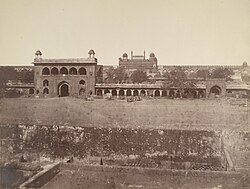
[[File:Naubat Khana Red Fort 1857.jpg|thumb|left|alt=Photo of courtyard shortly after the 1857 uprising|''[[Naubat Khana (Red Fort)|Naubat Khana]]'' and the courtyard before its demolition by the British, in an 1858 photograph]] | [[File:Naubat Khana Red Fort 1857.jpg|thumb|left|alt=Photo of courtyard shortly after the 1857 uprising|''[[Naubat Khana (Red Fort)|Naubat Khana]]'' and the courtyard before its demolition by the British, in an 1858 photograph]] | ||
In the east wall of the court stands the now-isolated ''Naubat Khana'' ([[Persian language|Persian]]: "Waiting Hall"), also known as ''Nakkar Khana'' (drum house). Music was | [[File:20191203 Naubat Khana, Red Fort, Delhi 0453 6340 DxO.jpg|thumb|''Naubat Khana'' today]] | ||
The vaulted arcade of the ''Chhatta Chowk'' ends in the | |||
In the east wall of the court stands the now-isolated ''Naubat Khana'' ([[Persian language|Persian]]: "Waiting Hall"), also known as ''Nakkar Khana'' (drum house). Music was performed daily at scheduled times within the Red Fort, and it was required of everyone, except members of the royalty, to dismount during these performances. Later Mughal emperors [[Jahandar Shah]] (1712–1713) and [[Farrukhsiyar]] (1713–1719) are believed to have been murdered here. The [[Indian War Memorial Museum]] is located on the second floor.<ref>{{Cite web |url=https://indiapicks.com/Heritage/Red_Fort/Red_Fort-Naubat_Khana.htm |title=Lal Qila (Red Fort) – Naubat Khana |website=indiapicks.com |url-status=usurped |access-date=12 April 2020 |archive-url=https://web.archive.org/web/20180311235856/http://indiapicks.com/Heritage/Red_Fort/Red_Fort-Naubat_Khana.htm |archive-date=11 March 2018 }}</ref> | |||
The vaulted arcade of the ''Chhatta Chowk'' ends in the center of the outer court, which measured {{convert|540|x|360|ft|m}}.<ref name="archive1">{{cite web |url=https://archive.org/stream/handbooktravelle00john#page/196 |title=A handbook for travellers in India, Burma, and Ceylon |access-date=3 January 2014 |archive-url=https://web.archive.org/web/20131224183054/http://www.archive.org/stream/handbooktravelle00john#page/196 |archive-date=24 December 2013 |url-status=live }}</ref> The side arcades and the central tank of the Red Fort were demolished following the 1857 rebellion. | |||
=== Diwan-i-Aam === | === Diwan-i-Aam === | ||
{{Main|Diwan-i-Aam (Red Fort, Delhi)}} | {{Main|Diwan-i-Aam (Red Fort, Delhi)}} | ||
The hall's columns and [[Engrailed (heraldry)|engrailed]] arches exhibit fine craftsmanship, and the hall was originally decorated with white ''chunam'' stucco.<ref name="archive1" /> | [[File:Diwan-i-Aam across lawn.jpg|thumb|upright=1.2|The ''Diwan-i-Aam'' today]] | ||
[[File:Ghulam Ali Khan 007.jpg|thumb|upright=1.2|The ''Diwan-i-Aam'' in the mid-nineteenth century]] | |||
The inner main court to which the ''Nakkar Khana'' led was {{convert|540|ft}} wide and {{convert|420|ft}} deep, surrounded by guarded galleries.<ref name="archive1" /> On the far side is the ''[[Diwan-i-Am (Red Fort)|Diwan-i-Aam]]'', the Public Audience Hall. This venue was used to oversee official matters brought forth by commoners, including legal issues such as taxation, inheritance disputes, and matters related to ''[[awqaf]]'' (endowments). | |||
The hall's columns and [[Engrailed (heraldry)|engrailed]] arches exhibit fine craftsmanship, and the hall was originally decorated with white ''chunam'' stucco.<ref name="archive1" /> At the rear of the venue, in a raised recess, the emperor would grant audiences from the marble balcony (''[[jharokha]]''). | |||
The ''Diwan-i-Aam'' was also used for state functions.<ref name="Langmead178" /> The courtyard (''mardana'') behind it leads to the imperial apartments. | The ''Diwan-i-Aam'' was also used for state functions.<ref name="Langmead178" /> The courtyard (''mardana'') behind it leads to the imperial apartments. | ||
| Line 153: | Line 180: | ||
=== Mumtaz Mahal === | === Mumtaz Mahal === | ||
{{Main|Mumtaz Mahal (Red Fort)}} | {{Main|Mumtaz Mahal (Red Fort)}} | ||
[[File:Red Fort 8.JPG|thumb|left|alt=Simple white building, with persons on walkway|{{Centre|''[[Mumtaz Mahal (Red Fort)|Mumtaz Mahal]]''}}]] | [[File:Red Fort 8.JPG|thumb|left|alt=Simple white building, with persons on walkway|{{Centre|''[[Mumtaz Mahal (Red Fort)|Mumtaz Mahal]]''}}]] | ||
The two southernmost pavilions of the palace are [[Zenana|''zenana''s]] (women's quarters), consisting of the ''Mumtaz Mahal'' built for Arjumand Banu Begum ([[Mumtaz Mahal]]) wife of the Mughal emperor Shah Jahan<ref>{{cite book|last1=Lach|first1= F.|last2=Kley|first2=Edwin J. Van|title=Asia in the Making of Europe, Volume III: A Century of Advance. Book 2, South Asia|date=1998|publisher=[[University of Chicago]] Press|isbn=9780226466972|page=689|language=en}}</ref> and the larger ''Rang Mahal'' a resort for royal women.<ref name=archnet>{{Cite web |url=https://archnet.org/sites/5270 |title= Rang Mahal Delhi, India |website=archnet.org |access-date=12 April 2020}}</ref> The ''Mumtaz Mahal'' houses the [[Red Fort Archaeological Museum]]. | The two southernmost pavilions of the palace are [[Zenana|''zenana''s]] (women's quarters), consisting of the ''Mumtaz Mahal,'' built for Arjumand Banu Begum ([[Mumtaz Mahal]]), who was wife of the Mughal emperor Shah Jahan,<ref>{{cite book|last1=Lach|first1= F.|last2=Kley|first2=Edwin J. Van|title=Asia in the Making of Europe, Volume III: A Century of Advance. Book 2, South Asia|date=1998|publisher=[[University of Chicago]] Press|isbn=9780226466972|page=689|language=en}}</ref> and the larger ''Rang Mahal'' was designated a resort for royal women.<ref name=archnet>{{Cite web |url=https://archnet.org/sites/5270 |title= Rang Mahal Delhi, India |website=archnet.org |access-date=12 April 2020}}</ref> The ''Mumtaz Mahal'' houses the [[Red Fort Archaeological Museum]]. | ||
=== Rang Mahal === | === Rang Mahal === | ||
{{Main|Rang Mahal (Red Fort)}} | {{Main|Rang Mahal (Red Fort)}} | ||
The ''Rang Mahal'' | |||
The ''Rang Mahal'', meaning "Palace of Colors," served as the residence for the emperor's wives and mistresses. It derived its name from its vibrant paintings and intricate decorations, including a mosaic of mirrors. At its center lies a marble pool, which is fed by the ''Nahr-i-Bihisht'' ("River of Paradise").<ref name="KM">{{Cite web |url=https://www.lonelyplanet.com/india/delhi/attractions/khas-mahal/a/poi-sig/1337802/356220 |title=Khas Mahal |website=lonelyplanet.com |access-date=12 April 2020}}</ref><ref name="archnet" /> | |||
=== Khas Mahal === | === Khas Mahal === | ||
{{Main|Khas Mahal (Red Fort)}} | {{Main|Khas Mahal (Red Fort)}} | ||
The ''Khas Mahal'' was the emperor's apartment. It was cooled by the ''Nahr-i-Bihisht''.<ref name="KM" /> Connected to it is the [[Muthamman Burj (Red Fort)|''Muthamman Burj'']], an octagonal tower where | |||
The ''Khas Mahal'' was the emperor's apartment. It was cooled by the ''Nahr-i-Bihisht''.<ref name="KM" /> Connected to it is the [[Muthamman Burj (Red Fort)|''Muthamman Burj'']], an octagonal tower where the emperor appeared before the audience awaiting his presence at the riverbank. Such practices were common among most kings of the time, reflecting the prevailing norms and traditions of royal courts.<ref name="ASI">{{cite web |url=http://asi.nic.in/asi_monu_tktd_delhi_redfort_muthaburz.asp |title=Muthamman-Burj |year=2011 |publisher=[[Archaeological Survey of India]] |access-date=12 April 2020 |archive-url=https://web.archive.org/web/20131124164735/http://asi.nic.in/asi_monu_tktd_delhi_redfort_muthaburz.asp |archive-date=24 November 2013 |url-status=live }}</ref> | |||
=== Diwan-i-Khas === | === Diwan-i-Khas === | ||
{{Main|Diwan-i-Khas (Red Fort)}} | {{Main|Diwan-i-Khas (Red Fort)}} | ||
[[File:Ghulam Ali Khan 013.jpg|thumb|Diwan-i-Khas in the mid-nineteenth century]] | |||
The Diwan-i-Khas | [[File:Ghulam Ali Khan 013.jpg|thumb|''Diwan-i-Khas'' in the mid-nineteenth century]] | ||
The ''Diwan-i-Khas'', or Hall of Private Audience, was a space dedicated to addressing the official matters and requests of the nobility and members of the royal family. A gate located on the north side of the ''[[Diwan-i-Aam (Red Fort, Delhi)|Diwan-i-Aam]]'' provided access to the innermost court of the palace, known as the ''Jalau Khana'', as well as to the ''Diwan-i-Khas''.<ref>{{Cite web |url=https://www.britannica.com/art/Akbar-period-architecture#ref244364 |title=Akbar period architecture |website=britannica.com |url-status=live |access-date=12 April 2020 |archive-url=https://web.archive.org/web/20190704025546/https://www.britannica.com/art/Akbar-period-architecture#ref244364 |archive-date=4 July 2019 }}</ref> It is constructed of white marble and inlaid with precious stones. The once-silver ceiling has been restored in wood. [[François Bernier]] described witnessing the jeweled Peacock Throne here in the 17th century. At both ends of the hall, over the two outer arches, is an inscription by the Persian poet [[Amir Khusrow]]: | |||
{{blockquote|If heaven can be on the face of the earth,<br /> | {{blockquote|If heaven can be on the face of the earth,<br /> | ||
| Line 178: | Line 209: | ||
=== Hammam === | === Hammam === | ||
{{Main|Hammam (Red Fort)}} | {{Main|Hammam (Red Fort)}} | ||
[[File:Hammam Red Fort interior.jpg|thumb| | |||
The ''[[hammam]]'' (Arabic: حمّام) were the imperial baths, consisting of three | [[File:Hammam Red Fort interior.jpg|thumb|The ''hammam'' in the mid-nineteenth century]] | ||
The ''[[hammam]]'' (Arabic: حمّام) were the imperial baths, consisting of three apartments separated by corridors and crowned with domes.<ref>{{Cite web |url=http://www.liveindia.com/redfort/5.html |title=Hammams Red Fort Delhi |website=liveindia.com |url-status=live |access-date=12 April 2020 |archive-url=https://web.archive.org/web/20190930234252/http://www.liveindia.com/redfort/5.html |archive-date=30 September 2019 }}</ref> The apartments are illuminated by a coloured glass skylight. The two rooms flanking the current entrance are believed to have served as bathing spaces for the royal children. The eastern apartment, featuring three fountain basins, was primarily used as a dressing room. Each room had a central fountain, and one included a marble reservoir embedded in the wall. According to legend, perfumed rose-water once flowed from the taps. The western apartment was designated for hot or vapor baths, with heating arrangements installed in its western wall.<ref>{{Cite book|last=John Murray (Firm)|url=https://archive.org/details/handbooktravelle00john|title=A handbook for travellers in India, Burma, and Ceylon .|date=1911|publisher=London : J. Murray; Calcutta : Thacker, Spink, & Co.|others=University of California Libraries}}</ref> | |||
The two rooms | |||
=== Baoli === | === Baoli === | ||
[[File:Red Fort Baoli.jpg|thumb|right|{{Centre|The baoli (step-well) at the}}{{Centre|Red Fort, Delhi}}]] | [[File:Red Fort Baoli.jpg|thumb|right|{{Centre|The baoli (step-well) at the}}{{Centre|Red Fort, Delhi}}]] | ||
The | The ''baoli'' (step-well) is one of the few structures within the Red Fort that survived the widespread demolitions carried out by the British after the Indian Rebellion of 1857. Its chambers were repurposed as a prison and, during the [[Indian National Army trials|Red Fort Trials]] of 1945–46, housed INA officers General [[Shah Nawaz Khan (general)|Shah Nawaz Khan]], Colonel [[Prem Sahgal|Prem Kumar Sahgal]], and Colonel [[Gurbaksh Singh Dhillon]]. The Red Fort ''baoli'' is distinctively designed, featuring two sets of staircases that descend to the well.<ref name="Red Fort Baoli">{{cite web |url=http://agrasenkibaoli.com/red-fort-baoli/ |title=Red Fort Baoli |publisher=agrasenkibaoli.com |access-date=1 August 2015 |archive-url=https://web.archive.org/web/20160110195809/http://agrasenkibaoli.com/red-fort-baoli/ |archive-date=10 January 2016 |url-status=live }}</ref> | ||
[[File:Moti Masjid in Red Fort Delhi.jpg|thumb|Moti Masjid | [[File:Moti Masjid in Red Fort Delhi.jpg|thumb|''Moti Masjid'']] | ||
=== Moti Masjid === | === Moti Masjid === | ||
{{Main|Moti Masjid (Red Fort)}} | {{Main|Moti Masjid (Red Fort)}} | ||
West of the hammam is the ''Moti Masjid'', the Pearl Mosque. A later addition, | |||
West of the ''hammam'' is the ''Moti Masjid'', the Pearl Mosque. A later addition to the Red Fort, the mosque was built in 1659 as a private place of worship for Emperor [[Aurangzeb]]. This small, three-domed structure is crafted from white marble and features a three-arched screen that opens onto the courtyard.<ref>World Heritage Series – Red Fort. Published by Director General, [[Archaeological Survey of India]], New Delhi, 2009. {{ISBN|978-81-87780-97-7}}</ref> | |||
=== Hira Mahal === | === Hira Mahal === | ||
{{Main|Hira Mahal (Red Fort)}} | {{Main|Hira Mahal (Red Fort)}} | ||
[[File:Fuerte Rojo-Delhi-India62.JPG|thumb|left|alt=Low, white building with ornate pillars and arches|{{Centre|''[[Shahi Burj (Red Fort)|Shahi Burj]]'' and its pavilion}}]] | [[File:Fuerte Rojo-Delhi-India62.JPG|thumb|left|alt=Low, white building with ornate pillars and arches|{{Centre|''[[Shahi Burj (Red Fort)|Shahi Burj]]'' and its pavilion}}]] | ||
The ''Hira Mahal'' ("Diamond Palace") is a pavilion on the southern edge of the | The ''Hira Mahal'' ("Diamond Palace") is a pavilion located on the southern edge of the Red Fort. It was constructed under the patronage of Bahadur Shah II and is situated at the end of the ''Hayat Baksh'' Garden.<ref>{{Cite web |url=https://www.culturalindia.net/indian-forts/delhi-fort.html |title=Red Fort |website=culturalindia.net |url-status=live |access-date=12 April 2020 |archive-url=https://web.archive.org/web/20190407125951/https://www.culturalindia.net/indian-forts/delhi-fort.html |archive-date=7 April 2019 }}</ref> At the northern edge of the Red Fort stood the ''Moti Mahal'', a twin building that was demolished during or shortly after the 1857 rebellion. The ''[[Shahi Burj (Red Fort)|Shahi Burj]]'' was the emperor's main study; its name means "Emperor's Tower",<ref>{{Cite web |url=https://www.lonelyplanet.com/india/delhi/attractions/shahi-burj/a/poi-sig/1337812/356220 |title=Shahi Burj Monument in Old Delhi (Shahjahanabad) |website=lonelyplanet.com |access-date=12 April 2020}}</ref> and it originally featured a ''[[chhatri]]'' on top. Heavily damaged, the tower is undergoing reconstruction. Facing it is a marble pavilion added by Emperor [[Aurangzeb]].<ref>{{Cite book |url=https://books.google.com/books?id=jEOwDwAAQBAJ&q=shahi+burj+a+marble+pavilion+added+by+Aurangzeb.&pg=PT15 |title=DK Eyewitness Top 10 Delhi |date=17 December 2019 |publisher=Penguin |isbn=9781465497246 |access-date=12 April 2020}}</ref> | ||
=== Hayat Bakhsh Bagh === | === Hayat Bakhsh Bagh === | ||
{{Main|Hayat Bakhsh Bagh}} | {{Main|Hayat Bakhsh Bagh}} | ||
Smaller gardens | [[File:Fuerte Rojo-Delhi-India69.JPG|thumb|alt=Square red sandstone building in a dried-out water tank|''Zafar Mahal'' and the white ''Sawan/Bhadon'' pavilions in the background]] | ||
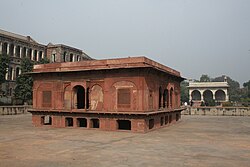
The ''Hayat Bakhsh Bagh'' ({{Langx|fa|حیات بخش باغ|lit=Life-Bestowing Garden}}) is located in the northeast part of the complex. At each end of the canal within the Red Fort is a white marble pavilion, named the ''Sawan'' and ''Bhadon'' Pavilions, after the Hindu months of Sawan and Bhadon. At the center of the reservoir stands the ''Zafar Mahal'', an eponymous red sandstone structure added around 1842 by Bahadur Shah Zafar.<ref>{{cite web |title=World Heritage Site – Red Fort, Delhi; Hayat-Bakhsh Garden and Pavilions |publisher=[[Archaeological Survey of India]] |url=http://asi.nic.in/asi_monu_tktd_delhi_redfort_pavilions.asp |access-date=15 August 2012 |archive-url=https://web.archive.org/web/20140207091933/http://asi.nic.in/asi_monu_tktd_delhi_redfort_pavilions.asp |archive-date=7 February 2014 |url-status=dead }}</ref> | |||
Smaller gardens, such as the ''Mehtab Bagh'' (Moonlight Garden), once existed to the west of the main garden but were demolished during the construction of British barracks.<ref name="ASI3" /> There are plans to restore the gardens.<ref>{{Cite news |url=https://timesofindia.indiatimes.com/city/delhi/Restoring-the-lost-glory-of-Red-Fort/articleshow/38398022.cms?referral=PM |title=Restoring the lost glory of Red Fort |website=[[Times of India]] |date=23 February 2003 |access-date=12 April 2020}}</ref> Beyond these structures, a road to the north leads to an arched bridge connecting to the [[Salimgarh Fort]]. | |||
=== Princes' quarter === | === Princes' quarter === | ||
{{Main|Princes' quarter (Red Fort)}} | {{Main|Princes' quarter (Red Fort)}} | ||
To the north of the ''Hayat Bakhsh Bagh'' and the ''Shahi Burj'' lies the quarter of the imperial princes, which was used by members of the Mughal royal family. Much of this area was demolished by British forces after the 1857 rebellion, with one of the palaces being repurposed into a tea house for soldiers. | |||
{{clear left}} | |||
== See also == | == See also == | ||
* Capital forts/palaces in Delhi, oldest first | |||
** [[Purana Qila]] | |||
*** [[Purana Qila#Indraprastha|Indraprastha]], earlier than 1000 BCE | |||
*** [[Ashokan Edicts in Delhi|Edicts & additions by Ashoka the Great]] (r. 268 to 232 BCE) of Maurya Empire | |||
** [[Anangpur]], by Anangpal I of Tomara dynasty (r. 736-1152 CE) | |||
** [[Qila Rai Pithora]] | |||
*** Lal Kot, by Tomara dynasty (1152-1177 CE) as capital | |||
*** Qila Rai Pithora, the Lal Kot expended by Prithviraj Chauhan (also called Rai Pithora, r. 1177–92 CE) of Chauhan dynasty | |||
** [[Siri Fort]], by Alauddin Khalji (r. 1296–1316), second ruler of Khalji Dynasty | |||
** [[Tughlaqabad Fort]], by Ghiyassudin Tughluq (r. 1320-25 CE) of Tughluq dynasty | |||
** [[Feroz Shah Kotla]], by Feroz Shah Tughluq (r. 1351-88 CE) of Tughluq dynasty | |||
** [[Salimgarh Fort]], in 1546 CE by Salim Shah Suri (r. 1545-54 CE), son of Sher Shah Suri | |||
** Red fort 8n Delhi, built in 1639-48 CE by Mughal emperor Shah Jahan when he moved his capital from Agra to Delhi | |||
** [[Rashtrapati Bhavan, New Delhi|Rashtrapati Bhavan]], built in 1912–29 by colonial British raj | |||
* [[History of Delhi]] | |||
** [[Anangpur#Paleo|Paleolithic sites in & around Tughlaqabad Fort]] | |||
** [[Baolis of Mehrauli#Stepwells|Stepwells of Delhi]] | |||
* Other Mughal Red Forts | |||
** [[Agra Fort]] | |||
** [[Lahore Fort]] | |||
== References == | == References == | ||
| Line 220: | Line 271: | ||
== External links == | == External links == | ||
* | *{{Commons category-inline}} | ||
*[https://web.archive.org/web/20101121144755/http://delhitourism.nic.in/delhitourism/tourist_place/red_fort.jsp Delhi Tourism | *[https://web.archive.org/web/20101121144755/http://delhitourism.nic.in/delhitourism/tourist_place/red_fort.jsp Delhi Tourism {{!}} Red Fort] | ||
*Dil Udaan | *Dil Udaan {{!}} [https://diludaan.blogspot.com/2023/06/blog-post.html Red Fort Blog] | ||
*{{Osmway|264863907}} | *{{Osmway|264863907}} | ||
| Line 229: | Line 280: | ||
{{World Heritage Sites in India}} | {{World Heritage Sites in India}} | ||
{{Mughal Empire|state=collapsed}} | {{Mughal Empire|state=collapsed}} | ||
{{Portal bar|India|Monarchy|History|Architecture}} | |||
{{authority control}} | {{authority control}} | ||
[[Category:Red Fort| ]] | [[Category:Red Fort| ]] | ||
[[Category:Buildings and structures completed in 1648]] | [[Category:Buildings and structures completed in 1648]] | ||
[[Category:Forts in Delhi]] | [[Category:Forts in Delhi]] | ||
| Line 241: | Line 290: | ||
[[Category:17th-century fortifications]] | [[Category:17th-century fortifications]] | ||
[[Category:Monuments of National Importance in Delhi]] | [[Category:Monuments of National Importance in Delhi]] | ||
[[Category:Mughal | [[Category:Mughal fortifications]] | ||
[[Category:Palaces in Delhi]] | [[Category:Palaces in Delhi]] | ||
[[Category:Royal residences in India]] | [[Category:Royal residences in India]] | ||
[[Category:World Heritage Sites in India]] | [[Category:World Heritage Sites in India]] | ||
[[Category:1648 establishments in India]] | [[Category:1648 establishments in India]] | ||
[[Category:Military installations closed in 2003]] | |||
[[Category:Terminating vistas in India]] | |||
Latest revision as of 20:11, 15 March 2026
Script error: No such module "About-distinguish".
| Red Fort | |
|---|---|
 A view of the Red Fort's Lahori Gate | |
| Location | Old Delhi, Delhi, India |
| Coordinates | 28°39′21″N 77°14′27″E / 28.65583°N 77.24083°E |
| Height | 18–33 m (59–108 ft) |
| Built | 12 May 1639 – 6 April 1648 |
| Built for | Mughal Empire |
| Architect | Ustad Ahmad Lahori |
| Architectural style(s) | Indo-Islamic architecture |
| Owner |
Sikh Confederacy (1783-1787)
|
| Lua error: bad argument #1 to 'mw.loadJsonData' ('Module:Designation/list' is not a valid JSON page). | |
Official name | Red Fort Complex |
| Type | Cultural |
| Criteria | II, III, VI |
| Designated | 2007 (31st session) |
| Reference no. | 231rev |
Region | Indo-Pacific |


The Red Fort (Lal Qila in Hindi; Hindi pronunciation: [laːl 'qɪlaː]) is a historic Mughal fort located in the Old Delhi area of Delhi, India. It served as the main residence of the Mughal emperors. Commissioned by Emperor Shah Jahan on the 12th of May 1639, the fort was constructed following his decision to shift the Mughal capital from Agra to Delhi. Originally adorned in red and white, the fort's design is attributed to Ustad Ahmad Lahori, the architect of the Taj Mahal. The Red Fort is a prominent example of Mughal architecture from Shah Jahan's reign, combining Persian and Indian architectural styles.
During the invasion by Nadir Shah of the Afsharid Empire in 1739, the fort was plundered and stripped of its artwork and jewels. Following the Indian Rebellion of 1857, many of its marble structures were demolished by the British, although the defensive walls remained largely intact. The fort was later repurposed as a military garrison.
On 15 August 1947, the first Prime Minister of India, Jawaharlal Nehru, hoisted the Indian flag above the Lahori Gate, the main entrance of the Red Fort. Since then, the Prime Minister of India has ceremonially raised the national tricolour at the main gate each year on Independence Day, then delivering a nationally broadcast address from its ramparts.
The Red Fort, as part of the Red Fort Complex, was recognised as a UNESCO World Heritage Site in 2007.[1][2]
Etymology[edit | edit source]
The name Red Fort is a translation of the Hindustani Lāl Qila (Hindi: लाल क़िला, Urdu: لال قلعہ),[3][4] derived from the fort's red sandstone walls. Lal means "red" in Hindi, while Qila comes from Arabic, meaning "fortress." Originally known as the "Blessed Fort" (Qila-i-Mubārak), it served as the residence of the imperial family.[5][6] The term Lāl Qila is also used to refer to the Agra Fort.
History[edit | edit source]
Mughal[edit | edit source]
Emperor Shah Jahan commissioned the construction of the Red Fort on 12 May 1639, following his decision to shift his capital from Agra to Delhi. The design of the Red Fort is attributed to the architect Ustad Ahmad Lahori, renowned for his work on the Taj Mahal.[7][8] It straddles the Yamuna River, which once fed the moats surrounding most of the walls.[9] Construction began in the sacred Islamic month of Muharram, on 13 May 1638.[10]:01 Supervised by Shah Jahan, it was completed on 6 April 1648.[11][12][13] The fort was originally adorned in red and white.[14] Unlike other Mughal forts, the Red Fort's boundary walls are asymmetrical to contain and subsume the older Salimgarh Fort.[10] The fortress-palace served as the centrepiece of Shahjahanabad, the city now known as Old Delhi. Shah Jahan's successor, Emperor Aurangzeb, enhanced the Red Fort by adding the Moti Masjid (Pearl Mosque) to the emperor's private quarters. He also constructed barbicans in front of the two main gates to create a more circuitous approach to the palace.[10]

Maratha[edit | edit source]
Following the death of Emperor Aurangzeb, the administrative and fiscal structure of the Mughal dynasty experienced decline, leading to the degeneration of the palace during the 18th century. In 1712, Jahandar Shah was crowned the Mughal Emperor. Within a year of beginning his rule, Shah was murdered and replaced by Farrukhsiyar. In 1739, the Persian emperor Nadir Shah decisively defeated the Mughal army, despite its considerable strength of approximately 200,000 soldiers.[15] Following his victory, he plundered the Red Fort, seizing its treasures, including the legendary Peacock Throne. After three months, Nadir Shah returned to Persia. His invasion left the city significantly damaged, and the Mughal Empire, under the next Mughal emperor Muhammad Shah's reign, was severely weakened.[10] The internal weaknesses of the Mughal Empire reduced the Mughals to titular rulers of Delhi. A treaty signed in 1752 established the Marathas as the protectors of the throne in Delhi.[16][17] The 1758 Maratha victory over the Afghans at Sirhind, followed by their defeat at Panipat,[18] catapulted them into further conflict with Ahmad Shah Durrani.[19][20]
In 1760, the Marathas stripped and melted the silver ceiling of the Diwan-i-Khas to raise funds for the defence of Delhi from the armies of Ahmed Shah Durrani.[21][22] In 1761, after the Marathas lost the third battle of Panipat, Delhi was raided by Durrani. Ten years later, the Marathas, acting at the behest of the exiled Emperor Shah Alam II, recaptured Delhi from the Rohilla Afghans. Mahadaji Shinde, the commander of the Maratha Army, restored Shah Alam II to the throne.[23]
In 1764, the Jat ruler of Bharatpur, Maharaja Jawahar Singh, attacked Delhi, and eventually captured the Red Fort of Delhi on 5 February 1765.[24] Two days later, after exacting tribute from the Mughals, the Jats withdrew their forces from the Red Fort, seizing the Mughal throne. The throne now adorns the palace at Deeg, serving as a historical centrepiece. The doors of the fort are located in the Lohagarh Fort of Bharatpur.[25]
In 1783, Sikh Misls led by Jassa Singh Ahluwalia, Jassa Singh Ramgarhia, and Baghel Singh Dhaliwal conquered Delhi and the Red Fort. With a consolidated force consisting of 40,000 troops, they looted the area spanning from Awadh to Jodhpur. After negotiations, the Sikh forces agreed to withdraw from Delhi and reinstate the Mughal emperor Shah Alam II. As a condition of their retreat, the Jats stipulated the construction of seven Sikh gurdwaras in Delhi, including the Gurudwara Sis Ganj Sahib in Chandni Chowk.[26]
In 1788, the grandson of Najib ad-Dawlah, Rohilla, Ghulam Kadir, looted Delhi and killed female members of the Mughal royal family. He also imprisoned Emperor Shah Alam II. Upon learning this, Mahadaji Shinde sent his men to free Shah Alam and pursue Kadir, who was hiding in Ghosgad in Rohilkhand. Kadir was eventually apprehended and beheaded. As a result of this, the Maratha flag was allowed to be hung from the Red Fort until 1803.
British[edit | edit source]
During the Second Anglo-Maratha War, British forces defeated a Maratha army led by Daulat Rao Sindhia in the Battle of Delhi, which marked the end of Maratha control over Delhi, including the Red Fort.[27] Following the battle, the East India Company took over the administration of Mughal territories and installed a resident at the Red Fort. The last Mughal emperor to occupy the fort, Bahadur Shah Zafar, became a symbol of the Indian Rebellion of 1857 against Company rule in India, in which the residents of Shahjahanabad participated.


Despite its position as the seat of Mughal power and its defensive capabilities, the Red Fort was not a site of any engagements during the 1857 rebellion. Bahadur left the fort on 17 September 1857 and was subsequently apprehended by British forces and returned to the Red Fort before being tried in 1858 and exiled to Rangoon in 7 October of that year.[28]
Following the rebellion's suppression, British authorities ordered the systematic demolition of the Red Fort, during which 80% of the fort's structures were demolished, including the stone screen that once connected the pavilions along the river-facing façade of the fort.[29] All the fort's furniture was either removed or destroyed; the harem apartments, servants' quarters, and gardens were demolished, and a line of stone barracks was erected atop them.[30] Only the marble buildings on the east side of the imperial enclosure escaped complete destruction, although they were damaged while demolition was underway. While the defensive walls and towers were relatively unscathed, over two-thirds of the inner structures were demolished.[31][32]
Lord Curzon, who served as the Viceroy of India from 1899 to 1905, initiated restoration efforts for the Red Fort. These included the reconstruction of its walls and the revival of its gardens, complete with an updated watering system.[33]

The INA trials, also known as the Red Fort Trials, refer to the court-martial of a number of officers of the Indian National Army. The first trial was conducted at the Red Fort between November and December 1945. On 15 August 1947, the first prime minister of India, Jawaharlal Nehru, raised the Indian national flag above the Lahore Gate.[34]
Indian[edit | edit source]
After Indian independence, the site experienced few changes, and the Red Fort continued to be used as a military cantonment. A significant portion of the Red Fort remained under the control of the Indian Army until 22 December 2003, when it was transferred to the Archaeological Survey of India for restoration and conservation.[35][36] In 2009, the Comprehensive Conservation and Management Plan (CCMP), prepared by the Archaeological Survey of India under the auspices of a Supreme Court direction to revitalise the fort, was announced.[37][38][39]
In the 21st century, several museums and galleries have been added to the Red Fort complex. Four of these museums, inaugurated in 2019, are housed in the colonial-era barracks within the complex. Barrack B1 is dedicated to the 1857 War of Independence, Barrack B2 commemorates the Jallianwala Bagh massacre, and Barrack B3 focuses on Subhas Chandra Bose and the Indian National Army movement. Barrack B4, known as Drishyakala, is a collaboration between the Archaeological Survey of India and the Delhi Art Gallery and showcases Indian art. The earlier museums, including the Indian Freedom Fighters' Museum, the Mumtaz Mahal Museum, and the Naubat Khana Museum, have been closed, with their exhibits relocated to these newly established museums.[40]
Archaeological finds[edit | edit source]
Archaeological excavations at the Red Fort have unearthed several Ochre Coloured Pottery culture artefacts dating from 2600 BCE to 1200 BCE.[41]
Modern era[edit | edit source]

.jpg)
The Red Fort, the largest monument in Old Delhi,[42] is one of its most popular tourist destinations[43] and attracts thousands of visitors every year.[44] It is a monument of national significance; each year on India's independence day, observed on August 15, the Prime Minister hoists the national flag at the Red Fort and delivers a speech from its ramparts, which is broadcast nationwide.[45] The fort also appears on the back of the ₹500 note of the Mahatma Gandhi New Series of the Indian rupee.[46]
The Red Fort's architectural features are in varying states of preservation. While some structures remain relatively intact, retaining their original decorative elements, others have suffered significant damage, with inlaid marble floral designs removed by looters. The water features, once extensive, are now dry. The tea house, though not preserved in its historical form, functions as a working restaurant. The mosque and the hammam (public baths) are closed to visitors, who can only view them through glass windows or marble latticework. Walkways within the complex are deteriorating, and public toilets are available both at the entrance and inside the premises. The Lahori Gate serves as the main entrance, leading to a shopping area with jewelry and craft stores. The complex also houses a museum of "blood paintings," which narrate the stories of 20th-century Indian martyrs, alongside an archaeological museum and an Indian war-memorial museum.[citation needed]
2000 terrorist attack[edit | edit source]
The Red Fort was the site of a terrorist attack on 22 December 2000, carried out by six Lashkar-e-Taiba operatives. Two soldiers and a civilian were murdered in what the news media described as an attempt to derail the then-ongoing India-Pakistan peace talks.[47][48]
Security[edit | edit source]
To ensure security and prevent terrorist attacks, stringent measures are implemented around the Red Fort on the eve of the Indian Independence Day. Delhi Police and paramilitary forces maintain a vigilant presence in the neighbourhoods surrounding the fort, while National Security Guard sharpshooters are strategically stationed on high-rises near the site.[49][50] The airspace around the fort is a designated no-fly zone during the celebration,[51] and safe houses exist in the vicinity to which the prime minister and other dignitaries can be taken to in the event of an attack.[49]
Adoption controversy[edit | edit source]
In April 2018, the Dalmia Group adopted the Red Fort for maintenance, development, and operations under the government's "Adopt A Heritage" scheme, through a contract worth ₹25 crores for a period of five years.[52] A memorandum of understanding was signed with the ministries of Tourism and Culture and the Archaeological Survey of India.[53] The adoption of the Red Fort by a private entity sparked outcry and widespread debate, drawing criticism from the public, historians, and political parties. The move also led to the trending of the hashtag #IndiaOnSale on Twitter.[54] In May 2018, the Indian National Congress demanded the suspension of the agreement until an "impartial review" could be conducted by the Central Advisory Board of Archaeology or another recognized body of experts.[55]
2021 Indian farmers' Republic Day protest[edit | edit source]
On 26 January 2021, during the 2021 Indian farmers' Republic Day protest, a coterie of protesting farmers breached the fort, hoisted religious flags from its ramparts, and scaled the domes of the fort.[56] One of the farmers was witnessed climbing a flagpole in front of the fort and hoisting the Nishan Sahib pennant on the flagpole.[57] The fort sustained damage owing to clashes between the protestors and the police[58] and was vacated following police announcements.
Discoloration of the Red Fort[edit | edit source]
Since the late 20th century, the monument has been affected by environmental pollution which has turned the Red Fort's color from red to black. According to recent Italo-Indian studies in September 2025, repeated events of air pollution has contributed to the formation of tarry black crusts forming on the Red Fort's walls.[59] These black crusts are caused by pollutants, including particulate matter, nitrogen dioxide, sulfur dioxide, carbon monoxide, and toxic metals, such as lead, copper and zinc.
Architecture[edit | edit source]

The World Heritage Convention characterises the Red Fort as embodying "the zenith of Mughal creativity". The fort synthesises Islamic palace structure with local traditions, resulting in a confluence of "Persian and Timurid architecture". The fort served as an inspiration for later buildings and gardens across the Indian subcontinent.[1]
The Red Fort spans an area of 254.67 acres (103.06 hectares) and is enclosed by 2.41 kilometres (1.50 miles) of defensive walls.[60] These walls, reinforced with turrets and bastions, vary in height from 18 meters (59 feet) on the river-facing side to 33 meters (108 feet) on the city-facing side. The fort is octagonal, with the north–south axis longer than the east–west axis. The marble, floral decorations and the fort's double domes exemplify later Mughal architecture.[61]
The Red Fort showcases a high level of ornamentation, and the Kohinoor diamond was reportedly part of the furnishings. The artwork of the fort integrates Persian, European, and Indian artistic traditions, culminating in a distinctive Shahjahani style characterized by its richness in form, expression, and color. The Red Fort is one of India's most significant architectural complexes, encapsulating a rich history and diverse artistic traditions. Even prior to its designation as a monument of national importance in 1913, efforts were undertaken to ensure its preservation for posterity.
The Lahori and Delhi Gates were used by the public, whereas the Khizrabad Gate was reserved for the emperor.[10] The Lahori Gate serves as the main entrance to the Red Fort, leading to the Chhatta Chowk, a domed shopping area often referred to as the covered bazaar.
Major structures[edit | edit source]
The most significant surviving structures of the Red Fort include its walls and ramparts, the main gates, the audience halls, and the imperial apartments located along the eastern riverbank.[62]

Lahori Gate[edit | edit source]

The Lahori Gate, the primary entrance to the Red Fort, derives its name from its orientation towards the city of Lahore, which was once part of the Mughal Empire. During Aurangzeb's reign, the aesthetic appeal of the Lahori Gate was modified by the construction of a barbican, which Shah Jahan poetically described as "a veil drawn across the face of a beautiful woman."[63][64][65] Since 1947, on every Indian Independence Day, the national flag is ceremonially unfurled, and the Prime Minister delivers a speech from the ramparts of the Red Fort.
Delhi Gate[edit | edit source]
The Delhi Gate serves as the southern public entrance to the Red Fort and shares a similar layout and appearance with the Lahori Gate. Flanking the gate are two life-sized stone elephants positioned to face each other.[66]
Chhatta Chowk[edit | edit source]
Adjacent to the Lahori Gate is the Chhatta Chowk (or Meena Bazaar), where silk jewelry and other items for the imperial household were sold during the Mughal period. This market was earlier known as Bazaar-i-Musaqqaf or Chatta-bazaar (both meaning "roofed market"). The Lahori Gate, the main entrance to the Red Fort, opens into an outer court that intersects with a large north–south street. This street originally separated the fort's military functions, located to the west, from the palaces situated to the east. At its southern end lies the Delhi Gate.[67]
Naubat Khana[edit | edit source]


In the east wall of the court stands the now-isolated Naubat Khana (Persian: "Waiting Hall"), also known as Nakkar Khana (drum house). Music was performed daily at scheduled times within the Red Fort, and it was required of everyone, except members of the royalty, to dismount during these performances. Later Mughal emperors Jahandar Shah (1712–1713) and Farrukhsiyar (1713–1719) are believed to have been murdered here. The Indian War Memorial Museum is located on the second floor.[68] The vaulted arcade of the Chhatta Chowk ends in the center of the outer court, which measured 540 by 360 feet (160 m × 110 m).[69] The side arcades and the central tank of the Red Fort were demolished following the 1857 rebellion.
Diwan-i-Aam[edit | edit source]


The inner main court to which the Nakkar Khana led was 540 feet (160 m) wide and 420 feet (130 m) deep, surrounded by guarded galleries.[69] On the far side is the Diwan-i-Aam, the Public Audience Hall. This venue was used to oversee official matters brought forth by commoners, including legal issues such as taxation, inheritance disputes, and matters related to awqaf (endowments).
The hall's columns and engrailed arches exhibit fine craftsmanship, and the hall was originally decorated with white chunam stucco.[69] At the rear of the venue, in a raised recess, the emperor would grant audiences from the marble balcony (jharokha).
The Diwan-i-Aam was also used for state functions.[61] The courtyard (mardana) behind it leads to the imperial apartments.
Mumtaz Mahal[edit | edit source]

The two southernmost pavilions of the palace are zenanas (women's quarters), consisting of the Mumtaz Mahal, built for Arjumand Banu Begum (Mumtaz Mahal), who was wife of the Mughal emperor Shah Jahan,[70] and the larger Rang Mahal was designated a resort for royal women.[71] The Mumtaz Mahal houses the Red Fort Archaeological Museum.
Rang Mahal[edit | edit source]
The Rang Mahal, meaning "Palace of Colors," served as the residence for the emperor's wives and mistresses. It derived its name from its vibrant paintings and intricate decorations, including a mosaic of mirrors. At its center lies a marble pool, which is fed by the Nahr-i-Bihisht ("River of Paradise").[72][71]
Khas Mahal[edit | edit source]
The Khas Mahal was the emperor's apartment. It was cooled by the Nahr-i-Bihisht.[72] Connected to it is the Muthamman Burj, an octagonal tower where the emperor appeared before the audience awaiting his presence at the riverbank. Such practices were common among most kings of the time, reflecting the prevailing norms and traditions of royal courts.[73]
Diwan-i-Khas[edit | edit source]

The Diwan-i-Khas, or Hall of Private Audience, was a space dedicated to addressing the official matters and requests of the nobility and members of the royal family. A gate located on the north side of the Diwan-i-Aam provided access to the innermost court of the palace, known as the Jalau Khana, as well as to the Diwan-i-Khas.[74] It is constructed of white marble and inlaid with precious stones. The once-silver ceiling has been restored in wood. François Bernier described witnessing the jeweled Peacock Throne here in the 17th century. At both ends of the hall, over the two outer arches, is an inscription by the Persian poet Amir Khusrow:
If heaven can be on the face of the earth,
It is this, it is this, it is this.
— "World Heritage Site – Red Fort, Delhi; Diwan-i-Khas". Archaeological Survey of India. Retrieved 15 August 2012.

Hammam[edit | edit source]

The hammam (Arabic: حمّام) were the imperial baths, consisting of three apartments separated by corridors and crowned with domes.[75] The apartments are illuminated by a coloured glass skylight. The two rooms flanking the current entrance are believed to have served as bathing spaces for the royal children. The eastern apartment, featuring three fountain basins, was primarily used as a dressing room. Each room had a central fountain, and one included a marble reservoir embedded in the wall. According to legend, perfumed rose-water once flowed from the taps. The western apartment was designated for hot or vapor baths, with heating arrangements installed in its western wall.[76]
Baoli[edit | edit source]

The baoli (step-well) is one of the few structures within the Red Fort that survived the widespread demolitions carried out by the British after the Indian Rebellion of 1857. Its chambers were repurposed as a prison and, during the Red Fort Trials of 1945–46, housed INA officers General Shah Nawaz Khan, Colonel Prem Kumar Sahgal, and Colonel Gurbaksh Singh Dhillon. The Red Fort baoli is distinctively designed, featuring two sets of staircases that descend to the well.[77]

Moti Masjid[edit | edit source]
West of the hammam is the Moti Masjid, the Pearl Mosque. A later addition to the Red Fort, the mosque was built in 1659 as a private place of worship for Emperor Aurangzeb. This small, three-domed structure is crafted from white marble and features a three-arched screen that opens onto the courtyard.[78]
Hira Mahal[edit | edit source]

The Hira Mahal ("Diamond Palace") is a pavilion located on the southern edge of the Red Fort. It was constructed under the patronage of Bahadur Shah II and is situated at the end of the Hayat Baksh Garden.[79] At the northern edge of the Red Fort stood the Moti Mahal, a twin building that was demolished during or shortly after the 1857 rebellion. The Shahi Burj was the emperor's main study; its name means "Emperor's Tower",[80] and it originally featured a chhatri on top. Heavily damaged, the tower is undergoing reconstruction. Facing it is a marble pavilion added by Emperor Aurangzeb.[81]
Hayat Bakhsh Bagh[edit | edit source]

The Hayat Bakhsh Bagh (Persian: حیات بخش باغ, lit. 'Life-Bestowing Garden') is located in the northeast part of the complex. At each end of the canal within the Red Fort is a white marble pavilion, named the Sawan and Bhadon Pavilions, after the Hindu months of Sawan and Bhadon. At the center of the reservoir stands the Zafar Mahal, an eponymous red sandstone structure added around 1842 by Bahadur Shah Zafar.[82]
Smaller gardens, such as the Mehtab Bagh (Moonlight Garden), once existed to the west of the main garden but were demolished during the construction of British barracks.[10] There are plans to restore the gardens.[83] Beyond these structures, a road to the north leads to an arched bridge connecting to the Salimgarh Fort.
Princes' quarter[edit | edit source]
To the north of the Hayat Bakhsh Bagh and the Shahi Burj lies the quarter of the imperial princes, which was used by members of the Mughal royal family. Much of this area was demolished by British forces after the 1857 rebellion, with one of the palaces being repurposed into a tea house for soldiers.
See also[edit | edit source]
- Capital forts/palaces in Delhi, oldest first
- Purana Qila
- Indraprastha, earlier than 1000 BCE
- Edicts & additions by Ashoka the Great (r. 268 to 232 BCE) of Maurya Empire
- Anangpur, by Anangpal I of Tomara dynasty (r. 736-1152 CE)
- Qila Rai Pithora
- Lal Kot, by Tomara dynasty (1152-1177 CE) as capital
- Qila Rai Pithora, the Lal Kot expended by Prithviraj Chauhan (also called Rai Pithora, r. 1177–92 CE) of Chauhan dynasty
- Siri Fort, by Alauddin Khalji (r. 1296–1316), second ruler of Khalji Dynasty
- Tughlaqabad Fort, by Ghiyassudin Tughluq (r. 1320-25 CE) of Tughluq dynasty
- Feroz Shah Kotla, by Feroz Shah Tughluq (r. 1351-88 CE) of Tughluq dynasty
- Salimgarh Fort, in 1546 CE by Salim Shah Suri (r. 1545-54 CE), son of Sher Shah Suri
- Red fort 8n Delhi, built in 1639-48 CE by Mughal emperor Shah Jahan when he moved his capital from Agra to Delhi
- Rashtrapati Bhavan, built in 1912–29 by colonial British raj
- Purana Qila
- History of Delhi
- Other Mughal Red Forts
References[edit | edit source]
- ↑ 1.0 1.1 "Red Fort Complex". World Heritage List. UNESCO World Heritage Centre. Archived from the original on 3 August 2009. Retrieved 15 November 2009.
- ↑ "Red Fort was designated a UNESCO World Heritage Site in 2007". Lonely Planet. Archived from the original on 29 April 2012. Retrieved 4 August 2012.
- ↑ "qila | Meaning of qila in English by Shabdkosh English Hindi Dictionary". Shabdkosh Dictionary. Archived from the original on 11 November 2013. Retrieved 2 June 2018.
- ↑ "qila | Definition of qila in English by Oxford Dictionaries". Oxford Dictionaries | English. Archived from the original on 3 April 2018. Retrieved 3 April 2018.
- ↑ William M. Spellman (1 April 2004). Monarchies 1000–2000. Reaktion Books. ISBN 978-1-86189-087-0. Archived from the original on 14 December 2011. Retrieved 5 August 2012.
- ↑ Mehrdad Kia; Elizabeth H. Oakes (1 November 2002). Social Science Resources in the Electronic Age. Greenwood Publishing Group. ISBN 978-1-57356-474-8. Archived from the original on 11 January 2014. Retrieved 5 August 2012.
- ↑ "Ustad Ahmad – oi". oxfordindex.oup.com. Retrieved 8 December 2019.[dead link]
- ↑ "Building the Taj – who designed the Taj Mahal". PBS. Archived from the original on 18 February 2014. Retrieved 13 August 2013.
- ↑ "Red Fort lies along the River Yamuna". Archived from the original on 14 August 2012. Retrieved 4 August 2012.
- ↑ 10.0 10.1 10.2 10.3 10.4 10.5 "Comprehensive Conservation Management Plan for Red Fort, Delhi" (PDF). Archaeological Survey of India. March 2009. Archived (PDF) from the original on 8 May 2012. Retrieved 14 August 2012.
- ↑ Elliot, H. M. (Henry Miers) (26 September 1875). "Shah Jahan". [Lahore : Sh. Mubarak Ali. Retrieved 26 September 2020 – via Internet Archive.
- ↑ "List of Muhammadan and Hindu monuments vol.1". 1916. Retrieved 4 March 2020.
- ↑ Pinto, Xavier; Myall, E. G. (2009). Glimpses of History. Frank Brothers. p. 129. ISBN 978-81-8409-617-0. Archived from the original on 11 January 2014. Retrieved 25 September 2016.
- ↑ Nelson, Dean (20 May 2011). "Delhi's Red Fort was originally white". The Daily Telegraph (UK).
- ↑ "Battle of Karnal". Encyclopedia Britannica. Retrieved 24 May 2021.
- ↑ Mehta, J. L. (2005). Advanced Study in the History of Modern India: Volume One: 1707–1813. Sterling Publishers. p. 134. ISBN 978-1-932705-54-6. Archived from the original on 12 January 2014. Retrieved 25 September 2016.
- ↑ Jayapalan, N. (2001). History of India. Atlantic Publishers & Distri. p. 249. ISBN 978-81-7156-928-1. Archived from the original on 12 January 2014. Retrieved 25 September 2016.
- ↑ Advanced Study in the History of Modern India: 1707–1813 – Jaswant Lal Mehta – Google Books. Google Books. Retrieved 29 July 2013.
- ↑ Roy, Kaushik (2004). India's Historic Battles: From Alexander the Great to Kargil. Permanent Black, India. pp. 80–81. ISBN 978-81-78241-09-8.
- ↑ Elphinstone, Mountstuart (1841). History of India. John Murray, London. p. 276.
- ↑ Kulkarni, Uday S. (2012). Solstice at Panipat, 14 January 1761. Pune: Mula Mutha Publishers. p. 345. ISBN 978-81-921080-0-1.
- ↑ Kumar Maheshwari, Kamalesh; Wiggins, Kenneth W. (1989). Maratha Mints and Coinage. Indian Institute of Research in Numismatic Studies. p. 140. Archived from the original on 12 January 2014. Retrieved 25 September 2016.
- ↑ Dalrymple, William. The Anarchy.
- ↑ Meena, P R. RPSC RAS Prelims: History of Rajasthan Complete Study Notes With MCQ. New Era Publication.
- ↑ Gupta, Devesh. Rajasthan District G.K.: English Medium. Atharv Publication. p. 134.
- ↑ Murphy, Anne (29 November 2012). The Materiality of the Past: History and Representation in Sikh Tradition. OUP USA. ISBN 978-0-19-991629-0.
- ↑ Mayaram, Shail (2003). Against History, Against State: Counterperspectives from the Margins. Columbia University Press. ISBN 978-0-231-12731-8.
- ↑ Mody, Krutika. "Bahadur Shah II "Zafar"'s significance with Red Fort". Archived from the original on 2 September 2012. Retrieved 4 August 2012.
- ↑ Mayank Austen Soofi, Delhi's Belly (19 August 2011). "The other red corridor". mint. Retrieved 23 May 2021.
- ↑ William Dalrymple (2007). "Introduction". The Last Mughal. Penguin Books. p. 7. ISBN 978-0-14-310243-4.
- ↑ "How the Red Fort Became the Site for India's Independence Day Celebrations". thewire.in. Retrieved 15 May 2024.
- ↑ Sirur, Simrin (30 January 2021). "Red Fort isn't just a historic monument. Its breach crossed a red line in Indian mind". ThePrint. Retrieved 15 May 2024.
- ↑ Eugenia W Herbert (2013). Flora's Empire: British Gardens in India. Penguin Books Limited. p. 333. ISBN 978-81-8475-871-9.
- ↑ PTI (15 August 2013). "Manmohan first PM outside Nehru-Gandhi clan to hoist flag for 10th time". The Hindu. Archived from the original on 21 December 2013. Retrieved 13 May 2014.
- ↑ India. Ministry of Defence (2005). Sainik samachar. Director of Public Relations, Ministry of Defence. Archived from the original on 30 September 2013. Retrieved 5 August 2012.
- ↑ Muslim India. Muslim India. 2004. Archived from the original on 30 September 2013. Retrieved 5 August 2012.
- ↑ "Red Fort facelift to revive Mughal glory in 10 years : Mail Today Stories, News – India Today". Indiatoday.intoday.in. 1 June 2009. Archived from the original on 13 December 2013. Retrieved 3 January 2014.
- ↑ "CHAPTER-10_revised_jan09.pmd" (PDF). Archived from the original (PDF) on 8 May 2012. Retrieved 13 May 2014.
- ↑ "CHAPTER-00_revisedfeb09.pmd" (PDF). Archived from the original (PDF) on 8 May 2012. Retrieved 13 May 2014.
- ↑ "Four museums at Red Fort open window to battle for freedom". The Times of India. 24 January 2019. ISSN 0971-8257. Retrieved 16 August 2024.
- ↑ Singh, Upinder (2008). A History of Ancient and Early Medieval India From the Stone Age to the 12th Century. Pearson Education India. p. 218. ISBN 9788131711200.
- ↑ Schreitmüller, Karen; Dhamotharan, Mohan (CON); Szerelmy, Beate (CON) (14 February 2012). Baedeker India. Baedeker. p. 253. ISBN 978-3-8297-6622-7. Archived from the original on 27 September 2013. Retrieved 25 August 2012.
- ↑ Devashish, Dasgupta (2011). Tourism Marketing. Pearson Education India. p. 79. ISBN 978-81-317-3182-6. Archived from the original on 29 September 2013. Retrieved 25 August 2012.
- ↑ Murthy, Raja (23 February 2012). "Mughal 'paradise' gets tortuous makeover". Asia Times Online. South Asia. Archived from the original on 20 November 2012. Retrieved 25 August 2012.
- ↑ "Singh becomes third PM to hoist flag at Red Fort for 9th time". Business Standard. 15 August 2012. Retrieved 17 August 2012.
- ↑ "Issue of ₹ 500 banknotes inset letter 'E' in Mahatma Gandhi (New) series after demonitization". Reserve Bank of India. 8 November 2016. Archived from the original on 9 November 2016. Retrieved 9 November 2016.
- ↑ "Red Fort attack will not affect peace moves". 19 August 2012. Archived from the original on 3 October 2012. Retrieved 19 August 2012.
- ↑ "Red Fort terrorist attacks". 31 March 2012. Archived from the original on 13 May 2013. Retrieved 4 August 2012.
- ↑ 49.0 49.1 "Security tightened across Delhi on I-Day eve". Daily News and Analysis. 14 August 2012. Archived from the original on 18 August 2012. Retrieved 17 August 2012.
- ↑ "Tight security ensures safe I-Day celebration". The Asian Age. 16 August 2012. Archived from the original on 17 November 2017. Retrieved 17 August 2012.
- ↑ "Rain Brings Children Cheer, Gives Securitymen a Tough Time". The Hindu. 16 August 2011. Archived from the original on 30 December 2013. Retrieved 27 July 2012.
- ↑ Manish, Sai (29 April 2018). "Dalmia Bharat group to adopt Delhi's iconic Red Fort for five years". Business Standard. Archived from the original on 13 May 2019. Retrieved 7 September 2019.
- ↑ Krishna, Navmi (30 April 2018). "Red Fort adoption row: The long list of Monument Mitras". The Hindu. Retrieved 7 September 2019.
- ↑ Nettikkara, Samiha (30 April 2018). "Indians upset over Red Fort monument 'adoption'". BBC. Archived from the original on 9 July 2019. Retrieved 7 September 2019.
- ↑ Pathak, Vikas (2 May 2018). "Historians seek review of Red Fort contract". The Hindu. Retrieved 7 September 2019.
- ↑ "India protest: Farmers breach Delhi's Red Fort in huge tractor rally". BBC News. BBC. 26 January 2021. Retrieved 28 January 2021.
- ↑ Dawn.com (26 January 2021). "In pictures: Indian farmers enter Delhi's Red Fort as protests break out across the country". Dawn. Pakistan. Retrieved 29 January 2021.
- ↑ "ASI shuts Red Fort till January 31 for visitors after vandalism by tractor rally protesters". 28 January 2021. Retrieved 28 January 2021.
- ↑ "Delhi's toxic air is turning iconic Red Fort black, scientists warn". The Independent. 18 September 2025. Retrieved 19 September 2025.
- ↑ N. L. Batra (May 2008). Delhi's Red Fort by the Yamuna. Niyogi Books. ISBN 9780856676543. Archived from the original on 9 October 2013. Retrieved 5 August 2012.
- ↑ 61.0 61.1 Langmead; Garnaut, Christine (2001). Encyclopedia of Architectural and Engineering Feats. ABC-CLIO. p. 178. ISBN 978-1-57607-112-0.
- ↑ "World Heritage Site – Red Fort, Delhi". Archaeological Survey of India. Archived from the original on 24 December 2014. Retrieved 15 August 2012.
- ↑ Fanshawe.H.C (1998). Delhi, Past and Present. Asian Educational Services. pp. 1–8, general introduction. ISBN 978-81-206-1318-8. Archived from the original on 15 December 2019. Retrieved 10 June 2009.
- ↑ Sharma p.143
- ↑ Mahtab Jahan (2004). "Dilli's gates and windows". MG The Milli Gazette. Archived from the original on 19 June 2017. Retrieved 17 May 2009.
- ↑ "World heritage site". Asi.nic.in. Archived from the original on 1 November 2015. Retrieved 3 August 2015.
- ↑ Kuriakose, Anthony (15 January 2011). "Chatta Chowk: A market for all reasons". deccanherald.com. Archived from the original on 22 January 2011. Retrieved 12 April 2020.
- ↑ "Lal Qila (Red Fort) – Naubat Khana". indiapicks.com. Archived from the original on 11 March 2018. Retrieved 12 April 2020.
- ↑ 69.0 69.1 69.2 "A handbook for travellers in India, Burma, and Ceylon". Archived from the original on 24 December 2013. Retrieved 3 January 2014.
- ↑ Lach, F.; Kley, Edwin J. Van (1998). Asia in the Making of Europe, Volume III: A Century of Advance. Book 2, South Asia. University of Chicago Press. p. 689. ISBN 9780226466972.
- ↑ 71.0 71.1 "Rang Mahal Delhi, India". archnet.org. Retrieved 12 April 2020.
- ↑ 72.0 72.1 "Khas Mahal". lonelyplanet.com. Retrieved 12 April 2020.
- ↑ "Muthamman-Burj". Archaeological Survey of India. 2011. Archived from the original on 24 November 2013. Retrieved 12 April 2020.
- ↑ "Akbar period architecture". britannica.com. Archived from the original on 4 July 2019. Retrieved 12 April 2020.
- ↑ "Hammams Red Fort Delhi". liveindia.com. Archived from the original on 30 September 2019. Retrieved 12 April 2020.
- ↑ John Murray (Firm) (1911). A handbook for travellers in India, Burma, and Ceylon . University of California Libraries. London : J. Murray; Calcutta : Thacker, Spink, & Co.
- ↑ "Red Fort Baoli". agrasenkibaoli.com. Archived from the original on 10 January 2016. Retrieved 1 August 2015.
- ↑ World Heritage Series – Red Fort. Published by Director General, Archaeological Survey of India, New Delhi, 2009. ISBN 978-81-87780-97-7
- ↑ "Red Fort". culturalindia.net. Archived from the original on 7 April 2019. Retrieved 12 April 2020.
- ↑ "Shahi Burj Monument in Old Delhi (Shahjahanabad)". lonelyplanet.com. Retrieved 12 April 2020.
- ↑ DK Eyewitness Top 10 Delhi. Penguin. 17 December 2019. ISBN 9781465497246. Retrieved 12 April 2020.
- ↑ "World Heritage Site – Red Fort, Delhi; Hayat-Bakhsh Garden and Pavilions". Archaeological Survey of India. Archived from the original on 7 February 2014. Retrieved 15 August 2012.
- ↑ "Restoring the lost glory of Red Fort". Times of India. 23 February 2003. Retrieved 12 April 2020.
External links[edit | edit source]
- Delhi Tourism | Red Fort
- Dil Udaan | Red Fort Blog
- Template:Osmway

| North |  | |
|---|---|---|
| East | ||
| Northeast | ||
| South | ||
| Central | ||
| West | ||

- Pages using the JsonConfig extension
- Pages with Hindi IPA
- Red Fort
- Buildings and structures completed in 1648
- Forts in Delhi
- Indian Army bases
- Indian National Army trials
- 17th-century fortifications
- Monuments of National Importance in Delhi
- Mughal fortifications
- Palaces in Delhi
- Royal residences in India
- World Heritage Sites in India
- 1648 establishments in India
- Military installations closed in 2003
- Terminating vistas in India