

m Removed empty portal template using script |
MarkObd354 (talk | contribs) refine article to improve readability |
||
| Line 3: | Line 3: | ||
{{Use Indian English|date=January 2016}} | {{Use Indian English|date=January 2016}} | ||
{{Infobox country | {{Infobox country | ||
| | | common_name = State of Carnatic | ||
| | | native_name = {{transliteration|fa|Salṭanat-i-Karnātak}} ([[Persian language|Persian]]) <br /> {{transliteration|ta|Aṟkāḍu Navāp}} ([[Tamil language|Tamil]]) <br /> {{transliteration|ur|Saltanat-e-Karnāṭak}} ([[Urdu]]) | ||
| image_map = IGI1908India1765a.jpg | | image_map = IGI1908India1765a.jpg | ||
| image_map_caption = | | image_map_caption = Carnatic (southeast coast), on the Bay of Bengal<!-- took me a while to find it --> | ||
| image_flag = Flag of Nawab.svg | | image_flag = Flag of Nawab.svg | ||
| era = [[Mughal Empire|Mughal rule in India]]<br> | | image_coat = Images 2 -removebg-preview (1).png | ||
[[Company rule in India]] | | era = [[Mughal Empire|Mughal rule in India]]<br> [[Maratha Empire]]<br> [[Company rule in India]] | ||
| government_type = [[Monarchy]] | | government_type = [[Monarchy]] | ||
| title_leader = Nawab | | leader_title1 = | ||
| leader_name1 = | |||
| leader_name2 = | |||
| leader_name3 = | |||
| title_leader = [[Nawab]] | |||
| year_leader1 = 1692–1703 (first) | |||
| leader1 = [[Zulfiqar Khan Nusrat Jung]] | |||
| year_leader2 = 1710–1732 (first independent) | |||
| leader2 = [[Saadatullah Khan I]] | |||
| year_leader3 = 1824–1855 (last) | |||
| leader3 = [[Ghulam Muhammad Ghouse Khan]] | |||
| year_start = 1692 | | year_start = 1692 | ||
| year_end = 1855 | | year_end = 1855 | ||
| Line 21: | Line 31: | ||
| date_pre = 1692 | | date_pre = 1692 | ||
| p1 = Madurai Nayak | | p1 = Madurai Nayak | ||
| s1 = Company | | p2 = Maratha Confederacy | ||
| p3 = Mughal Empire | |||
| s1 = Company Raj | |||
| flag_s1 = Flag of the British East India Company (1801).svg | | flag_s1 = Flag of the British East India Company (1801).svg | ||
| capital = [[Gingee]] (1692–1710),<br>[[Arcot]] (1710–1768),<br>[[Chepauk]] (1768–1855) | | capital = [[Gingee]] (1692–1710),<br>[[Arcot]] (1710–1768),<br>[[Chepauk]] (1768–1855) | ||
| | | official_languages = [[Persian language|Persian]], [[Tamil language|Tamil]], [[Urdu]] | ||
| religion = [[Islam]] | | religion = [[Islam]] (state religion) | ||
| today = [[India]] | | today = [[India]] | ||
| demonym = | | demonym = | ||
| Line 34: | Line 46: | ||
| HDI = | | HDI = | ||
| HDI_year = | | HDI_year = | ||
| conventional_long_name = | | conventional_long_name = Carnatic State | ||
| status_text = [[ | | status_text = *[[Subah]] of the [[Mughal Empire]] (1692–1710)<br/> | ||
Independent (1710–1801) | *Independent state (1710–1801) | ||
[[Princely State]] under the paramountcy of the [[British East India Company]] (1801–1855) | *[[Princely State]] under the paramountcy of the [[British East India Company]] (1801–1855) | ||
| status = Dependency of the [[ | | status = [[Dependent territory|Dependency]] of the [[Maratha Empire]] (1692–1710)<br/> De jure [[Maratha Empire|Maratha]] Independent (1710–1801) [[Princely State]] under the paramountcy of the [[British East India Company]] (1801–1855) | ||
}} | }} | ||
[[File:Thomas Hickey (1741-1824) - Prince Azim-ud-Daula (1775–1819), Nawab of the Carnatic and His Son Azam Jah (1800–1874) - 1180953 - National Trust.jpg|thumb|Nawab of Carnatic ''Azim-ud-Daula'' on the left, signed the [[Carnatic Treaty]] ceding tax rights to the [[British Empire|British]].]] | |||
The '''Carnatic''' ''' | The '''Carnatic Sultanate'''{{efn|name=Carnatic|[[Persian language|Persian]]: {{transliteration|fa|Salṭanat-i-Karnātak}}; [[Tamil language|Tamil]]: {{transliteration|ta|Aṟkāḍu Navāp}}; [[Urdu]]: {{transliteration|ur|Saltanat-e-Karnāṭak}}}}, also known as '''Carnatic State''' or '''Arcot State''', was a kingdom in [[South India|southern India]] between about 1690 and 1855, ruled by a Muslim [[nawab]] under the legal purview of the [[Nizam of Hyderabad]], until their demise.<ref>{{Cite book|url=https://books.google.com/books?id=hdmcAAAAQBAJ|title=The History of India|editor=Kenneth Pletcher|date=2010-04-01|publisher=Britannica Educational Publishing|isbn=9781615302017|pages=219|language=en}}</ref><ref>{{Cite book|url=https://books.google.com/books?id=eAEyAmYRNNQC|title=Political History of Carnatic Under the Nawabs|last=Ramaswami|first=N. S.|date=1984-01-01|publisher=Abhinav Publications|isbn=9780836412628|pages=104|language=en}}</ref> They initially had their capital at [[Arcot]] in the present-day Indian state of [[Tamil Nadu]]. Their rule is an important period in the history of the Carnatic and [[Coromandel Coast]] regions, in which the [[Mughal Empire]] gave way to the rising influence of the [[Maratha Empire|Maratha India]], and later the emergence of the [[British Raj|British India]]. | ||
== | == Borders == | ||
The old province, known as the Carnatic, in which [[Madras]] (Chennai) was situated, extended from the [[Krishna River]] to the [[Kaveri River]], and was bounded on the West by [[Mysore kingdom]] and [[Dindigul]], (which formed part of the [[Sultanate of Mysore]]). The Northern portion was known as the '[[Mughal Empire|Mughal]] [[Carnatic region|Carnatic]]', the Southern the '[[Maratha Empire|Maratha]] [[Carnatic region|Carnatic]]' with the [[Maratha]] fortresses of [[Gingee]] and [[Ranjankudi Fort|Ranjankudi]]. Carnatic thus was the name commonly given to the region of Southern India that stretches from the [[East Godavari]] of [[Andhra Pradesh]] in the north to the [[Maratha]] fort of Ranjangudi in the south (including the [[Kaveri River]] delta), and [[Coromandal Coast]] in the east to [[Western Ghats]] in the west. | |||
The old province known as the Carnatic, in which [[Madras]] (Chennai) was situated, extended from the [[Krishna | |||
==History== | ==History== | ||
With the decline of [[Vijayanagara Empire]] in 1646, the Hindu [[Nayaka dynasties|nayaks]], established in Madurai, Tanjore and Kanchi, made themselves independent. However, they quickly became tributaries to the kings of Golconda and Bijapur, who divided the Carnatic between them. [[Mughal Emperor]] [[Aurangzeb]] in 1692 appointed [[Zulfiqar Khan Nusrat Jung|Zulfiqar Khan]] as the first [[subahdar]] of the Carnatic with his seat at Arcot as a reward for his victory over the [[Maratha Empire|Marathas]] led by [[Rajaram I]].<ref>{{cite web|url=http://www.san.beck.org/2-9-MughalEmpire1526-1707.html |title=Mughal Empire 1526–1707 by Sanderson Beck |publisher=San.beck.org |access-date=2012-03-04}}</ref> | |||
With the decline of | With the decline of the Mughal empire, the Carnatic [[subah]] became independent as the Carnatic Sultanate, which controlled a vast territory south of the [[Krishna River]]. The Nawab [[Saadatullah Khan I]] moved his court from [[Gingee]] to [[Arcot]]. His successor [[Dost Ali Khan]] conquered and annexed [[Madurai]] in 1736. | ||
[[ | In 1740, the Maratha forces descended on Arcot. They attacked the Nawab, [[Dost Ali Khan]], in the pass of Damalcherry. In the war that followed, Dost Ali, one of his sons Hasan Ali, and a number of prominent persons lost their lives. This initial success at once enhanced Maratha prestige in the south. From Damalcherry, the Marathas proceeded to Arcot, which surrendered to them without much resistance. Chanda Sahib and his son were arrested and sent to [[Nagpur]]. | ||
[[Muhammad Ali Khan Wallajah]] became the ruler in 1749, however he was not officially crowned until 1752, and he was only recognised as an independent ruler by the Emperor of Delhi in 1765. | |||
The thirteenth Nawab, Ghulam Muhammad Ghouse Khan | The growing influences of the English and the French and their colonial wars had a huge impact on the Carnatic. Wallajah supported the English against the French and [[Hyder Ali]], placing him heavily in debt. As a result, he had to surrender much of his territory to the [[East India Company]]. [[Paul Benfield]], an English businessman, made major loans to the Nawab for the purpose of enabling him, who, with the aid of the English, had invaded and conquered the [[Maratha]] state of Tanjore, to satisfy some claims of the Dutch at [[Tranquebar]] on territories of the [[Rajah of Tanjore]].<ref>"Benfield, Paul" . ''[[Dictionary of National Biography]]''. London: Smith, Elder & Co. 1885–1900.</ref> | ||
The thirteenth Nawab, [[Ghulam Muhammad Ghouse Khan]], died, and the British annexed the Carnatic Nawabdom, applying the [[doctrine of lapse]]. Ghouse Khan's uncle Azim Jah was created the first Prince of Arcot (Amir-e-Arcot) in 1867 by [[Queen Victoria]], and was given a tax free-pension in perpetuity. | |||
==List of rulers== | ==List of rulers== | ||
{| class="wikitable" | {| class="wikitable" | ||
! | ! S.No. | ||
! Name | |||
! Reign began | ! Reign began | ||
! Reign ended | ! Reign ended | ||
!Notes | ! Notes | ||
|- | |||
! style="align: center; background: lavender;" colspan="6" |Subedar of the Carnatic | |||
|- | |- | ||
! 1 | ! 1 | ||
| Line 70: | Line 86: | ||
| 1692 | | 1692 | ||
| 1703 | | 1703 | ||
|Son of Asad Khan | |Son of [[Asad Khan (Mughal noble)|Asad Khan]], a renowned nobleman in the court of Emperor [[Aurangzeb]] | ||
|- | |- | ||
! 2 | ! 2 | ||
| Line 82: | Line 98: | ||
| 1710 | | 1710 | ||
| 1732 | | 1732 | ||
|He was the last Mughal governor who was appointed as Nawab of [[Carnatic region|Carnatic]]. | |He was the last Mughal governor who was appointed as Nawab of [[Carnatic region|Carnatic]]. Belonging to a [[Nawayath|Navaiyit family]],<ref>{{Cite book |last=Markovits |first=Claude |url=https://books.google.com/books?id=uzOmy2y0Zh4C&dq=Navaiyit+family,+to+which+the+nawabs+of+Arcot+belonged&pg=PA218 |title=A History of Modern India, 1480–1950 |date=2004-02-01 |publisher=Anthem Press |isbn=978-1-84331-004-4 |language=en}}</ref> he had no children and so he adopted his brother [[Ghulam Ali Khan]]'s son [[Dost Ali Khan]] as his own and nominated him as successor. | ||
| | |- | ||
! style="align: center; background: lavender;" colspan="6" |Nawab of the Carnatic | |||
== | |||
|- | |- | ||
! | ! 4 | ||
| [[Saadatullah Khan I|Sa'adatullah Khan I]] | | [[Saadatullah Khan I|Sa'adatullah Khan I]] | ||
| 1710 | | 1710 | ||
| Line 94: | Line 108: | ||
|He was the last Mughal governor who was appointed as Nawab of [[Carnatic region|Carnatic]]. Having no children, he adopted his brother [[Ghulam Ali Khan]]'s son [[Dost Ali Khan]] as his own and nominated him as successor. | |He was the last Mughal governor who was appointed as Nawab of [[Carnatic region|Carnatic]]. Having no children, he adopted his brother [[Ghulam Ali Khan]]'s son [[Dost Ali Khan]] as his own and nominated him as successor. | ||
|- | |- | ||
! | ! 5 | ||
| [[Dost Ali Khan]] | | [[Dost Ali Khan]] | ||
| 1732 | | 1732 | ||
| Line 100: | Line 114: | ||
|Nephew of [[Saadatullah Khan I|Sa'adatullah Khan I]] | |Nephew of [[Saadatullah Khan I|Sa'adatullah Khan I]] | ||
|- | |- | ||
! | ! 6 | ||
| [[Safdar Ali Khan]] | | [[Safdar Ali Khan]] | ||
| 1740 | | 1740 | ||
| Line 106: | Line 120: | ||
|Son of [[Dost Ali Khan]] | |Son of [[Dost Ali Khan]] | ||
|- | |- | ||
! | ! 7 | ||
| [[Nawab Muruza Ali Khan]] | | [[Nawab Muruza Ali Khan]] | ||
| November 1742 | | November 1742 | ||
| Line 112: | Line 126: | ||
| Cousin and Brother-in-Law of [[Safdar Ali Khan]] | | Cousin and Brother-in-Law of [[Safdar Ali Khan]] | ||
|- | |- | ||
! | ! 8 | ||
| [[Saadatullah Khan II|Sa'adatullah Khan II]] | | [[Saadatullah Khan II|Sa'adatullah Khan II]] | ||
| 1742 | | 1742 | ||
| 1744 | | 1744 | ||
|Son of [[Safdar Ali Khan]].He was murdered in July 1744 at [[Arcot]]. So, with him, the | |Son of [[Safdar Ali Khan]]. He was murdered in July 1744 at [[Arcot]]. So, with him, the ''first dynasty'' of the Nawabs of Arcot came to an end. | ||
|- | |- | ||
! | ! 9 | ||
| [[Anwaruddin Khan]] | | [[Anwaruddin Khan]] | ||
| 1744 | | 1744 | ||
| 3 August 1749 | | 3 August 1749 | ||
|He was the 1st [[ | |He was the 1st [[Nawab of Arcot]] of the ''second dynasty''. He was of [[Shaikhs of Uttar Pradesh|Qannauji Sheikh]] origin.<ref>{{cite book |url=https://books.google.com/books?id=y-1FAQAAIAAJ&q=kanauji |title= Uttar Pradesh District Gazetteers: Muzaffarnagar |page=42 |publisher= Government of Uttar Pradesh |date=1988 }}</ref> | ||
| | |- | ||
! 10 | |||
=== | |||
|- | |||
! | |||
| [[Chanda Shahib]] | | [[Chanda Shahib]] | ||
| 1749 | | 1749 | ||
| 1752 | | 1752 | ||
| Son-in-law of the [[Dost Ali Khan]],<ref name=Naravane>{{Cite book |last=Naravane |first=M.S. |title=Battles of the Honourable East India Company |publisher=A.P.H. Publishing Corporation |year=2014 |isbn=9788131300343 |pages=151, 154–158}}</ref> under whom he worked as a [[Dewan]] | | Son-in-law of the [[Dost Ali Khan]],<ref name=Naravane>{{Cite book |last=Naravane |first=M.S. |title=Battles of the Honourable East India Company |publisher=A.P.H. Publishing Corporation |year=2014 |isbn=9788131300343 |pages=151, 154–158}}</ref> under whom he worked as a [[Dewan]]. Supported the French in [[Carnatic Wars]]. | ||
|- | |- | ||
! | ! 11 | ||
| [[Muhammed Ali Khan Wallajah|Muhammad Ali Khan Wala-Jah]] | | [[Muhammed Ali Khan Wallajah|Muhammad Ali Khan Wala-Jah]] | ||
| 3 August 1749 | | 3 August 1749 | ||
| 16 October 1795 | | 16 October 1795 | ||
|Son of [[Anwaruddin Khan]] | |Son of [[Anwaruddin Khan]]. Supported the British in [[Carnatic Wars]]. Moved the capital from Arcot to [[Chepauk Palace|Chepauk]] | ||
|- | |- | ||
! | ! 12 | ||
| [[Umdat ul-Umara]] | | [[Umdat ul-Umara]] | ||
| 1795 | | 1795 | ||
| Line 150: | Line 156: | ||
|Son of [[Muhammed Ali Khan Wallajah|Muhammad Ali Khan Wala-Jah]] | |Son of [[Muhammed Ali Khan Wallajah|Muhammad Ali Khan Wala-Jah]] | ||
|- | |- | ||
! 13 | |||
! | |[[Azim-ud-Daula]] | ||
|[[Azim-ud-Daula]] | |||
|1801 | |1801 | ||
|1819 | |1819 | ||
|Signed the [[Carnatic Treaty]] ceding tax rights to the [[British Empire|British]] | |Signed the [[Carnatic Treaty]], ceding tax rights to the [[British Empire|British]]; Nephew of [[Umdat ul-Umara]] | ||
|- | |||
! 14 | |||
|- | |||
! | |||
| [[Azam Jah of the Carnatic|Azam Jah]] | | [[Azam Jah of the Carnatic|Azam Jah]] | ||
| 1819 | | 1819 | ||
| 1825 | | 1825 | ||
|Son of [[Azim-ud-Daula]] | | Son of [[Azim-ud-Daula]] | ||
|- | |- | ||
! | ! 15 | ||
| [[Ghulam Muhammad Ghouse Khan]] | | [[Ghulam Muhammad Ghouse Khan]] | ||
| 1825 | | 1825 | ||
| 1855 | | 1855 | ||
|Son of [[Azam Jah of the Carnatic|Azam Jah]]. | |Son of [[Azam Jah of the Carnatic|Azam Jah]]. He died in 1855 at the age of 31. He did not leave behind any male heir. | ||
He died in 1855 at the age of 31. He did not leave behind any male heir. | |||
|} | |} | ||
=== | ===Prince of Arcot=== | ||
{| class="wikitable" | {| class="wikitable" | ||
! style="background: LightSteelBlue;" colspan="7" |Lineage | ! style="background: LightSteelBlue;" colspan="7" |Lineage | ||
|+Prince of Arcot | |||
|- | |- | ||
! Amir | ! Amir | ||
| Line 192: | Line 184: | ||
!Notes | !Notes | ||
|- | |- | ||
| [[ | | [[Azim Jah]] || 1867–1874 | ||
|younger son of [[Azim-ud-Daula]] | |younger son of [[Azim-ud-Daula]] | ||
The [[Chepauk Palace]], the official residence of the princes of the Carnatic had been taken over by the British in 1859. | The [[Chepauk Palace]], the official residence of the princes of the Carnatic had been taken over by the British in 1859. | ||
| Line 199: | Line 191: | ||
|- | |- | ||
| Sir [[Zahir-ud-Daula]] Bahadur || 1874–1879 | | Sir [[Zahir-ud-Daula]] Bahadur || 1874–1879 | ||
|Son of [[ | |Son of [[Azim Jah]] | ||
|- | |- | ||
| [[Intizam-ul-Mulk]] Muazzal ud-Daula Bahadur || 1879–1889 | | [[Intizam-ul-Mulk]] Muazzal ud-Daula Bahadur || 1879–1889 | ||
|younger son of [[ | |younger son of [[Azim Jah]] | ||
|- | |- | ||
| Sir [[Muhammad Munawar Khan]] Bahadur || 1889–1903 | | Sir [[Muhammad Munawar Khan]] Bahadur || 1889–1903 | ||
| Line 218: | Line 210: | ||
| [[Muhammed Abdul Ali]] || 1993– | | [[Muhammed Abdul Ali]] || 1993– | ||
|Son of [[Ghulam Mohammed Abdul Khader]] | |Son of [[Ghulam Mohammed Abdul Khader]] | ||
|} | |} | ||
==Gallery== | ==Gallery== | ||
<gallery> | <gallery> | ||
Fort St. George, Chennai.jpg|In the year 1702, [[ | Fort St. George, Chennai.jpg|In the year 1702, [[Nawab Daud Khan]], the [[Mughal Empire]]'s local [[Subedar]] of the [[Carnatic region|Carnatic]], besieged and blockaded [[Fort St. George]] for more than three months,<ref>{{cite book |url={{Google books |plainurl=yes |id=yQgt5SYepi8C |page=11 }} |title=A miscellany of mutinies and massacres in India |author=Terence R. Blackburn }}</ref> the governor of the fort, [[Thomas Pitt]], was instructed by the [[British East India Company]] to vie for peace | ||
Death of the Nabob of the Carnatic by Paul Philippoteaux.jpg|Death of the [[Nawab]] [[Anwaruddin Muhammed Khan]] in a battle against the [[French people|French]] in 1749, by Paul | Death of the Nabob of the Carnatic by Paul Philippoteaux.jpg|Death of the [[Nawab]] [[Anwaruddin Muhammed Khan]] in a battle against the [[French people|French]] in 1749, by [[Paul Philippoteaux]] | ||
WAR ELEPHANTS CHARGE THE GATES OF THE FORT AT ARCOT..gif|The [[Siege of Arcot]] was a major battle fought between [[ | WAR ELEPHANTS CHARGE THE GATES OF THE FORT AT ARCOT..gif|The [[Siege of Arcot]] was a major battle fought between [[Robert Clive]] and the combined forces of the [[Mughal Empire]]'s Nawab of the Carnatic, [[Chanda Sahib]], assisted by a small number of troops from the [[French Indies Company|French East India Company]] | ||
Wallajah2.jpg|[[Muhammad Ali Khan Wallajah]], (1717–1795) | Wallajah2.jpg|[[Muhammad Ali Khan Wallajah]], (1717–1795) | ||
Umdat ul-Umara.jpg|[[Umdat ul-Umara]] the Nawab of the Carnatic was a covert ally of [[Tipu Sultan]] | Umdat ul-Umara.jpg|[[Umdat ul-Umara]] the Nawab of the Carnatic was a covert ally of [[Tipu Sultan]] | ||
| Line 232: | Line 225: | ||
==See also== | ==See also== | ||
{{Portal|Monarchy|India|History | |||
* [[ | }} | ||
* [[ | * [[History of Tamil Nadu]] | ||
* [[Nawab of Banganapalle]] | |||
* [[Nawab of Masulipatam]] | * [[Nawab of Masulipatam]] | ||
* [[Nawab of Savanur]] | * [[Nawab of Savanur]] | ||
==Notes== | |||
{{notelist}} | |||
==References== | ==References== | ||
| Line 244: | Line 239: | ||
== External links == | == External links == | ||
* [http://www.uq.net.au/~zzhsoszy/ips/a/arcot.html Indian Princely States | * [http://www.uq.net.au/~zzhsoszy/ips/a/arcot.html Indian Princely States – Arcot] {{Webarchive|url=https://web.archive.org/web/20020608231445/http://www.uq.net.au/~zzhsoszy/ips/a/arcot.html |date=8 June 2002 }} on uq.net.au | ||
* [https://web.archive.org/web/20040218012719/http://www.hindu.com/mag/2004/02/01/stories/2004020100120200.htm The House of Arcot] | * [https://web.archive.org/web/20040218012719/http://www.hindu.com/mag/2004/02/01/stories/2004020100120200.htm The House of Arcot] (archived) | ||
{{Princely states annexed by British India}}{{Mughal Empire}} | {{Princely states annexed by British India}}{{Mughal Empire}} | ||
{{ | {{coord|24.18|88.27|display=title}} | ||
[[Category:Princely states of India]] | [[Category:Princely states of India]] | ||
[[Category:Nawabs of the Carnatic| ]] | [[Category:Nawabs of the Carnatic| ]] | ||
[[Category:Islam in Tamil Nadu]] | [[Category:Islam in Tamil Nadu]] | ||
[[Category:Former sultanates]] | [[Category:Former sultanates]] | ||
[[Category:States and territories disestablished in 1855]] | |||
Latest revision as of 13:05, 14 March 2026
Carnatic State | |||||||||||||
|---|---|---|---|---|---|---|---|---|---|---|---|---|---|
| 1692–1855 | |||||||||||||
 Flag
.png) Coat of arms
| |||||||||||||
 Carnatic (southeast coast), on the Bay of Bengal | |||||||||||||
| Status |
| ||||||||||||
| Capital | Gingee (1692–1710), Arcot (1710–1768), Chepauk (1768–1855) | ||||||||||||
| Official languages | Persian, Tamil, Urdu | ||||||||||||
| Religion | Islam (state religion) | ||||||||||||
| Government | Monarchy | ||||||||||||
| Nawab | |||||||||||||
• 1692–1703 (first) | Zulfiqar Khan Nusrat Jung | ||||||||||||
• 1710–1732 (first independent) | Saadatullah Khan I | ||||||||||||
• 1824–1855 (last) | Ghulam Muhammad Ghouse Khan | ||||||||||||
| Historical era | Mughal rule in India Maratha Empire Company rule in India | ||||||||||||
• Progenitor of family appointed governor | 1692 | ||||||||||||
• Established | 1692 | ||||||||||||
| 23 September – 14 November 1751 | |||||||||||||
| 26 July 1801 | |||||||||||||
• Disestablished | 1855 | ||||||||||||
| |||||||||||||
| Today part of | India | ||||||||||||


_-_Prince_Azim-ud-Daula_(1775%E2%80%931819),_Nawab_of_the_Carnatic_and_His_Son_Azam_Jah_(1800%E2%80%931874)_-_1180953_-_National_Trust.jpg)
The Carnatic Sultanate[lower-alpha 1], also known as Carnatic State or Arcot State, was a kingdom in southern India between about 1690 and 1855, ruled by a Muslim nawab under the legal purview of the Nizam of Hyderabad, until their demise.[1][2] They initially had their capital at Arcot in the present-day Indian state of Tamil Nadu. Their rule is an important period in the history of the Carnatic and Coromandel Coast regions, in which the Mughal Empire gave way to the rising influence of the Maratha India, and later the emergence of the British India.
Borders[edit | edit source]
The old province, known as the Carnatic, in which Madras (Chennai) was situated, extended from the Krishna River to the Kaveri River, and was bounded on the West by Mysore kingdom and Dindigul, (which formed part of the Sultanate of Mysore). The Northern portion was known as the 'Mughal Carnatic', the Southern the 'Maratha Carnatic' with the Maratha fortresses of Gingee and Ranjankudi. Carnatic thus was the name commonly given to the region of Southern India that stretches from the East Godavari of Andhra Pradesh in the north to the Maratha fort of Ranjangudi in the south (including the Kaveri River delta), and Coromandal Coast in the east to Western Ghats in the west.
History[edit | edit source]
With the decline of Vijayanagara Empire in 1646, the Hindu nayaks, established in Madurai, Tanjore and Kanchi, made themselves independent. However, they quickly became tributaries to the kings of Golconda and Bijapur, who divided the Carnatic between them. Mughal Emperor Aurangzeb in 1692 appointed Zulfiqar Khan as the first subahdar of the Carnatic with his seat at Arcot as a reward for his victory over the Marathas led by Rajaram I.[3]
With the decline of the Mughal empire, the Carnatic subah became independent as the Carnatic Sultanate, which controlled a vast territory south of the Krishna River. The Nawab Saadatullah Khan I moved his court from Gingee to Arcot. His successor Dost Ali Khan conquered and annexed Madurai in 1736.
In 1740, the Maratha forces descended on Arcot. They attacked the Nawab, Dost Ali Khan, in the pass of Damalcherry. In the war that followed, Dost Ali, one of his sons Hasan Ali, and a number of prominent persons lost their lives. This initial success at once enhanced Maratha prestige in the south. From Damalcherry, the Marathas proceeded to Arcot, which surrendered to them without much resistance. Chanda Sahib and his son were arrested and sent to Nagpur.
Muhammad Ali Khan Wallajah became the ruler in 1749, however he was not officially crowned until 1752, and he was only recognised as an independent ruler by the Emperor of Delhi in 1765.
The growing influences of the English and the French and their colonial wars had a huge impact on the Carnatic. Wallajah supported the English against the French and Hyder Ali, placing him heavily in debt. As a result, he had to surrender much of his territory to the East India Company. Paul Benfield, an English businessman, made major loans to the Nawab for the purpose of enabling him, who, with the aid of the English, had invaded and conquered the Maratha state of Tanjore, to satisfy some claims of the Dutch at Tranquebar on territories of the Rajah of Tanjore.[4]
The thirteenth Nawab, Ghulam Muhammad Ghouse Khan, died, and the British annexed the Carnatic Nawabdom, applying the doctrine of lapse. Ghouse Khan's uncle Azim Jah was created the first Prince of Arcot (Amir-e-Arcot) in 1867 by Queen Victoria, and was given a tax free-pension in perpetuity.
List of rulers[edit | edit source]
| S.No. | Name | Reign began | Reign ended | Notes | |
|---|---|---|---|---|---|
| Subedar of the Carnatic | |||||
| 1 | Zulfiqar Khan Nusrat Jung | 1692 | 1703 | Son of Asad Khan, a renowned nobleman in the court of Emperor Aurangzeb | |
| 2 | Daud Khan Panni | 1703 | 1710 | Before he was made Nawab, the Emperor Aurangazeb appointed him as a leading commander of the Mughal Army. | |
| 3 | Sa'adatullah Khan I | 1710 | 1732 | He was the last Mughal governor who was appointed as Nawab of Carnatic. Belonging to a Navaiyit family,[5] he had no children and so he adopted his brother Ghulam Ali Khan's son Dost Ali Khan as his own and nominated him as successor. | |
| Nawab of the Carnatic | |||||
| 4 | Sa'adatullah Khan I | 1710 | 1732 | He was the last Mughal governor who was appointed as Nawab of Carnatic. Having no children, he adopted his brother Ghulam Ali Khan's son Dost Ali Khan as his own and nominated him as successor. | |
| 5 | Dost Ali Khan | 1732 | 1740 | Nephew of Sa'adatullah Khan I | |
| 6 | Safdar Ali Khan | 1740 | 1742 | Son of Dost Ali Khan | |
| 7 | Nawab Muruza Ali Khan | November 1742 | December 1742 | Cousin and Brother-in-Law of Safdar Ali Khan | |
| 8 | Sa'adatullah Khan II | 1742 | 1744 | Son of Safdar Ali Khan. He was murdered in July 1744 at Arcot. So, with him, the first dynasty of the Nawabs of Arcot came to an end. | |
| 9 | Anwaruddin Khan | 1744 | 3 August 1749 | He was the 1st Nawab of Arcot of the second dynasty. He was of Qannauji Sheikh origin.[6] | |
| 10 | Chanda Shahib | 1749 | 1752 | Son-in-law of the Dost Ali Khan,[7] under whom he worked as a Dewan. Supported the French in Carnatic Wars. | |
| 11 | Muhammad Ali Khan Wala-Jah | 3 August 1749 | 16 October 1795 | Son of Anwaruddin Khan. Supported the British in Carnatic Wars. Moved the capital from Arcot to Chepauk | |
| 12 | Umdat ul-Umara | 1795 | 1801 | Son of Muhammad Ali Khan Wala-Jah | |
| 13 | Azim-ud-Daula | 1801 | 1819 | Signed the Carnatic Treaty, ceding tax rights to the British; Nephew of Umdat ul-Umara | |
| 14 | Azam Jah | 1819 | 1825 | Son of Azim-ud-Daula | |
| 15 | Ghulam Muhammad Ghouse Khan | 1825 | 1855 | Son of Azam Jah. He died in 1855 at the age of 31. He did not leave behind any male heir. | |
Prince of Arcot[edit | edit source]
| Lineage | ||||||
|---|---|---|---|---|---|---|
| Amir | Reign | Notes | ||||
| Azim Jah | 1867–1874 | younger son of Azim-ud-Daula
The Chepauk Palace, the official residence of the princes of the Carnatic had been taken over by the British in 1859. He constructed a new residence, the Amir Mahal, in Royapettah. | ||||
| Sir Zahir-ud-Daula Bahadur | 1874–1879 | Son of Azim Jah | ||||
| Intizam-ul-Mulk Muazzal ud-Daula Bahadur | 1879–1889 | younger son of Azim Jah | ||||
| Sir Muhammad Munawar Khan Bahadur | 1889–1903 | nephew of Intizam-ul-Mulk | ||||
| Sir Ghulam Muhammad Ali Khan Bahadur | 1903–1952 | Son of Muhammad Munawar Khan | ||||
| Ghulam Mohiuddin Khan Bahadur | 1952–1969 | younger son of Muhammad Munawar Khan | ||||
| Ghulam Mohammed Abdul Khader | 1969–1993 | Son of Ghulam Mohiuddin Khan | ||||
| Muhammed Abdul Ali | 1993– | Son of Ghulam Mohammed Abdul Khader | ||||
Gallery[edit | edit source]
-
![In the year 1702, Nawab Daud Khan, the Mughal Empire's local Subedar of the Carnatic, besieged and blockaded Fort St. George for more than three months,[8] the governor of the fort, Thomas Pitt, was instructed by the British East India Company to vie for peace](https://upload.wikimedia.org/wikipedia/commons/4/4f/Fort_St._George%2C_Chennai.jpg?utm_source=commons.wikimedia.org&utm_campaign=imageinfo&utm_content=original) In the year 1702, Nawab Daud Khan, the Mughal Empire's local Subedar of the Carnatic, besieged and blockaded Fort St. George for more than three months,[8] the governor of the fort, Thomas Pitt, was instructed by the British East India Company to vie for peace
In the year 1702, Nawab Daud Khan, the Mughal Empire's local Subedar of the Carnatic, besieged and blockaded Fort St. George for more than three months,[8] the governor of the fort, Thomas Pitt, was instructed by the British East India Company to vie for peace -
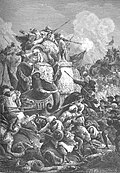 Death of the Nawab Anwaruddin Muhammed Khan in a battle against the French in 1749, by Paul Philippoteaux
 -
 The Siege of Arcot was a major battle fought between Robert Clive and the combined forces of the Mughal Empire's Nawab of the Carnatic, Chanda Sahib, assisted by a small number of troops from the French East India Company
 -
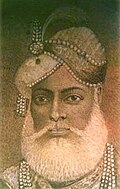 Muhammad Ali Khan Wallajah, (1717–1795)
 -
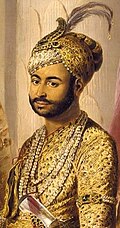 Umdat ul-Umara the Nawab of the Carnatic was a covert ally of Tipu Sultan
 -
 Azim Jah, eleventh and penultimate Nawab of the Carnatic, 1867 to 1874.
 -
 Azim-ud-Daula, Nawab of the Carnatic and his son Azam Jah.
![In the year 1702, Nawab Daud Khan, the Mughal Empire's local Subedar of the Carnatic, besieged and blockaded Fort St. George for more than three months,[8] the governor of the fort, Thomas Pitt, was instructed by the British East India Company to vie for peace](/wiki/File:Fort_St._George,_Chennai.jpg)


See also[edit | edit source]

Notes[edit | edit source]
References[edit | edit source]
- ↑ Kenneth Pletcher, ed. (1 April 2010). The History of India. Britannica Educational Publishing. p. 219. ISBN 9781615302017.
- ↑ Ramaswami, N. S. (1 January 1984). Political History of Carnatic Under the Nawabs. Abhinav Publications. p. 104. ISBN 9780836412628.
- ↑ "Mughal Empire 1526–1707 by Sanderson Beck". San.beck.org. Retrieved 4 March 2012.
- ↑ "Benfield, Paul" . Dictionary of National Biography. London: Smith, Elder & Co. 1885–1900.
- ↑ Markovits, Claude (1 February 2004). A History of Modern India, 1480–1950. Anthem Press. ISBN 978-1-84331-004-4.
- ↑ Uttar Pradesh District Gazetteers: Muzaffarnagar. Government of Uttar Pradesh. 1988. p. 42.
- ↑ Naravane, M.S. (2014). Battles of the Honourable East India Company. A.P.H. Publishing Corporation. pp. 151, 154–158. ISBN 9788131300343.
- ↑ Terence R. Blackburn. A miscellany of mutinies and massacres in India.
External links[edit | edit source]
- Indian Princely States – Arcot Archived 8 June 2002 at the Wayback Machine on uq.net.au
- The House of Arcot (archived)