



imported>Chariotrider555 Undid revision 1038872795 by 150.129.206.49 (talk) Rv vandalism |
Article updated with improved flow |
||
| Line 1: | Line 1: | ||
{{Short description|Veda of melodies and chants}} | |||
{{Use dmy dates|date=March 2015}} | {{Use dmy dates|date=March 2015}} | ||
{{Infobox religious text | {{Infobox religious text | ||
| religion = [[Hinduism]] | | religion = [[Historical Vedic religion]]<br />[[Hinduism]] | ||
| image = [[File:Four vedas.jpg|Four vedas|280px]] | | image = [[File:Four vedas.jpg|Four vedas|280px]] | ||
| alt = Four Vedas | | alt = Four Vedas | ||
| language = [[Vedic Sanskrit]] | | language = [[Vedic Sanskrit]] | ||
| caption = Four Vedas | | caption = Four Vedas | ||
| period = [[Wiktionary:circa|c.]] | | period = [[Vedic period]] ([[Wiktionary:circa|c.]] 1200-900 BCE){{sfn|Witzel|2001|p=6}} | ||
| chapters = 6 adhyayas | | chapters = 6 adhyayas | ||
| sutras = | | sutras = | ||
| verses = 1,875 mantras<ref>https://sites.google.com/a/vedicgranth.org/www/what_are_vedic_granth/the-four-veda/interpretation-and-more/construction-of-the-vedas?mobile=true</ref> | | verses = 1,875 mantras<ref>{{cite web |url=https://sites.google.com/a/vedicgranth.org/www/what_are_vedic_granth/the-four-veda/interpretation-and-more/construction-of-the-vedas?mobile=true |title=Construction of the Vedas |website=VedicGranth.Org |access-date=3 July 2020 |archive-date=17 July 2021 |archive-url=https://web.archive.org/web/20210717035126/https://sites.google.com/a/vedicgranth.org/www/what_are_vedic_granth/the-four-veda/interpretation-and-more/construction-of-the-vedas?mobile=true |url-status=dead }}</ref> | ||
}} | |background=#FFC569}} | ||
{{multiple image | {{multiple image | ||
| align = right | | align = right | ||
| Line 16: | Line 17: | ||
| width = 320 | | width = 320 | ||
| footer = Samaveda is a Hindu scripture in the Vedic Sanskrit language. Samaveda manuscripts exist in many Indic scripts. Above: [[Devanagari]], Below: [[Grantha script|Grantha]]. | | footer = Samaveda is a Hindu scripture in the Vedic Sanskrit language. Samaveda manuscripts exist in many Indic scripts. Above: [[Devanagari]], Below: [[Grantha script|Grantha]]. | ||
| image1 = 1636 CE Samaveda, Sadvimsha Brahmana, Varanasi Sanskrit college, Edward Cowell collection, sample iii, Sanskrit, Devanagari.jpg | |||
| image2 = 1863 CE palm leaf manuscript, Jaiminiya Aranyaka Gana, Samaveda (unidentified layer of texts), Sanskrit, Southern Grantha script, Malayali scribe Kecavan, sample ii.jpg | |||
}} | }} | ||
The '''Samaveda''' ([[ | {{Italic title}}The '''''Samaveda''''' or '''''Sama Veda'''''<ref>John Stevenson, {{Google books|Q8VVAAAAcAAJ|Translation of the Sanhita of the Sama Veda|page=PR12}}, page XII</ref> ({{langx|sa|[[wikt:सामवेद|सामवेद]]}}, {{IAST3|Sāmaveda}}, from ''[[wikt:सामन्|सामन्]]'', "song" and ''[[wikt:वेद|वेद]]'', "knowledge"), is the Veda of melodies and chants.<ref name=staal107/> It is an ancient [[Vedic Sanskrit]] text, and is one of the sacred scriptures in [[Hinduism]]. One of the four [[Vedas]], it is a liturgical text which consists of 1,875 verses. All but 75 verses have been taken from the [[Rigveda]].<ref name=witzelsamaveda/> Three recensions of the ''Samaveda'' have survived, and variant manuscripts of the Veda have been found in various parts of [[India]].<ref name=rgriffith/><ref name=hastings/> | ||
While its earliest parts are believed to date from as early as the Rigvedic period, the existing | While its earliest parts are believed to date from as early as the [[Rigveda|Rigvedic]] period, the existing [[samhita]] text dates from the post-Rigvedic Mantra period of [[Vedic Sanskrit]], between c. 1200 and 1000 BCE or "slightly rather later," roughly contemporary with the [[Atharvaveda]] and the [[Yajurveda]].{{sfn|Witzel|2001|p=6}}{{sfn|Dalal|2014|loc="The Rig Veda is considered later than the Rig Veda"}} Along with the Samhita layer of text, the ''Samaveda'' includes [[Brahmana]] texts, and a final layer of the text that covers philosophical speculations ([[Upanishads]]). These layers of the compilation date from the post-Rigvedic Mantra period of [[Vedic Sanskrit]], likely around the 6th century BCE.<ref> Patrick Olivelle (2014), The Early Upanishads, Oxford University Press; ISBN 978-0195124354, pp. 12-13 </ref> | ||
Embedded inside the Samaveda | Embedded inside the ''Samaveda'' are the widely studied ''[[Chandogya Upanishad]]'' and ''[[Kena Upanishad]]''. These Upanishads are considered as primary Upanishads and have had influence on the six schools of [[Hindu philosophy]], particularly the [[Vedanta]] school.<ref name=maxmullerfull/> The Samaveda laid important foundations for subsequent Indian music.<ref name=guybeck107/> | ||
In the ''[[Bhagavad Gita]]'', ch.10 v.22 [[Krishna]] says 'Among the Vedas I am the Samaveda'.<ref>{{Cite web |last=Vyasa |first=Ved |title=Bhagavad Gita 10.22 - Chapter 10 Verse 22 in Hindi & English |url=https://bhagavadgita.com/chapter/10/verse/22 |access-date=2026-01-15 |website=Bhagavad Gita |language=en}}</ref> | |||
==Dating and historical context== | ==Dating and historical context== | ||
| Line 38: | Line 38: | ||
The ''Samaveda'' is the Veda of Chants, or "storehouse of knowledge of chants".<ref>Frits Staal (2009), Discovering the Vedas: Origins, Mantras, Rituals, Insights, Penguin, {{ISBN|978-0143099864}}, page xvi-xvii, Quote: "The Vedas are an Oral Tradition and that applies especially to two of the four: the Veda of the Verse (Rigveda) and the Veda of Chants (Samaveda). (...) The Vedas are not a religion in any of the many senses of that widespread term. They have always been regarded as storehouses of knowledge, that is: ''veda''."</ref> According to [[Frits Staal]], it is "the [[Rigveda]] set to music".<ref name=fritsstaal4>Frits Staal (2009), Discovering the Vedas: Origins, Mantras, Rituals, Insights, Penguin, {{ISBN|978-0143099864}}, pages 4-5</ref> It is a fusion of older melodies (''sāman'') and the Rig verses.<ref name=fritsstaal4/> It has far fewer verses than Rigveda,<ref name=hastings>James Hastings, {{Google book|5D4TAAAAYAAJ|Encyclopaedia of Religion and Ethics}}, Vol. 7, Harvard Divinity School, TT Clark, pages 51-56</ref> but Samaveda is textually larger because it lists all the chant- and rituals-related score modifications of the verses.<ref name=fritsstaal4/> | The ''Samaveda'' is the Veda of Chants, or "storehouse of knowledge of chants".<ref>Frits Staal (2009), Discovering the Vedas: Origins, Mantras, Rituals, Insights, Penguin, {{ISBN|978-0143099864}}, page xvi-xvii, Quote: "The Vedas are an Oral Tradition and that applies especially to two of the four: the Veda of the Verse (Rigveda) and the Veda of Chants (Samaveda). (...) The Vedas are not a religion in any of the many senses of that widespread term. They have always been regarded as storehouses of knowledge, that is: ''veda''."</ref> According to [[Frits Staal]], it is "the [[Rigveda]] set to music".<ref name=fritsstaal4>Frits Staal (2009), Discovering the Vedas: Origins, Mantras, Rituals, Insights, Penguin, {{ISBN|978-0143099864}}, pages 4-5</ref> It is a fusion of older melodies (''sāman'') and the Rig verses.<ref name=fritsstaal4/> It has far fewer verses than Rigveda,<ref name=hastings>James Hastings, {{Google book|5D4TAAAAYAAJ|Encyclopaedia of Religion and Ethics}}, Vol. 7, Harvard Divinity School, TT Clark, pages 51-56</ref> but Samaveda is textually larger because it lists all the chant- and rituals-related score modifications of the verses.<ref name=fritsstaal4/> | ||
The Samaveda text contains notated melodies, and these are probably the world's oldest surviving ones.<ref name=brunonettle/> The musical notation is written usually immediately above, sometimes within, the line of Samaveda text, either in syllabic or a numerical form depending on the Samavedic ''Sakha'' (school).<ref>KR Norman (1979), Sāmavedic Chant by Wayne Howard (Book Review), Modern Asian Studies, Vol. 13, No. 3, page 524;<br>Wayne Howard (1977), Samavedic Chant, Yale University Press, {{ISBN|978-0300019568}}</ref> | The Samaveda text contains notated melodies, and these are probably the world's oldest surviving ones.<ref name=brunonettle/> The musical notation is written usually immediately above, sometimes within, the line of Samaveda text, either in syllabic or a numerical form depending on the Samavedic ''Sakha'' (school).<ref>KR Norman (1979), Sāmavedic Chant by Wayne Howard (Book Review), Modern Asian Studies, Vol. 13, No. 3, page 524;<br />Wayne Howard (1977), Samavedic Chant, Yale University Press, {{ISBN|978-0300019568}}</ref> | ||
===Recensions=== | ===Recensions=== | ||
R. T. H. Griffith says that there are three recensions of the text of the Samaveda Samhita:<ref name=rgriffith>Griffith, R. T. H. ''The {{IAST|Sāmaveda Saṃhitā}}'', {{ISBN|978-1419125096}}, page vi</ref> | [[R. T. H. Griffith]] says that there are three recensions of the text of the Samaveda Samhita:<ref name=rgriffith>Griffith, R. T. H. ''The {{IAST|Sāmaveda Saṃhitā}}'', {{ISBN|978-1419125096}}, page vi</ref> | ||
* the Kauthuma recension is current in [[Gujarat]], [[Uttar Pradesh]], [[Odisha]], [[West Bengal]] and | * the [[Kauthuma Samhita|''Kauthuma'' recension]] is current in [[Gujarat]], [[Uttar Pradesh]], [[Odisha]], [[West Bengal]], and for a few decades in [[Darbhanga]], [[Bihar]], | ||
* the {{IAST|Rāṇāyanīya}} in the [[Maharashtra]], [[Karnataka]], [[Gokarna, India|Gokarna]], few parts of [[Odisha]], [[Andhra Pradesh]] | * the {{IAST|Rāṇāyanīya}} in the [[Maharashtra]], [[Karnataka]], [[Gokarna, India|Gokarna]], a few parts of [[Odisha]], [[Andhra Pradesh]], | ||
* and the Jaiminiya in | * and the ''Jaiminiya'' in [[Karnataka]], [[Tamil Nadu]] and [[Kerala]]. | ||
===Organization=== | ===Organization=== | ||
The Samaveda comprises two major parts. The first part | The Samaveda comprises two major parts. The first part includes four melody collections and the second part three verse "books" .<ref name=witzelsamaveda/> A melody in the song books corresponds to a verse in the ''arcika'' books.<ref name=witzelsamaveda/> The ''Gana'' collection is subdivided into ''Gramageya'' and ''Aranyageya'', while the ''Arcika'' portion is subdivided into ''Purvarcika'' and ''Uttararcika'' portions.<ref name=guybeck/> The Purvarcika portion of the text has 585 single stanza verses and is organized in order of deities, while the Uttararcika text is ordered by rituals.<ref name=guybeck/> The Gramageya melodies are those for public recitations, while Aranyageya melodies are for personal meditative use such as in the solitude of a forest.<ref name=guybeck/> Typically, stanzas from the Purvarcika collection were sung to melodies described in the Gramageya-Gānas index, and the rules of how the verses mapped to verses is described in the Sanskrit texts such as the ''Puspasutra''.<ref name=guybeck>Guy Beck (1993), Sonic Theology: Hinduism and Sacred Sound, University of South Carolina Press, {{ISBN|978-0872498556}}, page 230 note 85</ref> | ||
Just | Just as in the Rigveda, the early sections of Samaveda typically begin with Agni and Indra hymns but shift to abstract speculations and philosophy, and their meters shift as well, in a descending order.<ref name=witzelsamaveda/> The later sections of the Samaveda, states Witzel, have the least deviation from substance of hymns they derive from Rigveda into songs.<ref name=witzelsamaveda/> The purpose of the Samaveda was liturgical, and it was the repertoire of the [[udgatr|''{{IAST|udgātṛ}}'']] or "singer" priests.<ref name=witzelsamaveda/> | ||
The Samaveda, like other Vedas, contains several layers of text, with [[Samhita]] being the oldest and the [[Upanishads]] the youngest layer.<ref name=staal74/> | The Samaveda, like other Vedas, contains several layers of text, with the [[Samhita]] being the oldest and the [[Upanishads]] the youngest layer.<ref name=staal74/> | ||
{| class="wikitable" | {| class="wikitable" | ||
| Line 58: | Line 58: | ||
! Vedic School!![[Brahmana]]!![[Upanishad]]s!! Shrauta Sutras | ! Vedic School!![[Brahmana]]!![[Upanishad]]s!! Shrauta Sutras | ||
|- | |- | ||
| Kauthuma-Ranayaniya|| | | Kauthuma-Ranayaniya|| [[Panchavimsha Brahmana]]|| [[Chandogya Upanishad]] || Latyayana Drahyayana | ||
|- | |- | ||
| Jaiminiya or Talavakara|| Jaiminiya || [[Kena Upanishad]]<br>Jaiminiya Upanishad || Jaiminiya | | Jaiminiya or Talavakara|| Jaiminiya || [[Kena Upanishad]]<br />Jaiminiya Upanishad || Jaiminiya | ||
|} | |} | ||
===Analytics=== | ===Analytics=== | ||
The Samaveda consists of 1,549 unique verses, taken almost entirely from Rigveda, except for 75 verses.<ref name=witzelsamaveda>[[Michael Witzel]] (1997), "[http://www.people.fas.harvard.edu/~witzel/canon.pdf The Development of the Vedic Canon and its Schools : The Social and Political Milieu]" in ''Inside the Texts, Beyond the Texts: New Approaches to the Study of the Vedas'', Harvard University Press, pages = 269-270</ref><ref>Axel Michaels (2004), Hinduism: Past and Present, Princeton University Press, {{ISBN|0-691-08953-1}}, page 51</ref> The largest number of | The Samaveda consists of 1,549 unique verses, taken almost entirely from the Rigveda, except for 75 verses.<ref name=witzelsamaveda>[[Michael Witzel]] (1997), "[http://www.people.fas.harvard.edu/~witzel/canon.pdf The Development of the Vedic Canon and its Schools : The Social and Political Milieu]" in ''Inside the Texts, Beyond the Texts: New Approaches to the Study of the Vedas'', Harvard University Press, pages = 269-270</ref><ref>Axel Michaels (2004), Hinduism: Past and Present, Princeton University Press, {{ISBN|0-691-08953-1}}, page 51</ref> The largest number of verses comes from Books 9 and 8 of the Rigveda.<ref name=mwitzel76>Michael Witzel (2003), "Vedas and Upaniṣads", in The Blackwell Companion to Hinduism (Editor: Gavin Flood), Blackwell, {{ISBN|0-631215352}}, page 76</ref> Some of the Rigvedic verses are repeated more than once. Including these repetitions, there are 1,875 verses in total numbered in the Samaveda recension translated by Griffith.<ref>For 1875 total verses, see numbering given in Ralph T. H. Griffith. Griffith's introduction mentions the recension history for his text. Repetitions may be found by consulting the cross-index in Griffith pp. 491-99.</ref> | ||
==Contents== | ==Contents== | ||
{{Hindu scriptures}} | {{Hindu scriptures}} | ||
Samaveda [[ | The Samaveda [[Samhita]] is not meant to be ''read'' as a text, it is like a musical score sheet that must be ''heard''.<ref name=staal107>Frits Staal (2009), Discovering the Vedas: Origins, Mantras, Rituals, Insights, Penguin, {{ISBN|978-0143099864}}, pages 107-112</ref> | ||
Staal states that the melodies likely existed before the verses in ancient India, and the words of the Rigveda verses were mapped | Staal states that the melodies likely existed before the verses in ancient India, and the words of the Rigveda verses were mapped onto those pre-existing melodies, because some early words fit and flow, while later words do not quite fit the melody in the same verse.<ref name=staal107/> The text uses creative structures, called ''Stobha'', to help embellish, transform or play with the words so that they better fit into a desired musical harmony.<ref>R Simon and JM van der Hoogt, [http://www.ibiblio.org/guruguha/MusicResearchLibrary/Books-English/BkE-Faddegon-StudiesOnTheSamaveda-1951-0022.pdf Studies on the Samaveda] North Holland Publishing Company, pages 47-54, 61-67</ref><ref>Frits Staal (1996), Ritual and Mantras, Motilal Banarsidass, {{ISBN|978-8120814127}}, pages 209-221</ref> Some verses add in meaningless sounds of a lullaby, for probably the same reason, remarks Staal.<ref name=staal107/> Thus the contents of the Samaveda represent a tradition and a creative synthesis of music, sounds, meaning, and spirituality; the text was not entirely a sudden inspiration.<ref name=staal107/> | ||
The portion of the first song of Samaveda illustrates the link and mapping of Rigvedic verses | The portion of the first song of Samaveda illustrates the link and mapping of Rigvedic verses onto a melodic chant:<ref name=staal107/> | ||
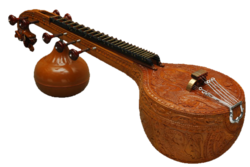
[[File:Veena.png|thumb|The [[veena]] (''vīṇā'') is mentioned in Samaveda.<ref>Guy Beck (1993), Sonic Theology: Hinduism and Sacred Sound, University of South Carolina Press, {{ISBN|978-0872498556}}, pages 107-109</ref>]] | [[File:Veena.png|thumb|The [[veena]] (''vīṇā'') is mentioned in Samaveda.<ref>Guy Beck (1993), Sonic Theology: Hinduism and Sacred Sound, University of South Carolina Press, {{ISBN|978-0872498556}}, pages 107-109</ref>]] | ||
{{Quote| | {{Quote| | ||
<poem> | <poem> | ||
अग्न आ याहि वीतये – [[Rigveda]] 6.16.10<ref>[https://sa.wikisource.org/wiki/ऋग्वेद:_सूक्तं_६.१६ ६.१६ ॥१०॥] Wikisource, Rigveda 6.16.10;<br>Sanskrit:<br>'''अग्न आ याहि वीतये''' गृणानो हव्यदातये <nowiki>।</nowiki><br>नि होता सत्सि बर्हिषि <nowiki>॥१०॥</nowiki></ref> | अग्न आ याहि वीतये – [[Rigveda]] 6.16.10<ref>[https://sa.wikisource.org/wiki/ऋग्वेद:_सूक्तं_६.१६ ६.१६ ॥१०॥] Wikisource, Rigveda 6.16.10;<br />Sanskrit:<br />'''अग्न आ याहि वीतये''' गृणानो हव्यदातये <nowiki>।</nowiki><br />नि होता सत्सि बर्हिषि <nowiki>॥१०॥</nowiki></ref> | ||
Agna ā yāhi vītaye | Agna ā yāhi vītaye | ||
| Line 86: | Line 86: | ||
O [[Agni]], come to the feast. | O [[Agni]], come to the feast. | ||
</poem> | </poem> | ||
|Samaveda 1.1.1|Translated by [[Frits Staal]]<ref name=staal107/>}}Multiple melodies were created by clans of sages from a Yonimantra, which is a base Mantra for Sama Chanting. Gautama's Parka was one such example cited by Dr. Damodar Satwalekar in his book Samveda.<ref>{{Cite web|title=Illustration on Samveda Musical Notes|url=https://sheetaluwach.com/veda-samveda-marathi/ | |Samaveda 1.1.1|Translated by [[Frits Staal]]<ref name=staal107/>}}Multiple melodies were created by clans of sages from a Yonimantra, which is a base Mantra for Sama Chanting. Gautama's Parka was one such example cited by Dr. Damodar Satwalekar in his book Samveda.<ref>{{Cite web|title=Illustration on Samveda Musical Notes|date=August 2020|url=https://sheetaluwach.com/veda-samveda-marathi/}}</ref> | ||
===Upanishads=== | ===Upanishads=== | ||
Two primary Upanishads of Hinduism are embedded inside the Samaveda – the Chandogya Upanishad and the Kena Upanishad. Both are notable for the lifting metric melodic structure, but it is Chandogya which has played a historic role in the evolution of various schools of [[Hindu philosophy]]. The embedded philosophical premises in Chandogya Upanishad have, for example, served as foundation for [[Vedanta]] school of Hinduism.<ref name=maxmullerfull>Max Muller, [https://archive.org/stream/upanishads01ml#page/n93/mode/2up Chandogya Upanishad], The Upanishads, Part I, Oxford University Press, pages LXXXVI-LXXXIX, 1-144 with footnotes</ref> It is one of the most cited texts in later ''Bhasyas'' (reviews and commentaries) by scholars from the | Two primary Upanishads of Hinduism are embedded inside the Samaveda – the Chandogya Upanishad and the Kena Upanishad. Both are notable for the lifting metric melodic structure, but it is the Chandogya which has played a historic role in the evolution of various schools of [[Hindu philosophy]]. The embedded philosophical premises in the Chandogya Upanishad have, for example, served as foundation for the [[Vedanta]] school of Hinduism.<ref name=maxmullerfull>Max Muller, [https://archive.org/stream/upanishads01ml#page/n93/mode/2up Chandogya Upanishad], The Upanishads, Part I, Oxford University Press, pages LXXXVI-LXXXIX, 1-144 with footnotes</ref> It is one of the most cited texts in later ''Bhasyas'' (reviews and commentaries) by scholars from the various schools of Hinduism. [[Adi Shankara]], for example, cited the Chandogya Upanishad 810 times in his ''Vedanta Sutra Bhasya'', more than any other ancient text.<ref>Paul Deussen, The System of Vedanta, {{ISBN|978-1432504946}}, pages 30-31</ref> | ||
====Chandogya Upanishad==== | ====Chandogya Upanishad==== | ||
{{main|Chandogya Upanishad}} | {{main|Chandogya Upanishad}} | ||
The Chandogya Upanishad belongs to the ''Tandya'' school of the Samaveda.<ref name=patrickolivellepreface/> Like [[Brhadaranyaka Upanishad]], the Chandogya Upanishad is an anthology of texts that must have pre-existed as separate texts, and were edited into a larger text by one or more ancient Indian scholars.<ref name=patrickolivellepreface>Patrick Olivelle (2014), The Early Upanishads, Oxford University Press, {{ISBN|978-0195124354}}, page 166-169</ref> The precise chronology of Chandogya Upanishad is uncertain, but it is the youngest layer of text in the Samaveda, and it is variously dated to have been composed by 8th to 6th | The Chandogya Upanishad belongs to the ''Tandya'' school of the Samaveda.<ref name=patrickolivellepreface/> Like the [[Brhadaranyaka Upanishad]], the Chandogya Upanishad is an anthology of texts that must have pre-existed as separate texts, and were edited into a larger text by one or more ancient Indian scholars.<ref name=patrickolivellepreface>Patrick Olivelle (2014), The Early Upanishads, Oxford University Press, {{ISBN|978-0195124354}}, page 166-169</ref> The precise chronology of the Chandogya Upanishad is uncertain, but it is the youngest layer of text in the Samaveda, and it is variously dated to have been composed by the 8th to 6th centuries BCE in India.<ref name=olivelleintro>Patrick Olivelle (2014), The Early Upanishads, Oxford University Press, {{ISBN|978-0195124354}}, page 12-13</ref><ref name=stephenphillips>Stephen Phillips (2009), Yoga, Karma, and Rebirth: A Brief History and Philosophy, Columbia University Press, {{ISBN|978-0231144858}}, Chapter 1</ref> | ||
The Chandogya text combines a metric, melodic structure with a wide range of speculations and philosophical topics. The | The Chandogya text combines a metric, melodic structure with a wide range of speculations and philosophical topics. The eighth and ninth chapters of the first book, for example, describe a debate between three men proficient in ''Udgitha'', about the origins and support of ''Udgitha.''<ref name=roberthume19>Robert Hume, [https://archive.org/stream/thirteenprincipa028442mbp#page/n205/mode/2up Chandogya Upanishad] 1.8.7 - 1.8.8, The Thirteen Principal Upanishads, Oxford University Press, pages 185-186</ref> The text summarizes their discussion as, | ||
{{quote| | {{quote| | ||
| Line 105: | Line 105: | ||
|Chandogya Upanishad 1.9.1-1.9.2<ref name=roberthume19/>}} | |Chandogya Upanishad 1.9.1-1.9.2<ref name=roberthume19/>}} | ||
Max Muller notes that the term "space" above, was later asserted in the Vedanta Sutra verse 1.1.22 to be a | Max Muller notes that the term "space" above, was later asserted in the Vedanta Sutra verse 1.1.22 to be a symbolic of the Vedic concept of [[Brahman]].<ref name=maxmuller19/> Paul Deussen explains the term ''Brahman'' means the "creative principle which lies realized in the whole world".<ref>Paul Deussen, Sixty Upanishads of the Veda, Volume 1, Motilal Banarsidass, {{ISBN|978-8120814684}}, page 91</ref> The text discusses [[Dharma]] and many other topics: | ||
{{Quote| | {{Quote| | ||
<poem> | <poem> | ||
There are three branches of [[Dharma]] (righteous life, duty): [[Yajna]] (sacrifice), [[Svādhyāya]] (self study) and [[Dāna]] (charity) are the first, | There are three branches of [[Dharma]] (righteous life, duty): [[Yajna]] (sacrifice), [[Svādhyāya]] (self study) and [[Dāna]] (charity) are the first, | ||
[[Tapas (Sanskrit)|Tapas]] (austerity, meditation) is the second, while dwelling as a [[Brahmacharya]] for education in the house of a teacher is third, | [[Tapas (Sanskrit)|Tapas]] (austerity, meditation) is the second, while dwelling as a [[Brahmacharya]] for education in the house of a teacher is the third, | ||
All three achieve the blessed worlds. But the ''Brahmasamstha'' – one who is firmly grounded in Brahman – alone achieves immortality. | All three achieve the blessed worlds. But the ''Brahmasamstha'' – one who is firmly grounded in Brahman – alone achieves immortality. | ||
</poem> | </poem> | ||
| Line 117: | Line 117: | ||
====Kena Upanishad==== | ====Kena Upanishad==== | ||
{{main|Kena Upanishad}} | {{main|Kena Upanishad}} | ||
The Kena Upanishad is embedded inside the last section of the ''Talavakara Brahmanam'' recension of the Samaveda.<ref>Johnston, Charles (1920-1931), The Mukhya Upanishads, Kshetra Books, {{ISBN|9781495946530}} (Reprinted in 2014)</ref><ref>Paul Deussen, Sixty Upanishads of the Veda, Volume 1, Motilal Banarsidass, {{ISBN|978-8120814684}}, pages 207-213</ref> It is much shorter, but it too delves into philosophical and spiritual questions like the Chandogya Upanishad. In the fourth chapter, the Kena Upanishad states, for example, that all beings have an innate longing for spiritual knowledge, for self-awareness.<ref name=pauldeussen208>Paul Deussen, Sixty Upanishads of the Veda, Volume 1, Motilal Banarsidass, {{ISBN|978-8120814684}}, page 208</ref> This knowledge of Atman-Brahman is ''Tadvanam'' (transcendental happiness, blissfulness).<ref>[https://archive.org/stream/kena-upanishad00xxxxuoft#page/31/mode/2up Kena Upanishad] Mantra 6, G Prasadji (Translator), pages 32-33</ref> In | |||
The Kena Upanishad is embedded inside the last section of the ''Talavakara Brahmanam'' recension of the Samaveda.<ref>Johnston, Charles (1920-1931), The Mukhya Upanishads, Kshetra Books, {{ISBN|9781495946530}} (Reprinted in 2014)</ref><ref>Paul Deussen, Sixty Upanishads of the Veda, Volume 1, Motilal Banarsidass, {{ISBN|978-8120814684}}, pages 207-213</ref> It is much shorter, but it too delves into philosophical and spiritual questions like the Chandogya Upanishad. In the fourth chapter, the Kena Upanishad states, for example, that all beings have an innate longing for spiritual knowledge, for self-awareness.<ref name=pauldeussen208>Paul Deussen, Sixty Upanishads of the Veda, Volume 1, Motilal Banarsidass, {{ISBN|978-8120814684}}, page 208</ref> This knowledge of Atman-Brahman is ''Tadvanam'' (transcendental happiness, blissfulness).<ref>[https://archive.org/stream/kena-upanishad00xxxxuoft#page/31/mode/2up Kena Upanishad] Mantra 6, G Prasadji (Translator), pages 32-33</ref> In its final paragraphs, the Kena Upanishad asserts ethical life as the foundation of self-knowledge and of Atman-Brahman. | |||
{{Quote| | {{Quote| | ||
| Line 126: | Line 127: | ||
The Kauthuma recension has been published (Samhita, Brahmana, Shrautasutra and ancillary Sutras, mainly by B.R. Sharma), parts of the Jaiminiya tradition remain unpublished.<ref>A. Parpola. The literature and study of the Jaiminīya Sāmaveda. In retrospect and prospect. Studia Orientalia XLIII:6. Helsinki 1973</ref> There is an edition of the first part of the Samhita by W. Caland<ref>W. Caland, Die Jaiminīya-Saṃhitā mit einer Einleitung über die Sāmaveda-literatur. Breslau 1907</ref> and of the Brahmana by Raghu Vira and Lokesh Chandra,<ref>Raghu Vira and Lokesh Chandra. 1954. Jaiminīya-Brāhmaṇa of the Sāmaveda. (Sarasvati-Vihara Series 31.) Nagpur. 2nd revised ed., Delhi 1986</ref> as well as the neglected Upanishad,<ref>H. Oertel. The Jaiminīya or Talavakāra Upaniṣad Brāhmaṇa. Text, translation, and notes. JAOS 16,1895, 79–260</ref> but only parts of the Shrautasutra. The song books remain unpublished.<ref>A. Parpola. The decipherment of the Samavedic notation of the Jaiminīyas. Finnish Oriental Society 1988</ref> | The Kauthuma recension has been published (Samhita, Brahmana, Shrautasutra and ancillary Sutras, mainly by B.R. Sharma), parts of the Jaiminiya tradition remain unpublished.<ref>A. Parpola. The literature and study of the Jaiminīya Sāmaveda. In retrospect and prospect. Studia Orientalia XLIII:6. Helsinki 1973</ref> There is an edition of the first part of the Samhita by W. Caland<ref>W. Caland, Die Jaiminīya-Saṃhitā mit einer Einleitung über die Sāmaveda-literatur. Breslau 1907</ref> and of the Brahmana by Raghu Vira and Lokesh Chandra,<ref>Raghu Vira and Lokesh Chandra. 1954. Jaiminīya-Brāhmaṇa of the Sāmaveda. (Sarasvati-Vihara Series 31.) Nagpur. 2nd revised ed., Delhi 1986</ref> as well as the neglected Upanishad,<ref>H. Oertel. The Jaiminīya or Talavakāra Upaniṣad Brāhmaṇa. Text, translation, and notes. JAOS 16,1895, 79–260</ref> but only parts of the Shrautasutra. The song books remain unpublished.<ref>A. Parpola. The decipherment of the Samavedic notation of the Jaiminīyas. Finnish Oriental Society 1988</ref> | ||
A German edition of Samaveda was published in 1848 by [[Theodor Benfey]],<ref>Theodor Benfey, [https://archive.org/stream/bub_gb_0C_oEB7TkVgC#page/n3/mode/2up Die Hymnen des Samaveda] FA Brockhaus, Leipzig</ref> and Satyavrata Samashrami published an edited Sanskrit version in 1873.<ref>Satyavrata Samashrami, {{Google books| i9dRAAAAcAAJ|Sama Veda Sanhita}}</ref> A Russian translation was published by [[Filipp Fortunatov]] in 1875.<ref>https://commons.wikimedia.org/w/index.php?title=File:%D0%A4%D0%BE%D1%80%D1%82%D1%83%D0%BD%D0%B0%D1%82%D0%BE%D0%B2_%D0%A4_%D0%A4_%D0%A1%D0%B0%D0%BC%D0%B0%D0%B2%D0%B5%D0%B4%D0%B0_%D0%90%D1%80%D0%B0%D0%BD%D1%8F%D0%BA%D0%B0_%D0%A1%D0%B0%D0%BC%D1%85%D0%B8%D1%82%D0%B0_1875.pdf&page=4</ref> An English translation was published by Ralph Griffith in 1893.<ref>Griffith, Ralph T. H. ''The {{IAST|Sāmaveda Saṃhitā}}''. Text, Translation, Commentary & Notes in English. Translated by Ralph T. H. Griffith. First published 1893; Revised and enlarged edition, enlarged by Nag Sharan Singh and Surendra Pratap, 1991 (Nag Publishers: Delhi, 1991) {{ISBN|81-7081-244-5}}; This edition provides the text in [[Devanagari]] with full metrical marks needed for chanting.</ref> A translation in Hindi by Mridul Kirti called "Samveda Ka Hindi Padyanuvad" has also been published recently.{{citation needed|date=September 2015}} | A German edition of Samaveda was published in 1848 by [[Theodor Benfey]],<ref>Theodor Benfey, [https://archive.org/stream/bub_gb_0C_oEB7TkVgC#page/n3/mode/2up Die Hymnen des Samaveda] FA Brockhaus, Leipzig</ref> and Satyavrata Samashrami published an edited Sanskrit version in 1873.<ref>Satyavrata Samashrami, {{Google books| i9dRAAAAcAAJ|Sama Veda Sanhita}}</ref> A Russian translation was published by [[Filipp Fortunatov]] in 1875.<ref>{{Citation |last=издание |first=дореволюционное |title=Русский: Фортунатов Ф Ф Самаведа Араняка Самхита 1875.pdf |date=1875 |url=https://commons.wikimedia.org/w/index.php?title=File:%D0%A4%D0%BE%D1%80%D1%82%D1%83%D0%BD%D0%B0%D1%82%D0%BE%D0%B2_%D0%A4_%D0%A4_%D0%A1%D0%B0%D0%BC%D0%B0%D0%B2%D0%B5%D0%B4%D0%B0_%D0%90%D1%80%D0%B0%D0%BD%D1%8F%D0%BA%D0%B0_%D0%A1%D0%B0%D0%BC%D1%85%D0%B8%D1%82%D0%B0_1875.pdf&page=4 |access-date=2024-12-05}}</ref> An English translation was published by [[Ralph T. H. Griffith|Ralph Griffith]] in 1893.<ref>Griffith, Ralph T. H. ''The {{IAST|Sāmaveda Saṃhitā}}''. Text, Translation, Commentary & Notes in English. Translated by Ralph T. H. Griffith. First published 1893; Revised and enlarged edition, enlarged by Nag Sharan Singh and Surendra Pratap, 1991 (Nag Publishers: Delhi, 1991) {{ISBN|81-7081-244-5}}; This edition provides the text in [[Devanagari]] with full metrical marks needed for chanting.</ref> A translation in Hindi by Mridul Kirti called "Samveda Ka Hindi Padyanuvad" has also been published recently.{{citation needed|date=September 2015}} | ||
The Samaveda text has not received as much attention as the Rigveda, because outside of the musical novelty and melodic creativity, the substance of all but 75 verses of the text have predominantly been derived from the Rigveda. A study of Rigveda suffices.<ref>SW Jamison and M Witzel (1992), [http://www.people.fas.harvard.edu/~witzel/vedica.pdf Vedic Hinduism], Harvard University, page 8</ref> | The Samaveda text has not received as much attention as the Rigveda, because outside of the musical novelty and melodic creativity, the substance of all but 75 verses of the text have predominantly been derived from the Rigveda. A study of Rigveda suffices.<ref>SW Jamison and M Witzel (1992), [http://www.people.fas.harvard.edu/~witzel/vedica.pdf Vedic Hinduism], Harvard University, page 8</ref> | ||
| Line 148: | Line 149: | ||
==Sources== | ==Sources== | ||
{{refbegin}} | {{refbegin}} | ||
<!-- D --> | |||
* {{cite book |last1=Dalal |first1=Rosen |year=2014 |title=Hinduism: An Alphabetical Guide |publisher=Penguin |isbn=978-8184752779 |url=https://books.google.com/books?id=DH0vmD8ghdMC}} | |||
<!-- W --> | <!-- W --> | ||
* {{citation | last =Witzel | first =Michael | year =1997| chapter =The Development of the Vedic Canon and its Schools: The Social and Political Milieu | editor-last =Witzel | editor-first =Michael | title =Inside the Texts, Beyond the Texts: New Approaches to the Study of the Vedas | series =Harvard Oriental Series, Opera Minora; vol. 2| publisher =Harvard University Press | location =Cambridge | author-link =Michael Witzel| url =https://www.people.fas.harvard.edu/~witzel/canon.pdf}} | * {{citation | last =Witzel | first =Michael | year =1997| chapter =The Development of the Vedic Canon and its Schools: The Social and Political Milieu | editor-last =Witzel | editor-first =Michael | title =Inside the Texts, Beyond the Texts: New Approaches to the Study of the Vedas | series =Harvard Oriental Series, Opera Minora; vol. 2| publisher =Harvard University Press | location =Cambridge | author-link =Michael Witzel| chapter-url =https://www.people.fas.harvard.edu/~witzel/canon.pdf}} | ||
* {{Citation | last=Witzel | first=Michael |year=2001 | title=Autochthonous Aryans? The Evidence from Old Indian and Iranian Texts | journal=Electronic Journal of Vedic Studies |volume=7 |issue=3 |pages=1–115 | url=http://www.people.fas.harvard.edu/~witzel/EJVS-7-3.pdf}} | * {{Citation | last=Witzel | first=Michael |year=2001 | title=Autochthonous Aryans? The Evidence from Old Indian and Iranian Texts | journal=Electronic Journal of Vedic Studies |volume=7 |issue=3 |pages=1–115 | url=http://www.people.fas.harvard.edu/~witzel/EJVS-7-3.pdf}} | ||
{{refend}} | {{refend}} | ||
| Line 157: | Line 160: | ||
{{wikiquote|Sama Veda}} | {{wikiquote|Sama Veda}} | ||
* [[Ralph T. H. Griffith|Ralph Griffith]], [http://www.sacred-texts.com/hin/sv.htm ''Hymns of the Samaveda''] 1895, full text, (online at sacred-texts.com) | * [[Ralph T. H. Griffith|Ralph Griffith]], [http://www.sacred-texts.com/hin/sv.htm ''Hymns of the Samaveda''] 1895, full text, (online at sacred-texts.com) | ||
* [http://www.vedchant.com/#sama Veda Prasar Samiti (MP3 examples of vedic chants)] | * [http://www.vedchant.com/#sama Veda Prasar Samiti (MP3 examples of vedic chants)] {{Webarchive|url=https://web.archive.org/web/20160303170034/http://www.vedchant.com/#sama |date=3 March 2016 }} | ||
* [http://www.sanskritweb.net/samaveda/ Samaveda Song Books in Devanagari with svara marks and musical notes file for download] | * [http://www.sanskritweb.net/samaveda/ Samaveda Song Books in Devanagari with svara marks and musical notes file for download] | ||
* [https://hinduism4u.com/samaveda/ 7 swaras in samaveda] | |||
{{Hindudharma}} | {{Hindudharma}} | ||
| Line 164: | Line 168: | ||
[[Category:Vedas]] | [[Category:Vedas]] | ||
[[Category:Indian poetics]] | [[Category:Indian poetics]] | ||
[[Category: | [[Category:Music of India]] | ||
[[Category:Libation]] | [[Category:Libation]] | ||
[[Category:Hindu texts]] | [[Category:Hindu texts]] | ||
Latest revision as of 04:33, 28 February 2026
| Samaveda | |
|---|---|
 Four Vedas | |
| Information | |
| Religion | Historical Vedic religion Hinduism |
| Language | Vedic Sanskrit |
| Period | Vedic period (c. 1200-900 BCE)[1] |
| Chapters | 6 adhyayas |
| Verses | 1,875 mantras[2] |

,_Sanskrit,_Southern_Grantha_script,_Malayali_scribe_Kecavan,_sample_ii.jpg)
The Samaveda or Sama Veda[3] (Sanskrit: सामवेद, IAST: Sāmaveda, from सामन्, "song" and वेद, "knowledge"), is the Veda of melodies and chants.[4] It is an ancient Vedic Sanskrit text, and is one of the sacred scriptures in Hinduism. One of the four Vedas, it is a liturgical text which consists of 1,875 verses. All but 75 verses have been taken from the Rigveda.[5] Three recensions of the Samaveda have survived, and variant manuscripts of the Veda have been found in various parts of India.[6][7]
While its earliest parts are believed to date from as early as the Rigvedic period, the existing samhita text dates from the post-Rigvedic Mantra period of Vedic Sanskrit, between c. 1200 and 1000 BCE or "slightly rather later," roughly contemporary with the Atharvaveda and the Yajurveda.[1][8] Along with the Samhita layer of text, the Samaveda includes Brahmana texts, and a final layer of the text that covers philosophical speculations (Upanishads). These layers of the compilation date from the post-Rigvedic Mantra period of Vedic Sanskrit, likely around the 6th century BCE.[9]
Embedded inside the Samaveda are the widely studied Chandogya Upanishad and Kena Upanishad. These Upanishads are considered as primary Upanishads and have had influence on the six schools of Hindu philosophy, particularly the Vedanta school.[10] The Samaveda laid important foundations for subsequent Indian music.[11]
In the Bhagavad Gita, ch.10 v.22 Krishna says 'Among the Vedas I am the Samaveda'.[12]
Dating and historical context[edit | edit source]
Michael Witzel states that there is no absolute dating for Samaveda and other Vedic texts.[13] He estimates the composition of the samhita layer of the text chronologically after the Rigveda, and in the likely range of 1200 to 1000 BCE, roughly contemporary with the Atharvaveda and the Yajurveda.[13][1][8]
There were about a dozen styles of Samavedic chanting. Of the three surviving versions, the Jaiminiya preserves the oldest surviving tradition of Samavedic chanting.[14]
Text[edit | edit source]
.png)
The Samaveda is the Veda of Chants, or "storehouse of knowledge of chants".[15] According to Frits Staal, it is "the Rigveda set to music".[16] It is a fusion of older melodies (sāman) and the Rig verses.[16] It has far fewer verses than Rigveda,[7] but Samaveda is textually larger because it lists all the chant- and rituals-related score modifications of the verses.[16]
The Samaveda text contains notated melodies, and these are probably the world's oldest surviving ones.[14] The musical notation is written usually immediately above, sometimes within, the line of Samaveda text, either in syllabic or a numerical form depending on the Samavedic Sakha (school).[17]
Recensions[edit | edit source]
R. T. H. Griffith says that there are three recensions of the text of the Samaveda Samhita:[6]
- the Kauthuma recension is current in Gujarat, Uttar Pradesh, Odisha, West Bengal, and for a few decades in Darbhanga, Bihar,
- the Rāṇāyanīya in the Maharashtra, Karnataka, Gokarna, a few parts of Odisha, Andhra Pradesh,
- and the Jaiminiya in Karnataka, Tamil Nadu and Kerala.
Organization[edit | edit source]
The Samaveda comprises two major parts. The first part includes four melody collections and the second part three verse "books" .[5] A melody in the song books corresponds to a verse in the arcika books.[5] The Gana collection is subdivided into Gramageya and Aranyageya, while the Arcika portion is subdivided into Purvarcika and Uttararcika portions.[18] The Purvarcika portion of the text has 585 single stanza verses and is organized in order of deities, while the Uttararcika text is ordered by rituals.[18] The Gramageya melodies are those for public recitations, while Aranyageya melodies are for personal meditative use such as in the solitude of a forest.[18] Typically, stanzas from the Purvarcika collection were sung to melodies described in the Gramageya-Gānas index, and the rules of how the verses mapped to verses is described in the Sanskrit texts such as the Puspasutra.[18]
Just as in the Rigveda, the early sections of Samaveda typically begin with Agni and Indra hymns but shift to abstract speculations and philosophy, and their meters shift as well, in a descending order.[5] The later sections of the Samaveda, states Witzel, have the least deviation from substance of hymns they derive from Rigveda into songs.[5] The purpose of the Samaveda was liturgical, and it was the repertoire of the udgātṛ or "singer" priests.[5]
The Samaveda, like other Vedas, contains several layers of text, with the Samhita being the oldest and the Upanishads the youngest layer.[19]
| Vedic School | Brahmana | Upanishads | Shrauta Sutras |
|---|---|---|---|
| Kauthuma-Ranayaniya | Panchavimsha Brahmana | Chandogya Upanishad | Latyayana Drahyayana |
| Jaiminiya or Talavakara | Jaiminiya | Kena Upanishad Jaiminiya Upanishad |
Jaiminiya |
Analytics[edit | edit source]
The Samaveda consists of 1,549 unique verses, taken almost entirely from the Rigveda, except for 75 verses.[5][20] The largest number of verses comes from Books 9 and 8 of the Rigveda.[21] Some of the Rigvedic verses are repeated more than once. Including these repetitions, there are 1,875 verses in total numbered in the Samaveda recension translated by Griffith.[22]
Contents[edit | edit source]
| Part of a series on |
| Hindu scriptures and texts |
|---|
 |
| Related Hindu texts |
The Samaveda Samhita is not meant to be read as a text, it is like a musical score sheet that must be heard.[4]
Staal states that the melodies likely existed before the verses in ancient India, and the words of the Rigveda verses were mapped onto those pre-existing melodies, because some early words fit and flow, while later words do not quite fit the melody in the same verse.[4] The text uses creative structures, called Stobha, to help embellish, transform or play with the words so that they better fit into a desired musical harmony.[23][24] Some verses add in meaningless sounds of a lullaby, for probably the same reason, remarks Staal.[4] Thus the contents of the Samaveda represent a tradition and a creative synthesis of music, sounds, meaning, and spirituality; the text was not entirely a sudden inspiration.[4]
The portion of the first song of Samaveda illustrates the link and mapping of Rigvedic verses onto a melodic chant:[4]

अग्न आ याहि वीतये – Rigveda 6.16.10[26]
Agna ā yāhi vītaye
Samaveda transformation (Jaiminiya manuscript):
o gnā i / ā yā hi vā i / tā yā i tā yā i /
Translation:
O Agni, come to the feast.— Samaveda 1.1.1, Translated by Frits Staal[4]
Multiple melodies were created by clans of sages from a Yonimantra, which is a base Mantra for Sama Chanting. Gautama's Parka was one such example cited by Dr. Damodar Satwalekar in his book Samveda.[27]
Upanishads[edit | edit source]
Two primary Upanishads of Hinduism are embedded inside the Samaveda – the Chandogya Upanishad and the Kena Upanishad. Both are notable for the lifting metric melodic structure, but it is the Chandogya which has played a historic role in the evolution of various schools of Hindu philosophy. The embedded philosophical premises in the Chandogya Upanishad have, for example, served as foundation for the Vedanta school of Hinduism.[10] It is one of the most cited texts in later Bhasyas (reviews and commentaries) by scholars from the various schools of Hinduism. Adi Shankara, for example, cited the Chandogya Upanishad 810 times in his Vedanta Sutra Bhasya, more than any other ancient text.[28]
Chandogya Upanishad[edit | edit source]
The Chandogya Upanishad belongs to the Tandya school of the Samaveda.[29] Like the Brhadaranyaka Upanishad, the Chandogya Upanishad is an anthology of texts that must have pre-existed as separate texts, and were edited into a larger text by one or more ancient Indian scholars.[29] The precise chronology of the Chandogya Upanishad is uncertain, but it is the youngest layer of text in the Samaveda, and it is variously dated to have been composed by the 8th to 6th centuries BCE in India.[30][31]
The Chandogya text combines a metric, melodic structure with a wide range of speculations and philosophical topics. The eighth and ninth chapters of the first book, for example, describe a debate between three men proficient in Udgitha, about the origins and support of Udgitha.[32] The text summarizes their discussion as,
What is the origin of this world?[33]
Space, said he. Verily, all things here arise out of space. They disappear back into space, for space alone is greater than these, space is the final goal.
This is the most excellent Udgitha. This is endless. The most excellent is his, the most excellent worlds does he win, who, knowing it thus, reveres the most excellent Udgitha (Om, ॐ).— Chandogya Upanishad 1.9.1-1.9.2[32]
Max Muller notes that the term "space" above, was later asserted in the Vedanta Sutra verse 1.1.22 to be a symbolic of the Vedic concept of Brahman.[33] Paul Deussen explains the term Brahman means the "creative principle which lies realized in the whole world".[34] The text discusses Dharma and many other topics:
There are three branches of Dharma (righteous life, duty): Yajna (sacrifice), Svādhyāya (self study) and Dāna (charity) are the first,
Tapas (austerity, meditation) is the second, while dwelling as a Brahmacharya for education in the house of a teacher is the third,
All three achieve the blessed worlds. But the Brahmasamstha – one who is firmly grounded in Brahman – alone achieves immortality.
Kena Upanishad[edit | edit source]
The Kena Upanishad is embedded inside the last section of the Talavakara Brahmanam recension of the Samaveda.[38][39] It is much shorter, but it too delves into philosophical and spiritual questions like the Chandogya Upanishad. In the fourth chapter, the Kena Upanishad states, for example, that all beings have an innate longing for spiritual knowledge, for self-awareness.[40] This knowledge of Atman-Brahman is Tadvanam (transcendental happiness, blissfulness).[41] In its final paragraphs, the Kena Upanishad asserts ethical life as the foundation of self-knowledge and of Atman-Brahman.
Tapas,[42] Damah,[43] Work - these are the foundations, the Vedas are the limbs of the same, the Truth is its fulcrum.
— Kena Upanishad, 4.8 (paragraph 33)[44]
Manuscripts and translations[edit | edit source]
The Kauthuma recension has been published (Samhita, Brahmana, Shrautasutra and ancillary Sutras, mainly by B.R. Sharma), parts of the Jaiminiya tradition remain unpublished.[45] There is an edition of the first part of the Samhita by W. Caland[46] and of the Brahmana by Raghu Vira and Lokesh Chandra,[47] as well as the neglected Upanishad,[48] but only parts of the Shrautasutra. The song books remain unpublished.[49]
A German edition of Samaveda was published in 1848 by Theodor Benfey,[50] and Satyavrata Samashrami published an edited Sanskrit version in 1873.[51] A Russian translation was published by Filipp Fortunatov in 1875.[52] An English translation was published by Ralph Griffith in 1893.[53] A translation in Hindi by Mridul Kirti called "Samveda Ka Hindi Padyanuvad" has also been published recently.[citation needed]
The Samaveda text has not received as much attention as the Rigveda, because outside of the musical novelty and melodic creativity, the substance of all but 75 verses of the text have predominantly been derived from the Rigveda. A study of Rigveda suffices.[54]
Cultural influence[edit | edit source]
The Indian classical music and dance, states Guy Beck, is rooted in the sonic and musical dimensions of the Sama Veda, along with the Upanishads and Agamas.[11] The Samaveda, in addition to singing and chanting, mentions instruments. The rules and suggestions for playing various instruments form a separate compilation, called the Gandharva-Veda, and this Upaveda is attached to the Samaveda.[11][55] The structure and theory of chants in the Samaveda have inspired the organizing principle for Indian classical arts and performances, and this root has been widely acknowledged by musicologists dealing with the history of Indian music.[11][56]
Our music tradition [Indian] in the North as well as in the South, remembers and cherishes its origin in the Samaveda... the musical version of the Rigveda.
— V. Raghavan, [11]
See also[edit | edit source]
References[edit | edit source]
- ↑ 1.0 1.1 1.2 Witzel 2001, p. 6.
- ↑ "Construction of the Vedas". VedicGranth.Org. Archived from the original on 17 July 2021. Retrieved 3 July 2020.
- ↑ John Stevenson, Translation of the Sanhita of the Sama Veda, p. PR12, at Google Books, page XII
- ↑ 4.0 4.1 4.2 4.3 4.4 4.5 4.6 Frits Staal (2009), Discovering the Vedas: Origins, Mantras, Rituals, Insights, Penguin, ISBN 978-0143099864, pages 107-112
- ↑ 5.0 5.1 5.2 5.3 5.4 5.5 5.6 Michael Witzel (1997), "The Development of the Vedic Canon and its Schools : The Social and Political Milieu" in Inside the Texts, Beyond the Texts: New Approaches to the Study of the Vedas, Harvard University Press, pages = 269-270
- ↑ 6.0 6.1 Griffith, R. T. H. The Sāmaveda Saṃhitā, ISBN 978-1419125096, page vi
- ↑ 7.0 7.1 James Hastings, Encyclopaedia of Religion and Ethics at Google Books, Vol. 7, Harvard Divinity School, TT Clark, pages 51-56
- ↑ 8.0 8.1 Dalal 2014, "The Rig Veda is considered later than the Rig Veda".
- ↑ Patrick Olivelle (2014), The Early Upanishads, Oxford University Press; ISBN 978-0195124354, pp. 12-13
- ↑ 10.0 10.1 Max Muller, Chandogya Upanishad, The Upanishads, Part I, Oxford University Press, pages LXXXVI-LXXXIX, 1-144 with footnotes
- ↑ 11.0 11.1 11.2 11.3 11.4 Guy Beck (1993), Sonic Theology: Hinduism and Sacred Sound, University of South Carolina Press, ISBN 978-0872498556, pages 107-108
- ↑ Vyasa, Ved. "Bhagavad Gita 10.22 - Chapter 10 Verse 22 in Hindi & English". Bhagavad Gita. Retrieved 15 January 2026.
- ↑ 13.0 13.1 Michael Witzel (2003), "Vedas and Upaniṣads", in The Blackwell Companion to Hinduism (Editor: Gavin Flood), Blackwell, ISBN 0-631215352, pages 68-70
- ↑ 14.0 14.1 Bruno Nettl, Ruth M. Stone, James Porter and Timothy Rice (1999), The Garland Encyclopedia of World Music, Routledge, ISBN 978-0824049461, pages 242-245
- ↑ Frits Staal (2009), Discovering the Vedas: Origins, Mantras, Rituals, Insights, Penguin, ISBN 978-0143099864, page xvi-xvii, Quote: "The Vedas are an Oral Tradition and that applies especially to two of the four: the Veda of the Verse (Rigveda) and the Veda of Chants (Samaveda). (...) The Vedas are not a religion in any of the many senses of that widespread term. They have always been regarded as storehouses of knowledge, that is: veda."
- ↑ 16.0 16.1 16.2 Frits Staal (2009), Discovering the Vedas: Origins, Mantras, Rituals, Insights, Penguin, ISBN 978-0143099864, pages 4-5
- ↑ KR Norman (1979), Sāmavedic Chant by Wayne Howard (Book Review), Modern Asian Studies, Vol. 13, No. 3, page 524;
Wayne Howard (1977), Samavedic Chant, Yale University Press, ISBN 978-0300019568 - ↑ 18.0 18.1 18.2 18.3 Guy Beck (1993), Sonic Theology: Hinduism and Sacred Sound, University of South Carolina Press, ISBN 978-0872498556, page 230 note 85
- ↑ 19.0 19.1 Frits Staal (2009), Discovering the Vedas: Origins, Mantras, Rituals, Insights, Penguin, ISBN 978-0143099864, pages 80, 74-81
- ↑ Axel Michaels (2004), Hinduism: Past and Present, Princeton University Press, ISBN 0-691-08953-1, page 51
- ↑ Michael Witzel (2003), "Vedas and Upaniṣads", in The Blackwell Companion to Hinduism (Editor: Gavin Flood), Blackwell, ISBN 0-631215352, page 76
- ↑ For 1875 total verses, see numbering given in Ralph T. H. Griffith. Griffith's introduction mentions the recension history for his text. Repetitions may be found by consulting the cross-index in Griffith pp. 491-99.
- ↑ R Simon and JM van der Hoogt, Studies on the Samaveda North Holland Publishing Company, pages 47-54, 61-67
- ↑ Frits Staal (1996), Ritual and Mantras, Motilal Banarsidass, ISBN 978-8120814127, pages 209-221
- ↑ Guy Beck (1993), Sonic Theology: Hinduism and Sacred Sound, University of South Carolina Press, ISBN 978-0872498556, pages 107-109
- ↑ ६.१६ ॥१०॥ Wikisource, Rigveda 6.16.10;
Sanskrit:
अग्न आ याहि वीतये गृणानो हव्यदातये ।
नि होता सत्सि बर्हिषि ॥१०॥ - ↑ "Illustration on Samveda Musical Notes". August 2020.
- ↑ Paul Deussen, The System of Vedanta, ISBN 978-1432504946, pages 30-31
- ↑ 29.0 29.1 Patrick Olivelle (2014), The Early Upanishads, Oxford University Press, ISBN 978-0195124354, page 166-169
- ↑ Patrick Olivelle (2014), The Early Upanishads, Oxford University Press, ISBN 978-0195124354, page 12-13
- ↑ Stephen Phillips (2009), Yoga, Karma, and Rebirth: A Brief History and Philosophy, Columbia University Press, ISBN 978-0231144858, Chapter 1
- ↑ 32.0 32.1 Robert Hume, Chandogya Upanishad 1.8.7 - 1.8.8, The Thirteen Principal Upanishads, Oxford University Press, pages 185-186
- ↑ 33.0 33.1 Max Muller, Chandogya Upanishad 1.9.1, The Upanishads, Part I, Oxford University Press, page 17 with footnote 1
- ↑ Paul Deussen, Sixty Upanishads of the Veda, Volume 1, Motilal Banarsidass, ISBN 978-8120814684, page 91
- ↑ Chandogya Upanishad with Shankara Bhashya Ganganath Jha (Translator), pages 103-116
- ↑ Max Muller, Chandogya Upanishad Twenty Third Khanda, The Upanishads, Part I, Oxford University Press, page 35 with footnote
- ↑ Paul Deussen, Sixty Upanishads of the Veda, Volume 1, Motilal Banarsidass, ISBN 978-8120814684, pages 97-98 with preface and footnotes
- ↑ Johnston, Charles (1920-1931), The Mukhya Upanishads, Kshetra Books, ISBN 9781495946530 (Reprinted in 2014)
- ↑ Paul Deussen, Sixty Upanishads of the Veda, Volume 1, Motilal Banarsidass, ISBN 978-8120814684, pages 207-213
- ↑ Paul Deussen, Sixty Upanishads of the Veda, Volume 1, Motilal Banarsidass, ISBN 978-8120814684, page 208
- ↑ Kena Upanishad Mantra 6, G Prasadji (Translator), pages 32-33
- ↑ Meditation, Penance, Inner heat, See: WO Kaelber (1976), "Tapas", Birth, and Spiritual Rebirth in the Veda, History of Religions, 15(4), pages 343-386
- ↑ Self-restraint, see: M Heim (2005), Differentiations in Hindu ethics, in William Schweiker (Editor), The Blackwell companion to religious ethics, ISBN 0631216340, pages 341-354
- ↑ Paul Deussen, Sixty Upanishads of the Veda, Volume 1, Motilal Banarsidass, ISBN 978-8120814684, pages 211-213
- ↑ A. Parpola. The literature and study of the Jaiminīya Sāmaveda. In retrospect and prospect. Studia Orientalia XLIII:6. Helsinki 1973
- ↑ W. Caland, Die Jaiminīya-Saṃhitā mit einer Einleitung über die Sāmaveda-literatur. Breslau 1907
- ↑ Raghu Vira and Lokesh Chandra. 1954. Jaiminīya-Brāhmaṇa of the Sāmaveda. (Sarasvati-Vihara Series 31.) Nagpur. 2nd revised ed., Delhi 1986
- ↑ H. Oertel. The Jaiminīya or Talavakāra Upaniṣad Brāhmaṇa. Text, translation, and notes. JAOS 16,1895, 79–260
- ↑ A. Parpola. The decipherment of the Samavedic notation of the Jaiminīyas. Finnish Oriental Society 1988
- ↑ Theodor Benfey, Die Hymnen des Samaveda FA Brockhaus, Leipzig
- ↑ Satyavrata Samashrami, Sama Veda Sanhita at Google Books
- ↑ издание, дореволюционное (1875), Русский: Фортунатов Ф Ф Самаведа Араняка Самхита 1875.pdf, retrieved 5 December 2024
- ↑ Griffith, Ralph T. H. The Sāmaveda Saṃhitā. Text, Translation, Commentary & Notes in English. Translated by Ralph T. H. Griffith. First published 1893; Revised and enlarged edition, enlarged by Nag Sharan Singh and Surendra Pratap, 1991 (Nag Publishers: Delhi, 1991) ISBN 81-7081-244-5; This edition provides the text in Devanagari with full metrical marks needed for chanting.
- ↑ SW Jamison and M Witzel (1992), Vedic Hinduism, Harvard University, page 8
- ↑ H Falk (1992), Samaveda und Gandharva (German language), in Ritual, State, and History in South Asia (Editors: Heesterman et al), BRILL, ISBN 978-9004094673, pages 141-158
- ↑ SS Janaki (1985), The role of Sanskrit in the Development of Indian Music, Journal of the Music Academy, Vol. 56, pages 67, 66-97
Sources[edit | edit source]
- Dalal, Rosen (2014). Hinduism: An Alphabetical Guide. Penguin. ISBN 978-8184752779.
- Witzel, Michael (1997), "The Development of the Vedic Canon and its Schools: The Social and Political Milieu" (PDF), in Witzel, Michael (ed.), Inside the Texts, Beyond the Texts: New Approaches to the Study of the Vedas, Harvard Oriental Series, Opera Minora; vol. 2, Cambridge: Harvard University Press
- Witzel, Michael (2001), "Autochthonous Aryans? The Evidence from Old Indian and Iranian Texts" (PDF), Electronic Journal of Vedic Studies, 7 (3): 1–115
External links[edit | edit source]
- Ralph Griffith, Hymns of the Samaveda 1895, full text, (online at sacred-texts.com)
- Veda Prasar Samiti (MP3 examples of vedic chants) Archived 3 March 2016 at the Wayback Machine
- Samaveda Song Books in Devanagari with svara marks and musical notes file for download
- 7 swaras in samaveda
| Philosophy |
|  | |||||||||||||||
|---|---|---|---|---|---|---|---|---|---|---|---|---|---|---|---|---|---|
| Texts |
| ||||||||||||||||
| Deities |
| ||||||||||||||||
| Practices |
| ||||||||||||||||
| Related | |||||||||||||||||