



imported>MRRaja001 →Iconography: added back the removed content |
Indianeagle1 (talk | contribs) Page updated with relevant improvements |
||
| Line 1: | Line 1: | ||
{{Short description|Hindu goddess}} | |||
{{other uses|Tripurasundari (disambiguation)}} | {{other uses|Tripurasundari (disambiguation)}} | ||
{{Use dmy dates|date=September 2017}} | {{Use dmy dates|date=September 2017}} | ||
{{AI-generated|date=December 2025}} | |||
{{Tone|Iconography|date=March 2026}} | |||
{{Infobox deity | {{Infobox deity | ||
| type = Hindu | | type = Hindu | ||
| image = | | image = File:Lalita sm.JPG | ||
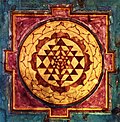
| caption = | | caption = Painting of the Goddess, Tripura Sundari | ||
| name = Tripura Sundari | | name = Tripura Sundari | ||
| deity_of = | | deity_of = Mother Goddess;<br/>One of the Highest Forms of [[Mahadevi]]<br />The Governess of the Universe | ||
<br/>[[Para Brahman|The Supreme Being]] ([[Kaula (Hinduism)|Srikula]]-[[Shaktism]]) | |||
| abode = [[Manidvipa]]/Śrī Nagara | | abode = [[Manidvipa]] / Śrī Nagara | ||
| weapon = [[ | | weapon = [[Pasha (Hinduism)|Pasha]] (rope), [[Ankusha]] (elephant goad), floral arrows and Sugarcane bow | ||
| consort = Kameshvara | {{sfn|Kinsley|1998|p=112}} | ||
| children = | | consort = Kameshvara, a form of Lord [[Shiva]] | ||
| mantra = | | children = <!-- none: Bala is one of her own forms, not her child --> | ||
| | | mantra = {{IAST|Oṃ Śrī Mātre Namaḥ}} | ||
| festivals = Lalita Jayanti on Magha Purnima | | festivals = {{hlist|Lalita Jayanti on Magha Purnima|Lalita Panchami|[[Navaratri]]|Adi-Puram}} | ||
| member_of = | | member_of = the ten [[Mahavidyas]] | ||
| avatar_birth = flower | |||
| other_names = Kamakshi, Kameshvari, Lalita, Lalitambika, Rajarajeshvari, Shodashi, Sri Mata | |||
| mount = [[Lion]] | |||
| symbols = [[Sri Yantra]] | |||
| texts = {{bulleted list|[[Brahmanda Purana]]|[[Tripura Rahasya]]|[[Devi Bhagavata Purana]]|[[Bahvricha Upanishad]]|[[Tripura Upanishad]]|[[Tantra]]s}} | |||
| gender = [[Female]] | |||
| day = [[Friday]] | |||
| region = Worshipped In the form of Goddess Kamakshi and Kamakhya in Kanchipuram and Assam | |||
| affiliation = [[Para Brahman|Parabrahaman]], [[Mahadevi]], [[Mahavidyas]], [[Parvati]], [[Kamakhya]] | |||
}} | }} | ||
'''Tripura Sundari''' ( | '''Tripura Sundari''' (Sanskrit: त्रिपुरसुन्दरी; IAST: ''Tripura Sundarī''), also known as '''Lalita''', '''Shodashi''', '''Kamakshi''', and '''Rajarajeshvari''', is a [[Hindus|Hindu]] goddess revered primarily within the [[Shaktism]] tradition and recognized as one of the ten [[Mahavidyas]].{{sfn|Kinsley|1998}} She embodies the essence of the supreme goddess [[Mahadevi]]. Central to the Shakta texts, she is widely praised in the ''[[Lalita Sahasranama]]'' and the ''[[Saundarya Lahari]]''.{{sfn|Das|2001}} In the Lalitopakhyana of the ''[[Brahmanda Purana]]'', she is referred to as [[Adi Parashakti]]. | ||
The term "Tripura" conveys the concept of three cities or worlds, while "Sundari" translates to "beautiful woman". She signifies the most beautiful woman across the three realms, with associations to the yoni symbol and the powers of creation, preservation, and dissolution. | |||
== | According to the [[Kaula (Hinduism)|Srikula tradition]] in Shaktism, Tripura Sundari is the foremost of the Mahavidyas, the [[Para Brahman|supreme divinity]] of Hinduism and also the primary goddess of [[Sri Vidya]]. The ''[[Tripura Upanishad]]'' places her as the ultimate [[Shakti]] (energy, power) of the universe.{{Sfn|Mahadevan|1975|pp=235}} She is described as the supreme consciousness, ruling from above [[Brahma]], [[Vishnu]], and [[Shiva]].{{Sfn|Brooks|1990|pp=155–156}} | ||
The | The ''Lalita Sahasranama'' narrates the cosmic battle between Lalita Tripura Sundari and the demon [[Bhandasura]], symbolizing the triumph of good over evil. This sacred text offers a detailed portrayal of her divine attributes and qualities. Temples dedicated to her exist across India, with prominent ones in [[Tripura]], [[West Bengal]], [[Tamil Nadu]], [[Andhra Pradesh]], [[Telangana]], [[Jharkhand]], and [[Karnataka]]. Her festivals, including Lalita Jayanti and Lalita Panchami, are celebrated fervently, reflecting devotees' deep spiritual connection to the Goddess and her embodiment of the Divine Feminine energy. | ||
== Etymology and nomenclature == | |||
The word Tripura (त्रिपुर ) means three cities or three worlds, Sundari (सुन्दरी) means beautiful woman. Tripura Sundari means the most beautiful woman in the three worlds. Tripura could also mean the [[Tripura (mythology)|three cities]] crafted by [[Mayasura]] and destroyed by [[Tripurantaka]], thus meaning "She who is beautiful to the destroyer of the Three Cities". She is known as Tripura as her mantra has three clusters of letters. She is also called Tripura because she is manifested in [[Brahma]], [[Vishnu]] and [[Shiva]] as the creator, preserver and destroyer of the universe.{{Sfn|Brooks|1990|pp=155–156}}{{sfn|Woodroffe|1974|pp=132–37}} | |||
== History and ''paramparas''== | |||
The ''Srikula'' (family of ''Sri'') tradition (''[[sampradaya]]'') focuses worship on Devi in the form of the goddess ''Lalita-Tripura Sundari''. Rooted in first-millennium. Srikula became a force in South India no later than the seventh century, and is today the prevalent form of Shaktism practised in South Indian regions such as the [[Kerala]], [[Tamil Nadu]] and Tamil areas of [[Sri Lanka]].{{sfn|Brooks|1992|loc=back cover}} | |||
The | The Srikula's best-known school is [[Shri Vidya|Srividya]], "one of Shakta Tantrism's most influential and theologically sophisticated movements." Its central symbol, the ''[[Sri Chakra]]'', is probably the most famous visual image in all of Hindu Tantric tradition. Its literature and practice is perhaps more systematic than that of any other Shakta sect.{{sfn|Brooks|1990|page=xiii}} | ||
Srividya largely views the goddess as "benign [''saumya''] and beautiful [''saundarya'']" (in contrast to Kalikula's focus on "terrifying [''ugra''] and horrifying [''ghora'']" Goddess forms such as Kali or Durga). In Srikula practice, moreover, every aspect of the goddess – whether malignant or gentle – is identified with Lalita.{{sfn|Brooks|1992|pages=59-60}} | |||
Srikula adepts most often worship Lalita using the abstract ''Sri Chakra'' [[yantra]], which is regarded as her subtle form. The Sri Chakra can be visually rendered either as a two-dimensional diagram (whether drawn temporarily as part of the worship ritual, or permanently engraved in metal) or in the three-dimensional, pyramidal form known as the ''Sri Meru''. It is not uncommon to find a ''Sri Chakra'' or ''Sri Meru'' installed in South Indian temples, because – as modern practitioners assert – "there is no disputing that this is the highest form of Devi and that some of the practice can be done openly. But what you see in the temples is not the ''srichakra'' worship you see when it is done privately."{{efn|A senior member of Guru Mandali, Madurai, November 1984, cited in Brooks 1992.{{sfn|Brooks|1992|page=56}} }} | |||
The Srividya ''[[parampara]]s'' can be further broadly subdivided into two streams, the ''[[Kaula (Hinduism)|Kaula]]'' (a ''[[vamachara|vamamarga]]'' practice) and the ''Samaya'' (a ''[[dakshinachara|dakshinamarga]]'' practice). The ''Kaula'' or ''Kaulachara'', first appeared as a coherent ritual system in the 8th century in central India,{{sfn|White|2003|page=219}} and its most revered theorist is the 18th-century philosopher [[Bhaskararaya]], widely considered "the best exponent of Shakta philosophy".{{sfn|Bhattacharyya|1996|page=209}} | |||
The ''Samaya'' or ''Samayachara'' finds its roots in the work of the 16th-century commentator Lakshmidhara, and is "fiercely puritanical [in its] attempts to reform Tantric practice in ways that bring it in line with high-caste [[brahmin|brahmanical]] norms."{{sfn|Brooks|1990|page=28}} Many Samaya practitioners explicitly deny being either Shakta or Tantric, though scholars argue that their cult remains technically both.{{sfn|Brooks|1990|page=28}} The Samaya–Kaula division marks "an old dispute within Hindu Tantrism".{{sfn|Brooks|1990|page=28}} | |||
[ | |||
{{ | == Legend == | ||
{{no footnotes|section|date=January 2023}} | |||
The battle between Lalita Tripura Sundari and the demon [[Bhandasura|Bhaṇḍāsura]] is primarily described in the ''[[Lalita Sahasranama]]'', a sacred text from Hinduism that consists of a thousand names of Goddess Lalita. The Lalita Sahasranama is a part of the larger scripture called the ''[[Brahmanda Purana]]'', specifically in the ''Uttara Khanda'' (the concluding section) of the Purana. | |||
The gods sought the help of [[Kamadeva]] to awaken Lord Shiva from his penance. Shiva opened his third eye and reduced Kamadeva to ashes. Taking those ashes, the Ganatha named Chitrakarma created a beautiful human form. Shiva gave it life. That is Bhandasura. | |||
In this narrative, Bhandasura is depicted as a powerful demon who has obtained a boon from [[Shiva]] that makes him nearly invincible. With his newfound powers, Bhandasura wreaks havoc and establishes his own kingdom, challenging the divine order. In response to the growing threat posed by Bhandasura, the gods, led by Shiva and [[Vishnu]], approach Lalita Tripura Sundari for help. | |||
Lalita Tripura Sundari is a manifestation of the divine feminine energy and is considered the ultimate form of [[Adi Parashakti]].<ref>{{Cite book |last=Dalal |first=Roshen |url=https://books.google.com/books?id=DH0vmD8ghdMC |title=Hinduism: An Alphabetical Guide |date=2010 |publisher=Penguin Books India |isbn=978-0-14-341421-6 |pages=221 |language=en}}</ref> She is often depicted as a beautiful and benevolent goddess, but when faced with the need to restore cosmic balance and protect the universe, she transforms into a fierce and powerful warrior. She is widely known as Parvati or Kamakshi. | |||
The battle between Lalita and Bhandasura is described in the ''Lalita Sahasranama'' as a cosmic confrontation that symbolizes the triumph of good over evil, righteousness over tyranny, and divine intervention over malevolent forces. The goddess, adorned with various weapons and symbols of power, engages in a fierce battle with Bhandasura and his army of demons. With her extraordinary prowess and the assistance of her divine companions and manifestations, Lalita defeats Bhandasura and restores cosmic harmony. | |||
The ''Lalita Sahasranama'' not only describes the battle itself but also delves into the divine qualities and aspects of Lalita, highlighting her significance as the embodiment of [[bhakti|divine love]], grace, power, and wisdom. The text is revered by devotees of the goddess and is recited as a form of worship and meditation to invoke her blessings and protection. | |||
== | === Role in creation === | ||
According to the Tripura Rahasya, only goddess Tripura Sundari existed before the beginning of the universe. She created the [[Trimurti]] and began the creation of the universe. | |||
The | == Literature == | ||
The most important text of Tripura Sundari is the ''[[Lalita sahasranama|Lalita Sahasranama]]'' (from the ''[[Brahmanda Purana]]'').{{sfn|Dikshitar|1999|pages=1–36}}{{sfn|Brown|1998|pages=8, 17, 10, 21, 320}} Tripura Sundari is most often mentioned in the Lalitopakhyana (the fourth book of the ''[[Brahmanda Purana]]'') and ''[[Tripura Rahasya]]''. The ''Lalitopakhyana'' tells of the epic battle between her forces and the forces of the arch-demon [[Bhandasura]]. | |||
The [[Tripura Rahasya]] is a key Sanskrit text that explores the greatness of Tripura Sundari and the philosophy of [[nondualism]].<ref>{{Cite web |last=S |date=2024-04-24 |title=Spiritual Teachings from 'Tripura Rahasya' |url=https://mahaavidya.org/spiritual-teachings-from-tripura-rahasya/ |access-date=2024-10-14 |website=Mahavidya Sadhana Centre |language=en-US}}</ref> It emphasizes the goddess as the supreme consciousness and the ultimate reality behind the universe. The text highlights her role in guiding seekers toward spiritual liberation through self-realization and knowledge of the highest truth. | |||
The ''[[Tripura Upanishad]]'' places the goddess Tripura Sundari as the ultimate [[Shakti]] (energy, power) of the universe.{{Sfn|Mahadevan|1975|pp=235}} She is described as the supreme consciousness, above [[Brahma]], [[Vishnu]] and [[Shiva]].{{Sfn|Brooks|1990|pp=155–156}} The ''Tripura Upanishad'' is historically the most complete introduction to Shakta Tantrism,{{Sfn|Brooks|1990|pp=xiii–xiv}} distilling into its 16 verses almost every important topic in Shakta Tantra tradition.{{Sfn|Brooks|1990|pp=xvi}} Along with the ''Tripura Upanishad'', the ''[[Tripuratapini Upanishad]]'' has attracted scholarly [[bhasya]] (commentary) in the second half of 2nd-millennium, such as the work of [[Bhaskararaya]],{{Sfn|Brooks|1990|pp=37-38}} and Ramanand.{{Sfn|Brooks|1990|p=221 with note 64}} | |||
The ''[[Bahvricha Upanishad]]'' is notable for asserting that the Self (soul, Atman) is a Goddess who alone existed before the creation of the universe.{{Sfn|Mahadevan|1975|p=237}}{{better source needed|date=January 2023}} | |||
According to the "Patala Khanda" of ''[[Padma Purana]]''<ref>{{Cite book |last=Deshpande |first=N. A. |title=The Padma Purana |year=2014 |orig-year=1st pub. 1951 |isbn=8120838297}}</ref> and the ''[[Naradiya Purana|Narada Purana]]'',{{sfn|Joshi|1997|p=[https://archive.org/details/naradapuranaeng031951ocrmotilalbanasirdass/page/n353/mode/2up 1264]}} the god [[Krishna]] is the male form of the goddess Lalita. | |||
== | The Tantraraja Tantra of the Shakta tradition describe that goddess Lalita assumed a male form as Krishna. Krishna has six forms namely Siddha-gopala, Kamaraja-gopala, Manmatha-gopala, Kandarpa-gopala, Makaraketana-gopala and Manobhava-gopaila and goddess Lalita created the last five forms from it.<ref>{{Cite book |last=Shastri |first=Mahamahopadhyaya Lakshmana |title=Tantraraja Tantra |publisher=Motilal Banarasidass Publishers |year=2000 |isbn=81-208-1253-0 |edition=4th |pages=15–16}}</ref> | ||
=== ''Lalita Sahasranama'' === | === ''Lalita Sahasranama'' === | ||
''[[Lalita Sahasranama]]'' contains a thousand names of the Hindu mother goddess ''Lalita''.{{sfn|Dalal|2014|p=[https://books.google.com/books?id=pNmfdAKFpkQC&pg=PA207 207]}} The names are organized in a hymn (''[[stotras]]''). It is the only ''[[sahasranama]]'' that does not repeat a single name. Further, in order to maintain the meter, other ''sahasranamas'' use the artifice of adding suffixes like tu, api, ca, and hi, which are conjunctions that do not necessarily add to the meaning of the name except in cases of interpretation. The ''Lalita sahasranama'' does not use any such auxiliary conjunctions and is unique in being an enumeration of holy names that meet the metrical, poetical and mystic requirements of a ''sahasranama'' by their order throughout the text. | |||
''Lalita Sahasranama'' begins by calling the goddess ''Shri Mata'' (the great mother), ''Shri Maharajni'' (the great queen) and ''Shrimat Simhasaneshwari'' (the queen sitting on the lion-throne).{{sfn|Venkatasubramanian|1999|p=343}} In verses 2 and 3 of the ''Sahasranama'' she is described as a ''Udayatbhanu Sahasrabha'' (the one who is as bright as the rays of thousand rising suns), ''Chaturbahu Samanvita'' (the one who has four hands) and ''Ragasvarupa Pashadhya'' (the one who is holding the rope).{{sfn|Deshpande|1986|p=108}} ''Chidagnikunda Sambhuta'' (one who was born from the altar of the fire of consciousness) and ''Devakarya samudyata'' (one who manifested Herself for fulfilling the objects of the ''[[Deva (Hinduism)|devas]]'') are among other names mentioned in the ''sahasranama''. | |||
==== Composition ==== | |||
The ''Lalita Sahasranama'' is said to have been composed by the eight ''vaag'' [[devi]]s (''Vasini'', ''Kameshvari'', ''Aruna'', ''Vimala'', ''Jayani'', ''Modini'', ''Sarveshvari'', and ''Kaulini'') upon the command of the goddess Lalita herself. The ''Sahasranama'' says that "One can worship Lalita only if she wishes us to do so." This ''stotra'' occurs in the ''[[Brahmanda Purana]]'' (history of the universe) in the chapter of discussion between [[Hayagreeva|Hayagriva]] and Sage [[Agasthya|Agastya]] in Kanchipuram.{{sfn|Tagare|1958}} Hayagriva is an incarnation of [[Vishnu]] with the head of a horse and is held to be the storehouse of knowledge. Agastya is one of the sages of yore and one of the stars of the constellation [[Saptarishi]]. At the request of Agastya, Hayagriva is said to have taught him the thousand holiest names of Lalita. The [[Tirumeeyachur Mehanadhar Temple|temple at Thirumeyachur]], near [[Kumbakonam]], is said to be where Agastya was initiated into this ''sahasranama''. An alternative origin is that the ''Upanishad Bramham Mutt'' at [[Kanchipuram]] is where this initiation happened.{{citation needed|date=January 2023}} In Carnatic Music, the composer Shyama Sastry composed many Swarajathis and lovely compositions in praise of the goddess. Most popular being the three swarajathis called as Ratnatrayam and the Navaratnamalika on goddess Meenakshi of Madurai. | |||
===''Tripura Rahasya''=== | |||
Tripura Sundari occupies a very special place in the ''[[Tripura Rahasya]]'', a Shakta scripture popular in [[Shri Vidya]] tradition. | |||
The '''Tripura Rahasya''' is traditionally divided into three volumes: the '''Mahatmya Khanda''', which extols the greatness of '''Tripura Sundari''' and her cosmic power; the '''Jnana Khanda''', which focuses on the nature of ultimate knowledge and self-realization through the teachings of the sage [[Dattatreya]] to [[Parashurama]]; and the '''Charya Khanda''', which is believed to contain instructions on rituals and practices, though the last part is largely considered lost or unavailable today. Each volume progressively guides seekers from devotion to spiritual wisdom and liberation. | |||
{{Blockquote|text=The Power called Tripura is Pure Consciousness. It is beyond speech, senses and mind. She, the Parameshvari exists as Atma in everything. She is beyond codes of conduct, free from conduct and the conductor. She is merely Pure Consciousness supporting all and beyond speech. She is just the soul and consciousness. By virtue of Her freedom She is termed as Maya (illusion). Her glory that encompasses all is beyond logic and questioning. The being gets deluded in many ways by Her who is the pure soul. The creation is said to be the sport of the Devi.|source=Shri Tripura Rahasya (Mahatmya Khanda), Chapter 58, Verses 12 to 14|author=T. B. Lakshmana Rao}} | |||
{{Blockquote|text=She rules over three cities, three paths children of the universe. a, ka, and tha, fully present. She is present in these letters. She is ageless, birth less, the greatest and she is the glory of all gods.|source=Tripura Upanishad Verse 01|author=Swami Narasimhananda}} | |||
== Iconography == | |||
Her form is described in her Dhyana Stotra as follows. | |||
' | {{poemquote|'aruṇāṃ karuṇā taraṅgitākṣīṃ | ||
dhṛtapāśāṅkuśa puṣpa bāṇa cāpām । | |||
aṇimādibhirāvṛtāṃ mayukhaiḥ | |||
ahamityeva vibhāvaye bhavānīm'.{{quote without source|date=December 2022}} }} | |||
I imagine of my goddess Bhavani, who has a color of the rising sun. Who has eyes which are waves of mercy, who holds Pasha, Ankusha, bow made of sugarcane, arrows made of soft flowers,in her hands and who is surrounded, by her devotees with powers great, as personification of the concept of “I”. | |||
==== | Also details of her appearance are found in the famous hymn in her praise, the [[Lalita Sahasranama]], where she is said to be, | ||
{{blockquote|seated on a throne like a queen (names 2 and 3), to wear jewels (names 13 and 14), to have the auspicious marks of a married woman (names 16–25), and to have heavy breasts and a thin waist (name 36); the crescent moon adorns her forehead, and her smile overwhelms Kameshwara, the lord of desire (name 28). She has as her throne with its legs being Pancha Brahmas (five Brahmas) (name 249).}} | |||
She is often depicted iconographically as a 16-year-old girl (hence the appellation "Shodashi") [[Lotus throne|seated on a lotus]] that rests on the supine body of Sadashiva, which in turn lies on a throne whose legs are the gods Brahma, Vishnu, Isvara, and Rudra. In some cases, the lotus is growing out of Shiva's navel. In other more common cases, the lotus is grown directly from the Sri Chakra. | |||
In the Jnana Khanda of Tripura Rahasya, goddess herself describes her eternal form. | |||
{{Blockquote|text=In the island of jewels, encircled by the ocean of nectar, beyond the universe, there is a mansion made of Chintamani (wish giving jewel) in the grove Kadamba (Burflower) trees. There is a platform with four legs representing Brahma, Vishnu, Mahesha and Ishwara, and the platform itself represent the back Sadashiva. On it, is installed my non-transcendent form as Tripura Sundari in the form of eternal consciousness.<ref>{{Cite book |first=A. U. |last=Vasavada |title=Tripura-Rahasya (Jnankhanda) |publisher=Chowkhamba Sanskrit Series Office |year=2014 |isbn=978-8170804161 |edition=2014 |pages=135 |language=English}}</ref>|source=Shri Tripura Rahasya (Jnana Khanda), Chapter 20, Verses 36:37}} | |||
The ''Vamakeshvara tantra'' says that Tripura-sundari dwells on the peaks of the [[Himalayas]]; is worshipped by sages and heavenly nymphs; has a body like pure crystal; wears a tiger skin, a snake as a garland around her neck, and her hair tied in a jata; holds a trident and drum; is decorated with jewels, flowers, and ashes; and has a large bull as a vehicle. | |||
The [[Saundarya Lahari]] and the [[Tantrasara]] describe her in detail from her hair to her feet. The ''Tantrasara dhyana'' mantra says that she is illuminated by the jewels of the crowns of Brahma and Visnu, which fell at her feet when they bowed down to worship her.{{sfn|Kinsley|1998|pp=112-113}} Kinsley also says that "In the Saundarya Lahari and Tantrasara she is not associated with [[Shiva]] in any obvious way as she is in other depictions".{{Sfn|Kinsley|1998|pp=112-113}} | |||
Vaishnavism traditions have a similar set of complementary parallels between [[Vishnu]] and [[Lakshmi]]. The Tantric [[Vaishnava]] [[Pancharatra]] texts associates Lalita with Lakshmi. Author Douglas Renfrew Brooks says, "Lalita, like the Pancharatra conception of Lakshmi, acts independently by taking over the cosmic functions of the male deity; yet she does not defy the god's wishes". Brooks also says, "In contrast to most Vaishnava conceptions of Lakshmi, however, Lalita destabilizes temporarily for the purpose of reasserting order".{{Sfn|Brooks|1992|p=67}} | |||
Scholar and professor [[Thomas B. Coburn]] says, {{blockquote|[[Sri Vidya]], then, can be understood as one of the premier instances of Hindu Shakta Tantrism. Specifically, it is the tradition (sampradaya) which deals with worship of Tripurasundari, "the most beautiful Tantric form of Sri/Lakshmi, [who is]... the most benign, beautiful and youthful yet motherly manifestation of the Supreme Shakti.{{Sfn|Coburn|1991|p=125}}}} | |||
== Sri Yantra == | |||
{{main|Sri Yantra}} | |||
[[File:Powerful Sri Chakra.jpg|thumb|The Sri Yantra in diagrammatic form, showing how its nine interlocking triangles form a total of 43 smaller triangles]] | |||
The [[Sri Yantra]] is a form of mystical diagram (''[[yantra]]'') used in the [[Shri Vidya]] school of [[Hinduism]]. Comprising nine interlocking triangles, it embodies complex symbolism. Four upward triangles signify [[Shiva]], while five downward triangles represent [[Shakti]], encompassing the cosmic and human realms around a central point called the bindu. This configuration is sometimes termed the [[Navayoni Chakra]].{{sfn|Shankaranarayanan|2004}} | |||
The [[ | |||
The Sri Yantra holds great significance in the [[Shri Vidya]] school, central to its worship. It symbolizes the union of masculine and feminine divine energies. The triangles, varying in size, form 43 smaller triangles in concentric levels, mirroring the cosmos. The power point (bindu) stands as the cosmic center, encompassed by concentric circles with lotus petal patterns denoting creation and life force. These elements, set within an earth square, depict a temple with doors to different regions of the universe. | |||
In the Shri Vidya tradition, the Sri Yantra represents the core of devotion. Each triangle and level is associated with specific aspects of divinity, culminating in a structure known as the nava chakra. Its projection into three dimensions results in the [[Maha Meru]], symbolizing the philosophy of [[Kashmir Shaivism]]. [[Subhash Kak]] has drawn parallels between the Sri Yantra and ancient Vedic texts, emphasizing its enduring significance across Hindu spiritual thought.{{sfn|Kak|2008–2009}} | |||
== Temples == | |||
=== | === India === | ||
There are several temples dedicated to Tripura Sundari across India.<ref>{{cite web |title= “Tripura Sundari Temple: A New Dawn for Spiritual Tourism in the North-East” |url=https://www.pib.gov.in/PressNoteDetails.aspx?NoteId=155254&ModuleId=3®=3&lang=2 |website=pib.gov.in}} </ref> | |||
Some of the most significant ones include: | |||
*[[Tirumeeyachur_Mehanadhar_Temple|Tirumeeyachur Mehanadhar Temple]]: Tirumeeyachur Mehanadhar Temple (திருமீயச்சூர் மேகநாதர் கோயில்) is located at Thirumeeyachur in Tiruvarur district, Tamil Nadu, India. As per a belief, Tirumeeyachur Mehanadhar Temple is where Sri Lalita Sahasranama was composed and [[Hayagriva]] taught it to [[Agastya]] maharishi. | |||
*[[Adyar Kamakshi Temple]], Tamil Nadu: While the primary deity of this temple is Goddess Kamakshi, she is often associated with Tripura Sundari in the Shakta tradition. The temple is located in Chennai, Tamil Nadu.{{citation needed|date=October 2023}} | |||
*[[Kanchi Kamakoti Peetham]], Tamil Nadu: also called the Sri Kanchi Matham or the Sri Kanchi Monastery, is a [[Hinduism|Hindu]] institution, located in [[Kanchipuram]], [[Tamil Nadu]]. It is located near a temple dedicated to Goddess Sri Kamakshi, along with a shrine for the Advaita Vedanta teacher [[Adi Shankara]].{{sfn|Krishna|2006|p=100}} | |||
[[File:Kanchipuram.in Kamakshi-Amman Temple - panoramio - SINHA (cropped).jpg|upright|thumb|Kamakshi Amman Temple in Kanchipuram, Tamil Nadu, India (2005)]] | |||
[[File: | |||
*[[Ratneshwari Temple]], Jharkhand: Located in Jharkhand, this temple is dedicated to Goddess Tripura Sundari. It is believed to be one of the Shakti Peethas and holds immense importance among devotees.{{citation needed|date=October 2023}} | |||
*Lalita Devi Temple, Uttar Pradesh: This temple is located in [[Naimiṣāraṇya (forest)|Naimisharanya]]. It is one of the 51 Shakti Peethas, which are considered highly sacred in the [[Shaktism|Shakta]] tradition. The temple complex is dedicated to Goddess Tripura Sundari.<ref>{{Cite web |date=28 November 2024 |title=Lalita Devi (Naimisharanya) |url=https://uptourism.gov.in/en/article/lalita-devi-naimisharanya |website=Uttar Pradesh Tourism}}</ref><ref>{{Cite web |title=Lalita Devi Temple {{!}} District Sitapur, Government of Uttar Pradesh {{!}} India |url=https://sitapur.nic.in/tourist-place/lalita-devi-temple/ |access-date=2025-09-01 |language=en-US}}</ref> | |||
*[[Jnanakshi Rajarajeshwari Temple|Sri Rajarajeswari Temple]], Karnataka: This peetham (spiritual institution) in Karnataka is dedicated to Goddess Rajarajeswari, a form of Tripura Sundari. It is a well-known center of worship and spiritual activities.<ref>{{Cite web |date=2016-05-09 |title=Sri Kailash Ashrama Mahasamsthana {{!}} Rajeshwari Temple |url=https://www.srikailashashrama.org/rajeshwari-temple.html |access-date=2024-11-17 |archive-url=https://web.archive.org/web/20160509152814/https://www.srikailashashrama.org/rajeshwari-temple.html |archive-date=9 May 2016 }}</ref> | |||
[[File:Sri_Raja_Rajeshwari_Temple_02.jpg|upright|thumb|Sri Raja Rajeshwari Temple is located at Kenchenhalli, Raja Rajeshwari Nagar, Bangalore Karnataka, India (2024)]] | |||
*[[Tiruvakkarai Kamakshi Amman Temple]], Tamil Nadu: This temple is located in Tiruvakkarai near Pondicherry, Tamil Nadu. It is an important pilgrimage site dedicated to Goddess Tripura Sundari. The temple is known for its intricate architecture and serene surroundings.{{citation needed|date=October 2023}} | |||
*[[Tripura Sundari Temple]], Tripura: This temple is located in the ancient city of Udaipur in Tripura, India. It is one of the 51 Shakti Peethas, which are considered highly sacred in the Shakta tradition. The temple complex is dedicated to Goddess Tripura Sundari and attracts devotees from all over the country.{{citation needed|date=October 2023}} | |||
*Rajrajeswari Temple in Tehri district of Uttarakhand. The presiding deity Rajrajeswari is identical with Nanda, the patron goddess of Kumaoni and Garhwali people. She is worshipped by Tantric and Shamanic methods like [[Jaagar]] in Uttarakhand. | |||
*Tripura Sundari Temple in [[Naggar, Himachal Pradesh|Naggar]] of Kullu district in Himachal Pradesh. | |||
=== Germany === | |||
[[File:Hamm-Tempel-Farbgestaltung2014-11-02-13-07.jpg|upright|thumb|Sri Kamakshi Ambal Temple in [[Hamm, North Rhine-Westphalia|Hamm]], Germany (2014)]] | |||
In [[Hamm, North Rhine-Westphalia|Hamm]] in [[North Rhine-Westphalia]], Germany, there is the ''Sri Kamadchi Ampal Temple'', built in 2002.{{sfn|Ben-Rafael|Sternberg|2010|pp=242–254}} | |||
== Festivals == | |||
Festivals dedicated to Tripura Sundari are celebrated with devotion and reverence across various regions in the [[Shakta]] tradition. Her main festivals are Lalita Jayanti and Lalita Panchami, but other festivals also hold significance. | |||
=== Lalita Jayanti === | |||
Lalita Jayanthi is celebrated on [[Magha Purnima]], the full moon day of the month of Magha (January–February). It is a very important day in some parts of North India when special offerings and ceremonies are held. It is believed that devotees on this day will be blessed if they worship Goddess Lalita with full devotion and dedication.{{citation needed|date=September 2022}} | |||
Goddess | === Lalita Panchami === | ||
Lalita Panchami is a very auspicious [[tithi]], celebrated on the fifth day of the Sharad [[Navaratri]] festival. Legend has it that on this auspicious day Goddess Lalita emerged from fire to defeat [[Bhandasura]], a demon created from the ashes of [[Kamadeva]]. This day is very important in [[Gujarat]] and [[Maharashtra]]. On this day, some devotees also hold a fast called Lalita Panchami vrata, which is also called the Upang Lalita Vrat.<ref>[https://www.drikpanchang.com/navratri/events/lalita-panchami-date-time.html?year=2023 Lalita Panchami, Upang Lalita Vrat]</ref> It is believed to bring wealth, happiness and wisdom. Chanting of Vedic mantras dedicated to Goddess Lalita on this day is very useful. It is a popular belief that doing so will immediately solve all the personal as well as business related problems in life. | |||
Tripura | ===Other festivals=== | ||
[[Navaratri]], a nine-night festival, holds immense significance as devotees engage in elaborate rituals, fasting, prayer, and recitation of sacred texts in honor of the divine feminine. [[Dussehra]], which marks the triumph of good over evil, often includes the worship of Tripura Sundari, emphasizing her role as a protector and nurturer. [[Shodashi Puja]], dedicated to her youthful form, is conducted by initiated devotees. [[Chaitra Navaratri]], observed in March–April, mirrors the autumn Navaratri celebrations. [[Pournami Pooja]], observed during full moon days, involves special prayers and rituals to seek her blessings. Additionally, various regions might organize [[Shakti Utsav]], celebrating the multifaceted forms of the goddess. These festivals collectively showcase the devotion, cultural richness, and spiritual connection that devotees share with Goddess Tripura Sundari. | |||
==See also== | |||
*{{annotated link|Kurukullā}} | |||
*{{annotated link|Triple Goddess}} | |||
== Notes == | == References == | ||
===Notes=== | |||
{{reflist|group=lower-alpha}} | |||
=== Citations === | |||
{{Reflist}} | {{Reflist}} | ||
== | === Works cited === | ||
*{{cite book|first=Douglas | {{refbegin|2|indent=yes}} | ||
* {{cite book |last= | *{{cite book |editor1-first=Eliezer |editor1-last=Ben-Rafael |editor2-first=Yitzhak |editor2-last=Sternberg |title=World Religions and Multiculturalism: A Dialectic Relation |year=2010 |place=Netherlands |publisher=Brill |isbn=978-9004188921}} | ||
*{{cite book|title= | *{{cite book |last=Bhattacharyya |first=N. N. |title=History of the Sakta Religion |publisher=[[Munshiram Manoharlal Publishers]] |location=New Delhi |orig-year=1974 |edition=2nd |year=1996 }} | ||
*{{cite book|title= | *{{cite book |first=Douglas Renfrew |last=Brooks |title=The Secret of the Three Cities: An Introduction to Hindu Sakta Tantrism |location=Chicago & London |publisher=University of Chicago Press |year=1990 |isbn=978-0226075709}} | ||
*{{cite book |title=Auspicious Wisdom: The Texts and Traditions of Srividya Sakta Tantrism in South India |first=Douglas Renfrew |last=Brooks |publisher=SUNY Press |year=1992 |isbn=978-0791411469}} | |||
*{{cite book |first=Cheever Mackenzie |last=Brown |title=The Devi Gita: The Song of the Goddess: A Translation, Annotation, and Commentary |year=1998 |publisher=State University of New York Press |location=Albany |isbn=978-0-7914-3939-5}} | |||
*{{cite book |title=Encountering the Goddess: A Translation of the Devi-Mahatmya and a Study of Its Interpretation |year=1991 |first=Thomas B. |last=Coburn |publisher=SUNY Press |isbn=978-0791499313}} | |||
* {{cite book |last=Dalal |first=Roshen |year=2014 |title=Religions of India: A Concise Guide to Nine Major Faiths |publisher=Penguin Books |isbn=978-0-14-341517-6}} | |||
*{{cite book |title=Human rights and indigenous peoples |last=Das |first=J. K. |pages=208–9 |publisher=A.P.H. Publishing |year=2001 |isbn=978-81-7648-243-1 |chapter=Chapter 5: Old and new political process in realization of the rights of indigenous peoples (regarded as tribals) in Tripura}} | |||
*{{cite book |last=Deshpande |first=Madhusudan Narhar |year=1986 |title=The Caves of Panhāle-Kājī, Ancient Pranālaka: An Art Historical Study of Transition from Hinayana, Tantric Vajrayana to Nath Sampradāya (third to Fourteenth Century A.D.) |location=New Delhi |publisher=Archaeological Survey of India, Government of India |oclc=923371295}} | |||
*{{cite book |last=Dikshitar |first=V. R. Ramachandra |title=The Lalitā Cult |publisher=[[Motilal Banarsidass]] |location=Delhi |orig-year=1942 |year=1999 |isbn=978-8120814981}} | |||
*{{cite book |last=Joshi |first=Makarand |title=The Narada-Purana: Part III |place=Delhi |publisher=Motilal Banarsidass Publishers Pvt. |year=1997 |orig-year=1952 |url=https://archive.org/details/naradapuranaeng031951ocrmotilalbanasirdass |url-access=registration}} | |||
* {{cite journal |url=http://ikashmir.net/subhashkak/docs/SriChakra.pdf |first=Subhash |last=Kak |title=The Great Goddess Lalitā and the Śrī Cakra |journal=Brahmavidyā: The Adyar Library Bulletin |volume=72–73 |pages=155–172 |date=2008–2009}} | |||
*{{cite book |last=Kinsley |first=David |date=1998 |title=Tantric Visions of the Divine Feminine: The Ten Mahāvidyās |publisher=[[Motilal Banarsidass]] |isbn= 978-8120815230 }} | |||
*{{cite book |editor-first=Nanditha |editor-last=Krishna |title=Kanchipuram: A Heritage of Art and Religion |year=2006 |place=India |publisher=C.P. Ramaswami Aiyar Foundation |isbn=978-8190148412}} | |||
*{{cite book |last= Mahadevan |first=T. M. P. |title=Upaniṣads: Selections from 108 Upaniṣads |year=1975 |publisher=Motilal Banarsidass |isbn=978-81-208-1611-4}} | |||
*{{cite book |last=Shankaranarayanan |first=S. |year=2004 |title=Sri Chakra |place=India |publisher=Nesma Books India |isbn=978-8185208046}} | |||
*{{cite book |title=Discovery of North East India |volume=11 |editor1-first=S. K. |editor1-last=Sharma |editor2-first=Usha |editor2-last=Sharma |publisher=Mittal Publication |place=New Delhi, India |year=2015 |isbn=978-81-8324-045-1}} | |||
*{{cite book |last=Tagare |first=G. V. |title=Lalitopakhyana |chapter=Chapters 41-44 |chapter-url=https://www.wisdomlib.org/hinduism/book/lalitopakhyana-lalita-mahatmya/d/doc362983.html |year=1958 |place=Delhi |publisher=Motilal Banarsidass Publishers Pvt.}} | |||
*{{cite book |last=Venkatasubramanian |first=Krishnaswamy |title=The Spectrum: Festschrift, Essays in Honour of Dr. K. Venkatasubramanian |url=https://books.google.com/books?id=OGOcAAAAMAAJ |year=1999 |publisher=Variant Communications}} | |||
*{{cite book |last=White |first=David Gordon |title=Kiss of the Yogini: "Tantric Sex" in its South Asian Contexts |publisher=University of Chicago Press |location=Chicago |year=2003 |isbn=978-0-226-89483-6 }} | |||
*{{cite book |last=Woodroffe |first=Sir John George |year=1974 |title=The Serpent Power: Being the Shat-Chakra-Nirūpana and Pādukā-Panchaka, Two Works on Laya-Yoga |publisher=Dover Publications |isbn=978-0486230580}} | |||
{{refend}} | |||
==Further reading== | ==Further reading== | ||
*{{ | {{refbegin|2|indent=yes}} | ||
*{{cite book | | *{{cite journal |last=Golovkova |first=A. A. (Anya) |year=2020 |title=The Forgotten Consort: The Goddess and Kāmadeva in the Early Worship of Tripurasundarī |journal=International Journal of Hindu Studies |volume=24 |number=1 |pages=87–106 |doi=10.1007/s11407-020-09272-6 |s2cid=255166456 |ref=none}} | ||
*{{cite | *{{cite book |last=Kinsley |first=David R. |year=1988 |title=Hindu Goddesses: Visions of the Divine Feminine in the Hindu Religious Tradition |location=Berkeley |publisher=University of California Press |isbn=978-0520063396 |ref=none}} | ||
*{{cite book |editor-first=Kathleen |editor-last=Kuiper |title=The Culture of India |year=2010 |publisher=Britannica Educational Pub. |isbn=978-1615301492 |ref=none}} | |||
*{{cite web |last=Magee |first=Mike |date=n.d. |title=Lalitā Tripurāsundarī, the Red Goddess |website=Shivashakti.com |url=https://shivashakti.com/tripura |access-date=2023-01-06 |ref=none}} | |||
{{refend}} | |||
==External links== | ==External links== | ||
*{{Commons category-inline}} | *{{Commons category-inline}} | ||
{{Mahavidya}} | {{Mahavidya}} | ||
{{HinduMythology}} | {{HinduMythology}} | ||
{{Portal bar|Hinduism|India|Religion}} | |||
{{Authority control}} | {{Authority control}} | ||
[[Category:Tripura Sundari| ]] | [[Category:Tripura Sundari| ]] | ||
[[Category:Lakshmi]] | [[Category:Forms of Lakshmi]] | ||
[[Category:Forms of Parvati]] | [[Category:Forms of Parvati]] | ||
[[Category:Mahavidyas]] | [[Category:Mahavidyas]] | ||
[[Category: | [[Category:Shaktism]] | ||
[[Category:Hindu tantric deities]] | |||
[[Category:Consorts of Shiva]] | |||
[[Category:Folk deities of Rajasthan]] | |||
Latest revision as of 22:49, 23 March 2026
 |
| Tripura Sundari | |
|---|---|
Mother Goddess; One of the Highest Forms of Mahadevi The Governess of the Universe The Supreme Being (Srikula-Shaktism) | |
| Member of the ten Mahavidyas | |
 Painting of the Goddess, Tripura Sundari | |
| Other names | Kamakshi, Kameshvari, Lalita, Lalitambika, Rajarajeshvari, Shodashi, Sri Mata |
| Affiliation | Parabrahaman, Mahadevi, Mahavidyas, Parvati, Kamakhya |
| Abode | Manidvipa / Śrī Nagara |
| Mantra | Oṃ Śrī Mātre Namaḥ |
| Weapon | Pasha (rope), Ankusha (elephant goad), floral arrows and Sugarcane bow [1] |
| Symbols | Sri Yantra |
| Day | Friday |
| Mount | Lion |
| Texts | |
| Gender | Female |
| Region | Worshipped In the form of Goddess Kamakshi and Kamakhya in Kanchipuram and Assam |
| Festivals |
|
| Personal information | |
| Avatar birth | flower |
| Consort | Kameshvara, a form of Lord Shiva |
Tripura Sundari (Sanskrit: त्रिपुरसुन्दरी; IAST: Tripura Sundarī), also known as Lalita, Shodashi, Kamakshi, and Rajarajeshvari, is a Hindu goddess revered primarily within the Shaktism tradition and recognized as one of the ten Mahavidyas.[2] She embodies the essence of the supreme goddess Mahadevi. Central to the Shakta texts, she is widely praised in the Lalita Sahasranama and the Saundarya Lahari.[3] In the Lalitopakhyana of the Brahmanda Purana, she is referred to as Adi Parashakti.
The term "Tripura" conveys the concept of three cities or worlds, while "Sundari" translates to "beautiful woman". She signifies the most beautiful woman across the three realms, with associations to the yoni symbol and the powers of creation, preservation, and dissolution.
According to the Srikula tradition in Shaktism, Tripura Sundari is the foremost of the Mahavidyas, the supreme divinity of Hinduism and also the primary goddess of Sri Vidya. The Tripura Upanishad places her as the ultimate Shakti (energy, power) of the universe.[4] She is described as the supreme consciousness, ruling from above Brahma, Vishnu, and Shiva.[5]
The Lalita Sahasranama narrates the cosmic battle between Lalita Tripura Sundari and the demon Bhandasura, symbolizing the triumph of good over evil. This sacred text offers a detailed portrayal of her divine attributes and qualities. Temples dedicated to her exist across India, with prominent ones in Tripura, West Bengal, Tamil Nadu, Andhra Pradesh, Telangana, Jharkhand, and Karnataka. Her festivals, including Lalita Jayanti and Lalita Panchami, are celebrated fervently, reflecting devotees' deep spiritual connection to the Goddess and her embodiment of the Divine Feminine energy.
Etymology and nomenclature[edit | edit source]
The word Tripura (त्रिपुर ) means three cities or three worlds, Sundari (सुन्दरी) means beautiful woman. Tripura Sundari means the most beautiful woman in the three worlds. Tripura could also mean the three cities crafted by Mayasura and destroyed by Tripurantaka, thus meaning "She who is beautiful to the destroyer of the Three Cities". She is known as Tripura as her mantra has three clusters of letters. She is also called Tripura because she is manifested in Brahma, Vishnu and Shiva as the creator, preserver and destroyer of the universe.[5][6]
History and paramparas[edit | edit source]
The Srikula (family of Sri) tradition (sampradaya) focuses worship on Devi in the form of the goddess Lalita-Tripura Sundari. Rooted in first-millennium. Srikula became a force in South India no later than the seventh century, and is today the prevalent form of Shaktism practised in South Indian regions such as the Kerala, Tamil Nadu and Tamil areas of Sri Lanka.[7]
The Srikula's best-known school is Srividya, "one of Shakta Tantrism's most influential and theologically sophisticated movements." Its central symbol, the Sri Chakra, is probably the most famous visual image in all of Hindu Tantric tradition. Its literature and practice is perhaps more systematic than that of any other Shakta sect.[8]
Srividya largely views the goddess as "benign [saumya] and beautiful [saundarya]" (in contrast to Kalikula's focus on "terrifying [ugra] and horrifying [ghora]" Goddess forms such as Kali or Durga). In Srikula practice, moreover, every aspect of the goddess – whether malignant or gentle – is identified with Lalita.[9]
Srikula adepts most often worship Lalita using the abstract Sri Chakra yantra, which is regarded as her subtle form. The Sri Chakra can be visually rendered either as a two-dimensional diagram (whether drawn temporarily as part of the worship ritual, or permanently engraved in metal) or in the three-dimensional, pyramidal form known as the Sri Meru. It is not uncommon to find a Sri Chakra or Sri Meru installed in South Indian temples, because – as modern practitioners assert – "there is no disputing that this is the highest form of Devi and that some of the practice can be done openly. But what you see in the temples is not the srichakra worship you see when it is done privately."[lower-alpha 1]
The Srividya paramparas can be further broadly subdivided into two streams, the Kaula (a vamamarga practice) and the Samaya (a dakshinamarga practice). The Kaula or Kaulachara, first appeared as a coherent ritual system in the 8th century in central India,[11] and its most revered theorist is the 18th-century philosopher Bhaskararaya, widely considered "the best exponent of Shakta philosophy".[12]
The Samaya or Samayachara finds its roots in the work of the 16th-century commentator Lakshmidhara, and is "fiercely puritanical [in its] attempts to reform Tantric practice in ways that bring it in line with high-caste brahmanical norms."[13] Many Samaya practitioners explicitly deny being either Shakta or Tantric, though scholars argue that their cult remains technically both.[13] The Samaya–Kaula division marks "an old dispute within Hindu Tantrism".[13]
Legend[edit | edit source]
 | This section includes a list of references, related reading, or external links, but its sources remain unclear because it lacks inline citations. (January 2023) |
The battle between Lalita Tripura Sundari and the demon Bhaṇḍāsura is primarily described in the Lalita Sahasranama, a sacred text from Hinduism that consists of a thousand names of Goddess Lalita. The Lalita Sahasranama is a part of the larger scripture called the Brahmanda Purana, specifically in the Uttara Khanda (the concluding section) of the Purana.
The gods sought the help of Kamadeva to awaken Lord Shiva from his penance. Shiva opened his third eye and reduced Kamadeva to ashes. Taking those ashes, the Ganatha named Chitrakarma created a beautiful human form. Shiva gave it life. That is Bhandasura.
In this narrative, Bhandasura is depicted as a powerful demon who has obtained a boon from Shiva that makes him nearly invincible. With his newfound powers, Bhandasura wreaks havoc and establishes his own kingdom, challenging the divine order. In response to the growing threat posed by Bhandasura, the gods, led by Shiva and Vishnu, approach Lalita Tripura Sundari for help.
Lalita Tripura Sundari is a manifestation of the divine feminine energy and is considered the ultimate form of Adi Parashakti.[14] She is often depicted as a beautiful and benevolent goddess, but when faced with the need to restore cosmic balance and protect the universe, she transforms into a fierce and powerful warrior. She is widely known as Parvati or Kamakshi.
The battle between Lalita and Bhandasura is described in the Lalita Sahasranama as a cosmic confrontation that symbolizes the triumph of good over evil, righteousness over tyranny, and divine intervention over malevolent forces. The goddess, adorned with various weapons and symbols of power, engages in a fierce battle with Bhandasura and his army of demons. With her extraordinary prowess and the assistance of her divine companions and manifestations, Lalita defeats Bhandasura and restores cosmic harmony.
The Lalita Sahasranama not only describes the battle itself but also delves into the divine qualities and aspects of Lalita, highlighting her significance as the embodiment of divine love, grace, power, and wisdom. The text is revered by devotees of the goddess and is recited as a form of worship and meditation to invoke her blessings and protection.
Role in creation[edit | edit source]
According to the Tripura Rahasya, only goddess Tripura Sundari existed before the beginning of the universe. She created the Trimurti and began the creation of the universe.
Literature[edit | edit source]
The most important text of Tripura Sundari is the Lalita Sahasranama (from the Brahmanda Purana).[15][16] Tripura Sundari is most often mentioned in the Lalitopakhyana (the fourth book of the Brahmanda Purana) and Tripura Rahasya. The Lalitopakhyana tells of the epic battle between her forces and the forces of the arch-demon Bhandasura.
The Tripura Rahasya is a key Sanskrit text that explores the greatness of Tripura Sundari and the philosophy of nondualism.[17] It emphasizes the goddess as the supreme consciousness and the ultimate reality behind the universe. The text highlights her role in guiding seekers toward spiritual liberation through self-realization and knowledge of the highest truth.
The Tripura Upanishad places the goddess Tripura Sundari as the ultimate Shakti (energy, power) of the universe.[4] She is described as the supreme consciousness, above Brahma, Vishnu and Shiva.[5] The Tripura Upanishad is historically the most complete introduction to Shakta Tantrism,[18] distilling into its 16 verses almost every important topic in Shakta Tantra tradition.[19] Along with the Tripura Upanishad, the Tripuratapini Upanishad has attracted scholarly bhasya (commentary) in the second half of 2nd-millennium, such as the work of Bhaskararaya,[20] and Ramanand.[21]
The Bahvricha Upanishad is notable for asserting that the Self (soul, Atman) is a Goddess who alone existed before the creation of the universe.[22][better source needed]
According to the "Patala Khanda" of Padma Purana[23] and the Narada Purana,[24] the god Krishna is the male form of the goddess Lalita.
The Tantraraja Tantra of the Shakta tradition describe that goddess Lalita assumed a male form as Krishna. Krishna has six forms namely Siddha-gopala, Kamaraja-gopala, Manmatha-gopala, Kandarpa-gopala, Makaraketana-gopala and Manobhava-gopaila and goddess Lalita created the last five forms from it.[25]
Lalita Sahasranama[edit | edit source]
Lalita Sahasranama contains a thousand names of the Hindu mother goddess Lalita.[26] The names are organized in a hymn (stotras). It is the only sahasranama that does not repeat a single name. Further, in order to maintain the meter, other sahasranamas use the artifice of adding suffixes like tu, api, ca, and hi, which are conjunctions that do not necessarily add to the meaning of the name except in cases of interpretation. The Lalita sahasranama does not use any such auxiliary conjunctions and is unique in being an enumeration of holy names that meet the metrical, poetical and mystic requirements of a sahasranama by their order throughout the text.
Lalita Sahasranama begins by calling the goddess Shri Mata (the great mother), Shri Maharajni (the great queen) and Shrimat Simhasaneshwari (the queen sitting on the lion-throne).[27] In verses 2 and 3 of the Sahasranama she is described as a Udayatbhanu Sahasrabha (the one who is as bright as the rays of thousand rising suns), Chaturbahu Samanvita (the one who has four hands) and Ragasvarupa Pashadhya (the one who is holding the rope).[28] Chidagnikunda Sambhuta (one who was born from the altar of the fire of consciousness) and Devakarya samudyata (one who manifested Herself for fulfilling the objects of the devas) are among other names mentioned in the sahasranama.
Composition[edit | edit source]
The Lalita Sahasranama is said to have been composed by the eight vaag devis (Vasini, Kameshvari, Aruna, Vimala, Jayani, Modini, Sarveshvari, and Kaulini) upon the command of the goddess Lalita herself. The Sahasranama says that "One can worship Lalita only if she wishes us to do so." This stotra occurs in the Brahmanda Purana (history of the universe) in the chapter of discussion between Hayagriva and Sage Agastya in Kanchipuram.[29] Hayagriva is an incarnation of Vishnu with the head of a horse and is held to be the storehouse of knowledge. Agastya is one of the sages of yore and one of the stars of the constellation Saptarishi. At the request of Agastya, Hayagriva is said to have taught him the thousand holiest names of Lalita. The temple at Thirumeyachur, near Kumbakonam, is said to be where Agastya was initiated into this sahasranama. An alternative origin is that the Upanishad Bramham Mutt at Kanchipuram is where this initiation happened.[citation needed] In Carnatic Music, the composer Shyama Sastry composed many Swarajathis and lovely compositions in praise of the goddess. Most popular being the three swarajathis called as Ratnatrayam and the Navaratnamalika on goddess Meenakshi of Madurai.
Tripura Rahasya[edit | edit source]
Tripura Sundari occupies a very special place in the Tripura Rahasya, a Shakta scripture popular in Shri Vidya tradition.
The Tripura Rahasya is traditionally divided into three volumes: the Mahatmya Khanda, which extols the greatness of Tripura Sundari and her cosmic power; the Jnana Khanda, which focuses on the nature of ultimate knowledge and self-realization through the teachings of the sage Dattatreya to Parashurama; and the Charya Khanda, which is believed to contain instructions on rituals and practices, though the last part is largely considered lost or unavailable today. Each volume progressively guides seekers from devotion to spiritual wisdom and liberation.
The Power called Tripura is Pure Consciousness. It is beyond speech, senses and mind. She, the Parameshvari exists as Atma in everything. She is beyond codes of conduct, free from conduct and the conductor. She is merely Pure Consciousness supporting all and beyond speech. She is just the soul and consciousness. By virtue of Her freedom She is termed as Maya (illusion). Her glory that encompasses all is beyond logic and questioning. The being gets deluded in many ways by Her who is the pure soul. The creation is said to be the sport of the Devi.
— T. B. Lakshmana Rao, Shri Tripura Rahasya (Mahatmya Khanda), Chapter 58, Verses 12 to 14
She rules over three cities, three paths children of the universe. a, ka, and tha, fully present. She is present in these letters. She is ageless, birth less, the greatest and she is the glory of all gods.
— Swami Narasimhananda, Tripura Upanishad Verse 01
Iconography[edit | edit source]
Her form is described in her Dhyana Stotra as follows.
'aruṇāṃ karuṇā taraṅgitākṣīṃ
dhṛtapāśāṅkuśa puṣpa bāṇa cāpām ।
aṇimādibhirāvṛtāṃ mayukhaiḥ
ahamityeva vibhāvaye bhavānīm'.[This quote needs a citation]
I imagine of my goddess Bhavani, who has a color of the rising sun. Who has eyes which are waves of mercy, who holds Pasha, Ankusha, bow made of sugarcane, arrows made of soft flowers,in her hands and who is surrounded, by her devotees with powers great, as personification of the concept of “I”.
Also details of her appearance are found in the famous hymn in her praise, the Lalita Sahasranama, where she is said to be,
seated on a throne like a queen (names 2 and 3), to wear jewels (names 13 and 14), to have the auspicious marks of a married woman (names 16–25), and to have heavy breasts and a thin waist (name 36); the crescent moon adorns her forehead, and her smile overwhelms Kameshwara, the lord of desire (name 28). She has as her throne with its legs being Pancha Brahmas (five Brahmas) (name 249).
She is often depicted iconographically as a 16-year-old girl (hence the appellation "Shodashi") seated on a lotus that rests on the supine body of Sadashiva, which in turn lies on a throne whose legs are the gods Brahma, Vishnu, Isvara, and Rudra. In some cases, the lotus is growing out of Shiva's navel. In other more common cases, the lotus is grown directly from the Sri Chakra.
In the Jnana Khanda of Tripura Rahasya, goddess herself describes her eternal form.
In the island of jewels, encircled by the ocean of nectar, beyond the universe, there is a mansion made of Chintamani (wish giving jewel) in the grove Kadamba (Burflower) trees. There is a platform with four legs representing Brahma, Vishnu, Mahesha and Ishwara, and the platform itself represent the back Sadashiva. On it, is installed my non-transcendent form as Tripura Sundari in the form of eternal consciousness.[30]
— Shri Tripura Rahasya (Jnana Khanda), Chapter 20, Verses 36:37
The Vamakeshvara tantra says that Tripura-sundari dwells on the peaks of the Himalayas; is worshipped by sages and heavenly nymphs; has a body like pure crystal; wears a tiger skin, a snake as a garland around her neck, and her hair tied in a jata; holds a trident and drum; is decorated with jewels, flowers, and ashes; and has a large bull as a vehicle.
The Saundarya Lahari and the Tantrasara describe her in detail from her hair to her feet. The Tantrasara dhyana mantra says that she is illuminated by the jewels of the crowns of Brahma and Visnu, which fell at her feet when they bowed down to worship her.[31] Kinsley also says that "In the Saundarya Lahari and Tantrasara she is not associated with Shiva in any obvious way as she is in other depictions".[31]
Vaishnavism traditions have a similar set of complementary parallels between Vishnu and Lakshmi. The Tantric Vaishnava Pancharatra texts associates Lalita with Lakshmi. Author Douglas Renfrew Brooks says, "Lalita, like the Pancharatra conception of Lakshmi, acts independently by taking over the cosmic functions of the male deity; yet she does not defy the god's wishes". Brooks also says, "In contrast to most Vaishnava conceptions of Lakshmi, however, Lalita destabilizes temporarily for the purpose of reasserting order".[32]
Scholar and professor Thomas B. Coburn says,
Sri Vidya, then, can be understood as one of the premier instances of Hindu Shakta Tantrism. Specifically, it is the tradition (sampradaya) which deals with worship of Tripurasundari, "the most beautiful Tantric form of Sri/Lakshmi, [who is]... the most benign, beautiful and youthful yet motherly manifestation of the Supreme Shakti.[33]
Sri Yantra[edit | edit source]

The Sri Yantra is a form of mystical diagram (yantra) used in the Shri Vidya school of Hinduism. Comprising nine interlocking triangles, it embodies complex symbolism. Four upward triangles signify Shiva, while five downward triangles represent Shakti, encompassing the cosmic and human realms around a central point called the bindu. This configuration is sometimes termed the Navayoni Chakra.[34]
The Sri Yantra holds great significance in the Shri Vidya school, central to its worship. It symbolizes the union of masculine and feminine divine energies. The triangles, varying in size, form 43 smaller triangles in concentric levels, mirroring the cosmos. The power point (bindu) stands as the cosmic center, encompassed by concentric circles with lotus petal patterns denoting creation and life force. These elements, set within an earth square, depict a temple with doors to different regions of the universe.
In the Shri Vidya tradition, the Sri Yantra represents the core of devotion. Each triangle and level is associated with specific aspects of divinity, culminating in a structure known as the nava chakra. Its projection into three dimensions results in the Maha Meru, symbolizing the philosophy of Kashmir Shaivism. Subhash Kak has drawn parallels between the Sri Yantra and ancient Vedic texts, emphasizing its enduring significance across Hindu spiritual thought.[35]
Temples[edit | edit source]
India[edit | edit source]
There are several temples dedicated to Tripura Sundari across India.[36] Some of the most significant ones include:
- Tirumeeyachur Mehanadhar Temple: Tirumeeyachur Mehanadhar Temple (திருமீயச்சூர் மேகநாதர் கோயில்) is located at Thirumeeyachur in Tiruvarur district, Tamil Nadu, India. As per a belief, Tirumeeyachur Mehanadhar Temple is where Sri Lalita Sahasranama was composed and Hayagriva taught it to Agastya maharishi.
- Adyar Kamakshi Temple, Tamil Nadu: While the primary deity of this temple is Goddess Kamakshi, she is often associated with Tripura Sundari in the Shakta tradition. The temple is located in Chennai, Tamil Nadu.[citation needed]
- Kanchi Kamakoti Peetham, Tamil Nadu: also called the Sri Kanchi Matham or the Sri Kanchi Monastery, is a Hindu institution, located in Kanchipuram, Tamil Nadu. It is located near a temple dedicated to Goddess Sri Kamakshi, along with a shrine for the Advaita Vedanta teacher Adi Shankara.[37]
.jpg)
- Ratneshwari Temple, Jharkhand: Located in Jharkhand, this temple is dedicated to Goddess Tripura Sundari. It is believed to be one of the Shakti Peethas and holds immense importance among devotees.[citation needed]
- Lalita Devi Temple, Uttar Pradesh: This temple is located in Naimisharanya. It is one of the 51 Shakti Peethas, which are considered highly sacred in the Shakta tradition. The temple complex is dedicated to Goddess Tripura Sundari.[38][39]
- Sri Rajarajeswari Temple, Karnataka: This peetham (spiritual institution) in Karnataka is dedicated to Goddess Rajarajeswari, a form of Tripura Sundari. It is a well-known center of worship and spiritual activities.[40]

- Tiruvakkarai Kamakshi Amman Temple, Tamil Nadu: This temple is located in Tiruvakkarai near Pondicherry, Tamil Nadu. It is an important pilgrimage site dedicated to Goddess Tripura Sundari. The temple is known for its intricate architecture and serene surroundings.[citation needed]
- Tripura Sundari Temple, Tripura: This temple is located in the ancient city of Udaipur in Tripura, India. It is one of the 51 Shakti Peethas, which are considered highly sacred in the Shakta tradition. The temple complex is dedicated to Goddess Tripura Sundari and attracts devotees from all over the country.[citation needed]
- Rajrajeswari Temple in Tehri district of Uttarakhand. The presiding deity Rajrajeswari is identical with Nanda, the patron goddess of Kumaoni and Garhwali people. She is worshipped by Tantric and Shamanic methods like Jaagar in Uttarakhand.
- Tripura Sundari Temple in Naggar of Kullu district in Himachal Pradesh.
Germany[edit | edit source]

In Hamm in North Rhine-Westphalia, Germany, there is the Sri Kamadchi Ampal Temple, built in 2002.[41]
Festivals[edit | edit source]
Festivals dedicated to Tripura Sundari are celebrated with devotion and reverence across various regions in the Shakta tradition. Her main festivals are Lalita Jayanti and Lalita Panchami, but other festivals also hold significance.
Lalita Jayanti[edit | edit source]
Lalita Jayanthi is celebrated on Magha Purnima, the full moon day of the month of Magha (January–February). It is a very important day in some parts of North India when special offerings and ceremonies are held. It is believed that devotees on this day will be blessed if they worship Goddess Lalita with full devotion and dedication.[citation needed]
Lalita Panchami[edit | edit source]
Lalita Panchami is a very auspicious tithi, celebrated on the fifth day of the Sharad Navaratri festival. Legend has it that on this auspicious day Goddess Lalita emerged from fire to defeat Bhandasura, a demon created from the ashes of Kamadeva. This day is very important in Gujarat and Maharashtra. On this day, some devotees also hold a fast called Lalita Panchami vrata, which is also called the Upang Lalita Vrat.[42] It is believed to bring wealth, happiness and wisdom. Chanting of Vedic mantras dedicated to Goddess Lalita on this day is very useful. It is a popular belief that doing so will immediately solve all the personal as well as business related problems in life.
Other festivals[edit | edit source]
Navaratri, a nine-night festival, holds immense significance as devotees engage in elaborate rituals, fasting, prayer, and recitation of sacred texts in honor of the divine feminine. Dussehra, which marks the triumph of good over evil, often includes the worship of Tripura Sundari, emphasizing her role as a protector and nurturer. Shodashi Puja, dedicated to her youthful form, is conducted by initiated devotees. Chaitra Navaratri, observed in March–April, mirrors the autumn Navaratri celebrations. Pournami Pooja, observed during full moon days, involves special prayers and rituals to seek her blessings. Additionally, various regions might organize Shakti Utsav, celebrating the multifaceted forms of the goddess. These festivals collectively showcase the devotion, cultural richness, and spiritual connection that devotees share with Goddess Tripura Sundari.
See also[edit | edit source]
References[edit | edit source]
Notes[edit | edit source]
Citations[edit | edit source]
- ↑ Kinsley 1998, p. 112.
- ↑ Kinsley 1998.
- ↑ Das 2001.
- ↑ 4.0 4.1 Mahadevan 1975, pp. 235.
- ↑ 5.0 5.1 5.2 Brooks 1990, pp. 155–156.
- ↑ Woodroffe 1974, pp. 132–37.
- ↑ Brooks 1992, back cover.
- ↑ Brooks 1990, p. xiii.
- ↑ Brooks 1992, pp. 59-60.
- ↑ Brooks 1992, p. 56.
- ↑ White 2003, p. 219.
- ↑ Bhattacharyya 1996, p. 209.
- ↑ 13.0 13.1 13.2 Brooks 1990, p. 28.
- ↑ Dalal, Roshen (2010). Hinduism: An Alphabetical Guide. Penguin Books India. p. 221. ISBN 978-0-14-341421-6.
- ↑ Dikshitar 1999, pp. 1–36.
- ↑ Brown 1998, pp. 8, 17, 10, 21, 320.
- ↑ S (24 April 2024). "Spiritual Teachings from 'Tripura Rahasya'". Mahavidya Sadhana Centre. Retrieved 14 October 2024.
- ↑ Brooks 1990, pp. xiii–xiv.
- ↑ Brooks 1990, pp. xvi.
- ↑ Brooks 1990, pp. 37-38.
- ↑ Brooks 1990, p. 221 with note 64.
- ↑ Mahadevan 1975, p. 237.
- ↑ Deshpande, N. A. (2014) [1st pub. 1951]. The Padma Purana. ISBN 8120838297.
- ↑ Joshi 1997, p. 1264.
- ↑ Shastri, Mahamahopadhyaya Lakshmana (2000). Tantraraja Tantra (4th ed.). Motilal Banarasidass Publishers. pp. 15–16. ISBN 81-208-1253-0.
- ↑ Dalal 2014, p. 207.
- ↑ Venkatasubramanian 1999, p. 343.
- ↑ Deshpande 1986, p. 108.
- ↑ Tagare 1958.
- ↑ Vasavada, A. U. (2014). Tripura-Rahasya (Jnankhanda) (2014 ed.). Chowkhamba Sanskrit Series Office. p. 135. ISBN 978-8170804161.
- ↑ 31.0 31.1 Kinsley 1998, pp. 112-113.
- ↑ Brooks 1992, p. 67.
- ↑ Coburn 1991, p. 125.
- ↑ Shankaranarayanan 2004.
- ↑ Kak 2008–2009.
- ↑ ""Tripura Sundari Temple: A New Dawn for Spiritual Tourism in the North-East"". pib.gov.in.
- ↑ Krishna 2006, p. 100.
- ↑ "Lalita Devi (Naimisharanya)". Uttar Pradesh Tourism. 28 November 2024.
- ↑ "Lalita Devi Temple | District Sitapur, Government of Uttar Pradesh | India". Retrieved 1 September 2025.
- ↑ "Sri Kailash Ashrama Mahasamsthana | Rajeshwari Temple". 9 May 2016. Archived from the original on 9 May 2016. Retrieved 17 November 2024.
- ↑ Ben-Rafael & Sternberg 2010, pp. 242–254.
- ↑ Lalita Panchami, Upang Lalita Vrat
Works cited[edit | edit source]
- Ben-Rafael, Eliezer; Sternberg, Yitzhak, eds. (2010). World Religions and Multiculturalism: A Dialectic Relation. Netherlands: Brill. ISBN 978-9004188921.
- Bhattacharyya, N. N. (1996) [1974]. History of the Sakta Religion (2nd ed.). New Delhi: Munshiram Manoharlal Publishers.
- Brooks, Douglas Renfrew (1990). The Secret of the Three Cities: An Introduction to Hindu Sakta Tantrism. Chicago & London: University of Chicago Press. ISBN 978-0226075709.
- Brooks, Douglas Renfrew (1992). Auspicious Wisdom: The Texts and Traditions of Srividya Sakta Tantrism in South India. SUNY Press. ISBN 978-0791411469.
- Brown, Cheever Mackenzie (1998). The Devi Gita: The Song of the Goddess: A Translation, Annotation, and Commentary. Albany: State University of New York Press. ISBN 978-0-7914-3939-5.
- Coburn, Thomas B. (1991). Encountering the Goddess: A Translation of the Devi-Mahatmya and a Study of Its Interpretation. SUNY Press. ISBN 978-0791499313.
- Dalal, Roshen (2014). Religions of India: A Concise Guide to Nine Major Faiths. Penguin Books. ISBN 978-0-14-341517-6.
- Das, J. K. (2001). "Chapter 5: Old and new political process in realization of the rights of indigenous peoples (regarded as tribals) in Tripura". Human rights and indigenous peoples. A.P.H. Publishing. pp. 208–9. ISBN 978-81-7648-243-1.
- Deshpande, Madhusudan Narhar (1986). The Caves of Panhāle-Kājī, Ancient Pranālaka: An Art Historical Study of Transition from Hinayana, Tantric Vajrayana to Nath Sampradāya (third to Fourteenth Century A.D.). New Delhi: Archaeological Survey of India, Government of India. OCLC 923371295.
- Dikshitar, V. R. Ramachandra (1999) [1942]. The Lalitā Cult. Delhi: Motilal Banarsidass. ISBN 978-8120814981.
- Joshi, Makarand (1997) [1952]. The Narada-Purana: Part III. Delhi: Motilal Banarsidass Publishers Pvt.
- Kak, Subhash (2008–2009). "The Great Goddess Lalitā and the Śrī Cakra" (PDF). Brahmavidyā: The Adyar Library Bulletin. 72–73: 155–172.
- Kinsley, David (1998). Tantric Visions of the Divine Feminine: The Ten Mahāvidyās. Motilal Banarsidass. ISBN 978-8120815230.
- Krishna, Nanditha, ed. (2006). Kanchipuram: A Heritage of Art and Religion. India: C.P. Ramaswami Aiyar Foundation. ISBN 978-8190148412.
- Mahadevan, T. M. P. (1975). Upaniṣads: Selections from 108 Upaniṣads. Motilal Banarsidass. ISBN 978-81-208-1611-4.
- Shankaranarayanan, S. (2004). Sri Chakra. India: Nesma Books India. ISBN 978-8185208046.
- Sharma, S. K.; Sharma, Usha, eds. (2015). Discovery of North East India. Vol. 11. New Delhi, India: Mittal Publication. ISBN 978-81-8324-045-1.
- Tagare, G. V. (1958). "Chapters 41-44". Lalitopakhyana. Delhi: Motilal Banarsidass Publishers Pvt.
- Venkatasubramanian, Krishnaswamy (1999). The Spectrum: Festschrift, Essays in Honour of Dr. K. Venkatasubramanian. Variant Communications.
- White, David Gordon (2003). Kiss of the Yogini: "Tantric Sex" in its South Asian Contexts. Chicago: University of Chicago Press. ISBN 978-0-226-89483-6.
- Woodroffe, Sir John George (1974). The Serpent Power: Being the Shat-Chakra-Nirūpana and Pādukā-Panchaka, Two Works on Laya-Yoga. Dover Publications. ISBN 978-0486230580.
Further reading[edit | edit source]
- Golovkova, A. A. (Anya) (2020). "The Forgotten Consort: The Goddess and Kāmadeva in the Early Worship of Tripurasundarī". International Journal of Hindu Studies. 24 (1): 87–106. doi:10.1007/s11407-020-09272-6. S2CID 255166456.
- Kinsley, David R. (1988). Hindu Goddesses: Visions of the Divine Feminine in the Hindu Religious Tradition. Berkeley: University of California Press. ISBN 978-0520063396.
- Kuiper, Kathleen, ed. (2010). The Culture of India. Britannica Educational Pub. ISBN 978-1615301492.
- Magee, Mike (n.d.). "Lalitā Tripurāsundarī, the Red Goddess". Shivashakti.com. Retrieved 6 January 2023.
External links[edit | edit source]
Hindu deities and texts | ||
|---|---|---|
| Gods |  | |
| Goddesses | ||
| Other deities | ||
| Texts | ||

