


m Bot: Delinking broken file(s) using script (info) |
No edit summary |
||
| Line 1: | Line 1: | ||
{{Short description|Protest against Assamese as the sole official language}} | |||
{{Use dmy dates|date=April 2022}} | {{Use dmy dates|date=April 2022}} | ||
{{Infobox civil conflict | |||
| title = Barak Valley Language Movement | |||
| subtitle = | |||
| partof = [[Bengali language movements in India]] | |||
| image = Procession in Silchar on 20 May 1961.jpg | |||
| caption = The condolence procession in [[Silchar]] on 20 May 1961 in memory of the deceased language martyrs in results of | |||
''[[lathicharge]]'' on 19 May 1961 | |||
| date = 1960 – 1961 | |||
| place = [[Barak Valley]], [[Assam]] | |||
| coordinates = {{coord|24.82|N| 92.81|E|display=inline,title}} | |||
| map_type = India | |||
| map_label = Barak Valley | |||
| map_caption = Location of the movement | |||
| causes = [[Assamese Language Movement|Assamese imposition]] | |||
| goals = [[Bengali nationalism]] | |||
| methods = Protests, sit-ins, demonstrations | |||
| status = | |||
| result = Bengali become the regional official language | |||
| side1 = | |||
| side2 = | |||
| side3 = | |||
| leadfigures1 = | |||
| leadfigures2 = | |||
| leadfigures3 = | |||
| howmany1 = | |||
| howmany2 = | |||
| howmany3 = | |||
| casualties1 = | |||
| casualties2 = | |||
| casualties3 = | |||
| fatalities = | |||
| injuries = | |||
| arrests = | |||
| damage = | |||
| buildings = | |||
| detentions = | |||
| charged = | |||
| fined = | |||
| effect = | |||
| effect_label = | |||
| casualties_label = | |||
| notes = | |||
| sidebox = | |||
}} | |||
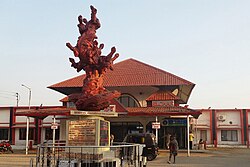
[[File:New Silchar Railway Station 2016.jpg|thumb|250px|A memorial built in memory of language martyrs]]The '''Bengali Language Movement''' of [[Barak Valley]] was a period of protests that began in 1960 against the decision of the [[Government of Assam]] to make [[Assamese language|Assamese]] the state's sole official language, even though most Barak Valley residents spoke [[Bengali language|Bengali]]. About 80% of the valley's residents are ethnic [[Bengalis]],<ref>{{Cite web |url=https://www.moneycontrol.com/news/politics/assam-elections-2021-can-barak-valley-pay-bjp-the-dividend-of-caa-bid-6706541.html |title=Assam Elections 2021 | Can Barak Valley Pay BJP the Dividend of CAA Bid?}}</ref> and the Bengali population in the Barak Valley region consists of both [[Bengali Hindus|Hindus]] and [[Bengali Muslims|Muslims]] in about equal number, constituting the overwhelming majority of the population. There is also a substantial minority of native tribes and immigrants from other parts of India. | |||
The main incident took place on 19 May 1961 at [[Silchar railway station]] in which the [[Assam Police|Assam police]] killed 11 ethnic Bengalis. | |||
== | == Background == | ||
{{See also|Barak state movement}} | |||
[[File:Language in Cachar district (1951-1961).svg|thumb|300px|left|Languages spoken in [[Barak Valley]] (administratively the erstwhile [[Cachar district]]), [[1951 census of India|1951]]-[[1961 Census of India|1961 Census]]<ref name=1961Census/>]] | |||
The Barak Valley, forming the major part of the erstwhile Cachar district in undivided Assam, though predominantly Hindu (59.6%) and Muslim (39.13%), was overwhelmingly Bengali-speaking (78.73%), followed by Hindi (10.33%), while Assamese was spoken by only a small minority (0.33%).<ref name=1961Census>{{cite web|title= Cultural and Migration Tables, Part II-C, Vol-III, Assam - Census 1961|url=https://censusindia.gov.in/nada/index.php/catalog/28300/download/31482/52000_1961_CUL.pdf |year=1965 |publisher=Superintendent of Census Operations, Assam |last=Pakyntein |first=E. H.}}</ref> After independence, the growth of [[Assamese Language Movement|Assamese linguistic nationalism]] in the Brahmaputra Valley was reflected in political initiatives to establish Assamese as the sole official language of the state, extending to the Bengali-speaking Barak Valley. The issue took a decisive turn in 1960 when a proposal was introduced to formalise Assamese as the state’s only official language. | |||
=== | In April 1960, a proposal was raised at the [[Assam Pradesh Congress Committee]] to declare [[Assamese language|Assamese]] as the state's sole official language.<ref>{{cite book |last=Bodhi |first=S. R. |year=2021 |chapter=Khasi Political Reality and the Struggle for Statehood: History, Context, and Political Processes |editor1-last=Ambagudia |editor1-first=Jagannath |editor2-last=Xaxa |editor2-first=Virginius |title=Handbook of tribal politics in India |chapter-url=https://books.google.com/books?id=2mYQEAAAQBAJ&pg=PT498 |publisher=SAGE Publications |page=398 |isbn=978-93-5388-460-4}}</ref> On 10 October 1960, [[Bimala Prasad Chaliha]], the then Chief Minister of Assam, presented a bill in the [[Assam Legislative Assembly|Legislative Assembly]] that sought to legalize Assamese as the sole official language of the state.<ref>{{cite book |last=Bodhi |first=S. R. |year=2021 |chapter=Khasi Political Reality and the Struggle for Statehood: History, Context, and Political Processes |editor1-last=Ambagudia |editor1-first=Jagannath |editor2-last=Xaxa |editor2-first=Virginius |title=Handbook of tribal politics in India |chapter-url=https://books.google.com/books?id=2mYQEAAAQBAJ&pg=PT500 |publisher=SAGE Publications |page=398 |isbn=978-93-5388-460-4}}</ref> Ranendra Mohan Das, the legislator from [[Karimganj North Assembly constituency|Karimganj (North) assembly constituency]] and an ethnic [[Bengalis|Bengali]], protested against the bill on the grounds that it sought to impose the language of a third of the population over the other two-thirds.<ref name="es19052013">{{cite news |script-title=bn:বিস্মৃত বলিদান |last=Chowdhury |first=Ranajit |url=http://www.epaper.eisamay.com/Details.aspx?id=3850&boxid=32416359 |date=19 May 2013 |work=Ei Samay |language=bn |access-date=22 May 2013 |archive-url=https://archive.today/20130619223401/http://www.epaper.eisamay.com/Details.aspx?id=3850&boxid=32416359 |archive-date=19 June 2013}}</ref> On 24 October, the bill was passed in the Assam legislative assembly, making Assamese the state's only official language.<ref name="es19052013" /> | ||
On | == The Movement == | ||
=== Protest === | |||
On 5 February 1961, the Cachar Gana Sangram Parishad was formed to protest the imposition of Assamese in the Bengali-speaking [[Barak Valley]]. On 14 April, the people of [[Silchar]], [[Karimganj]], and [[Hailakandi]] observed a Sankalpa Divas in protest against the injustice of the Assamese government.<ref name="choudhuri">{{cite web |url=http://wethepeople-barakvalley.com/bhasha-shahid-divas-language-martyrs%E2%80%99-day/843 |title=Bhasha Shahid Divas |last=Choudhuri |first=Arjun |publisher=We The People, Barak Valley |access-date=23 May 2013 |archive-url=https://web.archive.org/web/20130529232759/http://wethepeople-barakvalley.com/bhasha-shahid-divas-language-martyrs%E2%80%99-day/843 |archive-date=29 May 2013 |url-status=dead}}</ref> On 24 April, the Parishad left for a two-week [[padayatra]] in the Barak Valley, in the regions surrounding Silchar and Karimganj to raise awareness among the populace. The Satyagrahis, who took part in the padayatra, walked over 200 miles and covered several villages. The procession ended on 2 May in Silchar. Later on, a similar padayatra was organized in Hailakandi. After the padayatra, Rathindranath Sen, the Parishad leader, declared that if Bengali was not accorded the status of official language by 13 April 1961, a complete work stoppage (called a ''hartal'') would be observed on 19 May from dawn to dusk.<ref name="es19052013-2">{{cite news |script-title=bn:বাঙালির চেতনায় শুধু একুশে, স্থান নেই উনিশের শহীদদের |last=Mukhopadhyay |first=Baidyanath |date=19 May 2013 |work=Ei Samay |language=bn |location=Kolkata}}</ref> The Parishad also called for due recognition of the languages of other linguistic minorities. | |||
On 12 May, the soldiers of the Assam Rifles, the Madras Regiment, and the Central Reserve Police staged a flag march in Silchar.<ref name="report-1">{{cite web |url=http://www.unishemay.org/english-pages/lang-content/NCChatterjee.pdf |title=Report of Non-Official Enquiry Commission on Cachar |publisher=A. K. Das Memorial Trust |page=14 |access-date=25 May 2013 |location=Silchar |url-status=usurped |archive-url=https://web.archive.org/web/20131229042659/http://www.unishemay.org/english-pages/lang-content/NCChatterjee.pdf |archive-date=29 December 2013}}</ref> On 18 May, the Assam police arrested three prominent leaders of the movement, namely Nalinikanta Das, Rathindranath Sen, and Bidhubhushan Chowdhury, the editor of weekly Yugashakti. | |||
=== Main incident of 19 May === | |||
[[File:Lathicharge on satyagrahis at Tarapur railway station on 19 May 1961.jpg|thumb|left|Assam police resort to lathi charge on the satyagrahis at the Tarapur railway station (now, [[Silchar railway station]]).]] | |||
On 19 May, the dawn-to-dusk hartal began. Picketing started early in the morning in the sub-divisional towns of Silchar, [[Karimganj]], and Hailakandi. In Karimganj, the agitators picketed in front of government offices, courts, and railway stations. In Silchar, the agitators picketed in the railway station. The last train from Silchar was around 4 p.m., after which the hartal would be effectively dissolved. Not a single ticket was sold for the first train at 5:40 a.m. The morning passed peacefully without incident. However, in the afternoon, the [[Assam Rifles]] arrived at the railway station. | |||
At around 2:30 p.m., a [[Bedford Vehicles|Bedford]] truck carrying nine arrested [[Satyagraha|Satyagrahis]] from Katigorah was passing by the Tarapur railway station (present-day [[Silchar railway station]]). Seeing their fellow activists arrested and being taken away, the Satyagrahis assembled at the railway tracks and broke out in loud protests. At that point, the truck driver and the policemen escorting the arrested activists fled the scene. Immediately after they fled, an unidentified person set fire to the truck.<ref name="choudhuri" /> A firefighting team rushed to the spot to bring the fire under control. Within five minutes, at around 2:35 p.m., the paramilitary forces guarding the railway station started beating the protesters with rifle butts and batons without provocation. Within a span of seven minutes, the paramilitary forces fired 17 rounds into the crowd. Several people were hit by bullets and were carried to hospitals. Nine people died that day. On 20 May, the people of Silchar defied curfew with to make a procession for the martyrs' bodies in protest against the killings.<ref name="es19052013-2" /> Two more people were martyred the next day.<ref name="tsi04032013">{{cite news |url=http://www.thesundayindian.com/bn/story/%E0%A6%89%E0%A6%A8%E0%A6%BF%E0%A6%B6%E0%A7%87%E0%A6%B0-%E0%A6%B8%E0%A6%82%E0%A6%97%E0%A7%8D%E0%A6%B0%E0%A6%BE%E0%A6%AE-%E0%A6%85%E0%A6%A8%E0%A6%A8%E0%A7%8D%E0%A6%AF-%E0%A6%85%E0%A6%A4%E0%A7%81%E0%A6%B2%E0%A6%A8%E0%A7%80%E0%A7%9F/7/1256/ |script-title=bn:উনিশের সংগ্রাম অনন্য, অতুলনীয় |last=Laskar |first=Dilip Kanti |date=4 March 2012 |work=The Sunday Indian |language=bn |access-date=23 May 2013 |archive-date=2 September 2015 |archive-url=https://web.archive.org/web/20150902221121/http://www.thesundayindian.com/bn/story/%E0%A6%89%E0%A6%A8%E0%A6%BF%E0%A6%B6%E0%A7%87%E0%A6%B0-%E0%A6%B8%E0%A6%82%E0%A6%97%E0%A7%8D%E0%A6%B0%E0%A6%BE%E0%A6%AE-%E0%A6%85%E0%A6%A8%E0%A6%A8%E0%A7%8D%E0%A6%AF-%E0%A6%85%E0%A6%A4%E0%A7%81%E0%A6%B2%E0%A6%A8%E0%A7%80%E0%A7%9F/7/1256/ |url-status=dead }}</ref> | |||
== | == Post Movement Effect == | ||
After the incident, the Assam government had to withdraw and Bengali was ultimately given official status in Barak Valley's three districts.<ref name="tt27dec">{{cite news |title=No alliance with BJP, says AGP chief |url=http://www.telegraphindia.com/1031227/asp/northeast/story_2721710.asp |archive-url=https://archive.today/20120914104422/http://www.telegraphindia.com/1031227/asp/northeast/story_2721710.asp |url-status=dead |archive-date=14 September 2012 |access-date=26 May 2017 |newspaper=The Telegraph, Calcutta |date=27 December 2003}}</ref><ref name="toi9jun">{{cite news |title=Silchar rly station to be renamed soon |url=http://timesofindia.indiatimes.com/city/guwahati/Silchar-rly-station-to-be-renamed-soon/articleshow/4633120.cms?referral=PM |access-date=26 May 2017 |newspaper=The Times of India |date=9 Jun 2009}}</ref> Section 5 of Assam Act XVIII, 1961 safeguards the use of Bengali in the Cachar district. It states, "Without prejudice to the provisions contained in Section 3, the Bengali language shall be used for administrative and other official purposes up to and including district level".<ref>{{Cite web |url=https://silcharnews.wordpress.com/2013/07/24/compulsory-use-of-bengali-language-in-cachar/ |title=Compulsory use of Bengali Language in Cachar |date=2013-07-24 |website=Silchar News |access-date=26 May 2017}}</ref> | |||
After the incident, the Assam government had to withdraw | |||
== Legacy == | == Legacy == | ||
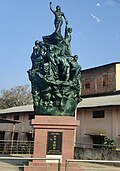
[[File:Statue of martyrs of Bengali Language movement of Barak valley.jpg|thumb|250px|Statue dedicated to martyrs of Bengali Language movement of Barak valley, located in [[Udharbond]]]] | [[File:Statue of martyrs of Bengali Language movement of Barak valley.jpg|thumb|250px|Statue dedicated to martyrs of Bengali Language movement of Barak valley, located in [[Udharbond]]]] | ||
In the movement, eleven people were martyred. They were [[Kanailal Niyogi]], Chandicharan Sutradhar, Hitesh Biswas, Satyendra Deb, Kumud Ranjan Das, Sunil Sarkar, [[Tarani Debnath]], [[Sachindra Chandra Pal]], Birendra Sutradhar, Sukamal Purakayastha, and [[Kamala Bhattacharya]]. Nine people died on 19 May 1961, and two died later. In subsequent effect, Bijan Chakraborty martyred on 17 August 1972, Jaganmay Deb and Dibyendu Das on 1986. | |||
Other than 11 martyrs of 19 May 1961, many protesters of the 1961 language movement were badly beaten by the armed forces with [[Lathi (stick)|lathis]] and bayonets. Many received bullet wounds. At least 30 protesters were admitted to Silchar Civil Hospital, while others were released after first aid treatment. Of these 30 activists, some lived with pain and disfigurement from bullet wounds for the remainder of their lives. | |||
This massacre is compared with [[Bengali language movement#Events of 1952|the one in Bangladesh on 21 February 1952]] when students demonstrating for recognition of their language, Bengali, as one of the two national languages of what was then Pakistan, were shot and killed by police in Dhaka, the capital of present-day Bangladesh.<ref>[[International Mother Language Day]] {{circular reference|date=February 2020}}</ref> | |||
[[Bhasha Shahid Divas (ভাষা শহীদ দিবস)|Bhasha Shahid Divas]] is celebrated every year on 19 May to commemorate those 11 martyrs who sacrificed their lives for the sake of protecting Bengali language. Various cultural programmes are conducted, rallies are held, and the busts of the martyrs are decorated with flower garlands. | |||
The movement also credited to Pradip Kumar Dutta, Krishna Kanta Biswas, Manik Miya Laskar, Nishitendra Narayan Thakur, Santosh Chandra Kirtoniya, Bhupendra Kumar Paul, Sita Dey, Monoranjan Sarkar, and Anjali Rani Deb for their organizations and literary support.<ref>Raktanjali, Bangla Bhasa sangramer Itihas, by Paritosh Paul Chaudhury, Raktim Giganta, Natun Diganta Prakashani, Silchar</ref> | |||
=== Memorial === | |||
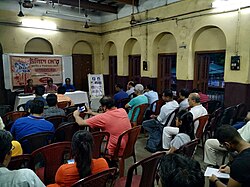
[[File:Commemoration of Bengali language movement in Barak Valley - Kolkata 2019-05-26 182610.jpg|thumb|Dr. Mohit Ray, speaking at a commemorative event in Kolkata in 2019.]] | |||
A martyr's tomb, known as the [[Shahid Minar, Silchar|Shahid Minar]] was erected in Silchar in memory of the martyrs. This stone tomb contains the ashes of the brave individuals who chose death for their right to get formal education in their mother tongue in their free country.<ref>{{cite web |url=http://www.cacharclub.com/silchar.asp |title=Learn A Little About Silchar |publisher=The [[Cachar Club]] | access-date=23 May 2013}}</ref> In 2011, Gopa Dutta Aich unveiled a bronze bust of Kamala Bhattacharya on the premises of the [[Chhotelal Seth Institute]] under the initiative of Shahid Kamala Bhattacharya Murti Sthapan Committee.<ref name="ts18052011">{{cite news |title=Bronze bust of martyr Kamala Bhattacharya installed |url=http://www.sentinelassam.com/cachar/story.php?sec=2&subsec=12&id=75299&dtP=2012-04-24&ppr=1 |archive-url=https://web.archive.org/web/20160303235620/http://www.sentinelassam.com/cachar/story.php?sec=2&subsec=12&id=75299&dtP=2012-04-24&ppr=1 |url-status=dead |archive-date=3 March 2016 |newspaper=The Sentinel |date=18 May 2011 |access-date=10 May 2012}}</ref> | |||
==Contemporary issues== | |||
The Assam government had, on 30 November 2013, issued a circular asking the deputy commissioners of all the state's districts to ensure the use of Assamese as an official language, which generated a lot of protests in the three Barak Valley districts—Cachar, Karimganj, and Hailakandi. However, Section 5 of the Assam Official Language Act of 1960 as amended in 1967 had specified Bengali as the official language. This prompted the state government to issue a fresh circular on September 9 saying that Bengali, the official language of Barak Valley, will continue to be used for all official works.<ref>{{Cite news |url=http://indianexpress.com/article/india/india-others/gogoi-draws-flak-over-official-language-circular-for-barak-valley/ |title=Gogoi draws flak over official language circular for Barak Valley |date=2014-09-10 |work=The Indian Express |access-date=2018-01-06 |language=en-US}}</ref> | |||
== See also == | == See also == | ||
| Line 82: | Line 106: | ||
{{Bengali language topics}} | {{Bengali language topics}} | ||
[[Category:1960s in Assam]] | |||
[[Category:1961 in India]] | [[Category:1961 in India]] | ||
[[Category:1961 protests]] | [[Category:1961 protests]] | ||
[[Category:Bengali language movement]] | [[Category:Bengali language movement]] | ||
[[Category:Language conflict in India]] | [[Category:Language conflict in India]] | ||
[[Category:Protests in India]] | [[Category:Protests in India]] | ||
[[Category:History of the Bengali language]] | |||
[[Category:Bengali language in India]] | |||
Latest revision as of 18:34, 6 January 2026
| Lua error in Module:Wikidata at line 978: Tried to read nil global data. | |
|---|---|
 The condolence procession in Silchar on 20 May 1961 in memory of the deceased language martyrs in results of
lathicharge on 19 May 1961 | |
| Date | 1960 – 1961 |
| Location | 24°49′N 92°49′E / 24.82°N 92.81°E |
| Caused by | Assamese imposition |
| Goals | Bengali nationalism |
| Methods | Protests, sit-ins, demonstrations |
| Result | Bengali become the regional official language |
  Barak Valley Location of the movement | |

The Bengali Language Movement of Barak Valley was a period of protests that began in 1960 against the decision of the Government of Assam to make Assamese the state's sole official language, even though most Barak Valley residents spoke Bengali. About 80% of the valley's residents are ethnic Bengalis,[1] and the Bengali population in the Barak Valley region consists of both Hindus and Muslims in about equal number, constituting the overwhelming majority of the population. There is also a substantial minority of native tribes and immigrants from other parts of India.
The main incident took place on 19 May 1961 at Silchar railway station in which the Assam police killed 11 ethnic Bengalis.
Background[edit | edit source]
.svg)
The Barak Valley, forming the major part of the erstwhile Cachar district in undivided Assam, though predominantly Hindu (59.6%) and Muslim (39.13%), was overwhelmingly Bengali-speaking (78.73%), followed by Hindi (10.33%), while Assamese was spoken by only a small minority (0.33%).[2] After independence, the growth of Assamese linguistic nationalism in the Brahmaputra Valley was reflected in political initiatives to establish Assamese as the sole official language of the state, extending to the Bengali-speaking Barak Valley. The issue took a decisive turn in 1960 when a proposal was introduced to formalise Assamese as the state’s only official language.
In April 1960, a proposal was raised at the Assam Pradesh Congress Committee to declare Assamese as the state's sole official language.[3] On 10 October 1960, Bimala Prasad Chaliha, the then Chief Minister of Assam, presented a bill in the Legislative Assembly that sought to legalize Assamese as the sole official language of the state.[4] Ranendra Mohan Das, the legislator from Karimganj (North) assembly constituency and an ethnic Bengali, protested against the bill on the grounds that it sought to impose the language of a third of the population over the other two-thirds.[5] On 24 October, the bill was passed in the Assam legislative assembly, making Assamese the state's only official language.[5]
The Movement[edit | edit source]
Protest[edit | edit source]
On 5 February 1961, the Cachar Gana Sangram Parishad was formed to protest the imposition of Assamese in the Bengali-speaking Barak Valley. On 14 April, the people of Silchar, Karimganj, and Hailakandi observed a Sankalpa Divas in protest against the injustice of the Assamese government.[6] On 24 April, the Parishad left for a two-week padayatra in the Barak Valley, in the regions surrounding Silchar and Karimganj to raise awareness among the populace. The Satyagrahis, who took part in the padayatra, walked over 200 miles and covered several villages. The procession ended on 2 May in Silchar. Later on, a similar padayatra was organized in Hailakandi. After the padayatra, Rathindranath Sen, the Parishad leader, declared that if Bengali was not accorded the status of official language by 13 April 1961, a complete work stoppage (called a hartal) would be observed on 19 May from dawn to dusk.[7] The Parishad also called for due recognition of the languages of other linguistic minorities.
On 12 May, the soldiers of the Assam Rifles, the Madras Regiment, and the Central Reserve Police staged a flag march in Silchar.[8] On 18 May, the Assam police arrested three prominent leaders of the movement, namely Nalinikanta Das, Rathindranath Sen, and Bidhubhushan Chowdhury, the editor of weekly Yugashakti.
Main incident of 19 May[edit | edit source]

On 19 May, the dawn-to-dusk hartal began. Picketing started early in the morning in the sub-divisional towns of Silchar, Karimganj, and Hailakandi. In Karimganj, the agitators picketed in front of government offices, courts, and railway stations. In Silchar, the agitators picketed in the railway station. The last train from Silchar was around 4 p.m., after which the hartal would be effectively dissolved. Not a single ticket was sold for the first train at 5:40 a.m. The morning passed peacefully without incident. However, in the afternoon, the Assam Rifles arrived at the railway station.
At around 2:30 p.m., a Bedford truck carrying nine arrested Satyagrahis from Katigorah was passing by the Tarapur railway station (present-day Silchar railway station). Seeing their fellow activists arrested and being taken away, the Satyagrahis assembled at the railway tracks and broke out in loud protests. At that point, the truck driver and the policemen escorting the arrested activists fled the scene. Immediately after they fled, an unidentified person set fire to the truck.[6] A firefighting team rushed to the spot to bring the fire under control. Within five minutes, at around 2:35 p.m., the paramilitary forces guarding the railway station started beating the protesters with rifle butts and batons without provocation. Within a span of seven minutes, the paramilitary forces fired 17 rounds into the crowd. Several people were hit by bullets and were carried to hospitals. Nine people died that day. On 20 May, the people of Silchar defied curfew with to make a procession for the martyrs' bodies in protest against the killings.[7] Two more people were martyred the next day.[9]
Post Movement Effect[edit | edit source]
After the incident, the Assam government had to withdraw and Bengali was ultimately given official status in Barak Valley's three districts.[10][11] Section 5 of Assam Act XVIII, 1961 safeguards the use of Bengali in the Cachar district. It states, "Without prejudice to the provisions contained in Section 3, the Bengali language shall be used for administrative and other official purposes up to and including district level".[12]
Legacy[edit | edit source]

In the movement, eleven people were martyred. They were Kanailal Niyogi, Chandicharan Sutradhar, Hitesh Biswas, Satyendra Deb, Kumud Ranjan Das, Sunil Sarkar, Tarani Debnath, Sachindra Chandra Pal, Birendra Sutradhar, Sukamal Purakayastha, and Kamala Bhattacharya. Nine people died on 19 May 1961, and two died later. In subsequent effect, Bijan Chakraborty martyred on 17 August 1972, Jaganmay Deb and Dibyendu Das on 1986.
Other than 11 martyrs of 19 May 1961, many protesters of the 1961 language movement were badly beaten by the armed forces with lathis and bayonets. Many received bullet wounds. At least 30 protesters were admitted to Silchar Civil Hospital, while others were released after first aid treatment. Of these 30 activists, some lived with pain and disfigurement from bullet wounds for the remainder of their lives.
This massacre is compared with the one in Bangladesh on 21 February 1952 when students demonstrating for recognition of their language, Bengali, as one of the two national languages of what was then Pakistan, were shot and killed by police in Dhaka, the capital of present-day Bangladesh.[13]
Bhasha Shahid Divas is celebrated every year on 19 May to commemorate those 11 martyrs who sacrificed their lives for the sake of protecting Bengali language. Various cultural programmes are conducted, rallies are held, and the busts of the martyrs are decorated with flower garlands.
The movement also credited to Pradip Kumar Dutta, Krishna Kanta Biswas, Manik Miya Laskar, Nishitendra Narayan Thakur, Santosh Chandra Kirtoniya, Bhupendra Kumar Paul, Sita Dey, Monoranjan Sarkar, and Anjali Rani Deb for their organizations and literary support.[14]
Memorial[edit | edit source]

A martyr's tomb, known as the Shahid Minar was erected in Silchar in memory of the martyrs. This stone tomb contains the ashes of the brave individuals who chose death for their right to get formal education in their mother tongue in their free country.[15] In 2011, Gopa Dutta Aich unveiled a bronze bust of Kamala Bhattacharya on the premises of the Chhotelal Seth Institute under the initiative of Shahid Kamala Bhattacharya Murti Sthapan Committee.[16]
Contemporary issues[edit | edit source]
The Assam government had, on 30 November 2013, issued a circular asking the deputy commissioners of all the state's districts to ensure the use of Assamese as an official language, which generated a lot of protests in the three Barak Valley districts—Cachar, Karimganj, and Hailakandi. However, Section 5 of the Assam Official Language Act of 1960 as amended in 1967 had specified Bengali as the official language. This prompted the state government to issue a fresh circular on September 9 saying that Bengali, the official language of Barak Valley, will continue to be used for all official works.[17]
See also[edit | edit source]
References[edit | edit source]
- ↑ "Assam Elections 2021 | Can Barak Valley Pay BJP the Dividend of CAA Bid?".
- ↑ 2.0 2.1 Pakyntein, E. H. (1965). "Cultural and Migration Tables, Part II-C, Vol-III, Assam - Census 1961" (PDF). Superintendent of Census Operations, Assam.
- ↑ Bodhi, S. R. (2021). "Khasi Political Reality and the Struggle for Statehood: History, Context, and Political Processes". In Ambagudia, Jagannath; Xaxa, Virginius (eds.). Handbook of tribal politics in India. SAGE Publications. p. 398. ISBN 978-93-5388-460-4.
- ↑ Bodhi, S. R. (2021). "Khasi Political Reality and the Struggle for Statehood: History, Context, and Political Processes". In Ambagudia, Jagannath; Xaxa, Virginius (eds.). Handbook of tribal politics in India. SAGE Publications. p. 398. ISBN 978-93-5388-460-4.
- ↑ 5.0 5.1 Chowdhury, Ranajit (19 May 2013). বিস্মৃত বলিদান. Ei Samay (in Bengali). Retrieved 22 May 2013.
{{cite news}}: CS1 maint: deprecated archival service (link) - ↑ 6.0 6.1 Choudhuri, Arjun. "Bhasha Shahid Divas". We The People, Barak Valley. Archived from the original on 29 May 2013. Retrieved 23 May 2013.
- ↑ 7.0 7.1 Mukhopadhyay, Baidyanath (19 May 2013). বাঙালির চেতনায় শুধু একুশে, স্থান নেই উনিশের শহীদদের. Ei Samay (in Bengali). Kolkata.
- ↑ "Report of Non-Official Enquiry Commission on Cachar" (PDF). Silchar: A. K. Das Memorial Trust. p. 14. Archived from the original on 29 December 2013. Retrieved 25 May 2013.
- ↑ Laskar, Dilip Kanti (4 March 2012). উনিশের সংগ্রাম অনন্য, অতুলনীয়. The Sunday Indian (in Bengali). Archived from the original on 2 September 2015. Retrieved 23 May 2013.
- ↑ "No alliance with BJP, says AGP chief". The Telegraph, Calcutta. 27 December 2003. Retrieved 26 May 2017.
{{cite news}}: CS1 maint: deprecated archival service (link) - ↑ "Silchar rly station to be renamed soon". The Times of India. 9 June 2009. Retrieved 26 May 2017.
- ↑ "Compulsory use of Bengali Language in Cachar". Silchar News. 24 July 2013. Retrieved 26 May 2017.
- ↑ International Mother Language Day [circular reference]
- ↑ Raktanjali, Bangla Bhasa sangramer Itihas, by Paritosh Paul Chaudhury, Raktim Giganta, Natun Diganta Prakashani, Silchar
- ↑ "Learn A Little About Silchar". The Cachar Club. Retrieved 23 May 2013.
- ↑ "Bronze bust of martyr Kamala Bhattacharya installed". The Sentinel. 18 May 2011. Archived from the original on 3 March 2016. Retrieved 10 May 2012.
- ↑ "Gogoi draws flak over official language circular for Barak Valley". The Indian Express. 10 September 2014. Retrieved 6 January 2018.
| History and events |  | |
|---|---|---|
| People | ||
| Commemoration | ||

