

















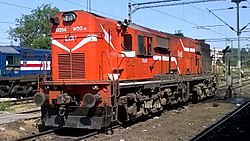

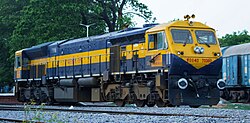
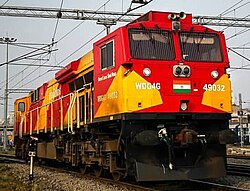


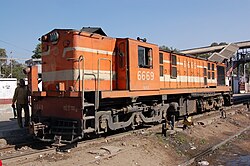



m robot: Update article (please report if you notice any mistake or error in this edit) |
Content refined and expanded |
||
| Line 1: | Line 1: | ||
{{Short description| | {{Short description|none}} | ||
{{Use Indian English|date=June 2013}} | {{Use Indian English|date=June 2013}} | ||
{{Use dmy dates|date= | {{Use dmy dates|date=July 2022}} | ||
{{ | {{More citations needed|date=July 2024}} | ||
'''[[Indian Railways]]''' operates [[India]]'s railway system and comes under the purview of the [[Ministry of Railways (India)|Ministry of Railways]] of [[Government of India]]. {{As of|2025}}, it maintains over {{cvt|108,706|km|abbr=on}} of tracks and operates over 15,000 passenger and 10,000 freight trains daily with a fleet of more than 18,000 [[locomotives]]. The railways primarily operates a fleet of [[Electric locomotive|electric]] and [[diesel locomotive]]s along with a few [[compressed natural gas]] (CNG) locomotives. [[Steam locomotive]]s are operated on [[Mountain railways of India|mountain railways]] and on [[restored train|heritage trains]]. As of February 2026, Indian Railways had 13,569 electric and 4,169 diesel locomotives.<ref name="E1">{{citation|url=https://elocos.railnet.gov.in/Holding/holding_02_26.pdf|title=Electric loco holding for Feb 2026|work=[[Indian Railways]]|access-date=3 February 2026}}</ref><ref name="D1">{{citation|url=https://st.indiarailinfo.com/kjfdsuiemjvcya24/0/2/7/9/7075279/0/diesel3102624.pdf|title=BG Diesel loco holding for Feb 2026 | |||
|work=[[Indian Railways]]|access-date=3 February 2026}}</ref> | |||
== {{ | == History == | ||
The history of the Indian Railway began in 1832 with the proposal to construct the first railway line in India at [[Madras]]. In 1837, the first train ran on Red Hill railway [[railway track|line]] between [[Red Hills, Chennai|Red Hills]] and [[Chintadripet]] in Madras and was hauled by a [[Rotary engine|rotary steam engine]] imported from [[England]].<ref name="Hist">{{cite report|url=https://indianrailways.gov.in/railwayboard/uploads/directorate/Heritage/2021/PDF/3%20Presentation%20Shradha%20Arora%20IRICEN%202019.pdf|title=Understanding Indian Railway Heritage|work=[[Indian Railways]]|page=6|access-date=1 December 2023}}</ref><ref>{{cite news|url=https://www.newindianexpress.com/cities/chennai/2018/apr/16/chennai-the-track-record-1801999.html|title=Chennai: The track record|date=16 April 2018|newspaper=[[The New Indian Express]]|access-date=9 August 2023}}</ref> In 1852, a [[steam locomotive]] imported from England was tried at [[Byculla]].<ref name="Locoh">{{cite report|url=https://swr.indianrailways.gov.in/uploads/files/1597914101378-The%20first%20%20running%20of%20%20railway%20locomotive%20%20in%20India.pdf|title=First running of a railway locomotive in India|publisher=[[Indian Railways]]|page=6|access-date=1 December 2023}}</ref> In 1853, the first passenger train ran between [[Bombay]] and [[Thane]] which had 14-carriages hauled by three steam locomotives: the Sahib, Sindh and Sultan.<ref>{{cite news|url=https://timesofindia.indiatimes.com/news/indias-1st-train-when-sahib-sindh-sultan-blew-steam/articleshow/19717248.cms?from=mdr|title=When India's first train blew steam|date=25 April 2013|newspaper=[[The Times of India]]|access-date=1 December 2023}}</ref> In 1877, an [[Ajmer]] built F-1/734 Steam Locomotive became the first indigenously built locomotive in India.<ref>{{cite news|url=https://timesofindia.indiatimes.com/city/jaipur/oldest-locomotive-built-in-ajmer-pride-of-delhi/articleshow/59888386.cms|title=Oldest locomotive: Built in Ajmer, pride of Delhi|date=3 August 2017|newspaper=[[The Times of India]]|access-date=1 December 2023}}</ref> In 1925, the first [[Electric locomotive|electric train]] ran between Bombay and [[Kurla]], hauled by a [[Swiss Locomotive and Machine Works]] (SLM) {{cvt|2400|HP|abbr=on}} electric locomotive on [[1500 V DC]] traction.<ref name="Hist"/><ref name="EL">{{cite report|url=https://secr.indianrailways.gov.in/uploads/files/1596785062728-Locomotive_comp.pdf|title=Evolution of Electric Locomotives|publisher=[[Indian Railways]]|access-date=1 December 2023}}</ref> The first [[diesel locomotive]] used in India was fabricated by [[North British Locomotive Company]] in 1954.<ref name="Gandhi">{{cite report|url=https://indianrailways.gov.in/railwayboard/uploads/directorate/mec_engg/downloads/DLS/WR/Gandhidham.pdf|title=Gandhidham shed details|publisher=[[Indian Railways]]|access-date=1 December 2023}}</ref> | |||
[[Chittaranjan Locomotive Works]], commissioned in 1950, was the first locomotive manufacturing unit in India.<ref>{{cite report|url= | |||
https://clw.indianrailways.gov.in/view_section.jsp?lang=0&id=0,294|title=Chittaranjan Locomotive works|publisher=[[Indian Railways]]|access-date=1 December 2023}}</ref> [[Banaras Locomotive Works]], commissioned in 1961, is the second locomotive manufacturing unit operated by Indian Railways.<ref name="Banaras">{{cite report|url=https://blw.indianrailways.gov.in/view_section.jsp?lang=0&id=0,294,702|title=Banaras Locomotive works|publisher=[[Indian Railways]]|access-date=1 December 2023}}</ref> In the 1960s, [[Integral Coach Factory|Integral Coach Factory-Chennai]] (ICF) started developing self-propelled [[electric multiple unit]]s for short-haul and local routes.<ref>{{cite report|date=15 October 1999|title=Electrical Multiple Units|url=https://st2.indiarailinfo.com/kjfdsuiemjvcya1/0/8/0/2/4684802/1/multipleunits1091923.pdf|website=Indian Rail Info|access-date=1 December 2023}}</ref><ref>{{cite web|title=Historical Background of Railway Electrification|url=https://core.indianrailways.gov.in/view_section.jsp?lang=0&id=0,294,302,530#:~:text=The%20first%20electric%20train%20ran,electrified%20on%201500%20Volt%20DC.|access-date=19 May 2023|publisher=[[Indian Railways]]}}</ref> [[Bharat Heavy Electricals Limited|BHEL]] and [[Patiala Locomotive Works]], established in 1981, also manufacture locomotives in India.<ref>{{cite web|url=https://indianrailways.gov.in/railwayboard/view_section.jsp?lang=0&id=0,1,304,366,552,694|title=Indian railway facilities|publisher=[[Indian Railways]]|access-date=1 April 2023}}</ref> In 2015, the first [[compressed natural gas]] (CNG) powered trains were rolled out by ICF.<ref name="CNG">{{cite news|url=https://economictimes.indiatimes.com/infrastructure/indias-first-cng-train-for-the-rewari-rohtak-section/indias-first-cng-train/slideshow/45895170.cms|title=India's first CNG train for the Rewari-Rohtak section|date=15 January 2015|newspaper=[[The Economic Times]]|access-date=1 December 2023}}</ref> In 2018, a semi-high speed self-propelled [[Vande Bharat (trainset)|train-set]] capable of reaching speeds of over {{cvt|160|kph}} was rolled out from ICF.<ref>{{cite news|date=20 February 2017|title=Indian Railways to roll out 'Make in India' 160 kmph self-propelled 'world-class' train sets at half the cost of import!|url=https://www.financialexpress.com/india-news/indian-railways-to-roll-out-make-in-india-160-kmph-self-propelled-world-class-train-sets-at-half-the-cost-of-imports/558791/|access-date=20 May 2023|newspaper=The Financial Express}}</ref><ref>{{cite news|date=29 October 2018|title=Train 18: Country's first engine-less train rolled out; Train 20 next|newspaper=[[The Economic Times]]|url=https://economictimes.indiatimes.com/industry/transportation/railways/train-18-countrys-first-engine-less-train-rolled-out-train-20-next/articleshow/66419774.cms|access-date=20 May 2023|issn=0013-0389}}</ref> {{As of|2025}}, Indian Railways maintains over {{cvt|108,706|km|abbr=on}} of tracks and operates over 15,000 passenger and 10,000 freight trains daily with a fleet of over 17,000 locomotives.<ref name="IR">{{cite web|url=https://indianrailways.gov.in/railwayboard/view_section.jsp?lang=0&id=0,1|title=About Indian Railways|publisher=[[Indian Railways]]|access-date=1 January 2024}}</ref><ref>{{cite report|url=https://indianrailways.gov.in/railwayboard/view_section.jsp?lang=0&id=0,1,304,366,537,2960|title=Trains at a glance|publisher=[[Indian Railways]]|access-date=1 January 2024}}</ref> As of October 2025, Indian Railways had 13,035 electric and 4,165 diesel locomotives amongst others.<ref name="E1"/><ref name="D1"/> | |||
== Classification == | |||
Locomotives are classified by [[track gauge]], [[Propulsion|motive power]], function, [[Power (physics)|power rating]] and model in a four- or five-letter code.<ref name="Class"/> The locomotives may be [[Long hood|Longer Hood Front]] (LHF), where the driver cabin is behind the hood of the engine or [[Short hood|Short Hood Front]] (SHF), where the cabin is located towards the front.<ref name="Class"/> | |||
[[File:Closeup view of WDM3A Indian Locomotive.jpg|thumb|Locomotive classification and number displayed on a [[locomotive]]; WDM3A indicates a [[Broad gauge]] (L1), [[Diesel locomotive|Diesel]] (L2), Mixed use (L3), 3100 [[Horsepower|HP]] (L4/L5) locomotive]] | |||
{|class="sortable wikitable"style="text-align:left;"style="font-size: 95%" | |||
|+Locomotive classification<ref name="Class">{{cite report|url=https://digitalscr.in/bzadiv/circulars/misc_circulars/uploads/Classification%20of%20Locomotives.pdf|title=Locomotive classification|publisher=[[Indian Railways]]|access-date=1 January 2024}}</ref> | |||
!Letter position | |||
!Denotes | |||
!Classification | |||
|- | |||
|1 | |||
|[[Track gauge]] | |||
| | |||
*W {{ndash}} [[Broad gauge]] {{Track gauge|1676mm}} | |||
*Y {{ndash}} [[Metre gauge]] {{Track gauge|1000mm}} | |||
*Z {{ndash}} [[Narrow gauge railway|Narrow gauge]] {{Track gauge|762mm}} | |||
*N {{ndash}} [[Narrow gauge railway|Narrower gauge]] {{Track gauge|610mm}} | |||
|- | |||
|2 | |||
|[[Propulsion|Motive power]] | |||
| | |||
*D {{ndash}} [[Diesel locomotive|Diesel]] | |||
*C {{ndash}} [[Direct current|DC]] [[Electric locomotive|Electric]] | |||
*A {{ndash}} [[Alternating current|AC]] [[Electric locomotive|Electric]] | |||
*DA {{ndash}} [[Diesel locomotive|Diesel]] + [[Electric locomotive|Electric]] Dual Mode (Only WDAP5) | |||
*CA {{ndash}} [[Direct current|DC]] + [[Alternating current|AC]] Dual [[Electric locomotive|Electric]] | |||
*B {{ndash}} [[Electric battery|Battery]] | |||
|- | |||
|3 | |||
|Use/ <br/> Load/ <br/> [[Railway electric traction|Traction]] | |||
| | |||
*G {{ndash}} [[Rail freight transport|Goods]] | |||
*P {{ndash}} [[passenger train|Passenger]] | |||
*M {{ndash}} Mixed ([[Rail freight transport|Goods]] and [[passenger train|Passenger]]) | |||
*S {{ndash}} [[shunting (rail)|Shunter]] | |||
*U {{ndash}} [[Multiple unit]] | |||
*R {{ndash}} [[Railcar]] | |||
|- | |||
|4 | |||
|Model/ <br/> [[Horsepower]] | |||
| | |||
*Version Number | |||
*Model Number | |||
*Number X 1000 [[Horsepower|HP]] | |||
|- | |||
|5 | |||
|Sub-class/ <br/> Sub-type/ <br/> [[Power (physics)|Power rating]] | |||
|Increments of 100 [[Horsepower|HP]] (For [[Diesel locomotive|Diesel]]) | |||
*A {{ndash}} 100 [[Horsepower|HP]] | |||
*B {{ndash}} 200 [[Horsepower|HP]] | |||
*C {{ndash}} 300 [[Horsepower|HP]] | |||
and so on | |||
|} | |||
=== {{ | == Electric == | ||
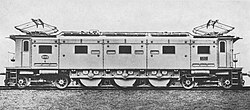
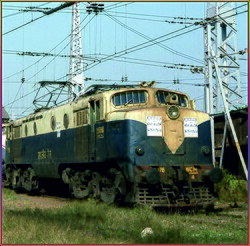
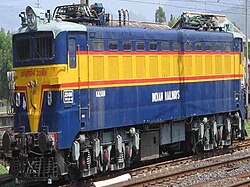
In 1925, the first electric train ran between Bombay and Kurla, hauled by a imported SLM locomotive on a DC traction.<ref name="EL1">{{cite report|url=https://elocos.railnet.gov.in/Analysis/Elect_Tr_history.htm|title=Electrification history|publisher=[[Indian Railways]]|access-date=1 December 2023|archive-date=9 June 2017|archive-url=https://web.archive.org/web/20170609072045/http://elocos.railnet.gov.in/Analysis/Elect_Tr_history.htm|url-status=dead}}</ref> In 1927, the first electric locomotive hauled passenger train was pulled by an imported WCP-1.<ref name="EL"/> In 1957, Indian Railways adopted 25 kV 50 Hz AC traction with the first runs beginning in December 1959 with the WAM-1 locomotives.<ref name="EL1"/> | |||
===Broad-gauge=== | |||
{| class="wikitable" style="font-size: 85%" | |||
|+Broad-gauge Electric Locomotives<ref name="EL1"/><ref name="EL"/><ref name="E1"/> | |||
|- | |||
![[Railway electric traction|Traction]] | |||
!Usage | |||
!Name | |||
!Image | |||
!Manufacturer | |||
![[Wheel arrangement|Axles]] | |||
!Number built | |||
!Production | |||
![[Power (physics)|Power]] ([[Horsepower|HP]]) | |||
!Status | |||
|- | |||
!colspan="10"|WCP series | |||
|- | |||
|rowspan="4"|[[Direct Current|DC]] | |||
|rowspan="4"|[[Passenger train|Passenger]] | |||
|[[Indian locomotive class WCP-1|WCP-1]] | |||
|[[File:Electric loco 4006.jpg|100px]] | |||
|[[Swiss Locomotive & Machine Works|SLM]] | |||
|[[Bo-Bo|2-Bo-A1]] | |||
|22 | |||
|1928-30 | |||
|2160 | |||
|Retired | |||
|- | |||
|[[Indian locomotive class WCP-2|WCP-2]] | |||
|[[File:Bahn-Transport GIPR EA2.jpg|100px]] | |||
|[[Swiss Locomotive & Machine Works|SLM]] | |||
|[[Bo-Bo|2-Bo-A1]] | |||
|1 | |||
|1938 | |||
|2160 | |||
|Retired | |||
|- | |||
|[[Indian locomotive class WCP-3|WCP-3]] | |||
| | |||
|[[Hawthorn Leslie & Company|Hawthorn Leslie]] | |||
|[[Co-Co locomotive#2Co-Co2|2-Co-2]] | |||
|1 | |||
|1928 | |||
|2250 | |||
|Retired | |||
|- | |||
|[[Indian locomotive class WCP-4|WCP-4]] | |||
|[[File:GIPR EC1 4002.jpg|100px]] | |||
|[[Hawthorn Leslie & Company|Hawthorn Leslie]], [[Brown, Boveri & Cie|BBC]] | |||
|[[Co-Co locomotive#2Co-Co2|2-Co-2]] | |||
|1 | |||
|1928 | |||
|2390 | |||
|Retired | |||
|- | |||
!colspan="10"|WCM series | |||
|- | |||
|rowspan="6"|[[Direct Current|DC]] | |||
|rowspan="6"|Mixed | |||
|[[Indian locomotive class WCM-1|WCM-1]] | |||
|[[File:An-Rail-Engine-display-in-ICF-Rail-Museum-Chennai.JPG|100px]] | |||
|[[English Electric]] | |||
|[[Co-Co locomotive|Co-Co]] | |||
|7 | |||
|1954-55 | |||
|3170 | |||
|Retired | |||
|- | |||
|[[Indian locomotive class WCM-2|WCM-2]] | |||
| | |||
|[[English Electric]] | |||
|[[Co-Co locomotive|Co-Co]] | |||
|12 | |||
|1956-57 | |||
|2810 | |||
|Retired | |||
|- | |||
|[[Indian locomotive class WCM-3|WCM-3]] | |||
| | |||
|[[Hitachi]] | |||
|[[Co-Co locomotive|Co-Co]] | |||
|3 | |||
|1958 | |||
|2460 | |||
|Retired | |||
|- | |||
|[[Indian locomotive class WCM-4|WCM-4]] | |||
|[[File:WCM 4.jpg|100px]] | |||
|[[Hitachi]] | |||
|[[Co-Co locomotive|Co-Co]] | |||
|7 | |||
|1960 | |||
|3290 | |||
|Retired | |||
|- | |||
|[[Indian locomotive class WCM-5|WCM-5]] | |||
|[[File:Business_end_of_broad_gauge_dc_electric_locomotive_WCM-5.jpg|100px]] | |||
|[[Chittaranjan Locomotive Works|CLW]] | |||
|[[Co-Co locomotive|Co-Co]] | |||
|21 | |||
|1961-63 | |||
|3700 | |||
|Retired | |||
|- | |||
|[[Indian locomotive class WCM-6|WCM-6]] | |||
|[[File:WCM-6.jpg|100px]] | |||
|[[Chittaranjan Locomotive Works|CLW]] | |||
|[[Co-Co locomotive|Co-Co]] | |||
|2 | |||
|1995 | |||
|5000 | |||
|Retired | |||
|- | |- | ||
!colspan="10"|WCG series | |||
|- | |||
|rowspan="2"|[[Direct Current|DC]] | |||
|rowspan="2"|[[Rail freight transport|Goods]] | |||
|[[Indian locomotive class WCG-1|WCG-1]] | |||
|[[File:Indian locomotive class WCG1.jpg|100px]] | |||
|[[Swiss Locomotive & Machine Works|SLM]] | |||
|[[Co-Co locomotive#C-C|C-C]] | |||
|41 | |||
|1925-29 | |||
|2400 | |||
|Retired | |||
|- | |||
|[[Indian locomotive class WCG-2|WCG-2]] | |||
|[[File:WCG2 triplet Indian Railways.jpg|100px]] | |||
|[[Chittaranjan Locomotive Works|CLW]] | |||
|[[Co-Co locomotive|Co-Co]] | |||
|57 | |||
|1970-76 | |||
|1640 | |||
|Retired | |||
|- | |||
!colspan="10"|WAM series | |||
|- | |||
|rowspan="4"|[[Alternating Current|AC]] | |||
|rowspan="4"|Mixed | |||
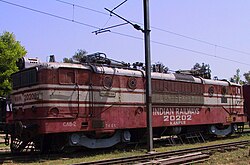
|[[Indian locomotive class WAM-1|WAM-1]] | |[[Indian locomotive class WAM-1|WAM-1]] | ||
|[[KraussMaffei]], Krupp, SFAC | |[[File:WAM1 20202 locomotive.jpg|100px]] | ||
|B-B | |50 cycles group{{efn|Consortium of [[KraussMaffei]], [[Krupp]], SFAC and [[La Brugeoise et Nivelles]]}} | ||
|[[Bo-Bo#B′B′|B-B]] | |||
|100 | |100 | ||
|1959- | |1959-60 | ||
| | |2870 | ||
|Retired | |Retired | ||
|- | |- | ||
|[[Indian locomotive class WAM-2/3|WAM-2]] | |[[Indian locomotive class WAM-2/3|WAM-2]] | ||
|[[Mitsubishi]] | | | ||
|[[Mitsubishi Heavy Industries|Mitsubishi]] | |||
|[[Bo-Bo]] | |[[Bo-Bo]] | ||
|36 | |36 | ||
|1960-64 | |1960-64 | ||
| | |2790 | ||
|Retired | |Retired | ||
|- | |- | ||
|[[Indian locomotive class WAM-2/3|WAM-3]] | |[[Indian locomotive class WAM-2/3|WAM-3]] | ||
|[[Mitsubishi]] | | | ||
|Bo-Bo | |[[Mitsubishi Heavy Industries|Mitsubishi]] | ||
|[[Bo-Bo]] | |||
|2 | |2 | ||
|1964 | |1964 | ||
| | |2790 | ||
|Retired | |Retired | ||
|- | |- | ||
|[[Indian locomotive class WAM-4|WAM-4]] | |[[Indian locomotive class WAM-4|WAM-4]] | ||
|[[File:WAM-4 AJJ.jpg|100px]] | |||
|[[Chittaranjan Locomotive Works|CLW]] | |[[Chittaranjan Locomotive Works|CLW]] | ||
|Co-Co | |[[Co-Co locomotive|Co-Co]] | ||
|500 | |500 | ||
|1970- | |1970-83 | ||
| | |3640 | ||
| | |Retired | ||
| | |- | ||
!colspan="10"|WAP series | |||
= | |||
|- | |- | ||
|rowspan="6"|[[Alternating Current|AC]] | |||
| rowspan="6" |[[Passenger train|Passenger]] | |||
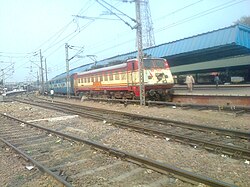
|[[Indian locomotive class WAP-1|WAP-1]] | |[[Indian locomotive class WAP-1|WAP-1]] | ||
|[[File:WAP-1 Locomotive at Delhi.jpg|100px]] | |||
|[[Chittaranjan Locomotive Works|CLW]] | |[[Chittaranjan Locomotive Works|CLW]] | ||
|Co-Co | |[[Co-Co locomotive|Co-Co]] | ||
|65 | |65 | ||
|1980- | |1980-96 | ||
| | |3760 | ||
|In service | |In service | ||
|- | |- | ||
|[[Indian locomotive class WAP-3|WAP-3]] | |[[Indian locomotive class WAP-3|WAP-3]] | ||
|[[File:Rajhans WAP1 ^22006 heading Bihar Sampark Kranti at NDLS - Flickr - Dr. Santulan Mahanta.jpg|100px]] | |||
|[[Chittaranjan Locomotive Works|CLW]] | |[[Chittaranjan Locomotive Works|CLW]] | ||
|Co-Co | |[[Co-Co locomotive|Co-Co]] | ||
|9 | |9 | ||
|1987- | |1987-88 | ||
| | |3760 | ||
|Retired | |Retired | ||
|- | |- | ||
|[[Indian locomotive class WAP-4|WAP-4]] | |[[Indian locomotive class WAP-4|WAP-4]] | ||
|[[File:Bhubaneshwar-Visakhapatnam Intercity Express on Platform 1 at Vizianagaram.jpg|100px]] | |||
|[[Chittaranjan Locomotive Works|CLW]] | |[[Chittaranjan Locomotive Works|CLW]] | ||
|Co-Co | |[[Co-Co locomotive|Co-Co]] | ||
|778 | |778 | ||
| | |1994-2015 | ||
| | |5000 | ||
|In service | |In service | ||
| | | | ||
|- | |- | ||
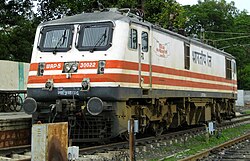
|[[Indian locomotive class WAP-5|WAP-5]] | |[[Indian locomotive class WAP-5|WAP-5]] | ||
|[[ABB]] | |[[File:WAP-5 at Bhopal.jpg|100px]] | ||
|Bo-Bo | |[[ABB]], [[Chittaranjan Locomotive Works|CLW]] | ||
| | |[[Bo-Bo]] | ||
| | |249 | ||
|6000 | |1995-present | ||
|6000 | |||
|In service | |In service | ||
|- | |- | ||
|[[Indian locomotive class WAP-6|WAP-6]] | |[[Indian locomotive class WAP-6|WAP-6]] | ||
|[[File:Kaziranga Express (SBC-Guwahati) at Khalor, West Bengal.jpg|100px]] | |||
|[[Chittaranjan Locomotive Works|CLW]] | |[[Chittaranjan Locomotive Works|CLW]] | ||
|Co-Co | |[[Co-Co locomotive|Co-Co]] | ||
|17 | |17 | ||
|1995- | |1995-98 | ||
| | |5000 | ||
|Retired/ | |Some variants of wap 6 has been Retired/Others are converted to wap 4e and Operational | ||
|- | |- | ||
|[[Indian locomotive class WAP-7|WAP-7]] | |[[Indian locomotive class WAP-7|WAP-7]] | ||
|[[Chittaranjan Locomotive Works|CLW]] | |[[File:WAP-7-LOCO.jpg|100px]] | ||
|Co-Co | |[[Chittaranjan Locomotive Works|CLW]], [[Banaras Locomotive Works|BLW]], [[Patiala Locomotive Works|PLW]] | ||
| | |[[Co-Co locomotive|Co-Co]] | ||
| | |1959 | ||
|6350 | |2000-present | ||
|6350 | |||
|In service | |In service | ||
|- | |- | ||
! colspan="10" |WDAP Series | |||
|- | |||
|[[Electric locomotive|Electric]] + [[Diesel locomotive|Diesel]] (Dual Mode) | |||
|[[Passenger train|Passenger]] | |||
|[[Indian locomotive class WDAP-5|WDAP-5]] | |||
|[[File:WDAP-5.jpg|100px]] | |||
|[[Banaras Locomotive Works|BLW]] | |||
|[[Co-Co locomotive|Co-Co]] | |||
|1 | |||
|2019 | |||
|5500 | |||
|In service (trials) | |||
|- | |||
! colspan="11" |WAG series | |||
|- | |||
|rowspan="18"|[[Alternating Current|AC]] | |||
|rowspan="18"|[[Rail freight transport|Goods]] | |||
|[[Indian locomotive class WAG-1|WAG-1]] | |[[Indian locomotive class WAG-1|WAG-1]] | ||
| | |[[File:WAG1 locomotive.jpg|100px]] | ||
[[Chittaranjan Locomotive Works|CLW]] | |[[SNCF]], [[Chittaranjan Locomotive Works|CLW]] | ||
|B-B | |[[Bo-Bo#B′B′|B-B]] | ||
|112 | |112 | ||
|1963- | |1963-66 | ||
| | |2900 | ||
|Retired | |Retired | ||
|- | |- | ||
|[[Indian locomotive class WAG-2|WAG-2]] | |[[Indian locomotive class WAG-2|WAG-2]] | ||
|[[ | |[[File:Wag2.png|100px]] | ||
|B-B | |[[Hitachi]], [[Mitsubishi]] | ||
|[[Bo-Bo#B′B′|B-B]] | |||
|45 | |45 | ||
|1964- | |1964-65 | ||
| | |3180 | ||
|Retired | |Retired | ||
|- | |- | ||
|[[Indian locomotive class WAG-3|WAG-3]] | |[[Indian locomotive class WAG-3|WAG-3]] | ||
|[[Henschel & Son|Henschel]] | |<!-- Deleted image removed: [[File:COLOUR PHOTOGRAPH OF B-B TYPE WAG3 CLASS ELECTRIC LOCOMOTIVE.png|100px]] --> | ||
|B-B | |[[Henschel & Son|Henschel]], [[Chittaranjan Locomotive Works|CLW]] | ||
|[[Bo-Bo#B′B′|B-B]] | |||
|10 | |10 | ||
|1965 | |1965 | ||
| | |3150 | ||
|Retired | |Retired | ||
|- | |- | ||
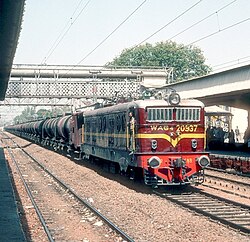
|[[Indian locomotive class WAG-4|WAG-4]] | |[[Indian locomotive class WAG-4|WAG-4]] | ||
|[[File:WAG4 20937MathuraJunction9-3-92.jpg|100px]] | |||
|[[Chittaranjan Locomotive Works|CLW]] | |[[Chittaranjan Locomotive Works|CLW]] | ||
|B-B | |[[Bo-Bo#B′B′|B-B]] | ||
|186 | |186 | ||
| | |1966-69 | ||
| | |3150 | ||
|Retired | |Retired | ||
|- | |- | ||
|[[Indian locomotive class WAG-5|WAG-5]] | |[[Indian locomotive class WAG-5|WAG-5]] | ||
|[[Chittaranjan Locomotive Works|CLW]] | |[[File:WAG-5HA AJJ.jpg|100px]] | ||
|Co-Co | |[[Chittaranjan Locomotive Works|CLW]], [[Bharat Heavy Electricals Limited|BHEL]] | ||
|[[Co-Co locomotive|Co-Co]] | |||
|1196 | |1196 | ||
| | |1984-98 | ||
| | |3900 | ||
|In service | |In service | ||
|- | |- | ||
|[[Indian locomotive class WAG-6A|WAG-6A]] | |[[Indian locomotive class WAG-6A|WAG-6A]] | ||
|ASEA | |[[File:WAG-6A loco with a BCNA freight train 01.jpg|100px]] | ||
|Bo-Bo-Bo | |[[ASEA]] | ||
|[[Bo-Bo-Bo]] | |||
|6 | |6 | ||
| | |1987-89 | ||
| | |6000 | ||
|Retired | |Retired | ||
|- | |- | ||
|[[Indian locomotive class WAG-6B/C|WAG-6B]] | |[[Indian locomotive class WAG-6B/C|WAG-6B/C]] | ||
|[[File:VSKP based WAG-6C locos at Koraput.jpg|100px]] | |||
|[[Hitachi]] | |[[Hitachi]] | ||
|Bo-Bo-Bo | |[[Bo-Bo-Bo]] | ||
| | |12 | ||
|1988 | |1988 | ||
|6110 | |6110 | ||
| | |Retired | ||
|- | |- | ||
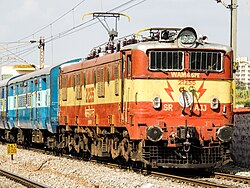
|[[Indian locomotive class WAG-7|WAG-7]] | |[[Indian locomotive class WAG-7|WAG-7]] | ||
|[[Chittaranjan Locomotive Works|CLW]] | |[[File:BZA based WAG-7 loco - 28217 at Dumdum Station.jpg|100px]] | ||
|Co-Co | |[[Chittaranjan Locomotive Works|CLW]] | ||
| | |[[Co-Co locomotive|Co-Co]] | ||
| | |2007 | ||
| | |1992-2015 | ||
|5000 | |||
|In service | |In service | ||
|- | |- | ||
|[[Indian locomotive class WAG-8|WAG-8]] | |[[Indian locomotive class WAG-8|WAG-8]] | ||
| | |||
|[[Bharat Heavy Electricals Limited|BHEL]] | |[[Bharat Heavy Electricals Limited|BHEL]] | ||
|Co-Co | |[[Co-Co locomotive|Co-Co]] | ||
|1 | |1 | ||
|1990 | |1990 | ||
|5000 | |5000 | ||
|Retired | |Retired | ||
|- | |- | ||
|[[Indian locomotive class WAG-9|WAG-9]] | |[[Indian locomotive class WAG-9|WAG-9]] | ||
|[[ABB]] | |[[File:WAG 9 Kazipet Junction.jpg|100px]] | ||
|Co-Co | |[[ABB]], [[Chittaranjan Locomotive Works|CLW]] | ||
| | |[[Co-Co locomotive|Co-Co]] | ||
| | |84 | ||
| | |1996-present | ||
|6000 | |||
|In service | |||
|- | |||
|[[Indian locomotive class WAG-9|WAG-9H]] | |||
|[[File:A Krishnarajapuram-based WAG-9HC at Bangalore City Railway Station.jpg|100px]] | |||
|[[Chittaranjan Locomotive Works|CLW]], [[Bharat Heavy Electricals Limited|BHEL]], [[Banaras Locomotive Works|BLW]], [[Patiala Locomotive Works|PLW]] | |||
|[[Co-Co locomotive|Co-Co]] | |||
|6073 | |||
|2006-present | |||
|6000 | |||
|In service | |In service | ||
|- | |||
|[[Indian locomotive class WAG-9|WAG-9I]] | |||
| | | | ||
|[[File: | |[[Chittaranjan Locomotive Works|CLW]] | ||
|[[Co-Co locomotive|Co-Co]] | |||
|43 | |||
|2010-present | |||
|6000 | |||
|In service | |||
|- | |||
|[[Indian locomotive class WAG-9|WAG-9HH/EF9K]] | |||
|[[File:EF9K Locomotive "Nava Utkarsh" on duty..jpg|100px]] | |||
|[[Chittaranjan Locomotive Works|CLW]] | |||
|[[Co-Co locomotive|Co-Co]] | |||
|57 | |||
|2020-present | |||
|9000 | |||
|In service | |||
|- | |||
|[[Indian locomotive class WAG-9|WAG-9/EF12K]] | |||
|[[File:Bhilai EF12K %28WAG-9 Twins%29 on duty..jpg|100px]] | |||
|[[Chittaranjan Locomotive Works|CLW]] | |||
|[[Co-Co locomotive|Co-Co+Co-Co]] | |||
|110 | |||
|2023-present | |||
|12000 | |||
|In service | |||
|- | |- | ||
|[[Indian locomotive class WAGC3/WAG-10|WAG-10]] | |[[Indian locomotive class WAGC3/WAG-10|WAG-10]] | ||
|[[File:BNDM WAG10.png|100px]] | |||
|[[Banaras Locomotive Works|BLW]] | |[[Banaras Locomotive Works|BLW]] | ||
|Co-Co-Co-Co | |[[Co-Co locomotive|Co-Co-Co-Co]] | ||
|1 | |1 | ||
| | |2018-present | ||
|10000 | |10000 | ||
|In service | |In service | ||
|- | |- | ||
|[[Indian locomotive class WAG-11|WAG-11]] | |[[Indian locomotive class WAG-11|WAG-11]] | ||
|[[File:WAG-11.jpg|100px]] | |||
|[[Banaras Locomotive Works|BLW]] | |[[Banaras Locomotive Works|BLW]] | ||
|Co-Co-Co- | |[[Co-Co locomotive|Co-Co-Co-Co]] | ||
|4 | |4 | ||
| | |2018-present | ||
|12000 | |12000 | ||
|In service | |||
| | |||
|- | |- | ||
|[[Indian locomotive class WAG-12|WAG-12]] | |[[Indian locomotive class WAG-12|WAG-12]] | ||
|[[Alstom]] | |[[File:WAG-12B locomotive.jpg|100px]] | ||
|Bo-Bo-Bo-Bo | |[[Alstom]], [[Electric Locomotive Factory, Madhepura|ELF]] | ||
| | |[[Bo-Bo#Bo′Bo′+Bo′Bo′|Bo-Bo-Bo-Bo]] | ||
| | |590 | ||
|12000 | |2017-present | ||
|12000 | |||
|In service | |In service | ||
|- | |- | ||
|[[Indian locomotive class | |[[Indian locomotive class WAG D-9|WAG D-9]] | ||
|[[ | |[[File:Dahod based WAG D9.jpg|left|frameless|131x131px]] | ||
|Co-Co | |[[Siemens]] | ||
| | |[[Co-Co locomotive|Co-Co]] | ||
| | | | ||
| | |2025-present | ||
|9000 | |||
|commissioning | |||
| | |||
| | |||
|- | |- | ||
!colspan="10"|WCAM series | |||
| | |||
|- | |- | ||
|rowspan="3"|Dual ([[Direct Current|DC]]/[[Alternating Current|AC]]) | |||
|rowspan="3"|Mixed | |||
|[[Indian locomotive class WCAM-1|WCAM-1]] | |[[Indian locomotive class WCAM-1|WCAM-1]] | ||
|[[File:19011 (BCT-ADI) Gujarat Express.jpg|100px]] | |||
|[[Chittaranjan Locomotive Works|CLW]] | |[[Chittaranjan Locomotive Works|CLW]] | ||
|Co-Co | |[[Co-Co locomotive|Co-Co]] | ||
|54 | |54 | ||
|1975- | |1975-79 | ||
| | |2930 (DC) <br/> 3640 (AC) | ||
|Retired | |Retired | ||
|- | |- | ||
|[[Indian locomotive class WCAM-2|WCAM-2]] | |[[Indian locomotive class WCAM-2|WCAM-2]] | ||
|[[ | |[[File:BL based WCAM-2P loco - 21867.jpg|100px]] | ||
|Co-Co | |[[Chittaranjan Locomotive Works|CLW]] | ||
|[[Co-Co locomotive|Co-Co]] | |||
|20 | |20 | ||
|1995- | |1995-96 | ||
| | |3780 (DC) <br/> 4720 (AC) | ||
|In service | |In service | ||
|- | |- | ||
|[[Indian locomotive class WCAM-3|WCAM-3]] | |[[Indian locomotive class WCAM-3|WCAM-3]] | ||
|[[File:Wcam3 kurla.jpg|100px]] | |||
|[[Bharat Heavy Electricals Limited|BHEL]] | |[[Bharat Heavy Electricals Limited|BHEL]] | ||
|Co-Co | |[[Co-Co locomotive|Co-Co]] | ||
|53 | |53 | ||
|1997- | |1997-98 | ||
| | |4600 (DC) <br/> 5000 (AC) | ||
|In service | |In service | ||
|- | |- | ||
!colspan="10"|WCAG series | |||
|- | |||
|Dual ([[Direct Current|DC]]/[[Alternating Current|AC]]) | |||
|[[Rail freight transport|Goods]] | |||
|[[Indian locomotive class WCAG-1|WCAG-1]] | |[[Indian locomotive class WCAG-1|WCAG-1]] | ||
|[[File:WCAG-1 21970-21979 Container Rake BSL Outer.jpg|100px]] | |||
|[[Bharat Heavy Electricals Limited|BHEL]] | |[[Bharat Heavy Electricals Limited|BHEL]] | ||
|Co-Co | |[[Co-Co locomotive|Co-Co]] | ||
|12 | |12 | ||
|1999-2000 | |1999-2000 | ||
| | |4600 (DC) <br/> 5000 (AC) | ||
|In service | |In service | ||
|} | |} | ||
=== { | ===Metre-gauge=== | ||
{|class="sortable wikitable"style="text-align:left;"style="font-size: 85%" | |||
|+Metre-gauge Electric Locomotives<ref name="Heritage">{{cite report|url=https://indianrailways.gov.in/railwayboard/uploads/directorate/Heritage/2021/4_%20Diesel%20and%20Electric%20Locomotives.pdf|title=Heritage list of locomotives|publisher=[[Indian Railways]]|access-date=1 December 2023}}</ref> | |||
|- | |||
= | !|[[Railway electric traction|Traction]] | ||
!Usage | |||
!Name | !Name | ||
!Image | |||
!Manufacturer | !Manufacturer | ||
!Wheel | ![[Wheel arrangement|Axles]] | ||
! | !Number built | ||
! | !Production | ||
!|[[Power (physics)|Power]] (|[[Horsepower|HP]]) | |||
! | !Status | ||
|- | |- | ||
|[[Indian locomotive class | |[[Direct Current|DC]] | ||
|[[ | |[[Rail freight transport|Goods]] | ||
| | |[[Indian locomotive class YCG-1|YCG-1]] | ||
| | |[[File:YCG-1 21900.jpg|100px]] | ||
| | |[[English Electric]] | ||
| | |[[Bo-Bo]] | ||
|4 | |||
|1930 | |||
| | |640 | ||
| | |Retired | ||
|[[File: | |- | ||
|[[Alternating Current|AC]] | |||
|Mixed | |||
|[[Indian locomotive class YAM-1|YAM-1]] | |||
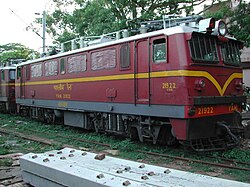
|[[File:YAm1-21922.jpg|100px]] | |||
|[[Mitsubishi]] | |||
|[[Bo-Bo#B′B′|B-B]] | |||
|20 | |||
|1964-66 | |||
|1740 | |||
|Retired | |||
|} | |} | ||
=== {{ | ===Electric multiple units=== | ||
In 1925, the [[Multiple units of India|electric multiple units]] (EMU) introduced in Bombay were 1.5KV DC units imported were from [[Cammell Laird]] and [[Duewag|Uerdingenwagonfabrik]].<ref name="EL1"/> In the 1960s, EMUs were developed by Integral Coach Factory (ICF) in Chennai. Indian Railways uses multiple DC units in operation in several suburban sections which are classified from WCU-1 through WCU-15. BHEL developed AC-DC dual use EMUs which can run on 25kV AC and 1.5kV DC traction lines.<ref name="EL1"/> In the late 1990s, MEMUs were developed which ran on 25KV AC power. AC Electric multiple units are designated WAU-1 to WAU-4.<ref name="EMUF">{{cite web|url=https://irfca.org/faq/faq-mu.html|title=Multiple Units|publisher=IRFCA|access-date=1 December 2023}}</ref> In 2019, ICF rolled out three-phase AC units to replace conventional DC units.<ref>{{cite news|url=https://www.thehindu.com/news/national/kerala/3-phase-memu-to-replace-conventional-dc-rakes-soon/article29588400.ece|title=3-phase MEMU to replace conventional DC rakes soon|newspaper=[[The Hindu]]|date=3 October 2019|access-date=1 December 2023}}</ref> | |||
== Diesel == | |||
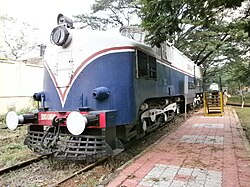
In 1954, the first [[diesel locomotive]] was used in India, which was manufactured by North British Locomotive Company.<ref name="Gandhi"/> In 1958, [[Indian locomotive class WDM-1|WDM-1]], the first locomotive used for mainline traffic was imported from [[American Locomotive Company|ALCO]].<ref>{{cite book|title=The Complete Encyclopedia of Locomotives|first1=Mirco|last1=De Cet|first2=Alan|last2=Kent|year=2006|page=286|isbn=978-9-0366-1505-1|publisher=Rebo International}}</ref> In 1964, the first broad-gauge [[Indian locomotive class WDM-2|WDM-2]] diesel locomotive was rolled out by Banaras Locomotive Works.<ref name="Banaras"/> | |||
==== { | ===Broad-gauge=== | ||
{|class="sortable wikitable"style="text-align:left;"style="font-size: 85%" | |||
|+Broad-gauge Diesel Locomotives<ref name="D1"/><ref name="Heritage"/><ref name="Banaras"/><ref name="IRFCA">{{cite web|url=https://www.irfca.org/apps/loco_classes|title=Loco classes|publisher=IRFCA|access-date=1 December 2023}}</ref> | |||
|- | |||
!Usage | |||
!Name | !Name | ||
!Numbers | |||
!Image | |||
!Manufacturer | !Manufacturer | ||
![[Wheel arrangement| | ![[Wheel arrangement|Axles]] | ||
[[ | !Number built | ||
!Production | |||
![[Power (physics)|Power]] ([[Horsepower|HP]]) | |||
!Status | |||
! | |||
|- | |- | ||
!colspan="10"|WDM series | |||
|- | |||
|rowspan="9"|Mixed | |||
|[[Indian locomotive class WDM-1|WDM-1]] | |[[Indian locomotive class WDM-1|WDM-1]] | ||
|17000-17099 | |||
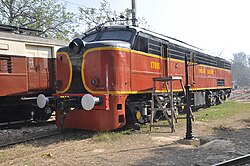
|[[File:Indian locomotive class WDM-1.jpg|100px]] | |||
|[[American Locomotive Company|ALCO]] | |[[American Locomotive Company|ALCO]] | ||
|Co-Co | |[[Co-Co locomotive|Co-Co]] | ||
|100 | |100 | ||
|1957- | |1957-59 | ||
|1950 | |1950 | ||
|Retired | |Retired | ||
|- | |- | ||
|[[Indian locomotive class WDM-2|WDM-2]] | |[[Indian locomotive class WDM-2|WDM-2]] | ||
|[[American Locomotive Company|ALCO]] | |16000-16887,<br>17100-17999,<br>18040-18079,<br>18112-18514,<br>18523-18900,<br>18903-18999 | ||
|Co-Co | |[[File:Kundan, the first WDM-2 locomotive assembled at DLW, Varanasi.jpg|100px]] | ||
| | |[[American Locomotive Company|ALCO]], [[Banaras Locomotive Works|BLW]] | ||
| | |[[Co-Co locomotive|Co-Co]] | ||
|2600 | |2700 | ||
|1962-98 | |||
|2600 | |||
|Retired | |||
| | |||
|- | |- | ||
|[[Indian locomotive class WDM-2G|WDM-2G]] | |[[Indian locomotive class WDM-2G|WDM-2G]] | ||
|[[ | |80000,80001 | ||
|Co-Co | | | ||
|[[Patiala Locomotive Works |PLW]] | |||
|[[Co-Co locomotive|Co-Co]] | |||
|2 | |2 | ||
|2013 | |2013 | ||
|2400 | |2400 | ||
| | |Retired | ||
|- | |- | ||
|[[Indian locomotive class WDM-3|WDM-3]] | |[[Indian locomotive class WDM-3|WDM-3]] | ||
|[[Henschel & Son|Henschel]] | |18515-18522 | ||
|Bo-Bo | | | ||
|[[Henschel & Son|Henschel]] | |||
|[[Bo-Bo]] | |||
|8 | |8 | ||
|1970 | |1970 | ||
|2500 | |2500 | ||
|Retired | |Retired | ||
|- | |- | ||
|[[Indian locomotive class WDM-3A|WDM-3A]] | |[[Indian locomotive class WDM-3A|WDM-3A]] | ||
|13xxx,<br>14001-14057,<br>14058-14143,<br>16000- | |||
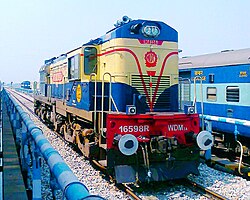
|[[File:MLDT based WDM3A 16598R.jpg|100px]] | |||
|[[Banaras Locomotive Works|BLW]] | |[[Banaras Locomotive Works|BLW]] | ||
|Co-Co | |[[Co-Co locomotive|Co-Co]] | ||
|1431 | |||
|1994-98 | |||
|3100 | |||
| | |||
| | |||
|3100 | |||
|In service | |In service | ||
|- | |- | ||
|[[Indian locomotive class WDM-3D|WDM-3D]] | |[[Indian locomotive class WDM-3D|WDM-3D]] | ||
|11101 - 11590 | |||
|[[File:WDM-3D 11466.jpg|100px]] | |||
|[[Banaras Locomotive Works|BLW]] | |[[Banaras Locomotive Works|BLW]] | ||
|Co-Co | |[[Co-Co locomotive|Co-Co]] | ||
|500 | |500 | ||
|2003- | |2003-13 | ||
|3300 | |3300 | ||
|In service | |In service | ||
|- | |- | ||
|[[Indian locomotive class WDM-4|WDM-4]] | |[[Indian locomotive class WDM-4|WDM-4]] | ||
|18000-039,<br>18080-18111 | |||
|[[File:WDM-4 locomotive.jpg|100px]] | |||
|[[Electro-Motive Diesel|GM]] | |[[Electro-Motive Diesel|GM]] | ||
|Co-Co | |[[Co-Co locomotive|Co-Co]] | ||
|72 | |72 | ||
|1962 | |1962 | ||
|2600 | |2600 | ||
|Retired | |Retired | ||
|- | |- | ||
|[[Indian Locomotive class WDM-6|WDM-6]] | |[[Indian Locomotive class WDM-6|WDM-6]] | ||
|18901,18902 | |||
| | |||
|[[Banaras Locomotive Works|BLW]] | |[[Banaras Locomotive Works|BLW]] | ||
|Bo-Bo | |[[Bo-Bo]] | ||
|2 | |2 | ||
|1981- | |1981-82 | ||
|1350 | |1350 | ||
|Retired | |Retired | ||
|- | |- | ||
|[[Indian locomotive class WDM-7|WDM-7]] | |[[Indian locomotive class WDM-7|WDM-7]] | ||
|11001-11015 | |||
|[[File:ഡീസൽ എഞ്ചിൻ, ബ്രോഡ് ഗേജ്.jpg|100px]] | |||
|[[Banaras Locomotive Works|BLW]] | |[[Banaras Locomotive Works|BLW]] | ||
|Co-Co | |[[Co-Co locomotive|Co-Co]] | ||
|15 | |15 | ||
| | |1987-89 | ||
|2000 | |2000 | ||
|In service | |In service | ||
|- | |- | ||
!colspan="10"|WDP series | |||
|- | |||
|rowspan="3"|[[Passenger train|Passenger]] | |||
|[[Indian locomotive class WDP-1|WDP-1]] | |[[Indian locomotive class WDP-1|WDP-1]] | ||
|[[Banaras Locomotive Works|BLW]] | |15001-15069 | ||
|Bo-Bo | |[[File:WDP1 (15010) locomotive with Rewari Passenger.jpg|100px]] | ||
|[[Banaras Locomotive Works|BLW]], [[American Locomotive Company|ALCO]] | |||
|[[Bo-Bo]] | |||
|69 | |69 | ||
| | |1995-99 | ||
|2300 | |2300 | ||
|In service | |In service | ||
|- | |- | ||
|[[Indian locomotive class WDP-3A|WDP-3A]] | |[[Indian locomotive class WDP-3A|WDP-3A]] | ||
|[[Banaras Locomotive Works|BLW]] | |15501-15544 | ||
|Co-Co | |[[File:WDP3A c 15543 PUSHPAK.jpg|100px]] | ||
|[[Banaras Locomotive Works|BLW]], [[American Locomotive Company|ALCO]] | |||
|[[Co-Co locomotive|Co-Co]] | |||
|44 | |44 | ||
| | |1998-2002 | ||
|3100 | |3100 | ||
|In service | |In service | ||
|- | |- | ||
|[[Indian locomotive class WDP-4|WDP-4]] | |[[Indian locomotive class WDP-4|WDP-4]] | ||
| | |20000-20103,<br>40001-40608 | ||
& | |[[File:WDP4 20094.jpg|100px]] | ||
|[[Electro-Motive Diesel|EMD]], [[Banaras Locomotive Works|BLW]] | |||
|[[Co-Co locomotive|Co-Co]] | |||
|711 | |||
|2002-18 | |||
|4000 | |||
|[[File: | |||
|[[Electro-Motive Diesel|EMD]] | |||
|Co-Co | |||
| | |||
| | |||
| | |||
|In service | |In service | ||
|- | |- | ||
| | !colspan="10"|WDG series | ||
|- | |- | ||
|[[Indian locomotive class WDG-2/3A|WDG- | |rowspan="6"|[[Rail freight transport|Goods]] | ||
|[[Indian locomotive class WDG-2/3A|WDG-2/3A]] | |||
|14501-14999,<br>13000-13665 | |||
|[[File:WDG-3A 13296.jpg|100px]] | |||
|[[Banaras Locomotive Works|BLW]] | |[[Banaras Locomotive Works|BLW]] | ||
|Co-Co | |[[Co-Co locomotive|Co-Co]] | ||
| | |||
|2004 | |2004 | ||
| | |1995-2010 | ||
|3100 | |||
|In service | |In service | ||
|- | |- | ||
|[[Indian locomotive class WDG-4|WDG-4]] | |[[Indian locomotive class WDG-4|WDG-4]] | ||
|[[Electro-Motive Diesel|EMD]] | |12001-12999,<br>70001-70190 | ||
|Co-Co | |[[File:GTY based WDG-4 locos with Freight Tanker at Malkajgiri 01.JPG|100px]] | ||
|[[Electro-Motive Diesel|EMD]], [[Banaras Locomotive Works|BLW]] | |||
|[[Co-Co locomotive|Co-Co]] | |||
|1188 | |1188 | ||
| | |1999-2018 | ||
|4500 | |4500 | ||
|In service | |In service | ||
|- | |- | ||
|[[Indian locomotive class WDG-4|WDG-4D]] | |[[Indian locomotive class WDG-4|WDG-4D]] | ||
|70301-70882,<br>12681 | |||
|[[File:WDG4D 70360.jpg|100px]] | |||
|[[Banaras Locomotive Works|BLW]] | |[[Banaras Locomotive Works|BLW]] | ||
|Co-Co | |[[Co-Co locomotive|Co-Co]] | ||
|583 | |583 | ||
| | |2012-2018 | ||
|4500 | |4500 | ||
|In service | |||
|- | |||
|[[Indian locomotive class WDG-4G|WDG-4G]] | |||
|49001-49700 | |||
|[[File:ROZA WDG4G 49032 roaming at Katihar Jn (cropped).jpg|100px]] | |||
|[[GE Transportation]], [[Diesel Locomotive Factory, Marhowrah|DLF]] | |||
|[[Co-Co locomotive|Co-Co]] | |||
|468 | |||
|2017-present | |||
|4500 | |||
|In service | |In service | ||
|- | |- | ||
|[[Indian locomotive class WDG-5|WDG-5]] | |[[Indian locomotive class WDG-5|WDG-5]] | ||
|50001-50007 | |||
|[[File:5500HP WDG5 Locomotive christened as Bheem - Flickr - Dr. Santulan Mahanta (cropped).jpg|100px]] | |||
|[[Banaras Locomotive Works|BLW]] | |[[Banaras Locomotive Works|BLW]] | ||
|Co-Co | |[[Co-Co locomotive|Co-Co]] | ||
|7 | |7 | ||
|2012- | |2012-17 | ||
|5500 | |5500 | ||
|In service | |In service | ||
|- | |- | ||
|[[Indian locomotive class WDG-6G|WDG-6G]] | |[[Indian locomotive class WDG-6G|WDG-6G]] | ||
|[[ | |69001-69300 | ||
|Co-Co | |[[File:Gandhidham based WDG-6G at Ghaziabad outer station area.jpg|Gandhidham based WDG-6G at Ghaziabad outer station area|100px]] | ||
| | |[[GE Transportation]], [[Diesel Locomotive Factory, Marhowrah|DLF]] | ||
| | |[[Co-Co locomotive|Co-Co]] | ||
|6000 | |92 | ||
|2018-present | |||
|6000 | |||
|In service | |In service | ||
|- | |- | ||
!colspan="10"|WDS series | |||
|- | |||
|rowspan="7"|[[Shunting (rail)|Shunter]] | |||
|[[Indian locomotive class WDS-1|WDS-1]] | |[[Indian locomotive class WDS-1|WDS-1]] | ||
|19000-19014 | |||
|[[File:GE 45-Ton Switcher at MSU's T. B. Simon Power Plant.jpg|100px]] | |||
|[[General Electric|GE]] | |[[General Electric|GE]] | ||
|Bo-Bo | |[[Bo-Bo]] | ||
|15 | |15 | ||
|1944- | |1944-45 | ||
|386 | |386 | ||
|Retired | |Retired | ||
|- | |- | ||
|[[Indian locomotive class WDS-2|WDS-2]] | |[[Indian locomotive class WDS-2|WDS-2]] | ||
| | |19016-19045 | ||
Maffei | |[[File:Bonn Beuel Krauss-Maffei ML 400 C uit 1951 (20194143436).jpg|100px]] | ||
|C | |[[Krauss-Maffei]] | ||
|[[UIC classification of locomotive axle arrangements|C]] | |||
|30 | |30 | ||
|1954- | |1954-55 | ||
|440 | |440 | ||
|Retired | |Retired | ||
|- | |- | ||
|[[Indian locomotive class WDS-3|WDS-3]] | |[[Indian locomotive class WDS-3|WDS-3]] | ||
| | |19046-19052 | ||
| | |||
|C | |[[Maschinenbau Kiel]] | ||
|[[UIC classification of locomotive axle arrangements|C]] | |||
|7 | |7 | ||
|1961 | |1961 | ||
|618 | |618 | ||
|Retired | |Retired | ||
|- | |- | ||
|[[Indian locomotive class WDS-4|WDS-4]] | |[[Indian locomotive class WDS-4|WDS-4]] | ||
| | |||
19057-19732 | |||
|[[File:Heritage Engine at Valsad 2 (cropped).jpg|100px]] | |||
|[[Chittaranjan Locomotive Works|CLW]] | |[[Chittaranjan Locomotive Works|CLW]] | ||
|C | |[[UIC classification of locomotive axle arrangements|C]] | ||
| | |662 | ||
|1968- | |1968-97 | ||
|600 | |600-700 | ||
| | |Retired | ||
| | |- | ||
| | |[[Indian locomotive class WDS-5|WDS-5]] | ||
|[[File:WDS | |19087-19107 | ||
|[[File:Mahabodhi Express (Mughal Sarai Station).jpg|100px]] | |||
|[[American Locomotive Company|ALCO]], [[Banaras Locomotive Works|BLW]] | |||
|[[Co-Co locomotive|Co-Co]] | |||
|21 | |||
|1967 | |||
|1065 | |||
|Retired | |||
|- | |||
|[[Indian locomotive class WDS-6|WDS-6]] | |||
| | |||
|[[File:Tughlakabad-based WDS-6 locomotive at Anand Vihar Terminal.jpg|100px]] | |||
|[[Banaras Locomotive Works|BLW]] | |||
|[[Co-Co locomotive|Co-Co]] | |||
|270 | |||
|1975–present | |||
|1400 | |||
|In service | |||
|- | |- | ||
|[[Indian locomotive class WDS- | |[[Indian locomotive class WDS-8|WDS-8]] | ||
| | |||
| | |||
|[[Chittaranjan Locomotive Works|CLW]] | |[[Chittaranjan Locomotive Works|CLW]] | ||
| | |[[Bo-Bo]] | ||
|5 | |5 | ||
| | |1979-82 | ||
| | |800 | ||
|Retired | |Retired | ||
| | |} | ||
|[[ | In 2009, a [[Indian locomotive class YDM-4|YDM-4 locomotive]] was converted to a broad gauge shunter by [[Golden Rock Railway Workshop]], codenamed WCDS-6, with C for "Converted" and delivered to [[RITES]].<ref>{{cite web|url=https://irfca.org/faq/faq-loco.html|title=Locomotive FAQ|publisher=IRFCA|access-date=1 December 2023}}</ref> | ||
===Metre-gauge=== | |||
{{anchor|YDM}} | |||
{|class="sortable wikitable"style="text-align:left;"style="font-size: 85%" | |||
|+Metre-gauge Diesel Locomotives<ref name="D1"/><ref name="Heritage"/><ref name="Banaras"/><ref name="IRFCA"/> | |||
|- | |||
!Usage | |||
!Name | |||
!Image | |||
!Manufacturer | |||
![[Wheel arrangement|Axles]] | |||
!Number built | |||
!Production | |||
![[Power (physics)|Power]] ([[Horsepower|HP]]) | |||
!Status | |||
|- | |||
!colspan="9"|YDM series | |||
|- | |- | ||
|[[Indian locomotive class | |rowspan="5"|Mixed | ||
|[[ | |[[Indian locomotive class YDM-1|YDM-1]] | ||
| | |[[File:Indian diesel locomotive, class YDM1R, Nº 6002.jpg|100px]] | ||
| | |[[North British Locomotive Company|NBL]] | ||
| | |[[Bo-Bo#B′B′|B-B]] | ||
|700 | |20 | ||
|1955-56 | |||
|700 | |||
|Retired | |Retired | ||
|- | |||
|[[Indian locomotive class YDM-2|YDM-2]] | |||
| | | | ||
|[[Chittaranjan Locomotive Works|CLW]] | |[[Chittaranjan Locomotive Works|CLW]] | ||
| | |[[Bo-Bo#B′B′|B-B]] | ||
| | |41 | ||
| | |1986-90 | ||
|700 | |700 | ||
|Retired | |Retired | ||
|- | |||
|[[Indian locomotive class YDM-3|YDM-3]] | |||
| | | | ||
| | |[[Electro-Motive Diesel|EMD]] | ||
|[[File: | |[[Bo-Bo#B′B′|B-B]] | ||
|30 | |||
|1961-62 | |||
|1390 | |||
|Retired | |||
|- | |||
|[[Indian locomotive class YDM-4|YDM-4]] | |||
|[[File:YDM4-6669 Jaipur Junction, 2008 (3).JPG|100px]] | |||
|[[American Locomotive Company|ALCO]], [[Banaras Locomotive Works|BLW]] | |||
|[[Co-Co locomotive|Co-Co]] | |||
|541 | |||
|1961–93 | |||
|1400 | |||
|In service | |||
|- | |- | ||
|[[Indian locomotive class | |[[Indian locomotive class YDM-5|YDM-5]] | ||
|[[ | |[[File:YDM - 5.jpg|100px]] | ||
|C | |[[Electro-Motive Diesel|GM]] | ||
| | |[[Co-Co locomotive#C-C|C-C]] | ||
| | |25 | ||
| | |1964 | ||
|1390 | |||
|Retired | |Retired | ||
|} | |||
==={{track gauge|2ft6in}} gauge=== | |||
{|class="sortable wikitable"style="text-align:left;"style="font-size: 85%" | |||
|+{{track gauge|2ft6in}} gauge Diesel Locomotives<ref name="D1"/><ref name="Heritage"/><ref name="Banaras"/><ref name="IRFCA"/> | |||
|- | |||
!Usage | |||
!Name | |||
!Image | |||
!Manufacturer | |||
![[Wheel arrangement|Axles]] | |||
!Number built | |||
!Production | |||
![[Power (physics)|Power]] ([[Horsepower|HP]]) | |||
!Status | |||
|- | |||
!colspan="9"|ZDM series | |||
|- | |||
|rowspan="5"|Mixed | |||
|[[Indian locomotive class ZDM-1|ZDM-1]] | |||
| | | | ||
| | |[[Arnold Jung Lokomotivfabrik|Arnold Jung]] | ||
|[[ | |[[Bo-Bo#B′B′|B-B]] | ||
|5 | |||
|1955 | |||
|290 | |||
|Retired | |||
|- | |- | ||
|[[Indian locomotive class | |[[Indian locomotive class ZDM-2|ZDM-2]] | ||
|[[ | |[[File:ZDM 2 Diesel locomotive at Solan.jpg|100px]] | ||
| | |[[Maschinenbau Kiel]] | ||
| | |[[Bo-Bo#B′B′|B-B]] | ||
| | |25 | ||
| | |1964-65 | ||
|700 | |||
|Retired | |Retired | ||
|- | |- | ||
|[[Indian locomotive class | |[[Indian locomotive class ZDM-3|ZDM-3]] | ||
|[[ | |[[File:Zdm engine baijnath.jpg|100px]] | ||
| | |[[Chittaranjan Locomotive Works|CLW]] | ||
| | |[[Bo-Bo#B′B′|B-B]] | ||
| | |40 | ||
| | |1970-82 | ||
|700 | |||
|In service | |||
|- | |||
|[[Indian locomotive class ZDM-4|ZDM-4]] | |||
|[[File:Narrow Gauge Train at Rajim.JPG|100px]] | |||
|[[Chittaranjan Locomotive Works|CLW]] | |||
|[[Bo-Bo#B′B′|1-B-B-1]] | |||
|49 | |||
|1975-90 | |||
|700 | |||
|In service | |||
|- | |||
|[[Indian locomotive class ZDM-5|ZDM-5]] | |||
|[[File:Bari Train.jpg|100px]] | |||
|[[Chittaranjan Locomotive Works|CLW]] | |||
|[[Bo-Bo#B′B′|B-B]] | |||
|41 | |||
|1989 | |||
|450 | |||
|In service | |In service | ||
| | |} | ||
| | |||
|[[ | ==={{track gauge|2ft}} gauge=== | ||
{|class="sortable wikitable"style="text-align:left;"style="font-size: 85%" | |||
|+{{track gauge|2ft}} gauge Diesel Locomotives<ref name="D1"/><ref name="Heritage"/><ref name="Banaras"/><ref name="IRFCA"/> | |||
|- | |||
!Usage | |||
!Name | |||
!Image | |||
!Manufacturer | |||
![[Wheel arrangement|Axles]] | |||
!Number built | |||
!Production | |||
![[Power (physics)|Power]] ([[Horsepower|HP]]) | |||
!Status | |||
|- | |||
!colspan="9"|NDM series | |||
|- | |- | ||
|[[Indian locomotive class | |rowspan="3"|Mixed | ||
|[[ | |[[Indian locomotive class NDM-1|NDM-1]] | ||
| | |[[File:NeralDeparture.JPG|100px]] | ||
| | |[[Arnold Jung Lokomotivfabrik|Arnold Jung]] | ||
| | |[[Bo-Bo#B′B′|B-B]] | ||
| | |7 | ||
|1955 | |||
|290 | |||
|In service | |In service | ||
|- | |- | ||
|[[Indian locomotive class | |[[Indian locomotive class NDM-5|NDM-5]] | ||
|[[File:Gwalior Light Railway, June 2017.jpg|100px]] | |||
|[[Chittaranjan Locomotive Works|CLW]] | |[[Chittaranjan Locomotive Works|CLW]] | ||
|Bo-Bo | |[[Bo-Bo#B′B′|B-B]] | ||
| | |11 | ||
| | |1987-89 | ||
| | |450 | ||
| | |In service | ||
| | |- | ||
| | |[[Indian locomotive class NDM-6|NDM-6]] | ||
|[[File: | |[[File:Darjeeling train station.jpg|100px]] | ||
|SAN | |||
|[[UIC classification of locomotive axle arrangements|B]] | |||
|6 | |||
|1997 | |||
|335 | |||
|In service | |||
|} | |} | ||
=== | ===Diesel railcars and multiple units=== | ||
In 1958, the [[Commonwealth Engineering]] of Australia supplied an unknown number of {{convert|400|hp|kW|abbr=on}}, 83-seat broad-gauge [[diesel-mechanical]] railcars to Indian Railways, classified as WRD-1. Powered by a pair of 200 hp [[Leyland Motors|Leyland]] engines, it had an axle arrangement of 1A-1A1, and a top speed of {{convert|110|km/h|mph|abbr=on}}.{{sfn|Sampson|1960|page=321}}{{sfn|Allen|1982|page=426}} | |||
In 1993-94, [[diesel multiple unit]]s (DMU) were introduced into service. Depending on their transmission system, they are classified as DEMU ([[diesel-electric transmission]]) or DHMU ([[diesel-hydraulic]] transmission).<ref name="EMUF"/> With increase in electrifiction, DEMUS have been replaced by MEMUs in stages.<ref name="EMUF"/> | |||
==== | == Dual == | ||
[[ | {|class="sortable wikitable"style="text-align:left;"style="font-size: 85%" | ||
|+Broad-gauge Dual Locomotives<ref>{{cite web|url=https://rdso.indianrailways.gov.in/view_section.jsp?lang=0&id=0,1,1093,6509&cssType=1|title=Achievements of 2021|publisher=RDSO|access-date=1 December 2023}}</ref><ref>{{cite news|date=17 January 2016 |title=Railways to manufacture dual-mode locomotives that run on diesel, electricity|url=https://timesofindia.indiatimes.com/business/india-business/Railways-to-manufacture-dual-mode-locomotives-that-run-on-diesel-electricity/articleshow/50612226.cms|access-date=20 May 2020|newspaper=[[The Times of India]]}}</ref> | |||
|- | |||
!Usage | |||
!Name | |||
!Image | |||
!Manufacturer | |||
![[Wheel arrangement|Axles]] | |||
!Number built | |||
!Production | |||
![[Power (physics)|Power]] ([[Horsepower|HP]]) | |||
!Status | |||
|- | |||
|[[Passenger train|Passenger]] | |||
|[[Indian locomotive class WDAP-5|WDAP-5]] | |||
|[[File:WDAP-5.jpg|100px]] | |||
|[[Banaras Locomotive Works|BLW]] | |||
|[[Co-Co locomotive|Co-Co]] | |||
|1 | |||
|2019- | |||
|4500 (Diesel) <br/> 5500 (AC) | |||
|In trials | |||
|} | |||
=== | == Steam == | ||
===Broad-gauge=== | |||
{{multiple image|perrow=2|total_width=360|image1=HPS 24467.jpg|alt1=Steam engine at outdoor museum|image2=NRM WP 7200.JPG|alt2=More-modern steam locomotive|alt3=Old red-and-black steam locomotive| | {{multiple image|perrow=2|total_width=360|image1=HPS 24467.jpg|alt1=Steam engine at outdoor museum|image2=NRM WP 7200.JPG|alt2=More-modern steam locomotive|alt3=Old red-and-black steam locomotive| | ||
image3=YPclass.jpg|image4=Indian locomotive B-26.jpg|alt4=Large steam locomotive|footer=Indian Railways locomotives: ''(clockwise from upper left)'' | image3=YPclass.jpg|image4=Indian locomotive B-26.jpg|alt4=Large steam locomotive|footer=Indian Railways locomotives: ''(clockwise from upper left)'' HPS, NRM WP 7200, B-26 and YP-class locomotives}} | ||
In the 19th century, the railway companies ordered custom-built steam locomotives, usually from [[Great Britain|British]] manufacturers. With non-standardized and multiple designs, manufacturing cost was high and production was slow. During the 1890s, Indian railway companies imported locomotives from [[Germany]] and the [[United States]] when British manufacturers were suffering from work outages.<ref>{{Harvnb|Hughes|1979|p=17}}</ref> The locomotives used included: | |||
*[[Bengal Nagpur Railway]]: | *[[Bengal Nagpur Railway]]: | ||
**Class F: | **Class F: {{whyte|0-6-0}} | ||
**Class GM: | **Class GM: {{whyte|2-6-0}} (probably modified) | ||
**[[BNR class HSG]]: | **[[BNR class HSG]]: {{whyte|2-8-0+0-8-2}} [[Garratt locomotive]], first Garratt locomotive | ||
**Class M: [[4-6-2]] (probably modified) | **Class M: [[4-6-2]] (probably modified) | ||
**[[BNR class N]]: | **[[BNR class N]]: {{whyte|4-8-0+0-8-4}} Garratt, India's largest locomotive; One is preserved at the [[National Rail Museum, New Delhi]] | ||
**[[BNR class NM]]: | **[[BNR class NM]]: Ten were built in 1931 by [[Beyer, Peacock & Company]]; withdrawn in the late 1960s | ||
**[[BNR class P]]: | **[[BNR class P]]: {{whyte|4-8-2+2-8-4}} Garratt, four were built by Beyer, Peacock & Company in 1939; withdrawn in the early 1970s | ||
*[[Bombay, Baroda & Central India Railway]]: | *[[Bombay, Baroda & Central India Railway]]: | ||
**BB&CI class P: 4-6-2 | **BB&CI class P: {{whyte|4-6-2}} | ||
**Class A: | **Class A: {{whyte|2-4-0|T}}, an [[Atlantic (locomotive)|Atlantic]]; was at the [[Palej]] shed | ||
**Class U36: | **Class U36: {{whyte|0-4-2}}, used on hauling suburban trains in Bombay | ||
**Class D1: | **Class D1: {{whyte|4-4-0}}, one was named ''Princess May'' | ||
**Class M: 4-6-2 | **Class M: {{whyte|4-6-2}} | ||
*[[East Indian Railway|East Indian Railway Company]]: | *[[East Indian Railway|East Indian Railway Company]]: | ||
**Class CT: | **Class CT: {{whyte|0-6-4|T}}, converted to a [[Superheater#Locomotives|superheater]] | ||
**EIR class G: 2-2- | **EIR class G: {{whyte|2-2-2|T}}, first two named ''Express'' and ''[[Fairy Queen (locomotive)|Fairy Queen]]''; Built in 1855, the latter is the world's oldest locomotive to be in working order and was rebuilt by ICF; Housed at [[East Indian Railway Company|East Indian Railway (EIR)]] | ||
**EIR class P: 4-6-0 | **EIR class P: {{whyte|4-6-0}} | ||
*[[Great Indian Peninsula Railway]]: | *[[Great Indian Peninsula Railway]]: | ||
**GIPR classes Y1, Y2, Y3, and Y4: | **[[GIP-1 to 8|''Sultan'', ''Sahib'' and ''Sindh'']]: Hauled the first passenger train in 1853 | ||
**[[Lord Falkland (locomotive)|''Lord Falkland'']]: [[0-6-0]] | |||
**GIPR classes Y1, Y2, Y3, and Y4: {{whyte|0-8-4|T}}, Used on [[Thal Ghat]] as [[Bank engine|bankers]] for pushing trains up the [[Western Ghats]]. | |||
**GIPR Class F and F3: 2-6-0 | **GIPR Class F and F3: 2-6-0 | ||
**GIPR class J1: 0-6-0 | **GIPR class J1: 0-6-0 | ||
**Class D4: 4-6-0 | **Class D4: 4-6-0, one is named ''Hero'' | ||
**Class D5: 4-6-0 passenger locomotive | **Class D5: 4-6-0 passenger locomotive | ||
**Class E1: 4-4-2 Atlantic built by the North British Locomotive Company in 1907–8 | **Class E1: 4-4-2 Atlantic built by the North British Locomotive Company in 1907–8; Rebuilt with a superheater between 1925 and 1928. | ||
**Class T: Tank locomotive used for hauling Mumbai suburban trains | **Class T: Tank locomotive used for hauling Mumbai suburban trains | ||
**Class Y: 2-8-4T | **Class Y: 2-8-4T | ||
**Crane tank: 0-6-0T | **Crane tank: 0-6-0T, one is preserved at the National Rail Museum in New Delhi | ||
*[[Madras and Southern Mahratta Railway]]: | *[[Madras and Southern Mahratta Railway]]: | ||
**M&SM class V: 4-4-0 | **M&SM class V: 4-4-0, one is preserved. | ||
**Class BTC: 2-6-4T, based on [[BSI Group|BESA]] specifications | **Class BTC: 2-6-4T, based on [[BSI Group|BESA]] specifications | ||
**Class T: 0-4-2; one is preserved in | **Class T: 0-4-2; one is preserved in Chennai | ||
*[[Nizam's Guaranteed State Railway]]: | *[[Nizam's Guaranteed State Railway]]: | ||
**NSR class A: 2-6-0T | **NSR class A: 2-6-0T, No. 48, an Atlantic preserved at the National Rail Museum, Delhi | ||
*[[North Western State Railway]]: | *[[North Western State Railway]]: | ||
**Class EM: 4-4-2 | **Class EM: 4-4-2, one is preserved at the National Rail Museum | ||
**NWR class GAS: 2-6-2+2-6-2 Garratt | **NWR class GAS: 2-6-2+2-6-2 Garratt, one built in 1925 and retired in 1937 | ||
**NWR class P: 2-4-0 | **NWR class P: 2-4-0 | ||
**Class E1: 4-4-2 | **Class E1: 4-4-2 | ||
**Class N1: 4-8-0 | **Class N1: 4-8-0 | ||
*[[Oudh and Rohilkhand Railway]]: | *[[Oudh and Rohilkhand Railway]]: | ||
**Class B26: 0-6-0 | **Class B26: 0-6-0, one is preserved at the National Rail Museum | ||
*Others: | *Others: | ||
**Class B: 2-6-0 | **Class B: 2-6-0 | ||
**Class E: 2-4-0 | **Class E: 2-4-0 | ||
**Class F: 2-8-2, built between 1926 and 1950 by [[Nasmyth Wilson]] for service on [[Central Railway zone|Central Railway (CR)]] | **Class F: 2-8-2, built between 1926 and 1950 by [[Nasmyth Wilson]] for service on [[Central Railway zone|Central Railway (CR)]] | ||
**Class G: 2-6-0, probably intended for freight | **Class G: 2-6-0, probably intended for freight | ||
**Class NA2 | **Class NA2 | ||
**Class PTC: 2-6-4T, owned by Northern Railway (NR); probably a converted passenger locomotive | **Class PTC: 2-6-4T, owned by Northern Railway (NR); probably a converted passenger locomotive | ||
**Class Y2: 2-8-2T, reclassified L2 | **Class Y2: 2-8-2T, reclassified L2 | ||
**Phoenix: 0-4-0T | **Phoenix: 0-4-0T, one is at the National Rail Museum | ||
**Ramgotty: 2-2-0T | **Ramgotty: 2-2-0T, the National Rail Museum's oldest locomotive, it was converted to broad gauge | ||
[[File:Pakistan Railways 3157, MOSI.jpg|thumb|alt=Steam locomotive in a museum|[[Vulcan Foundry]] class SPS, 1911]] | [[File:Pakistan Railways 3157, MOSI.jpg|thumb|alt=Steam locomotive in a museum|[[Vulcan Foundry]] class SPS, 1911]] | ||
In the early 1900s, the British Engineering Standards Committee (later the [[BSI Group#History|British Engineering Standards Association]]) began designing a series of locomotives for use by Indian railways. The first two designs emerged in 1903: a [[4-4-0]] passenger and [[0-6-0]] goods. They were revised in 1905 and 1906 with additional heavier, more-powerful locomotives:{{sfn|Hughes|1979|page=18}} | |||
* Class SP: Standard passenger ([[4-4-0]]) | * [[Indian locomotive class SP|Class SP]]: Standard passenger ([[4-4-0]]) | ||
* [[Indian locomotive class SG|Class SG]]: Standard goods ([[0-6-0]]) | * [[Indian locomotive class SG|Class SG]]: Standard goods ([[0-6-0]]) | ||
* Class PT: Passenger tank ([[2-6-4T]]) | * [[Indian locomotive class PT|Class PT]]: Passenger tank ([[2-6-4T]]) | ||
* Class HP: Heavy passenger ([[4-6-0]]) | * [[Indian locomotive class HP|Class HP]]: Heavy passenger ([[4-6-0]]) | ||
* Class AP: Atlantic passenger ([[4-4-2 (locomotive)|4-4-2]]) | * [[Indian locomotive class AP|Class AP]]: Atlantic passenger ([[4-4-2 (locomotive)|4-4-2]]) | ||
* Class HG: Heavy goods ([[2-8-0]]) | * [[Indian locomotive class HG|Class HG]]: Heavy goods ([[2-8-0]]) | ||
* Class HT: Heavy tank ([[2-8-2T]]) | * [[Indian locomotive class HT|Class HT]]: Heavy tank ([[2-8-2T]]) | ||
These advisory BESA designs were customized by the railway companies, which used different classification systems; only the state-operated railways used the class designations SP, SG, PT, HP, AP, HG and HT. When [[superheater#Locomotives|superheating]] was accepted, superheated versions were classified SPS, SGS and so on (if built with superheaters) and SPC, SGC and so on (if converted from [[Superheated steam#Saturated steam|saturated]] to superheated). | These advisory BESA designs were customized by the railway companies, which used different classification systems; only the state-operated railways used the class designations SP, SG, PT, HP, AP, HG and HT. When [[superheater#Locomotives|superheating]] was accepted, superheated versions were classified SPS, SGS and so on (if built with superheaters) and SPC, SGC and so on (if converted from [[Superheated steam#Saturated steam|saturated]] to superheated).{{sfn|Hughes|1979|page=18}} | ||
{{multiple image|alt1=Manufacturer's photo|image1=XP works photo, 1935.jpg|width1=150|image2=Indian State XB class 1927 photo.jpg|width2=150|alt2=Similar to first photo, without manufacturer documentation|footer=Indian Railways locomotives: 1935 XP class ''(left)'' and 1927 XB class}} | {{multiple image|alt1=Manufacturer's photo|image1=XP works photo, 1935.jpg|width1=150|image2=Indian State XB class 1927 photo.jpg|width2=150|alt2=Similar to first photo, without manufacturer documentation|footer=Indian Railways locomotives: 1935 XP class ''(left)'' and 1927 XB class}} | ||
After World War I, larger and more-powerful locomotives were designed by British consulting engineers for the Indian government. They began to | After World War I, larger and more-powerful locomotives were designed by British consulting engineers for the Indian government. They began to operate from 1927:{{sfn|Hughes|1979|page=21}} | ||
* [[Indian locomotive class XA|Class XA]]: branch passenger [[4-6-2]] design, 12.5-ton [[axle load]] | * [[Indian locomotive class XA|Class XA]]: branch passenger [[4-6-2]] design, 12.5-ton [[axle load]] | ||
* [[Indian locomotive class XB|Class XB]]: light passenger 4-6-2 design, 17-ton axle load | * [[Indian locomotive class XB|Class XB]]: light passenger 4-6-2 design, 17-ton axle load | ||
| Line 1,292: | Line 1,142: | ||
* [[Indian locomotive class XD|Class XD]]: Light goods [[2-8-2]] design, 17-ton axle load | * [[Indian locomotive class XD|Class XD]]: Light goods [[2-8-2]] design, 17-ton axle load | ||
* [[Indian locomotive class XE|Class XE]]: heavy goods 2-8-2 design, 22.5-ton axle load | * [[Indian locomotive class XE|Class XE]]: heavy goods 2-8-2 design, 22.5-ton axle load | ||
[[File:ETH-BIB-IRS Lokomotive XF Ans 05373-1762-FL .jpg|thumb|Class XF, built by [[Beyer, Peacock & Company]] in [[Manchester]] for [[East Bengal Railway]]]] | [[File:ETH-BIB-IRS Lokomotive XF Ans 05373-1762-FL .jpg|thumb|Class XF, built by [[Beyer, Peacock & Company]] in [[Manchester]] for [[East Bengal Railway]]]] | ||
* Class XF: light shunting [[0-8-0]] design, 18-ton axle load | * Class XF: light shunting [[0-8-0]] design, 18-ton axle load | ||
* Class XG: heavy shunting 0-8-0 design, 23-ton axle load | * Class XG: heavy shunting 0-8-0 design, 23-ton axle load | ||
| Line 1,300: | Line 1,150: | ||
* Class XT: light tank [[0-4-2T]], 15-ton axle load | * Class XT: light tank [[0-4-2T]], 15-ton axle load | ||
During [[India in World War II|World War II]], large numbers of 2-8-2 locomotives were acquired from the United States and Canada and classified AWD and CWD. The Baldwin Locomotive Works adapted the [[USATC S160 Class]] locomotive design for India, and it became [[USATC S160 Class|class AWC]]. Sixty broad-gauge locomotives were built in 1944 as part of an order of 180 S160 engines. In addition to modified frame spreaders, axles, cylinders, and cab, the Indian locomotives had a [[turbo generator]] and electric lighting (not included in the standard European design). Many parts (including boilers) were identical to those in standard-gauge locomotives. | During [[India in World War II|World War II]], large numbers of 2-8-2 locomotives were acquired from the United States and Canada and classified AWD and CWD. The Baldwin Locomotive Works adapted the [[USATC S160 Class]] locomotive design for India, and it became [[USATC S160 Class|class AWC]].{{sfn|Hughes|1979|page=23}} Sixty broad-gauge locomotives were built in 1944 as part of an order of 180 S160 engines. In addition to modified frame spreaders, axles, cylinders, and cab, the Indian locomotives had a [[turbo generator]] and electric lighting (not included in the standard European design). Many parts (including boilers) were identical to those in standard-gauge locomotives.<ref>Baldwin Locomotive Works drawing index and bill of materials for special order 43306, locomotive design 2-8-0 19S, numbers 666 to 845 for the U.S. Government, War Department.</ref> | ||
{{multiple image|alt1=Steam engine in transit|perrow=2|total_width=360|image1=WL 15084 Amritsar, 1993 (1).JPG|image2=Old-Steam-Coal-Rail-Engine.JPG|alt2=Steam engine at an outdoor museum|footer=''(clockwise from upper left)'' WL- and YG-class locomotives; an M2-162, and a display engine in [[Guntur railway division|Guntur Division]]|image4=Guntur west terminal and a model train.jpg|alt4=Locomotive on above-ground display|image3=Indian steam locomotive M2-162.jpg|alt3=Black locomotive under cover}} | {{multiple image|alt1=Steam engine in transit|perrow=2|total_width=360|image1=WL 15084 Amritsar, 1993 (1).JPG|image2=Old-Steam-Coal-Rail-Engine.JPG|alt2=Steam engine at an outdoor museum|footer=''(clockwise from upper left)'' WL- and YG-class locomotives; an M2-162, and a display engine in [[Guntur railway division|Guntur Division]]|image4=Guntur west terminal and a model train.jpg|alt4=Locomotive on above-ground display|image3=Indian steam locomotive M2-162.jpg|alt3=Black locomotive under cover}} | ||
Although new classes were designed shortly before the war, many did not enter service until the post-war period. The new classes were indicated by the change of broad-gauge prefix from ''X'' to ''W'', and plans were implemented to begin manufacturing locomotives in India. The new classes were: | Although new classes were designed shortly before the war, many did not enter service until the post-war period. The new classes were indicated by the change of broad-gauge prefix from ''X'' to ''W'', and plans were implemented to begin manufacturing locomotives in India. The new classes were:{{sfn|Hughes|1979|page=21-23}} | ||
* [[Indian locomotive class WP|Class WP]]: passenger 4-6-2, 18.50-ton axle load | * [[Indian locomotive class WP|Class WP]]: passenger 4-6-2, 18.50-ton axle load | ||
* [[Indian locomotive class WG|Class WG]]: goods 2-8-2, 18.50-ton axle load | * [[Indian locomotive class WG|Class WG]]: goods 2-8-2, 18.50-ton axle load | ||
| Line 1,316: | Line 1,166: | ||
All broad-gauge steam locomotives in India have been withdrawn from normal service, with only occasional steam specials continuing to operate. | All broad-gauge steam locomotives in India have been withdrawn from normal service, with only occasional steam specials continuing to operate. | ||
== | ===Metre-gauge=== | ||
*[[Nilgiri Mountain Railway X class]] | *[[Nilgiri Mountain Railway X class]] | ||
*BESA designs: | *BESA designs: | ||
** Passenger (4-6-0) | ** [[Indian locomotive class P|Passenger]] (4-6-0) | ||
** Mixed (4-6-0) | ** [[Indian locomotive class M|Mixed]] (4-6-0) | ||
** Goods (4-8-0) | ** [[Indian locomotive class G|Goods]] (4-8-0) | ||
** Tank (2-6-2T) | ** [[Indian locomotive class T|Tank]] (2-6-2T) | ||
*Indian Railway Standards designs of the late 1920s | *Indian Railway Standards designs of the late 1920s | ||
**Class YA: 4-6-2 with 9-ton axle load (none built) | **Class YA: 4-6-2 with 9-ton axle load (none built) | ||
** Class YB: 4-6-2 with 10-ton axle load (161 built for India and 50 for Burma) | ** Class YB: 4-6-2 with 10-ton axle load (161 built for India and 50 for Burma) | ||
** Class YC: 4-6-2 with 12-ton axle load (15 built for India and 13 for Burma) | ** [[Indian locomotive class YC|Class YC]]: 4-6-2 with 12-ton axle load (15 built for India and 13 for Burma) | ||
** Class YD: 2-8-2 with 10-ton axle load (171 built for India, 61 for Burma, and 25 for East Pakistan) | ** [[Indian locomotive class YD|Class YD]]: 2-8-2 with 10-ton axle load (171 built for India, 61 for Burma, and 25 for East Pakistan) | ||
** Class YE: 2-8-2 with 12-ton axle load (none built) | ** Class YE: 2-8-2 with 12-ton axle load (none built) | ||
** Class YF: 0-6-2 with 8-ton axle load; later examples were 2-6-2 (111 built for India) | ** Class YF: 0-6-2 with 8-ton axle load; later examples were 2-6-2 (111 built for India) | ||
| Line 1,460: | Line 1,186: | ||
** Class MWGX: 4-6-2+2-6-4 Garratt | ** Class MWGX: 4-6-2+2-6-4 Garratt | ||
*Indian Railway Standards post war designs | *Indian Railway Standards post war designs | ||
** Class YL: 2-6-2 mixed traffic locomotive with 8-ton axle load (264 built 1953–1957) | ** [[Indian locomotive class YL|Class YL]]: 2-6-2 mixed traffic locomotive with 8-ton axle load (264 built 1953–1957) | ||
** Class YG: 2-8-2 goods locomotive with | ** [[Indian locomotive class YG|Class YG]]: 2-8-2 goods locomotive with 10{{frac|1|2}}-ton axle load (1074 built 1949–1972) | ||
** Class YP: 4-6-2 passenger locomotive with | ** [[Indian locomotive class YP|Class YP]]: 4-6-2 passenger locomotive with 10{{frac|1|2}}-ton axle load (871 built 1949–1970) | ||
**Class YM 2-6-4T with 9-ton axle load (12 built 1956) | ** [[Indian locomotive class YM|Class YM]] 2-6-4T with 9-ton axle load (12 built 1956) | ||
=== {{ | ==={{TrackGauge|2ft6in}} gauge=== | ||
*[[Barsi Light Railway]]: | *[[Barsi Light Railway]]: | ||
**Class A: 0-8-4T | **Class A: 0-8-4T | ||
| Line 1,537: | Line 1,208: | ||
**Class ZF: 2-6-2T with 8-ton axle load | **Class ZF: 2-6-2T with 8-ton axle load | ||
==={{TrackGauge|2ft}} gauge=== | |||
[[File:Darjeeling train in shed. 1979.jpg|thumb|alt=Black locomotive|DHR B class locomotive in [[Darjeeling]] shed (1979)]] | [[File:Darjeeling train in shed. 1979.jpg|thumb|alt=Black locomotive|DHR B class locomotive in [[Darjeeling]] shed (1979)]] | ||
*[[Darjeeling Himalayan Railway]]: | *[[Darjeeling Himalayan Railway]]: | ||
| Line 1,544: | Line 1,215: | ||
** DHR C Class: 4-6-2 | ** DHR C Class: 4-6-2 | ||
** [[DHR D Class]]: 0-4-0+0-4-0 Garratt | ** [[DHR D Class]]: 0-4-0+0-4-0 Garratt | ||
*[[Matheran Light Railway]]: | |||
** [[Matheran Light Railway Locomotives 1 to 4|MLR 1-4]]: {{whyte|0-6-0|T}} | |||
*Indian Railway Standards (none built): | *Indian Railway Standards (none built): | ||
** QA: 2-6-2 with 4.5-ton axle load | ** QA: 2-6-2 with 4.5-ton axle load | ||
| Line 1,549: | Line 1,222: | ||
** QC: 2-8-2 with 6-ton axle load | ** QC: 2-8-2 with 6-ton axle load | ||
=== {{ | == Others == | ||
In 2015, the first [[compressed natural gas]] (CNG) powered Multiple unites were rolled out by ICF.<ref name="CNG"/> In 2020, [[Southern Railway zone]] introduced the first battery/AC dual shunter termed as WAG5HA with "H" for hybrid.<ref>{{cite news|url=https://www.financialexpress.com/business/railways-indian-railways-goes-green-with-eco-friendly-loco-adds-battery-operated-shunting-locomotive-to-its-fleet-2103440/|title=Indian Railways goes green with eco-friendly loco! Adds battery-operated shunting locomotive to its fleet|date=12 October 2020|newspaper=[[The Financial Express (India)|The Financial Express]]|access-date=1 December 2023}}</ref> The first indigenously designed and manufactured [[Hydrogen train|hydrogen-powered train]] was introduced in August 2025.<ref>{{cite web|url=https://timesofindia.indiatimes.com/business/infrastructure/indias-first-hydrogen-powered-train-is-ready-railway-minister-ashwini-vaishnaw-shares-sneak-peek-watch-video/articleshow/123259976.cms|title=India's first hydrogen powered train is ready|work=[[The Times of India]]|date=13 August 2025|access-date=31 August 2025}}</ref> | |||
== | |||
{{ | |||
== See also == | == See also == | ||
* [[Rail transport in India]] | * [[Rail transport in India]] | ||
* [[List of locomotive builders#India|List of locomotive builders]] | * [[List of locomotive builders#India|List of locomotive builders]] | ||
== | == Notes == | ||
{{notelist}} | |||
=== | === References === | ||
{{Reflist}} | {{Reflist|2}} | ||
=== Bibliography === | === Bibliography === | ||
{{refbegin}} | {{refbegin}} | ||
*{{cite book |last=Sampson |first=Henry |date=1960 |title=World Railways 1960 |url=https://archive.org/details/worldrailways1960000henr/mode/2up |url-access=registration |via=[[Internet Archive]] |location= |publisher=Sampson Low, Marston and Co. |page= |isbn= |access-date=}}{{ISBN missing|date=January 2025}} | |||
*{{Hughes-SII}} | *{{Hughes-SII}} | ||
*{{cite book|last=Hughes |first=Hugh |year=1979 |title=Steam locomotives in India, Part 3 – Broad Gauge |location=Harrow, Middlesex |publisher=The Continental Railway Circle |isbn=0-9503469-4-2 }} | *{{cite book|last=Hughes |first=Hugh |year=1979 |title=Steam locomotives in India, Part 3 – Broad Gauge |url=https://archive.org/details/steamlocomotives0000hugh/mode/2up |url-access=registration |via=[[Internet Archive]] |location=Harrow, Middlesex |publisher=The Continental Railway Circle |isbn=0-9503469-4-2 }} | ||
*{{cite book |editor-last1=Allen |editor-first1=Geoffrey Freeman |editor-link=Geoffrey Freeman Allen |date=1982 |title=Janes World Railways 1982 - 83 |url=https://archive.org/details/janesworldrailwa0000geof_c2a0/mode/2up |url-access=registration |location=London |publisher=Jane's Publishing Company |page= |isbn=9780867206180 |access-date= |series=[[Janes World Railways]] |via=[[Internet Archive]]}} | |||
*{{Hughes-IndianLocos1}} | *{{Hughes-IndianLocos1}} | ||
*{{Hughes-IndianLocos2}} | *{{Hughes-IndianLocos2}} | ||
| Line 1,584: | Line 1,253: | ||
== External links == | == External links == | ||
{{commons category}} | {{commons category}} | ||
{{Indian Railways}} | {{Indian Railways}} | ||
Revision as of 16:57, 18 February 2026
 | This article needs more citations. (July 2024) |
Indian Railways operates India's railway system and comes under the purview of the Ministry of Railways of Government of India. As of 2025[update], it maintains over 108,706 km (67,547 mi) of tracks and operates over 15,000 passenger and 10,000 freight trains daily with a fleet of more than 18,000 locomotives. The railways primarily operates a fleet of electric and diesel locomotives along with a few compressed natural gas (CNG) locomotives. Steam locomotives are operated on mountain railways and on heritage trains. As of February 2026, Indian Railways had 13,569 electric and 4,169 diesel locomotives.<ref name="E1">"Electric loco holding for Feb 2026" (PDF), Indian Railways, retrieved 3 February 2026</ref><ref name="D1">"BG Diesel loco holding for Feb 2026" (PDF), Indian Railways, retrieved 3 February 2026</ref>
History
The history of the Indian Railway began in 1832 with the proposal to construct the first railway line in India at Madras. In 1837, the first train ran on Red Hill railway line between Red Hills and Chintadripet in Madras and was hauled by a rotary steam engine imported from England.<ref name="Hist">Understanding Indian Railway Heritage (PDF). Indian Railways (Report). p. 6. Retrieved 1 December 2023.</ref><ref>"Chennai: The track record". The New Indian Express. 16 April 2018. Retrieved 9 August 2023.</ref> In 1852, a steam locomotive imported from England was tried at Byculla.<ref name="Locoh">First running of a railway locomotive in India (PDF) (Report). Indian Railways. p. 6. Retrieved 1 December 2023.</ref> In 1853, the first passenger train ran between Bombay and Thane which had 14-carriages hauled by three steam locomotives: the Sahib, Sindh and Sultan.<ref>"When India's first train blew steam". The Times of India. 25 April 2013. Retrieved 1 December 2023.</ref> In 1877, an Ajmer built F-1/734 Steam Locomotive became the first indigenously built locomotive in India.<ref>"Oldest locomotive: Built in Ajmer, pride of Delhi". The Times of India. 3 August 2017. Retrieved 1 December 2023.</ref> In 1925, the first electric train ran between Bombay and Kurla, hauled by a Swiss Locomotive and Machine Works (SLM) 2,400 hp (1,800 kW) electric locomotive on 1500 V DC traction.<ref name="Hist"/><ref name="EL">Evolution of Electric Locomotives (PDF) (Report). Indian Railways. Retrieved 1 December 2023.</ref> The first diesel locomotive used in India was fabricated by North British Locomotive Company in 1954.<ref name="Gandhi">Gandhidham shed details (PDF) (Report). Indian Railways. Retrieved 1 December 2023.</ref>
Chittaranjan Locomotive Works, commissioned in 1950, was the first locomotive manufacturing unit in India.<ref>Chittaranjan Locomotive works (Report). Indian Railways. Retrieved 1 December 2023.</ref> Banaras Locomotive Works, commissioned in 1961, is the second locomotive manufacturing unit operated by Indian Railways.<ref name="Banaras">Banaras Locomotive works (Report). Indian Railways. Retrieved 1 December 2023.</ref> In the 1960s, Integral Coach Factory-Chennai (ICF) started developing self-propelled electric multiple units for short-haul and local routes.<ref>Electrical Multiple Units (PDF). Indian Rail Info (Report). 15 October 1999. Retrieved 1 December 2023.</ref><ref>"Historical Background of Railway Electrification". Indian Railways. Retrieved 19 May 2023.</ref> BHEL and Patiala Locomotive Works, established in 1981, also manufacture locomotives in India.<ref>"Indian railway facilities". Indian Railways. Retrieved 1 April 2023.</ref> In 2015, the first compressed natural gas (CNG) powered trains were rolled out by ICF.<ref name="CNG">"India's first CNG train for the Rewari-Rohtak section". The Economic Times. 15 January 2015. Retrieved 1 December 2023.</ref> In 2018, a semi-high speed self-propelled train-set capable of reaching speeds of over 160 km/h (99 mph) was rolled out from ICF.<ref>"Indian Railways to roll out 'Make in India' 160 kmph self-propelled 'world-class' train sets at half the cost of import!". The Financial Express. 20 February 2017. Retrieved 20 May 2023.</ref><ref>"Train 18: Country's first engine-less train rolled out; Train 20 next". The Economic Times. 29 October 2018. ISSN 0013-0389. Retrieved 20 May 2023.</ref> As of 2025[update], Indian Railways maintains over 108,706 km (67,547 mi) of tracks and operates over 15,000 passenger and 10,000 freight trains daily with a fleet of over 17,000 locomotives.<ref name="IR">"About Indian Railways". Indian Railways. Retrieved 1 January 2024.</ref><ref>Trains at a glance (Report). Indian Railways. Retrieved 1 January 2024.</ref> As of October 2025, Indian Railways had 13,035 electric and 4,165 diesel locomotives amongst others.<ref name="E1"/><ref name="D1"/>
Classification
Locomotives are classified by track gauge, motive power, function, power rating and model in a four- or five-letter code.<ref name="Class"/> The locomotives may be Longer Hood Front (LHF), where the driver cabin is behind the hood of the engine or Short Hood Front (SHF), where the cabin is located towards the front.<ref name="Class"/>

| Letter position | Denotes | Classification |
|---|---|---|
| 1 | Track gauge |
|
| 2 | Motive power | |
| 3 | Use/ <br/> Load/ <br/> Traction | |
| 4 | Model/ <br/> Horsepower |
|
| 5 | Sub-class/ <br/> Sub-type/ <br/> Power rating | Increments of 100 HP (For Diesel)
and so on |
Electric
In 1925, the first electric train ran between Bombay and Kurla, hauled by a imported SLM locomotive on a DC traction.<ref name="EL1">Electrification history (Report). Indian Railways. Archived from the original on 9 June 2017. Retrieved 1 December 2023.</ref> In 1927, the first electric locomotive hauled passenger train was pulled by an imported WCP-1.<ref name="EL"/> In 1957, Indian Railways adopted 25 kV 50 Hz AC traction with the first runs beginning in December 1959 with the WAM-1 locomotives.<ref name="EL1"/>
Broad-gauge
| Traction | Usage | Name | Image | Manufacturer | Axles | Number built | Production | Power (HP) | Status | |
|---|---|---|---|---|---|---|---|---|---|---|
| WCP series | ||||||||||
| DC | Passenger | WCP-1 | 
|
SLM | 2-Bo-A1 | 22 | 1928-30 | 2160 | Retired | |
| WCP-2 | 
|
SLM | 2-Bo-A1 | 1 | 1938 | 2160 | Retired | |||
| WCP-3 | Hawthorn Leslie | 2-Co-2 | 1 | 1928 | 2250 | Retired | ||||
| WCP-4 | 
|
Hawthorn Leslie, BBC | 2-Co-2 | 1 | 1928 | 2390 | Retired | |||
| WCM series | ||||||||||
| DC | Mixed | WCM-1 | 
|
English Electric | Co-Co | 7 | 1954-55 | 3170 | Retired | |
| WCM-2 | English Electric | Co-Co | 12 | 1956-57 | 2810 | Retired | ||||
| WCM-3 | Hitachi | Co-Co | 3 | 1958 | 2460 | Retired | ||||
| WCM-4 | 
|
Hitachi | Co-Co | 7 | 1960 | 3290 | Retired | |||
| WCM-5 | 
|
CLW | Co-Co | 21 | 1961-63 | 3700 | Retired | |||
| WCM-6 | 
|
CLW | Co-Co | 2 | 1995 | 5000 | Retired | |||
| WCG series | ||||||||||
| DC | Goods | WCG-1 | 
|
SLM | C-C | 41 | 1925-29 | 2400 | Retired | |
| WCG-2 | 
|
CLW | Co-Co | 57 | 1970-76 | 1640 | Retired | |||
| WAM series | ||||||||||
| AC | Mixed | WAM-1 | 
|
50 cycles group[lower-alpha 1] | B-B | 100 | 1959-60 | 2870 | Retired | |
| WAM-2 | Mitsubishi | Bo-Bo | 36 | 1960-64 | 2790 | Retired | ||||
| WAM-3 | Mitsubishi | Bo-Bo | 2 | 1964 | 2790 | Retired | ||||
| WAM-4 | 
|
CLW | Co-Co | 500 | 1970-83 | 3640 | Retired | |||
| WAP series | ||||||||||
| AC | Passenger | WAP-1 | 
|
CLW | Co-Co | 65 | 1980-96 | 3760 | In service | |
| WAP-3 | 
|
CLW | Co-Co | 9 | 1987-88 | 3760 | Retired | |||
| WAP-4 | 
|
CLW | Co-Co | 778 | 1994-2015 | 5000 | In service | |||
| WAP-5 | 
|
ABB, CLW | Bo-Bo | 249 | 1995-present | 6000 | In service | |||
| WAP-6 | _at_Khalor,_West_Bengal.jpg)
|
CLW | Co-Co | 17 | 1995-98 | 5000 | Some variants of wap 6 has been Retired/Others are converted to wap 4e and Operational | |||
| WAP-7 | 
|
CLW, BLW, PLW | Co-Co | 1959 | 2000-present | 6350 | In service | |||
| WDAP Series | ||||||||||
| Electric + Diesel (Dual Mode) | Passenger | WDAP-5 | 
|
BLW | Co-Co | 1 | 2019 | 5500 | In service (trials) | |
| WAG series | ||||||||||
| AC | Goods | WAG-1 | File:WAG1 locomotive.jpg | SNCF, CLW | B-B | 112 | 1963-66 | 2900 | Retired | |
| WAG-2 | 
|
Hitachi, Mitsubishi | B-B | 45 | 1964-65 | 3180 | Retired | |||
| WAG-3 | <!-- Deleted image removed: File:COLOUR PHOTOGRAPH OF B-B TYPE WAG3 CLASS ELECTRIC LOCOMOTIVE.png --> | Henschel, CLW | B-B | 10 | 1965 | 3150 | Retired | |||
| WAG-4 | 
|
CLW | B-B | 186 | 1966-69 | 3150 | Retired | |||
| WAG-5 | 
|
CLW, BHEL | Co-Co | 1196 | 1984-98 | 3900 | In service | |||
| WAG-6A | 
|
ASEA | Bo-Bo-Bo | 6 | 1987-89 | 6000 | Retired | |||
| WAG-6B/C | 
|
Hitachi | Bo-Bo-Bo | 12 | 1988 | 6110 | Retired | |||
| WAG-7 | 
|
CLW | Co-Co | 2007 | 1992-2015 | 5000 | In service | |||
| WAG-8 | BHEL | Co-Co | 1 | 1990 | 5000 | Retired | ||||
| WAG-9 | 
|
ABB, CLW | Co-Co | 84 | 1996-present | 6000 | In service | |||
| WAG-9H | 
|
CLW, BHEL, BLW, PLW | Co-Co | 6073 | 2006-present | 6000 | In service | |||
| WAG-9I | CLW | Co-Co | 43 | 2010-present | 6000 | In service | ||||
| WAG-9HH/EF9K | 
|
CLW | Co-Co | 57 | 2020-present | 9000 | In service | |||
| WAG-9/EF12K | _on_duty..jpg)
|
CLW | Co-Co+Co-Co | 110 | 2023-present | 12000 | In service | |||
| WAG-10 | 
|
BLW | Co-Co-Co-Co | 1 | 2018-present | 10000 | In service | |||
| WAG-11 | 
|
BLW | Co-Co-Co-Co | 4 | 2018-present | 12000 | In service | |||
| WAG-12 | 
|
Alstom, ELF | Bo-Bo-Bo-Bo | 590 | 2017-present | 12000 | In service | |||
| WAG D-9 |  |
Siemens | Co-Co | 2025-present | 9000 | commissioning | ||||
| WCAM series | ||||||||||
| Dual (DC/AC) | Mixed | WCAM-1 | _Gujarat_Express.jpg)
|
CLW | Co-Co | 54 | 1975-79 | 2930 (DC) <br/> 3640 (AC) | Retired | |
| WCAM-2 | 
|
CLW | Co-Co | 20 | 1995-96 | 3780 (DC) <br/> 4720 (AC) | In service | |||
| WCAM-3 | 
|
BHEL | Co-Co | 53 | 1997-98 | 4600 (DC) <br/> 5000 (AC) | In service | |||
| WCAG series | ||||||||||
| Dual (DC/AC) | Goods | WCAG-1 | 
|
BHEL | Co-Co | 12 | 1999-2000 | 4600 (DC) <br/> 5000 (AC) | In service | |
Metre-gauge
| Traction | Usage | Name | Image | Manufacturer | Axles | Number built | Production | Power (|HP) | Status |
|---|---|---|---|---|---|---|---|---|---|
| DC | Goods | YCG-1 | 
|
English Electric | Bo-Bo | 4 | 1930 | 640 | Retired |
| AC | Mixed | YAM-1 | 
|
Mitsubishi | B-B | 20 | 1964-66 | 1740 | Retired |
Electric multiple units
In 1925, the electric multiple units (EMU) introduced in Bombay were 1.5KV DC units imported were from Cammell Laird and Uerdingenwagonfabrik.<ref name="EL1"/> In the 1960s, EMUs were developed by Integral Coach Factory (ICF) in Chennai. Indian Railways uses multiple DC units in operation in several suburban sections which are classified from WCU-1 through WCU-15. BHEL developed AC-DC dual use EMUs which can run on 25kV AC and 1.5kV DC traction lines.<ref name="EL1"/> In the late 1990s, MEMUs were developed which ran on 25KV AC power. AC Electric multiple units are designated WAU-1 to WAU-4.<ref name="EMUF">"Multiple Units". IRFCA. Retrieved 1 December 2023.</ref> In 2019, ICF rolled out three-phase AC units to replace conventional DC units.<ref>"3-phase MEMU to replace conventional DC rakes soon". The Hindu. 3 October 2019. Retrieved 1 December 2023.</ref>
Diesel
In 1954, the first diesel locomotive was used in India, which was manufactured by North British Locomotive Company.<ref name="Gandhi"/> In 1958, WDM-1, the first locomotive used for mainline traffic was imported from ALCO.<ref>De Cet, Mirco; Kent, Alan (2006). The Complete Encyclopedia of Locomotives. Rebo International. p. 286. ISBN 978-9-0366-1505-1.</ref> In 1964, the first broad-gauge WDM-2 diesel locomotive was rolled out by Banaras Locomotive Works.<ref name="Banaras"/>
Broad-gauge
| Usage | Name | Numbers | Image | Manufacturer | Axles | Number built | Production | Power (HP) | Status |
|---|---|---|---|---|---|---|---|---|---|
| WDM series | |||||||||
| Mixed | WDM-1 | 17000-17099 | 
|
ALCO | Co-Co | 100 | 1957-59 | 1950 | Retired |
| WDM-2 | 16000-16887,<br>17100-17999,<br>18040-18079,<br>18112-18514,<br>18523-18900,<br>18903-18999 | 
|
ALCO, BLW | Co-Co | 2700 | 1962-98 | 2600 | Retired | |
| WDM-2G | 80000,80001 | PLW | Co-Co | 2 | 2013 | 2400 | Retired | ||
| WDM-3 | 18515-18522 | Henschel | Bo-Bo | 8 | 1970 | 2500 | Retired | ||
| WDM-3A | 13xxx,<br>14001-14057,<br>14058-14143,<br>16000- | 
|
BLW | Co-Co | 1431 | 1994-98 | 3100 | In service | |
| WDM-3D | 11101 - 11590 | 
|
BLW | Co-Co | 500 | 2003-13 | 3300 | In service | |
| WDM-4 | 18000-039,<br>18080-18111 | File:WDM-4 locomotive.jpg | GM | Co-Co | 72 | 1962 | 2600 | Retired | |
| WDM-6 | 18901,18902 | BLW | Bo-Bo | 2 | 1981-82 | 1350 | Retired | ||
| WDM-7 | 11001-11015 | 
|
BLW | Co-Co | 15 | 1987-89 | 2000 | In service | |
| WDP series | |||||||||
| Passenger | WDP-1 | 15001-15069 | _locomotive_with_Rewari_Passenger.jpg)
|
BLW, ALCO | Bo-Bo | 69 | 1995-99 | 2300 | In service |
| WDP-3A | 15501-15544 | 
|
BLW, ALCO | Co-Co | 44 | 1998-2002 | 3100 | In service | |
| WDP-4 | 20000-20103,<br>40001-40608 | 
|
EMD, BLW | Co-Co | 711 | 2002-18 | 4000 | In service | |
| WDG series | |||||||||
| Goods | WDG-2/3A | 14501-14999,<br>13000-13665 | 
|
BLW | Co-Co | 2004 | 1995-2010 | 3100 | In service |
| WDG-4 | 12001-12999,<br>70001-70190 | 
|
EMD, BLW | Co-Co | 1188 | 1999-2018 | 4500 | In service | |
| WDG-4D | 70301-70882,<br>12681 | 
|
BLW | Co-Co | 583 | 2012-2018 | 4500 | In service | |
| WDG-4G | 49001-49700 | .jpg)
|
GE Transportation, DLF | Co-Co | 468 | 2017-present | 4500 | In service | |
| WDG-5 | 50001-50007 | .jpg)
|
BLW | Co-Co | 7 | 2012-17 | 5500 | In service | |
| WDG-6G | 69001-69300 | 
|
GE Transportation, DLF | Co-Co | 92 | 2018-present | 6000 | In service | |
| WDS series | |||||||||
| Shunter | WDS-1 | 19000-19014 | 
|
GE | Bo-Bo | 15 | 1944-45 | 386 | Retired |
| WDS-2 | 19016-19045 | .jpg)
|
Krauss-Maffei | C | 30 | 1954-55 | 440 | Retired | |
| WDS-3 | 19046-19052 | Maschinenbau Kiel | C | 7 | 1961 | 618 | Retired | ||
| WDS-4 |
19057-19732 |
.jpg)
|
CLW | C | 662 | 1968-97 | 600-700 | Retired | |
| WDS-5 | 19087-19107 | .jpg)
|
ALCO, BLW | Co-Co | 21 | 1967 | 1065 | Retired | |
| WDS-6 | 
|
BLW | Co-Co | 270 | 1975–present | 1400 | In service | ||
| WDS-8 | CLW | Bo-Bo | 5 | 1979-82 | 800 | Retired | |||
In 2009, a YDM-4 locomotive was converted to a broad gauge shunter by Golden Rock Railway Workshop, codenamed WCDS-6, with C for "Converted" and delivered to RITES.<ref>"Locomotive FAQ". IRFCA. Retrieved 1 December 2023.</ref>
Metre-gauge
| Usage | Name | Image | Manufacturer | Axles | Number built | Production | Power (HP) | Status |
|---|---|---|---|---|---|---|---|---|
| YDM series | ||||||||
| Mixed | YDM-1 | 
|
NBL | B-B | 20 | 1955-56 | 700 | Retired |
| YDM-2 | CLW | B-B | 41 | 1986-90 | 700 | Retired | ||
| YDM-3 | EMD | B-B | 30 | 1961-62 | 1390 | Retired | ||
| YDM-4 | .JPG)
|
ALCO, BLW | Co-Co | 541 | 1961–93 | 1400 | In service | |
| YDM-5 | 
|
GM | C-C | 25 | 1964 | 1390 | Retired | |
2 ft 6 in (762 mm) gauge
| Usage | Name | Image | Manufacturer | Axles | Number built | Production | Power (HP) | Status |
|---|---|---|---|---|---|---|---|---|
| ZDM series | ||||||||
| Mixed | ZDM-1 | Arnold Jung | B-B | 5 | 1955 | 290 | Retired | |
| ZDM-2 | 
|
Maschinenbau Kiel | B-B | 25 | 1964-65 | 700 | Retired | |
| ZDM-3 | 
|
CLW | B-B | 40 | 1970-82 | 700 | In service | |
| ZDM-4 | 
|
CLW | 1-B-B-1 | 49 | 1975-90 | 700 | In service | |
| ZDM-5 | 
|
CLW | B-B | 41 | 1989 | 450 | In service | |
2 ft (610 mm) gauge
| Usage | Name | Image | Manufacturer | Axles | Number built | Production | Power (HP) | Status |
|---|---|---|---|---|---|---|---|---|
| NDM series | ||||||||
| Mixed | NDM-1 | 
|
Arnold Jung | B-B | 7 | 1955 | 290 | In service |
| NDM-5 | 
|
CLW | B-B | 11 | 1987-89 | 450 | In service | |
| NDM-6 | 
|
SAN | B | 6 | 1997 | 335 | In service | |
Diesel railcars and multiple units
In 1958, the Commonwealth Engineering of Australia supplied an unknown number of 400 hp (300 kW), 83-seat broad-gauge diesel-mechanical railcars to Indian Railways, classified as WRD-1. Powered by a pair of 200 hp Leyland engines, it had an axle arrangement of 1A-1A1, and a top speed of 110 km/h (68 mph).[1][2]
In 1993-94, diesel multiple units (DMU) were introduced into service. Depending on their transmission system, they are classified as DEMU (diesel-electric transmission) or DHMU (diesel-hydraulic transmission).<ref name="EMUF"/> With increase in electrifiction, DEMUS have been replaced by MEMUs in stages.<ref name="EMUF"/>
Dual
| Usage | Name | Image | Manufacturer | Axles | Number built | Production | Power (HP) | Status |
|---|---|---|---|---|---|---|---|---|
| Passenger | WDAP-5 |
|
BLW | Co-Co | 1 | 2019- | 4500 (Diesel) <br/> 5500 (AC) | In trials |
Steam
Broad-gauge


In the 19th century, the railway companies ordered custom-built steam locomotives, usually from British manufacturers. With non-standardized and multiple designs, manufacturing cost was high and production was slow. During the 1890s, Indian railway companies imported locomotives from Germany and the United States when British manufacturers were suffering from work outages.<ref>Hughes 1979, p. 17</ref> The locomotives used included:
- Bengal Nagpur Railway:
- Class F: 0-6-0
- Class GM: 2-6-0 (probably modified)
- BNR class HSG: 2-8-0+0-8-2 Garratt locomotive, first Garratt locomotive
- Class M: 4-6-2 (probably modified)
- BNR class N: 4-8-0+0-8-4 Garratt, India's largest locomotive; One is preserved at the National Rail Museum, New Delhi
- BNR class NM: Ten were built in 1931 by Beyer, Peacock & Company; withdrawn in the late 1960s
- BNR class P: 4-8-2+2-8-4 Garratt, four were built by Beyer, Peacock & Company in 1939; withdrawn in the early 1970s
- Bombay, Baroda & Central India Railway:
- East Indian Railway Company:
- Class CT: 0-6-4T, converted to a superheater
- EIR class G: 2-2-2T, first two named Express and Fairy Queen; Built in 1855, the latter is the world's oldest locomotive to be in working order and was rebuilt by ICF; Housed at East Indian Railway (EIR)
- EIR class P: 4-6-0
- Great Indian Peninsula Railway:
- Sultan, Sahib and Sindh: Hauled the first passenger train in 1853
- Lord Falkland: 0-6-0
- GIPR classes Y1, Y2, Y3, and Y4: 0-8-4T, Used on Thal Ghat as bankers for pushing trains up the Western Ghats.
- GIPR Class F and F3: 2-6-0
- GIPR class J1: 0-6-0
- Class D4: 4-6-0, one is named Hero
- Class D5: 4-6-0 passenger locomotive
- Class E1: 4-4-2 Atlantic built by the North British Locomotive Company in 1907–8; Rebuilt with a superheater between 1925 and 1928.
- Class T: Tank locomotive used for hauling Mumbai suburban trains
- Class Y: 2-8-4T
- Crane tank: 0-6-0T, one is preserved at the National Rail Museum in New Delhi
- Madras and Southern Mahratta Railway:
- M&SM class V: 4-4-0, one is preserved.
- Class BTC: 2-6-4T, based on BESA specifications
- Class T: 0-4-2; one is preserved in Chennai
- Nizam's Guaranteed State Railway:
- NSR class A: 2-6-0T, No. 48, an Atlantic preserved at the National Rail Museum, Delhi
- North Western State Railway:
- Class EM: 4-4-2, one is preserved at the National Rail Museum
- NWR class GAS: 2-6-2+2-6-2 Garratt, one built in 1925 and retired in 1937
- NWR class P: 2-4-0
- Class E1: 4-4-2
- Class N1: 4-8-0
- Oudh and Rohilkhand Railway:
- Class B26: 0-6-0, one is preserved at the National Rail Museum
- Others:
- Class B: 2-6-0
- Class E: 2-4-0
- Class F: 2-8-2, built between 1926 and 1950 by Nasmyth Wilson for service on Central Railway (CR)
- Class G: 2-6-0, probably intended for freight
- Class NA2
- Class PTC: 2-6-4T, owned by Northern Railway (NR); probably a converted passenger locomotive
- Class Y2: 2-8-2T, reclassified L2
- Phoenix: 0-4-0T, one is at the National Rail Museum
- Ramgotty: 2-2-0T, the National Rail Museum's oldest locomotive, it was converted to broad gauge

In the early 1900s, the British Engineering Standards Committee (later the British Engineering Standards Association) began designing a series of locomotives for use by Indian railways. The first two designs emerged in 1903: a 4-4-0 passenger and 0-6-0 goods. They were revised in 1905 and 1906 with additional heavier, more-powerful locomotives:[3]
- Class SP: Standard passenger (4-4-0)
- Class SG: Standard goods (0-6-0)
- Class PT: Passenger tank (2-6-4T)
- Class HP: Heavy passenger (4-6-0)
- Class AP: Atlantic passenger (4-4-2)
- Class HG: Heavy goods (2-8-0)
- Class HT: Heavy tank (2-8-2T)
These advisory BESA designs were customized by the railway companies, which used different classification systems; only the state-operated railways used the class designations SP, SG, PT, HP, AP, HG and HT. When superheating was accepted, superheated versions were classified SPS, SGS and so on (if built with superheaters) and SPC, SGC and so on (if converted from saturated to superheated).[3]


After World War I, larger and more-powerful locomotives were designed by British consulting engineers for the Indian government. They began to operate from 1927:[4]
- Class XA: branch passenger 4-6-2 design, 12.5-ton axle load
- Class XB: light passenger 4-6-2 design, 17-ton axle load
- Class XC: heavy passenger 4-6-2 design, 19.5-ton axle load
- Class XD: Light goods 2-8-2 design, 17-ton axle load
- Class XE: heavy goods 2-8-2 design, 22.5-ton axle load

- Class XF: light shunting 0-8-0 design, 18-ton axle load
- Class XG: heavy shunting 0-8-0 design, 23-ton axle load
- Class XH: 4-cylinder 2-8-2, 28-ton axle load; none were built
- Class XP: experimental passenger 4-6-2, 18.5-ton axle load
- Class XS: experimental 4-cylinder 4-6-2, 21.5-ton axle load
- Class XT: light tank 0-4-2T, 15-ton axle load
During World War II, large numbers of 2-8-2 locomotives were acquired from the United States and Canada and classified AWD and CWD. The Baldwin Locomotive Works adapted the USATC S160 Class locomotive design for India, and it became class AWC.[5] Sixty broad-gauge locomotives were built in 1944 as part of an order of 180 S160 engines. In addition to modified frame spreaders, axles, cylinders, and cab, the Indian locomotives had a turbo generator and electric lighting (not included in the standard European design). Many parts (including boilers) were identical to those in standard-gauge locomotives.<ref>Baldwin Locomotive Works drawing index and bill of materials for special order 43306, locomotive design 2-8-0 19S, numbers 666 to 845 for the U.S. Government, War Department.</ref>
.JPG)


Although new classes were designed shortly before the war, many did not enter service until the post-war period. The new classes were indicated by the change of broad-gauge prefix from X to W, and plans were implemented to begin manufacturing locomotives in India. The new classes were:[6]
- Class WP: passenger 4-6-2, 18.50-ton axle load
- Class WG: goods 2-8-2, 18.50-ton axle load
- Class WL (1st): light 4-6-2, 16.00-ton axle load (four for North Western Railway in 1939; all to Pakistan during partition of India)
- Class WL (2nd): light 4-6-2, 16.75-ton axle load
- Class WM: 2-6-4T, 16.25-ton axle load
- Class WT: 2-8-4T, 18.00-ton axle load
- Class WU: 2-4-2T, 16.50-ton axle load
- Class WV: 2-6-2T, 16.25-ton axle load
- Class WW: 0-6-2T, 16.50-ton axle load
All broad-gauge steam locomotives in India have been withdrawn from normal service, with only occasional steam specials continuing to operate.
Metre-gauge
- Nilgiri Mountain Railway X class
- BESA designs:
- Indian Railway Standards designs of the late 1920s
- Class YA: 4-6-2 with 9-ton axle load (none built)
- Class YB: 4-6-2 with 10-ton axle load (161 built for India and 50 for Burma)
- Class YC: 4-6-2 with 12-ton axle load (15 built for India and 13 for Burma)
- Class YD: 2-8-2 with 10-ton axle load (171 built for India, 61 for Burma, and 25 for East Pakistan)
- Class YE: 2-8-2 with 12-ton axle load (none built)
- Class YF: 0-6-2 with 8-ton axle load; later examples were 2-6-2 (111 built for India)
- Class YK: 2-6-0 version of the 2-6-2 YF, 8-ton axle load (25 built for India)
- Class YT: 0-4-2T with 8-ton axle load (2 built for India)
- Wartime designs:
- Class MAWD: 2-8-2 USATC S118 Class
- Class MWGX: 4-6-2+2-6-4 Garratt
- Indian Railway Standards post war designs
- Class YL: 2-6-2 mixed traffic locomotive with 8-ton axle load (264 built 1953–1957)
- Class YG: 2-8-2 goods locomotive with 101⁄2-ton axle load (1074 built 1949–1972)
- Class YP: 4-6-2 passenger locomotive with 101⁄2-ton axle load (871 built 1949–1970)
- Class YM 2-6-4T with 9-ton axle load (12 built 1956)
Template:TrackGauge gauge
- Barsi Light Railway:
- Class A: 0-8-4T
- Class B: 4-8-4T
- Class C: 0-6-0ST
- Class D: 0-4-0
- Class E: Sentinel railcars
- Class F: 2-8-2
- Class G: 4-6-4
- Indian Railway Standards:
- Class ZA: 2-6-2 with 4.5-ton axle load (none built)
- Class ZB: 2-6-2 with 6-ton axle load
- Class ZC: 2-8-2 with 6-ton axle load (none built)
- Class ZD: 4-6-2 with 8-ton axle load (none built)
- Class ZE: 2-8-2 with 8-ton axle load
- Class ZF: 2-6-2T with 8-ton axle load
Template:TrackGauge gauge

- Darjeeling Himalayan Railway:
- DHR A Class: 0-4-0WT;
- DHR B Class: 0-4-0ST; #777 and #778 preserved
- DHR C Class: 4-6-2
- DHR D Class: 0-4-0+0-4-0 Garratt
- Matheran Light Railway:
- Indian Railway Standards (none built):
- QA: 2-6-2 with 4.5-ton axle load
- QB: 2-6-2 with 6-ton axle load
- QC: 2-8-2 with 6-ton axle load
Others
In 2015, the first compressed natural gas (CNG) powered Multiple unites were rolled out by ICF.<ref name="CNG"/> In 2020, Southern Railway zone introduced the first battery/AC dual shunter termed as WAG5HA with "H" for hybrid.<ref>"Indian Railways goes green with eco-friendly loco! Adds battery-operated shunting locomotive to its fleet". The Financial Express. 12 October 2020. Retrieved 1 December 2023.</ref> The first indigenously designed and manufactured hydrogen-powered train was introduced in August 2025.<ref>"India's first hydrogen powered train is ready". The Times of India. 13 August 2025. Retrieved 31 August 2025.</ref>
See also
Notes
- ↑ Consortium of KraussMaffei, Krupp, SFAC and La Brugeoise et Nivelles
References
- ↑ Sampson 1960, p. 321.
- ↑ Allen 1982, p. 426.
- ↑ 3.0 3.1 Hughes 1979, p. 18.
- ↑ Hughes 1979, p. 21.
- ↑ Hughes 1979, p. 23.
- ↑ Hughes 1979, p. 21-23.
Bibliography
- Sampson, Henry (1960). World Railways 1960. Sampson Low, Marston and Co. – via Internet Archive.[ISBN missing]
- Hughes, Hugh (1976). Steam in India. Truro, Cornwall: D. Bradford Barton Ltd. ISBN 0851532586.
- Hughes, Hugh (1979). Steam locomotives in India, Part 3 – Broad Gauge. Harrow, Middlesex: The Continental Railway Circle. ISBN 0-9503469-4-2 – via Internet Archive.
- Allen, Geoffrey Freeman, ed. (1982). Janes World Railways 1982 - 83. Janes World Railways. London: Jane's Publishing Company. ISBN 9780867206180 – via Internet Archive.
- Template:Hughes-IndianLocos1
- Template:Hughes-IndianLocos2
- Hughes, Hugh (1994). Indian Locomotives: Part 3 – Narrow Gauge 1863–1940. Harrow, Middlesex: The Continental Railway Circle. ISBN 0-9521655-0-3.
- Template:Hughes-IndianLocos4
- Marshall, Lawrence G (2001). Indian Narrow Gauge Steam Remembered. East Harling, Norfolk: Plateway Press. ISBN 1871980488.
- Marshall, Lawrence G (2005). Indian Metre Gauge Steam Remembered. East Harling, Norfolk: Plateway Press. ISBN 1871980542.
- Template:Marshall-IBGSR
- Woods, George (2017). Indian Steam in the 1970s. Stroud, Glos: Amberley Publishing. ISBN 9781445666785.
External links


| Steam |
|     | ||||||||
|---|---|---|---|---|---|---|---|---|---|---|
| Diesel |
| |||||||||
| DC electric |
| |||||||||
| AC electric |
| |||||||||
| Dual (AC and DC) electric |
| |||||||||
| Dual mode |
| |||||||||
| Steam |
|   | ||||||||||
|---|---|---|---|---|---|---|---|---|---|---|---|---|
| Diesel |
| |||||||||||
| DC electric |
| |||||||||||
| AC electric |
| |||||||||||
| Steam (2 ft 6 in (762 mm)) |
| .jpg) | ||||
|---|---|---|---|---|---|---|
| Steam (2 ft (610 mm)) |
| |||||
| Diesel (2 ft 6 in (762 mm)) | ||||||
| Diesel (2 ft (610 mm)) | ||||||
| Battery (2 ft (610 mm)) | ||||||