







ImportMaster (talk | contribs) robot: Add missing article in Category:Mahabharata |
WikiDwarfBOT (talk | contribs) Cleanup: Grammar fix. Source modification. |
||
| Line 1: | Line 1: | ||
{{Short description|Ancient region in the Indian subcontinent}} | {{Short description|Ancient region in the Indian subcontinent}} | ||
{{About||the kingdom in Epics|Gandhara Kingdom|other uses}} | {{About||the historical kingdom proper|Gandhāra (kingdom)|the kingdom in Epics|Gandhara Kingdom|other uses|}} | ||
{{Use British English|date=March 2013}} | {{Use British English|date=March 2013}} | ||
{{Use dmy dates|date=September 2015}} | {{Use dmy dates|date=September 2015}} | ||
{{Infobox Former | |||
| conventional_long_name = Gandhāra | {{Infobox Former Subdivision | ||
| common_name = | | native_name = Gandhara | ||
| era = Ancient | | conventional_long_name = Gandhāra | ||
| common_name = Gandhara | |||
| subdivision = Province | |||
| nation = | |||
| era = [[Ancient history|Antiquity]] | |||
| capital = [[Kapisi]] ([[Bagram]])<br>[[Pushkalavati|Puṣkalavati]] ([[Charsadda]])<br>[[Peshawar|Puruṣapura]] ([[Peshawer]])<br>[[Takshashila]] ([[Taxila]])<br>[[Hund (village)|Udabhandapura]] (Hund) | | capital = [[Kapisi]] ([[Bagram]])<br>[[Pushkalavati|Puṣkalavati]] ([[Charsadda]])<br>[[Peshawar|Puruṣapura]] ([[Peshawer]])<br>[[Takshashila]] ([[Taxila]])<br>[[Hund (village)|Udabhandapura]] (Hund) | ||
| | | title_leader = King | ||
| year_leader1 = {{circa| | | year_leader1 = {{circa|550 BCE}} | ||
| leader1 = | | leader1 = [[Pushkarasarin]] (first) | ||
| year_leader2 = {{circa| | | year_leader2 = {{circa|330 BCE}} – {{circa|316 BCE}} | ||
| leader2 = | | leader2 = [[Taxiles]]| | ||
| year_leader3 = {{circa| | | year_leader3 = {{circa|964 CE}} – {{circa|1001 CE}} | ||
| leader3 = [[Jayapala]] (last) | |||
| | |||
| image_map = {{Location map+ | | image_map = {{Location map+ | ||
|Pakistan | |Pakistan | ||
|float = right | |float = right | ||
|width = | |width = 320 | ||
|caption = | |caption = | ||
|nodiv = 1 | |nodiv = 1 | ||
| Line 26: | Line 28: | ||
|relief=yes | |relief=yes | ||
|places = | |places = | ||
<br/>{{location map~ |Pakistan |lat=34. | <br/>{{location map~ |Pakistan |lat=34.6|N |long=72|E |label=Gandhara|position=bottom |label_size=80|mark=U+25AD.svg|marksize=60}} | ||
}} | }} | ||
| image_map_caption = Location of Gandhara in South Asia (Afghanistan and Pakistan) | | image_map_caption = Location of Gandhara in South Asia (Afghanistan and Pakistan) | ||
| Line 48: | Line 50: | ||
}} | }} | ||
| image_map2_caption = Approximate geographical region of Gandhara centered on the [[Valley of Peshawar|Peshawar Basin]], in present-day northwest [[Pakistan]]. | | image_map2_caption = Approximate geographical region of Gandhara centered on the [[Valley of Peshawar|Peshawar Basin]], in present-day northwest [[Pakistan]]. | ||
| | | life_span = | ||
| | | year_start = {{circa|1500 BCE}} | ||
| | | event_start = | ||
| event1 = | |||
| date_event1 = | |||
| year_end = {{circa|1000 CE}} | |||
| event_end = | |||
| s1 = | |||
| today = [[Afghanistan]]<br/>[[Pakistan]] | | today = [[Afghanistan]]<br/>[[Pakistan]] | ||
}} | }} | ||
'''Gandhāra''' was an ancient | '''Gandhāra''' was an ancient [[Indo-Aryan people|Indo-Aryan]]<ref>{{Cite book |last=Bryant |first=Edwin Francis |url=https://books.google.com/books?id=3UWFPwAACAAJ |title=The Quest for the Origins of Vedic Culture: The Indo-Aryan Migration Debate |date=2002 |publisher=Oxford University Press |isbn=978-0-19-565361-8 |language=en|page=138}}</ref> civilization centered in the present-day north-west [[Pakistan]] and including parts of north-east [[Afghanistan]], roughly in the northwestern part of the [[Indian subcontinent]].<ref name="auto1">{{Cite book |last1=Kulke |first1=Professor of Asian History Hermann |url=https://books.google.com/books?id=TPVq3ykHyH4C&pg=PA53 |title=A History of India |last2=Kulke |first2=Hermann |last3=Rothermund |first3=Dietmar |date=2004 |publisher=Psychology Press |isbn=978-0-415-32919-4 |language=en}}</ref><ref name="auto">{{Cite book |last=Warikoo |first=K. |url=https://books.google.com/books?id=NsdvkRtAtusC&pg=PA73 |title=Bamiyan: Challenge to World Heritage |date=2004 |publisher=Third Eye |isbn=978-81-86505-66-3 |language=en}}</ref><ref name="auto2">{{Cite book |last=Hansen |first=Mogens Herman |url=https://books.google.com/books?id=8qvY8pxVxcwC&pg=PA377 |title=A Comparative Study of Thirty City-state Cultures: An Investigation |date=2000 |publisher=Kgl. Danske Videnskabernes Selskab |isbn=978-87-7876-177-4 |language=en}}</ref> The core of the region of Gandhara was the [[Peshawar valley]] and [[Swat valley]], though the cultural influence of "Greater Gandhara" extended across the Indus river to the [[Taxila]] region in [[Potohar Plateau]] and westwards into the [[Kabul|Kabul valley]] in Afghanistan, and northwards up to the [[Karakoram]] range.{{sfn|Neelis, Early Buddhist Transmission and Trade Networks|2010|p=232}}{{sfn|Eggermont, Alexander's Campaigns in Sind and Baluchistan|1975|pp=175–177}}<ref>{{citation |first=Ernst |last=Badian |title=Alexander at Peucelaotis |journal=The Classical Quarterly |volume=37 |pages=117–128 |number=1 |year=1987 |jstor=639350|doi=10.1017/S0009838800031712 |s2cid=246878679 }}</ref> | ||
The ''Gandhara tribe'', after which it is named, is attested in the [[Rigveda]] ({{circa|1500|1200 BCE}}),<ref name="sacred-texts.com">{{cite web | url= http://www.sacred-texts.com/hin/rigveda/rv01126.htm | title= Rigveda 1.126:7, English translation by Ralph TH Griffith}}</ref><ref name="Macdonell1997">{{cite book|author=Arthur Anthony Macdonell|title=A History of Sanskrit Literature|url=https://books.google.com/books?id=8wM-dNOa7fMC&pg=PA130|year=1997|publisher=Motilal Banarsidass |isbn=978-81-208-0095-3|pages=130–}}</ref> while the region is mentioned in the Zoroastrian [[Avesta]] as ''Vaēkərəta'', the [[Avestan geography|sixth most beautiful place]] on earth created by [[Ahura Mazda]]. It was one of the 16 [[Mahajanapadas]] of the [[second urbanisation]].<ref name="auto1"/><ref name="auto"/><ref name="auto2"/> Gandhara is frequently mentioned in the [[Ramayana]] and [[Mahabharata]].<ref>* Schmidt, Karl J. (1995). [https://books.google.com/books?id=BqdzCQAAQBAJ ''An Atlas and Survey of South Asian History''], p.120: "In addition to being a center of religion for Buddhists, as well as Hindus, Taxila was a thriving center for art, culture, and learning." | |||
* Srinivasan, Doris Meth (2008). "Hindu Deities in Gandharan art," in [https://books.google.com/books?id=lHBEAQAAIAAJ ''Gandhara, The Buddhist Heritage of Pakistan: Legends, Monasteries, and Paradise''], pp.130-143: "Gandhara was not cut off from the heartland of early Hinduism in the Gangetic Valley. The two regions shared cultural and political connections and trade relations and this facilitated the adoption and exchange of religious ideas. [...] It is during the Kushan Era that flowering of religious imagery occurred. [...] Gandhara often introduced its own idiosyncratic expression upon the Buddhist and Hindu imagery it had initially come in contact with." | * Srinivasan, Doris Meth (2008). "Hindu Deities in Gandharan art," in [https://books.google.com/books?id=lHBEAQAAIAAJ ''Gandhara, The Buddhist Heritage of Pakistan: Legends, Monasteries, and Paradise''], pp.130-143: "Gandhara was not cut off from the heartland of early Hinduism in the Gangetic Valley. The two regions shared cultural and political connections and trade relations and this facilitated the adoption and exchange of religious ideas. [...] It is during the Kushan Era that flowering of religious imagery occurred. [...] Gandhara often introduced its own idiosyncratic expression upon the Buddhist and Hindu imagery it had initially come in contact with." | ||
* Blurton, T. Richard (1993). [https://books.google.com/books?id=xJ-lzU_nj_MC ''Hindu Art''], Harvard University Press: "The earliest figures of Shiva which show him in purely human form come from the area of ancient Gandhara" (p.84) and "Coins from Gandhara of the first century BC show Lakshmi [...] four-armed, on a lotus." (p.176)</ref> | * Blurton, T. Richard (1993). [https://books.google.com/books?id=xJ-lzU_nj_MC ''Hindu Art''], Harvard University Press: "The earliest figures of Shiva which show him in purely human form come from the area of ancient Gandhara" (p.84) and "Coins from Gandhara of the first century BC show Lakshmi [...] four-armed, on a lotus." (p.176)</ref> | ||
Gandhara | The [[Iron Age in India|Iron Age]] [[Gandhāra (kingdom)|Gandhara kingdom]] emerged as a major imperial power during the reign of King [[Pushkarasarin]] in c.550 BCE.<ref name="Prakash"/> Gandhara was [[Achaemenid conquest of the Indus Valley|conquered by the Achaemenids]] in the 6th century BCE, [[Alexander the Great]] in 327 BCE, and later became part of the [[Maurya Empire]] before being a centre of the [[Indo-Greek Kingdom]]. The region was a major centre for [[Greco-Buddhism]] under the [[Indo-Greek Kingdom|Indo-Greeks]] and [[Gandharan Buddhism]] under later dynasties, including [[Indo-Scythians]], [[Indo-Parthians]] and [[Kushan Empire|Kushans]]. Gandhara was also a central location for the [[Silk Road transmission of Buddhism|spread of Buddhism to Central Asia and East Asia]].<ref>[http://www.washington.edu/uwpress/search/books/SALANC.html "UW Press: Ancient Buddhist Scrolls from Gandhara"]. Retrieved April 2018.</ref> | ||
[[Gandhari language|Gāndhārī]], an [[Indo-Aryan languages|Indo-Aryan language]] written in [[Kharosthi script]], acted as lingua franca of the region.<ref>[http://www.iranicaonline.org/articles/gandhari-language ''GĀNDHĀRĪ LANGUAGE'', Encyclopædia Iranica]</ref> Famed for its unique [[Gandhara art|Gandharan style of art]] which is influenced by the classical Hellenistic styles, Gandhara attained its height from the 1st century to the 5th century CE under the [[Kushan Empire]], who had their capital at [[Peshawar]] (''[[Puruṣapura]]'') and ushered a period of relative peace known as ''[[Pax Kushana]]''. Gandhara "flourished at the crossroads of India, Central Asia, and the Middle East," connecting [[Silk Road|trade routes]] and absorbing cultural influences from diverse civilizations; Buddhism thrived until the 8th or 9th centuries, when [[Islam]] first began to gain sway in the region.<ref>Kurt A. Behrendt (2007), [https://books.google.com/books?id=MJ3eCZVlT48C The Art of Gandhara in the Metropolitan Museum of Art], pp.4-5,91</ref> | |||
The region steadily declined after the violent invasion by [[Alchon Huns]] in 6th century, and the name Gandhara disappeared after [[Mahmud Ghaznavi]]'s conquest in 1001 CE.<ref name=":0">{{Cite book|last=Mohiuddin|first=Yasmeen Niaz|url=https://books.google.com/books?id=OTMy0B9OZjAC&q=Swat+Pakistan&pg=PA17|title=Pakistan: A Global Studies Handbook|date=2007|publisher=ABC-CLIO|isbn=9781851098019|language=en}}</ref> | The region steadily declined after the violent invasion by [[Alchon Huns]] in 6th century, and the name Gandhara disappeared after [[Mahmud Ghaznavi]]'s conquest in 1001 CE.<ref name=":0">{{Cite book|last=Mohiuddin|first=Yasmeen Niaz|url=https://books.google.com/books?id=OTMy0B9OZjAC&q=Swat+Pakistan&pg=PA17|title=Pakistan: A Global Studies Handbook|date=2007|publisher=ABC-CLIO|isbn=9781851098019|language=en}}</ref> | ||
== | ==Etymology== | ||
Gandhara was known in [[Sanskrit]] as ''{{IAST|Gandhāra}}'' ({{lang|sa|[[wikt:गन्धार|गन्धार]]}}), in [[Avestan]] as ''{{lang|ae|Vaēkərəta}}'', in [[Old Persian]] as ''Gadāra'' ([[Old Persian]] cuneiform: [[:Wikt:𐎥𐎭𐎠𐎼|𐎥𐎭𐎠𐎼]], ''Gadāra'', also transliterated as ''Ga<sup>n</sup>dāra'' since the nasal "n" before consonants was omitted in the Old Persian script, and simplified as ''Gandara''),<ref name="Old Persian">Some sounds are omitted in the writing of Old Persian, and are shown with a raised letter.[https://archive.org/stream/OldPersian#page/n177/mode/2up/ Old Persian p.164][https://archive.org/stream/OldPersian#page/n23/mode/2up/ Old Persian p.13]. In particular Old Persian nasals such as "n" were omitted in writing before consonants [https://archive.org/stream/OldPersian#page/n27/mode/2up/ Old Persian p.17][https://archive.org/stream/OldPersian#page/n35/mode/2up/ Old Persian p.25]</ref> in [[Akkadian language|Akkadian]] and [[Elamite language|Elamite]] as ''[[Paruparaesanna]]'' (''{{lang|peo|Para-upari-sena}}''),<ref name="PC2004">Perfrancesco Callieri, [http://www.iranicaonline.org/articles/india-ii-historical-geography INDIA ii. Historical Geography], Encyclopaedia Iranica, 15 December 2004.</ref> in [[Chinese Language|Chinese]] as {{lang|zh|[[Traditional Chinese|T]]: 犍陀羅/[[Simplified Chinese|S]]: 犍陀罗}} (''Qiántuóluó'') or | |||
{{lang|zh|[[Traditional Chinese|T]]: 罽賓/[[Simplified Chinese|S]]: 罽宾}} (''[[Jibin|Jìbīn]]''), and in [[Ancient Greek|Greek]] as {{lang|grc|Γανδάρα}} (''Gandhara'').<ref name=HIII>Herodotus [https://penelope.uchicago.edu/Thayer/E/Roman/Texts/Herodotus/3D*.html Book III, 89-95]</ref> | |||
One proposed origin of the name is from the Sanskrit word {{lang|sa|[[wikt:गन्ध|गन्ध]]}} ''{{IAST|gandha}}'', meaning "perfume" and "referring to the spices and aromatic herbs which they (the inhabitants) traded and with which they anointed themselves.".<ref>{{cite web|title=On Yuan Chwang's travels in India, 629–645 A.D.|author=Thomas Watters|publisher=[[Royal Asiatic Society]]|year=1904|url=https://archive.org/stream/onyuanchwangstr00wattgoog#page/n220/mode/2up|page=200|quote=Taken as Gandhavat the name is explained as meaning ''hsiang-hsing'' or "scent-action" from the word gandha which means ''scent'', ''small'', ''perfume''.}} At the [[Internet Archive]].</ref><ref>{{cite book|url=https://books.google.com/books?id=PzIer-wYbnQC&pg=PA176|title=Placenames of the World|author=Adrian Room|publisher=McFarland|year=1997|quote=Kandahar. ''City, south central Afghanistan''|isbn=9780786418145}} At Google Books.</ref> The [[Gandhari people]] are a [[List of Rigvedic tribes|tribe]] mentioned in the [[Rigveda]], the [[Atharvaveda]], and later Vedic texts.<ref>{{cite book | url=https://books.google.com/books?id=t6TVLlPvuMAC&pg=PA219 | title=Vedic Index of Names and Subjects|volume=1|year=1995|page=219|first1=Arthur Anthony|last1=Macdonell|first2=Arthur Berriedale|last2=Keith|publisher=Motilal Banarsidass Publishers| isbn=9788120813328}} At [[Google Books]].</ref> | |||
[[ | A [[Persian language|Persian]] form of the name, ''Gandara'', mentioned in the [[Behistun inscription]] of Emperor [[Darius I]],<ref>{{Cite web | url=https://www.livius.org/articles/place/gandara/? |title = Gandara – Livius}}</ref><ref>{{cite book|last=Herodotus|author-link=Herodotus|title=Histories|chapter=3.102.1|year=1920|chapter-url=https://www.perseus.tufts.edu/hopper/text?doc=Perseus%3Atext%3A1999.01.0125%3Abook%3D3%3Achapter%3D102%3Asection%3D1|title-link=Histories (Herodotus)}} {{cite book|chapter=4.44.2|language=el|chapter-url=https://www.perseus.tufts.edu/hopper/text?doc=Perseus%3Atext%3A1999.01.0125%3Abook%3D4%3Achapter%3D44%3Asection%3D2|title=Histories|translator=A. D. Godley|title-link=Histories (Herodotus)}} {{cite book|title=Histories|chapter=3.102.1|chapter-url=https://www.perseus.tufts.edu/hopper/text?doc=Hdt.+3.102.1&fromdoc=Perseus%3Atext%3A1999.01.0126|title-link=Histories (Herodotus)}} {{cite book|title=Histories|chapter=4.44.2|chapter-url=https://www.perseus.tufts.edu/hopper/text?doc=Hdt.+4.44.2&fromdoc=Perseus%3Atext%3A1999.01.0125|place=Cambridge|publisher=Harvard University Press.|title-link=Histories (Herodotus)}} At the [[Perseus Project]].</ref> was translated as ''[[Paruparaesanna]]'' (''{{lang|peo|Para-upari-sena}}'', meaning "beyond the Hindu Kush") in [[Babylonian language|Babylonian]] and [[Elamite language|Elamite]] in the same inscription.<ref name="PC2004"/> | ||
==Geography== | ==Geography== | ||
[[File: | [[File:Gandhara 9 October 2020.jpg|thumb|275px|A modern satellite view of Gandhara (October 2020).]] | ||
The boundaries of Gandhara varied throughout history. Sometimes the ''[[Peshawar]]'' Valley and ''[[Taxila]]'' were collectively referred to as Gandhara; sometimes the [[Kabul River|Kabul Valley]] and [[Swat District|Swat]] (Sanskrit: ''Suvāstu'') were included.<ref>{{citation |last=Eggermont |first=Pierre Herman Leonard |title=Alexander's Campaigns in Sind and Baluchistan and the Siege of the Brahmin Town of Harmatelia |url=https://books.google.com/books?id=nG0_xoDS3hUC&pg=PA177 |year=1975 |publisher=Peeters Publishers |isbn=978-90-6186-037-2 |pages=175–177}}</ref> The kingdom was ruled from capitals at ''[[Kapisi]]'' (''[[Bagram]]''),<ref>{{Cite web|url=https://archive.org/details/catalogueofcoins01lahoiala|title=Catalogue of coins in the Punjab museum, Lahore|year=1914}}</ref> ''Pushkalavati'' (''[[Charsadda]]''), ''Taxila'', ''Puruṣapura'' (''Peshawar'') and in its final days from ''Udabhandapura'' (''[[Hund, Khyber Pakhtunkhwa|Hund]]'') on the [[River Indus]]. Historically, it bordered ancient regions of [[Bactria]] and [[Ariana]] to the north and [[Arachosia]] and [[Sattagydia]] to the south.{{Citation needed|date=March 2021}} | |||
The boundaries of Gandhara varied throughout history. Sometimes the ''[[Peshawar]]'' Valley and ''[[Taxila]]'' were collectively referred to as Gandhara; sometimes the [[Kabul River|Kabul Valley]] and [[Swat District|Swat]] (Sanskrit: ''Suvāstu'') were included.<ref>{{citation |last=Eggermont |first=Pierre Herman Leonard |title=Alexander's Campaigns in Sind and Baluchistan and the Siege of the Brahmin Town of Harmatelia |url=https://books.google.com/books?id=nG0_xoDS3hUC&pg=PA177 |year=1975 |publisher=Peeters Publishers |isbn=978-90-6186-037-2 |pages=175–177}}</ref> The kingdom was ruled from capitals at ''[[Kapisi]]'' (''[[Bagram]]''),<ref>{{Cite web|url=https://archive.org/details/catalogueofcoins01lahoiala|title=Catalogue of coins in the Punjab museum, Lahore|year=1914}}</ref> ''Pushkalavati'' (''[[Charsadda]]''), ''Taxila'', ''Puruṣapura'' (''Peshawar'') and in its final days from ''Udabhandapura'' (''[[Hund, Khyber Pakhtunkhwa|Hund]]'') on the [[River Indus]]. | |||
==History== | |||
===Stone age=== | ===Stone age=== | ||
Evidence of the | [[File:GandharaMotherGoddess.JPG|thumb|upright|100px|Mother Goddess (fertility divinity), possibly derived from the [[Indus Valley civilization]], [[terracotta]], Sar Dheri, Gandhara, 1st century BC, [[Victoria and Albert Museum]]]]Evidence of human activity in the [[Middle Palaeolithic]] has been reported from [[Sanghao Cave]] in the [[Mardan District|Mardan district]] of Pakistan.<ref>{{cite book |author1=Ahmad Hasan Dani |title=History of Civilizations of Central Asia, Volume 1 |author2=Vadim Mikhaĭlovich Masson |publisher=[[Motilal Banarsidass]] |year=1999 |isbn=9788120814073 |page=79}}</ref> The cave was excavated by [[Ahmad Hasan Dani]] in 1963. Chipped stone, bones, were found during the excavation.<ref>"Some Comments on the Mammalian Fauna of Sanghao Cave, a Middle Stone Age Site in Northern Pakistan", by M. Salim, [https://www.jstor.org/discover/10.2307/29756770?uid=3738256&uid=2&uid=4&sid=21103394207843]</ref> Other items included scrapers, quartz tools, blades, flakes, etc.<ref>{{cite book |author=A. H. Dani |title=History of Civilizations of Central Asia: The Dawn of Civilization : Earliest Times to 700 B.C. |publisher=UNESCO |year=1993 |page=487}}</ref><ref>{{cite book |author=Kumkum Roy |url=https://books.google.com/books?id=RIUZjYEuqskC |title=Historical Dictionary of Ancient India |publisher=Rowman & Littlefield |year=2009 |isbn=9780810853669 |page=282}}</ref><ref>{{cite book |author1=Marta Camps |title=Sourcebook of Paleolithic Transitions: Methods, Theories, and Interpretations |author2=Parth Chauhan |isbn=9780387764870 |page=131}}</ref> | ||
===Gandhara grave culture=== | ===Gandhara grave culture=== | ||
{{Main|Gandhara grave culture|Indo-Aryan migration|}} | {{Main|Gandhara grave culture|Indo-Aryan migration|}} | ||
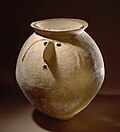
[[File:Cremation Urn with Lid LACMA AC1994.234.8a-b.jpg|thumb|upright|Cremation urn, [[Gandhara grave culture]], Swat Valley, {{circa|1200 BC}}.|left]] | |||
[[File: | Gandhara's first recorded culture was the Grave Culture that emerged ''c.'' 1400 BCE and lasted until 800 BCE,<ref>Olivieri, Luca M., Roberto Micheli, Massimo Vidale, and Muhammad Zahir, (2019). [https://reich.hms.harvard.edu/sites/reich.hms.harvard.edu/files/inline-files/2019_Science_NarasimhanPatterson_CentralSouthAsia_Supplement.pdf 'Late Bronze – Iron Age Swat Protohistoric Graves (Gandhara Grave Culture), Swat Valley, Pakistan (n-99)'], in Narasimhan, Vagheesh M., et al., "Supplementary Materials for the formation of human populations in South and Central Asia", Science 365 (6 September 2019), pp. 137-164.</ref> and named for their distinct funerary practices. It was found along the Middle [[Swat River]] course, even though earlier research considered it to be expanded to the Valleys of [[Dir District|Dir]], [[Kunar Province|Kunar]], [[Chitral]], and [[Valley of Peshawar|Peshawar]].<ref>Coningham, Robin, and Mark Manuel, (2008). "Kashmir and the Northwest Frontier", Asia, South, in ''Encyclopedia of Archaeology 2008'', Elsevier, p. 740.</ref> It has been regarded as a token of the Indo-Aryan migrations, but has also been explained by local cultural continuity. Backwards projections, based on ancient DNA analyses, suggest ancestors of Swat culture people mixed with a population coming from [[Inner Asia Mountain Corridor]], which carried [[Eurasian Steppe|Steppe]] ancestry, sometime between 1900 and 1500 BCE.<ref>Narasimhan, Vagheesh M., et al. (2019). [https://reich.hms.harvard.edu/sites/reich.hms.harvard.edu/files/inline-files/2019_Science_NarasimhanPatterson_CentralSouthAsia.pdf "The formation of human populations in South and Central Asia"], in Science 365 (6 September 2019), p. 11: "...we estimate the date of admixture into the Late Bronze Age and Iron Age individuals from the Swat District of northernmost South Asia to be, on average, 26 generations before the date that they lived, corresponding to a 95% confidence interval of ~1900 to 1500 BCE..."</ref> | ||
[[ | |||
=== Vedic era === | |||
{{Main|Gandhāra (kingdom)|Gandhara Kingdom}} | |||
[[File:Mahajanapadas (c. 500 BCE).png|thumb|upright=1.15|Kingdoms and cities of ancient Buddhism, with Gandhara located in the northwest of this region, during the time of the Buddha ({{circa|500 BC}}).]] | |||
The first mention of the Gandhārīs is attested once in the [[Rigveda|{{transliteration|sa|Ṛgveda}}]] as a tribe that has sheep with good wool. In the [[Atharvaveda|{{transliteration|sa|Atharvaveda}}]], the Gandhārīs are mentioned alongside the Mūjavants, the [[Anga|Āṅgeyas]]. and the [[Magadha|Māgadhīs]] in a hymn asking fever to leave the body of the sick man and instead go those aforementioned tribes. The tribes listed were the furthermost border tribes known to those in [[Madhyadesha|{{transliteration|sa|Madhyadeśa}}]], the Āṅgeyas and Māgadhīs in the east, and the Mūjavants and Gandhārīs in the north.<ref>{{Cite book |last1=Macdonell |first1=Arthur Anthony |title=Vedic Index of Names and Subjects |last2=Keith |first2=Arthur Berriedale |publisher=John Murray |year=1912 |pages=218–219}}</ref><ref>{{Cite book |last=Chattopadhyaya |first=Sudhakar |title=Reflections on the Tantras |publisher=Motilal Banarsidass Publishers |year=1978 |pages=4}}</ref> | |||
The Gāndhārī king [[Nagnajit]] and his son Svarajit are mentioned in the [[Brahmana|{{transliteration|sa|Brāhmaṇa}}s]], according to which they received Brahmanic consecration, but their family's attitude towards ritual is mentioned negatively,{{sfn|Raychaudhuri|1953|p=59-62}} with the royal family of Gandhāra during this period following non-Brahmanical religious traditions. According to the [[Jainism|Jain]] [[Uttaradhyayana|{{transliteration|sa|Uttarādhyayana-sūtra}}]], Nagnajit, or Naggaji, was a prominent king who had adopted Jainism and was comparable to Dvimukha of [[Pancala|Pāñcāla]], Nimi of [[Videha]], Karakaṇḍu of [[Kalinga (historical region)|Kaliṅga]], and Bhīma of [[Vidarbha]]; [[Buddhism|Buddhist]] sources instead claim that he had achieved [[Pratyekabuddhayāna|{{transliteration|pi|paccekabuddhayāna}}]].{{sfn|Raychaudhuri|1953|p=146-147}}<ref name="Prakash">{{cite journal |last=Prakash |first=Buddha |date=1951 |title=Poros |url=https://www.jstor.org/stable/41784590 |journal=Annals of the Bhandarkar Oriental Research Institute |volume=32 |issue=1 |pages=198–233 |doi= |jstor=41784590 |access-date=12 June 2022}}</ref>{{Sfn|Macdonell|Keith|1912|p=218-219, 432}} | |||
By the later Vedic period, the situation had changed, and the Gāndhārī capital of [[Taxila|Takṣaśila]] had become an important centre of knowledge where the men of {{transliteration|sa|Madhya-desa}} went to learn the three Vedas and the eighteen branches of knowledge, with the {{transliteration|sa|Kauśītaki Brāhmaṇa}} recording that [[Brahmin|{{transliteration|sa|brāhmaṇa}}s]] went north to study. According to the [[Shatapatha Brahmana|{{transliteration|sa|Śatapatha Brāhmaṇa}}]] and the {{transliteration|pi|Uddālaka Jātaka}}, the famous Vedic philosopher [[Uddālaka Āruṇi]] was among the famous students of Takṣaśila, and the {{transliteration|pi|Setaketu Jātaka}} claims that his son Śvetaketu also studied there. In the [[Chandogya Upanishad|{{transliteration|sa|Chāndogya Upaniṣad}}]], Uddālaka Āruṇi himself favourably referred to Gāndhārī education to the [[Videha|Vaideha]] king [[Janaka]].{{sfn|Raychaudhuri|1953|p=59-62}} | |||
During the 6th century BCE, Gandhāra was an important imperial power in north-west Iron Age South Asia, with the [[Kashmir Valley|valley of Kaśmīra]] being part of the kingdom,{{sfn|Raychaudhuri|1953|p=146-147}} while the other states of the Punjab region, such as the [[Kekaya]]s, [[Madra]]kas, [[Uśīnara]]s, and [[Shivi]]s being under Gāndhārī suzerainty. The Gāndhārī king [[Pushkarasarin|Pukkusāti]], who reigned around 550 BCE, engaged in expansionist ventures which brought him into conflict with the king [[Pradyota]] of the rising power of [[Avanti (Ancient India)|Avanti]]. Pukkusāti was successful in this struggle with Pradyota, but war broke out between him and the [[Arjunayanas|Pāṇḍava]] tribe located in the [[Punjab]] region, and who were threatened by his expansionist policy.<ref name="Prakash" /><ref>{{cite book |last=Jain |first=Kailash Chand |url= |title=Malwa Through the Ages |date=1972 |publisher=[[Motilal Banarsidass]] |isbn=978-8-120-80824-9 |location=[[Delhi]], [[India]] |pages=98–104 |author-link=}}</ref> Pukkusāti also engaged in friendly relations with the king [[Bimbisara|Bimbisāra]] of [[Magadha]].<ref name="Prakash" /> | |||
Due to this important position, Buddhist texts listed the Gandhāra kingdom as one of the sixteen ''[[Mahajanapadas|{{transliteration|sa|Mahājanapada}}s]]'' ("great realms") of Iron Age South Asia. It was the home of [[Gandhari (Mahabharata)|Gandhari]], the princess of [[Gandhara Kingdom|Gandhara kingdom]].<ref name="Higham2014">{{citation |last=Higham |first=Charles |title=Encyclopedia of Ancient Asian Civilizations |url=https://books.google.com/books?id=H1c1UIEVH9gC&pg=PA209 |pages=209– |year=2014 |publisher=Infobase Publishing |isbn=978-1-4381-0996-1}}</ref><ref name="Devi2007">{{cite book |author=Khoinaijam Rita Devi |url=https://books.google.com/books?id=R0UwAQAAIAAJ |title=History of ancient India: on the basis of Buddhist literature |date=1 January 2007 |publisher=Akansha Publishing House |isbn=978-81-8370-086-3}}</ref> | |||
===Achaemenid Gandhara=== | ===Achaemenid Gandhara=== | ||
| Line 110: | Line 112: | ||
{{See also|Achaemenid invasion of the Indus Valley}} | {{See also|Achaemenid invasion of the Indus Valley}} | ||
{{More citations needed section|date=February 2021}} | {{More citations needed section|date=February 2021}} | ||
[[File: | [[File:Xerxes detail Gandharan enhanced.jpg|thumb|200x200px|[[Xerxes I]] tomb, Gandāra soldier, {{Circa|470 BC}}.]] | ||
By the later 6th century BCE, the founder of the [[Persians|Persian]] [[Achaemenid Empire]], [[Cyrus the Great|Cyrus]], soon after his conquests of [[Medes|Media]], [[Lydia]], and [[Neo-Babylonian Empire|Babylonia]], marched into Gandhara and annexed it into his empire.<ref name="CAH">{{cite book |editor1-last=Boardman |editor1-first=John |editor1-link=John Boardman (art historian) |editor2-last=Hammond |editor2-first=N. G. L. |editor2-link=N. G. L. Hammond |editor3-last=Lewis |editor3-first=D. M. |editor3-link=David Malcolm Lewis |editor4-last=Ostwald |editor4-first=M. |editor4-link=Martin Ostwald |author-last=Young |author-first=T. Cuyler |author-link= |date=1988 |chapter=The early history of the Medes and the Persians and the Achaemenid empire to the death of Cambyses |title=The Cambridge Ancient History |volume=4 |url= |location=[[Cambridge]] |publisher=[[Cambridge University Press]] |pages=1–52 |isbn=978-0-521-22804-6 }}</ref> The scholar [[K. D. Sethna|Kaikhosru Danjibuoy Sethna]] advanced that Cyrus had conquered only the trans-Indus borderlands around Peshawar which had belonged to Gandhāra while Pukkusāti remained a powerful king who maintained his rule over the rest of Gandhāra and the western Punjab.<ref>{{cite book |last=Sethna |first=Kaikhosru Danjibuoy |author-link=K. D. Sethna |chapter=To Pāṇini's Time from Pāṇini's Place |date=2000 |title=Problems of Ancient India |url= |location= |publisher=Aditya Prakashan |pages=121–172 |isbn=978-8-177-42026-5}}</ref> | |||
However, according to the scholar [[Buddha Prakash]], Pukkusāti might have acted as a bulwark against the expansion of the [[Persians|Persian]] [[Achaemenid Empire]] into north-west South Asia. This hypothesis posits that the army which [[Nearchus]] claimed [[Cyrus the Great|Cyrus]] had lost in [[Gedrosia]] had in fact been defeated by Pukkusāti's Gāndhārī kingdom. Therefore, following Prakash's position, the Achaemenids would have been able to conquer Gandhāra only after a period of decline of Gandhāra after the reign of Pukkusāti combined the growth of Achaemenid power under the kings [[Cambyses II]] and [[Darius the Great|Darius I]].<ref name="Prakash"/> However, the presence of Gandhāra, referred to as {{transliteration|peo|Ga<sup>n</sup>dāra}} in [[Old Persian]], among the list of Achaemenid provinces in Darius's [[Behistun Inscription]] confirms that his empire had inherited this region from conquests carried out earlier by Cyrus.<ref name="CAH"/> | |||
It is unknown whether Pukkusāti remained in power after the Achaemenid conquest as a Persian vassal or if he was replaced by a Persian [[satrap]] (governor),<ref>{{cite book |editor1-last=Boardman |editor1-first=John |editor1-link=John Boardman (art historian) |editor2-last=Hammond |editor2-first=N. G. L. |editor2-link=N. G. L. Hammond |editor3-last=Lewis |editor3-first=D. M. |editor3-link=David Malcolm Lewis |editor4-last=Ostwald |editor4-first=M. |editor4-link=Martin Ostwald |author-last=Bivar |author-first=A. D. H. |author-link=David Bivar |date=1988 |chapter=The Indus Lands |title=The Cambridge Ancient History |volume=4 |url= |location=[[Cambridge]] |publisher=[[Cambridge University Press]] |pages=194–210 |isbn=978-0-521-22804-6 }}</ref> although [[Buddhism|Buddhist]] sources claim that he renounced his throne and became a monk after becoming a disciple of the [[Gautama Buddha|Buddha]].<ref>{{cite web|title=Pukkusāti|url=http://www.palikanon.com/english/pali_names/pu/pukkusati.htm|publisher=www.palikanon.com|access-date=26 July 2020}}</ref> The annexation under Cyrus was limited to Gandhāra proper, after which the peoples of the Punjab region previously under Gāndhārī authority took advantage of the new power vacuum to form their own states.<ref name="Prakash"/> | |||
[[File:Athens coin discovered in Pushkalavati.jpg|thumb|[[Athens]] coin ({{circa|500/490–485 BCE}}) discovered in [[Pushkalavati]]. This coin is the earliest known example of its type to be found so far east.<ref>O. Bopearachchi, "Premières frappes locales de l'Inde du Nord-Ouest: nouvelles données," in Trésors d'Orient: Mélanges offerts à Rika Gyselen, Fig. 1 [https://www.cngcoins.com/Coin.aspx?CoinID=199773 CNG Coins]</ref> Such coins were circulating in the area as currency, at least as far as the [[Indus]], during the reign of the [[Achaemenids]].<ref name="OB300">{{cite book |last1=Bopearachchi |first1=Osmund |title=Coin Production and Circulation in Central Asia and North-West India (Before and after Alexander's Conquest) |pages=300–301 |url=https://www.academia.edu/15798938 |language=en}}</ref><ref>{{Cite web |url=https://www.cemml.colostate.edu/cultural/09476/afgh05-106.html |title=US Department of Defense |access-date=7 October 2018 |archive-date=10 June 2020 |archive-url=https://web.archive.org/web/20200610004813/https://www.cemml.colostate.edu/cultural/09476/afgh05-106.html |url-status=dead }}</ref><ref name="JC">{{cite book |last1=Errington |first1=Elizabeth |last2=Trust |first2=Ancient India and Iran |last3=Museum |first3=Fitzwilliam |title=The Crossroads of Asia: transformation in image and symbol in the art of ancient Afghanistan and Pakistan |date=1992 |publisher=Ancient India and Iran Trust |isbn=9780951839911 |pages=57–59 |url=https://books.google.com/books?id=pfLpAAAAMAAJ |language=en}}</ref><ref name="OB308">{{cite book |last1=Bopearachchi |first1=Osmund |title=Coin Production and Circulation in Central Asia and North-West India (Before and after Alexander's Conquest) |pages=308– |url=https://www.academia.edu/15798938 |language=en}}</ref> |left]] | |||
Under Persian rule, a system of centralized administration, with a bureaucratic system, was introduced into the Indus Valley for the first time. Provinces or "satrapy" were established with provincial capitals. | Under Persian rule, a system of centralized administration, with a bureaucratic system, was introduced into the Indus Valley for the first time. Provinces or "satrapy" were established with provincial capitals. | ||
[[ | [[#Part of Achaemenid Empire|Gandhara]] satrapy, established 518 BCE with its capital at [[Pushkalavati]] ([[Charsadda]]).<ref>Rafi U. Samad, [https://books.google.com/books?id=pNUwBYGYgxsC&pg=PA33 ''The Grandeur of Gandhara: The Ancient Buddhist Civilization of the Swat, Peshawar, Kabul and Indus Valleys.''] Algora Publishing, 2011, p. 32 {{ISBN|0875868592}}</ref> | ||
The inscription on Darius' (521–486 BCE) tomb at [[Naqsh-e Rustam|Naqsh-i-Rustam]] near Persepolis records Gadāra (Gandāra) along with [[Hindush]] (Hənduš, Sindh) in the list of ''satrapies''. By about 380 BC the Persian hold on the region had weakened. Many small kingdoms sprang up in Gandhara. | The inscription on Darius' (521–486 BCE) tomb at [[Naqsh-e Rustam|Naqsh-i-Rustam]] near Persepolis records Gadāra (Gandāra) along with [[Hindush]] (Hənduš, Sindh) in the list of ''satrapies''. By about 380 BC the Persian hold on the region had weakened. Many small kingdoms sprang up in Gandhara. | ||
===Macedonian Gandhara=== | ===Macedonian Gandhara=== | ||
{{Main|Paropamisadae}} | {{Main|Paropamisadae}} | ||
{{See also|Indian campaign of Alexander the Great|Macedonian Empire}} | {{See also|Indian campaign of Alexander the Great|Macedonian Empire}} | ||
[[ | |||
In 327 BCE, [[Alexander the Great]] conquered Gandhara as well as the Indian ''satrapies'' of the Persian Empire. The expeditions of Alexander were recorded by his court historians and by [[Arrian]] (around 175 CE) in his ''[[Anabasis Alexandri]]'' and by other chroniclers many centuries after the event. | |||
In the winter of 327 BCE, Alexander invited all the chieftains in the remaining five Achaemenid satraps to submit to his authority. [[Ambhi]], then ruler of Taxila in the former [[Hindush]] satrapy complied, but the remaining tribes and clans in the former satraps of Gandhara, Arachosia, Sattagydia and Gedrosia rejected Alexander's offer.{{Citation needed|date=March 2021}} | In the winter of 327 BCE, Alexander invited all the chieftains in the remaining five Achaemenid satraps to submit to his authority. [[Ambhi]], then ruler of Taxila in the former [[Hindush]] satrapy complied, but the remaining tribes and clans in the former satraps of Gandhara, Arachosia, Sattagydia and Gedrosia rejected Alexander's offer.{{Citation needed|date=March 2021}} | ||
The first tribe they encountered were the [[Aspasioi]] tribe of the [[Kunar Valley]], who initiated a fierce battle against Alexander, in which he himself was wounded in the shoulder by a dart. However, the Aspasioi eventually lost and 40,000 people were enslaved. Alexander then continued in a southwestern direction where he encountered the [[Assakenoi]] tribe of the [[Swat, Pakistan|Swat]] & [[Buner]] valleys in April 326 BCE. The Assakenoi fought bravely and offered stubborn resistance to Alexander and his army in the cities of Ora, Bazira ([[Barikot]]) and Massaga. So enraged was Alexander about the resistance put up by the Assakenoi that he killed the entire population of Massaga and reduced its buildings to rubble. A similar slaughter then followed at Ora,<ref>{{cite book|title=History and Culture of Indian People, The Age of Imperial Unity, Foreign Invasion|author=Mukerjee, R. K.|page=46}}</ref> another stronghold of the Assakenoi. The stories of these slaughters reached numerous Assakenians, who began fleeing to Aornos, a hill-fort located between [[Shangla]] and [[Kohistan District, Pakistan|Kohistan]]. Alexander followed close behind their heels and besieged the strategic hill-fort, eventually capturing and destroying the fort and killing everyone inside. The remaining smaller tribes either surrendered or like the Astanenoi tribe of [[Pushkalavati ]]([[Charsadda]]) were quickly neutralized where 38,000 soldiers and 230,000 oxen were captured by Alexander.<ref>Curtius in McCrindle, p. 192, J. W. McCrindle; ''History of Punjab'', Vol I, 1997, p 229, Punjabi University, Patiala (editors): Fauja Singh, L. M. Joshi; ''Kambojas Through the Ages'', 2005, p. 134, Kirpal Singh.</ref> Eventually Alexander's smaller force would meet with the larger force which had come through the Khyber Pass met at [[Attock]]. With the conquest of Gandhara complete, Alexander switched to strengthening his military supply line, which by now stretched dangerously vulnerable over the [[Hindu Kush]] back to [[Balkh]] in Bactria.{{Citation needed|date=March 2021}} | The first tribe they encountered were the [[Aspasioi]] tribe of the [[Kunar Valley]], who under the leadership of their queen [[Cleophis]] initiated a fierce battle against Alexander, in which he himself was wounded in the shoulder by a dart. However, the Aspasioi eventually lost and 40,000 people were enslaved. Alexander then continued in a southwestern direction where he encountered the [[Assakenoi]] tribe of the [[Swat, Pakistan|Swat]] & [[Buner]] valleys in April 326 BCE. The Assakenoi fought bravely and offered stubborn resistance to Alexander and his army in the cities of Ora, Bazira ([[Barikot]]) and Massaga. So enraged was Alexander about the resistance put up by the Assakenoi that he killed the entire population of Massaga and reduced its buildings to rubble. A similar slaughter then followed at Ora,<ref>{{cite book|title=History and Culture of Indian People, The Age of Imperial Unity, Foreign Invasion|author=Mukerjee, R. K.|page=46}}</ref> another stronghold of the Assakenoi. The stories of these slaughters reached numerous Assakenians, who began fleeing to Aornos, a hill-fort located between [[Shangla]] and [[Kohistan District, Pakistan|Kohistan]]. Alexander followed close behind their heels and besieged the strategic hill-fort, eventually capturing and destroying the fort and killing everyone inside. The remaining smaller tribes either surrendered or like the Astanenoi tribe of [[Pushkalavati]]([[Charsadda]]) were quickly neutralized where 38,000 soldiers and 230,000 oxen were captured by Alexander.<ref>Curtius in McCrindle, p. 192, J. W. McCrindle; ''History of Punjab'', Vol I, 1997, p 229, Punjabi University, Patiala (editors): Fauja Singh, L. M. Joshi; ''Kambojas Through the Ages'', 2005, p. 134, Kirpal Singh.</ref> Eventually Alexander's smaller force would meet with the larger force which had come through the Khyber Pass met at [[Attock]]. With the conquest of Gandhara complete, Alexander switched to strengthening his military supply line, which by now stretched dangerously vulnerable over the [[Hindu Kush]] back to [[Balkh]] in Bactria.{{Citation needed|date=March 2021}} | ||
After conquering Gandhara and solidifying his supply line back to Bactria, Alexander combined his forces with the King Ambhi of Taxila and crossed the River Indus in July 326 BCE to begin the Archosia (Punjab) campaign. Alexander nominated officers as Satraps of the new provinces, and in Gandhara, [[Oxyartes]] was nominated to the position of Satrap in 326 BCE.{{Citation needed|date=March 2021}} | After conquering Gandhara and solidifying his supply line back to Bactria, Alexander combined his forces with the King Ambhi of Taxila and crossed the River Indus in July 326 BCE to begin the Archosia (Punjab) campaign. Alexander nominated officers as Satraps of the new provinces, and in Gandhara, [[Oxyartes]] was nominated to the position of Satrap in 326 BCE.{{Citation needed|date=March 2021}} | ||
===Mauryan Gandhara=== | ===Mauryan Gandhara=== | ||
[[File: | [[File:Upper Boulder with Inscriptions - Mansehra Rock Edicts.jpg|thumb|[[Major Rock Edicts|Major Rock Edict]] of Ashoka in [[Mansehra District|Mansehra]].]] | ||
[[ | After a battle with [[Seleucus Nicator]] (Alexander's successor in Asia) in 305 BCE, the [[Mauryan]] emperor [[Chandragupta Maurya|Chandragupta]] extended his domain up to and including Gandhara and [[Arachosia]]. With the completion of the Empire's [[Grand Trunk Road]], the region prospered as a centre of trade. Gandhara remained a part of the Mauryan Empire for about a century and a half. | ||
[[Ashoka]], the grandson of Chandragupta, was one of the greatest Indian rulers. Like his grandfather, Ashoka also started his career in Gandhara as a governor. Later he became a [[Buddhist]] and promoted Buddhism, building many ''stupas'' in Gandhara. Mauryan control over the northwestern frontier, including the [[Yona]]s, [[Kambojas]], and the Gandharas, is attested from the [[Rock Edicts]] left by Ashoka. | |||
According to one school of scholars, the Gandharas and Kambojas were [[Cognatic kinship|cognate]] people.<ref>Revue des etudes grecques 1973, p 131, Ch-Em Ruelle, Association pour l'encouragement des etudes grecques en France.</ref><ref>Early Indian Economic History, 1973, pp 237, 324, Rajaram Narayan Saletore.</ref><ref>Myths of the Dog-man, 199, p 119, David Gordon White; Journal of the Oriental Institute, 1919, p 200; Journal of Indian Museums, 1973, p 2, Museums Association of India; The Pāradas: A Study in Their Coinage and History, 1972, p 52, Dr B. N. Mukherjee – Pāradas; Journal of the Department of Sanskrit, 1989, p 50, Rabindra Bharati University, Dept. of Sanskrit- Sanskrit literature; The Journal of Academy of Indian Numismatics & Sigillography, 1988, p 58, Academy of Indian Numismatics and Sigillography – Numismatics; Cf: Rivers of Life: Or Sources and Streams of the Faiths of Man in All Lands, 2002, p 114, J. G. R. Forlong.</ref> It is also contended{{By whom|date=April 2022|discuss=Mauryan Gandhara cognate peoples}} that the [[Kuru Kingdom|Kurus]], [[Kambojas]], Gandharas and [[Bahlikas]] were cognate people and all had Iranian affinities,<ref>Journal of the Oriental Institute, 1919, p 265, Oriental Institute (Vadodara, India) – Oriental studies; For Kuru-Kamboja connections, see Dr Chandra Chakraberty's views in: Literary history of ancient India in relation to its racial and linguistic affiliations, pp 14,37, Vedas; The Racial History of India, 1944, p 153, Chandra Chakraberty – Ethnology; Paradise of Gods, 1966, p 330, Qamarud Din Ahmed – Pakistan.</ref> or that the Gandhara and Kamboja were nothing but two provinces of one empire and hence influencing each other's language.<ref>Ancient India, History of India for 1000 years, four Volumes, Vol I, 1938, pp 38, 98 Dr T. L. Shah.</ref> However, the local language of Gandhara is represented by Panini's conservative ''bhāṣā'' ("language"), which is entirely different from the Iranian (Late Avestan) language of the Kamboja that is indicated by [[Patanjali]]'s quote of Kambojan śavati 'to go' (= Late Avestan šava(i)ti).{{efn|group=note|''NOTE'': See long discussion under ''[[mahajanapada]]'' from the Ancient Buddhist text Anguttara Nikaya's list of ''mahajanapadas''.}} | |||
== | ===Indo-Greek Kingdom=== | ||
[[File:Demetrius I of Bactria.jpg|right|thumb|The founder of the [[Indo-Greek Kingdom]] [[Demetrius I of Bactria|Demetrius I]] (205–171 BC), wearing the scalp of an elephant, symbol of his conquest of the Indus valley.]]The Indo-Greek king [[Menander I]] (reigned 155–130 BCE) drove the Greco-Bactrians out of Gandhara and beyond the [[Hindu Kush]], becoming king shortly after his victory. | |||
His empire survived him in a fragmented manner until the last independent Greek king, [[Strato II]], disappeared around 10 CE. Around 125 BCE, the Greco-Bactrian king [[Heliocles]], son of Eucratides, fled from the [[Yuezhi]] invasion of Bactria and relocated to Gandhara, pushing the Indo-Greeks east of the [[Jhelum River]]. The last known Indo-Greek ruler was [[Theodamas]], from the [[Bajaur]] area of Gandhara, mentioned on a 1st-century CE signet ring, bearing the Kharoṣṭhī inscription ''"Su Theodamasa"'' (''"Su"'' was the Greek transliteration of the [[Kushan]] royal title ''"Shau"'' ("[[Shah]]" or "King")). | |||
[[ | |||
It is during this period that the fusion of Hellenistic and South Asian mythological, artistic and religious elements becomes most apparent, especially in the region of Gandhara.<ref>{{Diff|en:Greco-Buddhist_art|diff=|oldid=878583324|label=en:Greco-Buddhist_art, oldid 878583324}}{{Circular reference|date=September 2021}}</ref> | |||
Local Greek rulers still exercised a feeble and precarious power along the borderland, but the last vestige of the Greco-Indian rulers were finished by a people known to the old Chinese as the Yeuh-Chi.<ref name= IG149>{{Harv|Imperial Gazetteer|p=149}}</ref> | |||
===Indo-Scythian Kingdom=== | ===Indo-Scythian Kingdom=== | ||
[[File:Buner reliefs Scythian bacchanalian cropped.jpg|left|thumb|One of the [[Buner reliefs]] showing Scythian soldiers dancing. [[Cleveland Museum of Art]].]] | |||
The [[Indo-Scythians]] were descended from the [[Sakas]] (Scythians) who migrated from Central Asia into South Asia from the middle of the 2nd century BCE to the 1st century BCE. They displaced the Indo-Greeks and ruled a kingdom that stretched from Gandhara to [[Mathura, Uttar Pradesh|Mathura]]. The first Indo-Scythian king [[Maues]] established [[Saka]] hegemony by conquering [[Indo-Greek]] territories.<ref>The Grandeur of Gandhara, Rafi-us Samad, Algora Publishing, 2011, p.64-67 [https://books.google.com/books?id=PMEd8Cqh-YQC&pg=PA66]</ref> The power of the Saka rulers declined after the defeat to [[Chandragupta II]] of the [[Gupta Empire]] in the 4th century.<ref>Ancient India by Ramesh Chandra Majumdar p. 234</ref> | |||
===Indo-Parthian Kingdom=== | ===Indo-Parthian Kingdom=== | ||
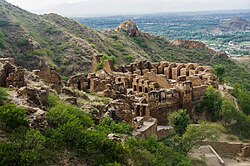
[[File:Takht-e-bahi.jpg|thumb|Ancient [[Buddhist]] [[monastery]] [[Takht-i-Bahi]] (a [[UNESCO World Heritage Site]]) constructed by the Indo-Parthians.]] | |||
The [[Indo-Parthian Kingdom]] was ruled by the Gondopharid dynasty, named after its first ruler [[Gondophares]]. For most of their history, the leading Gondopharid kings held [[Taxila]] (in the present [[Punjab, Pakistan|Punjab]] province of [[Pakistan]]) as their residence, but during their last few years of existence the capital shifted between [[Kabul]] and [[Peshawar]]. These kings have traditionally been referred to as Indo-Parthians, as their coinage was often inspired by the [[Arsacid dynasty of Parthia|Arsacid]] dynasty, but they probably belonged to a wider groups of [[Iranian peoples|Iranic]] tribes who lived east of [[Parthia]] proper, and there is no evidence that all the kings who assumed the title ''Gondophares'', which means "Holder of Glory", were even related. | |||
===Kushan Gandhara=== | ===Kushan Gandhara=== | ||
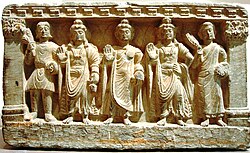
[[File:KanishkaCasket.JPG|thumb|upright|left|Casket of | [[File:Gandhara Buddha (tnm).jpeg|thumb|upright|[[Greco-Buddhism|Greco-Buddhist]] [[Standing Buddha from Gandhara (Tokyo)|standing Buddha from Gandhara]] (1st–2nd century), [[Tokyo National Museum]]]] | ||
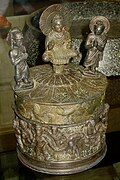
The Parthian dynasty fell in about 75 to another group from Central Asia. The [[Kushan Empire|Kushans]], known as [[Yuezhi]] in the Chinese source Hou Han Shu (argued by some{{Who|date=July 2017}} to be ethnically [[Asii]]) moved from Central Asia to [[Bactria]], where they stayed for a century. Around 75 CE, one of their tribes, the Kushan (Kuṣāṇa), under the leadership of Kujula Kadphises gained control of Gandhara. The Kushan empire began as a Central Asian kingdom, and expanded into | [[File:KanishkaCasket.JPG|thumb|upright|left|[[Kanishka casket|Casket of Kanishka the Great]], with Buddhist motifs]] | ||
The Parthian dynasty fell in about 75 to another group from Central Asia. The [[Kushan Empire|Kushans]], known as [[Yuezhi]] in the Chinese source Hou Han Shu (argued by some{{Who|date=July 2017}} to be ethnically [[Asii]]) moved from Central Asia to [[Bactria]], where they stayed for a century. Around 75 CE, one of their tribes, the Kushan (Kuṣāṇa), under the leadership of Kujula Kadphises gained control of Gandhara. The Kushan empire began as a Central Asian kingdom, and expanded into South Asia in the early centuries CE.<ref>{{cite book |author-link= Upinder Singh |title= Political Violence in Ancient India |url= https://books.google.com/books?id=dYM4DwAAQBAJ |page= 166 |isbn= 9780674981287|last1= Singh |first1= Upinder |date= 25 September 2017 }}</ref> | |||
The Kushan period is considered the Golden Period of Gandhara. Peshawar Valley and Taxila are littered with ruins of ''stupas'' and monasteries of this period. Gandharan art flourished and produced some of the best pieces of sculpture from the Indian subcontinent. | The Kushan period is considered the Golden Period of Gandhara. Peshawar Valley and Taxila are littered with ruins of ''stupas'' and monasteries of this period. [[Greco-Buddhist art|Gandharan art]] flourished and produced some of the best pieces of sculpture from the Indian subcontinent. | ||
Gandhara's culture peaked during the reign of the great Kushan king [[Kanishka the Great]] (127 CE – 150 CE). The cities of Taxila (Takṣaśilā) at Sirsukh and Purushapura (modern day [[Peshawar]]) reached new heights. Purushapura along with [[Mathura]] became the capital of the great empire stretching from Central Asia to Northern [[India]] with Gandhara being in the midst of it. Emperor [[Kanishka]] was a great patron of the Buddhist faith; [[Buddhism]] spread from [[India]] to [[Central Asia]] and the Far East across [[Bactria]] and [[Sogdia]], where his empire met the [[Han dynasty|Han Empire]] of China. Buddhist art spread from Gandhara to other parts of Asia. | |||
Gandhara's culture peaked during the reign of the great Kushan king [[Kanishka the Great]] (127 CE – 150 CE). The cities of Taxila (Takṣaśilā) at Sirsukh and Purushapura (modern day [[Peshawar]]) reached new heights. Purushapura along with [[Mathura]] became the capital of the great empire stretching from Central Asia to Northern [[India]] with Gandhara being in the midst of it. Emperor [[Kanishka]] was a great patron of the Buddhist faith; [[Buddhism]] spread from [[India]] to [[Central Asia]] and the Far East across [[Bactria]] and [[Sogdia]], where his empire met the [[Han dynasty|Han Empire]] of China. Buddhist art spread from Gandhara to other parts of Asia. | |||
In Gandhara, [[Mahayana Buddhism]] flourished and Buddha was represented in human form. Under the Kushans new Buddhists ''stupas'' were built and old ones were enlarged. Huge statues of the Buddha were erected in monasteries and carved into the hillsides. Kanishka also built | In Gandhara, [[Mahayana Buddhism]] flourished and Buddha was represented in human form. Under the Kushans new Buddhists ''stupas'' were built and old ones were enlarged. Huge statues of the Buddha were erected in monasteries and carved into the hillsides. Kanishka also built the 400-foot [[Kanishka Stupa|Kanishka stupa]] at Peshawar. This tower was reported by Chinese monks [[Faxian]], [[Song Yun]], and [[Xuanzang]] who visited the country. The stupa was built during the Kushan era to house Buddhist relics, and was among the tallest buildings in the ancient world.<ref>{{cite book |last1=Le |first1=Huu Phuoc |url=https://books.google.com/books?id=9jb364g4BvoC&pg=PA180 |title=Buddhist Architecture |date=2010 |publisher=Grafikol |isbn=9780984404308 |page=180 |language=en}}</ref><ref name="auto3">Marshall, John H. (1909): "Archaeological Exploration in India, 1908–9." (Section on: "The stūpa of Kanishka and relics of the Buddha"). ''Journal of the Royal Asiatic Society'', 1909, pp. 1056–1061.</ref><ref name="Chandra1979">{{cite book |author=Rai Govind Chandra |url=https://books.google.com/books?id=97od3sgsAjcC&pg=PA82 |title=Indo-Greek Jewellery |date=1 January 1979 |publisher=Abhinav Publications |isbn=978-81-7017-088-4 |pages=82– |access-date=13 December 2012}}</ref><gallery> | ||
File:Gandharan sculpture - head of a bodhisattva.jpg|Head of a bodhisattva, c. 4th century CE | |||
<!-- Deleted image removed: File:Amulet-box, Gandhara, Pakistan.jpeg|Amulet-box, 2nd - 3rd century CE --> | |||
File:Buddha-Vajrapani-Herakles.JPG|The Buddha and [[Vajrapani]] under the guise of [[Herakles]], c. 2nd-3rd century CE | |||
</gallery> | |||
===Kidarites=== | ===Kidarites=== | ||
The Kidarites conquered [[Peshawar]] and parts of northwest Indian subcontinent including Gandhara probably sometime between 390 and 410 from Kushan empire,<ref>{{cite book |last1=Dani |first1=Ahmad Hasan |last2=Litvinsky |first2=B. A. |title=History of Civilizations of Central Asia: The crossroads of civilizations, A.D. 250 to 750 |date=1996 |publisher=UNESCO |isbn=9789231032110 |page=122 |url=https://books.google.com/books?id=883OZBe2sMYC&pg=PA122 |language=en}}</ref> around the end of the rule of Gupta Emperor [[Chandragupta II]] or beginning of the rule of [[Kumaragupta I]].<ref>"The entry of the Kidarites into India may firmly be placed some time round about the end of rule of Candragupta II or beginning of the rule of Kumaragupta I (circa 410-420 a.d.)" in {{cite book |last1=Gupta |first1=Parmeshwari Lal |last2=Kulashreshtha |first2=Sarojini |title=Kuṣāṇa Coins and History |date=1994 |publisher=D.K. Printworld |isbn=9788124600177 |page=122 |url=https://books.google.com/books?id=q1caAAAAYAAJ |language=en}}</ref> It is probably the rise of the Hephthalites and the defeats against the Sasanians which pushed the Kidarites into northern India. Their last ruler in Gandhara was Kandik, around 500 CE. | The [[Kidarites]] conquered [[Peshawar]] and parts of northwest Indian subcontinent including Gandhara probably sometime between 390 and 410 from Kushan empire,<ref>{{cite book |last1=Dani |first1=Ahmad Hasan |last2=Litvinsky |first2=B. A. |title=History of Civilizations of Central Asia: The crossroads of civilizations, A.D. 250 to 750 |date=1996 |publisher=UNESCO |isbn=9789231032110 |page=122 |url=https://books.google.com/books?id=883OZBe2sMYC&pg=PA122 |language=en}}</ref> around the end of the rule of Gupta Emperor [[Chandragupta II]] or beginning of the rule of [[Kumaragupta I]].<ref>"The entry of the Kidarites into India may firmly be placed some time round about the end of rule of Candragupta II or beginning of the rule of Kumaragupta I (circa 410-420 a.d.)" in {{cite book |last1=Gupta |first1=Parmeshwari Lal |last2=Kulashreshtha |first2=Sarojini |title=Kuṣāṇa Coins and History |date=1994 |publisher=D.K. Printworld |isbn=9788124600177 |page=122 |url=https://books.google.com/books?id=q1caAAAAYAAJ |language=en}}</ref> It is probably the rise of the Hephthalites and the defeats against the Sasanians which pushed the Kidarites into northern India. Their last ruler in Gandhara was Kandik, around 500 CE. | ||
===Alchon Huns=== | ===Alchon Huns=== | ||
Around 430 King [[Khingila]], the most notable [[Alchon Huns|Alchon]] ruler, emerged and took control of the routes across the [[Hindu Kush]] from the Kidarites.<ref>"The Alchon Huns....established themselves as overlords of northwestern India, and directly contributed to the downfall of the Guptas" in {{cite book |last1=Neelis |first1=Jason |title=Early Buddhist Transmission and Trade Networks: Mobility and Exchange Within and Beyond the Northwestern Borderlands of South Asia |date=2010 |publisher=BRILL |isbn=9789004181595 |page=162 |url=https://books.google.com/books?id=GB-JV2eOr2UC&pg=PA162 |language=en}}</ref><ref>{{citation |last=Bakker |first=Hans |title=Monuments of Hope, Gloom and Glory in the Age of the Hunnic Wars: 50 years that changed India (484–534) |publisher=Royal Netherlands Academy of Arts and Sciences |year=2017 |isbn=978-90-6984-715-3 |url=https://www.knaw.nl/en/news/publications/monuments-of-hope-gloom-and-glory |at=Section 4 |access-date=1 May 2021 |archive-date=11 January 2020 |archive-url=https://web.archive.org/web/20200111041719/https://www.knaw.nl/en/news/publications/monuments-of-hope-gloom-and-glory |url-status=dead }}</ref><ref>{{cite book |author=Atreyi Biswas |date=1971 |title=The Political History of the Hūṇas in India |url=https://books.google.com/books?id=ohwdAAAAMAAJ |publisher=Munshiram Manoharlal Publishers|isbn=9780883863015 }}</ref><ref>{{cite book |author=Upendra Thakur |date=1967 |title=The Hūṇas in India |url=https://archive.org/download/dli.ernet.429146 |publisher=Chowkhamba Prakashan |pages=52–55}}</ref> Coins of the Alchons rulers Khingila and [[Mehama]] were found at the Buddhist monastery of [[Mes Aynak]], southeast of [[Kabul]], confirming the Alchon presence in this area around 450-500 CE.<ref>{{cite journal |last1=Alram |first1=Michael |date=2014 |title=From the Sasanians to the Huns New Numismatic Evidence from the Hindu Kush |url=https://www.jstor.org/stable/44710198 |journal=The Numismatic Chronicle |volume=174 |page=274 |jstor=44710198}}</ref> | |||
{{multiple image | |||
| perrow = 2 | |||
| total_width = 400 | |||
| caption_align = center | |||
| align = right | |||
| direction = horizontal | |||
| image1 = Hephthalite Silver Bowl (side view).jpg | |||
| caption1 = The silver bowl in the [[British Museum]] | |||
| image2 = Alchon horseman on the Hephthalite Silver Bowl.jpg | |||
| caption2 = Alchon horseman.<ref name="MA">{{cite journal |last1=ALRAM |first1=MICHAEL |title=From the Sasanians to the Huns New Numismatic Evidence from the Hindu Kush |journal=The Numismatic Chronicle |date=2014 |volume=174 |pages=274–275 |jstor=44710198 |url=https://www.jstor.org/stable/44710198 |issn=0078-2696}}</ref> | |||
| footer = The so-called "[[Hephthalite bowl]]" from Gandhara, features two [[Kidarites|Kidarite]] hunters wearing characteristic crowns, and as well as two Alchon hunters (one of them shown here, with [[skull deformation]]), suggesting a period of peaceful coexistence between the two entities.<ref name="MA"/> [[Swat District]], [[Pakistan]], 460–479 CE. [[British Museum]].<ref>Iaroslav Lebedynsky, "Les Nomades", p172.</ref><ref name="British Museum notice">{{Cite web|url=http://www.britishmuseum.org/research/collection_online/collection_object_details.aspx?objectId=247021&partId=1|title=British Museum notice|website=[[British Museum]]|access-date=2 April 2023}}</ref> | |||
| footer_align = center | |||
}} | |||
The numismatic evidence as well as the so-called "[[Hephthalite silver bowl|Hephthalite bowl]]" from Gandhara, now in the [[British Museum]], suggests a period of peaceful coexistence between the Kidarites and the Alchons, as it features two [[Kidarites|Kidarite]] noble hunters, together with two Alchon hunters and one of the Alchons inside a medallion.<ref name="MA" /> At one point, the Kidarites withdrew from Gandhara, and the Alchons took over their mints from the time of [[Khingila]].<ref name="MA" /> | |||
= | |||
The Alchons apparently undertook the mass destruction of Buddhist monasteries and [[stupas]] at [[Taxila]], a high center of learning, which never recovered from the destruction.<ref name="AG">{{cite book |last1=Ghosh |first1=Amalananda |url=https://books.google.com/books?id=0NA3AAAAIAAJ&pg=PA791 |title=Taxila |date=1965 |publisher=CUP Archive |page=791 |language=en}}</ref><ref>{{cite book |author= Upinder Singh |date=2017 |title=Political Violence in Ancient India |url=https://books.google.com/books?id=dYM4DwAAQBAJ&pg=PA241 |publisher=Harvard University Press |page=241 |isbn=9780674981287}}</ref> Virtually all of the Alchon coins found in the area of [[Taxila]] were found in the ruins of burned down monasteries, where apparently some of the invaders died alongside local defenders during the wave of destructions.<ref name="AG" /> It is thought that the [[Kanishka stupa]], one of the most famous and tallest buildings in antiquity, was destroyed by them during their invasion of the area in the 460s CE. The [[Mankiala stupa]] was also vandalized during their invasions.<ref name="Le">{{cite book |last1=Le |first1=Huu Phuoc |url=https://books.google.com/books?id=9jb364g4BvoC&q=hephthalite+peshawar&pg=PA51 |title=Buddhist Architecture |date=2010 |publisher=Grafikol |isbn=9780984404308 |access-date=24 March 2017}}</ref> | |||
The | Mihirakula in particular is remembered by [[Buddhist]] sources to have been a "terrible persecutor of their religion" in Gandhara.<ref name="Rene">{{Cite book |last=Grousset |first=Rene |title=The Empire of the Steppes |publisher=Rutgers University Press |year=1970 |isbn=0-8135-1304-9 |pages=[https://archive.org/details/empireofsteppesh00prof/page/69 69–71] |url=https://archive.org/details/empireofsteppesh00prof/page/69 }}</ref> During the reign of [[Mihirakula]], over one thousand Buddhist monasteries throughout Gandhara are said to have been destroyed.<ref name="kurt">{{cite book |last1=Behrendt |first1=Kurt A. |title=Handbuch der Orientalistik |date=2004 |publisher=BRILL |isbn=9789004135956 |location=Leiden}}</ref> In particular, the writings of Chinese monk [[Xuanzang]] from 630 CE explained that Mihirakula ordered the destruction of [[Buddhism]] and the expulsion of monks.<ref name="Upinder Singh 2017 241–242">{{cite book |author=Upinder Singh |url=https://books.google.com/books?id=dYM4DwAAQBAJ&pg=PA241 |title=Political Violence in Ancient India |date=2017 |publisher=Harvard University Press |isbn=9780674981287 |pages=241–242}}</ref> Indeed, the Buddhist art of Gandhara, in particular [[Greco-Buddhist art]], becomes essentially extinct around that period. When Xuanzang visited Gandhara in {{circa|630}} CE, he reported that Buddhism had drastically declined in favour of [[Shaivism]], and that most of the monasteries were deserted and left in ruins.<ref name="HeirmanBumbacher2007">{{cite book |author1=Ann Heirman |url=https://books.google.com/books?id=NuOvCQAAQBAJ |title=The Spread of Buddhism |author2=Stephan Peter Bumbacher |date=11 May 2007 |publisher=BRILL |isbn=978-90-474-2006-4 |location=Leiden |page=60}}</ref> | ||
===Turk and Hindu Shahis=== | |||
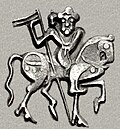
[[File:Horseman on Hindu Shahi coinage.jpg|thumb|Horseman on a coin of Spalapati, i.e. the "War-lord" of the [[Hindu Shahis]]. The headgear has been interpreted as a [[turban]].{{sfn|Rehman|1976|p=187 and Pl. V B.|loc="the horseman is shown wearing a turban-like head-gear with a small globule on the top"}}]] | |||
The [[Turk Shahis]] ruled Gandhara until 870, when they were overthrown by the [[Hindu Shahis]]. The Hindu Shahis are believed to belong to the Uḍi/Oḍi tribe, namely the people of [[Oddiyana]] in Gandhara.<ref>{{Cite journal |last=Rahman |first=Abdul |date=2002 |title=New Light on the Khingal, Turk and the Hindu Sahis |url=http://journals.uop.edu.pk/papers/AP_v15_37to42.pdf |journal=Ancient Pakistan |volume=XV |pages=37–42 |quote=The Hindu Śāhis were therefore neither Bhattis, or Janjuas, nor Brahmans. They were simply Uḍis/Oḍis. It can now be seen that the term Hindu Śāhi is a misnomer and, based as it is merely upon religious discrimination, should be discarded and forgotten. The correct name is Uḍi or Oḍi Śāhi dynasty.}}</ref><ref>{{Cite journal |last=Meister |first=Michael W. |date=2005 |title=The Problem of Platform Extensions at Kafirkot North |url=http://journals.uop.edu.pk/papers/AP_v16_41to48.pdf |journal=Ancient Pakistan |volume=XVI |pages=41–48 |quote=Rehman (2002: 41) makes a good case for calling the Hindu Śāhis by a more accurate name, "Uḍi Śāhis".}}</ref> | |||
The first king Kallar had moved the capital into Udabandhapura from Kabul, in the modern village of [[Hund (village)|Hund]] for its new capital.<ref>The Shahi Afghanistan and Punjab, 1973, pp 1, 45–46, 48, 80, Dr D. B. Pandey; The Úakas in India and Their Impact on Indian Life and Culture, 1976, p 80, Vishwa Mitra Mohan – Indo-Scythians; Country, Culture and Political life in early and medieval India, 2004, p 34, Daud Ali.</ref><ref>Journal of the Royal Asiatic Society, 1954, pp 112 ff; The Shahis of Afghanistan and Punjab, 1973, p 46, Dr D. B. Pandey; The Úakas in India and Their Impact on Indian Life and Culture, 1976, p 80, Vishwa Mitra Mohan – Indo-Scythians.</ref><ref>India, A History, 2001, p 203, John Keay.</ref><ref>Sehrai, Fidaullah (1979). Hund: ''The Forgotten City of Gandhara'', p. 2. Peshawar Museum Publications New Series, Peshawar.</ref> At its zenith, the kingdom stretched over the [[Kabul Valley]], Gandhara and western [[Punjab region|Punjab]] under [[Jayapala]].<ref name="Wynbrandt2009">{{Harv|Wynbrandt|2009|pp=52–54}}</ref> Jayapala saw a danger in the consolidation of the Ghaznavids and invaded their capital city of [[Ghazni]] both in the reign of [[Sebuktigin]] and in that of his son [[Mahmud of Ghazni|Mahmud]], which initiated the [[Muslim]] Ghaznavid and Hindu Shahi struggles.<ref name="Lewis2">{{Citation |title=The Cambridge history of Islam |url=https://books.google.com/books?id=5ccI0u5XDR0C |page=3 |year=1977 |editor=P. M. Holt |publisher=Cambridge University Press |isbn=978-0-521-29137-8 |quote=... Jaypala of Waihind saw danger in the consolidation of the kingdom of Ghazna and decided to destroy it. He therefore invaded Ghazna, but was defeated ... |editor2=Ann K. S. Lambton |editor3=[[Bernard Lewis]]}}</ref> Sebuk Tigin, however, defeated him, and he was forced to pay an indemnity.<ref name="Lewis2" /> Jayapala defaulted on the payment and took to the battlefield once more.<ref name="Lewis2" /> Jayapala however, lost control of the entire region between the [[Kabul|Kabul Valley]] and [[Indus River]].<ref name="Ferishta">{{cite book |url=https://archive.org/details/ferishtashistory01firi |title=Ferishta's History of Dekkan from the first Mahummedan conquests(etc) |work=Internet Archive |publisher=Shrewsbury [Eng.] : Printed for the editor by J. and W. Eddowes |year=1794}}</ref> | |||
However, the army was defeated in battle against the western forces, particularly against the Mahmud of Ghazni.<ref name="Ferishta" /> In the year 1001, soon after Sultan Mahmud came to power and was occupied with the [[Qarakhanid]]s north of the [[Hindu Kush]], Jaipal [[Battle of Peshawar (1001)|attacked Ghazni]] once more and upon suffering yet another defeat by the powerful Ghaznavid forces, near present-day [[Peshawar]]. After the [[Battle of Peshawar (1001)|Battle of Peshawar]], he died because of regretting as his subjects brought disaster and disgrace to the Shahi dynasty.<ref name="Lewis2" /><ref name="Ferishta" /> | |||
Jayapala was succeeded by his son [[Anandapala]],<ref name="Lewis2" /> who along with other succeeding generations of the Shahiya dynasty took part in various unsuccessful campaigns against the advancing Ghaznvids but were unsuccessful. The Hindu rulers eventually exiled themselves to the [[Kashmir]] [[Siwalik]] Hills.<ref name="Ferishta" /> | |||
===Rediscovery=== | ===Rediscovery=== | ||
| Line 214: | Line 221: | ||
[[John Marshall (archaeologist)|Archaeologist John Marshall]] excavated at Taxila between 1912 and 1934. He discovered separate Greek, Parthian, and Kushan cities and a large number of ''stupas'' and monasteries. These discoveries helped to piece together much more of the chronology of the history of Gandhara and its art. | [[John Marshall (archaeologist)|Archaeologist John Marshall]] excavated at Taxila between 1912 and 1934. He discovered separate Greek, Parthian, and Kushan cities and a large number of ''stupas'' and monasteries. These discoveries helped to piece together much more of the chronology of the history of Gandhara and its art. | ||
After 1947 [[Ahmed Hassan Dani]] and the Archaeology Department at the [[University of Peshawar]] made a number of discoveries in the Peshawar and Swat Valley. Excavation of many of the sites of Gandhara Civilization are being done by researchers from Peshawar and several universities around the world. | After 1947 [[Ahmed Hassan Dani]] and the Archaeology Department at the [[University of Peshawar]] made a number of discoveries in the Peshawar and Swat Valley. Excavation of many of the sites of Gandhara Civilization are being done by researchers from Peshawar and several universities around the world. | ||
==Language== | ==Culture== | ||
===Language=== | |||
{{Main|Gandhari language}} | {{Main|Gandhari language}} | ||
Gandhara's language was a [[Prakrit]] or "[[Middle Indo-Aryan languages|Middle Indo-Aryan]]" dialect, usually called Gāndhārī. Under the [[Kushan Empire]], Gāndhārī spread into adjoining regions of South and Central Asia. It used the [[Kharosthi]] script, which is derived from the [[Aramaic alphabet|Aramaic script]], and it died out about in the | Gandhara's language was a [[Prakrit]] or "[[Middle Indo-Aryan languages|Middle Indo-Aryan]]" dialect, usually called [[Gandhari language|Gāndhārī]].<ref name=":3">{{Cite web |last=Foundation |first=Encyclopaedia Iranica |title=GĀNDHĀRĪ LANGUAGE |url=https://iranicaonline.org/articles/gandhari-language |access-date=2021-07-20 |website=iranicaonline.org |language=en-US}}</ref> [[Hindko]] from [[Peshawar]] which was the capital of Gandhara, came from [[Shauraseni Prakrit|Shuraseni prakrit]] a language spoken in Gandhara.<ref>{{Cite web |title=Origins of Hindko |date=23 May 2013 |url=https://patch.com/connecticut/trumbull/history-of-punjabi-language--gurmukhi-alphabet}}</ref><ref>{{Cite web|url=https://www.newsgram.com/general/2021/04/15/hindko-the-language-of-hind|title=Hindko: 'The Language Of Hind'|author=<!--Not stated-->|website=NewsGram}}</ref><ref>{{Cite journal |title=Origins of Hindko |doi=10.31826/jlr-2018-153-409 |s2cid=212688313 |journal=Journal of Language Relationship |volume=15 |issue=3-4 |date=2018 |pages=228–237 |url=https://www.degruyter.com/document/doi/10.31826/jlr-2018-153-409/pdf}}</ref> Under the [[Kushan Empire]], Gāndhārī spread into adjoining regions of South and Central Asia.<ref name=":3" /> It used the [[Kharosthi]] script, which is derived from the [[Aramaic alphabet|Aramaic script]], and it died out about in the 4th century CE.<ref name=":3" /><ref>{{Cite book |last=Rhie |first=Marylin Martin |url=https://books.google.com/books?id=ogD1DwAAQBAJ&pg=PA327 |title=Early Buddhist Art of China and Central Asia, Volume 2 The Eastern Chin and Sixteen Kingdoms Period in China and Tumshuk, Kucha and Karashahr in Central Asia (2 vols) |date=2019-07-15 |publisher=BRILL |isbn=978-90-04-39186-4 |pages=327 |language=en}}</ref> | ||
Linguistic evidence links some groups of the [[Dardic languages]] with Gandhari.<ref>{{Cite book |last=Dani |first=Ahmad Hasan |url=https://books.google.com/books?id=MOltAAAAMAAJ&q=gandhari |title=History of Northern Areas of Pakistan: Upto 2000 A.D. |date=2001 |publisher=Sang-e-Meel Publications |isbn=978-969-35-1231-1 |pages=64–67 |language=en}}</ref><ref>{{Cite book |last=Saxena |first=Anju |url=https://books.google.com/books?id=vTgv1ZYGZdoC&pg=PA35 |title=Himalayan Languages: Past and Present |date=2011-05-12 |publisher=Walter de Gruyter |isbn=978-3-11-089887-3 |pages=35 |language=en}}</ref><ref>{{Cite book |last=Liljegren |first=Henrik |url=https://books.google.com/books?id=gRK1CwAAQBAJ&pg=PA14 |title=A grammar of Palula |date=2016-02-26 |publisher=Language Science Press |isbn=978-3-946234-31-9 |pages=13–14 |language=en |quote=Palula belongs to a group of Indo-Aryan (IA) languages spoken in the Hindukush region that are often referred to as "Dardic" languages... It has been and is still disputed to what extent this primarily geographically defined grouping has any real classificatory validity... On the one hand, Strand suggests that the term should be discarded altogether, holding that there is no justification whatsoever for any such grouping (in addition to the term itself having a problematic history of use), and prefers to make a finer classification of these languages into smaller genealogical groups directly under the IA heading, a classification we shall return to shortly... Zoller identifies the Dardic languages as the modern successors of the Middle Indo-Aryan (MIA) language Gandhari (also Gandhari Prakrit), but along with Bashir, Zoller concludes that the family tree model alone will not explain all the historical developments.}}</ref> The [[Kohistani languages]], now all being displaced from their original homelands, were once more widespread in the region and most likely descend from the ancient dialects of the region of Gandhara.<ref>{{Cite book |last1=Cacopardo |first1=Alberto M. |url=https://books.google.com/books?id=ghFuAAAAMAAJ |title=Gates of Peristan: History, Religion and Society in the Hindu Kush |last2=Cacopardo |first2=Augusto S. |date=2001 |publisher=IsIAO |isbn=978-88-6323-149-6 |pages=253 |language=en |quote=...This leads us to the conclusion that the ancient dialects of the Peshawar District, the country between Tirah and Swât, must have belonged to the Tirahi-Kohistani type, and that the westernmost Dardic language, Pashai, which probably had its ancient centre in Laghmân, has enjoyed a comparatively independent position since early times". …Today the Kohistâni languages descendent from the ancient dialects that developed in these valleys have all been displaced from their original homelands, as described below.}}</ref><ref name=":1">{{Cite journal|url=https://www.jstor.org/stable/608051|title=The Dialectical Position of the Niya Prakrit|date=1936|journal=Bulletin of the School of Oriental Studies, University of London|volume=8|issue=2/3|pages=419–435|issn=1356-1898|quote=... It might be going too far to say that Torwali is the direct lineal descendant of the Niya Prakrit, but there is no doubt that out of all the modern languages it shows the closest resemblance to it. A glance at the map in the Linguistic Survey of India shows that the area at present covered by "Kohistani" is the nearest to that area round Peshawar, where, as stated above, there is most reason to believe was the original home of the Niya Prakrit. That conclusion, which was reached for other reasons, is thus confirmed by the distribution of the modern dialects.|last=Burrow|first=T.|jstor=608051}}</ref> The last to disappear was [[Tirahi language|Tirahi]], still spoken some years ago in a few villages in the vicinity of [[Jalalabad]] in eastern Afghanistan, by descendants of migrants expelled from [[Tirah]] by the [[Afridi]] [[Pashtuns]] in the 19th century.<ref name=":2">{{Cite book |last=Dani |first=Ahmad Hasan |url=https://books.google.com/books?id=MOltAAAAMAAJ |title=History of Northern Areas of Pakistan: Upto 2000 A.D. |date=2001 |publisher=Sang-e-Meel Publications |isbn=978-969-35-1231-1 |pages=65 |language=en |quote=In the Peshawar district, there does not remain any Indian dialect continuing this old Gandhari. The last to disappear was Tirahi, still spoken some years ago in Afghanistan, in the vicinity of Jalalabad, by descendants of migrants expelled from Tirah by the Afridis in the 19th century. Nowadays, it must be entirely extinct and in the NWFP are only to be found modern Iranian languages brought in by later immigrants (Baluch, Pashto) or Indian languages brought in by the paramount political power (Urdu, Panjabi) or by Hindu traders (Hindko).}}</ref> [[Georg Morgenstierne]] claimed that Tirahi is "probably the remnant of a dialect group extending from Tirah through the [[Peshawar District|Peshawar district]] into [[Swat District|Swat]] and [[Dir District|Dir]]".<ref>{{Cite book |last1=Jain |first1=Danesh |url=https://books.google.com/books?id=iUHfBQAAQBAJ&pg=PT991 |title=The Indo-Aryan Languages |last2=Cardona |first2=George |date=2007-07-26 |publisher=Routledge |isbn=978-1-135-79710-2 |pages=991 |language=en}}</ref> Nowadays, it must be entirely extinct and the region is now dominated by [[Iranian languages]] brought in by later migrants, such as [[Pashto]].<ref name=":2" /> Among the modern day Indo-Aryan languages still spoken today, [[Torwali language|Torwali]] shows the closest linguistic affinity possible to ''Niya'', a dialect of Gāndhārī.<ref name=":1" /><ref>{{Cite book |last=Salomon |first=Richard |url=https://books.google.com/books?id=XYrG07qQDxkC&pg=PA79 |title=Indian Epigraphy: A Guide to the Study of Inscriptions in Sanskrit, Prakrit, and the other Indo-Aryan Languages |date=1998-12-10 |publisher=Oxford University Press |isbn=978-0-19-535666-3 |pages=79 |language=en}}</ref> | |||
==Religion== | ===Religion=== | ||
{{Further|Silk Road transmission of Buddhism|Gandharan Buddhism}} | {{Further|Silk Road transmission of Buddhism|Gandharan Buddhism}} | ||
| Line 231: | Line 239: | ||
====Mahāyāna Buddhism==== | ====Mahāyāna Buddhism==== | ||
Mahāyāna [[Buddhist sutras#Pure Land Sutras|Pure Land sutras]] were brought from the Gandhāra region to China as early as 147 CE, when the [[Kushan]] monk [[Lokaksema (Buddhist monk)|Lokakṣema]] began translating some of the first Buddhist sutras into Chinese.<ref>{{ | Mahāyāna [[Buddhist sutras#Pure Land Sutras|Pure Land sutras]] were brought from the Gandhāra region to China as early as 147 CE, when the [[Kushan]] monk [[Lokaksema (Buddhist monk)|Lokakṣema]] began translating some of the first Buddhist sutras into Chinese.<ref>{{Cite web|url=http://www.acmuller.net/descriptive_catalogue/files/k0024.html|title=The Korean Buddhist Canon: A Descriptive Catalogue|website=www.acmuller.net}}</ref> The earliest of these translations show evidence of having been translated from the Gāndhārī language.<ref>Mukherjee, Bratindra Nath. ''India in Early Central Asia.'' 1996. p. 15</ref> Lokakṣema translated important [[Mahayana sutras|Mahāyāna sūtras]] such as the ''[[Prajñāpāramitā|Aṣṭasāhasrikā Prajñāpāramitā Sūtra]]'', as well as rare, early Mahāyāna sūtras on topics such as [[Samādhi (Buddhism)|samādhi]], and meditation on the Buddha [[Akshobhya|Akṣobhya]]. Lokaksema's translations continue to provide insight into the early period of Mahāyāna Buddhism. This corpus of texts often includes and emphasizes ascetic practices and forest dwelling, and absorption in states of meditative concentration:<ref>Williams, Paul. ''Mahāyāna Buddhism: The Doctrinal Foundations.'' 2008. p. 30</ref>{{Blockquote|Paul Harrison has worked on some of the texts that are arguably the earliest versions we have of the Mahāyāna sūtras, those translated into Chinese in the last half of the second century AD by the Indo-Scythian translator Lokakṣema. Harrison points to the enthusiasm in the Lokakṣema sūtra corpus for the extra ascetic practices, for dwelling in the forest, and above all for states of meditative absorption (''samādhi''). Meditation and meditative states seem to have occupied a central place in early Mahāyāna, certainly because of their spiritual efficacy but also because they may have given access to fresh revelations and inspiration.}} | ||
{{ | |||
Some scholars believe that the Mahāyāna ''[[Infinite Life Sutra|Longer Sukhāvatīvyūha Sūtra]]'' was compiled in the age of the Kushan Empire in the 1st and 2nd centuries CE, by an order of [[Mahisasaka|Mahīśāsaka]] [[bhikkhu|bhikṣus]] which flourished in the Gandhāra region.<ref name="Nakamura, Hajime 1999. p. 205">Nakamura, Hajime. ''Indian Buddhism: A Survey With Biographical Notes.'' 1999. p. 205</ref><ref>Williams, Paul. ''Mahāyāna Buddhism: The Doctrinal Foundations.'' 2008. p. 239</ref> However, it is likely that the longer ''Sukhāvatīvyūha'' owes greatly to the [[Mahāsāṃghika]]-[[Lokottaravāda]] sect as well for its compilation, and in this sutra there are many elements in common with the Lokottaravādin ''[[Mahavastu|Mahāvastu]]''.<ref name="Nakamura, Hajime 1999. p. 205"/> There are also images of [[Amitābha]] Buddha with the [[bodhisattva]]s [[Avalokiteśvara]] and [[Mahāsthāmaprāpta]] which were made in Gandhāra during the Kushan era.<ref>{{cite web|url=http://huntingtonarchive.osu.edu/studypages/internal/dl/SouthAsia/Buddhist/pgs/u5/DL0230m.htm|title=Gandharan Sculptural Style: The Buddha Image|access-date=7 February 2016|archive-url=https://web.archive.org/web/20141218045231/http://huntingtonarchive.osu.edu/studypages/internal/dl/SouthAsia/Buddhist/pgs/u5/DL0230m.htm|archive-date=18 December 2014|url-status=dead|df=dmy-all}}</ref> | Some scholars believe that the Mahāyāna ''[[Infinite Life Sutra|Longer Sukhāvatīvyūha Sūtra]]'' was compiled in the age of the Kushan Empire in the 1st and 2nd centuries CE, by an order of [[Mahisasaka|Mahīśāsaka]] [[bhikkhu|bhikṣus]] which flourished in the Gandhāra region.<ref name="Nakamura, Hajime 1999. p. 205">Nakamura, Hajime. ''Indian Buddhism: A Survey With Biographical Notes.'' 1999. p. 205</ref><ref>Williams, Paul. ''Mahāyāna Buddhism: The Doctrinal Foundations.'' 2008. p. 239</ref> However, it is likely that the longer ''Sukhāvatīvyūha'' owes greatly to the [[Mahāsāṃghika]]-[[Lokottaravāda]] sect as well for its compilation, and in this sutra there are many elements in common with the Lokottaravādin ''[[Mahavastu|Mahāvastu]]''.<ref name="Nakamura, Hajime 1999. p. 205"/> There are also images of [[Amitābha]] Buddha with the [[bodhisattva]]s [[Avalokiteśvara]] and [[Mahāsthāmaprāpta]] which were made in Gandhāra during the Kushan era.<ref>{{cite web|url=http://huntingtonarchive.osu.edu/studypages/internal/dl/SouthAsia/Buddhist/pgs/u5/DL0230m.htm|title=Gandharan Sculptural Style: The Buddha Image|access-date=7 February 2016|archive-url=https://web.archive.org/web/20141218045231/http://huntingtonarchive.osu.edu/studypages/internal/dl/SouthAsia/Buddhist/pgs/u5/DL0230m.htm|archive-date=18 December 2014|url-status=dead|df=dmy-all}}</ref> | ||
| Line 239: | Line 245: | ||
The ''Mañjuśrīmūlakalpa'' records that Kaniṣka of the Kushan Empire presided over the establishment of the Mahāyāna [[Prajnaparamita|Prajñāpāramitā]] teachings in the northwest.<ref name="Ray, Reginald 1999. p. 410">Ray, Reginald. ''Buddhist Saints in India: A Study in Buddhist Values and Orientations.'' 1999. p. 410</ref> [[Taranatha|Tāranātha]] wrote that in this region, 500 [[bodhisattva]]s attended the council at Jālandhra monastery during the time of Kaniṣka, suggesting some institutional strength for Mahāyāna in the north-west during this period.<ref name="Ray, Reginald 1999. p. 410"/> [[Edward Conze]] goes further to say that Prajñāpāramitā had great success in the north-west during the Kushan period, and may have been the "fortress and hearth" of early Mahāyāna, but not its origin, which he associates with the Mahāsāṃghika branch of Buddhism.<ref>Ray, Reginald. ''Buddhist Saints in India: A Study in Buddhist Values and Orientations.'' 1999. p. 426</ref> | The ''Mañjuśrīmūlakalpa'' records that Kaniṣka of the Kushan Empire presided over the establishment of the Mahāyāna [[Prajnaparamita|Prajñāpāramitā]] teachings in the northwest.<ref name="Ray, Reginald 1999. p. 410">Ray, Reginald. ''Buddhist Saints in India: A Study in Buddhist Values and Orientations.'' 1999. p. 410</ref> [[Taranatha|Tāranātha]] wrote that in this region, 500 [[bodhisattva]]s attended the council at Jālandhra monastery during the time of Kaniṣka, suggesting some institutional strength for Mahāyāna in the north-west during this period.<ref name="Ray, Reginald 1999. p. 410"/> [[Edward Conze]] goes further to say that Prajñāpāramitā had great success in the north-west during the Kushan period, and may have been the "fortress and hearth" of early Mahāyāna, but not its origin, which he associates with the Mahāsāṃghika branch of Buddhism.<ref>Ray, Reginald. ''Buddhist Saints in India: A Study in Buddhist Values and Orientations.'' 1999. p. 426</ref> | ||
=== | ===Art=== | ||
{{See also|Greco-Buddhist art|Kushan art|Indo-Greek art|Indo-Scythian art}} | |||
[[File:Lid with seated male figure, Gandhara, Pakistan.jpeg|thumb|right|Lid with seated male figure, Gandhara. (1st–2nd century)]] | |||
[[ | Gandhāra is noted for the distinctive '''Gandhāra style''' of [[Buddhist art]], which shows influence of [[Hellenistic art|Hellenistic]] and local [[Indian art|Indian]] influences from the [[Indo-Gangetic Plain|Gangetic Valley]].<ref name=ubc2011>{{cite book |last1=Behrendt |first1=Kurt |title=Gandharan Buddhism: Archaeology, Art, and Texts |date=2011 |publisher=UBC Press |isbn=978-0774841283 |page=241 |url=https://books.google.com/books?id=rtYskEpemWgC |access-date=16 August 2019}}</ref> The [[Greco-Buddhist art|Gandhāran art]] flourished and achieved its peak during the [[Kushan]] period, from the 1st to the 5th centuries, but it declined and was destroyed after the invasion of the [[Alchon Huns]] in the 5th century. | ||
Buddhist imagery combined with some artistic elements from the cultures of the Hellenistic world. An example is the youthful Buddha, his hair in wavy curls, similar to statutes of [[Apollo]].<ref name=met /> | Siddhartha shown as a bejeweled prince (before the [[Great Renunciation|Sidhartha renounces palace life]]) is a common motif.<ref name="met">{{cite web|url=https://www.metmuseum.org/toah/hd/budd/hd_budd.htm |title = Buddhism and Buddhist Art}}</ref> [[Stucco]], as well as stone, were widely used by sculptors in Gandhara for the decoration of monastic and cult buildings.<ref name=met /><ref>{{Cite journal |last=Siple |first=Ella S. |date=1931 |title=Stucco Sculpture from Central Asia |url=https://www.jstor.org/stable/864875 |journal=The Burlington Magazine for Connoisseurs |volume=59 |issue=342 |pages=140–145 |jstor=864875 |issn=0951-0788}}</ref> Buddhist imagery combined with some artistic elements from the cultures of the Hellenistic world. An example is the youthful Buddha, his hair in wavy curls, similar to statutes of [[Apollo]].<ref name="met" /> Sacred artworks and architectural decorations used limestone for stucco composed by a mixture of local crushed rocks (i.e. [[schist]] and [[granite]]) which resulted compatible with the outcrops located in the mountains northwest of [[Islamabad]].<ref>{{cite journal | author = Carlo Rosa | author2 = Thomas Theye | author3 = Simona Pannuzi|url = https://doaj.org/article/4c2c60120f2343ccb1e43d8299572e53 | title = Geological overwiew of Gandharan sites and petrographical analysis on Gandharan stucco and clay artefacts | page = Abstract | language = en | format = pdf | access-date = February 15, 2020 | publisher = Firenze University Press | journal = Restauro Archeologico | oclc = 8349098991|issn = 1724-9686 |year = 2019 | volume = 27 | issue = 1 | doi = 10.13128/RA-25095 | archive-url = https://web.archive.org/web/20200215232533/https://oaj.fupress.net/index.php/ra/article/view/7349/7343 | archive-date = February 15, 2020 | url-status = live}} on [[DOAJ]]</ref> | ||
The artistic traditions of Gandhara art can be divided into following phases: | |||
*[[Indo-Greek art]]; 2nd century B.C to 1st century A.D | |||
*[[Indo-Scythian art]]; 1st century B.C to 1st century A.D | |||
*[[Kushan art]]; 1st century A.D to 4th century A.D | |||
<gallery> | <gallery> | ||
File:Standing Bodhisattva Gandhara Musee Guimet.jpg|Standing Bodhisattva (1st–2nd century) | |||
File:BuddhaHead.JPG|Buddha head (2nd century) | |||
File:Gandhara Buddha.jpg|Buddha head (4th–6th century) | |||
File:BuddhaAcanthusCapitol.JPG|Buddha in [[acanthus (ornament)|acanthus]] capital | |||
File:GandharanAtlas.JPG|The Greek god [[Atlas (mythology)|Atlas]], supporting a Buddhist monument, Hadda | |||
File:KushanMaitreya.JPG|The [[Bodhisattva]] [[Maitreya]] (2nd century) | |||
File:Indo-GreekBanquet.JPG|Wine-drinking and music, Hadda (1st–2nd century) | |||
File:MayaDream.jpg|Maya's white elephant dream (2nd–3rd century) | |||
File:SiddhartaBirth.jpg|The birth of Siddharta (2nd–3rd century) | |||
File:LeavingPalace.jpg|The Great Departure from the Palace (2nd–3rd century) | |||
File:EndAscetism.JPG|The end of ascetism (2nd–3rd century) | |||
File:Sarnath3.JPG|The Buddha preaching at the Deer Park in [[Sarnath]] (2nd–3rd century) | |||
File:Gandhara Buddha scene.jpg|Scene of the life of the Buddha (2nd–3rd century) | |||
File:Paranirvana.JPG|The death of the Buddha, or [[parinirvana]] (2nd–3rd century) | |||
File:HaddaSculpture.jpg|A sculpture from Hadda, (3rd century) | |||
File:HaddaBodhisattva.jpg|The [[Bodhisattva]] and Chandeka, Hadda (5th century) | |||
File | File:GandharaScrolls.JPG|Hellenistic decorative scrolls from [[Hadda, Afghanistan]] | ||
File:GandharaFrieze.JPG|Hellenistic scene, Gandhara (1st century) | |||
File:StonePalette1.JPG|A stone plate (1st century). | |||
File:Laughing boy JN 16 F.25-876 (1).jpg|"Laughing boy" from Hadda | File:Laughing boy JN 16 F.25-876 (1).jpg|"Laughing boy" from Hadda | ||
File:Gandhara, bodhisattva assiso, II sec..JPG|Bodhisattva seated in [[jhana|meditation]] | |||
File:Marine deities Gandhara 1st century.jpg|Marine deities, Gandhara | |||
File:SFAAMBuddha.jpg|The Seated Buddha, dating from 300 to 500 AD, was found near Jamal Garhi, and is now on display at the [[Asian Art Museum (San Francisco)|Asian Art Museum]] in [[San Francisco]] | |||
File:Sharing of relics and Gandhara fortified city.jpg|Sharing of the [[Buddha]]'s relics, above a Gandhara fortified city. | |||
</gallery> | </gallery> | ||
===Major cities=== | |||
= | |||
==Major cities== | |||
Major cities of ancient Gandhara are as follows: | Major cities of ancient Gandhara are as follows: | ||
*[[Pushkalavati|Puṣkalavati]] ([[Charsadda]]), [[Pakistan]] | *[[Pushkalavati|Puṣkalavati]] ([[Charsadda]]), [[Pakistan]] | ||
| Line 333: | Line 292: | ||
*[[Sagala]] ([[Sialkot]]), [[Pakistan]] | *[[Sagala]] ([[Sialkot]]), [[Pakistan]] | ||
*[[Oddiyana]] ([[Swat district|Swat]]), [[Pakistan]] | *[[Oddiyana]] ([[Swat district|Swat]]), [[Pakistan]] | ||
*[[Kapisi]] ([[Bagram]]), [[Afghanistan]] | *[[Kapisi]] ([[Bagram]]), [[Afghanistan]] | ||
*[[Jibin]], appears in the Chinese sources | |||
==Notable people== | |||
{{main|list of people from Gandhara}} | |||
== | ==In popular culture== | ||
{{ | *''Gandhara:Buddha no Seisen'' is an action RPG released in Japan in 1987.<ref>{{Cite web |url=https://www.mobygames.com/game/51192/gandhara-buddha-no-seisen/&ved=2ahUKEwj0xcbs2Oz9AhVD-6QKHbZBCKoQFnoECBUQAQ&usg=AOvVaw10o7WfYVhm1fIa2ulvnvkp |access-date=2023-03-21 |title=Gandhara:Buddha no Seisen}}</ref> | ||
* | *''[[Gandhara (song)]]'' is a 1978 song by Japanese [[rock music|rock]] band [[Godiego]], serving as their 7th single. | ||
*''[[List of Shaman King characters#Gandhara|Gandhara]]'' is a Buddhist pacifist organization in the Japanese [[manga]] series ''[[Shaman King]]''. | |||
* | |||
==See also== | ==See also== | ||
{{Div col|small=yes}} | {{Div col|small=yes}} | ||
*[[ | *[[History of Pakistan]] | ||
*[[History of Afghanistan]] | |||
*[[History of India]] | *[[History of India]] | ||
*[[Mahajanapadas]] | *[[Mahajanapadas]] | ||
{{Div col end}} | {{Div col end}} | ||
| Line 383: | Line 327: | ||
* Hill, John E. 2003. [http://depts.washington.edu/silkroad/texts/hhshu/hou_han_shu.html "Annotated Translation of the Chapter on the Western Regions according to the ''Hou Hanshu''"]. 2nd Edition: ''Through the Jade Gate to Rome: A Study of the Silk Routes, 1st to 2nd Centuries CE''. 2015. John E. Hill. Volume I, {{ISBN|978-1500696702}}; Volume II, {{ISBN|978-1503384620}}. CreateSpace, North Charleston, S.C. | * Hill, John E. 2003. [http://depts.washington.edu/silkroad/texts/hhshu/hou_han_shu.html "Annotated Translation of the Chapter on the Western Regions according to the ''Hou Hanshu''"]. 2nd Edition: ''Through the Jade Gate to Rome: A Study of the Silk Routes, 1st to 2nd Centuries CE''. 2015. John E. Hill. Volume I, {{ISBN|978-1500696702}}; Volume II, {{ISBN|978-1503384620}}. CreateSpace, North Charleston, S.C. | ||
* Hussain, J. '' An Illustrated History of Pakistan'', Oxford University Press, Karachi, 1983. | * Hussain, J. '' An Illustrated History of Pakistan'', Oxford University Press, Karachi, 1983. | ||
* {{cite web |url=https://dsal.uchicago.edu/reference/gazetteer/pager.html?objectid=DS405.1.I34_V19_154.gif |title=Imperial Gazetteer2 of India, Volume 19– Imperial Gazetteer of India |publisher=Digital South Asia Library |access-date=22 April 2015 |ref=CITEREFImperial_Gazetteer}} | |||
* Legge, James. Trans. and ed. 1886. ''A Record of Buddhistic Kingdoms: being an account by the Chinese monk Fâ-hsien of his travels in India and Ceylon (A.D. 399–414) in search of the Buddhist Books of Discipline''. Reprint: Dover Publications, New York. 1965. | * Legge, James. Trans. and ed. 1886. ''A Record of Buddhistic Kingdoms: being an account by the Chinese monk Fâ-hsien of his travels in India and Ceylon (A.D. 399–414) in search of the Buddhist Books of Discipline''. Reprint: Dover Publications, New York. 1965. | ||
* {{citation |last=Neelis |first=Jason |title=Early Buddhist Transmission and Trade Networks: Mobility and Exchange Within and Beyond the Northwestern Borderlands of South Asia |url=https://books.google.com/books?id=GB-JV2eOr2UC&pg=PA102 |year=2010 |publisher=BRILL |isbn=978-90-04-18159-5 |ref={{sfnref|Neelis, Early Buddhist Transmission and Trade Networks|2010}}}} | * {{citation |last=Neelis |first=Jason |title=Early Buddhist Transmission and Trade Networks: Mobility and Exchange Within and Beyond the Northwestern Borderlands of South Asia |url=https://books.google.com/books?id=GB-JV2eOr2UC&pg=PA102 |year=2010 |publisher=BRILL |isbn=978-90-04-18159-5 |ref={{sfnref|Neelis, Early Buddhist Transmission and Trade Networks|2010}}}} | ||
*{{cite book |last=Raychaudhuri |first=Hemchandra |author-link=Hem Chandra Raychaudhuri |date=1953 |title=Political History of Ancient India: From the Accession of Parikshit to the Extinction of Gupta Dynasty |url= |location= |publisher=[[University of Calcutta]] |isbn=}} | |||
* {{Cite thesis |title=The Last Two Dynasties of the Sahis: An analysis of their history, archaeology, coinage and palaeography |url=https://openresearch-repository.anu.edu.au/handle/1885/11229 |publisher=Australian National University |date=January 1976 |language=en |first=Abdur |last=Rehman}} | |||
* Shaw, Isobel. ''Pakistan Handbook'', The Guidebook Co., Hong Kong, 1989 | * Shaw, Isobel. ''Pakistan Handbook'', The Guidebook Co., Hong Kong, 1989 | ||
* Watters, Thomas. 1904–5. ''On Yuan Chwang's Travels in India (A.D. 629–645)''. Reprint: Mushiram Manoharlal Publishers, New Delhi. 1973. | * Watters, Thomas. 1904–5. ''On Yuan Chwang's Travels in India (A.D. 629–645)''. Reprint: Mushiram Manoharlal Publishers, New Delhi. 1973. | ||
*{{cite book |last1=Wynbrandt |first1=James |title=A Brief History of Pakistan |date=2009 |publisher=Infobase Publishing |location=New York}} | |||
{{Refend}} | {{Refend}} | ||
| Line 392: | Line 340: | ||
* {{cite book |author=Lerner, Martin |url=http://libmma.contentdm.oclc.org/cdm/compoundobject/collection/p15324coll10/id/105494 |title=The flame and the lotus: Indian and Southeast Asian art from the Kronos collections |location=New York |publisher=The Metropolitan Museum of Art |year=1984 |isbn=0-87099-374-7}} | * {{cite book |author=Lerner, Martin |url=http://libmma.contentdm.oclc.org/cdm/compoundobject/collection/p15324coll10/id/105494 |title=The flame and the lotus: Indian and Southeast Asian art from the Kronos collections |location=New York |publisher=The Metropolitan Museum of Art |year=1984 |isbn=0-87099-374-7}} | ||
* {{cite journal |last1=Rehman |first1=Abdur |title=A Note on the Etymology of Gandhāra |journal=Bulletin of the Asia Institute |date=2009 |volume=23 |pages=143–146 |jstor=24049432 }} | * {{cite journal |last1=Rehman |first1=Abdur |title=A Note on the Etymology of Gandhāra |journal=Bulletin of the Asia Institute |date=2009 |volume=23 |pages=143–146 |jstor=24049432 }} | ||
* {{cite journal|title=Reviewed Work: A Catalogue of the Gandhāra Sculpture in the British Museum, Vol. I: Text, Vol. II: Plates by Wladimir Zwalf|publisher=Istituto Italiano per l'Africa e l'Oriente | * {{cite journal|title=Reviewed Work: A Catalogue of the Gandhāra Sculpture in the British Museum, Vol. I: Text, Vol. II: Plates by Wladimir Zwalf|publisher=Istituto Italiano per l'Africa e l'Oriente|journal=Wladimir Zwalf, Review by: Anna Filigenzi|volume = 50|issue = 1/4|pages = 584–586|jstor = 29757475|last1 = Filigenzi|first1 = Anna|year = 2000}} | ||
* Rienjang, Wannaporn, and Peter Stewart (eds), ''The Rediscovery and Reception of Gandharan Art'' (Archaeopress, 2022) ISBN 978-1-80327-233-7. | |||
==External links== | ==External links== | ||
*[https://www.carc.ox.ac.uk/GandharaConnections/default.htm Gandharan Connections Project (Cambridge, 2016-2021)] | *[https://www.carc.ox.ac.uk/GandharaConnections/default.htm Gandharan Connections Project (Cambridge, 2016-2021)] | ||
*[https://www.livius.org/ga-gh/gandara/gandara.html Livius.org: Gandara] | *[https://www.livius.org/ga-gh/gandara/gandara.html Livius.org: Gandara] {{Webarchive|url=https://web.archive.org/web/20130719233855/http://www.livius.org/ga-gh/gandara/gandara.html |date=19 July 2013 }} | ||
*[https://web.archive.org/web/20040626090537/http://www.washington.edu/research/showcase/1996a.html The Buddhist Manuscript project] | *[https://web.archive.org/web/20040626090537/http://www.washington.edu/research/showcase/1996a.html The Buddhist Manuscript project] | ||
*[https://web.archive.org/web/20040405065830/http://www.washington.edu/newsroom/news/2002archive/08-02archive/k082002a.html University of Washington's Gandharan manuscript] | *[https://web.archive.org/web/20040405065830/http://www.washington.edu/newsroom/news/2002archive/08-02archive/k082002a.html University of Washington's Gandharan manuscript] | ||
| Line 413: | Line 362: | ||
[[Category:Gandhara| ]] | [[Category:Gandhara| ]] | ||
[[Category:Achaemenid satrapies]] | [[Category:Achaemenid satrapies]] | ||
[[Category:Ancient empires and kingdoms of India]] | [[Category:Ancient empires and kingdoms of India]] | ||
[[Category:Ancient history of Pakistan]] | |||
[[Category:Archaeological sites in Pakistan]] | |||
[[Category:Buddhist sites in Pakistan]] | |||
[[Category:Ancient Asia]] | |||
[[Category:History of Pakistan]] | |||
[[Category:Historical regions of Pakistan]] | [[Category:Historical regions of Pakistan]] | ||
[[Category:Kingdoms in the Ramayana]] | [[Category:Kingdoms in the Ramayana]] | ||
[[Category:Locations in Hindu mythology]] | [[Category:Locations in Hindu mythology]] | ||
[[Category: | [[Category:Prehistoric Pakistan]] | ||
Revision as of 08:27, 22 July 2023
| Gandhāra Gandhara | |
|---|---|
| c. 1500 BCE–c. 1000 CE | |
  Gandhara Location of Gandhara in South Asia (Afghanistan and Pakistan) | |
| Lua error in Module:Location_map/multi at line 27: Unable to find the specified location map definition: "Module:Location map/data/Gandhara" does not exist. Approximate geographical region of Gandhara centered on the Peshawar Basin, in present-day northwest Pakistan. | |
| Capital | Kapisi (Bagram) Puṣkalavati (Charsadda) Puruṣapura (Peshawer) Takshashila (Taxila) Udabhandapura (Hund) |
| History | |
| Government | |
| King | |
• c. 550 BCE | Pushkarasarin (first) |
• c. 330 BCE – c. 316 BCE | Taxiles |
• c. 964 CE – c. 1001 CE | Jayapala (last) |
| Historical era | Antiquity |
• Established | c. 1500 BCE |
• Disestablished | c. 1000 CE |
| Today part of | Afghanistan Pakistan |
Gandhāra was an ancient Indo-Aryan[1] civilization centered in the present-day north-west Pakistan and including parts of north-east Afghanistan, roughly in the northwestern part of the Indian subcontinent.[2][3][4] The core of the region of Gandhara was the Peshawar valley and Swat valley, though the cultural influence of "Greater Gandhara" extended across the Indus river to the Taxila region in Potohar Plateau and westwards into the Kabul valley in Afghanistan, and northwards up to the Karakoram range.[5][6][7]
The Gandhara tribe, after which it is named, is attested in the Rigveda (c. 1500 – c. 1200 BCE),[8][9] while the region is mentioned in the Zoroastrian Avesta as Vaēkərəta, the sixth most beautiful place on earth created by Ahura Mazda. It was one of the 16 Mahajanapadas of the second urbanisation.[2][3][4] Gandhara is frequently mentioned in the Ramayana and Mahabharata.[10]
The Iron Age Gandhara kingdom emerged as a major imperial power during the reign of King Pushkarasarin in c.550 BCE.[11] Gandhara was conquered by the Achaemenids in the 6th century BCE, Alexander the Great in 327 BCE, and later became part of the Maurya Empire before being a centre of the Indo-Greek Kingdom. The region was a major centre for Greco-Buddhism under the Indo-Greeks and Gandharan Buddhism under later dynasties, including Indo-Scythians, Indo-Parthians and Kushans. Gandhara was also a central location for the spread of Buddhism to Central Asia and East Asia.[12]
Gāndhārī, an Indo-Aryan language written in Kharosthi script, acted as lingua franca of the region.[13] Famed for its unique Gandharan style of art which is influenced by the classical Hellenistic styles, Gandhara attained its height from the 1st century to the 5th century CE under the Kushan Empire, who had their capital at Peshawar (Puruṣapura) and ushered a period of relative peace known as Pax Kushana. Gandhara "flourished at the crossroads of India, Central Asia, and the Middle East," connecting trade routes and absorbing cultural influences from diverse civilizations; Buddhism thrived until the 8th or 9th centuries, when Islam first began to gain sway in the region.[14]
The region steadily declined after the violent invasion by Alchon Huns in 6th century, and the name Gandhara disappeared after Mahmud Ghaznavi's conquest in 1001 CE.[15]
Etymology
Gandhara was known in Sanskrit as Gandhāra (गन्धार), in Avestan as Vaēkərəta, in Old Persian as Gadāra (Old Persian cuneiform: 𐎥𐎭𐎠𐎼, Gadāra, also transliterated as Gandāra since the nasal "n" before consonants was omitted in the Old Persian script, and simplified as Gandara),[16] in Akkadian and Elamite as Paruparaesanna (Para-upari-sena),[17] in Chinese as T: 犍陀羅/S: 犍陀罗 (Qiántuóluó) or T: 罽賓/S: 罽宾 (Jìbīn), and in Greek as Γανδάρα (Gandhara).[18]
One proposed origin of the name is from the Sanskrit word गन्ध gandha, meaning "perfume" and "referring to the spices and aromatic herbs which they (the inhabitants) traded and with which they anointed themselves.".[19][20] The Gandhari people are a tribe mentioned in the Rigveda, the Atharvaveda, and later Vedic texts.[21]
A Persian form of the name, Gandara, mentioned in the Behistun inscription of Emperor Darius I,[22][23] was translated as Paruparaesanna (Para-upari-sena, meaning "beyond the Hindu Kush") in Babylonian and Elamite in the same inscription.[17]
Geography

The boundaries of Gandhara varied throughout history. Sometimes the Peshawar Valley and Taxila were collectively referred to as Gandhara; sometimes the Kabul Valley and Swat (Sanskrit: Suvāstu) were included.[24] The kingdom was ruled from capitals at Kapisi (Bagram),[25] Pushkalavati (Charsadda), Taxila, Puruṣapura (Peshawar) and in its final days from Udabhandapura (Hund) on the River Indus. Historically, it bordered ancient regions of Bactria and Ariana to the north and Arachosia and Sattagydia to the south.[citation needed]
History
Stone age

Evidence of human activity in the Middle Palaeolithic has been reported from Sanghao Cave in the Mardan district of Pakistan.[26] The cave was excavated by Ahmad Hasan Dani in 1963. Chipped stone, bones, were found during the excavation.[27] Other items included scrapers, quartz tools, blades, flakes, etc.[28][29][30]
Gandhara grave culture

Gandhara's first recorded culture was the Grave Culture that emerged c. 1400 BCE and lasted until 800 BCE,[31] and named for their distinct funerary practices. It was found along the Middle Swat River course, even though earlier research considered it to be expanded to the Valleys of Dir, Kunar, Chitral, and Peshawar.[32] It has been regarded as a token of the Indo-Aryan migrations, but has also been explained by local cultural continuity. Backwards projections, based on ancient DNA analyses, suggest ancestors of Swat culture people mixed with a population coming from Inner Asia Mountain Corridor, which carried Steppe ancestry, sometime between 1900 and 1500 BCE.[33]
Vedic era
.png)
The first mention of the Gandhārīs is attested once in the Ṛgveda as a tribe that has sheep with good wool. In the Atharvaveda, the Gandhārīs are mentioned alongside the Mūjavants, the Āṅgeyas. and the Māgadhīs in a hymn asking fever to leave the body of the sick man and instead go those aforementioned tribes. The tribes listed were the furthermost border tribes known to those in Madhyadeśa, the Āṅgeyas and Māgadhīs in the east, and the Mūjavants and Gandhārīs in the north.[34][35]
The Gāndhārī king Nagnajit and his son Svarajit are mentioned in the Brāhmaṇas, according to which they received Brahmanic consecration, but their family's attitude towards ritual is mentioned negatively,[36] with the royal family of Gandhāra during this period following non-Brahmanical religious traditions. According to the Jain Uttarādhyayana-sūtra, Nagnajit, or Naggaji, was a prominent king who had adopted Jainism and was comparable to Dvimukha of Pāñcāla, Nimi of Videha, Karakaṇḍu of Kaliṅga, and Bhīma of Vidarbha; Buddhist sources instead claim that he had achieved paccekabuddhayāna.[37][11][38]
By the later Vedic period, the situation had changed, and the Gāndhārī capital of Takṣaśila had become an important centre of knowledge where the men of Madhya-desa went to learn the three Vedas and the eighteen branches of knowledge, with the Kauśītaki Brāhmaṇa recording that brāhmaṇas went north to study. According to the Śatapatha Brāhmaṇa and the Uddālaka Jātaka, the famous Vedic philosopher Uddālaka Āruṇi was among the famous students of Takṣaśila, and the Setaketu Jātaka claims that his son Śvetaketu also studied there. In the Chāndogya Upaniṣad, Uddālaka Āruṇi himself favourably referred to Gāndhārī education to the Vaideha king Janaka.[36]
During the 6th century BCE, Gandhāra was an important imperial power in north-west Iron Age South Asia, with the valley of Kaśmīra being part of the kingdom,[37] while the other states of the Punjab region, such as the Kekayas, Madrakas, Uśīnaras, and Shivis being under Gāndhārī suzerainty. The Gāndhārī king Pukkusāti, who reigned around 550 BCE, engaged in expansionist ventures which brought him into conflict with the king Pradyota of the rising power of Avanti. Pukkusāti was successful in this struggle with Pradyota, but war broke out between him and the Pāṇḍava tribe located in the Punjab region, and who were threatened by his expansionist policy.[11][39] Pukkusāti also engaged in friendly relations with the king Bimbisāra of Magadha.[11]
Due to this important position, Buddhist texts listed the Gandhāra kingdom as one of the sixteen Mahājanapadas ("great realms") of Iron Age South Asia. It was the home of Gandhari, the princess of Gandhara kingdom.[40][41]
Achaemenid Gandhara
 | This section needs more citations. (February 2021) |

By the later 6th century BCE, the founder of the Persian Achaemenid Empire, Cyrus, soon after his conquests of Media, Lydia, and Babylonia, marched into Gandhara and annexed it into his empire.[42] The scholar Kaikhosru Danjibuoy Sethna advanced that Cyrus had conquered only the trans-Indus borderlands around Peshawar which had belonged to Gandhāra while Pukkusāti remained a powerful king who maintained his rule over the rest of Gandhāra and the western Punjab.[43]
However, according to the scholar Buddha Prakash, Pukkusāti might have acted as a bulwark against the expansion of the Persian Achaemenid Empire into north-west South Asia. This hypothesis posits that the army which Nearchus claimed Cyrus had lost in Gedrosia had in fact been defeated by Pukkusāti's Gāndhārī kingdom. Therefore, following Prakash's position, the Achaemenids would have been able to conquer Gandhāra only after a period of decline of Gandhāra after the reign of Pukkusāti combined the growth of Achaemenid power under the kings Cambyses II and Darius I.[11] However, the presence of Gandhāra, referred to as Gandāra in Old Persian, among the list of Achaemenid provinces in Darius's Behistun Inscription confirms that his empire had inherited this region from conquests carried out earlier by Cyrus.[42]
It is unknown whether Pukkusāti remained in power after the Achaemenid conquest as a Persian vassal or if he was replaced by a Persian satrap (governor),[44] although Buddhist sources claim that he renounced his throne and became a monk after becoming a disciple of the Buddha.[45] The annexation under Cyrus was limited to Gandhāra proper, after which the peoples of the Punjab region previously under Gāndhārī authority took advantage of the new power vacuum to form their own states.[11]

Under Persian rule, a system of centralized administration, with a bureaucratic system, was introduced into the Indus Valley for the first time. Provinces or "satrapy" were established with provincial capitals.
Gandhara satrapy, established 518 BCE with its capital at Pushkalavati (Charsadda).[51]
The inscription on Darius' (521–486 BCE) tomb at Naqsh-i-Rustam near Persepolis records Gadāra (Gandāra) along with Hindush (Hənduš, Sindh) in the list of satrapies. By about 380 BC the Persian hold on the region had weakened. Many small kingdoms sprang up in Gandhara.
Macedonian Gandhara
In 327 BCE, Alexander the Great conquered Gandhara as well as the Indian satrapies of the Persian Empire. The expeditions of Alexander were recorded by his court historians and by Arrian (around 175 CE) in his Anabasis Alexandri and by other chroniclers many centuries after the event.
In the winter of 327 BCE, Alexander invited all the chieftains in the remaining five Achaemenid satraps to submit to his authority. Ambhi, then ruler of Taxila in the former Hindush satrapy complied, but the remaining tribes and clans in the former satraps of Gandhara, Arachosia, Sattagydia and Gedrosia rejected Alexander's offer.[citation needed]
The first tribe they encountered were the Aspasioi tribe of the Kunar Valley, who under the leadership of their queen Cleophis initiated a fierce battle against Alexander, in which he himself was wounded in the shoulder by a dart. However, the Aspasioi eventually lost and 40,000 people were enslaved. Alexander then continued in a southwestern direction where he encountered the Assakenoi tribe of the Swat & Buner valleys in April 326 BCE. The Assakenoi fought bravely and offered stubborn resistance to Alexander and his army in the cities of Ora, Bazira (Barikot) and Massaga. So enraged was Alexander about the resistance put up by the Assakenoi that he killed the entire population of Massaga and reduced its buildings to rubble. A similar slaughter then followed at Ora,[52] another stronghold of the Assakenoi. The stories of these slaughters reached numerous Assakenians, who began fleeing to Aornos, a hill-fort located between Shangla and Kohistan. Alexander followed close behind their heels and besieged the strategic hill-fort, eventually capturing and destroying the fort and killing everyone inside. The remaining smaller tribes either surrendered or like the Astanenoi tribe of Pushkalavati(Charsadda) were quickly neutralized where 38,000 soldiers and 230,000 oxen were captured by Alexander.[53] Eventually Alexander's smaller force would meet with the larger force which had come through the Khyber Pass met at Attock. With the conquest of Gandhara complete, Alexander switched to strengthening his military supply line, which by now stretched dangerously vulnerable over the Hindu Kush back to Balkh in Bactria.[citation needed]
After conquering Gandhara and solidifying his supply line back to Bactria, Alexander combined his forces with the King Ambhi of Taxila and crossed the River Indus in July 326 BCE to begin the Archosia (Punjab) campaign. Alexander nominated officers as Satraps of the new provinces, and in Gandhara, Oxyartes was nominated to the position of Satrap in 326 BCE.[citation needed]
Mauryan Gandhara

After a battle with Seleucus Nicator (Alexander's successor in Asia) in 305 BCE, the Mauryan emperor Chandragupta extended his domain up to and including Gandhara and Arachosia. With the completion of the Empire's Grand Trunk Road, the region prospered as a centre of trade. Gandhara remained a part of the Mauryan Empire for about a century and a half.
Ashoka, the grandson of Chandragupta, was one of the greatest Indian rulers. Like his grandfather, Ashoka also started his career in Gandhara as a governor. Later he became a Buddhist and promoted Buddhism, building many stupas in Gandhara. Mauryan control over the northwestern frontier, including the Yonas, Kambojas, and the Gandharas, is attested from the Rock Edicts left by Ashoka.
According to one school of scholars, the Gandharas and Kambojas were cognate people.[54][55][56] It is also contended[by whom? – Discuss] that the Kurus, Kambojas, Gandharas and Bahlikas were cognate people and all had Iranian affinities,[57] or that the Gandhara and Kamboja were nothing but two provinces of one empire and hence influencing each other's language.[58] However, the local language of Gandhara is represented by Panini's conservative bhāṣā ("language"), which is entirely different from the Iranian (Late Avestan) language of the Kamboja that is indicated by Patanjali's quote of Kambojan śavati 'to go' (= Late Avestan šava(i)ti).[note 1]
Indo-Greek Kingdom

The Indo-Greek king Menander I (reigned 155–130 BCE) drove the Greco-Bactrians out of Gandhara and beyond the Hindu Kush, becoming king shortly after his victory.
His empire survived him in a fragmented manner until the last independent Greek king, Strato II, disappeared around 10 CE. Around 125 BCE, the Greco-Bactrian king Heliocles, son of Eucratides, fled from the Yuezhi invasion of Bactria and relocated to Gandhara, pushing the Indo-Greeks east of the Jhelum River. The last known Indo-Greek ruler was Theodamas, from the Bajaur area of Gandhara, mentioned on a 1st-century CE signet ring, bearing the Kharoṣṭhī inscription "Su Theodamasa" ("Su" was the Greek transliteration of the Kushan royal title "Shau" ("Shah" or "King")).
It is during this period that the fusion of Hellenistic and South Asian mythological, artistic and religious elements becomes most apparent, especially in the region of Gandhara.[59]
Local Greek rulers still exercised a feeble and precarious power along the borderland, but the last vestige of the Greco-Indian rulers were finished by a people known to the old Chinese as the Yeuh-Chi.[60]
Indo-Scythian Kingdom

The Indo-Scythians were descended from the Sakas (Scythians) who migrated from Central Asia into South Asia from the middle of the 2nd century BCE to the 1st century BCE. They displaced the Indo-Greeks and ruled a kingdom that stretched from Gandhara to Mathura. The first Indo-Scythian king Maues established Saka hegemony by conquering Indo-Greek territories.[61] The power of the Saka rulers declined after the defeat to Chandragupta II of the Gupta Empire in the 4th century.[62]
Indo-Parthian Kingdom

The Indo-Parthian Kingdom was ruled by the Gondopharid dynasty, named after its first ruler Gondophares. For most of their history, the leading Gondopharid kings held Taxila (in the present Punjab province of Pakistan) as their residence, but during their last few years of existence the capital shifted between Kabul and Peshawar. These kings have traditionally been referred to as Indo-Parthians, as their coinage was often inspired by the Arsacid dynasty, but they probably belonged to a wider groups of Iranic tribes who lived east of Parthia proper, and there is no evidence that all the kings who assumed the title Gondophares, which means "Holder of Glory", were even related.
Kushan Gandhara
.jpeg)

The Parthian dynasty fell in about 75 to another group from Central Asia. The Kushans, known as Yuezhi in the Chinese source Hou Han Shu (argued by some[who?] to be ethnically Asii) moved from Central Asia to Bactria, where they stayed for a century. Around 75 CE, one of their tribes, the Kushan (Kuṣāṇa), under the leadership of Kujula Kadphises gained control of Gandhara. The Kushan empire began as a Central Asian kingdom, and expanded into South Asia in the early centuries CE.[63]
The Kushan period is considered the Golden Period of Gandhara. Peshawar Valley and Taxila are littered with ruins of stupas and monasteries of this period. Gandharan art flourished and produced some of the best pieces of sculpture from the Indian subcontinent.
Gandhara's culture peaked during the reign of the great Kushan king Kanishka the Great (127 CE – 150 CE). The cities of Taxila (Takṣaśilā) at Sirsukh and Purushapura (modern day Peshawar) reached new heights. Purushapura along with Mathura became the capital of the great empire stretching from Central Asia to Northern India with Gandhara being in the midst of it. Emperor Kanishka was a great patron of the Buddhist faith; Buddhism spread from India to Central Asia and the Far East across Bactria and Sogdia, where his empire met the Han Empire of China. Buddhist art spread from Gandhara to other parts of Asia.
In Gandhara, Mahayana Buddhism flourished and Buddha was represented in human form. Under the Kushans new Buddhists stupas were built and old ones were enlarged. Huge statues of the Buddha were erected in monasteries and carved into the hillsides. Kanishka also built the 400-foot Kanishka stupa at Peshawar. This tower was reported by Chinese monks Faxian, Song Yun, and Xuanzang who visited the country. The stupa was built during the Kushan era to house Buddhist relics, and was among the tallest buildings in the ancient world.[64][65][66]
-
 Head of a bodhisattva, c. 4th century CE
 -
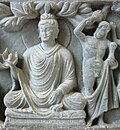


Kidarites
The Kidarites conquered Peshawar and parts of northwest Indian subcontinent including Gandhara probably sometime between 390 and 410 from Kushan empire,[67] around the end of the rule of Gupta Emperor Chandragupta II or beginning of the rule of Kumaragupta I.[68] It is probably the rise of the Hephthalites and the defeats against the Sasanians which pushed the Kidarites into northern India. Their last ruler in Gandhara was Kandik, around 500 CE.
Alchon Huns
Around 430 King Khingila, the most notable Alchon ruler, emerged and took control of the routes across the Hindu Kush from the Kidarites.[69][70][71][72] Coins of the Alchons rulers Khingila and Mehama were found at the Buddhist monastery of Mes Aynak, southeast of Kabul, confirming the Alchon presence in this area around 450-500 CE.[73]
.jpg)

The numismatic evidence as well as the so-called "Hephthalite bowl" from Gandhara, now in the British Museum, suggests a period of peaceful coexistence between the Kidarites and the Alchons, as it features two Kidarite noble hunters, together with two Alchon hunters and one of the Alchons inside a medallion.[74] At one point, the Kidarites withdrew from Gandhara, and the Alchons took over their mints from the time of Khingila.[74]
The Alchons apparently undertook the mass destruction of Buddhist monasteries and stupas at Taxila, a high center of learning, which never recovered from the destruction.[77][78] Virtually all of the Alchon coins found in the area of Taxila were found in the ruins of burned down monasteries, where apparently some of the invaders died alongside local defenders during the wave of destructions.[77] It is thought that the Kanishka stupa, one of the most famous and tallest buildings in antiquity, was destroyed by them during their invasion of the area in the 460s CE. The Mankiala stupa was also vandalized during their invasions.[79]
Mihirakula in particular is remembered by Buddhist sources to have been a "terrible persecutor of their religion" in Gandhara.[80] During the reign of Mihirakula, over one thousand Buddhist monasteries throughout Gandhara are said to have been destroyed.[81] In particular, the writings of Chinese monk Xuanzang from 630 CE explained that Mihirakula ordered the destruction of Buddhism and the expulsion of monks.[82] Indeed, the Buddhist art of Gandhara, in particular Greco-Buddhist art, becomes essentially extinct around that period. When Xuanzang visited Gandhara in c. 630 CE, he reported that Buddhism had drastically declined in favour of Shaivism, and that most of the monasteries were deserted and left in ruins.[83]
Turk and Hindu Shahis

The Turk Shahis ruled Gandhara until 870, when they were overthrown by the Hindu Shahis. The Hindu Shahis are believed to belong to the Uḍi/Oḍi tribe, namely the people of Oddiyana in Gandhara.[85][86]
The first king Kallar had moved the capital into Udabandhapura from Kabul, in the modern village of Hund for its new capital.[87][88][89][90] At its zenith, the kingdom stretched over the Kabul Valley, Gandhara and western Punjab under Jayapala.[91] Jayapala saw a danger in the consolidation of the Ghaznavids and invaded their capital city of Ghazni both in the reign of Sebuktigin and in that of his son Mahmud, which initiated the Muslim Ghaznavid and Hindu Shahi struggles.[92] Sebuk Tigin, however, defeated him, and he was forced to pay an indemnity.[92] Jayapala defaulted on the payment and took to the battlefield once more.[92] Jayapala however, lost control of the entire region between the Kabul Valley and Indus River.[93]
However, the army was defeated in battle against the western forces, particularly against the Mahmud of Ghazni.[93] In the year 1001, soon after Sultan Mahmud came to power and was occupied with the Qarakhanids north of the Hindu Kush, Jaipal attacked Ghazni once more and upon suffering yet another defeat by the powerful Ghaznavid forces, near present-day Peshawar. After the Battle of Peshawar, he died because of regretting as his subjects brought disaster and disgrace to the Shahi dynasty.[92][93]
Jayapala was succeeded by his son Anandapala,[92] who along with other succeeding generations of the Shahiya dynasty took part in various unsuccessful campaigns against the advancing Ghaznvids but were unsuccessful. The Hindu rulers eventually exiled themselves to the Kashmir Siwalik Hills.[93]
Rediscovery
|

By the time Gandhara had been absorbed into the empire of Mahmud of Ghazni, Buddhist buildings were already in ruins and Gandhara art had been forgotten. After Al-Biruni, the Kashmiri writer Kalhaṇa wrote his book Rajatarangini in 1151. He recorded some events that took place in Gandhara, and provided details about its last royal dynasty and capital Udabhandapura.
In the 19th century, British soldiers and administrators started taking an interest in the ancient history of the Indian Subcontinent. In the 1830s coins of the post-Ashoka period were discovered, and in the same period Chinese travelogues were translated. Charles Masson, James Prinsep, and Alexander Cunningham deciphered the Kharosthi script in 1838. Chinese records provided locations and site plans for Buddhist shrines. Along with the discovery of coins, these records provided clues necessary to piece together the history of Gandhara. In 1848 Cunningham found Gandhara sculptures north of Peshawar. He also identified the site of Taxila in the 1860s. From then on a large number of Buddhist statues were discovered in the Peshawar valley.
Archaeologist John Marshall excavated at Taxila between 1912 and 1934. He discovered separate Greek, Parthian, and Kushan cities and a large number of stupas and monasteries. These discoveries helped to piece together much more of the chronology of the history of Gandhara and its art.
After 1947 Ahmed Hassan Dani and the Archaeology Department at the University of Peshawar made a number of discoveries in the Peshawar and Swat Valley. Excavation of many of the sites of Gandhara Civilization are being done by researchers from Peshawar and several universities around the world.
Culture
Language
Gandhara's language was a Prakrit or "Middle Indo-Aryan" dialect, usually called Gāndhārī.[94] Hindko from Peshawar which was the capital of Gandhara, came from Shuraseni prakrit a language spoken in Gandhara.[95][96][97] Under the Kushan Empire, Gāndhārī spread into adjoining regions of South and Central Asia.[94] It used the Kharosthi script, which is derived from the Aramaic script, and it died out about in the 4th century CE.[94][98]
Linguistic evidence links some groups of the Dardic languages with Gandhari.[99][100][101] The Kohistani languages, now all being displaced from their original homelands, were once more widespread in the region and most likely descend from the ancient dialects of the region of Gandhara.[102][103] The last to disappear was Tirahi, still spoken some years ago in a few villages in the vicinity of Jalalabad in eastern Afghanistan, by descendants of migrants expelled from Tirah by the Afridi Pashtuns in the 19th century.[104] Georg Morgenstierne claimed that Tirahi is "probably the remnant of a dialect group extending from Tirah through the Peshawar district into Swat and Dir".[105] Nowadays, it must be entirely extinct and the region is now dominated by Iranian languages brought in by later migrants, such as Pashto.[104] Among the modern day Indo-Aryan languages still spoken today, Torwali shows the closest linguistic affinity possible to Niya, a dialect of Gāndhārī.[103][106]
Religion


Mahāyāna Buddhism
Mahāyāna Pure Land sutras were brought from the Gandhāra region to China as early as 147 CE, when the Kushan monk Lokakṣema began translating some of the first Buddhist sutras into Chinese.[107] The earliest of these translations show evidence of having been translated from the Gāndhārī language.[108] Lokakṣema translated important Mahāyāna sūtras such as the Aṣṭasāhasrikā Prajñāpāramitā Sūtra, as well as rare, early Mahāyāna sūtras on topics such as samādhi, and meditation on the Buddha Akṣobhya. Lokaksema's translations continue to provide insight into the early period of Mahāyāna Buddhism. This corpus of texts often includes and emphasizes ascetic practices and forest dwelling, and absorption in states of meditative concentration:[109]
Paul Harrison has worked on some of the texts that are arguably the earliest versions we have of the Mahāyāna sūtras, those translated into Chinese in the last half of the second century AD by the Indo-Scythian translator Lokakṣema. Harrison points to the enthusiasm in the Lokakṣema sūtra corpus for the extra ascetic practices, for dwelling in the forest, and above all for states of meditative absorption (samādhi). Meditation and meditative states seem to have occupied a central place in early Mahāyāna, certainly because of their spiritual efficacy but also because they may have given access to fresh revelations and inspiration.
Some scholars believe that the Mahāyāna Longer Sukhāvatīvyūha Sūtra was compiled in the age of the Kushan Empire in the 1st and 2nd centuries CE, by an order of Mahīśāsaka bhikṣus which flourished in the Gandhāra region.[110][111] However, it is likely that the longer Sukhāvatīvyūha owes greatly to the Mahāsāṃghika-Lokottaravāda sect as well for its compilation, and in this sutra there are many elements in common with the Lokottaravādin Mahāvastu.[110] There are also images of Amitābha Buddha with the bodhisattvas Avalokiteśvara and Mahāsthāmaprāpta which were made in Gandhāra during the Kushan era.[112]
The Mañjuśrīmūlakalpa records that Kaniṣka of the Kushan Empire presided over the establishment of the Mahāyāna Prajñāpāramitā teachings in the northwest.[113] Tāranātha wrote that in this region, 500 bodhisattvas attended the council at Jālandhra monastery during the time of Kaniṣka, suggesting some institutional strength for Mahāyāna in the north-west during this period.[113] Edward Conze goes further to say that Prajñāpāramitā had great success in the north-west during the Kushan period, and may have been the "fortress and hearth" of early Mahāyāna, but not its origin, which he associates with the Mahāsāṃghika branch of Buddhism.[114]
Art

Gandhāra is noted for the distinctive Gandhāra style of Buddhist art, which shows influence of Hellenistic and local Indian influences from the Gangetic Valley.[115] The Gandhāran art flourished and achieved its peak during the Kushan period, from the 1st to the 5th centuries, but it declined and was destroyed after the invasion of the Alchon Huns in the 5th century.
Siddhartha shown as a bejeweled prince (before the Sidhartha renounces palace life) is a common motif.[116] Stucco, as well as stone, were widely used by sculptors in Gandhara for the decoration of monastic and cult buildings.[116][117] Buddhist imagery combined with some artistic elements from the cultures of the Hellenistic world. An example is the youthful Buddha, his hair in wavy curls, similar to statutes of Apollo.[116] Sacred artworks and architectural decorations used limestone for stucco composed by a mixture of local crushed rocks (i.e. schist and granite) which resulted compatible with the outcrops located in the mountains northwest of Islamabad.[118]
The artistic traditions of Gandhara art can be divided into following phases:
- Indo-Greek art; 2nd century B.C to 1st century A.D
- Indo-Scythian art; 1st century B.C to 1st century A.D
- Kushan art; 1st century A.D to 4th century A.D
-
 Standing Bodhisattva (1st–2nd century)
 -
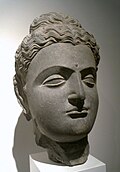 Buddha head (2nd century)
 -
 Buddha head (4th–6th century)
 -
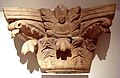 Buddha in acanthus capital
 -
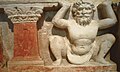 The Greek god Atlas, supporting a Buddhist monument, Hadda
 -
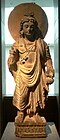 The Bodhisattva Maitreya (2nd century)
 -
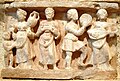 Wine-drinking and music, Hadda (1st–2nd century)
 -
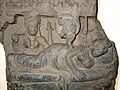 Maya's white elephant dream (2nd–3rd century)
 -
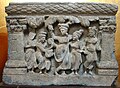 The birth of Siddharta (2nd–3rd century)
 -
 The Great Departure from the Palace (2nd–3rd century)
 -
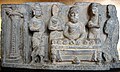 The end of ascetism (2nd–3rd century)
 -
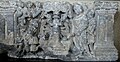 The Buddha preaching at the Deer Park in Sarnath (2nd–3rd century)
 -
 Scene of the life of the Buddha (2nd–3rd century)
 -
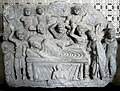 The death of the Buddha, or parinirvana (2nd–3rd century)
 -
 A sculpture from Hadda, (3rd century)
 -
 The Bodhisattva and Chandeka, Hadda (5th century)
 -
 Hellenistic decorative scrolls from Hadda, Afghanistan
 -
 Hellenistic scene, Gandhara (1st century)
 -
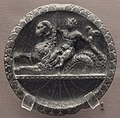 A stone plate (1st century).
 -
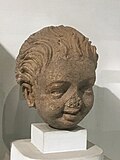 "Laughing boy" from Hadda
 -
 Bodhisattva seated in meditation
 -
 Marine deities, Gandhara
 -
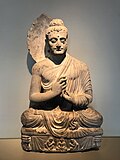 The Seated Buddha, dating from 300 to 500 AD, was found near Jamal Garhi, and is now on display at the Asian Art Museum in San Francisco
 -
 Sharing of the Buddha's relics, above a Gandhara fortified city.


.jpg)


Major cities
Major cities of ancient Gandhara are as follows:
- Puṣkalavati (Charsadda), Pakistan
- Takshashila (Taxila), Pakistan
- Puruṣapura (Peshawer), Pakistan
- Sagala (Sialkot), Pakistan
- Oddiyana (Swat), Pakistan
- Kapisi (Bagram), Afghanistan
- Jibin, appears in the Chinese sources
Notable people
In popular culture
- Gandhara:Buddha no Seisen is an action RPG released in Japan in 1987.[119]
- Gandhara (song) is a 1978 song by Japanese rock band Godiego, serving as their 7th single.
- Gandhara is a Buddhist pacifist organization in the Japanese manga series Shaman King.
See also
Notes
- ↑ NOTE: See long discussion under mahajanapada from the Ancient Buddhist text Anguttara Nikaya's list of mahajanapadas.
References
- ↑ Bryant, Edwin Francis (2002). The Quest for the Origins of Vedic Culture: The Indo-Aryan Migration Debate. Oxford University Press. p. 138. ISBN 978-0-19-565361-8.
- ↑ 2.0 2.1 Kulke, Professor of Asian History Hermann; Kulke, Hermann; Rothermund, Dietmar (2004). A History of India. Psychology Press. ISBN 978-0-415-32919-4.
- ↑ 3.0 3.1 Warikoo, K. (2004). Bamiyan: Challenge to World Heritage. Third Eye. ISBN 978-81-86505-66-3.
- ↑ 4.0 4.1 Hansen, Mogens Herman (2000). A Comparative Study of Thirty City-state Cultures: An Investigation. Kgl. Danske Videnskabernes Selskab. ISBN 978-87-7876-177-4.
- ↑ Neelis, Early Buddhist Transmission and Trade Networks 2010, p. 232.
- ↑ Eggermont, Alexander's Campaigns in Sind and Baluchistan 1975, pp. 175–177.
- ↑ Badian, Ernst (1987), "Alexander at Peucelaotis", The Classical Quarterly, 37 (1): 117–128, doi:10.1017/S0009838800031712, JSTOR 639350, S2CID 246878679
- ↑ "Rigveda 1.126:7, English translation by Ralph TH Griffith".
- ↑ Arthur Anthony Macdonell (1997). A History of Sanskrit Literature. Motilal Banarsidass. pp. 130–. ISBN 978-81-208-0095-3.
- ↑ * Schmidt, Karl J. (1995). An Atlas and Survey of South Asian History, p.120: "In addition to being a center of religion for Buddhists, as well as Hindus, Taxila was a thriving center for art, culture, and learning."
- Srinivasan, Doris Meth (2008). "Hindu Deities in Gandharan art," in Gandhara, The Buddhist Heritage of Pakistan: Legends, Monasteries, and Paradise, pp.130-143: "Gandhara was not cut off from the heartland of early Hinduism in the Gangetic Valley. The two regions shared cultural and political connections and trade relations and this facilitated the adoption and exchange of religious ideas. [...] It is during the Kushan Era that flowering of religious imagery occurred. [...] Gandhara often introduced its own idiosyncratic expression upon the Buddhist and Hindu imagery it had initially come in contact with."
- Blurton, T. Richard (1993). Hindu Art, Harvard University Press: "The earliest figures of Shiva which show him in purely human form come from the area of ancient Gandhara" (p.84) and "Coins from Gandhara of the first century BC show Lakshmi [...] four-armed, on a lotus." (p.176)
- ↑ 11.0 11.1 11.2 11.3 11.4 11.5 Prakash, Buddha (1951). "Poros". Annals of the Bhandarkar Oriental Research Institute. 32 (1): 198–233. JSTOR 41784590. Retrieved 12 June 2022.
- ↑ "UW Press: Ancient Buddhist Scrolls from Gandhara". Retrieved April 2018.
- ↑ GĀNDHĀRĪ LANGUAGE, Encyclopædia Iranica
- ↑ Kurt A. Behrendt (2007), The Art of Gandhara in the Metropolitan Museum of Art, pp.4-5,91
- ↑ Mohiuddin, Yasmeen Niaz (2007). Pakistan: A Global Studies Handbook. ABC-CLIO. ISBN 9781851098019.
- ↑ Some sounds are omitted in the writing of Old Persian, and are shown with a raised letter.Old Persian p.164Old Persian p.13. In particular Old Persian nasals such as "n" were omitted in writing before consonants Old Persian p.17Old Persian p.25
- ↑ 17.0 17.1 Perfrancesco Callieri, INDIA ii. Historical Geography, Encyclopaedia Iranica, 15 December 2004.
- ↑ Herodotus Book III, 89-95
- ↑ Thomas Watters (1904). "On Yuan Chwang's travels in India, 629–645 A.D." Royal Asiatic Society. p. 200.
Taken as Gandhavat the name is explained as meaning hsiang-hsing or "scent-action" from the word gandha which means scent, small, perfume.
At the Internet Archive. - ↑ Adrian Room (1997). Placenames of the World. McFarland. ISBN 9780786418145.
Kandahar. City, south central Afghanistan
At Google Books. - ↑ Macdonell, Arthur Anthony; Keith, Arthur Berriedale (1995). Vedic Index of Names and Subjects. Vol. 1. Motilal Banarsidass Publishers. p. 219. ISBN 9788120813328. At Google Books.
- ↑ "Gandara – Livius".
- ↑ Herodotus (1920). "3.102.1". Histories. "4.44.2". Histories (in Ελληνικά). Translated by A. D. Godley. "3.102.1". Histories. "4.44.2". Histories. Cambridge: Harvard University Press. At the Perseus Project.
- ↑ Eggermont, Pierre Herman Leonard (1975), Alexander's Campaigns in Sind and Baluchistan and the Siege of the Brahmin Town of Harmatelia, Peeters Publishers, pp. 175–177, ISBN 978-90-6186-037-2
- ↑ "Catalogue of coins in the Punjab museum, Lahore". 1914.
- ↑ Ahmad Hasan Dani; Vadim Mikhaĭlovich Masson (1999). History of Civilizations of Central Asia, Volume 1. Motilal Banarsidass. p. 79. ISBN 9788120814073.
- ↑ "Some Comments on the Mammalian Fauna of Sanghao Cave, a Middle Stone Age Site in Northern Pakistan", by M. Salim, [1]
- ↑ A. H. Dani (1993). History of Civilizations of Central Asia: The Dawn of Civilization : Earliest Times to 700 B.C. UNESCO. p. 487.
- ↑ Kumkum Roy (2009). Historical Dictionary of Ancient India. Rowman & Littlefield. p. 282. ISBN 9780810853669.
- ↑ Marta Camps; Parth Chauhan. Sourcebook of Paleolithic Transitions: Methods, Theories, and Interpretations. p. 131. ISBN 9780387764870.
- ↑ Olivieri, Luca M., Roberto Micheli, Massimo Vidale, and Muhammad Zahir, (2019). 'Late Bronze – Iron Age Swat Protohistoric Graves (Gandhara Grave Culture), Swat Valley, Pakistan (n-99)', in Narasimhan, Vagheesh M., et al., "Supplementary Materials for the formation of human populations in South and Central Asia", Science 365 (6 September 2019), pp. 137-164.
- ↑ Coningham, Robin, and Mark Manuel, (2008). "Kashmir and the Northwest Frontier", Asia, South, in Encyclopedia of Archaeology 2008, Elsevier, p. 740.
- ↑ Narasimhan, Vagheesh M., et al. (2019). "The formation of human populations in South and Central Asia", in Science 365 (6 September 2019), p. 11: "...we estimate the date of admixture into the Late Bronze Age and Iron Age individuals from the Swat District of northernmost South Asia to be, on average, 26 generations before the date that they lived, corresponding to a 95% confidence interval of ~1900 to 1500 BCE..."
- ↑ Macdonell, Arthur Anthony; Keith, Arthur Berriedale (1912). Vedic Index of Names and Subjects. John Murray. pp. 218–219.
- ↑ Chattopadhyaya, Sudhakar (1978). Reflections on the Tantras. Motilal Banarsidass Publishers. p. 4.
- ↑ 36.0 36.1 Raychaudhuri 1953, p. 59-62.
- ↑ 37.0 37.1 Raychaudhuri 1953, p. 146-147.
- ↑ Macdonell & Keith 1912, p. 218-219, 432.
- ↑ Jain, Kailash Chand (1972). Malwa Through the Ages. Delhi, India: Motilal Banarsidass. pp. 98–104. ISBN 978-8-120-80824-9.
- ↑ Higham, Charles (2014), Encyclopedia of Ancient Asian Civilizations, Infobase Publishing, pp. 209–, ISBN 978-1-4381-0996-1
- ↑ Khoinaijam Rita Devi (1 January 2007). History of ancient India: on the basis of Buddhist literature. Akansha Publishing House. ISBN 978-81-8370-086-3.
- ↑ 42.0 42.1 Young, T. Cuyler (1988). "The early history of the Medes and the Persians and the Achaemenid empire to the death of Cambyses". In Boardman, John; Hammond, N. G. L.; Lewis, D. M.; Ostwald, M. (eds.). The Cambridge Ancient History. Vol. 4. Cambridge: Cambridge University Press. pp. 1–52. ISBN 978-0-521-22804-6.
- ↑ Sethna, Kaikhosru Danjibuoy (2000). "To Pāṇini's Time from Pāṇini's Place". Problems of Ancient India. Aditya Prakashan. pp. 121–172. ISBN 978-8-177-42026-5.
- ↑ Bivar, A. D. H. (1988). "The Indus Lands". In Boardman, John; Hammond, N. G. L.; Lewis, D. M.; Ostwald, M. (eds.). The Cambridge Ancient History. Vol. 4. Cambridge: Cambridge University Press. pp. 194–210. ISBN 978-0-521-22804-6.
- ↑ "Pukkusāti". www.palikanon.com. Retrieved 26 July 2020.
- ↑ O. Bopearachchi, "Premières frappes locales de l'Inde du Nord-Ouest: nouvelles données," in Trésors d'Orient: Mélanges offerts à Rika Gyselen, Fig. 1 CNG Coins
- ↑ Bopearachchi, Osmund. Coin Production and Circulation in Central Asia and North-West India (Before and after Alexander's Conquest). pp. 300–301.
- ↑ "US Department of Defense". Archived from the original on 10 June 2020. Retrieved 7 October 2018.
- ↑ Errington, Elizabeth; Trust, Ancient India and Iran; Museum, Fitzwilliam (1992). The Crossroads of Asia: transformation in image and symbol in the art of ancient Afghanistan and Pakistan. Ancient India and Iran Trust. pp. 57–59. ISBN 9780951839911.
- ↑ Bopearachchi, Osmund. Coin Production and Circulation in Central Asia and North-West India (Before and after Alexander's Conquest). pp. 308–.
- ↑ Rafi U. Samad, The Grandeur of Gandhara: The Ancient Buddhist Civilization of the Swat, Peshawar, Kabul and Indus Valleys. Algora Publishing, 2011, p. 32 ISBN 0875868592
- ↑ Mukerjee, R. K. History and Culture of Indian People, The Age of Imperial Unity, Foreign Invasion. p. 46.
- ↑ Curtius in McCrindle, p. 192, J. W. McCrindle; History of Punjab, Vol I, 1997, p 229, Punjabi University, Patiala (editors): Fauja Singh, L. M. Joshi; Kambojas Through the Ages, 2005, p. 134, Kirpal Singh.
- ↑ Revue des etudes grecques 1973, p 131, Ch-Em Ruelle, Association pour l'encouragement des etudes grecques en France.
- ↑ Early Indian Economic History, 1973, pp 237, 324, Rajaram Narayan Saletore.
- ↑ Myths of the Dog-man, 199, p 119, David Gordon White; Journal of the Oriental Institute, 1919, p 200; Journal of Indian Museums, 1973, p 2, Museums Association of India; The Pāradas: A Study in Their Coinage and History, 1972, p 52, Dr B. N. Mukherjee – Pāradas; Journal of the Department of Sanskrit, 1989, p 50, Rabindra Bharati University, Dept. of Sanskrit- Sanskrit literature; The Journal of Academy of Indian Numismatics & Sigillography, 1988, p 58, Academy of Indian Numismatics and Sigillography – Numismatics; Cf: Rivers of Life: Or Sources and Streams of the Faiths of Man in All Lands, 2002, p 114, J. G. R. Forlong.
- ↑ Journal of the Oriental Institute, 1919, p 265, Oriental Institute (Vadodara, India) – Oriental studies; For Kuru-Kamboja connections, see Dr Chandra Chakraberty's views in: Literary history of ancient India in relation to its racial and linguistic affiliations, pp 14,37, Vedas; The Racial History of India, 1944, p 153, Chandra Chakraberty – Ethnology; Paradise of Gods, 1966, p 330, Qamarud Din Ahmed – Pakistan.
- ↑ Ancient India, History of India for 1000 years, four Volumes, Vol I, 1938, pp 38, 98 Dr T. L. Shah.
- ↑ en:Greco-Buddhist_art, oldid 878583324[circular reference]
- ↑ (Imperial Gazetteer, p. 149)
- ↑ The Grandeur of Gandhara, Rafi-us Samad, Algora Publishing, 2011, p.64-67 [2]
- ↑ Ancient India by Ramesh Chandra Majumdar p. 234
- ↑ Singh, Upinder (25 September 2017). Political Violence in Ancient India. p. 166. ISBN 9780674981287.
- ↑ Le, Huu Phuoc (2010). Buddhist Architecture. Grafikol. p. 180. ISBN 9780984404308.
- ↑ Marshall, John H. (1909): "Archaeological Exploration in India, 1908–9." (Section on: "The stūpa of Kanishka and relics of the Buddha"). Journal of the Royal Asiatic Society, 1909, pp. 1056–1061.
- ↑ Rai Govind Chandra (1 January 1979). Indo-Greek Jewellery. Abhinav Publications. pp. 82–. ISBN 978-81-7017-088-4. Retrieved 13 December 2012.
- ↑ Dani, Ahmad Hasan; Litvinsky, B. A. (1996). History of Civilizations of Central Asia: The crossroads of civilizations, A.D. 250 to 750. UNESCO. p. 122. ISBN 9789231032110.
- ↑ "The entry of the Kidarites into India may firmly be placed some time round about the end of rule of Candragupta II or beginning of the rule of Kumaragupta I (circa 410-420 a.d.)" in Gupta, Parmeshwari Lal; Kulashreshtha, Sarojini (1994). Kuṣāṇa Coins and History. D.K. Printworld. p. 122. ISBN 9788124600177.
- ↑ "The Alchon Huns....established themselves as overlords of northwestern India, and directly contributed to the downfall of the Guptas" in Neelis, Jason (2010). Early Buddhist Transmission and Trade Networks: Mobility and Exchange Within and Beyond the Northwestern Borderlands of South Asia. BRILL. p. 162. ISBN 9789004181595.
- ↑ Bakker, Hans (2017), Monuments of Hope, Gloom and Glory in the Age of the Hunnic Wars: 50 years that changed India (484–534), Royal Netherlands Academy of Arts and Sciences, Section 4, ISBN 978-90-6984-715-3, archived from the original on 11 January 2020, retrieved 1 May 2021
- ↑ Atreyi Biswas (1971). The Political History of the Hūṇas in India. Munshiram Manoharlal Publishers. ISBN 9780883863015.
- ↑ Upendra Thakur (1967). The Hūṇas in India. Chowkhamba Prakashan. pp. 52–55.
- ↑ Alram, Michael (2014). "From the Sasanians to the Huns New Numismatic Evidence from the Hindu Kush". The Numismatic Chronicle. 174: 274. JSTOR 44710198.
- ↑ 74.0 74.1 74.2 74.3 ALRAM, MICHAEL (2014). "From the Sasanians to the Huns New Numismatic Evidence from the Hindu Kush". The Numismatic Chronicle. 174: 274–275. ISSN 0078-2696. JSTOR 44710198.
- ↑ Iaroslav Lebedynsky, "Les Nomades", p172.
- ↑ "British Museum notice". British Museum. Retrieved 2 April 2023.
- ↑ 77.0 77.1 Ghosh, Amalananda (1965). Taxila. CUP Archive. p. 791.
- ↑ Upinder Singh (2017). Political Violence in Ancient India. Harvard University Press. p. 241. ISBN 9780674981287.
- ↑ Le, Huu Phuoc (2010). Buddhist Architecture. Grafikol. ISBN 9780984404308. Retrieved 24 March 2017.
- ↑ Grousset, Rene (1970). The Empire of the Steppes. Rutgers University Press. pp. 69–71. ISBN 0-8135-1304-9.
- ↑ Behrendt, Kurt A. (2004). Handbuch der Orientalistik. Leiden: BRILL. ISBN 9789004135956.
- ↑ Upinder Singh (2017). Political Violence in Ancient India. Harvard University Press. pp. 241–242. ISBN 9780674981287.
- ↑ Ann Heirman; Stephan Peter Bumbacher (11 May 2007). The Spread of Buddhism. Leiden: BRILL. p. 60. ISBN 978-90-474-2006-4.
- ↑ Rehman 1976, p. 187 and Pl. V B., "the horseman is shown wearing a turban-like head-gear with a small globule on the top".
- ↑ Rahman, Abdul (2002). "New Light on the Khingal, Turk and the Hindu Sahis" (PDF). Ancient Pakistan. XV: 37–42.
The Hindu Śāhis were therefore neither Bhattis, or Janjuas, nor Brahmans. They were simply Uḍis/Oḍis. It can now be seen that the term Hindu Śāhi is a misnomer and, based as it is merely upon religious discrimination, should be discarded and forgotten. The correct name is Uḍi or Oḍi Śāhi dynasty.
- ↑ Meister, Michael W. (2005). "The Problem of Platform Extensions at Kafirkot North" (PDF). Ancient Pakistan. XVI: 41–48.
Rehman (2002: 41) makes a good case for calling the Hindu Śāhis by a more accurate name, "Uḍi Śāhis".
- ↑ The Shahi Afghanistan and Punjab, 1973, pp 1, 45–46, 48, 80, Dr D. B. Pandey; The Úakas in India and Their Impact on Indian Life and Culture, 1976, p 80, Vishwa Mitra Mohan – Indo-Scythians; Country, Culture and Political life in early and medieval India, 2004, p 34, Daud Ali.
- ↑ Journal of the Royal Asiatic Society, 1954, pp 112 ff; The Shahis of Afghanistan and Punjab, 1973, p 46, Dr D. B. Pandey; The Úakas in India and Their Impact on Indian Life and Culture, 1976, p 80, Vishwa Mitra Mohan – Indo-Scythians.
- ↑ India, A History, 2001, p 203, John Keay.
- ↑ Sehrai, Fidaullah (1979). Hund: The Forgotten City of Gandhara, p. 2. Peshawar Museum Publications New Series, Peshawar.
- ↑ (Wynbrandt 2009, pp. 52–54)
- ↑ 92.0 92.1 92.2 92.3 92.4 P. M. Holt; Ann K. S. Lambton; Bernard Lewis, eds. (1977), The Cambridge history of Islam, Cambridge University Press, p. 3, ISBN 978-0-521-29137-8,
... Jaypala of Waihind saw danger in the consolidation of the kingdom of Ghazna and decided to destroy it. He therefore invaded Ghazna, but was defeated ...
- ↑ 93.0 93.1 93.2 93.3 Ferishta's History of Dekkan from the first Mahummedan conquests(etc). Shrewsbury [Eng.] : Printed for the editor by J. and W. Eddowes. 1794.
{{cite book}}:|work=ignored (help) - ↑ 94.0 94.1 94.2 Foundation, Encyclopaedia Iranica. "GĀNDHĀRĪ LANGUAGE". iranicaonline.org. Retrieved 20 July 2021.
- ↑ "Origins of Hindko". 23 May 2013.
- ↑ "Hindko: 'The Language Of Hind'". NewsGram.
- ↑ "Origins of Hindko". Journal of Language Relationship. 15 (3–4): 228–237. 2018. doi:10.31826/jlr-2018-153-409. S2CID 212688313.
- ↑ Rhie, Marylin Martin (15 July 2019). Early Buddhist Art of China and Central Asia, Volume 2 The Eastern Chin and Sixteen Kingdoms Period in China and Tumshuk, Kucha and Karashahr in Central Asia (2 vols). BRILL. p. 327. ISBN 978-90-04-39186-4.
- ↑ Dani, Ahmad Hasan (2001). History of Northern Areas of Pakistan: Upto 2000 A.D. Sang-e-Meel Publications. pp. 64–67. ISBN 978-969-35-1231-1.
- ↑ Saxena, Anju (12 May 2011). Himalayan Languages: Past and Present. Walter de Gruyter. p. 35. ISBN 978-3-11-089887-3.
- ↑ Liljegren, Henrik (26 February 2016). A grammar of Palula. Language Science Press. pp. 13–14. ISBN 978-3-946234-31-9.
Palula belongs to a group of Indo-Aryan (IA) languages spoken in the Hindukush region that are often referred to as "Dardic" languages... It has been and is still disputed to what extent this primarily geographically defined grouping has any real classificatory validity... On the one hand, Strand suggests that the term should be discarded altogether, holding that there is no justification whatsoever for any such grouping (in addition to the term itself having a problematic history of use), and prefers to make a finer classification of these languages into smaller genealogical groups directly under the IA heading, a classification we shall return to shortly... Zoller identifies the Dardic languages as the modern successors of the Middle Indo-Aryan (MIA) language Gandhari (also Gandhari Prakrit), but along with Bashir, Zoller concludes that the family tree model alone will not explain all the historical developments.
- ↑ Cacopardo, Alberto M.; Cacopardo, Augusto S. (2001). Gates of Peristan: History, Religion and Society in the Hindu Kush. IsIAO. p. 253. ISBN 978-88-6323-149-6.
...This leads us to the conclusion that the ancient dialects of the Peshawar District, the country between Tirah and Swât, must have belonged to the Tirahi-Kohistani type, and that the westernmost Dardic language, Pashai, which probably had its ancient centre in Laghmân, has enjoyed a comparatively independent position since early times". …Today the Kohistâni languages descendent from the ancient dialects that developed in these valleys have all been displaced from their original homelands, as described below.
- ↑ 103.0 103.1 Burrow, T. (1936). "The Dialectical Position of the Niya Prakrit". Bulletin of the School of Oriental Studies, University of London. 8 (2/3): 419–435. ISSN 1356-1898. JSTOR 608051.
... It might be going too far to say that Torwali is the direct lineal descendant of the Niya Prakrit, but there is no doubt that out of all the modern languages it shows the closest resemblance to it. A glance at the map in the Linguistic Survey of India shows that the area at present covered by "Kohistani" is the nearest to that area round Peshawar, where, as stated above, there is most reason to believe was the original home of the Niya Prakrit. That conclusion, which was reached for other reasons, is thus confirmed by the distribution of the modern dialects.
- ↑ 104.0 104.1 Dani, Ahmad Hasan (2001). History of Northern Areas of Pakistan: Upto 2000 A.D. Sang-e-Meel Publications. p. 65. ISBN 978-969-35-1231-1.
In the Peshawar district, there does not remain any Indian dialect continuing this old Gandhari. The last to disappear was Tirahi, still spoken some years ago in Afghanistan, in the vicinity of Jalalabad, by descendants of migrants expelled from Tirah by the Afridis in the 19th century. Nowadays, it must be entirely extinct and in the NWFP are only to be found modern Iranian languages brought in by later immigrants (Baluch, Pashto) or Indian languages brought in by the paramount political power (Urdu, Panjabi) or by Hindu traders (Hindko).
- ↑ Jain, Danesh; Cardona, George (26 July 2007). The Indo-Aryan Languages. Routledge. p. 991. ISBN 978-1-135-79710-2.
- ↑ Salomon, Richard (10 December 1998). Indian Epigraphy: A Guide to the Study of Inscriptions in Sanskrit, Prakrit, and the other Indo-Aryan Languages. Oxford University Press. p. 79. ISBN 978-0-19-535666-3.
- ↑ "The Korean Buddhist Canon: A Descriptive Catalogue". www.acmuller.net.
- ↑ Mukherjee, Bratindra Nath. India in Early Central Asia. 1996. p. 15
- ↑ Williams, Paul. Mahāyāna Buddhism: The Doctrinal Foundations. 2008. p. 30
- ↑ 110.0 110.1 Nakamura, Hajime. Indian Buddhism: A Survey With Biographical Notes. 1999. p. 205
- ↑ Williams, Paul. Mahāyāna Buddhism: The Doctrinal Foundations. 2008. p. 239
- ↑ "Gandharan Sculptural Style: The Buddha Image". Archived from the original on 18 December 2014. Retrieved 7 February 2016.
- ↑ 113.0 113.1 Ray, Reginald. Buddhist Saints in India: A Study in Buddhist Values and Orientations. 1999. p. 410
- ↑ Ray, Reginald. Buddhist Saints in India: A Study in Buddhist Values and Orientations. 1999. p. 426
- ↑ Behrendt, Kurt (2011). Gandharan Buddhism: Archaeology, Art, and Texts. UBC Press. p. 241. ISBN 978-0774841283. Retrieved 16 August 2019.
- ↑ 116.0 116.1 116.2 "Buddhism and Buddhist Art".
- ↑ Siple, Ella S. (1931). "Stucco Sculpture from Central Asia". The Burlington Magazine for Connoisseurs. 59 (342): 140–145. ISSN 0951-0788. JSTOR 864875.
- ↑ Carlo Rosa; Thomas Theye; Simona Pannuzi (2019). "Geological overwiew of Gandharan sites and petrographical analysis on Gandharan stucco and clay artefacts" (pdf). Restauro Archeologico. 27 (1). Firenze University Press: Abstract. doi:10.13128/RA-25095. ISSN 1724-9686. OCLC 8349098991. Archived from the original on 15 February 2020. Retrieved 15 February 2020. on DOAJ
- ↑ "Gandhara:Buddha no Seisen". Retrieved 21 March 2023.
Sources
- Beal, Samuel. 1884. Si-Yu-Ki: Buddhist Records of the Western World, by Hiuen Tsiang. 2 vols. Trans. by Samuel Beal. London. Reprint: Delhi. Oriental Books Reprint Corporation. 1969.
- Beal, Samuel. 1911. The Life of Hiuen-Tsiang by the Shaman Hwui Li, with an Introduction containing an account of the Works of I-Tsing. Trans. by Samuel Beal. London. 1911. Reprint: Munshiram Manoharlal, New Delhi. 1973.
- Bellew, H.W. Kashmir and Kashgar. London, 1875. Reprint: Sang-e-Meel Publications 1999 ISBN 969-35-0738-X
- Caroe, Sir Olaf, The Pathans, Oxford University Press, Karachi, 1958.
- Eggermont, Pierre Herman Leonard (1975), Alexander's Campaigns in Sind and Baluchistan and the Siege of the Brahmin Town of Harmatelia, Peeters Publishers, ISBN 978-90-6186-037-2
- Herodotus (1920). Histories (in Ελληνικά and English). With an English translation by A. D. Godley. Cambridge: Harvard University Press.
- Hill, John E. 2003. "Annotated Translation of the Chapter on the Western Regions according to the Hou Hanshu". 2nd Edition: Through the Jade Gate to Rome: A Study of the Silk Routes, 1st to 2nd Centuries CE. 2015. John E. Hill. Volume I, ISBN 978-1500696702; Volume II, ISBN 978-1503384620. CreateSpace, North Charleston, S.C.
- Hussain, J. An Illustrated History of Pakistan, Oxford University Press, Karachi, 1983.
- "Imperial Gazetteer2 of India, Volume 19– Imperial Gazetteer of India". Digital South Asia Library. Retrieved 22 April 2015.
- Legge, James. Trans. and ed. 1886. A Record of Buddhistic Kingdoms: being an account by the Chinese monk Fâ-hsien of his travels in India and Ceylon (A.D. 399–414) in search of the Buddhist Books of Discipline. Reprint: Dover Publications, New York. 1965.
- Neelis, Jason (2010), Early Buddhist Transmission and Trade Networks: Mobility and Exchange Within and Beyond the Northwestern Borderlands of South Asia, BRILL, ISBN 978-90-04-18159-5
- Raychaudhuri, Hemchandra (1953). Political History of Ancient India: From the Accession of Parikshit to the Extinction of Gupta Dynasty. University of Calcutta.
- Rehman, Abdur (January 1976). The Last Two Dynasties of the Sahis: An analysis of their history, archaeology, coinage and palaeography (Thesis). Australian National University.
- Shaw, Isobel. Pakistan Handbook, The Guidebook Co., Hong Kong, 1989
- Watters, Thomas. 1904–5. On Yuan Chwang's Travels in India (A.D. 629–645). Reprint: Mushiram Manoharlal Publishers, New Delhi. 1973.
- Wynbrandt, James (2009). A Brief History of Pakistan. New York: Infobase Publishing.

Further reading
- Lerner, Martin (1984). The flame and the lotus: Indian and Southeast Asian art from the Kronos collections. New York: The Metropolitan Museum of Art. ISBN 0-87099-374-7.
- Rehman, Abdur (2009). "A Note on the Etymology of Gandhāra". Bulletin of the Asia Institute. 23: 143–146. JSTOR 24049432.
- Filigenzi, Anna (2000). "Reviewed Work: A Catalogue of the Gandhāra Sculpture in the British Museum, Vol. I: Text, Vol. II: Plates by Wladimir Zwalf". Wladimir Zwalf, Review by: Anna Filigenzi. 50 (1/4). Istituto Italiano per l'Africa e l'Oriente: 584–586. JSTOR 29757475.
- Rienjang, Wannaporn, and Peter Stewart (eds), The Rediscovery and Reception of Gandharan Art (Archaeopress, 2022) ISBN 978-1-80327-233-7.
External links
- Gandharan Connections Project (Cambridge, 2016-2021)
- Livius.org: Gandara Archived 19 July 2013 at the Wayback Machine
- The Buddhist Manuscript project
- University of Washington's Gandharan manuscript
- Coins of Gandhara janapada
- Gandhara Civilization- National Fund for Cultural Heritage (Pakistan)
Template:Gandhara Template:Achaemenid Provinces
- Pages using the JsonConfig extension
- Former country articles requiring maintenance
- Articles containing Ancient Greek (to 1453)-language text
- Articles needing additional references from February 2021
- Gandhara
- Achaemenid satrapies
- Ancient empires and kingdoms of India
- Ancient history of Pakistan
- Archaeological sites in Pakistan
- Buddhist sites in Pakistan
- Ancient Asia
- History of Pakistan
- Historical regions of Pakistan
- Kingdoms in the Ramayana
- Locations in Hindu mythology
- Prehistoric Pakistan