

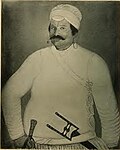


WikiDwarfBOT (talk | contribs) Cleanup: |
|||
| Line 6: | Line 6: | ||
| conventional_long_name = French Settlements in India | | conventional_long_name = French Settlements in India | ||
| common_name = French India | | common_name = French India | ||
| image_flag = | | image_flag = Royal Standard of the King of France.svg | ||
| | | image_flag2 = Flag of France (1794–1815).svg | ||
| empire = France | | empire = France | ||
| status = Colony | | status = Colony | ||
| era = | | era = | ||
| year_start = 1664 | | year_start = 1664 | ||
| year_end = 1954 | | year_end = 1954 | ||
| Line 28: | Line 28: | ||
| capital = [[Pondicherry|Pondichéry]] | | capital = [[Pondicherry|Pondichéry]] | ||
| common_languages = [[Indian French|French]] ''(de jure)''<ref>Not as widespread; regional and local as well as English</ref><br />[[Tamil language|Tamil]]<br />[[Telugu language|Telugu]]<br />[[Malayalam]]<br />[[Bengali language|Bengali]]<br />[[Indian English|English]] | | common_languages = [[Indian French|French]] ''(de jure)''<ref>Not as widespread; regional and local as well as English</ref><br />[[Tamil language|Tamil]]<br />[[Telugu language|Telugu]]<br />[[Malayalam]]<br />[[Bengali language|Bengali]]<br />[[Indian English|English]] | ||
| title_leader = | | title_leader = | ||
| leader1 = | | leader1 = | ||
| year_leader1 = | | year_leader1 = | ||
| leader2 = | | leader2 = | ||
| year_leader2 = | | year_leader2 = | ||
| title_representative = Governor | | title_representative = Governor | ||
| representative1 = [[François Caron]] {{small|(first)}} <ref>as Commissioner</ref> | | representative1 = [[François Caron]] {{small|(first)}} <ref>as Commissioner</ref> | ||
| year_representative1 = 1668–1673 | | year_representative1 = 1668–1673 | ||
| representative2 = Georges Escaragueil <ref>as High Commissioner</ref> | | representative2 = Georges Escaragueil<ref>as High Commissioner</ref> | ||
| year_representative2 = 1954 | | year_representative2 = 1954 | ||
| title_deputy = | | title_deputy = | ||
| Line 43: | Line 43: | ||
| deputy2 = Georges Escargueil {{small|(last)}} | | deputy2 = Georges Escargueil {{small|(last)}} | ||
| year_deputy2 = 1954 | | year_deputy2 = 1954 | ||
| currency = [[Roupie|French Indian Rupee]] | | currency = [[Roupie|French Indian Rupee]] | ||
| today = | | today = [[India]] | ||
| demonym = | | demonym = | ||
| stat_year1 = | |||
| stat_area1 = | |||
| stat_pop1 = | |||
| stat_year2 = 1936 | |||
| stat_area2 = 510 | |||
| stat_pop2 = 298,861 | |||
| area_km2 = | | area_km2 = | ||
| area_rank = | | area_rank = | ||
| Line 58: | Line 58: | ||
| HDI = | | HDI = | ||
| HDI_year = | | HDI_year = | ||
|status_text=Colony of France (1664–1946)<br />[[Overseas territory (France)|Overseas Territory of France]](1946–1954)|legislature=[[Representative Assembly of French India]]|government_type=Colonial | | status_text = Colony of France (1664–1946)<br />[[Overseas territory (France)|Overseas Territory of France]] (1946–1954) | ||
| legislature = [[Representative Assembly of French India]] | |||
| government_type = Colonial administration | |||
}} | |||
{{Colonial India}} | {{Colonial India}} | ||
'''French India''', formally the '''{{lang|fr|Établissements français dans l'Inde}}'''{{efn|In France it was popularly known as {{lang|fr|les Comptoirs de l'Inde}}. Strictly speaking though, a {{lang|fr|comptoir}} is a trading station, whereas the five French settlements were entire towns with the surrounding area, and not mere trading stations.}} ({{lang-en|French Settlements in India}}), was a [[Overseas territory (France)|French colony]] comprising five geographically separated enclaves on the [[Indian Subcontinent]] that had initially been [[Factory (trading post)|factories]] of the [[French East India Company]]. They were ''de facto'' incorporated into the [[India|Republic of India]] in 1950 and 1954. The enclaves were {{lang|fr|[[Pondicherry|Pondichéry]]|italic=no}}, [[Karaikal|Karikal]], [[Yanam | '''French India''', formally the '''{{lang|fr|Établissements français dans l'Inde}}'''{{efn|In France, it was popularly known as {{lang|fr|les Comptoirs de l'Inde}}. Strictly speaking though, a {{lang|fr|comptoir}} is a trading station, whereas the five French settlements were entire towns with the surrounding area, and not mere trading stations.}} ({{lang-en|French Settlements in India}}), was a [[Overseas territory (France)|French colony]] comprising five geographically separated enclaves on the [[Indian Subcontinent]] that had initially been [[Factory (trading post)|factories]] of the [[French East India Company]]. They were ''de facto'' incorporated into the [[India|Republic of India]] in 1950 and 1954. The enclaves were {{lang|fr|[[Pondicherry|Pondichéry]]|italic=no}}, [[Karaikal|Karikal]], [[Yanam]] ([[Andhra Pradesh]]) on the [[Coromandel Coast]], [[Mahé, India|Mahé]] on the [[Malabar Coast]] and [[Chandannagar|Chandernagor]] in [[Bengal]]. The French also possessed several {{lang|fr|loges}} ('lodges', tiny subsidiary trading stations) inside other towns, but after 1816, the British denied all French claims to these, which were not reoccupied. | ||
By 1950, the total area measured {{convert|510|km2|sqmi|abbr=on}}, of which {{convert|293|km2|sqmi|abbr=on}} belonged to the territory of {{lang|fr|[[Puducherry (union territory)|Pondichéry]]|italic=no}}. In 1936, the population of the colony totalled 298,851 inhabitants, of which 63% (187,870) lived in the territory of Pondichéry.<ref>Jacques Weber, ''Pondichéry et les comptoirs de l'Inde après Dupleix'', Éditions Denoël, Paris, 1996, p. 347.</ref> | By 1950, the total area measured {{convert|510|km2|sqmi|abbr=on}}, of which {{convert|293|km2|sqmi|abbr=on}} belonged to the territory of {{lang|fr|[[Puducherry (union territory)|Pondichéry]]|italic=no}}. In 1936, the population of the colony totalled 298,851 inhabitants, of which 63% (187,870) lived in the territory of Pondichéry.<ref>Jacques Weber, ''Pondichéry et les comptoirs de l'Inde après Dupleix'', Éditions Denoël, Paris, 1996, p. 347.</ref> | ||
== | == Background == | ||
{{See also|Franco-Indian alliances|Colonial History of Yanam|History of Puducherry}} | {{See also|Franco-Indian alliances|Colonial History of Yanam|History of Puducherry}} | ||
[[File:1751 map of India from "Historical Atlas of India", by Charles Joppen.jpg|thumb|India at the height of French | [[File:1751 map of India from "Historical Atlas of India", by Charles Joppen.jpg|thumb|India at the height of French influence (1751)]] | ||
[[File:Ananda Ranga Pillai.JPG|thumb|A portrait of [[Ananda Ranga Pillai]]]] | [[File:Ananda Ranga Pillai.JPG|thumb|A portrait of [[Ananda Ranga Pillai]]]] | ||
[[File:Yanaon.jpg|right|300px|thumb|Colonial [[Yanaon]]]] | [[File:Yanaon.jpg|right|300px|thumb|Colonial [[Yanaon]]]] | ||
| Line 77: | Line 80: | ||
France was the last of the major European maritime powers of the 17th century to enter the East India trade. Six decades after the foundation of the [[East India Company|English]] and [[Dutch East India Company|Dutch East India]] companies (in 1600 and 1602 respectively), and at a time when both companies were multiplying [[Factory (trading post)|factories]] (trading posts) on the shores of India, the French still did not have a viable trading company or a single permanent establishment in the East. | France was the last of the major European maritime powers of the 17th century to enter the East India trade. Six decades after the foundation of the [[East India Company|English]] and [[Dutch East India Company|Dutch East India]] companies (in 1600 and 1602 respectively), and at a time when both companies were multiplying [[Factory (trading post)|factories]] (trading posts) on the shores of India, the French still did not have a viable trading company or a single permanent establishment in the East. | ||
Seeking to explain France's late entrance in the East India trade, historians cite geopolitical circumstances such as the inland position of the French capital, France's numerous internal customs barriers, and parochial perspectives of merchants on France's Atlantic coast, who had little appetite for the large-scale investment required to develop a viable trading enterprise with the distant East Indies.<ref>Holden Furber, ''Rival Empires of Trade in the Orient, 1600–1800'', University of Minnesota Press, 1976, p. 201.</ref><ref>Philippe Haudrère, ''Les Compagnies des Indes Orientales'', Paris, 2006, p 70.</ref> | |||
== History == | |||
=== Initial marine voyages to India (16th century) === | |||
The first French commercial venture to India is believed to have taken place in the first half of the 16th century, in the reign of [[Francis I of France|King Francis I]], when two ships were fitted out by some merchants of [[Rouen]] to trade in eastern seas; they sailed from [[Le Havre]] and were never heard of again. In 1604, a company was granted letters patent by [[Henry IV of France|King Henry IV]], but the project failed. Fresh letters patent were issued in 1615, and two ships went to India, only one returning.<ref name=EB1911/> | |||
''La Compagnie française des Indes orientales'' ([[French East India Company]]) was formed under the auspices of [[Cardinal Richelieu]] (1642) and reconstructed under [[Jean-Baptiste Colbert]] (1664), sending an expedition to [[Madagascar]].<ref name=r1/><ref name=r2/><ref name=EB1911/> | |||
=== First factory in India (1668) === | |||
In 1667, the French India Company sent out another expedition, under the command of [[François Caron]] (who was accompanied by a [[Persian people|Persian]] named Marcara), which reached [[Surat]] in 1668 and established the first French factory in India.<ref name=r1>{{citation | url = https://books.google.com/books?id=qBZg0OhbiXMC&pg=PA747 | title = Asia in the making of Europe | page = 747| isbn = 9780226467672 | last1 = Lach | first1 = Donald Frederick | year = 1998 }}.</ref><ref name=r2>{{citation | url = https://books.google.com/books?id=Y-08AAAAIAAJ&pg=PA66 | title = The Cambridge history of the British Empire | year = 1940 | page = 66}}.</ref> | |||
In 1669, Marcara succeeded in establishing another French factory at [[Masulipatam]]. In 1672, Fort Saint Thomas | === French expansion in India (1669-1672) === | ||
In 1669, Marcara succeeded in establishing another French factory at [[Masulipatam]]. In 1672, the French captured Fort Saint Thomas, but they were driven out by the [[Dutch Republic|Dutch]] after a long and costly siege. [[Chandernagore]] (present-day Chandannagar) was established in 1692, with the permission of [[Nawab]] Shaista Khan, the [[Mughal Empire|Mughal]] governor of [[Bengal]]. In 1673, the French acquired the area of Pondicherry from the [[qiladar]] of Valikondapuram under the Sultan of [[Bijapur Sultanate|Bijapur]], and thus the foundation of [[Pondicherry (city)|Pondichéry]] was laid. By 1720, the French had lost their factories at Surat, Masulipatam and [[Bantam (city)|Bantam]] to the British [[East India Company]]. | |||
On 4 February 1673, Bellanger de l'Espinay, a French officer, took up residence in the Danish Lodge in Pondichéry, thereby commencing the French administration of Pondichéry. In 1674 [[François Martin (Pondicherry)|François Martin]], the first Governor, initiated ambitious projects to transform Pondichéry from a small fishing village into a flourishing port-town. | === Establishment of colony at Pondichéry (1673) === | ||
On 4 February 1673, Bellanger de l'Espinay, a French officer, took up residence in the Danish Lodge in Pondichéry, thereby commencing the French administration of Pondichéry. In 1674, [[François Martin (Pondicherry)|François Martin]], the first Governor, initiated ambitious projects to transform Pondichéry from a small fishing village into a flourishing port-town. However, the French found themselves in continual conflict with the Dutch and the English. In 1693, the Dutch captured Pondichéry and augmented the fortifications. The French regained the town in 1699 through the [[Treaty of Ryswick]], signed on 20 September 1697. | |||
=== Establishment of colonies at Yanon (1723) and Karaikal (1739) === | |||
From their arrival until 1741, the objectives of the French, like those of the British, were purely commercial. During this period, the French East India Company peacefully acquired [[Yanaon (Inde française)|Yanam]] (about {{convert|840|km|mi|disp=or}} north-east of Pondichéry on Andhra Coast) in 1723, [[Mahé, India|Mahe]] on Malabar Coast in 1725 and [[Karaikal]] (about {{convert|150|km|mi|disp=or}} south of Pondichéry) in 1739. In the early 18th century, the town of Pondichéry was laid out on a grid pattern and grew considerably. Able governors like [[Pierre Christophe Le Noir]] (1726–1735) and [[Pierre Benoît Dumas]] (1735–1741) expanded the Pondichéry area and made it a large and rich town. | From their arrival until 1741, the objectives of the French, like those of the British, were purely commercial. During this period, the French East India Company peacefully acquired [[Yanaon (Inde française)|Yanam]] (about {{convert|840|km|mi|disp=or}} north-east of Pondichéry on Andhra Coast) in 1723, [[Mahé, India|Mahe]] on Malabar Coast in 1725 and [[Karaikal]] (about {{convert|150|km|mi|disp=or}} south of Pondichéry) in 1739. In the early 18th century, the town of Pondichéry was laid out on a grid pattern and grew considerably. Able governors like [[Pierre Christophe Le Noir]] (1726–1735) and [[Pierre Benoît Dumas]] (1735–1741) expanded the Pondichéry area and made it a large and rich town. | ||
Soon after his arrival in 1741, the most famous governor of French India, [[Joseph François Dupleix]], began to cherish the ambition of a French territorial empire in India in spite of the pronounced uninterested attitude of his distant superiors and of the French government, which didn't want to provoke the British. Dupleix's ambition clashed with British interests in India and a period of military skirmishes and political intrigues began and continued even in rare periods when France and Great Britain were officially at peace. Under the command of the [[Marquis de Bussy-Castelnau]], Dupleix's army successfully controlled the area between [[Hyderabad, India|Hyderabad]] and [[Cape Comorin]]. | === Ambition of establishment of French territorial empire in India and defeat (1741-1754) === | ||
Soon after his arrival in 1741, the most famous governor of French India, [[Joseph François Dupleix]], began to cherish the ambition of a French territorial empire in India in spite of the pronounced uninterested attitude of his distant superiors and of the French government, which didn't want to provoke the British. Dupleix's ambition clashed with British interests in India and a period of military skirmishes and political intrigues began and continued even in rare periods when France and Great Britain were officially at peace. Under the command of the [[Marquis de Bussy-Castelnau]], Dupleix's army successfully controlled the area between [[Hyderabad, India|Hyderabad]] and [[Cape Comorin]]. However, [[Robert Clive]], a British officer, arrived in India in 1744, and dashed the hopes of Dupleix to create a French empire in India. | |||
After a defeat and failed peace talks, Dupleix was summarily dismissed and recalled to France in 1754. | After a defeat and failed peace talks, Dupleix was summarily dismissed and recalled to France in 1754. | ||
=== French vs British intrigues (1754-1871) === | |||
In spite of a treaty between the British and French agreeing not to interfere in regional Indian affairs, their colonial intrigues continued. The French expanded their influence at the court of the [[Nawab of Bengal]] and increased their trading activity in Bengal. In 1756, the French encouraged the Nawab ([[Siraj ud-Daulah]]) to attack and take the British [[Fort William (India)|Fort William]] in [[Calcutta]]. This led to the [[Battle of Plassey]] in 1757, where the British decisively defeated the Nawab and his French allies, resulting in the extension of British power over the entire province of Bengal. | In spite of a treaty between the British and French agreeing not to interfere in regional Indian affairs, their colonial intrigues continued. The French expanded their influence at the court of the [[Nawab of Bengal]] and increased their trading activity in Bengal. In 1756, the French encouraged the Nawab ([[Siraj ud-Daulah]]) to attack and take the British [[Fort William (India)|Fort William]] in [[Calcutta]]. This led to the [[Battle of Plassey]] in 1757, where the British decisively defeated the Nawab and his French allies, resulting in the extension of British power over the entire province of Bengal. | ||
Subsequently, France sent [[Thomas Arthur, comte de Lally|Lally-Tollendal]] to recover the lost French possessions and drive the British out of India. Lally arrived in Pondichéry in 1758, had some initial success and razed Fort St. David in [[Cuddalore]] District to the ground in 1758, but strategic mistakes by Lally led to the loss of the [[Hyderabad, India|Hyderabad]] region, the [[Battle of Wandiwash]] | Subsequently, France sent [[Thomas Arthur, comte de Lally|Lally-Tollendal]] to recover the lost French possessions and drive the British out of India. Lally arrived in Pondichéry in 1758, had some initial success and razed Fort St. David in [[Cuddalore]] District to the ground in 1758, but strategic mistakes by Lally led to the loss of the [[Hyderabad, India|Hyderabad]] region, the [[Battle of Wandiwash]] and the [[siege of Pondicherry (1760)|siege of Pondicherry]] in 1760. In 1761, the British razed Pondichéry to the ground in revenge for the French depredations; it lay in ruins for four years. The French had lost their hold now in South India too. | ||
In 1765 Pondichéry was returned to France in accordance with [[Treaty of Paris (1763)|a 1763 peace treaty]] with [[Kingdom of Great Britain|Britain]]. Governor [[Jean Law de Lauriston]] set to rebuild the town on its former layout and after five months 200 European and 2000 [[Tamil people|Tamil]] houses had been erected. In 1769 the French East India Company, unable to support itself financially, was abolished by the French Crown, which assumed administration of the French possessions in India. During the next 50 years, Pondichéry changed hands between France and Britain with the regularity of their wars and peace treaties. | In 1765, Pondichéry was returned to France in accordance with [[Treaty of Paris (1763)|a 1763 peace treaty]] with [[Kingdom of Great Britain|Britain]]. Governor [[Jean Law de Lauriston]] set to rebuild the town on its former layout and after five months 200 European and 2000 [[Tamil people|Tamil]] houses had been erected. In 1769, the French East India Company, unable to support itself financially, was abolished by the French Crown, which assumed administration of the French possessions in India. During the next 50 years, Pondichéry changed hands between France and Britain with the regularity of their wars and peace treaties. | ||
In 1816, after the conclusion of the [[Napoleonic Wars]], the five establishments of Pondichéry, [[Chandernagore]], Karaikal, Mahe and Yanam and the lodges at [[Machilipatnam]], Kozhikode and Surat were returned to France. Pondichéry had lost much of its former glory, and Chandernagore dwindled into an insignificant outpost to the north of the rapidly growing British metropolis of Calcutta. Successive governors tried, with mixed results, to improve infrastructure, industry, law and education over the next 138 years. | In 1816, after the conclusion of the [[Napoleonic Wars]], the five establishments of Pondichéry, [[Chandernagore]], Karaikal, Mahe and Yanam and the lodges at [[Machilipatnam]], [[Kozhikode]] and Surat were returned to France. Pondichéry had lost much of its former glory, and Chandernagore dwindled into an insignificant outpost to the north of the rapidly growing British metropolis of Calcutta. Successive governors tried, with mixed results, to improve infrastructure, industry, law and education over the next 138 years. | ||
By a decree of 25 January 1871, French India was to have an elective general council (''conseil général'') and elective local councils (''conseil local''). The results of this measure were not very satisfactory, and the qualifications for and the classes of the franchise were modified. The governor resided at Pondichéry and was assisted by a council. There were two ''[[Tribunal d'instance|Tribunaux d'instance]]'' (Tribunals of first instance) (at Pondichéry and Karikal) one ''Cour d'appel'' ([[Court of Appeal (France)|Court of Appeal]]) (at Pondichéry) and five '' | By a decree of 25 January 1871, French India was to have an elective general council (''conseil général'') and elective local councils (''conseil local''). The results of this measure were not very satisfactory, and the qualifications for and the classes of the franchise were modified. The governor resided at Pondichéry and was assisted by a council. There were two ''[[Tribunal d'instance|Tribunaux d'instance]]'' (Tribunals of first instance) (at Pondichéry and Karikal) one ''Cour d'appel'' ([[Court of Appeal (France)|Court of Appeal]]) (at Pondichéry) and five ''Juges de paix'' ([[Justice of the Peace|Justices of the Peace]]). Agricultural production consisted of rice, peanuts, tobacco, betel nuts and vegetables.<ref name=EB1911>{{EB1911|wstitle=India, French|volume=14|page=421|inline=1}}</ref> | ||
{{Location map+|India|width=500|float=right | |||
{{Location map+|India|width= | |||
|alt=French India | |alt=French India | ||
|caption= | |caption={{center|French establishments and loges as of 1947<br />{{legend inline|green|[[Bengal]]}} {{legend inline|blue|[[Coromandel coast]]}} {{legend inline|gold|[[Gujarat]]}} {{legend inline|red|[[Malabar coast]]}} {{legend inline|black|[[Orissa Province|Orissa]]}}}} | ||
|places= | |places= | ||
{{Location map~|India|lat_deg=11.911082|lon_deg=79.812533|position=right|mark=Blue_pog.svg|marksize=12|label='''Pondichéry'''}} | {{Location map~|India|lat_deg=11.911082|lon_deg=79.812533|position=right|mark=Blue_pog.svg|marksize=12|label='''Pondichéry'''}} | ||
| Line 126: | Line 135: | ||
}} | }} | ||
The French establishments of India are all located in the [[Indian peninsula]]. | === Independence movement (18th-20th century) and merger with India (1954) === | ||
The [[Indian Independence Act 1947|Independence of India]] on 15 August 1947 gave impetus to the union of France's Indian possessions with former [[British India]]. The lodges in Machilipatnam, Kozhikode and Surat were ceded to India on 6 October 1947.<ref>{{Cite book |url=https://francearchives.fr/fr/facomponent/22ad424ec7e764c64c8c31d37bad6e938f57be05 |title=Accord par échange de lettres relatif à la date de la cession des anciennes loges françaises de l'Inde au gouvernement de l'Inde |publisher=Ministère de l'Europe et des Affaires étrangères |year=1947 |location=Paris |pages=5 |language=French |trans-title=Agreement by exchange of letters relating to the date of the cession of the former French lodges of India to the Government of India |quote="the Government of India note and accept with pleasure the decision of the Government of France that October 6th will be the day from which the historic rights which France has exercised in the areas known as the French Loges in India will be renounced." |access-date=2 September 2022}}</ref> An agreement between France and India in 1948 agreed to an election in France's remaining Indian possessions to choose their political future. Governance of Chandernagore was ceded to India on 2 May 1950; it was then merged with [[West Bengal]] state on 2 October 1954. On 1 November 1954, the four enclaves of Pondichéry, Yanam, Mahe, and Karikal were ''de facto'' transferred to the Indian Union and became the [[Union Territory]] of [[Puducherry (union territory)|Puducherry]]. The ''de jure'' union of French India with India did not take place until 1962 when the [[Parliament of France|French Parliament]] in [[Paris]] ratified the treaty with India. | |||
== List of French establishments in India == | |||
{{Further|Municipal administration in French India}}The French establishments of India are all located in the [[Indian peninsula]]. As of 1839, these establishments are<ref>Chapitre II, Notices statistiques sur les colonies françaises, 1839.</ref> | |||
# On the [[Coramandel coast]], | # On the [[Coramandel coast]], | ||
#* '''[[Pondicherry|Pondichéry]]''' and its territory comprising districts of Pondichéry, Villenour and Bahour; | #* '''[[Pondicherry|Pondichéry]]''' and its territory comprising districts of Pondichéry, Villenour and Bahour; | ||
#* '''[[Karaikal|Karikal]]''' and its dependent maganams, or districts. | #* '''[[Karaikal|Karikal]]''' and its dependent maganams, or districts. | ||
# On the coast of [[ | # On the coast of [[Andhra Pradesh]], | ||
#* '''[[Yanaon]]''' and its territory comprising dependent aldées or villages; | #* '''[[Yanaon]]''' and its territory comprising dependent aldées or villages; | ||
#* The [[Masulipatam]] loge. | #* The [[Masulipatam]] lodge{{refn|group=note|The French Factory at Masulipatam was founded in 1669}} and a garden named Francepeth.{{refn|group=note|It is the largest and most significant loge among all others and was located on the outskirts of Masulipatam. It included two bungalows, a chapel and some other buildings. Its total area is around 61 acres (0.28sqkm).<ref name="francepethReference1993">{{cite book|url=https://books.google.com/books?id=TWjiNLj2jx0C|title=A Geographical Account of Countries Round the Bay of Bengal, 1669 to 1679|author=Thomas Bowrey |publisher=Asian Educational Services|year=1993|isbn=9788120608481 }}</ref>{{rp|64}}}} | ||
# On the [[Malabar coast]], | # On the [[Malabar coast]], | ||
#* '''[[Mahé, India|Mahé]]''' and its territory; | #* '''[[Mahé, India|Mahé]]''' and its territory; | ||
#* The [[Calicut]] loge. | #* The [[Calicut]] loge.{{refn|group=note|This French Loge was within the British-held Calicut town and consisted of 6 acres on the seashore about half a mile north of the Calicut Lighthouse and adjoins the old district jail site.}} | ||
# In [[Bengal]], | # In [[Bengal]], | ||
#* '''[[Chandannagar| | #* '''[[Chandannagar|Chandernagore]]''' and its territory; | ||
#* The five | #* The five lodges<ref name="LogesinBengalandOrissa">{{cite book|url=https://books.google.com/books?id=r2OKvG5wbaAC|title=A History of Modern India, 1480-1950|author=Claude Markovits|publisher=Anthem Press|page=210|year=2004|isbn=9781843311522 }}</ref> of [[Cossimbazar|Cassimbazar]],{{refn|group=note|This factory supplied silk goods cargoes and situated in the heart of silk belt.}} [[Jugdia|Jougdia]],{{refn|group=note|This factory supplied ordinary fabrics to the French East India Company. It was established in 1735 by [[Joseph François Dupleix|Dupleix]].}} [[Dacca]],{{refn|group=note|This factory exported muslins of 4 lakh rupees per annum by the mid-eighteen century. It was founded in 1722.}} [[Balasore]]{{refn|group=note|This factory was founded at the end of the seventeenth century but suffered from a lack of proper road transport and it lost its commercial activity during the next century.}} and [[Patna]].{{refn|group=note|This factory used to sell drapes from Europe and bought saltpetre and opium. It was founded in 1727.}} | ||
# In [[Gujarat]], | # In [[Gujarat]], | ||
#* [[Surat]] factory. | #* [[Surat]] factory.{{refn|group=note|This factory was founded in 1668 after securing a firman and a factory site from Emperor Aurangazeb.}} | ||
Under the French East India Company's regime, the name 'lodge' was given to factories or insulated establishments consisting of a home with an adjacent ground, where France had the right to fly its flag and form trading posts. | |||
<gallery class="center" widths="200px"> | <gallery class="center" widths="200px"> | ||
| Line 150: | Line 163: | ||
File:Suffren meeting with Haider Ali, 26 july 1782 engraved by J B Morret 1789.jpg|[[Pierre André de Suffren de Saint Tropez|Suffren]] meeting with ally [[Hyder Ali]] in 1782, J. B. Morret engraving, 1789 | File:Suffren meeting with Haider Ali, 26 july 1782 engraved by J B Morret 1789.jpg|[[Pierre André de Suffren de Saint Tropez|Suffren]] meeting with ally [[Hyder Ali]] in 1782, J. B. Morret engraving, 1789 | ||
File:French India postage stamps.jpg|French India postage stamps | File:French India postage stamps.jpg|French India postage stamps | ||
File:Fiebig Government House Chandernagore.jpg| | File:Fiebig Government House Chandernagore.jpg|Chandernagore's Government House c. 1850 | ||
</gallery> | </gallery> | ||
| Line 160: | Line 173: | ||
* François Baron, 1672–1681 | * François Baron, 1672–1681 | ||
* [[François Martin (Pondicherry)|François Martin]], 1681 – November 1693 | * [[François Martin (Pondicherry)|François Martin]], 1681 – November 1693 | ||
*'' Dutch occupation, September 1693 – September 1699 — '''[[Treaty of Ryswick]]''' (1697) | * ''Dutch occupation'', September 1693 – September 1699 — '''[[Treaty of Ryswick]]''' (1697) | ||
=== Governors === | |||
In the days of the French East India Company, the title of the top official was most of the time Governor of Pondicherry and General Commander of the French settlements in the East Indies ({{lang-fr|Gouverneur de Pondichéry et commandant général des établissements français aux Indes orientales}}). After 1816, it was Governor of French establishments in India ({{lang-fr|Gouverneur des établissements français de l'Inde'}}).[[File:Quai Duplex at Strand Road Chandernagor.jpg|thumb|376x376px|Quai Dupleix at Strand Road [[Chandannagar|Chandernagor]]]][[File:Chandernagor Government Place and Covent.jpg|thumb|379x379px|[[Chandannagar|Chandernagore]] Government House and Convent]] | |||
* [[François Martin (Pondicherry)|François Martin]], September 1699 – 31 December 1706 | * [[François Martin (Pondicherry)|François Martin]], September 1699 – 31 December 1706 | ||
* [[Pierre Dulivier]], January 1707 – July 1708 | * [[Pierre Dulivier]] (Acting), January 1707 – July 1708 | ||
* [[Guillaume André d'Hébert]], 1708–1712 | * [[Guillaume André d'Hébert]], 1708–1712 | ||
* [[Pierre Dulivier]], | * [[Pierre Dulivier]], 1713–1715 | ||
* [[Guillaume André d'Hébert]], | * [[Guillaume André d'Hébert]], 1715–1718 | ||
* [[Pierre André Prévost de La Prévostière]], August 1718 – 11 October 1721 | * [[Pierre André Prévost de La Prévostière]], August 1718 – 11 October 1721 | ||
* [[Pierre Christoph Le Noir]] (Acting), 1721–1723 | * [[Pierre Christoph Le Noir]] (Acting), 1721–1723 | ||
* [[Joseph Beauvollier de Courchant]], 1723–1726 | * [[Joseph Beauvollier de Courchant]], 1723–1726 | ||
* [[Pierre Christoph Le Noir]], | * [[Pierre Christoph Le Noir]], 1727–1734 | ||
* [[Pierre Benoît Dumas]], | * [[Pierre Benoît Dumas]], 1735–1741 | ||
* [[Joseph François Dupleix]], 14 January 1742 – 15 October 1754 | * [[Joseph François Dupleix]], 14 January 1742 – 15 October 1754 | ||
* [[Charles Godeheu]], Le commissaire (Acting), 15 October 1754 – 1754 | * [[Charles Godeheu]], Le commissaire (Acting), 15 October 1754 – 1754 | ||
* [[Georges Duval de Leyrit]], | * [[Georges Duval de Leyrit]], 1756–1758 | ||
* [[Thomas Arthur, comte de Lally]], 1758 – | * [[Thomas Arthur, comte de Lally]], 1758 – January 1761 | ||
* First British occupation, January 15, 1761 – June 25, 1765 — [[Treaty of Paris (1763)]] | * First British occupation, January 15, 1761 – June 25, 1765 — [[Treaty of Paris (1763)]] | ||
* [[Jean Law de Lauriston]], 1765–1766 | * [[Jean Law de Lauriston]], 1765–1766 | ||
* [[Antoine Boyellau]], 1766–1767 | * [[Antoine Boyellau]] (Acting), 1766–1767 | ||
* [[Jean Law de Lauriston]], 1767 – January 1777 | * [[Jean Law de Lauriston]], 1767 – January 1777[[File:Chandernagor Government House.jpg|thumb|376x376px|[[Chandannagar|Chandernagor]] ''Government House'']] | ||
* Second British occupation, 1778 – 1783 | * Second British occupation, 1778 – 1783 – [[Peace of Paris (1783)|Treaty of Paris (1783)]] | ||
* [[Guillaume de Bellecombe|Guillaume de Bellecombe, seigneur de Teirac]], January 1777 – 1778 | * [[Guillaume de Bellecombe|Guillaume de Bellecombe, seigneur de Teirac]], January 1777 – 1778 | ||
* [[Marquis de Bussy-Castelnau|Charles Joseph Pâtissier, Marquis de Bussy-Castelnau]], 1783–1785 | * [[Marquis de Bussy-Castelnau|Charles Joseph Pâtissier, Marquis de Bussy-Castelnau]], 1783–1785 | ||
| Line 231: | Line 243: | ||
* [[Pierre Louis Alfred Duprat]], July 1911 – November 1913 | * [[Pierre Louis Alfred Duprat]], July 1911 – November 1913 | ||
* [[Alfred Albert Martineau]], November 1913 – 29 June 1918 | * [[Alfred Albert Martineau]], November 1913 – 29 June 1918 | ||
* [[Pierre Étienne Clayssen]] ( | * [[Pierre Étienne Clayssen]] (Acting), 29 June 1918 – 21 February 1919 | ||
* [[Louis Martial Innocent Gerbinis]], 21 February 1919 – 11 February 1926 | * [[Louis Martial Innocent Gerbinis]], 21 February 1919 – 11 February 1926 | ||
* [[Henri Léo Eugène Lagroua]] (Acting), 11 February 1926 – 5 August 1926 | * [[Henri Léo Eugène Lagroua]] (Acting), 11 February 1926 – 5 August 1926 | ||
| Line 245: | Line 257: | ||
French India became an [[Overseas territory (France)|Overseas territory]] ({{lang-fr|territoire d'outre-mer}}) of France in 1946. | French India became an [[Overseas territory (France)|Overseas territory]] ({{lang-fr|territoire d'outre-mer}}) of France in 1946. | ||
===Commissioners=== | === Commissioners === | ||
* [[Charles François Marie Baron]], 20 August 1947 – May 1949 | * [[Charles François Marie Baron]], 20 August 1947 – May 1949 | ||
* [[Charles Chambon]], May 1949 – 31 July 1950 | * [[Charles Chambon]], May 1949 – 31 July 1950 | ||
| Line 253: | Line 265: | ||
French India ''[[de facto]]'' transferred to the [[India|Republic of India]] in 1954. | French India ''[[de facto]]'' transferred to the [[India|Republic of India]] in 1954. | ||
===High Commissioners=== | === High Commissioners === | ||
{{See also|List of lieutenant governors of Puducherry}} | {{See also|List of lieutenant governors of Puducherry}} | ||
The first High Commissioner, Kewal Singh was appointed immediately after the ''Kizhoor referendum'' on 21 October 1954 as per Foreign Jurisdiction Act, 1947.<ref name="ref2004"/>{{rp|964}} The Chief Commissioner had the powers of the former French commissioner, but was under the direct control of the Union Government.<ref name="reference1963">{{cite | {{see|List of consuls general of India in the French India}} | ||
The first High Commissioner, Kewal Singh was appointed immediately after the ''Kizhoor referendum'' on 21 October 1954 as per Foreign Jurisdiction Act, 1947.<ref name="ref2004"/>{{rp|964}} The Chief Commissioner had the powers of the former French commissioner, but was under the direct control of the Union Government.<ref name="reference1963">{{cite book|url=https://books.google.com/books?id=7We3DQAAQBAJ|title=The Statesman's Year-Book 1963: The One-Volume ENCYCLOPAEDIA of all nations|work=S. Steinberg|publisher=MACMILLAN&Co.LTD, London|year=1963|isbn=9780230270893 }}</ref>{{rp|198}} | |||
The list of Chief Commissioners is given below<ref name="ref2004">{{cite | The list of Chief Commissioners is given below<ref name="ref2004">{{cite book|url=https://books.google.com/books?id=DFqbAAAAMAAJ|title=Cabinet Responsibility to Legislature|work= G. C. Malhotra|publisher=Lok Sabha Secretariat|year=2004|isbn=9788120004009 }}</ref>{{rp|977}} | ||
{| class="wikitable sortable" | {| class="wikitable sortable" | ||
! {{Abbr|No.|Number}} | ! {{Abbr|No.|Number}} | ||
| Line 270: | Line 283: | ||
| 17 November 1956||27 August 1958 | | 17 November 1956||27 August 1958 | ||
|- | |- | ||
| 3 || {{Sortname|Lal Ram Saran|Singh}}<ref name="reference1960">{{cite | | 3 || {{Sortname|Lal Ram Saran|Singh}}<ref name="reference1960">{{cite book|url=https://books.google.com/books?id=7We3DQAAQBAJ|title=The Statesman's Year-Book 1960: The One-Volume ENCYCLOPAEDIA of all nations|work=S. Steinberg|publisher=MACMILLAN&Co.LTD, London|year=1960|isbn=9780230270893 }}</ref>{{rp|197}} | ||
| 30 August 1958||8 February 1961 | | 30 August 1958||8 February 1961 | ||
|- | |- | ||
| Line 284: | Line 297: | ||
* [[Apostolic Prefecture of French Colonies in India]] (Catholic mission) | * [[Apostolic Prefecture of French Colonies in India]] (Catholic mission) | ||
* [[British Raj]] | * [[British Raj]] | ||
* [[ | * [[Colonial India]] | ||
* [[Coup d'état of Yanaon]] | * [[Coup d'état of Yanaon]] | ||
* [[Danish India]] | * [[Danish India]] | ||
| Line 293: | Line 306: | ||
== Notes == | == Notes == | ||
{{notelist}} | {{notelist}} | ||
{{reflist|group=note}} | |||
== References == | == References == | ||
| Line 300: | Line 314: | ||
* Sudipta Das (1992). ''Myths and realities of French imperialism in India, 1763–1783''. New York: P. Lang. {{ISBN|0820416762}}. 459pp. | * Sudipta Das (1992). ''Myths and realities of French imperialism in India, 1763–1783''. New York: P. Lang. {{ISBN|0820416762}}. 459pp. | ||
== External links == | ==External links== | ||
*[https://frenchbooksonindia.com/ Frenchbooksonindia.com, an open access multilingual discovery tool with book data from 1531 to 2020, full-text ebooks from 1531 to 1937 and in-text search from c. 1830 to c. 1920] | *[https://frenchbooksonindia.com/ Frenchbooksonindia.com, an open access multilingual discovery tool with book data from 1531 to 2020, full-text ebooks from 1531 to 1937 and in-text search from c. 1830 to c. 1920] | ||
* [[V. Sankaran]], [http://pib.nic.in/feature/feyr98/fe0898/f1808986.html ''Freedom struggle in Pondicherry''] – Gov't of India publication | * [[V. Sankaran]], [http://pib.nic.in/feature/feyr98/fe0898/f1808986.html ''Freedom struggle in Pondicherry''] – Gov't of India publication | ||
| Line 312: | Line 326: | ||
[[Category:1769 establishments in French India]] | [[Category:1769 establishments in French India]] | ||
[[Category:1954 disestablishments in French India]] | [[Category:1954 disestablishments in French India]] | ||
[[Category:States and territories established in 1769]] | |||
[[Category:States and territories disestablished in 1954]] | |||
[[Category:Colonial India]] | [[Category:Colonial India]] | ||
[[Category:Colonial Kerala]] | [[Category:Colonial Kerala]] | ||
| Line 317: | Line 333: | ||
[[Category:Former countries in South Asia]] | [[Category:Former countries in South Asia]] | ||
[[Category:France–India relations]] | [[Category:France–India relations]] | ||
Revision as of 08:27, 22 July 2023
French Settlements in India Établissements français dans l'Inde | |||||||||||
|---|---|---|---|---|---|---|---|---|---|---|---|
| 1664–1954 | |||||||||||
 .svg) Flag | |||||||||||
 French India (shaded in white) after 1815 | |||||||||||
| Status | Colony of France (1664–1946) Overseas Territory of France (1946–1954) | ||||||||||
| Capital | Pondichéry | ||||||||||
| Common languages | French (de jure)[1] Tamil Telugu Malayalam Bengali English | ||||||||||
| Government | Colonial administration | ||||||||||
| Governor | |||||||||||
• 1668–1673 | François Caron (first) [2] | ||||||||||
• 1954 | Georges Escaragueil[3] | ||||||||||
| Legislature | Representative Assembly of French India | ||||||||||
| History | |||||||||||
• First French East India Company Commissioner of Surat | 1664 | ||||||||||
• De facto transfer | 1 November 1954 | ||||||||||
| Area | |||||||||||
| 1936 | 510 km2 (200 sq mi) | ||||||||||
| Population | |||||||||||
• 1936 | 298,861 | ||||||||||
| Currency | French Indian Rupee | ||||||||||
| |||||||||||
| Today part of | India | ||||||||||


 Imperial entities of India | |
| Dutch India | 1605–1825 |
|---|---|
| Danish India | 1620–1869 |
| French India | 1668–1954 |
| Casa da Índia | 1434–1833 |
| Portuguese East India Company | 1628–1633 |
| East India Company | 1612–1757 |
| Company rule in India | 1757–1858 |
| British Raj | 1858–1947 |
| British rule in Burma | 1824–1948 |
| Princely states | 1721–1949 |
| Partition of India | 1947 |
French India, formally the Établissements français dans l'Inde[lower-alpha 1] (English: French Settlements in India), was a French colony comprising five geographically separated enclaves on the Indian Subcontinent that had initially been factories of the French East India Company. They were de facto incorporated into the Republic of India in 1950 and 1954. The enclaves were Pondichéry, Karikal, Yanam (Andhra Pradesh) on the Coromandel Coast, Mahé on the Malabar Coast and Chandernagor in Bengal. The French also possessed several loges ('lodges', tiny subsidiary trading stations) inside other towns, but after 1816, the British denied all French claims to these, which were not reoccupied.
By 1950, the total area measured 510 km2 (200 sq mi), of which 293 km2 (113 sq mi) belonged to the territory of Pondichéry. In 1936, the population of the colony totalled 298,851 inhabitants, of which 63% (187,870) lived in the territory of Pondichéry.[4]
Background


France was the last of the major European maritime powers of the 17th century to enter the East India trade. Six decades after the foundation of the English and Dutch East India companies (in 1600 and 1602 respectively), and at a time when both companies were multiplying factories (trading posts) on the shores of India, the French still did not have a viable trading company or a single permanent establishment in the East.
Seeking to explain France's late entrance in the East India trade, historians cite geopolitical circumstances such as the inland position of the French capital, France's numerous internal customs barriers, and parochial perspectives of merchants on France's Atlantic coast, who had little appetite for the large-scale investment required to develop a viable trading enterprise with the distant East Indies.[5][6]
History
Initial marine voyages to India (16th century)
The first French commercial venture to India is believed to have taken place in the first half of the 16th century, in the reign of King Francis I, when two ships were fitted out by some merchants of Rouen to trade in eastern seas; they sailed from Le Havre and were never heard of again. In 1604, a company was granted letters patent by King Henry IV, but the project failed. Fresh letters patent were issued in 1615, and two ships went to India, only one returning.[7]
La Compagnie française des Indes orientales (French East India Company) was formed under the auspices of Cardinal Richelieu (1642) and reconstructed under Jean-Baptiste Colbert (1664), sending an expedition to Madagascar.[8][9][7]
First factory in India (1668)
In 1667, the French India Company sent out another expedition, under the command of François Caron (who was accompanied by a Persian named Marcara), which reached Surat in 1668 and established the first French factory in India.[8][9]
French expansion in India (1669-1672)
In 1669, Marcara succeeded in establishing another French factory at Masulipatam. In 1672, the French captured Fort Saint Thomas, but they were driven out by the Dutch after a long and costly siege. Chandernagore (present-day Chandannagar) was established in 1692, with the permission of Nawab Shaista Khan, the Mughal governor of Bengal. In 1673, the French acquired the area of Pondicherry from the qiladar of Valikondapuram under the Sultan of Bijapur, and thus the foundation of Pondichéry was laid. By 1720, the French had lost their factories at Surat, Masulipatam and Bantam to the British East India Company.
Establishment of colony at Pondichéry (1673)
On 4 February 1673, Bellanger de l'Espinay, a French officer, took up residence in the Danish Lodge in Pondichéry, thereby commencing the French administration of Pondichéry. In 1674, François Martin, the first Governor, initiated ambitious projects to transform Pondichéry from a small fishing village into a flourishing port-town. However, the French found themselves in continual conflict with the Dutch and the English. In 1693, the Dutch captured Pondichéry and augmented the fortifications. The French regained the town in 1699 through the Treaty of Ryswick, signed on 20 September 1697.
Establishment of colonies at Yanon (1723) and Karaikal (1739)
From their arrival until 1741, the objectives of the French, like those of the British, were purely commercial. During this period, the French East India Company peacefully acquired Yanam (about 840 kilometres or 520 miles north-east of Pondichéry on Andhra Coast) in 1723, Mahe on Malabar Coast in 1725 and Karaikal (about 150 kilometres or 93 miles south of Pondichéry) in 1739. In the early 18th century, the town of Pondichéry was laid out on a grid pattern and grew considerably. Able governors like Pierre Christophe Le Noir (1726–1735) and Pierre Benoît Dumas (1735–1741) expanded the Pondichéry area and made it a large and rich town.
Ambition of establishment of French territorial empire in India and defeat (1741-1754)
Soon after his arrival in 1741, the most famous governor of French India, Joseph François Dupleix, began to cherish the ambition of a French territorial empire in India in spite of the pronounced uninterested attitude of his distant superiors and of the French government, which didn't want to provoke the British. Dupleix's ambition clashed with British interests in India and a period of military skirmishes and political intrigues began and continued even in rare periods when France and Great Britain were officially at peace. Under the command of the Marquis de Bussy-Castelnau, Dupleix's army successfully controlled the area between Hyderabad and Cape Comorin. However, Robert Clive, a British officer, arrived in India in 1744, and dashed the hopes of Dupleix to create a French empire in India.
After a defeat and failed peace talks, Dupleix was summarily dismissed and recalled to France in 1754.
French vs British intrigues (1754-1871)
In spite of a treaty between the British and French agreeing not to interfere in regional Indian affairs, their colonial intrigues continued. The French expanded their influence at the court of the Nawab of Bengal and increased their trading activity in Bengal. In 1756, the French encouraged the Nawab (Siraj ud-Daulah) to attack and take the British Fort William in Calcutta. This led to the Battle of Plassey in 1757, where the British decisively defeated the Nawab and his French allies, resulting in the extension of British power over the entire province of Bengal.
Subsequently, France sent Lally-Tollendal to recover the lost French possessions and drive the British out of India. Lally arrived in Pondichéry in 1758, had some initial success and razed Fort St. David in Cuddalore District to the ground in 1758, but strategic mistakes by Lally led to the loss of the Hyderabad region, the Battle of Wandiwash and the siege of Pondicherry in 1760. In 1761, the British razed Pondichéry to the ground in revenge for the French depredations; it lay in ruins for four years. The French had lost their hold now in South India too.
In 1765, Pondichéry was returned to France in accordance with a 1763 peace treaty with Britain. Governor Jean Law de Lauriston set to rebuild the town on its former layout and after five months 200 European and 2000 Tamil houses had been erected. In 1769, the French East India Company, unable to support itself financially, was abolished by the French Crown, which assumed administration of the French possessions in India. During the next 50 years, Pondichéry changed hands between France and Britain with the regularity of their wars and peace treaties.
In 1816, after the conclusion of the Napoleonic Wars, the five establishments of Pondichéry, Chandernagore, Karaikal, Mahe and Yanam and the lodges at Machilipatnam, Kozhikode and Surat were returned to France. Pondichéry had lost much of its former glory, and Chandernagore dwindled into an insignificant outpost to the north of the rapidly growing British metropolis of Calcutta. Successive governors tried, with mixed results, to improve infrastructure, industry, law and education over the next 138 years.
By a decree of 25 January 1871, French India was to have an elective general council (conseil général) and elective local councils (conseil local). The results of this measure were not very satisfactory, and the qualifications for and the classes of the franchise were modified. The governor resided at Pondichéry and was assisted by a council. There were two Tribunaux d'instance (Tribunals of first instance) (at Pondichéry and Karikal) one Cour d'appel (Court of Appeal) (at Pondichéry) and five Juges de paix (Justices of the Peace). Agricultural production consisted of rice, peanuts, tobacco, betel nuts and vegetables.[7]


Independence movement (18th-20th century) and merger with India (1954)
The Independence of India on 15 August 1947 gave impetus to the union of France's Indian possessions with former British India. The lodges in Machilipatnam, Kozhikode and Surat were ceded to India on 6 October 1947.[10] An agreement between France and India in 1948 agreed to an election in France's remaining Indian possessions to choose their political future. Governance of Chandernagore was ceded to India on 2 May 1950; it was then merged with West Bengal state on 2 October 1954. On 1 November 1954, the four enclaves of Pondichéry, Yanam, Mahe, and Karikal were de facto transferred to the Indian Union and became the Union Territory of Puducherry. The de jure union of French India with India did not take place until 1962 when the French Parliament in Paris ratified the treaty with India.
List of French establishments in India
The French establishments of India are all located in the Indian peninsula. As of 1839, these establishments are[11]
- On the Coramandel coast,
- Pondichéry and its territory comprising districts of Pondichéry, Villenour and Bahour;
- Karikal and its dependent maganams, or districts.
- On the coast of Andhra Pradesh,
- Yanaon and its territory comprising dependent aldées or villages;
- The Masulipatam lodge[note 1] and a garden named Francepeth.[note 2]
- On the Malabar coast,
- In Bengal,
- In Gujarat,
Under the French East India Company's regime, the name 'lodge' was given to factories or insulated establishments consisting of a home with an adjacent ground, where France had the right to fly its flag and form trading posts.
-
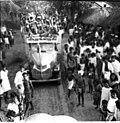 Pro-merger movement of French Settlements in India, 1954
 -
-
-
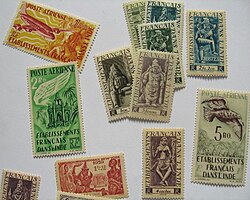 French India postage stamps
 -
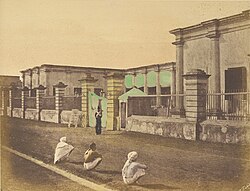 Chandernagore's Government House c. 1850


List of chief governing officers
Commissioners
- François Caron, 1668–1672
- François Baron, 1672–1681
- François Martin, 1681 – November 1693
- Dutch occupation, September 1693 – September 1699 — Treaty of Ryswick (1697)
Governors
In the days of the French East India Company, the title of the top official was most of the time Governor of Pondicherry and General Commander of the French settlements in the East Indies (French: Gouverneur de Pondichéry et commandant général des établissements français aux Indes orientales). After 1816, it was Governor of French establishments in India (French: Gouverneur des établissements français de l'Inde').


- François Martin, September 1699 – 31 December 1706
- Pierre Dulivier (Acting), January 1707 – July 1708
- Guillaume André d'Hébert, 1708–1712
- Pierre Dulivier, 1713–1715
- Guillaume André d'Hébert, 1715–1718
- Pierre André Prévost de La Prévostière, August 1718 – 11 October 1721
- Pierre Christoph Le Noir (Acting), 1721–1723
- Joseph Beauvollier de Courchant, 1723–1726
- Pierre Christoph Le Noir, 1727–1734
- Pierre Benoît Dumas, 1735–1741
- Joseph François Dupleix, 14 January 1742 – 15 October 1754
- Charles Godeheu, Le commissaire (Acting), 15 October 1754 – 1754
- Georges Duval de Leyrit, 1756–1758
- Thomas Arthur, comte de Lally, 1758 – January 1761
- First British occupation, January 15, 1761 – June 25, 1765 — Treaty of Paris (1763)
- Jean Law de Lauriston, 1765–1766
- Antoine Boyellau (Acting), 1766–1767
- Jean Law de Lauriston, 1767 – January 1777

Chandernagor Government House - Second British occupation, 1778 – 1783 – Treaty of Paris (1783)
- Guillaume de Bellecombe, seigneur de Teirac, January 1777 – 1778
- Charles Joseph Pâtissier, Marquis de Bussy-Castelnau, 1783–1785
- François, Vicomte de Souillac, 1785
- David Charpentier de Cossigny, October 1785 – 1787
- Thomas, comte de Conway, October 1787 – 1789
- Camille Charles Leclerc, chevalier de Fresne, 1789–1792
- Dominique Prosper de Chermont, November 1792 – 1793
- L. Leroux de Touffreville, 1793
- Third British occupation, 23 August 1793 – 18 June 1802 — Treaty of Amiens (1802)
- Charles Matthieu Isidore, Comte Decaen, 18 June 1802 – August 1803
- Louis François Binot, 1803
- Fourth British occupation, August 1803 – 26 September 1816 — Treaty of Paris (1814)
- André Julien Comte Dupuy, 26 September 1816 – October 1825
- Joseph Cordier, Marie Emmanuel (Acting), October 1825 – 19 June 1826
- Eugène Desbassayns de Richemont, 1826 – 2 August 1828
- Joseph Cordier, Marie Emmanuel (Acting), 2 August 1828 – 11 April 1829
- Auguste Jacques Nicolas Peureux de Mélay, 11 April 1829 – 3 May 1835
- Hubert Jean Victor, Marquis de Saint-Simon, 3 May 1835 – April 1840
- Paul de Nourquer du Camper, April 1840 – 1844
- Louis Pujol, 1844–1849
- Hyacinthe Marie de Lalande de Calan, 1849–1850
- Philippe Achille Bédier, 1851–1852
- Raymond de Saint-Maur, August 1852 – April 1857
- Alexandre Durand d'Ubraye, April 1857 – January 1863
- Napoléon Joseph Louis Bontemps, January 1863 – June 1871
- Antoine-Léonce Michaux, June 1871 – November 1871
- Pierre Aristide Faron, November 1871 – 1875
- Adolph Joseph Antoine Trillard, 1875–1878
- Léonce Laugier, February 1879 – April 1881
- Théodore Drouhet, 1881 – October 1884
- Étienne Richaud, October 1884 – 1886
- Édouard Manès, 1886–1888
- Georges Jules Piquet, 1888–1889
- Louis Hippolyte Marie Nouet, 1889–1891
- Léon Émile Clément-Thomas, 1891–1896
- Louis Jean Girod, 1896 – February 1898
- François Pierre Rodier, February 1898 – 11 January 1902
- Louis Pelletan (Acting), 11 January 1902
- Victor Louis Marie Lanrezac, 1902–1904
- Philema Lemaire, August 1904 – April 1905
- Joseph Pascal François, April 1905 – October 1906
- Gabriel Louis Angoulvant, October 1906 – 3 December 1907
- Adrien Jules Jean Bonhoure, 1908–1909
- Ernest Fernand Lévecque, 1909 – 9 July 1910
- Alfred Albert Martineau, 9 July 1910 – July 1911
- Pierre Louis Alfred Duprat, July 1911 – November 1913
- Alfred Albert Martineau, November 1913 – 29 June 1918
- Pierre Étienne Clayssen (Acting), 29 June 1918 – 21 February 1919
- Louis Martial Innocent Gerbinis, 21 February 1919 – 11 February 1926
- Henri Léo Eugène Lagroua (Acting), 11 February 1926 – 5 August 1926
- Pierre Jean Henri Didelot, 1926–1928
- Robert Paul Marie de Guise, 1928–1931
- François Adrien Juvanon, 1931–1934
- Léon Solomiac, August 1934 – 1936
- Horace Valentin Crocicchia, 1936–1938
- Louis Alexis Étienne Bonvin, 26 September 1938 – 1945
- Nicolas Ernest Marie Maurice Jeandin, 1945–1946
- Charles François Marie Baron, 20 March 1946 – 20 August 1947

French India became an Overseas territory (French: territoire d'outre-mer) of France in 1946.
Commissioners
- Charles François Marie Baron, 20 August 1947 – May 1949
- Charles Chambon, May 1949 – 31 July 1950
- André Ménard, 31 July 1950 – October 1954
- Georges Escargueil, October 1954 – 1 November 1954
French India de facto transferred to the Republic of India in 1954.
High Commissioners
The first High Commissioner, Kewal Singh was appointed immediately after the Kizhoor referendum on 21 October 1954 as per Foreign Jurisdiction Act, 1947.[14]:964 The Chief Commissioner had the powers of the former French commissioner, but was under the direct control of the Union Government.[15]:198
The list of Chief Commissioners is given below[14]:977
| No. | Name | Took office | Left office |
|---|---|---|---|
| 1 | Kewal Singh | 21 October 1954 | 16 November 1956 |
| 2 | M.K. Kripalani[16]:103 | 17 November 1956 | 27 August 1958 |
| 3 | Lal Ram Saran Singh[17]:197 | 30 August 1958 | 8 February 1961 |
| 4 | Sisir Kumar Dutta[18] | 2 May 1961 | 1 August 1963 |
| 5 | K.J. Somasundaram | 2 August 1963 | 13 October 1963 |
See also


- Apostolic Prefecture of French Colonies in India (Catholic mission)
- British Raj
- Colonial India
- Coup d'état of Yanaon
- Danish India
- Dutch India
- Municipal administration in French India
- Portuguese India
Notes
- ↑ In France, it was popularly known as les Comptoirs de l'Inde. Strictly speaking though, a comptoir is a trading station, whereas the five French settlements were entire towns with the surrounding area, and not mere trading stations.
- ↑ The French Factory at Masulipatam was founded in 1669
- ↑ It is the largest and most significant loge among all others and was located on the outskirts of Masulipatam. It included two bungalows, a chapel and some other buildings. Its total area is around 61 acres (0.28sqkm).[12]:64
- ↑ This French Loge was within the British-held Calicut town and consisted of 6 acres on the seashore about half a mile north of the Calicut Lighthouse and adjoins the old district jail site.
- ↑ This factory supplied silk goods cargoes and situated in the heart of silk belt.
- ↑ This factory supplied ordinary fabrics to the French East India Company. It was established in 1735 by Dupleix.
- ↑ This factory exported muslins of 4 lakh rupees per annum by the mid-eighteen century. It was founded in 1722.
- ↑ This factory was founded at the end of the seventeenth century but suffered from a lack of proper road transport and it lost its commercial activity during the next century.
- ↑ This factory used to sell drapes from Europe and bought saltpetre and opium. It was founded in 1727.
- ↑ This factory was founded in 1668 after securing a firman and a factory site from Emperor Aurangazeb.
References
- ↑ Not as widespread; regional and local as well as English
- ↑ as Commissioner
- ↑ as High Commissioner
- ↑ Jacques Weber, Pondichéry et les comptoirs de l'Inde après Dupleix, Éditions Denoël, Paris, 1996, p. 347.
- ↑ Holden Furber, Rival Empires of Trade in the Orient, 1600–1800, University of Minnesota Press, 1976, p. 201.
- ↑ Philippe Haudrère, Les Compagnies des Indes Orientales, Paris, 2006, p 70.
- ↑ 7.0 7.1 7.2
 One or more of the preceding sentences incorporates text from a publication now in the public domain: Chisholm, Hugh, ed. (1911). "India, French". Encyclopædia Britannica. Vol. 14 (11th ed.). Cambridge University Press. p. 421.
- ↑ 8.0 8.1 Lach, Donald Frederick (1998), Asia in the making of Europe, p. 747, ISBN 9780226467672.
- ↑ 9.0 9.1 The Cambridge history of the British Empire, 1940, p. 66.
- ↑ Accord par échange de lettres relatif à la date de la cession des anciennes loges françaises de l'Inde au gouvernement de l'Inde [Agreement by exchange of letters relating to the date of the cession of the former French lodges of India to the Government of India] (in French). Paris: Ministère de l'Europe et des Affaires étrangères. 1947. p. 5. Retrieved 2 September 2022.
the Government of India note and accept with pleasure the decision of the Government of France that October 6th will be the day from which the historic rights which France has exercised in the areas known as the French Loges in India will be renounced.
{{cite book}}: CS1 maint: unrecognized language (link) - ↑ Chapitre II, Notices statistiques sur les colonies françaises, 1839.
- ↑ Thomas Bowrey (1993). A Geographical Account of Countries Round the Bay of Bengal, 1669 to 1679. Asian Educational Services. ISBN 9788120608481.
- ↑ Claude Markovits (2004). A History of Modern India, 1480-1950. Anthem Press. p. 210. ISBN 9781843311522.
- ↑ 14.0 14.1 Cabinet Responsibility to Legislature. Lok Sabha Secretariat. 2004. ISBN 9788120004009.
{{cite book}}:|work=ignored (help) - ↑ The Statesman's Year-Book 1963: The One-Volume ENCYCLOPAEDIA of all nations. MACMILLAN&Co.LTD, London. 1963. ISBN 9780230270893.
{{cite book}}:|work=ignored (help) - ↑ "Civil Affairs". Monthly Journal of Local Govt. and Public Administration in India. 1958.
- ↑ The Statesman's Year-Book 1960: The One-Volume ENCYCLOPAEDIA of all nations. MACMILLAN&Co.LTD, London. 1960. ISBN 9780230270893.
{{cite book}}:|work=ignored (help) - ↑ "The Statesman's Year-Book 1963: The One-Volume ENCYCLOPAEDIA of all nations". S. Steinberg. MACMILLAN&Co.LTD, London. 1963. pp. 474–475.
Bibliography
- Sudipta Das (1992). Myths and realities of French imperialism in India, 1763–1783. New York: P. Lang. ISBN 0820416762. 459pp.
External links
- Articles containing French-language text
- Pages using the JsonConfig extension
- Former country articles using status text with Colony or Exile
- Pages using Lang-xx templates
- French India
- 1769 establishments in French India
- 1954 disestablishments in French India
- States and territories established in 1769
- States and territories disestablished in 1954
- Colonial India
- Colonial Kerala
- Former colonies in Asia
- Former countries in South Asia
- France–India relations