

Created page with "{{Short description|Indian development and possession of weapons of mass destruction}} {{Use Indian English|date=October 2016}} {{Use dmy dates|date=May 2020}} {{Infobox | bod..." |
>TheAlderaanian →Nuclear weapons: history of nuclear weapons under Bahadur Shastr/Gandhis/Desai, Prithvi missiles |
||
| Line 1: | Line 1: | ||
{{Short description|Indian development and possession of weapons | {{Short description|Indian development and possession of nuclear weapons}} | ||
{{Use Indian English|date=October 2016}} | {{Use Indian English|date=October 2016}} | ||
{{Use dmy dates|date=May 2020}} | {{Use dmy dates|date=May 2020}} | ||
{{Infobox | {{Infobox | ||
| bodystyle = width:30.0em<!--WMD infobox template that follows should (be set to) match-->; | | bodystyle = width:30.0em<!--WMD infobox template that follows should (be set to) match-->; | ||
| above = India | | above = India | ||
| image = [[File:India (orthographic projection).svg|150px|center|Location of India]] | | image = [[File:India (orthographic projection).svg|150px|center|Location of India]] | ||
| labelstyle = width:60%;padding:0.1em 0;line-height:1.2em;<!--({{longitem}})--> | | labelstyle = width:60%;padding:0.1em 0;line-height:1.2em;<!--({{longitem}})--> | ||
| datastyle = white-space:nowrap; | | datastyle = white-space:nowrap; | ||
| label1 = Nuclear programme<br/>start date |data1 = 1967 | | label1 = Nuclear programme<br/>start date | ||
| label2 = First nuclear<br/>weapon test | | data1 = {{start date and age|1967|df=y|br=y|p=y}} | ||
| label3 = First fusion<br/>weapon test | | label2 = First nuclear<br/>weapon test | ||
| label4 = Most recent test | | data2 = {{start date and age|1974|05|18|df=y|br=y|p=y}}{{ref|first-overall|a}} | ||
| label5 = Largest-yield test | | label3 = First fusion<br/>weapon test | ||
| label6 = Number of tests<br/>to date | | data3 = {{start date and age|1998|05|11|df=y|br=y|p=y}}{{ref|first-fusion|b}} | ||
| label7 = Peak stockpile | | label4 = Most recent test | ||
| label8 = Current stockpile | | data4 = {{start date and age|1998|05|13|df=y|br=y|p=y}} | ||
| label9 = Maximum missile<br/>range | | label5 = Largest-yield test | ||
| label10 = NPT Party |data10 = '''No''' | | data5 = {{convert|45|ktonTNT|lk=on}};<br /> Scale down of 200 kt model {{ref|yield|c}} | ||
| belowstyle = border-top:1px solid #aaa;background:none;font-size:90%; | | label6 = Number of tests<br/>to date | ||
| below = | | data6 = 3 (6 Devices fired) | ||
{{plainlist| | | label7 = Peak stockpile | ||
| data7 = 160 warheads <small>(2021 estimate)</small><ref name="nuclearweapons1"/> | |||
| label8 = Current stockpile | |||
| data8 = 160 warheads <small>(2021 estimate)<ref name="nuclearweapons1"/> | |||
| label9 = Maximum missile<br/>range | |||
| data9 = [[Agni-V]] {{hyphen}} {{convert|5500|to|8000|km|disp=br}} | |||
| label10 = NPT Party | |||
| data10 = '''No''' | |||
| belowstyle = border-top:1px solid #aaa;background:none;font-size:90%; | |||
| below = {{plainlist| | |||
* {{note|first-overall|a}} ''[[Smiling Buddha]]'' | * {{note|first-overall|a}} ''[[Smiling Buddha]]'' | ||
* {{note|first-fusion|b}} Declared ([[Pokhran-II]]) | * {{note|first-fusion|b}} Declared ([[Pokhran-II]]) | ||
* {{note|yield|c}} Declared<ref>{{Cite web|url=http://pib.gov.in/newsite/PrintRelease.aspx?relid=52814|title=Press Statement by Dr. Anil Kakodkar and Dr. R. Chidambaram on Pokhran-II tests|website=Press Information Bureau, Government of India|access-date=17 August 2019}}</ref><ref>{{cite news |last=Parashar |first=Sachin |url=http://articles.timesofindia.indiatimes.com/2009-08-28/india/28199613_1_santhanam-thermonuclear-device-pokhran |archive-url=https://web.archive.org/web/20121105024206/http://articles.timesofindia.indiatimes.com/2009-08-28/india/28199613_1_santhanam-thermonuclear-device-pokhran |url-status=dead |archive-date=5 November 2012 |title=Kalam certifies Pokharan II, Santhanam stands his ground |date=28 August 2009 |work=[[The Times of India]] |access-date=31 August 2010}}</ref> ([[Pokhran-II]]) | * {{note|yield|c}} Declared<ref>{{Cite web|url=http://pib.gov.in/newsite/PrintRelease.aspx?relid=52814|title=Press Statement by Dr. Anil Kakodkar and Dr. R. Chidambaram on Pokhran-II tests|website=Press Information Bureau, Government of India|access-date=17 August 2019}}</ref><ref>{{cite news |last=Parashar |first=Sachin |url=http://articles.timesofindia.indiatimes.com/2009-08-28/india/28199613_1_santhanam-thermonuclear-device-pokhran |archive-url=https://web.archive.org/web/20121105024206/http://articles.timesofindia.indiatimes.com/2009-08-28/india/28199613_1_santhanam-thermonuclear-device-pokhran |url-status=dead |archive-date=5 November 2012 |title=Kalam certifies Pokharan II, Santhanam stands his ground |date=28 August 2009 |work=[[The Times of India]] |access-date=31 August 2010}}</ref> ([[Pokhran-II]]) | ||
* {{note|stockpile|d}} 2018 estimate<ref name="nuclearweapons1">{{cite web|last1=Kristensen|first1=Hans M.|last2=Norris|first2=Robert S.|url=https://fas.org/issues/nuclear-weapons/status-world-nuclear-forces/|title=Status of World Nuclear Forces|website= | * {{note|stockpile|d}} 2018 estimate<ref name="nuclearweapons1">{{cite web|last1=Kristensen|first1=Hans M.| author-link1 = Hans M. Kristensen|last2=Norris|first2=Robert S.|url=https://fas.org/issues/nuclear-weapons/status-world-nuclear-forces/|title=Status of World Nuclear Forces|website=[[Federation of American Scientists]]|access-date=2019-04-23|df=dmy-all}}</ref><ref>{{cite web|title=Nuclear Weapons: Who Has What at a Glance|url=https://www.armscontrol.org/factsheets/Nuclearweaponswhohaswhat|website=Arms Control Association|publisher=ACA|access-date=23 April 2019}}</ref><ref>{{cite web|title=Modernization of nuclear weapons continues; number of peacekeepers declines: New SIPRI Yearbook out now|url=https://www.sipri.org/media/press-release/2018/modernization-nuclear-weapons-continues-number-peacekeepers-declines-new-sipri-yearbook-out-now|website=sipri.org|publisher=SIPRI|date=18 June 2018|access-date=23 April 2019}}</ref> | ||
* {{note|max-range|e}} [[Agni V]]<!-- | * {{note|max-range|e}} [[Agni V]]<!-- | ||
--><ref name="Saran">{{cite web|url=http://www.irgamag.com/component/k2/item/2400|title=Is India's Nuclear Deterrent Credible? {{smaller|(Statement given by Shyam Saran, Chairman of India's National Security Advisory Board)}}|last1=Saran|first1=Shyam|date=25 April 2013|website=irgamag.com|quote="[…] These include a modest arsenal, nuclear-capable aircraft and missiles, both in fixed underground silos as well as […] mounted on mobile rail and road-based platforms. These land-based missiles include both Agni-II (1,500 km) as well as Agni-III (2,500 km) missiles. The range and accuracy of further versions – for example, Agni V (5,000 km), which was tested successfully only recently – will improve with the acquisition of further technological capability and experience"|archive-url=https://web.archive.org/web/20130701001442/http://www.irgamag.com/component/k2/item/2400|archive-date=1 July 2013|url-status=dead}}</ref><!-- | --><ref name="Saran">{{cite web|url=http://www.irgamag.com/component/k2/item/2400|title=Is India's Nuclear Deterrent Credible? {{smaller|(Statement given by Shyam Saran, Chairman of India's National Security Advisory Board)}}|last1=Saran|first1=Shyam|date=25 April 2013|website=irgamag.com|quote="[…] These include a modest arsenal, nuclear-capable aircraft and missiles, both in fixed underground silos as well as […] mounted on mobile rail and road-based platforms. These land-based missiles include both Agni-II (1,500 km) as well as Agni-III (2,500 km) missiles. The range and accuracy of further versions – for example, Agni V (5,000 km), which was tested successfully only recently – will improve with the acquisition of further technological capability and experience"|archive-url=https://web.archive.org/web/20130701001442/http://www.irgamag.com/component/k2/item/2400|archive-date=1 July 2013|url-status=dead}}</ref><!-- | ||
| Line 33: | Line 42: | ||
{{Weapons of mass destruction |width=22.0em}} | {{Weapons of mass destruction |width=22.0em}} | ||
[[India]] has developed and possesses [[Weapon of mass destruction|weapons of mass destruction]] in the form of [[nuclear weapon]]s. Although India has not released any official statements about the size of its nuclear arsenal, recent estimates suggest that India has 160 nuclear weapons<ref name="nuclearweapons1"/> and has produced enough weapons-grade plutonium for up to 161–200 nuclear weapons.<ref>{{cite journal |last1=Kristensen |first1=Hans M. |last2=Norris |first2=Robert S. |title=Indian nuclear forces, 2017 |journal=Bulletin of the Atomic Scientists |date=5 July 2017 |volume=73 |issue=4 |page=205 |doi=10.1080/00963402.2017.1337998|doi-access=free }}</ref> In 1999, India was estimated to have 800 | [[India]] has developed and possesses [[Weapon of mass destruction|weapons of mass destruction]] in the form of [[nuclear weapon]]s. Although India has not released any official statements about the size of its nuclear arsenal, recent estimates suggest that India has 160 nuclear weapons<ref name="nuclearweapons1"/> and has produced enough weapons-grade plutonium for up to 161–200 nuclear weapons.<ref>{{cite journal |last1=Kristensen |first1=Hans M. |last2=Norris |first2=Robert S. |title=Indian nuclear forces, 2017 |journal=Bulletin of the Atomic Scientists |date=5 July 2017 |volume=73 |issue=4 |page=205 |doi=10.1080/00963402.2017.1337998|bibcode=2017BuAtS..73d.205K |doi-access=free }}</ref> In 1999, India was estimated to have {{convert | 800 | kg}} of separated [[reactor-grade plutonium]], with a total amount of {{convert|8300|kg}} of civilian plutonium, enough for approximately 1,000 nuclear weapons.<ref>{{cite web|title=India's Nuclear Weapons Program|url=http://nuclearweaponarchive.org/India/IndiaArsenal.html|website=nuclearweaponarchive.org|access-date=26 June 2012}}</ref><ref>{{cite web|title=India's and Pakistan's Fissile Material and Nuclear Weapons Inventories, end of 1999|url=http://www.isis-online.org/publications/southasia/stocks1000.html|publisher=Institute for Science and International Security|access-date=26 June 2012}}</ref> India has conducted nuclear weapons tests in a pair of series namely ''[[Smiling Buddha|Pokhran I]]'' and ''[[Pokhran-II|Pokhran II]]''.<ref>{{Cite web|title=The story of Pokhran: Tests that established India as nuclear power, became cornerstone of Atal Bihari Vajpayee's tenure as PM|url=https://thediplomat.com/2018/05/20-years-after-pokhran-ii-have-nuclear-weapons-made-india-more-secure/}}</ref> | ||
India is a member of three [[multilateral export control regime]]s — the [[Missile Technology Control Regime]], [[Wassenaar Arrangement]] and [[Australia Group]]. It has signed and ratified the [[Biological Weapons Convention]] and the [[Chemical Weapons Convention]]. India is also a subscribing state to the [[International Code of Conduct against Ballistic Missile Proliferation|Hague Code of Conduct]]. India has signed neither the [[Comprehensive Nuclear-Test-Ban Treaty]] nor the [[Nuclear Non-Proliferation Treaty]], considering both to be flawed and discriminatory.{{sfn|Kumar|2010}} India previously possessed [[chemical weapons]], but voluntarily destroyed its entire stockpile in 2009 — one of the seven countries to meet the [[Organisation for the Prohibition of Chemical Weapons|OPCW]] extended deadline.<ref name="india">{{cite web|url=http://zeenews.india.com/news531700.html |title=Zee News - India destroys its chemical weapons stockpile |publisher=Zeenews.india.com |date= 14 May 2009|access-date=27 August 2013}}</ref> | India is a member of three [[multilateral export control regime]]s — the [[Missile Technology Control Regime]], [[Wassenaar Arrangement]] and [[Australia Group]]. It has signed and ratified the [[Biological Weapons Convention]] and the [[Chemical Weapons Convention]]. India is also a subscribing state to the [[International Code of Conduct against Ballistic Missile Proliferation|Hague Code of Conduct]]. India has signed neither the [[Comprehensive Nuclear-Test-Ban Treaty]] nor the [[Nuclear Non-Proliferation Treaty]], considering both to be flawed and discriminatory.{{sfn|Kumar|2010}} India previously possessed [[chemical weapons]], but voluntarily destroyed its entire stockpile in 2009 — one of the seven countries to meet the [[Organisation for the Prohibition of Chemical Weapons|OPCW]] extended deadline.<ref name="india">{{cite web|url=http://zeenews.india.com/news531700.html |title=Zee News - India destroys its chemical weapons stockpile |publisher=Zeenews.india.com |date= 14 May 2009|access-date=27 August 2013}}</ref> | ||
India maintains a "[[no first use]]" nuclear policy and has developed a [[nuclear triad]] capability as a part of its "[[Minimum Credible Deterrence]]" doctrine.{{sfn|Nair|2007}}{{sfn|Pandit|2009}} | India maintains a "[[no first use]]" nuclear policy and has developed a [[nuclear triad]] capability as a part of its "[[Minimum Credible Deterrence]]" doctrine.{{sfn|Nair|2007}}{{sfn|Pandit|2009}}<ref name=":0">{{Cite web|last=Media Center|date=7 January 2022|title=Official Spokesperson's response to a media query regarding the Joint Statement on Preventing Nuclear War and Avoiding Arms Races|url=https://www.mea.gov.in/response-to-queries.htm?dtl/34743/Official_Spokespersons_response_to_a_media_query_regarding_the_Joint_Statement_on_Preventing_Nuclear_War_and_Avoiding_Arms_Races|url-status=live|access-date=12 January 2022|website=Ministry of External Affairs}}</ref> | ||
== Biological weapons == | == Biological weapons == | ||
{{Further|History of biological warfare}} | {{Further|History of biological warfare}} | ||
India has a [[biotechnology]] infrastructure that includes numerous pharmaceutical production facilities and bio-containment laboratories (including BSL-3 and BSL-4) for working with lethal [[pathogens]]. It also has scientists with expertise in infectious diseases. Some of India's facilities are being used to support research and development for biological weapons (BW) defence purposes. India has ratified the [[Biological Weapons Convention]] (BWC) and pledges to abide by its obligations. There is no clear evidence, circumstantial or otherwise, that directly points toward an offensive BW program. India does possess the scientific capability and infrastructure to launch an offensive BW program. In terms of delivery, India also possesses the capability to produce [[Aerosol spray|aerosols]] and has numerous potential delivery systems ranging from [[Aerial application|crop dusters]] to sophisticated [[ballistic missile]]s.<ref name="ReferenceA">{{cite web|url=http://www.nti.org/e_research/profiles/india/biological/index.html|title=Research Library: Country Profiles: India Biological Chronology|publisher=NTI|access-date=16 July 2010|archive-url=https://web.archive.org/web/20110604055018/http://www.nti.org/e_research/profiles/India/Biological/index.html|archive-date=4 June 2011}}</ref> | India has a [[biotechnology]] infrastructure that includes numerous pharmaceutical production facilities and bio-containment laboratories (including BSL-3 and BSL-4) for working with lethal [[pathogens]]. It also has scientists with expertise in infectious diseases. Some of India's facilities are being used to support research and development for biological weapons (BW) defence purposes {{Citation needed|date=September 2021}}. India has ratified the [[Biological Weapons Convention]] (BWC) and pledges to abide by its obligations. There is no clear evidence, circumstantial or otherwise, that directly points toward an offensive BW program. India does possess the scientific capability and infrastructure to launch an offensive BW program. In terms of delivery, India also possesses the capability to produce [[Aerosol spray|aerosols]] and has numerous potential delivery systems ranging from [[Aerial application|crop dusters]] to sophisticated [[ballistic missile]]s.<ref name="ReferenceA">{{cite web|url=http://www.nti.org/e_research/profiles/india/biological/index.html|title=Research Library: Country Profiles: India Biological Chronology|publisher=NTI|access-date=16 July 2010|archive-url=https://web.archive.org/web/20110604055018/http://www.nti.org/e_research/profiles/India/Biological/index.html|archive-date=4 June 2011}}</ref> | ||
No information exists in the public domain suggesting interest by the Indian government in delivery of biological agents by these or any other means. To reiterate the latter point, in October 2002, the then President [[A. P. J. Abdul Kalam]] asserted that "India will not make biological weapons. It is cruel to human beings".<ref name="ReferenceA"/> | No information exists in the public domain suggesting interest by the Indian government in delivery of biological agents by these or any other means. To reiterate the latter point, in October 2002, the then President [[A. P. J. Abdul Kalam]] asserted that "India will not make biological weapons. It is cruel to human beings".<ref name="ReferenceA"/> | ||
| Line 51: | Line 60: | ||
In 1992, India signed the [[Chemical Weapons Convention]] (CWC), stating that it did not have chemical weapons and the capacity or intent to manufacture chemical weapons.{{citation needed|date=September 2016}} By doing this India became one of the original signatories of the CWC in 1993,<ref>{{cite web|title=Member State - India|url=https://www.opcw.org/about-opcw/member-states/member-states-by-region/asia/member-state-india/|website=OPCW|access-date=5 September 2017|archive-url=https://web.archive.org/web/20171026045513/https://www.opcw.org/about-opcw/member-states/member-states-by-region/asia/member-state-india/|archive-date=26 October 2017|url-status=dead}}</ref> and ratified it on 2 September 1996. According to India's ex-Army Chief [[General Sunderji]], a country having the capability of making nuclear weapons does not need to have chemical weapons, since the dread of chemical weapons could be created only in those countries that do not have nuclear weapons. Others suggested that the fact that India has found chemical weapons dispensable highlighted its confidence in the conventional weapons system at its command. | In 1992, India signed the [[Chemical Weapons Convention]] (CWC), stating that it did not have chemical weapons and the capacity or intent to manufacture chemical weapons.{{citation needed|date=September 2016}} By doing this India became one of the original signatories of the CWC in 1993,<ref>{{cite web|title=Member State - India|url=https://www.opcw.org/about-opcw/member-states/member-states-by-region/asia/member-state-india/|website=OPCW|access-date=5 September 2017|archive-url=https://web.archive.org/web/20171026045513/https://www.opcw.org/about-opcw/member-states/member-states-by-region/asia/member-state-india/|archive-date=26 October 2017|url-status=dead}}</ref> and ratified it on 2 September 1996. According to India's ex-Army Chief [[General Sunderji]], a country having the capability of making nuclear weapons does not need to have chemical weapons, since the dread of chemical weapons could be created only in those countries that do not have nuclear weapons. Others suggested that the fact that India has found chemical weapons dispensable highlighted its confidence in the conventional weapons system at its command. | ||
In June 1997, India declared its stock of chemical weapons (1,045 tonnes of [[Sulfur mustard|sulphur mustard]]).<ref name="dominicantoday.com">{{cite web|url=http://www.dominicantoday.com/dr/world/2007/12/30/26543/India-to-destroy-chemical-weapons-stockpile-by-2009 |title=India to destroy chemical weapons stockpile by 2009 |work=[[Dominican Today]] |access-date=30 April 2013 |url-status=dead |archive-url=https://web.archive.org/web/20130907155755/http://www.dominicantoday.com/dr/world/2007/12/30/26543/India-to-destroy-chemical-weapons-stockpile-by-2009 |archive-date=7 September 2013 }}</ref><ref>{{cite web|author=Smithson, Amy Gaffney, Frank, Jr. |url=http://www.highbeam.com/doc/1P1-3987660.html |archive-url=https://web.archive.org/web/20121106050759/http://www.highbeam.com/doc/1P1-3987660.html |url-status=dead |archive-date=6 November 2012 |title=India declares its stock of chemical weapons |access-date=30 April 2013 |website=India Abroad}}</ref> By the end of 2006, India had destroyed more than 75 percent of its chemical weapons/material stockpile and was granted extension for destroying the remaining stocks by April 2009 and was expected to achieve 100 percent destruction within that time frame.<ref name="dominicantoday.com"/> India informed the [[United Nations]] in May 2009 that it had destroyed its stockpile of chemical weapons in compliance with the international Chemical Weapons Convention. With this India has become third country after South Korea and Albania to do so.<ref>{{cite web|url=http://zeenews.india.com/news531700.html |title= India destroys its chemical weapons stockpile |publisher=[[Zee News]] |date=14 May 2009 |access-date=30 April 2013}}</ref><ref name="in.news.yahoo.com">[http://in.news.yahoo.com/43/20090514/812/tnl-india-destroys-its-chemical-weapons.html] {{webarchive|url=https://web.archive.org/web/20090521195550/http://in.news.yahoo.com/43/20090514/812/tnl-india-destroys-its-chemical-weapons.html|date=21 May 2009}}</ref> This was cross-checked by inspectors of the United Nations. | In June 1997, India declared its stock of chemical weapons (1,045 tonnes of [[Sulfur mustard|sulphur mustard]]).<ref name="dominicantoday.com">{{cite web|url=http://www.dominicantoday.com/dr/world/2007/12/30/26543/India-to-destroy-chemical-weapons-stockpile-by-2009 |title=India to destroy chemical weapons stockpile by 2009 |work=[[Dominican Today]] |access-date=30 April 2013 |url-status=dead |archive-url=https://web.archive.org/web/20130907155755/http://www.dominicantoday.com/dr/world/2007/12/30/26543/India-to-destroy-chemical-weapons-stockpile-by-2009 |archive-date=7 September 2013 }}</ref><ref>{{cite web|author=Smithson, Amy Gaffney, Frank, Jr. |url=http://www.highbeam.com/doc/1P1-3987660.html |archive-url=https://web.archive.org/web/20121106050759/http://www.highbeam.com/doc/1P1-3987660.html |url-status=dead |archive-date=6 November 2012 |title=India declares its stock of chemical weapons |access-date=30 April 2013 |website=India Abroad}}</ref> By the end of 2006, India had destroyed more than 75 percent of its chemical weapons/material stockpile and was granted extension for destroying the remaining stocks by April 2009 and was expected to achieve 100 percent destruction within that time frame.<ref name="dominicantoday.com"/> India informed the [[United Nations]] in May 2009 that it had destroyed its stockpile of chemical weapons in compliance with the international Chemical Weapons Convention. With this India has become third country after [[South Korea]] and [[Albania]] to do so.<ref>{{cite web|url=http://zeenews.india.com/news531700.html |title= India destroys its chemical weapons stockpile |publisher=[[Zee News]] |date=14 May 2009 |access-date=30 April 2013}}</ref><ref name="in.news.yahoo.com">[http://in.news.yahoo.com/43/20090514/812/tnl-india-destroys-its-chemical-weapons.html] {{webarchive|url=https://web.archive.org/web/20090521195550/http://in.news.yahoo.com/43/20090514/812/tnl-india-destroys-its-chemical-weapons.html|date=21 May 2009}}</ref> This was cross-checked by inspectors of the United Nations. | ||
India has an advanced commercial [[chemical industry]], and produces the bulk of its own chemicals for domestic consumption. It is also widely acknowledged that India has an extensive civilian chemical and pharmaceutical industry and annually exports considerable quantities of chemicals to countries such as the United Kingdom, United States and Taiwan.<ref name="nti.org">{{cite web |url=http://www.nti.org/e_research/profiles/india/chemical/index.html |title=Research Library: Country Profiles: India Biological Chronology |publisher=NTI |access-date=16 July 2010 |url-status=dead |archive-url=https://web.archive.org/web/20100411054933/http://www.nti.org/e_research/profiles/India/Chemical/index.html |archive-date=11 April 2010 }}</ref> | India has an advanced commercial [[chemical industry]], and produces the bulk of its own chemicals for domestic consumption. It is also widely acknowledged that India has an extensive civilian chemical and pharmaceutical industry and annually exports considerable quantities of chemicals to countries such as the United Kingdom, United States and Taiwan.<ref name="nti.org">{{cite web |url=http://www.nti.org/e_research/profiles/india/chemical/index.html |title=Research Library: Country Profiles: India Biological Chronology |publisher=NTI |access-date=16 July 2010 |url-status=dead |archive-url=https://web.archive.org/web/20100411054933/http://www.nti.org/e_research/profiles/India/Chemical/index.html |archive-date=11 April 2010 }}</ref> | ||
| Line 60: | Line 69: | ||
As early as 26 June 1946, [[Jawaharlal Nehru]], soon to be India's first Prime Minister, announced: {{cquote|As long as the world is constituted as it is, every country will have to devise and use the latest devices for its protection. I have no doubt India will develop her scientific researches and I hope Indian scientists will use the atomic force for constructive purposes. But if India is threatened, she will inevitably try to defend herself by all means at her disposal.<ref>B. M. Udgaonkar, [http://www.ias.ac.in/currsci/jan25/articles20.htm ''India’s nuclear capability, her security concerns and the recent tests''], Indian Academy of Sciences, January 1999.</ref>}} | As early as 26 June 1946, [[Jawaharlal Nehru]], soon to be India's first Prime Minister, announced: {{cquote|As long as the world is constituted as it is, every country will have to devise and use the latest devices for its protection. I have no doubt India will develop her scientific researches and I hope Indian scientists will use the atomic force for constructive purposes. But if India is threatened, she will inevitably try to defend herself by all means at her disposal.<ref>B. M. Udgaonkar, [http://www.ias.ac.in/currsci/jan25/articles20.htm ''India’s nuclear capability, her security concerns and the recent tests''], Indian Academy of Sciences, January 1999.</ref>}} | ||
India built its first research reactor in 1956 and its first plutonium reprocessing plant by 1964.<ref>[http://barc.gov.in/reactor/index.html Bhabha Atomic Research Centre]</ref><ref>{{Cite web |url=http://www.nti.org/facilities/818/ |title=Apsara Research Reactor |access-date=12 April 2015 |archive-url=https://web.archive.org/web/20150419042039/http://www.nti.org/facilities/818/ |archive-date=19 April 2015 |url-status=dead }}</ref><ref>https://nsarchive2.gwu.edu//NSAEBB/NSAEBB187/IN03.pdf</ref> | Nehru pursued a policy of formally foregoing nuclear weapons while at the same time constructing a civilian nuclear energy program, and by extension the capability to make a nuclear bomb. This policy was motivated by a conventional weapons superiority over its rivals Pakistan and China.<ref name=":1">{{Citation|title=The Varieties of Hedgers: India, Japan, West Germany, Brazil and Argentina, Sweden and Switzerland|date=2020-12-31|url=https://www.degruyter.com/document/doi/10.1515/9780691223063-005/html|work=Seeking the Bomb: Strategies of Nuclear Proliferation|pages=53–126|publisher=Princeton University Press|doi=10.1515/9780691223063-005|isbn=978-0-691-22306-3|access-date=2022-01-20}}</ref> India built its first research reactor in 1956 and its first plutonium reprocessing plant by 1964.<ref>[http://barc.gov.in/reactor/index.html Bhabha Atomic Research Centre]</ref><ref>{{Cite web |url=http://www.nti.org/facilities/818/ |title=Apsara Research Reactor |access-date=12 April 2015 |archive-url=https://web.archive.org/web/20150419042039/http://www.nti.org/facilities/818/ |archive-date=19 April 2015 |url-status=dead }}</ref><ref>https://nsarchive2.gwu.edu//NSAEBB/NSAEBB187/IN03.pdf</ref> | ||
India's nuclear programme can trace its origins to March 1944 and its [[India's three-stage nuclear power programme|three-stage]] efforts in technology were established by [[Homi Jehangir Bhabha]] when he founded the nuclear research centre, the [[Tata Institute of Fundamental Research]].<ref>{{cite book|last=Chengappa|first=Raj|title=Weapons of peace : the secret story of India's quest to be a nuclear power|year=2000|publisher=Harper Collins Publishers, India|location=New Delhi|isbn=978-81-7223-330-3}}</ref><ref name="Nuclear weapon archive">{{cite web |title=The Beginning: 1944–1960|url=http://nuclearweaponarchive.org/India/IndiaOrigin.html|publisher=Nuclear weapon archive|access-date=15 January 2013|date=30 March 2001}}</ref> India's loss to China in a brief [[Sino-Indian War|Himalayan border war]] in October 1962, provided the New Delhi government impetus for developing nuclear weapons as a means of deterring potential Chinese aggression.<ref>{{cite web |url=http://nationalinterest.org/article/jfks-overshadowed-crisis-7073?page=show |title=JFK's Overshadowed Crisis |publisher=[[The National Interest]] |author=Bruce Riedel |author-link=Bruce Riedel |date=28 June 2012 |access-date = 7 July 2012}}</ref> By 1964 India was in a position to develop nuclear weapons.<ref>https://timesofindia.indiatimes.com/india/India-could-have-gone-nuclear-as-early-as-1964-US-intelligence/articleshow/52340895.cms</ref> India first tested a nuclear device in 1974 (code-named "[[Smiling Buddha]]"), under Prime Minister [[Indira Gandhi]] | India's nuclear programme can trace its origins to March 1944 and its [[India's three-stage nuclear power programme|three-stage]] efforts in technology were established by [[Homi Jehangir Bhabha]] when he founded the nuclear research centre, the [[Tata Institute of Fundamental Research]].<ref>{{cite book|last=Chengappa|first=Raj|title=Weapons of peace : the secret story of India's quest to be a nuclear power|year=2000|publisher=Harper Collins Publishers, India|location=New Delhi|isbn=978-81-7223-330-3}}</ref><ref name="Nuclear weapon archive">{{cite web |title=The Beginning: 1944–1960|url=http://nuclearweaponarchive.org/India/IndiaOrigin.html|publisher=Nuclear weapon archive|access-date=15 January 2013|date=30 March 2001}}</ref> | ||
India's loss to China in a brief [[Sino-Indian War|Himalayan border war]] in October 1962, provided the New Delhi government impetus for developing nuclear weapons as a means of deterring potential Chinese aggression.<ref>{{cite web |url=http://nationalinterest.org/article/jfks-overshadowed-crisis-7073?page=show |title=JFK's Overshadowed Crisis |publisher=[[The National Interest]] |author=Bruce Riedel |author-link=Bruce Riedel |date=28 June 2012 |access-date = 7 July 2012}}</ref> By 1964 India was in a position to develop nuclear weapons.<ref>{{Cite web|url=https://timesofindia.indiatimes.com/india/India-could-have-gone-nuclear-as-early-as-1964-US-intelligence/articleshow/52340895.cms|title=India could have gone nuclear as early as 1964: US intelligence | India News - Times of India}}</ref> Prime Minister [[Lal Bahadur Shastri]] opposed developing nuclear weapons but fell under intense political pressure, including elements within the ruling [[Indian National Congress]]. India was also unable to obtain security guarantees from either the United States or the Soviet Union. As a result, Shastri announced that India would pursue the capability of what it called "[[Peaceful nuclear explosion|peaceful nuclear explosions]]" that could be weaponized in the future.<ref name=":1" /> | |||
India first tested a nuclear device in 1974 (code-named "[[Smiling Buddha]]"), under Prime Minister [[Indira Gandhi]] as a peaceful nuclear explosion. The test used plutonium produced in the Canadian-supplied [[CIRUS reactor]], and raised concerns that nuclear technology supplied for peaceful purposes could be diverted to weapons purposes. This also stimulated the early work of the [[Nuclear Suppliers Group]].<ref>[http://www.nti.org/e_research/profiles/india/nuclear/2296_6267.html] {{webarchive|url=https://web.archive.org/web/20081001012955/http://www.nti.org/e_research/profiles/india/nuclear/2296_6267.html|date=1 October 2008}}</ref> During the 1970s and the 1980s Prime Ministers Indira Gandhi, [[Morarji Desai]], and [[Rajiv Gandhi]] opposed weaponizing its nuclear program beyond PNE's and theoretical research. In 1982, Indira Gandhi refused to allow the [[Defence Research and Development Organisation]] to develop active nuclear weapons, but also approved the [[Integrated Guided Missile Development Programme]] that would develop missiles to deliver a nuclear warhead if India developed one. India also supported international [[nuclear non-proliferation]] and [[arms control]] efforts.<ref name=":1">{{Citation|title=The Varieties of Hedgers: India, Japan, West Germany, Brazil and Argentina, Sweden and Switzerland|date=2020-12-31|url=https://www.degruyter.com/document/doi/10.1515/9780691223063-005/html|work=Seeking the Bomb: Strategies of Nuclear Proliferation|pages=53–126|publisher=Princeton University Press|doi=10.1515/9780691223063-005|isbn=978-0-691-22306-3|access-date=2022-01-20}}</ref> | |||
The situation changed again in the late 1980s after the 1987 [[Operation Brasstacks|Brasstacks crisis]] and the beginning of the [[Pakistani nuclear arsenal|Pakistani nuclear weapons program]]. In 1989, Prime Minister Rajiv Gandhi gave Defense Secretary [[Naresh Chandra]] approval to develop the bomb. Chandra continued the program through successive governments in the 1990s after Gandhi lost power in the [[1989 Indian general election|1989 general election]]. India most likely completed weaponized nuclear warheads around 1994.<ref name=":1">{{Citation|title=The Varieties of Hedgers: India, Japan, West Germany, Brazil and Argentina, Sweden and Switzerland|date=2020-12-31|url=https://www.degruyter.com/document/doi/10.1515/9780691223063-005/html|work=Seeking the Bomb: Strategies of Nuclear Proliferation|pages=53–126|publisher=Princeton University Press|doi=10.1515/9780691223063-005|isbn=978-0-691-22306-3|access-date=2022-01-20}}</ref> India performed further nuclear tests in 1998 (code-named "[[Operation Shakti]]") under Prime Minister [[Atal Bihari Vajpayee]]. In 1998, as a response to the continuing tests, the United States and Japan imposed sanctions on India, which have since been lifted.<ref>{{cite web|url=https://www.armscontrol.org/act/2001_10/sanctionsoct01|title=Bush Waives Nuclear-Related Sanctions on India, Pakistan - Arms Control Association}}</ref> | |||
===Neutron bombs=== | ===Neutron bombs=== | ||
R Chidambaram, who headed India's [[Pokhran-II]] nuclear tests, said in a 1999 interview with the [[Press Trust of India]] that India is capable of producing a [[neutron bomb]].<ref>{{cite web|url=https://www.wsj.com/articles/SB934836102919955535|title=India Discloses It Is Able To Build a Neutron Bomb|first=Jonathan|last=Karp|date=17 August 1999|work=The Wall Street Journal}}</ref> | [[Rajagopala Chidambaram|R Chidambaram]], who headed India's [[Pokhran-II]] nuclear tests, said in a 1999 interview with the [[Press Trust of India]] that India is capable of producing a [[neutron bomb]].<ref>{{cite web|url=https://www.wsj.com/articles/SB934836102919955535|title=India Discloses It Is Able To Build a Neutron Bomb|first=Jonathan|last=Karp|date=17 August 1999|work=The Wall Street Journal}}</ref> | ||
===India's no-first-use policy=== | ===India's no-first-use policy=== | ||
India has a declared nuclear [[No first use|no-first-use]] policy and is in the process of developing a [[nuclear doctrine]] based on "[[credible minimum deterrence]]." In August 1999, the Indian government released a draft of the doctrine<ref name=NFU>{{cite web|url=http://www.indianembassy.org/policy/CTBT/nuclear_doctrine_aug_17_1999.html |title=Draft Report of National Security Advisory Board on Indian Nuclear Doctrine |publisher=Indianembassy.org |access-date=30 April 2013 |url-status=dead |archive-url=https://web.archive.org/web/20091205231912/http://www.indianembassy.org/policy/CTBT/nuclear_doctrine_aug_17_1999.html |archive-date=5 December 2009 }}</ref> which asserts that nuclear weapons are solely for deterrence and that India will pursue a policy of "retaliation only". The document also maintains that India "will not be the first to initiate a nuclear [[Pre-emptive nuclear strike|first strike]], but will respond with punitive retaliation should deterrence fail" and that decisions to authorise the use of nuclear weapons would be made by the Prime Minister or his 'designated successor(s)'.<ref name=NFU/> According to the NRDC, despite the escalation of tensions between India and Pakistan in 2001–2002, India remained committed to its nuclear no-first-use policy. | India has a declared nuclear [[No first use|no-first-use]] policy and is in the process of developing a [[nuclear doctrine]] based on "[[credible minimum deterrence]]." In August 1999, the Indian government released a draft of the doctrine<ref name=NFU>{{cite web|url=http://www.indianembassy.org/policy/CTBT/nuclear_doctrine_aug_17_1999.html |title=Draft Report of National Security Advisory Board on Indian Nuclear Doctrine |publisher=Indianembassy.org |access-date=30 April 2013 |url-status=dead |archive-url=https://web.archive.org/web/20091205231912/http://www.indianembassy.org/policy/CTBT/nuclear_doctrine_aug_17_1999.html |archive-date=5 December 2009 }}</ref> which asserts that nuclear weapons are solely for deterrence and that India will pursue a policy of "retaliation only". The document also maintains that India "will not be the first to initiate a nuclear [[Pre-emptive nuclear strike|first strike]], but will respond with punitive retaliation should deterrence fail" and that decisions to authorise the use of nuclear weapons would be made by the Prime Minister or his 'designated successor(s)'.<ref name=NFU/> According to the NRDC, despite the escalation of tensions between India and Pakistan in 2001–2002, India remained committed to its nuclear no-first-use policy. | ||
India's [[Strategic Nuclear Command]] was formally established in 2003, with an Air Force officer, Air Marshal Asthana, as the Commander-in-Chief. The joint services SNC is the custodian of all of India's nuclear weapons, [[missiles]] and assets. It is also responsible for executing all aspects of India's nuclear policy. However, the civil leadership, in the form of the CCS ([[Cabinet Committee on Security]]) is the only body authorised to order a nuclear strike against another offending strike. The [[National Security Advisor (India)|National Security Advisor]] [[Shivshankar Menon]] reiterated a policy of "no first use" against nuclear weapon states and "non use against non-nuclear weapon states" in a speech on the occasion of Golden Jubilee celebrations of [[National Defence College, India|National Defence College]] in New Delhi on 21 October 2010, a doctrine Menon said reflected India's "strategic culture, with its emphasis on minimal deterrence.<ref>{{cite web|url=http://www.mea.gov.in/Speeches-Statements.htm?dtl/798/Speech+by+NSA+Shri+Shivshankar+Menon+at+NDC+on+The+Role+of+Force+in+Strategic+Affairs|title=Speech by NSA Shri Shivshankar Menon at NDC on 'The Role of Force in Strategic Affairs'|access-date=27 July 2015}}</ref><ref>[http://www.indiablooms.com/NewsDetailsPage/newsDetails211010n.php NSA Shivshankar Menon at NDC (Speech) : india Blooms] {{webarchive |url=https://web.archive.org/web/20110810110309/http://www.indiablooms.com/NewsDetailsPage/newsDetails211010n.php |date=10 August 2011 }}</ref> In April 2013 [[Shyam Saran]], convener of the [[National Security Advisory Board]], affirmed that regardless of the size of a nuclear attack against India, be it a miniaturised version or a "big" missile, India will [[massive retaliation|retaliate massively]] to inflict unacceptable damage.<ref>{{cite news|last=Bagchi |first=Indrani |url=http://economictimes.indiatimes.com/news/politics-and-nation/even-a-midget-nuke-strike-will-lead-to-massive-retaliation-india-warns-pak/articleshow/19795988.cms |title=Even a midget nuke strike will lead to massive retaliation, India warns Pak – The Economic Times |newspaper=The Economic Times |access-date=30 April 2013|date=30 April 2013 }}</ref> | India's [[Strategic Nuclear Command]] was formally established in 2003, with an [[Indian Air Force]] officer, Air Marshal Tej Mohan Asthana, as the Commander-in-Chief. The joint services SNC is the custodian of all of India's nuclear weapons, [[missiles]] and assets. It is also responsible for executing all aspects of India's nuclear policy. However, the civil leadership, in the form of the CCS ([[Cabinet Committee on Security]]) is the only body authorised to order a nuclear strike against another offending strike. The [[National Security Advisor (India)|National Security Advisor]] [[Shivshankar Menon]] reiterated a policy of "no first use" against nuclear weapon states and "non use against non-nuclear weapon states" in a speech on the occasion of Golden Jubilee celebrations of [[National Defence College, India|National Defence College]] in New Delhi on 21 October 2010, a doctrine Menon said reflected India's "strategic culture, with its emphasis on minimal deterrence.<ref>{{cite web|url=http://www.mea.gov.in/Speeches-Statements.htm?dtl/798/Speech+by+NSA+Shri+Shivshankar+Menon+at+NDC+on+The+Role+of+Force+in+Strategic+Affairs|title=Speech by NSA Shri Shivshankar Menon at NDC on 'The Role of Force in Strategic Affairs'|access-date=27 July 2015}}</ref><ref>[http://www.indiablooms.com/NewsDetailsPage/newsDetails211010n.php NSA Shivshankar Menon at NDC (Speech) : india Blooms] {{webarchive |url=https://web.archive.org/web/20110810110309/http://www.indiablooms.com/NewsDetailsPage/newsDetails211010n.php |date=10 August 2011 }}</ref> In April 2013 [[Shyam Saran]], convener of the [[National Security Advisory Board]], affirmed that regardless of the size of a nuclear attack against India, be it a miniaturised version or a "big" missile, India will [[massive retaliation|retaliate massively]] to inflict unacceptable damage.<ref>{{cite news|last=Bagchi |first=Indrani |url=http://economictimes.indiatimes.com/news/politics-and-nation/even-a-midget-nuke-strike-will-lead-to-massive-retaliation-india-warns-pak/articleshow/19795988.cms |title=Even a midget nuke strike will lead to massive retaliation, India warns Pak – The Economic Times |newspaper=The Economic Times |access-date=30 April 2013|date=30 April 2013 }}</ref> | ||
In 2016, | In 2016, [[Defence Minister of India|Defence Minister]] [[Manohar Parrikar]] questioned the no first use policy, asking why India should "bind" itself when it is a "responsible nuclear power". Later he clarified that this was his personal opinion.<ref>{{Cite news|url=https://www.thehindu.com/news/national/Why-bind-ourselves-to-%E2%80%98no-first-use-policy%E2%80%99-says-Parrikar-on-India%E2%80%99s-nuke-doctrine/article16442100.ece|title=Why bind ourselves to 'no first use policy', says Parrikar on India's nuke doctrine|date=10 November 2016|work=The Hindu|access-date=17 August 2019|others=Special Correspondent|issn=0971-751X}}</ref> Defence Minister [[Rajnath Singh]] in 2019 said that in the future, India's no first use policy might change depending upon the "circumstances".<ref>{{Cite news|url=https://www.thehindu.com/news/national/no-first-use-nuclear-policy-depends-on-circumstances-rajnath-singh/article29109149.ece|title='No First Use' nuclear policy depends on circumstances: Rajnath Singh|date=16 August 2019|work=The Hindu|access-date=17 August 2019|others=Special Correspondent|issn=0971-751X}}</ref><ref>{{Cite news|url=https://www.nytimes.com/reuters/2019/08/16/world/asia/16reuters-india-nuclear.html|title=India Says Committed to 'No First Use' of Nuclear Weapons for Now|last=Reuters|date=16 August 2019|work=The New York Times|access-date=17 August 2019|issn=0362-4331}}</ref> In a January 2022 statement, however, the [[Ministry of External Affairs (India)|Ministry of External Affairs]] reiterated India's doctrine of "maintaining a credible minimum deterrence based on a No First Use posture and non-use of nuclear weapons against non-nuclear weapon states".<ref name=":0">{{Cite web|last=Media Center|date=7 January 2022|title=Official Spokesperson's response to a media query regarding the Joint Statement on Preventing Nuclear War and Avoiding Arms Races|url=https://www.mea.gov.in/response-to-queries.htm?dtl/34743/Official_Spokespersons_response_to_a_media_query_regarding_the_Joint_Statement_on_Preventing_Nuclear_War_and_Avoiding_Arms_Races|url-status=live|access-date=12 January 2022|website=Ministry of External Affairs}}</ref><ref>{{Cite news|last=[[Press Trust of India]]|date=8 January 2022|title=India hails statement by 5 world powers to stop nuclear weapons|work=[[Business Standard]]|url=https://www.business-standard.com/article/current-affairs/india-hails-statement-by-5-world-powers-to-stop-nuclear-weapons-122010701208_1.html#:~:text=Arindam%20Bagchi%2C%20the%20spokesperson%20in,non%2Dnuclear%2Dweapon%20states.|access-date=12 January 2022}}</ref> | ||
===Indian nuclear triad=== | ===Indian nuclear triad=== | ||
| Line 78: | Line 93: | ||
====Air-launched nuclear weapons==== | ====Air-launched nuclear weapons==== | ||
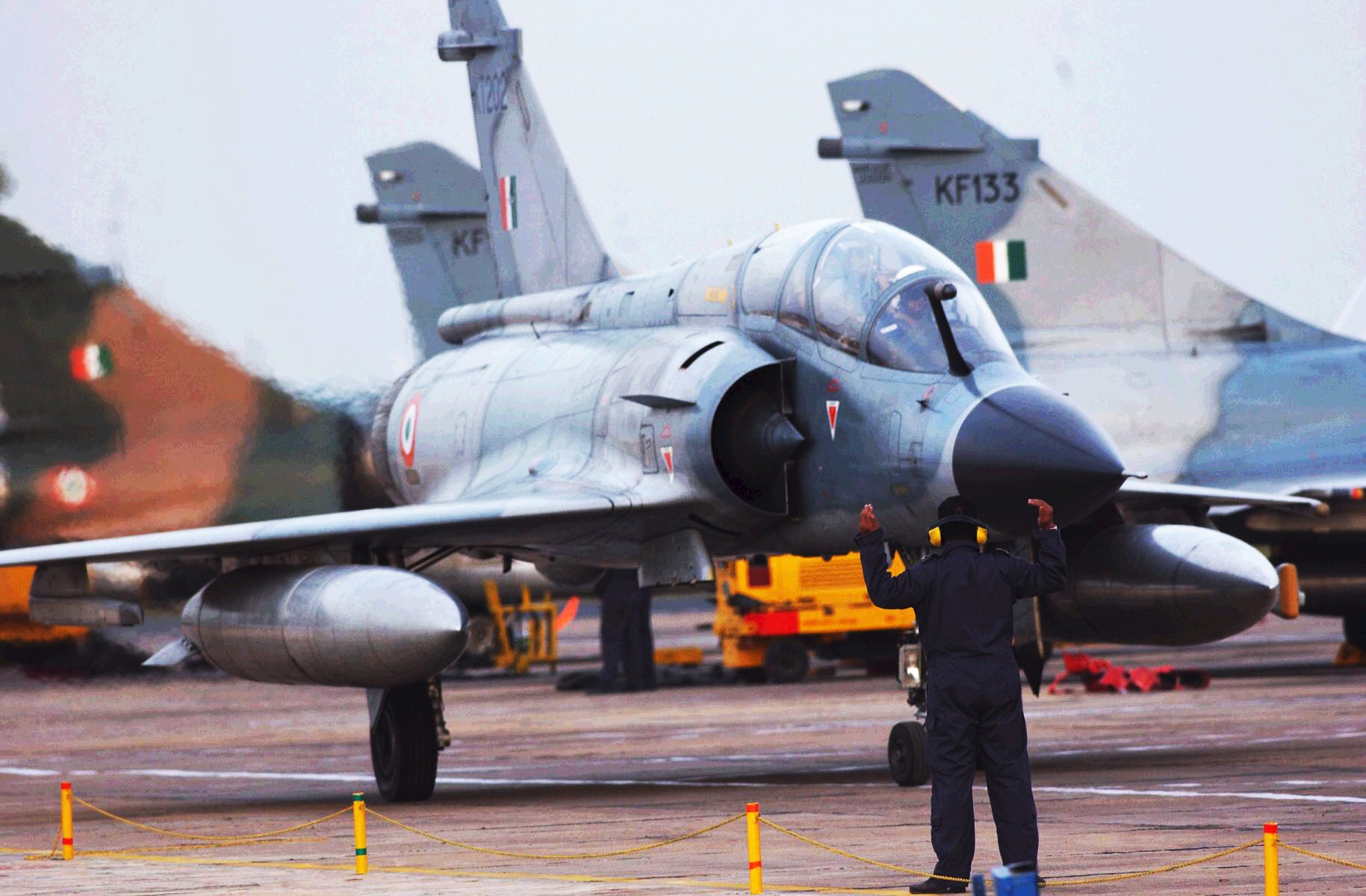
[[File:Dassault Mirage 2000.jpg|alt=|thumb|The [[Mirage 2000]] of the Indian Air Force is believed to be assigned the nuclear strike role, operating from Maharajpur Air Force Station.]] | [[File:Dassault Mirage 2000.jpg|alt=|thumb|The [[Mirage 2000]] of the Indian Air Force is believed to be assigned the nuclear strike role, operating from Maharajpur Air Force Station.]] | ||
Nuclear-armed fighter-bombers were India's first and only nuclear-capable strike force until 2003, when the country's first land-based nuclear ballistic missiles were fielded.<ref name="auto"/> | Nuclear-armed [[Fighter-bomber|fighter-bombers]] were India's first and only nuclear-capable strike force until 2003, when the country's first land-based nuclear ballistic missiles were fielded.<ref name="auto"/> | ||
In addition to their [[Attack aircraft|ground-attack]] role, it is believed that the [[Dassault Mirage 2000]]s and [[SEPECAT Jaguar]]s of the [[Indian Air Force]] are able to provide a secondary nuclear-strike role.<ref>[http://www.openbriefing.org/issuedesks/nuclearissues/indian-nuclear-forces-2012/ Indian Nuclear Forces] {{Webarchive|url=https://web.archive.org/web/20140820113841/http://www.openbriefing.org/issuedesks/nuclearissues/indian-nuclear-forces-2012/ |date=20 August 2014 }}, 14 July 2012.</ref> The SEPECAT Jaguar was designed to be able to carry and deploy nuclear weapons and the Indian Air Force has identified the jet as being capable of delivering Indian nuclear weapons.<ref>[http://articles.economictimes.indiatimes.com/2012-10-17/news/34525680_1_jaguar-strike-fighters-stealth-fifth-generation-fighter-aircraft-Rafale-fighters India plans to impart power punch to Jaguar fighters], October 2012.</ref> The most likely delivery method would be the use of bombs that are [[Unguided bomb|free-falling and unguided]].<ref>{{cite web |url=http://www.cdi.org/issues/nukef&f/database/innukes.html |title=CDI Nuclear Issues Area – Nuclear Weapons Database: French Nuclear Delivery Systems |publisher=cdi.org |access-date=16 July 2010}}</ref> | In addition to their [[Attack aircraft|ground-attack]] role, it is believed that the [[Dassault Mirage 2000]]s and [[SEPECAT Jaguar]]s of the [[Indian Air Force]] are able to provide a secondary nuclear-strike role.<ref>[http://www.openbriefing.org/issuedesks/nuclearissues/indian-nuclear-forces-2012/ Indian Nuclear Forces] {{Webarchive|url=https://web.archive.org/web/20140820113841/http://www.openbriefing.org/issuedesks/nuclearissues/indian-nuclear-forces-2012/ |date=20 August 2014 }}, 14 July 2012.</ref> The SEPECAT Jaguar was designed to be able to carry and deploy nuclear weapons and the Indian Air Force has identified the jet as being capable of delivering Indian nuclear weapons.<ref>[http://articles.economictimes.indiatimes.com/2012-10-17/news/34525680_1_jaguar-strike-fighters-stealth-fifth-generation-fighter-aircraft-Rafale-fighters India plans to impart power punch to Jaguar fighters], October 2012.</ref> The most likely delivery method would be the use of bombs that are [[Unguided bomb|free-falling and unguided]].<ref>{{cite web |url=http://www.cdi.org/issues/nukef&f/database/innukes.html |title=CDI Nuclear Issues Area – Nuclear Weapons Database: French Nuclear Delivery Systems |publisher=cdi.org |access-date=16 July 2010}}</ref> | ||
| Line 86: | Line 101: | ||
====Land-based ballistic missiles==== | ====Land-based ballistic missiles==== | ||
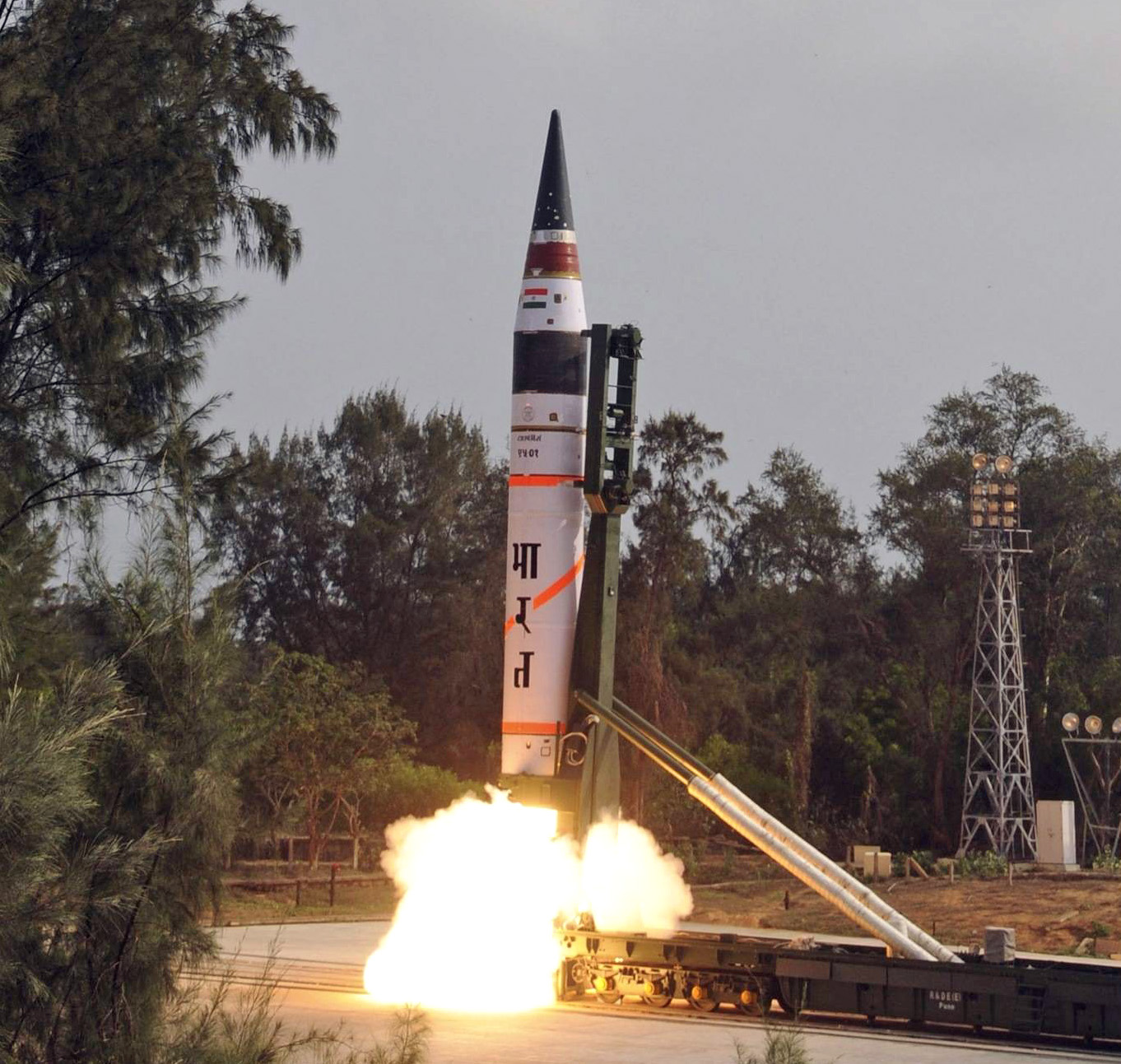
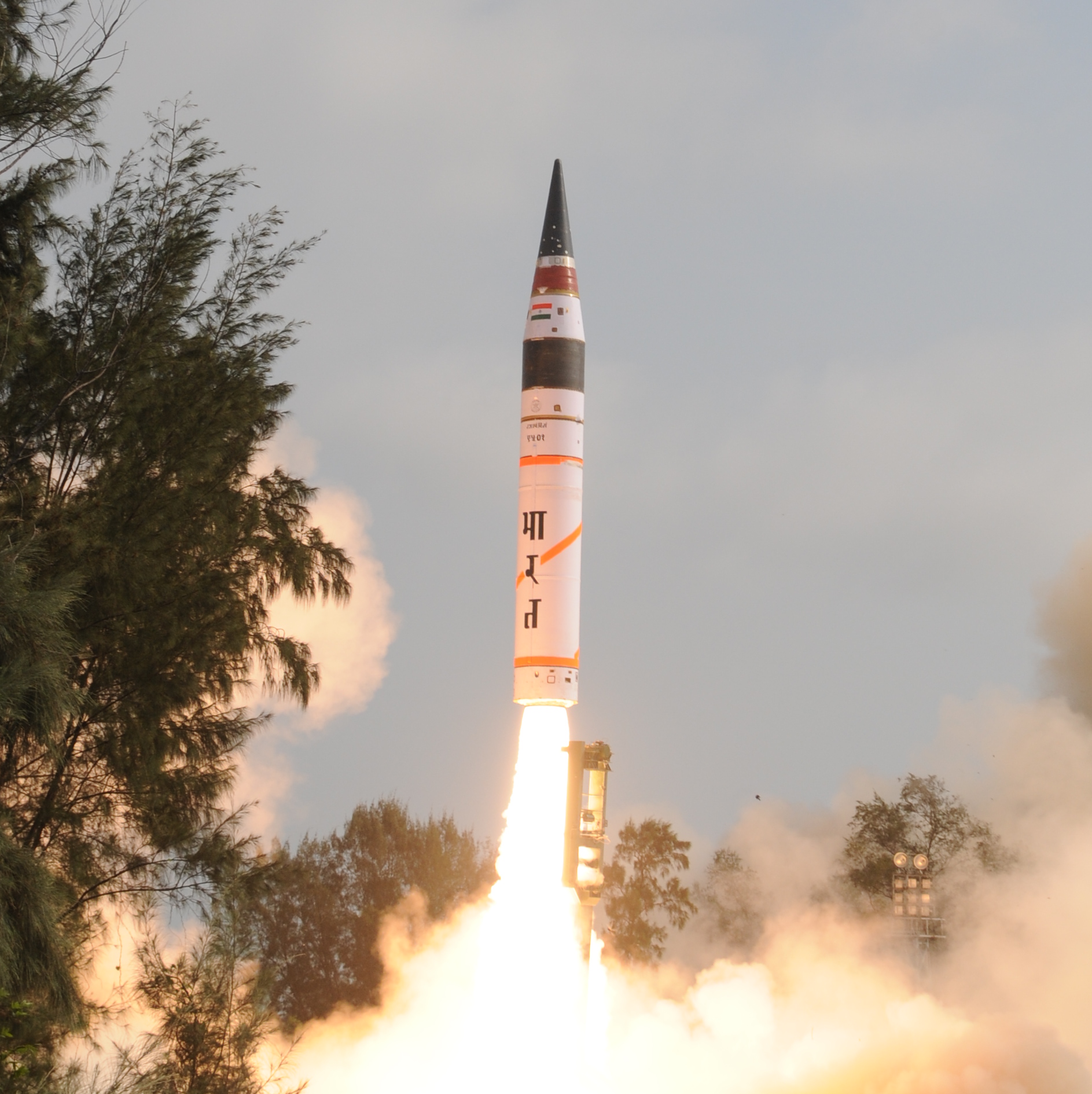
[[File:Agni-V during its first test flight.jpg|alt=|thumb|[[Agni-V]] during its first test flight on 19 April 2012]] | [[File:Agni-V during its first test flight.jpg|alt=|thumb|[[Agni-V]] during its first test flight on 19 April 2012]] | ||
The estimated 68 nuclear warheads<ref name="auto">{{cite journal |title=Indian nuclear forces, 2017 |first1=Hans M.|last1=Kristensen|first2=Robert S.|last2=Norris|journal=Bulletin of the Atomic Scientists|volume=73|issue=4|pages=205–209|doi=10.1080/00963402.2017.1337998|year = 2017|doi-access=free}}</ref> of land-based nuclear weapons of India are under the control of and deployed by the [[Strategic Forces Command]],<ref>{{Cite web|url=http://pib.gov.in/newsite/printrelease.aspx?relid=155897|title=Successful Test launch of AGNI V|website=Press Information Bureau, Government of India|access-date=18 August 2019}}</ref> using a variety of both vehicles and launching silos. They currently consist of three different types of [[ballistic missile]]s, the [[Agni-I]], the [[Agni-II]], [[Agni-III]] and the Army's variant of the [[Prithvi (missile)|Prithvi missile]] family – the Prithvi-I. Additional variants of the Agni missile series have recently been inducted including the most recent, the [[Agni-IV]]<ref>{{Cite web|url=https://www.hindustantimes.com/india-news/agni-v-to-undergo-one-more-pre-induction-test/story-a9OcIgjWaRUyMbBoSOnM5M.html|title=Agni-V set to be inducted by December after one more test|date=14 August 2018|website=Hindustan Times|access-date=18 February 2020}}</ref> and the [[Agni-V]], which is currently being deployed.<ref>{{Cite news|last=Pubby|first=Manu|url=https://economictimes.indiatimes.com/news/defence/confident-of-doubling-range-of-the-astra-will-be-the-most-lethal-air-to-air-missile-drdo-chief/articleshow/72120351.cms|title=Confident of doubling range of the Astra, will be the most lethal air to air missile: DRDO Chief|date=19 November 2019|work=The Economic Times|access-date=18 February 2020}}</ref> [[Agni-VI]] is also under development, with an estimated range of 8,000–12,000 km and features such as [[Multiple independently targetable reentry vehicle]]s (MIRVs) or [[Maneuverable reentry vehicle]]s (MARVs).<ref>{{cite news |title=Advanced Agni-6 missile with multiple warheads likely by 2017 |url=http://www.business-standard.com/article/economy-policy/advanced-agni-6-missile-with-multiple-warheads-likely-by-2017-113050800034_1.html |access-date=1 October 2013|newspaper=Business Standard India |date=7 May 2013 |last1=Shukla |first1=Ajai }}</ref><ref>{{cite news |last=Subramanian |first=T.S. |title=Agni-VI all set to take shape |url=http://www.thehindu.com/news/national/agnivi-all-set-to-take-shape/article4379416.ece?homepage=true |access-date=1 October 2013|newspaper=The Hindu |date=4 February 2013 }}</ref> | The estimated 68 nuclear warheads<ref name="auto">{{cite journal |title=Indian nuclear forces, 2017 |first1=Hans M.|last1=Kristensen|first2=Robert S.|last2=Norris|journal=Bulletin of the Atomic Scientists|volume=73|issue=4|pages=205–209|doi=10.1080/00963402.2017.1337998|year = 2017|bibcode=2017BuAtS..73d.205K|doi-access=free}}</ref> of land-based nuclear weapons of India are under the control of and deployed by the [[Strategic Forces Command]],<ref>{{Cite web|url=http://pib.gov.in/newsite/printrelease.aspx?relid=155897|title=Successful Test launch of AGNI V|website=Press Information Bureau, Government of India|access-date=18 August 2019}}</ref> using a variety of both vehicles and launching silos. They currently consist of three different types of [[ballistic missile]]s, the [[Agni-I]], the [[Agni-II]], [[Agni-III]], [[Agni-P]] and the Army's variant of the [[Prithvi (missile)|Prithvi missile]] family – the Prithvi-I. However, the Prithvi missiles are less useful for delivering nuclear weapons because they have a shorter range and must be deployed very close to the [[India–Pakistan border]].<ref name=":1">{{Citation|title=The Varieties of Hedgers: India, Japan, West Germany, Brazil and Argentina, Sweden and Switzerland|date=2020-12-31|url=https://www.degruyter.com/document/doi/10.1515/9780691223063-005/html|work=Seeking the Bomb: Strategies of Nuclear Proliferation|pages=53–126|publisher=Princeton University Press|doi=10.1515/9780691223063-005|isbn=978-0-691-22306-3|access-date=2022-01-20}}</ref> Additional variants of the Agni missile series have recently been inducted including the most recent, the [[Agni-IV]]<ref>{{Cite web|url=https://www.hindustantimes.com/india-news/agni-v-to-undergo-one-more-pre-induction-test/story-a9OcIgjWaRUyMbBoSOnM5M.html|title=Agni-V set to be inducted by December after one more test|date=14 August 2018|website=Hindustan Times|access-date=18 February 2020}}</ref> and the [[Agni-V]], which is currently being deployed.<ref>{{Cite news|last=Pubby|first=Manu|url=https://economictimes.indiatimes.com/news/defence/confident-of-doubling-range-of-the-astra-will-be-the-most-lethal-air-to-air-missile-drdo-chief/articleshow/72120351.cms|title=Confident of doubling range of the Astra, will be the most lethal air to air missile: DRDO Chief|date=19 November 2019|work=The Economic Times|access-date=18 February 2020}}</ref> [[Agni-VI]] is also under development, with an estimated range of 8,000–12,000 km and features such as [[Multiple independently targetable reentry vehicle]]s (MIRVs) or [[Maneuverable reentry vehicle]]s (MARVs).<ref>{{cite news |title=Advanced Agni-6 missile with multiple warheads likely by 2017 |url=http://www.business-standard.com/article/economy-policy/advanced-agni-6-missile-with-multiple-warheads-likely-by-2017-113050800034_1.html |access-date=1 October 2013|newspaper=Business Standard India |date=7 May 2013 |last1=Shukla |first1=Ajai }}</ref><ref>{{cite news |last=Subramanian |first=T.S. |title=Agni-VI all set to take shape |url=http://www.thehindu.com/news/national/agnivi-all-set-to-take-shape/article4379416.ece?homepage=true |access-date=1 October 2013|newspaper=The Hindu |date=4 February 2013 }}</ref> | ||
[[File:Agni-V missile during rehearsal of Republic Day Parade 2013.jpg|alt=|thumb|The [[Agni-V]] ballistic missile at Republic Day parade.]] | [[File:Agni-V missile during rehearsal of Republic Day Parade 2013.jpg|alt=|thumb|The [[Agni-V]] ballistic missile at Republic Day parade.]] | ||
{| class="wikitable" | {| class="wikitable" | ||
| Line 96: | Line 111: | ||
! Status | ! Status | ||
|- | |- | ||
| '''[[Prithvi (missile)|Prithvi-I]]'''{{nbsp|2}} || [[Short-range ballistic missile]] || 150 ||rowspan=" | | '''[[Prithvi (missile)|Prithvi-I]]'''{{nbsp|2}} || [[Short-range ballistic missile]] || 150 || rowspan="9" | Deployed | ||
|- | |- | ||
| '''[[Prithvi (missile)|Prithvi-II]]'''{{nbsp|2}} || Short-range ballistic missile || 250–350 | | '''[[Prithvi (missile)|Prithvi-II]]'''{{nbsp|2}} || Short-range ballistic missile || 250–350 | ||
| Line 104: | Line 119: | ||
| '''[[Agni-I]]''' || [[Medium-range ballistic missile]] || 700 | | '''[[Agni-I]]''' || [[Medium-range ballistic missile]] || 700 | ||
|- | |- | ||
| '''[[Agni- | | '''[[Shaurya missile|Shaurya]]''' || [[Medium-range ballistic missile]] || 700-1900 | ||
|- | |||
| '''[[Agni-P]]'''|| Medium-range ballistic missile || 1,000–2,000 | |||
|- | |- | ||
|'''[[Agni-II]]''' || Medium-range ballistic missile || 2,000–3,000 | |'''[[Agni-II]]''' || Medium-range ballistic missile || 2,000–3,000 | ||
|- | |- | ||
| '''[[Agni-III]]''' || | | '''[[Agni-III]]''' || Intermediate-range ballistic missile || 3,500–5,000 | ||
|- | |- | ||
| '''[[Agni-IV]]''' || Intermediate-range ballistic missile || 4000 | | '''[[Agni-IV]]''' || Intermediate-range ballistic missile || 4000 | ||
|- | |- | ||
| '''[[Agni-V]]''' || | | '''[[Agni-V]]''' || Intercontinental ballistic missile || 5,000–8,000 | ||
|- | |- | ||
| '''[[ | | '''[[Agni-VI]]''' || Intercontinental ballistic missile & MIRV capable || 8,000–12,000 || Under development | ||
|} | |} | ||
| Line 123: | Line 138: | ||
The [[Indian Navy]] has developed two sea-based delivery systems for nuclear weapons, completing Indian ambitions for a [[nuclear triad]], which may have been deployed in 2015.<ref>{{cite news|last1=Peri|first1=Dinakar|title=India's Nuclear Triad Finally Coming of Age|url=https://thediplomat.com/2014/06/indias-nuclear-triad-finally-coming-of-age/|access-date=10 March 2015|agency=The Diplomat|date=12 June 2014}}</ref><ref>{{cite web|url=http://www.livemint.com/Politics/lvVxsu1L5GPLvD7Z5j3baJ/Nuclear-triad-weapons-ready-for-deployment-DRDO.html|title=Nuclear triad weapons ready for deployment: DRDO|date=7 July 2014}}</ref> | The [[Indian Navy]] has developed two sea-based delivery systems for nuclear weapons, completing Indian ambitions for a [[nuclear triad]], which may have been deployed in 2015.<ref>{{cite news|last1=Peri|first1=Dinakar|title=India's Nuclear Triad Finally Coming of Age|url=https://thediplomat.com/2014/06/indias-nuclear-triad-finally-coming-of-age/|access-date=10 March 2015|agency=The Diplomat|date=12 June 2014}}</ref><ref>{{cite web|url=http://www.livemint.com/Politics/lvVxsu1L5GPLvD7Z5j3baJ/Nuclear-triad-weapons-ready-for-deployment-DRDO.html|title=Nuclear triad weapons ready for deployment: DRDO|date=7 July 2014}}</ref> | ||
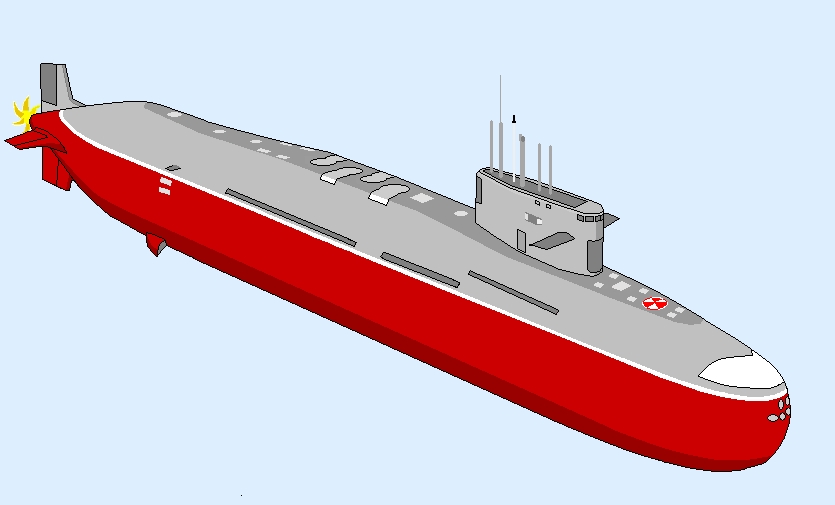
[[File:Arihant_1.jpg|thumb|A conceptual drawing of [[INS Arihant|INS ''Arihant'']]]] | [[File:Arihant_1.jpg|thumb|A conceptual drawing of [[INS Arihant|INS ''Arihant'']]]] | ||
The first is a submarine-launched system consisting of at least four 6,000 tonne ([[Nuclear submarine|nuclear-powered]]) [[ballistic missile submarine]]s of the [[Arihant class submarine|''Arihant'' class]]. The first vessel, [[INS Arihant|INS ''Arihant'']], was commissioned in August of 2016. She is the first nuclear-powered submarine to be built by India.<ref>{{cite news|last=Unnithan|first=Sandeep|title=The secret undersea weapon|url=http://indiatoday.intoday.in/story/The+secret+undersea+weapon/1/3659.html|access-date = 11 November 2012|newspaper=India Today|date=28 January 2008}}</ref><ref name="IT">"Indian nuclear submarine", ''India Today'', August 2007 edition</ref> A [[CIA]] report claimed that Russia provided technological aid to the naval nuclear propulsion program.<ref name=eipyi>{{cite news|title=Russia helped India's nuke programme: CIA|url=http://www.expressindia.com/news/fullstory.php?newsid=18265|access-date = 2 January 2013|agency=Press Trust of India|date=9 January 2003}}</ref><ref name=tda>{{cite news|title=Russia helped Indian nuclear programme, says CIA|url=http://archives.dawn.com/2003/01/10/top5.htm|access-date = 2 January 2013|newspaper=The Dawn|date=9 January 2009}}</ref> The submarines will be armed with up to 12 [[Sagarika (missile)|Sagarika]] (K-15) missiles armed with nuclear warheads. Sagarika is a [[submarine-launched ballistic missile]] with a range of 700 km. This missile has a length of 8.5 meters, weighs seven tonnes and can carry a pay load of up to 500 kg.<ref>{{cite news|url=http://www.hindu.com/2008/02/27/stories/2008022757940100.htm |archive-url=https://web.archive.org/web/20080229234524/http://www.hindu.com/2008/02/27/stories/2008022757940100.htm |url-status=dead |archive-date=29 February 2008 |title=Sagarika missile test-fired successfully |date=27 February 2008 |access-date = 31 August 2010 |work=[[The Hindu]] |location=Chennai, India}}</ref> Sagarika has already been test-fired from an underwater pontoon, but now [[DRDO]] is planning a full-fledged test of the missile from a submarine and for this purpose may use the services of the [[Russian Navy]].<ref name=autogenerated5>{{cite web|url=http://www.rediff.com/news/2008/jul/06astra.htm |title=Coming from India's defense unit: ASTRA missile | | The first is a submarine-launched system consisting of at least four 6,000 tonne ([[Nuclear submarine|nuclear-powered]]) [[ballistic missile submarine]]s of the [[Arihant class submarine|''Arihant'' class]]. The first vessel, [[INS Arihant|INS ''Arihant'']], was commissioned in August of 2016. She is the first nuclear-powered submarine to be built by India.<ref>{{cite news|last=Unnithan|first=Sandeep|title=The secret undersea weapon|url=http://indiatoday.intoday.in/story/The+secret+undersea+weapon/1/3659.html|access-date = 11 November 2012|newspaper=India Today|date=28 January 2008}}</ref><ref name="IT">"Indian nuclear submarine", ''India Today'', August 2007 edition</ref> A [[CIA]] report claimed that Russia provided technological aid to the naval nuclear propulsion program.<ref name=eipyi>{{cite news|title=Russia helped India's nuke programme: CIA|url=http://www.expressindia.com/news/fullstory.php?newsid=18265|access-date = 2 January 2013|agency=Press Trust of India|date=9 January 2003}}</ref><ref name=tda>{{cite news|title=Russia helped Indian nuclear programme, says CIA|url=http://archives.dawn.com/2003/01/10/top5.htm|access-date = 2 January 2013|newspaper=The Dawn|date=9 January 2009}}</ref> The submarines will be armed with up to 12 [[Sagarika (missile)|Sagarika]] (K-15) missiles armed with nuclear warheads. Sagarika is a [[submarine-launched ballistic missile]] with a range of 700 km. This missile has a length of 8.5 meters, weighs seven tonnes and can carry a pay load of up to 500 kg.<ref>{{cite news|url=http://www.hindu.com/2008/02/27/stories/2008022757940100.htm |archive-url=https://web.archive.org/web/20080229234524/http://www.hindu.com/2008/02/27/stories/2008022757940100.htm |url-status=dead |archive-date=29 February 2008 |title=Sagarika missile test-fired successfully |date=27 February 2008 |access-date = 31 August 2010 |work=[[The Hindu]] |location=Chennai, India}}</ref> Sagarika has already been test-fired from an underwater pontoon, but now [[DRDO]] is planning a full-fledged test of the missile from a submarine and for this purpose may use the services of the [[Russian Navy]].<ref name=autogenerated5>{{cite web|url=http://www.rediff.com/news/2008/jul/06astra.htm |title=Coming from India's defense unit: ASTRA missile |work=Rediff.com |date=31 December 2004 |access-date = 31 August 2010}}</ref> India's [[DRDO]] is also working on a submarine-launched ballistic missile version of the Agni-III missile, known as the Agni-III SL. According to Indian defence sources, the Agni-III SL will have a range of {{convert|3500|km}}.<ref>{{cite web |url=http://www.hinduonnet.com/thehindu/holnus/000200805071441.htm |title=Agni-III test-fired successfully |publisher=Hinduonnet.com |date=7 May 2008 |access-date=31 August 2010 |archive-url=https://web.archive.org/web/20110606185112/http://www.hinduonnet.com/thehindu/holnus/000200805071441.htm |archive-date=6 June 2011 |url-status=usurped }}</ref> The new missile will complement the older and less capable Sagarika submarine-launched ballistic missiles. However, the ''Arihant'' class ballistic missile submarines will be only capable of carrying a maximum of four Agni-III SL. | ||
The second is a ship-launched system based around the short range ship-launched Dhanush ballistic missile (a variant of the [[Prithvi (missile)|Prithvi missile]]). It has a range of around 300 km. In the year 2000 the missile was test-fired from INS ''Subhadra'' (a [[Sukanya class patrol craft|''Sukanya'' class patrol craft]]). INS ''Subhadra'' was modified for the test and the missile was launched from the reinforced helicopter deck. The results were considered partially successful.<ref name="nrdc.org">{{cite web|url=http://www.nrdc.org/nuclear/nudb/datab20.asp |title=Nuclear Data – Table of Indian Nuclear Forces, 2002 |publisher=NRDC |access-date = 16 July 2010}}</ref> In 2004, the missile was again tested from INS ''Subhadra'' and this time the results were reported successful.<ref name="bharat-rakshak.com">[http://www.bharat-rakshak.com/MISSILES/Prithvi.html] {{webarchive|url=https://web.archive.org/web/20090918064715/http://www.bharat-rakshak.com/MISSILES/Prithvi.html|date=18 September 2009}}</ref> In December 2005 the missile was tested again, but this time from the [[destroyer]] [[INS Rajput (D51)|INS ''Rajput'']]. The test was a success with the missile hitting the land based target.<ref name="domain-b.com">{{cite web |url=http://www.domain-b.com/aero/20070331_fired.htm |title=Dhanush, naval surface-to-surface missile, test fired successfully |publisher=domain-b.com |date=31 March 2007 |access-date=31 August 2010}}</ref> | The second is a ship-launched system based around the short range ship-launched Dhanush ballistic missile (a variant of the [[Prithvi (missile)|Prithvi missile]]). It has a range of around 300 km. In the year 2000 the missile was test-fired from [[INS Subhadra (P51)|INS ''Subhadra'']] (a [[Sukanya class patrol craft|''Sukanya'' class patrol craft]]). INS ''Subhadra'' was modified for the test and the missile was launched from the reinforced helicopter deck. The results were considered partially successful.<ref name="nrdc.org">{{cite web|url=http://www.nrdc.org/nuclear/nudb/datab20.asp |title=Nuclear Data – Table of Indian Nuclear Forces, 2002 |publisher=NRDC |access-date = 16 July 2010}}</ref> In 2004, the missile was again tested from INS ''Subhadra'' and this time the results were reported successful.<ref name="bharat-rakshak.com">[http://www.bharat-rakshak.com/MISSILES/Prithvi.html] {{webarchive|url=https://web.archive.org/web/20090918064715/http://www.bharat-rakshak.com/MISSILES/Prithvi.html|date=18 September 2009}}</ref> In December 2005 the missile was tested again, but this time from the [[destroyer]] [[INS Rajput (D51)|INS ''Rajput'']]. The test was a success with the missile hitting the land based target.<ref name="domain-b.com">{{cite web |url=http://www.domain-b.com/aero/20070331_fired.htm |title=Dhanush, naval surface-to-surface missile, test fired successfully |publisher=domain-b.com |date=31 March 2007 |access-date=31 August 2010}}</ref> | ||
{| class="wikitable" | {| class="wikitable" | ||
| Line 152: | Line 167: | ||
In August 2008, the [[International Atomic Energy Agency]] (IAEA) approved safeguards agreement with India under which the former will gradually gain access to India's civilian [[nuclear reactor]]s.<ref>{{cite web|url=http://www.iaea.org/NewsCenter/News/2008/board010808.html|title=IAEA approves India nuclear inspection deal |publisher=iaea.org|access-date=2 October 2008|date=31 July 2008}}</ref> In September 2008, the [[Nuclear Suppliers Group]] granted India a waiver allowing it to access civilian nuclear technology and fuel from other countries.<ref>{{cite web|url=http://www.marketwatch.com/news/story/nuclear-suppliers-group-grants-india/story.aspx?guid={BA6E4022-DBC8-4B43-B9DE-62608913CB8A}&dist=hppr |archive-url=https://web.archive.org/web/20080920132538/http://www.marketwatch.com/news/story/nuclear-suppliers-group-grants-india/story.aspx?guid=%7BBA6E4022-DBC8-4B43-B9DE-62608913CB8A%7D&dist=hppr |title=Nuclear Suppliers Group Grants India Historic Waiver — MarketWatch |publisher=Marketwatch.com |date=6 October 2008 |archive-date=20 September 2008 |access-date=2 October 2008 |url-status=dead }}</ref> The implementation of this waiver makes India the only known country with [[List of states with nuclear weapons|nuclear weapons]] which is not a party to the NPT but is still allowed to carry out nuclear commerce with the rest of the world.<ref>{{cite web|url=http://afp.google.com/article/ALeqM5geN2RWjoN4oJhPibc7rhkyxMXfzg |title=AFP: India energised by nuclear pacts |agency=Agence France-Presse |access-date=2 October 2008 |url-status=dead |archive-url=https://web.archive.org/web/20110520182512/http://afp.google.com/article/ALeqM5geN2RWjoN4oJhPibc7rhkyxMXfzg |archive-date=20 May 2011 }}</ref><ref name="auto1">R B Grover, "Opening up of international civil nuclear cooperation with India and related development", Progress in Nuclear Energy 101(2017) 161-167.</ref> | In August 2008, the [[International Atomic Energy Agency]] (IAEA) approved safeguards agreement with India under which the former will gradually gain access to India's civilian [[nuclear reactor]]s.<ref>{{cite web|url=http://www.iaea.org/NewsCenter/News/2008/board010808.html|title=IAEA approves India nuclear inspection deal |publisher=iaea.org|access-date=2 October 2008|date=31 July 2008}}</ref> In September 2008, the [[Nuclear Suppliers Group]] granted India a waiver allowing it to access civilian nuclear technology and fuel from other countries.<ref>{{cite web|url=http://www.marketwatch.com/news/story/nuclear-suppliers-group-grants-india/story.aspx?guid={BA6E4022-DBC8-4B43-B9DE-62608913CB8A}&dist=hppr |archive-url=https://web.archive.org/web/20080920132538/http://www.marketwatch.com/news/story/nuclear-suppliers-group-grants-india/story.aspx?guid=%7BBA6E4022-DBC8-4B43-B9DE-62608913CB8A%7D&dist=hppr |title=Nuclear Suppliers Group Grants India Historic Waiver — MarketWatch |publisher=Marketwatch.com |date=6 October 2008 |archive-date=20 September 2008 |access-date=2 October 2008 |url-status=dead }}</ref> The implementation of this waiver makes India the only known country with [[List of states with nuclear weapons|nuclear weapons]] which is not a party to the NPT but is still allowed to carry out nuclear commerce with the rest of the world.<ref>{{cite web|url=http://afp.google.com/article/ALeqM5geN2RWjoN4oJhPibc7rhkyxMXfzg |title=AFP: India energised by nuclear pacts |agency=Agence France-Presse |access-date=2 October 2008 |url-status=dead |archive-url=https://web.archive.org/web/20110520182512/http://afp.google.com/article/ALeqM5geN2RWjoN4oJhPibc7rhkyxMXfzg |archive-date=20 May 2011 }}</ref><ref name="auto1">R B Grover, "Opening up of international civil nuclear cooperation with India and related development", Progress in Nuclear Energy 101(2017) 161-167.</ref> | ||
Since the implementation of the [[Nuclear Suppliers Group|NSG]] waiver, India has signed nuclear deals with several countries including France,<ref>{{cite web|url=http://www.rediff.com/news/2008/jan/25france.htm|title=India, France agree on civil nuclear cooperation| | Since the implementation of the [[Nuclear Suppliers Group|NSG]] waiver, India has signed nuclear deals with several countries including France,<ref>{{cite web|url=http://www.rediff.com/news/2008/jan/25france.htm|title=India, France agree on civil nuclear cooperation|work=Rediff.com|access-date=16 July 2010}}</ref> United States,<ref>{{cite web|url=http://www.livemint.com/2008/10/09005930/Bush-signs-IndiaUS-nuclear-de.html|title=Bush signs India-US nuclear deal into law – Home|publisher=livemint.com |date=9 October 2008|access-date=16 July 2010}}</ref> [[Mongolia]], [[Namibia]],<ref>{{cite news|author=TNN |url=http://articles.timesofindia.indiatimes.com/2009-09-15/india/28093243_1_mongolia-sign-cooperation-pact-civil-nuclear|archive-url=https://web.archive.org/web/20121025093400/http://articles.timesofindia.indiatimes.com/2009-09-15/india/28093243_1_mongolia-sign-cooperation-pact-civil-nuclear|url-status=dead|archive-date=25 October 2012|title=India, Mongolia sign civil, nuclear cooperation pact – India|date=15 September 2009|work=[[The Times of India]] |access-date=16 July 2010}}</ref> [[Kazakhstan]]<ref>{{cite news|author=Sanjay Dutta, TNN, 23 January 2009, 01.35am IST|url=http://timesofindia.indiatimes.com/Business/Kazakh_oil_deals_hang_in_balance/articleshow/4019306.cms|title=Kazakh nuclear, oil deals hang in balance – International Business – Business|work=The Times of India|date=23 January 2009|access-date=16 July 2010}}</ref> and Australia<ref>{{cite news|author=SUHASINI HAIDAR|url=http://www.thehindu.com/news/national/nuclear-deal-will-finally-allow-australian-uranium-to-india-tony-abbott/article6383173.ece|title=India, Australia seal civil nuclear deal - The Hindu|newspaper=The Hindu|date=5 September 2014}}</ref> while the framework for similar deals with Canada and United Kingdom are also being prepared.<ref>{{cite web|author=UK, Canada eye India's nuclear business|url=http://www.ndtv.com/convergence/ndtv/story.aspx?id=NEWEN20090080481&ch=1/18/2009%203:57:00%20PM|title=UK, Canada eye India's nuclear business|publisher=NDTV.com|date=18 January 2009|access-date=16 July 2010}}</ref><ref>{{cite web|author=Sitakanta Mishra, THE PAPER|title=India - From 'Nuclear Apartheid' to Nuclear Multi-Alignment|url=http://www.indrastra.com/2016/06/PAPERS-India-From-Nuclear-Apartheid-to-Nuclear-Multi-Alignment-002-06-2016-0017.html|publisher=IndraStra|date=12 June 2016}}</ref><ref name="auto1"/> | ||
== See also == | == See also == | ||
| Line 176: | Line 191: | ||
* Pant, Harsh V. an d Yogesh Joshi. ''Indian Nuclear Policy'' (Oxford University Press, 2018) [https://www.h-net.org/reviews/showpdf.php?id=54468 online review] | * Pant, Harsh V. an d Yogesh Joshi. ''Indian Nuclear Policy'' (Oxford University Press, 2018) [https://www.h-net.org/reviews/showpdf.php?id=54468 online review] | ||
* Perkovich, George (1999). ''India's Nuclear Bomb: The Impact on Global Proliferation''. Berkeley, Los Angeles, and London: University of California Press. {{ISBN|978-0-520-23210-5}}. | * Perkovich, George (1999). ''India's Nuclear Bomb: The Impact on Global Proliferation''. Berkeley, Los Angeles, and London: University of California Press. {{ISBN|978-0-520-23210-5}}. | ||
* Szalontai, Balázs (2011). [http://www.wilsoncenter.org/publication/npihp-working-paper-1-the-elephant-the-room The Elephant in the Room: The Soviet Union and India’s Nuclear Program, 1967-1989]. Nuclear Proliferation International History Project Working Paper #1. Washington, D.C.: [[Woodrow Wilson Center Press]]. | * Sarkar, Jayita. 2022. ''[https://www.google.com/books/edition/Ploughshares_and_Swords/tYw-EAAAQBAJ?hl=en Ploughshares and Swords: India's Nuclear Program in the Global Cold War]''. Cornell University Press. | ||
*Szalontai, Balázs (2011). [http://www.wilsoncenter.org/publication/npihp-working-paper-1-the-elephant-the-room The Elephant in the Room: The Soviet Union and India’s Nuclear Program, 1967-1989]. Nuclear Proliferation International History Project Working Paper #1. Washington, D.C.: [[Woodrow Wilson Center Press]]. | |||
== External links == | == External links == | ||
Revision as of 07:50, 20 January 2022
| India | |
|---|---|
.svg) | |
| Nuclear programme start date | 1967 |
| First nuclear weapon test | 18 May 1974a |
| First fusion weapon test | 11 May 1998b |
| Most recent test | 13 May 1998 |
| Largest-yield test | 45 kilotons of TNT (190 TJ); Scale down of 200 kt model c |
| Number of tests to date | 3 (6 Devices fired) |
| Peak stockpile | 160 warheads (2021 estimate)[1] |
| Current stockpile | 160 warheads (2021 estimate)[1] |
| Maximum missile range | Agni-V Template:Hyphen 5,500 to 8,000 kilometres 3,400 to 5,000 miles |
| NPT Party | No |
| Weapons of mass destruction |
|---|
 |
| By type |
| By country |
|
| Non-state |
| Biological weapons by country |
| Chemical weapons by country |
| Nuclear weapons by country |
| Proliferation |
| Treaties |
| Defence |

India has developed and possesses weapons of mass destruction in the form of nuclear weapons. Although India has not released any official statements about the size of its nuclear arsenal, recent estimates suggest that India has 160 nuclear weapons[1] and has produced enough weapons-grade plutonium for up to 161–200 nuclear weapons.[9] In 1999, India was estimated to have 800 kilograms (1,800 lb) of separated reactor-grade plutonium, with a total amount of 8,300 kilograms (18,300 lb) of civilian plutonium, enough for approximately 1,000 nuclear weapons.[10][11] India has conducted nuclear weapons tests in a pair of series namely Pokhran I and Pokhran II.[12]
India is a member of three multilateral export control regimes — the Missile Technology Control Regime, Wassenaar Arrangement and Australia Group. It has signed and ratified the Biological Weapons Convention and the Chemical Weapons Convention. India is also a subscribing state to the Hague Code of Conduct. India has signed neither the Comprehensive Nuclear-Test-Ban Treaty nor the Nuclear Non-Proliferation Treaty, considering both to be flawed and discriminatory.[13] India previously possessed chemical weapons, but voluntarily destroyed its entire stockpile in 2009 — one of the seven countries to meet the OPCW extended deadline.[14]
India maintains a "no first use" nuclear policy and has developed a nuclear triad capability as a part of its "Minimum Credible Deterrence" doctrine.[15][16][17]
Biological weapons
India has a biotechnology infrastructure that includes numerous pharmaceutical production facilities and bio-containment laboratories (including BSL-3 and BSL-4) for working with lethal pathogens. It also has scientists with expertise in infectious diseases. Some of India's facilities are being used to support research and development for biological weapons (BW) defence purposes [citation needed]. India has ratified the Biological Weapons Convention (BWC) and pledges to abide by its obligations. There is no clear evidence, circumstantial or otherwise, that directly points toward an offensive BW program. India does possess the scientific capability and infrastructure to launch an offensive BW program. In terms of delivery, India also possesses the capability to produce aerosols and has numerous potential delivery systems ranging from crop dusters to sophisticated ballistic missiles.[18]
No information exists in the public domain suggesting interest by the Indian government in delivery of biological agents by these or any other means. To reiterate the latter point, in October 2002, the then President A. P. J. Abdul Kalam asserted that "India will not make biological weapons. It is cruel to human beings".[18]
Chemical weapons
In 1992, India signed the Chemical Weapons Convention (CWC), stating that it did not have chemical weapons and the capacity or intent to manufacture chemical weapons.[citation needed] By doing this India became one of the original signatories of the CWC in 1993,[19] and ratified it on 2 September 1996. According to India's ex-Army Chief General Sunderji, a country having the capability of making nuclear weapons does not need to have chemical weapons, since the dread of chemical weapons could be created only in those countries that do not have nuclear weapons. Others suggested that the fact that India has found chemical weapons dispensable highlighted its confidence in the conventional weapons system at its command.
In June 1997, India declared its stock of chemical weapons (1,045 tonnes of sulphur mustard).[20][21] By the end of 2006, India had destroyed more than 75 percent of its chemical weapons/material stockpile and was granted extension for destroying the remaining stocks by April 2009 and was expected to achieve 100 percent destruction within that time frame.[20] India informed the United Nations in May 2009 that it had destroyed its stockpile of chemical weapons in compliance with the international Chemical Weapons Convention. With this India has become third country after South Korea and Albania to do so.[22][23] This was cross-checked by inspectors of the United Nations.
India has an advanced commercial chemical industry, and produces the bulk of its own chemicals for domestic consumption. It is also widely acknowledged that India has an extensive civilian chemical and pharmaceutical industry and annually exports considerable quantities of chemicals to countries such as the United Kingdom, United States and Taiwan.[24]
Nuclear weapons
As early as 26 June 1946, Jawaharlal Nehru, soon to be India's first Prime Minister, announced:
As long as the world is constituted as it is, every country will have to devise and use the latest devices for its protection. I have no doubt India will develop her scientific researches and I hope Indian scientists will use the atomic force for constructive purposes. But if India is threatened, she will inevitably try to defend herself by all means at her disposal.[25]
Nehru pursued a policy of formally foregoing nuclear weapons while at the same time constructing a civilian nuclear energy program, and by extension the capability to make a nuclear bomb. This policy was motivated by a conventional weapons superiority over its rivals Pakistan and China.[26] India built its first research reactor in 1956 and its first plutonium reprocessing plant by 1964.[27][28][29] India's nuclear programme can trace its origins to March 1944 and its three-stage efforts in technology were established by Homi Jehangir Bhabha when he founded the nuclear research centre, the Tata Institute of Fundamental Research.[30][31]
India's loss to China in a brief Himalayan border war in October 1962, provided the New Delhi government impetus for developing nuclear weapons as a means of deterring potential Chinese aggression.[32] By 1964 India was in a position to develop nuclear weapons.[33] Prime Minister Lal Bahadur Shastri opposed developing nuclear weapons but fell under intense political pressure, including elements within the ruling Indian National Congress. India was also unable to obtain security guarantees from either the United States or the Soviet Union. As a result, Shastri announced that India would pursue the capability of what it called "peaceful nuclear explosions" that could be weaponized in the future.[26]
India first tested a nuclear device in 1974 (code-named "Smiling Buddha"), under Prime Minister Indira Gandhi as a peaceful nuclear explosion. The test used plutonium produced in the Canadian-supplied CIRUS reactor, and raised concerns that nuclear technology supplied for peaceful purposes could be diverted to weapons purposes. This also stimulated the early work of the Nuclear Suppliers Group.[34] During the 1970s and the 1980s Prime Ministers Indira Gandhi, Morarji Desai, and Rajiv Gandhi opposed weaponizing its nuclear program beyond PNE's and theoretical research. In 1982, Indira Gandhi refused to allow the Defence Research and Development Organisation to develop active nuclear weapons, but also approved the Integrated Guided Missile Development Programme that would develop missiles to deliver a nuclear warhead if India developed one. India also supported international nuclear non-proliferation and arms control efforts.[26]
The situation changed again in the late 1980s after the 1987 Brasstacks crisis and the beginning of the Pakistani nuclear weapons program. In 1989, Prime Minister Rajiv Gandhi gave Defense Secretary Naresh Chandra approval to develop the bomb. Chandra continued the program through successive governments in the 1990s after Gandhi lost power in the 1989 general election. India most likely completed weaponized nuclear warheads around 1994.[26] India performed further nuclear tests in 1998 (code-named "Operation Shakti") under Prime Minister Atal Bihari Vajpayee. In 1998, as a response to the continuing tests, the United States and Japan imposed sanctions on India, which have since been lifted.[35]
Neutron bombs
R Chidambaram, who headed India's Pokhran-II nuclear tests, said in a 1999 interview with the Press Trust of India that India is capable of producing a neutron bomb.[36]
India's no-first-use policy
India has a declared nuclear no-first-use policy and is in the process of developing a nuclear doctrine based on "credible minimum deterrence." In August 1999, the Indian government released a draft of the doctrine[37] which asserts that nuclear weapons are solely for deterrence and that India will pursue a policy of "retaliation only". The document also maintains that India "will not be the first to initiate a nuclear first strike, but will respond with punitive retaliation should deterrence fail" and that decisions to authorise the use of nuclear weapons would be made by the Prime Minister or his 'designated successor(s)'.[37] According to the NRDC, despite the escalation of tensions between India and Pakistan in 2001–2002, India remained committed to its nuclear no-first-use policy.
India's Strategic Nuclear Command was formally established in 2003, with an Indian Air Force officer, Air Marshal Tej Mohan Asthana, as the Commander-in-Chief. The joint services SNC is the custodian of all of India's nuclear weapons, missiles and assets. It is also responsible for executing all aspects of India's nuclear policy. However, the civil leadership, in the form of the CCS (Cabinet Committee on Security) is the only body authorised to order a nuclear strike against another offending strike. The National Security Advisor Shivshankar Menon reiterated a policy of "no first use" against nuclear weapon states and "non use against non-nuclear weapon states" in a speech on the occasion of Golden Jubilee celebrations of National Defence College in New Delhi on 21 October 2010, a doctrine Menon said reflected India's "strategic culture, with its emphasis on minimal deterrence.[38][39] In April 2013 Shyam Saran, convener of the National Security Advisory Board, affirmed that regardless of the size of a nuclear attack against India, be it a miniaturised version or a "big" missile, India will retaliate massively to inflict unacceptable damage.[40]
In 2016, Defence Minister Manohar Parrikar questioned the no first use policy, asking why India should "bind" itself when it is a "responsible nuclear power". Later he clarified that this was his personal opinion.[41] Defence Minister Rajnath Singh in 2019 said that in the future, India's no first use policy might change depending upon the "circumstances".[42][43] In a January 2022 statement, however, the Ministry of External Affairs reiterated India's doctrine of "maintaining a credible minimum deterrence based on a No First Use posture and non-use of nuclear weapons against non-nuclear weapon states".[17][44]
Indian nuclear triad
Air-launched nuclear weapons

Nuclear-armed fighter-bombers were India's first and only nuclear-capable strike force until 2003, when the country's first land-based nuclear ballistic missiles were fielded.[45]
In addition to their ground-attack role, it is believed that the Dassault Mirage 2000s and SEPECAT Jaguars of the Indian Air Force are able to provide a secondary nuclear-strike role.[46] The SEPECAT Jaguar was designed to be able to carry and deploy nuclear weapons and the Indian Air Force has identified the jet as being capable of delivering Indian nuclear weapons.[47] The most likely delivery method would be the use of bombs that are free-falling and unguided.[48]
Three airbases with four squadrons of Mirage 2000H (about 16 aircraft with 16 bombs from 1st and 7th squadrons of the 40th Wing at Maharajpur Air Force Station) and Jaguar IS/IB (about 32 aircraft with 32 bombs from one squadron each at Ambala Air Force Station and Gorakhpur Air Force Station) aircraft, are believed to be assigned the nuclear strike role.[45]
Land-based ballistic missiles

The estimated 68 nuclear warheads[45] of land-based nuclear weapons of India are under the control of and deployed by the Strategic Forces Command,[49] using a variety of both vehicles and launching silos. They currently consist of three different types of ballistic missiles, the Agni-I, the Agni-II, Agni-III, Agni-P and the Army's variant of the Prithvi missile family – the Prithvi-I. However, the Prithvi missiles are less useful for delivering nuclear weapons because they have a shorter range and must be deployed very close to the India–Pakistan border.[26] Additional variants of the Agni missile series have recently been inducted including the most recent, the Agni-IV[50] and the Agni-V, which is currently being deployed.[51] Agni-VI is also under development, with an estimated range of 8,000–12,000 km and features such as Multiple independently targetable reentry vehicles (MIRVs) or Maneuverable reentry vehicles (MARVs).[52][53]

| Name | Type | Range (km) | Status |
|---|---|---|---|
| Prithvi-I | Short-range ballistic missile | 150 | Deployed |
| Prithvi-II | Short-range ballistic missile | 250–350 | |
| Prithvi-III | Short-range ballistic missile | 350–600 | |
| Agni-I | Medium-range ballistic missile | 700 | |
| Shaurya | Medium-range ballistic missile | 700-1900 | |
| Agni-P | Medium-range ballistic missile | 1,000–2,000 | |
| Agni-II | Medium-range ballistic missile | 2,000–3,000 | |
| Agni-III | Intermediate-range ballistic missile | 3,500–5,000 | |
| Agni-IV | Intermediate-range ballistic missile | 4000 | |
| Agni-V | Intercontinental ballistic missile | 5,000–8,000 | |
| Agni-VI | Intercontinental ballistic missile & MIRV capable | 8,000–12,000 | Under development |
Sea-based ballistic missiles
.jpg)
The Indian Navy has developed two sea-based delivery systems for nuclear weapons, completing Indian ambitions for a nuclear triad, which may have been deployed in 2015.[54][55]

The first is a submarine-launched system consisting of at least four 6,000 tonne (nuclear-powered) ballistic missile submarines of the Arihant class. The first vessel, INS Arihant, was commissioned in August of 2016. She is the first nuclear-powered submarine to be built by India.[56][57] A CIA report claimed that Russia provided technological aid to the naval nuclear propulsion program.[58][59] The submarines will be armed with up to 12 Sagarika (K-15) missiles armed with nuclear warheads. Sagarika is a submarine-launched ballistic missile with a range of 700 km. This missile has a length of 8.5 meters, weighs seven tonnes and can carry a pay load of up to 500 kg.[60] Sagarika has already been test-fired from an underwater pontoon, but now DRDO is planning a full-fledged test of the missile from a submarine and for this purpose may use the services of the Russian Navy.[61] India's DRDO is also working on a submarine-launched ballistic missile version of the Agni-III missile, known as the Agni-III SL. According to Indian defence sources, the Agni-III SL will have a range of 3,500 kilometres (2,200 mi).[62] The new missile will complement the older and less capable Sagarika submarine-launched ballistic missiles. However, the Arihant class ballistic missile submarines will be only capable of carrying a maximum of four Agni-III SL.
The second is a ship-launched system based around the short range ship-launched Dhanush ballistic missile (a variant of the Prithvi missile). It has a range of around 300 km. In the year 2000 the missile was test-fired from INS Subhadra (a Sukanya class patrol craft). INS Subhadra was modified for the test and the missile was launched from the reinforced helicopter deck. The results were considered partially successful.[63] In 2004, the missile was again tested from INS Subhadra and this time the results were reported successful.[64] In December 2005 the missile was tested again, but this time from the destroyer INS Rajput. The test was a success with the missile hitting the land based target.[65]
| Name | Type | Range (km) | Status |
|---|---|---|---|
| Dhanush | Short-range ballistic missile | 350 | Operational[66] |
| Sagarika (K-15) | Submarine-launched ballistic missile | 700 | Operational |
| K-4 | Submarine-launched ballistic missile | 3,500 | Tested[67] |
| K-5 | Submarine-launched ballistic missile | 5,000 | Under Development[68] |
| K-6 | Submarine-launched ballistic missile | 6,000 | Under Development[69] |
International response
India is not a signatory to either the NPT or the Comprehensive Nuclear-Test-Ban Treaty (CTBT), but did accede to the Partial Nuclear Test Ban Treaty in October 1963. India is a member of the International Atomic Energy Agency (IAEA), and four of its 17 nuclear reactors are subject to IAEA safeguards. India announced its lack of intention to accede to the NPT as late as 1997 by voting against the paragraph of a General Assembly Resolution[70] which urged all non-signatories of the treaty to accede to it at the earliest possible date.[71] India voted against the UN General Assembly resolution endorsing the CTBT, which was adopted on 10 September 1996. India objected to the lack of provision for universal nuclear disarmament "within a time-bound framework." India also demanded that the treaty ban laboratory simulations. In addition, India opposed the provision in Article XIV of the CTBT that requires India's ratification for the treaty to enter into force, which India argued was a violation of its sovereign right to choose whether it would sign the treaty. In early February 1997, Foreign Minister I. K. Gujral reiterated India's opposition to the treaty, saying that "India favors any step aimed at destroying nuclear weapons, but considers that the treaty in its current form is not comprehensive and bans only certain types of tests."
In August 2008, the International Atomic Energy Agency (IAEA) approved safeguards agreement with India under which the former will gradually gain access to India's civilian nuclear reactors.[72] In September 2008, the Nuclear Suppliers Group granted India a waiver allowing it to access civilian nuclear technology and fuel from other countries.[73] The implementation of this waiver makes India the only known country with nuclear weapons which is not a party to the NPT but is still allowed to carry out nuclear commerce with the rest of the world.[74][75]
Since the implementation of the NSG waiver, India has signed nuclear deals with several countries including France,[76] United States,[77] Mongolia, Namibia,[78] Kazakhstan[79] and Australia[80] while the framework for similar deals with Canada and United Kingdom are also being prepared.[81][82][75]
See also

- Weapons of mass destruction
- India–United States Civil Nuclear Agreement
- Weapons of mass destruction
- Nuclear Command Authority (India)
- Defence related
- Indian military satellites
- Guided missiles of India
- Indian Armed Forces
- Indian Human Spaceflight Programme
References
- ↑ 1.0 1.1 1.2 1.3 Kristensen, Hans M.; Norris, Robert S. "Status of World Nuclear Forces". Federation of American Scientists. Retrieved 23 April 2019.
- ↑ "Press Statement by Dr. Anil Kakodkar and Dr. R. Chidambaram on Pokhran-II tests". Press Information Bureau, Government of India. Retrieved 17 August 2019.
- ↑ Parashar, Sachin (28 August 2009). "Kalam certifies Pokharan II, Santhanam stands his ground". The Times of India. Archived from the original on 5 November 2012. Retrieved 31 August 2010.
- ↑ "Nuclear Weapons: Who Has What at a Glance". Arms Control Association. ACA. Retrieved 23 April 2019.
- ↑ "Modernization of nuclear weapons continues; number of peacekeepers declines: New SIPRI Yearbook out now". sipri.org. SIPRI. 18 June 2018. Retrieved 23 April 2019.
- ↑ Saran, Shyam (25 April 2013). "Is India's Nuclear Deterrent Credible? (Statement given by Shyam Saran, Chairman of India's National Security Advisory Board)". irgamag.com. Archived from the original on 1 July 2013.
[…] These include a modest arsenal, nuclear-capable aircraft and missiles, both in fixed underground silos as well as […] mounted on mobile rail and road-based platforms. These land-based missiles include both Agni-II (1,500 km) as well as Agni-III (2,500 km) missiles. The range and accuracy of further versions – for example, Agni V (5,000 km), which was tested successfully only recently – will improve with the acquisition of further technological capability and experience
- ↑ "New chief of India's military research complex reveals brave new mandate". India Today. 4 July 2013. Retrieved 4 July 2013.
- ↑ "Strategic Forces Command fires AGNI-3 successfully". Business Standard. 23 December 2013. Retrieved 23 December 2013. (Second operational test firing by the Strategic Forces Command).
- ↑ Kristensen, Hans M.; Norris, Robert S. (5 July 2017). "Indian nuclear forces, 2017". Bulletin of the Atomic Scientists. 73 (4): 205. Bibcode:2017BuAtS..73d.205K. doi:10.1080/00963402.2017.1337998.
- ↑ "India's Nuclear Weapons Program". nuclearweaponarchive.org. Retrieved 26 June 2012.
- ↑ "India's and Pakistan's Fissile Material and Nuclear Weapons Inventories, end of 1999". Institute for Science and International Security. Retrieved 26 June 2012.
- ↑ "The story of Pokhran: Tests that established India as nuclear power, became cornerstone of Atal Bihari Vajpayee's tenure as PM".
- ↑ Kumar 2010.
- ↑ "Zee News - India destroys its chemical weapons stockpile". Zeenews.india.com. 14 May 2009. Retrieved 27 August 2013.
- ↑ Nair 2007.
- ↑ Pandit 2009.
- ↑ 17.0 17.1 Media Center (7 January 2022). "Official Spokesperson's response to a media query regarding the Joint Statement on Preventing Nuclear War and Avoiding Arms Races". Ministry of External Affairs. Retrieved 12 January 2022.
{{cite web}}: CS1 maint: url-status (link) - ↑ 18.0 18.1 "Research Library: Country Profiles: India Biological Chronology". NTI. Archived from the original on 4 June 2011. Retrieved 16 July 2010.
- ↑ "Member State - India". OPCW. Archived from the original on 26 October 2017. Retrieved 5 September 2017.
- ↑ 20.0 20.1 "India to destroy chemical weapons stockpile by 2009". Dominican Today. Archived from the original on 7 September 2013. Retrieved 30 April 2013.
- ↑ Smithson, Amy Gaffney, Frank, Jr. "India declares its stock of chemical weapons". India Abroad. Archived from the original on 6 November 2012. Retrieved 30 April 2013.
{{cite web}}: CS1 maint: multiple names: authors list (link) - ↑ "India destroys its chemical weapons stockpile". Zee News. 14 May 2009. Retrieved 30 April 2013.
- ↑ [1] Archived 21 May 2009 at the Wayback Machine
- ↑ "Research Library: Country Profiles: India Biological Chronology". NTI. Archived from the original on 11 April 2010. Retrieved 16 July 2010.
- ↑ B. M. Udgaonkar, India’s nuclear capability, her security concerns and the recent tests, Indian Academy of Sciences, January 1999.
- ↑ 26.0 26.1 26.2 26.3 26.4 "The Varieties of Hedgers: India, Japan, West Germany, Brazil and Argentina, Sweden and Switzerland", Seeking the Bomb: Strategies of Nuclear Proliferation, Princeton University Press, pp. 53–126, 31 December 2020, doi:10.1515/9780691223063-005, ISBN 978-0-691-22306-3, retrieved 20 January 2022
{{citation}}: CS1 maint: work parameter with ISBN (link) - ↑ Bhabha Atomic Research Centre
- ↑ "Apsara Research Reactor". Archived from the original on 19 April 2015. Retrieved 12 April 2015.
- ↑ https://nsarchive2.gwu.edu//NSAEBB/NSAEBB187/IN03.pdf
- ↑ Chengappa, Raj (2000). Weapons of peace : the secret story of India's quest to be a nuclear power. New Delhi: Harper Collins Publishers, India. ISBN 978-81-7223-330-3.
- ↑ "The Beginning: 1944–1960". Nuclear weapon archive. 30 March 2001. Retrieved 15 January 2013.
- ↑ Bruce Riedel (28 June 2012). "JFK's Overshadowed Crisis". The National Interest. Retrieved 7 July 2012.
- ↑ "India could have gone nuclear as early as 1964: US intelligence | India News - Times of India".
- ↑ [2] Archived 1 October 2008 at the Wayback Machine
- ↑ "Bush Waives Nuclear-Related Sanctions on India, Pakistan - Arms Control Association".
- ↑ Karp, Jonathan (17 August 1999). "India Discloses It Is Able To Build a Neutron Bomb". The Wall Street Journal.
- ↑ 37.0 37.1 "Draft Report of National Security Advisory Board on Indian Nuclear Doctrine". Indianembassy.org. Archived from the original on 5 December 2009. Retrieved 30 April 2013.
- ↑ "Speech by NSA Shri Shivshankar Menon at NDC on 'The Role of Force in Strategic Affairs'". Retrieved 27 July 2015.
- ↑ NSA Shivshankar Menon at NDC (Speech) : india Blooms Archived 10 August 2011 at the Wayback Machine
- ↑ Bagchi, Indrani (30 April 2013). "Even a midget nuke strike will lead to massive retaliation, India warns Pak – The Economic Times". The Economic Times. Retrieved 30 April 2013.
- ↑ "Why bind ourselves to 'no first use policy', says Parrikar on India's nuke doctrine". The Hindu. Special Correspondent. 10 November 2016. ISSN 0971-751X. Retrieved 17 August 2019.
{{cite news}}: CS1 maint: others (link) - ↑ "'No First Use' nuclear policy depends on circumstances: Rajnath Singh". The Hindu. Special Correspondent. 16 August 2019. ISSN 0971-751X. Retrieved 17 August 2019.
{{cite news}}: CS1 maint: others (link) - ↑ Reuters (16 August 2019). "India Says Committed to 'No First Use' of Nuclear Weapons for Now". The New York Times. ISSN 0362-4331. Retrieved 17 August 2019.
{{cite news}}:|last=has generic name (help) - ↑ Press Trust of India (8 January 2022). "India hails statement by 5 world powers to stop nuclear weapons". Business Standard. Retrieved 12 January 2022.
- ↑ 45.0 45.1 45.2 Kristensen, Hans M.; Norris, Robert S. (2017). "Indian nuclear forces, 2017". Bulletin of the Atomic Scientists. 73 (4): 205–209. Bibcode:2017BuAtS..73d.205K. doi:10.1080/00963402.2017.1337998.
- ↑ Indian Nuclear Forces Archived 20 August 2014 at the Wayback Machine, 14 July 2012.
- ↑ India plans to impart power punch to Jaguar fighters, October 2012.
- ↑ "CDI Nuclear Issues Area – Nuclear Weapons Database: French Nuclear Delivery Systems". cdi.org. Retrieved 16 July 2010.
- ↑ "Successful Test launch of AGNI V". Press Information Bureau, Government of India. Retrieved 18 August 2019.
- ↑ "Agni-V set to be inducted by December after one more test". Hindustan Times. 14 August 2018. Retrieved 18 February 2020.
- ↑ Pubby, Manu (19 November 2019). "Confident of doubling range of the Astra, will be the most lethal air to air missile: DRDO Chief". The Economic Times. Retrieved 18 February 2020.
- ↑ Shukla, Ajai (7 May 2013). "Advanced Agni-6 missile with multiple warheads likely by 2017". Business Standard India. Retrieved 1 October 2013.
- ↑ Subramanian, T.S. (4 February 2013). "Agni-VI all set to take shape". The Hindu. Retrieved 1 October 2013.
- ↑ Peri, Dinakar (12 June 2014). "India's Nuclear Triad Finally Coming of Age". The Diplomat. Retrieved 10 March 2015.
- ↑ "Nuclear triad weapons ready for deployment: DRDO". 7 July 2014.
- ↑ Unnithan, Sandeep (28 January 2008). "The secret undersea weapon". India Today. Retrieved 11 November 2012.
- ↑ "Indian nuclear submarine", India Today, August 2007 edition
- ↑ "Russia helped India's nuke programme: CIA". Press Trust of India. 9 January 2003. Retrieved 2 January 2013.
- ↑ "Russia helped Indian nuclear programme, says CIA". The Dawn. 9 January 2009. Retrieved 2 January 2013.
- ↑ "Sagarika missile test-fired successfully". The Hindu. Chennai, India. 27 February 2008. Archived from the original on 29 February 2008. Retrieved 31 August 2010.
- ↑ "Coming from India's defense unit: ASTRA missile". Rediff.com. 31 December 2004. Retrieved 31 August 2010.
- ↑ "Agni-III test-fired successfully". Hinduonnet.com. 7 May 2008. Archived from the original on 6 June 2011. Retrieved 31 August 2010.
- ↑ "Nuclear Data – Table of Indian Nuclear Forces, 2002". NRDC. Retrieved 16 July 2010.
- ↑ [3] Archived 18 September 2009 at the Wayback Machine
- ↑ "Dhanush, naval surface-to-surface missile, test fired successfully". domain-b.com. 31 March 2007. Retrieved 31 August 2010.
- ↑ "India s Dhanush Undergoes 1st Night Test - SP's Naval Forces". Retrieved 27 July 2015.
- ↑ "India test fires long range N-missile launched from under sea". Business Standard India. Press Trust of India. 25 March 2014. Retrieved 27 July 2015.
- ↑ Keck, Zachary (30 July 2013). "India's First Ballistic Missile Sub to Begin Sea Trials". The Diplomat.
- ↑ "DRDO on long range Pralay, K5 to stalemate China soon". The New Indian Express. Retrieved 18 February 2020.
- ↑ Template:UN document
- ↑ Template:UN document
- ↑ "IAEA approves India nuclear inspection deal". iaea.org. 31 July 2008. Retrieved 2 October 2008.
- ↑ "Nuclear Suppliers Group Grants India Historic Waiver — MarketWatch". Marketwatch.com. 6 October 2008. Archived from the original on 20 September 2008. Retrieved 2 October 2008.
- ↑ "AFP: India energised by nuclear pacts". Agence France-Presse. Archived from the original on 20 May 2011. Retrieved 2 October 2008.
- ↑ 75.0 75.1 R B Grover, "Opening up of international civil nuclear cooperation with India and related development", Progress in Nuclear Energy 101(2017) 161-167.
- ↑ "India, France agree on civil nuclear cooperation". Rediff.com. Retrieved 16 July 2010.
- ↑ "Bush signs India-US nuclear deal into law – Home". livemint.com. 9 October 2008. Retrieved 16 July 2010.
- ↑ TNN (15 September 2009). "India, Mongolia sign civil, nuclear cooperation pact – India". The Times of India. Archived from the original on 25 October 2012. Retrieved 16 July 2010.
- ↑ Sanjay Dutta, TNN, 23 January 2009, 01.35am IST (23 January 2009). "Kazakh nuclear, oil deals hang in balance – International Business – Business". The Times of India. Retrieved 16 July 2010.
{{cite news}}: CS1 maint: multiple names: authors list (link) CS1 maint: numeric names: authors list (link) - ↑ SUHASINI HAIDAR (5 September 2014). "India, Australia seal civil nuclear deal - The Hindu". The Hindu.
- ↑ UK, Canada eye India's nuclear business (18 January 2009). "UK, Canada eye India's nuclear business". NDTV.com. Retrieved 16 July 2010.
{{cite web}}:|author=has generic name (help) - ↑ Sitakanta Mishra, THE PAPER (12 June 2016). "India - From 'Nuclear Apartheid' to Nuclear Multi-Alignment". IndraStra.
Further reading
- Abraham, Itty (1998). The Making of the Indian Atomic Bomb. Science, Secrecy, and the Postcolonial State. London and New York: Zed Books. ISBN 9788125016151.
- Pahuja, Om Parkash (2001). India: A Nuclear Weapon State. New Delhi: Ocean Books. ISBN 978-81-87100-69-0.
- Pant, Harsh V. an d Yogesh Joshi. Indian Nuclear Policy (Oxford University Press, 2018) online review
- Perkovich, George (1999). India's Nuclear Bomb: The Impact on Global Proliferation. Berkeley, Los Angeles, and London: University of California Press. ISBN 978-0-520-23210-5.
- Sarkar, Jayita. 2022. Ploughshares and Swords: India's Nuclear Program in the Global Cold War. Cornell University Press.
- Szalontai, Balázs (2011). The Elephant in the Room: The Soviet Union and India’s Nuclear Program, 1967-1989. Nuclear Proliferation International History Project Working Paper #1. Washington, D.C.: Woodrow Wilson Center Press.
External links
- Indian nuclear weapons program at The Nuclear Weapon Archive
- At Nuclear Files:
- CIA on India's nuclear program
- India's missile testing ranges
- Video interviews taken at the 2008 NPT PrepCom on the United States-India Peaceful Atomic Energy Cooperation Act
- Annotated bibliography for India's nuclear weapons program at the Alsos Digital Library for Nuclear Issues.
- Woodrow Wilson Center's Nuclear Proliferation International History Project, including a collection of primary-source documents on Indian nuclear development.
- The National Security Archive's "Nuclear Vault" features a number of compilations of declassified US government documents related to India's nuclear program.
| Leadership |
| ||||||||||||||||||
|---|---|---|---|---|---|---|---|---|---|---|---|---|---|---|---|---|---|---|---|
| Organisation |
| ||||||||||||||||||
| Personnel |
| ||||||||||||||||||
| Operations | |||||||||||||||||||
| Equipment |
| ||||||||||||||||||
| Other topics | |||||||||||||||||||