
,_ISRO.jpg)
>Yiosie2356 Gaganyaan 1 delayed to 2022 |
>Ohsin m Reverted 1 edit by Freetricksworld (talk) to last revision by JacksonJLanders |
||
| Line 4: | Line 4: | ||
{{Infobox spacecraft class | {{Infobox spacecraft class | ||
| name = Gaganyaan | | name = Gaganyaan | ||
| image = | | image = Crew module infographic.jpg | ||
| image_caption = | | image_caption = Preliminary configuration of Gaganyaan orbital vehicle depicting integrated Crew and Service Modules, displayed at [[Bangalore]] Space Expo 2018 | ||
| image_size = 300px | | image_size = 300px | ||
| manufacturer = [[Defence Research and Development Organisation]] <br/>[[Hindustan Aeronautics Limited]] <br/>[[Indian Space Research Organisation]] | | manufacturer = [[Defence Research and Development Organisation]] <br/>[[Hindustan Aeronautics Limited]] <br/>[[Indian Space Research Organisation]] | ||
| country = India | | country = [[India]] | ||
| operator = [[ISRO]] | | operator = [[ISRO]] | ||
| applications = Crewed orbital vehicle | | applications = Crewed orbital vehicle | ||
| Line 33: | Line 33: | ||
| failed = | | failed = | ||
| lost = | | lost = | ||
| first = 2022 (uncrewed)<ref name=" | | first = June 2022 (uncrewed)<ref name="toi-20210722"/><br>2023 (crewed)<ref name="toi-20211111" /> | ||
| insignia = | | insignia = | ||
| insignia_caption = | | insignia_caption = | ||
| insignia_size = | | insignia_size = | ||
| previous = | | previous = | ||
| Line 43: | Line 43: | ||
}} | }} | ||
'''Gaganyaan''' <!--Do not add any foreign script per WP:INDICSCRIPT-->([[Sanskrit]] | '''Gaganyaan''' <!--Do not add any foreign script per WP:INDICSCRIPT-->([[Sanskrit]] <small>[[International Alphabet of Sanskrit Transliteration|IAST]]:</small> ''gagan-yāna''; {{trans|"Sky Craft"}}) is an Indian [[List of crewed spacecraft|crewed orbital spacecraft]] intended to be the formative spacecraft of the [[Indian Human Spaceflight Programme]]. The [[spacecraft]] is being designed to carry three people, and a planned upgraded version will be equipped with rendezvous and docking capability. In its maiden crewed mission, [[Indian Space Research Organisation]] (ISRO)'s largely autonomous {{cvt|5.3|t|lb}} capsule will orbit the Earth at {{cvt|400|km}} altitude for up to seven days with a two or three-person crew on board. The first crewed mission was originally planned to be launched on ISRO's [[Geosynchronous Satellite Launch Vehicle Mk III|GSLV Mk III]] in December 2021,<ref name="toi-20181229">{{cite web |last=Singh |first=Surendra |url=https://timesofindia.indiatimes.com/india/union-cabinet-clears-rs-10000cr-for-indias-gaganyaan-project/articleshow/67288124.cms |title=Rs 10,000 crore plan to send 3 Indians to space by 2022 |newspaper=[[The Times of India]] |date=29 December 2018 |access-date=29 December 2018}}</ref><ref name='launch 2022'>[https://www.thehindu.com/news/national/gaganyaan-mission-to-take-indian-astronaut-to-space-by-2022-pm-modi/article24695817.ece Gaganyaan mission to take Indian astronaut to space by 2022: PM Modi], ''The Hindu'', 15 August 2018</ref> but this has since been delayed to no earlier than 2023.<ref name="toi-20211111" /> | ||
This [[Hindustan Aeronautics Limited]] (HAL) manufactured crew module had its first un-crewed experimental flight on 18 December 2014.<ref name="hal-india.com">{{cite web|url=http://hal-india.com/Crew%20Module.asp|title=Archived copy|access-date=17 February 2014|archive-url=https://web.archive.org/web/20140222134240/http://hal-india.com/Crew%20Module.asp|archive-date=22 February 2014|url-status=dead}}</ref> {{As of|May 2019}}, design of the crew module has been completed.<ref>{{cite news|title=India's first solar mission in 2020: ISRO chairman|url=https://m.timesofindia.com/articleshow/69169011.cms|date=4 May 2019|access-date=5 May 2019|newspaper=The Times of India}}</ref> [[Defence Research and Development Organisation]] (DRDO) will provide support for critical human-centric systems and technologies like space grade food, crew healthcare, radiation measurement and protection, parachutes for the safe recovery of the crew module and fire suppression system.<ref>{{cite web|url=https://www.financialexpress.com/lifestyle/science/gaganyaan-drdo-to-provide-special-space-food-and-emergency-survival-kit-for-isros-manned-mission/1888944/|title=Gaganyaan: DRDO to provide special space food and emergency survival kit for ISRO's manned mission|date=2020-03-04|publisher=The Financial Express|access-date=2020-03-06}}</ref> | |||
On 11 June 2020, it was announced that while the first uncrewed Gaganyaan launch has been delayed due to [[COVID-19 pandemic in India]],<ref>{{cite web|date=11 June 2020|title=No Gaganyaan unmanned flight this year.|url=https://timesofindia.indiatimes.com/india/no-gaganyaan-unmanned-flight-this-year/articleshow/76315319.cms|access-date=2020-06-13|publisher=The Weather Channel}}</ref> overall timeline for crewed launches is expected to remain unaffected.<ref>{{cite web|date=2020-07-03|title=India's first human space mission "Gaganyaan" will not be affected by COVID pandemic: Dr.Jitendra Singh |url=https://pib.gov.in/newsite/PrintRelease.aspx?relid=209796|url-status=live|archive-url=https://web.archive.org/web/20200703020234/https://pib.gov.in/newsite/PrintRelease.aspx?relid=209796|archive-date=3 July 2020|access-date=2020-07-03}}</ref> | On 11 June 2020, it was announced that while the first uncrewed Gaganyaan launch has been delayed due to [[COVID-19 pandemic in India]],<ref>{{cite web|date=11 June 2020|title=No Gaganyaan unmanned flight this year.|url=https://timesofindia.indiatimes.com/india/no-gaganyaan-unmanned-flight-this-year/articleshow/76315319.cms|access-date=2020-06-13|publisher=The Weather Channel}}</ref> overall timeline for crewed launches is expected to remain unaffected.<ref>{{cite web|date=2020-07-03|title=India's first human space mission "Gaganyaan" will not be affected by COVID pandemic: Dr.Jitendra Singh |url=https://pib.gov.in/newsite/PrintRelease.aspx?relid=209796|url-status=live|archive-url=https://web.archive.org/web/20200703020234/https://pib.gov.in/newsite/PrintRelease.aspx?relid=209796|archive-date=3 July 2020|access-date=2020-07-03}}</ref> | ||
| Line 49: | Line 51: | ||
== History == | == History == | ||
Preliminary studies and technological development of Gaganyaan started in 2006 under the generic name "Orbital Vehicle". The plan was to design a simple capsule with an endurance of about a week in space, a capacity of two astronauts, and a [[splashdown]] landing after re-entry. The design was finalized by March 2008 and was submitted to the Government of India for funding. The funding for the Indian Human Spaceflight Programme was sanctioned in February 2009,<ref name=ISRO>{{cite news|last=Priyadarshi|first=Siddhanta|title=Planning Commission Okays ISRO Manned Space Flight Program|page=2|publisher=Indian Express | Preliminary studies and technological development of Gaganyaan started in 2006 under the generic name "Orbital Vehicle". The plan was to design a simple capsule with an endurance of about a week in space, a capacity of two astronauts, and a [[splashdown]] landing after re-entry. The design was finalized by March 2008 and was submitted to the Government of India for funding. The funding for the Indian Human Spaceflight Programme was sanctioned in February 2009,<ref name=ISRO>{{cite news|last=Priyadarshi|first=Siddhanta|title=Planning Commission Okays ISRO Manned Space Flight Program|page=2|publisher=Indian Express | ||
|date=23 February 2009|url=https://indianexpress.com/article/news-archive/web/plan-panel-okays-isro-manned-space-flight/}}</ref> but it fell short of full political support and obtained limited developmental funding.<ref name=ISRO/> Initially, the first uncrewed flight of the orbital vehicle was proposed to be in 2013,<ref>{{cite web|url=http://www.examresults.net/news/|title=All India 10th, 12th Board, University, Entrance Exam Results 2018|website=examresults.net}}</ref><ref>{{cite web|url=https://indianexpress.com/article/explained/simply-put-how-to-send-an-indian-into-space-isro-maned-mission-5308964/|title=Gaganyan: How to send an Indian into space|date=16 August 2018}}</ref> then it was revised to 2016.<ref name="BBC">{{cite news|url=http://news.bbc.co.uk/1/hi/world/south_asia/8483787.stm|work=BBC News|title=India announces first manned space mission|date=27 January 2010|access-date=5 May 2010|first=Habib|last=Beary|location=Bangalore}}</ref> However, in April 2012 it was reported that funding problems placed the future of the project in serious doubt;<ref>{{cite news|url=http://timesofindia.indiatimes.com/india/Spaceflight-stuck-due-to-budget-CAG/articleshow/12860797.cms|title=Spaceflight stuck due to budget: CAG|date=25 April 2012|newspaper=The Times of India|access-date=11 June 2013|location=New Delhi}}</ref> and in August 2013 it was announced that all crewed spaceflight efforts by India had been designated as being "off ISRO's priority list".<ref>{{cite web|last=Press Trust of India|title=Human space flight mission off ISRO priority list|url=http://www.ndtv.com/article/india/human-space-flight-mission-off-isro-priority-list-406551|access-date=18 August 2013}}</ref> By early 2014 the project was reconsidered and was one of the main beneficiaries of a substantial budget increase announced in February 2014.<ref>{{cite web |url=https://timesofindia.indiatimes.com/business/india-business/Rs-171-crore-boost-to-manned-space-project/articleshow/30591353.cms|title=Rs 171 crore boost to manned space project|newspaper=The Times of India}}</ref> ISRO is developing the Gaganyaan orbital vehicle on the tests performed with their scaled 550 kg [[Space Capsule Recovery Experiment]] (SRE), which was launched and recovered in January 2007.<ref>[http://news.xinhuanet.com/english/2007-01/22/content_5638117.htm China View: India's first space capsule returns to earth], {{webarchive |url=https://web.archive.org/web/20080502160720/http://news.xinhuanet.com/english/2007-01/22/content_5638117.htm|date=2008-05-02}} 22 January 2007</ref><ref>[http://www.isro.org/pressrelease/Jan22_2007.htm ISRO Press Release] {{webarchive|url=https://web.archive.org/web/20080514090034/http://www.isro.org/pressrelease/Jan22_2007.htm|date=2008-05-14}} 22 January 2007</ref> | |date=23 February 2009|url=https://indianexpress.com/article/news-archive/web/plan-panel-okays-isro-manned-space-flight/}}</ref> but it fell short of full political support and obtained limited developmental funding.<ref name=ISRO/> Initially, the first uncrewed flight of the orbital vehicle was proposed to be in 2013,<ref>{{cite web|url=http://www.examresults.net/news/|title=All India 10th, 12th Board, University, Entrance Exam Results 2018|website=examresults.net}}</ref><ref>{{cite web|url=https://indianexpress.com/article/explained/simply-put-how-to-send-an-indian-into-space-isro-maned-mission-5308964/|title=Gaganyan: How to send an Indian into space|date=16 August 2018}}</ref> then it was revised to 2016.<ref name="BBC">{{cite news|url=http://news.bbc.co.uk/1/hi/world/south_asia/8483787.stm|work=BBC News|title=India announces first manned space mission|date=27 January 2010|access-date=5 May 2010|first=Habib|last=Beary|location=Bangalore}}</ref> However, in April 2012 it was reported that funding problems placed the future of the project in serious doubt;<ref>{{cite news|url=http://timesofindia.indiatimes.com/india/Spaceflight-stuck-due-to-budget-CAG/articleshow/12860797.cms|title=Spaceflight stuck due to budget: CAG|date=25 April 2012|newspaper=The Times of India|access-date=11 June 2013|location=New Delhi}}</ref> and in August 2013 it was announced that all crewed spaceflight efforts by India had been designated as being "off ISRO's priority list".<ref>{{cite web|last=Press Trust of India|title=Human space flight mission off ISRO priority list|url=http://www.ndtv.com/article/india/human-space-flight-mission-off-isro-priority-list-406551|access-date=18 August 2013}}</ref> By early 2014 the project was reconsidered and was one of the main beneficiaries of a substantial budget increase announced in February 2014.<ref>{{cite web |url=https://timesofindia.indiatimes.com/business/india-business/Rs-171-crore-boost-to-manned-space-project/articleshow/30591353.cms|title=Rs 171 crore boost to manned space project|newspaper=The Times of India}}</ref> ISRO is developing the Gaganyaan orbital vehicle on the tests performed with their scaled 550 kg [[Space Capsule Recovery Experiment]] (SRE), which was launched and recovered in January 2007.<ref>[http://news.xinhuanet.com/english/2007-01/22/content_5638117.htm China View: India's first space capsule returns to earth], {{webarchive |url=https://web.archive.org/web/20080502160720/http://news.xinhuanet.com/english/2007-01/22/content_5638117.htm|date=2008-05-02}} 22 January 2007</ref><ref>[http://www.isro.org/pressrelease/Jan22_2007.htm ISRO Press Release] {{webarchive|url=https://web.archive.org/web/20080514090034/http://www.isro.org/pressrelease/Jan22_2007.htm|date=2008-05-14}} 22 January 2007</ref> | ||
The latest push for the [[Indian Human Spaceflight Programme]] took place in 2017,<ref>[http://eprints.nias.res.in/1359/1/2017-MK-Rao-IAC-17-B3-1-9-IndianHumanSpaceFlightFullPaper.pdf THE DECISION FOR INDIAN HUMAN SPACEFLIGHT PROGRAMME. POLITICAL PERSPECTIVES, NATIONAL RELEVANCE AND TECHNOLOGICAL CHALLENGES] Mukund Kadursrinivas Raoa, Sridhara Murthi K. Rb, and Prasad M. 68th International Astronautical Congress (IAC), Adelaide, Australia, 25–29 September 2017</ref> and it was accepted and formally announced by the Prime Minister [[Narendra Modi]] on 15 August 2018.<ref>[https://www.hindustantimes.com/india-news/indian-will-take-national-flag-to-space-on-board-gaganyaan-by-2022-says-pm-narendra-modi-in-independence-day-speech/story-ctNAmDef79gbpj7OHrU8dP.html Indian will take national flag to space on board Gaganyaan by 2022, says PM Narendra Modi in Independence Day speech] ''Hindustan Times'', 15 August 2018</ref> The current design calls for a crew of three.<ref name='three'>[https://www.indiatoday.in/science/story/gaganyaan-mission-isro-pilots-crew-module-1435145-2019-01-20 Gaganyaan: Astronauts assigned to the mission are likely to be pilots, crew module design to be finalised soon.] ''India Today'', 20 January 2019</ref> ISRO will perform four biological and two physical science experiments related to [[Micro-g environment|micro-gravity]] during the Gaganyaan mission.<ref>{{cite web |url=http://164.100.24.220/loksabhaquestions/annex/173/AU2259.pdf|title=Lok Sabha, Unstarred Question number 2259|date=4 March 2020|url-status=live|archive-url=https://web.archive.org/web/20200305122402/http://164.100.24.220/loksabhaquestions/annex/173/AU2259.pdf|archive-date=5 March 2020|access-date=4 March 2020}}</ref> ISRO is planning to replace [[hydrazine]] for green propellant in Gaganyaan mission for which [[Liquid Propulsion Systems Centre]] (LPSC) is already working on a [[monopropellant]] blended formulation consisting of [[hydroxylammonium nitrate]] (HAN), [[ammonium nitrate]], [[methanol]] and [[water]].<ref name=":1">{{Cite web|date=2021-03-26|title=Gaganyaan, India's human space mission, will use 'green propulsion': ISRO|url=https://www.hindustantimes.com/india-news/gaganyaan-india-s-human-space-mission-will-use-green-propulsion-isro-101616776504769.html|access-date=2021-04-01|website=Hindustan Times|language=en}}</ref><ref>{{Cite news|last=Nandakumar|first=T.|date=2018-05-13|title=ISRO making green propellant|language=en-IN|work=The Hindu|url=https://www.thehindu.com/sci-tech/science/isro-making-green-propellant/article23874464.ece|access-date=2021-04-01|issn=0971-751X}}</ref> | The latest push for the [[Indian Human Spaceflight Programme]] took place in 2017,<ref>[http://eprints.nias.res.in/1359/1/2017-MK-Rao-IAC-17-B3-1-9-IndianHumanSpaceFlightFullPaper.pdf THE DECISION FOR INDIAN HUMAN SPACEFLIGHT PROGRAMME. POLITICAL PERSPECTIVES, NATIONAL RELEVANCE AND TECHNOLOGICAL CHALLENGES] Mukund Kadursrinivas Raoa, Sridhara Murthi K. Rb, and Prasad M. 68th International Astronautical Congress (IAC), Adelaide, Australia, 25–29 September 2017</ref> and it was accepted and formally announced by the Prime Minister [[Narendra Modi]] on 15 August 2018.<ref>[https://www.hindustantimes.com/india-news/indian-will-take-national-flag-to-space-on-board-gaganyaan-by-2022-says-pm-narendra-modi-in-independence-day-speech/story-ctNAmDef79gbpj7OHrU8dP.html Indian will take national flag to space on board Gaganyaan by 2022, says PM Narendra Modi in Independence Day speech] ''Hindustan Times'', 15 August 2018</ref> The current design calls for a crew of three.<ref name='three'>[https://www.indiatoday.in/science/story/gaganyaan-mission-isro-pilots-crew-module-1435145-2019-01-20 Gaganyaan: Astronauts assigned to the mission are likely to be pilots, crew module design to be finalised soon.] ''India Today'', 20 January 2019</ref> ISRO will perform four biological and two physical science experiments related to [[Micro-g environment|micro-gravity]] during the Gaganyaan mission.<ref>{{cite web |url=http://164.100.24.220/loksabhaquestions/annex/173/AU2259.pdf|title=Lok Sabha, Unstarred Question number 2259|date=4 March 2020|url-status=live|archive-url=https://web.archive.org/web/20200305122402/http://164.100.24.220/loksabhaquestions/annex/173/AU2259.pdf|archive-date=5 March 2020|access-date=4 March 2020}}</ref> ISRO is planning to replace [[hydrazine]] for green propellant in Gaganyaan mission for which [[Liquid Propulsion Systems Centre]] (LPSC) is already working on a [[monopropellant]] blended formulation consisting of [[hydroxylammonium nitrate]] (HAN), [[ammonium nitrate]], [[methanol]] and [[water]].<ref name=":1">{{Cite web|date=2021-03-26|title=Gaganyaan, India's human space mission, will use 'green propulsion': ISRO|url=https://www.hindustantimes.com/india-news/gaganyaan-india-s-human-space-mission-will-use-green-propulsion-isro-101616776504769.html|access-date=2021-04-01|website=Hindustan Times|language=en}}</ref><ref>{{Cite news|last=Nandakumar|first=T.|date=2018-05-13|title=ISRO making green propellant|language=en-IN|work=The Hindu|url=https://www.thehindu.com/sci-tech/science/isro-making-green-propellant/article23874464.ece|access-date=2021-04-01|issn=0971-751X}}</ref> | ||
As of October, 2021, ISRO selected five science experiments that will be conducted on Gaganyaan. The payloads will be developed by [[Indian Institute of Space Science and Technology]] (IIST), [[University of Agricultural Sciences, Dharwad]] (UASD), [[Tata Institute of Fundamental Research]] (TIFR), [[IIT Patna]], [[Indian Institute of Chemical Technology]] (IICT) and [[Jawaharlal Nehru Centre for Advanced Scientific Research]] (JNCASR). Out of the five, two are biological experiments which will be conducted by IIST, UASD and TIFR that will include kidney stone formation and [[Sirtuin 1]] gene marker effects in [[Drosophila melanogaster|''Drosophila melanogaster'']]. IIT Patna will run experiment on [[heat sink]] that can handle very high [[heat flux]], IICT will perform [[crystallization]] phenomenon and JNCASR will check fluid mixing characteristics.<ref>{{Cite web|last=Kumar|first=Chethan|date=21 October 2021|title=Kidney stone formation to gene marking: 5 experiments shortlisted for Isro mission; MoUs in place|url=https://timesofindia.indiatimes.com/india/kidney-stone-formation-to-gene-marking-5-experiments-shortlisted-for-isro-mission-mous-in-place/articleshow/87191859.cms|url-status=live|access-date=2021-10-26|website=The Times of India|language=en}}</ref> | |||
=== Funding and infrastructure === | === Funding and infrastructure === | ||
A crewed spacecraft would require about {{Indian Rupee}} | A crewed spacecraft would require about {{Indian Rupee}}12,400 crore (US$1.77 billion) over a period of seven years, including the {{Indian Rupee}}5,000 crore (US$0.7 billion) for the initial work of the crewed spacecraft during the [[Eleventh Five-Year Plan (India)|Eleventh Five-Year Plan]] (2007–2012) out of which the Government released {{Indian Rupee}} 50 crore (US$7 million) in 2007-2008.<ref name=pl>{{cite web|url=http://planningcommission.nic.in:80/aboutus/committee/wrkgrp11/wg11_subspace.pdf|title=Eleventh Five year Plan (2007-2012) proposals for Indian space program}}</ref><ref name=bs2>{{cite web | ||
|url=http://www.business-standard.com/article/economy-policy/isro-plans-manned-mission-to-moon-in-2014-108100801012_1.html|title=ISRO plans manned mission to moon in 2014|publisher=Business Standard | |url=http://www.business-standard.com/article/economy-policy/isro-plans-manned-mission-to-moon-in-2014-108100801012_1.html|title=ISRO plans manned mission to moon in 2014|publisher=Business Standard | ||
|last=Mishra|first=Bibhu Ranjan|date=8 October 2008|access-date=14 June 2013|location=Sriharikota Range (SHAR)}}</ref> In December 2018, the government approved further {{Indian Rupee}} | |last=Mishra|first=Bibhu Ranjan|date=8 October 2008|access-date=14 June 2013|location=Sriharikota Range (SHAR)}}</ref> In December 2018, the government approved further {{Indian Rupee}}10,000 crore (US$1.5 billion) for a 7-days crewed flight of 3 astronauts to take place by 2021.<ref name="toi-20181229"/> | ||
[[Madhavan Chandradathan]], director of [[Satish Dhawan Space Centre]] (SDSC), stated that ISRO would need to set up an [[astronaut training]] facility in [[Bangalore]]. Newly established [[Human Space Flight Centre]] (HSFC) will coordinate the IHSF efforts.<ref>{{cite news|url=https://www.thehindu.com/sci-tech/science/isro-announces-human-space-flight-centre/article25967944.ece|title=ISRO starts Human Space Flight centre|last=Ds|first=Madhumathi|date=2019-01-11|newspaper=The Hindu|access-date=2019-01-11|issn=0971-751X}}</ref> Existing launch facilities will be upgraded for launches under Indian Human Spaceflight project <ref>{{cite news|url=http://www.newindianexpress.com/nation/2018/nov/15/indias-human-space-programme-gets-a-fillip-1898396.html|title=India's human space programme gets a fillip|access-date=11 January 2019 |quote=Initially, the plan was the construct a new launch pad for the human space flight, but Sivan told the Express that due to paucity of time one of the two existing launch pads is being modified to meet the requirement.}}</ref><ref>{{cite web|url=https://164.100.158.235/question/annex/247/Au1733.pdf|title=Question number 1733 in Rajya Sabha|access-date=11 January 2019|quote=It is proposed to utilise the existing launch pad with augmentation for carrying out the initial flights under the Gaganyaan manned space flight programme.}}{{Dead link|date=December 2019|bot=InternetArchiveBot|fix-attempted=yes}}</ref> with extra facilities needed for [[launch escape system]]s.<ref name=bs2/> Russia is likely to provide astronaut training | [[Madhavan Chandradathan]], director of [[Satish Dhawan Space Centre]] (SDSC), stated that ISRO would need to set up an [[astronaut training]] facility in [[Bangalore]]. Newly established [[Human Space Flight Centre]] (HSFC) will coordinate the IHSF efforts.<ref>{{cite news|url=https://www.thehindu.com/sci-tech/science/isro-announces-human-space-flight-centre/article25967944.ece|title=ISRO starts Human Space Flight centre|last=Ds|first=Madhumathi|date=2019-01-11|newspaper=The Hindu|access-date=2019-01-11|issn=0971-751X}}</ref> Existing launch facilities will be upgraded for launches under Indian Human Spaceflight project <ref>{{cite news|url=http://www.newindianexpress.com/nation/2018/nov/15/indias-human-space-programme-gets-a-fillip-1898396.html|title=India's human space programme gets a fillip|access-date=11 January 2019 |quote=Initially, the plan was the construct a new launch pad for the human space flight, but Sivan told the Express that due to paucity of time one of the two existing launch pads is being modified to meet the requirement.}}</ref><ref>{{cite web|url=https://164.100.158.235/question/annex/247/Au1733.pdf|title=Question number 1733 in Rajya Sabha|access-date=11 January 2019|quote=It is proposed to utilise the existing launch pad with augmentation for carrying out the initial flights under the Gaganyaan manned space flight programme.}}{{Dead link|date=December 2019|bot=InternetArchiveBot|fix-attempted=yes}}</ref> with extra facilities needed for [[launch escape system]]s.<ref name=bs2/> Russia is likely to provide astronaut training.<ref>[https://www.ndtv.com/india-news/russia-to-help-india-in-2022-space-mission-russian-envoy-nikolay-kudashev-1957344 Russia to Help India In 2022 Space Mission: Russian Envoy] ''NDTV'', 3 December 2018</ref> In spring 2009, the full-scale mock-up of crew capsule of Gaganyaan was built and delivered to Satish Dhawan Space Centre for training of astronauts.<ref>{{citation|url=http://www.hindu.com/2009/05/02/stories/2009050255231100.htm | ||
|archive-url=https://web.archive.org/web/20090504092855/http://www.hindu.com/2009/05/02/stories/2009050255231100.htm | |archive-url=https://web.archive.org/web/20090504092855/http://www.hindu.com/2009/05/02/stories/2009050255231100.htm | ||
|url-status=dead | |url-status=dead | ||
| Line 65: | Line 69: | ||
|location=Chennai}}</ref> | |location=Chennai}}</ref> | ||
India has already successfully developed and tested several building blocks, including [[Reentry capsule|re-entry space capsule]], [[ISRO Pad Abort Test|pad abort test]], [[Launch escape system|safe crew ejection mechanism]] in case of rocket failure, flight suit developed by [[Defence Bioengineering and Electromedical Laboratory | India has already successfully developed and tested several building blocks, including [[Reentry capsule|re-entry space capsule]], [[ISRO Pad Abort Test|pad abort test]], [[Launch escape system|safe crew ejection mechanism]] in case of rocket failure, flight suit developed by [[Defence Bioengineering and Electromedical Laboratory]] (DEBEL) and the powerful [[Geosynchronous Satellite Launch Vehicle Mark III|GSLV-MkIII]] launch vehicle.<ref name=rentry1>[https://economictimes.indiatimes.com/news/science/cabinet-approves-3-member-manned-space-mission/articleshow/67286574.cms India's manned space mission is on, Cabinet okays Rs 10,000 crore plan], Economic Times, 28 December 2018</ref> Having met all required technological keystones, the [[Indian Human Spaceflight Programme]] was accepted and formally announced by the Prime Minister Narendra Modi on 15 August 2018. Gaganyaan will be the first crewed spacecraft under this programme.{{citation needed|date=June 2021}} | ||
[[ISRO]]'s [[Human Space Flight Centre]] and [[Glavcosmos]], which is a subsidiary of the Russian state corporation [[Roscosmos]], signed an agreement on 1 July 2019 for cooperation in the selection, support, medical examination and space training of Indian astronauts.<ref>{{cite web|url=https://timesofindia.indiatimes.com/india/its-official-india-picks-russia-to-pick-train-astronauts/articleshow/70031169.cms |title=Gaganyaan: India chooses Russia to pick and train astronauts|date=1 July 2019|newspaper=The Times of India|access-date=2019-08-01}}</ref> An ISRO Technical Liaison Unit (ITLU) will be set up in [[Moscow]] to facilitate the development of some key technologies and establishment of special facilities which are essential to support life in space.<ref>{{cite web |url=https://timesofindia.indiatimes.com/india/isro-will-set-up-unit-in-moscow-to-develop-technology-needed-for-gaganyaan-mission/articleshow/70471565.cms|title=Isro will set up unit in Moscow to develop technology needed for Gaganyaan mission|last=Singh|first=Surendra|date=31 July 2019|newspaper=The Times of India|access-date=2019-08-01}}</ref> | [[ISRO]]'s [[Human Space Flight Centre]] and [[Glavcosmos]], which is a subsidiary of the Russian state corporation [[Roscosmos]], signed an agreement on 1 July 2019 for cooperation in the selection, support, medical examination and space training of Indian astronauts.<ref>{{cite web|url=https://timesofindia.indiatimes.com/india/its-official-india-picks-russia-to-pick-train-astronauts/articleshow/70031169.cms |title=Gaganyaan: India chooses Russia to pick and train astronauts|date=1 July 2019|newspaper=The Times of India|access-date=2019-08-01}}</ref> An ISRO Technical Liaison Unit (ITLU) will be set up in [[Moscow]] to facilitate the development of some key technologies and establishment of special facilities which are essential to support life in space.<ref>{{cite web |url=https://timesofindia.indiatimes.com/india/isro-will-set-up-unit-in-moscow-to-develop-technology-needed-for-gaganyaan-mission/articleshow/70471565.cms|title=Isro will set up unit in Moscow to develop technology needed for Gaganyaan mission|last=Singh|first=Surendra|date=31 July 2019|newspaper=The Times of India|access-date=2019-08-01}}</ref> | ||
On 25 October 2019, ISRO's [[Human Space Flight Centre]] and [[Glavcosmos]] signed a contract to evaluate the possibility of using Russian life support systems and thermal control for Gaganyaan.<ref>{{cite web |url=http://glavkosmos.com/en/248/|title=Glavkosmos to Help India with Heating and Life Support Systems for Gaganyaan Spacecraft|website=glavkosmos.com|url-status=live|archive-url=https://web.archive.org/web/20191025165836/http://glavkosmos.com/en/248/|archive-date=25 October 2019|access-date=2019-10-25}}</ref> ISRO is planning to develop a ground station for Gaganyaan mission at [[Cocos (Keeling) Islands]] and | On 25 October 2019, ISRO's [[Human Space Flight Centre]] and [[Glavcosmos]] signed a contract to evaluate the possibility of using Russian life support systems and thermal control for Gaganyaan.<ref>{{cite web |url=http://glavkosmos.com/en/248/|title=Glavkosmos to Help India with Heating and Life Support Systems for Gaganyaan Spacecraft|website=glavkosmos.com|url-status=live|archive-url=https://web.archive.org/web/20191025165836/http://glavkosmos.com/en/248/|archive-date=25 October 2019|access-date=2019-10-25}}</ref> Glavkosmos has also contracted [[NPP Zvezda]] for manufacturing customized IVA flight-suits for Indian astronauts.<ref>{{Cite web|title=News. Russia to make spacesuits for Indian cosmonauts|url=https://www.glavkosmos.com/en/russia-to-make-spacesuits-for-indian-cosmonauts/|access-date=2021-07-23|website=www.glavkosmos.com}}</ref><ref>{{Cite news|last1=Pramanik|first1=Ayan|last2=Krishnan|first2=Raghu|title=After Gaganyaan, ISRO chairman K Sivan to set sights on space station|work=The Economic Times|url=https://economictimes.indiatimes.com/news/science/after-gaganyaan-isro-chairman-k-sivan-to-set-sights-on-space-station/articleshow/73237162.cms|access-date=2021-07-23}}</ref><ref>{{Cite news|last=Peri|first=Dinakar|date=2021-08-28|title=Indian pilots to return to Russia soon for customised space suits|language=en-IN|work=The Hindu|url=https://www.thehindu.com/sci-tech/science/indian-pilots-to-return-to-russia-soon-for-customised-space-suits/article36158300.ece|access-date=2021-09-03|issn=0971-751X}}</ref> ISRO is planning to develop a ground station for Gaganyaan mission at [[Cocos (Keeling) Islands]], and after a brief discussion with [[Australian Space Agency]], a temporary ground station for the mission has been set up by ISRO in Cocos (Keeling) Islands, as of 2021.<ref name=":1" /> | ||
== Description == | == Description == | ||
Gaganyaan crew module is a fully autonomous {{cvt|5.3|t|lb}} spacecraft designed to carry a 3-member crew to orbit and safely return to the [[Earth]] after a mission duration of up to seven days.<ref name="SHAR_DD_HSFPREP_20201006"/> | ===Crew Module=== | ||
Gaganyaan crew module is a fully autonomous {{cvt|5.3|t|lb}} spacecraft designed to carry a 3-member crew to orbit and safely return to the [[Earth]] after a mission duration of up to seven days.<ref name="SHAR_DD_HSFPREP_20201006"/> | |||
The crew module is equipped with two parachutes for redundancy, while one parachute is good enough for safe splashdown. The parachutes would reduce the speed of the crew module from over {{cvt|216|m/s}} to under {{cvt|11|m/s}} at splashdown.<ref>{{cite web|url=https://www.deccanherald.com/national/isro-drdo-agra-labs-make-711368.html|title=Agra lab parachutes to bring back India astronauts|date=2019-01-04|newspaper=Deccan Herald|access-date=2019-01-11}}</ref> | |||
The space capsule will have life support and environmental control systems. It will be equipped with emergency mission abort and a Crew Escape System (CES) that can be activated during the first stage or second rocket stage burn.<ref>{{cite news|title=ISRO gears up for manned space mission | |||
|url=http://archive.deccanherald.com/Content/Jan42009/national20090104110557.asp|date=4 January 2009|access-date=14 June 2013|newspaper=Deccan Herald|last=Ray|first=Kalyan|location=Shillong|url-status=dead | |url=http://archive.deccanherald.com/Content/Jan42009/national20090104110557.asp|date=4 January 2009|access-date=14 June 2013|newspaper=Deccan Herald|last=Ray|first=Kalyan|location=Shillong|url-status=dead | ||
|archive-url=https://web.archive.org/web/20140203010314/http://archive.deccanherald.com/Content/Jan42009/national20090104110557.asp|archive-date=3 February 2014}}</ref> The nose of the original version of the orbital vehicle was free for a [[Docking and berthing of spacecraft|docking]] mechanism, but primary entry was evidently through a side hatch secured by explosive bolts.<ref>{{cite web |url=http://www.astronautix.com/4/404page.html|archive-url=https://web.archive.org/web/20081201012911/http://www.astronautix.com/craft/orbhicle.htm|url-status=dead|title=Encyclopedia Astronautica Index: 1 |archive-date=1 December 2008|website=astronautix.com}}</ref> | |archive-url=https://web.archive.org/web/20140203010314/http://archive.deccanherald.com/Content/Jan42009/national20090104110557.asp|archive-date=3 February 2014}}</ref> The nose of the original version of the orbital vehicle was free for a [[Docking and berthing of spacecraft|docking]] mechanism, but primary entry was evidently through a side hatch secured by explosive bolts.<ref>{{cite web |url=http://www.astronautix.com/4/404page.html|archive-url=https://web.archive.org/web/20081201012911/http://www.astronautix.com/craft/orbhicle.htm|url-status=dead|title=Encyclopedia Astronautica Index: 1 |archive-date=1 December 2008|website=astronautix.com}}</ref> | ||
===Service Module=== | |||
Its {{cvt|2.9|t|lb}}<ref name="SHAR_DD_HSFPREP_20201006"/> service module is powered by liquid propellant engines. The crew module is mated to the service module, and together they constitute {{cvt|8.2|t|lb}} orbital module.<ref name="SHAR_DD_HSFPREP_20201006"/> | |||
The Service Module Propulsion System (SMPS) will help in [[orbit raising]] maneuver of Gaganyaan to reach 400 km in [[Low Earth orbit|low earth orbit]] (LEO) and remain connected during deorbit burn until [[Atmospheric entry|atmospheric reentry]]. It will use an unified [[bipropellant]] system consisting of [[Mixed oxides of nitrogen|MON-3]] and [[Monomethylhydrazine]] as oxidizer and fuel, having five main engines derived from ISRO's [[Liquid apogee engine|liquid apogee motor]] with {{cvt|440|N}} thrust and sixteen 100 N [[reaction control system]] (RCS) [[Thrusters (spacecraft)|thrusters]]. | |||
Upon reentry, Service Module will detach itself from the spacecraft. The propulsion system will use a unified [[bipropellant]] system consisting of [[Mixed oxides of nitrogen|MON-3]] and [[Monomethylhydrazine]] as oxidizer and fuel. It will have five main engines derived from ISRO's [[Liquid apogee engine|liquid apogee motor]] with {{cvt|440|N}} thrust and sixteen 100 N [[reaction control system]] (RCS) [[Thrusters (spacecraft)|thrusters]]. | |||
==Development == | |||
Following two non-crewed orbital flight demonstrations of the spacecraft, a crewed Gaganyaan is slated to be launched on the [[Geosynchronous Satellite Launch Vehicle Mark III|GSLV Mk III]] launcher no earlier than 2023.<ref name="toi-20211111" /> Though the spacecraft is designed to carry 3 people, it is likely that the first flight will carry one person only.<ref>{{cite web|url=https://www.hindustantimes.com/india-news/india-s-first-manned-mission-gaganyaan-may-take-1-astronaut/story-nh095IVken3trSu0V1wVnK.html|title=India's first manned mission Gaganyaan may take 1 astronaut|date=2020-01-08|newspaper=Hindustan Times |access-date=2020-01-09}}</ref> | |||
== | ===Test flights=== | ||
{| class="wikitable" | {| class="wikitable" | ||
|+ Development timeline of Gaganyaan | |+ Development timeline of Gaganyaan | ||
|- | |- | ||
! Flight | ! Flight | ||
| Line 95: | Line 109: | ||
| [[Sub-orbital spaceflight|Sub-orbital]] | | [[Sub-orbital spaceflight|Sub-orbital]] | ||
| N/A | | N/A | ||
| Sub-orbital test of scaled down [[Boilerplate (spaceflight)| | | Sub-orbital test of scaled down [[Boilerplate (spaceflight)|boilerplate]] Gaganyaan capsule, launched aboard the sub-orbital first test flight of ISRO's [[GSLV Mark III]] rocket. | ||
| {{yes|Success}} | | {{yes|Success}} | ||
|- | |- | ||
| Line 106: | Line 120: | ||
|- | |- | ||
| [[Gaganyaan 1]] | | [[Gaganyaan 1]] | ||
| 2022<ref name=" | | June 2022<ref name="toi-20210722">{{cite web |last=Kumar |first=Chethan |url=https://timesofindia.indiatimes.com/home/science/gaganyaan-1st-uncrewed-mission-unlikely-before-june-2022-no-life-support-systems-testing/articleshow/84655380.cms |title=Gaganyaan 1st uncrewed mission unlikely before June 2022; no life support systems testing |work=[[The Times of India]] |date=22 July 2021 |access-date=23 July 2021}}</ref> | ||
| [[Low Earth Orbit|LEO]] | | [[Low Earth Orbit|LEO]] | ||
| N/A | | N/A | ||
| Line 113: | Line 127: | ||
|- | |- | ||
| [[Gaganyaan 2]] | | [[Gaganyaan 2]] | ||
| | | 2023<ref name="toi-20211111" /> | ||
| LEO | | [[Low Earth orbit|LEO]] | ||
| N/A | | N/A | ||
| Second orbital test flight of Gaganyaan capsule. | | Second orbital test flight of Gaganyaan capsule. | ||
| Line 120: | Line 134: | ||
|- | |- | ||
| [[Gaganyaan 3]] | | [[Gaganyaan 3]] | ||
| 2023 | | 2023<ref name="toi-20211111">{{cite web |last=Singh |first=Surendra |url=https://timesofindia.indiatimes.com/india/covid-stalled-gaganyaan-project-manned-mission-will-finally-be-launched-in-2023-isro-chief/articleshow/87650517.cms |title=Covid stalled Gaganyaan project, manned mission will finally be launched in 2023: Isro chief |work=[[The Times of India]] |date=11 November 2021 |access-date=23 November 2021}}</ref> | ||
| LEO | | [[Low Earth orbit|LEO]] | ||
| {{flagicon|IND}} TBA<br>{{flagicon|IND}} TBA<br>{{flagicon|IND}} TBA | | {{flagicon|IND}} TBA<br>{{flagicon|IND}} TBA<br>{{flagicon|IND}} TBA | ||
| First crewed flight of Gaganyaan, will carry 1-3 Indian astronauts on a short orbital test flight. | | First crewed flight of Gaganyaan, will carry 1-3 Indian astronauts on a short orbital test flight.<ref name="toi-20181229"/><ref>{{cite web |last=Dutt |first=Anonna |url=https://theprint.in/science/first-gaganyaan-spaceflight-likely-to-carry-only-one-astronaut-and-itll-be-a-man/346206/ |title=First Gaganyaan spaceflight likely to carry only one astronaut, and it'll be a man |work=[[ThePrint]] |date=8 January 2020 |access-date=10 February 2020}}</ref> | ||
| {{n/a|Planned}} | | {{n/a|Planned}} | ||
|} | |} | ||
===Test flight profile=== | |||
About 16 minutes after liftoff from the [[Satish Dhawan Space Centre]] (SDSC), [[Sriharikota]], the rocket will inject the spacecraft into an orbit {{cvt|300-400|km}} above Earth. When ready to land, its service module and solar panels will be disposed off before reentry. The capsule would return for a parachute splashdown in the [[Bay of Bengal]].<ref name="Times of India10012014">{{cite news|title=ISRO inches closer to manned mission|url=http://articles.timesofindia.indiatimes.com/2014-01-10/india/46065854_1_crew-module-space-capsule-recovery-experiment-gslv-mark|archive-url=https://web.archive.org/web/20140112140357/http://articles.timesofindia.indiatimes.com/2014-01-10/india/46065854_1_crew-module-space-capsule-recovery-experiment-gslv-mark|url-status=dead|archive-date=12 January 2014|access-date=13 January 2014|date=10 January 2014|newspaper=[[The Times of India]]|quote="We will be checking the crew capsule for all parameters".}}</ref> | |||
== Testing == | == Testing == | ||
=== Crew Module Atmospheric Re-entry Experiment === | |||
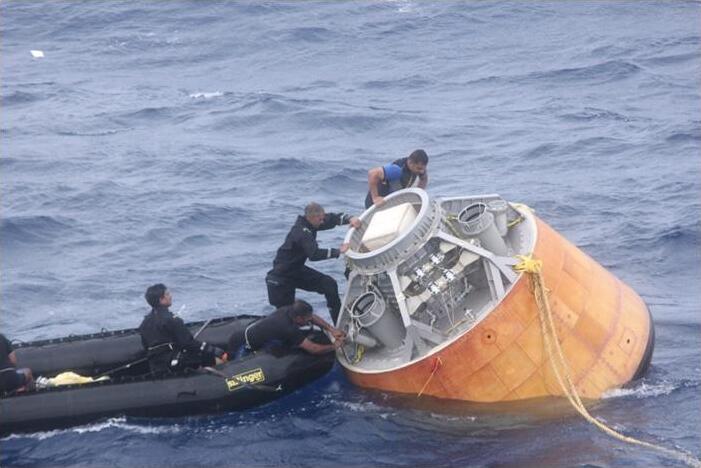
[[File:Indian Coast Guard CARE.jpg|thumb | [[File:Indian Coast Guard CARE.jpg|thumb|Test of water landing of CARE on 18 December 2014]] | ||
[[ | {{Main|Crew Module Atmospheric Re-entry Experiment}}On 13 February 2014, [[Hindustan Aeronautics|Hindustan Aeronautics Limited]] handed over the first [[Boilerplate (spaceflight)|boilerplate]] prototype of Crew Module structural assembly to ISRO for Crew Module Atmospheric Re-entry Experiment (CARE).<ref name="hal-india.com"/><ref>{{cite web|url=https://www.thehindubusinessline.com/news/science/human-space-flight-prog-hal-hands-over-crew-module-assembly-to-isro/article23155079.ece|title=Human space flight prog: HAL hands over crew module assembly to ISRO|website=@businessline}}</ref> ISRO's [[Vikram Sarabhai Space Centre]] would equip the Crew Module with systems necessary for life support, navigation, guidance and control systems. | ||
ISRO undertook an uncrewed test launch of the vehicle aboard the [[GSLV Mark III]] X1, for an experimental sub-orbital flight on 18 December 2014. The GSLV Mk3 launcher with a dummy upper cryogenic stage (filled with liquid nitrogen to simulate weight of fuel) was launched at 9:30 a.m. from the second launch pad at Satish Dhawan Space Center in [[Sriharikota]].<ref>{{cite web|url=https://www.thehindu.com/sci-tech/science/india-successfully-test-fires-gslv-markiii-its-heaviest-rocket/article6703691.ece|title=GSLV Mark III takes to the skies in test flight|first=Sangeetha|last=Kandavel|date=18 December 2014|via=thehindu.com}}</ref><ref>{{cite web | |||
|url=http://economictimes.indiatimes.com/news/science/india-to-launch-unmanned-crew-module-in-december/articleshow/44987199.cms|title=India to launch unmanned crew module in December|publisher=The Economic Times|date=30 October 2014|access-date=30 October 2014}}</ref> | |||
The crew module separated from the rocket at an altitude of 126 km. On board motors controlled and reduced the speed of the module until an altitude of {{cvt|80|km}}. Thrusters were shut off at that altitude and atmospheric drag further reduced speed of the capsule. | |||
The module heat shield was expected to experience temperature in excess of {{cvt|1600|C}}. Parachutes were deployed at an altitude of {{cvt|15|km}} to slow down the module which performed a [[splashdown]] in the [[Bay of Bengal]] near [[Andaman and Nicobar Islands]].<ref>[https://archive.today/20141218090307/http://isro.org/pressrelease/scripts/pressreleasein.aspx?Dec18_2014 First Experimental Flight of India's Next Generation Launch Vehicle GSLV Mk-III Successful] - ISRO Press Release - 18 December 2014</ref><ref>{{cite web|url=https://www.ibtimes.co.uk/india-successfully-launches-heaviest-rocket-gslv-mk-iii-1480025|title=India successfully launches its heaviest rocket GSLV-Mk III |date=18 December 2014|publisher=International Business Times UK}}</ref> | |||
This flight was used to test orbital injection, separation and re-entry procedures and systems of the Crew Capsule. Also tested were the capsule separation, heat shields and [[aerobraking]] systems, deployment of parachute, retro-firing, splashdown, flotation systems and procedures to recover the Crew Capsule from the Bay of Bengal.<ref>[http://www.thehindu.com/sci-tech/science/india-successfully-test-fires-gslv-markiii-its-heaviest-rocket/article6703691.ece GSLV Mark III takes to the skies in test flight] The Hindu, 19 December 2014</ref><ref>[https://www.bbc.com/news/world-asia-india-30527602 India launches largest rocket and unmanned capsule] BBC News, 18 December 2014</ref> Inflight launch abort and parachute tests are expected to be conducted by the end of 2019.<ref name="AstrotalkUK">{{cite web|title=Episode 90 – An update on ISRO's activities with S. Somanath and R. Umamaheshwaran|url=https://astrotalkuk.org/episode-90-an-update-on-isros-activities-with-s-somanath-and-r-umamaheshwaran/|date=24 October 2019|access-date=30 October 2019|publisher=Astro talk UK}}</ref> | This flight was used to test orbital injection, separation and re-entry procedures and systems of the Crew Capsule. Also tested were the capsule separation, heat shields and [[aerobraking]] systems, deployment of parachute, retro-firing, splashdown, flotation systems and procedures to recover the Crew Capsule from the Bay of Bengal.<ref>[http://www.thehindu.com/sci-tech/science/india-successfully-test-fires-gslv-markiii-its-heaviest-rocket/article6703691.ece GSLV Mark III takes to the skies in test flight] The Hindu, 19 December 2014</ref><ref>[https://www.bbc.com/news/world-asia-india-30527602 India launches largest rocket and unmanned capsule] BBC News, 18 December 2014</ref> Inflight launch abort and parachute tests are expected to be conducted by the end of 2019.<ref name="AstrotalkUK">{{cite web|title=Episode 90 – An update on ISRO's activities with S. Somanath and R. Umamaheshwaran|url=https://astrotalkuk.org/episode-90-an-update-on-isros-activities-with-s-somanath-and-r-umamaheshwaran/|date=24 October 2019|access-date=30 October 2019|publisher=Astro talk UK}}</ref> | ||
=== Pad | === Pad Abort Test === | ||
[[File:Crew Escape System Infographic.jpg|thumb|Info-graphic on ISRO's first Pad Abort Test (PAT-01) displayed at 6th Bangalore Space Expo 2018, 6-8 September 2018.]] | |||
{{Main|ISRO Pad Abort Test}} | |||
The Indian Space Research Organisation's Pad Abort Test was conducted successfully on 5 July 2018.<ref>{{cite web|url=https://www.nasaspaceflight.com/2018/07/isro-pad-abort-test-indian-human-program/|title=ISRO conducts pad abort test for Indian human space program|publisher=NASASpaceFlight.com|website=nasaspaceflight.com|access-date=2018-07-05}}</ref> As of September 2021, [[Vikram Sarabhai Space Centre]] (VSSC) is integrating a test vehicle to conduct an unmanned flight test of Crew Escape System (CES) before the official launch of Gaganyaan mission. The test vehicle will be ready by the end of 2021.<ref>{{Cite web|last=Kumar|first=Chethan|date=2021-09-27|title=Gaganyaan: ISRO readies for Crew Escape System test vehicle flights|url=https://timesofindia.indiatimes.com/home/science/gaganyaan-isro-readies-for-crew-escape-system-test-vehicle-flights/articleshow/86563182.cms|url-status=live|access-date=2021-09-28|website=The Times of India|language=en}}</ref> | |||
=== Long duration hot test - Vikas engine === | |||
[[File:Vikas Engine being hot tested for duration of 240 seconds at Principal Test Stand of IPRC Mahendragiri.jpg|thumb|Vikas engine undergoing long duration hot test at Principal Test Stand, ISRO Propulsion Complex on 14 July 2021.]] | |||
{{Main|Vikas (rocket engine)}} | |||
On July 14, 2021 ISRO conducted third long duration hot test of Vikas engine for core L110 liquid stage of GSLV Mark III at ISRO Propulsion Complex as part of engine qualification requirement of Gaganyaan mission. The engine was successfully test fired for a duration of 240 seconds validating all the required performance parameters.<ref>{{Cite web|date=2021-07-14|title=ISRO successfully conducts 3rd Vikas Engine hot test for Gaganyaan mission|url=https://www.livemint.com/news/india/isro-successfully-conducts-3rd-vikas-engine-long-duration-hot-test-for-gaganyaan-program-11626277208458.html|url-status=live|access-date=2021-09-01|website=Mint|language=en}}</ref> | |||
The Vikas engine is used to power the second stage of the [[Polar Satellite Launch Vehicle]] (PSLV), boosters and second stage of the [[Geosynchronous Satellite Launch Vehicle]] (GSLV) Mark I and II and also the core stage of [[Geosynchronous Satellite Launch Vehicle Mark III|GSLV Mark III]]. The propellant loading for Vikas engine in PSLV, GSLV Mark I and II is 40 tons, while in GSLV Mark III is 55 tons. | |||
=== Service Module Propulsion System === | |||
ISRO on 28 August 2021 successfully tested System Demonstration Model (SDM) of Service Module Propulsion System (SMPS) that will be integrated into Gaganyaan spacecraft. During on ground testing at [[ISRO Propulsion Complex]] (IPRC), SDM was fired for a duration of 450 seconds which matched the pre-test prediction data using five main engines and eight RCS thrusters. Each 440 N thrust engine will also be tested individually for longer duration involving various parameters to gain [[human-rating certification]].<ref>{{Cite web|date=28 August 2021|title=Successful hot Test of Gaganyaan Service Module Propulsion System – System Demonstration Model (SDM) - ISRO|url=https://www.isro.gov.in/update/28-aug-2021/successful-hot-test-of-gaganyaan-service-module-propulsion-system-%E2%80%93-system|url-status=live|access-date=2021-08-31|website=ISRO}}</ref><ref>{{Cite web|last=MP|first=Sidharth|date=30 August 2021|title=ISRO successfully tests a system that will propel India's human-carrying spacecraft|url=https://www.wionews.com/science/isro-successfully-tests-a-system-that-will-propel-indias-human-carrying-spacecraft-409433|url-status=live|access-date=2021-08-31|website=WION|language=en}}</ref> | |||
=== Human flight Cryogenic Engine === | |||
In January 2022, ISRO successfully conducted cryogenic engine testing for maiden human space flight scheduled to be launched in 2023.<ref>{{Cite web|last=Jan 12|first=Surendra Singh / TNN /|last2=2022|last3=Ist|first3=22:37|title=Isro successfully conducts cryo engine test for Gaganyaan rocket {{!}} India News - Times of India|url=https://timesofindia.indiatimes.com/india/isro-successfully-conducts-cryo-engine-test-for-gaganyaan-rocket/articleshow/88861681.cms|access-date=2022-01-12|website=The Times of India|language=en}}</ref> | |||
== Vyommitra == | == Vyommitra == | ||
{{Main|Vyommitra}} | {{Main|Vyommitra}} | ||
On 22 January 2020, ISRO announced [[Vyommitra]], a female-looking robot who will accompany the other astronauts in the mission. It can detect and give out warnings if environmental changes within the cabin get uncomfortable to astronauts and change the air condition | On 22 January 2020, ISRO announced [[Vyommitra]], a female-looking robot who will accompany the other astronauts in the mission. ISRO aims not to fly animals onboard experimental missions unlike other nations that have carried out human space flight. Instead, it will fly [[Humanoid robot|humanoid robots]] for a better understanding of what weightlessness and radiation do to the human body during long durations in space.<ref>{{Cite news|url=https://www.bbc.com/news/world-asia-india-48918280|title=Why is India sending robots into space?|date=2019-07-25|access-date=2020-01-25|language=en}}</ref> | ||
Vyommitra is expected to be onboard uncrewed Gaganyaan missions to perform [[Micro-g environment|microgravity]] experiments, monitor module parameters, and support astronauts in crewed missions by simulating functions like a human from the waist up. It does not have legs.<ref>{{Cite news|date=24 Jan 2020|title=ISRO to send humanoid Vyommitra in unmanned Gaganyaan spacecraft ahead of human spaceflight|work=[[The Economic Times]]|url=https://economictimes.indiatimes.com/news/science/isro-to-send-humanoid-vyommitra-in-unmanned-gaganyaan-spacecraft-ahead-of-human-spaceflight/articleshow/73576959.cms|access-date=29 Aug 2021}}</ref> It is programmed to speak Hindi and English and perform multiple tasks.<ref name = "TOI">{{Cite web|url=https://timesofindia.indiatimes.com/india/1st-glimpse-of-vyommitra-the-humanoid-for-gaganyaan-its-a-she/articleshow/73513989.cms|title=Gaganyaan mission: First glimpse of 'Vyommitra', the humanoid for Gaganyaan; it's a 'She' {{!}} India News - Times of India|last1=Jan 22|first1=Chethan Kumar {{!}} TNN {{!}} Updated|last2=2020|website=The Times of India|language=en|access-date=2020-01-22|last3=Ist|first3=14:08}}</ref><ref>{{Cite web|url=https://indianexpress.com/article/technology/science/isro-will-look-at-manned-mission-to-moon-someday-but-not-right-now-k-sivan-6229655/|title=ISRO's manned mission to Moon will happen, but not right now: K Sivan|date=2020-01-22|website=The Indian Express|language=en-US|access-date=2020-01-22}}</ref><ref>{{Cite web|url=https://www.loksatta.com/desh-videsh-news/vyommitra-the-humanoid-for-isros-mission-gaganyaan-dmp-82-2066411/|title='व्योममित्रा'ची पहिली झलक! भारताकडून 'ती' पहिल्यांदा जाणार अवकाशात|date=2020-01-22|website=Loksatta|language=mr-IN|access-date=2020-01-22}}</ref><ref>{{Cite web|url=https://www.timesnownews.com/technology-science/article/isro-s-prototype-humanoid-for-gaganyaan-mission-is-vyom-mitra-which-will-go-to-space-before-astronauts/543450|title=ISRO's prototype humanoid for Gaganyaan mission is Vyom Mitra which will go to space before astronauts|date=2020-01-22|website=www.timesnownews.com|language=en|access-date=2020-01-22}}</ref> | |||
It can detect and give out warnings if environmental changes within the cabin get uncomfortable to astronauts and change the air condition. It can autonomously complete tasks and follow new commands.<ref>{{cite web|last=Dwarakanath|first=Nagarjun|date=22 January 2020 |title=Gaganyaan mission: Meet Vyommitra, the talking human robot that Isro will send to space|url=https://www.indiatoday.in/science/story/gaganyaan-vyommitra-talking-humanoid-isro-space-1639077-2020-01-22 |access-date=2020-01-22|newspaper=India Today}}</ref> | |||
== See also == | == See also == | ||
{{Commons category|Gaganyaan}} | |||
{{Portal| Spaceflight }} | {{Portal| Spaceflight }} | ||
* [[Human spaceflight]] | * [[Human spaceflight]] | ||
Revision as of 23:24, 17 January 2022
 Preliminary configuration of Gaganyaan orbital vehicle depicting integrated Crew and Service Modules, displayed at Bangalore Space Expo 2018 | |
| Manufacturer | Defence Research and Development Organisation Hindustan Aeronautics Limited Indian Space Research Organisation |
|---|---|
| Country of origin | India |
| Operator | ISRO |
| Applications | Crewed orbital vehicle |
| Specifications | |
| Spacecraft type | Crewed |
| Launch mass | 8,200 kg (18,100 lb) (includes service module) [1] |
| Dry mass | 3,735 kg (8,234 lb) [2] |
| Crew capacity | 3 [3] |
| Dimensions | Diameter: 3.5 m (11 ft) [4] Height: 3.58 m (11.7 ft) [4] |
| Volume | 8 m3 (280 cu ft)[5] |
| Power | Photovoltaic array |
| Regime | Low Earth orbit |
| Design life | 7 days |
| Production | |
| Status | In development |
| Maiden launch | June 2022 (uncrewed)[6] 2023 (crewed)[7] |
Gaganyaan (Sanskrit IAST: gagan-yāna; transl. "Sky Craft") is an Indian crewed orbital spacecraft intended to be the formative spacecraft of the Indian Human Spaceflight Programme. The spacecraft is being designed to carry three people, and a planned upgraded version will be equipped with rendezvous and docking capability. In its maiden crewed mission, Indian Space Research Organisation (ISRO)'s largely autonomous 5.3 t (12,000 lb) capsule will orbit the Earth at 400 km (250 mi) altitude for up to seven days with a two or three-person crew on board. The first crewed mission was originally planned to be launched on ISRO's GSLV Mk III in December 2021,[8][9] but this has since been delayed to no earlier than 2023.[7]
This Hindustan Aeronautics Limited (HAL) manufactured crew module had its first un-crewed experimental flight on 18 December 2014.[10] As of May 2019[update], design of the crew module has been completed.[11] Defence Research and Development Organisation (DRDO) will provide support for critical human-centric systems and technologies like space grade food, crew healthcare, radiation measurement and protection, parachutes for the safe recovery of the crew module and fire suppression system.[12]
On 11 June 2020, it was announced that while the first uncrewed Gaganyaan launch has been delayed due to COVID-19 pandemic in India,[13] overall timeline for crewed launches is expected to remain unaffected.[14]
History
Preliminary studies and technological development of Gaganyaan started in 2006 under the generic name "Orbital Vehicle". The plan was to design a simple capsule with an endurance of about a week in space, a capacity of two astronauts, and a splashdown landing after re-entry. The design was finalized by March 2008 and was submitted to the Government of India for funding. The funding for the Indian Human Spaceflight Programme was sanctioned in February 2009,[15] but it fell short of full political support and obtained limited developmental funding.[15] Initially, the first uncrewed flight of the orbital vehicle was proposed to be in 2013,[16][17] then it was revised to 2016.[18] However, in April 2012 it was reported that funding problems placed the future of the project in serious doubt;[19] and in August 2013 it was announced that all crewed spaceflight efforts by India had been designated as being "off ISRO's priority list".[20] By early 2014 the project was reconsidered and was one of the main beneficiaries of a substantial budget increase announced in February 2014.[21] ISRO is developing the Gaganyaan orbital vehicle on the tests performed with their scaled 550 kg Space Capsule Recovery Experiment (SRE), which was launched and recovered in January 2007.[22][23]
The latest push for the Indian Human Spaceflight Programme took place in 2017,[24] and it was accepted and formally announced by the Prime Minister Narendra Modi on 15 August 2018.[25] The current design calls for a crew of three.[3] ISRO will perform four biological and two physical science experiments related to micro-gravity during the Gaganyaan mission.[26] ISRO is planning to replace hydrazine for green propellant in Gaganyaan mission for which Liquid Propulsion Systems Centre (LPSC) is already working on a monopropellant blended formulation consisting of hydroxylammonium nitrate (HAN), ammonium nitrate, methanol and water.[27][28]
As of October, 2021, ISRO selected five science experiments that will be conducted on Gaganyaan. The payloads will be developed by Indian Institute of Space Science and Technology (IIST), University of Agricultural Sciences, Dharwad (UASD), Tata Institute of Fundamental Research (TIFR), IIT Patna, Indian Institute of Chemical Technology (IICT) and Jawaharlal Nehru Centre for Advanced Scientific Research (JNCASR). Out of the five, two are biological experiments which will be conducted by IIST, UASD and TIFR that will include kidney stone formation and Sirtuin 1 gene marker effects in Drosophila melanogaster. IIT Patna will run experiment on heat sink that can handle very high heat flux, IICT will perform crystallization phenomenon and JNCASR will check fluid mixing characteristics.[29]
Funding and infrastructure
A crewed spacecraft would require about ₹12,400 crore (US$1.77 billion) over a period of seven years, including the ₹5,000 crore (US$0.7 billion) for the initial work of the crewed spacecraft during the Eleventh Five-Year Plan (2007–2012) out of which the Government released ₹ 50 crore (US$7 million) in 2007-2008.[30][31] In December 2018, the government approved further ₹10,000 crore (US$1.5 billion) for a 7-days crewed flight of 3 astronauts to take place by 2021.[8]
Madhavan Chandradathan, director of Satish Dhawan Space Centre (SDSC), stated that ISRO would need to set up an astronaut training facility in Bangalore. Newly established Human Space Flight Centre (HSFC) will coordinate the IHSF efforts.[32] Existing launch facilities will be upgraded for launches under Indian Human Spaceflight project [33][34] with extra facilities needed for launch escape systems.[31] Russia is likely to provide astronaut training.[35] In spring 2009, the full-scale mock-up of crew capsule of Gaganyaan was built and delivered to Satish Dhawan Space Centre for training of astronauts.[36]
India has already successfully developed and tested several building blocks, including re-entry space capsule, pad abort test, safe crew ejection mechanism in case of rocket failure, flight suit developed by Defence Bioengineering and Electromedical Laboratory (DEBEL) and the powerful GSLV-MkIII launch vehicle.[37] Having met all required technological keystones, the Indian Human Spaceflight Programme was accepted and formally announced by the Prime Minister Narendra Modi on 15 August 2018. Gaganyaan will be the first crewed spacecraft under this programme.[citation needed]
ISRO's Human Space Flight Centre and Glavcosmos, which is a subsidiary of the Russian state corporation Roscosmos, signed an agreement on 1 July 2019 for cooperation in the selection, support, medical examination and space training of Indian astronauts.[38] An ISRO Technical Liaison Unit (ITLU) will be set up in Moscow to facilitate the development of some key technologies and establishment of special facilities which are essential to support life in space.[39]
On 25 October 2019, ISRO's Human Space Flight Centre and Glavcosmos signed a contract to evaluate the possibility of using Russian life support systems and thermal control for Gaganyaan.[40] Glavkosmos has also contracted NPP Zvezda for manufacturing customized IVA flight-suits for Indian astronauts.[41][42][43] ISRO is planning to develop a ground station for Gaganyaan mission at Cocos (Keeling) Islands, and after a brief discussion with Australian Space Agency, a temporary ground station for the mission has been set up by ISRO in Cocos (Keeling) Islands, as of 2021.[27]
Description
Crew Module
Gaganyaan crew module is a fully autonomous 5.3 t (12,000 lb) spacecraft designed to carry a 3-member crew to orbit and safely return to the Earth after a mission duration of up to seven days.[1] The crew module is equipped with two parachutes for redundancy, while one parachute is good enough for safe splashdown. The parachutes would reduce the speed of the crew module from over 216 m/s (710 ft/s) to under 11 m/s (36 ft/s) at splashdown.[44]
The space capsule will have life support and environmental control systems. It will be equipped with emergency mission abort and a Crew Escape System (CES) that can be activated during the first stage or second rocket stage burn.[45] The nose of the original version of the orbital vehicle was free for a docking mechanism, but primary entry was evidently through a side hatch secured by explosive bolts.[46]
Service Module
Its 2.9 t (6,400 lb)[1] service module is powered by liquid propellant engines. The crew module is mated to the service module, and together they constitute 8.2 t (18,000 lb) orbital module.[1]
The Service Module Propulsion System (SMPS) will help in orbit raising maneuver of Gaganyaan to reach 400 km in low earth orbit (LEO) and remain connected during deorbit burn until atmospheric reentry. It will use an unified bipropellant system consisting of MON-3 and Monomethylhydrazine as oxidizer and fuel, having five main engines derived from ISRO's liquid apogee motor with 440 N (99 lbf) thrust and sixteen 100 N reaction control system (RCS) thrusters.
Upon reentry, Service Module will detach itself from the spacecraft. The propulsion system will use a unified bipropellant system consisting of MON-3 and Monomethylhydrazine as oxidizer and fuel. It will have five main engines derived from ISRO's liquid apogee motor with 440 N (99 lbf) thrust and sixteen 100 N reaction control system (RCS) thrusters.
Development
Following two non-crewed orbital flight demonstrations of the spacecraft, a crewed Gaganyaan is slated to be launched on the GSLV Mk III launcher no earlier than 2023.[7] Though the spacecraft is designed to carry 3 people, it is likely that the first flight will carry one person only.[47]
Test flights
| Flight | Date | Regime | Crew | Notes | Outcome |
|---|---|---|---|---|---|
| Re-entry Test | 18 December 2014 | Sub-orbital | N/A | Sub-orbital test of scaled down boilerplate Gaganyaan capsule, launched aboard the sub-orbital first test flight of ISRO's GSLV Mark III rocket. | Success |
| Pad Abort Test | 5 July 2018 | Atmospheric | N/A | 4-minute test of Gaganyaan's Launch abort system from launch pad at Satish Dhawan Space Centre. | Success |
| Gaganyaan 1 | June 2022[6] | LEO | N/A | First orbital test flight of Gaganyaan capsule. | Planned |
| Gaganyaan 2 | 2023[7] | LEO | N/A | Second orbital test flight of Gaganyaan capsule. | Planned |
| Gaganyaan 3 | 2023[7] | LEO |  TBA TBA TBA TBA TBA TBA
|
First crewed flight of Gaganyaan, will carry 1-3 Indian astronauts on a short orbital test flight.[8][48] | Planned |
Test flight profile
About 16 minutes after liftoff from the Satish Dhawan Space Centre (SDSC), Sriharikota, the rocket will inject the spacecraft into an orbit 300–400 km (190–250 mi) above Earth. When ready to land, its service module and solar panels will be disposed off before reentry. The capsule would return for a parachute splashdown in the Bay of Bengal.[49]
Testing
Crew Module Atmospheric Re-entry Experiment

On 13 February 2014, Hindustan Aeronautics Limited handed over the first boilerplate prototype of Crew Module structural assembly to ISRO for Crew Module Atmospheric Re-entry Experiment (CARE).[10][50] ISRO's Vikram Sarabhai Space Centre would equip the Crew Module with systems necessary for life support, navigation, guidance and control systems.
ISRO undertook an uncrewed test launch of the vehicle aboard the GSLV Mark III X1, for an experimental sub-orbital flight on 18 December 2014. The GSLV Mk3 launcher with a dummy upper cryogenic stage (filled with liquid nitrogen to simulate weight of fuel) was launched at 9:30 a.m. from the second launch pad at Satish Dhawan Space Center in Sriharikota.[51][52]
The crew module separated from the rocket at an altitude of 126 km. On board motors controlled and reduced the speed of the module until an altitude of 80 km (50 mi). Thrusters were shut off at that altitude and atmospheric drag further reduced speed of the capsule.
The module heat shield was expected to experience temperature in excess of 1,600 °C (2,910 °F). Parachutes were deployed at an altitude of 15 km (9.3 mi) to slow down the module which performed a splashdown in the Bay of Bengal near Andaman and Nicobar Islands.[53][54]
This flight was used to test orbital injection, separation and re-entry procedures and systems of the Crew Capsule. Also tested were the capsule separation, heat shields and aerobraking systems, deployment of parachute, retro-firing, splashdown, flotation systems and procedures to recover the Crew Capsule from the Bay of Bengal.[55][56] Inflight launch abort and parachute tests are expected to be conducted by the end of 2019.[57]
Pad Abort Test

The Indian Space Research Organisation's Pad Abort Test was conducted successfully on 5 July 2018.[58] As of September 2021, Vikram Sarabhai Space Centre (VSSC) is integrating a test vehicle to conduct an unmanned flight test of Crew Escape System (CES) before the official launch of Gaganyaan mission. The test vehicle will be ready by the end of 2021.[59]
Long duration hot test - Vikas engine

On July 14, 2021 ISRO conducted third long duration hot test of Vikas engine for core L110 liquid stage of GSLV Mark III at ISRO Propulsion Complex as part of engine qualification requirement of Gaganyaan mission. The engine was successfully test fired for a duration of 240 seconds validating all the required performance parameters.[60]
The Vikas engine is used to power the second stage of the Polar Satellite Launch Vehicle (PSLV), boosters and second stage of the Geosynchronous Satellite Launch Vehicle (GSLV) Mark I and II and also the core stage of GSLV Mark III. The propellant loading for Vikas engine in PSLV, GSLV Mark I and II is 40 tons, while in GSLV Mark III is 55 tons.
Service Module Propulsion System
ISRO on 28 August 2021 successfully tested System Demonstration Model (SDM) of Service Module Propulsion System (SMPS) that will be integrated into Gaganyaan spacecraft. During on ground testing at ISRO Propulsion Complex (IPRC), SDM was fired for a duration of 450 seconds which matched the pre-test prediction data using five main engines and eight RCS thrusters. Each 440 N thrust engine will also be tested individually for longer duration involving various parameters to gain human-rating certification.[61][62]
Human flight Cryogenic Engine
In January 2022, ISRO successfully conducted cryogenic engine testing for maiden human space flight scheduled to be launched in 2023.[63]
Vyommitra
On 22 January 2020, ISRO announced Vyommitra, a female-looking robot who will accompany the other astronauts in the mission. ISRO aims not to fly animals onboard experimental missions unlike other nations that have carried out human space flight. Instead, it will fly humanoid robots for a better understanding of what weightlessness and radiation do to the human body during long durations in space.[64]
Vyommitra is expected to be onboard uncrewed Gaganyaan missions to perform microgravity experiments, monitor module parameters, and support astronauts in crewed missions by simulating functions like a human from the waist up. It does not have legs.[65] It is programmed to speak Hindi and English and perform multiple tasks.[66][67][68][69]
It can detect and give out warnings if environmental changes within the cabin get uncomfortable to astronauts and change the air condition. It can autonomously complete tasks and follow new commands.[70]
See also
References
- ↑ 1.0 1.1 1.2 1.3 Expert Talk by Dr R.Venkatraman, Dy.Director on Challenges in launch pad systems for Gaganyaan (Video). SDSC SHAR. 6 October 2020. Retrieved 6 October 2020.
- ↑ Indian Manned Spacecraft, Astronautix, 2014
- ↑ 3.0 3.1 Gaganyaan: Astronauts assigned to the mission are likely to be pilots, crew module design to be finalised soon. India Today, 20 January 2019
- ↑ 4.0 4.1 Kunhikrishnan, P. "India's Human Spaceflight Programme: GAGANYAAN" (PDF). UNOOSA. Archived from the original (PDF) on 20 February 2019. Retrieved 20 February 2019.
- ↑ "Integrated Cabin Pressure Control System" (PDF). isro.gov.in. ISRO. p. 11. Archived from the original (PDF) on 21 August 2019. Retrieved 23 August 2019.
- ↑ 6.0 6.1 Kumar, Chethan (22 July 2021). "Gaganyaan 1st uncrewed mission unlikely before June 2022; no life support systems testing". The Times of India. Retrieved 23 July 2021.
- ↑ 7.0 7.1 7.2 7.3 7.4 Singh, Surendra (11 November 2021). "Covid stalled Gaganyaan project, manned mission will finally be launched in 2023: Isro chief". The Times of India. Retrieved 23 November 2021.
- ↑ 8.0 8.1 8.2 Singh, Surendra (29 December 2018). "Rs 10,000 crore plan to send 3 Indians to space by 2022". The Times of India. Retrieved 29 December 2018.
- ↑ Gaganyaan mission to take Indian astronaut to space by 2022: PM Modi, The Hindu, 15 August 2018
- ↑ 10.0 10.1 "Archived copy". Archived from the original on 22 February 2014. Retrieved 17 February 2014.
{{cite web}}: CS1 maint: archived copy as title (link) - ↑ "India's first solar mission in 2020: ISRO chairman". The Times of India. 4 May 2019. Retrieved 5 May 2019.
- ↑ "Gaganyaan: DRDO to provide special space food and emergency survival kit for ISRO's manned mission". The Financial Express. 4 March 2020. Retrieved 6 March 2020.
- ↑ "No Gaganyaan unmanned flight this year". The Weather Channel. 11 June 2020. Retrieved 13 June 2020.
- ↑ "India's first human space mission "Gaganyaan" will not be affected by COVID pandemic: Dr.Jitendra Singh". 3 July 2020. Archived from the original on 3 July 2020. Retrieved 3 July 2020.
- ↑ 15.0 15.1 Priyadarshi, Siddhanta (23 February 2009). "Planning Commission Okays ISRO Manned Space Flight Program". Indian Express. p. 2.
- ↑ "All India 10th, 12th Board, University, Entrance Exam Results 2018". examresults.net.
- ↑ "Gaganyan: How to send an Indian into space". 16 August 2018.
- ↑ Beary, Habib (27 January 2010). "India announces first manned space mission". BBC News. Bangalore. Retrieved 5 May 2010.
- ↑ "Spaceflight stuck due to budget: CAG". The Times of India. New Delhi. 25 April 2012. Retrieved 11 June 2013.
- ↑ Press Trust of India. "Human space flight mission off ISRO priority list". Retrieved 18 August 2013.
- ↑ "Rs 171 crore boost to manned space project". The Times of India.
- ↑ China View: India's first space capsule returns to earth, Archived 2008-05-02 at the Wayback Machine 22 January 2007
- ↑ ISRO Press Release Archived 2008-05-14 at the Wayback Machine 22 January 2007
- ↑ THE DECISION FOR INDIAN HUMAN SPACEFLIGHT PROGRAMME. POLITICAL PERSPECTIVES, NATIONAL RELEVANCE AND TECHNOLOGICAL CHALLENGES Mukund Kadursrinivas Raoa, Sridhara Murthi K. Rb, and Prasad M. 68th International Astronautical Congress (IAC), Adelaide, Australia, 25–29 September 2017
- ↑ Indian will take national flag to space on board Gaganyaan by 2022, says PM Narendra Modi in Independence Day speech Hindustan Times, 15 August 2018
- ↑ "Lok Sabha, Unstarred Question number 2259" (PDF). 4 March 2020. Archived (PDF) from the original on 5 March 2020. Retrieved 4 March 2020.
- ↑ 27.0 27.1 "Gaganyaan, India's human space mission, will use 'green propulsion': ISRO". Hindustan Times. 26 March 2021. Retrieved 1 April 2021.
- ↑ Nandakumar, T. (13 May 2018). "ISRO making green propellant". The Hindu. ISSN 0971-751X. Retrieved 1 April 2021.
- ↑ Kumar, Chethan (21 October 2021). "Kidney stone formation to gene marking: 5 experiments shortlisted for Isro mission; MoUs in place". The Times of India. Retrieved 26 October 2021.
{{cite web}}: CS1 maint: url-status (link) - ↑ "Eleventh Five year Plan (2007-2012) proposals for Indian space program" (PDF).
- ↑ 31.0 31.1 Mishra, Bibhu Ranjan (8 October 2008). "ISRO plans manned mission to moon in 2014". Sriharikota Range (SHAR): Business Standard. Retrieved 14 June 2013.
- ↑ Ds, Madhumathi (11 January 2019). "ISRO starts Human Space Flight centre". The Hindu. ISSN 0971-751X. Retrieved 11 January 2019.
- ↑ "India's human space programme gets a fillip". Retrieved 11 January 2019.
Initially, the plan was the construct a new launch pad for the human space flight, but Sivan told the Express that due to paucity of time one of the two existing launch pads is being modified to meet the requirement.
- ↑ "Question number 1733 in Rajya Sabha" (PDF). Retrieved 11 January 2019.
It is proposed to utilise the existing launch pad with augmentation for carrying out the initial flights under the Gaganyaan manned space flight programme.
[permanent dead link] - ↑ Russia to Help India In 2022 Space Mission: Russian Envoy NDTV, 3 December 2018
- ↑ T.S. Subramanian (2 May 2009), "Model of space crew module ready", The Hindu, Chennai, archived from the original on 4 May 2009, retrieved 14 June 2013
- ↑ India's manned space mission is on, Cabinet okays Rs 10,000 crore plan, Economic Times, 28 December 2018
- ↑ "Gaganyaan: India chooses Russia to pick and train astronauts". The Times of India. 1 July 2019. Retrieved 1 August 2019.
- ↑ Singh, Surendra (31 July 2019). "Isro will set up unit in Moscow to develop technology needed for Gaganyaan mission". The Times of India. Retrieved 1 August 2019.
- ↑ "Glavkosmos to Help India with Heating and Life Support Systems for Gaganyaan Spacecraft". glavkosmos.com. Archived from the original on 25 October 2019. Retrieved 25 October 2019.
- ↑ "News. Russia to make spacesuits for Indian cosmonauts". www.glavkosmos.com. Retrieved 23 July 2021.
- ↑ Pramanik, Ayan; Krishnan, Raghu. "After Gaganyaan, ISRO chairman K Sivan to set sights on space station". The Economic Times. Retrieved 23 July 2021.
- ↑ Peri, Dinakar (28 August 2021). "Indian pilots to return to Russia soon for customised space suits". The Hindu. ISSN 0971-751X. Retrieved 3 September 2021.
- ↑ "Agra lab parachutes to bring back India astronauts". Deccan Herald. 4 January 2019. Retrieved 11 January 2019.
- ↑ Ray, Kalyan (4 January 2009). "ISRO gears up for manned space mission". Deccan Herald. Shillong. Archived from the original on 3 February 2014. Retrieved 14 June 2013.
- ↑ "Encyclopedia Astronautica Index: 1". astronautix.com. Archived from the original on 1 December 2008.
- ↑ "India's first manned mission Gaganyaan may take 1 astronaut". Hindustan Times. 8 January 2020. Retrieved 9 January 2020.
- ↑ Dutt, Anonna (8 January 2020). "First Gaganyaan spaceflight likely to carry only one astronaut, and it'll be a man". ThePrint. Retrieved 10 February 2020.
- ↑ "ISRO inches closer to manned mission". The Times of India. 10 January 2014. Archived from the original on 12 January 2014. Retrieved 13 January 2014.
"We will be checking the crew capsule for all parameters".
- ↑ "Human space flight prog: HAL hands over crew module assembly to ISRO". @businessline.
- ↑ Kandavel, Sangeetha (18 December 2014). "GSLV Mark III takes to the skies in test flight" – via thehindu.com.
- ↑ "India to launch unmanned crew module in December". The Economic Times. 30 October 2014. Retrieved 30 October 2014.
- ↑ First Experimental Flight of India's Next Generation Launch Vehicle GSLV Mk-III Successful - ISRO Press Release - 18 December 2014
- ↑ "India successfully launches its heaviest rocket GSLV-Mk III". International Business Times UK. 18 December 2014.
- ↑ GSLV Mark III takes to the skies in test flight The Hindu, 19 December 2014
- ↑ India launches largest rocket and unmanned capsule BBC News, 18 December 2014
- ↑ "Episode 90 – An update on ISRO's activities with S. Somanath and R. Umamaheshwaran". Astro talk UK. 24 October 2019. Retrieved 30 October 2019.
- ↑ "ISRO conducts pad abort test for Indian human space program". nasaspaceflight.com. NASASpaceFlight.com. Retrieved 5 July 2018.
- ↑ Kumar, Chethan (27 September 2021). "Gaganyaan: ISRO readies for Crew Escape System test vehicle flights". The Times of India. Retrieved 28 September 2021.
{{cite web}}: CS1 maint: url-status (link) - ↑ "ISRO successfully conducts 3rd Vikas Engine hot test for Gaganyaan mission". Mint. 14 July 2021. Retrieved 1 September 2021.
{{cite web}}: CS1 maint: url-status (link) - ↑ "Successful hot Test of Gaganyaan Service Module Propulsion System – System Demonstration Model (SDM) - ISRO". ISRO. 28 August 2021. Retrieved 31 August 2021.
{{cite web}}: CS1 maint: url-status (link) - ↑ MP, Sidharth (30 August 2021). "ISRO successfully tests a system that will propel India's human-carrying spacecraft". WION. Retrieved 31 August 2021.
{{cite web}}: CS1 maint: url-status (link) - ↑ Jan 12, Surendra Singh / TNN /; 2022; Ist, 22:37. "Isro successfully conducts cryo engine test for Gaganyaan rocket | India News - Times of India". The Times of India. Retrieved 12 January 2022.
{{cite web}}:|last2=has numeric name (help)CS1 maint: numeric names: authors list (link) - ↑ "Why is India sending robots into space?". 25 July 2019. Retrieved 25 January 2020.
- ↑ "ISRO to send humanoid Vyommitra in unmanned Gaganyaan spacecraft ahead of human spaceflight". The Economic Times. 24 January 2020. Retrieved 29 August 2021.
- ↑ Jan 22, Chethan Kumar | TNN | Updated; 2020; Ist, 14:08. "Gaganyaan mission: First glimpse of 'Vyommitra', the humanoid for Gaganyaan; it's a 'She' | India News - Times of India". The Times of India. Retrieved 22 January 2020.
{{cite web}}:|first1=has generic name (help);|last2=has numeric name (help)CS1 maint: numeric names: authors list (link) - ↑ "ISRO's manned mission to Moon will happen, but not right now: K Sivan". The Indian Express. 22 January 2020. Retrieved 22 January 2020.
- ↑ "'व्योममित्रा'ची पहिली झलक! भारताकडून 'ती' पहिल्यांदा जाणार अवकाशात". Loksatta (in मराठी). 22 January 2020. Retrieved 22 January 2020.
- ↑ "ISRO's prototype humanoid for Gaganyaan mission is Vyom Mitra which will go to space before astronauts". www.timesnownews.com. 22 January 2020. Retrieved 22 January 2020.
- ↑ Dwarakanath, Nagarjun (22 January 2020). "Gaganyaan mission: Meet Vyommitra, the talking human robot that Isro will send to space". India Today. Retrieved 22 January 2020.

