|
|
| Line 136: |
Line 136: |
| | footnotes = | | | footnotes = |
| }} | | }} |
| '''Uttar Pradesh''' ({{IPA-hi|ˈʊtːəɾ pɾəˈdeːʃ|lang|Uttar Pradesh.ogg}}; translation: "Northern Province") is a [[States and union territories of India|state]] in northern [[India]]. With roughly 200 million inhabitants, it is the [[List of states and union territories of India by population|most-populous state]] in India as well as the [[List of country subdivisions by population|most-populous country subdivision in the world]].<ref>{{cite news |last1=Kopf |first1=Dan |last2=Varathan |first2=Preeti |title=If Uttar Pradesh were a country |url=https://qz.com/india/1094942/if-uttar-pradesh-were-a-country-where-would-it-rank-by-size-wealth-and-other-measures/ |access-date=20 May 2019 |work=Quartz India |date=11 October 2017 |language=en |archive-url=https://web.archive.org/web/20190622011953/https://qz.com/india/1094942/if-uttar-pradesh-were-a-country-where-would-it-rank-by-size-wealth-and-other-measures/ |archive-date=22 June 2019 |url-status=live}}</ref> It was created on 1 April 1937 as the [[United Provinces of Agra and Oudh]] during British rule, and was renamed ''Uttar Pradesh'' in 1950, giving it the acronym ''UP''. The state is divided into 18 [[Administrative divisions of Uttar Pradesh|divisions]] and 75 [[List of districts of Uttar Pradesh|districts]], with the capital being [[Lucknow]]. On 9 November 2000, a new state, [[Uttarakhand]], was carved from the state's Himalayan hill region. The two major rivers of the state, the [[Ganges]] and [[Yamuna]], join at [[Triveni Sangam]] in [[Allahabad]] and flow further east as Ganges. Other prominent rivers are [[Gomti River|Gomti]] and [[Saryu]]. The forest cover in the state is 6.09% of the state's geographical area. | | '''Uttar Pradesh''' ({{lang-hi|उत्तर प्रदेश}}, {{lang-ur|{{Nastaliq|اتر پردیش}}}}) is a state in northern [[India]]. For short, people call it UP. [[Lucknow]] is the capital city of UP. |
|
| |
|
| The state is bordered by [[Rajasthan]] to the west, [[Haryana]], [[Himachal Pradesh]] and [[Delhi]] to the northwest, [[Uttarakhand]] and an international border with [[Nepal]] to the north, [[Bihar]] to the east, [[Madhya Pradesh]] to the south, and touches the states of [[Jharkhand]] and [[Chhattisgarh]] to the southeast. It covers {{convert|240928|km2|sqmi|abbr=on}}, equal to 7.34% of the total area of India, and is the [[List of states of India by area|fourth-largest Indian state by area]]. Though long known for sugar production, the state's economy is now dominated by the services industry. The service sector comprises travel and [[tourism]], [[hotel industry]], [[real estate]], [[insurance]] and financial consultancies. The [[economy of Uttar Pradesh]] is the [[List of Indian states and union territories by GDP|fifth-largest state economy]] in India with {{INRConvert|17.94|lc|lk=}} in [[gross domestic product]] and a per capita NSDP of {{INRConvert|70|k|lk=}}.<ref name="MOSPI"/> There is a high rate of unemployment in Uttar Pradesh.<ref name="Unemployment"/> The state ranks [[List of Indian states and territories by Human Development Index|35th]] among Indian states in [[human development index]].<ref name="snhdi-gdl" /> [[President's rule]] has been imposed in Uttar Pradesh ten times since 1968, for different reasons and for a total of 1,700 days.<ref name="president's rule">{{cite web |title=President's Rule in Uttar Pradesh |url=http://uplegisassembly.gov.in/english/president's_rule.htm |website=uplegisassembly.gov.in |publisher=[[Uttar Pradesh Legislative Assembly]] |access-date=14 March 2018 |archive-url=https://web.archive.org/web/20180309090845/http://uplegisassembly.gov.in/english/president's_rule.htm |archive-date=9 March 2018 |url-status=live}}</ref> The state has two international airports, [[Chaudhary Charan Singh Airport]] (Lucknow) and [[Lal Bahadur Shastri Airport]] (Varanasi). [[Allahabad Junction railway station|Allahabad Junction]] is the headquarters of the [[North Central Railway Zone|North Central Railway]] and [[Gorakhpur Junction railway station|Gorakhpur Railway Station]] serves as the headquarters of the [[North Eastern Railway Zone|North Eastern Railway]]. The [[Allahabad High Court|High Court]] of the state is located in Allahabad. | | The [[population]] of the state is 199,581,477 ([[census]] 2011). It covers an area of 93,933 [[square mile|mi²]] (243,286 [[km²]]). It is bigger than the [[United Kingdom]] but smaller than [[Guinea]]. In traditional Indian geography it falls under the [[North India]]n zone. |
| | |
| Inhabitants of the state are called either [[Awadhi people|Awadhi]], [[Bagelkhand|Bagheli]], [[Bhojpuri people|Bhojpuri]], [[Braj]]i, [[Bundelkhand|Bundeli]], [[Kannauj district|Kannauji]], or [[Rohilkhand]]i depending upon their region of origin. [[Hinduism]] is practised by more than three-fourths of the population, with [[Islam]] being the next largest religious group. Hindi is the most widely spoken language and is also the official language of the state, along with [[Urdu]]. Uttar Pradesh was home to most of mainstream political entity that has existed in ancient and medieval India including [[Maurya Empire]], [[Empire of Harsha|Harsha Empire]], [[Mughal Empire]], [[Delhi Sultanate]], [[Gupta Empire]] as well as many other empires. At the time of [[Indian independence movement]] in the early 20th century, there were three major [[princely states]] in Uttar Pradesh – Ramgadi, [[Rampur State|Rampur]] and [[Benares State|Benares]]. The state houses several holy Hindu temples and pilgrimage centres. Uttar Pradesh has three [[List of World Heritage Sites in India|World Heritage sites]] and ranks first [[Tourism in Uttar Pradesh|tourist destinations]] in India. Uttar Pradesh has several historical, natural, and religious tourist destinations, such as [[Kushinagar]], [[Kanpur]], [[Ayodhya]], [[Vrindavan]], [[Mathura]], [[Varanasi]], [[Allahabad]], [[Lucknow]], [[Jaunpur, Uttar Pradesh|Jaunpur]], [[Noida]], [[Meerut]], [[Bareilly]], [[Faizabad, Uttar Pradesh|Faizabad]], [[Aligarh]], [[Agra]], [[Jhansi]], [[Mirzapur]], [[Rampur, Uttar Pradesh|Rampur]], [[Raebareli]], [[Saharanpur]], and [[Gorakhpur]].
| |
| | |
| == History ==
| |
| {{main|History of Uttar Pradesh}}
| |
| | |
| === Prehistory ===
| |
| [[Anatomically modern human|Modern human]] hunter-gatherers have been in Uttar Pradesh<ref>{{cite book|url=https://books.google.com/books?id=gMoJj-0Z94UC&pg=PA69|page=69|title=Recent Advances in Indo-Pacific Prehistory: proceedings of the international symposium held at Poona|author=Virendra N. Misra, Peter Bellwood|isbn=90-04-07512-7|access-date=23 July 2012|year=1985|url-status=live|archive-url=https://web.archive.org/web/20180303134041/https://books.google.com/books?id=gMoJj-0Z94UC&pg=PA69|archive-date=3 March 2018}}</ref><ref>{{cite book|url=https://books.google.com/books?id=r4s-YsP6vcIC&pg=PA58|page=58|title=The Rise of Civilization in India and Pakistan|author=Bridget Allchin, Frank Raymond Allchin|publisher=Cambridge University Press|isbn=0-521-28550-X|access-date=23 July 2012|date=29 July 1982|url-status=live|archive-url=https://web.archive.org/web/20170325035117/https://books.google.com/books?id=r4s-YsP6vcIC&pg=PA58|archive-date=25 March 2017}}</ref><ref>{{cite book |author1=Hasmukhlal Dhirajlal Sankalia |author2=Shantaram Bhalchandra Deo |author3=Madhukar Keshav Dhavalikar |date=1985 |title=Studies in Indian Archaeology: Professor H.D. Sankalia Felicitation Volume |url=https://books.google.com/books?id=35DP1Z-2dnYC&pg=PA96 |publisher=Popular Prakashan |page=96 |isbn=978-0-86132-088-2 |url-status=live |archive-url=https://web.archive.org/web/20170324205017/https://books.google.com/books?id=35DP1Z-2dnYC&pg=PA96 |archive-date=24 March 2017}}</ref> since between around<ref>Confidence limits for the age are 85 (±11) and 72 (±8) thousand years ago.</ref> 85,000 and 72,000 years ago. There have also been prehistorical finds in Uttar Pradesh from the Middle and Upper [[Paleolithic]] dated to 21,000–31,000 years old<ref>{{cite journal|last1=Gibling|first1=Sinha|last2=Sinha|first2=Roy|last3=Roy|first3=Tandon|last4=Tandon|first4=Jain|last5=Jain|first5=M|title=Quaternary fluvial and eolian deposits on the Belan river, India: paleoclimatic setting of Paleolithic to Neolithic archeological sites over the past 85,000 years|journal=Quaternary Science Reviews|volume=27|page=391|year=2008|doi=10.1016/j.quascirev.2007.11.001|issue=3–4|bibcode=2008QSRv...27..391G}}</ref> and [[Mesolithic]]/[[Microlithic]] [[hunter-gatherer]] settlement, near [[Pratapgarh, Uttar Pradesh|Pratapgarh]], from around 10550–9550 BC. Villages with domesticated cattle, sheep, and goats and evidence of agriculture began as early as 6000 BC, and gradually developed between c. 4000 and 1500 BC beginning with the [[Indus Valley Civilisation]] and [[Culture of Harappa|Harappa Culture]] to the [[Vedic period]] and extending into the [[Iron Age]].<ref>{{cite book|url=https://books.google.com/books?id=W6zQHNavWlsC&pg=PA263|publisher=University of Michigan Press|year=2000|isbn=0-472-11013-6|page=263|title=God-apes and Fossil Men|author=Kenneth A. R. Kennedy|access-date=23 July 2012|url-status=live|archive-url=https://web.archive.org/web/20170324214237/https://books.google.com/books?id=W6zQHNavWlsC&pg=PA263|archive-date=24 March 2017}}</ref><ref>{{cite book|url=https://books.google.com/books?id=r4s-YsP6vcIC&pg=PA119|page=119|publisher=Cambridge University Press|isbn=0-521-28550-X|year=1982|title=The Rise of Civilization in India and Pakistan|author=Bridget Allchin, Frank Raymond Allchin|access-date=23 July 2012|url-status=live|archive-url=https://web.archive.org/web/20180303134041/https://books.google.com/books?id=r4s-YsP6vcIC&pg=PA119|archive-date=3 March 2018}}</ref><ref>{{cite journal |url=http://www.ias.ac.in/describe/article/jbsc/026/04/0491-0531 |title=Prehistoric human colonization of India |journal=Journal of Biosciences |publisher=[[Indian Academy of Sciences]] |date=November 2001 |volume=26 |number=4 Supp |pages=491–531 |last=Misra |first=V N |s2cid=26248907 |format=PDF |access-date=19 September 2017 |doi=10.1007/bf02704749 |pmid=11779962 |archive-url=https://web.archive.org/web/20171007171203/http://www.ias.ac.in/describe/article/jbsc/026/04/0491-0531 |archive-date=7 October 2017 |url-status=live}}</ref>
| |
| | |
| === Ancient and classical period ===
| |
| {{multiple image
| |
| | perrow = 2
| |
| | total_width = 300
| |
| | caption_align=center
| |
| | align=left
| |
| | image1 =
| |
| | caption1 = Kausambi fort walls from Period I with burnt brick revetment, 1025-700 BC, PGW culture. Weeping holes at the base can be clearly observed.
| |
| | image2 = Dhamek Stupa, Sarnath.jpg
| |
| |background colour = #FDF5E6
| |
| | caption2 = The [[Dhamekh Stupa]] in Sarnath is where [[Gautama Buddha]] first taught the [[Dharma]], and where the Buddhist [[Sangha (Buddhism)|Sangha]] came into existence through the [[Enlightenment (spiritual)|enlightenment]] of [[Kondanna]].
| |
| | direction =
| |
| | alt1 =
| |
| }}
| |
| Out of the sixteen ''[[mahajanapadas]]'' (lit. 'great realms') or [[Oligarchy|oligarchic]] [[republic]]s that existed in ancient India, seven fell entirely within the present-day boundaries of Uttar Pradesh.<ref>{{Cite web|url=https://www.britannica.com/place/Uttar-Pradesh|title=Uttar Pradesh - History|website=Encyclopædia Britannica|language=en|access-date=12 January 2020|quote=A systematic history of India and the area of Uttar Pradesh dates to the end of the 7th century BCE, when 16 mahajanapadas (great states) in northern India were contending for supremacy. Of those, seven fell entirely within the present-day boundaries of Uttar Pradesh.|archive-url=https://web.archive.org/web/20200401072447/https://www.britannica.com/place/Uttar-Pradesh|archive-date=1 April 2020|url-status=live}}</ref> The kingdom of [[Kosala]], in the [[Mahajanapada]] era, was also located within the regional boundaries of modern-day Uttar Pradesh.<ref name="Sen1999">{{cite book|author=Sailendra Nath Sen|title=Ancient Indian History And Civilization|url=https://books.google.com/books?id=Wk4_ICH_g1EC&pg=PA105|access-date=1 October 2012|date=1 January 1999|publisher=New Age International|isbn=978-81-224-1198-0|pages=105–106|url-status=live|archive-url=https://web.archive.org/web/20130528155843/http://books.google.com/books?id=Wk4_ICH_g1EC&pg=PA105|archive-date=28 May 2013}}</ref> According to the Hindu legend, the divine king [[Rama]] of the [[Ramayana]] epic reigned in [[Ayodhya]], the capital of Kosala.<ref name="Buck2000">{{cite book|author=William Buck|title=Ramayana|url=https://books.google.com/books?id=vvuIp2kqIkMC|access-date=1 October 2012|date=1 January 2000|publisher=Motilal Banarsidass|isbn=978-81-208-1720-3|url-status=live|archive-url=https://web.archive.org/web/20130604213755/http://books.google.com/books?id=vvuIp2kqIkMC|archive-date=4 June 2013}}</ref> [[Krishna]], another divine king of Hindu legend, who plays a key role in the [[Mahabharata]] epic and is revered as the eighth reincarnation ([[Avatar]]) of the Hindu god [[Vishnu]], is said to have been born in the city of [[Mathura]], in Uttar Pradesh.<ref name="Sen1999" /> The aftermath of the [[Mahabharata yuddh]] is believed to have taken place in the area between the [[Doab#Upper Doab|Upper Doab]] and [[Delhi]], (in what was [[Kuru Kingdom|Kuru]] Mahajanapada), during the reign of the [[Pandava]] king [[Yudhishthira]]. The kingdom of the [[Kuru (India)|Kurus]] corresponds to the [[Black and Red Ware]] and [[Painted Gray Ware]] culture and the beginning of the Iron Age in northwest India, around 1000 BC.<ref name="Sen1999" />
| |
| | |
| Control over Gangetic plains region was of vital importance to the power and stability of all of India's major empires, including the [[Maurya Empire|Maurya]] (320–200 BC), [[Kushan Empire|Kushan]] (AD 100–250), [[Gupta Empire|Gupta]] (350–600), and [[Gurjara-Pratihara]] (650–1036) empires.<ref name="White2010">{{cite book|author=Richard White|title=The Middle Ground: Indians, Empires, and Republics in the Great Lakes Region, 1650–1815|url=https://books.google.com/books?id=fHLfiOZVzmMC|access-date=1 October 2012|date=8 November 2010|publisher=Cambridge University Press|isbn=978-1-107-00562-4|url-status=live|archive-url=https://web.archive.org/web/20130528145049/http://books.google.com/books?id=fHLfiOZVzmMC|archive-date=28 May 2013}}</ref> Following the [[Huns]]' invasions that broke the Gupta empire, the [[Doab#The Doab|Ganges-Yamuna Doab]] saw the rise of [[Kannauj]].<ref name="Corporation2007">{{cite book|author=Marshall Cavendish Corporation|title=World and Its Peoples: Eastern and Southern Asia|url=https://books.google.com/books?id=V1pQkwIXTG0C&pg=PA331|access-date=1 October 2012|date=September 2007|publisher=Marshall Cavendish|isbn=978-0-7614-7631-3|pages=331–335|url-status=live|archive-url=https://web.archive.org/web/20130605122741/http://books.google.com/books?id=V1pQkwIXTG0C&pg=PA331|archive-date=5 June 2013}}</ref> During the reign of [[Harshavardhana]] (590–647), the Kannauj empire reached its zenith.<ref name="Corporation2007" /> It spanned from [[Punjab region|Punjab]] in the north and [[Gujarat]] in the west to [[Bengal]] in the east and [[Odisha]] in the south.<ref name="Sen1999" /> It included parts of central India, north of the [[Narmada River]] and it encompassed the entire [[Indo-Gangetic plain]].<ref name="Chopra2003" /> Many communities in various parts of India claim descent from the migrants of Kannauj.<ref name="Bowman2000" /> Soon after Harshavardhana's death, his empire disintegrated into many kingdoms, which were invaded and ruled by the Gurjara-Pratihara empire, which challenged Bengal's [[Pala Empire]] for control of the region.<ref name="Chopra2003">{{cite book|author=Pran Nath Chopra|title=A Comprehensive History of Ancient India|url=https://books.google.com/books?id=gE7udqBkACwC&pg=PA196|access-date=1 October 2012|date=1 December 2003|publisher=Sterling Publishers Pvt. Ltd|isbn=978-81-207-2503-4|page=196|url-status=live|archive-url=https://web.archive.org/web/20130528140148/http://books.google.com/books?id=gE7udqBkACwC&pg=PA196|archive-date=28 May 2013}}</ref> Kannauj was several times invaded by the south Indian [[Rashtrakuta Dynasty]], from the 8th century to the 10th century.<ref>The History of India by Kenneth Pletcher p.102</ref><ref>The City in South Asia by James Heitzman p.37</ref> After fall of Pala empire, the [[Chero dynasty]] ruled from 12th century to 18th century.<ref>{{Cite book|url=https://books.google.com/books?id=399UDwAAQBAJ&q=chero+dynasty&pg=PT71|title=Bihar General Knowledge Digest|isbn=9789352667697|last1=Singh|first1=Pradyuman}}</ref>
| |
| | |
| ==== Delhi Sultanate ====
| |
| Parts or all of Uttar Pradesh were ruled by the [[Delhi Sultanate]] for 320 years (1206–1526). Five dynasties ruled over the Delhi Sultanate sequentially: the [[Mamluk dynasty (Delhi)|Mamluk dynasty]] (1206–90), the [[Khalji]] dynasty (1290–1320), the [[Tughlaq]] dynasty (1320–1414), the Sayyid dynasty (1414–51), and the [[Lodi dynasty]] (1451–1526).<ref>* {{cite book|last=Srivastava|first=Ashirvadi Lal|author-link=Ashirbadi Lal Srivastava|title=The Sultanate of Delhi 711-1526 A D|url=https://archive.org/stream/sultanateofdelhi001929mbp#page/n5/mode/2up|year=1929|publisher=Shiva Lal Agarwala & Company|access-date=29 April 2018|archive-url=https://web.archive.org/web/20160408110410/https://archive.org/stream/sultanateofdelhi001929mbp#page/n5/mode/2up|archive-date=8 April 2016|url-status=live}}</ref><ref name="Unesco1998">{{cite book|last1=Islam|last2=Bosworth|title=History of Civilizations of Central Asia|url=https://books.google.com/books?id=18eABeokpjEC&pg=PA269|date=1 January 1998|publisher=UNESCO|isbn=978-92-3-103467-1|pages=269–291}}</ref>
| |
| | |
| === Medieval and early modern period ===
| |
| In the 16th century, [[Babur]], a [[Timurid Dynasty|Timurid]] descendant of [[Timur]] and [[Descent from Genghis Khan|Genghis Khan]] from [[Fergana Valley]] (modern-day [[Uzbekistan]]), swept across the [[Khyber Pass]] and founded the [[Mughal Empire]], covering [[India]], along with modern-day [[Afghanistan]], Pakistan and [[Bangladesh]].<ref>{{Cite web|url=https://www.ucalgary.ca/applied_history/tutor/islam/empires/mughals/|archive-url=https://web.archive.org/web/20110927121217/http://www.ucalgary.ca/applied_history/tutor/islam/empires/mughals/|url-status=dead|title=The Islamic World to 1600: Rise of the Great Islamic Empires (The Mughal Empire)|archive-date=27 September 2011}}</ref> The Mughals were descended from Persianised Central Asian [[Turkic people|Turks]] (with significant [[Mongol]] admixture). In the [[Mughal Empire|Mughal]] era, Uttar Pradesh became the heartland of the empire.<ref name="Bowman2000">{{cite book|author=John Stewart Bowman|title=Columbia Chronologies of Asian History and Culture|url=https://archive.org/details/columbiachronolo00john|url-access=registration|access-date=2 August 2012|year=2000|publisher=Columbia University Press|isbn=978-0-231-11004-4|page=[https://archive.org/details/columbiachronolo00john/page/273 273]}}</ref> Mughal emperors Babur and Humayun ruled from Delhi.<ref name="Schimmel2004">{{cite book|author=Annemarie Schimmel|title=The Empire of the Great Mughals: History, Art and Culture|url=https://archive.org/details/empireofgreatmug00anne|url-access=registration|access-date=1 October 2012|date=5 February 2004|publisher=Reaktion Books|isbn=978-1-86189-185-3}}</ref><ref name="Hindustan)Hiro2006">{{cite book|author1=Babur (Emperor of Hindustan)|author2=Dilip Hiro|title=Babur Nama: Journal of Emperor Babur|url=https://books.google.com/books?id=VW2HJL689wgC|access-date=1 October 2012|date=1 March 2006|publisher=Penguin Books India|isbn=978-0-14-400149-1|url-status=live|archive-url=https://web.archive.org/web/20130528160214/http://books.google.com/books?id=VW2HJL689wgC|archive-date=28 May 2013}}</ref> In 1540 an Afghan, [[Sher Shah Suri]], took over the reins of Uttar Pradesh after defeating the Mughal king Humanyun.<ref name="Ramirez-Faria2007">{{cite book|author=Carlos Ramirez-Faria|title=Concise Encyclopeida of World History|url=https://books.google.com/books?id=gGKsS-9h4BYC&pg=PA171|access-date=2 August 2012|date=1 January 2007|publisher=Atlantic Publishers & Dist|isbn=978-81-269-0775-5|page=171|url-status=live|archive-url=https://web.archive.org/web/20130528155918/http://books.google.com/books?id=gGKsS-9h4BYC&pg=PA171|archive-date=28 May 2013}}</ref> Sher Shah and his son Islam Shah ruled Uttar Pradesh from their capital at [[Gwalior]].<ref name=Hindustan>{{cite book|last=Stronge|first=Susan|title=Mughal Hindustan is renowned for its opulence|date=16 October 2012|publisher=The Arts of the Sikh Kingdoms (V&A 1999)|location=London|page=255|url=https://books.google.com/books?id=PVrSYgEACAAJ&q=hindustan+by+mughal|access-date=23 July 2012|isbn=9788174366962|url-status=live|archive-url=https://web.archive.org/web/20170216115741/https://books.google.com/books?id=PVrSYgEACAAJ&dq=hindustan+by+mughal|archive-date=16 February 2017}}</ref> After the death of [[Islam Shah Suri]], his prime minister [[Hemu]] became the ''de facto'' ruler of Uttar Pradesh, Bihar, Madhya Pradesh, and the western parts of Bengal. He was bestowed the title of ''[[Hemu|Hemchandra Vikramaditya]]'' (title of [[Vikramāditya]] adopted from [[Vedic Period]]) at his formal coronation took place at [[Purana Quila]] in Delhi on 7 October 1556. A month later, Hemu died in the [[Second Battle of Panipat]], and Uttar Pradesh came under Emperor [[Akbar]]'s rule.<ref name="Agrawal1983">{{cite book|author=Ashvini Agrawal|title=Studies in Mughal History|url=https://books.google.com/books?id=AZdCrUxFAHEC&pg=PA30|access-date=27 July 2012|date=1 January 1983|publisher=Motilal Banarsidass|isbn=978-81-208-2326-6|pages=30–46|url-status=live|archive-url=https://web.archive.org/web/20130528153902/http://books.google.com/books?id=AZdCrUxFAHEC&pg=PA30|archive-date=28 May 2013}}</ref> Akbar ruled from [[Agra]] and [[Fatehpur Sikri]].<ref>Fergus Nicoll, ''Shah Jahan: The Rise and Fall of the Mughal Emperor'' (2009)</ref> In the 18th century, after the fall of Mughal authority, the power vacuum was filled by the [[Maratha Empire]], in the mid-18th century, the Maratha army invaded the Uttar Pradesh region, which resulted in [[Rohilla]]s losing control of [[Rohilkhand]] to the Maratha forces led by [[Raghunathrao|Raghunath Rao]] and [[Malharao Holkar]]. The conflict between Rohillas and Marathas came to an end on 18 December 1788 with the arrest of Ghulam Qadir, the grandson of Najeeb-ud-Daula, who was defeated by the Maratha general [[Mahadji Scindia|Mahadaji Scindia]]. In 1803, following the [[Second Anglo-Maratha War]], when the [[British East India Company]] defeated the Maratha Empire, much of the region came under British suzerainty.<ref>{{cite book
| |
| |last = Mayaram
| |
| |first = Shail
| |
| |title = Against history, against state: counterperspectives from the margins Cultures of history
| |
| |publisher = Columbia University Press, 2003
| |
| |isbn = 978-0-231-12731-8|year = 2003
| |
| }}</ref>
| |
| | |
| ==== British India era ====
| |
| {{Infobox
| |
| | above = Timeline of reorganisation and name changes of UP<ref>{{cite web |url=http://www.hindustantimes.com/lucknow/uttar-pradesh-day-how-the-state-was-born-67-years-back/story-Y2JhCTBIo2UuQYvQSTBNgN.html |title=Uttar Pradesh Day: How the state was born 67 years back |access-date=3 May 2017 |url-status=live |archive-url=https://web.archive.org/web/20170503114407/http://www.hindustantimes.com/lucknow/uttar-pradesh-day-how-the-state-was-born-67-years-back/story-Y2JhCTBIo2UuQYvQSTBNgN.html |archive-date=3 May 2017 |date=3 May 2017}}</ref>
| |
| | label2 = 1807 | data2 = [[Ceded and Conquered Provinces]]
| |
| | label3 = 14 November 1834 | data3 = [[Presidency of Agra]]
| |
| | label4 = 1 January 1836 | data4 = [[North-Western Provinces]]
| |
| | label5 = 3 April 1858 | data5 = [[Oudh]] taken under British control, [[Delhi]] taken away from [[North-Western Provinces|NWP]] and merged into [[Punjab (British India)|Punjab]]
| |
| | label6 = 1 April 1871 | data6 = [[Ajmer]], [[Mewar|Merwara]] & [[Kekri]] made separate commissioner-ship
| |
| | label7 = 15 February 1877 | data7 = Oudh added to [[North-Western Provinces]]
| |
| | label8 = 22 March 1902 | data8 = Renamed [[United Provinces of Agra and Oudh]]
| |
| | label9 = 3 January 1921 | data9 = Renamed [[United Provinces of British India]]
| |
| | label10 = 1 April 1937 | data10 = Renamed [[United Provinces (1937–1950)|United Provinces]]
| |
| | label11 = 1 April 1946 | data11 = Self rule granted
| |
| | label12 = 15 August 1947 | data12 = Part of independent India
| |
| | label13 = 24 January 1950 | data13 = Renamed Uttar Pradesh
| |
| | label14 = 9 November 2000 | data14 = Uttaranchal state, now known as [[Uttarakhand]], created from part of Uttar Pradesh
| |
| }}
| |
| Starting from [[Bengal]] in the second half of the 18th century, a series of battles for north Indian lands finally gave the [[British East India Company]] accession over the state's territories.<ref name="Kudaisya2006">{{cite book |author=Gyanesh Kudaisya |title=Region, nation, "heartland": Uttar Pradesh in India's body-politic |year=1994 |publisher=LIT Verlag Münster |isbn=978-3-8258-2097-8 |pages=126–376}}</ref> [[Ajmer]] and [[Jaipur]] kingdoms were also included in this northern territory, which was named the "[[North-Western Provinces]]" (of Agra). Although UP later became the fifth-largest state of India, NWPA was one of the smallest states of the British Indian empire.<ref name="Sivaramakrishnan1999">{{cite book|author=K. Sivaramakrishnan|title=Modern Forests: Statemaking and Environmental Change in Colonial Eastern India|url=https://books.google.com/books?id=TM7oYBG4M04C&pg=PA240|access-date=26 July 2012|date=3 December 1999|publisher=Stanford University Press|isbn=978-0-8047-4556-7|pages=240–276|url-status=live|archive-url=https://web.archive.org/web/20130528135332/http://books.google.com/books?id=TM7oYBG4M04C&pg=PA240|archive-date=28 May 2013}}</ref> Its capital shifted twice between Agra and Allahabad.<ref>{{cite book|title=Town Planning Regeneration of Cities|author=Ashutosh Joshi|publisher=New India Publishing|date=1 January 2008|isbn=978-8189422820|page=237|url=https://books.google.com/books?id=UFaGME0XDBkC&q=Naini&pg=PA151|url-status=live|archive-url=https://web.archive.org/web/20180303134041/https://books.google.com/books?id=UFaGME0XDBkC&pg=PA151&dq=Naini&hl=en&sa=X&ei=CN7OUsznI8yTrgeDwYDgCw&ved=0CDEQ6AEwATgU#v=onepage&q=Allahabad%20capital&f=false|archive-date=3 March 2018}}</ref>
| |
| | |
| Due to dissatisfaction with British rule, a serious rebellion erupted in various parts of North India, which became known as the [[Indian Rebellion of 1857]]; [[Bengal]] [[regiment]]'s sepoy stationed at [[Meerut]] [[cantonment]], [[Mangal Pandey]], is widely considered as its starting point.<ref name="Mukherjee2005">{{cite book|author=Rudrangshu Mukherjee|title=Mangal Pandey: brave martyr or accidental hero?|url=https://books.google.com/books?id=-SluAAAAMAAJ|access-date=1 October 2012|date=1 June 2005|publisher=Penguin Books|isbn=978-0-14-303256-4|url-status=live|archive-url=https://web.archive.org/web/20130605164801/http://books.google.com/books?id=-SluAAAAMAAJ|archive-date=5 June 2013}}</ref> After the revolt failed, the British divided the most rebellious regions by reorganising their administrative boundaries, splitting the Delhi region from 'NWFP of Agra' and merging it with [[Punjab (British India)|Punjab]], while the [[Ajmer]]- [[Marwar]] region was merged with [[Rajputana]] and [[Oudh State|Oudh]] was incorporated into the state. The new state was called the North Western Provinces of Agra and Oudh, which in 1902 was renamed as the [[United Provinces of Agra and Oudh]].<ref name="(India)Drake-Brockman1934">{{cite book|author1=United Provinces of Agra and Oudh (India)|author2=D.L. Drake-Brockman|title=District Gazetteers of the United Provinces of Agra and Oudh: supp.D.Pilibhit District|url=https://books.google.com/books?id=VUNuAAAAMAAJ|access-date=1 October 2012|year=1934|publisher=Supdt., Government Press, United Provinces|url-status=live|archive-url=https://web.archive.org/web/20130528131217/http://books.google.com/books?id=VUNuAAAAMAAJ|archive-date=28 May 2013}}</ref> It was commonly referred to as the United Provinces or its acronym UP.<ref name="Chakrabarti1997">{{cite book|author=Dilip K. Chakrabarti|title=Colonial Indology: sociopolitics of the ancient Indian past|url=https://books.google.com/books?id=ADZuAAAAMAAJ|access-date=26 July 2012|date=1 June 1997|publisher=Munshiram Manoharlal Publishers Pvt. Ltd.|location=Michigan|isbn=978-81-215-0750-9|page=257|url-status=live|archive-url=https://web.archive.org/web/20130528140749/http://books.google.com/books?id=ADZuAAAAMAAJ|archive-date=28 May 2013}}</ref><ref name="Cohn1996">{{cite book|author=Bernard S. Cohn|title=Colonialism and Its Forms of Knowledge: The British in India|url=https://books.google.com/books?id=uIalYaenrTkC|access-date=26 July 2012|date=19 August 1996|publisher=Princeton University Press|isbn=978-0-691-00043-5|page=189|url-status=live|archive-url=https://web.archive.org/web/20130528150524/http://books.google.com/books?id=uIalYaenrTkC|archive-date=28 May 2013}}</ref>
| |
| | |
| In 1920, the capital of the province was shifted from Allahabad to [[Lucknow]].<ref name="Wilkinson-Weber1999">{{cite book|author=Clare M. Wilkinson-Weber|title=Embroidering Lives: Women's Work and Skill in the Lucknow Embroidery Industry|url=https://books.google.com/books?id=ChwRC6hQttoC&pg=PA18|date=1 January 1999|publisher=SUNY Press|isbn=978-0-7914-4087-2|page=18}}</ref> The high court continued to be at Allahabad, but a bench was established at Lucknow.<ref name="Lucknow Bench">{{cite web |last1=Mathur |first1=Prakash Narain |title=A History of the Lucknow Bench Of The Allahabad High Court |url=http://www.allahabadhighcourt.in/event/AHistoryLucknowBenchPNMathur.pdf |publisher=Allahabad High Court |access-date=24 May 2020}}</ref> Allahabad continues to be an important administrative base of today's Uttar Pradesh and has several administrative headquarters.<ref name="Nair2004">{{cite book|author=K. Balasankaran Nair|title=Law of Contempt of Court in India|url=https://books.google.com/books?id=gujNYPcNETMC|access-date=26 July 2012|date=1 January 2004|publisher=Atlantic Publishers & Dist|isbn=978-81-269-0359-7|page=320|url-status=live|archive-url=https://web.archive.org/web/20130528143730/http://books.google.com/books?id=gujNYPcNETMC|archive-date=28 May 2013}}</ref> Uttar Pradesh continued to be central to Indian politics and was especially important in modern Indian history as a hotbed of the [[Indian independence movement]]. Uttar Pradesh hosted modern educational institutions such as the [[Aligarh Muslim University]], [[Banaras Hindu University]] and [[Darul Uloom Deoband]]. Nationally known figures such as [[Ram Prasad Bismil]] and [[Chandra Shekhar Azad]] were among the leaders of the movement in Uttar Pradesh, and [[Motilal Nehru]], [[Jawaharlal Nehru]], [[Madan Mohan Malaviya]] and [[Gobind Ballabh Pant]] were important national leaders of the [[Indian National Congress]]. The [[All India Kisan Sabha]] (AIKS) was formed at the Lucknow session of the Congress on 11 April 1936, with the famous nationalist [[Swami Sahajanand Saraswati]] elected as its first President,<ref>{{cite book
| |
| | first = Bandyopādhyāya
| |
| | last = Śekhara
| |
| | title = From Plassey to Partition: A History of Modern India
| |
| | publisher = [[Orient Longman]]
| |
| | year = 2004
| |
| | isbn = 978-81-250-2596-2
| |
| | page = 407
| |
| }}</ref> in order to address the longstanding grievances of the peasantry and mobilise them against the [[zamindari]] landlords attacks on their occupancy rights, thus sparking the Farmers movements in India.<ref>{{cite book
| |
| | first = Śekhara
| |
| | last = Bandyopādhyāya
| |
| | title = From Plassey to Partition: A History of Modern India
| |
| | publisher = [[Orient Longman]]
| |
| | year = 2004
| |
| | isbn = 978-81-250-2596-2
| |
| | page = 406
| |
| }}</ref> During the [[Quit India Movement]] of 1942, [[Ballia]] district overthrew the colonial authority and installed an independent administration under [[Chittu Pandey]]. Ballia became known as "Baghi Ballia" (Rebel Ballia) for this significant role in India's independence movement.<ref name="Chatterji2006">{{cite book|author=Bankim Chandra Chatterji|title=Anandamath|url=https://books.google.com/books?id=7Gmjn63ogDUC|access-date=26 July 2012|date=15 January 2006|publisher=Orient Paperbacks|isbn=978-81-222-0130-7|page=168|url-status=live|archive-url=https://web.archive.org/web/20130528130144/http://books.google.com/books?id=7Gmjn63ogDUC|archive-date=28 May 2013}}</ref>
| |
| | |
| ==== Post-independence ====
| |
| After India's independence, the United Provinces were renamed "Uttar Pradesh" ("northern province"), preserving UP as the acronym,<ref>{{cite web |title=Uttar Pradesh – States and Union Territories |url=http://www.archive.india.gov.in/knowindia/state_uts.php?id=28 |website=Know India: National Portal of India |access-date=14 July 2015 |url-status=live |archive-url=https://web.archive.org/web/20150715014814/http://www.archive.india.gov.in/knowindia/state_uts.php?id=28 |archive-date=15 July 2015}}</ref><ref>{{cite web |title=Uttar Pradesh |url=http://www.whatisindia.com/issues/uttarpra/uttar_general.html |publisher=What is India |access-date=8 October 2016 |date=22 August 2007 |url-status=live |archive-url=https://web.archive.org/web/20161012021112/http://www.whatisindia.com/issues/uttarpra/uttar_general.html |archive-date=12 October 2016}}</ref> with the change coming into effect on 24 January 1950.<ref name="UPDay"/> The state has provided nine of India's prime ministers, including current Prime Minister Narendra Modi who is MP from Varanasi, which is more than any other state and is the source of the largest number of seats in the [[Lok Sabha]]. Despite its political influence since ancient times, its poor record in economic development and administration, poor governance, organised crime and corruption have kept it amongst India's backward states. The state has been affected by repeated episodes of caste and communal violence.<ref>{{cite news |title=Communal violence |url=http://www.business-standard.com/article/current-affairs/uttar-pradesh-tops-home-ministry-list-on-communal-violence-114080601639_1.html |access-date=25 August 2014 |work=[[Business Standard]] |agency=[[Kotak Mahindra Bank]] |publisher=[[Ananda Publishers]] |date=6 August 2014 |url-status=live |archive-url=https://web.archive.org/web/20140826115034/http://www.business-standard.com/article/current-affairs/uttar-pradesh-tops-home-ministry-list-on-communal-violence-114080601639_1.html |archive-date=26 August 2014}}</ref> In [[Ayodhya]] in December 1992 the disputed [[Demolition of the Babri Masjid|Babri Mosque]] was demolished by radical Hindu activists, leading to widespread violence across India.<ref name="communal violence">{{cite news|last=communal violence|first=in uttar pradesh|title=Communal conflicts in state|url=http://www.tehelka.com/what-led-to-the-muzaffarnagar-communal-riots/|archive-url=https://web.archive.org/web/20140112232933/http://www.tehelka.com/what-led-to-the-muzaffarnagar-communal-riots/|url-status=dead|archive-date=12 January 2014|access-date=12 January 2014|newspaper=Tehalka}}</ref> In 2000, northern districts of the state were separated to form the state of [[Uttarakhand]].<ref name=separation>{{cite book |author1=J. C. Aggarwal |author2=S. P. Agrawal |date=1995 |title=Uttarakhand: Past, Present, and Future |url=https://books.google.com/books?id=alRh51xE_v0C&pg=PA391 |publisher=Concept Publishing Company of India |page=391 |isbn=978-81-7022-572-0 |url-status=live |archive-url=https://web.archive.org/web/20170324171535/https://books.google.com/books?id=alRh51xE_v0C&pg=PA391 |archive-date=24 March 2017}}</ref>
| |
|
| |
|
| == Geography == | | == Geography == |
| {{Main|Geography of Uttar Pradesh}}
| | Uttar Pradesh has a long border with [[Nepal]] to the north. Next to it are also the Indian states of [[Uttarakhand]], [[Himachal Pradesh]], [[Haryana]], [[Delhi]], [[Rajasthan]], [[Madhya Pradesh]], [[Chhattisgarh]], [[Jharkhand]] and [[Bihar]]. There are two [[geographical]] main regions:- |
| {{multiple image|perrow=1|total_width=220|caption_align=center|image_style=border:none;|background color = #F5F5DC| align=right |image1=Indo-Gangetic Plain.jpg|caption1={{font|size=110%|font=|text=A part of the Gangetic Plain}}}}
| |
| Uttar Pradesh, with a total area of {{convert|243290|km2|sqmi|0}}, is India's fourth-largest state in terms of land area and is roughly of same size as United Kingdom. It is situated on the northern spout of India and shares an international boundary with Nepal. The Himalayas border the state on the north,<ref name=land>{{cite web|title=Most critical factors|url=http://upenvis.nic.in/Database/Land_830.aspx|publisher=Uttar Pradesh climate department|access-date=22 July 2012|url-status=dead|archive-url=https://web.archive.org/web/20121215063439/http://upenvis.nic.in/Database/Land_830.aspx|archive-date=15 December 2012}}</ref> but the plains that cover most of the state are distinctly different from those high mountains.<ref name=Geography>{{cite web|title=Uttar Pradesh Geography|url=http://www.uponline.in/About/Profile/Geography/index.html|publisher=Uttar Pradesh State Profile|access-date=22 July 2012|url-status=live|archive-url=https://web.archive.org/web/20120723070728/http://www.uponline.in/About/Profile/geography/index.html|archive-date=23 July 2012}}</ref> The larger [[Gangetic Plain]] region is in the north; it includes the [[Doab#The Doab|Ganges-Yamuna Doab]], the Ghaghra plains, the Ganges plains and the [[Terai]].<ref name=Terai>{{cite web|title=The larger Gangetic Plain|url=http://www.gecafs.org/publications/Publications/IGP_Paper.pdf|archive-url=https://web.archive.org/web/20131226202743/http://www.gecafs.org/publications/Publications/IGP_Paper.pdf|url-status=dead|archive-date=26 December 2013|publisher=Gecafs|access-date=22 July 2012}}</ref> The smaller [[Vindhya Range]] and plateau region is in the south.<ref name=autogenerated8>{{cite web|title=Gangetic Plains and Vindhya Hills and plateau. |url=http://zeenews.india.com/state-elections-2012/up/profile.html/2 |publisher=[[Zee news]] |access-date=22 July 2012 |url-status=dead |archive-url=https://web.archive.org/web/20120406104938/http://zeenews.india.com/state-elections-2012/up/profile.html/2 |archive-date=6 April 2012}}</ref> It is characterised by hard rock strata and a varied topography of hills, plains, valleys and plateaus. The [[Bhabar|Bhabhar]] tract gives place to the terai area which is covered with tall [[Saccharum ravennae|elephant grass]] and thick forests interspersed with [[marshes]] and [[swamps]].<ref name="Terai Area">{{cite news |last1=Anwar |first1=Shakeel |title=List of major canals and dams in Uttar Pradesh |url=https://www.jagranjosh.com/general-knowledge/list-of-major-canals-and-dams-in-uttar-pradesh-1534427496-1 |access-date=21 June 2020 |work=Dainik Jagran |agency=Jagran Prakashan Limited |date=16 August 2018}}</ref><ref name="Bhabhar">{{cite web |title=Indo - African Journal for Resource Management |url=http://thehaider.com/4.2.1.pdf |publisher=Indo - African Journal for Resource Management and Planning |access-date=21 June 2020}}</ref> The sluggish rivers of the bhabhar deepen in this area, their course running through a tangled mass of thick undergrowth. The terai runs parallel to the bhabhar in a thin strip. The entire alluvial plain is divided into three sub-regions.<ref name="Great Plains">{{cite news |last1=Anwar |first1=Shakeel |title=The Great Plains of India |url=https://www.jagranjosh.com/general-knowledge/the-great-plains-of-india-1448281967-1 |access-date=19 May 2020 |work=Jagran Josh |agency=Jagran Prakashan Private Limited |publisher=Dainik Jagran |archive-url=https://web.archive.org/web/20171121224151/http://www.jagranjosh.com/general-knowledge/the-great-plains-of-india-1448281967-1 |archive-date=21 November 2017 |url-status=live}}</ref> The first in the [[Eastern Uttar Pradesh|eastern]] tract consisting of 14 districts which are subject to periodical [[floods]] and [[droughts]] and have been classified as scarcity areas. These districts have the highest density of population which gives the lowest per capita land. The other two regions, the [[Central Uttar Pradesh|central]] and the [[Western Uttar Pradesh|western]] are comparatively better with a well-developed irrigation system.{{cn|date=September 2020}} They suffer from waterlogging and large-scale user tracts.<ref name="Meena">{{cite book|author=R P Meena|title=Uttar Pradesh Current Affairs Yearbook 2020|url=https://books.google.com/books?id=I2fQDwAAQBAJ&pg=PT6|publisher=New Era Publication|page=6|id=GGKEY:XTXLJ8SQZFE}}</ref> In addition, the area is fairly arid. The state has more than 32 large and small rivers; of them, the Ganges, Yamuna, [[Saraswati river|Saraswati]], [[Sarayu]], [[Betwa]], and [[Ghaghara]] are larger and of religious importance in [[Hinduism]].<ref name=rivers>{{cite news|title=Rivers of Uttar Pradesh|url=http://economictimes.indiatimes.com/topiclist/Rivers-of-Uttar-Pradesh|newspaper=[[The Economic Times]]|access-date=22 July 2012|url-status=live|archive-url=https://web.archive.org/web/20130507013021/http://economictimes.indiatimes.com/topiclist/Rivers-of-Uttar-Pradesh|archive-date=7 May 2013}}</ref>
| |
| | |
| [[Tillage|Cultivation]] is intensive.<ref name=glossary>{{cite web|title=The Glossary of Meteorology |url=http://amsglossary.allenpress.com/glossary/preface2 |publisher=Allen Press Inc. |access-date=23 July 2012 |url-status=dead |archive-url=https://web.archive.org/web/20121005143046/http://amsglossary.allenpress.com/glossary/preface2 |archive-date=5 October 2012}}</ref> The [[valley]] areas have fertile and rich soil. There is intensive cultivation on terraced hill slopes, but irrigation facilities are deficient.<ref name=Irrigation>{{cite web|title=Potential Creation and Utilisation|url=http://irrigation.up.nic.in/aboutus_irrigation_potential.htm|publisher=Irrigation department U.P|access-date=22 July 2012|url-status=dead|archive-url=https://web.archive.org/web/20120213084300/http://irrigation.up.nic.in/aboutus_irrigation_potential.htm|archive-date=13 February 2012}}</ref> The [[Siwalik Range]] which forms the southern foothills of the [[Himalayas]], slopes down into a boulder bed called 'bhadhar'.<ref name=Preface>{{cite web|title=Purports to define every important meteorological term likely to be found in the literature today. |url=http://amsglossary.allenpress.com/glossary/preface1 |publisher=Allen Press, Inc. |access-date=22 July 2012 |url-status=dead |archive-url=https://web.archive.org/web/20120712214139/http://amsglossary.allenpress.com/glossary/preface1 |archive-date=12 July 2012}}</ref> The transitional belt running along the entire length of the state is called the terai and bhabhar area. It has rich forests, cutting across it are innumerable streams which swell into raging [[Torrent (stream)|torrents]] during the [[monsoon]].<ref name="Singh1998">{{cite book|author=Vir Singh|title=Mountain Ecosystems: A Scenario of Unsustainability|url=https://books.google.com/books?id=SX7ML4-0oGQC&pg=PA102|access-date=27 July 2012|publisher=Indus Publishing|isbn=978-81-7387-081-1|pages=102–264|url-status=live|archive-url=https://web.archive.org/web/20130528155028/http://books.google.com/books?id=SX7ML4-0oGQC&pg=PA102|archive-date=28 May 2013|year=1998}}</ref>
| |
| | |
| === Climate ===
| |
| {{Main|Climate of Uttar Pradesh}}
| |
| {{multiple image|perrow=1|total_width=220|caption_align=center|image_style=border:none;|background color = #FDF5E6 | align=left |image1=Monsoon clouds Lucknow.JPG|caption1={{font|size=110%|font=|text=Monsoon clouds over Lucknow}}}}
| |
| Uttar Pradesh has a humid subtropical climate and experiences four seasons.<ref name="Board2008" /> The winter in January and February is followed by summer between March and May and the monsoon season between June and September.<ref name=Climate>{{cite web|title=Climate change impacts|url=http://upenvis.nic.in/Database/Climate_861.aspx|publisher=Uttar Pradesh climate department|access-date=22 July 2012|url-status=dead|archive-url=https://web.archive.org/web/20121115211430/http://upenvis.nic.in/Database/Climate_861.aspx|archive-date=15 November 2012}}</ref> Summers are extreme with temperatures fluctuating anywhere between 0 °C and 50 °C in parts of the state coupled with dry hot winds called the ''[[Loo (wind)|Loo]]''.<ref name=climate009>{{cite web|title=Climate|url=http://www.webindia123.com/uttar/index.htm|publisher=Uttar Prades:Land. Suni System (P) Ltd.|access-date=5 August 2012|url-status=live|archive-url=https://web.archive.org/web/20120927165435/http://www.webindia123.com/UTTAR/Index.htm|archive-date=27 September 2012}}</ref> The Gangetic plain varies from semiarid to sub-humid.<ref name=Climate /> The mean annual rainfall ranges from 650 mm in the southwest corner of the state to 1000 mm in the eastern and southeastern parts of the state.<ref name=rainfall>{{cite web|last=Government of Uttar Pradesh, Lucknow|first=Irrigation Department Uttar Pradesh|title=Average rainfall pattern of Uttar Pradesh|url=http://idup.gov.in/wps/portal/!ut/p/c0/04_SB8K8xLLM9MSSzPy8xBz9CP0os3ifUEcnYzdTEwMLVy8TA89gU38XT-8AIwM3A_2CbEdFAHA_W1g!|publisher=Irrigation Department Uttar Pradesh|access-date=22 July 2012|url-status=dead|archive-url=https://web.archive.org/web/20120824174636/http://idup.gov.in/wps/portal/!ut/p/c0/04_SB8K8xLLM9MSSzPy8xBz9CP0os3ifUEcnYzdTEwMLVy8TA89gU38XT-8AIwM3A_2CbEdFAHA_W1g!|archive-date=24 August 2012}}</ref> Primarily a summer phenomenon, the Bay of Bengal branch of the [[Monsoon of India|Indian monsoon]] is the major bearer of rain in most parts of state. After summer it is the south-west monsoon which brings most of the rain here, while in winters rain due to the ''[[western disturbances]]'' and north-east monsoon also contribute small quantities towards the overall precipitation of the state.<ref name="Board2008">{{cite book|author=Upkar Prakashan – Editorial Board|title=Uttar Pradesh General Knowledge|url=https://books.google.com/books?id=_ce8FpJzR-4C&pg=PA26|access-date=9 March 2011|year=2008|publisher=Upkar Prakashan|isbn=978-81-7482-408-0|pages=26–|url-status=live|archive-url=https://web.archive.org/web/20130605095943/http://books.google.com/books?id=_ce8FpJzR-4C&pg=PA26|archive-date=5 June 2013}}</ref><ref name=WesDist>{{cite news|last=Sethi|first=Nitin|title=Met dept blames it on 'western disturbance'|url=http://articles.timesofindia.indiatimes.com/2007-02-13/india/27887812_1_met-dept-disturbance-rains|access-date=9 March 2011|newspaper=The Times of India|date=13 February 2007|archive-url=https://web.archive.org/web/20110811031649/http://articles.timesofindia.indiatimes.com/2007-02-13/india/27887812_1_met-dept-disturbance-rains|archive-date=11 August 2011|url-status=live}}</ref>
| |
| | |
| {{Weather box
| |
| |location = Uttar Pradesh
| |
| |metric first = yes
| |
| |single line = yes
| |
| |Jan high C = 29.9
| |
| |Feb high C = 31.9
| |
| |Mar high C = 35.4
| |
| |Apr high C = 37.7
| |
| |May high C = 36.9
| |
| |Jun high C = 31.7
| |
| |Jul high C = 28.4
| |
| |Aug high C = 27.4
| |
| |Sep high C = 29.4
| |
| |Oct high C = 31.4
| |
| |Nov high C = 30.1
| |
| |Dec high C = 28.9
| |
| |year high C =
| |
| |Jan low C = 11.0
| |
| |Feb low C = 12.1
| |
| |Mar low C = 15.8
| |
| |Apr low C = 19.9
| |
| |May low C = 22.4
| |
| |Jun low C = 22.9
| |
| |Jul low C = 22.2
| |
| |Aug low C = 21.6
| |
| |Sep low C = 20.8
| |
| |Oct low C = 18.5
| |
| |Nov low C = 14.4
| |
| |Dec low C = 11.5
| |
| |year low C =
| |
| |precipitation colour = green
| |
| |Jan precipitation mm = 0
| |
| |Feb precipitation mm = 3
| |
| |Mar precipitation mm = 2
| |
| |Apr precipitation mm = 11
| |
| |May precipitation mm = 40
| |
| |Jun precipitation mm = 138
| |
| |Jul precipitation mm = 163
| |
| |Aug precipitation mm = 129
| |
| |Sep precipitation mm = 155
| |
| |Oct precipitation mm = 68
| |
| |Nov precipitation mm = 28
| |
| |Dec precipitation mm = 4
| |
| |year precipitation mm =
| |
| |Jan precipitation days = 0.1
| |
| |Feb precipitation days = 0.3
| |
| |Mar precipitation days = 0.3
| |
| |Apr precipitation days = 1.1
| |
| |May precipitation days = 3.3
| |
| |Jun precipitation days = 10.9
| |
| |Jul precipitation days = 17.0
| |
| |Aug precipitation days = 16.2
| |
| |Sep precipitation days = 10.9
| |
| |Oct precipitation days = 5.0
| |
| |Nov precipitation days = 2.4
| |
| |Dec precipitation days = 0.3
| |
| |Jan sun = 291.4
| |
| |Feb sun = 282.8
| |
| |Mar sun = 300.7
| |
| |Apr sun = 303.0
| |
| |May sun = 316.2
| |
| |Jun sun = 186.0
| |
| |Jul sun = 120.9
| |
| |Aug sun = 111.6
| |
| |Sep sun = 177.0
| |
| |Oct sun = 248.44
| |
| |Nov sun = 270.0
| |
| |Dec sun = 288.3
| |
| |year sun =
| |
| |source 1 =<ref>{{cite web|url=http://125.21.185.44/citywx/city_weather1.php?id=42369 |title=Local Weather Report |publisher=Local Weather Report and Forecast Department |date=21 May 2012 |access-date=18 July 2012 |url-status=dead |archive-url=https://web.archive.org/web/20120501134209/http://125.21.185.44/citywx/city_weather1.php?id=42369 |archive-date=1 May 2012}}</ref>||date=June 2012
| |
| }}
| |
| <!-- Two major cities are added from Western, Central and Eastern region of Uttar Pradesh -->
| |
| {{multiple image|perrow=1|total_width=220|caption_align=center|image_style=border:none;|background color = #FDF5E6 | align=right |image1=Anandabodhi.jpg|caption1={{font|size=110%|font=|text=Anandabodhi tree in Jetavana Monastery, [[Sravasti]]}}}}
| |
| {{multiple image|perrow=1|total_width=220|caption_align=center|image_style=border:none;|background color = #FFDEAD | align=right |image1=Tropaeolum majus.jpg|caption1={{font|size=110%|font=|text=A hybrid nasturtium (''[[Tropaeolum majus]]'') showing nectar spur, found mainly in [[Hardoi district]]}}}}
| |
| | |
| {| class="wikitable" style="text-align:center; margin:1em auto"
| |
| ! colspan=13 style="background:#E8EAFA"|Average High and Low temperatures for various Uttar Pradesh Cities
| |
| |- style="background:#e5afaa"
| |
| |'''City'''
| |
| | '''Jan'''
| |
| | '''Feb'''
| |
| | '''Mar'''
| |
| | '''Apr'''
| |
| | '''May'''
| |
| | '''Jun'''
| |
| | '''Jul'''
| |
| | '''Aug'''
| |
| | '''Sep'''
| |
| | '''Oct'''
| |
| | '''Nov'''
| |
| | '''Dec'''
| |
| |- style="background:#f8f3ca"
| |
| | [[Lucknow]]<ref name=lucknowweather>{{cite web|title=Weather Report & Forecast for Lucknow |url=http://www.imd.gov.in/section/climate/lucknow.htm |publisher=India Meteorological Department |access-date=5 October 2012 |url-status=dead |archive-url=https://web.archive.org/web/20130208074134/http://www.imd.gov.in/section/climate/lucknow.htm |archive-date= 8 February 2013}}</ref>
| |
| | 23/7
| |
| | 26/9
| |
| | 32/14
| |
| | 38/21
| |
| | 41/24
| |
| | 39/27
| |
| | 33/26
| |
| | 32/26
| |
| | 33/24
| |
| | 33/19
| |
| | 26/12
| |
| | 24/7
| |
| |- style="background:#c5dfe1"
| |
| |[[Kanpur]]<ref name=kanpurweather>{{cite web|title=Weather Report & Forecast for Kanpur |url=http://www.imd.gov.in/section/climate/kannur2.htm |publisher=India Meteorological Department |access-date=5 October 2012 |url-status=dead |archive-url=https://web.archive.org/web/20140202134824/http://www.imd.gov.in/section/climate/kannur2.htm |archive-date=2 February 2014}}</ref>
| |
| | 23/8
| |
| | 25/10
| |
| | 32/15
| |
| | 38/21
| |
| | 40/25
| |
| | 39/27
| |
| | 34/26
| |
| | 33/26
| |
| | 33/25
| |
| | 32/19
| |
| | 28/12
| |
| | 24/8
| |
| |- style="background:#f8f3ca"
| |
| |[[Ghaziabad, Uttar Pradesh|Ghaziabad]]<ref name=ghazForecast>{{cite web|title=Weather Report & Forecast for Ghaziabad |url=http://www.weather.com/weather/wxclimatology/monthly/INXX0051 |publisher=India Meteorological Department |access-date=24 September 2012 |url-status=dead |archive-url=https://web.archive.org/web/20131113174957/http://www.weather.com/weather/wxclimatology/monthly/INXX0051 |archive-date=13 November 2013}}</ref>
| |
| | 21/7
| |
| | 23/10
| |
| | 29/15
| |
| | 36/21
| |
| | 39/26
| |
| | 38/28
| |
| | 34/27
| |
| | 33/26
| |
| | 34/24
| |
| | 33/19
| |
| | 28/13
| |
| | 23/8
| |
| |- style="background:#c5dfe1"
| |
| |[[Allahabad]]<ref name=AllahabadForecast>{{cite web|title=Weather Report & Forecast for Allahabaad |url=http://www.imd.gov.in/section/climate/allahabad2.htm |publisher=India Meteorological Department |access-date=24 September 2012 |url-status=dead |archive-url=https://web.archive.org/web/20121031015105/http://www.imd.gov.in/section/climate/allahabad2.htm |archive-date=31 October 2012}}</ref>
| |
| | 23/8
| |
| | 27/11
| |
| | 33/17
| |
| | 39/23
| |
| | 42/27
| |
| | 40/28
| |
| | 34/26
| |
| | 33/26
| |
| | 33/25
| |
| | 33/21
| |
| | 30/14
| |
| | 25/9
| |
| |- style="background:#f8f3ca"
| |
| |[[Agra]]<ref name=agraweather>{{cite web|title=Weather Report & Forecast for Agra |url=http://www.imd.gov.in/section/climate/agra2.htm |publisher=India Meteorological Department |access-date=5 October 2012 |url-status=dead |archive-url=https://web.archive.org/web/20140202135110/http://www.imd.gov.in/section/climate/agra2.htm |archive-date=2 February 2014}}</ref>
| |
| | 22/7
| |
| | 24/11
| |
| | 32/16
| |
| | 38/22
| |
| | 42/27
| |
| | 41/29
| |
| | 35/26
| |
| | 33/26
| |
| | 34/24
| |
| | 34/19
| |
| | 29/13
| |
| | 24/8
| |
| |- style="background:#c5dfe1"
| |
| |[[Varanasi]]<ref name=varaweather>{{cite web|title=Weather Report & Forecast for Varanasi |url=http://www.imd.gov.in/section/climate/varanasi2.htm |publisher=India Meteorological Department |access-date=5 October 2012 |url-status=dead |archive-url=https://web.archive.org/web/20120709160100/http://www.imd.gov.in/section/climate/varanasi2.htm |archive-date=9 July 2012}}</ref>
| |
| | 23/8
| |
| | 27/11
| |
| | 33/16
| |
| | 39/22
| |
| | 41/27
| |
| | 39/28
| |
| | 33/26
| |
| | 33/26
| |
| | 33/25
| |
| | 32/21
| |
| | 29/14
| |
| | 24/9
| |
| |- style="background:#f8f3ca"
| |
| |[[Gorakhpur]]<ref name=gorweather>{{cite web|title=Weather Report & Forecast for Gorakhpur |url=http://www.imd.gov.in/section/climate/gorakhpur2.htm |publisher=India Meteorological Department |access-date=5 October 2012 |url-status=dead |archive-url=https://web.archive.org/web/20100109193600/http://www.imd.gov.in/section/climate/gorakhpur2.htm |archive-date=9 January 2010}}</ref>
| |
| | 23/9
| |
| | 27/12
| |
| | 33/22
| |
| | 39/25
| |
| | 37/26
| |
| | 33/26
| |
| | 33/26
| |
| | 33/24
| |
| | 33/21
| |
| | 29/15
| |
| | 24/11
| |
| | 24/9
| |
| |- style="background:#c5dfe1"
| |
| |[[Bareilly]]<ref name=bareiweather>{{cite web|title=Weather Report & Forecast for Bareilly |url=http://www.imd.gov.in/section/climate/bareilly2.htm |publisher=India Meteorological Department |access-date=5 October 2012 |url-status=dead |archive-url=https://web.archive.org/web/20120603055234/http://www.imd.gov.in/section/climate/bareilly2.htm |archive-date=3 June 2012}}</ref>
| |
| | 22/8
| |
| | 25/14
| |
| | 31/16
| |
| | 37/21
| |
| | 41/25
| |
| | 39/27
| |
| | 34/26
| |
| | 33/26
| |
| | 33/24
| |
| | 32/19
| |
| | 28/13
| |
| | 23/9
| |
| |}
| |
| | |
| The rain in Uttar Pradesh can vary from an annual average of 170 cm in hilly areas to 84 cm in Western Uttar Pradesh.<ref name="Board2008" /> Given the concentration of most of this rainfall in the four months of the monsoon, excess rain can lead to floods and shortage to droughts. As such, these two phenomena, floods and droughts, commonly recur in the state. The climate of the Vindhya Range and [[plateau]] is subtropical with a mean annual rainfall between 1000 and 1200 mm, most of which comes during the monsoon.<ref name=Climate /> Typical summer months are from March to June, with maximum temperatures ranging from {{convert|30|to|38|C|F}}. There is low relative humidity of around 20% and dust-laden winds blow throughout the season. In summers, hot winds called ''[[loo (wind)|loo]]'' blow all across Uttar Pradesh.<ref name="Board2008" />
| |
| | |
| == Flora and fauna ==
| |
| {{See also|Pilibhit Tiger Reserve|Dudhwa National Park}}
| |
| {| class="toccolours" style="margin:1em; float:right; width:25%"
| |
| |+ '''State symbols of Uttar Pradesh'''<ref>{{cite web |url=http://www.pannatigerreserve.in/kids/state.htm |title=State Animal, Bird, Tree and Flower |website=Panna Tiger Reserve |access-date=29 August 2014 |url-status=live |archive-url=https://web.archive.org/web/20141013002319/http://www.pannatigerreserve.in/kids/state.htm |archive-date=13 October 2014}}</ref><ref name="dance">{{cite web |title=Music & Dance |url=http://uptourism.gov.in/pages/top/experience/top-experience-music-and-dance |website=uptourism.gov.in |publisher=Uttar Pradesh Tourism |access-date=3 March 2017 |url-status=live |archive-url=https://web.archive.org/web/20170123210405/http://www.uptourism.gov.in/pages/top/experience/top-experience-music-and-dance |archive-date=23 January 2017}}</ref>
| |
| |-
| |
| | '''State animal'''
| |
| | [[Swamp deer]] (''Rucervus duvaucelii'')|| [[File:The barasingha.jpg|50px]]
| |
| |-
| |
| | '''State bird'''
| |
| | [[Sarus crane]] ''Antigone antigone'')|| [[File:Grus antigone Luc viatour.jpg|50px]]
| |
| |-
| |
| | '''State tree'''
| |
| | [[Saraca asoca|Ashoka]] (''Saraca asoca'') || [[File:Ashoka (Polyalthia longifolia) flowers W IMG 7050.jpg|50px]]
| |
| |-
| |
| | '''State flower'''
| |
| | [[Butea monosperma|Palash]] (''Butea monosperma'') || [[File:STS 001 Butea monosperma.jpg|50px]]
| |
| |-
| |
| | '''State dance'''
| |
| | [[Kathak]] || [[File:Kathak 3511900193 986f6440f6 b retouched.jpg|50px]]
| |
| |-
| |
| | '''State sport'''
| |
| | [[Field hockey]] || [[File:Field hockey.jpg|50px]]
| |
| |}
| |
| | |
| {{Multiple image
| |
| | align=left
| |
| | direction = vertical
| |
| | header =
| |
| | header_align=left/right/center
| |
| | header_background =
| |
| | footer =
| |
| | footer_align=left/right/center
| |
| | footer_background =
| |
| | background color = #FDF5E6
| |
| | width = 220
| |
| | image1 = Ganges calling.jpg|thumb
| |
| | width1 =
| |
| | alt1 =
| |
| | caption1 =View of the [[Terai]] region
| |
| | image2 = Gavialis gangeticus, ZOO Praha 045.jpg|thumb
| |
| | width2 =
| |
| | alt2 =
| |
| | caption2 =[[Gharial]] (''Gavialis gangeticus'') is found in the [[Ganges river]]
| |
| }}
| |
| | |
| The state has an abundance of natural resources.<ref name=Flora>{{cite web|title=Uttar Pradesh Forest Corporation |url=http://www.upforestcorporation.in/Default.aspx |publisher=Forest department uttar pradesh |access-date=23 July 2012 |url-status=dead |archive-url=https://web.archive.org/web/20130120145111/http://www.upforestcorporation.in/Default.aspx |archive-date=20 January 2013}}</ref> In 2011 the recorded forest area in the state was {{convert|16583|km2|sqmi|abbr=on}} which is about 6.88% of the state's geographical area.<ref name="fsiwbforest">{{cite web|url=http://www.fsi.org.in/cover_2011/uttarapradesh.pdf|title=Forest and tree resources in states and union territories: Uttar Pradesh|work=India state of forest report 2009|publisher=Forest Survey of India, Ministry of Environment & Forests, Government of India|access-date=4 March 2012|url-status=dead|archive-url=https://web.archive.org/web/20131107201030/http://www.fsi.org.in/cover_2011/uttarapradesh.pdf|archive-date=7 November 2013}}</ref> In spite of rapid deforestation and poaching of wildlife, a diverse flora and fauna continue to exist in the state. Species in the state with respect to India, Uttar Pradesh is a [[habitat]] for 4.19% of all [[Algae]], 6.40% of [[Fungi]], 5.95 of [[Lichens]], 2.93% of [[Bryophytes]], 3.31% of [[Pteridophytes]], 8.69% of [[Gymnosperms]], 8.11% of [[Angiosperms]].<ref name="Plant Diversity">{{cite web |title=Floral and Faunal Diversity of Uttar Pradesh |url=http://www.upsbdb.org/diversity-of-up.php |publisher=Uttar Pradesh State Biodiversity Board |access-date=22 May 2020 |archive-url=https://web.archive.org/web/20190705034421/http://upsbdb.org/diversity-of-up.php |archive-date=5 July 2019 |url-status=live}}</ref> Several species of trees, large and small [[mammals]], [[reptiles]], and insects are found in the belt of [[temperate]] upper mountainous forests. Medicinal plants are found in the wild<ref>{{cite web|url=http://bsienvis.nic.in/medi.htm#Balanites |title=Aegyptica |publisher=Bsienvis.nic.in |access-date=21 September 2009 |url-status=dead |archive-url=https://web.archive.org/web/20090506192204/http://bsienvis.nic.in/medi.htm |archive-date=6 May 2009}}</ref> and are also grown in [[plantations]]. The [[Terai-Duar savanna and grasslands]] support cattle. Moist [[deciduous]] trees grow in the upper Gangetic plain, especially along its riverbanks. This plain supports a wide variety of plants and animals. The Ganges and its tributaries are the [[habitat]] of large and small reptiles, [[amphibians]], fresh-water fish, and crabs. [[Scrubland]] trees such as the [[Babool]] (''Vachellia nilotica'') and animals such as the [[Chinkara]] (''Gazella bennettii'') are found in the arid Vindhyas.<ref name=animals>{{cite web|title=Bird Sanctuary |url=http://www.up-tourism.com/destination/wild_life/wild_life.htm |publisher=U.P tourism |access-date=23 July 2012 |url-status=dead |archive-url=https://web.archive.org/web/20120704191031/http://www.up-tourism.com/destination/wild_life/wild_life.htm |archive-date=4 July 2012}}</ref><ref name=Predominant>{{cite web|title=Sanctuary Park in U.P |url=http://www.up-tourism.com/destination/wild_life/places_of_interest.htm#Suhelva |publisher=U.P tourism |access-date=23 July 2012 |url-status=dead |archive-url=https://web.archive.org/web/20120718025605/http://www.up-tourism.com/destination/wild_life/places_of_interest.htm |archive-date=18 July 2012}}</ref> Notable indigenous trees are the [[astringent]] ''[[Azadirachta indica]]'', or ''neem'', which is widely used in rural Indian [[herbal medicine]] and the luxuriant ''[[Ficus religiosa]]'', or ''peepul'', consider the tree to be sacred by Hindu and Jain ascetics as this is the tree under which [[Gautama Buddha]] is believed to have attained enlightenment.
| |
| | |
| Tropical dry deciduous forests are found in all parts of the plains. Since much sunlight reaches the ground, shrubs and grasses are also abundant.<ref name="Vegetation and Flora">{{cite web|title=Few patches of natural forest|url=http://upgov.nic.in/upwealth.aspx|publisher=State government of Uttar Pradesh|access-date=22 July 2012|url-status=dead|archive-url=https://web.archive.org/web/20120520140217/http://upgov.nic.in/upwealth.aspx|archive-date=20 May 2012}}</ref> Large tracts of these forests have been cleared for cultivation. Tropical thorny forests, consisting of widely scattered thorny trees, mainly [[Acacia nilotica|babool]] are mostly found in the southwestern parts of the state.<ref name="Thorny Forest">{{cite web|last=The Forests and biodiversity|first=in UP are important in many ways|title=Miscellaneous Statistics|url=http://upenvis.nic.in/Database/Forest_838.aspx|publisher=Ministry of Environment and Forests|access-date=22 July 2012|url-status=dead|archive-url=https://web.archive.org/web/20121115214704/http://upenvis.nic.in/Database/Forest_838.aspx|archive-date=15 November 2012}}</ref> These forests are confined to areas which have low annual rainfall (50–70 cm), a mean annual temperature of 25–27 °C and low humidity.
| |
|
| |
|
| Uttar Pradesh is known for its extensive [[Bird|avifauna]].<ref name=Avifauna>{{cite web|title=Conservation of the Avifauna|url=http://ww.orientalbirdclub.org/publications/forktail/14pdfs/Javed-Dudwa.pdf|publisher=[[Dudhwa National Park]]|access-date=20 July 2012|url-status=dead|archive-url=https://www.webcitation.org/69LhYrtqy?url=http://ww.orientalbirdclub.org/publications/forktail/14pdfs/Javed-Dudwa.pdf|archive-date=22 July 2012}}</ref> The most common birds which are found in the state are [[Columbidae|doves]], [[peafowl]], [[junglefowl]], [[black partridge]]s, [[house sparrow]]s, [[songbirds]], [[blue jay]]s, [[parakeet]]s, [[quail]]s, [[bulbul]]s, [[Knob-billed duck|comb ducks]], [[kingfisher]]s, [[woodpecker]]s, [[snipe]]s, and parrots. Bird sanctuaries in the state include [[Bakhira Sanctuary]], [[National Chambal Sanctuary]], [[Chandra Prabha Sanctuary]], [[Hastinapur Sanctuary]], [[Kaimoor Sanctuary]], and [[Okhla Sanctuary]].<ref name="sanctuaries">{{cite web|title=Major wildlife sanctuaries and reserves of Uttar Pradesh|url=https://sites.google.com/site/viveklpm/wild-and-zoo-animal-care-and-management/major-wildlife-sanctuaries-and-reserves-in-india/major-wildlife-sanctuaries-and-reserves-of-uttar-pradesh|access-date=4 February 2017|url-status=live|archive-url=https://web.archive.org/web/20170204171401/https://sites.google.com/site/viveklpm/wild-and-zoo-animal-care-and-management/major-wildlife-sanctuaries-and-reserves-in-india/major-wildlife-sanctuaries-and-reserves-of-uttar-pradesh|archive-date=4 February 2017}}</ref><ref name="Bakhira">{{cite web |title= Bakhira Bird Sanctuary |url= http://upforest.gov.in/StaticPages/bakhirabird_Home.aspx |website= upforest.gov.in |publisher= UP Forest and Wildlife Department |access-date= 4 February 2017 |url-status= live |archive-url= https://web.archive.org/web/20170204170352/http://upforest.gov.in/StaticPages/bakhirabird_Home.aspx |archive-date= 4 February 2017 |df= dmy-all}}</ref><ref name="Chambal Gharial">{{cite web|title=National Chambal Gharial Wildlife Sanctuary|url=http://nationalchambalsanctuary.in/|publisher=National Chambal Sanctuary|access-date=4 February 2017|url-status=dead|archive-url=https://web.archive.org/web/20170101110955/http://www.nationalchambalsanctuary.in/|archive-date=1 January 2017}}</ref><ref name="Chandra Prabha">{{cite web |title=Chandra Prabha Wildlife Sanctuary And Picnic Spots |url=http://www.uptourism.gov.in/pages/top/explore/top-explore-chandra-prabha |website=uptourism.gov.in |publisher=Uttar Pradesh Tourism |access-date=4 February 2017 |url-status=live |archive-url=https://web.archive.org/web/20170204170953/http://www.uptourism.gov.in/pages/top/explore/top-explore-chandra-prabha |archive-date=4 February 2017}}</ref><ref name="Hastinapur Wild Life">{{cite web |title= Hastinapur Wild Life Sanctuary |url= http://upforest.gov.in/STATICpages/hastinapurwild_Home.aspx |website= upforest.gov.in |publisher= P Forest and Wildlife Department |access-date= 4 February 2017 |url-status= live |archive-url= https://web.archive.org/web/20170204170724/http://upforest.gov.in/STATICpages/hastinapurwild_Home.aspx |archive-date= 4 February 2017 |df= dmy-all}}</ref><ref name="Kaimoor Wild Life">{{cite web |title= Kaimoor Wild Life Sanctuary |url= http://upforest.gov.in/StaticPages/kaimoorwildlife_Home.aspx |website= upforest.gov.in |publisher= Forest and Wildlife Department Uttar Pradesh |access-date= 4 February 2017 |url-status= live |archive-url= https://web.archive.org/web/20170204171033/http://upforest.gov.in/StaticPages/kaimoorwildlife_Home.aspx |archive-date= 4 February 2017 |df= dmy-all}}</ref><ref>{{cite web |title= Inside Okhla Bird Sanctuary |url= http://upforest.gov.in/STATICpages/okhlabird_Home.aspx |website= upforest.gov.in |publisher= UP Forest and Wildlife Department |access-date= 4 February 2017 |url-status= live |archive-url= https://web.archive.org/web/20170204171135/http://upforest.gov.in/STATICpages/okhlabird_Home.aspx |archive-date= 4 February 2017 |df= dmy-all}}</ref>
| | * The larger '''[[Gangetic Plains of India|Gangetic Plain]]''' in the north: it includes the Ganga-Yamuna [[Doab]]; the Ghaghra plains; the Ganga plains and the [[Terai]]. It has highly [[fertile]] soils and flat [[topography]]. There are also many [[pond]]s, [[lake]]s and [[river]]s. |
| | * The smaller '''Vindhya Range''' and [[plateau]] region in the south. There are [[hill]]s, [[plain]]s, [[valley]]s and plateau. It is harder to get [[water]]. |
|
| |
|
| Other animals in the state include reptiles such as [[lizard]]s, [[cobra]]s, [[Bungarus|kraits]], and [[gharial]]s. Among the wide variety of fishes, the most common ones are [[Mahseer|mahaseer]] and [[trout]]. Some animal species in Uttar Pradesh have gone extinct in recent years, while others, like the lion from the Gangetic Plain, the [[rhinoceros]] from the [[Terai]] region, [[South Asian river dolphin|Ganges river dolphin]] primarily found in the Ganges have become [[Endangered species|endangered]].<ref name="S.k.agarwal">{{cite book|author=S. K. Agarwal|title=Environment Biotechnology|url=https://books.google.com/books?id=0UeDTX6HEK8C&pg=PA61|access-date=25 July 2012|publisher=APH Publishing|isbn=978-81-313-0294-1|page=61|url-status=live|archive-url=https://web.archive.org/web/20130523073400/http://books.google.com/books?id=0UeDTX6HEK8C&pg=PA61|archive-date=23 May 2013|year=1998}}</ref> Many species are vulnerable to poaching despite regulation by the [[Government of Uttar Pradesh|government]].<ref name=fauna>{{cite web|title=Processing of manuscripts of Fauna |url=http://zsi.gov.in/right_menu/Annual%20Meeting/Annual%20Meeting%202011-12/HQ/Fauna.pdf |publisher=Indian Government |access-date=22 July 2012 |url-status=dead |archive-url=https://web.archive.org/web/20130505093620/http://zsi.gov.in/right_menu/Annual%20Meeting/Annual%20Meeting%202011-12/HQ/Fauna.pdf |archive-date=5 May 2013}}</ref>
| | ==Divisions of Uttar Pradesh== |
|
| |
|
| == {{anchor|Constituent regions}}{{anchor|Regions and cities}}Divisions, districts and cities ==
| | * [[Agra Division]] |
| {{Main|Divisions of Uttar Pradesh|Districts of Uttar Pradesh}}
| | * [[Allahabad Division]] |
| {{See also|Western Uttar Pradesh|Eastern Uttar Pradesh|Central Uttar Pradesh}}
| | * [[Azamgarh Division]] |
| | * [[Bareilly Division]] |
| | * [[Basti Division]] |
| | * [[Chitrakoot (Dham) Division]] |
| | * [[Devipatan Division]] |
| | * [[Faizabad Division]] |
| | * [[Gorakhpur Division]] |
| | * [[Jhansi Division]] |
| | * [[Kanpur Division]] |
| | * [[Lucknow Division]] |
| | * [[Meerut Division]] |
| | * [[Mirzapur Division]] |
| | * [[Muradabad Division]] |
| | * [[Saharanpur Division]] |
| | * [[Varanasi Division]] |
|
| |
|
| Uttar Pradesh is divided into 75 [[Districts of Uttar Pradesh|districts]] under these 18 divisions:<ref name=divisions>{{cite web|title=State division of Uttar Pradesh |url=http://india.gov.in/knowindia/districts/andhra1.php?stateid=UP |publisher=Government of India |access-date=22 July 2012 |url-status=dead |archive-url=https://web.archive.org/web/20120510202421/http://india.gov.in/knowindia/districts/andhra1.php?stateid=UP |archive-date=10 May 2012}}</ref>
| | {{bar box |
| <!-- Divisions are added in Western, Central and Eastern region-wise order. -->
| | |title=Religion in Uttar Pradesh |
| {| style="margin-left:30px"
| | |titlebar=#Fcd116 |
| {{col-begin}}
| | |left1=Religion |
| {{col-break|width=57%}}
| | |right1=Percent |
| {{ordered list|start=1 | | |float=right |
| |[[Saharanpur division|Saharanpur]] | | |bars= |
| |[[Moradabad division|Moradabad]] | | {{bar percent|[[Hindu]]|#FF6600|78}} |
| |[[Bareilly division|Bareilly]]
| | {{bar percent|[[Islam]]|#009000|21}} |
| |[[Meerut division|Meerut]]
| | {{bar percent|Others|#808080|1}} |
| |[[Aligarh division|Aligarh]]
| |
| |[[Agra division|Agra]]
| |
| |[[Devipatan division|Devipatan]]
| |
| |[[Basti division|Basti]] | |
| |[[Gorakhpur division|Gorakhpur]] | |
| }}
| |
| {{col-break}}
| |
| {{ordered list|start=10 | |
| |[[Kanpur division|Kanpur]]
| |
| |[[Lucknow division|Lucknow]] | |
| |[[Faizabad division|Faizabad]]
| |
| |[[Azamgarh division|Azamgarh]]
| |
| |[[Jhansi division|Jhansi]]
| |
| |[[Chitrakoot division|Chitrakoot]]
| |
| |[[Allahabad division|Allahabad]]
| |
| |[[Varanasi division|Varanasi]]
| |
| |[[Mirzapur division|Mirzapur]]|
| |
| }} | | }} |
| {{Col-end}}
| |
| |}
| |
| [[File:Uttar Pradesh administrative divisions.svg|right|thumb|200px|alt="Administrative Divisions"|[[Divisions of Uttar Pradesh]]]]
| |
| The following is a list of top districts from state of Uttar Pradesh by population, ranked in respect of all India.<ref name=districts1>{{cite web|title=Indian Districts by population|url=http://www.census2011.co.in/district.php|work=2011 Census of India|access-date=5 October 2012|url-status=live|archive-url=https://web.archive.org/web/20110611224943/http://www.census2011.co.in/district.php|archive-date=11 June 2011}}</ref>
| |
| {| class="wikitable sortable mw-collapsible"
| |
| |- style="background:#ccc; text-align:center"
| |
| ! Rank (in India) !! District !! Population !! Growth Rate (%) !! Sex Ratio (Females per 1000 Males) !! Literacy Rate (%)
| |
| |- style="vertical-align:middle; text-align:center"
| |
| | 13 || [[Allahabad district|Allahabad]] || 5,954,391 || 20.63 || 901 || 72.32
| |
| |- style="vertical-align:middle; text-align:center"
| |
| | 26 || [[Moradabad district|Moradabad]] || 4,772,006 || 25.22 || 906 || 56.77
| |
| |- style="vertical-align:middle; text-align:center"
| |
| | 27 || [[Ghaziabad district, India|Ghaziabad]] || 4,681,645 || 42.27 || 881 || 78.07
| |
| |- style="vertical-align:middle; text-align:center"
| |
| | 30 || [[Azamgarh district|Azamgarh]] || 4,613,913 || 17.11 || 1019 || 70.93
| |
| |- style="vertical-align:middle; text-align:center"
| |
| | 31 || [[Lucknow district|Lucknow]] || 4,589,838 || 25.82 || 917 || 77.29
| |
| |- style="vertical-align:middle; text-align:center"
| |
| | 32 || [[Kanpur Nagar district|Kanpur Nagar]] || 4,581,268 || 9.92 || 862 || 79.65
| |
| |- style="vertical-align:middle; text-align:center"
| |
| | 50 || [[Bareilly District|Bareilly]] || 4,448,359 || 22.93% || 887 || 58.5
| |
| |}
| |
| {| class="infobox" style="text-align:center; width:; margin-right:8px; font-size:90%"
| |
| !
| |
| ! colspan=6 style="padding:0.6em 0; line-height:1.1em" | Million Plus Cities of Uttar Pradesh by population ([[2011 census of India|2011 Census]])
| |
| !
| |
| |-
| |
| ! style="text-align:left;background:#f5f5f5" | Name
| |
| ! style="text-align:left;background:#f5f5f5" | Population
| |
| ! style="text-align:center;background:#f5f5f5" |
| |
| ! style="text-align:center;background:#f5f5f5" |
| |
| ! style="text-align:left;background:#f5f5f5" | Name
| |
| ! style="text-align:left;background:#f5f5f5" | Population
| |
| ! rowspan=11 |
| |
|
| |
|
| <!-- Please do not change population numbers for individual metro areas. These numbers are all from the 2011 census and are all for CMA's (census metropolitan areas). Using different definitions of metro area or population estimates from different years or sources depending on the city provides a poor basis for comparison and ranking of the cities. You can find the census population data at http://censusindia.gov.in/2011-prov-results/prov_data_products_up.htmlLANG=Eng&T=201&S=3&O=D&RPP=150 -->
| | ==Climate== |
| |-
| |
| | style="text-align:left;background:#f0f0f0" | [[Lucknow]] || 2,817,105 || ||||style="text-align:left;background:#f0f0f0"|[[Kanpur]] || 2,767,348
| |
| |-
| |
| | style="text-align:left;background:#f0f0f0" | [[Ghaziabad, Uttar Pradesh|Ghaziabad]] || 2,358,525 || ||||style="text-align:left;background:#f0f0f0" |[[Agra]] || 1,585,704
| |
| |-
| |
| | style="text-align:left;background:#f0f0f0" | [[Allahabad]] || 1,540,544 || ||||style="text-align:left;background:#f0f0f0" | [[Meerut]] || 1,424,908
| |
| |-
| |
| | style="text-align:left;background:#f0f0f0" | [[Varanasi]] || 1,201,815 ||
| |
| |}
| |
|
| |
|
| Each district is governed by a District Magistrate, who is an [[Indian Administrative Service]] officer appointed [[Government of Uttar Pradesh]] and reports to [[Divisional Commissioner]] of the division in which his district falls.<ref name=panchayat /> The Divisional Commissioner is an IAS officer of high seniority. Each district is divided into subdivisions, governed by a [[Sub-Divisional Magistrate]], and again into [[Block (country subdivision)|Blocks]]. Blocks consists of [[panchayats]] (village councils) and town [[municipalities]].<ref name="blocks">{{cite web|url=http://panchayatiraj.up.nic.in/Acts%20And%20Rules%20Pdfs/Panchayat%20Raj%20Act_1947_ch6.57-70.pdf|title=Panchayati Raj Act, 1947 – Chapter 6- The Nyaya Panchayat|year=1947|work=Department of Panchayati Raj, [[Government of Uttar Pradesh]]|access-date=13 September 2017|url-status=dead|archive-url=https://web.archive.org/web/20160304023420/http://panchayatiraj.up.nic.in/Acts%20And%20Rules%20Pdfs/Panchayat%20Raj%20Act_1947_ch6.57-70.pdf|archive-date=4 March 2016}}</ref> These blocks consists of urban units viz. [[census towns]] and rural units called [[gram panchayat]].<ref name="panchayat">{{cite web|url=http://panchayatiraj.up.nic.in/Acts%20And%20Rules%20Pdfs/Panchayat%20Raj%20Act_1947_ch4.38-50.pdf|title=Panchayati Raj Act, 1947|year=1947|work=Department of Panchayati Raj, [[Government of Uttar Pradesh]]|access-date=16 August 2017|url-status=dead|archive-url=https://web.archive.org/web/20170712165910/http://panchayatiraj.up.nic.in/Acts%20And%20Rules%20Pdfs/Panchayat%20Raj%20Act_1947_ch4.38-50.pdf|archive-date=12 July 2017}}</ref>
| | The [[climate]] of Uttar Pradesh is mostly [[subtropical climate|subtropical]]. However weather conditions change a lot depending on where one lives and the season. |
|
| |
|
| Uttar Pradesh has more [[List of most populous cities in India|metropolitan cities]] than any other state in India.<ref name="metropolitan cities">{{cite news|url=http://www.indianexpress.com/news/panels-to-draft-development-plans-for-13-cities/674326/|title=Panels to draft development plans for 13 cities|date=30 August 2010|newspaper=[[The Indian Express]]|access-date=13 July 2012}}</ref><ref name="Metro cities">{{cite web|title=The area and density of metropolitan cities |url=http://urbanindia.nic.in/theministry/subordinateoff/tcpo/AREA_POP/CHAPTER-4.PDF |publisher=The Ministry of Urban Development |access-date=22 July 2012 |url-status=dead |archive-url=https://web.archive.org/web/20121015142027/http://urbanindia.nic.in/theministry/subordinateoff/tcpo/AREA_POP/CHAPTER-4.PDF |archive-date=15 October 2012}}</ref> The absolute urban population of the state is 44.4 million, which constitutes 11.8% of the total urban population of India, the second-highest of any state.<ref name="Population info">{{cite web |title=Provisional population totals, Census of India 2011 |url=http://censusindia.gov.in/2011-prov-results/paper2/data_files/india/Rural_Urban_2011.pdf |publisher=Census of India 2011 |page=19 |access-date=14 March 2012 |url-status=live |archive-url=https://web.archive.org/web/20120226224319/http://censusindia.gov.in/2011-prov-results/paper2/data_files/india/Rural_Urban_2011.pdf |archive-date=26 February 2012}}</ref> According to the 2011 census, there are 15 urban agglomerations with a population greater than 500,000.<ref name=Datasheet>{{cite web|title=Provisional population totals paper 1 of 2011 : Uttar Pradesh|url=http://censusindia.gov.in/2011-prov-results/prov_data_products_up.html|publisher=Census of India 2011|access-date=23 July 2012|url-status=live|archive-url=https://web.archive.org/web/20120427103412/http://censusindia.gov.in/2011-prov-results/prov_data_products_up.html|archive-date=27 April 2012}}</ref> There are 14 [[Municipal Corporations in India|Municipal Corporations]],<ref>{{Cite web|url=http://www.janaagraha.org/asics/report/Uttar-Pradesh-Uttarakhand-Municipal-Corporation-Act-1959.pdf|title=Uttar Pradesh Municipal Corporation Act, 1959|year=1959|access-date=16 August 2017|url-status=live|archive-url=https://web.archive.org/web/20170816233237/http://www.janaagraha.org/asics/report/Uttar-Pradesh-Uttarakhand-Municipal-Corporation-Act-1959.pdf|archive-date=16 August 2017}}</ref><ref name="GENERAL AMENDMENT">{{cite web|url=http://sec.up.nic.in/acts_rules/MUNICIPAL%20CORPORATION_1959_eng/Municipal_Corp_Act_1959_chap1.pdf|title=Uttar Pradesh Municipal Corporation Act, 1959|year=1959|website=Uttar Pradesh State Election Commission|archive-url=https://web.archive.org/web/20120324141206/http://sec.up.nic.in/acts_rules/MUNICIPAL%20CORPORATION_1959_eng/Municipal_Corp_Act_1959_chap1.pdf|archive-date=24 March 2012|url-status=dead|access-date=17 August 2017}}</ref> while [[Noida]] and [[Greater Noida]] in [[Gautam Budh Nagar district]] are specially administered by statutory authorities under the ''Uttar Pradesh Industrial Development Act, 1976''.<ref>{{Cite web|url=http://www.noidaauthorityonline.com/UPIndAreaDevp.pdf|title=U.P. INDUSTRIAL AREA DEVELOPMENT ACT – 1976 (U.P. Act Number 6, of 1976)|year=1976|website=Noida Authority Online|access-date=13 August 2017|url-status=dead|archive-url=https://web.archive.org/web/20170812211441/http://www.noidaauthorityonline.com/UPIndAreaDevp.pdf|archive-date=12 August 2017}}</ref><ref>{{Cite web|url=http://www.greaternoida.com/files/attachments/inddevact.pdf|title=U.P. INDUSTRIAL AREA DEVELOPMENT ACT – 1976 (U.P. Act Number 6, of 1976)|year=1976|website=Greater Noida Authority|access-date=13 August 2017|url-status=live|archive-url=https://web.archive.org/web/20150511075823/http://www.greaternoida.com/files/attachments/inddevact.pdf|archive-date=11 May 2015}}</ref>
| | ''[[Temperature]]'': The average temperatures vary from 12.5–17.5°C (54.5–63.5°F) in [[January]] to 27.5–32.5°C (81.5–90.5°F) in [[May]] and [[June]]. The highest temperature recorded in the State was 49.9°C (121.8°F). It was at [[Gonda, India|Gonda]] on May 8, 1958. |
|
| |
|
| In 2011, state's cabinet ministers headed by the then Chief Minister [[Mayawati]] announced the separation of Uttar Pradesh into four different states of Purvanchal, Bundelkhand, Avadh Pradesh and Paschim Pradesh with twenty-eight, seven, twenty-three and seventeen districts, respectively, later the proposal was turned down when [[Akhilesh Yadav]] lead [[Samajwadi Party]] came to power in the 2012 election.<ref>{{cite news | url=http://www.thehindu.com/todays-paper/article2631472.ece | title=Maya splits U.P. poll scene wide open | newspaper=[[The Hindu]] | date=16 November 2011 | access-date=15 June 2013 | author=Khan, Atiq | location=Lucknow | url-status=live | archive-url=https://web.archive.org/web/20140112191630/http://www.thehindu.com/todays-paper/article2631472.ece | archive-date=12 January 2014 | df=dmy-all}}</ref>
| | ''Rainfall'': Rainfall is between 1,000 and 2,000 mm (40–80 inches) in the east and between 600 and 1,000 mm (24–40 inches) in the [[west]]. Most of the rain is due to the [[southwest monsoon]]. It lasts from June to [[September]]. Consequently, floods are a problem during those seasons. They badly damage crops and property. |
|
| |
|
| == Demographics ==
| | ''[[Drought]]s'': They occur when the monsoon does not come in the usual season. It leads to crop failure. |
| {{Main|Demographics of Uttar Pradesh}}
| |
| {{See also|List of people from Uttar Pradesh}}
| |
| {{multiple image
| |
| | perrow = 1
| |
| | total_width = 300
| |
| | caption_align=center
| |
| | image_style=border:none;
| |
| | background color = #F5F5DC
| |
| | align=right
| |
| | image1 = Uttar Pradesh is largest subdivion by population in the world. Red area has smaller population than Uttar Pradesh, India.jpg
| |
| | caption1 = {{font|size=110%|font=|text=Uttar Pradesh is the largest subdivision (by population) in the world. The red area has a smaller population.}}
| |
| | direction =
| |
| | alt1 =
| |
| | image2 =
| |
| | caption2 =
| |
| }}
| |
| Uttar Pradesh has a large population and a high population growth rate. From 1991 to 2001 its population increased by over 26%.<ref name=population>{{cite web |title=The density of population in U.P. |url=http://upenvis.nic.in/Database/Overview_847.aspx |publisher=Environment and Related Issues Department U.P |access-date=23 July 2012 |url-status=dead |archive-url=https://web.archive.org/web/20121215062041/http://upenvis.nic.in/Database/Overview_847.aspx |archive-date=15 December 2012}}</ref> Uttar Pradesh is the [[List of states and union territories of India by population|most populous state in India]], with 199,581,477 people on 1 March 2011.<ref name=autogenerated7>{{cite web|title=Provisional population totals|url=http://censusindia.gov.in/2011-prov-results/paper2/data_files/UP/7-pop-12-22.pdf|publisher=Census of India 2011|access-date=23 July 2012|url-status=live|archive-url=https://web.archive.org/web/20130207004512/http://www.censusindia.gov.in/2011-prov-results/paper2/data_files/UP/7-pop-12-22.pdf|archive-date=7 February 2013}}</ref> The state contributes 16.16% of India's population. The population density is 828 people per square kilometre, making it one of the most densely populated [[States and territories of India|states]] in the country.<ref name="Statistics" /> Uttar Pradesh has the largest [[scheduled caste]] population whereas [[List of Scheduled Tribes in India|scheduled tribes]] are less than 1 per cent of the total population.<ref name="Tribe">{{cite web |title=Scheduled castes and scheduled tribes |url=https://censusindia.gov.in/Census_And_You/scheduled_castes_and_sceduled_tribes.aspx |publisher=Office of the Registrar General & Census Commissioner, India |access-date=12 June 2020}}</ref><ref name="Indigenous">{{cite web |last1=Kaul |first1=Sudesh |title=Indigenous Peoples Policy Framework |url=http://documents.worldbank.org/curated/en/467821468035383950/pdf/IPP7630P14786400Box385405B00PUBLIC0.pdf |publisher=World Bank |access-date=12 June 2020}}</ref>
| |
|
| |
|
| The [[human sex ratio|sex ratio]] in 2011, at 912 women to 1000 men, was lower than the national figure of 943.<ref name="pc-census2011" /> The state's 2001–2011 decennial growth rate (including Uttrakhand) was 20.09%, higher than the national rate of 17.64%.<ref name=Decennial>{{cite web|title=Decennil growth of population by census|url=http://www.cwc.nic.in/Water_Data_Pocket_Book_2006/t9.01final.pdf|work=Census of India (2011)|access-date=5 October 2011|url-status=dead|archive-url=https://web.archive.org/web/20090410021912/http://www.cwc.nic.in/Water_Data_Pocket_Book_2006/t9.01final.pdf|archive-date=10 April 2009}}</ref><ref name=decennialgrowth>{{cite web|title=Decennial growth rate and density for 2011 at a glance for Uttar Pradesh and the districts: provisional population totals paper 1 of 2011|url=http://www.censusindia.gov.in/2011-prov-results/prov_data_products_up.html|work=Census of India(2011)|access-date=5 October 2011|url-status=live|archive-url=https://web.archive.org/web/20111007014159/http://censusindia.gov.in/2011-prov-results/prov_data_products_up.html|archive-date=7 October 2011}}</ref> Uttar Pradesh has a large number of people living below the [[Poverty threshold|poverty line]].<ref name=poverty /> As per [[World Bank]] document (released on 2016), the pace of poverty reduction in the state has been slower than the rest of the country.<ref name="World Bank">{{cite web |title=Uttar Pradesh Poverty, Growth & Inequality |url=http://documents.worldbank.org/curated/en/187721467995647501/pdf/105884-BRI-P157572-ADD-SERIES-India-state-briefs-PUBLIC-UttarPradesh-Proverty.pdf |publisher=World Bank |access-date=23 May 2020 |archive-url=https://web.archive.org/web/20171116021320/http://documents.worldbank.org/curated/en/187721467995647501/pdf/105884-BRI-P157572-ADD-SERIES-India-state-briefs-PUBLIC-UttarPradesh-Proverty.pdf |archive-date=16 November 2017 |url-status=live}}</ref> Estimates released by the Reserve Bank of India for the year 2011–12 revealed that Uttar Pradesh had 59 million people below the poverty line, the most for any state in India.<ref name=poverty>{{cite web|title=The state with large no. of peoples living below poverty line|url=http://pib.nic.in/newsite/erelease.aspx?relid=49731|work=Government of India|publisher=Press Information Bureau|access-date=5 October 2012|url-status=live|archive-url=https://web.archive.org/web/20130208074013/http://pib.nic.in/newsite/erelease.aspx?relid=49731|archive-date=8 February 2013}}</ref><ref name=commission>{{cite web |url=http://planningcommission.nic.in/news/pre_pov2307.pdf |title=Press Note on Poverty Estimates, 2011-12 |website=Planning Commission |publisher=Government of India |access-date=11 August 2014 |url-status=dead |archive-url=https://web.archive.org/web/20140628120737/http://planningcommission.nic.in/news/pre_pov2307.pdf |archive-date=28 June 2014}}</ref> The central and eastern districts in particular have very high levels of poverty. The state is also experiencing widening consumption inequality. As per the report of the [[Ministry of Statistics and Programme Implementation]] (released on 7 January 2020), the state per capita income is below {{INRConvert|8|k}} per annum.<ref name="Annum">{{cite news |last1=Singh |first1=Hemant |title=Per Capita Income of Indian States 2019-20 |url=https://www.jagranjosh.com/general-knowledge/per-capita-income-of-indian-states-1468997157-1 |access-date=23 May 2020 |work=Dainik Jagran |agency=Jagran Prakashan Limited |publisher=Jagran Josh |date=7 April 2020 |archive-url=https://web.archive.org/web/20190826043616/https://www.jagranjosh.com/general-knowledge/per-capita-income-of-indian-states-1468997157-1 |archive-date=26 August 2019 |url-status=live}}</ref>
| | ''[[Snow]]fall'': In the Himalayan region of the State it usually snows from 3 to 5 metres (10 to15 feet) between [[December]] and [[March]]. |
|
| |
|
| {{Pie chart|value1=79.73|label7=Other|caption=Religion in Uttar Pradesh (2011)<ref name="religion census">{{cite news |last1=Number |first1=Religion |title=U.P religions by numbers |url=https://www.thehindu.com/news/national/religious-communities-census-2011-what-the-numbers-say/article7582284.ece |access-date=29 March 2020 |work=The Hindu |agency=The Hindu Group |issue=26 August 2015 |publisher=N. Ravi |archive-url=https://web.archive.org/web/20181115030444/https://www.thehindu.com/news/national/religious-communities-census-2011-what-the-numbers-say/article7582284.ece |archive-date=15 November 2018 |url-status=live}}</ref>|color8=black|color7=chartreuse|color6=yellow|color5=brown|color4=dodgerblue|color3=darkkhaki|color2=green|color1=darkorange|label8=Not religious|label6=[[Buddhism]]|value2=19.26|label5=[[Jainism]]|label4=[[Christianity in Uttar Pradesh|Christianity]]|label3=[[Sikhism]]|label2=[[Islam in Uttar Pradesh|Islam]]|label1=[[Hinduism]]|value8=0.29|value7=0.01|value6=0.10|value5=0.11|value4=0.18|value3=0.32|thumb=left}}
| | ==Transportation== |
| | [[Image:DND Flyway.jpg|thumb|right|Expressway]] |
|
| |
|
| As per [[2011 Census of India|2011 census]], Uttar Pradesh, the most populous state in India, is home to the highest numbers of both Hindus and Muslims.<ref>{{cite web|url=http://www.deccanherald.com/content/497347/muslim-population-grew-faster-census.html|title=Muslim population grew faster: Census|url-status=live|archive-url=https://web.archive.org/web/20150827035701/http://www.deccanherald.com/content/497347/muslim-population-grew-faster-census.html|archive-date=27 August 2015}}</ref> By religion, the population in 2011 was Hindus 79.73%, Muslims 19.26%, Sikhs 0.32%, Christians 0.18%, Jains 0.11%, Buddhists 0.10%, and Others 0.30%.<ref>{{cite web|url= http://www.censusindia.gov.in/2011census/C-01/DDW09C-01%20MDDS.XLS|title= C1 – Population by religious community, Uttar Pradesh.|archive-url=https://web.archive.org/web/20150927145844/http://www.censusindia.gov.in/2011census/C-01/DDW09C-01%20MDDS.XLS |archive-date=27 September 2015 |work=Census India 2011|accessdate= 10 September 2011}}</ref> The literacy rate of the state at the 2011 census was 67.7%, which was below the national average of 74%.<ref name="Literacy rate">{{cite web|title=Uttar Pradesh Profile|url=http://censusindia.gov.in/2011census/censusinfodashboard/stock/profiles/en/IND009_Uttar%20Pradesh.pdf|publisher=Census of India 2011|access-date=16 October 2010|url-status=live|archive-url=https://web.archive.org/web/20130208074636/http://censusindia.gov.in/2011census/censusinfodashboard/stock/profiles/en/IND009_Uttar%20Pradesh.pdf|archive-date=8 February 2013}}</ref><ref name="literacy rates">{{cite web |title= A comparison of the literacy rates |url= http://censusmp.gov.in/censusmp/All-PDF/6Literacy21.12.pdf |publisher= censusmp.gov.in |access-date= 16 October 2010 |url-status= live |archive-url= https://web.archive.org/web/20120417110338/http://censusmp.gov.in/censusmp/All-PDF/6Literacy21.12.pdf |archive-date= 17 April 2012 |df= dmy-all}}</ref> The literacy rate for men is 79% and for women 59%. In 2001 the literacy rate in Uttar Pradesh stood at 56.27% overall, 67% for men and 43% for women.<ref name=Literacy>{{cite web |title= Literacy rate in Uttar Pradesh |url= http://www.census2011.co.in/census/state/uttar+pradesh.html |publisher= Census of India 2011 |access-date= 16 October 2010 |url-status= live |archive-url= https://web.archive.org/web/20110430133506/http://www.census2011.co.in/census/state/uttar+pradesh.html |archive-date= 30 April 2011 |df= dmy-all}}</ref>
| | '''[[Airport|Airway]]s''': The state has four important airports and 23 air strips. They are in [[Agra]], [[Kanpur]], Lucknow and [[Varanasi]]. Lucknow is the biggest and most important airport of the state. |
|
| |
|
| {{Pie chart|value1=80.16|value2=10.93|value3=5.42|value4=1.9|label1=[[Hindi]]|label2=[[Bhojpuri language|Bhojpuri]]|label3=[[Urdu]]|label4=[[Awadhi language|Awadhi]]|color1=orange|color2=maroon|color3=green|color4=pink|value5=1.59|label5=Others|color5=grey|caption=Languages of Uttar Pradesh from 2011 census<ref>{{cite web|url=http://censusindia.gov.in/2011Census/Language_MTs.html|title=Table C-16: Language by States and Union Territories - Uttar Pradesh|website=censusindia.gov.in|access-date=24 February 2021}}</ref>}}
| | '''[[Railway]]s''': Almost all the major cities and even some smaller cities are linked. The state has the largest railway network in the country. Its total length is 8,546 km (2006). It has the sixth largest railway [[density]]. |
|
| |
|
| [[Hindi]] is the official language of Uttar Pradesh and is spoken by the majority of the population (80.16%).<ref name="2011lang">{{cite web |url = http://www.nclm.nic.in/shared/linkimages/NCLM52ndReport.pdf |title = Report of the Commissioner for linguistic minorities: 52nd report (July 2014 to June 2015) |pages = 49–53 |publisher = Commissioner for Linguistic Minorities, Ministry of Minority Affairs, Government of India |access-date = 16 February 2016 |df = dmy-all |url-status = dead |archive-url = https://web.archive.org/web/20161115133948/http://nclm.nic.in/shared/linkimages/NCLM52ndReport.pdf |archive-date = 15 November 2016}}</ref> But most people speak regional languages classified as dialects of Hindi in the census. These include [[Awadhi language|Awadhi]] spoken in [[Awadh]] in central Uttar Pradesh, [[Bhojpuri]] spoken in [[Purvanchal]] in eastern Uttar Pradesh, and [[Braj Bhasha]] spoken in the [[Braj]] region in Western Uttar Pradesh. [[Urdu]] is given the status of a second official language, spoken by 5.42% of the population.<ref name="2011lang" /><ref name="census2011-langreport" /> Other notable languages spoken in the state include [[Punjabi language|Punjabi]] (0.25%) and [[Bengali language|Bengali]] (0.12%).<ref name="census2011-langreport">{{cite web |title=Language – India, States and Union Territories |url=http://www.censusindia.gov.in/2011Census/C-16_25062018_NEW.pdf |work=Census of India 2011 |publisher=Office of the Registrar General |pages=13–14 |access-date=21 November 2018 |archive-url=https://web.archive.org/web/20181114073412/http://www.censusindia.gov.in/2011Census/C-16_25062018_NEW.pdf |archive-date=14 November 2018 |url-status=live}}</ref> | | '''[[Road|Roadway]]s''': The state has the largest [[road]] network in the country. The biggest is [[Maharashtra]]. There are 31 National Highways (NH). In total they are of 4,942 km (8.5% of total NH length in India). It has the seventh highest road density in the India (1,027 km per 1000 km<sup>2</sup> in 2002). It also has the largest surfaced urban road network in the country (50,721 km, as on 2002). Cities of [[Kanpur]], Lucknow, Bareilly, Allahabad, Varanasi, [[Jhansi]], [[Gorakhpur]], [[Noida]], [[Ghaziabad]], [[Meerut]], [[Mathura]], [[Agra]] and [[Ghazipur]] are connected to many National Highways. |
|
| |
|
| == Government and administration ==
| | '''[[Waterway]]s''': The river [[Ganges]] - from Allahabad (Uttar Pradesh) to [[Haldia]] (West Bengal) - has been declared as [[Inland Waterways Authority of India|National Waterway]] (NW)-I and 600 km of the total NW-I lies in Uttar Pradesh. |
| {{Main|Government of Uttar Pradesh|Uttar Pradesh Legislature (Vidhan Bhawan)}}
| |
| The state is governed by a [[parliamentary system]] of [[representative democracy]]. Uttar Pradesh is one of the seven states in India, where the state legislature is bicameral, comprising two houses: the [[Vidhan Sabha]] (Legislative Assembly) and the [[Vidhan Parishad]] (Legislative Council).<ref name="vidhan parishad">{{cite web|url=http://legislativebodiesinindia.nic.in/UttarPradesh-LC.htm|title=Uttar Pradesh Vidhan Parishad structure|website=Legislative Bodies of India|publisher=[[Government of India]]|access-date=19 September 2017|url-status=dead|archive-url=https://web.archive.org/web/20160417175655/http://legislativebodiesinindia.nic.in/UttarPradesh-LC.htm|archive-date=17 April 2016}}</ref><ref name="Vidhan Sabha">{{cite web|url=http://legislativebodiesinindia.nic.in/UTTAR%20PRADESH.htm|title=Uttar Pradesh Vidhan Sabha structure|website=Legislative Bodies of India|publisher=[[Government of India]]|access-date=19 September 2017|url-status=dead|archive-url=https://web.archive.org/web/20160417175232/http://legislativebodiesinindia.nic.in/UTTAR%20PRADESH.htm|archive-date=17 April 2016}}</ref> The [[Uttar Pradesh Vidhan Sabha|Legislative Assembly]] consists of 404 members who are elected for five-year terms. The [[Uttar Pradesh Vidhan Parishad|Legislative Council]] is a permanent body of 100 members with one-third (33 members) retiring every two years. Since Uttar Pradesh sends the largest number of legislators to the national Parliament, it is often considered to be one of the most important states with respect to Indian politics.<ref name="elections">{{cite web|url=http://www.aljazeera.com/news/asia/2012/02/2012286478579763.html|title=Legislative elections in Uttar Pradesh|last=Four other states seen as barometer of support for federal government.|publisher=[[Al Jazeera]]|access-date=8 February 2012|url-status=live|archive-url=https://web.archive.org/web/20120210194222/http://www.aljazeera.com/news/asia/2012/02/2012286478579763.html|archive-date=10 February 2012}}</ref> The state contributes 80 seats to the lower house of the Indian Parliament, [[Lok Sabha]] and 31 seats to the upper house of the Indian Parliament, [[Rajya Sabha]].<ref>{{cite web|url=http://164.100.47.5/Newmembers/memberstatewise.aspx|title=Statewise List|publisher=164.100.47.5|access-date=29 July 2015|url-status=live|archive-url=https://web.archive.org/web/20140205185402/http://164.100.47.5/Newmembers/memberstatewise.aspx|archive-date=5 February 2014}}</ref><ref>{{cite web|url=http://rajyasabha.nic.in/rsnew/faq/freaq1.asp|title=Rajya Sabha|publisher=Rajya Sabha|archive-url=https://archive.today/20130724045633/http://rajyasabha.nic.in/rsnew/faq/freaq1.asp|archive-date=24 July 2013|url-status=dead|access-date=29 July 2015}}</ref><ref name="Grover1989">{{cite book|url=https://books.google.com/books?id=fRqrO0Hx0Y0C&pg=PA37|title=Legislative Council in State Legislatures|author=Verinder Grover|publisher=Deep & Deep Publications|isbn=978-81-7100-193-4|pages=37–255|access-date=27 July 2012|url-status=live|archive-url=https://web.archive.org/web/20130528132659/http://books.google.com/books?id=fRqrO0Hx0Y0C&pg=PA37|archive-date=28 May 2013|year=1989}}</ref><ref>{{cite web|url=http://rajyasabha.nic.in/rsnew/rsat_work/chapter-2.pdf|title=Composition of Rajya Sabha|work=Rajya Sabha|publisher=Rajya Sabha Secretariat|location=New Delhi|pages=24–25|archive-url=https://web.archive.org/web/20160305020442/http://rajyasabha.nic.in/rsnew/rsat_work/chapter-2.pdf|archive-date=5 March 2016|url-status=dead|access-date=15 February 2012}}</ref>
| |
|
| |
|
| [[Government of Uttar Pradesh|Uttar Pradesh government]] is a democratically elected body in India with the [[List of governors of Uttar Pradesh|Governor]] as its constitutional head and is appointed by the [[President of India]] for a five-year term.<ref>{{cite web |title= Role of The Governor |url= http://upgovernor.gov.in/upgovernor.gov.in/roleofgov.htm |website= upgovernor.gov.in |publisher= Raj Bhavan Uttar Pradesh |access-date= 17 March 2017 |url-status= dead |archive-url= https://web.archive.org/web/20170407230227/http://www.upgovernor.gov.in/upgovernor.gov.in/roleofgov.htm |archive-date= 7 April 2017 |df= dmy-all}}</ref> The leader of the party or coalition with a majority in the Legislative Assembly is appointed as the [[List of Chief Ministers of Uttar Pradesh|Chief Minister]] by the Governor, and the Council of Ministers are appointed by the Governor on the advice of the Chief Minister. The governor remains a ceremonial head of the state, while the Chief Minister and his council are responsible for day-to-day government functions. The council of ministers consists of Cabinet Ministers and Ministers of State (MoS). The Secretariat headed by the [[Chief Secretary (India)|Chief Secretary]] assists the council of ministers.<ref name=":2" /><ref name=":64">{{Cite book|title=Governance in India|last=Laxmikanth|first=M.|publisher=McGraw Hill Education|year=2014|isbn=978-9339204785|location=[[Noida]]|pages=4.3–4.5|edition=2nd}}</ref> The Chief Secretary is also the administrative head of the government.<ref name=":2">{{Cite web|url=http://up.gov.in/upconstitution.aspx|title=Constitutional Setup|website=[[Government of Uttar Pradesh]]|access-date=30 August 2017|url-status=live|archive-url=https://web.archive.org/web/20170831000649/http://up.gov.in/upconstitution.aspx|archive-date=31 August 2017}}</ref><ref name=":64" /> Each government department is headed by a Minister, who is assisted by an [[Additional Chief Secretary (India)|Additional Chief Secretary]] or a [[Principal Secretary (India)|Principal Secretary]], who usually is an officer of [[Indian Administrative Service]], the Additional Chief Secretary/Principal Secretary serve as the administrative head of the department they are assigned to.<ref name=":2" /><ref name=":64" /> Each department also has officers of the rank of Secretary, Special Secretary, Joint Secretary etc. assisting the Minister and the [[Additional Chief Secretary (India)|Additional Chief Secretary]]/[[Principal Secretary (India)|Principal Secretary]].<ref name=":2" /><ref name=":64" /> Rajendra Kumar Tiwari is the current [[Chief secretary (India)|Chief Secretary]].<ref name="cs5">—{{Cite web|url=https://www.pressreader.com/india/hindustan-times-lucknow/20180701/281513636897167|title=Anoop [''sic''] Chandra Pandey takes charge as chief secretary|date=1 July 2018|website=[[Hindustan Times]]|others=HT correspondent|location=Lucknow|via=[[PressReader]]|issn=0972-0243|oclc=231696742|access-date=31 October 2018|archive-url=https://web.archive.org/web/20181031175310/https://www.pressreader.com/india/hindustan-times-lucknow/20180701/281513636897167|archive-date=31 October 2018|url-status=live}}<br />—{{Cite news|url=https://www.dailypioneer.com/2018/state-editions/anup-chandra-pandey-took-over-as-the-new-chief-secretary-of-up.html|title=Anup Chandra Pandey took over as the new Chief Secretary of UP|date=1 July 2018|work=[[The Pioneer (India)|The Pioneer]]|access-date=31 October 2018|publisher=[[Chandan Mitra]]|agency=Pioneer News Service|location=Lucknow|archive-url=https://web.archive.org/web/20180926130827/https://www.dailypioneer.com/2018/state-editions/anup-chandra-pandey-took-over-as-the-new-chief-secretary-of-up.html|archive-date=26 September 2018|url-status=live}}<br />—{{Cite web|url=http://www.uniindia.com/anup-chandra-pandey-takes-charge-as-new-chief-secretary-of-up/states/news/1275537.html|title=Anup Chandra Pandey takes charge as new Chief Secretary of UP|date=30 June 2018|website=[[United News of India]]|location=Lucknow|access-date=31 October 2018|agency=United News of India|archive-url=https://web.archive.org/web/20181031214853/http://www.uniindia.com/anup-chandra-pandey-takes-charge-as-new-chief-secretary-of-up/states/news/1275537.html|archive-date=31 October 2018|url-status=live}}</ref> Hitesh C. Awasthy is the current [[Director General of Police]].<ref name="dgp">—{{Cite web|url=http://www.newindianexpress.com/nation/2018/jan/23/o-p-singh-takes-charge-as-uttar-pradeshs-new-dgp-bats-for-professional-policing-1762178.html|title=O P Singh takes charge as Uttar Pradesh's new DGP; bats for professional policing|last=Bajpai|first=Namita|date=23 January 2018|website=[[The New Indian Express]]|location=Lucknow|access-date=23 January 2018|url-status=live|archive-url=https://web.archive.org/web/20180124005809/http://www.newindianexpress.com/nation/2018/jan/23/o-p-singh-takes-charge-as-uttar-pradeshs-new-dgp-bats-for-professional-policing-1762178.html|archive-date=24 January 2018}}<br />—{{Cite web|url=https://timesofindia.indiatimes.com/india/o-p-singh-takes-charge-as-uttar-pradesh-dgp/articleshow/62616931.cms|title=O P Singh takes charge as Uttar Pradesh DGP|date=23 January 2018|website=[[The Times of India]]|location=Lucknow|access-date=23 January 2018|url-status=live|archive-url=https://web.archive.org/web/20180123185007/https://timesofindia.indiatimes.com/india/o-p-singh-takes-charge-as-uttar-pradesh-dgp/articleshow/62616931.cms|archive-date=23 January 2018}}<br />—{{Cite web|url=http://www.dnaindia.com/india/report-23-days-after-appointment-op-singh-finally-takes-charge-as-up-dgp-2577902|title=23 days after appointment, OP Singh finally takes charge as UP DGP|date=23 January 2018|website=[[Daily News and Analysis]]|access-date=23 January 2018|url-status=live|archive-url=https://web.archive.org/web/20180124153743/http://www.dnaindia.com/india/report-23-days-after-appointment-op-singh-finally-takes-charge-as-up-dgp-2577902|archive-date=24 January 2018}}</ref>
| | ==Provincial symbols of Uttar Pradesh== |
| | | <gallery> |
| For purpose of administration, the state is divided into 18 divisions and 75 districts. [[Divisional Commissioner]], an [[Indian Administrative Service|IAS officer]] is the head of administration on the divisional level.<ref name=":2" /><ref name=":42">{{Cite book|title=Indian Administration|last=Maheshwari|first=S.R.|publisher=Orient Blackswan Private Ltd.|year=2000|isbn=9788125019886|location=[[New Delhi]]|pages=563–572|edition=6th}}</ref><ref name=":52">{{Cite book|title=Revenue administration in India: A case study of Bihar|last=Singh|first=G.P.|publisher=Mittal Publications|year=1993|isbn=978-8170993810|location=[[Delhi]]|pages=26–129}}</ref><ref name=":62">{{Cite book|title=Governance in India|last=Laxmikanth|first=M.|publisher=McGraw Hill Education|year=2014|isbn=978-9339204785|location=[[Noida]]|pages=5.1–5.2|edition=2nd}}</ref><ref>{{Cite web|url=http://www.yourarticlelibrary.com/india-2/role-and-functions-of-divisional-commissioner/46672/|title=Role and Functions of Divisional Commissioner|website=Your Article Library|access-date=20 August 2017|url-status=live|archive-url=https://web.archive.org/web/20170816065354/http://www.yourarticlelibrary.com/india-2/role-and-functions-of-divisional-commissioner/46672/|archive-date=16 August 2017}}</ref><ref name=":022">{{Cite web|url=http://uphome.gov.in/DM-UP-Contact.htm|title=Contact Details of Commissioners and District Magistrates of U.P.|website=[[Department of Home (Uttar Pradesh)|Department of Home and Confidential]], [[Government of Uttar Pradesh]]|access-date=15 August 2017|url-status=live|archive-url=https://web.archive.org/web/20170816061300/http://uphome.gov.in/DM-UP-Contact.htm|archive-date=16 August 2017}}</ref><ref name=":1">{{Cite web|url=http://niyuktionline.up.nic.in/DOCUMENTS/DMCFileCurrent.aspx |script-title=hi:जिलाधिकारी/मंडलायुक्त की सूची|website=Department of Appointments and Personnel, [[Government of Uttar Pradesh]]|language=hi|trans-title=List of District Magistrates and Divisional Commissioners|access-date=15 August 2017|url-status=dead|archive-url=https://web.archive.org/web/20110210045547/http://niyuktionline.up.nic.in/DOCUMENTS/DMCFileCurrent.aspx|archive-date=10 February 2011}}</ref> The administration in each district is headed by a [[District collector|District Magistrate]], who is an [[Indian Administrative Service|IAS officer]] and is assisted by a number of officers belonging to state services.<ref name=":2" /><ref name=":022" /><ref name=":1" /><ref name=":4">{{Cite book|title=Indian Administration|last=Maheshwari|first=S.R.|publisher=Orient Blackswan Private Ltd.|year=2000|isbn=9788125019886|location=[[New Delhi]]|pages=573–597|edition=6th}}</ref><ref name=":6">{{Cite book|title=Governance in India|last=Laxmikanth|first=M.|publisher=McGraw Hill Education|year=2014|isbn=978-9339204785|location=[[Noida]]|pages=6.1–6.6|edition=2nd}}</ref><ref name=":5">{{Cite book|title=Revenue administration in India: A case study of Bihar|last=Singh|first=G.P.|publisher=Mittal Publications|year=1993|isbn=978-8170993810|location=[[Delhi]]|pages=50–124}}</ref><ref>{{cite web|url=http://www.importantindia.com/1724/powers-of-district-magistrate-in-india/|title=Powers of District Magistrate in India|website=Important India|access-date=20 August 2017|url-status=dead|archive-url=https://web.archive.org/web/20170816062201/http://www.importantindia.com/1724/powers-of-district-magistrate-in-india/|archive-date=16 August 2017}}</ref> The [[Uttar Pradesh Police]] is headed by an IPS officer of the rank of [[Director general of police]]. There are 8 Police Zones, 18 Police Ranges and 75 police districts in the state. An [[Indian Police Service|IPS officer]] in the rank of [[Additional director general of police|Inspector General of Police]] heads the zones, whereas an [[Indian Police Service|IPS officer]] of the rank of [[Deputy inspector general of police]] heads the ranges. A [[Superintendent of Police (India)|Superintendent of Police]], an [[IPS Officers|IPS officer]] and assisted by the officers of the Uttar Pradesh Police Service, is entrusted with the responsibility of maintaining law and order and related issues in each district.
| | Image:Sarus Crane I IMG 8628.jpg|Provincial bird of Uttar Pradesh, the [[Sarus Crane]] |
| {{multiple image|perrow=1|total_width=500|caption_align=center
| | Image:Barasingha.jpg|Provincial animal of Uttar Pradesh |
| | align=left
| | Image:Sita-Ashok (Saraca asoca) leaves & flowers in Kolkata W IMG 2272.jpg|Provincial tree of Uttar Pradesh |
| |image_style=border:none;
| | Image:STS 001 Butea monosperma.jpg|Provincial flower of Uttar Pradesh |
| |background color =seashell
| | </gallery> |
| |image1=Vidhan Sabha (at day).jpg
| |
| |caption1={{font|size=110%|font=|text=Uttar Pradesh Legislative Assembly (Vidhan Sabha), the lower house of the bicameral legislature.}}
| |
| }}
| |
| The judiciary in the state consists of the [[Allahabad High Court]] in [[Allahabad]], the [[Lucknow]] Bench of [[Allahabad High Court]], district courts and session courts in each district or Sessions Division, and lower courts at the [[tehsil]] level.<ref name=":2" /><ref name="courts">{{cite web|url=http://www.mapsofindia.com/uttar-pradesh/local-government/judiciary.html|title=Uttar Pradesh judiciary|publisher=Maps of India|archive-url=https://web.archive.org/web/20120904072538/http://www.mapsofindia.com/uttar-pradesh/local-government/judiciary.html|archive-date=4 September 2012|url-status=dead|access-date=19 September 2012}}</ref> The [[President of India]] appoints the chief justice of the High Court of the Uttar Pradesh judiciary on the advice of the Chief Justice of the [[Supreme Court of India]] as well as the Governor of Uttar Pradesh.<ref name="Appointment">{{cite web |title=The Uttar Pradesh Judicial Service Rules, 2001 |url=http://www.allahabadhighcourt.in/rules/TheUttarPradeshJudicialServiceRules2001.pdf |publisher=Allahabad High Court |access-date=19 May 2020 |archive-url=https://web.archive.org/web/20191024015107/http://allahabadhighcourt.in/rules/TheUttarPradeshJudicialServiceRules2001.pdf |archive-date=24 October 2019 |url-status=live}}</ref><ref name=":2" /> Other judges are appointed by the President of India on the advice of the Chief Justice of the High Court.<ref name=":2" /><ref name="courts" /> ''Subordinate Judicial Service'', categorised into two divisions viz. Uttar Pradesh civil judicial services and Uttar Pradesh higher judicial service is another vital part of the judiciary of Uttar Pradesh.<ref name="presiding"/><ref name=":2" /> While the Uttar Pradesh civil judicial services comprise the Civil Judges (Junior Division)/Judicial Magistrates and civil judges (Senior Division)/Chief Judicial Magistrate, the Uttar Pradesh higher judicial service comprises civil and sessions judges.<ref name=":2" /> The Subordinate judicial service (viz. The district court of [[Etawah]] and the district court of Kanpur Dehat) of the judiciary at Uttar Pradesh is controlled by the District Judge.<ref name="presiding"><!--?REPEAT1?-->{{cite web |last1=Bind |first1=Basini Prasad |title=The History and Role of Subordinate Civil Judiciary in Uttar Pradesh |url=http://www.allahabadhighcourt.in/event/TheHistoryRoleSubordinateJudiciaryBBPrasad.pdf |publisher=Allahabad High Court |access-date=19 May 2020 |archive-url=https://web.archive.org/web/20130508214410/http://www.allahabadhighcourt.in/event/TheHistoryRoleSubordinateJudiciaryBBPrasad.pdf |archive-date=8 May 2013 |url-status=live}}</ref><ref name=":2" /><ref name="Civil Judiciary"><!--?REPEAT2?-->{{cite web|url=http://www.allahabadhighcourt.in/event/TheHistoryRoleSubordinateJudiciaryBBPrasad.pdf|title=Subordinate Civil Judiciary in Uttar Pradesh|publisher=[[Allahabad High Court]]|access-date=19 September 2012|url-status=live|archive-url=https://web.archive.org/web/20130508214410/http://www.allahabadhighcourt.in/event/TheHistoryRoleSubordinateJudiciaryBBPrasad.pdf|archive-date=8 May 2013}}</ref>
| |
| | |
| Politics in Uttar Pradesh has been dominated by four political parties, the [[Samajwadi Party]], the [[Bahujan Samaj Party]], the [[Indian National Congress]], and the [[Bharatiya Janata Party]]. Politicians from Uttar Pradesh have played prominent roles in [[Government of India|Union Government of India]] with some of them having held the high positions of Prime Minister. Uttar Pradesh has been called India's [[BIMARU states|under-achiever]] because it has provided India with eight prime ministers while remaining a poor state.<ref name="politically crucial state">{{cite web|title=UP: the nerve centre of politics|url=http://zeenews.india.com/state-elections-2012/up/issues.html|publisher=[[Zee news]]|access-date=22 July 2012|url-status=dead|archive-url=https://web.archive.org/web/20120524062808/http://zeenews.india.com/state-elections-2012/up/issues.html|archive-date=24 May 2012}}</ref>
| |
| | |
| == Crime ==
| |
| {{See also|Department of Home (Uttar Pradesh)|Uttar Pradesh Police}}
| |
| {{multiple image|perrow=1|total_width=220|caption_align=center|image_style=border:none;|background color = #F5F5DC| align=right |image1=Upplogo.png|caption1={{font|size=110%|font=|text=Logo of [[Uttar Pradesh Police]], the largest police force in the world.<ref name="armed force" />}}}}
| |
| According to the [[National Human Rights Commission of India]] (NHRC), Uttar Pradesh tops the list of states of [[Encounter killings by police|encounter killings]] and custodial deaths.<ref name="Express">{{cite news |last1=Sarda |first1=Kanu |title=In Custody: Six died daily in four months |url=https://www.newindianexpress.com/thesundaystandard/2018/aug/19/in-custody-six-died-daily-in-four-months-1859555.html |access-date=7 June 2020 |work=The New Indian Express |agency=Express Publications (Madurai) Limited D |date=19 August 2018}}</ref> In 2014, the state recorded 365 judicial deaths out of a total 1,530 deaths recorded in the country.<ref name="deaths">{{cite news |last1=Sandhu |first1=Kamaljit Kaur |title=More bad news for Yogi Adityanath as data show UP tops crime chart |url=https://www.indiatoday.in/india/story/more-bad-news-for-yogi-adityanath-as-data-show-up-tops-crime-chart-1189660-2018-03-14 |access-date=20 May 2020 |work=India Today |agency=Living Media India Limited |date=14 May 2018 |archive-url=https://web.archive.org/web/20190828232341/https://www.indiatoday.in/india/story/more-bad-news-for-yogi-adityanath-as-data-show-up-tops-crime-chart-1189660-2018-03-14 |archive-date=28 August 2019 |url-status=live}}</ref> NHRC further said, of the over 30,000 murders registered in the country in 2016, Uttar Pradesh had 4,889 cases.<ref name="NHRC">{{cite news |last1=Rao |first1=Phalguni |title=NHRC registered 1,782 fake encounter cases between 2000-2017; Uttar Pradesh alone accounts for 44.55% |url=https://www.firstpost.com/india/nhrc-registered-1782-fake-encounter-cases-between-2000-2017-uttar-pradesh-alone-accounts-for-44-55-4332125.html |access-date=7 June 2020 |work=Firstpost |agency=Network 18}}</ref> A data from [[Minister of Home Affairs (India)|Minister of Home Affairs]] (MHA) avers, [[Bareilly]] recorded the highest number of custodial death at 25, followed by [[Agra]] (21), [[Allahabad]] (19) and [[Varanasi]] (9). [[National Crime Records Bureau]] (2011) data says, Uttar Pradesh has the highest number of crimes among any state in India, but due to its [[Population density|high population]], the actual per capita crime rate is low.<ref>{{cite web|author=Pervez Iqbal Siddiqui|url=http://articles.timesofindia.indiatimes.com/2011-10-30/lucknow/30338628_1_crime-incidents-population-kidnapping-and-abduction-cases|title=UP tops in crime, low on 'criminality'|work=The Times of India|date=30 October 2011|access-date=14 September 2013|archive-url=https://web.archive.org/web/20131226121729/http://articles.timesofindia.indiatimes.com/2011-10-30/lucknow/30338628_1_crime-incidents-population-kidnapping-and-abduction-cases|archive-date=26 December 2013|url-status=live}}</ref> Uttar Pradesh also continues to top the list of states with maximum [[Religious violence in India|communal violence]] incidents. An analysis of Ministers of State of Home Affairs states (2014), 23% of all incidents of communal violence in India took place in Uttar Pradesh.<ref name="rise violence">{{cite news |title=Uttar Pradesh tops the list of communal violence hit states in 2017: Govt|url=https://economictimes.indiatimes.com/news/politics-and-nation/uttar-pradesh-tops-the-list-of-communal-violence-hit-states-in-2017-govt/articleshow/63300833.cms?from=mdr |access-date=20 May 2020 |work=The Economic Times |agency=Bennett, Coleman & Co. Ltd. |date=14 March 2018}}</ref><ref name="violence raise">{{cite news |last1=Sharma |first1=Neeta |title=Communal Violence Goes Up In Country, Uttar Pradesh Still Tops List |url=https://www.ndtv.com/india-news/communal-violence-goes-up-in-country-uttar-pradesh-still-tops-list-1823917 |access-date=20 May 2020 |publisher=NDTV |agency=New Delhi Television Limited |date=14 March 2018 |archive-url=https://web.archive.org/web/20190812005415/https://www.ndtv.com/india-news/communal-violence-goes-up-in-country-uttar-pradesh-still-tops-list-1823917 |archive-date=12 August 2019 |url-status=live}}</ref> According to a research assembled by [[State Bank of India]], Uttar Pradesh failed to improve its [[Human Development Index]] (HDI) ranking over a period of 27 years (1990-2017).<ref name="SBI">{{cite web |title=HUMAN DEVELOPMENT INDEX ACROSS INDIAN STATES: IS THE GLASS STILL HALF EMPTY? |url=https://sbi.co.in/documents/13958/14472/Ecowrap_20190308.pdf |publisher=State Bank of India |access-date=20 May 2020 |archive-url=https://web.archive.org/web/20200406004223/https://sbi.co.in/documents/13958/14472/Ecowrap_20190308.pdf |archive-date=6 April 2020 |url-status=live}}</ref> Based on sub-national human development index data for [[List of Indian states and territories by Human Development Index|Indian states]] from 1990 to 2017, the report also stated that the value of human development index in Uttar Pradesh has steadily increased over time from 0.39 in 1990 to 0.59 in 2017.<ref name="Index">{{cite news |last1=Chauhan |first1=Saurabh |title=UP fails to improve human development index ranking in 27 years |url=https://www.hindustantimes.com/lucknow/up-fails-to-improve-human-development-index-ranking-in-27-years/story-RJM0f3tD9hiQ3mAE62VVaL.html |access-date=20 May 2020 |work=Hindustan Times |agency=HT Media Ltd |archive-url=https://web.archive.org/web/20200126140936/https://www.hindustantimes.com/lucknow/up-fails-to-improve-human-development-index-ranking-in-27-years/story-RJM0f3tD9hiQ3mAE62VVaL.html |archive-date=26 January 2020 |url-status=live}}</ref><ref name="HDI">{{cite web|url=http://hdr.undp.org/sites/default/files/india_uttar_pradesh_2007.pdf|title=Uttar Pradesh Human Development Report|date=December 2008|website=[[United Nations Development Programme]]|access-date=13 September 2017|url-status=live|archive-url=https://web.archive.org/web/20170709020534/http://hdr.undp.org/sites/default/files/india_uttar_pradesh_2007.pdf|archive-date=9 July 2017}}</ref><ref name="growth">{{cite news|url=http://articles.timesofindia.indiatimes.com/2011-10-22/india/30310270_1_poor-states-bjp-ruled-states-social-inclusion|title=India Human Development Report report raps Gujarat, praises UP and Bihar|date=22 October 2011|work=[[The Times of India]]|access-date=13 September 2017|archive-url=https://web.archive.org/web/20131226114722/http://articles.timesofindia.indiatimes.com/2011-10-22/india/30310270_1_poor-states-bjp-ruled-states-social-inclusion|archive-date=26 December 2013|url-status=live}}</ref> The [[Uttar Pradesh Police]], governed by the [[Department of Home (Uttar Pradesh)|Department of Home]], is the largest [[police]] force in the world.<ref name="armed force">{{cite web|last=Shafi |first=Alam |title=The strength of Armed Police in Uttar Pradesh |url=http://ncrb.nic.in/CII2010/cii-2010/Chapter%2017.pdf |publisher=[[National Crime Records Bureau]] |access-date=23 July 2012 |url-status=dead |archive-url=https://web.archive.org/web/20111110085726/http://ncrb.nic.in/CII2010/cii-2010/Chapter%2017.pdf |archive-date=10 November 2011}}</ref><ref>{{Cite web|url=https://uppolice.gov.in/pages/en/topmenu/about-us/en-general-information|title=General Information|website=Uttar Pradesh Police|access-date=6 September 2017|url-status=live|archive-url=https://web.archive.org/web/20170906042425/https://uppolice.gov.in/pages/en/topmenu/about-us/en-general-information|archive-date=6 September 2017}}</ref><ref name=Highlight>{{cite web|title=Highlight of criminal statistics|url=http://mospi.nic.in/Mospi_New/upload/statistical_year_book_2011/SECTOR-6-MISCELLANEOUS%20SECTOR/CH-37-CRIME%20STATISTICS/CRIME%20STATISTICS-WRITEUP.pdf|publisher=Ministry of statics and program implementation|access-date=22 July 2012|url-status=dead|archive-url=https://web.archive.org/web/20121120103625/http://mospi.nic.in/Mospi_New/upload/statistical_year_book_2011/SECTOR-6-MISCELLANEOUS%20SECTOR/CH-37-CRIME%20STATISTICS/CRIME%20STATISTICS-WRITEUP.pdf|archive-date=20 November 2012}}</ref>
| |
| | |
| Uttar Pradesh also reported the highest number of deaths—23,219—due to road and rail accidents in 2015, according to NCRB data.<ref name="RailRoad Deaths">{{cite web |title=Accidental Deaths in India |url=https://ncrb.gov.in/sites/default/files/accidental-deaths-11.pdf |publisher=National Crime Records Bureau |access-date=7 June 2020}}</ref><ref name="Highest">{{cite news |last1=Chauhan |first1=Arvind |title=At 23,219, UP reports highest number of road, rail accident |url=https://timesofindia.indiatimes.com/city/agra/at-23219-up-reports-highest-number-of-road-rail-accident-deaths/articleshow/56394327.cms |access-date=7 June 2020 |work=The Times of India |agency=The Times Group |publisher=Bennett, Coleman & Co. Ltd. |date=7 January 2017}}</ref> This included 8,109 deaths due to careless driving.<ref>{{cite news|title=An accident reported every two hours in UP: Fatal accidents in the state|url=http://www.hindustantimes.com/lucknow/an-accident-reported-every-two-hours-in-up-fatal-accidents-in-the-state/story-qfPeclssrDuZGulc7ETNUJ.html|url-status=live|archive-url=https://web.archive.org/web/20170505113620/http://www.hindustantimes.com/lucknow/an-accident-reported-every-two-hours-in-up-fatal-accidents-in-the-state/story-qfPeclssrDuZGulc7ETNUJ.html|archive-date=5 May 2017}}</ref> Between 2006 and 2010, the state has been hit with three terrorist attacks, including explosions in a landmark holy place, a court and a temple. The [[2006 Varanasi bombings]] were a series of bombings that occurred across the [[Hinduism|Hindu]] holy city of [[Varanasi]] on 7 March 2006. At least 28 people were killed and as many as 101 others were injured.<ref name=bomb09>{{cite news|title=A powerful bomb placed in|url=http://zeenews.india.com/news/uttar-pradesh/delhi-blast-raid-at-huji-militant-s-house-in-up_730458.html|access-date=20 July 2012|publisher=[[Zee news]]|date=20 July 2012|url-status=live|archive-url=https://web.archive.org/web/20120129235043/http://zeenews.india.com/news/uttar-pradesh/delhi-blast-raid-at-huji-militant-s-house-in-up_730458.html|archive-date=29 January 2012}}</ref><ref>{{cite web|title=Sankat Mochan Hanuman temple blast|url=http://in.rediff.com/news/2006/mar/07up.htm|work='[[Rediff.com]]|access-date=14 July 2012|url-status=live|archive-url=https://web.archive.org/web/20160809032928/http://in.rediff.com/news/2006/mar/07up.htm|archive-date=9 August 2016}}</ref>
| |
| | |
| In the afternoon of 23 November 2007, within a span of 25 minutes, six consecutive [[2007 Uttar Pradesh bombings|serial blasts]] occurred in the Lucknow, Varanasi, and Faizabad courts, in which 28 people were killed and several others injured.<ref name=RDX>{{cite news|title=Uttar Pradesh blasts, RDX use confirmed|url=http://news.webindia123.com/news/Articles/India/20071125/832278.html|access-date=4 August 2012|publisher=Web India|date=25 November 2007|url-status=live|archive-url=https://web.archive.org/web/20120524145720/http://news.webindia123.com/news/Articles/India/20071125/832278.html|archive-date=24 May 2012}}</ref> The blasts came a week after the Uttar Pradesh police and central security agencies busted [[Jaish-e-Mohammed]] terrorists who had planned to abduct [[Rahul Gandhi]]. The [[Indian Mujahidin|Indian Mujahideen]] has claimed responsibility for these blasts in an email sent to TV stations five minutes before the blast.<ref name="blast responsible">{{cite news|title=Varanasi blast|url=http://www.ndtv.com/article/india/varanasi-blast-18-month-old-killed-25-injured-71186|access-date=15 July 2012|publisher=[[NDTV]]|date=7 December 2010|url-status=live|archive-url=https://web.archive.org/web/20121212033140/http://www.ndtv.com/article/india/varanasi-blast-18-month-old-killed-25-injured-71186|archive-date=12 December 2012}}</ref><ref name="2007 bombing">{{cite news|last=Swami|first=Praveen|title=Uttar Pradesh bombings mark new phase|url=http://www.hindu.com/2007/11/25/stories/2007112555861000.htm|access-date=20 July 2012|work=[[The Hindu]]|date=25 November 2007|url-status=live|archive-url=https://web.archive.org/web/20120126061742/http://www.hindu.com/2007/11/25/stories/2007112555861000.htm|archive-date=26 January 2012}}</ref><ref name=bombings>{{cite news|last=Swami|first=Praveen|title=Wiretap warning on Uttar Pradesh bombings went in vain|url=http://hindu.com/2007/12/26/stories/2007122653691200.htm|access-date=20 July 2012|work=[[The Hindu]]|date=26 December 2007|url-status=live|archive-url=https://web.archive.org/web/20080304213229/http://www.hindu.com/2007/12/26/stories/2007122653691200.htm|archive-date=4 March 2008}}</ref> Another blast occurred on 7 December 2010, the [[2010 Varanasi bombing|blast]] occurred at Sheetla Ghat in Varanasi in which more than 38 people were killed and several others injured.<ref name="people killed">{{cite news|title=Massive terror attacks|url=http://www.thesundayindian.com/en/story/massive-terror-attacks-in-india-in-the-last-20-years/14/26333/|access-date=20 July 2012|publisher=The Sunday Indian|date=25 November 2011|url-status=live|archive-url=https://web.archive.org/web/20130606090350/http://www.thesundayindian.com/en/story/massive-terror-attacks-in-india-in-the-last-20-years/14/26333/|archive-date=6 June 2013}}</ref><ref name="terror attack">{{cite web|title=Chronology of recent terror attacks|url=http://in.news.yahoo.com/chronology-recent-terror-attacks-india-153913362.html|publisher=[[Yahoo]]|access-date=13 July 2011|url-status=dead|archive-url=https://web.archive.org/web/20110717155321/http://in.news.yahoo.com/chronology-recent-terror-attacks-india-153913362.html|archive-date=17 July 2011}}</ref>
| |
| | |
| == Economy ==
| |
| {{Main|Economy of Uttar Pradesh}}
| |
| {{See also|List of urban agglomerations in Uttar Pradesh}}
| |
| {{multiple image|perrow=1|total_width=220|caption_align=center|image_style=border:none;|background color = #F5F5DC| align=left |image1=Rice crops at initial stage.jpg|caption1={{font|size=110%|font=|text=Sown saplings of rice in a [[rice|paddy]]; located in the rich fertile [[Indo-Gangetic Plain]], agriculture is the largest employment generator in the state.}}}}
| |
| {| class="wikitable" style="float:right; width:260px; margin:0 0 1em 1em; background:#f4f5f6; border:#c6c7c8 solid; font-size:90%"
| |
| | colspan=2 style="background:#c2d6e5; text-align:center"| '''Net State Domestic Product at Factor Cost at Current Prices (2011–12 Base)'''
| |
| | |
| figures in [[crore]]s of [[Indian rupee]]s
| |
| |-
| |
| ! Year || Net State Domestic Product<ref>{{Cite web|url=http://updes.up.nic.in/STATE%20ACC%20STATISTICS/State%20Domestic%20Product/GSDP%20at%20current%202014-15.pdf|title=GROSS STATE DOMESTIC PRODUCT BY ECONOMIC ACTIVITY (crore Rs) UTTAR PRADESH|website=Directorate of Economics and Statistics, [[Government of Uttar Pradesh]]|access-date=11 January 2018|url-status=dead|archive-url=https://web.archive.org/web/20180112042957/http://updes.up.nic.in/STATE%20ACC%20STATISTICS/State%20Domestic%20Product/GSDP%20at%20current%202014-15.pdf|archive-date=12 January 2018}}</ref>
| |
| |-
| |
| | 2011-12 || 229,074
| |
| |-
| |
| | 2012–13 || 256,699
| |
| |-
| |
| | 2013–14 || 294,031
| |
| |-
| |
| | 2014–15|| 332,352
| |
| |-
| |
| | 2015–16 || 384,718
| |
| |-
| |
| | 2016–17 || 453,020
| |
| |-
| |
| |2017–18
| |
| |{{INRConvert|1446000|c|lk=on}}<ref name=":0">{{cite web|url=http://www.prsindia.org/uploads/media/State%20Budget%202018-19/Uttar%20Pradesh%20Budget%20Analysis%202018-19.pdf|title=Uttar Pradesh Budget Analysis 2018–19|last=Khullar|first=Vatsal|date=20 February 2018|website=[[PRS Legislative Research]]|access-date=28 March 2018|archive-url=https://web.archive.org/web/20180221100915/http://www.prsindia.org/uploads/media/State%20Budget%202018-19/Uttar%20Pradesh%20Budget%20Analysis%202018-19.pdf|archive-date=21 February 2018|url-status=dead}}</ref> {{Small|(est.)}}
| |
| |}
| |
| Agriculture is the leading occupation in Uttar Pradesh and play vital role in the economic development of the state.<ref name=resources>{{cite web|title=The state profile |url=http://www.phdcci.in/admin/userfiles/file/Research-Bureau/Uttar-Pradesh.pdf |publisher=PHD Chember |access-date=20 September 2012 |url-status=dead |archive-url=https://web.archive.org/web/20121224141248/http://www.phdcci.in/admin/userfiles/file/Research-Bureau/Uttar-Pradesh.pdf |archive-date=24 December 2012}}</ref> In terms of [[Net domestic product|net state domestic product]] (NSDP), Uttar Pradesh is the second-largest economy in India after [[Maharashtra]], with an estimated gross state domestic product of {{INRConvert|14.89|lc}},<ref name=":0" /> and hence contributes 8.406% of India. According to the report generated by India Brand Equity Foundation (IBEF), in 2014–15, Uttar Pradesh has accounted for 19% share in the country's total food grain output.<ref name=IBEF2015>{{cite web |url=https://www.ibef.org/download/Uttar%20Pradesh-November-2015.pdf |title=Uttar Pradesh: A Rainbow Land |author=<!--Staff writer(s); no by-line.--> |year=2015 |website=ibef.org |publisher=[[India Brand Equity Foundation]] |access-date=13 May 2019 |archive-url=https://web.archive.org/web/20180921230048/https://www.ibef.org/download/Uttar%20Pradesh-November-2015.pdf |archive-date=21 September 2018 |url-status=live}}</ref> The state has experienced a high rate of economic growth in the past few years. Food grain production in the state in 2014–15 stood at 47,773.4 thousand tonnes. Wheat is the state's principal food crop and [[sugarcane]] is the main commercial crop particularly in Western Uttar Pradesh.<ref name="Policy">{{cite web|url=http://www.lexuniverse.com/industrial-policy/india/uttar-pradesh/uttar-pradesh2.html|title=Industrial policy of Uttar Pradesh|publisher=Lex Universe|access-date=20 September 2012|url-status=live|archive-url=https://web.archive.org/web/20120501052825/http://www.lexuniverse.com/industrial-policy/india/uttar-pradesh/uttar-pradesh2.html|archive-date=1 May 2012}}</ref> About 70% of India's sugar comes from Uttar Pradesh. Sugarcane is the most important cash crop as the state is country's largest producer of sugar.<ref name=IBEF2015/> As per the report generated by Indian Sugar Mills Association (ISMA), total sugarcane production in India was estimated to be 28.3 million tonnes in the fiscal ending September 2015 which includes 10.47 million tonnes from Maharashtra and 7.35 million tonnes from Uttar Pradesh<ref>{{Cite web|url=http://www.indiansugar.com/NewsDetails.aspx?nid=4584|title=Indian sugar mills association|website=indiansugar.com|access-date=8 August 2016|url-status=live|archive-url=https://web.archive.org/web/20160826083928/http://www.indiansugar.com/NewsDetails.aspx?nid=4584|archive-date=26 August 2016}}</ref>
| |
| | |
| State industries are localised in the Kanpur region, the fertile [[purvanchal]] lands and the Noida region. The [[Mughalsarai]] is home to a number of major [[locomotive]] plants. Major manufacturing products include engineering products, electronics, electrical equipment, cables, steel, leather, textiles, jewellery, frigates, automobiles, railway coaches, and wagons. [[Meerut]] is the sports capital of India and also a jewellery hub. More [[Ministry of Micro, Small and Medium Enterprises|small-scale industrial units]] are situated in Uttar Pradesh than in any other state, with 12 per cent of over 2.3 million units.<ref name="resources" /> With 359 manufacturing clusters, cement is the top sector of [[Ministry of Micro, Small and Medium Enterprises|SMEs]] in Uttar Pradesh.<ref name="ET-20130620-SMEs">{{cite web | url=http://economictimes.indiatimes.com/news/emerging-businesses/sme-policy-trends/smes-employ-close-to-40-of-indias-workforce-but-contribute-only-17-to-gdp/articleshow/20496337.cms?curpg=2 | title=SMEs employ close to 40% of India's workforce, but contribute only 17% to GDP | work=The Economic TImes | date=9 June 2013| access-date=20 June 2013 | author=Malini Goyal | url-status=live | archive-url=https://web.archive.org/web/20161231062949/http://economictimes.indiatimes.com/news/emerging-businesses/sme-policy-trends/smes-employ-close-to-40-of-indias-workforce-but-contribute-only-17-to-gdp/articleshow/20496337.cms?curpg=2 | archive-date=31 December 2016 | df=dmy-all}}</ref>
| |
| {{multiple image|perrow=1|total_width=220|caption_align=center|image_style=border:none;|background color = #F0F8FF| align=right |image1=IT Park, Noida, Uttar Pradesh (2011-06-18).jpg|caption1={{font|size=110%|font=|text=IT premise in [[Noida]], city is known for infrastructure and services, high-end housing complexes.<ref name="IT parks">{{cite news |last1=IT park |first1=Infrastructure and |title=Noida-Greater Noida's world class infrastructure to be highlighted in UP Pravasi Diwas |url=https://timesofindia.indiatimes.com/city/noida/Noida-Greater-Noidas-world-class-infrastructure-to-be-highlighted-in-UP-Pravasi-Diwas/articleshow/50433022.cms |access-date=2 April 2020 |work=[[The Times of India]] |agency=Bennett, Coleman & Co. Ltd |date=4 January 2016 |archive-url=https://web.archive.org/web/20170131081352/http://timesofindia.indiatimes.com/city/noida/Noida-Greater-Noidas-world-class-infrastructure-to-be-highlighted-in-UP-Pravasi-Diwas/articleshow/50433022.cms |archive-date=31 January 2017 |url-status=live}}</ref>}}}}
| |
| The Uttar Pradesh Financial Corporation (UPFC) was established in the year 1954 under the SFCs Act of 1951 mainly to develop small- and medium-scale industries in the state.<ref name=UPFC>{{cite web|title=Details of financing & limits of accommodation|url=http://www.ijest.info/docs/IJEST10-02-07-13.pdf|publisher=UPFC India|access-date=22 July 2012|archive-url=https://web.archive.org/web/20120530154018/http://www.ijest.info/docs/IJEST10-02-07-13.pdf|archive-date=30 May 2012|url-status=live}}</ref> The UPFC also provides working capital to existing units with a sound track record and to new units under a single window scheme.<ref name=statements>{{cite web|title=A statement of the categories of documents that are held by the Corporation.|url=http://www.upfcindia.com/rti/manual-vi.pdf|publisher=Uttar Pradesh Financial Corporation|access-date=9 July 2012|url-status=dead|archive-url=https://web.archive.org/web/20121116014458/http://www.upfcindia.com/rti/manual-vi.pdf|archive-date=16 November 2012}}</ref> In July 2012, due to financial constraints and directions from the state government, lending activities have been suspended except for State Government Schemes.<ref name=budget>{{cite web|title=The budget allocated to each of its agency|url=http://www.upfcindia.com/rti/manual-xi.pdf|publisher=UPFC India|access-date=22 July 2012|url-status=dead|archive-url=https://web.archive.org/web/20121116014535/http://www.upfcindia.com/rti/manual-xi.pdf|archive-date=16 November 2012}}</ref> The state has reported total private investment worth over Rs. 25,081 crores during the years of 2012 and 2016.<ref>{{Cite web|url=http://www.business-standard.com/article/politics/private-investment-under-akhilesh-government-more-than-doubles-116032700361_1.html|title=Private investment under Akhilesh government more than doubles|last=Rawat|first=Virendra Singh|access-date=8 August 2016|url-status=live|archive-url=https://web.archive.org/web/20160820114551/http://www.business-standard.com/article/politics/private-investment-under-akhilesh-government-more-than-doubles-116032700361_1.html|archive-date=20 August 2016}}</ref> According to a recent report of World Bank on Ease of Doing Business in India, Uttar Pradesh was ranked among the top 10 states and first among Northern states.<ref>{{Cite web|url=http://economictimes.indiatimes.com/slideshows/economy/world-bank-survey-indias-top-10-states-on-the-ease-of-doing-business-ranking/10-uttar-pradesh/slideshow/48970813.cms|title=10. Uttar Pradesh – World Bank Survey: India's top 10 states on the ease of doing business ranking – The Economic Times|access-date=8 August 2016|url-status=live|archive-url=https://web.archive.org/web/20160623140228/http://economictimes.indiatimes.com/slideshows/economy/world-bank-survey-indias-top-10-states-on-the-ease-of-doing-business-ranking/10-uttar-pradesh/slideshow/48970813.cms|archive-date=23 June 2016}}</ref>
| |
| | |
| According to the Uttar Pradesh Budget Documents (2019–20), Uttar Pradesh’s debt burden is 29.8 per cent of the [[Gross domestic product|GSDP]].<ref name="Debt HT">{{cite news |last1=Raghuvanshi |first1=Umesh |title=Finance commission asks Uttar Pradesh to bring down its debt burden |url=https://www.hindustantimes.com/india-news/finance-commission-asks-up-to-bring-down-its-debt-burden/story-ySZwu16DTAU6bsnzfbEBHP.html |access-date=24 May 2020 |work=Hindustan Times |agency=HT Media Ltd |date=23 October 2019}}</ref> The state's total financial debt stood at {{INRConvert|2000|b}} in 2011.<ref name="debt burden">{{cite news|title=State slipping into debt burden|url=http://articles.timesofindia.indiatimes.com/2011-06-14/pune/29656552_1_debt-burden-white-paper-finance-minister|newspaper=[[The Times of India]]|access-date=14 June 2011|date=14 June 2011|archive-url=https://web.archive.org/web/20130506234001/http://articles.timesofindia.indiatimes.com/2011-06-14/pune/29656552_1_debt-burden-white-paper-finance-minister|archive-date=6 May 2013|url-status=live}}</ref> Uttar Pradesh has not been able to witness double digit economic growth despite consistent attempts over the years.<ref name="Debt HT"/> The GSDP is estimated to have grown 7 per cent in 2017-18 and 6.5 per cent in 2018-2019 which is about 10 per cent of India’s GDP. According to a survey conducted by the Centre for Monitoring Indian Economy (CMIE), Uttar Pradesh's [[unemployment rate]] increased 11.4 percentage points, rising to 21.5 per cent in April 2020.<ref name="Unemployment">{{cite news |title=Unemployment in Uttar Pradesh increased 11.4 pct points, rose to 21.5% in Apr 2020: CMIE Survey |url=https://www.livemint.com/news/india/unemployment-in-uttar-pradesh-increased-11-4-pct-points-rose-to-21-5-in-apr-2020-cmie-survey-11588316047392.html |access-date=5 June 2020 |work=Mint (newspaper) |agency=HT Media |date=1 May 2020}}</ref> Uttar Pradesh has largest number of [[Human migration|net migrants]] migrating out of the state.<ref>{{cite news |last1=Jha |first1=Abhishek |last2=Kawoosa |first2=Vijdan Mohammad |title=What the 2011 census data on migration tells us |url=https://www.hindustantimes.com/delhi-news/migration-from-up-bihar-disproportionately-high/story-K3WAio8TrrvBhd22VbAPLN.html |access-date=31 July 2020 |work=Hindustan Times |agency=HT Media Ltd |date=26 July 2019}}</ref> The 2011 census data on migration shows that nearly 14.4 million (14.7%) people had migrated out of Uttar Pradesh.<ref>{{cite news |last1=Edwin |first1=Tina |title=Migrants seem to prefer neighbouring States for livelihood |url=https://www.thehindubusinessline.com/news/migrants-seem-to-prefer-neighbouring-states-for-livelihood/article28762755.ece |access-date=31 July 2020 |work=Business Line |agency=Kasturi and Sons Limited |publisher=The Hindu Group |date=30 July 2019}}</ref> Marriage was cited as the pre-dominant reason for migration among females. Among males the most important reason for migration was Work / Employment.<ref name="Reasons">{{cite web |title=Census of India 2001 - Data Highlights |url=https://censusindia.gov.in/Data_Products/Data_Highlights/Data_Highlights_link/data_highlights_D1D2D3.pdf |publisher=Government of India |access-date=31 July 2020}}</ref>
| |
| | |
| In 2009–10, the [[tertiary sector of the economy]] (service industries) was the largest contributor to the gross domestic product of the state, contributing 44.8% of the state domestic product compared to 44% from the primary sector (agriculture, forestry, and tourism) and 11.2% from the secondary sector (industrial and manufacturing).<ref name=Investment>{{cite web|title=Investment climate of a state|url=http://www.ibef.org/download/Uttar_Pradesh_060710.pdf|publisher=IBEF organization|access-date=22 July 2012|url-status=live|archive-url=https://web.archive.org/web/20130510142802/http://www.ibef.org/download/Uttar_Pradesh_060710.pdf|archive-date=10 May 2013}}</ref><ref name="Service sector">{{cite news|title=Service sector over the present crisis|url=http://articles.economictimes.indiatimes.com/2009-03-14/news/28471008_1_service-sector-gdp-growth-enterprises|work=[[The Economic Times]]|access-date=14 March 2009|date=14 March 2009|archive-url=https://web.archive.org/web/20130507005546/http://articles.economictimes.indiatimes.com/2009-03-14/news/28471008_1_service-sector-gdp-growth-enterprises|archive-date=7 May 2013|url-status=live}}</ref> MSME sector is the second-largest employment generator in Uttar Pradesh, the first being agriculture and employs over 9.2 million people across the state. Under the leadership of Akhilesh Yadav, Uttar Pradesh has exceeded 11 five-year plan targets and has established several Micro Small and Medium Enterprises (MSMEs) and generated 650,000 employment opportunities across the state.[http://tari.co.in/wp-content/uploads/2016/04/UP-MSME_Eng.pdf ] During the 11th five-year plan (2007–2012), the average [[Gross domestic product|gross state domestic product]] (GSDP) growth rate was 7.28%, lower than 15.5%, the average for all states of the country.<ref>{{cite web|url=http://www.moneycontrol.com/news/economy/only-5-states-exceed-11th-plan-growth-targets-govt_584266.html|title=Only 5 states exceed 11th Plan growth targets: Govt: Ruled by CNBC TV18 News|date=13 May 2011|work=[[CNBC]] TV18-MoneyControl Post|url-status=live|archive-url=https://web.archive.org/web/20130605114827/http://www.moneycontrol.com/news/economy/only-5-states-exceed-11th-plan-growth-targets-govt_584266.html|archive-date=5 June 2013}}</ref><ref name="State Finances">{{cite web|title=RBI releases Study on State Finances 2009-10 |url=http://rbi.org.in/scripts/BS_PressReleaseDisplay.aspx?prid=22105 |publisher=[[Reserve Bank of India]] (RBI) |access-date=22 February 2010 |url-status=dead |archive-url=https://web.archive.org/web/20100225162108/http://www.rbi.org.in/scripts/BS_PressReleaseDisplay.aspx?prid=22105 |archive-date=25 February 2010}}</ref> The state's per capita GSDP was {{INRConvert|29417}}, lower than the national per capita GSDP of {{INRConvert|60972}}.<ref name="Ministry of statistics and Program Implementation Govt. Of India">{{Cite journal|title=Ministry of statistics and Program Implementation |url=http://mospi.nic.in/Mospi_New/upload/State_wise_SDP_2004-05_14mar12.pdf |publisher=Ministry of statistics and Program Implementation Govt. Of India |url-status=dead |archive-url=https://web.archive.org/web/20160304023256/http://mospi.nic.in/Mospi_New/upload/State_wise_SDP_2004-05_14mar12.pdf |archive-date= 4 March 2016}}</ref> Labour efficiency is higher at an index of 26 than the national average of 25. Textiles and sugar refining, both long-standing industries in Uttar Pradesh, employ a significant proportion of the state’s total factory labour. The economy also benefits from the state's tourism industry.<ref name="Small Scale Industries">{{cite web|title=Small scale industries and other small trades.|url=http://indiabudget.nic.in/ub2004-05(I)/eb/sbe84.pdf|publisher=Ministry of Small Scale Industries|access-date=17 January 2008|url-status=dead|archive-url=https://web.archive.org/web/20090410141303/http://indiabudget.nic.in/ub2004-05(I)/eb/sbe84.pdf|archive-date=10 April 2009}}</ref> The state’s exports include footwear, leather goods, and sporting gear.
| |
| | |
| The state is attracting [[foreign direct investment]] which has mostly come in the software and electronics fields; [[Noida]], [[Kanpur]] and [[Lucknow]] are becoming major hubs for the information technology (IT) industry and house the headquarters of most of the major corporate, media and financial institutions. [[Sonebhadra]], a district in [[eastern Uttar Pradesh]], has large-scale industries. Its southern region is known as the ''Energy Capital of India''.<ref name=Introduction>{{cite web|title=Western part of the coalfield |url=http://ncl.gov.in/new/profile1.htm |publisher=Northern Coalfields Limited |access-date=8 July 2008 |url-status=dead |archive-url=https://web.archive.org/web/20081226012503/http://ncl.gov.in/new/profile1.htm |archive-date=26 December 2008}}</ref> In May 2013 Uttar Pradesh had the largest number of mobile subscribers in the country, a total of 121.60 million mobile phone connections out of 861.66 million in India, according to the telecom regulator, [[Telecom Regulatory Authority of India]] (TRAI).<ref name="Mobile subscribers">{{cite web|last=Report by|first=TRAI|title=Monthly press release|url=http://www.trai.gov.in/WriteReadData/WhatsNew/Documents/Monthly_press_release_February_2013_16april2013.pdf|work=Telecom Regulatory Authority of India|publisher=[[TRAI]]|access-date=23 May 2013|url-status=dead|archive-url=https://web.archive.org/web/20130512151023/http://www.trai.gov.in/WriteReadData/WhatsNew/Documents/Monthly_press_release_February_2013_16april2013.pdf|archive-date=12 May 2013}}</ref><ref name="Press Trust">{{cite news|url=http://www.thehindubusinessline.com/industry-and-economy/info-tech/up-tn-have-most-cellphone-users-in-india-trai/article4686660.ece|title=UP, TN have most cell-phone users in India: TRAI|date=5 May 2013|newspaper=Business Line|access-date=13 September 2017|url-status=live|archive-url=https://web.archive.org/web/20131101101300/http://www.thehindubusinessline.com/industry-and-economy/info-tech/up-tn-have-most-cellphone-users-in-india-trai/article4686660.ece|archive-date=1 November 2013}}</ref><ref name="Cell phone users">{{cite news|url=http://www.indianexpress.com/news/up-has-most-cell-phone-users-in-india-trai/1111876/|title=UP has most cell phone users in India: TRAI|date=6 May 2013|access-date=13 September 2017|newspaper=[[The Indian Express]]}}</ref><ref name="Subscribers">{{cite news|url=http://articles.timesofindia.indiatimes.com/2013-05-06/telecom/39064013_1_telecom-subscriber-base-connections-cell-phone|title=Uttar Pradesh top in mobile penetration|date=6 May 2013|access-date=13 September 2017|archive-url=https://web.archive.org/web/20131101130440/http://articles.timesofindia.indiatimes.com/2013-05-06/telecom/39064013_1_telecom-subscriber-base-connections-cell-phone|archive-date=1 November 2013|url-status=live}}</ref> In November 2015, the [[Ministry of Urban Development]] selected sixty one cities of Uttar Pradesh for a [[List of government schemes in India|comprehensive development program]] known as the [[Atal Mission for Rejuvenation and Urban Transformation]] (AMRUT).<ref name="AMRUT">{{cite web |title=Map of Cities covered under AMRUT |url=http://amrut.gov.in/content/citiescovered_map.php |publisher=Ministry of Housing and Urban Affairs, Government of India |access-date=31 July 2020}}</ref> A package of {{INRConvert|260|b}} was declared for the cities to develop service level improvement plan (SLIP), a plan for better functioning of the local urban bodies in the cities.<ref name="AMRUT Funds">{{cite web |title=Uttar Pradesh size - Atal Mission for Rejuvenation and Urban Transformation (AMRUT) |url=http://amrut.gov.in/amrut/upload/uploadfiles/files/UttarPradesh.pdf |publisher=Ministry of Housing & Urban Affairs |access-date=31 July 2020}}</ref>
| |
| | |
| == Transportation ==
| |
| {{Further|List of state highways in Uttar Pradesh|List of airports in Uttar Pradesh|Uttar Pradesh State Road Transport Corporation}}
| |
| {{multiple image|perrow=1|total_width=220|caption_align=center
| |
| |image_style=border:none;
| |
| |background color = #F5F5F5
| |
| | align=left
| |
| ||image1=Delhi Noida Direct flyway (Uttar Pradesh - 2011-06-18).jpg|caption1={{font|size=110%|font=Sans-serif|text=A section of Delhi–Noida Direct Flyway}}
| |
| }}
| |
| The state has the largest railway network in the country but in relative terms has only sixth-highest railway density despite its plain topography and largest population. As of 2011, there were {{convert|8546|km|mi|0|abbr=on}} of rail in the state.<ref name="route length">{{cite web|title=total railway route length uttar pradesh|url=http://lko.railnet.gov.in/|publisher=Northern Railways Lucknow Division|access-date=22 July 2012|url-status=dead|archive-url=https://web.archive.org/web/20120814075641/http://lko.railnet.gov.in/|archive-date=14 August 2012}}</ref> Allahabad is the headquarters of the [[North Central Railway Zone|North Central Railway]]<ref name="North Central Railway">{{cite web|title=North Central Railway-The Allahabad Division|url=http://www.ncr.indianrailways.gov.in/view_section.jsp?lang=0&id=0,1,396,403|publisher=Indian Railways Portal CMS Team|access-date=22 February 2011|url-status=live|archive-url=https://web.archive.org/web/20140318062507/http://ncr.indianrailways.gov.in/view_section.jsp?lang=0&id=0,1,396,403|archive-date=18 March 2014}}</ref> and [[Gorakhpur]] is the headquarters of the [[North Eastern Railway Zone|North Eastern Railway]].<ref name="North-Eastern Railways">{{cite web|title=the Portal of Indian Railways|url=http://www.ner.indianrailways.gov.in/|publisher=[[Indian Railways]]|access-date=14 April 2011|url-status=live|archive-url=https://web.archive.org/web/20110411221732/http://www.ner.indianrailways.gov.in/|archive-date=11 April 2011}}</ref><ref name="security system">{{cite news|title=Equipment arrives for integrated security system|url=http://timesofindia.indiatimes.com/topic/North-Eastern-Railway|newspaper=[[The Times of India]]|access-date=22 July 2012|url-status=live|archive-url=https://web.archive.org/web/20130514093655/http://timesofindia.indiatimes.com/topic/North-Eastern-Railway|archive-date=14 May 2013}}</ref> Other than Zonal Headquarters of Allahabad and Gorakhpur, Lucknow and Moradabad serve as divisional Headquarters of the Northern Railway Division. [[Lucknow Swarna Shatabdi Express]], the second fastest [[Shatabdi Express|shatabdi]] train, connects the Indian capital of [[New Delhi Railway Station|New Delhi]] to [[Charbagh Railway Station|Lucknow]]. This was the first train in India to get the new German LHB coaches.<ref name=train>{{cite news|title=Lucknow New Delhi Shatabdi Express|url=http://timesofindia.indiatimes.com/topic/Lucknow-New-Delhi-Shatabdi-Express|access-date=28 July 2012|work=[[The Times of India]]|date=2 July 2012|url-status=live|archive-url=https://web.archive.org/web/20120926075420/http://timesofindia.indiatimes.com/topic/Lucknow-New-Delhi-Shatabdi-Express|archive-date=26 September 2012}}</ref> The railway stations of [[Allahabad Junction railway station|Allahabad Junction]], [[Charbagh Railway Station|Lucknow NR]], [[Kanpur Central]], [[Varanasi Junction]], [[Agra Cantt]], [[Gorakhpur Junction railway station|Gorakhpur Junction]], [[Mathura Junction railway station|Mathura Junction]] included in the Indian Railways list of 50 world-class railway stations.<ref name="Railway Budget">{{cite web|title=Introducing the Railway Budget 2011-12|url=http://www.indianrailways.gov.in/railwayboard/uploads/directorate/finance_budget/RailBudget_11-12/RailBudget_2011-12.pdf|publisher=[[Indian Railways]]|access-date=22 July 2012|url-status=live|archive-url=https://web.archive.org/web/20160512215003/http://www.indianrailways.gov.in/railwayboard/uploads/directorate/finance_budget/RailBudget_11-12/RailBudget_2011-12.pdf|archive-date=12 May 2016}}</ref>
| |
| | |
| {{Multiple image
| |
| | align=right
| |
| | direction = vertical
| |
| | header =
| |
| | header_align=left/right/center
| |
| | header_background =
| |
| |background color = #F0FFFF
| |
| | footer =
| |
| | footer_align=left/right/center
| |
| | footer_background =
| |
| | width = 220
| |
| | image1 = Lkoshat.jpg|thumb
| |
| | width1 =
| |
| | alt1 =
| |
| | caption1 =Lucknow Swarna Shatabdi Express near New Delhi.
| |
| | image2 = CCSI Airport Visiting Lobby.jpg|thumb
| |
| | width2 =
| |
| | alt2 =
| |
| | caption2 = Inside view of the new airport terminal building
| |
| }}
| |
| The state has a large, multimodal transportation system with the largest road network in the country.<ref name="ROAD NETWORK"><!--?REPEAT1?-->{{cite web |last=Investment Promotion & Infrastructure Development Cell |title=Road |url=http://dipp.nic.in/English/Investor/Investers_Gudlines/roads.pdf |publisher=Department of Industrial Policy and Promotion |access-date=7 January 2012 |url-status=dead |archive-url=https://web.archive.org/web/20111014170737/http://dipp.nic.in/English/Investor/Investers_Gudlines/roads.pdf |archive-date=14 October 2011}}</ref> The state is well connected to its nine neighbouring states and almost all other parts of India through the [[National Highway (India)|national highways]] (NH). It boasts 42 national highways, with a total length of 4,942 km (9.6% of the total NH length in India). The [[Uttar Pradesh State Road Transport Corporation]] was established in 1972 to provide economical, reliable, and comfortable transportation in the state with connecting services to adjoining states<ref>{{cite web|title=Road network|url=http://www.ibef.org/download/uttar_pradesh_190111.pdf|publisher=India Brand Equity Foundation|access-date=22 July 2012|url-status=live|archive-url=https://web.archive.org/web/20120907052302/http://www.ibef.org/download/uttar_pradesh_190111.pdf|archive-date=7 September 2012}}</ref> and boasts as being the only State Transport Corporation that runs in profit in the entire nation. All cities are connected to [[State Highway (India)|state highways]], and all district headquarters are being connected with four lane roads which carry traffic between major centres within the state. One of them is Agra Lucknow Expressway, which is a 302 km (188 mi) [[controlled-access highway]] constructed by [[Uttar Pradesh Expressways Industrial Development Authority]]<ref>{{cite web|title=Welcome :: U.P. Expressways Industrial Development Authority|url=http://www.upeida.in/project_8.htm|website=upeida.in|access-date=26 July 2016|url-status=dead|archive-url=https://web.archive.org/web/20160712131932/http://www.upeida.in/project_8.htm|archive-date=12 July 2016}}</ref> (UPEIDA) to reduce vehicular traffic in previously congested roads. This expressway is country's largest Greenfield Expressway which reduced the travel time between Lucknow and Agra from 6 hours to 3.30 hours.<ref>{{cite web|title=India's Longest Agra-Lucknow Expressway – 20 Facts to Know|url=http://www.masterplansindia.com/expressways/india-longest-agra-lucknow-expressway-20-facts-to-know|access-date=26 July 2016|date=26 November 2014|url-status=live|archive-url=https://web.archive.org/web/20160714220544/http://www.masterplansindia.com/expressways/india-longest-agra-lucknow-expressway-20-facts-to-know|archive-date=14 July 2016}}</ref> Other district roads and village roads provide villages accessibility to meet their social needs as also the means to transport agriculture produce from village to nearby markets. Major district roads provide a secondary function of linking between main roads and rural roads.<ref name="road networks"><!--?REPEAT2?-->{{cite web|last=Roads in India are divided into the categories|first=For the purpose of management and administration|title=One of the largest road networks in the Country|url=http://dipp.nic.in/English/Investor/Investers_Gudlines/roads.pdf|publisher=Department of Industrial policy and promotion|access-date=22 July 2012|url-status=dead|archive-url=https://web.archive.org/web/20121224063100/http://dipp.nic.in/English/Investor/Investers_Gudlines/roads.pdf|archive-date=24 December 2012}}</ref> Uttar Pradesh has the highest road density in India, (1,027 km per 1000 km<sup>2</sup>) and the largest surfaced urban-road network in the country (50,721 km).<ref>{{cite web|title=Pervasive road network of Uttar Pradesh|url=http://planningcommission.nic.in/plans/stateplan/upsdr/vol-2/Chap_b8.pdf|publisher=Planning commission, Government of India|access-date=20 September 2012|url-status=dead|archive-url=https://web.archive.org/web/20121222090850/http://planningcommission.nic.in/plans/stateplan/upsdr/vol-2/Chap_b8.pdf|archive-date=22 December 2012}}</ref>
| |
| | |
| The state has two international airports located in Lucknow ([[Chaudhary Charan Singh International Airport]]) and [[Varanasi Airport|Lal Bahadur Shastri International Airport]] in Varanasi.<ref name=Airports>{{cite web|title=contributing to economic growth and prosperity of the nation|url=http://www.aai.aero/allAirports/varanasi_generalinfo.jsp|publisher=Airports Authority of India|access-date=22 July 2012|url-status=dead|archive-url=https://web.archive.org/web/20120629091735/http://www.aai.aero/allAirports/varanasi_generalinfo.jsp|archive-date=29 June 2012}}</ref> and four domestic airports located at Agra, Allahabad, Gorakhpur and Kanpur. The Lucknow Airport is the second-busiest airport in North India after the [[Indira Gandhi International Airport]], New Delhi. The state has also proposed creating the [[Taj International Airport]] at Kurikupa near Hirangaon, [[Tundla]] in [[Firozabad district]].<ref>{{cite web|url=http://www.hindustantimes.com/india-news/lucknow/up-to-seek-dgca-nod-for-taj-airport/article1-1080013.aspx |title=UP to seek DGCA nod for Taj airport |work=Hindustan Times |date=21 June 2013 |access-date=29 July 2015 |url-status=dead |archive-url=https://web.archive.org/web/20150402155751/http://www.hindustantimes.com/india-news/lucknow/up-to-seek-dgca-nod-for-taj-airport/article1-1080013.aspx |archive-date=2 April 2015}}</ref><ref>{{cite web|url=http://paper.hindustantimes.com/epaper/viewer.aspx |title=Hindustan Times e-Paper |work=Hindustan Times |access-date=29 July 2015 |url-status=dead |archive-url=https://web.archive.org/web/20140608140626/http://paper.hindustantimes.com/epaper/viewer.aspx |archive-date=8 June 2014}}</ref> Two more international airports have been proposed to be built at [[Kushinagar]] and [[Jewar]], [[Greater Noida]].<ref>{{cite web|url=http://www.business-standard.com/article/companies/kushinagar-international-airport-to-get-ready-for-take-off-113010700012_1.html|title=Kushinagar international airport to get ready for take-off|publisher=Virendra Singh Rawat|date=7 January 2013|url-status=live|archive-url=https://web.archive.org/web/20140521031503/http://www.business-standard.com/article/companies/kushinagar-international-airport-to-get-ready-for-take-off-113010700012_1.html|archive-date=21 May 2014}}</ref><ref>{{cite news |last1=Mishra |first1=Mihir |title=Jewar to be second airport in Delhi NCR |url=https://economictimes.indiatimes.com/industry/transportation/airlines-/-aviation/jewar-to-be-second-airport-in-delhi-ncr/articleshow/59296768.cms |work=The Economic Times |date=24 June 2017 |access-date=11 August 2018 |archive-url=https://web.archive.org/web/20180811133947/https://economictimes.indiatimes.com/industry/transportation/airlines-/-aviation/jewar-to-be-second-airport-in-delhi-ncr/articleshow/59296768.cms |archive-date=11 August 2018 |url-status=live}}</ref> The [[Lucknow Metro]] has been operational since 9 March 2019. The capital cities are witnessing a swift rise in the number of immigrants and this has called for the transformation of public modes of transport.<ref>{{cite web|url=http://timesofindia.indiatimes.com/city/lucknow/Lucknow-Metro-Rail-Right-On-Track/articleshow/5960484.cms|title=Lucknow Metro Rail Right on Track|access-date=25 July 2016|url-status=live|archive-url=https://web.archive.org/web/20170106202135/http://timesofindia.indiatimes.com/city/lucknow/Lucknow-Metro-Rail-Right-On-Track/articleshow/5960484.cms|archive-date=6 January 2017}}</ref>
| |
| | |
| == Sports ==
| |
| {{See also|Indian Grand Prix|Uttar Pradesh Cricket Association}}
| |
| {{multiple image|perrow=1|total_width=175|caption_align=center|image_style=border:none;|background color = #F0FFF0| align=right |image1=Dhyan Chand closeup.jpg|caption1={{font|size=110%|font=|text=|Indian hockey legend [[Dhyan Chand|Major Dhyan Chand]]}}}}
| |
| Traditional sports, now played mostly as a pastime, include [[wrestling]], [[Swimming (sport)|swimming]], [[kabaddi]], and track-sports or [[List of water sports|water-sports]] played according to local traditional rules and without modern equipment. Some sports are designed to display martial skills such as using a sword or 'Pata' (stick).<ref name="Rao2005">{{cite book|author=Mohan Rao|title=From Population Control To Reproductive Health: Malthusian Arithmetic|url=https://books.google.com/books?id=9p1cojMJUtkC&pg=PA244|access-date=26 July 2012|date=6 January 2005|publisher=Sage Publications|isbn=978-0-7619-3269-7|pages=244–246|url-status=live|archive-url=https://web.archive.org/web/20130604230402/http://books.google.com/books?id=9p1cojMJUtkC&pg=PA244|archive-date=4 June 2013}}</ref> Due to lack of organised patronage and requisite facilities, these sports survive mostly as individuals' hobbies or local competitive events. Among modern sports, [[field hockey]] is popular and Uttar Pradesh has produced some of the finest players in India, including Dhyan Chand and, more recently, Nitin Kumar<ref name="state hockey">{{cite web|title=Indian Hockey Player|url=http://www.stick2hockey.com/View-Bio-Data/Nitin%20Kumar/48.html|publisher=stick2hockey|access-date=31 December 2010|url-status=live|archive-url=https://web.archive.org/web/20111114204408/http://www.stick2hockey.com/View-Bio-Data/Nitin%20Kumar/48.html|archive-date=14 November 2011}}</ref> and Lalit Kumar Upadhyay.<ref name=player>{{cite web|title=Hapless victim of a TV sting, this hockey player is now a rising star|url=http://www.indianexpress.com/news/hapless-victim-of-a-tv-sting-this-hockey-player-is-now-a-rising-star/938634/|work=[[The Indian Express]]|access-date=29 June 2012}}</ref>
| |
| | |
| [[File:Ekana cricket stadium .jpg|thumb|left|[[Bharat Ratna Shri Atal Bihari Vajpayee Ekana Cricket Stadium|Ekana Cricket Stadium]] in [[Lucknow]].]]
| |
| Recently, [[cricket]] has become more popular than [[field hockey]].{{CN|date=July 2020}} Uttar Pradesh won its first [[Ranji Trophy]] tournament in February 2006, beating [[Bengal]] in the final.<ref name="Ranji Trophy">{{cite web|title=Uttar Pradesh win Ranji Trophy|url=http://www.rediff.com/cricket/report/ranji-up/20060202.htm|work=[[Rediff.com]]|access-date=2 February 2006|url-status=live|archive-url=https://web.archive.org/web/20121019103708/http://www.rediff.com/cricket/report/ranji-up/20060202.htm|archive-date=19 October 2012}}</ref> It can also boast of routinely having three or four players on the national side. [[Green Park Stadium]] in [[Kanpur]], the only internationally recognised cricket stadium in the state, has witnessed some of India's most famous victories. [[Uttar Pradesh Cricket Association]] (UPCA) has headquarters in Kanpur. An [[Lucknow International Cricket Stadium|International Cricket Stadium]] with a capacity of 50,000 spectators, is being set up in the capital city of Uttar Pradesh. [[Greater Noida Cricket Stadium]] is another newly built international cricket stadium with a capacity of around 20,000 spectators.<ref>{{cite web|url=http://zeenews.india.com/sports/cricket/up-to-get-one-more-cricket-stadium-by-2011_25512.html|title=UP to get one more cricket stadium by 2011|publisher=First Published:PTI, Friday, 27 November 2009, 21:26|access-date=2 February 2006|url-status=live|archive-url=https://web.archive.org/web/20130524011021/http://zeenews.india.com/sports/cricket/up-to-get-one-more-cricket-stadium-by-2011_25512.html|archive-date=24 May 2013}}</ref>
| |
| | |
| The [[Buddh International Circuit]] hosted India's inaugural [[List of Formula One Grands Prix|F1 Grand Prix]] race on 30 October 2011.<ref name="Indian Grand Prix">{{cite news|title=The Buddh International Circuit (BIC), which played host to India's first Formula One Grand Prix|url=http://ibnlive.in.com/news/buddh-circuit-wins-global-award/203294-5-24.html|access-date=14 July 2012|publisher=[[CNN-IBN]]|date=18 November 2011|url-status=live|archive-url=https://web.archive.org/web/20111222055639/http://ibnlive.in.com/news/buddh-circuit-wins-global-award/203294-5-24.html|archive-date=22 December 2011}}</ref> The {{Convert|5.14|km|mi|-long|abbr=off|adj=mid}} circuit was designed by German architect and racetrack designer [[Herman Tilke]] to compete with other world-class race circuits.<ref name="Formula One">{{cite web|title=Philosophy behind the Buddh International Circuit|url=http://www.jaypeesports.com/bic_and_jpsi_fact_sheet.pdf|publisher=[[Jaypee Group]]|access-date=2 February 2006|url-status=dead|archive-url=https://web.archive.org/web/20111027084916/http://www.jaypeesports.com/bic_and_jpsi_fact_sheet.pdf|archive-date=27 October 2011}}</ref> However, races were only held three times before being cancelled due to falling attendance and lack of government support. The government of Uttar Pradesh considered Formula One to be entertainment and not a sport, and thus imposed taxes on the event and participants.<ref name="bbc.co.uk">{{cite news | url=https://www.bbc.co.uk/news/business-24659690 | work=BBC News | title=Why India's Formula 1 Grand Prix is under threat | date=24 October 2013 | url-status=live | archive-url=https://web.archive.org/web/20131027223718/http://www.bbc.co.uk/news/business-24659690 | archive-date=27 October 2013 | df=dmy-all}}</ref>
| |
| | |
| == Education ==
| |
| {{Main|Education in Uttar Pradesh}}
| |
| {{See also|List of institutions of higher education in Uttar Pradesh|}}
| |
| {{multiple image
| |
| | perrow = 1
| |
| | total_width = 225
| |
| | caption_align=center
| |
| | image_style=border:none;
| |
| | background color =seashell
| |
| | align=left
| |
| | image1 = JRHU - Main Building.jpg
| |
| | caption1 = {{font|size=110%|font=|text=|[[Jagadguru Rambhadracharya Handicapped University|JRHU]] is the world's first school for the handicapped}}
| |
| | direction =
| |
| | alt1 =
| |
| | image2 =
| |
| | caption2 =
| |
| }}
| |
| Uttar Pradesh has a long tradition of education, although historically it was primarily confined to the elite class and religious schools.<ref name=schools>{{cite news|title=Islamic religious schools|url=http://articles.timesofindia.indiatimes.com/keyword/madrassas|archive-url=https://archive.today/20130103081247/http://articles.timesofindia.indiatimes.com/keyword/madrassas|url-status=dead|archive-date=3 January 2013|newspaper=[[The Times of India]]|access-date=25 April 2003}}</ref> Sanskrit-based learning formed the major part of education from the [[Vedic period|Vedic]] to the [[Gupta period]]s. As cultures travelled through the region they brought their bodies of knowledge with them, adding [[Pali]], [[Persian language|Persian]] and [[Arabic]] scholarship to the community. These formed the core of Hindu-Buddhist-Muslim education until the rise of British colonialism. The present schools-to-university system of education owes its inception and development in the state (as in the rest of the country) to foreign [[Christian missionaries]] and the [[British Empire|British colonial administration]].<ref name="Education System">{{cite web|title=British colonial administration system in state education system|url=http://www.upeducation.net/|publisher=State Education Board|access-date=25 April 2003|url-status=live|archive-url=https://web.archive.org/web/20030421195013/http://upeducation.net/|archive-date=21 April 2003}}</ref> Schools in the state are either managed by the government or by private trusts. [[Hindi]] is used as a medium of instruction in most of the schools except those affiliated to the [[Central Board of Secondary Education|CBSE]] or the Council for [[Indian Certificate of Secondary Education|ICSE]] boards.<ref name=Facts>{{cite web|title=Uttar Pradesh Facts & Figures|url=http://www.upeducation.net/Facts/|publisher=Uttar Pradesh education department|access-date=16 October 2010|url-status=live|archive-url=https://web.archive.org/web/20110403071219/http://www.upeducation.net/facts/|archive-date=3 April 2011}}</ref> Under the [[10+2+3 plan]], after completing secondary school, students typically enroll for two years in a [[junior college]], also known as pre-university, or in schools with a higher secondary facility affiliated with the [[Board of High School and Intermediate Education Uttar Pradesh|Uttar Pradesh Board of High School and Intermediate Education]] or a central board. Students choose from one of three streams, namely [[liberal arts]], commerce, or science. Upon completing the required coursework, students may enroll in general or professional degree programs. Some Uttar Pradesh schools, for example [[Delhi Public School, Noida|Delhi Public School]] (Noida), [[La Martiniere Lucknow|La Martinière Girls' College]] (Lucknow), and Step by Step School (Noida) have been ranked amongst the best schools in the country.<ref>{{cite web|title=India's Best Schools, 2014|url=http://www.rediff.com/getahead/report/career-indias-best-schools-of-2014/20140922.htm|work=Rediff.com|url-status=live|archive-url=https://web.archive.org/web/20150722053415/http://www.rediff.com/getahead/report/career-indias-best-schools-of-2014/20140922.htm|archive-date=22 July 2015}}</ref>
| |
| {{multiple image|perrow=1|total_width=270|caption_align=center|image_style=border:none;|background color = #F5F5DC| align=right |image1=Chattar Manzil 2005.jpg|caption1={{font|size=110%|font=|text=|[[Central Drug Research Institute]], an autonomous multidisciplinary research institute}}}}
| |
| | |
| Uttar Pradesh has more than 45 universities,<ref name="universities">{{cite web|url=http://www.educationinfoindia.com/Universities/U-up.htm|title=List of universities|website=Education info India|access-date=13 September 2017|url-status=live|archive-url=https://web.archive.org/web/20170411015723/http://www.educationinfoindia.com/Universities/U-up.htm|archive-date=11 April 2017}}</ref> including 5 [[Central University, India|central universities]], 28 [[State university (India)|state universities]], 8 [[Deemed university|deemed universities]], 2 [[IITs]] in [[Indian Institute of Technology (BHU) Varanasi|Varanasi]] and [[Indian Institute of Technology Kanpur|Kanpur]], [[AIIMS Gorakhpur]] and [[AIIMS Rae Bareli]], 1 [[Indian Institutes of Management|IIM]] in [[Indian Institute of Management Lucknow|Lucknow]], 1 [[National Institutes of Technology|NIT]] in [[Motilal Nehru National Institute of Technology Allahabad|Allahabad]], 2 [[Indian Institutes of Information Technology|IIITs]], 1 [[National Law University]] in [[Lucknow]] and several polytechnics, engineering colleges and [[industrial training institute]]s.<ref name=Universities>{{cite web|title=List of Universities in Uttar Pradesh|url=http://www.upeducation.net/universities/|publisher=Education department of U.P|access-date=27 June 2012|url-status=live|archive-url=https://web.archive.org/web/20120621081900/http://www.upeducation.net/universities/|archive-date=21 June 2012}}</ref> Prestigious institutes like the [[Aligarh Muslim University]], [[Sanjay Gandhi Postgraduate Institute of Medical Sciences]], [[Indian Institute of Technology Kanpur|Indian Institute of Technology (Kanpur)]],<ref name=IIT>{{cite news|title=Kanpur schools welcome IIT Council formula|url=http://timesofindia.indiatimes.com/topic/IIT-Kanpur|newspaper=[[The Times of India]]|access-date=27 June 2012|url-status=live|archive-url=https://web.archive.org/web/20120622162836/http://timesofindia.indiatimes.com/topic/IIT-Kanpur|archive-date=22 June 2012}}</ref> [[Indian Institute of Technology (BHU) Varanasi|Indian Institute of Technology (BHU)]], the [[Indian Institute of Management Lucknow|Indian Institute of Management (Lucknow)]], [[Motilal Nehru National Institute of Technology Allahabad|Motilal Nehru National Institute of Technology (Allahabad)]], [[Indian Institute of Information Technology, Allahabad|Indian Institute of Information Technology (Allahabad)]], [[Indian Institute of Information Technology, Lucknow|Indian Institute of Information Technology (Lucknow)]], [[University Institute of Engineering and Technology, Kanpur]], [[King George's Medical University]], [[Dr. Ram Manohar Lohiya National Law University]] and the [[Harcourt Butler Technical University]] are known worldwide for their quality education and research in their respective fields.<ref name=IIM>{{cite web|title=Official Website of IIM Lucknow|url=http://www.iiml.ac.in/|publisher=[[IIM Lucknow]]|access-date=11 April 2012|archive-url=https://web.archive.org/web/20120413144029/http://www.iiml.ac.in/|archive-date=13 April 2012|url-status=live}}</ref> The presence of such institutions provides the students of the state with ample opportunities for higher education.<ref name="IIM students">{{cite news|title=IIM-Lucknow sends country's first team to global agribusiness meet|url=http://articles.timesofindia.indiatimes.com/2012-06-28/lucknow/32456320_1_iim-lucknow-management-lucknow-global-colleges|newspaper=[[The Times of India]]|access-date=28 June 2012|date=28 June 2012|archive-url=https://web.archive.org/web/20130507025757/http://articles.timesofindia.indiatimes.com/2012-06-28/lucknow/32456320_1_iim-lucknow-management-lucknow-global-colleges|archive-date=7 May 2013|url-status=live}}</ref><ref name=Agri-biz>{{cite web|title=IIM Lucknow students shine at International Agri-biz symposium in Shanghai|url=http://www.mbauniverse.com/article/id/5953/IIM-Lucknow-agribusiness-summit|publisher=MBA Universe|access-date=28 June 2012|url-status=dead|archive-url=https://web.archive.org/web/20120628225913/http://www.mbauniverse.com/article/id/5953/IIM-Lucknow-agribusiness-summit|archive-date=28 June 2012}}</ref>
| |
| | |
| [[Integral University (Lucknow)|The Integral University]], a state level institution, was established by the [[Government of Uttar Pradesh|Uttar Pradesh Government]] to provide education in different technical, [[applied science]], and other [[Academic discipline|disciplines]].<ref name=institution>{{cite web|title=The Integral University Lucknow state level institution|url=http://www.upeducation.net/universities/Integral_University/|publisher=Government of Uttar Pradesh|access-date=28 June 2012|url-status=live|archive-url=https://web.archive.org/web/20120107225558/http://www.upeducation.net/universities/Integral_University/|archive-date=7 January 2012}}</ref> The [[Central Institute of Higher Tibetan Studies]] was founded as an autonomous organisation by the national [[Ministry of Culture (India)|ministry of culture]]. [[Jagadguru Rambhadracharya Handicapped University]] is the only university established exclusively for the disabled in the world.<ref name="jansatta">{{cite news | publisher=Jansatta Express | language=hi | first=Dikshit| last=Ragini| title= चित्रकूट: दुनिया का प्रथम विकलांग विश्वविद्यालय |trans-title=Chitrakuta: The world's first handicapped university | date = 10 July 2007}}</ref> A large number of Indian scholars are educated at different universities in Uttar Pradesh. Notable scholars who were born, worked or studied in the geographic area of the state include [[Harivansh Rai Bachchan]], [[Motilal Nehru]], [[Harish Chandra]] and [[Indira Gandhi]].
| |
| | |
| == Tourism ==
| |
| {{Main|Tourism in Uttar Pradesh}}
| |
| {{See also|Kumbh Mela|Architecture of Uttar Pradesh}}
| |
| {{multiple image|perrow=1|total_width=225|caption_align=center|image_style=border:none;|background color = #F0FFFF| align=left |image1=Kumbh Mela 2013 Sangam, Allahabd.jpg|caption1={{font|size=110%|font=|text=|Kumbh Mela 2013 at Sangam, Allahabad}}}}
| |
| | |
| Uttar Pradesh ranks first in domestic tourist arrivals among all states of India with more than 71 million,<ref name="Board2010">{{cite book|author=Upkar Prakashan – Editorial Board|title=Uttar Pradesh General Knowledge|url=https://books.google.com/books?id=_ce8FpJzR-4C&pg=PA46|access-date=26 July 2012|date=1 September 2010|publisher=Upkar Prakashan|isbn=978-81-7482-408-0|pages=46–287|url-status=live|archive-url=https://web.archive.org/web/20130528155016/http://books.google.com/books?id=_ce8FpJzR-4C&pg=PA46|archive-date=28 May 2013}}</ref><ref name=Tourism>{{cite journal |title=Performance of Tourist Centres in Uttar Pradesh: An Evaluation Using Data Envelopment Analysis |url=http://asci.org.in/journal/Vol.40(2010-11)/40_1_Masood%20H%20Siddiqui.pdf |publisher=Administrative Staff College of India |journal=ASCI Journal of Management |volume=40 |issue=1 |first1=Masood H. |last1=Siddiqui |first2=Shalini N. |last2=Tripathi |year=2011 |access-date=22 March 2019 |archive-url=https://web.archive.org/web/20160804081245/http://asci.org.in/journal/Vol.40(2010-11)/40_1_Masood%20H%20Siddiqui.pdf |archive-date=4 August 2016 |url-status=live}}</ref> owing to its rich and varied [[topography]], vibrant culture, festivals, monuments, ancient places of worship, and [[List of Buddhist temples|viharas]]. Uttar Pradesh is also home to three [[World Heritage Sites]]: the [[Taj Mahal]], [[Agra Fort]], and the nearby [[Fatehpur Sikri]]. Uttar Pradesh is a favoured tourist destination in India due to the location of Taj Mahal, nearly 69 lakhs (6.9 million) people visited the Taj Mahal in 2018-19, up an 6% from the previous year when the number stood at 64 lakhs (6.4 million). The monument earned almost {{INRConvert|78|c|lk=on}} in ticket sales in 2018-19.<ref>{{cite news |last1=Taj Mahal |first1=Tourists at |title=Tourists up at Taj Mahal|url=https://economictimes.indiatimes.com/news/politics-and-nation/tourists-up-at-taj-mahal-and-red-fort-but-qutub-minar-loses-its-no-2-spot/articleshow/70152555.cms?utm_source=contentofinterest&utm_medium=text&utm_campaign=cppst |access-date=29 March 2020 |work=[[The Economic Times]] |agency=Bennett, Coleman & Co. Ltd. |publisher=[[The Times Group]] |ref=grow}}</ref> The state's tourism industry is a major contributor to the [[Economy of Uttar Pradesh|state's economy]], growing at the rate of 21.60%.<ref name="Year-wise">{{cite web |title=Year-wise Tourist Statistics |url=http://www.uptourism.gov.in/pages/top/about-up-tourism/year-wise-tourist-statistics |publisher=Uttar Pradesh Tourism |access-date=12 June 2020}}</ref>
| |
| | |
| Religious tourism plays significant role in Uttar Pradesh tourism as the state has some of the holiest Hindu shrines. [[Varanasi]] a major religious hub, is the [[Holy city|holiest]] of the seven sacred cities (''[[Sapta Puri]]'') in [[Hinduism]] and [[Jainism]]. Domestic tourist most commonly visit for religious purposes while foreign tourist visit for ghats along river Ganges. [[Vrindavan]] is considered to be a holy place for [[Vaisnavism]]. Owing to the belief as the birthplace of [[Rama]], [[Ayodhya]] (Awadh) has been regarded as one of the seven most important pilgrimage sites. [[Dwarka]] is one of the [[Chardham]]s, four sacred [[Hindu]] pilgrimage sites. Millions gather at [[Allahabad]] to take part in the [[Magh Mela]] festival on the banks of the Ganges.<ref name="MacLean2008">{{cite book|author=Kama MacLean|title=Pilgrimage and Power: The Kumbh Mela in Allahabad, 1765–1954|url=https://books.google.com/books?id=MALacgnsroMC|access-date=25 July 2012|date=29 August 2008|publisher=Oxford University Press|isbn=978-0-19-533894-2|url-status=live|archive-url=https://web.archive.org/web/20130527022328/http://books.google.com/books?id=MALacgnsroMC|archive-date=27 May 2013}}</ref> This festival is organised on a larger scale every 12th year and is called the [[Kumbh Mela]], where over 10 million Hindu pilgrims congregate in one of the largest gatherings of people in the world.<ref name="Magh Mela">{{cite news|title=Hindus gather for the Kumbh Mela at the Ganges in India and Maha Shivaratri in Allahabad|url=https://www.telegraph.co.uk/news/picturegalleries/worldnews/7222387/pictures-Hindus-gather-for-the-Kumbh-Mela-in-India-and-Maha-Shivaratri-in-Nepal.html|work=The Daily Telegraph|location=London|access-date=25 January 2011|date=12 February 2010|url-status=live|archive-url=https://web.archive.org/web/20110127012405/http://www.telegraph.co.uk/news/picturegalleries/worldnews/7222387/pictures-Hindus-gather-for-the-Kumbh-Mela-in-India-and-Maha-Shivaratri-in-Nepal.html|archive-date=27 January 2011}}</ref> [[Vindhyachal]] is a [[Hindu]] [[pilgrimage]] site having the temple of [[Vindhyavasini]].
| |
| | |
| Buddhist attractions in Uttar Pradesh include [[stupas]] and [[monasteries]]. The historically important towns of [[Sarnath]] where [[Gautama Buddha]] gave his first sermon after his enlightenment and died at [[Kushinagar]]; both are important pilgrimage sites for [[Buddhists]].<ref name=SARNATH>{{cite web|title=SARNATH GENERAL INFORMATION|url=http://varanasi.nic.in/tourist/tourist7.html|publisher=Tourism department of Varanasi|access-date=8 July 2012|url-status=dead|archive-url=https://web.archive.org/web/20120508235741/http://varanasi.nic.in/tourist/tourist7.html|archive-date=8 May 2012}}</ref> Also at Sarnath are the [[Ashoka pillar|Pillars of Ashoka]] and the [[Lion Capital of Ashoka]], both important archaeological artefacts with national significance. At a distance of 80 km from Varanasi, [[Ghazipur district|Ghazipur]] is famous not only for its [[Ghat]]s on the Ganges but also for the tomb of [[Lord Cornwallis]], the 18th-century Governor of [[East India Company]] ruled [[Bengal Presidency]]. The tomb is maintained by the [[Archaeological Survey of India]].<ref name="Joon">{{cite book|author=Sanjeev Joon|title=Complete Guide for SSC|url=https://books.google.com/books?id=E9YfW2709psC&pg=RA2-PA93|access-date=25 July 2012|publisher=Tata McGraw-Hill Education|isbn=978-0-07-070645-3|page=255|url-status=live|archive-url=https://web.archive.org/web/20130528151112/http://books.google.com/books?id=E9YfW2709psC&pg=RA2-PA93|archive-date=28 May 2013}}</ref> The state has one National Park and 25 Wildlife Sanctuaries. [[Okhla Bird Sanctuary]] known as a haven for over 300 bird species out of which 160 bird species are migratory, travelling from [[Tibet]], [[Europe]] & [[Siberia]] and [[Patna Bird Sanctuary]] sanctuary in Etah district, is a major tourist attraction.
| |
| | |
| == Healthcare ==
| |
| {{multiple image|perrow=1|total_width=225|caption_align=center|image_style=border:none;|background color = #F0FFFF| align=right |image1=District Hospital.jpg|caption1={{font|size=110%|font=|text=|District Hospital, [[Kanpur Dehat district|Kanpur Dehat]]}}}}
| |
| Uttar Pradesh has a large [[Publicly funded health care|public]] as well as private healthcare infrastructure. Although an extensive network of public and private sector healthcare providers has been built, the available [[Healthcare in India|health infrastructure]] is inadequate to meet the demand for health services in the state.<ref>{{cite journal |last1=Anand |first1=Manjaree |title=Health status and health care services in Uttar Pradesh and Bihar: A comparative study |journal=Indian Journal of Public Health |date=1 July 2014 |volume=58 |issue=3 |pages=174–9 |doi=10.4103/0019-557X.138624 |pmid=25116823 |language=en |issn=0019-557X|doi-access=free}}</ref> In 15 years to 2012–13, the population of Uttar Pradesh increased by more than 25 per cent. The public health centres, which are the frontline of the government's health care system, decreased by 8 per cent.<ref name="health">{{cite web|url=http://www.censusindia.gov.in/vital_statistics/AHSBulletins/AHS_Factsheets_2012-13/FACTSHEET-UTTAR_PRADESH.pdf|title=Annual Health Survey 2012–13 Fact Sheet – Uttar Pradesh|year=2013|website=Office of the Registrar General and Census Commissioner|publisher=[[Ministry of Home Affairs (India)|Ministry of Home Affairs]], [[Government of India]]|access-date=13 September 2017|ref=health|url-status=live|archive-url=https://web.archive.org/web/20171113214808/http://www.censusindia.gov.in/vital_statistics/AHSBulletins/AHS_Factsheets_2012-13/FACTSHEET-UTTAR_PRADESH.pdf|archive-date=13 November 2017}}</ref> Smaller sub-centres, the first point of public contact, increased by no more than 2 per cent over the 25 years to 2015, a period when the population grew by more than 51 per cent.<ref name="health" /> The state is also facing challenges such as a shortage of healthcare professionals, increasing cost of healthcare, the mushrooming of private healthcare and a lack of planning.<ref name="WHO">{{cite news |last1=Perappadan |first1=Bindu Shajan |title=India facing critical shortage of healthcare providers: WHO |url=https://www.thehindu.com/sci-tech/health/india-facing-critical-shortage-of-healthcare-providers-who/article27096738.ece |access-date=17 June 2020 |work=The Hindu |agency=The Hindu Group |date=11 May 2019}}</ref> As on 2017, number of government hospital in rural and urban areas of Uttar Pradesh are 4442 (39104 beds) and 193 (37156 beds), respectively.<ref name="Hospitals">{{cite web |title=Hospitals in the Country |url=https://pib.gov.in/PressReleasePage.aspx?PRID=1539877 |publisher=Ministry of Health and Family Welfare |access-date=17 August 2020}}</ref>
| |
| | |
| A newborn in Uttar Pradesh is expected to live four years fewer than in the neighbouring state of [[Bihar]], five years fewer than in [[Haryana]] and seven years fewer than in [[Himachal Pradesh]]. Uttar Pradesh contributed to the largest share of almost all [[Contagious disease|communicable]] and noncommunicable disease deaths, including 48 per cent of all [[typhoid]] deaths (2014); 17 per cent of cancer deaths and 18 per cent of [[tuberculosis]] deaths (2015).<ref name="health" /> Uttar Pradesh’s [[Maternal death|maternal mortality]] ratio is higher than the national average at 258 maternal deaths for every 100,000 live births (2017), with 62 per cent of pregnant women unable to access minimum ante-natal care.<ref name="NITI">{{cite web |title=Maternal Mortality Ratio (MMR) (Per 100000 Live Births) |url=https://niti.gov.in/content/maternal-mortality-ratio-mmr-100000-live-births |publisher=NITI Aayog |access-date=24 May 2020}}</ref><ref name="Mortality">{{cite news |last1=Rao |first1=Menaka |title=Uttar Pradesh has a free ambulance service for pregnant women but substandard hospitals |url=https://scroll.in/pulse/827874/uttar-pradesh-has-a-free-ambulance-service-for-pregnant-women-but-substandard-hospitals |access-date=24 May 2020 |work=Scroll.in |agency=Scroll Media Inc, USA |date=8 February 2017}}</ref> Around 42 per cent of pregnant women, more than 1.5 million, deliver babies at home. About two-thirds (61 per cent) of childbirths at home in Uttar Pradesh are unsafe.<ref name="Health and Family">{{cite web|url=http://www.uhrc.in/downloads/Reports/up.pdf|title=State of Urban Health in Uttar Pradesh- Urban Health Resource Center|website=[[Urban Health Resource Centre]]|publisher=[[Ministry of Health and Family Welfare]], [[Government of India]]|access-date=14 August 2017|url-status=live|archive-url=https://web.archive.org/web/20170722150012/http://www.uhrc.in/downloads/Reports/up.pdf|archive-date=22 July 2017}}</ref> State has the highest child mortality indicators,<ref name="Child mortality">{{cite web |title=Estimates of mortality indicators |url=https://www.censusindia.gov.in/vital_statistics/SRS_Report_2017/11.%20Chap%204-Estimates%20of%20Mortality%20Indicators-2017.pdf |publisher=Census of India |access-date=24 May 2020}}</ref> from the [[Infant mortality|neonatal mortality rate]] (NNMR) to the under-five mortality rate of 64 children who die per 1,000 live births before five years of age, 35 die within a month of birth, and 50 do not complete a year of life.<ref name="Rural">{{cite web|url=http://wcd.nic.in/sites/default/files/RHS_1.pdf|title=Rural Health Statistics 2014–15|year=2015|website=[[Ministry of Health and Family Welfare]], [[Government of India]]|access-date=13 September 2017|url-status=live|archive-url=https://web.archive.org/web/20170829050157/http://wcd.nic.in/sites/default/files/RHS_1.pdf|archive-date=29 August 2017}}</ref> A third of the rural population in the state has been deprived of primary healthcare infrastructure, according to the norms of the Indian Public Health Standards.<ref name="Delivery">{{cite web|url=http://www.cehat.org/go/uploads/PPP/bibisratpaper.pdf|title=Public Private Partnership in Uttar Pradesh Health Care Delivery System- UPHSDP as an Initiative|last=Jahan|first=Bibi Ishrat|website=Centre for Inquiry into Health and Allied Themes|access-date=13 September 2017|url-status=live|archive-url=https://web.archive.org/web/20170329140924/http://www.cehat.org/go/uploads/PPP/bibisratpaper.pdf|archive-date=29 March 2017}}</ref>
| |
| | |
| == Culture ==
| |
| {{Main|Culture of Uttar Pradesh}}
| |
| | |
| === Language and literature ===
| |
| {{Main|Languages of Uttar Pradesh}}
| |
| {{multiple image|perrow=1|total_width=225|caption_align=center|image_style=border:none;|background color = #FDF5E6 | align=left |image1=Kurukshetra.jpg|caption1={{font|size=110%|font=|text=|The battle of Kurukshetra, folio from the Mahabharata}}}}
| |
| Several texts and hymns of the Vedic literature were composed in Uttar Pradesh. Renowned Indian writers who have resided in Uttar Pradesh were [[Kabir]], [[Ravidas]], and [[Tulsidas]], who wrote much of his ''Ram Charit Manas'' in Varanasi. The festival of ''[[Guru Purnima]]'' is dedicated to Sage [[Vyasa]], and also known as ''Vyasa Purnima'' as it is the day which is believed to be his birthday and also the day he divided the Vedas.<ref name=ci>{{cite book|title=Awakening Indians to India|url=https://books.google.com/books?id=AIU4LzftaPAC&pg=PA167|year=2008|publisher=Chinmaya Mission|isbn=978-81-7597-434-0|page=167|access-date=5 August 2012|url-status=live|archive-url=https://web.archive.org/web/20130528135339/http://books.google.com/books?id=AIU4LzftaPAC&pg=PA167&dq=%22Guru+Purnima%22+-inpublisher%3Aicon&cd=8#v=onepage&q=%22Guru%20Purnima%22%20-inpublisher%3Aicon&f=false|archive-date=28 May 2013}}</ref> There is a long literary and folk Hindi-language tradition in the state. In the 19th and 20th century, Hindi literature was modernised by authors such as [[Jaishankar Prasad]], [[Maithili Sharan Gupt]], [[Munshi Premchand]], [[Suryakant Tripathi Nirala]], [[Babu Gulabrai]], [[Sachchidananda Vatsyayan|Sachchidananda Hirananda Vatsyayan 'Agyeya']], [[Rahul Sankrityayan]], [[Harivansh Rai Bachchan]], [[Dharamvir Bharati]], [[Subhadra Kumari Chauhan]], [[Mahavir Prasad Dwivedi]], [[Swami Sahajanand Saraswati]], [[Dushyant Kumar]], [[Hazari Prasad Dwivedi]], [[Acharya Kuber Nath Rai]], [[Bharatendu Harishchandra]], [[Kamleshwar Prasad Saxena]], [[Shivmangal Singh Suman]], [[Mahadevi Varma]], and [[Vibhuti Narain Rai]].<ref name=authors>{{cite web|title=The Indus Valley Civilization|url=http://www.hindunet.org/hindu_history/ancient/indus/indus_civ.html|publisher=The Hindu universe|access-date=8 July 2012|url-status=dead|archive-url=https://web.archive.org/web/20120521002905/http://www.hindunet.org/hindu_history/ancient/indus/indus_civ.html|archive-date=21 May 2012}}</ref>
| |
| | |
| The state is sometimes called the 'Hindi heartland of India'.<ref>{{cite web|url=http://www.newkerala.com/topstory-fullnews-67268.html |title=Three indian children to attend J8 summit in Rome.:. newkerala.com Online News |publisher=New kerala |access-date=21 September 2009 |url-status=dead |archive-url=https://web.archive.org/web/20110614094016/http://www.newkerala.com/topstory-fullnews-67268.html |archive-date=14 June 2011}}</ref> [[Hindi]] became the language of state administration with the Uttar Pradesh Official Language Act of 1951.<ref>{{cite web|url=http://uplegassembly.nic.in/UPLL.HTML |title=Uttar Pradesh Legislature |publisher=U.P assembly |access-date=21 September 2009 |url-status=dead |archive-url=https://web.archive.org/web/20090619093010/http://www.uplegassembly.nic.in/UPLL.HTML |archive-date=19 June 2009}}</ref> A 1989 amendment to the act added [[Urdu]], as an additional language of the state.<ref>{{Cite web |url=http://www.lawsofindia.org/pdf/uttar_pradesh/1989/1989UP28.pdf |title=Archived copy |access-date=7 May 2020 |archive-url=https://web.archive.org/web/20190707095531/http://www.lawsofindia.org/pdf/uttar_pradesh/1989/1989UP28.pdf |archive-date=7 July 2019 |url-status=live}}</ref> Linguistically, the state spreads across the Central, East-Central, and Eastern zones of the [[Hindi Belt]], the major Hindi languages of the state being [[Awadhi]], [[Bhojpuri]], [[Bundeli]], [[Braj Bhasha]], [[Kannauji]] and [[Hindustani language|Hindustani]].<ref>{{cite web |url=http://www.ethnologue.com/show_language.asp?code=bfy |title=Ethnologue report for language code: bfy |publisher=Ethnologue |access-date=21 September 2009 |url-status=live |archive-url=https://web.archive.org/web/20090416015135/http://www.ethnologue.com/show_language.asp?code=bfy |archive-date=16 April 2009}}</ref>
| |
| | |
| === Music and dance ===
| |
| {{multiple image|perrow=1|total_width=225|caption_align=center|image_style=border:none;|background color = #FFF0F5| align=left |image1=Kathak 3511900193 986f6440f6 b retouched.jpg|caption1={{font|size=110%|font=|text=|Kathak dancer performing}}}}
| |
| With each and every district of Uttar Pradesh having its unique music and tradition. Traditional folk music in Uttar Pradesh has been categorised in three different ways including music transmitted orally, music with unknown composers and music performed by custom. The popular folk music of Uttar Pradesh includes [[sohar]] which is sung to celebrate birth of a child. [[Kajari]] sung during the rainy season. [[Ghazal]], [[Thumri]] and [[Qawwali]] which is a form of [[Sufi poetry]] is popular in the Awadh region. [[Rasiya]] (especially popular in [[Braj]]), which celebrate the divine love of [[Radha]] and [[Krishna]]. [[Khayal]] is a form of semi-classical singing which comes from the courts of Awadh. Other forms of music are [[Biraha]], [[Chaiti]], Alha and [[Sawani]].
| |
| | |
| [[Kathak]], a classical dance form, owes its origin to the state of Uttar Pradesh.<ref name="dance" /> The dance form is connected to classical Hindustani music where the rhythmic nimbleness of the feet is accompanied by either [[Tabla]] or [[Pakhawaj]].<ref>{{cite web|title=North Indian: Kathak|url=http://www.worldartswest.org/plm/guide/printablepages/kathak.pdf|publisher=Dance style loacator|access-date=23 June 2012|url-status=live|archive-url=https://web.archive.org/web/20130508154646/http://www.worldartswest.org/plm/guide/printablepages/kathak.pdf|archive-date=8 May 2013}}</ref> [[Ramlila]] is one of the oldest dramatic folk dance which depicts the life of Lord Rama and is mainly performed during the Vijayadashami festival. Svanga is a dance drama of semi-historical tales and ballads. Traditional dance and musical styles are taught at the [[Bhatkhande Music Institute]] University in Lucknow, named after the musician [[Pandit Vishnu Narayan Bhatkhande]].<ref name=Institute>{{cite web|title=Bhatkhande music institute|url=http://www.upeducation.net/universities/Bhatkhande_Music_Institute/|publisher=Uttar Pradesh Education Department|access-date=25 July 2012|url-status=live|archive-url=https://web.archive.org/web/20120110184217/http://www.upeducation.net/universities/Bhatkhande_Music_Institute/|archive-date=10 January 2012}}</ref> Four of the six schools of this dance form, [[Lucknow gharana (tabla)|Lucknow gharana]], [[Ajrara gharana]], [[Farukhabad gharana]] and [[Benares gharana]], are situated in Uttar Pradesh.<ref name=gharana>{{cite web|title=Lucknow gharana, developed with Kathak. |url=http://www.hindustaniclassical.com/lucknow.asp |publisher=Hindustani classical music |access-date=23 July 2012 |url-status=dead |archive-url=https://web.archive.org/web/20100605174519/http://www.hindustaniclassical.com/lucknow.asp |archive-date=5 June 2010}}</ref><ref name="benaras gharna">{{cite web|title=Benaras Gharana, traditional style and way of teaching and performing Indian classical music.|url=http://www.benaresmusicacademy.com/page-1|publisher=Benares music academy|access-date=23 June 2012|url-status=live|archive-url=https://web.archive.org/web/20120616123218/http://www.benaresmusicacademy.com/page-1|archive-date=16 June 2012}}</ref>
| |
| | |
| === Fairs and festivals ===
| |
| {{multiple image|perrow=1|total_width=225|caption_align=center|image_style=border:none;|background color =seashell| align=right |image1=Barsana Holi Festival.jpg|caption1={{font|size=110%|font=|text=|Devotees inside Krishna temple during Lathmaar holi}}}}
| |
| [[Diwali]] (celebrated between mid-October and mid-December) and [[Rama Navami]] are popular festivals in Uttar Pradesh. [[Kumbh Mela]], organised in the month of [[Maagha]] (February—March), is a major festival held every twelve years in rotation at Allahabad on the river Ganges.<ref name=Mela>{{cite web|title=Kumbh Mela – India|url=https://www.youtube.com/watch?v=WqvzEjgYTFA|via=[[YouTube]]|access-date=18 July 2012|url-status=live|archive-url=https://web.archive.org/web/20130225201349/http://www.youtube.com/watch?v=WqvzEjgYTFA|archive-date=25 February 2013}}</ref> [[Lath mar Holi]] is a local celebration of the Hindu festival of Holi. It takes place well before the actual Holi in the town of [[Barsana]] near Mathura. [[Taj Mahotsav]], held annually at Agra, is a colourful display of the culture of the Braj area.<ref name="Braj Holi">{{cite news|title=The Braj Holi: Legend in real life |url=http://www.hindustantimes.com/News-Feed/lifestyle/The-Braj-Holi-Legend-in-real-life/Article1-675341.aspx |access-date=13 July 2012 |work=[[Hindustan Times]] |date=19 March 2011 |url-status=dead |archive-url=https://web.archive.org/web/20110322041343/http://www.hindustantimes.com/News-Feed/lifestyle/The-Braj-Holi-Legend-in-real-life/Article1-675341.aspx |archive-date=22 March 2011}}</ref> [[Dev Deepawali (Varanasi)|Ganga Mahotsav]] festival of [[Kartik Poornima]] celebrated fifteen days after Diwali. [[Vesak|Buddha Purnima]], which marks the birth of [[Gautama Buddha]], is a major Hindu and Buddhist festival, while Christmas is celebrated by the minority Christian population. Other festivals are [[Eid ul-Fitr|Eid-ul-Fitr]], [[Eid ul-Adha|Eid-ul-Adhaa/Bakreed]], [[Vijayadashami]], [[Makar Sankranti]], [[Vasant Panchami]], [[Ayudha Puja]], [[Janmashtami]], Sardhana Christian Fair, [[Maha Shivaratri]], [[Mahavir Janma Kalyanak]], Ayurved Jhansi Mahotsav, [[Mawlid|Bārah Wafāṭ]], [[Chhath]] puja, [[Lucknow Mahotsav]], [[Moharram]], [[Kabob]] and [[Hanuman Jayanti]].<ref name=traditions>{{cite web|title=The glorious traditions and mythological legacy |url=http://www.up-tourism.com/destination/varanasi/fair_festival.htm |publisher=Department of tourism U.P |access-date=18 July 2012 |url-status=dead |archive-url=https://web.archive.org/web/20120629052417/http://www.up-tourism.com/destination/varanasi/fair_festival.htm |archive-date=29 June 2012}}</ref>
| |
| | |
| === Cuisine ===
| |
| {{Main|Cuisine of Uttar Pradesh}}
| |
| {{multiple image|perrow=1|total_width=225|caption_align=center|image_style=border:none;|background color =seashell| align=left |image1=Vegetarian Curry.jpeg|caption1={{font|size=110%|font=|text=|Uttar Pradeshi thali with [[naan]], [[dal|sultani dal]], [[raita]], and [[shahi paneer]]}}}}
| |
| A typical day-to-day traditional vegetarian meal of Uttar Pradesh, like any other North Indian [[thali]], consists of [[roti]] (flatbread), [[chawal]], [[dal]], [[sabji]], raita and [[papad]]. On festive occasions, usually 'tava' (flat pan for roti) is considered inauspicious, and instead fried foods are consumed. A typical festive thali consists of Puri, Kachauri, sabji, pulav, [[Popadum|papad]], [[raita]], salad and desserts (such as sewai or [[Kheer]]).<ref name="Thalis">{{cite news |title=Yummy: 29 Scrumptious Thalis From 29 States Of India |url=https://www.indiatimes.com/lifestyle/self/best-indian-food-281226.html |access-date=21 May 2020 |work=itimes |agency=The Times Group |date=27 September 2016}}</ref> [[Lassi]] ([[yogurt]]-based) and chaach (traditional [[buttermilk]]) are most favoured drink in Uttar Pradesh.
| |
| | |
| Many communities have their own particular style of cuisines, such as the Jains, Kayasths and Muslims. There are also certain sub-regional delicacies. Awadhi cuisine is world-famous for dishes such as [[kebab]], [[biryani]], [[keema]] and [[nihari]]. Sweets occupy an important place in the Hindu diet and are eaten at social ceremonies. People make distinctive [[Confectionery|sweetmeats]] from milk products, including khurchan, [[peda]], [[gulabjamun]], [[petha]], makkhan malai, and [[chamcham]]. The [[chaat]] in Lucknow and Banarasi [[Paan]] is known across India for its flavour and ingredients.<ref name=paan>{{cite news|title=Banarasi paan or tobacco|url=http://timesofindia.indiatimes.com/topic/Banarasi-paan-or-tobacco|access-date=14 July 2012|work=[[The Times of India]]|date=28 April 2012|url-status=live|archive-url=https://web.archive.org/web/20130508041942/http://timesofindia.indiatimes.com/topic/Banarasi-paan-or-tobacco|archive-date=8 May 2013}}</ref>
| |
| {{multiple image|perrow=1|total_width=225|caption_align=center|image_style=border:none;|background color = #FDF5E6| align=right |image1=Paan, (betel leaves) being served with silver foil, India.jpg|caption1={{font|size=110%|font=|text=|Paan, (betel leaves) being served with silver foil}}}}
| |
| | |
| [[Awadhi cuisine]] is from the city of [[Lucknow]]. The cuisine consists of both vegetarian and non-vegetarian dishes. [[Awadh]] has been greatly influenced by [[Mughlai cuisine|Mughal cooking techniques]], and the cuisine of Lucknow bears similarities to those of [[Central Asia]], [[Kashmir]], [[Punjab region|Punjab]] and [[Hyderabad, India|Hyderabad]]; and the city is known for [[Nawabi]] foods.<ref name="books.google.nl">{{cite book|url=https://books.google.com/books?id=v-2TyjzZhZEC&q=central+asian+influence+on+mughal+cuisine&pg=PA10|title=Royal Mughal Ladies and Their Contributions|access-date=1 June 2014|isbn=9788121207607|last1=Mukherjee|first1=Soma|year=2001|url-status=live|archive-url=https://web.archive.org/web/20170324193035/https://books.google.com/books?id=v-2TyjzZhZEC&pg=PA10&lpg=PA10&dq=central+asian+influence+on+mughal+cuisine|archive-date=24 March 2017}}</ref>
| |
| The [[bawarchi]]s and rakabdars of Awadh gave birth to the [[Dum Pukht|dum style of cooking]] or the art of cooking over a slow fire, which has become synonymous with Lucknow today. Their spread consisted of elaborate dishes like [[kebabs]] (''shish kebab'' or ''shashlik''), [[korma]]s, [[biryani]], kaliya, [[Kulcha|nahari-kulchas]], zarda, sheermal, [[Roti|roomali rotis]], and [[Paratha|warqi parathas]]. The richness of Awadh cuisine lies not only in the variety of cuisine but also in the ingredients used like [[mutton]], [[paneer]], and rich spices including [[cardamom]] and [[saffron]].
| |
| | |
| [[Mughlai cuisine]] is a style of cooking developed in the [[Indian subcontinent]] by the {{linktext|imperial}} kitchens of the [[Mughal Empire]]. It represents the cooking styles used in [[North India]], especially Uttar Pradesh. The cuisine is strongly influenced by the [[Central Asian cuisine|cuisine of Central Asia]], and has in turn strongly similarities to the regional cuisines of [[Kashmiri cuisine|Kashmir]] and the [[Punjabi cuisine|Punjab]] region.<ref name="books.google.nl" /> The tastes of Mughlai cuisine vary from extremely mild to spicy, and is often associated with a distinctive [[aroma]] and the taste of ground and whole spices.
| |
| | |
| ===Dress===
| |
| The people of Uttar Pradesh dress in a variety of traditional and Western styles.<ref name=Costumes>{{cite web|title=Costumes of Uttar Pradesh|url=http://www.indfy.com/uttar-pradesh/dresses.html|publisher=Indify|access-date=1 October 2012}}</ref> Traditional styles of dress include colourful draped garments – such as [[sari]] for women and [[dhoti]] or [[lungi]] for men – and tailored clothes such as [[salwar kameez]] for women and [[kurta]]-[[pajamas|pyjama]] for men.<ref name=Style>{{cite web|title=Style statement for fashionistas in state|url=http://post.jagran.com/Dhoti-pants-are-new-style-statement-for-fashionistas-1346059723|publisher=Post Jagran|access-date=1 October 2012}}</ref> Men often sport head-gear like [[topi]] or [[Pagri (turban)|pagri]].<ref name=Costumes/> [[Sherwani]] is a more formal male dress and is frequently worn along with [[chooridar]] on festive occasions. European-style trousers and shirts are also common among the men.<ref name=Costumes/>
| |
| | |
| == Media ==
| |
| A number of newspapers and periodicals are published in Hindi, English, and Urdu. ''[[The Pioneer (Indian newspaper)|The Pioneer]]'' was founded in [[Allahabad]] in 1865 by George Allen.<ref name=dasgupta>{{cite journal|doi=10.1017/S0026749X00015092|author=Das Gupta, Uma|year=1977|title=The Indian Press 1870–1880: A Small World of Journalism|journal=Modern Asian Studies|volume=11|issue=2|pages=213–235|jstor=311549}}</ref> ''[[Amar Ujala]]'', ''[[Dainik Bhaskar]]'', ''[[Dainik Jagran]]'', ''[[Rajasthan Patrika]]'' and ''[[Hindustan Dainik]]'' have a wide circulation, with local editions published from several important cities. Major English language newspapers which are published and sold in large numbers are ''[[The Telegraph (Kolkata)|The Telegraph]]'', ''[[The Times of India]]'', ''[[Hindustan Times]]'', ''[[The Hindu]]'', ''[[The Statesman (India)|The Statesman]]'', ''[[The Indian Express]]'', and ''[[Asian Age]]''. Some prominent financial dailies like ''[[The Economic Times]]'', ''[[The Financial Express (India)|Financial Express]]'', ''[[Business Line]]'', and ''[[Business Standard]]'' are widely circulated. Vernacular newspapers such as those in [[Hindi]], [[Nepali language|Nepali]], [[Gujarati language|Gujarati]], [[Odia language|Odia]], [[Urdu]], and [[Punjabi language|Punjabi]] are also read by a select readership.
| |
| | |
| [[Doordarshan]] is the state-owned television broadcaster. [[Multi system operator]]s provide a mix of Hindi, English, Bengali, Nepali and international channels via [[Cable television|cable]]. [[:Category:24-hour television news channels|Hindi 24-hour television news channels]] are ''[[NDTV India]]'', ''[[DD News]]'', ''[[Zee News]]'', ''[[Aaj Tak]]'', ''[[News18 India]]'', and ''[[ABP News]]''. ''[[All India Radio]]'' is a public radio station. There are 32 private [[frequency modulation|FM]] stations available in major cities like Lucknow, Kanpur, Varanasi, Allahabad, Agra, and Noida.<ref name="RADIO STATIONS">{{cite web|title=Radio Stations in Uttar Pradesh, India|url=http://www.asiawaves.net/india/uttar-pradesh-radio.htm|publisher=Asiawaves|access-date=14 July 2012|url-status=live|archive-url=https://web.archive.org/web/20120331070016/http://www.asiawaves.net/india/uttar-pradesh-radio.htm|archive-date=31 March 2012}}</ref><ref name="FM Stations">{{cite web|title=Indian FM Stations Statewise|url=http://fmstations.bharatiyamobile.com/Indian-FM-Stations-Statewise.php?state=Uttar+Pradesh&location=Aligarh|publisher=Bharatiya mobile|access-date=14 July 2012|url-status=live|archive-url=https://web.archive.org/web/20140202205134/http://fmstations.bharatiyamobile.com/Indian-FM-Stations-Statewise.php?state=Uttar+Pradesh&location=Aligarh|archive-date=2 February 2014}}</ref> Cell phone providers include ''[[Vodafone Essar|Vodafone]]'', ''[[Bharti Airtel|Airtel]]'', ''[[BSNL]]'', [[Reliance Jio]], ''[[Reliance Communications]]'', ''[[Telenor]]'', ''[[Aircel]]'',''[[Tata Indicom]]'', ''[[Idea Cellular]]'', and ''[[Tata DoCoMo]]''. Broadband internet is available in select towns and cities and is provided by the state-run BSNL and by private companies.<ref name=cellular>{{cite web|title=Uttar Pradesh (East)|url=http://www.india-cellular.com/UPE-page.html|archive-url=https://web.archive.org/web/20121103222348/http://www.india-cellular.com/UPE-page.html|url-status=dead|archive-date=3 November 2012|publisher=India cellular phone industry|access-date=14 July 2012}}</ref> [[Dial-up access]] is provided throughout the state by BSNL and other providers.<ref name="dial up">{{cite web|title=Internet Service Provider|url=http://www.datainfocom.in/services/isp.htm|publisher=Data Infocom Limited|access-date=14 July 2012|url-status=live|archive-url=https://web.archive.org/web/20120725111443/http://datainfocom.in/services/isp.htm|archive-date=25 July 2012}}</ref>
| |
| | |
| == See also ==
| |
| {{Portal|India}}
| |
| * [[List of Governors of Uttar Pradesh]]
| |
| * [[List of people from Uttar Pradesh]]
| |
| * [[Nawabganj Bird Sanctuary]]
| |
| * [[Outline of India]]
| |
| * [[Social Mobilisation Network (SMNet)]]
| |
| | |
| == References ==
| |
| {{Reflist}}
| |
| | |
| == External links ==
| |
| {{Z148}}<!-- {{No more links}}
| |
| | |
| Please be cautious adding more external links.
| |
| | |
| Wikipedia is not a collection of links and should not be used for advertising.
| |
| | |
| Excessive or inappropriate links will be removed.
| |
| | |
| See [[Wikipedia:External links]] and [[Wikipedia:Spam]] for details.
| |
| | |
| If there are already suitable links, propose additions or replacements on
| |
| the article's talk page, or submit your link to the relevant category at
| |
| the Open Directory Project (dmoz.org) and link there using {{Dmoz}}.
| |
| | |
| -->
| |
| ===Government===
| |
| * [http://up.gov.in/ Official Website of Government of Uttar Pradesh]
| |
| * [http://uphome.gov.in/ Official Website of Department of Home of Government of Uttar Pradesh]
| |
| * [http://www.uptourism.gov.in/ Official Website of Department of Tourism of Government of Uttar Pradesh]
| |
| | |
| ===General information===
| |
| * {{Britannica|620898}}
| |
| * [http://www.reraconsultants.com/rera-uttar-pradesh/ Uttar Pradesh] ''RERA Uttar Pradesh''
| |
| * {{Curlie|Regional/Asia/India/Uttar_Pradesh|Uttar Pradesh}}
| |
| * {{osmrelation-inline|1942587}}
| |
| | |
| {{Geographic location
| |
| |Centre = Uttar Pradesh
| |
| |North = [[Uttarakhand]]
| |
| |Northeast = [[Sudurpashchim Province]], [[Lumbini Province]] and [[Gandaki Province]], {{flag|Nepal}}
| |
| |East = [[Bihar]]
| |
| |Southeast = [[Jharkhand]]<br />[[Chhattisgarh]]
| |
| |South = [[Madhya Pradesh]]
| |
| |Southwest = [[Rajasthan]]<br />[[Madhya Pradesh]]
| |
| |West = [[Haryana]]<br />[[Rajasthan]]
| |
| |Northwest = [[Himachal Pradesh]]<br />[[Haryana]]<br />[[Delhi]]
| |
| }}
| |
| | |
| {{Navboxes
| |
| |title = Articles related to Uttar Pradesh
| |
| |list =
| |
| {{Uttar Pradesh}}
| |
| {{Uttar Pradesh topics}}
| |
| {{Hydrography of Uttar Pradesh}}
| |
| {{Protected areas in Uttar Pradesh}}
| |
| {{Hindu temples in Uttar Pradesh}}
| |
| {{States and territories of India}}
| |
| }}
| |
| {{Subject bar |book=Uttar Pradesh |portal2=Geography |portal3=India |commons=yes |commons-search=Category:Uttar Pradesh |n=yes |n-search=Category:Uttar Pradesh |wikt=yes |b=yes |q=yes |s=yes |v=yes |voy=yes |d=yes |d-search=Q1156}}
| |
| {{Authority control}}
| |
|
| |
|
| {{Good article}} | | {{India}} |
|
| |
|
| [[Category:Uttar Pradesh| ]] | | [[Category:Uttar Pradesh| ]] |
| [[Category:North India|*]]
| |
| [[Category:States and union territories of India]]
| |
| [[Category:States and territories established in 1950]]
| |
| [[Category:1950 establishments in India]]
| |
| [[Category:Hindustani-speaking countries and territories]]
| |


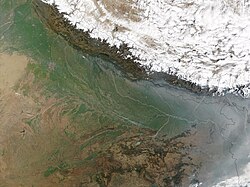
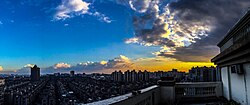
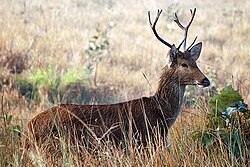
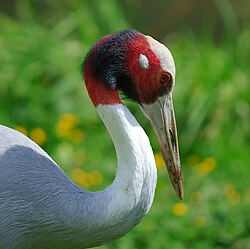
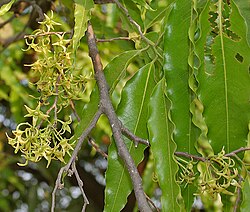
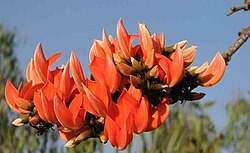

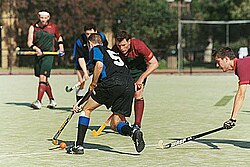

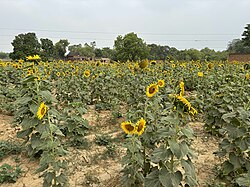

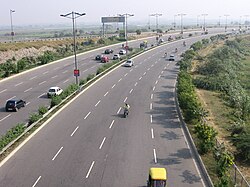
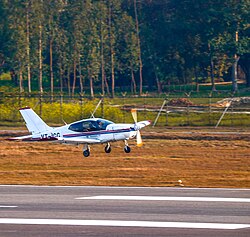
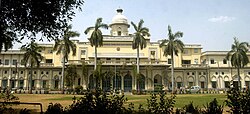
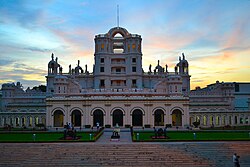
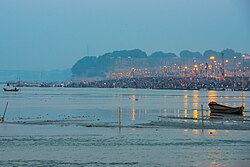
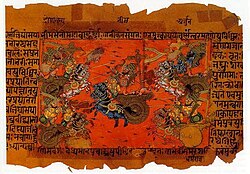
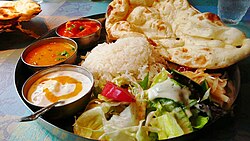
.jpeg)


.jpg)


 India
India 0.596[8] Medium · 35th
 UP Government Emblem


_flowers_in_Kolkata_W_IMG_4146.jpg)

 Provincial bird of Uttar Pradesh, the Sarus Crane
 Provincial animal of Uttar Pradesh
 Provincial tree of Uttar Pradesh
 Provincial flower of Uttar Pradesh

_leaves_%26_flowers_in_Kolkata_W_IMG_2272.jpg)
