





Ajay Kumar (talk | contribs) Created a new article Tag: self-published-blog |
m enhance references |
||
| Line 1: | Line 1: | ||
{{Short description|Princely state of India (1721–1949)}} | {{Short description|Princely state of India (1721–1949)}} | ||
{{ | {{Use British English|date=January 2014}} | ||
{{Use dmy dates|date=April 2022}} | {{Use dmy dates|date=April 2022}} | ||
{{Infobox former country | {{Infobox former country | ||
|conventional_long_name = State of Baroda | | conventional_long_name = State of Baroda | ||
|common_name = Baroda | | common_name = Baroda | ||
| | | native_name = {{native name|mr|Baḍōdā rājya}}<br />{{native name|gu|Barōḍā rājya}} | ||
| | | image_flag = Baroda flag.svg | ||
| | | official_languages = [[Marathi language|Marathi]] | ||
|official_languages = | | government_type = [[Monarchy]] | ||
|government_type = [[Monarchy]] | | capital = [[Vadodara|Baroda]] | ||
|capital = [[Vadodara|Baroda | | demonym = [[Baroda|Barodian]] | ||
|demonym = Baroda | | religion = {{ubl|[[Hinduism]] ([[state religion|State]])|[[Islam]]|[[Jainism]]|[[Christianity]]|[[Zoroastrianism]]}} | ||
|religion= [[Hinduism]] ([[state religion|State]]) | | title_leader = [[#Gaekwad Maharajas of Baroda|Maharaja]] | ||
|title_leader = [[Gaekwad | | footnotes = [https://archive.org/stream/cu31924007471935/cu31924007471935_djvu.txt "A Catalogue of Manuscript and Printed Reports, Field Books, Memoirs, Maps ..." Vol. iv, "Containing the treaties, etc., relating to the states within the Bombay presidency"] | ||
|year_leader1 = | | year_leader1 = 1721–1732 <small>(first)</small> | ||
|leader1 = [[Pilaji Rao Gaekwad]] | | leader1 = [[Pilaji Rao Gaekwad]] | ||
|year_leader2 = | | year_leader2 = 1939–1949 <small>(last)</small>{{efn|before abolition and dilusion in the [[Republic of India]]}} | ||
|leader2= [[Pratap Singh Rao Gaekwad]] | | leader2 = [[Pratap Singh Rao Gaekwad]] | ||
|year_start = 1721 | | year_start = 1721 | ||
|year_end = 1949 | | status = State Within the [[Maratha Empire]] (1721–1805) <br/> [[Protectorate]] of the [[East India Company]] (1805–1858) <br/> [[Princely State]] of the [[British Raj]] (1858–1947)<br />State of the [[Dominion of India]] (1947–1949) | ||
|p1 = Maratha | | year_end = 1949 | ||
|flag_p1 = Flag of the Maratha Empire.svg | | p1 = Maratha Confederacy | ||
|border_p1 = no | | flag_p1 = Flag of the Maratha Empire.svg | ||
|s1 = Dominion of India | | border_p1 = no | ||
|flag_s1 = Flag of India.svg | | s1 = Dominion of India | ||
|today= [[ | | flag_s1 = Flag of India.svg | ||
|map_caption = Baroda State in 1901 | | today = [[India]]<br /> '''∟''' [[Gujarat]] | ||
|image_map = Baroda state 1909.jpg | | map_caption = Baroda State in 1901 | ||
|image_coat = Baroda State CoA.png | | image_map = Baroda state 1909.jpg | ||
|event_end = [[ | | map_caption2 = | ||
| image_map2 = | |||
| image_coat = Baroda State CoA.png | |||
| event_end = [[Political integration of India#Merger|Merger into India]] | |||
}} | }} | ||
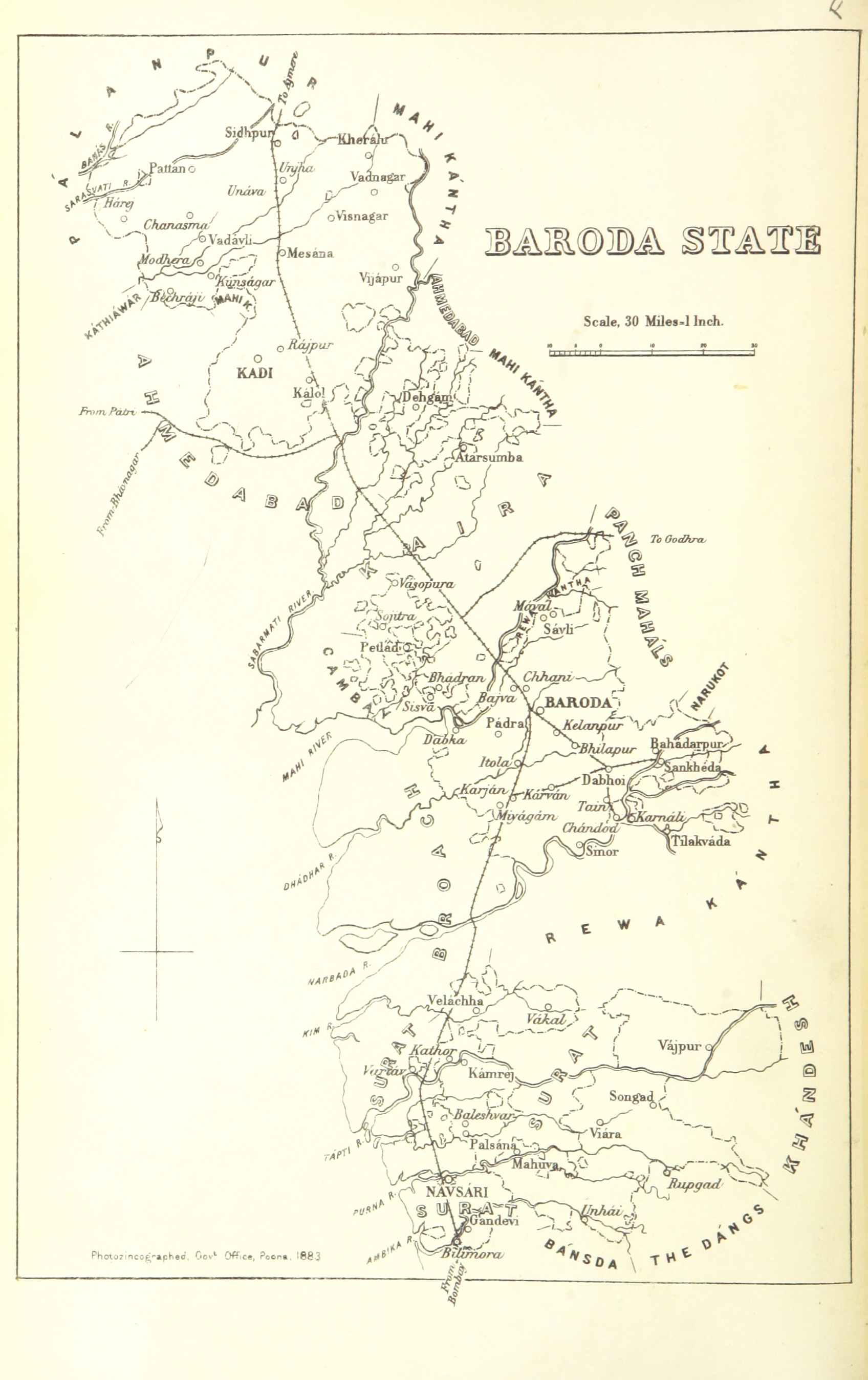
'''Baroda State''' was a [[princely state]] in present-day [[Gujarat]] | '''Baroda State''' was a kingdom within the [[Maratha Empire]] and later a [[princely state]] in present-day [[Gujarat]]. It was ruled by the [[Gaekwad dynasty]] from its formation in 1721 until its [[Instrument of Accession|accession]] to the newly formed [[Dominion of India]]. With the city of [[Baroda]] as its capital, its relations with the [[British Raj]] authorities were managed by the [[Baroda Residency]]. The revenue of the state in 1901 was Rs. 13,661,000.<ref>{{Cite web|title=Imperial Gazetteer of India, Volume 7, page 25|url=https://dsal.uchicago.edu/reference/gazetteer/pager.html?volume=7&objectid=DS405.1.I34_V07_031.gif|access-date=12 July 2020|website=dsal.uchicago.edu|publisher=Digital South Asia Library}}</ref> Baroda [[Political integration of India#Merger|merged]] into the [[Dominion of India]] on 1 May 1949, before which an interim government was formed in the state.<ref name=fi>{{cite news|url=https://news.google.com/newspapers?id=5Hw-AAAAIBAJ&pg=5018,2762425&dq=baroda-state&hl=en|title=Rulers Farewell Message|date=1 May 1949|work=The Indian Express}}</ref> | ||
==History== | ==History== | ||
| Line 46: | Line 49: | ||
The [[Marathas]] first attacked Gujarat in 1705. By 1712, a Maratha leader Khande Rao Dabhade grew powerful in the region and when he returned to [[Satara (city)|Satara]] in 1716, he was made the ''[[senapati]]'' ([[commander in chief]]). Thereafter during the "Battle of Balapur" in 1721, one of his officers, Damaji Gaekwad was awarded the title ''Shamsher Bahadur'' or Distinguished Swordsman. Damaji died in 1721 and was succeeded by his nephew Pilajirao.<ref>[[#Im|Gazetteer, p. 31, 32]]</ref> | The [[Marathas]] first attacked Gujarat in 1705. By 1712, a Maratha leader Khande Rao Dabhade grew powerful in the region and when he returned to [[Satara (city)|Satara]] in 1716, he was made the ''[[senapati]]'' ([[commander in chief]]). Thereafter during the "Battle of Balapur" in 1721, one of his officers, Damaji Gaekwad was awarded the title ''Shamsher Bahadur'' or Distinguished Swordsman. Damaji died in 1721 and was succeeded by his nephew Pilajirao.<ref>[[#Im|Gazetteer, p. 31, 32]]</ref> | ||
Thus the Baroda State was founded in 1721, when the [[Maratha Empire|Maratha]] general [[Pilaji Gaekwad]] conquered [[Songadh]] from the [[Mughal Empire|Mughal]]s. | Thus the Baroda State was founded in 1721, when the [[Maratha Empire|Maratha]] general [[Pilaji Gaekwad]] conquered [[Songadh]] from the [[Mughal Empire|Mughal]]s. Before this Pilajirao was appointed as general to collect revenues from Gujarat by the [[Peshwa]], the Prime Minister of the [[Maratha Empire]], who had taken over the region north and south of [[Surat]] from the Mughals to established the ''Sarkar of Surat''. Songadh remained the headquarters of the "House of Gaekwad" until 1866.<ref name="it">{{cite news|url=http://articles.timesofindia.indiatimes.com/2010-09-27/vadodara/28212949_1_vessels-erstwhile-baroda-state-passports|archive-url=https://web.archive.org/web/20121103185234/http://articles.timesofindia.indiatimes.com/2010-09-27/vadodara/28212949_1_vessels-erstwhile-baroda-state-passports|url-status=dead|archive-date=3 November 2012|work=[[The Times of India]]|title=280 years ago, Baroda had its own Navy|date=27 September 2010}}</ref><ref>[[#Im|Gazetteer, 32]]</ref> After the [[Second Anglo-Maratha War]] (1803–1805), the [[East India Company]] wrested control of much of Gujarat from the [[Maratha]]s. However, the Gaekwads of Baroda (Vadodara) acknowledged British [[suzerainty]] and control of the state's external affairs in return for retaining internal autonomy. | ||
===Princely state=== | ===Princely state=== | ||
| Line 53: | Line 56: | ||
[[File:Silver rupee of Sayaji Rao III of Baroda.jpg|thumb|right|250px|Silver rupee of Sayaji Rao III of Baroda (ruled 1875–1939), showing his portrait. This coin is dated 1955 in the [[Vikrama era]] (= 1897 CE).]] | [[File:Silver rupee of Sayaji Rao III of Baroda.jpg|thumb|right|250px|Silver rupee of Sayaji Rao III of Baroda (ruled 1875–1939), showing his portrait. This coin is dated 1955 in the [[Vikrama era]] (= 1897 CE).]] | ||
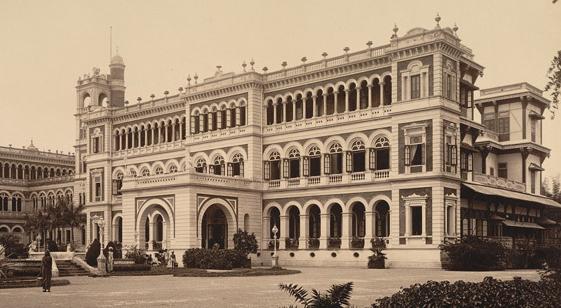
Following the death of Sir [[Khanderao Gaekwad]] (1828–1870), the popular Maharaja of Baroda, in 1870, it was expected that his brother, [[Malharrao]] (1831–1882), would succeed him. However, Malharrao had already proven himself to be of the vilest character and had been imprisoned earlier for conspiring to assassinate Khanderao. As Khanderao's widow, [[Maharani | Following the death of Sir [[Khanderao Gaekwad]] (1828–1870), the popular Maharaja of Baroda, in 1870, it was expected that his brother, [[Malharrao]] (1831–1882), would succeed him. However, Malharrao had already proven himself to be of the vilest character and had been imprisoned earlier for conspiring to assassinate Khanderao. As Khanderao's widow, [[Maharaja|Maharani]] '''Jamnabai''' (1853–1898) was already pregnant with a posthumous child, the succession was delayed until the gender of the child could be proven. The child proved to be a daughter, and so upon her birth on 5 July 1871, Malharrao ascended the throne. | ||
Malharrao spent money liberally, nearly emptying the Barodan state coffers (he commissioned a pair of solid gold cannon and a carpet of pearls, among other expenses) and soon reports reached the Resident of Malharrao's gross tyranny and cruelty. Malharrao further attempted to cover up his deeds by poisoning the Resident, Colonel [[R. Phayre]] C.B. with a compound of [[arsenic]]. By order of the [[Secretary of State for India]], [[Lord Salisbury]], Malharrao was deposed on 10 April 1875 and exiled to [[Madras]], where he died in obscurity in 1882.<ref>{{cite news|url=http://paperspast.natlib.govt.nz/cgi-bin/paperspast?a=d&d=GRA18750705.2.12|title=DEPOSITION OF THE GAEKWAR OF BARODA|date=26 April 1875|newspaper=The Times of India}}</ref> With the throne of Baroda now vacant, Maharani Jamnabai called on the heads of the extended branches of the dynasty to come to Baroda and present themselves and their sons in order to decide upon a successor. | Malharrao spent money liberally, nearly emptying the Barodan state coffers (he commissioned a pair of solid gold cannon and a carpet of pearls, among other expenses) and soon reports reached the Resident of Malharrao's gross tyranny and cruelty. Malharrao further attempted to cover up his deeds by poisoning the Resident, Colonel [[R. Phayre]] C.B. with a compound of [[arsenic]].<ref>{{Cite book |last=Mulhar Rao Gaekwar |url=https://catalog.hathitrust.org/Record/008746830 |title=The great Baroda case: being a full report of the proceedings of the trial and deposition of His Highness Mulhar Rao Gaekwar of Baroda for instigating an attempt to poison the British Resident at his court. |date=1905 |publisher=R. Cambray |series=Great trial series |location=Calcutta}}</ref> By order of the [[Secretary of State for India]], [[Lord Salisbury]], Malharrao was deposed on 10 April 1875 and exiled to [[Madras]], where he died in obscurity in 1882.<ref>{{cite news|url=http://paperspast.natlib.govt.nz/cgi-bin/paperspast?a=d&d=GRA18750705.2.12|title=DEPOSITION OF THE GAEKWAR OF BARODA|date=26 April 1875|newspaper=The Times of India}}</ref> With the throne of Baroda now vacant, Maharani Jamnabai called on the heads of the extended branches of the dynasty to come to Baroda and present themselves and their sons in order to decide upon a successor. | ||
[[File:Baroda Makarpura.jpg|thumb|251x251px|[[Makarpura Palace]], built by Maharaja Khende Rao in 1870.|left]] | [[File:Baroda Makarpura.jpg|thumb|251x251px|[[Makarpura Palace]], built by Maharaja Khende Rao in 1870.|left]] | ||
Kashirao and his three sons, Anandrao (1857–1917), Gopalrao (1863–1938) and Sampatrao (1865–1934) walked to Baroda from Kavlana | Kashirao and his three sons, Anandrao (1857–1917), Gopalrao (1863–1938) and Sampatrao (1865–1934) walked to Baroda from Kavlana, a distance of some 600 kilometres, to present themselves to Jamnabai. | ||
Eventually Gopalrao was selected by the British Government as successor and was accordingly adopted by Maharani Jamnabai, on 27 May 1875. He was also given a new name, Sayajirao. On 16 June 1875, he ascended the throne as [[Sayajirao Gaekwad III]], but being a minor, reigned under a Council of Regency until he came of age and was invested with full ruling powers on 28 December 1881. founding numerous institutions, | Eventually, Gopalrao was selected by the British Government as successor and was accordingly adopted by Maharani Jamnabai, on 27 May 1875. He was also given a new name, Sayajirao. On 16 June 1875, he ascended the throne as [[Sayajirao Gaekwad III]], but being a minor, reigned under a Council of Regency until he came of age and was invested with full ruling powers on 28 December 1881. founding numerous institutions. During the hunting season in 1933, he was saved from lion by two boys of Dhari town, '''Arjan Koli''' and '''Hari Koli'''. After that both Koli brothers were respected in open court (Baroda state darbar) and their bronze statues were established in royal [[Sayaji Baug]] (Kamati Baug) by Sayajirao Gaekwad.<ref>{{Cite web |date=2024-02-18 |title=Know Your City: How Baroda's bronze statues will regain their black sheen in Rs 1.10 crore restoration project |url=https://indianexpress.com/article/cities/ahmedabad/know-your-city-how-barodas-bronze-statues-will-regain-their-black-sheen-in-rs-1-10-crore-restoration-project-9167612/ |access-date=2024-04-19 |website=The Indian Express |language=en}}</ref> | ||
===20th century=== | ===20th century=== | ||
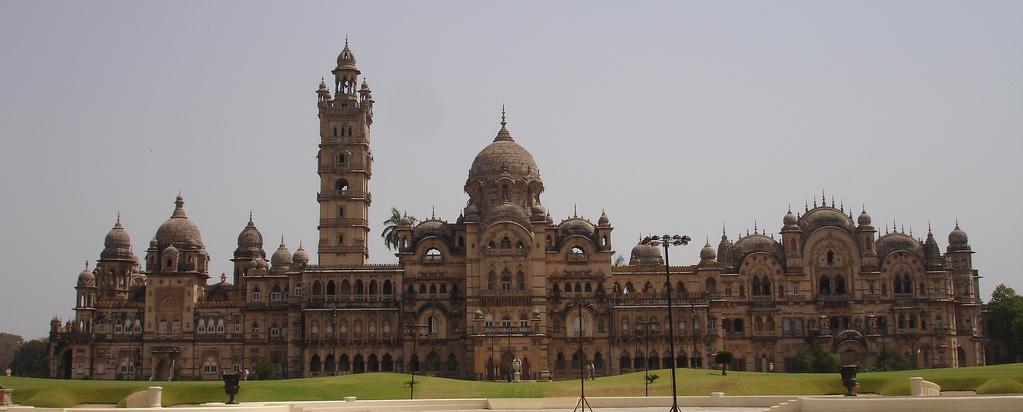
Various important state institutions were founded in the early 20th century, including the [[Bank of Baroda]] on 20 July 1908. In 1908, Sayajirao also founded the Baroda Legislative Assembly (also known as the Baroda Dhara Sabha).<ref>{{Cite book|url=https://books.google.com/books?id=RVhNO2MwOCAC&pg=PA37|title=Gandhinagar: Building National Identity in Postcolonial India|last=Kalia|first=Ravi|date=2004|publisher=University of South Carolina Press|isbn=9781570035449|pages=37|language=en}}</ref>[[File:Baroda Lvp.JPG|thumb|248x248px|right|[[Laxmi Vilas Palace]], [[Baroda]], built by [[Maharaja Sayajirao Gaekwad III]] in 1890 ]] | Various important state institutions were founded in the early 20th century, including the [[Bank of Baroda]] on 20 July 1908. In 1908, Sayajirao also founded the Baroda Legislative Assembly (also known as the Baroda Dhara Sabha).<ref>{{Cite book|url=https://books.google.com/books?id=RVhNO2MwOCAC&pg=PA37|title=Gandhinagar: Building National Identity in Postcolonial India|last=Kalia|first=Ravi|date=2004|publisher=University of South Carolina Press|isbn=9781570035449|pages=37|language=en}}</ref>[[File:Baroda Lvp.JPG|thumb|248x248px|right|[[Laxmi Vilas Palace]], [[Baroda]], built by [[Maharaja Sayajirao Gaekwad III]] in 1890 ]] | ||
By the beginning of the 20th century, the relations of the British with the four largest princely states—[[Hyderabad State|Hyderabad]], [[Kingdom of Mysore|Mysore]], [[Jammu and Kashmir (state)|Jammu and Kashmir]], and Baroda were managed by a British [[resident (title)|Resident]] under the direct authority the [[Governor-General of India]].<ref>[[Imperial Gazetteer of India]] vol. IV (1907), p. 92.</ref> In 1911, Baroda State spanned {{convert|3239|km2|mi2|0|abbr=on}}, and the population was 2,032,798 persons as per the 1911 census of India.<ref>{{cite book |author1=Somerset Playne |author2=R. V. Solomon |author3=J. W. Bond |author4=Arnold Wright | title = Indian states: a biographical, historical, and administrative survey | publisher = Asian Educational Services | year = 2006 | isbn = 978-81-206-1965-4 | page=9 | chapter=The State of Baroda |edition=illustrated}}</ref> The state was very wealthy. ''[[The Pittsburgh Press]]'' reported in 1927 that the diamond necklace, which contained the [[Star of the South]] diamond, was a part of a royal collection worth $10,000,000 at the time, housed in the [[Nazarbaug Palace]] (built 1721) in [[Baroda]] city; another important part of the collection was a cloth embroidered with precious stones and seed [[pearl]]s, made to cover the tomb of [[Mohammed]].<ref>{{cite news|url=https://news.google.com/newspapers?id=0kAbAAAAIBAJ&pg=3086,6808320&dq=baroda-state&hl=en|title=Baroda City of Palace|date=14 August 1927|work=[[The Pittsburgh Press]]}}</ref><ref name="timesindia">{{cite web |url=http://articles.timesofindia.indiatimes.com/2007-03-28/india/27880016_1_diamond-cartier-sangramsinh |archive-url=https://web.archive.org/web/20121022035253/http://articles.timesofindia.indiatimes.com/2007-03-28/india/27880016_1_diamond-cartier-sangramsinh |url-status=dead |archive-date=22 October 2012 |work=[[The Times of India]] |title=Gaekwad's Star of the South diamond sold |date=28 March 2007 }}</ref> | By the beginning of the 20th century, the relations of the British with the four largest princely states—[[Hyderabad State|Hyderabad]], [[Kingdom of Mysore|Mysore]], [[Jammu and Kashmir (state)|Jammu and Kashmir]], and Baroda were managed by a British [[resident (title)|Resident]] under the direct authority the [[Governor-General of India]].<ref>[[Imperial Gazetteer of India]] vol. IV (1907), p. 92.</ref> In 1911, Baroda State spanned {{convert|3239|km2|mi2|0|abbr=on}}, and the population was 2,032,798 persons as per the 1911 census of India.<ref>{{cite book |author1=Somerset Playne |author2=R. V. Solomon |author3=J. W. Bond |author4=Arnold Wright | title = Indian states: a biographical, historical, and administrative survey | publisher = Asian Educational Services | year = 2006 | isbn = 978-81-206-1965-4 | page=9 | chapter=The State of Baroda |edition=illustrated}}</ref> The state was very wealthy. ''[[The Pittsburgh Press]]'' reported in 1927 that the diamond necklace, which contained the [[Star of the South]] diamond, was a part of a royal collection worth $10,000,000 at the time, housed in the [[Nazarbaug Palace]] (built 1721) in [[Baroda]] city; another important part of the collection was a cloth embroidered with precious stones and seed [[pearl]]s, made to cover the tomb of [[Mohammed]].<ref>{{cite news|url=https://news.google.com/newspapers?id=0kAbAAAAIBAJ&pg=3086,6808320&dq=baroda-state&hl=en|title=Baroda City of Palace|date=14 August 1927|work=[[The Pittsburgh Press]]}}</ref><ref name="timesindia">{{cite web |url=http://articles.timesofindia.indiatimes.com/2007-03-28/india/27880016_1_diamond-cartier-sangramsinh |archive-url=https://web.archive.org/web/20121022035253/http://articles.timesofindia.indiatimes.com/2007-03-28/india/27880016_1_diamond-cartier-sangramsinh |url-status=dead |archive-date=22 October 2012 |work=[[The Times of India]] |title=Gaekwad's Star of the South diamond sold |date=28 March 2007 }}</ref> The Qatar National Museum now holds the Pearl Carpet of Baroda as one of its treasures.<ref>{{Cite web |last=Fabrique |title=Collection Highlight: The Baroda Carpet |url=https://qm.org.qa/en/stories/all-stories/baroda-carpet/ |access-date=2025-10-06 |website=Qatar Museums |language=en}}</ref> | ||
Dr. [[B.R. Ambedkar|B.R.Ambedkar]] writes about his experience with [[untouchability]] in Baroda in the second chapter of his autobiographical book, [[Waiting for a Visa]].<ref>{{cite book|last1=Ambedkar|first1=Dr. Bhimrao|title=Waiting for a Visa|date=1991|publisher=Dept. of education, Government of Maharashtra|location=Mumbai|pages=4071–4090|url=https://drambedkarbooks.files.wordpress.com/2009/03/selected-work-of-dr-b-r-ambedkar.pdf|access-date=15 April 2015}}</ref> | Dr. [[B.R. Ambedkar|B.R.Ambedkar]] writes about his experience with [[untouchability]] in Baroda in the second chapter of his autobiographical book, [[Waiting for a Visa]].<ref>{{cite book|last1=Ambedkar|first1=Dr. Bhimrao|title=Waiting for a Visa|date=1991|publisher=Dept. of education, Government of Maharashtra|location=Mumbai|pages=4071–4090|url=https://drambedkarbooks.files.wordpress.com/2009/03/selected-work-of-dr-b-r-ambedkar.pdf|access-date=15 April 2015}}</ref> | ||
In 1937, the [[princely states]] of the [[Baroda Residency]] were merged with those of the agencies adjacent to the northern part of the [[Bombay Presidency]] — [[Rewa Kantha Agency]], [[Surat Agency]], [[Nasik Agency]], [[Kaira Agency]] and [[Thana Agency]] — in order to form the [[Baroda and Gujarat States Agency]].<ref>[http://www.hubert-herald.nl/BhaGujarat1.htm History of the State of Gujarat]</ref> A few years before independence the process of the '[[Attachment Scheme]]' began in order to integrate the smallest princely states, estates and ''thanas''. Baroda State was one of the main beneficiaries of this measure by being able to add about 15,000 km<sup>2</sup> and half a million inhabitants to the state. The merged states were [[Pethapur State|Pethapur]] on 1 February 1940, the [[Katosan Thana]], with [[Deloli]], [[Kalsapura]], [[Maguna]], [[Memadpura]], [[Rampura, Sankheda Mehwas|Rampura]], [[Ranipura]], [[Tejpura State|Tejpura]], [[Varsora]], the [[Palaj]] Taluka and both [[Ijpura State]]s between June and July 1940. These were followed on 10 July 1943 by the states of [[Ambliara State|Ambliara]], [[Ghorasar State|Ghorasar]], [[Ilol State|Ilol]], [[Katosan State|Katosan]], [[Khadal State|Khadal]], [[Patdi State|Patdi]], [[Punadra State|Punadra]], [[Ranasan State|Ranasan]], [[Wasoda State|Wasoda]] and [[Wao State|Wao]]<ref>which had been fourth class states in the [[Mahi Kantha Agency]].</ref> Also many small ''Talukas'' of the region were merged. On 24 July 1943 [[Sachodar State]] and a few small places that had no own jurisdiction were annexed. By December of the same year the small states of [[Bajana State|Bajana]], [[Bhilka State|Bhilka]], [[Malpur State|Malpur]], | In 1937, the [[princely states]] of the [[Baroda Residency]] were merged with those of the agencies adjacent to the northern part of the [[Bombay Presidency]] — [[Rewa Kantha Agency]], [[Surat Agency]], [[Nasik Agency]], [[Kaira Agency]] and [[Thana Agency]] — in order to form the [[Baroda and Gujarat States Agency]].<ref>[http://www.hubert-herald.nl/BhaGujarat1.htm History of the State of Gujarat]</ref> A few years before independence the process of the '[[Attachment Scheme]]' began in order to integrate the smallest princely states, estates and ''thanas''. Baroda State was one of the main beneficiaries of this measure by being able to add about 15,000 km<sup>2</sup> and half a million inhabitants to the state. The merged states were [[Pethapur State|Pethapur]] on 1 February 1940, the [[Katosan Thana]], with [[Deloli]], [[Kalsapura]], [[Maguna]], [[Memadpura]], [[Rampura, Sankheda Mehwas|Rampura]], [[Ranipura]], [[Tejpura State|Tejpura]], [[Varsora]], the [[Palaj]] Taluka and both [[Ijpura State]]s between June and July 1940. These were followed on 10 July 1943 by the states of [[Ambliara State|Ambliara]], [[Ghorasar State|Ghorasar]], [[Ilol State|Ilol]], [[Katosan State|Katosan]], [[Khadal State|Khadal]], [[Patdi State|Patdi]], [[Punadra State|Punadra]], [[Ranasan State|Ranasan]], [[Wasoda State|Wasoda]] and [[Wao State|Wao]]<ref>which had been fourth class states in the [[Mahi Kantha Agency]].</ref> Also many small ''Talukas'' of the region were merged. On 24 July 1943 [[Sachodar State]] and a few small places that had no own jurisdiction were annexed. By December of the same year the small states of [[Bajana State|Bajana]], [[Bhilka State|Bhilka]], [[Malpur State|Malpur]], Mansa and [[Vadia State|Vadia]] met the same fate.<ref>McLeod, John; ''Sovereignty, power, control: politics in the States of Western India, 1916–1947;'' Leiden u.a. 1999; {{ISBN|90-04-11343-6}}; p. 160</ref> | ||
Finally on 5 November 1944 the Baroda and Gujarat States Agency was merged with the [[Western India States Agency]] (WISA) to form the larger [[Baroda, Western India and Gujarat States Agency]]. | Finally on 5 November 1944 the Baroda and Gujarat States Agency was merged with the [[Western India States Agency]] (WISA) to form the larger [[Baroda, Western India and Gujarat States Agency]]. | ||
After the [[independence of India]], which initially did not include Baroda or many other princely states, an interim government under Prime Minister Dr. [[Jivraj Narayan Mehta]], son-in-law of [[Manubhai Mehta]], then Dewan of Baroda state, was inaugurated in the State, on 4 September 1948, by the then Maharaja at a special ''[[Durbar (court)|Durbar]]'' in the [[Laxmi Vilas Palace]], Baroda.<ref>{{cite news|url=https://news.google.com/newspapers?id=xdI-AAAAIBAJ&pg=3890,6471046&dq=baroda-state&hl=en|title=Gaekwar Inaugurates Responsible Government|date=5 September 1948|work=The Indian Express}}</ref> Finally on 1 May 1949, Baroda State, the third largest state at the time of [[British India]], formally | After the [[independence of India]], which initially did not include Baroda or many other princely states, an interim government under Prime Minister Dr. [[Jivraj Narayan Mehta]], son-in-law of [[Manubhai Mehta]], then Dewan of Baroda state, was inaugurated in the State, on 4 September 1948, by the then Maharaja at a special ''[[Durbar (court)|Durbar]]'' in the [[Laxmi Vilas Palace]], Baroda.<ref>{{cite news|url=https://news.google.com/newspapers?id=xdI-AAAAIBAJ&pg=3890,6471046&dq=baroda-state&hl=en|title=Gaekwar Inaugurates Responsible Government|date=5 September 1948|work=The Indian Express}}</ref> Finally on 1 May 1949, Baroda State, the third largest state at the time of [[British India]], formally [[Political integration of India#Merger|merged]] into the [[Dominion of India]],<ref name=fi/><ref>{{cite news|url=https://news.google.com/newspapers?id=5Xw-AAAAIBAJ&pg=1263,2862239&dq=baroda-state&hl=en|title=Kher's Appeal to people &Service for Cooperation|date=2 May 1949|work=The Indian Express}}</ref> Initially, Baroda merged with the [[Bombay state]], and then, on 1 May 1960, when the two new states of [[Gujarat]] and [[Maharashtra]] were formed, it became part of Gujarat, with Dr. [[Jivraj Narayan Mehta]] becoming the first [[Chief Minister of Gujarat]]. | ||
== Koli revolt == | == Koli revolt == | ||
[[File:Koli popular in 1931.jpg|thumb|Koli population in Baroda State in 1931]] | [[File:Koli popular in 1931.jpg|thumb|Koli population in Baroda State in 1931]] | ||
The [[Koli people|Koli]] rebellion was led by two brothers [[ | The [[Koli people|Koli]] rebellion was led by two brothers [[Nathaji Patel]] and [[Nathaji and Yamaji of Chandap|Yamaji Patel]], chiefs of [[Chandap]] [[Taluq]]. During the great [[Indian Rebellion of 1857]], the Kolis of Chandap under Nathaji and Yamaji planning for revolt and Gaekwad of Baroda received that news. So Gaekwad stationed his cavalry at Chandap to control the rebels. But cavalry of Gaekwad was killed and thrown out by [[Koli people|Kolis]] of Chandap. After that Kolis went into [[Taranga Jain temple|Taranga]] hills and continued their rebellion for few months. In the end of October 1857, the combined forces of British, [[Idar State]] and Baroda attacked Kolis and burnt the Chandap village.<ref>{{Cite book|last=Dharaiya|first=Ramanlal Kakalbhai|url=https://books.google.com/books?id=wps5AQAAIAAJ|title=Gujarat in 1857|date=1970|publisher=[[Gujarat University]]|location=[[New Delhi]], [[India]]|pages=38–40–52|language=en}}</ref> | ||
In [[North Gujarat|north]]-west Gujarat, around the southern tip of the [[Aravalli district|Aravali]], a number of [[Koli people|Koli]] [[Taluqdar|Talukdars]] revolted against the triumvirate of the [[British Raj|British]], [[Gaekwad dynasty|Gaekwad]] and Raja of [[Idar State|Idar]]. Together, these three forces burnt down two Koli villages towards the end of 1857. The Koli chieftains collected an army of 2000 Koli- and [[Bhil people|Bhil]] soldiers and attacked Gaekwadi villages near present day [[Gandhinagar]]. Adopting [[Guerrilla warfare|guerrilla]] tactics, they continued their resistance till the end of 1858. While Koli chiefs fought around the river [[Sabarmati River|Sabarmati]]. The Kolis paid a huge price for their resistance to British and Baroda. They were not only defeated in battle and punished for having dared to resist but, in the aftermath, kolis were marginalized by the rest of society as [[ | In [[North Gujarat|north]]-west Gujarat, around the southern tip of the [[Aravalli district|Aravali]], a number of [[Koli people|Koli]] [[Taluqdar|Talukdars]] revolted against the triumvirate of the [[British Raj|British]], [[Gaekwad dynasty|Gaekwad]] and Raja of [[Idar State|Idar]]. Together, these three forces burnt down two Koli villages towards the end of 1857. The Koli chieftains collected an army of 2000 Koli- and [[Bhil people|Bhil]] soldiers and attacked Gaekwadi villages near present day [[Gandhinagar]]. Adopting [[Guerrilla warfare|guerrilla]] tactics, they continued their resistance till the end of 1858. While Koli chiefs fought around the river [[Sabarmati River|Sabarmati]]. The Kolis paid a huge price for their resistance to British and Baroda. They were not only defeated in battle and punished for having dared to resist but, in the aftermath, kolis were marginalized by the rest of society as [[outlaw]]s. Being arms-bearing community, they too were disarmed in early 1858 and also forced to practise [[agriculture]].<ref>{{Cite book|last1=Yājñika|first1=Acyuta|url=|title=The Shaping of Modern Gujarat: Plurality, [[Hindutva]], and Beyond|last2=Sheth|first2=Suchitra|date=2005|publisher=[[Penguin Books India]]|isbn=978-0-14-400038-8|location=[[New Delhi]], [[India]]|pages=93–96|language=en}}</ref> | ||
==Baroda State Railway== | ==Baroda State Railway== | ||
| Line 112: | Line 115: | ||
* [[Malhar Rao Gaekwad]] (1870–1875) | * [[Malhar Rao Gaekwad]] (1870–1875) | ||
* [[Sayajirao Gaekwad III]] (1875–1939) | * [[Sayajirao Gaekwad III]] (1875–1939) | ||
*[[Pratap Singh Rao Gaekwad]] (1939–1951); ruled from 1939 | *[[Pratap Singh Rao Gaekwad]] (1939–1951); ruled from 1939 to 1947, serving as nominal ruler to his death in 1951 | ||
===Titular Maharajas=== | ===Titular Maharajas=== | ||
* [[Fatehsinghrao Gaekwad]] II (1951–1988) titular Maharaj of Baroda until 1971 when All the royal titles in India were officially abolished in 1971 under the [[Twenty-sixth Amendment of the Constitution of India]] by [[Indira Gandhi]]'s government. | * [[Fatehsinghrao Gaekwad]] II (1951–1988) titular Maharaj of Baroda until 1971 when All the royal titles in India were officially abolished in 1971 under the [[Twenty-sixth Amendment of the Constitution of India]] by [[Indira Gandhi]]'s government. | ||
===Later | ===Later heads of family=== | ||
* [[Ranjitsinh Pratapsinh Gaekwad]] (1988–2012; [[pretender]]) | * [[Ranjitsinh Pratapsinh Gaekwad]] (1988–2012; [[pretender]]) | ||
* [[Samarjitsinh Gaekwad]] ( | * [[Samarjitsinh Gaekwad]] (2012–present; pretender) | ||
===Present line of succession to the Baroda throne=== | ===Present line of succession to the Baroda throne=== | ||
| Line 127: | Line 130: | ||
# Shrimant Maharajkumar Pratapsinhrao Sangramsinhrao Gaekwad (26 August 1971–). Only son of Sangramsinhrao Gaekwad. | # Shrimant Maharajkumar Pratapsinhrao Sangramsinhrao Gaekwad (26 August 1971–). Only son of Sangramsinhrao Gaekwad. | ||
# Shrimant Rajkumar Sayajirao Khanderao Gaekwad (6 April 1947–). Great-grandson of [[Sayajirao Gaekwad III]] by the Maharaja's younger son [[Shivajirao Gaekwad|Shivajirao]] (1890–1919) and through Shivajirao's son Khanderao (1916–1991). Has two daughters. | # Shrimant Rajkumar Sayajirao Khanderao Gaekwad (6 April 1947–). Great-grandson of [[Sayajirao Gaekwad III]] by the Maharaja's younger son [[Shivajirao Gaekwad|Shivajirao]] (1890–1919) and through Shivajirao's son Khanderao (1916–1991). Has two daughters. | ||
# Shrimant Rajkumar Anandrao Khanderao | # Shrimant Rajkumar Anandrao Khanderao Gaekwar (1948–2024). Younger brother of Sayajirao Khanderao Gaekwad. Has two sons. | ||
# Shrimant Shivajirao Anandrao Gaekwar (21 September 1983–). Elder son of Anandrao Khanderao Gaekwad. | # Shrimant Shivajirao Anandrao Gaekwar (21 September 1983–). Elder son of Anandrao Khanderao Gaekwad. | ||
# Shrimant | # Shrimant Udaysinghrao Anandrao Gaekwar (4 December 1990–). Younger son of Anandrao Khanderao Gaekwad. | ||
# Shrimant Kr Jeetendrasinh Gautamsinhrao Gaekwad (4 Nov 1960–), son of Late Professor Shrimant Gautamsinhrao Bhadrasinhrao Gaekwad (1936–2006). Great Grandnephew of Maharaja Sir Sayajirao III. Great Grandson of the Maharaja's late elder brother 'Senapati' Anandrao, ''Himmat Bahadur'', CIE (1857–1917). Grandson of Anandrao's son 'Rajyakarya Dhurandhar' 'Dewan' 'Barrister' Bhadrasinhrao Anandrao Gaekwad, CIE (1896–1946). | # Shrimant Kr Jeetendrasinh Gautamsinhrao Gaekwad (4 Nov 1960–), son of Late Professor Shrimant Gautamsinhrao Bhadrasinhrao Gaekwad (1936–2006). Great Grandnephew of Maharaja Sir Sayajirao III. Great Grandson of the Maharaja's late elder brother 'Senapati' Anandrao, ''Himmat Bahadur'', CIE (1857–1917). Grandson of Anandrao's son 'Rajyakarya Dhurandhar' 'Dewan' 'Barrister' Bhadrasinhrao Anandrao Gaekwad, CIE (1896–1946). | ||
# Shrimant Satyajitsinhrao Duleepsinhrao Gaekwad (3 March 1962–). Great-grandnephew of [[Sayajirao Gaekwad III]] through the Maharaja's elder brother Anandrao, ''Himmat Bahadur'', CIE (1857–1917), through Anandrao's son Chandrasinhrao (born 1894–?) and through his grandson Duleepsinhrao (b. c. 1920–?) | # Shrimant Satyajitsinhrao Duleepsinhrao Gaekwad (3 March 1962–). Great-grandnephew of [[Sayajirao Gaekwad III]] through the Maharaja's elder brother Anandrao, ''Himmat Bahadur'', CIE (1857–1917), through Anandrao's son Chandrasinhrao (born 1894–?) and through his grandson Duleepsinhrao (b. c. 1920–?) | ||
#Shrimant Yudeepsinhrao Satyajitsinhrao Gaekwad (2001–). Son of Satyajitsinhrao. | #Shrimant Yudeepsinhrao Satyajitsinhrao Gaekwad (2001–). Son of Satyajitsinhrao. | ||
== Orders of chivalry == | |||
{{Redirect-distinguish-text|Most Noble Order of the Rising Sun|[[Order of the Rising Sun]]}} | |||
The Royal House of Baroda awards the Most Noble Order of the Rising Sun in three grades, classed as Udayaditya, Vikramaditya, and Arunaditya. This order of chivalry was established during the reign of [[Sayajirao Gaekwad III|Maharaja Sayajirao Gaekwad III]].<ref name="McClenaghan1996">{{cite book |last1=McClenaghan |first1=Tony |title=Indian Princely Medals: A Record of the Orders, Decorations, and Medals of the Indian Princely States |date=1996 |publisher=Lancer Publishers |isbn=978-1-897829-19-6 |page=55|language=en}}</ref> Being made of gold, the breast star is arranged as follows: | |||
{{blockquote|Twenty four centrifugally arranged petal-shaped diamond studded strips alternating with shorter but similar strips, fanning out from two red enamelled, diamond-bordered circles, inscribed at the top ''Satyameva Jayate'' (Truth Shall Triumph). Within the inner circle a diamond encrusted ''Sirpech'' (pagri-shaped crown with royal pendant-shaped decoration rising upwards from the front of the crown) resting on a diamond encrusted sword below, which, on a strip of red enamel, the inscription in gold, ''Vadodara Raj'' (Baroda State)<ref name="McClenaghan1996"/>}} | |||
== Diwans of Baroda== | == Diwans of Baroda== | ||
| Line 145: | Line 153: | ||
* [[Balvantrav Khanvelkar]] – (November 1872 – March 1873) | * [[Balvantrav Khanvelkar]] – (November 1872 – March 1873) | ||
* [[Shivaji Rao Khanvelkar]] – (5 March 1873 – 4 August 1874) | * [[Shivaji Rao Khanvelkar]] – (5 March 1873 – 4 August 1874) | ||
*[[Dadabhai Naoroji]] – ( 4 August 1874 – 7 January 1875) | *[[Dadabhai Naoroji]] – (4 August 1874 – 7 January 1875) | ||
*[[Raja]]h [[Sir]] [[T. Madhava Rao]] – (16 May 1875 – 28 September 1882) | *[[Raja]]h [[Sir]] [[T. Madhava Rao]] – (16 May 1875 – 28 September 1882) | ||
*[[Khan Bahadur]] Kazi Shahabuddin – (29 September 1882 – 31 July 1886) | *[[Khan Bahadur]] Kazi Shahabuddin – (29 September 1882 – 31 July 1886) | ||
| Line 175: | Line 183: | ||
==See also== | ==See also== | ||
* | * | ||
* [[Political integration of India]] | * [[Political integration of India]] | ||
* [[List of Maratha dynasties and states]] | * [[List of Maratha dynasties and states]] | ||
* [[Maratha Empire]] | * [[Maratha Empire]] | ||
*[[Red Ensign]] | * [[Red Ensign]] | ||
* [[Hyderabad State]] | |||
==Further reading== | ==Further reading== | ||
| Line 314: | Line 323: | ||
* [http://coinindia.com/galleries-baroda.html Coins of Baroda State] | * [http://coinindia.com/galleries-baroda.html Coins of Baroda State] | ||
{{Princely states of the Baroda and Gujarat States Agency}} | {{Princely states of the Baroda and Gujarat States Agency}} | ||
{{Salute states}} | |||
{{Authority control}} | {{Authority control}} | ||
{{Coord|22.18|N|73.12|E|source:kolossus-cawiki|display=title}} | {{Coord|22.18|N|73.12|E|source:kolossus-cawiki|display=title}} | ||
| Line 326: | Line 336: | ||
[[Category:1721 establishments in India]] | [[Category:1721 establishments in India]] | ||
[[Category:Hindu states]] | [[Category:Hindu states]] | ||
Latest revision as of 18:44, 9 March 2026
State of Baroda | |||||||||
|---|---|---|---|---|---|---|---|---|---|
| 1721–1949 | |||||||||
 Flag
 Coat of arms
| |||||||||
 Baroda State in 1901 | |||||||||
| Status | State Within the Maratha Empire (1721–1805) Protectorate of the East India Company (1805–1858) Princely State of the British Raj (1858–1947) State of the Dominion of India (1947–1949) | ||||||||
| Capital | Baroda | ||||||||
| Official languages | Marathi | ||||||||
| Religion | |||||||||
| Demonym | Barodian | ||||||||
| Government | Monarchy | ||||||||
| Maharaja | |||||||||
• 1721–1732 (first) | Pilaji Rao Gaekwad | ||||||||
• 1939–1949 (last)[lower-alpha 1] | Pratap Singh Rao Gaekwad | ||||||||
| History | |||||||||
• Established | 1721 | ||||||||
| 1949 | |||||||||
| |||||||||
| Today part of | India ∟ Gujarat | ||||||||


Baroda State was a kingdom within the Maratha Empire and later a princely state in present-day Gujarat. It was ruled by the Gaekwad dynasty from its formation in 1721 until its accession to the newly formed Dominion of India. With the city of Baroda as its capital, its relations with the British Raj authorities were managed by the Baroda Residency. The revenue of the state in 1901 was Rs. 13,661,000.[1] Baroda merged into the Dominion of India on 1 May 1949, before which an interim government was formed in the state.[2]
History[edit | edit source]
Early history[edit | edit source]


Baroda derives its native name Vadodara from the Sanskrit word vatodara, meaning 'in the heart of the Banyan (Vata) tree. It also has another name, Virakshetra or Virawati (land of warriors), mentioned alongside Vadodara by the 17th century Gujarati poet Premanand Bhatt, native to the city. Its name has been mentioned as Brodera by early English travellers and merchants, from which its later name Baroda was derived.[3] Geographically it comprised several disjointed tracts of land, measuring over 1000 square miles, spread across the present Gujarat state; these were subdivided into four prant (states), namely Kadi, Baroda, Navsari and Amreli, which included coastal portions of the state, in the Okhamadal region near Dwarka and Kodinar near Diu.[4]
The Marathas first attacked Gujarat in 1705. By 1712, a Maratha leader Khande Rao Dabhade grew powerful in the region and when he returned to Satara in 1716, he was made the senapati (commander in chief). Thereafter during the "Battle of Balapur" in 1721, one of his officers, Damaji Gaekwad was awarded the title Shamsher Bahadur or Distinguished Swordsman. Damaji died in 1721 and was succeeded by his nephew Pilajirao.[5]
Thus the Baroda State was founded in 1721, when the Maratha general Pilaji Gaekwad conquered Songadh from the Mughals. Before this Pilajirao was appointed as general to collect revenues from Gujarat by the Peshwa, the Prime Minister of the Maratha Empire, who had taken over the region north and south of Surat from the Mughals to established the Sarkar of Surat. Songadh remained the headquarters of the "House of Gaekwad" until 1866.[6][7] After the Second Anglo-Maratha War (1803–1805), the East India Company wrested control of much of Gujarat from the Marathas. However, the Gaekwads of Baroda (Vadodara) acknowledged British suzerainty and control of the state's external affairs in return for retaining internal autonomy.
Princely state[edit | edit source]


Following the death of Sir Khanderao Gaekwad (1828–1870), the popular Maharaja of Baroda, in 1870, it was expected that his brother, Malharrao (1831–1882), would succeed him. However, Malharrao had already proven himself to be of the vilest character and had been imprisoned earlier for conspiring to assassinate Khanderao. As Khanderao's widow, Maharani Jamnabai (1853–1898) was already pregnant with a posthumous child, the succession was delayed until the gender of the child could be proven. The child proved to be a daughter, and so upon her birth on 5 July 1871, Malharrao ascended the throne.
Malharrao spent money liberally, nearly emptying the Barodan state coffers (he commissioned a pair of solid gold cannon and a carpet of pearls, among other expenses) and soon reports reached the Resident of Malharrao's gross tyranny and cruelty. Malharrao further attempted to cover up his deeds by poisoning the Resident, Colonel R. Phayre C.B. with a compound of arsenic.[8] By order of the Secretary of State for India, Lord Salisbury, Malharrao was deposed on 10 April 1875 and exiled to Madras, where he died in obscurity in 1882.[9] With the throne of Baroda now vacant, Maharani Jamnabai called on the heads of the extended branches of the dynasty to come to Baroda and present themselves and their sons in order to decide upon a successor.

Kashirao and his three sons, Anandrao (1857–1917), Gopalrao (1863–1938) and Sampatrao (1865–1934) walked to Baroda from Kavlana, a distance of some 600 kilometres, to present themselves to Jamnabai.
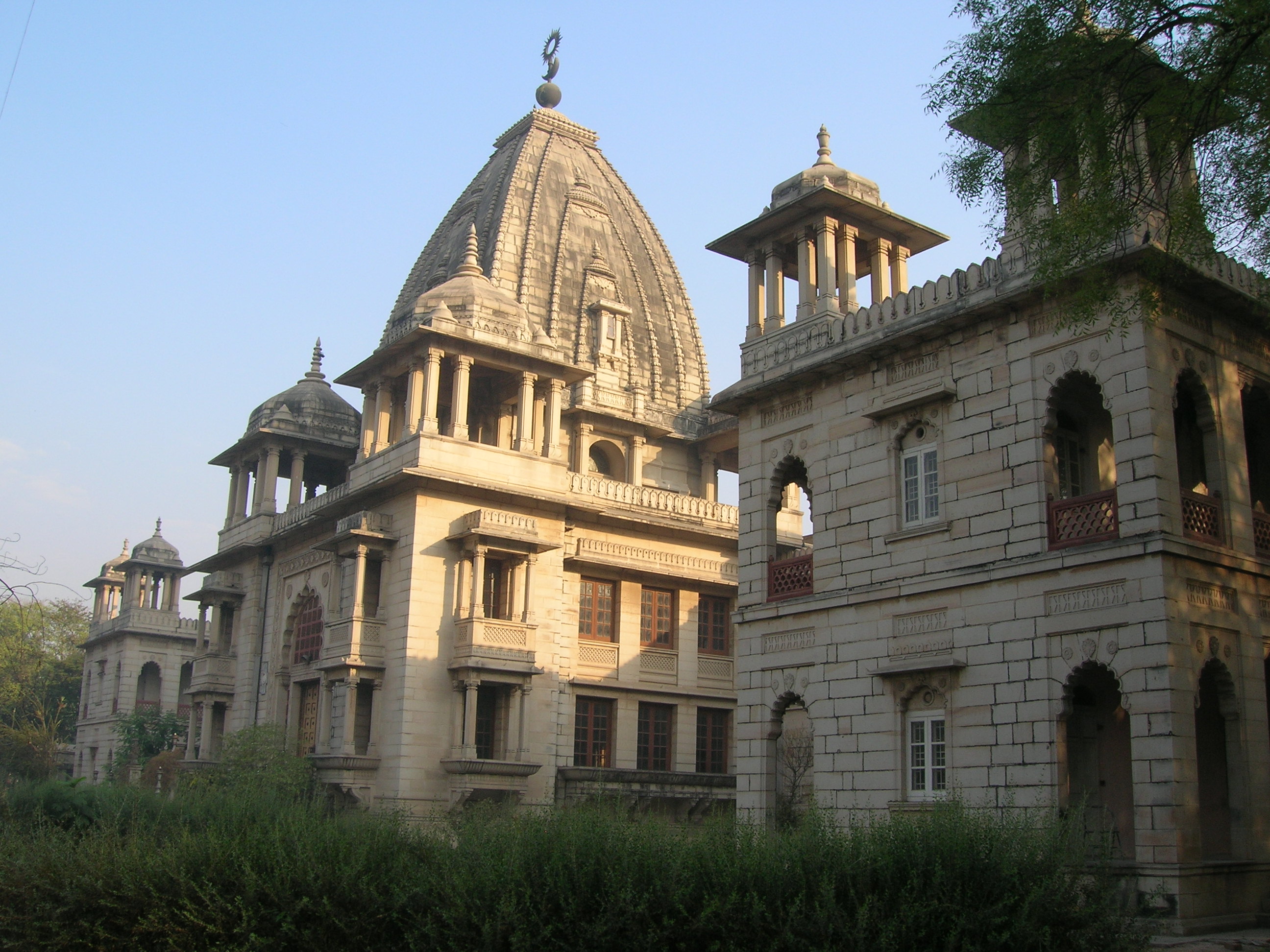
Eventually, Gopalrao was selected by the British Government as successor and was accordingly adopted by Maharani Jamnabai, on 27 May 1875. He was also given a new name, Sayajirao. On 16 June 1875, he ascended the throne as Sayajirao Gaekwad III, but being a minor, reigned under a Council of Regency until he came of age and was invested with full ruling powers on 28 December 1881. founding numerous institutions. During the hunting season in 1933, he was saved from lion by two boys of Dhari town, Arjan Koli and Hari Koli. After that both Koli brothers were respected in open court (Baroda state darbar) and their bronze statues were established in royal Sayaji Baug (Kamati Baug) by Sayajirao Gaekwad.[10]
20th century[edit | edit source]
Various important state institutions were founded in the early 20th century, including the Bank of Baroda on 20 July 1908. In 1908, Sayajirao also founded the Baroda Legislative Assembly (also known as the Baroda Dhara Sabha).[11]

By the beginning of the 20th century, the relations of the British with the four largest princely states—Hyderabad, Mysore, Jammu and Kashmir, and Baroda were managed by a British Resident under the direct authority the Governor-General of India.[12] In 1911, Baroda State spanned 3,239 km2 (1,251 sq mi), and the population was 2,032,798 persons as per the 1911 census of India.[13] The state was very wealthy. The Pittsburgh Press reported in 1927 that the diamond necklace, which contained the Star of the South diamond, was a part of a royal collection worth $10,000,000 at the time, housed in the Nazarbaug Palace (built 1721) in Baroda city; another important part of the collection was a cloth embroidered with precious stones and seed pearls, made to cover the tomb of Mohammed.[14][15] The Qatar National Museum now holds the Pearl Carpet of Baroda as one of its treasures.[16]
Dr. B.R.Ambedkar writes about his experience with untouchability in Baroda in the second chapter of his autobiographical book, Waiting for a Visa.[17]
In 1937, the princely states of the Baroda Residency were merged with those of the agencies adjacent to the northern part of the Bombay Presidency — Rewa Kantha Agency, Surat Agency, Nasik Agency, Kaira Agency and Thana Agency — in order to form the Baroda and Gujarat States Agency.[18] A few years before independence the process of the 'Attachment Scheme' began in order to integrate the smallest princely states, estates and thanas. Baroda State was one of the main beneficiaries of this measure by being able to add about 15,000 km2 and half a million inhabitants to the state. The merged states were Pethapur on 1 February 1940, the Katosan Thana, with Deloli, Kalsapura, Maguna, Memadpura, Rampura, Ranipura, Tejpura, Varsora, the Palaj Taluka and both Ijpura States between June and July 1940. These were followed on 10 July 1943 by the states of Ambliara, Ghorasar, Ilol, Katosan, Khadal, Patdi, Punadra, Ranasan, Wasoda and Wao[19] Also many small Talukas of the region were merged. On 24 July 1943 Sachodar State and a few small places that had no own jurisdiction were annexed. By December of the same year the small states of Bajana, Bhilka, Malpur, Mansa and Vadia met the same fate.[20]
Finally on 5 November 1944 the Baroda and Gujarat States Agency was merged with the Western India States Agency (WISA) to form the larger Baroda, Western India and Gujarat States Agency.
After the independence of India, which initially did not include Baroda or many other princely states, an interim government under Prime Minister Dr. Jivraj Narayan Mehta, son-in-law of Manubhai Mehta, then Dewan of Baroda state, was inaugurated in the State, on 4 September 1948, by the then Maharaja at a special Durbar in the Laxmi Vilas Palace, Baroda.[21] Finally on 1 May 1949, Baroda State, the third largest state at the time of British India, formally merged into the Dominion of India,[2][22] Initially, Baroda merged with the Bombay state, and then, on 1 May 1960, when the two new states of Gujarat and Maharashtra were formed, it became part of Gujarat, with Dr. Jivraj Narayan Mehta becoming the first Chief Minister of Gujarat.
Koli revolt[edit | edit source]

The Koli rebellion was led by two brothers Nathaji Patel and Yamaji Patel, chiefs of Chandap Taluq. During the great Indian Rebellion of 1857, the Kolis of Chandap under Nathaji and Yamaji planning for revolt and Gaekwad of Baroda received that news. So Gaekwad stationed his cavalry at Chandap to control the rebels. But cavalry of Gaekwad was killed and thrown out by Kolis of Chandap. After that Kolis went into Taranga hills and continued their rebellion for few months. In the end of October 1857, the combined forces of British, Idar State and Baroda attacked Kolis and burnt the Chandap village.[23]
In north-west Gujarat, around the southern tip of the Aravali, a number of Koli Talukdars revolted against the triumvirate of the British, Gaekwad and Raja of Idar. Together, these three forces burnt down two Koli villages towards the end of 1857. The Koli chieftains collected an army of 2000 Koli- and Bhil soldiers and attacked Gaekwadi villages near present day Gandhinagar. Adopting guerrilla tactics, they continued their resistance till the end of 1858. While Koli chiefs fought around the river Sabarmati. The Kolis paid a huge price for their resistance to British and Baroda. They were not only defeated in battle and punished for having dared to resist but, in the aftermath, kolis were marginalized by the rest of society as outlaws. Being arms-bearing community, they too were disarmed in early 1858 and also forced to practise agriculture.[24]
Baroda State Railway[edit | edit source]
The state owned the Gaekwar's Baroda State Railway (GBSR), which started in 1862 as the first narrow-gauge in India. It consisted of 8 miles (13 km) of narrow gauge track from Dabhoi to Miyagam.[25] The railway network extended to Goyagate, Chandod, Bodeli and Samalaya Jn with Dabhoi as its focal point. After independence in 1949 this railway merged with the Bombay, Baroda and Central India Railway. The lines are under conversion to broad gauge currently.[26]
[edit | edit source]
In late 18th century, the Baroda state established a Naval set up at Billimora, a port about 40 miles south of Surat, known as Bunder Billimora Suba Armor. Here a fleet of 50 vessels was stationed, which included mostly sails, cargo vessels for trading and military vessels to secure the sea from Portuguese, Dutch and French.[6]
When political alignments changed, after the Second Anglo-Maratha war, a joint expedition of British and Barodan state troops under Colonel Walker, then resident of Baroda, approached Kathiawad in 1808, and eventually obtained bonds from the chiefs of Okha-mandal and from the maritime states of Kathiawad renouncing piracy. Then in 1813, the Barodan government acquired the parganah of Kodinar (in present Junagadh district), where at port of Velan a small fleet of four frigates with 12-pounder guns on each for the protection of the trade between Bombay and Sindh was established. These four armed vessels were named Anandprasad, Sarsuba, Anamat Vart and Anne Maria, which was purchased from the Shah of Iran, and was known as 'Shah Kai Khusru' until then.[6]
Gaekwad Maharajas of Baroda[edit | edit source]


- Pilaji Rao Gaekwad (1721–1732)
- Damaji Rao Gaekwad (1732–1768)
- Sayaji Rao I Gaekwad (1768–1778)
- Fateh Singh Rao Gaekwad (1778–1789)
- Manaji Rao Gaekwad (1789–1793)
- Govind Rao Gaekwad (1793–1800)
- Anand Rao Gaekwad (1800–1818)
- Sayaji Rao Gaekwad II (1818–1847)
- Ganpat Rao Gaekwad (1847–1856)
- Khande Rao Gaekwad (1856–1870)
- Malhar Rao Gaekwad (1870–1875)
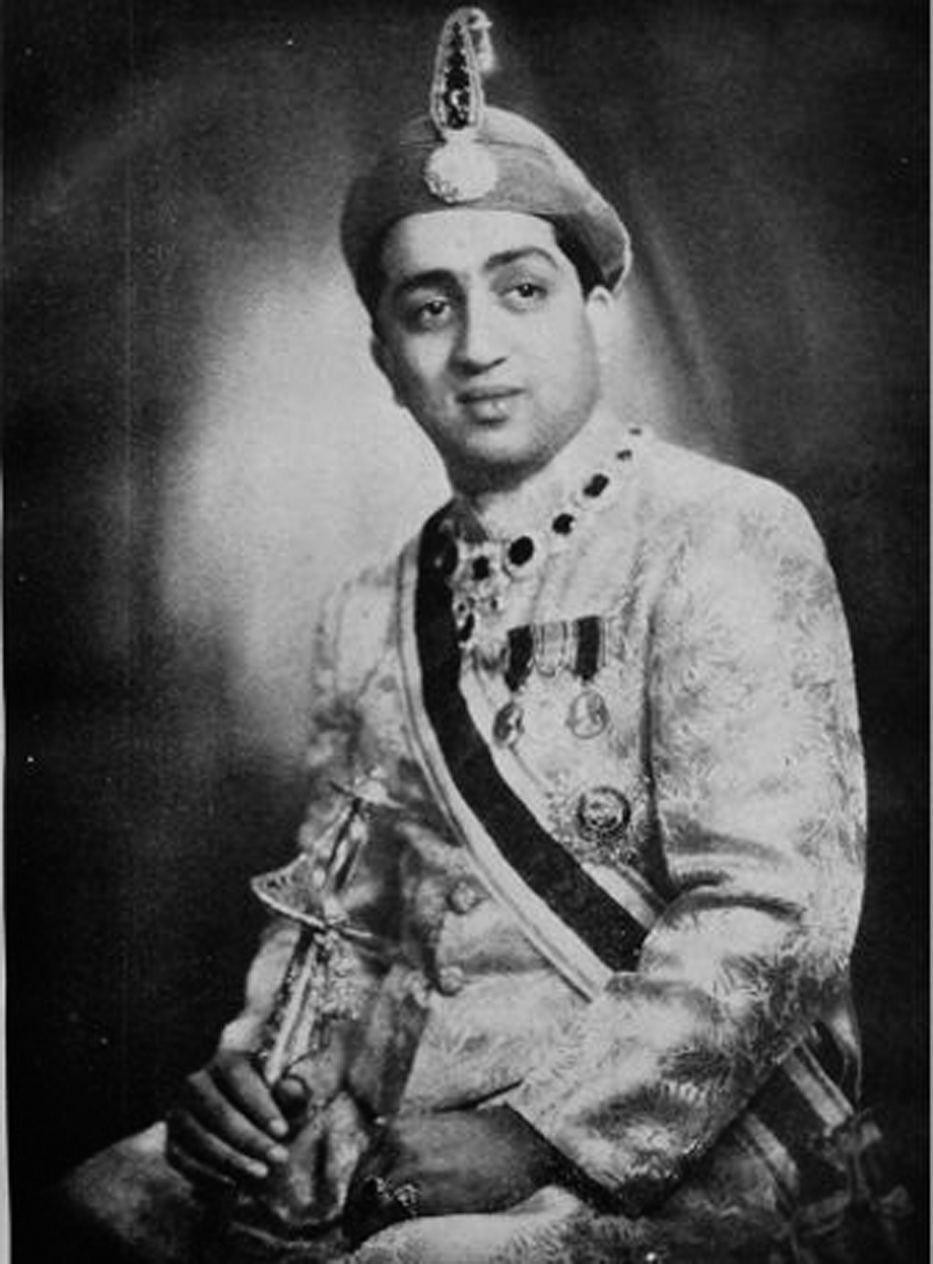
- Sayajirao Gaekwad III (1875–1939)
- Pratap Singh Rao Gaekwad (1939–1951); ruled from 1939 to 1947, serving as nominal ruler to his death in 1951
Titular Maharajas[edit | edit source]
- Fatehsinghrao Gaekwad II (1951–1988) titular Maharaj of Baroda until 1971 when All the royal titles in India were officially abolished in 1971 under the Twenty-sixth Amendment of the Constitution of India by Indira Gandhi's government.
Later heads of family[edit | edit source]
- Ranjitsinh Pratapsinh Gaekwad (1988–2012; pretender)
- Samarjitsinh Gaekwad (2012–present; pretender)
Present line of succession to the Baroda throne[edit | edit source]
 | This section does not cite any sources. (September 2021) |
The Gaekwad dynasty follows the standard of male primogeniture in matters of succession. The present line of succession is as follows:
- Shrimant Prince (Maharajkumar) Sangramsinhrao Gaekwad, the Heir Presumptive (6 August 1941–). Uncle of the present Maharaja.
- Shrimant Maharajkumar Pratapsinhrao Sangramsinhrao Gaekwad (26 August 1971–). Only son of Sangramsinhrao Gaekwad.
- Shrimant Rajkumar Sayajirao Khanderao Gaekwad (6 April 1947–). Great-grandson of Sayajirao Gaekwad III by the Maharaja's younger son Shivajirao (1890–1919) and through Shivajirao's son Khanderao (1916–1991). Has two daughters.
- Shrimant Rajkumar Anandrao Khanderao Gaekwar (1948–2024). Younger brother of Sayajirao Khanderao Gaekwad. Has two sons.
- Shrimant Shivajirao Anandrao Gaekwar (21 September 1983–). Elder son of Anandrao Khanderao Gaekwad.
- Shrimant Udaysinghrao Anandrao Gaekwar (4 December 1990–). Younger son of Anandrao Khanderao Gaekwad.
- Shrimant Kr Jeetendrasinh Gautamsinhrao Gaekwad (4 Nov 1960–), son of Late Professor Shrimant Gautamsinhrao Bhadrasinhrao Gaekwad (1936–2006). Great Grandnephew of Maharaja Sir Sayajirao III. Great Grandson of the Maharaja's late elder brother 'Senapati' Anandrao, Himmat Bahadur, CIE (1857–1917). Grandson of Anandrao's son 'Rajyakarya Dhurandhar' 'Dewan' 'Barrister' Bhadrasinhrao Anandrao Gaekwad, CIE (1896–1946).
- Shrimant Satyajitsinhrao Duleepsinhrao Gaekwad (3 March 1962–). Great-grandnephew of Sayajirao Gaekwad III through the Maharaja's elder brother Anandrao, Himmat Bahadur, CIE (1857–1917), through Anandrao's son Chandrasinhrao (born 1894–?) and through his grandson Duleepsinhrao (b. c. 1920–?)
- Shrimant Yudeepsinhrao Satyajitsinhrao Gaekwad (2001–). Son of Satyajitsinhrao.
Orders of chivalry[edit | edit source]
Template:Redirect-distinguish-text The Royal House of Baroda awards the Most Noble Order of the Rising Sun in three grades, classed as Udayaditya, Vikramaditya, and Arunaditya. This order of chivalry was established during the reign of Maharaja Sayajirao Gaekwad III.[27] Being made of gold, the breast star is arranged as follows:
Twenty four centrifugally arranged petal-shaped diamond studded strips alternating with shorter but similar strips, fanning out from two red enamelled, diamond-bordered circles, inscribed at the top Satyameva Jayate (Truth Shall Triumph). Within the inner circle a diamond encrusted Sirpech (pagri-shaped crown with royal pendant-shaped decoration rising upwards from the front of the crown) resting on a diamond encrusted sword below, which, on a strip of red enamel, the inscription in gold, Vadodara Raj (Baroda State)[27]
Diwans of Baroda[edit | edit source]
List of Diwans of Baroda:[28]
- Bhau Shinde – (17 November 1867 – 24 November 1869)
- Nimbaji Rao Dhole (acting) – (25 November 1869 – November 1870)
- Hariba Dada – (November 1870 – March 1871)
- Gopal Rav Mairal – (22 March 1871 – 1872)
- Balwant Rao Bhicaji Rahurakar – (1872–72) (4 months)
- Balvantrav Khanvelkar – (November 1872 – March 1873)
- Shivaji Rao Khanvelkar – (5 March 1873 – 4 August 1874)
- Dadabhai Naoroji – (4 August 1874 – 7 January 1875)
- Rajah Sir T. Madhava Rao – (16 May 1875 – 28 September 1882)
- Khan Bahadur Kazi Shahabuddin – (29 September 1882 – 31 July 1886)
- Diwan Bahadur Lakshman Jagannath Vaidya – (1 August 1886 – 30 May 1890)
- Diwan Bahadur Manibhai Jashbhai – (31 May 1890 – 21 November 1895)
- Diwan Bahadur S. Srinivasa Raghavaiyangar – (15 July 1895 – 2 July 1901)
- Diwan Bahadur R. V. Dhamnaskar – (3 October 1901 – 30 June 1904)
- Kersaspji Rustamji Dadachanji – (1 July 1904 – 28 February 1909)
- Romesh Chunder Dutt, I.C.S – (1 June 1909 – 30 November 1909)
- Rahim Suleman Theba, I.C.S – (1 December 1909 – 3 January 1912)
- Behari Lal Gupta, I.C.S – (4 January 1912 – 16 March 1914)
- V. P. Madhava Rao – (17 March 1914 – 7 May 1916)
- Manubhai Nandshankar Mehta – (8 May 1916 – 1927)
- V. T. Krishnamachari – (1927–1944)
- Bhadrasinh Anandrao Gaekwar – (1944–1945)
- Sir Brojendra Lal Mitter – (1945–1947)
- Sakharam Amrit Sudhalkar – (October 1947 – June 1948)
- Jivraj Narayan Mehta – (1 June 1948 – 1 May 1949)
Historiography[edit | edit source]
In 2007, Gujarat State Department of Archives started digitising 600,000 files, including Baroda state registers, prints, maps, abhinandan patra or maan patra (felicitation letters) offered to the erstwhile King by different provincial states and organisation, aagna patrika (gazette), huzur orders, and volumes of letters exchanged and agreements of the princely state with other provincial states and the British Raj, currently housed at the 'Southern Circle Record Office' at Vadodara, where a permanent exhibition had also been set up.[29]
 |
 |
 |
See also[edit | edit source]
- Political integration of India
- List of Maratha dynasties and states
- Maratha Empire
- Red Ensign
- Hyderabad State
Further reading[edit | edit source]
- Foote, Robert Bruce (1898). The geology of Baroda State. Addison.
- Mukerjea, Satyavrata. Baroda State. Government Printing, 1921.
- Gadre, A. S. (2007). Important Inscriptions from the Baroda State – (Volume 1). READ BOOKS. ISBN 978-1-4067-1136-3.
- Gupte, Balkrishna Atmaram (1922). Selections from the Historical records of the Hereditary minister of Baroda, consisting of letters from Bombay, Baroda, Poona and Satara governments. University of Calcutta.
- F. A. H. Elliot. The Rulers of Baroda. Baroda State Press 1934. ASIN B0006C35QS.
- Gense, James (1939). The Gaikwads of Baroda. D.B. Taraporevala Sons & Co 1942. ASIN B0007K1PL6.
- Kothekara, Santa. The Gaikwads of Baroda and the East India Company, 1770–1820. Nagpur University. ASIN B0006D2LAI.
- Gaekwad, Fatesinghrao * Biography of Maharaja Sayajirao III by Daji Nagesh Apte (1989). Sayajirao of Baroda: The Prince and the Man. Popular Prakashan. ISBN 978-0-86132-214-5.
- Gaekwar, Sayaji Rao. Speeches and addresses of Sayaji Rao III, Maharaja Gaekwar of Baroda. H. Milford 1933. ASIN B000855T0I.
- Rice, Stanley (1931). Life of Sayaji Rao III, Maharaja of Baroda. Oxford university press 1931. ASIN B00085DDFG.
- Clair, Edward (1911). A Year with the Gaekwar of Baroda. D. Estes & co 1911. ASIN B0008BLVV8.
- MacLeod, John (1999). Sovereignty, Power, Control: Politics in the State of Western India, 1916–1947. Brill Academic Publishers. ISBN 90-04-11343-6.
- Kamerkar, Mani. British Paramountcy: British-Baroda Relations, 1818-1848. Popular Prakashan. ASIN B000JLZE6A.
- Kooiman, Dick (2002). Communalism and Indian Princely States: Travancore, Baroda and Hyderabad in the 1930s. Manohar Pubns. ISBN 978-81-7304-421-2.
- Desai, Govindbhai. Forty Years in Baroda: Being Reminiscences of Forty Years' Service in the Baroda State. Pustakalaya Sahayak Sahakari Mandal 1929. ASIN B0006E18R4.
- Maharaja of Baroda (1980). The Palaces of India. Viking Pr. ISBN 978-0-00-211678-7.
- Doshi, Saryu (1995). The royal bequest: Art treasures of the Baroda Museum and Picture Gallery. India Book House. ISBN 978-81-7508-009-6.
- Moore, Lucy (2005). Maharanis; the extraordinary tale of four Indian queens and their journey from purdah to parliament. Viking Press. ISBN 0-670-03368-5.
Notes[edit | edit source]
- ↑ before abolition and dilusion in the Republic of India
References[edit | edit source]
- ↑ "Imperial Gazetteer of India, Volume 7, page 25". dsal.uchicago.edu. Digital South Asia Library. Retrieved 12 July 2020.
- ↑ 2.0 2.1 "Rulers Farewell Message". The Indian Express. 1 May 1949.
- ↑ Gazetteer, p. 25
- ↑ Gazetteer, p. 26
- ↑ Gazetteer, p. 31, 32
- ↑ 6.0 6.1 6.2 "280 years ago, Baroda had its own Navy". The Times of India. 27 September 2010. Archived from the original on 3 November 2012.
- ↑ Gazetteer, 32
- ↑ Mulhar Rao Gaekwar (1905). The great Baroda case: being a full report of the proceedings of the trial and deposition of His Highness Mulhar Rao Gaekwar of Baroda for instigating an attempt to poison the British Resident at his court. Great trial series. Calcutta: R. Cambray.
- ↑ "DEPOSITION OF THE GAEKWAR OF BARODA". The Times of India. 26 April 1875.
- ↑ "Know Your City: How Baroda's bronze statues will regain their black sheen in Rs 1.10 crore restoration project". The Indian Express. 18 February 2024. Retrieved 19 April 2024.
- ↑ Kalia, Ravi (2004). Gandhinagar: Building National Identity in Postcolonial India. University of South Carolina Press. p. 37. ISBN 9781570035449.
- ↑ Imperial Gazetteer of India vol. IV (1907), p. 92.
- ↑ Somerset Playne; R. V. Solomon; J. W. Bond; Arnold Wright (2006). "The State of Baroda". Indian states: a biographical, historical, and administrative survey (illustrated ed.). Asian Educational Services. p. 9. ISBN 978-81-206-1965-4.
- ↑ "Baroda City of Palace". The Pittsburgh Press. 14 August 1927.
- ↑ "Gaekwad's Star of the South diamond sold". The Times of India. 28 March 2007. Archived from the original on 22 October 2012.
- ↑ Fabrique. "Collection Highlight: The Baroda Carpet". Qatar Museums. Retrieved 6 October 2025.
- ↑ Ambedkar, Dr. Bhimrao (1991). Waiting for a Visa (PDF). Mumbai: Dept. of education, Government of Maharashtra. pp. 4071–4090. Retrieved 15 April 2015.
- ↑ History of the State of Gujarat
- ↑ which had been fourth class states in the Mahi Kantha Agency.
- ↑ McLeod, John; Sovereignty, power, control: politics in the States of Western India, 1916–1947; Leiden u.a. 1999; ISBN 90-04-11343-6; p. 160
- ↑ "Gaekwar Inaugurates Responsible Government". The Indian Express. 5 September 1948.
- ↑ "Kher's Appeal to people &Service for Cooperation". The Indian Express. 2 May 1949.
- ↑ Dharaiya, Ramanlal Kakalbhai (1970). Gujarat in 1857. New Delhi, India: Gujarat University. pp. 38–40–52.
- ↑ Yājñika, Acyuta; Sheth, Suchitra (2005). The Shaping of Modern Gujarat: Plurality, Hindutva, and Beyond. New Delhi, India: Penguin Books India. pp. 93–96. ISBN 978-0-14-400038-8.
- ↑ "Indian Railways Some Fascinating Facts: First Gauge Lines". Indian Army Official website.
{{cite web}}: Missing or empty|url=(help) - ↑ Dabhoi-Bodeli broad gauge section to become operational
- ↑ 27.0 27.1 McClenaghan, Tony (1996). Indian Princely Medals: A Record of the Orders, Decorations, and Medals of the Indian Princely States. Lancer Publishers. p. 55. ISBN 978-1-897829-19-6.
- ↑ R. V. Solomon; J. W. Bond (2006). Indian States: A Biographical, Historical, and Administrative Survey. Asian Educational Services. p. 24. ISBN 9788120619654.
- ↑ "Erstwhile Gaekwad state's archives being digitised". The Indian Express. 27 December 2007. Archived from the original on 10 October 2012.

Citations[edit | edit source]
- "Baroda State". Imperial Gazetteer of India, v. 7. Oxford at the Clarendon Press. 1908. pp. 25–84.
