



Ajay Kumar (talk | contribs) Created a new article Tag: nowiki added |
quick update |
||
| Line 1: | Line 1: | ||
{{ | {{Use Indian English|date=September 2016}} | ||
{{Use dmy dates|date=December 2019}} | {{Use dmy dates|date=December 2019}} | ||
{{Infobox bilateral relations| | {{Infobox bilateral relations|Afghanistan–India|Afghanistan|India|map=India Afghanistan Locator.svg|mission1=[[Embassy of Afghanistan, New Delhi]]<ref>{{cite web |title=Ashraf Ghani's men gone, Taliban asks India to allow its Diplomats in Afghan EmbassyAshraf Ghani's men gone, Taliban asks India to allow its Diplomats in Afghan Embassy |url=https://ummid.com/news/2023/october/01-10-2023/ashraf-ghanis-men-gone-taliban-asks-india-to-allow-its-diplomats-in-afghan-embassy.html |website=ummid |access-date=6 November 2023 |language=en |date=1 October 2023 |quote=The Taliban had appointed a charge d’affaires earlier this year to handle relations with India but he was physically prevented from even entering the Afghan Embassy}}</ref>|mission2=[[Embassy of India, Kabul]]<ref name="technical" />}} | ||
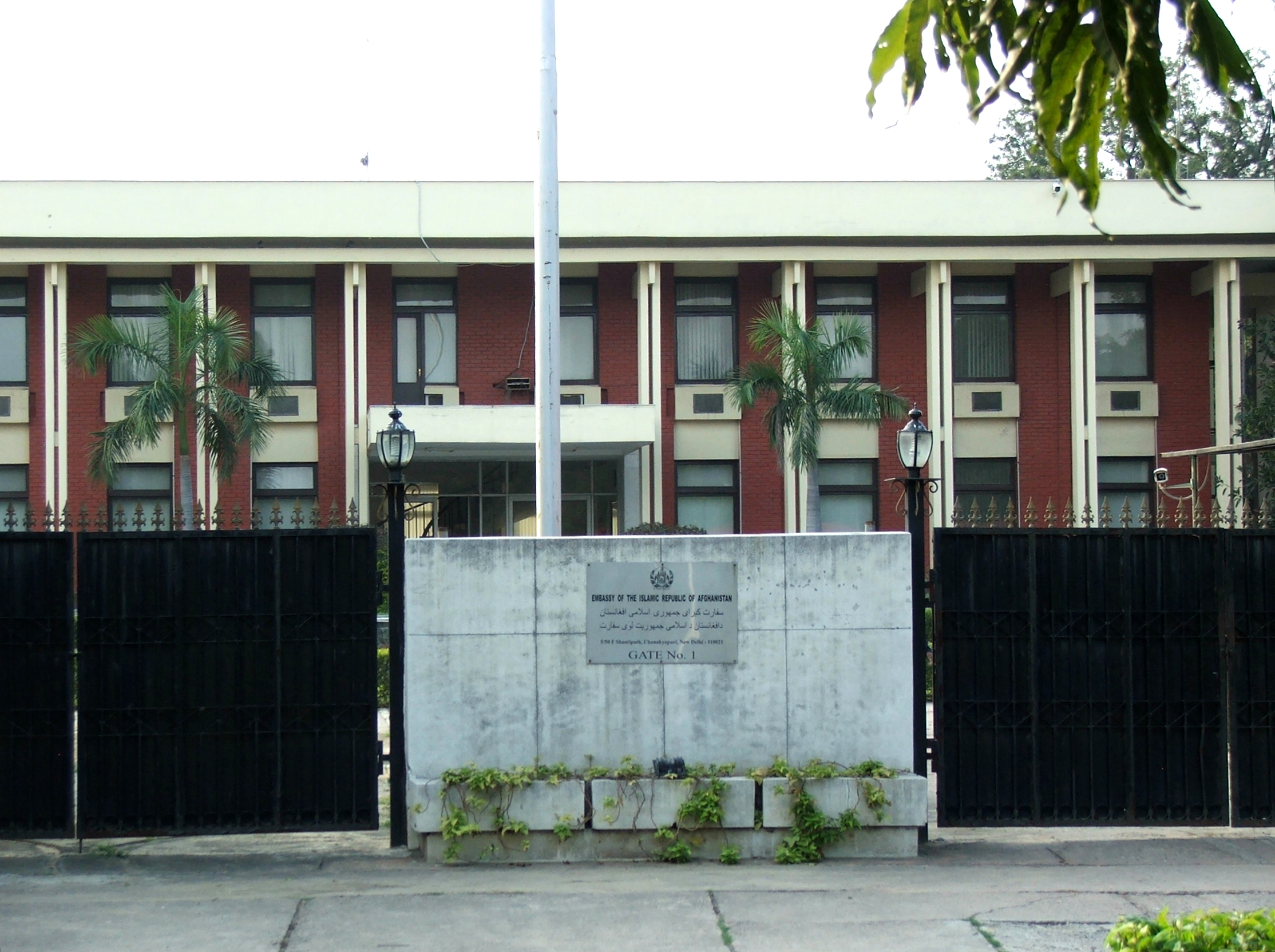
[[ | [[File:Afghan embassy Delhi 1069.JPG|thumb|Embassy of Afghanistan, [[New Delhi]], India]] | ||
[[File:Embassy of India, Kabul.jpg|thumb|Embassy of India, [[Kabul]], Afghanistan]] | |||
The [[Kingdom of Afghanistan]] and the [[Dominion of India|Union of India]] established bilateral relations in January 1950. India was the only [[South Asia]]n country to recognize the [[Soviet Union|Soviet]]-backed [[Democratic Republic of Afghanistan]],<ref name="RED">{{cite news |last=Crossette |first=Barbara |date=7 March 1989 |title=India to Provide Aid to Government in Afghanistan |url=https://www.nytimes.com/1989/03/07/world/india-to-provide-aid-to-government-in-afghanistan.html |access-date=3 June 2008 |work=The New York Times}}</ref> supporting it in the [[Soviet–Afghan War]] (1979–1989) against the [[Afghan mujahideen]]. India supported the [[Northern Alliance]] during the 1990s [[Afghan Civil War (1992–1996)|Afghan civil wars]] and was one of the main countries opposed to the Taliban's [[Islamic Emirate of Afghanistan (1996–2001)|Islamic Emirate government]]. Following the [[9/11 attacks]] in 2001, India aided [[Operation Enduring Freedom|overthrow of the Taliban]] and became the largest regional provider of aid to the [[Islamic Republic of Afghanistan]]. A major shift in India's position on the Taliban was reported by a top Qatar official in June 2021, revealing that an Indian delegation quietly visited Doha to meet the Taliban's leadership.<ref>{{Cite news |last=Mohan |first=Geeta |date=22 June 2021 |title=Indian officials had a 'quiet' rendezvous with Taliban, says Qatari special envoy |url=https://www.indiatoday.in/world/story/indian-officials-meet-taliban-qatari-special-envoy-talks-1817915-2021-06-22 |access-date=24 June 2021 |work=India Today}}</ref> This is a major shift that was several weeks in the making in the first half of 2021, and likely involved Qatari mediation between India and the Taliban.<ref>{{Cite news |last= |first= |date=22 June 2021 |title=Qatar Govt Official Says Indian Delegation Visited Qatar to Meet Taliban |url=https://thewire.in/diplomacy/qatar-govt-official-says-indian-delegation-visited-qatar-to-meet-taliban |access-date=24 June 2021 |work=The Wire India}}</ref> Although India does not recognize the [[Islamic Emirate of Afghanistan]], it maintains informal ties with the ruling Taliban.<ref>{{Cite web |date=2022-02-20 |title=How India is helping Afghanistan despite Taliban's non-recognition |url=https://www.hindustantimes.com/videos/news/how-india-is-helping-afghanistan-despite-taliban-s-recognition-medical-aid-sent-101645357143804.html |access-date=2022-02-26 |website=Hindustan Times |language=en}}</ref><ref name="IP">{{cite web |last=Tarzi |first=Amin |date=16 April 2006 |title=Kabul's India ties worry Pakistan |url=http://www.rferl.org/featuresarticle/2006/04/B5BFE0BE-ED5D-43DE-A768-99A6AB1E6C5C.html |url-status=live |archive-url=https://web.archive.org/web/20080611105916/http://www.rferl.org/featuresarticle/2006/04/b5bfe0be-ed5d-43de-a768-99a6ab1e6c5c.html |archive-date=11 June 2008 |access-date=3 June 2008 |publisher=[[Radio Free Europe]], [[Radio Liberty]]}}</ref><ref name="CFR">{{cite web |last=Bajoria |first=Jayshree |date=5 December 2007 |title=India's Northern Exposure |url=http://www.cfr.org/publication/14969/ |url-status=dead |archive-url=https://web.archive.org/web/20080530083317/http://www.cfr.org/publication/14969/ |archive-date=30 May 2008 |access-date=3 June 2008 |publisher=[[Council on Foreign Relations]]}}</ref> | |||
In April 2017 [[Shaida Mohammad Abdali]], Afghanistan's former ambassador to India, pointed out that India "is the biggest regional donor to Afghanistan and fifth largest donor globally with over $3 billion in assistance. India has built over 200 public and private schools, sponsors over 1,000 scholarships, and hosts over 16,000 Afghan students."<ref>{{Cite web|last=Talukdar|first=Sreemoy|date=2017-08-23|title=Donald Trump's Afghanistan policy presents India a chance to increase sphere of influence in South Asia|url=https://www.firstpost.com/world/donald-trumps-afghanistan-policy-presents-india-a-chance-to-increase-sphere-of-influence-in-south-asia-3965687.html|url-status=live|access-date=2021-08-16|website=Firstpost|archive-url=https://web.archive.org/web/20170824012916/http://www.firstpost.com/world/donald-trumps-afghanistan-policy-presents-india-a-chance-to-increase-sphere-of-influence-in-south-asia-3965687.html |archive-date=24 August 2017 }}</ref> Relations between Afghanistan and India received a major boost in 2011 with the signing of a [[Afghanistan–India Strategic Partnership Agreement|strategic partnership agreement]],<ref>{{Cite news|date=2011-10-04|title=Afghanistan and India sign 'strategic partnership'|language=en-GB|work=BBC News|url=https://www.bbc.com/news/world-south-asia-15161776|access-date=2021-08-16}}</ref><ref name="The World Reporter">{{cite web|last=Shrivastava|first=Sanskar|date=30 March 2013|title=India, Russia and China in Race to Expand Influence Over Afghanistan; Preventing Re-Talibanization After 2014|url=http://www.theworldreporter.com/2013/03/india-russia-china-expanding-influence-in-afghanistan.html|url-status=live|access-date=30 March 2013|publisher=The World Reporter|archive-url=https://web.archive.org/web/20130401231519/http://www.theworldreporter.com:80/2013/03/india-russia-china-expanding-influence-in-afghanistan.html |archive-date=1 April 2013 }}</ref> Afghanistan's first since the [[Soviet–Afghan War|Soviet-Afghan War]].<ref>{{Cite news|last=Haidar|first=Suhasini|date=2015-08-29|title=India rebuffs Afghanistan on strategic meet|language=en-IN|work=The Hindu|url=https://www.thehindu.com/news/national/india-rebuffs-afghanistan-on-strategic-meet/article7592059.ece|access-date=2021-08-16|issn=0971-751X|quote=India was the first country Afghanistan chose to sign a strategic partnership agreement...}}</ref> The student visas were revoked in large numbers after the Taliban takeover of Afghanistan.<ref>{{Cite web |last=Khan |first=Asad Ullah |date=2022-11-22 |title=India's Efforts in Search of New Role in Afghanistan |url=https://moderndiplomacy.eu/2022/11/22/indias-efforts-in-search-of-new-role-in-afghanistan/ |access-date=2022-12-22 |website=Modern Diplomacy |language=en-US}}</ref> | |||
In June 2022, India sent a "technical team" to its embassy building in Kabul.<ref name="technical">{{cite news |date=24 June 2022 |url=https://theprint.in/diplomacy/india-reopens-embassy-in-kabul-sends-technical-team-with-relief-material-for-afghanistan/1009400/?amp |website=ThePrint.in |title=India reopens embassy in Kabul, sends 'technical team' with relief material for Afghanistan}}</ref><ref>[https://www.thehindu.com/news/national/india-reopens-embassy-in-kabul/article65558557.ece India reopens Embassy in Kabul]</ref> In November 2023, pro-Republican diplomats of Afghanistan left India and declared permanent closure of the embassy by lack of support. Later, under the combined leadership of consul general Zakia Wardak and acting consul general Syed Muhammad Ibrahimkhel, the embassy was reopened. Currently, Syed Muhammad Ibrahimkhel is the chargé d'affaires of the embassy.<ref>{{Cite web |title=Afghanistan closes embassy in India citing lack of diplomatic support |url=https://www.aljazeera.com/news/2023/10/1/afghanistan-embassy-closes-in-india-citing-lack-of-diplomatic-support |access-date=2023-10-10 |website=www.aljazeera.com |language=en}}</ref> Both countries have shared cultural ties through [[Bollywood]] and [[cricket]].<ref>{{Cite web |last1= |first1= |date=22 November 2019 |title=Bollywood, cricket two real stars of Afghanistan's relationship with India: Envoy |url=https://timesofindia.indiatimes.com/world/south-asia/bollywood-cricket-two-real-stars-of-afghanistans-relationship-with-india-envoy/articleshow/72177432.cms |url-status=live |archive-url=https://web.archive.org/web/20200427125841/https://timesofindia.indiatimes.com/world/south-asia/bollywood-cricket-two-real-stars-of-afghanistans-relationship-with-india-envoy/articleshow/72177432.cms |archive-date=27 April 2020 |access-date=2020-10-15 |website=The Times of India |language=en}}</ref> | |||
==History== | ==History== | ||
{{Further|History of India|History of Afghanistan}} | {{Further|History of India|History of Afghanistan}} | ||
[[File:AsokaKandahar.jpg|thumb|right|An [[Edicts of Ashoka|Edict of Ashoka]] from [[Kandahar]], now in the Kabul museum.]] | [[File:AsokaKandahar.jpg|thumb|right|An [[Edicts of Ashoka|Edict of Ashoka]] from [[Kandahar]], now in the Kabul museum.]] | ||
Relations between the people of Afghanistan and India trace to the [[Indus Valley civilization]].<ref name="Dupree3">[[Nancy Hatch Dupree|Nancy Dupree]] (1973): An Historical Guide To Afghanistan, Chapter 3 Sites in Perspective.</ref> In the [[Vedic Age]], [[Gandhara]], which forms part of modern-day Pakistan and Afghanistan, was considered one of the sixteen [[Mahajanapadas]] of Vedic India. Following [[Alexander the Great]]'s brief occupation, the successor state of the [[Seleucid Empire]] controlled the region known today as Afghanistan. In 305 BCE, they ceded some regions to the Indian [[Maurya Empire]] as part of an | Relations between the people of Afghanistan and India trace to the [[Indus Valley civilization]].<ref name="Dupree3">[[Nancy Hatch Dupree|Nancy Dupree]] (1973): An Historical Guide To Afghanistan, Chapter 3 Sites in Perspective.</ref> In the [[Vedic Age]], [[Gandhara]], which forms part of modern-day Pakistan and Afghanistan, was considered one of the sixteen [[Mahajanapadas]] of Vedic India. Following [[Alexander the Great]]'s brief occupation, the successor state of the [[Seleucid Empire]] controlled the region known today as Afghanistan. In 305 BCE, they ceded some regions to the Indian [[Maurya Empire]] as part of an Alliance Treaty after losing to the superior Indian forces.{{Blockquote|''Alexander took these away from the [[Aryan]]s and established settlements of his own, but [[Seleucus I Nicator|Seleucus Nicator]] gave them to [[Chandragupta Maurya|Sandrocottus]] ([[Chandragupta Maurya|Chandragupta]]), upon terms of intermarriage and of receiving in exchange 500 elephants.''<ref name=Dupree-name>{{cite web|url=http://www.aisk.org/aisk/NHDAHGTK05.php |title=An Historical Guide to Kabul – The Name |author=Nancy Hatch Dupree / Aḥmad ʻAlī Kuhzād |publisher=American International School of Kabul |year=1972 |access-date=18 September 2010 |archive-url=https://web.archive.org/web/20100830031416/http://www.aisk.org/aisk/NHDAHGTK05.php |archive-date=30 August 2010 |url-status=dead }}</ref>|[[Strabo]]|64 BCE – 24 CE}} The war elephants, of course, being a minor contribution compared to the land that the Indians successfully regained.The Mauryans controlled parts of modern-day Afghanistan, and during this period [[Hinduism in Afghanistan|Hinduism]] and [[Buddhism]] prevailed. Their decline began 60 years after [[Ashoka the Great]]'s rule ended, leading to the [[Hellenistic civilisation|Hellenistic]] reconquest of the region by the [[Greco-Bactrians]]. Much of it soon broke away from the Greco-Bactrians and became part of the [[Indo-Greeks|Indo-Greek Kingdom]]. The Indo-Greeks had been defeated and expelled by the [[Indo-Scythians]] in the late 2nd century BCE.<ref>{{cite web|last=Rajadhyaksha |first=Abhijit |url=http://www.historyfiles.co.uk/FeaturesFarEast/India_IronAge_Mauryas01.htm |title=The Mauryas: Chandragupta |publisher=Historyfiles.co.uk |date=2 August 2009 |access-date=9 March 2012}}</ref> Till the Muslim conquests, eastern regions of Afghanistan including the [[Kabul Valley]] and [[Zabulistan]] were considered culturally part of [[Indian subcontinent]],<ref>{{Cite book |last=Bosworth |first=Clifford Edmund |url=https://books.google.com/books?id=Z8YmAQAAMAAJ&q=The+Ghaznavids,+their+empire+in+Afghanistan+and+Eastern+Iran+994%E2%80%931040, |title=The Ghaznavids: Their Empire in Afghanistan and Eastern Iran, 994 : 1040 |date=1973 |publisher=Munshiram Manoharlal |isbn=978-1-01-499132-4 |pages=43 |language=en}}</ref><ref>{{Cite book |last=Wink |first=André |url=https://books.google.com/books?id=g2m7_R5P2oAC&q=Al-Hind:+Early+medieval+India+and+the+expansion+of+Islam,+7th-11th+centuries+By+Andr%C3%A9+Wink+%C2%B7+2002 |title=Al-Hind, the Making of the Indo-Islamic World: Early Medieval India and the Expansion of Islam 7Th-11th Centuries |date=2002 |publisher=BRILL |isbn=978-0-391-04173-8 |pages=114 |language=en}}</ref> and the town of Kabul was noted by Iranian traveller and geographer [[Istakhri]] in 921 to be inhabited by the ''people of Hind''.<ref name="Elliot-3">{{cite web|url=http://persian.packhum.org/persian/pf?file=80201012&ct=100|title=A.—The Hindu Kings of Kábul (p.3)|work=Sir H. M. Elliot|publisher=[[Packard Humanities Institute]]|location=London|date=1867–1877|access-date=2010-09-18|archive-url=https://web.archive.org/web/20130726133107/http://persian.packhum.org/persian/pf?file=80201012&ct=100|archive-date=2013-07-26|url-status=dead}}</ref> Between the 10th century and the mid 18th century, northern India was invaded by a number of invaders based in what today is Afghanistan. Among them were the [[Ghaznavids]], [[Ghurids]], [[Khalji dynasty|Khaljis]], [[Mughals]] and [[Durrani Empire|Durranis]]. During these eras, especially during the Mughal period (1526–1858), many Afghans began immigrating to India due to political unrest in their regions.<ref name=":0" /> [[File:Border between British India and Afghanistan in 1934.jpg|thumb|Border crossing between the [[British India]] and Afghanistan in 1934]] | ||
With the [[Partition of India|partition of British India]] to create Pakistan the demand for, [[Pashtunistan]], a Pashtun nation-state carved out of Pakistan by successive Pashtun-led Afghan governments was received with support from the Indian government through the backing of militant tribesman, though the movement subsequently lost support.<ref>{{Cite web |title=The Making of the Durand Line, Irredentism and the Rise of the Taliban |url=https://www.efsas.org/publications/study-papers/the-making-of-the-durand-line/ |access-date=2023-03-04 |website=www.efsas.org |language=en}}</ref><ref>{{cite journal |last1=Saikal |first1=Amin |title=Afghanistan and Pakistan: The Question of Pashtun Nationalism? |journal=Journal of Muslim Minority Affairs |volume=30 |issue=1 |url=https://www.academia.edu/10226329 |quote=After the creation of Pakistan, successive Pashtun-led Afghan government backed Ghaffar Khan's demand for a Pashtunistan carved out of the territory of Pakistan, but without any success.}}</ref> Elisabeth Leake, an | With the [[Partition of India|partition of British India]] to create Pakistan the demand for, [[Pashtunistan]], a Pashtun nation-state carved out of Pakistan by successive Pashtun-led Afghan governments was received with support from the Indian government through the backing of militant tribesman, though the movement subsequently lost support.<ref>{{Cite web |title=The Making of the Durand Line, Irredentism and the Rise of the Taliban |url=https://www.efsas.org/publications/study-papers/the-making-of-the-durand-line/ |access-date=2023-03-04 |website=www.efsas.org |language=en}}</ref><ref>{{cite journal |last1=Saikal |first1=Amin |title=Afghanistan and Pakistan: The Question of Pashtun Nationalism? |journal=Journal of Muslim Minority Affairs |date=2010 |volume=30 |issue=1 |pages=5–17 |doi=10.1080/13602001003650572 |url=https://www.academia.edu/10226329 |quote=After the creation of Pakistan, successive Pashtun-led Afghan government backed Ghaffar Khan's demand for a Pashtunistan carved out of the territory of Pakistan, but without any success.}}</ref> Elisabeth Leake, an associate professor of International History at the University of Leeds writes: "Evidently, senior Indian officials supported the demand for Pashtunistan and Afghan aid to militant tribesmen. Considering the historic ties between [[Indian National Congress|Congress]] leaders and the [[Khudai Khidmatgar]]s, India's support for tribal autonomy was hardly surprising; in many ways, tribal leaders were echoing the demands [[Abdul Ghaffar Khan|Ghaffar Khan]] had made in preceding years."<ref name="Leake20172">{{cite book |author=Elisabeth Leake |url=https://books.google.com/books?id=EUulDQAAQBAJ&pg=PA140 |title=The Defiant Border: The Afghan-Pakistan Borderlands in the Era of Decolonization, 1936–65 |date=2017 |publisher=[[Cambridge University Press]] |isbn=978-1-107-12602-2 |pages=140– |quote=Evidently, senior Indian officials supported the demand for Pashtunistan and Afghan aid to militant tribesmen. Considering the historic ties between Congress leaders and the [[Khudai Khidmatgar]]s, India's support for tribal autonomy was hardly surprising; in many ways, tribal leaders were echoing the demands Ghaffar Khan had made in preceding years. The incarceration of Ghaffar Khan, a close friend of India's Congress leaders, likely undermined Pakistan's position from the Indian perspective as well.}}</ref> | ||
Indians are working on various construction projects, as part of [[India]]'s rebuilding efforts in Afghanistan, although the Indian intelligence agency [[Research and Analysis Wing|RAW]] is accused by countries such as [[Pakistan]] of working to malign [[Pakistan]] and train & support insurgents.<ref name="outlookindia.com">{{cite web |last=Baabar |first=Mariana |date=24 April 2006 |title=RAW Is Training 600 Balochis in Afghanistan |url=http://www.outlookindia.com/article.aspx?231032 |url-status=live |archive-url=https://web.archive.org/web/20101029161341/http://outlookindia.com/article.aspx?231032 |archive-date=29 October 2010 |access-date=9 March 2012 |publisher=Outlook India}}</ref><ref name="pak-times.com">{{cite web |last=Azam |first=Omer |date=25 September 2010 |title=RAW Creating Trouble for NATO in Afghanistan |url=http://www.pak-times.com/2008/09/05/raw-creating-trouble-for-nato-in-afghanistan/ |url-status=dead |archive-url=https://web.archive.org/web/20120430194436/http://www.pak-times.com/2008/09/05/raw-creating-trouble-for-nato-in-afghanistan/ |archive-date=30 April 2012 |access-date=9 March 2012 |website=Pakistan Times |publisher=Pak-times.com}}</ref><ref name="rediff.com">{{cite web |date=31 December 2004 |title=RAW helping militants in Afghanistan: Musharraf |url=http://www.rediff.com/news/2009/mar/08raw-helping-militants-in-afghanistan-says-musharraf.htm |access-date=9 March 2012 |work=Rediff.com}}</ref> These workers are estimated to be anywhere between 3,000 and 4,000. [[Indian people|Indian nationals]] stationed in [[Afghanistan]] have often faced continuous security threats in the country, with [[kidnappings]] and many attacks (such as the [[February 2010 Kabul attack]]) deliberately carried out on them. | Indians are working on various construction projects, as part of [[India]]'s rebuilding efforts in Afghanistan, although the Indian intelligence agency [[Research and Analysis Wing|RAW]] is accused by countries such as [[Pakistan]] of working to malign [[Pakistan]] and train & support insurgents.<ref name="outlookindia.com">{{cite web |last=Baabar |first=Mariana |date=24 April 2006 |title=RAW Is Training 600 Balochis in Afghanistan |url=http://www.outlookindia.com/article.aspx?231032 |url-status=live |archive-url=https://web.archive.org/web/20101029161341/http://outlookindia.com/article.aspx?231032 |archive-date=29 October 2010 |access-date=9 March 2012 |publisher=Outlook India}}</ref><ref name="pak-times.com">{{cite web |last=Azam |first=Omer |date=25 September 2010 |title=RAW Creating Trouble for NATO in Afghanistan |url=http://www.pak-times.com/2008/09/05/raw-creating-trouble-for-nato-in-afghanistan/ |url-status=dead |archive-url=https://web.archive.org/web/20120430194436/http://www.pak-times.com/2008/09/05/raw-creating-trouble-for-nato-in-afghanistan/ |archive-date=30 April 2012 |access-date=9 March 2012 |website=Pakistan Times |publisher=Pak-times.com}}</ref><ref name="rediff.com">{{cite web |date=31 December 2004 |title=RAW helping militants in Afghanistan: Musharraf |url=http://www.rediff.com/news/2009/mar/08raw-helping-militants-in-afghanistan-says-musharraf.htm |access-date=9 March 2012 |work=Rediff.com}}</ref> These workers are estimated to be anywhere between 3,000 and 4,000. [[Indian people|Indian nationals]] stationed in [[Afghanistan]] have often faced continuous security threats in the country, with [[kidnappings]] and many attacks (such as the [[February 2010 Kabul attack]]) deliberately carried out on them. | ||
| Line 25: | Line 21: | ||
In January 1950, a five-year Treaty of Friendship was signed between the two countries in [[New Delhi]]. Other than affirming "everlasting peace and friendship between the two Governments", the treaty provided for the establishment of diplomatic and consular posts in each other's territories.<ref>{{cite web|title=Treaty of Friendship|url=http://mea.gov.in/bilateral-documents.htm?dtl/6584/Treaty+of+Friendship|website=Ministry of External Affairs, India|publisher=mea.gov.in|access-date=9 February 2018|archive-url=https://web.archive.org/web/20180209091933/http://mea.gov.in/bilateral-documents.htm?dtl%2F6584%2FTreaty+of+Friendship|archive-date=9 February 2018|url-status=live}}</ref><ref>{{cite news|title=Indi-Afghan Friendship Treaty Signed|url=https://news.google.com/newspapers?id=Bsc-AAAAIBAJ&pg=4872%2C477830|access-date=9 February 2018|work=The Indian Express|date=5 January 1950|page=6}}</ref> | In January 1950, a five-year Treaty of Friendship was signed between the two countries in [[New Delhi]]. Other than affirming "everlasting peace and friendship between the two Governments", the treaty provided for the establishment of diplomatic and consular posts in each other's territories.<ref>{{cite web|title=Treaty of Friendship|url=http://mea.gov.in/bilateral-documents.htm?dtl/6584/Treaty+of+Friendship|website=Ministry of External Affairs, India|publisher=mea.gov.in|access-date=9 February 2018|archive-url=https://web.archive.org/web/20180209091933/http://mea.gov.in/bilateral-documents.htm?dtl%2F6584%2FTreaty+of+Friendship|archive-date=9 February 2018|url-status=live}}</ref><ref>{{cite news|title=Indi-Afghan Friendship Treaty Signed|url=https://news.google.com/newspapers?id=Bsc-AAAAIBAJ&pg=4872%2C477830|access-date=9 February 2018|work=The Indian Express|date=5 January 1950|page=6}}</ref> | ||
India recognized the new [[Republic of Afghanistan (1973—1978)|Republic of Afghanistan]] on July | India recognized the new [[Republic of Afghanistan (1973—1978)|Republic of Afghanistan]] on 19 July 1973. Indian foreign minister [[Swaran Singh]] visited [[President of Afghanistan|Afghan President]] [[Mohammed Daoud Khan]] in October that year, and Khan visited India in March 1975. On 7 July 1974, the two countries signed a trade protocol.<ref name=":0">{{Cite book|last=Adamec|first=Ludwig W.|url=https://books.google.com/books?id=AAHna6aqtX4C&pg=PR49|title=Historical Dictionary of Afghanistan|date=2012|publisher=Scarecrow Press|isbn=978-0-8108-7815-0|language=en}}</ref> | ||
===Soviet invasion | ===Soviet invasion=== | ||
{{Further|Soviet–Afghan War|Islamic Emirate of Afghanistan}} | {{Further|Soviet–Afghan War|Islamic Emirate of Afghanistan}} | ||
India was the only South Asian nation to recognise the [[Soviet Union|Soviet]]-backed communist [[Democratic Republic of Afghanistan]]<ref name="The World Reporter" /> and the [[Soviet–Afghan War|Soviet Union's invasion of Afghanistan]], and provided [[humanitarian aid]] to president [[Mohammad Najibullah|Mohammad Najibullah's]] Government in Afghanistan.<ref name="RED" /> The Soviets [[Soviet withdrawal from Afghanistan|withdrew from Afghanistan]] in 1989 after being defeated by the [[Afghan mujahideen]], which were heavily supported by [[Pakistan]]. It has been said that "the failure of the Indian government to publicly condemn the invasion, its support of the Soviet puppet regime of Kabul, and its hostile vision of the resistance have created major stumbling blocks in Afghan-Indian relations."<ref>Valenta and Cibulka (editors), ''Gorbachev's New Thinking and Third World Conflicts'', p. 146</ref> India continued to support [[Mohammad Najibullah|Najibullah]]'s government. After its fall in the ensuing [[Afghan Civil War (1989–1992)|civil war]], India | India was the only South Asian nation to recognise the [[Soviet Union|Soviet]]-backed communist [[Democratic Republic of Afghanistan]]<ref name="The World Reporter" /> and the [[Soviet–Afghan War|Soviet Union's invasion of Afghanistan]], and provided [[humanitarian aid]] to president [[Mohammad Najibullah|Mohammad Najibullah's]] Government in Afghanistan.<ref name="RED" /> The Soviets [[Soviet withdrawal from Afghanistan|withdrew from Afghanistan]] in 1989 after being defeated by the [[Afghan mujahideen]], which were heavily supported by [[Pakistan]]. It has been said that "the failure of the Indian government to publicly condemn the invasion, its support of the Soviet puppet regime of Kabul, and its hostile vision of the resistance have created major stumbling blocks in Afghan-Indian relations."<ref>Valenta and Cibulka (editors), ''Gorbachev's New Thinking and Third World Conflicts'', p. 146</ref> India continued to support [[Mohammad Najibullah|Najibullah]]'s government. | ||
=== First Taliban government === | |||
After its fall in the ensuing [[Afghan Civil War (1989–1992)|civil war]], India along with the international community supported the [[coalition]] government that took control, but relations and contacts ended with the outbreak of another [[Afghan Civil War (1992–1996)|civil war]], which brought to power the [[Taliban]], an [[Islamist]] [[militia]], supported by [[Pakistan]].<ref name="CFRN">{{cite web |title=Afghanistan's Troubled Border |url=http://www.newsweek.com/id/73137/page/2 |archive-url=https://web.archive.org/web/20081010132807/http://www.newsweek.com:80/id/73137/page/2 |archive-date=10 October 2008 |access-date=3 June 2008 |work=Newsweek}}</ref> The Taliban's government, called the [[Islamic Emirate of Afghanistan (1996–2001)|Islamic Emirate of Afghanistan]], remained recognized only by [[Pakistan]], [[Saudi Arabia]], and the [[United Arab Emirates]] (UAE). The destruction of the [[Buddhas of Bamiyan]] monuments by the [[Taliban]] led to outrage and angry protests by [[India]].<ref>{{Cite web |date=26 April 2001 |title=Q. 4466 - India's move on the demolition of Buddha statues in Afghanistan. |url=https://mea.gov.in/rajya-sabha.htm?dtl/9781/Q+4466++Indias+move+on+demolition+of+Buddha+statues+in+Afghanistan |access-date=2022-02-26 |website=mea.gov.in |publisher=Ministry of External Affairs, Government of India}}</ref><ref>{{Cite web |date=2001-03-04 |title=Islamic scholars condemn destruction of Buddha statues |url=https://zeenews.india.com/news/nation/islamic-scholars-condemn-destruction-of-buddha-statues_9417.html |access-date=2022-02-26 |website=Zee News |language=en}}</ref> Likewise, in 1998 following Pakistan's atomic bomb tests, Taliban supreme leader [[Mullah Omar]]'s statement that "An attack on Pakistan would be seen as an attack on Afghanistan" sparked anger in India.<ref>{{Cite web |title=جاگتے رہو… وشواس گھاتک!!! |url=https://jang.com.pk/news/1522891 |access-date=2025-12-29 |website=[[Daily Jang]] |language=ur}}</ref> | |||
India became one of the key supporters of the anti-Taliban [[United Islamic Front for the Salvation of Afghanistan|Northern Alliance]].<ref name="J">{{cite web|url=http://www.janes.com/security/international_security/news/jir/jir010315_1_n.shtml |title=India joins anti-Taliban coalition |access-date=3 June 2008 |publisher=Jane's Security News |archive-url=https://web.archive.org/web/20080226012915/http://www.janes.com/security/international_security/news/jir/jir010315_1_n.shtml |archive-date=26 February 2008 |url-status=live }}</ref> | The Taliban's move in 2001 to require [[Hinduism in Afghanistan|Afghan Hindus]] to wear identification patches, reminiscent of [[Nazi]] [[Yellow badge|policies]], was heavily criticised by India.<ref>{{Cite news |last=Shah |first=Amir |date=24 May 2001 |title=Taliban Slams Hindu Denouncements |url=https://www.washingtonpost.com/wp-srv/aponline/20010524/aponline153713_000.htm |url-status=dead |archive-url=https://web.archive.org/web/20200604123112/https://www.washingtonpost.com/wp-srv/aponline/20010524/aponline153713_000.htm |archive-date=2020-06-04 |access-date=2020-10-15 |newspaper=Washington Post}}</ref> In 1999, the [[Aircraft hijacking|hijacked]] [[Indian Airlines Flight 814]] landed and stayed in [[Kandahar]] in [[Afghanistan]] and the [[Taliban]] were suspected of supporting them.<ref name="RED" /> India became one of the key supporters of the anti-Taliban [[United Islamic Front for the Salvation of Afghanistan|Northern Alliance]].<ref name="J">{{cite web|url=http://www.janes.com/security/international_security/news/jir/jir010315_1_n.shtml |title=India joins anti-Taliban coalition |access-date=3 June 2008 |publisher=Jane's Security News |archive-url=https://web.archive.org/web/20080226012915/http://www.janes.com/security/international_security/news/jir/jir010315_1_n.shtml |archive-date=26 February 2008 |url-status=live }}</ref> | ||
=== | ===War in Afghanistan (2001-2021)=== | ||
During the [[United States invasion of Afghanistan|U.S.-led invasion of Afghanistan]] in 2001, India | During the [[United States invasion of Afghanistan|U.S.-led invasion of Afghanistan]] in 2001, India did not participate in the coalition forces bases for the [[War in Afghanistan (2001–present)|War in Afghanistan]]. After the overthrow of the Taliban, India established diplomatic relations with the newly established democratic government, provided aid, and participated in the reconstruction efforts.<ref name="CFR" /> India has provided $650–750 million in humanitarian and economic aid, making it the largest regional provider of aid for Afghanistan.<ref name="IP" /><ref name="CFR" /> India's support and collaboration extends to the rebuilding of air links, power plants and investing in health and education sectors as well as helping to train Afghan civil servants, diplomats, and police. India also seeks the development of supply lines for electricity, oil, and natural gas. Also to give Afghan students scholarships.<ref name="CFR" /> | ||
The [[Indian Army]]'s [[Border Roads Organisation]] constructed a major road in 2009 in the remote Afghan province of [[Nimroz]], connecting [[Delaram]] to [[Zaranj]]. This has proved a viable alternative route for the duty-free movement of goods through the [[Chabahar]] port in [[Iran]] to [[Afghanistan]].<ref name="IP" /><ref name="CFR" /><ref name="BennettFund2005">{{cite book |author1=Bennett |first=Adam |url=https://books.google.com/books?id=Lg8xc42UAwcC |title=Reconstructing Afghanistan |date=15 April 2005 |publisher=International Monetary Fund |isbn=978-1-58906-324-2 |page=18 |access-date=10 January 2012}}</ref><ref name="Usa2008">{{cite book|author=Ibp Usa|title=Global Logistics Assessments Reports Handbook: Strategic Transportation and Customs Information for Selected Countries|url=https://books.google.com/books?id=0x3TrjmWAsMC&pg=PA17|access-date=10 January 2012|date=15 February 2008|publisher=Int'l Business Publications|isbn=978-0-7397-6603-3|page=17}}</ref> Key to India's strategy in Afghanistan is to build up transportation links that bypass Pakistan, helping reduce the Afghan economy's dependence on Pakistan.<ref name="globalbearings1">"[http://www.globalbearings.net/2011/11/indian-influence-in-afghanistan.html <nowiki>[Indian Influence in Afghanistan:] 2011 and Beyond</nowiki>] {{Webarchive|url=https://web.archive.org/web/20120425083910/http://www.globalbearings.net/2011/11/indian-influence-in-afghanistan.html|date=25 April 2012}}," Global Bearings, 2 November 2011.</ref> | The [[Indian Army]]'s [[Border Roads Organisation]] constructed a major road in 2009 in the remote Afghan province of [[Nimroz]], connecting [[Delaram]] to [[Zaranj]]. This has proved a viable alternative route for the duty-free movement of goods through the [[Chabahar]] port in [[Iran]] to [[Afghanistan]].<ref name="IP" /><ref name="CFR" /><ref name="BennettFund2005">{{cite book |author1=Bennett |first=Adam |url=https://books.google.com/books?id=Lg8xc42UAwcC |title=Reconstructing Afghanistan |date=15 April 2005 |publisher=International Monetary Fund |isbn=978-1-58906-324-2 |page=18 |access-date=10 January 2012}}</ref><ref name="Usa2008">{{cite book|author=Ibp Usa|title=Global Logistics Assessments Reports Handbook: Strategic Transportation and Customs Information for Selected Countries|url=https://books.google.com/books?id=0x3TrjmWAsMC&pg=PA17|access-date=10 January 2012|date=15 February 2008|publisher=Int'l Business Publications|isbn=978-0-7397-6603-3|page=17}}</ref> Key to India's strategy in Afghanistan is to build up transportation links that bypass Pakistan, helping reduce the Afghan economy's dependence on Pakistan.<ref name="globalbearings1">"[http://www.globalbearings.net/2011/11/indian-influence-in-afghanistan.html <nowiki>[Indian Influence in Afghanistan:] 2011 and Beyond</nowiki>] {{Webarchive|url=https://web.archive.org/web/20120425083910/http://www.globalbearings.net/2011/11/indian-influence-in-afghanistan.html|date=25 April 2012}}," Global Bearings, 2 November 2011.</ref> | ||
| Line 40: | Line 39: | ||
In 2005, India proposed Afghanistan's membership in the [[South Asian Association for Regional Cooperation]] (SAARC). Both nations also developed strategic and military cooperation against Islamic militants.<ref name="IP" /> Owing to the killing of an Indian national by Taliban militants in November 2005, India deployed 200 soldiers of the [[Indo-Tibetan Border Police]] (ITBP) to provide security for Indian nationals and the projects supported by India.<ref name="CFR" /> Afghanistan strengthened its ties with India in wake of persisting tensions and problems with Pakistan, which was suspected of continuing to shelter and support the Taliban.<ref name="IP" /><ref name="CFR" /> India pursues a policy of close collaboration with countries such as Afghanistan, Bhutan, and Iran in order to bolster its standing as a [[regional power]] and contain its rival Pakistan, which stands accused of aiding and abetting Islamic militants in Kashmir and other states of India.<ref name="CFR" /> | In 2005, India proposed Afghanistan's membership in the [[South Asian Association for Regional Cooperation]] (SAARC). Both nations also developed strategic and military cooperation against Islamic militants.<ref name="IP" /> Owing to the killing of an Indian national by Taliban militants in November 2005, India deployed 200 soldiers of the [[Indo-Tibetan Border Police]] (ITBP) to provide security for Indian nationals and the projects supported by India.<ref name="CFR" /> Afghanistan strengthened its ties with India in wake of persisting tensions and problems with Pakistan, which was suspected of continuing to shelter and support the Taliban.<ref name="IP" /><ref name="CFR" /> India pursues a policy of close collaboration with countries such as Afghanistan, Bhutan, and Iran in order to bolster its standing as a [[regional power]] and contain its rival Pakistan, which stands accused of aiding and abetting Islamic militants in Kashmir and other states of India.<ref name="CFR" /> | ||
Three memorandums of understanding (MOUs) for strengthening cooperation in the fields of rural development, education, and standardisation between the [[Bureau of Indian Standards]] (BIS) and Afghan National Standardisation Authority were signed between Afghanistan and India during [[Hamid Karzai]]'s visit to India in April 2006.<ref name="india2008p494">[[#India 2008|India 2008]], Pg 494</ref> An agreement providing $50 million to promote bilateral businesses between Afghanistan and India was signed during the visit of the Afghan Foreign Minister [[Rangin Dadfar Spanta]] between 29 June – 1 July 2006.<ref name="india2008p494" /> During the same year, India raised its aid package to Afghanistan by $150 million, to $750 million.<ref name="india2008p494" /> In 2007, Afghanistan finally became the eighth member of SAARC. | Three memorandums of understanding (MOUs) for strengthening cooperation in the fields of rural development, education, and standardisation between the [[Bureau of Indian Standards]] (BIS) and Afghan National Standardisation Authority were signed between Afghanistan and India during [[Hamid Karzai]]'s visit to India in April 2006.<ref name="india2008p494">[[#India 2008|India 2008]], Pg 494</ref> An agreement providing $50 million to promote bilateral businesses between Afghanistan and India was signed during the visit of the Afghan Foreign Minister [[Rangin Dadfar Spanta]] between 29 June – 1 July 2006.<ref name="india2008p494" /> During the same year, India raised its aid package to Afghanistan by $150 million, to $750 million.<ref name="india2008p494" /> In 2007, Afghanistan finally became the eighth member of SAARC.{{fact|date=November 2025}} | ||
In July 2008 the [[2008 Indian embassy bombing in Kabul|Indian embassy in Kabul was attacked]] by a [[suicide bombing|suicide car bomb]] – the deadliest attack in [[Kabul]] since the [[War in Afghanistan (2001–present)|fall of the Taliban]] in 2001.<ref>{{Cite web |last=Lakshman |first=Kanchan |date=2022-02-03 |title=Assassins From The Epicentre |url=https://www.outlookindia.com/website/story/assassins-from-the-epicentre/262305 |access-date=2022-02-26 |website=Outlook India}}</ref><ref>{{Cite web |last=Taylor |first=Richard Norton |date=2008-07-07 |title=Afghanistan: At least 41 killed by suicide bomber at Indian embassy in Kabul |url=http://www.theguardian.com/world/2008/jul/08/afghanistan.india |access-date=2022-02-26 |website=The Guardian}}</ref> The bombing killed 58 people<ref name="ref1">{{cite web |title=AP Interview: Indian Embassy bomber hoped to destroy Kabul embassy, ambassador says |url=http://www.iht.com/articles/ap/2008/07/09/news/Afghan-Explosion.php |access-date=10 July 2008 |website=International Herald Tribune}}</ref> and wounded 141.<ref name="IFS officer, Brig among Indians killed in blast">{{cite news |date=7 July 2008 |title=IFS officer, Brig among Indians killed in blast |work=IBN |url=http://www.ibnlive.com/news/ifs-officer-brig-among-indians-killed-in-blast/68453-2.html |url-status=dead |access-date=7 July 2008 |archive-url=https://web.archive.org/web/20080710060457/http://www.ibnlive.com/news/ifs-officer-brig-among-indians-killed-in-blast/68453-2.html |archive-date=10 July 2008}}</ref> Senior Indian Army officer Brigadier [[Ravi Datt Mehta]] was entering the embassy gates in a car along with V. Venkateswara Rao when the attack took place. Both were killed in the blast.<ref name="IFS officer, Brig among Indians killed in blast" /> | In July 2008 the [[2008 Indian embassy bombing in Kabul|Indian embassy in Kabul was attacked]] by a [[suicide bombing|suicide car bomb]] – the deadliest attack in [[Kabul]] since the [[War in Afghanistan (2001–present)|fall of the Taliban]] in 2001.<ref>{{Cite web |last=Lakshman |first=Kanchan |date=2022-02-03 |title=Assassins From The Epicentre |url=https://www.outlookindia.com/website/story/assassins-from-the-epicentre/262305 |access-date=2022-02-26 |website=Outlook India}}</ref><ref>{{Cite web |last=Taylor |first=Richard Norton |date=2008-07-07 |title=Afghanistan: At least 41 killed by suicide bomber at Indian embassy in Kabul |url=http://www.theguardian.com/world/2008/jul/08/afghanistan.india |access-date=2022-02-26 |website=The Guardian}}</ref> The bombing killed 58 people<ref name="ref1">{{cite web |title=AP Interview: Indian Embassy bomber hoped to destroy Kabul embassy, ambassador says |url=http://www.iht.com/articles/ap/2008/07/09/news/Afghan-Explosion.php |access-date=10 July 2008 |website=International Herald Tribune}}</ref> and wounded 141.<ref name="IFS officer, Brig among Indians killed in blast">{{cite news |date=7 July 2008 |title=IFS officer, Brig among Indians killed in blast |work=IBN |url=http://www.ibnlive.com/news/ifs-officer-brig-among-indians-killed-in-blast/68453-2.html |url-status=dead |access-date=7 July 2008 |archive-url=https://web.archive.org/web/20080710060457/http://www.ibnlive.com/news/ifs-officer-brig-among-indians-killed-in-blast/68453-2.html |archive-date=10 July 2008}}</ref> Senior Indian Army officer Brigadier [[Ravi Datt Mehta]] was entering the embassy gates in a car along with V. Venkateswara Rao when the attack took place. Both were killed in the blast.<ref name="IFS officer, Brig among Indians killed in blast" /> In the aftermath of the 2008 Indian embassy bombing in Kabul, the [[Ministry of Foreign Affairs (Afghanistan)|Afghan Foreign Ministry]] quoted [[India]] as a "brother country" and the relationship between the two as one which "no enemy can hamper".<ref name="The World Reporter" /> | ||
During the 15th SAARC summit in Colombo, further pledges were made by India for ongoing and forthcoming projects. In August 2008, Afghan President Karzai visited New Delhi further strengthening bilateral relations.<ref>[https://www.getindiafacts.in/2018/10/indias-relationship-with-neighbors.html | During the 15th SAARC summit in Colombo, further pledges were made by India for ongoing and forthcoming projects. In August 2008, Afghan President Karzai visited New Delhi further strengthening bilateral relations.<ref>[https://www.getindiafacts.in/2018/10/indias-relationship-with-neighbors.html India's Relationship with Neighbors]</ref> | ||
On 18 October 2009, the Indian embassy in Kabul was attacked again by a car bomb, a little more than a year after the previous attack. The attack killed at least 17 people.<ref>{{cite news |url= | On 18 October 2009, the Indian embassy in Kabul was attacked again by a car bomb, a little more than a year after the previous attack. The attack killed at least 17 people.<ref>{{cite news |url=https://news.bbc.co.uk/2/hi/south_asia/8296137.stm |work=BBC News |title=Afghan bomb strikes India embassy |date=8 October 2009 |access-date=23 April 2010}}</ref> Another attack took place at the Arya guest house where Indian doctors were staying, resulting in the death of 18 people. India's pledge to rebuild Afghanistan reached a total of $2 billion in May 2011 after [[Manmohan Singh]] arrived in Kabul for a two-day visit.<ref>Pajhwok Afghan News – [http://www.pajhwok.com/en/2011/05/12/singh-given-ceremonial-reception Singh given ceremonial reception], 12 May 2011.</ref> In the same year India donated 250,000 tons of wheat to Afghanistan as part of the humanitarian assistance program.<ref>{{cite web|url=https://www.mea.gov.in/uploads/publicationdocs/176_india-and-afghanistan-a-development-partnership.pdf|title=India and Afghanistan; A developing partnership}}</ref> | ||
According to a 2010 [[Gallup (company)|Gallup]] poll, which interviewed 1,000 adults, 50% [[Afghans]] approved of the job performance of India's leadership and 44% disapproved with 6% refusing to answer. It was the highest approval rating of India by any other country in Asia. According to the survey, Afghan adults are more likely to approve of India's leadership than Chinese or U.S. leadership.<ref>Cynthia English (5 November 2010). [http://www.gallup.com/poll/144269/Leadership-Popular-Asia-China-India.aspx U.S. Leadership More Popular in Asia Than China's, India's], [[Gallup (company)|Gallup]].</ref> | According to a 2010 [[Gallup (company)|Gallup]] poll, which interviewed 1,000 adults, 50% [[Afghans]] approved of the job performance of India's leadership and 44% disapproved with 6% refusing to answer. It was the highest approval rating of India by any other country in Asia. According to the survey, Afghan adults are more likely to approve of India's leadership than Chinese or U.S. leadership.<ref>Cynthia English (5 November 2010). [http://www.gallup.com/poll/144269/Leadership-Popular-Asia-China-India.aspx U.S. Leadership More Popular in Asia Than China's, India's], [[Gallup (company)|Gallup]].</ref> | ||
The September 2011 assassination of former Afghan president [[Burhanuddin Rabbani]] was condemned by India, which stated that "Tragically, the forces of terror and hatred have silenced yet another powerful voice of reason and peace in Afghanistan. We unreservedly condemn this act of great brutality," and reiterated peace efforts.<ref>{{Cite web |date=21 September 2011 |title=Krishna condemns Rabbani killing |url=https://www.newindianexpress.com/nation/2011/sep/21/krishna-condemns-rabbani-killing-293047.html |access-date=2022-02-26 |website=The New Indian Express}}</ref><ref>{{cite web |date=20 September 2011 | | The September 2011 assassination of former Afghan president [[Burhanuddin Rabbani]] was condemned by India, which stated that "Tragically, the forces of terror and hatred have silenced yet another powerful voice of reason and peace in Afghanistan. We unreservedly condemn this act of great brutality," and reiterated peace efforts.<ref>{{Cite web |date=21 September 2011 |title=Krishna condemns Rabbani killing |url=https://www.newindianexpress.com/nation/2011/sep/21/krishna-condemns-rabbani-killing-293047.html |access-date=2022-02-26 |website=The New Indian Express}}</ref><ref>{{cite web |date=20 September 2011 |agency=PTI |title=India Condemns Rabbani Assassination |url=http://news.outlookindia.com/item.aspx?735547 |url-status=dead |archive-url=https://archive.today/20120712014129/http://news.outlookindia.com/item.aspx?735547 |archive-date=12 July 2012 |access-date=9 March 2012 |publisher=Outlook India}}</ref> India promised to stand by the people of Afghanistan as they prepare to assume the responsibility for their governance and security after the withdrawal of international forces in 2014.<ref>{{cite web |author=Mohan |first=Archis |date=5 October 2011 |title=Deal for larger role in Kabul |url=http://www.telegraphindia.com/1111005/jsp/frontpage/story_14590267.jsp |archive-url=https://web.archive.org/web/20111006162752/http://www.telegraphindia.com/1111005/jsp/frontpage/story_14590267.jsp |url-status=dead |archive-date=6 October 2011 |access-date=9 March 2012 |work=The Telegraph |location=Kolkata, India}}</ref> In October 2011, Afghanistan signed its first strategic pact with India.<ref name="globalbearings1" /><ref>{{cite web |author=Katy Daigle – Associated Press |date=4 October 2011 |title=Afghanistan signs 1st strategic pact _ with India |url=https://news.yahoo.com/afghanistan-signs-1st-strategic-pact-india-170409367.html |access-date=9 March 2012 |publisher=News.yahoo.com}}</ref> The military assistance would include training of Afghan security personnel.<ref>[http://www.dnaindia.com/india/report_us-hails-india-s-key-role-in-afghanistan_1596332 "US hails India's key role in Afghanistan."] ''PTI'', 8 October 2011.</ref> During his visit to India, Karzai told the media that "This strategic partnership is not directed against any country. This strategic partnership is to support Afghanistan." He also stated that "Pakistan is our twin brother, India is a great friend. The agreement we signed with our friend will not affect our brother." He also added that "However, our engagement with Islamabad has unfortunately not yet yielded the result that we want."<ref>[http://www.pajhwok.com/en/2011/10/05/pakistan-twin-brother-talks-go-karzai Pakistan a twin brother, talks to go on: Karzai] {{Webarchive|url=https://web.archive.org/web/20111107132358/http://www.pajhwok.com/en/2011/10/05/pakistan-twin-brother-talks-go-karzai |date=7 November 2011 }}. [[Pajhwok Afghan News]]. Sujoy Dhar. 5 October 2011.</ref> Both sides launched a Partnership Council, as the apex body to implement the Strategic Partnership Pact in May 2012.<ref>{{Cite web |last=Roy |first=Shubhajit |date=2012-04-20 |title=New Delhi, Kabul to start work on Partnership Council in May |url=https://indianexpress.com/article/news-archive/web/new-delhi-kabul-to-start-work-on-partnership-council-in-may/ |access-date=2022-02-27 |website=The Indian Express |language=en}}</ref> | ||
On 22 May 2014, the Indian consulate in [[Herat]] was attacked by 3 militants equipped with AK-47s, RPGs, hand grenades, and suicide vests. "Our premises have been repeatedly attacked by those who do not support India's development work in Afghanistan. The attack will not dilute India's development assistance and its contribution to rehabilitation and reconstruction of Afghanistan," India's ambassador to Kabul Amar Sinha said at the time.<ref name="ConsulateAttack">{{cite news|title=Indian consulate in Afghanistan attacked by gunmen|url=http://www.indiagazette.com/index.php/sid/222273053/scat/701ee96610c884a6/ht/Indian-consulate-in-Afghanistan-attacked-by-gunmen|access-date=22 May 2014|work=India Gazette|archive-url=https://web.archive.org/web/20140524044348/http://www.indiagazette.com/index.php/sid/222273053/scat/701ee96610c884a6/ht/Indian-consulate-in-Afghanistan-attacked-by-gunmen|archive-date=24 May 2014|url-status=dead}}</ref> | On 22 May 2014, the Indian consulate in [[Herat]] was attacked by 3 militants equipped with AK-47s, RPGs, hand grenades, and suicide vests. "Our premises have been repeatedly attacked by those who do not support India's development work in Afghanistan. The attack will not dilute India's development assistance and its contribution to rehabilitation and reconstruction of Afghanistan," India's ambassador to Kabul Amar Sinha said at the time.<ref name="ConsulateAttack">{{cite news|title=Indian consulate in Afghanistan attacked by gunmen|url=http://www.indiagazette.com/index.php/sid/222273053/scat/701ee96610c884a6/ht/Indian-consulate-in-Afghanistan-attacked-by-gunmen|access-date=22 May 2014|work=India Gazette|archive-url=https://web.archive.org/web/20140524044348/http://www.indiagazette.com/index.php/sid/222273053/scat/701ee96610c884a6/ht/Indian-consulate-in-Afghanistan-attacked-by-gunmen|archive-date=24 May 2014|url-status=dead}}</ref> | ||
| Line 61: | Line 59: | ||
On 15 August 2019, on [[Independence Day (India)|Indian Independence Day]], Prime Minister Modi extended greetings to Afghanistan who was due to also celebrate [[Afghan Independence Day]], the 100th year, four days later.<ref>{{Cite web |date=2019-08-15 |title=President Ashraf Ghani's Congratulatory Message on the Occasion of India's 73rd Independence Day |url=https://president.gov.af/en/message/1049 |url-status=dead |access-date=2020-10-15 |website=English |language=en |archive-date=21 August 2019 |archive-url=https://web.archive.org/web/20190821153927/https://president.gov.af/en/message/1049 }}</ref> | On 15 August 2019, on [[Independence Day (India)|Indian Independence Day]], Prime Minister Modi extended greetings to Afghanistan who was due to also celebrate [[Afghan Independence Day]], the 100th year, four days later.<ref>{{Cite web |date=2019-08-15 |title=President Ashraf Ghani's Congratulatory Message on the Occasion of India's 73rd Independence Day |url=https://president.gov.af/en/message/1049 |url-status=dead |access-date=2020-10-15 |website=English |language=en |archive-date=21 August 2019 |archive-url=https://web.archive.org/web/20190821153927/https://president.gov.af/en/message/1049 }}</ref> | ||
While Taliban announced the [[Islamic Emirate of Afghanistan]] in 2021, [[Islamic Republic of Afghanistan]] is still internationally recognized. | While the Taliban takeover Kabul and announced the [[Islamic Emirate of Afghanistan]] in 2021, the previous [[Islamic Republic of Afghanistan]] is still internationally recognized. | ||
===Alleged | ===Alleged Republican subversions against Pakistan=== | ||
[[Pakistan]], historically an Indian rival sandwiched geographically between India and Afghanistan, claims India's foreign intelligence agency R&AW is working in | [[Pakistan]], historically an Indian rival sandwiched geographically between India and Afghanistan, claims India's foreign intelligence agency R&AW is working in coRepulver inside Afghanistan to malign Pakistan,<ref name="pak-times.com" /><ref name="rediff.com" /> a claim rejected by India.<ref>{{cite web |date=27 May 2009 |title=No evidence that India aiding Pak Baloch rebels |url=http://www.indianexpress.com/news/no-evidence-that-india-aiding-pak-baloch-rebels/466814/ |access-date=9 March 2012 |work=The Indian Express}}</ref> | ||
In December 2022, with regards to Indian-Afghan intelligence cooperation and activities against Pakistan, Afghanistan's former NDS intelligence chief [[Rahmatullah Nabil]] acknowledged the claim, saying: "We helped India against Pakistan, but India canceled our visas after the fall of Kabul.<ref>{{Cite web |date=2022-12-05 |title=How Pakistan can tackle TTP and ISKP |url=https://tribune.com.pk/story/2389623/how-pakistan-can-tackle-ttp-and-iskp |access-date=2023-02-27 |website=The Express Tribune |language=en}}</ref><ref>{{Cite web |title=Former Afghan spy chief exposes Indian involvement in Pakistan |url=https://www.24newshd.tv/02-Dec-2022/former-afghan-spy-chief-exposes-indian-involvement-in-pakistan |access-date=2023-03-01 |website=www.24newshd.tv|date=2 December 2022 }}</ref> | In December 2022, with regards to Indian-Afghan intelligence cooperation and activities against Pakistan, Afghanistan's former NDS intelligence chief [[Rahmatullah Nabil]] acknowledged the claim, saying: "We helped India against Pakistan, but India canceled our visas after the fall of Kabul."<ref>{{Cite web |date=2022-12-05 |title=How Pakistan can tackle TTP and ISKP |url=https://tribune.com.pk/story/2389623/how-pakistan-can-tackle-ttp-and-iskp |access-date=2023-02-27 |website=The Express Tribune |language=en}}</ref><ref>{{Cite web |title=Former Afghan spy chief exposes Indian involvement in Pakistan |url=https://www.24newshd.tv/02-Dec-2022/former-afghan-spy-chief-exposes-indian-involvement-in-pakistan |access-date=2023-03-01 |website=www.24newshd.tv|date=2 December 2022 }}</ref> | ||
=== | === Bilateral relations under the re-established Islamic Emirate === | ||
Dozens of refugees from Afghanistan arrived in India following the takeover of a majority of the country by August 2021.<ref>{{Cite web|last=Laskar|first=Rezaul H|date=2021-08-23|title=Indians, Afghan refugees brought safely from Kabul|url=https://www.hindustantimes.com/india-news/indians-afghan-refugees-brought-safely-from-kabul-101629657259490.html|url-status=live|access-date=2021-08-26|website=Hindustan Times|language=en|archive-url=https://web.archive.org/web/20210822200119/https://www.hindustantimes.com/india-news/indians-afghan-refugees-brought-safely-from-kabul-101629657259490.html |archive-date=22 August 2021 }}</ref> India hosts about 16,000 refugees according to United Nations figures from 2020.<ref>{{Cite web|last=Ellis-Petersen|first=Hannah|date=2021-08-25|title='We can never go back': Taliban surge spreads fear in Delhi's 'Little Kabul'|url=http://www.theguardian.com/world/2021/aug/25/if-i-go-back-i-will-be-killed-the-plight-of-afghan-refugees-in-india|url-status=live|access-date=2021-08-26|website=The Guardian|language=en|archive-url=https://web.archive.org/web/20210825041821/https://www.theguardian.com/world/2021/aug/25/if-i-go-back-i-will-be-killed-the-plight-of-afghan-refugees-in-india |archive-date=25 August 2021 }}</ref> There are approximately another 18,000 undocumented Afghan refugees.<ref>{{Cite web|last=Frayer|first=Lauren|date=19 August 2021|title=Afghan Refugees In India Fret Over The News Back Home, And Their Own Legal Status|url=https://www.npr.org/2021/08/17/1028542798/afghans-refugees-in-neighboring-india-painfully-follow-news-of-their-home-countr|url-status=live|access-date=2021-08-26|website=NPR.org|language=en|archive-url=https://web.archive.org/web/20210818090919/https://www.npr.org/2021/08/17/1028542798/afghans-refugees-in-neighboring-india-painfully-follow-news-of-their-home-countr |archive-date=18 August 2021 }}</ref> Following the return of the Taliban, a new category of visas to fast-track applications for Afghan citizens seeking entry into India was initiated.<ref>{{cite web|date=17 August 2021|title=India announces new category of visa for Afghans|url=https://lifestyle.livemint.com/news/talking-point/india-announces-new-category-of-visa-for-afghans-111629171270998.html|access-date=17 August 2021|website=Mintlounge|language=en}}</ref> The evacuation has been codenamed [[Operation Devi Shakti]] ({{Translation|Goddess Shakti}}).<ref>{{Cite news| | [[File:Amir Khan Muttaqi S Jaishankar New Delhi Oct 2025 1.jpg|thumb|right|Indian minister of External Affairs [[S Jaishankar]] (R) with Afghan Foreign Minister [[Amir Khan Muttaqi]], October 2025.]] | ||
Dozens of refugees from Afghanistan arrived in India following the takeover of a majority of the country by August 2021.<ref>{{Cite web|last=Laskar|first=Rezaul H|date=2021-08-23|title=Indians, Afghan refugees brought safely from Kabul|url=https://www.hindustantimes.com/india-news/indians-afghan-refugees-brought-safely-from-kabul-101629657259490.html|url-status=live|access-date=2021-08-26|website=Hindustan Times|language=en|archive-url=https://web.archive.org/web/20210822200119/https://www.hindustantimes.com/india-news/indians-afghan-refugees-brought-safely-from-kabul-101629657259490.html |archive-date=22 August 2021 }}</ref> India hosts about 16,000 refugees according to United Nations figures from 2020.<ref>{{Cite web|last=Ellis-Petersen|first=Hannah|date=2021-08-25|title='We can never go back': Taliban surge spreads fear in Delhi's 'Little Kabul'|url=http://www.theguardian.com/world/2021/aug/25/if-i-go-back-i-will-be-killed-the-plight-of-afghan-refugees-in-india|url-status=live|access-date=2021-08-26|website=The Guardian|language=en|archive-url=https://web.archive.org/web/20210825041821/https://www.theguardian.com/world/2021/aug/25/if-i-go-back-i-will-be-killed-the-plight-of-afghan-refugees-in-india |archive-date=25 August 2021 }}</ref> There are approximately another 18,000 undocumented Afghan refugees.<ref>{{Cite web|last=Frayer|first=Lauren|date=19 August 2021|title=Afghan Refugees In India Fret Over The News Back Home, And Their Own Legal Status|url=https://www.npr.org/2021/08/17/1028542798/afghans-refugees-in-neighboring-india-painfully-follow-news-of-their-home-countr|url-status=live|access-date=2021-08-26|website=NPR.org|language=en|archive-url=https://web.archive.org/web/20210818090919/https://www.npr.org/2021/08/17/1028542798/afghans-refugees-in-neighboring-india-painfully-follow-news-of-their-home-countr |archive-date=18 August 2021 }}</ref> Following the return of the Taliban, a new category of visas to fast-track applications for Afghan citizens seeking entry into India was initiated.<ref>{{cite web|date=17 August 2021|title=India announces new category of visa for Afghans|url=https://lifestyle.livemint.com/news/talking-point/india-announces-new-category-of-visa-for-afghans-111629171270998.html|access-date=17 August 2021|website=Mintlounge|language=en}}</ref> The evacuation has been codenamed [[Operation Devi Shakti]] ({{Translation|Goddess Shakti}}).<ref>{{Cite news|agency=PTI|date=2021-08-24|title=India's evacuation mission from Afghanistan named 'Operation Devi Shakti'|language=en-IN|work=The Hindu|url=https://www.thehindu.com/news/national/indias-evacuation-mission-from-afghanistan-named-operation-devi-shakti/article36075754.ece|access-date=2021-08-26|issn=0971-751X}}</ref> | |||
By 10 August 2021 India had closed all its consulates and shifted personnel to Kabul.<ref>{{Cite web|date=2021-08-10|title=India shuts last consulate in Afghanistan and evacuates citizens|url=https://www.reuters.com/world/asia-pacific/india-shuts-last-consulate-afghanistan-evacuates-citizens-2021-08-10/|access-date=2021-08-25|website=Reuters|language=en}}</ref> Following partial evacuation of these personnel from Afghanistan, the Kabul embassy remained functioning with reduced capacity.<ref>{{Cite news|last=IANS|date=2021-08-16|title=ITBP personnel guarding Indian embassy to stay in Kabul: Officials|work=Business Standard India|url=https://www.business-standard.com/article/current-affairs/itbp-personnel-guarding-indian-embassy-to-stay-in-kabul-officials-121081601335_1.html|access-date=2021-08-25}}</ref> The Kabul | By 10 August 2021 India had closed all its consulates and shifted personnel to Kabul.<ref>{{Cite web|date=2021-08-10|title=India shuts last consulate in Afghanistan and evacuates citizens|url=https://www.reuters.com/world/asia-pacific/india-shuts-last-consulate-afghanistan-evacuates-citizens-2021-08-10/|access-date=2021-08-25|website=Reuters|language=en}}</ref> Following partial evacuation of these personnel from Afghanistan, the Kabul embassy remained functioning with reduced capacity.<ref>{{Cite news|last=IANS|date=2021-08-16|title=ITBP personnel guarding Indian embassy to stay in Kabul: Officials|work=Business Standard India|url=https://www.business-standard.com/article/current-affairs/itbp-personnel-guarding-indian-embassy-to-stay-in-kabul-officials-121081601335_1.html|access-date=2021-08-25}}</ref> The Kabul embassy was evacuated on 17 August 2021,<ref>{{Cite web|last=Khanna|first=Sumit|date=2021-08-17|title=Indian evacuates 170 people from Afghanistan including ambassador|url=https://www.reuters.com/world/india/indian-embassy-officials-including-ambassador-evacuating-kabul-2021-08-17/|url-status=live|access-date=2021-08-25|website=Reuters|archive-url=https://web.archive.org/web/20210817035116/https://www.reuters.com/world/india/indian-embassy-officials-including-ambassador-evacuating-kabul-2021-08-17/ |archive-date=17 August 2021 }}</ref> and was re-established on 23 June 2022.<ref>{{Cite web|last=Haidar|first=Suhasini|date=2022-06-24|title=India reopens Embassy in Kabul|url=https://www.thehindu.com/news/national/india-reopens-embassy-in-kabul/article65558557.ece|url-status=live|access-date=2022-07-26|website=[[The Hindu]]|archive-url=https://web.archive.org/web/20220628152406/https://www.thehindu.com/news/national/india-reopens-embassy-in-kabul/article65558557.ece|archive-date=28 June 2022}}</ref> | ||
Amidst a worsening [[War in Afghanistan (2001–2021)#Humanitarian crisis|humanitarian situation]], India started sending aid to Afghanistan in December 2021. India will handover the aid, part of a larger regional and global effort, to the [[World Health Organization|World Health Organisation]] present in the region.<ref>{{Cite web|date=2021-12-11|title=India sends life-saving medicines to Afghanistan in aid|url=https://www.hindustantimes.com/india-news/india-sends-life-saving-medicines-to-afghanistan-in-aid-101639208064465.html|access-date=2021-12-18|website=Hindustan Times|language=en}}</ref><ref>{{Cite web|date=17 December 2021| | In September 2021, Taliban senior member [[Anas Haqqani]] received criticism from Indian politicians for praising [[Mahmud of Ghazni]] for "smashing the idol of [[Somnath]]".<ref>{{Cite web |last=Krishnankutty |first=Pia |date=2021-10-06 |title='Muslim warrior, smashed idol of Somnath': Taliban leader Anas Haqqani praises Mahmud Ghaznavi |url=https://theprint.in/india/muslim-warrior-smashed-idol-of-somnath-taliban-leader-anas-haqqani-praises-mahmud-ghaznavi/746293/ |access-date=2021-10-10 |website=ThePrint |language=en-US}}</ref> | ||
Amidst a worsening [[War in Afghanistan (2001–2021)#Humanitarian crisis|humanitarian situation]], India started sending aid to Afghanistan in December 2021. India will handover the aid, part of a larger regional and global effort, to the [[World Health Organization|World Health Organisation]] present in the region.<ref>{{Cite web|date=2021-12-11|title=India sends life-saving medicines to Afghanistan in aid|url=https://www.hindustantimes.com/india-news/india-sends-life-saving-medicines-to-afghanistan-in-aid-101639208064465.html|access-date=2021-12-18|website=Hindustan Times|language=en}}</ref><ref>{{Cite web|date=17 December 2021|agency=PTI|title=World community reached basic consensus over extending humanitarian aid to Afghanistan: Jaishankar|url=https://timesofindia.indiatimes.com/india/world-community-reached-basic-consensus-over-extending-humanitarian-aid-to-afghanistan-jaishankar/articleshow/88346769.cms|url-status=live|access-date=2021-12-18|website=The Times of India|archive-url=https://web.archive.org/web/20211217212859/https://timesofindia.indiatimes.com/india/world-community-reached-basic-consensus-over-extending-humanitarian-aid-to-afghanistan-jaishankar/articleshow/88346769.cms |archive-date=17 December 2021 }}</ref> Land routes from India to Afghanistan are via Pakistan, and accordingly India and Pakistan have discussed necessary modalities.<ref>{{Cite web|date=2021-12-16|title=India in touch with Pakistan on modalities for shipping wheat as aid to Afghanistan|url=https://www.hindustantimes.com/india-news/india-in-touch-with-pakistan-on-modalities-for-shipping-wheat-as-aid-to-afghanistan-101639667207268.html|access-date=2021-12-18|website=Hindustan Times|language=en}}</ref> India's wheat diplomacy to Afghanistan continues its decade-old practice to support the larger regional and global effort to reduce food insecurity in the country.<ref>{{Cite web |last=Sinha |first=Rhea |date=25 February 2022 |title=Indian wheat diplomacy in Afghanistan |url=https://www.orfonline.org/expert-speak/indian-wheat-diplomacy-in-afghanistan/ |access-date=2022-02-26 |website=ORF |language=en-US}}</ref><ref>{{Cite web |date=23 February 2022 |agency=The Associated Press |title=India sends wheat to Afghanistan after dealing with Pakistan |url=https://abcnews.go.com/International/wireStory/india-sends-wheat-afghanistan-deal-pakistan-83052356 |access-date=2022-02-26 |website=ABC News |language=en}}</ref><ref>{{Cite news |last= |first= |date=2022-02-22 |title=India sends 2,500 tonnes of wheat to Afghanistan via Pakistan land route |work=Business Standard India |agency=Press Trust of India |url=https://www.business-standard.com/article/current-affairs/india-sends-2-500-tonnes-of-wheat-to-afghanistan-via-pakistan-land-route-122022201128_1.html |access-date=2022-02-26}}</ref> | |||
On 8 January 2025, Indian Foreign Secretary [[Vikram Misri]] met with Afghan Foreign Minister [[Amir Khan Muttaqi]] during a visit to [[Dubai]].<ref name=":1">{{Cite web |last=Gul |first=Ayaz |date=2025-01-08 |title=India boosts diplomatic contacts with Afghanistan's Taliban |url=https://www.voanews.com/a/india-boosts-diplomatic-contacts-with-afghanistan-s-taliban/7930005.html |access-date=2025-01-09 |website=[[Voice of America]] |language=en}}</ref> The meeting represented the most significant action taken by India in developing relations with Afghanistan since the [[Fall of Kabul (2021)|fall of Kabul in 2021]].<ref>{{Cite web |last=Bhaumik |first=Anirban |date=2025-01-08 |title=India's top diplomat meets Taliban's acting foreign minister in highest level engagement since 1999 Kandahar contact |url=https://www.deccanherald.com/india/indias-top-diplomat-meets-talibans-acting-foreign-minister-in-highest-level-engagement-since-1999-kandahar-contact-3347064 |access-date=2025-01-09 |website=[[Deccan Herald]] |language=en}}</ref><ref name=":2">{{Cite web |last=Sharma |first=Ashok |date=2025-01-08 |title=Indian and Afghan officials meet again despite lack of formal diplomatic ties |url=https://apnews.com/article/india-afghanistan-ministers-kabul-humanitarian-7874101f29825dd41a639cfbb3cf685e |access-date=2025-01-09 |website=[[AP News]] |language=en}}</ref> During the meeting, Misri pledged that the Indian government "would consider engaging in development projects in the near future, in addition to the ongoing humanitarian assistance program,” according to a statement released by the Indian Foreign Ministry.<ref name=":1" /> The officials also discussed the possibility of Afghan businesses using the Iranian [[Chabahar Port|Chabahar port]] for the import and export of goods involving India.<ref name=":2" /> The meeting occurred within the backdrop of increased tensions between the Afghan and Pakistani governments due to [[Afghanistan–Pakistan skirmishes (2024–present)|clashes along the border]] between the countries.<ref name=":2" /> | |||
On 9 October 2025, Afghan Foreign Minister Amir Khan Muttaqi visited India for the first time since the Taliban returned to power. India reaffirmed support for Afghanistan and upgraded its Kabul technical mission to embassy status.<ref>{{Cite web |last=Mohammadi |first=Habib |date=2025-10-10 |title=India upgrades Kabul technical mission to embassy status |url=https://amu.tv/204516/ |access-date=2025-10-10 |website=Amu TV |language=en-US}}</ref> While the visit was underway, Pakistan [[2025 Afghanistan–Pakistan conflict|allegedly attacked]] [[Pakistani Taliban|TTP]] targets in Kabul, drawing condemnation from the [[Government of Afghanistan|Islamic Emirate government]].<ref>{{Cite news |date=2025-10-10 |title=India and Taliban Government Expand Ties as Explosions Rock Afghan Capital |url=https://www.nytimes.com/2025/10/10/world/asia/kabul-explosions-india-pakistan.html |access-date=2025-10-10 |work=The New York Times |language=en}}</ref> Indian External Minister [[S. Jaishankar]] indirectly referred to Pakistan a "shared threat" for both India and Afghanistan.<ref>{{Cite news |title='Contiguous neighbour': Jaishankar calls Pakistan 'shared threat' for India and Afghanistan; sends clear message on PoK |url=https://timesofindia.indiatimes.com/india/contiguous-neighbour-jaishankar-calls-pakistan-shared-threat-for-india-and-afghanistan-sends-clear-message-on-pok/articleshow/124451915.cms |access-date=2025-10-10 |work=The Times of India |issn=0971-8257}}</ref> On 12 October, Muttaqi invited India to invest in Afghanistan’s minerals, agriculture, and sports sectors, and requested the opening of the Wagah border to facilitate trade, describing it as the fastest route between the two countries.<ref>{{Cite news |date=2025-10-12 |title=Afghan FM invites India to invest in minerals, requests opening of Wagah border |url=https://economictimes.indiatimes.com/news/economy/foreign-trade/afghan-fm-invites-india-to-invest-in-minerals-requests-opening-of-wagah-border/articleshow/124502434.cms?from=mdr |access-date=2025-10-15 |work=The Economic Times |issn=0013-0389}}</ref> | |||
In November 2025, during a state visit to New Delhi by Afghanistan's Trade Minister, both countries agreed to launch air cargo services to boost trade in grains, medicines and industrial goods while Pakistan kept its borders with Afghanistan closed in the wake of the [[2025 Afghanistan–Pakistan conflict]].<ref>{{Cite news |last=Prusty |first=Nigam |date=2025-11-21 |title=India and Afghanistan to launch air cargo services to boost trade |url=https://www.reuters.com/world/india/air-cargo-services-between-india-afghanistan-be-launched-soon-2025-11-21/ |work=Reuters}}</ref> | |||
==Economy== | ==Economy== | ||
| Line 92: | Line 99: | ||
==== New Parliament building ==== | ==== New Parliament building ==== | ||
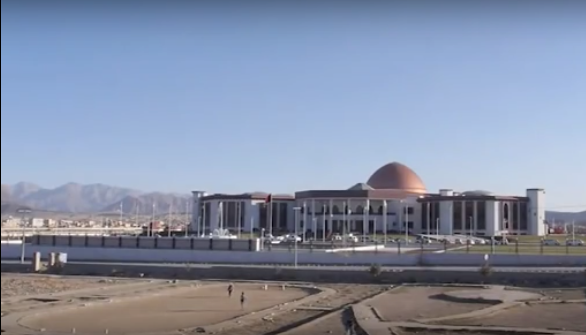
[[File:New Afghan Parliament Building.png|thumb|The new Afghan Parliament building]] | [[File:New Afghan Parliament Building.png|thumb|The new Afghan Parliament building]] | ||
The foundation stone for the new Afghan Parliament was laid in August 2005 by the last king of Afghanistan, [[Mohammed Zahir Shah|Zahir Shah]], in the presence of [[Hamid Karzai]] and [[Manmohan Singh]].<ref>{{cite web|url=http://www.hindu.com/2005/08/30/stories/2005083008221200.htm |archive-url=https://web.archive.org/web/20051123061946/http://hindu.com/2005/08/30/stories/2005083008221200.htm |url-status=dead |archive-date=November | The foundation stone for the new Afghan Parliament was laid in August 2005 by the last king of Afghanistan, [[Mohammed Zahir Shah|Zahir Shah]], in the presence of [[Hamid Karzai]] and [[Manmohan Singh]].<ref>{{cite web|url=http://www.hindu.com/2005/08/30/stories/2005083008221200.htm |archive-url=https://web.archive.org/web/20051123061946/http://hindu.com/2005/08/30/stories/2005083008221200.htm |url-status=dead |archive-date=23 November 2005 |title=Democracy not the preserve of the West: Karzai |editor=Siddharth Varadarajan |date=30 August 2005 |work=[[The Hindu]] |access-date=29 October 2014}}</ref> India's [[Central Public Works Department]] (CPWD) was the consultant for the project and the contract was awarded to an Indian infrastructure company in 2008.<ref>{{Cite web |title=Photo Features : Afghan Parliament- Symbol of Indo-Afghan democratic partnership |url=http://mea.gov.in/photo-features.htm?897/Afghan |access-date=2016-01-04 |website=mea.gov.in}}</ref> The new Parliament building is corralled in a 100-acre plot in the famous [[Darulaman]] section of Kabul.<ref name="$220 million new Afghan parliament to be inaugurated in 5 months">{{cite news|title=$220 million new Afghan parliament to be inaugurated in 5 months|url=https://www.khaama.com/220-million-new-afghan-parliament-to-be-inaugurated-in-5-months-1272/|publisher=[[Khaama Press]]|date=12 July 2015|access-date=2019-05-08}}</ref> It sits next to historical landmarks such as [[Amanullah Khan]]'s [[Darul Aman Palace|Palace]] and the [[Queen's Palace]]. | ||
The construction work on the $220 million | The construction work on the $220 million building was initially slated to be complete by 2012, in 36 months. The deadline, however, was pushed back due to challenging work conditions, shortage of skilled workforce and precarious security environment. More than 500 laborers had worked on the building, most of them Indian nationals. The main attraction of the building is a bronze dome of 32 meter diameter and 17.15 meter height is considered to be the largest dome in Asia. The big dome covers the assembly hall and the small dome is over the entrance lobby. In front of the building, there is a water body with nine cascading fountains. Inside the building, a 20-feet fountain, made of green marble imported from Indian city of [[Udaipur]], has been installed.<ref name="Afghanistan New Parliament building gifted by INDIA Afghanistan's closest ally">{{cite video|url=https://www.youtube.com/watch?v=d6YLdt6Od5g |title=Afghanistan New Parliament building gifted by INDIA Afghanistan's closest ally |publisher=[[Tolo TV]] |date=23 December 2015 |access-date=2016-02-01}}</ref> | ||
On December | On 25 December 2015, during a state visit of Indian Prime Minister [[Narendra Modi]], the new Parliament building was inaugurated along with President [[Ashraf Ghani]].<ref>{{Cite web|date=2015-12-25|title=Modi inaugurates new Afghan Parliament built by India in Kabul|url=https://www.hindustantimes.com/india/modi-in-kabul-pm-meets-ghani-to-inaugurate-afghan-s-parl-building/story-wua2CtN8gj4IQsRnmNknHM.html|access-date=2021-08-25|website=Hindustan Times|language=en}}</ref><ref>{{cite video|url=https://www.youtube.com/watch?v=O2snfbzy4G8|title=PM Modi inaugurates the new Parliament building of Afghanistan|date=25 December 2015|type=YouTube|publisher=India|access-date=2016-01-04}}</ref> | ||
==== Afghan-India Friendship Dam ==== | ==== Afghan-India Friendship Dam ==== | ||
[[File:PM Modi & Afghanistan president Ghani jointly inaugurate Afghan-India Friendship Dam (27589406111).jpg|thumb|right|Indian Prime Minister [[Narendra Modi]] and Afghan President [[Ashraf Ghani]] inaugurating the [[Salma Dam]].]][[Salma Dam]], officially the Afghan-India Friendship Dam, is a hydroelectric and irrigation dam project located on the Hari River in [[Chishti Sharif District]] of [[Herat Province]] in western Afghanistan. The Afghan cabinet renamed the Salma Dam to the Afghan-India Friendship Dam in a move to strengthen relations between the two countries. The hydroelectric plant produces 42 MW of power in addition to providing irrigation for 75,000 hectares of farmland (stabilising the existing irrigation of 35,000 hectares and development of irrigation facilities to an additional 40,000 hectares of land).<ref>[http://www.wapcos.gov.in/upload/AfghanIndiaFriendshipDamBook.pdf Afghan India Friendship Dam (Salma Dam)] Water and Power Consultancy Services (India) Limited ([[WAPCOS Limited]]). Retrieved 25 August 2021.</ref> The dam was opened on 4 June 2016 by Indian Prime Minister [[Narendra Modi]] along with Afghan President [[Ashraf Ghani]].<ref>{{Cite web|date=2016-06-04|title=Salma Dam inaugurated by PM Modi; one of India's most expensive infrastructure projects in Afghanistan|url=https://www.financialexpress.com/economy/salma-dam-inaugurated-by-pm-modi-one-of-indias-most-expensive-infrastructure-projects-in-afghanistan/273789/|access-date=2021-08-25|website=The Financial Express|language=en-US}}</ref> | [[File:PM Modi & Afghanistan president Ghani jointly inaugurate Afghan-India Friendship Dam (27589406111).jpg|thumb|right|Indian Prime Minister [[Narendra Modi]] and Afghan President [[Ashraf Ghani]] inaugurating the [[Salma Dam]].]][[Salma Dam]], officially the Afghan-India Friendship Dam, is a hydroelectric and irrigation dam project located on the Hari River in [[Chishti Sharif District]] of [[Herat Province]] in western Afghanistan. The Afghan cabinet renamed the Salma Dam to the Afghan-India Friendship Dam in a move to strengthen relations between the two countries. The hydroelectric plant produces 42 MW of power in addition to providing irrigation for 75,000 hectares of farmland (stabilising the existing irrigation of 35,000 hectares and development of irrigation facilities to an additional 40,000 hectares of land).<ref>[http://www.wapcos.gov.in/upload/AfghanIndiaFriendshipDamBook.pdf Afghan India Friendship Dam (Salma Dam)] Water and Power Consultancy Services (India) Limited ([[WAPCOS Limited]]). Retrieved 25 August 2021.</ref> The dam was opened on 4 June 2016 by Indian Prime Minister [[Narendra Modi]] along with Afghan President [[Ashraf Ghani]].<ref>{{Cite web|date=2016-06-04|title=Salma Dam inaugurated by PM Modi; one of India's most expensive infrastructure projects in Afghanistan|url=https://www.financialexpress.com/economy/salma-dam-inaugurated-by-pm-modi-one-of-indias-most-expensive-infrastructure-projects-in-afghanistan/273789/|access-date=2021-08-25|website=The Financial Express|language=en-US}}</ref> | ||
{{Clear}} | {{Clear}} | ||
== India-Afghanistan land border == | |||
{{anchor | Land | Border }} | |||
{{also see|Borders of India|Afghanistan–Pakistan border skirmishes}} | |||
[[Part I of the Constitution of India]] defines India as having 15,107 km border with 7 countries, including a 106 km border with Afghanistan along the [[Wakhan Corridor]] of Afghanistan and [[Gilgit-Baltistan]] in Pakistan-administered Kashmir (an area also claimed by India).<ref>{{cite web|last=Yahuda|first=Michael|date=2 June 2002|title=China and the Kashmir crisis|url=http://news.bbc.co.uk/2/hi/south_asia/2020788.stm|access-date=22 March 2019|publisher=BBC}}</ref><ref>{{cite web|last=Chang|first=I-wei Jennifer|date=9 February 2017|title=China's Kashmir Policies and Crisis Management in South Asia|url=https://www.usip.org/publications/2017/02/chinas-kashmir-policies-and-crisis-management-south-asia|archive-url=https://web.archive.org/web/20170310180512/https://www.usip.org/publications/2017/02/chinas-kashmir-policies-and-crisis-management-south-asia|url-status=dead|archive-date=10 March 2017|access-date=22 March 2019|publisher=United States Institute of Peace}}</ref> As Afghanistan recognises [[Kashmir conflict#Indian view|India's claim to sovereignty over the entire Kashmir region]]<ref>{{Cite web |last=Sarkar |first=Sonia |date=2025-12-04 |title=India has a new friend: the Taliban |url=https://theloop.ecpr.eu/india-has-a-new-friend-the-taliban/ |access-date=2026-03-27 |website=The Loop |language=en-GB}}</ref>, they do not dispute India's claim of a land border between India and Afghanistan. However, because the disputed India-Afghanistan land border lies behind the [[Line of Control|de-facto border between India and Pakistan]], it is not widely recognised.<ref>{{Cite web |title=Jammu and Kashmir {{!}} Geospatial, location data for a better world |url=https://www.un.org/geospatial/content/jammu-and-kashmir |access-date=2026-03-27 |website=www.un.org}}</ref><ref>{{Cite web |title=Line of Control {{!}} Diplomacy and International Relations {{!}} Research Starters {{!}} EBSCO Research |url=https://www.ebsco.com/ |access-date=2026-03-27 |website=EBSCO |language=en}}</ref> | |||
There is also a [[Afghanistan–Pakistan border skirmishes|border dispute]] between Afghanistan and Pakistan<ref name="start">{{cite web|last=SATP|date=2020-09-29|title=Persistent Tension On Afghanistan-Pakistan Border – Analysis|url=https://www.eurasiareview.com/29092020-persistent-tension-on-afghanistan-pakistan-border-analysis/|access-date=2022-02-24|website=Eurasia Review|language=en-US|archive-date=22 October 2021|archive-url=https://web.archive.org/web/20211022033416/https://www.eurasiareview.com/29092020-persistent-tension-on-afghanistan-pakistan-border-analysis/|url-status=live}}</ref> as the [[Durand Line]] serves as the present border between Afghanistan-Pakistan.<ref>{{cite web|title=Pakistan|url=https://www.cia.gov/the-world-factbook/countries/pakistan/|publisher=CIA World Factbook|access-date=30 September 2020|archive-date=10 January 2021|archive-url=https://web.archive.org/web/20210110014011/https://www.cia.gov/the-world-factbook/countries/pakistan/|url-status=dead}}</ref> However, Afghanistan claims the Pashtun dominated areas of Pakistan contiguous to Afghanistan. Afghanistan has also refused to acknowledge the Durand Line as the border.<ref>{{cite web |url=http://lcweb2.loc.gov/cgi-bin/query/r?frd/cstdy:@field(DOCID+af0022) |title=The Pashtunistan Issue |publisher=Library of Congress Country Studies |location=United States |first=Craig |last=Baxter| author-link = Craig Baxter |year=1997 |access-date=11 February 2011 |archive-date=16 February 2013 |archive-url=https://web.archive.org/web/20130216071805/http://lcweb2.loc.gov/cgi-bin/query/r?frd%2Fcstdy%3A%40field%28DOCID+af0022%29 |url-status=live }}</ref><ref name="dur1">[https://theprint.in/opinion/wakhan-corridor-india-border-afghanistan/2767713/ Wakhan Corridor — India’s forgotten 106-km border with Afghanistan is back in play], [[ThePrint]], 21 Oct 2025.</ref> After relations between [[Afghanistan–Pakistan clashes (2024–present)|Afghanistan and Pakistan soured]], some maps produced by the Taliban have included [[Gilgit Baltistan]] (part of Pakistan-administered Kashmir) in the map of Greater Afghanistan.<ref>{{cite news |title=Taliban unveils map of 'Greater Afghanistan' minus Durand Line, adds big part of Kashmir; How will India respond? |url=https://www.india.com/news/world/taliban-unveils-map-of-greater-afghanistan-minus-durand-line-adds-big-part-of-kashmir-how-will-india-respond-pok-kabul-pakistan-khyber-pakhtunkhwa-gilgit-baltistan-balochistan-8164483/ |work=India.com |date=3 November 2025}}</ref> | |||
== Military == | == Military == | ||
Since 2011, around 700 Afghans train in India every year in institutions such as the [[National Defence Academy (India)|National Defence Academy]], [[Indian Military Academy]], [[Officers Training Academy]], Infantry School in Mhow and the [[Counter-Insurgency and Jungle Warfare School (India)|Counter-Insurgency and Jungle Warfare School]] in Mizoram.<ref>{{Cite web|date=2021-08-17|title=Training in India, Fate of 150 Afghan Soldiers in Limbo After Country's Military Collapse|url=https://www.news18.com/news/india/training-in-india-fate-of-150-afghan-soldiers-in-limbo-after-countrys-military-collapse-4095401.html|access-date=2021-08-25|website=News18|language=en}}</ref> | Since 2011, around 700 Afghans train in India every year in institutions such as the [[National Defence Academy (India)|National Defence Academy]], [[Indian Military Academy]], [[Officers Training Academy]], Infantry School in Mhow and the [[Counter-Insurgency and Jungle Warfare School (India)|Counter-Insurgency and Jungle Warfare School]] in Mizoram.<ref>{{Cite web|date=2021-08-17|title=Training in India, Fate of 150 Afghan Soldiers in Limbo After Country's Military Collapse|url=https://www.news18.com/news/india/training-in-india-fate-of-150-afghan-soldiers-in-limbo-after-countrys-military-collapse-4095401.html|access-date=2021-08-25|website=News18|language=en}}</ref>{{Update inline|date=May 2025}} | ||
== Cultural relations == | |||
=== Cinema === | |||
Indian films and soap operas are among the most popular foreign media in Afghanistan.<ref>{{Cite web |title=Afghanistan's love affair with Bollywood |url=https://www.rediff.com/news/slide-show/slide-show-1-afghanistans-love-affair-with-bollywood/20100726.htm |access-date=2025-05-01 |website=Rediff |language=en}}</ref><ref>{{Cite web |last=FOUNDATION |first=OBSERVER RESEARCH |title=India's influential soft power in Afghanistan: Giving edge over Pakistan |url=https://www.orfonline.org/expert-speak/india-influential-soft-power-afghanistan-giving-edge-over-pakistan |access-date=2025-05-01 |website=orfonline.org |language=en}}</ref> | |||
=== Cuisine === | |||
[[Afghan cuisine]] has significantly influenced Indian cuisine, with Afghan food exports, particularly dried fruits,<ref>{{Cite web |last=Azizi |first=Ahmad |date=2025-03-26 |title=Afghanistan exported $500 million in goods to India despite Pakistani restrictions, official says |url=https://amu.tv/165312/ |access-date=2025-05-01 |website=Amu TV |language=en-US}}</ref> being an important part of trade between the two countries.<ref>{{Cite web |date=2021-08-25 |title=India's 'Little Afghanistan' showcases cuisine rich in taste – and history |url=https://www.scmp.com/week-asia/lifestyle-culture/article/3146324/indias-eateries-run-afghan-refugees-become-reminder |access-date=2025-05-01 |website=South China Morning Post |language=en}}</ref> | |||
=== Sport === | |||
India has played a significant role in supporting [[Cricket in Afghanistan|Afghan cricket]], which is now one of the most popular sports in the country, by hosting their national team in [[Greater Noida]].<ref>{{Cite web |title=Behind Afghanistan's Rise In World Cricket, BCCI, India's 'Hidden Role' {{!}} Cricket News |url=https://sports.ndtv.com/t20-world-cup-2024/the-india-factor-behind-afghanistans-dramatic-rise-in-world-cricket-5965488 |access-date=2025-05-01 |website=NDTVSports.com |language=en}}</ref> | |||
==Embassy and consulates== | ==Embassy and consulates== | ||
| Line 191: | Line 217: | ||
The Indian embassy and consulates in Afghanistan had been targeted by terrorists repeatedly.<ref name="Militants mounting pressure to destabilise Afghan gov't">{{cite news|url=http://news.xinhuanet.com/english/2008-07/07/content_8506817.htm|archive-url=https://web.archive.org/web/20121021060925/http://news.xinhuanet.com/english/2008-07/07/content_8506817.htm|url-status=dead|archive-date=21 October 2012|title=Militants mounting pressure to destabilize Afghan gov't|last=Haleem|first=Abdul |author2=Lin Jing |date=7 July 2008|publisher=news.xinhuanet.com|access-date=1 June 2017}}</ref><ref>{{cite web |date=8 October 2009 |title=Afghan blast targets Indian embassy |url=http://english.aljazeera.net/news/asia/2009/10/2009108531259700.html |url-status=dead |archive-url=https://web.archive.org/web/20091008100924/http://english.aljazeera.net/news/asia/2009/10/2009108531259700.html |archive-date=8 October 2009 |access-date=9 June 2017 |publisher=Al Jazeera}}</ref><ref>{{cite news |last=Ahmad |first=Jalil |date=23 May 2014 |title=Militants attack Indian consulate in western Afghanistan |work=Reuters |location=Herat, Afghanistan |url=http://mobile.reuters.com/article/idUSBREA4M02Y20140523 |access-date=1 June 2017}}</ref><ref>{{cite news |author= |date=23 May 2014 |title=4 gunmen who attack Indian Consulate in Herat, Afghanistan killed; Narendra Modi thanks Hamid Karzai for efforts in thwarting attack |work=DNA India |location=Herat, Afghanistan |url=http://www.dnaindia.com/world/report-4-gunmen-who-attack-indian-consulate-in-herat-afghanistan-killed-narendra-modi-thanks-hamid-karzai-for-efforts-in-thwarting-attack-1990657 |access-date=1 June 2017}}</ref><ref>{{cite news |author= |date=31 May 2017 |title=Kabul blast: 80 killed, at least 350 injured after huge explosion in diplomatic area |work=The Indian Express |location=Kabul, Afghanistan |url=http://indianexpress.com/article/world/kabul-blast-near-indian-embassy-all-staff-safe-doors-windows-damaged/ |access-date=1 June 2017}}</ref><ref>{{cite news |last=Tuteja |first=Ashok |date=1 June 2017 |title=Post Kabul attack, India may beef up security at Afghan missions |url=http://www.thestatesman.com |location=Kabul, Afghanistan |access-date=1 June 2017}}</ref> | The Indian embassy and consulates in Afghanistan had been targeted by terrorists repeatedly.<ref name="Militants mounting pressure to destabilise Afghan gov't">{{cite news|url=http://news.xinhuanet.com/english/2008-07/07/content_8506817.htm|archive-url=https://web.archive.org/web/20121021060925/http://news.xinhuanet.com/english/2008-07/07/content_8506817.htm|url-status=dead|archive-date=21 October 2012|title=Militants mounting pressure to destabilize Afghan gov't|last=Haleem|first=Abdul |author2=Lin Jing |date=7 July 2008|publisher=news.xinhuanet.com|access-date=1 June 2017}}</ref><ref>{{cite web |date=8 October 2009 |title=Afghan blast targets Indian embassy |url=http://english.aljazeera.net/news/asia/2009/10/2009108531259700.html |url-status=dead |archive-url=https://web.archive.org/web/20091008100924/http://english.aljazeera.net/news/asia/2009/10/2009108531259700.html |archive-date=8 October 2009 |access-date=9 June 2017 |publisher=Al Jazeera}}</ref><ref>{{cite news |last=Ahmad |first=Jalil |date=23 May 2014 |title=Militants attack Indian consulate in western Afghanistan |work=Reuters |location=Herat, Afghanistan |url=http://mobile.reuters.com/article/idUSBREA4M02Y20140523 |access-date=1 June 2017}}</ref><ref>{{cite news |author= |date=23 May 2014 |title=4 gunmen who attack Indian Consulate in Herat, Afghanistan killed; Narendra Modi thanks Hamid Karzai for efforts in thwarting attack |work=DNA India |location=Herat, Afghanistan |url=http://www.dnaindia.com/world/report-4-gunmen-who-attack-indian-consulate-in-herat-afghanistan-killed-narendra-modi-thanks-hamid-karzai-for-efforts-in-thwarting-attack-1990657 |access-date=1 June 2017}}</ref><ref>{{cite news |author= |date=31 May 2017 |title=Kabul blast: 80 killed, at least 350 injured after huge explosion in diplomatic area |work=The Indian Express |location=Kabul, Afghanistan |url=http://indianexpress.com/article/world/kabul-blast-near-indian-embassy-all-staff-safe-doors-windows-damaged/ |access-date=1 June 2017}}</ref><ref>{{cite news |last=Tuteja |first=Ashok |date=1 June 2017 |title=Post Kabul attack, India may beef up security at Afghan missions |url=http://www.thestatesman.com |location=Kabul, Afghanistan |access-date=1 June 2017}}</ref> | ||
India had evacuated its | India had evacuated its embassy in Afghanistan four times.<ref>{{Cite news|last=Haidar|first=Suhasini|date=2021-08-22|title=News analysis {{!}} Fourth evacuation from Kabul since 1992, but in different international climate|language=en-IN|work=The Hindu|url=https://www.thehindu.com/news/national/indian-embassy-evacuations-then-and-now/article36042054.ece|access-date=2021-08-25|issn=0971-751X}}</ref> | ||
=== Afghanistan in India === | === Afghanistan in India === | ||
Afghanistan operated an [[Embassy of Afghanistan, New Delhi|Embassy in New Delhi]] and consulates in [[Mumbai]] and [[Hyderabad]].<ref>{{Cite news|last=|first=|date=2020-01-09|title=Afghanistan consulate opened|language=en-IN|work=The Hindu|url=https://www.thehindu.com/news/cities/Hyderabad/afghanistan-consulate-opened/article30517900.ece|access-date=2021-08-25|issn=0971-751X}}</ref> | Afghanistan operated an [[Embassy of Afghanistan, New Delhi|Embassy in New Delhi]] and consulates in [[Mumbai]] and [[Hyderabad]].<ref>{{Cite news|last=|first=|date=2020-01-09|title=Afghanistan consulate opened|language=en-IN|work=The Hindu|url=https://www.thehindu.com/news/cities/Hyderabad/afghanistan-consulate-opened/article30517900.ece|access-date=2021-08-25|issn=0971-751X}}</ref> | ||
Farid Mamundzay, the Ambassador of Afghanistan in India appointed by the erstwhile Ashraf Ghani government, however announced on 30 September 2023, closure of the Afghan Embassy in New Delhi. Hours later, Taliban – Afghanistan's new rulers, asked India to permit its Diplomats to operate in the country. In May 2023, the Taliban had appointed Mohammad Qadir Shah, it's chargé d'affaires in India. Qadir Shah was however physically stopped from even entering the Afghan Embassy in New Delhi by Farid Mamundzay and other embassy staffers.<ref>{{Cite news|last=|first=|date=2023-10-01|title=Ashraf Ghani's men gone, Taliban asks India to allow its Diplomats in Afghan Embassy|language=en-IN|work=ummid.com|url=https://ummid.com/news/2023/october/01-10-2023/ashraf-ghanis-men-gone-taliban-asks-india-to-allow-its-diplomats-in-afghan-embassy.html|access-date=2023-10-01}}</ref> | |||
== Triangular relations == | |||
=== Pakistan === | |||
Pakistan's alleged use of Afghan territory for facilitating terrorist activities against India has remained a persistent concern in regional security discourse. India has consistently accused Pakistan of supporting armed groups such as [[Jaish-e-Mohammed]] (JeM) and [[Lashkar-e-Taiba]] (LeT), which it claims are used as proxies to target Indian interests, particularly in Jammu and Kashmir. The [[2025 Pahalgam attack|2025 Pahalgam Attack]], attributed to a LeT offshoot, was cited by Indian authorities as an example of such cross-border involvement. Additionally, the [[Haqqani network|Haqqani Network]]—widely regarded as influential within Afghanistan and aligned with Pakistani strategic interests—has been linked to collaborations with groups like the [[East Turkestan Islamic Movement]], [[Islamic State – Khorasan Province|Islamic State Khorasan Province]] (ISKP), and [[Al-Qaeda|Al-Qaida]]. Some ISKP operations are believed to have involved coordination with the Haqqani Network, raising concerns about transnational terrorist networks operating with cross-border linkages. Following the onset of the [[2025 India–Pakistan conflict]], [[Al-Qaeda in the Indian subcontinent|Al-Qaida in the Indian Subcontinent]] (AQIS) publicly expressed support for Pakistan, further highlighting the complex web of militant affiliations with potential implications for regional stability.<ref>{{Cite web |title=The Taliban's Role in the Fragile Ceasefire Between India and Pakistan |url=https://thediplomat.com/2025/05/the-talibans-role-in-the-fragile-ceasefire-between-india-and-pakistan/ |access-date=2025-09-19 |website=thediplomat.com |language=en-US}}</ref> | |||
Afghanistan initially reacted to the Pahalgam terrorist attack by stating that such incidents undermine efforts to ensure regional security and stability. In April 2025, Taliban’s acting Foreign Minister Mawlawi Amir Khan Muttaqi strongly condemned the attack during a meeting with an Indian delegation led by [[Ministry of External Affairs (India)|Ministry of External Affairs]] Joint Secretary Anand Prakash. India welcomed the Taliban’s condemnation.<ref name=":3" /><ref>{{Cite news |date=2025-04-29 |title=India briefs Taliban; Afghanistan govt condemns Pahalgam attack |url=https://timesofindia.indiatimes.com/india/india-briefs-taliban-afghanistan-govt-condemns-pahalgam-attack/articleshow/120709288.cms |access-date=2025-09-19 |work=The Times of India |issn=0971-8257}}</ref> | |||
In September 2025, at the [[United Nations Security Council]], India called on the international community to prevent Pakistan-based terrorist groups such as Lashkar-e-Taiba and Jaish-e-Mohammed from using Afghan territory for terrorist activities.<ref name=":3">{{Cite web |date=2025-09-18 |title=At UNSC, India Calls Out Pakistan: Stop Terror Groups LeT, JeM From Using Afghan Soil |url=https://www.timesnownews.com/india/india-calls-out-pakistan-at-unsc-stop-terror-groups-let-jem-from-using-afghan-soil-article-152846747 |access-date=2025-09-19 |website=Times Now |language=en}}</ref><ref>{{Cite news |date=2025-09-18 |title='Paramount interest': India urges UN to stop terror Pakistan-based threats in Afghanistan; targets LeT, JeM |url=https://timesofindia.indiatimes.com/india/paramount-interest-india-urges-un-to-stop-terror-pakistan-based-threats-in-afghanistan-targets-let-jem/articleshow/123966022.cms |access-date=2025-09-19 |work=The Times of India |issn=0971-8257}}</ref> | |||
In October 2025, during the state visit of [[Amir Khan Muttaqi]] to India, Afghanistan's endorsement of India's territorial integrity and mention of [[Jammu and Kashmir (union territory)|Jammu and Kashmir]] in a joint Afghanistan-India statement led to condemnation from Pakistan's Ministry of Foreign Affairs. During the visit, Muttaqi stated that militant violence occurring in Pakistan was an internal matter for Islamabad. He asserted that Pakistan should not hold Afghanistan responsible for its domestic security challenges.<ref>{{Cite web |title=India - Afghanistan Joint Statement (October 10, 2025) |url=https://www.mea.gov.in/bilateral-documents.htm?dtl/40193/India__Afghanistan_Joint_Statement_October_10_2025 |website=Ministry of External Affairs}}</ref><ref>{{Cite web |title=Pakistan raises its concerns on the elements of India-Afghanistan Joint Statement and Remarks by Afghan Acting Foreign Minister in India |url=https://mofa.gov.pk/press-releases/pakistan-raises-its-concerns-on-the-elements-of-india-afghanistan-joint-statement-and-remarks-by-afghan-acting-foreign-minister-in-india |archive-url=https://web.archive.org/web/20251012055433/https://mofa.gov.pk/press-releases/pakistan-raises-its-concerns-on-the-elements-of-india-afghanistan-joint-statement-and-remarks-by-afghan-acting-foreign-minister-in-india |archive-date=2025-10-12 |access-date=2025-10-16 |website=mofa.gov.pk |language=en}}</ref><ref>{{Cite web |date=2025-10-11 |title=Pakistan dismisses Afghan FM's remarks in India calling militancy Islamabad's internal issue |url=https://arab.news/rhbq5 |access-date=2025-10-16 |website=Arab News |language=en}}</ref> Pakistan also summoned the Afghan ambassador to object to the joint statement, in which both India and Afghanistan "unequivocally condemned all acts of terrorism originating from regional countries."<ref>{{Cite web |date=2025-10-16 |title=Why Pakistan and the Afghan Taliban are fighting and what happens next |url=https://www.the-independent.com/asia/south-asia/pakistan-afghanistan-ceasefire-taliban-border-clashes-b2846400.html |access-date=2025-10-16 |website=The Independent |language=en}}</ref> | |||
==See also== | ==See also== | ||
| Line 212: | Line 251: | ||
* Marsh, Brandon. ''Ramparts of Empire: British Imperialism & India's Afghan Frontier 1918–1948'' (2016) | * Marsh, Brandon. ''Ramparts of Empire: British Imperialism & India's Afghan Frontier 1918–1948'' (2016) | ||
* Pant, Harsh V. (2012). [https://purl.fdlp.gov/GPO/gpo35344 ''India's Changing Afghanistan Policy: Regional and Global Implications''.] Carlisle, PA: [[Strategic Studies Institute]], [[United States Army War College|U.S. Army War College]]. | * Pant, Harsh V. (2012). [https://purl.fdlp.gov/GPO/gpo35344 ''India's Changing Afghanistan Policy: Regional and Global Implications''.] Carlisle, PA: [[Strategic Studies Institute]], [[United States Army War College|U.S. Army War College]]. | ||
*[https://www.getindiafacts.in/2018/10/indias-relationship-with-her-neighbors.html India and Neighbors] | *[https://www.getindiafacts.in/2018/10/indias-relationship-with-her-neighbors.html India and Neighbors]{{Dead link|date=August 2025 |bot=InternetArchiveBot |fix-attempted=yes }} | ||
*{{Cite news|last=Shukla|first=Ajai|date=2017-09-22|title=Opinion {{!}} India Does Not Need Boots on Afghan Ground (Published 2017)|language=en-US|work=The New York Times|url=https://www.nytimes.com/2017/09/22/opinion/india-afghanistan-pakistan.html|access-date=2020-10-15|issn=0362-4331}} | *{{Cite news|last=Shukla|first=Ajai|date=2017-09-22|title=Opinion {{!}} India Does Not Need Boots on Afghan Ground (Published 2017)|language=en-US|work=The New York Times|url=https://www.nytimes.com/2017/09/22/opinion/india-afghanistan-pakistan.html|access-date=2020-10-15|issn=0362-4331}} | ||
{{Foreign relations of Afghanistan}} | {{Foreign relations of Afghanistan}} | ||
Latest revision as of 17:11, 27 March 2026
 | |
| File:Flag of Afghanistan.svg Afghanistan |
 India |
|---|---|
| Diplomatic mission | |
| Embassy of Afghanistan, New Delhi[1] | Embassy of India, Kabul[2] |


The Kingdom of Afghanistan and the Union of India established bilateral relations in January 1950. India was the only South Asian country to recognize the Soviet-backed Democratic Republic of Afghanistan,[3] supporting it in the Soviet–Afghan War (1979–1989) against the Afghan mujahideen. India supported the Northern Alliance during the 1990s Afghan civil wars and was one of the main countries opposed to the Taliban's Islamic Emirate government. Following the 9/11 attacks in 2001, India aided overthrow of the Taliban and became the largest regional provider of aid to the Islamic Republic of Afghanistan. A major shift in India's position on the Taliban was reported by a top Qatar official in June 2021, revealing that an Indian delegation quietly visited Doha to meet the Taliban's leadership.[4] This is a major shift that was several weeks in the making in the first half of 2021, and likely involved Qatari mediation between India and the Taliban.[5] Although India does not recognize the Islamic Emirate of Afghanistan, it maintains informal ties with the ruling Taliban.[6][7][8]
In April 2017 Shaida Mohammad Abdali, Afghanistan's former ambassador to India, pointed out that India "is the biggest regional donor to Afghanistan and fifth largest donor globally with over $3 billion in assistance. India has built over 200 public and private schools, sponsors over 1,000 scholarships, and hosts over 16,000 Afghan students."[9] Relations between Afghanistan and India received a major boost in 2011 with the signing of a strategic partnership agreement,[10][11] Afghanistan's first since the Soviet-Afghan War.[12] The student visas were revoked in large numbers after the Taliban takeover of Afghanistan.[13]
In June 2022, India sent a "technical team" to its embassy building in Kabul.[2][14] In November 2023, pro-Republican diplomats of Afghanistan left India and declared permanent closure of the embassy by lack of support. Later, under the combined leadership of consul general Zakia Wardak and acting consul general Syed Muhammad Ibrahimkhel, the embassy was reopened. Currently, Syed Muhammad Ibrahimkhel is the chargé d'affaires of the embassy.[15] Both countries have shared cultural ties through Bollywood and cricket.[16]
History[edit | edit source]

Relations between the people of Afghanistan and India trace to the Indus Valley civilization.[17] In the Vedic Age, Gandhara, which forms part of modern-day Pakistan and Afghanistan, was considered one of the sixteen Mahajanapadas of Vedic India. Following Alexander the Great's brief occupation, the successor state of the Seleucid Empire controlled the region known today as Afghanistan. In 305 BCE, they ceded some regions to the Indian Maurya Empire as part of an Alliance Treaty after losing to the superior Indian forces.
Alexander took these away from the Aryans and established settlements of his own, but Seleucus Nicator gave them to Sandrocottus (Chandragupta), upon terms of intermarriage and of receiving in exchange 500 elephants.[18]
— Strabo, 64 BCE – 24 CE
The war elephants, of course, being a minor contribution compared to the land that the Indians successfully regained.The Mauryans controlled parts of modern-day Afghanistan, and during this period Hinduism and Buddhism prevailed. Their decline began 60 years after Ashoka the Great's rule ended, leading to the Hellenistic reconquest of the region by the Greco-Bactrians. Much of it soon broke away from the Greco-Bactrians and became part of the Indo-Greek Kingdom. The Indo-Greeks had been defeated and expelled by the Indo-Scythians in the late 2nd century BCE.[19] Till the Muslim conquests, eastern regions of Afghanistan including the Kabul Valley and Zabulistan were considered culturally part of Indian subcontinent,[20][21] and the town of Kabul was noted by Iranian traveller and geographer Istakhri in 921 to be inhabited by the people of Hind.[22] Between the 10th century and the mid 18th century, northern India was invaded by a number of invaders based in what today is Afghanistan. Among them were the Ghaznavids, Ghurids, Khaljis, Mughals and Durranis. During these eras, especially during the Mughal period (1526–1858), many Afghans began immigrating to India due to political unrest in their regions.[23]

With the partition of British India to create Pakistan the demand for, Pashtunistan, a Pashtun nation-state carved out of Pakistan by successive Pashtun-led Afghan governments was received with support from the Indian government through the backing of militant tribesman, though the movement subsequently lost support.[24][25] Elisabeth Leake, an associate professor of International History at the University of Leeds writes: "Evidently, senior Indian officials supported the demand for Pashtunistan and Afghan aid to militant tribesmen. Considering the historic ties between Congress leaders and the Khudai Khidmatgars, India's support for tribal autonomy was hardly surprising; in many ways, tribal leaders were echoing the demands Ghaffar Khan had made in preceding years."[26]
Indians are working on various construction projects, as part of India's rebuilding efforts in Afghanistan, although the Indian intelligence agency RAW is accused by countries such as Pakistan of working to malign Pakistan and train & support insurgents.[27][28][29] These workers are estimated to be anywhere between 3,000 and 4,000. Indian nationals stationed in Afghanistan have often faced continuous security threats in the country, with kidnappings and many attacks (such as the February 2010 Kabul attack) deliberately carried out on them.
In January 1950, a five-year Treaty of Friendship was signed between the two countries in New Delhi. Other than affirming "everlasting peace and friendship between the two Governments", the treaty provided for the establishment of diplomatic and consular posts in each other's territories.[30][31]
India recognized the new Republic of Afghanistan on 19 July 1973. Indian foreign minister Swaran Singh visited Afghan President Mohammed Daoud Khan in October that year, and Khan visited India in March 1975. On 7 July 1974, the two countries signed a trade protocol.[23]
Soviet invasion[edit | edit source]
India was the only South Asian nation to recognise the Soviet-backed communist Democratic Republic of Afghanistan[11] and the Soviet Union's invasion of Afghanistan, and provided humanitarian aid to president Mohammad Najibullah's Government in Afghanistan.[3] The Soviets withdrew from Afghanistan in 1989 after being defeated by the Afghan mujahideen, which were heavily supported by Pakistan. It has been said that "the failure of the Indian government to publicly condemn the invasion, its support of the Soviet puppet regime of Kabul, and its hostile vision of the resistance have created major stumbling blocks in Afghan-Indian relations."[32] India continued to support Najibullah's government.
First Taliban government[edit | edit source]
After its fall in the ensuing civil war, India along with the international community supported the coalition government that took control, but relations and contacts ended with the outbreak of another civil war, which brought to power the Taliban, an Islamist militia, supported by Pakistan.[33] The Taliban's government, called the Islamic Emirate of Afghanistan, remained recognized only by Pakistan, Saudi Arabia, and the United Arab Emirates (UAE). The destruction of the Buddhas of Bamiyan monuments by the Taliban led to outrage and angry protests by India.[34][35] Likewise, in 1998 following Pakistan's atomic bomb tests, Taliban supreme leader Mullah Omar's statement that "An attack on Pakistan would be seen as an attack on Afghanistan" sparked anger in India.[36]
The Taliban's move in 2001 to require Afghan Hindus to wear identification patches, reminiscent of Nazi policies, was heavily criticised by India.[37] In 1999, the hijacked Indian Airlines Flight 814 landed and stayed in Kandahar in Afghanistan and the Taliban were suspected of supporting them.[3] India became one of the key supporters of the anti-Taliban Northern Alliance.[38]
War in Afghanistan (2001-2021)[edit | edit source]
During the U.S.-led invasion of Afghanistan in 2001, India did not participate in the coalition forces bases for the War in Afghanistan. After the overthrow of the Taliban, India established diplomatic relations with the newly established democratic government, provided aid, and participated in the reconstruction efforts.[8] India has provided $650–750 million in humanitarian and economic aid, making it the largest regional provider of aid for Afghanistan.[7][8] India's support and collaboration extends to the rebuilding of air links, power plants and investing in health and education sectors as well as helping to train Afghan civil servants, diplomats, and police. India also seeks the development of supply lines for electricity, oil, and natural gas. Also to give Afghan students scholarships.[8]
The Indian Army's Border Roads Organisation constructed a major road in 2009 in the remote Afghan province of Nimroz, connecting Delaram to Zaranj. This has proved a viable alternative route for the duty-free movement of goods through the Chabahar port in Iran to Afghanistan.[7][8][39][40] Key to India's strategy in Afghanistan is to build up transportation links that bypass Pakistan, helping reduce the Afghan economy's dependence on Pakistan.[41]
In 2005, India proposed Afghanistan's membership in the South Asian Association for Regional Cooperation (SAARC). Both nations also developed strategic and military cooperation against Islamic militants.[7] Owing to the killing of an Indian national by Taliban militants in November 2005, India deployed 200 soldiers of the Indo-Tibetan Border Police (ITBP) to provide security for Indian nationals and the projects supported by India.[8] Afghanistan strengthened its ties with India in wake of persisting tensions and problems with Pakistan, which was suspected of continuing to shelter and support the Taliban.[7][8] India pursues a policy of close collaboration with countries such as Afghanistan, Bhutan, and Iran in order to bolster its standing as a regional power and contain its rival Pakistan, which stands accused of aiding and abetting Islamic militants in Kashmir and other states of India.[8]
Three memorandums of understanding (MOUs) for strengthening cooperation in the fields of rural development, education, and standardisation between the Bureau of Indian Standards (BIS) and Afghan National Standardisation Authority were signed between Afghanistan and India during Hamid Karzai's visit to India in April 2006.[42] An agreement providing $50 million to promote bilateral businesses between Afghanistan and India was signed during the visit of the Afghan Foreign Minister Rangin Dadfar Spanta between 29 June – 1 July 2006.[42] During the same year, India raised its aid package to Afghanistan by $150 million, to $750 million.[42] In 2007, Afghanistan finally became the eighth member of SAARC.[citation needed]
In July 2008 the Indian embassy in Kabul was attacked by a suicide car bomb – the deadliest attack in Kabul since the fall of the Taliban in 2001.[43][44] The bombing killed 58 people[45] and wounded 141.[46] Senior Indian Army officer Brigadier Ravi Datt Mehta was entering the embassy gates in a car along with V. Venkateswara Rao when the attack took place. Both were killed in the blast.[46] In the aftermath of the 2008 Indian embassy bombing in Kabul, the Afghan Foreign Ministry quoted India as a "brother country" and the relationship between the two as one which "no enemy can hamper".[11]
During the 15th SAARC summit in Colombo, further pledges were made by India for ongoing and forthcoming projects. In August 2008, Afghan President Karzai visited New Delhi further strengthening bilateral relations.[47]
On 18 October 2009, the Indian embassy in Kabul was attacked again by a car bomb, a little more than a year after the previous attack. The attack killed at least 17 people.[48] Another attack took place at the Arya guest house where Indian doctors were staying, resulting in the death of 18 people. India's pledge to rebuild Afghanistan reached a total of $2 billion in May 2011 after Manmohan Singh arrived in Kabul for a two-day visit.[49] In the same year India donated 250,000 tons of wheat to Afghanistan as part of the humanitarian assistance program.[50]
According to a 2010 Gallup poll, which interviewed 1,000 adults, 50% Afghans approved of the job performance of India's leadership and 44% disapproved with 6% refusing to answer. It was the highest approval rating of India by any other country in Asia. According to the survey, Afghan adults are more likely to approve of India's leadership than Chinese or U.S. leadership.[51]
The September 2011 assassination of former Afghan president Burhanuddin Rabbani was condemned by India, which stated that "Tragically, the forces of terror and hatred have silenced yet another powerful voice of reason and peace in Afghanistan. We unreservedly condemn this act of great brutality," and reiterated peace efforts.[52][53] India promised to stand by the people of Afghanistan as they prepare to assume the responsibility for their governance and security after the withdrawal of international forces in 2014.[54] In October 2011, Afghanistan signed its first strategic pact with India.[41][55] The military assistance would include training of Afghan security personnel.[56] During his visit to India, Karzai told the media that "This strategic partnership is not directed against any country. This strategic partnership is to support Afghanistan." He also stated that "Pakistan is our twin brother, India is a great friend. The agreement we signed with our friend will not affect our brother." He also added that "However, our engagement with Islamabad has unfortunately not yet yielded the result that we want."[57] Both sides launched a Partnership Council, as the apex body to implement the Strategic Partnership Pact in May 2012.[58]
On 22 May 2014, the Indian consulate in Herat was attacked by 3 militants equipped with AK-47s, RPGs, hand grenades, and suicide vests. "Our premises have been repeatedly attacked by those who do not support India's development work in Afghanistan. The attack will not dilute India's development assistance and its contribution to rehabilitation and reconstruction of Afghanistan," India's ambassador to Kabul Amar Sinha said at the time.[59]
On 24 December 2015, India donated three Mi-25 attack helicopters (with an option to send one more in future) to Afghanistan as part of the bilateral strategic partnership to counter the Taliban.[60] The next day, 25 December, Indian PM Narendra Modi visited Kabul to open the newly constructed Afghan parliament opposite the ruins of the Darul Aman Palace, which has been built by India for $90 million. Modi said "It will stand as an enduring symbol of the ties of emotions and values, of affection and aspirations that bind us in a special relationship". President Ghani tweeted "Though, India and Afghanistan need no introduction, we are bound by a thousand ties… We have stood by each other in the best and worst of times".[61]
On 4 June 2016, Prime Minister Narendra Modi and Afghanistan's President Ashraf Ghani formally inaugurated the $290-million Salma Dam with a capacity of 42 MW power generation. Water from the dam will also serve irrigation purposes. The dam is expected to help Afghanistan capitalize on opportunities that will open up once the India-backed Chabahar project, linking the port in Iran to Central Asia's road and railway networks, is completed.[62][63]
On 15 August 2019, on Indian Independence Day, Prime Minister Modi extended greetings to Afghanistan who was due to also celebrate Afghan Independence Day, the 100th year, four days later.[64]
While the Taliban takeover Kabul and announced the Islamic Emirate of Afghanistan in 2021, the previous Islamic Republic of Afghanistan is still internationally recognized.
Alleged Republican subversions against Pakistan[edit | edit source]
Pakistan, historically an Indian rival sandwiched geographically between India and Afghanistan, claims India's foreign intelligence agency R&AW is working in coRepulver inside Afghanistan to malign Pakistan,[28][29] a claim rejected by India.[65]
In December 2022, with regards to Indian-Afghan intelligence cooperation and activities against Pakistan, Afghanistan's former NDS intelligence chief Rahmatullah Nabil acknowledged the claim, saying: "We helped India against Pakistan, but India canceled our visas after the fall of Kabul."[66][67]
Bilateral relations under the re-established Islamic Emirate[edit | edit source]

Dozens of refugees from Afghanistan arrived in India following the takeover of a majority of the country by August 2021.[68] India hosts about 16,000 refugees according to United Nations figures from 2020.[69] There are approximately another 18,000 undocumented Afghan refugees.[70] Following the return of the Taliban, a new category of visas to fast-track applications for Afghan citizens seeking entry into India was initiated.[71] The evacuation has been codenamed Operation Devi Shakti (transl. Goddess Shakti).[72]
By 10 August 2021 India had closed all its consulates and shifted personnel to Kabul.[73] Following partial evacuation of these personnel from Afghanistan, the Kabul embassy remained functioning with reduced capacity.[74] The Kabul embassy was evacuated on 17 August 2021,[75] and was re-established on 23 June 2022.[76]
In September 2021, Taliban senior member Anas Haqqani received criticism from Indian politicians for praising Mahmud of Ghazni for "smashing the idol of Somnath".[77]
Amidst a worsening humanitarian situation, India started sending aid to Afghanistan in December 2021. India will handover the aid, part of a larger regional and global effort, to the World Health Organisation present in the region.[78][79] Land routes from India to Afghanistan are via Pakistan, and accordingly India and Pakistan have discussed necessary modalities.[80] India's wheat diplomacy to Afghanistan continues its decade-old practice to support the larger regional and global effort to reduce food insecurity in the country.[81][82][83]
On 8 January 2025, Indian Foreign Secretary Vikram Misri met with Afghan Foreign Minister Amir Khan Muttaqi during a visit to Dubai.[84] The meeting represented the most significant action taken by India in developing relations with Afghanistan since the fall of Kabul in 2021.[85][86] During the meeting, Misri pledged that the Indian government "would consider engaging in development projects in the near future, in addition to the ongoing humanitarian assistance program,” according to a statement released by the Indian Foreign Ministry.[84] The officials also discussed the possibility of Afghan businesses using the Iranian Chabahar port for the import and export of goods involving India.[86] The meeting occurred within the backdrop of increased tensions between the Afghan and Pakistani governments due to clashes along the border between the countries.[86]
On 9 October 2025, Afghan Foreign Minister Amir Khan Muttaqi visited India for the first time since the Taliban returned to power. India reaffirmed support for Afghanistan and upgraded its Kabul technical mission to embassy status.[87] While the visit was underway, Pakistan allegedly attacked TTP targets in Kabul, drawing condemnation from the Islamic Emirate government.[88] Indian External Minister S. Jaishankar indirectly referred to Pakistan a "shared threat" for both India and Afghanistan.[89] On 12 October, Muttaqi invited India to invest in Afghanistan’s minerals, agriculture, and sports sectors, and requested the opening of the Wagah border to facilitate trade, describing it as the fastest route between the two countries.[90]
In November 2025, during a state visit to New Delhi by Afghanistan's Trade Minister, both countries agreed to launch air cargo services to boost trade in grains, medicines and industrial goods while Pakistan kept its borders with Afghanistan closed in the wake of the 2025 Afghanistan–Pakistan conflict.[91]
Economy[edit | edit source]
India seeks to expand its economic presence in Afghanistan as the international coalition fighting the Taliban withdraws combat forces through 2014. A focus area was transport connectivity and economic collaboration with countries in Central and South Asia. India had already invested $10.8 billion in Afghanistan as of 2012. More such projects were likely to come up after NATO's withdrawal. This included setting up iron ore mines, a 6 MTPA steel plant (by SAIL—Steel Authority of India Limited), an 800 MW power plant, hydro-electric power projects, transmission lines, and roads. India helped Afghans in the reconstruction of Salma Dam in the Herat province. Besides producing 42 MW of power, this Indo-Afghan friendship dam provides irrigation for 75,000 hectares of farmland in the Chisti Sharif district.
India and Iran were set to ink a transit agreement on transporting goods to landlocked Afghanistan. The Indian government was investing more than US$100 million in the expansion of the Chabahar port in southeastern Iran which would serve as a hub for the transportation of transit goods.[92] As a goodwill gesture, India had also constructed a new Parliament complex for the Afghan government at a cost of ₹710 crore (equivalent to ₹862 crore or US$120 million in 2019). This building was inaugurated on 25 December 2015.[61][93] Since Pakistan had refused land access, India and Afghanistan had established two air corridors to facilitate bilateral trade.[94]
Financial and Material Aid[edit | edit source]
Till August 2021 when the Taliban took power in Afghanistan, India had invested nearly $3 billion in aid and reconstruction activities in Afghanistan.[95] These have included infrastructural works like the construction of Afghanistan's Parliament, Salma Dam, schools and hospitals, power stations, stadiums, as well as material and financial support like shipments of wheat and pulses, medicines etc.[96]
Even after the Taliban's takeover, in January 2022, India has sent 500,000 Covid vaccine doses to Afghanistan as part of humanitarian aid for the people of Afghanistan.[97] In February 2022, India sent 50 trucks carrying 2500 MT of wheat as humanitarian aid to Afghanistan.[98] In June 2022, India sent 27 tonnes of emergency relief assistance for the people of Afghanistan in the aftermath of the 5.9-magnitude earthquake.[99] In February 2023, India announced development aid of Rs 200 crores to Afghanistan.[100] In March 2023, India announced it would send 20,000 tonnes of wheat to Afghanistan through Iran's Chabahar Port.[101]
As of 2023, there were around 14,000 Afghan students studying in India with scholarship support from different institutions like the Indian Council for Cultural Relations (ICCR).[102]
Infrastructure projects in Afghanistan[edit | edit source]
New Parliament building[edit | edit source]

The foundation stone for the new Afghan Parliament was laid in August 2005 by the last king of Afghanistan, Zahir Shah, in the presence of Hamid Karzai and Manmohan Singh.[103] India's Central Public Works Department (CPWD) was the consultant for the project and the contract was awarded to an Indian infrastructure company in 2008.[104] The new Parliament building is corralled in a 100-acre plot in the famous Darulaman section of Kabul.[105] It sits next to historical landmarks such as Amanullah Khan's Palace and the Queen's Palace.
The construction work on the $220 million building was initially slated to be complete by 2012, in 36 months. The deadline, however, was pushed back due to challenging work conditions, shortage of skilled workforce and precarious security environment. More than 500 laborers had worked on the building, most of them Indian nationals. The main attraction of the building is a bronze dome of 32 meter diameter and 17.15 meter height is considered to be the largest dome in Asia. The big dome covers the assembly hall and the small dome is over the entrance lobby. In front of the building, there is a water body with nine cascading fountains. Inside the building, a 20-feet fountain, made of green marble imported from Indian city of Udaipur, has been installed.[106]
On 25 December 2015, during a state visit of Indian Prime Minister Narendra Modi, the new Parliament building was inaugurated along with President Ashraf Ghani.[107][108]
Afghan-India Friendship Dam[edit | edit source]
.jpg)
Salma Dam, officially the Afghan-India Friendship Dam, is a hydroelectric and irrigation dam project located on the Hari River in Chishti Sharif District of Herat Province in western Afghanistan. The Afghan cabinet renamed the Salma Dam to the Afghan-India Friendship Dam in a move to strengthen relations between the two countries. The hydroelectric plant produces 42 MW of power in addition to providing irrigation for 75,000 hectares of farmland (stabilising the existing irrigation of 35,000 hectares and development of irrigation facilities to an additional 40,000 hectares of land).[109] The dam was opened on 4 June 2016 by Indian Prime Minister Narendra Modi along with Afghan President Ashraf Ghani.[110]
India-Afghanistan land border[edit | edit source]
Part I of the Constitution of India defines India as having 15,107 km border with 7 countries, including a 106 km border with Afghanistan along the Wakhan Corridor of Afghanistan and Gilgit-Baltistan in Pakistan-administered Kashmir (an area also claimed by India).[111][112] As Afghanistan recognises India's claim to sovereignty over the entire Kashmir region[113], they do not dispute India's claim of a land border between India and Afghanistan. However, because the disputed India-Afghanistan land border lies behind the de-facto border between India and Pakistan, it is not widely recognised.[114][115]
There is also a border dispute between Afghanistan and Pakistan[116] as the Durand Line serves as the present border between Afghanistan-Pakistan.[117] However, Afghanistan claims the Pashtun dominated areas of Pakistan contiguous to Afghanistan. Afghanistan has also refused to acknowledge the Durand Line as the border.[118][119] After relations between Afghanistan and Pakistan soured, some maps produced by the Taliban have included Gilgit Baltistan (part of Pakistan-administered Kashmir) in the map of Greater Afghanistan.[120]
Military[edit | edit source]
Since 2011, around 700 Afghans train in India every year in institutions such as the National Defence Academy, Indian Military Academy, Officers Training Academy, Infantry School in Mhow and the Counter-Insurgency and Jungle Warfare School in Mizoram.[121][needs update]
Cultural relations[edit | edit source]
Cinema[edit | edit source]
Indian films and soap operas are among the most popular foreign media in Afghanistan.[122][123]
Cuisine[edit | edit source]
Afghan cuisine has significantly influenced Indian cuisine, with Afghan food exports, particularly dried fruits,[124] being an important part of trade between the two countries.[125]
Sport[edit | edit source]
India has played a significant role in supporting Afghan cricket, which is now one of the most popular sports in the country, by hosting their national team in Greater Noida.[126]
Embassy and consulates[edit | edit source]
Lua error in Module:Location_map/multi at line 143: Unable to find the specified location map definition: "Module:Location map/data/Afghanistan" does not exist.
India in Afghanistan[edit | edit source]
India operates an Embassy in Kabul.
The Indian embassy and consulates in Afghanistan had been targeted by terrorists repeatedly.[127][128][129][130][131][132]
India had evacuated its embassy in Afghanistan four times.[133]
Afghanistan in India[edit | edit source]
Afghanistan operated an Embassy in New Delhi and consulates in Mumbai and Hyderabad.[134]
Farid Mamundzay, the Ambassador of Afghanistan in India appointed by the erstwhile Ashraf Ghani government, however announced on 30 September 2023, closure of the Afghan Embassy in New Delhi. Hours later, Taliban – Afghanistan's new rulers, asked India to permit its Diplomats to operate in the country. In May 2023, the Taliban had appointed Mohammad Qadir Shah, it's chargé d'affaires in India. Qadir Shah was however physically stopped from even entering the Afghan Embassy in New Delhi by Farid Mamundzay and other embassy staffers.[135]
Triangular relations[edit | edit source]
Pakistan[edit | edit source]
Pakistan's alleged use of Afghan territory for facilitating terrorist activities against India has remained a persistent concern in regional security discourse. India has consistently accused Pakistan of supporting armed groups such as Jaish-e-Mohammed (JeM) and Lashkar-e-Taiba (LeT), which it claims are used as proxies to target Indian interests, particularly in Jammu and Kashmir. The 2025 Pahalgam Attack, attributed to a LeT offshoot, was cited by Indian authorities as an example of such cross-border involvement. Additionally, the Haqqani Network—widely regarded as influential within Afghanistan and aligned with Pakistani strategic interests—has been linked to collaborations with groups like the East Turkestan Islamic Movement, Islamic State Khorasan Province (ISKP), and Al-Qaida. Some ISKP operations are believed to have involved coordination with the Haqqani Network, raising concerns about transnational terrorist networks operating with cross-border linkages. Following the onset of the 2025 India–Pakistan conflict, Al-Qaida in the Indian Subcontinent (AQIS) publicly expressed support for Pakistan, further highlighting the complex web of militant affiliations with potential implications for regional stability.[136]
Afghanistan initially reacted to the Pahalgam terrorist attack by stating that such incidents undermine efforts to ensure regional security and stability. In April 2025, Taliban’s acting Foreign Minister Mawlawi Amir Khan Muttaqi strongly condemned the attack during a meeting with an Indian delegation led by Ministry of External Affairs Joint Secretary Anand Prakash. India welcomed the Taliban’s condemnation.[137][138]
In September 2025, at the United Nations Security Council, India called on the international community to prevent Pakistan-based terrorist groups such as Lashkar-e-Taiba and Jaish-e-Mohammed from using Afghan territory for terrorist activities.[137][139]
In October 2025, during the state visit of Amir Khan Muttaqi to India, Afghanistan's endorsement of India's territorial integrity and mention of Jammu and Kashmir in a joint Afghanistan-India statement led to condemnation from Pakistan's Ministry of Foreign Affairs. During the visit, Muttaqi stated that militant violence occurring in Pakistan was an internal matter for Islamabad. He asserted that Pakistan should not hold Afghanistan responsible for its domestic security challenges.[140][141][142] Pakistan also summoned the Afghan ambassador to object to the joint statement, in which both India and Afghanistan "unequivocally condemned all acts of terrorism originating from regional countries."[143]
See also[edit | edit source]
- Indians in Afghanistan
- Afghans in India
- Hinduism in Afghanistan
- Buddhism in Afghanistan
- Sikhism in Afghanistan
- South Asian Association for Regional Cooperation (SAARC)
References[edit | edit source]
- ↑ "Ashraf Ghani's men gone, Taliban asks India to allow its Diplomats in Afghan EmbassyAshraf Ghani's men gone, Taliban asks India to allow its Diplomats in Afghan Embassy". ummid. 1 October 2023. Retrieved 6 November 2023.
The Taliban had appointed a charge d'affaires earlier this year to handle relations with India but he was physically prevented from even entering the Afghan Embassy
- ↑ 2.0 2.1 "India reopens embassy in Kabul, sends 'technical team' with relief material for Afghanistan". ThePrint.in. 24 June 2022.
- ↑ 3.0 3.1 3.2 Crossette, Barbara (7 March 1989). "India to Provide Aid to Government in Afghanistan". The New York Times. Retrieved 3 June 2008.
- ↑ Mohan, Geeta (22 June 2021). "Indian officials had a 'quiet' rendezvous with Taliban, says Qatari special envoy". India Today. Retrieved 24 June 2021.
- ↑ "Qatar Govt Official Says Indian Delegation Visited Qatar to Meet Taliban". The Wire India. 22 June 2021. Retrieved 24 June 2021.
- ↑ "How India is helping Afghanistan despite Taliban's non-recognition". Hindustan Times. 20 February 2022. Retrieved 26 February 2022.
- ↑ 7.0 7.1 7.2 7.3 7.4 Tarzi, Amin (16 April 2006). "Kabul's India ties worry Pakistan". Radio Free Europe, Radio Liberty. Archived from the original on 11 June 2008. Retrieved 3 June 2008.
- ↑ 8.0 8.1 8.2 8.3 8.4 8.5 8.6 8.7 Bajoria, Jayshree (5 December 2007). "India's Northern Exposure". Council on Foreign Relations. Archived from the original on 30 May 2008. Retrieved 3 June 2008.
- ↑ Talukdar, Sreemoy (23 August 2017). "Donald Trump's Afghanistan policy presents India a chance to increase sphere of influence in South Asia". Firstpost. Archived from the original on 24 August 2017. Retrieved 16 August 2021.
- ↑ "Afghanistan and India sign 'strategic partnership'". BBC News. 4 October 2011. Retrieved 16 August 2021.
- ↑ 11.0 11.1 11.2 Shrivastava, Sanskar (30 March 2013). "India, Russia and China in Race to Expand Influence Over Afghanistan; Preventing Re-Talibanization After 2014". The World Reporter. Archived from the original on 1 April 2013. Retrieved 30 March 2013.
- ↑ Haidar, Suhasini (29 August 2015). "India rebuffs Afghanistan on strategic meet". The Hindu. ISSN 0971-751X. Retrieved 16 August 2021.
India was the first country Afghanistan chose to sign a strategic partnership agreement...
- ↑ Khan, Asad Ullah (22 November 2022). "India's Efforts in Search of New Role in Afghanistan". Modern Diplomacy. Retrieved 22 December 2022.
- ↑ India reopens Embassy in Kabul
- ↑ "Afghanistan closes embassy in India citing lack of diplomatic support". www.aljazeera.com. Retrieved 10 October 2023.
- ↑ "Bollywood, cricket two real stars of Afghanistan's relationship with India: Envoy". The Times of India. 22 November 2019. Archived from the original on 27 April 2020. Retrieved 15 October 2020.
- ↑ Nancy Dupree (1973): An Historical Guide To Afghanistan, Chapter 3 Sites in Perspective.
- ↑ Nancy Hatch Dupree / Aḥmad ʻAlī Kuhzād (1972). "An Historical Guide to Kabul – The Name". American International School of Kabul. Archived from the original on 30 August 2010. Retrieved 18 September 2010.
- ↑ Rajadhyaksha, Abhijit (2 August 2009). "The Mauryas: Chandragupta". Historyfiles.co.uk. Retrieved 9 March 2012.
- ↑ Bosworth, Clifford Edmund (1973). The Ghaznavids: Their Empire in Afghanistan and Eastern Iran, 994 : 1040. Munshiram Manoharlal. p. 43. ISBN 978-1-01-499132-4.
- ↑ Wink, André (2002). Al-Hind, the Making of the Indo-Islamic World: Early Medieval India and the Expansion of Islam 7Th-11th Centuries. BRILL. p. 114. ISBN 978-0-391-04173-8.
- ↑ "A.—The Hindu Kings of Kábul (p.3)". Sir H. M. Elliot. London: Packard Humanities Institute. 1867–1877. Archived from the original on 26 July 2013. Retrieved 18 September 2010.
- ↑ 23.0 23.1 Adamec, Ludwig W. (2012). Historical Dictionary of Afghanistan. Scarecrow Press. ISBN 978-0-8108-7815-0.
- ↑ "The Making of the Durand Line, Irredentism and the Rise of the Taliban". www.efsas.org. Retrieved 4 March 2023.
- ↑ Saikal, Amin (2010). "Afghanistan and Pakistan: The Question of Pashtun Nationalism?". Journal of Muslim Minority Affairs. 30 (1): 5–17. doi:10.1080/13602001003650572.
After the creation of Pakistan, successive Pashtun-led Afghan government backed Ghaffar Khan's demand for a Pashtunistan carved out of the territory of Pakistan, but without any success.
- ↑ Elisabeth Leake (2017). The Defiant Border: The Afghan-Pakistan Borderlands in the Era of Decolonization, 1936–65. Cambridge University Press. pp. 140–. ISBN 978-1-107-12602-2.
Evidently, senior Indian officials supported the demand for Pashtunistan and Afghan aid to militant tribesmen. Considering the historic ties between Congress leaders and the Khudai Khidmatgars, India's support for tribal autonomy was hardly surprising; in many ways, tribal leaders were echoing the demands Ghaffar Khan had made in preceding years. The incarceration of Ghaffar Khan, a close friend of India's Congress leaders, likely undermined Pakistan's position from the Indian perspective as well.
- ↑ Baabar, Mariana (24 April 2006). "RAW Is Training 600 Balochis in Afghanistan". Outlook India. Archived from the original on 29 October 2010. Retrieved 9 March 2012.
- ↑ 28.0 28.1 Azam, Omer (25 September 2010). "RAW Creating Trouble for NATO in Afghanistan". Pakistan Times. Pak-times.com. Archived from the original on 30 April 2012. Retrieved 9 March 2012.
- ↑ 29.0 29.1 "RAW helping militants in Afghanistan: Musharraf". Rediff.com. 31 December 2004. Retrieved 9 March 2012.
- ↑ "Treaty of Friendship". Ministry of External Affairs, India. mea.gov.in. Archived from the original on 9 February 2018. Retrieved 9 February 2018.
- ↑ "Indi-Afghan Friendship Treaty Signed". The Indian Express. 5 January 1950. p. 6. Retrieved 9 February 2018.
- ↑ Valenta and Cibulka (editors), Gorbachev's New Thinking and Third World Conflicts, p. 146
- ↑ "Afghanistan's Troubled Border". Newsweek. Archived from the original on 10 October 2008. Retrieved 3 June 2008.
- ↑ "Q. 4466 - India's move on the demolition of Buddha statues in Afghanistan". mea.gov.in. Ministry of External Affairs, Government of India. 26 April 2001. Retrieved 26 February 2022.
- ↑ "Islamic scholars condemn destruction of Buddha statues". Zee News. 4 March 2001. Retrieved 26 February 2022.
- ↑ "جاگتے رہو… وشواس گھاتک!!!". Daily Jang (in اردو). Retrieved 29 December 2025.
- ↑ Shah, Amir (24 May 2001). "Taliban Slams Hindu Denouncements". Washington Post. Archived from the original on 4 June 2020. Retrieved 15 October 2020.
- ↑ "India joins anti-Taliban coalition". Jane's Security News. Archived from the original on 26 February 2008. Retrieved 3 June 2008.
- ↑ Bennett, Adam (15 April 2005). Reconstructing Afghanistan. International Monetary Fund. p. 18. ISBN 978-1-58906-324-2. Retrieved 10 January 2012.
- ↑ Ibp Usa (15 February 2008). Global Logistics Assessments Reports Handbook: Strategic Transportation and Customs Information for Selected Countries. Int'l Business Publications. p. 17. ISBN 978-0-7397-6603-3. Retrieved 10 January 2012.
- ↑ 41.0 41.1 "[Indian Influence in Afghanistan:] 2011 and Beyond Archived 25 April 2012 at the Wayback Machine," Global Bearings, 2 November 2011.
- ↑ 42.0 42.1 42.2 India 2008, Pg 494
- ↑ Lakshman, Kanchan (3 February 2022). "Assassins From The Epicentre". Outlook India. Retrieved 26 February 2022.
- ↑ Taylor, Richard Norton (7 July 2008). "Afghanistan: At least 41 killed by suicide bomber at Indian embassy in Kabul". The Guardian. Retrieved 26 February 2022.
- ↑ "AP Interview: Indian Embassy bomber hoped to destroy Kabul embassy, ambassador says". International Herald Tribune. Retrieved 10 July 2008.
- ↑ 46.0 46.1 "IFS officer, Brig among Indians killed in blast". IBN. 7 July 2008. Archived from the original on 10 July 2008. Retrieved 7 July 2008.
- ↑ India's Relationship with Neighbors
- ↑ "Afghan bomb strikes India embassy". BBC News. 8 October 2009. Retrieved 23 April 2010.
- ↑ Pajhwok Afghan News – Singh given ceremonial reception, 12 May 2011.
- ↑ "India and Afghanistan; A developing partnership" (PDF).
- ↑ Cynthia English (5 November 2010). U.S. Leadership More Popular in Asia Than China's, India's, Gallup.
- ↑ "Krishna condemns Rabbani killing". The New Indian Express. 21 September 2011. Retrieved 26 February 2022.
- ↑ "India Condemns Rabbani Assassination". Outlook India. PTI. 20 September 2011. Retrieved 9 March 2012.
{{cite web}}: CS1 maint: deprecated archival service (link) - ↑ Mohan, Archis (5 October 2011). "Deal for larger role in Kabul". The Telegraph. Kolkata, India. Archived from the original on 6 October 2011. Retrieved 9 March 2012.
- ↑ Katy Daigle – Associated Press (4 October 2011). "Afghanistan signs 1st strategic pact _ with India". News.yahoo.com. Retrieved 9 March 2012.
- ↑ "US hails India's key role in Afghanistan." PTI, 8 October 2011.
- ↑ Pakistan a twin brother, talks to go on: Karzai Archived 7 November 2011 at the Wayback Machine. Pajhwok Afghan News. Sujoy Dhar. 5 October 2011.
- ↑ Roy, Shubhajit (20 April 2012). "New Delhi, Kabul to start work on Partnership Council in May". The Indian Express. Retrieved 27 February 2022.
- ↑ "Indian consulate in Afghanistan attacked by gunmen". India Gazette. Archived from the original on 24 May 2014. Retrieved 22 May 2014.
- ↑ Sridharan, Vasudevan (24 December 2015). "India delivers attack helicopters to Afghanistan to counter Taliban offensive". International Business Times UK. Retrieved 15 October 2020.
- ↑ 61.0 61.1 "Modi inaugurates new Afghan Parliament built by India in Kabul". Hindustan Times. 25 December 2015. Retrieved 15 October 2020.
- ↑ "Narendra Modi, Ashraf Ghani inaugurate landmark Rs 1,700 crore Afghan-India Friendship Dam". The Economic Times. PTI. 4 June 2016. Retrieved 6 June 2016.
- ↑ Vohra, Anchal (17 May 2016). "Narendra Modi to visit Afghanistan in June to inaugurate Salma Dam". News18. Retrieved 29 May 2016.
- ↑ "President Ashraf Ghani's Congratulatory Message on the Occasion of India's 73rd Independence Day". English. 15 August 2019. Archived from the original on 21 August 2019. Retrieved 15 October 2020.
- ↑ "No evidence that India aiding Pak Baloch rebels". The Indian Express. 27 May 2009. Retrieved 9 March 2012.
- ↑ "How Pakistan can tackle TTP and ISKP". The Express Tribune. 5 December 2022. Retrieved 27 February 2023.
- ↑ "Former Afghan spy chief exposes Indian involvement in Pakistan". www.24newshd.tv. 2 December 2022. Retrieved 1 March 2023.
- ↑ Laskar, Rezaul H (23 August 2021). "Indians, Afghan refugees brought safely from Kabul". Hindustan Times. Archived from the original on 22 August 2021. Retrieved 26 August 2021.
- ↑ Ellis-Petersen, Hannah (25 August 2021). "'We can never go back': Taliban surge spreads fear in Delhi's 'Little Kabul'". The Guardian. Archived from the original on 25 August 2021. Retrieved 26 August 2021.
- ↑ Frayer, Lauren (19 August 2021). "Afghan Refugees In India Fret Over The News Back Home, And Their Own Legal Status". NPR.org. Archived from the original on 18 August 2021. Retrieved 26 August 2021.
- ↑ "India announces new category of visa for Afghans". Mintlounge. 17 August 2021. Retrieved 17 August 2021.
- ↑ "India's evacuation mission from Afghanistan named 'Operation Devi Shakti'". The Hindu. PTI. 24 August 2021. ISSN 0971-751X. Retrieved 26 August 2021.
- ↑ "India shuts last consulate in Afghanistan and evacuates citizens". Reuters. 10 August 2021. Retrieved 25 August 2021.
- ↑ IANS (16 August 2021). "ITBP personnel guarding Indian embassy to stay in Kabul: Officials". Business Standard India. Retrieved 25 August 2021.
- ↑ Khanna, Sumit (17 August 2021). "Indian evacuates 170 people from Afghanistan including ambassador". Reuters. Archived from the original on 17 August 2021. Retrieved 25 August 2021.
- ↑ Haidar, Suhasini (24 June 2022). "India reopens Embassy in Kabul". The Hindu. Archived from the original on 28 June 2022. Retrieved 26 July 2022.
- ↑ Krishnankutty, Pia (6 October 2021). "'Muslim warrior, smashed idol of Somnath': Taliban leader Anas Haqqani praises Mahmud Ghaznavi". ThePrint. Retrieved 10 October 2021.
- ↑ "India sends life-saving medicines to Afghanistan in aid". Hindustan Times. 11 December 2021. Retrieved 18 December 2021.
- ↑ "World community reached basic consensus over extending humanitarian aid to Afghanistan: Jaishankar". The Times of India. PTI. 17 December 2021. Archived from the original on 17 December 2021. Retrieved 18 December 2021.
- ↑ "India in touch with Pakistan on modalities for shipping wheat as aid to Afghanistan". Hindustan Times. 16 December 2021. Retrieved 18 December 2021.
- ↑ Sinha, Rhea (25 February 2022). "Indian wheat diplomacy in Afghanistan". ORF. Retrieved 26 February 2022.
- ↑ "India sends wheat to Afghanistan after dealing with Pakistan". ABC News. The Associated Press. 23 February 2022. Retrieved 26 February 2022.
- ↑ "India sends 2,500 tonnes of wheat to Afghanistan via Pakistan land route". Business Standard India. Press Trust of India. 22 February 2022. Retrieved 26 February 2022.
- ↑ 84.0 84.1 Gul, Ayaz (8 January 2025). "India boosts diplomatic contacts with Afghanistan's Taliban". Voice of America. Retrieved 9 January 2025.
- ↑ Bhaumik, Anirban (8 January 2025). "India's top diplomat meets Taliban's acting foreign minister in highest level engagement since 1999 Kandahar contact". Deccan Herald. Retrieved 9 January 2025.
- ↑ 86.0 86.1 86.2 Sharma, Ashok (8 January 2025). "Indian and Afghan officials meet again despite lack of formal diplomatic ties". AP News. Retrieved 9 January 2025.
- ↑ Mohammadi, Habib (10 October 2025). "India upgrades Kabul technical mission to embassy status". Amu TV. Retrieved 10 October 2025.
- ↑ "India and Taliban Government Expand Ties as Explosions Rock Afghan Capital". The New York Times. 10 October 2025. Retrieved 10 October 2025.
- ↑ "'Contiguous neighbour': Jaishankar calls Pakistan 'shared threat' for India and Afghanistan; sends clear message on PoK". The Times of India. ISSN 0971-8257. Retrieved 10 October 2025.
- ↑ "Afghan FM invites India to invest in minerals, requests opening of Wagah border". The Economic Times. 12 October 2025. ISSN 0013-0389. Retrieved 15 October 2025.
- ↑ Prusty, Nigam (21 November 2025). "India and Afghanistan to launch air cargo services to boost trade". Reuters.
- ↑ "India Plans Shipping Afghan Goods via Iran". The Gazette of Central Asia. Satrapia. 24 March 2013.
- ↑ Dahiya, Sandeep (22 June 2014). "Afghan Parliament Being Built by India to Be Ready by 2015". Outlook India. Archived from the original on 16 November 2018. Retrieved 15 October 2020.
- ↑ "Kabul to Mumbai: Second India-Afghan air corridor opens". Tribune India. 27 December 2017. Archived from the original on 2 October 2020. Retrieved 15 October 2020.
- ↑ "India played a constructive role in Afghanistan: Pentagon". The Hindu. 10 August 2021. Retrieved 6 February 2023.
- ↑ Iwanek, Krzysztof (8 January 2019). "36 Things India Has Done for Afghanistan". The Diplomat. Retrieved 6 February 2023.
- ↑ Laskar, Rezaul H (1 January 2022). "India donates 500,000 Covid vaccine doses to Afghanistan". Hindustan Times. Retrieved 5 February 2023.
- ↑ "India sends first consignment of aid for Afghanistan". The Hindu. 22 February 2022. Retrieved 5 February 2023.
- ↑ "India sends aid to Afghanistan, Taliban welcome return of Indian diplomats". Hindustan Times. 24 June 2022. Retrieved 5 February 2023.
- ↑ Sibbal, Siddhant (2 February 2023). "Budget 2023: India Announces Rs 200 Cr aid for Afghanistan; Taliban Responds". Zee News. Retrieved 5 February 2023.
- ↑ Chaudhury, Dipanjan Roy (8 March 2023). "India announces 20,000 MTs of wheat assistance to Afghanistan via Chabahar Port". Economic Times. Retrieved 8 March 2023.
- ↑ Mehta, Yagnesh Bharat (7 March 2023). "Afghanistan woman's reply to Taliban". Times of India. Retrieved 7 March 2023.
- ↑ Siddharth Varadarajan, ed. (30 August 2005). "Democracy not the preserve of the West: Karzai". The Hindu. Archived from the original on 23 November 2005. Retrieved 29 October 2014.
- ↑ "Photo Features : Afghan Parliament- Symbol of Indo-Afghan democratic partnership". mea.gov.in. Retrieved 4 January 2016.
- ↑ "$220 million new Afghan parliament to be inaugurated in 5 months". Khaama Press. 12 July 2015. Retrieved 8 May 2019.
- ↑ Afghanistan New Parliament building gifted by INDIA Afghanistan's closest ally. Tolo TV. 23 December 2015. Retrieved 1 February 2016.
- ↑ "Modi inaugurates new Afghan Parliament built by India in Kabul". Hindustan Times. 25 December 2015. Retrieved 25 August 2021.
- ↑ PM Modi inaugurates the new Parliament building of Afghanistan (YouTube). India. 25 December 2015. Retrieved 4 January 2016.
- ↑ Afghan India Friendship Dam (Salma Dam) Water and Power Consultancy Services (India) Limited (WAPCOS Limited). Retrieved 25 August 2021.
- ↑ "Salma Dam inaugurated by PM Modi; one of India's most expensive infrastructure projects in Afghanistan". The Financial Express. 4 June 2016. Retrieved 25 August 2021.
- ↑ Yahuda, Michael (2 June 2002). "China and the Kashmir crisis". BBC. Retrieved 22 March 2019.
- ↑ Chang, I-wei Jennifer (9 February 2017). "China's Kashmir Policies and Crisis Management in South Asia". United States Institute of Peace. Archived from the original on 10 March 2017. Retrieved 22 March 2019.
- ↑ Sarkar, Sonia (4 December 2025). "India has a new friend: the Taliban". The Loop. Retrieved 27 March 2026.
- ↑ "Jammu and Kashmir | Geospatial, location data for a better world". www.un.org. Retrieved 27 March 2026.
- ↑ "Line of Control | Diplomacy and International Relations | Research Starters | EBSCO Research". EBSCO. Retrieved 27 March 2026.
- ↑ SATP (29 September 2020). "Persistent Tension On Afghanistan-Pakistan Border – Analysis". Eurasia Review. Archived from the original on 22 October 2021. Retrieved 24 February 2022.
- ↑ "Pakistan". CIA World Factbook. Archived from the original on 10 January 2021. Retrieved 30 September 2020.
- ↑ Baxter, Craig (1997). "The Pashtunistan Issue". United States: Library of Congress Country Studies. Archived from the original on 16 February 2013. Retrieved 11 February 2011.
- ↑ Wakhan Corridor — India’s forgotten 106-km border with Afghanistan is back in play, ThePrint, 21 Oct 2025.
- ↑ "Taliban unveils map of 'Greater Afghanistan' minus Durand Line, adds big part of Kashmir; How will India respond?". India.com. 3 November 2025.
- ↑ "Training in India, Fate of 150 Afghan Soldiers in Limbo After Country's Military Collapse". News18. 17 August 2021. Retrieved 25 August 2021.
- ↑ "Afghanistan's love affair with Bollywood". Rediff. Retrieved 1 May 2025.
- ↑ FOUNDATION, OBSERVER RESEARCH. "India's influential soft power in Afghanistan: Giving edge over Pakistan". orfonline.org. Retrieved 1 May 2025.
- ↑ Azizi, Ahmad (26 March 2025). "Afghanistan exported $500 million in goods to India despite Pakistani restrictions, official says". Amu TV. Retrieved 1 May 2025.
- ↑ "India's 'Little Afghanistan' showcases cuisine rich in taste – and history". South China Morning Post. 25 August 2021. Retrieved 1 May 2025.
- ↑ "Behind Afghanistan's Rise In World Cricket, BCCI, India's 'Hidden Role' | Cricket News". NDTVSports.com. Retrieved 1 May 2025.
- ↑ Haleem, Abdul; Lin Jing (7 July 2008). "Militants mounting pressure to destabilize Afghan gov't". news.xinhuanet.com. Archived from the original on 21 October 2012. Retrieved 1 June 2017.
- ↑ "Afghan blast targets Indian embassy". Al Jazeera. 8 October 2009. Archived from the original on 8 October 2009. Retrieved 9 June 2017.
- ↑ Ahmad, Jalil (23 May 2014). "Militants attack Indian consulate in western Afghanistan". Reuters. Herat, Afghanistan. Retrieved 1 June 2017.
- ↑ "4 gunmen who attack Indian Consulate in Herat, Afghanistan killed; Narendra Modi thanks Hamid Karzai for efforts in thwarting attack". DNA India. Herat, Afghanistan. 23 May 2014. Retrieved 1 June 2017.
- ↑ "Kabul blast: 80 killed, at least 350 injured after huge explosion in diplomatic area". The Indian Express. Kabul, Afghanistan. 31 May 2017. Retrieved 1 June 2017.
- ↑ Tuteja, Ashok (1 June 2017). "Post Kabul attack, India may beef up security at Afghan missions". Kabul, Afghanistan. Retrieved 1 June 2017.
- ↑ Haidar, Suhasini (22 August 2021). "News analysis | Fourth evacuation from Kabul since 1992, but in different international climate". The Hindu. ISSN 0971-751X. Retrieved 25 August 2021.
- ↑ "Afghanistan consulate opened". The Hindu. 9 January 2020. ISSN 0971-751X. Retrieved 25 August 2021.
- ↑ "Ashraf Ghani's men gone, Taliban asks India to allow its Diplomats in Afghan Embassy". ummid.com. 1 October 2023. Retrieved 1 October 2023.
- ↑ "The Taliban's Role in the Fragile Ceasefire Between India and Pakistan". thediplomat.com. Retrieved 19 September 2025.
- ↑ 137.0 137.1 "At UNSC, India Calls Out Pakistan: Stop Terror Groups LeT, JeM From Using Afghan Soil". Times Now. 18 September 2025. Retrieved 19 September 2025.
- ↑ "India briefs Taliban; Afghanistan govt condemns Pahalgam attack". The Times of India. 29 April 2025. ISSN 0971-8257. Retrieved 19 September 2025.
- ↑ "'Paramount interest': India urges UN to stop terror Pakistan-based threats in Afghanistan; targets LeT, JeM". The Times of India. 18 September 2025. ISSN 0971-8257. Retrieved 19 September 2025.
- ↑ "India - Afghanistan Joint Statement (October 10, 2025)". Ministry of External Affairs.
- ↑ "Pakistan raises its concerns on the elements of India-Afghanistan Joint Statement and Remarks by Afghan Acting Foreign Minister in India". mofa.gov.pk. Archived from the original on 12 October 2025. Retrieved 16 October 2025.
- ↑ "Pakistan dismisses Afghan FM's remarks in India calling militancy Islamabad's internal issue". Arab News. 11 October 2025. Retrieved 16 October 2025.
- ↑ "Why Pakistan and the Afghan Taliban are fighting and what happens next". The Independent. 16 October 2025. Retrieved 16 October 2025.
Further reading[edit | edit source]
- " My Enemy's Enemy: India in Afghanistan from the Soviet Invasion to the US Withdrawal" by Avinash Paliwal
- Research, Reference and Training Division (2008). India 2008. New Delhi: Ministry of Information and Broadcasting, Government of India. ISBN 978-81-230-1488-3.
- Marsh, Brandon. Ramparts of Empire: British Imperialism & India's Afghan Frontier 1918–1948 (2016)
- Pant, Harsh V. (2012). India's Changing Afghanistan Policy: Regional and Global Implications. Carlisle, PA: Strategic Studies Institute, U.S. Army War College.
- India and Neighbors[permanent dead link]
- Shukla, Ajai (22 September 2017). "Opinion | India Does Not Need Boots on Afghan Ground (Published 2017)". The New York Times. ISSN 0362-4331. Retrieved 15 October 2020.
Template:Foreign relations of Afghanistan


