


WikiDwarfBOT (talk | contribs) Cleanup: Information added. |
adjusted section further and updated info based on references |
||
| Line 1: | Line 1: | ||
{{ | {{short description|Indian actor and former Chief Minister of Andhra Pradesh (1923–1996)}} | ||
<!-- PLEASE CITE RELIABLE SOURCES. UNREFERENCED POORLY WRITTEN MATERIAL WILL BE REMOVED.--> | |||
{{Use Indian English|date= | {{Use Indian English|date=December 2025}} | ||
{{Use dmy dates|date= | {{Use dmy dates|date=December 2025}} | ||
{{Infobox officeholder | {{Infobox officeholder | ||
| name | | name = N. T. Rama Rao | ||
| image | | image = NT Rama Rao.jpg | ||
| caption | | caption = | ||
| | | office1 = 10th [[List of chief ministers of Andhra Pradesh|Chief Minister of Andhra Pradesh]] | ||
| term_start1 | | term_start1 = 12 December 1994 | ||
| term_end1 | | term_end1 = 1 September 1995 | ||
| governor1 | | governor1 = [[Krishan Kant]] | ||
| predecessor1 | | 1blankname1 = '''Cabinet''' | ||
| successor1 | | 1namedata1 = [[Fourth N. T. Rama Rao ministry|NTR IV]] | ||
| term_start2 | | predecessor1 = [[Kotla Vijaya Bhaskara Reddy]] | ||
| term_end2 | | successor1 = [[N. Chandrababu Naidu]] | ||
| governor2 | | term_start2 = 16 September 1984 | ||
| predecessor2 | | term_end2 = 2 December 1989 | ||
| successor2 | | governor2 = * [[Shankar Dayal Sharma]] | ||
| term_start3 | * [[Kumudben Joshi]] | ||
| term_end3 | | 1blankname2 = Cabinet | ||
| governor3 | | 1namedata2 = [[Second and Third N. T. Rama Rao ministry|NTR II & III]] | ||
| | | predecessor2 = [[Nadendla Bhaskara Rao]] | ||
| | | successor2 = [[Marri Chenna Reddy]] | ||
| | | term_start3 = 9 January 1983 | ||
| | | term_end3 = 16 August 1984 | ||
| | | governor3 = * [[K. C. Abraham]] | ||
| | * [[Thakur Ram Lal]] | ||
| | | 1blankname3 = Cabinet | ||
| birth_date | | 1namedata3 = [[First N. T. Rama Rao ministry|NTR I]] | ||
| birth_place | | predecessor3 = [[Kotla Vijaya Bhaskara Reddy]] | ||
| death_date | | successor3 = [[Nadendla Bhaskara Rao]] | ||
| death_place | | office4 = 10th [[List of leaders of the opposition in the Andhra Pradesh Legislative Assembly|Leader of the Opposition in the Andhra Pradesh Legislative Assembly]] | ||
| death_cause | | term_start4 = 5 January 1990 | ||
| party | | term_end4 = 10 December 1994 | ||
| | | governor4 = * [[Kumudben Joshi]] | ||
| spouse | * [[Krishan Kant]] | ||
| 1blankname4 = Chief Minister | |||
| 1namedata4 = * [[Marri Chenna Reddy]] | |||
* [[Nedurumalli Janardhana Reddy]] | |||
* [[Kotla Vijaya Bhaskara Reddy]] | |||
| predecessor4 = [[Mogaligundla Baga Reddy]] | |||
| successor4 = [[P. Janardhan Reddy]] | |||
| office5 = [[Andhra Pradesh Legislative Assembly|Member of Legislative Assembly, Andhra Pradesh]] | |||
| term_start5 = 10 March 1985 | |||
| term_end5 = 18 January 1996 | |||
| predecessor5 = Pamishetty Ranganayakulu | |||
| successor5 = [[Nandamuri Harikrishna]] | |||
| constituency5 = [[Hindupur Assembly constituency|Hindupuram]] | |||
| term_start6 = 1983 | |||
| term_end6 = 1985 | |||
| predecessor6 = Katari Satyanarayana Rao | |||
| successor6 = Raavi Sobhanadri Chowdary | |||
| constituency6 = [[Gudivada Assembly constituency|Gudivada]] | |||
| office7 = 1st [[Telugu Desam Party|President of Telugu Desam Party]] | |||
| term_start7 = 29 March 1982 | |||
| term_end7 = 1 September 1995 | |||
| 1blankname7 = General Secretary | |||
| 1namedata7 = [[N. Chandrababu Naidu]]<br />(1983–1995) | |||
| predecessor7 = ''Position established'' | |||
| successor7 = [[N. Chandrababu Naidu]] | |||
| birth_name = Nandamuri Taraka Rama Rao | |||
| birth_date = {{Birth date|df=yes|1923|5|28}} | |||
| birth_place = [[Nimmakuru]], [[Madras Presidency]], [[British Raj|British India]]<br />(now in [[Andhra Pradesh]], India) | |||
| death_date = {{Death date and age|1996|1|18|1923|3|29|df=y}} | |||
| death_place = [[Hyderabad]], [[Andhra Pradesh (1956-2014)|Andhra Pradesh]], India<br />(now in [[Telangana]], India) | |||
| death_cause = | |||
| party = [[Telugu Desam Party]] | |||
| occupation = {{hlist|Actor| | |||
film director| | |||
film producer| | |||
screenwriter| | |||
film editor| | |||
philanthropist| | |||
politician}} | |||
| spouse = {{ubl | |||
| {{marriage|Nandamuri Basavatarakam|1943|1985|end=died}} | |||
| {{marriage|[[Lakshmi Parvathi]] <br />|1993<!--|18 January 1996-->}} | |||
| children = 12, including {{hlist|[[Nandamuri Harikrishna|Harikrishna]]|[[Nandamuri Balakrishna|Balakrishna]]|[[Daggubati Purandeswari|Purandeswari]]}} | | children = 12, including {{hlist|[[Nandamuri Harikrishna|Harikrishna]]|[[Nandamuri Balakrishna|Balakrishna]]|[[Daggubati Purandeswari|Purandeswari]]}} | ||
| alma_mater = SRR & CVR College, [[Andhra Christian College]] | | alma_mater = SRR & CVR College, [[Andhra Christian College]] | ||
| blank1 = Awards | | blank1 = Awards | ||
| data1 = [[Padma Shri]] (1968)<br />[[National Film Awards]] | | data1 = [[Padma Shri]] (1968)<br />[[National Film Awards]] | ||
| relatives = See [[Political families of Andhra Pradesh and Telangana#Nandamuri–Nara family|Nandamuri–Nara family]] | | relatives = See [[Political families of Andhra Pradesh and Telangana#Nandamuri–Nara family|Nandamuri–Nara family]] | ||
}} | |||
| signature = NT Rama Rao Signature.svg | |||
| signature_alt = NTR's signature | |||
| parents = | |||
| awards = [[Padma Shri]] (1968) | |||
| children = 12 | |||
| relations = [[Nandamuri–Nara family|Nandamuri family]] | |||
| resting_place = [[NTR Gardens]] | |||
}} | }} | ||
'''Nandamuri Taraka Rama Rao''' (28 May 1923 | '''Nandamuri Taraka Rama Rao''' (28 May 1923 – 18 January 1996),<ref name="TheHindu DOB" /> often referred to by his initials '''NTR''', was an Indian actor, film director, film producer, screenwriter, film editor, philanthropist, and politician who served as the [[List of Chief Ministers of Andhra Pradesh|Chief Minister of Andhra Pradesh]] over four terms for seven years. He founded the [[Telugu Desam Party]] (TDP) in 1982, the first regional party of [[Andhra Pradesh (1956–2014)|Andhra Pradesh]]. He is regarded as one of the most influential figures of [[Cinema of India|Indian cinema]].<ref>{{Cite web |date=29 August 2018 |title=NTR, India's greatest ever actor, says survey |url=https://www.deccanherald.com/entertainment/ntr-indias-greatest-ever-actor-says-survey-308711.html}}</ref> He starred in over 300 films, predominantly in [[Telugu cinema]], and was referred to as "''Viswa Vikhyatha Nata Sarvabhouma"'' ({{translation|Universally-renowned star of acting}}).<ref name="timesofindia.indiatimes.com">{{Cite web|date=18 January 2020|title=Remembering Nandamuri Taraka Rama Rao on his 24th death anniversary: The life and legacy of Doctor Viswa Vikhyatha Nata Sarvabhouma|url=https://timesofindia.indiatimes.com/entertainment/telugu/movies/news/remembering-nandamuri-taraka-rama-rao-on-his-24th-death-anniversary-the-life-and-legacy-of-viswa-vikhyatha-nata-sarvabhouma/photostory/73353193.cms|access-date=12 July 2021|website=The Times of India|language=en|archive-date=7 January 2022|archive-url=https://web.archive.org/web/20220107165810/https://timesofindia.indiatimes.com/entertainment/telugu/movies/news/remembering-nandamuri-taraka-rama-rao-on-his-24th-death-anniversary-the-life-and-legacy-of-viswa-vikhyatha-nata-sarvabhouma/photostory/73353193.cms|url-status=live}}</ref> He was one of the earliest [[method actor]]s of Indian cinema.<ref name="Ind-Obit" /> In 2013, Rao was voted as "Greatest Indian Actor of All Time" in a [[CNN-IBN]] national poll conducted on the occasion of the Centenary of Indian Cinema.<ref>{{cite web |date=9 March 2013 |title=NTR greatest actor in India |url=http://www.news18.com/news/india/ntr-greatest-actor-in-india-cnn-ibn-poll-survey-595559.html |url-status=live |archive-url=https://web.archive.org/web/20160923064158/http://www.news18.com/news/india/ntr-greatest-actor-in-india-cnn-ibn-poll-survey-595559.html |archive-date=23 September 2016 |access-date=2 September 2016 |publisher=CNN-IBN}}</ref><ref>{{cite news |title=NTR is the greatest Indian actor – Times of India |url=http://timesofindia.indiatimes.com/entertainment/telugu/movies/news/NTR-is-the-greatest-Indian-actor/articleshow/18860418.cms |url-status=live |archive-url=https://web.archive.org/web/20170203110221/http://timesofindia.indiatimes.com/entertainment/telugu/movies/news/NTR-is-the-greatest-Indian-actor/articleshow/18860418.cms |archive-date=3 February 2017 |access-date=2 September 2016 |website=[[The Times of India]]}}</ref> | ||
Rama Rao | Rama Rao has received numerous honours and accolades, including the [[Padma Shri]] in 1968. He also received three [[National Film Awards]] for co-producing ''[[Thodu Dongalu (1954 film)|Thodu Dongalu]]'' (1954) and ''[[Seeta Rama Kalyanam (1960 film)|Seetharama Kalyanam]]'' (1960) under National Art Theater, Madras,<ref name=":0">[[Eenadu]] Daily, Eenadu cinema – 17 July 2013, National art theater, Page 10</ref> and for directing ''[[Varakatnam]]'' (1970).<ref name="2ndawardPDF">{{cite web |title=2nd National Film Awards |url=http://dff.nic.in/2011/2nd_nff_1955.pdf |url-status=live |archive-url=https://web.archive.org/web/20120316222437/http://dff.nic.in/2011/2nd_nff_1955.pdf |archive-date=16 March 2012 |access-date=23 August 2011 |publisher=[[Directorate of Film Festivals]]}}</ref> Rao garnered the [[Nandi Award for Best Actor]] for ''[[Kodalu Diddina Kapuram]]'' in 1970, and the Inaugural [[Filmfare Award for Best Actor – Telugu]] in 1972 for ''[[Badi Panthulu]]''.<ref>https://archive.org/details/20th-filmfare-best-actor-award-winners</ref><ref name="Times of India Press">{{cite book |title=The Times of India directory and year book including who's who |publisher=Times of India Press |year=1984}}</ref><ref name="Ramachandran 1973"/> | ||
He starred in such films as ''[[Pathala Bhairavi]]'' (1951), the only south Indian film screened at the first [[International Film Festival of India]],<ref>{{cite web|url=http://www.dff.nic.in/iffi.asp |title=::Directorate Of Film Festivals |url-status=dead |archive-url=https://web.archive.org/web/20150528092902/http://www.dff.nic.in/iffi.asp |archive-date=28 May 2015 }}</ref><ref name="4thawardPDF">{{cite web|url=http://dff.nic.in/2011/4th_Nff.pdf|title=4th National Film Awards|publisher=[[Directorate of Film Festivals]]|access-date=2 September 2011}}</ref> ''[[Malliswari (1951 film)|Malliswari]]'' (1951), featured at Peking Film Festival, Beijing, China,<ref>[[Eenadu]] Daily, Eenadu Sunday – 28 April 2013, 100 years of Indian Cinema, Early Tollywood, Page 9</ref> the enduring classics ''[[Mayabazar]]'' (1957) and ''[[Nartanasala (1963 film)|Nartanasala]]'' (1963), featured at the [[Afro-Asian Film Festival]] that was held in [[Jakarta]], | Rama Rao made his debut as an actor in a [[Telugu cinema|Telugu]] social film ''[[Mana Desam]]'', directed by [[L. V. Prasad]] in 1949. he got his breakthrough performances in ''[[Raju Peda]]'' (1954)<ref name="Ramachandran 1973">{{cite book|last=Ramachandran|first=T.M.|title=Film world|year=1973|volume=9}}</ref> and gained popularity in the 1960s when he became well known for his portrayals of [[Hindu deities]], especially [[Krishna]], [[Shiva]] and [[Rama]],<ref name="Ind-Obit" /> roles which have made him a "messiah of the masses" and a prominent figure in the history of cinema.<ref name="Ind-Obit"/><ref name="Burns">{{cite news|url=https://www.nytimes.com/1996/01/19/world/n-t-rama-rao-72-is-dead-star-status-infused-his-politics.html|title=N. T. Rama Rao, 72, Is Dead; Star Status Infused His Politics|newspaper=The New York Times|access-date=22 September 2015|first=John F.|last=Burns|date=19 January 1996|archive-date=29 September 2015|archive-url=https://web.archive.org/web/20150929024506/http://www.nytimes.com/1996/01/19/world/n-t-rama-rao-72-is-dead-star-status-infused-his-politics.html|url-status=live}}</ref> He later became known for portraying antagonistic characters and [[Robin Hood]]-esque hero characters in films.<ref name=autogenerated3 /><ref>{{cite news|url=http://www.hinduonnet.com/thehindu/mp/2002/12/09/stories/2002120901160200.htm|title=N.T. Rama Rao (1923–1995): A messiah of the masses|newspaper=[[The Hindu]]|access-date=9 December 2002|archive-url=https://web.archive.org/web/20030314034454/http://www.hinduonnet.com/thehindu/mp/2002/12/09/stories/2002120901160200.htm|archive-date=14 March 2003|url-status=usurped}}</ref><ref name="Sashidhar AS, TNN 13 Aug 2012, 04.15PM IST">{{cite press release|author=Sashidhar AS |url=https://timesofindia.indiatimes.com/entertainment/regional/telugu/did-you-know-/Donga-Ramudu-was-included-in-FTII/articleshow/15476065.cms |archive-url=https://web.archive.org/web/20130504205627/http://articles.timesofindia.indiatimes.com/2012-08-13/did-you-know-/33181554_1_ftii-film-and-television-institute-magnum-opus |url-status=live |archive-date=4 May 2013 |title=Donga Ramudu was included in FTII |date=13 August 2012 |work=[[The Times of India]] |access-date=27 August 2012}}</ref><ref name="Nostalgia – Pathala Bhairavi">{{cite web |url=http://www.cinegoer.com/pathalabhairavi.htm |title=Nostalgia – Pathala Bhairavi |publisher=CineGoer.com |access-date=27 August 2012 |url-status=dead |archive-url=https://web.archive.org/web/20120928162055/http://www.cinegoer.com/pathalabhairavi.htm |archive-date=28 September 2012 }}</ref> He starred in such films as ''[[Pathala Bhairavi]]'' (1951), the only south Indian film screened at the first [[International Film Festival of India]],<ref>{{cite web|url=http://www.dff.nic.in/iffi.asp |title=::Directorate Of Film Festivals |url-status=dead |archive-url=https://web.archive.org/web/20150528092902/http://www.dff.nic.in/iffi.asp |archive-date=28 May 2015 }}</ref><ref name="4thawardPDF">{{cite web|url=http://dff.nic.in/2011/4th_Nff.pdf|title=4th National Film Awards|publisher=[[Directorate of Film Festivals]]|access-date=2 September 2011|archive-date=25 December 2018|archive-url=https://web.archive.org/web/20181225070937/http://dff.nic.in/2011/4th_Nff.pdf|url-status=live}}</ref> ''[[Malliswari (1951 film)|Malliswari]]'' (1951), featured at Peking Film Festival, Beijing, China,<ref>[[Eenadu]] Daily, Eenadu Sunday – 28 April 2013, 100 years of Indian Cinema, Early Tollywood, Page 9</ref> the enduring classics ''[[Mayabazar]]'' (1957) and ''[[Nartanasala (1963 film)|Nartanasala]]'' (1963), featured at the [[Afro-Asian Film Festival]] that was held in [[Jakarta]], Indonesia.<ref>{{cite web |url=http://iffi.nic.in/Dff2011/Frm6IIFAAward.aspx?PdfName=6IIFA.pdf |title=Directorate of Film Festival |publisher=Iffi.nic.in |access-date=25 August 2012 |archive-url=https://archive.today/20170502124953/http://iffi.nic.in/Dff2011/Frm6IIFAAward.aspx?PdfName=6IIFA.pdf |archive-date=2 May 2017 |url-status=dead }}</ref> All the four films were included in [[CNN-IBN]]'s list of "100 greatest Indian films of all time".<ref>{{cite web|url=http://ibnlive.in.com/photogallery/13200.html|archive-url=https://web.archive.org/web/20130424003536/http://ibnlive.in.com/photogallery/13200.html|url-status=dead|archive-date=24 April 2013|title=News18.com: CNN-News18 Breaking News India, Latest News, Current News Headlines|website=News18}}</ref> He co-produced ''[[Ummadi Kutumbam]]'', nominated by [[Film Federation of India]] as one of its entries to the 1968 [[Moscow Film Festival]].<ref name="autogenerated3">[[Eenadu]] Daily, Eenadu cinema – 17 July 2013, National art theater, Page 10</ref><ref>{{cite web|url=http://www.indiaglitz.com/channels/telugu/article/27325.html|archive-url=https://web.archive.org/web/20110613120616/http://www.indiaglitz.com/channels/telugu/article/27325.html|url-status=dead|archive-date=13 June 2011|title=Cinema News – Movie Reviews – Movie Trailers – IndiaGlitz}}</ref> Besides Telugu, he has also acted in a few [[Kollywood|Tamil]] films.<ref>[http://www.odi.org.uk/resources/download/1997.pdf Democratic Process and Electoral Politics in Andhra Pradesh, India] {{Webarchive|url=https://web.archive.org/web/20090920085415/http://www.odi.org.uk/resources/download/1997.pdf |date=20 September 2009 }} (1997)</ref> | ||
He served four tumultuous terms as [[Chief Minister of Andhra Pradesh]] between 1983 and 1995. He was a strong advocate of a distinct [[Telugu people|Telugu cultural]] identity, distinguishing it from the erstwhile [[Madras State]] with which it was often associated. At the national level, he was instrumental in the formation of the [[National Front (India)|National Front]], a coalition of non-[[Indian National Congress|Congress]] parties which governed India in 1989 and 1990. His political career brought vast changes in the polity and political landscape of India, since its independence. | |||
==Early life== | ==Early life== | ||
Nandamuri Taraka Rama Rao was born in a Hindu agrarian family | Nandamuri Taraka Rama Rao was born on 28 May 1923 in a [[Telugu people|Telugu]] [[Hindus|Hindu]] agrarian family to Nandamuri Lakshmaih Chowdary and Nandamuri Venkata Ramamma,<ref name="TheHindu DOB">{{cite news|url=http://www.thehindu.com/news/national/andhra-pradesh/nt-rama-rao-a-timeline/article18594639.ece|title=N.T. Rama Rao: A timeline|work=The Hindu|date=28 May 2017|access-date=22 November 2017|archive-date=11 October 2020|archive-url=https://web.archive.org/web/20201011175343/https://www.thehindu.com/news/national/andhra-pradesh/nt-rama-rao-a-timeline/article18594639.ece|url-status=live}}</ref> in [[Nimmakuru]], a small village in [[Gudivada]] taluk of [[Krishna district]], which was a part of the erstwhile [[Madras Presidency]] of [[British India]]. He was given in adoption to his paternal uncle because his uncle and aunt were childless.{{sfn|Narayan|1983|pp=54–55}} He was first educated by a teacher who came from a nearby village, whom he would attribute his command of Telugu to, as well as his father, an aspiring thespian and patron of the arts. Although children were normally pulled out of school after completing their primary education in that time and place, on account of being the first male child in the family, his father sent him to [[Vijayawada]] to continue his education, matriculating in 1940 before studying at SRR & CVR College and completing a bachelor's degree from Andhra Christian College in [[Guntur]].{{Sfn|Narayan|1983|pp=55–57}} | ||
After qualifying for the [[Civil Services of India|civil service]] in what was then the Madras Presidency under British India, he took a job as a sub-registrar in [[Tamil Nadu Public Service Commission|Madras Service Commission]] at [[Mangalagiri]], northeast of Guntur, a much-coveted job that he nevertheless quit within three weeks to pursue a career in acting.<ref>{{cite web|url=http://www.thehindu.com/thehindu/mp/2002/12/09/stories/2002120901160200.htm |archive-url=https://web.archive.org/web/20030611160814/http://thehindu.com/thehindu/mp/2002/12/09/stories/2002120901160200.htm |url-status=dead |archive-date=11 June 2003 |title=N.T. Rama Rao (1923–1995): A messiah of the masses |date=9 December 2002 |work=[[The Hindu]] |access-date= 24 September 2015}}</ref><ref>{{Cite encyclopedia |date=17 February 2024 |title=Nandamuri Taraka Rama Rao |encyclopedia=Encyclopedia Britannica |url=https://www.britannica.com/biography/Nandamuri-Taraka-Rama-Rao}}</ref> He developed a [[baritone]] singing voice as a young man.<ref name="Ind-Obit">{{cite news|author=McGirk, Tim|url=https://www.independent.co.uk/news/people/obituary-n-t-rama-rao-1324748.html |archive-url=https://ghostarchive.org/archive/20220618/https://www.independent.co.uk/news/people/obituary-n-t-rama-rao-1324748.html |archive-date=18 June 2022 |url-access=subscription |url-status=live|title=Obituary: N. T. Rama Rao |work=[[The Independent]]|access-date=31 May 2010|location=London|date=19 January 1996}}</ref> | |||
==Personal life== | ==Personal life== | ||
In May | {{Further|Nandamuri–Nara family}} | ||
In May 1942, at the age of 18, while still pursuing his Intermediate, Rao married Basava Rama Tarakam, the daughter of his maternal uncle. The marriage resulted in twelve children; including eight sons and four daughters, namely: Ramakrishna Sr., [[Jayakrishna]], Saikrishna, [[Nandamuri Harikrishna|Harikrishna]], [[Nandamuri Mohana Krishna|Mohana Krishna]], [[Nandamuri Balakrishna|Balakrishna]], Ramakrishna Jr., Jayashankarakrishna, Lokeswari, [[Daggubati Purandeswari|Purandeswari]], Bhuvaneswari, and Umamaheswari.<ref>{{cite news |url=http://www.thehindu.com/news/cities/Vijayawada/article2814013.ece |title=Cities / Vijayawada : Rich tributes paid to N.T. Rama Rao |newspaper=The Hindu |date=19 January 2012 |access-date=3 August 2012 |archive-date=19 July 2012 |archive-url=https://web.archive.org/web/20120719155640/http://www.thehindu.com/news/cities/Vijayawada/article2814013.ece |url-status=live }}</ref> | |||
Tarakam died of cancer in 1985.<ref>{{Cite web|url=http://induscancer.com/about-us/|title=About Us|website=Induscancer|language=en-US|access-date=21 March 2019|archive-date=21 March 2019|archive-url=https://web.archive.org/web/20190321110931/http://induscancer.com/about-us/|url-status=live}}</ref> In her memory, Rao established the Basavatarakam Indo-American Cancer Hospital in Hyderabad, in 1986.<ref>{{cite web |url=http://www.andhraheadlines.com/state/i-need-people%E2%80%99s-blessings-balayya-4-94939.html |title=I need people's blessings: Balayya |publisher=Andhraheadlines.com |access-date=4 August 2013 |archive-url=https://web.archive.org/web/20120118144016/http://www.andhraheadlines.com/state/i-need-people%E2%80%99s-blessings-balayya-4-94939.html |archive-date=18 January 2012 |url-status=dead }}</ref> In 1993, NTR married [[Lakshmi Parvathi]], a Telugu writer.<ref>{{cite news|author=Ch |url=https://timesofindia.indiatimes.com/city/hyderabad/Lakshmi-Parvathi-to-don-greasepaint/articleshow/86493.cms |archive-url=https://web.archive.org/web/20130520215835/http://articles.timesofindia.indiatimes.com/2003-07-21/hyderabad/27198251_1_lakshmi-parvathi-film-ntr |url-status=live |archive-date=20 May 2013 |title=Lakshmi Parvathi to don greasepaint|date=21 July 2003 |newspaper=[[The Times of India]] |access-date=4 August 2013}}</ref> | |||
NTR's | NTR's sixth son, [[Nandamuri Balakrishna]], has been one of the leading actors in Tollywood since the mid-1980s. He also started his career as a child artist. NTR's third daughter, Bhuvaneswari, is married to chief minister [[Nara Chandrababu Naidu]]. NTR's second daughter, [[Daggubati Purandeswari]], is a politician, who has represented the [[Indian National Congress]] in the [[Lok Sabha]] and served as a Union Minister. She later shifted her allegiance to the [[Bharatiya Janata Party]].<ref>[http://www.india.gov.in/govt/loksabhampdetail.php?mpcode=4022] {{webarchive|url=https://web.archive.org/web/20070807190819/http://www.india.gov.in/govt/loksabhampdetail.php?mpcode=4022|date=7 August 2007}}</ref><ref>{{cite news|author=ARUN KUMAR|url=https://timesofindia.indiatimes.com/city/hyderabad/Caste-tangle-hits-Purandeswaris-elevation/articleshow/16997381.cms |archive-url=https://archive.today/20130103081841/http://articles.timesofindia.indiatimes.com/2012-10-29/hyderabad/34799737_1_daggubati-purandeswari-anand-sharma-high-command |url-status=live |archive-date=3 January 2013 |title=Caste tangle hits Purandeswari's elevation|date=29 October 2012 |newspaper=[[The Times of India]] |access-date=4 August 2013}}</ref> | ||
Rama Rao died of a heart attack on 18 January 1996 at his residence in [[Hyderabad, India|Hyderabad]], aged 72.<ref name="ntr death">{{cite web|url=https://www.outlookindia.com/magazine/story/a-legacy-under-siege/200715|title=A Legacy Under Siege|work=Outlook India|date=31 January 1996|access-date=22 October 2019|author=Rahman, Sheikh|archive-url=https://web.archive.org/web/20190329150255/http://www.outlookindia.com/magazine/story/a-legacy-under-siege/200715|archive-date=29 March 2019|url-status=live|quote=When news of NTR's untimely death due to a massive heart attack in the early hours of January 18 broke ...}}</ref> He was cremated, and his ashes were immersed at [[Srirangapatna]] by his second wife [[Lakshmi Parvathi]], eight years later, in May 2004.<ref>{{cite web|url=http://www.hindu.com/2004/05/17/stories/2004051704921200.htm |archive-url=https://web.archive.org/web/20040621124642/http://www.hindu.com/2004/05/17/stories/2004051704921200.htm |url-status=dead |archive-date=21 June 2004 |title=National : Lakshmi Parvati immerses NTR's ashes in Cauvery |date=17 May 2004 |work=[[The Hindu]] |access-date=4 August 2013}}</ref> | |||
==Film career== | ==Film career== | ||
{{Further|N. T. Rama Rao filmography}} | {{Further|N. T. Rama Rao filmography}} | ||
NTR made his debut as an actor in a [[Telugu cinema|Telugu]] social film ''[[Mana Desam]]'', directed by [[L. V. Prasad]] in 1949. Following this, he appeared in ''[[Palletoori Pilla]]'' (1950), directed by [[B. A. Subba Rao]]. He got his breakthrough performances in ''[[Raju Peda]]'' (1954)<ref name="Ramachandran 1973">{{cite book|last=Ramachandran|first=T.M.|title=Film world|year=1973|volume=9}}</ref> | |||
His first [[Hindu|religious film]] was in 1957, where he portrayed the [[Hindu deities|Hindu god]] [[Krishna]] in the blockbuster film ''[[Maya Bazaar]]''.<ref name="ntr krishna">{{cite web |url=http://www.idlebrain.com/celeb/bio-data/bio-ntr.html |title=Telugu cinema megastar – Nandamuri Taraka Rama Rao's Bio-data |publisher=Idlebrain.com |access-date=4 August 2013 |archive-date=3 June 2013 |archive-url=https://web.archive.org/web/20130603074840/http://www.idlebrain.com/celeb/bio-data/bio-ntr.html |url-status=live }}</ref> He played Krishna in 17 films,<ref name="ntr krishna"/> including some landmark films such as ''[[Sri Krishnarjuna Yudham]]'' (1962), the Tamil film ''[[Karnan (1964 film)|Karnan]]'' (1964) and ''[[Daana Veera Soora Karna]]'' (1977). He was also known for his portrayal of the god [[Rama]], essaying that role in films such as ''[[Lava Kusa (1963 film)|Lava Kusa]]'' (1963) and ''[[Sri Ramanjaneya Yuddham]]'' (1974) to name a few. He has also portrayed other characters from the [[Ramayana]], such as [[Ravana]] in ''[[Bhookailas (1958 Telugu film)|Bhookailas]]'' (1958) and ''[[Seeta Rama Kalyanam (1960 film)|Seetharama Kalyanam]]'' (1961) among others. He portrayed the god [[Vishnu]] in films such as ''[[Sri Venkateswara Mahatyam]]'' (1960) among others and the god [[Shiva]] in ''[[Dakshayagnam (1962 film)|Dakshayagnam]]'' (1962). He has also enacted the roles of [[Mahabharata]] characters, such as [[Bheeshma]], [[Arjuna]], [[Bhima]], [[Karna]] and [[Duryodhana]]. | |||
He gained popularity in the 1960s when he became well known for his portrayals of [[Hindu deities]], especially [[Krishna]], [[Shiva]] and [[Rama]],<ref name="Ind-Obit" /> roles and a prominent figure in the history of cinema.<ref name="Ind-Obit" /><ref name="Burns"/><ref>{{cite news|url=http://www.hinduonnet.com/thehindu/mp/2002/12/09/stories/2002120901160200.htm|title=N.T. Rama Rao (1923–1995): A messiah of the masses|newspaper=[[The Hindu]]|access-date=9 December 2002|archive-url=https://web.archive.org/web/20030314034454/http://www.hinduonnet.com/thehindu/mp/2002/12/09/stories/2002120901160200.htm|archive-date=14 March 2003|url-status=usurped}}</ref> He starred in such films as ''[[Pathala Bhairavi]]'' (1951), the only south Indian film screened at the first [[International Film Festival of India]],<ref name="Nostalgia – Pathala Bhairavi"/><ref name=1961awards>{{cite web|url=http://www.dff.nic.in/iffi.asp |title=State Awards for films - Programme 1961 |publisher=Directorate Of Film Festivals |url-status=dead |archive-url=https://web.archive.org/web/20150528092902/http://www.dff.nic.in/iffi.asp |archive-date=28 May 2015 }}</ref> [[Malliswari (1951 film)|Malliswari]] (1951), featured at Peking Film Festival, Beijing, China,<ref name=ET>{{cite news |title=100 years of Indian Cinema, Early Tollywood|page=9 |publisher=[[Eenadu]] |date=28 April 2013}}</ref> the enduring classics [[Mayabazar]] (1957) and [[Nartanasala (1963 film)|Nartanasala]] (1963). | |||
In the later half of his career, Rao became a screenwriter. Despite having no formal training in scriptwriting, he authored several screenplays for his own movies as well as for other producers. He also produced many of his films as well as other actor's films through his film production house National Art Theater Private Limited, Madras. Rao founded the film studios [[Ramakrishna Studios]] initially in Musheerabad in memory of his eldest son, Nandamuri Ramakrishna Sr. who died in 1962. Later It was shifted to [[Nacharam]]. He co-produced ''[[Ummadi Kutumbam]]'', nominated by [[Film Federation of India]] as one of its entries to the 1968 [[Moscow Film Festival]].<ref name=NAT>{{cite news |title=National art theater |issue=17 July 2013 |publisher=[[Eenadu]] |date=17 July 2013}}</ref> He actively campaigned for the construction of a large number of cinemas through this production house. He was influential in designing and implementing a financial system that funded the production and distribution of movies. He was so dedicated to his profession that he would often learn new things to portray a particular character on-screen perfectly and realistically. At the age of 40, he learnt dance from the [[Kuchipudi]] dancer [[Vempati Chinna Satyam]] for his role in the film ''[[Nartanasala (1963 film)|Nartanasala]]''(1963). Later in his career, he transitioned from portraying princely characters in commercial films to roles featuring working-class heroes who challenged societal structures. These films resonated with a broad audience. Some of these films are ''[[Devudu Chesina Manushulu (1973 film)|Devudu Chesina Manushulu]]'' (1973), ''[[Adavi Ramudu (1977 film)|Adavi Ramudu]]'' (1977), ''[[Driver Ramudu]]'' (1979), ''[[Vetagadu]]'' (1979), ''[[Sardar Papa Rayudu]]'' (1980), ''[[Kondaveeti Simham]]'' (1981), ''[[Justice Chowdary]]'' (1982) and ''[[Bobbili Puli]]'' (1982). He also portrayed [[fantasy film|fantasy]] roles, his notable film in that genre being ''[[Yamagola]]'' (1977). His film ''[[Lava Kusa (1963 film)|Lava Kusa]]'', in which he starred as Rama, collected {{Indian Rupee}}10 million in 1963. He directed and acted in the [[hagiography|hagiographical film]] ''[[Srimadvirat Veerabrahmendra Swami Charitra]]'' (1984). He also acted in films such as ''[[Brahmarshi Viswamitra|Brahmashi Viswamitra]]'' (1991) and ''[[Major Chandrakanth (1993 film)|Major Chandrakanth]]'' (1993). His last film was ''[[Srinatha Kavi Sarvabhowmudu]]'', a biographical film on the [[Telugu literature|Telugu poet]] [[Srinatha]], which released in 1993. | |||
He starred in over 300 films, predominantly in [[Telugu cinema]], and was referred to as "''Viswa Vikhyatha Nata Sarvabhouma"'' ({{translation|Universally-renowned star of acting}}).<ref name="timesofindia.indiatimes.com"/> He was one of the earliest [[method actor]]s of Indian cinema.<ref name="Ind-Obit" /> | |||
Rao received three [[National Film Awards]] for co-producing ''[[Thodu Dongalu (1954 film)|Thodu Dongalu]]'' (1954) and ''[[Seeta Rama Kalyanam (1960 film)|Seetharama Kalyanam]]'' (1960) under National Art Theater, Madras,<ref name=NAT/> and for directing ''[[Varakatnam]]'' (1970).<ref name="2ndawardPDF" /> | |||
==Political career== | ==Political career== | ||
NTR's political career with his Telugu Desam Party in Andhra Pradesh brought tremendous changes in the polity and political landscape of India since Independence.<ref>{{cite news |last1=KC |first1=Srivatsan |title=Elections that shaped India : The rise of the Telugu Desam Party |url=https://www.thehindu.com/news/national/elections-that-shaped-india-the-rise-of-the-telugu-desam-party/article67953779.ece |access-date=25 October 2025 |work=The Hindu |date=24 May 2024}}</ref> [[N. Bhaskara Rao|Nadendla Bhaskara Rao]], a politician belonging to Congress (I) contemplated forming a new political party after he was dropped as a minister. He came in contact with NTR, who also expressed his interest to do public service after his 60th birthday. NTR announced the launch of [[Telugu Desam Party]] (TDP) on 29 March 1982 in [[Hyderabad, India|Hyderabad]] in a meeting with the enthusiastic supporters and delegates of the proposed party, which included N. Bhaskara Rao, who by then had resigned from Congress(I). He said that this decision was based on a historic need to rid Andhra Pradesh of the corrupt and inept rule of the [[Indian National Congress]], which had governed the state since its formation in 1956.{{Sfn|Kandula|2021|pp=14-25}}<ref>{{cite news|url=http://www.dnaindia.com/india/report_telugu-desam-party-turns-29-nt-rama-rao-remembered_1364859|title=Telugu Desam Party turns 29, NT Rama Rao remembered|newspaper=DNA India|access-date=31 May 2010|archive-date=1 April 2010|archive-url=https://web.archive.org/web/20100401144456/http://www.dnaindia.com/india/report_telugu-desam-party-turns-29-nt-rama-rao-remembered_1364859|url-status=live}}</ref> After general body meeting of party named Mahanaadu in May 1982, he hit the road to tell people of his mission even though elections were several months away. He used a modified [[Chevrolet]] van of 1950s for his campaign. A sunroof to climb up for addressing the public along with a public address system and focus lights were some of the modifications to facilitate his marathon tour across the state. The vehicle was named ''Chaitanya Ratham'' (Chariot of Awakening) and this style of campaigning became an innovation that was followed by several others later. He attired himself in Khaki pants and bush shirt. He lived his life on the road avoiding guest houses or luxury houses of his fans, even performing daily activities such as shaving, bathing by the roadside. His food was a simple meal prepared by an assistant on the roadside. [[Eenadu]] an upcoming Telugu daily supported NTR's campaign by providing information on local issues for use in NTR's speeches and by extensive coverage in the paper with reports from a reporter and photographer always accompanying. The paper's circulation jumped from 2.3 lakh to 3.5 lakh during June - December 1982 coinciding with campaign period.{{Sfn|Kandula|2021|pp=38-43}} | |||
In the elections, the TDP allied with the newly formed Sanjaya Vichara Manch (SVM) party.{{Sfn|Kandula|2021|pages=72}} TDP manifesto projected itself as the real alternative to the Congress (I).{{Sfn|Kandula|2021|p=60}} It fielded ordinary persons who had integrity, competence and loyalty as its candidates.{{Sfn|Kandula|2021|page=414}} Rao himself decided to contest from two assembly constituencies, Gudivada and [[Tirupati (city)|Tirupati]]. In his Chaitanya Ratham, Rao travelled across the state of Andhra Pradesh, criss-crossing all the districts with his son [[Nandamuri Harikrishna]] driving the van. He notched up over 75,000 kilometres during his campaign, a distinctive sight with the van's yellow party flags and banners and Rao sitting on top of the vehicle hailing the crowds.<ref>{{cite news|url=http://www.hindu.com/2009/04/17/stories/2009041755071300.htm|archive-url=https://web.archive.org/web/20090421195117/http://www.hindu.com/2009/04/17/stories/2009041755071300.htm|url-status=dead|archive-date=21 April 2009|title=The original ratham |newspaper=[[The Hindu]]|date=17 April 2009|access-date=31 May 2010|location=Chennai, India}}</ref> He campaigned for restoring the dignity of the Telugu people and advocated forming a closer bond between the government and the common people, going into the elections with the slogan, ''Telugu Vari Atma Gauravam'' (lit. ''Telugu people's self-respect'').{{Sfn|KC|2002|page=25-26}} | |||
In the [[1983 Andhra Pradesh Legislative Assembly election|AP Legislative assembly election]] held on 5 January 1983 two months ahead of schedule,{{Sfn|Kandula|2021|p=55}} TDP with its alliance partner SVM won a land slide victory by winning 202 out of the 294 seats in the state assembly, with Rao himself winning both the seats he contested.<ref name="auto2">{{Cite web |title=Andhra Pradesh Assembly Election Results in 1983 |url=https://www.elections.in/andhra-pradesh/assembly-constituencies/1983-election-results.html/ |access-date=16 April 2022 |website=Elections in India |archive-date=1 March 2021 |archive-url=https://web.archive.org/web/20210301012029/https://www.elections.in/andhra-pradesh/assembly-constituencies/1983-election-results.html |url-status=live }}</ref> In all legislative assembly elections, he used to contest from two or three seats and won in all such contests except for the loss from Kalwakurthy in 1989 as detailed in the table below. | |||
===First term as Chief Minister | {| class="wikitable" style="width:70%; text-align: center;" | ||
|+Election results | |||
!Year | |||
!Office | |||
!Constituency | |||
! colspan="2" |Party | |||
!Votes | |||
!% | |||
!Opponent | |||
! colspan="2" |Party | |||
!Votes | |||
!% | |||
!Result | |||
!Ref | |||
|- | |||
|rowspan=2 |[[1983 Andhra Pradesh Legislative Assembly election|1983]] | |||
|rowspan=9 |[[Member of Legislative Assembly (India)|MLA]] | |||
|[[Tirupati Assembly constituency|Tirupati]] | |||
|rowspan=9 |[[Telugu Desam Party]] | |||
|rowspan=9 |[[File:Indian Election Symbol Cycle.png|frameless|21x21px]] | |||
|64,688 | |||
|77.01 | |||
|Agarala Eswara Reddy | |||
|rowspan="9" |[[Indian National Congress]] | |||
|rowspan="9" |[[File:Hand INC.svg|frameless|21x21px]] | |||
|17,809 | |||
|21.2 | |||
|{{Won}} | |||
|<ref>{{Cite web |title=Tirupati Assembly Constituency Election Result – Legislative Assembly Constituency |url=https://resultuniversity.com/election/tirupati-andhra-pradesh-assembly-constituency |access-date=4 December 2024 |website=resultuniversity.com}}</ref> | |||
|- | |||
|rowspan=2 |[[Gudivada Assembly constituency|Gudivada]] | |||
|53906 | |||
|64.94 | |||
|Katari Satyanarayan Rao | |||
|27368 | |||
|32.97 | |||
|{{Won}} | |||
|rowspan=2 |<ref>{{Cite web |title=Gudivada Assembly Constituency Election Result – Legislative Assembly Constituency |url=https://resultuniversity.com/election/gudivada-andhra-pradesh-assembly-constituency |access-date=4 December 2024 |website=resultuniversity.com}}</ref> | |||
|- | |||
|rowspan=3 |[[1985 Andhra Pradesh Legislative Assembly election|1985]] | |||
|49,600 | |||
|53.64 | |||
|Uppalapati Suryanarayana Babu | |||
|42,003 | |||
|45.42 | |||
|{{Won}} | |||
|- | |||
|[[Hindupur Assembly constituency|Hindupur]] | |||
|56,599 | |||
|75.64 | |||
|E. Adimurty | |||
|16,070 | |||
|21.48 | |||
|{{Won}} | |||
|<ref name="auto3">{{Cite web |title=Hindupur Assembly Constituency Election Result – Legislative Assembly Constituency |url=https://resultuniversity.com/election/hindupur-andhra-pradesh-assembly-constituency |access-date=4 December 2024 |website=resultuniversity.com}}</ref> | |||
|- | |||
|[[Nalgonda Assembly constituency|Nalgonda]] | |||
|49,788 | |||
|66.54 | |||
|Mandadi Ramchandra Reddy | |||
|18,201 | |||
|24.32 | |||
|{{Won}} | |||
|<ref>{{Cite web |title=Nalgonda Assembly Constituency Election Result – Legislative Assembly Constituency |url=https://resultuniversity.com/election/nalgonda-andhra-pradesh-assembly-constituency |access-date=4 December 2024 |website=resultuniversity.com}}</ref> | |||
|- | |||
|rowspan=2 |[[1989 Andhra Pradesh Legislative Assembly election|1989]] | |||
|[[Kalwakurthy Assembly constituency|Kalwakurthy]] | |||
|50,786 | |||
|47.59 | |||
|Chittaranjan Dass | |||
|54,354 | |||
|50.94 | |||
|{{Lost}} | |||
|<ref>{{Cite web |title=Kalwakurthi Assembly Constituency Election Result – Legislative Assembly Constituency |url=https://resultuniversity.com/election/kalwakurthi-andhra-pradesh-assembly-constituency |access-date=4 December 2024 |website=resultuniversity.com}}</ref> | |||
|- | |||
|rowspan=2 |[[Hindupur Assembly constituency|Hindupur]] | |||
|63,715 | |||
|61.6 | |||
|G. Soma Sekhar | |||
|39,720 | |||
|38.4 | |||
|{{Won}} | |||
|rowspan=2 |<ref name="auto3"/> | |||
|- | |||
|rowspan=2 |[[1994 Andhra Pradesh Legislative Assembly election|1994]] | |||
|88,058 | |||
|74.04 | |||
|J. C. Prabhakar Reddy | |||
|28,008 | |||
|23.55 | |||
|{{Won}} | |||
|- | |||
|[[Tekkali Assembly constituency|Tekkali]] | |||
|66,200 | |||
|70.9 | |||
|Vajja Babu Rao | |||
|25,310 | |||
|27.1 | |||
|{{Won}} | |||
|<ref>{{Cite web |title=IndiaVotes AC: Tekkali 1994 |url=https://www.indiavotes.com/vidhan-sabha-details/1994/andhra-pradesh/tekkali/27/17636/116 |access-date=4 December 2024 |website=IndiaVotes}}</ref> | |||
|} | |||
==First term as Chief Minister == | |||
{{main|Chief Ministership of N. T. Rama Rao}} | {{main|Chief Ministership of N. T. Rama Rao}} | ||
Rao was sworn in as the 10th and the first non-Congress Chief Minister of the state on 9 January 1983 with ten cabinet ministers and five ministers of state.<ref>{{cite book|author=S. Nagendra Ambedkar |title=Political elite|publisher=Printwell, with special arrangement from Rupa Books|year=1992|isbn=8170443415}}</ref> | |||
After one year in office, NTR became known for populist schemes such as subsidised rice at Rs 2 per kg to the poor through public distribution system. He also went about dismantling established political setup such as recommending dissolution of legislative council, dismantling hereditary part time village officers and reducing the retirement age for government employees.{{Sfn|Kandula|2021|pages=87-88}} Several of his actions in an authoritative manner caused resentment among several interest groups. In particular government employees strike against reducing retirement age lasted 19 days.{{Sfn|Kandula|2021|p=92}} | |||
NTR visited the US for treatment of his health issues during June and July 1984 without nominating an in-charge. He underwent [[open heart surgery]] during his second visit. N. Bhaskar Rao, who initiated the idea of regional party and thought he could wield power from behind realised that he was sidelined. Rao engineered a split in the party making use of MLAs who were impacted by the authoritarian rule of NTR. After returning from US, NTR came to know about the actions of Bhaskar Rao and recommended his dismissal to governor to from the cabinet. Meanwhile Bhaskar Rao and three other ministers resigned from the cabinet. Bhaskar Rao met governor and claimed that NTR lost the majority in the house and he had the support of MLAs from the TDP and also from other parties to be able to form the government. Governor of Andhra Pradesh [[Thakur Ram Lal]], sought NTR's resignation claiming that he lost his majority in the house. Despite NTR's immediate response to prove his majority by producing the MLAs, Ram Lal dismissed NTR's government and invited Bhaskar Rao to form the government and prove his majority in 30 days.{{Sfn|Kandula|2021|pages=118-127}}<ref name="Murty p.48">{{cite book|author=Murty, K. R.|title=Parties, elections, and mobilisation|publisher=Anmol Publications PVT. LTD.|year=2001|pages=48–49|isbn=978-81-261-0979-1|url=https://books.google.com/books?id=x7pD5oTDw0IC&pg=PA48 |access-date=21 November 2018|archive-date=24 February 2024|archive-url=https://web.archive.org/web/20240224164037/https://books.google.com/books?id=x7pD5oTDw0IC&pg=PA48|url-status=live}}</ref> | |||
During this term, he brought together 14 non Congress(I) parties during Mahanadu held at Vijayawada in May 1983. The meeting called for review of centre-state relations. Subsequent such meetings held in New delhi, Srinagar, Calcutta helped NTR emerge as one of the prominent leaders at the national level.{{Sfn|Kandula|2021|pp=103-105}} | |||
=== | ===Fight for democracy restoration=== | ||
Peeved by the unilateral decision of governor in dismissing his government, without giving him a chance to prove his majority, Rama Rao relaunched his ''Chaitanya Ratham'' campaign, this time campaigning for the restoration of democracy by mobilising the support of people and various anti-Congress political parties in the country including the [[Janata Party]] (JP), the [[Bharatiya Janata Party]] (BJP), and the [[Jammu & Kashmir National Conference|National Conference]] (NC). During the one-month crisis, the MLAs supporting Rama Rao were secured in a secret place to avoid [[horse-trading]]. This was achieved with the support of [[Ramakrishna Hegde]], Janata party chief minister of the neighbouring Karnataka state. Ramakrishna Hegde moved all the TDP MLAs to a budget hotel, Das Prakash, in Mysuru ([[Mysore]]), as Congress was known for poaching MLAs. This was the first time in Indian politics that MLAs were secured at a safe place from poaching. Also, due to mobilisation of several political parties and the people and widespread publicity by press, Indira Gandhi unwillingly removed governor Ramlal and appointed a Congress veteran, [[Shankar Dayal Sharma]], to pave the way for restoring Rao.<ref name="Murty p.48"/> Sharma put pressure on Nadendla to prove his majority as quickly as possible. The assembly was convened on 11 September 1984, four days ahead of deadline. TDP MLAs returned to Hyderabad a day before the session to participate in the assembly. During the three days, the house was forced to be adjourned as the pro Bhaskar Rao MLAs and [[All India Majlis-e-Ittehadul Muslimeen|MIM]] MLAs shouted slogans abusing NTR and caused unrest. The pro team speaker resigned. Bandhs were observed in the state and a Bharat bandh was also called by the national non congress(I) parties which rallied behind NTR.{{Sfn|Kandula|2021|pp=139-144}} | |||
== | ==Second term as Chief Minister== | ||
On 16 September, governor invited NTR to form a government as Bhaskar Rao could not prove his majority in the house. NTR was sworn in along with eight ministers was sworn in at the Raj Bhavan. On 20 September, the first day of assembly session, NTR proved his majority with support from communist parties, BJP and Janata party. NTR was unable to function like in the past, as he did not have absolute majority of his own. He also did not revoke the reinstatement of retirement age for government employees done by his predecessor Nadendla Bhaskar Rao during his short stint.{{Sfn|Kandula|2021|pp=144-150}} | |||
Meanwhile [[Indira Gandhi]] was [[Assassination of Indira Gandhi|assassinated]] and was succeeded as prime minister by her son, [[Rajiv Gandhi]] in November 1984. NTR wanted to go for mid term polls and got an assurance from Rajiv Gandhi on the condition that he will not campaign outside his state in the upcoming national elections. On 23 November 1984, NTR's cabinet recommended dissolution of the assembly which was accepted by the governor.{{Sfn|Kandula|2021|pp=150-152}} In the ensuing national elections to the [[Lok Sabha]] in December 1984, the Congress, riding on the sympathy wave caused by Indira Gandhi's assassination, won convincingly all over the country except in Andhra Pradesh where the TDP secured a landslide victory. TDP became the first regional party to serve as the main opposition party in the Lok Sabha.<ref>{{Cite web |date=26 March 2019 |title=INKredible India: The story of 1984 Lok Sabha election |url=https://zeenews.india.com/lok-sabha-general-elections-2019/inkredible-india-the-story-of-1984-lok-sabha-election-all-you-need-to-know-2190296.html |access-date=16 April 2022 |website=Zee News |language=en |archive-date=23 May 2022 |archive-url=https://web.archive.org/web/20220523044735/https://zeenews.india.com/lok-sabha-general-elections-2019/inkredible-india-the-story-of-1984-lok-sabha-election-all-you-need-to-know-2190296.html |url-status=live }}</ref> | |||
Meanwhile | |||
The TDP again won with a massive majority in [[1985 Andhra Pradesh Legislative Assembly election|mid term elections held in March 1985]], bagging 202 out of 250 seats it contested. Rao won from all the 3 seats that he contested namely [[Hindupur]], [[Nalgonda]] and [[Gudivada Assembly constituency|Gudivada]]. Senior Leaders of the Congress in the state including former Chief Ministers [[Kasu Brahmananda Reddy]] and [[Kotla Vijaya Bhaskara Reddy]] lost in the election. Nadendla Bhaskar Rao's splinter party only won two seats.{{Sfn|Kandula|2021|pp=157-158}} | |||
=== | ==Third term as Chief Minister== | ||
During | Rao was sworn in as the chief minister on 9 March 1985.<ref>{{cite web |last1=Darbhamulla |first1=Sruthi |title=A political history of Andhra Pradesh: From formation to the NTR years |url=https://www.thehindu.com/news/national/a-political-history-of-andhra-pradesh-from-formation-to-the-ntr-years/article68229762.ece |work=The Hindu |access-date=24 October 2025 |date=22 July 2024}}</ref> During this term, he altered rural power structures by creating 1104 revenue mandals in place of 305 talukas to decentralise the rural administration and make it more efficient. Direct elections for local bodies with reservations for 50% of seats for including 20% for backward classes for the first time on a party basis were held. The bill to introduce equal rights to daughters in inheritance became an act on 10 October 1985 much before such change at the national level in 2005. He banned alcohol sale.He started the practice of registering house site pattas in the name of women and special courts for crimes against women. He transformed Hyderabad into a distinctly Telugu city, by launching Tank bund project and launching the Hussain Sagar Buddha project. He announced political reservations for BCs with 20% quota in mandals. He decided to implement increased reservations from 49 per cent to 71 per cent based on the recommendation N.K. Muralidhar Rao commission and also impose a creamy layer criteria to exclude the well off. However this was challenged in the courts which resulted in annulling the GO.{{Sfn|Kandula|2021|pages=160-196}} | ||
Several congress leaders and activists tried to stall several initiatives of NTR by filing petitions in courts and courts passed strictures on some. He also revived his film making and acting while the state faced several crisis such as naxal crisis, social conflicts due to increase in reservations, caste conflicts in Vijaywada and Karamchedu. In the December 1989 assembly elections however, he was voted out of power due to a wave of anti-incumbency sweeping the state as a result of which the Congress returned to power.{{Sfn|Kandula|2021|pages=251-302}} | |||
== | ==As leader of the opposition== | ||
{{See also|1989 Indian general election}} | |||
== | Rao assumed the position as the Leader of Opposition in the state. He felt dejected and unwanted by the proceedings in the assembly in which he was belittled by the Congress MLAs who were earlier MLAs of his party. He found solace in movie making. He completed the remaining shooting for Brahmarshi Viswamitra and took up and completed films on Srinatha, Telugu poet and Ashok, the emperor. All the three failed at the box office.{{Sfn|Kandula|2021|pp=304-305}} Lakshmi Parvathi who met him during a Harikatha performance of his husband at AP Bhavan in 1985. She sought his permission to write his biography and persisted despite initial rejections from Rao. During 1991, he relented and Lakshmi Parvati started meeting him regularly. She cared for him during his campaigning for mid term election. she also started living away from her husband. According to Parvathi, NTR asked her to be his companion. Parvathi accepted his proposal and filed for divorce from her husband. According to Parvathi, they got married on 22 February 1992 secretly in the puja room of NTR's kuteeram at Ramakrishna Studios, Nacharam. She appeared in public when Rao suffered paralytic stroke and was admitted to NIMS. He visited US again for treatment. He was cared for by Parvathi after returning. NTR's family members attempts to separate them proved futile. As rumours spread about his life with Parvathi, he put a lid on them by sharing his relationship with Parvathi and proposing to her in public, during the 100th day celebration of film Major Chandrakaanth on 10 September 1993.{{Sfn|Kandula|2021|pp=314-325}} Surprisingly, the relationship was well received by the public. | ||
{| | |||
| | Several non Congress(I) parties came together to form National Front on 6 August 1988 largely due to the efforts of NTR. He became its Chairman.{{Sfn|Kandula|2021|pp=249-250}}<ref name="ntr national front">{{cite web|access-date=2 August 2022|title=Regionalism and sub-regionalism|url=https://frontline.thehindu.com/cover-story/article30222171.ece|date=22 April 2004|website=frontline.thehindu.com|archive-date=20 September 2022|archive-url=https://web.archive.org/web/20220920173228/https://frontline.thehindu.com/cover-story/article30222171.ece|url-status=live}}</ref> He campaigned extensively for the constituent parties using his ''Chaitanya Ratham'' campaigning concept.<ref>{{cite news|url=http://www.hindu.com/2004/04/01/stories/2004040100991200.htm |archive-url=https://web.archive.org/web/20040414000554/http://www.hindu.com/2004/04/01/stories/2004040100991200.htm |url-status=dead |archive-date=14 April 2004 |title=The mother of all rath yatras |date=1 April 2004 |newspaper=[[The Hindu]] |access-date=4 August 2013}}</ref> This alliance governed India between 1989 and 1990 with support from the BJP. He could not play an active influential role, as his party is represented by just two MPs in Lok Sabha. As National front government fell before the completion of one year, mid term elections took place in May 1991 in two phases. Due to the sympathy wave for Rajiv Gandhi, who was killed during the electioneering, TDP increased its tally to 13 seats, while Congress won 25 seats. He was happy to see PV Narasimha Rao, a Telugu elected as prime minister of the coalition government. He decided not to field a TDP candidate when PV Narasimha rao contested in the Nandyal By-election subsequently. He faced split in his parliamentary party, when opposition parties brought about a no confidence motion against Narasimha Rao government.{{Sfn|Kandula|2021|pp=306-310}} | ||
When all TDP MLAs who were demanding action against daylight murder of their colleague in Hyderabad rushed into the well of the house, they were suspended by the speaker. This made NTR take a vow to return to the assembly only as the chief minister.{{Sfn|Kandula|2021|p=313}} | |||
To energise the party cadre, Rao started organising regional meetings. During the first such meeting at Rajahmundry meeting, the audience wanted Parvathi to speak after the address by NTR. Her speech made a good impression. Though she did not express any political aspirations, her increasing clout made family members and specially Chandrababu unhappy. Some members who did not get along well with Chandrababu, became close to her. The historic anti-arrack agitation by women across the state became a threat to the Congress government. Though the government ordered a ban from 1 October 1993, NTR promised total ban including Indian Made Foreign Liquor, once he comes to power. NTR reduced his roadshows during the campaigns for [[1994 Andhra Pradesh Legislative Assembly election|December 1994 state assembly elections]], due to his advancing age. | |||
Elections were held in two phases on 1 and 5 December 1994.{{Sfn|Kandula|2021|p=327-335}} | |||
|- | |||
| | |||
| | |||
| | |||
| | |||
|} | |||
= | TDP in alliance with the Left Front won 269 seats in the 294 seat assembly, with the TDP alone winning 226. The Congress, which once again had multiple Chief Ministers in the state during its five-year rule between 1989 and 1994, won only 26 seats. Rao contested again from Hindupur and won the seat for the third consecutive time,<ref name="ntr hindupur">{{cite web |url=http://eci.nic.in/eci_main/electionanalysis/AE/S01/partycomp164.htm |title=State Elections 2004 – Partywise Comparison for 164-Hindupur Constituency of ANDHRA PRADESH |publisher=Eci.nic.in |access-date=4 August 2013 |archive-date=13 May 2014 |archive-url=https://web.archive.org/web/20140513031322/http://eci.nic.in/eci_main/electionanalysis/AE/S01/partycomp164.htm |url-status=live }}</ref> achieving a rare hat-trick of wins from the same assembly constituency. He also won from another assembly constituency, [[Tekkali]].<ref>{{cite web |url=http://eci.nic.in/eci_main/electionanalysis/AE/S01/partycomp03.htm |title=State Elections 2004 – Partywise Comparison for 3-Tekkali Constituency of Andhra Pradesh |publisher=Eci.nic.in |access-date=4 August 2013 |archive-date=17 October 2015 |archive-url=https://web.archive.org/web/20151017104840/http://eci.nic.in/eci_main/electionanalysis/AE/S01/partycomp03.htm |url-status=live }}</ref> | ||
{| | |||
|- | |||
| | |||
| | |||
| | |||
|} | |||
== | ==Fourth term as Chief Minister== | ||
{| | Rao was sworn in as the chief minister for the fourth and final time in a ceremony at Lal Bahadur Stadium in the presence of non Congress(I) party leaders. He signed the file to impose total alcohol prohibition in the event to a applause from the crowd, fulfilling his election promise. Though NTR rewarded Chandrababu with cabinet minister for finance and revenue which are considered as plum posts, he denied berths to some of his loyalists.{{Sfn|Kandula|2021|page=337}} | ||
Lakshmi Parvati's increasing influence by accompanying NTR in his travels and her individual public appearances in cultural and social functions in which several ministers participated troubled several TDP leaders. Unhappy TDP MLAs congregated in hotel Viceroy and engaged in discussions about future course of action. Few representatives met NTR and asked him to assure to keep Lakshmi Parvathi out of politics, which was declined. Aware of the role of Chandrababu, NTR recommended the dismissal of him and his loyalists from the cabinet to the governor which was accepted. With the support of NTR's son Harikrishna and son-in-law Daggubati to dethrone NTR, MLAs elected [[N. Chandrababu Naidu]] as the leader of the legislature party. A final attempt by NTR to bring back the rebel MLAs to his fold turned futile. While NTR requested the governor to dissolve the assembly. Meanwhile representative from Chandrababu's faction informed governor of change of leadership of TDP legislature party with the requisite support of MLAs. Governor asked NTR to resign. Finally NTR resigned after 8 and half months of his being sworn in. Following this Chandrababu staked his claim to form the government and was sworn in as the Chief minister on 1 September 1995.{{Sfn|Kandula|2021|page=346-369}}<ref>{{cite web |title=A legacy under siege |url=https://www.outlookindia.com/magazine/story/a-legacy-under-siege/200715 |publisher=Outlook |access-date=29 March 2019 |archive-date=29 March 2019 |archive-url=https://web.archive.org/web/20190329150255/http://www.outlookindia.com/magazine/story/a-legacy-under-siege/200715 |url-status=live }}</ref><ref>{{cite web |last1=Menon |first1=Amarnath K |title=N.T. Rama Rao's wife Lakshmi Parvathi may follow Tamil Nadu CM J. Jayalalitha's path |url=https://www.indiatoday.in/magazine/indiascope/story/19950228-nt-rama-raos-wife-lakshmi-parvathi-may-follow-tamil-nadu-cm-j-jayalalithas-path-806957-1995-02-27 |website=India Today |access-date=28 July 2023 |date=28 February 1995}}</ref> | |||
|- | |||
| | |||
| | |||
Following this, NTR vowed to take revenge against Naidu in an interview with [[Reuters]] on 17 January 1996.<ref>{{Cite news |last=Burns |first=John F. |date=19 January 1996 |title=N. T. Rama Rao, 72, Is Dead; Star Status Infused His Politics |work=The New York Times |url=https://www.nytimes.com/1996/01/19/world/n-t-rama-rao-72-is-dead-star-status-infused-his-politics.html |url-status=live |archive-url=https://web.archive.org/web/20210321215552/https://www.nytimes.com/1996/01/19/world/n-t-rama-rao-72-is-dead-star-status-infused-his-politics.html |archive-date=21 March 2021}}</ref> NTR died the next day. Lakshmi Parvathi's faction formed a new party [[NTR Telugu Desam Party]], and participated in the 1996 Lok Sabha elections but could not win a single seat. However she won in the by-election to the legislative assembly from Pathapatnam in October 1996. The party could not win any in the later elections.{{Sfn|Kandula|2021|page=396-397}} | |||
{| | |||
| | |||
|} | |||
== | ==Awards and honours== | ||
Rama Rao has received numerous honours and accolades, including the [[Padma Shri]] in 1968. He received an honorary Doctorate in 1978 from [[Andhra University]]. He also received three [[National Film Awards]] for co-producing ''[[Thodu Dongalu (1954 film)|Thodu Dongalu]]'' (1954) and ''[[Seeta Rama Kalyanam (1960 film)|Seetharama Kalyanam]]'' (1960) under National Art Theater, Madras,<ref name=NAT /> and for directing ''[[Varakatnam]]'' (1970).<ref name="2ndawardPDF">{{cite web |title=2nd National Film Awards |url=http://dff.nic.in/2011/2nd_nff_1955.pdf |url-status=live |archive-url=https://web.archive.org/web/20120316222437/http://dff.nic.in/2011/2nd_nff_1955.pdf |archive-date=16 March 2012 |access-date=23 August 2011 |publisher=[[Directorate of Film Festivals]]}}</ref> Rao garnered the [[Nandi Award for Best Actor]] for ''[[Kodalu Diddina Kapuram]]'' in 1970, and the Inaugural [[Filmfare Award for Best Actor – Telugu]] in 1972 for ''[[Badi Panthulu]]''.<ref>https://archive.org/details/20th-filmfare-best-actor-award-winners</ref><ref name="Times of India Press">{{cite book |title=The Times of India directory and year book including who's who |publisher=Times of India Press |year=1984}}</ref><ref name="Ramachandran 1973"/><ref>{{Cite web|url=http://archive.org/details/ntr-filmfare-award|title=NTR Filmfare Award|date=23 April 2025|via=Internet Archive}}</ref><ref>{{Cite web|url=http://archive.org/details/20th-annual-filmfare-telugu-kannada-winners|title=20th Annual Filmfare Telugu and Kannada Winners|date=15 April 2025|via=Internet Archive}}</ref><ref name="National Film Awards - 1969">{{cite web|title=National Film Awards – 1969|url=http://www.hindilyrics.net/awards/national-film-awards-1969.html|access-date=3 August 2012|publisher=Hindilyrics.net|archive-date=20 March 2012|archive-url=https://web.archive.org/web/20120320050330/http://www.hindilyrics.net/awards/national-film-awards-1969.html|url-status=dead}}</ref> | |||
He received [[Nandi Award for Best Story Writer|Best Story Writer]] in 1974 for [[Tatamma Kala]]<ref>{{Cite web|url=http://ipr.ap.nic.in/New_Links/Film.pdf|title=నంది అవార్డు విజేతల పరంపర (1964–2008)|trans-title=A series of Nandi Award Winners (1964–2008)|publisher=[[Andhra Pradesh (magazine)|Information & Public Relations of Andhra Pradesh]]|access-date=21 August 2020|archive-date=23 February 2015|archive-url=https://web.archive.org/web/20150223135739/http://ipr.ap.nic.in/New_Links/Film.pdf|url-status=live}}(in [[Telugu language|Telugu]])</ref> | |||
|<ref name="2ndawardPDF" | |||
| | |||
| | |||
|{{ | |||
|- | |||
| | |||
| | |||
| | |||
|} | |||
==Legacy== | ==Legacy== | ||
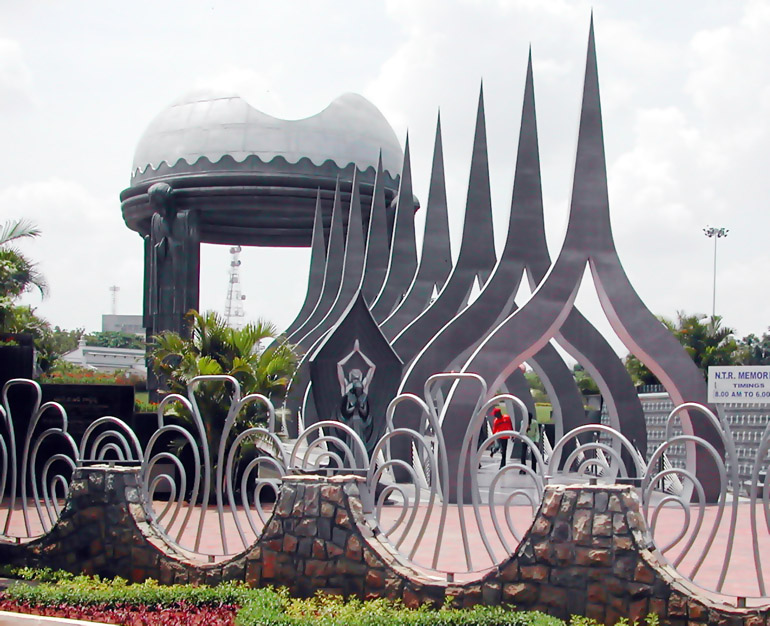
[[File:NTR Memorial.jpg|thumb|Rao's memorial at [[NTR Gardens]], [[Hyderabad]]]] | [[File:Dr NTR University of Health Sciences A.P.jpg|thumb|Entrance of Dr NTR University of Health Sciences]] | ||
[[File:NTR Memorial.jpg|thumb|Rao's memorial at [[NTR Gardens]], [[Hyderabad]]]] | |||
[[File:NT_Rama_Rao_2000_stamp_of_India.jpg|thumb|N. T. Rama Rao commemorative stamp released on 28 August 2000]] | |||
There is a statue of him in his birth city. | |||
[[Government of Andhra Pradesh]] instituted [[NTR National Award]] in 1996 by the to recognise notable film personalities for their lifetime achievements and contributions to the [[Cinema of India|Indian film industry]].<ref>{{cite web |url=https://www.thehindu.com/news/national/ntr-national-literary-award-for-ashokamitran/article3384822.ece |title=Ilayaraja, Ambarish, Krishna get NTR award |publisher=The Hindu, Business Line |location=Hyderabad |date=30 August 2007 |access-date=4 January 2012 |archive-date=7 October 2019 |archive-url=https://web.archive.org/web/20191007084448/https://www.thehindu.com/news/national/ntr-national-literary-award-for-ashokamitran/article3384822.ece |url-status=live }}</ref> [[Dr. NTR University of Health Sciences|University of Health Sciences]], inaugurated on 9 April 1986 by N. T. Rama Rao was renamed in his honour on 2 February 1998 following his death.<ref>{{cite web |title=About US |url=https://drntr.uhsap.in/index/About |publisher=Dr NTR University of Healh Sciences |access-date=24 October 2025}}</ref> NTR Memorial developed on 5 acre plot part of the 55 acre NTR garden overlooking Hussain Sagar Lake was inaugurated by Chandrababu Naidu on 30 May 1999.<ref name="5acres_memorial">{{cite web|url=http://www.indianexpress.com/res/web/pIe/ie/daily/19990531/ige31029.html|title=Row erupts over NTR Memorial|publisher=[[The Indian Express]]|date=31 May 1999|access-date=18 August 2008|work=Press Trust of India|url-status=dead|archive-url=https://web.archive.org/web/20090907013434/http://www.indianexpress.com/res/web/pIe/ie/daily/19990531/ige31029.html|archive-date=7 September 2009}}</ref> A postal stamp was released on 28 May 2000 in honour of NTR.<ref>{{cite web |title=Dr. Nandamuri Taraka Rama Rao |url=http://www.indianphilatelics.com/stamps/commemorative-stamps/2000-2001/item/12391-dr-nandamuri-taraka-rama-rao-click-for-stamp-information.html |website=www.indphila.com |access-date=3 November 2025}}</ref> Droupadi Murmu, President of India released a ₹100 commemorative coin featuring N.T. Rama Rao at the Rashtrapati Bhavan in New Delhi on 28 August 2023.<ref>{{cite news |last1=V |first1=Raghavendra |title=President Murmu releases ₹100 commemorative coin on N.T. Rama Rao to mark his birth centenary |url=https://www.thehindu.com/news/national/andhra-pradesh/president-murmu-releases-100-commemorative-coin-on-nt-rama-rao-to-mark-his-birth-centenary/article67245287.ece |access-date=3 November 2025 |work=The Hindu |date=28 August 2023}}</ref> | |||
[[NTR Trust|NTR Memorial Trust]] a non profit founded by N Chandrababu Naidu is engaged in social service.<ref>{{cite news |title=Trust's fourth blood bank in Rajamahendravaram |url=https://www.thehindu.com/news/national/andhra-pradesh/nara-bhuvaneswari-inaugurates-ntr-memorial-trusts-fourth-blood-bank-in-rajamahendravaram/article68701581.ece |access-date=25 October 2025 |date=30 September 2024}}</ref> | |||
The NTR National Literary Award was instituted by the NTR Vignan Trust, founded by Lakshmi Parvathi is an annual award to recognise people for their lifetime achievements and contributions to Indian literature.<ref>{{cite news |url=https://www.thehindu.com/news/national/ntr-national-literary-award-for-ashokamitran/article3384822.ece |title=NTR literary Award for Ashoka Mitran |newspaper=The Hindu |publisher=The Hindu, Business Line |location=Hyderabad |date=4 May 2012 |access-date=23 September 2012 |archive-date=7 October 2019 |archive-url=https://web.archive.org/web/20191007084448/https://www.thehindu.com/news/national/ntr-national-literary-award-for-ashokamitran/article3384822.ece |url-status=live }}</ref> | |||
== | == In popular culture == | ||
NTR's son [[Nandamuri Balakrishna]] portrayed him in the films ''[[N.T.R: Kathanayakudu]]'' covering his acting career and ''[[N.T.R: Mahanayakudu]]'' covering his political rule till he is restored as chief minister in 1984 following a political coup.<ref>{{cite news |last1=Dundoo |first1=Sangeetha Devi |title='NTR Kathanayakudu' review: On a reverential tone |url=https://www.thehindu.com/entertainment/movies/ntr-kathanayakudu-on-a-reverential-tone/article25949259.ece |access-date=3 November 2025 |date=9 January 2019}}</ref><ref>{{cite news |last1=Dundoo |first1=Sangeetha Devi |title='NTR Mahanayakudu' review: A raging political storm |url=https://www.thehindu.com/entertainment/movies/ntr-mahanayakudu-review-the-silent-show-stealer-is-young-chandrababu-naidu/article26339701.ece |access-date=3 November 2025 |work=The Hindu |date=22 February 2019}}</ref> NTR was portrayed by P Vijay Kumar in the [[Ram Gopal Varma]] film ''[[Lakshmi's NTR]]'' which covers the events in Lakshmi Parvathi's life with NTR.<ref>{{cite news |last1=Y. |first1=Sunita Chowdhary |title=Lakshmi's NTR review: Story sans objectivity |url=https://www.thehindu.com/entertainment/movies/the-hindu/article26676329.ece |access-date=3 November 2025 |work=The Hindu |date=30 March 2019}}</ref> | |||
| | |||
| | |||
| | |||
|- | |||
| | |||
| | |||
| | |||
|- | |||
| | |||
| | |||
|- | |||
| | |||
|} | |||
Lakshmi Parvati authored two-volume biography of NTR. The first volume, ''Eduruleni Manishi'' ({{Translation|Unstoppable person}}), covers his childhood and his entry into films.<ref>{{cite web |title=Paswan at NTR'S bio-graphy |url=https://thehinduimages.com/details-page.php?id=2404545 |work=The Hindu |access-date=3 November 2025|date=26 February 2004}}</ref> The second volume, ''Telugu Tejam'' ({{Translation|The radiance of Telugu}}), dealt with his political career.<ref>{{cite web |last1=Donthi |first1=Praveen |title=Chairman Rao |url=https://caravanmagazine.in/reportage/chairman-rao |access-date=3 November 2025|date=1 December 2014}}</ref> Ramesh Kandula, K Ramachandra Murti and I Venkat Rao were some of the authors of books on NTR.<ref>{{cite web |last1=M |first1=Somasekhar |title=Book review of 'NTR: A Political Biography' — actor, politician and people's man |url=https://www.thehindubusinessline.com/books/reviews/book-review-of-ntr-a-political-biography-actor-politician-and-peoples-man/article66911516.ece |publisher=The Hindu Business Line |access-date=25 October 2025 |date=20 May 2023}}</ref> | |||
==See also== | == See also == | ||
* [[NTR Gardens]], memorial dedicated to him in Hyderabad | |||
* [[NTR district]], district of Andhra Pradesh named after him | |||
* [[NTR bus station]] | |||
* [[List of chief ministers of Andhra Pradesh]] | * [[List of chief ministers of Andhra Pradesh]] | ||
==References== | ==References== | ||
| Line 261: | Line 317: | ||
===Bibliography=== | ===Bibliography=== | ||
* {{Cite book |last=Narayan |first=S. Venkat |publisher=Vikas Publishing House |title=NTR: A Biography |date=1983 |isbn=0-7069-2404-5 |location=New Delhi |oclc=10432404}} | * {{Cite book |last=Narayan |first=S. Venkat |publisher=Vikas Publishing House |title=NTR: A Biography |date=1983 |isbn=0-7069-2404-5 |location=New Delhi |oclc=10432404}} | ||
* {{Cite book |title=Maverick Messiah : A Politicial biography of N. T. Rama Rao|last=Kandula |publisher=Penguin India |date=2021|isbn=978-0-670-09393-9 }} | |||
* {{Cite book|url=http://www.odi.org.uk/resources/download/1997.pdf |title=Democratic Process and Electoral Politics in Andhra Pradesh, India|archive-url=https://web.archive.org/web/20090920085415/http://www.odi.org.uk/resources/download/1997.pdf |date=2002|archive-date=20 September 2009|first=Suri|last=KC|publisher=Overseas Development Institute|isbn= 0-85003-613-5 }} | |||
==External links== | ==External links== | ||
{{commons category|N. T. Rama Rao}} | |||
* {{IMDb name|0004417}} | * {{IMDb name|0004417}} | ||
* [https://www.bbc.com/telugu/india-44277727 Article on NTR in BBC Telugu | * [https://www.bbc.com/telugu/india-44277727 Article on NTR] in BBC Telugu | ||
{{s-start}} | {{s-start}} | ||
| Line 314: | Line 372: | ||
[[Category:1996 deaths]] | [[Category:1996 deaths]] | ||
[[Category:Andhra University alumni]] | [[Category:Andhra University alumni]] | ||
[[Category:Nandamuri–Nara family|N. T. Rama Rao]] | |||
[[Category:Telugu film directors]] | [[Category:Telugu film directors]] | ||
[[Category:Chief | [[Category:Chief ministers of Andhra Pradesh]] | ||
[[Category:V. P. Singh administration]] | [[Category:V. P. Singh administration]] | ||
[[Category:People from Krishna district]] | [[Category:People from Krishna district]] | ||
| Line 328: | Line 387: | ||
[[Category:Telugu Desam Party]] | [[Category:Telugu Desam Party]] | ||
[[Category:Chief ministers from Telugu Desam Party]] | [[Category:Chief ministers from Telugu Desam Party]] | ||
[[Category:Leaders of the | [[Category:Leaders of the opposition in the Andhra Pradesh Legislative Assembly]] | ||
[[Category:Recipients of the Padma Shri in arts]] | [[Category:Recipients of the Padma Shri in arts]] | ||
[[Category:Film directors from Andhra Pradesh]] | [[Category:Film directors from Andhra Pradesh]] | ||
[[Category: | [[Category:Andhra Pradesh MLAs 1983–1985]] | ||
[[Category:Andhra Pradesh MLAs 1985–1989]] | |||
[[Category:Andhra Pradesh MLAs 1989–1994]] | |||
[[Category:Andhra Pradesh MLAs 1994–1999]] | |||
Latest revision as of 11:15, 25 March 2026
N. T. Rama Rao | |
|---|---|
 | |
| 10th Chief Minister of Andhra Pradesh | |
| In office 12 December 1994 – 1 September 1995 | |
| Governor | Krishan Kant |
| Cabinet | NTR IV |
| Preceded by | Kotla Vijaya Bhaskara Reddy |
| Succeeded by | N. Chandrababu Naidu |
| In office 16 September 1984 – 2 December 1989 | |
| Governor | |
| Cabinet | NTR II & III |
| Preceded by | Nadendla Bhaskara Rao |
| Succeeded by | Marri Chenna Reddy |
| In office 9 January 1983 – 16 August 1984 | |
| Governor | |
| Cabinet | NTR I |
| Preceded by | Kotla Vijaya Bhaskara Reddy |
| Succeeded by | Nadendla Bhaskara Rao |
| 10th Leader of the Opposition in the Andhra Pradesh Legislative Assembly | |
| In office 5 January 1990 – 10 December 1994 | |
| Governor | |
| Chief Minister | |
| Preceded by | Mogaligundla Baga Reddy |
| Succeeded by | P. Janardhan Reddy |
| Member of Legislative Assembly, Andhra Pradesh | |
| In office 10 March 1985 – 18 January 1996 | |
| Preceded by | Pamishetty Ranganayakulu |
| Succeeded by | Nandamuri Harikrishna |
| Constituency | Hindupuram |
| In office 1983–1985 | |
| Preceded by | Katari Satyanarayana Rao |
| Succeeded by | Raavi Sobhanadri Chowdary |
| Constituency | Gudivada |
| 1st President of Telugu Desam Party | |
| In office 29 March 1982 – 1 September 1995 | |
| General Secretary | N. Chandrababu Naidu (1983–1995) |
| Preceded by | Position established |
| Succeeded by | N. Chandrababu Naidu |
| Personal details | |
| Born | Nandamuri Taraka Rama Rao 28 May 1923 Nimmakuru, Madras Presidency, British India (now in Andhra Pradesh, India) |
| Died | 18 January 1996 (aged 72) Hyderabad, Andhra Pradesh, India (now in Telangana, India) |
| Resting place | NTR Gardens |
| Political party | Telugu Desam Party |
| Spouse(s) |
|
| Relations | Nandamuri family |
| Children | 12 |
| Occupation |
|
| Awards | Padma Shri (1968) |
| Signature |  |
Nandamuri Taraka Rama Rao (28 May 1923 – 18 January 1996),[1] often referred to by his initials NTR, was an Indian actor, film director, film producer, screenwriter, film editor, philanthropist, and politician who served as the Chief Minister of Andhra Pradesh over four terms for seven years. He founded the Telugu Desam Party (TDP) in 1982, the first regional party of Andhra Pradesh. He is regarded as one of the most influential figures of Indian cinema.[2] He starred in over 300 films, predominantly in Telugu cinema, and was referred to as "Viswa Vikhyatha Nata Sarvabhouma" (transl. Universally-renowned star of acting).[3] He was one of the earliest method actors of Indian cinema.[4] In 2013, Rao was voted as "Greatest Indian Actor of All Time" in a CNN-IBN national poll conducted on the occasion of the Centenary of Indian Cinema.[5][6]
Rama Rao has received numerous honours and accolades, including the Padma Shri in 1968. He also received three National Film Awards for co-producing Thodu Dongalu (1954) and Seetharama Kalyanam (1960) under National Art Theater, Madras,[7] and for directing Varakatnam (1970).[8] Rao garnered the Nandi Award for Best Actor for Kodalu Diddina Kapuram in 1970, and the Inaugural Filmfare Award for Best Actor – Telugu in 1972 for Badi Panthulu.[9][10][11]
Rama Rao made his debut as an actor in a Telugu social film Mana Desam, directed by L. V. Prasad in 1949. he got his breakthrough performances in Raju Peda (1954)[11] and gained popularity in the 1960s when he became well known for his portrayals of Hindu deities, especially Krishna, Shiva and Rama,[4] roles which have made him a "messiah of the masses" and a prominent figure in the history of cinema.[4][12] He later became known for portraying antagonistic characters and Robin Hood-esque hero characters in films.[13][14][15][16] He starred in such films as Pathala Bhairavi (1951), the only south Indian film screened at the first International Film Festival of India,[17][18] Malliswari (1951), featured at Peking Film Festival, Beijing, China,[19] the enduring classics Mayabazar (1957) and Nartanasala (1963), featured at the Afro-Asian Film Festival that was held in Jakarta, Indonesia.[20] All the four films were included in CNN-IBN's list of "100 greatest Indian films of all time".[21] He co-produced Ummadi Kutumbam, nominated by Film Federation of India as one of its entries to the 1968 Moscow Film Festival.[13][22] Besides Telugu, he has also acted in a few Tamil films.[23]
He served four tumultuous terms as Chief Minister of Andhra Pradesh between 1983 and 1995. He was a strong advocate of a distinct Telugu cultural identity, distinguishing it from the erstwhile Madras State with which it was often associated. At the national level, he was instrumental in the formation of the National Front, a coalition of non-Congress parties which governed India in 1989 and 1990. His political career brought vast changes in the polity and political landscape of India, since its independence.
Early life[edit | edit source]
Nandamuri Taraka Rama Rao was born on 28 May 1923 in a Telugu Hindu agrarian family to Nandamuri Lakshmaih Chowdary and Nandamuri Venkata Ramamma,[1] in Nimmakuru, a small village in Gudivada taluk of Krishna district, which was a part of the erstwhile Madras Presidency of British India. He was given in adoption to his paternal uncle because his uncle and aunt were childless.[24] He was first educated by a teacher who came from a nearby village, whom he would attribute his command of Telugu to, as well as his father, an aspiring thespian and patron of the arts. Although children were normally pulled out of school after completing their primary education in that time and place, on account of being the first male child in the family, his father sent him to Vijayawada to continue his education, matriculating in 1940 before studying at SRR & CVR College and completing a bachelor's degree from Andhra Christian College in Guntur.[25]
After qualifying for the civil service in what was then the Madras Presidency under British India, he took a job as a sub-registrar in Madras Service Commission at Mangalagiri, northeast of Guntur, a much-coveted job that he nevertheless quit within three weeks to pursue a career in acting.[26][27] He developed a baritone singing voice as a young man.[4]
Personal life[edit | edit source]
In May 1942, at the age of 18, while still pursuing his Intermediate, Rao married Basava Rama Tarakam, the daughter of his maternal uncle. The marriage resulted in twelve children; including eight sons and four daughters, namely: Ramakrishna Sr., Jayakrishna, Saikrishna, Harikrishna, Mohana Krishna, Balakrishna, Ramakrishna Jr., Jayashankarakrishna, Lokeswari, Purandeswari, Bhuvaneswari, and Umamaheswari.[28]
Tarakam died of cancer in 1985.[29] In her memory, Rao established the Basavatarakam Indo-American Cancer Hospital in Hyderabad, in 1986.[30] In 1993, NTR married Lakshmi Parvathi, a Telugu writer.[31]
NTR's sixth son, Nandamuri Balakrishna, has been one of the leading actors in Tollywood since the mid-1980s. He also started his career as a child artist. NTR's third daughter, Bhuvaneswari, is married to chief minister Nara Chandrababu Naidu. NTR's second daughter, Daggubati Purandeswari, is a politician, who has represented the Indian National Congress in the Lok Sabha and served as a Union Minister. She later shifted her allegiance to the Bharatiya Janata Party.[32][33]
Rama Rao died of a heart attack on 18 January 1996 at his residence in Hyderabad, aged 72.[34] He was cremated, and his ashes were immersed at Srirangapatna by his second wife Lakshmi Parvathi, eight years later, in May 2004.[35]
Film career[edit | edit source]
NTR made his debut as an actor in a Telugu social film Mana Desam, directed by L. V. Prasad in 1949. Following this, he appeared in Palletoori Pilla (1950), directed by B. A. Subba Rao. He got his breakthrough performances in Raju Peda (1954)[11]
His first religious film was in 1957, where he portrayed the Hindu god Krishna in the blockbuster film Maya Bazaar.[36] He played Krishna in 17 films,[36] including some landmark films such as Sri Krishnarjuna Yudham (1962), the Tamil film Karnan (1964) and Daana Veera Soora Karna (1977). He was also known for his portrayal of the god Rama, essaying that role in films such as Lava Kusa (1963) and Sri Ramanjaneya Yuddham (1974) to name a few. He has also portrayed other characters from the Ramayana, such as Ravana in Bhookailas (1958) and Seetharama Kalyanam (1961) among others. He portrayed the god Vishnu in films such as Sri Venkateswara Mahatyam (1960) among others and the god Shiva in Dakshayagnam (1962). He has also enacted the roles of Mahabharata characters, such as Bheeshma, Arjuna, Bhima, Karna and Duryodhana.
He gained popularity in the 1960s when he became well known for his portrayals of Hindu deities, especially Krishna, Shiva and Rama,[4] roles and a prominent figure in the history of cinema.[4][12][37] He starred in such films as Pathala Bhairavi (1951), the only south Indian film screened at the first International Film Festival of India,[16][38] Malliswari (1951), featured at Peking Film Festival, Beijing, China,[39] the enduring classics Mayabazar (1957) and Nartanasala (1963).
In the later half of his career, Rao became a screenwriter. Despite having no formal training in scriptwriting, he authored several screenplays for his own movies as well as for other producers. He also produced many of his films as well as other actor's films through his film production house National Art Theater Private Limited, Madras. Rao founded the film studios Ramakrishna Studios initially in Musheerabad in memory of his eldest son, Nandamuri Ramakrishna Sr. who died in 1962. Later It was shifted to Nacharam. He co-produced Ummadi Kutumbam, nominated by Film Federation of India as one of its entries to the 1968 Moscow Film Festival.[40] He actively campaigned for the construction of a large number of cinemas through this production house. He was influential in designing and implementing a financial system that funded the production and distribution of movies. He was so dedicated to his profession that he would often learn new things to portray a particular character on-screen perfectly and realistically. At the age of 40, he learnt dance from the Kuchipudi dancer Vempati Chinna Satyam for his role in the film Nartanasala(1963). Later in his career, he transitioned from portraying princely characters in commercial films to roles featuring working-class heroes who challenged societal structures. These films resonated with a broad audience. Some of these films are Devudu Chesina Manushulu (1973), Adavi Ramudu (1977), Driver Ramudu (1979), Vetagadu (1979), Sardar Papa Rayudu (1980), Kondaveeti Simham (1981), Justice Chowdary (1982) and Bobbili Puli (1982). He also portrayed fantasy roles, his notable film in that genre being Yamagola (1977). His film Lava Kusa, in which he starred as Rama, collected ₹10 million in 1963. He directed and acted in the hagiographical film Srimadvirat Veerabrahmendra Swami Charitra (1984). He also acted in films such as Brahmashi Viswamitra (1991) and Major Chandrakanth (1993). His last film was Srinatha Kavi Sarvabhowmudu, a biographical film on the Telugu poet Srinatha, which released in 1993.
He starred in over 300 films, predominantly in Telugu cinema, and was referred to as "Viswa Vikhyatha Nata Sarvabhouma" (transl. Universally-renowned star of acting).[3] He was one of the earliest method actors of Indian cinema.[4]
Rao received three National Film Awards for co-producing Thodu Dongalu (1954) and Seetharama Kalyanam (1960) under National Art Theater, Madras,[40] and for directing Varakatnam (1970).[8]
Political career[edit | edit source]
NTR's political career with his Telugu Desam Party in Andhra Pradesh brought tremendous changes in the polity and political landscape of India since Independence.[41] Nadendla Bhaskara Rao, a politician belonging to Congress (I) contemplated forming a new political party after he was dropped as a minister. He came in contact with NTR, who also expressed his interest to do public service after his 60th birthday. NTR announced the launch of Telugu Desam Party (TDP) on 29 March 1982 in Hyderabad in a meeting with the enthusiastic supporters and delegates of the proposed party, which included N. Bhaskara Rao, who by then had resigned from Congress(I). He said that this decision was based on a historic need to rid Andhra Pradesh of the corrupt and inept rule of the Indian National Congress, which had governed the state since its formation in 1956.[42][43] After general body meeting of party named Mahanaadu in May 1982, he hit the road to tell people of his mission even though elections were several months away. He used a modified Chevrolet van of 1950s for his campaign. A sunroof to climb up for addressing the public along with a public address system and focus lights were some of the modifications to facilitate his marathon tour across the state. The vehicle was named Chaitanya Ratham (Chariot of Awakening) and this style of campaigning became an innovation that was followed by several others later. He attired himself in Khaki pants and bush shirt. He lived his life on the road avoiding guest houses or luxury houses of his fans, even performing daily activities such as shaving, bathing by the roadside. His food was a simple meal prepared by an assistant on the roadside. Eenadu an upcoming Telugu daily supported NTR's campaign by providing information on local issues for use in NTR's speeches and by extensive coverage in the paper with reports from a reporter and photographer always accompanying. The paper's circulation jumped from 2.3 lakh to 3.5 lakh during June - December 1982 coinciding with campaign period.[44]
In the elections, the TDP allied with the newly formed Sanjaya Vichara Manch (SVM) party.[45] TDP manifesto projected itself as the real alternative to the Congress (I).[46] It fielded ordinary persons who had integrity, competence and loyalty as its candidates.[47] Rao himself decided to contest from two assembly constituencies, Gudivada and Tirupati. In his Chaitanya Ratham, Rao travelled across the state of Andhra Pradesh, criss-crossing all the districts with his son Nandamuri Harikrishna driving the van. He notched up over 75,000 kilometres during his campaign, a distinctive sight with the van's yellow party flags and banners and Rao sitting on top of the vehicle hailing the crowds.[48] He campaigned for restoring the dignity of the Telugu people and advocated forming a closer bond between the government and the common people, going into the elections with the slogan, Telugu Vari Atma Gauravam (lit. Telugu people's self-respect).[49]
In the AP Legislative assembly election held on 5 January 1983 two months ahead of schedule,[50] TDP with its alliance partner SVM won a land slide victory by winning 202 out of the 294 seats in the state assembly, with Rao himself winning both the seats he contested.[51] In all legislative assembly elections, he used to contest from two or three seats and won in all such contests except for the loss from Kalwakurthy in 1989 as detailed in the table below.
| Year | Office | Constituency | Party | Votes | % | Opponent | Party | Votes | % | Result | Ref | ||
|---|---|---|---|---|---|---|---|---|---|---|---|---|---|
| 1983 | MLA | Tirupati | Telugu Desam Party | 
|
64,688 | 77.01 | Agarala Eswara Reddy | Indian National Congress | 
|
17,809 | 21.2 | Won | [52] |
| Gudivada | 53906 | 64.94 | Katari Satyanarayan Rao | 27368 | 32.97 | Won | [53] | ||||||
| 1985 | 49,600 | 53.64 | Uppalapati Suryanarayana Babu | 42,003 | 45.42 | Won | |||||||
| Hindupur | 56,599 | 75.64 | E. Adimurty | 16,070 | 21.48 | Won | [54] | ||||||
| Nalgonda | 49,788 | 66.54 | Mandadi Ramchandra Reddy | 18,201 | 24.32 | Won | [55] | ||||||
| 1989 | Kalwakurthy | 50,786 | 47.59 | Chittaranjan Dass | 54,354 | 50.94 | Lost | [56] | |||||
| Hindupur | 63,715 | 61.6 | G. Soma Sekhar | 39,720 | 38.4 | Won | [54] | ||||||
| 1994 | 88,058 | 74.04 | J. C. Prabhakar Reddy | 28,008 | 23.55 | Won | |||||||
| Tekkali | 66,200 | 70.9 | Vajja Babu Rao | 25,310 | 27.1 | Won | [57] | ||||||
First term as Chief Minister[edit | edit source]
Rao was sworn in as the 10th and the first non-Congress Chief Minister of the state on 9 January 1983 with ten cabinet ministers and five ministers of state.[58] After one year in office, NTR became known for populist schemes such as subsidised rice at Rs 2 per kg to the poor through public distribution system. He also went about dismantling established political setup such as recommending dissolution of legislative council, dismantling hereditary part time village officers and reducing the retirement age for government employees.[59] Several of his actions in an authoritative manner caused resentment among several interest groups. In particular government employees strike against reducing retirement age lasted 19 days.[60]
NTR visited the US for treatment of his health issues during June and July 1984 without nominating an in-charge. He underwent open heart surgery during his second visit. N. Bhaskar Rao, who initiated the idea of regional party and thought he could wield power from behind realised that he was sidelined. Rao engineered a split in the party making use of MLAs who were impacted by the authoritarian rule of NTR. After returning from US, NTR came to know about the actions of Bhaskar Rao and recommended his dismissal to governor to from the cabinet. Meanwhile Bhaskar Rao and three other ministers resigned from the cabinet. Bhaskar Rao met governor and claimed that NTR lost the majority in the house and he had the support of MLAs from the TDP and also from other parties to be able to form the government. Governor of Andhra Pradesh Thakur Ram Lal, sought NTR's resignation claiming that he lost his majority in the house. Despite NTR's immediate response to prove his majority by producing the MLAs, Ram Lal dismissed NTR's government and invited Bhaskar Rao to form the government and prove his majority in 30 days.[61][62]
During this term, he brought together 14 non Congress(I) parties during Mahanadu held at Vijayawada in May 1983. The meeting called for review of centre-state relations. Subsequent such meetings held in New delhi, Srinagar, Calcutta helped NTR emerge as one of the prominent leaders at the national level.[63]
Fight for democracy restoration[edit | edit source]
Peeved by the unilateral decision of governor in dismissing his government, without giving him a chance to prove his majority, Rama Rao relaunched his Chaitanya Ratham campaign, this time campaigning for the restoration of democracy by mobilising the support of people and various anti-Congress political parties in the country including the Janata Party (JP), the Bharatiya Janata Party (BJP), and the National Conference (NC). During the one-month crisis, the MLAs supporting Rama Rao were secured in a secret place to avoid horse-trading. This was achieved with the support of Ramakrishna Hegde, Janata party chief minister of the neighbouring Karnataka state. Ramakrishna Hegde moved all the TDP MLAs to a budget hotel, Das Prakash, in Mysuru (Mysore), as Congress was known for poaching MLAs. This was the first time in Indian politics that MLAs were secured at a safe place from poaching. Also, due to mobilisation of several political parties and the people and widespread publicity by press, Indira Gandhi unwillingly removed governor Ramlal and appointed a Congress veteran, Shankar Dayal Sharma, to pave the way for restoring Rao.[62] Sharma put pressure on Nadendla to prove his majority as quickly as possible. The assembly was convened on 11 September 1984, four days ahead of deadline. TDP MLAs returned to Hyderabad a day before the session to participate in the assembly. During the three days, the house was forced to be adjourned as the pro Bhaskar Rao MLAs and MIM MLAs shouted slogans abusing NTR and caused unrest. The pro team speaker resigned. Bandhs were observed in the state and a Bharat bandh was also called by the national non congress(I) parties which rallied behind NTR.[64]
Second term as Chief Minister[edit | edit source]
On 16 September, governor invited NTR to form a government as Bhaskar Rao could not prove his majority in the house. NTR was sworn in along with eight ministers was sworn in at the Raj Bhavan. On 20 September, the first day of assembly session, NTR proved his majority with support from communist parties, BJP and Janata party. NTR was unable to function like in the past, as he did not have absolute majority of his own. He also did not revoke the reinstatement of retirement age for government employees done by his predecessor Nadendla Bhaskar Rao during his short stint.[65]
Meanwhile Indira Gandhi was assassinated and was succeeded as prime minister by her son, Rajiv Gandhi in November 1984. NTR wanted to go for mid term polls and got an assurance from Rajiv Gandhi on the condition that he will not campaign outside his state in the upcoming national elections. On 23 November 1984, NTR's cabinet recommended dissolution of the assembly which was accepted by the governor.[66] In the ensuing national elections to the Lok Sabha in December 1984, the Congress, riding on the sympathy wave caused by Indira Gandhi's assassination, won convincingly all over the country except in Andhra Pradesh where the TDP secured a landslide victory. TDP became the first regional party to serve as the main opposition party in the Lok Sabha.[67]
The TDP again won with a massive majority in mid term elections held in March 1985, bagging 202 out of 250 seats it contested. Rao won from all the 3 seats that he contested namely Hindupur, Nalgonda and Gudivada. Senior Leaders of the Congress in the state including former Chief Ministers Kasu Brahmananda Reddy and Kotla Vijaya Bhaskara Reddy lost in the election. Nadendla Bhaskar Rao's splinter party only won two seats.[68]
Third term as Chief Minister[edit | edit source]
Rao was sworn in as the chief minister on 9 March 1985.[69] During this term, he altered rural power structures by creating 1104 revenue mandals in place of 305 talukas to decentralise the rural administration and make it more efficient. Direct elections for local bodies with reservations for 50% of seats for including 20% for backward classes for the first time on a party basis were held. The bill to introduce equal rights to daughters in inheritance became an act on 10 October 1985 much before such change at the national level in 2005. He banned alcohol sale.He started the practice of registering house site pattas in the name of women and special courts for crimes against women. He transformed Hyderabad into a distinctly Telugu city, by launching Tank bund project and launching the Hussain Sagar Buddha project. He announced political reservations for BCs with 20% quota in mandals. He decided to implement increased reservations from 49 per cent to 71 per cent based on the recommendation N.K. Muralidhar Rao commission and also impose a creamy layer criteria to exclude the well off. However this was challenged in the courts which resulted in annulling the GO.[70]
Several congress leaders and activists tried to stall several initiatives of NTR by filing petitions in courts and courts passed strictures on some. He also revived his film making and acting while the state faced several crisis such as naxal crisis, social conflicts due to increase in reservations, caste conflicts in Vijaywada and Karamchedu. In the December 1989 assembly elections however, he was voted out of power due to a wave of anti-incumbency sweeping the state as a result of which the Congress returned to power.[71]
As leader of the opposition[edit | edit source]
Rao assumed the position as the Leader of Opposition in the state. He felt dejected and unwanted by the proceedings in the assembly in which he was belittled by the Congress MLAs who were earlier MLAs of his party. He found solace in movie making. He completed the remaining shooting for Brahmarshi Viswamitra and took up and completed films on Srinatha, Telugu poet and Ashok, the emperor. All the three failed at the box office.[72] Lakshmi Parvathi who met him during a Harikatha performance of his husband at AP Bhavan in 1985. She sought his permission to write his biography and persisted despite initial rejections from Rao. During 1991, he relented and Lakshmi Parvati started meeting him regularly. She cared for him during his campaigning for mid term election. she also started living away from her husband. According to Parvathi, NTR asked her to be his companion. Parvathi accepted his proposal and filed for divorce from her husband. According to Parvathi, they got married on 22 February 1992 secretly in the puja room of NTR's kuteeram at Ramakrishna Studios, Nacharam. She appeared in public when Rao suffered paralytic stroke and was admitted to NIMS. He visited US again for treatment. He was cared for by Parvathi after returning. NTR's family members attempts to separate them proved futile. As rumours spread about his life with Parvathi, he put a lid on them by sharing his relationship with Parvathi and proposing to her in public, during the 100th day celebration of film Major Chandrakaanth on 10 September 1993.[73] Surprisingly, the relationship was well received by the public.
Several non Congress(I) parties came together to form National Front on 6 August 1988 largely due to the efforts of NTR. He became its Chairman.[74][75] He campaigned extensively for the constituent parties using his Chaitanya Ratham campaigning concept.[76] This alliance governed India between 1989 and 1990 with support from the BJP. He could not play an active influential role, as his party is represented by just two MPs in Lok Sabha. As National front government fell before the completion of one year, mid term elections took place in May 1991 in two phases. Due to the sympathy wave for Rajiv Gandhi, who was killed during the electioneering, TDP increased its tally to 13 seats, while Congress won 25 seats. He was happy to see PV Narasimha Rao, a Telugu elected as prime minister of the coalition government. He decided not to field a TDP candidate when PV Narasimha rao contested in the Nandyal By-election subsequently. He faced split in his parliamentary party, when opposition parties brought about a no confidence motion against Narasimha Rao government.[77]
When all TDP MLAs who were demanding action against daylight murder of their colleague in Hyderabad rushed into the well of the house, they were suspended by the speaker. This made NTR take a vow to return to the assembly only as the chief minister.[78]
To energise the party cadre, Rao started organising regional meetings. During the first such meeting at Rajahmundry meeting, the audience wanted Parvathi to speak after the address by NTR. Her speech made a good impression. Though she did not express any political aspirations, her increasing clout made family members and specially Chandrababu unhappy. Some members who did not get along well with Chandrababu, became close to her. The historic anti-arrack agitation by women across the state became a threat to the Congress government. Though the government ordered a ban from 1 October 1993, NTR promised total ban including Indian Made Foreign Liquor, once he comes to power. NTR reduced his roadshows during the campaigns for December 1994 state assembly elections, due to his advancing age. Elections were held in two phases on 1 and 5 December 1994.[79]
TDP in alliance with the Left Front won 269 seats in the 294 seat assembly, with the TDP alone winning 226. The Congress, which once again had multiple Chief Ministers in the state during its five-year rule between 1989 and 1994, won only 26 seats. Rao contested again from Hindupur and won the seat for the third consecutive time,[80] achieving a rare hat-trick of wins from the same assembly constituency. He also won from another assembly constituency, Tekkali.[81]
Fourth term as Chief Minister[edit | edit source]
Rao was sworn in as the chief minister for the fourth and final time in a ceremony at Lal Bahadur Stadium in the presence of non Congress(I) party leaders. He signed the file to impose total alcohol prohibition in the event to a applause from the crowd, fulfilling his election promise. Though NTR rewarded Chandrababu with cabinet minister for finance and revenue which are considered as plum posts, he denied berths to some of his loyalists.[82] Lakshmi Parvati's increasing influence by accompanying NTR in his travels and her individual public appearances in cultural and social functions in which several ministers participated troubled several TDP leaders. Unhappy TDP MLAs congregated in hotel Viceroy and engaged in discussions about future course of action. Few representatives met NTR and asked him to assure to keep Lakshmi Parvathi out of politics, which was declined. Aware of the role of Chandrababu, NTR recommended the dismissal of him and his loyalists from the cabinet to the governor which was accepted. With the support of NTR's son Harikrishna and son-in-law Daggubati to dethrone NTR, MLAs elected N. Chandrababu Naidu as the leader of the legislature party. A final attempt by NTR to bring back the rebel MLAs to his fold turned futile. While NTR requested the governor to dissolve the assembly. Meanwhile representative from Chandrababu's faction informed governor of change of leadership of TDP legislature party with the requisite support of MLAs. Governor asked NTR to resign. Finally NTR resigned after 8 and half months of his being sworn in. Following this Chandrababu staked his claim to form the government and was sworn in as the Chief minister on 1 September 1995.[83][84][85]
Following this, NTR vowed to take revenge against Naidu in an interview with Reuters on 17 January 1996.[86] NTR died the next day. Lakshmi Parvathi's faction formed a new party NTR Telugu Desam Party, and participated in the 1996 Lok Sabha elections but could not win a single seat. However she won in the by-election to the legislative assembly from Pathapatnam in October 1996. The party could not win any in the later elections.[87]
Awards and honours[edit | edit source]
Rama Rao has received numerous honours and accolades, including the Padma Shri in 1968. He received an honorary Doctorate in 1978 from Andhra University. He also received three National Film Awards for co-producing Thodu Dongalu (1954) and Seetharama Kalyanam (1960) under National Art Theater, Madras,[40] and for directing Varakatnam (1970).[8] Rao garnered the Nandi Award for Best Actor for Kodalu Diddina Kapuram in 1970, and the Inaugural Filmfare Award for Best Actor – Telugu in 1972 for Badi Panthulu.[88][10][11][89][90][91] He received Best Story Writer in 1974 for Tatamma Kala[92]
Legacy[edit | edit source]


There is a statue of him in his birth city.
Government of Andhra Pradesh instituted NTR National Award in 1996 by the to recognise notable film personalities for their lifetime achievements and contributions to the Indian film industry.[93] University of Health Sciences, inaugurated on 9 April 1986 by N. T. Rama Rao was renamed in his honour on 2 February 1998 following his death.[94] NTR Memorial developed on 5 acre plot part of the 55 acre NTR garden overlooking Hussain Sagar Lake was inaugurated by Chandrababu Naidu on 30 May 1999.[95] A postal stamp was released on 28 May 2000 in honour of NTR.[96] Droupadi Murmu, President of India released a ₹100 commemorative coin featuring N.T. Rama Rao at the Rashtrapati Bhavan in New Delhi on 28 August 2023.[97]
NTR Memorial Trust a non profit founded by N Chandrababu Naidu is engaged in social service.[98] The NTR National Literary Award was instituted by the NTR Vignan Trust, founded by Lakshmi Parvathi is an annual award to recognise people for their lifetime achievements and contributions to Indian literature.[99]
In popular culture[edit | edit source]
NTR's son Nandamuri Balakrishna portrayed him in the films N.T.R: Kathanayakudu covering his acting career and N.T.R: Mahanayakudu covering his political rule till he is restored as chief minister in 1984 following a political coup.[100][101] NTR was portrayed by P Vijay Kumar in the Ram Gopal Varma film Lakshmi's NTR which covers the events in Lakshmi Parvathi's life with NTR.[102]
Lakshmi Parvati authored two-volume biography of NTR. The first volume, Eduruleni Manishi (transl. Unstoppable person), covers his childhood and his entry into films.[103] The second volume, Telugu Tejam (transl. The radiance of Telugu), dealt with his political career.[104] Ramesh Kandula, K Ramachandra Murti and I Venkat Rao were some of the authors of books on NTR.[105]
See also[edit | edit source]
- NTR Gardens, memorial dedicated to him in Hyderabad
- NTR district, district of Andhra Pradesh named after him
- NTR bus station
- List of chief ministers of Andhra Pradesh
References[edit | edit source]
- ↑ 1.0 1.1 "N.T. Rama Rao: A timeline". The Hindu. 28 May 2017. Archived from the original on 11 October 2020. Retrieved 22 November 2017.
- ↑ "NTR, India's greatest ever actor, says survey". 29 August 2018.
- ↑ 3.0 3.1 "Remembering Nandamuri Taraka Rama Rao on his 24th death anniversary: The life and legacy of Doctor Viswa Vikhyatha Nata Sarvabhouma". The Times of India. 18 January 2020. Archived from the original on 7 January 2022. Retrieved 12 July 2021.
- ↑ 4.0 4.1 4.2 4.3 4.4 4.5 4.6 McGirk, Tim (19 January 1996). "Obituary: N. T. Rama Rao". The Independent. London. Archived from the original on 18 June 2022. Retrieved 31 May 2010.
- ↑ "NTR greatest actor in India". CNN-IBN. 9 March 2013. Archived from the original on 23 September 2016. Retrieved 2 September 2016.
- ↑ "NTR is the greatest Indian actor – Times of India". The Times of India. Archived from the original on 3 February 2017. Retrieved 2 September 2016.
- ↑ Eenadu Daily, Eenadu cinema – 17 July 2013, National art theater, Page 10
- ↑ 8.0 8.1 8.2 "2nd National Film Awards" (PDF). Directorate of Film Festivals. Archived (PDF) from the original on 16 March 2012. Retrieved 23 August 2011.
- ↑ https://archive.org/details/20th-filmfare-best-actor-award-winners
- ↑ 10.0 10.1 The Times of India directory and year book including who's who. Times of India Press. 1984.
- ↑ 11.0 11.1 11.2 11.3 Ramachandran, T.M. (1973). Film world. Vol. 9.
- ↑ 12.0 12.1 Burns, John F. (19 January 1996). "N. T. Rama Rao, 72, Is Dead; Star Status Infused His Politics". The New York Times. Archived from the original on 29 September 2015. Retrieved 22 September 2015.
- ↑ 13.0 13.1 Eenadu Daily, Eenadu cinema – 17 July 2013, National art theater, Page 10
- ↑ "N.T. Rama Rao (1923–1995): A messiah of the masses". The Hindu. Archived from the original on 14 March 2003. Retrieved 9 December 2002.
- ↑ Sashidhar AS (13 August 2012). "Donga Ramudu was included in FTII". The Times of India (Press release). Archived from the original on 4 May 2013. Retrieved 27 August 2012.
- ↑ 16.0 16.1 "Nostalgia – Pathala Bhairavi". CineGoer.com. Archived from the original on 28 September 2012. Retrieved 27 August 2012.
- ↑ "::Directorate Of Film Festivals". Archived from the original on 28 May 2015.
- ↑ "4th National Film Awards" (PDF). Directorate of Film Festivals. Archived (PDF) from the original on 25 December 2018. Retrieved 2 September 2011.
- ↑ Eenadu Daily, Eenadu Sunday – 28 April 2013, 100 years of Indian Cinema, Early Tollywood, Page 9
- ↑ "Directorate of Film Festival" (PDF). Iffi.nic.in. Retrieved 25 August 2012.
{{cite web}}: CS1 maint: deprecated archival service (link) - ↑ "News18.com: CNN-News18 Breaking News India, Latest News, Current News Headlines". News18. Archived from the original on 24 April 2013.
- ↑ "Cinema News – Movie Reviews – Movie Trailers – IndiaGlitz". Archived from the original on 13 June 2011.
- ↑ Democratic Process and Electoral Politics in Andhra Pradesh, India Archived 20 September 2009 at the Wayback Machine (1997)
- ↑ Narayan 1983, pp. 54–55.
- ↑ Narayan 1983, pp. 55–57.
- ↑ "N.T. Rama Rao (1923–1995): A messiah of the masses". The Hindu. 9 December 2002. Archived from the original on 11 June 2003. Retrieved 24 September 2015.
- ↑ "Nandamuri Taraka Rama Rao". Encyclopedia Britannica. 17 February 2024.
- ↑ "Cities / Vijayawada : Rich tributes paid to N.T. Rama Rao". The Hindu. 19 January 2012. Archived from the original on 19 July 2012. Retrieved 3 August 2012.
- ↑ "About Us". Induscancer. Archived from the original on 21 March 2019. Retrieved 21 March 2019.
- ↑ "I need people's blessings: Balayya". Andhraheadlines.com. Archived from the original on 18 January 2012. Retrieved 4 August 2013.
- ↑ Ch (21 July 2003). "Lakshmi Parvathi to don greasepaint". The Times of India. Archived from the original on 20 May 2013. Retrieved 4 August 2013.
- ↑ [1] Archived 7 August 2007 at the Wayback Machine
- ↑ ARUN KUMAR (29 October 2012). "Caste tangle hits Purandeswari's elevation". The Times of India. Retrieved 4 August 2013.
{{cite news}}: CS1 maint: deprecated archival service (link) - ↑ Rahman, Sheikh (31 January 1996). "A Legacy Under Siege". Outlook India. Archived from the original on 29 March 2019. Retrieved 22 October 2019.
When news of NTR's untimely death due to a massive heart attack in the early hours of January 18 broke ...
- ↑ "National : Lakshmi Parvati immerses NTR's ashes in Cauvery". The Hindu. 17 May 2004. Archived from the original on 21 June 2004. Retrieved 4 August 2013.
- ↑ 36.0 36.1 "Telugu cinema megastar – Nandamuri Taraka Rama Rao's Bio-data". Idlebrain.com. Archived from the original on 3 June 2013. Retrieved 4 August 2013.
- ↑ "N.T. Rama Rao (1923–1995): A messiah of the masses". The Hindu. Archived from the original on 14 March 2003. Retrieved 9 December 2002.
- ↑ "State Awards for films - Programme 1961". Directorate Of Film Festivals. Archived from the original on 28 May 2015.
- ↑ "100 years of Indian Cinema, Early Tollywood". Eenadu. 28 April 2013. p. 9.
- ↑ 40.0 40.1 40.2 "National art theater". No. 17 July 2013. Eenadu. 17 July 2013.
- ↑ KC, Srivatsan (24 May 2024). "Elections that shaped India : The rise of the Telugu Desam Party". The Hindu. Retrieved 25 October 2025.
- ↑ Kandula 2021, pp. 14-25.
- ↑ "Telugu Desam Party turns 29, NT Rama Rao remembered". DNA India. Archived from the original on 1 April 2010. Retrieved 31 May 2010.
- ↑ Kandula 2021, pp. 38-43.
- ↑ Kandula 2021, pp. 72.
- ↑ Kandula 2021, p. 60.
- ↑ Kandula 2021, p. 414.
- ↑ "The original ratham". The Hindu. Chennai, India. 17 April 2009. Archived from the original on 21 April 2009. Retrieved 31 May 2010.
- ↑ KC 2002, p. 25-26.
- ↑ Kandula 2021, p. 55.
- ↑ "Andhra Pradesh Assembly Election Results in 1983". Elections in India. Archived from the original on 1 March 2021. Retrieved 16 April 2022.
- ↑ "Tirupati Assembly Constituency Election Result – Legislative Assembly Constituency". resultuniversity.com. Retrieved 4 December 2024.
- ↑ "Gudivada Assembly Constituency Election Result – Legislative Assembly Constituency". resultuniversity.com. Retrieved 4 December 2024.
- ↑ 54.0 54.1 "Hindupur Assembly Constituency Election Result – Legislative Assembly Constituency". resultuniversity.com. Retrieved 4 December 2024.
- ↑ "Nalgonda Assembly Constituency Election Result – Legislative Assembly Constituency". resultuniversity.com. Retrieved 4 December 2024.
- ↑ "Kalwakurthi Assembly Constituency Election Result – Legislative Assembly Constituency". resultuniversity.com. Retrieved 4 December 2024.
- ↑ "IndiaVotes AC: Tekkali 1994". IndiaVotes. Retrieved 4 December 2024.
- ↑ S. Nagendra Ambedkar (1992). Political elite. Printwell, with special arrangement from Rupa Books. ISBN 8170443415.
- ↑ Kandula 2021, pp. 87-88.
- ↑ Kandula 2021, p. 92.
- ↑ Kandula 2021, pp. 118-127.
- ↑ 62.0 62.1 Murty, K. R. (2001). Parties, elections, and mobilisation. Anmol Publications PVT. LTD. pp. 48–49. ISBN 978-81-261-0979-1. Archived from the original on 24 February 2024. Retrieved 21 November 2018.
- ↑ Kandula 2021, pp. 103-105.
- ↑ Kandula 2021, pp. 139-144.
- ↑ Kandula 2021, pp. 144-150.
- ↑ Kandula 2021, pp. 150-152.
- ↑ "INKredible India: The story of 1984 Lok Sabha election". Zee News. 26 March 2019. Archived from the original on 23 May 2022. Retrieved 16 April 2022.
- ↑ Kandula 2021, pp. 157-158.
- ↑ Darbhamulla, Sruthi (22 July 2024). "A political history of Andhra Pradesh: From formation to the NTR years". The Hindu. Retrieved 24 October 2025.
- ↑ Kandula 2021, pp. 160-196.
- ↑ Kandula 2021, pp. 251-302.
- ↑ Kandula 2021, pp. 304-305.
- ↑ Kandula 2021, pp. 314-325.
- ↑ Kandula 2021, pp. 249-250.
- ↑ "Regionalism and sub-regionalism". frontline.thehindu.com. 22 April 2004. Archived from the original on 20 September 2022. Retrieved 2 August 2022.
- ↑ "The mother of all rath yatras". The Hindu. 1 April 2004. Archived from the original on 14 April 2004. Retrieved 4 August 2013.
- ↑ Kandula 2021, pp. 306-310.
- ↑ Kandula 2021, p. 313.
- ↑ Kandula 2021, p. 327-335.
- ↑ "State Elections 2004 – Partywise Comparison for 164-Hindupur Constituency of ANDHRA PRADESH". Eci.nic.in. Archived from the original on 13 May 2014. Retrieved 4 August 2013.
- ↑ "State Elections 2004 – Partywise Comparison for 3-Tekkali Constituency of Andhra Pradesh". Eci.nic.in. Archived from the original on 17 October 2015. Retrieved 4 August 2013.
- ↑ Kandula 2021, p. 337.
- ↑ Kandula 2021, p. 346-369.
- ↑ "A legacy under siege". Outlook. Archived from the original on 29 March 2019. Retrieved 29 March 2019.
- ↑ Menon, Amarnath K (28 February 1995). "N.T. Rama Rao's wife Lakshmi Parvathi may follow Tamil Nadu CM J. Jayalalitha's path". India Today. Retrieved 28 July 2023.
- ↑ Burns, John F. (19 January 1996). "N. T. Rama Rao, 72, Is Dead; Star Status Infused His Politics". The New York Times. Archived from the original on 21 March 2021.
- ↑ Kandula 2021, p. 396-397.
- ↑ https://archive.org/details/20th-filmfare-best-actor-award-winners
- ↑ "NTR Filmfare Award". 23 April 2025 – via Internet Archive.
- ↑ "20th Annual Filmfare Telugu and Kannada Winners". 15 April 2025 – via Internet Archive.
- ↑ "National Film Awards – 1969". Hindilyrics.net. Archived from the original on 20 March 2012. Retrieved 3 August 2012.
- ↑ "నంది అవార్డు విజేతల పరంపర (1964–2008)" [A series of Nandi Award Winners (1964–2008)] (PDF). Information & Public Relations of Andhra Pradesh. Archived (PDF) from the original on 23 February 2015. Retrieved 21 August 2020.(in Telugu)
- ↑ "Ilayaraja, Ambarish, Krishna get NTR award". Hyderabad: The Hindu, Business Line. 30 August 2007. Archived from the original on 7 October 2019. Retrieved 4 January 2012.
- ↑ "About US". Dr NTR University of Healh Sciences. Retrieved 24 October 2025.
- ↑ "Row erupts over NTR Memorial". Press Trust of India. The Indian Express. 31 May 1999. Archived from the original on 7 September 2009. Retrieved 18 August 2008.
- ↑ "Dr. Nandamuri Taraka Rama Rao". www.indphila.com. Retrieved 3 November 2025.
- ↑ V, Raghavendra (28 August 2023). "President Murmu releases ₹100 commemorative coin on N.T. Rama Rao to mark his birth centenary". The Hindu. Retrieved 3 November 2025.
- ↑ "Trust's fourth blood bank in Rajamahendravaram". 30 September 2024. Retrieved 25 October 2025.
- ↑ "NTR literary Award for Ashoka Mitran". The Hindu. Hyderabad: The Hindu, Business Line. 4 May 2012. Archived from the original on 7 October 2019. Retrieved 23 September 2012.
- ↑ Dundoo, Sangeetha Devi (9 January 2019). "'NTR Kathanayakudu' review: On a reverential tone". Retrieved 3 November 2025.
- ↑ Dundoo, Sangeetha Devi (22 February 2019). "'NTR Mahanayakudu' review: A raging political storm". The Hindu. Retrieved 3 November 2025.
- ↑ Y., Sunita Chowdhary (30 March 2019). "Lakshmi's NTR review: Story sans objectivity". The Hindu. Retrieved 3 November 2025.
- ↑ "Paswan at NTR'S bio-graphy". The Hindu. 26 February 2004. Retrieved 3 November 2025.
- ↑ Donthi, Praveen (1 December 2014). "Chairman Rao". Retrieved 3 November 2025.
- ↑ M, Somasekhar (20 May 2023). "Book review of 'NTR: A Political Biography' — actor, politician and people's man". The Hindu Business Line. Retrieved 25 October 2025.
Bibliography[edit | edit source]
- Narayan, S. Venkat (1983). NTR: A Biography. New Delhi: Vikas Publishing House. ISBN 0-7069-2404-5. OCLC 10432404.
- Kandula (2021). Maverick Messiah : A Politicial biography of N. T. Rama Rao. Penguin India. ISBN 978-0-670-09393-9.
- KC, Suri (2002). Democratic Process and Electoral Politics in Andhra Pradesh, India (PDF). Overseas Development Institute. ISBN 0-85003-613-5. Archived from the original (PDF) on 20 September 2009.
External links[edit | edit source]
- N. T. Rama Rao on IMDb
- Article on NTR in BBC Telugu
| Political offices | ||
|---|---|---|
| Preceded by Kotla Vijaya Bhaskara Reddy |
Chief Minister of Andhra Pradesh 1983–1984 |
Succeeded by Nadendla Bhaskara Rao |
| Preceded by Nadendla Bhaskara Rao |
Chief Minister of Andhra Pradesh 1984–1989 |
Succeeded by Marri Chenna Reddy |
| Preceded by Kotla Vijaya Bhaskara Reddy |
Chief Minister of Andhra Pradesh 1994–1995 |
Succeeded by Nara Chandrababu Naidu |
