




robot: Creating/updating articles |
WikiDwarfBOT (talk | contribs) Cleanup: Source modification. Information added. Tag: Disambiguation links |
||
| Line 7: | Line 7: | ||
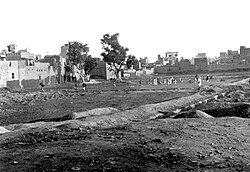
| caption = The narrow passage to the entrance of [[Jallianwala Bagh]] Garden where the massacre occurred | | caption = The narrow passage to the entrance of [[Jallianwala Bagh]] Garden where the massacre occurred | ||
| map = {{Location map|India Punjab|lat=31.62|long=74.88|caption=}} | | map = {{Location map|India Punjab|lat=31.62|long=74.88|caption=}} | ||
| map_caption = Location of [[Amritsar]] in | | map_caption = Location of [[Amritsar]] in Punjab | ||
| title = | | title = Jallianwala Bagh Massacre | ||
| location = [[Amritsar]], [[Punjab Province (British India)|Punjab]], [[British Raj | | location = [[Amritsar]], [[Punjab Province (British India)|Punjab]], [[British Raj]] (present-day [[ Punjab]], [[India]]) | ||
| target = Crowd of nonviolent protesters, along with [[Baisakhi]] pilgrims, who had gathered in [[Jallianwala Bagh]], [[Amritsar]] | | target = Crowd of nonviolent protesters, along with [[Baisakhi]] pilgrims, who had gathered in [[Jallianwala Bagh]], [[Amritsar]] | ||
| coordinates = {{coord|31|37|14|N|74|52|50|E|scale:4000|display=inline,title}} | | coordinates = {{coord|31|37|14|N|74|52|50|E|scale:4000|display=inline,title}} | ||
| Line 16: | Line 16: | ||
| timezone = [[Indian Standard Time|IST]] | | timezone = [[Indian Standard Time|IST]] | ||
| type = [[Massacre]] | | type = [[Massacre]] | ||
| fatalities = 379<ref name="Colletp263"/> – | | fatalities = 379<ref name="Colletp263"/> – 1500<ref name="encarta"/> | ||
<ref>{{Cite book |last=Narain |first=Savita |url=https://books.google.com/books?id=8ct0AQAAQBAJ&dq=Jallianwala+Bagh+1000&pg=PT54 |title=The Jallianwala Bagh Massacre |date=2013-10-19 |publisher=Lancer Publishers LLC |isbn=978-1-935501-87-9 |language=en}}</ref> | |||
| injuries = ~ 1,500<ref name="encarta"/> | | injuries = ~ 1,500<ref name="encarta"/> | ||
| perps = [[Brigadier (India)|Brig.-Gen.]]<ref>{{London Gazette|issue=29509 |supp=y|page=2902|date=14 March 1916}}</ref> [[Reginald Dyer|R. E. H. Dyer]], in charge of 50 soldiers of the [[9th Gurkha Rifles]], 54th Sikh regiment (Frontier Force) and [[59th Scinde Rifles]] | | perps = [[Brigadier (India)|Brig.-Gen.]]<ref>{{London Gazette|issue=29509 |supp=y|page=2902|date=14 March 1916}}</ref> [[Reginald Dyer|R. E. H. Dyer]], in charge of 50 soldiers of the [[9th Gurkha Rifles]], 54th Sikh regiment (Frontier Force) and [[59th Scinde Rifles]] | ||
| Line 22: | Line 23: | ||
| numparts = | | numparts = | ||
}} | }} | ||
[[File:Detail of Mural Depicting 1919 Amritsar Massacre - Jallianwala Bagh - Amritsar - Punjab - India (12675536215).jpg|thumb|right|Mural depicting 1919 Amritsar massacre]] | [[File:Detail of Mural Depicting 1919 Amritsar Massacre - Jallianwala Bagh - Amritsar - Punjab - India (12675536215).jpg|thumb|right|Mural depicting 1919 Amritsar massacre]] The '''Jallianwala Bagh massacre''', also known as the '''Amritsar massacre''', took place on 13 April 1919. A large, peaceful crowd had gathered at the [[Jallianwala Bagh]] in [[Amritsar]], [[Punjab, British India]], to protest against the [[Rowlatt Act]] and arrest of pro-independence activists [[Saifuddin Kitchlew|Saifuddin Kitchlu]] and [[Satyapal]]. In response to the public gathering, the temporary [[Brigadier (India)|brigadier general]] [[R. E. H. Dyer]], surrounded the protesters with his Gurkha, Baloch, Rajput and Sikh troops from 2-9th Gurkhas, the 54th Sikhs and the [[59th Scinde Rifles (Frontier Force)|59th Scinde Rifles]] of the [[British Indian Army]].<ref>{{Cite web|title=Punjab disturbances, April 1919; compiled from the Civil and military gazette |url=https://archive.org/details/punjabdisturbanc01lahouoft|website=Lahore Civil and Military Gazette Press 1921|access-date=18 August 2022}}</ref> The Jallianwala Bagh could only be exited on one side, as its other three sides were enclosed by buildings. After blocking the exit with his troops, he ordered them to shoot at the crowd, continuing to fire even as the protestors tried to flee. The troops kept on firing until their ammunition was exhausted.<ref>{{Cite web|title=Jallianwala-Bagh-Massacre|url=https://www.britannica.com/event/Jallianwala-Bagh-Massacre|website=Britannica}}</ref> Estimates of those killed vary from 379 to 1,500 or more people<ref name="Colletp263">{{cite book|author=Nigel Collett|url=https://books.google.com/books?id=XuQC5pgzCw4C&pg=PA263|title=The Butcher of Amritsar: General Reginald Dyer|year=2006|publisher=A&C Black|isbn=978-1-85285-575-8|page=263}}</ref> and over 1,200 other people were injured of whom 192 were seriously injured.<ref name="Hunter" /><ref>{{Cite book|last=Dolly|first=Sequeria|title=Total History & Civics 10 ICSE|publisher=Morning Star|year=2021|location=New Delhi|pages=71}}</ref> Britain has never formally apologised for the massacre but expressed "deep regret" in 2019. | ||
The '''Jallianwala Bagh massacre''', also known as the '''Amritsar massacre''', took place on 13 April 1919. A large peaceful crowd had gathered at the [[Jallianwala Bagh]] in [[Amritsar]], [[Punjab, British India]], to | |||
The massacre caused a re-evaluation by the British Army of its military role against civilians to "minimal force whenever possible", although later British actions during the [[Mau Mau rebellion]] in the [[Kenya Colony]] have led historian Huw Bennett to comment that the new policy could be put aside.<ref>Huw Bennett, Fighting the Mau Mau: The British Army, 52nd Sikh regiment and Counter-Insurgency in Kenya</ref> The army was retrained and developed less violent tactics for crowd control.<ref>Srinath Raghaven, "Protecting the Raj: The Army in India and Internal Security, c. 1919–39", ''Small Wars and Insurgencies'', (Fall 2005), 16#3 pp 253–279 [http://www.tandfonline.com/doi/abs/10.1080/09592310500220528 online]</ref> The level of casual brutality, and lack of any accountability, stunned the entire nation,<ref>[[Bipan Chandra]] et al, ''India's Struggle for Independence'', Viking 1988, p. 166</ref> resulting in a wrenching loss of faith of the general Indian public in the intentions of the United Kingdom.<ref>{{cite book | title = A concise history of modern India | author = Barbara D. Metcalf and [[Thomas R. Metcalf]] | publisher = Cambridge University Press |url= http://www.cse.iitk.ac.in/users/amit/books/metcalf-2006-concise-history-of.html| year = 2006}} p.169</ref> The attack was condemned by the [[Secretary of State for War]], [[Winston Churchill]], as "unutterably monstrous", and in the [[UK House of Commons]] debate on 8 July 1920 [[Member of Parliament (United Kingdom)|Members of Parliament]] voted 247 to 37 against Dyer. The ineffective inquiry, together with the initial accolades for Dyer, fuelled great widespread anger against the British among the Indian populace, leading to the [[non-cooperation movement]] of 1920–22.<ref>{{cite book | last=Collett |first=Nigel |title=The Butcher of Amritsar: General Reginald Dyer|year=2006|pages=398–399}}</ref> Some historians consider the episode a decisive step towards the end of [[British rule in India]].<ref>{{cite magazine |last=Bond |first=Brian |date=October 1963 |title=Amritsar 1919 |magazine=History Today |volume=13 |issue=10 |pages=666–676}}</ref> | The massacre caused a re-evaluation by the British Army of its military role against civilians to "minimal force whenever possible", although later British actions during the [[Mau Mau rebellion]] in the [[Kenya Colony]] have led historian Huw Bennett to comment that the new policy could sometimes be put aside.<ref>Huw Bennett, Fighting the Mau Mau: The British Army, 52nd Sikh regiment and Counter-Insurgency in Kenya</ref> The army was retrained and developed less violent tactics for crowd control.<ref>Srinath Raghaven, "Protecting the Raj: The Army in India and Internal Security, c. 1919–39", ''Small Wars and Insurgencies'', (Fall 2005), 16#3 pp 253–279 [http://www.tandfonline.com/doi/abs/10.1080/09592310500220528 online]</ref> The level of casual brutality, and lack of any accountability, stunned the entire nation,<ref>[[Bipan Chandra]] et al, ''India's Struggle for Independence'', Viking 1988, p. 166</ref> resulting in a wrenching loss of faith of the general Indian public in the intentions of the United Kingdom.<ref>{{cite book | title = A concise history of modern India | author = Barbara D. Metcalf and [[Thomas R. Metcalf]] | publisher = Cambridge University Press |url= http://www.cse.iitk.ac.in/users/amit/books/metcalf-2006-concise-history-of.html| year = 2006}} p. 169</ref> The attack was condemned by the [[Secretary of State for War]], [[Winston Churchill]], as "unutterably monstrous", and in the [[UK House of Commons]] debate on 8 July 1920 [[Member of Parliament (United Kingdom)|Members of Parliament]] voted 247 to 37 against Dyer. The ineffective inquiry, together with the initial accolades for Dyer, fuelled great widespread anger against the British among the Indian populace, leading to the [[non-cooperation movement]] of 1920–22.<ref>{{cite book | last=Collett |first=Nigel |title=The Butcher of Amritsar: General Reginald Dyer|year=2006|pages=398–399}}</ref> Some historians consider the episode a decisive step towards the end of [[British rule in India]].<ref>{{cite magazine |last=Bond |first=Brian |date=October 1963 |title=Amritsar 1919 |magazine=History Today |volume=13 |issue=10 |pages=666–676}}</ref><ref>{{cite news |url=https://www.bbc.co.uk/news/world-asia-india-47887322 |title=Amritsar: Theresa May describes 1919 massacre as 'shameful scar' – BBC News |work=BBC News |date=April 10, 2019 |access-date= November 6, 2021}}</ref> | ||
== Background == | == Background == | ||
| Line 32: | Line 32: | ||
{{Main|Defence of India Act 1915}} | {{Main|Defence of India Act 1915}} | ||
{{See also|Ghadar Mutiny}} | {{See also|Ghadar Mutiny}} | ||
During [[World War I]], [[British India]] contributed to the British war effort by providing men and resources. Millions of Indian soldiers and labourers served in Europe, Africa, and the Middle East, while both the Indian administration and the princes sent large supplies of food, money, and ammunition. [[Bengal]] and [[Punjab (British India)|Punjab]] remained sources of [[Revolutionary movement for Indian independence|anti-colonial activities]]. | During [[World War I]], [[British India]] contributed to the British war effort by providing men and resources. Millions of Indian soldiers and labourers served in Europe, Africa, and the Middle East, while both the Indian administration and the princes sent large supplies of food, money, and ammunition. [[Bengal]] and [[Punjab (British India)|Punjab]] remained sources of [[Revolutionary movement for Indian independence|anti-colonial activities]]. Revolutionary attacks in Bengal, associated increasingly with disturbances in Punjab, were enough to nearly paralyse the regional administration.<ref name=Gupta12>{{cite journal |last=Gupta |first=Amit Kumar |date=Sep–Oct 1997 |title=Defying Death: Nationalist Revolutionism in India, 1897–1938 |jstor=3517678 |journal=Social Scientist |volume=25 |issue=9/10 |pages=3–27 |doi=10.2307/3517678 }}</ref><ref>{{Cite book | last = Popplewell | first = Richard J. | year = 1995 | title = Intelligence and Imperial Defence: British Intelligence and the Defence of the Indian Empire 1904–1924 | url = http://www.routledge.com/shopping_cart/products/product_detail.asp?sku=&isbn=071464580X&parent_id=&pc= | publisher = Routledge | page = 201 | isbn = 978-0-7146-4580-3 | access-date = 8 January 2008 | archive-date = 26 March 2009 | archive-url = https://web.archive.org/web/20090326193437/http://www.routledge.com/shopping_cart/products/product_detail.asp?sku=&isbn=071464580X&parent_id=&pc= | url-status = dead }}</ref> Of these, [[Ghadar conspiracy|a pan-Indian mutiny]] in the British Indian Army planned for February 1915 was the most prominent amongst [[Hindu-German Conspiracy|a number of plots]] formulated between 1914 and 1917 by Indian nationalists in India, the United States and Germany. | ||
The planned February mutiny was ultimately thwarted when British intelligence infiltrated the [[Ghadar Movement]], arresting key figures. Mutinies in smaller units and garrisons within India were also crushed. In the context of the British war effort and the threat from the separatist movement in India, the [[Defence of India Act 1915]] was passed, limiting civil and political liberties. [[Michael O'Dwyer]], then the Lieutenant Governor of Punjab, was one of the strongest proponents of the act, in no small part due to the Ghadarite threat in the province.<ref name=Popplewell175>{{Cite book | last = Popplewell | first = Richard J. | year = 1995 | title = Intelligence and Imperial Defence: British Intelligence and the Defence of the Indian Empire 1904–1924 | url = http://www.routledge.com/shopping_cart/products/product_detail.asp?sku=&isbn=071464580X&parent_id=&pc= | publisher = Routledge | page = 175 | isbn = 978-0-7146-4580-3 | access-date = 8 January 2008 | archive-date = 26 March 2009 | archive-url = https://web.archive.org/web/20090326193437/http://www.routledge.com/shopping_cart/products/product_detail.asp?sku=&isbn=071464580X&parent_id=&pc= | url-status = dead }}</ref> | The planned February mutiny was ultimately thwarted when British intelligence infiltrated the [[Ghadar Movement]], arresting key figures. Mutinies in smaller units and garrisons within India were also crushed. In the context of the British war effort and the threat from the separatist movement in India, the [[Defence of India Act 1915]] was passed, limiting civil and political liberties. [[Michael O'Dwyer]], then the Lieutenant Governor of Punjab, was one of the strongest proponents of the act, in no small part due to the Ghadarite threat in the province.<ref name=Popplewell175>{{Cite book | last = Popplewell | first = Richard J. | year = 1995 | title = Intelligence and Imperial Defence: British Intelligence and the Defence of the Indian Empire 1904–1924 | url = http://www.routledge.com/shopping_cart/products/product_detail.asp?sku=&isbn=071464580X&parent_id=&pc= | publisher = Routledge | page = 175 | isbn = 978-0-7146-4580-3 | access-date = 8 January 2008 | archive-date = 26 March 2009 | archive-url = https://web.archive.org/web/20090326193437/http://www.routledge.com/shopping_cart/products/product_detail.asp?sku=&isbn=071464580X&parent_id=&pc= | url-status = dead }}</ref> | ||
| Line 41: | Line 41: | ||
The costs of the protracted war in money and manpower were great. High casualty rates in the war, increasing inflation after the end, compounded by heavy taxation, the deadly [[1918 flu pandemic]], and the disruption of trade during the war escalated human suffering in India. The pre-war [[Indian nationalist]] sentiment was revived as moderate and extremist groups of the [[Indian National Congress]] ended their differences to unify. In 1916, the Congress was successful in establishing the [[Lucknow Pact]], a temporary alliance with the [[All-India Muslim League]]. British political concessions and Whitehall's India Policy after World War I began to change, with the passage of [[Montagu–Chelmsford Reforms]], which initiated the first round of political reform in the Indian subcontinent in 1917.<ref name="Majumderxix">{{Cite book | last = Majumdar | first = Ramesh C. | year = 1971 | title = History of the Freedom Movement in India |volume=II | publisher = Firma K. L. Mukhopadhyay |page = xix | isbn = 978-81-7102-099-7}}</ref><ref name="Dignan60">{{cite journal | last = Dignan | first = Don | date=February 1971 | title = The Hindu Conspiracy in Anglo-American Relations during World War I | journal = The Pacific Historical Review |volume=40 |issue=1 | pages = 57–76 | doi=10.2307/3637829| jstor = 3637829 }}</ref><ref name="Cole">{{cite book | last = Cole | first = Howard| year = 2001 | title = Labour and Radical Politics 1762–1937 | publisher = Routledge | page = 572 | isbn = 978-0-415-26576-8 |display-authors=etal}}</ref> However, this was deemed insufficient in reforms by the Indian political movement. [[Mahatma Gandhi]], recently returned to India, began emerging as an increasingly charismatic leader under whose leadership civil disobedience movements grew rapidly as an expression of political unrest.<ref>{{cite book|author=Dennis Dalton|title=Mahatma Gandhi: Nonviolent Power in Action|url=https://books.google.com/books?id=KxUp1igCL_0C |year=2012|publisher=[[Columbia University Press]]|isbn=978-0-231-15959-3|pages=8–14, 20–23, 30–35}}</ref> | The costs of the protracted war in money and manpower were great. High casualty rates in the war, increasing inflation after the end, compounded by heavy taxation, the deadly [[1918 flu pandemic]], and the disruption of trade during the war escalated human suffering in India. The pre-war [[Indian nationalist]] sentiment was revived as moderate and extremist groups of the [[Indian National Congress]] ended their differences to unify. In 1916, the Congress was successful in establishing the [[Lucknow Pact]], a temporary alliance with the [[All-India Muslim League]]. British political concessions and Whitehall's India Policy after World War I began to change, with the passage of [[Montagu–Chelmsford Reforms]], which initiated the first round of political reform in the Indian subcontinent in 1917.<ref name="Majumderxix">{{Cite book | last = Majumdar | first = Ramesh C. | year = 1971 | title = History of the Freedom Movement in India |volume=II | publisher = Firma K. L. Mukhopadhyay |page = xix | isbn = 978-81-7102-099-7}}</ref><ref name="Dignan60">{{cite journal | last = Dignan | first = Don | date=February 1971 | title = The Hindu Conspiracy in Anglo-American Relations during World War I | journal = The Pacific Historical Review |volume=40 |issue=1 | pages = 57–76 | doi=10.2307/3637829| jstor = 3637829 }}</ref><ref name="Cole">{{cite book | last = Cole | first = Howard| year = 2001 | title = Labour and Radical Politics 1762–1937 | publisher = Routledge | page = 572 | isbn = 978-0-415-26576-8 |display-authors=etal}}</ref> However, this was deemed insufficient in reforms by the Indian political movement. [[Mahatma Gandhi]], recently returned to India, began emerging as an increasingly charismatic leader under whose leadership civil disobedience movements grew rapidly as an expression of political unrest.<ref>{{cite book|author=Dennis Dalton|title=Mahatma Gandhi: Nonviolent Power in Action|url=https://books.google.com/books?id=KxUp1igCL_0C |year=2012|publisher=[[Columbia University Press]]|isbn=978-0-231-15959-3|pages=8–14, 20–23, 30–35}}</ref> | ||
The recently crushed Ghadar conspiracy, the presence of [[Raja Mahendra Pratap]]'s [[Niedermayer–Hentig Expedition|Kabul mission]] in Afghanistan (with possible links to Bolshevik Russia), and a still-active revolutionary movement especially in Punjab and Bengal (as well as worsening civil unrest throughout India) led to the appointment of a [[Rowlatt Committee|sedition committee]] in 1918 chaired by [[Sidney Rowlatt]], an Anglo-Egyptian judge. It was tasked to evaluate German and Bolshevik links to the militant movement in India, especially in Punjab and Bengal. On the recommendations of the committee, the [[Rowlatt Act]], an extension of the Defence of India Act 1915 to limit civil liberties, was enacted.<ref name=Popplewell175/><ref name=Lovett>{{cite book | last1 = Lovett | | The recently crushed Ghadar conspiracy, the presence of [[Raja Mahendra Pratap]]'s [[Niedermayer–Hentig Expedition|Kabul mission]] in Afghanistan (with possible links to Bolshevik Russia), and a still-active revolutionary movement especially in Punjab and Bengal (as well as worsening civil unrest throughout India) led to the appointment of a [[Rowlatt Committee|sedition committee]] in 1918 chaired by [[Sidney Rowlatt]], an Anglo-Egyptian judge. It was tasked to evaluate German and Bolshevik links to the militant movement in India, especially in Punjab and Bengal. On the recommendations of the committee, the [[Rowlatt Act]], an extension of the Defence of India Act 1915 to limit civil liberties, was enacted.<ref name=Popplewell175/><ref name=Lovett>{{cite book | last1 = Lovett | first1 = Sir Verney | year = 1920 | title = A History of the Indian Nationalist Movement | url = https://archive.org/details/cu31924024064523 | location= New York | publisher = [[Frederick A. Stokes]] Company | pages = [https://archive.org/details/cu31924024064523/page/n109 94], 187–191 | isbn = 978-81-7536-249-9}}</ref><ref name=Sarkar1921>{{cite journal | last = Sarkar | first = B. K. | date= 10 March 1921 | title = The Hindu Theory of the State | journal = Political Science Quarterly | volume=36 | issue=1 | pages = 79–90 | doi = 10.2307/2142662 | jstor = 2142662 }}</ref><ref name=Tinker92>{{cite journal | last = Tinker | first = Hugh | date =October 1968 | title = India in the First World War and after | jstor = 259846 | journal = Journal of Contemporary History | volume=3 | issue=4 | pages = 89–107 | doi = 10.1177/002200946800300407 | s2cid = 150456443 }}</ref><ref name=Fisher129>{{cite journal | last = Fisher | first = Margaret W. | date = Spring 1972 | title = Essays on Gandhian Politics: the Rowlatt Satyagraha of 1919 (in Book Reviews) | journal = Pacific Affairs |volume=45 |issue=1 | pages = 128–129 | doi=10.2307/2755297| jstor = 2755297 }}</ref> | ||
The passage of the Rowlatt Act in 1919 precipitated large-scale political unrest throughout India. Ominously, in 1919, the [[Third Anglo-Afghan War]] began in the wake of Amir [[Habibullah Khan|Habibullah]]'s assassination and institution of [[Amanullah Khan|Amanullah]] in a system strongly influenced by the political figures courted by the Kabul mission during the world war. As a reaction to the Rowlatt Act, [[Muhammad Ali Jinnah]] resigned from his Bombay seat, writing in a letter to the Viceroy, "I, therefore, as a protest against the passing of the Bill and the manner in which it was passed tender my resignation ... a Government that passes or sanctions such a law in times of peace forfeits its claim to be called a civilised government".<ref>{{Cite book|title=Jinnah of Pakistan|last=Wolpert|first=Stanley|publisher=Oxford University Press|year=2013|isbn=978-0-19-577389-7|location=Karachi, Pakistan|page=62}}</ref> Gandhi's call for protest against the Rowlatt Act achieved an unprecedented response of furious unrest and protests. | The passage of the Rowlatt Act in 1919 precipitated large-scale political unrest throughout India. Ominously, in 1919, the [[Third Anglo-Afghan War]] began in the wake of Amir [[Habibullah Khan|Habibullah]]'s assassination and institution of [[Amanullah Khan|Amanullah]] in a system strongly influenced by the political figures courted by the Kabul mission during the world war. As a reaction to the Rowlatt Act, [[Muhammad Ali Jinnah]] resigned from his Bombay seat, writing in a letter to the Viceroy, "I, therefore, as a protest against the passing of the Bill and the manner in which it was passed tender my resignation ... a Government that passes or sanctions such a law in times of peace forfeits its claim to be called a civilised government".<ref>{{Cite book|title=Jinnah of Pakistan|last=Wolpert|first=Stanley|publisher=Oxford University Press|year=2013|isbn=978-0-19-577389-7|location=Karachi, Pakistan|page=62}}</ref> Gandhi's call for protest against the Rowlatt Act achieved an unprecedented response of furious unrest and protests. | ||
| Line 59: | Line 59: | ||
}}</ref> Many officers in the Indian army believed revolt was possible, and they prepared for the worst. The British Lieutenant-Governor of Punjab, [[Michael O'Dwyer]], is said to have believed that these were the early and ill-concealed signs of a conspiracy for a coordinated revolt planned around May, on the lines of the [[1857 revolt]], at a time when British troops would have withdrawn to the hills for the summer.<ref>{{Cite web |title=Jallianwala Bagh Massacre: What Happened On The Dark Day 103 Years Ago |url=https://www.ndtv.com/india-news/jallianwala-bagh-massacre-what-happened-on-the-dark-day-103-years-ago-2883961 |access-date=2022-04-13 |website=NDTV.com}}</ref> | }}</ref> Many officers in the Indian army believed revolt was possible, and they prepared for the worst. The British Lieutenant-Governor of Punjab, [[Michael O'Dwyer]], is said to have believed that these were the early and ill-concealed signs of a conspiracy for a coordinated revolt planned around May, on the lines of the [[1857 revolt]], at a time when British troops would have withdrawn to the hills for the summer.<ref>{{Cite web |title=Jallianwala Bagh Massacre: What Happened On The Dark Day 103 Years Ago |url=https://www.ndtv.com/india-news/jallianwala-bagh-massacre-what-happened-on-the-dark-day-103-years-ago-2883961 |access-date=2022-04-13 |website=NDTV.com}}</ref> | ||
The Amritsar massacre and other events at about the same time, have been described by some historians as the result of a concerted plan by the Punjab administration to suppress such a conspiracy.<ref name="Cell 2002 67">{{cite book | last = Cell | first = John W. | year = 2002 | title = Hailey: A Study in British Imperialism, 1872–1969 | publisher = Cambridge University Press | page = 67 | isbn = 978-0-521-52117-8}}</ref> [[James Houssemayne Du Boulay]] is said to have | The Amritsar massacre and other events at about the same time, have been described by some historians as the result of a concerted plan by the Punjab administration to suppress such a conspiracy.<ref name="Cell 2002 67">{{cite book | last = Cell | first = John W. | year = 2002 | title = Hailey: A Study in British Imperialism, 1872–1969 | publisher = Cambridge University Press | page = 67 | isbn = 978-0-521-52117-8}}</ref> [[James Houssemayne Du Boulay]] is said to have posited a direct causal relationship between the fear of a [[Ghadar Mutiny|Ghadarite uprising]] in the midst of an increasingly tense situation in Punjab, and the British response that ended in the massacre.<ref name=Brown1973>{{cite journal | last = Brown | first = Emily | date = May 1973 | title = Book Reviews; South Asia | journal = The Journal of Asian Studies | volume = 32 | issue = 3 | pages = 522–523 | doi = 10.2307/2052702| jstor = 2052702 | s2cid = 153543772 }}</ref> | ||
On 10 April 1919, there was a protest at the residence of [[Miles Irving]], the [[Deputy commissioner|Deputy Commissioner]] of [[Amritsar]]. The [[Demonstration (political)|demonstration]] was to demand the release of two popular leaders of the [[Indian Independence Movement]], Satya Pal and [[Saifuddin Kitchlew]], who had been earlier arrested by the government and moved to a secret location. Both were proponents of the [[Satyagraha]] movement led by [[Mahatma Gandhi|Gandhi]]. A military picket shot at the crowd, killing several protesters and setting off a series of violent events. Riotous crowds carried out | On 10 April 1919, there was a protest at the residence of [[Miles Irving]], the [[Deputy commissioner|Deputy Commissioner]] of [[Amritsar]]. The [[Demonstration (political)|demonstration]] was to demand the release of two popular leaders of the [[Indian Independence Movement]], Satya Pal and [[Saifuddin Kitchlew]], who had been earlier arrested by the government and moved to a secret location. Both were proponents of the [[Satyagraha]] movement led by [[Mahatma Gandhi|Gandhi]]. A military picket shot at the crowd, killing several protesters and setting off a series of violent events. Riotous crowds carried out arson attacks on British banks, killed several British people and assaulted two British women.<ref>{{citation|author=Stanley Wolpert|title=India|chapter-url=https://www.britannica.com/place/India/Anti-British-activity#ref47051|series=Encyclopedia Britannica|chapter=The postwar years|author-link=Stanley Wolpert}}</ref> | ||
[[File:Native crawling up street where Miss Sherwood was assaulted 1919.jpg|thumb|All native men were forced to crawl the Kucha Kurrichhan on their hands and knees as punishment, 1919|293x293px]] | [[File:Native crawling up street where Miss Sherwood was assaulted 1919.jpg|thumb|All native men were forced to crawl the Kucha Kurrichhan on their hands and knees as punishment, 1919|293x293px]] | ||
| Line 74: | Line 74: | ||
[[File:'The Martyr's' well at Jallianwala Bagh.jpg|thumb|left|''The Martyrs' Well'', at Jallianwala Bagh. 120 bodies were recovered from this well as per inscription on it.<ref>{{Cite web |date=13 April 2018 |title=Jallianwala Bagh Massacre was a horrifying bloodbath on the day of Baisakhi 99 years ago |url=https://www.indiatoday.in/education-today/gk-current-affairs/story/jallianwala-bagh-massacre-was-a-horrifying-bloodbath-on-the-day-of-baisakhi-99-years-ago-1211231-2018-04-13 |access-date=16 October 2021 |website=India Today}}</ref>]] | [[File:'The Martyr's' well at Jallianwala Bagh.jpg|thumb|left|''The Martyrs' Well'', at Jallianwala Bagh. 120 bodies were recovered from this well as per inscription on it.<ref>{{Cite web |date=13 April 2018 |title=Jallianwala Bagh Massacre was a horrifying bloodbath on the day of Baisakhi 99 years ago |url=https://www.indiatoday.in/education-today/gk-current-affairs/story/jallianwala-bagh-massacre-was-a-horrifying-bloodbath-on-the-day-of-baisakhi-99-years-ago-1211231-2018-04-13 |access-date=16 October 2021 |website=India Today}}</ref>]] | ||
On Sunday, 13 April 1919, Dyer, convinced a major insurrection could take place, banned all meetings. This notice was not widely disseminated, and many villagers gathered in the [[Bagh (garden)|Bagh]] to celebrate the | On Sunday, 13 April 1919, Dyer, convinced a major insurrection could take place, banned all meetings. This notice was not widely disseminated, and many villagers gathered in the [[Bagh (garden)|Bagh]] to celebrate the [[Vaisakhi|Baisakhi]] festival, and peacefully protest against the arrest and deportation of two national leaders, [[Satyapal]] and [[Saifuddin Kitchlew]].<ref>{{Cite web |title=Jallianwala Bagh Massacre {{!}} Causes, History, & Significance {{!}} Britannica |url=https://www.britannica.com/event/Jallianwala-Bagh-Massacre |access-date=2022-04-13 |website=www.britannica.com |language=en}}</ref> | ||
At | At 09:00 on the morning of 13 April 1919, the traditional festival of [[Baisakhi]], [[Reginald Dyer]], the acting military commander for Amritsar and its environs, proceeded through the city with several city officials, announcing the implementation of a pass system to enter or leave Amritsar, a curfew beginning at 20:00 that night and a ban on all processions and public meetings of four or more persons. The proclamation was read and explained in English, [[Urdu]], [[Hindi]], and [[Punjabi language|Punjabi]], but many either paid it no heed, or learned of it only later.<ref>Collett, ''The Butcher of Amritsar'' pp. 252–253</ref> Meanwhile, local police had received intelligence of the planned meeting in the Jallianwala Bagh through word of mouth and plainclothes detectives in the crowds. Dyer was informed of the meeting at 12:40, and returned to his base at around 13:30 to decide how to handle it.<ref>Collett, ''The Butcher of Amritsar'' p. 253</ref> | ||
By mid-afternoon, thousands of Indians had gathered in the [[Jallianwala Bagh]] (garden) near the [[Harmandir Sahib]] in Amritsar. Many who were present had earlier | By mid-afternoon, thousands of Indians had gathered in the [[Jallianwala Bagh]] (garden) near the [[Golden Temple|Harmandir Sahib]] in Amritsar. Many who were present had been worshipping earlier at the [[Golden Temple]] and were merely passing through the Bagh on their way home. The Bagh was (and remains today) an open area of six to seven acres, roughly 200 yards by 200 yards in size, and surrounded on all sides by walls roughly 10 feet in height. Balconies of houses three to four stories tall overlooked the Bagh, and five narrow entrances opened onto it, several with lockable gates. Although it was planted with crops during the rainy season, for much of the rest of the year it served as a local meeting place and recreation area.<ref name="Collett, p. 254-255">Collett, ''The Butcher of Amritsar'' pp. 254–255</ref> In the centre of the Bagh was a ''[[samadhi]]'' (cremation site) and a large well partly filled with water which measured about 20 feet in diameter.<ref name="Collett, p. 254-255"/> | ||
Apart from pilgrims, Amritsar had filled up over the preceding days with farmers, traders, and merchants attending the annual Baisakhi horse and cattle fair. | Apart from the pilgrims passing through, Amritsar had filled up over the preceding days with farmers, traders, and merchants who were attending the annual Baisakhi horse and cattle fair. Because the city police closed the fair at 14:00 that afternoon, many of those who had been attending it drifted into the Jallianwala Bagh, further increasing the number of people who happened to be there when the massacre began. | ||
Dyer arranged for an aeroplane to overfly the Bagh and estimate the size of the crowd, | Dyer arranged for an aeroplane to overfly the Bagh and estimate the size of the crowd, which he reported was about 6,000; however, the Hunter Commission estimates that a crowd of between 10,000 and 20,000 had assembled by the time Dyer arrived.<ref name="Collett, p. 254-255"/><ref name="Hunter" /> Colonel Dyer and Deputy Commissioner Irving, the senior civil authority for Amritsar, took no actions to prevent the crowds from assembling, or to peacefully disperse them. This would later be a serious criticism levelled at both Dyer and Irving. | ||
An hour after the meeting began as scheduled at 17:30, Colonel Dyer arrived at the Bagh with a group of 50 troops, including 25 [[Gurkhas]] of 1/[[9th Gurkha Rifles|9 Gurkha Rifles]] (1st battalion, 9th Gurkha Rifles), [[Pathans]] and [[Baluch people|Baluch]] and [[59th Scinde Rifles (Frontier Force)|59th Sindh Rifles]].<ref>Colvin, p. 178</ref> All fifty were armed with [[.303 British|.303]] [[Lee–Enfield]] bolt-action rifles. Dyer may have specifically chosen troops from those ethnic groups due to their proven loyalty to the British. He had also brought two armoured cars armed with machine guns; however, the vehicles could not enter the compound through the narrow entrances. The Jallianwala Bagh was surrounded on all sides by houses and buildings and had only five narrow entrances, most kept permanently locked. The main entrance was relatively wide, but was guarded heavily by the troops backed by the armoured vehicles so as to prevent anyone from getting out. | An hour after the meeting began as scheduled at 17:30, Colonel Dyer arrived at the Bagh with a group of 50 troops, including 25 [[Gurkhas]] of 1/[[9th Gurkha Rifles|9 Gurkha Rifles]] (1st battalion, 9th Gurkha Rifles), [[Pathans]] and [[Baluch people|Baluch]] and [[59th Scinde Rifles (Frontier Force)|59th Sindh Rifles]].<ref>Colvin, p. 178</ref> All fifty were armed with [[.303 British|.303]] [[Lee–Enfield]] bolt-action rifles. Dyer may have specifically chosen troops from those ethnic groups due to their proven loyalty to the British. He had also brought two armoured cars armed with machine guns; however, the vehicles could not enter the compound through the narrow entrances. The Jallianwala Bagh was surrounded on all sides by houses and buildings and had only five narrow entrances, most of which were kept permanently locked. The main entrance was relatively wide, but was guarded heavily by the troops backed by the armoured vehicles so as to prevent anyone from getting out. | ||
Without warning the crowd to disperse, Dyer ordered his troops to block the main exits and begin shooting toward the densest sections of the crowd in front of the available narrow exits, where panicked crowds were trying to leave the Bagh. Firing continued for approximately ten minutes. Unarmed civilians, including men, women, elderly people and children were killed. This incident came to be known as the Amritsar massacre. A cease-fire was ordered after the troops fired about one third of their ammunition.<ref name="Colletp262"/><ref>Lloyd, Nick (2011) ''The Amritsar Massacre: The Untold Story of One Fateful Day'' IB Taurus, London p. 180</ref> He stated later that the purpose of this action "was not to disperse the meeting but to punish the Indians for disobedience."<ref name="Collett, p 255-58">Collett, ''The Butcher of Amritsar: General Reginald Dyer'' pp. 255–258</ref> | |||
The following day Dyer stated in a report | The following day Dyer stated in a report, "I have heard that between 200 and 300 of the crowd were killed. My party fired 1,650 rounds".<ref name="Hansard">{{hansard|1920/jul/19/punjab-disturbances-the-case-of-general#column_254|house=lords|title=Punjab Disturbances: The Case of General Dyer|access-date=12 April 2019}}</ref><ref name="Colletp262">{{cite book|author=Nigel Collett|url=https://books.google.com/books?id=XuQC5pgzCw4C&pg=PA262|title=The Butcher of Amritsar: General Reginald Dyer|date= 2006|publisher=A&C Black|isbn=978-1-85285-575-8|page=262}}</ref> Apart from the many deaths that resulted directly from the shooting, a number of people died by being crushed in the stampedes at the narrow gates or by jumping into the solitary well on the compound to escape the shooting. A plaque, placed at the site after independence, states that 120 bodies were removed from the well. Dyer imposed a curfew time that was earlier than the usual time; as a result, the wounded could not be moved from where they had fallen, and many of them therefore died of their wounds during the night.<ref>Collett, Nigel (2006). ''The Butcher of Amritsar: General Reginald Dyer''. Hambledon Continuum: New Edition. pp. 254–255</ref> | ||
== Casualties == | == Casualties == | ||
The number of total casualties is disputed. The following morning's newspapers quoted an erroneous initial figure of 200 casualties, offered by the Associated Press, e.g. | The number of total casualties is disputed. The following morning's newspapers quoted an erroneous initial figure of 200 casualties, offered by the Associated Press, e.g., | ||
{{Blockquote | {{Blockquote | ||
| title=The Times of India, 14 April 1919<ref>{{cite news |last1= | | title=The Times of India, 14 April 1919<ref>{{cite news |last1=Kothar|first1=Urvish|title=British media woke up to Jallianwala Bagh massacre eight months after it happened |url=https://theprint.in/opinion/british-media-woke-up-to-jallianwala-bagh-massacre-eight-months-after-it-happened/220993/ |access-date=5 June 2020 |work=The Print |date=19 Apr 2019}}</ref> | ||
| text="News has been received from the Punjab that the Amritsar mob has again broken out in a violent attack against the authorities. The rebels were repulsed by the military and they suffered 200 casualties | | text="News has been received from the Punjab that the Amritsar mob has again broken out in a violent attack against the authorities. The rebels were repulsed by the military and they suffered 200 casualties." | ||
}} | }} | ||
The Government of Punjab, criticised by the Hunter Commission for not gathering accurate figures, only offered the same approximate figure of 200. When interviewed by the members of the committee a senior civil servant in Punjab admitted that the actual figure could be higher.<ref name="Hunter" /> The Sewa Samiti society independently carried out an investigation and reported 379 deaths, and 192 seriously wounded. The Hunter Commission based their figures of 379 deaths, and approximately 3 times that number injured, suggesting 1500 casualties.<ref name="Hunter">{{cite book |last1=India. Committee on Disturbances in Bombay, Delhi, and the Punjab |title=Report; disorders inquiry committee 1919–1920 |date=1920 |pages= | The Government of Punjab, criticised by the Hunter Commission for not gathering accurate figures, only offered the same approximate figure of 200. When interviewed by the members of the committee a senior civil servant in Punjab admitted that the actual figure could be higher.<ref name="Hunter" /> The Sewa Samiti society independently carried out an investigation and reported 379 deaths, and 192 seriously wounded. The Hunter Commission based their figures of 379 deaths, and approximately 3 times that number injured, suggesting 1500 casualties.<ref name="Hunter">{{cite book |last1=India. Committee on Disturbances in Bombay, Delhi, and the Punjab |title=Report; disorders inquiry committee 1919–1920 |date=1920 |pages=xx–xxi, 44–45, 116–117 |url=https://archive.org/stream/ape9901.0001.001.umich.edu#page/n47 |access-date=8 September 2018}}</ref> At the meeting of the [[Imperial Legislative Council]] held on 12 September 1919, the investigation led by [[Pandit Madan Mohan Malviya]] concluded that there were 42 boys among the dead, the youngest of them only 7 months old.<ref>{{cite book|last=Datta|first=Vishwa Nath|title=Jallianwala Bagh|year=1969|publisher=[Kurukshetra University Books and Stationery Shop for] Lyall Book Depot|url=https://books.google.com/books?id=kG0_AAAAMAAJ}}</ref> The Hunter commission confirmed the deaths of 337 men, 41 boys and a six-week-old baby.<ref name="Hunter" /> | ||
In July 1919, three months after the massacre, officials were tasked with finding who had been killed by inviting inhabitants of the city to volunteer information about those who had died.<ref name="Hunter" /> This information was incomplete due to fear that those who participated would be identified as having been present at the meeting, and some of the dead may not have had close relations in the area.<ref>{{cite book |year=2007 | title = The Butcher of Amritsar: General Reginald Dyer | author1=Nigel Collett | publisher=Hambledon and London | page=263}}</ref> | In July 1919, three months after the massacre, officials were tasked with finding who had been killed by inviting inhabitants of the city to volunteer information about those who had died.<ref name="Hunter" /> This information was incomplete due to fear that those who participated would be identified as having been present at the meeting, and some of the dead may not have had close relations in the area.<ref>{{cite book |year=2007 | title = The Butcher of Amritsar: General Reginald Dyer | author1=Nigel Collett | publisher=Hambledon and London | page=263}}</ref> | ||
[[Winston Churchill]] reported nearly 400 slaughtered, and | [[Winston Churchill]] reported nearly 400 slaughtered, and three or four times the number wounded to the Westminster Parliament, on 8 July 1920.<ref>{{cite web |title=Punjab Disturbances. Lord Hunter's Committee. – 1725 |url=https://api.parliament.uk/historic-hansard/commons/1920/jul/08/army-council-and-general-dyer |access-date=5 June 2020 |website=Parliament.UK |publisher=Hansard}}</ref> | ||
Since the official figures were obviously flawed regarding the size of the crowd (6,000–20,000<ref name="Hunter" />), the number of rounds fired and the period of shooting, the Indian National Congress instituted a separate inquiry of its own, with conclusions that differed considerably from the British Government's inquiry. The casualty number quoted by the Congress was more than 1,500, with approximately 1,000 being killed.<ref name="encarta">{{cite web|title=Amritsar Massacre – ninemsn Encarta |url=http://au.encarta.msn.com/encyclopedia_761579959/amritsar_massacre.html |archive-url=https://www.webcitation.org/5kwriIrvt?url=http://au.encarta.msn.com/encyclopedia_761579959/amritsar_massacre.html |archive-date= 1 November 2009 |url-status=dead }}</ref> | Since the official figures were obviously flawed regarding the size of the crowd (6,000–20,000<ref name="Hunter" />), the number of rounds fired and the period of shooting, the Indian National Congress instituted a separate inquiry of its own, with conclusions that differed considerably from the British Government's inquiry. The casualty number quoted by the Congress was more than 1,500, with approximately 1,000 being killed.<ref name="encarta">{{cite web|title=Amritsar Massacre – ninemsn Encarta |url=http://au.encarta.msn.com/encyclopedia_761579959/amritsar_massacre.html |archive-url=https://www.webcitation.org/5kwriIrvt?url=http://au.encarta.msn.com/encyclopedia_761579959/amritsar_massacre.html |archive-date= 1 November 2009 |url-status=dead }}</ref> | ||
| Line 111: | Line 111: | ||
}}</ref> but news spread in India and widespread outrage ensued; details of the massacre did not become known in Britain until December 1919.<ref>{{cite book|last=Sharma|first=Dipti|title=Assamese Women in the Freedom Struggle|year=1993|page=42|publisher=Punthi Pustak|isbn=978-8-1850-9461-8}}</ref><ref>{{cite book|last=Subba Rao|first=K. Sreeranjani|title=Struggle for Freedom: Case Study of the East Godavari District, 1905–1947|publisher=Mittal Publications|year=1989|isbn=978-8-1709-9176-2|page=97}}</ref><ref>{{cite book|last1=Dhabade|first1=Sneha|last2=Dhabade|first2=Rohan|title=Something About Jallianwala Bagh And The Days of British Empire|year=2019|page=169|publisher=Evincepub Publishing|isbn=978-9-3888-5572-3}}</ref> | }}</ref> but news spread in India and widespread outrage ensued; details of the massacre did not become known in Britain until December 1919.<ref>{{cite book|last=Sharma|first=Dipti|title=Assamese Women in the Freedom Struggle|year=1993|page=42|publisher=Punthi Pustak|isbn=978-8-1850-9461-8}}</ref><ref>{{cite book|last=Subba Rao|first=K. Sreeranjani|title=Struggle for Freedom: Case Study of the East Godavari District, 1905–1947|publisher=Mittal Publications|year=1989|isbn=978-8-1709-9176-2|page=97}}</ref><ref>{{cite book|last1=Dhabade|first1=Sneha|last2=Dhabade|first2=Rohan|title=Something About Jallianwala Bagh And The Days of British Empire|year=2019|page=169|publisher=Evincepub Publishing|isbn=978-9-3888-5572-3}}</ref> | ||
== Aftermath == | ==Aftermath== | ||
This event caused many moderate Indians to abandon their previous loyalty to the British and become nationalists distrustful of British rule.<ref>{{citation|author=Stanley Wolpert|title=India|chapter-url=https://www.britannica.com/place/India/Anti-British-activity#ref47052|series=Encyclopedia Britannica|chapter=Jallianwala Bagh massacre|author-link=Stanley Wolpert}}</ref> | This event caused many moderate Indians to abandon their previous loyalty to the British and become nationalists distrustful of British rule.<ref>{{citation|author=Stanley Wolpert|title=India|chapter-url=https://www.britannica.com/place/India/Anti-British-activity#ref47052|series=Encyclopedia Britannica|chapter=Jallianwala Bagh massacre|author-link=Stanley Wolpert}}</ref> | ||
Colonel Dyer reported to his superiors that he had been "confronted by a revolutionary army", to which Major General William Beynon replied: "Your action was correct and Lieutenant Governor approves."<ref>Nigel Collett, ''The Butcher of Amritsar: General Reginald Dyer'' (2006) p. 267</ref> O'Dwyer requested that martial law should be imposed upon Amritsar and other areas, and this was granted by Viceroy [[Frederic Thesiger, 1st Viscount Chelmsford|Lord Chelmsford]].<ref>Derek Sayer, "British Reaction to the Amritsar Massacre 1919–1920", ''Past & Present'', May 1991, Issue 131, p.142</ref><ref>Nigel Collett, ''The Butcher of Amritsar: General Reginald Dyer'' (2006) p. 372</ref> | Colonel Dyer reported to his superiors that he had been "confronted by a revolutionary army", to which Major General William Beynon replied: "Your action was correct and Lieutenant Governor approves."<ref>Nigel Collett, ''The Butcher of Amritsar: General Reginald Dyer'' (2006) p. 267</ref> O'Dwyer requested that martial law should be imposed upon Amritsar and other areas, and this was granted by Viceroy [[Frederic Thesiger, 1st Viscount Chelmsford|Lord Chelmsford]].<ref>Derek Sayer, "British Reaction to the Amritsar Massacre 1919–1920", ''Past & Present'', May 1991, Issue 131, p. 142</ref><ref>Nigel Collett, ''The Butcher of Amritsar: General Reginald Dyer'' (2006) p. 372</ref> | ||
Both [[Secretary of State for War]] [[Winston Churchill]] and former Prime Minister [[H. H. Asquith]], however, openly condemned the attack, Churchill referring to it as "unutterably monstrous", | Both [[Secretary of State for War]] [[Winston Churchill]] and former Prime Minister [[H. H. Asquith]], however, openly condemned the attack, Churchill referring to it as "unutterably monstrous", and Asquith called it "one of the worst, most dreadful, outrages in the whole of our history".<ref>Derek Sayer, "British Reaction to the Amritsar Massacre 1919–1920", ''Past & Present'', May 1991, Issue 131, p. 131</ref> Churchill, in the House of Commons debate of 8 July 1920, said "The crowd was unarmed, except with [[Bludgeon (weapon)|bludgeons]]. It was not attacking anybody or anything ... When fire had been opened upon it to disperse it, it tried to run away. Pinned up in a narrow place considerably smaller than [[Trafalgar Square]], with hardly any exits, and packed together so that one bullet would drive through three or four bodies, the people ran madly this way and the other. When the fire was directed upon the centre, they ran to the sides. The fire was then directed to the sides. Many threw themselves down on the ground, the fire was then directed down on the ground. This was continued to 8 to 10 minutes, and it stopped only when the ammunition had reached the point of exhaustion."<ref name="ReferenceA">{{cite journal|title=Hansard (House of Commons Archives)|journal=Hansard|date=8 July 1920|pages=1719–1733}}</ref> | ||
After Churchill's speech in the House of Commons debate, MPs voted 247 to 37 against Dyer and in support of the Government.<ref name="Manchester 1988 694">{{cite book|last=Manchester|first=William|title=The Last Lion: Winston Spencer Churchill, Visions of Glory (1874–1932)|year=1988|publisher=Little, Brown|page=694}}</ref> Cloake reports that despite the official rebuke, many Britons still "thought him a hero for saving the rule of British law in India."<ref>{{cite book|url=https://books.google.com/books?id=uco8S8lxvCoC&pg=PT36|title=Britain in the Modern World|publisher=Oxford University Press|year=1994|page=36|author=J. A. Cloake|isbn=9780199133765}}</ref> | After Churchill's speech in the House of Commons debate, MPs voted 247 to 37 against Dyer and in support of the Government.<ref name="Manchester 1988 694">{{cite book|last=Manchester|first=William|title=The Last Lion: Winston Spencer Churchill, Visions of Glory (1874–1932)|year=1988|publisher=Little, Brown|page=694}}</ref> Cloake reports that despite the official rebuke, many Britons still "thought him a hero for saving the rule of British law in India."<ref>{{cite book|url=https://books.google.com/books?id=uco8S8lxvCoC&pg=PT36|title=Britain in the Modern World|publisher=Oxford University Press|year=1994|page=36|author=J. A. Cloake|isbn=9780199133765}}</ref> | ||
[[Rabindranath Tagore]] received the news of the massacre by 22 May 1919. He tried to arrange a protest meeting in [[Kolkata|Calcutta]] and finally decided to renounce his British knighthood as "a symbolic act of protest".<ref name="TagoreDas1996">{{cite book|author1=Rabindranath Tagore|author2=Sisir Kumar Das|title=A miscellany|url=https://books.google.com/books?id=EZOu04e1bNQC&pg=PA982|access-date=17 February 2012| | [[Rabindranath Tagore]] received the news of the massacre by 22 May 1919. He tried to arrange a protest meeting in [[Kolkata|Calcutta]] and finally decided to renounce his British knighthood as "a symbolic act of protest".<ref name="TagoreDas1996">{{cite book|author1=Rabindranath Tagore|author2=Sisir Kumar Das|title=A miscellany|url=https://books.google.com/books?id=EZOu04e1bNQC&pg=PA982|access-date=17 February 2012|year=1996|publisher=Sahitya Akademi|isbn=978-81-260-0094-4|page=982}}</ref> In the repudiation letter, dated 31 May 1919 and addressed to the [[Viceroy of India]], [[Frederic Thesiger, 1st Viscount Chelmsford|Lord Chelmsford]], he wrote "I ... wish to stand, shorn, of all special distinctions, by the side of those of my countrymen who, for their so called insignificance, are liable to suffer degradation not fit for human beings."<ref name="TOI2011-04">{{cite news|url=http://articles.timesofindia.indiatimes.com/2011-04-13/india/29413338_1_knighthood-protest-honour|archive-url=https://web.archive.org/web/20130512110157/http://articles.timesofindia.indiatimes.com/2011-04-13/india/29413338_1_knighthood-protest-honour|url-status=dead|archive-date=12 May 2013|title=Tagore renounced his Knighthood in protest for Jalianwalla Bagh mass killing|date=13 April 2011|access-date=17 February 2012|work=[[The Times of India]]|location=[[Mumbai]]}}</ref> | ||
Gupta describes the letter written by Tagore as "historic". He writes that Tagore "renounced his knighthood in protest against the inhuman cruelty of the British Army to the people of Punjab", and he quotes Tagore's letter to the Viceroy "The enormity of the measures taken by the Government in Punjab for quelling some local disturbances has, with a rude shock, revealed to our minds the helplessness of our position as British subjects in India ... [T]he very least that I can do for my country is to take all consequences upon myself in giving voice to the protest of the millions of my countrymen, surprised into dumb anguish of terror. The time has come when badges of honour make our shame glaring in the incongruous context of humiliation ..."<ref name="Gupta2005">{{cite book|author=Kalyan Sen Gupta|title=The philosophy of Rabindranath Tagore|url=https://books.google.com/books?id=B15fqPp2BSwC&pg=PA3|year=2005|publisher=Ashgate Publishing, Ltd.|isbn=978-0-7546-3036-4|page=3}}</ref> ''English Writings of Rabindranath Tagore Miscellaneous Writings Vol# 8'' carries a facsimile of this hand written letter.<ref name="TagoreRay2007">{{cite book|author1=Rabindranath Tagore|author2=Introduction By Mohit K. Ray|title=English Writings of Rabindranath TagoreMiscellaneous Writings Vol# 8|url=https://books.google.com/books?id=KmurjO7AQ1sC&pg=PA1021|access-date=17 February 2012|date= | Gupta describes the letter written by Tagore as "historic". He writes that Tagore "renounced his knighthood in protest against the inhuman cruelty of the British Army to the people of Punjab", and he quotes Tagore's letter to the Viceroy "The enormity of the measures taken by the Government in Punjab for quelling some local disturbances has, with a rude shock, revealed to our minds the helplessness of our position as British subjects in India ... [T]he very least that I can do for my country is to take all consequences upon myself in giving voice to the protest of the millions of my countrymen, surprised into dumb anguish of terror. The time has come when badges of honour make our shame glaring in the incongruous context of humiliation ..."<ref name="Gupta2005">{{cite book|author=Kalyan Sen Gupta|title=The philosophy of Rabindranath Tagore|url=https://books.google.com/books?id=B15fqPp2BSwC&pg=PA3|year=2005|publisher=Ashgate Publishing, Ltd.|isbn=978-0-7546-3036-4|page=3}}</ref> ''English Writings of Rabindranath Tagore Miscellaneous Writings Vol # 8'' carries a facsimile of this hand written letter.<ref name="TagoreRay2007">{{cite book|author1=Rabindranath Tagore|author2=Introduction By Mohit K. Ray|title=English Writings of Rabindranath TagoreMiscellaneous Writings Vol# 8|url=https://books.google.com/books?id=KmurjO7AQ1sC&pg=PA1021|access-date=17 February 2012|date=2007|publisher=Atlantic Publishers & Dist|isbn=978-81-269-0761-8|page=1021}}</ref> | ||
[[File:Disorders Inquiry Committee 1919-1920 (report) Calcutta- Superintendent Government Printing, India 1920 - ape9901.0001.001.umich.edu (page 31 crop).jpg|thumb|[[c:File:Disorders_Inquiry_Committee_1919-1920_(report)_Calcutta-_Superintendent_Government_Printing,_India_1920_-_ape9901.0001.001.umich.edu.pdf|Disorders Inquiry Committee 1919–1920 (report) Calcutta- Superintendent Government Printing, India 1920]]]] | [[File:Disorders Inquiry Committee 1919-1920 (report) Calcutta- Superintendent Government Printing, India 1920 - ape9901.0001.001.umich.edu (page 31 crop).jpg|thumb|[[c:File:Disorders_Inquiry_Committee_1919-1920_(report)_Calcutta-_Superintendent_Government_Printing,_India_1920_-_ape9901.0001.001.umich.edu.pdf|Disorders Inquiry Committee 1919–1920 (report) Calcutta- Superintendent Government Printing, India 1920]]]] | ||
=== Hunter Commission === | ===Hunter Commission === | ||
On 14 October 1919, after orders issued by the | On 14 October 1919, after orders issued by the Secretary of State for India [[Edwin Samuel Montagu|Edwin Montagu]], the Government of India announced the formation of a committee of inquiry into the events in Punjab. Referred to as the Disorders Inquiry Committee, it was later more widely known as the Hunter Commission. It was named after the chairman, [[William Hunter, Lord Hunter|William, Lord Hunter]], former Solicitor-General for Scotland and Senator of the College of Justice in Scotland. The stated purpose of the commission was to "investigate the recent disturbances in [[Bombay]], [[Delhi]] and Punjab, about their causes, and the measures taken to cope with them".<ref>{{Cite web|url=https://politicsnow.in/bloodbath-on-the-baishakhi/|title=Bloodbath on the Baishakhi|author=Dipankan Bandopadhyay|date=15 April 2020|access-date=3 May 2020}}</ref><ref name="col333-334">{{cite book|pages=333–334|title=The Butcher of Amritsar: General Reginald Dyer|first=Nigel |last=Collett|publisher=Continuum International Publishing Group|year=2006|isbn= 9781852855758|location=Amritsar (India)}}</ref> The members of the commission were: | ||
* Lord Hunter, Chairman of the Commission | * Lord Hunter, Chairman of the Commission | ||
| Line 134: | Line 133: | ||
* Sir [[Chimanlal Harilal Setalvad]], Vice-Chancellor of Bombay University and advocate of the Bombay High Court | * Sir [[Chimanlal Harilal Setalvad]], Vice-Chancellor of Bombay University and advocate of the Bombay High Court | ||
* W.F. Rice, member of the Home Department | * W.F. Rice, member of the Home Department | ||
* Major-General | * Major-General George Barrow, KCB, KCMG, GOC Peshawar Division | ||
* Pandit [[Jagat Narayan]], lawyer and Member of the Legislative Council of the United Provinces | * Pandit [[Jagat Narayan]], lawyer and Member of the Legislative Council of the United Provinces | ||
* Thomas Smith, Member of the Legislative Council of the United Provinces | * Thomas Smith, Member of the Legislative Council of the United Provinces | ||
| Line 142: | Line 141: | ||
After meeting in New Delhi on 29 October, the commission took statements from witnesses over the following weeks.<ref>{{Cite web|title=Evidence Taken before the Disorders Inquiry Committee- Volume III- Amritsar|url=https://assets3.parliament.uk/iv/original/ImageVault/Images/id_23772/scope_0/ImageVaultHandler.aspx.jpg|website=UK Parliament}}</ref> Witnesses were called in [[Delhi]], [[Ahmedabad]], [[Bombay]], and [[Lahore]]. Although the commission as such was not a formally constituted court of law, meaning witnesses were not subject to questioning under oath, its members managed to elicit detailed accounts and statements from witnesses by rigorous cross-questioning. In general, it was felt the commission had been very thorough in its enquiries.<ref name="col333-334"/> After reaching Lahore in November, the commission wound up its initial inquiries by examining the principal witnesses to the events in Amritsar. The commission held its official sittings at the [[Lahore Town Hall]] near [[Anarkali Bazaar]]. | After meeting in New Delhi on 29 October, the commission took statements from witnesses over the following weeks.<ref>{{Cite web|title=Evidence Taken before the Disorders Inquiry Committee- Volume III- Amritsar|url=https://assets3.parliament.uk/iv/original/ImageVault/Images/id_23772/scope_0/ImageVaultHandler.aspx.jpg|website=UK Parliament}}</ref> Witnesses were called in [[Delhi]], [[Ahmedabad]], [[Bombay]], and [[Lahore]]. Although the commission as such was not a formally constituted court of law, meaning witnesses were not subject to questioning under oath, its members managed to elicit detailed accounts and statements from witnesses by rigorous cross-questioning. In general, it was felt the commission had been very thorough in its enquiries.<ref name="col333-334"/> After reaching Lahore in November, the commission wound up its initial inquiries by examining the principal witnesses to the events in Amritsar. The commission held its official sittings at the [[Lahore Town Hall]] near [[Anarkali Bazaar]]. | ||
On 19 November, Dyer was ordered to appear before the commission. Although his military superiors had suggested he be represented by legal counsel at the inquiry, Dyer refused this suggestion and appeared alone.<ref name="col333-334"/> Initially questioned by Lord Hunter, Dyer stated he had come to know about the meeting at the Jallianwala Bagh at 12:40 hours that day but did not attempt to prevent it. He stated that he had gone to the Bagh with the deliberate intention of opening fire if he found a crowd assembled there. Patterson says Dyer explained his sense of honour to the Hunter Commission by saying, "I think it quite possible that I could have dispersed the crowd without firing, but they would have come back again and laughed, and I would have made, what I consider, a fool of myself."<ref>Steven Patterson, ''The cult of imperial honor in British India'' (2009) | On 19 November, Dyer was ordered to appear before the commission. Although his military superiors had suggested he be represented by legal counsel at the inquiry, Dyer refused this suggestion and appeared alone.<ref name="col333-334"/> Initially questioned by Lord Hunter, Dyer stated he had come to know about the meeting at the Jallianwala Bagh at 12:40 hours that day but did not attempt to prevent it. He stated that he had gone to the Bagh with the deliberate intention of opening fire if he found a crowd assembled there. Patterson says Dyer explained his sense of honour to the Hunter Commission by saying, "I think it quite possible that I could have dispersed the crowd without firing, but they would have come back again and laughed, and I would have made, what I consider, a fool of myself."<ref>Steven Patterson, ''The cult of imperial honor in British India'' (2009) p. 67</ref> Dyer further reiterated his belief that the crowd in the Bagh was one of "rebels who were trying to isolate my forces and cut me off from other supplies. Therefore, I considered it my duty to fire on them and to fire well".<ref name="col333-334"/> | ||
After Mr. Justice Rankin had questioned Dyer, Sir Chimanlal Setalvad enquired: | After Mr. Justice Rankin had questioned Dyer, Sir Chimanlal Setalvad enquired: | ||
| Line 154: | Line 153: | ||
Dyer: Yes.<ref name="col333-334"/>}} | Dyer: Yes.<ref name="col333-334"/>}} | ||
Dyer further stated that his intentions had been to strike terror throughout Punjab and in doing so, reduce the moral stature of the "rebels". He said he did not stop the shooting when the crowd began to disperse because he thought it was his duty to keep shooting until the crowd dispersed, and that minimal shooting would not prove effective. In fact, he continued the shooting until the ammunition was almost exhausted.<ref>Nick Lloyd, ''The Amritsar Massacre: The Untold Story of One Fateful Day'' (2011) p. 157</ref> He stated that he did not make any effort to tend to the wounded after the shooting: "Certainly not. It was not my job. | Dyer further stated that his intentions had been to strike terror throughout Punjab and in doing so, reduce the moral stature of the "rebels". He said he did not stop the shooting when the crowd began to disperse because he thought it was his duty to keep shooting until the crowd dispersed, and that minimal shooting would not prove effective. In fact, he continued the shooting until the ammunition was almost exhausted.<ref>Nick Lloyd, ''The Amritsar Massacre: The Untold Story of One Fateful Day'' (2011) p. 157</ref> He stated that he did not make any effort to tend to the wounded after the shooting: "Certainly not. It was not my job. Hospitals were open and they could have gone there."<ref>Collett, ''The Butcher of Amritsar'' p. 337</ref> | ||
Exhausted from the rigorous cross-examination questioning and unwell, Dyer was then released. Over the next several months, while the commission wrote its final report, the British press, as well as many MPs, turned increasingly hostile towards Dyer as the full extent of the massacre and his statements at the inquiry became widely known.<ref name="col333-334"/> Lord Chelmsford refused to comment until the Commission had been wound up. In the meanwhile, Dyer became seriously ill with | Exhausted from the rigorous cross-examination questioning and unwell, Dyer was then released. Over the next several months, while the commission wrote its final report, the British press, as well as many MPs, turned increasingly hostile towards Dyer as the full extent of the massacre and his statements at the inquiry became widely known.<ref name="col333-334"/> Lord Chelmsford refused to comment until the Commission had been wound up. In the meanwhile, Dyer became seriously ill with jaundice and arteriosclerosis, and he was hospitalised.<ref name="col333-334"/> | ||
Although the members of the commission had been divided by racial tensions following Dyer's statement, and though the Indian members had written a separate, minority report, the final report, comprising six volumes of evidence and released on 8 March 1920, unanimously condemned Dyer's actions.<ref name="col333-334"/> In "continuing firing as long as he did, it appears to us that General Dyer committed a grave error."<ref>Cyril Henry Philips, "The evolution of India and Pakistan, 1858 to 1947: select documents" p.214. Oxford University Press, 1962</ref> Dissenting members argued that the martial law regime's use of force was wholly unjustified. "General Dyer thought he had crushed the rebellion and Sir [[Michael O'Dwyer]] was of the same view", they wrote, "(but) there was no rebellion which required to be crushed." The report concluded that: | Although the members of the commission had been divided by racial tensions following Dyer's statement, and though the Indian members had written a separate, minority report, the final report, comprising six volumes of evidence and released on 8 March 1920, unanimously condemned Dyer's actions.<ref name="col333-334"/> In "continuing firing as long as he did, it appears to us that General Dyer committed a grave error."<ref>Cyril Henry Philips, "The evolution of India and Pakistan, 1858 to 1947: select documents" p. 214. Oxford University Press, 1962</ref> Dissenting members argued that the martial law regime's use of force was wholly unjustified. "General Dyer thought he had crushed the rebellion and Sir [[Michael O'Dwyer]] was of the same view", they wrote, "(but) there was no rebellion which required to be crushed." The report concluded that: | ||
* Lack of notice to disperse from the Bagh, in the beginning, was an error. | * Lack of notice to disperse from the Bagh, in the beginning, was an error. | ||
| Line 175: | Line 174: | ||
The Hunter Commission did not impose any penal or disciplinary action because Dyer's actions were condoned by various superiors (later upheld by the Army Council).<ref name="churchillspeech">{{cite web | date=8 July 1920 | title=Winston Churchill's speech in the House of Commons | author1=Winston Churchill | url=http://lachlan.bluehaze.com.au/churchill/amritsar.htm | access-date=14 September 2010 | archive-date=19 October 2010 | archive-url=https://web.archive.org/web/20101019100838/http://lachlan.bluehaze.com.au/churchill/amritsar.htm | url-status=dead }}</ref> The Legal and Home Members on the [[Viceroy's Executive Council]] ultimately decided that, though Dyer had acted in a callous and brutal way, military or legal prosecution would not be possible due to political reasons. However, he was finally found guilty of a mistaken notion of duty and relieved of his command on 23 March. He had been recommended for a CBE as a result of his service in the Third Afghan War; this recommendation was cancelled on 29 March 1920. | The Hunter Commission did not impose any penal or disciplinary action because Dyer's actions were condoned by various superiors (later upheld by the Army Council).<ref name="churchillspeech">{{cite web | date=8 July 1920 | title=Winston Churchill's speech in the House of Commons | author1=Winston Churchill | url=http://lachlan.bluehaze.com.au/churchill/amritsar.htm | access-date=14 September 2010 | archive-date=19 October 2010 | archive-url=https://web.archive.org/web/20101019100838/http://lachlan.bluehaze.com.au/churchill/amritsar.htm | url-status=dead }}</ref> The Legal and Home Members on the [[Viceroy's Executive Council]] ultimately decided that, though Dyer had acted in a callous and brutal way, military or legal prosecution would not be possible due to political reasons. However, he was finally found guilty of a mistaken notion of duty and relieved of his command on 23 March. He had been recommended for a CBE as a result of his service in the Third Afghan War; this recommendation was cancelled on 29 March 1920. | ||
[[Reginald Dyer]] was disciplined by removal from his appointment, was passed over for promotion and was prohibited from | [[Reginald Dyer]] was disciplined by removal from his appointment, was passed over for promotion and was prohibited from employment in India. He died in 1927.<ref name="millbanksystems.com">{{hansard|1920/jul/08/army-council-and-general-dyer#column_1722|access-date=29 April 2020}}</ref> | ||
=== | === Rioting in Gujranwala === | ||
Two days later, on 15 April, | Two days later, on 15 April, riots occurred in [[Gujranwala]] protesting against the killings at Amritsar. Police and aircraft were used against the demonstrators, resulting in 12 deaths and 27 injuries. The Officer Commanding the [[Royal Air Force]] in India, [[Norman MacEwen|Brigadier General N D K MacEwen]] stated later that: | ||
<blockquote>I think we can fairly claim to have been of great use in the late riots, particularly at Gujranwala, where the crowd when looking at its nastiest was absolutely dispersed by a machine using bombs and Lewis guns.<ref>{{cite web |url=http://www.raf.mod.uk/rafcms/mediafiles/BC18F893_1143_EC82_2E16AC19F19FE2D2.pdf |title=Royal Air Force Power Review |date=Spring 2008 |series=1 |access-date=24 October 2010 |issue=1 |archive-url=https://web.archive.org/web/20110606163004/http://www.raf.mod.uk/rafcms/mediafiles/BC18F893_1143_EC82_2E16AC19F19FE2D2.pdf |archive-date=6 June 2011 |url-status=dead }}</ref></blockquote> | <blockquote>I think we can fairly claim to have been of great use in the late riots, particularly at Gujranwala, where the crowd when looking at its nastiest was absolutely dispersed by a machine using bombs and Lewis guns.<ref>{{cite web |url=http://www.raf.mod.uk/rafcms/mediafiles/BC18F893_1143_EC82_2E16AC19F19FE2D2.pdf |title=Royal Air Force Power Review |date=Spring 2008 |series=1 |access-date=24 October 2010 |issue=1 |archive-url=https://web.archive.org/web/20110606163004/http://www.raf.mod.uk/rafcms/mediafiles/BC18F893_1143_EC82_2E16AC19F19FE2D2.pdf |archive-date=6 June 2011 |url-status=dead }}</ref></blockquote> | ||
| Line 187: | Line 186: | ||
[[File:Sir-Michael-ODwyer.jpg|thumb|right| [[Michael O'Dwyer]] c. 1912]] | [[File:Sir-Michael-ODwyer.jpg|thumb|right| [[Michael O'Dwyer]] c. 1912]] | ||
On 13 March 1940, at Caxton Hall in London, [[Udham Singh]], an Indian independence activist from Sunam who had witnessed the events in Amritsar and had | On 13 March 1940, at Caxton Hall in London, [[Udham Singh]], an Indian independence activist from Sunam who had witnessed the events in Amritsar and who had been wounded, shot and killed [[Michael O'Dwyer]], the lieutenant-governor of Punjab at the time of the massacre, who had approved Dyer's action and was believed to have been the main planner. | ||
Some, such as the nationalist newspaper ''[[Amrita Bazar Patrika]]'', made statements supporting the killing. The common people and revolutionaries glorified the action of Udham Singh. Much of the press worldwide recalled the story of Jallianwala Bagh, and alleged O'Dwyer to have been responsible for the massacre. Singh was termed a "fighter for freedom" and his action was referred to in '' | Some, such as the nationalist newspaper ''[[Amrita Bazar Patrika]]'', made statements supporting the killing. The common people and revolutionaries glorified the action of Sir Sardar Udham Singh. Much of the press worldwide recalled the story of Jallianwala Bagh, and alleged O'Dwyer to have been responsible for the massacre. Singh was termed a "fighter for freedom" and his action was referred to in ''The Times'' newspaper as "an expression of the pent-up fury of the down-trodden Indian People".<ref>''The Times'', London, 16 March 1940</ref> Reporter and historian [[William L. Shirer]] wrote the next day "Most of the other Indians I know [other than Gandhi] will feel this is divine retribution. O'Dwyer bore a share of responsibility in the 1919 Amritsar massacre, in which Gen. Dyer shot 1,500 Indians in cold blood. When I was at Amritsar eleven years after [the massacre] in 1930, the bitterness still stuck in the people there."<ref>{{cite book|author=Shirer, William L.|title=Berlin Diary|url=https://archive.org/details/berlindiaryjourn00shir|url-access=registration|publisher=Alfred A. Knopf|location=New York|date=20 June 1941|page=[https://archive.org/details/berlindiaryjourn00shir/page/299 299]}}</ref> | ||
In fascist countries, the incident was used for anti-British propaganda: ''Bergeret'', published in large scale from Rome at that time, while commenting upon the Caxton Hall assassination, ascribed the greatest significance to the circumstance and praised the action of Udham Singh as courageous.<ref>Public and Judicial Department, File No L/P + J/7/3822, Caxton Hall outrage, [[India Office Records|India Office Library and Records]], London, pp 13–14</ref> The ''Berliner Börsen Zeitung'' termed the event "The torch of Indian freedom". German radio reportedly broadcast: "The cry of tormented people spoke with shots." | In fascist countries, the incident was used for anti-British propaganda: ''Bergeret'', published in large scale from Rome at that time, while commenting upon the Caxton Hall assassination, ascribed the greatest significance to the circumstance and praised the action of Sardar Udham Singh as courageous.<ref>Public and Judicial Department, File No L/P + J/7/3822, Caxton Hall outrage, [[India Office Records|India Office Library and Records]], London, pp. 13–14</ref> The ''Berliner Börsen Zeitung'' termed the event "The torch of Indian freedom". German radio reportedly broadcast: "The cry of tormented people spoke with shots." | ||
At a public meeting in [[Kanpur]], a spokesman had stated that "at last an insult and humiliation of the nation had been avenged". Similar sentiments were expressed in numerous other places across the country.<ref>Government of India, Home Department, Political File No {{sic|18/3/1|940|hide=y}}<!-- sic: protect file name against datebot -->, National Archives of India, New Delhi, | At a public meeting in [[Kanpur|Cawnpore]] (now Kanpur), a spokesman had stated that "at last an insult and humiliation of the nation had been avenged". Similar sentiments were expressed in numerous other places across the country.<ref>Government of India, Home Department, Political File No {{sic|18/3/1|940|hide=y}}<!-- sic: protect file name against datebot -->, National Archives of India, New Delhi, p. 40</ref> Fortnightly reports of the political situation in [[Bihar Province|Bihar]] mentioned: "It is true that we had no love lost for Sir Michael. The indignities he heaped upon our countrymen in Punjab have not been forgotten." In its 18 March 1940 issue ''[[Amrita Bazar Patrika]]'' wrote: "O'Dwyer's name is connected with Punjab incidents which India will never forget." The ''New Statesman'' observed: "British conservatism has not discovered how to deal with Ireland after two centuries of rule. Similar comment may be made on British rule in India. Will the historians of the future have to record that it was not the [[Nazi Party|Nazis]] but the British ruling class which destroyed the British Empire?" Singh had told the court at his trial: | ||
[[File:Massacre memorial in Amritsar.jpg|right|thumb|180px|Wide view of [[Jallianwala Bagh]] memorial]] | [[File:Massacre memorial in Amritsar.jpg|right|thumb|180px|Wide view of [[Jallianwala Bagh]] memorial]] | ||
<blockquote>I did it because I had a grudge against him. He deserved it. He was the real culprit. He wanted to crush the spirit of my people, so I have crushed him. For full 21 years, I have been trying to wreak vengeance. I am happy that I have done the job. I am not scared of death. I am dying for my country. I have seen my people starving in India under the British rule. I have protested against this, it was my duty. What greater honour could be bestowed on me than death for the sake of my motherland?<ref>CRIM 1/1177, Public Record Office, London, p 64</ref></blockquote> | <blockquote>I did it because I had a grudge against him. He deserved it. He was the real culprit. He wanted to crush the spirit of my people, so I have crushed him. For full 21 years, I have been trying to wreak vengeance. I am happy that I have done the job. I am not scared of death. I am dying for my country. I have seen my people starving in India under the British rule. I have protested against this, it was my duty. What greater honour could be bestowed on me than death for the sake of my motherland?<ref>CRIM 1/1177, Public Record Office, London, p. 64</ref></blockquote> | ||
Singh was hanged for the murder on 31 July 1940. At that time, many, including [[Jawaharlal Nehru]] and [[Mahatma Gandhi]], condemned the murder as senseless even if it was courageous. In 1952, Nehru (by then Prime Minister) honoured Udham Singh with the following statement, which appeared in the daily Partap: | Singh was hanged for the murder on 31 July 1940. At that time, many, including [[Jawaharlal Nehru]] and [[Mahatma Gandhi]], condemned the murder as senseless even if it was courageous. In 1952, Nehru (by then Prime Minister) honoured Udham Singh with the following statement, which appeared in the daily Partap: | ||
| Line 201: | Line 200: | ||
<blockquote>I salute Shaheed-i-Azam Udham Singh with reverence who had kissed the noose so that we may be free.</blockquote> | <blockquote>I salute Shaheed-i-Azam Udham Singh with reverence who had kissed the noose so that we may be free.</blockquote> | ||
Soon after this recognition by the Prime Minister, Udham Singh received the title of ''[[ | Soon after this recognition by the Prime Minister, Udham Singh received the title of ''[[Shaheed]]'', a name given to someone who has attained martyrdom or done something heroic on behalf of their country or religion. | ||
== Monument and legacy == | == Monument and legacy == | ||
[[File:Jallianwala Bagh Entrance.JPG|left|thumb|Entrance to the present-day [[Jallianwala Bagh]] | [[File:Jallianwala Bagh Entrance.JPG|left|thumb|Entrance to the present-day [[Jallianwala Bagh]]]] | ||
[[File:Plaque Memorializing 1919 Amritsar Massacre - Jallianwala Bagh - Amritsar - Punjab - India (12675316515).jpg|left|thumb|Memorial plaque at | [[File:Plaque Memorializing 1919 Amritsar Massacre - Jallianwala Bagh - Amritsar - Punjab - India (12675316515).jpg|left|thumb|Memorial plaque at Jallianwala Bagh]] | ||
[[File:Plaque in Passageway Memorializing 1919 Amritsar Massacre - Jallianwala Bagh - Amritsar - Punjab - India (12675337405).jpg|left|thumb|Memorial plaque in passageway of | [[File:Plaque in Passageway Memorializing 1919 Amritsar Massacre - Jallianwala Bagh - Amritsar - Punjab - India (12675337405).jpg|left|thumb|Memorial plaque in passageway of Jallianwala Bagh site]] | ||
[[File:Bullet marks at Jallianwala Bagh.jpg|left|thumb|Bullet holes in wall at | [[File:Bullet marks at Jallianwala Bagh.jpg|left|thumb|Bullet holes in wall at Jallianwala Bagh memorial]] | ||
[[File:Martyrs Well - Where Victims Leapt to Escape 1919 Amritsar Massacre - Jallianwala Bagh - Amritsar - Punjab - India (12675387185).jpg|left|thumb|Martyrs Well at the | [[File:Martyrs Well - Where Victims Leapt to Escape 1919 Amritsar Massacre - Jallianwala Bagh - Amritsar - Punjab - India (12675387185).jpg|left|thumb|Martyrs Well at the Jallianwala Bagh memorial]] | ||
{{multiple image | {{multiple image | ||
| Line 221: | Line 220: | ||
}} | }} | ||
A trust was founded in 1920 to build a memorial at the site after a resolution was passed by the Indian National Congress. In 1923, the trust purchased land for the project. A memorial, designed by American architect [[Benjamin Polk]], was built on the site and inaugurated by President of India [[Rajendra Prasad]] on 13 April 1961, in the presence of Jawaharlal Nehru and other leaders. A [[eternal flame|flame]] was | A trust was founded in 1920 to build a memorial at the site after a resolution was passed by the Indian National Congress. In 1923, the trust purchased land for the project. A memorial, designed by American architect [[Benjamin Polk]], was built on the site and inaugurated by President of India [[Rajendra Prasad]] on 13 April 1961, in the presence of Jawaharlal Nehru and other leaders. A [[eternal flame|flame]] later was added to the site. | ||
The bullet marks remain on the walls and adjoining buildings to this day. The well into which many people jumped and drowned attempting to save themselves from the bullets is also a protected monument inside the park. | The bullet marks remain on the walls and adjoining buildings to this day. The well into which many people jumped and drowned attempting to save themselves from the bullets is also a protected monument inside the park. | ||
| Line 227: | Line 226: | ||
=== Formation of the Shiromani Gurudwara Prabandhak Committee === | === Formation of the Shiromani Gurudwara Prabandhak Committee === | ||
Shortly after the massacre, the official Sikh clergy of the [[Harmandir Sahib]] (Golden Temple) in Amritsar conferred upon Colonel Dyer the Saropa (the mark of distinguished service to the Sikh faith or, in general, humanity), sending shock waves among the Sikh community.<ref name="Ajit Singh Sarhadi 1970, p. 19">Ajit Singh Sarhadi, "Punjabi Suba: The Story of the Struggle", Kapur Printing Press, Delhi, 1970, p. 19.</ref> On 12 October 1920, students and faculty of the [[Khalsa College, Amritsar|Amritsar Khalsa College]] called a meeting to strengthen the Nationalistic Movement.<ref name="Ajit Singh Sarhadi 1970, p. 19"/> The students pushed for an anti-British movement and the result was the formation of the [[Shiromani Gurudwara Prabhandak Committee]] on 15 November 1920 to manage and to implement reforms in Sikh shrines.<ref>{{cite book |url=https://books.google.com/books?id=GGGudMuE4PIC&pg=PA173 |title=Indian critiques of Gandhi | Shortly after the massacre, the official Sikh clergy of the [[Harmandir Sahib]] (Golden Temple) in Amritsar conferred upon Colonel Dyer the Saropa (the mark of distinguished service to the Sikh faith or, in general, humanity), sending shock waves among the Sikh community.<ref name="Ajit Singh Sarhadi 1970, p. 19">Ajit Singh Sarhadi, "Punjabi Suba: The Story of the Struggle", Kapur Printing Press, Delhi, 1970, p. 19.</ref> On 12 October 1920, students and faculty of the [[Khalsa College, Amritsar|Amritsar Khalsa College]] called a meeting to strengthen the Nationalistic Movement.<ref name="Ajit Singh Sarhadi 1970, p. 19"/> The students pushed for an anti-British movement and the result was the formation of the [[Shiromani Gurudwara Prabhandak Committee]] on 15 November 1920 to manage and to implement reforms in Sikh shrines.<ref>{{cite book |url=https://books.google.com/books?id=GGGudMuE4PIC&pg=PA173 |title=Indian critiques of Gandhi |via= Google Books |access-date=1 February 2011|isbn=978-0-7914-5910-2|year=2003|last1=Coward |first1=Harold }}</ref> | ||
=== Visit by Queen Elizabeth II === | === Visit by Queen Elizabeth II === | ||
| Line 237: | Line 236: | ||
On 14 October 1997, Queen Elizabeth II visited Jallianwala Bagh and paid her respects with a 30‑second [[moment of silence]]. During the visit, she wore a dress of a colour described as pink apricot or [[Saffron (color)|saffron]], which was of religious significance to the [[Sikhs]].<ref name="NYT"/> She removed her shoes while visiting the monument and laid a wreath at the monument.<ref name="NYT"/> | On 14 October 1997, Queen Elizabeth II visited Jallianwala Bagh and paid her respects with a 30‑second [[moment of silence]]. During the visit, she wore a dress of a colour described as pink apricot or [[Saffron (color)|saffron]], which was of religious significance to the [[Sikhs]].<ref name="NYT"/> She removed her shoes while visiting the monument and laid a wreath at the monument.<ref name="NYT"/> | ||
While some Indians welcomed the expression of regret and sadness in the | While some Indians welcomed the expression of regret and sadness in the queen's statement, others criticised it for being less than an apology.<ref name="NYT"/> The then Prime Minister of India [[Inder Kumar Gujral]] defended the queen, saying that the queen had not even been born at the time of the events and should not be required to apologise.<ref name="NYT"/> | ||
The | The queen's 1997 statement was not without controversies. During her visit, there were protests in the city of Amritsar, with people waving black flags and chanting the insult "Queen, go back."<ref>{{cite web|url=http://www.rediff.com/news/oct/14queen1.htm|title=Rediff on the NeT: Queen visits Jallianwalla Bagh|website=www.rediff.com}}</ref> Queen Elizabeth and the [[Prince Philip, Duke of Edinburgh]] merely signed the visitor's book. The fact that they did not leave any comment, regretting the incident was criticised.<ref name="intoday.in">{{cite web|url=http://indiatoday.intoday.in/story/jallianwala-bagh-massacre-amritsar/1/927629.html|title=Jallianwala Bagh massacre anniversary: Is it time for Britain to apologise for excesses committed on Indians?|website=India Today}}</ref><ref name="telegraphindia.com">{{Cite web |last=Thakur |first=Sankarshan |date=21 February 2013 |title=History repeats itself, in stopping short |url=https://www.telegraphindia.com/1130221/jsp/frontpage/story_16587696.jsp |url-status=dead |archive-url=https://web.archive.org/web/20180826183006/https://www.telegraphindia.com/1130221/jsp/frontpage/story_16587696.jsp |archive-date=26 August 2018 |access-date=2021-10-17 |website=[[Wayback Machine]]}}</ref> | ||
During the same visit, minutes after [[Elizabeth II|Queen Elizabeth]] and [[Prince Philip]] stood in silence at the Flame of Liberty, the | During the same visit, minutes after [[Elizabeth II|Queen Elizabeth]] and [[Prince Philip]] stood in silence at the Flame of Liberty, the prince and his guide [[Partha Sarathi Mukherjee]] reached<ref>{{Cite web |last=Swami |first=Praveen |date=1 November 1997 |title=The Queen in Amritsar |url=https://frontline.thehindu.com/social-issues/article30160325.ece |access-date=16 October 2021 |website=Frontline}}</ref> a plaque recording the events of the 1919 massacre. Among the many things found on the plaque was the assertion that 2,000 people were killed in the massacre. (The precise text is: "This place is saturated with the blood of about two thousand Hindus, Sikhs and Muslims who were martyred in a non-violent struggle." It describes the events of that day.)<ref name="frontline.in">{{Cite web |last=Swami |first=Praveen |date=14 November 1997 |title=The Queen's Visit {{!}} The Queen in Amritsar |url=http://www.frontline.in/static/html/fl1422/14220460.htm |url-status=dead |archive-url=https://web.archive.org/web/20140306083403/http://www.frontline.in/static/html/fl1422/14220460.htm |archive-date=6 March 2014 |access-date=2021-10-16 |website=[[Wayback Machine]]}}</ref> "That's a bit exaggerated," Philip told Mukherjee, "it must include the wounded." Mukherjee asked Philip how he had come to this conclusion. "I was told about the killings by [[Reginald Dyer|General Dyer]]'s son," Mukherjee recalls the Duke as saying, "I'd met him while I was in the Navy." These statements by Philip drew widespread condemnation in India.<ref name="frontline.in" /><ref name="telegraphindia.com" /><ref>{{cite web|url=https://m.rediff.com/news/oct/15queen.htm|title=Rediff on the NeT: Prince Philip kicks up another storm|website=m.rediff.com}}</ref><ref>{{cite news|url=https://www.nytimes.com/1997/10/19/weekinreview/india-and-england-beg-to-differ-tiptoeing-through-the-time-of-the-raj.html|title=India and England Beg to Differ; Tiptoeing Through the Time of the Raj|first=John F.|last=Burns|date=19 October 1997|newspaper=The New York Times}}</ref> | ||
Indian journalist [[Praveen Swami]] wrote in | Indian journalist [[Praveen Swami]] wrote in ''Frontline'' magazine: "(The fact that) ... this was the solitary comment Prince Philip had to offer after his visit to Jallianwala Bagh ... (and that) it was the only aspect of the massacre that exercised his imagination, caused offence. It suggested that the death of 379 people was in some way inadequate to appal the royal conscience, in the way the death of 2,000 people would have. Perhaps more important of all, the staggering arrogance that Prince Philip displayed in citing his source of information on the tragedy made clear the lack of integrity in the wreath-laying."<ref name="frontline.in" /> | ||
=== Demands for an apology === | |||
There are long-standing demands in India that Britain should apologise for the massacre.<ref name="frontline.in" /><ref name="telegraphindia.com" /><ref name="hindustantimes.com">{{Cite web |date=15 January 2017 |title=Jallianwala Bagh centenary a 'good time' for British to apologise: Shashi Tharoor |url=https://www.hindustantimes.com/india-news/jallianwala-bagh-centenary-a-good-time-for-british-to-apologise-shashi-tharoor/story-jSAj4EEGlX5aSktmVZi71M.html |access-date=16 October 2021 |website=Hindustan Times}}</ref><ref name="intoday.in"/> Winston Churchill, on 8 July 1920, urged the House of Commons to punish Colonel Dyer.<ref name="ReferenceA"/> Churchill, who described the massacre as "monstrous",<ref name="BBC April 2019">{{cite web|url=https://www.bbc.co.uk/news/world-asia-india-47887322|title=Amritsar: Theresa May describes 1919 Massacre as 'shameful scar'|date=10 April 2019|website=[[BBC Online]]|access-date=10 April 2019}}</ref> succeeded in persuading the House to forcibly retire Colonel Dyer, but would have preferred to have seen the colonel disciplined.<ref name="Manchester 1988 694"/> | There are long-standing demands in India that Britain should apologise for the massacre.<ref name="frontline.in" /><ref name="telegraphindia.com" /><ref name="hindustantimes.com">{{Cite web |date=15 January 2017 |title=Jallianwala Bagh centenary a 'good time' for British to apologise: Shashi Tharoor |url=https://www.hindustantimes.com/india-news/jallianwala-bagh-centenary-a-good-time-for-british-to-apologise-shashi-tharoor/story-jSAj4EEGlX5aSktmVZi71M.html |access-date=16 October 2021 |website=Hindustan Times}}</ref><ref name="intoday.in"/> Winston Churchill, on 8 July 1920, urged the House of Commons to punish Colonel Dyer.<ref name="ReferenceA"/> Churchill, who described the massacre as "monstrous",<ref name="BBC April 2019">{{cite web|url=https://www.bbc.co.uk/news/world-asia-india-47887322|title=Amritsar: Theresa May describes 1919 Massacre as 'shameful scar'|date=10 April 2019|website=[[BBC Online]]|access-date=10 April 2019}}</ref> succeeded in persuading the House to forcibly retire Colonel Dyer, but would have preferred to have seen the colonel disciplined.<ref name="Manchester 1988 694"/> | ||
An apology was made at the time in a statement made by Sir William Vincent, the home member of the Viceroy's Council in a debate on the Punjab disturbances. This made clear the deep regret of the Government of India. It made clear that the actions taken were wrong and repudiated by the Government. It was called a noteworthy case of improper action; "overdrastic and severe action, excessive use of force and acts ... reasonably interpreted as designed to humiliate Indian people ... cannot but be regarded as unpardonable (and) morally indefensible." In addition, the Indian Government reported in despatches to the UK government that the actions of General Dyer were far beyond what was necessary. Also, General Dyer acted far beyond the principle of using reasonable and minimum force. Sir William Vincent stated that the actions of Dyer were of deep regret. A manual of instructions was created after the massacre to instruct officers in their use of force and this was to be avoided unless absolutely necessary.<ref>p 72 Legislative Assembly Debates, Government Central Press, Simla 15 February 1921</ref> | An apology was made at the time in a statement made by Sir William Vincent, the home member of the Viceroy's Council in a debate on the Punjab disturbances. This made clear the deep regret of the Government of India. It made clear that the actions taken were wrong and repudiated by the Government. It was called a noteworthy case of improper action; "overdrastic and severe action, excessive use of force and acts ... reasonably interpreted as designed to humiliate Indian people ... cannot but be regarded as unpardonable (and) morally indefensible." In addition, the Indian Government reported in despatches to the UK government that the actions of General Dyer were far beyond what was necessary. Also, General Dyer acted far beyond the principle of using reasonable and minimum force. Sir William Vincent stated that the actions of Dyer were of deep regret. A manual of instructions was created after the massacre to instruct officers in their use of force and this was to be avoided unless absolutely necessary.<ref>p. 72 Legislative Assembly Debates, Government Central Press, Simla 15 February 1921</ref> | ||
In February 2013 [[David Cameron]] became the first serving | In February 2013 [[David Cameron]] became the first serving British prime minister to visit the site, laid a wreath at the memorial, and described the Amritsar massacre as "a deeply shameful event in British history, one that Winston Churchill rightly described at that time as monstrous. We must never forget what happened here and we must ensure that the UK stands up for [[2010 United Kingdom student protests#Parliament Square protest|the right of peaceful protests]]". Cameron did not deliver an official apology.<ref>{{cite news |url=https://www.bbc.co.uk/news/uk-politics-21515360 |title= David Cameron marks British 1919 Amritsar massacre|date= 20 February 2013|work= News |publisher= [[BBC]] |access-date=20 February 2013}} | ||
{{cite web |url= https://www.mirror.co.uk/news/world-news/david-cameron-visit-amritsar-massacre-1719343|title= Not our finest hour: David Cameron to visit Amritsar massacre site but won't make official apology |date= 20 February 2013|work= [[Daily Mirror]]|access-date=20 February 2013}} | {{cite web |url= https://www.mirror.co.uk/news/world-news/david-cameron-visit-amritsar-massacre-1719343|title= Not our finest hour: David Cameron to visit Amritsar massacre site but won't make official apology |date= 20 February 2013|work= [[Daily Mirror]]|access-date=20 February 2013}} | ||
{{cite web |url= http://www.dnaindia.com/india/report_jallianwala-bagh-killings-shameful-says-david-cameron_1802074|title=Jallianwala Bagh killings shameful, says David Cameron|date= 20 February 2013|work= News|publisher=[[Daily News and Analysis]] |access-date=20 February 2013}} | {{cite web |url= http://www.dnaindia.com/india/report_jallianwala-bagh-killings-shameful-says-david-cameron_1802074|title=Jallianwala Bagh killings shameful, says David Cameron|date= 20 February 2013|work= News|publisher=[[Daily News and Analysis]] |access-date=20 February 2013}} | ||
</ref> This was criticised by some commentators. Writing in ''[[The Telegraph (Calcutta)|The Telegraph]]'', [[Sankarshan Thakur]] wrote | </ref> This was criticised by some commentators. Writing in ''[[The Telegraph (Calcutta)|The Telegraph]]'', [[Sankarshan Thakur]] wrote "Over nearly a century now British protagonists have approached the 1919 massacre ground of Jallianwala Bagh thumbing the thesaurus for an appropriate word to pick. 'Sorry' has not been among them."{{cn|date=July 2023}} | ||
[[File:JallianwalaBaghmemorial1227.JPG|right|thumb|[[Jallianwala Bagh]] memorial]] | [[File:JallianwalaBaghmemorial1227.JPG|right|thumb|[[Jallianwala Bagh]] memorial]] | ||
The issue of apology resurfaced during the 2016 India visit of [[William, Prince of Wales|Prince William, Duke of Cambridge]] and the [[Catherine, Princess of Wales|Duchess of Cambridge]] when both decided to skip the memorial site from their itinerary.<ref>{{Cite web |date=13 April 2016 |title=Jallianwala Bagh : The shrine Kate and Will should not have given a miss |url=http://www.catchnews.com/national-news/jallianwala-bagh-the-shrine-kate-and-will-should-not-have-given-a-miss-1460477581.html |access-date=16 October 2021 |website=CatchNews.com}}</ref> In 2017, Indian author and politician [[Shashi Tharoor]] suggested that the Jalianwala Bagh centenary in 2019 could be a "good time" for the British to apologise to the Indians for wrongs committed during the colonial rule.<ref>{{cite web|url=https://www.dailyo.in/politics/shashi-tharoor-an-era-of-darkness-the-british-empire-in-india-aleph-theresa-may-brexit-holocaust-germany/story/1/13895.html|title=When will a British PM beg forgiveness for Jallianwala Bagh massacre?|website=www.dailyo.in}}</ref><ref name="hindustantimes.com" /> Visiting the memorial on 6 December 2017, London's mayor [[Sadiq Khan]] called on the British government to apologise for the massacre.<ref>{{cite web|url=https://economictimes.indiatimes.com/news/politics-and-nation/britain-must-apologise-for-jallianwala-bagh-massacre-london-mayor-sadiq-khan/articleshow/61943692.cms|title=Britain must apologise for Jallianwala Bagh massacre: London Mayor Sadiq Khan|date=6 December 2017|via=The Economic Times}}</ref> | The issue of apology resurfaced during the 2016 India visit of [[William, Prince of Wales|Prince William, Duke of Cambridge]] and the [[Catherine, Princess of Wales|Duchess of Cambridge]] when both decided to skip the memorial site from their itinerary.<ref>{{Cite web |date=13 April 2016 |title=Jallianwala Bagh : The shrine Kate and Will should not have given a miss |url=http://www.catchnews.com/national-news/jallianwala-bagh-the-shrine-kate-and-will-should-not-have-given-a-miss-1460477581.html |access-date=16 October 2021 |website=CatchNews.com}}</ref> In 2017, Indian author and politician [[Shashi Tharoor]] suggested that the Jalianwala Bagh centenary in 2019 could be a "good time" for the British to apologise to the Indians for wrongs committed during the colonial rule.<ref>{{cite web|url=https://www.dailyo.in/politics/shashi-tharoor-an-era-of-darkness-the-british-empire-in-india-aleph-theresa-may-brexit-holocaust-germany/story/1/13895.html|title=When will a British PM beg forgiveness for Jallianwala Bagh massacre?|website=www.dailyo.in}}</ref><ref name="hindustantimes.com" /> Visiting the memorial on 6 December 2017, London's mayor [[Sadiq Khan]] called on the British government to apologise for the massacre.<ref>{{cite web|url=https://economictimes.indiatimes.com/news/politics-and-nation/britain-must-apologise-for-jallianwala-bagh-massacre-london-mayor-sadiq-khan/articleshow/61943692.cms|title=Britain must apologise for Jallianwala Bagh massacre: London Mayor Sadiq Khan|date=6 December 2017|via=The Economic Times}}</ref> | ||
In February 2019 the British House of Lords began discussing and debating the massacre.<ref>{{cite news|url=https://www.bbc.com/news/world-asia-india-47070534|title=Viewpoint: Should Britain apologise for Amritsar massacre?|work=BBC News|date=19 February 2019}}</ref> | In February 2019, the British House of Lords began discussing and debating the massacre.<ref>{{cite news|url=https://www.bbc.com/news/world-asia-india-47070534|title=Viewpoint: Should Britain apologise for Amritsar massacre?|work=BBC News|date=19 February 2019}}</ref> | ||
On 12 April 2019, a ceremony was held in Amritsar just before the centenary anniversary of the massacre. Although she did not issue an apology, British Prime Minister [[Theresa May]] called the 1919 shooting of unarmed civilians a "shameful scar", echoing the 2013 statement made by David Cameron.<ref>{{cite web |url=https://www.cbc.ca/news/world/jallianwala-bagh-british-soldiers-massacre-amritsar-india-1.5097108 |title=Hundreds gather to commemorate Jallianwala Bagh massacre centenary|date=13 April 2019 |publisher=CBC|access-date=13 April 2019|quote=...but she did not issue a formal apology. In 2013, then British Prime Minister David Cameron described the killings as a "deeply shameful event" in a visitor book at the site, now marked by a 14-metre-high flame-shaped memorial.}}</ref> | On 12 April 2019, a ceremony was held in Amritsar just before the centenary anniversary of the massacre. Although she did not issue an apology, British Prime Minister [[Theresa May]] called the 1919 shooting of unarmed civilians a "shameful scar", echoing the 2013 statement made by David Cameron.<ref>{{cite web |url=https://www.cbc.ca/news/world/jallianwala-bagh-british-soldiers-massacre-amritsar-india-1.5097108 |title=Hundreds gather to commemorate Jallianwala Bagh massacre centenary|date=13 April 2019 |publisher=CBC|access-date=13 April 2019|quote=...but she did not issue a formal apology. In 2013, then British Prime Minister David Cameron described the killings as a "deeply shameful event" in a visitor book at the site, now marked by a 14-metre-high flame-shaped memorial.}}</ref> | ||
=== National | === National memorial event in the UK === | ||
On 15 April 2019, a national memorial event was held in the British Parliament hosted by [[Jasvir Singh (barrister)|Jasvir Singh]] and organised by [[City Sikhs]] and the Faiths Forum for London titled Jallianwala Bagh 100 Years On, where testimonies of survivors were read from the book ''Eyewitness at Amritsar'',<ref>{{Cite web|title=Kashi House Publishing|url=https://www.kashihouse.com/books/eyewitness-at-amritsar-a-visual-history-of-the-1919-jallianwala-bagh-massacre|access-date=2021-01-30|website=Kashi House|language=en-GB}}</ref> there were traditional musical performances, and a minute's silence was held to remember those who had been killed a century earlier.<ref>{{Cite web |date=17 April 2019 |title=Jallianwala Bagh 100 Years On |url=http://www.faithsforum.com/jallianwala-bagh-100-years-on/ |access-date=16 October 2021 |website=Faiths Forum}}</ref> | |||
On 15 April 2019, a national memorial event was held in the British Parliament hosted by [[Jasvir Singh (barrister)|Jasvir Singh]] and organised by [[City Sikhs]] and the Faiths Forum for London | |||
=== The Asian Awards === | === The Asian Awards === | ||
In April 2019 [[The Asian Awards]] honoured the Martyrs of Jallianwala Bagh with the prestigious Founders Award. It was accepted by the nephew of [[Bhagat Singh]], Dr Jagmohan Singh.<ref>{{Cite web|title=The Asian Awards {{!}} Honouring Asian Excellence {{!}} VIP Asian Awards {{!}} Business Awards {{!}} 8th Asian Awards|url=https://theasianawards.com/winners_9th_awards.html|access-date=2021-01-30|website=theasianawards.com}}</ref> | In April 2019 [[The Asian Awards]] honoured the Martyrs of Jallianwala Bagh with the prestigious Founders Award. It was accepted by the nephew of [[Bhagat Singh]], Dr Jagmohan Singh.<ref>{{Cite web|title=The Asian Awards {{!}} Honouring Asian Excellence {{!}} VIP Asian Awards {{!}} Business Awards {{!}} 8th Asian Awards|url=https://theasianawards.com/winners_9th_awards.html|access-date=2021-01-30|website=theasianawards.com}}</ref> | ||
=== 2021 | === 2021 assassination attempt on Queen Elizabeth II === | ||
On Christmas Day, 2021, Jaswant Singh Chail entered the grounds of [[Windsor Castle]], where Queen Elizabeth II was living, intending to assassinate her with a crossbow. In a video he posted to | On Christmas Day, 2021, Jaswant Singh Chail entered the grounds of [[Windsor Castle]], where Queen Elizabeth II was living, intending to assassinate her with a crossbow. In a video he posted to Snapchat, he said "This is revenge for those who have died in the 1919 Jallianwala Bagh massacre. It is also revenge for those who have been killed, humiliated and discriminated on because of their race". He was arrested before entering the castle, and in February 2023, admitted three counts of [[Treason#United Kingdom|treason]], the first charge of treason in the UK since 1981.<ref>{{cite web |title=Man admits treason charge over Queen crossbow threat |url=https://www.bbc.com/news/uk-england-berkshire-64500638 |access-date=2023-07-10 |website=bbc.com}}</ref> | ||
== In popular culture == | == In popular culture == | ||
| Line 286: | Line 282: | ||
* 2006: Portions of the Hindi film ''[[Rang De Basanti]]'' [[Nonlinear narrative|nonlinearly]] depict the massacre and the influence it had on the freedom fighters. | * 2006: Portions of the Hindi film ''[[Rang De Basanti]]'' [[Nonlinear narrative|nonlinearly]] depict the massacre and the influence it had on the freedom fighters. | ||
* 2009: [[Bali Rai]]'s novel, ''City of Ghosts'', is partly set around the massacre, blending fact with fiction and magical realism. Dyer, Udham Singh and other real historical figures feature in the story. | * 2009: [[Bali Rai]]'s novel, ''City of Ghosts'', is partly set around the massacre, blending fact with fiction and magical realism. Dyer, Udham Singh and other real historical figures feature in the story. | ||
* 2012: A few shots of the massacre are captured in the movie ''[[Midnight's Children (film)|Midnight's Children]]'', a Canadian-British | * 2012: A few shots of the massacre are captured in the movie ''[[Midnight's Children (film)|Midnight's Children]]'', a Canadian-British film adaptation of [[Salman Rushdie]]'s 1981 [[Midnight's Children|novel of the same name]] directed by [[Deepa Mehta]]. | ||
* 2014: The British period drama ''[[Downton Abbey]]'' makes a reference to the massacre in the eighth episode of [[List of Downton Abbey episodes#Series Five .282014.29|season 5]] as "that terrible Amritsar business". The characters of [[List of Downton Abbey characters#Robert Crawley.2C The Earl of Grantham|Lord Grantham]], [[List of Downton Abbey characters#Isobel Crawley|Isobel Crawley]] and [[List of Downton Abbey characters#Hugh MacClare.2C Marquess of Flintshire|Shrimpy]] express their disapproval of the massacre when Lord Sinderby supports it. | * 2014: The British period drama ''[[Downton Abbey]]'' makes a reference to the massacre in the eighth episode of [[List of Downton Abbey episodes#Series Five .282014.29|season 5]] as "that terrible Amritsar business". The characters of [[List of Downton Abbey characters#Robert Crawley.2C The Earl of Grantham|Lord Grantham]], [[List of Downton Abbey characters#Isobel Crawley|Isobel Crawley]] and [[List of Downton Abbey characters#Hugh MacClare.2C Marquess of Flintshire|Shrimpy]] express their disapproval of the massacre when Lord Sinderby supports it. | ||
* 2017: The Hindi language film ''[[Phillauri (film)|Phillauri]]'' | * 2017: The Hindi language film ''[[Phillauri (film)|Phillauri]]'' refers to the massacre as the reason the spirit of the primary character portrayed by [[Anushka Sharma]] cannot find peace as her lover lost his life in Amritsar and was unable to return to their village for their wedding. The movie depicts the massacre and the following stampede, with the climax shot on-location at the modern-day Jallianwallah Bagh memorial. | ||
* 2019: The UK's BBC broadcast historian Dr. Zareer Masani's ''Amritsar 1919: Remembering a British Massacre''<ref>{{cite web |last1=Masani |first1=Dr Zareer |title=Amritsar 1919; Remembering a British Massacre. |url=https://www.bbc.co.uk/programmes/m0003ztt |website=Radio 4 |publisher=BBC |access-date=13 April 2019}}</ref> was broadcast. | * 2019: The UK's BBC broadcast historian Dr. Zareer Masani's ''Amritsar 1919: Remembering a British Massacre''<ref>{{cite web |last1=Masani |first1=Dr Zareer |title=Amritsar 1919; Remembering a British Massacre. |url=https://www.bbc.co.uk/programmes/m0003ztt |website=Radio 4 |publisher=BBC |access-date=13 April 2019}}</ref> was broadcast. | ||
* 2019: the UK's Channel 4 broadcast "The Massacre That Shook the Empire" on Saturday 13 April at 9 p.m. in which writer Sathnam Sanghera examined the 1919 massacre and its legacy. | * 2019: the UK's Channel 4 broadcast "The Massacre That Shook the Empire" on Saturday 13 April at 9 p.m. in which writer Sathnam Sanghera examined the 1919 massacre and its legacy. | ||
* 2019: The UK's BBC broadcast a special | * 2019: The UK's BBC broadcast a special "Thought for the Day" on Friday 12 April presented by [[Jasvir Singh (barrister)|Jasvir Singh]] to mark the anniversary.<ref>{{Cite web |date=12 April 2019 |title=Thought for the Day, Jasvir Singh – 12/04/2019 |url=https://www.bbc.co.uk/programmes/p0769sl1 |access-date=16 October 2021 |website=BBC}}</ref> | ||
* 2021: ''[[Sardar Udham]]'', a Hindi language film is based on the JallianWala Bagh Massacre and the assassination of [[Michael O'Dwyer]] by [[Udham Singh]]. | * 2021: ''[[Sardar Udham]]'', a Hindi language film is based on the JallianWala Bagh Massacre and the assassination of [[Michael O'Dwyer]] by [[Udham Singh]]. | ||
| Line 299: | Line 295: | ||
* [[Vidurashwatha]] | * [[Vidurashwatha]] | ||
* [[Babrra massacre]] | * [[Babrra massacre]] | ||
* Charan Paduka massacre on the [[Makar Sankranti]] festival (14 January 1930) in [[Chhatarpur]], called the "Jallianwala Bagh of Madhya Pradesh": General Fischer ordered the firing on non-violent Indian freedom fighters resulting in 21 deaths and many injured.<ref name="A. U. Siddiqui 2004">A. U. Siddiqui, "Indian Freedom Movement in Princely States of Vindhya Pradesh", Northern Book Centre, New Delhi, 2004.</ref><ref>{{cite web | url=https://www.daijiworld.com/news/newsDisplay?newsID=986941 | title=Bundelkhand's 'Jallianwala Bagh' led to martyrdom of 21 freedom fighters }}</ref><ref>{{cite web | url=https://www.naidunia.com/madhya-pradesh/bhopal-jallianwala-bagh-massacre-like-was-also-done-in-charanpaduka-in-bundelkhand-remembering-martyrs-through-webinar-6809086 | title=Webinar in Bhopal: बुंदेलखंड के चरणपादुका में भी हुआ था जलियांवाला बाग जैसा हत्याकांड वेबिनार के जरिए शहीदों को किया याद | date=14 April 2021 }}</ref><ref>{{cite web | url=https://hindi.news18.com/news/madhya-pradesh/chhatarpur-bundelkhands-phase-was-in-charanpaduka-21-martyr-sacrifice-on-motherland-1481101.html | title=बुन्देलखंड के चरण पादुका में हुए थे भारत मां के 21 सपूत शहीद | date=14 August 2018 }}</ref><ref>{{cite web | url=https://www.youtube.com/watch?v=CfwYAC4FCTE | title=Charan Paduka Narsamhar | * Charan Paduka massacre on the [[Makar Sankranti]] festival (14 January 1930) in [[Chhatarpur]], called the "Jallianwala Bagh of Madhya Pradesh": General Fischer ordered the firing on non-violent Indian freedom fighters resulting in 21 deaths and many injured.<ref name="A. U. Siddiqui 2004">A. U. Siddiqui, "Indian Freedom Movement in Princely States of Vindhya Pradesh", Northern Book Centre, New Delhi, 2004.</ref><ref>{{cite web | url=https://www.daijiworld.com/news/newsDisplay?newsID=986941 | title=Bundelkhand's 'Jallianwala Bagh' led to martyrdom of 21 freedom fighters }}</ref><ref>{{cite web | url=https://www.naidunia.com/madhya-pradesh/bhopal-jallianwala-bagh-massacre-like-was-also-done-in-charanpaduka-in-bundelkhand-remembering-martyrs-through-webinar-6809086 | title=Webinar in Bhopal: बुंदेलखंड के चरणपादुका में भी हुआ था जलियांवाला बाग जैसा हत्याकांड वेबिनार के जरिए शहीदों को किया याद | date=14 April 2021 }}</ref><ref>{{cite web | url=https://hindi.news18.com/news/madhya-pradesh/chhatarpur-bundelkhands-phase-was-in-charanpaduka-21-martyr-sacrifice-on-motherland-1481101.html | title=बुन्देलखंड के चरण पादुका में हुए थे भारत मां के 21 सपूत शहीद | date=14 August 2018 }}</ref><ref>{{cite web | url=https://www.youtube.com/watch?v=CfwYAC4FCTE | title=Charan Paduka Narsamhar – Madhya Pradesh ka Jaliawala bagh | website=[[YouTube]] }}</ref> | ||
* [[Anti-British sentiment]] | * [[Anti-British sentiment]] | ||
* [[British expedition to Tibet#Massacre of Chumik Shenko|Massacre of Chumik Shenko]] | * [[British expedition to Tibet#Massacre of Chumik Shenko|Massacre of Chumik Shenko]] | ||
* [[Patharighat#Massacre|Patharighat massacre]] | * [[Patharighat#Massacre|Patharighat massacre]] – Jallianwala of Assam | ||
* [[Indian independence movement]] | * [[Indian independence movement]] | ||
* [[List of massacres in India]] | * [[List of massacres in India]] | ||
| Line 313: | Line 309: | ||
== Further reading == | == Further reading == | ||
* [[Nigel Collett|Collett, Nigel]] (2006). ''[[The Butcher of Amritsar: General Reginald Dyer]]''. | * [[Nigel Collett|Collett, Nigel]] (2006). ''[[The Butcher of Amritsar: General Reginald Dyer]]''. | ||
* Draper, Alfred (1985). ''The Amritsar Massacre: Twilight of the Raj''. | * Draper, Alfred (1985). ''The Amritsar Massacre: Twilight of the Raj''. | ||
* [[Peter Hopkirk|Hopkirk, Peter]] (1997). ''Like Hidden Fire: The Plot to Bring Down the British Empire''. Kodansha Globe. {{ISBN|1-56836-127-0}}. | * [[Peter Hopkirk|Hopkirk, Peter]] (1997). ''Like Hidden Fire: The Plot to Bring Down the British Empire''. Kodansha Globe. {{ISBN|1-56836-127-0}}. | ||
* Judd, Dennis (1996). "The Amritsar Massacre of 1919: Gandhi, the Raj and the Growth of Indian Nationalism, 1915–39", in Judd, ''Empire: The British Imperial Experience from 1765 to the Present''. Basic Books. pp | * Judd, Dennis (1996). "The Amritsar Massacre of 1919: Gandhi, the Raj and the Growth of Indian Nationalism, 1915–39", in Judd, ''Empire: The British Imperial Experience from 1765 to the Present''. Basic Books. pp. 258–272. | ||
* [[Nick Lloyd (historian)|Lloyd, Nick]] (2011). ''The Amritsar Massacre: The Untold Story of One Fateful Day''. | * [[Nick Lloyd (historian)|Lloyd, Nick]] (2011). ''The Amritsar Massacre: The Untold Story of One Fateful Day''. | ||
* Narain, Savita (1998). ''The historiography of the Jallianwala Bagh massacre, 1919''. New Delhi: Spantech and Lancer. | * Narain, Savita (1998). ''The historiography of the Jallianwala Bagh massacre, 1919''. New Delhi: Spantech and Lancer. 76 pp. {{ISBN|1-897829-36-1}} | ||
* [[Arthur Swinson|Swinson, Arthur]] (1964). ''Six Minutes to Sunset: The Story of General Dyer and the Amritsar Affair''. London: Peter Davies. | * [[Arthur Swinson|Swinson, Arthur]] (1964). ''Six Minutes to Sunset: The Story of General Dyer and the Amritsar Affair''. London: Peter Davies. | ||
* [[Kim A. Wagner|Wagner, Kim A.]] "Calculated to Strike Terror': The Amritsar Massacre and the Spectacle of Colonial Violence." ''Past Present'' (2016) 233#1: 185–225. {{doi|10.1093/pastj/gtw037}} | * [[Kim A. Wagner|Wagner, Kim A.]] "Calculated to Strike Terror': The Amritsar Massacre and the Spectacle of Colonial Violence." ''Past Present'' (2016) 233#1: 185–225. {{doi|10.1093/pastj/gtw037}} | ||
| Line 325: | Line 320: | ||
== External links == | == External links == | ||
* [https://www.parliament.uk/about/living-heritage/evolutionofparliament/legislativescrutiny/parliament-and-empire/collections1/collections2/amritsar-hunter-commission/ Amritsar: 1920 – Minutes of Evidence taken before the Hunter Committee – UK Parliament Living Heritage] | * [https://www.parliament.uk/about/living-heritage/evolutionofparliament/legislativescrutiny/parliament-and-empire/collections1/collections2/amritsar-hunter-commission/ Amritsar: 1920 – Minutes of Evidence taken before the Hunter Committee – UK Parliament Living Heritage] | ||
| Line 333: | Line 328: | ||
* [http://lachlan.bluehaze.com.au/churchill/amritsar.htm Churchill's speech] {{Webarchive|url=https://web.archive.org/web/20101019100838/http://lachlan.bluehaze.com.au/churchill/amritsar.htm |date=19 October 2010 }} after the incident. | * [http://lachlan.bluehaze.com.au/churchill/amritsar.htm Churchill's speech] {{Webarchive|url=https://web.archive.org/web/20101019100838/http://lachlan.bluehaze.com.au/churchill/amritsar.htm |date=19 October 2010 }} after the incident. | ||
* [http://www.amritsar.com/Jallian%20Wala%20Bagh.shtml Amritsar Massacre at Jallianwala Bagh] Listen to the Shaheed song of the Amritsar Massacre at Jallianwala Bagh. | * [http://www.amritsar.com/Jallian%20Wala%20Bagh.shtml Amritsar Massacre at Jallianwala Bagh] Listen to the Shaheed song of the Amritsar Massacre at Jallianwala Bagh. | ||
* Singh, Gajendra: [https://encyclopedia.1914-1918-online.net/article/amritsar_massacre_of/ Amritsar, Massacre of], in: [https://encyclopedia.1914-1918-online.net/home.html/ | * Singh, Gajendra: [https://encyclopedia.1914-1918-online.net/article/amritsar_massacre_of/ Amritsar, Massacre of], in: [https://encyclopedia.1914-1918-online.net/home.html/ 1914–1918-online. International Encyclopedia of the First World War]. | ||
{{Indian independence movement}} | {{Indian independence movement}} | ||
| Line 351: | Line 346: | ||
[[Category:1919 in India]] | [[Category:1919 in India]] | ||
[[Category:History of Punjab, India]] | [[Category:History of Punjab, India]] | ||
[[Category:Indian independence movement]] | [[Category:Indian independence movement]] | ||
[[Category:April 1919 events]] | [[Category:April 1919 events]] | ||
[[Category:1919 murders in India]] | [[Category:1919 murders in India]] | ||
Revision as of 02:29, 22 July 2023
| Jallianwala Bagh Massacre | |
|---|---|
 The narrow passage to the entrance of Jallianwala Bagh Garden where the massacre occurred | |
  Location of Amritsar in Punjab | |
| Location | Amritsar, Punjab, British Raj (present-day Punjab, India) |
| Coordinates | 31°37′14″N 74°52′50″E / 31.62056°N 74.88056°E |
| Date | 13 April 1919 05:30 p.m (IST) |
| Target | Crowd of nonviolent protesters, along with Baisakhi pilgrims, who had gathered in Jallianwala Bagh, Amritsar |
Attack type | Massacre |
| Weapons | Lee-Enfield rifles |
| Deaths | 379[1] – 1500[2] [3] |
| Injured | ~ 1,500[2] |
| Perpetrators | Brig.-Gen.[4] R. E. H. Dyer, in charge of 50 soldiers of the 9th Gurkha Rifles, 54th Sikh regiment (Frontier Force) and 59th Scinde Rifles |
.jpg)
The Jallianwala Bagh massacre, also known as the Amritsar massacre, took place on 13 April 1919. A large, peaceful crowd had gathered at the Jallianwala Bagh in Amritsar, Punjab, British India, to protest against the Rowlatt Act and arrest of pro-independence activists Saifuddin Kitchlu and Satyapal. In response to the public gathering, the temporary brigadier general R. E. H. Dyer, surrounded the protesters with his Gurkha, Baloch, Rajput and Sikh troops from 2-9th Gurkhas, the 54th Sikhs and the 59th Scinde Rifles of the British Indian Army.[5] The Jallianwala Bagh could only be exited on one side, as its other three sides were enclosed by buildings. After blocking the exit with his troops, he ordered them to shoot at the crowd, continuing to fire even as the protestors tried to flee. The troops kept on firing until their ammunition was exhausted.[6] Estimates of those killed vary from 379 to 1,500 or more people[1] and over 1,200 other people were injured of whom 192 were seriously injured.[7][8] Britain has never formally apologised for the massacre but expressed "deep regret" in 2019.
The massacre caused a re-evaluation by the British Army of its military role against civilians to "minimal force whenever possible", although later British actions during the Mau Mau rebellion in the Kenya Colony have led historian Huw Bennett to comment that the new policy could sometimes be put aside.[9] The army was retrained and developed less violent tactics for crowd control.[10] The level of casual brutality, and lack of any accountability, stunned the entire nation,[11] resulting in a wrenching loss of faith of the general Indian public in the intentions of the United Kingdom.[12] The attack was condemned by the Secretary of State for War, Winston Churchill, as "unutterably monstrous", and in the UK House of Commons debate on 8 July 1920 Members of Parliament voted 247 to 37 against Dyer. The ineffective inquiry, together with the initial accolades for Dyer, fuelled great widespread anger against the British among the Indian populace, leading to the non-cooperation movement of 1920–22.[13] Some historians consider the episode a decisive step towards the end of British rule in India.[14][15]
Background
Defence of India Act
During World War I, British India contributed to the British war effort by providing men and resources. Millions of Indian soldiers and labourers served in Europe, Africa, and the Middle East, while both the Indian administration and the princes sent large supplies of food, money, and ammunition. Bengal and Punjab remained sources of anti-colonial activities. Revolutionary attacks in Bengal, associated increasingly with disturbances in Punjab, were enough to nearly paralyse the regional administration.[16][17] Of these, a pan-Indian mutiny in the British Indian Army planned for February 1915 was the most prominent amongst a number of plots formulated between 1914 and 1917 by Indian nationalists in India, the United States and Germany.
The planned February mutiny was ultimately thwarted when British intelligence infiltrated the Ghadar Movement, arresting key figures. Mutinies in smaller units and garrisons within India were also crushed. In the context of the British war effort and the threat from the separatist movement in India, the Defence of India Act 1915 was passed, limiting civil and political liberties. Michael O'Dwyer, then the Lieutenant Governor of Punjab, was one of the strongest proponents of the act, in no small part due to the Ghadarite threat in the province.[18]
The Rowlatt Act
The costs of the protracted war in money and manpower were great. High casualty rates in the war, increasing inflation after the end, compounded by heavy taxation, the deadly 1918 flu pandemic, and the disruption of trade during the war escalated human suffering in India. The pre-war Indian nationalist sentiment was revived as moderate and extremist groups of the Indian National Congress ended their differences to unify. In 1916, the Congress was successful in establishing the Lucknow Pact, a temporary alliance with the All-India Muslim League. British political concessions and Whitehall's India Policy after World War I began to change, with the passage of Montagu–Chelmsford Reforms, which initiated the first round of political reform in the Indian subcontinent in 1917.[19][20][21] However, this was deemed insufficient in reforms by the Indian political movement. Mahatma Gandhi, recently returned to India, began emerging as an increasingly charismatic leader under whose leadership civil disobedience movements grew rapidly as an expression of political unrest.[22]
The recently crushed Ghadar conspiracy, the presence of Raja Mahendra Pratap's Kabul mission in Afghanistan (with possible links to Bolshevik Russia), and a still-active revolutionary movement especially in Punjab and Bengal (as well as worsening civil unrest throughout India) led to the appointment of a sedition committee in 1918 chaired by Sidney Rowlatt, an Anglo-Egyptian judge. It was tasked to evaluate German and Bolshevik links to the militant movement in India, especially in Punjab and Bengal. On the recommendations of the committee, the Rowlatt Act, an extension of the Defence of India Act 1915 to limit civil liberties, was enacted.[18][23][24][25][26]
The passage of the Rowlatt Act in 1919 precipitated large-scale political unrest throughout India. Ominously, in 1919, the Third Anglo-Afghan War began in the wake of Amir Habibullah's assassination and institution of Amanullah in a system strongly influenced by the political figures courted by the Kabul mission during the world war. As a reaction to the Rowlatt Act, Muhammad Ali Jinnah resigned from his Bombay seat, writing in a letter to the Viceroy, "I, therefore, as a protest against the passing of the Bill and the manner in which it was passed tender my resignation ... a Government that passes or sanctions such a law in times of peace forfeits its claim to be called a civilised government".[27] Gandhi's call for protest against the Rowlatt Act achieved an unprecedented response of furious unrest and protests.
Before the massacre

Especially in Punjab, the situation was deteriorating rapidly, with disruptions of rail, telegraph, and communication systems. The movement was at its peak before the end of the first week of April, with some recording that "practically the whole of Lahore was on the streets, the immense crowd that passed through Anarkali Bazaar was estimated to be around 20,000".[28] Many officers in the Indian army believed revolt was possible, and they prepared for the worst. The British Lieutenant-Governor of Punjab, Michael O'Dwyer, is said to have believed that these were the early and ill-concealed signs of a conspiracy for a coordinated revolt planned around May, on the lines of the 1857 revolt, at a time when British troops would have withdrawn to the hills for the summer.[29]
The Amritsar massacre and other events at about the same time, have been described by some historians as the result of a concerted plan by the Punjab administration to suppress such a conspiracy.[30] James Houssemayne Du Boulay is said to have posited a direct causal relationship between the fear of a Ghadarite uprising in the midst of an increasingly tense situation in Punjab, and the British response that ended in the massacre.[31]
On 10 April 1919, there was a protest at the residence of Miles Irving, the Deputy Commissioner of Amritsar. The demonstration was to demand the release of two popular leaders of the Indian Independence Movement, Satya Pal and Saifuddin Kitchlew, who had been earlier arrested by the government and moved to a secret location. Both were proponents of the Satyagraha movement led by Gandhi. A military picket shot at the crowd, killing several protesters and setting off a series of violent events. Riotous crowds carried out arson attacks on British banks, killed several British people and assaulted two British women.[32]

On 11 April, Marcella Sherwood, an elderly English missionary, fearing for the safety of the approximately 600 Indian children under her care, was on her way to shut the schools and send the children home.[33][34] While travelling through a narrow street called the Kucha Kurrichhan, she was caught by a mob who violently attacked her. She was rescued by some local Indians, including the father of one of her pupils, who hid her from the mob and then smuggled her to the safety of Gobindgarh Fort.[34][35] After visiting Sherwood on 19 April, the Raj's local commander, General Dyer, enraged at the assault, issued an order requiring every Indian man using that street to crawl its length on his hands and knees as a punishment.[33][36] Colonel Dyer later explained to a British inspector: "Some Indians crawl face downwards in front of their gods. I wanted them to know that a British woman is as sacred as a Hindu god and therefore they have to crawl in front of her, too."[37] He also authorised the indiscriminate, public whipping of locals who came within lathi length of a police officer. Marcella Sherwood later defended Colonel Dyer, describing him "as the saviour of the Punjab".[36]
For the next two days, the city of Amritsar was quiet, but violence continued in other parts of Punjab. Railway lines were cut, telegraph posts destroyed, government buildings burnt, and three Europeans murdered. By 13 April, the British government had decided to put most of Punjab under martial law. The legislation restricted a number of civil liberties, including freedom of assembly; gatherings of more than four people were banned.[38]
On the evening of 12 April, the leaders of the hartal in Amritsar held a meeting at the Hindu College – Dhab Khatikan. At the meeting, Hans Raj, an aide to Kitchlew, announced a public protest meeting would be held at 16:30 the following day in the Jallianwala Bagh, to be organised by Muhammad Bashir and chaired by a senior and respected Congress Party leader, Lal Kanhyalal Bhatia. A series of resolutions protesting against the Rowlatt Act, the recent actions of the British authorities and the detention of Satyapal and Kitchlew was drawn up and approved, after which the meeting adjourned.[39]
The massacre

On Sunday, 13 April 1919, Dyer, convinced a major insurrection could take place, banned all meetings. This notice was not widely disseminated, and many villagers gathered in the Bagh to celebrate the Baisakhi festival, and peacefully protest against the arrest and deportation of two national leaders, Satyapal and Saifuddin Kitchlew.[41]
At 09:00 on the morning of 13 April 1919, the traditional festival of Baisakhi, Reginald Dyer, the acting military commander for Amritsar and its environs, proceeded through the city with several city officials, announcing the implementation of a pass system to enter or leave Amritsar, a curfew beginning at 20:00 that night and a ban on all processions and public meetings of four or more persons. The proclamation was read and explained in English, Urdu, Hindi, and Punjabi, but many either paid it no heed, or learned of it only later.[42] Meanwhile, local police had received intelligence of the planned meeting in the Jallianwala Bagh through word of mouth and plainclothes detectives in the crowds. Dyer was informed of the meeting at 12:40, and returned to his base at around 13:30 to decide how to handle it.[43]
By mid-afternoon, thousands of Indians had gathered in the Jallianwala Bagh (garden) near the Harmandir Sahib in Amritsar. Many who were present had been worshipping earlier at the Golden Temple and were merely passing through the Bagh on their way home. The Bagh was (and remains today) an open area of six to seven acres, roughly 200 yards by 200 yards in size, and surrounded on all sides by walls roughly 10 feet in height. Balconies of houses three to four stories tall overlooked the Bagh, and five narrow entrances opened onto it, several with lockable gates. Although it was planted with crops during the rainy season, for much of the rest of the year it served as a local meeting place and recreation area.[44] In the centre of the Bagh was a samadhi (cremation site) and a large well partly filled with water which measured about 20 feet in diameter.[44]
Apart from the pilgrims passing through, Amritsar had filled up over the preceding days with farmers, traders, and merchants who were attending the annual Baisakhi horse and cattle fair. Because the city police closed the fair at 14:00 that afternoon, many of those who had been attending it drifted into the Jallianwala Bagh, further increasing the number of people who happened to be there when the massacre began.
Dyer arranged for an aeroplane to overfly the Bagh and estimate the size of the crowd, which he reported was about 6,000; however, the Hunter Commission estimates that a crowd of between 10,000 and 20,000 had assembled by the time Dyer arrived.[44][7] Colonel Dyer and Deputy Commissioner Irving, the senior civil authority for Amritsar, took no actions to prevent the crowds from assembling, or to peacefully disperse them. This would later be a serious criticism levelled at both Dyer and Irving.
An hour after the meeting began as scheduled at 17:30, Colonel Dyer arrived at the Bagh with a group of 50 troops, including 25 Gurkhas of 1/9 Gurkha Rifles (1st battalion, 9th Gurkha Rifles), Pathans and Baluch and 59th Sindh Rifles.[45] All fifty were armed with .303 Lee–Enfield bolt-action rifles. Dyer may have specifically chosen troops from those ethnic groups due to their proven loyalty to the British. He had also brought two armoured cars armed with machine guns; however, the vehicles could not enter the compound through the narrow entrances. The Jallianwala Bagh was surrounded on all sides by houses and buildings and had only five narrow entrances, most of which were kept permanently locked. The main entrance was relatively wide, but was guarded heavily by the troops backed by the armoured vehicles so as to prevent anyone from getting out.
Without warning the crowd to disperse, Dyer ordered his troops to block the main exits and begin shooting toward the densest sections of the crowd in front of the available narrow exits, where panicked crowds were trying to leave the Bagh. Firing continued for approximately ten minutes. Unarmed civilians, including men, women, elderly people and children were killed. This incident came to be known as the Amritsar massacre. A cease-fire was ordered after the troops fired about one third of their ammunition.[46][47] He stated later that the purpose of this action "was not to disperse the meeting but to punish the Indians for disobedience."[48]
The following day Dyer stated in a report, "I have heard that between 200 and 300 of the crowd were killed. My party fired 1,650 rounds".[49][46] Apart from the many deaths that resulted directly from the shooting, a number of people died by being crushed in the stampedes at the narrow gates or by jumping into the solitary well on the compound to escape the shooting. A plaque, placed at the site after independence, states that 120 bodies were removed from the well. Dyer imposed a curfew time that was earlier than the usual time; as a result, the wounded could not be moved from where they had fallen, and many of them therefore died of their wounds during the night.[50]
Casualties
The number of total casualties is disputed. The following morning's newspapers quoted an erroneous initial figure of 200 casualties, offered by the Associated Press, e.g.,
"News has been received from the Punjab that the Amritsar mob has again broken out in a violent attack against the authorities. The rebels were repulsed by the military and they suffered 200 casualties."
— The Times of India, 14 April 1919[51]
The Government of Punjab, criticised by the Hunter Commission for not gathering accurate figures, only offered the same approximate figure of 200. When interviewed by the members of the committee a senior civil servant in Punjab admitted that the actual figure could be higher.[7] The Sewa Samiti society independently carried out an investigation and reported 379 deaths, and 192 seriously wounded. The Hunter Commission based their figures of 379 deaths, and approximately 3 times that number injured, suggesting 1500 casualties.[7] At the meeting of the Imperial Legislative Council held on 12 September 1919, the investigation led by Pandit Madan Mohan Malviya concluded that there were 42 boys among the dead, the youngest of them only 7 months old.[52] The Hunter commission confirmed the deaths of 337 men, 41 boys and a six-week-old baby.[7]
In July 1919, three months after the massacre, officials were tasked with finding who had been killed by inviting inhabitants of the city to volunteer information about those who had died.[7] This information was incomplete due to fear that those who participated would be identified as having been present at the meeting, and some of the dead may not have had close relations in the area.[53]
Winston Churchill reported nearly 400 slaughtered, and three or four times the number wounded to the Westminster Parliament, on 8 July 1920.[54]
Since the official figures were obviously flawed regarding the size of the crowd (6,000–20,000[7]), the number of rounds fired and the period of shooting, the Indian National Congress instituted a separate inquiry of its own, with conclusions that differed considerably from the British Government's inquiry. The casualty number quoted by the Congress was more than 1,500, with approximately 1,000 being killed.[2]
Indian nationalist Swami Shraddhanand wrote to Gandhi of 1500 deaths in the incident.[55]
The British Government tried to suppress information of the massacre,[56] but news spread in India and widespread outrage ensued; details of the massacre did not become known in Britain until December 1919.[57][58][59]
Aftermath
This event caused many moderate Indians to abandon their previous loyalty to the British and become nationalists distrustful of British rule.[60]
Colonel Dyer reported to his superiors that he had been "confronted by a revolutionary army", to which Major General William Beynon replied: "Your action was correct and Lieutenant Governor approves."[61] O'Dwyer requested that martial law should be imposed upon Amritsar and other areas, and this was granted by Viceroy Lord Chelmsford.[62][63]
Both Secretary of State for War Winston Churchill and former Prime Minister H. H. Asquith, however, openly condemned the attack, Churchill referring to it as "unutterably monstrous", and Asquith called it "one of the worst, most dreadful, outrages in the whole of our history".[64] Churchill, in the House of Commons debate of 8 July 1920, said "The crowd was unarmed, except with bludgeons. It was not attacking anybody or anything ... When fire had been opened upon it to disperse it, it tried to run away. Pinned up in a narrow place considerably smaller than Trafalgar Square, with hardly any exits, and packed together so that one bullet would drive through three or four bodies, the people ran madly this way and the other. When the fire was directed upon the centre, they ran to the sides. The fire was then directed to the sides. Many threw themselves down on the ground, the fire was then directed down on the ground. This was continued to 8 to 10 minutes, and it stopped only when the ammunition had reached the point of exhaustion."[65]
After Churchill's speech in the House of Commons debate, MPs voted 247 to 37 against Dyer and in support of the Government.[66] Cloake reports that despite the official rebuke, many Britons still "thought him a hero for saving the rule of British law in India."[67]
Rabindranath Tagore received the news of the massacre by 22 May 1919. He tried to arrange a protest meeting in Calcutta and finally decided to renounce his British knighthood as "a symbolic act of protest".[68] In the repudiation letter, dated 31 May 1919 and addressed to the Viceroy of India, Lord Chelmsford, he wrote "I ... wish to stand, shorn, of all special distinctions, by the side of those of my countrymen who, for their so called insignificance, are liable to suffer degradation not fit for human beings."[69]
Gupta describes the letter written by Tagore as "historic". He writes that Tagore "renounced his knighthood in protest against the inhuman cruelty of the British Army to the people of Punjab", and he quotes Tagore's letter to the Viceroy "The enormity of the measures taken by the Government in Punjab for quelling some local disturbances has, with a rude shock, revealed to our minds the helplessness of our position as British subjects in India ... [T]he very least that I can do for my country is to take all consequences upon myself in giving voice to the protest of the millions of my countrymen, surprised into dumb anguish of terror. The time has come when badges of honour make our shame glaring in the incongruous context of humiliation ..."[70] English Writings of Rabindranath Tagore Miscellaneous Writings Vol # 8 carries a facsimile of this hand written letter.[71]
_Calcutta-_Superintendent_Government_Printing,_India_1920_-_ape9901.0001.001.umich.edu_(page_31_crop).jpg)
Hunter Commission
On 14 October 1919, after orders issued by the Secretary of State for India Edwin Montagu, the Government of India announced the formation of a committee of inquiry into the events in Punjab. Referred to as the Disorders Inquiry Committee, it was later more widely known as the Hunter Commission. It was named after the chairman, William, Lord Hunter, former Solicitor-General for Scotland and Senator of the College of Justice in Scotland. The stated purpose of the commission was to "investigate the recent disturbances in Bombay, Delhi and Punjab, about their causes, and the measures taken to cope with them".[72][73] The members of the commission were:
- Lord Hunter, Chairman of the Commission
- Mr Justice George C. Rankin of Calcutta
- Sir Chimanlal Harilal Setalvad, Vice-Chancellor of Bombay University and advocate of the Bombay High Court
- W.F. Rice, member of the Home Department
- Major-General George Barrow, KCB, KCMG, GOC Peshawar Division
- Pandit Jagat Narayan, lawyer and Member of the Legislative Council of the United Provinces
- Thomas Smith, Member of the Legislative Council of the United Provinces
- Sardar Sahibzada Sultan Ahmad Khan, lawyer from Gwalior State
- H.C. Stokes, Secretary of the Commission and member of the Home Department[73]
After meeting in New Delhi on 29 October, the commission took statements from witnesses over the following weeks.[74] Witnesses were called in Delhi, Ahmedabad, Bombay, and Lahore. Although the commission as such was not a formally constituted court of law, meaning witnesses were not subject to questioning under oath, its members managed to elicit detailed accounts and statements from witnesses by rigorous cross-questioning. In general, it was felt the commission had been very thorough in its enquiries.[73] After reaching Lahore in November, the commission wound up its initial inquiries by examining the principal witnesses to the events in Amritsar. The commission held its official sittings at the Lahore Town Hall near Anarkali Bazaar.
On 19 November, Dyer was ordered to appear before the commission. Although his military superiors had suggested he be represented by legal counsel at the inquiry, Dyer refused this suggestion and appeared alone.[73] Initially questioned by Lord Hunter, Dyer stated he had come to know about the meeting at the Jallianwala Bagh at 12:40 hours that day but did not attempt to prevent it. He stated that he had gone to the Bagh with the deliberate intention of opening fire if he found a crowd assembled there. Patterson says Dyer explained his sense of honour to the Hunter Commission by saying, "I think it quite possible that I could have dispersed the crowd without firing, but they would have come back again and laughed, and I would have made, what I consider, a fool of myself."[75] Dyer further reiterated his belief that the crowd in the Bagh was one of "rebels who were trying to isolate my forces and cut me off from other supplies. Therefore, I considered it my duty to fire on them and to fire well".[73]
After Mr. Justice Rankin had questioned Dyer, Sir Chimanlal Setalvad enquired:
Sir Chimanlal: Supposing the passage was sufficient to allow the armoured cars to go in, would you have opened fire with the machine guns?
Dyer: I think probably, yes.
Sir Chimanlal: In that case, the casualties would have been much higher?
Dyer: Yes.[73]
Dyer further stated that his intentions had been to strike terror throughout Punjab and in doing so, reduce the moral stature of the "rebels". He said he did not stop the shooting when the crowd began to disperse because he thought it was his duty to keep shooting until the crowd dispersed, and that minimal shooting would not prove effective. In fact, he continued the shooting until the ammunition was almost exhausted.[76] He stated that he did not make any effort to tend to the wounded after the shooting: "Certainly not. It was not my job. Hospitals were open and they could have gone there."[77]
Exhausted from the rigorous cross-examination questioning and unwell, Dyer was then released. Over the next several months, while the commission wrote its final report, the British press, as well as many MPs, turned increasingly hostile towards Dyer as the full extent of the massacre and his statements at the inquiry became widely known.[73] Lord Chelmsford refused to comment until the Commission had been wound up. In the meanwhile, Dyer became seriously ill with jaundice and arteriosclerosis, and he was hospitalised.[73]
Although the members of the commission had been divided by racial tensions following Dyer's statement, and though the Indian members had written a separate, minority report, the final report, comprising six volumes of evidence and released on 8 March 1920, unanimously condemned Dyer's actions.[73] In "continuing firing as long as he did, it appears to us that General Dyer committed a grave error."[78] Dissenting members argued that the martial law regime's use of force was wholly unjustified. "General Dyer thought he had crushed the rebellion and Sir Michael O'Dwyer was of the same view", they wrote, "(but) there was no rebellion which required to be crushed." The report concluded that:
- Lack of notice to disperse from the Bagh, in the beginning, was an error.
- The length of firing showed a grave error.
- Dyer's motive of producing a sufficient moral effect was to be condemned.
- Dyer had overstepped the bounds of his authority.
- There had been no conspiracy to overthrow British rule in the Punjab.
The minority report of the Indian members further added that:
- Proclamations banning public meetings were insufficiently distributed.
- Innocent people were in the crowd, and there had been no violence in the Bagh beforehand.
- Dyer should have either ordered his troops to help the wounded or instructed the civil authorities to do so.
- Dyer's actions had been "inhuman and un-British" and had greatly injured the image of British rule in India.
The Hunter Commission did not impose any penal or disciplinary action because Dyer's actions were condoned by various superiors (later upheld by the Army Council).[79] The Legal and Home Members on the Viceroy's Executive Council ultimately decided that, though Dyer had acted in a callous and brutal way, military or legal prosecution would not be possible due to political reasons. However, he was finally found guilty of a mistaken notion of duty and relieved of his command on 23 March. He had been recommended for a CBE as a result of his service in the Third Afghan War; this recommendation was cancelled on 29 March 1920.
Reginald Dyer was disciplined by removal from his appointment, was passed over for promotion and was prohibited from employment in India. He died in 1927.[80]
Rioting in Gujranwala
Two days later, on 15 April, riots occurred in Gujranwala protesting against the killings at Amritsar. Police and aircraft were used against the demonstrators, resulting in 12 deaths and 27 injuries. The Officer Commanding the Royal Air Force in India, Brigadier General N D K MacEwen stated later that:
I think we can fairly claim to have been of great use in the late riots, particularly at Gujranwala, where the crowd when looking at its nastiest was absolutely dispersed by a machine using bombs and Lewis guns.[81]
Assassination of Michael O'Dwyer

On 13 March 1940, at Caxton Hall in London, Udham Singh, an Indian independence activist from Sunam who had witnessed the events in Amritsar and who had been wounded, shot and killed Michael O'Dwyer, the lieutenant-governor of Punjab at the time of the massacre, who had approved Dyer's action and was believed to have been the main planner.
Some, such as the nationalist newspaper Amrita Bazar Patrika, made statements supporting the killing. The common people and revolutionaries glorified the action of Sir Sardar Udham Singh. Much of the press worldwide recalled the story of Jallianwala Bagh, and alleged O'Dwyer to have been responsible for the massacre. Singh was termed a "fighter for freedom" and his action was referred to in The Times newspaper as "an expression of the pent-up fury of the down-trodden Indian People".[82] Reporter and historian William L. Shirer wrote the next day "Most of the other Indians I know [other than Gandhi] will feel this is divine retribution. O'Dwyer bore a share of responsibility in the 1919 Amritsar massacre, in which Gen. Dyer shot 1,500 Indians in cold blood. When I was at Amritsar eleven years after [the massacre] in 1930, the bitterness still stuck in the people there."[83]
In fascist countries, the incident was used for anti-British propaganda: Bergeret, published in large scale from Rome at that time, while commenting upon the Caxton Hall assassination, ascribed the greatest significance to the circumstance and praised the action of Sardar Udham Singh as courageous.[84] The Berliner Börsen Zeitung termed the event "The torch of Indian freedom". German radio reportedly broadcast: "The cry of tormented people spoke with shots."
At a public meeting in Cawnpore (now Kanpur), a spokesman had stated that "at last an insult and humiliation of the nation had been avenged". Similar sentiments were expressed in numerous other places across the country.[85] Fortnightly reports of the political situation in Bihar mentioned: "It is true that we had no love lost for Sir Michael. The indignities he heaped upon our countrymen in Punjab have not been forgotten." In its 18 March 1940 issue Amrita Bazar Patrika wrote: "O'Dwyer's name is connected with Punjab incidents which India will never forget." The New Statesman observed: "British conservatism has not discovered how to deal with Ireland after two centuries of rule. Similar comment may be made on British rule in India. Will the historians of the future have to record that it was not the Nazis but the British ruling class which destroyed the British Empire?" Singh had told the court at his trial:

I did it because I had a grudge against him. He deserved it. He was the real culprit. He wanted to crush the spirit of my people, so I have crushed him. For full 21 years, I have been trying to wreak vengeance. I am happy that I have done the job. I am not scared of death. I am dying for my country. I have seen my people starving in India under the British rule. I have protested against this, it was my duty. What greater honour could be bestowed on me than death for the sake of my motherland?[86]
Singh was hanged for the murder on 31 July 1940. At that time, many, including Jawaharlal Nehru and Mahatma Gandhi, condemned the murder as senseless even if it was courageous. In 1952, Nehru (by then Prime Minister) honoured Udham Singh with the following statement, which appeared in the daily Partap:
I salute Shaheed-i-Azam Udham Singh with reverence who had kissed the noose so that we may be free.
Soon after this recognition by the Prime Minister, Udham Singh received the title of Shaheed, a name given to someone who has attained martyrdom or done something heroic on behalf of their country or religion.
Monument and legacy

.jpg)
.jpg)

.jpg)


A trust was founded in 1920 to build a memorial at the site after a resolution was passed by the Indian National Congress. In 1923, the trust purchased land for the project. A memorial, designed by American architect Benjamin Polk, was built on the site and inaugurated by President of India Rajendra Prasad on 13 April 1961, in the presence of Jawaharlal Nehru and other leaders. A flame later was added to the site.
The bullet marks remain on the walls and adjoining buildings to this day. The well into which many people jumped and drowned attempting to save themselves from the bullets is also a protected monument inside the park.
Formation of the Shiromani Gurudwara Prabandhak Committee
Shortly after the massacre, the official Sikh clergy of the Harmandir Sahib (Golden Temple) in Amritsar conferred upon Colonel Dyer the Saropa (the mark of distinguished service to the Sikh faith or, in general, humanity), sending shock waves among the Sikh community.[87] On 12 October 1920, students and faculty of the Amritsar Khalsa College called a meeting to strengthen the Nationalistic Movement.[87] The students pushed for an anti-British movement and the result was the formation of the Shiromani Gurudwara Prabhandak Committee on 15 November 1920 to manage and to implement reforms in Sikh shrines.[88]
Visit by Queen Elizabeth II
Although Queen Elizabeth II had not made any comments on the incident during her state visits in 1961 and 1983, she spoke about the events at a state banquet in India on 13 October 1997:[89]
It is no secret that there have been some difficult episodes in our past – Jallianwala Bagh, which I shall visit tomorrow, is a distressing example. But history cannot be rewritten, however much we might sometimes wish otherwise. It has its moments of sadness, as well as gladness. We must learn from the sadness and build on the gladness.[89]
On 14 October 1997, Queen Elizabeth II visited Jallianwala Bagh and paid her respects with a 30‑second moment of silence. During the visit, she wore a dress of a colour described as pink apricot or saffron, which was of religious significance to the Sikhs.[89] She removed her shoes while visiting the monument and laid a wreath at the monument.[89]
While some Indians welcomed the expression of regret and sadness in the queen's statement, others criticised it for being less than an apology.[89] The then Prime Minister of India Inder Kumar Gujral defended the queen, saying that the queen had not even been born at the time of the events and should not be required to apologise.[89]
The queen's 1997 statement was not without controversies. During her visit, there were protests in the city of Amritsar, with people waving black flags and chanting the insult "Queen, go back."[90] Queen Elizabeth and the Prince Philip, Duke of Edinburgh merely signed the visitor's book. The fact that they did not leave any comment, regretting the incident was criticised.[91][92]
During the same visit, minutes after Queen Elizabeth and Prince Philip stood in silence at the Flame of Liberty, the prince and his guide Partha Sarathi Mukherjee reached[93] a plaque recording the events of the 1919 massacre. Among the many things found on the plaque was the assertion that 2,000 people were killed in the massacre. (The precise text is: "This place is saturated with the blood of about two thousand Hindus, Sikhs and Muslims who were martyred in a non-violent struggle." It describes the events of that day.)[94] "That's a bit exaggerated," Philip told Mukherjee, "it must include the wounded." Mukherjee asked Philip how he had come to this conclusion. "I was told about the killings by General Dyer's son," Mukherjee recalls the Duke as saying, "I'd met him while I was in the Navy." These statements by Philip drew widespread condemnation in India.[94][92][95][96]
Indian journalist Praveen Swami wrote in Frontline magazine: "(The fact that) ... this was the solitary comment Prince Philip had to offer after his visit to Jallianwala Bagh ... (and that) it was the only aspect of the massacre that exercised his imagination, caused offence. It suggested that the death of 379 people was in some way inadequate to appal the royal conscience, in the way the death of 2,000 people would have. Perhaps more important of all, the staggering arrogance that Prince Philip displayed in citing his source of information on the tragedy made clear the lack of integrity in the wreath-laying."[94]
Demands for an apology
There are long-standing demands in India that Britain should apologise for the massacre.[94][92][97][91] Winston Churchill, on 8 July 1920, urged the House of Commons to punish Colonel Dyer.[65] Churchill, who described the massacre as "monstrous",[98] succeeded in persuading the House to forcibly retire Colonel Dyer, but would have preferred to have seen the colonel disciplined.[66]
An apology was made at the time in a statement made by Sir William Vincent, the home member of the Viceroy's Council in a debate on the Punjab disturbances. This made clear the deep regret of the Government of India. It made clear that the actions taken were wrong and repudiated by the Government. It was called a noteworthy case of improper action; "overdrastic and severe action, excessive use of force and acts ... reasonably interpreted as designed to humiliate Indian people ... cannot but be regarded as unpardonable (and) morally indefensible." In addition, the Indian Government reported in despatches to the UK government that the actions of General Dyer were far beyond what was necessary. Also, General Dyer acted far beyond the principle of using reasonable and minimum force. Sir William Vincent stated that the actions of Dyer were of deep regret. A manual of instructions was created after the massacre to instruct officers in their use of force and this was to be avoided unless absolutely necessary.[99]
In February 2013 David Cameron became the first serving British prime minister to visit the site, laid a wreath at the memorial, and described the Amritsar massacre as "a deeply shameful event in British history, one that Winston Churchill rightly described at that time as monstrous. We must never forget what happened here and we must ensure that the UK stands up for the right of peaceful protests". Cameron did not deliver an official apology.[100] This was criticised by some commentators. Writing in The Telegraph, Sankarshan Thakur wrote "Over nearly a century now British protagonists have approached the 1919 massacre ground of Jallianwala Bagh thumbing the thesaurus for an appropriate word to pick. 'Sorry' has not been among them."[citation needed]

The issue of apology resurfaced during the 2016 India visit of Prince William, Duke of Cambridge and the Duchess of Cambridge when both decided to skip the memorial site from their itinerary.[101] In 2017, Indian author and politician Shashi Tharoor suggested that the Jalianwala Bagh centenary in 2019 could be a "good time" for the British to apologise to the Indians for wrongs committed during the colonial rule.[102][97] Visiting the memorial on 6 December 2017, London's mayor Sadiq Khan called on the British government to apologise for the massacre.[103]
In February 2019, the British House of Lords began discussing and debating the massacre.[104]
On 12 April 2019, a ceremony was held in Amritsar just before the centenary anniversary of the massacre. Although she did not issue an apology, British Prime Minister Theresa May called the 1919 shooting of unarmed civilians a "shameful scar", echoing the 2013 statement made by David Cameron.[105]
National memorial event in the UK
On 15 April 2019, a national memorial event was held in the British Parliament hosted by Jasvir Singh and organised by City Sikhs and the Faiths Forum for London titled Jallianwala Bagh 100 Years On, where testimonies of survivors were read from the book Eyewitness at Amritsar,[106] there were traditional musical performances, and a minute's silence was held to remember those who had been killed a century earlier.[107]
The Asian Awards
In April 2019 The Asian Awards honoured the Martyrs of Jallianwala Bagh with the prestigious Founders Award. It was accepted by the nephew of Bhagat Singh, Dr Jagmohan Singh.[108]
2021 assassination attempt on Queen Elizabeth II
On Christmas Day, 2021, Jaswant Singh Chail entered the grounds of Windsor Castle, where Queen Elizabeth II was living, intending to assassinate her with a crossbow. In a video he posted to Snapchat, he said "This is revenge for those who have died in the 1919 Jallianwala Bagh massacre. It is also revenge for those who have been killed, humiliated and discriminated on because of their race". He was arrested before entering the castle, and in February 2023, admitted three counts of treason, the first charge of treason in the UK since 1981.[109]
In popular culture
 | This article appears to contain trivial, minor, or unrelated references to popular culture. (April 2019) |
- 1932: Noted Hindi poet Subhadra Kumari Chauhan wrote a poem, "Jallianwalla Bagh Mein Basant",[110] (Spring in the Jallianwalla Bagh) in memory of the slain in her anthology Bikhre Moti (Scattered Pearls).
- 1977: The massacre is portrayed in the Hindi movie Jallian Wala Bagh starring Vinod Khanna, Parikshat Sahni, Shabana Azmi, Sampooran Singh Gulzar, and Deepti Naval. The film was written, produced and directed by Balraj Tah with the screenplay by Gulzar. The film is a part-biopic of Udham Singh (played by Parikshit Sahni) who assassinated Michael O'Dwyer in 1940. Portions of the film were shot in the UK notably in Coventry and surrounding areas.[111]
- 1981: Salman Rushdie's novel Midnight's Children portrays the massacre from the perspective of a doctor in the crowd, saved from the gunfire by a well-timed sneeze.
- 1982: The massacre is depicted in Richard Attenborough's film Gandhi with the role of General Dyer played by Edward Fox. The film depicts most of the details of the massacre as well as the subsequent inquiry by the Hunter commission.
- 1984: The story of the massacre also occurs in the seventh episode of Granada TV's 1984 series The Jewel in the Crown, recounted by the fictional widow of a British officer who is haunted by the inhumanity of it and who tells how she came to be reviled because she ignored the honours to Dyer and instead donated money to the Indian victims.
- 2000: Shaheed Udham Singh, a Hindi language film is based on the JallianWala Bagh Massacre and the assassination of Michael O'Dwyer by Udham Singh.
- 2002: In the Hindi film The Legend of Bhagat Singh directed by Rajkumar Santoshi, the massacre is reconstructed with the child Bhagat Singh as a witness, eventually inspiring him to become a revolutionary in the Indian independence movement.
- 2006: Portions of the Hindi film Rang De Basanti nonlinearly depict the massacre and the influence it had on the freedom fighters.
- 2009: Bali Rai's novel, City of Ghosts, is partly set around the massacre, blending fact with fiction and magical realism. Dyer, Udham Singh and other real historical figures feature in the story.
- 2012: A few shots of the massacre are captured in the movie Midnight's Children, a Canadian-British film adaptation of Salman Rushdie's 1981 novel of the same name directed by Deepa Mehta.
- 2014: The British period drama Downton Abbey makes a reference to the massacre in the eighth episode of season 5 as "that terrible Amritsar business". The characters of Lord Grantham, Isobel Crawley and Shrimpy express their disapproval of the massacre when Lord Sinderby supports it.
- 2017: The Hindi language film Phillauri refers to the massacre as the reason the spirit of the primary character portrayed by Anushka Sharma cannot find peace as her lover lost his life in Amritsar and was unable to return to their village for their wedding. The movie depicts the massacre and the following stampede, with the climax shot on-location at the modern-day Jallianwallah Bagh memorial.
- 2019: The UK's BBC broadcast historian Dr. Zareer Masani's Amritsar 1919: Remembering a British Massacre[112] was broadcast.
- 2019: the UK's Channel 4 broadcast "The Massacre That Shook the Empire" on Saturday 13 April at 9 p.m. in which writer Sathnam Sanghera examined the 1919 massacre and its legacy.
- 2019: The UK's BBC broadcast a special "Thought for the Day" on Friday 12 April presented by Jasvir Singh to mark the anniversary.[113]
- 2021: Sardar Udham, a Hindi language film is based on the JallianWala Bagh Massacre and the assassination of Michael O'Dwyer by Udham Singh.
See also

- Vidurashwatha
- Babrra massacre
- Charan Paduka massacre on the Makar Sankranti festival (14 January 1930) in Chhatarpur, called the "Jallianwala Bagh of Madhya Pradesh": General Fischer ordered the firing on non-violent Indian freedom fighters resulting in 21 deaths and many injured.[114][115][116][117][118]
- Anti-British sentiment
- Massacre of Chumik Shenko
- Patharighat massacre – Jallianwala of Assam
- Indian independence movement
- List of massacres in India
- Bloody Sunday, a day of IRA assassinations in Ireland and revenge attacks by the Royal Irish Constabulary on a crowd at Croke Park and on prisoners at Dublin Castle in 1920
References
- ↑ 1.0 1.1 Nigel Collett (2006). The Butcher of Amritsar: General Reginald Dyer. A&C Black. p. 263. ISBN 978-1-85285-575-8.
- ↑ 2.0 2.1 2.2 "Amritsar Massacre – ninemsn Encarta". Archived from the original on 1 November 2009.
- ↑ Narain, Savita (19 October 2013). The Jallianwala Bagh Massacre. Lancer Publishers LLC. ISBN 978-1-935501-87-9.
- ↑ "No. 29509". The London Gazette (Supplement). 14 March 1916. p. 2902.
- ↑ "Punjab disturbances, April 1919; compiled from the Civil and military gazette". Lahore Civil and Military Gazette Press 1921. Retrieved 18 August 2022.
- ↑ "Jallianwala-Bagh-Massacre". Britannica.
- ↑ 7.0 7.1 7.2 7.3 7.4 7.5 7.6 India. Committee on Disturbances in Bombay, Delhi, and the Punjab (1920). Report; disorders inquiry committee 1919–1920. pp. xx–xxi, 44–45, 116–117. Retrieved 8 September 2018.
{{cite book}}: CS1 maint: multiple names: authors list (link) - ↑ Dolly, Sequeria (2021). Total History & Civics 10 ICSE. New Delhi: Morning Star. p. 71.
- ↑ Huw Bennett, Fighting the Mau Mau: The British Army, 52nd Sikh regiment and Counter-Insurgency in Kenya
- ↑ Srinath Raghaven, "Protecting the Raj: The Army in India and Internal Security, c. 1919–39", Small Wars and Insurgencies, (Fall 2005), 16#3 pp 253–279 online
- ↑ Bipan Chandra et al, India's Struggle for Independence, Viking 1988, p. 166
- ↑ Barbara D. Metcalf and Thomas R. Metcalf (2006). A concise history of modern India. Cambridge University Press. p. 169
- ↑ Collett, Nigel (2006). The Butcher of Amritsar: General Reginald Dyer. pp. 398–399.
- ↑ Bond, Brian (October 1963). "Amritsar 1919". History Today. Vol. 13, no. 10. pp. 666–676.
- ↑ "Amritsar: Theresa May describes 1919 massacre as 'shameful scar' – BBC News". BBC News. 10 April 2019. Retrieved 6 November 2021.
- ↑ Gupta, Amit Kumar (September–October 1997). "Defying Death: Nationalist Revolutionism in India, 1897–1938". Social Scientist. 25 (9/10): 3–27. doi:10.2307/3517678. JSTOR 3517678.
- ↑ Popplewell, Richard J. (1995). Intelligence and Imperial Defence: British Intelligence and the Defence of the Indian Empire 1904–1924. Routledge. p. 201. ISBN 978-0-7146-4580-3. Archived from the original on 26 March 2009. Retrieved 8 January 2008.
- ↑ 18.0 18.1 Popplewell, Richard J. (1995). Intelligence and Imperial Defence: British Intelligence and the Defence of the Indian Empire 1904–1924. Routledge. p. 175. ISBN 978-0-7146-4580-3. Archived from the original on 26 March 2009. Retrieved 8 January 2008.
- ↑ Majumdar, Ramesh C. (1971). History of the Freedom Movement in India. Vol. II. Firma K. L. Mukhopadhyay. p. xix. ISBN 978-81-7102-099-7.
- ↑ Dignan, Don (February 1971). "The Hindu Conspiracy in Anglo-American Relations during World War I". The Pacific Historical Review. 40 (1): 57–76. doi:10.2307/3637829. JSTOR 3637829.
- ↑ Cole, Howard; et al. (2001). Labour and Radical Politics 1762–1937. Routledge. p. 572. ISBN 978-0-415-26576-8.
- ↑ Dennis Dalton (2012). Mahatma Gandhi: Nonviolent Power in Action. Columbia University Press. pp. 8–14, 20–23, 30–35. ISBN 978-0-231-15959-3.
- ↑ Lovett, Sir Verney (1920). A History of the Indian Nationalist Movement. New York: Frederick A. Stokes Company. pp. 94, 187–191. ISBN 978-81-7536-249-9.
- ↑ Sarkar, B. K. (10 March 1921). "The Hindu Theory of the State". Political Science Quarterly. 36 (1): 79–90. doi:10.2307/2142662. JSTOR 2142662.
- ↑ Tinker, Hugh (October 1968). "India in the First World War and after". Journal of Contemporary History. 3 (4): 89–107. doi:10.1177/002200946800300407. JSTOR 259846. S2CID 150456443.
- ↑ Fisher, Margaret W. (Spring 1972). "Essays on Gandhian Politics: the Rowlatt Satyagraha of 1919 (in Book Reviews)". Pacific Affairs. 45 (1): 128–129. doi:10.2307/2755297. JSTOR 2755297.
- ↑ Wolpert, Stanley (2013). Jinnah of Pakistan. Karachi, Pakistan: Oxford University Press. p. 62. ISBN 978-0-19-577389-7.
- ↑ Swami P (1 November 1997). "Jallianwala Bagh revisited". The Hindu. Archived from the original on 28 November 2007. Retrieved 7 October 2007.
- ↑ "Jallianwala Bagh Massacre: What Happened On The Dark Day 103 Years Ago". NDTV.com. Retrieved 13 April 2022.
- ↑ Cell, John W. (2002). Hailey: A Study in British Imperialism, 1872–1969. Cambridge University Press. p. 67. ISBN 978-0-521-52117-8.
- ↑ Brown, Emily (May 1973). "Book Reviews; South Asia". The Journal of Asian Studies. 32 (3): 522–523. doi:10.2307/2052702. JSTOR 2052702. S2CID 153543772.
- ↑ Stanley Wolpert, "The postwar years", India, Encyclopedia Britannica
- ↑ 33.0 33.1 Jaswant Singh (13 April 2002). "Bloodbath on the Baisakhi". The Tribune. Retrieved 16 March 2013.
- ↑ 34.0 34.1 Ferguson, Niall (2003). Empire: How Britain Made the Modern World. London: Penguin Books. p. 326. ISBN 978-0-7139-9615-9.
- ↑ Collett, Nigel (2006). The Butcher of Amritsar: General Reginald Dyer. Hambledon Continuum: New Edition. p. 234.
{{cite book}}: CS1 maint: publisher location (link) - ↑ 36.0 36.1 Banerjee, Sikata (2012). Muscular Nationalism: Gender, Violence, and Empire. p. 24. ISBN 9780814789773.
- ↑ Talbott, Strobe (2004). Engaging India : Diplomacy, Democracy, and the Bomb. Brookings Institution Press. p. 245. ISBN 9780815783008.
- ↑ Townshend, Britain's Civil Wars. p 137
- ↑ Collett, The Butcher of Amritsar p. 246
- ↑ "Jallianwala Bagh Massacre was a horrifying bloodbath on the day of Baisakhi 99 years ago". India Today. 13 April 2018. Retrieved 16 October 2021.
- ↑ "Jallianwala Bagh Massacre | Causes, History, & Significance | Britannica". www.britannica.com. Retrieved 13 April 2022.
- ↑ Collett, The Butcher of Amritsar pp. 252–253
- ↑ Collett, The Butcher of Amritsar p. 253
- ↑ 44.0 44.1 44.2 Collett, The Butcher of Amritsar pp. 254–255
- ↑ Colvin, p. 178
- ↑ 46.0 46.1 Nigel Collett (2006). The Butcher of Amritsar: General Reginald Dyer. A&C Black. p. 262. ISBN 978-1-85285-575-8.
- ↑ Lloyd, Nick (2011) The Amritsar Massacre: The Untold Story of One Fateful Day IB Taurus, London p. 180
- ↑ Collett, The Butcher of Amritsar: General Reginald Dyer pp. 255–258
- ↑ Template:Hansard
- ↑ Collett, Nigel (2006). The Butcher of Amritsar: General Reginald Dyer. Hambledon Continuum: New Edition. pp. 254–255
- ↑ Kothar, Urvish (19 April 2019). "British media woke up to Jallianwala Bagh massacre eight months after it happened". The Print. Retrieved 5 June 2020.
- ↑ Datta, Vishwa Nath (1969). Jallianwala Bagh. [Kurukshetra University Books and Stationery Shop for] Lyall Book Depot.
- ↑ Nigel Collett (2007). The Butcher of Amritsar: General Reginald Dyer. Hambledon and London. p. 263.
- ↑ "Punjab Disturbances. Lord Hunter's Committee. – 1725". Parliament.UK. Hansard. Retrieved 5 June 2020.
- ↑ Feigenbaum, Anna (2018). "Chapter 8: Tear Gas and Colonial Bodies in the British Interwar Period". In Mankoo, Alex; Rappert, Brian (eds.). Chemical Bodies: The Techno-Politics of Control. Book Publishers. pp. 151–164. ISBN 978-1-7866-0586-3.
- ↑ Meherally, Yusuf (1948). "Chapter VI: The Massacre of Jallianwala Bagh". The Price of Liberty. National Information & Publications. p. 66.
- ↑ Sharma, Dipti (1993). Assamese Women in the Freedom Struggle. Punthi Pustak. p. 42. ISBN 978-8-1850-9461-8.
- ↑ Subba Rao, K. Sreeranjani (1989). Struggle for Freedom: Case Study of the East Godavari District, 1905–1947. Mittal Publications. p. 97. ISBN 978-8-1709-9176-2.
- ↑ Dhabade, Sneha; Dhabade, Rohan (2019). Something About Jallianwala Bagh And The Days of British Empire. Evincepub Publishing. p. 169. ISBN 978-9-3888-5572-3.
- ↑ Stanley Wolpert, "Jallianwala Bagh massacre", India, Encyclopedia Britannica
- ↑ Nigel Collett, The Butcher of Amritsar: General Reginald Dyer (2006) p. 267
- ↑ Derek Sayer, "British Reaction to the Amritsar Massacre 1919–1920", Past & Present, May 1991, Issue 131, p. 142
- ↑ Nigel Collett, The Butcher of Amritsar: General Reginald Dyer (2006) p. 372
- ↑ Derek Sayer, "British Reaction to the Amritsar Massacre 1919–1920", Past & Present, May 1991, Issue 131, p. 131
- ↑ 65.0 65.1 "Hansard (House of Commons Archives)". Hansard: 1719–1733. 8 July 1920.
- ↑ 66.0 66.1 Manchester, William (1988). The Last Lion: Winston Spencer Churchill, Visions of Glory (1874–1932). Little, Brown. p. 694.
- ↑ J. A. Cloake (1994). Britain in the Modern World. Oxford University Press. p. 36. ISBN 9780199133765.
- ↑ Rabindranath Tagore; Sisir Kumar Das (1996). A miscellany. Sahitya Akademi. p. 982. ISBN 978-81-260-0094-4. Retrieved 17 February 2012.
- ↑ "Tagore renounced his Knighthood in protest for Jalianwalla Bagh mass killing". The Times of India. Mumbai. 13 April 2011. Archived from the original on 12 May 2013. Retrieved 17 February 2012.
- ↑ Kalyan Sen Gupta (2005). The philosophy of Rabindranath Tagore. Ashgate Publishing, Ltd. p. 3. ISBN 978-0-7546-3036-4.
- ↑ Rabindranath Tagore; Introduction By Mohit K. Ray (2007). English Writings of Rabindranath TagoreMiscellaneous Writings Vol# 8. Atlantic Publishers & Dist. p. 1021. ISBN 978-81-269-0761-8. Retrieved 17 February 2012.
- ↑ Dipankan Bandopadhyay (15 April 2020). "Bloodbath on the Baishakhi". Retrieved 3 May 2020.
- ↑ 73.0 73.1 73.2 73.3 73.4 73.5 73.6 73.7 73.8 Collett, Nigel (2006). The Butcher of Amritsar: General Reginald Dyer. Amritsar (India): Continuum International Publishing Group. pp. 333–334. ISBN 9781852855758.
- ↑ "Evidence Taken before the Disorders Inquiry Committee- Volume III- Amritsar". UK Parliament.
- ↑ Steven Patterson, The cult of imperial honor in British India (2009) p. 67
- ↑ Nick Lloyd, The Amritsar Massacre: The Untold Story of One Fateful Day (2011) p. 157
- ↑ Collett, The Butcher of Amritsar p. 337
- ↑ Cyril Henry Philips, "The evolution of India and Pakistan, 1858 to 1947: select documents" p. 214. Oxford University Press, 1962
- ↑ Winston Churchill (8 July 1920). "Winston Churchill's speech in the House of Commons". Archived from the original on 19 October 2010. Retrieved 14 September 2010.
- ↑ Template:Hansard
- ↑ "Royal Air Force Power Review" (PDF). 1. Spring 2008. Archived from the original (PDF) on 6 June 2011. Retrieved 24 October 2010.
- ↑ The Times, London, 16 March 1940
- ↑ Shirer, William L. (20 June 1941). Berlin Diary. New York: Alfred A. Knopf. p. 299.
- ↑ Public and Judicial Department, File No L/P + J/7/3822, Caxton Hall outrage, India Office Library and Records, London, pp. 13–14
- ↑ Government of India, Home Department, Political File No 18/3/1940, National Archives of India, New Delhi, p. 40
- ↑ CRIM 1/1177, Public Record Office, London, p. 64
- ↑ 87.0 87.1 Ajit Singh Sarhadi, "Punjabi Suba: The Story of the Struggle", Kapur Printing Press, Delhi, 1970, p. 19.
- ↑ Coward, Harold (2003). Indian critiques of Gandhi. ISBN 978-0-7914-5910-2. Retrieved 1 February 2011 – via Google Books.
- ↑ 89.0 89.1 89.2 89.3 89.4 89.5 Burns, John F. (15 October 1997). "In India, Queen Bows Her Head Over a Massacre in 1919". The New York Times. Retrieved 12 February 2013.
- ↑ "Rediff on the NeT: Queen visits Jallianwalla Bagh". www.rediff.com.
- ↑ 91.0 91.1 "Jallianwala Bagh massacre anniversary: Is it time for Britain to apologise for excesses committed on Indians?". India Today.
- ↑ 92.0 92.1 92.2 Thakur, Sankarshan (21 February 2013). "History repeats itself, in stopping short". Wayback Machine. Archived from the original on 26 August 2018. Retrieved 17 October 2021.
- ↑ Swami, Praveen (1 November 1997). "The Queen in Amritsar". Frontline. Retrieved 16 October 2021.
- ↑ 94.0 94.1 94.2 94.3 Swami, Praveen (14 November 1997). "The Queen's Visit | The Queen in Amritsar". Wayback Machine. Archived from the original on 6 March 2014. Retrieved 16 October 2021.
- ↑ "Rediff on the NeT: Prince Philip kicks up another storm". m.rediff.com.
- ↑ Burns, John F. (19 October 1997). "India and England Beg to Differ; Tiptoeing Through the Time of the Raj". The New York Times.
- ↑ 97.0 97.1 "Jallianwala Bagh centenary a 'good time' for British to apologise: Shashi Tharoor". Hindustan Times. 15 January 2017. Retrieved 16 October 2021.
- ↑ "Amritsar: Theresa May describes 1919 Massacre as 'shameful scar'". BBC Online. 10 April 2019. Retrieved 10 April 2019.
- ↑ p. 72 Legislative Assembly Debates, Government Central Press, Simla 15 February 1921
- ↑ "David Cameron marks British 1919 Amritsar massacre". News. BBC. 20 February 2013. Retrieved 20 February 2013. "Not our finest hour: David Cameron to visit Amritsar massacre site but won't make official apology". Daily Mirror. 20 February 2013. Retrieved 20 February 2013. "Jallianwala Bagh killings shameful, says David Cameron". News. Daily News and Analysis. 20 February 2013. Retrieved 20 February 2013.
- ↑ "Jallianwala Bagh : The shrine Kate and Will should not have given a miss". CatchNews.com. 13 April 2016. Retrieved 16 October 2021.
- ↑ "When will a British PM beg forgiveness for Jallianwala Bagh massacre?". www.dailyo.in.
- ↑ "Britain must apologise for Jallianwala Bagh massacre: London Mayor Sadiq Khan". 6 December 2017 – via The Economic Times.
- ↑ "Viewpoint: Should Britain apologise for Amritsar massacre?". BBC News. 19 February 2019.
- ↑ "Hundreds gather to commemorate Jallianwala Bagh massacre centenary". CBC. 13 April 2019. Retrieved 13 April 2019.
...but she did not issue a formal apology. In 2013, then British Prime Minister David Cameron described the killings as a "deeply shameful event" in a visitor book at the site, now marked by a 14-metre-high flame-shaped memorial.
- ↑ "Kashi House Publishing". Kashi House. Retrieved 30 January 2021.
- ↑ "Jallianwala Bagh 100 Years On". Faiths Forum. 17 April 2019. Retrieved 16 October 2021.
- ↑ "The Asian Awards | Honouring Asian Excellence | VIP Asian Awards | Business Awards | 8th Asian Awards". theasianawards.com. Retrieved 30 January 2021.
- ↑ "Man admits treason charge over Queen crossbow threat". bbc.com. Retrieved 10 July 2023.
- ↑ "जलियाँवाला बाग में बसंत / सुभद्राकुमारी चौहान – कविता कोश". kavitakosh.org.
- ↑ Jallian Wala Bagh on IMDb
- ↑ Masani, Dr Zareer. "Amritsar 1919; Remembering a British Massacre". Radio 4. BBC. Retrieved 13 April 2019.
- ↑ "Thought for the Day, Jasvir Singh – 12/04/2019". BBC. 12 April 2019. Retrieved 16 October 2021.
- ↑ A. U. Siddiqui, "Indian Freedom Movement in Princely States of Vindhya Pradesh", Northern Book Centre, New Delhi, 2004.
- ↑ "Bundelkhand's 'Jallianwala Bagh' led to martyrdom of 21 freedom fighters".
- ↑ "Webinar in Bhopal: बुंदेलखंड के चरणपादुका में भी हुआ था जलियांवाला बाग जैसा हत्याकांड वेबिनार के जरिए शहीदों को किया याद". 14 April 2021.
- ↑ "बुन्देलखंड के चरण पादुका में हुए थे भारत मां के 21 सपूत शहीद". 14 August 2018.
- ↑ "Charan Paduka Narsamhar – Madhya Pradesh ka Jaliawala bagh". YouTube.

Further reading
- Collett, Nigel (2006). The Butcher of Amritsar: General Reginald Dyer.
- Draper, Alfred (1985). The Amritsar Massacre: Twilight of the Raj.
- Hopkirk, Peter (1997). Like Hidden Fire: The Plot to Bring Down the British Empire. Kodansha Globe. ISBN 1-56836-127-0.
- Judd, Dennis (1996). "The Amritsar Massacre of 1919: Gandhi, the Raj and the Growth of Indian Nationalism, 1915–39", in Judd, Empire: The British Imperial Experience from 1765 to the Present. Basic Books. pp. 258–272.
- Lloyd, Nick (2011). The Amritsar Massacre: The Untold Story of One Fateful Day.
- Narain, Savita (1998). The historiography of the Jallianwala Bagh massacre, 1919. New Delhi: Spantech and Lancer. 76 pp. ISBN 1-897829-36-1
- Swinson, Arthur (1964). Six Minutes to Sunset: The Story of General Dyer and the Amritsar Affair. London: Peter Davies.
- Wagner, Kim A. "Calculated to Strike Terror': The Amritsar Massacre and the Spectacle of Colonial Violence." Past Present (2016) 233#1: 185–225. doi:10.1093/pastj/gtw037
- Jalil, Rakhshanda "Jallianwala Bagh: Literary Responses in Prose & Poetry, 2019". Niyogi Books. ISBN 978-9386906922
External links
- Amritsar: 1920 – Minutes of Evidence taken before the Hunter Committee – UK Parliament Living Heritage
- Debate on this incident in the British Parliament
- Black Chapter of Indian History – Jallianwala Bagh Massacre
- An NPR interview with Bapu Shingara Singh – the last known surviving witness.
- Churchill's speech Archived 19 October 2010 at the Wayback Machine after the incident.
- Amritsar Massacre at Jallianwala Bagh Listen to the Shaheed song of the Amritsar Massacre at Jallianwala Bagh.
- Singh, Gajendra: Amritsar, Massacre of, in: 1914–1918-online. International Encyclopedia of the First World War.
- Pages using the JsonConfig extension
- Conflicts in 1919
- Massacres in 1919
- 1919 in British India
- Protests in British India
- Massacres in British India
- Massacres committed by the United Kingdom
- Amritsar
- Political repression in British India
- Military scandals
- Hindu–German Conspiracy
- 1919 in India
- History of Punjab, India
- Indian independence movement
- April 1919 events
- 1919 murders in India