


ImportMaster (talk | contribs) robot: Create/update articles in Category:Hindu gods. |
typo fix |
||
| Line 1: | Line 1: | ||
{{short description|Hindu | {{short description|Hindu god of love}} | ||
{{About|the Hindu deity of love|concept of emotions and love|Kama|others|Kama (disambiguation)}} | {{About|the Hindu deity of love|the concept of emotions and love|Kama|others|Kama (disambiguation)}} | ||
{{Redirect|Manmadhan||Manmadhan (disambiguation)}} | {{Redirect|Manmadhan||Manmadhan (disambiguation)}} | ||
{{Redirect|Madana|the place|Madana, Nepal|the film|Madana (film)}} | {{Redirect|Madana|the place|Madana, Nepal|the film|Madana (film)}} | ||
{{Infobox deity<!-- | {{AI-generated|date=February 2026|reason=many 2024-25 article expansions; note [[BP:AISIGNS]] in superficial analyses, vocab distribution typical of 2024-25 LLM text etc}} | ||
{{Infobox deity<!--Bharatpedia:WikiProject Hindu mythology--> | |||
| type = Hindu | | type = Hindu | ||
| image = | | image = Kama sculpture at the group of monuments at Belur, Hassan, Karnataka, India.jpg | ||
| caption = | | caption = Sculpture of Kamadeva on a temple wall of [[Chennakeshava Temple, Belur|Chennakesava Temple]], [[Belur, Karnataka|Belur]] | ||
| name = Kamadeva | | name = Kamadeva | ||
| Devanagari = {{lang|sa| | | Devanagari = {{lang|sa|कामदेव}} | ||
| Sanskrit_transliteration = | | Sanskrit_transliteration = Kāmadeva | ||
| affiliation = [[Deva (Hinduism)|Deva]] | | affiliation = [[Deva (Hinduism)|Deva]] | ||
| abode = [[ | | abode = [[Kamaloka]] | ||
| mantra = {{ | | gender = Male | ||
| weapon = Sugarcane | | texts = ''[[Atharvaveda]], [[Ramayana]], [[Mahabharata]], [[Harivamsha]], [[Puranas]]'' | ||
| children = Harsha | | symbol = [[Makara]] | ||
| consort = [[Rati]]{{efn|In some scriptures, Kama has a second consort named [[Priti (goddess)|Priti]] | | mantra = {{lang|sa|काम}} ({{Transliteration|sa|kāma}})<ref>{{cite book|url=https://books.google.com/books?id=3uAMAAAAIAAJ&q=Kamadevaya|title=History of Dharmaśāstra|author1=Kāṇe, Pāṇḍuraṅga Vāmana|author2=Institute, Bhandarkar Oriental Research|year=1958}}</ref> | ||
| weapon = Sugarcane bow and floral arrows | |||
| children = Harsha and Yasha (sons)<!--Blacklinked in [[Rati]]--> | |||
| consort = [[Rati]]{{efn|In some scriptures, Kama has a second consort named [[Priti (goddess)|Priti]].<ref name = "Chandra">{{Cite book|url=https://books.google.com/books?id=mfTE6kpz6XEC&dq=kamadeva+rati+priti&pg=PA168|title=Encyclopaedia of Hindu Gods and Goddesses|first=Suresh|last=Chandra|date=November 7, 1998|publisher=Sarup & Sons|isbn=978-81-7625-039-9 |via=Google Books}}</ref>}} | |||
| mount = [[Parrot]] | | mount = [[Parrot]] | ||
| god_of = God of Love and | | god_of = God of Love, Desire, Attraction, Pleasure and Beauty | ||
| other_names = Manmatha | | other_names = Manmatha, Madana, Ananga | ||
| parents = [[Brahma]] ( | | parents = [[Brahma]] (father){{efn|Kama is mentioned as one of Brahma's mind born sons in the ''[[Puranas]]''.<ref name = "VM2" /> In the ''[[Harivamsha]]'', he is the son of the ''prajapati'' Dharma and his wife Lakshmi.<ref name = "Hop" /> Some traditions consider Kama (as [[Pradyumna]]) as the son of the god [[Vishnu]] (as [[Krishna]]) and his wife [[Lakshmi]] (as [[Rukmini]]).<ref name = "Chandra" /><ref name = "WW" />}} | ||
| greek_equivalent = [[Eros]]<ref name = "JL" >James Lochtefeld (2002), The Illustrated Encyclopedia of Hinduism, Volume 1, Rosen Publishing, New York, ISBN 0-8239-2287-1, page 340</ref> | |||
| roman_equivalent = [[Cupid]]<ref name = "WW" /> | |||
}} | }} | ||
''' | '''Kamadeva''' ({{langx|sa|कामदेव}}, {{IAST3|Kāmadeva}}), also known as '''Kama''', '''Manmatha''', and '''Madana''' is the [[Deva (Hinduism)|Hindu god]] of love, carnal desire, attraction, pleasure and beauty, as well as the personification of the concept of ''[[kāma]]''. He is depicted as a handsome young man decked with ornaments and flowers, armed with a bow of sugarcane and shooting arrows of flowers. He often portrayed alongside his consort and female counterpart, [[Rati]].<ref name="Sanford2005">{{cite journal |author=Sanford, A.W. |year=2005 |title=Shifting the Center: Yakṣas on the Margins of Contemporary Practice |journal=Journal of the American Academy of Religion |volume=73 |issue=1 |pages=89–110 |doi=10.1093/jaarel/lfi005}}</ref> | ||
Kamadeva's origins are traced to the verses of the ''[[Rig Veda]]'' and ''[[Atharva Veda]]'', although he is better known from the stories of the [[Purana|''Puranas'']].<ref name="kamadeva" /> The ''Atharva Veda'' regards Kamadeva as a powerful god, the wielder of the creative power of the universe, also describing him to have been "born at first, him neither the gods nor the fathers ever equaled".<ref>{{Cite book |last=Webster |first=David |url=https://books.google.com/books?id=S89fgAUG2AEC&dq=Kamadeva+atharva+veda&pg=PA56 |title=The Philosophy of Desire in the Buddhist Pali Canon |date=2004-12-31 |publisher=Routledge |isbn=978-1-134-27941-8 |page=56 |language=en}}</ref> | |||
His most popular | In the ''Puranas,'' Kamadeva is generally mentioned as a ''[[manasputra|manasaputra]]'' (mind-born son) of the creator god [[Brahma]]. His most popular myth is his incineration by the god [[Shiva]]'s third eye and rebirth on earth as [[Pradyumna]], the eldest son of [[Krishna]] and his chief consort [[Rukmini]].<ref>{{Cite book |last=Hudson |first=D. Dennis |url=https://books.google.com/books?id=0IE8DwAAQBAJ&dq=Shiva+burns+Kamadeva&pg=PA417 |title=The Body of God: An Emperor's Palace for Krishna in Eighth-Century Kanchipuram |date=2008-09-25 |publisher=Oxford University Press, USA |isbn=978-0-19-536922-9 |page=417 |language=en}}</ref> | ||
==Etymology and other names== | ==Etymology and other names== | ||
The name ''Kama-deva'' ({{IAST3|kāma-deva}}) can be translated as 'god of love'. ''Deva'' means heavenly or divine | The name ''Kama-deva'' ({{IAST3|kāma-deva}}) can be translated as 'god of love'. ''Deva'' means heavenly or divine and refers to a deity in [[Hinduism]]. ''Kama'' ({{IAST3|kāma}}) means "desire" or "longing", especially as in sensual or sexual love. The name is used in the [[Rig Veda|Rigveda]] ([[Mandala 9|RV 9]], 113. 11).<ref name="ReferenceA">Monier-Williams Sanskrit-English Dictionary</ref> Kamadeva is a name of [[Vishnu]] in the [[Vishnu Purana]] and the [[Bhagavata Purana]] (SB 5.18.15). It is also a name of the deities [[Krishna]] and [[Shiva]]. ''Kama'' is also a name used for [[Agni]] ([[Atharvaveda|Atharva Veda]] 6.36.3).<ref>{{Cite web|title=Atharva Veda: Book 6: Hymn 36: In praise of Agni Vaisvānara|url=https://www.sacred-texts.com/hin/av/av06036.htm|access-date=2022-02-15|website=www.sacred-texts.com}}</ref> | ||
Other names used | Other names prominently used about Kamadeva are: | ||
{{Bulleted list| | |||
Kama (काम) - ''desire''; ''longing''.<ref name = "VM2" /> | |||
|Manmatha (मन्मथ) - ''one who agitates mind.''<ref name = "VM2" /><ref name = "WW" /> | |||
|Madana (मदन) - ''one who intoxicates with love.''<ref name = "VM2" /><ref name = "WW" /><ref name="ReferenceA" /><ref name="Edgerton1912">{{cite journal|year=1912|title=A Hindu Book of Tales: The Vikramacarita|journal=American Journal of Philology|volume=33|issue=3|pages=249–284|doi=10.2307/288995|jstor=288995|author=Edgerton, F.}}</ref> | |||
|Mara (मार) - ''he who wounds''.<ref name = "VM2" /><ref name = "WW" /> | |||
|Ananga (अनंग) - ''he who is without a body.''<ref name = "VM2" /><ref name = "WW" /> | |||
|Kushumeshara (कुसुमशर) - ''he whose arrows are flowers.''<ref name = "VM2" /><ref name = "WW" /> | |||
|Pradyumna (प्रद्युम्न) - ''he who conquers all.'' It is also the named of [[Pradyumna|Kama's reincarnation]].<ref name = "VM2" /><ref name = "WW" /> | |||
|Kandarpa (कन्दर्प) or Darpaka (दर्पक) - ''the inflamer''. Brahma gave him this name.<ref name = "VM2" /><ref name = "SK" /> | |||
|Manasija (मनसिज), Manoja (मनोज) and Bhavaja (भवज) - ''he who is born of mind''.<ref name = "SK" /><ref name = "VM2" /> | |||
|Ratikanta (रतिकांत) or Ratipati (रतिपति) - ''husband of [[Rati]]''.<ref name = "VM2" /> | |||
| Abhirupa (अभिरूप) - ''the beautiful one''. Also a name for both Vishnu and Shiva.<ref>{{cite book|title=India through the ages|url=https://archive.org/details/indiathroughages00mada|last=Gopal|first=Madan|year= 1990| page= [https://archive.org/details/indiathroughages00mada/page/61 61]|editor=K.S. Gautam|publisher=Publication Division, Ministry of Information and Broadcasting, Government of India}}</ref>}} | |||
== | ==Evolution== | ||
Kamadeva's origins can be traced back to the ancient [[Vedas]], from where ''kāma'' evolved from an impersonal and conceptual force of desire into a fully developed deity.{{Sfn|Benton|2006|p=108-111}} | |||
=== Vedas === | |||
The earliest references to the concept of desire, later personified as Kamadeva, appear in the Vedic ''[[Samhita]]''{{Mdash}}''[[Rigveda]]'' and ''[[Atharvaveda]]'', where the notion of ''[[Kama|kāma]]'' is presented primarily as an abstract cosmic principle rather than a fully developed deity. These early Vedic texts reflect the formative stages of Kamadeva’s mythological identity.{{Sfn|Benton|2006|p=108-111}} [[John Muir (Indologist)|John Muir]] notes that Kama in the Vedas does not refer to the sexual desire, but rather desire of goodness in general.<ref name=":1">{{Cite book |last=Dowson |first=John |url=https://books.google.com/books?id=9RD-AQAAQBAJ&dq=Kama+dowson&pg=PA146 |title=A Classical Dictionary of Hindu Mythology and Religion, Geography, History and Literature |date=2013-11-05 |publisher=Routledge |isbn=978-1-136-39036-4 |language=en}}</ref> | |||
In ''Rigveda'' 10.129, often referred to as the ''[[Nasadiya Sukta]]'' or the Hymn of Creation, ''kāma'' emerges as a primordial force central to the cosmogonic process. The hymn portrays a state of indistinguishable darkness and undifferentiated water, out of which desire (''kāma'') arises as “the first seed of mind.” Linguist [[Franklin Edgerton]] interprets this ''kāma'' as a "cosmic Will" or an impersonal force essential to the evolution of the universe. In this early context, ''kāma'' is not yet anthropomorphized but rather functions as an abstract principle vital to creation itself, linking non-existence with existence through mental conception.{{Sfn|Benton|2006|p=108-111}} | |||
[[ | |||
In the ''Atharvaveda'', ''Kāma'' begins to take on a more defined, divine character. In hymn 9.2, ''Kāma'' is invoked to grant desires and eliminate rivals. The deity is described with titles such as “first seed of mind” (''manoja'', mind-born one), echoing his Rigvedic origins. The supplicant praises ''Kāma''’s superiority over gods, ancestors, and mortals, reinforcing his status as a primordial force. According to Professor Catherine Benton of the [[Lake Forest College]] (Department of Religion), this form of ''Kāma'' is simultaneously a divine agent of desire and a god with cosmic significance. Hymn 19.52 of the ''Atharvaveda'' continues this theme, offering homage to ''Kāma'' as a bestower of prosperity and success, likely in connection with sacrificial rites. Again, ''Kāma'' is described as “the first seed of mind,” indicating continuity with the Rigvedic view of desire as a force foundational to creation. Benton observes that in these contexts, ''Kāma'' functions not as a romantic deity but as a divine principle invoked to fulfill a variety of human wishes, from wealth to progeny.{{Sfn|Benton|2006|p=108-111}} | |||
A significant shift toward the later mythological depiction of Kamadeva appears in ''Atharvaveda'' 3.25. This hymn illustrates ''Kāma'' in a form more closely resembling the god portrayed in the [[Itihasa-Purana|epics and Puranas]]. The verses describe the use of Kama’s arrows to arouse intense desire in a woman:{{Sfn|Benton|2006|p=108-111}}{{Blockquote|text=“May the up-thruster thrust you up; do not abide in your own lair; | |||
with the arrow of kāma that is terrible I pierce you in the heart.” (AV 3.25.1) | |||
= | “The arrow feathered with longing, tipped with love [kāma], | ||
Kamadeva | necked with resolve, let love pierce you in the heart.” (AV 3.25.2)|author=}} | ||
While early translators interpreted ''kāma'' here as “love,” Benton argues that the term more accurately reflects desire, especially one linked to resolve and intensity. The supplicant in these verses does not merely seek affection but calls upon ''Kāma'' to awaken powerful desire within the target of his attraction. This early association of ''Kāma'' with arrows—referred to as “terrible” and capable of burning the heart—marks one of the first identifiable characteristics of Kamadeva as he is depicted in later Sanskrit literature. While 20th-century scholar [[Arthur Berriedale Keith|A. Berriedale Keith]] considered the text reflective of the "lower side" of religious life, contemporary scholars emphasize its appeal across all societal strata. Its rituals and charms—for success, fertility, and personal protection—suggest that figures like Kamadeva, even in rudimentary form, would have been recognizable and culturally significant to a broad audience.{{Sfn|Benton|2006|p=108-111}} | |||
=== Brahmanas === | |||
In the ''[[Brahmana]]s'', the term ''[[kāma]]'' is primarily used to denote generic desire, particularly in the context of sacrificial rites. According to Benton, although some stories in the ''Brahmanas'' touch on themes of sexual pleasure, these do not establish ''kāma'' as a divine being. Across these texts, ''kāma'' remains a concept—used to articulate motivations, wishes, and preferences—rather than an anthropomorphic deity.{{Sfn|Benton|2006|p=111-112}}{{efn|In the ''[[Shatapatha Brahmana|Śatapatha Brāhmaṇa]]'', ''kāma'' is frequently linked to the fulfillment of wishes through proper ritual. One passage explains that the desires (''kāma'') entertained by the [[rishi]]s during sacrifice were fulfilled, and likewise, the desires of any sacrificer who performs the same rites will be accomplished. Another section reiterates this idea in relation to offerings made to [[Prajapati|Prajāpati]]: the sacrificer’s desires are said to be fulfilled through the ritual process. In both instances, ''kāma'' functions as a term for aspiration or hoped-for outcome, without divine personification. Similarly, the ''[[Jaiminiya Brahmana|Jaiminīya Brāhmaṇa]]'' employs ''kāma'' in discussions of rituals such as the ''[[agnihotra]]'', describing the offering as a path toward achieving “all things one may desire.” Here, too, ''kāma'' remains an abstract term indicating a wide range of human wants and goals. The ''Brahmanas'' also contain an adverbial form of the word, ''kāmanam'', meaning "at will" or "as one pleases." In the ''Jaiminīya Upaniṣad Brāhmaṇa'', for instance, students are advised to abstain from certain foods but may “eat with pleasure” what is offered by their teacher—underscoring the term’s broad semantic range, including but not limited to physical or sensual gratification.{{Sfn|Benton|2006|p=111-112}}}} | |||
A notable verse in the fourth ''khaṇḍa'' of the ''[[Shatapatha Brahmana|Śatapatha Brāhmaṇa]]''—closely echoing ''Atharvaveda'' 3.29.7—states: “Desire has given to desire; desire is the giver, desire the receiver.” Although this formulaic expression may suggest a symbolic exchange involving ''kāma'', Benton cautions that it should not be read as evidence of a fully developed god of desire. No further references in the ''Śatapatha'' support a personified interpretation.{{Sfn|Benton|2006|p=111-112}} | |||
[[John Dowson]], however, states that in the ''[[Taittiriya Brahmana]]'', Kama appears as a deity, described as the son of deities [[Dharma]] (righteousness personified) and Shraddha (faith personified).<ref name=":1" /> | |||
=== ''Mahabharata'' === | |||
Kamadeva, also known by names such as Kandarpa, Manmatha, Smara, and Madana, appears both as a mythological deity and as a personified philosophical concept of desire in the [[Mahakavya|Hindu epic]] ''[[Mahabharata]]''.<ref name="Hop" /> While ''kāma'' continues to be discussed in philosophical terms, Kamadeva evolves from a symbolic representation of desire into a fully personified deity with mythological significance.{{Efn|The ''[[Shanti Parva|Śānti Parvan]]'' features an extended discussion among the [[Pandava]] brothers and [[Vidura]] on the hierarchy of life's four aims (''[[puruṣārtha]]s''): ''[[dharma]]'' (duty), ''[[artha]]'' (wealth), ''[[Kama|kāma]]'' (pleasure or desire), and ''[[Moksha|mokṣa]]'' (liberation). The ''Mahābhārata'' also often links ''Kāma'' (desire) with ''[[Krodha (Mental factor)|Krodha]]'' (anger), presenting them as paired forces—''kāmakrodhau''—that represent two facets of human impulse. Benton observes that these dual forces are seen as major obstacles to self-mastery, appearing throughout the ''[[Adi Parva|Ādi]]'', ''Śānti'', and ''[[Anushasana Parva|Anuśāsana]] Parvans''. They are embodied as powerful, almost invincible figures, subdued only by sages such as [[Vasishtha]] through ascetic discipline. In one passage, the warrior [[Ashvatthama]] is described as born from parts of [[Shiva]], [[Yama]] (Death), ''Kama'', and ''Krodha'', embodying desire, rage, and destruction.{{Sfn|Benton|2006|p=115-123}}}} | |||
In the ''[[Adi Parva]]'', Kamadeva is firmly personified, attested as the son of [[Dharma]] and the husband of [[Rati]]. This lineage situates Kamadeva within a divine genealogy.<ref name="Hop" /><ref name="VM2">{{cite book |author=Vettam Mani |url=https://archive.org/details/puranicencyclopa00maniuoft |title=Puranic Encyclopaedia |publisher=[[Motilal Banarsidass]] |year=1975 |isbn=978-81-208-0597-2 |page=[https://archive.org/details/puranicencyclopa00maniuoft/page/378/mode/2up?view=theater 378-379]}}</ref><ref name=":0">{{Cite book |last1=Mittal |first1=Sushil |url=https://books.google.com/books?id=8CXU0MJmJboC&dq=k%C4%81ma+deva+dharma&pg=RA1-PT309 |title=The Hindu World |last2=Thursby |first2=Gene |date=2004-08-02 |publisher=Routledge |isbn=978-1-134-60875-1 |language=en}}</ref> | |||
Philosophy and mythology blend throughout the ''Mahabharata'' in depictions of Kamadeva. As a metaphysical force, he is immortal and pervasive, described in the ''[[Kamagita|Kāmagītā]]'' verses as saying, “None can destroy me… I am the one immortal and indestructible.” At the same time, he remains a poetic embodiment of desire, armed with his arrows—a motif first seen in the ''Atharvaveda''—which are said to bring madness, ecstasy, and suffering. The epic often portrays victims of desire as struck by “the sharp arrows of Manmatha,” emphasizing the emotional and psychological impact of passion.<ref name="Hop" /> For instance, the princess [[Amba (Mahabharata)|Amba]] is described as tormented by Kāma’s arrow when rejected by beloved Shalva (''Mahabharata 5.172.8''). Kamadeva also becomes a figure of metaphor in the epic. Exceptionally attractive men, such as the hero [[Nala]] (''Mahabharata 3.50.14''), are described as physical embodiments of Kamadeva, emphasizing the god’s role as a symbol of irresistible beauty and desire.<ref name=":0" /> | |||
The ''[[Udyoga Parva]]'' locates Kāma in the northern direction, the domain of [[Shiva]] and Uma ([[Parvati]]) at [[Mount Kailash]]. His presence in this region stirs divine passion, further solidifying his cosmological relevance. Moreover, in the ''[[Shanti Parva]]'', Kamadeva appears in an allegorical episode as Virūpa (“ugly”) alongside Krodha (anger) as Vikṛta (“distorted”), in a philosophical debate that explores the dynamic between spiritual giver and worldly receiver. In one passage, the warrior [[Ashvatthama]] is described as born from parts of Shiva, [[Yama]] (Death), ''Kama'', and ''Krodha'', embodying desire, rage, and destruction.{{Sfn|Benton|2006|p=115-123}} | |||
A pivotal reference to Kamadeva's transformation appears in ''Mahabharata'' 12.183.10.5, which states: “Also the universal lord, the husband of Umā, when Kāma was getting the better of him, subdued him by making him bodiless.” Though the account is brief, it alludes to the later, fuller myth of Shiva incinerating Kāma with his third eye. This marks the emergence of the epithet ''Ananga'' (“the bodiless one”) and symbolizes the conflict between ascetic detachment and sensual desire.<ref name=":0" /> In the ''[[Anushasana Parva]]'', Kamadeva is further elevated as a ''dharaṇīdhara''—an upholder of the earth—and is philosophically associated with ''saṅkalpa'', or mental intention. [[Bhishma]] lists Kāma among seven such cosmic sustainers, including Dharma and Time. This passage preserves an older Vedic conception of desire not merely as a temptation but as a generative and sustaining principle. Additional metaphysical insights are found in ''Mahabharata'' 13.84.11, where Kāma is equated with ''saṅkalpa'', described as “For everlasting intention is called desire; it is Rudra’s vigor which leapt out and fell in the fire.” This verse connects Kāma to the myth of [[Kartikeya|Skanda]]’s birth, in which a drop of Shiva’s seed—infused with creative will—is identified with Kāma.{{Sfn|Benton|2006|p=115-123}} | |||
=== ''Ramayana'' === | |||
In the other epic ''[[Ramayana]]'', Kamadeva—appearing under the names Kandarpa and Manmatha—retains his role as the divine embodiment of love and desire. He is known for his power to disturb minds and kindle longing, attributes evident in his epithets: Manmatha (“mind-disturber”) and Madana (“intoxicator”). One of the most prominent mentions of Kamadeva in the ''Ramayana'' is his influence over [[Rama]]. After his wife [[Sita]]'s abduction, [[Rama]] is described as being overcome by longing and mental distress. He becomes ''kāmavaśaṃgata''—overpowered by love—and “perpetually absorbed in thought and sorrow” (R 5.36.41f.).<ref name="Hop" /> | |||
The ''Ramayana'' also alludes to the well-known myth of Kamadeva’s incineration by Shiva, a narrative that becomes more elaborated in later literature. In R 1.23.12f. and R 3.56.10, references are made to Shiva burning Kamadeva to ashes after the latter attempted to disturb his meditation. Despite his annihilation, Kamadeva endures in a disembodied form, earning the epithet ''Ananga'' (“the bodiless one”). His continued power despite his destruction reflects his lasting presence as an unseen but potent force of emotional compulsion.<ref name="Hop" /> | |||
Kamadeva’s symbolic attributes also appear subtly throughout the text. [[Rati]], his consort, is mentioned as the embodiment of physical desire and erotic longing. In R 5.15.29, she is explicitly identified as the wife of Madana, solidifying her mythological pairing with Kamadeva. Later passages describe metaphors that liken a lover’s body to a battlefield marked by the fiery assault of Manmatha’s arrows, as when a character pleads for the “fire of love” to be “extinguished by the rain of self-surrender” (R 4.14.25f.).<ref name="Hop" /> | |||
Though more implicit than explicit, Kamadeva’s influence pervades the ''Ramayana'' through its emotional tenor and imagery. In one verse, Rama remarks that the sight of dancing peacocks stirs feelings of desire within him (R 4.1.37), a subtle allusion to the peacock’s later association with Kamadeva’s iconography.<ref name="Hop" /> | |||
=== Puranas === | |||
In the later Hindu mythological texts such as the ''[[Harivamsha]]'' and ''[[Puranas]]'', Kama is fully personified, where he is depicted as the mind-born god of desire, a figure renowned for his ability to ignite passion in all beings and for his dramatic incineration by [[Shiva|Shiva's]] gaze. By the seventh century CE, Kamadeva was already well established in Indian oral and literary traditions.{{Sfn|Benton|2006|p=108-111}} | |||
He is explicitly identified as the "lord" (''prabhu'') of the ''[[Gandharvas]]'' and ''[[Apsarasas]]'' (Hariv. 270; 12499), reinforcing his association with celestial sensuality and artistic charm. This attribution situates Kamadeva not merely as a personification of desire but as a ruler of those divine beings most emblematic of beauty and seduction.<ref name="Hop" /> | |||
The text links Kamadeva to the divine genealogy of [[Krishna]] by identifying [[Pradyumna]]—son of Krishna and [[Rukmini|Rukmiṇī]]—as a manifestation of Kāma (1.67.152), and [[Aniruddha]], Pradyumna’s son, as the “son of Rati” (H 10064). This generational link illustrates a philosophical and mythological identification, extending Kamadeva’s presence into the dynastic narrative of Krishna's lineage.<ref name="Hop" /> | |||
==Mythology== | |||
===Birth=== | ===Birth=== | ||
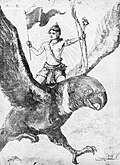
The story of the birth of Kamadeva has several variants in different | [[File:Thewakamnoet (1959, p. 137).jpg|thumb|left|A Thai depiction of Kamadeva riding a parrot, 1959]] | ||
|author = | The story of the birth of Kamadeva has several variants in different Hindu scriptures.<ref>{{Harvnb|Benton|2006|loc=p. 23}}</ref> | ||
|title= | |||
|publisher = [[ | In early scriptures, including the ''[[Taittiriya Brahmana]]'' and the ''[[Mahabharata]]'', Kamadeva is described as the son of Dharma, the personification of righteousness and a ''Prajāpati'' (progenitor deity).<ref>[https://www.sacred-texts.com/hin/m01/m01067.htm Adi Parva, Chapter 66, Verses 31-33]</ref> According to the ''Mahabharata'', Dharma is said to have been born from [[Brahma]]’s right breast and fathered three sons: Shama (tranquility), Kama (desire), and Harsha (joy).<ref name="VM2" /> Kama's mother is mentioned to be Dharma's wife Shraddha in ''Taittiriya Brahmana'',<ref name = "Dal" /> while the appendix of the ''Mahabharata'', ''[[Harivamsa]]'', states his mother to be Lakshmi, another wife of Dharma.{{efn|Distinct from the [[Lakshmi|consort of Vishnu]] who has the same name.}}<ref name = "Dal">{{cite book |author=[[Roshen Dalal]] |title=Hinduism: An Alphabetical Guide |url=https://books.google.com/books?id=zrk0AwAAQBAJ |publisher=[[Penguin Books]] |date=2014|isbn=978-81-8475-277-9 }} Entry: "Kama"</ref><ref name = "Hop">{{Cite book |last=Hopkins |first=Edward Washburn |url=http://archive.org/details/epicmythology00hopkuoft |title=Epic mythology |date=1915 |publisher=Strassburg K.J. Trübner |others=Robarts - University of Toronto}}</ref><ref>{{Cite book |last=Kapoor |first=Subodh |url=https://books.google.com/books?id=HJ6O8nwsFWgC&q=Kama&pg=PA28 |title=A Dictionary of Hinduism: Including Its Mythology, Religion, History, Literature, and Pantheon |date=2004 |publisher=Cosmo Publications |isbn=978-81-7755-874-6 |language=en}}</ref> | ||
| | |||
|url= | According to [[Purana|''Puranic'' scriptures]] including the ''[[Shiva Purana]]'', the ''[[Kalika Purana]]'', the ''[[Brahma Vaivarta Purana]],'' and the ''[[Matsya Purana]]'', Kama is one of the [[Manasputra|mind-born sons]] of the creator god [[Brahma]].<ref>{{Harvnb|Benton|2006|loc=p. 36}}</ref><ref>{{Harvnb|Benton|2006|loc=p. 44}}</ref><ref name = "SK" /><ref name = "Chandra" /><ref name = "SS2" /> In the most common narrative, after Brahma creates all the [[prajapati]]s (agents of creation) and a maiden named Sandhya, an extremely handsome and youthful man emerges from his mind and enquires Brahma about the purpose of his birth. Brahma names him Kama and orders him to spread love in the world by shooting his flower arrows. Kama decides to first use his arrows against Brahma and shoots him with his floral arrows.{{efn|In the ''Kalika Purana'', Kama also shoots at the ''prajapatis'', and later from the sweat of [[Daksha]], [[Rati]] emerges.<ref name = "VM2" />}} He becomes attracted to Sandhya and desires for her. The ''prajapati'' Dharma becomes worried by this and calls the god [[Shiva]], who watches them and laughs at both Brahma and Kama.{{efn|In some versions, the role of Dharma is absent. Instead, Shiva sees them while traveling there.<ref name = "SS2" />}} Brahma regains consciousness and curses Kama to be burnt to ashes by Shiva in the future. However, on Kama's pleading, Brahma assures him that he will be reborn.<ref name = "SS2" >{{Cite book |last=Santideva |first=Sadhu |url=https://books.google.com/books?id=TUFZ9XzzHAcC&dq=k%C4%81ma+brahm%C4%81&pg=PA112 |title=Ascetic Mysticism |date=2000 |publisher=Cosmo Publications |isbn=978-81-7020-998-0 |pages=111–117 |language=en}}</ref><ref name = "VM2" /><ref>{{Harvnb|Benton|2006}}</ref><ref name = "SK" />{{efn|In some texts like the ''Matsya Purana'' and ''[[Brahmanda Purana]]'', a different name is used for Sandhya.<ref name = "SS2" /><ref name = "SK" /><ref name = "VM2" />}} A later version of the myth is found in the ''[[Skanda Purana]],'' according to which, Brahma creates Kama from his mind to ignite passion in the ''prajapatis'' (agents of creation) after they refused to procreate.<ref name = "SK" >{{Cite book |last=Kramrisch |first=S. |url=https://books.google.com/books?id=O5BanndcIgUC&dq=k%C4%81ma+god&pg=PA218 |title=The Presence of Siva |date=1981 |publisher=Princeton University Press |isbn=978-0-691-01930-7 |language=en}}</ref>{{efn|In this version, Kama is cursed by Brahma as he initially ignores his orders.<ref name = "SS2" />}} | ||
|isbn= 978- | |||
In some traditions, Kama is considered a son of the goddess of wealth [[Lakshmi]], and the preserver god [[Vishnu]] due to his birth as [[Pradyumna]] to [[Rukmini]] and [[Krishna]], the incarnations of Lakshmi and Vishnu respectively.<ref name = "WW" /><ref>The Book of Hindu Imagery: Gods, Manifestations and Their Meaning By Eva Rudy Jansen p. 93</ref><ref name = "Chandra" /> According to ''Matsya Purana'', Visnu-Krishna and Kamadeva have a historical relationship.<ref name="Sanford2002" /> | |||
===Family and assistants=== | |||
[[File:Kama sur le temple de Parshvanath (Khajuraho) (8638392628).jpg|thumb|Sculpture of Kama and Rati at [[Khajuraho Group of Monuments|Khajuraho]] ]] | |||
Both the epics and the ''[[Puranas]]'' attest to the goddess [[Rati]] as the consort and chief assistant of Kamadeva. She is his female counterpart representing sensual pleasure. According to ''[[Kalika Purana]]'' and ''[[Shiva Purana]]'', she emerged from a sweat drop of ''prajapati'' [[Daksha]] who was assigned by [[Brahma]] to present Kamadeva as a wife. The ''Shiva Purana'' also mentions that Kama himself was pierced by his love arrows when he saw Rati. The ''[[Brahmavaivarta Purana]]'' gives Rati another origin, according to which Sandhya died after [[Brahma]] desired her but was revived as Rati by [[Vishnu]] who presented her to Kama.<ref>{{Harvnb|Benton|2006|loc=p. 32}}</ref><ref>{{Harvnb|Benton|2006|loc=p. 31}}</ref> [[Priti (goddess)|Priti]] ("affection") is mentioned as Kamadeva's second spouse in the ''[[Skanda Purana]]'', while in other texts, 'Priti' is just an epithet of Rati.<ref name = "Chandra" /> | |||
In most scriptures, Kama and Rati have two children, Harsha ("Joy") and Yashas ("Grace"). However, the ''[[Vishnu Purana]]'' mentions that they only have one son – Harsha.<ref name = "Hop" /> | |||
Besides Rati, Kama's main assistant is Vasanta, the god of spring season, who was created by Brahma. Kama is served by a group of violent ''[[gana]]s'' known as the Maras.<ref>{{Harvnb|Benton|2006|loc=p. 33}}</ref><ref name = "Chandra" /> Kama also leads the celestial nymphs, the [[apsaras]], and they are often sent by [[Indra]]—the king of heaven—to disturb the penance of sages to prevent them from achieving divine powers.<ref>{{Harvnb|Benton|2006|loc=p. 34}}</ref> | |||
===Incineration by Shiva=== | ===Incineration by Shiva=== | ||
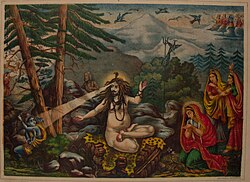
[[ | The most famous episode of Kama's mythology—his incineration by the ascetic god [[Shiva]]'s third eye—is often called the ''Madana-bhasma,'' also rendered the ''Kama dahana''. This tale is recorded in various Indian texts, including the ''[[Matsya Purana]], [[Padma Purana]], [[Shiva Purana]]'', and ''[[Vamana Purana]]''.{{sfn|Benton|2006|p=39}}<ref>[[Klaus Klostermaier]], (2000) Hinduism: A Short History. Oxford: One World Publications. | ||
</ref> In all versions, Kamadeva is tasked with breaking Shiva's asceticism. Shiva's potential to father a son who could defeat the demon [[Tārakāsura|Taraka]] is the gods' only hope. Taraka's boon of invincibility ensures that only a son of Shiva can kill him, a seemingly impossible task given Shiva's intense ascetic lifestyle after the death of his wife [[Sati (Hindu goddess)|Sati]]. The gods, led by [[Indra]], summon Kamadeva, the god of desire, to make Shiva fall in love with [[Parvati]], the reincarnation of Sati and the daughter of the mountain god [[Himavat]].{{sfn|Benton|2006|p=40}} | |||
[[File:Kama Shiva.jpg|thumb|Kama attacks a meditating Shiva, gouache on paper, c. 1820 CE]] | |||
It occurs in its most developed and earliest form in the ''Matsya Purana'' (verses 227–255).<ref>{{cite book | |||
|author = Daniel Ingalls | |author = Daniel Ingalls | ||
|title= Sanskrit poetry, from Vidyākara's "Treasury" | |title= Sanskrit poetry, from Vidyākara's "Treasury" | ||
| Line 79: | Line 131: | ||
|url=https://books.google.com/books?id=AjEdCVZ5uoQC | |url=https://books.google.com/books?id=AjEdCVZ5uoQC | ||
|isbn=978-0-674-78865-7|author-link= Daniel H. H. Ingalls, Sr | |isbn=978-0-674-78865-7|author-link= Daniel H. H. Ingalls, Sr | ||
}}, p.58</ref> but is | }}, p.58</ref>{{sfn|Benton|2006|p=39}} In this variant, the gods, desperate for a warrior to vanquish Taraka, send Kamadeva to disrupt Shiva's meditation. Kamadeva, aware of the danger, initially hesitates, fearing that Shiva's wrath will result in his own destruction. Indra, however, reassures him, insisting that this mission is crucial to the survival of the world.{{sfn|Benton|2006|p=40}} Kamadeva prepares carefully for the task. He takes his sugarcane bow and floral arrows, each one symbolizing a particular emotion or aspect of desire. Accompanied by his wife [[Rati]] (goddess of pleasure) and the spirit of Spring (Madhu or Vasanta), Kamadeva approaches Shiva, who is deep in meditation.{{sfn|Benton|2006|p=41}} Kamadeva's approach to breaking Shiva's concentration is a calculated multi-stage process. He first begins by targeting Shiva's mind, slowly destabilizing his thoughts. As the god of desire, Kamadeva introduces feelings of envy, hatred, and anger into Shiva's mind—emotions that are traditionally considered the antithesis of spiritual equilibrium. According to the text, Kamadeva strategically stirs Shiva's senses: bees buzz around him, fragrant flowers bloom, and a gentle breeze flows—all aimed at disrupting Shiva's focus.{{sfn|Benton|2006|p=45–46}} After successfully infiltrating Shiva's mind and senses, Kamadeva escalates his attack by drawing his famous floral arrows. The most potent of these is the ''Mohana'' arrow, symbolizing delusion and infatuation. He shoots this arrow directly at Shiva's heart, which momentarily stirs feelings of desire in the god for Parvati. However, Shiva quickly regains his composure and realizes that his ascetic control is being threatened. Enraged by the disturbance, Shiva opens his third eye, from which fire emerges and instantly reduces Kamadeva to ashes.{{sfn|Benton|2006|p=46–47}} After Kamadeva's death, his wife Rati is devastated by grief and smears his ashes all over her body. Her mourning becomes a significant element of the narrative, as she petitions Shiva to restore her husband. Shiva, moved by her devotion, promises that Kamadeva will return, but not in his previous form. Instead, Kamadeva will be reborn as Ananga—the bodiless one—making him invisible yet still present. This transformation marks a new phase in the existence of desire—it becomes an unseen force, influencing the world in ways that are not immediately visible.{{sfn|Benton|2006|p=49–50}}<ref>[[Wendy Doniger O'Flaherty]], (1975) Hindu Myths: A Sourcebook Translated from the Sanskrit. London: Penguin Books, p.157-159 [https://books.google.com/books?id=JAwA8sHtGbgC] | ||
other | </ref>[[File:Madan-Bhasma (Shiva Turns to Ashes).jpg|thumb|Painting of the Madana-bhasma (Shiva turns Kamadeva to ashes)]]While the ''Matsya Purana'' provides a foundational version of the story, other texts like the ''Shiva Purana'' and the ''Vamana Purana'' offer different emphases and additional layers to the myth. In the ''Shiva Purana'', Kamadeva is depicted as more arrogant and powerful, yet his encounter with Shiva further underscores the latter's dominance over desire. Kamadeva's arrows fail to fully penetrate Shiva's concentration, demonstrating the supreme yogi's ability to resist even the most potent forces of passion. However, as in the ''Matsya Purana'', Kamadeva's destruction leads not to the end of desire but to its transformation. Shiva absorbs Kamadeva into himself, making him one of his ''[[gana]]s'' (attendants). This act symbolizes Shiva's control over desire, yet acknowledges its persistence in a subtler, controlled form;{{sfn|Benton|2006|p=50-51}} the Shiva Purana thus reinforces the idea that desire is an inherent part of the universe, but under the control of disciplined spiritual practice.{{sfn|Benton|2006|p=54}} The ''Vamana Purana'' presents a version in which Shiva is more vulnerable to Kamadeva's arrows. Here, Shiva is grieving for his first wife, [[Sati (Hindu goddess)|Sati]], and is emotionally vulnerable when Kamadeva strikes. Overwhelmed by desire and grief, Shiva flees into the forest, seeking to escape Kamadeva's influence. However, the very act of fleeing causes the wives of the forest sages to become infatuated with him, illustrating the uncontrollable nature of desire, even for the gods.{{sfn|Benton|2006|p=54-55}} | ||
''Kalika Purana'' & ''Shiva Purana'' attributes Kama's incineration to him being cursed by Brahma because he shot his first arrows at him & the other mind-born sons of Brahma, which caused Brahma to become incestually enamoured of his daughter Sandhya, for which he is rebuked by Shiva.<ref>{{Cite web |last=www.wisdomlib.org |date=2018-09-21 |title=Kāma is cursed but blessed later [Chapter 3] |url=https://www.wisdomlib.org/hinduism/book/shiva-purana-english/d/doc226022.html |access-date=2025-10-11 |website=www.wisdomlib.org |language=en}}</ref> The maharshis, incestually enamoured of their sister, begin to perspire, which creates the [[Pitri|Pitrs]]. Sandhya, ashamed of her body which incited such forbidden passions, commits suicide & is reincarnated as [[Arundhati (Hinduism)|Arundhati]]. | |||
In the ''Lalitopakhyana'' section of the ''[[Brahmanda Purana]]'', from the incinerated remains of Kamadeva, arose the asura [[Bhandasura]]. | |||
=== Resurrection === | |||
''Shiva Purana'' describes Kamadeva being resurrected by Shiva on the event of his marriage to Parvati.<ref>{{Cite web |last=www.wisdomlib.org |date=2018-10-10 |title=The resuscitation of Kāma [Chapter 51] |url=https://www.wisdomlib.org/hinduism/book/shiva-purana-english/d/doc226115.html |access-date=2025-10-11 |website=www.wisdomlib.org |language=en}}</ref> However, the ''Lalitopakhyana'' describes his resurrection from the eyes (''akshi'' in Sanskrit) of the Goddess [[Tripura Sundari|Lalita]] in [[Kanchipuram]], where she [[Kamakshi Amman Temple|resides]] by the name of ''Kamakshi''. The ''Kalika Purana'' states that Kamadeva was resurrected by goddess [[Kamakhya]], (who is also related to Lalita) hence the land of Kamakhya where the Kamadeva regained his ''rupa'' (corporeal form in Sanskrit) became known as [[Kamarupa]]. In gratitude, Kamadeva constructed the first [[Kamakhya Temple|shrine of Kamakhya]]. | |||
The death and resurrection of Kamadeva fills in the trope of [[dying-and-rising god]] found in other cultures. | |||
===Incarnations=== | ===Incarnations=== | ||
According to [[Garuda Purana]], [[Pradyumna]] and [[Samba (Krishna's son)|Samba]] - the | According to [[Garuda Purana]], [[Pradyumna]] and [[Samba (Krishna's son)|Samba]] - the sons of [[Krishna]], [[Four Kumaras|Sanat Kumara]] - the son of [[Brahma]], [[Kartikeya|Skanda]] - the son of [[Shiva]], [[Sudarshana]] (the presiding deity of Sudarshana Chakra), and [[Bharata (Mahabharata)|Bharata]] are all incarnations of Kama.<ref name="Motilal Banarsidass">{{cite book |author1=J.L. Shastri |url=https://books.google.com/books?id=9pDsDwAAQBAJ&pg=PA1115 |title=Ancient Indian Tradition and Mythology Volume 14: The Garuda Purana Part 3 |author2=G.P. Bhatt |date=1 January 2004 |publisher=Motilal Banarsidass |isbn=978-81-208-3881-9 |page=1115 |quote=Kama, the presiding deity of the disc was born as Sudarsana. Sâmba the son of lord Krsna was also the incarnation of Kāma. Skanda, the son of Rudra (Shiva) was also Kåma. Since he overcame the enemies he is called Skanda. Since he overcame enemies he is called Skanda. Sudarsana, Pradyumna, Bharata, Samba, Sanatkumara, and Skanda these six are the incarnations of Kama.}}</ref> The myth of Kamadeva's incineration is referenced in the ''Matsya Purana'' and ''Bhagavata Purana'' to reveal a relationship between | ||
[[Krishna]] and Kamadeva.<ref name=Sanford2002>{{cite journal | [[Krishna]] and Kamadeva.<ref name=Sanford2002>{{cite journal | ||
| author = Sanford, A.W. | | author = Sanford, A.W. | ||
| Line 101: | Line 156: | ||
| doi = 10.1093/jaar/70.1.55 | | doi = 10.1093/jaar/70.1.55 | ||
}}</ref> In the narrative, Kama is reincarnated in the womb of Krishna's wife [[Rukmini]] as [[Pradyumna]], after being burned to ashes by [[Shiva]]. | }}</ref> In the narrative, Kama is reincarnated in the womb of Krishna's wife [[Rukmini]] as [[Pradyumna]], after being burned to ashes by [[Shiva]]. | ||
==Iconography and depictions== | |||
{{multiple image | |||
| perrow = 2/2/2/1 | |||
| caption_align = center | |||
| total_width = 300 | |||
| title = Depictions of Kama | |||
| image4 = Exhibits in display at Archeological Survey of India's museum at Nalanda, Bihar, India 44 (cropped).jpg | |||
| caption4 = with Rati, from Nalanda c. 9th - 10th cent. CE, | |||
| image3 = Various Sculptures in Salar Jung Museum, Hyderabad 03 (cropped).jpg | |||
| caption3 = Sculpture at Salar Jung Museum | |||
| image5 = Kamadeva1.jpg | |||
| caption5 = with green skin, c. 18th-19th century | |||
| image1 = MET DP130033.jpg | |||
| caption1 = Bust from ancient kingdom of Kashmir, c. 8th century CE | |||
| image2 = Kama, le dieu du désir amoureux, sur le temple de Chennakesava (Somanathapura, Inde) - Flickr - dalbera (cropped).jpg | |||
| caption2 = On the Chennakesava temple walls, c. 1269 CE | |||
| image6 = Paneel met Kama en Rati, AK-MAK-1730.jpg | |||
| caption6 = on ivory panel with Rati from Tamil Nadu, c. 1700-1800 CE | |||
}} | |||
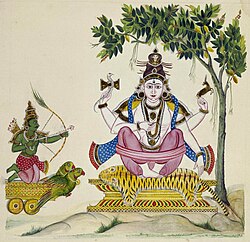
Kamadeva is vividly described in the [[Puranic texts|''Puranic'' texts]] as a radiant and enchanting deity, often regarded as the pinnacle of male beauty. According to the ''[[Shiva Purana]]'', he possesses a golden complexion, a broad and muscular chest likened to a doorframe,and well-rounded limbs, including plump thighs and calves. His waist is slender with deep navel, and his entire body is suffused with the intoxicating fragrance reminiscent of an [[Musth|elephant in rut]]. His features are refined and sensuous—his nose straight and delicate, his eyes shaped like lotus petals and tinged red along with his hands, face, legs, and fingers. His eyebrows are thick and expressive, and his moon-like face is framed by soft blue-black waves of hair. His teeth are flawless, and his neck is shaped like a conch. His breath carries a natural fragrance, and his gaze is highly seductive. Kamadeva wears a blue garment and rides a [[makara]], a mythical aquatic creature. He is armed with a [[sugarcane]] bow, stringed with a thread of buzzing bees, and five arrows tipped with flowers, each one capable of inducing a specific mood or emotion linked to desire.Also he is depicted as in Green, Red Complexion in some Scriptures.He holds arrows which are traditionally made from the [[Ashoka tree|ashoka blossom]], [[Mango|mango flower]], [[jasmine]], [[Nymphaea nouchali|blue lotus]], and [[Nelumbo|white lotus]], and are essential components of his iconography. His presence is always associated with ''[[Sringara|śṛṅgāra rasa]]'', the aesthetic mood of romantic and erotic love.{{sfn|Benton|2006}} | |||
In classical Indian iconography, Kamadeva is portrayed as a youthful and handsome deity, often accompanied by his consort [[Rati]]. Surrounding him are various figures and symbols that underscore his association with desire and fertility. [[Apsaras]] (celestial nymphs) and [[gandharvas]] (heavenly musicians), while absent from Kamadeva’s mythological narratives, frequently appear beside him and Rati in visual depictions, such as in the eighth-century sculpture at the [[Kailasa Temple, Ellora|Kailasa Cave Temple]] at [[Ellora]]. At his feet typically sits a brightly colored [[parrot]], his vāhana (vehicle), representing playful affection and the connection between love and speech. His standard often features a makara, symbolizing fertility and primal desire. According to [[T. A. Gopinatha Rao]]’s study of the ''[[Shilpa Shastras|Śilpa Śāstras]]'', Kamadeva is sometimes accompanied by Vasanta, the embodiment of spring, described as a pleasing figure adorned with aśoka leaves, pomegranate flower earrings, and a garland of keśava blossoms. Despite this literary association, Vasanta is rarely depicted in visual art, possibly because another handsome male figure might distract from Kamadeva’s central visual appeal. Kamadeva’s standard-bearer is often shown with the face of a horse, likely a reference to the stallion’s virility and association with generative power, as seen in the unusual twelfth-century Halebid temple depiction where Vasanta is omitted but the horse-faced figure remains. The ''Śilpa Śāstras'' prescribe that Kamadeva should be adorned with floral garlands and gold ornaments, holding a sugarcane bow in his left hand and flower-tipped arrows in his right, flanked by his consorts—Rati and [[Priti (goddess)|Priti]], a joyful Vasanta, and a horse-faced standard-bearer carrying a banner emblazoned with a makara. Nonetheless, as Rao notes, artistic representations often diverge from these textual norms. Benton observes that sculptors typically depict Kamadeva only with Rati, his horse-faced flag-bearer, gandharvas, and apsaras, omitting Vasanta.{{sfn|Benton|2006}} Additional symbolic attributes include a [[cuckoo]], humming [[bee]]s, the season of [[spring (season)|spring]], celestial nymphs and the gentle breeze.<ref name="WW">{{Cite web |title=Hindu Mythology, Vedic and Puranic: Chapter V. The Incarnations or Avatāras of Vishnu: Kamadeva |url=https://www.sacred-texts.com/hin/hmvp/hmvp32.htm |access-date=2023-01-30 |website=www.sacred-texts.com}}</ref><ref name=kamadeva>{{cite journal|title=A study of Kamadeva in Indian story literature |url=http://digitalcommons.libraries.columbia.edu/dissertations/AAI9127814/ |journal=Columbia Educational Journal |access-date=2008-07-06 |archive-url=https://web.archive.org/web/20090114043227/http://digitalcommons.libraries.columbia.edu/dissertations/AAI9127814/ |archive-date=January 14, 2009 }}</ref><ref name=Sanford2002/> | |||
Though images of standalone Kamadeva are relatively rare, several notable depictions exist. A set of vividly painted, six-foot-tall wooden statues at the [[Salar Jung Museum]] in [[Hyderabad]] portrays Kamadeva and Rati with dynamic energy and lifelike expressiveness. Other exceptional examples include a sixth-century sculpture from Bijapur and a similarly posed stone sculpture in the Metropolitan Museum of Art, where Kamadeva and Rati are in a tender embrace beneath a canopy of leaves—likely symbolizing a flowering tree or sugarcane plant.{{sfn|Benton|2006}} A terracotta [[murti]] of Kamadeva of great antiquity is housed in the [[Mathura]] Museum, UP, [[India]].<ref>''History of Indian Theatre'' By M. L. Varadpande. p.188. Published 1991, Abhinav Publications, {{ISBN|81-7017-278-0}}.</ref> Literary works like ''[[Harshacharita|Harṣacarita]]'' and ''[[Naishadha Charita|Naiṣadhacarita]]'' mention inner chambers adorned with paintings or figurines of Kamadeva, Rati, and [[Priti (goddess)|Priti]]. Though these artworks have long since vanished, they suggest that Kamadeva was once a visible part of elite aesthetic and devotional spaces.{{sfn|Benton|2006}} | |||
==Beliefs and worship== | ==Beliefs and worship== | ||
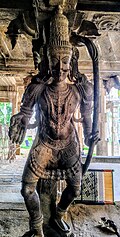
The deity of Kamadeva along with his consort Rati is included in the pantheon of Vedic-Brahmanical deities such as [[Shiva]] and [[Parvati]].<ref name=Hooja2004>{{cite journal | [[File:Manmadhan.jpg|thumb|The sculpture of the Hindu God Manmadhan at the Thirukkurungudi Temple, Tamil Nadu.]]The deity of Kamadeva along with his consort Rati is included in the pantheon of Vedic-Brahmanical deities such as [[Shiva]] and [[Parvati]].<ref name="Hooja2004">{{cite journal | ||
| author = Hooja, R. | | author = Hooja, R. | ||
| year = 2004 | | year = 2004 | ||
| Line 115: | Line 195: | ||
| doi = 10.1080/0043824042000282795 | | doi = 10.1080/0043824042000282795 | ||
| s2cid = 162304052 | | s2cid = 162304052 | ||
}}</ref> In [[Hindu]] traditions for the marriage ceremony itself, the bride's feet are often painted with pictures of Suka, the parrot vahana of Kamadeva.<ref name=Arnold1996>{{cite book | }}</ref> In [[Hindu]] traditions for the marriage ceremony itself, the bride's feet are often painted with pictures of Suka, the parrot vahana of Kamadeva.<ref name="Arnold1996">{{cite book | ||
| author = Arnold, A.J. | | author = Arnold, A.J. | ||
| year = 1996 | | year = 1996 | ||
| Line 123: | Line 203: | ||
}}</ref> | }}</ref> | ||
The religious rituals addressed to him offer a means of purification and re-entry into the community. Devotion to Kamadeva keeps desire within the framework of the [[dharma|religious tradition]].<ref>{{Harvnb|Benton|2006|loc=p. 84}}</ref> Kamadeva appears in many stories and becomes the object of devotional rituals for those seeking health, physical beauty, husbands, wives, and sons. In one story{{Where|date=December 2016}} Kamadeva himself succumbs to desire, and must then worship his lover | The religious rituals addressed to him offer a means of purification and re-entry into the community. Devotion to Kamadeva keeps desire within the framework of the [[dharma|religious tradition]].<ref>{{Harvnb|Benton|2006|loc=p. 84}}</ref> Kamadeva appears in many stories and becomes the object of devotional rituals for those seeking health, and physical beauty, husbands, wives, and sons. In one story{{Where|date=December 2016}} Kamadeva himself succumbs to desire, and must then worship his lover to be released from this passion and its curse. | ||
===Rituals and festivals=== | ===Rituals and festivals=== | ||
[[Holi]] is a Hindu festival, celebrated in the Indian subcontinent. It is sometimes called Madana-Mahotsava<ref>{{Cite book |url=https://books.google.com/books?id=59IoDwAAQBAJ&pg=PA161 |title=HINDUO KE VRAT-PARV EVAM TEEJ TYOHAR |last=GANGRADE |first=DR PRAKASH CHANDRA |publisher=V&S Publishers |isbn=978-93-5057-358-7 |page=161 |language=hi|date=2015-01-06 }}</ref> or Kama-Mahotsava.<ref name="Roy">{{Cite book |url=https://books.google.com/books?id=IKqOUfqt4cIC&pg=PA193 |title=Traditional Festivals: A Multicultural Encyclopedia |last=Roy |first=Christian |date=2005 |publisher=ABC-CLIO |isbn=978-1-57607-089-5 |page=193 |language=en}}</ref><ref>{{Cite book |url=https://books.google.com/books?id=SyxOHOCVcVkC |title=History of Indian Theatre |last=Varadpande |first=Manohar Laxman |date=1987 |publisher=Abhinav Publications |isbn=978-81-7017-221-5 |page=220 |language=en |quote=Madana Mahotsava or Kama Mahotsava, Vasant Mahotsava are sophisticated forms of some ancient festivals. The 8th century poet ... The colourful festival of Holi has its origin in these festivals, known for their gay abandon. It is an ancient ...}}</ref> This festival is mentioned by [[Jaimini]], in his early writings such as ''Purvamimamsa-sutra'', dated c. 400 BC.<ref name="Roy"/> | |||
[[Holi]] is a Hindu festival, celebrated in the Indian subcontinent. It is sometimes called Madana-Mahotsava<ref>{{Cite book |url=https://books.google.com/books?id=59IoDwAAQBAJ&pg=PA161 |title=HINDUO KE VRAT-PARV EVAM TEEJ TYOHAR |last=GANGRADE |first=DR PRAKASH CHANDRA |publisher=V&S Publishers |isbn= | |||
The [[Saraca indica|Ashoka]] tree is often planted near temples. The tree is said to be a symbol of love and is dedicated to Kamadeva.<ref name=Ray1981>{{cite journal | The [[Saraca indica|Ashoka]] tree is often planted near temples. The tree is said to be a symbol of love and is dedicated to Kamadeva.<ref name=Ray1981>{{cite journal | ||
| Line 150: | Line 229: | ||
|page = Ch. 55: Shaba was Born to Kṛṣṇa and Jambabati | |page = Ch. 55: Shaba was Born to Kṛṣṇa and Jambabati | ||
| title-link = Kṛṣṇa, the Supreme Personality of Godhead | | title-link = Kṛṣṇa, the Supreme Personality of Godhead | ||
}}</ref> This Shamba is not considered identical | }}</ref> This Shamba is not considered identical to [[Vishnu]]'s [[vyuha]]-manifestation called Shamba, but is an individual soul (''[[jiva]]-tattva'') who, owing to his celestial powers, becomes an emanation of [[Vishnu]]'s prowess. | ||
The Kamadeva that was incinerated is believed to be a celestial [[demigod]] capable of inducing love and lusty desires. He is distinguished from the spiritual Kamadeva.<ref name=SS/> Here [[Krishna]] is the source of Kamadeva's inciting power, the ever-fresh [[Transcendence (religion)|transcendental]] god of love of [[Vrindavana]], the origin of all forms of Kamadeva, yet above mundane love, who is worshiped with the Kama-Gayatri and Kama-Bija [[mantra]]s.<ref name=SS/><ref name=CC>''vṛndāvane aprākṛta navīna madana, kāma-gāyatrī kāma-bīje yāṅra upāsana'' (Caitanya Caritamrita, 2.8.138)</ref><ref name=Miller1980>{{cite journal | The Kamadeva that was incinerated is believed to be a celestial [[demigod]] capable of inducing love and lusty desires. He is distinguished from the spiritual Kamadeva.<ref name=SS/> Here [[Krishna]] is the source of Kamadeva's inciting power, the ever-fresh [[Transcendence (religion)|transcendental]] god of love of [[Vrindavana]], the origin of all forms of Kamadeva, yet above mundane love, who is worshiped with the Kama-Gayatri and Kama-Bija [[mantra]]s.<ref name=SS/><ref name=CC>''vṛndāvane aprākṛta navīna madana, kāma-gāyatrī kāma-bīje yāṅra upāsana'' (Caitanya Caritamrita, 2.8.138)</ref><ref name=Miller1980>{{cite journal | ||
| Line 165: | Line 244: | ||
| jstor=2054724 | | jstor=2054724 | ||
| s2cid = 161486286 | | s2cid = 161486286 | ||
| doi-access = free | |||
}}</ref> | }}</ref> | ||
When Kamadeva is referenced as ''smara'' in ''Bhāgavata Purāṇa'' (book 10) in the context of the supramundane love between Krishna and the [[gopi]]s (cowherd maidens), he is not the [[Deva (Hinduism)|Deva]] who incites lusty feelings.<ref name=SS/> The word ''smara'' rather refers to Krishna himself, who through the medium of his [[bansuri|flute]] increases his influence on the devoted [[gopi]]s. The symptoms of this ''smarodayam'' (lit. "arousal of desire") experienced by the [[gopi]]s have been described in a commentary (by [[Vishvanatha Cakravarti]]) as follows:<ref>[[Bhagavata Purana]] 10.21.3 Tika, | When Kamadeva is referenced as ''smara'' in ''Bhāgavata Purāṇa'' (book 10) in the context of the supramundane love between Krishna and the [[gopi]]s (cowherd maidens), he is not the [[Deva (Hinduism)|Deva]] who incites lusty feelings.<ref name=SS/> The word ''smara'' rather refers to Krishna himself, who through the medium of his [[bansuri|flute]] increases his influence on the devoted [[gopi]]s. The symptoms of this ''smarodayam'' (lit. "arousal of desire") experienced by the [[gopi]]s have been described in a commentary (by [[Vishvanatha Cakravarti]]) as follows:<ref>[[Bhagavata Purana]] 10.21.3 Tika, "''caksu-ragah prathamam cittasangas tata 'tha sankalpah nidra-cchedas tanuta visaya-nivrittis trapanasah / unmado muriccha mrtir ity etah smara-dasa dasaiva syuh.''"</ref> "First comes attraction expressed through the eyes, then intense attachment in the mind, then determination, loss of sleep, becoming emaciated, uninterested in external things, shamelessness, madness, becoming stunned, and death. These are the ten stages of Cupid's effects."<ref name=SS>{{cite book | ||
| author = Swami Sivarama | | author = Swami Sivarama | ||
| year = 1998 | | year = 1998 | ||
| Line 174: | Line 254: | ||
|isbn = 978-963-03-7649-5 | |isbn = 978-963-03-7649-5 | ||
| page = Ch. 2: "The gopis assemble together" | | page = Ch. 2: "The gopis assemble together" | ||
}}</ref> The beauty of Krishna's consort, [[Radha]], is without | }}</ref> The beauty of Krishna's consort, [[Radha]], is without equality in the universe, and her power constantly defeats the god of love, Kamadeva.<ref>{{Cite book | title =Alternative Krishnas: Regional and Vernacular Variations on a Hindu Deity | last = Beck| first = Guy L. (Ed.) | author-link = Guy Beck |url = https://books.google.com/books?id=0SJ73GHSCF8C |page = 65| publisher = SUNY Press | year = 2005 |quote =Radha is without equal in the universe for beauty, and her power constantly defeats the god of love, Kamadeva. | isbn =978-0-7914-6415-1}}</ref> | ||
=== In Indonesia === | |||
Kamadeva is also mentioned in the 12th-century [[Javanese language|Javanese]] poem ''[[Smaradahana]]'', a rendering of the myth of Kamadeva's burning by [[Shiva]] and fall from heaven to earth. Kama and his consort Rati are referenced as ''Kamajaya'' and ''Kamarati'' in [[Kakawin]] poetry and later [[Wayang]] narratives.{{citation needed|date=March 2017}} | |||
==Temples== | ==Temples== | ||
| Line 180: | Line 263: | ||
| author = Benton, C. | | author = Benton, C. | ||
| year = 2005 | | year = 2005 | ||
}}</ref> | }}</ref> he frequently appears in illustrations, especially in Shiva temples in South India describing his incineration. | ||
Some other temples dedicated or related to this [[deva (Hinduism)|deva]]: | Some other temples dedicated or related to this [[deva (Hinduism)|deva]]: | ||
*Kameshwara Temple, in [[Aragalur]]. The [[Purana#Sthala Puranas|Sthala purana]] indicates that Kamadeva woke up [[Shiva]] at this place. | *Kameshwara Temple, in [[Aragalur]]. The [[Purana#Sthala Puranas|Sthala purana]] indicates that Kamadeva woke up [[Shiva]] at this place. | ||
*Kameshvara Temple, in [[Vraja|Kamyavan]], one of the twelve forests of [[Vrindavana]].<ref> | *Kameshvara Temple, in [[Vraja|Kamyavan]], is one of the twelve forests of [[Vrindavana]].<ref> | ||
{{cite web | {{cite web | ||
|url=http://www.agraindia.org.uk/excursions/mathura/braja-mandala-parikrama.html | |url=http://www.agraindia.org.uk/excursions/mathura/braja-mandala-parikrama.html | ||
| Line 192: | Line 275: | ||
}} | }} | ||
</ref> | </ref> | ||
* Soundaraja Perumal Temple at [[Thadikombu]], near Dindigul, Tamil Nadu<ref>{{cite web |url=http://www.columbuslost.com/2015/03/temple-for-cupid-thadikombu-dindigul.html | * Soundaraja Perumal Temple at [[Thadikombu]], near Dindigul, Tamil Nadu<ref>{{cite web |url=http://www.columbuslost.com/2015/03/temple-for-cupid-thadikombu-dindigul.html |archive-url=https://web.archive.org/web/20150405183447/http://www.columbuslost.com/2015/03/temple-for-cupid-thadikombu-dindigul.html |archive-date=2015-04-05 |title=Temple for Cupid, Thadikombu, Dindigul}}</ref> | ||
* Harsat-Mata Temple at [[Abhaneri]] has representation of Kamadeva.<ref name=Atherton1995>{{cite journal | * Harsat-Mata Temple at [[Abhaneri]] has a representation of Kamadeva.<ref name=Atherton1995>{{cite journal | ||
| author = Atherton, C.P. | | author = Atherton, C.P. | ||
| year = 1995 | | year = 1995 | ||
| Line 206: | Line 289: | ||
}}</ref> | }}</ref> | ||
==In English | ==In English literature== | ||
{{wikisource|Landon in The Literary Gazette 1822/Manmadin|Manmadin, the Indian Cupid, floating down the Ganges,<br>a poem by L. E. L.}} | {{wikisource|Landon in The Literary Gazette 1822/Manmadin|Manmadin, the Indian Cupid, floating down the Ganges,<br />a poem by L. E. L.}} | ||
[[Letitia Elizabeth Landon]]'s descriptive poem ''Manmadin, the Indian Cupid, floating down the Ganges'' appeared in The Literary Gazette, 1822 (''Fragment in Rhyme VII.'') | [[Letitia Elizabeth Landon]]'s descriptive poem ''Manmadin, the Indian Cupid, floating down the Ganges'' appeared in ''The Literary Gazette'', 1822 (''Fragment in Rhyme VII.'') | ||
{{clear}} | {{clear}} | ||
==Notes== | ==Notes== | ||
{{notelist}} | {{notelist}} | ||
| Line 215: | Line 299: | ||
==References== | ==References== | ||
{{Reflist}} | {{Reflist}} | ||
* {{Cite book |last=Benton |first=Catherine |year=2006 |title=God of desire: tales of Kamadeva in Sanskrit story literature |publisher=State University of New York Press |location=Albany, New York |isbn=978-0-7914-6565-3 }} | |||
* {{Cite book |last=Benton |first=Catherine |year=2006 |title=God of desire: tales of Kamadeva in Sanskrit story literature |publisher=State University of New York Press |location=Albany, | |||
==External links== | |||
*{{commons category-inline}} | |||
{{HinduMythology}} | {{HinduMythology}} | ||
{{Authority control}} | {{Authority control}} | ||
| Line 223: | Line 308: | ||
[[Category:Hindu gods]] | [[Category:Hindu gods]] | ||
[[Category:Love and lust gods]] | [[Category:Love and lust gods]] | ||
[[Category:Mythological archers]] | |||
[[Category:Beauty gods]] | |||
Latest revision as of 08:08, 12 March 2026
| Kamadeva | |
|---|---|
God of Love, Desire, Attraction, Pleasure and Beauty | |
 Sculpture of Kamadeva on a temple wall of Chennakesava Temple, Belur | |
| Other names | Manmatha, Madana, Ananga |
| Devanagari | कामदेव |
| Sanskrit transliteration | Kāmadeva |
| Affiliation | Deva |
| Abode | Kamaloka |
| Mantra | काम (kāma)[1] |
| Weapon | Sugarcane bow and floral arrows |
| Symbol | Makara |
| Mount | Parrot |
| Texts | Atharvaveda, Ramayana, Mahabharata, Harivamsha, Puranas |
| Gender | Male |
| Personal information | |
| Parents | Brahma (father)[lower-alpha 1] |
| Consort | Rati[lower-alpha 2] |
| Children | Harsha and Yasha (sons) |
| Equivalents | |
| Greek equivalent | Eros[6] |
| Roman equivalent | Cupid[5] |
Kamadeva (Sanskrit: कामदेव, IAST: Kāmadeva), also known as Kama, Manmatha, and Madana is the Hindu god of love, carnal desire, attraction, pleasure and beauty, as well as the personification of the concept of kāma. He is depicted as a handsome young man decked with ornaments and flowers, armed with a bow of sugarcane and shooting arrows of flowers. He often portrayed alongside his consort and female counterpart, Rati.[7]
Kamadeva's origins are traced to the verses of the Rig Veda and Atharva Veda, although he is better known from the stories of the Puranas.[8] The Atharva Veda regards Kamadeva as a powerful god, the wielder of the creative power of the universe, also describing him to have been "born at first, him neither the gods nor the fathers ever equaled".[9]
In the Puranas, Kamadeva is generally mentioned as a manasaputra (mind-born son) of the creator god Brahma. His most popular myth is his incineration by the god Shiva's third eye and rebirth on earth as Pradyumna, the eldest son of Krishna and his chief consort Rukmini.[10]
Etymology and other names[edit | edit source]
The name Kama-deva (IAST: kāma-deva) can be translated as 'god of love'. Deva means heavenly or divine and refers to a deity in Hinduism. Kama (IAST: kāma) means "desire" or "longing", especially as in sensual or sexual love. The name is used in the Rigveda (RV 9, 113. 11).[11] Kamadeva is a name of Vishnu in the Vishnu Purana and the Bhagavata Purana (SB 5.18.15). It is also a name of the deities Krishna and Shiva. Kama is also a name used for Agni (Atharva Veda 6.36.3).[12]
Other names prominently used about Kamadeva are:
- Kama (काम) - desire; longing.[2]
- Manmatha (मन्मथ) - one who agitates mind.[2][5]
- Madana (मदन) - one who intoxicates with love.[2][5][11][13]
- Mara (मार) - he who wounds.[2][5]
- Ananga (अनंग) - he who is without a body.[2][5]
- Kushumeshara (कुसुमशर) - he whose arrows are flowers.[2][5]
- Pradyumna (प्रद्युम्न) - he who conquers all. It is also the named of Kama's reincarnation.[2][5]
- Kandarpa (कन्दर्प) or Darpaka (दर्पक) - the inflamer. Brahma gave him this name.[2][14]
- Manasija (मनसिज), Manoja (मनोज) and Bhavaja (भवज) - he who is born of mind.[14][2]
- Ratikanta (रतिकांत) or Ratipati (रतिपति) - husband of Rati.[2]
- Abhirupa (अभिरूप) - the beautiful one. Also a name for both Vishnu and Shiva.[15]
Evolution[edit | edit source]
Kamadeva's origins can be traced back to the ancient Vedas, from where kāma evolved from an impersonal and conceptual force of desire into a fully developed deity.[16]
Vedas[edit | edit source]
The earliest references to the concept of desire, later personified as Kamadeva, appear in the Vedic Samhita—Rigveda and Atharvaveda, where the notion of kāma is presented primarily as an abstract cosmic principle rather than a fully developed deity. These early Vedic texts reflect the formative stages of Kamadeva’s mythological identity.[16] John Muir notes that Kama in the Vedas does not refer to the sexual desire, but rather desire of goodness in general.[17]
In Rigveda 10.129, often referred to as the Nasadiya Sukta or the Hymn of Creation, kāma emerges as a primordial force central to the cosmogonic process. The hymn portrays a state of indistinguishable darkness and undifferentiated water, out of which desire (kāma) arises as “the first seed of mind.” Linguist Franklin Edgerton interprets this kāma as a "cosmic Will" or an impersonal force essential to the evolution of the universe. In this early context, kāma is not yet anthropomorphized but rather functions as an abstract principle vital to creation itself, linking non-existence with existence through mental conception.[16]
In the Atharvaveda, Kāma begins to take on a more defined, divine character. In hymn 9.2, Kāma is invoked to grant desires and eliminate rivals. The deity is described with titles such as “first seed of mind” (manoja, mind-born one), echoing his Rigvedic origins. The supplicant praises Kāma’s superiority over gods, ancestors, and mortals, reinforcing his status as a primordial force. According to Professor Catherine Benton of the Lake Forest College (Department of Religion), this form of Kāma is simultaneously a divine agent of desire and a god with cosmic significance. Hymn 19.52 of the Atharvaveda continues this theme, offering homage to Kāma as a bestower of prosperity and success, likely in connection with sacrificial rites. Again, Kāma is described as “the first seed of mind,” indicating continuity with the Rigvedic view of desire as a force foundational to creation. Benton observes that in these contexts, Kāma functions not as a romantic deity but as a divine principle invoked to fulfill a variety of human wishes, from wealth to progeny.[16]
A significant shift toward the later mythological depiction of Kamadeva appears in Atharvaveda 3.25. This hymn illustrates Kāma in a form more closely resembling the god portrayed in the epics and Puranas. The verses describe the use of Kama’s arrows to arouse intense desire in a woman:[16]
“May the up-thruster thrust you up; do not abide in your own lair;
with the arrow of kāma that is terrible I pierce you in the heart.” (AV 3.25.1)
“The arrow feathered with longing, tipped with love [kāma],
necked with resolve, let love pierce you in the heart.” (AV 3.25.2)
While early translators interpreted kāma here as “love,” Benton argues that the term more accurately reflects desire, especially one linked to resolve and intensity. The supplicant in these verses does not merely seek affection but calls upon Kāma to awaken powerful desire within the target of his attraction. This early association of Kāma with arrows—referred to as “terrible” and capable of burning the heart—marks one of the first identifiable characteristics of Kamadeva as he is depicted in later Sanskrit literature. While 20th-century scholar A. Berriedale Keith considered the text reflective of the "lower side" of religious life, contemporary scholars emphasize its appeal across all societal strata. Its rituals and charms—for success, fertility, and personal protection—suggest that figures like Kamadeva, even in rudimentary form, would have been recognizable and culturally significant to a broad audience.[16]
Brahmanas[edit | edit source]
In the Brahmanas, the term kāma is primarily used to denote generic desire, particularly in the context of sacrificial rites. According to Benton, although some stories in the Brahmanas touch on themes of sexual pleasure, these do not establish kāma as a divine being. Across these texts, kāma remains a concept—used to articulate motivations, wishes, and preferences—rather than an anthropomorphic deity.[18][lower-alpha 3]
A notable verse in the fourth khaṇḍa of the Śatapatha Brāhmaṇa—closely echoing Atharvaveda 3.29.7—states: “Desire has given to desire; desire is the giver, desire the receiver.” Although this formulaic expression may suggest a symbolic exchange involving kāma, Benton cautions that it should not be read as evidence of a fully developed god of desire. No further references in the Śatapatha support a personified interpretation.[18]
John Dowson, however, states that in the Taittiriya Brahmana, Kama appears as a deity, described as the son of deities Dharma (righteousness personified) and Shraddha (faith personified).[17]
Mahabharata[edit | edit source]
Kamadeva, also known by names such as Kandarpa, Manmatha, Smara, and Madana, appears both as a mythological deity and as a personified philosophical concept of desire in the Hindu epic Mahabharata.[3] While kāma continues to be discussed in philosophical terms, Kamadeva evolves from a symbolic representation of desire into a fully personified deity with mythological significance.[lower-alpha 4]
In the Adi Parva, Kamadeva is firmly personified, attested as the son of Dharma and the husband of Rati. This lineage situates Kamadeva within a divine genealogy.[3][2][20]
Philosophy and mythology blend throughout the Mahabharata in depictions of Kamadeva. As a metaphysical force, he is immortal and pervasive, described in the Kāmagītā verses as saying, “None can destroy me… I am the one immortal and indestructible.” At the same time, he remains a poetic embodiment of desire, armed with his arrows—a motif first seen in the Atharvaveda—which are said to bring madness, ecstasy, and suffering. The epic often portrays victims of desire as struck by “the sharp arrows of Manmatha,” emphasizing the emotional and psychological impact of passion.[3] For instance, the princess Amba is described as tormented by Kāma’s arrow when rejected by beloved Shalva (Mahabharata 5.172.8). Kamadeva also becomes a figure of metaphor in the epic. Exceptionally attractive men, such as the hero Nala (Mahabharata 3.50.14), are described as physical embodiments of Kamadeva, emphasizing the god’s role as a symbol of irresistible beauty and desire.[20]
The Udyoga Parva locates Kāma in the northern direction, the domain of Shiva and Uma (Parvati) at Mount Kailash. His presence in this region stirs divine passion, further solidifying his cosmological relevance. Moreover, in the Shanti Parva, Kamadeva appears in an allegorical episode as Virūpa (“ugly”) alongside Krodha (anger) as Vikṛta (“distorted”), in a philosophical debate that explores the dynamic between spiritual giver and worldly receiver. In one passage, the warrior Ashvatthama is described as born from parts of Shiva, Yama (Death), Kama, and Krodha, embodying desire, rage, and destruction.[19]
A pivotal reference to Kamadeva's transformation appears in Mahabharata 12.183.10.5, which states: “Also the universal lord, the husband of Umā, when Kāma was getting the better of him, subdued him by making him bodiless.” Though the account is brief, it alludes to the later, fuller myth of Shiva incinerating Kāma with his third eye. This marks the emergence of the epithet Ananga (“the bodiless one”) and symbolizes the conflict between ascetic detachment and sensual desire.[20] In the Anushasana Parva, Kamadeva is further elevated as a dharaṇīdhara—an upholder of the earth—and is philosophically associated with saṅkalpa, or mental intention. Bhishma lists Kāma among seven such cosmic sustainers, including Dharma and Time. This passage preserves an older Vedic conception of desire not merely as a temptation but as a generative and sustaining principle. Additional metaphysical insights are found in Mahabharata 13.84.11, where Kāma is equated with saṅkalpa, described as “For everlasting intention is called desire; it is Rudra’s vigor which leapt out and fell in the fire.” This verse connects Kāma to the myth of Skanda’s birth, in which a drop of Shiva’s seed—infused with creative will—is identified with Kāma.[19]
Ramayana[edit | edit source]
In the other epic Ramayana, Kamadeva—appearing under the names Kandarpa and Manmatha—retains his role as the divine embodiment of love and desire. He is known for his power to disturb minds and kindle longing, attributes evident in his epithets: Manmatha (“mind-disturber”) and Madana (“intoxicator”). One of the most prominent mentions of Kamadeva in the Ramayana is his influence over Rama. After his wife Sita's abduction, Rama is described as being overcome by longing and mental distress. He becomes kāmavaśaṃgata—overpowered by love—and “perpetually absorbed in thought and sorrow” (R 5.36.41f.).[3]
The Ramayana also alludes to the well-known myth of Kamadeva’s incineration by Shiva, a narrative that becomes more elaborated in later literature. In R 1.23.12f. and R 3.56.10, references are made to Shiva burning Kamadeva to ashes after the latter attempted to disturb his meditation. Despite his annihilation, Kamadeva endures in a disembodied form, earning the epithet Ananga (“the bodiless one”). His continued power despite his destruction reflects his lasting presence as an unseen but potent force of emotional compulsion.[3]
Kamadeva’s symbolic attributes also appear subtly throughout the text. Rati, his consort, is mentioned as the embodiment of physical desire and erotic longing. In R 5.15.29, she is explicitly identified as the wife of Madana, solidifying her mythological pairing with Kamadeva. Later passages describe metaphors that liken a lover’s body to a battlefield marked by the fiery assault of Manmatha’s arrows, as when a character pleads for the “fire of love” to be “extinguished by the rain of self-surrender” (R 4.14.25f.).[3]
Though more implicit than explicit, Kamadeva’s influence pervades the Ramayana through its emotional tenor and imagery. In one verse, Rama remarks that the sight of dancing peacocks stirs feelings of desire within him (R 4.1.37), a subtle allusion to the peacock’s later association with Kamadeva’s iconography.[3]
Puranas[edit | edit source]
In the later Hindu mythological texts such as the Harivamsha and Puranas, Kama is fully personified, where he is depicted as the mind-born god of desire, a figure renowned for his ability to ignite passion in all beings and for his dramatic incineration by Shiva's gaze. By the seventh century CE, Kamadeva was already well established in Indian oral and literary traditions.[16]
He is explicitly identified as the "lord" (prabhu) of the Gandharvas and Apsarasas (Hariv. 270; 12499), reinforcing his association with celestial sensuality and artistic charm. This attribution situates Kamadeva not merely as a personification of desire but as a ruler of those divine beings most emblematic of beauty and seduction.[3]
The text links Kamadeva to the divine genealogy of Krishna by identifying Pradyumna—son of Krishna and Rukmiṇī—as a manifestation of Kāma (1.67.152), and Aniruddha, Pradyumna’s son, as the “son of Rati” (H 10064). This generational link illustrates a philosophical and mythological identification, extending Kamadeva’s presence into the dynastic narrative of Krishna's lineage.[3]
Mythology[edit | edit source]
Birth[edit | edit source]
.jpg)
The story of the birth of Kamadeva has several variants in different Hindu scriptures.[21]
In early scriptures, including the Taittiriya Brahmana and the Mahabharata, Kamadeva is described as the son of Dharma, the personification of righteousness and a Prajāpati (progenitor deity).[22] According to the Mahabharata, Dharma is said to have been born from Brahma’s right breast and fathered three sons: Shama (tranquility), Kama (desire), and Harsha (joy).[2] Kama's mother is mentioned to be Dharma's wife Shraddha in Taittiriya Brahmana,[23] while the appendix of the Mahabharata, Harivamsa, states his mother to be Lakshmi, another wife of Dharma.[lower-alpha 5][23][3][24]
According to Puranic scriptures including the Shiva Purana, the Kalika Purana, the Brahma Vaivarta Purana, and the Matsya Purana, Kama is one of the mind-born sons of the creator god Brahma.[25][26][14][4][27] In the most common narrative, after Brahma creates all the prajapatis (agents of creation) and a maiden named Sandhya, an extremely handsome and youthful man emerges from his mind and enquires Brahma about the purpose of his birth. Brahma names him Kama and orders him to spread love in the world by shooting his flower arrows. Kama decides to first use his arrows against Brahma and shoots him with his floral arrows.[lower-alpha 6] He becomes attracted to Sandhya and desires for her. The prajapati Dharma becomes worried by this and calls the god Shiva, who watches them and laughs at both Brahma and Kama.[lower-alpha 7] Brahma regains consciousness and curses Kama to be burnt to ashes by Shiva in the future. However, on Kama's pleading, Brahma assures him that he will be reborn.[27][2][28][14][lower-alpha 8] A later version of the myth is found in the Skanda Purana, according to which, Brahma creates Kama from his mind to ignite passion in the prajapatis (agents of creation) after they refused to procreate.[14][lower-alpha 9]
In some traditions, Kama is considered a son of the goddess of wealth Lakshmi, and the preserver god Vishnu due to his birth as Pradyumna to Rukmini and Krishna, the incarnations of Lakshmi and Vishnu respectively.[5][29][4] According to Matsya Purana, Visnu-Krishna and Kamadeva have a historical relationship.[30]
Family and assistants[edit | edit source]
_(8638392628).jpg)
Both the epics and the Puranas attest to the goddess Rati as the consort and chief assistant of Kamadeva. She is his female counterpart representing sensual pleasure. According to Kalika Purana and Shiva Purana, she emerged from a sweat drop of prajapati Daksha who was assigned by Brahma to present Kamadeva as a wife. The Shiva Purana also mentions that Kama himself was pierced by his love arrows when he saw Rati. The Brahmavaivarta Purana gives Rati another origin, according to which Sandhya died after Brahma desired her but was revived as Rati by Vishnu who presented her to Kama.[31][32] Priti ("affection") is mentioned as Kamadeva's second spouse in the Skanda Purana, while in other texts, 'Priti' is just an epithet of Rati.[4]
In most scriptures, Kama and Rati have two children, Harsha ("Joy") and Yashas ("Grace"). However, the Vishnu Purana mentions that they only have one son – Harsha.[3]
Besides Rati, Kama's main assistant is Vasanta, the god of spring season, who was created by Brahma. Kama is served by a group of violent ganas known as the Maras.[33][4] Kama also leads the celestial nymphs, the apsaras, and they are often sent by Indra—the king of heaven—to disturb the penance of sages to prevent them from achieving divine powers.[34]
Incineration by Shiva[edit | edit source]
The most famous episode of Kama's mythology—his incineration by the ascetic god Shiva's third eye—is often called the Madana-bhasma, also rendered the Kama dahana. This tale is recorded in various Indian texts, including the Matsya Purana, Padma Purana, Shiva Purana, and Vamana Purana.[35][36] In all versions, Kamadeva is tasked with breaking Shiva's asceticism. Shiva's potential to father a son who could defeat the demon Taraka is the gods' only hope. Taraka's boon of invincibility ensures that only a son of Shiva can kill him, a seemingly impossible task given Shiva's intense ascetic lifestyle after the death of his wife Sati. The gods, led by Indra, summon Kamadeva, the god of desire, to make Shiva fall in love with Parvati, the reincarnation of Sati and the daughter of the mountain god Himavat.[37]

It occurs in its most developed and earliest form in the Matsya Purana (verses 227–255).[38][35] In this variant, the gods, desperate for a warrior to vanquish Taraka, send Kamadeva to disrupt Shiva's meditation. Kamadeva, aware of the danger, initially hesitates, fearing that Shiva's wrath will result in his own destruction. Indra, however, reassures him, insisting that this mission is crucial to the survival of the world.[37] Kamadeva prepares carefully for the task. He takes his sugarcane bow and floral arrows, each one symbolizing a particular emotion or aspect of desire. Accompanied by his wife Rati (goddess of pleasure) and the spirit of Spring (Madhu or Vasanta), Kamadeva approaches Shiva, who is deep in meditation.[39] Kamadeva's approach to breaking Shiva's concentration is a calculated multi-stage process. He first begins by targeting Shiva's mind, slowly destabilizing his thoughts. As the god of desire, Kamadeva introduces feelings of envy, hatred, and anger into Shiva's mind—emotions that are traditionally considered the antithesis of spiritual equilibrium. According to the text, Kamadeva strategically stirs Shiva's senses: bees buzz around him, fragrant flowers bloom, and a gentle breeze flows—all aimed at disrupting Shiva's focus.[40] After successfully infiltrating Shiva's mind and senses, Kamadeva escalates his attack by drawing his famous floral arrows. The most potent of these is the Mohana arrow, symbolizing delusion and infatuation. He shoots this arrow directly at Shiva's heart, which momentarily stirs feelings of desire in the god for Parvati. However, Shiva quickly regains his composure and realizes that his ascetic control is being threatened. Enraged by the disturbance, Shiva opens his third eye, from which fire emerges and instantly reduces Kamadeva to ashes.[41] After Kamadeva's death, his wife Rati is devastated by grief and smears his ashes all over her body. Her mourning becomes a significant element of the narrative, as she petitions Shiva to restore her husband. Shiva, moved by her devotion, promises that Kamadeva will return, but not in his previous form. Instead, Kamadeva will be reborn as Ananga—the bodiless one—making him invisible yet still present. This transformation marks a new phase in the existence of desire—it becomes an unseen force, influencing the world in ways that are not immediately visible.[42][43]
.jpg)
While the Matsya Purana provides a foundational version of the story, other texts like the Shiva Purana and the Vamana Purana offer different emphases and additional layers to the myth. In the Shiva Purana, Kamadeva is depicted as more arrogant and powerful, yet his encounter with Shiva further underscores the latter's dominance over desire. Kamadeva's arrows fail to fully penetrate Shiva's concentration, demonstrating the supreme yogi's ability to resist even the most potent forces of passion. However, as in the Matsya Purana, Kamadeva's destruction leads not to the end of desire but to its transformation. Shiva absorbs Kamadeva into himself, making him one of his ganas (attendants). This act symbolizes Shiva's control over desire, yet acknowledges its persistence in a subtler, controlled form;[44] the Shiva Purana thus reinforces the idea that desire is an inherent part of the universe, but under the control of disciplined spiritual practice.[45] The Vamana Purana presents a version in which Shiva is more vulnerable to Kamadeva's arrows. Here, Shiva is grieving for his first wife, Sati, and is emotionally vulnerable when Kamadeva strikes. Overwhelmed by desire and grief, Shiva flees into the forest, seeking to escape Kamadeva's influence. However, the very act of fleeing causes the wives of the forest sages to become infatuated with him, illustrating the uncontrollable nature of desire, even for the gods.[46]
Kalika Purana & Shiva Purana attributes Kama's incineration to him being cursed by Brahma because he shot his first arrows at him & the other mind-born sons of Brahma, which caused Brahma to become incestually enamoured of his daughter Sandhya, for which he is rebuked by Shiva.[47] The maharshis, incestually enamoured of their sister, begin to perspire, which creates the Pitrs. Sandhya, ashamed of her body which incited such forbidden passions, commits suicide & is reincarnated as Arundhati.
In the Lalitopakhyana section of the Brahmanda Purana, from the incinerated remains of Kamadeva, arose the asura Bhandasura.
Resurrection[edit | edit source]
Shiva Purana describes Kamadeva being resurrected by Shiva on the event of his marriage to Parvati.[48] However, the Lalitopakhyana describes his resurrection from the eyes (akshi in Sanskrit) of the Goddess Lalita in Kanchipuram, where she resides by the name of Kamakshi. The Kalika Purana states that Kamadeva was resurrected by goddess Kamakhya, (who is also related to Lalita) hence the land of Kamakhya where the Kamadeva regained his rupa (corporeal form in Sanskrit) became known as Kamarupa. In gratitude, Kamadeva constructed the first shrine of Kamakhya.
The death and resurrection of Kamadeva fills in the trope of dying-and-rising god found in other cultures.
Incarnations[edit | edit source]
According to Garuda Purana, Pradyumna and Samba - the sons of Krishna, Sanat Kumara - the son of Brahma, Skanda - the son of Shiva, Sudarshana (the presiding deity of Sudarshana Chakra), and Bharata are all incarnations of Kama.[49] The myth of Kamadeva's incineration is referenced in the Matsya Purana and Bhagavata Purana to reveal a relationship between Krishna and Kamadeva.[30] In the narrative, Kama is reincarnated in the womb of Krishna's wife Rukmini as Pradyumna, after being burned to ashes by Shiva.
Iconography and depictions[edit | edit source]

_-_Flickr_-_dalbera_(cropped).jpg)
.jpg)
.jpg)


Kamadeva is vividly described in the Puranic texts as a radiant and enchanting deity, often regarded as the pinnacle of male beauty. According to the Shiva Purana, he possesses a golden complexion, a broad and muscular chest likened to a doorframe,and well-rounded limbs, including plump thighs and calves. His waist is slender with deep navel, and his entire body is suffused with the intoxicating fragrance reminiscent of an elephant in rut. His features are refined and sensuous—his nose straight and delicate, his eyes shaped like lotus petals and tinged red along with his hands, face, legs, and fingers. His eyebrows are thick and expressive, and his moon-like face is framed by soft blue-black waves of hair. His teeth are flawless, and his neck is shaped like a conch. His breath carries a natural fragrance, and his gaze is highly seductive. Kamadeva wears a blue garment and rides a makara, a mythical aquatic creature. He is armed with a sugarcane bow, stringed with a thread of buzzing bees, and five arrows tipped with flowers, each one capable of inducing a specific mood or emotion linked to desire.Also he is depicted as in Green, Red Complexion in some Scriptures.He holds arrows which are traditionally made from the ashoka blossom, mango flower, jasmine, blue lotus, and white lotus, and are essential components of his iconography. His presence is always associated with śṛṅgāra rasa, the aesthetic mood of romantic and erotic love.[50]
In classical Indian iconography, Kamadeva is portrayed as a youthful and handsome deity, often accompanied by his consort Rati. Surrounding him are various figures and symbols that underscore his association with desire and fertility. Apsaras (celestial nymphs) and gandharvas (heavenly musicians), while absent from Kamadeva’s mythological narratives, frequently appear beside him and Rati in visual depictions, such as in the eighth-century sculpture at the Kailasa Cave Temple at Ellora. At his feet typically sits a brightly colored parrot, his vāhana (vehicle), representing playful affection and the connection between love and speech. His standard often features a makara, symbolizing fertility and primal desire. According to T. A. Gopinatha Rao’s study of the Śilpa Śāstras, Kamadeva is sometimes accompanied by Vasanta, the embodiment of spring, described as a pleasing figure adorned with aśoka leaves, pomegranate flower earrings, and a garland of keśava blossoms. Despite this literary association, Vasanta is rarely depicted in visual art, possibly because another handsome male figure might distract from Kamadeva’s central visual appeal. Kamadeva’s standard-bearer is often shown with the face of a horse, likely a reference to the stallion’s virility and association with generative power, as seen in the unusual twelfth-century Halebid temple depiction where Vasanta is omitted but the horse-faced figure remains. The Śilpa Śāstras prescribe that Kamadeva should be adorned with floral garlands and gold ornaments, holding a sugarcane bow in his left hand and flower-tipped arrows in his right, flanked by his consorts—Rati and Priti, a joyful Vasanta, and a horse-faced standard-bearer carrying a banner emblazoned with a makara. Nonetheless, as Rao notes, artistic representations often diverge from these textual norms. Benton observes that sculptors typically depict Kamadeva only with Rati, his horse-faced flag-bearer, gandharvas, and apsaras, omitting Vasanta.[50] Additional symbolic attributes include a cuckoo, humming bees, the season of spring, celestial nymphs and the gentle breeze.[5][8][30]
Though images of standalone Kamadeva are relatively rare, several notable depictions exist. A set of vividly painted, six-foot-tall wooden statues at the Salar Jung Museum in Hyderabad portrays Kamadeva and Rati with dynamic energy and lifelike expressiveness. Other exceptional examples include a sixth-century sculpture from Bijapur and a similarly posed stone sculpture in the Metropolitan Museum of Art, where Kamadeva and Rati are in a tender embrace beneath a canopy of leaves—likely symbolizing a flowering tree or sugarcane plant.[50] A terracotta murti of Kamadeva of great antiquity is housed in the Mathura Museum, UP, India.[51] Literary works like Harṣacarita and Naiṣadhacarita mention inner chambers adorned with paintings or figurines of Kamadeva, Rati, and Priti. Though these artworks have long since vanished, they suggest that Kamadeva was once a visible part of elite aesthetic and devotional spaces.[50]
Beliefs and worship[edit | edit source]

The deity of Kamadeva along with his consort Rati is included in the pantheon of Vedic-Brahmanical deities such as Shiva and Parvati.[52] In Hindu traditions for the marriage ceremony itself, the bride's feet are often painted with pictures of Suka, the parrot vahana of Kamadeva.[53]
The religious rituals addressed to him offer a means of purification and re-entry into the community. Devotion to Kamadeva keeps desire within the framework of the religious tradition.[54] Kamadeva appears in many stories and becomes the object of devotional rituals for those seeking health, and physical beauty, husbands, wives, and sons. In one story[where?] Kamadeva himself succumbs to desire, and must then worship his lover to be released from this passion and its curse.
Rituals and festivals[edit | edit source]
Holi is a Hindu festival, celebrated in the Indian subcontinent. It is sometimes called Madana-Mahotsava[55] or Kama-Mahotsava.[56][57] This festival is mentioned by Jaimini, in his early writings such as Purvamimamsa-sutra, dated c. 400 BC.[56]
The Ashoka tree is often planted near temples. The tree is said to be a symbol of love and is dedicated to Kamadeva.[58]
[edit | edit source]
In the Gaudiya Vaishnava tradition, Krishna is identified as the original Kamadeva in Vrindavana. Kamadeva also incarnates as Krishna's son Shamba after being burned down by Shiva. Since he was begotten by Krishna himself, his qualities were similar to those of Krishna, such as his colour, appearance, and attributes.[59] This Shamba is not considered identical to Vishnu's vyuha-manifestation called Shamba, but is an individual soul (jiva-tattva) who, owing to his celestial powers, becomes an emanation of Vishnu's prowess.
The Kamadeva that was incinerated is believed to be a celestial demigod capable of inducing love and lusty desires. He is distinguished from the spiritual Kamadeva.[60] Here Krishna is the source of Kamadeva's inciting power, the ever-fresh transcendental god of love of Vrindavana, the origin of all forms of Kamadeva, yet above mundane love, who is worshiped with the Kama-Gayatri and Kama-Bija mantras.[60][61][62]
When Kamadeva is referenced as smara in Bhāgavata Purāṇa (book 10) in the context of the supramundane love between Krishna and the gopis (cowherd maidens), he is not the Deva who incites lusty feelings.[60] The word smara rather refers to Krishna himself, who through the medium of his flute increases his influence on the devoted gopis. The symptoms of this smarodayam (lit. "arousal of desire") experienced by the gopis have been described in a commentary (by Vishvanatha Cakravarti) as follows:[63] "First comes attraction expressed through the eyes, then intense attachment in the mind, then determination, loss of sleep, becoming emaciated, uninterested in external things, shamelessness, madness, becoming stunned, and death. These are the ten stages of Cupid's effects."[60] The beauty of Krishna's consort, Radha, is without equality in the universe, and her power constantly defeats the god of love, Kamadeva.[64]
In Indonesia[edit | edit source]
Kamadeva is also mentioned in the 12th-century Javanese poem Smaradahana, a rendering of the myth of Kamadeva's burning by Shiva and fall from heaven to earth. Kama and his consort Rati are referenced as Kamajaya and Kamarati in Kakawin poetry and later Wayang narratives.[citation needed]
Temples[edit | edit source]
While it is believed that there are no temples to Kamadeva, and no murtis (statues) of Kamadeva are sold for worship on the market,[65] he frequently appears in illustrations, especially in Shiva temples in South India describing his incineration.
Some other temples dedicated or related to this deva:
- Kameshwara Temple, in Aragalur. The Sthala purana indicates that Kamadeva woke up Shiva at this place.
- Kameshvara Temple, in Kamyavan, is one of the twelve forests of Vrindavana.[66]
- Soundaraja Perumal Temple at Thadikombu, near Dindigul, Tamil Nadu[67]
- Harsat-Mata Temple at Abhaneri has a representation of Kamadeva.[68]
In English literature[edit | edit source]
Letitia Elizabeth Landon's descriptive poem Manmadin, the Indian Cupid, floating down the Ganges appeared in The Literary Gazette, 1822 (Fragment in Rhyme VII.)
Notes[edit | edit source]
- ↑ Kama is mentioned as one of Brahma's mind born sons in the Puranas.[2] In the Harivamsha, he is the son of the prajapati Dharma and his wife Lakshmi.[3] Some traditions consider Kama (as Pradyumna) as the son of the god Vishnu (as Krishna) and his wife Lakshmi (as Rukmini).[4][5]
- ↑ In some scriptures, Kama has a second consort named Priti.[4]
- ↑ In the Śatapatha Brāhmaṇa, kāma is frequently linked to the fulfillment of wishes through proper ritual. One passage explains that the desires (kāma) entertained by the rishis during sacrifice were fulfilled, and likewise, the desires of any sacrificer who performs the same rites will be accomplished. Another section reiterates this idea in relation to offerings made to Prajāpati: the sacrificer’s desires are said to be fulfilled through the ritual process. In both instances, kāma functions as a term for aspiration or hoped-for outcome, without divine personification. Similarly, the Jaiminīya Brāhmaṇa employs kāma in discussions of rituals such as the agnihotra, describing the offering as a path toward achieving “all things one may desire.” Here, too, kāma remains an abstract term indicating a wide range of human wants and goals. The Brahmanas also contain an adverbial form of the word, kāmanam, meaning "at will" or "as one pleases." In the Jaiminīya Upaniṣad Brāhmaṇa, for instance, students are advised to abstain from certain foods but may “eat with pleasure” what is offered by their teacher—underscoring the term’s broad semantic range, including but not limited to physical or sensual gratification.[18]
- ↑ The Śānti Parvan features an extended discussion among the Pandava brothers and Vidura on the hierarchy of life's four aims (puruṣārthas): dharma (duty), artha (wealth), kāma (pleasure or desire), and mokṣa (liberation). The Mahābhārata also often links Kāma (desire) with Krodha (anger), presenting them as paired forces—kāmakrodhau—that represent two facets of human impulse. Benton observes that these dual forces are seen as major obstacles to self-mastery, appearing throughout the Ādi, Śānti, and Anuśāsana Parvans. They are embodied as powerful, almost invincible figures, subdued only by sages such as Vasishtha through ascetic discipline. In one passage, the warrior Ashvatthama is described as born from parts of Shiva, Yama (Death), Kama, and Krodha, embodying desire, rage, and destruction.[19]
- ↑ Distinct from the consort of Vishnu who has the same name.
- ↑ In the Kalika Purana, Kama also shoots at the prajapatis, and later from the sweat of Daksha, Rati emerges.[2]
- ↑ In some versions, the role of Dharma is absent. Instead, Shiva sees them while traveling there.[27]
- ↑ In some texts like the Matsya Purana and Brahmanda Purana, a different name is used for Sandhya.[27][14][2]
- ↑ In this version, Kama is cursed by Brahma as he initially ignores his orders.[27]
References[edit | edit source]
- ↑ Kāṇe, Pāṇḍuraṅga Vāmana; Institute, Bhandarkar Oriental Research (1958). History of Dharmaśāstra.
- ↑ 2.00 2.01 2.02 2.03 2.04 2.05 2.06 2.07 2.08 2.09 2.10 2.11 2.12 2.13 2.14 2.15 Vettam Mani (1975). Puranic Encyclopaedia. Motilal Banarsidass. p. 378-379. ISBN 978-81-208-0597-2.
- ↑ 3.00 3.01 3.02 3.03 3.04 3.05 3.06 3.07 3.08 3.09 3.10 3.11 Hopkins, Edward Washburn (1915). Epic mythology. Robarts - University of Toronto. Strassburg K.J. Trübner.
- ↑ 4.0 4.1 4.2 4.3 4.4 4.5 Chandra, Suresh (November 7, 1998). Encyclopaedia of Hindu Gods and Goddesses. Sarup & Sons. ISBN 978-81-7625-039-9 – via Google Books.
- ↑ 5.00 5.01 5.02 5.03 5.04 5.05 5.06 5.07 5.08 5.09 "Hindu Mythology, Vedic and Puranic: Chapter V. The Incarnations or Avatāras of Vishnu: Kamadeva". www.sacred-texts.com. Retrieved 2023-01-30.
- ↑ James Lochtefeld (2002), The Illustrated Encyclopedia of Hinduism, Volume 1, Rosen Publishing, New York, ISBN 0-8239-2287-1, page 340
- ↑ Sanford, A.W. (2005). "Shifting the Center: Yakṣas on the Margins of Contemporary Practice". Journal of the American Academy of Religion. 73 (1): 89–110. doi:10.1093/jaarel/lfi005.
- ↑ 8.0 8.1 "A study of Kamadeva in Indian story literature". Columbia Educational Journal. Archived from the original on January 14, 2009. Retrieved 2008-07-06.
- ↑ Webster, David (2004-12-31). The Philosophy of Desire in the Buddhist Pali Canon. Routledge. p. 56. ISBN 978-1-134-27941-8.
- ↑ Hudson, D. Dennis (2008-09-25). The Body of God: An Emperor's Palace for Krishna in Eighth-Century Kanchipuram. Oxford University Press, USA. p. 417. ISBN 978-0-19-536922-9.
- ↑ 11.0 11.1 Monier-Williams Sanskrit-English Dictionary
- ↑ "Atharva Veda: Book 6: Hymn 36: In praise of Agni Vaisvānara". www.sacred-texts.com. Retrieved 2022-02-15.
- ↑ Edgerton, F. (1912). "A Hindu Book of Tales: The Vikramacarita". American Journal of Philology. 33 (3): 249–284. doi:10.2307/288995. JSTOR 288995.
- ↑ 14.0 14.1 14.2 14.3 14.4 14.5 Kramrisch, S. (1981). The Presence of Siva. Princeton University Press. ISBN 978-0-691-01930-7.
- ↑ Gopal, Madan (1990). K.S. Gautam (ed.). India through the ages. Publication Division, Ministry of Information and Broadcasting, Government of India. p. 61.
- ↑ 16.0 16.1 16.2 16.3 16.4 16.5 16.6 Benton 2006, p. 108-111.
- ↑ 17.0 17.1 Dowson, John (2013-11-05). A Classical Dictionary of Hindu Mythology and Religion, Geography, History and Literature. Routledge. ISBN 978-1-136-39036-4.
- ↑ 18.0 18.1 18.2 Benton 2006, p. 111-112.
- ↑ 19.0 19.1 19.2 Benton 2006, p. 115-123.
- ↑ 20.0 20.1 20.2 Mittal, Sushil; Thursby, Gene (2004-08-02). The Hindu World. Routledge. ISBN 978-1-134-60875-1.
- ↑ Benton 2006, p. 23
- ↑ Adi Parva, Chapter 66, Verses 31-33
- ↑ 23.0 23.1 Roshen Dalal (2014). Hinduism: An Alphabetical Guide. Penguin Books. ISBN 978-81-8475-277-9. Entry: "Kama"
- ↑ Kapoor, Subodh (2004). A Dictionary of Hinduism: Including Its Mythology, Religion, History, Literature, and Pantheon. Cosmo Publications. ISBN 978-81-7755-874-6.
- ↑ Benton 2006, p. 36
- ↑ Benton 2006, p. 44
- ↑ 27.0 27.1 27.2 27.3 27.4 Santideva, Sadhu (2000). Ascetic Mysticism. Cosmo Publications. pp. 111–117. ISBN 978-81-7020-998-0.
- ↑ Benton 2006
- ↑ The Book of Hindu Imagery: Gods, Manifestations and Their Meaning By Eva Rudy Jansen p. 93
- ↑ 30.0 30.1 30.2 Sanford, A.W. (2002). "Painting words, tasting sound: visions of Krishna in Paramanand's sixteenth-century devotional poetry". Journal of the American Academy of Religion. 70 (1): 55–81. doi:10.1093/jaar/70.1.55.
- ↑ Benton 2006, p. 32
- ↑ Benton 2006, p. 31
- ↑ Benton 2006, p. 33
- ↑ Benton 2006, p. 34
- ↑ 35.0 35.1 Benton 2006, p. 39.
- ↑ Klaus Klostermaier, (2000) Hinduism: A Short History. Oxford: One World Publications.
- ↑ 37.0 37.1 Benton 2006, p. 40.
- ↑ Daniel Ingalls (1968). Sanskrit poetry, from Vidyākara's "Treasury". Harvard University Press. ISBN 978-0-674-78865-7., p.58
- ↑ Benton 2006, p. 41.
- ↑ Benton 2006, p. 45–46.
- ↑ Benton 2006, p. 46–47.
- ↑ Benton 2006, p. 49–50.
- ↑ Wendy Doniger O'Flaherty, (1975) Hindu Myths: A Sourcebook Translated from the Sanskrit. London: Penguin Books, p.157-159 [1]
- ↑ Benton 2006, p. 50-51.
- ↑ Benton 2006, p. 54.
- ↑ Benton 2006, p. 54-55.
- ↑ www.wisdomlib.org (2018-09-21). "Kāma is cursed but blessed later [Chapter 3]". www.wisdomlib.org. Retrieved 2025-10-11.
- ↑ www.wisdomlib.org (2018-10-10). "The resuscitation of Kāma [Chapter 51]". www.wisdomlib.org. Retrieved 2025-10-11.
- ↑ J.L. Shastri; G.P. Bhatt (1 January 2004). Ancient Indian Tradition and Mythology Volume 14: The Garuda Purana Part 3. Motilal Banarsidass. p. 1115. ISBN 978-81-208-3881-9.
Kama, the presiding deity of the disc was born as Sudarsana. Sâmba the son of lord Krsna was also the incarnation of Kāma. Skanda, the son of Rudra (Shiva) was also Kåma. Since he overcame the enemies he is called Skanda. Since he overcame enemies he is called Skanda. Sudarsana, Pradyumna, Bharata, Samba, Sanatkumara, and Skanda these six are the incarnations of Kama.
- ↑ 50.0 50.1 50.2 50.3 Benton 2006.
- ↑ History of Indian Theatre By M. L. Varadpande. p.188. Published 1991, Abhinav Publications, ISBN 81-7017-278-0.
- ↑ Hooja, R. (2004). "Icons, artefacts and interpretations of the past: early Hinduism in Rajasthan" (PDF). World Archaeology. 36 (3): 360–377. doi:10.1080/0043824042000282795. S2CID 162304052. Retrieved 2008-07-06.
- ↑ Arnold, A.J. (1996). Monsters, Tricksters, and Sacred Cows: Animal Tales and American Identities. University of Virginia Press. p. 186.
- ↑ Benton 2006, p. 84
- ↑ GANGRADE, DR PRAKASH CHANDRA (2015-01-06). HINDUO KE VRAT-PARV EVAM TEEJ TYOHAR (in हिन्दी). V&S Publishers. p. 161. ISBN 978-93-5057-358-7.
- ↑ 56.0 56.1 Roy, Christian (2005). Traditional Festivals: A Multicultural Encyclopedia. ABC-CLIO. p. 193. ISBN 978-1-57607-089-5.
- ↑ Varadpande, Manohar Laxman (1987). History of Indian Theatre. Abhinav Publications. p. 220. ISBN 978-81-7017-221-5.
Madana Mahotsava or Kama Mahotsava, Vasant Mahotsava are sophisticated forms of some ancient festivals. The 8th century poet ... The colourful festival of Holi has its origin in these festivals, known for their gay abandon. It is an ancient ...
- ↑ Ray, N.; Datta, P.C. (1981). "Pharmacognostic Study of the Bark of Saraca indica" (PDF). Pharmaceutical Biology. 19 (2): 97–102. doi:10.3109/13880208109070585. Retrieved 2008-07-13.
- ↑ Prabhupada, A.C.B.S. (1972). Kṛṣṇa, the Supreme Personality of Godhead. p. Ch. 55: Shaba was Born to Kṛṣṇa and Jambabati.
- ↑ 60.0 60.1 60.2 60.3 Swami Sivarama (1998). Venu-gita. Budapest, Bhaktivedanta Kulturális és Tudo. p. Ch. 2: "The gopis assemble together". ISBN 978-963-03-7649-5.
- ↑ vṛndāvane aprākṛta navīna madana, kāma-gāyatrī kāma-bīje yāṅra upāsana (Caitanya Caritamrita, 2.8.138)
- ↑ Miller, B.S.; Siegel, Lee (1980). "Sacred and Profane Dimensions of Love in Indian Traditions as Exemplified in the Gitagovinda of Jayadeva". Journal of Asian Studies. 39 (3): 622–623. doi:10.2307/2054724. JSTOR 2054724. S2CID 161486286.
- ↑ Bhagavata Purana 10.21.3 Tika, "caksu-ragah prathamam cittasangas tata 'tha sankalpah nidra-cchedas tanuta visaya-nivrittis trapanasah / unmado muriccha mrtir ity etah smara-dasa dasaiva syuh."
- ↑ Beck, Guy L. (Ed.) (2005). Alternative Krishnas: Regional and Vernacular Variations on a Hindu Deity. SUNY Press. p. 65. ISBN 978-0-7914-6415-1.
Radha is without equal in the universe for beauty, and her power constantly defeats the god of love, Kamadeva.
- ↑ Benton, C. (2005).
{{cite book}}: Missing or empty|title=(help) - ↑ "Braj Mandala Parikrama in Mathura". www.agraindia.org.uk. Retrieved 2008-07-13.
- ↑ "Temple for Cupid, Thadikombu, Dindigul". Archived from the original on 2015-04-05.
- ↑ Atherton, C.P. (1995). "The Harsat-Mata Temple at Abaneri: Levels of Meaning". Artibus Asiae. 55 (3/4): 201–236. doi:10.2307/3249750. JSTOR 3249750.
K. Deva suggests it is Kamadeva in the EITA
- Benton, Catherine (2006). God of desire: tales of Kamadeva in Sanskrit story literature. Albany, New York: State University of New York Press. ISBN 978-0-7914-6565-3.
External links[edit | edit source]
Hindu deities and texts | ||
|---|---|---|
| Gods |  | |
| Goddesses | ||
| Other deities | ||
| Texts | ||